
Inside Out

By Hannah Sherk

Los Alamos National Laboratory typically calls to mind cutting-edge advances in national security, but a recent project had its scientists looking back to a nearly 500-year-old conflict. LANL chemists, in a partnership with archaeologists from the Coronado Institute, are using high-tech instruments to examine artifacts from a long-buried battle. 

In 2018, after sixteen months of careful searching, a metal detector survey unearthed a trove of artifacts at Coronado Historic Site in Bernalillo. These objects, which include items like lead shot, projectile points, and sling stones, have helped to solidify an uncertain history. The nature of the finds suggests a conflict between Spanish conquistador Francisco Vázquez de Coronado and the people of the Kuaua Pueblo sometime between 1540 and 1542.

In an interdisciplinary collaboration, LANL analytical chemist Dr. Brian M. Patterson proposed using lab technology to examine delicate artifacts using non-invasive imaging. Coronado Institute Executive Director Dr. Clay Mathers sent the lab two objects from the Bernalillo dig: a votive pendant and a crossbow bolt head.
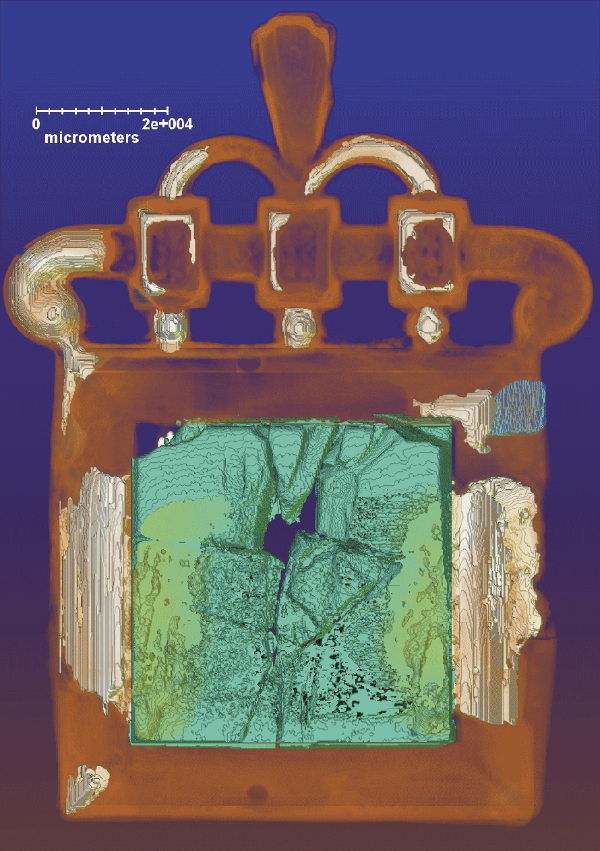
XRF imaging allows scientists at Los Alamos National Laboratory to map the precise location of different materials inside delicate artifacts.

“The technology that we have been developing at Los Alamos and wanted to use for this project is confocal micro X-ray fluorescence (XRF). That’s kind of a mouthful,” Patterson laughs. “But what that means is, we can hit the sample with an X-ray… and it identifies the elements and where they are located.”

This technology is not available anywhere else in the world; in fact, one machine used in this project was built at LANL. It’s especially apt for this type of study, because whereas other dating techniques require samples of the small, delicate artifacts, which would damage them, XRF technology is able to study the artifacts without damage. This technique for determining the artifacts’ chemical composition effectively dates them, confirming that they date back to around 1540. The traces of copper detected are indicative of the smelting techniques of the time period.

By combining this XRF technology with other analytical techniques to study these objects, the LANL team produced high-resolution 3D images showing the interior of the archaeological finds. In other words, they’ve helped the Coronado historians look below the fragile surface to explore these objects from the inside out. This technology is so precise,
“we can image moderately sized material in 3D all the way down to very high resolution, where a human hair is actually too big,” Patterson says.
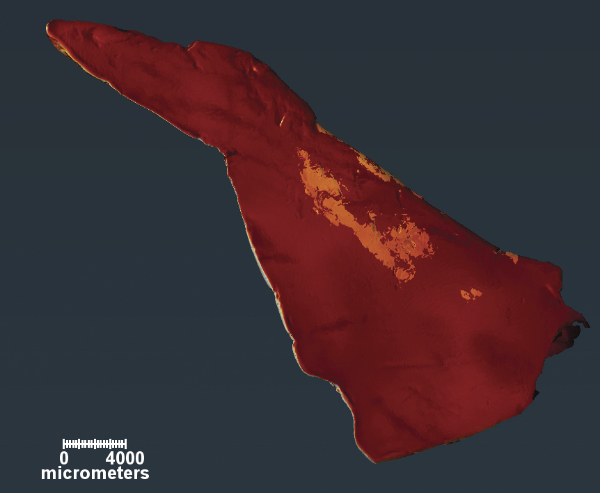
XRF imaging maps the location of different materials inside an arrowhead found at Coronado Historic Site.

The material makeup of these artifacts could help historians understand the story that has been buried under Bernalillo soil for centuries. The technology has already helped the Coronado team definitively date one of their finds: The materials found in the crossbow head allowed scientists to confirm its chronological and geographical origins. In an email interview, Mathers writes, “With respect to the copper crossbow quarrel, the results we received were entirely in line with our a priori expectations: that is, the object was nearly pure copper and consistent with XRF analyses undertaken on other copper objects known from both the Vázquez de Coronado entrada, and other sixteenth-century expeditions elsewhere in North America.”

By using this technology, LANL chemists can break down each object’s ingredients. The Coronado archaeologists are then able to begin interpreting the lab’s results as a kind of chronological recipe, linking the materials to a corresponding timeline. Each recovered weapon and tool helps these historians piece together the story of European conquests, raids, and attacks in what is now the Southwestern United States. 

Mathers can see the utility in continuing to share expertise and technology between historians and chemists. “Further collaboration between experts in physical and social sciences, of the kind represented in this research,” he says, “might help to move XRF and other analytical tools into more commonplace archaeological applications.”

Photographs courtesy Los Alamos National Laboratory.

Hannah Sherk is an English teacher, writer, and editor living in Portland, Oregon. She attended St. John’s College in Santa Fe before finishing her B.A. in sociology and anthropology in North Carolina. 
Hannah Sherk (opens in a new tab) is an English teacher, writer, and editor living in Portland, Oregon. She attended St. John’s College in Santa Fe before finishing her BA in sociology and anthropology in North Carolina.
This Old House

By Paul Weideman

Santa Fe’s history lives in its buildings— in the places where people lived, worked, played, studied and worshipped during the past several centuries.

Many of the buildings are wonderful in themselves; as examples of adobe construction, for instance. And in both the buildings and their people, we realize the importance of historic preservation.

One esteemed survivor is the Otero-Bergere House on Grant Avenue. It was built by the U.S. Army in the 1870s as an officers’ residence. In 1901 it was the home of Alfred Maurice Bergere, an English immigrant, Santa Fe merchant, and county clerk. His wife, Eloisa Luna Otero-Bergere, the sister of Territorial Governor Miguel Otero, purchased it in 1905 for $270.

The house remained in the family until the 1965 death of Otero’s daughter, the intrepid suffragist Adelina “Nina” Otero-Warren. A member of the Luna family of Los Lunas, she also served as Santa Fe County’s superintendent of public schools, chaired the New Mexico Board of Health, and penned the book Old Spain in Our Southwest. Today, the house is the Georgia O’Keeffe Museum Research Center.

This is one of nearly 100 buildings and other historic features profiled in the new, fifth edition of Old Santa Fe Today. Published by Museum of New Mexico Press in association with the Historic Santa Fe Foundation, the book is 288 pages, with 255 photographs. Originally published in 1966, it was last updated to its fourth edition in 1991. (Full disclosure: The author of this article also contributed an essay to the newest edition of the book.)

Most of the featured properties were built as houses, dating back as far as the early 1700s. Many are still used as residences; those in other uses include the Rafael Borrego House, now the restaurant Geronimo; the “Oldest House,” long a tourist attraction; El Delirio (the Amelia Elizabeth and Martha Root White House), now the home of the School for Advanced Research; and the James L. Johnson House (El Zaguán), now the home of the Historic Santa Fe Foundation.

Another thirty or so of the entries are nonresidential and wide-ranging. There’s the venerable Palace of the Governors, the New Mexico Supreme Court, San Miguel Chapel, Fairview Cemetery, the restored 1894 Hydroelectric Power Plant, La Fonda, El Puente de los Hidalgos, and St. Catherine Indian School.

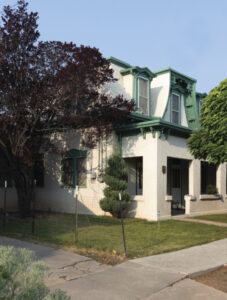
The Hesch House is a rare example of the French Second Empire Style in Santa Fe, influenced by Archbishop Lamy. Photograph by Simone Frances, 2020.

“This book brings it all together for the reader or for a tourist or someone walking through the neighborhoods,” Audra Bellmore, who wrote the text for the book, says. “Not only can they see the sites individually, but they can see them as part of neighborhoods and as part of streetscapes and get a sense of the historic scapes that are still viable in Santa Fe. The book is an accessible and useable way to maneuver through those historic districts in Santa Fe.” Touring the properties is made easier with a series of neighborhood maps by Deborah Reade Design. “What we tried to bring out with each property was the story—not just who lived in it and when, but why these stories might have meaning and significance.”

Bellmore, a Michigan native, came to the University of New Mexico sixteen years ago. She is an associate professor in the Center for Southwest Research and Special Collections, curator of the John Gaw Meem Archives of Southwestern Architecture, and adjunct professor in the Museum Studies Program. She holds a doctorate in history from Loyola University.

Her work on Old Santa Fe Today amounted to a total rewrite. “History evolves, and some things weren’t correct. The Palace of the Governors and the Center for Southwest Research were our primary research sites, and they simply have more collections than they had back then.

“I also wanted to standardize the entries, instead of having some entries written in 1962, some in the 1970s, and some in the 1980s, with different styles. They all have an introduction and tell that historical story of who lived there at what time, but they also talk about the look, the architecture, and also if I could find information that represented the streetscape or the neighborhood. Then to finally pull it all together with a significant statement like you might see in a national or state register nomination—like, ‘So what? Why is this important?’”

Bellmore already knew a lot about Santa Fe’s architecture, including the many buildings by John Gaw Meem, because of her work at the Meem Archives. But this book project resulted in a broader knowledge of the different styles represented in Santa Fe. “And the history of Santa Fe is similar to the history of many towns in New Mexico, so in a way it’s been a model for me to learn about many communities.”

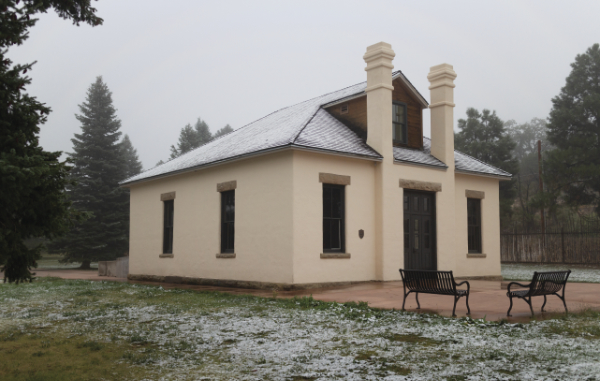
Hydroelectric Power Plant in the snow. This structure and grounds are owned by the City of Santa Fe and have been restored to the 1905 appearance. The plant is the center of a public park and water history museum. Photograph by Simone Frances, 2020.

For her research, she had easy access to the substantial Meem Archives at UNM, but the pandemic had closed the Palace of the Governors Photo Archives and History Library. “I also could have found great information in the city files on properties, but they were also closed. It was a very tricky time. Some people didn’t want anyone to come inside their homes, or even into their courtyards.”

Simone Frances, who photographed nearly eighty of the properties for the new book, writes in an email, “Overall, property owners and managers were incredibly generous and open to assisting in facilitating this project despite the complications of Covid-19 concerns and precautions.

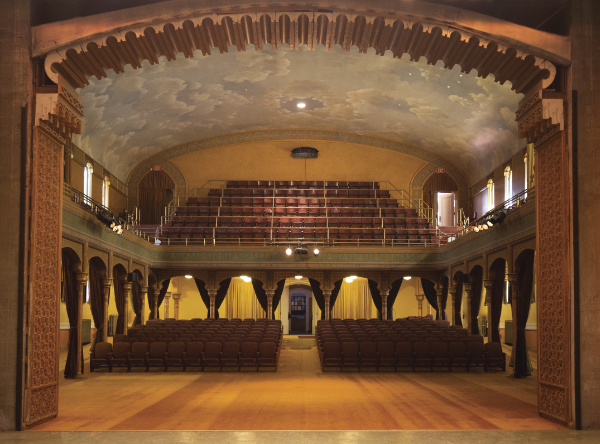
“Carl Beale of Randall Davey House Audubon Center & Sanctuary was especially kind as I was shooting while on crutches after breaking my ankle photographing houses in Kansas a couple weeks earlier. John Adams of the Scottish Rite Temple was a wealth of knowledge and very accommodating, which resulted in some great long exposure images of the theatre.”

Frances is a writer and architectural photographer based in Santa Fe and in coastal Maine. She earned her BFA in photography from the College of Santa Fe and her MFA in photography at UNM, and she was a fellow at the Center for Southwest Research and Special Collections. Since 2011, she has worked for photographer Anna Strickland, a master printer and longtime professor at the Rhode Island School of Design. Frances is at work on her second photography book, No Is A Place, “a collection of architectural photography centered around museum, performance, and other exhibitionary spaces,” she writes.

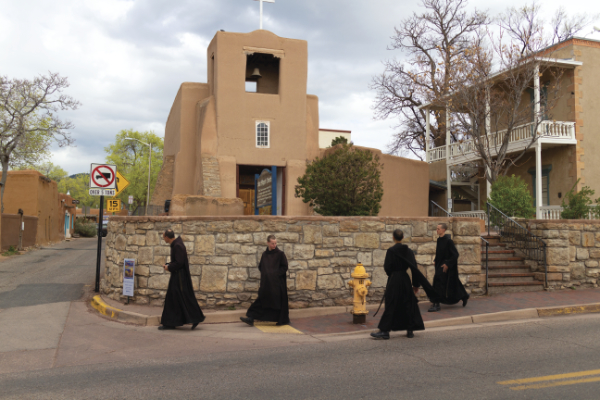
The San Miguel chapel, originally built in the 1620s, is considered the oldest church in the United States. Photograph by Simone Frances, 2020.

Her photos for Old Santa Fe Today include one of San Miguel Chapel with a quartet of long-robed Franciscans walking in front of the edifice. Also striking, “the Cyrus McCormick house [Las Acequias] in Nambé was one of my favorites, because the property is stunning and the light was orange that day and I could hear peacocks in the trees,” she recalls.

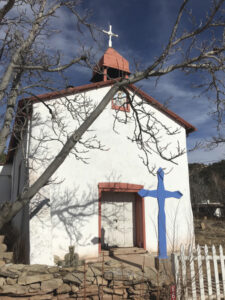
The Nuestra Señora de Luz façade features a small window set in the front gable and a bell canopy topped with a cross. Photograph by Melanie McWhorter, 2020.

Some of the book’s entries are longer, with at least four photos rather than one or two. “Simone kind of got free rein to shoot what she wanted to shoot,” says Melanie McWhorter. “I facilitated connections with owners. And we asked the owners to be there with her to let her know that certain things—maybe a significant pottery collection shouldn’t be photographed; and if there were important historic features, we asked them to point those out to Simone.”

McWhorter, deputy director at the Historic Santa Fe Foundation, zeroed in on Frances because of her photography connections. In her business, Melanie McWhorter Photography Consulting, she works with clients on photo-book projects. A dozen of Old Santa Fe Today’s photos are by McWhorter. Her color photos and those by Frances contrast with more than eighty historic black-and-white images.

Finding Bellmore was serendipitous for McWhorter, who was the Foundation’s primary organizer of the book project. Bellmore brought her UNM students to El Zaguán one day for a class she was teaching in the Museum Studies Department, looking at historic sites in Santa Fe and Taos. “Melanie gave all my students copies of the old Old Santa Fe Today, and I said, ‘That’s really nice, but you really need to update this book,’” Bellmore says.

The Francisca Hinojos House interior, remodeled after a fire in 2013. Photograph by Simone Frances, 2020.

“I raised my eyebrows,” McWhorter recalls, “because our board of directors had talked about doing just that for a long time. So I asked Audra, ‘Would you consider writing it for us?’”

The book’s new edition got started in November 2018, when the Historic Santa Fe Foundation’s director, Peter Warzel, and McWhorter got a go-ahead from Museum of New Mexico Press.

Funding was achieved in 2020 with donations from about fifty individuals and businesses, and grants from the Historical Society of New Mexico and from the National Endowment for the Humanities via the New Mexico Community Foundation.

The new book is more than twice as large as the previous edition from 1991. Significant additions include El Delirio, Church of the Holy Faith, Marian Hall, La Fonda, New Mexico Museum of Art, St. Catherine Indian School, the Scottish Rite Center, and the Laboratory of Anthropology Director’s Residence.

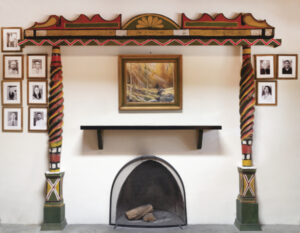
A fireplace, framed by carved columns, adds warmth to the Billiard House at El Delirio. Photograph by Simone Frances, 2020.

There are also eleven entries from the old version that aren’t in this one, among them the Cathedral Basilica of St. Francis of Assisi, the Santa Fe Plaza, Cristo Rey Church, and the Santuario de Guadalupe, due to not being included in the HSFF register. That register, which HSFF began in 1962, lists historic buildings (and larger features like the Acequia Madre and Fairview Cemetery) that are researched and receive HSFF plaques inscribed, “Register of Properties Worthy of Preservation.”

“For the new edition of Old Santa Fe Today, we decided to focus just on the register properties,” Warzel says.

The Scottish Rite Temple’s 80-foot stage with its 404-seat theater and ninety-seven backdrops featuring thirty-seven scenes. Photograph by Simone Frances, 2020.

Longtime HSFF board members Alan “Mac” Watson and Nancy Owen Lewis reviewed every entry for the book. “I’m really proud of this. It was a really great team effort,” says McWhorter. She adds that the foundation is planning an Old Santa Fe Today app, aided by a state grant.

From November 4-28, 2022, El Zaguán hosts an Old Santa Fe Today exhibition. Check in at historicsantafe.org to find out about associated activities.

Old Santa Fe Today, 5th ed., by Audra Bellmore (Museum of New Mexico Press, 2022). Photographs courtesy of the publisher.

Paul Weideman has written about archaeology, historic preservation, architecture, real estate, art, and culture for The Santa Fe New Mexican and other publications for thirty years. He is the author of the 2019 book ARCHITECTURE Santa Fe: A Guidebook.

Paul Weideman has written about archaeology, historic preservation, architecture, real estate, art, and culture for The Santa Fe New Mexican and other publications for thirty years. He is the author of the 2019 book ARCHITECTURE Santa Fe: A Guidebook.

Simone Frances is a writer and architectural photographer based in Santa Fe, and coastal Maine. Frances received her BFA in photography in 2004 from the College of Santa Fe. After a long career as an antique photographic printer, Frances took her master’s in photography from the University of New Mexico in 2019, where she was a teacher of photography. Exhibiting locally and nationally, she has received awards and honors, such as the SITE Santa Fe Site Scholar, SOMA Mexico City Fellowship, the Fred M. Calkins Award, the Phyllis Muth Scholarship for Fine Arts, and the John L. Knight Award. Frances served as the Pictorial Fellow at the Center for Southwest Research and Special Collections from 2017 to 2019.

Embroidering the Canon

By Emily Withnall

When an eclectic scattering of artists across the United States began pushing the boundaries of what photography could be in the 1960s and ’70s, they did not collectively name themselves. Organizing their movement would have been the antithesis of what they were trying to do. Though it is impossible to fully capture the range of approaches each artist took in creating their work, they were each trying to challenge the idea that photography was a window into reality. To these iconoclastic artists, photography was full of possibility, but it was not static or sacred.

The New Mexico Museum of Art exhibition Transgressions and Amplifications: Mixed-media Photography of the 1960s and 1970s (on view through January 8, 2023) features many of the artists who pushed to expand the boundaries of what photography could be. To provide historical context, Museum of Art Curator of Photography Katherine Ware includes a comparison of a 1931 photograph by Edward Weston with a 1972 piece by Betty Hahn to help viewers better understand the rules later artists sought to break.

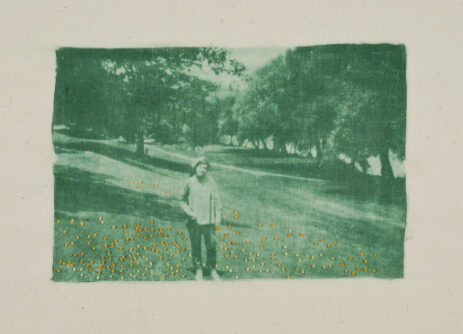
Betty Hahn, Untitled (Barbara, Genesee Park), 1971. Gum bichromate print on fabric with thread. 8 ¾ x 13 3/ 8 in. Collection of the New Mexico Museum of Art. Gift of Charles McClelland, 1991 (1991.69.1). © Betty Hahn. Photograph by Blair Clark.
Betty Hahn, Untitled (Barbara, Genesee Park), 1971. Gum bichromate print on fabric with thread. 8 ¾ x 13 3/ 8 in. Collection of the New Mexico Museum of Art. Gift of Charles McClelland, 1991 (1991.69.1). ©Betty Hahn. Photograph by Blair Clark.

In a portrait of his great-grandfather by Van Deren Coke, a brightly lit outline of a bust can be seen against a black background. The figure’s hair is wavy and the bust is fractured, like an image of clay with pieces coming off in chunks, leaving dark holes behind. The black background also appears to be crumbling and is set against a larger sepia-toned background. Light seeps from the seams where black and sepia collide.

“He photographed this tiny ambrotype of his great-grandfather then printed it as a photogravure,” says Ware. “He is making a new work of art about an old photograph, referring back to that history but commenting on it.”

Where an ambrotype is a positive photograph on glass, a photogravure is not usually considered to be photography, because the film negative is not developed in a darkroom. Instead, the negative is transferred directly onto a copper plate, where the image is engraved with ink. By combining these techniques and subverting the idea of what a portrait can be, Van Deren Coke was, like many of the other photographers in the exhibition, interested in stretching the definition of what counted as photography and how it operates.

Some artists created photography without a camera, and instead used early versions of Xerox machines, or manipulated found photos, among other techniques. Ware says for most of the featured artists, proving that photography could be severed from cameras wasn’t a specific aim. However, one artist, Thomas Barrow, who graduated from the Institute of Design in Chicago, was very interested in this question.

In Barrow’s Discrete Multivariate Analysis, a gelatin silver print photogram (a photograph made without a camera), a diptych overwhelms the viewer with numerous images that appear like film negatives of various items like screws, the repeated outline of a pedestrian “stop” hand signal, mechanical instructions, a shower head, and a shadow of a person illuminated along a staircase, alongside numerous other inscrutable images.

“Barrow was particularly sophisticated in playing with photo history and the question of, ‘How far can I push this?’” says Ware. “There’s another piece by him in the show that refers to nineteenth-century stereographs and he dares to tint the print pink, just to see if he can get away with it.”

Many of the artists in the exhibition viewed a photo as an object unto itself. The physical photo was as integral to their art as the subjects or meanings framed within the photo. Artists marked, pierced, tore, crumpled, or otherwise used and challenged the fine art world’s notion of the photograph as inherently truthful or sacred.

“The transgression is that the fine-art print was considered this pristine thing everyone has to wear gloves to handle,” says Ware. “But these artists added old photo processes, used ink, wrote and sewed on their prints. Most of them are unique objects rather than something that can be reproduced from a negative.”

Photographer Betty Hahn painted on her photos, applied Xeroxed images to fabric, and embroidered photographs. In her photo printed onto fabric, Barbara, Gennesse Park, a woman stands in a knoll of trees. The woman, grass, trees, and sky are all various shades of green. Raised knots of thread add color and texture to the photograph, appearing like small flowers in the field.

Hahn and other women artists stretching the limits of photography worked to incorporate craft and skills that were often considered to be “women’s work” into their art. Ware says the women photographers working in these varied mediums in the 1960s weren’t always a part of the women’s movement because they were often too busy teaching, making art, and running households. Nevertheless, in addition to raising children and caring for their homes, they made art that addressed the female experience and the changing roles of women in society, as well as questioning the ways photography, in particular, was understood.

One photographic predecessor to these iconoclasts was Alfred Stieglitz. His photo series of clouds and of Georgia O’Keeffe asked viewers to engage with the photographs emotionally and to see the multifaceted nature of any subject rather than one fixed image. But where photographers like Adams and Stieglitz were concerned with precision and camera technique, the artists of the 1960s and 1970s wanted to go further.

“This generation comes along and asks, ‘Why can’t it be in color? And why is it just pictures of one thing? And how do you express what it’s like to be a parent or in love in a single frame?’” says Ware.

At the time these artists were working, photography was still relegated to the edges of the fine art world. Where art broadly acts to break norms and push boundaries, Ware says a tension exists between art as transgressive and fine art as a categorization that maintains the status quo. The iconoclasts of the ’60s and ’70s wanted to challenge the gatekeeping that was occurring in the fine art world, and especially where photography was concerned.

“They all saw The Family of Man at the MoMA and admired the work, but they wanted to do something different,” says Ware, referencing the 1955 exhibition of global solidarity following World War II that featured hundreds of photographers.

In the Museum of Art exhibition, viewers can compare Edward Weston’s realistic gelatin silver print of a cabbage leaf with Betty Hahn’s image, Lettuce. Hahn’s photo is a green-tinted gum bichromate print on fabric. Lines in the lettuce leaf are embroidered in black and white. Unlike Weston’s photo, Hahn has blurred the detail of the leaf and instead calls the viewer’s attention to the thread.

Hahn was among a small group of photographers who came to New Mexico to teach and continue their work in the 1970s. When Van Deren Coke arrived at the University of New Mexico to found the art museum there in 1962, fellow iconoclasts Betty Hahn and Tom Barrow soon followed. Though some enclaves existed in Albuquerque (as well as in Rochester, New York; Bloomington, Indiana; and Gainesville, Florida), Ware says the artists were not a cohesive group overall.

The women artists of that time were often overlooked or further marginalized within their own boundary-breaking non-movement.

“Bea Nettles studied with some traditional teachers who felt that her subject matter about women and families was not appropriate for art,” says Ware. “And they literally locked her out of the darkroom, so she found other techniques and methods for producing her work.”

Joyce Neimanas, married to fellow iconoclast artist Robert Heineken, is known for her early work in digital imaging, but prior to that she pushed the boundaries in a variety of ways including using stills from adult videos. Several of her works in the show explore women’s sexuality.

“She incorporated texts from the Kinsey report in some of her pictures,” says Ware. “She was very interested in media and found photography and so she was doing screen grabs of anonymous bodies, then handwriting words from the report and giving the pictures very clinical titles.”

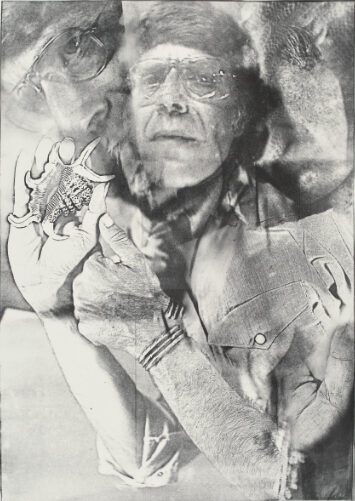
Joan Lyons, Untitled (Nathan Lyons), 1974. Offset lithograph from a Haloid Xerox transfer. 21 ¾ × 15 ½ in. Collection of the New Mexico Museum of Art. Jane Reese Williams Collection, Museum acquisition through the New Mexico Council on Photography, 1988 (1988.367.24). © Joan Lyons. Photograph by Blair Clark.
Joan Lyons, Untitled (Nathan Lyons), 1974. Offset lithograph from a Haloid Xerox transfer. 21 ¾ × 15 ½ in. Collection of the New Mexico Museum of Art. Jane Reese Williams Collection, Museum acquisition through the New Mexico Council on Photography, 1988 (1988.367.24). ©Joan Lyons. Photograph by Blair Clark.

Likewise, Joan Lyons, who was married to photographer, curator, and teacher Nathan Lyons, benefited from a shared creative milieu, though her work was somewhat overshadowed. She worked extensively with early Xerox machines to create personal photographs based on her experiences. For Lyons, Hahn, Nettles, Neimanas, and other women artists, being overlooked or relegated to small women’s shows was commonplace, though they were always glad for opportunities to share their work.

Ware points to the ’60s and ’70s as being a period of flux and huge cultural shifts in the United States, and much of those shifts infused the transgressive photography these artists were making, whether they were actively a part of social movements or not. “There’s some commentary in the work that is arguably oblique to viewers now,” says Ware. “But the adventurous spirit and sense of a disordered world comes through clearly in many of the pieces.”

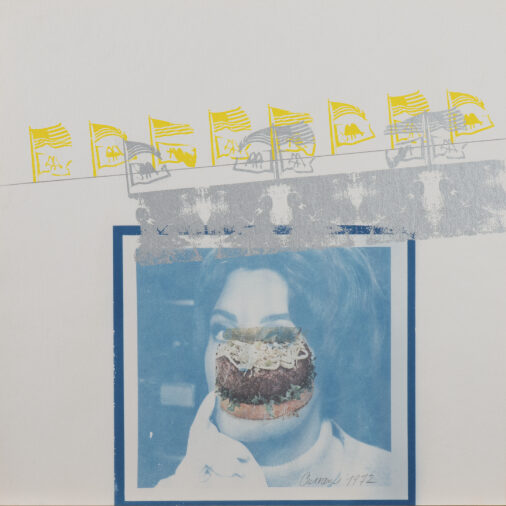
In one such photo, Darryl Curran’s Nutrition Temple Series #14, a magazine-appropriated portrait of a woman is overlaid with an image of a hamburger that obliterates most of her face except for her eyes, forehead, and shiny coiffed hair. Two different screen prints with repeating patterns are stamped above the photo—one of gray cow noses sprouting flag poles with McDonalds and American flags, and another yellow print above it with additional McDonalds and American flags.

Darryl Curran, Nutrition Temple Series #14, 1972. Screen print with solvent transfer and applied ink. 15 × 15 in. Collection of the New Mexico Museum of Art. Gift of Darryl Curran in memory of Carole Brieant, 2020 (2021.1.2). © Darryl Curran. Photogrpah by Cameron Gay.
Darryl Curran, Nutrition Temple Series #14, 1972. Screen print with solvent transfer and applied ink. 15 × 15 in. Collection of the New Mexico Museum of Art. Gift of Darryl Curran in memory of Carole Brieant, 2020 (2021.1.2). ©Darryl Curran. Photogrpah by Cameron Gay.

Because the majority of the artists in the exhibition created multi-media work, viewers might be inclined to wonder why they chose photography as a medium. Ware says it’s a question each artist would likely answer differently.

“I think they weren’t that interested in the question,” says Ware. “Their work doesn’t fit in a conceptual box, and they liked that.”

The etymology of “photography” is “to write with light”—a definition many of the artists of the 1960s and ’70s broke from. And while many often did not use a camera or light to create their work, others worked with older photographic methods to capture the light. One such method was the cyanotype, which allowed artists to create a negative on paper painted with photosensitive blue solution. In the 1800s, architects used cyanotypes to produce blueprints, but iconoclast Brian D. Taylor wanted to play with that historical lens in his own work.

In Taylor’s Labyrinth No. 5, a cyanotype reveals a zoomed-in view of walls, floors, and their seams. It is impossible to see the whole structure so viewers are left with simply the impression of geometric shapes. In an image with no clear focus, light pours from the lines where the walls and floor meet, suggesting that perhaps light is the subject.

“He’s using the architecture and the fact that the cyanotype wipes out details to make this very abstract composition,” says Ware. Of the group of artists as a whole, she adds: “They’re all over the place. That’s part of why they can’t be considered to be a defined movement.”

Although the exhibition primarily features artists from the 1960s and ’70s, Ware says she has included work by Lorna Simpson, whose work provides a more contemporary example of multimedia photography. In her diptych Back 1991, a portrait of the back of a Black woman’s head is paired with an actual black braid set in a square inside the wooden frame. Words in the center of the frame read: “eyes in the back of your head.”

“The question that really fascinates me is always—why did she need to add the braid, or why did he need to add the paint, or why did she need to add the handkerchief?” says Ware. “The photographs are crucial, but they’re reaching for something that they can’t say without the added elements. How do you reflect the experience of a feeling or a mental state?”

Making meaning of the photographs can sometimes be challenging. The artists were often less interested in portraying a subject and more interested in communicating varied emotions, perceptions, and realities. The images in the show are paired with descriptive and contextual labels, but many viewers may find themselves probing for meaning or asking where boundaries should be drawn when defining an artistic medium.

For Ware herself, this isn’t always an easy answer. Although she acknowledges the sophisticated tools digital cameras offer to the heirs of the iconoclasts in the exhibition, Ware points out that digital cameras use numbers to capture images—not light. In the context of an exhibition about transgressions, however, the question of whether digital photography counts as photography is overshadowed by a bigger question: What isn’t a photograph?

 “The message of the show is the fluidity of definitions and the requirements of expression,” says Ware. “People reach for the tools they need to say what they’re trying to say.”  

Emily Withnall lives and writes in Santa Fe, New Mexico. Her work can be read at emilywithnall.com.

Blair Clark is an illustrative photographer with over thirty years experience in studio and on-site photography and almost twenty-five years in museum photography.

Cameron Gay (opens in a new tab) is a professional photographer.

Emily Withnall (opens in a new tab) is the editor of El Palacio and the host of Encounter Culture. Prior to stepping into the editor role, she wrote for the magazine for eight years. Emily has also been published in The New York Times, Al Jazeera, High Country News, Orion Magazine, Tin House, The Kenyon Review, Gay Magazine, Source New Mexico, and other publications. She lives and writes in Santa Fe, New Mexico.

Clay Community

By Almah LaVon Rice

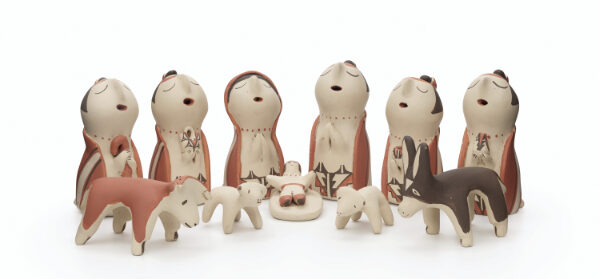
Their heads are tilted back, casting praise skyward. Eyes closed to everything but rapture, their mouths are OOO’d in song or supplication. Six clay figures—Mary, Joseph, the shepherd, and three wise men—arc around five smaller figures: a donkey, cow, two sheep, and in the center, Baby Jesus in a manger. This ca. 1982 Nativity set made by renowned Walatowa/Jemez potter Mary Elizabeth Toya invokes the humble, earthen place where the divine Son rose; in this work the ground under the feet is shaped and enshrined as ceramic art—immanence and transcendence are one.

Mary Elizabeth Toya (Jemez), nativity set, ca. 1982. Clay and paint. Courtesy School for Advanced Research: SAR.2010-2-34A-K. Photograph by Peter Gabriel.

Kathleen Wall, Toya’s niece and a formidable ceramicist in her own right, writes of the cultural syncretism: “My Auntie Mary was a medicine woman in the Fire Society and a very active participant in both Catholicism and tribal practices.” Wall is one of the sixty community curators charged with selecting and writing about more than 100 historic and contemporary works in clay for the traveling exhibition, Grounded in Clay: The Spirit of Pueblo Pottery. The exhibition opened on July 31 in unceded Tewa territory at the Museum of Indian Arts and Culture in O’gah’poh geh Owingeh (Santa Fe) before it closes on May 29, 2023, then travels across Turtle Island next year.

Grounded in Clay is drawn from the respective Pueblo pottery collections of the Vilcek Foundation in New York and the Indian Arts Research Center of the School for Advanced Research in Santa Fe. But perhaps the spiraled, coiled heart of the exhibition is the Pueblo Pottery Collective. This group curated Grounded in Clay, andis comprised of more than sixty individual potters, writers, museum professionals, and community leaders from all nineteen Rio Grande Pueblos in New Mexico, in addition to Hopi (Arizona) and Ysleta del Sur (West Texas) communities. (The collective also includes a few non-Pueblo museum professionals.) Each member—from former Tesuque Pueblo Governor Mark Mitchell to fashion designer Loren Aragon (Acoma)—was invited to select one or two works from the aforementioned Pueblo pottery collections, then write a catalog entry describing why they chose the work(s), with oral history recording as well as editorial and transcription support available if desired. While open-ended prompts were on offer, the community curators could write about their chosen pieces as they wished. That freedom contributed to fright, at least for Wall.

“To me, [writing is] terrifying,” admits the 2020 recipient of the MIAC’s Native Treasures Living Treasure award. “It’s so daunting.” Her initial approach was to be “analytical,” until she realized that “I didn’t want anything like that. To talk about Pueblo pottery, I need something that I had a really strong connection to.” That “something” ended up being pottery sprung from the hands and imagination of the women within her lineage. “Auntie Mary is the second-oldest of my aunts, [who] all contribute to our work as a family collective,” Wall says. That flesh-and-blood resonance cracked open her writing process. Much of Wall’s current work in clay is in conversation with storyteller figurines made by Pueblo artists in New Mexico in general, and her family in particular. The clay figurine, with an open mouth meant to signify spilling stories, is surrounded by listeners eager for each drop; in every iteration, smaller figurines—children, animals, et al.—swarm the storyteller. Toya’s nativity scene was created within this clay storyteller tradition, and as Wall explains, “It was almost like a homecoming piece for me, because those were my beginnings; that storyteller body. I learned how to make everything I do—that it came from that one shape. And so it was very natural for me to want to talk about it; I had a lot to say about it.”

However, this intimate connection was also a source of inner conflict for Wall, who didn’t want to be “biased,” as she calls it. “I was trying not to typically pick my aunt or my mom or a cousin, because I wanted to be open and I wanted to learn,” continues Wall. But then she decided that Grounded in Clay called for drawing upon those intracommunal relationships and insider expertise. “This isn’t the time to learn about something so much as to share what I knew.”

Although not all curators chose works to which they were familially connected, MIAC’s Curator of Collections Patrick Cruz also selected an artwork linked to his direct ancestry. “I was really surprised that they actually had a pot from my great-grandmother,” he says. “Not too many places have I actually seen her pottery.” The pottery in question is the ca. 1940 painted clay jar by Gregorita Cruz of Ohkay Owingeh Pueblo. Patrick Cruz, who boasts a background in archaeology and creating micaceous pottery, was responsible for receiving the objects for Grounded in Clay in addition to other logistical and back-end duties. Such a role especially positioned him to recognize that Pueblo potters are not monolithic. “This is a unique exhibit in that we have something like sixty artists and people from the different Pueblo communities that are involved in this project. That’s different than most exhibits,” he explains. “You get more of a broad perspective of the different Pueblos … a much broader inclusion of all the different groups. Again, it’s different from the idea of having a curator that tries to put together one story, and [Grounded in Clay has] sixty small stories being told.” 

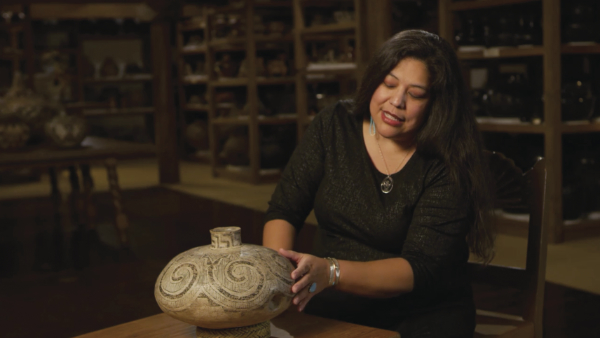
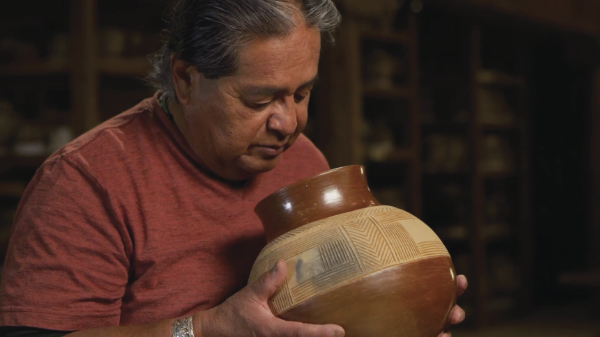
Tara Gatewood (Isleta) discusses her choice of pottery in the video portion of the Grounded in Clay exhibition, directed by Adam Shaening-Pokrasso.

Indian Arts Research Center Director Elysia Poon echoes the sentiment that single-story curation has its limitations. “Historically, a lot of museums rely on curators to hold the vast majority of the knowledge of the objects within a museum collection. And it’s not a sustainable way to transfer knowledge. Single people can’t be expected to know everything, especially looking at Native communities, and specifically Pueblo communities where oftentimes knowledge is held across the community and not with one or two people,” says Poon, whose museum career began twenty-three years ago. “My background is in museum education, and I always felt like, as museums, we could do a much better job in connecting community and museums together.”

The community-driven curatorial approach evidenced in Grounded in Clay also sets it apart from other treatments of Pueblo pottery: Within this particular exhibition, the works in clay are not relegated to mere historical relics, ethnographic curiosities, or reflections of Western conceptions of fine art. “Especially over the last ten years, we’ve been really trying to privilege community knowledge and make sure that people understand that that is the knowledge that we privilege within our own collections,” says Poon. “It’s an incredibly rich way to learn about the collections in a very different way that … Western kind of methodology would expect to find within the museum collection.”

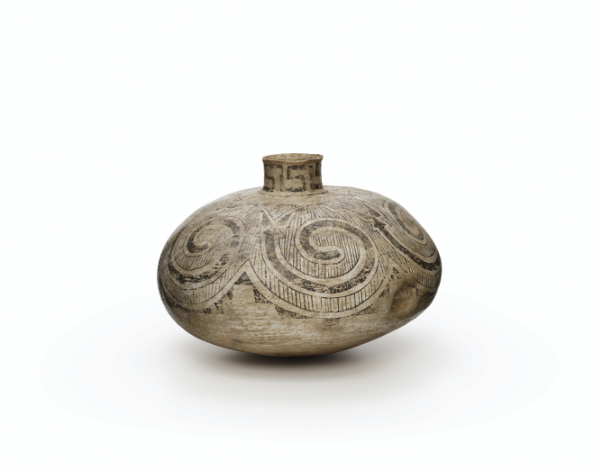
Mogollon jar, ca. 1100-1300. Clay and paint. 8 ¼ × 17 ¾ in. Courtesy Vilcek Collection: 1997.03.01. Photograph by Peter Gabriel.

This exhibition is IARC’s first, while also being a 100th-anniversary celebration of the birth of SAR’s Indian Arts Research Center’s pottery collection, which started as the Pueblo Pottery Fund in 1922. Grounded in Clay is just one manifestation of SAR’s expressed commitment to collaboration that is accountable to Native communities. In 2012, a group of tribal and non-tribal museum professionals, cultural leaders, and artists started convening to develop SAR’s Guidelines for Collaboration. Not intended as mandates, the Guidelines (online at guidelinesforcollaboration.info) instead “offer principles and considerations for building successful collaborations,” according to the site. Poon states that the Guidelines are navigational tools for both institutions and communities alike: “It was a collaborative effort between a number of institutions and led by SAR to really encourage other institutions to work better with communities that they serve and to also assist communities to how to navigate the their way through what is a very complicated museum system—in a way to form better relationships, because museums, at the heart, are educational institutions.”

Clarence Cruz (Ohkay Owingeh), uncle of Patrick Cruz, discusses his choice of pottery in the video portion of the Grounded in Clay exhibition, directed by Adam Shaening-Pokrasso.

A living, ever-changing document, the Guidelines continue to extend their impact and influence throughout multiple institutional networks and community contexts. Institutions such as the Metropolitan Museum of Art, Chicago’s Field Museum, and the Getty Conservation Institute, among many others, have made use of this groundbreaking resource. Explains Poon: “From the Guidelines for Collaboration, there’s a two-part extension that happened. One is Grounded in Clay, which is the public-facing and practical application of all these years of methodology building that we’ve been doing. … We’re also expanding the guidelines and working with the American Alliance of Museums and other institutions, and especially those that work with Native collections heavily, to develop what we’re calling the Core Standards for Museums with Native American Collections. While the Guidelines primarily focus on collections and conservation and that type of work, the CSMNAC is really focused on creating more equal relationships between community and museums across all areas of museum work. And that includes facilities, organizational structure, human resources, risk management, all of that.”

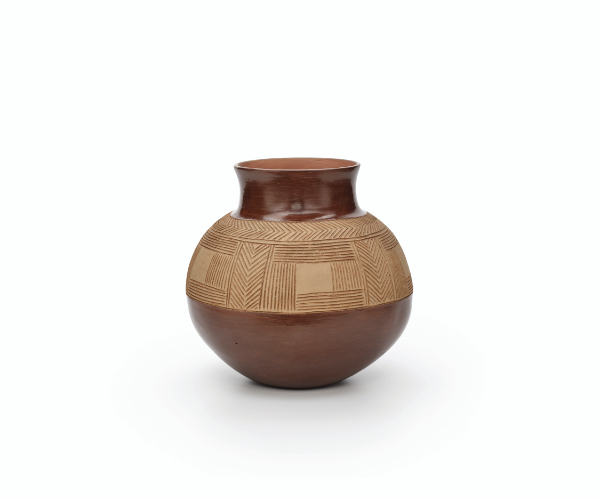
Veronica C. Cruz (Ohkay Owingeh), jar, 1938. Clay and paint. 10 × 10 ¼ in. Courtesy School for Advanced Research: IAF.2122. Photograph by Peter Gabriel.

It all comes down to home and heritage for Kathleen Wall, but without being reductive or flattening. When asked how she experienced being part of a community-curated exhibition, she says, “I’m very used to living in a community setting; I live on the reservation. So we have a great deal of family and friends and close relatives, distant relatives, that we all navigate these relationships with when living in this community setting. So it wasn’t far from my grasp to enjoy the experience. When you’re involved with so many different personalities and viewpoints—and the thing about Pueblo pottery is it connects us all. … Although we all have our own experiences, we all have our own differences, our own upbringing.”

In the end, Grounded in Clay: The Spirit of Pueblo Pottery is an exhibition, yes, but it is also itself a vessel for holding the multiplicity, the infinity of stories of Pueblo individuals and their communities—all told in clay.   

Former New Mexico resident Almah LaVon Rice is a Pittsburgh-based writer at work on her first book. You can find more of her writing at AlmahLaVonRice.com.

Adam Shaening-Pokrasso is an artist based in Santa Fe.

Almah LaVon (opens in a new tab) (they/them) is a writer and fairy marsh monster living in Dionde:gâ. They write creative nonfiction and short fiction engaging unfettered Black imagination and dreaming a new world many-petaled. Almah is a recipient of the Exposure Artists Program First-Time Grantee Award from The Pittsburgh Foundation.They were selected for the global Orange Tangent Study grant in 2022. They were awarded the 2022 Fable Grant, an initiative led by New York Times-bestselling author Adrienne Young.

Hunting Miss Deuel

By James E. Snead

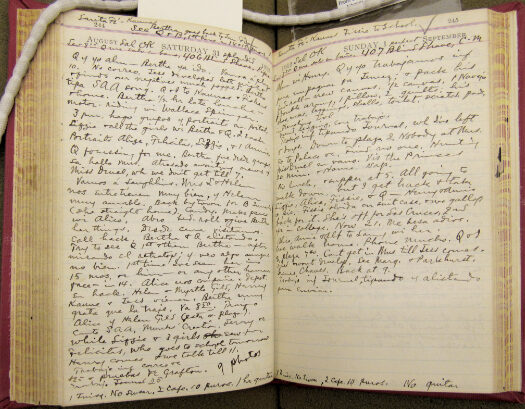
On September 1, 1912, Charles Fletcher Lummis—author, “anthropologist,” and impresario of the American West—made a note in his diary. “Hunting Miss Deuel,” he wrote; “en vano.”

Lummis coded his journals in what might today be called “Spanglish,” and this particular scribble referred to Elizabeth Deuel, whom he had met two weeks previously. Deuel was a new student at the School of American Archaeology in Santa Fe, and Lummis one of the leaders of the institution. His use of “hunting” was literal—trying to find her, as she repaired pottery behind the scenes at the Museum of New Mexico—but also metaphorical, with visceral implications unfortunately recognizable to women in anthropology today.

Detail from Lummis Journal, September 1, 1912, where Lummis comments on "Hunting Miss Deuel” (right page, a third of the way down). Courtesy Autry Museum of the American West.
Detail from Lummis Journal, September 1, 1912, where Lummis comments on “Hunting Miss Deuel” (right page, a third of the way down). Courtesy Autry Museum of the American West.

Anthropologists must reckon with the past, and currently the most important of these “pasts” to be reconsidered is our own. Mistreatment of Indigenous peoples, disregard for the communities we should serve, neglect of the collections we hold in trust—all are topics of vigorous debate. The issue of sexual harassment is particularly charged. “No one should have to endure harassment to be able to do the work they love,” notes Stanford’s Barbara Voss, even while documenting that such malign circumstances are widespread.

Unearthing stories of sexual harassment in the history of anthropology is a challenging proposition. Our archives are incomplete and were haphazardly assembled. Most are associated with institutions, and thus men, increasing the difficulty. Personal reticence about sexual matters and other cultural codes makes it tricky to interpret any evidence that does come to light. Authors must also worry about offending gatekeepers—senior colleagues, institutional representatives—in ways that might inhibit future work. The risk of inflicting pain on survivors and families is always near.

Yet telling these stories is essential. Individual experiences are important in themselves, but they also provide threads linking the past to the present conversation. Megan Steffan’s account of the 1931 rape and murder of anthropology student Henrietta Schmerling has attracted considerable attention, exposing a “hidden” story of the field as well as decades of obfuscation and denial.

But to tell a story, it must first be found. The vast majority of women who hoped to become anthropologists in the nineteenth and twentieth centuries were prevented from doing so. We don’t know their names, and by definition most of their lives fall outside our frame of reference. Fragments of narrative are dispersed in files hundreds of miles apart, with few keys to make the connection. And yet they are there, waiting for those links to be made, for a voice to suddenly be heard across the generations.

And one of those stories—one of those voices that anthropologists decided not to hear more than a century ago—is that of Elizabeth Deuel.

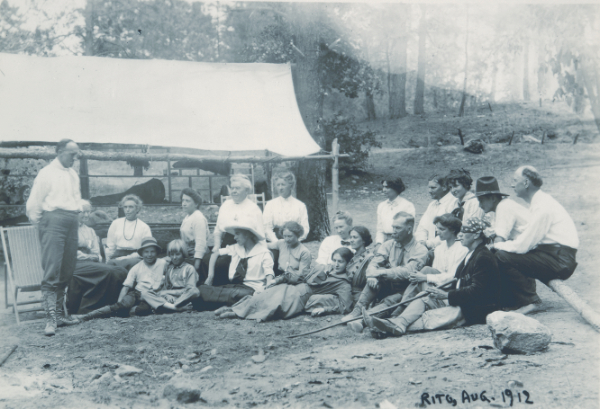
The 1912 Summer Session at the Rito de los Frijoles. Included here are Edgar Lee Hewett (standing, at left) and Charles Lummis (seated, with bandana and cigar, third from right). It is probable that Elizabeth Deuel is the woman seated to his right, next to School patron Frank Springer. Courtesy Autry Museum of the American West.

Elizabeth Deuel and the School of American Archaeology

Elizabeth Ham Deuel was born in 1880 to a middle-class family in Dutchess County, New York. As a young adult she attended Middlebury College and the University of Missouri, subsequently working as a teacher. In later correspondence she described herself as restless, writing in a 1913 letter that she liked “to feel the current of life and rush along with it.” One summer, Deuel took a train west to Pasadena to visit her widowed mother, making a touristic stop along the way that accidentally brought her into the new world of American anthropology.

The big event in Santa Fe in August 1912 was the School of American Archaeology’s “Summer Session.” The school was an outpost of the Archaeological Institute of America, intended to provide field training for aspiring students. Under the leadership of Edgar Lee Hewett, however, it quickly evolved into a more public-oriented institution. The Summer Session provided lectures, demonstrations, and field trips to a wide audience, attracting visitors from long distances.

The “personals” column in The Santa Fe New Mexican for August 8 of that year indicated that “Miss E. Deuel of Concord, N.H., is stopping here for a few days on her way to the coast.” The array of cultural events quickly drew her in. On the surface, the School’s programs seemed particularly welcoming to women. Women of the Santa Fe elite funded Hewett’s endeavors: Their daughters participated in the excursions and they hosted receptions in the state museum. Teachers were also involved, such as Maude Hancock, a graduate of the New Mexico Normal School, who attended the Summer Session before taking up her classroom duties in Alamogordo.

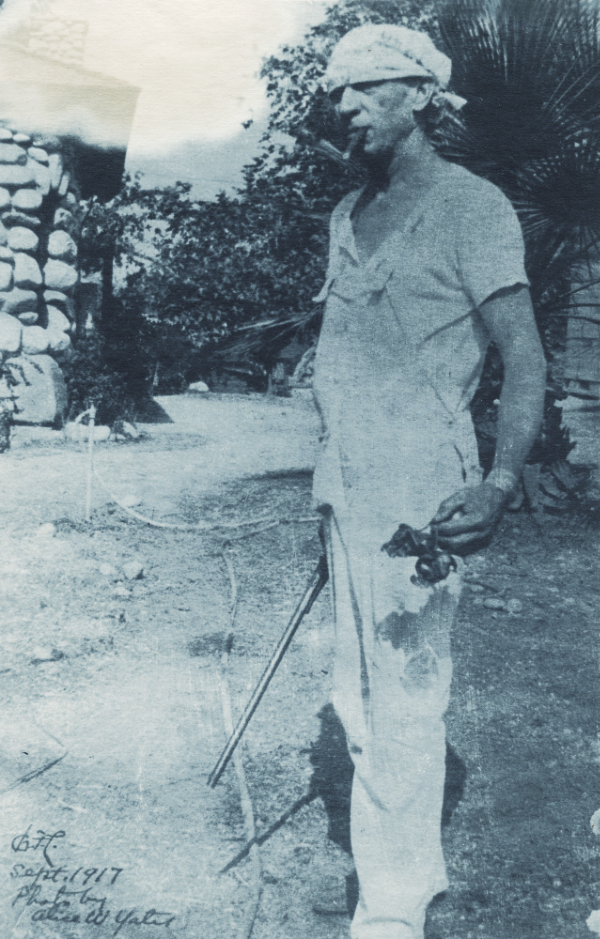
It is likely that Deuel was in the audience on August 12 for a presentation anticipated by many as the highlight of the Summer Session’s schedule. On stage was Charles Lummis, a familiar presence in Santa Fe, probably dressed in his notorious corduroy suit. He wore a kerchief around his eyes and was said to be blind as a result of a tropical disease. The New England native had spent thirty years in the Southwest serving as a reporter, writer, magazine editor, and “booster.” This particular event featured his own guitar playing and the live recording of Native American songs. During the evening, according to his diary, “not a soul moves.”

Lummis projected an eccentric persona that masked an ego-driven promoter bent on establishing dominance over those closest to him. While a professor at Harvard, he seduced his student Dorothea Rhodes. In the course of their marriage, she negotiated her husband’s capricious cruelty even while becoming one of the first woman doctors in Los Angeles. In 1891, she was discarded for a younger woman, Eve Douglas, who seems to have been perceived as more compliant. Not surprisingly, this marriage was also marked by infidelity and turbulence. The couple separated only after the birth of four children, with agonizing divorce proceedings marked, among other things, by feigned health crises. The patron Phoebe Hearst, who regretted supporting his projects, saw through the act. “Of course Lummis’s ‘blindness’ was a fake,” she wrote to Eve in 1911, “like everything else he does!”

A few days after Lummis’s Santa Fe performance, the Summer Session moved 20 miles west to a camp along the Rito de los Frijoles, in what is now Bandelier National Monument. Students slept in tents and were fed by Ida Mae Abbott who, with her husband, ran a small ranch in the valley. Lummis and other veterans occupied cliffside “caves” that were part of the ancestral Tewa and Keres villages being excavated under the auspices of the School, largely with Native American labor. Days were spent inspecting the work, with evenings devoted to lectures around a campfire.

Deuel’s account of the Summer Session has not been found, but her name first appears in Lummis’s diary on August 23. Thereafter he jotted down references to her on an almost daily basis. His divorce from Eve had been finalized only a few months earlier, and he was clearly making plans. When the Summer Session ended, Lummis moved on to more fieldwork in the nearby Jemez Mountains, and then to his home in Los Angeles, but his mind was as much on Deuel as on any of his other projects.

For her part, Deuel, to the probable surprise of her family, decided to stay in Santa Fe. She was drawn into a circle of young Santa Fe women associated with the School—Ruth Laughlin, Kate Muller, Amelia McFie—all of whom faced their own opportunities and challenges with anthropology. Deuel devoted the fall of 1912 to study and work in the museum, and made plans to build a house. It is apparent that she preferred anthropology and the Southwest to the narrower opportunities she faced as a teacher back in New Hampshire.

Despite these apparently promising circumstances, however, Deuel remained peripheral to School projects-in-progress. One potential mentor, Barbara Freire-Marrecco, passed through Santa Fe only briefly and the two had no opportunity to establish a relationship. Hewett traveled constantly and was unavailable. The staff member most reliably present was John Peabody Harrington, who already had a significant reputation as an anthropological linguist but had little responsibility for School affairs. Deuel was prevented from assisting in fieldwork because no female companion could be recruited. A proposed expedition to the Yucatan, where she would join Sylvanus Morley and his wife, Alice Williams Morley, generated excitement, but it also fell through.

The neglect of Deuel by the School’s leaders had the unfortunate effect of convincing her to turn to Lummis. She clearly sought a mentor: her letters address him as “cacique,” a term of respect in Pueblo communities, and one that Lummis embraced. His letters to her, however, were from the start intended to cultivate a more personal relationship. When she suggested that they were a bit too “forward,” he responded that it was her “own fault. You should not make anyone wish to write you so.” She clearly understood such tactics, and this disappointment added to the realization that there was no place for her in Santa Fe, after all.

Elizabeth Deuel and the University of Chicago

Dismayed by the attentions of Lummis, and disappointed with the School, Deuel still did not give up on anthropology. At Hewett’s suggestion, she applied to the University of Chicago to study under Frederick Starr. To be as prepared as possible, however, she decided to conduct a little research on her own, visiting to the Pueblo of Zuni in the spring of 1913 to learn about the Zuni language. She thus joined the increasingly long list of outsiders intruding into the Zuni community for their own benefit, and Deuel’s letters demonstrate that she shared prejudices about Native Americans expressed by most of her contemporaries. But Deuel responded positively to the people she met. One boy taught her to make “string figures,” and she was pleased when another described her as “crazy like a butterfly.”

While at Zuni, Deuel also worked through her conflicted feelings about Lummis. Alone on a snowy day, fighting a cold and sitting in front of a “little old ’dobe fireplace,” she perceived the situation somewhat differently than she had a few months before in Santa Fe. In the field on March 13, 1913, she wrote him, “… one comes at last to realize something of life and its meaning… So, Señor, I am ready at least to think about ‘graduating into life’”

Lummis seized the moment and dispatched a profession of love. He sketched an artistic vision of their married life to come—what he referred to as their “Blend.” “I can invite you only to poverty,” he wrote from California on March 19. “But never starve for fodder, & you would never go hungry for Love.” But he would not come to her, pleading unavoidable obligations. Whether or not her vision of the future matched what she was reading, Deuel sought resolution, and took a train west.

Deuel only stayed in California for five days. She caught up with her mother in Pasadena, but also spent considerable time with Lummis at his eclectic house, “El Alisal” (The Sycamore), apparently discussing the future. It was not a successful conversation. “I allowed the person in question to see me…” she wrote a friend in an undated letter. “This did not improve matters.”

Another letter, written after the visit, clarifies—to Lummis himself—what happened at El Alisal.

I’ve tried to write you before but the memory of the brutal way you kissed me has left me still as stunned and wordless as that Saturday afternoon.

How could you do it? You are unusual in the fineness and delicacies of your feelings and in expressing them. When you stroke my hair and call me ‘bird’ I come very close to loving you. But when you kiss me like a vulture it leaves me sick with loathing…

Somehow it has spoiled everything.

Lummis’s diary recorded the event succinctly on April 5, 1913: “Robo un beso”—“stole a kiss.”

By this time the spring term at Chicago was underway, and Deuel found her “preparation” at the School to be prophetic. Starr put her to work organizing Asian ethnographic collections but provided no formal guidance, showing the same lack of interest that had characterized her Santa Fe experience. Her account of a classroom episode, sent in a letter to Lummis in June 1913, indicates—albeit in a humorous vein—how Starr’s perspectives on women shaped his relationships with his students.

Oh, Joy! Professor Starr almost asphyxiated himself after class today. It all began about woman suffrage. After expressing his view that woman should have the ballot as means of defence [sic] he went on to say that if she continues on her mad career of competing with men then the race will tend toward extinction. His face turned purple and he wailed pathetically. ‘Let them try it I say, let them try it’ he was still wailing as I fled down the stairs and into the open.”

For his part, Starr included Deuel’s name in his “daily record book” only twice, with minimal detail. She also sought opportunities at the Field Museum, and at first circumstances seemed more promising there. But the only substantive offer was for her to help cataloging “some wealthy man’s collection” with no meaningful implications. By early summer it was apparent that Chicago, just like Santa Fe, offered nothing in the way of substantive engagement with anthropology. Illness prevented her from taking the end-of-term exams, and, while she got passing grades, there is no evidence that Deuel ever returned to the University of Chicago or was awarded a degree.

Elizabeth Deuel in Southern California

While Deuel was knocking on doors in Chicago, Lummis was rearranging his household at El Alisal. He kept a punishing schedule, working late and sleeping little, a routine supported by a series of live-in secretaries. He preferred to hire young, unattached women, often of fragile social status and without family nearby. They were provided room and board, assisted with other household tasks, and were expected to be available throughout the night, long after everyone else had retired.

Lillian Gildersleeve, ca. 1911. Courtesy Autry Museum of the American West.

Correspondence from Lummis’s files make it clear that some of his secretaries were also sexual partners. He relied on the vulnerability of these women to public censure and scandal for their “cooperation.” In 1913 his secretary was Lillian Gildersleeve, a young woman from Santa Fe with whom he also had a sexual relationship. Eventually she proposed marriage in a letter on July 8, 1913:

Regardless of those stupid laws of society that give a woman the alternative of—marrying whoever asks her—and—remaining a fruitless, good-for-nix parasite all of her days, I offer myself to be your wife.

Even while Gildersleeve was composing this humiliating request, however, Lummis was recruiting Deuel for the same position. They had resumed correspondence in the late spring: Deuel seems to have been motivated by loneliness in Chicago and disappointment at the lack of opportunity there. “Deuel reverses & recants,” notes Lummis’s diary for May 31. The tone of her letters written that summer ranged from pensive to flirtatious. He responded by listing the characteristics he found desirable in a spouse, emphasizing the importance of children. Unless a woman felt the “Mother instinct,” he admonished, “…she never makes the right wife.”

harles Lummis at El Alisal, Los Angeles, California, 1917. Photograph by Alice W. Yates. Courtesy the Palace of the Governors Photo Archives (NMHM/DCA), neg. no. 065709.
Charles Lummis at El Alisal, Los Angeles, California, 1917. Photograph by Alice W. Yates. Courtesy the Palace of the Governors Photo Archives (NMHM/DCA), neg. no. 065709.

After the Chicago debacle, Deuel spent four months recuperating at her sister’s home in New Hampshire. But she would eventually have to return to southern California to see her mother—and reckon with Lummis. California also harbored the one other male anthropologist who she considered a friend: John Peabody Harrington. Harrington had returned to his home state with thousands of pages of notes and several unfinished projects. Deuel sympathized with his professional challenges, and the two exchanged Santa Fe gossip. It seems that this was one relationship established at the School that she hoped to maintain.

In the fall of 1913, Deuel’s view of the future was obscured by Lummis, and her letters to him became more direct. She was candid about her dislike of his drinking, her concern about where she stood with his children, and his sexual aggression. If they should meet to discuss personal matters, she warned, “…you must promise me that you will not, in any way, shape, or manner, make love to me unless I say you may. I can not endure it. … I tell you frankly that I have no intention of marrying you … Spinsters are so much freer…!”

In the meantime, confidential inquiries were being circulated about whether or not Lummis’s home was “a fit place for a young woman.” Lummis learned of this via the rejected Lillian Gildersleeve, who had returned to New Mexico but remained an ally. “You know,” she wrote, “…that I have never divulged a thing you would not have known,” pledging to “stand by you through thick and thin,” although she did not reveal the source of the inquiries. 

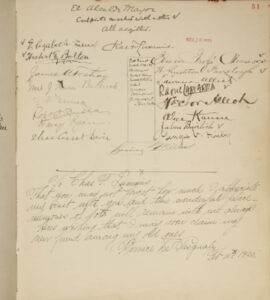
Deuel returned to California on November 24 and immediately re-entered the charged environment of El Alisal. Lummis, in his diary, described her as “muy rejiga”—rebellious. But he intended to complete the seduction. In addition to his formidable charisma, he planned a dramatic display of power and influence via an event nicknamed “El Alcalde Mayor.” These semi-regular festivities, named after the ancient tree that had given El Alisal its name, reinforced Lummis’s alliances among the elite of California.

The Lummis Housebook for the evening of November 30, 1913, illustrates the “seating chart” for El Alcalde Mayor. Courtesy Autry Museum of the American West.

This particular El Alcalde Mayor took place on November 30, 1913. Deuel sat at Lummis’s right hand. Joining them around the table were politicians, cultural celebrities, and academics, including renowned borderlands historian Herbert Bolton, former State Senator Robert Nelson Bulla, and cellist Elsa von Grofe-Menasco. Also present was the superintendent of the city’s schools. The seat of the hostess was occupied by Louise Miller, who had succeeded Gildersleeve as secretary. Thus Deuel was introduced to the community in which, as Lummis’s wife, she would play a distinctive role, although ambiguous as to how her interests in anthropology might be accommodated.

Deuel did not, however, respond as Lummis would have anticipated, and the change in her perspective was dramatic. “You may be surprised that I went to that house,” she wrote Harrington two weeks after El Alcalde Mayor, “…but I did. I went on a quixotic errand which I fear will be fruitless and which has earned me his hatred and malice forever. But I prefer that to the opposite emotions.” A subsequent letter described the outcome of this encounter.

At present I am very happy for my errand at Mr. L’s was not fruitless. On the contrary that unspeakable man will lose a wife and a secretary at the same time. I believe he had so fascinated the girl that she would have married him. But all illusions concerning him have left her forever more…       

Why God permits such a creature to exist I cannot understand.

Deuel had clearly discovered evidence of Lummis’s predatory behavior. Perhaps she was speaking of herself in the letter, as the fascinated girl. But the specifics of the account suggest that her concern was directed toward other, more vulnerable women in the house. These would have included the young Alice Kaune, daughter of Santa Fe friends, who had been visiting El Alisal for some weeks. Deuel would have met the Kaune family in 1912, and was perhaps aware of some circumstance that alerted her to the risk.

Shortly afterwards, Deuel returned Lummis’s letters, and never communicated with him again.

Lummis was unfazed. Literally within hours of Deuel’s departure he rekindled an affair with a former secretary, Gertrude Redit, who had the misfortune of becoming his third wife in 1915. Kaune returned to Santa Fe, but she was not the last occupant of El Alisal to receive unwanted attention from its owner. That Lummis kept Deuel’s letters, despite the insights they provide into these circumstances, says a great deal about his fundamental narcissism.

For her part, Elizabeth Deuel persisted. She remained in southern California, at first living with her mother in Pasadena. She kept in touch with Harrington; at his advice, Deuel took typing lessons, in part because the skill was useful for research assistants. Harrington’s peripatetic fieldwork led him to the Colorado River in the Spring of 1914, where he was documenting the Mojave language. Deuel saw the opportunity. “It would really be worth coming,” she wrote him, “…if you would dare to do it. … Could you use me?” He must have assented, since on June 1 she arrived at Needles, California, ready to get to work.
The twist of fate that followed seems particularly cruel, since even as Deuel was disembarking from the train Harrington came down with typhoid fever. Technically he was still working for Hewett, so Harrington sent him a pathetic cable imploring rescue. But Deuel was first on the scene, realized the seriousness of the situation, and dispatched Harrington back to his family. “I have thought of many little things I might have done to make your journey more comfortable,” she wrote two days later, on June 4. “I trust the porter made down your berth for you at once and found you a drinking cup.”

Hewett arrived on the scene a few days later. Although he must have been aware of the details, he exaggerated his own role without mentioning Deuel, claiming that he had picked up Harrington at Needles himself. Harrington’s convalescence lasted several months, during which his various patrons implored him to return to work.

Meanwhile, Deuel was left on the Colorado River on her own, with minimal instructions. After some hesitation, she “invested in a small camera and a broad brimmed hat and crossed the river” to visit the community where Harrington had been working. She wrote to him on June 11:

As you prophesied I like the Mohave people very much and, as usual, I like the old women best. This afternoon I have spent out in the wheat field with three of [them]… I have helped to pick the wheat, heads, trample them out and winnow them. During this they taught me various Mohave words.

Flooding made conditions difficult, however, and soon Deuel found it necessary to return home. She visited Harrington later in the summer, and the two corresponded about ethnographic topics into 1915. But when he finally returned to the field, Deuel was not involved.

It is not coincidental that 1915 was also the year that Harrington met Carobeth Tucker, a student of anthropology enrolled in a class he taught at the Panama-Pacific Exposition in San Diego. She resembled Deuel in her eagerness for deeper participation in her mentor’s projects, but within a few months had also established a closer emotional and physical relationship with him. Harrington quickly put her to work. “I am keeping very busy with Taos and the typewriting,” she wrote him on September 15 of that year. “The verbs are going to be almost as interesting though perhaps not so complicated as the pronouns.”

This sequence of events makes it clear that Harrington sought—in the words Deuel used for Lummis—“a wife and a secretary at the same time.” He married Tucker in 1916, and her 1975 autobiography Encounter with an Angry God (as Carobeth Laird) describes these circumstances with devastating clarity. Her history is a reflection of what might have been for Deuel. But by avoiding a life of penury and exploitation by Harrington, Deuel also left her final “opportunity” in anthropology behind.

These circumstances were made doubly clear in a letter sent back in the fall of 1912, when both Deuel and Harrington were working in Santa Fe. To a friend, Harrington fretted over the state of his notes, but anticipated assistance: “This typist will probably be a young woman from Illinois named Deuel,” he wrote, with relief. “She is employed at present mending cliff dweller pottery[.] … Hewett told me … that he has made her typist and stenographer for the school and that she will typewrite … for me.” That this arrangement was unknown to Deuel, who at the time was anticipating a more substantive assignment, makes Harrington’s offhand remark particularly infuriating.

Incredibly, however, Deuel continued to search for a career in which she could find meaning. She worked for a few years in the new Museum of History, Science, and Art of Los Angeles. But when the curator left in the wake of a scandal, Deuel found herself at odds with the museum administration, and was fired. That she considered taking legal action against the museum, as she made clear in letters from fall 1917, is an indication of her increasing frustration with the situation. Afterwards she turned to magazine writing, but was not particularly successful.

 One discovery that Deuel did make in Los Angeles was a partner: Mary N. Dubois (or Du Bois), who she described as “an art critic in this city.” Within a few months the two were sharing quarters. They lived together for thirty years thereafter, first in Pasadena and then in San Luis Obispo County, where they are buried under the same headstone in the Arroyo Grande Cemetery. 

Whether the relationship between Deuel and Dubois was a “Boston marriage” or something different remains impossible to define. The language used by Deuel in her previous correspondence could be interpreted as providing insight into her sexuality. One of her rejections of Lummis’s advances characterizes her resistance. “It isn’t because it’s you,” she wrote in February 1913.

It’s simply that I’m not a man’s woman I guess. I always astonished when a stray masculine being comes along and mistakes me for one[.] … There’s a queer little kink in my makeup to which you appeal rather powerfully but that kink doesn’t happen to be the ruling element.”

Coda

Elizabeth Deuel wrote with disarming clarity, something evident in the letters dispersed through various archives. But that we know little about her beyond these words inevitably affects our perceptions. Critically, we have no correspondence between Deuel and other women, which means that we see her through the veil of engagement with men. These letters demonstrate skill at code shifting, an obvious survival strategy for an ecology in which she had little power. But however we interpret her inner life, the archival record for her experiences with anthropologists can hardly be clearer.

One among many additional ironies is that Deuel’s younger brother, Thorne Deuel, actually had a career as an anthropologist. He studied with Frans Boas at Columbia and eventually served as the director of the Illinois State Museum. The two Deuels had been close: The influence of Elizabeth in her brother’s choice of career and subsequent pathways taken can only be surmised, as well as her personal reaction to his success in an endeavor that she also pursued.

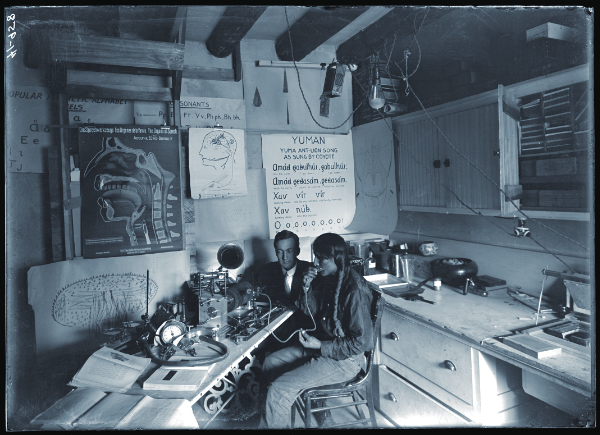
J. P. Harrington and Tewa man (perhaps Julian Martinez?) recording speech in the Language Room in the Palace of the Governors, Santa Fe, New Mexico, ca. 1909-1910. Courtesy the Palace of the Governors Photo Archives (NMHM/DCA), neg. no. 088417.

Deuel’s story tells us that sexual politics, including harassment, must be understood as part of the deep structure of the discipline of anthropology. It also indicates that evidence for such behavior is indeed preserved in our records. Whether or not this dismal legacy is useful for those who are addressing harassment in the modern context, the similarity of the words and deeds of Lummis and others in this story with the reported actions of many in the current era are not surprising.

The focus of attention, however, should be on Elizabeth Deuel, and the impact of overt and covert harassment on her desire to become an anthropologist. “At present,” she wrote Harrington on December 14, 1913, “I am at a standstill as it seems necessary to play accompaniments to other people’s lives and to let my own wait a bit.”

That wait, it turned out—at least in the context of anthropology—was forever.
 —

James E. Snead is professor of anthropology at California State University, Northridge. A 1980 graduate of Santa Fe High School, he is an archaeologist and historian with diverse interests concerning the U.S. Southwest.

A Century of Antics Onstage and Off

by Jennifer Levin

Art Olivas drove a friend to Santa Fe Community Theater and sat in the audience, watching the hopefuls take their turns. He wasn’t there to audition, but the director asked him to read anyway. This was in 1979, and though Olivas doesn’t remember what the play was, he ended up in it.

“I’d never been on a stage. It could’ve been the melodrama—I was in it that year,” says the former photo archivist at New Mexico History Museum. Olivas, 73, took small roles after that for about a decade, stepping into a great Santa Fe tradition begun by the author Mary Hunter Austin in 1922.

Today’s Santa Fe Playhouse was first known as the Santa Fe Players. In the hundred years since its founding, the theater has survived a slew of charismatic leaders, a world war, a pandemic, and approximately ninety-nine Fiesta Melodramas.

Amateur and professional theater groups pop up regularly in Santa Fe. With some notable exceptions, most fold in three to five years. The second-oldest group in town, Teatro Paraguas, is eighteen years old. In people years, the Playhouse could be its great-grandmother. In this cutthroat town, how and why has it endured to celebrate its centennial?

Fundamentally, it’s because the Playhouse owns its own space, while most groups must rent a stage to produce a show. But what makes its longevity all the more astonishing is that, for most of its history, the Santa Fe Playhouse was run by volunteers. In the twentieth century, it was squarely a community theater. The great contemporary debate is whether it still is.

Today, the Playhouse pays creatives for their time. The theater is run by a small staff, which includes a part-time marketing and communications manager—a role I accepted after writing about local theater for the Santa Fe New Mexican for many years. Working at the Playhouse, I found that no official written history exists. So, I’ve attempted to piece one together. But what follows is just a start, because this story could fill a book. 

Anticorporate origins

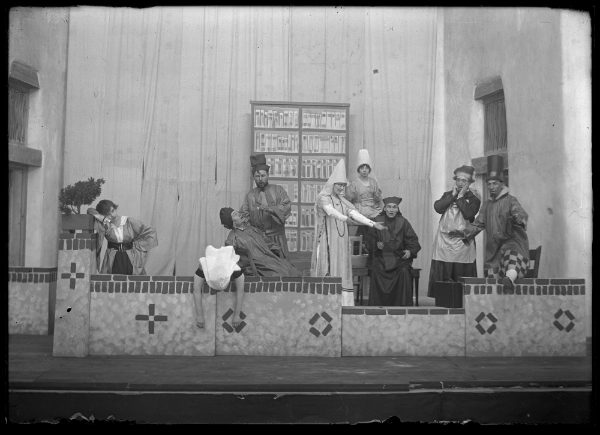
The first production of the Santa Fe Players was Anatole France’s The Man Who Married a Dumb Wife on Valentine’s Day in 1919, presented in the St. Francis Auditorium at what was then called the Museum of Fine Arts. It was directed by Mary Hunter Austin, a social activist and author of Indigenous themes who’d relocated to Santa Fe from California the year before. Austin belonged to a group of white transplants who had a lasting influence on Santa Fe culture, including artist Will Shuster, poet Witter Bynner, and architect John Gaw Meem.

“The Man who Married a Dumb Wife,” Santa Fe Community Theater, St. Francis Auditorium, Santa Fe, New Mexico, 1919. Photograph by Wesley Bradfield. Courtesy Palace of the Governors Photo Archives (NMHM/DCA), neg. no.099833.

“Mary Austin’s objective was to do international, national, and local plays that mattered, that would get the community involved and start a conversation,” says Kent Kirkpatrick, president of Santa Fe Playhouse’s Board of Trustees.

Austin was inspired by the Little Theater Movement, a national effort to combat corporate control of most U.S. venues, which booked traveling shows with mass-market appeal. The Little Theater Movement called for greater artistic exploration and was promoted by the likes of Nobel-winning playwright Eugene O’Neill, a founding member of the Provincetown Players. Austin and her group incorporated in 1922, the same year they produced Santa Fe’s first Fiesta Melodrama, The Sorcerers of Nambe. It was directed by J.D. DeHuff, then superintendent of Santa Fe Indian School, with sets by renowned painter Gerald Cassidy.

The Santa Fe Indian Market began during the same Fiesta, held against the backdrop of the DeVargas Pageant (also known as the Entrada) that re-enacted the “peaceful reconquest” of Santa Fe in 1693, after Spanish colonists were driven out by the 1680 Pueblo Revolt. Fiesta emphasized what were considered Santa Fe’s three distinct cultures—Native American, Hispanic, and Anglo-American—supposedly living in harmony. Fiesta was one of many tourism initiatives designed as a pathway to statehood for New Mexico, as was the tri-cultural identity—but it wasn’t all that accurate.

“Despite the rhetoric of social tolerance, and despite the unifying image provided by the ubiquitous adobe-colored stucco, the myth of Santa Fe obscures long-standing cultural and class frictions,” Chris Wilson writes in The Myth of Santa Fe, published in 1997.

Former Playhouse Board President Kelly Huertas says the Santa Fe Players probably held the first melodrama “because they thought they could sell tickets. I don’t think they intended to insert themselves into the tri-culture controversy.”

But that’s exactly what they did. Since 1922, a Santa Fe Fiesta Melodrama has been performed almost every year. The jokes usually twist on cultural differences, and it’s all supposed to be in good fun. Despite their embrace of local customs and people, the white Santa Fe Players displayed the same clueless racism that was common in America at the time. An undated photo housed in the New Mexico History Museum Photo Archives shows Will Shuster, Witter Bynner, and their friends performing a minstrel show in blackface. 

Barebones theater

Plays in the first half of the twentieth century included A Night Wind, directed by Witter Bynner, in 1931; The Ninth Guest, written by Owen Davis and directed by Mel Marshal in 1939 at Harrington Junior High School (which closed in 1976 and was replaced with Capshaw Middle School); and Eugene O’Neill’s Anna Christie, directed by Dave Hyatt and performed at a mysterious location called only “Loretto Hall” in January 1941. The Legend of Dallas Lee, written and directed by Judy Warner, ran for three days in May 1955 at St. Michael’s College Playhouse—a barn that predated the Greer Garson Theater at what would later be called the College of Santa Fe. New generations of Players kept the group going, at some point changing the name to Santa Fe Little Theater and then to Santa Fe Community Theater.

We know the group went dark for a few years during World War II. They performed in school auditoriums and on makeshift stages in empty lots, often staging the Fiesta Melodrama at the Rodeo Grounds. Once, sometime in the 1950s, they held it in an empty hotel swimming pool, with the audience gazing down upon the actors. In 1961, they wrote the Fiesta Melodrama in-house for the first time, instead of adding Santa Fe references to an existing script. It’s been written in-house ever since, the writers kept anonymous to protect them from public backlash. 

The itinerant theater group also staged small productions at Three Cities of Spain Restaurant on Canyon Road (where Geronimo is today). “I lived next to the restaurant, and the two men who ran that were talking about getting a building,” says Bob Sinn, who acted in productions from the 1960s onward. He joined the board in 1991 after retiring from a career in social work. He served as part-time managing director for several years, an all-consuming job for which he was paid $350 a month.

The restaurant owners, Bob Garrison and David Munn, might have been among the original buyers of the Santa Fe Playhouse, but the names on that long-ago deed are lost to history. A picture taken when the theater opened in 1962 shows Anabel Haas, Robert Jerkins and Joe Paull (who were a couple), Dorothy Best Donnelly, and Thomas A. Donnelly outside the front doors of the nineteenth-century adobe on DeVargas Street.

The structure was built in the 1890s as a livery stable and later became an auto repair shop. It barely resembled a theater, but it was theirs. They sectioned off an area for the stage and carted in folding chairs. As time went on, they built a makeshift dressing room that rested against the back of the building, and erected a real stage—although a structurally important pole stood in the middle of it until at least the 1970s. A second pole, in the audience area, was removed in the late 1980s or early ’90s—no one remembers exactly when.

Jim McGiffin, a New York native who performed at the Playhouse for the first time as the villain in the 1979 Fiesta Melodrama, says the pole was definitely still on stage when he got there. “I remember swinging around it, pointing at people, and doing nasty, villain things.”

The heyday

Jean Moss in Talking With by Jane Martin, mid to late 1980s at Santa Fe Community Theater, directed by Susan McCosker. Courtesy Jean Moss.

Jean Moss moved to Santa Fe in 1972 from New York, where she’d intended to become an actress.

“But I didn’t do it. I was terrified of the extraordinary commitment that I had when I was working,” says the 81-year-old rare books dealer. “Theater is the closest thing I have to religion.”

In New Mexico, she auditioned for Santa Fe Community Theater’s production of Summer and Smoke, by Tennessee Williams. “I didn’t comb my hair or put on lipstick. I just ran down to the theater. I remember it was very quiet when I auditioned because no one had ever seen me before.”

She didn’t get the part, but director Cather MacCallum cast her as Sonya in Chekhov’s Uncle Vanya in 1974. Moss went back to New York for a few years soon after, but returned in 1980 and joined the community theater’s board. Moss recalls there being a few paid staffers in the 1980s, including an office administrator and a technical director, but everyone else worked for free.

In 1982, Moss directed Cake, which Witter Bynner wrote for the Players and published in 1926. Produced in honor of the theater’s sixtieth anniversary, the theater paid no royalties and received financial support from the Santa Fe-based Witter Bynner Foundation. Moss recalls that they paid no royalties when they did Chekhov plays, either, because they adapted their own scripts. She says the seasons were made up of classics, contemporary works, and musicals, as well as the epitome of community theater, the Fiesta Melodrama.

“That’s where a lot of people without theater experience got their start, and then they would become more involved. But the melodrama was always separate from everything else that was going on. It was its own thing.” 

The 1970s and ’80s were the heyday of the community theater movement, which was an evolution of the Little Theater Movement that relied on volunteer support. Like others of its ilk, Santa Fe’s was supported by dues-paying members. But membership dwindled over the decades, and soon the $25 annual dues didn’t stretch as far as they once had. Most of the people from this era have died, but one important name is Marion “Jinx” Junkin, who founded Jinx’s Magic Theater in 1968 and The Theater of Music in 1980, both in Santa Fe. Another is Marty Stone, who took a leadership role starting in the mid-1970s, and was known as “Mr. Theater.”

“He was a force of nature,” Olivas says of Stone. “He was the living embodiment of Zero Mostel as Bialystock in The Producers. He could talk you into anything.”

Stone convinced residents of the nearby retirement community to buy season subscriptions. He talked strangers on the street into auditioning for plays. He rescued seating from a synagogue dumpster and finally replaced the folding chairs in the audience. But his bookkeeping was sloppy—donation information was scribbled on scrap paper and unidentified receipts piled up in the box office. When he moved to California in the late ’80s, board upheaval followed and some of the core actors drifted away. Moss left the board at this time, though she continued to be involved for a few years, directing Uncle Vanya in the 1988-89 season.

McGiffin, the aforementioned pole-swinging villain, and his wife Carol met during the 1979 Fiesta Melodrama. They co-directed shows throughout the 1980s until starting their family, and remained involved from time to time. McGiffin, 73, last acted at the Playhouse in 2017 in The Normal Heart by Larry Kramer, directed by Duchess Dale. He also appeared in a video projection featured in that season’s adaptation of George Orwell’s 1984. McGiffin is a community theater devotee who says the Playhouse should remain what it always was. “The only thing they do now that’s like community theater is the melodrama. It’s too corporate now,” he says. And it doesn’t offer shows he wants to see. He prefers family-friendly musicals to “some play where two people ponder the possibilities.”

Asked what he’s referring to, he says, “I don’t want to see Waiting for Godot” (despite the Playhouse not having produced Beckett’s classic in any recent memory).

Moss disagrees. “I would love to see a great production of Waiting for Godot!”

The push for professionalism

Argos MacCallum arrived at the theater soon after Stone left. The Santa Fe Preparatory School graduate had been involved with other local theaters, including the Theatre of All Possibilities, before coming home to where he’d spent parts of his childhood watching his mother, Cather, run rehearsals. He began acting in and directing shows, and using his carpentry skills to improve the building. He joined the board. 

“They were involved in a huge renovation. They got rid of the pole in the audience, and the stage got raised,” says MacCallum, 70. “I did a lot of work on the remodel. I don’t remember who was president, but Rebecca Morgan was very instrumental at the time.” Morgan ran Southwest Children’s Theater and served on the Playhouse board for many years, and managed the Playhouse in the 2000s. She died in 2021, at age 69.

Catherine Owen moved to Santa Fe in 1993 to work for New Mexico Repertory Theater, but the Equity house (a theater employing talent from the Actors’ Equity Association) operating in the Armory for the Arts closed six months after she arrived. The board hired her in 1995 as the full-time managing director. They changed the name to Santa Fe Playhouse in 1997, in an effort to distance themselves from the stigma for uneven quality that had come to be associated with “community theater.”

Argos MacCallum was ambivalent about the name change, but says that as soon as they became the Santa Fe Playhouse, “ticket sales shot up.” He wanted to produce Spanish-language and bilingual theater, so he eventually left to found Teatro Paraguas. He remains a driving force in the Santa Fe theater scene, sitting on several boards and serving as ad-hoc advisor to anyone who seeks his counsel.

Sinn, 83, says he was invited to leave around the same time. “The theater fell on me after I retired. I thought I knew what my life was going to be, and then I got sucked into this. … Most of my memories are when we had community theater. The one thing we had was fun. That’s what held us together. And the mortgage. If you have to pay the mortgage every month, you might as well put on a play.”

During this era, directors included T. Kent Crider, Lucinda Marker, Janice Bonser, Richard Block, and Clara Soister. In the 1994-95 season, Crider directed an ambitious production of The Kentucky Cycle, by Robert Shenkkam, a Pulitzer Prize-winning series of nine one-act plays that required audiences to come back over two days.

“We found out later that the playwright was actually here in town when we were doing it, but he didn’t come see the play. You never know if they’re here or not,” said Sinn.

Owen, 63, admits that she and Sinn clashed. “He had a different focus of what he wanted to do, and he left. It was hard. I felt bad about it. But I had things that had to get done.”

She says changing the name was not about abandoning the theater’s origins, but about looking to the future. “Community theater is the hardest theater you can do. You work on little to no money, mostly volunteers. It was hard for community theaters to keep going, but those that did survive became playhouses, like the Pasadena Playhouse. I felt it would be a natural transition. It would help me grow the theater, and I knew the artistic quality could be better because we have the talent here.”

The Santa Fe Playhouse did away with its membership fee and became a 501c3. Owen wrote grants, increased rental income, and got new seating, among other upgrades. After a fire decimated the dressing room in 2000, she renovated the back of the building. She also started annual LGBTQ productions and the one-act playwriting competition Benchwarmers, which featured ten ten-minute plays where the only set piece was a park bench—and which ran until 2019 (and then become a casualty of the pandemic).

“I was able to start getting individuals to donate larger amounts of money,” says Owen, who left the managing director position in 2005. “I had many conversations with Robert Jerkins and Joe Paull, and when Robert passed, he left his estate to the theater.”

The modern era

Georgia native Kelly Huertas landed in Santa Fe in 1992 by way of New York City, where she’d grown tired of the drama in the independent theater community. She bartended at Cowgirl and once stumbled into the Fiesta Melodrama, which she didn’t entirely understand because she was new in town. In 2009, she wrote a play that was accepted into the Benchwarmers competition. She had another play accepted in 2010, and in 2011, she joined the board.

“I’d moved here to get away from theater politics,” she says, “but, I thought, this was small and I could handle it.”

The board was full of actors and directors. They were happy to work concessions, paint sets, and clean bathrooms, but the finances were a mess. They’d paid off the mortgage with Jerkins’ estate gift, and the remainder—around $1 million, depending on how the market was doing—was used to make up for annual budget shortfalls.

“Someone said, ‘When the money goes away, we’ll just let the next board deal with it.’ That really got under my skin,” Huertas says. It was time to stop relying on volunteers to run everything, or someone taking charge out of a sense of obligation, as Bob Sinn did when he came out of retirement and worked for a pittance.

Huertas, 59, became board president in 2013 and instituted a new infrastructure, hiring an artistic director, technical director, and office administrator. But the first staff quit en masse in less than a year, citing burnout. “None of us had any idea what it took to run a theater,” she admits. “We wrote job descriptions, but we were asking them to do more than was humanly possible.”

They brought in Vaughn Irving as the new artistic director. Irving grew up in Santa Fe, seeing Fiesta Melodramas as a teenager before going away to college and then acting in regional theater, teaching, and writing plays. “The board framed the mission as, ‘We want to be more professional; we don’t want to be a community theater anymore,’” he says.

Irving, 38, produced comedies, musicals, new works, and locally written plays, trying to see what would bring in audiences. But it wasn’t as though he suddenly closed auditions to the public and started only hiring Equity actors. Irving cast widely from the community, including students from Santa Fe University of Art and Design, which infused the Playhouse with youthful energy.

He says the most basic way to distinguish between community and professional theater is that the former relies on volunteers and the latter pays. “But I don’t think it gets at the heart of the question, which is: Who is the primary audience you’re serving?” Irving posits. “Community theater is about providing creative opportunities for the people in the community. Hopefully, the audience enjoys the finished product.”

Compare this to professional theater, where “we’re serving a mission to offer something to the community, not to provide an outlet for the community to do theater. Theater is our tool to create community, shared experiences, and dialogue,” says Colin Hovde, 41, the Playhouse’s current executive director.

In late 2019, Irving left the Playhouse to move to Chicago to pursue a graduate degree in arts administration (though he has since moved back to Santa Fe to serve as president of LiveArts Santa Fe, a nonprofit seeking to establish community and academic programs at the Greer Garson Theatre Center). He hand-picked his replacement, Robyn Rikoon, who lived in Santa Fe until she was 14. She’d been coming back in recent years to act and direct, including directing the 2017 production of 1984. Hovde joined the staff in 2021, when the Playhouse was closed to the public due to the coronavirus pandemic, which turned the theater world inside out.

Once More Unto the Breach

Rikoon left Santa Fe for boarding school in 2000, after her older brother died. She moved back almost twenty years later, just days after her partner unexpectedly passed away.

“I was in a state of shock,” says Rikoon, 36. “I don’t think I consciously made the choice to take the job. It’s like the choice was made for me.”

She’d been acting in regional theater for several years, and got her first chance to direct at the Santa Fe Playhouse, starting with short Benchwarmers scripts before moving on to the aforementioned 2017 production of 1984. After that, she accepted a directing fellowship at the Kennedy Center in Washington, D.C., where she reconnected with Hovde, whom she knew from North Carolina School for the Arts, where they both went to college. He’s the first person in a generation to bring substantial theater management experience to the Playhouse, which he calls “a hundred-year-old startup.”

Becoming an artistic director was a dream come true for Rikoon. Then, almost immediately, the pandemic hit, and she was forced to cancel her first season. She put some theater pieces online, including the 2020 Fiesta Melodrama, which she co-directed with Andrew Primm as a series of socially distanced shorts, filmed outdoors.

Reviving live theater in the waning days of the pandemic has been challenging. Shows have been delayed due to illness in the cast, and there is a general sense that many of the people who supported the Playhouse in the past haven’t come back. It’s unclear whether that’s due to rising ticket prices, fear of crowds, or other issues. Rikoon and Hovde would love to rebuild the volunteer core, upon which many theaters rely for concession work, ushering, and other duties.

“I don’t intend to take the theater away from the community, so I get super riled up when people have these ideas about it,” she says. “Just because we’re trying to create ‘better’ theater, whatever that means, that doesn’t mean it’s not for the community. I hold an open audition once a year, in December, for everyone who wants to act at the Playhouse, and then I do callbacks for the individual plays.”

The board is now made up of professionals—rather than artists—with legal and marketing experience, fundraising and networking chops, and other skills that can help steer a theater while leaving the artistic decisions to the artistic director.

“Our mission is to do new plays, and Robyn’s taste is extraordinary,” says Board President Kirkpatrick. He hopes that someday soon the Playhouse will be regarded as a small regional theater, rather than a community theater, but that there’s nothing wrong with existing somewhere in between. “I want the Playhouse to always be important to the community. We want people to come because we offer something they enjoy and that makes them think.”

Coda

The hundredth-anniversary Fiesta Melodrama, presented in August and September of 2022, was titled A Proud Playhouse Presents a Preeminent Pageant to Puncture the Precious Pretensions of a Pretty Provincial Populace, or A Silly Centennial Celebration Centered on the Scintillating Scandals of Santa Fe, or A Riotous Retrospective Chock Full of Gags. It was supposed to be a greatest-hits show, reflecting on a century of skewering anybody and everybody in the City Different. But when the cast, crew, and other volunteers began reading through old scripts, they realized that the Fiesta Melodrama has always been, in a word, problematic.

Times have changed and so has Fiesta. Indian Market long ago became independent of white oversight and is held earlier in August, and the Entrada was canceled in 2018 after mass public outrage at its selectively edited version of history. “You could say or do things a hundred years ago, or forty years ago, that no one blinked at, but these jokes come across very differently now and are taken in a completely different way,” says Andrew Primm, who co-directed this year with Eliot Fisher.

The result was a play that put the melodrama itself on trial, in an attempt to look back and reckon with its history while authentically engaging Santa Fe’s tri-culture in the context of larger social change.

“In the play itself, we’re talking about how traditions change, but that traditions are people,” Fisher says. “The Melodrama is what we want to make it, any of us. That’s the same as our city.”

Fisher, 39, directed his first Fiesta Melodrama in 2006. Primm, 50, joined him in 2011, first as the play’s hero and then as co-director. They’ve shuffled duties most years since, bringing in others when needed. Both were born and raised in Santa Fe, though Fisher moved to Austin, Texas, a few years ago to pursue his doctorate in performance as public practice. Primm is a well-known local musician, producer, and cinematographer whose melodrama bona fides date to 1959, when his uncle was in the show and his aunt sewed costumes.

Fisher’s interest stems from his time playing piano for the Madrid Melodrama at the Engine House Theater. When he found out Santa Fe had a melodrama of its own, he walked into the Playhouse and asked how he could get involved. He was immediately welcomed by Rebecca Morgan, who saw potential in the recent college grad with a passion for old-timey hijinks.

“I don’t want to be grandiose,” he says, “but the reason I’ve been involved for so many years, and the reason I love it, is that the melodrama allows us to let our guard down enough to see ourselves and each other anew, and maybe even inspire us to take some action in our lives. We raise our voices in approval or discouragement at various things in our town, about how we live. It’s very much like the democratic process itself. That’s getting very serious about something that is super silly, but it’s genuine for me.”

Jennifer Levin is a freelance writer and communications professional in Santa Fe, New Mexico. As a journalist, she writes primarily about arts and culture. She grew up in Chicago and holds a bachelor’s in creative writing from the College of Santa Fe.

Summer Poetry

Ana Castillo

What Is Your Writing Process?

With mop in one hand,
cocktail in the other,
at 9:00 a.m. or night,
flies swatted,
roach corpses swept.
Lola Beltrán belts “Mi ranchito”
through the house speakers
from room to room.
I hum off key.
Mares fed, dogs let out,
sun beating on the flat roof,
moon rising behind a cloud—
verses take form.

If I Pray

One morning I heard on the radio a boy named Trayvon was shot dead.
Bent over, slipping on shoes, vertigo took hold.

As happened with any child’s loss, the earth ceased to rotate,
I said a prayer for all mothers’ children, for my own, for myself.

A boy gunned down for his color on a private street where
his father lived, Trayvon belonged to everyone, and we failed him.

Immediately, a scene came to mind—just a kid going out
for treats before watching a game on TV with his dad.

Skittles and a Slurpy in hand, in the predator’s firing range,
shot in the back, the boy collapsed, body shaking.

The hunter of dark-skinned humans was declared
by a jury of his peers not guilty, which did not mean innocent.

Elections brought a president who proclaimed
only the good deserved protection.

According to the new president, “the good” was not us.
The president decreed there be more policing of us,

more guns aimed at us.
It was a consequence of keeping the good safe, the new president said.

From Chicago to Palestine our children shot dead on sight.
My eyes to the sky, I pray. Don’t judge my mother’s heart.

Othering

Having a light supper of peanut butter and wild berry jam
on water table crackers while watching PBS,
a woman who wrote a book came on.
She talked about married Indian women,
her curiosity about them.

They were private, at first, she said.
It took time to gain trust
and signed consents,
everything on the up and up, you understand.
How bloody “Margaret Mead” of her,
how “Jane Goodall,” I thought,
going over to make tea, draw blinds,
bring in the dogs for the night.

After all, I mused, if her subjects—
multilingual, educated, well-traveled—
wished for strangers to know
whether they watched porn,
places where they made love,
how they interacted with in-laws
and reared children,
they’d write their own accounts.

Instead, perhaps sometime
they’d document
the impudent guest
who came to town
for the sole purpose
of blabbing about all that went on
behind closed doors.

The Reflection

Once upon a time
I was told not to take up much space.
One day,
I ran in the bathroom with no lock.
Standing on the toilet seat I stared.
My reddened face looked back.
The medicine cabinet mirror
was a fairy tale looking glass, opaque.
Everything in the flat was worn out.
(In a few years the house would come down,
neighborhood ploughed,
families scattered, lives gone,
our stories of arrival, learning English,
bringing our lamb on a rack,
tacos, and sweat to factories and steel mills,
all dismissed.)

In the bathroom,
the obscured child in the mirror,
with disheveled hair and decalcified teeth,
snot running to her upper lip,
was real.
From another room,
the bully mocked, “She’s watching
herself cry!”

Fast forward.
I stare in a mirror
in a public restroom.
Someone takes it for fascination.
“What an arrogant chick,” the stranger
passing by says,
“checking herself out like that.”

These poems were previously published in My Book of the Dead: New Poems (The University of New Mexico Press, 2021).

Ana Castillo is a celebrated poet, novelist, short story writer, essayist, editor, playwright, translator, and independent scholar. Castillo was born and raised in Chicago and resides in Southern New Mexico. Learn more about her work at anacastillo.net.

Castillo presents the keynote address at this year’s Taos Writers Conference on July 29, 2022. For more information, visit somostaos.org/taos-writers-conference.


Petra Salazar

a spell for my father

make a pilgrimage
to the santuario
for provisions

bleed into the hollowed
skull of a jackalope

chant no cadaver
no decay no death

masticate nightshade
my father’s camphor
& leather from his worn
right boot

use pestle & mortar
to grind this poultice
with holy dirt & ash

make a clay & sing
the songs he taught me 

Family Songs

“Sing that song again, the one
that says you’re gone,” you say.

Lord, I’m one, Lord, I’m two,
Lord, I’m three,
Lord, I’m four
Lord, I’m five hundred miles
away from home

I look over, expecting you
to be asleep, but your eyes
are on me, lips in the small
tight frown foretelling tears.

Swiftly, I lift you, my arms
around your little wailing body,
and ask, “what’s wrong?”

“You’re gone?” you respond
between bereft breaths.

“I’m not gone, it’s just a song
about a guy who took a train
and works a long way from home.”

Does he ever go home again
to his mommy and daddy?
I wonder as I assure you
that he does, he must.

“It’s just a sad song my dad taught me,”
all those train songs and old spirituals,
all those songs about a mourning mother
and her son, nailed to a cross.

My father’s melancholy
Ave Maria resounding
through the stained glass
of an adobe church
from the choir loft.

Me sitting on the floor
looking through the bars
of the banister, singing at his feet,
which pressed the organ pedal,
his hands finding keys without seeing,
his voice, a low booming thunder
traveling across our desert valley.

José is both my child and my father,
un tocayo precioso y un descanso.

All of his favorite songs
were in minor key.

I sang to him

If I get there before you do,
I’ll cut a hole and pull you through.

as I laid on his
old barrel chest,
heaving its slow
last breaths.

Sometimes I’m up, sometimes I’m down,
Sometimes I’m almost to the ground.

In the somber hospital room,
someone well-meaning tried
to sing something more uplifting,
but to change our music to a major key
is to rewrite history, betray loyalties.
When I sing my father’s songs,
I know he can hear me.

I once was lost, but now I’m found,
Was blind, but now I see.

Does he still need me?
Does my arm still
guide him to the piano bench?
Do my steps still slow
to match his pace?
Can he see now
or am I still his eyes?

Our hearts were one
instrument tied together
by a steel string.

True love don’t weep, don’t mourn for me.
For what has to be, has got to be.

Grief is an unrelenting disbelief.

Oh, sometimes it causes me
to tremble, tremble, tremble.

My father didn’t swing low,
cut a hole and pull me through so
I’m alone with my inheritance
of sad songs.

But I’m coming, too, returning
to him just as he had hoped
to return to his mother,
I’ll be gone, one day.

And my child, what songs
will I leave you?

You look up at me and say,
regaining your peace,
“Don’t sing me sad songs, anymore.
Sing me happy ones, promise?”

My father rests his hand
on my shoulder, telling me
it’s time to sing my own songs.
Mi abuela is here too, asking 
me to notice I’m not alone,
I look like her, belong to her.

I lean into their embrace,
reminded of the sun rising
over the Sangre de Cristos,
the sound of chimes in the wind,
rain on a tin roof, the smell
of cedar on my father’s skin,
and know that I have
other songs to sing.

“Okay, my love, I promise,
I’ll learn new songs for you.”

Petra Salazar, raised in Española, New Mexico, dwells in the borderlands of race and gender—a location that informs Petra’s creative and critical inquiries into identity and history, especially of the U.S. Southwest. They serve as managing editor for Snapdragon Journal, facilitate learning through philopoetics, and hold a master of fine arts degree in poetry from UNC-Greensboro. Learn more at petrasalazar.com.

Ana Castillo (opens in a new tab) is a celebrated poet, novelist, short story writer, essayist, editor, playwright, translator, and independent scholar. Castillo was born and raised in Chicago and resides in Southern New Mexico. Learn more about her work at anacastillo.net.

Petra Salazar (opens in a new tab) is a coyote (regional term for an Indohispano/Anglo racial identity) from Española, New Mexico, aka “Spaña.” She teaches children at a Montessori school and adults at philopoetics.com. Petra’s work has been published or is forthcoming in Colorado Review, Indiana Review, Sonora Review, The Southampton Review, Latin American Literature Today, and elsewhere.

First-Person, Plural

By Charlotte Jusinski

Perhaps one of the most damaging “rules” of writing taught to us as children is that using first-person is unprofessional. Despite being told to think outside the box, we were forbidden to say who did all that thinking we were writing from. I remember conducting all varieties of grammatical acrobatics to avoid saying “I think” in my school papers. “It could be said that” and “Some believe” were a couple of my favorites. (And, yes, those phrases often got circled in red by my teachers.)

Thankfully, upon entering thirteenth grade (aka the College of Santa Fe), most of the rules I learned the previous eighteen years went out the window, and I was allowed to truly learn the craft of writing. And before you say that I’m talking about two different types of writing—creative versus academic—I know I’ve seen similar acrobatics in peer-reviewed articles that are just dying to get a little personal. “These writers assert,” for example, or “The author has found that” … All just thinly veiled Is and wes and mes.

As the pieces for this issue of El Palacio began arriving in my inbox this spring, I was struck by how many featured prominently the first person. Writers with whom I have worked before and who I know don’t always insert themselves into their pieces chose this issue to speak from their own mouths. And I appreciated it. In one writer’s first draft, I highlighted a section of first-person and asked for a rewrite—but specifically told them to keep the Is and mes. I like them. I want them. I look for them, to be honest.

One of my personal and professional goals as I helm El Palacio is making this magazine as accessible as possible; I don’t think our readers should have any particular level of education or familiarity with the subject matter to enjoy the stories herein. I want these pages to be enjoyed by folks from all walks of life and of all backgrounds. And I think one of the first steps toward making this reading enjoyable for everyone is making the language used as human and down-to-earth as possible, while still maintaining the quality and integrity you have come to know and expect from this publication. One of the easiest ways to bring the reader in, I think, is to let the writer come out.

The true test was when I penned something myself for El Palacio. Aside from my editor’s letters, I haven’t written anything for these pages—and that was by design. As an editor, passing the mic is one of my favorite things to do. But for this issue, I made an exception and published a piece on the Bosque Redondo that I started working on in 2019.

I resisted using the first-person for almost the entire piece, but by the very end, I had to slip in just a few instances. I couldn’t pretend a robot wrote it. I wrote it—me, a living, breathing, bleeding human. To deny that human beings are behind each and every word of this magazine would be disingenuous, and so I encourage my writers (and myself) to lean into that reality. We made this, and we present it to you—another human being, who will hopefully forgive the “sin” of the first person.

Thank you for reading El Palacio, and thank you for trusting those represented within these pages to tell these stories right from our own mouths.

Challenging History

By Charlotte Jusinski

The town of Fort Sumner, New Mexico, is quiet and pastoral. The streets of the farming and ranching community are gravelly and pocked, and rusty signs for Billy the Kid’s grave or Fort Sumner Lake dot the shoulders like tired but richly patinaed sentinels. Sometimes the whole town smells vaguely of petrichor, thanks to the Pecos River lurching lazily through the plains nearby, and irrigation ditches lining the streets fill the fields thick with green crops each spring and summer. Horses whisk their tails near pickup trucks and tidy barns. The floodlights outside the Dollar General buzz. A car stops at the Dariland drive-thru for a cheeseburger and a milkshake.

About three miles from the town center, down Billy the Kid Road to the southeast and just past the gravesite of the famous outlaw, is the eponymous fort, established in the nineteenth century. None of the buildings from that time remain, but a herd of churro sheep graze quietly in a field adjacent to the old military parade grounds.

Rather than musty old adobes, the location is dominated by a relatively new building: the Bosque Redondo Memorial, a state historic site. The building, which presents as a modern take on a teepee melded with a Navajo hogan, is impressive but not large. With only 6,500 square feet of exhibition space, the site endeavors to fairly and accurately recount a history that seems widely unknown: that of an American concentration camp.

It’s a story that is vital to the understanding of the American government’s relationship with Native Americans, not only when the camp was in operation in the 1860s, but right up to today. It’s a story that has been years in the making, if not decades, or perhaps centuries; it’s taken a long time to get it right, or as close to right as possible. It’s a story as emotionally charged as any about genocide, forced removal, survival, racism, and resilience.

It’s a story that the state of New Mexico has been trying to tell for a long time—an endeavor which has finally come to pass in a sweeping new exhibition led by Indigenous communities and pieced together by deeply invested parties.

It’s a story that one could say started in 1492, or 1864, or 1990, or 2017. But most importantly, it’s a story that will forever evolve.

This is only one version.

The Letter

One summer morning thirty-two years ago, a ranger at the Bosque Redondo Memorial was walking the grounds when they came upon a folded letter carefully tucked in a rock shrine. The ranger brought the mysterious letter inside to show to their colleagues; it seemed to have been left by a group of students who had visited the site the day before.

“We the young generation of the Diné (Navajo) were here on June 27, 1990 at 7:30 pm,” the letter begins. “We find Fort Sumner’s Historical site discriminating and not telling the true story behind what really happened to our ancestors in 1864-1868.”

The letter, signed on the back by twenty students, continues: “It seems to us there is more information on ‘Billy the Kid’ which has no significance to the years 1864-1868. We therefore declare that the museum show and tell the true history of the Navajos and the United States Military. We are a [concerned] young generation of the Navajos for the future.”

The letter left by Navajo students in 1990 is displayed upon first entering the exhibition Bosque Redondo: A Place of Suffering; a Place of Survival, driving home the impact that it had on decades’ worth of staff and directors at the site. Photograph by Tira Howard.

Indeed, the exhibition at what was then Fort Sumner State Monument wasn’t a memorial, nor was it about the Bosque Redondo. The exhibition focused mostly on the army fort operations at the site, touched briefly upon the incarceration of Indigenous people there, and made significant mention of Billy the Kid. The outlaw died behind a house, since razed, back behind the parade grounds; a phonebook-sized plaque marks the site.

Even more egregiously, every single iteration of the exhibition at the site since its founding in the 1970s had been prepared by mostly white state employees with no input sought from Indigenous communities.

But with the letter from the Navajo students, the trajectory of the historic site was about to change. It would take a few decades, a few directors, and more than a few iterations. Eventually it led to a collaboration that spanned from the Navajo Nation to Oregon to Santa Fe to New Jersey to the Mescalero Apache Reservation.

On May 28, 2022, with the grand opening of a new exhibition, Bosque Redondo: A Place of Suffering…A Place of Survival, the story of the site will enter its next chapter.

The walls of the exhibition feature quotes from Indigenous representatives, scholars, and historic figures.
Photograph by Tira Howard.

Hwéeldi

The 1800s were a tumultuous time in the American West, as white colonizers blazed new paths across lands already colonized by Spanish conquistadors and the Mexican government. In New Mexico, Navajos (Diné) and Apaches (Ndé) had come to be known by settlers as particularly “problematic” people often blamed for raids and thievery. The solution, according to the United States government, was mass incarceration and cultural genocide.

Chasing down the nomadic Mescalero Apaches through Southern New Mexico resulted in a small number of that band surrendering to the government. Then, through a brutal campaign of scorched earth and a vicious war of attrition, Kit Carson led a band of soldiers to Dinétah and into the heart of Canyon de Chelly to force the Navajo people to turn themselves in. Carson, relaying the promises of the government, assured the Navajos that if they surrendered, they would be well cared for as charges of the United States.

Large group of Indian captives at Fort Sumner, New Mexico, 1866. Courtesy the Collection of John Gaw Meem, Palace of the Governors Photo Archives (NMHM/DCA), neg. no. 038194.

What in fact happened was a forced march of hundreds of miles from the Four Corners region to eastern New Mexico, to a newly established frontier outpost called Fort Sumner. Thousands of Navajos started what they called the Long Walk from their homelands to Fort Sumner. Hundreds died en route, and more were kidnapped and forced into slavery along the way. Mothers were forced to give up their children in villages they passed through, while soldiers shot and killed sick or weak people who fell behind. It was weeks before the line of thousands reached their destination in the dead of winter in 1864.

The area around the fort, a 40-mile square the Spanish had dubbed Bosque Redondo, was a site chosen by U.S. General James Carleton. Supposedly an idyllic landscape for Indigenous people to learn the virtuous sedentary life of farming on the banks of the Pecos River, it was offered to the Diné and Ndé people as their new home, a place where they could live in peace—as long as they didn’t leave or cause any further trouble to colonizers.

After the horror of being forced off their homelands and enduring the Long Walk, at first there seemed to be a few dim glimmers of hope at the site. The Bosque Redondo was actually already known to the Mescalero people as a peaceful, shady site perfect for pit stops for small groups in summer. The Navajos, meanwhile, took pride in their farming prowess, and for a time there was plenty of firewood, the corn at the Bosque grew tall, and it seemed there would be plenty to go around.

“The Belle of the Navajos,” Long Walk era, New Mexico, 1866. Courtesy the Collection of John Gaw Meem, Palace of the Governors Photo Archives (NMHM/DCA), neg. no. 038199.

The hope didn’t last. The water of the Pecos was alkaline and unfit to drink. It wasn’t long before a worm infestation, then bad-luck weather, destroyed the crops. Even on a million acres, there wasn’t enough firewood to feed the campfires of thousands of people. There weren’t materials to build proper hogans, so the people were forced to dig into the earth and lay branches over the ground for shelter. The barren landscape couldn’t feed even a fraction of the population of Bosque Redondo.

On November 3, 1865, the Mescalero Apaches had had enough. They were greatly outnumbered by Navajos at the Bosque, and tensions between the tribes were high, in addition to the abysmal conditions at the fort. The Apaches appointed nine people who were either too old or too ill to travel to tend to fires throughout the night to fool the guards into thinking the Mescaleros remained at their camps; and then, under the cover of darkness, 400 Apache captives snuck away in the night, spreading in all directions to evade pursuit.

Navajo Chief Manuelito [Pistol Bullet] taken during Bosque Redondo (Long Walk) era, New Mexico, 1866. Courtesy the Collection of John Gaw Meem, Palace of the Governors Photo Archives (NMHM/DCA), neg. no. 023130.

Conditions did not improve for the people left at Fort Sumner. Servicemen sexually assaulted young girls, leaving them “payments” of ration tickets or cornmeal; children dug corn kernels out of mule manure to eat; people walked miles every day to wrest scant mesquite roots out of the ground to feed meager fires. Disease and malnutrition were rampant. One out of every three captive Navajos—three thousand in total—died at the concentration camp.

In May 1868, the government finally admitted what had been clear since the beginning, and agreed to shut down the Bosque Redondo. Navajo chief Manuelito, medicine man Barboncito, and other headmen of the tribe signed the Treaty of 1868, which allowed the Navajos to return to their ancestral lands and established the boundaries of the Navajo Nation. On June 18, 1868, the remaining captive people began the 400-mile walk back to Dinétah.

The incarceration experiment at Bosque Redondo had been a resounding failure. The place would forever be known to the Navajos as Hwéeldi—a place of suffering and fear.

The People

Only one individual has been consistently involved with the Bosque Redondo Memorial through all of its recent iterations, and most will cite a single name as its matriarch: Mary Ann Cortese.

Cortese, a retired school teacher, is the president of the Friends of the Bosque Redondo Memorial, a nonprofit sister organization. She has been a tireless advocate of telling the entire truth of the site since 1995, and her work with the memorial has become more than a project. It’s integrated with her very life.

When asked how she’s stayed so passionate, she remains modest. “You know, I believe in the project,” she says with poise, seated elegantly in an office at the historic site. She often says, “When I stop crying when I tell this story, I need to quit. When I lose the passion for it, I need to step out. So far, I haven’t lost that.”

Kevin Black, Mary Ann Cortese, Fort Sumner, New Mexico, 2020. Tintype. Courtesy the artist.

The Friends of the Bosque was always involved in the exhibition planning as an auxiliary group, and Cortese says problems emerged early on with some of the early designs. “The first one was dioramas, mannequins. Very oldschool exhibits.” Worse, she says, “Neither one of the tribes were contacted. Neither one was involved.”

She continues, “Being an educator and being a counselor, you have to get down to the nitty-gritty of a problem in order to solve it. You’ve got to be able to solve it in a way that it doesn’t come back, hopefully.”

The nitty-gritty of this problem, of course, was the exclusion of the Navajos and the Mescalero Apaches from the process. It was nearly the 150th anniversary of the Treaty of 1868 before Indigenous groups were involved and consulted from the very earliest stages of exhibition planning.

And then, through a mix of timing, personal passion, and ambition, Director Aaron Roth took up the mantle at the site. Roth moved to Fort Sumner in 2014 and took a job as a ranger at the Bosque Redondo Memorial, but it wasn’t long before he was promoted to site director at a pivotal time in its evolution.

Many facets of Roth’s education as an historic archaeologist, not to mention his ancestry, especially equip him to aid in leading at the site. Prior to World War I, sensing oncoming trouble for Jewish people, his father’s side of the family left Germany and changed their name from Rothstein.

Of the maternal side of his family, Roth says: “His father told him to get out of Germany just before the onset of [World War II],” referring to his grandfather and great-grandfather, who were half-Jewish and Jewish, respectively. His grandfather eventually enlisted in Canada, and was shot down over the English Channel.

“He came back to the United States because he said, ‘I cannot return to Germany, my home, because it is a graveyard to me.’” Roth pauses. “I think about that.”

He continues, “I know that we don’t explicitly state that this place has its connections to other concentration camps around the world, but it does. … It’s my driving force.”

Upon his arrival, Roth was presented with a “finished” exhibition plan that still felt incomplete; as he says, all that was left was to choose the paint color for the rotunda. But it still wasn’t right. He took the drastic step of scrapping everything. “The history that we told over the years is not incorrect. It’s just not complete,” he says. “The fact that we have shied away from that is what’s upsetting to me. It’s something that happened. To deny it, that’s the injustice.”

So Roth and Jeff Pappas, then the director of New Mexico’s historic sites, went back to the drawing board. And the time is right, Roth says, to talk about difficult histories. “You can’t do something anymore without being seen,” he says, referencing ubiquitous social media and a twenty-four-hour news cycle. “I think injustice is on everyone’s radar. If someone is being harmed in any way, people pull out their phones and it is viewed. How people are treated, how people are mistreated is something that is constantly in the limelight.”

When it came time to assemble the “dream team” to put together the new exhibition’s articles, layout, literature, and overall appearance, a variety of folks threw their hats into the ring, each as important as the people next to them.

Manuelito (Manny) Wheeler, director of the Navajo Nation Museum in Window Rock, Arizona, represented his people both as a tribal member and a museum professional; Holly Houghten, tribal historic preservation officer of the Mescalero Apache Tribe, advised as a representative for the Mescalero people, who escaped in 1865; consultant Tammy Bormann of New Jersey joined the group to facilitate discussions around race and culture; and historian Morgen Young traveled from Portland, Oregon, representing Historical Research Associates, Inc., to advise on the sensitive building of the exhibition.

“The chemistry with this group is there,” Wheeler says. “Half the time, [when] you’re dealing with design and development aspects of exhibits, the chemistry is not there and it becomes very formulaic. … It wasn’t a self-serving group, either, where it was like, ‘Let’s all pat ourselves on the back.’ Everybody understood the importance of this.”

Cortese agrees, and reflects upon her own involvement. When asked how she’s kept the historical narrative a priority for twenty-seven years and counting, she says with a slight smile: “Well, when you start a story, you finish it.”

Talking

After the exhibition team was assembled, says consultant Tammy Bormann of New Jersey-based TLB Collective, it was time to actually meet for the first time. TLB enables dialogue-based development of change processes just like the Bosque Redondo Memorial’s evolution. “My expertise was to facilitate the process,” Bormann says. Her role was to “bring insight around institutional structural racism,” but even the very first steps of this process felt fraught.

For example: Where to meet? Even that question was loaded. The 2005 decision “to build a government building on sacred [land]” made a meeting location “a complex dynamic.”

Bormann continues, “Particularly for the Navajo people, the philosophy, the cosmology, the belief is you don’t return to the place of trauma, because it comes back with you. Yes, tell the story, but I don’t know—build it right on the ground? It’s a tricky dynamic.”

The project that began in 2017 wasn’t the first time this kind of advisory committee was attempted. An advisory group did meet a few times in 2007. “The outcome of that process was there were several recommendations, next steps, educational work, themes that would get embedded into the exhibit itself,” Bormann says. “I produced a couple of reports as a result of that work, and fundamentally we didn’t move forward.” Then, “the leadership of the site changed. The site manager retired. New people came in. There wasn’t funding. It didn’t really go anywhere, for a while…” She pauses. “For a while.”

A while later—ten years later, to be precise—things had changed. The process restarted in 2017 was what she describes as “a nation-to-nation consultation collaborative planning process that wasn’t mandated by the state, but the state participated in with tribal leaders in both communities. Totally different vibe the second time around.”

That vibe led to a swift spirit of collaboration. “There was a sense that learning had to precede planning, and the learning came from the inside out. It wasn’t imposed,” Bormann says. “Because we had more time together and we were funded to be in spaces together, there was an opportunity as a facilitator of the process to build in trustbuilding work, to build in space for really listening and hearing, not just rushing to product. I think that made a difference in the way the group worked together, and the product that emerged and the way the space is now being designed.”

She continues, “In this most recent process, I don’t think the white saviors were in the room. As white folks, we were not absent from that narrative. We just had a different role in that narrative. … This was about accountability and about truthtelling, even in the constraints of knowing that the very existence of the building on the site was problematic.”

A self-described “white girl from the East Coast,” Bormann says, “I do understand the cynicism. I get it. … I think that has been the history not just of that site, but of many historic sites in this country that have been governed, controlled, and shaped by white culture, by white narrative. … If you are an American organization, it doesn’t matter what kind of organization you are—if you were started in this country, then you were planted in the soil of a racialized, genderized social system from the beginning. If you’re American, this is your shit to deal with.”

And deal with it they did.

Returning

“I’d never been there,” Manny Wheeler says of the Bosque Redondo. Wheeler strikes a tall, perhaps imposing figure, and his voice fills the conference room at the Navajo Nation Museum, of which he is the director. “It was something that I had questions about, and it was time for me myself to get some answers.”

A light display in the first room of the exhibition allows visitors to see a map of the Long Walk, as well as get a sense of the location of the Bosque Redondo. Photograph by Tira Howard.

In 2017, he was invited by the state of New Mexico to consult on behalf of his tribe about the memorial’s new exhibition. Wheeler grew up knowing what happened in Fort Sumner, but he also knew that, for some members of his tribe, returning to the site is taboo. At the time of the Long Walk, the Navajos were particularly distressed to travel outside the square formed by the four sacred mountains; the change in landscape from the rich red-rock landscape of Dinétah to the flat, bleak llano of Fort Sumner notwithstanding, it was believed that the prayers and traditions of the Navajos would become meaningless outside of their homeland.

Today there is still some resistance to journeying to the Bosque Redondo. When the Navajos left in 1868, the headmen of the tribe vowed never to return to Hwéeldi, and many generations of the tribe regarded that rule as sacrosanct.

Navajo headmen signed the Treaty of 1868, which created the Navajo Nation and allowed the tribe members to leave the Bosque Redondo. Photograph by Tira Howard.

“But from an administrative standpoint, as a Navajo Nation employee and as a director of the Navajo Nation Museum, I understood that 2018 was coming up,” Wheeler says, in reference to the 150th anniversary of the Treaty of 1868. “I knew that somebody had to … acknowledge 1868, acknowledge the tragedy, acknowledge the spiritual ramifications that are associated with it.” He continues, “It’s almost like one of those ships that break ice. I had to break the ice first, so that everybody else can start to participate if they wanted to.”

Navajo men, Long Walk era, New Mexico, 1866. Courtesy the Collection of John Gaw Meem, Palace of the Governors Photo Archives (NMHM/DCA), neg. no. 030332.

It turns out that more people want to interact with this history than is perhaps realized. “A common misconception is that the majority of Navajo people do not want to go to Fort Sumner,” he says.

Houghten concurs. Of the Ndé, she says, “I would say it’s 80 percent would be for talking about it, and 20 percent not. Another reason for the shift is we’ve lost a lot of our elders who were much more embedded in the culture; and the reason it’s not talked about is because it’s part of the culture not to talk of the dead or of bad things, because it may be bringing them back upon you.” But an evolution of communication within the Mescalero Tribe has contributed, in her view, to a much more willing attitude toward discussing difficult histories.

Wheeler continues, “I’ve found plenty of people, including myself, who have questions and want to contend with that part of Navajo history, part of my history. My maternal grandmother was extremely wise in the ways of Navajo beliefs and ceremonial practices. That being said, she visited Fort Sumner on more than one occasion. She raised my mother with the idea, concept, and belief that we need to be strong because the people who survived that were strong. That, in turn, makes us stronger.”

But appreciating the strength of ancestors doesn’t necessarily mean that busloads of Diné will travel to the Bosque for picnics—or that anyone should. “There’s the other part, for me, the humanistic approach,” Wheeler says. “This is an emotionally, historically, and psychologically heavy location to go to, regardless of your belief system. For a lot of Navajo people, it’s complicated. It’s complicated for us.”

Houghten also appreciated the collaboration before anything was set in stone. “A lot of it is a trust issue,” she says. “They ask you to help, but then a lot of times they develop everything and say, ‘Okay, here’s what we’re doing, is it okay?’ And if you say, ‘Well, we really wish you’d done it this way,’ they say, ‘Well, we already paid to have this done, we can’t really change it.’ Things like that. So this project was better, because they did bring us on from the beginning, and actually had us involved in all the steps.”

In working together to craft the exhibition, Roth recalls one instance that illustrated the tribal consultants’ influence. The Glimpse of Life program was an educational activity presented for inclusion at the site. Roth describes:

Fort Sumner high school kids … were given forty-five minutes to build a home with whatever they could find around the site. Then they were given the same type of rations that would have been issued here. Mind you, it wasn’t rotting or filled with plaster of Paris, but they were given eight ounces of meat, a pound of white flour or cornmeal, some coffee beans, and some sugar. Then they had to make adobe bricks. Then they had a creative writing exercise where they were given a persona of somebody based upon historical fact and they had to write from their perspective. Part of the interpretive plan was expanding that.

I remember talking to Manny outside, and I said, “Manny, how do you think the schools on the Navajo Nation would feel about joining in with the Glimpse of Life program? That we could combine Fort Sumner kids and say a school from the Navajo Nation and mix everybody up and gauge that experience?”

He said, “Well, I don’t really think that’s a good idea.”

I said, “What are your thoughts on that?”

He said, “Well, it would be similar to if you sent Jews to Auschwitz and said, ‘Why don’t you live there for a day or two to see what life was like in Auschwitz?’”

Beyond the complicated history, Wheeler says, there is mostly respect between members of his tribe who differ in their beliefs about traveling to the Bosque. “I also don’t want to paint a picture of, ‘Everything was rainbows, and all Navajos were skipping along together in unison.’ There were also points of ugliness about each other’s belief systems. The majority of Navajos came together, regardless of that, and said, ‘This is an important point of our history, an important time to state that after that tragedy and after that point in time where our ancestors, in 1868, questioned our future.’”

Group of Navajo captives, Bosque Redondo Era, Fort Sumner, New Mexico, 1866. Courtesy the Collection of John Gaw Meem, Palace of the Governors Photo Archives (NMHM/DCA), neg. no. 038191.

Roth also believes this return is important, whether physically or through education. He says of Navajo Nation President Jonathan Nez, “He said, ‘There are many monsters that plague Navajo Nation. Drug abuse, spousal abuse, kids being lost in the system, and problems with land disputes—all of that stems from this place.’ He said, ‘The fact that we’re not talking about it is that we’re just burying this monster deeper.’”

Now, Wheeler says of the Bosque Redondo, “Every time I go there, I just find a little bit of a quiet time just to go outside and stare at the landscape and try to think about many different aspects of that place. The absolute horror, but also the absolute courage that our people had.”

The Plan

When asked about the thirty-plus-year time span between the letter from the Navajo students to the opening of the new Bosque exhibition, Mary Ann Cortese lightly shakes her head. “How long it took, that means nothing to me. That’s not even a story to me. … It does us no good to go back and dredge up why it didn’t work. It is working now.” She smiles. “Something good is happening.”

That “something good” greatly concerns historian Morgen Young, a representative of Historical Research Associates, based in Portland, Oregon. “I’m a public historian, so that essentially means history outside of the classroom—museums, historic preservation, archives,” she says. “My focus is exhibit development. I love creating exhibits with community members—not for community members, but with them directly. That’s totally what we’re doing at the Bosque Redondo Memorial site. … My brain likes combining the analytical side of research and the creative side of conveying complex history to the public.”

And of course, when it comes to complex histories, Fort Sumner fits the bill. “I knew it was also going to be a challenge of a site that is revered by others for its association with Billy the Kid,” Young says. “I knew that I didn’t want to continue that reverence myself.”

So, she said, she leaned heavily on Wheeler and Houghten as partners from Indigenous communities to craft the exhibition. “We wanted the community voice to be first and foremost. That was how we structured all of the content and the design.” Indeed, she says, in reference to the note found in the rock shrine in 1990, “The whole show starts with that letter. That letter is a challenge to the site to the state of, ‘Why aren’t you telling our story? Our story needs to be here.’”

While there are opportunities to just skim the exhibition and opportunities to dive deeper, no matter what mode a viewer uses to view the memorial, “it’s a heavy exhibit. It is not easy history. We try to give people areas where they can pause and reflect.”

A fiber optic installation by Dallas Swindle runs much of the length of the ceiling of the exhibition, seen here in the so-called “Long Walk Hallway,” which features reproductions of large murals by Mike Scovel (left) and Shonto Begay (right). Photograph by Tira Howard.

Because the exhibition is so emotionally charged, it’s broken up into stages, perhaps the most challenging of which is a circular room at the center of the building that features contemporary accounts of life at the Bosque read aloud.

It’s a lot to take in—so, Young says, “At the end, there [is] also this reflection room where you’re able to sit and share your experiences, either at the exhibit or as a member of these communities who have dealt with intergenerational trauma. The hope is that the content is presented in such a way that you will get something out of it, whether you read ten words or all of the words.”

Because few artifacts from the time of the Bosque Redondo exist, exhibit designers opted to display seemingly innocuous objects that hide impactful meanings. This cup of cornmeal was the type of ration that officers and soldiers would offer as “payment” after assaulting a captive. Photograph by Tira Howard.

The exhibition is unique in that there aren’t many artifacts from the site during the Bosque Redondo era. But the team found ways around it. One display box contains a ration token, illustrating both the struggle to get enough supplies—and the ingenuity of skilled Navajo silversmiths, who quickly learned to counterfeit them. Additionally, to accompany a quote about finding meager mesquite roots for firewood, Young says, “Mary Ann Cortese’s husband Buddy provided us with a mesquite root that he got from his property.” Something as neutral as a piece of wood, in this environment, takes on an intense charge: Picture walking miles every day for roots smaller than this one, hoping against hope it could feed a fire all day and night.

In reference to a cup of cornmeal in the round theater room, lit softly in a glass box, Young says, “You walk up to this seemingly innocuous object and you read this recollection of what people went through at this site.” The cornmeal is presented with an account of young women and girls sexually assaulted in exchange for a meager ration, like what you see in the cup. “That’s us utilizing community oral traditions of what happened there, and then trying to illustrate that with objects [that have an] even bigger impact on visitors.”

For Young, the development of the exhibition was as much a learning experience as it was one of creation. “There were ideas I had on the exhibit and I would run by [Manny Wheeler and Holly Houghten]. They would tell me that they were inappropriate.” She says she appreciated “being able to work directly with them and learn from them and realize how much I don’t know. … There’s no ego with this sort of stuff.”

The Exhibition

The final exhibition, which saw a soft opening to the public in July 2021 and celebrates its grand opening on May 28, 2022, is reverential without being static; it’s informative without being didactic; it’s heavy without being oppressive.

Dressed in cool blues and bathed in the ambient light of a fiber-optic installation hanging overhead throughout the first half of the exhibition, it features mostly historic photos blown up floor-to-ceiling on the walls, along with descriptive text—mostly quotes from Indigenous scholars and historic figures, as well as panels about the site’s history in English, Diné (Navajo), and Ndé (Apache). As previously mentioned, there aren’t necessarily many physical objects in the exhibition, but that makes those on display even more impactful.

In particular, a wool dress in the style of what women would have worn at the Bosque Redondo dominates one of the first areas you see upon entering. In addition to unraveling government-issue blankets to re-weave their traditional clothing, the Navajo at Fort Sumner used wool from churro sheep, the tribe’s prized livestock, to weave fabric. The dress by Ephraim Anderson (Diné) is the first garment made of wool from Fort Sumner’s churro sheep since 1868.

The experience of moving through the exhibition is intense, but manageable. Throughout, the language and presentation of information is both sensitive and informative; it doesn’t cut corners or spare ugly details, but viewers are able to digest it bit by bit. This is due in part largely to the design, which only allows you to see small sections at a time as you move through the exhibition on a single path.

“The designers—they were part of the conversations, too, with our tribal partners,” Roth says. “They had input every step of the way. It wasn’t they were hearing these conversations second- or third-hand. They were taking notes from our tribal partners. … They had a wealth of tools to draw upon to make a lot of these concepts come to life. … Everyone sitting at the table together was probably the biggest change. It wasn’t done piecemeal.”

While the majority of the rooms at the Bosque Redondo Memorial describe the incarceration of the Navajo and Apache people, the exhibition doesn’t end with the signing of the Treaty of 1868. The last portion describes many of the struggles and cultural genocide that awaited Indigenous people after they returned to their homelands, including the boarding school program and forced relocation. Many of these discriminatory practices and policies continue to reverberate.

“When we study and teach enslavement in the United States, it’s like the whole African world begins with the Middle Passage,” Bormann says regarding the need to look at the bigger picture. “Nobody ever pays attention to the fact that there were kingdoms and whole lives and histories long before Gorée Island. That was an important part of this. There’s a whole narrative, and it ain’t over yet. … That became important as a mechanism for teaching Navajo people, Mescalero people, people who are not Indigenous at all, who are coming to visit. We also talked about the fact that the site itself has meaning and implications on a global scale. What happened there continues to happen in the world, and happened multiple other times in the United States.”

The last bit of Bormann’s statement refers to the site’s inclusion in the International Coalition of Sites of Conscience, a group of sites around the world that were home to the worst of human atrocity—and the most remarkable of human resilience. At the end of your journey through the exhibition, near a tasteful reflection area, a display of panels describes other Sites of Conscience around the world. Featured are places such as the Carlisle Indian School Farmhouse, Minidoka National Historic Site, and Manzanar National Historic Site, all of which include a brief description of the site’s history and why it is an important part of understanding the history of the atrocities humans have visited upon each other.

The reflection room, meanwhile, is a comfortable space designed by the Friends of the Bosque Redondo. Earth-toned couches and decorative pillows dot the space; tissue boxes, journals, and pens pepper coffee tables and end tables. It’s a welcoming space to silently reflect, discuss the exhibition with staff or your companions, or recalibrate after an exhibition that could (and should) be jarring. Another room invites visitors to write their thoughts in marker on glass panels.

Most of the reflections, both in the journals and on the walls, are unsigned. Some are in tiny print; some in wobbly writing from a very young or very old hand; others are bold and declarative. In early 2022, right in the middle of one glass panel were stark silver words, the message undeniable:

“They survived so I can be Diné.”

Looking Forward

When asked what the biggest challenge facing the site in the future might be, every member of the team had a similar answer. No one disagrees that the exhibition is world-class, but there is one glaring problem: “Just the physical location of that town,” Wheeler says. “How are we going to get people down there?”

Indeed, Fort Sumner is two and a half hours from either Santa Fe or Albuquerque, and doesn’t fall on any major highway or thoroughfare. Unless there is one large group that has come together, such as a school group, the exhibition rarely has more than a few people visiting at a time. It’s not a huge tourist draw simply because it’s not on the way to or from anywhere in particular.

However, Roth says, “I feel as though there will always be people with ancestral heritage coming here. Because when this place was an open grass field and there was no exhibit, over 3,000 people gathered here. They walked from their homelands to this place in 1968, and it was nothing. Regardless of whether I’m here or anybody else is here, the people will come. It’s important.” He continues: “I know that people will always be here.”

Visitors are invited to write on glass panels and in journals at the end of the exhibition. Photograph by Charlotte Jusinski.

Every member of the exhibition team also had a similar answer to the question of whether the site was “finished.” When asked whether she herself would ever consider her work done, Cortese says no. “When I come back in ten years, if I’m still alive in ten years, I don’t want it to look the same. Absolutely, it shouldn’t. I hope that it just continues to modernize itself.”

Physical location and modernization may not be the site’s only concerns, moving forward. “We live in a time right now that Americans who want to reject or deny the ugliest parts of our history are empowered to do so,” Bormann says. “They are empowered to reject, are empowered to deny, and they’re empowered to express their resistance. I do worry about that in this space. I worry about guarding the hearts and souls of people for whom this is a site of trauma. I worry about guarding that in the face of empowered whiteness in the United States at a time when all of that has been sanctioned and even given nobility.”

While no one on the exhibition team wants to dwell on what hasn’t gone right since the site’s opening in 1971, the missteps and mistakes of their predecessors haven’t been forgotten. “That part is important, owning up to how what was here was not perfect,” Roth says. “It was far from perfect. It wasn’t done well. But after a lot of effort, we’re getting there.”

Continuing

As the sun sets over Fort Sumner, the comfortable heat of an autumn day fades into a brisk dusk. The familiar smooth gradient of a cloudless sky is beautiful, but those well versed in New Mexico weather know it usually means a bitterly cold night is on its way.

While researching this story in October 2019, I took Aaron Roth up on a generous offer to stay a couple nights in a casita on the grounds of the memorial. Roth was almost done orienting me when he remembered one last important point.

“If you hear what sounds like screaming in the middle of the night, it’s okay,” he said. He continued: Some of the churro sheep, which they raise and keep at the memorial, were due to give birth soon.

His ominous warning in my head, I leaned against the casita’s west-facing adobe wall, still warm from the day, and watched the light fade from the sky over the Pecos. I wrote a few words on this piece, read a bit from Hampton Sides’s Blood and Thunder, and mostly sat quietly—which is something everyone should probably do for a while at the Bosque Redondo.

I slept soundly and didn’t dream. The next morning, early-arriving rangers found two little lambs still steaming in the chilly air.
—   

Charlotte Jusinski is the editor of El Palacio. She is from New Jersey and has lived in Santa Fe on and off, mostly on, since 2003.

Molly Boyle contributed editing. She is senior editor at New Mexico Magazine.

Charlotte Jusinski served as the editor of El Palacio from 2019 to 2023. Charlotte previously worked as copy editor for the Santa Fe Reporter and penned their award-winning “Acting Out” theater review column. She also received a second-place Top of the Rockies award from the Society of Professional Journalists in 2019 for her coverage of a nonprofit that provides aid to Native elders on the Navajo Nation.

Molly Boyle is the managing editor of New Mexico Magazine. She is an experienced arts and culture writer, having written articles for El Palacio magazine, New Mexico Magazine, the Santa Fe Reporter, the Albuquerque Journal, and other outlets.

Tira Howard (opens in a new tab) is a portrait, lifestyle, and fashion photographer based out of Santa Fe, New Mexico. Her work can be seen in V Magazine, Cowgirl Magazine, Table Magazine, New Mexico Magazine, El Palacio magazine, Pasatiempo, Cowboys and Indians Magazine, The Santa Fe New Mexican magazines, The Santa Fe Reporter, Western Art & Architecture Magazine, and Edible New Mexico Magazine.

Tin Man

By Charlotte Jusinksi

I first started researching my article about the Bosque Redondo Memorial (see page 24) in September 2019. I worked steadily for a few months, and was about halfway done when, on March 9, 2020, I learned I had to put it on ice for at least one issue’s worth of time.

Of course, that initial “two-week” shutdown stretched for nearly two years. When I was told in January 2022 that I needed to revive my Bosque story and ready it for publication, I was both thrilled and apprehensive. I knew my original vision would have to shift, for better or for worse.

One of the features of the original project were tintype images made by Kevin Black, a photographer based in Rio Rancho. Kevin traveled to Ft. Sumner and to the Navajo Nation to take these beautiful portraits. One of which, made only weeks before that first shutdown, was this image of Navajo Nation Museum Director Manuelito Wheeler.

The direction of the story changed once I reworked it in 2022, and Kevin’s striking images no longer fit with the piece—but I couldn’t simply allow them to languish.

To that end, please view four other portraits in this series, and visit Kevin’s website for more information about his work.

[wonderplugin_slider id=189 alignment=”center”]


Charlotte Jusinski is the editor of El Palacio.

Charlotte Jusinski served as the editor of El Palacio from 2019 to 2023. Charlotte previously worked as copy editor for the Santa Fe Reporter and penned their award-winning “Acting Out” theater review column. She also received a second-place Top of the Rockies award from the Society of Professional Journalists in 2019 for her coverage of a nonprofit that provides aid to Native elders on the Navajo Nation.