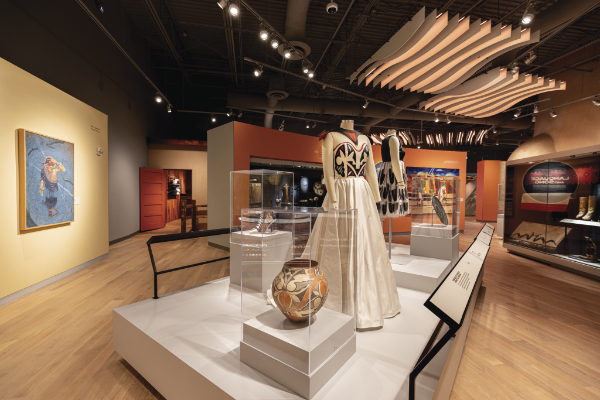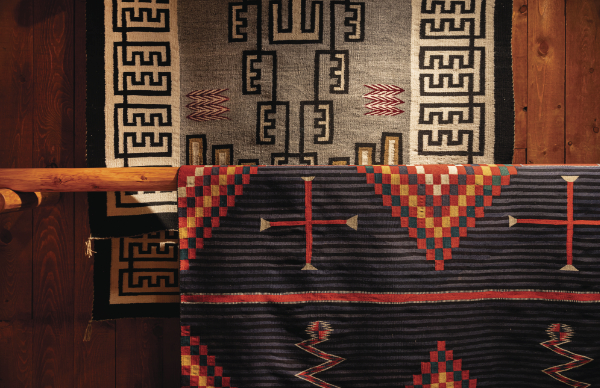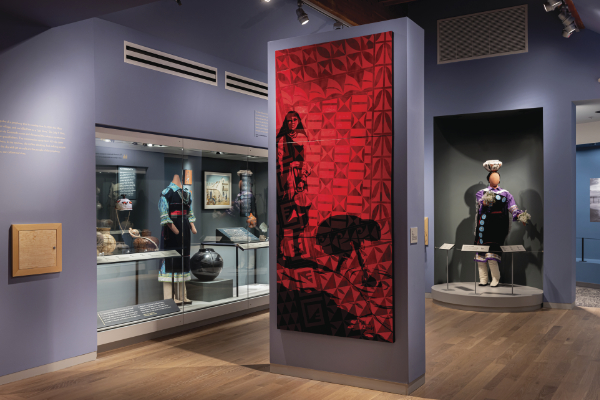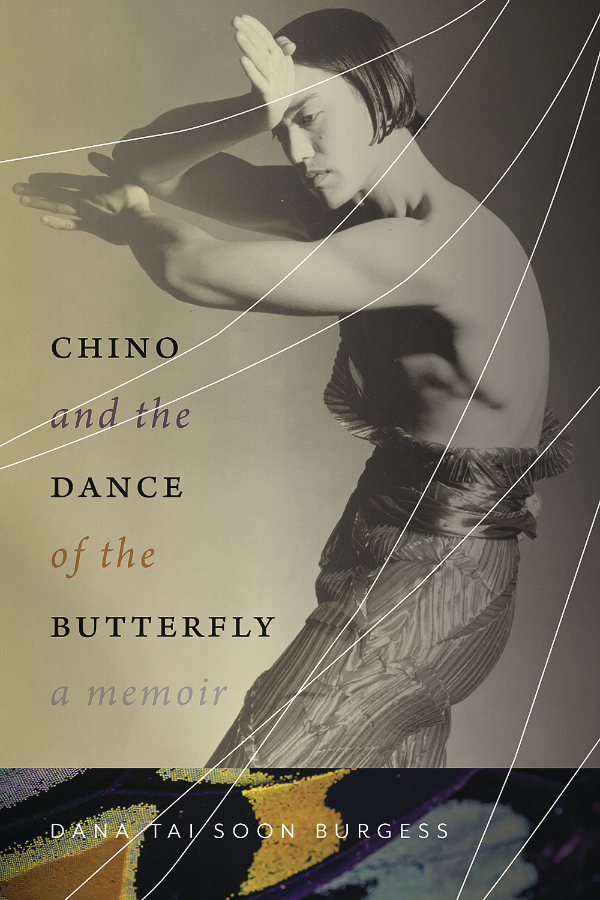

Tutto il Mondo è Paese

By Rachel Preston

More than one of New Mexico’s great stories starts with a broken wheel… and the account of the Museum of International Folk Art is one of them.

Its founder, Florence Dibell Bartlett, got her first taste of New Mexico’s quaint and cordial village life—a style of living perhaps the polar opposite to that of the wealthy hardware heiress and world traveler in 1920’s Chicago—while awaiting a wagon tire repair in Santa Cruz, and she was hooked.

In the 1930s, Bartlett would purchase the San Gabriel Dude Ranch in Alcalde, which had hosted several other notable women who would inspire her efforts, including Georgia O’Keeffe, fellow Chicagoans “the White Sisters” Elizabeth and Martha White, and Mary Cabot Wheelwright (the last of whom would buy another renowned property, Los Luceros, nearby). Bartlett built out an extensive Spanish Pueblo Revival home which would become known as El Mirador (“The Lookout”) on the property. She hired Gustave Baumann who, with his wife Jane, was a frequent guest of the dude ranch, to carve wood details, as well as muralist Olive Rush to decorate the home.

Then, the collecting began. Neighbors and friends would visit, bringing along their artist friends, who would sell their craftware to the patroness. It was not long before the collection overwhelmed every room in the house. Bartlett needed a place to store it. Further, seeing how fragile those traditional lifeways seemed, she wanted to share it so those arts would be preserved.

Having been deeply impacted by the early twentieth century’s two world wars, Bartlett wanted to find ways of bridging differences to bring people together. She believed that the language of art was universal, and that folk craft and dress were a place where different people could find common ground and ways of relating to one another. Bartlett sought the advice of experts and friends to help her facilitate her mission, including advisors from New York’s Museum of Modern Art, the Denver Art Museum, the Art Institute of Chicago, and Colonial Williamsburg. Finally, in 1950, Bartlett founded and endowed the Museum of International Folk Art as well as its supporting International Folk Art Foundation.

Bartlett called Museum of New Mexico Director Boaz Long and architect John Gaw Meem to El Mirador to see if it might be remodeled into a museum. The distance from Santa Fe, the building’s many levels, and the steep budget for the remodel contributed to the decision to build a new facility at Museum Hill instead.

In the late 1920s, what we know today as Museum Hill was part of an effort undertaken by Meem and the White Sisters, who bought properties all the way up Arroyo Chamiso past Sunmount Sanitorium to where St. John’s College sits today, in order to prevent the installation of a Southwest Chautauqua around Sun Mountain. Their protest led to the formation of the Old Santa Fe Association as well as transformed the beloved area where many—including Meem—had come to recuperate from tuberculosis into a place for Santa Fe to come together around the ideas of cultural exploration.

Because of the intention of this place they had preserved, how the museum sat within the landscape was vitally important to Meem. From placing the entrance of the museum at the centerline of the ridge and aligned to Truchas Peak, to aligning other views to the sacred Jemez and Sandia mountains, to building a terraced garden walk up from the lower parking lot, to his account that he had yelled at the excavators for using a bulldozer to clear plants near the building that were meant to be retained, Meem paid attention to the details.
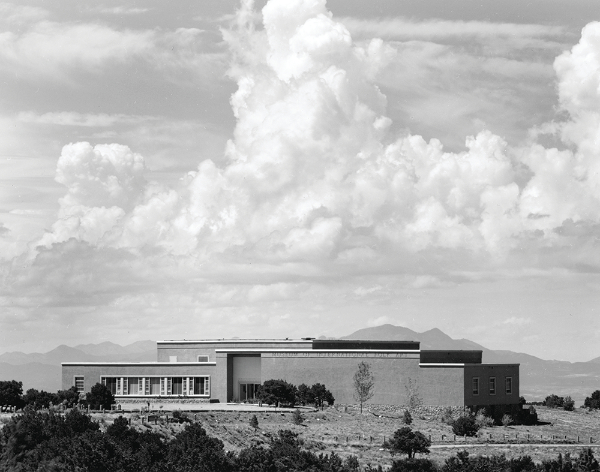
Façade, main elevation, 1952. Photograph by Laura Gilpin. Laura Gilpin collection (AR.00018.1), Bartlett Library and Archives, Museum of International Folk Art.

With Meem’s own Laboratory of Anthropology and Director’s Residence (now the Museum of Spanish Colonial Art) to the east, the 1939 National Park Service Building by Cecil Doty beyond, and the 1937 Museum of Navajo Ceremonial Art built by neighbor Mary Cabot Wheelwright on the west, MOIFA was going to anchor Modernism into the architectural language of the area. Bartlett wrote to Meem that “the exterior of the museum should be simple in line and modern in feeling.” He confirmed this, adding that it should be “harmonizing… with the nearby regional style buildings in mass and color, but contemporary in its simplicity of detail.” The museum was going to put Santa Fe on the map as a modern international art destination… and the building needed to read as such.

While most of us know Meem as a revivalist, he regularly wrote and spoke on the ideas of the great artists and designers of the day, including Pablo Picasso, Le Corbusier, and Eero Saarinen. He knew he wanted to design a building that would function well, but that would be also considered beautiful by modern standards; he noted that Saarinen had once said, “You need to grow roses as well as cabbages.” In several speeches about his work, Meem said that he was “not trying to imitate an adobe.” Rather, he referred to his approach to design as “recalling some of the … characteristics such as flat roofs, sloped walls, and earth colors.” To that, he added terraced massing, parapets, and sparse window openings within large wall expanses, authoring a modern style of building that still remembered it was in Santa Fe.

While Meem was busy planning, Bartlett sent Director Robert Bruce Inverarity to research forty-five museums around the U.S. and Canada to determine the best practices for the new museum. She called on Meem to help her mold her vision of what an active international museum should be—with a crafts school, an outdoor amphitheater, and an outdoor collection of folk houses from around the world, something like an international Skansen—and to do it within her budget of $300,000 (about $3.7 million today).

Meem began designing in a way he was most comfortable: with a stone and stucco Territorial Revival building aligned with the Laboratory of Anthropology, with the entrance on the north under a long portal. From there, he explored what he might do to make the design modern. An alternate version had an oversized cornice that shaded the wall. One sketch appeared as if it was a Bauhaus effort. Another looked like it was a Frank Lloyd Wright building, with a stone façade, long horizontals at the eaves, and canopies over each of the tall windows. A circular plan from May 1949 centered on a “Hall of All Nations” with galleries and an amphitheater that radiated from a core hall. Another was laid out perpendicular to the Laboratory of Anthropology, with an irregular, angular entrance, and with what would later be described in the press as its “million-dollar view” at the lounge opening towards the southwest, so that the collection of international cottages could be laid out along the view of the Sandias.

The final design Meem and Bartlett arrived at was scaled without overwhelming the Laboratory of Anthropology, while tucking in an additional working floor below into the slope of the hill, in a modern, stripped-down adaptation of Meem’s Territorial Revival style. Meem played within his own language, puncturing the tall entry portal through the entablature emblazoned with the name of the museum. This “cap” on the building was a simplified version of Territorial brick copings, which reflected back on Greek Revival architecture. Meem hid in plain sight a timeline of the past seventy years of New Mexican design, and then broke it, hoping to cause visitors to pause and take it in. Painting the tall portal’s walls a light blue usually reserved for window trim ensured the effect.

Built between 1950 and 1952, the earth-toned stucco-covered concrete block building sat on a rubble stone plinth that hid the concrete structure of the lower floor, with concrete details at the top of the parapet and around the aluminum windows and doors. Within, the grid ceilings over the galleries were hung from Pratt steel trusses that echoed early long-span bridges, with light gage steel trusses holding up the lower ceilings. This structure would be used in later additions, with the trusses sometimes exposed for decorative effect, most notably in the Girard wing. Meem designed for passive solar design with both solar gain and shading at the south-facing terrace and offices; he wanted the building to perform in as much a modern way as it appeared.
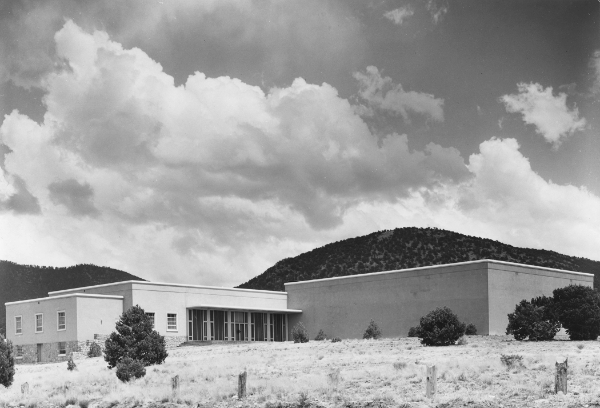
Terrace, southwest elevation, 1952. Photograph by Laura Gilpin. Laura Gilpin collection (AR.00018.1), Bartlett Library and Archives, Museum of International Folk Art.

Bartlett was concerned about her museum being accessible to everyone, so she directed Meem to locate public spaces and galleries on the main floor, and omit any steps into the building, so the elderly and infirm might be able to enjoy the space unencumbered. They also included a freight elevator for the staff to transfer collections from the basement to the exhibits.
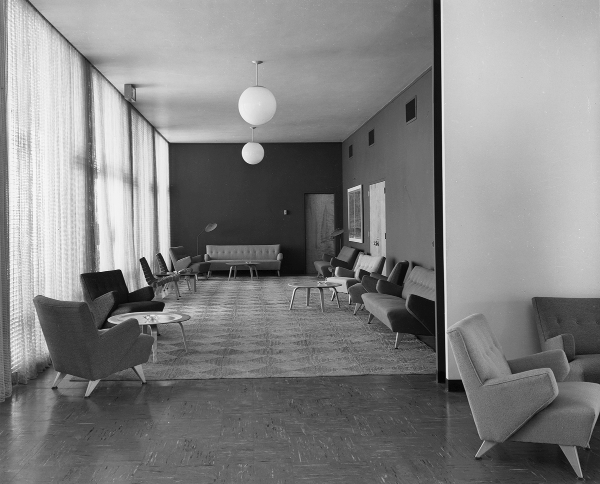
Lounge area, north wing, 1953. Photograph by Ernest Johanson. MOIFA image collection (AR.00009.3), Bartlett Library and Archives, Museum of International Folk Art.

The main floor featured a reception area with a handsome lounge featuring Knoll furniture by some of Mid-Century Modern’s finest designers, including Ilmari Tapiovaara, George Nakashima, Jens Risom, and Charles and Ray Eames; a nearly 8,000-square-foot exhibition space; a library; a 160-seat auditorium for folk performances, lectures, and films, which could also serve as gallery space for temporary exhibitions; plus dressing rooms for performers; bathrooms; and a staff kitchen. The basement offered collections storage, a catalog room, collection processing rooms, a laboratory, photographic studio, loading dock, two small offices for visiting scholars, and a separate apartment with a patio and private entry for a museum caretaker.

Bartlett would donate some 2,500 artworks from thirty-four countries to the museum, including traditional costumes, textiles, jewelry, ceramics, wood carvings, paintings, and jewelry acquired during her travels, referring to it as the “nucleus” of what would become a renowned folk art collection. By the opening, the collection had grown to include more than 4,000 items from fifty-five countries through donations from local collectors, as well as the French government; the Art Institute of Chicago; Harvard’s Peabody Museum; the University of Pennsylvania’s museum; Holland’s Rijks-museum voor Volkskunde; Austria’s Volkskunde Museum Wein; and the Heard Foundation in Phoenix established by Bartlett’s sister Maie.
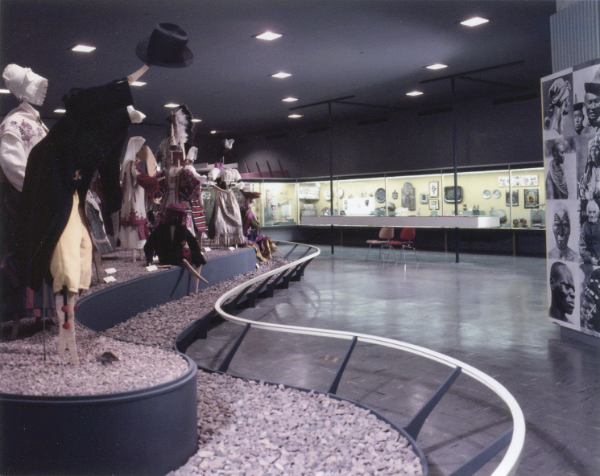
Costumes from the Florence Dibell Bartlett Collection, Opening Exhibit, 1953. MOIFA image collection (AR.00009.2), Bartlett Library and Archives, Museum of International Folk Art.

Bartlett envisioned a museum alive with people and activity, and as such, the spaces designed for the display of the collection were just as important as the building itself. Atypical of museums at the time, color was a central feature, with colors, fonts, and graphics selected, as described in a 1953 special issue of El Palacio celebrating the opening, “to not only enhance the architectural qualities of the building but to provide pleasurable interest and variation.”

The entrance lobby was the heart of the museum, acting as a hub of spokes that radiated out to the museum’s different functions. Each space could be closed off without preventing access to the others.

The gallery was designed without columns or windows, with a ceiling that could be raised or lowered, and a grid of lights and light-hangers so that lighting could be located anywhere it was needed, resulting in a space that could be modified into almost any arrangement for exhibitions. The famous Costume Parade exhibit, with its unusual modern mannequins that allowed the costumes to seem as if they were being danced, was designed by Director Inverarity and Stanley Nelson. The Santa Fe New Mexican delighted in having the scoop that it was based on a New York striptease show, noting that the display was inspired by dancers coming down a ramp into the audience.

The exhibit was made more intriguing by its lack of glass; a low angled rail was the only thing separating the visitors from the art itself. Inverarity believed that putting art behind glass put a “psychological barrier between the exhibit and the onlooker.” Exhibits were designed to be uncluttered, so visitors could feel an intimate connection to each item, and were purposely arranged in an irregular manner so people could move about as they pleased. And it was not just a visual experience; the exhibition had folk music from around the world playing as visitors went through.

Bartlett was deeply invested in the project and it showed in her direction that the museum never compete with the architectural style or collections of other local museums; as well as in all the details she helped select, including hardware, casework, colors, and curtains. She even managed the checklist of items contractors needed to fix prior to the exhibition installation and museum opening a year later. Bartlett invited Gustave Baumann to paint the quote over the silver entrance doors: “The art of the craftsman is a bond between the peoples of the world.” He also hand-carved the dedication plaque for the lobby vestibule which, after years of being stored away, is currently being documented and restored.
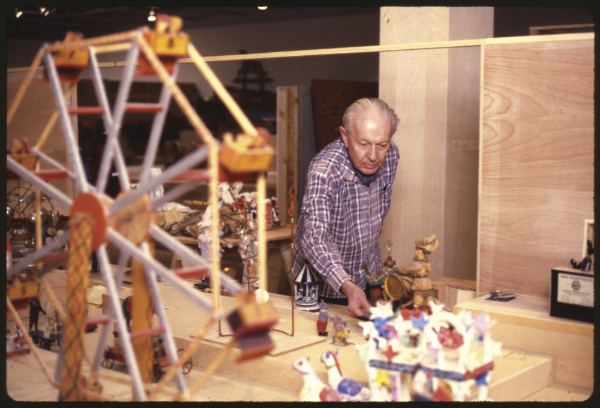
Alexander Girard installing an exhibition at the Folk Art Museum, Santa Fe, New Mexico, not dated. Photograph by Mark Nohl. Courtesy Palace of the Governors Photo Archives (NMHM/DCA), neg. no. HP.2007.20.1155.

Opening ceremonies in September 1953 were attended by more than 1,200 visitors. Engraved, hand-addressed invitations had been sent to foreign museum directors and diplomats, directors of the major museums in the U.S., local dignitaries and officials, and hundreds of supporters. Crowds followed hand-lettered signs up the new dirt road to the museum. Barlett cut the ceremonial ribbon while the Albuquerque trio Los Tres Caballeros played. The gallery opening that afternoon was followed by a series of talks on primitive, folk, and fine arts.

The museum was the first of its kind in the world, and was the largest single donation ever received by the state at that time. Articles about the opening noted that MOIFA was “the principal art museum building of the fifties so far.” The New York Times celebrated the placement of the building in the landscape, as well as its contemporary design, lauding the Finnish chairs, the push-button screen in the auditorium, and even the molded birchwood letter trays.

Bartlett donated the finished museum to the State of New Mexico, as she did with El Mirador, which was to be sold to establish a fund for the museum’s upkeep. She died just eight months after her dream was realized. Meem and his firm and mentees continued working on museum renovations through the 1960s.

Alexander “Sandro” Girard and his wife Susan famously started their life in folk art in 1939 on a belated honeymoon to Mexico. Girard was taken with the idea of real people making simple, beautiful objects which would share their values and ideals with others—especially children. A carload of objects bought on that first trip became the seeds of a collection that would ultimately number over 106,000 objects. The Girards would set up the Girard Foundation in 1961 to care for them.

However, folk art was not what most people knew Alexander Girard for when he and Susan moved to Santa Fe in 1953. Girard’s career was a masterclass in design thinking; a fusion of architecture, furnishings, fabrics, interiors, typography, symbology, and graphic design. He had added touches of folk art, reminders of color, culture, and play into the crisp, clean spaces he was designing in his early works, but those touches were not yet integral to his aesthetic.

John Gaw Meem was one of most important people Girard met when he began the process of obtaining his New Mexico architecture license. Meem had founded the New Mexico chapter of American Institute of Architects, designed the process of architectural registration, and was the connector of who was who in architecture and design. Meem must have been impressed with the designer—because in 1963, a decade after MOIFA opened, when he was dissatisfied with the proposed interiors at the Student Center for his patronage up the road at St. John’s College, Meem encouraged the college to hire Girard to design them anew. Girard designed a partially completed 80-foot-long painted mural of symbols that represented the highest ideals of the college’s renowned Great Books program, as well as the interiors of the coffee shop, painted doors, chandeliers, and a line of furnishings. He also donated several folk art pieces to the decorative effort.
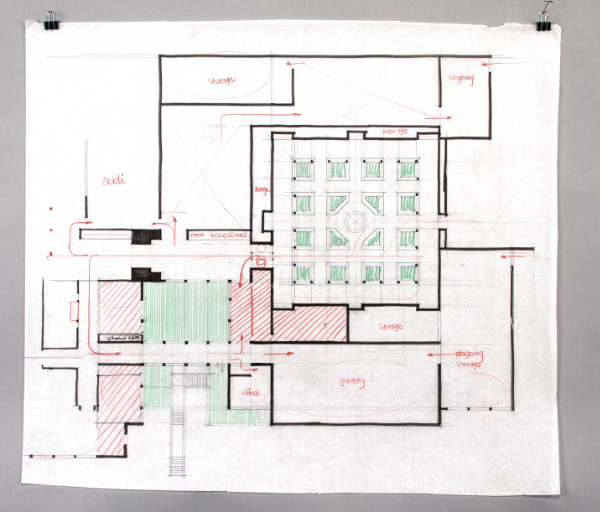
Alexander Girard, preliminary drawing of proposed addition and alterations to the Museum of International Folk Art, first floor overlay, 1974. MOIFA Facilities collection (AR.00013.2), Bartlett Library and Archives, Museum of International Folk Art.

Girard’s relationship with St. John’s would be transformative. For the next eight years, the Girard Foundation would consider donating the collection to the college. A competing pitch from San Francisco was also considered, but Girard preferred the collection to stay in Santa Fe where he and Susan lived, as it would be easier to install and manage that way. And Girard had a caveat for the donation: He wanted the collection wholly integrated into St. John’s programming, noting, “I do not believe that it is possible to acquire a balanced or truly comprehensive view of life, on which in turn valid conclusions can be reached, when the visual and tactile elements that surround us are not given an equal place along with our more purely cerebral faculties. … As great literary ideas have been presented… so have other equally great ideas… in other languages, those of building, painting, and design.”

Meem was copied on the correspondence. Girard put together three shows for the college’s gallery while negotiations were ongoing. Cummins CEO Irwin Miller and Donald Hall of Hallmark, both previous patrons of Girard’s, and of the arts in general, were approached for input and funding; however, when neither the funding nor the enthusiastic support of the college were forthcoming, the Girard Foundation abandoned the idea in 1973.

MOIFA Director Yvonne Lange caught wind of the situation, and approached the Girards to see if they might consider attaching their collection to the museum instead. Girard was reticent at first; he saw his collection as quite separate from Bartlett’s. Girard was clear that his collection was one of toys—eighty-five categories’ worth, whether they be pre-industrial “folk” handmade toys; “early industrial” toys made with foot-powered machines in the nineteenth century; or recent “industrial” toys made almost entirely by machine. Anything that was not that, he considered a supporting “property.” These included religious figures and prints, faux foods, cutouts, “Shadow Theater” puppets, antique samplers, textiles and belts, East Indian miniatures, tin containers, Chinese New Year posters, “magic objects” like amulets and tantra objects, masks, Mexican Day of the Dead objects, and graphics and paintings. Girard felt that the toys and their properties—which would be arranged without regard to their provenance or function—had little relation to the often useful craftworks that Bartlett had collected and catalogued as anthropological objects. In a binder that accompanied the collection, Girard noted a distinct difference, stating that “A comprehensive collection of toys might better express the history of man’s aspirations and dreams than the real objects of utilitarian culture they occasionally represent.”

Lange’s pitch was successful, likely in no small part due to the Girards’ history with the Museum of New Mexico. MOIFA had partially funded the Girards’ film about Mexico’s Day of the Dead made with Charles and Ray Eames in 1957, and showed the film annually for many years. In 1961, Girard produced the Christmastime Nacimiento nativity exhibition for MOIFA, plus another five shows for MOIFA and one for what is now the New Mexico Museum of Art before the donation of the Girard Foundation Collection was finalized.

In 1974, Girard started sketching potential addition concepts that illustrated his desired wing, which besides a large gallery also included a garden, an exterior exhibition in an enclosed courtyard, and a restaurant. He still had in his mind that the Bartlett and Girard Foundation collections were separate entities, and his early design separates a single wing from the original museum façade by a series of gardens to the left and in front of the earlier museum, where the labyrinth is now. An alternate version does the same, wrapping around the entire façade of the old building and around the auditorium. In this iteration, visitors arrive at a formal gated courtyard outdoor exhibition space, aligned just off-center of the existing entrance, so that when coming through the gate, they are greeted by a nicho filled with folk art. Galleries for the collection are located on either side of the court.

After four years of negotiations, the collection was formally donated to MOIFA in 1978. While Girard had put pen to vellum for several years working on designs, Lange would enlist architect Harvey Hoshour to help realize the Girards’ vision, so that Sandro could focus on transforming the massive collection into an exhibition.

Harvey “Tad” Hoshour, a modern architecture scholar and designer, was an ideal candidate for the project. He had spent 1957-1962 in Chicago and New York working for modernist icons including Harry Weese, I.M. Pei, and his idol, Mies van der Rohe. Mies had just finished Crown Hall at the Illinois Institute of Technology, where he would define his approach that “God is in the Details”—a concept that would later influence the first project in which Hoshour and Girard would collaborate. Hoshour was laid off when Mies’ patron was killed in a plane crash, so in 1962, after passing the architecture licensing exams, he married his wife Lise and moved to Albuquerque to join the faculty of the University of New Mexico’s architecture program.

Hoshour began working with Girard in Santa Fe two days a week while starting his firm and becoming involved in the design of the First Unitarian Church of Albuquerque. Hoshour’s graduate thesis at Massachusetts Institute of Technology, “A Proposed Unitarian Church for Albuquerque, New Mexico,” would prove to be prescient… especially once it was published at the moment the church wanted a new building (though the soaring sculptural angles of the earlier project were abandoned due to budget). Hoshour was working part time with Girard, so it was an easy ask to invite him to design the large wooden mural altar screen and an accompanying Herman Miller fabric-upholstered lectern. An order of Eames fiberglass stacking chairs completed the look. The building was dedicated in 1964.

Hoshour and Girard were a well-suited collaboration. Hoshour was also a folk art collector, and would build and maintain a friendship with the Girards through the years, traveling to Latin America on some of the buying trips that would result in the need for a space to keep the objects they collected. While Meem had researched and developed his appreciation of Modern design from afar, Hoshour and Girard worked with some of the greatest designers of their time—Harry Weese and I.M. Pei—at the same time. They shared an architectural lineage and language.
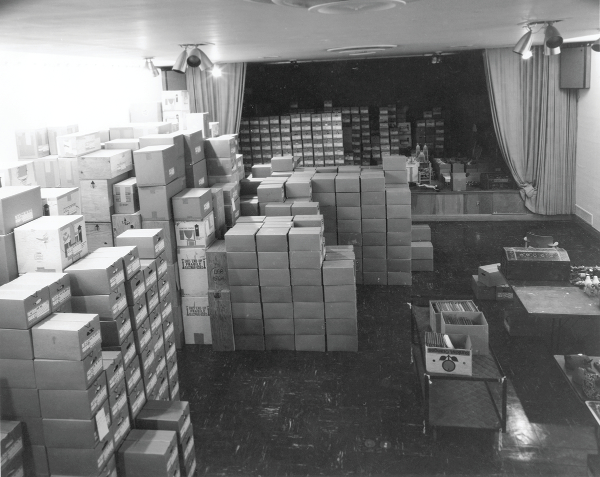
The Girard Foundation Folk Art Collection awaits processing in the auditorium at the Museum of International Folk Art, September 8, 1978.  Photograph by Art Taylor. Multiple Visions: A Common Bond, MOIFA Exhibitions (AR00004.170), Bartlett Library and Archives, Museum of International Folk Art.
The Girard Foundation Folk Art Collection awaits processing in the auditorium at the Museum of International Folk Art, September 8, 1978. Photograph by Art Taylor. Multiple Visions: A Common Bond, MOIFA Exhibitions (AR00004.170), Bartlett Library and Archives, Museum of International Folk Art.

Among his solo projects, after 1952 Girard collaborated with designers Charles and Ray Eames and George Nelson through his position as director of the Fabrics Division at Herman Miller. While he was a vital component in the team, it was not until 1955 and the Miller House project that Girard really got to step into the light as a designer. In their prior collaborations, he provided the “pop” in the firm’s modern-yet-traditional spaces, but right about the time that Nelson left in 1954 to go to New York to start his own firm to focus on furnishings, Girard stepped forward with a style of his own—one that would ultimately look at the entire space as potentiality. It was as if he was painting a mural, except exploding the two-dimensional image off the wall into three dimensions. While some of his earlier projects played with this idea, the Miller House’s bookcase behind his famous conversation pit was what got noticed; House and Garden magazine celebrated the three-dimensional mural with a two-page spread. Girard kept adding depth, eventually layering entire spaces onto each other. By the time he designed Herman Miller’s Textiles & Objects Shop in 1961, his designs encompassed the walls, the ceilings, the floors, layer upon layer, until the entire space became a three-dimensional mural.

Girard honed his style for the next thirty years, designing spaces, furnishings, fabrics, fonts, and more murals of both the two- and three-dimensional varieties, until every element of the spaces he created became a vehicle for storytelling. The culmination of his philosophy would be in the explosion of creativity that is the Girard Foundation’s Multiple Visions permanent exhibition at MOIFA.

Hoshour “got it.” The open, column-free gallery with exposed steel trusses and travertine floor he designed for MOIFA allowed Girard to do whatever he wanted, wherever he wanted—much as Meem’s gallery had. As quoted in the posthumous volume of his work, Architect: Harvey S. Hoshour, issued by the the Hoshour Archives, he described the space as “a simple container in which one of the world great designers could produce the visual magic for which he is famous.” Like Girard, Hoshour was humble. He was working concurrently on restorations of the Kimo Theater as well as the Occidental Life Building in Albuquerque, and he recognized he was modifying one of Meem’s legacy buildings… and that the addition should be respectful of that, too.

Hoshour prepared the straightforward ink-on-mylar drawings for the addition, as well as plans for how the exhibitions might be added to over time. Girard oversaw the design, selecting every detail—even down to the typography and background texture of the memorial plaque.

The Girard wing addition effectively turned Meem’s L-shaped building into what Hoshour described as “a present-day Renaissance palazzo built around a courtyard.” He added on the north, which unlike his typical work that celebrated a building’s structure, instead tucked its humble façade into the terraced mass of the existing building in an effort to blend in with its landscape. Meem’s façades and primary entrance remained largely unchanged. The new design only altered the museum’s look by cutting off the southwest terrace and its view of the Sandias in the distance. The fresh-air-and-sunshine effect of that space was retained by enclosing the resulting two-story courtyard in a simply-detailed balcony that connected the Bartlett wing and the Girards’ wing, offering visitors pleasant spaces indoors and out to take a break between the two collections. Hoshour left Meem’s lounge in place, updating the windows with new aluminum storefront (windows ganged together with aluminum to make a glass wall), and then mirrored the assemblage opposite in the new building. The sunken patio below still to this day acts as a lightwell into the lower-level offices, offering a zen garden-inspired space for staff. The lower floor addition also doubled the existing storage and collections areas.

The Girards’ collection’s many hundreds of organized cardboard boxes were stored in the auditorium until they could be unpacked and accessioned—a process which took two years. Ten thousand objects were integrated by Girard and his team of curators and assistants into the permanent exhibit, including several sets reused from the 1968 San Antonio Hemisfair. Girard attempted to make a plan for the exhibit, but gave up. As quoted by Laura Forde in Petit Glam No 7, he said:

There was no way to plan such an exhibition. I foolishly tried. But when I grasped the scope—106,000 objects—the first thing I figured I would do is go into a coma, then come out of it a few weeks later, realizing laying it out on paper just couldn’t be done. It was not practical.

He further explained,

My main aim was not to just line things up on shelves. It became a mania. And I surely didn’t want to create a moat between the people and the exhibition. No one pays attention if there’s enormous space. You don’t need all that room. You have to be able to get up close. I’ve listened to and watched people in exhibits and I see that they get bored quickly. Any rhythmic thing like case after case, or even labels in the same format, can be hypnotic. Anything that provides relief and excitement is very useful and desirable. You have to distract people into looking at things.

By the time he was installing the exhibition—what would prove to be his last work—Girard was a master of getting people to look at things. He prepared visitors for what they are about to see by placing miniature stage sets at the entrance. He is telling us that this is a play, and by passing through this space, we will pull back the curtains on new stories, or “sets,” as he called the individual displays. He wants us to remember that the sets are not “real”—he did not label the objects or arrange them by provenance, but instead arranged many things from many places together. He shows us that there is, for instance, no “Mexican Town,” but a hodgepodge of all the different kinds of people who might come together in a Mexican place and relate to one another. He was illustrating the motto inscribed at the entrance to the Girard Wing: Tutto il mondo è paese; “The whole world is home.”

Girard took great care with lighting the exhibit, and often placed objects so it required some effort to see what was going on—including on the ceiling so visitors had to look up, or so they had to kneel on the floor and look at them as a small child might see them. He invited play by leaving mischievous “Easter eggs” for curious observers to find. He also tied the exhibition to his other projects, especially in New Mexico, through the use of shared materials and shared symbols. Next time you visit, look for all the angels and trees of life—they are in almost every set! Throughout, he is reminding us that no matter where we are, we are not alone… and that our life and our community are gifts.
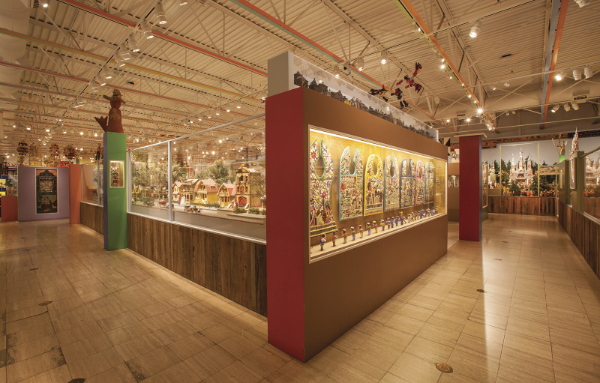
The Girard Wing, 2018. Photograph courtesy the Museum of International Folk Art.

There is much to celebrate for MOIFA, with 2022 marking the fortieth anniversary of the Girard wing, and 2023 the seventieth anniversary of the founding of the museum by Florence Dibell Bartlett. With the seventy-fifth anniversary forthcoming, directors and staff are evaluating where the museum goes from here, including what changes might be made to bring the museum into alignment with its important place as a wellspring of inspiration for Santa Fe Modernism. Meem and Girard’s collective works at MOIFA and St. John’s still act as the upper and lower anchors of the area around Sun Mountain that Meem was trying to protect, establishing a place where modern and contemporary design can grow. It is worth asking what the future holds for a place that was envisioned as a living workshop for design in a location where cultures are united through dynamic artistic traditions.

Documenting the evolution of its architecture is one part of this effort. The beautiful Mid-Century furnishings tucked away in storage will be catalogued too, so they might be displayed, restored, or reused. As well, interiors, exhibits, signage and typography, the use of color, and light—all the ways that design enhances storytelling and teaches us about who we are in relation to one another—are being noted and celebrated. The Museum of New Mexico Foundation has even set up a dedicated support group, the Design Council, consisting of professionals in these fields, so that MOIFA can keep its finger on the pulse of design and enhance its ability to meet its mission of creativity and inspiration for the next seventy-five years.

Rachel Preston, director of The Ministry of Architecture in Santa Fe, has documented historic buildings across New Mexico and has produced documentaries about the architecture of Acoma and Bandelier. Rachel writes, teaches, and speaks about New Mexico’s thousand-year tradition of sustainable design. 
Rachel Preston (opens in a new tab) is the director of The Ministry of Architecture in Santa Fe. She has documented historic buildings across New Mexico and produced documentaries about architecture at Acoma and Bandelier. She writes, teaches, and speaks about New Mexico’s thousand-year tradition of sustainable design.
The Story of Buildings

By Charlotte Jusinski with Jeff Pappas
Jeff Pappas. Photograph by Kevin Lange.

Now in its third season, the Department of Cultural Affairs’s podcast, Encounter Culture, explores the exhibitions, stories, and personalities of the largest governmental department in New Mexico. Whether focusing on an art exhibition, Indigenous history, or ghostly experiences, Encounter Culture offers a unique look into what makes our state’s cultural institutions tick—and this episode with State Historic Preservation Officer Dr. Jeff Pappas, transcribed here, is no exception.

Pappas’s background includes time as a legislative assistant in the Massachusetts House of Representatives and two decades with the National Park Service at Yosemite National Park, in addition to degrees from Brigham Young University, Baylor University, and Arizona State University. He now brings his extensive experience and training as an historian to the Historic Preservation Division, where his big-picture thinking is enacted in policies, studies, and assessments concerning New Mexico’s 17,000 years of history.

This interview has been edited for length and clarity; listen to the whole episode at podcast.nmculture.org, or on your favorite podcast app.

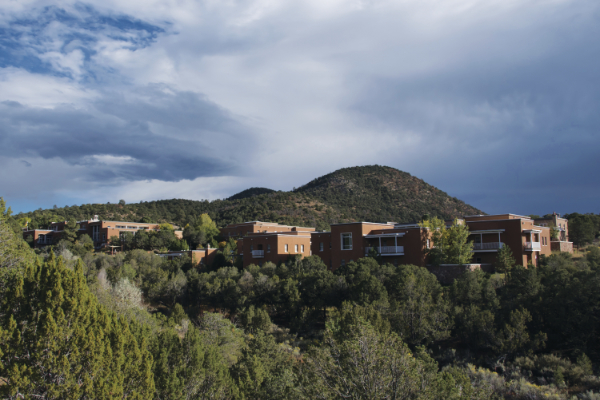
The entire campus of St. John’s College in Santa Fe was designated an historic district in 2015, and is currently the only college campus in New Mexico to receive this distinction. The college celebrates its designations from the National Register of Historic Places and the State Register of Cultural Properties. Photograph by Carrie McCarthy.

Charlotte Jusinski: One of my things I like to do in the beginning of these episodes is to ask for an elevator pitch. And I mean, we can be on a 500-story building; it’s fine if the elevator has to go for a long time. But what do you do? 

Jeff Pappas: The state historic preservation officer position was actually established in federal law. In 1966, it was established through the National Historic Preservation Act. Every state, in fact, has what they call an SHPO, or affectionately known as ‘Shippo.’ Essentially, the federal government felt that there needed to be a public presence when any federal agency in any state was doing projects that could potentially impact historic properties on federal lands, and that the state actually had a stake in that matter. … And so I’m basically the eyes and ears for the governor’s office. It’s a gubernatorial-appointed position when it comes to historic preservation matters on federal lands. 

CJ: It seems to me like New Mexico would have an exponentially higher number of these kinds of properties to protect. Is that accurate?

JP: That’s absolutely accurate. I think if I added it up, my office consults with probably about a hundred agencies, both federal and state. Most of our work is with the Bureau of Land Management, because they’re a massive landholder in the state. The Forest Service, of course, the National Park Service, and a variety of other federal agencies. Anywhere where the federal government is investing monies and projects that have the potential to impact historic properties, the state has to… be a consulting party to those decisions. I think last year we reviewed a little over 2,000 undertakings across the state.

CJ: And so what would an ‘undertaking’ look like? Does it mean we need new bathrooms? Does it mean we need new siding? What does that mean?

JP: Well, it could be from some of the most obvious issues, like oil and gas leasing here in the state. … And of course that takes up a lot of land. They dig quite a bit. And so we have to make sure that the archeological sites near these oil and gas use are protected. And so that would be one example.

Let’s say White Sands Missile Range. They have… many historic properties; they’ve got enormous resources there anywhere from the early V2 rocket sites that go back to 1946 and 1947 at the beginning of the Cold War. These sites are still there. And if they propose to do any kind of modifications to these sites, it has the potential to impact its historic characteristics. Then we have to be there to make sure that what they do is consistent with the standards in historic preservation. And those standards are issued by the federal government, by the Department of the Interior. 

CJ: What does ‘preservation’ mean in this context?

JP: The standards are the responsibility of the National Park Service through the Department of the Interior; that is the agency that we look toward for any guidance when it comes to modifications of historic properties. And typically they’re far more interested in what things look like than how things function. In fact, the federal government and the Park Service understand that buildings change out consistently over time, their use changes out consistently… let’s say at military installations, where technologies change constantly. So the interior of the buildings have to be modified in order to accommodate for a variety of these changes. The standards aren’t particular when it comes to interiors of properties, but exterior of properties, what people are actually looking at when they drive past these buildings, is what matters the most to the federal standards.

CJ: I can get a little cynical and say, ‘The intrinsic value of a historic building—oh, that wouldn’t matter to the powers that be.’ But clearly it does. And to the point where they have these agencies and officers to preserve these kinds of things.

Are you as struck as I am by how nice that is? They care what we’re looking at and they care what we see! And maybe they care how we feel about it!

JP: Yeah, I think it’s inherent. I think if you take a look at the preamble of the National Historic Preservation Act, they feel that a democratic society, in this case, has a right to understand its history. And that’s written right into the preamble of the federal legislation.

And how do you do that? You study the buildings, you collect data on the buildings, you take wonderful photographs of buildings, and then you try at least to keep them looking relatively historic.

Is it esoteric? I think the word that I’m challenged with repeatedly by federal agencies is ‘subjective.’ That it’s my subjectivity or that it’s the SHPO’s subjectivity. I bring a certain sensibility to the jobs that will inform how I consult on these particular projects. And I have been challenged by federal agencies that may not appreciate my particular approach to preservation, but that’s why we have staffs, and that’s why we consult with a variety of people to make sure that what’s rendered ultimately is a reflection of the people who do this work. And we hope that it’s an honest, or at least an authentic expression of what the regulations say. 

CJ: So, speaking of subjective, what is it about you that makes you an authority on historic preservation? 

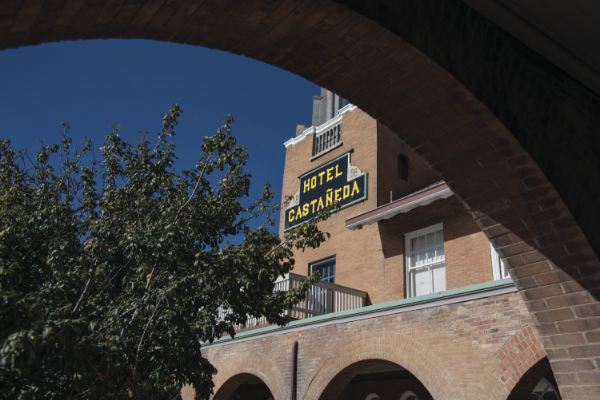
The Castañeda Hotel in Las Vegas, New Mexico, built in 1898, received tax credits in 2016 to aid in restoring the building’s exterior. Photograph by Carrie McCarthy.

JP: … I think that as a director, it seems to be beneficial to have someone with an historical background, because I bring a broader perspective to resources. So it’s just not about the architecture or about, let’s say, the empirical building itself. It’s really about the story that building tells over time.

And that really is the bread and butter of the historical profession, is to be able to see that story unfold over generations of time—deep time, in fact, if we can go back in New Mexico of 12 to 15, potentially 17,000 years. And so I think the way that I’ve been trained allows me an opportunity to step back from the nitty-gritty or from the daily grind of doing this work and to set a tone for the office. Then I ultimately manage that tone by hiring certain kinds of people that can inform that decision-making.

CJ: How would you define that tone?

JP: Oh, it’s a great question; and it is so relevant today with the #MeToo movements, how politics plays into the way that we understand the past, or the way that we express our past through commitments. And these could be multimillion-dollar projects through commitments to save certain aspects of our past in order to inform a present generation to propel us into the future. So I have to vision out what that might be, but I also have to go back and take a look at the past in order to help inform that present moment so that we can tell stories that includes everyone, or at least as many people as possible. …

So when you come to a state like New Mexico, where you have all these wonderful, diverse voices, my job is to try to include as many of those voices in the public dialogue as possible. And I think that is something that this office, not that it didn’t have necessarily, but I don’t know if there was anyone directing the program who thought so overtly about that commitment to our communities.

CJ: So, these are a lot of big ideas. How does it play out in the day to day? 

JP:  Yeah, I’ll give you a case study. I tend to live in that bigger place, but our programs can help me focus these visions in ways that I think are meaningful to people. … It could be about ranching. It could be about mining. It could be about working with tribes or the American Indian presence in the state of New Mexico. What we’ve been focused on over the past five or six years is to bring to light the story of the African American experience in New Mexico, which was hardly known.

My staff, we were looking for opportunities to do historic context around themes, like the African American experience that could help the state understand its history, particularly its contemporary history. And this really is tied a lot to Black Lives Matter and other kinds of contemporary arguments that are happening now that I’m very concerned about.

And so we put some money together through our federal partners and we hired an historian to write the historic context of the African American experience for the state. And what that did was not only provide a narrative that goes back to 1905, essentially, right to the present, but it also identified every historic resource—buildings, structures, objects, sites, and districts—associated with the Black experience, so that we come in with our national register program—you know, how you plaque those buildings. Then what we’ll do is we’ll take that study and we’ll begin to identify buildings and structures associated with that experience and begin to list them both to the state and national registers of historic places, and to continue to build that history with the hope that it will trickle down, hopefully in our schools or in our politics or wherever. It’s a rich history. It’s a really important history. …

And so now what we’re doing is taking that data and we are hiring other historians to write national register nominations, to build the detailed history of those facilities, to list those properties to the state so they get further protection, both in state and federal law. 

JP: There are programs that I would like folks to know a little bit more about. … And number one, of course, is the state and national register program. My office works with the National Park Service and with the gubernatorial-appointed committee that we have to list significant properties to the state register—and anyone, anyone could nominate a property to the state register.

That’s a deeply wonderful public process that we use to engage folks in identifying significant resources in their communities that they want to celebrate. … The way that the national register program works is that we don’t consider any resources that are fifty years of age or less.

Occasionally we will, under what we call an exceptional category, but primarily… the dial, it moves the chronology up another year. And so right now, if you take a look at what our fifty-year threshold would be, we’re looking at resources now that were built in 1972, in the lifespan of most people.

CJ: What’s an exception in Santa Fe? 

JP: St. John’s College. This was a wonderful experience that we had with the president of St. John’s just before he retired back in 2016, his name was [Michael] Peters. To celebrate the fiftieth anniversary of St. John’s College, he came to us and asked what would it be to list this property on the national register. The campus itself, they began construction on the campus in the early 1960s, around 1962, 1963. They opened the doors by 1966, ’65, but then some of the buildings on… that beautiful campus were built in 1973, which were clearly less than fifty years old.

And so we had to nominate that entire campus under an exceptional criteria—and the keeper of the national register in Washington, D.C., agreed. And it was a wonderful thing. We had a nice ceremony there, and the school takes it very seriously. … In fact, St. John’s is the only full college campus in the state of New Mexico listed to both the state and national register.

JP: [Another] program that we do is a preservation tax credit program. And so we work both with the state’s Tax and Rev Department and with the IRS to provide significant preservation tax credits to property owners who own historic properties to rehabilitate their properties. And we do an enormous amount of work there with residential property owners and commercial property owners. In fact, we just finished up a wonderful federal tax credit to rehabilitate the Castañeda Hotel in Las Vegas. … They did a wonderful job. So not only are we providing a tax incentive, but that’s also helping us to build an economy around historic preservation—the artisans that… work on historic properties.

And I think we generate several millions of dollars in economic development in rehabilitating historic properties. And that’s something that we’re really proud of and we do well. I think we do very well with that.

We also have a program called a certified local government program. Essentially it authorizes us to help local communities, cities, municipalities, craft their own historic preservation ordinance, which is wonderful work. What we help them with is to think about how they want to preserve their communities. And we provide federal funding for them to do that. And so we create sort of a local ethos of preservation around this certified local government program.


JP: Rulemaking can take years, and it should; the public has to be involved. We have to make sure that we have the language right. … It takes patience and it takes a long time to do that kind of work. New Mexico is unique in some ways that we don’t have sunset clauses for our regulations. In other words, they don’t sunset every five years or every ten years. … And so they just sit. And that’s problematic, because the language that’s invested in a regulation that was established maybe in 1972 needs to speak to contemporary issues. … Take the historic markers program.

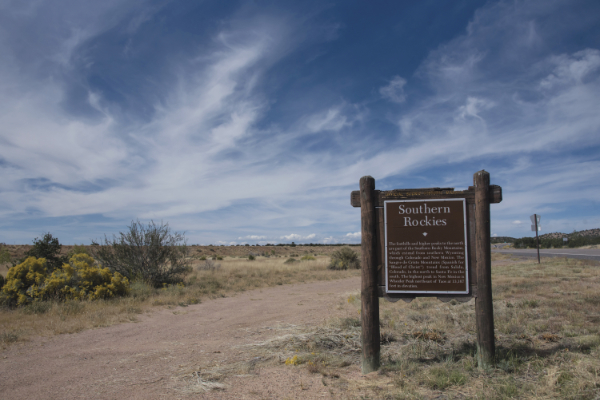
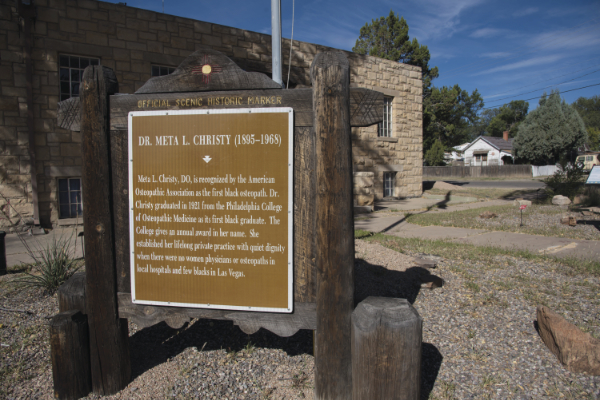
You probably all know those historic markers that are out there. … And the design of those markers is actually based upon a National Park Service rustic design that was coming in vogue in the 1920s and 1930s. And the state has managed it ever since my office took it over, I believe in the 1970s. …

Now, you can imagine text on any of these… go back to the 1940s, the 1950s, the 1960s, the 1970s. And built into that, of course, is a presentist language that they used, much like what we use today. We may not be conscious of it, but we’re committing to something in language that’s a representative of our time. So we need to go back and we need to constantly look at the text on these, because my gosh, there’s so many of them that could be perceived as offensive and they need to be changed. 

One of the many responsibilities of the state Historic Preservation Office is to monitor and update the language found on historic markers around the state. Photographs by Carrie McCarthy.

CJ: What does that look like? Might someone call up your office and say, ‘I’m offended by this on Highway 50?’

JP: Yes. That’s exactly what happens. One of the remarkable things about the state of New Mexico, it’s relatively small—at least its state government is relatively small, and people have access to their decision-makers. And that is a remarkable part of who we are, so it’s truly democratic. And so we do, we receive calls all the time about markers that are either damaged or destroyed or language that may not be accurate or language that may be offensive. And our job is to go back and revisit all of these sites and to make sure that we are applying contemporary scholarship to address these issues.

CJ: What is the monetary cost of fixing up that kind of stuff—versus the cultural cost of not?

JP: I think the important thing to think about is that societal or cultural cost. And then everything flows from there. You’ll find the money at that point; if it becomes important to the state, it becomes important to people who really care about their history, then the money will become available to do it. Right now we have no funding mechanism, at least no state funding mechanism, but we can leverage federal dollars to do this work.

How much will it cost? It’s a good question. I don’t know. What would it cost to hire someone to go around the state and to take photographs of each of the historic markers to locate them? We do have a database for these markers, so we know roughly where they are, but we’d have to do surveys first. And then we would have to work with our partner who actually manufactures the signs. … It would cost potentially hundreds of thousands of dollars.

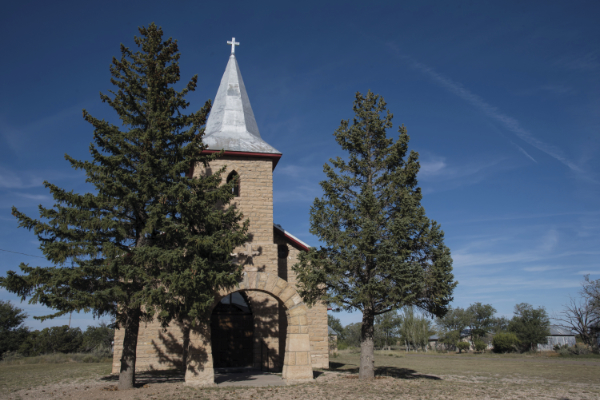
The San Juan Bautista Catholic Church, erected in 1916, is one of the Duran area’s cultural touchstones. Photograph by Carrie McCarthy.

CJ: But you know, as you said, the cultural cost of not is immeasurable.

JP: Yeah, you can’t calculate that—where a state is just sitting on text that clearly needs to be reevaluated. But that’s partly the unfortunate reality of certain programs that don’t have a proactive approach to the way that we manage them. And this program, I think, suffers from that.

CJ: You obviously care a whole lot about what you do. What is it about this position that has gotten you to this passionate place?

JP: It’s a question that you should ask yourself every six months to a year, or every month or two months, or when you’re challenged—

CJ: Every day.

JP: —or every day! The passion, if one can call that, derives from my love of teaching. I think everything revolves around teaching—young kids, college kids, high school. And I don’t see what I do any different than that.

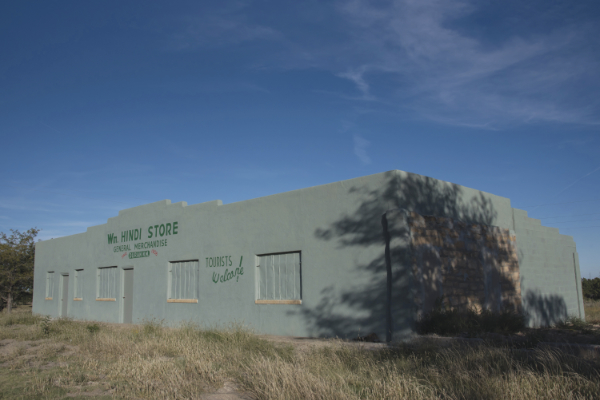
The Wm. Hindi Store, erected in 1908, is a well-maintained relic of a family that still lives in the Duran area. Photograph by Carrie McCarthy.

I’m at heart a teacher. Talking to a secretary about a budget is to teach that particular administration about why this work needs to happen. So it doesn’t really answer the question why I feel as though the work needs to happen, it’s just that I feel as though I have a need to teach people why it does.

And it really goes back to my training as an historian. That I do feel that story absolutely matters and how cliché that may be. But I think, if you really drill deeply into that cliché, ‘story matters,’ you get to the root of the passion. You get to the root of engaging and enfranchising disadvantaged communities, marginalized communities that have not had a voice in the historic narrative for eons. …

I’ll give you an example. Two years ago, we nominated the entire community of Duran to the national register. They have an entire association there that takes care of those properties. And they came to us and said, ‘We want a seat at the table.’ How do you want to do this? ‘We want to nominate the entire town to the national register.’

And then, years ago, when the state committed their resources to nominate Mount Taylor to the National Register of Historic Places and to recognize the five Native narratives that are associated with that holy mountain—that is not something that this state prior to that nomination was able to locate at a particular place like Mount Taylor, right? A 400,000-acre site that is now listed on the state Register of Cultural Properties. So now any time that the state has anything to do with that area, those Native American communities have a voice at the table.

There’s nothing more profound than that. Although I love science and physics. I don’t think there’s anything as powerful as that, even politics, because the pure expression of that—it gets me every time.

Encounter Culture is a production of the New Mexico Department of Cultural Affairs. It is produced and edited by Andrea Klunder at the Creative Imposter Studios. Its technical director is Edwin R. Ruiz, its recording engineer is Kabby at Kabby Sound Studios, and its executive producer is Daniel Zillmann. Learn more or listen in at podcast.nmculture.org or on your favorite podcast app.

Charlotte Jusinski is the editor of El Palacio and the host of Encounter Culture.

Charlotte Jusinski served as the editor of El Palacio from 2019 to 2023. Charlotte previously worked as copy editor for the Santa Fe Reporter and penned their award-winning “Acting Out” theater review column. She also received a second-place Top of the Rockies award from the Society of Professional Journalists in 2019 for her coverage of a nonprofit that provides aid to Native elders on the Navajo Nation.

Jeff Pappas is a former state historic preservation officer housed within the Historic Preservation Division of New Mexico Department of Cultural Affairs. Jeff holds degrees from Brigham Young University, Baylor University, and a PhD from Arizona State University, where he studied American Indian, Environmental, and Public History. Between 1992 and 2012, Pappas worked for the National Park Service and taught in the graduate program in public history at Colorado State University.

Standing on a Corner

While photographing the town of Duran for The Story of Structures, I was on a corner, hip-deep in chamisa that was on its crunchy, end-of-season last legs.

With only thirty-six residents, hustle and bustle is decidedly not the prevailing vibe in Duran. In fact, in the several hours I had been roaming and photographing, I had only seen one other car on the mostly dirt streets, and no other people.

But then, an impeccably well-maintained late model truck rolled by, slowed, and backed up. The window rolled down, revealing the welcoming face of rancher Shafie “Joseph” Hindi.

“Why, hi there. Are you a photographer?” Hindi asked. I held up my camera, considered it, lowered it, and responded to Hindi: “Why, apparently I am.”

Ice broken, we got to talking. Hindi quickly revealed that his grandmother, Clarita, was a Duran. Yes, that Duran—the town was founded by Clarita’s father, Ventura, and her uncles, Blas and Espiridión, in 1902.

Hindi then continued to briefly explain the markers of his family’s history. His grandfather, Alex Hindi, was born in Lebanon and, in the early 1900s, at the age of approximately 17, he emigrated to territorial New Mexico, where he met and married Clarita Duran. They had seven children, including Hindi’s father, also named Shafie.

“And now I’ll let you get back to photographing. Be sure to check out our church. We’re very proud of it,” Hindi said as he smiled broadly. He passed me his card, and extended an invitation: “If you have questions feel free to call, email, or just stop by for a good, old-fashioned chat.”

Ten days later I returned for that good, old-fashioned, four-hour chat with Shafie, one that included a visit to Hindi ranch, which at its heyday was approximately 100,000 acres with 15,000 sheep and, eventually, the Arabian horses that his grandfather Alex Hindi brought to Duran in 1948. On the ranch, gravestones honor the lives of some those first horses.

Of growing up in Duran, Hindi says, “It was paradise. We were wild and free, yes, but we were also hard-working, well educated, and we looked after each other. We might have a population of thirty-six, but when the church celebrated its 100-year fiesta in 2016, there were 2,000 people here—Durans, Hindis, Madrills, Chavezes, Valencias, Sanchezes, and more for whom Duran is still home”

During our rambling chat, Hindi covered wide-ranging markers of both Duran’s history and the history of his family, including that his family continues to speak English, Spanish, and Arabic. It was a story both universal and personal, with themes of immigration, broad-ranging economic impact, storybook Western myth, and intimate family moments.

“Duran, like many small provincial communities in New Mexico, has a complex and unique history,” said Hindi with emotion. Duran’s addition to the National Register of Historic Places “is a recognition of that. Stories of the past are spoken, family ties are reinforced, and history is kept alive in Duran.”

Carrie McCarthy is a photographer, writer, and creative director based in Santa Fe, New Mexico. She currently works with a range of clients to help them navigate the ever-evolving post-pandemic universe.

Carrie McCarthy (opens in a new tab) is a photographer, writer, and creative director based in Santa Fe, New Mexico. She currently works with a range of clients to help them navigate the ever-evolving post-pandemic universe.

A Century of Antics Onstage and Off

By Jennifer Levin

Art Olivas drove a friend to Santa Fe Community Theater and sat in the audience, watching the hopefuls take their turns. He wasn’t there to audition, but the director asked him to read anyway. This was in 1979, and though Olivas doesn’t remember what the play was, he ended up in it.

“I’d never been on a stage. It could’ve been the melodrama—I was in it that year,” says the former photo archivist at New Mexico History Museum. Olivas, 73, took small roles after that for about a decade, stepping into a great Santa Fe tradition begun by the author Mary Hunter Austin in 1922.

Today’s Santa Fe Playhouse was first known as the Santa Fe Players. In the hundred years since its founding, the theater has survived a slew of charismatic leaders, a world war, a pandemic, and approximately ninety-nine Fiesta Melodramas.

Amateur and professional theater groups pop up regularly in Santa Fe. With some notable exceptions, most fold in three to five years. The second-oldest group in town, Teatro Paraguas, is eighteen years old. In people years, the Playhouse could be its great-grandmother. In this cutthroat town, how and why has it endured to celebrate its centennial?

Fundamentally, it’s because the Playhouse owns its own space, while most groups must rent a stage to produce a show. But what makes its longevity all the more astonishing is that, for most of its history, the Santa Fe Playhouse was run by volunteers. In the twentieth century, it was squarely a community theater. The great contemporary debate is whether it still is.

Today, the Playhouse pays creatives for their time. The theater is run by a small staff, which includes a part-time marketing and communications manager—a role I accepted after writing about local theater for the Santa Fe New Mexican for many years. Working at the Playhouse, I found that no official written history exists. So, I’ve attempted to piece one together. But what follows is just a start, because this story could fill a book. 

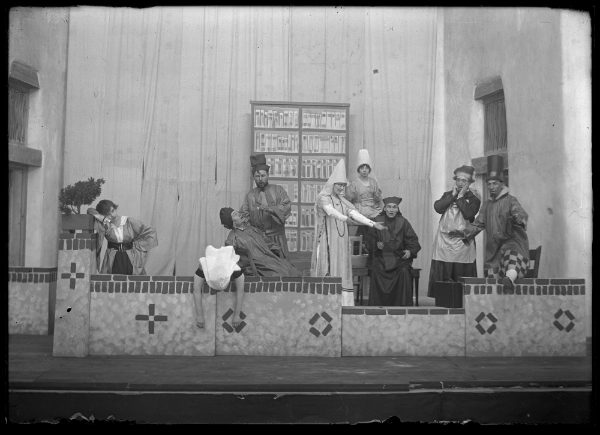
“The Man who Married a Dumb Wife,” Santa Fe Community Theater, St. Francis Auditorium, Santa Fe, New Mexico, 1919. Photograph by Wesley Bradfield. Courtesy Palace of the Governors Photo Archives (NMHM/DCA), neg. no.099833.

Anticorporate origins

The first production of the Santa Fe Players was Anatole France’s The Man Who Married a Dumb Wife on Valentine’s Day in 1919, presented in the St. Francis Auditorium at what was then called the Museum of Fine Arts. It was directed by Mary Hunter Austin, a social activist and author of Indigenous themes who’d relocated to Santa Fe from California the year before. Austin belonged to a group of white transplants who had a lasting influence on Santa Fe culture, including artist Will Shuster, poet Witter Bynner, and architect John Gaw Meem.

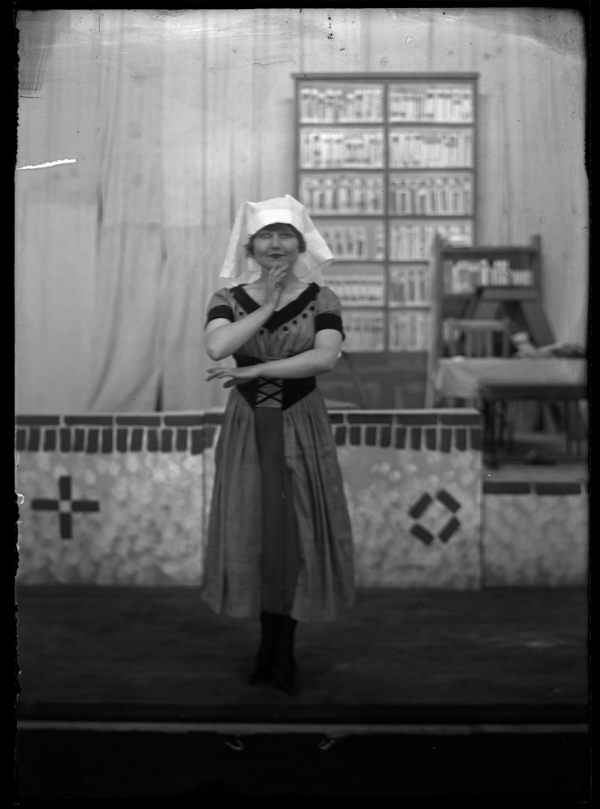
“The Man who Married a Dumb Wife,” Alison, Botal's servant (Louise Crow), Santa Fe Community Theater, St. Francis Auditorium, Santa Fe, New Mexico, May 13, 1919. Courtesy Palace of the Governors Photo Archives (NMHM/DCA), neg. no.099835.
“The Man who Married a Dumb Wife,” Alison, Botal’s servant (Louise Crow), Santa Fe Community Theater, St. Francis Auditorium, Santa Fe, New Mexico, May 13, 1919. Courtesy Palace of the Governors Photo Archives (NMHM/DCA), neg. no.099835.

“Mary Austin’s objective was to do international, national, and local plays that mattered, that would get the community involved and start a conversation,” says Kent Kirkpatrick, president of Santa Fe Playhouse’s Board of Trustees.

Austin was inspired by the Little Theater Movement, a national effort to combat corporate control of most U.S. venues, which booked traveling shows with mass-market appeal. The Little Theater Movement called for greater artistic exploration and was promoted by the likes of Nobel-winning playwright Eugene O’Neill, a founding member of the Provincetown Players. Austin and her group incorporated in 1922, the same year they produced Santa Fe’s first Fiesta Melodrama, The Sorcerers of Nambe. It was directed by J.D. DeHuff, then superintendent of Santa Fe Indian School, with sets by renowned painter Gerald Cassidy.

The Santa Fe Indian Market began during the same Fiesta, held against the backdrop of the DeVargas Pageant (also known as the Entrada) that re-enacted the “peaceful reconquest” of Santa Fe in 1693, after Spanish colonists were driven out by the 1680 Pueblo Revolt. Fiesta emphasized what were considered Santa Fe’s three distinct cultures—Native American, Hispanic, and Anglo-American—supposedly living in harmony. Fiesta was one of many tourism initiatives designed as a pathway to statehood for New Mexico, as was the tri-cultural identity—but it wasn’t all that accurate.

“Despite the rhetoric of social tolerance, and despite the unifying image provided by the ubiquitous adobe-colored stucco, the myth of Santa Fe obscures long-standing cultural and class frictions,” Chris Wilson writes in The Myth of Santa Fe, published in 1997.

Former Playhouse Board President Kelly Huertas says the Santa Fe Players probably held the first melodrama “because they thought they could sell tickets. I don’t think they intended to insert themselves into the tri-culture controversy.”

But that’s exactly what they did. Since 1922, a Santa Fe Fiesta Melodrama has been performed almost every year. The jokes usually twist on cultural differences, and it’s all supposed to be in good fun. Despite their embrace of local customs and people, the white Santa Fe Players displayed the same clueless racism that was common in America at the time. An undated photo housed in the New Mexico History Museum Photo Archives shows Will Shuster, Witter Bynner, and their friends performing a minstrel show in blackface. 

Barebones theater

Plays in the first half of the twentieth century included A Night Wind, directed by Witter Bynner, in 1931; The Ninth Guest, written by Owen Davis and directed by Mel Marshal in 1939 at Harrington Junior High School (which closed in 1976 and was replaced with Capshaw Middle School); and Eugene O’Neill’s Anna Christie, directed by Dave Hyatt and performed at a mysterious location called only “Loretto Hall” in January 1941. The Legend of Dallas Lee, written and directed by Judy Warner, ran for three days in May 1955 at St. Michael’s College Playhouse—a barn that predated the Greer Garson Theater at what would later be called the College of Santa Fe. New generations of Players kept the group going, at some point changing the name to Santa Fe Little Theater and then to Santa Fe Community Theater.

We know the group went dark for a few years during World War II. They performed in school auditoriums and on makeshift stages in empty lots, often staging the Fiesta Melodrama at the Rodeo Grounds. Once, sometime in the 1950s, they held it in an empty hotel swimming pool, with the audience gazing down upon the actors. In 1961, they wrote the Fiesta Melodrama in-house for the first time, instead of adding Santa Fe references to an existing script. It’s been written in-house ever since, the writers kept anonymous to protect them from public backlash. 

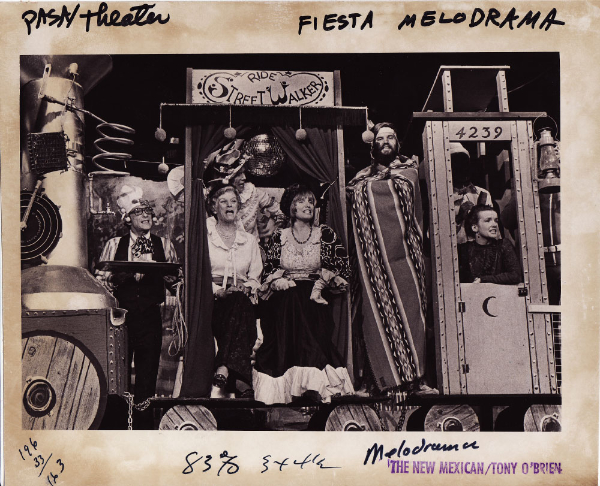
Undated Santa Fe New Mexican file photo of a Fiesta Melodrama found in the Santa Fe Playhouse archives. Photograph by Tony O’Brien.

The itinerant theater group also staged small productions at Three Cities of Spain Restaurant on Canyon Road (where Geronimo is today). “I lived next to the restaurant, and the two men who ran that were talking about getting a building,” says Bob Sinn, who acted in productions from the 1960s onward. He joined the board in 1991 after retiring from a career in social work. He served as part-time managing director for several years, an all-consuming job for which he was paid $350 a month.

Jean Moss in Talking With by Jane Martin, mid to late 1980s at Santa Fe Community Theater, directed by Susan McCosker. Courtesy Jean Moss.
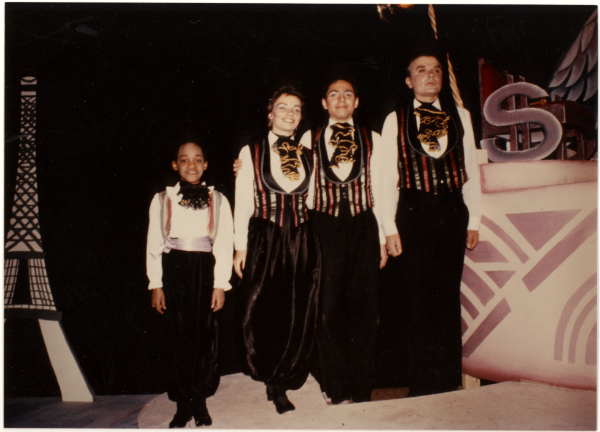
Cake by Witter Bynner, produced in 1982 in honor of the sixtieth anniversary of the Santa Fe Players, directed by Jean Moss. Left to right: Quiana Rodriguez, unknown, Art Olivas, Bob Sinn. Courtesy Jean Moss.

The restaurant owners, Bob Garrison and David Munn, might have been among the original buyers of the Santa Fe Playhouse, but the names on that long-ago deed are lost to history. A picture taken when the theater opened in 1962 shows Anabel Haas, Robert Jerkins and Joe Paull (who were a couple), Dorothy Best Donnelly, and Thomas A. Donnelly outside the front doors of the nineteenth-century adobe on DeVargas Street.

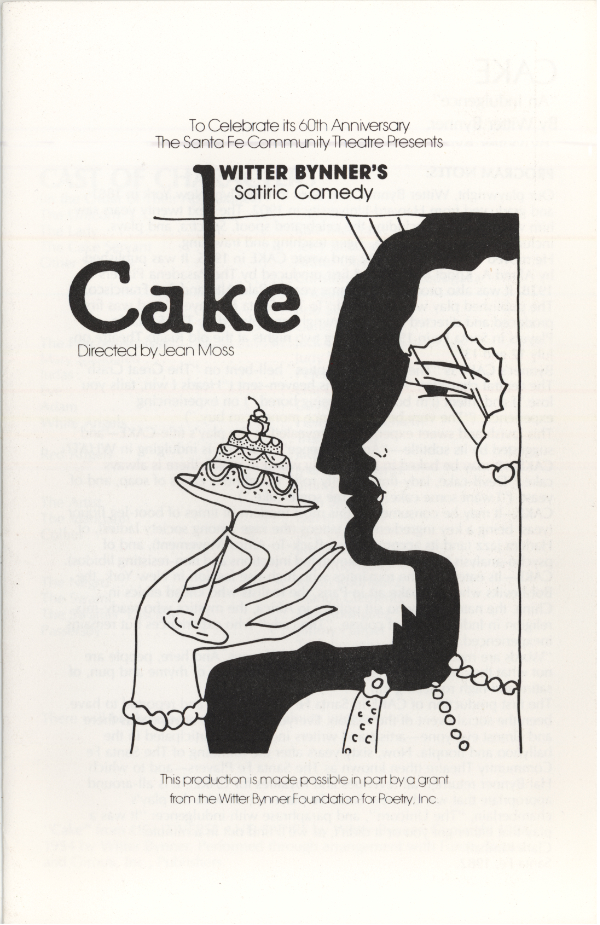
Program for Cake by Witter Bynner, produced in honor of the 60th anniversary of the Santa Fe Players, directed by Jean Moss, 1982. Design by David Margolis. Courtesy Jean Moss.

The structure was built in the 1890s as a livery stable and later became an auto repair shop. It barely resembled a theater, but it was theirs. They sectioned off an area for the stage and carted in folding chairs. As time went on, they built a makeshift dressing room that rested against the back of the building, and erected a real stage—although a structurally important pole stood in the middle of it until at least the 1970s. A second pole, in the audience area, was removed in the late 1980s or early ’90s—no one remembers exactly when.

Jim McGiffin, a New York native who performed at the Playhouse for the first time as the villain in the 1979 Fiesta Melodrama, says the pole was definitely still on stage when he got there. “I remember swinging around it, pointing at people, and doing nasty, villain things.”

The heyday

Jean Moss moved to Santa Fe in 1972 from New York, where she’d intended to become an actress.

“But I didn’t do it. I was terrified of the extraordinary commitment that I had when I was working,” says the 81-year-old rare books dealer. “Theater is the closest thing I have to religion.”

In New Mexico, she auditioned for Santa Fe Community Theater’s production of Summer and Smoke, by Tennessee Williams. “I didn’t comb my hair or put on lipstick. I just ran down to the theater. I remember it was very quiet when I auditioned because no one had ever seen me before.”

She didn’t get the part, but director Cather MacCallum cast her as Sonya in Chekhov’s Uncle Vanya in 1974. Moss went back to New York for a few years soon after, but returned in 1980 and joined the community theater’s board. Moss recalls there being a few paid staffers in the 1980s, including an office administrator and a technical director, but everyone else worked for free.

In 1982, Moss directed Cake, which Witter Bynner wrote for the Players and published in 1926. Produced in honor of the theater’s sixtieth anniversary, the theater paid no royalties and received financial support from the Santa Fe-based Witter Bynner Foundation. Moss recalls that they paid no royalties when they did Chekhov plays, either, because they adapted their own scripts. She says the seasons were made up of classics, contemporary works, and musicals, as well as the epitome of community theater, the Fiesta Melodrama.

“That’s where a lot of people without theater experience got their start, and then they would become more involved. But the melodrama was always separate from everything else that was going on. It was its own thing.” 

The 1970s and ’80s were the heyday of the community theater movement, which was an evolution of the Little Theater Movement that relied on volunteer support. Like others of its ilk, Santa Fe’s was supported by dues-paying members. But membership dwindled over the decades, and soon the $25 annual dues didn’t stretch as far as they once had. Most of the people from this era have died, but one important name is Marion “Jinx” Junkin, who founded Jinx’s Magic Theater in 1968 and The Theater of Music in 1980, both in Santa Fe. Another is Marty Stone, who took a leadership role starting in the mid-1970s, and was known as “Mr. Theater.”

Season program, circa 1998-99, Santa Fe Playhouse. Courtesy William Plouffe.

“He was a force of nature,” Olivas says of Stone. “He was the living embodiment of Zero Mostel as Bialystock in The Producers. He could talk you into anything.”

Stone convinced residents of the nearby retirement community to buy season subscriptions. He talked strangers on the street into auditioning for plays. He rescued seating from a synagogue dumpster and finally replaced the folding chairs in the audience. But his bookkeeping was sloppy—donation information was scribbled on scrap paper and unidentified receipts piled up in the box office. When he moved to California in the late ’80s, board upheaval followed and some of the core actors drifted away. Moss left the board at this time, though she continued to be involved for a few years, directing Uncle Vanya in the 1988-89 season.

McGiffin, the aforementioned pole-swinging villain, and his wife Carol met during the 1979 Fiesta Melodrama. They co-directed shows throughout the 1980s until starting their family, and remained involved from time to time. McGiffin, 73, last acted at the Playhouse in 2017 in The Normal Heart by Larry Kramer, directed by Duchess Dale. He also appeared in a video projection featured in that season’s adaptation of George Orwell’s 1984. McGiffin is a community theater devotee who says the Playhouse should remain what it always was. “The only thing they do now that’s like community theater is the melodrama. It’s too corporate now,” he says. And it doesn’t offer shows he wants to see. He prefers family-friendly musicals to “some play where two people ponder the possibilities.”

Asked what he’s referring to, he says, “I don’t want to see Waiting for Godot” (despite the Playhouse not having produced Beckett’s classic in any recent memory).

Moss disagrees. “I would love to see a great production of Waiting for Godot!”

The push for professionalism

Argos MacCallum arrived at the theater soon after Stone left. The Santa Fe Preparatory School graduate had been involved with other local theaters, including the Theatre of All Possibilities, before coming home to where he’d spent parts of his childhood watching his mother, Cather, run rehearsals. He began acting in and directing shows, and using his carpentry skills to improve the building. He joined the board. 

“They were involved in a huge renovation. They got rid of the pole in the audience, and the stage got raised,” says MacCallum, 70. “I did a lot of work on the remodel. I don’t remember who was president, but Rebecca Morgan was very instrumental at the time.” Morgan ran Southwest Children’s Theater and served on the Playhouse board for many years, and managed the Playhouse in the 2000s. She died in 2021, at age 69.

Catherine Owen moved to Santa Fe in 1993 to work for New Mexico Repertory Theater, but the Equity house (a theater employing talent from the Actors’ Equity Association) operating in the Armory for the Arts closed six months after she arrived. The board hired her in 1995 as the full-time managing director. They changed the name to Santa Fe Playhouse in 1997, in an effort to distance themselves from the stigma for uneven quality that had come to be associated with “community theater.”

Argos MacCallum was ambivalent about the name change, but says that as soon as they became the Santa Fe Playhouse, “ticket sales shot up.” He wanted to produce Spanish-language and bilingual theater, so he eventually left to found Teatro Paraguas. He remains a driving force in the Santa Fe theater scene, sitting on several boards and serving as ad-hoc advisor to anyone who seeks his counsel.

Sinn, 83, says he was invited to leave around the same time. “The theater fell on me after I retired. I thought I knew what my life was going to be, and then I got sucked into this. … Most of my memories are when we had community theater. The one thing we had was fun. That’s what held us together. And the mortgage. If you have to pay the mortgage every month, you might as well put on a play.”

During this era, directors included T. Kent Crider, Lucinda Marker, Janice Bonser, Richard Block, and Clara Soister. In the 1994-95 season, Crider directed an ambitious production of The Kentucky Cycle, by Robert Shenkkam, a Pulitzer Prize-winning series of nine one-act plays that required audiences to come back over two days.

“We found out later that the playwright was actually here in town when we were doing it, but he didn’t come see the play. You never know if they’re here or not,” said Sinn.

Owen, 63, admits that she and Sinn clashed. “He had a different focus of what he wanted to do, and he left. It was hard. I felt bad about it. But I had things that had to get done.”

She says changing the name was not about abandoning the theater’s origins, but about looking to the future. “Community theater is the hardest theater you can do. You work on little to no money, mostly volunteers. It was hard for community theaters to keep going, but those that did survive became playhouses, like the Pasadena Playhouse. I felt it would be a natural transition. It would help me grow the theater, and I knew the artistic quality could be better because we have the talent here.”

The Santa Fe Playhouse did away with its membership fee and became a 501c3. Owen wrote grants, increased rental income, and got new seating, among other upgrades. After a fire decimated the dressing room in 2000, she renovated the back of the building. She also started annual LGBTQ productions and the one-act playwriting competition Benchwarmers, which featured ten ten-minute plays where the only set piece was a park bench—and which ran until 2019 (and then become a casualty of the pandemic).

“I was able to start getting individuals to donate larger amounts of money,” says Owen, who left the managing director position in 2005. “I had many conversations with Robert Jerkins and Joe Paull, and when Robert passed, he left his estate to the theater.”

The modern era

Georgia native Kelly Huertas landed in Santa Fe in 1992 by way of New York City, where she’d grown tired of the drama in the independent theater community. She bartended at Cowgirl and once stumbled into the Fiesta Melodrama, which she didn’t entirely understand because she was new in town. In 2009, she wrote a play that was accepted into the Benchwarmers competition. She had another play accepted in 2010, and in 2011, she joined the board.

“I’d moved here to get away from theater politics,” she says, “but, I thought, this was small and I could handle it.”

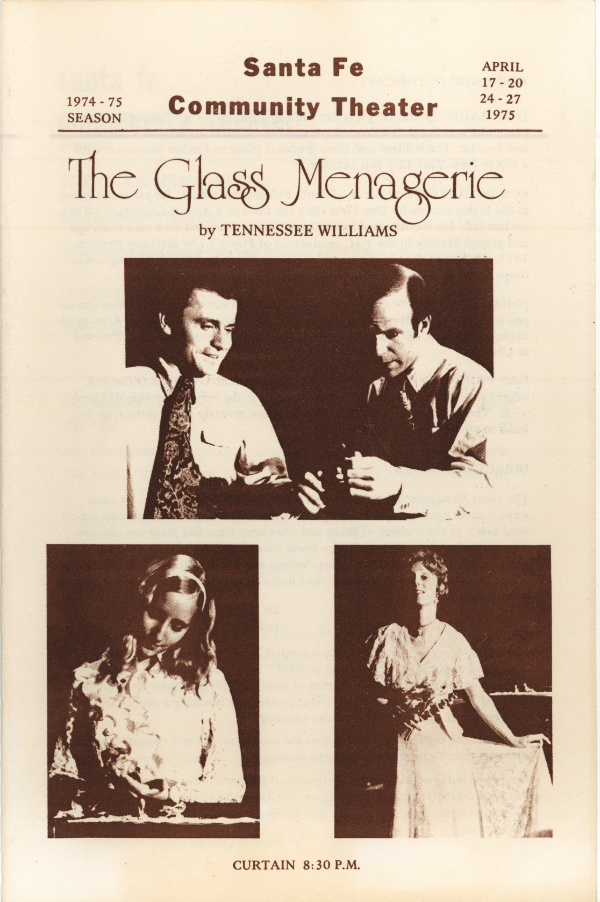
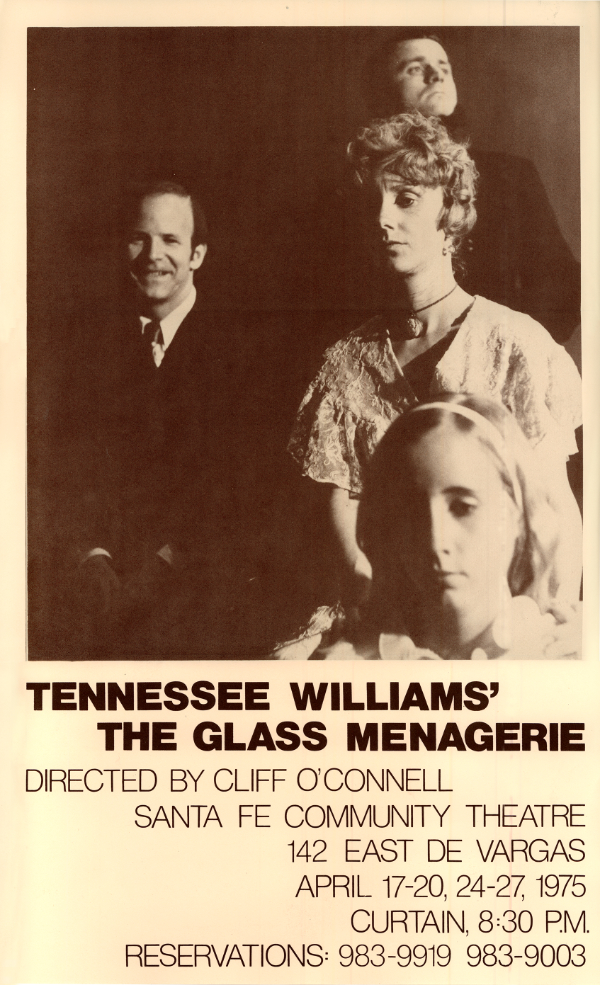
Program for The Glass Menagerie by Tennessee Williams, directed by Cliff O’Connell, Santa Fe Community Theater, 1975. Design by David Margolis. Courtesy Jean Moss.

The board was full of actors and directors. They were happy to work concessions, paint sets, and clean bathrooms, but the finances were a mess. They’d paid off the mortgage with Jerkins’ estate gift, and the remainder—around $1 million, depending on how the market was doing—was used to make up for annual budget shortfalls.

“Someone said, ‘When the money goes away, we’ll just let the next board deal with it.’ That really got under my skin,” Huertas says. It was time to stop relying on volunteers to run everything, or someone taking charge out of a sense of obligation, as Bob Sinn did when he came out of retirement and worked for a pittance.

Huertas, 59, became board president in 2013 and instituted a new infrastructure, hiring an artistic director, technical director, and office administrator. But the first staff quit en masse in less than a year, citing burnout. “None of us had any idea what it took to run a theater,” she admits. “We wrote job descriptions, but we were asking them to do more than was humanly possible.”

They brought in Vaughn Irving as the new artistic director. Irving grew up in Santa Fe, seeing Fiesta Melodramas as a teenager before going away to college and then acting in regional theater, teaching, and writing plays. “The board framed the mission as, ‘We want to be more professional; we don’t want to be a community theater anymore,’” he says.

Poster of The Glass Menagerie by Tennessee Williams, directed by Cliff O’Connell, Santa Fe Community Theater, 1975. Design by David Margolis. Courtesy Jean Moss.

Irving, 38, produced comedies, musicals, new works, and locally written plays, trying to see what would bring in audiences. But it wasn’t as though he suddenly closed auditions to the public and started only hiring Equity actors. Irving cast widely from the community, including students from Santa Fe University of Art and Design, which infused the Playhouse with youthful energy.

He says the most basic way to distinguish between community and professional theater is that the former relies on volunteers and the latter pays. “But I don’t think it gets at the heart of the question, which is: Who is the primary audience you’re serving?” Irving posits. “Community theater is about providing creative opportunities for the people in the community. Hopefully, the audience enjoys the finished product.”

Compare this to professional theater, where “we’re serving a mission to offer something to the community, not to provide an outlet for the community to do theater. Theater is our tool to create community, shared experiences, and dialogue,” says Colin Hovde, 41, the Playhouse’s current executive director.

In late 2019, Irving left the Playhouse to move to Chicago to pursue a graduate degree in arts administration (though he has since moved back to Santa Fe to serve as president of LiveArts Santa Fe, a nonprofit seeking to establish community and academic programs at the Greer Garson Theatre Center). He hand-picked his replacement, Robyn Rikoon, who lived in Santa Fe until she was 14. She’d been coming back in recent years to act and direct, including directing the 2017 production of 1984. Hovde joined the staff in 2021, when the Playhouse was closed to the public due to the coronavirus pandemic, which turned the theater world inside out.

Once More Unto the Breach

Rikoon left Santa Fe for boarding school in 2000, after her older brother died. She moved back almost twenty years later, just days after her partner unexpectedly passed away.

“I was in a state of shock,” says Rikoon, 36. “I don’t think I consciously made the choice to take the job. It’s like the choice was made for me.”

She’d been acting in regional theater for several years, and got her first chance to direct at the Santa Fe Playhouse, starting with short Benchwarmers scripts before moving on to the aforementioned 2017 production of 1984. After that, she accepted a directing fellowship at the Kennedy Center in Washington, D.C., where she reconnected with Hovde, whom she knew from North Carolina School for the Arts, where they both went to college. He’s the first person in a generation to bring substantial theater management experience to the Playhouse, which he calls “a hundred-year-old startup.”

Becoming an artistic director was a dream come true for Rikoon. Then, almost immediately, the pandemic hit, and she was forced to cancel her first season. She put some theater pieces online, including the 2020 Fiesta Melodrama, which she co-directed with Andrew Primm as a series of socially distanced shorts, filmed outdoors.

Reviving live theater in the waning days of the pandemic has been challenging. Shows have been delayed due to illness in the cast, and there is a general sense that many of the people who supported the Playhouse in the past haven’t come back. It’s unclear whether that’s due to rising ticket prices, fear of crowds, or other issues. Rikoon and Hovde would love to rebuild the volunteer core, upon which many theaters rely for concession work, ushering, and other duties.

“I don’t intend to take the theater away from the community, so I get super riled up when people have these ideas about it,” she says. “Just because we’re trying to create ‘better’ theater, whatever that means, that doesn’t mean it’s not for the community. I hold an open audition once a year, in December, for everyone who wants to act at the Playhouse, and then I do callbacks for the individual plays.”

The board is now made up of professionals—rather than artists—with legal and marketing experience, fundraising and networking chops, and other skills that can help steer a theater while leaving the artistic decisions to the artistic director.

“Our mission is to do new plays, and Robyn’s taste is extraordinary,” says Board President Kirkpatrick. He hopes that someday soon the Playhouse will be regarded as a small regional theater, rather than a community theater, but that there’s nothing wrong with existing somewhere in between. “I want the Playhouse to always be important to the community. We want people to come because we offer something they enjoy and that makes them think.”

Coda

The hundredth-anniversary Fiesta Melodrama, presented in August and September of 2022, was titled A Proud Playhouse Presents a Preeminent Pageant to Puncture the Precious Pretensions of a Pretty Provincial Populace, or A Silly Centennial Celebration Centered on the Scintillating Scandals of Santa Fe, or A Riotous Retrospective Chock Full of Gags. It was supposed to be a greatest-hits show, reflecting on a century of skewering anybody and everybody in the City Different. But when the cast, crew, and other volunteers began reading through old scripts, they realized that the Fiesta Melodrama has always been, in a word, problematic.

Times have changed and so has Fiesta. Indian Market long ago became independent of white oversight and is held earlier in August, and the Entrada was canceled in 2018 after mass public outrage at its selectively edited version of history. “You could say or do things a hundred years ago, or forty years ago, that no one blinked at, but these jokes come across very differently now and are taken in a completely different way,” says Andrew Primm, who co-directed this year with Eliot Fisher.

Felix Cordova performs in the 2021 Fiesta Melodrama at the Santa Fe Playhouse. Photograph by C. Stanley Photography. Courtesy the Santa Fe Playhouse.

The result was a play that put the melodrama itself on trial, in an attempt to look back and reckon with its history while authentically engaging Santa Fe’s tri-culture in the context of larger social change.

“In the play itself, we’re talking about how traditions change, but that traditions are people,” Fisher says. “The Melodrama is what we want to make it, any of us. That’s the same as our city.”

Fisher, 39, directed his first Fiesta Melodrama in 2006. Primm, 50, joined him in 2011, first as the play’s hero and then as co-director. They’ve shuffled duties most years since, bringing in others when needed. Both were born and raised in Santa Fe, though Fisher moved to Austin, Texas, a few years ago to pursue his doctorate in performance as public practice. Primm is a well-known local musician, producer, and cinematographer whose melodrama bona fides date to 1959, when his uncle was in the show and his aunt sewed costumes.

Fisher’s interest stems from his time playing piano for the Madrid Melodrama at the Engine House Theater. When he found out Santa Fe had a melodrama of its own, he walked into the Playhouse and asked how he could get involved. He was immediately welcomed by Rebecca Morgan, who saw potential in the recent college grad with a passion for old-timey hijinks.

“I don’t want to be grandiose,” he says, “but the reason I’ve been involved for so many years, and the reason I love it, is that the melodrama allows us to let our guard down enough to see ourselves and each other anew, and maybe even inspire us to take some action in our lives. We raise our voices in approval or discouragement at various things in our town, about how we live. It’s very much like the democratic process itself. That’s getting very serious about something that is super silly, but it’s genuine for me.”


Jennifer Levin is a freelance writer and communications professional in Santa Fe, New Mexico. As a journalist, she writes primarily about arts and culture. She grew up in Chicago and holds a bachelor’s in creative writing from the College of Santa Fe.

Jennifer Levin is a freelance writer and communications professional in Santa Fe, New Mexico. As a journalist, she writes primarily about arts and culture. She grew up in Chicago and holds a bachelor’s in creative writing from the College of Santa Fe.

Driven

By Almah LaVon Rice

Erased from history. Neglected. Overlooked. Hidden. Makes Critical Race Theory haters tremble.

These are the words and phrases that alight on photographer Ron Tarver’s mind when he considers the popular iconography of the Black cowboy. “I tried to publish a book in the ’90s [about Black cowboys] and could not get anyone interested,” recalls Tarver, whose photojournalism in The Philadelphia Inquirer garnered a joint Pulitzer Prize in 2012. “In fact, an editor at a publishing house told me there were no such things as Black cowboys.” But that laughable ahistoricism is belied by the widespread adoption of the word “cowboy” itself: Anglo cowhands were more likely to be called just that, while Black cowhands were pejoratively dubbed “cowboys” no matter their age. 

Thankfully, Black cowboy imagery is galloping out of the pop culture shadows—from the stylings of rappers Lil Nas X and Megan Thee Stallion to the foot-stomping reception to Chapel Hart, a cowgirl singing trio. There is Concrete Cowboy, a feature film based on the novel Ghetto Cowboy by Greg Neri. The 2020 release was inspired by Philadelphia’s Black horsemanship traditions, which Tarver has also chronicled in his photography. The Harder They Fall was filmed in New Mexico and released last year, becoming one of the few Westerns with an all-Black principal cast.

But perhaps nothing has branded Black cowboy imagery in the recent collective consciousness like the Black Lives Matter protests of June 2020. Galvanized by the filmed murder of George Floyd and the extrajudicial killings of other Black Americans, the Compton Cowboys created and led a peace ride through the streets of Compton, a city in southern Los Angeles County. These mounted freedom fighters made a powerful social and visual statement with matching black T-shirts, cowboy hats, masks, bandanas, and raised fists. At Oakland’s BLM protests, Brianna Noble of Urban Cowgirl Ranch sat atop Dapper Dan, her Appaloosa gelding, and became an international icon of resistance.

It’s against this dynamic backdrop that the Harwood Museum of Art stages Outriders: Legacy of the Black Cowboy. The exhibition in Taos features archival photographs, historical texts, and present-day renderings of the Black buckaroo. Contemporary Black artists (Tarver, Praise Fuller, Nate Young, Otis Kwame Kye Quaicoe, Kennedi Carter, Ivan B. McClellan, and Alexander Harrison) aptly demonstrate in this show that the Black cowboy tradition still breathes and bronco-busts through barriers. The Harwood, the second-oldest museum in the state, offers Outriders through May 7, 2023.


Even a cursory look into the annals of the cattle driving industry reveals that African American outriders were no outliers. Historians estimate that, in the nineteenth century, one in four cowboys was Black. In fact, according to the nonprofit BlackPast, Black bondsmen constituted the majority of the cowboys in 1850s Texas.

And according to Larry Callies, founder of the Black Cowboy Museum in Rosenberg, Texas, the widely touted one-in-four estimate is just too conservative. Black cowboys were deliberately hidden during census roundups so that white ranch (and slave) owners could evade taxes, he claims. “My dad was a cowboy, my uncles were cowboys,” remembers Callies in a documentary from The Guardian. “Everybody I knew in my family were cowboys. And I asked my dad one time when I was about six, ‘Dad, where are the white cowboys?’”

Callies’s father made it clear that the prevalence of African American cowboys was not happenstance. “It’s like picking cotton,” he replied, invoking another industry associated with enslaved labor—because the duties associated with cattle driving were backbreaking and far from glamorous, despite the mass-media conception of the cowboy as an avatar of unbridled freedom, a flâneur on horseback.

Enslaved Black Muslim men were the first true “cow men,” or vaqueros, asserts Lawrence Clayton in his book, Vaqueros, Cowboys, and Buckaroos. During their 800-year rule of Spain, Moors transmitted their riding styles, horsemanship skills, and horse breeding knowledge to the Spanish. When Hernán Cortés and other Spanish conquistadors invaded present-day Mexico, they brought with them Black Muslim enslaved people who were also equestrians. (Even the modern Western saddle derives from the Moorish saddle.) BlackPast also notes that Senegalese stock grazers, who were enslaved in South Carolina and South American colonies, are part of the Black ancestral cowboy legacy that eventually spread throughout the American West. Of course, Black cowboys perfected their craft under the tutelage of Indigenous cattle wranglers and Mexican vaqueros of various ethnicities.

These multiethnic, multicultural, and even multinational contributions to The Cowboy™ have traditionally been missing from the popular imagination. Silver-screen depictions of the cowboy have been overwhelmingly limited to John Wayne, Clint Eastwood, Robert Redford, and other white men meant to embody rugged Americana. In some cases, specific Black cowboys have been whitewashed out of the picture. Although a white actor played the titular character in 1949 TV series The Lone Ranger—the masked Texas Ranger who was the very paragon of cowboy ethics—the actual Lone Ranger was Bass Reeves, the first Black deputy U.S. marshal west of the Mississippi. John Wayne’s character in the movie The Searchers (1956), although white, is modeled after the real-life Britt Johnson, a noted Black cowboy. According to Callies, white Hollywood cowboys were imitating the storied Black marksman and cowboy Nat Love, aka Deadwood Dick. In addition, cowpunchers of African descent infused cowboy traditions with various innovations. It was Afro-Cherokee cowboy Bill Pickett who invented the rodeo technique only for the most intrepid: bulldogging, or steer wrestling. (Black cowboy legend John Ware is said to have popularized the practice in Canada.) Black Seminole cowgirl Johanna July invented a protocol for taming wild horses, leading the U.S. Army to retain her as a wild horse tamer. But the open range and the rodeo were not the only places a Black cowboy could make history. George McJunkin was one of the best ropers in the country and is credited with the 1908 discovery of the Folsom Site—one of the most significant archaeological sites in North America—in eastern Colfax County, New Mexico.

Erwin E. Smith (1886–1947), Cowboy lighting a hand-rolled cigarette making a smoke that looks like a brush-fire. A typical manner of smoking on the range in those days. JA Ranch, Texas., 1908. Gelatin dry plate negative. 7 × 5 in. Erwin E. Smith Collection of the Library of Congress on Deposit at the Amon Carter Museum of American Art, Fort Worth, Texas, LC.S6.917.

Ballad for the Mane that Blooms. Mutualism Between Woman and Horse. A Study of Companionship in a Pasture. Today I Braided a Mare’s Mane to Match Mine. A Ravening Wolf is also a Nursing Mother. My Box Braids are Sweetgrass. Ant Raft on Bloody Lake, Anthill on my Gravesite.

These are titles of discrete works inside Praise Fuller’s Is Heaven A Mountain?, a 2021 cyanotype exhibition at Blue Rose Gallery in Houston. But they also float into the reader’s mind as poems do, revealing as they conceal. This is no accident, as Fuller admits: “My first dive into creativity was through poetry and creative writing.” Her father was also a poet and as such, she adds, “It’s one of the only ways I feel truly connected to him.” And speaking of connections: It’s as if an in/visible filament links Fuller’s visual work to her textual meditations. Consider her disrupted cyanotype print of ants: What relationship do they have to Fuller’s gravesite? Is the artist a griot remembering, or an Afrofuturist prophet, or both? It’s up to viewers and readers to make their own associative leaps between mystery and mystery. She says, “I … like leaving lots of detail open to interpretation, hence the fragments as titles.” 

Praise Fuller, Untitled (three cyanotype studies), 2022. Cyanotype print. Courtesy of the artist.

Playfully obscured as it may sometimes be, there is a symbiotic relationship between word and image in Fuller’s work. “I discovered through writing, not only could I make sense of the world around me, but I could also create worlds of my own or translate sentiments and experiences into something visual,” she explains. “I found myself writing poems to create visuals that would then be birthed into cyanotypes. If I didn’t know how to portray something or an idea seemed a bit too literal, I’d write a poem. Whenever I learned something new, I wrote a poem about it. From there, I came up with my own allegories that manifested into cyanotypes.”

Interestingly enough, Fuller’s three works in the Outriders show all bear the name Untitled (2022). It’s as if titles from the aforementioned cyanotypes—for example, Mutualism Between Woman and Horse and A Study of Companionship in a Pasture—have been assimilated into the images themselves. Words fall away as the viewer takes in the visual poetry. These cyanotype prints on fabric say it all: a Black woman, her horse, clouds, sky, scrubland, rocks, and the knowing between them. Her printed textiles remind the viewer of well-loved, oft-washed denim: soft and blue as a memory or a dream. Spirit and love of homeland sing through this Texas-born artist’s oeuvre. The intimacy between Fuller and landscape shows up in her invocation of box braids and sweetgrass; the natural world and the sacred arts of Black hair are braided together, bound up together. “I love Texas so much,” she says. “I say this because I love its physical beauty and what it has offered me spiritually. I want to be able to share experiences learning about bird migration, how I got into horseback riding … my solo walks through various Texas terrain, wondering if the cows I’d see every day before school enjoy my innocent kisses I’d blow out the window, everything. Sometimes I feel like what I wish to convey may be bigger than me. I feel like these explorations have helped me navigate a lot that I felt was lacking in familial or religious spaces, although those teachings and experiences shaped who I am as well.”

But Black artists are not merely biography-bound; they get to be fugitive, too. A Black artist might spring from Houston, as Fuller has, but at the same time she gets to be from Elsewhere. “I don’t want things to be too autobiographical,” she continues. “As I said, I like things to be open to interpretation, so I like to think my experiences just serve as an inspiration for a lot of my work.”

In the end, Fuller’s fascination with the cyanotype reflects the playfulness, expansiveness, and mystery evident in the content of her work. She muses, “I love how mutable the medium is. It’s a simple process, really; just two chemicals and a photo negative makes something a ‘cyanotype,’ but the fact I can go from paper to fabric to wearables to an entire bedspread to playing with upcycling old mirrors or ceramics still having these pieces under the guise of ‘cyanotype’ is so interesting to me. It allows me to stay playful with the medium and experiment with different questions, forms, ideas, and ways of approaching creativity as long as it’s coated in this blue formula. … As I evolve, I feel like I chose a medium that gets to evolve with me.”


Fuller’s printmaking comrade in Outriders includes Ron Tarver, although pigment ink is employed in his case. Well-known for his role in amplifying Black cowboy iconography over the years, he has been an associate professor of studio art at Swarthmore College since 2008. His photojournalism has appeared in National Geographic, Life, Time, Newsweek, and Sports Illustrated, among many other venues. His fine art photography has garnered support and recognition from the National Endowment for the Arts and the Pew Fellowship in the Arts, in addition to countless other honors; last year he was awarded the prestigious Guggenheim Fellowship for photography.

Yet another honor may be the way his subjects open up to him and his gaze as a visual storyteller. In Father and Son, a Black cowboy and his toddler son look into the eye of the camera. They could be posing between rodeo events, a quick courtesy extended to Tarver. But their eyes tell the long history of Black cowboys in this country, suspended in and supple within time. The portrait testifies: The tale of the Black cowboy is intergenerational and very much alive. Tarver could just as easily be sharing his personal family history in so much of his body of work; he says, “My grandfather Tommy Wilson was a working cowboy in Oklahoma in the ’30s and ’40s. He died before I was born. My mother told stories of him driving cattle from Ft. Gibson, the small northeast Oklahoma town where I grew up, to Catoosa, Oklahoma, about 50 miles north where the cattle would be auctioned and sold. He also was locally famous for being an outstanding rodeo cowboy specializing in steer roping.” Tarver assumes the role of witness and archivist readily, adding, “The significance lies in the fact that these stories are not widely known outside of family histories. As a photojournalist I felt it was my duty to tell stories of modern day African American men and women who live a Western lifestyle.” 

Tarver’s early formal education in the arts gained him a BA in journalism and graphic arts at Northeastern State University in Tahlequah, Oklahoma (1979). After attending the Missouri Photographic Workshop in 1984, he went on to earn an MFA from Philadelphia’s University of the Arts in 2017 after years of racking up accolades in the field. After all, he joined The Philadelphia Inquirer as staff photographer in 1983, wrapping up his tenure there as recently as 2014.

It was at The Philadelphia Inquirer—which happens to be the third-longest continuously operating newspaper in the U.S.—that his documentation of Black cowboys was ignited. Recalls Tarver: “At the time I worked on this Black cowboy project in the ’90s, I didn’t imagine the images as an exhibition. However, when the stories ran in The Philadelphia Inquirer I was amazed [by] the response. Those stories garnered more letters than just about any story I had worked on. I see the images as more than art on a wall—to me they are a way to communicate this proud heritage.”

So many exhibitions later—over thirty solo and fifty group shows, national and international—Tarver has been integral in paving the way for other chroniclers of the Black cowboy experience. In one of his artworks featured in Outriders, a Black cowboy races on a white horse, headed to some wild unknown yonder. Aptly, the print is entitled Dave’s Last Ride. A rainbow arcs over horse and rider with cinematic panache, the meteorological phenomenon serving once again as a symbol of hope, promise, and what endures. The print could be a still from the Black cowboy movie of our dreams—and from the future.


Painting film posters by hand is how Otis Kwame Kye Quaicoe got his opening credits as an artist. Born in Accra, Ghana, he grew up wondering where were the cowboys “that looked like me,” he says. “I loved movies and I always watched cowboy Western movies [and] I discovered art through a bunch of artists that were commissioned to paint these movies. … The posters advertising outside of the theater were hand-painted by these artists. So I was amazed by that and … told them I wanted to learn how to paint, draw like them. So I started taking lessons from them and they taught me a lot.”

Ron Tarver, Father and Son, 1993. Pigment ink print. 17 × 26 inches. Courtesy of the artist.

The subjects of some of these fledgling drawings? Cowboys, of course. Quaicoe went on to study painting at the Ghanatta College of Art and Design in Accra. He moved to Portland, Oregon, in 2017 and in 2020, Roberts Projects, Los Angeles, California, mounted Black Like Me in Culver City, California—Quaicoe’s first solo gallery exhibition in his adopted country. This was also during the era of the uprisings, the supposed summer of racial reckoning. “I saw in the news for the first time African-American cowboys, which were the Compton Cowboys. So that is what actually sparked everything in me,” he remembers. “I’m like, ‘Oh, so what I have always imagined and wondered—if there was somebody [a cowboy] that looked like me—this example actually existed. So for me, it was like a dream come true. My fictional characters have finally come to life.” His portraits of Afro-descended people within cowboy aesthetics led to his first solo show in Europe, BLACK RODEO: Cowboys of the 21st Century, presented by Almine Rech Gallery in Brussels earlier this year.

Otis Kwame Kye Quaicoe, Untitled, 2022. Oil, acrylic, charcoal and oil stick on panel. 30 × 24 inches. Courtesy of the artist and Roberts Projects, Los Angeles, California.

It’s called Red Bandana on Green Suit, as if the oil painting’s title is pointedly, playfully understated in contrast to the vividness of its subject. A Black man wears a cowboy hat, a red bandana around his neck, and a green striped jacket—and his eyes blaze, even as they are cool and assessing. Lower your gaze and this cowboy will not follow suit; hold his gaze and behold what you dare not confront. Ineffable and resounding, this man is a mirror; wordlessly, he says, Look at yourself through my eyes. Do you like what you see?

While not featured in Outriders, the smoldering Red Bandana on Green Suit cannot be ignored when considering Quaicoe’s body of work. The arresting nature of the eyes in Quaicoe’s figures is intentional. He has been fascinated by and has studied portraiture of canonical artists like Renoir and van Gogh, integrating those gleanings into his paintings along with his experiences as an hypervisible Black man in America. He states that since arriving in the U.S., he has noticed “the gaze and stare people give me when I walk into certain places that just feels like I’m not welcome here. The kind of look they give me—the eyes that follow you around in every movement, in every direction you go.” He continues, “I try to put those two together—[the gaze] from the masters and the gaze I get when I walk around.”

Knitting the intimacy of European portraits he has admired with commentary on anti-Black surveillance is just one example of the ways Quaicoe synthesizes his influences and inspirations. The Black cowboy in Red Bandana on Green Suit may be standing on some desert plain in New Mexico, but the thick-textured sky in the painting is directly inspired by the mud and wood homes of northern Ghana. Quaicoe also notes that herding and horse riding has its own sartorial tradition in northern Ghana. “We dress in our traditional way,” he explains, which is different from cowboy hats and boots. “I’m just trying to find the connection between the two and also merge them together.” Invoking migration, slavery, and the African diaspora, he adds: “We are connected as one from the beginning.”


One of Quaicoe’s works included in Outriders is simply called Untitled. Rendered as oil, acrylic, charcoal, and oil stick on panel, another Black man in a cowboy hat regards the viewer. But in this painting, his nose and mouth are covered by a red bandana.

Is he a member of the Bloods? Is he a cowboy shielding himself from the clouds of dust raised by storming cattle? Is he the masked marauder of stereotype? Is he trying to keep his loved ones safe from Covid? You will find whatever Black man you are looking for. One thing is for certain: He is staring right back at you. The Black gaze is here, front and center. The look is a lasso and you cannot help but be reeled in. 


Former New Mexico resident Almah LaVon Rice is a Pittsburgh-based writer at work on her first book. You can find more of her writing at AlmahLaVonRice.com.

Almah LaVon (opens in a new tab) (they/them) is a writer and fairy marsh monster living in Dionde:gâ. They write creative nonfiction and short fiction engaging unfettered Black imagination and dreaming a new world many-petaled. Almah is a recipient of the Exposure Artists Program First-Time Grantee Award from The Pittsburgh Foundation.They were selected for the global Orange Tangent Study grant in 2022. They were awarded the 2022 Fable Grant, an initiative led by New York Times-bestselling author Adrienne Young.

On the Ball

By Amy Smith Muise
Photographs by Gabriela Campos

I met Greg Ball on a fine, hot morning in August, on a weekday when the museum wasn’t crowded. He’s been the livestock manager at the New Mexico Farm & Ranch Heritage Museum for twenty-four years now. Our conversation started about rain, as is often the case in the desert Southwest.

Along with his full-time job at the museum, he has a small farm in Mesilla, and as of early August it hadn’t rained much there.

“It’s rained here a lot, but this is a gravel pit.”

I had to laugh. We stood in front of a lofty horse barn among manicured lawns, paths, and clean, well-maintained livestock pens. “Gravel pit” isn’t the first descriptor to come to mind.

“When I came here, where that bathroom is, there was a 50-foot hole there,” he says. “There was an arroyo about where we’re standing. We kind of channeled the water, here and there. So it’s been quite interesting, to put it all together over the years. These cattle… I’ve raised them. Third and fourth generation on some of them. They’re kind of my babies.”

Greg Ball collects bales of hay to be distributed as the first meal for the various livestock at the museum early on an August morning.

Greg is the type of person who can seem real tough and real sweet at the same time. Perfect for a public-facing job like this. 

As we talk, a trio of Swainson’s hawks are calling from their perches on the fence and roof, surprisingly close to us. I ask what they’re after. “A rabbit or a quail or something,” Greg says, “it just has to make the wrong move.”

I ask if they are always so vocal.

He makes a loud, hoarse whistle just like the hawks’. They call back. “Yeah, you can sit here and talk with them,” he says.

The New Mexico Farm & Ranch Heritage Museum encompasses 47 acres in Las Cruces, on Dripping Springs Road across from Tortugas Mountain (and yes, it sits on sand and gravel deposits of the ancestral Rio Grande). The museum arose from long grassroots interest—it was the vision of William P. Stephens, former director of the New Mexico Department of Agriculture, and Gerald Thomas, then president of New Mexico State University, as well as from efforts of the Office of Cultural Affairs (now the Department of Cultural Affairs) and the New Mexico Department of Agriculture. It opened to the public in 1998, around the same time a rancher on the museum’s board, John Yarbrough, contacted Greg and asked if he’d be interested in starting up a livestock program.

“They just wanted something simple,” says Greg, “and it started simple, but it’s turned into this monster that it is now!” He laughs. “I just call it that. It’s just turned into a lot of work.”

He speaks highly of the crew who helps him with that work. “People think they want to be in the livestock business or want to be a cowboy, but a lot of them figure out they don’t. Or I’ve had some really good crews, nothing but good cowboys, but they don’t want to talk to people; they want to be on a horse. And they’re great help and they do things well in front of people, but they don’t want to talk.”

That’s not the case with the current crew: Ross Zuniga and Jake Montoya. “They’re good. They’ll talk. Real kind-hearted. That shows up. Cattle really pick up on that.”

The museum is set on two sides of Tortugas Arroyo. These days, to get from the main museum building to the livestock area, visitors cross it on a regal green bridge that once served as part of a three-span across the Pecos River near Roswell, and later was moved to the Rio Hondo. It was installed in its present location in 2007.

Greg points out a white barn near the arroyo. “This was the first building. … The dairy barn. Southwest Dairy Farmers. That sidewalk, that was the only way to get across. [Dairy] was really the only thing to do… and then we slowly started building other things, and we started down there. Once we started, Smith & Aguirre Construction Company, they came in here and did all the dirt work for us. They came in, put in all the utilities… found all the elevations, put water to drain. There was always a lot of ideas of what was going to go down here. I can remember some of them saying: ‘That cowboy’s going to build a fence, fence off everything down here.’ So I did.’”

“Did you do all this welding yourself?” I ask. There’s a lot of pipe fence and welded wire.

“Uh-huh.”

Greg tells me he’s been lucky over the years to have directors who gave him the freedom to develop things his way on this side; and the current director, Heather Reed, who took on the position in November 2020, is no exception. You can tell Greg has had a long-term vision. The livestock area has the kind of harmony of shape—geometric, but following the lay of the land—that says its maker has pondered every aspect of the site.

“Almost everything here, we built,” Greg says, pointing out a few exceptions. A lot of the work has been on the setup of livestock pens that he’s rightly proud of. As a farm girl, I admire the sheep pens right away: grassy paddocks laid out with pipe frames and sturdy mesh panels. Sheep excel at escape. Greg explains that his team built those during Covid lockdowns when most of the museum was closed, but of course, the livestock department wasn’t.

We walk around the sheep and goat barn, a pleasant, airy building with indoor-outdoor runs for the animals and beautiful hand-painted signs describing modern and historical breeds of sheep and goats in New Mexico. In the center of the barn sits a sheepherder’s wagon, a moveable dwelling used throughout the American West as lodging for those who traveled with the flocks. Peering through the glass, I see a narrow bed with threadbare quilt, a washbasin, a small wood stove. It’s hard to imagine that life.

The devotion of caretakers of livestock on the range and in the mountains is kin to the devotion that all livestock managers feel. Animals require daily care, feed, water, a careful eye on their health. Greg says it was peaceful during Covid, when only he and the crew were around.

“We just did a lot of things when everybody was gone,” he says. “Put all the stays in that fence. We have barriers now, between everything, for the safety of the public.” Also for the safety of the animals. “People will feed them whatever,” he admits.

Despite this barricade, Greg has had pretty good experiences with museum visitors.  “It’s been a very fun place,” he says. “And to tell you the truth, whatever black eye agriculture has”—I think he means the public’s concerns about animal welfare and environmental impact—“I haven’t seen it. Even though… my wife says I’m kind of an unapproachable guy. I have an unapproachable personality.”

I find this hilarious. He’s pretty charming.

Greg likes to do his livestock work openly, where visitors can observe the daily goings-on. A highlight during organized events is the Parade of Breeds, where the crew bring cattle through for viewing, in order of their historical introduction to New Mexico. Greg will talk to the audience about each breed, its carcass characteristics, and what type of environment they do well in. “Not all these breeds belong here in the desert Southwest,” he emphasizes. In the early 1990s, he worked as a research assistant at New Mexico State University under Dr. Bobby Rankin, studying crossbred commercial cows for desert environments. This work familiarized him with many beef breeds and crosses, including Simmental, Charolais, and Hereford crosses, and purebred Brangus. His favorite mama cows, he says, are a Brangus-Hereford cross.

“I’m extremely fond of them.”

Although the livestock program keeps and uses bulls onsite, Greg sometimes artificially inseminates cows to bring in genetics from elsewhere. He tells the story of one of the few times he stopped what he was doing to warn visitors away.

Greg Ball and a donkey look out towards the Organ Mountains as the sun rises at the New Mexico Farm & Ranch Heritage Museum.

“Some ladies and some little girls,” he says, stopped by to watch while he was AI-ing some cows. “You’d better go… look around,” he told them. 

“Oh, no,” they said, “It’s okay. We watch Doctor Pol [a TV veterinarian].”

“Who’s Doctor Pol?” Greg asked.

“You don’t watch Dr. Pol?” they said.

“No.”

Greg has a way of finishing up anecdotes by quoting his own laconic responses.

“So the public does get to watch you work cattle?” I ask.

“Yes, we don’t hide anything from them.”

Greg Ball stands next to his quarter horse Rachel after a long day attending to the many animals at the Museum. Ball, who began working at the New Mexico Farm & Ranch Heritage Museum in 1998, is continuing the tradition of ranching and farming that his grandparents instilled in him.

He also encourages visitors to watch the crew working with young horses. At the far end of the horse barn is a beautiful round pen with bleachers where observers can sit up and get a good view of what’s happening.

Greg has been starting colts for most of his life, as well as training head and heel horses, cutting horses, and working ranch horses, especially for pen work. “Sorting horses,” he specifies, referencing horses trained to divide up groups of cattle, “that’s kind of my niche. You have to pay attention to what you’re doing. Can’t sit there yacking on your phone. Or something tries to go by, and…” He makes the universal gesture for getting dumped when your horse dives out from under you to turn a cow.

“It’s been fun here because I’ve gotten to do it as a demonstration,” he says. Whatever he needs to do on a given day, with a given horse, that’s what he works on, and the public can watch and learn. He doesn’t like to be videotaped, though. “This day and age, everyone just comes in and thinks they [should] videotape you.”

I make a mental note to take it easy with my camera phone. For those who take pride in their “feel,” handling horses and cattle with sensitivity, a random capture can unfairly preserve an inelegant moment. “I’ve been in the cattle business for forty-two years,” Greg says. “I grew up around old cowboys, so… handling cattle—it always cracks me up—‘quietly’ is nothing new,” he says; referencing low-stress ways of working cattle. “Because… it was really frowned upon [not to]. Everything was done on a horse.”

Cattle tend to feel comfortable around horses, as fellow prey animals. They respect them, but don’t fear them. When humans get horseback, cattle can see us more easily and don’t get as nervous as when we mess around at ground level.

“It was almost sacrilege to work cattle in a pen on foot. The old-timers just wouldn’t do it. That’s how I got involved in horse training.”

Greg Ball rides his quarter horse Rachel in the museum’s ring.

Greg gestures to the corrals that spiral back to the edge of the property. “These pens are for a guy that wants to do things on a horse. … Long ways. Big. All the latches are up on top.” He designed these gate latches, easy to open and close from horseback; they don’t require getting down, opening a waist-level latch, leading a horse through, then closing the gate on foot. It can all be done from the saddle.

This way, the crew can bring cattle from any direction to the sorting chutes next to the barn, all while staying horseback. The corrals fit together in a long connecting path. There’s no stress or difficulty in maneuvering through gates or alleys. Everything just sort of flows…

“…most days,” says Greg.

He doesn’t want me thinking all museum visitors are angels. So he tells his story about the one time—just once—some guys tried chucking rocks at a bull.

“And these were older men! They said, ‘He started it’—meaning the bull. I said, ‘You’re kidding?!’ I told them, ‘I got third graders [touring the museum] more mature than you guys.’ Boy that made them mad. But in all the twenty-something years, that’s all. One other lady, she came up and said, ‘One of those pens doesn’t have any water in it.’ And you can see right here, the troughs split the pens. There’s water in both pens. And I had one old cowboy working here then, he said I should have told her, ‘That’s a breed that we’re raising that doesn’t need water here in the desert Southwest.’”

I get the impression they have a pretty enjoyable sense of humor around here.

Greg says he’s lucky to have started the livestock program and to have stayed here to see it grow. As a young man, he worked on ranches for the Yateses (of Yates Petroleum). When he moved to Mesilla he wasn’t really planning on staying there, but “life gets in the way.” He met his wife here, and they’ve been married for thirty-two years. Their sons are both athletes who played Division 1 college ball (one football, one baseball). Greg also has a daughter who works at a veterinary clinic, and I can tell he’s pretty proud of her skills and toughness.

It’s time for the tour of the cattle, so we climb aboard the UTV to make the rounds. The livestock program produces registered bulls, as well as heifers, and sells them as part of its process. I see some nice young bulls, Angus and Hereford, that will be ready by the fall. They also raise Brangus bulls, most of which have already been sold for this year. “You want them all the same size,” says Greg, “want them all to look the same, all look good. That way you’ll sell them all.” He shows me some older cows that raise “the best heifers” every year, and one who regularly has twins. “We try to explain everything that we do. And I think people don’t realize how much we know about them… as far as the genetics of them, their personalities.”

To show me a bit of that personality, Greg gets out of the UTV and climbs over a tall fence with extraordinary nimbleness. (He casually mentions he’s had five back surgeries.) A massive bull sidles over for scratches, clearly used to socializing. All the cattle on the place are gentle—testament to the calm, daily attention Greg and his crew pay them, and to their lack of stress in handling.

Their working chutes accommodate many different kinds and sizes of cattle, including special facilities for longhorns (staggered openings allow them to move their horns through the chute one at a time) and a hydraulic squeeze chute for doctoring or other delicate work.

“This is the hoof-trimming chute,” he tells me, “but we don’t really need it.”

I joke (am I getting the hang of this?): “Because you’re in a gravel pit!”

Greg works his cattle slowly through the alleys, not filling them up, just six or seven at a time. “Just gets rid of all your mess, all your problems,” he says, “especially if you do it horseback. … I mean, we could pack them in here… but sooner or later, something goes wrong.”

The radio in the barn is playing a cover of Hank Williams’s “Honky Tonkin’.”

Cattle enjoy their sunrise meal at the New Mexico Farm & Ranch Heritage Museum.

We tour pens of Angus, Hereford, and Brangus cattle, as well as some beautiful longhorn cows and a Brahman bull. Greg shows me the facility’s roping arena and the Corriente steers they raise for the recreational cattle market (cattle used for roping practice and competition). He says that demand is good right now. Staying home during Covid lockdowns brought people back into team roping.

At this edge of the property there’s an almost-2-acre field remediated with fertile soil from the Mesilla Valley. Here, the crew grows giant Bermuda grass to pasture cattle for grazing when they can. The rest of their forage is stored nearby, in enormous haystacks of small bales under sheds. Across the fence we can see Centennial High School. Greg has explained that before the high school was built, they used to have a water feature nearby, with wetland plants. Fearing it might be too much of an “attractive nuisance” so visible from the high school, he decided to fill it in, moving several cottonwood trees to new locations in livestock pens. They provide much-needed shade in the hot climate of Southern New Mexico.  “We have other shades, the shade structure and the walls,” Greg explains, “but nothing makes better shade for cattle than trees.”

Greg Ball tosses hay for an early morning round of feeding of the various breeds of cattle at the museum.

As it nears midday, we can see cows, calves, and bulls clustered beneath them.

I ask about the roping arena, and he explains they hope to use it more once they level some land for parking (for pickups and horse trailers). As for Greg, he can’t really rope anymore after his back surgeries. “Hasn’t really stopped me from riding,” he says, “but it’s stopped my roping.” A battery sewn under his skin with two wires run into his vertebrae helps him walk and tricks his brain to ignore pain from a spinal cord injury. It’s been an improvement in life, he says. He controls the device from what he calls a “little bitty iPad.”

Greg’s vision for the livestock program still feels alive and electric, after all these years, as he talks about the lineages of cows and bulls, the long arc of his breeding programs for Angus and Hereford, Brangus and Corriente. Meanwhile, Greg tells me about the alley we’re traveling down: “I’m going to rebuild all this. And put some swinging gates in there.” He muses, “One of these days I’ll retire. And one of the things I did to get myself to my retirement was I built myself a new round pen in the back of my roping arena [in Mesilla]. My wife said, ‘What are you going to do with that?’ and I said, ‘I’m going to break colts.’ She says, ‘Wasn’t that what you were doing twenty-five years ago?’ I said, ‘Yeah! I’m going to retire and get right back to it.’”

Amy Smith Muise lives on a cow-calf ranch in Otero County and works in the Department of Innovative Media, Research & Extension at New Mexico State University. She grew up on a sheep farm in Manitoba, Canada. 

Gabriela Campos is a photojournalist based in Albuquerque, New Mexico. Her work has been featured in The Guardian, High Country News, Al Jazeera, VICE, and numerous southwestern publications. She is currently on staff with the Santa Fe New Mexican.

Amy Smith Muise (opens in a new tab) lives on a cow-calf ranch in Otero County and works in the Department of Innovative Media, Research & Extension at New Mexico State University. She grew up on a sheep farm in Manitoba, Canada.

Gabriela Campos (opens in a new tab) is a photojournalist based in Albuquerque, New Mexico. Her work has been featured in The Guardian, High Country News, Al Jazeera, VICE, and numerous southwestern publications. She is currently on staff with the Santa Fe New Mexican.

Not So Niche

By Charlotte Jusinski

In a recent email to a colleague, I found myself describing El Palacio as a “niche” magazine. But even as I wrote it, I knew it didn’t feel right.

Looking at it in a more pigeonholed point of view, I guess it could be considered specialty. El Pal is specifically tied to the programming of the museums and historic sites of New Mexico, and more loosely focuses on the art, history, and culture of the Southwest as a whole. It’s primarily read by people who love New Mexico, whether they live here or travel here (or want to live here or travel here). That seems a bit specific.

But I’d argue that El Pal is anything but narrow. New Mexico’s remarkable system of state cultural institutions is incredibly diverse in its scope and range of emotion and experience. Whether you’re looking for art made by humans who lived in New Mexico a millennia ago, wondering what the future will hold as New Mexico continues to push forward space exploration, want to dive into what brought Easterners here in the early nineteenth century, or are just looking to enjoy the quiet company of a cow, there’s a state museum or historic site for you. And El Palacio brings them all directly to your mailbox.

Even in this issue alone features a wide range of subjects that would probably interest just about anyone. James Snead’s archival deep-dive into a story of sexual harassment in the world of anthropology should be of great interest to at least half the world’s population (and ideally all of it) as it explores the obstacles set before aspiring female anthropologists in the early 1900s—though many of the exchanges chronicled therein probably could be set right here in the early 2000s, too.

Two features about exhibitions at the Museum of Indian Arts and Culture (Here, Now and Always and Grounded in Clay) zero in on the need for community and authenticity, especially as Indigenous people contend with the manipulative legacy of many museum institutions. It’s a shift in curation that affects the way we view and visit museums—and thus should affect our thinking about the way the history of our state and our civilization is told and retold. That’s pretty wide-reaching, no?

Pivot your view of Santa Fe with an excerpt of Dana Tai Soon Burgess’s new memoir, Chino and the Dance of the Butterfly, where we see the Santa Fe of the 1970s through the eyes of a child. Burgess’s vivid account of his childhood in Santa Fe allows us inside the head of an artist in the making: Burgess is now a world-renowned choreographer who attributes much of his creative childhood to his formative experiences here. It’s a feeling many have felt in Santa Fe and beyond, and explores a creative mind from the inside.

Transgressions and Amplifications, an exhibition at the Museum of Art explored by Emily Withnall, seems very specific at first: genre-bending photography from the 1960s and ‘70s. But scratch the surface a little bit and you’ll see that much of what led these artists to create such subversive works were emotions and experiences held by just about anyone.

A review of Old Santa Fe Today by Paul Weideman and a brief look at a collaboration between Coronado Historic Site and Los Alamos National Labs by Hannah Sherk round out an issue as diverse and varied as the people who read it every quarter.

So maybe at first El Pal might only appeal to adherents to the gospel of New Mexico museums, but I urge you to think about the big picture. The stories herein can be endlessly extrapolated to apply to anyone, anywhere, doing anything—not so niche, in the end.

Full Circle

By Kim Suina Melwani
Photographs by Tira Howard

When I was young, my family had a subscription to National Geographic. It was not unusual to see them lying around the house, but one particular issue grabbed my attention. On the magazine’s November 1982 cover, flanked by numerous clay children, sat a familiar Pueblo
storyteller figurine made by Helen Cordero who, like me, was from Cochiti Pubelo. Inside that issue, color photographs of contemporary Native peoples living their day-to-day lives also struck me; they were a reflection of what I knew to be true, and were in stark contrast to the typical ways that I had seen Indians portrayed in popular culture—namely, that we were stuck in the past. For me, these images affirmed that mine was a living, breathing culture, changing but still connected to tradition; one where my grandmother, mother, and us kids roamed the landscape harvesting a variety of wild plants; one where, as a family, we plastered our traditional ovens with our bare hands; and one where my siblings and I sat next to our mother making lopsided animals with our own hunks of clay as she mindfully shaped her own storyteller.

My experience was far from the typical portrayals of the “vanishing Indian.” But in the mind of the average American, my community and I were on that trajectory.

From institutional choices to popular culture depictions, representation and misrepresentation shape the way that non-Native communities see Native communities—and how Native communities see themselves. In mainstream venues, such as museums and educational systems, Native culture and history have been typically presented from a perspective other than our own. These representations have portrayed Native culture as virtually extinct; as a result, lived experiences which say the opposite are often ignored, forming one of the reasons Native people have remained wary of museums.

When it first opened in 1997, the Museum of Indian Arts and Culture’s permanent exhibition Here, Now and Always addressed this dissonance between the lived experience of contemporary Native peoples and narratives that portray us as fixed in the past, a shift that was radical for its time and remains revolutionary today. The very items that dot the galleries and line the cases of museums dealing with Native history and culture have always carried our histories, and our stories—stories of how we have upheld traditions while adapting to change, stories of subtle and not-so-subtle resistance, stories of survival and resilience, and stories of joy and humor. These histories and stories are often ignored, however, in favor of a colonized non-Native-centric interpretation of what those items represent.

The inclusion of Native voice in the planning of the original HNA finally allowed for these stories to be heard, and is what made the exhibition so groundbreaking when it first opened. This shift in perspective and storytelling still reverberates today, now that it has finally become more typical for museums to collaborate with Native communities on projects related to their histories and their cultures. Museum of Indian Arts and Culture and Laboratory of Anthropology Curator of Ethnology and original HNA curator Edmund J. Ladd’s (Zuni) words, “I am here. I am here, now. I have been here, always” were the springboard for the title of the exhibition and communicated from the outset that it was unlike any other that had preceded it—it clearly positioned Native voice in the present and conveyed to visitors that Native peoples had been in the Southwest since time immemorial and would remain here far into the future.

Unknown artist (Ohkay Owingeh), Eagle Dance tableau, ca. 1925. Clay, watercolor paint. 6 × 9 ¼ × 7 1 8 inches. Museum purchase by Kenneth Chapman, PhD. MIAC Collection: 7860/12.

“We didn’t want to put on display the corn, beans, and squash Indians. And no flute music!” Ladd “joked, with a serious edge” in reference to HNA, as quoted in the introduction by then-director of MIAC, Dr. Bruce Bernstein, in Here, Now, and Always: Voices of the First Peoples of the Southwest, a publication based on the exhibition that came out in 2001. Although said partially in jest, Ladd expressed what others in the planning committee felt: that it was time to move past one-dimensional representations and time to “tell the complex stories of Native peoples’ lives and histories from a Native point of view, organized around Native principles and ideas.” Organizers hoped to transform the museum into “both an active curatorial and exhibition space and a place of living peoples.”

Developed by a curatorial team comprised of Native peoples and museum professionals, HNA incorporated more than two hundred individual voices in written, audio, and video formats to tell the collective story of Indigenous people of the Southwest. As the Museum of Indian Arts and Culture has just reopened Here, Now and Always after two and a half years of physical renovations, it is an appropriate time to reflect on how it has been a model for other museums and institutions to foster partnerships with Native communities. This in and of itself is a complicated process because of the colonial, extractive, and exploitive underpinnings of museums.

Planning of the original exhibition began in 1989. Although it was a team effort, two individuals spearheaded this massive undertaking which took nearly a decade to materialize. Under the direction of Ladd and Bernstein, Native community advisors and curators from tribes throughout the Southwest were invited to consider what aspects of their histories and their cultures they wanted to share with museum visitors, and how they wanted this information presented. An early version of what is now MIAC’s Indian Advisory Panel—which is composed of members of various Southwest tribes and still advises the museum on multiple topics—provided additional input on the exhibition. Participants were involved in selecting, interpreting, and writing about items, and determining the thematic direction of HNA. On this inclusiveness, current MIAC/Laboratory of Anthropology archivist Diane Bird (Santo Domingo) states, “It was a valid opportunity, not just lip service,” which communicated that the “door was open.” For her, it was especially impactful to see a number of elders “easily speaking” on various topics; “they weren’t holding back.” When built on a foundation of real listening and genuine interaction, HNA demonstrated what true collaboration between museums and Native communities can and should look like.

Unknown artist (Navajo), ceramic jar, ca. 1690-1750. Clay. 18 1 8 × 19 3 10 inches. MIAC Collection: 53765/11.

It is no coincidence that the original HNA opened when it did, as museums and related fields of archaeology and anthropology reckoned with their problematic history of interacting with and portraying Native communities. On a national policy level, the passage of the Native American Graves Protection and Repatriation Act in 1990 recognized the rights of lineal descendants, Native American tribes, and Native Hawaiian organizations to certain Native American human remains, funerary items, sacred items, and items of cultural patrimony. Around the same time, MIAC undertook its own effort to reconsider the ways in which it had interacted with Southwestern tribal communities whose ancestors had crafted many of the items in its extensive collection. Institutions like MIAC had collected Indigenous material culture under the incorrect presumption that these items would be relics of soon-to-be-extinct Native cultures; the problem was that we were very much alive and these “things” still had ongoing historical, traditional, and cultural significance to us.

HNA gave voice to over a thousand so-called “objects” by replacing the all-knowing museum voice with first-person, active, present-tense voice. “Earth Words” placed on the walls throughout the exhibition served as both thematic and contemplative vignettes connecting time and space.

Alvina Yepa’s pot dedicated to wildland firefighters is paired with gear from the Ramah Navajo Hotshot Crew in the Survival and Resilience section. Left: Alvina Yepa, Prayer and Meditation Jar, 2018. Clay, volcanic ash temper, slip. 10 ½ × 11 ¼ inches. MIAC Collection: 60290/12. Right: Shirt, Ramah Navajo Hotshot Crew, ca. 1970. Gift of Lola Henio. MIAC Collection: 60320/12.

We must remember the worlds our ancestors traveled.
Always wear the songs they gave us.
Remember we are made of prayers.
Now we leave wrapped in blankets of love and wisdom.
-Luci Tapahonso (Navajo)

Appearing beside ancient and contemporary materials, these individual voices told a collective story and reminded visitors that Native people are, indeed, still here, and that for Native people, the ancient and the contemporary live side by side.

HNA also demonstrated that Native memory, identity, and voice are not monolithic; we have different traditions and languages, and we have had varied reactions and outcomes to some of the same outside forces and historical events. Not one Native person speaks for an entire community; each offers one unique perspective on a larger experience. The attribution of each author’s name next to their words and the inclusion of short biographies and photographs of Native curators at the front of the exhibition further communicated that Native
people are diverse and flourishing—an inclusion that literally and figuratively spoke volumes in a space originally designed to be a memorial to our demise. When framed in this context, the fact that we are still here is remarkable, and one of the reasons why a seemingly benign inclusion of names and photographs was so impactful.

Small pinch pots represent childrens’ first foray into the tradition of pottery-making.

One of the challenges for MIAC and museums in general, then and now, is creating an environment in which Native peoples are willing to be involved as employees, advisors, and visitors. Many Native people still approach museums and museum-adjacent institutions with a fair amount of caution and discomfort. Layer upon layer of distrust have resulted in centuries-old historic trauma that is not easily chiseled away. A real-life example of this injury can be observed in any number of Pueblos where, at the entrance to the village, rules of what behaviors are not acceptable—including no sketching, no picture taking, and no recording—speak loud and clear from posted signs. For Pueblos, specifically, this characteristic of holding our culture close was born from oppressive measures aimed at erasing our religious and cultural beliefs experienced under multiple outside governments, and exploitive efforts from outsiders to collect and preserve those aspects of our culture which they had deemed worthy of saving. To the inexperienced visitor to a Pueblo village, these warnings on behavior are likely unsettling because they are a departure from established ways of doing things in the non-Native world.

In similar fashion, the original HNA pushed visitors out of their comfort zone. Upon entering the exhibition, visitors were immediately faced with a semi-darkened emergence pathway. This sensory experience was meant to convey the aesthetic sensibilities that characterize the various emergence stories told by Native peoples of the Southwest. Visitors began their own journey, emerging both literally and figuratively into a world where Western concepts of linear time and categorization had been replaced with cyclical ways of thinking and a layout that intermixed the narratives of peoples from various tribes. The unconventional organizational layout deliberately conveyed that Native people were not static in time nor space.

A gown by Loren Aragon (Acoma), inspired by the Acoma or Laguna pot seen in the foreground, is one of the focal points in the Arts section.

This change in perspective intentionally prompted visitors to ask themselves whether HNA was intended for a Native or a non-Native audience. One warning even spoke specifically to Native visitors, literally in their own languages, in a message detailing the sensitive nature of the archaeological materials on display in the Ancestors section of the exhibition; items which some Native cultures consider taboo to interact with without proper preparation, if they interact with them at all. This warning allowed Native visitors to bypass this portion of the exhibition, while putting non-Native visitors in the experiential position of learning, spurring them to consider what it is like for a Native person to visit or to work in a museum when the items on display have ongoing and varied meaning.

For Native peoples, observing cultural items in a museum can bring up a complex set of emotions—sadness or anger at seeing these items stored in drawers and sitting on shelves, suspicion of how some of these items made it into the hands of the museum, unease in how to approach these items, annoyance with seeing these items sometimes misidentified, excitement at viewing items created by the hands of our relatives, pride in the ingenious and artistic ways our ancestors expressed themselves through material culture; each Native person brings to this situation their own personal experience and cultural teachings.

The original HNA brought to the forefront a number of important conversations, including what responsibility museums have in foregrounding Native voice to present a more complex portrayal; how museums can act as jumping-off points for learning and hopefully encouraging visitors to engage in informed, equitable relationships with Native peoples outside the museum walls; and how museums can make the material culture they hold accessible to those for whom it has the most meaning. HNA also prompted Native peoples themselves to reevaluate what role museums should play in our lives. We reflect on whether reaching past the discomfort is even worthwhile—do these colonial institutions fit into our way of being, as places for learning about other cultures or even aspects of our own cultures, as sources of inspiration from the material holdings, as places of employment, or as venues to educate others about our histories and our cultures? And further, what responsibility do we have to steward these material holdings now that these items have already been collected?

In 2014, under the leadership of then-Director Della Warrior (Otoe-Missouria) and Deputy Director Marla Redcorn-Miller (Osage/Kiowa/Caddo), MIAC began the process of revamping HNA, efforts which continued under the guidance of Interim Executive Director Dr. Matthew Martinez (Ohkay Owingeh). Their efforts included conserving cultural items that had been on public display for many years, updating scholarship, and conforming to current museum standards for an enhanced visitor experience. They addressed accessibility issues such as placement of text panels, the flow and use of the visitor accessible areas, and implementing present-day technology. The exhibition was deinstalled in early 2020 and remained closed until HNA reopened in July 2022.

MIAC/LAB Curator of Ethnology and HNA renewal Coordinating Curator Tony R. Chavarria (Santa Clara) says that the renovation falls in line with what MIAC has always aimed to communicate: to show the continuity of Southwestern Native peoples by catching up with that later generation in terms of “the interpretation, the writing viewpoints, and the participants.” On this topic, on an episode of the Department of Cultural Affairs’ Encounter Culture podcast, Assistant Curator Lillia McEnaney states: “The people have changed. It’s been twenty, twenty-five years, and there’s a whole new cohort of incredible artists and community leaders whose voices needed to be amplified in a way that MIAC is uniquely positioned to do.”

As the renewed HNA took shape, the curatorial team agreed that cycles were a common theme throughout the exhibition—whether they be life, seasonal, or ceremonial cycles—and made the Cycles section the thematic and architectural core. The dark maze-like layout of the original HNA has been replaced with a more open floorplan with brighter lighting, contemporary graphic design, and colorful hues. Situated within MIAC’s 8,400-square-foot Amy Rose Bloch Wing, the exhibition is designed as a hub-and-spoke, where visitors can choose their own exhibition experience. Visitors to the previous iteration of HNA often lamented the inability to structure their visit themselves and the claustrophobic feeling they experienced when they wandered the meandering architecture. After going through Emergence and entering the Cycles hub, visitors are able to choose which direction they want to walk. They can go to the right and enter Ancestors, walk straight and enter Community and Home and Trade and Exchange, or move to the left and enter Arts or Survival and Resilience. Curators and designers hope that this new layout will allow people to experience the exhibition in their own way, and allow for more creative reflection and critical thinking within the space. Chavarria notes that this layout is a “much better use of space—it’s more spacious, less cave-like, and easier to navigate.”

Like the original exhibition, each section was headed by staff curators and Native community co-curators. Additional Native and non-Native advisors met with curators during a series of Tribal Community Gatherings, and in one-on-one meetings and numerous conversations. MIAC has already well-established relationships with Native communities dating back to the original HNA—in fact, some of the original Native contributors continued to be vital resources during the renewal project. During a day-long Tribal Community Gathering in February 2017, artists, scholars, and tribal leadership from Indigenous communities toured and commented on the existing exhibition, comments which MIAC considered in its renovation plan. In a second gathering, held in October 2017, curators sought from participants feedback on content developed since the first meeting and further guidance on the exhibition design.
Previous visitors will recognize that the spirit of the original HNA is still intact—the voices of Native people continue to be the defining narrative thread of the exhibition. Quotes from some of the original participants still guide visitors through each section, echoing the continuity of these deeply held beliefs and traditions.
In the exhibition, Chavarria has included a quote by Charles Fort: “One measures a circle beginning anywhere.” As a guest on Encounter Culture, Chavarria explained: “So we can start in the ancient past, we can start today, and we can start in 1950… but hopefully… [the stories] all reach back and forward on each other so that people will get this idea of both cultural continuity [and] tradition, how traditions can change and how tradition was once innovation and was once very extremely contemporary.” He gives the example of the San Ildefonso black-on-black pottery of Maria Martinez and Julian Martinez, which pushed the envelope in its time, yet today is considered traditional. “It’s things like that, that we’re hoping to catch… in a bottle.”

To update these stories, curators conducted interviews with Native and non-Native consultants, co-curators, and outside academic specialists on wide-ranging topics; excerpts from these interviews, as well as demo videos, appear on iPads and larger screens positioned throughout the exhibition. These interviews themselves are important historic records of contemporary Indigeneity in the Southwest.

Foreground: Unknown artist (Navajo), Hubbell Trading Post rug, ca. 1800-1890. Commercial Germantown wool. 81 7 8 × 62 inches. Gift of Mr. and Mrs. Edward H. Tatum. MIAC Collection: 36197/12. Background: Unknown artist (Navajo), Two Grey Hills rug, ca. 1910-1920. Handspun wool, aniline dye. 88 3 5 × 54 ¾ inches. Gift of the Santa Fe Opera. MIAC Collection: 56595/12.

Over 600 thoughtfully curated items, including some more recently acquired, make up the current HNAa series of small jars and pots which represent some of the first pottery made by children (the earliest dating back to possibly AD 900); a turkey feather blanket crafted by archaeologist Mary Weahkee (Santa Clara/Kiowa); a gown made by Acoma fashion designer Loren Aragon, who viewed MIAC’s vast collection of pottery for inspiration; a jar etched with traditional designs signifying the importance of water in the Southwest and dedicated to forest firefighters by Jemez potter Alvina Yepa; a full Pueblo outfit like those worn by the women’s singing and dancing group, the Zuni Olla Maidens; and the traditional Pueblo dress worn by now-U.S. Secretary of Interior Deb Haaland (Laguna) during her 2019 historic swearing-in as one of two Indigenous women elected to the U.S. House of Representatives.

Archivist Diane Bird began working at MIAC shortly before the original exhibition opened nearly twenty-five years ago. Ladd, who later became a mentor to Bird, attempted to persuade her to add her voice to the exhibition, but she rejected the idea—she felt uncomfortable with sharing her words in such a public presentation. Further, working directly with the museum’s collections gave her pause, as they included items that she had been warned by her mother to steer clear of because of their unknown origin. But when it came time for the exhibition’s revamp, Bird, who had curated only one exhibit on historic photographs prior to the HNA renewal, decided to push beyond her comfort zone—this meant working directly with collections.

Now-Secretary of the Interior Deb Haaland donated her traditional Laguna dress (left background) to the exhibition after she wore it to her swearing-in ceremony as the first Pueblo woman to serve in the United States Congress. The Survival and Resilience section also features also features Water Girls by Marla Allison (Paguate Village, Laguna) (center), as well as the clothes worn by a traditional Laguna olla maiden (right background).

She took on the role of curator of Survival and Resilience, as well as of the replica of a 1940s Pueblo house. For her, completion of the renewed HNA has brought her to a full-circle moment. About Ladd, who passed away in 1999, she speaks with fondness. “Now, I comprehend what Ed expected of me and why he wanted my voice added to HNA,” Bird says. “I can see him right now dancing around, smiling with glee, and saying in Zuni, ‘Finally, she got it right.’” She feels that she was able to fulfill his “dream of Native voice and perspective,” particularly in Survival and Resilience, where in addition to addressing historic events like Navajo and Mescalero Apaches’ incarceration at Bosque Redondo and the Pueblo and Hopi Revolt of 1680, she included content focusing on current-day issues such as the environmental impact of uranium mining on Native lands, tribal sovereignty, and land and water rights.

Like Bird, I am humbled to have played a small part in carrying out the original vision of the exhibition, and continuing the tradition that HNA established of Native community co-curatorship. Bird asked Lola Henio (Ramah Navajo) and me to advise her on Survival and Resilience as co-curators; I also worked as a contractor assisting with curatorial and administrative tasks related to the exhibition. At various points throughout the project, I caught myself nodding my head in agreement (perhaps having my own full-circle moments) while browsing through the words of the original Native participants and viewing countless hours of interviews conducted as part of the renewal.

Their words affirmed what I still know to be true: that mine is a living, breathing culture, changing but connected to tradition; one where grandmothers, mothers, and kids still roam the landscape harvesting a variety of wild plants; one where families still plaster their  traditional ovens with their bare hands; and one where kids still sit next to their mothers making lopsided animals with their own hunks of clay while she mindfully shapes her own storyteller.
 —

Kim Suina Melwani, member of Cochiti, is community co-curator of the Survival and Resilience section of the Here, Now and Always permanent exhibition of the Museum of Indian Arts and Culture.

Kim Suina Melwani (Cochiti) (opens in a new tab) is community co-curator of the Survival and Resilience section of the Here, Now and Always permanent exhibition of the Museum of Indian Arts & Culture.

Tira Howard (opens in a new tab) is a portrait, lifestyle, and fashion photographer based out of Santa Fe, New Mexico. Her work can be seen in V Magazine, Cowgirl Magazine, Table Magazine, New Mexico Magazine, El Palacio magazine, Pasatiempo, Cowboys and Indians Magazine, The Santa Fe New Mexican magazines, The Santa Fe Reporter, Western Art & Architecture Magazine, and Edible New Mexico Magazine.

Molten Identity

By Dana Tai Soon Burgess

Dana Tai Soon Burgess’s new memoir, Chino and the Dance of the Butterfly (UNM Press 2022), is a deft weaving of the author’s experience with self-discovery as he realizes a life as a dancer and artist in a world that expects people of his ethnic background, Korean-American, to be a certain way and go into certain fields.

He writes in the book, as he conceptualizes a new performance: “This dance would depict the never-resolving identity and cultural struggles associated with displacement. It would, in fact, reflect my own point of view: identity struggles never really are resolved conclusively, satisfactorily. I scrawled across a page what would be the tile of this dance: Hyphen.” And then, when Hyphen was performed, he recounts: “After the twenty minutes from start to finish—as the dancers continued in movement struggles—the curtain is abruptly and purposefully closed vertically, a statement that the struggle for clarity of the hyphenated identity is never resolved. The crowd went wild wanting more and rose to their feet.”

Burgess, the choreographer in residence at the Smithsonian based at the National Portrait Gallery, spent his childhood in Santa Fe, and the early chapters of his memoir are a singular portrait of the city painted in strokes only Burgess could conjure. Here, we excerpt some of those memories of Santa Fe.

As I reflect upon the formulation of my life’s path, I always return, like a migrating butterfly, to Santa Fe. The 1970s and 1980s were a time of challenges between the forces of history and gentrification. The backdrop of Santa Fe, its residents, its adobe houses, the desert vistas, the vendors of Native jewelry in front of the Palace of the Governors, framed my cultural and sexual confusions. Chino and the Dance of the Butterfly: A Memoir is my coming-of-age story, reflections on a journey that was beautifully sculpted in the confluence of dance and visual art. 

—DTSB

Three: Migration

My father seemed to me to be a towering giant. He had dark hair with highlights of gray and white, thick black square oversized eyeglass frames, hip mutton-chop sideburns that cupped his face, and a moustache that was roof to his lips. He wore a blue painter’s smock when he stood in front of his easel coaxing tubes of paint into dollops that he strategically brushed onto canvas. Abstract images emerged in crimson, cerulean, and lime, the forms always at odds with one another. Dad was experiencing what he called “a real creative block.” Carmel Valley and family life—kids cost money, after all—had siphoned from them both energy, funds, and inspiration. Their original attraction to the beauty and affordability of Carmel Valley was overturned by rising prices and an impending recession economy. Every dime earned at Origins went back into art materials.

San Miguel Chapel on Old Santa Fe Trail, Santa Fe, New Mexico, ca. 1978. Photograph by Tony O’Brien. Courtesy The Santa Fe New Mexican Collection, Palace of the Governors Photo Archives (NMHM/DCA), neg. no. HP.2014.14.1347.
Dana school photo Carmel Valley, California, 1972. Photograph courtesy Dana Tai Soon Burgess.

In 1972, my parents were searching for a new community and a landscape that could re-inspire my father’s painting as well as sustain our daily needs. So, they packed up our 1961 turquoise, white-topped Volkswagen bus and drove us across the Mojave Desert in a reconnaissance mission to Santa Fe. We drove at night and slept during the day to avoid the worst of the broiling temperatures that radiated along the desert. In our cheap roadside motels, I reveled in the mechanical beds—like grown-up tin toys—that provided ten minutes of vibrating “massage” for every nickel you put in the slot. As my muscles shook on this makeshift carnival ride, I watched cloth streamers attached to the grease-blackened air-conditioner vents flap and snap convulsively in the air flow. These were quite the come down from the delicate fluttering of butterfly wings. Mom inspected all motel surfaces. She didn’t allow any of us to walk barefoot on the filthy carpets. We had to wear our seullipeo—Korean house slippers. Nor did she permit us to sleep under the motel bed sheets and covers. She lay our own sheets over the comforters and pillows, closed the blinds to block out the midday light, and pushed a dresser against the front door to ensure our security.

We drove under a star-filled sky past twenty-four-hour gas stations set into the desert sand with green AstroTurf facsimiles of suburban lawns. The air was so dry I couldn’t sweat. Instead, my skin turned red and hot to the touch and my feet and ankles swelled. I would lie back on the vinyl passenger seats, elevate my legs, and place my broad four-year-old bare feet on the van’s window glass to cool them; I stared out the window imagining the twinkling stars as celestial fingers tickling my toes. My mother said I had rice paddy feet, strong and wide, good for keeping my balance in flooded fields.

Dana and his brother Ian Tai Kyung Burgess, 1973. Photograph courtesy Dana Tai Soon Burgess.

With his index finger, my brother drew an imaginary border between us down the back seat. His space was twice as large as mine. My penalty for crossing over was hard pinches and punches to my thighs. He would use his flashlight to read aloud from one of his issues of Fate magazine. These focused on thrilling paranormal phenomena, stories that set our hearts racing with fear of Sasquatches, the Loch Ness Monster, alien abductions, and battlefield hauntings. I loved the outsized drama of Ian’s reading, the entertainment of it all, in our edgy but cozy confinement. I was spellbound, too, fidgeting very little. Ian need not have feared my border trespasses. I was an audience who knew better than to do anything that might cause him to lose his place or prematurely end the show—a far more dreaded outcome than a pinch or shove.

Once we got to Santa Fe, we parked the van and took to exploring every narrow street, peering into trading posts filled with pawned jewelry and revolvers. And we poked around local art galleries, studied landscape paintings and portraits of cowboys and Indians, occasionally stopping so our parents could speak with artists in their studios. I was fascinated by the people who were blowing molten glass—how they pulled the glass from roaring fires to swiftly shape it into a vase or a dish before it cooled.

That day Dad allowed me to choose a tiny turquoise and silver ring with a stylized bear claw design, one I admired in a jewelry vendor’s display along the Santa Fe River just off the plaza. He paid five dollars to the jeweler: four crisp one dollar bills and four quarters. The expense made my eyes widen. I stared at my ring constantly, the inset stone the color of the southwestern sky. The ring was a commemoration of a moment. That day we committed ourselves; we moved from being visitors to residents. Mom and Dad had decided to rent a house on the outskirts of the city and signed a month-to-month lease.

Dana and his mother Anna Kang Burgess, ca. 1979. Photograph courtesy Dana Tai Soon Burgess.

My favorite part of Santa Fe on this trip was its cathedrals, chapels, and santuarios (sanctuaries). I had never been in a church. I was crazy about the altars. They were like a stage. Crudely hand carved and painted, they wordlessly expressed the emotions of devotion through shape and hues. At the center of each was the magnificence of Jesus, represented as a nearly naked, vulnerable man nailed to a cross.

Interior, San Miguel Church, Santa Fe, New Mexico, ca. 1881. Photograph by William Henry Jackson. Courtesy the Palace of the Governors Photo Archives (NMHM/DCA), neg. no. 164958.
Mass at Our Lady of Guadalupe Church, Santa Fe, New Mexico, 1982. Photograph by Michael Heller. Courtesy The Santa Fe New Mexican Collection, Palace of the Governors Photo Archives (NMHM/DCA), neg. no. HP.2014.14.1412.

After a week exploring our new city, we drove back to Carmel Valley, held a garage sale, bid goodbye to neighbors, packed up our essentials, and left California for good. We piled into the VW bus for a one-way trip back across the desert. Our dog Lilioukelani and our guinea pigs, Alexandra and Wilbur, traveled on the floormat in front of me, the latter in a small smelly crate. I wondered if they would die in the car. Lili panted, suffering in the heat. Wilbur didn’t make it past the second night. His desert funeral was delayed by my having to pour water on the crackled earth to soften it enough to make a small indentation into which I could ceremoniously place and then bury his little body. Would my brother and I survive this journey?

Tormento (Torment)

We moved into a small single-family adobe home on the outskirts of Santa Fe. The two-bedroom, two-bath home with a compact living room measured one thousand square feet. It was handcrafted and where the windowsills should have met the walls, there were holes where gentle breezes blew through. The landlord explained that after installing the new windows the young green wood had dried and shrunk, pulling away from the walls, but that these little holes would afford a young boy like me spy holes to see outside. Each afternoon a two-inch gap under the front door above the saddle let in a fine covering of sand to the foyer. The brick floor had been laid directly into the sand below; vacuuming was futile and would only suck more sand from the earth upward onto t he bricks. My determined mother swept each evening only to be thwarted each next day.

The house suffered from assorted uninvited creatures. Bright orange and red centipedes, each six inches long, had their nests somewhere under those bricks, near the couch. Field mice casually dallied through, and furry brown and black bats flitted near the ceilings. Rattlesnakes and grasshoppers were frequent drop-ins. We shared the space with these original occupants of the house. It could be crowded. I was more curious than afraid, for the most part.

But those moths.

They were attracted to the light that emanated from our home on the dark edge of the city. At the peak of the moths’ bombarding, between ten and eleven o’clock each night, my mom, dad, and brother performed a ritual. First, they extinguished all the lights. Then they would do their assigned tasks. My mother would grab my brother’s flashlight, bring it into the middle of the living room, turn it on, and aim the beam up at the ceiling. Meanwhile, my father would arm himself with the long suction hose of the vacuum cleaner and stand next to her; positioned at the old metal vacuum canister, my brother switched the power to ON. The wings of thousands of moths collided in frenzied flight they made for the single elongated tower of light. Their bodies thudded loudly as they were drawn into the hose and into the chamber in which they would soon suffocate. The vacuum motor whined under the strain. Once the canister was full—you could hear that it was—we would stumble in the absolute dark to our beds, calling out “goodnights” as locators. I crawled under my sheets and covered my hands, toes, and hair so that any stray moths still in the house wouldn’t take revenge on me in my sleep. The moths craved moisture and minerals. My brother said moths were dung eaters so they would especially be attracted to me. I believed him. These were not the monarch butterflies of my old Carmel Valley home. These were dull pale indelicate night monsters that clung to every part of the human body, leaving a glassy gray film of dust from their wings that couldn’t be brushed away. They were literally the monsters that go bump in the night.

I learned to navigate a land in which plagues swarmed in biblical proportions and sequence. When I turned five, the grasshoppers emerged in July and devoured every bit of green for miles. They jumped onto my clothes every time I stepped onto the open porch. I had to tear my pants off and shake them out to rid myself of them. They probed my skin with sharp feet. Grasshoppers have a dense body mass and when I pulled them, hard, off my skin, they resisted with tenacity far beyond their size. They were hideous creatures, muddy brown and puce, that angrily hummed by rubbing their angular legs together before hurling their bodies and latching on with a thump. They had the ability to jump great distances and fly with loud twitching wings. I would fight them off with sticks and stomp them under my sneakers. My brother occasionally joined my garrison. We were outnumbered and victory was hopeless. The grasshoppers were born starving in an environment that could not satiate them. As quickly as they had emerged, they disappeared back into the dry earth for another several years. The harsh desert delivered lessons.

Along with the steady flapping of moth wings and chewing clicks and predations of grasshoppers, I learned to interpret many other auditory and sensory events and movements of my fellow domestic inhabitants. The squeaking from a rusted bathroom exhaust fan meant that another field mouse had climbed the adobe walls and accidentally fell fatally into its churn. It would be trapped on a compulsory exercise wheel until Dad could come open the grate cover, holding a paper bag over the opening. Once the mouse was inside the sack, Dad released it outdoors. As cute as the field mice were, they were known to actually carry the bubonic plague, a threat that had somehow survived the Spanish Inquisition in New Mexico. True.

La Iglesia

A Santo bulto and a painting of the Dolorosa in the church, Trampas, New Mexico, 1943. Photograph by John Collier, Jr. Courtesy the Library of Congress, Prints and Photographs Division. LC-USW361-914.

The Santa Fe of my childhood was not yet the Hollywood branded version that it was to become. The year 1973 marked the beginning of a financial recession. It was eight years before Ralph Lauren would launch his Santa Fe Style fashion and home décor line, a decade before actor Val Kilmer would begin popping up at restaurants, and twenty years before actress and best-selling memoirist Shirley MacLaine felt the radiating crystal energy of the land and chronicled sightings of UFOs from her Santa Fe house on a hill. Santa Fe was a gritty Southwestern town that was more like a sprawling pueblo. For lack of upkeep, flat roofs sagged on adobe homes, lowrider cars prowled dirt roads that branched off main streets, and tumbleweeds blew and fastened onto barbed wire fences where they would dry to a crisp.

Santa Fe was a city with little economy and the pressures of three prominent cultures that were sometimes at odds: Indigenous, Hispanic, and Caucasian. Their relationships to the land were also varied. Although Santa Feans spoke with pride about the tres visiónes—the three visions—as a braided community, in fact the city was built on hundreds of years of conquest and conflict, land disputes, and clashes of religion.

On the main plaza, I sometimes saw children mock the glottal sounds of the Native people’s language. I hid behind my mother when we walked downtown. I thought it better to not be seen, to be disregarded as interlopers until I understood this strange new terrain.

Worshippers at San Miguel Chapel, Santa Fe, New Mexico, ca. 1978. Courtesy The Santa Fe New Mexican Collection, Palace of the Governors Photo Archives (NMHM/DCA), neg. no. HP.2014.14.1346.

One early impression I had of the characters in my new hometown was that “The Church” was law in this Western outpost. The Catholic churches were packed each Sunday for mass with devout señoras mayores, old ladies dressed in black, wrinkled faces behind lace veils. They devoutly clutched Bibles and rosaries. These were the old crones who cast judgment on boisterous children, girls in miniskirts, women braless in low-cut blouses, and handsome dark men that leered and posed suggestively. The señoras mayores had no reservations about reprimanding strangers, a shaming as tough love that would ensure the streets remained safe and orderly.

Dana poses for a Christmas picture in the front yard of the Burgess home in the Casa Solana neighborhood, 1977. Photograph courtesy Dana Tai Soon Burgess.

When I turned six, I began attending Agua Fria Elementary, a bilingual Spanish and English public school. I jumped rope with the girls in complicated rhythmic sequences. We sang out in Spanish and our feet accented the downbeat in between swings of tattered ropes. “Osito, osito, ¿puedes saltar? Ayúdame, ayúdame a contar uno, dos, tres, cuatro…” I excelled and soon was jumping between not one but two ropes. Daily the ropes were whipped around faster and faster, to push me further, until at recess an audience of older students formed a group to watch my mastery. My skills and joy were absolute. Students of all ages and teachers marveled at my timing, footwork, and endurance. Older students often assumed me to be a girl. After all, I was playing with the girls, wasn’t I? Adding to their confusion were my gender-neutral name, my pageboy haircut, and a still high-pitched voice. What did I care? I was the main event. My skills were what mattered. I didn’t care or even think about gender, mine or anyone else’s. It was irrelevant.

Soon my performances would attract a new friend. A friend other than good old Charlie. A Spanish boy, Bobby Romero, with a lisp-like accent, sky blue eyes, and black hair resembling crow feathers was never far away, smiling any time I looked up, through lunch hour and at every recess. In class Bobby moved his large, red Big Chief tablet next to mine and gently bumped his knee against me as we practiced penmanship. We loved our writing pads, the covers with the illustrated profile of a Native American tribal chief in full headdress. Bobby and I believed it was Chief Iron Eyes Cody from the Keep America Beautiful antipollution campaign on TV. As an adult I would be disillusioned by both the discovery that the proud Indigenous face on the pad was unnamed, likely a generic rendering with no real model, and that the Keep America Beautiful “Chief” was actually an Italian American actor, Espera Oscar de Corti.

Bobby and all my classmates wore Roman Catholic scapulars around their necks: blessed small square images of Christ and the Virgin Mary. Not having a scapular drew a clear religious divide between a good Catholic child and me, a heretic with no formal religion.

But I did enjoy class field trips to the Santuario de Guadalupe and the San Miguel Chapel, the oldest church in America. Those held far more fascination and excitement among us impressionable children than our trips to the sterile and abstract Los Alamos Laboratories and the lifeless State Capitol Building. We wanted magic, animation, to hear of miracles, to light votive candles, and adorn the San Miguel Chapel bell with milagros: those tiny images of body parts and supplications pressed into alloy that were reminders to God of our prayers.

Bulto wood carving, New Mexico, ca. 1920-1930. Courtesy the Palace of the Governors Photo Archives (NMHM/DCA), neg. no. HP.2015.17.011

These field trips have provided endless material toward my dance vocabulary. I studied the postures and gestures of each retablo, bulto, and santo, special artforms in New Mexico that feature paintings and carvings of saints. Even then, I noticed the figurines’ contrapposto— the “counterpoise”—that suggested weight borne on one leg, which caused a subtle curve of spine that ended in the slightly tilted head of St. Francis or Archangel Michael. I registered that this pose led me, as viewer, to perceive that they strained to hear my respectful salutations. The rigidity of Our Lady of Sorrows’ black robes, and red bleeding heart with a silver dagger thrust into it, conveyed her eternal deep emotional agony. Her painted glass eyes, crystalline tears, and frown hinted at softness beneath. I copied the outstretched hands of Saint Joseph and mimicked the stances of multiple Virgins, seeking to unlock what each was saying with only their body language. There were stories within each pose that I yearned to understand, to mine, and to replicate. On one field trip, while sitting in a pew holding hands with Bobby, it crossed my mind that a church was a monument to pain and suffering that in fact highlighted human sensuality and virility. Take Jesus on the crucifix. He was so handsome, with his flowing hair, defiant crown of thorns, and defined musculature. Although bloodied, Jesus’s abdominal six-pack, his lengthened sinuous biceps and deltoids, pumped pectorals, strong and well-defined thighs, and luscious long legs were absolutely beautiful. They were intended to be so. And no one ever seemed to talk about that. Why not? His was the perfect male body. I wondered why he wore a low-slung tattered garment around his hips that just barely covered his penis; was this the shameful flaw of his body, Bobby’s body, and mine as well? Jesus’s image stirred me physically on a deep level, one for which I as yet lacked words. Surely I could not be the only person to perceive and to appreciate these things in his holy male form. I sat with Bobby in the front row staring at the altar for what must have been about forty-five minutes until my teacher, Mrs. Baca, pulled us away from there and from each other. I knew no terrors of religion, nor of the shame of sexuality, to stop me from being lost in the wonder of the candle-lit images that emerged from shadows as Bobby and I intertwined our hands. Up to this time I had only seen my father’s stylized sketches of bodies and forms. This beatific experience, this potent blend of spiritual and physical arousal, was completely new and was my own. And had I known at age six what the tingling warmth was that I felt for Bobby, I would have called it puppy love. It was my first such attraction and it was to someone of my same gender.

My time at Agua Fria Elementary abruptly ended when my family had to relocate from rural Santa Fe to the Casa Solana neighborhood, just off West Alameda across from the Santa Fe River. We vacated the rental home on the outskirts of the city when the owner sold it to a family who bought it outright. On my last day at Agua Fria Elementary, I waited for my father to pick me up and take me home. Suddenly, Bobby approached. We looked at each other and he hugged me very tightly. I wordlessly reciprocated. Our embrace was abbreviated by the imminent departure of his school bus. We heard the engine turn over; Bobby whispered “goodbye” into my left ear, pulled away, bolted toward the impatient yellow bus, and clambered aboard and into the cacophony of our peers. The accordion door shut behind him, a suction seal capturing the belated passenger. I visually tracked Bobby through the windows as he made his way down its center aisle to a window seat in the back. I moved to a position in his sight lines. Once seated, Bobby searched for me, our eyes locked, we smiled wanly, and we waved at each other. As the bus began to pull away, I became acutely aware of a deep ache in my chest. I kept waving, trotting along just a few yards as well, until the bus was out of view, leaving only its tiny cloud of dirt and dust after a few stoplights beyond. For months afterward, I would think of Bobby. Always my heart ached. It does now, in fact. I have lost track of him all these decades later. Thank you, Bobby, wherever you are. 

Evoking Empowerment

By Lillia McEnaney

As visitors enter the Arts section of the Here, Now and Always at the Museum of Indian Arts and Culture, they are greeted by a large platform exhibiting several dresses, evoking the vision of a high fashion runway show. Alongside the dresses are historic ceramics, decorative footwear, and mixed-media purses.

Central on this platform is a strikingly voluminous couture gown with terracotta and black design elements along its bust. This dress, titled Ancestral Awakening, is exhibited adjacent to a historic jar with similar motifs.

In 2019, the Museum of Indian Arts and Culture commissioned Loren Aragon (Acoma Pueblo), the co-founder of couture fashion brand ACONAV, to create an item of clothing based on a historic piece in the museum’s collection for Here, Now and Always. Aragon was quickly drawn to a polychrome jar created by an Acoma or Laguna Pueblo artist in the early 1900s. During a conversation at the museum in 2019, Aragon explained that “my creative process starts by looking at ancestral designs—which can be found just about anywhere—and by taking trips to museums, trips to collections like this. I also always center the idea of matrilineal strengths. Acoma women—and all of the things that we believe about her—are my muse for a lot of the things that I present in my designs.”

Looking at the two pieces side-by-side, their connection is immediate. Geometric, painted black design elements are emboldened, flipped, and sewn into the bodice, while the terracotta banding hugging the jar lines the bust of the dress. The ceramic’s negative space is translated onto the gown’s skirt, showing both artists’ reverence for the body of Clay Mother, now mirrored onto the form of the female body.

Aragon says he is “always trying to keep it modern, keep a timeless look, and create something that will evoke empowerment of the wearer to look inside herself, and see all that she is. My goal is to try and capture every little bit of detail, transforming these [historic pieces] into new designs, presenting something modern, something new.”


Lillia McEnaney is an assistant curator at the Museum of Indian Arts and Culture/Laboratory of Anthropology in Santa Fe, New Mexico.

Lillia McEnaney (opens in a new tab) is a museum anthropologist and independent curator living and working in Santa Fe, New Mexico. Lillia is an assistant professor of museum studies at the Institute of American Indian Arts. Her ongoing projects include collaborations with the School for Advanced Research Indian Arts Research Center and the Navajo Nation Museum. Lillia is co-editor, with Dr. Jennifer Nez Denetadle (Diné), of “Our Livestock Will Never Diminish” / “Nihinaaldlooshii doo nídínééshgóó k’ee’ąą yilzhish dooleeł:” Breathing Life into the Photography of Milton Snow Across Diné Bikéyah (University of New Mexico Press, 2026). Previously, Lillia was assistant curator at the Museum of Indian Arts & Culture, director of the Hands-On Curatorial Program at the Ralph T. Coe Center for the Arts, and adjunct instructor in Lehigh University’s Department of Art, Architecture, and Design/Semester in the American West. She holds an MA from New York University and a BA from Hamilton College.