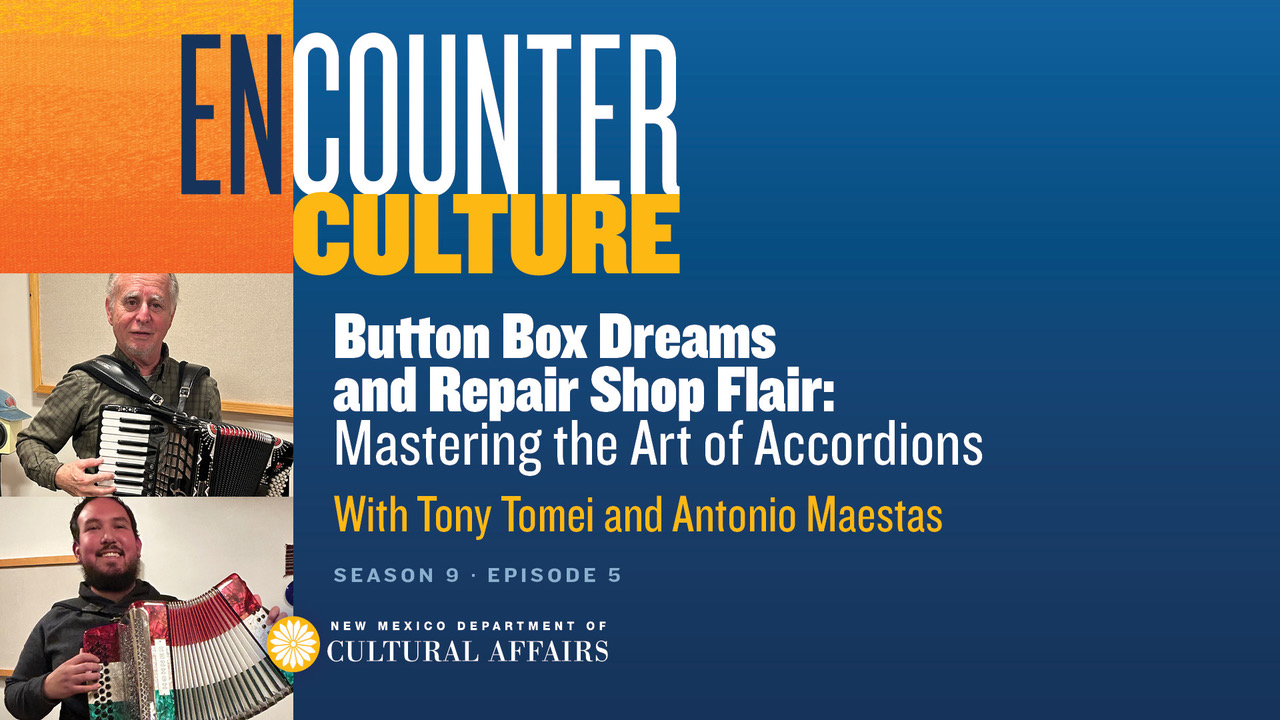
Button Box Dreams & Repair-Shop Flair: Mastering the Art of Accordions with Tony Tomei and Antonio Maestas
[Opening strum of Spanish guitar music]
[00:00:00] Antonio Maestas: Right now, I can tell you I have about six or seven accordions on my bench to repair, and I thought maybe I’ll get like one or two like a month. Now. It’s uh, a lot more than that.
[00:00:10] Tony Tomei: He thinks six accordions on his workbench is a lot? (chuckling in the background) I’ve had ’em where they’re piled up in my shop, where I could hardly even walk into my shop.
[00:00:19] You know, I was servicing the entire country, and I was working at the laboratory in, in medium energy particle physics. So, I’d get up in the morning, and I’d repair accordions in the morning. Then I’d go to work and then I’d come back at night, and I’d repair accordions till I fell asleep. And then every day it was the same thing.
[00:00:33] I mean, it was—at one time, that place was driving me crazy.
[00:00:40] Emily: ¡Bienvenidos! This is Encounter Culture from the New Mexico Department of Cultural Affairs. I’m your host, and editor of El Palacio magazine, Emily Withnall.
[intro music fades away into the background]
[00:00:40] Emily: Accordions were a part of the musical fabric around me in Las Vegas, New Mexico as I was growing up.
[gentle accordion music begins in the background]
[00:00:58] Antonia Apodaca, accordion player extraordinaire from Rociada, was a local legend. And of course, no rendition of “Cielito Lindo”, whether performed at Robertson High School or on the plaza for the 4th of July fiestas, was complete without the rich sounds emanating from an accordion. The presence of the accordion and Música Norteña is due to an intercultural mingling. In the 1800s, Polish, German, and Czech railroad workers brought their polkas and waltzes with them, and some instruments too; most notably, the accordion.
[00:01:37] These musical traditions blended with Mexican instruments, and the corridos and storytelling traditions so integral to Mexico, leading to the distinct sounds of Música Norteña so beloved in New Mexico and across the Southwest. For this reason, I was delighted when Amy Mills, the director of the New Mexico Arts Folk Arts Apprenticeship Program, told me I should get in touch with Tony Tomei and Antonio Maestas.
[00:02:04] The two men completed the program in 2024 for accordion restoration and traditional New Mexico tunings. As you will hear, they brought two of Tony’s accordions into the studio. The piano accordion Tony played during our conversation was one he custom-designed, from the rhinestones on the exterior to the reeds on the interior, and had made in Italy.
[00:02:28] Tony and Antonio are just one pair of the two hundred and seventy master apprentice pairs who have gone through the Folk Arts Apprenticeship Program since it began in 1990. The program is designed to provide funding to a master artist who can pass their craft onto an apprentice to keep the art form alive. The possibilities for what artists can work on together are vast.
[00:02:51] From Colcha embroidery, African drumming, Zuni lullabies, flamenco, Adobe building, and more. Check out our show notes for a link to a previous Encounter Culture episode where we talked to two boot makers who also went through the program. And check out our show notes for a link to the Folk Arts Apprenticeship Program website where you can learn more about how to apply.
[00:03:14] And if you want to see Tony and Antonio playing, check out the New Mexico Department of Cultural Affairs YouTube channel @NewMexicoCulture.
[accordion music, which has been joined with brass and percussion, swells briefly before fading behind conversation]
[00:03:30] Emily: Antonio and Tony, welcome to Encounter Culture. I’m so excited to have you both here. Before we dive into the world of accordion playing and accordion repair, I’d love to have you introduce yourselves to the listeners.
[00:03:44] Tony: I’m Tony Tomei. I live in Los Alamos, New Mexico, and I’ve been, uh, in and around accordions for around fifty years, playing and repairing. And, I still enjoy it as much today as I did on day one.
[00:03:58] Antonio: My name is Antonio. I am from Chilili, New Mexico. And, um, I’ve been in the music scene here locally, since I was younger. Recently, kind of got into accordions over the last, um, you know, six to eight years, and was able to spend a lot of time with Tony, learning how to repair accordions and, uh, a little bit more about, you know, about that scene there.
[00:04:22] Emily: Yeah. So, I actually found out about both of you from Amy Mills, who directs the New Mexico Folk Arts Master Apprenticeship Program. And I was fascinated, because even though I have heard, you know, New Mexico-style music with the accordion and stuff, I don’t personally know any accordion players.
[00:04:43] I know lots of, you know, piano players, and guitar players, and things like that. So I’m curious if each of you can talk about when you first encountered the accordion, and what drew you to it, and what makes it so unique.
[00:04:56] Antonio: I’ll let you kick that one off, Tony.
[00:04:58] Tony: (chuckles) Okay. Well, um, I grew up in a small town in southwestern Pennsylvania. Mount Pleasant, outside of—about thirty miles outside of Pittsburgh, a very ethnic community with Italians, and Hungarians, and Polish. And, and we all had our own segments of town that we lived in, and our own churches that we went to. And, uh, I grew up in the fifties and back in the fifties, the instrument was the accordion.
[00:05:27] Emily: Oh, wow.
[00:05:28] Tony: And that was before the Beatles came in the sixties, and basically wreaked havoc with the accordion, and everybody switched over to the guitars.
[00:05:38] Emily: Okay.
[00:05:38] Tony: And so I was in and around accordion music at a very, very young age. I used to go to a place called, uh, Fiedors Grove in the summertime, where they had bands come in from all over, like Chicago.
[00:05:54] We, we’d get bands from there, and it was an open pavilion and dance floor. And one group was called Little Wally and the Chicago Jumping Jacks. And, they would play, and people would polka and waltz all night long. And around the outside of the pavilion were the Polish ladies with their aprons just soaked in grease and making polish sausage and kielbasa, and I can’t tell you how much fun it was. (laughs)
[00:06:24] So that, that was kind of the earliest, uh, exposure to accordions.
[00:06:30] Emily: Can you say a little bit more about how the Beatles wreaked havoc on the accordion? And also, like why didn’t you follow that trend towards the guitar? What made you stick with the accordion?
[00:06:40] Tony: Well, it was the thing to do back then. I mean the, especially the young girls would just scream (Emily chuckles) and lose their minds over, over the Beatles. I don’t understand. Even the Beatles would complain that they could barely hear themselves. All they would hear is screaming during their performances. So it was a, it was like a mania that went on and, called “The British Invasion.”
[00:07:05] Emily: Yeah. (chuckles)
[00:07:05] Tony: And, uh, it was the right time and place for it. I mean, that’s all I can answer.
[00:07:09] Emily: Yeah.
[00:07:10] Tony: But some of us, you know, I’m kind of a traditionalist person, and amplifying anything is not to my tastes. I mean, it’s okay when you need it.
[00:07:19] Emily: Mm-hmm.
[00:07:20] Tony: But basically, I like acoustic instruments.
[00:07:22] Emily: And you said you grew up in a community where accordion was everywhere. Did you also have family members who played it?
[00:07:28] Tony: No, I was the only one. They actually started me off on the piano.
[00:07:32] Emily: Okay.
[00:07:33] Tony: And I started taking piano lessons at a young age, and gradually later on, uh, slipped into a little bit of accordion. And then it died off for many years. I played it for a while. When I left to go to college, I, I didn’t play it for quite a few years.
[00:07:48] And then in college, down in Socorro at New Mexico Tech, I was walking by the gymnasium one night, and I heard this beautiful music coming out of the, out of the gymnasium. And, I thought, “Gee, I’ve never heard anything like that before.” And it was international folk dancing and folk music. So, they had music from Eastern Europe, uh, Slovenia, Macedonia, Hungary, Italy, Bulgaria.
[00:08:14] So I went in and I started folk dancing, but a lot of the songs used what instrument?
[00:08:20] Emily: Accordion!
[00:08:21] Tony: The accordion! (both chuckle) So, got that right! So, I thought, “Well, I can play some of that.” So I went to a pawn shop and bought myself a used accordion. And then the next thing I knew, within a couple of years, I had like four accordions, and then I had ten accordions, (Emily laughs) and recently, close to two-hundred accordions.
[00:08:43] Emily: Oh, wow!
[00:08:43] Tony: Yeah. Most of which, now, are in Antonio’s possession.
[00:08:47] Emily: That’s incredible.
[00:08:48] Tony: Yeah.
[00:08:48] Emily: Okay, well I’m gonna have more questions about that later. Antonio, how—what drew you to accordion?
[00:08:54] Antonio: Well, for me, I started out in music playing guitar and trumpet. And I also come from a family that you would consider very musical, but I’m the only musician in my family. So, I grew up around environments where we’re listening to traditional New Mexican music, with my grandparents, with my mom, and extended family. And I had always heard stories about my great-grandfather. His name was Eulogio Barela, and he was an accordion player.
[00:09:25] He passed shortly before I was born. He would go to family functions, and he’d play the accordion. He was a singer-songwriter. It was actually he and his brother who had a band. And, you know, my family had always been enamored with the accordion. It was one of the instruments that I had always loved and enjoyed, when I was a kid.
[00:09:43] But, to me it was one of those ones that was very difficult at that time. I didn’t know, you know, how to start playing it. I didn’t even know where to go with it. And so, I had been such a big fan of Cumbia, the genre of Cumbia, which is kind of where Tony and I differ in our playing styles—and had really enjoyed artists like Celso Piña, from Mexico, Aniceto Molina from Colombia, and a few other Cumbia accordion players.
[00:10:09] And shortly before COVID and right around COVID, I really started to kind of take it seriously and wanted to learn how to play that style and bought a cheap accordion. Didn’t know what I was doing, you know, and, bought a real kind of, uh, high-end accordion after that; one that’s typically used in Cumbia and Vallenato music and started to learn how to play.
That’s actually kind of where Tony and I met.
[00:10:31] Emily: It sounds like you have a lot of accordions now. If you have most of—(chuckling)
[00:10:34] Antonio: Yeah. I was laughing a little bit in my head when Tony was saying that it started out with one accordion and then it became four, ’cause that’s exactly what it was for me. It started out with one accordion, then it became four, and then it became two hundred, through Tony. (Emily laughs)
[00:10:46] Um, (chuckles) so we had a very similar uh, track there into—getting into it. Yeah.
[00:10:52] Tony: There’s more, there’s more similarities than that. So one we just discovered, what, about a month ago?
[00:11:00] Antonio: When we were talking to—doing the interview for—
[00:11:02] Tony: —doing New Mexico Magazine?
[00:11:04] Antonio: New Mexico Magazine. Yeah.
[00:11:05] Tony: Yeah. It turns out that accordions were patented May 6th, 1829 in Vienna, Austria, by the guy name of Cyrill Demian. And then a month later on, uh, June 19th, Wheatstone patented the concertina in England. My birthday’s May 6th. And when is your birthday?
[00:11:21] Antonio: June 19th.
[00:11:22] Emily: Oh wow. (everyone chuckles)
[00:11:26] Antonio: We’re both, uh, of the “Tony” variation in name.
[00:11:29] Emily: Yes. Yeah. Yeah. (chuckles)
[00:11:31] Antonio: I think our middle, initial or middle name is very similar as well.
[00:11:34] Tony: Yeah, exactly. Yeah.
[00:11:34] Emily: Initials. Yeah. That’s amazing.
[bright accordion polka music begins. As the conversation resumes it fades away in the background]
[00:12:20] And I want to talk about how you met and got involved in this program—but I know, Tony, ’cause Amy told me, that you first were a part of the New Mexico Arts Apprenticeship Program in 1994. Right?
[00:12:33] Tony: Right.
[00:12:34] Emily: So, can you talk a little bit about that before we get into your story together?
[00:12:38] Tony: Yeah, sure. There was a guy named, I believe Claude Stevens was his name, and he was head of the program at that time.
[00:12:44] And, my mentor, my teacher, lived in western Pennsylvania about twenty miles from where I grew up. His name’s Mario Mosti. He’s gone now. And, I went back to visit my folks, and of course when I was growing up, accordions were everywhere. And, I said, “Well, I’d like to go look at some accordions.” And people were looking, looking at me like—this was in the sixties.
[00:13:10] It’s like, “Nobody does accordions anymore. Everybody does guitars.” And then somebody said at a music store, “There’s this old guy that lives in Jeannette, and I think he still does it.” So I looked him up, went to visit him, and the minute I walked in and we met each other, it was just like we fit like a glove.
[00:13:28] Our personalities, our outlook. The nicest man I’ve ever met. Kindhearted, helped everybody out, and a real master at his craft of repairing, but also a master player. He, at one point in his career, early on, he was playing in California for movie soundtracks and missed his home. Came back home, and basically stayed there ’til the end of his life.
[00:13:54] His dad was an accordion teacher, not a repairman, but an accordion teacher, and a very stern, old-fashioned-time Italian. And so, he put Mario onto playing the accordion when he was like three or four. And at age six, Mario was winning different accolades, at different accordion contests.
[00:14:20] And one of the stories that I remember about Mario is that I brought some music back to him. I’d go back and visit often as I could, and I brought some music back for him to play some sheet music. And he thumbed through and he goes, “Well, I don’t know any of these, so you have to turn the pages for me when I’m playing it.” And I said, “Sure. So no problem.” So I, he gets the accordion on.
[00:14:42] And I got my fingers—I’m like really nervous—I got my fingers on the top of the page so that when he says, “Turn the page,” I turn. And I said, “How do I know when to turn the page?” He said, “When I nod my head, you turn the page.” I thought, “That’s simple enough.” And these are not baby pieces. This is like difficult accordion written music that he’s never seen before.
[00:15:04] So he starts playing it, and of course it’s perfect. And he gets to the bottom of the page, the first measure of the last line of music on the page, and he nods his head. Now look, there’s like eight more measures to play here, folks. He nods his head, I turn the page, he keeps playing those, and he picks up the new one on the next page.
[00:15:25] And I’m like, “Whoa!” And he did that throughout the entire session that he played the mu—and I was recording it. He did, for me. And at the end I said, “Mario, how in the world did you do that?” He goes, “Do what?” I said, “First measure, last line. Nod your head.” He says, “Well, I take a line at a time.” I said, “You take a line at a time. Maybe I take a measure, maybe two at a time.” (incredulous chuckling)
[00:15:52] He takes a line at a time, like eight measures, and I said, “Well, you know, my next question is, well, how did you learn to do that?” He said, “When I was a little boy, my dad would make me practice before he would let me go out and play with the other kids.” He’s like six—five, six years old—and he said, “He would put a stack of music down next to me about that deep. Sheet music. And he said, ‘When you get done, playing that, you can go out and play with your friends.’” And his dad listened. If he made mistakes, he had to go back and play that piece over again. It wasn’t like he could just mess around. And he said, “So I learned that the farther ahead I looked, the faster I could play it without making mistakes.”
[00:16:34] And so now I’m up to one, one line at a time.
[00:16:38] Emily: Wow.
[00:16:39] Tony: Yeah. And he—and just amazing, amazing that he, anyone could do that. I’m, I don’t know about other musicians, but I know, I know a lot of musicians I know of no one else that can do that. I’m sure there is somebody. But.
[00:16:53] Antonio: Yeah, sight reading, like for anyone that doesn’t know, like music or like reading music and what goes into it. Sight reading is one of the hardest things to do. If you’re going measure by measure, right? Note by note, right? Nonetheless, an entire line? That’s—that’s incredible.
[accordion music begins in the background]
[ads begin]
[00:17:11] Emily: Do you ever wonder who coordinates public art around New Mexico, or how the Governor’s Awards for Excellence in the Arts are chosen? Or, who runs the New Artist in Residence Program at the historic sites? New Mexico Arts supports these programs and provides funding for art services throughout the state, including Arts in the Military, Poetry Out Loud, the Folk Arts program, and Arts and Cultural Districts. To learn more, visit nmarts.org.
[00:17:50] Some things you can find on the internet. And others, not so much. Putting together a publication as interesting and beautiful as El Palacio Magazine is hard work, but it’s well worth the effort. The articles we cover, ranging from artist profiles you can’t find anywhere else, to impressive archeological discoveries, to histories of events in New Mexico that are underrepresented in our state’s archives, offer important and insightful writing about topics you definitely won’t find on the internet.
[00:18:25] I’ve been writing for El Palacio for a long time. And now, as editor, I may be just a little biased, but if you love New Mexico, you’ll love El Palacio. There’s a reason we’ve been around for one hundred and ten years. Subscribe at elpalacio.org/subscribe. I guarantee you won’t want to miss an issue.
[ads end]
[00:18:53] So I would just love to know. So you learned technique for playing and repair from him?
[00:18:58] Tony: Yeah, mostly repair, but we would take, you know, finish repairing. At the end of the day, he would pick up his accordion. He played both piano, chromatic accordion, and he also played button box accordion. It’s just the kind that, uh, Antonio plays, but he played in, and, which is a style I play in a Slovenian button box style accordion, German Austrian, Bavarian Slovenian.
[00:19:20] Emily: Okay.
[00:19:21] Tony: So I, that’s—and button accordion. That’s what I played because that’s what he played. And it’s a different system.
[00:19:26] Emily: Okay.
[00:19:27] Tony: With a button accordion, if you push in, you push a button down for a note and you push in, it makes one sound. But if you pull out it makes a different sound.
[00:19:37] Antonio: Okay. I can show you.
[00:19:40] Tony: You wanna see that? Yeah, let’s look at that.
[00:19:41] Emily: Okay. Yeah.
[00:19:42] Antonio: So if I have a button
[00:19:44] Emily: Yeah.
[00:19:44] Antonio: I pull out (a note sounds)
[00:19:48] versus push in, (a lower note sounds)
[00:19:51] It’s like that across the whole keyboard.
[00:19:52] Emily: Okay. Wow.
[00:19:55] Tony: But with a chromatic piano accordion, or a chromatic button accordion, it’s the same note in and out.
[00:20:00] Emily: Oh, okay.
[00:20:00] Tony: And that’s what I played. I played chromatic piano accordion.
[00:20:04] Emily: Right.
[00:20:04] Tony: And uh, so for a couple of years, Mario would tell me, he said, “You need, you should, you should learn to play this button accordian.”
[00:20:13] I looked down, I says, “How could anybody play an instrument where it’s a different note in and out?” And he goes, “It’s easy. Matter of fact,” he said, “You could be a dummy and play one of these.” (Emily chuckles) And I didn’t believe him, you know? So, one day after a couple of years of him gently asking me to play the button—to try it, we worked in his basement, which is where my shop is, and his mother was sick.
[00:20:38] And so, and they had this intercom system like you’d have for a baby. And she called him upstairs, and he would run to take care of her. And I saw his button accordion sitting down on the floor and I thought, “Eh, why don’t I give this a try while he’s not around,” you know? So, I tinked around with it for maybe fifteen, twenty minutes, and I thought, “You know. He, he might be right.” And so then he gave me a lesson on the button accordion, and he showed me how to play a song on, on three buttons. Going in and out.
[00:21:11] Emily: Yeah.
[00:21:11] Tony: And uh, and so from then on, I played both button and chromatic piano.
[00:21:19] Emily: Wow. So I wanna jump like way forward in time now. You were an apprentice and then decades later, what made you want to become the master on the master side of the Master Apprentice Program?
[00:21:33] Tony: Well, I started the Master Apprentice Program because it’s nice to have a piece of paper. I mean, I knew what I was doing. You can always learn more. I’m one that is a believer that you never are done learning. So, I would learn from Mario, but then with a Master Apprentice Program, get a certificate that says, “He knows what he’s doing.”
[00:21:53] Tony: And they pay the master. And Mario was as poor as a church mouse. And so, I signed up for the program, and I put him as the master, and I traveled back to Pennsylvania to study with him. And, so then I got through the program. And then as time went on, it’s not decades, but it was probably, well maybe it was, maybe twelve years, ten, twelve years later, you know, I was getting older.
[00:22:20] I’m still getting older, and, uh, I thought it’d be nice to pass this tradition on to someone else. So I, I took on a woman as an apprentice who was, was already helping me do some repairs, and suggested that she go through the program. So, I signed her up and put her through the program. Turns out that after a couple of years, she decided that’s something she didn’t want to do.
[00:22:48] Emily: Okay.
[00:22:49] Tony: And then I was very disappointed; and I had tried a couple other people just said they were interested. And soon after they started, they lost interest. And then one day, this guy walks into my studio to get his accordion repaired. And, uh, we hit it off. And he was real excited about the work bench and tuning and looking at the insides of accordions, which he’d already peeked at before.
[00:23:17] And I thought, “Well, I’ll give it one more try. And if it works, great. If it doesn’t, then when I die, this skill dies with me. And I, I tried to keep it going, but it just didn’t work out.” But it did work out with Antonio to a very great degree, beyond my expectations. He and I just clicked, and still do today.
[00:23:41] So many things that are in common with each other. Our, our approach to doing things on the workbench, and our approach to life, and general ethics that we have all, all are pretty much the same.
[00:23:55] Emily: Yeah. Yeah.
[00:23:56] Tony: So then I ran him through the program and, and he, he “do-ed” it. (everyone laughs)
[00:24:02] Emily: Um, Antonio, I’d love to hear from you what your experience has been, learning from Tony.
[00:24:09] Antonio: Yeah. Well, yeah. Answering that question, it’s a loaded question, because there’s a lot that I learned from Tony, and a lot that applies—not just from a technical standpoint or from repairing accordions, but from a philosophical standpoint—and also just how to approach life and problem solving.
[00:24:26] And I think for me, I mean, the obvious answer is how I met Tony was, I broke a reed on an accordion and had no idea what I was doing. I actually reached out to this guy that I saw on YouTube first, and he was from Germany. The guy graciously got on a, you know, a WhatsApp video call with me and tried to help me figure it out.
[00:24:48] I had no idea what I was doing. I was kind of scared to touch it. So I got in contact with the Albuquerque Accordion Club, and they told me, this guy, uh, who’s an engineer—that comes in handy later as well—out of Los Alamos repairs accordions. And so, I reached out to Tony, and I think at this point Tony had been really, really busy.
[00:25:06] But, you know, with Tony’s heart and just knowing him, he asked me, “Hey, you know what, just send me your read block. I’ll do the repair for you. And you know, we’ll go from there.” And so, I think in that conversation I had told Tony—and I had already been getting very interested in learning accordions—and uh, Tony, you know, asked me if I was serious about that.
[00:25:29] And, you know, that conversation ended up leading into us getting into the master apprentice program. But I say all that to say that the obvious answer is I learned how to repair accordions from not knowing what happened with that time that I broke a reed on my accordion to being able to repair all types of accordions, different, you know, problems that arise and, and, and troubleshooting and problem solving.
[00:25:51] So that’s the obvious answer. The second thing I think really is around like what Tony said around ethics. And I think when you think about ethics and integrity, I really do believe that Tony embodies that. And the reason why I say that is there’s countless times that we’re on the work bench and we have an accordion in front of us. And Tony, correct me if I’m wrong, a full size accordion like this has five thousand parts—
[00:26:12] Tony: Yeah.
[00:26:12] Antonio: —to it. And some parts are bigger parts, some parts, smaller parts, and there, there are many times that we’re working on a customer’s accordion, and there’s maybe a screw that’s a little loose. Or there’s a possibility that with a tool you can scratch something on the inside.
[00:26:28] And Tony, the steps that he took to take care of other people’s material was something that stood out to me and, and something that I really wanted to adopt in my everyday life, in my career. And what I mean by that too, is Tony had told me many, many times, like, “The customer may not see a scratch on the inside of their accordion, but first do no harm.”
[00:26:49] That’s the very principle of integrity, is to do the right thing when nobody’s looking; to do the right thing when nobody knows. And that’s exactly what I consider the foundation of what our relationship was like, and the Master Apprentice Program was like, was moving with integrity. You know, we, I don’t know, tightened little screws here and there, and rewaxed the part of a reed block that wasn’t a part of the original problem, why the accordion was sitting on the bench.
[00:27:18] But we did it because it was the right thing to do. And that player may never know, right? That that was done in the shop. But the principle of it is, I think, something that we’re missing in the world today and is very rare to find in people. And so that goes to Tony accepting me as his apprentice and to, you know, teaching those values in that system, you know, um, through the program is something that I, you know, I really cherish in, in everything.
[00:27:45] Tony: Thank you.
[00:27:46] Antonio: No, thank you. (chuckles)
[00:27:48] Tony: Yeah. And also, Antonio had a little—and a lot of people have it. We would go to do something. This was early on in the program. He would go do something and he’d say, “Well, let me do this real quick.” (Anthony laughs) And I, I’d just look over at him and I thought, “Oh boy, that’s opened a bad door there.” I said, “Well, that usually, usually leads to problems.”
[00:28:11] Antonio: Yeah.
[00:28:12] Tony: I said, “We wanna do it, we wanna do it right. We wanna take our time. But doing it ‘real quick,’ rarely, if ever leads to a good job on, in anything, not just accordion repairs, but in any part of life. Understand what it is that you need to do. First, seek to understand, you know, and then as Davey Crockett, or at least some stories say, as Davey Crockett said, ‘Make sure you’re right, then go ahead.’”
[00:28:40] Tony: And that’s, that’s kind of all the same type of logic, same approach that we both have.
[00:28:49] Antonio: Mm-hmm.
[00:28:49] Tony: Yeah. Yeah. And he’s basically stopped saying, “Let me do this real quick.”
[00:28:53] Antonio: Yeah.
[00:28:54] Tony: Every now, every now and then.
[00:28:55] Antonio: Yeah. I say, “Let me do this real—” And I’m like, “I’m not going there,” telling you. He’s like already looking at me from across the work bench. (laughter) “Don’t say the key word.”
[accordion rendition of Mission Impossible theme music plays and then fades away]
[00:29:22] Emily: So, and have you learned things from Antonio?
[00:29:25] Tony: I think what I’ve learned from Antonio is to value your youth (everyone laughs) because it don’t last that long. I’m seventy-seven now, and it’s, uh, you know, things are slowing down, and my vision’s getting worse, and, and I didn’t appreciate it as much when I was around his age. And then now looking back, it’s like I, you know, I did, my philosophy has been the same throughout my life, but I didn’t realize what a gift it was to have an agile body and good vision, and be able to just execute things that you wanted to, which later on sometimes doesn’t happen.
[00:30:08] Emily: Yeah. So are you still running your repair shop?
[00:30:11] Tony: Well, I’m taking care of existing customers. If someone bought an accordion from me, you know, five or ten years ago, and they have something wrong with, it’ll fix it for him. But any new calls that come in, they go to him.
[00:30:24] Emily: Okay.
[00:30:24] Tony: And actually, even some existing customers, if they’re open to it, I’ll send them to him also, because I’ve told my customers in the past, “This accordion, I’ll take care of it for you.” And I, if I say something. That’s what I do. Unless there’s something major that’s stopping me. So, for the most part, he gets all the business now.
[00:30:47] Emily: I know that you said when you were coming in today that you play very different styles of music. Can you describe the styles of music that you play? And maybe, I mean, it sounds like, I don’t know how many different kinds of accordions there are, but like, I’d be curious about how that also plays a part in the type of music you play.
[00:31:07] Antonio: Well, I can focus on the button box, right? And the types of accordions, as Tony mentioned earlier, even with the button boxes, you have different variations.
[00:31:15] You have chromatic button boxes, which are the same note as you pull out, as you push in. Then you have diatonic button boxes, and you have different styles of diatonic button boxes. I’ll focus on two very common ones that you’ll see here in the state of New Mexico, or in the region. You usually find what we call a two voice button box, which is more common in like Norteño Music, Tex-Mex music, New Mexico music.
[00:31:42] Two of the bigger brands that you’ll see are Hohner and Gabbanelli for those. The style of music I play is Cumbia. A lot of people think I play Tex-Mex, but I don’t play Tex-Mex. I play Cumbia, from Colombia. It’s a very traditional style of Cumbia Colombiana that is from a town called San Jacinto Colombia.
[00:32:00] That’s essentially my favorite form of Cumbia. It’s the most traditional, it’s just a very vibrant and very technical style of Cumbia. And the accordion that I use is a button box. It looks very similar to the two voice, but it’s actually a three voice. All that means is it’s much brighter, and that there’s three voices per note.
[00:32:21] So there’s three reeds per button, essentially. And the, the tone is much brighter. It’s a Corona III versus a Corona II, which is found in Norteño music. So that’s what I play. Tony here, and he’ll show later, has a piano, uh chromatic accordion. Um, and I’ll let you kind of take it on the chromatics if you’d like.
[00:32:46] Tony: Now?
[00:32:46] Antonio: Yeah (everyone chuckles)
[00:32:47] Tony: Okay. Well, most people are familiar with the piano, and that’s a chromatic instrument. What does that mean? It’s, there’s twelve notes in the Western world musical scale. C, C-sharp, D, D-sharp, E, F, F-sharp, right? You look, it’s black and white keys. So there’s twelve notes. And then after that they repeat again. But it’s an octave higher.
[00:33:09] And if you think back to the old days of organs, and it’s the, the nomenclature is still used today. There was a six foot pipe organ. And then if you wanted to go up an octave, there was a twelve-foot pipe organ, then you kept adding to get the different octaves. And if you look on this accordion that I brought, it has eighths and sixes on it and eights and twelves.
[00:33:33] And so it’s telling you, well, this, this is this octave. That’s that octave. So the twelve notes in the chromatic Western world scale allow you to play any song in any key, and you need the accompanying chords that go with that. In music, there’s generally basic music, simple songs. There’s three chords that go with them.
[00:33:56] There’s the tonic, the dominant seventh, and the subdominant. And so, if I look at those three chords, tonic, dominant seventh, and subdominant, if I pick the accordion up, the buttons on the base are arranged in, guess what? Tonic; right next to it: dominant seventh; right below it: subdominant. So you pick any key you want to play in, like C, the two chords you need with it are right next to it.
[00:34:22] You want to play in D, go up to D. A and G are right next to that. And that’s the two chords you need. So when most people look at a chromatic piano accordion, they see all these buttons on the base. There’s on a full size one there’s one hundred twenty, they freak out. It’s like, “How could you possibly figure that out,” you know?
[00:34:44] Well, there’s little marks on some of them. That’s a big help. But they’re arrranged in such a way that follows the circle of fifths. Musicians, anybody that’s around and plays music, they know the circle of fifths, but they usually call ’em by a different nomenclature. The tonic they call “one,” the dominant seventh, they call “five,” and the subdominant they call “four.” So it’s the old one-four-five. They’ll go, “One, four, five.” And if I say “subdominant” or “dominant seventh,” they just stare at me. You know, they have no idea. But it’s the same, it’s just a different way of calling out those chords. So anyway, so any song in any key is pretty handy. And usually if you have like a singer, they’ll usually sing like A or D or whatever they sing in.
[00:35:28] And so with the piano accordion, you can accompany them. With Antonio’s diatonic accordion, each row on that accordion—there’s three rows on most of them—is a different key. G-C-F is a very common one, right? So if I, if I take, if I take G, C, F and make that the tonic, then if I take C and make that the tonic, then G and F are on either side of it.
[00:35:57] Well, that’s exactly how that accordion is laid out. He can play in those three keys. He can play in G, C, or F. Can he play an A? I’m sorry folks. (Emily chuckles) A has three sharps and he ain’t going there because he doesn’t have ’em on the accordion.
[00:36:12] Emily: Right.
[00:36:13] Tony: So they’re not there for the most part. There are some exceptions with different construction of accordions.
[00:36:18] So anyway, that’s, that’s the difference between the piano chromatic and the button diatonic. There’s also a button chromatic, which is the same as the piano accordion, except instead of piano keys, it has buttons. And they’re black and white. Same as, same as the other one.
[00:36:35] Emily: And what kind of genre do you play?
[00:36:38] Tony: I’m pretty eclectic. Well, I’m Italian, so I know and play the old stuff, “We’ Marie,” and you know the “O Sole Mio,” and that kind of stuff. And I move around. You know, currently I’m into a jazz phase where I like jazz music and, and there’s a certain construction of an accordion called a tone chamber, which is, if you familiar with a mute that goes onto a coronet, changes the sound.
[00:37:02] And the tone chamber accordion puts out a real mellow, rounded jazz-type, easygoing sound. And so, I’ve been playing tone chamber jazz recently. I also like show tunes, you know, Zorba the Greek, you know, The Good, the Bad, and the Ugly, you know, those, those tunes.
[00:37:20] Emily: I was going to ask earlier when you mentioned the two hundred accordions, like how, why would you need that many? But it sounds like, based on tunings and like what you’re able to play, like maybe is that a part of the reason?
[00:37:34] Antonio: From a functional standpoint? Yes. And okay, to answer the question, yes and no, right? There’s some accordions within the collection that are collectors items. They’re relics, they’re from different eras.
[00:37:45] Museum pieces. And there’s also different sizes of accordions, right? So you have smaller keyboard accordions. You have, you know, more full-size accordions. You have two row button boxes, one row button boxes, um, four row. You have just different styles, right?
[00:38:01] And you run into different players, and different types of players that want those styles. Or you just find, have the finds, right, like an accordion from the forties—and that’s something you don’t come across as easily these days. And so having that and being in possession of that accordion is like being in possession of a piece of history.
[00:38:19] Tony has some really cool accordions from what, the 1800s?
[00:38:22] Tony: I have one according to patented, as I said in 1829. I have one made in 1834 in my collection.
[00:38:27] Emily: Wow.
[00:38:30] Tony: And I have one from 1870.
[00:38:32] Emily: Wow.
[00:38:33] Tony: Yeah. Which is all hand in lay wood. It’s a beautiful piece to look at.
[00:38:37] Emily: That’s incredible.
[00:38:38] Tony: But you ask about, basically, why do you need two-hundred accordions?
[00:38:42] Emily: Yeah.
[00:38:43] Tony: Well, look, somebody comes to your shop and they want to sell an accordion. What do you do? “I’d like that.” (everyone laughs) “That’s nice. How much do you want for it?” And then, and that next thing is from one-fifty to 151. Now you have 151. And somebody comes in next week, somebody say, “I wanna sell my—” “Oh! That’s a nice accordion. I’d like that.” 152. You know, so.
[00:39:11] Emily: That’s an interesting business model. (laughs)
[00:39:14] Tony: I have. I have one story. I hope my wife doesn’t get mad at me. (everyone laughs) My wife, my wife is very patient with me. She puts up with a lot. But my previous wife was not that way. And, and I had like, at that time I think had like 150 accordions, it was a small collection. (Emily chuckles)
[00:39:33] And she came, I was in the workshop and she came down the stairs and she was pissed off about something and she goes, “You know what? Either those accordions have got to go, or I go.” And I looked her and I said, “I’m sorry you put it that way.” (everyone laughs)
[00:39:54] That’s a true story. We got divorced. Didn’t mean to hurt her feelings, but.
[moody accordion music begins in the background]
[00:40:08] Emily: Wow. That’s quite the story.
[00:40:10] Tony: Documented. Yeah.
[accordion waltz music fades to foreground for several seconds and continues in the background throughout the rest of the conversation]
[00:40:44] Emily: Tony, you mentioned there was a big popularity for accordion music, and you grew up surrounded by it in Pennsylvania, and then that popularity waned. So I’m curious about, you know, how popular accordion playing is currently, and what the demand is for accordion repair.
[00:41:02] Tony: Well, I’ll take the demand for accordion repair. That’s the easy one. It’s astronomical. Once they find out that you can fix ’em and you do a good job on them, it’s all over folks. I mean, you’re going to have as much business as you want. I mean that, you know, I was turning business down for a while. I just, I said, “I can’t, I don’t even have any room to get in my shop, let alone take another accordion in here.”
[00:41:25] But no, it’s over the past fifteen to twenty years, it’s been gaining in popularity. There’s more people playing accordions than there used to be, in the lull period from the like sixties to, pick a number, two thousands or somewhere around there, and you notice it because if you watch movies, there’ll be a number of movies, in the soundtrack, in the movie, there’ll be an accordion playing. Now most people don’t notice it, but I notice it. Right. And popularity in with a, especially out here in, uh, the Southwest with, uh, Hispanic, various forms of Spanish music, accordion is the number one instrument used in, in that type of music.
[00:42:12] One thing I didn’t say earlier, which might be appropriate, is that the accordions migrated from Germany to Mexico, and then from Mexico they migrated up into New Mexico, and then spread out across the Southwest. And so this whole region that we’re living in, especially if you have Hispanic people that live in that area, the accordion plays a large part in their lives, and they love to hear that sound.
[00:42:40] Antonio: From my experience in, you know, the, the timeframe that I’ve been able to work with the accordions and, and repairing accordions, I’ve seen a lot of people recently, especially in Albuquerque, in the state, coming to me asking, “What’s a good first accordion? What’s a good beginner accordion?” Uh, and a lot of people are starting to, to trend in that direction as well.
[00:43:02] You’re seeing a lot of, you know, uh, known artists today who are known for, you know, playing guitar and other styles of music, that are picking up the accordion as well. And right now, I can tell you I have about six or seven accordions on my bench to repair, and I thought maybe I’ll get like one or two like a month.
[00:43:20] Now, it’s, uh, a lot more than that. So I am definitely seeing the rotation of accordions coming to me for repair and uh, you know, just kind of a resurgence in that craze even in the short time that I’ve been doing it.
[00:43:33] Tony: And they’re popular across the world. Eastern Europe, they never went out of popularity there.
[00:43:39] I’ve had customers, the farthest one was from South Korea. He brought his accordion in. He called Hohner, wanted his accordion repaired, and they couldn’t fix it. So they called me up and they sent him to me. And so I repaired this guy’s accordion from South Korea. It was a tone chamber model. I’ve sold accordions as far as England: London, England.
[00:43:57] See, he’s not known yet. He thinks six accordions on his workbench is a lot? I’ve, I’ve had them, I’ve had ’em where they’re piled up in my shop where I could hardly even walk into my shop. In the heyday, you know, I was servicing the entire country. You know, from Philadelphia to Seattle to California, and I was working at the laboratory in medium energy particle physics as mechanical engineer at the same time.
[00:44:24] So I’d get up in the morning, and I’d repair accordions in the morning, then I’d go to work, and then I’d come back at night, and I’d repair accordions till I fell asleep. And then every day it was the same thing. I mean, it was at one time that place was driving me crazy, but because there wasn’t—and there still aren’t that many competent repairmen around—When you have somebody like Hohner calling you up saying, would you fix this for us? And then I’d send it back to them and they’d send it back to their customer.
[00:44:52] Tony: You know, it’s the competency just wasn’t there.
[00:44:55] Antonio: And Honer is a manufacturer.
[00:44:57] Tony: Yeah. They’re a manufacturer.
[00:44:57] Emily: Wow. Yeah. So the manufacturers were calling you, that’s, that’s—
[00:45:02] Tony: Yeah. Especially with tone chamber accordion. It’s a special construction.
[00:45:06] Antonio: A little bit more complicated.
[00:45:07] Tony: A lot more complicated.
[accordion fades out and outro horn and accordion music begins under speaking]
[00:45:16] Emily: If you are interested in the New Mexico Arts Folk Arts Apprenticeship Program, keep your eye out for the next deadline, in early January of 2027. Staff at New Mexico Arts are always happy to help artists with their application forms. Note that this is not a formal training program that comes with a certificate, and apprentices are not paired with master artists.
[00:45:37] Rather, pairs of artists apply together, to work on their own time, and in their own spaces with funding and resource support from the program. As Amy Mills, director of the program says: “Fundamentally, it is a program that prioritizes an older way of learning, where the values and standards are based in community, and the work is often done in informal settings.”
[00:46:01] “The master artists are experts in their fields, and we respect that and work with them on that basis.” The program is managed by New Mexico Arts, the State Arts Agency with support from the National Endowment for the Arts, the Creative Industries division of the New Mexico Economic Development Department, and the New Mexico Music Commission.
[00:46:23] For more information, check out the links in our show notes. Thanks for listening.
[music fades into theme music and closing credits]
[00:46:47] Emily: Encounter Culture is a production of the New Mexico Department of Cultural Affairs.
Our producer is Andrea Klunder at The Creative Impostor Studios.
This season is produced and edited by Andrea Klunder and Alex Riegler with additional editing by Monica Braine.
Our recording engineers are Collin Ungerleider and Kabby at Kabby Sound Studios in Santa Fe.
[00:47:11] Technical direction and post-production audio by Edwin R. Ruiz.
Our executive producer is Daniel Zillmann.
Thank you to New Mexico artist “El Brujo” D’Santi Nava for our theme music.
For a full transcript and show notes, visit podcast.nmculture.org or click the link in the episode description in your listening app.
[00:47:34] I’m your host, Emily Withnall.
The New Mexico Department of Cultural Affairs is your guide to the state’s entire family of museums, historic sites, and cultural institutions. From Native treasures to space exploration, world-class folk art to ancient dinosaurs, our favorite way to fully explore is with the New Mexico CulturePass. To see everywhere CulturePass is accepted and reserve yours today, visit nmculture.org/visit/culturepass.
And if you love New Mexico, you’ll love El Palacio Magazine. Subscribe at elpalacio.org.
Thank you for listening, and if you learned something new, send this episode to a friend or share it on social media. We love celebrating the cultures of New Mexico together.
[theme music fades out]