Possibility and Ferocity

By Laureli Ivanoff
Photographs by Kevin Lange

Joy Harjo helps one to understand the concept that God, the Creator, should be feared.

Having the chance to talk with the three-term United States poet laureate was like a wannabe boxer meeting Muhammad Ali. A C-team basketball player meeting Dr. J. A tennis player stealing a moment with Serena. To momentarily have access to the internationally renowned writer and poet was one part wonderful and three parts terrifying. To have the opportunity to ask questions to the Native woman you respect most causes the chest to hurt, the stomach to buzz, the brain to scatter for the week and a half leading up to the appointment. It was lovely torture.

“I’ve never been so unworthy of such correspondence,” I said to one of my best friends after talking and sharing emails with Joy Harjo. “How does one person possess so much grace, love, courage, compassion, and ferocity?”

As a former radio reporter, interviewing inspiring people who make things happen remains one of my favorite things in life. The day I dialed the phone number to talk with Joy Harjo, my stomach held a large stone. My chest felt tight. There was a lot of deep breathing. She answered, and I didn’t even know how to introduce myself.

“Where are you?” she had to ask me.

My voice high and strange, I answered. “I’m in a little fishing town called Unalakleet. In Alaska,” I said. Unalakleet is a town of 750 on the western coast. With no roads connecting us to other communities, we’re an hour’s plane ride from Nome, the gold-rich town that brought the first wave of self-proclaimed “pioneers” to Alaska more than 120 years ago.

“I love Nome,” Harjo said, and I felt the rock in my belly turn into something just softer than stone. Hard mud? She said she had been to Nome twice and wrote a poem about the town I had lived in for sixteen years, where my career began.

Harjo wrote “Spirit Walking in the Tundra” for a friend and her son after visiting them. They’re people I know. “Mary Jane used to do healing work on me during a difficult time in my life,” I told Harjo. “She’s a mystic, which I was drawn to.”

“Mary Jane is amazing,” she said. “We always have the best time.”

And just like that, I was able to picture Joy Harjo driving around on those dusty streets and down the dirt road that follows the sandy, sparkling beach. She became human.

I don’t need to tell you she’s brilliant. Her words reach deep while simultaneously lighting up our minds. Her journey as an artist, as a Native person, as a woman, gives people like me courage. Her life and path show us we can push beyond expectations in our society and do so with our heads held high. What she showed me over the course of a week is that we can also do this while keeping our hearts soft.

Joy Harjo does what seems impossible.

I wanted to understand. How did a young Mvskoke woman from the Muscogee Creek Nation Reservation rise up in society and become an internationally renowned poet, all while lifting us up with her?

“When did you get an inkling that you could be a writer?” I ask.

 “I was never aware of a calling to be a writer or a poet,” she says of growing up with a grandmother and aunt who were painters, in a community where Native visual art characterized the Tulsa and greater Oklahoma culture. “Growing up, we had no models of poets and writers,” she says.

But in her aunt Lois, Harjo found someone in her family that understood her. “We had quite a time with each other,” Harjo says. “I would drive her around to visit the older relatives in our community, the ones who knew things. She was a painter, a lover and supporter of our Native arts and cultures, loved animals, and stories of mysterious events, just like me.” During the days she and her aunt would frequent a chicken and frybread establishment that’s no longer in Okmulgee, she understood that the arts gave her a way to express herself. She said back then, at Tulsa Public Schools, art was part of the education. She was in two art shows in sixth grade and was the understudy for a major role in an operetta.

Harjo was also often in school plays because a teacher told her once that her voice carried. Her voice is strong. Here in Unalakleet where we rely on the ice like a typical American relies on a grocery store, the east wind pushes thick sea ice with such strength it forces cracks to open, allowing rich ocean water to emerge. Joy Harjo’s voice is like that. With the power in her words, her voice moves. You feel it in your chest. But it didn’t start off that way.

“I never talked freely in the classroom until I went to Indian school,” she says. Which means she didn’t talk freely in the classroom until she was 16 years old. Such is the experience of many Native people who attend Western educational institutions throughout the country. We often feel we don’t fit in. And if we are just more than ignored, we use most of our energy to explain who we are.

“As a teenager my home life was treacherous,” she says. “I knew that in order to survive to adulthood I would need to leave. I told my mother I wanted to go to Indian school, because I would be around solely Native students.” Her mother brought her 50 miles away to the Bureau of Indian Affairs office in Muskogee to sign her up for the following fall. “When she told the agent I was a good artist, I was directed to apply to attend the Institute of American Indian Arts in Santa Fe.”

She was accepted to what was then a high school based on her drawings.

The drawings were “mostly fashion,” she says. “My mother said that I used to draw original fashion ideas and images, then they would show up in magazines the next season.”

Today IAIA is a tribal college with undergraduate and master’s programs with more than 600 students enrolled. In 1967 and ’68, when she attended, there were roughly 200 students and twenty art faculty members. Native students attended from throughout the country to study arts of all kinds. “It was a new school with a groundbreaking arts curriculum. We had the best art teachers in the country, predominantly Native.”

While there were writing classes and a literary publication that came out every spring, and she enjoyed reading poetry, her interests were not yet in that direction. At IAIA she enjoyed drawing, dance, and drama. Along with being immersed in art and studying with teachers like Daystar Rosalie Jones and Fritz Scholder, she also found healing. Maybe it was experiencing acceptance. Maybe safety. Maybe in discovery.

Some of it was place.

“The landscape and light captured me and allowed my imagination to find lift,” she says. “There’s no place like New Mexico.”

I ask how her time in New Mexico fed into who she is as a poet. “The answer could be a whole book,” she says.

When Harjo initially attended the University of New Mexico, she was a studio arts major. During that time, she met many of the up-and-coming Native writers, including Simon J. Ortiz, Leslie Marmon Silko, and James Welch. “They became my models,” she says. “Because of them I realized for the first time that we Native nations people write and express in our own distinct manner. That freed me and I began writing poetry.”

“Something just took over when I wrote poetry, and it seemed a very unlikely goal for a single mother with two children to take on. I didn’t understand it,” she says. “I still don’t—but writing became compelling, and I had to follow it.”

Following what compelled her, Harjo’s steps opened the world for poets, writers, and artists everywhere, and especially Native writers who know, from her example, that not only can we express ourselves through art, but we can strive for excellence. In a world that suddenly seems interested in our experience and our voices and perspective, writers everywhere stand firmly knowing they can use their voices.                 

But no one can do it alone.

Harjo says while we may work singularly, an artist must connect with others on a similar track. She says after she started playing the saxophone, she was given advice to play music with those who were better than her, and they indeed made her better. “When I started out writing poetry I was with the best,” she says. “They helped me refine my craft, thought field, and inspired me.”

What I have not told you is that when I dialed the phone number to interview Joy Harjo, I was an hour late. And she told me so. I blame what could be the biggest mishap in my career on the norovirus my body was still shedding. Or perhaps my strange relationship with numbers, time, and the resulting difficulty with time zones. But, in the moment she said, “You were supposed to call me an hour ago,” none of that mattered.

I messed up.

The first Native U.S. poet laureate, the visual artist, the seamstress, saxophone player, and what I’d learn and experience to be a compassionate human being, remained on the phone with me for fifteen minutes—fourteen minutes longer than she needed to. In that time, I heard her strong voice, felt her commanding presence while 3,250 miles away, and experienced her grace. Grace a majority of us have not practiced during this chaotic time in our history. 

Harjo said her laureateship has taken place during an unusual time, not only because much of it was done through Zoom and on social media, but “because of all the political division, the pandemic, and climate change we are witnessing,” she said. It’s why her grace and compassion felt all the more undeserved. With intention and purpose, she manifests goodness unseen. However, she says, “because of the times we are in, people have been turning to poetry for what poetry gives us. A way to speak and to think and to dream outside of linear thought.”
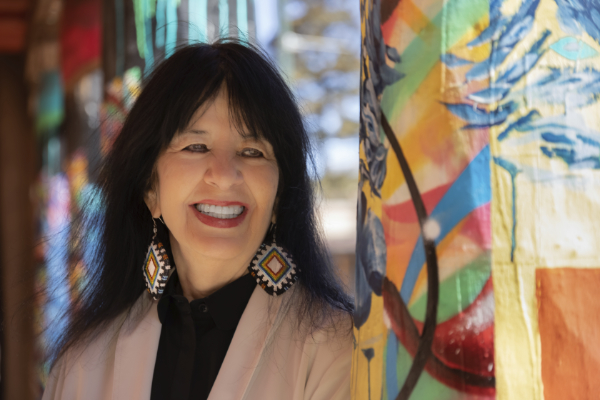
And I was reminded from the poem she wrote about Nome that she is someone who, while looking down at the sea ice, sees the sky. She looks at what is and beyond at what can be. With intention and purpose, she manifests the impossible.

With the laureateship nearing completion, Harjo remains persistent in finding projects that compel her. She has a book coming out, Catching the Light, which will be published in November by Yale University Press. This summer she will join the new Bob Dylan Center in Tulsa, Oklahoma, leading a six-year residency as its first artist-in-residence. She says the residency honors creativity, especially Bob Dylan’s creative life. Her work is “to help support those who are coming up in the story field, who create music and poetry, who wish to make change to benefit their generation, this world,” she says. “I will be advising and will help in the vision.”

And I wondered, “How?” How does an artist and creative in today’s harsh and difficult world match strength and ferocity with such compassion, grace, and love? 

She offered this answer from her forthcoming book about writing and creativity:

It is the singers, poets, and storytellers who are captured by the expression of this eternal human drama, and with language, metaphor, timing, and melody turn despair and hopelessness into meaningful shape. What is repetitive and ordinary becomes flowers blooming in a blizzard. A doorway appears where a door was not possible, and through it runs a white rabbit with a watch, or a white buffalo who is a promise made by mythic female power. We are terrified or delighted and with poetry, music, and story we are given a way to speak it, to understand it. We find a way through even when there appears to be no light.

She continues: “To write is to open up doorways to the impossible.” 

Laureli Ivanoff is an Inupiaq writer in Unalakleet, Alaska, where she cuts fish and makes seal oil. She’s working on a memoir and is currently an MFA student at the Institute of American Indian Arts’ low-residency creative writing program.
Kevin Lange (opens in a new tab) is a photographer working out of Albuquerque, New Mexico, in the shadow of the Sandia Mountains.

Laureli Ivanoff (opens in a new tab) is an Inupiaq writer in Unalakleet, Alaska, where she cuts fish and makes seal oil. She’s working on a memoir and is currently an MFA student at the Institute of American Indian Arts’ low-residency creative writing program.
To Market, To Market

A century of harking back and looking forward at Santa Fe’s beloved summer institution

Each August, an estimated 100,000 people attend the largest juried Native American art show in the world: the Southwestern Association of American Indian Arts’ annual Indian Market.

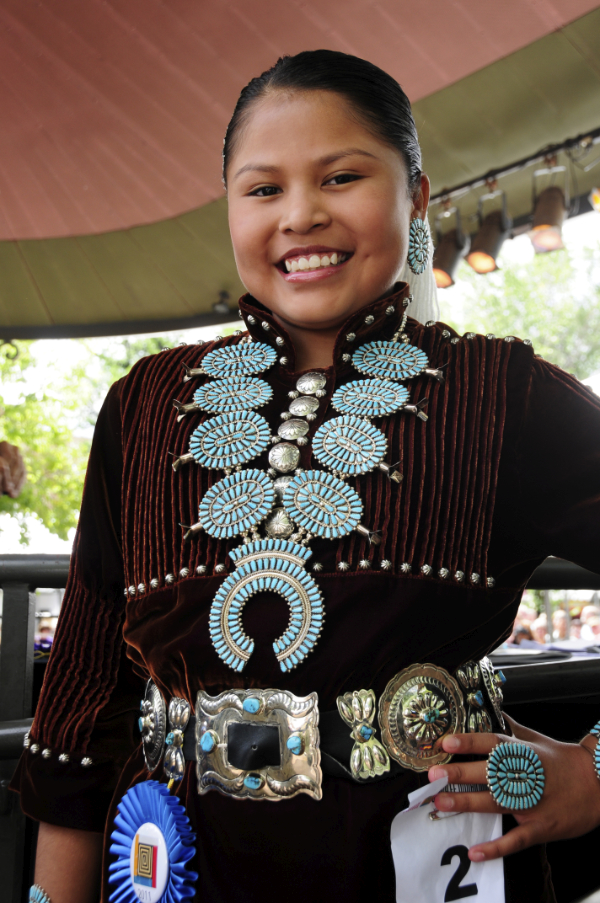
Audrey Brokeshoulder (Navajo/Hopi/Absentee Shawnee), the 2011 winner of Best in Traditional Junior Girls at the Native American Clothing Contest at Indian Market. Photograph by Kitty Leaken.

This remarkable event takes place on and around the central plaza in Santa Fe, New Mexico, and sponsors approximately 1,000 Native artists from more than 100 tribal communities in North America and Canada. Artists show their latest work and compete for awards in SWAIA’s prestigious judged art competition (full disclosure: This author has served as a judge at past Indian Markets). Santa Fe’s Indian Market has endured for the past 100 years, and today generates upwards of $160 million annually in revenues for artists and the community.

This summer, the New Mexico History Museum and the Southwestern Association of Indian Arts present an exhibition that commemorates a century of Santa Fe’s Indian Market. Honoring Tradition and Innovation: 100 Years of Santa Fe’s Indian Market 1922–2022 traces the history of this important market and explores the impact of Federal Indian policies on the Native American art world over the last century. Many of these policies are reflected in the social and economic trends that shaped Indian Market through the years. The exhibition, on view August 7, 2022 through August 31, 2023, celebrates the artists and collectors who have made it possible, and includes over 200 examples of work by Indian Market artists from private and public collections, as well as historic and contemporary photographs and interviews with artists and collectors. 

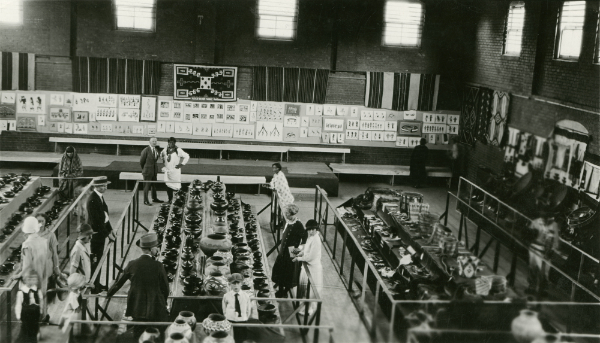
Indian Fair in old armory building, Santa Fe, New Mexico, 1925. Courtesy Palace of the Governors Photo Archives (NMHM/DCA), neg. no. 022951.

Over the past century, the American Indian art world has been significantly shaped and sustained by Santa Fe’s Native art market and tourist industry. The market provides income to artists and their families while serving as a vehicle that connects Native and non-Native worlds through the interactions it fosters. Indian Market has evolved out of years of these mutually influential interactions. It is through these interactions that Native artists communicate cultural histories to non-Native visitors. In this respect, Indian Market has served as a forum for shared cultural exchanges.

The market has grown tremendously in scope and size since its 1922 beginnings. Originally sponsored by non-Native Museum of New Mexico staff, the market has shifted to being facilitated by mostly Native staff and board members of SWAIA. It has also changed from participation by mostly Pueblo artists to include Native artisans from the entire United States and Canada. Further, its mission of preserving traditional designs and technologies of the past has expanded to also include the honoring and encouragement of innovation and new technologies in Native art forms.

The market has been a family matter since its inception, with several generations of artists often participating in the creative process and in the same Indian Market booth. The history of Indian Market also reflects SWAIA’s commitment to “bringing Native arts to the world by inspiring artistic excellence, fostering education, and creating meaningful partnerships,” according to the organization’s website.

The Market’s Beginnings

While Santa Fe has been a center of trade and exchange for centuries, Indian Market as we know it today began in 1922. In that year, Museum of New Mexico Director Edgar Lee Hewett and curator Kenneth Chapman sponsored the first market, then known as the Southwest Indian Art Fair and Industrial Arts and Crafts Exhibition.

The Indian fair was sponsored by the Museum of New Mexico and the School of American Research, now known as the School for Advanced Research. It was held indoors, admission was charged, and both artists and traders (people who bought and sold art and artifacts) submitted work to the judged art competition. Artworks were judged by a panel of non-Natives who also set prices and sold to the public. Native artists themselves did not interact directly with visitors at these early fairs. The public’s interaction with Native artists has become one of today’s more popular aspects of Indian Market.

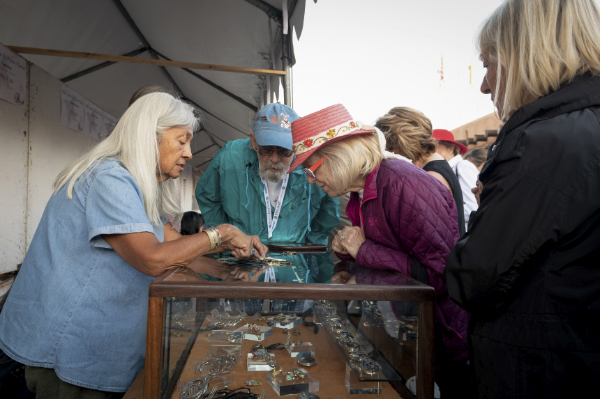
On the left, Gail Bird (Santo Domingo and Laguna), pictured here with Brenda and Gary Ruttenberg, start the day off right at 7 a.m. Saturday morning in 2019. Photograph by Kitty Leaken.

The first Indian Markets were similar in scope to the New Mexican pavilion at the 1915 San Diego World’s Fair. That exposition’s official guidebook called it “the Cathedral of the Desert” and commented on the rough-beam vigas that protruded from irregular walls. President Theodore Roosevelt congratulated San Diego and New Mexico for developing an American form of architecture out of old Spanish and Pueblo Indian styles. The San Diego Fair also built an Indian pueblo, designed and constructed a Pueblo cliff dwelling, and had art-making demonstrations by San Ildefonso potters Maria and Julian Martinez. The displays were created to introduce Southwestern Native Americans and their creations to the world.

Exhibitions at world fairs in general included idealized displays of Native cultures and living demonstrations of pottery, textiles, and jewelry-making. The Bureau of Ethnology designed exhibitions for the 1893 Chicago and the 1904 St. Louis World’s Fairs.

Historic photographs reveal the interior of the first Santa Fe Indian Fair in 1922, which featured Pueblo pottery arranged on tables and shelves according to tribal affiliation. Navajo rugs were displayed on walls, and Plains Indian beadwork was placed on tables. In the courtyard and under the Portal of the Palace of the Governors, demonstrations and dances were held by Native artists for visitors to observe.

Santa Fe Indian Market was created from an intention to provide Native American artisans with a venue to sell their works, and to preserve and perpetuate the cultural heritage of Native Americans out of the fear of their disappearance. The market began to protect what remained of diminishing Native American cultures subjected to colonialism, settler encroachment, diseases introduced by Europeans, and U.S. Federal Indian policies.

The History of Indian Market: Pre-market U.S. Government Policies

Beginning in the early nineteenth century, Federal policies of Indian removal and the reservation period (1829–1886) tore across the country moving westward. These acts removed Native Americans from their homelands and forced them to live on reservations. By the late nineteenth century, 90 percent of North American Indians had perished because of these policies, diseases for which they held no immunities, and warfare. However, some tribal groups of the Southwest, such as Pueblo and Navajo Indians, were eventually able to remain in their original homelands—which would make the Southwest United States an area of great interest to anthropologists, historians, writers, artists, and tourists.

After removal and reservation policies were enacted, the U.S. government shifted to allotment and assimilation policies (1887–1934) that included the ceding of Indian lands through the Allotment Act (1887) and the establishment of boarding schools. U.S. government officials removed Native children from their homes and discouraged or forbade them from speaking their languages and practicing their religions. Many Native adults were encouraged to learn a trade or industrialized farming techniques, all of which contributed to the diminishing of Native cultures and languages.

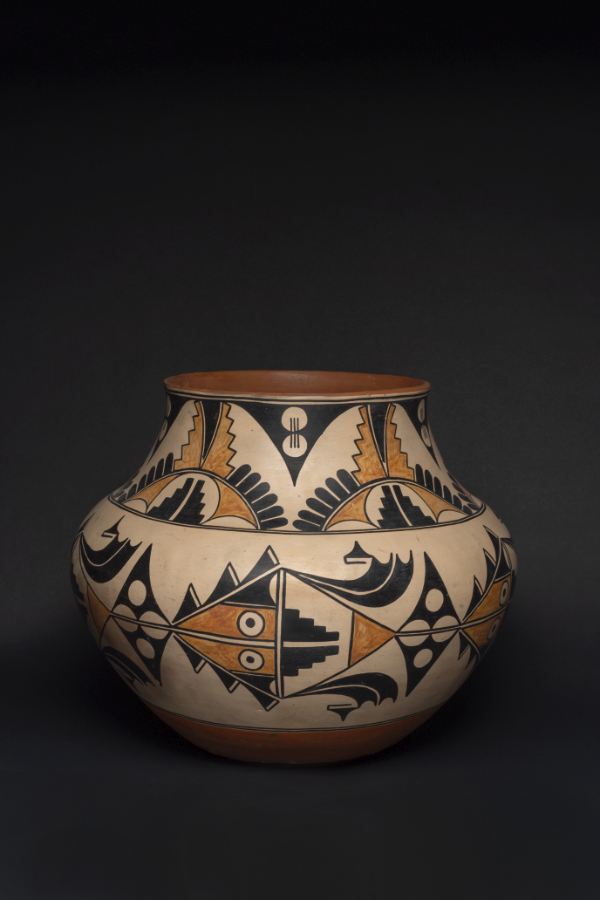
This jar won an award at the first Indian Fair in 1922. Maria and Julian Martinez (San Ildefonso), polychrome pottery jar, 1922. Clay and pigment, 14 × 17 inches. MIAC Collection: #18783/12. Photograph by Kitty Leaken.

As the Industrial Revolution produced more and more manufactured goods, fewer Native-made goods were produced. The 1923 Annual Fiesta and Southwest Indian Art Fair brochure reveals the condescending and paternalistic attitude towards Native Americans that was present in the minds of museum staff and curators, but nonetheless states:

That there is a danger of losing to the world the priceless heritage of distinctive Indian art and handicraft unless something is done to keep it alive is evidenced by the fact that for a good many years past there has been a steady drift on the part of the Indians in the direction of agriculture and mechanic arts, on account of better and quicker financial returns. All too frequently comes the reply from Indian Agents, when solicited to send an exhibit from their jurisdictions: “My Indians have forgotten their ancient crafts and there is nothing along that line produced nowadays.”

Tourism: Railroads Enter Santa Fe

During the 1880s, the Atchison, Topeka and Santa Fe Railroad began servicing Santa Fe, New Mexico, and with it brought visitors and tourists through Indian Country. Pueblo pottery makers created objects that reflected the people they encountered with this new influx of railroad passengers that included circus acrobats, opera singers, workers, and settlers, to name a few. They also created small human figures to sell to tourists in the curio trade which existed long before the railroad made it to Santa Fe. Over the next few decades, Pueblo Indian pottery, a 2,000-year-old art form in the Southwest, changed dramatically: Non-traditional vessels and figurines were made in great numbers. Interestingly, these types of Native ceramics were considered “curios” by the museum staff that sponsored the early Indian Markets and were not permitted to be included in the early Southwest Indian Fairs. Edgar Lee Hewett and Kenneth Chapman encouraged Pueblo potters to make pottery that was more based on old styles rather than souvenirs for the tourist market. The arrival of the railroads also brought more mass-produced goods such as metal cookware, textiles, and household goods to Pueblo people decreasing their need to create such materials.

Salvage Anthropology

A reaction to the diminishing of Native-made goods among some anthropologists, collectors, and institutions was to buy as many representatives of Native cultural materials as possible. Some of the buyers included the Smithsonian’s National Museum of Natural History and New York’s American Museum of Natural History. In New Mexico, the New Mexico Historical Society and others searched for Native-made goods. Pueblo pottery was one of the mediums that institutions and private individuals collected heavily.

This purchasing of massive quantities of Native American cultural objects by private individuals and public institutions would be deemed “salvage anthropology,” as anthropologists and collectors competed for and acquired millions of Native-made objects. These objects became more rare in the hands of Natives themselves, and the continued handing-down of some designs and technologies was in danger of being lost through their removal. Prior to the twentieth century, many of the Native-made objects remained in Native hands, and the designs and technologies used were readily available to community and family members to refer to when creating new works. As these objects were increasingly sought after by non-Native markets, this aspect of keeping objects in communities diminished. Today, some institutions hold consultations with Native tribal members to reintroduce technologies and designs found in the work of their ancestors.

Another component of the preservation of these traditions was to provide a marketplace where Native-made goods could be sold. It was believed that in this way the continuation of Native culture would be ensured; by creating a market for Native-made objects, more could be made by artisans and contribute to the perpetuation of this knowledge. The 1923 Fiesta and Southwest Indian Fair and Industrial Arts and Crafts Exhibition brochure, which further depicts the paternalistic attitude at the time of white arts patrons and museum staff towards Native Americans who participated in these early fairs, states:

The Southwest Indian Fair and Industrial Arts and Crafts Exhibition of 1923 is the second of its scope and character to be held in Santa Fe.

The objects in the exhibition are the encouragement of native arts and crafts among the Indians; to revive old arts, and keep the arts of each tribe and pueblo as distinctive as possible; the establishment and locating of markets for all Indian products, the securing of reasonable prices; authenticating of all handicraft offered for sale and protection to the Indian in all his business dealings with traders and buyers.

New Mexico Association of Indian Affairs

Additional social, political, and economic issues were converging on this moment in history and contributed to shaping these early Indian Markets. For instance, in 1922, the New Mexico Association of Indian Affairs was formed by a group of individuals in Santa Fe whose main agenda was to defeat the U.S. Senate’s proposed Bursum Bill. This bill would have ceded Pueblo Indian lands to non-Native settlers.

The NMAIA was established to promote and protect the rights of New Mexican Natives. These included providing advocacy, legal, medical, and technical services. It would eventually become known as the Southwestern Association of Indian Affairs to include the entire Southwest region, and into today’s Southwestern Association of Indian Arts, which hosts Santa Fe Indian Market annually. In 1934, the association began to oversee Indian Market and proposed educating the public about Indian arts through a series of publications in New Mexico Magazine.

In addition to the formation of the NMAIA and the first Indian Market in 1922, the School of American Research was founded, along with the Pueblo pottery fund, which facilitated the purchase of Pueblo pottery now in the collections of SAR and shown in the New Mexico History Museum’s 2022 exhibition. The Gallup Inter-Tribal Ceremonials also began in 1922 and showcased the work of Native artists. These entities were created to preserve and protect Native cultures of the Southwest and provide a venue for Native artists to sell their works.

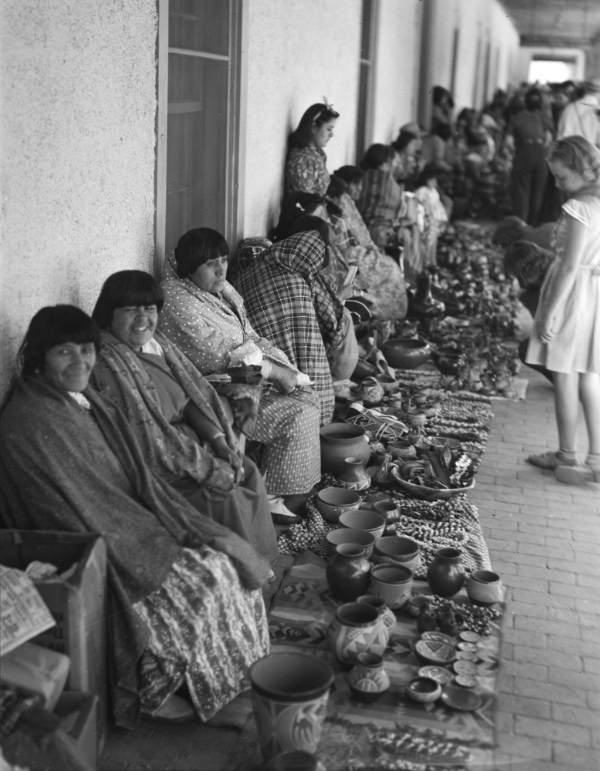
Pueblo Indians selling pottery and jewelry on portal, Palace of the Governors, Santa Fe, New Mexico, ca. 1925–1945. Photograph by T. Harmon Parkhurst. Courtesy T. Harmon Parkhurst Collection, Palace of the Governors Photo Archives (NMHM/DCA), neg. no. 069973.

The Southwest Indian Fair continued to be sponsored by MNM and SAR from 1922 to 1927, at which time Hewett ended the Museum of New Mexico’s involvement with the Fair that was by then managed by a committee of volunteers. The committee included prominent patrons of Native arts such as Kenneth and Kate Chapman, Amelia and Martha White, Dorothy Stewart, Margretta Dietrich, Frank Applegate, and Henry Mera. During this time, there was a revival of Pueblo pottery partly due to these efforts and the promotion of artists that participated in the fair. Tonita Roybal (San Ildefonso), Maria Martinez (San Ildefonso), and Lufina Baca (Santa Clara) all won prizes for their pottery during these early Indian fairs.

In 1931, the Southwest Indian Fair was held outside under the Portal of the Palace of the Governors along the Santa Fe Plaza. This marked an important transition: For the first time, artists interacted with and sold directly to the public, eliminating the Museum of New Mexico’s staff as intermediaries between artists and buyers. Here we see the beginnings of Indian Market’s transition to having more Native-held control over sales and direct interactions with consumers.

Indian Reorganization Act of 1934

This trend coincides with the Indian Reorganization Act of 1934, a political movement that reinforced tribal sovereignty and enabled Native groups to reorganize their governments to better self-govern and strengthen their communities. It also put an end to the allotment of Indian lands to individual households. This act was created in part to decrease the paternalistic power of the Bureau of Indian Affairs, which was running numerous Indian boarding schools.

The Indian Reorganization Act was created partly in response to the Meriam Report (1928), a government study that described poor living conditions and high poverty and death rates on Indian reservations, as well as the grossly inadequate care of Indian children in boarding schools. The Meriam Report also conveyed the destructive effects of the erosion of Indian land caused by the Allotment Act. The Great Depression began shortly after this report was issued, causing living conditions and employment opportunities to fall everywhere in the country. President Franklin D. Roosevelt’s New Deal policies were designed as a response and focused on relief, recovery, and reform. It was in this atmosphere that Congress passed the Indian Reorganization Act in 1934, also known as the Indian New Deal.

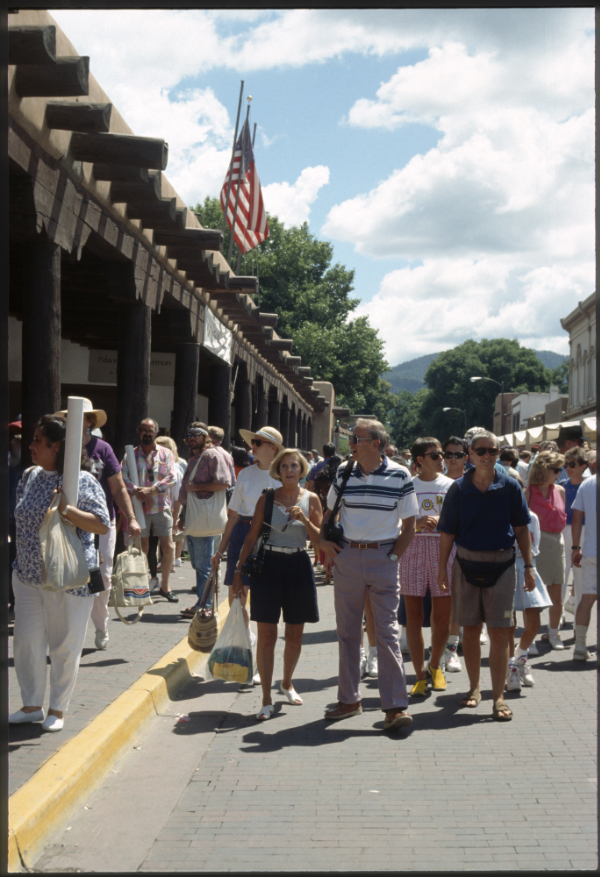
Crowd in front of the Palace of the Governors, SWAIA Santa Fe Indian Market, Santa Fe, New Mexico, 1991. Photograph by Annie Sahlin. Courtesy Palace of the Governors Photo Archives (NMHM/DCA), neg. no. HP.2013.12.073.

From 1932 to 1935, the market was held not in Santa Fe, but instead at various Pueblos during feast days, and at Indian and Pueblo day schools. Fair committee members traveled to the Pueblos in attempts to continue their influence over Native arts. Committee members encouraged artists to refrain from making “curios,” smaller and less complex objects to sell to tourists, who tended to purchase objects that could travel easily. One of the categories for winning awards involved the size of pottery pieces, encouraging larger, more utilitarian types of vessels reminiscent of objects made in the past. Larger pieces of pottery have historically won awards more often and were encouraged from the beginning of the early fairs.

The New Mexico Association of Indian Affairs officially took over sponsoring the market in 1934 and promoted an educational component to inform the general public about Native-made goods and culture. The fair was held weekly under the Portal of the Palace of the Governors from 1936 to 1939. The Southwest Indian Fairs continued to be held during Santa Fe’s annual Fiesta celebrations until 1962. Today the market is held the third weekend in August each year.

In 1936, Margretta Dietrich was chair of the NMAIA and instrumental in moving the Indian Fairs from various Pueblos back to Santa Fe. At this time, Maria Chabot began producing a series of articles about Indian art for New Mexico Magazine that would serve to educate potential buyers so they could better recognize “quality” Native arts.

Termination Era: 1946–1960

During the mid-1940s to the 1960s, Federal Indian policy shifted again to the termination era, which ended many tribes’ special relationship with the government and federal recognition of their status as sovereign nations. It also worked to relocate Natives from reservations to urban environments in favor of assimilation. Public Law 280, a federal statute, was enacted by Congress in 1953, which enabled states to assume criminal, as well as civil, jurisdiction in matters involving Indians as litigants on reservation land, further diminishing Native sovereignty.

During this era, the federal government terminated the official status of more than 100 tribes. Those that were not, suffered from increased governmental paternalism. Indian Market stagnated and decreased in size, as did the amounts of award monies available. NMAIA member Gladys Auger financed the market and kept it going through 1959, when a group of traders and anthropologists began to run the market.

Also in 1959, the NMAIA changed its name to the Southwestern Association of Indian Affairs to describe its reach into the greater Southwest region of the United States. In 1993, the organization again shifted its name to the Southwestern Association of Indian Arts. Indian Market became the main focus of the group and cultural preservation and education became its main objective.

Self Determination: 1961–1985

The 1960s brought on more social and political change, and renewed policies of self determination began to take hold. Native Americans sought to restore tribal communities, self-government, educational control, and input into federal government decisions concerning policies and programs.

The Institute of American Indian Arts was founded in 1962, and proved to greatly influence Indian Market. Many artists that participate in the market have attended and were trained at IAIA over the past sixty years. With IAIA’s inception, we begin to see a shift in the perception of Native arts from craft to fine art. 

During the 1960s, increased activism for civil rights proliferated in Indian Country and the movement for self determination steadily gained momentum. This renewal of Indian activism ushered in a new generation. Public protests such as the occupations of Alcatraz (1969–1971) and Wounded Knee (1973) are examples of American Indians uniting to change their relationship with the United States government. In 1968, Congress passed the Indian Civil Rights Act after acknowledging that the policies of Indian termination were a failure. Native Americans had persisted in keeping their cultures and religions alive. Self determination became official federal government policy in 1970, when President Richard Nixon addressed the issue and asserted his support of the movement.

1980s and 1990s

Over the next decades, Santa Fe’s Indian Market became increasingly popular and attendance by both artists and visitors continued to rise above that of the Gallup Inter-Tribal Ceremonials. The hosting and running of Indian Market became more and more controlled by individual Native artists and tribal members who joined the SWAIA staff and board of directors. New generations of artists and buyers continued to meet annually on the Santa Fe Plaza to exchange knowledge of Native American arts and culture.

Two important acts were passed in 1990: the Native American Graves Protection and Repatriation Act and the Indian Arts and Crafts Act. NAGPRA empowered Native communities to reclaim ancestral remains and objects of cultural patrimony, endeavoring to create a more equitable relationship between institutions and Native communities. The Indian Arts and Crafts Act is an updated version of the 1935 act that promoted the welfare of Native communities through the development of arts and crafts. It was also aimed at authenticating artists’ identities; under the act, an “Indian” is defined as a member of any federally or state-recognized tribe of the United States. It also incorporated fines for the misrepresenting of objects as Indian-made.

Twenty-First-Century Indian Market

 Today, SWAIA sponsors Indian Market the third weekend in August each year. Over 100,000 visitors—more than the population of Santa Fe—attend from around the world. The vibrant scene is filled with Native art, artists, collectors, and performers with the sounds of crowds, Native music, jingle dresses clinking, and children playing as attendees gather at the gazebo, the main outdoor bandstand for performances.

The vibrancy and excitement of the market can be felt by everyone, whether long-term attendees or first-timers. This is especially apparent at SWAIA’s Best of Show Awards Ceremony and preview reception held the Friday before Indian Market weekend. Artists bring their works to the Santa Fe Convention Center, where SWAIA volunteers receive, record, and categorize the entries for judging.

Anticipation looms as artists reveal their latest creations to the classification specialists, who then place their works into numerous categories that include traditional and contemporary divisions. Artworks are then displayed on tables in preparation for the SWAIA judging process. More than 1,000 examples of the finest Native-made jewelry, pottery, paintings, sculpture, photography, carvings, textiles, beadwork, and basketry are submitted to the competition.

The awards ceremony celebrates Native artists whose careers are often advanced after receiving awards. The winning artists are announced, and they speak about their work, their families and communities, and what the award means to them. One of the classification winners is selected and awarded the grand prize: Best in Show for Indian Market each year. This is the most highly revered award in the Native art world.

Following the awards ceremony, additional opportunities are made available to view winning artworks at preview events held Friday afternoon and evening. Collectors often take notes on artworks they hope to acquire as they compete to be the first in line at an artist’s booth Saturday morning. Avid collectors have been known in some instances to sleep overnight in an artist’s booth to ensure that they will be the first in line on Saturday morning to purchase the piece they want to own.

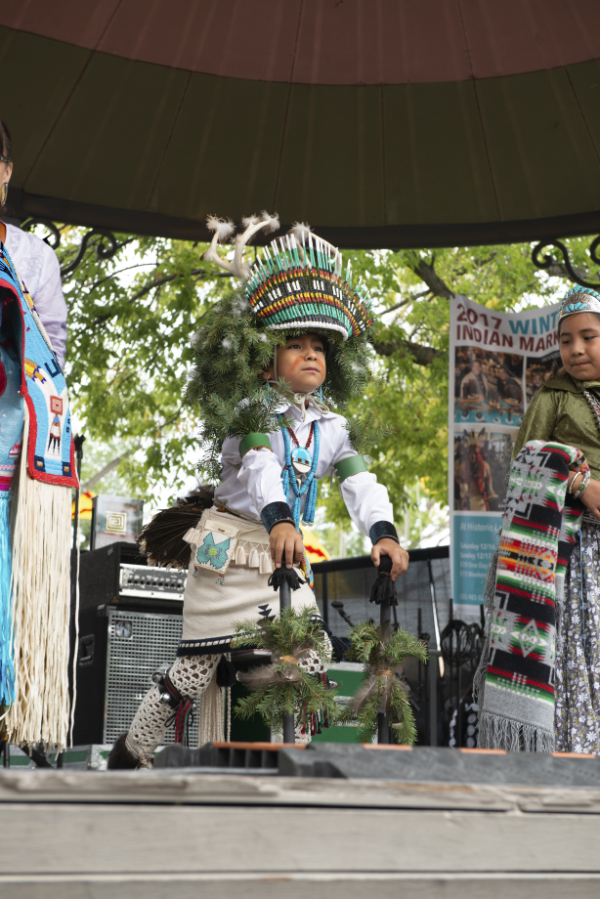
Jai P’o Makowa P’ing Havier (Pojoaque and Santa Clara), a young Deer Dancer at Indian Market, won Best of Show in 2017. Photograph by Kitty Leaken.

Numerous events are held in tandem to the main event throughout Indian Market week. These include museum and art gallery openings, a Native American film festival, a trending Native fashion show, dancing, demonstrations, and other various shows and auctions. It is possible to move from one high-energy happening to another during the entire Indian Market week.

SWAIA artists and visitors have described Indian Market as a place where artists and collectors reunite and catch up on the news of the past year. This community aspect of market plays a substantial role in its continued success. When you purchase a work of art at Indian Market, you are receiving an artist’s creation, as well as learning directly from them about the history and tradition of the culture in which it was created.

For instance, contemporary potters often refer back to their ancestors and those that taught them the processes of gathering materials and creating their work. Their inspirations arise from many factors including dreams, personal events, and visions for the future. Indian Market artists speak about their culture and traditions as each artist brings a different perspective. Storytelling is part of Native oral traditions and can impart values, language, memories, ethics, and philosophy, passing them down through generations.

Multiple generations of artists often can be found together at the market; the gathering of materials, the stages of preparation, and the actual creating of a work of art also often include the collaboration of several generations of artists.

Although the market has gone through many changes over the past 100 years, some consistencies can be found, such as the art competition and awards acknowledging exceptional works prize money, classifications, artist demonstrations, dances, and educational programs. All trace their origins to the 1922 Southwest Indian Art Fair and Crafts Exhibition. 

Cathy Notarnicola is the curator of Southwest history at the New Mexico History Museum. She has also worked at the Museum of Indian Arts and Culture in Santa Fe and at the Smithsonian Institution’s National Museum of the American Indian in Washington, D.C.

Kitty Leaken (opens in a new tab) learned photojournalism on the job at the Santa Fe Reporter and the Santa Fe New Mexican. 

All Roads Lead To… Chocolate

By Jason S. Shapiro

The main benefit of this cacao is a beverage which they make called Chocolate, which is a strange thing valued in that country. It disgusts those who are not used to it, for it has foam on top or a scum-like bubbling.

José de Acosta, 1590

Chocolate and I have a long history.

One of my earliest childhood memories involves the aroma of fresh chocolate. I grew up in Milton, Massachusetts, a bedroom community just outside Boston, and only a couple of miles from where Walter Baker Chocolate, purportedly America’s oldest chocolate company, was established in 1765. The factory was still operating in the fifties and sixties, and when the wind blew from the east, we were suffused with the intoxicating essence of chocolate. More than sixty years later I remain an enthusiastic chocolate consumer.

As most astute readers will acknowledge, the mass-produced, industrialized, and affordable chocolate bar that we recognize today, whether wrapped in the iconic silver and brown foil or encased in that mythical golden ticket, is a recent invention. For more than 4,000 years people have treated chocolate, or more accurately cacao, as a treasured commodity. We have drunk it, eaten it, traded it, used it for money, cultivated it, and obsessed over it. People have pursued chocolate across time and space for centuries and have carried it from its place of origin to every continent on the planet.

Chocolate has achieved such a valued status that it has been accorded both a National Chocolate Day (September 28) and a World Chocolate Day (July 7). Likewise, there are more than sixty-five museums worldwide whose sole focus is presenting the story of chocolate; accordingly, the New Mexico Museum of Natural History and Science hosts Chocolate: The Exhibition, a traveling exhibition by Chicago’s Field Museum. It opens June 17 and will run through March 12, 2023.

Originally ingested as a bitter, spiced drink, chocolate is now consumed in an uncountable number of ways, from sweetened solid bars to truffles, coated fruits and nuts, and all manner of hot and cold beverages. Chocolate has become an essential ingredient in Western culture, and has gained prominence in films, television shows, literature, and music. What else could be a fitting vehicle for Willy Wonka’s infamous Golden Ticket than a luscious and intoxicating bar of chocolate? Even the late Anthony Bourdain devoted an entire travel program to chocolate. The cameras followed Bourdain to Peru and chronicled his involvement with the production of single-sourced, artisanal chocolate bars. However, long before chocolate in all its modern forms dominated the Western palate, it was the drink of kings, emperors, and presidents—hot chocolate frequently appeared at George Washington’s breakfast table. I intend to examine chocolate’s popularity, as well as consider how chocolate has linked the culinary and the cultural between the Americas and the wider world.

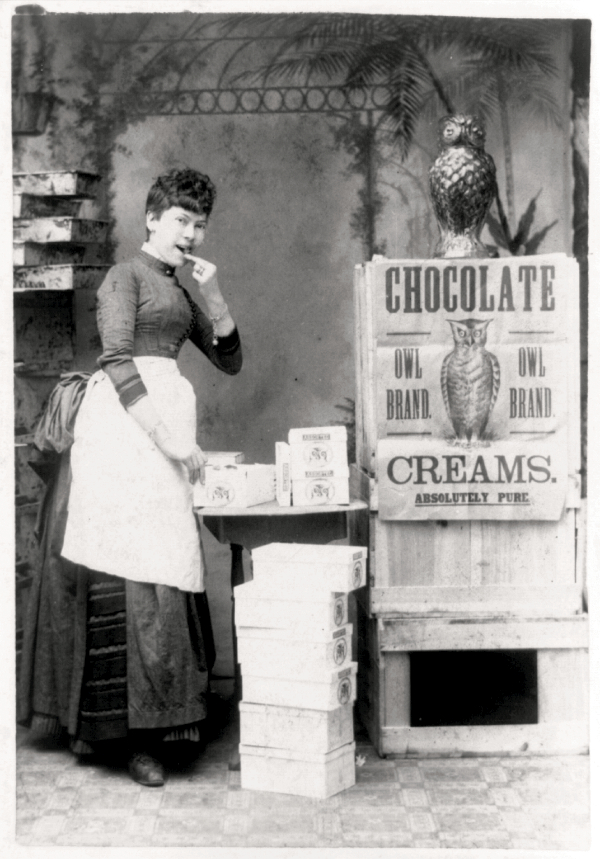
Eating chocolate, ca. 1886. Courtesy Library of Congress Prints and Photographs Division, item no. LC-USZ62-92565.

The diffusion of chocolate is linked to the European colonization of the Americas, but its initial spread was a much older process that began thousands of years earlier in the Amazon Basin. The Amazon preserves the greatest concentration of wild cacao species and is most likely where the plant evolved. Cacao (Theobroma cacao = “the food of the Gods”) is a tropical tree that produces thirty or so yellow or scarlet-colored pods, each containing twenty-five to forty inch-long seeds embedded within a whitish pulp. Although the pulp can be fermented into a kind of fruity drink, the seeds are the source of the substance we call chocolate.

Cacao processing is neither obvious nor intuitive, and requires several very specific steps in order to get the good stuff. Transforming raw cacao into chocolate involves harvesting the ripe pods, separating the seeds from the pulp, fermenting then drying the seeds, roasting them, and then finally winnowing the seed casings to create cacao nibs that are ground into a paste that can be dried and preserved, or hydrated for drinks. Perhaps the least obvious and most critical step for the preparation of drinks is frothing, agitating the mixture until a foam forms and really brings out the cacao’s flavor. Whether one pours the liquid back and forth between special jars as the Maya did, or uses a Spanish-developed molinillo whisk, frothing is the “secret sauce” behind cacao elixirs.

It remains an open question whether cacao trees diffused naturally from the Amazon, or were taken by groups of cacao cultivators to the warm, humid parts of Mesoamerica where the tree flourished. However those trees arrived, by roughly 1900 B.C.E. the Olmec people living along Mexico’s Gulf Coast were growing cacao and preparing beverages. The Olmec may not have been the first chocolatiers, but they provided us with something unique. Their word for chocolate, kakawa, is the source for the word “cacao.” It was adopted by the Maya whose word chokola’j means “to drink chocolate together,” as well as the Aztecs, who used the term choclatl that became “chocolate.” Cacao trees cannot grow in the Mexican Highlands, but the Aztec Empire imported huge volumes of cacao seeds as tribute from their vassal states located in warmer, wetter areas. Drinking spiced cacao became a defining social marker for Aztec royalty, wealthy individuals, and their military. Despite being cultivated in relatively few places, cacao evolved into a pan-Mesoamerican phenomenon and was used in ceremonial activities from central Mexico to Guatemala, Belize, and Honduras.

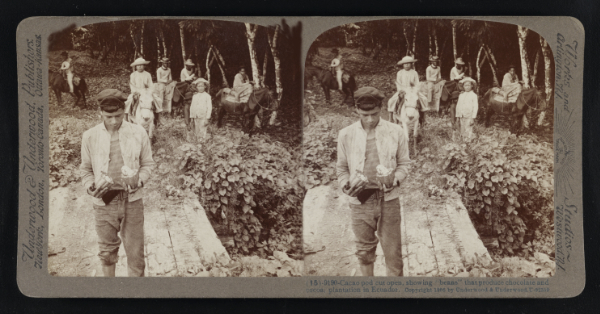
Cacao pod cut open, showing “beans” that produce chocolate and cocoa, plantation in Ecuador, 1906. Photograph courtesy Library of Congress Prints and Photographs Division, item no. LC-DIG-stereo-1s20714.

As with many investigations into the use and distribution of well-known commodities, the details often turn out to be older, more complex, and more extensive than what people had previously assumed. This is the case with cacao, which has some surprisingly old ties to the Southwest in general and New Mexico in particular. The distribution and consumption of chocolate has become part of the enduring question concerning connections with Mexico. No one disputes that Mesoamerican artifacts and cultural traits reached the Southwest, but they were so selectively distributed in terms of time and place that scholars have been debating the significance of those artifacts and traits for more than a century.

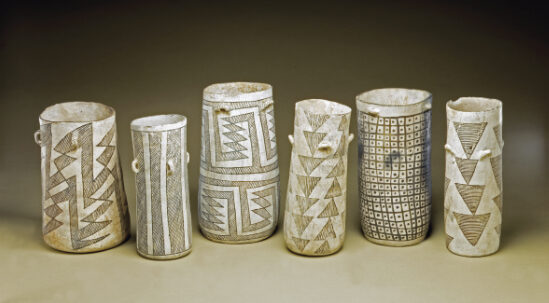
Everything we thought we understood about the range of cacao use changed in 2008 when University of New Mexico professor Patricia Crown collaborated with Jeffrey Hurst of the Hershey Center for Health and Nutrition to study chemical residues on Ancestral Puebloan ceramics. Their analysis revealed unmistakable traces of cacao in association with unique ceramic cylinder vessels that were unearthed at Pueblo Bonito in Chaco Canyon in 1896. Using sophisticated chemical analysis, scientists have identified the existence of cacao by spotting telltale organic residues, specifically the alkaloid theobromine, a definitive marker for cacao.

Crown and Hurst’s conclusion that people in Chaco Canyon were drinking chocolate as early as 1000 C.E. was an unexpected surprise, and contributed to a more complex picture of inter-regional trade with perishable cacao somehow making the long journey north. The nearest Mexican cacao sources relative to Chaco Canyon were somewhere between 1,500–1,700 miles distant, across some of the most rugged country in North America.

The story of cacao in the Southwest has become more complicated in light of additional research. In 2011, professor Dorothy Washburn at the University of Pennsylvania recovered theobromine in residues from ceramics collected from Alkali Ridge, an eighth-century Ancestral Puebloan settlement in southeastern Utah. These findings indicate that people were drinking cacao in the Southwest almost two hundred years earlier than at Chaco Canyon. As with the Chacoan cylindrical ceramic containers, the Alkali Ridge findings are associated with a rather sudden appearance of new and distinctive pottery types. Those discoveries support the possibility that cacao may have been brought into the Southwest by groups of farmers moving north; people who knew all about maize-growing and pottery-making, and who were also familiar with cacao. These early farmers were nothing like the hereditary royals and other elites who monopolized cacao-drinking among the Maya and other contemporaneous Mesoamerican societies. The as-yet-unsolved conundrum is that the Alkali Ridge folks were pretty egalitarian in their social structure, yet they also consumed what archaeologists have heretofore considered to be “elite centric” cacao drinks.

The Alkali Ridge findings have implications when considering the nature of Mesoamerican contacts, but raise very specific issues for Chaco Canyon. We may never know for certain how cacao got to Chaco, but the existence of cacao residues suggests that whoever was walking around the Southwest with dried cacao seeds already knew what to do with them, including exhibiting a barista’s ability to quickly whip up spicy, frothy chocolate drinks. Specialized knowledge does not magically appear in a vacuum, and if Mesoamericans could have carried cacao to Alkali Ridge, it is plausible that, two centuries later, different Mesoamericans could have carried cacao seeds, together with their associated recipes, to Chaco Canyon. The Chacoans were clever and sophisticated people, but without having received some kind of “chocolate tutorial” from skilled cacao specialists, they would have been as flummoxed as the Spanish would be several hundred years later when they too were presented with cacao seeds for the first time.

If the idea of chocolate tutorials conducted by Mesoamerican merchants or immigrants is worthy of consideration, then the next logical question is, “Which Mesoamericans are we talking about?” One might speculate about societies living in western Mexico. These people lived hundreds of miles from cacao-growing regions, but there is evidence that suggests local highly socially ranked individuals were using cacao as early as the ninth century. As those west Mexican polities became larger and more integrated into the broader streams of Mesoamerican culture, they gained access to exotic stuff, including cacao.

Could west Mexican groups have expanded their networks northward and traded goods, resulting in cacao at Chaco Canyon? It’s certainly plausible, but irrespective of how cacao got to Chaco, there seems to have been a very select group of Chacoans who got to drink it. Beyond their elevated social status and an association with Pueblo Bonito, we don’t know much about who these people were or what they thought about those exotic cacao drinks. In other words, there are plenty of intriguing cacao questions that remain unanswered.

Chacoan society dissolved by the thirteenth century, and chocolate usage in the Southwest seems to have dissolved then as well. There are a few Mesa Verde and subsequent period sites where traces of theobromine have been discovered, but the sample numbers are small, and there are no findings of cacao among Ancestral Puebloans after the 1400s. Moreover, there do not appear to be accounts of cacao usage among historical Pueblo societies, so chocolate beverage consumption did not continue as part of any ongoing ceremonial or cultural activity. Chocolate eventually made a triumphant return to New Mexico, but it required a few hundred years and an entirely different group of people to provide it.

Prior to 1500, no one in Europe had ever seen or heard of cacao. That was about to change as cacao was drawn into the “Columbian Exchange,” the name given to the transfer of technologies, plants, animals, and diseases as they were carried by people between Europe, the Americas, and everywhere else. The worldwide distribution of chocolate began unwittingly during Christopher Columbus’s fourth voyage, when on August 2, 1502, he encountered a Maya trading canoe from which he seized the crew and their merchandise that included things described as “almonds,” but which were actually dried cacao seeds. Neither Columbus nor his crew knew anything about those seeds, but within a short time they would enthusiastically embrace knowledge the Maya and others already had; namely, how to transform those little brown seeds into enticing and nutritious drinks.

Ancestral Pueblo pottery dating from 1100 A.D., from Room 28, Pueblo Bonito, Chaco Canyon, New Mexico. Photograph courtesy the American Museum of Natural History Library, image no. ptc-3521.

In 1519, during Hernán Cortés’s  military campaign from Veracruz to the Aztec capitol of Tenochtitlan, he was approached by two Aztec emissaries.

When the Spanish saw them eating, they too began to eat turkey, stew, and maize cakes, and enjoy the food with much laughing and sporting. But when time came to drink the chocolate that had been brought to them, that most highly prized drink of the Indian, they were filled with fear. When the Indian saw they would not drink, they tasted from all the gourds and the Spanish then quenched their thirst with chocolate and realized what a refreshing drink it was. —Diego Duran, 1964

Cortés was sufficiently impressed to describe cacao in a letter to the King of Spain in which he wrote, “Cacao is a fruit like the almond which they grind and hold to be of such value that they use it as money throughout the land and with it buy all they need in the markets and other places.” Cacao was so valuable that some Indigenous “entrepreneurs” learned how to make highly realistic counterfeit seeds out of clay. As with everything else of value in the Americas, the Spanish sought all the cacao they could find. Following their destruction of the Aztec Empire, they continued to collect huge amounts of cacao by expropriating existing Aztec tribute systems, forcing cacao growers to serve Spanish instead of Aztec needs. Over time Spanish colonials not only adapted to cacao, they innovated with novel recipes, as well as with newly invented tools with which to froth and serve chocolate drinks.

The earliest documented presence of cacao in Spain occurred in 1544 when some Dominican friars brought a Mayan delegation to the Spanish court. Among the exotic items the Maya gifted to Prince Phillip of Spain were containers of frothed chocolate beverages. We do not know Phillip’s reaction, but within a short time, it was game on for chocolate consumption in Europe as it became a hugely popular, mass marketed commodity. In other words, although Spain had “conquered” cacao, one could conclude that cacao had conquered Spain, and the rest of Europe as well.

By the mid-1600s, cacao had been introduced to Italy and England, and was becoming the beverage of choice among the European upper classes who had the time and resources to spend an afternoon sipping aromatic chocolate drinks. Within a century, millions of pounds of cacao were being grown on tropical plantations throughout the Caribbean region in order to feed European demands. Cacao quickly became an important component of Spain’s colonial economy because of its popularity as a consumable as well as its ongoing use as a medium of exchange. By the late sixteenth century, consumption of chocolate beverages was well ensconced along the Spanish colonial frontier; among the wealthy, drinking chocolate became quite fashionable. As the frontier was extended further north into New Mexico, the practice of cacao drinking was carried along with the Spanish flag.

One description of cacao use in colonial New Mexico was provided by Don Diego de Vargas, the commander responsible for the 1692 Reconquest of New Mexico following the Pueblo Revolt of 1680. De Vargas described meeting a Pueblo leader and wrote, “I ordered him to enter my tent, greeting him kindly with warm words and chocolate, which he drank with the fathers, the others who were present, and me.” De Vargas may have been a tough and unyielding colonial administrator, but he had absorbed the traditional Aztec concept of hospitality that used chocolate drinks to lubricate the wheels of diplomacy … and conquest. Cacao-drinking remained part of colonial culture in New Mexico, especially among the upper classes and Catholic Church officials who offered hot chocolate beverages at banquets or other situations involving important or honored guests.

Over time, two aspects of traditional cacao usage changed. For thousands of years cacao had only been consumed as a beverage, rather than eaten as a solid confection. These conditions shifted as early as the sixteenth century, when cloistered Spanish nuns in Mexico learned how to use sugar and other ingredients to produce the world’s first chocolate candies. Those enterprising nuns foreshadowed the popular “Chocolate Giants,” such as John Cadbury and Milton Hershey, by centuries.

The second and not unrelated aspect is that cacao was traditionally treated as a specialty item accessible to social elites. It does not matter if we contemplate a ninth-century Maya lord, a seventeenth-century Spanish colonial administrator, or an eighteenth-century English lord—for the most part, until the industrialization of chocolate production, those people drove the market for cacao. A big exception were the eighteenth-century American colonies into which large volumes of chocolate were imported and apparently enjoyed by all classes. With the industrial revolution, mass production of sweetened chocolate became possible, and by the early nineteenth century, the powdered drink that came to be known as Dutch cocoa was invented, with improvements to the production of solid chocolate following soon after. The monopoly of the elites was over, and soon anyone who desired chocolate could have as much as they could buy.

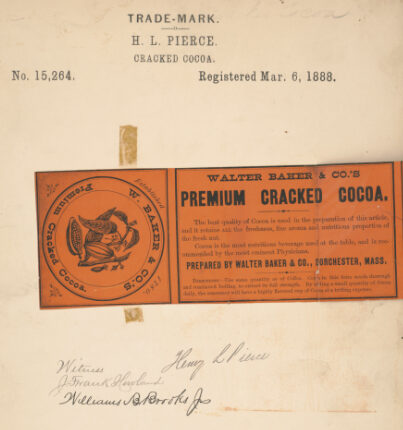
Trademark certificate
Trademark registration by H. L. Pierce for Walter Baker & Co.’s Premium Cracked Cocoa. brand Cracked Cocoa, 1888. Courtesy Library of Congress Prints and Photographs Division, item no. LC-DIG-trmk-1t15264.

Well into the nineteenth century, New Mexico’s cacao culture remained tied to Mexico and the Camino Real, rather than to the growing economic engine of the United States. Although there was a history of chocolate production and consumption among eastern seaboard colonies, there was apparently no hurry to expand the market for “eastern chocolate” into the West. For example, there is not much evidence for chocolate products being transported along the Santa Fe Trail, at least moving east to west. Josiah Gregg, in his mid-nineteenth century book about the Trail, Commerce of the Prairies: The Journal of a Santa Fe Trader 1831-1839, noted that “no one can hesitate to do homage to their [Mexicans’] incomparable chocolate, in the preparation of which the Mexican surely excel other people.” In other words, chocolate was not unknown along the Trail in the nineteenth century, but it was primarily associated with Mexican traders.

Unlike in modern Mesoamerica, where cacao is still incorporated in food and drinks and holds an important place in rituals, contemporary Indian and Hispanic communities in New Mexico do not use chocolate in that manner. Irrespective of longstanding connections between the Southwest and Mesoamerica, they remain distinct cultural regions. Despite the growing corpus of evidence supporting the use and distribution of cacao in the Chaco and post-Chaco world, for reasons we do not understand, cacao usage simply stopped and was not carried forward by descendant communities.

Nevertheless, chocolate’s legacy in the Southwest has persisted into the modern era: Follow your nose to Kakawa Chocolate House in Santa Fe, and co-owner Bonnie Bennett will be happy to talk about all things chocolate. On a recent visit, she encouraged me to sample a few thousand years’ worth of chocolate elixirs. From a 2,400-year-old spiced Mayan concoction, to a seventeenth-century Italian citrus-infused recipe, to more contemporary preparations, I literally drank my way through the history of chocolate.

And isn’t that the ultimate purpose? For centuries, cacao has offered the promise of great wealth and the lure of something mysterious. But at the end of the day, what people really want to do is to eat it, drink it, and revel in the wonderfulness that is chocolate. The Golden Ticket, it turns out, was under our noses all along.

The author gratefully acknowledges the many useful comments, suggestions, and observations from Bonnie Bennett, Dr. Eric Blinman, Dr. Patricia Crown, and Dr. Richard Ford.

Jason S. Shapiro, J.D., Ph.D., is a retired archaeologist living in Santa Fe. In addition to several prior contributions to El Palacio, Dr. Shapiro is the author of Before Santa Fe, The Archaeology of the City Different (Museum of New Mexico Press, 2008), the first comprehensive synthesis of the Santa Fe region.

Dr. Jason "Jay" S. Shapiro is a retired archaeologist living in Santa Fe. In addition to several prior contributions to El Palacio, Dr. Shapiro is the author of Before Santa Fe, The Archaeology of the City Different (Museum of New Mexico Press, 2008), the first comprehensive synthesis of the Santa Fe region.

I Change into My Levi’s That I Bought With Last Year’s Potato Harvest Money

By Jim O’Donnell

Rosie left for Colorado when she was 6 months old. Her family travelled by covered wagon, crossing the mountains and making their way north. The year was 1921. José Delores Cordova, Rosie’s father and a recently returned veteran of the First World War, simply couldn’t make ends meet farming and ranching the high desert plateau north of Taos, New Mexico. He and his wife, Maria Refugio “Ruth” Martínez, had gotten wind of decent-paying jobs in the sugar beet fields outside of Fort Collins, Colorado, run by the Great Western Sugar Company, and so they left their ancestral village of Cerro and joined hundreds of other Hispanic New Mexico families—los Manitos—migrating north for better economic opportunities.

The northeast Colorado sugar beet industry of the early twentieth century has been described as an empire. Beet fields sprawled across thousands of acres surrounding communities such as Greeley, Eaton, Loveland, and Fort Collins. Workers and their families poured in from all over the country and beyond. In Fort Collins, the neighborhoods of Andersonville and Buckingham filled with immigrants from Russia, Germany, and Eastern Europe. New Mexicans settled the Alta Vista neighborhood.

José Cordova had been to Colorado for work before—probably several times, as was common for the Manitos of New Mexico’s mountain villages. The 1920 United States Census lists Cordova as living in both Cerro, New Mexico, and Windsor, Colorado. For a time, he herded sheep around Meeker, Colorado. Yet for José, it didn’t make sense to be apart from his family, and he was determined to bring them with him. Steady work in the sugar beet fields gave him that opportunity. It was in Alta Vista that José and Ruth Cordova built an adobe home on Martínez Street sometime between 1920 and 1922, when Rosie was just a little one.

“My brother and I helped mix the mud with the sand and the straw. We’d take off our shoes, roll up our coveralls and just get in there and mixed it all up,” Rosie said in an interview before her death in 2007. “My father would make up the adobes, leave them to dry for one or two days. He kept turning them until they’d dry evenly then he’d put them in a pile until he had enough to build another wall.”

José and Ruth raised ten children in that adobe house. The boys slept in the attic, the girls below. Before long, José’s parents Juan Miguel and Eleonora Cordova joined José and Ruth in Alta Vista, creating a new home just across the intersection. José’s brother, Manuel Ruperto Cordova and his wife, Lilly, settled in across the street.

“This is my family,” says Rosie’s granddaughter Ashley Cordova, my wife’s cousin. “We’ve been in Fort Collins for eight generations. Over 100 years. The older I get, the more infatuated I get with our family story. And I want to preserve that legacy.”

Manito. Mano.

I once met a man named Arsenio. He was 94 years old at the time. He was from the village of Peñasco, south of Taos. When I told him that I was born and raised in Pueblo, Colorado, he launched into a string of stories about his life as a Manito, working in the train yard at the sprawling Rockefeller-owned Colorado Fuel and Iron Company steel mill. I told him my grandfather worked there from the 1930s into the 1970s and, as the crazy world works, it turned out my grandfather had been Arsenio’s boss. This was the first time I’d heard the term “Manito.” According to Arsenio, the term meant “hand,” as in the calloused hands of the hard-working migrant laborer.

Mano. Manito. The name more likely comes from the term of kinship and endearment rooted in the Spanish word for brother. Hermano. It’s an old term. Some early collectors of folklore and oral histories feel that the word manito may have originally been a somewhat pejorative label for the “mixed-blood” Hispanos of El Norte. Regardless, by the late 1800s, “mano” and “Manito” were used in terms of kinship, brotherhood, sisterhood, care, and shared identity. The name Manito is used to this day.

And yet mano in terms of hand is probably not far off in other respects. It was the hands of these New Mexico families that harvested the beets of Colorado, built the highways, dug the mines of the West, and herded the sheep of Wyoming. At home, it was the manos that shaped the adobes, fixed the roof, harvested the corn and chiles, and built new lives far from home.

Levi Romero, poet and associate professor in Chicana and Chicano studies at the University of New Mexico, writes in an introductory brochure for the Millicent Rogers Museum’s exhibition about the Manitos that “Not every New Mexican calls themselves Manito. Some New Mexicans prefer to be called Chicano. Others prefer Hispanic or Latino. Some people just like to be called New Mexican. Here, we use the term ‘manito’ because for us it means family and community.”

Now, a number of researchers—many Manitos themselves—are working to preserve the legacy of this chapter of the American experience.


Summers En Los Campos
Savannah P. Rodríguez
Dedicado a mi Tío Leroy

Summer is here y ya nos vamos a Colorado
Tío Ezequiel, Tía Sofía and the rest of the crew están esperando
I change into my Levi’s that I bought with last year’s potato harvest money
Grab my big hat and long sleeves
Estoy listo

We left home when school was finished
When the air was hot and dry
When there was no work and Welfare ran out
So we all hopped into the back of the troca and we were on our way

I was 6 years old the first time I went to the fields
Too little to hold the hoe, so I watched
Learned
Understood what work was and the value of feria
I walked up and down the rows
Up to all the sweaty trabajadores
Chicanos from all over the place
And offered ’em Daisy cups of water
For one penny a pop

Back home there was much time to practice in our gardens
I looked forward to the next job, next town, next field

During the harvest, we went to Monte Vista
Filled a thousand sacks of papas a day
For fifty bucks a week

I’d clean acequias on the weekends for fifty cents an hour
For pencils and paper and pantalones for my siblings

Sometimes on my day off, I’d take the bus into town
Fort Garland to Alamosa
Walked half a mile to the swimming pool
Bought a burger and a song on the jukebox

For years after I graduated high school and left home to California,
Soñé de los campos
Y los extrañé

Picking peaches allí en Grand Junction
String beans in La Junta
Boxes of watermelon and cantaloupe
Buckets of onions, beets, and lettuce

Farmer’s tan
Knees and hands stained with dirt

I dreamt of summers
En los campos


For centuries, Hispanos from the mountain villages of El Norte have had to travel in order to survive. In the seventeenth and eighteenth centuries, ciboleros crossed la sierra, the Sangre de Cristo mountain range, to hunt with their Comanche allies on the Llano Estacado, the great Staked Plain stretching from the foothills into present-day Texas and Oklahoma. People moved regularly up and down the trade routes into Mexico and, later, between the trade centers of Taos and Santa Fe to the American frontier and the commercial center of St. Louis.

It was with the United States invasion and annexation of what we now call the American Southwest that economic and social conditions in the villages of Northern New Mexico morphed so dramatically that large-scale migration and permanent resettlement of Hispano families far from home took place.

In 1848, the United States of America and Mexico signed the Treaty of Guadalupe Hidalgo, officially ending the American war on Mexico and codifying the American takeover of Texas, New Mexico, and most of present-day Arizona and California. New Mexicans of the agriculture-based villages of Northern New Mexico suddenly found themselves on the other side of the border in a country with an entirely different legal and economic system. “This reality has had a significant impact on the day-to-day experiences of Nuevomexicanos,” writes Dr. Trisha Venisa-Alicia Martínez of University of New Mexico – Taos, an expert on New Mexico’s migrant workers and families and author of Living the Manito Trail: Maintaining Self, Community, and Culture. “Communal lands where they once grazed their livestock and gathered wood were seized [by Americans] and no longer accessible. Many communities were banished from their property and displaced from their livelihood.”

Dr. Martínez, grandchild of Manitos who settled in Wyoming, recently returned to her ancestral village of Valdez in Taos County to raise her children, give back, and work the land of her ancestors. She is furthering her research and continuing to document the history of Manitos as research scholar for the Following the Manito Trail ethnographic project, and as migrations manager for the Manitos Community Memory Project.

The Treaty of Guadalupe Hidalgo assured New Mexicans that their communally held lands would be protected by the United States. However, as with promises made to Native Americans, these assurances were rarely kept. New Mexico’s agricultural communities were marginalized and saw their land-based economies undermined.

“In my own research,” says Dr. Vanessa Fonseca-Chávez, associate professor of English and associate dean of diversity, equity, and inclusion at Arizona State University, “I have noted that modernization processes in Northern New Mexico prompted migration for many Manitos. Following the Mexican-American War of 1848, Nuevomexicanos became wage laborers in a wage-based economy—meaning that they were expected to earn money to pay for goods, services, etc. As land-based peoples, they encountered a system brought forth by U.S. colonization that was largely unfamiliar to Nuevomexicanos. We often note that Manitos migrated because they had to—and primarily to find work elsewhere.”  

The latter half of the nineteenth century saw Manitos spreading north to work the coal mines of southern Colorado, the steel mill in Pueblo, the sugar beet fields of the Wyoming-Colorado borderlands, and as sheepherders in the mountains of Wyoming. Manitos also took jobs in stores, with construction crews, and at meat-packing plants. Later, more Manitos were pulled to shipyards and aircraft factories during the world wars. New Mexican migrants extended their reach into Texas, Arizona, and Gold Rush-era California as well.

American business also drove the migration north. Many companies seeking cheap labor sent recruiters to the villages of El Norte, promising housing, good pay, and decent working conditions. It wasn’t just the sugar beet industry. The mines, factories, and railroads found in the Hispanos of Northern New Mexico a land-based people thrust into an unfamiliar wage economy to which they were forced to adapt.

It is unclear how many New Mexicans left home. “Because the Census data only accounts for every ten years, its fairly easy to track where people were in 1910, 1920, 1930, etc.,” says Dr. Fonseca-Chávez. “But we don’t currently have the data to know how many people left in any given year or over a number of years.” Fonseca-Chávez and a colleague, Dr. Eric Nystrom, are working on an estimate for migrant numbers by interpreting the Census data. That work is in its early stages. 

People also went back and forth, making an exact count difficult, if not impossible. An estimated 250 to 300 men from the village of Chimayó averaged five to six months away from home each year in the 1930s. Even before the Great Depression, as many as 85 percent of the men from Tierra Azul were away working in sheep and lumber camps. At first, Manitos who migrated for work tended to do so only seasonally. They would leave for several months in the summer and return for the winter. At times, working men were gone for years at a time. Migration was key to survival.

“My paternal grandparents are from Valdez, both of them,” says Dr. Martínez. “They knew each other’s families and they met in Wyoming. As of work—options were limited, so people would go out of state. My grandfather left after he got out of the Army. People around here would go—and pick papas, they would go take care of sheep, they would work the mines. … Somebody’d say there was work somewhere, and a lot of the people from one area, they would go together, live together in the same area to help each other out. And a lot of the time, the ladies would just stay here, taking care of the family, the animals, and the ranchitos. The men would come back and bring money in, just keeping their land, keeping the way going.”

“The people left behind had it rough,” says Doug Cordova, nephew of Rosie Cordova and the family historian. “The women had to do everything. They had lives of their own doing the day-to-day on the farm.” Doug speculates that the Penitentes, a religious order unique to Northern New Mexico and southern Colorado, helped support the women and children left behind.

With most of the men of the villages gone, the women crossed traditional gender norms by working in the fields, building the houses, taking an active role in faith and spirituality, and practicing medicine, points out Dr. Martínez.

“The women became the culture-bearers,” she says. “We have a legacy of powerful women in our communities. They had to be. They raised the children; they built the houses. But it didn’t come without loss. The loss of men meant loss of certain experiences. Yet this reality inspired the strength of our matrilineal heritage and families.”

“The other thing,” says Doug Cordova, “is that the men were often gone so long that the women who stayed behind had other relationships, so there were a lot of out-of-wedlock kids, half-brothers and sisters.” It made sense as, at times, husbands were gone for upwards of ten to twenty years, often starting new families where they lived. All this, Cordova guesses, may have contributed to the deep intertwining of relations he sees in his own family.

When the Great Western Sugar Company offered to move whole families and even supply housing, the choice for many New Mexicans was clear. Family mattered. It only made sense to José and Ruth Cordova to keep their nuclear family together and move permanently to Colorado.

Borders, much like the concept of race, are a social construct. A social construct does not have inherent, “real” meaning. Social constructs are created by people, and the only meaning they have is the meaning given to them by people. Borders don’t actually exist in physical reality; they are constructed in our minds. Borders are imaginary and arbitrary, and yet they play a profound and deeply problematic role in our everyday experience. Just because a border is named doesn’t mean that it instantly alters existing ties and realities on the ground.

The idea and implementation of borders is a relatively new concept on the human timeline. Migration is part of the human condition. Simply put, humans have always moved across the landscape for fresh opportunities.

At the same time that New Mexico’s Manitos were spreading throughout the West for work, tens of thousands of Mexican nationals likewise came north seeking fresh opportunities. Mexican workers 100 years ago, much like today, were seen as both undesired yet highly valuable as exploitable workers. Mexican migrants were on the receiving end of an enormous amount of racism, and that reality impacted Manitos.

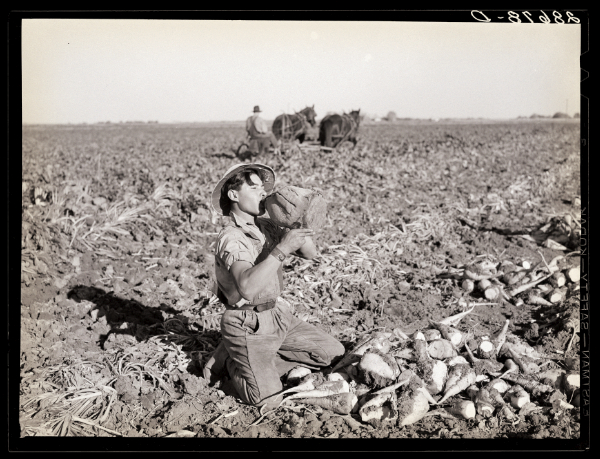
Sugar beet worker drinks water. Adams County, Colorado, 1939. Photograph by Arthur Rothstein. Courtesy of the Library of Congress, Prints and Photographs Division, Farm Security Administration/Office of War Information Black-and-White Negatives. LC-USF34-028678-D.

According to Dr. Martínez, “it is important to acknowledge the conflation of Mexicans, Mexican-Americans, and Manitos, particularly in terms of how they have been perceived as one culture and community.” For much of white America, there was no difference between Mexicans and New Mexicans. While the Manitos were American citizens, their rights were frequently curtailed in their new communities as they were lumped in with non-citizen Mexicans because of the color of their skin.

“‘No Dogs and No Mexicans Allowed’ was the sign on the door of the store,” Vi Esparza recalls. “They were everywhere those signs. All over Fort Collins.”

Esparza, Rosie’s sister, remembers her father José Cordova speaking only Spanish at home while sticking to English in public. “He paid his bills at the end of every month. He showed respect and demanded respect. He wanted to work harder than everyone else to prove that we were equal, and he told us: ‘Don’t think you’re better, but certainly don’t ever think that you’re worse.’”

José held down three jobs. He worked in the sugar beet factory in the day and topped beets all night. Depending on the season, the family harvested at farms across the area. Cucumbers, cherries, peas, pumpkins. Esparza recalls being pulled out of school to harvest potatoes. Their father dug up the roots and she and her sisters followed behind shaking the spuds from the vines.

“It was very, very difficult. We were calloused and sunburned and tired. Even the other New Mexicans looked down on us for a while. But I guess, when you work hard in life, you appreciate it when you’re older.”

Cerros [sic], near Costilla, N[ew] Mex[ico], 1943. Photograph by John Collier, Jr. Courtesy of Library of Congress, Prints and Photographs Division, Farm Security Administration/Office of War Information Color Photographs. LC-USW36-892.

The Fathers
by Dr. Patricia Perea
For George Perea and Jacobo Perea

These are the fathers I know. Like twins.
Inseparable as night from day.
They were always following each other. Often
they lived in the twilight—that fine
line when the light goes from lavender to amethyst—
when sapphire hovers just above the straight
horizon of the southern plains.

I traveled miles with them—miles between Lubbock and Amarillo,
Friona and Canyon, Clovis and El Paso,
Albuquerque and Vado.
Between us, there were piñon shells, Marlboro Reds,
whiskey and Allsup’s chimichangas. And on the AM radio rancheras
crossed paths with honkytonks on the dial.

My fathers had secrets I never knew. Secrets held in the red
rocks of Dilia houses, the loud shipyards of Oakland,
the cotton fields of Texas, and the dry sands of the Chihuahua desert.

At Christmas and birthdays, I got dolls and doll furniture,
rabbit fur coats and headbands; I loved them all;
used them until they fell apart in my hands.

But what I really wanted, I never said.

I wanted to be like them.
I wanted to take hits at the punching bag in the barn,
learn to shoot combos at the pool table,
brush down the horses, and maybe practice a pretend spar in the backyard.

I wanted to be between them, sharing everything, telling jokes
and sometimes crying over the lost land I had not yet seen.
I wanted to know the stories behind their dark eyes,
or the reasons for the slight breaks in their laughs.

I want to know why my dad held my grandpa so close and pushed
all the rest of us
so far away.


Spanish-American woman topping sugar beets, Adams County, Colorado, 1939. Photograph by Arthur Rothstein. Courtesy of the Library of Congress, Prints and Photographs Division, Farm Security Administration/Office of War Information Black-and-White Negatives. LC-USF33-003426-M1.
Spanish-American sugar beet worker. Adams County, Colorado, 1939. Photograph by Arthur Rothstein. Courtesy of the Library of Congress, Prints and Photographs Division, Farm Security Administration/Office of War Information Black-and-White Negatives. LC-USF34-028740-D.

The Manitos weren’t always welcome in their new communities. There was the overt racism they frequently encountered such as the “No Mexicans” signs, and then there was the pervasive marginalization and neglect.

Frequently, white migrant workers had access to better working and living conditions. It was common to see access to voting rights, commerce, and even basic infrastructure curtailed for the New Mexicans.

“Manitos and their Mexicano relatives continue to evolve in a world of borders [that] attempts to limit and define their existence,” writes Dr. Martínez.

“To the Anglos, we’re all Mexicans,” says Nety Arias of Cheyenne, Wyoming, related to Dr. Martínez—and thus the Manitos, much like the Mexicans, were segregated from white people.

In a new paper slated to be published in the fall of 2022, “We Were Always Chicanos, or, We Did it Our Way: Situated Citizenship in the Equality State,” Dr. Fonseca-Chávez takes an in-depth look at how Manitos in Wyoming were not afforded the same rights as their fellow Americans, who were white. As she notes, the New Mexicans—and in particular the women—pushed back. “Chicanas challenged notions of gender and ethnic equality and fairness in Riverton, Wyoming, an unlikely place to uncover historical moments of Chicana activism.”

A number of the individuals she and Levi Romero interviewed for the Following the Manito Trail project pointed out that because they were perceived as Mexicans, many Manitos had difficulty finding housing in white neighborhoods throughout Wyoming. This “almost always led them to ethnic havens on the south side of town. Even though these neighborhoods were connected by cultural and racial heritage, they often were neglected by city and town officials due to existing racist sentiments.”

The women, the Chicanas, were forced to mobilize their communities to get the basic infrastructure services they needed and that white neighborhoods enjoyed. They organized their communities and used their voting power, pushed the municipalities to direct money their way, applied for state and federal grants, and even fought in the courts. In Riverton, Wyoming, these Chicanas, fed up with the waiting and the stalling, took it upon themselves to pave their own streets. In other places they installed sewer lines or drinking water systems. More often than not, the whole community joined together to get the work done.

“Their activism elucidates the extent to which they were keenly aware of their positionality within a state that is overwhelmingly white and one that historically has failed to extend equality and fairness to Chicana/o communities as well as other marginalized populations,” writes Dr. Fonseca-Chávez.

One recurring theme in nearly all Manito family stories is the importance of education. Life for many Manito migrant families was hard, and education was seen as key to getting out of the sugar beet and corn fields.

“Grandma takes pride in her education and ours,” Dr. Martínez says. “Education was a way out of the hard labor of the fields and a way to move ahead.”

The Cordovas of Fort Collins also put a high price on education.

“Grandma Rosie told us, ‘Go to school, get good grades, you won’t want to work like we did,’” says Ashley Cordova. “Education was super important for us.”

In 2017, Fort Collins honored the Cordovas with a new street name and, in October 2021, they planted a Living Legacy Family Tree in Sugar Beet Park, where Ashley’s great grandfather, José Delores, worked. This year, the Cordovas will install a street mural in the Alta Vista neighborhood to honor the sacrifices of their ancestors.

There is an aspen tree in an old sheepherder’s camp alongside Highway 70 in the Sierra Madres of Carbon County, Wyoming. Carved on the tree are the words “Taos” and “Arroyo Seco.” 

Wyoming’s forests are covered in tens of thousands of tree carvings known as arborglyphs. Arborglyphs can be both pictures and text cut into the bark of living trees. Most of Wyoming’s arborglyphs were made during the late nineteenth and early twentieth centuries, first by Hispanic New Mexicans, then Mexican, then Basque, and now Peruvian sheepherders.

Videographer and documentarian Adam Herrera and Dr. Troy Lovata of the University of New Mexico have spent the last several years studying these arborglyphs. They hope to construct the cultural histories of Wyoming’s aspen forests and to fill in the historical gaps left by a lack of written and oral histories.

The carving of arborglyphs is a cultural trait of Northern New Mexico communities dating back centuries, and the Manitos brought this practice with them to Wyoming, writes Lovata. “Some arborglyphs are clearly billboard-like in their prominent placement and flamboyant forms. These include stylized signatures, notable dates, and vibrant images that are meant to be easily seen and widely understood as strong statements of ‘I was here’ in the face of the vastness of nature, time and labor.”

Still other glyphs are hidden, Lovata has discovered. These in-jokes, jargon, dichos, and messages are targeted at particular individuals or groups. Some are enigmatic. Some are names of people and places. Some express loneliness or the missing of a loved one. Frequently the glyphs express a deep longing for home, a call for the mountains and valleys of El Norte. “No te olvides, amigos.”

Manitos on the migration trail or Manitos who moved permanently to other states generally sought to preserve their unique culture, holding onto their songs, sayings, poems, foods, and other deep markers of culture.

Dr. Martínez places the New Mexican “Manito Trail” migrations among the assemblage of true diasporas, mass movements of people who retain a collective memory and myth about the homeland and a commitment to the maintenance and continuation of their heritage and culture. “To understand Manitos as a community, historically and today, we must consider their migratory experiences and who they are as part of a larger Manito diaspora,” she writes in Living the Manito Trail. “The link between Manitos and the villages of Northern New Mexico have been pertinent in maintaining cultural values and a sense of ethnic identity in marginalized spaces.”

Dr. Sylvia Rodriguez, University of New Mexico professor emerita, defines querencia as both a physical place or location and the subjective feeling that ties a person or people to that place.

This attachment to place, or a homeland, is fundamental in understanding the Manito diaspora. It is a lived idea that ties Manitos to their homeland and culture and sets them apart as a unique people. 


Querencia
by Olivia Romo

The deep profound love I have for my homelands,
My connection to the earth through adobe bricks, communal ditches, and the rural
Traditions of my Nuevomexico
Soy India-Hispana. Proud of Spanish coat-of-arms, Comanche cautiva songs, and
Meso-American seeds, like corn.
These are my raices.


Author and photographer Jim O’Donnell is based in Taos, New Mexico. His work has appeared in Discover, Scientific American, Ensia, Sapiens, BBC Travel, and New Mexico Magazine, among others. Jim is the author of Notes for the Aurora Society and a wide range of short stories. Find him at jimodonnellphotography.com.

The Millicent Rogers Museum in Taos, New Mexico, hosts the exhibition Following the Manito Trail, on view through July 31, 2022. For more information, click here.

Jim O’Donnell (opens in a new tab) is a writer, photographer, and explorer based in Taos, New Mexico. Jim’s writing focuses on people and ecosystems in flux. From journalism to literary non-fiction to full-on creative fiction, transformation is the thread that binds all his writing. He is the author of Fountain Creek: Big Lessons from a Little River (2025) from Torrey House Press and Who Broke the World (2024).

Gee! Haw!

By Charlotte Jusinski

Kids enamored of books and words often want to grow up to be writers, and I was one of them. I knew even before I could hold a pencil that I wanted to write. Blank pages sparkled in my eyes. I developed a slight deformity in my right hand because I held my pencil funny, and sometimes spent up to twelve hours a day scribbling stories. I always pictured myself packing a notebook on a dogsled like Gary Paulsen or in a Jeep amid running mustangs like Marguerite Henry. I pictured stacks of books with my name on the spine.

One thing I never pictured was being a magazine editor.

Admittedly, it’s not the kind of job we dream of as kids. We want to tell our own stories first. And I did that for quite a while. But as I got a little older, I hit a certain point (my Saturn return, maybe) where I didn’t find myself that interesting anymore.

Being an editor is the perfect job for someone with that kind of relationship with their own work. I know what excites me, I know how to recognize good writing—but I am also realistic about what I’m capable of. And I am not capable of anything that you’ll find in this issue.

I don’t think I’ve ever met someone as jazzed about their subject matter as Rachel Preston was about her protagonist John Gaw Meem, whom she profiles in “A Gift for Sketching Buildings.” She visited the renowned architect’s buildings and spent hours poring over historic documents to craft a piece so jam-packed with information, it simply had to run as our cover feature.

We also find Part II of “Tracks Through Time” by railroad man Fred Friedman; in no way could I have written this story, unless I suddenly gained fifty years of railroad knowledge overnight, to match Fred. We excerpt beloved local author James McGrath Morris’s new biography of the writer Tony Hillerman. Jamie is known for phonebook-thick biographies of some of our favorite twentieth-century writers, and his expertise at dissecting their lives and placing them neatly, happily on the page is unmatched in Santa Fe or elsewhere.

El Pal veteran Emily Withnall’s quadruple-profile of the photographers included in the exhibition Tempo y Tiempo at the National Hispanic Cultural Center. This story had to come together quickly and had to be impeccable, and while I like to think I could have pulled it off on my own, we all know that’s not true. Thankfully, I have Emily on speed-dial.

Paul Weideman offers an overview of the New Mexico History Museum’s upcoming exhibition Curative Powers, with time spent talking to curators and authors and sifting through books about New Mexico’s hot springs. And, finally, our remarkable poetry feature this issue was curated by Santa Fe Poet Laureate Darryl Lorenzo Wellington. It absolutely shines, thanks to Darryl’s wide net and ability to bring people together for a cohesive and effective selection.

So yeah, it’s not all about me—and that feels good. Being an editor able to reach my tentacles out into New Mexico to bring all these stories together, told better than I could ever hope to tell any of them, is a unique honor bestowed upon very few. Being a writer is cool, but being able to facilitate such incredible and diverse storytelling under one roof? Priceless. I’m still hoping for that dogsled ride, though.

Poetry On and Off the Page

Curated by Darry Lorenzo Wellington

The poems that I have curated for El Palacio reflect a maxim that branded me with a lasting mark. My instructor at a residency program at the Atlantic Center for the Arts, Thomas Sayers Ellis, smilingly explained: “The poem isn’t on the page.” He iterated the pronouncement whenever he encountered a poem that fell flat and lifeless. Personally, I have felt a patch of skin burning with the revelation ever since. I thought, I want my poems to get off the page.

But if the printed text is illusory—that is, if the poem isn’t really on the page—where is it? Is it in the human voice? Is it in syllables spoken aloud? Is it in the part of the consciousness of the writer transmuted to the reader? Is it in the collective consciousness of all readers during a specific era? Is it in a literary continuum? Is it in all the social and historical elements that contributed to making the poem? Is it in the air?

Poetry sits on the page decorated by rhyme, assonance, and consonance. It can get “off the page” by recognizing that history, sociology, political science, and philosophy are also aesthetic categories. Poetry is constituted of contemporary reality, and it needs to reflect contemporary complexity. The printed text is nailed to the page, yet it doesn’t live there. It’s been given life by manifold elements. No one knows where the poem finally is. The answer shifts from poem to poem.

Poetry that jettisons into the space beyond—into the world of thought and action—draws on relevant concepts in the zeitgeist, and the edgy interplay is rife with import.

The poems that I’ve picked rely heavily on the discipline called history—though I am tempted to write “the discipline formerly known as history,” because various scholars have described recent times as the end of history. I agree that old concepts have disintegrated. But the end of history, however conceived, isn’t the end of strife, culture, or the human voice searching for poetic accomplishment. If humanity survives, these poems are records and sketches for a new beginning. They’re not pills to pacify post-historical PTSD; they’re re-wirings of post-historical consciousness. They exorcize; they purify. They have been influenced by confessionalism, concrete poetry, and shout-out poetry. They rewrite the lines. They seize the day, locally and globally.

Revising the standard American nationalistic hymns, Mary Stone Jackson retells a classic Ellis Island immigration story. She writes that bones, like histories, “connect with a series of small bones / forming the backbone,” yet the anatomy is disabled lest it supports “an anchor for the entire body.” Israel F. Haros Lopez narrows history to a specific encounter, singing to his mother, using multi-lingual expressions infused with the dynamism of ritual and the pressure of concrete poetry.

Yvonne Sandoval and Fatima van Hattum underline the pointless cruelty of borders, lines, and walls that don’t respect human beings. Finally, Zubair Ibrahim Siddiqui situates his poem in Santa Fe, but an unfamiliar (or unacknowledged) Santa Fe as experienced by a visitor. Without putting his finger on it, he intuits an element here in the present—a carry-on from the past—that recalls Hollywood, and makes him ask, “Why do you feel like a clown here?” Why does he notice that the moon ensconced in Santa Fe shadows “paints my face white”?

Siddiqui’s skillfully tight lines and cadences have obviously been influenced by writing workshops, but the questions he asks can’t be contained within ink on a page. That’s why his poem and the others ask that we read past the page—where answers may not be self-contained and a line can be simultaneously a chant, a song, and a thesis. “Toilet paper borders are disintegrating,” and a poem today is a multi-disciplinary global construct.

An uprooted Southerner, Darryl Lorenzo Wellington has been a New Mexican for the past ten years. He is the 2021-23 poet laureate of Santa Fe. His full-length poetry collection, Psalms at the Present Time, was published by Flowstone Press in 2021.


The Backbone of Us
By Mary Strong Jackson

Each vertebra nudges the next until all open their wings
across eons over pinon, pine, oak, cacti, and cottonwood.
You feel it just under the skin of your backbone—swish, dip,      
it radiates up the broad back of the plains to return
on the same line of the spine strong as woven silk
no matter the frayed bits.

My spine descended from Elder John Strong off the ship
called the Mary and John landing in 1630. His gentle turn
of head and shoulder, surreal flow of mind and spine—cogs
awakened repeating patterns taken time and again in the turn
of his head, to gather, to inhale with his eyes the brisk steps of men
and women striding across the land he was about to step onto.

Today, I enter the pool’s bathhouse where two old women
talk of one’s father entering Ellis Island at 2 years old.
His parents instructed do not let the doctor remove your hat.
He screamed and clutched his small cap            
because something—I didn’t catch in my eavesdropping—
some disease showed under the cap and the family would be
held        easy to forgive this escape from quarantine.

Each of our bony skulls connect with a series of small bones
forming the backbone having projections for articulation
able to speak of scars, skills, and inheritances       to be shared
in bathhouses, slave quarters, mansions, then burned to ash,
spread, and inhaled by the living—chances to feel in this aching
ramrod of a country how to lift from bent knee, 
how to swivel while supporting,

how to be an anchor for the entire body

Mary Strong Jackson lives near Otowi Crossing, north of Santa Fe. Her latest chapbook, Dreaming in Grief, is available now from Finishing Line Press.


Nantli
By Israel F. Haros Lopez

Mother song mother dancing mother singing mother memory mother tortillas y frijoles mother song mother smiling mother pushing feet into the earth mother pulling in the weight of men mother pushing against the border mother underneath inside and around the trunk of a taxi to cross the border again mother crazy mother mom mother warrior mother hustler mother movement mother working mother pushing mother drinking mother dancing mother being mother laughing over and again mother having fun in all the solitude mother chanclas mother heels mother kneels mother begs mother pushes mother breaks my father’s teeth against the toilet seat my short short mother very dangerous mother warm mother love mother being tía over and again to strangers mother being mother to strangers mother sister mother laughing mother telling stories mother hustling mother paperless mother mother sin papeles still mother working working wet wet wet back mother sweating mother pushing mother dancing every weekend laughing partying mother who I’ll say fuck you to her when I’m 9 cuz she’s leaving again and again mother dancing weekend mother leaving me behind the metal door crying and my cousin crying cuz she has to take care of me and she knows my llantos and all I want is my mom and all my ama wants is to be woman momma woman ama mujer mother’s high heels mother’s dress mother’s party cuz she’s pushing seams all week mother working no father mother father working she’s gonna leave again and again and she’s always gonna come back even when she left for a week when I was ten without leaving a message she’s always gonna come back ama madre mía siempre regresaste mom’s laughing mom’s crying mom’s dying alone but no need she knows she’s like siempre tú solamente tú siempre tú mom’s fighting mom’s pushing mom’s drinking mom’s loving mom’s bailando still dancing at 52 Híjole still singing and now she remembers cantos de sus abuelas mom’s cantando sin jarana sin sonaja just cantando straight up from all the raíces and her dancing feet she’s dancing now with tonatiuh she’s dancing with coyolxauhqui mom’s remembering she’s telling me old old things when she sings like that when she dances like that I’m stretched out not knowing it’s the fourth day and I think I have nothing nothing left to give and then I see her dancing with the sun and I know I have a whole universe de energía in my spine didn’t know it was like that until that moment in my history but she’s been dancing and singing swaying me like that since I was swimming in the universe of her womb

Israel F. Haros Lopez is founder and art director of the Alas De Agua Collective.


Toilet Paper Borders
By Yvonne Sandoval

Movements once separated by identity are finding our common humanity.

With every tear shed by fierce mama warriors carrying babies across the raging waters of the Rio Grande, your toilet paper borders are deteriorating.

Threads of resistance are weaving together 500 broken treaties.

The courage of people in caravans, fleeing war torn countries, incited by U.S. policies are dismantling your toilet paper borders.

Queer youth are restoring the divine balance back to who we are.

Asylum seekers with nothing else to lose but their last breath are decomposing your toilet paper borders.

Reclaiming ancestral ways of life is medicinal for our minds and bodies.

Powerful women seeking refuge from their abusers, your toilet paper borders are dissolving.

Listening to the truth as our mothers and sisters speak is healing our wounds.

Locking up babies you are unintentionally awakening the human consciousness on this planet. Your toilet paper borders are meeting their destructive fate.

Your toilet paper borders will soon become compost for us to grow our seeds.

Yvonne Sandoval is a Chicanx poet, social worker, and mother.


bright spots
By Fatima van Hattum

[In airports in Albuquerque, Denver, and occupied Palestine]

We have a “groin” here, he says,
is there anything in your pockets?

She takes me into the room.

I’ve lost count:
In Albuquerque, she joked humanely while she did it

In Israel,
stripped down to my underwear,
and she ran a detector over my bare skin.

In Denver, her hands, “I have to clear
your buttocks and frontal area,
your waistband and inner thighs
until I meet resistance.” Her hands,
push my tunic up around my waist,
ask me to hold it, so I too am participating,
touch me, handle me, too, too close through my tight jeans.
A laugh-sob escapes me, watching the blue
latex gloves, she can’t meet my eye.

What        world are we in?

Afterwards, a young cafe manager apologizes
for my food being late,
I hadn’t really even noticed,
“Have a drink on us…at least a bottle of water.”

A flight attendant looks me in the eye as I board and asks,
“Would you like a glass of water, or something to drink
with your dinner there?”

I’ve been offered water twice since my crotch was searched.

There are dark spots in this world

And there are bright ones, too,
like the sun across water.

Fatima van Hattum is completing her PhD at the University of New Mexico and works as a program director at New Mexico’s statewide women’s foundation. Her work has appeared in CALYX Journal, Portland Review, apt, Intersections, Chicana/Latina Studies, and New Moons: Contemporary Writing by North American Muslims.

“bright spots” was originally published in CALYX Journal (2019), 31:1.


Visitor
By Zubair Ibrahim Siddiqui

In the Galisteo basin I watched
                      The vast sky, watched distant clouds

Collapse Into rainwalls. I heard the sounds
                      Of lizards rustling leaves on their blue bellies;

Resting on blood soaked sand: the flesh of these desserts.
                      In the arroyo where I walked from shade to shade

I felt as though I was in Tharparkar
                      And yet the land asked me:

                                                               Why do you feel like a clown here?

*

Visiting Carlos’ home in Santa Fe was like stepping into
                      Daadi jaan’s photo albums

Because through the color I could see it all
                      In sepia. Even though

Ramzan was still many months away,
                      It  somehow felt like it was already Eid,

And I had just arrived at a distant relative’s
                      In Clifton or Gulshan just to recall.

Apparently this entire neighborhood was once
                      The smell of discos and crowded families.
*

On train trestles, sitting with my fear
                       Of heights, I dared not look down

At the distance of a visitor. So I knew I stuck out
                       To the land like freshly painted cement.                       

Adobe doesn’t glitter like gold to me,
                       It speaks warnings, says:

                                                                  Hollywood.

The wind under the shade of these Siberian Elms
                       Is a heavenly corridor, but within the

Four walls of this home I feel a haunting
                       Cold, as if the walls were trapped with ghosts,

                                                        Usurped by white tears.

Some nights the bright moon doesn’t let me sink,
                       But paints my face white.

Queer Pakistani poet Zubair Ibrahim Siddiqui graduated with a BA in literature from Bennington College in 2020, and spent the subsequent year working in Santa Fe at various local nonprofits such as Youthworks and Littleglobe, before returning to Karachi. His poems have appeared in literary journals such as Quarterly West.


Fatima Van Hattum (opens in a new tab) is completing her PhD at the University of New Mexico and works as a program director at New Mexico’s statewide women’s foundation. Her work has appeared in CALYX Journal, Portland Review, apt, Intersections, Chicana/Latina Studies, and New Moons: Contemporary Writing by North American Muslims.

Israel F. Haros Lopez (opens in a new tab) is the founder and art director of the Alas De Agua Collective in Santa Fe, New Mexico. Israel was born in East Los Angeles and brings his firsthand knowledge of the realities of migration and life as a Mexican American to his work as a mentor, educator, art instructor, and activist. He received a degree in English literature and Chicano Studies from the University of California Berkeley and an MFA in creative writing from California College of the Arts. At formal and informal visual art spaces, Israel creates and collaborates in interdisciplinary ways using a variety of mediums.

Mary Strong Jackson (opens in a new tab) lives near Otowi Crossing, north of Santa Fe. Her latest chapbook, Dreaming in Grief, is available from Finishing Line Press.

Yvonne Sandoval a Chicanx poet, social worker, and mother.

Zubair Ibrahim Siddiqui (opens in a new tab) is a queer, Pakistani poet who graduated with a BA in literature from Bennington College in 2020, and spent the subsequent year working in Santa Fe at various local nonprofits such as Youthworks and Little Globe, before returning to Karachi. His poems have appeared in literary journals such as Quarterly West.

Hot In Here

By Paul Weideman

“It’s easy in New Mexico to wind down while things heat up,” according to a New Mexico Tourism Department guide to New Mexico’s hot springs at newmexico.org. However, residents’ ability to enjoy our steamy mineral springs is not what it historically was.

Part of the problem dates to the U.S. takeover of New Mexico Territory in 1848. More and more people came from the East trying to seek respite from tuberculosis and other infectious diseases, and entrepreneurs took advantage of opportunities to transform increasingly popular hot springs into businesses.

“A lot of them became privatized,” says Dr. Alicia Romero, curator of Nuevomexicano/a history at the New Mexico History Museum. “Some of them were absorbed by the U.S. Forest Service, so you can still get to some of the hot springs in national forests, but a lot were bought by private business owners. That made them inaccessible to the native population. And even if they’re available, there are fees that can be prohibitive. Some of them charge $50 for a one-hour session.

“From the research I’ve done,” Romero says, “it seems to be that the people who historically used them are the ones who maintain them today but don’t have access to them as visitors.”

Curative Powers: New Mexico’s Hot Springs will open at the New Mexico History Museum in mid-March. The exhibition will discuss water history, environmental issues, and geology, but its central focus will be on labor. “The topic of our hot springs throughout the state is something we haven’t explored before here at the History Museum,” Romero says. “There are guidebooks for hikers and other visitors, but nothing with a critical lens.”

Looking at the labor that went into creating these spots around New Mexico is a part of their history that Romero is particularly keen to explore. “This aspect comes into play more in the late nineteenth and throughout the twentieth century when hot springs were privatized,” Romero says. “I’m interested in exploring how the industry changed from common usage to a more exclusive, tourist-driven clientele. Part of that change facilitated the creation of a labor force needed to maintain the facilities; I’m interested in who those people were/are and if the hot springs are accessible to them.”

Fourth of July group at San Jose Springs, New Mexico, ca. 1880–1890. Photograph by Ben Wittick. Courtesy Palace of the Governors Photo Archives (NMHM/DCA), neg. no. 113931.

As exhibition curator, she planned to focus substantially on colonial Mexico, or pre-American settlement. During our interview, a few books on Romero’s desk were simple guidebooks to hot springs. Another offers a scholar’s viewpoint: Virtuous Waters: Mineral Springs, Bathing, and Infrastructure in Mexico (University of California Press, 2018) by Casey Walsh.

“I tried to go back before the Spanish arrived, but from what I can tell, there wasn’t much use of hot mineral springs,” Walsh says by telephone. “People in the Americas bathed in sweat lodges—temazcales, they called them.”

These were adobe or masonry buildings where users threw water on hot stones to create steam. In his book, Walsh, chair of the anthropology department at University of California–Santa Barbara, writes that bathers “would symbolically enter the underworld when they passed through the door of the temazcal.”
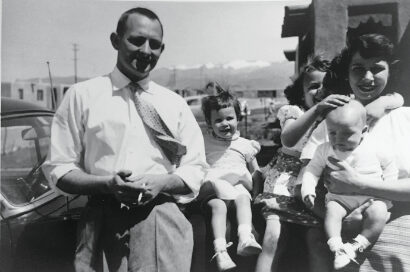
By the end of the 1500s, the immigrants in what was called New Spain were building bath houses at natural hot springs. “In Spain, they had kind of outlawed bathing,” says Walsh. “They thought it was basically Islam and Judaism that had the bathing cultures, and so it was suspect. Many mosques would have a bath house attached to them, a vapor bath. The Christians were also worried about the Roman history of decadence.”

In Virtuous Waters, Walsh goes into great detail to explain bathing traditions in medieval Spain: “Within the medical model elaborated by the Roman physician Galen, to which most doctors adhered well into the eighteenth century, bathing was important for carrying off the remains of digestion, which formed one of six groups of things—called ‘non-natural’ or ‘necessary’ things—that were not intrinsic to human bodies. Bathing, exercise, and sex, all of which produced sweat and the emission of fluids, eliminated the remnants of these things from the body, and following Aristotle, balance and moderation was considered the correct way to deal with them.”

By contrast, bathing by immersion of the entire body in hot water or steam was considered an extreme act.

“When they got to the Americas, they saw this bathing where men and women would go into these temazcales, so the Catholic priests were definitely worried about that; they thought of it as heathen and decadent.”

In his book, Walsh relates that the conquistadores often recorded “how well-groomed the Indigenous people were owing to their frequent washing.” But the religious and sexual practices associated with it were “unacceptably offensive.” Nevertheless, some Spaniards built temazcales in their homes. And today, residential saunas have endured in the greater Mayan region for at least 1,200 years.

Romero’s emphasis on restricted, commercial use of natural hot springs was also an underlying theme of Virtuous Waters. “Certain people wanted to control these rare and special sources,” Walsh says. “There are longstanding popular uses, but people would come in and try to turn them into businesses, building big, fancy bathhouses and charging money.”

Mexico may have the edge on New Mexico when it comes to preserving access for the poor. “That’s a characteristic of Mexico. It’s a negotiated relationship of class. It’s very difficult for the ruling classes there to actually impose themselves on people, and so a lot of the traditional activities are maintained.”

The European settlers ultimately sanctioned bathing in mineral springs, but only because of the springs’ reputed health benefits.

“Spanish-speaking people knew the value of hot springs when they started migrating to what is now the American Southwest,” Romero says. “There were springs all over Mexico and they were used for communal bathing; it was not always something you did in private. And they’ve always been used for their healing properties.”

Indigenous people were tuned in to all features of the landscape and probably revered hot springs as therapeutic. “But the belief that there were curative properties came full-force with the Americans and the establishment of sanatoriums,” Romero says.

“Thermal activity along the Rio Grande rift and elsewhere had turned a series of natural springs into heated pools,” author Nancy Owen Lewis writes in Chasing the Cure in New Mexico: Tuberculosis and the Quest for Health (Museum of New Mexico Press, 2016). “Rich in mineral content, they were thought to have therapeutic properties capable of curing a variety of ailments, including incipient tuberculosis. … By 1880 Ojo Caliente mineral springs, fifty miles north of Santa Fe, offered accommodations for sixty guests. The resort attracted hundreds of invalids eager to soak away their rheumatism, skin complaints, and kidney problems.”

Overlook of Las Vegas Hot Springs, New Mexico, ca. 1875–1906. Photograph by James N. Furlong. Courtesy Palace of the Governors Photo Archives (NMHM/DCA), neg. no. 086949.

In the late 1800s, the railroads promoted hot springs. Most noticeable in the historical record is the publicity about the Montezuma Hotel built by the Atchison, Topeka & Santa Fe Railroad at the site of a famed hot springs near Las Vegas. First erected in 1882, it was rebuilt twice after fires. The third hotel, dating from 1886, still stands. It is now the heart of the campus of United World College–USA.

Montezuma Hot Springs recently reopened to the public.

“The hot springs have been a free community resource for generations here in San Miguel County, and yet the considerable liability issues and costs of managing the baths were becoming an issue for the school,” says Carl-Martin Nelson, UWC-USA director of communications.

After the college held a series of public meetings about the hot springs, local residents formed a nonprofit, Friends of the Montezuma Hot Springs, which leases the site from UWC-USA. “It took almost three years, Covid hampered the efforts, and it wasn’t always pretty or easy, but we all persevered working toward a goal and we made it,” Nelson says.

Information about access to the springs can be found at the Facebook site of Friends of the Montezuma Hot Springs.

There are ten other natural, noncommercial hot springs listed in the New Mexico Tourism Department guide:

• McCauley and Spence, near Jemez Springs

• Black Rock and Manby, west of Arroyo Hondo [but the road to Manby Hot Springs is no longer open; it was closed in 2021 because of overuse and littering during the pandemic.]

• Gila, House Log Canyon, Lightfeather, and Turkey Creek, in the Gila area

• Bubbles Hot Springs, near Silver City

• San Francisco, near Pleasanton

Temperatures in these springs are typically around 100 degrees, but there’s a caution for the Lightfeather feature: “The hot springs themselves are very hot (about 149 degrees F) and will scald you if you sample them near the source. The only way to enjoy the hot water is in one of the rather ephemeral rock-lined pools along the river where the hot-spring water mixes with the cold river water, making for a comfortable bath.”

According to the guide, clothing is optional at about half of these mineral springs. In Richard Melzer’s 2011 book New Mexico: Celebrating the Land of Enchantment, the author tells us that “Spence Hot Springs allowed nude bathing on Sundays and Mondays but required bathing suits the rest of the week. Visitors who got their days confused faced a $25 fine.”

Hot spring between San Ysidro and Cuba, New Mexico, Jemez Mountains in background, ca. 1940. Courtesy Palace of the Governors Photo Archives (NMHM/DCA), neg. no. 005579.

Today, says the Tourism Department, the Spence pools “set in beautiful locations” are very popular and also have “a reputation as a hangout for nudists.”

The image of folks enjoying steamy outdoor waters au naturel might call to mind sixties counterculturists, but their delectations were nothing new. “I would think that Native people also did not have a stigma of shame attached to one’s natural state,” Romero says.

Today, you have to be strategic about pursuing such delights if you don’t want to “get into hot water.” Some commercial springs are, instead, all about how you can conduct yourself. “And whether children are allowed,” Romero says. “I saw one advertisement indicating that if you take children they have to be silent. People walk around with a paddle saying Hush, because it’s now a luxury experience. You’ll interrupt people having a meditative experience. It’s very different from a century or two ago.”

This evolution of the use of hot springs, as well as their cultural and economic impact on New Mexico as it evolved over the centuries, features prominently in Curative Powers, currently scheduled to be on display March 18 through September 4, 2022.

Paul Weideman has written about archaeology, historic preservation, architecture, real estate, art, and culture for The Santa Fe New Mexican and other publications for 30 years. He is the author of the 2019 book ARCHITECTURE Santa Fe: A Guidebook.

Paul Weideman has written about archaeology, historic preservation, architecture, real estate, art, and culture for The Santa Fe New Mexican and other publications for thirty years. He is the author of the 2019 book ARCHITECTURE Santa Fe: A Guidebook.

A New Mexican Love Story

By Emily Withnall

In Frank Blazquez’s photograph Sleepy and his Daughter, Sleepy flashes the prison gang sign for Los Padillas. He is shirtless and covered in tattoos, his arms wrapped around his young daughter, who sits on his lap. His hands partially obscure the girl’s face and he looks directly at the viewer in a bid for acknowledgment. Los Padillas are also a family affiliation, and as Blazquez explains, many of Sleepy’s tattoos also demonstrate allegiance to family, as well as place and faith.

Blazquez’s photographs appear alongside the work of three other New Mexican photographers—Ximena Montez, Bobby Gutierrez, and Pico del Hierro-Villa—in Tempo y Tiempo at the National Hispanic Cultural Center, which runs until July 10. Curator Jadira Gurulé says that the show reflects New Mexico cultures and themes of identity, healing, and legacy. Each photographer’s work provides a familiar reflection of the places and people that many New Mexicans can identify with, but they also reveal a window into how each artist makes sense of their lives and communities.

“Art shows can get organized around certain identities, but these stories have elements that are applicable to a wide range of people,” Gurulé says. “Hispanic artwork, for example, is still relevant in the broader context of American art.”

Blazquez, who is based in Albuquerque, photographs people living in the “War Zone,” a notorious neighborhood along the city’s Central Avenue. His portraits reveal the humanity in Latinx survivors of addiction and incarceration. He calls his photographs a “New Mexican love story.” As a native Chicagoan, Blazquez considers himself an insider/outsider. Like many of the people he photographs, he is Mexican-American and he has overcome addiction. But as a geographic outsider, he says, he’s able to see how deeply people here identify with place.

“Sometimes before they even say, ‘I’m Latino, I’m Hispanic’—it’s ‘I’m New Mexican first,’” says Blazquez. “I never heard that in Chicago, someone saying, ‘I’m an Illinoisan first’—that doesn’t happen.”

Blazquez says he learned about shutter speed, aperture, and the ways light passes through a lens in his former work as an optician, before he ever picked up a camera. He began taking portraits inspired by the Great Depression-era documentary photography he encountered at the University of New Mexico’s Center for Southwest Research. He says the old photographs made him want to make a connection between people who might be the ancestors of those he photographs.

The people in most of Blazquez’s portraits have many tattoos, some homemade prison tattoos and others professional. For the people he photographs, Blazquez says, the tattoos are a way to process trauma, claim geographies, or to commemorate loss.

“There’s a lot of memorials,” says Blazquez. “One that I saw that I didn’t get permission to take a picture of, but I can speak about it, he had this graveyard on his back of all his friends that have passed away.”

Frank Blazquez, Sleepy and his Daughter, 2018.
Archival pigment print, 28 × 34 in. Courtesy of the artist.

As a whole, the photographs featured in Tempo y Tiempo are each a kind of memorial of their own—moments in time captured to remember and honor places, people, and the versions of self revealed in each image. Gurulé says the exhibition’s name came from a collaborative process, and is meant to invoke moments in time—tiempo—and the tempo of living.

Santa Fe photographer Ximena Montez’s work is a part of a project entitled How to Pretend to be a Matriarch, and the series of photographs invokes a memorial for the deaths of beloved grandparents and the metaphorical death of past versions of self. The title is a reference to the sometimes unwieldy challenge of stepping into a new role.

“My grandmother pulled me aside before she passed away and said she thought that I was going to be the next matriarch of the family—and that was over 20 years ago,” says Montez. “I’m only 51 years old; I’m not an old sage woman. I get my information from other mothers and family members that are in the same process. It’s just a process of learning.”

Ximena Montez, Te voy a echar de menos. (I am going to miss you.) and Una matriarca es la que une a la familia. (A matriarch is the one that ties the family together.), 2021.
Digital photograph, 11 × 14 in. Courtesy of the artist.

In one frame of paired photographs, Montez captures her grandmother’s empty brown recliner. On the wall above the chair, a yellowed tear-away calendar and a picture of la Virgen de Guadalupe are visible. Below the photograph is a dicho (saying): “Te voy a echar de menos (I am going to miss you).” In the second photograph in the frame, Montez captures a still life of unfinished embroidery. Red stitching skims half the outline of an apple penciled onto white cloth before the stitching stops and the loose red thread extends beyond the embroidery hoop and out of frame. Its dicho reads: “Una matriarca es la que une a la familia (A matriarch is the one that ties the family together).”

“For me, and probably for any matriarch, it’s trying to hold onto those things that are really important for the culture,” says Montez. “What’s important to me might have been different for my grandmother and my mother. It’s thinking about how do I support and raise the next generation.”

Montez is an educator in the Santa Fe Public Schools, and she says education and love of the land are two things she wants to pass on. In a photograph Montez describes as a portrait of her grandparents, two vehicles are parked side-by-side. An orange pickup truck faces one direction, and a yellow sedan faces the other. Behind the vehicles are bare-branched winter trees and distant blue peaks. Montez says the vehicles belonged to her grandfather and grandmother, respectively, and the land was where they lived in La Puebla. The distant peaks were a reference to her grandmother’s worldliness—in the 1930s, she was recruited for a women’s baseball team, later served as a nurse in World War II, and made sure she was educated before she married. The dicho beneath the photograph reads: “A camino largo, paso corto. (Long way, short stop).”

Ximena Montez, A camino largo, paso corto. (Long way, short stop.), 2021.
Digital photograph, 11 × 14 in. Courtesy of the artist.

No living humans appear in Montez’s work; instead she captures objects and the places in Santa Fe and La Puebla to carry the emotion of grief, inheritance, and faith. Although Montez does not adhere to the Catholicism she was raised with, the cultural elements and beliefs come through in her work. She says the red thread is the heart, and she uses blue in all of her images because of the Catholic belief that it will ward off bad spirits.

Faith, spirituality, and Catholicism—particularly in the form of la Virgen de Guadalupe—are recurring themes throughout the exhibition. La Virgen, recognized by the Catholic Church as a manifestation of the Virgin Mary, invokes a sense of community and belonging in New Mexico that can be felt in the photographers’ work. In Bobby Gutierrez’s photograph Veneration, a plaster Virgen graces a nicho on the exterior wall of an adobe home. She can be seen through white metal fence posts and she wears a cloth mask across her face. Rosary beads are draped around her wrists as she holds her hands in prayer. Chile lights are arranged around her.

Bobby Gutierrez, Veneration, 2021. Archival photo print, 11 × 14 in. Courtesy of the artist.

Gutierrez says la Virgen de Guadalupe has been a common thread in the ten years he’s been taking photographs. His work in Tempo y Tiempo captures pandemic life in New Mexico, and most of his photographs are paired with in-depth personal reflections on what it means to be human in the midst of so much turmoil and tragedy.

“During the height of the pandemic, I think people were trying to convince people that how we need to help each other is by protecting each other—like, this is how we’re going to get through this,” says Gutierrez. “Unfortunately, as you know, it’s not working out that great.”

Bobby Gutierrez, lack of (empathy), 2021.
Archival photo print, 11 × 14 in. Courtesy of the artist.

Gutierrez captures this despair in his black-and-white photograph lack of (empathy). In it, a truck’s side mirror obscures the face of a man seated on the curb, holding a sign that reads “Anything helps. Anything.” In his caption, Gutierrez writes, “As the world slowly begins to return to ‘normal’ I find myself wondering if we have learned nothing of the last 18 months. How to be empathetic to others’ lives and situations or is it back to our selfish ways? I don’t have a lot of hope to be honest…” 

Gutierrez is self-taught, and says he’s been taking photographs for ten years. Although he has worked professionally (taking photos for the Santa Fe Opera, for example), he prefers the creativity that comes from spontaneous shots. The personal captions he includes with most of his photographs are his way of contextualizing the moments in time he captures.

“People say if you take great images, you don’t need words, but for people like me who may not have an art education, I’m just putting my image in context,” says Gutierrez. “We’re in such a quick-consume world, everything is single-serve. We don’t really take time to connect, but if I can catch you for those five to ten seconds that you are scrolling through Instagram, and I can get you to read that little caption, it makes you think for a minute. The image is beautiful, but I want the words to resonate.”

Gutierrez, who works as a professional glazer in Albuquerque, says he walks and drives a lot for his job, which enables him to capture spontaneous moments. He is always on the lookout for interesting things that catch his eye, and says he works to remain present as life is happening and tries not to exert control over things. He says his earliest photographs were of roadside descansos, memorials to those killed on the road, which was his way of offering a prayer for that person.

“That memento mori is our way of saying death is always around,” says Gutierrez. “It’s not something we’re all immune to. It’s there.”

Death is visible in all of the photographers’ work, from the tattooed memorials in Blazquez’s portraits to the photograph of Montez’s grandmother’s gravestone and Gutierrez’s photograph of a descanso draped in flowers and a liquor bottle.

In Pico del Hierro-Villa’s work, however, death is metaphorical. Their vision for their photo series of queer Mexican and Chicanx people came from an epiphany they had during the pandemic. Del Hierro-Villa says that although they were raised without religion, during the pandemic they found themself drawn to la Virgen de Guadalupe. When their mom got sick, they began praying to la Virgen, which helped them embrace their transgender identity.

“I started to ask her to guide me on these paths of healing. She’s a representation of motherhood and acceptance in the LGBTQ community,” says del Hierro-Villa. “And in her Indigenous roots, she’s the taker of evil and she gives you positivity and light. She’s also a representation of death, so she basically killed who I was before, and I was rebirthed. Death became life.” 

This experience made del Hierro-Villa curious about whether other queer Mexican and Chicanx people had discovered their gender or sexuality through spirituality. Inspired by Humans of New York, the popular Instagram account that chronicles the lives of everyday people in the city, del Hierro-Villa began taking photographs and interviewing people about their experiences. Each of their photos in Tempo y Tiempo is paired with a testimonio written in the subject’s own words.

Pico del Hierro-Villa, Danza, 2021. Digital photograph, 12 × 18 in. Courtesy of the artist.

In one photograph, Danza, two women face each other with a tall black drum between them. They each wear feathered headdresses and ankle bells. One woman is dressed in white regalia and the other in red. They stand barefooted on a crimson blanket with juniper-dotted mountains behind them and a brilliant blue New Mexican sky, filled with white cumulus clouds above them. In their testimonies, both women speak about their fear of coming out, their decision to be their authentic selves, and their devotion to the folk tradition of Danza.
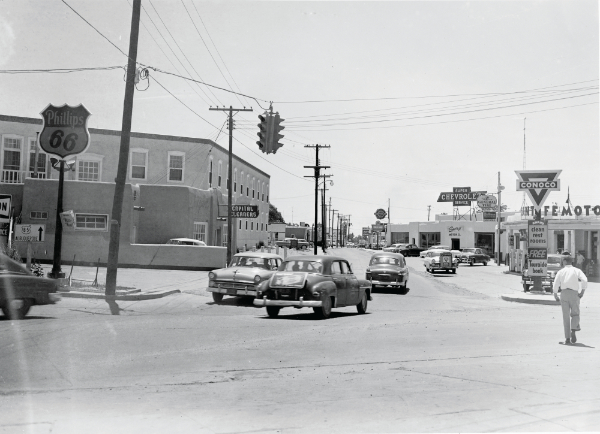
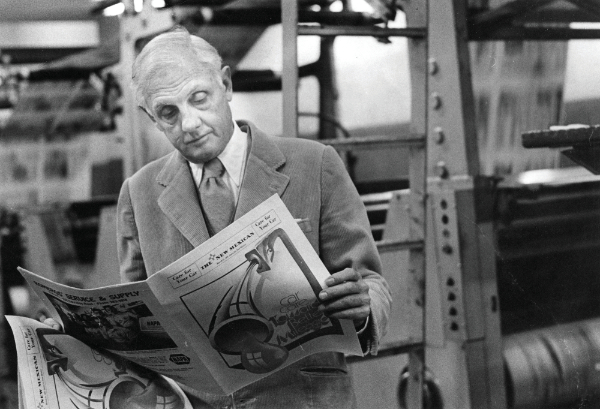
Del Hierro-Villa, who is a graduate student at the University of New Mexico, is self-taught and says they picked up a camera just two years ago. Initially, they said they wanted to learn how other queer people were disrupting heteronormative standards, and to document both their images and their stories. As a trans nonbinary photographer in a field that is male-dominated, del Hierro-Villa considers themself to be an example of the ways queerness can disrupt those standards. But they also emphasize the ways that queer art is art for everyone.

“With my art being displayed in that exhibit, it really makes people think about the sort of art that they consume,” says del Hierro-Villa. “Just because it’s queer, doesn’t mean that you can’t relate to it.”

In a black-and-white photograph, a woman stands with her back to the camera in front of a statue of la Virgen de Guadalupe. The woman’s body obscures la Virgen—only the statue’s aureole is visible. The woman wears a polka dot shirt that is cut low to reveal a full back tattoo of la Virgen. In her testimonio, the woman writes about her reclamation of la Virgen and her realization that leaving the Church doesn’t have to mean abandoning spirituality.

Del Hierro-Villa describes themself as a storyteller, and says they see the other photographers in the exhibition as storytellers, too. Although some photographs in the exhibition grapple with themes of grief and trauma, every photograph is also a love letter to the people, cultures, and places of New Mexico. This comes through in the details that arise from looking closely—the red thread that winds itself through Montez’s photographs, the runner in the distance behind Gutierrez’s descanso, the clown tattoo on the man in Blazquez’s photograph, and the way the women in del Hierro-Villa’s Danza photograph clasp each other’s hands on top of the drum.

Though each photographer has a different style, the details in their photographs are deliberate and reveal an aspect of New Mexico that is at once familiar and distinct. Ultimately, Tempo y Tiempo is an invitation to slow down, pay attention, and honor the people and places who make us who we are. 

Emily Withnall lives and writes in Santa Fe, New Mexico. Her work can be read at emilywithnall.com

Emily Withnall (opens in a new tab) is the editor of El Palacio and the host of Encounter Culture. Prior to stepping into the editor role, she wrote for the magazine for eight years. Emily has also been published in The New York Times, Al Jazeera, High Country News, Orion Magazine, Tin House, The Kenyon Review, Gay Magazine, Source New Mexico, and other publications. She lives and writes in Santa Fe, New Mexico.

Pico del Hierro-Villa  is a Queer Fronterizx who received their master’s at the University of New Mexico in Chicanx Studies.

On the Fly

By James McGrath Morris

For Tony Hillerman, there was only one thing that could lure him away from his typewriter, and that was his fishing rod. On slow news days, beginning in the 1950s, Hillerman would trade his seat at the Santa Fe New Mexican for a spot on the banks of rivers and streams in Northern New Mexico and southern Colorado. Woodrow “Woody” Wilson, a journeyman printer at the paper, first introduced Hillerman to the almost inaccessible Rio Brazos, a moderate-sized stream that feeds the Rio Chama north of Santa Fe. It soon became his favorite spot to fish.

Even after he moved to Albuquerque in 1963, Hillerman made the trek to Northern New Mexico fishing holes. Once, he told an irritated New York City magazine editor that he was running late on an assignment—a cardinal sin in journalism—because he simply had to go fishing. Hardly an apt excuse to a Manhattan sophisticate.

“To be frank,” Hillerman told the editor, “a tipster in the Game and Fish Department told me of some beaver ponds in the San Juan National Forest which should have some big trout in them. They did.”

On occasion Hillerman took one of his children along. Teenaged Anne Hillerman watched her father cast his line into brooks swollen with spring runoff. “He looked so happy that I felt happy too, despite the mosquitoes,” she recalled. “If the fish were biting, we’d eat the wily trout he’d hooked. If not, we’d have crackers and Vienna sausages out of the can with a Hershey bar for dessert.”

In Hillerman’s second novel, fishing and writing came together. Hillerman had run into a problem with his plot for The Fly on the Wall, whose protagonist John Cotton was an Oklahoma state capitol reporter, a post Hillerman had once held. He realized it would not be in keeping with the character of his reporter for him to remain in town pursuing a story that was accompanied by a credible death threat. “I hit upon having him flee to New Mexico, go fishing at my favorite little stream in isolated Brazos Meadows,” said Hillerman. Once there, Cotton realized the threat had been a trick to get him away from the state capital to an isolated spot where he could be murdered.

The stream provided an escape from death. Contriving a weapon, a plot device Hillerman used in his first novel, Cotton attaches heavy lures with barbed hooks, snares his would-be killer’s jacket, and pulls him off a log into the fast-moving waters of the steam. A fly fisherman who read the novel might have been puzzled that Cotton had heavy lures in his tackle box, but Hillerman often preferred to fish with them. “I claim to be a fisherman—a trout fisherman—but I’m not very good at it,” he said.

Soon after the novel was published in 1971, Hillerman inscribed an apology in the front of a copy of the book. “My fellow fly fishermen are exhorted to forgive the misuse of Cotton’s fishing pole in chapter fourteen,” he wrote. “Couldn’t think of another way out for the poor guy.”

James McGrath Morris’s fifth biography is Tony Hillerman: A Life, excerpted in this issue. Click here.

James McGrath Morris (opens in a new tab) is a biographer and writer of narrative nonfiction. His books include the New York Times Bestselling Eye on the Struggle: Ethel Payne, The First Lady of the Black Press, which was awarded the Benjamin Hooks National Book Prize; Pulitzer: A Life in Politics, Print, and Power; and Jailhouse Journalism: The Four Estate Behind Bars among others. His newest book is Tony Hillerman: A Life. McGrath Morris has written extensively for newspapers and magazines, as well as some academic journals. Prior to becoming a full-time writer, he spent a decade as a journalist, a decade working in the book and magazine business, and a decade as a high school teacher.

Hillerman Opens his New Mexico Chapter

By James McGrath Morris

When Tony Hillerman left behind his native Oklahoma for New Mexico in 1952, journalism paid his bills—but he dreamed of one day writing fiction. Santa Fe would be an important stop on his path to eventually becoming one of America’s best-known writers of mysteries. In a new biography, Tony Hillerman: A Life, author James McGrath Morris tells Hillerman’s story as no one has before; here, we excerpt Chapter 11, in which Hillerman arrives in Santa Fe.

Born in a small Oklahoma town and raised during the Great Depression, Hillerman had risen up through the ranks of newspapers and wire service reporting. He had followed this career path thanks to a fully paid college education provided by the GI Bill after his nearly fatal service in World War II.

Prior to taking the journalism job that brought him to Santa Fe, 27-year-old Hillerman had worked as a crime reporter in Borger, Texas, as an editor in Lawton, Oklahoma, and as a state capital reporter for United Press. Coming along for each change in jobs and locale was his wife Marie. The two had met their last semester at University of Oklahoma and had married shortly after graduating in 1948. Now with them was their first child Anne—who, years later after Tony Hillerman’s death in 2008, would continue her father’s mystery series.

But mystery novels and literary success were still years away. At this point Hillerman was slaving in the trenches of journalism and Marie was keeping a home with a much-absent husband and a 3-year-old daughter underfoot.


Chapter Eleven: Santa Fe

East San Francisco Street on the Plaza, Santa Fe, 1950. Photograph by Tyler Dingee. Courtesy the Palace of the Governors Photo Archives (NMHM/ DCA), neg. no. 091918.

When Tony and Marie Hillerman batted around ideas about their future together, he confessed his ambition was to edit a state capital newspaper, preferably in neighboring New Mexico, which he had first seen in 1945 when delivering oil equipment. In late September 1952, a path that could bring him closer to his goal opened. One night, when he showed up to work a late shift at the United Press office, his boss told him the Santa Fe bureau chief had resigned. Would he want the job? he asked. The following day Hillerman was behind the wheel of his aging sedan rolling down Route 66 bound for New Mexico. Marie, always stalwart, remained behind to pack up and sell the house with their 2-year-old daughter underfoot. And, as Tony had left with the car, mother and child had to take the train to Santa Fe when the Oklahoma City house was sold.

For the fourth time in as many years, the Hillermans took to the road in pursuit of Tony’s journalistic advancement. Now he and his hopes traveled the same route that two decades earlier had carried Okies away from the dust bowl. John Steinbeck, one of Hillerman’s favorite authors, had enshrined Route 66 in the nation’s consciousness. His 1939 Grapes of Wrath described the plague of dust, floods, and unscrupulous land dealers that drove people from their lands. “From all of these the people are in flight,” wrote Steinbeck, “and they come into 66 from the tributary side roads, from the wagon tracks and the rutted country roads. 66 is the mother road, the road of flight.”

By winter of 1954, Hillerman was widely recognized member of the capital press corp. Here he visits the governor’s office, uncharacteristically dressed in a double-breasted suit. Photograph courtesy the Center for Southwest Research and Special Collections, University of New Mexico, Tony Hillerman Photograph Collection, item no. PICT 000-501(2)-0012.1.

In 1952, a traveler would enter Santa Fe by way of College Avenue (later renamed Old Santa Fe Trail), which passed by the seventeenth-century San Miguel Chapel and led to the Plaza and the ancient Palace of the Governors at the heart of the city. The route was a quick introduction to the city’s infatuation with adobe architecture. Bypassed by the railroads, Santa Fe remained unaffected by the modernization that usually accompanied economic growth. The city of twenty-seven thousand was as it had been for years, an exotic collection of aging adobe buildings along winding streets, many of which were dirt.

The preservationists did have a gem to safeguard. Not only was Santa Fe picturesque, but it also possessed a storied history. Originally the site of an Indian pueblo known as Oghá P’o’oge in the Tewa language, the spot became the center of Spanish colonial rule in 1610 when it was designated the capital of the northernmost province of New Spain. The new rulers renamed it La Villa Real de la Santa Fe de San Francisco de Asís (the Royal Town of the Holy Faith of Saint Francis of Assisi), soon simplified to Santa Fe.

In 1680, Pueblo Indians rose up in rebellion and expelled the Spanish in the first successful war of independence in North America. In 1692, however, the Spanish returned and reimposed their rule. In the years following, Santa Fe served successively as the capital of Nuevo Mexico after Mexico’s independence from Spain, then as the capital of the New Mexico territory after the United States won its war with Mexico. By the time Hillerman arrived, Santa Fe was marking its fortieth anniversary as a state capital, New Mexico having been admitted into the union in 1912. Not only could it lay claim to being the oldest capital city in the United States, but at seven thousand feet it was also the highest in elevation.

Several populations coexisted in the state. Pueblo Indians still lived in dwellings dating back almost a millennium, while Navajo and Apache peoples occupied large tracts of reservation land. Hispanos, denoting those who traced their lineage back to the conquistadors, dominated state politics, church life, and music. Completing the mix were newcomers like Hillerman, who were designated as Anglos. “The Hispanos, then, were the social cream,” said Hillerman. “All others were Anglos, whether their origins were European, African, Asian, Samoan, or Turk.”


The departing UP bureau manager took Hillerman around to introduce him to useful sources. It took only a few handshakes before Hillerman got an earful about how Santa Fe had declined, particularly since the arrival of the Tejanos, the disparaging name locals had taken to calling wealthy Texans who were making the city into their summer playground. Despite those complaints, the city still had a large population of colorful, eccentric, artistic, and oddball characters. “The situation in the autumn of 1952 gave tyro [beginner] political reporters such as myself scant time to enjoy them,” said Hillerman. Feeding the insatiable demand of the UP wire came first.

Hillerman holds marked-up news copy and an ever-present cigarette in the newsroom of the Santa Fe New Mexican. Hillerman began smoking while in the Army in World War II and didn’t quit until he had a cancer scare in the late 1960s. Photograph courtesy the Center for Southwest Research and Special Collections, University of New Mexico, Tony Hillerman Photograph Collection, item no. PICT 000-501-001.

Hillerman’s title as bureau chief meant he supervised a staff of one inexperienced reporter while the rival Associated Press (AP) bureau had a staff of six. Unlike in Oklahoma, UP was new to the state and a weak competitor to the AP. Hillerman would have to churn out reams of copy. He began each day with stops at the state government offices, looking for tips, gossip, and news. Even though it was a state government, the size and scope of its jurisdiction over fewer than 700,000 people was similar to that of a county government like those in rural Westchester, New York, or Milwaukee, Wisconsin.

After completing his rounds, Hillerman would make his way to the office on Marcy Street, just a few blocks from the Plaza. Office might be a generous term. The UP bureau occupied a small room crammed with three teletype machines, a filing cabinet, a couple of chairs, but only one desk and one typewriter. Even reaching home at 6:30 in the evening did not mean an escape from work. His home telephone number was written down next to phones in state police headquarters and other offices. “It wasn’t a job that allowed time for relaxing,” said Hillerman.

His post, however, gave Hillerman a chance to learn more about Navajo culture. […] In March 1954 he went out to Window Rock, the capital of the Navajo Nation that stretches across the corners of Utah, Arizona, and New Mexico. The Navajo Tribal Council was reconsidering its 1940 ban on peyote use following news that one out of every six members of the tribe was using it. Describing the “tiny, button-shaped cactus bean” as “the keystone of a strange religion,” Hillerman filed an article quoting an Anglo pharmacist and an Anglo sociologist but no Navajos. “Since the bean is the key ingredient in ceremonies of the Native American Church,” Hillerman predicted, “the issue will be freedom of religion.”

State Capitol Building, Santa Fe, 1954. Photograph by the New Mexico State Tourist Bureau. Courtesy the Palace of the Governors Photo Archives (NMHM/ DCA), neg. no. 056411.

It was not long before his reporting was noticed by editors at the Santa Fe New Mexican, which occupied the building next door and was the state’s leading political paper. Five months after starting work in Santa Fe, Hillerman wrote about a shakedown at the state penitentiary, following the fatal stabbing of an inmate, that had uncovered a stash of handmade knives and rope of sufficient length to scale the wall. State police officials were under orders from the governor to keep the results of the search “confidential” but Hillerman found troopers willing to talk. The Santa Fe New Mexican ran Hillerman’s UP story on page 1.

The following day correctional officials invited the press to the prison, where they offered supposed evidence, often contradictory bits of information, to disprove Hillerman’s reporting. Even though he didn’t work for the Santa Fe New Mexican, the paper came to Hillerman’s defense. Referring to him as “an experienced and reliable newsman,” the paper’s lead editorial said it was “highly debatable” whether anything said by state officials “proved or disproved Hillerman’s story.” Any inaccuracies, if they existed, would not have been disseminated had the state been more forthcoming with details of the shakedown, opined the editorial board.


After almost two years of nonstop work with UP, Hillerman’s superiors reorganized the wire services operation in New Mexico and opened a bureau in Albuquerque. With no staff, Hillerman’s already impossible schedule worsened. Robert M. McKinney, the publisher of the Santa Fe New Mexican, asked Hillerman to join his paper as news editor. Hillerman accepted the offer and, in July 1954, walked across the parking lot separating the UP office from the Santa Fe New Mexican building. For the first time in four years, Hillerman was back at work in a newspaper’s newsroom, with its symphony of ringing telephones, dinging teletype bells, and clattering typewriters, the air thick with cigarette smoke laced with the smell of printer’s ink wafting out of the adjoining press room.

Established in 1849, the Santa Fe New Mexican was the West’s oldest paper. McKinney, who had been a successful New York financier, had bought the paper in its centenary year for $560,000. Though not as large as its rival Albuquerque Journal, the Santa Fe New Mexican was widely read, well respected, and often had the scoop on state politics as the capital’s newspaper. Politics was its life blood. “Its readership,” said Hillerman, “depends on political news to approximately the same extent as that of Playboy magazine depends upon bare skin.”

Residential street scene, possibly Casa Linda or Casa Solana, Santa Fe, New Mexico, ca. 1950s. Photograph by Wilma Ferguson Watson. Courtesy the Palace of the Governors Photo Archives (NMHM/ DCA), neg. no. HP.2015.41.06.Q

“Most publishers, we believed, were easy to fathom,” Hillerman said. “Robert McKinney wasn’t.” Nonetheless, the two men had a lot in common. They were tall, lanky Oklahoma natives and University of Oklahoma graduates—both of whom got in hot water as editors of campus publications—World War II veterans, and storytellers. In fact, before he became a newspaper publisher, McKinney had published a book of his poetry with Henry Holt and Co. “We knew that well-used language was important to him—a value sadly rare among publishers as a class,” Hillerman said.

Hillerman enjoys the smiling company of daughter Anne Hillerman, born in 1949, who would follow in her father’s footsteps first as a journalist, then a mystery author. Photograph courtesy Hillerman Estate.

At the same time McKinney’s aristocratic airs were off-putting to Hillerman’s country-boy sensibilities. On several occasions Tony and Marie dined with the McKinneys in their resplendent home in Nambe, to the north of Santa Fe. Marie fretted whenever the invitation came, and for good reason. Shawnee and Sacred Heart upbringings left them ill prepared to sup in a candlelit dining room, furnished in English antiques, with a uniformed server hovering about. The often-absent McKinney paid a great deal of attention to the running of his newspaper, much to the chagrin of his employees. The newsroom staff found McKinney to be abrupt, demanding, and often tactless. When the publisher was appointed ambassador to Switzerland, Hillerman was said to have joked, “We’ve never had trouble with Switzerland before, but this might be the start of it.”

Hillerman’s seven years of reporting, especially his time with UP, made him a valuable member of the paper’s staff. When not at the editor’s desk, he supplemented the modest-sized staff’s output of hard news stories and wrote bylined features on such topics as a couple training a bloodhound for rescue work, a profile of a state supreme court justice, how the state government watched over its fleet of cars, and even a little sports copy.


In January 1957, a storm coming up from Mexico blanketed northern New Mexico with up to six inches of snow. For a water-starved state, the storm brought welcomed relief. But when a second storm arrived on its heels, a good thing turned dangerous in some of the state’s isolated communities.

The Santa Fe New Mexican got a tip that a freight train on the Denver and Rio Grande Western Railway, which had been built across the southern portion of the Rocky Mountains in the 1880s, was stranded atop Cumbres Pass on the Colorado border. The railway was trying to keep a lid on the story, after it had failed to halt trains crossing the 10,022-foot pass at the height of the storm. A rescue train was now also stuck in the snow. In addition to the crew members trapped in trains, section men who had been working on the rails were also marooned at the top. In all, as many as sixty men were now in need of rescue.

The story was too good and too close by for Hillerman to remain at his desk. He reached the small village of Chama at the same time as a detachment from the army’s Mountain Winter Warfare School and Training Center in Hale, Colorado. The men brought two M29 weasels, small vehicles designed for cold-weather use in World War II, with treads like gigantic rubber bands that could travel over soft ground and snow. The weasels had not returned from their initial rescue attempt by the time Hillerman filed his first dispatch. Instead, he reported on conditions and what he could learn about the stranded men.

He put his story on the front page and it was sent out on the AP wire, a source of pride for any news reporter. But after coming all this way, Hillerman was still reporting from the sidelines. At last Hillerman talked his way into a ride on one of the weasels. With the reluctant consent of the commander of the army detachment, Hillerman set off through the snow. Watched by a crowd of sixty onlookers, the two machines pulled out of Chama and roared down State Route 19, now a snow trail. Four miles out the weasels began their climb up to the pass, past snow-filled canyons and buried cabins.

“Further up, four elk, led by an antlered bull, could be seen floundering slowly through the trees,” observed Hillerman. “They moved behind a stand of fir without a glance at the noisy weasels below them.” The drivers decided to turn back after the engine of one of the weasels died. A failed attempt to tow the disabled vehicle back caused the group to crowd into the other weasel. Spending the night in subzero temperatures was not an option. As they neared Chama, they picked up an exhausted CBS cameraman who had tried to ski up to the stranded trains. The following day Hillerman’s words and photographs dominated the paper. Soon the last of the stranded men was rescued with the functioning weasel, and plow trains began to cut a path to reopen the pass. Eleven months later, Hillerman’s coverage took second place in the straight news category of the New Mexico Press Association competition.


In his role as the editorial page editor, Hillerman could shed the writing straightjacket he wore when working on the news pages. McKinney gave Hillerman full license to represent the paper’s opinion, particularly on local items, reserving commentary on national and international events for himself. At first, Hillerman wrote staid commentary on such topics as the beauty of the aspens in the fall, traffic safety, and the March of Dimes. But over time, he developed a quiet folksy style salted with occasional bits of humor and vitriol.

Tony and Marie look over their first three children in the front driveway of their home on Otowi Road in Santa Fe. From left to right are Janet, Anne, and Tony Jr. Eventually the couple would raise six children, five of whom were adopted. Photograph courtesy Hillerman Estate.

While his tone was often droll, Hillerman also used the page to chastise the behavior of public officials. School Superintendent Irving P. Murphy ran into Hillerman’s literary buzzsaw when he forbade a reporter from viewing records, as permitted by law, to learn whether athletes were getting an academic break. “We hate to spoil the fun, but to confess that those mysterious ‘certain persons’ to whom Mr. Murphy refers aren’t representatives of the Mafia—they are just us,” Hillerman wrote. “We are the sneaky fox causing the cackling in the chicken coop. But […]  Scouts Honor, we don’t intend to blackmail anyone, break up any homes, or make an assault on the ‘human dignity and worthwhileness’ which the superintendent avows to protect.” The superintendent quit his job the following year and Hillerman’s editorial took second place in the New Mexico Press Association contest.


Perhaps inspired by his stint as editor of the University of Oklahoma’s humor magazine, The Covered Wagon, Hillerman enlivened the editorial page by mischievously enlisting the help of a Mrs. H. Pincus, a Texan who summered in Santa Fe. She had first appeared in the pages of the Santa Fe New Mexican in the spring of 1954, while Hillerman was still working for UP. Her one-sentence letter to the editor came after news reports that the city was considering paving over the Acequia Madre, a centuries-old irrigation ditch. “If you people in Santa Fe cover the Acequia Madre,” she wrote, “I’ll never come back.”

The acequia was not paved and Pincus returned to Santa Fe, at least according to the letters to the editor in 1957. But, according to reporter Lew Thompson, a classmate who coincidentally had preceded Hillerman as editor of The Covered Wagon, Pincus did not exist. She was the invention of a previous editor. It was now Hillerman’s turn at playing Cyrano de Bergerac of the press by penning letters for a fictitious Mrs. Pincus.

Cerrillos Road before widening, looking south from Montezuma Street, Santa Fe, New Mexico, 1955. Photograph by Harold Hanson. Courtesy the Palace of the Governors Photo Archives (NMHM/ DCA), neg. no. HP.2009.90.14.

In her new letter, Mrs. Pincus complimented the city for paving streets but complained that no improvements were being made to College Street. “The main entry to your city from Texas—and we’re the people who keep you alive—is disgraceful,” Pincus wrote. “The city should condemn all those dirty mud buildings and make the street wide enough to handle traffic.” In this brief missive Pincus hit two hot-button issues: Santa Fe’s antipathy toward Texans and its almost religious reverence of adobe.

Readers took note. Artist Gustave Baumann offered up a poem chastising Pincus for wanting to make New Mexico into another Texas. He was followed by the owner of a brown mud building on College Street who asked, “Why, oh, WHY do you keep coming to Santa Fe? … Please, hereafter, stay in Texas. No other place in the world could endure you.”

Several months later, after more missives from Mrs. Pincus, one reader questioned the authenticity of the letters. “I suspect that Mrs. Pincus is a fictitious creation of some local citizen who is resorting to trickery in an effort to sway the local populace while others railed against her,” wrote H. Winneng of Los Alamos, New Mexico. If, Winneng added, Mrs. Pincus were for real, then an ordinance ought to be passed banning her, and other Texans like her, from coming to New Mexico.

“People would get up in arms about it,” said Thompson. Over the years, Mrs. Pincus’s letters would return at regular intervals. In 1959, for instance, she belittled yet another cherished aspect of Santa Fe. Penned in a style that hinted at it being a spoof, Pincus’s letter complimented the city for awarding prizes before “the date when people put out those messy incendiary luminarios and farolitos.” She hoped “a true-blue American tradition of up-to-date electric lights will undoubtedly be another of those dangerous and unsightly customs your people seem to cling to in spite of everything.”

In her final appearance in the paper, she praised construction projects opposed by many residents, such as the drab new Federal Building. She told readers to ignore Indian complaints about a proposed statue honoring the Spanish governor who reconquered New Mexico after the Pueblo Revolt, and tossed in a comment that the state would have never amounted to much had Indians been in charge. An accompanying editor’s note all but gave away the ruse.

“We had been informed that Mrs. Pincus, a frequent summer visitor in Santa Fe in past years, had died in a Fort Worth hospital last September,” wrote the editor, likely to have been Hillerman. “We are pleased to note that the obituary in the Dallas Morning News was exaggerated.”

Mrs. H. Pincus never reappeared in the pages of the Santa Fe New Mexican, although a Miss Lulu Maud Pincus of Dallas sent in a letter several months later. “Our family never did like that dirty old mud Governor’s Palace,” she wrote, adding it ought to be redesigned to look like the Alamo. “A chip off the old block.”

As much as Hillerman enjoyed humor, especially his own, he had his limits. For instance, when he became managing editor, he put a stop to a newsroom practice of appending funny tales or jokes to the end of copy to amuse the composing room staff. Hillerman told the newsroom that when he worked in Oklahoma one reporter wrote up a funeral, adding “and a good time was had by all.” No one caught it until it was published in the newspaper.


Santa Fe fed Hillerman’s yearning to write fiction. The UP bureau, his first worksite in the city, was just up the street from where territorial governor Lew Wallace had written Ben Hur. In the newsroom of the Santa Fe New Mexican, where Hillerman worked next, columnist Oliver LaFarge’s Laughing Boy had won the Pulitzer Prize, and nationally renowned poet Winfield Townley served as books editor. On the Plaza, at the grocery, even in the jail’s drunk tank, Hillerman ran into people who made a living writing fiction. “I wanted to work with the plastic of fiction instead of the hard rock of truth,” he said.

Hillerman began to consider obtaining a master’s degree to expand his writing opportunities. In the spring of 1959, he contacted the dean at the School of Journalism at the University of Missouri. The dean told Hillerman it would be possible for him to work part-time, helping oversee the school’s commercial daily newspaper, and earn a degree in two years. Nothing further came from the discussions. In the end, a confrontation with death convinced him to follow his dream to be a writer.

Robert McKinney, owner of the Santa Fe New Mexican, grabs a copy of the newspaper off the press, 1976. Photograph by Jeff Moscow. Courtesy the Santa Fe New Mexican Collection, the Palace of the Governors Photo Archives (NMHM/ DCA), neg. no. HP.2014.14.2263.

On the night of January 7, 1960, Hillerman drove out to the state penitentiary on the outskirts of Santa Fe, where a prisoner was scheduled to be the first executed in the state’s gas chamber. In the company of other reporters, Hillerman was taken to a cell holding David Cooper Nelson, convicted of killing a man who had picked him up while hitchhiking. “I feel wonderful,” Nelson told the reporters. “Do any of you believe that you will live forever?” An episode of Johnny Staccato, an NBC private detective series, played on the cell’s television set. A guard turned the volume down. Hillerman watched as Nelson stretched out on his bunk and continued his expansive philosophical chat about what might come after death. The warden announced an end to the visit and the reporters filed out. As Hillerman looked back he saw Nelson gripping the bars of his cell. “God bless you,” said the prisoner.

Twice before, Hillerman had covered an execution. His first time was in 1954 when Frederick Heisler was put to death by electrocution. Hillerman had been horrified by the spectacle of more than one hundred police officers, politicians, and others who had come to witness the event, many with alcohol on their breath. “I had the feeling some of those guys were having orgasms,” Hillerman said. “It was just a sickening spectacle.” A few months later, state lawmakers passed the “Hillerman bill,” limiting the number of spectators at future executions.

On this 1960 night, Hillerman, his colleagues, and official witnesses took their places in the observation room whose plate glass window looked into the newly built gas chamber. Nelson, strapped in a chair, smiled and winked at the reporters he had spent time with earlier. Hillerman listened as the warden counseled the condemned man. “When you first smell the fumes, take a deep breath Dave,” said the warden. “Don’t try to fight it.” Minutes later thick fumes rose from a bucket of acid into which a pound of cyanide pellets was poured. “Nelson’s white shirt tightened across his bulky chest as he inhaled,” wrote Hillerman in his front-page story. “He gasped convulsively for several minutes.” Eight minutes later Nelson was pronounced dead. Hillerman could not shake the memory of that night, of Nelson’s hands on the bars and his smile through the gas chamber window. “It caused me to think seriously for the first time about writing fiction,” Hillerman said. “How could one report the true meaning of that execution while sticking to objective facts?”

Hillerman poses outside Scholes Hall on the campus of the University of New Mexico. Photograph courtesy the Center for Southwest Research and Special Collections, University of New Mexico, Tony Hillerman Photograph Collection, item no. PICT 000-501(2)-0017.

In November 1962, after serving as managing editor for three years, Hillerman was given the newly created post of executive editor, overseeing all aspects of the newspaper. At long last his aspiration of running a state capital newspaper had come to pass. But during the climb to this position a different dream had taken root. Instead of news, Tony told Marie, he wanted to pursue his on-again, off-again longing to write fiction. Now fourteen years into a journalism career, Hillerman was burned out. “I felt like I was writing the same story over and over,” he said.

On November 24, 1962, Hillerman placed a sheet of paper in his typewriter. “Dear Mr. McKinney,” he began, “I have decided to resign from the New Mexican.”   

Excerpt provided by the University of Oklahoma Press, 2021.

An online exhibition, assembled by the University of New Mexico Libraries Center for Southwest Research and Special Collections, draws from its collection of Tony Hillerman’s papers. It features a dozen documents and artifacts selected by James McGrath Morris. Each item is accompanied by a description as well as bibliographical information. To view, visit here.

Tony Hillerman: A Life is James McGrath Morris’s fifth biography. His previous subjects have included Joseph Pulitzer, the newspaper mogul; Ethel Payne, a Black civil rights reporter; and novelists Ernest Hemingway and John Dos Passos. Like Hillerman, Morris began his professional life as a reporter. He makes his home in Santa Fe.

James McGrath Morris (opens in a new tab) is a biographer and writer of narrative nonfiction. His books include the New York Times Bestselling Eye on the Struggle: Ethel Payne, The First Lady of the Black Press, which was awarded the Benjamin Hooks National Book Prize; Pulitzer: A Life in Politics, Print, and Power; and Jailhouse Journalism: The Four Estate Behind Bars among others. His newest book is Tony Hillerman: A Life. McGrath Morris has written extensively for newspapers and magazines, as well as some academic journals. Prior to becoming a full-time writer, he spent a decade as a journalist, a decade working in the book and magazine business, and a decade as a high school teacher.