The Beautiful City of Tirzah

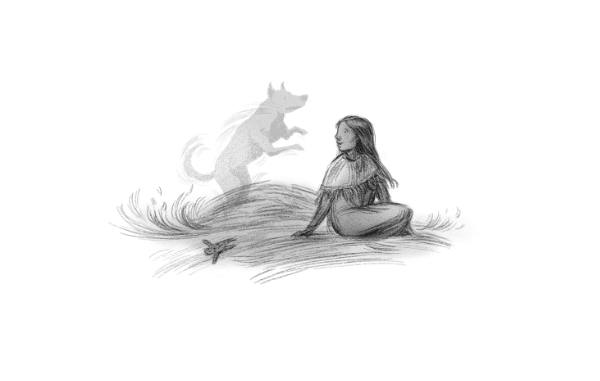
Animals come after my father dies. Dogs. Cats. Ducks. Geese. A goat. A peacock. They wander to our North Valley home several years into his absence—appearing on our doorstep or catching our eye from feed store cages. Always, we take them in. We line our laundry room floor with old bath towels, fill cereal bowls with tap water, then flick off the ceiling light to watch them sleep. 
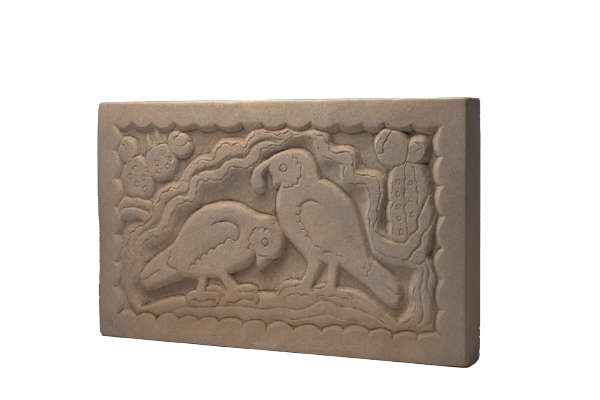
Stone relief of two quails
Eugenie F. Shonnard, Untitled Relief (Two Quails), n.d., stone, 12 × 19 7/8 × 1 7/8 in. (2008.1.107). Photo by Brad Trone.

“Strays make the best pets,” my mother tells the five of us kids. “They won’t leave.”

In memory, I see this: Beggar’s Night, 1970. My big brother is late. Again. Our mother said he can play after supper on the ditch bank behind our house and to see if neighbors will give him Halloween candy a day early, but when I peek outside to check on him, the sun has already set. Shadows drip like blue ink from the cottonwoods. But I don’t say anything to our mother, who sits in her antique rocker tapping a Russian olive switch on the floor. I scoot on my knees across the hardwood to take my place before the living room TV, where my three sisters huddle before the movie of the week, Dr. No. It’s a school night. We’ve changed into our flannel pajamas. Our hair is damp from the bath.

“Mom!”

The back door thuds open. My brother clomps through the kitchen, breathing hard as if he’s been running. Our mother stands, grips the switch, and intercepts him in the dining room. The overhead light flicks on, bright as an interrogation lamp.

“Wait!” my brother pleads. “I found something. Look!”

I scramble to my feet and jockey for position with my sisters. 

Our brother reaches into his brown corduroy jacket, extracts a small bundle, opens
his hands.

A baby bird squints at us.

“An owl,” mother says, setting aside her switch. “It’s adorable. Where did you find it?”

My brother had been hurrying home along the acequia when he heard a rustling from the bushes. When he slid down the embankment to investigate, he startled a hatchling that skittered through the dirt but couldn’t fly. He thought it might have broken its wing, so he scooped it up.

“I looked for the nest but couldn’t find it,” he says, shifting his weight from one foot to another. “Then I saw its mama by a tree. Someone shot her or something.”

Our mother holds the owl to the warmth of her body. 

It looks up at her and blinks.
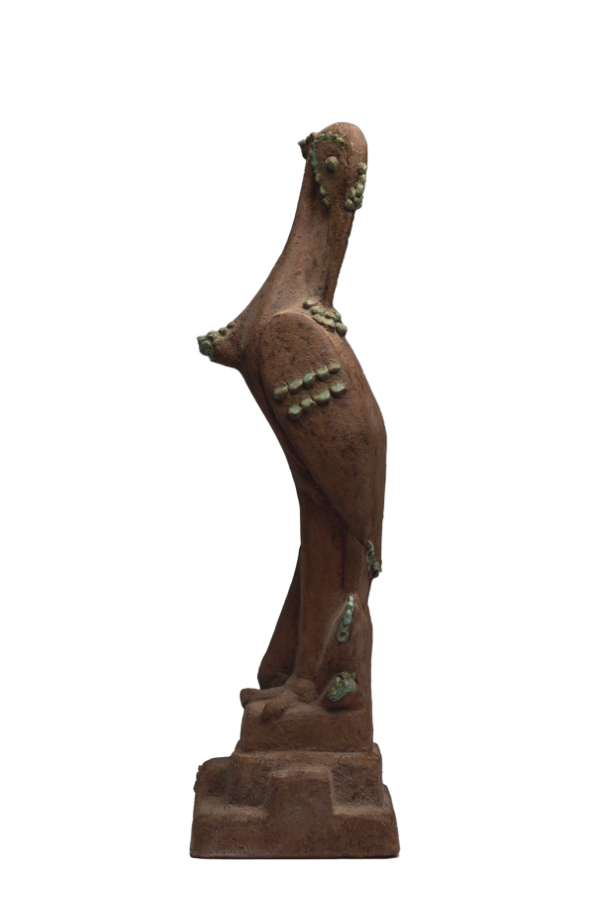
ceramic sculpture of a crane
Eugenie F. Shonnard, Untitled Sculpture (Crane), n.d., ceramic, 18 1/2 × 5 1/4 × 5 in. (2008.1.104). Photo by Brad Trone.

An ornithologist who lives down the street tells my mother we’ve adopted a screech owl, probably a female, he guesses, given the description over the phone. Although it’s not allowed under City of Albuquerque codes, we can probably nurse the chick until she gets stronger. Feed her bits of stew meat, he advises, and later mice. Keep her in a cage or an enclosed room. And watch out for cats.

My mother follows every instruction but one: the cage. She wants the owl to fly freely in her home. She retrieves a cardboard box from behind Safeway, lines it with newspapers and old towels, and places a piñon branch inside as a perch. Then she sets the whole thing on the dining room pottery case, which our tabbies can’t reach.

The owl is the size and shape of an upside-down pear. Her feathers are gray with black-and-white speckles. She has two tufts on her head that look like ears or horns, and her beak is as sharp and shiny black as her talons. What I like best are her eyes, piercing yellow, the size of dimes. When she looks at me, it’s like she’s reading my mind, or seeing something I can’t. One of my aunts won’t meet her gaze. The owl’s eyes, she says, are too human.

My mother considers the bird’s name carefully. Usually, she names the pets after artists or literary figures she admires, like Toshiro, the Japanese actor, for the silky black-and-white cat. Sometimes she chooses characters from her favorite films, like Tonya, from Dr. Zhivago, for the German shepherd. 

For the owl, though, my mother decides on Tirzah.

“Tirzah,” she says, savoring the syllables, which break like the morning light through her bedroom window crystals, turquoise and gold. “My little Tirzah.”

“What’s it mean?” I ask, watching her stroke the bird.

“It’s an old name. A religious name. From the Bible.”

Later, I look it up in the library.

“Tirzah—A city in Palestine, a beautiful place alluded to in the Songs of Solomon (`You are as beautiful, my darling, as Tirzah’).”

Each morning, my mother sets the owl’s box on the dining room table while she makes breakfast, sketches, or pays bills. Tirzah hops out from her box and waddles over to nibble my mother’s pen. If she leaves the room, the owl scurries after her. The only way my mother can finish her chores is to wrap the fledging bird in a washcloth and tuck her in the breast pocket of her denim work shirt. 

Tirzah remains there for hours, lulled by my mother’s heartbeat.
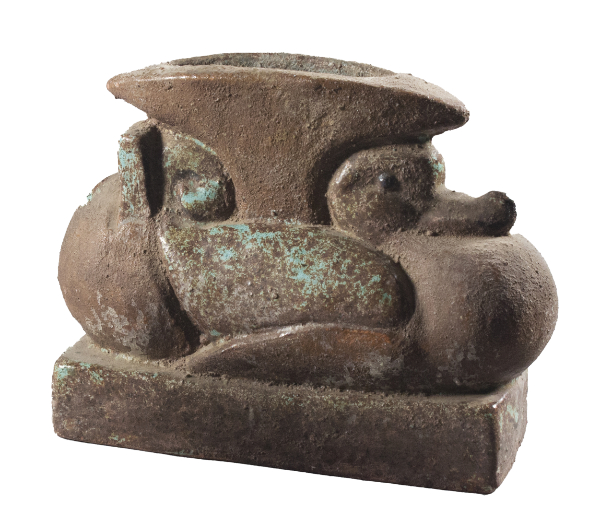
ceramic vase with a duck motif
Eugenie F. Shonnard, Untitled (Duck Vase), n.d., ceramic, 5 7/8 × 3 × 7 1/2 in. Collection of the New Mexico Museum of Art. Gift of Eugenie F. Shonnard Estate, 1978 (2008.1.83). © Museum of New Mexico Foundation.
ceramic squirrel candle holders
Eugenie F. Shonnard, Untitled (Squirrel Candleholders), n.d., ceramic, 8 7/8 × 3 1/4 × 2 3/4 in. Collection of the New Mexico Museum of Art. Gift of Eugenie F. Shonnard Estate, 1978 (2008.1.81ab). © Museum of New Mexico Foundation. Photo by Blair Clark.

On Sunday evenings, my grandmother, Desolina, stops by our house for pot roast stuffed with garlic. Over supper, she grumbles about her childhood in Corrales, growing up among horses, cows, and chickens in a drafty adobe where black widow spiders dropped from the rafters into her tin cup of milk or coffee. She hated every minute of it, she says, but learned the old ways despite herself. She knows how to bleed a goat, how to age red wine, and how to treat a rattlesnake bite with chewing tobacco. And she knows about spirits. While my mother collects the supper dishes, I line my toy knights on the table and listen to the two of them whisper in Spanish about dead relatives. When Desolina catches me eavesdropping—she always catches me—she laughs under her breath and beckons with a crooked finger.  “Come here, mi’jito,” she says, leaning from her chair. 

Then, in a low raspy voice, she describes the fireballs dancing along the Rio Grande bosque, the footsteps dragging down her hallway at midnight, and the crone who transformed into a banshee to chase her brother home on an acequia near Bernalillo.

 “It’s true,” she says, nodding at my wide eyes, then breaking into a smile. “And did you go to church like I told you?”

When Tirzah flutters by, my grandmother makes the sign of the cross. Owls, she always says, are bad omens, messengers of the night.

“Que fea,” she mutters. “Why did you bring that ugly thing in your home?”

My mother shrugs. “I think she’s beautiful.”

When Tirzah settles on the back of a chair across from her, Desolina holds the owl’s gaze for a full thirty seconds. She slips a glow-in-the-dark rosary from her purse, turns her head, and spits.

I don’t go camping, like the other kids on my block. I don’t go fishing, boating, or even to Uncle Cliff’s Family Land. My mother doesn’t like tourists. Doesn’t like doing what everyone else does. Instead, on weekends, we go exploring. We pile into her peacock green `67 Comet and hit the road. 

We visit old churches, abandoned graveyards, ghost towns, and adobe ruins, chasing a landscape and culture she says is vanishing before our eyes. She talks to old people, scours the ground for roots and fossils, and collects antique tables and chairs, while I run with my siblings through the juniper and pine playing Last of the Mohicans.

One Saturday morning, washed clean by spring rain, we pile into the bed of my grandfather’s F-150 and head north to Truchas, a village so high in the Sangre de Cristos we almost touch the clouds.

In a roadside meadow, my grandfather, Carlos, notices a slice of aspen bark—eight feet long, crescent shaped, with a knothole at one end. My uncle, who’s come along for the ride, says it looks like a cobra. I see a dragon. My mother says it has “character,” so we pitch it in the truck.

Before heading back to Albuquerque, we stop at a tiendita for gas, chile chips, and root beer. The viejo behind the counter tells us the bark was cut by lightning a few nights earlier. He saw the flash himself, heard the thunderous boom. This makes my mother smile.

Back home, she nails the plank across the living room wall. Tirzah notices immediately. She flies out from the dining room pottery case and claims the perch as her own, sliding down the arc to the knothole at the bottom, watching us through the dragon’s eye.
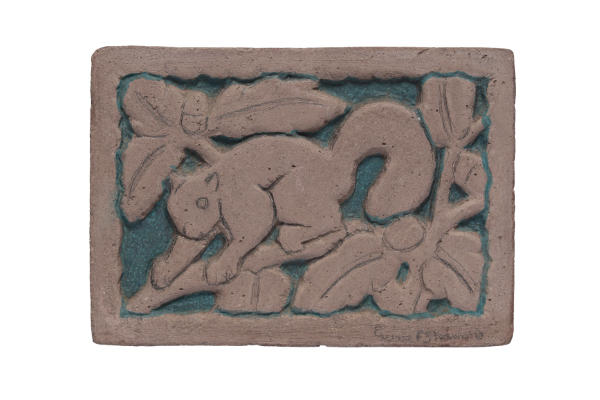
ceramic relief of a squirrel
Eugenie F. Shonnard, Untitled Keenstone Relief (Squirrel), ca. 1960, keenstone, 6 3/8 x 9 3/4 x 3/4 in. Collection of the New Mexico Museum of Art. Gift of Eugenie F. Shonnard Estate, 1978 (2008.1.112). © Museum of New Mexico Foundation.

The owl isn’t my pet, although I’d like her to be. She won’t come when I call, perch on my finger, or take meat from my hand, as she does with my mother, uncle, or brother. It’s not that I’m afraid. It’s more that she’s too beautiful to touch. When she does approach me, I get nervous, and she flies away. 

One afternoon, though, while I’m doing homework, Tirzah flutters down beside me onto the dining room table.

“Hi, pretty girl,” says my mother, who sits beside me sewing a blouse. “Are you thirsty?” 

Tirzah waddles up to me, ignoring the water bowl my mother slides forward. 

I tap the pencil eraser on my teeth.

“Go ahead,” my mother says. “Pet her. She won’t bite.”

“I know, but she doesn’t like me.”

“That’s not true. Just scratch her head. She loves that. Rub in little circles.”

I extend the pencil. 

Tirzah flinches, eyes wide, preparing to fly.

“See,” I say, withdrawing my hand. “She hates me.”

“Wait,” my mother whispers. “Try again. Slower.”

 I inch the eraser forward until it touches the owl’s head. 

Tirzah squints but stays put.

“Use your finger,” my mother says. “Like that. See how funny it feels? Like a ping pong ball?”

Tirzah closes her eyes and leans into the pressure. 

The more she relaxes the more I relax. 

After a few minutes, the owl curls her toes and rolls onto her side, asleep.

My grandfather Carlos visits us on his way home from the highway construction crew. At sixty-five, after raising nine children and working all his life in construction, he insists on holding a job. He nods hello to us, settles into a corner rocker, and hangs his gray fedora on his bony knee while my mother fetches him a cold Coors longneck.

Carlos doesn’t talk much. He prefers to watch, listen, and absorb the warmth of a family life he never had as a boy. His father died when he was eight. When his mother remarried, her husband refused to raise another man’s son, so she sent him to a boarding school in Santa Fe. He ran away with a friend soon afterward, walking a hundred miles through the Rio Puerco badlands to the village of Marquez, where he worked handy-man jobs. Carlos slept in arroyos, caves, and abandoned barns during that trek through the chamisal and cholla. On those lonely nights, he told my mother, owls watched him from the junipers, bathed in silver moonlight.

One night when he stops by our house, Tirzah glides down to his armrest from her aspen perch. When Carlos extends a gnarled finger, she hops on. He raises her to his nose, and smiles.
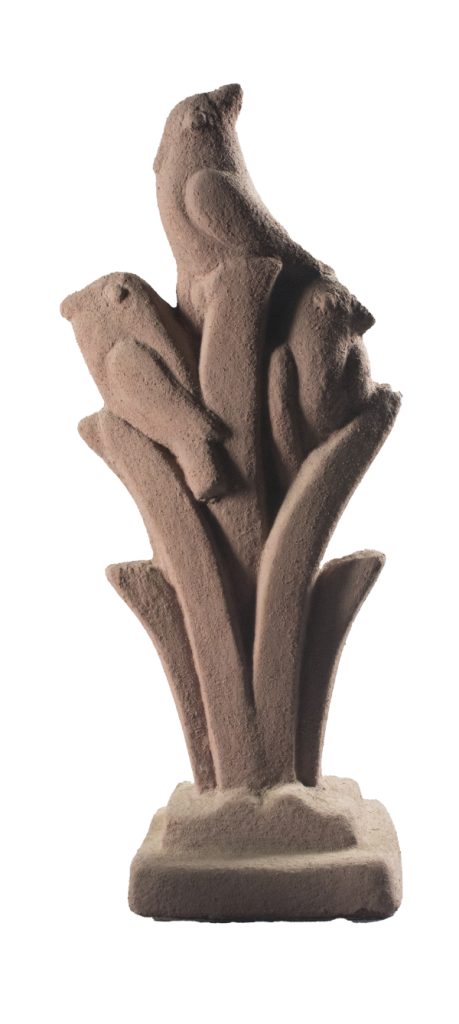
ceramic sculptures with three birds on an abstracted branch
Eugenie F. Shonnard, Untitled (Three Birds), mid-20th Century, keenstone, 15 1/8 × 7 3/8 × 4 7/8 in. Collection of the New Mexico Museum of Art. Gift of Eugenie F. Shonnard Estate, 1978 (2008.1.158). © Museum of New Mexico Foundation.

Each winter, our house fills with the sweet scent of piñon. We have no fireplace or wood-burning stove, so my mother sprinkles trading post incense over the steel grate of our living room floor furnace instead. It reminds her of childhood on the rancho in Corrales, she says, crumbling sawdust between her fingers, then standing in the heat as sparks swirl before her eyes. As a girl, she stoked the potbelly stove in her grandmother’s kitchen. Piñon smoke reminds her of black coffee in tin cups, cotton quilts, and crackling horno flames. Piñon smoke takes her back, she says. All the way back.

When my mother leaves to prepare fried potatoes and green chile for supper, I take her place on the furnace vent, standing in the current until my blue jeans burn my legs. As Tirzah glides by, white smoke curling from her wings, I imagine I’m soaring through the clouds beside her, drifting like an apparition above the antique tables, Navajo rugs and clay pots, haunting this
room forever.

On nights before art show openings, I sleep to the hiss of my uncle’s propane torch and the click of his sculptor’s tools. He’s the youngest in my mother’s family of nine, fourteen years her junior. He moved in with us four years after my father died. My mother needed help around the house, and didn’t feel safe alone with small children on the farming edge of northwest Albuquerque. She also wanted a male role model for my brother and me, although my uncle is barely out of his teens. He listens to The Doors, Jimi Hendrix, Country Joe and the Fish. He has a wizard beard and shoulder-length hair and walks barefoot everywhere, even in the mountains. I think he looks like George Harrison stepping onto the crosswalk of my mother’s favorite album, Abbey Road, but my grandmother thinks he looks like Jesus. Desolina wants him to be a priest, to help atone for family sins, but he’s an artist, instead. With needle-nose pliers and rods of Pyrex glass, he creates intricate figurines of Hopi eagle dancers, Mexican vaqueros, and Navajo shepherds, then mounts them on driftwood and volcanic rock. I watch him from my pillow with his Einstein hair and welder’s glasses, crafting icy figures from fire. Tirzah perches above his worktable, drawn, like me, to his clear blue flame.
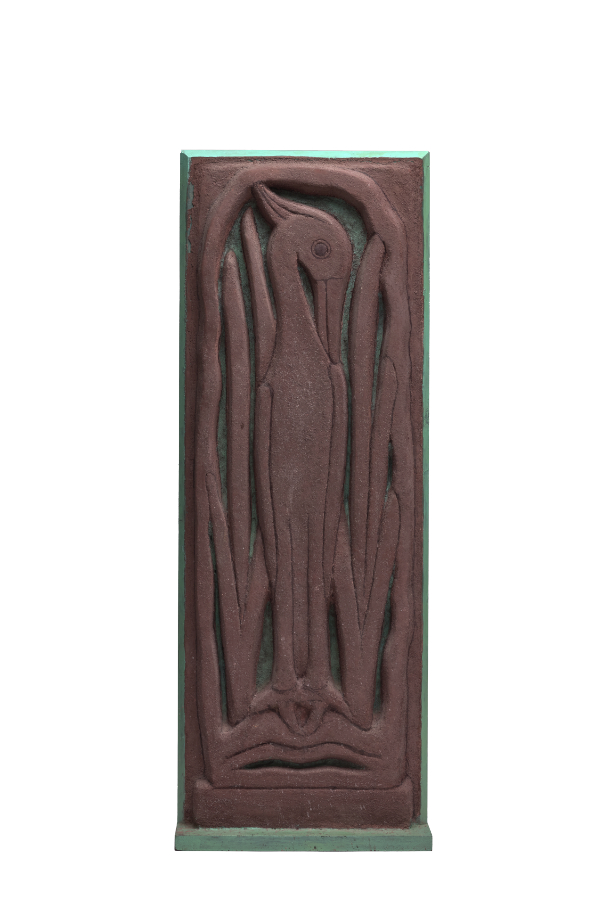
ceramic relief of heron
Eugenie F. Shonnard, Untitled Keenstone Relief (Heron), ca. 1960, keenstone, 34 3/4 x 12 1/2 x 8 3/4 in. Collection of the New Mexico Museum of Art. Gift of Eugenie F. Shonnard Estate, 1978 (2008.1.103a). © Museum of New Mexico Foundation.

My brother finds most of our strays. Or they find him. He’ll see a German shepherd digging in the garbage, walk right up, and it’ll lick his hand, a friend for life. He has a way with animals, which soothe him in a way no one else can. He was six when our father died. He has the most memories.

He and I are polar opposites, our mother likes to say. And she’s right. My brother loses his temper like the strike of a match and plays hardball without a glove. I’m steady, docile, and brooding, like my duck, Hercules, with his blunt beak and orange feet, content to never leave his yard. 

On weekday afternoons, Tirzah waits by the front window for my brother to return home from school. She hoots when he shuffles through the driveway, flies to his room while he changes from nice clothes into blue jeans, and perches patiently on his shoulder while our mother tethers them together with a strand of yarn—from boy’s wrist to owl’s leg. 

Task complete, they step outside to straddle his purple Sting-Ray bike. I watch from the front porch steps as they pull away, Tirzah’s eyes swallowing light and motion—flashing chrome handlebars, fluttering cottonwood leaf, the neighbor’s dog yapping behind a chain-link fence.

“Be careful,” our mother shouts, but my brother stands on his pedals anyway, and steers a wide circle under the streetlight, gathering speed for the racing lap around the block. 

Tirzah grips his jacket and leans into the wind.

My mother wants to bless our pets. Although she took a hiatus from the church a few years after my father died, she wants protection for our strays. So, on a warm Sunday in February, we load the ducks, geese, peacock, goat, and owl into our Comet, and attend the outdoor ceremony in Old Town.

We stand in line behind a few dozen puppies, kitties, gerbils, and bunnies. The priest chuckles from the white gazebo in the plaza as he sprinkles holy water. When our turn arrives, he stops mid-motion and appraises us behind silver-rimmed eyeglasses. My brother slouches before the dais, arms folded, Tirzah on his shoulder. I kneel beside the black Nubian goat, which suckles from a baby bottle. My oldest sister cradles the peacock, while the other two hold a mallard duck and a snow goose. Our mother lingers on the steps, eyes hidden behind her Jackie O sunglasses. 

We’re longhaired, tie-dyed, and proud of it, in full bloom eight years after my father’s funeral, surrounded by the animals that brought new life into our home.

Parishioners scowl. A poodle yaps. A news photographer snaps our portrait. 

After a pause, the priest mumbles a prayer. 

The next day, we make the front page.

Tirzah surprises us. When one of the dogs slinks through the house, she contracts her feathers, squints, and becomes as thin and gnarled as a dry juniper branch, invisible against the gray of her aspen plank. She can change direction in mid-flight, too, hovering in place like a helicopter, swiveling her head, then returning silently the way she came. She’s also a stone-cold hunter. When we place a chunk of stew meat on her perch, she puffs up to twice her normal size, dilates her pupils wide, and pounces. She thumps the meat several times, then flings it to the floor. Yellow eyes blazing, talons scratching hardwood, she stalks her meal like a panther. Finding it, she opens her beak, swallows it whole.

During the day, the sun is too bright for the owl’s sensitive eyes, so she seeks dark corners to sleep. One morning, when the temperature hits eighty-nine, my middle sister reaches into the hall closet to flick on the swamp cooler but leaves the door ajar. The chain is broken on the overhead bulb, so the closet is always pitch black. Tirzah, gazing toward the opening from her perch, flutters atop the closet door. I hold my breath. My sister calls our mother. Normally, the closet is off limits to us kids and the animals. We try to shoo Tirzah away, but she won’t budge. She just stares into the cool abyss. After a moment, she lowers her head and hops inside. From then on, the hall closet becomes her sanctuary. To fetch her at feeding time, I must reach into the darkness, brushing my father’s things.  

Breaking the Mold 

The animal-themed art that appears alongside Harrison Candelaria Fletcher’s essay—apart from the screech owl—is the work of Eugenie Shonnard. Eugenie Shonnard: Breaking the Mold opens at the New Mexico Museum of Art March 8, 2025, and is the first major posthumous exhibition of the acclaimed sculptor. Shonnard was a pivotal figure for the history of art and sculpture in the Southwest, widely recognized during her own time for her contributions to the visual arts, yet largely overlooked in recent decades. This exhibition, with an accompanying publication, seeks to reintroduce Shonnard to a new generation of art enthusiasts. The images in this article belong to the Collection of the New Mexico Museum of Art, and were a gift of the Eugenie F. Shonnard Estate, 1978. © Museum of New Mexico Foundation.
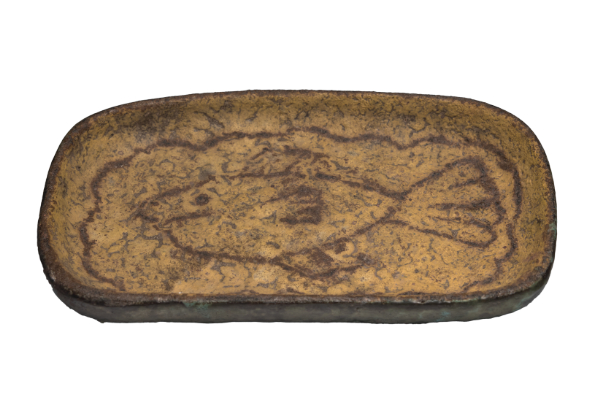
ceramic platter with fish motif
Eugenie F. Shonnard, Untitled (Fish Platter), n.d., glazed ceramic, 2 x 12 x 7 3/8 in. Collection of the New Mexico Museum of Art. Gift of Eugenie F. Shonnard Estate, 1978 (2008.1.97). © Museum of New Mexico Foundation.

Shonnard’s subject matter reflected her interest in the distinctive cultures she found in New Mexico, and she soon earned a national reputation for insightful depictions of the folk traditions of the Southwest. 

Shonnard worked across a wide variety of sculptural techniques, but came to champion “direct carving,” also referred to as taille directe, which was popular among early twentieth-century sculptors. This approach to sculpture involves working directly on a sculpture without the use of models or maquettes for reference, making many of her sculptures one-of-a-kind objects.

Eugenie Shonnard: Breaking the Mold emphasizes the breadth of Shonnard’s long career, from her early Art Nouveau designs created under Alphonse Mucha’s direct influence to the sculpture, architectural ornaments, and furniture she produced as a mature artist. The exhibition closes August 24, 2025.
Blair Clark is an illustrative photographer with over thirty years experience in studio and on-site photography and almost twenty-five years in museum photography.

Harrison Candelaria Fletcher (opens in a new tab) is the author of Descanso for My Father (2012), Presentimiento (2016), and Finding Querencia: Essays from In-Between (2022). He is the recipient of fellowships from the National Endowment for the Arts, MacDowell, and Helene Wurlitzer Foundation, as well as the Autumn House Press Nonfiction Prize, Colorado Book Award, and New Mexico-Arizona Book Award. A native of Albuquerque, he teaches at Colorado State University.

A Brief History of Navajo-Churro Sheep

After shearing a Navajo-Churro sheep, the raw wool is still warm when it is handed off for processing. The fleece is first skirted—a process in which burrs, animal waste, second cuts, and ratty wool is removed prior to washing. The lanolin, which provides the sheep with natural waterproofing, gives the fleece a slightly sticky texture. The fleece from each sheep is bagged separately because many fiber artists prefer to know that the wool they are using comes from only one sheep. The final step in the shearing process is washing and air drying the fleece.  

Shearing Navajo-Churro sheep occurs each spring at both Los Luceros Historic Site and at Bosque Redondo Memorial at Fort Sumner Historic Site. This breed of sheep is significant to New Mexico history and to Diné communities in particular. The very existence of these sheep is a testament to the strength and resilience of the Diné. 

The History of Navajo-Churro Sheep

The History of Navajo-Churro sheep begins in Spain. Domesticated sheep have been kept for centuries in the Iberian Peninsula. Originally providing meat, milk, and wool to the people of Spain, the Iberian Churra first rose to prominence in the Douro Valley. When the Moors conquered the land in 711, they brought Merino sheep to the region along with a rich, world-renowned weaving tradition. Both Merino and Churra wool were used to weave Spanish rugs. Merino sheep and their finer, softer wool was seen as higher class and preferred by nobility across Europe while the coarse-wooled Churra remained the sheep of the common people. This preference had great consequences as Spain began exploring and colonizing the world. 

In 1496, on the second expedition to the “New World,” Christopher Columbus and his fleet of ships brought a variety of livestock to aid in Spanish colonization. One of the domesticated animals was the Iberian Churra sheep. These sheep were the less prized desert breed and therefore seen as useful and expendable. Merino sheep were kept in Spain, largely because trade agreements with other nations prized Merino wool over Churra wool. Churra sheep survived the treacherous voyage largely because they were such a hardy breed and made their way successfully to the Americas alongside donkeys, horses, and other European livestock. 

The Churra spread quickly throughout New Spain, including the Northern Territory—modern day New Mexico and Arizona—by the mid-1500s. There is some debate about the exact year that Diné families first acquired Churra sheep. According to the Navajo Sheep Project, Diné families traded for or captured sheep as early as 1540 near the modern-day Mexican border when they were brought north with the Coronado Expedition. The Livestock Conservancy and Hubbell Trading Post National Historic Park assert that Churra sheep came to Diné communities in 1598 when they were brought with the Oñate Expedition to the Ohkay Owingeh area near modern-day Española. Either way, by 1600, Diné people had taken to pastoralism with Churra sheep as their main stock. 

After the introduction of domesticated sheep, weaving, wool working, and textile production became an intrinsic part of Diné culture. For hundreds of years Navajo-Churro wool, meat, and milk were the pillar of economic and societal stability of the Diné.

The Diné have asserted that they have always had sheep and knowledge of weaving thanks to the Holy People, and primarily thanks to Spider Woman, long before the arrival of Europeans. They have shared their historic connection to sheep through oral histories and their own research. Before the arrival of the Spanish, wild mountain sheep were the only sheep found in the Americas. According to the Bighorn Institute, there are two types of wild sheep native to North America; one of which, the bighorn sheep, is native to the Southwest. The bighorn sheep, sometimes called the sheep of the Holy People, while not domesticated, were present in Diné Bikéyah, the Navajo homeland. The Diné would hunt them for their hides, horns, and meat. Their wool, which the sheep shed naturally each year by rubbing against rocks, trees, and canyon walls, was collected and used in a variety of ways, possibly even for weaving. According to Diné traditions, the Holy People promised the Diné would be given sheep of their own to care for. This promise was fulfilled with the arrival of the Spanish Churra.  

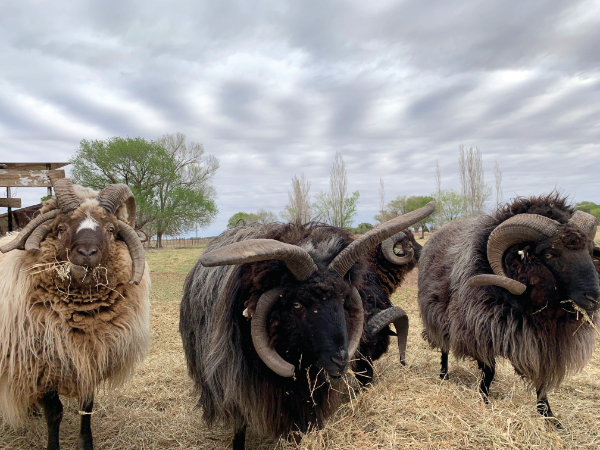
two rams at bosque redondo memorial
Navajo-Churro rams at Bosque Redondo Memorial. Photograph by Department of Cultural Affairs staff, 2023.

The Churra sheep eventually became the Churro—when the ‘a’ became an ‘o’ will most likely remain a mystery—and the Navajo-Churro quickly became its own domestic breed through the efforts of thousands of Diné people. The breed is distinct and still considered rare, with about 10,000 spread across the U.S. At their height, there were millions of Navajo-Churro in the Four Corners region and Diné families cared for flocks of thousands. 

This prosperity was dashed in the 1860s when American soldiers slaughtered both flocks and the people who cared for them. When the Union Army launched the Navajo Campaign in 1863, Brigadier General James H. Carleton commanded his forces to wage war against the Diné and relocate them from their ancestral homelands to the newly created Bosque Redondo Indian Reservation along the bank of the Pecos River. He had established Fort Sumner as the military post which would keep the Diné, as well as four hundred and fifty Ndé (Mescalero Apache), under military control. This forced removal opened Ndé and Diné lands to white settlers and miners. To end Native resistance to U.S. colonization and conflicts with settlers migrating West, these powerful sovereign tribes were put under the control of the U.S. government. 

Carleton enlisted Colonel Christopher “Kit” Carson to command the campaign.  Carson waged scorched-earth warfare, leveling homes, burning crops, and slaughtering livestock to starve the Diné into surrendering. Some Diné fled into canyons, preserving small flocks of Navajo-Churro sheep, and waited for those taken to Bosque Redondo to return. The majority, however, were force-marched approximately four hundred miles from their homeland in what is known today as “The Long Walk” to what the Diné call Hwéeldi or “Place of Suffering.” Those who still had livestock when they surrendered were allowed to bring their animals.  Conditions during the Long Walk and at Fort Sumner devastated the meager flocks of Navajo-Churro, shrinking from 6,962 sheep to a mere 940 by the time the Diné returned to their homeland in 1868. Starvation conditions forced the Diné to butcher the animals for meat, despite the need for their wool and milk. In fact, wool was key to the people’s survival while interred, especially during the bitter cold of Fort Sumner winters. Captain McCabe in an official report, stated “…One industrious female can finish a blanket in three weeks, which will wear for ten years, [and] is perfectly water-proof.” Also contributing to the loss of sheep were frequent raids by groups whose traditional homelands the Diné were now on, such as the Ka’igwu (Kiowas) and Nu–mu–n—uu (Comanches), who stole livestock and took women and children captive.

The Treaty of 1868, signed between the U.S. government and the Diné, secured the establishment of a reservation in their homeland, despite the U.S. government’s original intention of sending them to Oklahoma. The treaty included a provision that each Diné man, woman, and child were to be given two sheep. They did not receive said sheep until a year later in 1869, whereupon one of their leaders, Barboncito, who was elected head chief when the treaty was being negotiated, said:

Take care of the sheep that have been given you as you care for your own children. Never kill them for food. If you are hungry, go out after the wild animals and the wild plants. Or go without food, for you have done that before. These few sheep must grow into flocks so that we, the People, can be as we once were. 

The Diné repopulated their Churro flocks and the sheep thrived for sixty years, allowing the Diné to sustain themselves, continue their traditions, and participate in bartering at the trading posts established throughout the reservation. Then, in the 1930s, New Deal Stock Reductions had devastating consequences for the breed.

 Rebuilding the lost herds between 1869 and 1930 had taken time and patience. By the early 1930s there were, once again, millions of sheep within Diné Bikéyah. This garnered attention from the U.S. government. Environmental devastation was
becoming apparent as cattle, goats, and sheep herds over-grazed the Southwest. To mitigate erosion and environmental loss, the Livestock Reduction Act was passed as part of the New Deal. The program was initially voluntary and offered financial compensation for each lost animal but, because it went against Diné ways-of-life to kill sheep without an apparent reason (celebrations, feeding the community), it was adamantly opposed by most herders on the Navajo Nation. By 1935, however, the program became mandatory, and U.S. government personnel were deployed to force herds into compliance. While the Livestock Reduction Act was meant to be sweeping legislation that affected all herders and ranchers, Diné communities were disproportionally targeted compared with white herders and ranchers. Navajo-Churro flocks were reduced from roughly one million sheep to less than four hundred within a year. The economic and cultural devastation cannot be overstated. Many elders who witnessed the violent killings of their sacred sheep still tell of this event. It was so destructive the Diné refer to the Livestock Reduction Era as the Second Long Walk. 

In the 1970s, Dr. Lyle McNeal, a professor at Utah State University, started the Navajo Sheep Project after coming across a small flock in California. While McNeal had read about the Navajo-Churro, seeing them in person prompted him to launch an effort to breed the rare sheep. While in the Navajo Nation, he encountered elders who recognized the sheep and asked where he had gotten them. From these elders, Dr.
McNeal learned of their deep historical and cultural significance which made his mission even more important. Since then, other organizations have formed to assist with breed
revitalization efforts, many of them lead by Diné.

Physical Characteristics of the Breed

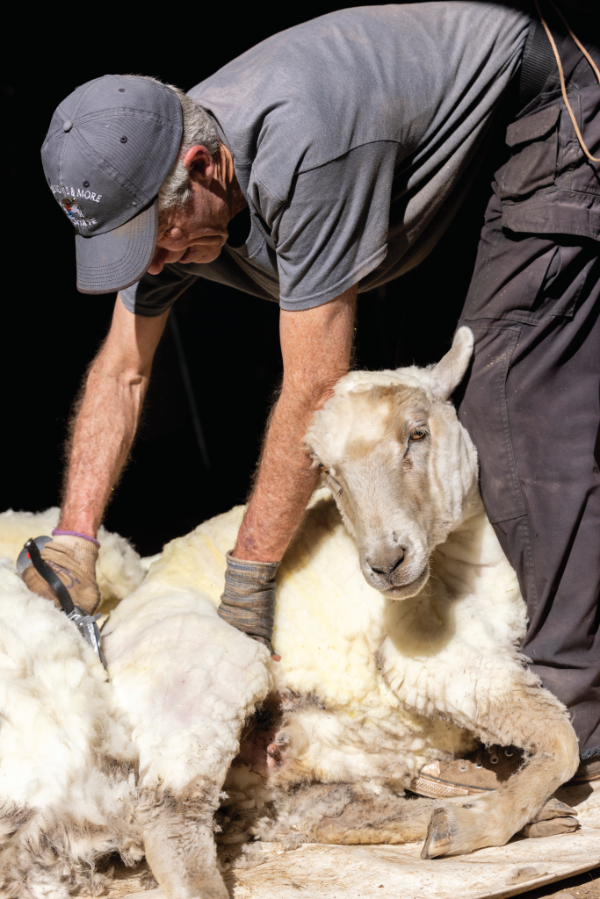
Traditional sheep shearing in process
Sheep shearer Kerry Mauer nearing the end of shearing a ewe. Mauer uses the traditional hand shears. Photograph by Tira Howard, 2024.

Many physical characteristics separate the Navajo-Churro from the Iberian Churra. The Navajo-Churro is a desert sheep, perfectly adapted to the environment of the American Southwest. In fact, certain adaptations that make Navajo-Churro sheep perfect for desert living were traits the U.S. government decided made the breed less desirable, including the Navajo-Churro’s inability to gain fat and muscle as quickly as other sheep. This adaptation, however, allows them to flourish in high desert regions because their watering and grazing needs are lesser than that of the Rambouillet or Dahl sheep, which were introduced to the Southwest later. While the slow-growing trait made them ideal in the deserts of New Mexico, Arizona, and Utah, the U.S. government felt that it was
imperative to breed only sheep that grew quickly to maximize meat production. The U.S. government’s attempt to make Native communities switch to more “desirable” breeds of sheep proved impossible until they forced the switch by killing Navajo-Churro sheep en masse.  

Some Navajo-Churro rams have four or more horns—this noteworthy but coincidental trait is considered one of the hallmarks of the breed. This was likely a recessive genetic trait in some of the Churra sheep brought to the Americas. Another distinctive part of the Navajo-Churro appearance is the lack of wool on their legs and faces. This helps them keep cool, prevents wool from impairing their sight, and keeps burrs and other prickly plants from getting caught on their legs.

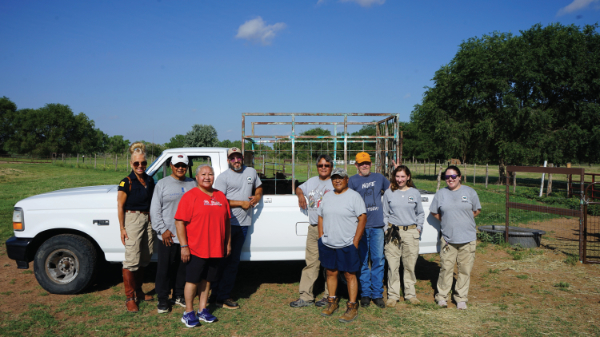
Color portrait of nine adults posed in front of a white pick-up truck
Diné recipients of the Bosque Redondo Navajo-Churro sheep donation program. Photograph by Department of Cultural Affairs staff, 2024.

One way the Navajo-Churro stands out from their Churra cousins is in the colors of their coats. Generally, Iberian Churra sheep are white with dark brown spots on their faces. Navajo-Churro, however, have been bred in a variety of colors. This trait helps with making woven designs in textiles. White, cream, tan, brown, grey, black, and red coats are common among Navajo-Churro flocks. Some sheep may be spotted, while others are one color. The sheep were also bred to produce less lanolin, and their wool takes to natural dyes better than other domestic sheep fleece. The low lanolin means little to no water is needed for washing the fleece—a great adaptation for a landscape where water can be a scarce resource. Navajo-Churro wool grows in longer, less tightly curled tresses, making it ideal for hand-spinning or drop-spinning, but it can also be worked on a spinning wheel. This wool is the most sought after by Diné weavers. In recent years, people have been able to acquire Navajo-Churro wool again. Previously, the Diné imported wool of Karakul sheep of Kazakhstan because of its similar texture to Navajo-Churro wool. Diné weavers so preferred a coarse wool that they imported fleece from across the world. The need to outsource wool from such a far-off place demonstrates the deep economic impact of losing the Navajo-Churro. 

Navajo-Churro Today

Navajo-Churro sheep continue to be important to the Diné way of life, both economically and spiritually. Navajo-Churro mutton and wool both command high prices on the market, thanks to various initiatives recognizing the unique qualities of these sheep. Moreover, many Diné practice traditional methods of wool processing, spinning, dying, and weaving. The yarn and textiles made from it are world-renowned for their quality and beauty and are made either for ceremonial purposes or for the global market.  Al Henderson, who comes from a long line of Diné shepherds, noted, “My grandmother, mother, and aunties who were rug weavers valued Churro wool the best. The wool per sheep were of better quality and when sold to the local trader it paid a handsome price.”

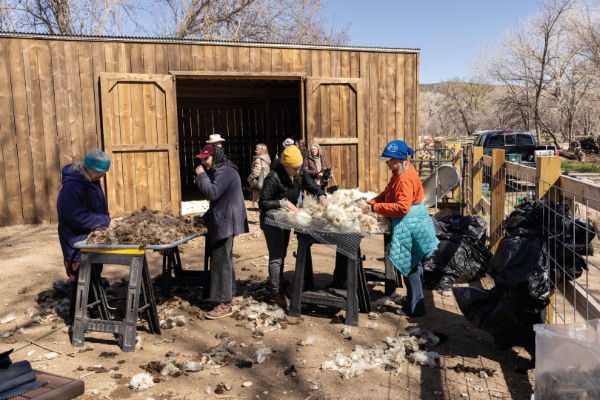
Various adults skirting wool on tables in front of a wooden barn
Volunteers from Española Valley Fiber Arts Center skirting wool next to the barn at Los Luceros Historic Site in April of 2024. Photograph by Tira Howard, 2024.

Combined, there are more than fifty Navajo-Churro sheep at Los Luceros and Bosque Redondo. Their presence at these Historic Sites is part of an ongoing breed revitalization effort led by multiple individuals and organizations. Like most domesticated sheep, the flocks must be sheared annually. Historic Site staff members organize regular vaccinations, vet visits, and shearing at both locations. 

 The wool at Los Luceros Historic Site is given to the Española Valley Fiber Arts Center (EVFAC) for distribution to fiber artists in the local community who donate their time and money to help with shearing each year. EVFAC teaches the communities of Northern New Mexico about traditional Spanish weaving techniques. With the wool they collect from the sheep at Los Luceros, they teach classes on cleaning, carding, spinning, and dying wool. This empowers local shepherds, farmers, and fiber artists to continue their work. 

Bosque Redondo’s sheep help tell the painful history of the Long Walk and subsequent imprisonment of the Diné and Ndé, and they help sustain the traditions that originated from the relationship between the Diné and these incredible
animals. Beginning in the late 2010s, when the flock had grown larger than could be easily maintained by Bosque Redondo staff, they began to donate sheep to Diné families. The animals are owned by Friends of the Bosque Redondo Memorial, which enables them to donate two or three sheep to Diné families who apply each year. Since 2017, more than one hundred and eighty sheep have been donated. Nina Toledo, a recipient in 2024, shared her family’s story of the sheep:

My older sister was telling me she also remembers that my grandmother also had sheep. Maybe like one hundred which was a lot at that time… But according to my older sister my grandma remembers losing sheep to the sheep reduction by the government—maybe like in 1935… Navajo-Churro Sheep [became] endangered and nearly extinct and caused a huge cultural shift.  Economic and cultural power was taken from the hands of the Navajo women… My mother and father started raising sheep and goats in 1955.  From there the sheep and goat herd grew. It was regular sheep. No Churros.  After my parents both passed away in 1998 the sheep slowly dwindled til there were no more sheep left. Which was sad… They helped my ancestors survive even though many of them died during the Long Walk. I would like my children and grandchildren to learn all that I have learned about the Churro sheep so I will be teaching them and to tell them to help me take care of the sheep… My parents would be so happy that I got these sheep too.

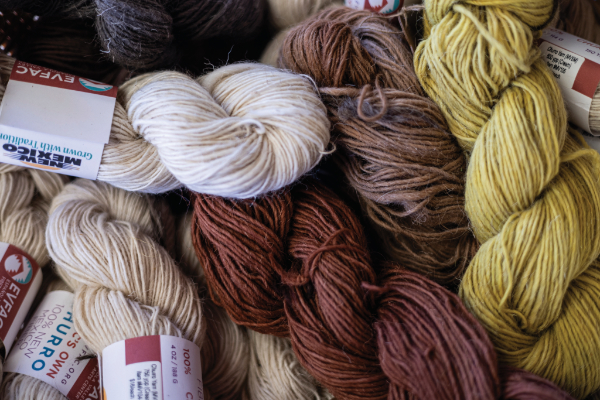
Several skeins of wool yarn in various natural colors
Churro wool that has been fully processed into yarn. Some of this yarn has been dyed while others have been left with their natural color. Photograph by Tira Howard, 2024.

The story of the Navajo-Churro is one that resonates with many visitors to Bosque Redondo and Los Luceros. Despite extermination efforts during the Long Walk and the Livestock Reduction Act, Navajo-Churro sheep have made their way back to the Diné people. Unfortunately, what happened to the Navajo-Churro is not a unique tale. Other animals, both domesticated and wild, have faced complete or near extinction at the hands of the U.S. government and American settlers. Thankfully, for the Navajo-Churro, thousands of people have been invested in the success of the breed and in ensuring the ongoing relationship between the Diné and their sheep.”

Rebecca Ward is the instructional coordinator at Los Luceros Historic Site in Alcalde. She holds a Master of Arts degree in Museum Studies and a Bachelor of Arts degree in Anthropology.

Rebekha Crockett (opens in a new tab) is the instructional coordinator at Bosque Redondo Memorial at Fort Sumner Historic Site. In her free time, she enjoys reading, archery, and taking her dog Ekho on walks.

Tira Howard (opens in a new tab) is a portrait, lifestyle, and fashion photographer based out of Santa Fe, New Mexico. Her work can be seen in V Magazine, Cowgirl Magazine, Table Magazine, New Mexico Magazine, El Palacio magazine, Pasatiempo, Cowboys and Indians Magazine, The Santa Fe New Mexican magazines, The Santa Fe Reporter, Western Art & Architecture Magazine, and Edible New Mexico Magazine.

New Test Post

a test of the link test new setup for italics and bold

Test content above lorem ipsum dolor sit amet consectetur adipiscing elit. Quisque faucibus ex sapien vitae pellentesque sem placerat. In id cursus mi pretium tellus duis convallis. Tempus leo eu aenean sed diam urna tempor. Pulvinar vivamus fringilla lacus nec metus bibendum egestas. Iaculis massa nisl malesuada lacinia integer nunc posuere. Ut hendrerit semper vel class aptent taciti sociosqu. Ad litora torquent per conubia nostra inceptos himenaeos.

This is the caption field for another placeholder image. I need to put more content in here for testing so that it extends to several lines like the example in the Figma file. That’s probably good.

Lorem ipsum dolor sit amet consectetur adipiscing elit. Quisque faucibus ex sapien vitae pellentesque sem placerat. In id cursus mi pretium tellus duis convallis. Tempus leo eu aenean sed diam urna tempor. Pulvinar vivamus fringilla lacus nec metus bibendum egestas. Iaculis massa nisl malesuada lacinia integer nunc posuere. Ut hendrerit semper vel class aptent taciti sociosqu. Ad litora torquent per conubia nostra inceptos himenaeos.

Lorem ipsum dolor sit amet consectetur adipiscing elit. Quisque faucibus ex sapien vitae pellentesque sem placerat. In id cursus mi pretium tellus duis convallis. Tempus leo eu aenean sed diam urna tempor. Pulvinar vivamus fringilla lacus nec metus bibendum egestas. Iaculis massa nisl malesuada lacinia integer nunc posuere. Ut hendrerit semper vel class aptent taciti sociosqu. Ad litora torquent per conubia nostra inceptos himenaeos.

Lorem ipsum dolor sit amet consectetur adipiscing elit. Quisque faucibus ex sapien vitae pellentesque sem placerat. In id cursus mi pretium tellus duis convallis. Tempus leo eu aenean sed diam urna tempor. Pulvinar vivamus fringilla lacus nec metus bibendum egestas. Iaculis massa nisl malesuada lacinia integer nunc posuere. Ut hendrerit semper vel class aptent taciti sociosqu. Ad litora torquent per conubia nostra inceptos himenaeos.

Lorem ipsum dolor sit amet consectetur adipiscing elit. Quisque faucibus ex sapien vitae pellentesque sem placerat. In id cursus mi pretium tellus duis convallis. Tempus leo eu aenean sed diam urna tempor. Pulvinar vivamus fringilla lacus nec metus bibendum egestas. Iaculis massa nisl malesuada lacinia integer nunc posuere. Ut hendrerit semper vel class aptent taciti sociosqu. Ad litora torquent per conubia nostra inceptos himenaeos.

Test content below lorem ipsum dolor sit amet consectetur adipiscing elit. Quisque faucibus ex sapien vitae pellentesque sem placerat. In id cursus mi pretium tellus duis convallis. Tempus leo eu aenean sed diam urna tempor. Pulvinar vivamus fringilla lacus nec metus bibendum egestas. Iaculis massa nisl malesuada lacinia integer nunc posuere. Ut hendrerit semper vel class aptent taciti sociosqu. Ad litora torquent per conubia nostra inceptos himenaeos.

This is some caption text within the image file, editable via the Media Library. You should be seeing a photo of a dark kitchen with a black sink and countertop area, silver faucet

Test content below lorem ipsum dolor sit amet consectetur adipiscing elit. Quisque faucibus ex sapien vitae pellentesque sem placerat. In id cursus mi pretium tellus duis convallis. Tempus leo eu aenean sed diam urna tempor. Pulvinar vivamus fringilla lacus nec metus bibendum egestas. Iaculis massa nisl malesuada lacinia integer nunc posuere. Ut hendrerit semper vel class aptent taciti sociosqu. Ad litora torquent per conubia nostra inceptos himenaeos.

Robert Minor (left) and David Levinson pose for a photo in Gallup following their kidnapping in May 1935. Courtesy of the Palace of the Governors Photo Archive (NMHM/DCA), Neg. No. HP.2024.26.0030a.
Robert Minor is inspected by police after his kidnapping. Courtesy of the Palace of the Governors Photo Archive (NMHM/DCA), Neg. No. HP.2024.26.0023.

Test content below lorem ipsum dolor sit amet consectetur adipiscing elit. Quisque faucibus ex sapien vitae pellentesque sem placerat. In id cursus mi pretium tellus duis convallis. Tempus leo eu aenean sed diam urna tempor. Pulvinar vivamus fringilla lacus nec metus bibendum egestas. Iaculis massa nisl malesuada lacinia integer nunc posuere. Ut hendrerit semper vel class aptent taciti sociosqu. Ad litora torquent per conubia nostra inceptos himenaeos.

caption test for the single left offset image. this is the default setting for images if nothing is selected

Test content below lorem ipsum dolor sit amet consectetur adipiscing elit. Quisque faucibus ex sapien vitae pellentesque sem placerat. In id cursus mi pretium tellus duis convallis. Tempus leo eu aenean sed diam urna tempor. Pulvinar vivamus fringilla lacus nec metus bibendum egestas. Iaculis massa nisl malesuada lacinia integer nunc posuere. Ut hendrerit semper vel class aptent taciti sociosqu. Ad litora torquent per conubia nostra inceptos himenaeos.

Caption for another placeholder image ex sapien vitae pellentesque sem placerat. In id cursus mi pretium tellus duis.
Robert Minor is inspected by police after his kidnapping. Courtesy of the Palace of the Governors Photo Archive (NMHM/DCA), Neg. No. HP.2024.26.0023.

Test content below lorem ipsum dolor sit amet consectetur adipiscing elit. Quisque faucibus ex sapien vitae pellentesque sem placerat. In id cursus mi pretium tellus duis convallis. Tempus leo eu aenean sed diam urna tempor. Pulvinar vivamus fringilla lacus nec metus bibendum egestas. Iaculis massa nisl malesuada lacinia integer nunc posuere. Ut hendrerit semper vel class aptent taciti sociosqu. Ad litora torquent per conubia nostra inceptos himenaeos.

caption test for the single left offset image. this is the default setting for images if nothing is selected

Test content below lorem ipsum dolor sit amet consectetur adipiscing elit. Quisque faucibus ex sapien vitae pellentesque sem placerat. In id cursus mi pretium tellus duis convallis. Tempus leo eu aenean sed diam urna tempor. Pulvinar vivamus fringilla lacus nec metus bibendum egestas. Iaculis massa nisl malesuada lacinia integer nunc posuere. Ut hendrerit semper vel class aptent taciti sociosqu. Ad litora torquent per conubia nostra inceptos himenaeos.

Marcus Xavier Chormicle (opens in a new tab) is a lens-based artist and independent curator from Las Cruces, and lineal descendant of the Agua Caliente Band of Cahuilla Indians. His work focuses on family, memory, and the intersection of class, race, and history in the Southwest. In 2024, he was a New Mexico Arts artist-in-residence at Lincoln Historic Site where he expanded on his oryx project.

Ungelbah Dávila (Diné) is an award-winning writer and photographer from New Mexico. She spent her first twelve years in rural New Mexico on her father’s cattle ranch in Mangas, and mother’s property along the Gila Wilderness and San Francisco River in Reserve, New Mexico. Ungelbah received her BFA in Creative Writing from the Institute of American Indian Arts and launched La Loca Magazine during her time there. She began self publishing La Loca with national distribution from 2013-2015 while working as a copyeditor and journalist at the Valencia County News Bulletin (2011-2012) where she was awarded the National Newspaper Association Award: Best Serious Column & Best Breaking News Story (2013).

Migration Patterns

Black and white striped tubes intertwine and overlap, forming an abstract, hypnotic pattern with a sense of movement and depth. [gen-ai]

In 2001, when I first arrived at the Roswell Artist-in-Residence program, a man followed me around the Farmer’s Country Market. Had he never seen an Asian in person? Throughout the year, I blocked out the constant stares. 

In those days, we still had thick telephone books with thin newsprint pages. I decided to write each name listed in Roswell’s white pages on lined notebook paper. Using a No. 2 pencil, I wrote in the consistent looping slant of standard cursive I had learned in school and connected the names in a long continuum. After all, we share a connection when we live in the same city. 

As I wrote, I unwittingly traced migration patterns. The multiple Arceneaux, a common name in Louisiana where I had previously lived, might have come from France, crossed the Atlantic to New Orleans, traveled up the Mississippi to Missouri, and traveled along the Santa Fe Trail to arrive in New Mexico. The abundant Williams and Smiths, who might have come via Plymouth Rock, were as common as more than thirty Trujillos, a name originating in Spain that crossed the ocean to end up here. Names like Patel and Tsering spoke to recent migrations from Asia. When I got to the T’s, I added my name, writing myself into the community.

Twenty years later, shortly after both my parents died, I returned for another residency in Roswell. My parents had immigrated from Taiwan following the 1965 Immigration Act. They raised my sisters and me in Pennsylvania before returning to Taiwan, where my father worked another two decades as a physicist. They retired in the Pacific Northwest where they knew very few people. They didn’t need community the way I did, a daughter of immigrants never connected to a homeland.

Throughout late fall at the new artist-in-residence compound just six miles from Bitter Lake National Wildlife Refuge, the call of sandhill cranes and snow geese could be heard in the mornings and evenings. I’d look at the sky to see long staggered lines and V formations of migrating birds.

I pasted maps of cities, states, and other countries together to form large sheets of paper, creating a fragmented world with borders askew. Using sumi ink and brush, as my dad used for Chinese calligraphy, I started in the center of a large map and painted a line spiraling out. The brush crossed cities my parents had brought us to, including Albuquerque. I crossed cities and borders I visited alone or with friends and thought of how far I had come.

I knew little about my lineage, but through the creative process, I came to know Roswell’s. It was an unexpected place to return for creative nourishment over the years. In creating the maps, I came to understand that our lineages include the places and communities we have been a part of.

Edie Tsong (Taiwanese American) (opens in a new tab) is an interdisciplinary artist, writer, and musician. She is a Blackburn Fellow at the Randolph MFA in Creative Writing program and plays in the improvisational quartet Lost Time.

Weaving New Meanings

Without traffic, it only takes thirty minutes to reach KwaMashu and Siyanda. Past Durban’s inner suburbs, stadiums, mansions, and malls, I reach the few highway entrances that connect these historically Black neighborhoods—home to over 175,000 people, over ninety percent of whom are isiZulu-speaking—to the rest of this 3.25-million-person harbor city. As I enter KwaMashu, the road narrows and the terrain becomes less grid-like. Roads loop across the hillsides where Durban’s migrant-labor population has lived since the 1960s, when the government controlled Black labor and determined who was officially allowed to live in this city-beside-a-city.

Multi-colored telephone wire basket
Elliot Mkhize. Basket, 2003. Telephone wire. wire. KwaMashu, KwaZulu-Natal, South Africa. 
Gift of David Arment and Jim Rimelspach, 
David Arment Southern African 
Collection, IFAF Collection, 
Museum of International Folk Art, FA.2024.12.32.

Today, tucked between the official Township of KwaMashu and the highway is Siyanda, a majority isiZulu-speaking community that was never planned or condoned on official maps. The informal settlement boom town was first built from corrugated iron and whatever materials were at hand. Now, cinderblocks and more traditional building materials have replaced the insecure housing materials of the past. These two neighborhoods, KwaMashu and Siyanda, are the incubators of telephone wire art, a distinctly South African art form.iNgqikithi yokuPhica/Weaving Meanings: Telephone Wire Art from South Africa is the first major exhibition of South African telephone wire art in a North American museum. It opened November 17, 2024 at the Museum of International Folk Art (MOIFA) in Santa Fe.

“The title iNgqikithi yokuPhica is a poetic expression that encourages us to grapple with the meaning of art,” says Muziwandile Gigaba, community curator and lead Indigenous knowledge expert based in KwaMashu Township, Durban, South Africa. “iNgqikithi means an essence or deep foundation. Ukuphica (the root verb of the title’s yokuPhica) usually refers to a weaving technique but also may refer to a riddle. Riddles may seem confusing at first, but they have a clever answer or unexpected meaning in the end.”

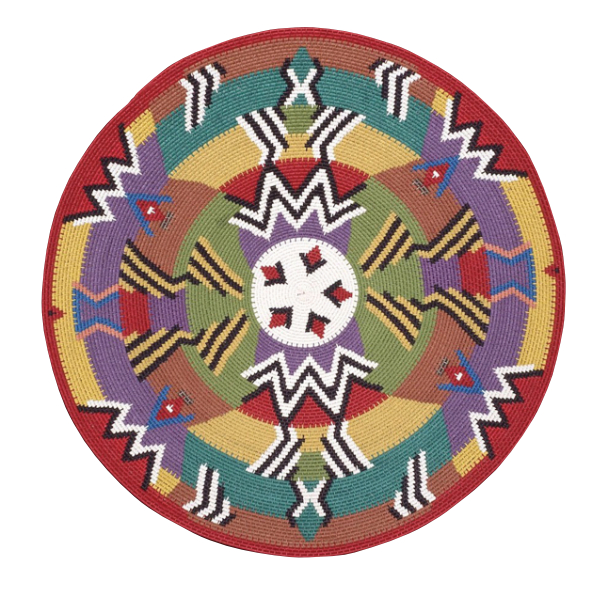
Circular woven folk art
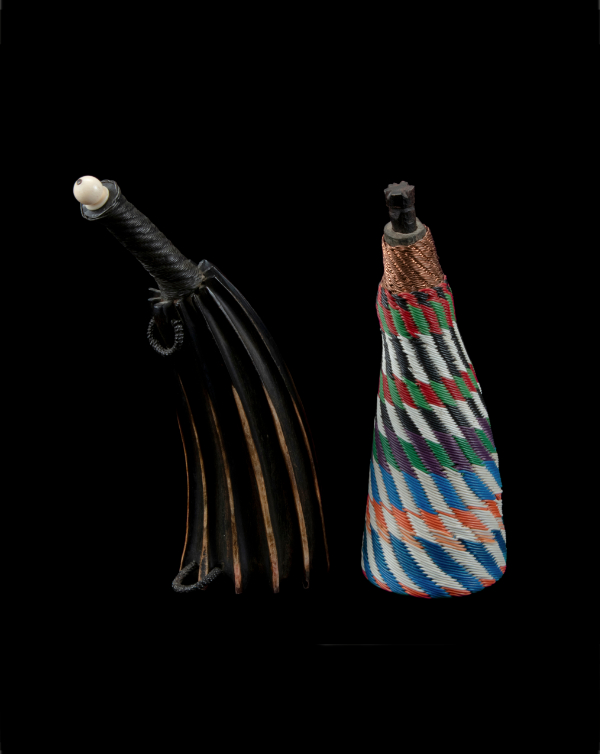
Artist Not Recorded. Ishungu (snuff container), late nineteenth to early twentieth century. Horn, wood, metal wire, bone. KwaZulu-Natal, South Africa. Collection of Carol-Boram Hays, 2.40, IL.2024.13.1ab. Right: Artist Not Recorded, Ishungu (snuff container), early to mid-twentieth century. Horn, wood, copper wire, telephone wire. KwaZulu-Natal, South Africa. Gift of David Arment and Jim Rimelspach, David Arment Southern African Collection, IFAF Collection, 
Museum of International Folk Art, FA.2024.12.79.

A celebration of the tenacity of South Africans, this exhibition is built around the David Arment Southern African Collection, key loans, and documentary footage filmed and edited by a South African production team, Zamo Mkhize’s Gone Fishing Productions. Interview footage featured in five short documentaries foreground the voices of artists, historians, and community members who witnessed the emergence and development of this art form from the mid-twentieth century onward.

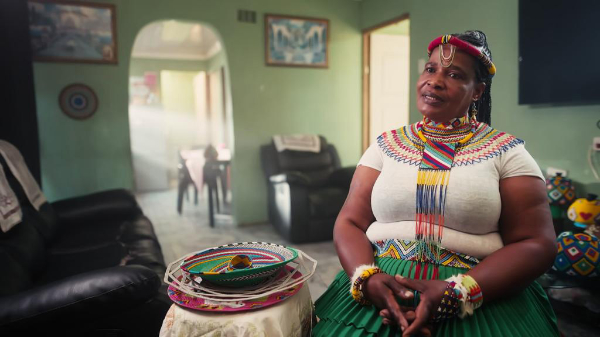
One of the first artists visitors encounter in the series of documentaries that fill the galleries is Zodwa Maphumulo, the matriarch of the Maphumulo family. While looking at her work and the work of her family members, the viewer won’t know that on July 13, 2023, as Maphumulo was settling in for her interview, lights set, boom mic in place, and sound levels checked—the power went out. It wasn’t only Maphumulo who lost power, it was all of Siyanda and much of neighboring KwaMashu. Annoyed but unfazed, our entire team, including Gigaba, the Gone Fishing Production team, and I, as well as the entire Maphumulo family, pulled out our phones to check the “ESP-Loadshedding” app. The app allows residents to see when power outages will occur in their neighborhoods, and when an unexpected outage hits it gives an estimated time for the power to return.

That’s just daily life in South Africa because of unstable infrastructure and cities that were designed for a minority of South Africans. White elite areas, surrounded by pools of government-controlled enclaves of people of color, were designed under Apartheid. When freedom of movement was finally permitted in the 1990s, the infrastructure was taxed by a flood of urban immigration. Today, scheduled rolling power outages called “loadshedding” take place regularly to avoid nationwide blackouts because the entire power grid is under constant stress.

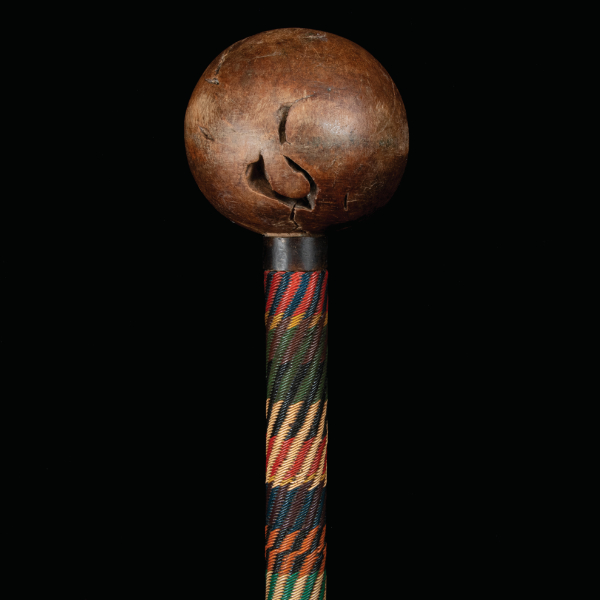
sparring stick with woven handle
Artist Not Recorded. Iwisa (knobbed sparring stick) (detail), early to mid-twentieth century. Wood, telephone wire, brass or copper. KwaZulu-Natal, South Africa. Gift of David Arment and Jim Rimelspach, David Arment Southern African Collection, IFAF Collection, Museun of International Folk Art, FA.2024.12.74

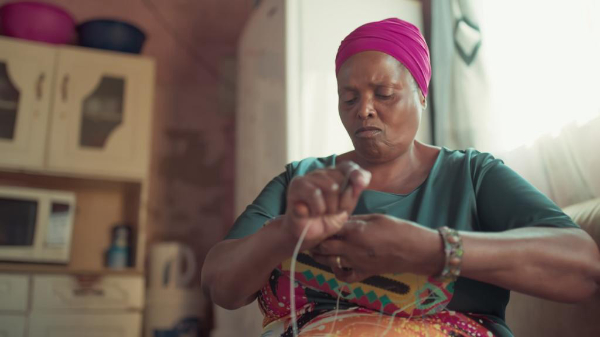
Though the outage wasn’t on the schedule, our team made a strategic move: We shifted to an outdoor interview with Ntombifuthi (Magwaza) Sibiya, a nearby weaver of the same generation living in Siyanda. Like the telephone wire weavers who are used to improvisation and resilience, this team of township-raised professionals knew the backup generators and batteries would likely last until the power came back on. They work in South Africa’s booming film industry and know what local conditions demand.

Origins in Resistance and Racism

The Apartheid South African government’s policy of racial segregation existed from 1948 until 1994 and was the oppressive system from which telephone wire basketry emerged. In this era, white cities and farms were separate from Black, Coloured (a mixed-race category defined by the Apartheid government), and Asian populations. Neighborhoods were segregated, and industries relied on Black migrant workers based in rural areas and those living in government-controlled Black townships for labor. Experimental pieces of wire embellishment on sticks and izimbenge (beer pot lids) emerged in rural and urban spaces soon after telephone lines were laid in the mid-twentieth century. 

Unfortunately, early trade in these experimental pieces was often driven by a desire for artworks by Zulu artists that satisfied a generalized category or type, but that was not attributed accurately to an artist—much akin to the collecting worldwide of Indigenous peoples’ arts during this period. Even when collectors sought out the names of artists, circuitous and extractionary exchange routes erased the identity of Black weavers from the rural, government-created “Homelands.” These Homelands were often not the weavers’ historical homes; the Apartheid government created Black Homelands through forced and traumatic displacement. And, unfortunately, artworks exported from the Black-designated KwaZulu “Homeland” to the white-controlled province of Natal were, most often, labeled only as “Zulu.”

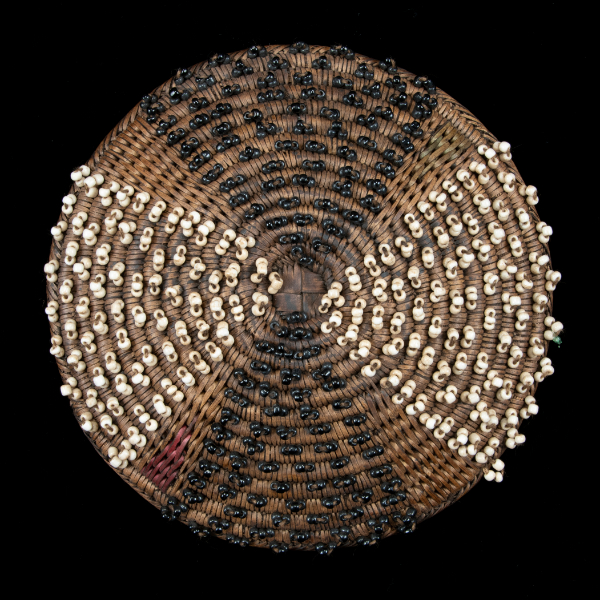
Woven snuff containers
Artist Not Recorded. Ishungu (snuff container), late nineteenth to early twentieth century. Horn, wood, metal wire, bone. KwaZulu-Natal, South Africa. Collection of Carol-Boram Hays, 2.40, IL.2024.13.1ab. Right: Artist Not Recorded, Ishungu (snuff container), early to mid-twentieth century. Horn, wood, copper wire, telephone wire. KwaZulu-Natal, South Africa. Gift of David Arment and Jim Rimelspach, David Arment Southern African Collection, IFAF Collection, 
Museum of International Folk Art, FA.2024.12.79.

Direct contact between individuals in different race categories, as designated by the Apartheid government, was strictly controlled. Mixing between races in a range of settings was illegal. But, even with the barriers set between racial groups under Apartheid, art did construct a space for some communication and mutual support. Liberal-leaning arts organizations, run largely by white South Africans and sponsored by a few international aid organizations, supported rural arts development and sales. Through white intermediaries—often nonprofit employees or volunteers who were in contact with Black-designated rural areas or townships—art was sold in white South African spaces and to buyers abroad. The African Art Centre, which opened in 1959, ran workshops that initially only engaged with art media known to be produced by isiZulu-speaking populations historically: weaving in natural fibers, carving, ceramics, or beadwork.

Artists started experimenting with coated telephone wire in the mid-twentieth century. Particularly during the 1980s, the telephone network in South Africa expanded. The individuals who first used wire experimentally on walking sticks or as small areas of color on natural fiber weaving were likely stripping colored wires from waste materials at building sites or along infrastructure construction sites. The exact origin point has not been established. Paul Mikula, an architect and collector of Zulu fiber weaving who founded the Phansi Museum in Durban, facilitated a waste-wire distribution site once the art form started to expand in the 1990s.

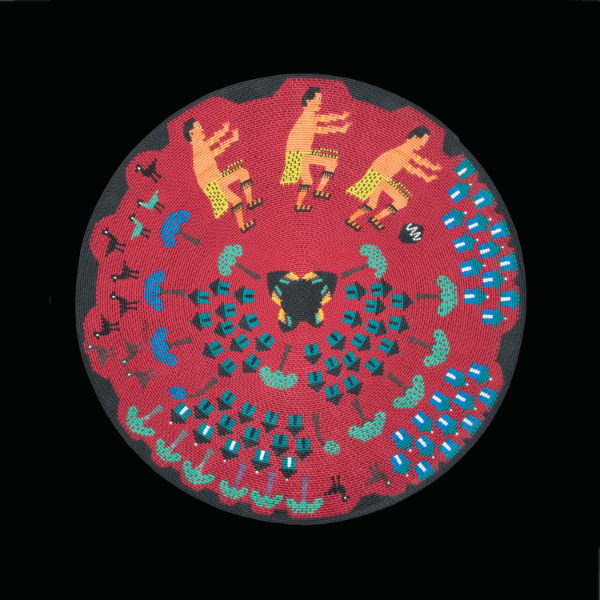
Colorful circular weaving
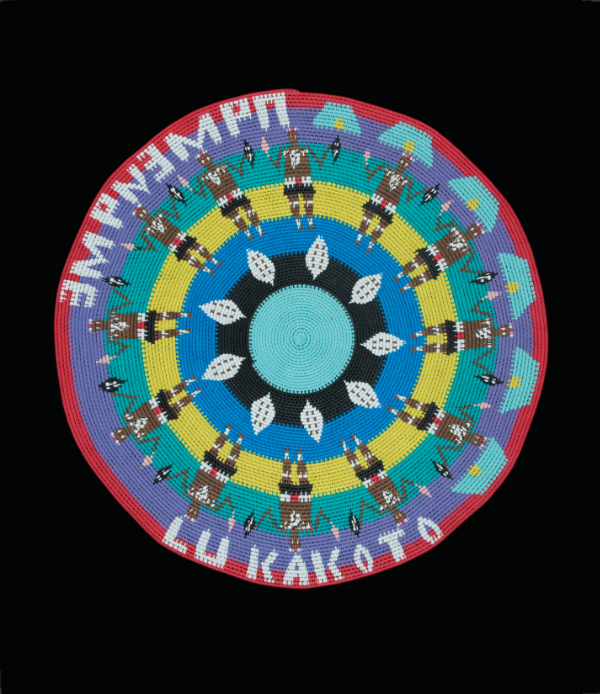
Bheki Dlamini, UdWENdWE LUKAKOTO (The Wedding Party of Koto), 2002. Telephone wire, wire. KwaZulu-Natal, South Africa. Gift of David Arment and Jim Rimelspach, David Arment Southern African 
Collection, IFAF Collection, Museum of International 
Folk Art (FA.2024.12.12) Above: Zodwa Maphumul

This bright and expressive material speaks to a range of Indigenous art forms in what is today KwaZulu-Natal province—the rich embellishment found in historical copper or brass weaving, fiber basketry-weaving techniques, and beadwork color theory. The African Art Centre first sold telephone wire embellished works in the 1980s, and later another nonprofit, the Bartel Arts Trust (BAT) Centre and the BAT Shop, opened in the 1990s, as well as a range of independent galleries supported the sales of telephone wire domestically and internationally. Once Apartheid officially ended in 1994, the diversification of sales points expanded.

In urban spaces, Black night watchmen, employed by white property owners, spent their evenings embellishing the only weapon they were allowed—traditional wooden clubs and sparring sticks. Some of the oldest embellished objects in the exhibition, wooden clubs, sparring sticks, and snuff horns covered in wire, tie wire weaving back to the value placed on metal rods and wire in early Southern African trade routes that have existed since at least the sixteenth century. In the nineteenth century, imported wire was used to wrap sparring sticks and small personal objects. The fine weaving of copper and brass wire on prized nineteenth-century sparring sticks and a rare snuff container—on loan for Weaving Meanings—inspired the earliest telephone wire weavers.

Celebrating Artists Shaping a Nation

Elliot Mkhize, a resident of KwaMashu, was a key figure in the expansion of the telephone wire art form in the 1980s and 1990s, just before South Africa’s emergence from Apartheid. Mkhize trained at the Ndaleni Art School in the 1960s, one of few art schools during Apartheid that trained Black artists. At Ndaleni, Indigenous art forms from KwaZulu-Natal, alongside Western-derived printmaking, painting, and sculpting were on the curriculum. After his formal education, Mkhize, the son and grandson of sculptors, gravitated to Durban’s city center. Mkize became a nightwatchman at the Playhouse Theater across from the city’s history museum and city hall, and near the African Art Centre and other galleries. Other night guards taught him to weave around telephone wire sticks. Mkhize realized that telephone wire might also be used to weave the palm-fiber patterns he had been taught at Ndaleni Art School. He quickly began making small izimbenge (beer pot covers) in bright telephone wire patterns. Mkhize explained in a 1997 conversation with artist and art historian Carol Boram-Hays, “The patterns will just come by themselves while I’m working […] like a dream.”

color photograph of weaving artist wearing and surrounded by her art
Zodwa Maphumulo discussing her career, July 2023. Siyanda, eThekwini Municipality, South Africa. Image courtesy of Zamo Mhkize 
and Gone Fishing Productions.
Weaving artist at home demonstrating her technique
Ntombifuthi (Magwaza) Sibiya demonstrates hard-wire weaving in her home, July 2023. Siyanda, eThekwini Municipality, KwaZulu-Natal, South Africa. Image courtesy of Zamo Mhkize and Gone Fishing Productions.

This narrative, woven by an expert artist and storyteller, claims to be the origin of telephone wire basketry. But evidence of earlier telephone wire basket weaving in the mid-twentieth century, seen in Weaving Meanings, attests to an earlier origin. What Mkhize and others agree upon, however, is that something shifted within the Durban art world at the end of Apartheid. A celebratory and unifying spirit was a part of the tense yet optimistic shift that occurred from 1990 to 1994 as Nelson Mandela, the African National Congress leader who had been imprisoned for twenty-seven years, and F.W. de Klerk, then the president of South Africa, sat down to negotiate a peace accord that led to South Africa’s first election in which all races could legally vote. This 1994 vote and the years after were a moment when telephone wire became a symbol of “The New South Africa.” This phrase—The New South Africa—was used repeatedly and conveyed the optimistic fervor of national and international onlookers alike that peace might prevail.

“Despite his passing in 2020, Elliot is still revered in his neighborhood as a living ancestor, and his presence is still felt,” says Gigaba. “Elliot carried isithunzi sokuhlakanipha (prestige of wisdom) throughout his career as a mentor and teacher. His geometric shapes are a nod to ancient Zulu hierographic writing, as if navigating the past to forge a new abstract language.”

multi-colored round telephone wire weaving
Vincent Sithole. Basket, 2003. Telephone wire, wire. KwaZulu-Natal, South Africa. Gift of David Arment and Jim Rimelspach, David Arment Southern African Collection, IFAF Collection, Museum of International Folk Art, FA.2024.12.214.

Another artist featured in the exhibition, Dudu Cele, created telephone wire works that overtly communicated South Africa’s new branding. Her flag plate hangs in the gallery within a case of several pieces produced in the late 1990s and early 2000s that featured the new South African flag. During the optimistic moment following the peace accord, art centers and galleries in South Africa and abroad catered to a wide range of patriotic South Africans, to tourists who flooded into the newly open South Africa, and to international shops interested in celebrating the design and optimism of the country’s vibrant cultures. The art form of telephone wire flourished in the late 1990s and early 2000s and the love of design, pattern, and intricacy, which is such a driving force in Zulu beadwork and weaving, came to the fore. Artists like Ntombifuthi (Magwaza) Sibiya and her husband Bheki Sibiya, Vincent Sithole, and Simon Mavundla produced work that won a range of national design and craft prizes and that pushed the intricacy of design within the art form to new heights.

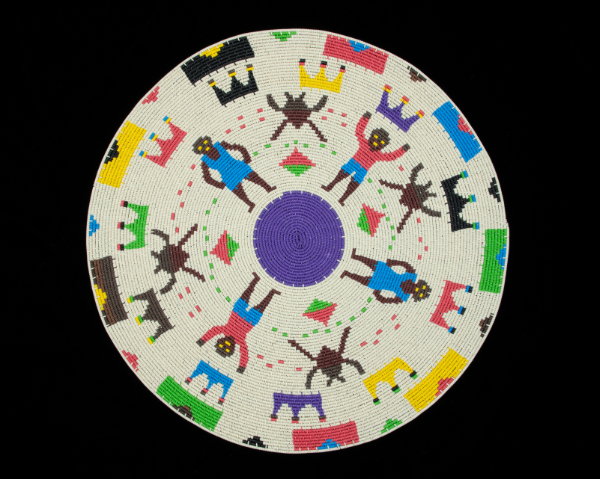
Today, the spirit of community-minded engagement and design innovation endures. New generations of artists have shifted their focus from patriotism to new concerns. Weaving Meanings honors this generational progression. One contemporary artist, Thembinkosi Maphumulo, creates work that reveals a deep concern for the natural world. In one piece, he depicts dung beetles—an indicator species that reflects the health or decline of an ecological zone. Dung beetles speak to both the health of the environment and the community. For Maphumulo, being ecologically minded and upholding traditional values and Zulu identity go hand-in-hand.

Pride in Language and Transforming Culture

The importance of language as a site of pride is clear in the telephone wire artworks from the 1990s, as South Africa emerged from Apartheid. Bheki Dlamini, one of the first generation of telephone wire weavers who was able to turn this art form into a full-time profession, created a basket with the words “Udwendwe Luka Koto” emblazed above a figurative scene. This title translates to “Koto’s Bridal Party,” and is just one of a range of baskets found in the galleries at MOIFA that use woven words to emphasize imagery.

Gigaba observes of the basket, “The composition here is inspired by a [radio] drama series that grappled with social issues and challenges and shifts in the South African socio-geographical landscape following the lifting of South Africa’s unjust land acts. With new mobility, different tensions emerged between Black people who had assimilated into urban spaces as migrant workers with those in rural communities. This inspired a change in lifestyle that ended up affecting cultural practices and traditions such as courtship.”

Dlamini was living in the heart of the neighborhoods featured in the radio drama Udwendwe Luka Koto. He and his peers were the immigrants who flooded in from rural areas to settle in the townships and informal settlements that surround Durban, and he clearly connected deeply with the content of this radio program. The drama engaged with the many cultural norms that were held in rural spaces. For instance, rural marriage was often an ongoing and multi-step process between two families, but when many Black South Africans from a range of backgrounds moved to urban spaces the marital negotiation process and other social norms changed. Udwendwe Luka Koto spoke to these changes and tensions that were growing between rural and urban, old and young. Dlamini reflected his love of this show, and with it the rich and complex realities of contemporary Zulu identity, in his weaving.

multi-colored round telephone wire weaving
Goodman Thembinkosi Maphumulo. Basket, 2023. Telephone wire, wire. Siyanda, KwaZulu-Natal, South Africa. IFAF purchase, Museum of International Folk Art, P.2024.4.20.

At the top of Dlamini’s basket we see light blue trapezoids, each with a yellow spot along its base. These peaked roofs represent thatched homes with entrances. This is a style that has been used by subsequent artists, but Dlamini’s original intent was not recorded during his lifetime. As with most of the first generation of artists, Dlamini passed away without conveying his full message. What is clear is that he depicted a ring of Zulu women, each holding a small spear and miniature shield associated with young women. They wear small headdresses, chest coverings, skirts, and leg bands that are instantly readable to a Zulu audience. Rows of concentric colors emphasize the joyful tone, and near the center, nine white ovoid shapes with eight symmetrical markings appear.

This piece helps us understand that the celebratory baskets of isiZulu-speaking artists, even when made for export, are layered in meaning. To those who know Zulu cultural symbols it is clear the ovoid shapes are shields. The base color of the shields is white, emphasizing the clarity and purity of the young women. It seems that Dlamini had a positive spin on the radio dramas heard in Udwendwe Luka Koto, as the ring of young women conveys both their pride and self-assurance.

The exhibition space for Weaving Meanings emulates a Zulu household’s layout. The isibaya cattle enclosure, a sacred circular space where generational ceremonies take place, forms the center of Zulu homestead. This space is where ancestors are consulted, surrounded by the houses of family members. Likewise, Weaving Meanings features key lineages in its central room. Zodwa Maphumulo, the matriarch of the family; Thembinkosi Maphumulo, her son; and Nobuhle, her granddaughter, are also featured in this central ancestral space.

Telephone wire basketry can be understood as a point of entry into thinking about South Africa’s complex histories, colonial politics, and diverse community contexts. Through a discussion of the creation of an entirely new artistic medium, visitors to Weaving Meanings will see artistic innovation emerge as a means of resistance, nation-building, and cultural pride.

Conclusion

Weaving Meanings rewards close looking. In addition to emphasizing Zulu and South African aesthetics, the exhibition focuses on the complex political, economic, and sociocultural contexts in which these baskets began their lives. Weaving Meanings asks visitors to think deeply and critically about what constitutes “meaning.” A meaning is not simply representative imagery—what we may think of as symbols or iconography—but instead asks visitors to think about meaning as culturally produced and constructed, made real through the actions of both individuals and communities. As artist Zodwa Maphumulo says, “Sometimes, I weave baskets seeking to archive history that would serve as a tangible reference for future generations.”

Thankfully, younger generations from the weaving families of Siyanda and the inheritors of the arts infrastructures of Durban’s city center are ensuring the legacies of telephone wire continue. Although telephone wire can no longer be readily salvaged now that cell phones have taken over the global infrastructure, families custom-order wire and continue this weaving tradition. Nobuhle Maphumulo, Zodwa’s granddaughter, works closely with her extended family. When large orders come in, the Maphumulos divide the work and share the profits. But each artist is also forging their own path. Twenty-eight-year-old Nobuhle browses the internet on her phone to bring in imagery and color combinations that shape her own style. She’s also an aspiring teacher.

From August 17 to 20 of this year, Nobuhle traveled daily into Durban from Siyanda to lead her first class in weaving telephone wire. The course, materials, and students were coordinated by Nozipho Zulu through her business, ZuluGal Retro. Nozipho is a young arts professional who graduated with an art degree from the Durban University of Technology and worked as a Manager at the African Art Centre, the same organization that sold Elliot Mkhize’s wire baskets in the 1970s. Nobuhle and Nozipho are just two examples of the younger generations in South Africa who are continuing the legacy of telephone wire, centering their local experiences and style, and weaving their own futures.

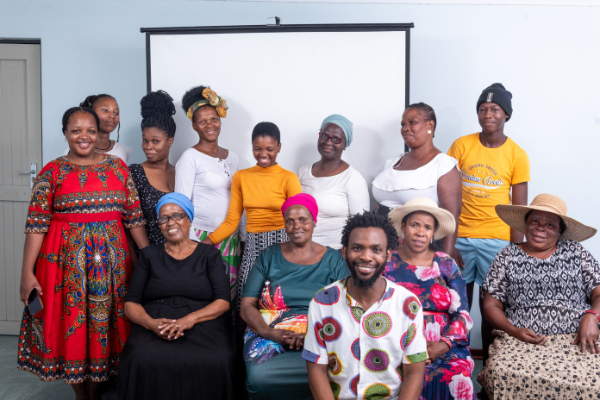
Group photo of workshop facilitators and particpants
Workshop facilitators and participants: Zinhle Kumalo, Muziwandile Gigaba, Princes Dlamini, Bukisile Mkhize, Ntombifuthi (Magwaza) Sibiya, Roslinah Khanyile, Andile Mkhize, Bongeleni Mkhize, Sidisiwe Nzama, Sphiwe Mkhize, Zodwa Sibiya, Lieketseng Dlamini, and Thobeka Dlomo. Kwa Mashu Township, Durban, South Africa, March 27, 2024. Photography courtesy of Muziwandile Gigaba and the Museum of International Folk Art.

An Ongoing Relationship

The David Arment Southern African Collection at the Museum of International Folk Art, donated by David Arment and Jim Rimelspach, was the impetus for Weaving Meanings. Based in Santa Fe, Arment and Rimelspach have been traveling to South Africa for over thirty years. Their extensive travels overlapped with the development of telephone wire as an art form and resulted in a diverse and comprehensive collection that brings together telephone wire works in various creative styles and forms, highlighting both individual artistic agency and collaborative projects. In particular, the David Arment Southern African Collection is an important archive of the works of master weavers no longer with us, such as Dudu Cele (1970-2002), Bheki Dlamini (1957-2003), Elliot Mkhize (1945-2020), Jaheni Mkhize (1953-2009), and Vincent Sithole (1970-2011).

Weaving Meanings is part of MOIFA’s ongoing commitment to generative relationship-building with South African artistic communities. As part of the model of reciprocity at the center of the Weaving Meanings community-focused curatorial practice, an artists’ workshop was held in March 2024. Weaver Ntombifuthi (Magwaza) Sibiya and others had called for artist training focused on documenting artworks. Though it was not part of the original exhibition purview, the MOIFA team facilitated a professionalization workshop. Muziwandile Gigaba and Zinhle Khumalo, an arts workshop facilitator working with the arts professional development start-up curate.a.space based in KwaZulu-Natal, led an on-site program, “Empowering Artisans: Weaving Dreams Workshop.” The goal of the workshop was to nurture artists and focus on the specific skills of photographic documentation, building an online presence, developing a business network, and writing artists’ statements and biographies. The team is currently developing educational materials that will be shared directly with South African educators to support Indigenous arts curricula.

Dr. Elizabeth Perrill is professor of Art History at the University of North Carolina at Greensboro and the guest curator of iNgqikithi yokuPhica/Weaving Meanings: Telephone Wire Art from South Africa at the Museum of International Folk Art. This article was written with extensive editorial input from the community curator and lead Indigenous knowledge expert for iNgqikithi yokuPhica, Muziwandile Gigaba, a multimedia artist and oral storyteller based in KwaMashu Township, Durban, South Africa, and Lillia McEnaney, a museum anthropologist and independent curator. McEnaney is also the assistant curator and project manager for iNgqikithi yokuPhica at MOIFA.

Elizabeth Perrill (opens in a new tab) is professor of Art History at the University of North Carolina at Greensboro and the guest curator of iNgqikithi yokuPhica/Weaving Meanings: Telephone Wire Art from South Africa at the Museum of International Folk Art. This article was written with extensive editorial input from the community curator and lead Indigenous knowledge expert for iNgqikithi yokuPhica

Lillia McEnaney (opens in a new tab) is a museum anthropologist and independent curator living and working in Santa Fe, New Mexico. Lillia is an assistant professor of museum studies at the Institute of American Indian Arts. Her ongoing projects include collaborations with the School for Advanced Research Indian Arts Research Center and the Navajo Nation Museum. Lillia is co-editor, with Dr. Jennifer Nez Denetadle (Diné), of “Our Livestock Will Never Diminish” / “Nihinaaldlooshii doo nídínééshgóó k’ee’ąą yilzhish dooleeł:” Breathing Life into the Photography of Milton Snow Across Diné Bikéyah (University of New Mexico Press, 2026). Previously, Lillia was assistant curator at the Museum of Indian Arts & Culture, director of the Hands-On Curatorial Program at the Ralph T. Coe Center for the Arts, and adjunct instructor in Lehigh University’s Department of Art, Architecture, and Design/Semester in the American West. She holds an MA from New York University and a BA from Hamilton College.

Muziwandile Gigaba (opens in a new tab) a multimedia artist and oral storyteller based in KwaMashu Township, Durban, South Africa

Collaborative Listening in a Time of Emergency:

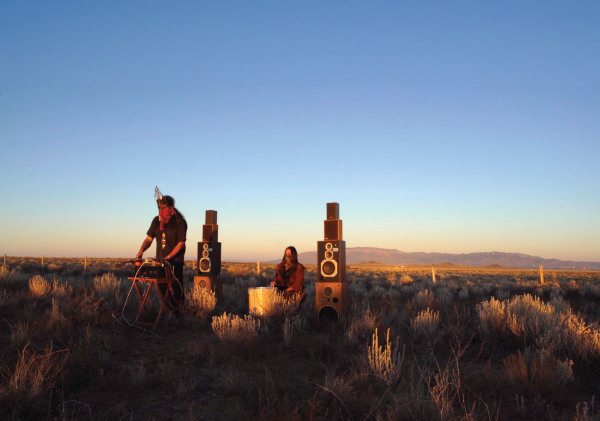
Seated in a circle, the crowd patiently waited for the sold-out performance to begin. A static image of the Navajo Nation’s volcanic Church Rock was projected onto a white wall in a dark room. There was no podium. No mic stand. No stage. Raven Chacon and Candice Hopkins sat side-by-side in the circle. The performance began as the image moved and seemingly pulsated. Chacon grunted and breathed heavily with the volcanic rock. The visual movement and sounds illustrated the life of the sacred formation on Navajo Nation land.

In January 2024, SITE Santa Fe and the MFA in Studio Arts Program at the Institute of American Indian Arts presented Dispatch, a score by Pulitzer Prize-winning composer and artist Chacon, and internationally distinguished curator and writer Hopkins. The score is Chacon’s and Hopkins’s collaborative response to the Water Protectors’ defense of Standing Rock during the 2016 No Dakota Access Pipeline (#noDAPL) movement.

In his introduction, Dr. Mario A. Caro affirmed that Indigenous art “transforms, circulates, and lives with us,” and said that Hopkins and Chacon are leading the way in defining contemporary Indigenous arts. Their work is collaborative as professional artists and as life partners. I knew Hopkins as a writer and curator, and Chacon as an artist and composer, but I had not thought of them as collaborative artists until this performance. Hopkins is a citizen of Carcross/Tagish First Nation and originally from Whitehorse, Yukon, Canada. She is the director of the Forge Project in Taghkanic, New York, and a fellow in Indigenous Art History and Curator Studies at Bard College, along with curating seminal exhibitions worldwide. Chacon is from Fort Defiance, Navajo Nation, and received a 2023 New Mexico Governor’s Arts Award and a 2022 Pulitzer in music for his composition Voiceless Mass.

diagram
Raven Chacon, Dispatch, Schematic #1, 2020.
diagram
Raven Chacon, Dispatch, Schematic #2, 2020.

In Dispatch, Hopkins, Chacon, and three Institute of American Indian Arts (IAIA) MFA students, Kimberly Fulton Orozco, Ursula Hudson, and Mekko Harjo, along with artists and musicians Heather Trost and Laura Ortman, wove together images, sonic and visual artifacts, archival documents, and live music—which included violins, drums, singing and disruption, and even snacks (coffee and cake). Throughout Dispatch, Trost and Ortman played the violin, which enhanced the material and challenged the audience to listen closely. While Chacon and Hopkins seemed to have a structured script, it was unclear if the musicians were playing from memory or improvising. As a whole, the performance carried both the carefully timed flow of images and performers while also inserting moments of levity, jokes, and instrumental jazz-like qualities, which conveyed a mindful, purpose-driven momentum.

“Dispatch” means “to send off to a destination or for a purpose,” so instead of a traditional program, the audience was provided a zine-like booklet that offered guidance, reflection, and dialogue. Unfolded, one side had a black-and-white photo of Church Rock. The other side included a Coda with dispatches and prompts. The Coda explained how in 2016, a delegation of five women, Dr. Sarah Jumping Eagle, Wasté Win Young, Tara Houska, Autumn Chacon, and Michelle Cook, uncovered the funders of the pipeline (from banks to private corporations) and made a public call for them to divest. They traveled to Norway and Switzerland in 2017 to meet with banking personnel about the detrimental impacts of investments on community land and the violations of Indigenous rights. The Norwegian bank, DNB, decided to completely divest, but others have “yet, to heed their call.” The program invited engagement with the score’s objective: To think critically about the #noDAPL movement and how it can inspire other communities to dispatch action for other land, human rights, or social justice concerns.

artists performing in desert wilderness
Raven and Candice performance of Rift Transcription, 2020. 
Courtesy of the artists

Instead of a traditional three-act structure (setup, confrontation, resolution), Chacon and Hopkins arranged an alternate three-act composition: The Call, The Gathering, and The Aim. Each dispatch served as an open invitation or dialogue with audience members to inspire action in their own communities. Just as live performance or music changes with context, they imagined this score to be “enacted in the real world.” In the call to action, Chacon and Hopkins prompted a critical examination of the players (people needed to generate attention), such as those on the front line, including reporters, politicians, artists, protestors, and spiritual leaders. The Aim asked for a critical examination of the action: What is needed, what is the leadership model, and what are the risks? These three dispatches were included in the zine and addressed in the performance through observations from the field, artifacts like historic documents, or storytelling from family, friends, and oral traditions.

About halfway through the performance, Chacon read from the 1969 bulletin manifesto, Indian Theater: An Artistic Experiment in Progress, created by IAIA director Lloyd Kiva New and drama/dance instructor Rolland Meinholtz. Projected pages from this document explained that an evening of “Indian theater” would present a series of short events that “would have an emotional pattern, but not necessarily an intellectual cohesiveness.” While Dispatch as a score included sound and music, the non-linear form was driven by emotion-filled harmonics and rhythms that took the audience on varied listening journeys and expanded on the 1969 ideas and model.

Throughout, I found myself at times completely present with the images and documentation presented, and at other times the performance opened space for me to get lost in my familial and community reflections. The score asked the audience to listen to field recordings of Standing Rock and the Water Protectors, participate in moments of call and response, and critically engage with written excerpts from artists and scholars like Fred Moten, Dylan Robinson (Stó:l/Skwah), and Pauline Oliveros that were read aloud. Like Indian Theater, Dispatch highlighted the ways communities have the power to cultivate their own ceremonies and rituals.

color photo of man and a woman in front of mesa formations of monument valley
Candice Hopkins and Raven Chacon in Monument Valley, Arizona. Courtesy of the artists.

Hopkins, Chacon, and the other performers cultivated a socio-political performance that engaged all the senses. Hudson’s live drumming and singing explored personal memories and she invited the audience to participate by humming and singing along with her, and most did. As friends and folks around me began to participate, there was an active awareness of a powerful collective harmony. Harjo then entered the space, claiming to be late, and asked the audience to help him bring in a table, cake, and coffee. Many audience members weren’t sure if they were allowed to get up until Harjo and Hopkins announced a snack break. I used this time to get up and stretch and hug a friend. During the ten-minute break, people were able to move their bodies and stand in the center of the circle with food and friends. Unlike most academic talks or performances, this invited the audience to break the fourth wall and physically enter the circle. Hopkins and Chacon understood the whole space and performance as a stage, and this moment invited the audience to participate in a shared experience as performers.

Dispatch forced me to think critically about performance and how we are always—consciously or unconsciously—engaging in a mode of performance. Even as members of an audience, we embody certain ideas of performance expectations and roles. Chacon and Hopkins asked us to disrupt our ideas of those roles and invited us to be active, sing along, get up at the mid-point to stretch the body and eat, and mix poetry with academic scholarship and visual/audio artifacts. At the beginning of Dispatch, the room was dark as Hopkins stated: “Raven describes music as beauty lining up with other beauty. … It’s the universe reminding you that it’s listening to you. It might be repeating sounds, it might be overlapping sounds, it might be a ceremony of sound to break the spell or convention of time that we’ve been forced to adhere to. Music is the basis for everyday ceremony, just as art is the basis for every ritual.” While Hopkins provided this definition, I could hear Trost and Ortman playing the violin but could not see them. Chacon’s expansive experimental definition of the musical score mirrored this, inviting us to expand our ideas of what music is.

Hopkins and Chacon met in 2010 in Winnipeg, Canada, at Plug In Institute for Contemporary Art. Hopkins co-curated the exhibition Close Encounters: The Next 500 Years with Lee-Ann Martin (Mohawk), Jenny Western (European, Oneida, and Stockbridge-Musee), and Steve Loft (Mohawk, Jewish), and invited the collective, Postcommodity, which at that time comprised Chacon (Navajo), Kade L. Twist (Cherokee), Nathan Young (Delaware/Kiowa/Pawnee), Steven Yazzie (Laguna/Navajo), Before the exhibition, all the artists and curators participated in a month-long residency. This residency culminated with the exhibition, Hopkins’s and Chacon’s first collaboration.

photograph of a pirate flag on a camper with a blake's whataburger sign and 96.9 fm painted on it
Fort Lotaburger at #noDAPL Water 
Protector encampment, 2016. Courtesy of the artists.

At the Plug In Institute, more than thirty international Indigenous artists were interrogating and responding to what the next five hundred years could look like for humans. The Close Encounters program stated that these Indigenous artists were “radically reconsidering encounter narratives between native and non-native people, Indigenous prophecies, possible utopias, and apocalypses.” The exhibition invited Indigenous artists to engage with the “speculative, the prophetic, and the unknown.”

Chacon participated in Close Encounters as a member of Postcommodity, a collective of “proud descent of the American Indian self-determination movement that seeks to contribute to the larger postcolonial Indigenous narrative of social, cultural, political and economic perseverance.”

“To be honest, I had never seen people work together in the way Postcommodity was collaborating, which was really intriguing,” Hopkins says. “I was intrigued by the space of experimentation. I was interested in the visual arts experimentation but had never seen experimentation so profoundly within music.”

While Close Encounters was the professional crossroads at which Chacon and Hopkins met, it was also the beginning of their life-partnership origin story.

Detail of camper with handpainted lettering that says indian land
Fort Lotaburger installed at Off Lomas, 2017. Courtesy of the artists.

Hopkins shares that one night when Postcommodity performed a set, “It was kind of amazing, they had a homemade amp and speaker, and they burned the speakers. At the end of the set, there was a ring of fire.” Throughout the residency, they spent more time together and Hopkins credits Chacon for “wowing” her with his karaoke skills of a David Bowie cover. Chacon claims Hopkins was and continues to be “the most brilliant person I’ve ever met.”

Their relationship developed further outside the residency, and they ultimately relocated to Albuquerque. As they continued to advance their individual art careers, they also continued to collaborate.

“Before I knew Candice, I was very nomadic and constantly on the road,” Chacon says. “Ever since I left CalArts, I was always town-to-town. In a lot of ways, I am still, but I think it has lined up with the ways Candice’s life had also been […] but for me, now, I am able to move with her.”

Both attribute their professional and personal successes to the places that they come from and the communities they’ve built. Hopkins explains, “Beyond us, we have incredible family and community. Raven’s family is amazing—his mom, dad, and grandparents are all incredible people. On my end, I like to say I come from a long line of really tough women. So, our worldviews really align, and we have a lot of support from extended relations. We cannot do this on our own because we live a fairly unconventional life.”

In December 2015, Chacon and Hopkins transformed an empty lot that was left by the construction that widened Lomas Boulevard in Albuquerque into a space that has hosted experimental artists and projects ever since. Their space, Off Lomas, hosted Battle at Fort Lotaburger byIndigenous artists Autumn Chacon, Fish Water, and Eugene Yazzie in November 2017. This sound installation and radio broadcast highlighted the experience from the frontlines of the Water Protectors at Standing Rock during the #NoDAPL movement, which is also referenced in Dispatch score. These audio recordings include the sonic layers of the place, which include singing, bullhorns, police, prayers, and drones from the front lines.

While Hopkins and Chacon have different careers, they each critically and creatively support the other’s daily practices, often reading or listening to each other’s first drafts of ideas or projects.

color photograph of the artists in conversation
Candice Hopkins and Raven Chacon. Courtesy of the artists.

Chacon’s worldview and Diné teachings have shaped his role as a supportive partner to Hopkins. “I learn from Raven about composition, about timing, about expanding definitions of music,” Hopkins says. “And one of the things I can do is translate—curate and work through ideas.”

For Chacon, Hopkins’s perspective as a curator influences his thinking about the informal ways he organizes artists, musicians, and projects. “I’ve never considered anything I did in the past curating, and I’m not sure that I still do, to the level that a curator works, but I’ve been able to understand [that role in] the smaller projects I’ve done like running a label, DIY space.” Like a curator, Chacon connects larger themes and communities for a shared vision.

Dispatch is the third score Hopkins and Chacon have collaborated on. In 2014, they co-wrote Score for Marginal Objects; in 2017, they co-wrote Score for Hearing Voices. When collaborating on these scores, there is “reciprocal critical thinking,” Chacon says. Together, they “consider all the possibilities” and then test and challenge it with their community. While writing, Chacon shared that they both ask themselves, “One, what are we trying to say? Two, is it important to say? And three, can it actually be realized?”

Dispatch started with conversations after coming back from Standing Rock in 2016. For Chacon, the experience at the encampment was surreal and profound and he was struck by the many different sounds that emerged from so many people living and protesting together at Standing Rock. “I’d been thinking through my experience there in a sonic analysis, I suppose,” Chacon says.

In 2020, Hopkins and Chacon were scheduled to collaborate with environmental art organization Liquid Architecture in Melbourne, Australia, but the trip was canceled due to COVID-19. Both Hopkins and Chacon had planned to use that time to work on a score based on the #noDAPL movement and response to Standing Rock.

Home-bound in New Mexico, they had to reorient their approach to the project. In the early months of the pandemic, they often took long drives where they practiced and exercised different listening methods. The concept of “deep listening,” coined by composer and performer Paulina Oliveros, was something Hopkins and Chacon reflected on. Dispatch is featured within The Center for Deep Listening, an organization that provides workshops and retreats for the practice of deep listening. “In order to deep listen, you can’t cancel out the sounds you don’t want to hear,” Hopkins says. When Chacon returned from Standing Rock, he asked, “How do you listen in times of emergency, when you don’t have the privilege of silence, or your life might be under threat? How do you hear in those times?”

Chacon and Hopkins both wanted to think about how Dispatch could be re-imagined for other scenarios and places outside Standing Rock. The idea for creating an adaptable score came when Hopkins and Chacon visited Coaxial, a multi-disciplinary media arts organization in Los Angeles. A visiting musician from Melbourn shared stories of activism there to protect sacred trees that were threatened by freeway expansion. For Dispatch, Hopkins and Chacon thought about the conditions and the players, but also how the score could be transferable, which is why Dispatch has three parts (The Call, The Gathering and The Aim). Part of their process included writing down experiences and then brainstorming prompts and transposing them onto other contexts—such as other environmental sites that were under threat or even Confederate monuments that still need to be removed.

When they collaborate, Chacon and Hopkins are weaving in their communities, too. In writing Dispatch, they invited collaborations from Cannupa Hanska Lugar and other musicians to explore the composition further. As Hopkins shared during the score, with violins playing softly underneath her voice, “The politics of colonial entanglement offer the possibility not only to hear but to listen to their silences as well.”

“When people have historically been silenced, […] there are things that need to be said, there are things that need to be confronted,” says Chacon. Both Chacon and Hopkins shared ways they examine listening and the ways they listen to the land, in addition to examining what worldviews threaten the land. They both remind us of this in the zine and in their spoken words when they perform in Dispatch. “Rocks have harmonics, resonated frequencies. They are also deities, lives begun millions of years ago, witnesses to the formation of the earth,” says Candice. 

color photograph of three individuals
Candice Hopkins and Raven Chacon with land rights activist and member 
of the American Indian Movement, Phyllis Young. Courtesy of the artists.

 Chacon and Hopkins shared that collaborative feedback from trusted community members, including other artists, musicians, and students was part of the process of writing a score. Improvisation is at the “heart of resistance movements,” Hopkins states, “It can be the place where all songs are welcome, where all rhythms are accepted.” As with any live performance, no performances will ever be identical.

Chacon and Hopkins are sounding boards for each other and continue to find ways to support one another’s careers. Hopkins shares, “My role in this world is to be a conduit and offer people platforms.” As individual artists and collaborators, both Chacon and Hopkins illustrate that the objective is not simply about the product, but the process of the work.

At the end of the Dispatch, I remember sitting still before turning to a homegirl who said, “Damn, they collaborate as artists and still have to live with one another.” We shared a laugh. Later, when I asked them how they weave ideas of deep listening into their daily practice and partnership, Hopkins admitted, “the truth of the matter is we don’t always listen as well as we should.” However, they both affirmed that they are committed to a shared vision and exploring how to be better listeners within their practices.

“One thing we share, at the end of the day, is that we’re very positive about art and what artists are doing,” Chacon says. “And the potential of art and what it can do,” adds Hopkins. Chacon continues, “We believe in art, and we believe in artists.”

Joelle E. Mendoza (JEM) is an Indigenous-Chicana artist and writer based in East Los Angeles. JEM holds an MFA in Fiction and Screenwriting from the Institute of American Indian Arts. She also works with clay and adobe along with contributing to local Native gardening practices and collectives.

Joelle E. Mendoza (JEM) (opens in a new tab) is an Indigenous-Chicana artist and writer based in East Los Angeles. JEM holds an MFA in Fiction and Screenwriting from the Institute of American Indian Arts. She also works with clay and adobe along with contributing to local Native gardening practices and collectives.

Imagination as Necessity

I’ve been thinking a lot recently about the power of imagination. It’s incredible to me that humans can create something tangible from a dream. Although many of us have access to infrastructure like roads and indoor plumbing—to name two basic ones—these things we take for granted were brought into being by imagination. Our imaginations have created nearly everything around us, from paintings and forms of dance to technologies and new forms of collaboration.

While much of art and technology is judged by its market value, I invite readers to consider two older, enduring motivations for creation: necessity and expression. In this issue of El Palacio, readers will find abundant inspiration from the myriad ways personal and political histories can spark a creative response that deepens our understanding of the past and encourages us to think outside the box when imagining the future.

When telephone lines were installed across Apartheid South Africa, Zulu weavers began to use coated telephone wire to create new art forms.The innovation that came from the expansion of telephones led to a burgeoning craft that continues forty years later. iNgqikithi yokuPhica/Weaving Meanings: Telephone Art from South Africa, on view at the Museum of International Folk Art in Santa Fe, features this art along with stories of the weavers and the cultural meaning imbued in their work.

For Tiffany Sánchez, a New Mexican farmer who lives with disability, access to adaptive equipment helps her continue to ride and work with horses. Sánchez is one of many farmers across the country who can continue to pursue their passions and maintain their livelihoods due to the innovations that provide greater access and mobility. AgrAbility, an exhibition at the New Mexico Farm & Ranch Heritage Museum, showcases stories of farmers and ranchers who have benefited from assistive technology.

Whether reckoning with personal or historical trauma, interrogating contemporary dilemmas, or creating new worlds and futures, science fiction integrates reality with imagined possibility. Contributor Timotéo Montoya invites readers to consider the pragmatic idealism offered by the artistic movement of Indigenous Futurisms in a piece about the Sci Fi & Sci Fact: New Worlds Collide exhibition at the New Mexico Space History Museum in Alamogordo. Oceanographer and author Darcie Little Badger (Lipan Apache) is one Indigenous Futurisms writer who weaves an understanding of the past with an expansive view of possible futures through her science fiction.

For Nikki Nojima Louis, who watched the FBI handcuff her father, Santa Fe loomed large in her imagination. Her father’s imprisonment at the Santa Fe Internment Camp shaped her relationship with him. At seventy, she came to New Mexico to learn about her father’s experiences. Learning that the Japanese American men in the camp grew eggplants was one of many entry points for Louis as she researched family stories so integral to national history. Louis’s plays and documentaries are an act of creativity that weave personal and political and serve as a bridge between past and present.

Curator Candice Hopkins and composer Raven Chacon have also harnessed the power of imagination in their life partnership and artistic collaborations. Their collaborative score, Dispatch, models the disruption of established roles and offers a vision for the possibilities inherent to community resistance and resilience. They have found that deep listening makes these acts of radical imagination possible.

In response, I offer my own invitation: When you read about the power of innovation and creativity in the pages of El Palacio, what are you moved to imagine into being? I hope you’ll share it with us.

Emily Withnall (opens in a new tab) is the editor of El Palacio and the host of Encounter Culture. Prior to stepping into the editor role, she wrote for the magazine for eight years. Emily has also been published in The New York Times, Al Jazeera, High Country News, Orion Magazine, Tin House, The Kenyon Review, Gay Magazine, Source New Mexico, and other publications. She lives and writes in Santa Fe, New Mexico.

Dancing Back to the Desert

I follow Jock Soto across the TV screen, measuring his movements in lengths. The length of an arm, reaching out, every finger engaged with emotion. The length of his neck as his head looks skyward, his black hair blending into the stage, his brown throat exposed, veins pulsing. The length of his legs fluttering through the air in a moment of ethereal flight. The length of his torso bending to the side like a crescent moon. The length of his career with the New York City Ballet (NYCB): twenty-four years.

And then, the house lights are on and covering the stage where only moments ago Soto soared through the air like a dove, are hundreds of rose petals.

It’s a Sunday in June 2005, and Soto has just danced his last ballet as a principal of the NYCB. The program, Dance at the Gym, features ballets by five different choreographers—Jerome Robbins, Peter Martins, Christopher Wheeldon, Lynne Taylor-Corbett, and George Balanchine. Here, Soto takes his farewell bow before retiring at age forty, as ballerina Wendy Whelan, Soto’s longtime dance partner, whispers, “I love you.” Backstage, he embraces his parents, Josephine Towne (Diné) and José Soto (Puerto Rican), whose unyielding support set him on this path thirty-five years ago in a strip mall two thousand miles away in Phoenix, Arizona.

Black and white photo of a ballet class with a principal dancer and seated dancers in background
Jock Soto, age 16, rehearsing for the final performance of The Magic Flute, choreographed by Peter Martins with the School of American Ballet, 1981. Soto was selected by George Balanchine to join the New York City Ballet two weeks later. Photo: 
@Steven Caras, all rights reserved.

Today, Soto resides in Eagle Nest, New Mexico, with his husband Luis Fuentes in a home he had built for his parents with design input from his mom. He is still widely recognized as one of his generation’s most accomplished and influential male ballet dancers. In 2017, he received the New Mexico state Certificate of Appreciation for his contribution to the arts, and he is a recipient of the 2024 Governor’s Arts Awards. His illustrious career with the NYCB and the bittersweet night of his final performance are all captured forever in the documentary Water Flowing Together by Gwendolen Cates, in which his late mother recalls having several false labors with Jock because, she theorized, he was dancing in her belly.

Color photo of man with black hat on a typically New Mexico portal or porch
Jock Soto poses at Bishop’s Lodge in Santa Fe, following Indigenous Fashion Week, 2024. Photo by Todd Muchow.

“She often said that, and I didn’t believe her!” laughs Soto. “But I had an accident where I was in the hospital, dancing, apparently, in the bed, and they had to tie down my hands and wrists because I would just kick and do all this stuff. So yeah, now we believe that I was dancing in her womb.”

For the past fifty-nine years, music and dance have been a constant in Soto’s life. Born in Gallup in 1965, he spent his early childhood on the Navajo Nation, where he began hoop dancing with his mother at three. “My grandfather was known as a famous drummer and singer,” says Soto. “He’d take my mother and me out to the front of their little shack on the reservation, and he taught me how to dance. He’d say, ‘Follow your mom,’ and I was just like, ‘Oh, my God, I love this!’ And he would play and sing while we danced.”

His grandfather made Soto hoops to dance with, and he still remembers dancing with his mother at rodeos, intertwining intricate choreography with her for the cheers of the crowd. Amid the heartbeat of the drum, the dust from moccasins gliding on the desert floor, and the life-affirming symbology of the hoop, Soto garnered his first understanding of rhythm, performance, physical and spiritual balance, and using his body to tell a story.

“My mom was the first Navajo woman who did the hoop dance because it was always done by male dancers,” he says. “I tell my students now, I say, ‘Before you even walk into the studio, you have to think about what you’re going to learn and how you present yourself.’ I think a lot of it has to do with my heritage. I have had that awareness since I began hoop dancing at age three.”

Black and white photo with a young boy, and two adults
Young Jock Soto with his parents, José Soto 
and Josephine Towne on the rodeo circuit in pre-New York days. 
Photo courtesy of Jock Soto.

The Soto family spent time on the powwow circuit, performing the hoop dance, selling crafts and fry bread, and living by modest means. And then one day in Chinle, Arizona, George Balanchine’s 1967 ballet, Jewels, crackled through the TV set and Soto’s world was forever changed. He was captivated by the weightlessness and masculinity of dancer Edward Villella, whom he calls his idol, as he lifted ballerina Patricia McBride through the air. “I saw that ballet on television, and I walked to my mom’s bedroom at five years old, and I said, ‘That’s what I want to do!’” says Soto.

In the 1970s, boys learning ballet was practically unheard of in rural Arizona, but his parents found Soto a school ninety minutes away in Phoenix. He was the only boy enrolled and after auditioning was given a scholarship to attend. It quickly became apparent that Soto possessed a rare gift, and his teacher urged him to apply to the School of American Ballet. At just thirteen, Soto was accepted into George Balanchine’s prestigious New York City school with a scholarship from the Ford Foundation.

With a rare and life-changing opportunity across the country in what may as well have been on a different planet from the tinkling bells of sheep corrals, warm scent of fry bread cooking on a wood stove, and sprawling red earth of Diné Bikéyah, his parents were met with a difficult decision. There was no way the Soto family could afford to live in New York City, so in an act of sheer faith, they left him on his own in the biggest city in the U.S. He called Manhattan home for the next thirty-eight years and remembers lying about his age to rent an apartment with other boys, pretending to be an understudy to sneak into theater wings and watch the NYCB, and giving up correspondence classes to focus on ballet full time.

“I survived with five other students, and you know, if we needed to borrow fifty cents for a hot dog, that’s how we ate,” he recalls. “But, my whole passion was to be in the studio with my teacher. That’s all I lived for. That’s all I wanted to do. When George Balanchine took me into the [NYCB] company, I was like, ‘I’m good now, everything’s good. This is my life.’ And from then on, until I retired at forty, that was my life.”

Despite having what is considered an atypical dancer’s body, Soto’s discipline and inherent talent landed him a spot in the NYCB by age sixteen.

“The directors that I worked with believed in me because I actually worked every single day for twelve hours a day. I didn’t have the body or the technique or the physicality that they had, and I wished every single day that I could look like them. I had to make myself look like them; that was my goal. Somehow, my directors saw my drive,” he says.

Black and white photo of a two principal dancers during a performance
Jock Soto and Heather Watts in ballet performance Ecstatic Orange, choreographed by Peter Martins, 1988. Photo: @Steven Caras, all rights reserved.

While Soto’s exceptional technique, powerful stage presence, and unique ability to blend strength with fluidity made him a standout performer, it wasn’t without intense physical and mental challenges. He remembers dancing early on between two male ballet dancers and comparing their bodies to his. At the time, he didn’t believe his body was as “exceptional” as his peers’ but resolved to work until it was.

“Sometimes I’d go home, and I’d just be crying, and I would think, ‘Why are these people treating me this way? Why are they picking on me? Is it because I look different?’ I questioned myself all the time. But my whole life was walking into that theater and walking out happy and proud,” says Soto. “My director at the time, after George Balanchine died, said he was going to promote me, but, and you could say this back then, he told me ‘You’re too heavy.’ Two weeks later, I had lost fifteen pounds because I thought if I want to be on stage, and if I want to dance like them, I have to become what these people [the audience] are paying for. It was a huge deal for me because I was eighteen, and two weeks later, I was promoted to a principal dancer, one of the leads, and I thought: this is what it takes now.”

Throughout his illustrious career with the NYCB, Soto became known for his versatility and artistic depth. He performed an extensive repertoire that included classical and contemporary works, collaborating with some of the most renowned choreographers of the twentieth century, including George Balanchine, Jerome Robbins, and Peter Martins. He danced feature roles in over forty ballets, many created specifically for him. His interpretations of Balanchine’s works, in particular, were highly praised, as he brought a unique sensitivity and understanding to the complex choreography.

“It’s a hard career to have, but the strength that my mother gave me is what made my career, I think,” says Soto. “I never, ever thought that I would be famous, and when people announce my name and say, ‘the famous whatever,’ I’m just like, ‘No, I just did what I needed to do.’”

Black and white photo of a ballet rehearsal
Peter Martins, Katrina Killian, and Jock Soto rehearse for 
The Magic Flute at the School of American Ballet, 1981. Photo: © Steven Caras, 
all rights reserved.

Soto’s ability to partner with renowned ballerinas such as Heather Watts, Darci Kistler, and Whelan also earned him praise for handling tricky, breathtaking lifts with confidence. He attributes the ability to create sensuous and romantic stage relationships to getting to know the ballerinas on and off the stage.

“We would end rehearsal, go have lunch, and we’d talk about everything that they were going through, what they were interested in, or what I was going through. So, if I was dancing with somebody that I didn’t know much about, I’d want to get to know them better because I wanted to bring that to the stage,” says Soto.

While Soto is gay, he found that sharing a type of intimacy with his dance partner was essential. “There was one ballerina who I danced with a few times, who was a lot younger than me. I got frustrated because she was frustrated. I said, ‘Imagine that we’re having sex.’ I said, ‘This is about movement.’ It made sense to her, how every step you take has to be important. I said, ‘You have to think about how I’m putting your foot down on the floor.’ And guess what? That night, she brought the house down, and I say ‘she’ because she understood how I was moving and how I was doing all this stuff and manipulating her.”

In the nineteen years since retiring as a dancer, Soto has enjoyed a second act as a choreographer and instructor. He became a faculty member at the School of American Ballet, before permanently relocating to New Mexico, where he now teaches and choreographs for Ballet Taos and Festival Ballet Albuquerque. He was also a guest instructor at the Jillana School, an intensive summer dance program in the Taos Ski Valley, which closed during the pandemic.

Soto says he never expected to be a teacher or choreographer, but the great teachers he had inspired him to carry on the torch. “My life right now is going towards trying to inspire kids and dancers and show them and talk to them about what I’ve gone through,” he says. “You cannot walk into a studio of whoever you’re teaching or choreographing […] as a tyrant because people are scared of you already. I’m just trying to pass on what I’ve learned. And I can’t pass on what I’ve learned in negativity.”

In a dance studio at the Jillana School in 2019, a room of young ballerinas giggle as Soto corrects their technique or reminds them of their steps. “OK, that was really bad,” he says with a laugh, his voice soft and patient. The piano picks up, and the girls try again while Soto walks the room clapping the rhythm, a huge, proud smile across his face.

Steven Caras (opens in a new tab) began studying ballet at the age of fifteen. Three years later, he was invited to join the New York City Ballet by its founder, the legendary George Balanchine. Noting Caras’ inseparable bond with his used Olympus camera, Balanchine granted him full access to document all aspects of company activity – a world few were privy to. His mentor’s encouragement planted the seed that would grow into a second career for Caras. For more than four decades, his work has continually appeared internationally in prominent publications, films and documentaries, exhibitions, and private collections.

Ungelbah Dávila (Diné) is an award-winning writer and photographer from New Mexico. She spent her first twelve years in rural New Mexico on her father’s cattle ranch in Mangas, and mother’s property along the Gila Wilderness and San Francisco River in Reserve, New Mexico. Ungelbah received her BFA in Creative Writing from the Institute of American Indian Arts and launched La Loca Magazine during her time there. She began self publishing La Loca with national distribution from 2013-2015 while working as a copyeditor and journalist at the Valencia County News Bulletin (2011-2012) where she was awarded the National Newspaper Association Award: Best Serious Column & Best Breaking News Story (2013).

We are in the Mountains and Skies

The New Mexico Museum of Space History is perched where the steep foothills of the Sacramento Mountains are flattened by gravity and erosion. The building is flared at the base as if a rocket were hidden at its foot, ready to blast into the sky. The museum rises four stories higher than most buildings in Alamogordo. From the windows of the third story, where the Sci Fi & Sci Fact: Two Worlds Collide exhibition is tucked in the corner, you can see a large swath of the Tularosa Basin—the infamous White Sands and the San Andres Mountains filling the horizon. 

As I turned from the windows and wove my way down the carpeted ramps of the museum, a familiar sense of awe fell over me. I felt this same awe as an eight-year-old, curled up next to my father as we watched the camera pan from a sea of stars toward an Imperial Cruiser. I felt it again the following summer at Space Camp, where I launched a vinegar and baking soda rocket to rousing cheers. It is the same awe I felt as a young college student when I learned how precise the Sun Dagger was at Chaco Canyon. And I feel it today when I read stories of Indigenous Futurisms.

I departed Del Rio, Texas, at dawn, ensuring I could get to the exhibition before the museum closed. On the long drive, I watched the landscape outside my window shift from limestone deserts of ocotillo and sotol to grasslands pinned by yucca and piñon, and finally to mountain canyons of cottonwood, ponderosa, and aspen before dropping down into the creosote heat of the Tularosa Basin. These are the lands my people, the Lipan Apache, traversed countless times. Human hands, feet, and imaginations have shaped these lands since time immemorial. From these lands humanity has continuously sought the stars, first through archeoastronomy observatories atop the Sacramento Mountains, then through twentieth-century White Sands missile tests that enabled both the unprecedented destruction of the atomic bomb, and the launching of early space exploration satellites.

I made my way down the ramp that led to the Sci Fi & Sci Fact exhibition, where defunct satellites hung from the ceiling above me, their polished aluminum and steel bodies reflecting star-like under the harsh halogens. Movie posters that defined my adolescence plastered the walls—Star Wars, The Planet of The Apes, and Starship Troopers. Adjacent to a stunning display of spacesuits from science fiction movies, I saw a small, glass display case of books. An aged copy of Jules Verne’s From the Earth to the Moon presided over novels from other masters of science fiction such as Robert Heinlein, Issac Asimov, and Ursula K. Le Guin. The most recent book in the lineup was Rebecca Roanhorse’s Black Sun.

In their careers, these authors have all employed the fundamental exercise of science fiction—speculating upon our reality. These fertile speculations invariably reflect and refract the current socio-cultural experience of each author, allowing them to speak upon the current moment and the potential realities and futures humanity could inhabit. From gender, to space, science, technology, culture, and religion—science fiction stories shape the future and have had a profound impact on Western society.

Herein lies the awe-inducing power of the genre; these novels and movies are not merely trite stories, they convey humanity’s potentials. These potentials are not always positive. The cautionary tale of a dystopian post-apocalypse is as vibrant and important as the struggle of a budding utopia. That is why the lived experience and imagination of the author writing them is as important as the stories themselves. It is, after all, a great responsibility to speculate about what could be, for it could, and does, become.

So, to see an Indigenous author like Roanhorse alongside authors who have undeniably shaped Western culture, science, and technology, I am not ashamed to admit, I teared up. I am sure the mother and two teenagers who rounded the corner at that moment didn’t expect to see a 6’ 3″, 270-pound man wiping his eyes, but there I was. The teenagers didn’t seem to notice, their own awe-filled eyes glued to the wall of spacesuits. This small but important acknowledgment of an Indigenous author in an exhibition about science fiction and its inseparable relationship with the vast world of science and culture felt like the completion of a circle I had been walking for the last eight years.

I first heard the term “Indigenous Futurisms” in 2016 when it was used to describe the electronic music group A Tribe Called Red (now named The Halluci Nation) who fused powwow songs and electro, dubstep, and other musical subgenres. I later learned that Indigenous Futurisms was coined by Professor Grace L. Dillion in her 2012 anthology, Walking the Clouds. The phrase has since been used to define an emerging movement of science fiction books, art, and media that speculate on the past, present, and future from an Indigenous perspective. Authors such as Roanhorse, Stephen Graham Jones, and Louise Erdrich have all been claimed under the Indigenous Futurisms umbrella. In 2019, as I started writing my own stories, I came across Darcie Little Badger’s name in an article about Indigenous Futurisms.

Like me, Little Badger is Lipan Apache (or Ndé as we call ourselves). In the world of genre fiction writers, there are very few Indigenous people, and even fewer write science fiction. In the world in general, there are just a few thousand Lipan Apache people. To have an established Lipan Apache Indigenous Futurisms writer feels like an improbability. An improbability that has continued to inspire me to pursue writing.

Little Badger has published stories in the genres of Indigenous Futurisms, fantasy, science fiction, and magical realism for over a decade. Her last three novels have been featured in countless reading lists and have won awards such as the Locus and Newbery Honor. Before all that, Little Badger earned her PhD in oceanography from Texas A&M University.

“I have to say, I don’t regret one moment of being an oceanographer,” Little Badger tells me, her voice tin-like over my phone speaker.

Illustration of a seated figure with a ghost like wolf to their side
Rovina Cai, 2020. Illustrations from Elatsoe by Darcie Little Badger. Courtesy of Levine Querido.

She explains that her work as a scientist has undeniably impacted her writing. Her second novel, A Snake Falls to Earth, takes place in a near-future Texas threatened by hurricanes resulting from rising ocean temperatures—a process Little Badger knows well. Before her stunning 2020 debut Elatsoe, which garnered multiple awards and was on seemingly every reading list posted on Instagram in 2021, Little Badger worked as an editor of academic scientific papers.

“When I was actively doing research and scientific editing, I’d be reading this cutting-edge research and it would just be very inspiring […] It made my imagination run and think, well, if this is possible, what if we just kind of push the boundaries of what we can currently do a little bit?” Little Badger says. “By entering the field of science, I’m just getting a more comprehensive understanding of the world around me and its potential.”

While it may be a little passé (at least in my circles) to say science fiction influences science—with clear examples like cell phones, virtual reality headsets, credit cards being dreamed up in science fiction before being brought to reality decades later—the ways in which science influences science fiction is less considered.This is one of the reasons the former New Mexico Museum of Space History Director, Chris Orwoll, created the Sci Fi & Sci Fact exhibition.

“We also have to understand that there’s a lot of science fiction stuff that was written about that never came to be because it was just too crazy,” Orwoll said with an enthusiasm I know well. It’s the enthusiasm of a nerd who finally gets to discuss his interests. Behind him, a massive bookshelf lined the wall, packed with science fiction and fantasy novels, toys, collectibles, and academic texts. “What scientists and engineers nowadays think about [like] how would we spend long periods of time in space? You’ll see that brought into movies. It’s a fictional thing that is written about, [but] it’s actually based in reality.”

The “comprehensive understanding of the world around me and its potentials” that Little Badger describes as a facet of being a scientist is precisely what makes for excellent science fiction and, more generally, all speculative fiction. A science fiction writer should be learning from scientists, as Orwoll alludes to, and they should be asking some of the same questions a scientist would, like, What would happen if ocean levels rose a hundred meters?, What would happen to people who live in a different atmosphere? How would they be impacted?, What if we could listen to our distant ancestors? What would they say? (there are many possible ways to listen), and a fundamental question to all scientists and science fiction writers, With what we know, how could we change the world for good or ill?

A comprehensive understanding of the world is not limited to science, nor does science fiction have to prove anything—there is no peer review process for a story. It is precisely this freedom that allows science fiction authors to include, advance, and transcend science, pushing at the seams of what is possible, enriching the world with stories full of solutions, questions, and quandaries that we are
incapable of enacting, or sometimes, even imagining. This sandbox quality is only limited by the author’s imagination and their “comprehensive understanding of the world around them,” which, in turn, is influenced by their lived experiences.

Illustration of a small figure with an imposing and fantastical dragonlike figure
Rovina Cai, 2020. Illustrations from Elatsoe by Darcie Little Badger. Courtesy of Levine Querido.

Indigenous Futurisms then reflect the lived experience of contemporary Indigenous peoples. As part of the science fiction and speculative fiction genre, Indigenous writers are often in conversation with Western culture, sciences, and technology through critique, synthesis, and comparison with their own Indigenous knowledge systems. Indigenous Futurisms frequently step beyond tragedy toward a post-colonial reflection on modernity that enables Indigenous people to defy stereotypes, define themselves, and define their own relationships with their people, lands, languages, history, and culture—in addition to colonization, climate change, Western sciences, and technology.

In A Snake Falls to Earth, we meet Nina, a Lipan Apache girl from a small town in near-future Texas, and Oli, a fifteen-year-old cottonmouth snake from the “Reflecting World,” a realm of animal beings, spirits, and monsters. Oli is tasked with helping his friend Ami, a toad being who is sick due to climate change endangering his people. Together, Nina and Oli work to reconnect the two worlds, saving Ami and the toad populations from extinction, and Nina’s grandmother from an encroaching hurricane. It is Nina’s continued connection to land, language, lineage, and the “Reflecting World” that emboldens her to fight against the impacts of climate change on her community and hope for a better world.

“My books will always have an element of hope to them regardless of what the subject is or what genre they’re in,” Little Badger says. “I feel like we owe it to the generations that come after us to fight for the best possible version of the future that we can for them. Not to give up. Because when you lose hope, you lose that passion to act. And it’s those actions that are going to make change. For the people who survived those waves of colonization, they had to act. If you give up, then how do we survive? I want younger generations to survive and then I want them to have a place where they’re able to be happy and thrive. And so that’s what I try to really fight for in my work. But also, I do acknowledge that things will be difficult.”

It is this sense of hope I admire so deeply about Little Badger’s writing. Her stories, while largely written for young adults, don’t shy away from difficult experiences like loss, grief, tragedy, and the long chain of impacts that colonization has had on Indigenous communities. It is how these themes are continuously juxtaposed with reconnection and repair that makes them hopeful. It is the gentle, consistent encouragement from community, family, ancestors, and spirit helpers that allows tragedy to be approached safely. This safety is founded in active Indigeneity: the connection to land, people, and the more-than-human worlds that move these stories beyond survival, beyond overcoming the ravages of colonization, and into stories of survivance. Survivance is defined by Anishinaabe cultural theorist Gerald Vizenor as “renunciations of dominance, tragedy, and victimry.” And it is stories that renounce dominance, tragedy, and victimry, that are undeniably alive with possibility and hope.

As Little Badger states, “Things will be difficult.” It’s a sentiment I have heard many times from Indigenous writers and activists who end similarly stirring proclamations of fighting for future generations with an acknowledgment of the inherent difficulty of doing so. In my experience, this turn toward pragmatic idealism is natural for Indigenous peoples who know just how much has been lost, how much our ancestral territories have changed, and how much forward-thinking hope and fortitude, tempered by sobering acknowledgments of tragedy and grief, were required by our ancestors so we could be here today. We know it is possible to overcome tragedy because we are here. We know it is possible to hope for a better future where our rights as Indigenous peoples are acknowledged because it is actively happening.

Gray and yellow illustration of a small figure within abstracted animals and flora
Rovina Cai, 2024. Cover illustration for Sheine Lende: 
A Prequel to Elatsoe by Darcie Little Badger. Courtesy of Rovina Cai.

Little Badger, as a Lipan Apache person, not only writes about but lives this reality every day. It is a reality that balances acknowledgment of difficult pasts and hopeful reclamations of the future to create abundant stories of reconnection and repair. Recently, mRNA data connected the bones of a seven-hundred-year-old elder found in the Chinati Mountains in West Texas to Darcie Little Badger’s mother, and on May 18, 2024, the elder’s remains were reburied at El Cementerio del Barrio de los Lipanes, in Presidio, Texas. This same graveyard was transferred back to the Lipan Apache in 2021—the first land ever transferred back to the Lipan Apache by the state of Texas. As a non-federally recognized tribe, the remains of our ancestors are not protected under the Native American Graves Protection and Repatriation Act (NAGPRA), and it was by the grace of small West Texas families and communities that the lands and ancestor were returned to us.

“I also know that it’s just probably the first of many, many small victories that we’ll have in terms of protecting what’s sacred. It was heartening […] This reburial is significant for all Lipan people,” Little Badger says when I asked her about the experience. The return of land, the reburial, the mRNA evidence, all these events will forever impact the fight for the rights of not only the Lipan Apache, but the dozens of non-federally recognized Indigenous tribes of Texas who face similar struggles of reconnection, acknowledgment, and reparation. 

While the ancestral territories of the Lipan Apache originally followed the Pecos River and Rio Grande from the Sangre de Cristo Mountains to the Gulf of Mexico, many of our ancestors were forcibly moved from our ancestral territories. Many bands were either pushed past the Rio Grande into what is now called Mexico, marched to the Mescalero Reservation, or simply driven into hiding in the many small rancherias and towns across Texas. This disconnection is a constant lament in our community, with many tribal members knowing very little about who they are and the lands they come from. This is precisely why stories of survivance, stories like Little Badger’s, afford us an opportunity to reclaim, to create what cannot be reclaimed, and to dream an Indigenous future that could never be if tragedy were our only story.

In August 2024, Little Badger wrote of this monumental return in an article published by the Texas Observer stating, “We never lost our home, I realize. Unbroken generations of my family are folded within the sun-warmed Earth. We are in the mountains.” 

It comes as no surprise that the return of her ancestor has inspired Little Badger to set her fourth novel in the Chinati Mountains where her ancestor was buried beside a metate (grinding stone) over seven hundred years ago. It is a story I trust will gather and sow the seeds of possibility for the future for our people.

My spirits were high as I walked out of the New Mexico Museum  of Space History and made my way to my Toyota RAV4 loaded down with camping gear and books. As I drove away, I let gravity pull my car down the road. I was in no hurry to be anywhere. I grabbed some Thai food before heading back up Highway 82 into the Sacramento Mountains. About five miles up the hill I turned off the highway and followed a road until the pavement gave way to dirt. Elk greeted me there, unbothered by my puttering engine. I made camp on Bureau of Land Management (BLM) land, on the land of Pueblo and Apache peoples, and watched the sun set behind the San Andres Mountains from my tent. As I laid in my sleeping bag, I considered the rolling arroyos below me that once produced enough water to flood White Sands. I gave a small breath of gratitude to the mountain beneath me, and to the countless ancestors folded within the sun-warmed earth. I hope that one day mRNA data may help us reclaim these ancestors, a tether we can keep even as we seek habitable planets among the stars. I hope that one day my children’s children will watch a small group of humans leave Earth from White Sands at a rocket’s behest, knowing their ancestors are buried beneath the land upon which they stand. I hope that those humans leave Earth not in escape, but as an act of pragmatic idealism—an act of unshakable hope. I hope that one day my people will get to say, “We never lost our home. Unbroken generations of our families are folded within sun-warmed earths. We are in the mountains and the skies.” 

Timotéo I. Montoya II (Lipan Apache, Scottish, French, Spanish) is an enrolled member of the Lipan Apache Band of Texas and a second-year fiction student in the Creative Writing MFA Program at The Institute of American Indian Arts. He is a writer of Indigenous Futurisms and Speculative Fiction and is currently working on his first Indigenous Futurisms epic—The I’xos Trilogy. He received his BFA in Cultural Anthropology from University of California, Santa Cruz in 2013, with a focus on Indigenous food systems. He has published a short story in Into the Unknown Together, A New Mexico climate fiction anthology, and a chapter on Indigenous Futurisms in A Companion to Contemporary Art in a Global Framework (2023), published by Wiley-Blackwell.

Rovina Cai (opens in a new tab) is a Rovina Cai is a freelance illustrator from Melbourne, Australia. A graduate of the MFA Illustration as Visual Essay program at the School of Visual Arts in New York, Rovina has more than a decade of experience working with a diverse client list across gaming and book publishing. Her work has been recognised with multiple Hugo and World Fantasy Awards.

Timotéo Ikoshy Montoya II (opens in a new tab) is an enrolled member of the Lipan Apache Band of Texas. He is a writer, cultural theorist, and multimedia artist, focusing on Indigenous Futurisms and Indigenous knowledge systems to support an emerging world in crisis. He holds an MFA from the Institute of American Indian Arts and a Bachelor’s degree in Cultural Anthropology from the University of California Santa Cruz, where his thesis explored the impact of Colonization on Indigenous diets and health.

From Disability to AgrAbility 

November 20, 2021, in Valencia County was just another crisp, clear autumn day on the farm for Tiffany Sánchez. As usual, she prepared herself for a full day of working with and training horses at Adelino Legacy Farms, her family’s op-eration. The Sánchez family grows hay on the farm, but Tiffany’s passion is raising and training barrel horses for herself and clients.

“That’s really my baby, is the horse thing,” she said.

Sánchez is originally from Arizona, while her husband’s family is from the Adelino area of New Mexico, a cen-sus-designated community between Belén and Los Lunas. Sánchez grew up on horses and has always had them in her life. She received a college rodeo scholarship for barrel racing while studying at Western New Mexico University in Silver City.

a woman riding a horse outdoors
A custom Roho Pad helps Tiffany Sánchez with stability in the saddle so she can ride a horse, 2024. Photo by Anna Lisa Padilla.

Between college, marriage, and jobs, Sánchez and her family have bounced between Arizona and New Mexico. They finally settled in the central part of the state about five years ago after inheriting her husband’s family farm.

Adelino Legacy Farms was established in the early 1900s by Adelino Sánchez, three generations before Tiffany’s hus-band took over the operation. Adelino also lent his name to the community he lived in. Now, Tiffany’s husband and their son manage the horses and hay. 

A cousin down the road raises several hundred head of cattle.

That autumn day in 2021, Sánchez hadn’t anticipated ending up in the hospital with a spinal cord injury that would change the trajectory of her life.

The Accident

Sánchez had been working with a breakaway horse (used for breakaway roping in rodeo events) outside of her farm, de-spite trying to send him home several times. She often worked with outside horses, and although the horse was not “mean,” he was one she wouldn’t promote to others. “I thought I was doing them a favor,” she said of the owner, who was trying to sell the animal.

woman standing in a vertical wheelchair in a farm setting outdoors
The Action Trackstander helps Tiffany Sánchez stand, 2024. Photo by Anna Lisa Padilla.

“It was just kind of a bad deal,” Sánchez said. “I was in the parking lot, and I didn’t even have my right leg totally over him yet, and he started bucking.”

The horse bucked hard, higher than the top of Sánchez’s truck. She held on for a while but eventually let go and fell in the dirt parking lot.

Sánchez broke her back, sustained a spinal cord injury, punctured her left lung, and broke the left side of her pelvis. Her son, who was fourteen, saw the entire thing and had to step up and help while his father was out of town. Paramedics transported Sánchez to the University of New Mexico Hospital, where she underwent surgery the next day to insert rods into her back.

“I wasn’t even really awake from surgery yet, and a resident … told me that I would never walk again,” she said. Sánchez is paralyzed from the belly button down and deals with nerve pain every day. Her spinal injury is a T9 level, meaning her paraplegia begins in her mid- to lower back. Sánchez said she was told she would never sit up on her own, but she was able to do so after waking up from surgery.

“I feel like basically I’m dipped in lava from my belly button down at all times,î she said. ìI try not to think about it.”

In addition to the loss of movement in arms or legs, spinal cord injuries can change the way people perceive touch and temperature. The nerve damage can leave people with different levels of constant pain or even stinging.

A woman posing in her wheelchair amidst the fields of her farm flanked by her husband and son
Tiffany Sánchez and her husband JJ and their son Clancy on their farm, 2024. Photo by Anna Lisa Padilla.

While still in the ICU and assessing her condition, Sánchez received calls from people interested in buying her prized mare—not to ask how her recovery was going. “I almost did it,” she said, but credited fate or divine intervention that the sale never happened. “I was still really on the fence about just selling everything, just getting rid of my horses.” After her initial hospital stay in New Mexico, Sánchez spent three months in Denver at the Craig Hospital Neurorehabilitation Center, where medical teams specialize in treating spinal cord and traumatic brain injuries. She was treated and pushed to regain as much mobility as possible. “It was really hard,” she said. “But I was not the first, and I won’t be the last in a horse accident.”

The program incorporated a model horse for patients to simulate mounting and sitting. Sánchez had to be talked into this exercise because, after a lifetime of riding and working professionally with horses, she was worried she would not look or feel normal. It was her sister-in-law who convinced Sánchez to give the fake horse a try. “It actually kind of changed my whole perspective,” she said. “As soon as I got on the fake horse, it felt like home. I felt completely and absolutely normal … I mean, don’t get me wrong, I can’t feel, but it’s amazing to me that my body still has muscle memory.”

The familiar sensation of sitting on a horse gave Sánchez a sense of normalcy amid sudden major changes to her basic day-to-day life. Her rehabilitation continued at Craig Hospital, where specialists helped her as an inpatient; and then, later, as an outpatient. The support helped orient her to home life before she returned to New Mexico.

The first thing Sánchez did when she returned home in the windy spring of 2022 was visit her horses. She was particularly excited to see her colt, Boots. “We raised him from a baby, and he was just my pride and joy,” she said. “When I got home, I mean, they rolled me out there and he just put his head right in my lap.”

AgrAbility

It was while she was still in Colorado that Sánchez and her husband found out about AgrAbility, a national program with offshoots in various states that helps connect people with disabilities to equipment that allows them to continue agricultural work. The national and state programs assist people with disabilities ranging from arthritis and hearing or visual impairments to amputations, cerebral palsy, and brain injuries. This includes spinal cord injuries and paralysis.

The national project was founded in 1990 through the Food, Agriculture, Conservation and Trade Act—often referred to as the Farm Bill. The first handful of state programs gained funding a year later. Sonja Koukel, a retired New Mexico State University professor and extension health specialist, was the first program director for New Mexico AgrAbility. She is no longer the program’s leader but continues to work with the team. An occupational therapist who was part of the AgrAbility program in Colorado contacted Koukel around 2014. The therapist was interested in bringing the program to New Mexico.

The programs are required to be in partnership with a land-grant university and one nonprofit disability organization so as to ensure the involvement of people with knowledge of disabilities in agricultural areas. Already positioned at NMSU as a professor and extension health specialist at the time, Koukel was the favorite choice for leading the project. New Mexico AgrAbility is also connected with Mandy’s Farm, an Albuquerque nonprofit devoted to helping people with intellectual and developmental disabilities; and with the University of New Mexico’s occupational therapy department. “We had people in place; all we had to do was kind of get together,” Koukel said.

Tiffany Sánchez uses the Life Essentials Lift to get into her tractor, 2024. Photo by Anna Lisa Padilla.

New Mexico received money a couple of years after applying for the highly competitive national funding, but was hampered by government closures, changes within the national program, and COVID-19. The program is now in its second round of four-year funding. The AgrAbility program serves a middleman role, connecting people living with disabilities to specialists and programs that can  assist in their agricultural work. Koukel said the team is small, involving about  ten people. The number of people with disabilities they have assisted is small for now, she said, largely because of the small team and the distances required for travel-ing to clients. “Everything’s so rural, you know, so much of our money gets eaten up in travel,” she said. “It’s pretty much, at this point Albuquerque-centric because everything’s so much closer.”

Koukel said that as the program gains traction and grows its network of partners throughout the state, it will reach more clients. The New Mexico AgrAbility team is still working on expanding awareness of their program. It may take some time to reach the end goal, but New Mexico organizing partners invite people to contact them and join their list of potential clients.

When a person seeks assistance from the New Mexico AgrAbility program, an occupational therapist schedules an on-site assessment. Occasionally, graduate occupational therapy program students from UNM conduct the assessment, which generates recommendations for adaptive technology that would help the disabled client work. From there, the client can present the findings to the New Mexico Technical Assistance Program or the New Mexico Division of Vocational Rehabilitation, which partners with AgrAbility, and can then work to make the required equipment available.

Robert Hagevoort, the current New Mexico project program director, says there is technology available to people; they just are not aware of its capabilities in agricultural contexts. A drone, for example, can help farmers unable to physically check on or water their crops, and monitor animal pastures from a phone or computer. 3D printers can create gardening tools or other devices specifically adapted to a person’s disability.

In early 2023, Heather Reed, the former executive director of the New Mexico Farm & Ranch Heritage Museum in Las Cruces, contacted New Mexico project organizers about an exhibit highlighting their work. Sánchez’s story will be featured, along with members of the project team and other clients, in an AgrAbility exhibition that will open January 23, 2025 and will remain open to the public for several years.

Nathan Japel, the museum’s curator supervisor, said the exhibit includes photos, stories, and explanations of AgrAbility New Mexico’s partner organizations, some of its clients, and the business side of farming. Visitors can walk into a hoop house and interact with some of the adaptive changes that can be made for people with disabilities. Japel said a tractor simulator will allow people to experience what it is like to harvest crops.

“Not only are we helping the farmers and ranchers, food growers, but we’re also teaching people about disabilities and how everybody can have a good quality of life if we just kind of think outside the box and use what we already have,” Koukel said.

Returning to Farm Life

After returning home, Sánchez quickly realized she needed extra help. The basic task of getting around the farm with her wheelchair proved difficult because of the gravel, sand, and uneven ground. She had tried out a trackchair in Colorado and knew she needed to get one somehow. Connecting with the New Mexico AgrAbility Project led to an assessment of the kind of equipment Sánchez would need to start working on her farm again.

An occupational therapist conducted a physical assessment of Sánchez and took photographs around the farm of the horses, walkways, track, and farming equipment. Aside from the goal of providing Sánchez with a trackchair, the assessment highlighted the need for a lift for the back of her truck, something Sánchez said she had not even thought of. The lift would make getting on top of a horse easier and more comfortable. “In the meantime, though, my husband’s an engineer, so he engineered up like a makeshift [lift]. I look like a car engine getting lifted up on my horses with a chain deal,” she said.

It took nine months for Sánchez to get her trackchair approved through insurance. It took a year to approve the truck lift. “We use it in so many different ways. So now, instead of being lifted up like a car lift, which kind of killed me—it just hurt to be squeezed in the sling and then put on my horse—but now we use that lift to where I can get on my horses,” she said. ìBut then we actually use it to put the trackchair on it if we need to go somewhere, and I need to be in my trackchair instead of just my regular wheelchair.”

Ten months after her accident, Sánchez rode a horse again. When she was healed and strong enough to try riding, her three horses were too young, sore, or had been sent elsewhere, so Sánchez had to travel to a nearby farm.

In September 2022, she went to Loving Thunder Therapeutic Riding in Corrales. The farm is set up to assist people with disabilities and has a wheelchair ramp and a high-tech lift. “I probably rode for like forty-five minutes. It was awesome,” she said.

Sánchez’s horse-training operation has come to a standstill since her accident. She said it has negatively impacted the family’s livelihood because she was in the process of receiving six more horses to train to run barrels at about $2,000 a horse per month.

Now, she might not get on a live horse for a month at a time. “ì”I can’t just go saddle horses when I want. I have to really depend on my husband or son to basically babysit me. It’s actually horrible. And we’re trying to get it to where we can make it a little bit easier, but I still can’t get on a horse by myself. So, I have to kind of go around everybody else’s schedule,” she said.

A typical day for Sánchez now involves physical therapy. She uses a functional electrical stimulation bike to keep her muscles primed for walking and riding again. She said she doesn’t want to become complacent. Sánchez rides the bike for about an hour and a half every weekday, which equates to about ten miles. She does arm exercises and stretches and then stands for an hour with her trackchair.

“I think it’s helpful for getting my neuro-plasticity and that sort of thing, you know, going again,” she said. “I’m just trying to do my due diligence of keeping moving as much as possible that I can to hopefully help my healing process … I want to be the person that says they told me I couldn’t walk but I’m walking.” In the afternoons, she takes her trackchair out to the stables and works with her horses, whether brushing them or leading her four-month-old filly by the reins. And she’ll often stand with them outside as well. “I lead her in my trackchair which, it doesn’t sound like a big deal, but that’s kind of a big deal,” Sánchez said.

Despite her disability, she was able to break the filly. None of her horses have ever reacted to her trackchair. If her husband or son is able to saddle one of the horses, she might ride for a little while.


“I definitely realized I’m human. And I guess I didn’t really pay attention to maybe how much risk I took on a daily basis, but I didn’t think of it. I mean, this is what I’ve always known, what I’ve always been around. But now I just have to be really careful,” she said.

Wisconsin AgrAbility client using a bale spear to move large round hay bales.
Wisconsin AgrAbility client using a bale spear to move large round hay bales. Courtesy of National AgrAbility Project.

Sánchez gets tired easily these days and has to be extra careful with her skin. Cuts or bruises can easily turn into ulcers. Extreme temperatures affect her more than they used to. And now, she only trains with her own horses because she knows how their training was started. She does, however, have people call her about red light and microcurrent therapies on their horses. These therapies can help loosen tight muscles, stimulate the healing of tendons and soft tissue, and reduce inflammation.

“My husband has to help me out with that too, but more times than not, I can get around them pretty good,” she said.

She also spent about a year after returning home helping to train a high school girl with her barrel racing technique, which she said she enjoyed. She gave directions from her trackchair or rode one of her horses, strapped into a special saddle.

The Future

At this point in her life, Sánchez takes one day at a time and says it’s hard to look to the future because every day is different. “It kind of gets discouraging, to be quite honest,” she said.

She still contemplates selling her horses and closing that part of her life, but said she isn’t there yet. “I would love to just have my miracle happen and get up and just go out and saddle my own horses and take care of everything like I did,” she said. “And that could still happen, but as of right now, how it looks is we’re just still kind of learning as we go.”

Sánchez’s next project is to get her four-year-old horse started on his barrel racing training. She also might try to help her cousins who have a nearby ranch. They raise cattle, and she said she might be able to ride one of her horses to check on the cows.

She is working on adding a seatbelt to her saddles, though the additions to her riding gear are costly. She said she is also looking into a treatment involving electrodes, which might assist in healing her nerve damage and propel her toward making more physical progress. Sánchez has her “moments” when the reality of her physical abilities weighs on her but she strives to maintain her positivity. “I was raised with horses, so I think I rode horses before I could walk,” she said. “They’re a wonderful animal … they’ll look into your soul and tell you who you are. And, I mean, I guess for me to just even be able to go out and brush them and do all that stuff, I still feel pretty blessed that I get to do it.”

Leah Romero is a freelance journalist based in Las Cruces.

Anna Lisa Padilla (opens in a new tab) is a photographer and writer living in Albuquerque, New Mexico. She graduated the University of New Mexico with a degree in communications and journalism with a focus in film production.

Leah Romero (opens in a new tab) is a southern New Mexico-born writer based in Las Cruces. She has worked as a journalist in New Mexico since 2018 at various news outlets.