
Father, I Hardly Knew Ye

Pearl Harbor, Honolulu, was attacked at 7:55 a.m. Hawaii time. It was 10:55 a.m. in Seattle on Sunday, December 7, 1941, which also happened to be my fourth birthday. My mother often talked about that day, telling of the two tall white men who entered our home that evening: the FBI. The younger man wiped his feet on the welcome mat when Mommy answered the door. When he removed his hat, she saw that his hair was the color of carrots. The other man gave orders; he did not take off his hat. Daddy was in the bathroom and didn’t come out, though Mommy heard the toilet flush. I was in my jammies, sitting in the kitchen licking Neapolitan ice cream from a spoon. The younger FBI agent said, “Cute baby.” “I’m four!” I replied. They took my father away in handcuffs.

I spent the first four years of my life with my father and the last three years of his life with him when I was sixteen years old. But after the FBI’s visit, my father, my mother, and I never lived together as a family again.
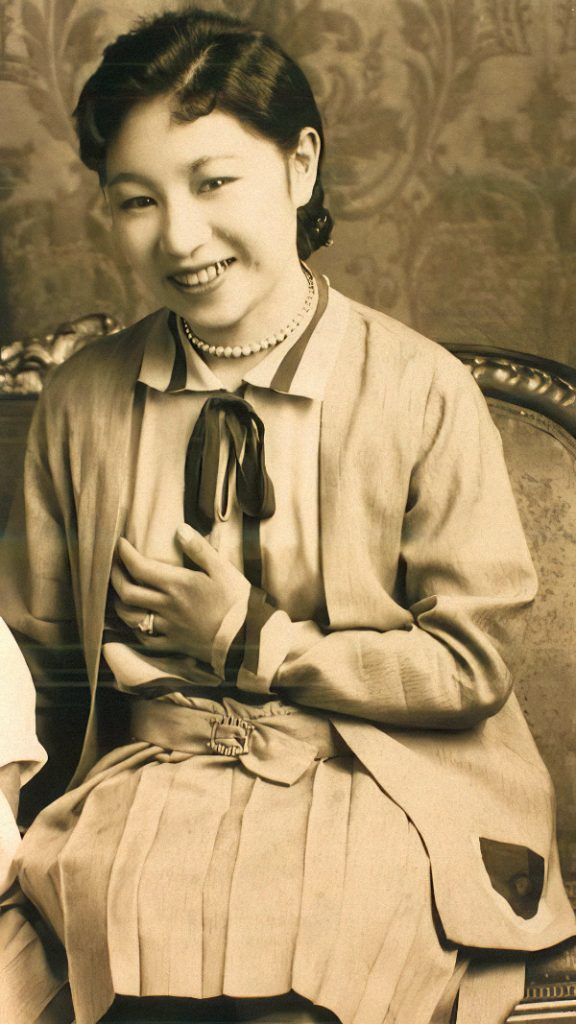
Vintage sepia photo of a japanese woman well dressed and smiling
Michiyo Nojima, Louis’s mother. Courtesy of Nikki Nojima Louis.

The first generation of Japanese who arrived in the U.S. is called Issei, from the Japanese word ichi, for one. The second generation of Japanese Americans, born to the immigrant Issei, is called Nisei, after the Japanese word ni, for two. The third generation, Sansei, and so on. I was born in 1937 to Shoichi Nojima of Tokyo, Japan, and Michiyo Nakatsu Nojima of Kumamoto, Japan. I’m a Nisei daughter, a child of World War II American incarceration camps, and a product of the Civil Rights Movement. I’m named after that all-American girl, Shirley Temple, the most famous child movie star of her time. I’ve always thought it was ironic that my mother gave me a name she couldn’t pronounce—but “Shulee Tempu” was my mother’s American dream child. When in third grade in Chicago my nickname evolved from Nojima to Nikajima to Nikki. Finally, my mother had a name she could pronounce.

Sadayo is my Japanese middle name, but I like the soft sound of “Sachiyan,” its diminutive, which my parents used. My mother looked up to my father’s family as high class, which in Japan’s feudal class system refers to the samurai, or ruling warrior class. As a Nisei American-born person of Japanese heritage, I straddled two worlds—the world of my parents and centuries of Japanese culture, and the turbulent and rejuvenating times of twentieth-century America.

My father was born in 1888, my mother in 1905. She had been orphaned in the States at age eight and shuttled to uncaring strangers and relatives in Japan. I’ve always thought of my mother’s childhood as a Japanese Jane Eyre. She revered education, classical ballet, high fashion, American movies, and Americans. She had a correspondence degree in dressmaking from Vogue and owned a sewing school in Seattle’s Japantown before the war. My father was soft-spoken, mild-mannered, and enjoyed golf, baseball, Japanese picnics, and people. He loved all forms of shibai, Japanese theater—the classical stillness of Noh drama; the stylized, flamboyant theatrics of kabuki; the love suicides of bunraku puppetry. Everyone in Seattle’s Nihonmachi knew my dad.

Until I was four, I lived with my mother and father on Jackson Street in the Nihonmachi section of Seattle, Washington—Japantown.

Jackson Street was the north–south tributary that divided Japantown from the bustling commerce of Chinatown. Our apartment building and my mother’s sewing school were a block apart, between restaurants, teahouses, bathhouses, barbershops, dance and music schools, the N-P Hotel, Japanese language school, and the Buddhist Church. Seattle’s Nihonmachi was the second largest in the United States. By the 1930s, the Japanese were the largest non-white group in Seattle.
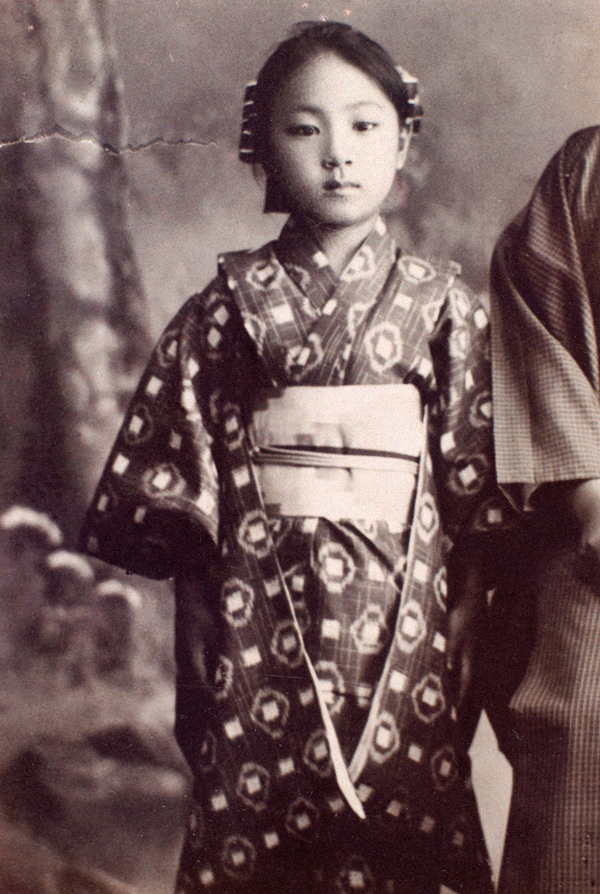
vintage photo of a japanese girl in kimono
Michiyo Nakatsu, Louis’s mother. Kumamoto, Japan, circa 1912. Courtesy of Nikki Nojima Louis. 

My mother returned to the U.S. in her teens to work on her stepfather’s farm after he remarried. Years later, when she wanted to attend secretarial school in Seattle, her stepmother accused her of selfishness. She remained on the farm to help raise her step-siblings until age twenty-four when the family arranged an omiai, a match with the esteemed and eligible bachelor who fulfilled my mother’s dream of living in Seattle. Shoichi Nojima was a catch—educated, with refined manners, and from a samurai family. His suits were custom-made. Mommy said that when she leaned forward to sign the marriage certificate, she saw that he was forty-one.

My father had an ease in the Japanese community that my mother could never achieve. He was a Japanese American Pacific Northwest golf champion at a time when non-whites could only play on public courses. But I suspect that the seeming ease with which he dealt with the humiliations he was subjected to in white America was hard-won. He’d confided to my mother that as a young boy in Japan, he’d been spoiled and headstrong but that he changed overnight when he almost killed another boy in a fight at school.

As a child, I remember balancing large leather-bound photo albums on my lap, scanning the pages of sepia-toned and black-and-white photos. Community picnics in Seward Park, mushroom picking on Mount Rainier, my mother with Filipino workers at the fishing cannery in Alaska my dad managed in the summer. Photos of the twenty-six-inch-tall Shirley Temple doll in its glass case on the credenza in our dining room and the wall of shelves with tiny glass cases of Japanese dolls in brightly colored kimonos. They were treasured artifacts of the American Dream, in which my mother ardently believed. I would have liked to talk with my dad about his American hopes and dreams.
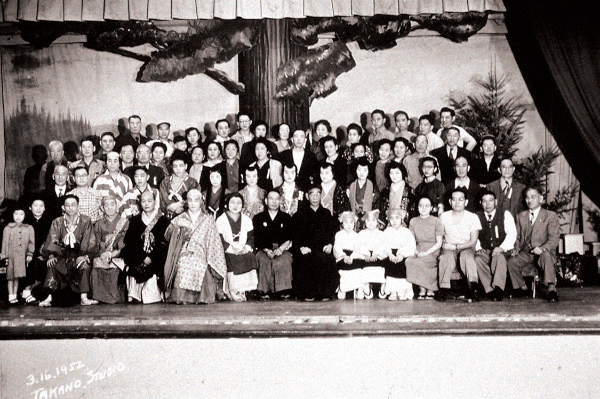
vintage black and white group photo pm a stage
Nippon Kan Hall, Seattle Japantown. Built in 1909, the building was a vibrant community center filled with theatrical performances, sumo wrestlers, and opera singers imported from Japan. Louis’s father (second row, second from right) was an enthusiastic volunteer. After WWII, the building was restored by the architect Edward M. Burke and his wife Betty and was the home of the Northwest Asian American Theatre, where Louis wrote and performed her first play, Breaking the Silence. Courtesy of Nikki Nojima Louis.

Throughout my childhood, my mother enthralled me with stories of her mother, who eloped with a doctor’s son to Hawaii; her grandfather, who had been a Buddhist priest in Kumamoto and had committed suicide; our visit to Japan on an ocean liner when I was three years old and our return barely a month before the start of WWII. I recall the Japanese ghost stories she told that were so frightening I had to sleep with the lights on. But most valuable to me now are my mother’s accounts of my father and their life together before the war. One story is of my step-grandmother Nakatsu calling in the middle of the night to beg my father to stop my Uncle Joe from marrying his white girlfriend. In the morning when he returned home, my mother anxiously asked what happened. Daddy, changing into his pajamas, told her bit by bit: they drove around in Joe’s car, talked about sports, and ordered pie and coffee at the Cherry Street Café. “That’s all?” Mommy demanded. Heading for bed, he said that  Joe had parked in front of our apartment building, where they sat in silence, the motor running. “Kio tsukete ne, Joe?” my father had finally said, opening the car door. “Take care, okay Joe?” Uncle Joe did not marry his white girlfriend.

On February 19, 1942, President Franklin Delano Roosevelt signed Executive Order 9066, authorizing the removal of all persons of Japanese ancestry from the West Coast: the designated “war zones” of Washington, Oregon, and California. By spring of that year, we were assigned to temporary “assembly centers” on racetracks and fairgrounds, in stockyard pavilions, and abandoned Civilian Conservation Corps camps—wherever several hundred to several thousand people could be confined while awaiting completion of ten permanent “relocation centers” under the newly organized, civilian-run War Relocation Authority. In their internal memos, government officials, including President Roosevelt, referred to these “relocation centers” as “concentration camps.”

In the meantime, my father, who had been taken from us in December 1941, was held in the secretive system of Department of Justice- and Army-run camps with thousands of other Japanese men who’d been picked up without just cause or due process. In June 1942, following interrogation and confinement at Fort Missoula, Montana and Fort Lincoln, Bismarck, North Dakota, he was transported by train to Lordsburg Internment Camp in New Mexico. It was the largest and the only camp specifically built to house “enemy aliens.”

In May 1942, Mommy and I were bused to the Washington State Fairgrounds in Puyallup, where approximately 7,390 men, women, and children from western Washington and Alaska were crowded into horse stalls, hastily constructed barracks along the racetrack and parking lots, and under the grandstand. I remember the stacks of straw and burlap cases we were pointed toward upon arrival, and the night I spent sweating and scratching from the ticks that came with the straw we’d stuffed into makeshift mattresses. Later, I learned the nickname assigned to the Puyallup Assembly Center was Camp Harmony.
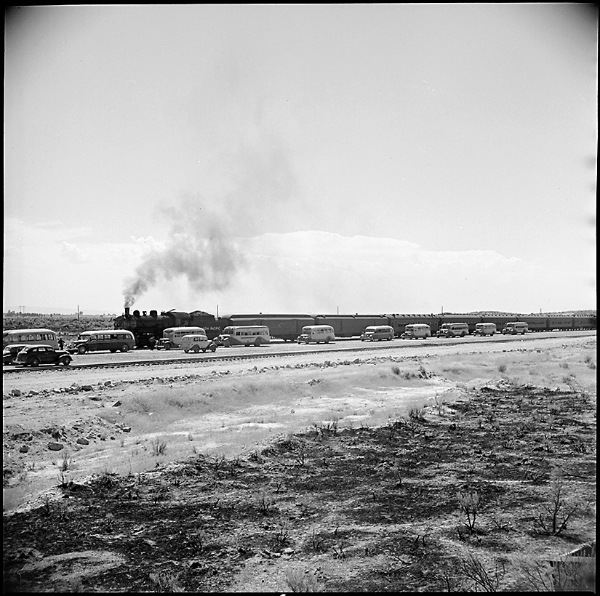
vintage photo a bleak landscape with a train advancing behind a line of cars in traffic
Eden, Idaho, August 17, 1942. A train bringing approximately six hundred evacuees from the assembly center at Puyallup, Washington. Buses, used to transport these people to the Minidoka War Relocation Authority center, are waiting at the siding. Photograph by Francis Stewart for the War Relocation Authority, National Archives Identifier 538267.

In August 1942, the occupants of Camp Harmony were herded onto railroad cars with blackened windows for the thirty-hour trip to the Magic Valley, seven miles east of Eden, in south-central Idaho. These poetic-sounding names bore no resemblance to the reality of the camp called Minidoka. Forty-four blocks of tar-papered barracks stretched across miles of barren land. At a population of approximately 9,390, the barbed-wire town of Minidoka outnumbered the population of most other Idaho towns. Each block contained twelve barracks divided into sections or “apartments” of varying sizes depending on the number of occupants. Each apartment contained a bare lightbulb in the ceiling, sleeping cots, a potbelly stove, and a coal bucket. Mommy kept a chamber pot in the corner, as the latrines were a distance away. We faced constant blinding sandstorms and extreme temperatures in summer and winter. Gun towers and searchlights that swept across the camp at night completed the look and feel of a concentration camp.
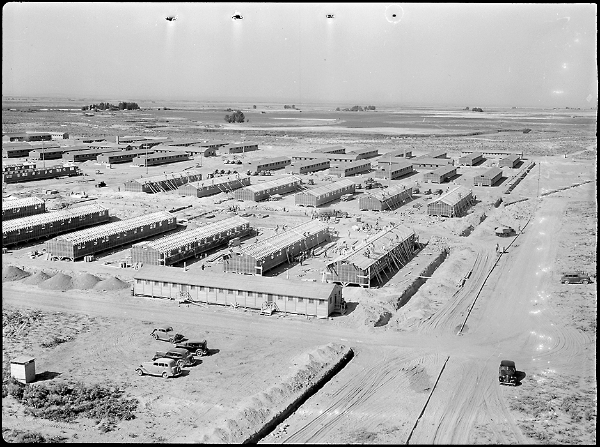
vintage aerial photo of bunkers in a confinement camp
Eden, Idaho, August 18, 1942. A panorama view of the Minidoka War Relocation Authority Center, the internment camp for Americans of Japanese ancestry during WWII. Nikki Nojima Louis and her mother were held here. This view, taken from the top of the water tower at the east end of the Center, shows partially completed barracks. Photograph by Francis Stewart for the War Relocation Authority, National Archives Identifier 538299.

In June 1945, three months before the war’s end, my mother and I joined the diaspora of Japanese Americans who, instead of returning to the West Coast, settled in the Midwest—in our case, a slum apartment on the far north side of Chicago. Each internee released from camp received $25 as a fare-thee-well to three-and-a-half years of incarceration.

My father spent the first year of his imprisonment in Lordsburg, along the Arizona border in the southern boot heel of New Mexico. Lordsburg was a hardscrabble US Army-run camp specifically built to hold the men who had been rounded up by the FBI in the hours and days after the attack on Pearl Harbor. It was run like a prisoner-of-war (POW) camp, although these men were civilians—a bugle wake-up at 6 a.m., lights out at 10 p.m., and regimentation throughout the day. The population of about 1,500 incarcerees was male, and almost entirely Issei. Their average age was fifty-five—far from the youthful enemy soldiers captured in the Pacific that many people in town thought them to be. My father was fifty-four.

In November 1943, Lordsburg was redesignated a POW camp for Italian soldiers captured in North Africa and Italy, and later for German POWs. The Issei were transferred to a camp in Santa Fe, a mile-and-a-half from the downtown Plaza. Although hostility toward the internees was sometimes virulent, there were also exchanges of generosity and compassion that created openings in the barbed wire of fear and hostility.
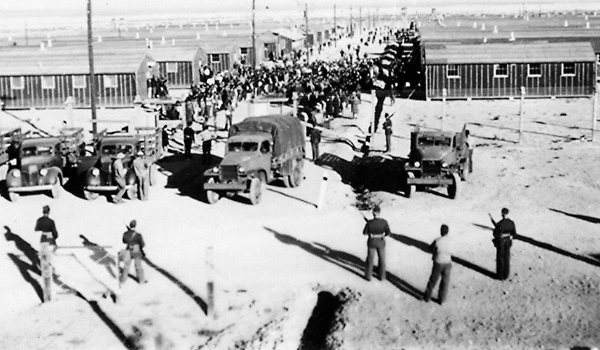
black and white photo of new mexico camp including many men, bunks and vehicles
Camp Lordsburg, New Mexico, circa 1943. Photographs by US Department of Defense. Courtesy of Mollie Pressler.

Ninety-year-old artist Jerry West told me his father, Work Projects Administration (WPA) artist Hal West, worked the night shift as a guard at the Santa Fe Internment Camp. I’ve learned from author Gail Okawa, who shared interviews for her book “Remembering Our Grandfathers’ Exile” with me, that many Santa Feans learned that the Japanese men in their midst were educated, peaceable, and outstanding gardeners. Hal told his son that the men grew vegetables in the arid soil of Santa Fe that New Mexicans had never seen. A friend I housesat for in the Casa Solana neighborhood, where the Santa Fe Camp once stood, remembered elderly neighbors talking about buying eggplants and leafy greens from prisoners who were occasionally allowed to set up vegetable stands outside the Camp. This at a time of rationing when Spam, canned Vienna sausages, and sandy Wonder Bread were our daily fare in the mess halls of Minidoka!

In postwar Chicago, my mother found work as a maid, then as a seamstress in the linen room of the Edgewater Beach Hotel, a luxurious resort on Lake Michigan. My uncle, Frank Kamo, had preceded us from Minidoka and lived in the same building. Mommy and Uncle Frank spoke Japanese and ate Japanese food but were also invested in American ways. Mommy still loved movies, opera, and classical ballet. Whenever the Ballet Russe and American Ballet Theater came to town, we’d ride the el to the Civic Opera House in the downtown Loop. Uncle Frank took me to stage shows at the Chicago and Oriental Theaters, Chicago Cubs baseball games, Riverside Amusement Park, and Lincoln Park Zoo with my best friend, Carol Harmon.
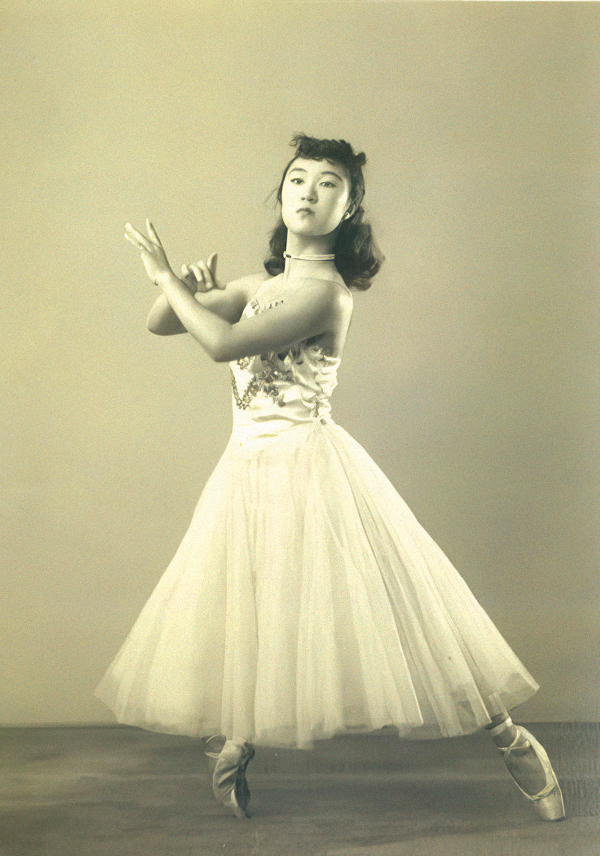
vitntage portrait of louis posing in ballet pose and dress
Louis, age 13, Chicago. Trained in ballet, Louis danced professionally in her teens during summer breaks from school. Courtesy of Nikki Nojima Louis. Photographed by Frank Kamo.

We lived in a slum apartment on the north side of Chicago, where I ran with a rowdy gang of white neighborhood kids but attended ballet school, Girl Scouts, and took piano lessons from Professor Frederic Berendt, a Jewish refugee who’d been conductor of the Vienna State Opera. Ballet school gave me entrée into a part-time career as a professional dancer. Every summer break from school I performed in grandstand shows at state fairs throughout the country, including the segregated South. I was always the only person of color.

When my father was released from the Santa Fe Internment Camp in June 1946, a year after the war ended, he joined us in Chicago. I was nine, and in the Brownies, the junior Girl Scouts. I was a busy kid, very much “lessoned up” by my mother with piano, dance, and school. I ran with different sets of friends from different groups, changing personas to fit in—always the “insider-outsider.”

I wasn’t prepared for this quiet, old-fashioned, older man so unlike my flashy Uncle Frank who bought me bubblegum and banana splits and let me eat hotdogs every other inning at Chicago Cubs games. Frank, Mommy, my piano teacher Professor Berendt, and his wife all spoke fractured English, yet they had adjusted to Chicago’s fast-paced New World-ness. Why couldn’t my dad? One day, when he bought me a hotdog from a street vendor and insisted I eat it at home, I stood on the sidewalk screaming and ran home crying. Although I’d bragged that my daddy was going to be my date for our Brownie troop’s father-daughter dinner, I went instead with our troop leader Ma Mengden’s husband, Pa. I never told my dad about the dinner, nor have I thought of my childish cruelty until now.

When it was announced that my father was returning to Seattle, though, I was genuinely distressed. I remember my mother pointing out the nightly beer battles between the couple next door, the shared bathroom with tenants who never flushed the toilet or scrubbed the tub, the odor of cabbage, booze, and urine in the halls, and the abuse my father endured in the low-paying jobs he was offered. Chicago was stormy, hustling, brawling—hog butcher of the world. I understood.

When I was sixteen, I returned to Seattle to live with my father. He’d suffered a heart attack playing golf on the public course with his longtime friends who’d survived the camps, and I lived with my step-grandparents while he recovered. I finished my senior year at Garfield High School with newfound friends: Anglos, Sephardic Jews, Black Americans, Chinese Americans, and Filipino Americans. The least open and approachable were my fellow Nikkei, Japanese American kids with whom I’d been in Camp Minidoka a few years before. What I didn’t understand then was community trauma. A year later, I enrolled at the University of Washington, where I majored in Literature and Theater.

Life with my dad was easygoing and affectionate. Although his circumstances had been considerably reduced since the war, he still had standing among the Issei and Nisei families that had returned to Seattle. We lived in the Central District—in an ethnically diverse working-class neighborhood that reflected the student population of the high school I attended. Daddy somehow became a kind of Pied Piper of the neighborhood. Without seeming to exert effort, he attracted little kids and a dog, Mutty, and a cat, Kitty, who belonged to the Black family next door but lived mostly at our apartment. Every day, by the time he got off the Jefferson Street bus after work to walk the two blocks home, Mutty, Kitty, and some kids would be trailing after him. Maybe it was the bag of Japanese senbei crackers he always carried?

When he suffered his fatal heart attack in December 1957, a couple of weeks after my twentieth birthday and two days before Christmas, I had completed finals at the University of Washington the day before. I’d spent the previous year dancing in California and Las Vegas but declined an offer to perform at Radio City Music Hall in New York because I wanted to return to school. It was real luck that I was home that fateful day. In the morning, my father called out in pain from his room. Mutty and Kitty hovered anxiously on his bed. The doctor rushed over; the ambulance came. He died soon after arriving at Harborview Hospital. My mother flew in from Chicago—the first time she’d been in Seattle since 1942—and fainted at the funeral.

During the time I lived with my dad as a teenager, I remember him speaking of his camp experience only once, and that was about the generosity of a Santa Fe guard. I don’t recall the circumstances of that conversation—I had hardly any interest or curiosity about the camp experience then—but I do remember that my dad said the guard called him by his camp nickname, “Sam,” and told him to walk around the Plaza and enjoy himself. Years later, when I related this incident to members of my Asian American theater group in Seattle, an actor who was particularly embittered by his family’s Minidoka experience, opined that the guard ditched my dad to get together with a girlfriend, or to grab a beer, or for any other reason than kindness.

So, I was later grateful to learn of Reverend Charles Kingsolving, who received death threats for conducting Episcopalian services at the Camp and offering evening prayers to “anyone who wanted them.” His son John Kingsolving related to author Gail Okawa that when the phone rang in their house, his dad would say, “Another damn phone call,” and hang up. Emotions were fraught because of New Mexico’s heavy losses in the Battle of Bataan in the Philippines and the atrocities of the Bataan Death March. Gail has also shared with me that Joe Valdes, a former mayor of Santa Fe who ran errands at the Cash & Carry Grocery on Palace Avenue when he was thirteen, verified what my father had told me—that many of the guards treated their prisoners humanely.

I’ve spent the past fifteen years in and out of New Mexico, fact-finding the lives of the Issei men held in Lordsburg and Santa Fe: community leaders, Buddhists and Shinto priests, Christian ministers, Japanese language teachers, businessmen, journalists, fishing boat owners. Many had lived in the U.S. for decades and had fathered American-born children, as had my father, but were denied citizenship due to long-held Asian Exclusion laws. They were allowed to live in this country only as “resident aliens.” The attack on Pearl Harbor changed their status to “enemy alien,” and their roundup by the FBI and military was immediate and swift.
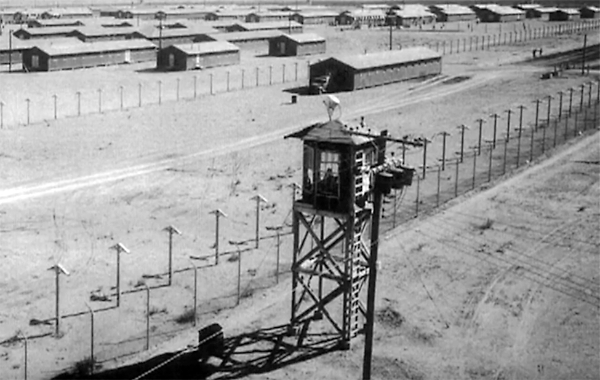
black and white vintage photograph of camp watchtower and perimeter fenching with bunks in the distance
Camp Lordsburg, New Mexico, circa 1943. Photographs by US Department of Defense. Courtesy of Mollie Pressler.

I’ve scrutinized group photographs of prisoners in my research of the Lordsburg and Santa Fe Camps, searching for the face of my father. At one time he sent us a photo of himself and a group of other men posing with golf clubs—one of many official photos I’ve seen that documented the recreational facilities which the men were allowed. I hated that photograph for making Santa Fe look like a resort.
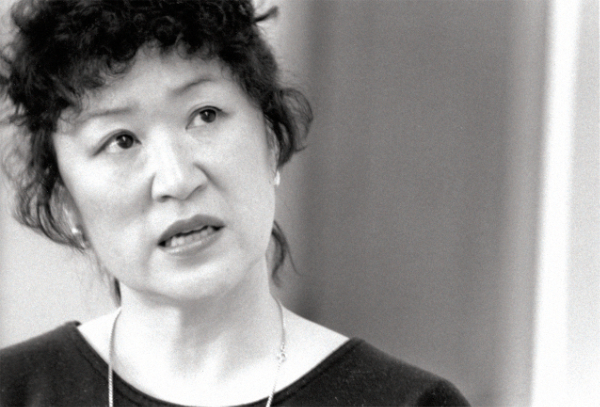
black and white image of Louis's face
Louis in performance of Breaking the Silence: Japanese Voices in America at the Northwest Asian American Theatre, Seattle, Washington, 1985.

In 2012, I attended a symposium at the New Mexico History Museum on the Santa Fe Internment Camp. At one point in the program, Mollie Pressler, curator of the Lordsburg Museum, asked the audience if they knew of anyone who’d been in the Lordsburg Internment Camp during World War II. I raised my hand and said, “Shoichi Nojima.” Mollie took out a stack of rubber-banded 3 × 5 index cards from a plastic cake box and removed a single card from the stack. She announced to the audience my father’s name, vital statistics, and the date he entered Lordsburg Camp with one dollar in his sweater pocket. This began my relationship with the Lordsburg Museum, which led to research, interviews, and writing of a reader’s theater script on the Camp and the controversial deadly shootings of two elderly prisoners by a guard in 1942. My father was in Lordsburg at the time of the shootings. Did he know these men? Was he aware of the shootings? Did he fear for his safety?
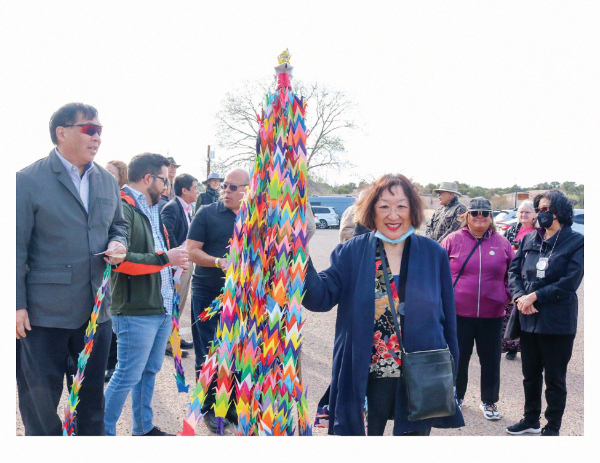
color photo of Louis posing next to pole of a thousand colorful origami cranes
Louis holds a pole of a thousand origami cranes, preparing to lead a pilgrimage to the Santa Fe Internment Camp Marker. Frank Ortiz Dog Park, April 23, 2022. Photograph by Shelley Takeuchi. Courtesy of Nikki Nomima Louis.

Barbara Kingsolver writes that “memory is a complicated thing—a relative to truth but not its twin.” This challenges the assumption that our memories accurately reflect reality. In my case, it challenges the idea that if I’d been able to sit down for a conversation with my dad about his feelings or experiences or anything—we would have gotten “to the truth of the matter.” While I don’t know all the facts of my father’s life, I feel I know much of his truth. I’m certain that being with him the last three years of his life—and even the first four years of my childhood—was a gift of time and not a lament for the time we didn’t have. I feel I “know” my father through my mother’s interpretations of him, through the time I spent with him as a teenager, and through the journey of discovery I’ve been on since I arrived in New Mexico in 2008 as a newly minted PhD at age seventy. Sixteen years later, I’m still here and learning.

My time in Santa Fe parallels my father’s—although our stays are more than seventy years apart. I’ve had the privilege of meeting Santa Feans with childhood memories of the Camp and its inhabitants, and through them have felt the world in which my father had lived. The two worlds I straddle are in balance; the past informs the present. When I view the adobe structures of Santa Fe, stroll across the Plaza, or look up at the same night sky, I know my father has been here before me.
Nikki Nojima Louis (opens in a new tab) is a child of American concentration camps and the protégé of the Civil Rights Movement. In the Pacific Northwest, she was active in multicultural theater as a writer, performer, and producer of women’s, peace, and social justice shows. In New Mexico, she thrives on writing, directing, and touring living history plays that connect the past to the present and us to one another. Louis received the 2024 Upstander Award from the Holocaust and Intolerance Museum, and subsequently discovered that an upstander is a person who speaks out and stands up in support of others. She strives to be that person.

Governor’s Awards for Excellence in the Arts Celebrates Fifty Years

New Mexico Governor Bruce King and First Lady Alice King established the Governor’s Awards for Excellence in the Arts in 1974 to celebrate the significance of the arts to the state’s culture and economy. The first recipients were well-known icons responsible for creating the visual mythos the world associates with the Land of Enchantment. Today, those honorees are bona fide art royalty—painter Georgia O’Keeffe, potter Maria Martinez, architect John Gaw Meem, and photographer Laura Gilpin.

Five decades later, the annual pool of nominees remains outstanding. Every year, the awards honor up to eight artists and major contributors to the arts. Recent recipients include composer Raven Chacon (2023), santero Arthur López (2022), cartoonist Ricardo Caté (2021), potter Roxanne Swentzell (2019), and art critic Lucy Lippard (2018).

“Fifty years is a long time. To have such a deep well of talent, skill, and support for the arts that you can have so many authentically deserving awardees each year never fails to amaze me,” says Michelle Laflamme-Childs, executive director of New Mexico Arts, the state agency that oversees the nomination process with its advisory board, the New Mexico Arts Commission. They send recommendations to the governor, who makes the final selections.

“In theory,” Laflamme-Childs says, “we could receive nomination letters but not find anyone who really merited the distinction. But that’s never happened, which speaks to the incredible richness of arts and culture in our state.”

The seven recipients of the 2024 Governor’s Awards for Excellence in the Arts come from all over New Mexico. For Debra Garcia y Griego, Department of Cultural Affairs Secretary, recognizing artists in every part of the state is vital.

“All of the artists and arts contributors are part of a much longer history in New Mexico of artistic and cultural expression that goes back millennia,” says Garcia y Griego. “This year’s slate of recipients really represents every corner of the state, and artists at every age.”

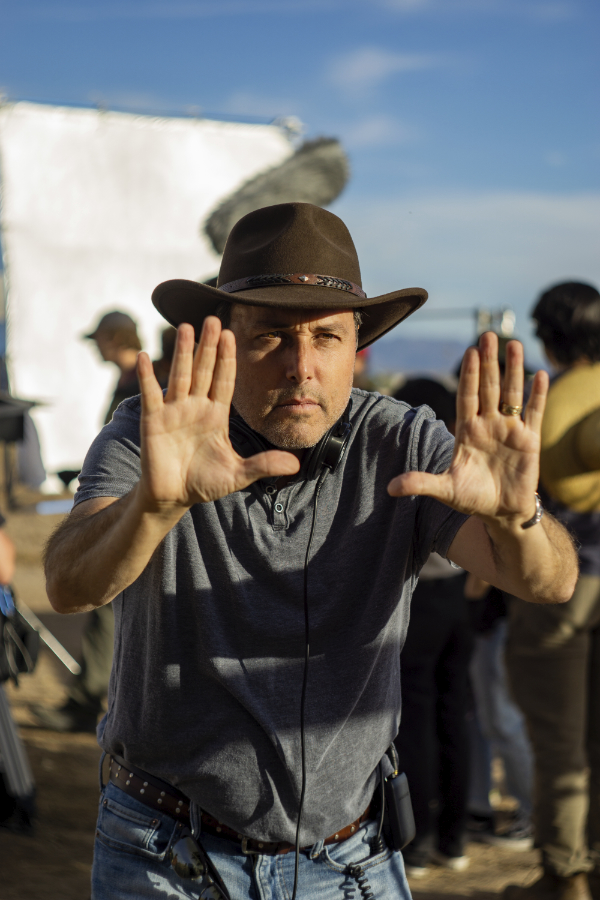
Color portrait of a caucasian man with a leather cowboy hat. His hands are up creating a frame with his hands
Ross Kagan Marks.

“New Mexico is where I discovered my voice”
Filmmaker Ross Kagan Marks, founder and director of the Las Cruces International Film Festival, is honored this year as a major contributor to the arts. “Whatever I’ve achieved, I owe to New Mexico. New Mexico is where I discovered my voice as an artist,” he says, adding that the Governor’s Award is especially meaningful to him because his mentor and father-in-law, playwright Mark Medoff (Children of a Lesser God), received it in 1980.

“Mark isn’t here to celebrate with me, but it means so much because I’ve worked hard to continue his legacy as an artist and as a teacher. Getting this award is confirmation that I’m doing that.”

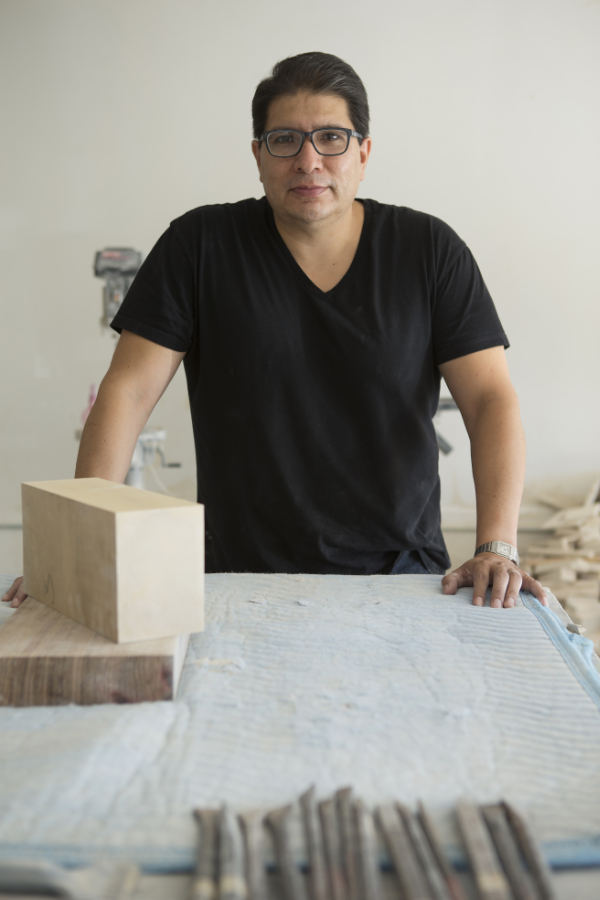
Portrait of a man in glasses and a black tshirt standing behind a work table with various forms and tools
Arlo Namingha. Photograph by Kate Russel

“I want to be an inspiration”
Sculptor Arlo Namingha (Tewa/Hopi) has been gathering accolades for some time. The eldest son of famed painter Dan Namingha received a 2016 Santa Fe Mayor’s Arts Award and was named one of the Santa Fe New Mexican’s “10 Who Made a Difference” in 2023. He works in wood, clay, stone, and fabricated and cast bronze, usually containing Tewa and Hopi cultural images, landscapes, and symbolism. His work is featured in numerous private and museum collections, including two pieces in the Governor’s Mansion. Namingha was among the sixty curators of Grounded in Clay: The Spirit of Pueblo Pottery, an exhibition from the collection of the Indian Arts Research Center at the School for Advanced Research that opened in 2022 at the Museum of Indian Arts and Culture and is now touring nationally.

“I knew of Arlo because of his work at Niman Fine Art, his family’s gallery here in Santa Fe, but I didn’t know about his community activities until I read his many nomination letters,” Laflamme-Childs says. “Not only is he carrying on a long family tradition as an artist, but also because his father received this award in 1985.”

Namingha has long worked as an arts educator and youth mentor, but in 2021, his generosity took a different turn. At his own cost, Namingha created sterling silver stethoscope cuffs and badge charms for the staff in the CHRISTUS St. Vincent COVID-19 wing and presented them in a special ceremony. Two vertical lines represent the Hopi symbol for strength, a design that becomes an equal sign when looked at horizontally. The artist said the imagery honored the medical professionals’ courage in treating patients with dignity and sympathy.

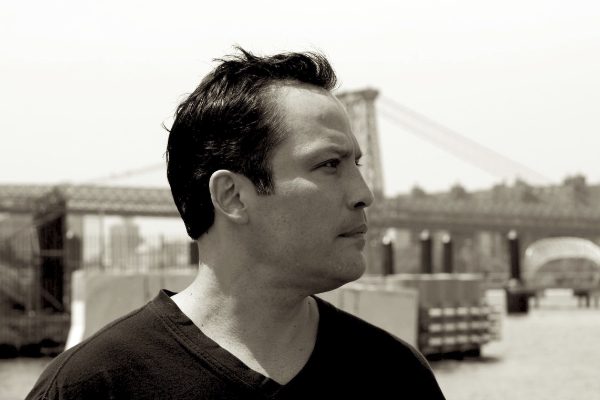
Sepia toned profile portrait of a man in front of a waterfront with bridge.
Jock Soto. Photograph by Luis Fuentes.

World-famous ballet dancer Jock Soto grew up on the Navajo Nation and now lives in the tiny village of Eagle Nest near the Taos Ski Valley. He began formal dance training at age five, and at eleven, left the southwest for the New York City Ballet, selected for stardom by its legendary artistic director George Balanchine. Soto danced the lead in at least one hundred ballets before retiring at forty. Because communicating the beauty and importance of ballet to children is important to him, he appeared in a dozen episodes of Sesame Street, demonstrating his moves with fellow dancers and with the Muppets. He wrote a memoir, Every Step You Take (Harper, 2011), and he’s the subject of a PBS documentary, Water Flowing Together. In New Mexico, he’s worked with Festival Ballet Albuquerque and Ballet Taos.

“It’s fun to see what the dancers are like in New Mexico. They’re good, and they’re eager. You walk into the studio, and they come to attention,” Soto says. “I want to be an inspiration. I’d never even heard of the Governor’s Arts Awards, but it’s a thrill to be getting one.”

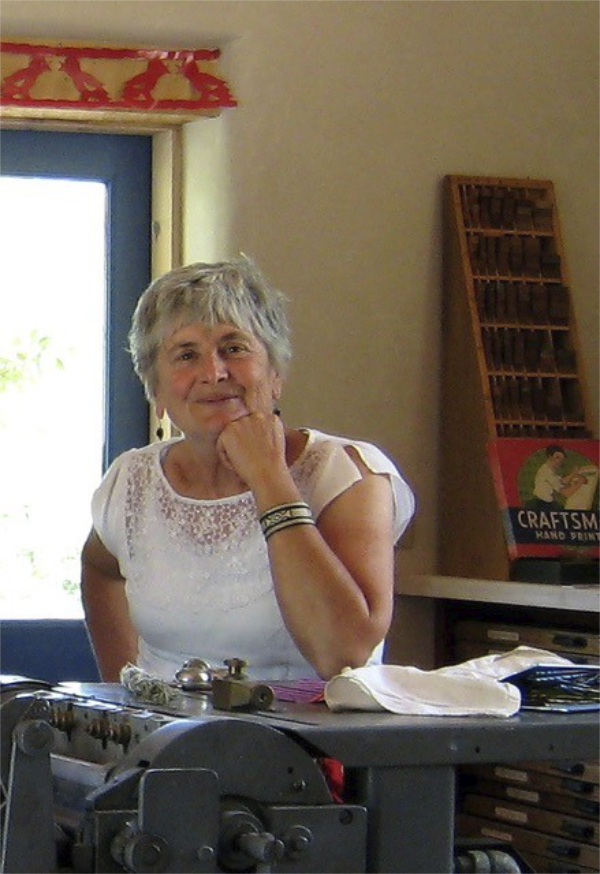
Color photograph of a woman with her fist propping up her chin
Pamela Shirinne Smith. Photograph by Anne Raymo.

“I’m delighted”
Pamela Shirrine Smith is internationally lauded for the centuries-old craft of paper marbling, a process in which colorful patterns are created on a viscous, liquid surface and transferred to paper. Marbled paper is most often used for covers and endpapers in handmade books, and as proprietor of MarbleSmith Paper, Smith creates edition papers distributed by BookMakers International as well as for private clients.

“You never know what someone is going to do with decorative papers,” Smith says. “Once, I realized someone was using them for wainscotting.”

Smith is included in a 2023 exhibition and catalog at the Metropolitan Museum of Art’s Watson Library, Pattern and Flow, a Golden Age of American Decorated Paper. She teaches master classes and workshops locally and around the world, most recently at Oxbow, the School of the Art Institute of Chicago’s summer residency program. Before her 2001 retirement, the longtime Abiquiu resident spent twenty-eight years as director of the Museum of New Mexico’s Press at the Palace of the Governors. There, she created limited-edition books of New Mexico literature, including Broncho vs. Bicycle, a tale in verse by John Wallace Crawford (also known as Captain Jack)—one of the state’s earliest poet-playwrights.

Like many of the other award recipients, Smith is involved in her community and helped establish the village of Abiquiu’s first public library in 1998. “I put together a collection of nineteenth-century photographs taken in and around the village,” she recalls. “I’m delighted that people here who don’t know me as a paper marbler will now recognize me for this little-known, magical art form.”

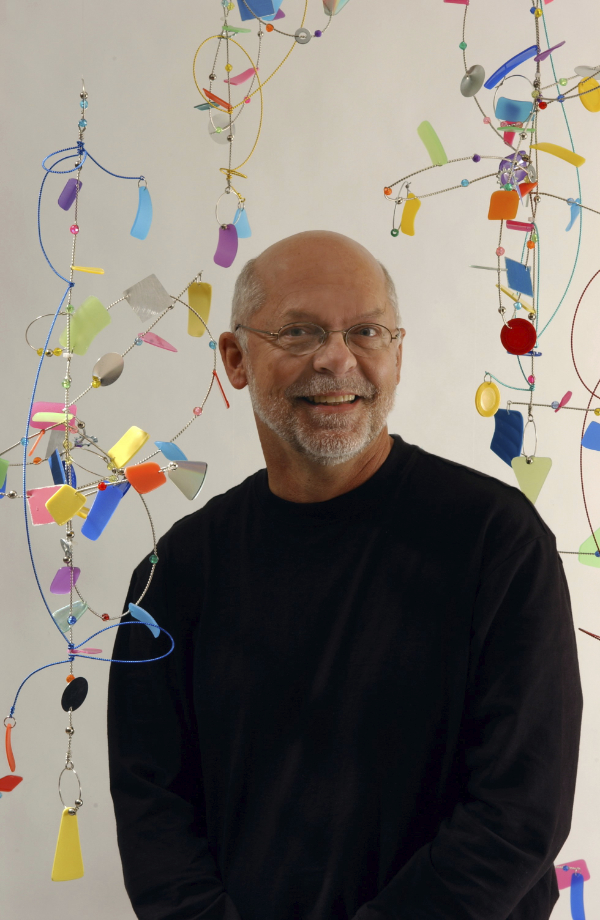
Color portrait of a man smiling amidst hanging colorful art
John Garrett. Photograph by Margot Geist.

A fourth New Mexico artist working to vast acclaim is John Garrett, an experimental fiber artist from Las Cruces. He makes baskets, wall hangings, quilts, and sculptural forms using discarded everyday materials, including painted aluminum, crushed cans, rusted metal, and plastic flowers. The surfaces are rich in texture, with areas of fine detail and complex pattern. An American Craft magazine article disclosed that Garrett wants his pieces to inspire thoughts of abundance, of interior and exterior worlds, and, most of all, of the rewards of looking at things with a fresh eye.

Garrett received National Endowment for the Arts fellowships in 1983 and 1995. In 2010 he was elected a Fellow of the American Craft Council, and in 2013 he received a Lifetime Achievement Award from the National Basketry Organization. His work is included in numerous museum collections, including the Renwick Gallery of the Smithsonian American Art Museum, the Carnegie Museum of Art, the Detroit Institute of Art, and the Albuquerque Museum.

“Someone sees you”  
Philanthropists who support major institutions are crucial to New Mexico’s arts and culture. The Department of Cultural Affairs oversees staffing and building maintenance for the New Mexico Museum system, but there isn’t much left over for public programming, so private donations are needed to support exhibitions, educational initiatives, special collections projects, and even new construction. Generous contributors to the arts make it possible for the state’s cultural institutions to thrive despite limited public resources.  

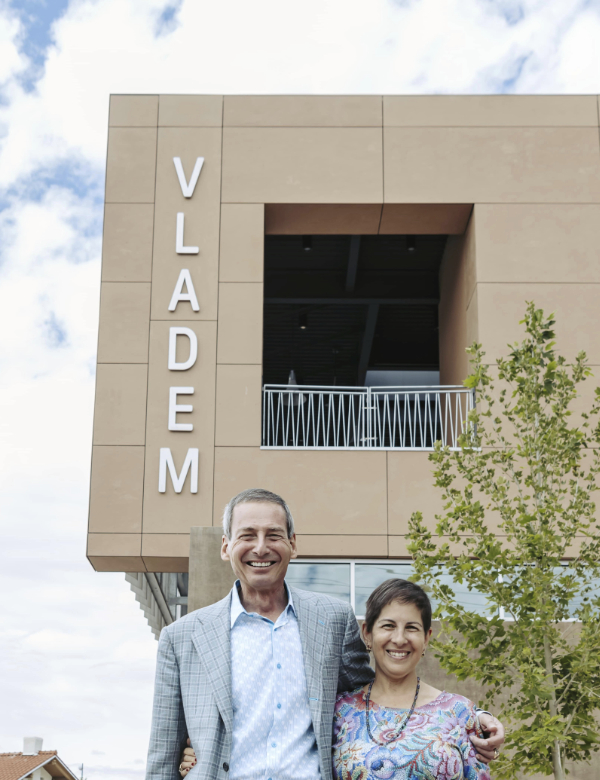
Portrait of a couple smiling in front of a building with vertical signage that says Vladem.
Robert and Ellen Vladem.

Ellen and Robert Vladem are honored this year for ongoing financial generosity, including a $4 million gift to seed the construction of the Vladem Contemporary, the new wing of the New Mexico Museum of Art that opened in 2023. The Vladems, who have lived in Santa Fe since 2013, have underwritten the Santa Fe Opera since 2015 and established a $5 million endowment to underwrite annual opera seasons in perpetuity. Robert Vladem is a private investor who serves as a trustee of the New Mexico Museum of Natural History and Science, and Ellen Vladem is a retired Intensive Care Unit Registered Nurse. Together, they received the 2022 Santa Fe Mayor’s Arts Award for Philanthropy.

Portrait of a woman standing, hands interwoven, in front of various colorful artworks.
Diana Ingalls Leyba. Photograph by Jay Hemphill.

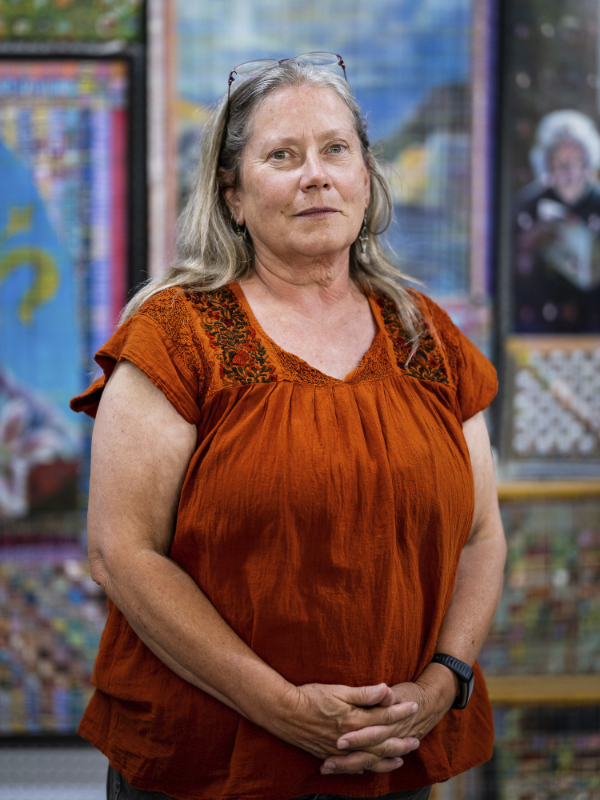
Silver City artist and gallery owner Diana Ingalls Leyba is another major contributor to the arts, nominated for her leadership of the Youth Mural Program, which operates under the auspices of the Grant County Community Foundation. Leyba directs projects “all the way up to Catron County in Glenwood and down to the City of Rocks.” Mural artists range in age from six to eighteen years old. “Everyone communicates their ideas, even with stick figures,” she says. “Designing by committee is a life skill.”

Since its founding in 2002, the Youth Mural Program has completed about eighty-five murals, some within urban landscapes and others in remote areas. A recent project at the Senator Clinton P. Anderson Overlook is celebrating one hundred years since the designation of the Gila Wilderness required participants to travel an hour and a half each way, carrying their own water. Leyba was already impressed with the students’ dedication to creating nature imagery on a low wall at the lookout, but she understood just how much ownership they felt when she saw teens—who aren’t always comfortable talking to adults—excitedly explaining the project to visitors who happened upon them while they were painting.

“I’ve been at it long enough that I have participants who are the kids of kids who were with me when we first started,” Leyba says. “I was at the dog park when I got the call about the award. I started crying. It’s a validation of everything you’re doing—someone sees you.”

Youthful energy is the driving force behind the Las Cruces International Film Festival, now entering its tenth year at New Mexico State University. It’s grown from a handful of films and an audience of about 2,000 to more than 10,000 attendees viewing one hundred films, and it’s the largest student-run film festival in the United States, says director Ross Kagan Marks. The NMSU alumnus returned to teach in 2007 and soon resolved to expand the film industry in southern New Mexico. The festival is worldwide in scope but highlights films made in New Mexico and features a full slate of panels and workshops on all aspects of filmmaking.

“Film festivals are the heart of the industry, and if I can’t take my students to Sundance, I’ll bring Sundance to them,” Marks says. “The festival is a teaching tool, and the students do everything from driving celebrities around town, to projecting the films, to moderating panels. People can feel their energy and enthusiasm.”

For an artist, a Governor’s Award validates a life of creative expression, confirming that your efforts are appreciated not only by individual art lovers but at the highest levels of elected leadership. For those born and raised in New Mexico, this can be especially poignant. For a community organizer or philanthropist, the award is a stamp of approval that conveys credibility and can attract future funding opportunities. All honorees become an indelible part of New Mexico history and, in turn, leave their own legacy.

Secretary Garcia y Griego says fifty years of celebrating artists at the state level is significant, “but it’s not nearly enough. I don’t think you can overstate the importance of the arts to our state or the role of artists and those who support them. New Mexico is blessed with so many cultural resources and so much creative talent that we will never have enough time and enough awards to truly honor everyone who deserves it.”

Jennifer Levin is a freelance writer and communications professional in Santa Fe, New Mexico. As a journalist, she writes primarily about arts and culture. She grew up in Chicago and holds a bachelor’s in creative writing from the College of Santa Fe.

Kate Russell (opens in a new tab) is a photographer. She lives in Santa Fe.

Mary Ann Hatchitt is a former communications director of the New Mexico Department of Cultural Affairs.

The Art of Survival

The engraving on the side of the cup is painstakingly scratched out of the silver metal. The top line reads “PNM”—the Penitentiary of New Mexico. Below are two simple statistics that together tell a brutal story with remarkable concision. 

“33 DIED,” reads the second line.

“89 WOUNDED,” reads the third. 

Paul Oliver remembers the day his father, Nordaine Oliver, brought the cup home from work. Nordaine was a guard at the state penitentiary, just south of Santa Fe, and the engraving needed no explanation. Even as a teenager, Paul knew it referenced the 1980 riot at the prison, widely considered to be one of the most violent in U.S. history. While Nordaine hadn’t been on duty in the early morning hours of February 2 when the riot broke out, according to Paul, he had been among the law enforcement officers who helped retake the penitentiary after a thirty-six-hour standoff. What Nordaine saw inside had haunted him, which is perhaps why he didn’t explain much about the cup and the prisoner who had made it—and why Paul didn’t ask. 

“One thing my father did say is out of two wars that he had been through [Korea and Vietnam], he had never seen more gruesome mutilation of humans than what he saw after the riot, going through the penitentiary,” Paul recalls. 

Perhaps the cup was a declaration of survival from someone who had lived through the riot; perhaps it was a memorial to those lost. As with many of the pieces on display in Between the Lines: Prison Art & Advocacy, an exhibition currently on view through September 2, 2025 at the Museum of International Folk Art, it’s unlikely we’ll ever know the full story behind it. But the questions the cup raises about the human compulsion to create art out of tragedy, and to document our experiences, are among those explored in the exhibition. Overall, Between the Lines asks visitors to reflect on the purpose of imprisonment and its ripple effects in communities, including Santa Fe. 

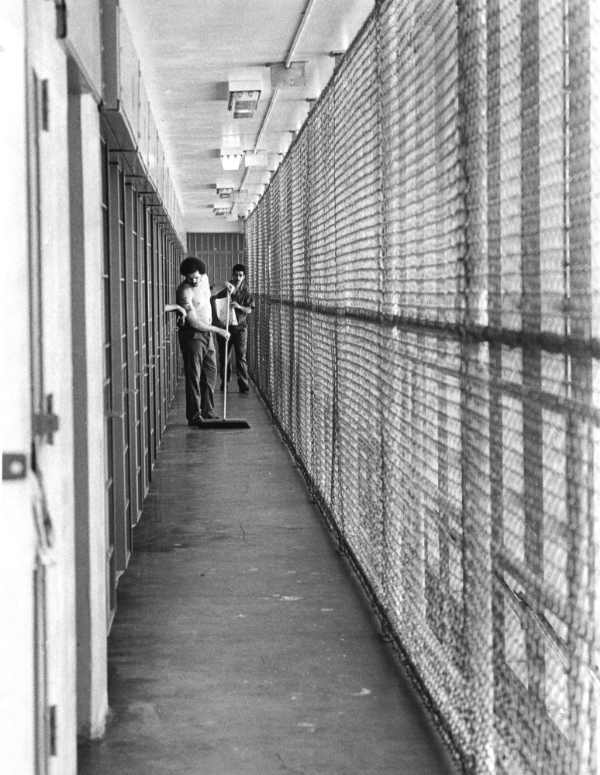
the long hallway of a cellblock with two men sweeping
Barbaraellen Koch, Cellblock 4 with new cyclone fencing, 6 months after the 1980 riot, Penitentiary of New Mexico, 1980. Courtesy of the Palace of the Governors Photo Archives (NMHM/DCA), The Santa Fe New Mexican Collection, HP.2014.14.1399.

When the state penitentiary opened at its current location just off Highway 14 in 1956, then-Governor John Simms called it “among the most advanced correctional institutions in the world.” The previous penitentiary in downtown Santa Fe had been plagued with overcrowding and violence, leading to a riot at the facility in 1953. Once the new prison was built, its first warden, H.R. Swenson, touted its potential for rehabilitation rather than simply punishment, saying that with the improved physical conditions of the penitentiary, “we elevate our sights, and begin the task of human repair.” He imagined a future that included educational services and community programs that would help prepare people locked up for new lives upon release—a vision that was at least partly realized in the early years of the new prison. But many of the problems that had plagued the previous facility, including poorly-trained guards and over-crowding, soon became problems at the new penitentiary and by 1975, operation of the prison had become “a challenge to all concerned,” according to then-Secretary of Corrections, Michael Hanrahan.

A veteran of the federal maximum security prison system was appointed as the new warden that same year, and according to a report from the Attorney General in the aftermath of the riot, he “supported a philosophy that promoted tighter restrictions on inmates.” One of the warden’s first moves was to reduce the programming available to those inside. As a result, many prisoners found themselves idle for large stretches of the day, and the guards lacked the means to motivate good behavior. “Human beings function better when they have some self esteem and incentives in their lives,” the Attorney General’s report noted. But those incentives were in short supply by the late ’70s, when Carlos Cervantes was sentenced to the state penitentiary. 

  Growing up in Santa Fe as a middle child of ten, Cervantes discovered a talent for art at an early age. At the Boy’s & Girl’s Club, he learned the techniques of woodburning, carving, and drawing, winning several awards for his work. Like many children of the 1960s and ’70s, he often used his art for protest, participating in El Movimiento, the movement for Chicano power. Then, when he was twenty-four, he was arrested for selling heroin and sentenced to a minimum of thirty-four years in prison.

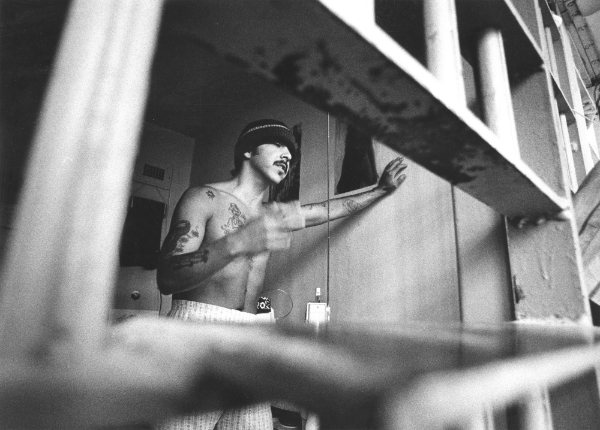
Black-and-white photograph of a prisoner with a knit cap in their cell
Michael Heller, Carlos Maestas in maximum security at the Penitentiary of New Mexico, 1984. Courtesy of the Palace of the Governors Photo Archives (NMHM/DCA), The Santa Fe New Mexican Collection, HP.2014.14.1115.

Cervantes arrived at the penitentiary in 1978, which was a particularly volatile moment. The prison was overcrowded, with more than 1,100 people crammed into a facility built for less than 1,000, and guard turnover was at eighty percent. According to the Attorney General’s report, an atmosphere of hostility prevailed between the guards and those incarcerated. “The distinctions between minor and major violations were not clear,” the report said. “Inmates reported that the guards threatened lockup for such offenses as walking down the wrong side of the corridor, lying on their bunks after reveille, disruptive conduct, verbal abuse against staff members, failing to follow a direct order, or taking crackers out of the kitchen.” Three independent filmmakers spent time in the penitentiary in 1979 and documented bubbling anger among the prisoners over conditions in the film Doing Time. “Rehabilitation is out now,” one prisoner told the filmmakers. “You’re here to be punished, okay? And they don’t make no bones about that anymore. That’s a fact.” 

Despite the dearth of rehabilitative programming, many incarcerated people nevertheless found ways to make art. Cervantes was among them. In prison, as on the outside, people make art for many reasons. It can be a form of personal expression, a means of protest, a remedy for boredom, and a valuable commodity—or sometimes all of the above. For Cervantes, the main constraint on his work inside the prison was the availability of materials and tools, although he quickly learned to improvise. Like generations of incarcerated people in the Southwest before him, he ripped up bedsheets to create paños (handkerchief-sized canvases for drawing), built rudimentary tattoo machines out of scrapped materials, and hoarded the wrappers from cigarette packs to craft into intricate picture frames. A video featured in Between the Lines shows his technique of carefully cutting apart the wrappers with a razor blade to make smaller pieces, folding those pieces into strips, and then painstakingly weaving the strips together to build colorful three-dimensional frames. “It would take me out of prison,” he says. “It was an escape.” But while Cervantes was channeling his energies into making art, other prisoners were planning how to take over the prison.

The riot began in the early morning hours of February 2, 1980, in a part of the penitentiary known as Dormitory E-2. E-2 was considered a medium-security unit, but a number of higher-security prisoners had been transferred there during construction on one of the cellblocks. The riot, according to witnesses, broke out when several of those prisoners seized four guards as they were locking down the dormitory for the night. Taking those guards’ keys, the rioters unlocked the doors to adjacent dormitories and cellblocks, capturing another four guards in the process. According to the Attorney General’s report, in twenty-two minutes, they had broken into the penitentiary’s control center, and within hours, they had total control of the facility. 

While prison riots were far from unusual in the U.S. at the time—there had been thirty-nine riots in U.S. prisons in the 1970s alone—the speed and scale of the rioters’ takeover made the situation in Santa Fe unique, as did the violence that ensued. Of the seventeen listed as employees on duty at the prison on February 2 according to the Attorney General’s report, twelve ended up being taken hostage. Many of them were beaten, stabbed, and sexually assaulted. But the guards were not the only ones who were targeted. Much of the violence was directed at other prisoners, especially those housed in Cellblock 4, which was widely understood to be a protective custody unit for prison informants. Eyewitnesses reported that a group of 15-20 rioters formed what was referred to in the Attorney General’s report as “a death squad” that proceeded to conduct “a systematic killing campaign” in the cellblock.

Partly due to a stroke he suffered several years ago, Cervantes struggles to tell his story of that day, but according to written accounts, as the chaos spread, he left his cell on the south side of the prison and ended up on the north side of the facility. There, he and a number of other prisoners worked together to protect two guards from the atrocities that were unfolding elsewhere. “I am certain that his protection helped to save my life,” one of the guards later wrote, noting that Cervantes had stayed with the officers for most of the riot, “making sure that no harm came to us from other inmates.” Many others were not so lucky. By the time SWAT teams and National Guard troops retook the prison a day and a half after the start of the riot, at least thirty-three prisoners were dead, and dozens, if not hundreds, of others had been gravely injured. 

Patricia Cervantes, Carlos’s sister, remembers waiting outside the prison with her entire family for any news about her brother. “All these guys [coming out of the prison], their faces were just black from the smoke,” she said. The rioters had set fires all over the penitentiary, including in the warden’s office and the records department. As they waited, Patricia says the family checked and rechecked the lists of names of people who managed to escape and surrender to police, but Carlos’s name never appeared. “We were really scared,” she said. It was only when the prison had been retaken that Carlos’s family spotted him on a bus transporting prisoners to the airport so they could be relocated out of state. Even now, decades later, Patricia gets emotional thinking about the moment. “We followed the bus, and we went [to the airport],” she remembered. “They didn’t let any of us really get near him, but we were all watching from a distance.” Within hours, Cervantes, along with dozens of other prisoners, was on a plane bound for Arizona—his first time leaving New Mexico.

  The riot brought considerable scrutiny to the penitentiary, but reforms were slow to come in its aftermath. Lax security, insufficient guard training, harassment of prisoners, an absence of programming and arbitrary use of punishment were all identified by the Attorney General’s report as factors that had contributed to the riot. An investigation by the Santa Fe Reporter a year later found that if anything, the riot made many of those problems worse, noting that there had been a “post-riot regimen of brutality, caprice and incredible security lapses.” Three years prior to the riot, a prisoner named Dwight Duran had filed suit against the state, alleging that conditions in the penitentiary violated incarcerated people’s constitutional rights. The state signed what would become known as the Duran Consent Decree in July of 1980, an agreement to make improvements to the state’s prison system in fourteen different areas, including medical care, legal access, and living conditions, but the changes went largely unimplemented for years. A former guard told The New York Times in late 1981, “It just hasn’t changed—it’s gotten worse since the riot.” According to that same article, nine prisoners and two guards were killed inside the penitentiary in the two years after the riot, and the number of incarcerated people allowed to participate in any kind of educational or community programming dropped to a mere ten percent. “Human repair” seemed a distant memory. 

Over the course of the 1980s, the state expanded the physical footprint of the penitentiary, building three new facilities on the eponymous Penitentiary Road, including two new maximum security complexes and a minimum-security prison. But a decade later, the general consensus was that the penitentiary was still operating far from optimally. “They’ve got much better security than they had in 1980. They’ve got a much better guard training program than they had in 1980,” Karen McDaniel, a reporter for KOAT, said in the 1990 documentary, At Week’s End: Since the 1980 Riot, which is screened in Between the Lines. “But there’s still a lot of problems.”

For Cervantes, the 1980s were a tumultuous decade. After being transferred out of New Mexico, he was bounced around the country to prisons in Arizona, Indiana, and Oklahoma. In Santa Fe, his family visited regularly on the weekends, but out of state, Cervantes found himself on his own, surrounded by people with very different backgrounds and life experiences. As before the riot, he escaped into his art. Prison art is often regional, with specific techniques dominating in different parts of the country and among specific populations. Cervantes quickly learned that many of the art forms that had been commonplace at the penitentiary, including paño drawing and crafting cigarette-pack picture frames, were totally novel in out-of-state prisons. “He’s talked about how they admired his artwork and the little frames that he did,” Patricia said. “He taught them something they had never seen before in prison.” 

Then in 1985, Cervantes ended up back in New Mexico. He attributes the commutation of his sentence by then-Governor Toney Anaya to the help he had provided to the prison guards during the riot. He was out of prison but remained on parole. As with many who experienced the riot first-hand, Cervantes rarely talked about what had happened, but it continued to loom large in his life and his community.

While Paul Oliver grew up understanding that the story of the riot inscribed on the cup his father brought home was a horror story, the version John Paul Granillo learned was very different. Unlike Oliver, Granillo was not even born at the time of the riot, but nevertheless grew up in its shadow. By the time he was learning about it in the 1990s, it had become almost a legend in his neighborhood near downtown Santa Fe. Granillo remembers his neighbors treating those who had been imprisoned during the riot with deference—including Cervantes, who was close friends with Granillo’s grandfather. 

“We called them veteranos—veterans,” Granillo explained. “It was cool to be that.” Looking back, Granillo can see that underneath the mythology was a tremendous amount of pain and unspoken trauma around the riot, and the violence that had been perpetrated, but at the time, the lesson he internalized was that the violence had made the veteranos tough, and that he should be tough too. “You wanna be as badass as Johnny Badass, right?” It wasn’t until Granillo himself ended up in federal prison for bank robbery that his perspective on the events of February 2 and 3, 1980 started to shift, and he saw the ways the riot had damaged people. “It is a trauma that poured out in a lot of different ways,” Granillo said. “They’re still hurting.” 

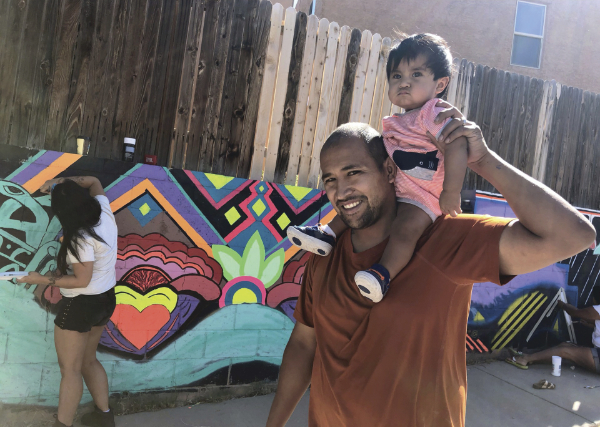
Man holding baby on his shoulders walking by a vibrant mural being painted by a woman with long hair
Artist John Paul Granillo at a community mural project in Santa Fe, 2019. Film still by Chloe Accardi.

Today, prison riots are relatively rare, despite the fact that the prison population in the U.S. has ballooned since 1980. Even after many prisoner releases during the COVID pandemic, the  overall prison population is nearly four times what it was at the time of the 1980 riot, according to data from the U.S. Department of Justice. New Mexico’s  prison population has followed a similar trend.  There are a variety of reasons for the precipitous rise in prison populations, but chief among them are an increase in the length of sentences and more effective prosecutions. There isn’t much scholarship that examines why riots have fallen by the wayside in the U. S., although the rise of specialized riot-control units within prisons and increased use of lockdowns and solitary confinement are often cited as plausible causes. In other words—restriction and force, not access to programs or better overall conditions.

The facility at PNM that housed incarcerated people in 1980, known as Old Main, was shut down in 1998, and today it is used as a film set for movies. It’s also open to tour groups—“Public Tours, Group Tours, School Tours, Historical Tours,” as the Corrections Department website advertises. For a fee, a department employee will walk visitors through Old Main’s weathered cellblocks, narrating the story of the riot. The guiding motto for the tours is, according to the Corrections Department, “respecting our past to create a better future”—a tidy narrative of linear improvement. Reality, however, is not so neat. Reforms aimed at addressing prison crowding, conditions, and programming have  waxed and waned over the past decades according to the priorities of each incoming administration. One of the strengths of Between the Lines—which showcases art from incarcerated people across the country and internationally—is the way it highlights the challenge of changing the system of mass incarceration.

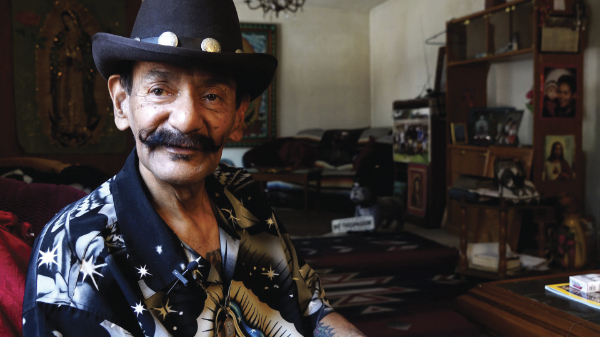
portrait of a man with black hat, adorned hat and patterned shirt
Artist and community activist Carlos Cervantes at his home in Santa Fe. Film still by Chloe Accardi.

The commutation of Cervantes’s sentence in 1985 was not the end of his story with the state penitentiary. He would end up spending another fifteen years of his life locked up in the state prison system as he cycled in and out of detention throughout the 1990s and early 2000s, sometimes for new drug-related charges, sometimes for parole violations. Now seventy-one years old, he remains on parole. 

Both in and out of prison, Cervantes has continued to make art, including many murals in both Santa Fe and Albuquerque. One of his most elaborate works is in a small community park on the Santa Fe River, near the intersection of Alameda and St. Francis Drive. Most of Louis Montaño Park is a labyrinth of color, full of bright geometric designs and depictions of Aztec religious icons. But near the top of the park is a very different kind of piece—a self-portrait of the artist. In it, Cervantes sports a bushy black mustache with upturned corners, a style that remains his signature today. He peers out from behind bars in a blue prison jumpsuit labeled with his prisoner number: 27480. A guard tower looms over him, wrapped in a hissing snake, and an hourglass beside him marks the slow passage of time. Cervantes is half-smiling in the portrait, giving the impression of defiance, an unwillingness to be reduced to the cage he’s in.

Granillo remembers Cervantes painting the murals in the park. It inspired him to his own artistic practice, which he got serious about in prison. Drawing and painting were a way to pass the time, but over the years, Granillo also came to see a deeper significance in the act of creating. “If you don’t make your mark for you, they have a place to put you,” he said, explaining that during his time in prison, he had come to see art as an act of resistance against a system that often reduces incarcerated people to statistics. 33 died, 89 wounded. That’s also, Granillo believes, the power of Between the Lines. He was one of many community collaborators on the exhibit, which features some of his own work, as well as the work of other artists he connected to the museum. Over the years, Granillo has noticed that people who receive art from prisoners often hide the pieces away—out of shame, or pain, or a desire not to dwell on its provenance. That was the case for the cup Nordaine Oliver received—Paul says after the day his father brought it home, he didn’t see it again until three decades later when he was sorting through his father’s belongings. By bringing those pieces out of storage and into the museum, Granillo is hopeful that visitors will walk away thinking about the people who made them and why. “I think in this exhibition, they’re bringing back a lot of —humanizing, some of the dehumanizing that happened in those spaces,” Granillo said. “And I think that’s how [prisoners] remember they’re human in prison too. It’s through the art.”

Stephanie May Joyce (opens in a new tab) is a writer and podcast producer based in Santa Fe. Her stories about border conflicts, public lands, and the crab mafia, among other things, have been published by Outside, NPR, Bloomberg Businessweek, and 99% Invisible.

What the Land Holds

Returning from a trip once, the woman seated beside me peered out the window as the plane began its descent to Albuquerque. “Oh my,” she said. “Look at how brown it is.” I looked. I saw some brown and grey buildings, but I also saw red earth, the gentle green of the cottonwood leaves, the dark green of the juniper, and the deep blue of the Sandias—which I knew from experience would blush a luminous pink at sunset. My impulse was to defend the land, but I remained silent. Seeing through someone else’s eyes is often difficult—especially when it comes to the lands we call home.

Although I was born and raised here and feel deeply connected to this place, I cannot see it the same way as people who have been here far longer. I do not hold the ancestral knowledge or memory that comes from generations. Most people living within what we call New Mexico do not live on our ancestral homelands—including many Indigenous peoples who have lived here for time immemorial, who do not have full access, or any, to their ancestral lands. For some of us, displacement was a choice and for others, genocide, slavery, colonization, and assimilation have forced displacement.

In an excerpt from her memoir Whiskey Tender, Deborah Taffa (Kwatsaán and Laguna) writes about being a mixed-tribe kid living in a border town on the Navajo Nation. For Taffa, experiences with displacement and assimilation echoed the long history of her ancestors and parents. Watching her father draw strength and comfort in the land helped Taffa do the same.

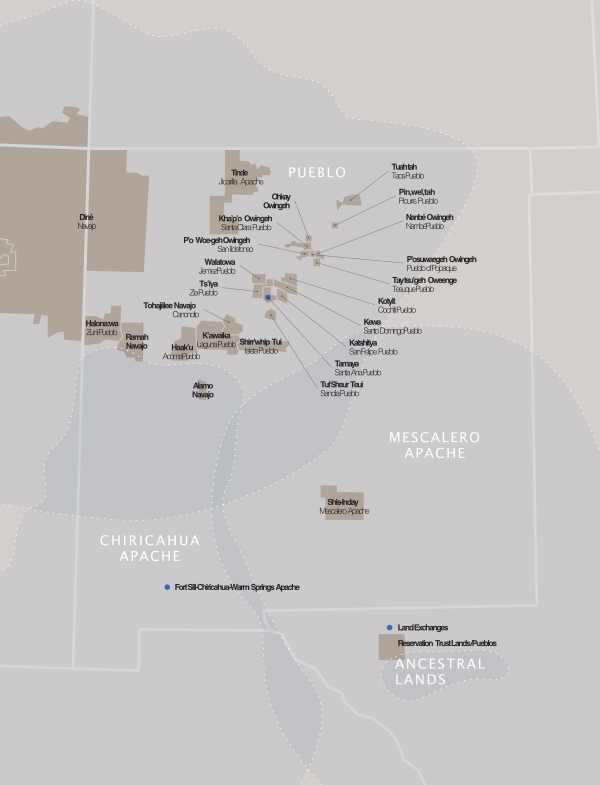
DezBaa´ (Diné) also chronicles the history of forced removal of Native peoples here, beginning with Spanish colonization in the 1500s. People who should have been on these lands for centuries often weren’t. As she writes in her article about two Native Nations’ recent land exchanges with the New Mexico State Land Office, “For those of us who have grown up
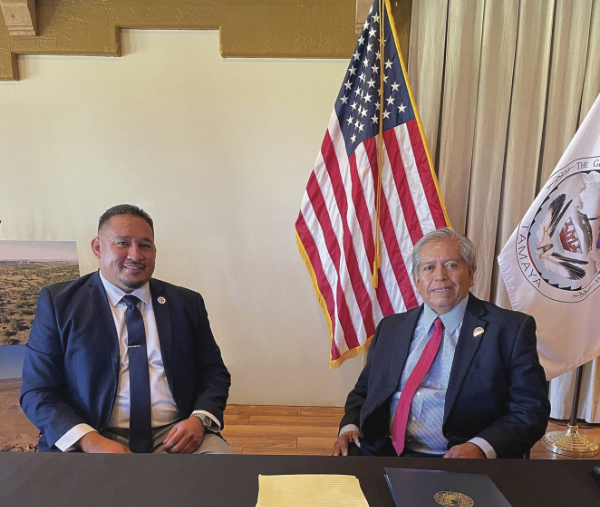
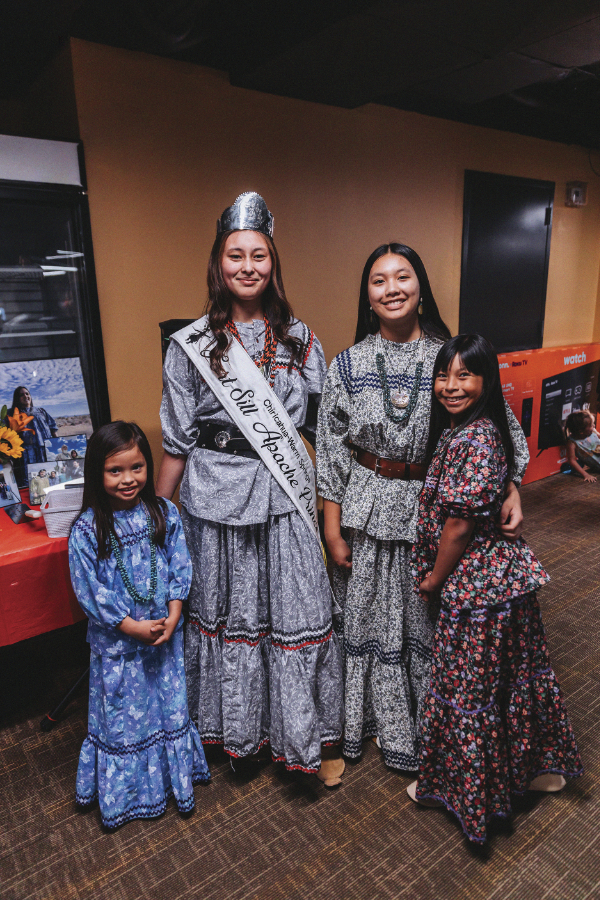
outside of our ancestral lands, there’s a joyful remembrance in our souls and a mournful ache in our hearts.” Though their histories are not the same, Fort Sill-Chiricahua-Warm Springs Apache and Santa Ana Pueblo have recently expanded access to their ancestral lands. It is an act of reclaiming some of what was lost.

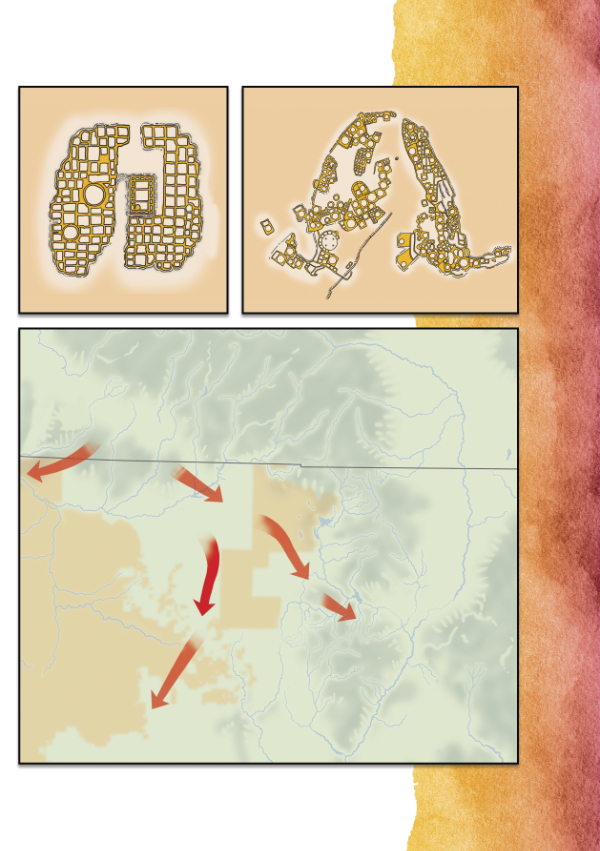
For many Indigenous communities, reclaiming and re-imagining is embedded in their history. In his article, Jim O’Donnell chronicles the rise of authoritarianism among Ancestral Puebloans in the Four Corners region and the subsequent migration away from this political system and connected economic disparities in the 1200s. Tewa Pueblos in New Mexico are among those believed to be descendants of groups who broke away from authoritarianism to create more egalitarian societies. Though O’Donnell advises readers to approach lessons of the past with caution given our contemporary lenses, there is perhaps a hopeful lesson in the history he chronicles: Agency, reclaiming, and the human imagination can help us create new lived realities.

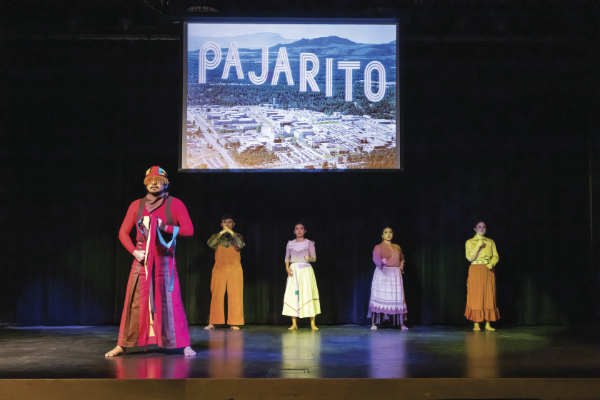
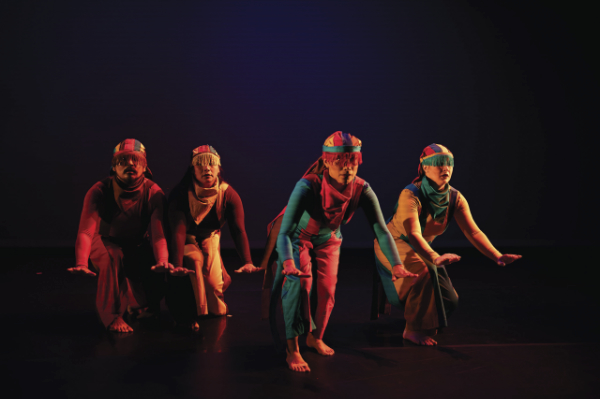
Storytelling and art are powerful examples of imagination and our capacity to envision new systems and heal from pain. Steph Joyce writes about the 1980 prison riot at the Santa Fe Penitentiary and reveals the ways art can help incarcerated people survive. Food, too, is an art, as Mi’Jan Celie Tho-Biaz reveals in her essay about New Mexico food traditions, and it’s one that can nourish and heal us—especially when we create and enjoy it together. In her article about Yvonne Montoya’s dance performance that reckons with displacement of nuevomexicano families from the Pajarito Plateau during the construction of Los Alamos, Myrriah Gómez records Montoya’s powerful words: “We must take our historias into our own hands and instill them in our children to ensure that our querencia—our love of place and culture—lives on.”

Emily Withnall (opens in a new tab) is the editor of El Palacio and the host of Encounter Culture. Prior to stepping into the editor role, she wrote for the magazine for eight years. Emily has also been published in The New York Times, Al Jazeera, High Country News, Orion Magazine, Tin House, The Kenyon Review, Gay Magazine, Source New Mexico, and other publications. She lives and writes in Santa Fe, New Mexico.

She, The Mountain

At a sleepover when I was seven, my friend said the mountain was a volcano that would erupt at any moment, cracking the dam and flooding Abiquiú. I stayed up most of that night panicking over my impending death. I prayed we would float down the valley like worn winter leaves on water. For years I watched the mountain, leery of her fragile flattop and percolating lava within. Many told me she wasn’t a volcano, but it took a long time before I was convinced we were safe. From her. 

A few years ago, my sister sent me a video with the caption, “The influencers made it to Abiquiú.” In it, the person wears clear four-inch platform heels that reveal a set of encased dice. Where I come from, rolling the dice means something different. The influencer struts and poses on this path to my childhood home, the dice and stiletto points clattering on the humble paved road. I remember when the road was dirt. 

I know the mountain’s every angle. When I look at her from the north, I am on the ribbon of highway approaching Youngsville, forty-five minutes from my dad’s house. From the northwest, her surreptitious pyramid top is visible, placing me at the cutting bend before the forest and elk begin. I’ve memorized every view of her, the center of this carousel that rotated me between houses, when my mother would drive me and my sister to the Coyote Forest Ranger Station for the weekend handover to our dad. By the time we got to his house, she was no longer visible. 

It’s hard not to think of the famous painter when we see her. Though we’ve spent years taking back the narrative of Cerro Pedernal, the name of the woman the mountain made famous sits heavy on her horizon line. But we do see her as herself. Her steepled edging. Her supple corners. The mesa band of her brow. We see all that she stands for, against, in spite of. Consider all she’s witnessed: fawning artists, P’Oshu’Owingeh’s prime, the unfettered Chama River, selfie-taking tourists, the burning of Santa Rosa de Lima. The folly of believing you can own a mountain therein betrays the power and possession she has over you. She will endure after we die. She does not care where we sprinkle our ashes. She is not a volcano.

Santana Shorty (opens in a new tab) earned her BA from Stanford University and her MFA from the Institute of American Indian Arts. Her work focuses on New Mexican landscape and culture. Currently, she is working on her first novel. She is a member of the Navajo Nation and lives in Santa Fe, New Mexico.

Tira Howard (opens in a new tab) is a portrait, lifestyle, and fashion photographer based out of Santa Fe, New Mexico. Her work can be seen in V Magazine, Cowgirl Magazine, Table Magazine, New Mexico Magazine, El Palacio magazine, Pasatiempo, Cowboys and Indians Magazine, The Santa Fe New Mexican magazines, The Santa Fe Reporter, Western Art & Architecture Magazine, and Edible New Mexico Magazine.

Almost Yuman (1972)

Remembering the Animas River helps me forget, at least for a moment, the challenges, fears, and feelings of inadequacy I experienced in my childhood. Memoria praeteritorum bonorum. My own set of rose-colored glasses. A trick of the mind that helps me highlight the peaceful days, the quiet ones that punctuated the violence, pressures, and confusion of being a Native girl in a northwestern New Mexico town where cowboys still hated Indians, and three White teenagers murdered three Native men just before my family and I moved there for my father’s new job. Navajo people marched in the streets, and though we missed the protests and backlash, the town’s tension remained consistent, even after the Civil Rights Commission came in to keep the peace. 

My early childhood took place in an era when good Native families didn’t move off the reservation because close friends and relatives called relocation a betrayal. It was a time of conflicting choices, when young people who grew up on the reservation faced a dilemma that pitted double-digit inflation and high reservation unemployment against the desire to belong to their tribe. It was a time when my father realized he wanted to be an individual, and my parents decided they wanted their kids to be mainstream Americans, thereby passing down an implicit appreciation of social climbing along with and in conflict with the realization that our people are excluded, ironically, from the central mythologies of the American identity.       

I want to say ours is the iconic American story but that would insult non-Natives, the decent folk for whom the knowledge of broken treaties and forced assimilation is already a burden, and for whom oppression is likely also an inheritance. I don’t tell this story to create a divide. I tell it because there are too many dark corners in America that can be relieved of persistent shadows by shining a little light. I tell it because our story belongs to all Americans, some of whom may be surprised by its history. I tell it to celebrate our survival as a culture, as well as the hope, strength, and grace of my family.  

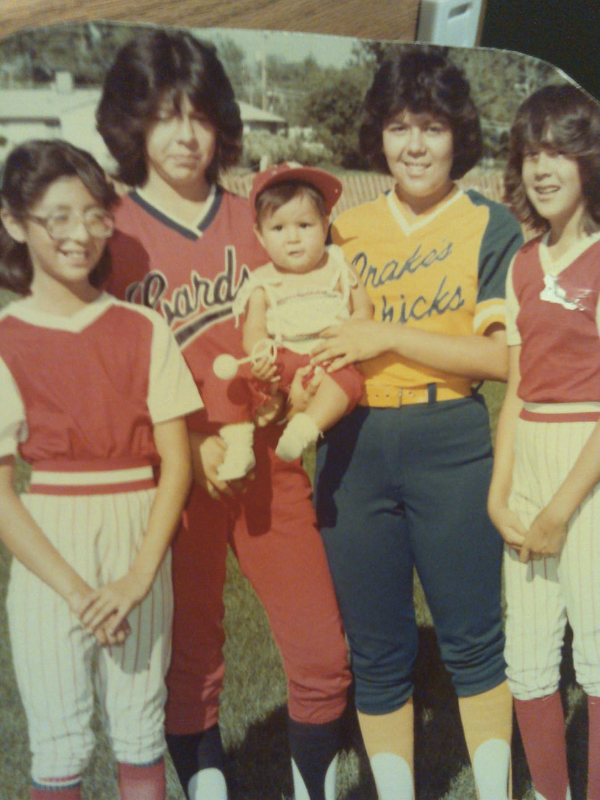
Five sisters in the late 70s in softball uniforms
Deborah Taffa and her sisters in their softball uniforms, 1978. Courtesy of author.

This story is as common as dirt. Thousands of Native Americans in California, Arizona, and New Mexico could tell it. Anyone with a grandpa who was haunted by Indian boarding school, who stung his family like a dust devil when he drank. Anyone with a grandma who washed laundry until her fingernails cracked and bled, who went without eating when there weren’t enough groceries because she wanted her ten kids to have a few extra bites. Anyone with a mother who kept secrets so her kids wouldn’t find out about their father’s jailbird past. Anyone with a father who chose the violence of industrial labor over the violence of reservation life because he wanted his kids to get through private school and make better lives for themselves.          

So many people could tell this story; it is shocking how little it has been told. Too many mothers have watched their kids thrown into cop cars without protest. Too many aunties have put ice on black eyes without saying a word. Too many grandmothers have watched their grandchildren, their hope for the future, head out to a party and never come home. Too many girls have pretended nothing happened after experiencing sexual harassment, only to redirect the hate towards the innocent face staring back at them in the mirror. 

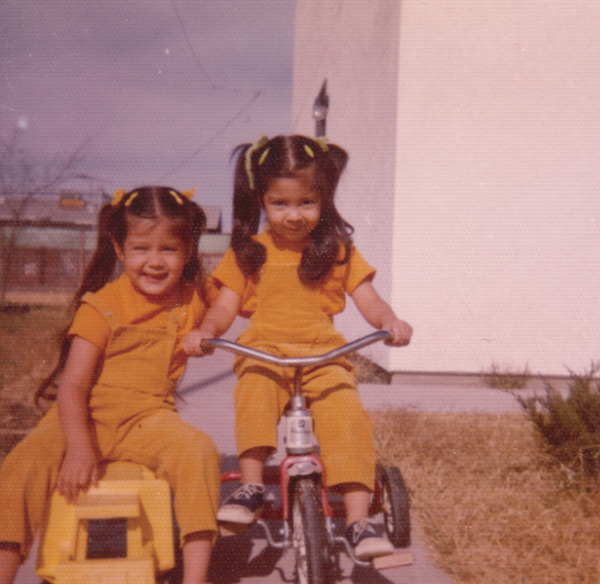
color photo of two girls on tricycles in matching yellow outfits in the mid 70s
Deborah Taffa and her sister, Monica, 1974. Courtesy of author.

Native memoirs are rare because there are rules on the reservation. Talking to outsiders is taboo. We fear appropriation and fight about who has the right to speak. So why tell my story? Because I want Native kids to feel more connected and less lonely. Because I hate the portrayal of my people as dependents unable to better their own circumstances. Because I need to understand what aspects of my personality were seeded in that New Mexican town all those years ago. And because it has been so long since the events in this book took place, I am able to enjoy some gallows humor in the telling.  

My inheritance stretches back to the Anasazi, over a thousand years in the cacti, sage, and sandstone lands, in the desert canyons, adobe homes, and turquoise stone Southwest. America runs like a river through my veins, yet throughout my childhood, Native representation gathered dust in museums. On television, in books, I saw costumes and mascots—never a portrayal of a mixed-tribe Native girl listening to music on her Walkman. Without a contemporary likeness of myself in the media, there was no confirmation that anything I experienced in my childhood was real. 

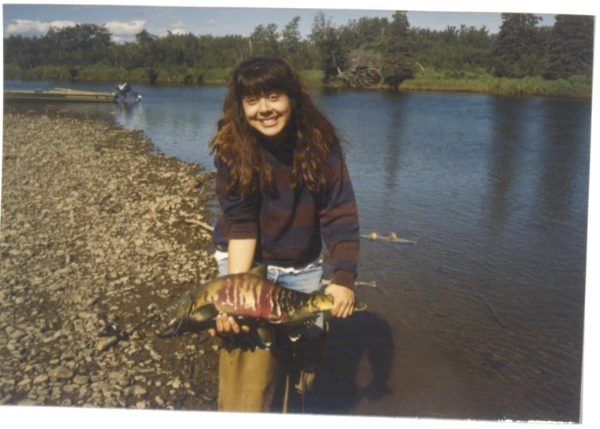
Teenage woman holding a freshly caught fish on the bank of a lake
Deborah Taffa fishing, 1989. Courtesy of author.

My father was born in 1941 and he taught me never to confuse pity with comprehension. His Quechan (Yuma) grandfather was born in a time when California’s Indian population had plummeted ninety percent because of foreign diseases, Catholic slave-labor, and the government’s hiring of private militia to bring in Indian scalps. California’s first governor, Peter Hardeman Burnett, openly promoted genocide, calling for “a war of extermination” in his second state address. With the help of the U.S. Army, the California legislature distributed weapons to vigilantes who raided Native homes and killed 100,000 of my ancestors in the first two years of the Gold Rush alone. $1.1 million was paid to these murderers, and when it was done, the U.S. Congress agreed to reimburse the state.

When I was younger, I avoided writing about these atrocities. I told myself it sounded conceited. To have survived that much violence, my ancestors must have been powerful. It was like I was claiming to have super genes. Today I know my hesitation was shame: the silence that follows an apocalypse. To talk about what we suffered, to concede that we were victims, was not something we did in my family. And yet to write about the culture that was taken via the government’s assimilation policies, I must acknowledge the pain and remember the beauty in the middle-class life my parents jerry-rigged for me and my siblings in the high-desert arroyos and sun-scorched histories of the American Southwest. 

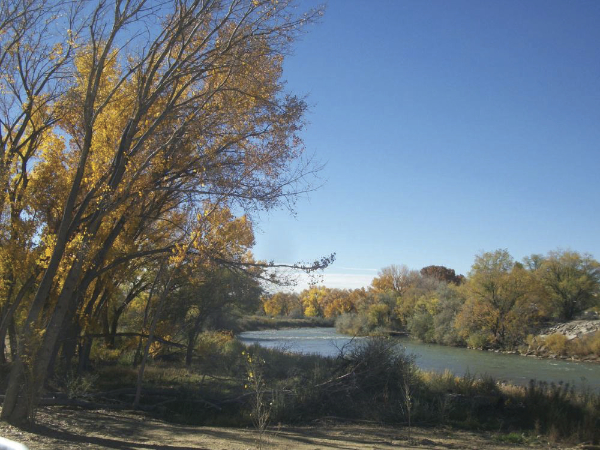
I was raised to believe in the reciprocity of the land, and I know that, if I went back now, I would see that our favorite camping spot near Purgatory has aged just as much as me. During my childhood in the 1980s, my family and I were fishing on the shores of change: the Animas was the last free-flowing water in Colorado before it was dammed at the start of the twenty-first century; a bald eagle refuge not yet injured by the wastewater that bled from the Gold King Mine in 2015. Dad said the river’s full name was the Río de las Ánimas Perdidas, or the River of Lost Souls. He said if we got up early, we might get lucky and see them: the spirits of our ancestors floating downstream in the early morning fog.

I remember waking up and calling Dad to bring me my basketball shoes while I was still in my sleeping bag. Warm from their place near the fire, the shoes’ canvas made my toes cozy. I ran down to the water, where the grass was stiff with frost, and there was the smell of smoky pine in every breath. I squatted to wash my face, squinting at the outline of what I imagined to be the spirits of our ancestors on the other shore. If only I knew their names, I thought, maybe I could help them get home. 

Today, they are the ones bringing me home. Reflecting on my visit to the Animas River when I was twelve, I hold my ancestors close to my heart, knowing I too will be an ancestor someday, adding to the chain of lives that came before. 

With death as my guide, I remember what’s important, and listen for the river even now. “Do not participate in the erasure of your own people,” the voices murmur. “Do not be a silent witness as we fade.”   

We sisters were broken girls. We twisted our ankles sailing off playground swings, toppled out of tamarisk trees, plucked yellow-jacket and broken glass stingers out of our skin. We slammed our fingers in car doors, burned our feet in campfires, and then sat in the waiting room at the Yuma Indian Hospital, ice pressed to injuries. 

Joan broke her wrist. I broke my collar bone. Lori had a two-inch scar down the center of her chest. Monica slipped through the handrails of a tall metal slide and landed twenty feet below. The reservation was rowdy in the 1970s. By the time I was three, scars were a main source of pride. 

Put a little whiskey in Dad’s beer, and he got to talking about his friends. Crushed under a fast-moving train. Stabbed in the chest during an alley fight. Propped against a tree at a public park with a hot needle sticking out of an arm. Killed in a landmine explosion in Vietnam. Mom tried to shush Dad when he told us his stories. But he said we needed to know the truth if we were going to survive, to hear how tough the world could be. 

Swagger was a sure way for us kids to get praise. Despondency hung over the reservation, and when toddlers and children acted rebellious, adults saw hope and verve. A sassy girl was a girl who might make it, even against the odds. My sisters and I did what we could to impress.  

We rejected all things girly. We painted our dolls’ faces with markers, tattooing their chins in the style of our female ancestors. We chopped off their hair, and when they grew grotesque, threw their heads in the trashcan, and danced their bodies around, calling out like barkers selling tickets to see Geronimo at the World’s Fair: “Come and see the Amazing Headless Wonders!” We were unruly Indian girls, not the friendly Thanksgiving Day types who knew how to cook and behave. Our mother said it was too late to teach us any manners.  

Dad always said, “Broken bones grow back stronger,” raising us the same way his older brother, Gene, raised him. A father’s job was to control the pace of the world’s wounding; to dole out the pain in slightly bigger doses over time so that his kids would learn not to break under pressure. This is what I think of when I think of my sisters and me growing up: we didn’t get anything for free and we blossomed because of it, blood flowering into bruises, skin thick and ripened under the Sonoran Desert sun.

We rarely cried, knowing tears were a sign of weakness, knowing we’d never catch our father or his brothers wet-eyed. I remember seeing one man cry though—our neighbor, weeping the day his dog, Rocco, died. 

You never saw a dog as spastic as Rocco. He made a play for freedom every time her neighbor opened his front door. “Rocco, you shit!” we’d hear him yell. Then the screen door would slam, and the chase would begin. 

Rocco would never heel and our neighbor, who had a bad leg, could never catch him. It was dodge-and-go for thirty minutes every time, an entertaining show that my sisters and I watched with glee. We scrambled on top of the swamp cooler and cheered Rocco on, loving the way he sidled in and ducked away at the last second. 

The downside to our afternoon pleasure was the finish. The longer it took the neighbor to catch poor Rocco, the harder he would kick him once he got him leashed. “You fat old bastard!” we yelled when he did this. 

Rocco’s owner lived alone. He passed us Popsicles through the rip in his front screen door, but only if we would stay with him for a while after eating. Cold and sticky and sweet, the Popsicles were a treat we never had in our own refrigerator, stocked only with its week-old refried beans, lard-hardened cheese enchiladas, and Bud Light beer. When we finished, he’d come out and wash our hands with the hose. Then he would gather us around his lawn chair, take one of us on his lap, and crack stupid jokes. We could not leave because that would mean abandoning whoever he had on his lap. The rest of us gnawed nervously on the Popsicle-sticks until he let the unlucky one go.

“Next time I ain’t taking one of those Popsicles,” we would swear. Then his jalopy would crunch up the driveway and we would see him carrying sacks emblazoned with the words Del Sol Grocery to the carport door. Our mud cakes would fall to the ground. We risked plenty for those Popsicles. 

“Don’t go near that guy.” Our parents gave us strict instructions to stay away from him. 

Everyone said the only reason he lived in Yuma was because his ex-wife died and left him her house. They said never to trust an Indian who doesn’t want to go back to his own reservation. Their mean comments were rooted in jealousy. He wasn’t an enrolled Quechan (Yuma) tribal citizen, yet he had inherited a house on our reservation. 

Property ownership on our ancestral lands became complicated in 1893, when the Colorado Irrigation Company started lobbying the U.S. government to build a diversion dam on our reservation. Suddenly, engineers and Indian agents were advocating for the government to “give” tribal members five acres each and sell the “excess land” to White farmers. Before this era in history, our home at the confluence of the Colorado and Gila Rivers had been mostly ignored by whites, many of whom had assumed southeastern California was sterile. Instead, it was an oasis in the desert, beneficial for planting. 

By the time I was born in 1969, it was hard to imagine the sheer size of the Colorado River before it was dammed. For eons it had burst its banks in spring, carrying sediment carved off the walls of the Grand Canyon. There was always snow in the mountains, which meant an annual flood was guaranteed, and every year our ancestors went to higher ground until the water receded. When they came down, they planted in the nitrogen-rich silt deposited by the river: melon, squash, beans, and corn. They rebuilt the previous year’s swales and dams for irrigation, adjusting annually to the new contours of their farmland.

My inheritance should have been a house with abundant crops grown in some of America’s most fertile soil, but despite petitioning Congress, Dad’s great grandparents lost their battle and their land to the U.S. government via termination policies involved the Dawe’s Act. In 1911, purportedly to pay for canal construction and the tribe’s new irrigation costs, the government sold our best farmland for pennies on the dollar. Concrete canals were built for white farmers, cheap wooden ones for us. Maintenance fees resulted in the concrete canals being patrolled and kept in good condition, whereas ours leaked and destroyed the soil with alkalinity.

The 1912 flood was the last time Dad’s great-grandparents planted in the traditional way. By 1914, our family members, Dad’s Quechan grandfather included, received ten acres each (a number that paled in comparison to the average one-hundred-acre allotments on other western Indian reservations). In 1915, the government adopted a rule that Indian agents could lease Quechan land for ten years at a time if it was not being used to their liking, and from that point forward White farmers took over our reservation. 

With eighty percent of our original treaty land sold, only three houses had been built by Dad’s family. Dad was the fifth child, and by the time I was born, his mother and two brothers called the houses home. The family had more acreage, but banks would not accept reservation plots as collateral, and even the houses we did have were gained when my grandpa, dad, and the family drove out to San Diego in 1956 to dismantle and transport prefabricated plywood houses that had been built for shipyard workers during the war. Because of this reservation housing scarcity, we lived in duplexes, apartments, and run-down stucco houses, rental properties on both sides of the river. Renting was a common circumstance for many big Quechan families, and therefore many people resented Grandma’s neighbor for his house on the reservation. Grandma herself was Laguna Pueblo, which meant they might have resented her too. 

When the rattler got Rocco, our neighbor’s scream ripped the desert. I was hiding behind clothesline sheets in a game of hide-and-seek when I heard him yell the dog’s name. I came out of white cotton to see his shovel moving like a jackhammer as he chopped the rattler in two.

He threw the shovel down and limped over to Rocco. His good leg buckled. We inched closer. Rocco was bleeding out of two puncture wounds and his forehead was starting to swell. “What’re you staring at?” our neighbor yelled. 

Vintage photo of a smiling man sitting at a linotype machine with a feathered headdress
Deborah Taffa’s grandfather at his linotype machine at the Yuma Daily Sun, date unknown. Courtesy of author.

The rock wasn’t big, and he only threw one. It struck the back of my hand, and my sisters took off running. Stunned by the pain, I lost them. The memory gets lost, too, at this point, but I always say I ran down to the canal. I wouldn’t have gone home while I was crying. My sisters would never let me hear the end of it. And it wasn’t like I feared Dad would whoop me. He wouldn’t have. But even if he said nothing, I knew he’d be disappointed.  

Color phoito of the animas river with foliage beginning to turn golden early in the season
The Animas River as seen looking north from Aztec Ruins National Monument in Aztec, New Mexico, 2014. Maekju, Creative Commons Attribution-Share Alike 4.0 International license (CC-BY-SA-4.0).

Dad had a secret. I could see it in his body and sensed it in the way Mom sometimes told us to leave him alone. I felt it in the air like static when he grew angry at the park, restraining himself, barely, in exchanges with leathery men in gallon hats, men who refused to let us play with their daughters. I had seen Dad knock a guy off his feet with one punch, but he was straightening his life out in my early childhood, and his new docility embarrassed me.

Dad belonged to the desert like a naturally rooted cedar, and the incongruent way he started shrinking small in town was scary. He sometimes had night terrors, jumping to his feet with his fists raised like he didn’t recognize Mom. During my early years in Yuma, he held a river of traumatic events in his body, and if the flood of pain hadn’t finally busted open, I never would have learned his secret myself. 

When life grew stressful, and he had trouble sleeping, he always retreated to the land. I don’t know how many times he drove us out to go hiking near Picacho Peak, insisting that it was his job to help us grow strong. Mom always stayed back at the dirt parking lot, at the base of the desert peak, cracking sunflower seeds and reading. I would see her when the trail switched back, shielding her eyes with her book, fidgeting as she watched us climb higher. 

The loose gravel was slippery, but Dad refused to carry us, and didn’t like it when we asked to rest. When we tried to sit and scoot down a slippery slope, he barked for us to stand. We would gain elevation gradually until we ran into rock walls. He would say, “wait,” then climb up, and call for us to come closer. He would grab us by our wrists and pull us up the face. Once we were together, we would walk farther until we were on top of the world.

Looking down at our Chevy Nova on the dirt road below, the vein in my neck would pulse, and my head would spin dizzily. The car looked like a toy, and Mom like a small doll waving her arms helplessly, worried to see us so high. The desert reduced Mom, like town did Dad. Out here he was towering, standing at the edge of the cliff, his hair whipping around in his face. 

I usually shied away from the precipices, but Dad always came over. Squatting low to look us in the eye, he gave instructions: “If anyone moves from where I put you, you’re going to get a spanking.” Then he would take my older sisters, Joan and Lori, to sit on the edge of the cliff. Monica and I would huddle together hoping to stay where we were, but he always returned for us as well. 

He would arrange us two on his right and two on his left with his arms extended across our laps like a safety bar. My legs would dangle heavy and the wind would blow across the sweat at my lower back. Whenever I shivered, feeling frightened, Dad would scoff and roll his eyes. “You’re not going to fall,” he would say, and trusting him, I would manage to relax and see.  

The desert stretched on forever, and a green body of water snaked through the mauves and tans.“That’s the Colorado,” Dad told us, using his chin to point at the river in the distance. Our ancestral homeland stretched on as far as the eye could see.

Then Dad would grow quiet. He was always capable of keeping still for long periods of time. Sometimes we complained and pestered him to go home, sometimes he sucked us into the silence and I would lean up against his body and feel the weight of his wounding, as well as the difficulty of my knowledge that not everything was getting told. 

Deborah Taffa’s memoir, Whiskey Tender, has been named to 2024 best lists at Esquire, Oprah Daily, ELLE, and The Washington Post. With fellowships and grants from the National Endowment for the Arts, PEN America, MacDowell, and the NY State Summer Writers Institute, she received her MFA in creative nonfiction writing in Iowa City. A citizen of the Kwatsaan (Yuma) Nation and Laguna Pueblo, Taffa is the director of the Creative Writing MFA program at the Institute of American Indian Arts in Santa Fe. This essay is an excerpt from the chapters “Animas (1981)” and “Almost Yuman (1972)” as they appear in Taffa’s memoir, Whiskey Tender, (HarperCollins, 2024).

Deborah Jackson Taffa (opens in a new tab) is an Indigenous American writer and the author of the memoir Whiskey Tender, which was a finalist for the 2024 National Book Award for Nonfiction and was longlisted for the 2025 Carnegie Medal for Excellence in Nonfiction. A citizen of the Quechan (Yuma) Nation and Laguna Pueblo, she holds an MFA in Creative Writing from the University of Iowa and serves as Director of the MFA in Creative Writing program at the Institute of American Indian Arts. Taffa has received numerous awards and fellowships from organizations such as the National Endowment for the Arts, PEN America, MacDowell, Hedgebrook, and others.

Hands, Heart, Land, Table

When we arrive at the table, we witness an assortment of heads intermittently lowered in praise-filled bites, not prayer, trying to draw the meal out as long as possible. No food grows cold or is left over, which is the ultimate compliment to the chef. 

What is New Mexican-based art, if not our foods?

The arts all carry the opportunity to permeate our minds and hearts, traveling different routes to our scatterplot of available senses.

Depending on the bass, volume, and type, music touches our ears, prompting our heads to nod, hands to tap, and feet to follow.

Performing and visual arts are a bit more distant, only able to be perceived by our eyes or ears or rhythmically through floorboards at a length of space that supports the interplay between artist and audience. Images, movement, and action allow opportunities for these art forms to be physically touched and felt.

But culinary arts in New Mexico? It is the rare art form that combines each of our senses.

Almost like a mathematical order of sense-bearing operations, New Mexican culinary dishes travel very close to the nose so that we can make our final approval–to inhale what our eyes have already taken in. We usually have a funny way of smell-seeing our foods because many delicious dishes (such as fry bread and tamales) can be held in our hands.

Historic black and white photo of two women tending to an outdoor indigenous oven with an elder holding a baby in the background
T. Harmon Parkhurst, Pueblo Girl Scouts baking bread in horno, New Mexico, 1930–1935. Courtesy of the Palace of the Governors Photo Archives (NMHM/DCA), Neg. No. 054266.

Culinary arts are ultimately reliant on our mouths; however, it is the art form that is the most intimate, literally ingested by our bodies to sustain our physical life, which means that it carries the highest likelihood of a daily artistic practice. My favorite way of engaging in the practice is beside my master chef friends. They cook and later clean, while I prep and dry dishes. The kitchen is transformed daily into the place where we trade jokes, listen to music, and guard culinary and life secrets around a festive table built for loving our collection of friends, chosen family, collaborators, and sweethearts. 

While I could join many others who have written love letters about everything uniquely delicious to New Mexican cuisine, as well as our different fusion variants, it is the communal eating experiences where we truly shine. Like other states, we have the usual roundup, including movie theater dining, where you can sit in front of the big screen and join a full theater of other diners facing cinematic action. There’s also food truck culture that offers roadside eating for you and your chosen community. And we have plentiful bars where diners can order a meal and a drink, choosing to speak with the bartender and anyone else who is agreeable and seated on your left or right. While I believe that our kindest culinary gesture happens periodically during the Pueblo Feast days, we can routinely find generosity, connection, and care through our community tables.

Two women smiling in a kitchen in front of generous, colorful spread of avocado, tostadas and a purple salad
Aurelia Arroyo Nieto and Mi’Jan Celie Tho-Biaz (author), 2024. Photograph by Balam Toscano.

This past spring I went to lunch with a friend in Santa Fe. The restaurant was packed, and we were both pressed for time, which made the ten-person community table of travelers and locals our quickest option. While most of the table’s newcomers could never figure out whose menu was supposed to be whose, there was zero grumbling because we were hungry and most of us only needed to see one thing listed: breakfast burrito, with its constant companion of red, green, or “Christmas” chile.

The community table’s composition seemingly mirrored the kaleidoscope mix of the smothered breakfast burrito flavors, and the dedicated ensemble of hands that create and transport each aspect of the dish to the table: acequia waterway protectors, agricultural growers, farmers and ranchers, chefs, and restaurant waitstaff.

It strikes me as interesting how people from different geographies and developed palates can encounter the intersection of New Mexican culinary arts at the communal table, as if the table and food are in a friendly competition to see which can elicit more of a spirit of connection and nourishment. I quietly wonder about the last time that I encountered a compelling art form with an invitation to similarly experience mandatory nourishment, while surrounded by a small group of other people having the same experience, facing and talking with each other. 

While I do not want this love letter to misrepresent communal tables as utopias of the culinary art world, I am fairly certain that it is a subtle New Mexican approach to our food and the unique settings that serve as connectors that transcend singular senses, bundling the entirety into a more dynamic whole. After all, our foodways tell the story of our longstanding New Mexican traditions that are tied to complex histories as we nourish our yet-to-be-told futures.  

I wonder if my constellation of feelings about New Mexico’s unique food traditions is a requirement for our food’s soul not being defined by rich taste or spices alone. One of the hallmarks of soul foods around the world is how they hook you from the first bite, demanding heads, hearts, and bellies to feel an undeniable kinship to the hands, hearts, and land that made it so.

We may arrive at the communal table alone or joined by loved ones. In either case, we will likely feel invited and welcome. The day could be a special occasion or part of our routine needs. But odds are high that each person will have two points of overlap–the culinary art, and the artful act of being woven together with other eaters–neither fitting neatly into one box, alone.

Mi’Jan Celie (opens in a new tab) is a Kennedy Center Citizen Artist who moves between realms of oral history, art, ritual, and civic engagement. She is a 2024 National Council on Public History Honoree for her oral history and public art work, an inaugural New America Us@250 Fellow, as well as a 2023–2024 Andrew Mellon Foundation Fellow at the Huntington Library where she is researching Octavia E. Butler’s archives.

Ungelbah Dávila (Diné) is an award-winning writer and photographer from New Mexico. She spent her first twelve years in rural New Mexico on her father’s cattle ranch in Mangas, and mother’s property along the Gila Wilderness and San Francisco River in Reserve, New Mexico. Ungelbah received her BFA in Creative Writing from the Institute of American Indian Arts and launched La Loca Magazine during her time there. She began self publishing La Loca with national distribution from 2013-2015 while working as a copyeditor and journalist at the Valencia County News Bulletin (2011-2012) where she was awarded the National Newspaper Association Award: Best Serious Column & Best Breaking News Story (2013).

Feet, sandals,and the power of political agency in the ancient southwest

Illustrations by Marty Two Bulls Sr.

Eight hundred years ago, something profoundly interesting happened in the American Southwest. Over the course of about one hundred years, the Puebloan world consciously transformed itself from a stratified hierarchical society to a system with no apparent markers of classor status. In our current state of political and climate chaos and anxiety, the experiences of Ancestral Puebloan people teach us that deep societal change is possible. 


I returned to Yucca House on a dusty morning in late May, maneuvering my truck down a gravel road lined with abandoned irrigation pipes, pumps, hoses, and sprinklers. I parked past a “No Trespassing” sign, near a windswept farmhouse surrounded by a green lawn. A brown haze of dust, pollen, and smoke from fires hundreds of miles away cloaked Sleeping Ute Mountain and the mesas to the south.

Beyond a creaking metal gate lay the remains of what was once a thriving town, home to hundreds of people. Seven hundred years ago, farmers worked plots of corn, beans, squash, and bright bee plant watered from a bubbling spring. Others fashioned ceramics or tended cooking fires and flocks of turkeys. Laughing children raced through the plaza where dancers celebrated connections of sky, earth, and ancestors.

Then it all came to a bloody end.

Today, Yucca House is a national monument six miles from Mesa Verde National Park in the southwestern corner of Colorado. Plowed, leveled, and irrigated fields surround mounds of rubble. An astounding number of rattlesnakes inhabit the site. The ancient walls are of coarse sandstone blocks standing in intersecting rows, creating a mesh of rooms that appears like an L-shaped waffle when viewed from above. The wooden roofs and stone towers of the town collapsed centuries ago. Save for the wind, a deep, well-earned silence embraces the ancient settlement.

Yucca House stands out as one of the largest archaeological sites in southwestern Colorado, but more importantly, it is the communal plaza where children once played that makes this place particularly intriguing.

“The layout of the lower plaza and its central public space is dramatically different from those at other Mesa Verde villages from that time,” archaeologist Scott Ortman, author of Winds from the North: Tewa Origins and Historical Anthropology, tells me later. This communal plaza hints that the people of Yucca House may have been experimenting with something profound, a complete reordering of their spiritual lives and the creation of a new socio-economic organization. Something where power seems to have devolved from elites to the common person. Something increasingly focused on the well-being of the entire community. Something more resilient.

And it was that experimentation that may have gotten them into trouble.

In the 1270s, widespread violence engulfed the Mesa Verde region. While Yucca House has never been formally excavated, Richard Wetherill, writing around 1900, noted the remains of dozens of individuals apparently murdered there. At nearby Castle Rock Pueblo, forty-one people were massacred, their remains showing signs of extreme trauma. At Sand Canyon Pueblo, where I worked as a young archaeologist in the late 1980s, dozens of people were apparently killed, and possibly more, given that only about five percent of the site has been excavated. Other Mesa Verde sites likewise bear the remains of victims as well as artistic representations of violence. The collapse of the Mesa Verde system was a very bad time, Ortman says.

It was also an instructive time, something worth considering in our modern world of climate change and political turmoil.

Eventually, the Ancestral Puebloan people of Yucca House and the larger Mesa Verde region up and left. Demographic studies suggest that between the years 1250 and 1290, an estimated 35,000 individuals—the majority of people in the region—migrated south and west. Some went to the Hopi mesas, others to Zuni lands, some to Acoma Pueblo. The largest group, around 15,000 individuals, made their way to the middle Rio Grande Valley of present-day New Mexico. These Ancestral Puebloans, most archaeologists now believe, were the ancestors of today’s Tewa people.

Who brought such violence to the people of Castle Rock, Sand Canyon, and Yucca House? We may never know, but it is possible the perpetrators were the region’s ruling elite, perhaps desperate to cling to power as their world collapsed around them; or perhaps common people seeking change. Most likely, it was part of the back and forth of a complex regional civil war.

The migrations of the Tewa people’s ancestors from Mesa Verde region to the Rio Grande and the creation of a whole new way of life upends much of how historians and archaeologists think about the ancestors of present-day Puebloan people, the value of Indigenous histories, and how pre-Columbian Indigenous nations chose to structure or re-structure their worlds. It places Indigenous experience at the center of self-conscious decision-making. The Ancestral Puebloans were cognizant political actors, shaping their own reality. It also teaches us that deep social change is our birthright as human beings.

Dr. Ben Bellorado points to a series of white boxes lining a table in the Mesa Verde Visitor and Research Center. Each box contains a real sandal once worn by Ancestral Puebloan people of the Mesa Verde region.

“Clothing and representation of clothing tells us a lot about social identities and power structures,” Bellorado says. “And since footwear was usually made of yucca leaves or fibers, it survives better than other types of clothing.”

Social and economic inequality were a part of daily life in the Four Corners region from 800 to 1300. Bellorado studies nearly 8,500 years of footwear traditions from across the region. By far the most prevalent type was the simple yucca sandal. These were easy to manufacture. They wore out quickly but were also easily replaced.

Then there were the twined sandals. These specialized items were made for over 1,500 years beginning around 200. The twined sandals, Bellorado explained, were rare and complex, employing finely woven, pre-made yucca string. They took days, if not weeks, to construct and would have been expensive in terms of both time and material. The twined sandals had both colorful and textured treads that left unique footprints in the sands of the region. They were also uniform in nature, suggesting a regionally shared way of constructing them.

“These were hands down the most complex textile ever made in the American Southwest,” Bellorado says.

It appears that certain communities specialized in the creation of these high-end sandals. The raised treads likely signaled that the wearer was a member of a privileged elite or a political organization, family, or a group in control of vital esoteric knowledge. “You could see these prints in the sand and tell what groups their wearers belonged to based on the tread design,” Bellarado explains.

The size and shape of the sandals suggests they were worn exclusively by adult men during both the Chaco and Mesa Verde eras. Weavers may have been holders of specialized spiritual knowledge, holding positions of prestige and imparting that knowledge into the sandals themselves.

Footprints, apparently, mattered. Twined sandal symbolism turns up in pottery, petroglyphs, plaster murals, and other artworks from across the region. Footprints mattered, perhaps in part, because feet mattered. Or more importantly, toes. Polydactylism is a condition in which a person has more than five fingers or toes on one or both of their hands or feet. In the 800s and 900s, individuals bearing this unique genetic trait appear to have founded a nascent nation-state in the Chaco Canyon region of northwestern New Mexico, with its capital at the bottom of Chaco Canyon itself. Several ornately buried six-toed men were found at Chaco. Recent DNA studies suggest that these individuals were related through the female line and had elite lineage lasting at least 330 years. Interestingly, the six-toe motif shows up in Indigenous Mesoamerican art from the same period, adding to the growing body of evidence of some yet-to-be understood political/religious connection between the northern Southwest and Central America. The greater Chaco political system, often referred to as the “Chaco Phenomenon” appeared soon after the collapse of Teotihuacán in Mexico and the elite of Chaco enjoyed chocolate, copper, and macaws—all products imported from Mesoamerica.

“Think of Chaco as a sort of small Rome,” Ortman tells me. “The center of the world, a place of riches, a place of nobility. Chaco was a place where wealth went in, but it didn’t come back out.”

Probably because it was a tax or tribute. The movement of wealth from the common people to an elite or ruling class.

The fourteen Great Houses at Chaco were “a sink for fancy things,” says Bellorado. One room at Pueblo Bonito, for example, held more turquoise than in the rest of the entire Southwest. In the next room, archaeologists found more jet gemstones than in the rest of the entire Southwest. Other rooms contained macaw skeletons and feathers, flutes, uniquely crafted arrows, carved wooden staffs, and ceramics decorated in ways that were unusual for the region at that time. Finely made shell necklaces, silver, abalone, and conch shells abounded. Small, privileged groups, families, or organizations enjoyed life in finely-built and decorated multi-story Great Houses with large kivas, fancy redware ceramics, and towers. Some archaeologists call these Great Houses “palaces.” 

At both Chaco and later at Mesa Verde, Ortman sees evidence of a status competition between families—a sort of Game of Thrones.

“Does this apparent wealth inequality suggest a political hierarchy?” asks Dr. Tim Kohler of Washington State University. “We can’t be one hundred percent sure, but more often than not, they go hand in hand.”

From about 850 to 1150, the Chaco political and economic structure came to dominate the Four Corners region. Besides the Great Houses, Chacoans constructed a system of wide formal roads to facilitate a regional system of tribute. They expanded their power with colonies archaeologists call “outliers,” and they grew social hierarchies of extreme inequality. Indigenous histories of Chaco mention slavery, torture, and weather control. These are sensitive stories and the details are not mine to tell, but it seems that both the Diné and modern Puebloan people agree that Chaco was a place of darkness and sorrow.

Kohler, Ortman, and a team of researchers modeled wealth differences in the Four Corners utilizing Gini coefficients, a commonly used statistical measure of income inequality within a certain population. They found that increased maize production across the Southwest resulted in staggering population growth beginning around 500. Life expectancy likewise increased through this period. Around 900, Gini coefficients skyrocketed, indicating a rapid growth in wealth disparity. Soon after, the first Chacoan Great House appeared.

Interestingly, the work of Kohler and company suggests that, at the time of Chaco’s rise, people generally tolerated this wealth disparity. Still, not everyone was happy with this powerful new polity. Those on the rim of Chacoan influence actively resisted the new hierarchy. Some populations moved north and west to escape Chacoan domination. Others moved east of the continental divide into the Rio Grande basin that would one day become the new homeland or, as the Tewa say, the “middle place.” Still, during its initial rise, Chaco was somehow able to compel social cohesion while suppressing conflict within its sphere. And then it couldn’t.

Authoritarian political systems are inherently fragile. So, too, systems of extreme wealth inequality. In their research, Kohler and his colleagues demonstrate a “significant tendency for periods with high wealth inequality to be followed by periods of high violence.” 

Under the weight of internal conflict, political reorganization, and an extended drought, Chaco fell apart around 1150. “The people intentionally dismantled the power of Chaco,” Dr. Bellorado explains. But the elite had to go somewhere, and the remnants of Chaco appear to have moved north to what is now Aztec Ruins National Monument on the Animas River. And yet, Aztec Pueblo didn’t last, perhaps couldn’t last, and those that hung on moved south. Stephen Lekson of the University of Colorado and author of The Chaco Meridian believes the majority of what remained of Chacoan society eventually ended up at Paquimé in Chihuahua and then, perhaps, Culiacán on Mexico’s Pacific coast. Another group hung on in the Mesa Verde region, attempting a new polity centered in the canyon heads of Mesa Verde and the surrounding landscape.

For 150 years after the collapse of the Chacoan state, the people of the Four Corners struggled to make sense of what happened and to figure out what came next.

Around 1080, a curious feature began showing up on the twine sandals. The “toe jog,” a fabric projection where the pinky toe is positioned, appears as if accommodating a sixth toe. These toe jogs coincided with a massive expansion of Great Houses across the region, perhaps signifying an attempted revitalization based around the memory of a Chacoan elite. The toe jog might represent an attempt to tie the present and future to a nearly mythological past.

“It was not unlike current political and religious revitalization movements seen throughout the modern world. It was an attempt at societal renaissance of the reimagined past,” Bellorado says.

Like Castle Rock, Sand Canyon Pueblo may have been yet another attempt at revitalizing the Chacoan legacy, imitating many key architectural and planning features. It was a large, fortified, and carefully laid out town constructed rapidly in the 1240s. In many regards, it is strikingly similar to Pueblo Bonito in Chaco Canyon.

But like Chaco, Sand Canyon was doomed. The end came around 1280. During excavations, archaeologists uncovered a mess of human bones scattered in a way that suggested a battle, followed by a mass killing. Most intriguing was the discovery of the remains of a six-toed male known to archaeologists as Block 100 Man. The depression fracture on his skull indicates he was killed by a harsh blow to the head. Was this man a descendant of the Chacoan ruling clan? It seems likely.

While Sand Canyon may have been an attempt at retaining and reinvigorating the Chacoan legacy, Yucca House seems to have been the opposite. Originally a Chacoan outlier, the people of Yucca House began transforming the town’s layout around 1200, opening the communal plaza and lessening indicators of hierarchy.

Amid what may have been a regional civil war, mass socio-cultural experimentation was underway across the region. Their world turned upside down, Ancestral Puebloans scrambled for something new.

The post-Chacoan revitalization movement lasted right up until the 1260s when both toe jogs and twined sandals suddenly disappeared. In fact, production of all types of sandals— simple and complex—essentially ceased by 1350 and there is no evidence that anyone in the northern Southwest made or wore sandals again. Instead, they were replaced with simple leather moccasins that all looked generally the same. When it came to footwear, you could no longer distinguish one person or group from the next—and this was probably true with other forms of clothing. Simultaneously, architectural forms simplified and became uniform. The status of one household or another could no longer be visibly distinguished. So too with ceramics. The intricate designs that had characterized Ancestral Puebloan pottery in the Mesa Verde region for centuries were no longer made. Instead, the narrower range of design structures and systems developed in the Rio Grande Basin took hold. It is as if a whole social structure that had once dominated Chaco, Mesa Verde, and the San Juan Basin was deliberately rejected and remade.

This type of conscious break with either the past or other cultures is known as schismogenesis, a way one group or culture defines themselves in opposition to their neighbors—or their past. In this case, the Tewa people consciously created a new society in direct opposition to the one they had lived under for centuries.

Clearly, something big was happening but it had yet to reach its conclusion.

The economy of the greater Mesa Verde polity of the late 1100s and 1200s centered on the family unit, with each family economically self-sufficient while possibly offering goods and labor to their rulers. Markets, it seems, did not exist; there was little incentive to grow surplus food and there was no method to redistribute surplus—except up, as tribute. As the population expanded, families farmed increasingly marginal areas, wild game such as mule deer were hunted out and the gulf between the haves and the have-nots widened.

To further complicate matters, the people of Mesa Verde became overly dependent on maize for their diet. Some studies estimate that by the early 1200s maize made up around eighty percent of the caloric intake in the region. As wildlife populations collapsed, the people of Mesa Verde began raising turkeys for meat, feeding them with, yes, maize. The entire food system became a house of cards built around a single source.

And to make things worse, tree-ring data indicate that around the year 1000, a remarkable climactic shift began. For centuries, the American Southwest had enjoyed relatively cool and wet El Niño-like conditions. Then, during the height of Chaco, a La Niña pattern took hold, not every year but more often than not. By 1200, hot and dry conditions dominated the region. Interestingly, around the same time the city of Cahokia along the Mississippi River near present day St. Louis also crumbled, burdened itself by inequality, hierarchy, and climatic shift.

 Michelle Hegmon, an archaeologist at Arizona State University’s School of Human Evolution and Social Change believes it was not so much the drought that took down Mesa Verde. After all, Ancestral Puebloans were skilled at managing the vagaries of the Southwest’s mercurial climate and had weathered much worse climactic shifts. Rather, it was the social reaction, or lack of reaction, to the drought that ultimately tore things apart. According the Hegmon, the culture of Mesa Verde was deeply conservative and hierarchical, perhaps still clinging to the old Chacoan habits. As the climate warmed and dried, corn production dropped off dramatically, the ruling elite failed to react. Malnutrition set in, then starvation, then violence.

“They were very established in their ways,” Hegmon tells me. In other words, they were culturally stuck. Clinging too rigidly to traditional ways rendered them unable to deal with a new reality.

“They didn’t all have to leave,” Ortman says. “Even during that big drought, the land could have supported most of those people.”

The fact is, they chose to leave.

Archaeology allows us to reflect on present cultural and socio-economic choices by holding the mirror of the past to our gaze. But only if we pay attention to the evidence.

The fundamental weakness of sweeping, popular historical narratives such as those written by Steven Pinker, Jared Diamond, and Yuval Harari is that they ignore human agency, instead relying on environmental determinism and teleological thinking. These writers ignore more than two hundred years of accumulated archaeological evidence that would otherwise undermine the foundations of their books. As a result, these works reproduce the limiting anti-historical mythologies we were taught in school and leave out the human ability to make choices.

The human experience has never been linear. There was never a stage of human history when all humans survived in tiny egalitarian bands of hunter-gatherers and there was never one single “Agricultural Revolution.” Over the past 500,000 years, human beings have created a beautiful and bewildering array of social, political, economic, and spiritual systems. Humans have always had the ability to make informed choices. Viewing history this way offers us a far more interesting set of stories than the overly simplistic and frequently racist histories we have grown up with when it comes to Indigenous America.

Moving from a top-down and weak hierarchical system to a peaceful and resilient social structure bordering on the egalitarian, the Ancestral Puebloan experience demonstrates that we are not obliged to stick with structures that no longer serve us. Climatic changes may influence options available but at the end of the day, people make informed and conscious choices as to how they respond to challenges they face.

We do need to be careful here. Far too often, the past is viewed through the lens of the present. In the violence-wracked decades of the early twentieth century, archaeologists understood most Ancestral Puebloan architecture as defensive in nature. During the heyday of environmentalism of the 1960s and ’70s, ancient human societies were viewed as subjects dominated by the whims of regional environments and weather patterns with observed failings emanating from a perceived misuse of natural resources. Likewise, in our current state of dramatic income and power inequality it can be tempting to view the entirety of history simply as a product of the struggle between the haves and have-nots. But human beings are far more complex than that and even though current evidence points to a bloody competition between classes in the ancient Southwest and the birth of a creatively imagined future, we nonetheless need to remain aware of our biases and how they impact our thinking and interpretations.

As Stephen Lekson puts it, the ancestors of the Tewa voted with their feet.

Sometime around 1200, the ancestors of the Tewa began looking for other options. People travelled regularly into present day New Mexico, specifically to the Jemez Mountains. It takes about two weeks for the average adult to walk the 250 miles from Mesa Verde. What were initially trading journeys among familiar neighbors grew to something more. These people were scouting a new homeland.

“The decision to pick up family and move was not taken lightly,” says Dr. Matthew Martinez, executive director of the Mesa Prieta Petroglyph Project, and former lieutenant governor of Ohkay Owingeh, one of New Mexico’s six Tewa Pueblos. “Our ancestors took the time and put a lot of thought and consideration into their choice. The movement from Mesa Verde to the upper Rio Grande was meticulous.”

Archaeological evidence supports this.

For centuries, the people of Chaco and Mesa Verde regions had obtained obsidian—a volcanic glass—from a wide range of sources throughout the Southwest and beyond. Even though Indigenous tool makers preferred harder materials such as cherts or quartzites, obsidian was often utilized in the manufacture of tools such as scrapers and projectile points. After Chaco, the Mesa Verdeans imported obsidian almost exclusively from New Mexico’s Pajarito Plateau in the Jemez Mountains. Imports grew as Mesa Verde’s population declined in the 1200s then ceased completely as the people moved wholesale into New Mexico and Arizona.

Both Ortman and Bellorado theorize that the obsidian traders were less interested in the volcanic glass for tools, seeing its value more in the significance it carried. Most obsidian collections from the Mesa Verde region comprised small flakes, not tools.

In many Puebloan belief systems, mountains represent the physical connection and interaction between the earth and the spiritual world. They are sacred places, closer to the deities that control the weather. Summer rain storms form over the high country and springs that become great rivers are born in the mountains. Obsidian, a Tewa friend tells me, was believed to have been created by lightning striking the ground.

“It seems almost like they’re trying to get the glassy black material because of its color and association with the mountains and lightning or rain deities,” Bellorado says.

This suggests two things. First, that the people of Mesa Verde had strong connections with the northern Rio Grande prior to migration and two, that the initial migration was indeed a slow, methodical process of preparing the destination for the mass of people that would soon arrive.

“They’d learned their lessons,” Martinez says. “And they were ready for a better life.”

To be clear, not all archaeologists are convinced that the modern Tewa are the descendants of the Mesa Verdeans. The debate has, at times, been heated. Still, Ortman and others have accumulated a compelling amount of evidence for this theory from a wide range of disciplines—archaeological, biological, zoological, and linguistic.

One line of inquiry compared turkey bones from both Mesa Verde and the Tewa Basin. These DNA studies suggest that a new, genetically distinct type of turkey appeared on and around the Pajarito Plateau in the late 1200s. The new population of turkeys were different from earlier turkey populations in the region but identical to the birds that had been a source of food and feathers at Mesa Verde.

Linguistically, the Tewa have words that describe architectural forms and features never utilized in the Tewa Basin but that were common in the Mesa Verde region. It is the same with ceramics. Tewa words relating to pottery were clearly born in older words describing woven items or basketry, even though modern Tewa artists do not utilize baskets in their ceramics as did the people of Mesa Verde. These so-called “fossil words” also reference plants, water bodies, and other items that exist in the Mesa Verde region but not the Tewa Basin.

Perhaps the most compelling evidence linking the modern Tewa with Mesa Verde comes from oral histories. The Tewa themselves have numerous stories detailing their migration from the north to the Rio Grande. Stories recorded by anthropologists over one-hundred years ago finds the Tewa using names for places located in southwestern Colorado, places the storytellers had never visited.

“We have many terms for places in the north,” Martinez tells me. “It’s like a story of evolution. We know our people emerged from certain mountain ranges and lakes up north. They went through dark times, struggled, learned, changed, and came south.”

At the core of these stories, Martinez and others tell me, is adaptability and the willingness to change behavior, change government, and “turn over our way of doing things.”

Dismissing Indigenous histories as simple “mythology” ignores a vast historical resource that could answer many so-called archaeological “mysteries,” if done respectfully and under leadership of Indigenous people. It can also help us as a nation reconsider how we handle the challenges we face today.

Ortman received high praise from many Tewa folks for working with them on this research instead of simply extracting information. His research is all the more robust for the effort.

My former mentor Dr. Ricky Lightfoot, at my alma mater Crow Canyon Archaeological Center, tells me they have shifted much of their research to working with and under the guidance of tribal advisors. Lightfoot directed excavations at Crow Canyon for several decades and currently sits on the Board of Trustees. “We’re thinking more in terms of what we can give back to Native communities,” he says. “We’re focusing our research on things that matter most to modern Pueblo people.”

“I’d love to see the academy recognize traditional and Indigenous knowledge systems as the source for information and that our system influence policy, decisions, and research,” Brian Valle, former Governor of Acoma Pueblo says. “We have the responsibility to continue the connection to these places.” 

Wind bent the sage and chamisa. I watched my steps, aiming to avoid rattlers. Someone had gathered a handful of ceramic sherds and arranged them in a square atop the sandstone wall. I came across several obsidian flakes and wondered how far they had come to be there in the dust of Yucca House. From the top of the main mound overlooking the townsite, I looked east to Mesa Verde, green against the gray sky. West, Sleeping Ute Mountain lay shrouded in yellowing dust.

One old Tewa story, Dr. Martinez tells me, describes Yucca House in amazing detail, referring to the ancient town as an ancestral home. “It is a place that is still alive for us,” he says.

Former Governor Vallo tells me that each Pueblo has different sensitivities about the power and spirit of Chaco and Mesa Verde and what happened there. “Both of these sites are incredibly important to Pueblo people. What we learned there are lessons still passed on orally and are key to the future of our culture.”

There was never an “abandonment” of Mesa Verde as pop-culture histories insist. Pueblo people simply do not think in those terms. Instead, Ancestral Puebloans seem to have pushed back against oppression and creatively imagined a whole new way of being in the world while simultaneously maintaining connection to ancient homelands and the memory of what they endured.

“We never left,” says Vallo. “We still visit up there. We gather medicines, clay, herbs, and we go to take offerings to those sites. Those sites are still alive. We are still alive.” 


An Approximate Timeline of Events
Leading to the Great Ancestral Puebloan Migration
All dates are common era

200
First twined sandals appear in the American Southwest 

850
Greater Chacoan political system established in the Four Corners Region

1000
Centuries-long climactic shift begins in North America

1150
Chacoan political system collapses

1080
Toe jog to accommodate six toes appears in twined sandals

1100
Aztec polity established near present day Farmington

1100
Yucca House established six miles from Mesa Verde

1200
Mesa Verdean travelers begin importing obsidian from Jemez Mountains

1200
Yucca House town layout transformation begins

1240
Sand Canyon Pueblo established

1250
Migrations to present-day
Pueblos of Hopi and Acoma, and upper Rio Grande basin Pueblos begin

1270s
Violence at Yucca House, Castle Rock, Sand Canyon, and elsewhere

1280
Sand Canyon Pueblo destroyed

1290
Migrations complete, Four Corners region largely empty

1250–1300
Tewa towns such as Tsankawi, Ohkay Owingeh and P’ohwhogeh Owîngeh established in the northern Rio Grande Basin

1300–1350
Sandal construction ends, Ancestral Puebloans begin wearing moccasins

Jim O’Donnell (opens in a new tab) is a writer, photographer, and explorer based in Taos, New Mexico. Jim’s writing focuses on people and ecosystems in flux. From journalism to literary non-fiction to full-on creative fiction, transformation is the thread that binds all his writing. He is the author of Fountain Creek: Big Lessons from a Little River (2025) from Torrey House Press and Who Broke the World (2024).

Marty Two Bulls Sr. (opens in a new tab) is a member of the Oglala Lakota Tribe, originally from the Pine Ridge Indian Reservation in South Dakota. He was born in Rapid City, S.D., attended college Colorado Institute of Art in Denver, CO., working in Vermillion, Rapid City, and Sioux Falls, S.D. Marty attained his BFA at the Institute of American Indian Arts and currently lives and works in Santa Fe. He works as a senior freelance artist, college art professor and graphic designer. Marty enjoys teaching, painting, sculpting and designing jewelry.

Returning Home


Santa Ana Pueblo / Tamaya

Santa Ana Pueblo calls itself Tamaya and its people, the Tamayame, speak Keres. To the rest of the world, however, it is known as Santa Ana Pueblo because it is the official government title for the sovereign nation. Santa Ana currently encompasses 79,000 acres of land northwest of Albuquerque and borders Bernalillo to the south.

For the most part, the Tamayame have been able to maintain being on their homelands in the Rio Grande Valley since their arrival in the region in the 1200s. The section of I-25 between Santa Fe and Albuquerque runs through the reservation. Santa Ana owns a vineyard northeast of Bernalillo on the east side of the interstate, and it sells the crop to Gruet, our New Mexico sparkling wine company.

Hidden from view of the interstate to the west, Santa Ana housing dots the Rio Grande. Driving along the frontage road, it looks ecologically similar to the area where I grew up in Northern New Mexico. Living north of Medanales and going to school in Española, my family and I would often travel along highway 84 and 285—between Abiquiu and Ojo Caliente. Driving with the windows down and the sun shining in, anyone could tell why this land has been fought for and held onto for so long.

When I first called the Santa Ana Historic Preservation Office inquiring about Santa Ana completing a land exchange with the New Mexico State Land Office, the woman on the phone chuckled. Monica Murrell informed me the Pueblo had been buying back their lands from the Spanish since the 1700s.

Murrell, the Tribal Historic Preservation Officer and Director for Santa Ana Pueblo, has previously worked for other Pueblos and Nations. She is well-versed in the bureaucratic dance that comes with working with several governments and organizations at once. She set up a meeting for me to talk with Governor Myron Armijo and his nephews about Santa Ana’s economic development, cultural preservation, and expanding land base.

Governor Armijo spoke about Santa Ana’s cultural priorities, and how his people have worked diligently for years to create its current economic environment, including revenue generated by a resort, casino, and golf courses. It wasn’t an easy decision to build the casino, but the Pueblo knew without substantial income their cultural ties to the land would be in jeopardy. Armijo sees economic self-sufficiency as a means to a much bigger goal. The revenue created by the casino and golf courses are in place only to provide the capital to trade in for something even more valuable—to buy back their stolen land.

In 2016, in a regular real estate purchase, the Pueblo paid a hefty $30 million to buy ancestral lands back from former Governor Bruce King’s family ranch. Just this summer—eight years later—this “fee land” was turned into a reservation, or trust lands, for the Pueblo. In 2021, Santa Ana acquired three additional parcels of New Mexico State Land Office inholdings within the former King property through the land-exchange program, totaling 1,920 acres valued at $912,000.

The land was already being leased to the Pueblo for livestock grazing and was exchanged for three parcels Santa Ana had purchased within Los Alamos County and an additional parcel in Bernalillo County, for a combined value of $924,000. The lands proposed for conveyance to the state had greater potential for commercial development, thereby providing greater income potential to the trust land beneficiary—New Mexico Public Schools.

As Murrell mentioned, Santa Ana Pueblo has been buying back its land through its own means since the colonial period. Almost 95,000 acres of lands between the Pueblo and the Sandia Mountains were bought back from the colonial settlers in the 1700s through the exchange of both Spanish currency and goods, such as livestock blankets, saddles, horses, cows, or whatever was available for trade. The deeds documenting these early land acquisitions are housed in a protected archive. Governor Armijo says this recently acquired land is valuable not for future economic development but is set aside for cultural use.

The amount of land granted to Santa Ana—when what is now New Mexico was a part of a colony of Spain—measured four square leagues (commonly referred to as a Pueblo league) surrounding the Pueblo’s mission, totaling approximately 17,350 acres. This land was unsuitable for agriculture. The first parcel the Pueblo reacquired in 1709 from Manuel Baca for fifty pesos. It had been owned by Baca’s father, Cristóbal, and had been a part of the Angostura de Bernalillo Land Grant. According to the authors of the 2015 book Four Square Leagues: Pueblo Indian Land in New Mexico, “[t]he pueblo paid whatever the Hispanos demanded, believing that no price could be put on land.” Reading this is heartbreaking; it’s as though our land is being held for ransom.

Governor Armijo recalls that as a young council member in the 1980s Santa Ana’s annual budget was around $10,000. It was then the council decided that even with their small budget, they would eventually buy back the land as more funds became available.

New Mexico State Land Office Land Exchanges

New Mexico has nine million surface acres held in trust for Native tribes within the state. According to the New Mexico Commissioner of Public Lands Stephanie Garcia Richard, “The State Land Office acknowledges that it is stolen ancestral Indigenous land.” However, these lands generate income to benefit public schools and other institutions. Tribal government agencies can “buy back” parcels of ancestral lands by exchanging purchased commercial real estate for the lands New Mexico holds in trust which, until exchanged, are set aside to generate money for public programs. The acreage being exchanged can be different, but the dollar amount must be equal. The trust land acreage is generally higher because the acre-value is lower.

Garcia Richard explained that the land exchange program is a “government-to-government transaction. We exchange with Federal Government, we exchange with other state agencies, we exchange with the tribes.” Of the twenty-three federally recognized Native Nations within New Mexico’s borders, only two—Santa Ana Pueblo and Fort Sill-Chiricahua-Warm Springs Apache—within the last six years under Commissioner Garcia Richard’s leadership have filed applications and purchased profitable commercial land in exchange for part of the acres held in trust by the state. According to Joey Keefe, assistant commissioner of communications with the State Land Office, both Santa Ana and Fort Sill purchased commercial land to use for the land exchange program. “Typically, a tribe will apply to the State Land Office to initiate an exchange when they have identified a parcel of state land that is culturally significant to them,” said Keefe. “Since the State Land Office cannot legally give land away […] The State Land Office assesses the value of the property the tribe would like to receive and then we work with the tribe to find an equal value parcel of land that would be financially beneficial to the State Land Office and the institutions we fund.”

The remaining land held in trust, awaiting potential exchange, can be leased by the state to generate income for New Mexico’s public schools. According to Maria Parazo Rose and Anna V. Smith, who wrote about state trust lands for Grist,

State trust lands, which are managed by state agencies, generate millions of dollars for public schools, universities, penitentiaries, hospitals, and other state institutions, typically through grazing, logging, mining, and oil and gas production. Although federal Indian reservations were established for the use and governance of Indigenous nations and their citizens, the existence of state trust lands reveals a truth: States rely on Indigenous land and resources to support non-Indigenous institutions and offset state taxpayer dollars for non-Indigenous people. Tribal nations have no control over this land, and many states do not consult with tribes about how it’s used.

The intricacies of this system are problematic. However, it can make sense for more Nations to buy back land for their own tribe’s needs. By exchanging the land for lucrative, high-value city real estate, New Mexico doesn’t lose funds from leasing trust lands to farmers, it just moves the source. And because there are a growing number of urban Natives who benefit from these state-funded public programs, this “land exchange” is a win all around. While this commonwealth approach is in line with Indigenous land values, it entails private purchases that encroach on the culture of Indigenous Natives and New Mexicans who’ve been “born here” all their lives.

Cities continue to expand as folks outside of New Mexico with deep pockets look for quiet, expansive blue skies, and large sections of land. The Wild West continues to beckon adventurers and fortune seekers. But this wildness, this mountain-desert landscape, for some of us, is more than just land we can build a fence across to claim as “property.” It’s a relationship we have with the land. A kinship. And kinship is vastly different from ownership.

The difference between ownership and kinship is based on perspective. One perspective values the land as a living entity. The other promotes superiority and dominion over the land—including animals. Inherent in this latter perspective is a dissociation on multiple levels that positions the owner in isolation from everything around them. Continuing to pursue the act of ownership perpetuates the inherent disconnect. This cycle grows like a cancer. The more we set to own, the less we have viable relationships with.

Two seated men in suits sitting at a table in front of a US flag and a tribal flag.
Santa Ana Pueblo Governor, Myron Armijo (right), and Lt. Governor Kevin Montoya (left), at the signing ceremony at which the Bureau of Indian Affairs placed the King Ranch lands into trust. Courtesy of Santa Ana Pueblo.

A History of Displacement

The Native people of this land were systematically and forcibly removed and relocated. Of approximately 575 federally recognized Nations and tribes in the United States today and the four hundred unrecognized tribes, only a handful live within their original territories. Many reservations are lands where the U.S. government discarded Indigenous people. These Native homelands became what the U.S. needed to create its empire: A new nation as far from the restraints of the British, and out of the hands of competing European nations, as possible.

Two adults and one child pose steely-eyed in a sepia toned photograph
T. Harmon Parkhurst, Otero family, Santa Ana Pueblo, New Mexico, 1935. Courtesy of the Palace of Governors Photo Archive (NMHM/DCA), Neg. No. 028931.

The irony of removing Indigenous people from their homelands to provide the space for a growing U.S. to prosper and live freely is not lost on Indigenous people. Reservations, in essence, were created as glorified incarceration camps to keep Indigenous people off American soil. No matter how the government tried to package these deals or what promises and agreements were brokered between the U.S. and tribes, it has been incredibly difficult for the tribes to recover from these acts of violence, and the U.S. government made it nearly impossible for the tribes to re-establish themselves as self-reliant governments.

Prior to invasion, Indigenous people have inhabited what is now the United States. Prior to becoming a state in 1912 and prior to the arrival of the Spanish in the 1500s, what is now called New Mexico has always been inhabited by Indigenous communities. Some of us were nomadic, and others more settled in agriculture.

New Mexico state map labeling land exchanges, reservation trust lands / pueblos, and ancestral lands.

This arid landscape has been one of the last holdouts in the union to be wrangled into submission. I think it’s part and parcel to who we are. Unruly. Robust. Wild. Forever untamed. Like a bucking bronco, this pocket of the Southwest continues to beckon outsiders and test their ability to survive. It tempts outsiders to commercialize its blue skies, geologic soils, and geothermal landscapes. When passing through the Navajo Nation with my partner, he remarked, “I can’t imagine anyone ever wanting to leave here.” Taking this in, I teared up and replied, “We didn’t.”

Beginning in 1863, Diné and Ndé were rounded up and taken to an incarceration camp in Fort Sumner. Bosque Redondo, known to Diné as Hwéeldi, The Place of Suffering, imprisoned Diné and Ndé for nearly five years. The conditions were beyond brutal: alkaline water, poor soil, oppressive heat—conditions that the soldiers themselves had issue with and wrote about in their journals. But if the conditions were harsh for the soldiers, the conditions were flat-out inhumane for the Natives.

After a smallpox outbreak in the Ndé side of the reservation, they decided to leave in the middle of the night. The Diné stayed until they were able to obtain a treaty with the U.S. government that allowed us to return to our homelands June 1, 1868.

A majority of Diné were incarcerated, but some remained hidden in the far reaches of the Dinebikeyah—as far away as Antelope Canyon. Others—many of them children—were sold into slavery to Spanish settlers as far north as Abiquiú. Though many Diné take pride that they managed to escape being rounded up and taken to the incarceration camp, the physical and cultural effects of hiding to survive have left a mark on all of us. Just because some weren’t taken prisoner does not make anyone immune to effects of this attempted genocide.

I did not grow up on the Navajo Nation reservation and neither did my father. I was born in Santa Fe and grew up in Northern New Mexico. My dad grew up in a reservation border town, raised by a white family who had employed his mother. Growing up in Northern New Mexico, I mostly identified as being Hispanic because of my mom’s Mexican heritage and although I knew very little Spanish, I knew a lot more than I did Diné bizaad.

In 2023, I applied for and received a grant from New Mexico Arts to create a project at Bosque Redondo Memorial in Fort Sumner. I applied for this grant to help my dad with a question he’d begun to ask five years earlier. Who am I? It was a question, I believe, he had been asking himself all his life, but it was only after I had returned home from trying to figure that out myself that he gave himself permission to ask out loud.

In 2015, I landed a job as a geologist for the Navajo Nation and so I moved with my daughter from Massachusetts to Gallup. I was terrified of being seen as an outsider and nervous about being accepted. The first day of training, after a half hour of introductions from coworkers in Navajo, it came my turn to introduce myself. I told the facilitator my clans in English, apologized for not knowing my language, and said I was glad to be back “home.” The facilitator smiled and said, “You’ve returned to us.” And in that moment, I did feel at home and I knew who I was. From the time I moved back to my homelands to the time my dad and I stepped foot in Bosque Redondo, I knew who I was, and wanted my dad to find that same sense of belonging.

When a Diné person asks another Diné, “Who are you?,” they are basically asking the other person, “Where are you from?” The responder will share their clans with the inquirer. Clans are based on geographical origin although a person may not live in that area anymore. The long-form answer would include where you were born, where you are now, your parents, and where they’re from. You end the answer: This is what makes me Diné. Our identities as Diné are intrinsically connected to land and if you don’t know your clans, then not only do you not who you are, you don’t know where you’re from.

If you take the time to think about it, all our identities are land-based. The essence of who we are as humans has always been rooted in land even if we have become disconnected from this, whether we no longer live in our countries of origin or our work no longer keeps us connected to the earth. In our global society we identify ourselves by land-based citizenship that came to us from either where we were born, where our parents were born, or because we decided to pledge ourselves to a new nation.

If our identity as a species is so tied to land, how could anyone question the validity of returning land that Indigenous people were on thousands of years prior to the arrival of Europeans? The land that became known as the “land of the free and the home of the brave” has always been a part of a Native’s identity. And that is exactly why colonizers tried so hard to take it away. If you take away a person’s identity, it is easier to destroy who they are. Kill the Indian and take their land.

Fort Sill-Chiricahua-
Warm Springs Apache Tribe

In 2011, the Bureau of Indian Affairs designated thirty acres east of Deming for the Fort Sill-Chiricahua-Warm Springs Apache Tribe as its official reservation. The Tribe purchased the land in 1998 and it was held in trust by the federal government from 2007, but it took four more years for it to be declared a reservation in 2011. For decades the Fort Sill Apache Tribe had no land to call home except for individually owned pieces of allotted land near Fort Sill, Oklahoma, in what was called the Kiowa Comanche Apache Reservation (KCA). The KCA, established circa 1868 prior to Oklahoma becoming a state, was a treaty arrangement negotiated with Natives to restrict them to small portions of their land, thereby opening the rest to settlement by Americans.

Archival sepia tone colored photograph of a river with a man emerging from the high bank.
Mimbres River and Cookes Peak near Deming, New Mexico, n.d. Courtesy of the Palace of Governors Photo Archive (NMHM/DCA), Neg. No. 013822.

The Fort Sill Apache Tribe is a single Nation comprising several component bands, the largest of which are the Chiricahua and Warm Springs. In the late 1800s the members of these tribes—by then around five hundred men, women, and children—were made prisoners of war and exiled to Florida and later Alabama. In 1894 they were relocated to Oklahoma and held as prisoners of war at Fort Sill. In 1913, six years after Oklahoma became a state and one year after New Mexico gained statehood, the Fort Sill Tribe was told its individual tribal land allotments on the KCA were expiring. Tribal members were offered release from imprisonment in exchange for joining the Mescalero Apache Tribe on its reservation in New Mexico. One hundred eighty Apache prisoners of war moved to New Mexico and were adopted into the Mescalero Apache Tribe. Eighty-one of these prisoners did not want to integrate into another Tribe’s language and culture on homelands that were not their own. They remained in Oklahoma, hoping for land that had been promised to them by the U.S. government—or better yet, land in their true home territory in southwestern New Mexico.

Fort Sill Princess poses with sisters at a celebration
Matthew Grant Johnston, Fort Sill Princess, Makayla Maguire, with sisters Rulan, Sophia, and Ava Harjo at the Chiricahua Apache Plaza one-year celebration, 2024. Courtesy of Fort Sill-Chiricahua-Warm Springs Apache Tribe.
Woman with microphone holding legal pad
Matthew Grant Johnston, Fort Sill‑Chiricahua-Warm Springs Apache Chairwoman Jennifer Heminokeky at the Chiricahua Apache Plaza one-year celebration, 2024. Courtesy of Fort Sill‑Chiricahua-Warm Springs Apache Tribe.

In 1944, the Fort Sill Apache Tribe filed a federal land claim that was settled by the Indian Claims Commission in 1966. Ten years later, on August 16, 1976, the Fort Sill Apache Tribe was reorganized under a constitution approved by Congress. Subsequently, the Tribe was able to start acquiring small pieces of land in its home territory and have them placed in trust status.

Just before leaving office, former Fort Sill-Chiricahua-Warm Springs Apache Chairman Jeff Houser began to look at expanding the Tribe’s thirty-acre parcel of land near Deming in 2012. Because it was excluded from consultation as a New Mexico Tribe, the Fort Sill Apache sued former New Mexico Governor Susana Martinez to be included in the State Tribal Collaboration Act. Ten years later, in 2022, the Tribe made arrangements with the state to exchange 1.3 acres of valuable land it had purchased in Albuquerque for approximately 1,880 acres adjacent to its original thirty acres outside of Deming. Each property had an appraised market value of approximately $429,000.00. The Tribe’s revenue comes, in part, from its gas stations and a small casino in Oklahoma.

It’s a matter of perspective how long it took the Fort Sill Apache to get this small parcel of 1,800 acres of land back. On the one hand, it can be argued that it took the Tribe nearly two hundred years too long. From another point of view, it was a quick turnaround of ten years from former New Mexico Land Commissioner Ray Powell and Houser discussing the possibility to Garcia Richard finalizing the transaction.

Color photograph of dwellings enveloped by rock formation under blue sky
Santa Ana land and cultural site acquired in 2021 land exchange with the State of New Mexico, 2023. Courtesy of Santa Ana Pueblo.
Archival photograph of prisoners outside a train car in 1886 Arizona
Chiricahua Apache prisoners, including Geronimo (first row, third from right), sit on an embankment outside a railroad car in Arizona, ca. 1886. Their destination was internment in a Florida prison. After they escaped on March 28, 1886, General Nelson Miles pursued Geronimo’s band deep into Mexico, gaining his surrender on September 4, 1886. Courtesy of Fort Sill-Chiricahua-Warm Springs Apache Tribe.

The Fort Sill Apache encountered pushback from both the State of New Mexico and some of their Apache relatives when they began asserting their right to hunt on their own land—
a right afforded to every other tribe in the state. This right was assured by a federal judge in a recent case.

The dispute has not deterred newly elected Fort Sill Apache Chairwoman Jennifer Heminokeky. She has moved forward with what her predecessors started, and she’s determined to see it through. She has joined forces with Luna County Manager Chris Brice to bring more services and infrastructure to the Deming area in a joint effort to create jobs and community for their respective citizens. This kind of collaboration is the result of what centuries ago may have been an impossibility.

It’s almost impossible to tell anyone what is and is not worth any dollar amount. Armijo, Heminokeky, Brice, and Garcia Richard are all community- and service-driven people. They are doing what is best for their citizens. They are striving to be good neighbors, building communities, bridges, and pathways toward growth. This growth is physical as well as spiritual and cultural. They are sharing resources and space and ensuring their communities have access to resources. This  cooperation to me speaks of the kind of reparations that go unnoticed but are astoundingly necessary for healing. I believe we are all reconnecting and returning home to a specific place and along with that, a sense of identity.

Returning Home

Forced removal—like many other violent acts—creates wounds that require care and the intention of repairing and replacing what was taken away. In the case of stolen land or artifacts, repatriation to the original caretaker is of utmost necessity.

The U.S. has been gaslighting Indigenous people since its “discovery.” In trying to understand it from my cultural teachings—that there is no “good” or “bad”—I want to know what caused people to steal other peoples’ living spaces. Why are we not able to share? When did we concede permission to buy and sell land where people had already established lives?

These are not easy questions, especially in the aftermath of so much violence. Our cultures and identities are marked by a resilience that existed prior to being tested. The strength of our spirit sometimes bent beyond our own recognition.

I spoke with one of Fort Sill Apache’s well-known elders and artists, Bob Haozous, about returning home. He, like I, was born outside of the reservation. He considers himself an outsider. But he has made peace with this fact by connecting with Indigenous relatives in other tribes: gaining wisdom in their teachings, connecting with his culture through art, and realizing that what we perceive to have lost, was never really taken away. I understand this concept as I have worked for the last seven years healing from the generational trauma inflicted on my ancestors through their forced removal.

For those of us who grew up outside our ancestral lands, there’s a joyful remembrance in our souls and a mournful ache in our hearts. We feel both ease in our spirits and the painful dissonance of having missed so much of our lives. The collective loss spans generations that we can never fully recover. Something is always missing. That includes the violent way our ancestors and lands were taken from us. Haozous tells the stories of what he saw growing up:

Busloads of children being taken away from their parents. When the white people came, what do they do? The first thing they do is they took away our children. They took away everything … no more language, no more songs, no more ceremonies … Just get rid of the Indian. Our land, our culture, our kids, our future, our identities—gone in a matter of seconds.

What is the value of getting that back? What price do you put on that? How much do you pay to get back not only pieces of your identity but the cumulative identities of generations?

According to a story that Haozous retells, when he asked his friend Frank how we Natives go about getting back stolen land, Frank’s reply—ironically metaphorical—on the surface seems almost passive, but in reality, challenges the colonized concept of ownership. Frank said we must understand that what we thought was missing was never really taken away. Ownership may pass hands and generations but our relationship with our land will never be taken away. The land knows who her stewards are. And the land knows who takes care of her and her inhabitants. 

DezBaa´ (opens in a new tab) is a Diné multi-hyphenate artist: an essayist, screenwriter, actor, filmmaker; mind-body healing facilitator; and single parent. She is a “Norteña,” born in Santa Fe and raised in Northern New Mexico. DezBaa´ is a graduate of Northern New Mexico College, Amherst College, and the Institute of American Indian Arts, with a certificate and bachelor’s and master’s degrees in Massage Therapy, Geology, Screenwriting and Creative Nonfiction, respectively. She’s still figuring out what she wants to be when she grows up.

“¿Tecolote d’ónde vienes?”

Four dancers take the stage. Their headpieces cast a striking resemblance to the headdresses of los soldados from the tradition of Los Matachines. Long colorful ribbons flutter down their backs and fringe covers their eyes. The vocals of Lia Martinez, Jordan Wax, and Shae Fiol of Lone Piñon hauntingly narrate the movement of messenger birds on stage with the opening words: “¿Tecolote d’ónde vienes?” or “Where do you come from, little owl?” A keen eye will quickly notice the contrast of brown bodies against brightly colored costumes. Their movements alternate between recognizable nuevomexicano folk dance movements and Western Contemporary and Modern dance. It’s mesmerizing until you are startled out of your trance when one of the tecolotes (danced by original cast member Ruby Morales) becomes injured. Slowly, the tecolote moves to lie down on the floor. At the close of the dance, viewers are left wondering what happens to the dead bird. 

“Tecolote” is the opening number for nuevomexicana choreographer Yvonne Montoya’s Stories from Home, a collection of dances that embodies the cultural tradition of storytelling in Northern New Mexico. The performance is comprised of two acts. Act One includes five dances, and Act Two contains four. The dances tell stories of herencia sefardí, mestizo and genízaro; linguistic terrorism; the bracero program; the Manhattan Project; family secrets; a borderlands love story; and motherhood. The stories were inspired by Montoya’s father and created for her son, yet the historias depicted are relatable for all nuevomexicanos.

In New Mexican Spanish, a tecolotitois a little owl, and in nuevomexicano culture, tecolotes are messengers between life and death. When Montoya’s father was diagnosed with stage 4 cancer in 2011, an owl began to roost in a tree in front of her home in Tucson, Arizona, where she lives with her husband and son. She noticed that it began to follow her. Once, she thought the tecolote even followed her to her sister’s house in Phoenix, where it continued to haunt them both. Every time she heard it hoot she recognized the omen of what was to come. Like many nuevomexicanos, Montoya saw that tecolote as a messenger, a harbinger of death. Four years after the tecolote arrived, her father succumbed to his battle with a horrific cancer.

Montoya was on a research trip back home in Albuquerque while working on her collection Stories from Home when she first heard Lone Piñon’s song “El Tecolotito.” She immediately fell in love with it. Its haunting melody reflects a traditional song from the Northern Río Grande River Valley about a little owl who is hungry because he has been flying back and forth delivering messages. In the song, he is called valiente, brave for risking his life to deliver the messages. In 1940, Stanford folklorist and Arroyo Hondo native Juan Bautista Rael made the recording of Ricardo Archuleta from Cerro, New Mexico, singing “El Tecolotito.” Lone Piñon’s 2017 arrangement of the song pays homage to the deep musical and cultural traditions of the Spanish-speaking people of the Northern Río Grande Valley. 

The tecolotito in the song is a metaphor for Montoya, who is hungry to preserve the culture of her homelands, her family history, and the oral traditions of Northern New Mexico through love and dance, similar to the tecoloteroin the song. The voices in the song symbolize her deep longing for home, which she connects to the grief she holds after the death of her father. Montoya wanted to transform the sadness of the tecolotito from a harbinger of death to one of querencia. 

Unlike the rest of the dances in the performance, which tell complete stories with clear beginnings and endings, “Tecolote” is meant to run as a tela, a thread, throughout the entirety of the production. The tecolotes each return as interludes between the longer dances, short solos for the four unique messengers who bring each individual story to the stage. In each one they hold the headdress of the fallen tecolotito in their hands.

Every decision Montoya made while creating Stories from Home was well calculated, down to the timing of the intermission, which was meant to signify the major ethnic identity shifts in the Pojoaque Valley of Northern New Mexico. While she was working on her master’s degree, Montoya was auditing dance classes at the University of Arizona and performing with local dance companies when an advising faculty member told her that she had to pick between dance and academia. The professor telling her she “couldn’t do both” motivated Montoya to find a way to do exactly that, and Stories from Home is the result. 

While she was writing her master’s thesis, Montoya was staying with her great-grandmother Aurelia in El Rancho in the Pojoaque Valley for a month during the summer when, in conversation, her gramita told her, “Semos Mexicanos.” She began to question why one generation identified one way and the next generation identified differently. Montoya proceeded to investigate why nuevomexicanos in the Pojoaque Valley moved from identifying as Mexicanos to identifying as Spanish. Through archival and oral history methodologies, Montoya’s thesis concluded that the arrival of the Manhattan Project in Los Alamos, which resulted in the establishment of the Los Alamos Scientific Laboratory (now the Los Alamos National Laboratory) was the “cataclysmic shift” for nuevomexicana/o identity, particularly those in the Pojoaque Valley. 

The inception of the Manhattan Project changed the entire cultural landscape of Northern New Mexico. For one, language changed. This is significantly indicated in nuevomexicanos’ use of the Spanish-language “Mexicanos” versus the English-language “Spanish.” In the penultimate dance before the intermission, “Deslenguadas,” Montoya and her dancers address why nuevomexicanas of our generation were not taught Spanish by our parents or grandparents, even when it was their mother tongue, and how it has resulted in various degrees of vergüenza. Accompanied by snippets of interviews from her matriarchs—María Graciola Roybal, María Adelia Roybal Baldock, María Aurelia Luján, and María Diolanda Garcia—Montoya’s dancers depict the corporal punishment that many of our parents and grandparents endured for speaking Spanish in grade school. Notable references to her family members attending school in Los Alamos stand out in this dance; one refrain of an anciana being forced to touch her nose to the wall repeats throughout the dance, among other examples of physical and psychological abuse. 

If the intermission serves as the break and shift in identity, chronologically speaking, then the first dance in Act Two, “Pajarito” represents that cataclysmic event of dispossession and the beginning of illnesses related to radiation overexposure for nuevomexicanos. Montoya’s great-great-grandparents, Norberto and Sophia Roybal, were among over three dozen nuevomexicano families evicted from their properties at the advent of the Manhattan Project. This had major ramifications for the entire family, including two sons who were away at war and returned home hoping to work at the ranch—but instead had to leave for California to find employment. The first part of “Pajarito” tells the story of the violent removal of nuevomexicanos from their ranchlands. 

Dancer laying on ground bathed in dramatic red light on a stage with a black background.
“Tecolote” dance from Stories from Home, performed by dancers Esteban Rosales (depicted here), Luz Zarina Mendoza Orduño, and Ruby Morales, 2023. Photograph by Dominic AZ Bonuccelli, courtesy of Yvonne Montoya.

One of the most stunning solos in Stories from Home is the “mujerota” solo (danced by original cast member Luz Zarina Mendoza Orduño) which depicts the strength that the women exhibited atop the Pajarito Plateau, both on and off the farms, especially when the military came to evict these families. This mujerota takes center stage and leaps and spins in defiant movements that are simultaneously emotional and stoic; a graceful leap is followed by hard-hitting feet on the floor in which the dancer faces the audience with a look that says “Try me.” Together, the farmers stand shoulder-to-shoulder with their imaginary implements like makeshift weapons—palas(shovels), talaches (mattocks), and hachas(axes)—emulating an archival photo of several farmers standing in the fields of Los Alamos before their displacement. They are forces with which to be reckoned. But in the end, they are removed.

Five dancers on a stage with a projection above them of an aerial photograph with the word Pajarito in a ruled display font.
“Pajarito” dance performed by dancers Esteban Rosales, David Bernal-Fuentes, Ruby Morales, Luz Zarina Mendoza Orduño, and Lauren Jimenez, 2023. Photograph by Dominic AZ Bonuccelli, courtesy of Yvonne Montoya.

After the first part of “Pajarito,” which depicts the hard-working farmers and their forced displacement, Montoya takes the stage to perform her monologue while the dancers shift from 1940s farmers to 1990s and early 2000s Lab employees. Montoya bravely tells the story of her third great-grandparents’ displacement and then explains how her father developed radiogenic cancer as a result of his work at the Lab, for which his survivors were compensated through the Energy Employees Occupational Illness and Compensation Program Act (EEOICPA). Still, due to family strife, Montoya notes she did not receive a penny from either the class-action lawsuit won by the homesteaders or the EEOICPA settlement.

Stories from Home, and “Pajarito” in particular, were well underway before the blockbuster Oppenheimer came into public discourse. Stories from Home had its world premiere at GALA Hispanic Theater in Washington, D.C., in October 2023, just three months after Oppenheimer premiered in the U.S. In her monologue, Montoya remarks that people want to hear stories about Teller, Oppenheimer, and Fermi—all notable Manhattan Project scientists—but no one cares to learn about the nuevomexicanos who were evicted from their land or made into laborers during the early years of Site Y. Her passionate, personal story of Los Alamos is embodied by the dancers. One plays her father (performed by original cast member Esteban Rosales), and his body is rolled around on stage. He writhes in pain when he falls ill with metastatic cancer. Eventually, he dies on stage, not unlike the tecolotito in the first dance. Other dancers are portrayed as also developing radiogenic cancers caused by the Lab; their bodies are dragged and then slumped over each other in a pile. These familial stories of nuevomexicanos are the ones you do not see in Oppenheimer.

Montoya explains that the monologue for “Pajarito” poured out of her after an early research trip to Los Alamos where she interviewed locals and asked them where in their bodies they feel the emotions when they think about what happened to their antepasados. Heeding advice from a mentor, she was careful not to say with words what she could say with movement, and she uses her speaking part to give names of people, places, laws, and dates. She says that she is only emotionally able to perform the monologue by picturing her father sitting in the audience, drinking a beer and laughing: “¡Jajaja. Eeee hita!” “Pajarito” represents more than a turning point in nuevomexicano identity. Audience members can see how generational trauma, especially everything represented in Act One leading up to the major rupture represented in “Pajarito,” causes the tecolotito to fall ill in the first dance. If that little owl does not represent Montoya’s father, then they certainly parallel each other. 

In the final dance, Montoya resumes the stage dressed in a beautiful Chimayó vest with the tecolote headdress in her hands. In the concluding monologue, she explains how we must take our historias into our own hands and instill them in our children to ensure that our querencia—our love of place and culture—lives on. As she speaks, her son slowly takes the stage. As they stand face to face, Montoya crowns her son, whom she lovingly refers to as Buddy, with the headdress before they embark on a traditional nuevomexicano waltz, the varceliana, together. If you managed not to cry during other parts of the performance, you will surely cry watching this representation of birth and rebirth, motherhood, and cultural transmission. After they dance together, Buddy takes the headdress in his hands and dances alone, waving it proudly through the air.

Four dancers performing on a stage with a black drop. The dancers are wearing red, turquoise, and yellow costumes with strong vertical stripes and head pieces.
“Tecolote” dance from Stories from Home, performed by dancers Esteban Rosales, Luz Zarina Mendoza Orduño, and Ruby Morales, 2023. Photograph by Dominic AZ Bonuccelli, courtesy of Yvonne Montoya.

Montoya knows where she comes from. She has taught her son well about where he comes from. ¿Tecolote, d‘ónde vienes? De Nuevo México. De los tecolotitos y la meseta Pajarito. De la gente sefardí, indígena, mestiza, mulata, y genízara. De los barrios de Analco y de El Rancho. Del lenguaje del español nuevomexicano. De los viajes de los braceros. De la frontera entre Arizona y México. Y de todas las partes entremedio. Semos mensajeras. Montoya created this dance for a Latinx audience who does not see themselves reflected in contemporary dance. She created this dance for nuevomexicanas/os who do not see brown bodies of various shapes on stage, nor hear stories that represent their histories. The power in this performance is perfectly articulated in the ways that these are uniquely New Mexican. And she offers no apologies.

In early 2024, Montoya and her dance company, Safos, premiered Stories from Home in Socorro. After the performance, she joined hometown friends for a late dinner at a local bar. It was no surprise when there, on a cool March evening, Montoya heard—and saw—her tecolote once again. But this time, the message was different. No longer an omen of death, the tecolote was now a symbol of cultural preservation and, at long last, querencia.  

Five dancers in costume behind a female dancer bathed in dramatic warm light.
“Pajarito” dance performed by Yvonne Montoya, 2023. Photograph by Dominic AZ Bonuccelli, courtesy of Yvonne Montoya.

Dominic AZ Bonuccelli (opens in a new tab) is an award-winning photographer and filmmaker who has travelled to more than eighty countries – from Cuba to Cambodia and Kiribati to Tibet – capturing images as the lead photographer for Rick Steves’ Europe and Lonely Planet travel guides.

Myrriah Gómez (opens in a new tab) is from El Rancho in the Pojoaque Valley. She earned her bachelor’s degree at New Mexico Highlands University. She is an associate professor in the Honors College at the University of New Mexico and the author of Nuclear Nuevo México. She thanks Dr. Ray Hernández-Durán, Juanita J. Lavadie, Francisco Lefebre, Adelita M. Medina, and Dr. Irene Vásquez for sharing their time and knowledge with her.