Symphonies in the Skies

By RoseMary Diaz

Growing up in Santa Clara Pueblo, I listened to my grandmother tell the stories of our Tewa ancestors. From her I learned about how the Old Ones came from the north and built their homes in sandstone cliffs and atop high desert mesas of the Southwest; how they nurtured close relationships with the land and the animals and plants who also call it home; how they learned to read the weather and the seasons, hunt, and plant crops of beans, squash, and corn in a rainbow of sacred colors; how they shaped a rich legacy of language, song, and dance; and how they developed complex cosmocentric ceremonial and religious constructs that continue to define Tewa culture and belief today.

These stories, based on the knowledge acquired over many generations of Tewa history, taught me that the survival of the Pueblo people has always depended on our understanding of the cosmos. We live in accordance with the harmonies and rhythms of the natural world, including those that orchestrate themselves into symphonies in the skies.

From my grandmother’s stories I also learned that to know something of the skies and the stars, and constellations in them, is to know something of my own beginnings, and possibly my future.

Makowa: The Worlds Above Us at the Museum of Indian Arts and Culture (MIAC) opened in June and offers a similar opportunity to learn about our connection to the planets and stars, and our unique place in the vastness of the universe.

Within this vastness twinkle the eighty-eight constellations officially recognized by the International Astronomical Union, many of which are based on mythological traditions from ancient Greek and Middle Eastern civilizations. These include the formations we recognize as the astrological signs of the zodiac, and others that are known across different Indigenous communities as the Dog Stars (the Little Dipper), the Standing Still Star (the North Star), the Seven Sisters (the Pleiades), and the They Go With Someone in a Canoe Star (the Big Dipper) (a coded reference to the Big Dipper is in the American folksong, “The Drinking Gourd,” which alludes to the asterism as a celestial guide used by escaped enslaved people on the Underground Railroad to find the North Star and travel to freedom). The Cherokee refer to the Milky Way as Gili Ulisvsdanvy, meaning “where the dog ran;” the Navajo call it Yikáísdáhá, or “that which awaits the dawn;” and the Lakota know it as Wanagi Yata, or “The Place of Spirits.” And although many of us know and have observed these familiar constellations, among others, Makowa tells the stories of the stars in a new light.

Makowa was conceived and initiated just before the COVID-19 pandemic by MIAC’s former Deputy Director Dr. Matthew Martinez (Ohkay Owingeh), and former Curator of Archaeology Dr. Maxine McBrinn. It has finally been brought to fruition and was co-curated by MIAC’s current Deputy Director Dr. Elisabeth Stone, and artist, performer, and Jemez Historic Site Instructional Coordinator Supervisor Marlon Magdalena (Jemez Pueblo). The exhibition is a look into Indigenous understandings and interpretations of the cosmos, anchored by the Western empirical constructs of science, technology, engineering, and mathematics (STEM) research and findings. Following its run at MIAC, Makowa will travel to rural and tribal communities in New Mexico.

Makowa is a juxtaposition of Indigenous ways of being in the world and scientific methods that are rooted in cultural knowledge versus Western ways of being in the world and Western knowledge,” says Stone, who grew up in Socorro and has a background in community education. “These ideas are not necessarily in conflict or opposition,” adds Stone. They encourage a “close looking” at both sources and histories of acquired knowledge.

“Our [vision] was to expand on the idea that astronomy is not just about nighttime observations of the sky,” says Magdalena. “I wanted it to include everything else in the observable space above us [to illustrate how] everything is connected—the clouds, the rain, the birds, the stars, the sun, the moon, everything in the sky. People have a sense of curiosity [about] what is in the universe and have continually observed the worlds above us to make sense of the world they live in.”

During summer visits to Santa Clara Canyon, where I spent long, warm days and starlit evenings with my grandparents, my grandmother’s stories continued. With her hand, she traced the shape of a half-moon against the sky, just visible beneath a thin veil of late afternoon clouds, and spoke of how the Old Ones held P’ho Quio (Grandmother Moon) as sacred because from her all life was brought forth. The Hopi call her Toho’osmuya, said Grandmother, which translates to “Wind Moon” and reflects the Hopi understanding of the moon’s relationship to the earth’s wind and seasons. Grandmother knew many Hopi words because the Tewa and the Hopi are related.
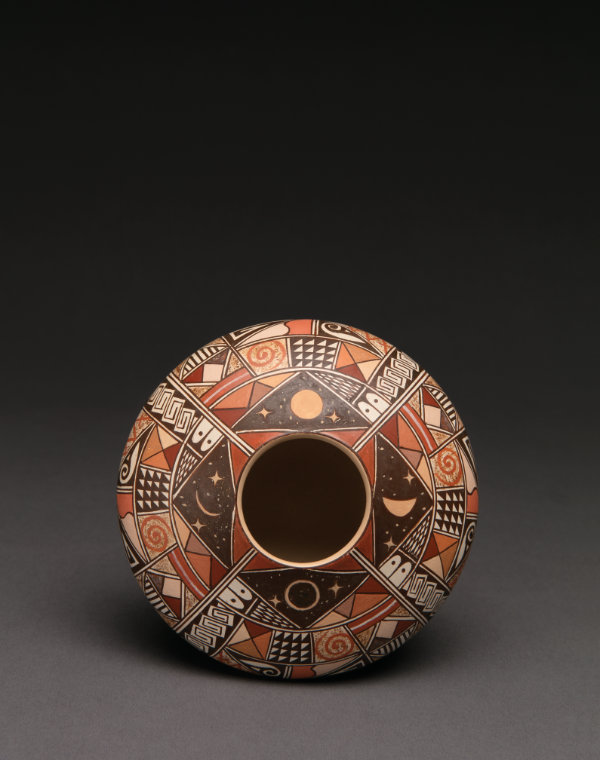
Rainy Naha (Hopi). Jar, ca. 2009. Clay with sand temper and micaceous slip. 3 × 4 3 ⁄8 × 4 3 ⁄8 in. MIAC Collection, 59697/12. Gift of Carol Warren. Photograph by Addison Doty.

Storytelling, which Magdalena says, “gives us a perspective from people of the past, where these stories came from, handed down from generation [to] generation,” is also an important component of Makowa. It offers some foundational reference to the origins and development of Indigenous oral histories and cosmologies and literally gives voice to our Pueblo ancestors who sky watched and stargazed from these sacred lands so long ago.

As the day folded into night, Grandmother spoke about how we are connected to the stars and how our ancestors looked to the sky for direction as they traveled across the wind-blown deserts during their great walks from the north. We are part of everything that is above us, she said, as she looked up into the infinity of an ever-darkening night sky.

“It is theorized, supported by cultural narratives, that storytelling, often referred to as the oral tradition, was the principal method of the transference of acquired knowledge, history, immergence, lineage, skill sets, heritage, societal core values, existential constructs, language, and all components of what defines the human condition,” says Jon Ghahate (Laguna Pueblo/Zuni Pueblo), a historical, cultural, and STEM public speaker and staff educator at Crow Canyon Archaeology Center in Cortez, Colorado. “And just as it is in many Indigenous communities today, perhaps there were those born into ancestral civilizations who were entrusted with the responsibility [of being] storytellers—those who were charged with making sure… knowledge and/or information was passed along to future generations. It was their contribution as part of a community.”

Everything is knowable if we look to the sky, said Grandmother, pointing to Agoyo T’se—Yellow Star—or Venus, the brightest star in the night sky. The Old Ones knew of this star, she said, and named their daughters in honor of her. One day, if you have a daughter, you can name her Agoyo T’se, so she will always be connected to the stars and to the Tewa people.

“For contemporary Pueblo and other Indigenous societies, storytelling remains an integral connection to ancestral societies,” says Ghahate. And he continues, storytelling “gives them their sense of place… in the world. So, it is the responsibility of the storyteller(s) to be accurate and authentic.”

On the fourth day of my daughter’s life, my grandmother prepared the naming bowl. She filled the clay vessel with water, into which she sprinkled cornmeal the color of gathering storm clouds. Grandmother wrapped the child in a finely woven wool blanket and carried her outside and into the waiting dawn. Holding the naming bowl close, I followed them toward the first rays of the rising sun.
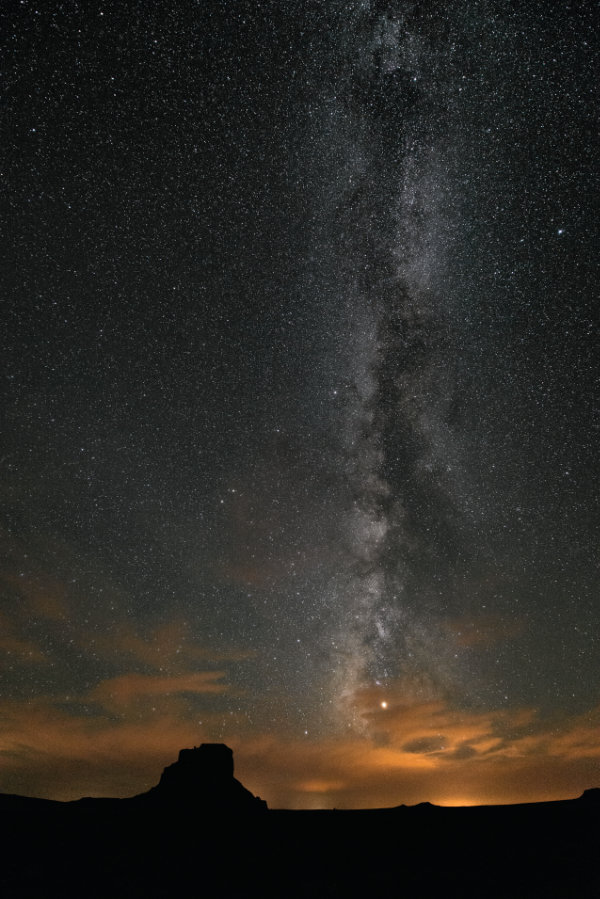
Stan Honda. Milky Way over Fajada Butte, Chaco Culture National Historic Park, 2016. Digital photograph. Courtesy of the artist.

Ghahate, who works with students to develop “accurate, credible, and respectful narratives of Southwest cultures,” will share stories and “make connections among Indigenous ways of knowing and Western sciences” via a short video produced by award-winning documentarian, Kaela Waldstein, Makowa’s official videographer. The video is part of a series in the exhibition that features personal interviews with several Native interviewees from various backgrounds and perspectives, “speaking to their personal experience with the stars and/or [sharing] cultural stories,” says Waldstein. Additionally, Waldstein has created a separate Career Journeys video series featuring exhibition contributors that will serve as a traveling curriculum in schools, community centers, and other organizations in Pueblo, tribal, and rural areas of the state and broader Southwest.

It is important to understand that “the application of Western science is no different from Indigenous acquired or learned knowledge,” says Ghahate. “There was science here, too, but we don’t give the same quantification to certain cultures. The difference between the terms ‘Indigenous acquired knowledge’ and ‘Western science’ is the empirical effort to quantify, label, and explain the principles of science, but keep in mind, Indigenous peoples have practiced science since they originated on Turtle Island. [And] today, no matter what profession we choose, we are utilizing the same science principles that countless Indigenous peoples have used for multiple millennia.”

Grandmother dipped a small, white shell into the bowl and filled it with some of the cornmeal water; she placed the tip of the shell into her great-granddaughter’s mouth and asked the Creator to bless the child with a long and healthy life. I give you this name, Agoyo T’se, Grandmother said as she dipped the shell into the bowl and into the newborn’s mouth again. She did this four times in acknowledgement of each cardinal direction. Now you are part of the Pueblo people, said Grandmother. You were born of and for this place, you belong to it and it belongs to you.

“Science is science, and science principles and constructs were in the cosmos long before humankind appeared on this planet,” says Ghahate. “The formation of this cosmos is science. Through science we know when the sun, the moon, the stars, and any other life form on this planet and [within] other celestial bodies were formed. It is through scientific evidence, measured and quantified, that the age of our universe, or multi-verse, [was determined].”

Like in ancient Greece, Rome, and Britain, Indigenous peoples closer to home were guided by the cosmos, as recorded in the countless cave paintings, petroglyphs, and pictographs they created, specifically, in the American Southwest. Some examples of these important works can be seen at numerous sites in New Mexico, including Boca Negra Canyon, Petroglyph National Monument, and the Three Rivers Petroglyph Site.

As Grandmother poured the last shell of water into the child’s mouth, she prayed over her in Tewa. She offered some of the cornmeal to the mountains and prairies, to the oceans and lakes, to T’han sedo—Father Sun—and P’ho Quio, our Grandmother Moon, and to the sky and the worlds above us. The Old Ones knew the stories of the stars and the worlds above us, said Grandmother, and they lived by these knowings.

“Different cultures have created their own understandings, their own interpretations of a creator, the creation, and the origin of all that is,” says Ghahate. “We have attempted to understand our world [and] ourselves. My hope is that this exhibit will inspire [visitors] to wonder about the Sun and its power, and about how of all the galaxies among countless galaxies, we, so far, are the exception [as humans] only because of Earth’s position, orbit, tilt, mass, and magnetic fields.”

Ghahate thinks the exhibition will appeal to both science buffs—those who can associate higher levels of STEM constructs into how humans exist on this planet—and those who will see the beauty of the culture, the art, the creativity, and the ingenuity of [Indigenous] art and design. “This may then translate into envisioning or seeing how we have evolved our culture, language, and existential constructs; basically, how humankind has evolved on this planet,” says Ghahate.

They knew of the phases of the moon and the cycle of the sun, and of distant planets yet to be discovered. And you too will know these things; you will know the ways of the Old Ones, Grandmother said to Agoyo T’se.

Another contributor to Makowa is Dr. Cherilynn Morrow, an award-winning science educator. She currently serves as the designer and director of the public engagement program that has been immersed in NASAS’s PUNCH (Polarimeter to Unify the Corona and Heliosphere) mission, which will, according to NASA, “make global, 3D observations of the sun’s outer atmosphere and how it becomes the solar wind” over two years.

Dr. Morrow’s outreach theme for PUNCH is “ancient and modern Sun-watching,” which honors the long cultural heritage of Native American skywatchers in the Southwest. The theme centers on “learners’ personal awareness of both ancestral practices and NASA missions,” and demonstrates NASA’s continued exploration of the sun as “a natural extension of humanity’s age-old dedication to observing and learning to live in harmony with the rhythms and mysteries of our nearest star.” Makowa will feature Dr. Morrow’s tactile interactives, digital interactives, and other information from PUNCH.
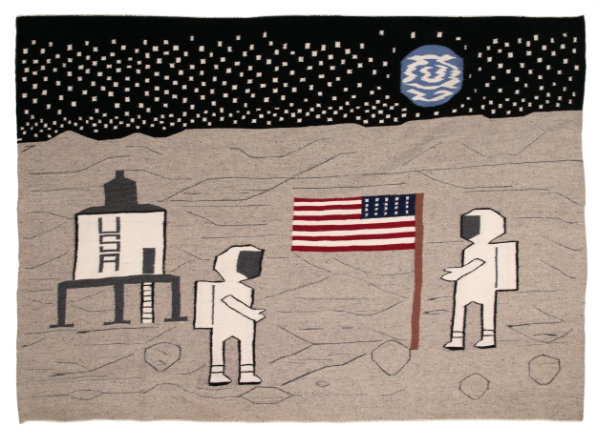
Melissa Benaly (Diné). Rug or Wall Hanging (detail), 2001. Wool, aniline dye. 66 ¼ × 91 ¼ in. MIAC Collection, 55948/12. Drs. Norman and Gilda Greenberg Purchase Fund. Photograph by Addison Doty.

And you will know the ways of the Pueblo people; you will know the stories of how we were created from the stars and of how we will return to the stars.

Misha Pipe (Navajo/Assiniboine/Gros Ventres), the Native American Astronomy Program (NAAOP) Coordinator at Lowell Observatory, is also a contributor. Pipe holds a bachelor’s degree in Parks and Recreation Management from Northern Arizona University and is an educator who incorporates first languages into her instruction. She is one of the featured interviewees for the exhibition’s video series.

The methods and means of Indigenous storytelling have changed over millennia, from the campfire tales told by Puebloan ancients under the night skies so long ago to today’s high-tech podcasts and livestreams, and, of course, museum exhibitions. Still, the fundamental purpose of storytelling—to preserve and perpetuate acquired knowledge (science) for subsequent generations—remains central to keeping us connected to Tribe and culture and to navigating our way into the future.

As she grew into childhood, Agoyo T’se also listened to Grandmother tell the stories of our Tewa ancestors, just as she had told them to me when I was young. From Grandmother she learned about how the Old Ones came from the north; how they learned to hunt, build, and plant to coax life from the dry, desert soil; how they sang and danced and created our Pueblo religion and ways of being.

“In our attempts to interpret our environment, our cosmos, we are not [alone],” says Ghahate. “If we allow ourselves to be open to the contributions of other societies and civilizations and their interpretations of how others perceive their place in the cosmos, perhaps we, as a human species, can focus more on the commonalities among us rather than the differences between us.”

From Grandmother’s stories my daughter also learned that to know something of the skies and the stars and constellations in them is to know something of her own beginnings, and possibly her future, just as I had learned years before.

Makowa unfolds in its entirety through several of MIAC’s large gallery spaces and comprises interactive panels, star charts and calendars, photographs of the sun and moon, and important open-desert and Chacoan petroglyphs. A traditional Jemez morning prayer is quoted near the entrance to the exhibition. Makowa also includes a selection of original art works by local Native artists, including painter George Toya (Jemez Pueblo), photographer and videographer Steven Yazzie (Diné), and Kathleen Wall (Jemez Pueblo), whose hand-coiled ceramic figurine from her Koshare Stars series greets visitors with a smile and a trio of four-pointed stars. Waldstein’s video series is viewable in the museum’s media room.

Waldstein, who owns and operates Mountain Mover Media, comes to the project with a culturally sensitive and respectful voice, having much experience in co-telling the stories of Indigenous artists. “I was thrilled when I was asked to contribute to this exhibition with a series of videos,” says Waldstein. “We can get really wrapped up in the drama taking place here on Earth, and opening our minds up to a wider perspective is something that most of us desperately need right now. I love how the exhibit embraces how many perspectives there can be when it comes to finding meaning [in the stars]. And it’s not just about the stars, it’s also about how we connect to what is right here, right now. I feel that hearing the voices of those telling their stories provides a resonance that also adds to [the] exhibit’s overall impact. I hope I can help these voices convey their messages in a way that connects deeply with visitors to the museum.”
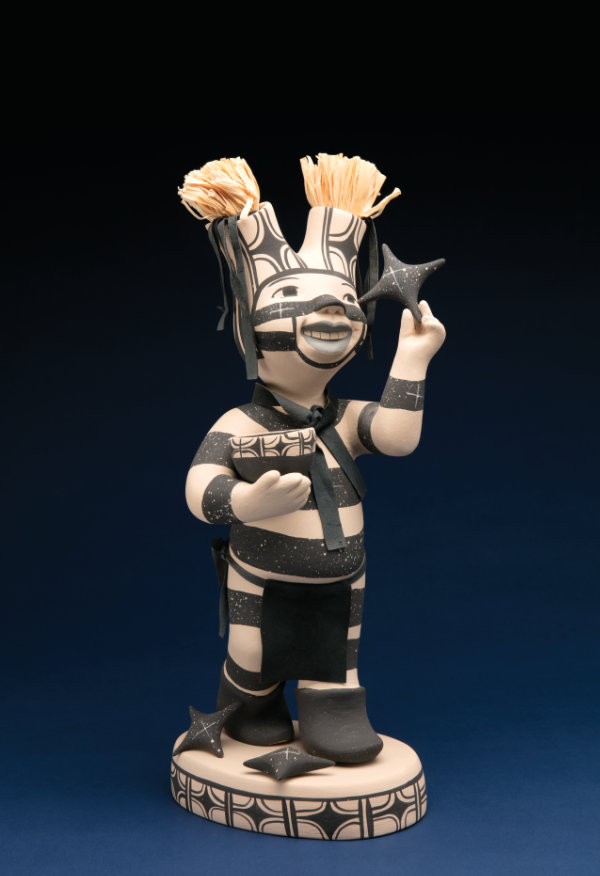
Kathleen Wall (Jemez Pueblo). Evening Star, 2009. Clay, volcanic ash, paint. 16 ½ × 6 ½ × 7 in. MIAC Collection, 60693/12. Gift of Ronald L. and Vicki Sullivan. Photograph by Addison Doty.

These stories, voices, and messages have arrived at a good time and the connections they forge are apropos given the fragile state of our planet and all it holds. With a unique alignment of planets occurring in 2025, “we’re living in an astronomically unique time,” says Stone, “and lots of things are happening in the sky.” The sky and the objects that inhabit it “have things to teach us if we look with full attention,” concludes Stone. “Maybe it’s time for us to slow down and look up.”

She learned of how we were created from the stars and of how we will return to the stars. This is what the Old Ones knew, and this is what we believe.

Celestial events that will occur in 2025 include a total lunar eclipse on September 7; a partial solar eclipse on September 21; and numerous meteor showers, including the Delta Aquariids, July 30–31; the Perseids, August 12–13; the Orionids, October 21–22; the Leonids, November 17; the Ursids, in early December; and the Geminids, December 13–14. A major lunar standstill, a result of the rotation of the moon’s inclined orbit, which spans an 18.6-year cycle, is also part the celestial calendar. The standstill will be visible throughout the rest of the year, peaking again around the September equinox.

And now she too knows the ways of the Old Ones; she too knows the ways of the Pueblo people; she too knows of our connection to the stars.

“While many of us can use technology to learn about the stars, another way is to look to the sky and observe the worlds above us with our own eyes,” says Magdalena. “We want visitors to understand that [these] observations have helped shape the world they live in, and that everything is connected and works together. People of the past have looked to the sky for guidance and help, looking at the patterns of the days, nights, months, and seasons to make sense of the world around them and how they are connected to the worlds above. These observations have allowed many communities to survive.”

And the stories of our Tewa ancestors will continue to be told through her and through generations to come. 

RoseMary Diaz (Santa Clara Pueblo) is a freelance writer based in Santa Fe. She studied literature and its respective arts at the Institute of American Indian Arts (IAIA), Naropa University, and the University of California, Santa Cruz.
Marlon Magdalena (opens in a new tab) is a Native American artist, educator, and performer from the Pueblo of Jemez in New Mexico. He performs with Native American Style flutes of his own making, and some made by others. He is also the Instructional Coordinator at the Jemez Historic Site where he educates the public about the Jemez People.

RoseMary Diaz (Santa Clara Pueblo) (opens in a new tab) is a freelance writer based in Santa Fe. She studied literature and its respective arts at the Institute of American Indian Arts (IAIA), Naropa University, and the University of California, Santa Cruz.
Stan Honda (opens in a new tab) is a New York-based photographer and worked as a photojournalist for 34 years. His personal projects include documenting U.S. concentration camps and photographing night sky landscapes. Stan’s astronomy-related photos have also been featured in The New York Times, USA Today, NationalGeographic.com, Sky & Telescope, and Yahoo News.

Steven J. Yazzie (opens in a new tab) is a multidisciplinary artist working across painting, installation, video/film, photography and community collaboration. Yazzie is a member of the Navajo Nation and a veteran of the Gulf War, serving honorably with the United States Marine Corps, 1988-92. He received a BFA at Arizona State University and was named 2014 Outstanding Graduate for the Herberger Institute for Design and Art; Yazzie was a Community Scholar for the Interdisciplinary Research Institute for the Study of (in)Equality, University of Denver, Colorado, 2019-20; Additionally, Yazzie was a founding member of Postcommodity, an Indigenous arts collective, and the co-founder of the Museum of Walking. Yazzie’s notable exhibitions include the National Gallery of Art, Washington D.C; Museum of Modern Art, New York, NY; National Museum of the American Indian, New York, NY; Museum of Contemporary Art Denver, Denver Art Museum, Colorado; National Gallery of Canada, Ottawa, Art Gallery of Ontario, Toronto, Canada; Phoenix Art Museum, Scottsdale Museum of Contemporary Art, and the Tucson Museum of Art in Arizona. Yazzie was selected for the 2025 Sharjah Biennial 16, UAE. He lives and works in Denver, Colorado.

Community of Craft

By Gina Rae La Cerva

One of Cynthia Burke’s many creative endeavors is hosting a radio show for her town of two hundred people in the Australian outback. Called “CB” by her friends, she loves playing country and gospel music ranging from the 1950s to 2000s. She tells me this as we sit on a stone bench at the 2024 International Folk Art Market (IFAM), eating popsicles and watching the first day of the market begin to buzz with energy.

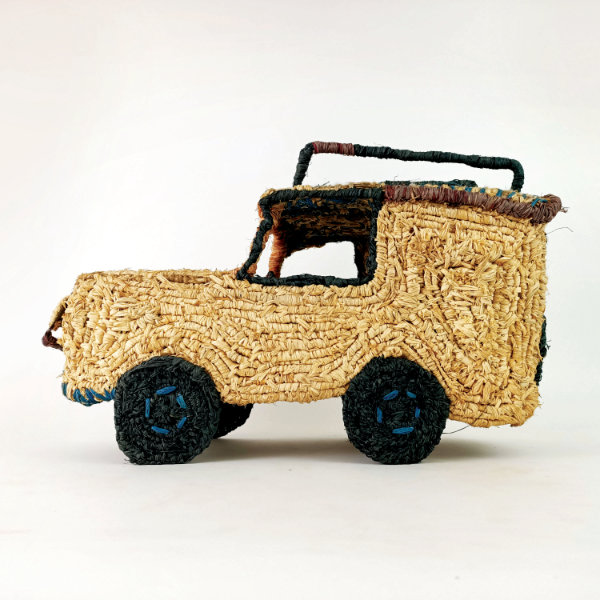
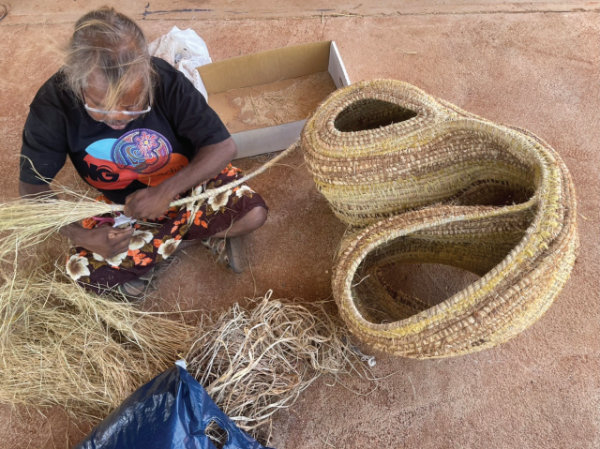
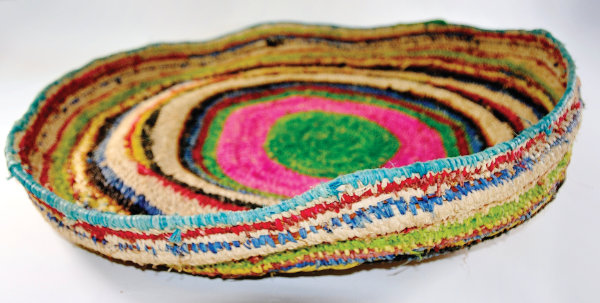
CB had never left Australia before coming to Santa Fe. She lives nine hours out in the bush. It took them thirty hours to travel here, and by the time I’d met her, she had already met with hundreds of people—writers, photographers, administrators, other vendors, and buyers. English is her third language. I watch as she poses timidly for her official IFAM portrait, as people weave in and out of the booth, picking up her woven baskets, or turning her grass sculptures over with care. Her contemporary fiber art depicts animals such as camels, dogs, and birds. The baskets and sculptures are made from dried native grasses, wool, and raffia. They are colorful and whimsical, with a surprising level of detail, given the coarse natural materials.

Tjanpi Desert Weavers, the organization CB has partnered with, is a social enterprise of the Ngaanyatjarra, Pitjantjatjara, and Yankunytjatjara Women’s Council, which makes important decisions for the larger community. Formed in 1980, this council delivers health, social, and cultural services for several Aboriginal Australian groups collectively known as the Anangu. Tjanpi has been operating for over thirty years and has served as a lifeline for women in the remote Central and Western Australian deserts through paid opportunities for their artwork, skills development workshops, and grass-collecting trips. By supporting these activities, the organization has empowered women for decades, creating income streams that have allowed for the preservation and sharing of cultural heritage through contemporary fiber arts and crafts.

CB and the other artists from Tjanpi were featured artists in the women’s empowerment category at the 2024 IFAM. It was their first time at the market, and they were among 167 artists from fifty-one countries. The Santa Fe International Folk Art Market is the largest folk art market in the world, and its economic impact is very important for artists’ home communities. According to IFAM, which celebrated its twentieth year in 2024, on average, nearly $20,000 per booth is repatriated to artists’ native countries. Artist cooperatives make up the heart of the market, supporting entire families and villages, thus impacting thousands of lives. This is particularly true for women artists. Due to the sales made during the four-day market, nearly three hundred women around the world have a year-round source of employment and income.

Beyond the financial opportunities the market creates, there are other special benefits to taking part. For instance, global artists, who might otherwise remain isolated, get to meet and inspire each other. An Afghani glass artist with the most beautiful Herat blue cups is located a few booths down from a Mexican ceramicist. Textile artists from India can meet textile artists from Kyrgyzstan, Indonesia, and Nigeria. The ability to reflect and share creatively from so many cultures, each rooted in distinct places, makes for a remarkable cauldron of ideas and inspiration. Again, this opportunity is particularly beneficial for women artists, who may not otherwise be able to travel to meet others and share in the pride created in producing their heritage crafts. Often, their crafts employ techniques that have been on the brink of extinction. Like oral histories, living artists keep this expertise alive.

Nelly Patterson. Car, 2024. Tjanpi (wild harvested grass), wool, and wire. Image courtesy of Tjanpi Desert Weavers, 2024.

IFAM would not be what it is today without the Museum of International Folk Art (MOIFA), a division of the New Mexico Department of Cultural Affairs. Founded in 1953, MOIFA is a world-class museum that showcases the diversity and artistry of the world’s folk artists and cultures. It has a collection of more than 162,000 objects, representing more than one hundred countries. After eighteen years of hosting IFAM on Milner Plaza on Museum Hill, MOIFA and IFAM continue to have a close relationship. Together, they host cross-cultural exchanges between local and international artists, as well as joint public symposia. Additionally, MOIFA buys folk art at the market every year for their collection, and IFAM artists have been featured in MOIFA exhibitions.

When global artists visit, MOIFA often provides private tours of its collections—which benefit both the artists and MOIFA curators. During these encounters, an artist might explain a deeper meaning or technique used in the museum’s collection, or a piece in the collection might reveal to the artist how the skill they practice has evolved from an older traditional method. “The museum does an amazing job of preserving folk art and sharing the stories of these traditions with the public, while IFAM furthers the living tradition of folk art, bringing practicing artists to Santa Fe to tell their stories directly,” says Stacey Edgar, director of IFAM. “I think this is what is most exciting about our collaborations—finding ways to both preserve and advance folk art in a community that cares deeply about the artists and the traditions.”

Nelly Patterson. Car, 2024. Tjanpi (wild harvested grass), wool, and wire. Image courtesy of Tjanpi Desert Weavers, 2024.

The idea that craft could be considered art, honored and displayed in museums, solidified over various periods of history. Creating functional objects that are also aesthetically pleasing has been part of human culture since prehistoric times. In many cultures, there is less distinction between fine art and craft. Functional objects are valued as much for their beauty as their practical uses.

But during the Renaissance period in European culture, the line between craft and fine art became more pronounced. Craft made useful objects. Art was meant to transform people. Artists were thus seen as creators channeling personal expression, whereas craftspeople such as carvers, weavers, and goldsmiths were merely considered skilled technicians without that extra spark of genius.

In the twentieth century, the line blurred again as Western artists began incorporating traditional craft techniques into their work in reaction to the increasing industrialization of society. This became so popular that it spawned the Arts and Crafts Movement in the late Victorian period in England, which celebrated the merging of utilitarian crafts—carvers, weavers, woodworkers, and goldsmiths, et cetera—with the creative expression of fine artists. It sought to promote useful objects that were handmade and beautiful.

Angkaliya Eadie Curtis. Basketpa Tjukurla, 2013. Dry native grasses, wool, and raffia. Image courtesy of Tjanpi Desert Weavers.

In other cases, objects originally made for everyday needs were increasingly regarded as fine art, to be collected and displayed rather than used. This was true for Native American pottery in the Southwest. Indigenous groups have been crafting exquisite pottery for almost two thousand years, using these objects in their daily lives. In the 1800s, as railroads spread West, trading posts were established to accommodate the bourgeoning tourism from the East Coast. Native American pottery increasingly came to be seen not just as an everyday craft but as an art form that could be sold to outsiders who would acquire these vessels and sculptures for both private collections and museum exhibitions.

The category of folk art is best described as a handicraft tradition rooted in a specific cultural history, but created as an art object to be sold. Often misconstrued as amateur art, folk art has become an important part of the art market. Folk artists often have a history of living on the fringes of society.

In the case of the Tjanpi Desert Weavers, their isolation from society is quite literal, given their geographic distance from larger population centers. This collective of women includes the weaving styles of the Ngaanyatjarra, Pitjantjatjara, and Yankunytjatjara cultures of Australia’s Central Desert region, an area approximately 350,000 square kilometers in size, spanning the tri-state border region of the Northern Territory, Western Australia, and South Australia.

The raffia used to make their fiber art is soaked in an old bathtub with a fire underneath. After cooking, it is hung longwise between the trees to dry. The grass coil baskets can be made relatively quickly, while the sculptures take more time. Wool is often used to give form and structure to more intricate shapes. Artists also incorporate string, wire, animal fur, beads, seeds, and found objects. Each piece is considered a story, passing down ancestral knowledge and honoring the rhythms of the land. The communities are deeply rooted in the area, having continuously occupied the Australian continent for fifty thousand years. Their art is thus embedded with spiritual and practical connections to ecology. Referred to as Dreamtime or Tjukurrpa, this is a set of teachings that underpin an understanding of the world, its creation, its great stories, and its spirit ancestors who created everything. These Law stories teach the wisdom of an unchanging network of relationships between the human and non-human world, which can be traced back to the beginning of time.

Tjanpi Desert Weavers, named for one of the Aboriginal names for the local spinifex grasses used in their weavings, offers one of few opportunities for income in the Central and Western Desert region, enabling women in these remote communities to maintain their lives and families through fiber art sales. The benefits of supporting these craftswomen extend beyond individual income to include positive social outcomes that arise from having meaningful employment. It brings women together to celebrate their cultural heritage and mutual care as they go out on grass-collecting trips or prepare materials together. Tjanpi represents over four hundred artists from twenty-six different communities, and this range of artists means that women who first started making baskets in 1995 can help teach the younger generations who are taking up weaving today.

CB is a member of the Ngaanyatjarra community and splits her time between the Warakurna and Irrunytju (Wingellina) communities in Western Australia. She learned painting and weaving skills from her mother, Jean Burke, who was herself an esteemed artist. From large-scale baskets to intricate animal figurines, her work is wide-ranging. She only began weaving ten years ago, and her artistic practice encompasses a broad range of disciplines. She likes to paint landscapes in silence—often at night when the house is quiet. Her acrylic works are made up of thousands of tiny dots—dark blues, white, and shades of pink—that come together to reveal a whole world of mesmerizing geometric shapes. They celebrate her love of the aerial views of the land from an airplane, and her unique ability to put herself in that place, as if looking down, while she works.

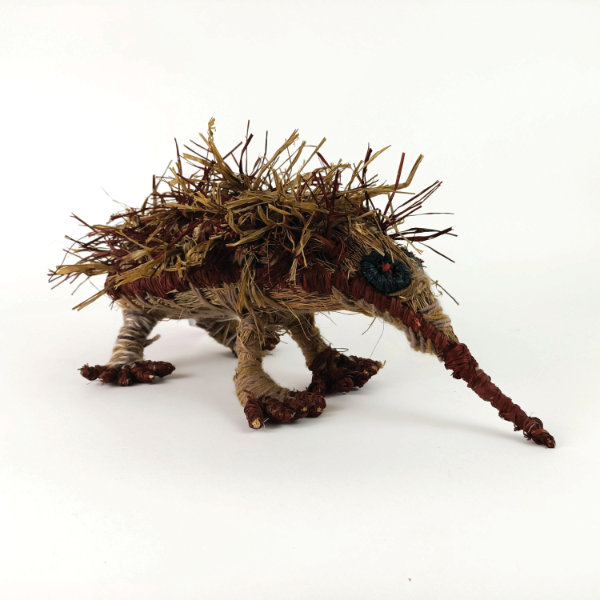
Michelle Lewis. Echidna (spiny, egg-laying mammal found in Australia), 2024. Tjanpi (wild harvested grass) and wool. Image courtesy of Tjanpi Desert Weavers.

CB was born in Alice Springs in 1973 and began painting at about age ten. “Every time I looked at my mother, she was painting,” she once said of how her art practice began. Her paintings are also part of a larger cultural remembering. Her mother was once quoted as saying, “We want to do the paintings so we can teach the younger ones the old stories—so they can learn. If we finish, it’s their turn to do dot paintings, to tell the Dreamtime stories—keep the stories strong. That’s why we do the dot paintings, so they can say, ‘That’s my country, that’s my mother’s country.’ Like that.” Cynthia remembers the elders telling Dreamtime stories when they were out in the bush. While Cynthia’s paintings do not directly tell Tjukurrpa or Law stories, they demonstrate a connection to the spirituality of the land and the changing nature of seasons and ecosystems.

For CB, the creation of her art is partly to continue her family’s legacy (in addition to her mother, her uncle Tommy Watson was also a famed artist) and partly to infuse her style into the creations. Her mom and aunt taught her bush dying: they went out onto the land to collect natural dyes, which were then used to dye the raffia to create more complex and colorful weavings. CB would drive the car and learn as much as she could from these two older women. Now, she brings her creative spin to these traditional elements to create contemporary art. For instance, she likes adding emu feathers into a weaving, or incorporating detailed stitching techniques. She also makes punu, or traditional carvings from native trees, depicting animals and stories. Dogs are also a big inspiration for her work. The stop animation film she helped make, Ngayuku Papa (My Dog), is a loving portrait of her dog, Tiny, made with grass sculptures.

CB’s radio program has been on the air since 2012 and features a weekly selection of music, local news, and interviews. In 2013, she won a Best Emerging Radio Talent broadcasting award at the National Remote Indigenous Media Festival Awards. She also works as a camera operator for Ngaanyatjarra Media, was a key collaborating artist in a project with FORM and Polyglot Theatre, and regularly spends time out in the bush creating videos that have appeared on the Indigenous Community Television Station of Australia, for which she has also won awards. In one of her first major exhibitions in 2013, she contributed a weaving and some media to a show on string theory held at the Museum of Contemporary Art in Sydney. Her work has also been exhibited at Ellenbrook Gallery in Perth in 2013, Fremantle Arts Centre in 2017, 2018, and 2019, and at AIATSIS–Resurgence at the National Museum of Australia, Canberra in 2019, as well as overseas.

Perhaps one of the most interesting shows she participated in was at the National Museum of Australia, an exhibition called Songlines: Tracking the Seven Sisters, which tells one of the central creation stories or songlines in Australia. Referencing the Pleiades star cluster, it is a saga of seven women who use magical powers to elude a pursuer as they flee across three deserts. A songline, also called a dreaming track, is the path taken across the land (or sometimes the sky) by ancestral creator-beings in the Dreamtime. A songline is both a navigational aid; providing directions for how one might traverse a region, including descriptions of landmarks, water sources, and natural features; and a repository of cultural knowledge and spiritual lessons, embedded within artistic expressions. This exhibition is now part of the permanent collection having toured the world with major stops in Finland and France.

CB recognizes the importance of showing her art around the world, explaining in an interview with Japingka Aboriginal Art Gallery, “Exhibiting my art all over the world is important because I get to learn new things and show my work to a new audience.” Still, for the Tjanpi weavers, traveling with their work is not always easy. Obtaining passports can be challenging, as there is often a lack of documentation and no birth certificates in these remote communities. 

CB began working with Tjanpi Desert Weavers in 2016, running some of the core operations at the remote Warakurna office, nine hours away from the core development office. She regularly visits over eight communities to support the far-flung Tjanpi artists. Her days unfold in a beautiful rhythm, with the mornings often spent in the art center painting or weaving, before she moves on to her work with Tjanpi in the afternoon. On the weekends, she goes to church, listens to Gospels, and sings hymns on Sundays. Her colleagues describe her as a level-headed and compassionate advocate dedicated to supporting the next generation of women weavers and creative business leaders.

The women in CB’s community are constantly pushing the boundaries of their arts practices and trying different things. They are creatively juiced up, excited to mix the tradition of craft with the inventiveness of the artist. When I ask CB if she thinks she will come back to the IFAM, she says she’s not sure. She likes her community, and she misses her two dogs. But she radiates a sense of empowerment, as piece by piece, her booth at the Santa Fe market heads toward selling out.   


Gina Rae La Cerva is a writer and painter from Santa Fe, New Mexico.

Gina Rae La Cerva (opens in a new tab) is a geographer and environmental anthropologist. Her first book, Feasting Wild: In Search of the Last Untamed Food was recommended by the New York Times Summer Reading List and selected as a Best Nonfiction Book of 2020 by Amazon. She has written for The New York Times, Outside Magazine, Nature Magazine, Emergence Magazine, and Atlas Obscura, among others. She has been published by MIT Press, Routledge, Greystone, and Yale University Press. La Cerva holds degrees from Yale University, the University of Cambridge, and Vassar College. She was a National Science Foundation Graduate Fellow and a Scholar in Residence for the U.S. Forest Service at Grey Towers.

Undoing Dominant Narratives

What does it mean to build a museum? For video maker and interdisciplinary artist Chris E. Vargas, building a museum means critiquing the institution itself, where the museum as an artifact interrogates the power of its presence, questions its authority, and reveals its limitations. As the founder and director of the Museum of Trans Hirstory & Art (MOTHA), a conceptual museum “forever under construction,” Vargas reshapes how we think about the role of institutions in preserving, categorizing, and exhibiting marginalized histories. Vargas describes it as a conceptual art project; the museum itself has no physical structure, which allows him the ability to play with form and function. In his words, MOTHA is an ongoing experiment, an act of “expropriating power” that masquerades as a museum to critique museums. What happens when you name something a museum? Who decides what is worthy of preservation? What histories are collected, and which are ignored? And what of the “archive?”
“The project investigates various aspects of people’s relationships to museums, specifically marginalized people who maybe have a difficult relationship with museums as pillars of white, cis, colonial, Western culture,” says Vargas. “The fluid nature of its form is also important to me. Because I don’t have a space, it gets to be very flexible and call into question the very power of museums and power of naming.”

Spanning over four centuries, this volume brings together a wide-ranging selection of artworks and artifacts that highlight the under-recog- nized histories of trans and gender-nonconforming communities. Through the contributions of artists, writers, poets, activists, and scholars, this title reflects on historical erasure and imagines trans futures. Museum of Trans Hirstory & Art: Trans Hirstory in 99 Objects, 2024, Hirmer Publishers, edited by David Evans Frantz, Christina Linden, and Chris E. Vargas. Photograph by Gene Aguilar Magaña.

One of MOTHA’s featured projects is the book Trans Hirstory in 99 Objects. Part archive, part speculative, part historiography, part art form, Trans Hirstory in 99 Objects peers through time and ancestry to narrate the collective power and story within transgender communities by gathering objects, artwork, and artifacts from various artists, writers, poets, activists, and scholars. Spanning four centuries, the book defies empirical classification and instead relies on the living memories and documents of trans communities throughout an often-erased or underrepresented history. Like gender, art itself is often contained within and even felt through narrow categorization that reflects a larger, dominant Western and colonial society. Resistance requires fluidity.

The threading within Vargas’s work is motion and movement within, between, among, and beyond identity. Vargas is originally from California, where DIY and punk attitudes sparked numerous movements within art and culture. His work spans film, video, performance, and installation, always maintaining a critical edge toward dominant narratives of gender, history, and cultural memory. His practice began in DIY experimental filmmaking, making collaborative, small-scale projects focused on queer and trans politics, radical critique, and the politics of visibility. Now based in Washington, Vargas explains that conversations and community inform themes in his work. “My work is always a contribution to a larger conversation with the communities of which I am a part,” says Vargas.

Over time these conversations with various communities evolved his work into an exploration of archives and the gaps within them—those spaces where trans, queer, and racialized histories are absent or distorted. His interventions are often speculative, filling in those absences with playful yet deeply critical reconstructions of what could have been. They are a practice of freedom, language borrowed from a film Vargas made with Eric A. Stanley called Criminal Queers (2015). The film imagines “a world without walls” while taking on the prison-industrial complex. At the film’s center is a quote from Flo Kennedy: “All oppressed people have a right to violence.” This urgency to demystify power takes shape in the DIY nature of Vargas’s work.

“If you have a group of people who are enthusiastic and committed, you can make something happen out of nothing. There is a real power in community, and this will sound cheesy, but it’s real to say that communities can dream up stuff together and make it tangible,” says Vargas. Video and film were ways Vargas created community. Through often scrappy and low-tech means, Vargas’s early work highlights the accessibility of video and film as art forms. Even when it isn’t, Vargas insists on reclamation and persistence. “You don’t have to ask for permission.”

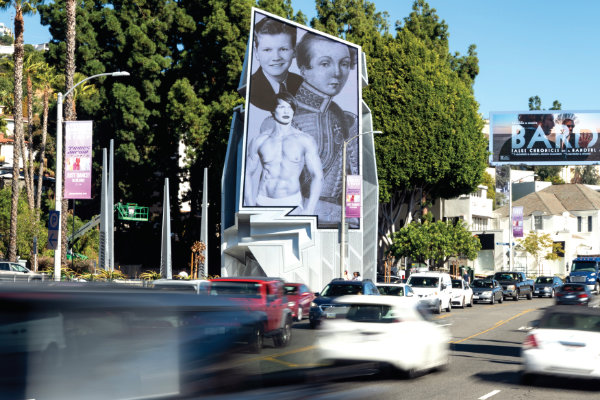
Public art advertising the imminent opening of the “forever under construction” Museum of Transgender Hirstory & Art. The collage animation included artists, activists, and figures significant to a trans and non-binary history. Digital billboard on Sunset Boulevard. Production still from Chris E. Vargas’s MOTHA Forever Coming Soon, 2022. Commissioned by the City of West Hollywood, California.

This sentiment is one shared by one of Vargas’s inspirations: John Waters. Obsessed with the obscene, Waters, also known as “The Pope of Trash,” grew up in Baltimore and rose to fame as a filmmaker, writer, artist, and fashion icon. There are rivers of Waters’s work within Vargas’s films. The focus on queerness, radical video-making, and humor illuminates Vargas’s artwork in layered ways. Teasing through complexities has been a consistent task for Vargas.

Now, Vargas finds himself at a threshold moment in his career. After years of expanding and sustaining MOTHA, he is considering whether to continue its trajectory or move in an entirely new direction. He describes the moment as both liberating and uncertain, an opportunity to return to earlier modes of work while questioning what comes next. “I stopped making film because I started to not be able to understand it outside making content for digital platforms, and I became really disinterested,” says Vargas. “I want to remember what that early relationship to film and video was like.”

Vargas was one of two artists selected for the 2025 Artist-in-Residence program at Los Luceros Historic Site. “Vargas is a natural fit in many ways,” says Kiersten Fellrath, a Public Art Program coordinator for New Mexico Arts. “The Los Luceros Historic Site is one of the largest historic sites in New Mexico, and Vargas brings with him a new research base and context.” It is true that the Los Luceros Historic Site is one of the “most scenic and historically significant properties” in New Mexico, according to its website. It sits on land that is layered with many complex voices, peoples, and histories: histories of colonization, gendered power dynamics, and artistic appropriation.

What we know of the desert is its ability to help sharpen perspective because the light echoes differently in the high desert. Vargas spent some time visiting The Land of Enchantment as a child and noticed, even then, the way the New Mexico landscape defies what being a desert is. In a way, then, New Mexico will be a kind of homecoming for Vargas—not to a literal home, but to an earlier love of film, video, and moving image as mediums. Supporting art is something like matchmaking and helping artists find a mirror. A New Mexico sunset that explodes every evening is as big a mirror as one can offer. 

Vargas’s project at Los Luceros will explore the relationship between Mary Wheelwright, a white woman at the center of New Mexico’s early twentieth-century art and anthropology circles, and Hastiin Klah, a Diné weaver and medicine person whose contributions were foundational to the museum that bears Wheelwright’s name. For Vargas, this project will be an attempt to understand how marginalized people navigate their relationships with institutions that simultaneously document and exploit them. 

“Their identities are interesting to me: Wheelwright being a white woman of this movement called The New Woman movement, which saw, for the first time in colonial American history, more independence and autonomy for a certain class of woman and how her moving out West follows this trajectory of expansion that is at odds with feminist liberation,” explains Vargas. The argument here is that white feminism is often linked with colonialism, which does not align with any calls for justice or liberation. Wheelwright, as a pillar of history within this space, represents a narrow vision of what counts as feminist liberation. Enter the layers of Indigenous history in the area and Wheelwright’s engagements with Hastiin Klah, a figure often used to posit a pre-contact gender fluidity among Indigenous communities. Vargas is asking the question: How do we understand figures like Klah through contemporary frameworks such as a Two-Spirit identity when those terms did not exist at the time? There is a struggle with applying contemporary lenses to historical figures. Where speculative work fails, attention to the entrenched nature of power and the way it permeates all communities can be a way to reconcile these two ends and re-envision pasts and futures.

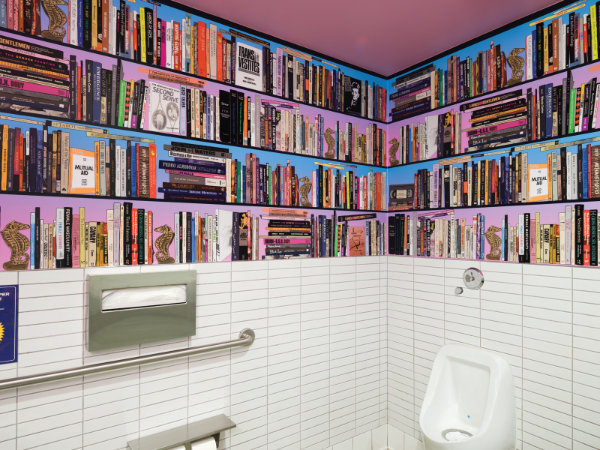
Chris E. Vargas. Reading Is Transcendental, 2024. Vinyl wallpaper, 8’2.75″ x 3’8.5.” Commissioned for Scientia Sexualis exhibition at Institute for Contemporary Art, Los Angeles.

“Hastiin Klah’s gender is interesting to me, and I’m interested in how Wheelwright and Klah’s identities come together and the kinds of inherent power dynamics that exist within their relationship. I guess I’m interested in the complexities of a racialized power dynamic and how those kinds of relationships informed history. How history is collected and preserved and identified as legitimate,” says Vargas.

For Fellrath, Vargas’s care and intentionality around complexity sets him up as an artist capable not only of exploring but also of witnessing a relationship between two important figures within New Mexico art history. New Mexico is home to twenty-three federally recognized Pueblos and tribes and to others that remain state-recognized or unrecognized altogether, each with its own cultural and linguistic history that predates and counters Western gender norms. “Trans and queer identities are not new identities. They have always existed and have carried on through time,” says Fellrath. This understanding warps normal modes of historic preservation. Centering diverse cultural histories is foundational to the Los Luceros Historic Site. Purchased in 2008 by the New Mexico Department of Cultural Affairs, which oversees the New Mexico Arts Commission, Los Luceros Historic Site maintains the important work of artmaking in the context of land, people, and time. Vargas’s project exploring Wheelwright and Klah’s relationship through a trans lens offers the Los Luceros Historic Site a necessary intervention. While New Mexico Arts focuses on New Mexico artists, it also opens the residency to artists who propose projects that could contribute significantly to the New Mexico art scene. “It’s important to cross-pollinate and offer space for new perspectives,” says Fellrath.

The high desert of Northern New Mexico introduces yet another layer of complexity. The region has long drawn artists and outsiders who romanticize its landscape, from Georgia O’Keeffe to the tourism industry that markets the state as a place of cultural harmony. Vargas approaches this space with both curiosity and caution, keenly aware of the ways its histories have been flattened and commodified. He is interested in the ways New Mexico tells stories about itself, the narratives that are promoted, and the ones that remain obscured.

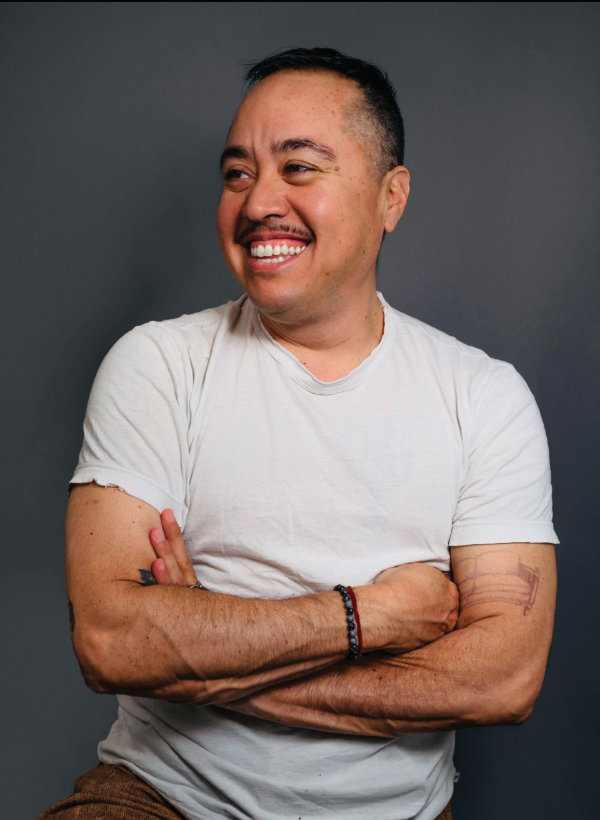
Heather Posten. Chris E. Vargas.

In this lens, New Mexico becomes a museum. For Vargas, then, this project is an extension of his ongoing interest in the politics of archives. How do institutions legitimize certain histories while erasing or distorting others? He says, “Understanding the politics of archives is knowing how cultural biases are inherent to collections and how there will always be gaps in what’s recorded and what’s deemed legitimate. Artists are in a really unique position to use those gaps creatively and generate something for those spaces. So, a lot of what I’ve done is speculative in that way, using these lesser-known histories and speculating what would be possible.”

Using speculative art as a framework is Vargas’s way of reconciling complex narratives. Speculative work is highly futurist and shines brightly in queer and marginalized spaces where futurity is under constant threat. This truth is paramount in queer history. Under the current administration, it’s becoming all the more urgent to find the gaps in the archives and speculate about what is possible in those silences. Artists like Vargas who are playing with time are opening up possibilities for the future. So, Vargas maintains a commitment to resisting linearity. His work challenges the assumption that history moves in a straight line, that progress follows a neat trajectory. Instead, he leans into speculation as a means of artmaking. The act of undoing dominant narratives is creative by nature. As Vargas reconnects with film and video, he returns not to the past, but to a space of artistic possibility—one that is shaped by history but not bound by it. It is an act of futuring, which has become a way marginalized communities have used speculative and creative expression to inspire strategies for continued survival.

Another possibility for Vargas’s project at Los Luceros is John Waters in the desert. He might also work on an intense interrogation of museums, archives, land, and identity. Vargas’s practice thrives in uncertainty. Whether through MOTHA, his explorations of archival gaps, or his proposed speculative film project at the Los Luceros Historic Site, his work will continue to challenge, complicate, and expand our understanding of what history—and the future—can be.

As Vargas moves into this next phase of his career, his work remains a conversation with history, identity, and the institutions that attempt to define them. His speculative and critical approach reminds us that archives are never neutral, that history is always contested, and that art can be a powerful tool for disruption and reimagination. Whatever path he takes next, Vargas’s practice ensures that the act of questioning remains central, opening space for new narratives, new futures, and the radical potential of an art that refuses to be contained.

Jake Skeets (opens in a new tab) is a poet and writer and was named Navajo Nation Poet Laureate in 2025. He is the author of the award-winning collection Eyes Bottle Dark with a Mouthful of Flowers.

Pathway and Relationship

By Jamie Figueroa

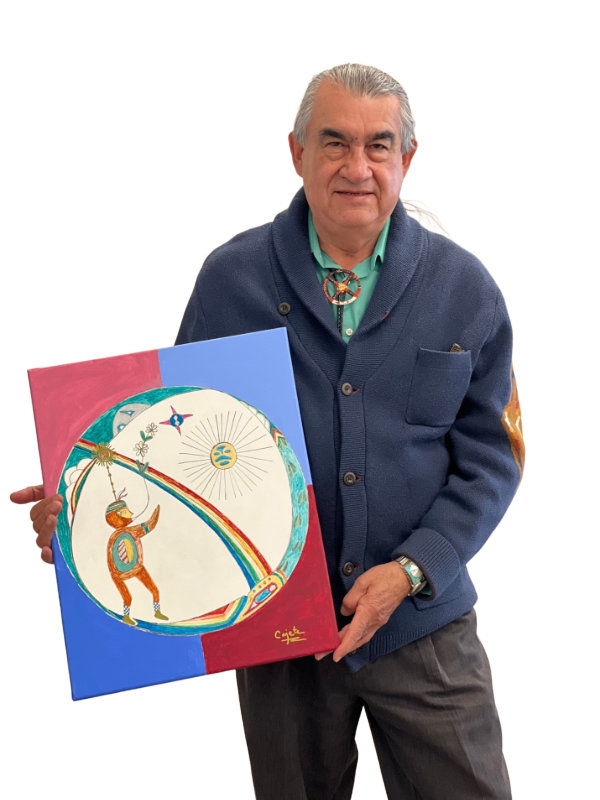
Green, yellow, and red outline three edges of the canvas. The flat expanse of turquoise sky holds a small, distant sun. Red, orange, then yellow—circle inside of circle inside of circle—black thin spokes reaching from its circumference. Above the clouds, above the mountain, is a Divine presence, the largest and most colorful figure. Below, what is life-giving and life-sustaining—corn growing. Kokopellis play their flutes, and a howler monkey, creative protector and guide, smiles from the lower right-hand corner as if more knowing than the human, who stands opposite in the lower left corner. Arms outstretched, the human reaches toward the Divine, a three-lobed hovering presence, feminine in suggestion and all-powerful. A spiral extends up through the top of the human’s head as if an expression of the imagination, a coil of possibility, an antenna giving and picking up signals from the unseen, yet ever-present. From their mouth blooms a pattern of flowers, one simple line of four-petaled prayers aimed at the Divine. The final flower is painted on the Divine as if heard, received.

Greg Cajete holds his painting, The Asking, 2025. Photograph by Jamie Figueroa.

In The Asking, Dr. Greg Cajete’s (Tewa/Santa Clara Pueblo) painting resembles what he calls “Nuevo Pueblo Mural Style.” To my eyes, it is a meditation on sacred relationships present in the ceremony of creating. Cajete explains, “This figure is thinking a creative thought, is chanting, asking in a prayer form for guidance and for blessings as they begin their path on this journey.”

To many, Cajete is known as a distinguished scholar, philosopher, and educator. Among significant Indigenous thinkers and writers with a legacy of impacting higher education and beyond, he stands alongside noteworthy contemporaries like Gerald Vizenor (Chippewa/White Earth) and Vine Deloria (Lakota/Standing Rock). Cajete’s name is synonymous with Native Science, given his work in the field spanning more than fifty years. Considering his numerous accolades, fellowships, lectures, and presentations both nationally and internationally, an extensive archive of interviews, and his five books, his popularity makes sense. As a former New Mexico Humanities scholar and member of the New Mexico Arts Commission, having spent twenty-one years teaching at the Institute of American Indian Arts (IAIA) and twenty-five years at the University of New Mexico, it seems nearly everyone has heard of him, and if not, they should.

What is less known and what captivates me—as a novelist, essayist, educator, doctoral candidate focused on creative sovereignty, and former student of Cajete’s—is his equally important decades-long devotion to the process of artmaking.

The images in The Asking are essentialized, simple and direct, uncluttered. Even so, the composition continues to reveal complex layers of meaning. The painting’s symbolism—its elegant meaning—speaks to the core of our existence as humans, our internal nature as creatives, reflected in outer nature. We are not separate from nature; we are nature. We belong to nature, which is creativity in motion, creation ongoing. “There is a timelessness, creation, dissolution, and reawakening—from micro to macro.” Cajete says, “We’re an expression of that, and creativity is a part of this process as well.”

The Asking is the cover of his book, Look to the Mountain (1993). His artwork is also on the cover of Indigenous Community: Rekindling the Teachings of the Seventh Fire (2015). This image depicts a series of eight circles, four inner and four outer. The four inner circles each contain a figure turned to face a different direction: east, south, west, and north. They are chanting, praying. Their words lift from their mouths in a strand of connection to what is beyond us but which we are not separate from. Dressed in brown, red, and white, these Puebloan figures appear against blocks of turquoise that stair-step upward along with the prayers. In the outer four circles, Kokopellis play. Red, green, and yellow curves and swirls indicate an unknown path. Triangles come together to form squares, and ladders climb up and down; both symbols represent purposeful and necessary positions of understanding, allowing us to see from above and below. The eight circles overlay four blocks of color, two red and two blue of varying intensity. All appears to be organized around the center of the canvas, which steadies the movement of this piece; each element reaches in and out simultaneously. “It’s another way of depicting pathway and relationship. Preparation, gathering of ideas, issues, and perspectives,” Cajete says. Both paintings in this “Nuevo Pueblo Mural Style” feel akin to the Mimbres and Mogollon pottery painting where images brilliantly captured the mundane and the mystical.

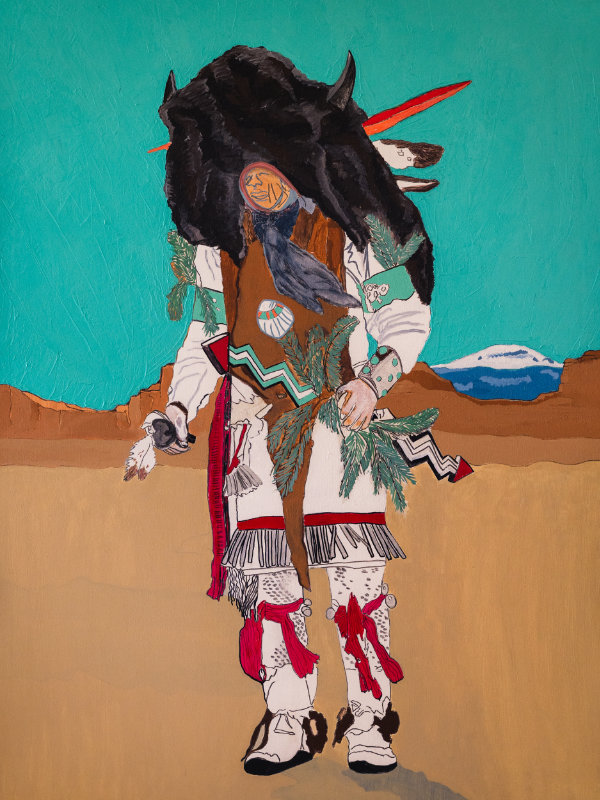
Greg Cajete, Buffalo Dancer. Acrylic painting, 36’ × 48’. Photograph by Isabel Miranda.

If we consider Indigenous culture and archaeological sites dating back at least 13,000 years, we realize that alongside all the basic human needs—food (gathering, making, storing, seeds), fire, shelter, protection—are creative objects and images. Across time, global Indigenous cultures reveal the same patterns. This is what we do as humans: we create. This is what we are: creatives. When we forget this essential expression and experience, meaning drains from us, our path feels limited and all turns bleak. Disconnected from the ground we stand on—from this essential truth and meaning that serves as our inner ground of being—we lack a relationship to place and context. Whoever we are, without creative engagement, we drift ungrounded, removed from our capacity to remake and renew. This reduces us to a husk of ourselves, caught on any current the wind threatens to take us. “Place influences you and all your creativity, all your expressions,” Cajete reminds us. “Place and context influence creation.”

Cajete calls himself a “practicing artist but not a professional artist.” He is quick to celebrate artists he knows and admires for their significant contribution to the world. But he notes that professional artists who make their livelihood from art must consider the marketplace. Instead, he has chosen to prioritize his own thoughts and internal motivations. Cajete has done this for decades; in embracing imperfection in each of his pieces—on canvas, in metal, stone, or ceramics—he strives above all else for the process. For many non-artists, the process can be the least appealing part of creating. For those of us who’ve devoted our lives to being creatives, we travel deep into the unknown and are transformed. It’s where we lose sight of what we intended, and no longer in control, we are prone to forcing the repetition of past success. The forms we seek to manifest have their way with us as much as we have with them. The mundane tools we wield—paint, clay, pen, paper—rise to a spiritual experience as what we don’t know is made known through our very own hands. “Let go and become the music and the dance of creation. Embody what you create. Embody what you teach. Embody what you experience, what you encounter,” Cajete shares as we look over his collection of images. “Become the music and dance of creation.”

As an undergraduate, Cajete’s early interest in art was curtailed at New Mexico Highlands University where art classes took a Western approach. There, he experienced critique, a Euro-centric curriculum and worldview, and a hierarchy that made art separate from all else and politicized it. Deterred from studying art in this formal context, Cajete found solace in the natural world and instead chose to focus on biology, then sociology and education. These areas of study came together to further inform his multi-dimensional perspective. Artistic expression became personal and served as the undercurrent that guided him as an educator, scholar, researcher, and leader in higher education:

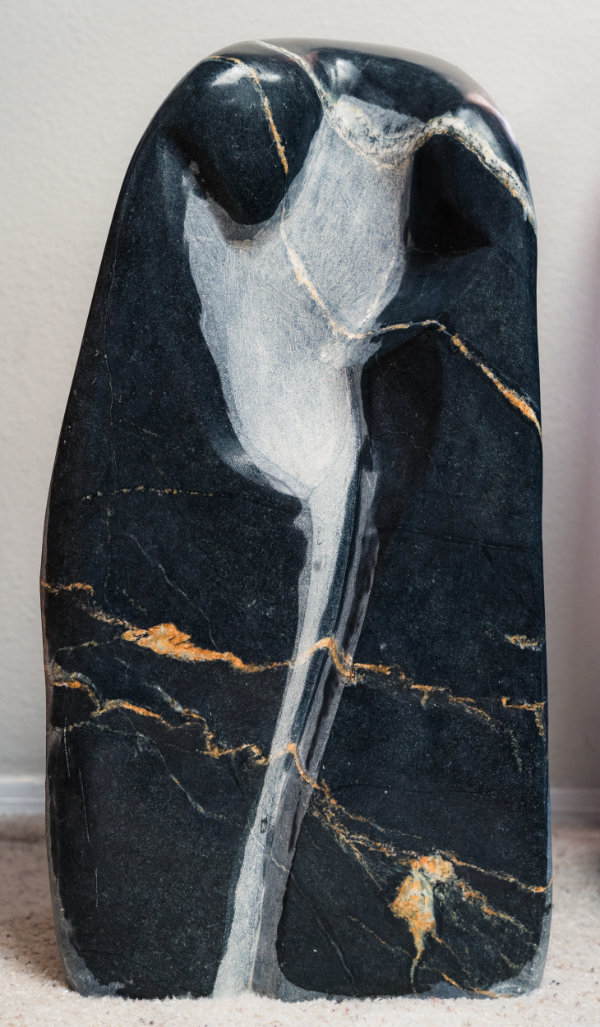
Greg Cajete, Meeting for the First Time. Black alabaster sculpture, 28” × 14”. Photograph by Isabel Miranda.

I’m looking at the idea of creativity as being inherent to human beings and inherent to the natural processes in nature. When you begin to focus on creativity, then you begin to understand its nuances and … it’s beyond art. Art is just one popularized area of creativity, but the creative process is what’s important. To begin to understand, to begin to think about, and to see in yourself that you have many kinds of ways of expressing creativity. Those expressions are just as valid as something like painting.

“He is engaging in art the way our ancestors did before the Europeans arrived,” says Audrey Dreaver (Mistawasis Cree), assistant professor at First Nations University of Canada where she lectures on Indigenous art histories of the Americas and teaches studio art. “Before the European version of art was forced on Indigenous nations,” Dreaver continues, “our ancestors made art for their own reasons. Art used as a means to commodify art and culture that we see today is usually all about the money. By making the art for himself, Cajete is engaging in an Indigenous art practice that has been done for many millennia.”

Writing, dancing, singing, and teaching are all forms of creative expression for Cajete. Often, he will first write in his notebook, paint or sculpt, and engage in traditional singing and dancing, before working on his next book or outlining a lecture. Sometimes, it’s the drawing that reveals a deeper insight into what he is thinking and writing about. He engages in artwork because it is fundamental to his experience of being alive. Central to Indigenous knowledge understanding as articulated in Native philosophy, is this core acknowledgment that creativity is valued as life-giving and life-sustaining. “Art sustains me. In real, tangible ways,” says Cajete.

In looking through Cajete’s art, I appreciate the scope in materials, diversity of expression, and styles. Alabaster heads, sculptures three feet high, acrylic, pencil and pastel portraits—one of a Maasai warrior, one a K’iche’ Madonna, and one an Andean flute player—display Cajete’s interest in different cultures and tribal groups, some of whom visited IAIA under his direction. These studies of others reveal what Cajete calls “Mindful adherence to patterns. Art as ways of thinking, ways of knowing, of observing social, cultural, and spiritual patterns. Creating these pieces makes one cognizant of different patterns informed by distinct views and perspectives.” 

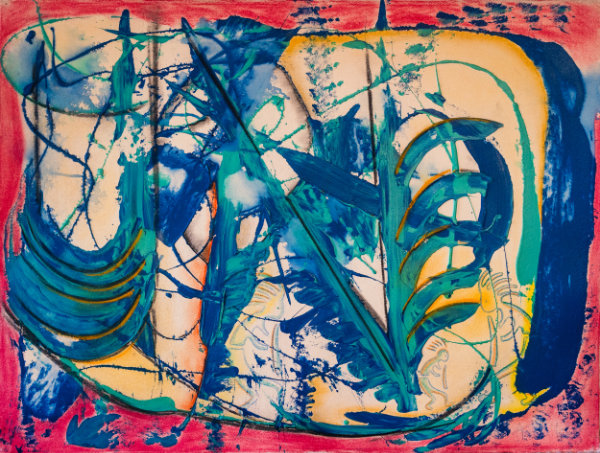
This admission by Cajete highlights the artful practice of paying attention. Attentiveness is essential to the creative process. In his collection, there are also K’iche’ yarn paintings and an abstract painting that is spontaneous and gestural, the paint fluid and varied. “Aesthetics,” Cajete explains, “is an appreciation of intrinsic meanings.” Additionally, Cajete painted his wife wearing her dance regalia when she was young, and a series of dancers, including one of himself. There are also sketches of his great-grandfather, Chief Manitou, and of his grandfather, who was the first to be sent to and survive a U.S. Government-run Indian Boarding School in 1915.

Greg Cajete, Kokopeli Corn Dance. Acrylic wash painting, 36” × 24”. Photograph by Isabel Miranda.

In Cajete’s quasi-retirement, after the most severe restrictions of the pandemic had been lifted, he began painting portraits of family members. The portraits honor past and future generations, those who died during the pandemic and those who remain. Alongside his process of creating, he is joined by his wife, his son, and grandson—all of whom are not professional artists, but makers of art. He also includes images of their work in his portfolio. It’s a shared family experience, intergenerational, and accessible to each of them. Cajete shares that this is common in Native families: everyone creates art. “Art in Native society reflects ritualization of the life process. The family doing art, the aliveness of the artifact is the aesthetic criteria,” Cajete says. “Give life to the art piece that you’re doing. Part of yourself is reflected in anything that you do artistically, but also in life as a whole.”

Currently, Cajete is again at work on a painting in “Nuevo Pueblo Mural Style,” with rainbows descending and ascending, and a figure is once again “asking,” a term Cajete uses interchangeably with praying. “There is ceremony to art. Ceremony is art,” Cajete says. “It is a mindset of creation that needs to be relearned.” It is this understanding of his own life and the myriad ways he engages with creativity that align when Cajete says that his path was never straight and hierarchical. “You’re going back and forth like this—” He moves his hand across the library’s tabletop where we’ve met for the afternoon to talk, his finger looping and spiraling to create a pattern. “My pathway is not linear. Going back, going forward, moving around in circles. That’s a good idea for a painting—the meandering of a journey and how it moves you forward and backward. It’s organic movement.”

Each one of us is called to engage our creative impulse, this inherent nature seated within. It is our human inheritance, our birthright. “You have to find your way, your pathway in the world, and that takes a lot of introspection and reflection both backward—what you’ve done before—and forward—what you envision,” Cajete says. “But the path is always meandering. It’s never direct.”  


Jamie Figueroa is the author of Brother, Sister, Mother, Explorer, which was longlisted for the Center for Fiction’s First Novel Prize and shortlisted for Reading the West Debut Fiction. Figueroa’s memoir in essays, Mother Island, received a starred Kirkus review and was named among the LA Times “6 books to shake off colonialism and rethink our Latino stories.” Figueroa is Boricua (Afro-Taíno) by way of Ohio and is a longtime resident of Northern New Mexico.

Isabel Miranda is a Bolivian-American artist and photographer who grew up in seven different countries. She lives in Albuquerque.

Jamie Figueroa (opens in a new tab) is the author of Brother, Sister, Mother, Explorer, which was longlisted for the Center for Fiction’s First Novel Prize and shortlisted for Reading the West Debut Fiction. Figueroa’s memoir in essays, Mother Island, received a starred Kirkus review and was named among the LA Times “6 books to shake off colonialism and rethink our Latino stories.” Figueroa is Boricua (Afro-Taíno) by way of Ohio and is a longtime resident of northern New Mexico.

Ritual Killing: Oryx in New Mexico

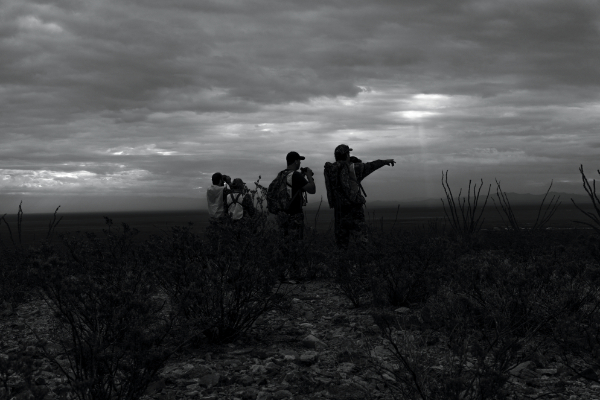
As the desert transitions from deep blacks to dim greys and blues, we creep through the mountain pass. We leave the city lights behind us and roll into the dark nothingness. Our headlights rip through the morning and carry us onto base. 

_

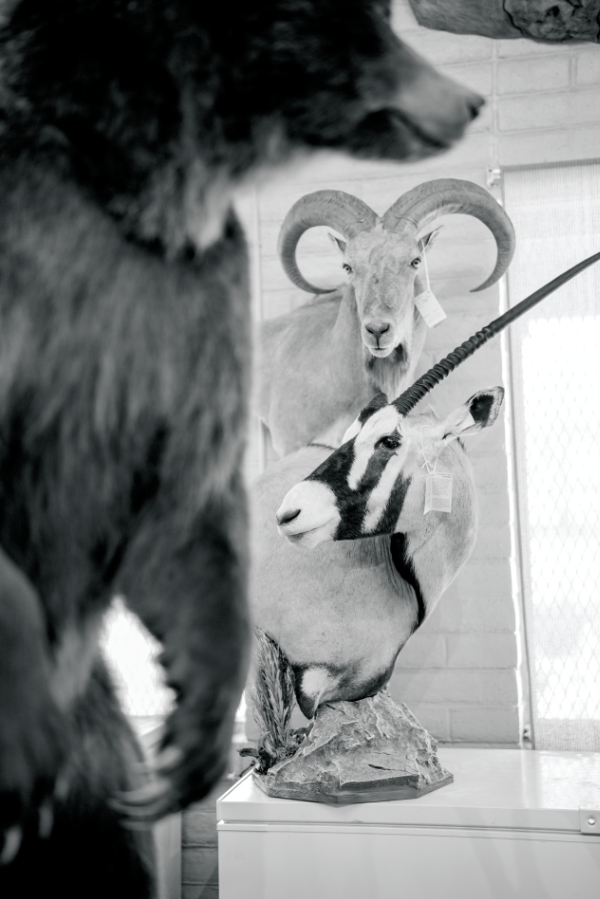
Beginning in 1969, oryx were introduced to the Chihuahuan Desert. Frank C. Hibben, a foreigner to the desert himself, brought these aliens onto the land. Released onto the White Sands Missile Range, the largest restricted military airspace in the United States, the powerful creatures quickly grew in numbers and range. The oryx spread nearly as far north as Albuquerque, and to the south past El Paso. Hungry, thirsty, and amorous, they tore across the land.

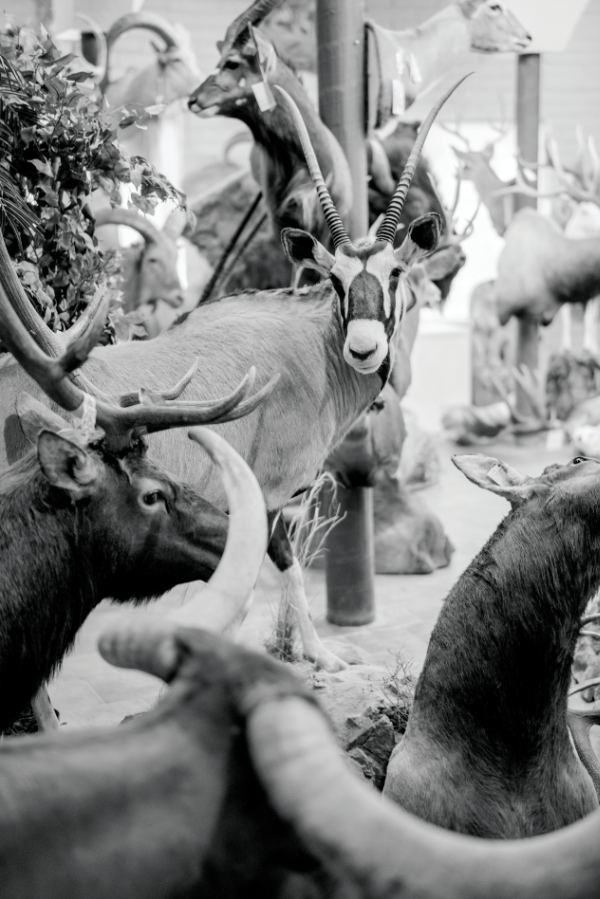
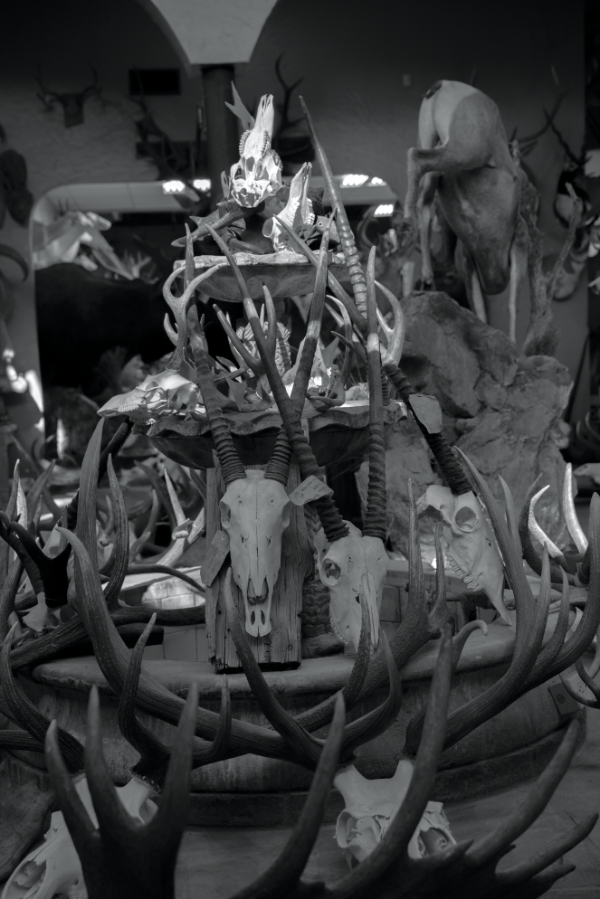
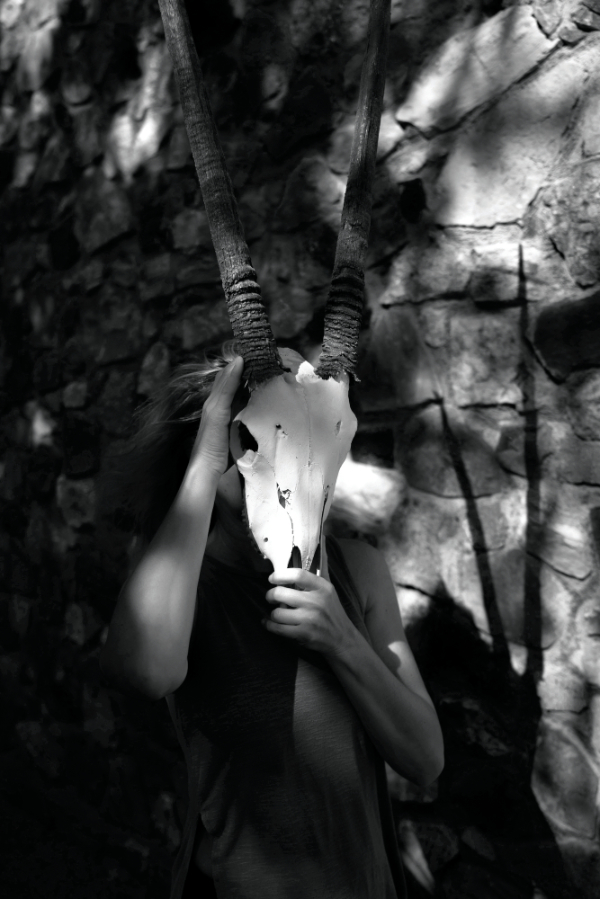
I don’t remember learning about the oryx. They’ve always been a fixture in my life: Their skulls bleached in the Las Cruces sun in my grandparents’ yard, oryx flesh filling the freezer in their garage, heads racked on the wall in their living room. When I was young, I didn’t have a real concept of what was and wasn’t native. As I grew, I came to understand the pronghorn was, the oryx was not; the ocotillo was, the tumbleweed was not; my father’s parents were, my mother’s were not. 

We followed the lines of sand on the desert floor to the base. The driver, a serviceman stationed at the base and the hunt sponsor, called in and listed our names one by one, as clearly as possible. Each of us had to match the list of approved hunters. We were cleared to cross. From the top of the hill, one of the hunters peeked an oryx one thousand yards out. We needed to be less than three hundred yards away to stand a chance of getting a shot. So we stepped out in a neat line to march across the desert toward the beast. 

I grew up hearing stories about my grandma Phyllis getting a kill. We were proud—it was a sweet success. I never went on a hunt as a kid. The violence of the Southwest was prevalent in our lives and family history. My parents didn’t like guns, and fairly so. My dad’s father was shot by police and died of his wound. My mom’s brother shot himself in the head when he was five with her father’s gun and died of his wound. We spent at least half our childhoods at our grandparents’ houses but we weren’t allowed to touch their guns. 

As we trek toward the hill where we last saw the oryx, I try to absorb the landscape. My photos are a useful tool for remembering, but I want to hold onto this place. Despite growing up less than twenty miles from the site, I had never been allowed to enter White Sands Missile Range, and it’s unlikely that I will again. 

It is beautiful here; the desert’s abundance has been preserved by the restriction of access to the land. Thick tangles of ocotillo flourish, bucks with some of the largest horns I’ve ever seen casually pass us by, and the oryx dominate the space. Large herds sprint across their inherited territory, and yet they elude us. 

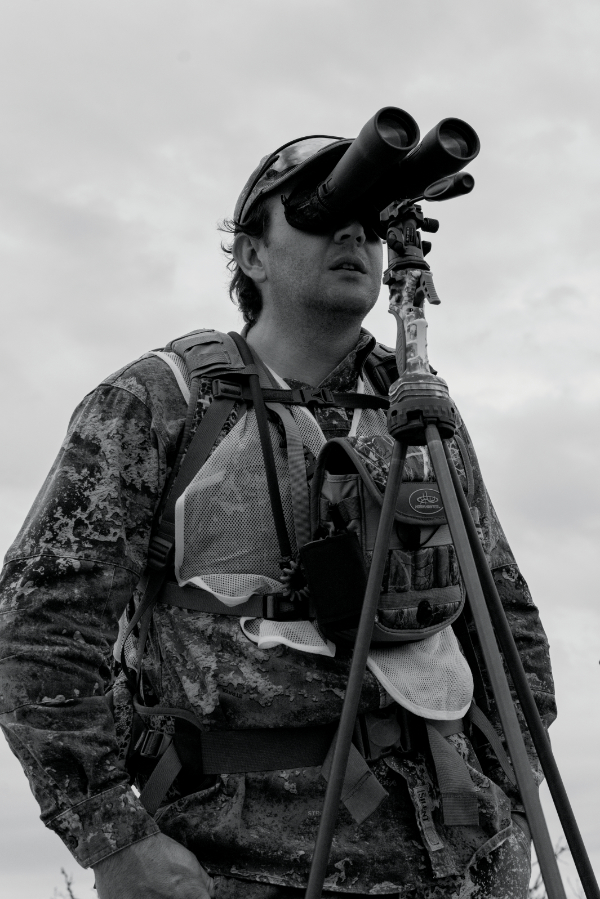
I stand quietly, camera raised to my eye. Through the lens, I watch the hunters peer through their binoculars across the terrain. The oryx come into focus as they weave through creosote. Their horns reach for the sky alongside the spindling arms of the ocotillo. The oryx’s eye fixes on the glint of the hunter’s glass, the hunter adjusts his dial to bring the beast into focus, I squeeze my finger down and shoot; the oryx runs over the hill and is gone into the vastness of the brown desert.

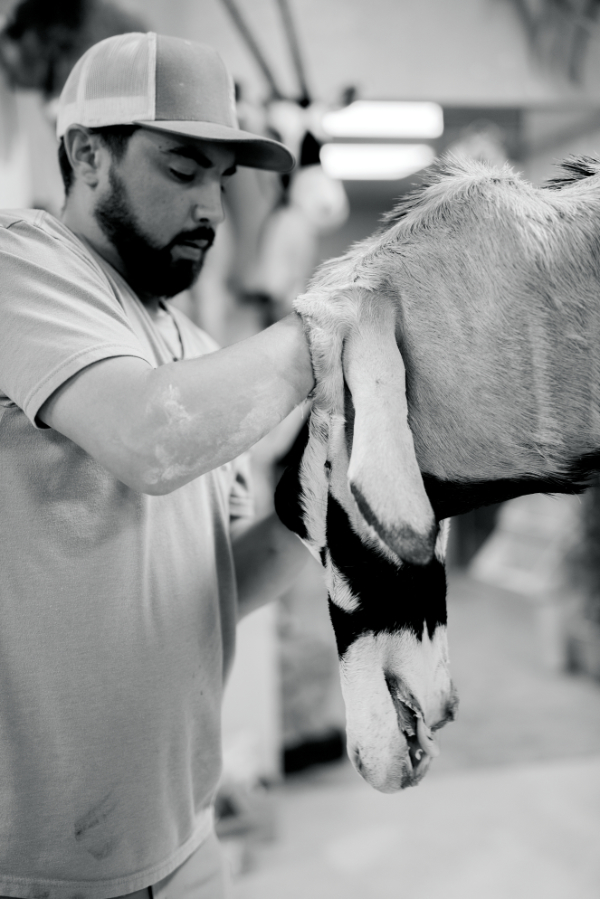
What to do with the oryx? Since its arrival in the desert, oryx numbers have grown exponentially. There are five to six thousand oryx in New Mexico. The animal’s impressive adaptability and resilience have helped it thrive in the ancient Chihuahuan ecosystem. Every year, approximately 1,500 oryx are harvested from the desert, dressed, carried out on hunters’ backs, stuffed into coolers in the back of truck beds, and hauled off the land. 

In the 1990s there was backlash from animal rights activists when word got out about the Park Service’s plan to cull problem oryx on the White Sands National Monument. The people of New Mexico stood by their adopted creatures. Now we are past the point of no return; the oryx have made their mark in the desert. The responsible decision would have been to rid the land of them, but the option to maintain the new status quo won out. 

As we work our way off the range, after a day of chasing the near mythical creature, I reflect on the frivolousness of maintaining the population this way. We now live in a system of ritual killings to maintain the status quo of the desert, but it is not quite enough. The gas pedal remains flat against the floor.  

Marcus Xavier Chormicle (opens in a new tab) is a lens-based artist and independent curator from Las Cruces, and lineal descendant of the Agua Caliente Band of Cahuilla Indians. His work focuses on family, memory, and the intersection of class, race, and history in the Southwest. In 2024, he was a New Mexico Arts artist-in-residence at Lincoln Historic Site where he expanded on his oryx project.

A Parallel Beauty

I was on a video call early in the pandemic with my friend Jamie Figuroa, when I articulated it for the first time. I had just finished reading her novel, Brother, Sister, Mother, Explorer, which is set in Santa Fe and captures so well the community’s beauty and power, as well as its dangerous magic and its shadowy underbelly. There are a group of older women who pedal along the edges of scenes on bicycles. They are protectors, working against sex traffickers and other vestiges of the patriarchy, collectively called “the grandmothers of us all.” I told Jamie that reading her novel made me know in my bones Santa Fe was my ultimate destination, that I had been in as deep and complex a relationship with Santa Fe for the last thirty years as I had with any other person or place in my life. Because Jamie is wise enough to understand both that I wanted to be a grandmother of us all, and to be tended by them, she said, “Santa Fe feels the same way about you, Pam, and I think it is time you came home.” 

I have not come home to Santa Fe quite yet, for a number of reasons, including a couple of aging horses who like the one hundred and twenty acres they move about at my actual home two hundred miles up the Rio Grande from Santa Fe outside Creede, Colorado. There are the three Icelandic sheep in my dwindling herd, the four chickens who survived the avian flu that swept in with the wild birds last winter, and the dogs who are not schooled in leashes or fences or dog parks. There is the barn, the only non-living object I cared about saving when evacuation threatened during the 2013 West Fork Fire, and the thirty-five years of memories I have made living there. Also, even if it were easy to sell my Colorado homestead, which it will not be, sitting as it does at the end of a long dirt road in a place that is serious about winter, I could not trade across for even the smallest home in Santa Fe, at least not an intact one, and sixty-two might be too old to take on another mortgage. 

Are we doomed to love our spiritual homes more than our actual ones? Does Santa Fe retain its perfection in my eyes because animal logistics and gentrification will make it nearly impossible for me to live there? Is she like the secret lover who never ages or becomes tiresome by virtue of never being captured? Am I like the guy who agrees to go steady with the girl only after he finds out she has six months to live? 

My first visit to Santa Fe occurred around the same time I bought my place in Creede, in the late fall of 1992, not long after the publication of my first book, Cowboys Are My Weakness, when I was a guest of the Santa Fe Writers Conference. After giving my reading, I was taken out to Galisteo to the home of ceramicist Vicki Snyder and her writer husband David, for a dinner with other artists on their portal. Theirs was the coolest home I had seen at the time, lit up with luminarias, the real adobe walls adorned with ristras and milagros. I thought “this is what it must mean to be a grown up, to have created a home that feels like a heart.” I had just turned thirty and had spent much of the previous decade sleeping in my North Face VE 24 tent, or my Toyota Corolla, or a shack in Park City, Utah, which I could afford on my graduate school budget. Not that the Galisteo house was grand. It was not grand, and that was the beauty of it. It was perfect. Warm, compact, elegant, of the earth. As I sat there, I could still feel the hands shaping the walls. 

Santa Fe is four hours from my Colorado homestead, door to door. It’s my closest art house movie theater, my closest sushi, my closest real latte, my closest grocery store that carries quality olive oil and Malden salt. Each time I made the trip, I met another Santa Fean who engaged with, cared about, and configured their lives around art. I had not known it was possible to design a life that way. In Colorado, I had chosen wilderness, my lucky horseshoe of mountains, a million acres of aspen trees beyond the property line to get lost in, a sky where the Milky Way remains as its name suggests. What Santa Fe offered was a community of people who wished to investigate a parallel beauty, beauty made by human beings. 

At first, I was bedazzled by the Plaza, lit up by a thousand holiday lights, or packed full of Zydeco dancers at a free summer concert. I fell for the hole-in-the-wall that was Holy Spirit Espresso, a walk with my dogs on the Chamisa Trail loop in October, and a soak in the women’s pool at Ten Thousand Waves. Eventually I discovered the Santa Fe that thrives on the other side of Saint Francis: Counter Culture, Mu Du Noodles, and eventually Tune-Up, with its whole world of flavors. The people I met were using their talents to fight for climate and social justice. This corresponded perfectly to my political awakening, my growing understanding of the inequities and supremacies that direct this country’s policies, and our collective denial about our many crimes. 

I met a poet in Santa Fe who lived in a tiny apartment in a compound off Acequia Madre. When I visited him, I walked Canyon Road daily, marveled at the sheer density of galleries, and eyeballed Cormac McCarthy from behind my laptop at Collected Works. The poet had an ex he was still entwined with, and I don’t want to dwell on that trouble except to say that it was the first real challenge of my relationship with Santa Fe. I fell out of love with the city for the first and only time. I think of what followed as a trial separation from Santa Fe; we took a little break from each other. Eventually though, the poet moved to California, and Santa Fe and I rekindled our relationship, shyly at first, and then with reinvigorated passion. We renewed our vows as our friends looked on. 

Then, one snowy Saturday in January, something happened that solidified my relationship with Santa Fe so completely no poet will ever tear it asunder. I was home alone, happy in the middle of a three-day blizzard, when the phone rang. It was the then-director of the newly minted MFA program at the Institute of American Indian Arts, Jon Davis, asking how soon I could be in Santa Fe. Mona Susan Power, who was scheduled to read that night, couldn’t make it, and he was looking for a replacement who was not afraid to travel in the snow. I stepped outside and looked at the fat flakes falling from the sky, eyeballed my moderately drifted driveway, looked toward the horses munching peacefully on the hay I had thrown an hour before.

“I would have to bring my dogs,” I said. “I don’t have a sitter.”

 Jon said, “I’ll get you a dog-friendly hotel room.” 

I said, “Make sure they like big dogs, together my two weigh three hundred pounds.” 

I arrived at IAIA unbrushed, brushless, and covered in dog hair, but on time for the reading, and with a promise from my neighbor to throw hay for the horses early the next day. I dashed to the women’s restroom to try to address my hair and perhaps shed some of the dogs’. I asked the first three women who came in if I could borrow a hairbrush. To a person, they smiled, friendly and apologetic. “Sorry, I don’t have a brush, I just kind of run my hands through my hair”—here she demonstrated—”in the shower and call that good.” Another said, “No, I gave up hairbrushes the same year as underwire bras.” These were decisions I could relate to. I liked IAIA already. 

The morning after my reading I sat at a table of mostly Diné writers, including Byron Aspaas, and though I cannot remember the subject, I do remember laughing so long and hard it was impossible to eat. Byron wasn’t the only friend I made at IAIA that day, but he was the one to stand beside me as my best man four years later when I got married. Before I drove away, Jon asked if I would consider returning, and I haven’t missed a semester of teaching in that program since. 

In the Low-Rez program we meet three times a year for eight days at a time, so while my job there has not massively increased the number of days I spend in Santa Fe, it has increased the range and quality of my interactions. My colleagues and students belong to many different Nations, but we come together in Santa Fe as a community, to learn, laugh, cry, argue, listen, read, and write. We go on excursions to IAIA’s Museum of Contemporary Native Arts, Tune-Up, Meow Wolf, and sing karaoke. Because of when our residencies fall, I have celebrated my last twelve birthdays with them. The amount I have learned from being in proximity to their varied but consistently Earth-centric, community-forward, empiricism-challenging values has changed me—as it would anyone. It has been quite simply the most valuable education of my life. 

In my first full year teaching at IAIA, I mentored Dia Winograd, who is non-Native and has been a resident of Santa Fe for forty years, and Northern New Mexico for even longer. Over the last decade she has become my chosen mom, because she’s a yes-sayer, hilarious, makes the best gluten-free meatloaf on the planet, and because she is sober. My mother, who was not sober, died when I was thirty. I didn’t know how exhausted I was from a quarter century of motherlessness until Dia came along. Dia lives in Eldorado, behind a lilac bush that’s as big as my barn. Because I have no clothes drier at home, I bring my laundry to Mama Dia’s, which makes us both happy. We walk the Eldorado trails for hours and when the weather is too shitty for walking, we dance to ’80s music in her living room. 

I got COVID-19 in February 2020 and was sicker than I had ever been. Lungs, sure, but also heart palpitations and joint aches, kidney failure, and nose bleeds that lasted weeks. No Western doctor wanted anything to do with me. We had not even begun saying the words Long COVID yet, so I begged Alix Bjorklund, a Sante Fe acupuncturist who had been recommended to me over the decades but was never taking new clients, to have mercy on me, and she did. 

Cynthia Baughman, longtime Santa Fe resident and former editor of El Palacio, traded me the condo her mother left her for membership in my private writing group since all short-term rentals had been temporarily disallowed. This gift allowed me to see Alix three times a week when I was so sick I could hardly function. Being two thousand feet lower in elevation than Creede gave my lungs a fighting chance. Cynthia’s condo is downtown, catty-corner from the big metal dog who wears the bright red Christmas collar. Sometimes Pasqual’s was open and sometimes La Boca, and Iconik was always open, so I managed to keep myself fed. It was a lonely time but somehow the empty streets I walked kept me company. On the way from the condo to Iconik on Guadalupe each morning, I would pass the elephant that sits on the swing painted on a wall near the Chile Line Brewery and greet him as if we were friends. Somehow the happiness conveyed in the back muscles of that elephant made me believe things might one day be okay. 

One night, when I’d had way too much of my own company, I double masked and stopped into a sock shop near the Plaza. The woman who worked there recognized me—a thing that happens to me sometimes in Santa Fe and nowhere else on Earth—and she said, “Pam, do you think the fascists will come all the way to Santa Fe to get us, or do you think we will be safe here?” 

“I think the fascists will leave Santa Fe alone,” I said, without a ton of confidence, “but if they don’t, I think this community will stand up and fight on behalf of one another.” 

Was this the sort of fantasy a person who is pretending to live in their favorite town engages in? If I actually lived in Santa Fe, would I believe it would be every person for themselves? 

A few nights later I was walking back from Pasqual’s with my garden burrito and my vanilla date shake (one of the best meals in any time) and I rounded a corner to see a lone man on the otherwise deserted sidewalk. As was the protocol, I stepped into the empty street, and he did too. He laughed and said, “No, you have food, you take the sidewalk.” I had been right then, I hoped, to say Santa Feans would fight for each other. 

In the spring of 2021, my strength increasing, I took what I called “the long walk” daily: up Marcy Street, across Paseo, up Hillside to Rodriguez, Rodriquez down to Palace, Palace to Canyon, then Monte Sol over to Acequia Madre, down to Garcia, over to Cathedral, and back downtown. It took an hour and fifteen minutes if I didn’t have to stop and rest. In May, a century plant bloomed on the corner of Palace and La Vereda, and I took pictures of it every day to mark the passage of time. 

Eventually COVID restrictions came to an end, and the condo became a short-term rental again. I rented a house briefly in Chupadero, and when that rental ended abruptly, one of Dia’s two spare bedrooms became mine. My life revved up too. I was teaching in California, France, and Wisconsin, and my lungs got strong enough for me to spend time back in Creede. But Santa Fe had solidified itself in my heart and soul as the place that had healed me. Through sickness and health, we had promised one another, and Santa Fe had delivered big time. 

In late November 2024, after the presidential election, I noticed Santa Feans had switched back into COVID mode, which is to say, they were being particularly tender with one another. At Iconik one morning, three different strangers told me they liked my sweater, and while it is a truly great sweater, hand knitted for me by a friend, I knew it was less about the sweater and more about saying, hey, you are a person and I am a person and we are both hurting and I see that you are here. 

Is home the place you bring your laundry? Or the place you learned you had a political self? Is it the place you weathered a physical or emotional storm? Is it the place you found the mother you always wanted? The place you see your values reflected in the eyes of others? The place where you believe strangers will stand up and fight on one another’s behalf? 

It remains to be seen if I will I ever commit wholly to Santa Fe, get right down in the trenches of old age with her, or if she will remain my other woman, the name I’ll call out with regret on my death bed. For now, just out of frame, the grandmothers of us all are beckoning from their bicycles, saying something wise like it is a very lucky woman who can claim to love more than one home.


fine art screenprinting with a collaged style
Melanie Yazzie, Indian Boy Art Project, 1993, screen print, 22 1/2 x 30 in. Collection of the New Mexico Museum of Art. Gift of Lucy R. Lippard, 1999 (1999.15.40). © Melanie Yazzie.

Art and Belonging

A few months ago, I met Pam Houston at the New Mexico Museum of Art’s Vladem Contemporary, and we walked through Off-Center: New Mexico Art, 1970-2000 together. The exhibition opened last summer and rotated through the themes of place, spectacle, and identity. As we drifted from one work to another, Pam and I talked about place, belonging, experiences in New Mexico, and what makes a place a home. Our conversation was as varied and wide-ranging as the breadth of work represented in Off-Center. The images that appear alongside her essay are ones she was especially drawn to at the exhibition. 

Off-Center, which closes on May 18, 2025, runs through a survey of the last three decades of the twentieth century, a pivotal time in which numerous artists relocated to New Mexico, drawn by its distinctive climate and landscape, its rich diversity of cultures, and its strong reputation as a center for the visual arts. Between 1970 and 2000, Albuquerque, Santa Fe, and Taos continued to be important destinations for contemporary artists, but other communities developed in cities and towns infrequently identified with the visual arts such as Galisteo, Gallup, Las Cruces, Roswell, and Silver City. With over 125 artists on view, Off-Center presents a compelling range of artistic approaches and a diverse range of experiences. —Emily Withnall

Pam Houston (opens in a new tab) is the author of the memoir Deep Creek: Finding Hope In The High Country, as well as two novels, Contents May Have Shifted and Sight Hound, two collections of short stories, Cowboys Are My Weakness and Waltzing the Cat, and a collection of essays, A Little More About Me, as well as a book of essay between Pam and environmental activist Amy Irvine, called Air Mail: Letters of Politics, Pandemics and Place. Her stories have been selected for volumes of The O. Henry Awards, The Pushcart Prize, Best American Travel Writing, and Best American Short Stories of the Century among other anthologies. She teaches in the Low Rez MFA program at the Institute of American Indian Arts, is Professor of English at UC Davis, and co-founder and creative director of the literary nonprofit Writing By Writers.

Our Place in the Family of Things

color photograph of woman with glasses smiling

There’s a place I like to walk with my dog on the outskirts of Santa Fe. The trail offers views of the city and the pink and orange cotton candy clouds that often illuminate the sky at sunset. As I walk, I take in the soft hoots of owls as the sun slips behind the mountains and the echoes from coyotes throwing their voices between the hills. Sometimes, I spot the small grey silhouette of a coyote on the hillside and watch it dart out of sight as Venus and the first evening stars appear in the twilight. 

I recently learned that coyotes are ventriloquists; they
can project their voices and make themselves sound greater in number. Called the Beau Geste Effect—which translates to “Beautiful Gesture”—this auditory illusion is part of what gives coyotes their mythological “trickster” reputation.

And because they are so often maligned by humans, these vocal tricks allow coyotes to survive. I grew up hearing coyote stories from Pueblos and tribes across the Southwest,
and between these stories and the few scientific details I
know, I am aware of how much more I don’t know—and how much about the wider natural world humans may never understand. 

This issue of El Palacio is teeming with animals and the more-than-human. Whether reading Tamara Enz’s article about ancient life billions of years ago in New Mexico, diving into the long, rich history between the Diné and Navajo-Churro sheep, or learning about the oryx that live at White Sands in Marcus Chormicle’s photo essay, there is much we can learn when we take time to reflect on Earth’s vast geologic history and our relationships to the living beings around us. Eliza Naranjo Morse, an artist from Santa Clara Pueblo profiled in this issue, encourages us to consider what we can learn from the soil, ocotillo, and rabbits—among many other beings in the natural world.

Two essays in this issue, by Pam Houston and Harrison Candelaria Fletcher, explore what it means to belong to a place, a family, or a community. Which are the people, animals, and places that claim us? What and who do we claim in return? When considering ideas like belonging and home, adjusting the scope can sometimes deepen our understanding, or complicate it. Whether we are considering a kinship with a screech owl, as Candelaria Fletcher does, or a relationship to a city—like Santa Fe, as Houston does, or whether we can transport our imaginations backward in time 1.4 billion years so as to appreciate the formation of the Precambrian pink granite that make up the Sandia Mountains, as Enz describes, there are many ways to understand our connection to place, other beings, and the ongoing story of the world. 

As a perpetual knowledge-seeker and researcher, my thirst for understanding can sometimes feel unquenchable. But there is also beauty in surrendering to the vast unknown and embracing the mystery. It is easy to feel disconnected or isolated but paying attention to the life around us can offer an entry point into a deeper knowing. Whether considering how many mass extinctions and land formations Earth has experienced to make current life possible or wondering what a coyote or sheep perceives that humans cannot, there can be some relief in feeling how deeply interconnected we all are to each other, all living beings, and the landscapes we inhabit. 

Emily Withnall (opens in a new tab) is the editor of El Palacio and the host of Encounter Culture. Prior to stepping into the editor role, she wrote for the magazine for eight years. Emily has also been published in The New York Times, Al Jazeera, High Country News, Orion Magazine, Tin House, The Kenyon Review, Gay Magazine, Source New Mexico, and other publications. She lives and writes in Santa Fe, New Mexico.

Snow Pillow

The winter earth summons all to reflect. As birds move south, and with them their chats and songs, the cycle of hibernation and rejuvenation commences. A deep reflection on what has happened and how everything culminated in this moment commences. 

Wolf returns to landscapes he has always known because the land directs his memory, and codes embedded in DNA dictate his path. From far north where fire sits beneath fields of snow and rainbow-colored pools boil, bison and elk succumb to Wolf’s attack. He feasts all spring and summer, moving across vast groves of trees and fields of wildflowers as yellow as the sun and as pink as the evening sky. Then, he crosses steep mountain ranges to ones of rounder peaks. 

Each fold woven into his coat, layered on top of others, forms a warm cover and contains the collective occurrences of Wolf’s existence. Memories insulate and aid him through the challenges of each day. 

Every time his paws touch the land, Wolf inscribes a scent. Nerve points along his paw pads receive information from the soil while simultaneously leaving a mark to communicate with others who migrate across the terrain. The aroma filters through tree roots, granulated soil minerals, and spring pollen, thereby residing in the air.

Every imprint on the land matters in the cycles of seasons. Years of floods, drought, high heat, cooler summers. Births and deaths. Victories and defeats. All living beings sway with fluid realities. 

In the darkest, quietest corners, Wolf makes space for more life. He slows down in the cold as all life must. Idleness peels away layers of modern life’s stressors—fences, highways, guns—the barriers that attempt to hinder him. 

Winter’s reflection commands a trust in nature and a desire to exist inside her womb. To rely on a wisdom outside any one being’s control. 

The great winter break provides an opportunity to fortify a soul, to build towers of strength needed to carry on. Lay down with a thick winter cover, let senses pause, and feel the chill of change upon the earth. What comes next is another cycle that may bring bleakness, battles, roaming, or joy. But it will all be temporary. Each season builds on other seasons, which in turn creates life. 

Rest without closing eyes on the snow pillow. For the battle to survive never ends.

Joanne Aartman holds an MFA in Creative Nonfiction from the Institute of American Indian Arts. She is working on a memoir of her nine years as a globe trekker. Her stories center on encounters with land temples and nature. She lives in California.

Storytelling Creatures

In her 1988 collection, Favorite Folktales from Around the World, the folklorist Jane Yolen introduced humans as the primary source of stories, writing that, “Only humans can create tales that change or structure the world in which they live.” However, this statement is challenged by the menagerie of beings which painter and sculptor Eliza Naranjo Morse calls forth in her art. When encountering her luminescent and kaleidoscopic paintings of creatures, it becomes difficult to argue that humans have been the only ones to weft and wend the fabric of stories. We are summoned to question the possibility that these creatures can teach us enough to imagine their tales as interwoven and instructive to our own lives. With almost unassuming deftness, Naranjo Morse’s iridescent teal and purple beetles move with veritable personalities, and the clouds in the sky tell parts of the story—despite the flat planes in which many of her creatures live their lives and play out their narratives. There is something cinematic and deeply animate about the whole affair, like the viewer is entering the world of movement and dreams that are at once a powerful stride into the unknown and deeply reminiscent of an ancestral time when humans lived as tiny players in a more magical and vibrantly alive world. 

I get to speak with Naranjo Morse on a day where she is at home, and when the Northern New Mexico air is crisp, with the tickle of autumn unfurling, and after she and her mother have gathered all the tomatoes and peppers from the garden. Word on the street is that her mother makes a mean pepper jelly—and don’t even get her started on the pickled carrots. I am on a video call with her, away from that beloved landscape, so I beg her for details of the season, and we chat about the glowing mats of cottonwood leaves and the sense of completion that comes with winding down harvest season. She indulges me with generous observations of a place we both love, her eyes warm and wide even through the computer screen. She tells me that she has a sincere love for the landscape of New Mexico, and for the soil in this area. Her expression reverent, she says, “I drive by dirt and am like, ‘I love you.’ Pick some dirt up and feel this legitimate reciprocal love.”

Naranjo Morse is from here. Like, deeply from here. On her curriculum vitae, under the education heading, she writes “The ongoing education I receive from my Pueblo elders which spans considerations of language, values, knowledge systems and creativity that is rooted in Tewa worldview as it meets a current global experience.” That kind of from here. The line precedes the list of her formal education and gives her CV an active life force that challenges the sterility of these sorts of documents, and it roots her work in the cartography of mesas and monsoons that make up Northern New Mexico. 

Born in Albuquerque with her twin brother and brought back to Tewa homelands, Naranjo Morse remains there to this day. An out-of-commission post office once served as her studio, though now the studio is in the house she and her partner are building, and at the time of my interview with her, they were pushing to get windows installed before winter. She makes her work ensconced in the very community where she was raised, a place where art as a way of life was normalized from her nascency. Naranjo Morse teaches art at the Kha’p’o Community School, is an avid auntie to her nieces, and is also an avid niece to her aunties, with whom she spends a significant amount of time assisting in their projects, accompanying them to do talks on various topics of their expertise, such as relationship and reciprocity. She also supports her mother Nora Naranjo Morse’s work building and sculpting, and is helping to care for Nora’s installation, Always Becoming, at the National Museum of the American Indian in Washington, D.C. From what I can tell, Naranjo Morse is honored to be interwoven in the undertakings of her family. “Sometimes I feel like I need a little headset like a wedding planner,” Naranjo Morse says, laughing. There isn’t an inch of ego or ire in her voice, just a sense of joy that she can be there, and an enviable sense of clarity about her family role and the wisdom of her elders.

This makes sense, as Naranjo Morse’s family provided the first fertile soil in which her artwork began to bud and flourish. From a kinship group comprised of an inordinate number of artists and craftspeople, she says that somebody was always sculpting, making pottery, or drawing; or her mother was gathering random bits and bobs to spray-paint and render into something meaningful. She often handed Naranjo Morse a lump of material with an encouragement: “Here’s some clay, go over there and make something.” 

mixed-media installation
Eliza Naranjo Morse, Carrying, Collecting, Letting Go. The Feeling of an Us, 2018. A combination of many materials that were shared, saved, found, collected, and passed down. Installation. 144 x 211 x 42 in. Collection of the artist. Exhibited in Because It’s Time: Unraveling Race and
Place in NM (4 May 2018 – January 28, 2019), National Hispanic Cultural Center Art Museum. Photograph by Addison Doty.

Naranjo Morse spent much of her youth making things. She spent a good amount of time with her cousins, building forts from old lumber, elm sticks, and piles of leaves, choosing prime rocks for her “tea kettles,” and making tunnels in the dirt. She also adored involving Trolls dolls (figurines with solid little bodies with wrinkles in their hard plastic foreheads and shocks of hair in neon green or burgundy sprouting out of the tops of their heads) in her childhood art projects. When she summoned these toys into the conversation, she ushered in a whole era of memories. As a child, she loved to use Trolls as the catalysts for creation as she considered what they needed to live out their stories. For example, the Trolls needed a tiny painting next to their cardboard couch (also made by Naranjo Morse), or miniscule cardboard candy. Her adoration for creatures which were not particularly cute nor particularly human makes sense. As her work evolved, it continued to feature sometimes overlooked creatures. From making Trolls rugs and tables, she moved on to drawing people, flowers, worlds, and monsters. She told me that she would, quite literally, draw anything. She enjoyed making comic books and cartoons—anything with a sense of sequence, and to occupy herself, she often played “pass it” with her family; a doodle would be passed from person to person until a story developed organically. 

 “I knew from my Pueblo family and also my non-Pueblo family that art could be incorporated into every task,” Naranjo Morse says. “All normal activities—from cleaning the yard to plastering the wall with mud—those were all made into normal daily practices as opposed to something at an arms-length, like now you’re doing art.” In a gaggle of tight-knit cousins, the kids went from studio to studio, or house to house, looking for activities and art supplies. Drawing was an activity to which Naranjo Morse dedicated enormous amounts of care and practice. She says the idea of something two-dimensional felt radical, and she wanted to know what stories those flat shapes could tell. 

Naranjo Morse remembers a major shift that crept its way into her consciousness when she was around nine. Her uncle, who was blind, was coloring with her in a Gremlins coloring book (other creatures from the 1980s, with similarly wild hair and wrinkled faces). She peered over at her uncle’s coloring page as he made circles all over the page, picking different colors as he went along until the page was a mass of blue and green and yellow swirls, which gave her pause and filled her with wonder. “It was so much more beautiful than trying to color a Gremlin in,” she told me, “The colors were moving around each other, it was significant to my sense of what is possible in illustration—and prescribed systems. It affirmed my sense that art was boundaryless.” 

acrylic on canvas artwork depicting animals with weapons in a desert scene
Eliza Naranjo Morse, Hurt, 2024, acrylic on canvas, 48 x 36 in.

It is clear Naranjo Morse took her uncle’s coloring seriously. Her art practice is wide-ranging, from sculpture and installation to drawing and painting in riots of color, but the most arresting for me are her cartoon-like characters. Some of her drawings feel as if you’ve stepped into a dream of whimsey, but with some serious undertones. In one painting, a frog and a rabbit are in a moment of conflict with an armed beetle which pulls a jail cart—but all under a strangely calming nighttime sky and the shadow of a carmine ocotillo plant. Naranjo Morse notes that as she gets older, she has become more invested in the lives of landscapes and incorporating them as storytelling beings in her paintings, working to give them voices and agency to move and tell the story swirling in and out of the painting. She says, 

Landscapes have all of the history; certain hills or mountains have deep meaning for people—they are holders of enormous significance. When I was younger, I was very interested in what people were doing or what was happening so the space was more open, but now [in my current work], how do I make a space that helps tell a story? The New Mexican landscape becomes the most beautiful landscape for figuring out how to do that. Animal-like storytellers are important to me but now it’s like … wait a minute, if I put these Beings next to an ocotillo plant, then I’m able to offer them the same unique medicine that the plant offers. If they are under a quarter moon, then what does it mean about how a story is growing?  Or receding if the moon is waning? These details become significant [in order to] love earth and stories, but also to tell a story.

There is a sense of animacy that permeates Naranjo Morse’s work, and she thinks about materials not only in terms of selecting the right medium, but also the resonance of what the vegetables, animals, and minerals can indicate in terms of landscape’s history. Last summer, she started painting amaranth frequently, enamored with the history and significance of the plant. She felt that by drawing amaranth, the plant’s story is acknowledged, along with its perseverance and nutrients. Then, as a byproduct, the human story of our historical relationship with those magenta leaves is revealed. “It’s exciting to begin using plants as storytellers,” Naranjo Morse says. “I’m thinking about the power corn holds as an expression of one’s life going through stages, and how human survival is dependent on the more-than-human relationship not just with the corn harvest, but all the life that made it possible. There’s a kinship that comes with knowing corn through different stages; if the tassels form it means it’s a certain part of summer. And that means a whole environment of experience.” These plant stories become narrative details in her paintings, helping the journey playing out in two dimensions communicate the long relationship between humans and amaranth, or humans and corn. 

Naranjo Morse also draws tools. “I like shovels. I like sticks. I like toys, they remind us to … return to a time when we held something so precious,” she says, noting that she watches her little nieces walking around with pouches and purses they fill with small, sparkly things. “They are all precious about it,” she laughs, “and they just have some rocks and maybe a little figurine or notebook or something.” 

Naranjo recognizes the ways that these small items which make up our lives can have storytelling significance, and that there is reverence in how children care for the flotsam and jetsam that adults can overlook. In her mixed-media collaboration with Brandee Caoba, Carrying, Collecting, Letting Go, The Feeling of Us,that was part of the exhibition Because It’s Time: Unraveling Race and Place in NM exhibited in the National Hispanic Cultural Center Art Museum from 2018 to 2019,  Naranjo Morse depicts a human-like character moving through space and time, carrying and collecting parts of environment and ancestry that make up their own identity—all the precious little bits that allow us to become who we are. 

This attention to tiny things is evident throughout Naranjo Morse’s work and approach. For example, she smears in a little slip of clay in all her paintings to remind the paintings that they are connected to the ground, even though the paints themselves contain plastics, as many art supplies do. She takes comfort in knowing the paintings will have a connection to home and a form of grounding, even when mounted on walls away from the place where they were made. 

It is often difficult to discuss the concept of animacy without verging on anthropomorphism. It is human habit to project our traits onto more-than-human beings by refashioning them in our own image, but the way that Naranjo Morse interacts with her characters is not quite that. Her work reflects the things humans can learn from other creatures. She draws insects because they tell a story about a more communal way of being. She loves to render badgers and leans into how smart and tenacious they are—not graceful, but hearty and dedicated to getting something done. She draws stars because they are “a reminder that it’s not just us; we’re being held within a much larger natural system; it’s a reminder of what is possible and how connected we are.” She creates with care and a belief that everything deserves to be cherished. 

Naranjo Morse’s most recent work in the group show, Vivarium: Exploring Intersections of Art, Storytelling, and the Resilience of the Living World at the Albuquerque Museum was no exception to this care. A vivarium is a clear container where viewers can watch nature. The exhibition simultaneously played with the idea that vivarium means “place of life” in Latin and could be a way of observing or putting the natural world under a microscope. Artists troubled this meaning by providing myriad opportunities to view junctures in human and non-human environments and built and natural spaces. Naranjo Morse, along with a handful of other artists from other Indigenous communities, presented a compendium of approaches as to how the non-human world continues in its resilience. These ideas, which included heavy engagement with animism and mythology, a confrontation of consumerism and environmental neglect, and the uplifting of hope, were meant to foster public dialogue for ecological and societal changes.

The world seems ripe to recognize the timely necessity of Naranjo Morse’s work, as she was recently named as one of The National Museum of Women in the Arts’ “Women to Watch 2024.” When I mention this honor, she smiles and says, “It took me way too long to be brave enough to make the art I wanted to.” She tells me that she had doubts (like so many) about doing her heart’s work, and about whether her creature drawings would be understood as having meaning beyond being cute. “The honor of being selected to represent New Mexico in the exhibit in Washington, D.C. was an affirmation to express my creative truth and be brave about it,” she says. Then, thoughtfully, she expresses gratitude for the chances she has been given and hopes for those same chances for as many young and elder artists as possible. “How can institutions lift as many creative thinkers up and give them as many chances as possible?” she asks. “Because sometimes it takes more than one chance and one person to fully explore what we are meant to share. This helps us and our world so much more.” 

I think of this collective approach to living as I sink into her triptych titled, Light from Love. It is a bird’s eye view of deer, birds, squirrels, and all manner of other creatures with brightly colored possessions roped to their backs. They are moving towards an unfathomably deep circle in the center painting, where the galaxy swirls and the sparkle of stars winks up at them, almost as if it were calling them all home after a long day. Whether it is beetles or plants or family, Naranjo Morse is firm on the preciousness of creatures great and small, and her work serves to imagine a world in which all beings are held in an interwoven net of stories and stars.

Addison Doty is a photographer based in Santa Fe, New Mexico. His images of of artwork are featured in award-winning books, catalogs, periodicals, and exhibits worldwide. For more than twenty-five years, Addison has supported galleries, collectors, artists, and museums.

Eliza Naranjo Morse (opens in a new tab) is a mixed-media artist from Santa Clara Pueblo. Her work engages drawing, land, collaboration, sculpture, and writing. She receives an ongoing education from her extended family and holds a Bachelor Degree in Art from Skidmore College. She works mostly locally and has traveled internationally for various forms of creative knowledge gathering and sharing.  She lives on Santa Clara Pueblo land and continues to work with creative and communal expressions and the universes of possibility that lies within them.

Mariko O. Thomas is an independent scholar, instructor, and writer who moves between Arroyo Seco, New Mexico, and Whidbey Island, Washington. She has a PhD in Environmental Communication from University of New Mexico and researches plant-human relationships, environmental justice, and storytelling. Thomas is also co-founder of an arts and ecology collaborative called Submergence Collective, an associate editor for the academic journal Plant Perspectives, faculty at Skagit Valley College, and pretty decent at reciting fairy tales.

Before the Famous Fossils: Ancient Life in the Paleozoic Era in New Mexico

Talking about ancient life and the Paleozoic Era (252 to 541 million years ago) in New Mexico elicits various unexpected responses. Oh, cool! The ancient Puebloans. Well, no. A little further back. Great! Dinosaurs. Charismatic megafauna get all the press, but no, earlier in geologic time. Occasionally, Oh. I tried that diet. No, again. Long before people living the Paleo diet, those who walked through White Sands at the end of the last ice age, and before New Mexico’s famous dinosaurs, the Bisti Beast and Coelophysis (74 and 208 million years ago, respectively), what we now call New Mexico was a dynamic landscape teeming with life.

Over the last five hundred million years, continents moved, ice ages came and went, sea levels rose and fell, and mountains grew and washed away. Life proliferated and was exterminated in mass extinctions, not once, but five times. This geologic and biologic variety and upheaval left some of Earth’s finest fossil beds in New Mexico, drawing paleontologists from around the globe.

Beyond the famous dinosaur remains, the state has a spectacular array of lesser-known and significantly older fossils. Carefully extracted, described, and cataloged over decades, this extensive collection is at the center of the permanent Bradbury Stamm Construction Hall of Ancient Life, which opened at the New Mexico Museum of Natural History & Science in February.

Matt Celeskey, curator of exhibits, and Dr. Spencer Lucas, paleontology curator, generously guided me through the display and museum collections. “This exhibition is kind of a reimagining of the very beginning of the journey through time,” Celeskey tells me. “Since the museum opened, Spencer and his colleagues have been collecting fossils all around the state and filling our collections with New Mexico’s ancient life, the fossils from the Paleozoic Era, and we’re excited to have the opportunity to really put them on display.”

Lucas adds, “When you visit you will see unique fossils that are only here. It’s not like you’re going to see models and stuff. That’s common. We have a lot of unique fossils that have only been found in New Mexico.”

Ancient Life details approximately 250 million years of the Paleozoic Era. Beginning 541 million years ago in the Cambrian Period, life suddenly diversified from microscopic, mostly single-celled beings to more complex lifeforms, and the fossils these creatures left behind first appear in the rock record during this period. Following the Cambrian, the Ordovician marked a time of ice ages, ending with the first mass extinction. Vascular plants evolved in the Silurian Period, as did fish with jaws and freshwater fish, ushering in the Devonian Age of Fishes. Four-legged creatures evolved from fish and moved onto land in the Devonian. After two mass extinctions, ice ages gripped the Mississippian and Pennsylvanian Periods. Outside of the U.S., these two periods are combined and called the Carboniferous, in honor of carbon in rock form—the world’s coal source—but in North America, the division between the two periods is so distinct that they are separated. The Permian Period marked the end of the Paleozoic Era 252 million years ago with The Great Dying, when ninety-five percent of Earth’s life went extinct, setting the stage for dinosaurs and eventually ancient humans. Presenting New Mexico fossils from each of these periods, Ancient Life shines in the late Paleozoic, with about 75 percent of the exhibition from the Pennsylvanian and Permian Periods.

The Precambrian: 4.5 billion to 541 million years ago or everything before fossils outgrew the microscope

Almost any fossil story must begin with 4.5 billion years of Earth-bound geologic time. The Precambrian encompasses the first four billion years—nearly 90 percent—of the Earth’s history. During the Precambrian, storms raged, land formed, life began, and the early hot and hellish atmosphere of carbon dioxide and nitrogen became oxygen-rich. Earth was in motion. Following a global ocean and bombardment by meteorites, continental crusts began forming. Two hundred million years later, sedimentary rocks—compressed sediment layers—show the first evidence of life. Another billion years passed before the Earth’s internal convection mechanism began driving plate tectonics, shifting landmasses around the globe.

By the end of the Precambrian, Laurentia, the continent that became North America, was south of the equator abutting Antarctica and Australia. The landmass we now call New Mexico didn’t yet exist. We know where Laurentia was because when magma (molten rock within the Earth) cools, magnetic minerals in the cooling rock set as a permanent compass indicating where the rock was relative to Magnetic North and the equator. By aging the rock and comparing it with other rock formations, original locations and associations can be determined.

Between 1.6 and 1.8 billion years ago, two smaller continents consecutively crashed, albeit one millimeter at a time, into the southeastern edge of Laurentia. Too thick and light to go under Laurentia, these microcontinents accreted to the larger continent, creating most of New Mexico’s landmass. A few hundred million years later, a third microcontinent joined Laurentia, completing the state’s far southeastern corner. This created the state’s final land area, though not its final form. The primary components necessary for fossils to form and to be thrust into our view billions of years later had come together; Precambrian life and mobile continents were the beginning. The final component was ocean sediments that trapped the dead and dying lifeforms, mostly bacteria and single-celled animals, in layers on the sea floor. Weighted by new sediments and overlying ocean water, millions of years passed before compression rendered fossils—and likely millions more years passed before plate tectonics exposed those sediments to us.

The oldest rocks in New Mexico date back 1.75 billion years and are from the microcontinents that crashed into Laurentia. Although Precambrian rock underlies all continents, it is usually buried under newer sediments, including volcanic ash and lava. Few places in New Mexico have accessible Precambrian rocks. The western slope of the Sandia Mountains exposes 1.4-billion-year-old pink granite, often visible in the Rio Grande Valley evening light. The most notable thing about Precambrian rocks is that fossils in these strata are microscopic. The distinction between microscopic and visible-with-the-naked-eye fossils in the rock record divides Precambrian Earth from everything that came later. This is where Ancient Life begins.

The Cambrian: 541 to 485 million years ago or radiation, diversification, and increased complexity

Source: Graphics after The Geology of Southern New Mexico’s Parks, Monuments, and Public Lands, 2020, New Mexico Bureau of Geology and Mineral Resources. ISBN: 978-1-883905-48-4

A curious fact about the geologic record throughout much of North America is that Cambrian sandstone and limestone are not sequential with Precambrian rock. Typically, newer sediments provide a chronological record of environmental conditions, including fossils. Sediments are usually layered sequentially one on top of the next, with no breaks—rock layered like this is said to lay conformably on older sediment; this is called conformity. But in the Great Unconformity between the last Precambrian and the first Cambrian rock, there is a 1.1-billion-year gap in the global geologic record—these Precambrian and Cambrian rocks rest unconformably. A lot of questions surround this geologic saga because the Great Unconformity is, in places, thousands of feet below ground. Additionally, the timelines of when the rock disappeared in different locations don’t entirely match. In New Mexico, the Great Unconformity is visible in the Hatchet Mountains of the bootheel and the Sandia Mountains. These two mountain ranges also show the varied timeline. In the Hatchets, Cambrian Bliss Formation sandstone overlies Precambrian rock, and in the Sandias, it’s Pennsylvanian sandstone that sits atop the Precambrian granite—the time difference is almost the span of the Ancient Life exhibition. Whether completely eroded or never deposited, the geologic record for a significant portion of the Cambrian in New Mexico and elsewhere does not exist.

Primarily barren rock, Laurentia was far to the south during the Cambrian and at a 90 degree angle from North America’s current position. Modern-day New Mexico was at the southern end of higher-elevation land stretching from New Mexico to the Great Lakes. Sea level rose consistently during the Cambrian, and by the end, North America was bathed in warm, shallow seas and New Mexico’s higher elevations were islands.

photograph of large fossils
Cambrian trilobite. Relatively large for this period, it is one of the three oldest fossils on display in Ancient Life. Photograph by Paul Sealey, 2024.

There was no life on land yet, but at the beginning of the Cambrian multicellular sea life went rampant. Remember that missing billion years of rock? It’s thought the Cambrian proliferation of life was related to the erosion of that rock; as increased sediments, minerals, and nutrients became available in the global oceans, they nourished new lifeforms. This sudden radiation (expanding range), diversification, and increasing complexity of life is called the Cambrian Explosion. Most modern species are descendants of life forms that evolved then, including chordates—the first evolutionary step to vertebrates leading to humans. Another significant development was calcium carbonate shells and rudimentary skeletons, which allowed species to support larger bodies and defensive structures. These shells and armored plates may also have resulted from the missing rock, since calcium eroded from that rock likely saturated the oceans and was available for animals to use in shell building. Readily preserved, these structures provide an excellent fossil record.

photograph of fossils
Cambrian chondrites. Another of the three oldest fossils in the exhibition, chondrites were common in various ocean depths and sediment types. Photograph by Paul Sealey, 2024.

Southern New Mexico mountain ranges hold the state’s Cambrian fossils. We commonly think of fossils as dinosaur bones and petrified wood; called body fossils, these are found in many museums and galleries. However, trace fossils, like fingerprints at a crime scene, provide evidence of animal behavior. Burrows, footprints, and scat—called coprolites—are trace fossils.

Although uncommonly found in New Mexico, Cambrian body and trace fossils, including trilobites, colonial animals called graptolites, and burrows, are exhibited in Ancient Life. Bottom-feeding scavengers and predators, trilobites were arthropods (relatives of modern insects, crustaceans, and spiders). Thousands of trilobite species are known, from flea-sized to two feet long; all have three lobes running the length of their bodies from head to tail. Broadly, they look like a cross between a horseshoe crab, with a helmet-like head, and a millipede, with narrow ridges crossing their bodies and numerous feet beneath.

What’s intriguing about the rock record is that no Cambrian species appear in the following period. Whether those species evolved into something new or were superseded by different species—a new top predator, for example—no Cambrian species are found in the Ordovician.

photograph of specimen
Ordovician nautiloid cyrtocone. Photograph by Paul Sealey, 2024.

The Ordovician: 485 to 444 million years ago
or two rock groups, an unconformity, and a mass extinction

The earliest Ordovician rock is part of the Late Cambrian Bliss sandstone. The first wholly Ordovician rock is the El Paso rock group, which formed when much of New Mexico was still under warm, shallow seas south of the equator. Sea level fell and rose again, and thirty million years later, the Montoya rock group, which rests unconformably on the El Paso group, was deposited in cooler, deeper oceans. In New Mexico, limestone cliffs from Ordovician sediments are visible in the Big Hatchet and Florida Mountains, Oliver Lee State Park, and on Cookes Peak.

Primarily limestone and dolomites (limestone rich in the mineral magnesium), the El Paso and Montoya groups have poor fossil records because fossils degrade during the geologic formation of dolomite. These New Mexico formations collectively hold about four hundred fossil species. Yet, there are no fossil species in common between the El Paso and Montoya rock—no species and few genera. Every living species disappeared between the early and late Ordovician.

photograph of specimen
Ordovician coiled nautiloid. Photograph by Paul Sealey, 2024.

Globally, the Ordovician land was barren, but fungi and arthropods moved landward. In the oceans, animals without backbones, called invertebrates, like eurypterids (water scorpions), sponges, horseshoe crabs, crustaceans, trilobites, and nautiloids, were common. Nautiloids are cephalopods, relatives of ammonites (which appear later in the exhibition), modern squid, and octopuses. In Ordovician oceans, nautiloids, specifically the nautilus, were dominant predators. Vertebrates were rare, but jawless fish began diversifying. In Ancient Life, shelled animals provide the most elaborate Ordovician fossil record. Related to modern sea stars and sea urchins, animals called crinoids, or sea lilies, adhered to the sea floor with long stalks, and used tentacles to filter food from the currents. In New Mexico, pieces of fossilized crinoid stalks are found, but rarely the whole creature. Brachiopods first appeared in the Cambrian; superficially, they look like clams, but a single brachiopod shell divided in half is symmetrical side to side, whereas in clams, the front and back shells are alike. Some fossil brachiopod species measure fifteen inches across; the largest shell found in New Mexico is about four and a half inches long and is on display in Ancient Life.

photograph of specimen
Ordovician Receptaculites. Photograph by Paul Sealey, 2024.

By the late Ordovician, Gondwanaland, the supercontinent that held South America, Africa, Antarctica, Australia, and India, stretched from the South Pole to the equator. Moving farther south plunged the globe into an ice age, and reduced sea level. The cooler climate and constricted oceans caused the first recorded mass extinction, which ravaged marine animals globally, setting the evolutionary stage back to mostly bacteria and invertebrates. Rapid reproduction, like that of bacteria especially, introduces more mutations and increases the chance of a genetic combination that will survive. With each successive generation building on mutations and adaptations of the previous generation, evolution happens rapidly—geologically speaking—and niches left by extinct creatures are quickly filled.

The Silurian: 444 to 419 million years ago or a post-extinction intermezzo

Once again under a warm, shallow sea and still on the southwest edge of Laurentia, New Mexico was south of the equator during the Silurian, and because Laurentia was still rotated relative to its current position, the equator ran from Quebec to California. After the Ordovician cold and extinction, surviving animal groups thrived in mild Silurian seas.

Brachiopods, corals, and crinoids increased in abundance and diversity, while trilobites began tapering toward extinction. Moving into brackish water, eurypterids were fierce, eight-foot predators. Jawless fish became armored, while the first fish and mollusks adapted to fresh water. Fish evolved jaws, and well-developed fins improved swimming. Top predators included cartilaginous fish like sharks and armored placoderms—fish with plated armor on their heads and necks. Meanwhile, terrestrial life was burgeoning. Drawing water from roots into aboveground stems, the first vascular plants formed the early terrestrial food chain. Soon millipedes and arthropods foraged in leaf litter.

Unconformities before and after Silurian dolomite provide a limited fossil record. Among corals, brachiopods, and bryozoans—an invertebrate also called sea fans—approximately fifty species were recorded, but degraded fossils provide tentative identities. Like earlier strata, Silurian rocks are found in southern New Mexico mountains (Big Hatchet and Florida), Oliver Lee State Park, and the Sacramento Mountain foothills.

The Devonian: 419 to 359 million years ago or the Age of Fishes and double decimation

In the early Devonian, landmasses that became eastern North America and Europe bumped into Laurentia creating the supercontinent Euramerica. Three layers of Devonian rock formed, each with a few million years’ gap and only a few common fossil species.

Ray-finned fish with webbed fins, lobe-finned fish with fleshy, muscular fins, and sharks and placoderms proliferated. Most living fish today evolved from prehistoric ray-finned fish. While their ray-finned friends stayed in the water, lobe-finned fish, like lungfish and coelacanths, colonized the land. By the late Devonian, these tetrapods, named for the four legs evolved from fins, adapted to life on land and the newly formed forests as trees, ferns, horsetails, and clubmosses flourished. Walking, breathing, seeing, and hearing on dry land are critical evolutionary innovations. All modern land vertebrates evolved from these early lobe-finned fish.

Devonian fossils include crinoids, brachiopods, and horn corals. Unlike corals today, horn corals were cone-shaped—the pointy end attached to the sea floor, and the animal filter fed from the wider opening. Ammonites, the octopus cousins mentioned earlier, became a dominant marine invertebrate and an important index fossil linking rock strata globally. Index fossils are important because they identify a narrow geologic timeframe across a broad geographic area, immediately tying one rock formation to another in time, regardless of location. Shark teeth fossils were the first evidence of fish found in New Mexico. While early sharks were barely three feet long, placoderms ruled the seas, reaching twenty-three feet, with armored heads and bodies and flexible tails. Placoderms eventually hunted oceans globally but became extinct by the end of the Devonian. A model placoderm skull from an animal called Dunkleosteus hangs in the Ancient Life exhibition. It includes a fossilized bone fragment discovered near Alamogordo—the only piece of this species found in New Mexico.

A hundred million years of ice ages began in the late Devonian, and in the final twenty million years of the period, two mass extinctions wiped out 70 percent of life. The prevailing theory on these extinctions is that glacial cooling triggered ocean water layers of different temperatures and oxygen content to flip. Deep, oxygen-poor water, heavy in organic material, lifted off the ocean bottom, spread across shallow continental shelves, and suffocated marine life.

The Mississippian: 359 to 323 million years ago or amniotic eggs and cockroaches

Life rebounded in the Mississippian, an interlude in the rolling, late Paleozoic ice ages when Laurentia was again under warm shallow seas. South of the equator, New Mexico was an island archipelago of lush rainforests and swamps. Bryozoans, brachiopods, and crinoids were dominant sea-bottom species, and ammonites hunted global oceans. Ray-finned fish and sharks diversified.

photograph of jemez historic site - limestone and sandstone walls in front of cliff faces in background
Jemez Historic Site, including both the traditional Jemez Pueblo kivas and the Spanish mission church, was built of Pennsylvanian limestone and Permian sandstone. The cliff face behind shows the lower gray Pennsylvanian limestone, mid-cliff red Permian sandstone, and the topmost layer of Jemez volcanic rock and ash. Photograph by Tamara Enz, 2024.

Foraminifera—single-celled organisms with calcium carbonate shells that are not classified as animal, plant, or fungi—exploded during the Mississippian, reaching nearly forty thousand species. Fossilized foraminifera shells form the Lake Valley Mississippian limestone found in southern New Mexico today. The tectonic uplift of Mississippian rocks caused significant erosion, leaving gaps between the Devonian and Pennsylvanian rocks, and many questions about life during this period. Serendipitously, within Lake Valley limestone, among more sought-after silver deposits, rich fossil beds were discovered. Plant and vertebrate fossils from this period are scarce, but crinoids, brachiopods, and bryozoans are the primary Mississippian fossils in Ancient Life. Bryozoans (sea fans) looked a bit like some modern corals and were colonial animals that lived on the sea floor.

Several amphibian groups evolved during the Mississippian, expanding into freshwater habitats and moist forests. Plants, insects, and arthropods expanded on land, providing new habitat for tetrapods. To date, amphibians were entirely dependent on water for reproduction, but amniotic eggs evolved by the end of the period. Enclosed in a hard shell, surrounded by fluid, and feeding from a nutrient sac, embryos developed in a protected environment without external water. While amphibians remained tied to wetter habitats, tetrapods diversified away from their relatives as a group of land-dwelling, egg-laying proto reptiles. As if amniotic eggs weren’t enough, cockroaches made their fossil debut.

photograph of specimen
Mississippian coral syringoporid. Photograph by Paul Sealey, 2024.
photograph of specimen
What appears to be a worm is the stalk of a crinoid, or sea lily during the Mississippian Period. Photograph by Tamara Enz, 2024.

By the late Mississippian, Gondwanaland and Euramerica united to form Pangea, and another ice age spread across the continent’s southern reaches.

The Pennsylvanian: 323 to 299 million years ago or the fossil hotbed

While cold gripped much of Pangea, New Mexico remained an archipelago near the equator. As isolated landmasses, these islands held upland forests and rivers that fed sediment to coastal plains. The sediments recorded variable sea level caused by fluctuating southern ice sheets. The Pennsylvanian Sandia Formation rock holds an almost complete fossil record, with 1,400 species and trace fossils like raindrops and river-bottom ripples. The Sandia sandstone surpasses all previous geological formations and represents marine, non-marine, and deltaic fossils, many of which can be seen in Ancient Life.

photograph of specimen
The Late Pennsylvanian Sphenacodon was a carnivorous animal that hunted on riverbanks and floodplains. This fossil was retrieved from Cañon del Cobre in Northern New Mexico. Photograph by Tamara Enz, 2024.

Forests weren’t as extensive during the Pennsylvanian, but conifers—trees with cones and seeds—evolved in drier highlands. Tetrapods began eating plants, and insects began flying. Amphibians and reptiles filled habitat niches as emerging plant communities and freshwater species spread. Plant photosynthesis and respiration increased atmospheric oxygen. With no land predators, giant insects evolved—some millipede-like bugs were eight feet long. A set of tracks in a trace fossil found near Abiquiu is the only evidence of giant arthropods in New Mexico. The bodies, as much as six feet in length, were discovered in Europe and Nova Scotia and described a long time ago. Until recently no one found a head to go with the body. Now, the tracks, the body, and the head with antennae and eyes on stalks will come together for the exhibition.

photograph of specimen
This beautifully preserved Pennsylvanian Period fish fossil shows scales, tail and fin ribbing, and an eye. It has not yet been scientifically described or named. Photograph by Tamara Enz, 2024.

From the Manzano Mountains, a salamander-like species called Milnererpeton is so well preserved that its stomach and last meal of seed shrimp is identifiable. The most complete Pennsylvanian shark skeleton, Dracopristis, also came from the Manzanos. Sharks rarely fossilize because their body is structured around cartilage rather than a calcium skeleton. But this shark and the two-foot-long spines on its back—a highlight in the new exhibition—are spectacular. If a nine-foot shark needs two massive spines, presumably for defense, what was hunting it?

Lucas points to a fossil he and his colleagues found under a larger salamander skeleton. “This is something you’ll never see anywhere in the world except here. This is the oldest tree climbing reptile,” he says. “Its body would have been about that long,” he holds his hands about five inches apart, “Throw a tail on it. It’s like the size of a kitten” The only fossil of its kind ever recovered, it was found in Cañon del Cobre near Abiquiu. 

The fossil, scientifically described by Lucas and named Eoscansor, has long fingers and toes and sharp claws that facilitated climbing. “When you think about it, this is a huge innovation, you know, to be able to climb trees,” Lucas continues. “It’s not easy, it’s dangerous, and you get this animal doing it at about 310 million [years ago]. And that’s the oldest record.” Imagine the risk of this adaptation—hunting in trees, moving over vertical surfaces against gravity, and the potential for a fatal fall.

By the late Pennsylvanian, Carboniferous rainforests were collapsing under ongoing glaciation. Although bacteria and fungi were living on land by this time, none were able to break down the woody plant material, and coal reserves were laid down worldwide. Becoming increasingly drier through the Pennsylvanian, New Mexico no longer had lush vegetation, and although graced with abundant fossils, it produced little coal.

photograph of low-level lake basin
Bottomless Lakes–mid-Permian limestone and gypsum at the edge of the Delaware Basin. Photograph by Tamara Enz, 2024.

The Permian: 299 to 252 million years ago or salt, reefs, and the Great Dying

At the beginning of the Permian period, Siberia joined Pangea to complete the supercontinent that spanned from North Pole to South Pole. New Mexico was north of the equator. The continent’s interior became desert, yet rock and fossil records show Pangea experienced monsoons like the seasonal wet and dry cycles of modern New Mexico.

Mostly above sea level, rivers drained to a tropical sea in the Delaware Basin, New Mexico’s southeastern corner. As the climate dried, floodplains turned to dunes and hyper-saline seas. Evaporation accelerated, leaving thick deposits of gypsum (calcium sulfate) and halite (rock salt). Few creatures lived in these salt-intense environments, and there are few fossils from this period, but flooding and evaporation cycles left salt deposits three thousand feet thick.

“At the end of the Permian, the Permian Basin dried out. It turned into what we call an evaporitic basin, and it left gypsum and salt, real salt, like halite, rock salt,” Lucas explains. “In New Mexico, they’re the youngest Permian rocks we have, and they show [the] evaporation of this great, famous Permian seaway that existed before.” Today, east of Carlsbad and 2,150 feet below southeastern New Mexico’s surface, this salt stratum encases a nuclear waste repository. Considered a safe medium for holding nuclear waste, salt under pressure is essentially a slow-moving liquid (it exhibits plasticity and deforms). As the salt changes shape, called salt creep, it engulfs whatever is in its path and, in theory, will seal the deposited waste and the mine. Along with pieces of layered gypsum from the Carlsbad area, a block of salt drilled from the waste site is on display. The salt, Lucas says, is “quite attractive because it’s got this, this kind of reddish mineral, probably it’s [an] iron oxide impurity. That makes it not just a big block of white rock.”

color photograph of the guadalupe mountains
The Guadalupe Mountains are the best-preserved and most accessible Paleozoic reef system above ground, and the site of Carlsbad Caverns, 750 feet below ground. Photograph by Tamara Enz, 2024.

By the mid-Permian, the Delaware Basin flooded again, decreasing the water salinity. This shallow sea held many earlier Paleozoic species—or their evolved descendants, and calcareous sponges and algae built a reef encircling the basin. When the ocean retreated, the reef died and was buried in sediment. Millions of years later, tectonic activity exposed what is now Carlsbad Caverns and the Guadalupe Mountains, the world’s largest, best preserved, and most studied Paleozoic reef.

photograph of specimen
A mysterious Permian spiral, possibly the molted exoskeleton of a millipede or egg chambers from an insect nest, lies among fossilized ripples from a stream bottom. Photograph by Tamara Enz, 2024.

Elsewhere, tetrapods continued radiating, and coal-forming forests dwindled in the arid environment. Surrounding deserts with freshwater oases were rife with trace fossils, plant impressions, and body casts. In the seas, marine animals and driftwood fossilized. A trackway from the southern New Mexico beaches, Celeskey says, is “pretty close to [a] Gordodon fossil… [with] spines and the skull that was collected near Alamogordo. You can estimate the length of the animal, from the distance between the steps.” Lucas continues, “In the early Permian, say, 280–290 [million years ago], that’s about as big as footprints get. That’s one of the bigger footprints you’d ever see. It’s about the size of your hand.”

The current scientific theory is that massive eruptions in the Siberian volcanic fields initiated radical climate change, increased ocean acidity, and an altered carbon cycle. In the resulting mass extinction during the Permian, called the Great Dying, 95 percent of life was extinguished—the largest mass extinction in Earth’s history. Although the dominant life form then and now—bacteria—returned to business as usual, the rock record was nearly reset to microscopic life. The lifeforms that survived tended toward groups with numerous diverse species, some of which may have already adapted to similar conditions—bacteria at deep-sea hydrothermal vents, for example, and those groups with more generalist species that could readily move into niches left by newly-extinct creatures. The remaining life continued evolving, finally appearing as and with dinosaurs in the Age of Reptiles.

photograph of specimen
Permian Orobates cast. This animal was an evolutionary intermediate between amphibians and reptiles. Photograph by Paul Sealey, 2024.

The scale of time covered in Ancient Life and this article is rivaled only by the scale of effort required by museum staff to turn this vast story into something accessible to everyone. The struggle is not to find enough fossils because New Mexico is bountiful in these; the difficulty lies in bringing a comprehensive view of this era to life for visitors who range in age from eight to eighty. The three thousand square foot exhibition includes fossils, of course, but also maps, murals, artwork, sculptures, and reconstructions. While most Ancient Life material came out of the New Mexico rocks, everything that completes the exhibition, including the fabrication of individual specimen mounts, came from the research and creativity of people behind the scenes. When they do their jobs well, staff members remain unseen but deserve credit and praise for creating this world for us.

Dr. Spencer G. Lucas is a curator of paleontology at the New Mexico Museum of Natural History and Science. He received a BA from the University of New Mexico and his MS and PhD from Yale University. As a paleontologist and stratigrapher, he specializes in the study of late Paleozoic, Mesozoic and early Cenozoic vertebrate fossils and continental deposits, particularly in the American Southwest. Lucas has extensive field experience in the western United States as well as in northern Mexico, Costa Rica, Kazakhstan, Nicaragua, Soviet Georgia and the People’s Republic of China. He has published more than 1000 scientific articles, co-edited fourteen books and authored three books.

Paul Sealey is a photographer and volunteer researcher for the New Mexico Museum of Natural History & Science who found a very rare and important fossil, the partial skeleton of a tyrannosaur, a member of the group of meat-eating dinosaurs that includes Tyrannosaurus rex, in the Bisti Wilderness Area.

Tamara Enz (opens in a new tab) is a writer, photographer, and biologist who spent thirty years studying birds, plants, and natural habitats. She is the author of two bird guides and is now writing (un)frozen, creative nonfiction about living alone on an Arctic Ocean island.

Tira Howard (opens in a new tab) is a portrait, lifestyle, and fashion photographer based out of Santa Fe, New Mexico. Her work can be seen in V Magazine, Cowgirl Magazine, Table Magazine, New Mexico Magazine, El Palacio magazine, Pasatiempo, Cowboys and Indians Magazine, The Santa Fe New Mexican magazines, The Santa Fe Reporter, Western Art & Architecture Magazine, and Edible New Mexico Magazine.