
A Fortuitous Convergence

By Maurice M. Dixon, Jr.

Although rare, every so often a convergence occurs of such magnitude that, at the time, little or no thought is given to its consequence by those involved. Nevertheless the significance of its occurrence has traversed the decades, continuing until the present.

Such a convergence transpired nearly one hundred years ago with the most unlikely of participants: an East Coast philanthropist of immense wealth; a Portuguese-speaking, up-and-coming architect; a gifted young artisan from the llano of northeastern New Mexico; and a multi-talented native of Santa Fe, recently deceased and largely unknown beyond the Spanish-speaking population of New Mexico and Southern Colorado. Had it never happened, New Mexico’s rich cultural history would be the poorer for it.

Forty-two years ago, the Fall 1981 issue of El Palacio was devoted entirely to the New Mexico Laboratory of Anthropology on the occasion of the fiftieth anniversary of the building’s completion. Amid the nine articles describing the origin and activities of the laboratory was an excerpt from the then-forthcoming, John Gaw Meem: Southwestern Architect (University of New Mexico Press, 1983), a biography of Meem’s life and work by University of New Mexico professor of architecture Bainbridge Bunting. The nine-page account related a history of the laboratory complex as envisioned by Standard Oil Company magnate John D. Rockefeller, Jr., a competition for its design that he sponsored, and the winner of that competition, thirty-six-year-old John Gaw Meem.

In the introductory article, The Laboratorys Early Years: 1927–1947, author Betty Tolouse described the building’s dedication on September 1, 1931: “Handmade furniture, carved interior doors, and a black, specially-compounded and highly polished floor were illuminated with hand fashioned tin chandeliers and wall sconces.”

The Bunting excerpt was illustrated with fourteen photographs by legendary photographer Ansel Adams—taken at the time of the building’s completion—and then-current Laboratory of Anthropology photographer Nancy Hunter Warren. Among the illustrations was a single black-and-white photograph by Hunter Warren of the elegant araña (chandelier) that graces the building’s entry foyer. No caption accompanied the photograph—undoubtedly because there was no available information to impart pertaining to the fixture’s origin or the artisan who crafted it.

Yet, in spite of the admiration the chandelier and the other hand-crafted lighting fixtures have elicited over the years, the question persists: Who was the artist responsible for their creation? Why have they not been seriously documented? Has anyone really ever cared? These are questions that pertain to numerous New Mexican artists and artisans of many genres, past and present; talented individuals who have been neglected, misunderstood, and ignored in the wake of non-native interlopers of national and international celebrity with whom New Mexico is so often identified in the collective consciousness of the art-world cognoscenti.

Although it is the imposing foyer chandelier that invariably attracts the attention of visitors to the building, it is the wall sconces referenced by Tolouse that are the source of unlocking the mystery of the artisan who crafted the preponderance of the laboratory’s decorative lighting fixtures. Each of the eight sconces that grace the walls of the building’s massive east wing is unique; no two are alike, although all pay homage to nineteenth-century New Mexican tinworks that served as prototypes for their inspiration.
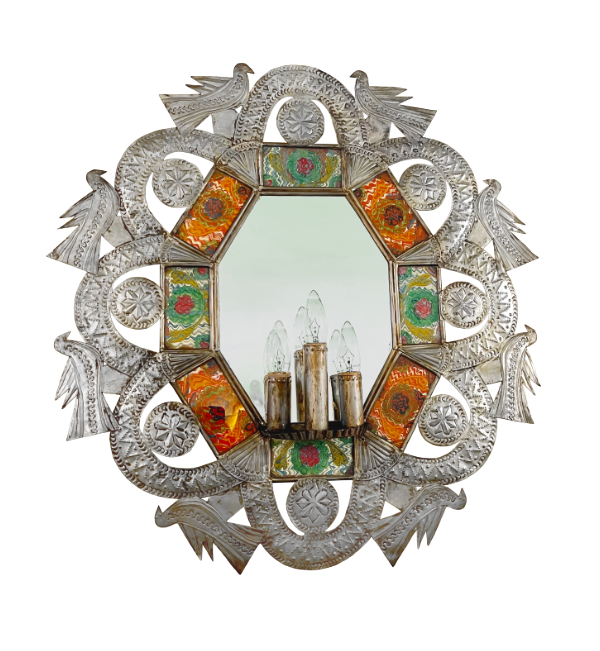
Laboratory of Anthropology lounge wall sconce. Terneplate,
reverse-painted glass, mirror. 28 × 25 inches. Photograph by Justin
Gallegos-Mayrant.
Laboratory of Anthropology lounge wall sconce. Terneplate, reverse-painted glass, mirror. 28 × 25 inches. Photograph by Justin Gallegos-Mayrant.

One sconce in particular stands out not only for its beauty and distinctive style, but also as the key to the identity of the artisan responsible for the Laboratory’s decorative fixtures, Robert Earl Woodman, and a link to his progenitor and muse, Higinio V. Gonzales.

Born June 9, 1906 in St. Louis, Missouri, Woodman’s early childhood and that of his older brother, Henry Pierre, remain shrouded in mystery. Woodman’s adoptive father, Kenneth F. Woodman, enlisted in the United States Army in 1913 and served in the Canal Zone, Balboa, until discharged in late 1919. Scant information provided by a family member suggests that his recent bride, Florence, and her sons accompanied him to Panama for the duration of his military service. The tropical climate was apparently detrimental to the elder Woodman’s health, whereupon discharge from military service the decision was made to migrate to the Southwest. In 1920, the family initially, but briefly, settled in the small ranching community of Roy in Harding County, New Mexico. There, the Woodman brothers attended high school. Two years later the family relocated to Santa Fe while maintaining a secondary residence in Las Vegas, occasioned by the elder Woodman’s position as business manager for the Las Vegas Normal School (later to become New Mexico Highlands University).

Envelope printed with logo and address of Woodman Woodcraft Company, ca. 1926. Private collection. Photograph by Orlando Dugi.

Upon graduating from high school Robert joined his brother, Pierre, a second-year architecture student, at the University of Nebraska. There, he majored in chemical engineering. Completing two years of university, Woodman returned to New Mexico to embark on a career as a wood craftsman. The 1926–28 Santa Fe Directory lists twenty-one-year-old Robert, his new wife, Ruby Taylor, and his mother residing in the South Capitol area. Their residence was also listed as the headquarters of Woodman Woodcraft, although the physical place of business was located at the corner of Washington Avenue and East Palace Avenue, one half-block west of Norma V. Sweringen’s recently established decorative arts shop, The Spanish Chest.
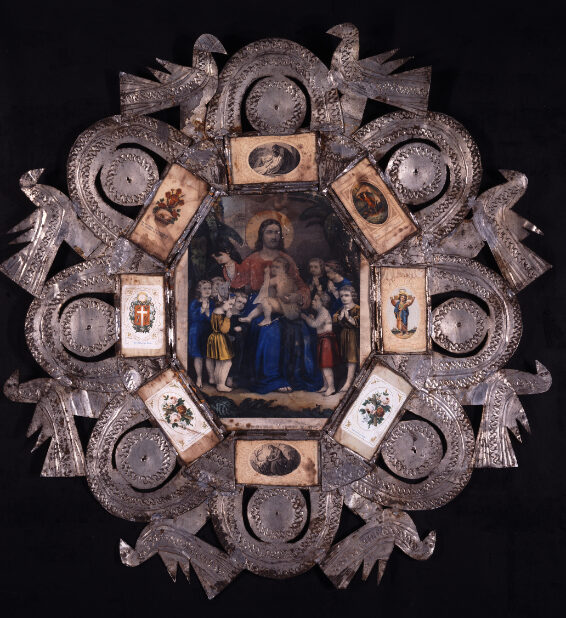
Higinio V. Gonzales, octagonal marco, ca. 1865–1880. Repurposed tinplate, glass, hand-colored devotional lithograph, assorted devotional holy cards. Current location unknown. Photograph courtesy of The Owings Gallery.
Set of patterns from Woodman's workshop made
as templates for octagonal electrified wall sconce, Laboratory of
Anthropology lounge. Private collection. Photograph by
Maurice M. Dixon, Jr.
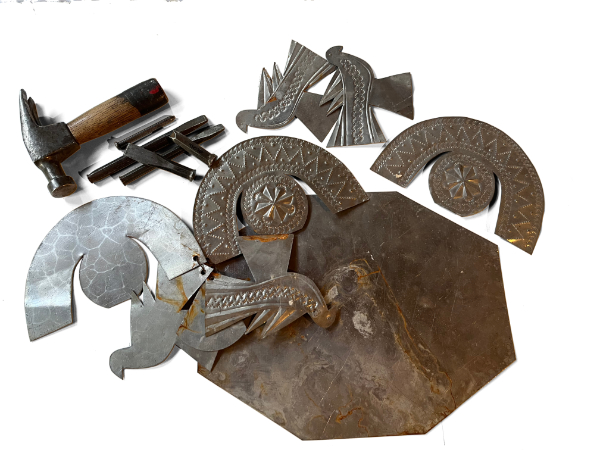
Set of patterns from Woodman’s workshop made as templates for octagonal electrified wall sconce, Laboratory of Anthropology lounge. Private collection. Photograph by Maurice M. Dixon, Jr.

From his initial introduction to New Mexico at age thirteen, the perceptive youth was doubtless drawn to the decorative arts of the state’s Hispanic population. In the early decades of the twentieth century there would have been very few Northern New Mexican households that were not furnished with locally crafted chairs, tables, trasteros, and storage chests. Similarly, these homes would have been graced with at least one or more marcos (frames) or nichos (niches) crafted from discarded tinplate provisions containers and housing colorful, commercially printed, devotional images revered by those of the Catholic faith. Possessed of a mathematical mindset, training as an engineer, a passion for precision, and an eye attuned to proportion, grace, and beauty, the young artisan inevitably drew from the varied forms and decorative ornamentation of nineteenth-century examples, reworking their original purpose to the requirements of the twentieth century as home furnishings, lighting fixtures, and myriad other utilitarian functions.

So keenly aware was Woodman of nineteenth-century New Mexican tinworks that the octagonal-shaped wall sconce he crafted for the newly completed Laboratory of Anthropology “lounge” was a full-size copy of one of many tin-and-glass marcos that, unknown to Woodman, were fashioned by the remarkable polymath and talented hojalatero (tinsmith), Higinio V. Gonzales (1842–1921). The explosive exuberance of the sconce is captivating. Surrounding the elongated octagonal mirror are eight rectangular panes of glass sporting floral rosettes of alternating color comb-painted onto the reverse side of the glass. These panels in turn support eight semi-circular arcs, each encompassing a circular disc embossed with distinctive repoussé rosettes encased in a ring of closely-stamped impressions made with a small serrate-tooth punch die. At the juncture of each of the half-moon arcs are soldered stylized birds embellished with both die-stamped embossing and scored linear accents that delineate their chubby bodies and sharp geometric wings.

The overall form, individual design, and ornamental decorative elements so closely reference existing works by Gonzales it is a certainty that Woodman was possessed of an actual piece when he crafted the laboratory sconce. Furthermore, existing patterns for the sconce, found in Woodman’s workshop, as well as his tools—whose embossed imprints match those of the Laboratory sconce—substantiate his authorship.

Examination of the laboratory foyer araña, the eight wall sconces and two massive chandeliers that illuminate the lounge, in addition to a pair of crown-like corona chandeliers in the library, provides evidence that he was indeed the artisan who crafted the splendid works, after comparison of their die-embossed impressions to Woodman’s stock of stamping dies and cutting tools. Curiously, the files of the Laboratory of Anthropology that are housed in the Meem Archives at the Zimmerman library on the University of New Mexico campus contain no working drawings of the lighting fixtures. This is corroborated by a SchoolArts magazine article (May 1934) that featured photographs of the grand foyer chandelier along with two chandeliers, which exhibit Woodman’s decidedly stylistic signature, yet credit “Mr. Sweriger” as the designer and craftsman responsible for each item—presumably a reference to Benjamin Sweringen, husband of The Spanish Chest’s Norma Sweringen.
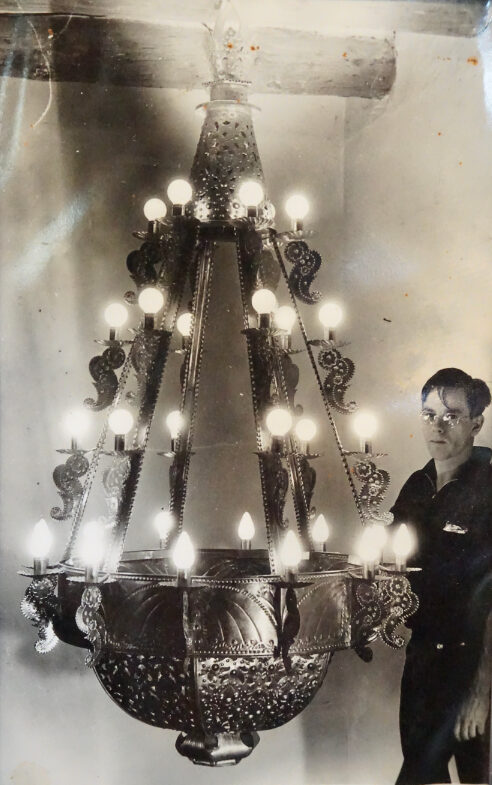
Robert Woodman standing next to newly completed terneplate chandelier fabricated for Our Lady of Carmel Catholic church in Montecito, California, built 1936–1938. Private collection.

The unfortunate lack of working drawings has, no doubt, contributed in part to the mystery surrounding the laboratory fixtures’ origin. It is possible that Meem, although known for his meticulous attention to detail, gave the order for their design and fabrication to Benjamin Sweringen—or it was perhaps the building contractor who chose The Spanish Chest as a source for the fixtures, thereby bypassing Meem’s aesthetic input entirely. That the fixtures’ place of origin was indeed The Spanish Chest is documented in an announcement of Sweringen’s death, published in the Santa Fe New Mexican and dated December 20, 1941, where it was stated Mr. Sweringen “opened and operated the Spanish Chest on Palace avenue [sic]. His organization specialized in the manufacture of Spanish furniture and tin work, some of which was used in the Laboratory of Anthropology here and in the Monte Cito [sic] church in California.”

Unequivocal evidence of Woodman’s authorship of the Laboratory of Anthropology fixtures is inextricably linked to the “church in California” noted in Sweringen’s death notice. Our Lady of Carmel Catholic Church (built 1936–1938) is located in the community of Montecito, where the fixtures hang today. Documentation of Woodman origin and craftsmanship of these fixtures is provided by a photograph of the tinsmith, youthful, muscular, and demure, standing next to one of the set of massive life-size chandeliers that he fabricated for the church.

The chandelier’s heavily pierced and perforated inverted half dome, which forms the fixture’s base, is essentially identical to the bulbous base of the Laboratory foyer chandelier and the perforated circular drums that highlight the Laboratory lounge’s distinctive chandeliers. The placement and structure of the light bulb receptacles of the lounge chandeliers and those of the Montecito chandelier are identical—but it is not only the similarity of form, identical perforation, and stamping of the terneplate that establish Woodman’s authorship. It is the fixtures’ structural configuration consisting of an elongated, triangular-shaped support at the apex of the fixture as well as the substantial circular band from which the weight of the chandelier is suspended that is identical to the support components of each of the three Laboratory chandeliers.

This easily overlooked detail establishes Woodman as the undisputed artisan responsible for their creation. Sweringen may have designed the lighting fixtures for the Laboratory and the church in Montecito, but it was most certainly Robert Woodman whose artistry transformed the working drawings into tangible objects of beauty.

In conversation with gallery owner Ray Dewey in 1984, the sole surviving Woodman family member stated that it was their uncle, Robert Woodman, who crafted the fixtures for the Laboratory of Anthropology—and that his association with the project was a source of profound unrequited pain that he suffered for the remainder of his life. The dolorous circumstances involved a young woman affiliated with the Laboratory at the time of its construction who attracted the attention of not only Woodman but the project’s principal patron, John D. Rockefeller, Jr. The choice for the woman was simple; Woodman, heartbroken, carried her photograph in his wallet until the day of his death.
Pendant ten-point "star" lighting fixture of John Gaw Meem design, ca. 1935.
Woodman's innate and accomplished capacity to interpret established Mexican,
Spanish, and North African styles of lighting fixtures is evident in this
masterwork. It hangs in an unidentified interior. Photograph by Wyatt Davis.
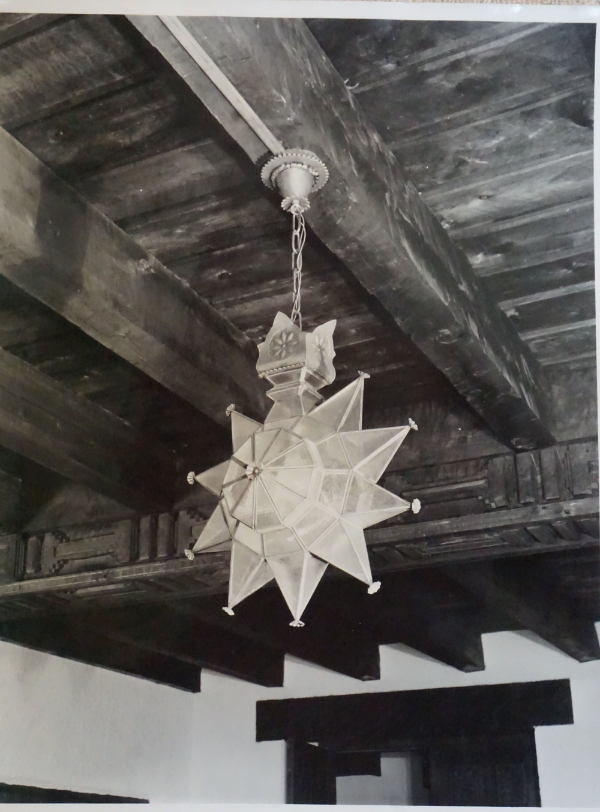
Pendant ten-point “star” lighting fixture of John Gaw Meem design, ca. 1935. Woodman’s innate and accomplished capacity to interpret established Mexican, Spanish, and North African styles of lighting fixtures is evident in this masterwork. It hangs in an unidentified interior. Photograph by Wyatt Davis.

When Woodman chose a career as a full-time metalsmith is unknown; however, operating nearby businesses on Palace Avenue, Woodman and Sweringen would have maintained an acquaintance and possibly a working relationship from as early as 1926, with Woodman having been employed by the Sweringens shortly after the demise of Woodman Woodcraft. The 1936–1937 Santa Fe City Directory lists him as an employee of The Spanish Chest, where it was emphasized that he specialized in metalcraft. There, all manner of decorative items that he and the prodigiously productive and multi-talented artisan Bruce Cooper crafted were on display and for sale. Due to the nature of the Sweringens’ business, there were undoubtedly dozens of nineteenth-century New Mexican tinworks for sale from which Woodman and Cooper would have drawn inspiration for crafting contemporary functional items such as lighting fixtures and for which their customers, with romantic images of the past, were eager consumers. Although it is a certainty that Sweringen did not design or craft the Laboratory octagonal wall sconce, he may have provided the original piece of tinwork that was reproduced by Woodman.

Experiencing increasing ill health, Sweringen sold the business to Cooper in the late 1930s. Woodman continued to craft tinplate items for the shop, but by then he had established his own business at his workshop, located at 1557 Canyon Road, where he catered to private individuals, local entrepreneurs, and invariably to John Gaw Meem.

Woodman’s affiliation with The Spanish Chest and his capability to craft intricate and complicated large-scale works inevitably impressed Meem and was likely the catalyst for his long-lasting professional relationship with the Meem architecture firm.

From this period, when the Laboratory of Anthropology and adjacent Director’s House (whose grand sala was graced with a matching pair of Woodman’s unmistakable corona-style chandeliers) was completed, Woodman-crafted works appear in a multitude of Meem-designed structures on the University of New Mexico campus; the Santa Fe municipal building (1936); the Santa Fe County Courthouse (1938); religious, commercial and academic structures in Albuquerque, Santa Fe, and Colorado (Fountain Valley School, 1930–1941); and elsewhere as well as numerous private residences. One of the grandest of these was Ruth Hannah McCormick Simms’ Los Poblanos Ranch fiesta pavilion, La Quinta, built in Los Ranchos de Albuquerque in 1935.

Many of Woodman’s brass, copper, and terneplate creations were informed by Meem, whose designs for lighting fixtures often reflect an appreciation of nineteenth-century New Mexican tinworks as well as the intricate, faceted-glass fixtures of Mexico and Spain. A photograph from the Woodman photography archive, taken by Santa Fe photographer Wyatt Davis, of a pendant star-shaped, multi-point fixture made almost entirely of translucent “frosted” glass, is identical  to a Meem drawing made specifically for the new student union building on the University of New Mexico campus.
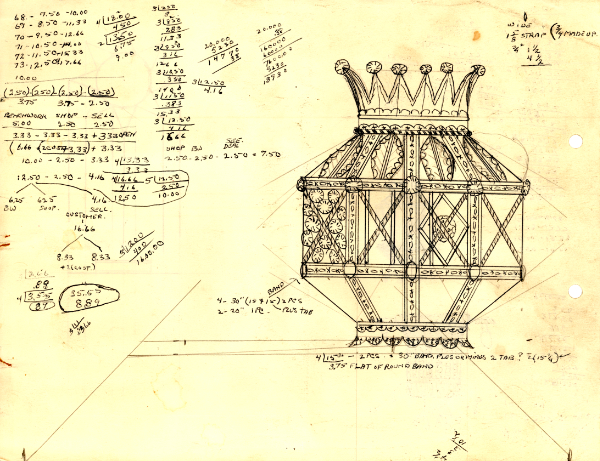
Working drawing for pendant fixture with
calculations for materials and production time in order to
determine accurate retail price, ca. 1935–1950.
Private collection. Photograph
Working drawing for pendant fixture with calculations for materials and production time in order to determine accurate retail price, ca. 1935–1950. Private collection. Photograph

The working drawing, illustrated in Dr. Ann Taylor’s Southwestern Ornamentation and Design: The Architecture of John Gaw Meem (Sunstone Press, 1989), and the completed fixture owe their inspiration to cultures distinctly removed from isolated New Mexico; however, it is the amalgamation of various stylistic influences and the imaginative collaborations of Meem and Woodman that have contributed to the lasting esthetic that the artist’s metalworks exhibit yet today.

A circa-1938 spiral-ring notebook lists fixtures that Woodman crafted for the Meem-designed Sandia School in Albuquerque (1937), as well as documents an astounding 562 items that he crafted around that time. Among those listed as clients were several of Santa Fe and Albuquerque’s wealthiest inhabitants, all of whom were Meem patrons: Amelia Hollenback; Albert and John F. Simms; Cyrus McCormick, Jr. Also invoiced were Meem for his new home at the base of Sun Mountain on Old Santa Fe Trail (1937) and Woodman’s former employer, “Ben” (Sweringen).

To facilitate purchases, Woodman crafted individual display pieces in order that a client could be assured of an exact duplicate of a chosen item, exemplified by the extensive array of working drawings complete with the time to execute each component methodically calculated. His penchant for clarity and precision was responsible for the large cache of surviving photographs of individual pieces and collections of his artistry, while a major portion of the pieces made for sale have long since vanished. Of the original “sample” pieces that exist, Woodman’s calculated prices are marked (on their back or base) in black grease pencil: A single-bulb sconce; $3.50; a tri-part, menorah-like candelabra seen in the lower right corner of a photograph of Woodman soldering in his workshop, an adaptation of those crafted by Francisco Sandoval (1860–1944), was marked $3.50, the price later being changed to $6.30. Records pertaining to the impressive lighting fixtures crafted for the Meem-designed Zimmerman Library on the UNM campus (1934–1936) document that the budget for the fixtures was set at $650, including materials and labor. Assuming that the contract for their fabrication was given to The Spanish Chest rather than to Woodman directly, he clearly did not reap a fortune from his artistry.
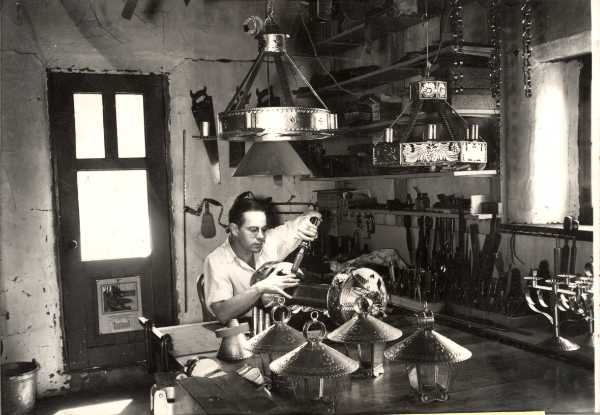
Robert Woodman, in his Canyon Road workshop surrounded
by numerous completed items and works in progress, solders a
large cylindrical fixture designed to utilize tubular fluorescent
light bulbs, circa 1940-1950. Private collection.
Robert Woodman, in his Canyon Road workshop surrounded by numerous completed items and works in progress, solders a large cylindrical fixture designed to utilize tubular fluorescent light bulbs, circa 1940-1950. Private collection.

Woodman’s reputation as a superb craftsman was recognized when clients and shop owners such as the Sweringens brought to him pieces of nineteenth-century New Mexican and Mexican hojalatería—many housing devotional prints which were destined to be removed along with the original glass covering and replaced with mirrors, or in the case of three-dimensional nichos—to be converted into electrical lighting fixtures. It’s an action the present-day connoisseur and collector finds unconscionably reprehensible, but that until the 1970s was common practice. Thus it was that he inadvertently contributed to the desecration of dozens of tin works, many of which were crafted by Gonzales; the artisan identified as the Isleta Tinsmith; the Taos Serrate tinsmith; and the prolific and brilliantly talented José Maria Apodaca (1844–1924) whose uniquely styled, pitched-roof nichos, comprised principally of glass, were the inspiration for the copper-and-glass nicho that Woodman crafted to illuminate the exterior of the east wing of the Laboratory of Anthropology, where it remains in situ today.

Identifying a nineteenth-century tinplate marco that was retrofitted by Woodman to contain a mirror is a relatively easy task. The terneplate tubular came used to encase the plate glass mirror along with a substantial back plate also made of terneplate is recognizable to the trained eye as having been executed by Woodman, but it is the flowing, silky-smooth soldering that readily identifies Woodman’s signature as the skilled craftsman who retrofitted the vintage tinwork. Woodman’s capacity for exactitude and his training as an engineer was undoubtedly responsible for his unparalleled ability to solder. The pieces that he created are virtually “bombproof,” the soldering so assured and even and with a density such that it is nearly impossible to dismantle a piece without resulting in its destruction. Woe to the person who attempts to rewire his electrical fixtures (and there are many that require such treatment) without maiming their structural or decorative integrity. And, like his light fixtures, woe betide the contemporary tinsmith who attempts to remove a damaged or broken Woodman-installed mirror!

Barbara Ann Thorpe, proprietor of Bishop’s Lodge on the northern outskirts of Santa Fe, was a regular customer, commissioning items ranging from assorted lighting fixtures to guest bath “backsplashes” and elaborate items such as postcard display holders for the lodge’s lobby. In the late 1930s she commissioned Woodman to craft a series of frames housing devotional prints destined to be hung on the side walls of the diminutive chapel situated above the main lodge that was built in the mid-nineteenth century by Archbishop J. B. Lamy. The horizontally oriented frames were crafted in the form of windows framed by drawn-aside drapery executed with deeply-scored curvilinear flourishes and a minimum of repoussé stamping. On 3-by-3-inch index cards, Woodman made specific reference to the Lamy Chapel and the frames as “curtain effect,” three of which appear in a circa 1940–41 photograph of the chapel by Ernest Knee and published in his book, Santa Fe. There they remained for more than seven decades.

Woodman’s productivity was halted in the spring of 1942 by his participation in the Second World War effort. Upon moving to Santa Monica, California, he worked in a civilian capacity fabricating metal components for military aircraft, but was eventually inducted into the United States Army Air Corps in December 1943. Following basic training in Kansas, he was deployed to South Carolina where his metal fabricating abilities were again called upon until he was discharged in late summer 1945.

Upon his return to civilian life, he once again established his metalworking business with unimaginable vigor. A surviving invoice book dated 1946 and dedicated exclusively to sales to the antique dealer Eleanor Bedell lists 559 items he fabricated that year, ranging from switchplates ($1 each for copper) to “Taos” chandeliers ($60 each), all to be offered for sale at her Palace Avenue shop. Other invoice books document that he also provided a consistent inventory of assorted decorative items for Tony Taylor’s popular The Old Mexico Shop: ash trays, cigarette boxes, letter holders and other items for the desk, assorted small- to medium-size picture frames, and an astonishing variety of switchplate covers made of brass and copper, as well as the ubiquitous and ever-popular terneplate.

Cryptic and occasionally vitriolic comments written in the margins of billing invoices suggest that Woodman was not altogether pleased with Taylor’s purchase and resale of metal items that he was importing from Mexico; Woodman vented that his work was being undercut in quality and price. However, several surviving tinwork items as well as those that appear in photographs substantiate that Woodman was not immune to the stylistic influences of his Mexican colleagues, notably among these the incorporation of colored marbles into lamp shades and lighting fixtures. The charming but slightly odd “’50s modern” drum-style chandeliers that he fashioned, and that until recently illuminated the public areas of La Posada on Palace Avenue in Santa Fe, were excellent examples of this genre.

Woodman’s artistry was recognized in 1952 when he was given an exhibition at an East San Francisco Street venue, Under the Portal, sponsored by the First National Bank of Santa Fe. There, all manner of his work was on exhibit and it may have been the impetus to craft an advertisement piece which is as fresh today as the day it exited his studio. A quote in the Santa Fe New Mexican, announcing Woodman’s artistry, stated: “For beauty and design, this metal work certainly rivals work in silver. Displayed are candelabras, frames, centerpieces and candle sticks of unusual beauty, as well as many novelties such as mail boxes, Kleenex boxes, wall lights, etc. You will be interested in seeing this display by one of the few master craftsmen still working in tin.” Regrettably, no photos of the exhibition exist.

The 1950s were fruitful for Woodman as he continued to repair or convert vintage tinwork for local antique dealers and accept commissions from contractors, architects, and private customers—most importantly from his patron, John Gaw Meem. Three distinctive star-shaped, reverse-painted-glass, flush-mounted light fixtures that he crafted for the Felipe B. Delgado house on West Palace Avenue—purchased by Meem as an act of preservation and donated to The Historic Santa Fe foundation—remain today attached to the underside of the overhanging balcony.

This was also a period when, acknowledging (or capitulating to) changing tastes, Woodman introduced new and innovative designs into his repertoire that reflected the aesthetic of the era. In lieu of the shimmering reverse-painted glass panels that had been previously painted by his mother, he began to incorporate wallpaper, wrapping paper, and colored foil, giving his works an updated (if somewhat glitzy) appearance. The popularity of glazing glass surfaces with colored crystal solutions also made its appearance as a replacement for the comb-painted patterns that previously graced his lighting fixtures and mirror frame components.

The advent of “modern times” eventually found its way into his pricing structure, as he raised his hourly working fee from $2.50 in 1942 to $5.50 in 1973! It was at that time that Woodman, always reserved and unassuming, began to withdraw from society altogether, refusing commissions and turning away private clients eager to purchase one or more of his superbly crafted creations. Yet, despite his refusal to sell products, he continued to craft masterworks in confined areas of his home and under its broad south-facing portal, stacking the pieces one on top of the other in the house and in his two unkempt and deteriorating workshops.

Having neglected general maintenance on the workshops in his declining years, rain and snowmelt leaked through the roofs, seeping onto his work benches and into the many wooden drawers containing his meticulously kept file cards. Dozens of sheets of rare, vintage terneplate were stained, rusted, and rendered unusable. Rolls of antique wallpaper, detailed working drawings and architectural blueprints of lighting fixtures, many of which originated in the Meem firm, were water-stained and mouse-eaten. Much of the content of the workshops was beyond salvaging.

Following Woodman’s death in the spring of 1983, a large portion of the moisture-damaged material and an unknown number of tools, mechanical devices, and miscellaneous material were consigned to the rubbish pile. It was only by serendipitous happenstance that a significant portion of his oeuvre—the collection of photographs and remaining contents of his workshop—were rescued from oblivion when I, as a sales associate on duty at the front desk of Dewey-Kofron Gallery, located on the Santa Fe Plaza, was shown an assortment of tinworks by Woodman’s heir. Soon thereafter, the corpus of Woodman’s workshop was consigned and offered for sale in my recently inaugurated Gallery of Decorative Art located in the garden level of Dewey-Kofron Gallery.

Collectors and patrons who had formerly been turned away from Woodman’s doorstep flocked to purchase longed-for items that he had refused to sell. The alarming rapidity with which the inventory sold brought about the realization that Woodman’s work should be recognized before it disappeared forever.

In the autumn of 1984, an exhibition of his remaining work was mounted in the main exhibition space of Dewey-Kofron Gallery. The public response surpassed expectations. It was this exhibition, which coincided with a chance conversation with metal artisan and educator Lane Coulter, that initiated the impetus for extensive research that resulted in the publication of our collaborative volume, New Mexican Tinwork 1840–1940 (University of New Mexico Press, 1990).
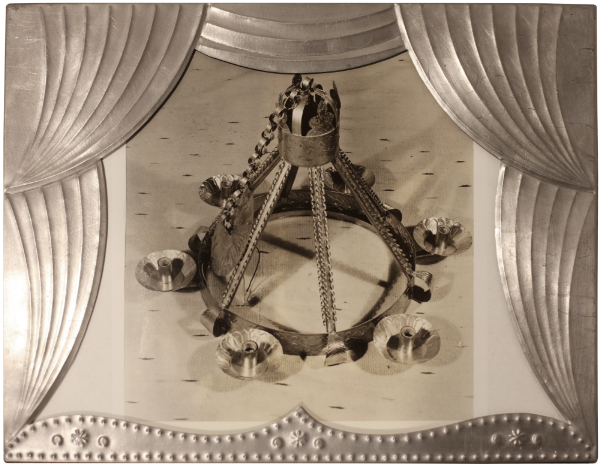
"Curtain Effect" frame, ca. 1938–1945. Terneplate. 10 × 12.75 inches. Frame houses photograph of Woodman-crafted chandelier priced $42.50.
Photograph by David Rohr.
“Curtain Effect” frame, ca. 1938–1945. Terneplate. 10 × 12.75 inches. Frame houses photograph of Woodman-crafted chandelier priced $42.50. Photograph by David Rohr.

The book’s popularity ignited my further study of individual nineteenth-century New Mexican hojalateros, subsequently resulting in the 2015 publication of The Artistic Odyssey of Higinio V. Gonzales: A Tinsmith and Poet in Territorial New Mexico (University of Oklahoma Press), a biography and explication of the life and multiple creative endeavors of el nuevomexicano extraordinario whose imaginary and beautifully crafted tinworks inspired many of Woodman’s masterworks, and whose octagonal-shaped marco served as the prototype for the sconce that illuminates the east wall of the Laboratory of Anthropology’s great room: the lounge.

Thus the convergence that began in 1929 came full circle. Rockefeller patronage, Meem vision, Woodman talent, Gonzales inspiration, and the chance occurrence of a box of metal switch plate covers being brought to a Santa Fe plaza gallery on a warm August afternoon spurred the first codification of nineteenth- and early-twentieth-century New Mexican hojalatería. The story came full circle to encompass the recognition of Higinio V. Gonzales as the progenitor of so much of the beauty that we enjoy today in the timeless works of John Gaw Meem, Robert Woodman, and their contemporary successors.

The passage of time will surely erase all memory of Robert E. Woodman, but it is my express hope that this brief account of his life and artistry will in some small way honor the man whose five decades of creative contribution to New Mexico’s architectural legacy has been for too long unacknowledged.

Maurice M. Dixon, Jr. (BFA, MFA) is a painter, tinsmith, antiquarian, collector, and researcher. He is currently a consultant on a forthcoming Rick Dillingham exhibition at the New Mexico Museum of Art, and is also at work on an account of Dillingham’s life and artistry.
Justin Gallegos Mayrant (opens in a new tab) is the first artist in his family. Northern New Mexico’s traditional crafts are deeply rooted in history and family expertise; the earliest examples of Hispanic tinwork in New Mexico date to the 1840s. But the tinwork of artist Mayrant stands out in its grounded innovation: He came to it organically, rather than out of familial obligation, and has made it his mission to innovate and redefine the form while continually drawing from mastery of tradition.

Maurice M. Dixon, Jr. (BFA, MFA) (opens in a new tab) is a painter, tinsmith, antiquarian, collector, and researcher. He a consulted on an exhibition about Rick Dillingham at the New Mexico Museum of Art, and is also at work on an account of Dillingham’s life and artistry.
The Man in the Sala

By Kate Nelson

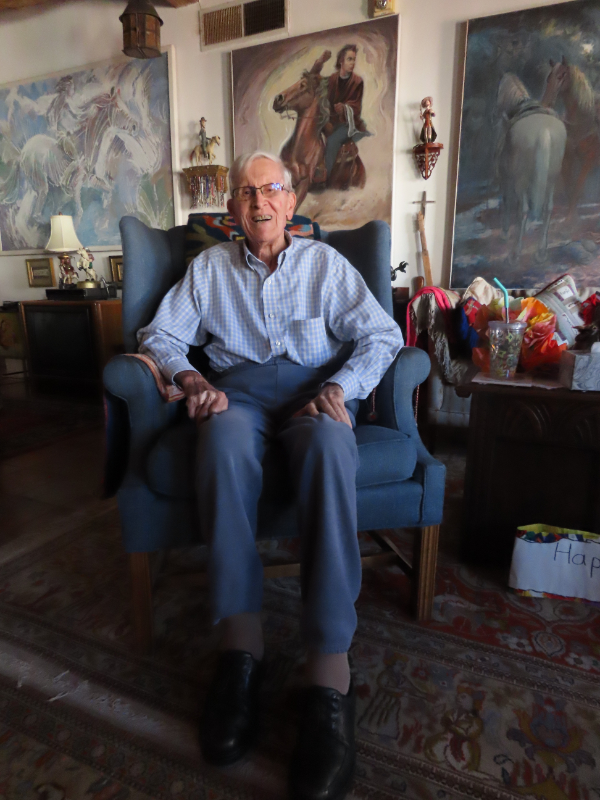
Late-afternoon light tinged with autumnal gold spills into the sala grande of J. Paul Taylor’s home. The muted melodies of a mariachi band performing on the Mesilla Plaza seep through the adobe walls and wind down the zaguán, a hallway connecting the home’s living areas to this southern New Mexico town’s historic square. Seated in one of his favorite chairs for holding an informal sort of court, Taylor greets me with the warmth of a treasured guest—a hallmark of his renowned hospitality.

Taylor, a formidable figure in New Mexico politics, history, and arts stewardship, passed peacefully at his home in Mesilla on February 12, 2023, at the age of 102. But on this day in Mesilla in 2019, he is closing in on his 100th birthday. He was always, he says, “a skinny, frail little guy,” and age has eroded yet more layers from his slight frame. The familial tremor that began afflicting him as a far younger adult is apparent; a walker is close at hand. Although his voice is faint, his memory stands firm, a boundless sky of local history, political endeavors, family lore, and a deep and abiding love for New Mexico’s art and culture.

Above us, cottonwood vigas are topped by willow latillas and then tules, or cattails—a southern New Mexico variation of the pine vigas and aspen latillas used in Northern New Mexico. Around us, the works of santeros and contemporary artists consume nearly every bit of wall and shelf space. Family photos, including ones of his beloved late wife, Mary Daniels Taylor, an accomplished photographer, author, and genealogist, cluster atop side tables. Taylor, an educator, legislator, and longtime regent of the Museum of New Mexico, seems game to welcome another guest, along with a soothing team of visitors—a daughter, a son, a daughter-in-law, some of whom live in the sprawl of connected buildings enclosing a patio just beyond the sala grande.

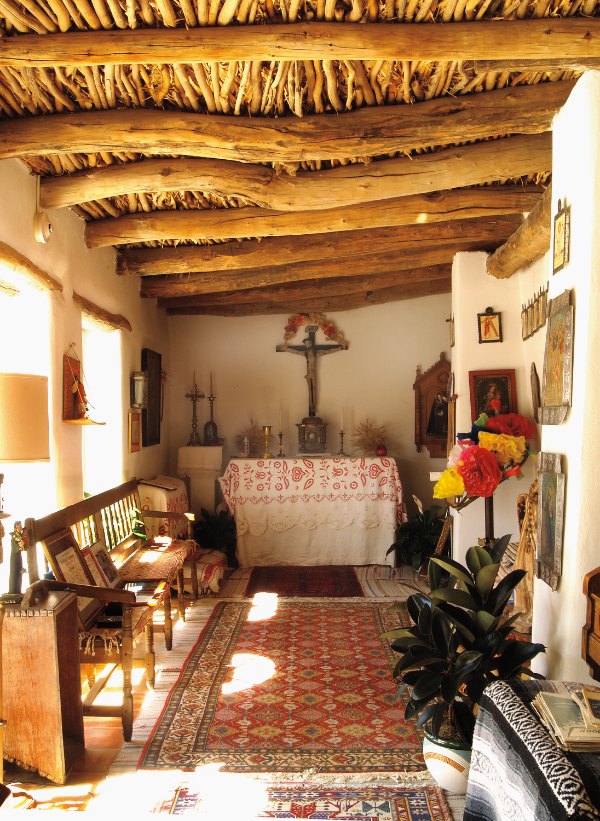
The oratorio of the Taylor home. Undated photograph; courtesy New Mexico Historic Sites.

While portions of the home date to the 1848 founding of Mesilla, others reflect the oddball add-ons of a family that grew and then grew some more—a nursery here, a teen’s room there, an in-home oratorio to honor loved ones who died too soon—all of it grounded in the maestro-caliber craftsmanship of local adoberos and carpinteros. Together, the architecture, furniture, art, and occupants tell an often-overlooked story of New Mexico: that of the Borderlands, this region now anchored by Las Cruces, where an international boundary is less a mark on a map and more a state of mind—fluid, collective, bilingual, and embracing.

Since its proclamation as a state monument in 2004, the Taylors’ home has helped tell such stories as a by-appointment-only branch of New Mexico Historic Sites; it was bequeathed to the state of New Mexico upon his death. That bequeathment was a prospect that, at the time of my visit, with Taylor still alive and a global pandemic yet to strike, seemed absurd to consider. When trying to talk about it, his children invariably choke up, saddened by just the thought of walking into the future without their father. The historic sites staff who have worked most closely with Taylor to inventory the home’s contents and gather his remembrances of how each piece of art made its way here acknowledge that they’ve also given their hearts to the man in the sala grande. “You didn’t expect me to live this long, did you?” he has joked so often to them that it became reasonable to believe that he would, in fact, always be there.

Two and a half years later, the sala grande fell silent. J. Paul Taylor had weathered the worst of the pandemic, a variety of ailments, and finally a heart attack that left his body too weak to carry on. His light dimmed quietly a few hours before dawn on February 12, in his home and surrounded by his family. Governor Michelle Lujan Grisham ordered flags to be flown at half-staff in his honor, and said in a prepared statement: “You would be hard-pressed to find an individual as passionate about the people, culture, and communities of New Mexico as J. Paul Taylor. For my own part, I consider him to be a friend and mentor who demonstrated the heart of a servant, always striving to make New Mexico a better place to live for future generations.”

In the years prior to his passing, plans were well underway for how the Taylor Mesilla Historic Property would emerge as a full-blown member of the Department of Cultural Affairs family. Discussions over which objects might be displayed and how the rooms would be arranged to tell what kind of story always ended with Taylor’s own insistence: “I want the house to look like it’s been lived in.”

Living, after all, was what Paul and Mary Taylor did best.


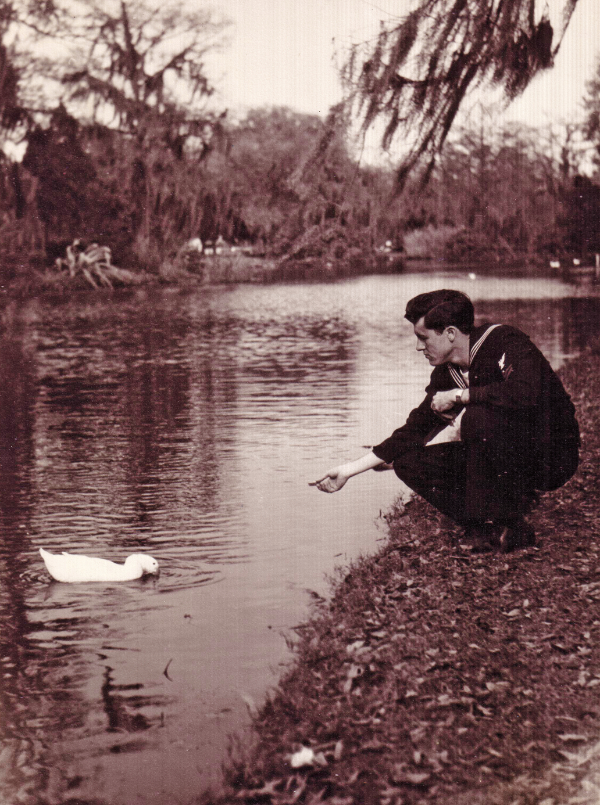
J. Paul Taylor in New Orleans, 1945.
J. Paul Taylor in New Orleans, 1945. Photograph courtesy the Taylor family.

He was a child of Chamberino, a farming village south of Mesilla, past the cooling breezes of the pecan orchards. Fields of cotton and chile still line the main road. A long view to the east reveals the Organ Mountains; to the south, Mexico, less than 30 miles away. Taylor’s mother, Margarita Romero y López, was descended from Juan de Cabeza de Vaca, one of Coronado’s soldiers, as well as other colonial-era luminaries, and grew up in a Romeroville mansion near Las Vegas, New Mexico. During a social event in Estancia, she met Robert Taylor, a handsome railroad man whose father had moved west after serving as a Confederate soldier during the Civil War.

In her delightful biography, J. Paul Taylor: The Man from Mesilla (Museum of New Mexico Press, 2012), Ana Pacheco recounts the young couple’s journey from Las Vegas to La Luz and finally to a dairy farm in Chamberino, five children in tow, before their youngest child, John Paul, known most often as “Paul,” arrived, seven years after his closest sibling.

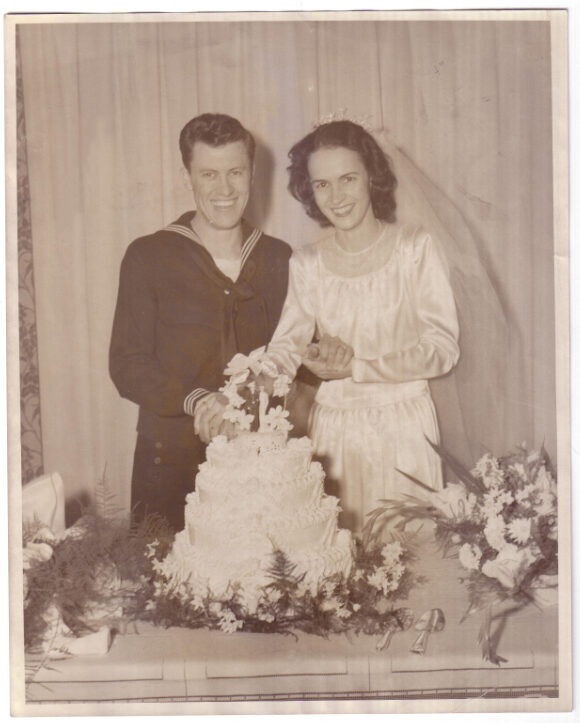
The wedding photograph of Mary and Paul Taylor, December 27, 1945.
The wedding photograph of Mary and Paul Taylor, December 27, 1945. Photograph courtesy the Taylor family.

Paul was delivered at home by his father’s sister Beulah. … Being the youngest, Paul was a bit spoiled, especially by his mother, who herself was the baby of the family. … Paul’s mother sent him to school each day with a lunch of sandwiches and fruit empanaditas, wrapped up in newspaper and tied with strings. He sometimes traded his mother’s delicious fruit pies for oranges and bananas with his friend Ralph, whose parents owned a grocery store. One year as an April Fools’ Day joke, Margarita sent Paul to school with cotton-filled empanaditas. When the children bit into the little fruit pies, they ended up with mouthfuls of cotton.

Besides a sunny sense of humor, Margarita also instilled in him a generous heart. “She had a great feeling for the needs of people,” Taylor said. “During the Depression she used to take cans of milk to the schools so the children could have milk.” His schoolmates were descendants of Anglo, Spanish, Mexican, Black, and Japanese community members, and during tough times, they banded together. In high school, he became editor of the school paper, “a mimeograph little thing,” that benefited not only from his curiosity in history and current events but his shorthand and typing skills as well. When First Lady Eleanor Roosevelt scheduled a trip to El Paso, a teacher loaded up three cars and bundled the paper’s young staff to the Cortez Hotel. “We were country kids,” he said. “We looked ragtag.” Somehow, the teacher talked their way past a hotel guard, and Taylor got his first taste of the political world from a woman still revered as a model of compassion.

The J. Paul and Mary Taylor property, fronting the Mesilla plaza. Undated photograph; courtesy New Mexico Historic Sites.

“That was wonderful,” he said. “The farmers would have died without President Roosevelt and all the WPA things going on then.”

While attending the New Mexico College of Agriculture and Mechanic Arts (now New Mexico State University), he became enchanted by a young woman who attended the same church as he and his mother did. “She had this ebony black hair,” he said. “I could hardly move through Mass from looking at this charming girl in front. But we never met. Every New Year’s, they had a Sun Carnival Parade in El Paso. It was a chance to come out from the country. My mother went to our usual place, and guess who was standing there?”
Mary and Paul Taylor in 1946.
Mary and Paul Taylor in 1946. Photograph courtesy the Taylor family.

Mary Daniels was attending the University of Texas at El Paso with a dream of becoming an archaeologist. The two “began a long friendship, which became a romance,” Taylor said, “and then World War II began.” On the heels of Pearl Harbor, Taylor joined the U.S. Navy and was assigned to an intelligence unit based in New Orleans. In 1945, while home on leave, he and Mary were married early in the morning “because the train went at 10 o’clock. Mary’s parents had a little reception, and we stayed long enough to greet guests, then got on the train back to New Orleans.”

At 118 pounds, he had barely qualified for service. “I just did the two-year commitment,” he said. “So many of my friends did the four years. So many were killed in the war.”

After his service, the Taylors returned to Las Cruces, and he began working as an assistant registrar for the university, then as an elementary school teacher, a principal, and finally an associate superintendent of Las Cruces Public Schools. At times, he had to take on extra duties when the schools were shorthanded, including teaching physical education. “Do I look like a P.E. teacher?” he said with a laugh. Eventually, he said, “I could get back to doing what I really loved: working with teachers, getting into classrooms.” He championed bilingual education and instituted cross-border teacher exchanges, which led to lasting friendships.

J. Paul Taylor smiles during his 102nd birthday celebration Wednesday, Aug. 25, 2022, at J. Paul Taylor Academy.
Photograph by Meg Potter, courtesy the Las Cruces Sun-News.
J. Paul Taylor smiles during his 102nd birthday celebration Wednesday, Aug. 25, 2022, at J. Paul Taylor Academy. Photograph by Meg Potter, courtesy the Las Cruces Sun-News.

He retired in 1985 at age 65, but his impact endured. In 2010, the idea for a J. Paul Taylor Academy took root. The charter school, based in Las Cruces, opened the following year with a mission of rigorous learning that includes conversational Spanish and healthy living. This past August, he celebrated his 102nd birthday with the kindergarten-through-eighth-grade students, who lauded him with songs and dances. “You are a very special group of children,” Taylor told them, according to the Las Cruces Sun-News. “I’ve seen some of you grow up from kindergarten and first grade, and here you are, fine young people and adults.”

The school presented him with a poster onto which each of the twenty kindergarten students had left a print of one hand. Their two teachers had then made prints of one finger apiece. “So it’s 102 fingers,” says Alexandra McKinney, instructional coordinator for the Taylor site, when she showed it to me on a recent visit. The poster had already become yet another artifact for telling the story of the man in the sala grande.


Early in Taylor’s educational career, he and Mary purchased a tiny house in Mesilla and began having babies. Robert, Dolores, Michael, Mary Helen, John, Pat, and Rosemary.
Partway through the family’s growth, a neighbor came to the couple, asking that they purchase her home. Built in the 1880s, it had at one point been the home of parish priest Father Grange, conveniently set kitty-corner to the historic San Albino Church, now a basilica. The home was small and in sore shape, but the family agreed, given their love of its history. Thus began years of additions and renovations directed by Taylor, often with materials he scavenged from other aged structures.
A 2003 photo of the Taylor family. Back row, left to right: Robert, Pat, José Horacio Reyes (family friend),
John, Michael, and Mary Helen. Front row: Rosemary, Paul, Mary, and Dolores. Photograph courtesy the Taylor family.
A 2003 photo of the Taylor family. Back row, left to right: Robert, Pat, José Horacio Reyes (family friend), John, Michael, and Mary Helen. Front row: Rosemary, Paul, Mary, and Dolores. Photograph courtesy the Taylor family.

“When I built the first shop for my folks on the corner of the plaza,” said Pat Taylor, today a renowned adobe preservationist, “none of that existed. My dad got an architect who asked him how wide the building should be. Dad put his back against a wall and stepped toward a line in the sand. ‘How’d you decide to make it that long?’ [a worker] asked. ‘Because that’s how long the vigas I found are,’ Dad answered.

“What always strikes me about the house is how interesting the vernacular architecture in there is,” he continued. “As you walk through, rooms change, window and door sizes change, nothing is in line with each other.”

That pieced-together process could complicate the plan to make the property fully accessible, with updated electricity and plumbing, plus the current Heart of the Desert store, facing the plaza, turned into a visitor center that will sell tickets for guided tours. Under the agreement with the Taylor family, the state has two years to accomplish that goal, but Patrick Moore, director of the sites, aims to cut that to six months.

“From a cultural standpoint, it will serve as a new opportunity to talk about New Mexico from a bottom-up perspective,” he says. “It’s a gateway to understanding not just J. Paul Taylor and Mary Daniels Taylor but also things that happened in U.S. history. So many things happened within range of that corner.”


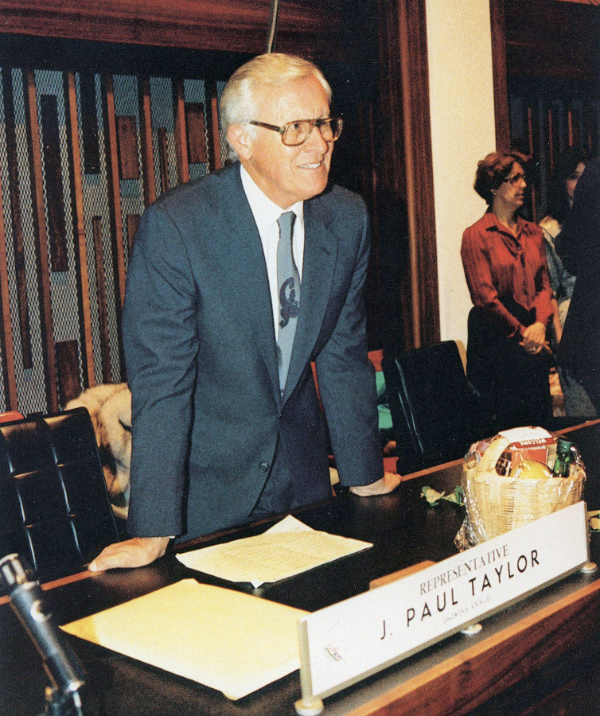
J. Paul Taylor in 2004, during his time as a Democratic representative for
the state of New Mexico. He was known as “the conscience of the Legislature.”
Photograph courtesy the J. Paul Taylor Collection, Rio Grande Historical
Collections, New Mexico State University.
J. Paul Taylor in 2004, during his time as a Democratic representative for the state of New Mexico. He was known as “the conscience of the Legislature.” Photograph courtesy the J. Paul Taylor Collection, Rio Grande Historical Collections, New Mexico State University.

In 1986, J. Paul Taylor won a seat in the state House of Representatives, serving from 1987 to 2005, a tireless advocate for low-income families, disabled children, immigrants, and Hispanic students who needed an extra boost. He served as chairman of the House’s Health and Human Services Committee, which helped guide the state through a divisive period of welfare reform. I was a reporter for The Albuquerque Tribune then, and from my perch in the media gallery, would watch the often raucous debates of the full House on the floor. Any time Taylor stood and picked up his microphone, the arguing and chattering would dim to an almost reverential hush. It was in part to better hear his quiet, tremulous voice, but it struck me even then as a bipartisan sign of respect for a colleague who was regarded as “the conscience of the Legislature.”

His love for the state’s art, history, and culture made him a key player in creating the Department of Cultural Affairs, which he saw as an entity that could preserve New Mexico’s unique identity and ensure people throughout the state would learn about and celebrate it. That commitment continued after he left the Legislature, through the donation of his home and through his service on the Museum of New Mexico Board of Regents, a citizen-led body that guides the development of the museums and historic sites under its purview and serves as trustee of their collections. Taylor dutifully attended the regents’ meetings up to the month before his passing—an example of the commitment he passed on to his children and grandchildren.

J. Paul Taylor in his home in Mesilla. Undated photograph; courtesy the Taylor family.

“In every aspect of my life, my grandfather’s been an influence,” said Paul Ratje, a photojournalist whose coverage of border issues has achieved international recognition. “He influenced my world view. He was interested in cultures, art. He was a collector, and his patronage of the arts was incredible. I’m also really interested in art. Having that artistic atmosphere in his house really changed me.”


Besides Taylor’s lifelong interest in the arts (he obtained his first two pieces of Native pottery as a child), the house witnessed his wife’s growth as a genealogical researcher, work that saw her digging through archives in Mexico and training students to follow her lead. Her records now proudly reside at New Mexico State University. She also wielded a camera that documented years of Mesilla life—fiestas on the plaza, local children, merchants whose shops have long since faded. Throughout it all, the house on the corner endured the antics of its rambunctious children.

“We were normal kids,” Michael said. “I remember Dad got mad at us one time. We had little tennis balls. We were throwing them and trying to get them into these pots. They were Maria and Julian Martinez pots,” treasures crafted by the famed San Ildefonso Pueblo potters.

The house grew into a time capsule of life on the border, seen most clearly in oversize paintings by Las Cruces artist Ken Barrick (1913–2007) detailing historic events such as the push and pull of whether Mesilla would belong to the United States or Mexico, a struggle finally settled by the Gadsden Purchase in 1853. Even in his final years, Taylor named as one of his favorite artworks a bulto of Santiago that was one of his first acquisitions, its $90 price tag paid for over time on his teacher’s salary. (A different Santiago—he of Matamoros—depicts the saint on a horse that towers over Moorish people, an act of dominance that became, in time, something that Taylor regretted. “So I keep it way up there,” he said, pointing to its perch on a high shelf.)

Any time I visited Taylor in his final years, we lapsed into lengthy reminiscences of our “old days” in the Roundhouse. The clarity of his memories always topped mine. “My dad can remember what he did on August 4, 1932,” says Robert, adding with a chuckle, “but he can’t remember what he did with his glasses.” Too often, the memories I shared with Taylor included him noting, “She’s dead now. He’s dead now.” His gift of a lengthy life carried sorrows that now his children and grandchildren must bear. The family gatherings and Sunday potlucks will move to another home, and the ache of the empty seat at the table will linger.

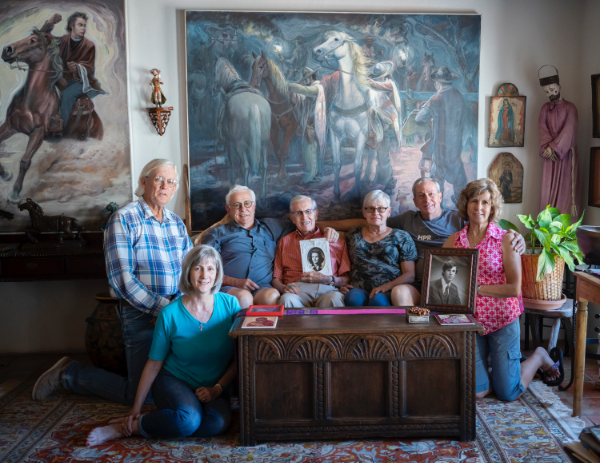
The Taylor family. Pat Taylor, Rosemary Taylor Stolberg (seated), Robert Taylor, J . Paul Taylor holding a photo of Mary Daniels Taylor,
Dolores Taylor, Mike Taylor, Mary Helen Taylor Ratje holding a photo of John Paul Taylor Jr., photographed in August 2018.
Photograph by Paul Ratje; courtesy the Taylor family.
The Taylor family. Pat Taylor, Rosemary Taylor Stolberg (seated), Robert Taylor, J . Paul Taylor holding a photo of Mary Daniels Taylor, Dolores Taylor, Mike Taylor, Mary Helen Taylor Ratje holding a photo of John Paul Taylor Jr., photographed in August 2018. Photograph by Paul Ratje; courtesy the Taylor family.

Still, says Paul Ratje, every member of the family endorsed the property’s donation to the state. “For us, it’s a sad thing, because there’s a hard transition,” he said. “This has been our meeting place, our home, and grandpa won’t be there anymore. But we think it’s a blessing he and my grandmother decided to make that gift to share the house, to have the history be taught.”

Alexandra McKinney spent countless hours in the house, talking with Taylor about the artworks, about the acequia outside, and about the history she now hopes to impart to visitors. If she could send him a message today, she said, it would ring with gratitude. “You and your family have given this state a wonderful gift to continue telling the story of the state that you loved, that your wife loved, and that your family loves.”

El Palacio thanks the Museum of New Mexico Press for providing images for this story. We are also indebted to the Friends of the Taylor-Mesilla Historic Site and to Ana Pacheco for her biography J. Paul Taylor: The Man from Mesilla.

Kate Nelson is a longtime New Mexico journalist who recently retired as managing editor of New Mexico Magazine where she earned numerous awards from the International Regional Magazine Association.

Kate Nelson (opens in a new tab) is a longtime New Mexico journalist who retired as managing editor of New Mexico Magazine where she earned numerous awards from the International Regional Magazine Association.

¡Oye Primos!

By Petra Salazar

How do we survive the uncertainty of our globalized, techno-digital age? Listen for answers in the sounds and stories of the Borderlands.

The border is not just a geographic location, but something embodied in people who dwell on the border of conflicting identities. In the U.S. Southwest, the region referred to in Chicano philosophy as Aztlán, the border is a place where we find a confluence of diverse Indohispano perspectives, blending Indigenous and Spanish ways of knowing. These ways of knowing remain largely undocumented in the canon of artists and scholars taught in traditional U.S. schools. But those of us who are at home in these borderlands know that our people carry valuable information in our bodies and our styles, our ways of speaking, living, and loving. This knowledge, rooted in our history and our complex racial and sociopolitical identities, is known in Chicano philosophy as “el oro del barrio,” and, if given recognition, it can offer a powerful tonic for coping with the uncertainty of our historical moment.

Indohispano elders have long called for younger generations to claim, steward, and contribute to our inheritance of traditional knowledge. Many young New Mexicans are taking up this call. In her work as a curator with the National Hispanic Cultural Center Art Museum, Jadira Gurulé platforms New Mexican artists whose work puzzles over heritage—never expecting easy answers. Gurulé says the museum has a duty to represent a broad range of Latinx experience. Although there are some themes that frequently arise in the work shown in the museum, including “identity, resilience, healing, family, and community,” Gurulé says that “the beauty in working with these themes is how many ways there are to tell these stories.” She is especially curious about work that explores the museum as an acoustic space.  

One such work is by experimental artists Adri De La Cruz and Marisa Demarco. Their collaboration is an expression of a shared interest in documentation and in questions about how knowledge is communicated beyond words, who gets to claim and convey knowledge, and how the audience and environment shape the knowledge that gets conveyed.

The Mountains Wore Down to the Valleys is a multi-phase installation that explores sound as a medium for the transmission of knowledge, through family stories of survival, situated within the acoustic landscape of New Mexico. Demarco describes the work as located at the “intersection of journalism, documenting, storytelling, and experimental sound art.” The installation is intersectional and stages a dialogue between dichotomies—such as sound and story, erosion and survival, grief and renewal. This is a work of the borderlands, one that sheds new light on the uncertain terrain that Indohispano knowledge workers and artists have long been charting.

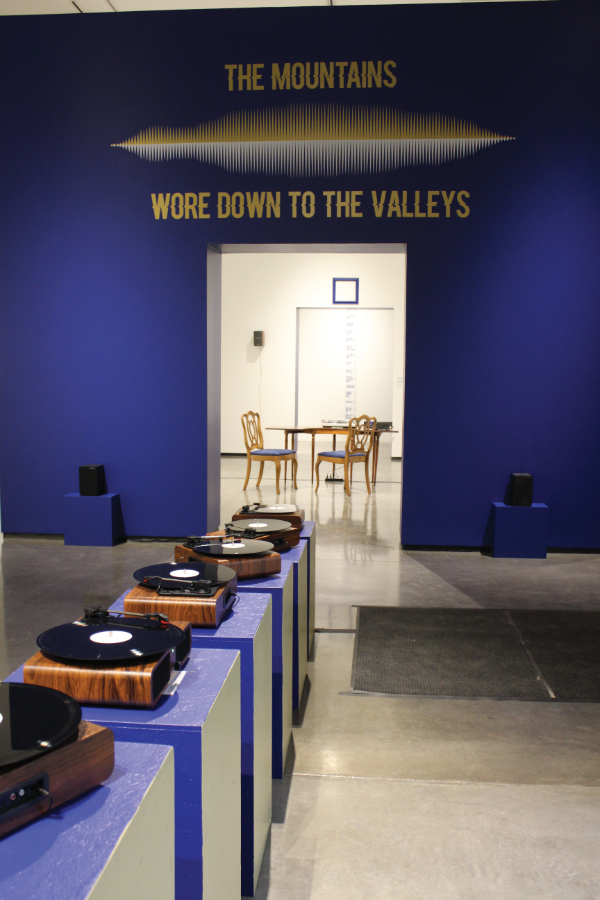
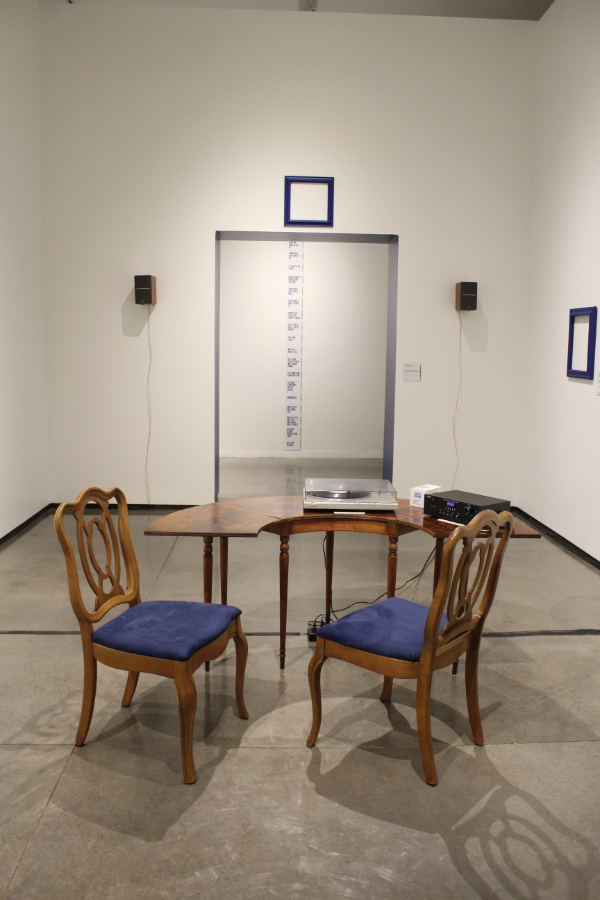
The multi-phase exhibition opened on November 4, 2022. Guests who visited during the first phase, which lasted seventy-two hours, were treated to the full sound experience, amplified by a minimalistic environment. In the museum’s Community Gallery, twenty-one record players are arranged in a row in the center of the space, leading to a small room with one additional record player. 

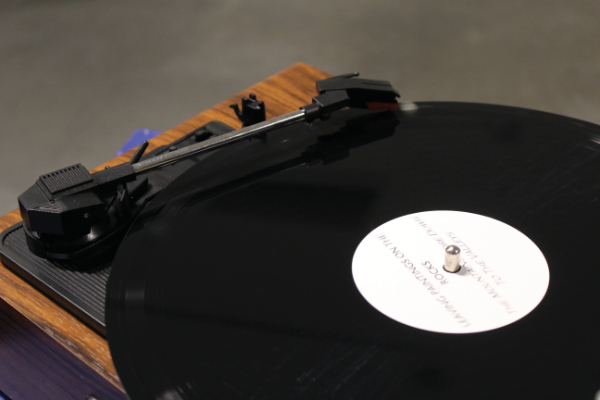
Over the course of the first three days, twenty-two lathe-cut records played simultaneously. Twenty-one of these records played unique musical compositions by Demarco. To my ear, the combined sounds from these atonal compositions evoke New Mexico’s windy, alien desert. The title of each of these records is listed on one gallery wall, forming together a poem about impermanence and resilience. Two tracks, or lines, read:

Uncertainty, rising and falling
Constant, like these hills.

Demarco, a journalist and experimental sound artist, is concerned with the “big long slow changes” that occur in the landscape, unobservable in a single human lifetime. Her work experiments with scale and expanding time. She recently collaborated on a composition representing decades of data on the flow of the Rio Grande.

In the first phase of The Mountains Wore Down to the Valleys, Demarco’s compositions spanned the entire seventy-two-hour period. During that time, the needles from twenty-one record players wore away the ridges, or “mountains,” of the vinyl records, and the sounds from Demarco’s compositions slowly eroded, until they could no longer be heard.

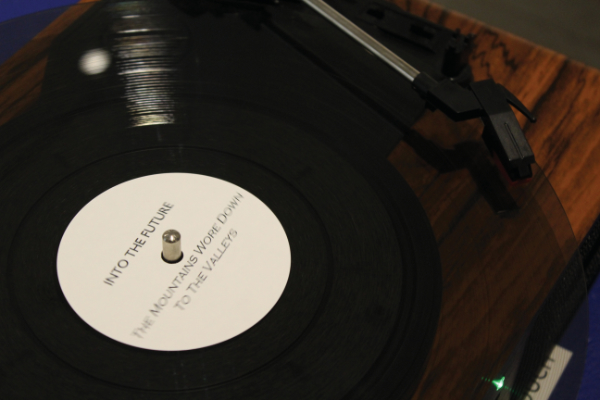
What survived the erosion is a record titled The Mountains Wore Down to the Valleys, which continues to play in the small room. This is the De La Cruz family record, documenting stories from the descendants of migrant farmworkers and the knowledge that helped this family survive uncertain times. In the second phase of the installation, etched portraits of the family were presented on the reverse side of eight eroded records and put on display.

Guests who visited during the first phase of The Mountains Wore Down to the Valleys, which lasted 72 hours in the museum’s Community Gallery, encountered twenty-one record players arranged in a row in the center of the space, leading to a small room with one additional record player.

The family record contains el oro del barrio, hard-won insights into the importance of family solidarity, strong mothers, practical skills, and faith in something larger than oneself, like community. Initially, De La Cruz said, their family didn’t feel they had much wisdom to offer. However, through a series of open-ended questions, De La Cruz was able to provoke memories, helping the family summon into words this invaluable traditional knowledge. 

New Mexican philosopher Tomás Atencio used a similar form of dialogue to reveal el oro del barrio in his home community of Dixon, where he would facilitate long, open-ended discussions. Afterward, he would organize community action around themes that arose in these dialogues. He called this process “Resolana,” which he proposed as an Indohispano alternative to the Socratic Dialogue. The term “resolana” derives from the Indohispano tradition of men gathering on the sunny side of a home to talk.

The dialogues we hear in The Mountains Wore Down to the Valleys, however, occur at another domestic site of knowledge exchange. In the intimacy of the small room, the family record sits on a table with two chairs. The setting evokes the “kitchen table organizing” described by Joy Harjo and Gloria Bird in the collection Reinventing the Enemy’s Language. They write, “Many revolutions, ideas, songs, and stories have been born around the table of our talk made from grief, joy, sorrow, and happiness.” The kitchen table represents an often unrecognized space of possibility—a space of family dialogue and community organizing.

Dialogue is an oral mode of knowledge sharing that can help us tolerate the uncertainties and complexities of the borderlands and navigate the terrain beyond rigid and reductive colonial boundaries. For his part, Atencio believed that dialogue could reveal universal themes that provide a framework for greater human understanding and relation. Unfortunately, in the current knowledge economy, oral traditions of knowledge production like dialogue have little commercial value. Instead, there is a premium set on knowledge objects—static information, often generated by a single individual and sealed in print, which can be efficiently processed and filed away as documented. This comes at the cost of dynamic and evolving traditions that are impermanent but embodied and alive. When we lose our living connection to these traditions, we risk annihilation.

The small room at the end of the line of record players features a single record that features the De La Cruz family record, documenting stories from the descendants of migrant farmworkers and the knowledge that helped this family survive uncertain times. The white wall beyond the small room features the title of each of these records forming together a poem about impermanence and resilience.

The Community Gallery is a fitting location to showcase the work of De La Cruz and Demarco, two community-builders who find solace in being just a small part of something greater. During the isolation of the pandemic, the longtime friends leaned on one another and are now rebuilding the vibrant creative community they had before COVID-19. De La Cruz co-runs La Chancla, a hub for experimental artists, and Demarco is a member of the noise collective Death Convention Singers.

While the idea for the installation came before the pandemic, its themes are even more salient now. Preoccupied by digital worlds and relationships, the pressures of wage labor, and polarized demands on binary identities, we’re increasingly alienated from one another, from the Earth, and from our own bodies. The installation’s themes of resilience and community have cross-cultural resonance that extends the impact of the work beyond one family to the broader human family—a family we can choose to recognize.

In many Indohispano traditions, familia has an inclusive connotation: Everyone outside one’s immediate family is a primo, a cousin. This inclusive sense of family accounts for the complex and growing community of people who, despite racial, religious, political, and geographic differences, make up the amorphous family known as Latinos. The presumption of relatedness among Indohispanos leads not only to an inclusive sense of family, but also to an expansive sense of homeland, because primos live all over the Americas and the Caribbean—and wherever there is family, there is home.

We can extend our sense of family even further, the way Demarco scales time. The idea that we’re all connected to each other, and to Earth, can be found in traditional knowledges worldwide. The climate crisis, with its droughts, fires, floods, and displacement, could be seen as a symptom of our forgetting this basic truth.

The installation uses storytelling to activate deep memories, a ritual practice described by Laguna storyteller Leslie Marmon Silko as a key technology that we will need to survive the devastation of forgetting. In her novel Storyteller, she writes: “Old stories and new stories are essential: They tell us who we are, and they enable us to survive. We thank all the ancestors, and we thank all those people who keep on telling stories generation after generation, because if you don’t have the stories, you don’t have anything.”

De La Cruz’s father, who helped the artists build the plinths for the record players, can be heard in one recording urging his child to “keep the life going.” Everyone has a responsibility and a role to play in keeping the life going and sharing el oro del barrio, a duty to ensure we have expressed curiosity in one another’s stories and offered up our own stories. Indohispanos have much to contribute towards a more nuanced, pluralistic understanding of identity, community membership, and querencia—our familial, spiritual connection to land and home. 

Experimental artists who work at borders and intersections can help us sit with uncomfortable contradictions, increasing our tolerance to uncertainty. There is much that is uncertain when it comes to climate, heritage, and how we will survive our current historical moment. But as De La Cruz reminds us, “it’s okay to not know.” The knowledge we need to survive is an emergent variable that we are co-creating in dialogue.

While Demarco’s sonic experience has passed, guests can access the eroding sounds via a QR code in the museum. The visual component of The Mountains Wore Down to the Valleys is on display through April 23, 2023, along with the De La Cruz family record, marginalized stories that are worth a listen.
Oye, mis primos.

Petra Salazar is a coyote (regional term for an Indohispano/Anglo racial identity) from Española, New Mexico, aka “Spaña.” They teach children at a Montessori school and adults at philopoetics.com. Petra’s work has been published or is forthcoming in Colorado Review, Indiana Review, Sonora Review, The Southampton Review, Latin American Literature Today, and elsewhere.

Petra Salazar (opens in a new tab) is a coyote (regional term for an Indohispano/Anglo racial identity) from Española, New Mexico, aka “Spaña.” She teaches children at a Montessori school and adults at philopoetics.com. Petra’s work has been published or is forthcoming in Colorado Review, Indiana Review, Sonora Review, The Southampton Review, Latin American Literature Today, and elsewhere.

The Power of One

By Stephanie Padilla
Photographs courtesy Dr. Michael H. Trujillo

In 1948, Pueblo advocate Miguel H. Trujillo and Indian Law attorney Felix Cohen walked into a courtroom and prevailed in their fight to win the Native American right to vote in New Mexico. Despite such a monumental achievement, only recently has Miguel Trujillo started to become a familiar name to the average New Mexican. Outside of the niche community of those who have studied Indian law or voting rights, Trujillo and Cohen are not well known. Without wider teaching and recognition of their actions, students and scholars alike have missed out on an inspiring but controversial moment in history which we continue to benefit from and fight for today.

In 2022, aided by a grant from the National Endowment for the Humanities, the New Mexico History Museum embarked upon an effort to bring more awareness to Native American voting rights and their foundation in Trujillo v. Garley, the court case fought and won in 1948. Now, with episodes of the podcast Encounter Culture and a corresponding video documentary series, the NMHM and the New Mexico Department of Cultural Affairs present contemporary takes on longstanding questions related to how the Indigenous people of New Mexico interact with their government.

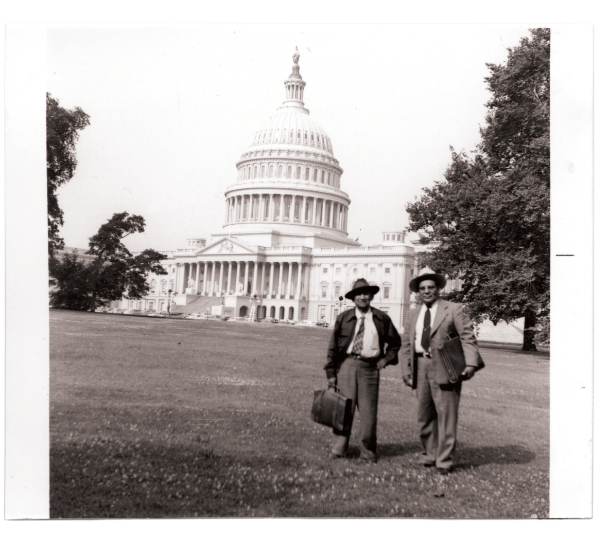
Laguna Pueblo Governor John Sarracino and Miguel Trujillo on a trip to Washington, D.C., in 1953.

What is the value of education, and how does a well-educated person interact with their government? How does the United States’ style of governance compare or contrast with an Indigenous model? What loyalty do Native Americans feel to the American government, after centuries of mistreatment and disenfranchisement? How does studying the history of Native American voting and the actions of Miguel Trujillo influence current Native decision-makers and figureheads in their work and mentorship?

To even begin to consider such questions, the first step is to look at the history of Trujillo’s life and advocacy, and how it plays into New Mexico’s Native history.

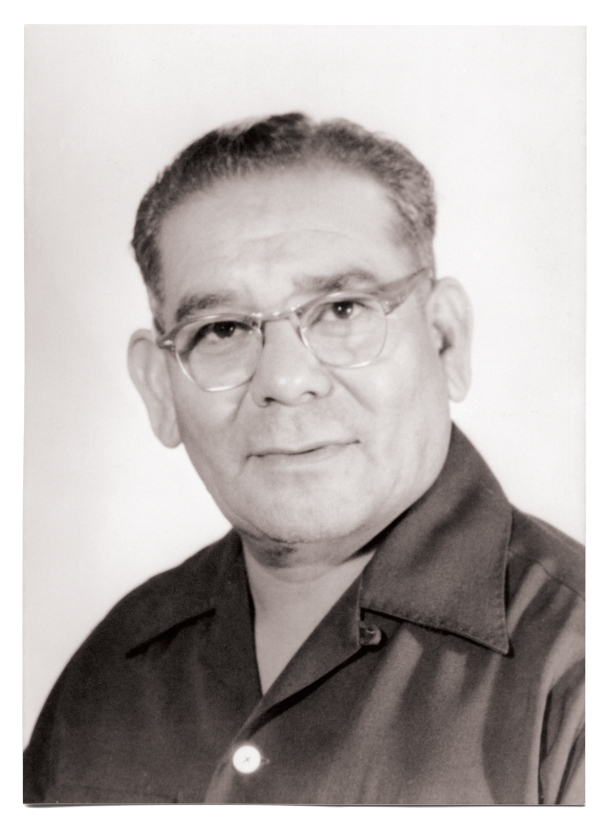
Miguel H. Trujillo (1904–1989) was born and raised in Isleta Pueblo, one of the nineteen pueblos located in New Mexico. He attended Bureau of Indian Affairs boarding schools and the University of New Mexico and eventually enlisted in the Marines, but was passionate about education throughout. While pursuing his education he married Ruchanda Paisano of the Pueblo of Laguna, which is about an hour west of Albuquerque. The couple lived most of their adult lives and raised their children in Laguna. Both pursuing their careers in education, Trujillo became the principal and Ruchanda became a teacher at Laguna Day School. According to their family, they made quite a team; Ruchanda was an organizer and homemaker as well as a career woman, and later would keep Miguel prepared and rested during Trujillo v. Garley. Ruchanda’s attention to detail and unwavering support of her husband’s endeavors were vital to the success of the case.

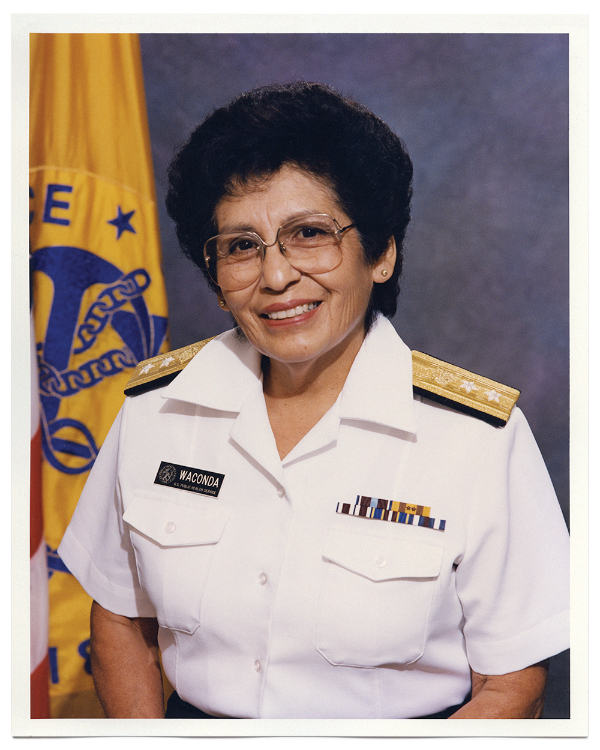
On three separate occasions, Santa Clara scholar Dr. Porter Swentzell, filmmaker Sibel Melik, and I sat down with Trujillo’s son, Dr. Michael H. Trujillo, and his granddaughter Karen Waconda. Both of them had come to share their memories of their family and what they knew about Trujillo v. Garley. In a cozy room at Albuquerque’s Indian Pueblo Cultural Center, surrounded by white adobe walls and the chirping of uninvited crickets, we listened to each of their stories. 

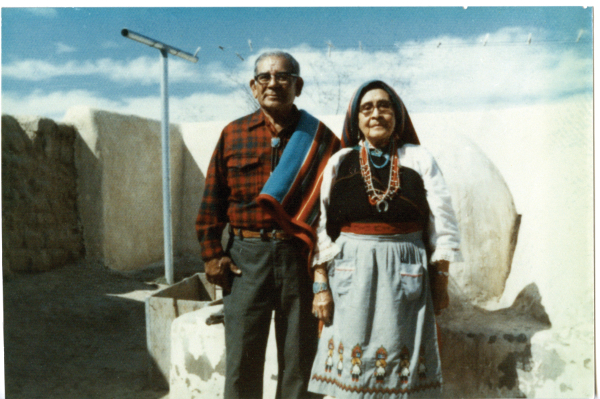
Miguel and Ruchanda Trujillo, ca. 1980.

There were five common themes that came up as Michael Trujillo and Waconda spoke of their ancestors: humility, humor, tradition, education, and community. “It’s something that you just do,” Waconda explained after I asked why she thought her grandpa never spoke of his victory. “It wasn’t until twenty years later when I was like ‘Wait a minute, grandpa did that?’”

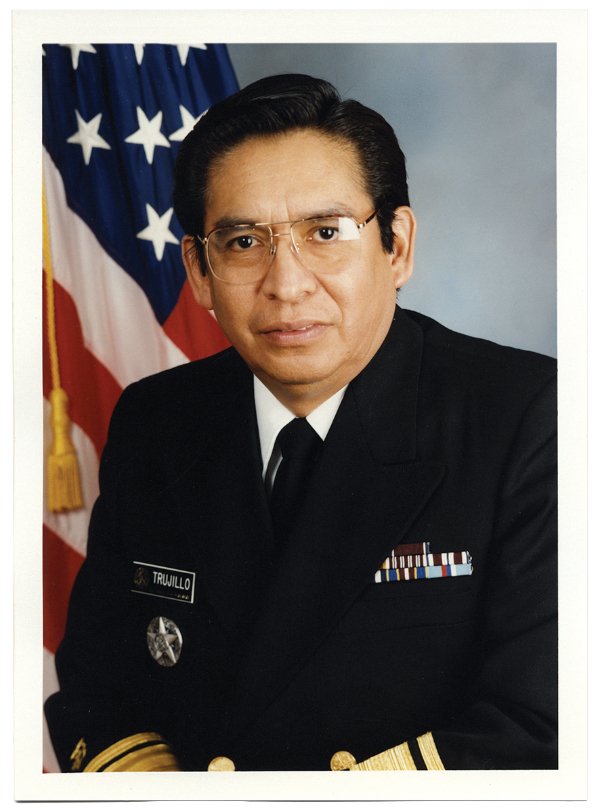
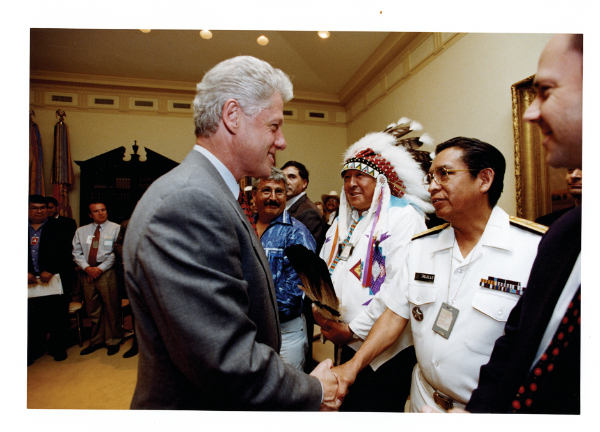
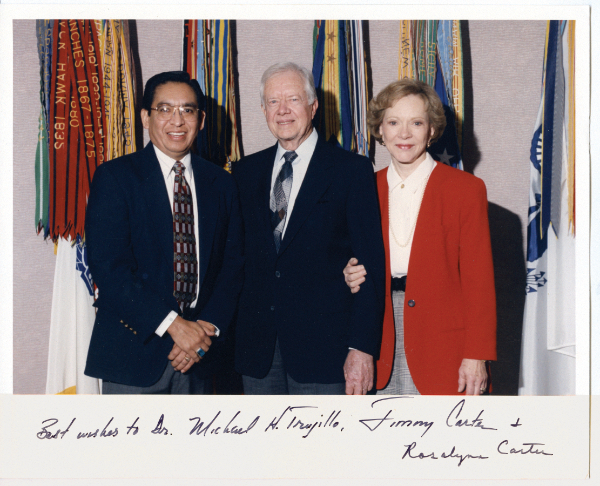
Trujillo rarely discussed his achievements with his grandchildren, but he did educate them on their right to vote and how to execute that right. Waconda remembers when she neared the age to vote, her grandpa drew an illustration of a ballot box, a ballot, and explained how the process worked. “We would watch presidential elections and state elections and he would review it with me and say, ‘Okay, what did you learn from this? What rights are they fighting for?’” Waconda recalls with a smile. Trujillo also emphasized the importance of education and that once you are educated, no one can take it away. This stuck with his children and grandchildren, each of whom went on to be incredibly successful in their endeavors. (Dr. Michael Trujillo was the head of the Indian Health Services appointed by President Bill Clinton.)

Trujillo was deeply invested in education despite the long era of boarding schools, the effects of which he experienced himself. An American education was forced on many children of Trujillo’s age. “He used to tell me little stories from when he was actually taken from his family home at Isleta. … They came around the houses to take children to Albuquerque Indian School and he remembered that he hid underneath the bed so he wasn’t taken,” Waconda recalls. The second time this happened they managed to find and take Trujillo, but he snuck out of the school and walked back to Isleta—a long trek for an adult, let alone a child.

Though resistant at first, Trujillo soon had a change of heart as he began to consider the opportunities an education could bring, despite the often malicious intent behind boarding schools. Trujillo realized he could use the power of education to his own benefit and the benefit of his people. He went on to graduate from Haskell Indian Nations University in Lawrence, Kansas, and the University of New Mexico. Trujillo was a jack of all trades, and during his time at Haskell he participated in a range of hobbies including wrestling and filmmaking.

Upon graduating from the University of New Mexico, Trujillo joined the Marines, where he served as a recruiter for World War II. He recruited a number of Navajo men, many of whom became Navajo Code Talkers. After the war, Trujillo continued to follow his passion for education, becoming the principal at Laguna Day School. We can assume it was his extensive education or possibly his service during the war that pushed Trujillo to be so invested in voting rights. To an extent, these assumptions may be true, but his family believes that it was simpler than that: He didn’t understand why he and his community members couldn’t vote, so he made it happen.

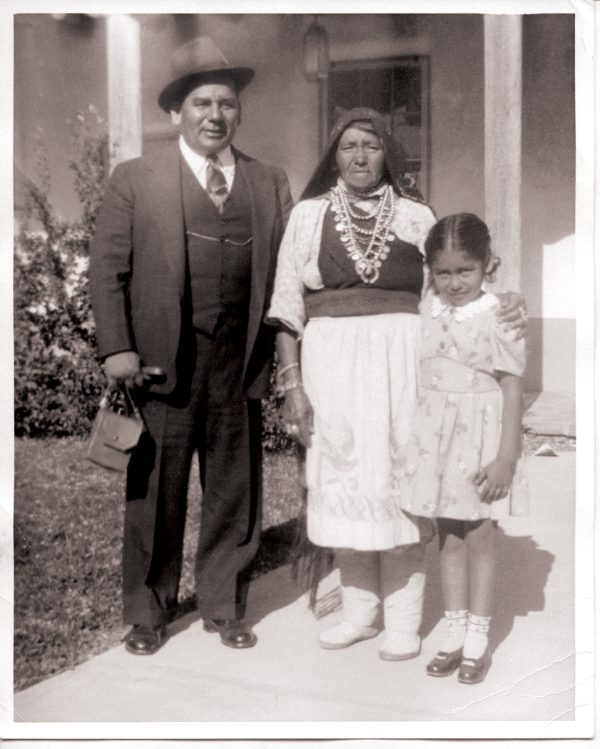
Photographed at Miguel Trujillo’s graduation from the University of New Mexico on May 11, 1942, when he earned a bachelor’s degree, are Miguel, his mother Juanita Trujillo, and Miguel’s daughter Josie.

Around the time the case was brought in 1948, voting was still incredibly controversial among tribes in New Mexico. Many traditional leaders were opposed to voting, fearing what it might do to tribal sovereignty; they suspected that becoming eligible to vote on a state level might impact sovereignty on tribal land, allowing encroachment by the state. On the other hand, there were some people, mostly of the younger generation, who had a different perspective. The latter group didn’t understand why they were permitted to stand next to a white man in combat but not in a voter registration line.

Navajo Code Talkers were introduced in World War I. In World War II they returned with twenty other tribes who would use their languages to help the United States prevail. While enlisted in the Marines as a recruiter, Trujillo recruited Navajo Code Talker Thomas Begay from Gallup, New Mexico. At a recent event honoring Trujillo in Isleta Pueblo, Begay chuckled as he told the audience that he had decided to enlist in the Marines because they had the fanciest uniform. Begay ended up doing much more than wearing a fancy uniform—he successfully transmitted 800 messages during the war without any flaws. After a long and successful military career which included service in the Korean War, he received the Presidential Unit Citation with three Bronze Stars, the Meritorious Unit Citation with the Korean Service Medal with five Bronze Stars, and a Congressional Medal from President George W. Bush. Begay was only one of the thousands of Native Americans who saw active duty in World War II, yet he returned home without the ability to vote in an election.

Native-led contributions to the war were monumental motivators to gain the right to vote for many, but Trujillo’s family doesn’t think it was his only or even his main motivator. But Trujillo knew, regardless of the war, that the decisions being made out there would be impacting what would happen here; federal policies orchestrated in Washington, D.C. would only play larger parts in daily life for Indigenous people in New Mexico and beyond. He knew voting rights were vital to the success and independence of Native people and their governments.

Felix Solomon Cohen: The Father of Federal Indian Law

Felix S. Cohen, born in 1907, was a Jewish American from Manhattan, New York. After earning a PhD in philosophy from Harvard and subsequently graduating from Columbia Law School, Cohen was hired by the Department of the Interior. Though he didn’t initially set out to become an Indian Law attorney, he believed deeply in cultural and legal pluralism. Much of this had to do with his upbringing, as debate and critical thinking were encouraged in his household. Toward the beginning of his career, Cohen became sincerely invested in advocating for the interest of Native communities. As a young attorney, Cohen was well ahead of his time and failed to display the widespread ignorance and apathy often directed toward Native people.

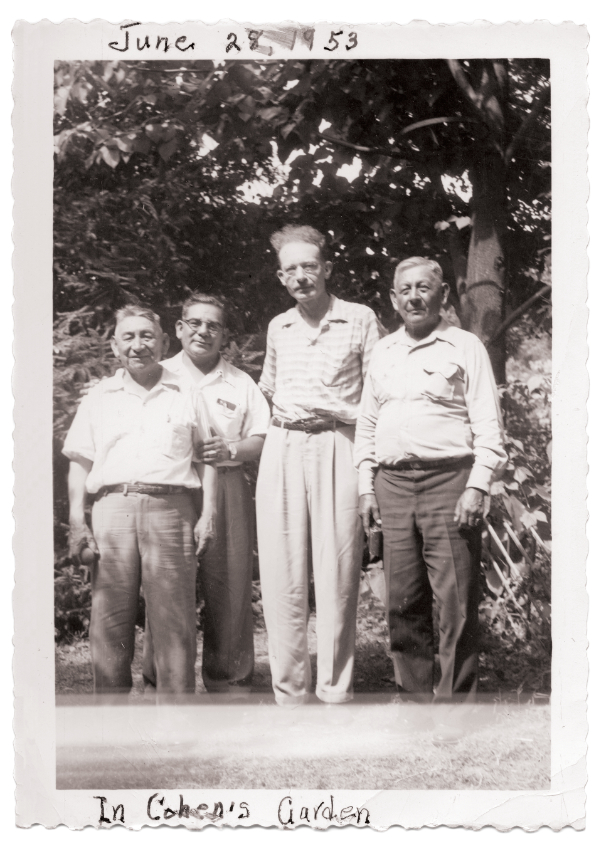
In a photo dated June 28, 1953, Laguna Pueblo Governor John Sarracino, Miguel Trujillo, Felix Cohen, and Laguna Pueblo Lieutenant Governor Walter Sarracino are pictured in Cohen’s garden.

Straight out of law school, Cohen served as a government attorney for the Department of Justice, where his primary duty was to contribute to the development of the Handbook of Federal Indian Law. He was later fired from this position (he suspected antisemitism; other historians suggest his involvement would have made the handbook give too much power to Indigenous people, whom the government has historically always tried to subvert). His dismissal put a pause on the handbook, but not Cohen’s work. He had become dedicated to the Handbook, so rather than give up, he finished the job with resources gathered through the Department of Interior, where he had resumed his position as the solicitor. The Handbook of Federal Indian Law is still relevant in the court system today and has been republished several times. During his career, Cohen drafted several tribal constitutions and made meaningful connections with various tribes. There is no doubt that by this point in his career, he was well trusted by Indigenous people across the country. 

By 1940, Cohen was serving as the attorney for the Pueblo of Laguna. Aside from being progressively ahead of his years, contemporary accounts attest that he had a great sense of humor and a sincere desire to cultivate lasting relationships with the people he helped. Cohen believed that Indian reservations held a promise for a better national future—a future that would reflect his pluralist ideals. He also did not believe in assimilation, as he knew this would mean the death of the cultures he respected and appreciated.

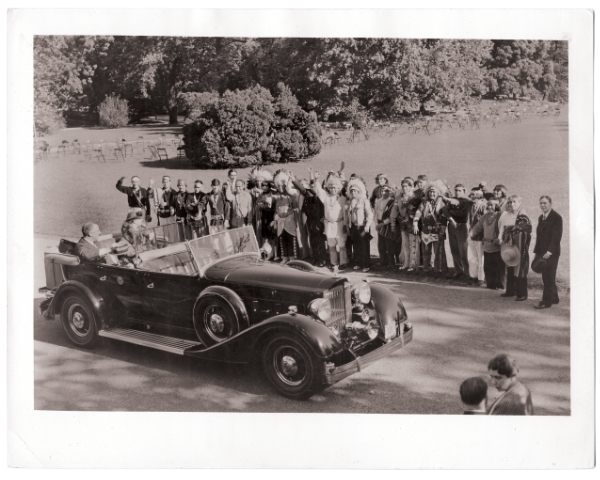
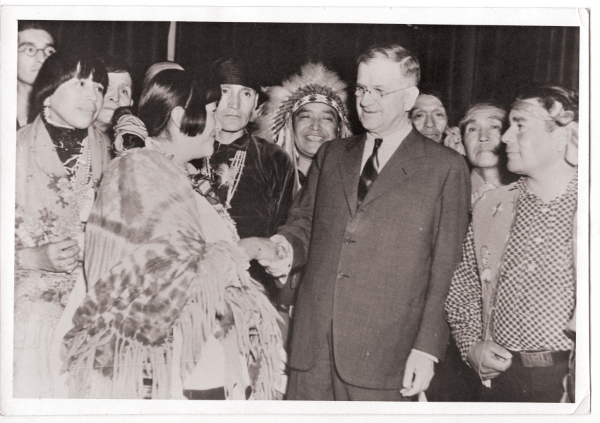
In 1936, Miguel Trujillo stands on the White House lawn in Washington, D.C., with other tribal members and President Franklin D. Roosevelt and Eleanor Roosevelt (in car).

Cohen was an asset to Native American tribes, and his valuable and dedicated work eventually led him to Trujillo v. Garley. The people of Laguna appear to have trusted Cohen, and he and Trujillo developed a friendship during the case. Michael Trujillo laughed as he recounted one afternoon when he and his family came home to a note from a friendly but hungry intruder. “One day we came home to a note from Felix; he had climbed through the window and helped himself to some bread.”

Trujillo v. Garley

The story commonly told is that in 1948, Miguel Trujillo walked into the registrar’s office in Valencia County to register to vote but was denied by Eloy Garley, who turned him away because Native Americans could not vote in the state of New Mexico. This decision was allegedly based on the New Mexico Constitution, which read that “Indians not taxed” would not be permitted to vote. According to Felix Cohen, however, the problem with this constitutional provision was that Indians were taxed, and so it had no merit.

According to Michael Trujillo, his father and Garley actually knew each other personally, as they had met at UNM. When Trujillo walked in to register, he already knew he would be turned away by Garley—but this was a part of the plan. Being denied the ability to register to vote was what he and Cohen needed to get the ball rolling on the case. So as planned, Trujillo walked into the registrar’s office with his eager attorney waiting for him, and he successfully failed to register to vote.

Miguel Trujillo (on right) is photographed with Secretary of the Interior Harold Ickes in 1936.

Trujillo sued, and through Cohen, he argued to the three-judge panel in the Federal District Court that though Trujillo does not pay property taxes, he does pay taxes on everything else including gas, groceries, and income. On August 3, 1948, the judges ruled in Trujillo’s favor, and Judge Orie Phillips made the important point that taxes have nothing to do with the right to vote, and it was in fact a violation of the Fourteenth and Fifteenth Amendments that Indians were the only race who must pay taxes to vote.

This monumental moment in New Mexican history was well overdue and mostly celebrated; however, it was soon overshadowed by those opposed to the decision. There were still many New Mexicans who did not believe that the Indigenous population should participate in elections, and pushed to have Trujillo v. Garley overturned. Much of this pushback came from state officials who thought Natives were the federal government’s “responsibility,” and that allowing them the right to vote would confuse this.

Coincidentally, just a few weeks before Trujillo v. Garley was decided, Arizona’s Harrison v. Laveen was decided, also succeeding in granting voting rights to Native Americans. Just like Trujillo, Frank Harrison was a Native American World War II veteran who walked into the Maricopa County Registrar’s office to register to vote. And just like Trujillo, Harrison was turned away because Native Americans were not permitted to vote in his state. The county recorder, Roger Laveen, cited the Arizona State Constitution which stated that Native Americans were considered persons under guardianship of the United States and thus were not permitted to vote. Harrison found this to be unjust and sued, eventually prevailing in the Supreme Court of Arizona just weeks before Trujillo v. Garley was decided. In the opinion issued by Justice Levi Stuart Udall in the decision on Harrison v. Laveen, the judge refers to none other than Felix Cohen’s Handbook of Federal Indian Law, calling the work “monumental.”

Sadly, Felix Cohen passed away in 1953 at the young age of 46—not long after he, Trujillo, and New Mexican Natives celebrated their win in Trujillo v. Garley. Felix Cohen was, and still is, a legendary Indian Law attorney. In his short life and career, he managed to leave behind a firm foundation of Federal Indian Law and an enormous amount of love and respect from the people he served.

The Controversy of Voting

In 1846, General Stephen Watts Kearny’s army entered Santa Fe, New Mexico. Previously, New Mexican tribes had suffered the effects of colonization by the hands of Mexican and Spanish governments. But through a limited amount of sovereignty and independence, they learned how to advocate for themselves. Under Spanish and Mexican governance, New Mexican Natives were considered citizens, and because they were citizens, they had rights.

The United States government, however, did not share this thinking. In the United States’ view, Native Americans were not and should not be considered citizens. In the second half of the nineteenth century, Native Americans everywhere were forced to resist assimilation efforts by the United States and their claims to their lands were at an all-time vulnerability. It wasn’t until 1924 when The Snyder Act was passed that Native Americans were granted citizenship and with that, the right to vote. However, discretion on whether Native people could actually vote was left up to the states, and it wasn’t until the decision of Trujillo v. Garley in 1948 that Native Americans in all fifty states had the right to vote.

Juanita Trujillo, mother of Miguel Trujillo, ca.1940.

Due to the complex and lengthy history of colonial governments, talk of voting rights for Natives in New Mexico and Trujillo v. Garley in the 1940s was controversial. At the All Pueblo Council Meeting held on April 6, 1936, respected Isleta leader Pablo Abeita said, “I hope that I will be seven feet under the ground when my people start voting.” Abeita said this during meetings concerning the Indian Reorganization Act of 1934, also known as The Wheeler Act. The goal of the IRA was to push Native American tribes to adopt governments that would reflect that of the United States. Tribes that adopted these governments and created constitutions of their own would receive subsidies from the federal government. Abeita felt that this was yet another unnecessary invasion into tribal governments.

As part of the Department of Cultural Affairs’ podcast series Encounter Culture, Borderlands historian Dr. Maurice Crandall, a citizen of the Yavapai-Apache Nation of Camp Verde, Arizona, explained the traditional process of decision-making in most tribal governments. Rather than vote, the people would have discussions and made decisions only after listening to each other and a consensus was reached. Sometimes it would take days to come to a consensus. According to Dr. Crandall, this was how tribal governments operated most effectively: as a community.

To this day, many Native Americans do not trust the United States government due to the lengthy history of injustice they have experienced. Indigenous communities all over America are still healing from assimilation and colonization. American Indigenous communities continue to have their voices suppressed due to state-mandated I.D. requirements, gerrymandering, a lack of accessible polls, and other voter suppression efforts rampant in communities of color across the United States.

The Fight Continues

Voting equality, education, and high numbers of participation continue to be a goal yet to be reached. Native leaders persist in their efforts for a better future for Native communities by providing their communities the benefit of proper voting education and the tools they need for participation and success. As part of Encounter Culture, Kara Bobroff and Laura Harris shared their knowledge on how we can someday conquer the barriers that keep Native people away from the polls.

Assistant Surgeon General Dr. Michael Trujillo, Miguel’s son (b.1944), was the director of the Indian Health Services, appointed by President Bill Clinton.

Kara Bobroff (Navajo/Lakota) is one of the founders of the Native American Community Academy, an Albuquerque charter school founded in 2007, that allows its Native American students to remain connected to their cultures while in school. In 2020 she served as the deputy secretary of education for identity, equity, and transformation in New Mexico and holds a long history of being a leader in education. Bobroff discussed how we can encourage Indigenous children to become politically involved; her perspective is that knowledge and an open dialogue, along with providing the tools to participate and become involved at their own levels of comfort, seems to be the most motivating.

Bobroff gives an example of this when she recalls volunteering for Moving America Forward. In addition to registering people to vote, she would teach voter education and participate in outreach efforts. In one instance, there was a group of students from Crown Point, Arizona, who wanted to vote. After the forty-five-minute drive it took to get to the nearest voting site, they found out that one of the students’ registrations did not process correctly. Bobroff assisted in resolving the issue on the spot so the student could participate, but she also remembers how this motivated the students further: “Everybody was really fired up. They were like, ‘Man, they were about to violate her civil rights!’ and ‘What can we do about that?’ Well, it’s knowing that process. … When people have that information, they’re more informed and able to speak up and say, ‘This is what I know to be true.’”

Miguel Trujillo’s daughter, Josephine Waconda (1935–2013), served as assistant surgeon general, and was the first Native woman to achieve that rank in the U.S. Public Health Service, and dedicated her life to the health care of Native people in the United States. Waconda and her brother Dr. Michael Trujillo were the only two-star admirals in the military both from the same family at the same time.

Bobroff also emphasizes the importance of recognizing accurate Native American history and identity in schools. This is important to Bobroff, as she was once a little girl going through a school system that lacked awareness. She recalls a “pervasive lack of Native American role models, both in the classroom as well as in the school,” and shares the vulnerability that surrounded being a young Native girl. “At that time, a lot of media in Albuquerque and throughout our state only portrayed Native American people on the news in really negative ways—which, for me, reinforced stereotypes about what it meant to be a Native American. I think that was really, really hard. I remember going through high school thinking that that was something I didn’t want to bring to the forefront, as much as I have later on in my life, because of the negativity that was experienced, both in the community in which we were living, but also within the school itself. There wasn’t a lot of support for Native American identity.”

Bobroff was able to overcome these barriers and prejudiced perspectives, and has now helped to curate a school that not only addresses these issues but also encourages Indigenous youth to be proud of who they are and push them to use their voices for positive change.

Miguel Trujillo, ca. 1965.

Laura Harris (Comanche) is the director of Americans for Indian Opportunity, which was founded by her mother LaDonna Harris, a trailblazing civil rights activist and Indigenous leader. Harris says Americans for Indian Opportunity was founded in the late 1960s to change federal policy as it applied to Indigenous communities. “Their first really big win was [returning] Taos’s Blue Lake to the people of Taos here in New Mexico… and that was the first time that the federal government ever gave back land to an Indian tribe,” Harris says. AIO doesn’t stop at Native policy; it has also worked on issues involving housing, leadership, and education.

Harris grew up in a home that was very politically involved; in addition to her mother’s political activism, her father was renowned Democratic Senator Fred R. Harris. Participating in elections and politics has always been the norm for her, and she believes firmly that it is vital for Native Americans to be at tables where decisions are being made, and that age is no excuse. When asked for guidance on when youth can begin to participate in campaigns, Harris offers, “There’s no age limit. … I started before birth, right?” Her advice for Native people, including youth, is to become involved in a campaign, even if it is simple volunteer work, which can open doors of opportunity. While Harris grew up in a household that cared a lot about politics, she recognizes that not all Native people are raised this way.

In an official White House photo dated May 12, 1999, Dr. Michael Trujillo shakes the hand of President Bill Clinton, flanked by a tribal delegation.

Due to the traumas caused by the United States government, there is still some hesitation in Native communities about becoming actively involved in American politics. When asked why Native Americans should care about American politics and vote, Harris’s answer reflected a vulnerable reality for Native Americans:

An undated photo, taken when Dr. Trujillo was the director of the Indian Health Services, features the inscription: “Best wishes to Dr. Michael H. Trujillo, Jimmy Carter and Rosalynn Carter.

“It is important that we all participate and learn how the political process works, because it does affect us so much. We retain our inherent right to be self-governing—the United States Congress recognizes that and so does the federal government. But we say, ‘What Congress giveth, Congress can taketh away’—and they have. So, it’s in our own best interest to run for office and to vote for candidates that support tribes and urban Natives. … Native Americans are part of a national trend of apathy. The idea that their vote doesn’t count and that the average person can’t make a difference couldn’t be more far from the truth. The way our system in the United States is set up is that everybody has opportunity to make a difference, and it starts with civic participation in voting.”

So, indeed—the fight continues, but there are inspiring and motivated leaders who only continue to make strides toward voting equality, education, and participation. 

Stephanie Padilla grew up on the reservation of Isleta Pueblo. She currently serves our New Mexico community as a children’s court attorney and is passionate about civil rights and her culture.


Encounter Culture, DCA’s official podcast, features interviews about Indian Law and Native American voting rights in its fourth season, releasing weekly in Spring 2023. For more information, visit podcast.newmexicoculture.org or search Encounter Culture in your favorite podcast app.

Stephanie Padilla grew up on the reservation of Isleta Pueblo. She currently serves our New Mexico community as a children’s court attorney and is passionate about civil rights and her culture.

An Honest Instinct

By Leslie Linthicum

“The first thing I should say,” photographer Joel-Peter Witkin told a writer for Vanity Fair decades ago, “is I am not a monster.”

His photographic canon—stylized portraits of cross-dressers, amputees, masked nudes, body parts, and corpses —has been called grotesque, perverted, and macabre.

But shuffling around his photo studio in Albuquerque’s South Valley in sweatpants and slippers, wearing his signature oversized glasses and a T-shirt printed with one of his most famous images, the 83-year-old comes across as anything but dark.

He jokes a lot. And when he laughs his eyes squeeze closed and his entire body gets in on the joke. Witkin at the end of his career is a man at peace with himself and with the controversial art he will leave the world.

Joel-Peter Witkin, Studio of the Painter Courbet, 1990. Courtesy the artist.

It’s been quite a career. He has received the International Center of Photography Award and the Chevalier des Arts et des Lettres, and his work can be found in the permanent collections of the Museum of Modern Art and the Whitney in New York, the Bibliothéque Nationale de France in Paris and the Stedelijk in Amsterdam. The Guggenheim Museum in New York and the Museum of Modern Art in Moscow have celebrated his career with retrospectives. Among celebrity collectors, his fans include actor Richard Gere and the late Dennis Hopper.

Joel-Peter Witkin, Satiro, Mexico, 1992. Courtesy the artist.

Withering criticism has greeted his work as often as critical acclaim and fame.

Grotesque. Disgusting. Stomach-turning. Exploitation. Astonishing perversity.

“This has been an issue with Joel his entire career,” says Catherine Edelman, who formerly represented Witkin at her Chicago art gallery for more than thirty years. “People either love his work or they don’t.”

Edelman, who met Witkin when she was studying photography in graduate school, says Witkin’s body of work rightly places him in the ranks of world-renowned photographers, but that has never quieted his critics.

Joel-Peter Witkin, Siamese Twins, Los Angeles, 1988. Courtesy the artist.

Often, Witkin’s elaborately staged portraits include Christian iconography alongside nudity or body parts, with staging and costuming that echoes the Italian Renaissance.

“Since Joel’s work deals with Christianity and art history, it can be interpreted by a non-art audience as sacrilegious—even though that is not at all how Joel feels or what his art is about,” Edelman says.

Witkin, a practicing Catholic, has always taken the blistering criticism in stride.

“My work has been interpreted in different ways, some of which are very, very negative. And I think that’s fine,” Witkin says. “We’re all trying to be honest and do the best we can to basically come to some point of joy, resolve, enlightenment, grace. I think my art has a redemptive aspect. I don’t leave the characters cold and dying out there. There’s always a sort of way back or ability to come up from where they are to a light, or to have redemption somehow.”

And, anyway, Witkin says, he couldn’t have been any other kind of artist.

“I’m not saying that I’m correct. I’m saying that I have the instinct, the honest instinct if there is such a thing, to go about doing what I do and I accept it. I don’t block it. I don’t negate it. I don’t minimize it. I do what is at the moment natural and viable to create photographs that tell of the times I’m living in and tell of the purpose of life and how we can live in a way that is emotive and better than we could even imagine. I think we are given grace or knowledge and the desire to make something happen that elevates life on Earth and makes it better.”

The Catalyst

Born in Brooklyn, Witkin was raised with an older sister and an identical twin brother—acclaimed figurative painter Jerome Witkin—by a Roman Catholic mother divorced from his Jewish father.

His first camera was a dual-image plastic model that his father gave him. He visited what was then called the freak show on Coney Island and his earliest pictures were portraits of society’s outsiders.

He enlisted in the army and was assigned to Fort Hood in Texas. When his three years were up, he enrolled in The Cooper Union in New York, getting a BFA in sculpture in 1974. While he was stationed in Texas, Witkin took road trips to New Mexico and clicked with the energy here. He also knew by reputation Van Deren Coke, then chairman of UNM’s well-known Department of Photography. So he moved to Albuquerque and enrolled in UNM’s masters program, where he began to understand himself as an artist and develop his unique style.

“Art school gave me the opportunity to see my emotions without censorship, both from myself and from other people,” Witkin says.

While at UNM, Witkin worked at Al Monte’s on Rio Grande, first as a bus boy and ultimately as head waiter, to pay the bills. He completed a master’s degree in 1976. As his work became known, he received grants from the National Endowment for the Arts in 1982, 1984, and 1986, the year he received his MFA.

Joel-Peter Witkin, Cupid and Centaur in the Museum of Love, Marseilles, 1992. Courtesy the artist.

The Kiss

What drew Witkin to the dead? Was it the oft-repeated nature of his stateside army service, in which he was tasked with photographing soldiers who had taken their own lives or been killed in training accidents?

Witkin brushes the air with a hand and says that never happened; his army photography was much more mundane.

Witkin says a better hint to his influence is his grandmother, who lived with the family, and who had a never-healing sore on her leg from an injury that wasn’t treated. The smell of coffee brewing and of rotting flesh were part of daily life. The connection between decay, disability, and the comforts of family and home stuck with him.

Witkin explains his first foray into making art from the dead as part inspiration and part luck.

“My job was to be lucky enough to be connected to people who were open,” Witkin says. He was pursuing his MFA when he expressed an interest in using bodies in his art and was given a box containing the head of an elderly man by a pathologist at the medical school.

Witkin’s first question, as always when being given access to body parts, was, “What’s there to work with?”

“The head was cut in half,” Witkin recalls. “I was fascinated. Sometimes the first impression is the total impression, and that’s what happened. You have this head split in half. And me being a twin, and having those sides meet, touch, communicate—it was there.”

The result was The Kiss, a photo that ended Witkin’s relationship with the Pathology Department but launched him into a new level of critical acclaim and attention. It serves as a Rorschach test of his work. Is the image of what appears to be two elderly twins kissing tender and deep? Or is it exploitative and obscene?

Witkin has never faltered from his belief that his art is uplifting, and he has never made excuses for entering into the sacred space of death.

“I’m OK being there, because I’ve gotten permission to be there,” he explains. “I’ve been given an opportunity from this person I don’t know, who is not in life, to create an image of hopefully wonder and beauty. If it’s done right, if it’s done with purpose and love, then it reinforces life itself. If it’s done right, it reenforces goodness. I make the work honestly and openly and I believe in it. And that’s all I can do.”

Joel-Peter Witkin, Woman on a Table, New Mexico, 1987. Courtesy the artist.

The Work

As his work evolved, elaborate sets constructed in his spacious South Valley studio became his signature. He never snapped a photo of something he saw, instead reverse-engineering until he achieved a vision.

“An idea comes to me out of the blue,” Witkin explains. “I get this idea. I drift there and go there and think about it, make a drawing.”

When he is satisfied with the drawing, he works with a team to build and paint a set, to collect or construct props and to assemble a cast of models—oftentimes with physical disabilities—willing to pose nude, to be covered in powder, to wear masks. When the day of the shoot comes, he says, “As the visual director I have to have people, an environment, a look, lighting. The final stage, of course, is the photograph. And most of the time it’s pretty damn close to the sketches.”

Witkin has recruited amputees to pose for him, while others volunteered.

Ann Millett-Gallant, an art historian who is a congenital amputee whose arms end below her elbows and legs below her knees, was fascinated by Witkin’s photographs, particularly those of disabled models. And so she contacted him and, in 2007, came to Albuquerque to be what she calls “a performing agent” in the photograph Retablo, New Mexico (2007).

In her book Performing Amputation: The Photographs of Joel-Peter Witkin, Millett-Gallant writes, “Critics have characterized Witkin’s controversial work as too perverse, too blasphemous, and too grotesque, and for many, his framing of disability is one of the most offensive orchestrations.”

But, she asks, are Witkin’s photographs shocking because they are an extension of the exploitative freak show or because they reframe disability as grace and beauty?

Millett-Gallant has displayed a print of Retablo and the second Witkin photo she posed for in 2015, Hitler Posing With The Anti-Christ, 1937,  in her home.

“Witkin‘s work challenges cultural assumptions and judgments of bodies, what they do, and what should bring them pleasure,” she writes in her book. “It forces us to confront our greatest fears, anxieties, and inhibitions about our own bodies, morality, and inevitable mortality.”

Many photographers consider their work done after they have a print, but for Witkin that was always a second starting point. He often scratches, clouds, or otherwise manipulates his image.

“Joel was a maniac when he was working,” his wife Cynthia Bency-Witkin says.

“I had energy that just didn’t stop,” Witkin remembers. “Twenty-four hours a day just wasn’t enough. The energy was fierce. It was my passion and it’s what I loved to do. It was like a marriage of myself and the unknown.”

“And all of that hard work has allowed us to have an inventory that we can pull from,” Bency-Witkin says. The results of his manic energy are evident in the boxes of prints stacked in his studio.

Theirs has always been an unconventional marriage, involving polyamory and intermittent breaks.

They were married for twenty-one years, then divorced for twenty-one years. They remarried in 2021 and live together again on the farm that has been home to Witkin’s creative process for fifty years.

Joel-Peter Witkin, Vanity, 1990. Courtesy the artist.

The End

In 2018, Witkin was diagnosed with dementia.

“My memory is not that great,” says Witkin, who can recall in depth many aspects of his career and only a hazy sketch of others. “You have to accept it. And it’s preparation for death. It’s a loss, and death is the loss of life. So, it’s part of the train ride to death.”

The man responsible for introducing images of death into museum collections around the world and the homes of wealthy and celebrity collectors is in a stage of retirement and reflection now, and is comfortable with his own inevitable end.

“I look forward to it,” he says. “I think we live forever. I think we’re made by God and we’re on Earth and we have free will and we can make life better or horrible.”

He hasn’t made a photograph in several years.

“I think people should end gracefully. I’ve given everything and I couldn’t think of anything else I could share, and I stopped. I get up in the morning. There’s hot coffee. I go out and get the New York Times. And then the day happens. I figure that in the future, if my work is seen to have an association with longevity, power—all to the good. I’ve done the best I could.” 

Many of Joel-Peter Witkin’s photographs feature sensitive imagery and materials including cadavers and nudity. Out of respect for our readers, we have created an online gallery of some of Witkin’s more provocative images.

Please click here to view those photographs. Discretion is advised.

Leslie Linthicum is a writer and editor who lives in New Mexico. 

Leslie Linthicum is a writer and editor who lives in New Mexico.

The Doing or The Thing

By Charlotte Jusinski

I forget who asked me first, or when, but the question has stuck with me for years: Do you like the doing or the thing?

It’s intended to be asked of artsy types, and generally translates to: When you make your art, do you like the process, or do you like the end result? I asked it of New Mexico Poet Laureate Lauren Camp in our interview featured in this issue. Her answer was the polar opposite of mine, and yet she’s still one of my favorite people—which is why poets should run the world. But, I digress.

I love this question because it says a lot about what an artist values. Someone who likes the doing might be a bit introverted, or otherwise might enjoy the solitude that is practicing their craft alone under a bare bulb in a studio or next to a cup of tea and an open notebook. (Might be; of course, there are plenty of other ways that could go.)

For me, I like the thing. I like having something to show for my hard work. (And, as all artists know, even if it is quite fun, it is indeed hard work.) As a poet, I love having a poem at the end of all that writing anguish. I absolutely love poems. I only write and edit so that I can have that final thing, that acorn of beauty, that poem. Maybe it’s because I’m extroverted; I want to share it. I want people to see it. I want it to be read and known and considered, and then I want to talk about it all day. And then I want to do it all over again.

This attitude carries over to this magazine. I like the thing. I love that, four times a year, I get to hold an actual paper magazine in my hands, and that the thing is absolutely beautiful. (Shout-out to El Palacio’s graphic design team for that consistent outcome.) I love when people interact with me after reading, when they ask for more copies, when new subscribers come out of the woodwork because they saw it on a friend’s coffee table. I love sharing what we have made.

The flip side of that coin, however, is that the doing is… well, rough sometimes. (Apologies to my closest cohorts, who have to bear the brunt of this roughness.) I’m definitely one of those angsty people who pulls her hair out the entire time this puppy is getting put together, all the way until the last five minutes before the whole thing is shipped to the printer. (Those last five minutes are usually spent in a comatose state, but hey, at least I’m not pulling my hair out.) It’s all part of the gig, sure, and I’ll do it as much and for as long as I have to, but it’s not my favorite part. Not by far.

No, my favorite part is where we’re at right now—when you’re either holding this beautiful glossy paper in your hands, or admiring our website full of 109 years of New Mexico history. And this last part makes it absolutely worth it every single time. When I’m in the worst of it and nothing seems to be going right, I just think, In a couple months, I’ll have a magazine. And that keeps me going.

Thanks for reading our final product, our thing. The doing is always a bit of a rodeo, but seeing how incredible it comes out every single time, I’d never dream of having it any other way. Hopefully you wouldn’t either. And maybe drop me a line sometime to let me know—do you like the doing or the thing?

Writing Ourselves Back Into the Story

By Emily Withnall
Photographs by Alanna Romero

When Patricia French saw Big Bird building an horno on Sesame Street in 1975, she knew she wanted to live in New Mexico.

In 1978, she moved to the state with her husband and two-year-old son in tow. As they drove across the country from New York, French remembers singing Buffy Sainte-Marie’s refrain from the series: “Sunny day, on my way to Santa Fe.”

French is the mind behind the New Mexico Historic Women Marker Program, which launched as a 2005 initiative to commemorate women’s contributions to the state’s history. And although she didn’t know it at the time, Buffy Sainte-Marie’s influence on Sesame Street’s New Mexico series proved to be an auspicious beginning to a project that honors women from many cultures in New Mexico.

In 2005, there were over 500 historic markers on roadsides across New Mexico. Many of the markers provided information about the landscape, events, or people that contributed significantly to the state’s history. Upon her arrival to New Mexico, French says, “All I did with my family was travel the state. I look everything up, and I looked at those markers.” What she noticed, however, was that of the hundreds of markers she read, very few markers mentioned women—and when they did, the women were mentioned in passing as someone’s mother or wife. At San Ildefonso Pueblo, one marker mentioned internationally renowned potter Maria Martinez. But she was the only one.

Historic roadside markers began to be installed in New Mexico in 1935, at the same time as many other states in the country. The passage of the 1935 Historic Sites Act, signed into law by President Franklin Delano Roosevelt, signaled a commitment to the preservation of sites, buildings, and objects of national significance. With the expansion of American highways, historic markers were seen as a way to promote local history and tourism and to inspire Americans taking to the open road.

Although French noticed the absence of women on the roadside markers in her early travels around New Mexico, she mostly kept her observation to herself—until she met likeminded friends Beverly Duran and Alexis Girard. French and Girard met while they were both raising their young children, and later both women met Duran through the New Mexico Women’s Forum.

French, Duran, and Girard all have personal histories filled with activism and a commitment to equity. French began her career creating an early childhood center in Brooklyn that now is fifty years old—an experience that fueled her dedication to supporting educational opportunities in New Mexico. Duran is a fifteenth-generation New Mexican with a long activist
history, including her notable success in addressing systemic disparities in graduate student housing in the early ’70s. Girard, a fifth-generation New Mexican, recalls marching against the Vietnam War and says she is the first woman to lead her family’s real estate company.

In 1988, French co-founded the New Mexico Women’s Forum, which is now known as the International Women’s Forum-New Mexico. The purpose of the Forum was to provide mutual support and mentorship to empower and elevate women in positions of leadership. French and Duran were both early members, and Girard later joined them. Then, in 1996, at the Forum’s first overnight retreat on the CS Cattle Company ranch, the three women walked the ruts of the Santa Fe Trail and stopped to read a historic marker there.

With the unmistakable backdrop of the Inn and Spa at Loretto in downtown Santa Fe, at the intersection of East Alameda and Old Santa Fe Trail, sits a marker dedicated to the Sisters of Loretto. The front of the sign reads, “Four Sisters of Loretto, Mother Magdalen Hayden and Sisters Roberta Brown, Rosana Dant and Catherine Mahoney, arrived in Santa Fe from Kentucky on September 26, 1852. In January 1853 they established Our Lady of Light Academy, later known as Loretto, the first school for young women in the Territory of New Mexico.” On the back, pictured here: “Between 1863 and 1879 the Sisters, with the help of local people, raised funds to build the Loretto Chapel. During the next century, hundreds of women, many of them of Hispanic heritage, joined the Sisters of Loretto. Lucia Perea became the first native-born New Mexican superior at Loretto, Santa Fe in 1896.”

“Pat was reading that sign and she remarked that many women had traveled the trail, but none had been acknowledged,” Duran says. “And she wondered how the Forum could honor these women. That’s when I thought, ‘Oh, yeah, the Santa Fe Trail, but also, what about the women that came over on the Camino Real?’”

French frequently commented on the absence of women on historic markers, but it took nearly ten years from that day walking the ruts of the Santa Fe Trail to begin to remedy the exclusion of women from the state’s history. On July 9, 2005, the IWF-NM president asked for project proposals from members. Women’s markers were still very much on French’s mind.

“I was sitting next to Bev and Alexis,” French says. “And Bev said, ‘Tell them about your idea! We’ll get behind it and work on it together.’”

Historic markers that feature a notable woman on only one side also feature a brief description of the initiative on the opposite side. This description reads, “The New Mexico Historic Women Marker Initiative was founded in 2005 by members of the New Mexico Women’s Forum in a statewide effort to recognize women’s contributions to New Mexico history on the state’s Official Scenic Historic Markers. The Initiative ensures that women’s diverse histories will be remembered and told, and will inspire and provide a guide for future generations. The 2006 Legislature funded the project.” This particular text is featured on the opposite side of a marker for Doña Dolores “Lola” Chávez de Armijo, located on Highway 556 in Albuquerque.

The IWF-NM agreed to take on the Women Marker Initiative with French, Duran, and Girard leading the charge. French contacted New Mexico Governor Bill Richardson and spoke with him first about the idea. He was interested. “His wife, Barbara, always used to say to him, ‘If someone wants something from you for the state, take a look at it,’” says Rosemary Molnar, who became one of the Initiative’s executive administrators.

Duran, Girard, and other members of the Women’s Forum then began lobbying state legislators. They describe the process as complicated and educational, but legislators were receptive and Senator Ingle and his staff were especially helpful. Through the guidance they received from Anne Green-Romig in the Department of Cultural Affairs and Paula Tackett from Legislative Council Service, they pushed for a capital outlay appropriation from proceeds from severance tax bonds. Governor Richardson signed the bill on International Women’s Day in 2006. 

“What I love about New Mexico is that it is a state where you can actually go into the legislature and lobby on something,” says French. “That was not true in New York. But here it was so open and accessible.” 

When the bill for the Women Marker Initiative passed, the New Mexico Department of Transportation became the fiscal agent and entered into a Memorandum of Understanding with the New Mexico Department of Cultural Affairs. It was at this juncture that the Historic Preservation Department, a division of Cultural Affairs, put out a request for proposals to contract out the actual work needed to solicit nominations, conduct research, and write the text for the women’s historic markers.
So it was that French, Duran, and Girard found themselves bidding for the very project they had championed. The
attorney who helped them was none other than current U.S. Congresswoman Teresa Leger Fernández.

Against the serene backdrop of Ashley Pond in Los Alamos is a marker dedicated to writer Peggy Pond Church, a two-sided marker shared with Marjorie Bell Chambers. Church’s dedication reads: “Peggy Pond Church, author of the Southwest classic The House at Otowi Bridge and daughter of Los Alamos Ranch School founder Ashley Pond, will forever be ‘The First Lady of New Mexican Poetry.’ As she rode the Pajarito Plateau and camped beneath tall pines, she came to understand that ‘it is the land that wants to be said.’ She captured it in her sensitive poems.”

“Teresa Leger Fernández. Oh, my God. Her legal expertise at the time helped us tremendously,” Molnar says. “She was in the Forum, too, and it was tremendous how important her input was to help us with the contract. I became a friend of hers through Pat, also. So it all started from friendship.”

With the contract secured, the New Mexico Historic Women Marker Initiative was given three years, between 2007 and 2010, to install sixty-four markers. Early on, French knew she didn’t want to only commemorate the most famous women in New Mexico’s history.

“I researched what other states had done, and found that while some mentioned women in markers, there weren’t many states that included women and if they did, it was only women of prominence,” French says. “Our project was to discover not just the women who were well-known, but the unknown, unsung women and to make it more comprehensive, including the Pueblos and tribes. That had never been done anywhere else.”

French learned that Virginia had solicited historic marker nominations through county governments, so the Forum decided to do the same. They reached out to Benito Martinez, who was the president of the New Mexico Association of Counties, to get him on board.

Duran remembers attending numerous county commission meetings across New Mexico. “I traveled all over the state presenting, usually at a moment’s notice,” says Duran. 

Few locations in New Mexico are as iconic as the view from Highway 68 just outside Taos, with the Rio Grande Gorge sprawling out to the mountains. Here, at the Horseshoe Rest Area, is a marker dedicated to the “Captive Women and Children of Taos” and María Rosa Villapando. The first description reads, “In August 1760, around sixty women and children were taken captive in a Comanche raid on Ranchos de Taos. That raid is an example of living on New Mexico’s frontier during the 17th and 18th centuries, for Hispanic and Indigenous communities alike raided each other and suffered enormous consequences. Thousands of women and children were taken captive. Most were never returned.” The side shown here reads: “One known captive of this raid, María Rosa Villapando, was traded to the Pawnees and, after ten years, was ransomed by her future husband, a French trader from St. Louis. She was reunited with her New Mexican son, Joseph Julian Jaques in 1802. Her grandson, Antoine Leroux, returned to Taos and married into the Vigil family, making her the ancestral matriarch of several prominent Taos families.”

County commissioners solicited nominations from people in their counties by radio, newspaper ads, and more. Criteria for the nominations included that the nominee must be deceased and either born in New Mexico or having done the body of their work in New Mexico. Photographer Marcia Keegan, who had decades of experience documenting the history of New Mexico Pueblos, solicited nominations from the tribes. While some individuals from tribes went on to be commemorated on markers, the criteria singling out one woman did not align with many Pueblos’ beliefs. Instead, marker nominations from Pueblos often honored groups of women.

“Only one letter of nomination was from a man,” Molnar says. “And sometimes if there wasn’t any interest from a county commissioner, a commissioner’s secretary would do it herself and write me a letter or call. It was just amazing.”

From the beginning, Duran was focused on ensuring a balanced representation of Hispanic women on the markers, and because women were not often mentioned in traditional historical texts, she found other ways to learn about the women who travelled the Camino Real.

Located alongside scenic agricultural fields on Highway 84 in Guadalupe County, we learn about bilingual education pioneer Mela Leger. The marker reads: “At four, Manuelita de Atocha (Mela) Lucero Leger read Spanish language newspapers to her blind grandfather in Colonias. Although New Mexico’s constitution protects Spanish-speaking students, school children were often punished for speaking Spanish. As a pioneer in bilingual education, Mela changed that by founding one of the nation’s first bilingual multi-cultural schools, developing curriculum, training teachers and helping write the historic 1973 Bilingual Education Act.”

“Henrietta Christmas, a genealogist, was able to learn the history of women who came over on the Camino Real by reading their wills,” Duran says. “In that time, Hispanic women could own land, they could trade the land, they could sell it. They did not have to leave land to their husbands. Women fared much better and they could dispense of their wills as they saw fit.”

The selection committee that reviewed nominations was chaired by French and consisted of representatives from the New Mexico Association of Counties, the Commission on the Status of Women, the Historic Preservation Division, the Women’s Forum, the NMDOT, and members of the general public. Historians and researchers, including Tom Chavez, Kim Suina Melwani of Cochiti Pueblo, Lillian Apodaca, and David Pike, among many others, helped the committee with researching the nominations as they came in from the counties and tribes, and with writing the texts. Researchers also assisted in completing the application forms that were submitted to the Cultural Properties Review Committee. Once CPRC approved a marker, NMDOT could proceed with the planning and installing.

“Everybody complains about state government, including me, but I never knew what was involved,” says Karren Sahler, one of the Initiative’s other executive administrators. “When I got into this project, I was very impressed. Yeah, there’s a lot of pork-belly spending, but there’s also an amazingly well-oiled machine that manages to get together and take care of the people of this state.”

According to Sahler, editing the text down to the required fifty-word maximum was challenging. The goal in the writing was to identify each woman’s most significant contribution to New Mexico state history—a tall order for the many women with numerous contributions. Some markers commemorated a different woman on each side, and others had text on one side explaining the importance of the Women Marker Initiative.

Once the text was ready and NMDOT had what it needed, Rhonda Faught took charge. She was, and remains even after her retirement, the first and only woman cabinet secretary for NMDOT, and in 2007, she was one of only three or four other women serving as the head of a state department of transportation in the United States. Faught came to the position having served in many NMDOT roles, including the first female district engineer in her hometown of Deming, New Mexico, and first female adjutant cabinet secretary in Santa Fe. She was used to being the only woman in the room, but for the Women Marker Initiative, she wanted to change that.

“I appointed women engineers in my department to help select finalists for the markers and identify appropriate locations,” Faught says. “Dee Beingessner and Rhonda Lopez shepherded the project, from sign location to sign manufacturing to installation.”

Faught says there was a lot of behind-the-scenes work that went into negotiating marker placement. Markers had to be installed in places where vehicles could safely pull over, pull-outs had to be designed, and maintenance agreements had to be negotiated if the proposed location was not on a state highway, but rather the property of a university, tribe, city, or private citizen.

Many of the marker installations were celebrated with a ceremony or party. Others have been celebrated more quietly, or treated almost like gravestones with offerings of flowers. Sahler remembers over fifty family members coming together to celebrate the marker honoring Feliciana Tapia Villarial of Pojoaque Pueblo for her role in restoring the Pueblo’s cultural legacy.

“People were really excited about it. I went on a couple of occasions to watch them install the markers,” Sahler says. “One time, there were men digging the hole and one of the guys jumped up out of the hole and said, ‘This is my great aunt, this is my family.’”

A marker dedicated to Doña Dolores “Lola” Chávez de Armijo, located on Highway 556 in Albuquerque, reads: “In 1912, State Librarian Lola Chávez de Armijo filed a gender discrimination lawsuit after the governor sought to replace her by court order, claiming that as a woman, she was unqualified to hold office under the constitution and laws of New Mexico. The New Mexico Supreme Court ruled in her favor and legislation followed, thereafter allowing women to hold appointed office.”

French, Girard, and Duran were committed to finding the history of Black women’s contributions to the state. One such woman was Cathay Williams, who disguised herself as a man and joined the Buffalo Soldiers in Deming after being released from her forced role in the Union Army. And French, upon learning that Dr. Meta Christy was the first Black woman osteopath in the United States, travelled to Las Vegas, New Mexico, where Christy had practiced and taught.

“I went there and knocked on doors to find out where she had lived, and some people in the community remembered her because she died in 1968,” French says. “The Historical Society in Las Vegas got behind it and Ancestry.com came in and helped in the process. When we were done with the project, we sent Meta Christy’s information to the Osteopathic Association, and she’s now acknowledged as a part of Black History Month. This is one of the joys of doing it; this discovery is incredibly wonderful.”

All sixty-four of the original markers were installed by the end of 2010. Many from the Women’s Forum, including French and Girard, left the Initiative to pursue other projects, but Duran stayed on for several more years. After the IWF-NM approved funding for research on twenty-four more markers, Duran focused her energy on ensuring that more Hispanic women were represented in the state’s history.

Although the three original women are no longer involved with the Initiative, the IWF-NM has indeed carried it forward. During the 2022 state legislative session, the now-renamed New Mexico Historic Women Marker Program was granted additional funding for outreach, education, and publicity.

A different kind of marker graces the pit stop near Camel Rock in Tesuque Pueblo. “Seated clay figurines known as rain gods or ‘rain catchers’ spring from Tesuque Pueblo’s deep-rooted figurative pottery tradition,” the marker reads. “Popularized in the 1880s, Tesuque women made and sold the figurines in a variety of colors and designs, and earned income by selling them to curio dealers and tourists. Rain gods typically hold pots while other gods hold children, animals and other objects. The tradition is practiced to this day.”

Faught, who retired from NMDOT in 2008, remained with the Initiative even following her retirement, and is a current member of its steering committee. “We have the markers now, but we need people to learn about it,” she says. “We have several walking tours in Santa Fe and they don’t even mention the markers. But I haven’t talked to a single person that hasn’t said, ‘That’s so cool!’ So it’s not like people don’t care, it’s that they don’t know it’s there.” Along with Faught and Tackett, the steering committee today includes chair Betty Downes, Celia Foy Castillo, Karen Abraham, Nicole Rassmuson, and Veronica Gonzales, who continue to work to ensure the success and lasting legacy of the program.

Plans for education and outreach include making maps and passports, using QR codes people can scan to pull up more information about each woman, creating an archive of research materials, revamping the website, and creating a speaking series that travels from county to county to educate the public about the women commemorated on local markers.

Curriculum planning is also in the works. Faught says Lisa Nordstrom of Santa Fe Prep is helping to develop curriculum for kindergarten through the twelfth grade to include more women in history lessons. Nordstrom has also already begun to integrate the Women Marker Program into her classrooms.

A marker dedicated to Agueda S. Martinez can be found framed by snowcapped peaks in Medanales (Rio Arriba County) on Highway 84. It reads: “Agueda is the matriarch of Hispanic weaving in New Mexico. From a very young age, she was known for her complex designs and natural dyes. She was the subject of the Academy Award-nominated documentary film, Agueda Martinez: Our People, Our Country. Her weaving is carried on by fifty-two direct descendants and can be seen today in many museums, including the Smithsonian.”

“Six of her seniors picked a person and did more research on them that we are going to include in our website. They followed Judy Chicago’s The Dinner Party and decorated a plate and placemat about each woman so that when you sit at that place you learn a lot about the woman,” Faught says. “History was written by men, so we don’t hear about women, but the women made it possible for some of these things to happen, and in some cases were critical to the development of this area.” 

As of 2022, over one hundred women are commemorated on markers in all thirty-three counties in New Mexico. Faught says more markers will be installed in the future, but for now, the focus will be on getting the word out and helping integrate more women into the state’s written history.

“For me, it just reaffirmed that when women are in charge it’s a good thing, and that they are not as well celebrated as their male counterparts,” says Girard, reflecting on her experience with the Initiative. “I’m hoping that more of that continues.”

French, Duran, and Girard all say they are glad, in retrospect, that they didn’t know what they were getting into and how much work it would be. In the process of developing the Women Marker Initiative, however, they became historians working to augment New Mexico’s full history and women’s contributions to their communities.

“If it is but one thing I have learned from our project, it’s that the first written word is history,” Duran says. 

Mora hosts a marker dedicated to a group of women that spans across generations: curanderas, women who heal. It can be found on Highway 518, across from the Allsup’s.

French credits her friends with helping her realize a dream. “I am a person who lives in the world of ideas. I’m so gratified to see something come of what I dreamt about twenty-six years ago. I mean, I was 50, and I’m now 76,” she says. “And I’m so thankful to the women who are continuing this.”

Although many of the women’s historic markers across the state honor individual women and incredible acts of heroism and bravery, the friendship between French, Duran, and Girard offers insight into the meaning of the Women Marker Initiative as a whole: When women dream and collaborate together, and when they persist in bringing those dreams to fruition, we can write a new history.

Emily Withnall lives and writes in Santa Fe, New Mexico. Her work can be read at emilywithnall.com.

Alanna Romero is a New Mexican artist. For the past 27 years she has been nurturing a passion in photography. Mostly self-taught, she has travelled through the United States and Europe capturing imagery focused on nature, culture, spirituality, and history. Her work has been displayed in the New Mexico Museum of Art and several New Mexico shops and galleries.

Emily Withnall (opens in a new tab) is the editor of El Palacio and the host of Encounter Culture. Prior to stepping into the editor role, she wrote for the magazine for eight years. Emily has also been published in The New York Times, Al Jazeera, High Country News, Orion Magazine, Tin House, The Kenyon Review, Gay Magazine, Source New Mexico, and other publications. She lives and writes in Santa Fe, New Mexico.

Writing the Ripe World

By Jennifer Levin

Peggy Pond Church (1903–1986) was a poet of place. She emerged from the Southwestern landscape pre-statehood, born in what would become Mora County. She spent her adolescence riding horses on the Pajarito Plateau, in New Mexico’s Jemez Mountains. As a teen, she was sent away to East Coast boarding schools against her wishes. Her father founded the Los Alamos Ranch School in 1917, which did not admit girls. She lived most of her adult life in the Land of Enchantment.

Although she’s well-known for the memoir The House at Otowi Bridge: The Story of Edith Warner and Los Alamos (1973), Church was a highly accomplished poet. She published her first collection, Foretaste, in 1933, and went on to publish nine others. She was friendly with many of the writers and artists who flocked to Santa Fe in the 1920s and ’30s, including Alice Corbin Henderson and Mary Austin. But she didn’t consider herself one of these transplanted creatives, many of whom romanticized New Mexico and its people. Church’s poems are inextricable from the land and sky, the blazing sun on the mountains a fact of existence rather than an observable marvel from someone accustomed to skylines of steel and glass.

Church doesn’t fear sentimentality or meaningful narrative, which sets her apart from mid-century’s postmodernist rise. She was often trying to find her way through a feeling or a relationship, which was deep friendship as often as it was romantic love. After the U.S. government shut down the Los Alamos Ranch School in 1942 to build the atomic bomb on the ground on which it stood, Church turned her lyrical eye to the violence of the bomb and the scientists who invented it. Ultimatum for Man (1946) is considered by many to be her strongest work. Written during the same era, “Letters to Virginia” appears only in her posthumously published selected works, This Dancing Ground of Sky (1993). She writes with unabashed emotion and femininity about the bomb as a violent rupture between past and future. In content and tone, if not in voice, the piece reads as a precursor to the woman-focused and environmentally conscious works of more well-known writers like Adrienne Rich and Denise Levertov, who had not yet come to prominence.

Do you remember those days, Virginia,
when we were young and Time was innocent?

The ripe world flowered around us.

Disaster was a seed whose spear had not thrust through
    the quiet earth.

There is a historic marker dedicated to Peggy Pond Church at Ashley Pond in Los Alamos. Read more about historic markers dedicated to women’s history in New Mexico here.

Jennifer Levin is a freelance writer and communications professional in Santa Fe, New Mexico. As a journalist, she writes primarily about arts and culture. She grew up in Chicago and holds a bachelor’s in creative writing from the College of Santa Fe.

Jennifer Levin is a freelance writer and communications professional in Santa Fe, New Mexico. As a journalist, she writes primarily about arts and culture. She grew up in Chicago and holds a bachelor’s in creative writing from the College of Santa Fe.

New Mexico’s Queen of Poetry

By Charlotte Jusinski

One of the first things Lauren Camp will do when you meet her is ask you about you. This interview, conducted over coffee at my kitchen table in October 2022, was edited for length and clarity—and also to remove many questions Camp asked about me and my own creative life.

She had just wrapped up a month-long appointment as astronomer-in-residence at the Grand Canyon, announced her poet laureateship right after that, had been published in dozens of journals in the last couple years, and seemed always on the verge of something else new and exciting—but still, she wanted to reach out into the world and learn more, more, more.

The Office of the Poet Laureate, part of the New Mexico State Library, is appointed every three years. According to the State Library, the poet laureate pursues “the goals of supporting literacy and enhancing education while promoting arts enrichment across the state. Through speaking engagements statewide and programs at schools and libraries, the poet will engage all New Mexicans with poetry.” Within New Mexico, many cities and counties also appoint their own poets laureate, and the United States poet laureate is currently Ada Limón. Camp is New Mexico’s second state poet laureate; its inaugural office holder was Levi Romero, who wrapped up his term in August 2022.

Camp has released five books of poetry, the most recent of which is Took House (Tupelo Press, 2020), which received numerous accolades including the American Fiction Award in Poetry from the American Book Fest. She also celebrates the forthcoming publication of two more collections: An Eye in Each Square (River River Books, 2023) and Worn Smooth Between Devourings (NYQ Books, 2023).

Read on to learn more about New Mexico’s poet laureate, what she learned in the dark, and whether she likes the doing or the thing.

Charlotte Jusinski: Can you give me a brief history of Lauren and poetry?

Lauren Camp: I was in Santa Fe making visual art as a career. My series of fiber art portraits, The Fabric of Jazz, was traveling around the country on exhibit in museums and art centers.

At the opening of the show in Kentucky, somebody came up to me and said, ‘I know you made the artwork; who wrote the poems?’ I looked around the room, and it was all my artwork, solo show. There was nothing else.

I said, ‘There are no poems here.’ That person took me around, pointing to the wall text beside my artwork—‘This is a poem, this is a poem, this is a poem’—which was a revelation to me. I didn’t come from a hyper-literary family. My mother was a very avid reader, but not of scholarly books. My father was an immigrant, and [didn’t have the] capacity to handle reading in another language. I had no understanding of what poetry was, honestly.

I returned to New Mexico figuring, ‘Well, if I’m doing this, I might as well know what it is, for real.’ I thought poetry had certain things to it; probably it had to be rhyming and it had to be impossible to understand. Secret things that many people are scared of with poetry if they’re uncertain about it.

I overheard a friend of mine say something about her poetry group and I asked to join. That writing group helped me realize—in the same way that I realized hiking was just walking—‘Oh, poetry is just writing.’

It suited me to be able to fold color, texture, and pattern, oddness and emotion into a poem. Poetry gives me the leeway and spaciousness I need to be able to express something in a way that’s not formulaic.

CJ: You just had this absolute flurry of publications in the last year or so. The simple question is: How much do you write? Because from the outside, it’s like, ‘Oh my god, how prolific is this person?’

LC: You’re not the first person to say I’m prolific. I don’t think of myself that way, which is interesting. I prefer to only write when I have something to write about. This might be something I overhear, something I see, a place I visited. I’ve written through a lot of grief and loss also.

When I have something on my mind, I just hammer at it in multiple drafts. I will start a draft with notes. I don’t care if they’re well written. They are just place-holding reminders—images and sensations that I care to preserve. I guess other people would put this in a journal, but I want to develop them into poems.

I love the revision process. I’m fine with a poem taking months or years to get done. Some of the work you’re seeing has taken me eight years to complete. …

What I’ve learned over time is that the best way for me to write a poem that’s interesting is to layer other selves into it, onto it, which means I am forced to come back to the poem in two months or two years. When I return to the draft after some time has passed, my thinking has changed and new things have happened since. It may be a different season or my outlook may be different. All of this gets braided in, making a richer poem.

CJ: Let’s talk about your month-long stint as astronomer-in-residence at Grand Canyon National Park. Did the headline say, ‘Astronomer-in-residence needed,’ and you were like, ‘Oh, that’s me’? How did that happen?

LC: Kind of. … They were looking for astronomers and scientists, and they had other disciplines too. The call included writers. It might have even said poets. I thought, ‘Well, okay, I’m a poet so I’ll apply.’ It was like everything else in my life: ‘This sounds challenging and wild and incredible and different for me. Sure, why not?’ I already knew that I love living in a place where I can see activity in the heavens. It was a good chance to learn more. …

So I applied. When they said yes, I was truly shocked. I was really astounded.

CJ: I think there are so many people who, myself included, would take one look at that and say, ‘Oh, well, that’s not me.’ Maybe you didn’t specifically say, ‘Oh, that is me,’ but something led you to say, ‘Let me give this a go.’ What is it about you that allows you to do that?

LC: I didn’t know what I would do with the opportunity, but I cared about the subject. I was curious about the subject and I like to learn. I understood that I was going to be building my poems for an audience that probably also didn’t know much about astronomy. That meant I was in a uniquely perfect place to be able to bridge this space between celestial phenomena and issues of light pollution or whatever I was going to write about for the average person who does not get to see much of anything in outer space from where they live.

CJ: What was your daily routine when you were there?

LC: I had days that were wide open, no structure from the outside at all, and then I had days where I was doing ranger talks or interviews. While I was there, I gathered responses from visitors and created an epic poem built around cycles of the moon.

I did a lot of walking along the rim. I visited all the public buildings, the museums. It was August, and quite hot. I took to going out often for walks in the early morning and every night at sunset and for the hour or two after. Just seeing how it felt to be in the dark, walking in the dark, which is not something that I typically do here. I paid attention to how it felt in my body to be out there with a headlamp, where all I could see was a little ways in front of me, and this great canyon right next to me. …

At the beginning, I was overwhelmed by the grandness of the space. Had I been just a visitor, I could have been awed … but I was also tasked with doing something. That was a little intimidating.

CJ: Were there subjects you found yourself gravitating toward there?

LC:  I wrote a lot about dark. Every poem dealt with darkness, but a different darkness than I was used to writing about. I’ve written a lot about grief … but this was just dark, an actual dark that you could walk into.

At the same time, I was reading about light pollution. I was learning the ways that we as humans and communities are messing with everybody’s ability to see the skies. I wanted desperately to include all that in my poems, but I also kept trying to hold back.

CJ: Why did you try not to write about light pollution?

LC: Because it’s hard to write successfully when you have an agenda. There has to be a space for the reader to bring themself to the page and the subject.

I got to do several great ranger talks after dark. The first half of the program, I read poems I’d curated about darkness and the moon and stars, poems dating back to the eighth century through contemporary times. That was planned time for the audience to let their eyes dark-adapt. Then, Rader Lane, a dark skies ranger at the park, gave a laser-guided constellation talk. It was a beautiful combination. Everybody sitting out there in the dark, just looking up at the skies, listening to poetry.

Rader pointed out Polaris, the north star, explaining it as circumpolar. He shared all kinds of fascinating details and stories of the stars that most people don’t know. The last ranger talk, we had 130 people out there sitting on the ground and on stone walls. A very dark night. … I had a red headlamp and Rader had a red headlamp, and everyone else was in the dark. We had already given them the talk about not shining white lights because it messes with your rods and cones, and your ability to see in the darkness.

So there we were, cozied by poetry and all dark-adapted. I was at the end of truly lovely poems  by Neruda and Szymborska. All of a sudden, I heard a murmur among the audience, who I could hardly see—a ground swell of comments: ‘Are you really going to do that? No, don’t. No.’

I got a glimpse of a figure off to the left of me, at the outside of the crowd, with a white light. It was two people and they decided to cross directly in front of all 130 people with their vibrant white light held in front of them so they could see their path. …

Everybody was bothered. I still had the stage. My stage was a huge stone boulder. After they had passed, I said, ‘So that was your first lesson in light pollution.’ That was a much better way to communicate light pollution. They could feel the invasion of light in their bodies.

CJ: How much did you write while you were there?

LC: I wrote a ton. I think I currently have thirteen finished poems, which is extraordinary for me—because as I said, I don’t finish things very quickly. I have a number of other drafts that I am holding aside. I want to return to them later, when I can layer other things into them. I want the whole body of work to be poems with different resonances.

CJ: What did you take away from the Grand Canyon?

LC: I miss it terribly. It’s the weirdest thing. I travel, some people would say a lot. Some are really fancy places, and some are really ordinary places, and I think they’re great. But I’ve never missed a place like this.

It’s partly the Grand Canyon, one of the wonders of the world, but it’s partly the spaciousness of the dark that I miss, that is hard to get here. It would be even harder to get it most anywhere else. Every night since I’ve been back, I stand outside and figure out what I can of what’s happening in the sky.

I’m not out there for an incredibly long period of time, but I keep trying to identify a little more. The skies here are not as clear as they are at the Grand Canyon, but I can go from Big Dipper to Polaris to Queen Cassiopeia to—I think that’s the Great Square of Pegasus. Every day, I’m trying to learn a little more.

I took away a real strong sense of the value of darkness for rest—for sleep rest, but also for just personal rest. There was something very beautiful about hiking in the dark. It was a safe place.

It was such a luxury to be given a month to keep watching. Typically, when you go on trips, you’re cramming a lot of things in. Because you’re only there for a short period of time, you have to see a lot. This was more like I could sit on a bench, and I could watch the lightning over the North Rim. I could go out to the same point over and over, and see it today and tomorrow and the next day. That was a real luxury, to remember that you’re looking at a place over time.

CJ: What would you say is your relationship to your reader?

LC: I write for me. I’m fully focused on getting the poem exactly the way I need it to be, which is something different from perfection. I am looking for some kind of surprise. I need to play with the language. I feel a little giddy at the end of a poem. Not because it’s funny, but because it’s done something outside my knowing. I’m completely in the world I’ve made from the poem. It’s a very comfortable space because there’s no pressure. There’s no critical attention coming from anywhere.

CJ: There is no reader.

LC: There’s no reader. It’s just me moving words and lines around. If something doesn’t work, it doesn’t come with any danger. It simply doesn’t work. I can go back to a draft and cross off seventy-five percent of it … but that’s fine. It’s OK. … I tell my students, ‘If you keep one good line from something, you’ve been successful.’

It’s a long time into the process before there’s a reader. In fact, not until I have something I feel is basically done. Then I care a lot about the reader. I feel like the circle’s not complete until somebody engages with what I’ve written, until I can share it somehow—but it’s a long time before I’m ready to bring what I’ve written to a reader.

CJ: It’s almost like you’re creating in a vacuum. That sounds freeing.

LC: An inordinate number of people have self judgment, an inner critic. I do everything I can in my classes to try to reduce that angst that people have. Seeing that in others has, over the years, made me wonder when that comes up for me? I’ve had that vacuum since I was a child, making little crafty projects whenever I could.

My parents cared that I did well in school and that was it. I made my little projects on the side and truly nobody paid much attention to them. I guess I was determined or interested enough that I just kept making them.

At some point, as an adult, I started thinking—why didn’t anybody encourage that creative spirit? But the more I thought about it, the more I realized that if someone had encouraged it, maybe there would have been pressure to do it well. Instead, I just did what I did for me.

In that space of not having an audience, it was only me, moving towards whatever I envisioned for the piece, and I could keep working on it until mom called me for dinner or until I was done or until I felt good about it. There’s so much spaciousness in that. There’s nobody saying, ‘Nope, not right.’ There’s no little annoying critic on your shoulder saying, ‘Not good enough,’ because I had nothing to compare what I made to—other than another piece I had made, or an idea in my mind. The more I look back on it, I feel like that was a gift.

CJ: For some people, that vacuum is the death of their creativity.

LC: Exactly. For someone else, it would have been devastating to have nobody to look at it. For me, it was a good safe space.

CJ: So, everyone and their mother at every media outlet in New Mexico is going to say, ‘What are you going to do as poet laureate?’—Everybody cares about that, and I care about that, but I’m not going to ask it because you’ve answered it.

What I would rather know: What does being poet laureate mean to you?

LC: I feel like I came to poetry through a side door. People opened the door a little more for me at every place I went and said, ‘Come on in. This is what poetry can be. This is what poetry can be in all these different ways, and you can find a space here.’ I feel like that’s what I want to do.

I want to find a way to get poetry to the people who don’t yet know—like I didn’t know—that they can write a poem, that they can claim a poem written by someone else and say, ‘This matters to me,’ or ‘I like this,’ or ‘I agree with this,’ or ‘I feel this.’ … Part of the way I want to do that is to connect poetry with disciplines and interests and organizations that are doing something that is not poetry-related—where poetry can slip in and maybe widen the audience both for that discipline or interest and for poetry. I’m going to be looking for ways to make those connections and I’ll be open to any way for those connections to happen.

CJ: You are a truly empathetic person. Are you apprehensive about a role such as poet laureate as somebody who connects with others very deeply? It sounds almost exhausting.

LC: My brother once said to me some years ago, ‘How do you manage in life, Lauren, when you care about so much? How does it not just completely wear you out?’ I don’t know. I’m excited about going around the state and learning more about different cultures, different communities, different individuals and what they care about.

I’ll have to answer that part of whether it exhausts me or not later, but I think it might invigorate and energize me to learn more about individuals. I really think that the key to everything is the individual. I want to know—who are you and what drives you, what scares you, what are you looking at? That has always interested me. In college I studied psychology, human development, communication. I was not interested in the study of groups.

I was interested in the individual, and I still am. Whether a person has lived in the same place, the same town, the same village for their whole life or whether they’ve traveled the world, I find people really interesting.

I teach a memoir class at the community college. I’ve had people come into that class and say, ‘I haven’t done anything with my life.’ My answer: ‘Of course you have.’ I feel like that’s part of my role, in a way, confirming, ‘Your life matters. It matters to me and I would like to see it, and I would like to honor it.’ I think poetry is one way to do that.

CJ: Lastly, this is one of my favorite questions to ask of artists of any discipline at all: Do you like the doing, or do you like the thing?

LC: I like the doing. I don’t care about the thing. I get excited to have a thing done maybe, but also then there’s that void where you don’t have a thing. You don’t have the process anymore. You don’t have the doing of the thing anymore, which I think is part of why I start a lot of poems.

Then I can be back in that doing process. I like the slowness of the process. I don’t like a blank page. I don’t like finishing a whole big book project and then having nothing. I like being in it. That’s a really glorious, happy, engaging space for me.  

Learn more about New Mexico’s Office of the Poet Laureate at poetry.nmculture.org, and more about Lauren Camp at laurencamp.com.

Charlotte Jusinski is the editor of El Palacio.


POEMS

No Other Place to Go

I was sitting on a bench watching night
move into place. I wasn’t doing nothing
and I wasn’t doing anything about that
either. It was unlike real life.
Simple, such looking without
having to notice. Stars little by little
gathered in the paunch above
and so I was thinking
about darkness and light, thinking gradations
of points and the uses of wings
and just then two people asked
to share the bench. Though they sat no distance
from me, they were only bodies lived
through voices. The mother began to tell
where they home—a concrete jungle she said,
two hours from this and two hours
beamed to another big city. Her husband
right then was down the road, wanting
to photograph the sky. In position,
awaiting. I sat without taking my eyes
from the vanishing, And that was what I was,
happy and whole. She said he lugs
his equipment on trips to find
any dark. She wanted him
to have what they can’t see in Delaware,
the missing data of the impossibly vast.
That night we saw stars fish around
and we filled only with what
they were doing.


Giving readings by red headlamp was a highlight of Lauren Camp’s residency at the Grand Canyon. Photograph by Ed Neubaum; courtesy Lauren Camp.

Juniperus monosperma 

From my living room I can see
seven junipers: plant bark and fatty oil, tuber, wood.

Each is a bed, a tunnel, a kingdom.
I can absorb silence or flurries of action.

When night is a clutter of stars, a dark husk
falls over. Ravens unsleeve

from branches. All year, so tired
I’ve tried not to look

at any conclusion. At the back door, a spider eats
in the hub of its web,

then neatens to simple strands. I carry on
a one-sided chat with the weaver.

I’m ready now. My view is here.


Lauren Camp spent the month of August 2022 as the astronomer-in-residence at Grand Canyon National Park, where she spent a lot of time in the dark, writing, and writing in the dark. Photograph by Lauren Camp.

Folk Show at Betterday Coffee

That Saturday scattered to an urgent sort of ear

as only sodden winter scabbed the floor. At the counter,
the melodic barrage of foam. A timer clicked.

I began to see everything, the brief landscape of booths and the breath
of a man with an accordion, face full of forehead,
his hands holding heartbeat, then inhale and exhale. Striped socks,

all the sounds

shrugging up heat—


NM Poet Laureate

To Open the Tireless Sky

It was a month with water then without.
Around me the supercontinents.
This might not matter to what I didn’t know.

When I was asked to describe darkness
I first sat with my pencil
and syntax and my pad stayed
white: a moon half-
termed in the sky. I stared out to see, to occupy,
to seize

Couldn’t begin. Needed lessons. For hours I read
how to uncluster, to become
star tender, a fisher. Underlined letters.

Every night the night
made time for itself, bodied and elongated, and I took
a jacket out
to the thrumming. To stare
up and off, watch it

pull over rough shadows. There was no
front of the heavens, no halfway to study.

What you have here is me in multiple
squattings at a rock
or bench or anyplace thick
with a parcel of dark. I doubted
I’d ever have any
ability to capture what splurged within, but in

those hanks of night
what existed was a door
and a window. An old life explaining the logic
of another. Stubborn and actual

and part of a whole. Why write it at all, this impassable
glint since I couldn’t control it? Why look
for something to force me to worship?

Night was a view of the crowd, a thousand reoccurrences
and spiderwebbed tripletting tracks. Night was
bat and raven and ghosting. I wanted
to loop into

those maneuvered blues
forming and roaming. There was no final sentence.

Scott Pasfield (opens in a new tab) ’s work explores the intersection of architecture, site-specific art, landscape and portraiture, shaped by close attention to light, structure, atmosphere, and human presence.

All My Friends

By Charlotte Jusinski

A few months ago, I was perusing the upcoming exhibitions calendar at the Harwood Museum of Art in Taos when something stopped me where I stood: Outriders: Legacy of the Black Cowboy.

Ever since enjoying a performance of traditional cowboy songs by Dom Flemons (of Carolina Chocolate Drops fame) at GiG Performance Space in Santa Fe back in 2018, I’ve wanted to explore the history and legacy of the Black cowboy. When I saw that this exhibition would not only feature historical information but also work from contemporary artists, I knew I had to get a story about it into El Palacio.

While the Harwood Museum of Art is not a Department of Cultural Affairs institution, I eagerly welcome information about this exhibition to our pages. While El Palacio does focus primarily on the exhibitions and programming of state-run museums and historic sites, I also know that El Palacio readers’ curiosity about the exhibitions of New Mexico doesn’t stop where the governmental department ends. While they’re planning a trip to the New Mexico Museum of Art, chances are they’ll also drop by the IAIA Museum of Contemporary Native Art; while they’re taking in the New Mexico Museum of Natural History and Science, a walk around the block to the Albuquerque Museum is probably also on the list. And so on and so forth.

Besides, collaboration with outside institutions is not new for El Palacio. We have often worked with the Georgia O’Keeffe Museum here in Santa Fe (see Summer 2019’s “When Georgia Met Sandro” by Kate Nelson), and it was a happy accident when Jim O’Donnell’s “I Change into My Levi’s That I Bought With Last Year’s Potato Harvest Money: Querencia and New Mexico’s Manito diaspora” (Summer 2022) dovetailed perfectly into an exhibition about the migrant workers known as Manitos at the Millicent Rogers Museum in Taos. (And, even better: If you want to check out that exhibition at a DCA institution right now, head up to Los Luceros Historic Site in Alcalde, where it’s on view through spring of 2023.)

Not only are these collaborations a testament to our readers’ wide-ranging interests, but they are a perfect example of how institutions can and should work together. At the 2019 Mountain Plains Museum Association conference in Albuquerque, I was struck by just how imaginative, progressive, passionate, and even idealistic the museums professionals there were; they were eager to reach out to each other for information, educational materials, brainpower, and to form bonds. It was inspiring collaboration between folks who have the same interest at heart: Namely, all of it was rooted in their desire to get information to the general public in whatever way they could.

So, dear reader, thanks for trusting me as El Palacio takes you on a tour across the state and sometimes ventures into unique territory. My ultimate goal is to get you information that can help you happily plan your weekends and road trips, combining pleasure with education from Taos to Las Cruces. And if that sometimes leads us off the beaten path—well, all the better, right?

Happy exploring.