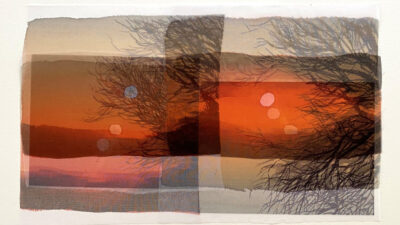
Read Troubling the Archive A layered abstract image features silhouettes of tree branches against a vibrant orange and red sunset with reflected light spots and overlapping textures.

Troubling the Archive

When Fray Francisco Atanasio Domínguez traveled from Mexico City to the far frontier of New Mexico in 1776 on behalf of the Church and the Spanish Crown, he was on a record-keeping mission. As Estevan Rael-Gálvez writes in his article about reckoning with the 250th anniversary of U.S. independence, Domínguez also documented the state of the written archive in this place far removed from the small, new U.S.

Categories: Editor's Letter

Read Cruising the Mother Road Six vintage covers of Bob Damron’s address books from 1969, 1970, 1971, 1973, 1975, and 1976 shown in a grid arrangement.

Cruising the Mother Road

I found my first taste of freedom crisscrossing cornfields shadowed by windmills in rural Indiana in a hand-me-down Oldsmobile. Burnt CDs from friends and lovers made my small-town life feel cinematic. On the worn leather seats, I came out, I made out, I ran away, I came home, I made homes. Like many queer and trans people before me, I found freedom in the thrum of my tires on asphalt and gravel: safety in flight.

Categories: Essays and memoir, Featured, New Mexican cultures, New Mexican history, Southwestern history, Staff favorites

Read A Question of Power

A Question of Power

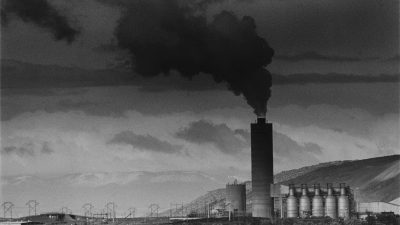
The power of protest suffused the smoky air in Window Rock, Arizona. It was January 2007. Diné men wearing respirators held signs that read “Defend your right to clean air.” Diné women held American flags and faced off against police with hands on their pistols. A large painted sign of a smoke-belching power plant loomed ominously in the background, while a Diné woman looked pleadingly to the skies with a nuclear power logo superimposed over her gas mask.

Categories: Indigenous arts and cultures

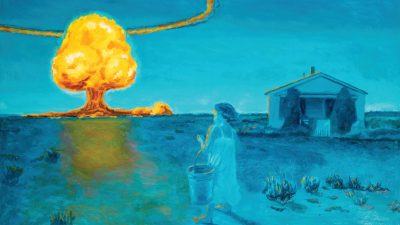
Read When Atomic Testimony Becomes Art A woman carrying a bucket stands outside a house, watching a large nuclear explosion with a mushroom cloud in the distance under a blue sky.

When Atomic Testimony Becomes Art

“Dear Journalist,” the letter starts. “You have been tasked with investigating recent deaths linked to alleged creature sightings in the Tularosa Basin area. It is speculated that these deaths have been occurring in Southern New Mexico ever since ‘the sun rose twice’ last year.”  These are the initial instructions for a 3D point-and-click video game called El Sol. I am instructed to embark on a journey to photograph “creatures” to help explain these mysterious deaths.

Categories: Featured, Landscape and environment, New Mexican cultures, New Mexican history, Southwestern history

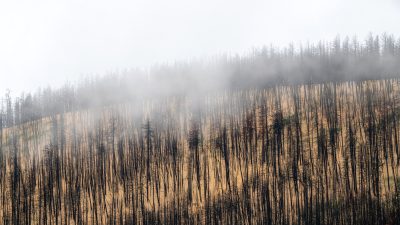
Read The Loss of the Commons: A Historic Context for the Hermit’s Peak/Calf Canyon Fire A hillside forest of scorched, leafless trees stands beneath a layer of mist, showing signs of recent wildfire damage.

The Loss of the Commons: A Historic Context for the Hermit’s Peak/Calf Canyon Fire

In April 2022, the largest and most destructive wildfire in New Mexico history, known as the Hermit’s Peak/Calf Canyon Fire, erupted in the Santa Fe National Forest.The wildfire originated from two U.S. Forest Service prescribed burns that escaped control in the Pecos/Las Vegas Ranger District. The combined fire spread down the east side of the Sangre de Cristo Mountains into nearby communities in Mora and San Miguel Counties.

Categories: Farming and ranching, Featured, Landscape and environment, New Mexican history, Southwestern history, Staff favorites

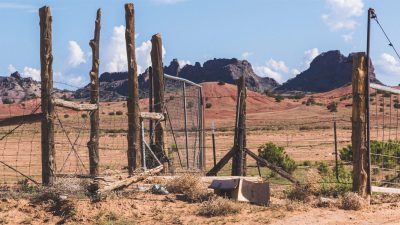
Read Remembering as Resistance A rustic wooden and metal gate stands open in a wire fence, with rocky hills and sparse vegetation in the background under a blue sky.

Remembering as Resistance

My mother was adopted through the Indian Adoption Project, a federal program that ran from 1958 to 1967 and was designed to assimilate Native children by placing them with white families. Unexpectedly, she was adopted by my Navajo and Choctaw grandparents. Both had their separate experiences of assimilation as children through the Indian Boarding School policy. In 1964, their work with the Bureau of Indian Affairs moved our family from the Navajo Nation to Los Angeles under the Indian Relocation Act.

Categories: Essays and memoir, Framework, Indigenous arts and cultures, Landscape and environment, New Mexican history, Southwestern history

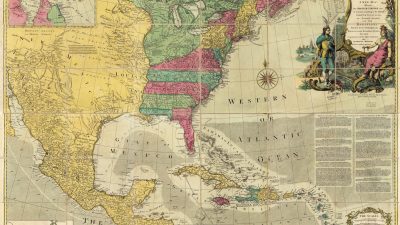
Read Reckoning with 1776 18th-century map of North America showing territories, geographical features, and colonial claims, with a decorative cartouche in the upper right corner.

Reckoning with 1776

It is known today as New Mexico, a place where time is recognized as “immemorial.” Here, the footprints of people in motion, likely left 23,000 years ago, remain impressed upon the land. We honor breath and recognize the living presence of people whose complex identities have formed across generations. We speak and listen to a multitude of languages, stories, and prayers.

Categories: Featured, New Mexican history, Southwestern history, Staff favorites