

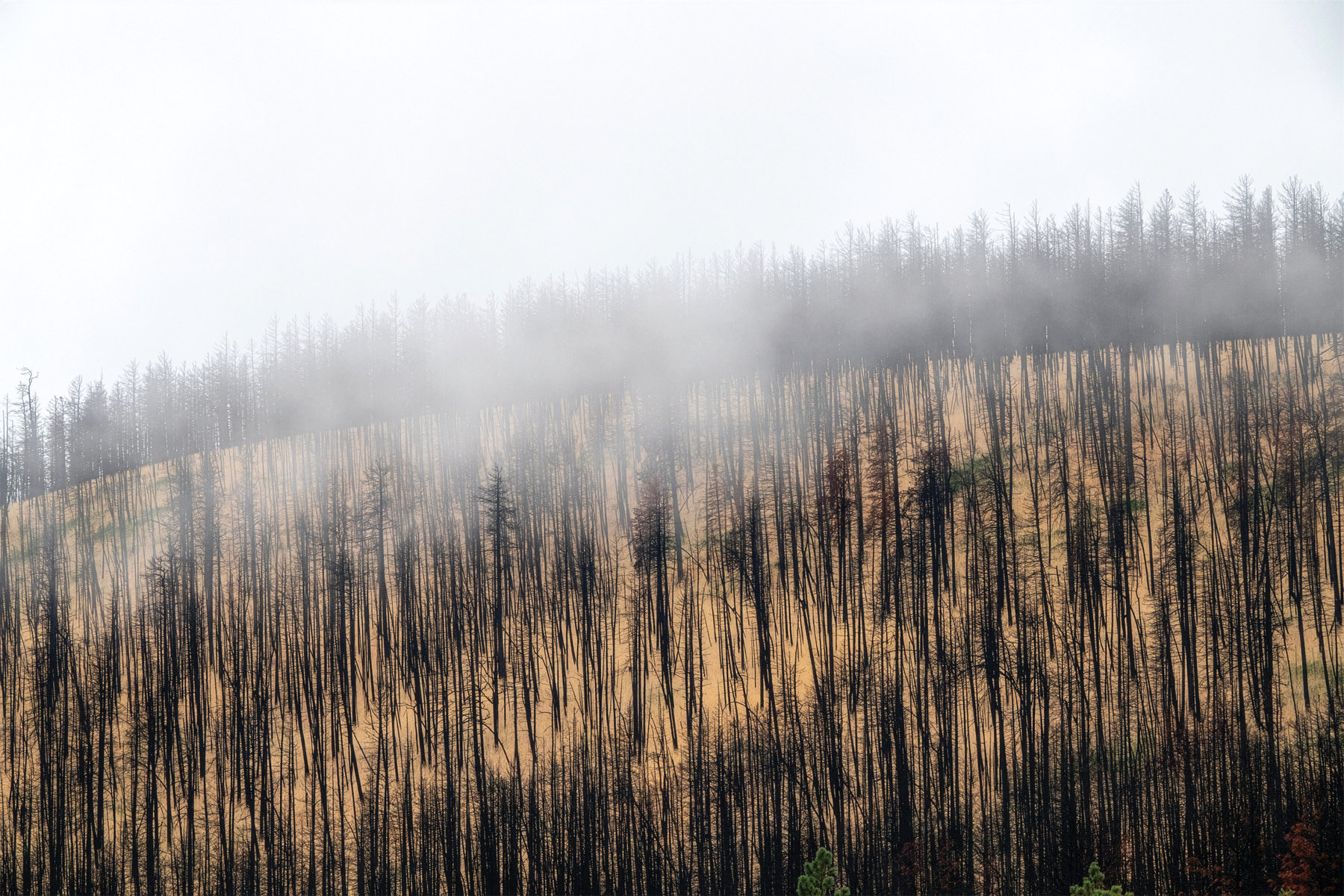
In April 2022, the largest and most destructive wildfire in New Mexico history, known as the Hermit’s Peak/Calf Canyon Fire, erupted in the Santa Fe National Forest.The wildfire originated from two U.S. Forest Service prescribed burns that escaped control in the Pecos/Las Vegas Ranger District. The combined fire spread down the east side of the Sangre de Cristo Mountains into nearby communities in Mora and San Miguel Counties. Over a five-month period, it burned 341,725 acres, or more than five hundred square miles, destroyed around one thousand structures, and forced the evacuation of 15,000 people. The wildfire overlapped with record-breaking monsoon rains, which led to flooding of the burn scar, debris entering the river system, and the contamination of water supplies. The City of Las Vegas and the surrounding communities are still struggling to recover from the disaster.
Forest Service missteps, coupled with the Megadrought (the driest conditions in the U.S. Southwest in 1,200 years), have received the brunt of blame for the catastrophe. But the Hermit’s Peak/Calf Canyon Fire is connected to a broader story of cultural uses of the land, conflict over land rights, and ecological change that spans hundreds of years. The wildfire started on what was once the communal lands of land grant communities established in the late eighteenth century. Members worked together for a variety of purposes—growing crops, grazing livestock, harvesting timber, hunting, fishing, and foraging—that encompassed sustainable land use. These practices, in turn, were connected to principles of reciprocity, mutual aid, and self-government, called mutualismo, that remain important to these communities. Mutualismo serves as an organizing system of values that defines a communal connection to the land.
Over the past 175 years, these communities have gradually lost their common lands to land speculators, cattle ranchers, and ultimately, the U.S. government. The seizure and partition of these lands not only represents an immense cultural and material loss for these communities, but has also facilitated new types of land use that have led to ecological change. Beginning in the late nineteenth century, cattle overgrazing damaged grasses and increased the density of the forests. In the twentieth century, federal land management agencies imposed fire suppression tactics that disrupted the natural fire regime and allowed a huge buildup of flammable debris. The story of land loss among the land grant communities and the rise of super fires are crucial to understanding the ecological challenges facing New Mexico today.
Land Grant Communities and Mutualismo, 1786–1835
On February 25, 1786, Governor Juan Bautista de Anza stood in front of the Palace of the Governors awaiting Ecueracapa, the capitán general of the Western Comanche. A crowd of his diverse subjects—Spaniards, Pueblo, and Genízaros—filled the central plaza. For roughly fifty years, the people of New Mexico had engaged in a brutal conflict with Comanche. Combatants from both sides had destroyed one another’s settlements, killed and captured hundreds of people, and plundered livestock. On this day, however, New Mexicans welcomed the Comanche leader. The crowd roared when he arrived in the plaza, flanked by three of his chief lieutenants and escorted by a column of Spanish soldiers and Santa Fe’s leading citizens. Ecueracapa approached De Anza and the two men embraced, signaling peace and friendship between their peoples.
Ecology and land use shaped this new alliance. The people of New Mexico congregated near mountains and valleys. They took advantage of the way mountains captured upper-atmosphere moisture and channeled the resulting precipitation into fertile river valleys below. This landscape enabled the region’s inhabitants to farm and raise livestock, namely sheep. To the east, the Comanche dominated the grasslands of the southern Great Plains. They eschewed agriculture and most forms of gathering and instead embraced bison hunting and horse breeding. This mobile lifestyle gave them a strategic advantage over other Plains tribes. But it also created vulnerabilities. A bison-based diet made Comanche susceptible to protein poisoning. New Mexicans, who produced a rich variety of agricultural goods such as maize, beans, and chile, could supplement the Comanche’s diet.
Thus, in 1786, the new allies engaged in mutually beneficial trade. New Mexicans exchanged with the Comanche agricultural goods and wool products, such as textiles and blankets, in return for horses, bison skins, and Indigenous slaves. The burgeoning trade enabled Spanish expansion into the strategically vital region east of the Sangre de Cristo Mountains. This area offered fertile river valleys that adjoined the Great Plains and Comanchería.
Over the next half-century, Spanish and then Mexican officials issued land grants to encourage settlement in the regions that are today Mora and San Miguel Counties. A diverse group of settlers—Spanish citizens, pueblo people, and Genízaros—received the grants and established settlements at San Miguel del Bado (1794), Mora (1818), Tecolote (1824), and Las Vegas (1835).
The settlers used thousand-year-old Iberian practices to establish their communities. The land grant settlers of New Mexico received individual allotments of land, usually in river valleys, to build their houses, construct acequia systems, and farm. They also held in common with members of their community the surrounding forests and grasslands. While settlers were free to sell their individual allotments, the community owned the common lands collectively and they could not be sold.
Management of common lands and acequias shaped the ideals of the land grant communities. The settlers grew crops, raised sheep, hunted wild game, fished, harvested timber, and foraged herbs. They elected officers, including the mayordomo, to oversee the maintenance of the acequias and equitably distribute water among parciantes. Allocation of water, called repartimiento, was based on local agreements within the community. The underwriting principle was that all living things—people, animals, and plants—required water in times of both plenty and scarcity. These ideals of local self-government, reciprocity, mutual protection, and ecological sustainability became known as mutualismo.
The tenets of mutualismo unified the ethnically and culturally diverse land grant settlers. Civic or community-based identity tied to land, residence, and belonging began to supersede caste identities. In place of Spaniard, Mestizo, Indio, and Genízaro, the settlers began to call themselves vecinos. The sense of community was not only rooted among the settlers themselves, but also their relationship to the land.
Wars and Rebellions, 1836–1860
Once established, the land grant communities in what are now Mora and San Miguel Counties engaged in a series of conflicts to protect their communities and practices of mutualismo. In 1837, they joined other New Mexican communities in rebelling against the Mexican national government, which sought to restrict local political autonomy and increase taxes. The new measures were an affront to local principles of self-government and threatened to disrupt trade with the Comanche. Although the rebellion collapsed the following year, the rebels gained lasting concessions. The Mexican government restored a measure of self-government to New Mexicans and exempted them from federal taxes for the next seven years. Local autonomy and the Comanche alliance remained intact.
In 1841, the newly formed Republic of Texas launched an expedition to “liberate” New Mexico. The people of New Mexico, however, were uninterested in joining the Lonestar Republic. A mixed force of local militiamen and Mexican soldiers captured the Texans and dispatched the prisoners to Mexico City. The Texas government thereafter commissioned privateers to raid Mexican caravans on the Santa Fe Trail. In 1843, Texan freebooters raided the Mora Valley, attempting to steal livestock and take women and children captive. Local militiamen, however, intercepted the raiders, disarmed them, and sent them back to Texas on foot. New Mexicans retaliated by supporting—and often participating in—Comanche raids into Texas throughout the mid-1840s.
The conflict with Texas finally came to an end with the outbreak of the U.S.-Mexico War in 1846. Texas joined the United States and disavowed claims to New Mexico in 1850. The U.S. Army of the West, in turn, occupied New Mexico and initially faced little local resistance. The presence of U.S. troops, looming annexation, and fear that the U.S. government would not recognize their land titles, however, led to growing discontent among land grant communities that finally boiled over in early 1847. Echoing the Rio Arriba Rebellion a decade earlier, rebels launched an uprising in Taos, killing the newly appointed Governor Charles Bent and several other authorities.
The residents of Mora joined the rebellion and initially routed a force of U.S. soldiers. A larger U.S. force, however, returned a week later and burned the village of Mora to the ground. Nevertheless, a group of rebels under Manuel Cortez escaped and continued to wage guerrilla warfare against the U.S. government.
The U.S. government responded to the Taos Revolt by constructing a ring of forts across the territory. The largest, Fort Union, was located near Las Vegas. The U.S. military used the forts to prevent further uprisings within New Mexico and to impede surrounding tribes from entering the region. In effect, they cleaved the land grant communities of present-day Mora and San Miguel counties from the Comanche.
U.S. expansion into New Mexico coincided with the ecological crisis among the Comanche. By the late 1840s, a combination of overhunting and overexpansion of horse herds, which competed with bison for grass, led to a collapse of the bison population in the southern Great Plains. By the early 1850s, the Comanche experienced famine, their trade networks unraveled, and their power foundered. In 1853, the Comanche violently clashed with New Mexicans over hunting rights on Llano Estacado, bringing the alliance between the two groups effectively to an end.
The land grant communities absorbed the political and economic shock of Comanche collapse. They replaced Comanche trade by shifting to supply the newly established U.S. military forts. They began to grow wheat and raise cattle to satisfy the military’s demand for flour and beef. These new products, however, did not eclipse the community’s ecological practices, but rather became integrated within them. The communities maintained a careful balance of production and sustainable land use. Mutualismo thus remained a core principle and source of resilience among the land grant communities.
The U.S. judicial system, however, emerged as an existential threat to the land grant communities. In 1848, Congress removed Article 10 of the Treaty of Guadalupe Hidalgo before ratifying the document. This clause based the validity of Spanish and Mexican land grants on Mexican law. Without a standard to test of the validity of land grants, Congress and the courts were free to make up their own rules in adjudicating claims in New Mexico.
The new system took shape with the establishment of the Office of Surveyor General of New Mexico in 1854. The congressionally appointed surveyor general was empowered to determine federal public lands and boundaries of land grants. But this system often worked against land grant communities. First, the regulations of land grants, including boundaries, were based on customary law as much as written law. Boundaries, for example, were often determined by agreements among local communities rather than courts. Second, the land grant communities did not understand the U.S. system of land ownership and lacked the resources to defend their claims in court. Finally, their lawyers often became land speculators themselves. The unscrupulous law practitioners routinely demanded portions of communities’ common lands as payment for their services—typically one-third undivided interest in the common lands, which amounted to thousands of acres. The net result was that land grant communities ended up losing roughly 95 percent of their land over the next fifty years. Their land loss led to the introduction of new, less sustainable land use practices that would reshape the ecology of New Mexico.
The Civil War, Texas Cattle Ranchers, and Las Gorras Blancas, 1861–1900
The onset of the Civil War in 1861 unleashed ecological change in New Mexico. During the summer of 1861, Confederate Texans occupied southern New Mexico and then invaded Union-aligned Northern New Mexico in early 1862. New Mexicans from across the territory, including those from present-day Mora and San Miguel counties, rallied to protect their communities. They joined the New Mexico Volunteers, a local military force raised to defend against the Confederate invasion composed primarily of Hispanic and pueblo people. They fought at the Battle of Valverde and then served as scouts at the pivotal Union victory at Glorieta Pass, which forced Confederate Texans to retreat from New Mexico during the spring of 1862.
In the wake of the Texans’ defeat, U.S. military officials tasked the New Mexico Volunteers with spearheading campaigns against the Mescalero Apache and Navajo. Between 1862 and 1865, New Mexican troops captured nearly ten thousand members of these tribes and forced them onto the Bosque Redondo Reservation near Fort Sumner. This forced march to Bosque Redondo became known among its victims as the Long Walk.
Indigenous internment proved to be a humanitarian and economic disaster. The imprisonment of what amounted to 10 percent of the territory’s population strained the local food supply. To make matters worse, New Mexico suffered from a series of droughts and blights that damaged crop and livestock production from 1863 to 1865. The net result was a lack of food and skyrocketing prices. At Bosque Redondo, the Navajo and Mescalero Apache starved. Roughly one third of the prisoners perished.
Desperate to solve the food crisis they had created, U.S. military officials dispatched a small force into West Texas in the fall of 1865 to purchase cattle. Word of the market in New Mexico spread across Texas. In 1866, ranchers Charles Goodnight and Oliver Loving drove several thousand head of cattle from central Texas into New Mexico. They followed the Pecos River and sold the livestock at military forts and Bosque Redondo.
The establishment of the Goodnight-Loving Trail led to an influx of cattle ranchers into New Mexico. By the early 1870s, they occupied much of the grasslands of eastern New Mexico and their herds numbered nearly a hundred thousand head. The cattle ranchers and their herds replaced the Comanche and the bison. Over the next decade, the herds swelled to up to a million head of cattle ranging across nearly two million acres of land. Texas cattle ranchers undercut local producers and, with the help of Anglo speculators and lawyers, moved to seize control of common lands. Range wars broke out as Texan ranchers and Hispanic communities fought for control of both land and water rights.
Whereas the land grant communities sought to maintain an ecological balance, Texans introduced monoculture practices that exploited the landscape to prioritize cattle production. Swarms of cattle consumed native grasses, which altered New Mexico’s diverse landscape. In the Llano Estacado, weeds and invasive plants replaced native grasses, transforming formerly lush grassland into marginal grassland or even desert. At higher altitudes, the removal of grass enabled tree saplings to spread. Piñon and juniper woodlands at medium elevations and ponderosa pine forests in the mountains began to increase in density. The changes eventually made the landscape more prone to high intensity fires. The loss of grass also caused erosion. Grass-covered banks gave way to deep-cut arroyos and water-washed gullies, which contributed to flash flooding.
Las Vegas became the epicenter of conflict over land. In 1879, the Atchison, Topeka, and Santa Fe Railroad arrived. Ranchers and merchants were able to ship cattle by rail to the great slaughter pens in Chicago, which in turn provided beef to the major East Coast markets. Thousands of Anglo migrants relocated to Las Vegas to take advantage of this economic bonanza. They congregated near the railroad in East Las Vegas.
Hispanics in West Las Vegas, the location of the original land grant settlement, faced economic headwinds that threatened mutualismo. Anglo ranchers and land speculators began to encroach and fence off communal lands. They leveraged superior resources, namely capital and lawyers, to gain control of the common lands.
The people of West Las Vegas and other nearby communities fought back. In 1889, Juan José Herrera, who had served as captain in the New Mexico Volunteers during the Civil War, and his brothers Pablo and Nicanor, formed a vigilante group called Las Gorras Blancas (The White Hats). They launched nighttime raids to destroy barbed wire fences and tear up railroad tracks. Law enforcement attempted to arrest alleged members of the group, but widespread protests in Las Vegas forced officials to drop all charges and release the prisoners.
In 1890, the Herrera brothers established a new political party called El Partido del Pueblo Unido (The United People’s Party) promising to raise wages and protect communal lands. The party won overwhelming local support. In the 1890 elections, the party swept every elected position in San Miguel County. Four candidates, including Pablo Herrera, won seats in the Territorial Assembly. But land speculators and their supporters stymied the efforts of these reformers. Herrera resigned in disgust from the Territorial Assembly in 1891, declaring that “there is more honesty in the halls of the territorial prison than in the halls of the legislature.” Law enforcement subsequently shot and killed him when he returned to Las Vegas. In the wake of Herrera’s death, the political activism that had given birth to Las Gorras Blancas and El Partido del Pueblo Unido fell apart.
The U.S. government also thwarted local efforts to protect land grants. The Mora Land Grant, confirmed by Congress in 1860 at nearly 850,000 acres, soon fell prey to predatory land speculators and government officials. Their partition of the grant converted common land to private, completing a process of privatization that plagued the grant for more than half a century after its establishment. These nefarious actions led to a new process that worked against the land grant claimants. The intent of the federal government was not to protect the interests of the land grant communities, but the interests of the United States.
In 1891, Congress established the Court of Private Land Claims to oversee land claims in New Mexico. In the ensuing years, the new court made a series of rulings against land grant communities, which led to the loss of millions of acres of communal lands. The cases climaxed with the United States v. Sandoval decision in 1897. Judges ruled that land grant communities did not own common lands but rather held them at the will of the sovereign, which was Spain, Mexico, and then the United States. They decreed that it was now the will of the U.S. government to seize the communal lands of many land grant communities, including San Miguel del Bado. The common lands of Las Vegas, in turn, were eventually privatized, partitioned, and fell under the control of wealthy, predominately Anglo business interests who introduced monoculture.
National Forests and Fire Suppression, 1900–2022
In 1905, Congress established the U.S. Forest Service and transferred significant portions of federal land in New Mexico to its control. Over the next fifteen years, many of the common lands seized from land grant communities became elements of the Carson, Cibola, and Santa Fe National Forests. The former common lands of the San Miguel del Bado became the Pecos/Las Vegas Ranger District of the Santa Fe National Forest, which purchased and incorporated more than 55,000 acres of the Mora Land Grant from the 1930s through the 1960s.
The loss of land was devastating to the land grant communities. They lost access to mountainous forests that they had used to harvest timber, graze livestock during the summer, hunt, fish, and gather herbs. Without the land to sustain them, the communities experienced outmigration. The migrants, known as manitos, traveled to Wyoming, Colorado, and other parts of the West to work as miners, sheepherders, loggers, sawmill operators, and crop harvesters. Although land grant communities survived, the practice of mutualismo contracted.
The region’s economic decline accelerated with the onset of the Great Depression. By the early 1930s, agricultural, mining, and ranching industries declined by over 50 percent. The Atchison, Topeka, and Santa Fe Railroad, the state’s largest private employer, laid off most of its employees. In 1930, a brutal drought began that lasted the next eight years, devastating the agricultural industry. At the height of the economic crisis, nearly half the working population in New Mexico was unemployed. Las Vegas ceased to be a major commercial center.
The transfer of land ownership from communities to private hands altered relationships with the land. The Forest Service, drawing on Progressive Era principles that emphasized efficiency, sought to manage forests to harvest timber for commercial use. Fire, according to the service’s belief at the time, was a threat to the health of the forests and the logging industry. In 1935, the U.S. Forest Service codified fire suppression by establishing the so-called 10 a.m. policy, which mandated the suppression of every fire by 10 a.m. the day following its initial outbreak. Other federal land management agencies soon adopted similar measures and fire suppression became a major federal policy until the 1970s. The suppression of fires, however, disrupted the existing fire regime. Low- and medium-intensity fires, which are generally beneficial to the health of the forests, ceased. The forests became denser and experienced a buildup of debris that would normally be recycled into the environment through low-intensity, frequent fires. This buildup of fuels later contributed to the increased power of wildfires.
The federal government attempted to channel assistance to the land grant communities to bind them to the new timber harvesting regime. In 1944, Congress passed the Sustained-Yield Forest Management Act to bolster forest industries among rural communities, including those in Northern New Mexico. The Forest Service and local communities struck agreements to harvest set amounts of timber and produce logs, ties, and other forest products.
Despite repeated attempts over the next several decades, the program never took off. Local communities had suffered economic decline for generations and lacked the capital to build the requisite sawmills and manufacturing facilities. At the same time, federal officials repeatedly raised the annual timber cut quotas beyond the capabilities of local communities. As a result, the Forest Service turned to outside companies who hired outside workers to produce the allotted goods. Local communities with historic ties to the forests saw little benefit.
Frustrations with the federal government erupted in the 1960s. In 1963, Civil Rights activist Reies Lopéz Tijerina established La Alianza Federal de Las Mercedes (The Federal Land Grant Alliance) to advocate for the historic claims of New Mexico’s land grant communities. Within two years, the organization had over six thousand members from rural communities across Northern New Mexico. The group fused nonviolent protests and vigilante justice. In 1966, La Alianza members occupied the Echo Amphitheater in Carson National Forest, which was formerly part of the San Joaquín del Río de Chama land grant. The following year, Alianza members raided the local courthouse in Tierra Amarilla and attempted a citizen’s arrest of the county’s district attorney. The organization remained active until 1979.
La Alianza shocked federal officials. In the wake of the Tierra Amarilla courthouse raid, Secretary of Agriculture Orville Freeman recognized that the Forest Service need to make “a stronger effort to work in rural development and poverty programs to help Mexican-American people.” In 1972, New Mexico Regional Forester William D. Hurst directed the Forest Service to evaluate how the agency could better serve the needs of rural communities. His staff determined that the Forest Service should recognize Hispanic and Indigenous cultural practices as “resources” in the same manner as timber harvesting and conservation. But the Forest Service never received adequate funding to institutionalize efforts to build connections with New Mexican communities and the proposed ethos that valued local knowledge never took hold.
At this point, the ecological changes wrought from overgrazing, fire suppression, and the dislocation of communities from their traditional lands were becoming clear. Major fire years occurred throughout the 1970s, culminating with the massive La Mesa Fire in 1978 that swept through Bandelier National Monument and part of Los Alamos National Laboratory. The fires marked the beginning of a new era of high-intensity super fires that sterilized portions of the landscape in their wake. The Forest Service responded by introducing prescribed burns and working to reestablish natural fire cycles that had been disrupted decades earlier
In the 1980s, the environmental movement began to reshape the federal government’s management of New Mexico’s forests. In 1980, the passage of the New Mexico Wilderness Act expanded wilderness areas in the state’s national forests. Ostensibly designed to preserve environmentally “unspoiled” areas, the act shifted land management efforts from timber harvesting to managing the natural value of the landscape. But the act failed to consider and incorporate the historic connections of land grants and Indigenous communities and restricted access to and use of these wilderness areas. Nearly 20 percent of the Santa Fe National Forest became designated wilderness, blocking all human activities other than recreation. Embodying the disconnect from local communities, the Forest Service established a management plan for the Santa Fe National Forest in 1987 that made no mention of the land grant communities.
In 1993, U.S. Fish and Wildlife Service listed the Mexican Spotted Owl as a threatened species. Environmental groups, many of which were based outside of New Mexico, filed suit against the Forest Service for failure to protect the owl. Despite few confirmed sightings of the Mexican Spotted Owl, federal judges in the U.S. District Court for the District of Arizona ruled in the environmentalists’ favor. They imposed an injunction against logging, firewood gathering, and wood product collecting in confirmed Owl Protected Activity Centers in national forests across Arizona and New Mexico. The ruling severely reduced Northern New Mexican communities’ access to the firewood they relied on during the winter. In November 1995, outraged Northern New Mexicans marched on Santa Fe in protest and hanged environmental leaders in effigy.
Frustration with the federal government led to a new generation of political activism among land grant communities. In the late 1980s, local acequia associations began to form across Northern New Mexico. Their efforts culminated in 1990 with the establishment of the New Mexico Acequia Association. During the 2000s, activists founded two new statewide organizations to promote the interests of land grant communities. In 2006, land grant organizations across the state established a new statewide grassroots organization, New Mexico Land Grant Consejo. In 2009, the state legislature created the New Mexico Land Grants Council. These groups provide educational, technical, and legal assistance to promote traditional and sustainable land use practices within New Mexico.
This traditional land use revival in New Mexico occurred with the onset of a severe, twenty-plus year drought known as the Megadrought. The Megadrought has overlapped with changes to the forests, largely due to overgrazing and fire suppression policies, that have left them significantly denser. What were once open and park-like forests with roughly one hundred trees per acre now have up to several thousand trees per acre. The Cerro Grande Fire, which burned 42,000 acres and 250 homes in Los Alamos in 2000, marked the beginning of fires that are unprecedented in scale, destructiveness, and number. Since then, there have been over one thousand wildfires that have burned one hundred acres or more, impacting nearly every region in New Mexico.
The outbreak of the 2022 Hermit’s Peak/Calf Canyon Fire marked the culmination of forces stretching back nearly 250 years. The dislocation of land grant communities from their communal lands disrupted practices rooted in mutualismo and ended a stable fire regime. Federal land management policies, compounded by the Megadrought, contributed to ecological changes that created more fire-prone landscapes. The fact that the U.S. Forest Service felt compelled to implement prescribed burns during historically unprecedented high winds in order to preempt the Mexican Spotted Owl’s nesting season highlights the disconnect with local communities that know to never burn in unpredictable windy spring weather. For the affected communities, the wildfire originating on their historically-held lands was the product of a broader history of government discrimination, material loss, and cultural marginalization.
Mutualismo, and Reining in Wildfires
Wildfires are an inescapable and natural element of New Mexico’s ecology. Low- and medium-intensity fires are beneficial for the landscape. But today’s high-intensity wildfires are a destructive aberration. The Hermit’s Peak/Calf Canyon Fire was so intense that it vaporized all living organisms in portions of the Santa Fe National Forest, effectively transforming some areas into moonscapes. It will likely take at least ten years for the reestablishment of vegetation in the worst hit areas of the burn scar. In the meantime, the water that once sustained local communities has now become a threat. Without vegetation to absorb it, the water crashes down the mountainsides, mixing with ash and other debris, and forms a destructive mudflow. This mudflow has damaged or destroyed acequias in Mora and San Miguel Counties and polluted the local water supply, most notably in Las Vegas.
Addressing the consequences of the Hermit’s Peak/Calf Canyon Fire while mitigating future wildfires is an immense challenge that will require creative forms of ecological engineering. As part of this endeavor, the Forest Service has made tentative steps toward reconciliation with the communities of Mora and San Miguel Counties. The recently updated Santa Fe National Forest Management Plan acknowledges pueblos and land grant communities, their historic ties to the land, and the importance of their interaction with the land to maintain their cultural practices. It also pledges Forest Service collaboration with local communities to provide firewood, restore wetlands and riparian areas, and foster sustainable livestock practices, among other activities. The new plans incorporate tacit acknowledgement that traditional cultural knowledge is an important element of land management—but the success of this arrangement rests on adequate funding and support within the Forest Service.
While land grant communities are unlikely to gain control over most of their former common lands, their story demonstrates that ecology and culture are intimately linked in New Mexico. Mutualismo offers environmental practices that emphasize the holistic and sustainable uses of commonly held land. Its practices are guided by place-based knowledge that prizes not only the land’s resources, but also its cultural value. Returning to this way of life and model of stewardship is essential for cultural and material revival as well as mitigating future catastrophic wildfires.
This article was written in consultation with the New Mexico Land Grant Council, a state agency created in 2009, that provides advice, assistance, technical support, and liaison services to land grant communities that are organized as political subdivisions of New Mexico. Its five councilors are appointed by the governor. Click here for more information.