
“Dear Journalist,” the letter starts. “You have been tasked with investigating recent deaths linked to alleged creature sightings in the Tularosa Basin area. It is speculated that these deaths have been occurring in Southern New Mexico ever since ‘the sun rose twice’ last year.”
These are the initial instructions for a 3D point-and-click video game called El Sol. I am instructed to embark on a journey to photograph “creatures” to help explain these mysterious deaths. After reading the control instructions, I enter the game space. Unmistakable clicks of a Geiger counter come out of my speakers. I walk around the game space for quite a while wondering where these creatures are.
I am not a gamer, so every time I approach a piece of glassy, green Trinitite, I try to take a photo, thinking it will morph into a creature, but there are no surprises. Finally, I see something hiding behind a tree. As I approach, I hear a growl. I snap my photo, and a newspaper article from the fictitious Albuquerque Sun comes onto the screen: “We have our first ever captured photo of El Hombre Gordo, the grotesque humanoid who lurks in the Trinity area woods. No one knows exactly who or what this creature is, but he appears to have once been human.”
Now I’m hooked, and I’m determined to find all the supernatural creatures supposedly created by the Trinity test that are causing deaths in the region. El Sol (2024-25), created by MacKenzie Cordova, Katia Kasower, and Nicole Padilla (with assistance from Luke Cordova), is one of the art pieces featured in a new exhibition at the National Hispanic Cultural Center. Nuclear Past, Present, and Future: Art in Action, on view through January 24, 2027, is a collaboration between the NHCC and the Tularosa Basin Downwinders Consortium (TBDC). It captures the generational effects of the U.S. nuclear weapons project not only for Hispanic populations, but also for Indigenous communities and other people who have been impacted by nuclear technologies in the Southwest. This exhibition contains sixty-two artworks by thirty-two artists from across the world. A major theme in the exhibition is the Trinity test.
In 1945, scientists in Los Alamos, New Mexico—the site of Project Y of the United States’s secret Manhattan Project—developed and built the world’s first nuclear weapons. The uranium bomb, called Little Boy, and plutonium bomb known as Fat Man, were anthropomorphized, giving rise to the commonly used “cradle-to-grave” terminology used for the nuclear weapons industry that pervades New Mexico.
Although some locals who were hired as laborers atop the Pajarito Plateau knew about the clandestine community of scientists and military personnel, most New Mexicans were unaware of the operation. In July 1944, scientists were forced to switch direction in their weapons development when they learned that plutonium could not be used in the gun-type weapon design on which they had been working, and by August, the entire operation was focused on developing the new implosion design needed to use plutonium in a weapon. Within a year, scientists had created two weapons: a gun-type uranium bomb and an implosion-type plutonium bomb. The first plutonium bomb, called the Gadget, was dropped from a one-hundred-foot tower in the southern New Mexican desert on July 16, 1945. Residents living in the vicinity of the test were never warned or given the option to vacate their properties before the bomb was exploded, and even when fallout reached the levels that constituted evacuation, military personnel ignored them, choosing to maintain secrecy over safety. This procedural failure introduced a legacy of generational trauma for New Mexicans living downwind of the world’s first atomic weapon explosion.
Within a few years of the blast, people living within a fifty-mile radius of ground zero were dying of cancer. Today, fifth-generation downwinders are being diagnosed with radiogenic cancers and other illnesses linked to overexposure to ionizing radiation. On July 4, 2025, the United States Congress reauthorized the Radiation Exposure Compensation Act (RECA), which supports compensating downwinders, uranium workers, and on-site test participants who became sick or died because of U.S. nuclear weapons work.
RECA’s reauthorization now includes New Mexicans as downwinders for the first time since the law was passed in 1990, and creates a small window during which New Mexicans can apply for compensation for a select group of radiogenic cancers caused, presumably, by the Trinity test and other tests related to weapons development, specifically the Radioactive Lanthanum tests in Los Alamos. It also amends the cutoff date for uranium workers, which now allows people who worked in the uranium industry—predominantly Indigenous workers across the Navajo Nation and from Laguna and Acoma Pueblos—to qualify for compensation.
Today, plutonium pits for new nuclear weapons are being produced exclusively at Los Alamos National Laboratory (LANL). New Mexico remains the center of the U.S. nuclear weapons complex, hosting two of the Department of Energy’s three nuclear weapons laboratories: LANL and Sandia National Laboratories. This past, present, and future of nuclear weapons, and the generational effects of an industry that has existed in New Mexico since its inception, has inspired artists to create artworks that invite viewers to have sometimes-difficult conversations about the eighty-year history of nuclear weapons.
Art as Activism
In summer 2023, TBDC steering committee member Mary Martinez White curated the art exhibition Trinity: Legacies of Nuclear Testing—A People’s Perspective with the Branigan Cultural Center in Las Cruces, New Mexico. The Branigan show focused on the direct consequences of the Trinity test on the people of the Tularosa Basin. The response to the show demonstrated the power of art to inform and impact both people and policy. Jadira Gurulé, head curator and program manager for the Art Museum and Visual Arts program at NHCC, worked with the TBDC to create an exhibition that reflected nuclear New Mexico beyond the effects of the Trinity test. Together with other TBDC steering committee members, Joanna Keane Lopez and Alicia Romero, the four women juried the new show.
The TBDC’s grassroots and humanist approach to discussing nuclear-impacted communities has helped correct the historical record regarding nuclear weapons development by demonstrating that areas typically described as “uninhabited” were occupied and that people were harmed. Art has the power to document those facts and to supplant institutional histories with testimonies of and by the people who are witness to the effects of nuclear development. An increase in exhibitions around the country focused on nuclear issues might be seen as a second coming of the “Make Art, Not War” era. Many of the artists in NHCC’s show also have personal ties to its subject matter, and some come from frontline communities.
After more than eighty years of providing jobs for New Mexicans, the nuclear industry has created a conundrum that some might mistake for querencia: a love of home, of the place where one feels safe. By providing job security in our homeland, the nuclear industry has enabled New Mexicans to get “good” jobs by working for the national laboratories or their contractors. But, as Rudolfo Anaya asks, “What happens when two cultures meet, each with its own sensibility of querencia?” This has created a clash of cultures and forced many people into a split subjectivity, which is evident in many of the artworks in the exhibition.
Split Subjectivities: Navigating Family Traditions and Familiar Stories
Jacobo (Jake) Ortega Trujillo was a skilled weaver from Chimayó, New Mexico, and worked in Los Alamos during the Manhattan Project. In 1945, he created a rug with a representation of the atomic bomb at the center for Leslie Groves, who oversaw the military installation of the Manhattan Project in Los Alamos. Trujillo worked in Los Alamos as a property manager for the laboratory, and his son, Irvin, grew up and attended school there. Irvin once commented that he did not feel at home in either Los Alamos or Chimayó, saying, “In Chimayó, everyone spoke Spanish, so I clearly wasn’t one of them, but in Los Alamos my Spanish surname seemed foreign, so I wasn’t one of them either. I was stuck somewhere in the middle.”
Like his father, Irvin now braids artistry and Los Alamos labor into his tapestry “Mutally Assured Destruction.” In this black wool weaving, a broken arrow symbolizing nuclear weapons accidents, including radioactive contamination, appears over a bright red and yellow mushroom cloud. The text underneath the fiery cloud reads, “ONE BOMB IS TOO MANY,” followed by the year 2001 and “Por Don Edwardo de Los Alamos.” Don Edwardo is a reference to Ed Grothus (whose daughter, Barbara, also has work in the show), owner of the famous Black Hole surplus store in Los Alamos. Trujillo is a seventh-generation weaver whose weaving follows the Chimayó tradition popularized by the Ortega and Trujillo families of northern New Mexico. Trujillo earned degrees from Eastern New Mexico University and the University of New Mexico and returned to Los Alamos to work at the Lab. But working at the Lab was unsatisfying, and he moved off the hill to Chimayó, where he and his wife opened Centinela Traditional Arts.
Like the Trujillo family, MacKenzie Cordova comes from a family with strong ties to the Manhattan Project. At twenty-six, she is the youngest solo artist in the exhibition. Born in Albuquerque, MacKenzie spent much of her childhood living in New Mexico before moving to California with her family as a teenager. In her statement about “The Sun,” she writes, “The Sun is a tarot card representative of my family’s nuclear legacy. Many of my family members have had several different forms of cancer, and some did not survive. My grandfather, who had four completely different kinds of cancer, survived three of them. The last one took him from us. It was one of the most impactful moments of my life.”
The tarot card displays the St. Francis de Paula Catholic Church in Tularosa. In the background, ristras hang suspended from hummingbird skulls—a reminder of her grandfather, with whom she would sit in the garden as hummingbirds flittered around them. The church symbolizes community, family, and culture. “The Sun” is a euphemism for the atomic blast at the Trinity test, which many New Mexicans thought was the sun rising too early. When the sun finally rose at its normal time, people across the state proclaimed that the sun had risen twice that day. They were unaware that a nuclear test had occurred and knew nothing about the existence of an atomic bomb.
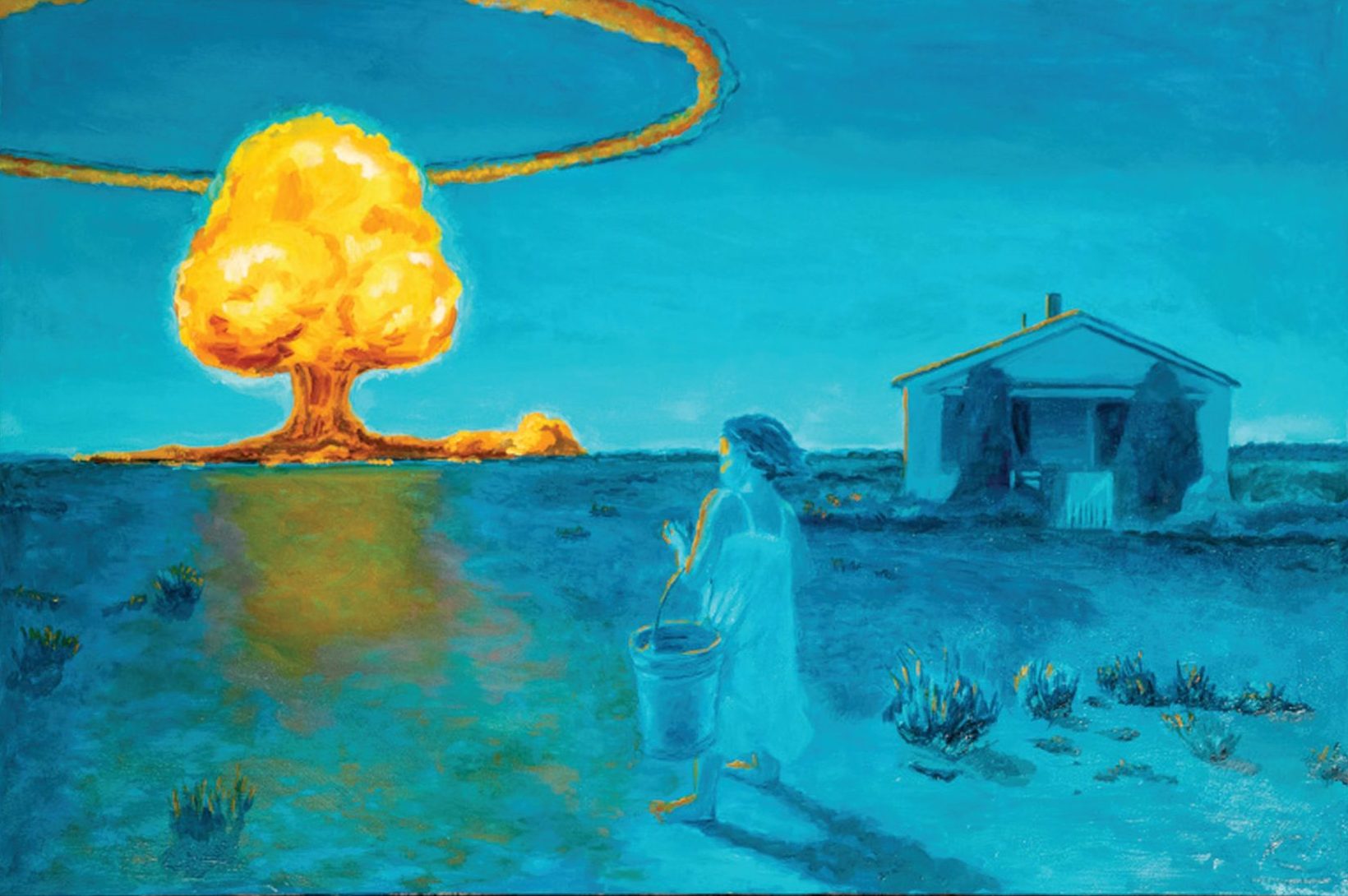
In his painting, “Morning Chores Interrupted” (2025), Aaron Richardson also ruminates on the light from the blast. This work alludes the clean clothes hung to dry on clotheslines only to be dirtied by ash that rained down in nearby communities after the Trinity test. “My grandmother was seven when scientists from Los Alamos tested the first atomic bomb fewer than twenty miles from her home in San Pedro, New Mexico,” writes Richardson in his artist statement. “Growing up in Socorro, I heard stories from family and witnesses about the day the sun rose twice. My goal was to illustrate what it must have been like for pre-dawn chores to be interrupted by the splitting of an atom.” Richardson juxtaposes the yellow light of the bomb with the blue light of the early dawn. A single home in the frame reminds viewers that while the area was not densely populated, it was inhabited.
When she was younger, MacKenzie and her brothers “would joke that we were all gonna die [of cancer].” In 2022, MacKenzie was diagnosed with metastatic PTC, or papillary thyroid carcinoma, at twenty-three years old while attending college. She is the fifth generation of people in her family to get cancer. Like other members of her extended community, Cordova believes that her cancer can be traced back to Trinity. “I think that the [Trinity test] definitely influenced a lot of the cancer in my family. My family is all from that area. They lived off the land. They drank the water, they farmed the crops, they did all those things.”
Land-based practices ground New Mexicans in their culture. Many people believe that fallout from Trinity contaminated acequias that were used to irrigate crops and feed families, poisoned domesticated animals and wild game that were used as meat, and tainted other lifeways, especially in the communities closest to the test site. This fallout from Trinity is depicted in Eric J. Garcia’s cochineal ink on paper (2023) titled “Game Over.” In it, Garcia depicts a video-game-style image of a mushroom cloud. In the top left is the outline of the state of New Mexico with an empty space in the shape of an “x” denoting the Trinity site and a radioactive fallout cloud seeping out of it. In the top right, an airplane drops a bomb with the year “1945” above it. The bomb’s point of contact creates an explosion that looks like a sunrise, with four rays emulating the lines of a Zia symbol that rise all the way up into a mushroom cloud that occupies most of the space on the artwork. Underneath the ominous cloud are the words “Game Over,” in an ’80s-style video game font. Garcia’s use of cochineal is a throwback to the traditional red pigment New Mexican weavers have historically used to dye wool.
Garcia’s family comes from the Estancia Valley. His parents were toddlers growing up in Torreon in 1945. Garcia’s father and three of his uncles have all survived prostate cancer, and another uncle succumbed to cancer. Garcia served in the U.S. military, and while stationed overseas his job was to guard nuclear missiles. Today, his work brings attention to the negative effects of militarism and the nuclear industrial complex, especially in communities like his parents’. This is evident in his longstanding political comic El Machete Illustrated: Cutting through the Bullsh…, where his artwork critiques the U.S. military, and more recently, nuclear weapons policies. His work reminds viewers that dropping a nuclear bomb is an act of war, and when a country drops a bomb on its own citizens, no one wins.
MacKenzie is TBDC co-founder Tina Cordova’s niece. Tina Cordova, an accidental activist and a thyroid cancer survivor, has led the grassroot efforts to bring attention to the negative health impacts on individuals and communities living downwind of the 1945 Trinity test. “[Tina’s] the oldest in the family. My dad is her youngest brother,” MacKenzie says. “Being around [Tina], I always knew from a young age about the effects. My dad used to work at the White Sands Missile Range. Tina had all the knowledge of the history, and my dad had all the knowledge of the sciences and the technical work that went on.” MacKenzie’s description of her split subjectivity is also a familiar narrative for New Mexicans, many of whom have made careers out of the industries created by the nuclear complex.
Like the Cordovas, another Tularosa Basin family’s generational trauma is captured in the exhibition. Sofie Hecht’s four photographs come from her ongoing archival project A Matter of When, which “follows the lead of family matriarchs who don’t rest until everything they believe sacred is well-maintained, until the bits and pieces of their family’s past are securely fastened into photo albums, inscribed into history books, told boisterously around the dinner table, and made immortal.” Specifically, the photograph “Scars” (2024) demonstrates the effects of a breast lumpectomy for downwinder Doris Walters. Both she and her sister Evelyn have survived breast cancer. Her sister Margaret died of uterine cancer. Their mother, Lucy Benavidez, was a twelve-year-old kid living in Tularosa when the atomic bomb exploded that fateful July day in 1945.
In another photo, “What Lies ahead for Her (2023),” Hecht captures Doris and her aunt, Josephine, watching the latter’s great granddaughter play. Josephine’s granddaughter died of leukemia. As part of the bigger body of work, Hecht says her art “explores the changes of landscapes, families, and bodies exposed to radiation, as well as the strength of community advocacy in the face of extractive energy industries.” Hecht is part of a generation of younger artists who are engaging in educating a broader audience about the impact of the Trinity test. When she arrived in New Mexico, she had never heard of the Trinity test. Now, her work with the Trinity Downwinders is the focus of her Master’s project at The University of New Mexico.
MacKenzie and her classmates created their browser-based video game, El Sol, as their capstone project for their BFAs in Animation/Illustration at San José State University to educate others about how New Mexicans have been affected by the Trinity bomb. Describing the game for a short article she authored for Ploughshares, MacKenzie writes, “I came up with the concept with hopes of creating an immersive and educational experience for the player, which I expect to be a person of my age.” The video game combines fabulations about folkloric characters with facts about the Trinity test to engage a younger audience in learning about this important history. El Sol creates a landscape set in 1946 where monsters have been created by overexposure to radiation from the nuclear weapons project. Of the title for the video game, she says, “I just wanted it to be in Spanish because I wanted it to be super clear that it was grounded in my Hispanic culture. And I wanted it to be grounded in Hispanic folklore.” MacKenzie and her team conducted research about the effects of Trinity, and the history of the Manhattan Project and the cultures of New Mexico, focusing on folktales from Hispanic communities.
In El Sol, the Owl, La Mala Hora, El Hombre Gordo, and El Chupacabra each have unique stories about how they became “creatures” relative to the Manhattan Project. The Owl is pregnant and serves as a speculative symbol for “the final moments on Earth before the bomb was tested, unleashing a new age on humanity as we entered a world with nuclear weaponry that had the power to end entire generations.” It is also an allusion to the rise in infant mortality in New Mexico after Trinity. MacKenzie worked on the illustrations for a creature named La Mala Hora, which she describes as “a centipede that grew larger than most buildings from the radiation the blast of the testing emitted, and her spine is fused with a glassy green substance named Trinitite. This substance, never known to have existed until after the explosion, was formed from the heat of the bomb melting the sand in the desert.” El Hombre Gordo, literally Fat Man, is a stand-in for the scientists who worked on developing and testing the bomb, some of whom also developed cancer. El Chupacabra represents the radioactive fallout that plagued livestock, crops, and cisterns full of water as a reimagining of why livestock fell ill and how farmers and their families who ate these sick cows became sick. While this embodied plague is entirely mythological, they build on a preexisting mythos of the New Mexican landscape. Despite the supernatural conditions and speculative nature of the characters, the goal of the game is to educate people about the facts of Trinity. At the end of the game, players are given resources for further reading and information about Trinity and affected communities.
MacKenzie’s art is Chicanafuturism, a term that derives from Afrofuturism and has been popularized by historian Catherine Ramírez. Chicanafuturism refers to cultural production by Chicanx people that combines science, technology, and cultural symbols to reveal, change, and sometimes create identity, technology, and the future. At its core, it redefines the human. Writing about New Mexican santera Marion C. Martínez’s artworks, made from computer parts discarded from the Los Alamos National Laboratory and purchased mostly from Ed Grothus’s Black Hole, Ramírez says survival is a key component of Chicanafuturism. Certainly, for MacKenzie, who battled cancer as she worked on El Sol, her survival was central to her artwork.
MacKenzie wants players to experience the horror of nuclear weaponry through every encounter with the creatures that haunt the Tularosa Basin in the video game. As each monster is captured by camera, information pops up on the screen teaching players about the Trinity test and its lasting impacts. “You really want to get the facts right, even when you’re telling a fictional story because the whole point is to bring people to the issue that not many people know about,” she says. In addition to this history, MacKenzie wants players to learn about her culture. “I hope that people can kind of see how important family is to Hispanic culture. Family ties a lot of things together, and it’s why the Trinity test is so devastating because it’s affected families for generations and it’s something that nobody can really control at this point.”
Desaquerenciados: Home Is Familiar,
Safety Is Questionable
As New Mexicans, we have become desaquerenciados in our nuclear homeland. On one hand, we feel safe and at home in our various corners of New Mexico, but on the other, we are now questioning our safety due to nuclear contamination and the ways that New Mexico is targeted for nuclear development. But the reality is that this nuclear past, present, and future is familiar and familial. What was once the ability to look away from the negative impact of nuclear history in New Mexico is no longer an option. This cultura atómica has evolved out of a lived reality, distorted family traditions, and a sense that cancer—like Cordova’s creatures—lurks in the darkness waiting to attack. Art has become a medium for teaching the general public a narrative about nuclear issues that is not told in mainstream museums, especially those funded by the nuclear industry itself. In this exhibition, the Trinity test is one of many nuclear issues with which artists engage.Some artworks in Nuclear Past, Present, and Future: Art in Action, like Trujillo’s textile, demonstrate the ways that nuclear history is embedded in our cultural practices. Others, like Hecht’s photographs, reflect the nuclear present, the physical and emotional scars that families live with daily. The video game scenarios of Cordova’s and Garcia’s artworks project a future, albeit fictionalized, that is predicated on New Mexican culture and atomic history. MacKenzie tells me that she does not want people to be jaded, because these topics can be depressing to think about and talk about. She says, “If these artists who are affected by these issues can put their voice into the world, then so can you.”
New Mexicans who have or had cancer and lived in New Mexico between September 1944 and November 1962 or worked in the uranium industry between January 1942 and December 1990 are eligible for compensation and should visit the U.S. Department of Justice’s RECA website here or the Tularosa Basin Downwinders Consortium’s website here to check eligibility for compensation and to apply for themselves or deceased family members. The deadline to file is December 31, 2027.