
Who Gets to Be a Saint?

By Jacks McNamara

What is love? What is holy? Inside ovals of radiance, two girls holding hands, nearly matching—white tank tops and jeans, narrow sliver of sun on their cheeks, their left arms. I want to know if they are lovers, sisters, or friends. Their bodies are frank and factual, their bodies are surely sexualized nearly everywhere they go, they are just at that age of turned-enough-toward-adulthood,turned-enough-toward-curves to no longer be entirely their own. Their faces give nothing away. I wonder what it is to be two teenagers in New Mexico. I wonder what they have seen, their gazes as direct as the sky itself, its blue matching their pants, color of cornflowers and baby boys, color of hope after winter and a blessed break from the spring winds.

I want to read the image as queer because I am queer, and I hunger for more representation. I hunger to belong. Forty-three and still hungering, a lifetime of wanting more. I wonder what these girls hunger for. In my imagination, they hunger for each other. In my imagination they hunger to be seen, the photographer’s exposure a vindication that they exist and deserve to be recorded. In my imagination the photograph precedes a moment, a moment when they fall into each other outside the camera’s reach, soft and laughing, ready to let go of the courage of standing so unflinchingly, of being witnessed as they are.

They are an image of romance and bravery. Refusing to hide. Unbowed by church or family. Insisting that two queer girls can be saints, standing inside their mandorlas, gently luminous, reminding us of Guadalupe herself, if Guadalupe had ripped jeans and a girlfriend, dignifying an old fence and an expanse of weedy gravel with the proud certainty of new love.
Jacks McNamara is a queer, trans, neurodivergent artist, writer, healer, organizer, and educator. Their visual art is informed by their parallel practice as a poet, and is deeply shaped by their experiences of synesthesia, their passion for plants, their astonishment at New Mexico landscapes, and their investigations of pre-Christian spirituality in ancestral European homelands. Mcnamara’s body of work explores themes of resilience, devotion, myth, magic, seasonal transformation, and the sheer wonder of the growing world. McNamara is a Lambda Literary Fellow with a BFA from the San Francisco Art Institute and attended the Aegean School for the Fine Arts in Greece. McNamara is the co-founder of The Icarus Project, co-author of Navigating the Space Between Brilliance and Madness, teaches The Big Queer Poetry Class, hosts the podcast So Many Wings, and writes regular columns for the Santa Fe Reporter.

Pico del Hierro-Villa  is a Queer Fronterizx who received their master’s at the University of New Mexico in Chicanx Studies.

Traversing the Memory Field

There are several threads running through the articles and essays in this issue of El Palacio, but as I edited the work, Diné poet Jake Skeets’s idea of the memory field kept returning to me. In his essay, Skeets writes that time and memory are not just cognitive, but physical. Just as the light we receive from the stars comes from the past, he argues, our memories are woven together with the land and within our bodies. Scars, for example, hold physical reminders of the past. The landscape holds the history of its formation and clues about what’s to come. Our memories, Skeets says, are very much tied to distinct places.

The “memory field” theme traverses the vast geographies present in this issue, from the Gila Wilderness to Las Vegas, New Mexico, not to mention the layered histories in this state that make it so complicated and beautiful. As Adele Oliveira writes in “Acequias de Santa Fe: Preserving What Remains,” the city’s loss of a once-vast irrigation system is all the more reason to hold onto the four acequias that remain. And as Hilario Romero tells Oliveira, when he walks the city looking for signs of old acequias, he always finds traces of them.

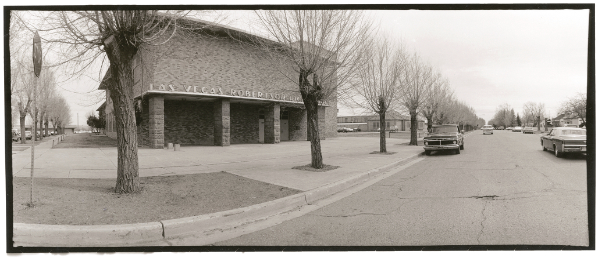
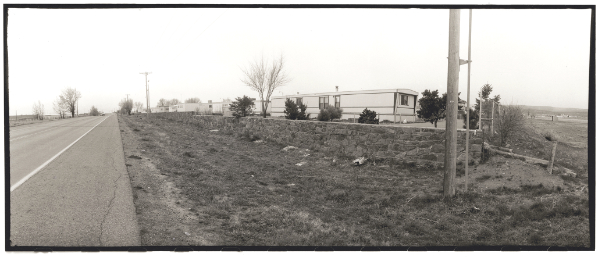
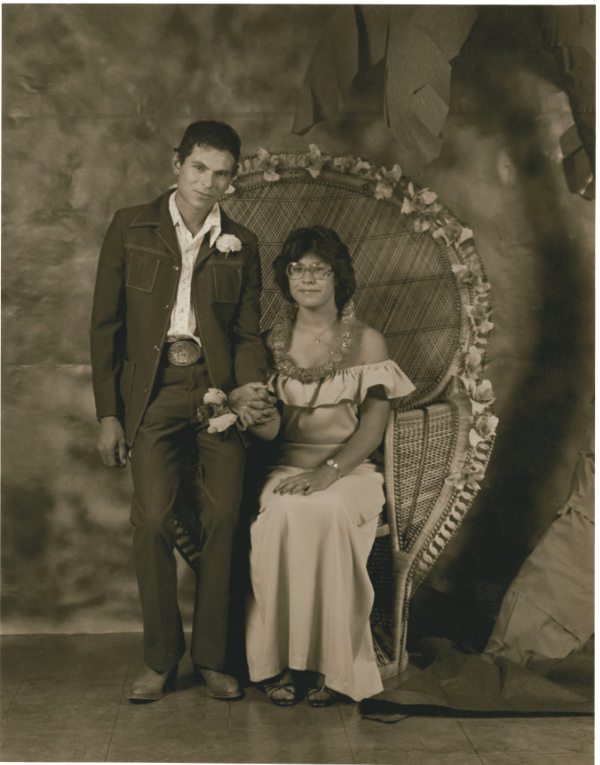
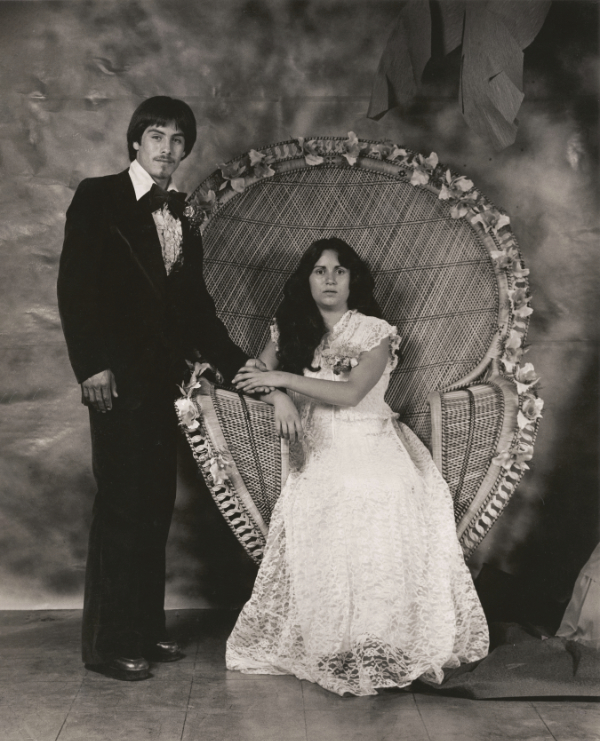
Whether it is desirable to return to the past is often beside the point. In her essay, “So Far from Paris or Santa Fe,” Samantha Dunn remembers the beauty and pain of her high school years in Las Vegas, New Mexico. The years were formative perhaps because of their difficulty. Although I graduated from Robertson High School eighteen years after Dunn did, so much about her experience resonated with me. Her words, and the photographs by Alex Traube that accompany them, reveal a slowing down, or pausing of time. In Las Vegas, as in many small towns, past and present blur. Memory fields are transposed like layers of sandstone. The effect is the feeling of a deep sense of place and connection, or suffocation—or both.

Finding the balance between holding on and letting go is an art. Looking to the past for clues about how to navigate the future can be invaluable, as Joe Saenz writes in his essay “Nde Benah”—excerpted from First & Wildest: The Gila Wilderness at 100. Although we cannot return to the past, we can learn from the people who have been here for innumerable centuries, people who remain culturally and spiritually connected to the land.

For others, looking to the past involves pain and healing. In Almah LaVonne Rice’s article about the film “Community in Conflict: The Santa Fe Internment Marker,” the past and present have intermingled. Pain has been dragged through decades. Remembering is essential, but returning to the past would be unthinkable. The memory field of war and incarceration remains tied to the Casa Solana neighborhood in Santa Fe, grief and loss rich in the soil.

In Robin Babb’s review of New Mexico Museum of Art’s Out West: Gay and Lesbian Artists in the Southwest 1900–1969, the past is spotty and hard to fill in. As with queer history of any kind, the archive of New Mexican queer artists is riddled with holes. Babb reveals how having a documented past can often be a privilege. Though art and writing aren’t the only ways to inhabit the memory field, they often make it easier. Amy Groleau, former Museum of International Folk Art curator, once told me, “There’s a lot of disagreement about how or whether to remember. There are people currently in politics now who have a stake in forgetting.”

Documented, held in cultural memory, or held in the land, the past can reemerge at unexpected times and in surprising places. Skeets reminds us that, “Pasts, presents, and futures exist simultaneously.”

Emily Withnall (opens in a new tab) is the editor of El Palacio and the host of Encounter Culture. Prior to stepping into the editor role, she wrote for the magazine for eight years. Emily has also been published in The New York Times, Al Jazeera, High Country News, Orion Magazine, Tin House, The Kenyon Review, Gay Magazine, Source New Mexico, and other publications. She lives and writes in Santa Fe, New Mexico.

Monuments of Mutuality

The documentary begins with a close-up view of an apparent snowscape. The camera eye sweeps slowly across what must be packed snow, glittering in the sunlight of the Southwest. Text surfaces on the screen, revealing haunting lines that confirm what we must be seeing:


In the field of white snow

I starve for the love

of my own people.


Yuki Shiroki

No Ni Nikushin No

Ai Ni Ue.
                                          —Itaru Ina

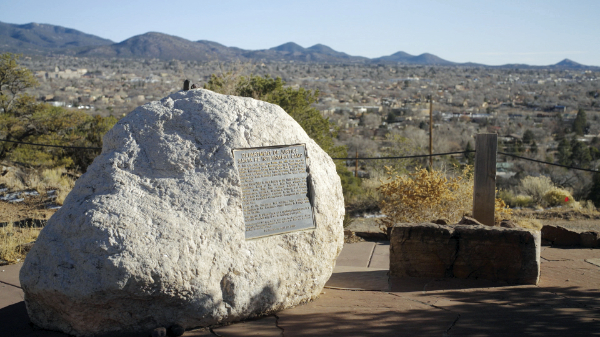
But look closer: Maybe the snow is sand, perhaps a nose-close view of the gypsum at White Sands National Park? No, it is not snow. Nor is it sand. Nor salt. Via a deliberately paced reveal, the Community in Conflict: The Santa Fe Internment Camp Marker documentary makes clear that we are witnessing something far weightier—a six-ton boulder embedded with a bronze plaque proclaiming where 4,555 men of Japanese ancestry were unjustly incarcerated during World War II. This mound of stone from Arizona is thus stamped with a nation’s shame.

But the marker almost didn’t happen. The most vocal objectors were WWII veterans and their allies in Santa Fe. Specifically, some of these veterans were survivors of the Bataan Death March—in which the Japanese Imperial Army forced thousands of captured Filipino and American soldiers on a hellish sixty-five-mile trek to prison camps in the Philippines. These twin tributaries of wartime trauma—in the prison camps of New Mexico and the Philippines
—converged in Santa Fe in the late 1990s. The tale of two traumas is the center of Community in Conflict, directed by Claudia Katayanagi, produced by Nikki Nojima Louis.

Genesis of Anti-Japanese Sentiment

December 7, 1941, according to the famous speech by then-
President Franklin D. Roosevelt, “is a date which will live in infamy.” On that day, the Empire of Japan unleashed a surprise military attack on Pearl Harbor, a U.S. naval base near Honolulu. The U.S. Pacific Fleet was pulverized, and more than 2,400 Americans were killed. On December 8, the U.S. declared war on Imperial Japan, and three days later, the U.S. officially entered WWII.

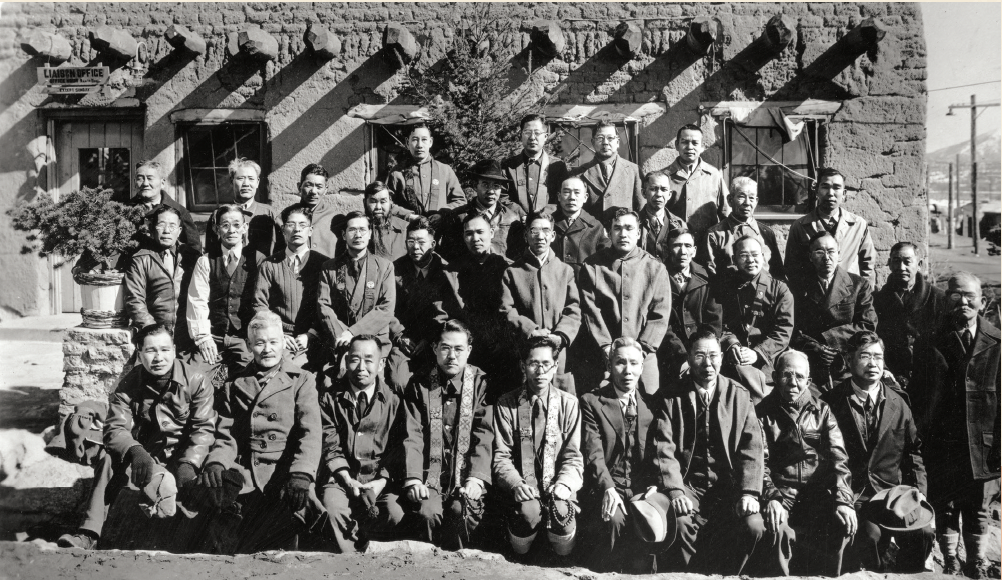
Japanese Americans at the Santa Fe Internment Camp, New Mexico, 1944. National Archives. Courtesy of the Palace of the Governors Photo Archives (NMHM/DCA), PAMU.233.2.

The fallout began immediately for people of Japanese ancestry in the Americas, from California to Peru. Less than a full day after the Pearl Harbor attack, the FBI started rounding up Issei, or first-generation Japanese immigrants. Xenophobic furor swept across the country—especially on the West Coast, which was partitioned into military zones. On February 19, 1942, Roosevelt issued Executive Order 9066, authorizing the removal of select groups of civilians from said military zones due to espionage-related hysteria. According to the Densho Encyclopedia, “Perhaps [influenced by] racialized thinking, [Roosevelt] was quick to believe unfounded reports of Japanese American espionage and was largely indifferent to the human cost of the policy.” While the language of the order did not single out Issei, or Nisei (U.S. citizens with Japanese immigrant parents), its implementation overwhelmingly targeted these populations.

On March 18, 1942, Roosevelt signed Executive Order 9102, which established the War Relocation Authority (WRA)—a federal agency that presided over the purging of more than 125,000 persons of Japanese ancestry from the West Coast. More than two-thirds of those removed and imprisoned were native-born U.S. citizens; those who were not U.S. citizens could not become so, thanks to the Naturalization Act of 1790 and its subsequent amendments. (The restriction against all people of Asian ancestry was not officially lifted until the enactment of the Immigration and Nationality Act of 1952. Even then, provisos were included that favored European immigration over Asian immigration.)

Despite the state’s reputation as a haven for racial tolerance, U.S. Department of Justice (DOJ) agencies, including the Immigration and Naturalization Service (INS), facilitated the location and administration of four American concentration camps—
euphemistically known as “relocation centers,” “assembly centers,” and “internment camps”—in New Mexico. The confinement sites in New Mexico were established in Santa Fe, Lordsburg, Fort Stanton, and Old Raton Ranch (a.k.a. “Baca Camp”). While the WRA managed most of the prison camps in the country, the DOJ and INS oversaw the New Mexico sites because incarcerees were deemed “enemy aliens” for reasons as innocuous as being born in Japan or being respected community leaders.

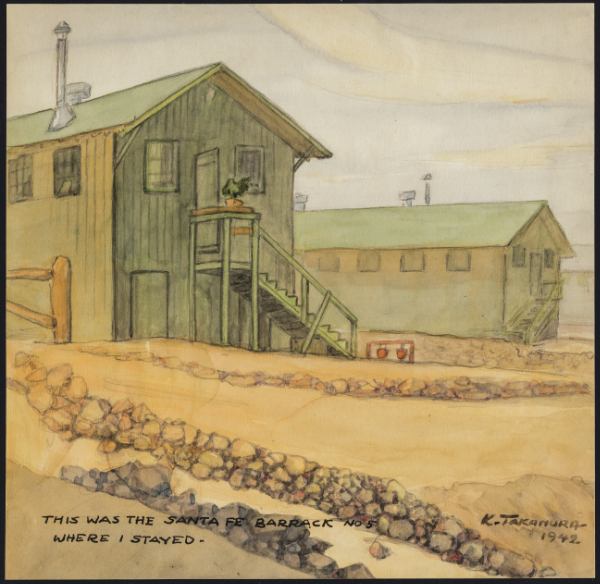
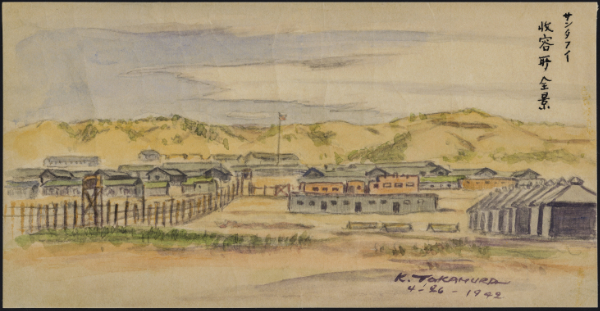
"Drawn on writing paper—with anxiety—during early days when I was not sure that drawings of any kind were permitted.” Kango Takamura, Panorama of Santa Fe Internment Center, 1942. Watercolor and ink on paper, 13 x 25 cm. UCLA Library Special Collections. Courtesy of Jaime Tanaka-Boulia.
“Drawn on writing paper—with anxiety—during early days when I was not sure that drawings of any kind were permitted.” Kango Takamura, Panorama of Santa Fe Internment Center, 1942. Watercolor and ink on paper, 13 x 25 cm. UCLA Library Special Collections. Courtesy of Jaime Tanaka-Boulia.
“Our guard in the watchtower became a spring baseball fan at Santa Fe.” Kango Takamura, This was the Santa Fe Barrack no. 5, 1942. Watercolor and ink on paper, 21 x 21.5 cm. UCLA Library Special Collections. Courtesy of Jaime Tanaka-Boulia.

But a warm, partially cloudy day in Oahu eight decades ago did not mark the start of anti-Japanese sentiment in the U.S. or the Land of Enchantment. What is now known as the Anti-Japanese Exclusion Movement started gaining ground in the late nineteenth century. It was fueled by the racist concept “Yellow Peril,” which frames Asian people as the invading “other,” posing a threat to white Western civilization. Anti-Japanese exclusionists exploited the outcome of the Russo-Japanese War—the first time in modernity that an Asian power defeated a European one—to argue that Japanese descendants in the U.S. were existentially dangerous. The Gentlemen’s Agreement of 1907–1908 as well as the Ladies’ Agreement of 1921 were both forged to hinder Japanese immigration to the States. Spearheaded by California, many primarily western states established alien land laws to block Issei from land ownership. New Mexico jumped on the nativist bandwagon in 1921 with a constitutional amendment barring property ownership for “aliens ineligible to citizenship”—despite the fact that people with Japanese ancestry in the state numbered fewer than three hundred. The New Mexico legislature did not drop this amendment until 2006.

While the DOJ and INS were imprisoning successive waves of Issei and Nisei men in Santa Fe, another tragedy was unfolding almost eight thousand miles away. The New Mexico Brigade had been deployed to defend the Bataan Peninsula in 1941. The Japanese military captured the peninsula in April 1942, eventually rendering the New Mexicans prisoners of war along with Filipino soldiers. American and Filipino troops were forced into what is now known as the Bataan Death March and were subjected to starvation, dehydration, medical neglect, torture, and wanton execution. The troops that survived the march were imprisoned at Camp O’Donnell in Luzon, where thousands of POWs continued to perish. U.S. and Filipino forces wrested control of the camp on January 30, 1945. The New Mexico Brigade—also known as the New Mexico National Guard’s 200th and 515th Coast Artillery—comprised 1,816 men. But 826 of them never saw home again. Physical and psychic scars persisted for those who did.

When the Political is Personal

The genesis of Community in Conflict is grounded in stories unburied, silences broken. “For over fifty years, our community was silent for many of the reasons—for security, protection, so your family isn’t deported, and all the reasons that people have for protecting their secrets,” Louis explains. “But I just found it extraordinary, because I’m part of that generation. My mother was very much a part of that generation of silence.” Louis was born in Seattle and raised in Chicago, and she and her mother were imprisoned at the Puyallup Fairgrounds in Washington State as well as the Minidoka Camp in the remote Idaho desert. Louis’s fourth birthday party was crashed by the FBI, who took her newspaper editor father, the Tokyo-born Shoichi Nojima, to the camp in Lordsburg and then Santa Fe. The aftermath of these injustices included Louis’s own “internalized racism and denial,” as she says.

Santa Fe Internment Camp marker. Production still from Community in Conflict, 2023. Courtesy of Claudia Katayanagi.
Santa Fe Veterans Memorial. Production still from Community in Conflict, 2023. Courtesy of Claudia Katayanagi.

Louis is now based in Albuquerque, which seems like full-circle cadence considering her little-girl visions of New Mexico. While imprisoned in Minidoka, Idaho, she would receive packages from her father who was imprisoned in Santa Fe. The packages, stamped “Enemy Alien Mail,” were filled with beaded jewelry, wooden toys, and Pueblo pottery. The parcels testified to anguish, injustice, state-sanctioned theft, family separation, and more—as well as a father’s untrammeled love for his daughter. They also cemented New Mexico as “a magical place” in Louis’s young imagination. 

Katayanagi, who is based in the San Francisco Bay Area, is
steeped in a similar legacy as a Nikkei Yonsei, or fourth-generation Japanese-American.  “I realized I’ve denied my Japanese heritage for a long time,” she writes on the A Bitter Legacy website. “By exploring this Nikkei history in these American Concentration Camps, I began to fully appreciate my cultural heritage and all that pain and indignation all the Nikkei families have suffered.” The UC Berkeley graduate adds, “All of my relatives were in these concentration camps during the war,” including her parents and even a cousin who was born in the Topaz, Utah camp.

It is no wonder, then, that the life work of Louis and Katayanagi is concerned with the politics of memory and the personal, collective, and ancestral implications of the archive. Louis is an accomplished theater artist with a PhD in creative writing from Florida State University. She is also the artistic director of the JACL Players, the theater group of the New Mexico Japanese American Citizens League. In addition to her Pacific Northwest work, the plays she has written, directed, and toured in New Mexico include Asian American Legacy Stories;Lordsburg Diary; Citizen Min in New Mexico; From Days of Infamy to Days of Remembrance;and Nisei, the Greatest Generation: Soldiers, Protesters & Prisoners. Her plays on the prison camps of New Mexico include Confinement in the Land of Enchantment; Barbed Wire and Cactus;and Courage and Compassion: Stories from Inside
and Outside the Barbed Wire of the Internment Camps of New Mexico.

Katayanagi boasts decades of film experience, including directing, producing, and location sound mixing/recording. Her award-winning film, A Bitter Legacy, explored Citizen Isolation Centers, which isolated “troublemakers” from the general population of incarcerees. (Being educated in Japan could be enough to earn the label “dissident.”)  As she points out, these illegal centers are now viewed as the antecedents of Abu Ghraib and Guantanamo. Community In Conflict is the second film of the trilogy that began with A Bitter Legacy; she is currently at work on Exiled,the final film in the series. Exiled focuses on alien detention camps and also plumbs the history of Latin American countries turning their citizens of Japanese descent over to the U.S. government.

Katayanagi’s unflinching gaze upon these brutal histories sparked Louis’s desire to collaborate. Louis explains, “This collaboration started with my interest in A Bitter Legacy. I think of Claudia as a photojournalist, an investigative reporter—because she doesn’t make nostalgic films about our time in camp. I mean, many of those films are really, truly beautiful and lyrical. But you know, she goes to these places where she is not wanted.”

When WWII Traumas Collide

Community in Conflict goes to places where truth-tellers and anti-revisionists must go. A spare, brooding piano score accompanies the film from the start, as historian and former New Mexico History Museum Director Thomas Chávez recalls holes in the historical record. He says, “The state history museum has a state history library and photographic archive. We have historians come in there to research and we were periodically getting questions about the internment camp, and we had nothing in our archives or library about that.” Chávez later continues, “I wrote an article about the existence of this camp, and I just said, ‘Wouldn’t it be interesting if we could put a marker there?’” His 1997 guest editorial in The Santa Fe New Mexican led to the creation of the Santa Fe Internment Camp Marker Committee. Patti Bushee, Santa Fe City Councilor at the time, concurs: “I was enthusiastic from the get-go. This was a piece of history that deserved everybody knowing about it. It deserved recognition. When I presented the initial resolution, it wasn’t costing the city a dime.” But the resulting blowback from some community members was emotionally expensive—and explosive.

Some survivors of the Bataan Death March and their supporters made a misguided equivalence between their Japanese torturers in the Philippines and the incarcerees at the Santa Fe camp.

 “They were all confused thinking that this was a prisoner of war camp … a lot of people [were] just uneducated or they just don’t know there was an internment camp,” states Katayanagi. The misinformation and attendant rancor called for an intervention. “I was called in to the city manager who said, ‘We need to get community dialogue. We need to resolve this. We need to see where citizens are at, and we need to decide whether we’re going to do this or not,’” remembers Gerard Martínez y Valencia, then-director of the Office of Intercultural Affairs for the City of Santa Fe, who teamed up with the Institute of Intercultural Community Leadership of Santa Fe Community College. “We designed a facilitation process for this and then took off with it.”

Three community meetings were convened, employing a roundtable format.  Hearing stories directly from the incarcerees or their family members softened some of the anti-marker contingent. One testimony came from Joe Ando, a retired Air Force colonel who was incarcerated at Arizona’s Gila River camp; his father was confined in the Santa Fe camp. He says, “I am a veteran and I speak to a lot of veterans, and I have been asked to speak to Bataan veterans’ groups. During the question-and-answer sessions I get some serious, hard questions thrown at my race. Anger comes at me. I throw words back; I don’t throw anger back. Surprisingly, I make friends that way.” 

As Chávez points out, some of the veterans were not aware that the imprisoned were citizens or prevented from becoming citizens. Many did not know that some of their brothers in battle were of Japanese descent. In fact, the most decorated unit in U.S. military history was the 442nd Infantry Regiment, the majority of which were Nisei soldiers who fought in WWII. “The card we played at the end, the one we were holding was: and they served in WWII. That I think is the one that tipped the balance,” Chávez concludes.

Even so, a retired lieutenant colonel vowed to urinate on the marker if it ever went up. Another opponent threatened to defecate on it. Ethnic slurs were spewed. As noted in Kellie Nicholas’s article, “Santa Fe Marker Project and Controversy,” in the book, Confinement in the Land of Enchantment: “One observer remarked to the local media on the racism he detected, stating, ‘You would have thought the war was still going on.’” It was such a powder keg situation that the split Santa Fe City Council delayed voting on the marker. The vote was finally held on October 27, 1999—with police on hand because of the volatility. In fact, the police chief stepped in when one of the marker opponents started threatening physical violence.

This is the point in the film where Louis and Katayanagi make a particularly compelling artistic decision. Constraint fueled creativity: video of this charged moment in Santa Fe history could not be located, so, as Louis says, “You have to make lemonade out of lemons.” Katayanagi adds, “In the council meeting where they had the actual vote … there was a story that the local PBS or the local public access TV station had filmed this meeting and apparently it was very dramatic. It was … people were getting up and yelling and screaming and almost getting into fistfights. … And I spent many, many hours looking for this footage. I contacted the public access [channels], I contacted the museum, I contacted City Hall.” She kept hearing about a possible videotape in an attic. She asked everyone,it seemed. But finally, the documentarian had to cease her search. “I accepted the fact that I wasn’t going to get this original footage,” recalls Katayanagi. “So, I went to Nikki [and said] ‘Let’s do a reenactment.’”

And what an inspired decision that was. The powerful dramatization was based on minutes of the meeting; Louis adapted the minutes into a script. Actors perform in the black-and-white reenactment, which crackles with opposing viewpoints; Louis plays Councilor Carol Robertson Lopez, who appears in one of Community in Conflict’s interviews. Stormy facial expressions and vexed body language further help transport viewers to the crowded city council chambers of that day. Mayor Larry A. Delgado ended up having to break the tie with a “yes” to the marker. One of the yelled-out reactions, from former City Councilor Clarence Lithgow? Your vote has kicked the Bataan veterans right in the teeth.

But the other resolution that passed that day was for establishing a memorial for those who did not survive Bataan. This memorial was one of the fruits of the facilitated intercultural dialogues. Martínez y Valencia recalls how his group’s task was to excavate “what it is that [the Bataan veterans] were really upset about.” And what did the group unearth? “Well, the bottom line with what we heard from the veterans was, ‘We have not been honored with anything,’” he says. From their perspective, the honoring that they had received was negligible. Their requests for a memorial had gone rebuffed for decades.  So, the group decided that the marker and the monument had to be realized. “The whole group agreed they have to be side-by-side,” notes Martínez y Valencia. “Both groups want to be remembered. They want to be recognized. They don’t want to be abandoned again. … [B]oth of those groups were abandoned by their country in different ways,” says Rod Ventura, former member of the Bataan-Corregidor Memorial Foundation. “They all share something, and that’s trauma.”

Almost twenty-five years after the contentious city council vote, there are some indications that more Santa Feans are willing to look at and learn from the past—even the most painful chapters.  “I think there is a hunger to learn,” asserts Katayanagi. “People go, ‘I didn’t even know there was an internment camp in Santa Fe … and how come I don’t know this?’” Louis acknowledges that the current state of the conversation is complicated and dynamic, running the gamut from “healing, forgiveness, denial, and a refusal to admit that it ever happened.” She continues, “There are deniers of American concentration camps.”

The imperfect resolution is illustrated in the name of the marker itself. “The veteran community said, ‘You can’t call it a monument, you can call it a marker.’ So that’s why the town’s sign says it was ‘Santa Fe Internment Camp Marker.’ But internally, I just call it a monument.” Katayanagi prefers calling it a “memorial,” invoking the Nikkei pilgrimages to confinement sites. As Louis explains, “Claudia talks about the insult for calling this a marker, because the marker is a little sign that tells you to go this way to wherever your destination is—not to dignify it by calling it a monument or a memorial.” In contrast, pilgrims to the camp—many of whom are descendants of the men imprisoned there—perform ceremonies to re-sacralize what is now the Frank Ortiz Dog Park.

Katayanagi references the opening haiku by Itaru Ina, a survivor of several prison camps throughout the country: “Yes, we all want the love of our own community … at the same time, we want to share.” She maintains a tradition of inviting all her friends to her Japanese New Year celebrations, complete with “food, ritual, and cultural activities.” That invitation reflects her view that the table of this nation is large enough to accommodate all of us. She adds, “And I think, in a way, what my film is showing is that there is a way to dialogue.”

Community in Conflict: The Santa Fe Internment Camp Marker will be screened as a part of the Museum of International Folk Art’s exhibition, Between the Lines: Prison Art & Advocacy. To learn more, visit internationalfolkart.org/. Subsequent screenings are planned throughout 2024 and can be found on the New Mexico History Museum’s events page at nmhistorymuseum.org/programs/events/.

Almah LaVon (opens in a new tab) (they/them) is a writer and fairy marsh monster living in Dionde:gâ. They write creative nonfiction and short fiction engaging unfettered Black imagination and dreaming a new world many-petaled. Almah is a recipient of the Exposure Artists Program First-Time Grantee Award from The Pittsburgh Foundation.They were selected for the global Orange Tangent Study grant in 2022. They were awarded the 2022 Fable Grant, an initiative led by New York Times-bestselling author Adrienne Young.

Claudia Katayanagi (opens in a new tab) is an award-winning documentary filmmaker and a fourth-generation Japanese American. Claudia’s personal and professional journey led her to uncover the dark realities of World War II’s “Citizen Isolation Centers,” a topic explored in her powerful documentary A Bitter Legacy.

Nikki Nojima Louis (opens in a new tab) is a child of American concentration camps and the protégé of the Civil Rights Movement. In the Pacific Northwest, she was active in multicultural theater as a writer, performer, and producer of women’s, peace, and social justice shows. In New Mexico, she thrives on writing, directing, and touring living history plays that connect the past to the present and us to one another. Louis received the 2024 Upstander Award from the Holocaust and Intolerance Museum, and subsequently discovered that an upstander is a person who speaks out and stands up in support of others. She strives to be that person.

Acequias de Santa Fe:

By Adele Oliveira
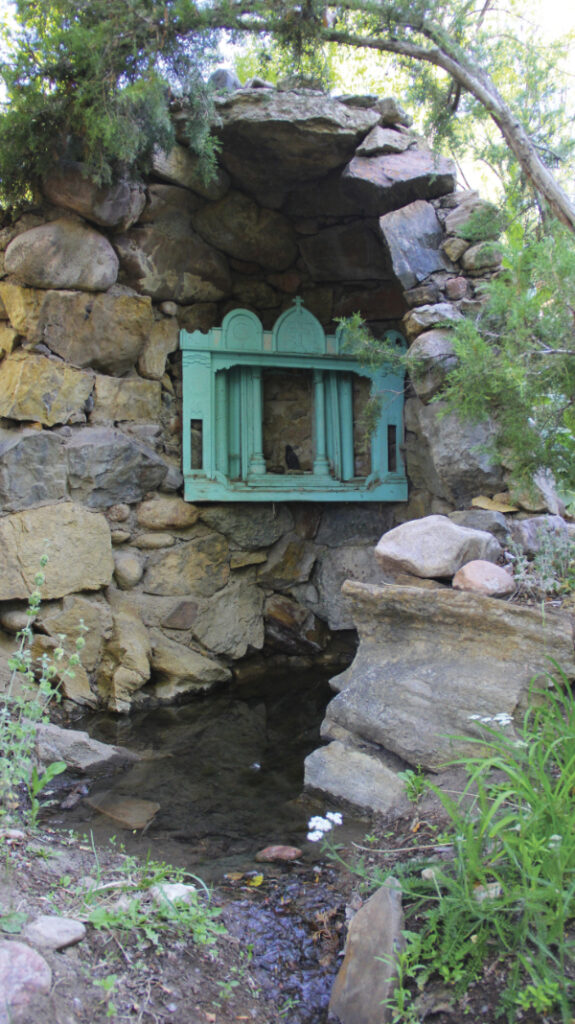
Kyle Maier, Shrine alongside the Acequia de la Muralla, 2020. Courtesy of the Historic Santa Fe Foundation.

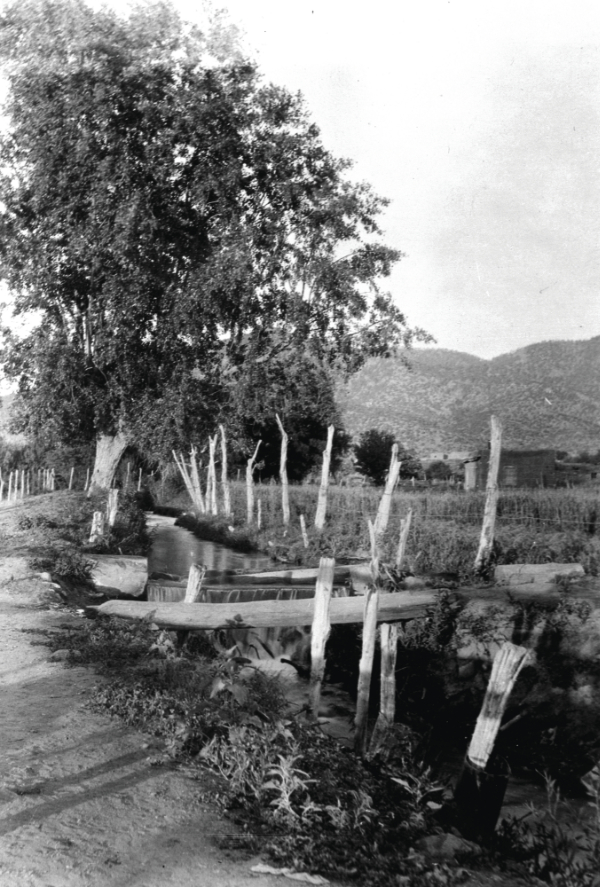
Last spring, after a wet winter yielded a decent snowpack, if you walked the narrow dirt path alongside the Acequia Madre in Santa Fe, between the ditch and the curb, the water gurgled companionably downstream beside you, following its centuries-old course, banks choked with green grass and apricot blossoms. When flowing at near-historic volumes, the Acequia Madre performs a kind of magic trick, becoming a portal to the past and a living cultural artifact, a physical example of what life used to look like in Santa Fe, and a potent reminder to preserve what remains.

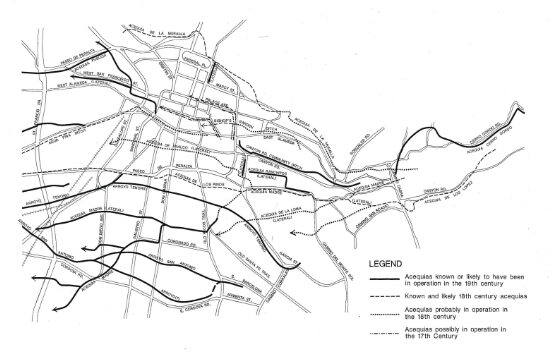
A century ago, Santa Fe was ribboned with acequias, nearly forty according to a 1919 survey, with hundreds more following the river downstream. Laterals and diversions watered fields and gardens, provided riparian habitat for wildlife, and shaded the town with what Enrique Lamadrid, historian, author, and professor emeritus of Spanish at UNM, calls “cultural greenery.” Today, just four acequias in the city limits still flow: Acequia Madre, Acequia de la Muralla, Acequia Cerro Gordo, and Acequia del Llano.

When community activist Rick Martinez was a boy in the 1960s growing up near the Acequia Madre, on days when it was flowing he and his friends would race paper boats down the ditch and wade barefoot in the water. He remembers an acequia that used to run parallel to the Acequia Madre behind his grandmother’s house on Canyon Road, long since dry. “Where the parking lot is now at the cathedral, that used to be the Bishop’s Garden,” Martinez says. “It was fed by acequias too and was a wetland. I saw it when I was a kid, but by the time I got to be twelve or fourteen, the area was covered up. [Developers] didn’t want to know more; they saw property being developed there.”

Acequias are complex community systems that are also beautifully simple: ancient, cross-cultural technology that offers clues about future survival in arid places as the planet warms and dry regions become drier. In the late sixteenth century when Spanish colonists first arrived in O’Ga P’Ogeh Owingeh, Indigenous people had been using the water from the Santa Fe River via diversion ditches and flood irrigation for centuries, farming crops like beans and corn, while the irrigation techniques that the Spanish brought to New Mexico originated with the Moors during the Middle Ages on the Arabian Peninsula. “Acequia” derives from the Arabic word “as-saqiya, which means “that which brings water.” The colonists’ survival was contingent on successful agriculture, and the Spanish augmented the existing ditch systems, digging canals (or forcing Pueblo residents to do it for them) that in some places remain essentially unaltered: Santa Fe’s Acequia Madre, dug in the early 1600s, is the “oldest remaining Spanish acequia in the southwest that can easily be traced today,” according to an Historic American Engineering report—though the Acequia de Chamita may be slightly older. 

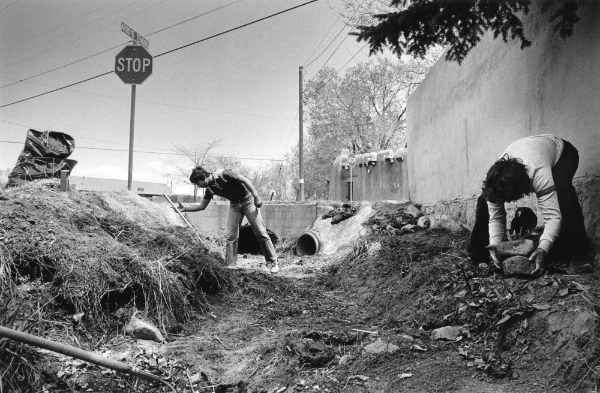
Acequia governing practices, facilitated by an elected mayordomo (boss) and three commissioners, are inherently democratic and equality-oriented: water is sacred and belongs equally to all people. Every parciante, or water right holder, pays an annual fee and is responsible for helping to maintain the ditch, including during the limpia, a big community clean out in the spring. Over the course of the nineteenth and twentieth centuries and continuing today, Santa Fe’s acequias were eroded, both literally and figuratively, often in the name of progress that increasingly positions water as a commodity.

“They’re not in great shape,” says former state historian and retired professor Hilario Romero of Santa Fe’s acequias. “Very little is left.” Romero recalls a time when the farmland around Agua Fria was the “breadbasket of Santa Fe,” fed by acequias and by the now-dry underground ojitos, or springs. In his eyes, the city’s acequias have been in trouble since 1851, when New Mexico became a territory of the United States, bringing waves of settlers and land speculation. Romero also points to the construction of dams on the Santa Fe River (four between 1881 and 1943) as eradicating the acequia system, as well the privatization of water by Thomas Catron, Confederate Civil War veteran turned career politician and capitalist, and the “Santa Fe Ring,” territorial governmental appointees bestowed with wide-ranging power. The Santa Fe Water and Improvement Company (later Santa Fe Water and Light Company, part of PNM today) built the dams, seizing most of the water for hydroelectric power.

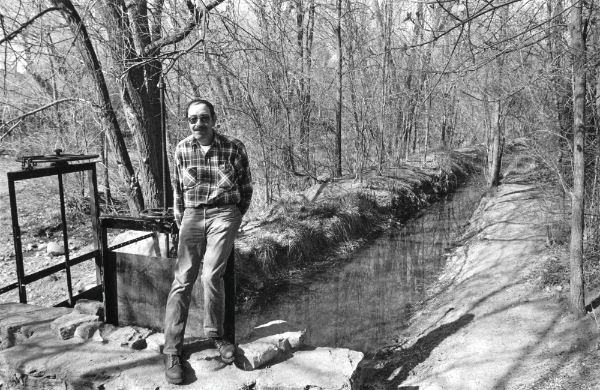
Peter Eichstaedt, Robert Moya at Acequia Madre, the irrigation ditch that dates to 1706, Santa Fe, New Mexico, 1988. Courtesy of the Palace of the Governors Photo Archives (NMHM/DCA), HP.2014.14.70.

The destruction of Santa Fe’s acequias continues today. Both Romero and Martinez have been active in fighting what they see as unsustainable and poorly planned housing developments that have destroyed historic acequias. While the majority of acequias west of St. Francis Drive no longer receive water rights, they’re still supposed to be protected by easements. In practice, however, this hasn’t been the reality. 

“The water in the acequias has always been a metaphor for the Anglo-American conquest of Santa Fe,” says Kyle Maier, a historian with a focus on Canyon Road. “When Anglo-Americans started showing up with the opening of the Santa Fe Trail in 1821, they brought this concept of ‘owning’ the water. The biggest threat to the Acequia Madre seems to have been the city itself and the water utility company—in this case, PNM. Today, very few people who own property with water rights actually want to use their water.… Gentrification and the increase in property rates has had a tremendous effect on the acequia, and not in a good way.”

Every acequia, whether running or dry, deserves to be considered on its own terms. “No two ditches are alike. Every ditch is unique and different,” says José Rivera, a professor emeritus of community and regional planning at the University of New Mexico and the author of numerous books and articles about acequias including Water for the People: The Acequia Heritage of New Mexico in a Global Context, which he co-edited with Lamadrid. “Gravity flow automatically makes them different from one another because of the topography and the physics of moving water from the main head gate,” Rivera explains. “Some ditches might experience lower flows or more frequent droughts, no watering the ditch when they need it most.… People come and go and there’s resale of these properties with access to water.” He goes on to describe what’s called the “newcomer effect.”

“In general, you have two different kinds,” Rivera says. In the worst cases, a new owner won’t understand or care about their water rights. In a best-case scenario, “there are those [who]embrace and become part of it; the Stanley Crawfords who pick up a shovel and go to cleanings and the evening meetings and sometimes become mayordomos.” In Santa Fe, the three smaller acequias on Upper Canyon and Cerro Gordo are currently stewarded by mayordomos Carl Beal, Chris Ford, and B.C. Rimbeaux, who, like Crawford—renowned author and Dixon farmer—are all gringos originally from elsewhere: all three became mayordomos after their predecessors grew old and died or moved away. Even when newer mayordomos are committed and respectful, acequia knowledge is inevitably lost in the transfer of water rights away from families who’ve held them, in some cases for generations. 

During the season, Rimbeaux, who has been Acequia de la Muralla’s mayordomo for the last fifteen years, arrives at the head gate at 7:30 in the morning. To make the allotment last from April to sometime in July when the monsoons (hopefully) arrive, he releases water twice a week. Even if the water no longer supports community agriculture, as acequias do elsewhere in the state (as near as La Cienega and Nambé), running water through the channels is important for supporting riparian habitat and for the overall health of the watershed. After opening the compuerta, or head gate, he walks the length of the ditch to ensure it’s flowing free of obstructions. “We don’t have the kind of flow that some of the rural acequias do; it’s small, so it doesn’t take much to stop it,” Rimbeaux says. “If you’ve got gophers, it seeps through the wall. Twigs can get caught up in the weeds, and it doesn’t take long for leaves to dam it up and [cause] overflow.” Rimbeaux says in its heyday the Muralla ran all the way to somewhere near the current site of DeVargas Center mall, hewing to the hillsides in accordance with gravity. Today, the acequia is barely a mile long and serves about fifteen parciantes. Rimbeaux says over the last several years, there’s been a great deal of turnover in properties on the Muralla and a “net loss of interest” in it.

Up the canyon from the Muralla and the Acequia Cerro Gordo, Randall Davey Audubon Center Director Carl Beal became mayordomo on the Acequia del Llano a few years ago when the longtime mayordomo moved away. “I was sort of the last able-bodied person on the ditch,” Beal says. “And I love the work…. [The acequia] is like a whole different world, this little meandering stream through a tunnel of willows.” The Llano is unique in that it begins directly at Nichols Reservoir, at a pipe that comes out the base of the dam. When the valve is open, pressure gradually forces water up a 2,500-foot section of pipe, where it spills onto the north edge of the RDAC property. (Before the dam was built, the Llano was diverted from the river.)

“When we’re irrigating, whether it’s orchards or gardens, we have to be mindful of what we’re watering and why, and how to do it as efficiently as possible,” says Beal. To that end, sections of the Llano are piped: a long stretch at the beginning that runs over an unshaded, sunbaked swath of earth, and then again near the center’s parking lot and trailhead, a high traffic area, and behind the historic sawmill-turned-Davey-House, where leaking expedited erosion. Prior to piping, the Llano seeped through the walls of the first floor of the house and down the hillside where it watered saplings planted in 1900, an eastern species of cottonwood brought to the property by Candelario Martinez, former postmaster general and probate judge who was lobbying for New Mexico’s statehood. One condition of the donation of the Davey property to the Audubon Society in the 1970s was that the gardens be maintained in perpetuity, but those stipulations were made with limited information, in a time with more abundant water. Beal is in the process of replanting a section of the lawn with native grasses, which demand much less from the acequia. The cottonwoods are at the end of their lifespan, and Beal faces a dilemma about whether and how to replace them.

“The reason acequias continue to operate is [that]a few people will just work hard at it,” says Phil Bové, a legend in Santa Fe acequia circles for his longtime devotion to the Acequia Madre as a commissioner, and for his encyclopedic knowledge of the city’s waterways. Bové married into the Ortiz family and still lives on Acequia Madre, in the house his late wife Eleanor’s parents built. For decades, Bové says, city or state engineers have called on him to inquire about things like the locations of dry laterals, which, though no longer flowing, are still protected by easements.

“A lot of information has gotten lost over the years. I’m lucky to have grown up in the house my mother was born in,” says Phil’s daughter, Miche Bové Garcia. “But you’re not going to see that up and down the street. You’re going to see [fewer and fewer] people who have a knowledge of what that water meant for their families and generations past. Even when wonderful people move in, who are interested in preserving history, they don’t have history with it themselves. You can lose the storyline of an acequia, because you aren’t as connected to the story of the water that runs through.” Garcia is encouraging her father to write a book, compiling as much of his knowledge as possible in one place. Much of acequia wisdom is transmitted orally or in person, acquired over years in piecemeal, and written records are no longer as fastidiously kept.

The east side of Santa Fe has experienced and continues to weather waves of gentrification spanning generations. While some old-time families hang on, buying property on a living acequia in Santa Fe has been expensive for a long time. Yet each of the city’s four acequias are at some point accessible via public property: Acequia del Llano runs through the Audubon Center, where visitors can cross it on a footbridge behind the treehouse. When it’s running, the Acequia Cerro Gordo sluices down the sloping field of Armijo Park, where, at the bottom of the hill, you’ll find the Acequia de la Muralla’s head gate at the Santa Fe River. The Acequia Madre invites us to follow almost her entire length, first by sidewalk and later the Acequia Trail. Acequia Madre, everyone agrees, is the best protected of Santa Fe’s acequias and the one most likely to endure into the twenty-second century. As families are displaced from their ancestral lands (Romero says his grown sons would love to live in Santa Fe but have been priced out) the centuries-old significance of acequias is lost.

“People say I’m anti-growth. I’m not anti-growth—I just want to see things done in a sense where it’s protected and it’s compatible with what’s in the surrounding areas,” Martinez says. “It’s a part of the history that should be kept. That’s why we have archaeological reviews and archaeological reports.”

Advocating for acequias, according to those who love them, means grunt work like showing up at city council meetings. Garcia recalls her parents taking groups of students from Acequia Madre Elementary School to clean the ditch in the spring. “They’d be out there with little bitty rakes and shovels and gloves,” Garcia says. “We need to teach them the storyline of the acequia.” Romero shops at the farmers’ market, “no matter how expensive it is,” because he prioritizes the connection to his ancestral foodways.

“If there’s a lack of water flow into a ditch, it threatens the whole political, social, and cultural organization,” Rivera explains. He remembers visiting his friend, Congresswoman Teresa Leger Fernández, at her family’s ditch in Chupadero several years ago. The acequia had been dry for two years and its erosion was palpable, even though the water came back. He estimates that a ditch fades after five years without water. “It’s important to preserve them for those reasons, but it’s also personally important to feel this connection to nature and to the watershed.”

At seven miles long, including laterals, the Acequia Madre has by far the most volume, flowing from its origin at East Alameda and Los Cerros Reservoir to Agua Fria Village, where it dumps back into the Santa Fe River, when it has enough water to run its full course to the Montoyas, its final parciantes. West of St. Francis Drive, there are remnants of dozens of laterals that no longer flow or receive rights, though many rush with storm water during summer monsoons. The now-dry Acequia de Los Pinos, for instance, can be glimpsed from Baca Street (as can Acequia Madre) or at one end of Larragoite Park. Bové acknowledges that many of these acequias would probably be dry by now even if they hadn’t been cut off from the river and Acequia Madre, because of how much the water table has dropped, and the ongoing drought.

“It feels like I’m holding on to something very thin sometimes, like it’s fleeting,” says Garcia. “It’s like it’s slowly going away without people understanding how we cherish it.”

Volunteers helping with annual cleaning of Acequia Madre irrigation ditch dating to 1706, Santa Fe, New Mexico, 1984. Courtesy of the Palace of the Governors Photo Archives (NMHM/DCA), HP.2014.14.71.

The poet Arthur Sze has lived in New Mexico for fifty years, the last ten of them with his wife as parciantes on the Acequia del Llano, on which he’s also a former commissioner. In 2021, while spending a lot of time at home and inspired by a 2009 Army Corps of Engineers environmental assessment, Sze wrote a prose poem about the acequia. “I was astonished at the number of native species, plants, and wildlife that depend on this acequia that’s only 1.5 miles long,” he says. His piece, titled “Acequia del Llano,” is printed on two laminated sheets of paper attached to a wooden box near the Acequia del Llano on Audubon property. Short stanzas alternate with more informational paragraphs, like this:

In the ditch, water flowing—
now an eagle feather wind. …

Yarrow, rabbitbrush, claret cup cactus, one-seed
juniper, Douglas fir, and scarlet penstemon are some of the plants in this environment. Endangered and threatened species include the southwestern willow flycatcher, the least tern, the violet-crowned
hummingbird, the American marten, and the white-tailed ptarmigan.

Acequia Madre irrigation ditch, Santa Fe, New Mexico, ca. 1890. Courtesy of the Palace of the Governors Photo Archives (NMHM/DCA), 055021.

Sze notes, “Having water run along these existing acequias impacts these threatened native species.… It’s all part of a bigger ecosystem; people who aren’t on the acequia can still appreciate [its effect] on habitat along the Santa Fe River.” 

“Our snowpack this winter is pretty good, but overall, the state is experiencing enormous drought conditions,” Sze adds. “When that happens, there’s a water crunch.”  Sze remembers one very dry year when he was an acequia commissioner and the City of Santa Fe asked the Acequia del Llano to use less water. He recalls the complication of “owing” Texas water on certain years, due to the intricate and out-of-date policies of 1938’s Rio Grande Compact.

Romero keeps a collection of acequia maps dating back to Spanish cartographer and polymath Bernardo Miera y Pacheco’s seventeenth century rendering of the watershed and its topography. To him, acequias are as important as the Camino Real de Tierra Adentro. More recent maps are marked with blue highlighter, or dotted lines, which denote where Romero thinks an acequia once ran. He favors a “boots on the ground” approach, sometimes searching for evidence of defunct ditches under centuries’ worth of infrastructure and city planning. “I always find traces of them,” he says.           

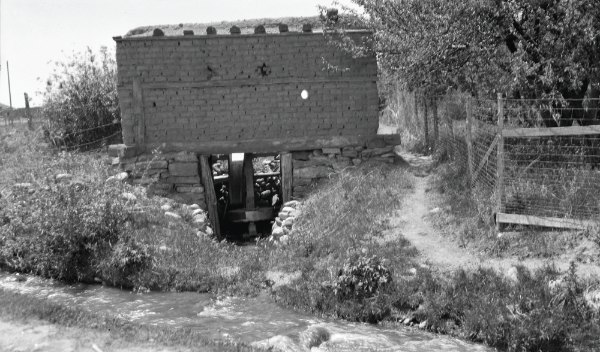
William H. Roberts, Old mill on Acequia Madre above Manhattan Street, Santa Fe, New Mexico, ca. 1920-1930. Courtesy of the Palace of the Governors Photo Archives (NMHM/DCA), 149931.

“In Santa Fe where the water is not being used to sustain families with drinking water or irrigating sustainable agriculture, we’re doing it for cultural and historical reasons,” says Rimbeaux. “We’re trying to maintain this hand-dug acequia that flows its original course.” He says even if some water is lost to seepage and evaporation, it “sustains the elm trees and riparian habitat, and if some of it goes into the ground, that’s okay. It’s not necessarily ‘lost,’ depending on your point of view.” Acequias support green space which combats the “urban heat island” effect by providing shade and keeping moisture in the ground, as well as providing migration corridors for wildlife, considerations that become even more important during the historic drought we are currently experiencing.

Santa Fe’s remaining acequias face an uphill battle, but these historic community systems offer important solutions for a water-scarce future. “They have an ability to be flexible and to change,” says Rivera. Just as no two ditches are the same, “no two seasons are alike, either.… [A]s long as irrigators hold together in this concept of solidarity, acequias can endure.”

Adele Oliveira is a freelance writer in Santa Fe, New Mexico.

Adele Oliveira (opens in a new tab) is a freelance writer in Santa Fe, New Mexico. She writes regularly for the magazines division at the New Mexican and for a variety of local and national outlets; primarily about art, culture, and northern New Mexico.

Dylan McLaughlin: The Alchemy of Art and Science

A drone glides across an empty riverbed, then transitions to a seemingly endless double line of tanker cars transporting oil on train tracks in the video art piece, In Transition Is the Most Honest. Another drone flies downward from atop a mountain overlooking Questa, near Taos Pueblo, in the video, In So We Sing the Land. In this piece, the drone follows erosion lines down a mountain from a point of view no human being could naturally see; aerial footage of the aftermath of mining from the top of the mountain downward. In yet another drone scene, we glide along the top of the Rio Grande in Albuquerque, surveying the drying ancient river that has carried water southward for innumerable generations.

Sound and video artist Dylan McLaughlin (Diné) views the world through a different lens. He zooms out and offers us a wide shot, providing images that we may not have thought to see. In his concern for the earth and how humans affect the land, he fuses his love of art and ecology, presenting a new way of seeing and experiencing the world.

The common thread that runs through McLaughlin’s work is his focus on the land, water, and the effect of extractive industries on ecosystems. As a multimedia artist, he uses sculpture, textiles, electronics, and instruments he builds and performs with to explore these conversations. McLaughlin uses his family’s legacy and knowledge of silversmith work to create musical instruments, fashioning them out of copper and nickel while using guitar effects pedals and synthesizers for sonic effects. McLaughlin describes his work in the moment as “Looking at threatened ecosystems, places that have high levels of soil toxicity, contamination from uranium sites, looking at rivers that have been impacted by a lot of diversion projects and most currently, looking at a lot of species die-off.”

Dylan McLaughlin, Distortions, 2024. Courtesy of artist.

McLaughlin was influenced by heavy metal and experimental noise music growing up in Kayenta, Arizona, in the Navajo Nation. Later, in Albuquerque, he became immersed in the noise music community, attending shows and working alongside musicians and performers (and later collaborators) such as Antonia Montoya, Marisa Demarco, and Diné artist Ryan Dennison. Originally a video artist, McLaughlin became interested in performance art in Brooklyn, where he collaborated with musicians and dancers. “Over the years I started building my own performance practice, where I was the one performing,” McLaughlin says.  He wants his art to be felt and experienced.

McLaughlin has recently been interviewing for tenure-track teaching jobs around the West. He earned his undergraduate degree at the Institute of American Indian Arts (IAIA) in Santa Fe, and his graduate degree at the University of New Mexico in Albuquerque. He currently teaches in the low-residency studio arts MFA program at IAIA while living in Austin as a post-doctoral fellow at the University of Texas. At just thirty-four, McLaughlin’s CV yields an extensive number of accomplishments: artist residencies spanning the globe from Italy to Croatia, a Native Arts and Culture LIFT grant alongside a New Mexico Fulcrum grant in 2022, and exhibitions and performances from New York to the Netherlands. McLaughlin was described to me as an emerging artist, but I’m hard-pressed to find that his CV is that of an emerging artist. Next up for McLaughlin is a new artist residency in New Mexico.

Lincoln is the newest location for the 2024 New Mexico Arts (NMA) Artist-in-Residence program. The historic site in southern New Mexico chose two artists to host consecutively, beginning with Marcus Xavier Chormicle, who will be followed by McLaughlin. Chormicle (Agua Caliente Band of Cahuilla Indians/Chicano) is a Las Cruces-based artist. McLaughlin, currently splits his time between Texas and Brooklyn. Both artists bring their special brand of Indigenous contemporary art to the small historic community of Lincoln.

The site has seventeen structures, two museums, and is the most visited of all the historic sites in New Mexico. As a resident of New Mexico for nearly twenty years, I had never heard of Lincoln, so it was with great interest that I learned that President Rutherford B. Hayes once called Lincoln’s main street, “the most dangerous street in America.” Old West icons Billy the Kid and Pat Garrett once walked (or rode) these streets; it was the location of the Kid’s last infamous escape from jail before he was taken down by Sheriff Garrett further up at Fort Sumner.

Heck of a place to stick a couple of contemporary Indigenous artists, eh?

“This is only the second year it’s taken place, the first year being at Bosque Redondo Historic Site,” says Olivia Ortiz (Chicana/Mescalero Apache) of the NMA Artist-in-Residence program in Lincoln. Ortiz is the Art in Public Places program project coordinator for New Mexico Arts. The residency is a work in progress, with perhaps the most intriguing part being that the residencies change locations each year.

“We are looking to last year to see what can be improved but also getting to know this new site at Lincoln and fleshing out what we want the program to be.” The nationwide call for the residency prioritized artists who could connect to the site and create compelling work inspired by the location. Both Chormicle and McLaughlin have strong New Mexican ties and their project ideas spoke to the committee. It also helps that they are familiar with the landscape and probably won’t experience too much culture shock; the location in Lincoln is quite rural. The closest cities are Albuquerque—three hours north—and Las Cruces, two and half hours south. “Not great Wi-Fi,” Ortiz mentions.

Marisa DeMarco, Dylan McLaughlin at KUNM, 2022.

Lincoln was chosen this year for the residency because, “from the sites that were available this year, this one was the most fit to be ready to live in and to host someone,” says Ortiz. It’s a pragmatic approach to an artist residency but with the wealth of beautiful locations and historic sites in the state, there’s likely not a “wrong” place to host artists.

The Lincoln location for McLaughlin as a Diné artist is filled with juxtapositions. On his mind is Bosque Redondo—roughly two hours northeast of Lincoln, where the Diné people were forcibly relocated more than three hundred miles from their homelands and several hundred died along the way. 

“When I think of that part of the world I think of Bosque Redondo,” McLaughlin says. “I think if you ask any Navajo person about that area they’re going to tell you, well that’s right where Bosque Redondo is.” Typical to McLaughlin’s line of thinking, however, is that he’s also contemplating larger ideas about the area. “Lincoln is also historic grasslands, there used to be enormous bison populations in the area. I’m interested in thinking about different types of migrations, monarch butterfly migrations, I’m thinking about the ecology of this place.”

He doesn’t know anyone in the area yet, but he’s excited about the connections to be made once he arrives, “I think I’ll find those people and I think those people will find me.” he says.

McLaughlin spends most of his time working in the post-graduate program at UT Austin called Expanding Approaches to American Arts. “It’s essentially a research position that is looking at pulling together interdisciplinary researchers and scholars, including visual artists,” McLaughlin, who has been there two years, says. “A lot of the interdisciplinary and ecological research that I’m doing is able to be housed there with the idea that I would start looking to foster cross-department collaboration.”

Being in a new environment like Austin has given McLaughlin the opportunity to lean into the performance aspect of his artistic practice and he’s getting recognition for this new phase. He was invited to perform in the Fusebox Festival, a performance art festival in Austin, now in its twentieth year. McLaughlin welcomes improvisation and is excited about the evolution of his practice, “It helps to let my work change” he says.

In addition to a new emphasis on performance, McLaughlin also thinks about the presence and notable absence of Native people during his time in Texas. “There used to be a lot of Native people in the area; now it’s complicated.” He’s quick to point out that he’s not relying on the state’s mythology to influence his art and that he just sees the location as a place to meet new people and get fresh ideas. “Another artist could hypothetically arrive to Texas and be like, okay, this is my ‘Texas work,’” McLaughlin says comically.

For a New Mexican Indigenous artist away from his community, it must feel like a homecoming to return to New Mexico to create art. The six-week residency for McLaughlin began April 26 and ends June 7. Artists have a broad directive for how to use their time in residence. The only state-supported artist residency, it is open to artists working in any genre and at any stage of their careers.

“[Dylan’s] project proposal in many ways left some room for imagination, which typically a review committee might give a reason for pause, but if you’re familiar with his work it’s very multidisciplinary and I think he explores his ideas in multiple, different avenues,” Ortiz says. “We are excited to see what his final product will actually be, but more so excited to see the process he takes for the site specifically.”

Dylan McLaughlin, 2020. Courtesy of artist.

Ortiz notes that the committee thought McLaughlin challenged the tri-cultural trope that exists at the Lincoln Historical Site and offers a fresh perspective of the region. “He’s typically pretty collaborative with community. That was another point of interest of us, to see how that could play out,” Ortiz says. McLaughlin will be new to the area but should have no problem building new relationships, given his history of working in other rural areas such as Standing Rock Reservation.

A notable collaboration for McLaughlin was with fellow IAIA alumni Cannupa Hanska Luger (Hidatsa, Arikara, and Lakota). “Cannupa and I were in the same graduating class, so we were good friends through college and after college we started an art collective together,” says McLaughlin. Winter Count Collective looked at Indigenous communities affected by extractive industries. Its work started at Standing Rock, which became one of the focal points for the battle over clean water in 2016. It was a site where Indigenous protestors from all over the country came together to defend the local Indigenous communities’ right to clean water.

Winter Count describes itself as a collective of multi-disciplinary artists working in film, performance, installation, sculpture, storytelling, and sound composition. The roster for Winter Count included a who’s who of notable contemporary Indigenous artists: Ginger Dunnill, Merritt Johnson, Nicholas Galanin, Demian Dinéyazhi, and Laura Ortman, in addition to McLaughlin and Hanska Luger. The collective showed installation and video work on both coasts and disbanded when McLaughlin left for grad school at UNM.

McLaughlin’s time in Albuquerque led to notable collaborations, including an exhibition about the drying of the Rio Grande titled, There Must Be Other Names for the River, with the artists Marisa Demarco and Jessica Zeglin. The exhibition was inspired by the environmental reporting of Albuquerque journalist Laura Paskus, who wrote a book about the Rio Grande and climate change called, At the Precipice.

“The three of us were in grad school together and we developed what has become a multiyear collaboration,” McLaughlin says of the ongoing exhibition. “At its core it’s an experimental music composition that is derived from historic stream flow data.” The musicians procured the data from the public United States Geological Survey site and interpreted and played the scientific data sonically.

The Rio Grande has been noticeably decreasing in water flow over the past few years, and it’s become a topic of conversation. “It’s a conversation about the cultural relevance of the Rio and the politics and the climate effects—just kind of looking at all of the conversations around the Rio and how it’s very much a lifeline that runs through New Mexico, Colorado, and Texas,” says McLaughlin.

So far, there has been a web-based installation of the work early in the pandemic, a larger exhibition in 2023 at SITE Santa Fe, and multiple performances in between—notably at the National Hispanic Cultural Center and at The University of New Mexico Art Museum. The music was performed by singers at these exhibitions, but at SITE Santa Fe, a sound installation played round-the-clock in the Railyard as a public art event.

During our conversation, McLaughlin consistently references scientific activity, things he is thinking about, the natural order of things that are upended by human beings, or things that human beings are taking for granted about the natural world—things like cottonwood trees in Albuquerque near the Rio Grande. “The cottonwood tree is seemingly a pretty abundant species in Albuquerque,” McLaughlin says, but he predicts a time in the next decade when these abundant trees will die.

“Basically, all of the cottonwood trees within Albuquerque, within the metropolitan area, were pretty much planted all around the same time.” The cottonwoods in the bosque require flooding from the Rio Grande that can no longer happen because of human settlement. “They only live up to seventy to one hundred years old. Once they reach that maturing point when they die, they’re all going to die around the same time.” McLaughlin wonders what the reaction and discussion will be when this happens. “Can you imagine Albuquerque with no cottonwood trees? It’s going to impact the city so much.”

And while his work is informed by scientific research, he’s careful not to call it scientific; rather, he uses science as a jumping off point for further discussion. “I’m looking at the research of scientists and I’m taking all of that information and I’m finding ways to synthesize it into my own work; finding ways to turn it into music or turn it into performance or turn it into sculpture,” he says. “It’s giving people entry points into these conversations so that people can have this information and can be thinking about these things.”

McLaughlin, who comes from a long line of house builders, farmers, and silversmiths, takes his role as an artist seriously. He chose art as his path because “It’s about people, it’s about storytelling, it’s about learning about the world and learning about the misunderstandings and misinterpretations and erasure and invisibility that we live with right now. There’s a lot of stories that are not being told.”

Dylan McLaughlin, The People Who Invent the Tools to Invent the Dismantling of a World in Harmony, 2019. Courtesy of the artist.

McLaughlin’s list of influences is not what you might expect for an artist. At the top of his list are NDN Collective, an organization dedicated to activism and philanthropy; and Source New Mexico, an independent publication that reports on New Mexican news and politics and highlights subjects that McLaughlin is driven to create art about, such as extractive industries. “I love the work of Source NM … all the work that is being done at Source around the Rio,” he says. “I look to a lot of journalists who are doing activism-related work or science-related work or ecology-related work.”

At Lincoln Historic Site, McLaughlin looks forward to creating in a new space. “I have no idea exactly what to expect from the time there, but I think that’s kind of the beauty of an art residency.” Recently, he’s been researching a mass die-off of migrating butterflies in Colorado.

“The Monarch butterflies are flying through Colorado and New Mexico down into Mexico,” he says. “We’re talking about habitat loss of these butterflies. We’re also talking about the loss of historical grasslands, so we’re talking also about the loss of the bison populations.” The concept of population displacement weighs on McLaughlin’s mind, and he thinks of the first NMA Artist-in-Residence location, Bosque Redondo and The Long Walk, where many of his ancestors died. “I’m looking at the intersectionality of all of these issues… I would love to tap into working with some musicians in the area and build some kind of large ensemble music piece—like I do in a lot of my work—in response to the complexity of all of these issues.”

A conversation with McLaughlin leaves the mind reeling with images of species migrations, data crunching, dead trees, and dry rivers—things I thought were the opposite of art. Mclaughlin’s approach is unapologetic; for him, these elements are perfectly natural things to synthesize and from which to create art. There’s little doubt that he will bring something special to the small village in southeast New Mexico, and the village and its surroundings will influence him in a unique way—a way only McLaughlin could think of.

Jason Asenap is a Comanche and Muscogee writer and filmmaker based in Albuquerque. He holds an MFA in Screenwriting from IAIA. His films have screened around the U.S. and internationally. In addition to filmmaking, Asenap writes about Indigenous contributions to film, art, and culture. He is an award-winning Indigenous film critic, including awards for his film criticism from the Native American Journalist Association in 2020 and 2022 and an award from the Los Angeles Press Club for best Visual Arts/Architecture Feature in 2024. You can find his writing in Esquire, Variety, Vox, Alta Journal, Grist, High Country News, Salon, and New Mexico Magazine.

So Far From Paris or Santa Fe

BY SAMANTHA DUNN · PHOTOGRAPHS BY ALEX TRAUBE

Las Vegas, New Mexico. Fifty-four miles east of Santa Fe and worlds away from its golden adobes, art galleries, trustafarians. Across the ragged current of the Pecos River, beyond piñon and juniper to taller Ponderosa pines.

Las Vegas translated means “The Meadows,” and the town spreads in a malachite ribbon of fertile soil. The vast wilderness of the Kit Carson National Forest borders Vegas on the north; to the south and east the Llano Estacado yawns wide and empty all the way into Texas.

But in 1980 when you said “Vegas,” you really meant Monte Carlos with swivel bucket seats and chrome rims. You meant bronc riders and black tar heroin, Penitentes and La Raza Unida. You meant the United World College up at Montezuma and the state mental hospital along the way. The Old Santa Fe Railroad, roasted cabrito, Joe’s Ringside Bar, and the Plaza Hotel.

Vegas had a reputation.

“Vegas? You’re moving to Vegas? You, güerita?”

Pepper Griego sat next to me in eighth-grade homeroom at Capshaw Junior High. I’d just told her my family was leaving Santa Fe next month for Vegas. What I didn’t say was my single mother went bankrupt and we were getting evicted from our home in El Dorado.

Pepper, short and curly headed, always boasted, half serious, that she was the only Mexican in Santa Fe. Everybody else bragged like they were direct descendants of Don Diego de Vargas, puro sangre all the way to Spain. To which Pepper, Mexican by way of Michoacán, would say, “Pendejos. As if.”

Pepper leaned close to me. “Listen, even I would have a hard time in Vegas with the cholitas. You. Are. Going. To. Get. Killed. We gotta get your Spanish a whole lot better, but I don’t even know if that will help.”

She shook her head.

“Vegas. Híjole. Vegas.”

Soon enough, my mom, grandmother and I unpacked the U-Haul at a rough-looking stucco on a dirt road by McAllister Lake, with a lawn of rusted cars and weeds growing waist high. Then we were landing briefly at a rat trap perched off NM-65, where the busted septic tank spilled our stinking shame onto the road. It was a relief when we finally set up house in a single-wide at Lot 78 of the Enchanted Hills Mobile Home Park. That’s another, longer story, but for these purposes, thank god Pepper got it wrong. Not about the Spanish, she was right, I had to learn it better than Santa Fe required, but I didn’t get killed. In fact, I thrived in Vegas.

Well, mostly. The cholas waited in the school bathrooms, their eyes warning they could strike if they chose to. Then there were the drunk men Mom brought home from happy hour at El Rialto, but my reflexes were quick. On the bright side, 
I learned that the green chile enchiladas and an order of sopa-pillas at Charlie’s Spic & Span would cure any ill of body or soul.

Anyway, we’re skipping to the part where I, now junior class president at Robertson High School, am considering the ice-pink polyester sateen prom dress my mother and grandmother had driven all the way to the DeVargas Mall in Santa Fe to procure at JC Penney—or rather “Jacques Penné,” the preferred pronunciation in our house.

To accomplish this, two adult women had to drive 108 miles round trip in a rusting Ford Esquire station wagon that doubled to haul my horse’s hay and grain back from Farmway Feed. Alfalfa stalks poked through the back seats, permanently embedded in the blue vinyl. Dog hair, dust and hay swirled in a funnel cloud when anybody rolled down the windows. We kept Allerest in the car for when the cloud kicked up my allergies.

My mom called our car Mariah, after the old song “They Call the Wind Mariah” by The Sons of the Pioneers. Today, the name “Mariah” might bring to mind pop singer Mariah Carey, but she wasn’t around in those days, and even if she were, nobody would have heard her music on our local radio station. KFUN—which everybody just called “Que Fun”—played a mixture of country music, ’70s rock, and, strangely, a little Billy Joel, until it switched to Spanish programming after lunch, the cries of mariachis ringing through the afternoon.

But back to the dress: The flouncy peasant-cut top and the elastic waistband weren’t doing my Rubenesque silhouette any favors. I looked like a bowl of strawberry sherbet.

The real problem was my skin. Parents today will take their kid to dermatologists or order Proactiv on the infomercials, but then, and maybe still for kids who live in places such as I, what Clearasil couldn’t cure, CoverGirl would have to do.

Mom and Gram worked in tandem to apply foundation and false eyelashes, the only time I can remember them doing anything in harmony. Maybe that was thanks to the fact they knew the stakes were high. Their girl had a prom date with a boy, one they knew was too beautiful for me.

The day this beautiful senior asked me to prom goes down as one of the biggest surprises in the history of the world. Or at least in my life.

I was secretly in love with my neighbor Enrique three trailers up, but he only seemed to want to seek shelter at my place when his football star older brother was on a rampage, or to talk to my grandmother about old movies. He would never think to ask me anywhere, least of all a dance, so I assumed going with a fellow junior would be my fate. It was a week until prom and no one else expressed any interest, even though I was the class president and the theme that year was my idea: “An Evening in Paris.”

The fellow junior didn’t seem in much of a hurry to ask, being that he’d only smiled at me in the hall between classes. Let’s call him Jeremiah, a 4-H member, Wrangler-jeans wearer, brass belt-buckle owner, a tall, big-eared, skinny, nice but not terribly attractive kid, like me. That is to say white, Anglo, güero, or gringo, depending on who was doing the describing.

In Vegas, sometimes you didn’t need to call anybody anything to have the snot knocked clear out of you. Just being who you were was enough. This is what Pepper had been talking about—it was a small town where it was tough to be anyone who fell outside the prescribed ways of being.

Not only was I strawberry blonde—aided by Sun-In, a spray-in hair lightener that gave my hair the color and texture of oat hay—I was five foot eight, which is to say gargantuan. And my home was in a park where single-wide trailers lined up like saltine boxes.

Robertson High School, Fifth Street and Friedman Avenue, Las Vegas, New Mexico, 1982. Courtesy of the Palace of the Governors Photo Archives (NMHM/DCA), HP.2023.12.53.
Enchanted Hills Trailer Park, Route 3, near Las Vegas, New Mexico, 1982. Courtesy of the Palace of the Governors Photo Archives (NMHM/DCA), HP.2023.12.66.

My strategy for overcoming this was to join every conceivable school group that would have me—the Ski Club, the pep squad, student council, the student newspaper, the yearbook, the three-member French Club and even the track team, because although I had no perceivable athletic ability, I was big enough to throw a discus. My eventual election as class president was not so much a triumph of popularity as desperation. Nobody else wanted the job.

This is the girl a certain yearbook photographer I will call Joaquin Ortega approached at the lockers. Joaquin was my height but a good twenty pounds lighter. His hair was the rich shade of a coffee bean, his eyes the green of new grass, his lips thin, his nose straight, his cheekbones high. Skin, unblemished. It was easy to imagine his ancestors in the courts of Spain, perhaps confidants of Queen Isabella. If Joaquin had lived in Los Angeles he would have been “discovered,” his likeness put on billboards to sell designer ties or cologne, but in Las Vegas, he seemed almost delicate, neither cowboy, jock, nor vato enough to categorize, and so you rarely found him hanging with a crowd. I occasionally saw him talking to Enrique in the hallways, but I thought of him like a reclusive, rare bird; you might catch a glimpse of color and form, but nothing that could be held.

“How’s it going?” I remember he said, but I was too startled seeing the beautiful Joaquin standing by my locker to reply. He had never actually spoken to me before, even though we’d both been part of the yearbook staff.

The verb “to go” was the cornerstone of our teenage language. We used some conjugation of it in nearly every sentence, usually as a substitute for “say” or “said,” particularly when reporting events or transactions. For example:

He goes to me, “Are you going to the prom?”

And I go, “Like, yeah, I kind of have to because I’m class president.”

And then he goes, “So, you going with anybody yet?”

I go, “Not yet.”

So he goes all quiet, and then he goes, “Want to go with me?”

When I nod he goes, “Cool. I’ll call you later.”

As I recall that’s pretty much how it went, being asked to the prom by Joaquin. I think I held my breath, not entirely convinced that the elusive Joaquin Ortega had asked me to be his prom date. Maybe he had mistaken me for someone else, or maybe he had actually been asking if my good friend, the far cuter Cindy Perez, had a date. I thought it was likely he would come back and say, “Sorry for the confusion,” or “That was just a misunderstanding.”

But he didn’t.

In fact, on Saturday he called and asked if I wanted to help him wash his car. (Getting my number was easy—we were the only Dunns in the phonebook.) I don’t remember much of that day, except that the sky was a blue that seems only to exist in New Mexico, and that the interior of his car was navy fabric that felt like velour as I ran the vacuum over it.

He had a good sense of humor when he spoke, which wasn’t often, and I think I laughed more than I expected. He surprised me once by spraying me with the garden hose, pretending at first that it was by accident but then copped to doing it on purpose. I suppose I threw a soapy sponge in retaliation. Songs by Journey, Foreigner, and REO Speedwagon blared from the speakers of his Oldsmobile Cutlass Supreme.

When he dropped me home in the now-shining Cutlass, he acted every inch the gentleman, holding the door for me and coming to the porch to meet Gram. He shook her hand, which she said was evidence of good breeding. Mom stuck her head through the screen door and said, “Hi there cutie,” like she did to anyone handsome. When his car pulled away and I could no longer see the taillights I’d Windexed to a glimmer, Mom shrugged.

“He’s pretty,” she said, cigarette in hand. “Betcha he’s queer.”

Why would my mom say that? Never mind that John Wayne and Charles Bronson movies had formed her idea of how a man should look and act. More likely it was her way of trying to protect me, as in, “Don’t get your hopes up sweetheart. A good-looking guy like that is not going to fall for a girl like you.”

I thought about her words all week while I worked with the dozen or so people who’d volunteered to help me transform our gymnasium into the Champs Elyseé. While draping midnight blue and silver streamers over the rafters and building the seven-foot cardboard replicas of the Eiffel Tower and the Arc de Triomphe, I considered what I knew about Joaquin, which was almost nothing, and what I knew about homosexuality, which was slightly more than nothing. Gay rights had barely entered the national conversation, let alone a distant outpost in what still felt like the Wild West.

During my freshman year there had been a nice senior who had a high-pitched laugh and dressed in silky tops à la John Travolta in Saturday Night Fever. Frequent perms turned his curly hair orange, and he was always talking about going to Albuquerque, the big city. At school he never forgot to give me an “Hola chica,” smiling and joking, but when he walked down the hall a hiss of voices would spit homophobic slurs in Spanish and English. 
I never thought much about it, because everybody was teased to some degree, but during one summer, news spread that he had committed suicide. The rumor about the way he ended his life left a sick feeling in my stomach: throwing himself off a bridge. Up in the mountains outside of town. Late at night. Without his car nearby.

Couple at Prom, Robertson High School, Las Vegas, New Mexico, 1981. Courtesy of the artist.

After that, I understood what people thought of you in a place like this could literally be a matter of life and death. Safer not to give anybody enough information about you to form opinions.

But that still begged the question, what did Joaquin want with me? I wondered if he, like me, had a big plan for the future that meant making a beeline out of Vegas as soon as he had half a reason to go.

From what I could tell, the usual dreams for kids in Vegas were to make it out to Albuquerque, possibly even Denver, perhaps somewhere like Austin. But my dream was crazier: Unknown to anyone, I was living my life according to a manual, which guided my every action. If I did as it directed, it would transform my life the way the fairy godmother’s wand cured Cinderella.

That manual would be Scruples, by Judith Krantz.

All right, so it wasn’t a manual, technically speaking, just a mass-market novel I’d found in one of Mom’s many stacks of paperbacks pressed along the trailer wall, their collective weight like boulders crushing the shag carpet. But the moment I first read the story—on a sick day, home from school—I was sure it had been written for me. I read it until I could recite passages, and I kept it on my nightstand for easy reference.

It was about a heroine, Billy Ikehorn (Billy, which was a boy’s name, not unlike Sam, my name. This I noted immediately). She was an intelligent but tubby and unattractive girl who came from a bitter family (more similarities). But this overweight shell was just the chrysalis; all it takes is a trip to France to release the real Billy. She goes to Paris, and in the process of learning to speak fluent French, learns how to dress and to wear makeup, becomes beautiful. When she comes back to the States, men fall in love with her, but not she with them, and through wits and classy beauty, she becomes famous, rich, trounces the bad guys, meets some gorgeous Italian who is her true love, and has the requisite happy ending.

I thought I had found a blueprint. I thought I knew how things would go. All I had to do was work hard. It was the reason I often sat holed up in my trailer bedroom, on my twin bed with the scratchy polyester, butterfly bedcover. I studied French, did all the extra credit, memorized poems by Apollinaire and mimicked out-of-date conversation cassettes checked out from the school library. I read Mademoiselle, Glamour and Vogue when Mom had enough extra money to splurge, even though it was like reading reports from life on Jupiter. I became prone to using expressions like “mais oui” and “zut, alors!” and was the only kid who would unabashedly greet our French teacher Miss Ortiz in the hallway with a loud, “Bonjour madame!”

So, it was no shock to anyone when it came time for the junior class to plan the prom, I pronounced there would be a Paris theme. Only about six people came to the class meeting anyway. There may have been other suggestions, half-hearted, like “Grecian Gardens,” and perhaps a weak complaint that such a big decision should be put to a vote, but I’m pretty sure I steamrolled over all that. Wasn’t prom about being elegant, about romance, about experiencing a glimmer of the fabulous adult world we would soon enter? What else could deliver that except an evening in Paris?

Joaquin, impeccable and creaseless in his blue tux and a tie, arrived to pick me up in the Cutlass right on time. Except he wasn’t alone—Enrique and two of his girl cousins were in tow, making it not a date but a gaggle of five. Which is to say, from minute one the night didn’t exactly go the way I’d hoped.

In the preceding week I had developed a small, chaste crush on Joaquin and secretly wished that he, thanks to his infinite sensitivity and superior intelligence, would see the latent Billy Ikehorn within me. In my fantasy he would proffer his arm and proudly usher me, in my floating swirl of pink sateen, past the entryway, which recalled the Pont des Beaux Arts over the Seine, and into the gym, metamorphosed into the Jardin de Luxembourg.

At the dance there was no way to stage my pastel flourish of an entrance with Joaquin, who walked ahead, laughing with Enrique at a joke only they shared. The gym had failed to transform into Paris: My bridge over the Seine appeared to be just a plywood riser over blue construction paper taped to the floor. The Arc de Triomphe wouldn’t stay up. And the cardboard Eiffel Tower looked like exactly that. But the streamers were kind of nice, and the twinkle lights dressed the cavernous gym so that it did look slightly more festive than the usual school dance. I considered all this as I sat at one of the tables, watching everyone mill around.

I might have been less disappointed that night had I known that one day I would live in France, and that I would eventually move to Hollywood and attend glittering events, and work for magazines like the ones I used to read, and that I would lose weight and learn a few tricks of the fashionistas and that I would, yes, even find the love of my life. Of course, if I had known all of that then, I would also have foreseen the innumerable failures that went along with France and Hollywood, the divorce and romantic disasters, the pains and illnesses, bankruptcy, betrayals, and deaths of people I loved that would also come along. That prospect likely would have cowed me so much I would have abandoned my Scruples blueprint and stayed in the relative safety of the Enchanted Hills Mobile Home Park. Which means, of course, I would have missed my entire life.

Joaquin and I must have had a token dance; the song “Open Arms” by Journey keeps popping to mind, so maybe that was it. Soon word came that a keg party was raging on the hill next to KFUN and the cruise on Douglas Avenue was hopping, cars bumper to bumper along that drag. Enrique and his cousins wanted to go, and, really, what was there to stay for in this paper Paris?

Couple at Prom, Robertson High School, Las Vegas, New Mexico, 1981. Courtesy of the Palace of the Governors Photo Archives (NMHM/DCA), 164808.

When we finally pulled up to the trailer, Gram’s reading light shone from the window, a small yellow glow through the curtains.

We’d dropped the other girls off at their house, so it was just Enrique, Joaquin, and me. Joaquin got out to help me out of the back seat and walked me to the porch. As I stood thanking him for the night, he suddenly leaned forward and kissed me squarely on the lips, putting his hand on my shoulder with the stiffness of a mannequin. I was as startled as I’d been the day he approached me at the locker.

When he pulled away, he smiled with what felt like genuine warmth and we looked at each other for a moment, not saying a word. The next day we would go back to our lives, passing in the halls, maybe venturing a “what’s up,” but nothing more. But that night we stood for a moment on the porch, his thin hand still on my shoulder, his green eyes looking into my blue ones. Did we know then that no matter where we eventually ended up, this unforgettable little town would always be in our blood, a haunting in our souls, the iron in our backbones?

The sting of disappointment faded.

“Thanks Sam,” he finally said, sliding into the driver’s seat. “Take care.”

I stood there until the red glow of the Cutlass’s taillights disappeared around the corner and watched as they moved down the road past the Fort Union Drive-In, until I could see nothing but night.

Samantha Dunn is the author of the novel Failing Paris and the memoirs Not By Accident: Reconstructing a Careless Life and Faith in Carlos Gomez. A longtime journalist, she is a senior editor for the Southern California News Group and now lives in Orange, California. Find her at www.samanthadunnwriter.com.

Alex Traube (opens in a new tab) has been a photographer since the early 1970s. He holds two master’s degrees in photography. His photographs and digital images have been exhibited in over 150 solo and group shows in the United States and abroad and are in thirty-six museum collections. He has received a number of grants and fellowships, including a National Endowment for the Arts Fellowship and an Illinois Art Council Fellowship. The University of New Mexico Press published a book of his photographs, LAS VEGAS, NEW MEXICO: A PORTRAIT, in 1983.

Samantha Dunn (opens in a new tab) is the author of the novel Failing Paris and the memoirs Not By Accident: Reconstructing a Careless Life and Faith in Carlos Gomez. A longtime journalist, she is a senior editor for the Southern California News Group and now lives in Orange, California.

Filling Gaps in the Archive: 


By Robin Babb

At the entrance to the gallery, a quote on the wall provides context and raison d’être for the Out West exhibition. It’s from Santa Fe author Walter Cooper’s recent book Unbuttoned: Gay Life in the Santa Fe Art Scene:

So much of our queer history has been swept under the rug, it’s almost as if we never existed. People tend to underrate or ignore “the queer factor,” the enormous impact gay folk have made on New Mexico’s unique cultural life.

Open now through September 2, 2024, Out West: Gay and Lesbian Artists in the Southwest 1900–1969 at the New Mexico Museum of Art (NMMoA) in Santa Fe presents work by and about queer artists in New Mexico from the turn of the twentieth century until the cultural turning point of the Stonewall Riots in 1969. During this period, modernism was on the move, and many artists were responding to the trauma of two world wars, the increasing urbanization and industrialization of the country, and the burgeoning civil rights and women’s liberation movements. While several of the artworks in this exhibition were familiar to me, being cornerstones of a New Mexico canon—paintings from Marsden Hartley, for instance, as well as works from Agnes Sims, R. C. Gorman, and Russell Cheney—the context of these artists’ lives has often been overlooked. In Out West, these artists and many others are showcased through the lens of their shared identities.

This is not to say that there’s no precedent of showing the work of queer artists in the state. The show takes its title after an earlier exhibition in Santa Fe curated by artist Harmony Hammond. Hammond, who now lives in Galisteo, New Mexico, says the current Out West “builds upon and includes documentation of Out West, the 1999 exhibition of work by contemporary lesbian, gay, bisexual, transgender and Two-Spirited artists living and working in the Southwest, that I curated for Plan B Evolving Arts—as CCA [the Center for Contemporary Arts in Santa Fe] was then called. Or we might say it provides the missing history, underlying the impetus for Out West at Plan B. I chose the title to not only reference being out of the closet, but also to invoke the metaphor of the West—outlaw country, where there is space to be who you think you are or wish to be.”

Cady Wells (1904-1954), Head of Santo, ca. 1939. Oil and watercolor on paper, 22 3/4 × 15 1/4 in. Collection of the New Mexico Museum of Art. Gift of the Cady Wells Estate, 1982 (1982.16.40).

Indeed, the exhibition at NMMoA plainly seeks to locate the reality of lesbian and gay lives that so often gets elided from the official record. That evidence of this reality is often hard to find is no surprise—few of the artworks in this collection feature explicitly lesbian or gay content, and very few of these artists were out in their lifetimes (at least not in a public way; many of them were out within their trusted communities). This is its main divergence from Hammond’s 1999 exhibition: post-Stonewall, queer themes began emerging much more directly in queer artists’ work, sometimes in pointed and political ways that responded to the civil rights movement or the 
AIDS epidemic.

Despite the lack of what we might call queer content, there was certainly queer coding going on in much of this work—such as with Cady Wells’s 1939 painting, Head of Santo, which features the scarred and lacerated face of a Penitente in the symbolic role of Christ carrying the cross. Wells, Marsden Hartley, Russell Cheney, and other gay male painters in this exhibition often took up the Penitentes and their flagellation rituals as subject matter. It is possible that some of these artists inferred a homosocial understanding of the Penitentes, but as Christian Waguespack, head of curatorial affairs and curator of twentieth century art at NMMoA, wrote in his article “Perceptions of Passion” in the winter 2019 issue of El Palacio, “Due in part to a general lack of access […] of outsiders, accounts of Penitente activities and their representation in art often reflect popular stereotypes more than actual fact.”

In Manuel Acosta’s 1960 painting Youth, a portrait of a young Chicano man with delicate features and suggestively parted lips, this coding is even clearer. Within the permissiveness of artistic license, many of these artists found subtle ways to say the unsayable, to hint at sublimated identities and desires—but only to those who were paying close enough attention to see it.

John K. Hillers, The Late We:wa of Zuni Pueblo weaving in a ceremonial dress, Washington, D.C., ca. 1888. Courtesy of the Palace of the Governors Photo Archives (NMHM/DCA), 002565.

In discussing why he chose “gay and lesbian” for the title of the exhibition instead of “queer,” Waguespack says, 
“‘Queer’ wasn’t really in their lexicon. The way that I use and understand ‘queer,’ I would want to open up the context a lot more to other gendered existences and ways of being, but I didn’t have the artwork to back that up.”

Waguespack faces a problem familiar to anyone attempting an honest study of queer history. Queer people have always existed, but up until very recent history, people did not use the word “queer” for themselves. Their understandings of themselves, their sexualities and gender identities, were as bound by the time they lived in as ours are today.

In much the same way that the term “queer” arose from its status as slur into an embraced umbrella term for a diversity of identities, the relatively modern, English-language term “Two-Spirit” is a blanket term for nonheteronormative or nonbinary Indigenous identities. Identities outside of the male-female binary have long been acknowledged and even celebrated within many Indigenous cultures, but centuries of assimilationist practices succeeded in driving many of those traditions underground. From the 1920s to 1940s, while Taos and Santa Fe were providing community and (relative) safe haven to white gay and lesbian people from outside the state, the U.S. government and Christian missionaries were condemning traditional Pueblo cultural and religious ceremonies; stealing children from Pueblo, Diné, and other tribal families; and enforcing assimilation to white mainstream culture—including assimilation to conservative Western ideas of heteronormativity and the gender binary. Contemporary acknowledgement of these identities and histories help revitalize efforts to resist colonization and assimilation practices still happening today.

One alcove in Out West includes two photos of the late Zuni artist We:wa (1849–1896): a studio portrait and a photo of him weaving on the lawn of the Smithsonian, as part of a cultural demonstration he gave in the 1880s. According to Curtis Quam (Zuni), friends and family members largely used both feminine and masculine English pronouns for the late We:wa who was a Łamana, a kind of Two-Spirit tradition unique to Zuni Pueblo. Quam emphasizes, however, that his perspective is not necessarily representative of all Zuni perspectives on the late We:wa. The late We:wa was considered to have been born male, but often wore traditional Zuni women’s clothes and performed work that was typically performed by women—in Zuni, this meant pottery. Her designs in both weaving and pottery were considered expert in her time, and many artists—Zuni and otherwise—took inspiration from her work. Waguespack would have loved to include some artworks by the late We:wa in the exhibition, but the few extant works are all at the Smithsonian.

Another Native artist is depicted in the exhibition: In a smoky lithograph by R. C. Gorman titled Clah, a monolithic face gazes out in the foreground of a mesa. The face is that of Hastiin Klah (1867–1937), a renowned Diné weaver, sand painter, medicine man, and nádleehi. Nádleehi, which roughly means “one who has been changed” or “one who is constantly changing,” was a traditional designation for what non-Natives consider a third “gender” in Diné culture; typically, somebody who was born male but who dressed as and performed roles often ascribed to Diné women, like weaving (though there is some disagreement from the younger Diné generation about the translation of these roles). According to Diné educator and advocate charlie amáyá scott, Klah was believed to be intersex, and the rough English translation of “Hastiin” in English is “man.” As far as we know, Klah was referred to largely by masculine English pronouns during his life. Klah’s knowledge of traditional Diné medicinal practices was second to none; his weaving incorporated expertise of ancient patterns as well as a radical break from tradition; and his commitment to an ascetic, spiritual life was complete. His artistic and cultural legacy reigns titanic in the Native Southwest—he was a co-founder, along with Mary Cabot Wheelwright, of the Wheelwright Museum of the American Indian in Santa Fe.

Klah was deeply loved by white and Diné communities—but he was also controversial in his lifetime among the Diné. In the 1930s and 1940s, Klah worked with Wheelwright to record sacred Diné ceremonies, chants, and sand paintings—recordings that now reside in the collections of the Wheelwright Museum and in several publications of the time. He was one of the first Diné artists to translate the usually ephemeral and sacred sand paintings used in some rituals into weaving, thus making them permanent and accessible to the non-Diné public. In 1919, he also wove the first depiction of a Yeibichai healing ceremony and sold it to Ed Davies, a white trader in the Two Grey Hills area. To many Diné, then and now, these recordings are considered sacrilegious—hence, Klah’s work is not shown to the public.

Russell Cheney (1881-1945), New Mexico/Penitente, 1929. Oil on canvas, 39 1/2 x 39 1/2 in. Collection of the New Mexico Museum of Art. Gift of Russell Cheney, 1942 (1181.23P).

Still, Waguespack wanted to include the late We:wa and Hastiin Klah in the conversation, even if in portraiture alone. “You can’t tell the story of queer people and gender non-conforming people in New Mexico without talking about We:wa,” he says.

Of the canonical New Mexican artists whose work is featured in the exhibition, only one of them is Indigenous—R. C. Gorman, the commercially successful Diné painter who was called the “Picasso of American Indian art” by the New York Times in 1973. Although Gorman was born in Chinle, Arizona, within the Navajo Nation, he made the rural-to-urban migration common to queer people of the time. Following his service in WWII, he lived in San Francisco between 1955 and 1968. It was during these years that he solidified his identity as both an artist and a gay man.

His early paintings, most of which focus on Diné cultural practices and largely feature Diné women wrapped in brightly colored clothing, became something of a recognizable southwestern aesthetic of the era that was copied by dozens of artists, mostly white, to capitalize on the region’s growing art world cachet. His 1969 painting Night of the Yei very much falls into this period of his work and features several stylized yeis—spiritual beings in Diné culture that were associated with blessing and healing rituals.

Gorman also opened the first Native-owned art gallery in the country, which is still open in Santa Fe and sells reproductions of Gorman’s work. I didn’t know before I saw this exhibition that he was gay—although he was very much out in his lifetime. 
As Waguespack says, Gorman was more than a little flamboyant, both about his sexuality and his success: “He was taking private jets, buying everybody champagne…. He was very foppish and [threw lots of] parties, in the way that Andy Warhol was.”

R. C. Gorman, Night of the Yei, 1969. Oil on canvas, 33 1/2 x 45 1/2 in. Collection of the New Mexico Museum of Art. Gift of Dr. and Mrs. Rex Peterson, 1984 (1984.609). © R.C. Gorman Gallery. Photo by Hugo Beltran.

Gorman moved to Taos in 1968, effectively leaving the queer capital of San Francisco and settling into a more rural existence. He was tracing a journey that few queer people and artists were making in that era—but certainly not none. Following statehood in 1912, New Mexico, with its wide-open spaces, cheap real estate, and general lack of supervision—governmental, familial, or otherwise—became a stage for many white artists, hippies, and other “unsavory” types. Many of those artists came and went with some regularity. Others stayed, put down roots, and created community. Then—and often now—queer migration flowed away from small towns and rural areas to big cities like New York and San Francisco where queer community was thriving. But Gorman and others like him instead looked to the Southwest, where insular artist colonies were already spawning in Taos and Santa Fe.

Perhaps it was a certain personality type that was attracted to the more arid and less cosmopolitan charms of New Mexico—those who wanted queer community, but also a degree of solitude; those who wanted to start a new life outside of the closet, but perhaps within a circle of trusted friends instead of being out to the wide world. Whatever it was that drew them here, it’s true that for painters like Agnes Sims and Marsden Hartley, photographers like Laura Gilpin and Anne Noggle, and writers like Witter Bynner and Lynn Riggs, Northern New Mexico became a kind of hub where queer artists settled to make art and make lives together.

“Northern New Mexico had a history of laissez-faire attitudes toward queerness that engendered the blossoming of a semi-open white queer creative culture,” writes Jordan Biro Walters in her book Wide-Open Desert: A Queer History of New Mexico. In relatively private spaces—like Mabel Dodge Luhan’s salon in Taos—as well as public—like the dining room at La Fonda Inn, where lesbians dressed in cowboy hats, dusters, and bandannas often dined together—these white, queer artists embodied a measure of freedom that was unique for the period. This freedom depended upon a strategy that literary scholar D. A. Miller terms the “open secret”: a sort of paradoxical accommodation to and acceptance of a heteronormative world for the sake of safety and appearances, one that also maintains subtle, embedded denials or resistances to that heteronormative world. In other words, to merely exist as a gay or lesbian person was an act of resistance—and the acts of community-building, homemaking with a same-sex partner, or cross-dressing in public were further expressions of resistance, whether or not they were explicitly labeled as such.

Marsden Hartley (1877-1943), El Santo, 1919. Oil on canvas, 36 × 32 in. Collection of the New Mexico Museum of Art. Gift of the artist, 1919 (523.23P).

When visiting Out West, I couldn’t help but flinch at first glance of Agnes Sims’s Deer Dance statues—though beautifully made, the term “cultural appropriation” has rarely fit any artwork so well. Her roughly foot-high carved wooden figures are dressed in the regalia of a deer dance, a ceremony held by several Pueblos with ancient roots and private significance.

Sims was not the only white artist in this exhibition to have a fascination with Pueblo dances; the dances, in fact, were something of a flashpoint in New Mexico in the 1920s. Marsden Hartley attended several Pueblo dances and was inspired by them; he wrote essays and made paintings about them. His artworks, though, emphasized what Hartley saw as the sensual spectacle of the dances, and they certainly sidled into fetishization. As Biro Walters writes, “Gay men imagined Pueblo dances as a realm for fantasizing about cross-racial sexual liaisons and reformulating constructs of sexuality. Scholars have pointed out sexualized depictions by white women, but gay men participated as well.”

In the midst of these culture wars about Pueblo dances, Pueblo people became tired of having their longstanding cultural traditions and their sexual practices interpreted by anyone. As Biro Walters writes,

[T]he controversy demonstrates how whites publicly adopted a specific racial logic that intertwined race and sexuality, simultaneously pathologizing and celebrating Native sexuality. As art colonists perpetuated notions of Pueblo sexuality to empower their own sexual inclinations without consideration of the consequences for Pueblo Indians, Pueblos retreated to a culture of silence, refusing to speak to outsiders about sexual customs.

As previously noted, Wells, Cheney, and other gay artists also created work inspired by or appropriative of the Penitente Brotherhood. Like the Pueblo dancers, the Penitentes responded to these interpretations and to the public censure by withdrawing from public view and—perhaps worse—sometimes amending their rituals to be more palatable to a white audience with Victorian tastes.

It is this pattern of appropriation and interpretation, followed by an understandable closing of ranks, that largely defined relations between white artists and traditional Native and Hispano artists in New Mexico in the period examined by Out West. 
R. C. Gorman’s unique charisma, along with his background of serving alongside white soldiers in WWII and living for many years in the largely white city of San Francisco, allowed him to move through the cosmopolitan white art world with relative ease. However, many other Indigenous artists who lived and made art according to more traditional practices were often commodified by newcomers like Sims rather than treated as fellow artists, with whom an honest and equal exchange of ideas might be possible. This history is lamentable—but Out West does not seek to revise or reframe it.

Harmony Hammond, What Have You Done With Our Desire?, 1997. Mixed media in 3 parts, approx. 117 x 106 x 27 in. Courtesy the artist and Alexander Gray Associates, New York. © 2023 Harmony Hammond / Licensed by VAGA at Artists Rights Society (ARS), New York, IL2023.32.

“I don’t believe in saints,” Waguespack says when I ask him about Agnes Sims and her Deer Dance figures. “And I don’t believe in an approach to representing artists where we just put them on a pedestal and say everything that they made was golden. But at the same time, I think about putting what they were doing in a little bit of context—without giving them a free pass.”

For Sims, some of that context is this: In the 1930s and 1940s, Sims flaunted not only gender norms, but also expectations of monogamy, and even homonormativity. She sometimes identified as a lesbian and had several long-term romantic relationships with women—some of them happening concurrently—but there are records of her dalliances with men, too. She cross-dressed, drank scotch neat, and worked as a contractor in Santa Fe, renovating old houses. She bought land on Canyon Road and built a house for herself and one for her long-term partner, Mary Louise Aswell, so they could be close together but still each have their own space. In a moment that was largely defined by reactionary returns to conservative family values, Sims was looking forward, carving out a life that was aggressively her own.

As artists, all we can ever do is draw from the materials that were left to us by those who came before, try to understand them, and make something new with that understanding. When I moved to New Mexico from Oakland in 2015, I enacted a similar narrative as those earlier white queer artists who migrated here. I, too, was yearning for community, for rootedness, and for a place to belong.

 I find a lot to relate to in the lives and art of the white queer artists represented in Out West: Agnes Sims, or Cady Wells, or Laura Gilpin. I relate most strongly to the writers whose portraits appear in the exhibition, like Witter Bynner. These artists and writers found inspiration in this place, and in each other. They recognized and loved the uniqueness of New Mexico, and when the moment demanded it, they came to its defense—most notably in helping to coordinate a public relations campaign to defeat the Bursum Bill that would have stripped Pueblos of their land and culture. When I read about Wells’s nuclear anxiety and bitterness towards Los Alamos, or about Alice Corbin Henderson’s impassioned defense of the Pueblos’ rights to continue holding public dances amid the pearl-clutching Pueblo dance controversy, I see people who loved this place and were trying to give back to it, trying to reciprocate for all they had taken. To us, as modern viewers of their art and their lives, these attempts appear fraught and problematic. As they should—we should always be interrogating our past, evolving our ideas, and trying to do better than those who came before us.

John K. Hillers, Łamana the Late We:wa of Zuni Pueblo, ca. 1879- 1880. Courtesy of the Palace of the Governors Photo Archives (NMHM/ DCA), 029921.

To me, the most compelling piece of the exhibition is the one at the end that hints at some of the queer history that’s been “swept under the rug,” in Walter Cooper’s words. It’s by Harmony Hammond. Originally made in 1997, it’s one of only two artworks that fall outside of the timeline defined by the exhibition’s title. It’s a multimedia piece depicting wrecked domesticity: floral-patterned linoleum that’s been chopped up and re-assembled in a hodgepodge manner, a wooden chair with a washbasin full of hay sitting on it, and broken blinds stained with red paint. On the valence above the half-open blinds, words in black read: What have you done with our desire?

The question comes from the French lesbian feminist writer Monique Wittig (1935–2003) and points to a history that has put narrow and un-nuanced boundaries on the ways we identify and understand ourselves. Perhaps it’s because Hammond’s work is among the more modern of the artworks in the exhibition and thus has some of the most recognizable queer content, or perhaps it’s because my own desires and identities mirror Hammond’s more closely than those of some of the other artists, but this piece is the one that gutted me. Hammond’s work, which often incorporates themes of domesticity and violence, is potent in its layered concealments and exposures. As anyone who’s intimately known that a home can also be a trap, the silences in our histories—and what doesn’t get said—is often as important as what does. As Hammond describes the piece: “The half-open blinds are in conversation with artists in the historical [1999] exhibition—many living proudly as homosexual or bisexual … others living half-open in same-sex relationships and lifestyles, but not naming it, and in not naming it, remaining apolitical.”

While I don’t believe queer artists, then or now, have a political responsibility to be out, I understand Hammond’s desire for nobody to feel they should have to live a life “half-open.” But, for their various reasons, many of these artists did live half-open lives—thus leaving us with a historical archive filled with gaps. How we choose to read this archive is up to us.

Robin Babb is an MFA student in creative nonfiction at the University of New Mexico. Her work has been published in Phoebe Journal, New Mexico Magazine, and Southwest Contemporary, and is forthcoming in the Kenyon Review. She was awarded a 2024 New Mexico Writers Annual Grant.

Robin Babb (opens in a new tab) is a writer in Albuquerque, New Mexico, and the associate editor of edible New Mexico and The Bite. She has worked in newspaper and magazine editorial for ten years, and her work has been published in the Kenyon Review, Phoebe Journal, New Mexico Magazine, Eaten, Civil Eats, Southwest Contemporary, and other places. In 2024 she was awarded the New Mexico Writers Annual Grant and the Center for Regional Studies Fellowship. She likes to write about animals, books, video games, and the end of the world. She is currently working on a collection of essays.

Nde Benah

By Joe Saenz

One hundred years ago, on June 3, 1924, the U.S. Forest Service designated the Gila Wilderness as the country’s first official wilderness area. The designation was spurred by the advocacy of writer and conservationist, Aldo Leopold. Leopold had been working for the fledging Forest Service for ten years when, in 1922, he proposed that the federal government set aside protected land for a wilderness area. At the time, the Gila Wilderness encompassed 755,000 acres; it was later split and expanded into two wilderness areas: the Gila now spans 557,837 acres and the adjacent Aldo Leopold Wilderness spans 202,016 acres.

The designation of the Gila Wilderness preceded the 1964 Wilderness Act which was established sixty years ago to protect wilderness areas from machinery and habitation, among other intensive human activity. The Gila Wilderness also preceded the posthumous 1949 publication of Leopold’s book, A Sand County Almanac, in which he argued for the need for a land ethic that might help guide people toward a noncommercial relationship to the land. As he wrote in A Sand County Almanac, “Ability to see the cultural value of wilderness boils down … to a question of intellectual humility. The shallow-minded modern who has lost his rootage in the land … prate of empires, political or economic, that will last a thousand years. … It is only the scholar who understands why the raw wilderness gives definition and meaning to the human enterprise.” 

And yet, as Lauret Savoy writes in the chapter “Alien Land Ethic: The Distance Between,” in her 2015 book, Trace, Leopold’s luminous writing about the natural world as an extension of the human community and our responsibilities to it did not seem to extend to humans. Though he was writing up until the time of his death in 1948, he made no mention of the Indigenous peoples dispossessed of their land, African American segregation, or the internment of Japanese Americans—among the many injustices occurring at his time. Savoy reflects that a land ethic is not complete without an ethic that considers human relationships, too: “if the health of the land is its capacity for self-renewal, then the health of the human family could, in part, be an intergenerational capacity for locating ourselves within many inheritances: as citizens of the land, of nations even within a nation, and of Earth.”

First & Wildest: The Gila Wilderness at 100, edited by Elizabeth Hightower Allen (Torrey House Press, 2022), contains writing by essayists, poets, and politicians, all of whom have come together to celebrate and grapple with the Gila’s one hundredth anniversary. As Hightower Allen writes in the book’s introduction, to the contributors “the Greater Gila represents one of our last opportunities to reimagine a land ethic that is inclusive, whole, and wild.” Joe Saenz, of the Chiricahua Apache, is one of the voices in the collection’s pages and I am honored to share his essay here, with El Palacio readers.— Emily Withnall

Nde Benah. This is Apache Land. Many know it as the Gila Wilderness, Gila National Forest, Aldo Leopold Wilderness, and Blue Range Wilderness. As Nde people, it is our Northern Stronghold. Our history, culture, and language run deep into this landscape of mountains, canyons, and grasslands. These are the traditional lands and country to the Warm Springs Band of Chiricahua Apaches, of which I’m a descendant.

I have been privileged to live in my traditional lands. It took me a while to really understand the importance of Nde lands. Traveling around and living in different places for a while, I relearned the value of how to live in and appreciate this country. To be part of a group of people that treated this land as it should be, as we were instructed by the Creator, protecting all its functions and all its parts—the animals, the water, the soil, the trees. When I say “country,” I am referring to the Northern Stronghold, ancestral Nde lands. Most of the Gila National Forest is Nde lands, as well as areas now known as Apache, Cibola, and Coronado National Forests in southern New Mexico. The four bands that make up the Chiricahua Apache extended all the way from I-40 three hundred miles south into Mexico, all the way from the Sacramento and Guadalupe Mountains west to Tucson. The Warm Springs Band, my band, mostly inhabited the Black Range and the eastern side of the Gila Wilderness, all the way to the Rio Grande.

Now I see all these place names associated with the Gila Wilderness and within the Gila National Forest, and they have nothing to do with Apache. Or, if they do, these names are very derogatory or disrespectful. I’ve asked our elders what they remember. What is their story of this country?

My great-grandmother used to talk about this quite a bit, how the northern mountains are the Northern Stronghold—the entire Gila Wilderness and Gila National Forest—and how the Southern Stronghold is south in the Sierra Madres. One elder, a descendant of Mangas Coloradas, confirmed this area being our Northern Stronghold. There is a word for this area, Huułi, meaning “where things originate, or come from,” and this is the cultural knowledge from my elders and ancestors.

Our stories tell us that we were created here. We believe there were many points of emergence throughout the world. And there was one right here. Archaeologists and anthropologists give credit to the Puebloan peoples, who passed through the area and left their ancestral structures, like cliff dwellings, pit houses, and petroglyphs. All of their footprints were left behind. As they passed through, we contend that they came from a different direction, the south; we do not ascribe to the land bridge theory. I grew up hearing a different story. My grandparents told me stories of how Indigenous peoples moved in this area, where they came from, who was here, and who was not. And so those truths were ingrained in me. When I attended college, of course I heard differently. And I’m going, “Wait a minute. I heard it differently.”

So yes, there are Ancestral Puebloan sites here, and we know they moved from the region. But we were here, and we can attest to that. The only people that were able to run us off were the U.S. government and the U.S. military. They did that by trickery, by genocide, and by conventional war. But this is Apache land, and always has been.

We lived off this land. We did not have to grow crops. We did not have rock buildings. There was a way to move through this country to flourish. We had a variety of terrain that accommodated us in winter and summer, plenty of carrying capacity for all of us. Aside from the physical beauty, the mountains, we had the minerals, the timber, the forest, the lowlands with desert and cactus—all of that accommodated us, nourished us, and gave us the spiritual connection.

As Nde, we wove ourselves through these environments because we understood that damaging any system would damage other parts of the ecosystem, and would eventually cause damage to us, so it was important that our movement accommodated that. The philosophies, the medicine, all of that, manifested itself in those lives. Just amazing.

There is a reason most of this country is national forest. The dominant society, also known as Americans, saw these lands from a monetary perspective. But it is impossible to care for this land without the knowledge of our Nde connections and acknowledgment of the Nde as the guardians of this cultural landscape. When comparing Indigenous views and Western perspectives, there is a distorted perception. On the one hand, we are the voice to speak against exploitation of this land for its timber, water, grass, or any of its other elements. Settlers, however, want to use Nde lands for monetary gain.

Instead of calling it the Gila Wilderness, I very much prefer it as the Apache Preserve. That would be a starting point to reclaiming Nde benah, with Apache values, ideology, and culture. Understanding how to manage these lands from our view would help the state and federal governments learn that these lands are sacred. Instead of knowing the latitude and longitude of a specific sacred site, it is the whole country. Our values of what is sacred—both tangible and intangible—run counter to American government and its political system.

There’s really no intrinsic monetary value that goes with our culture. We moved around too much, a value that cannot be capitalized upon. What are we going to do, make bows and arrows on a street corner? When outsiders visit the area, it is marketed as Puebloan culture, and people line up in carloads to see the remnants of what outsiders think is a dead culture, and so there is no responsibility and accountability to those Indigenous narratives. And so that culture is perpetuated; hence, the need for responsibility and accountability. Apache people lived differently and are still present in the area.

We’re here to say there is a different way to experience the Northern Stronghold. Imagine this country without those petroglyphs. Imagine this country without those cliff dwellings. Imagine this country without those pit houses. That’s what we saw. And now this landscape is changing, especially under the management of the Forest Service. We are extremely lucky to have the Gila Wilderness and Gila National Forest. We’re able to hang on. But the wilderness has been in decline due to mismanagement since the land was taken over in the late 1800s.

One of the threats is fire. Fire is a big business. Money. Everything is done around fire now. They need to stop fighting fires in the wilderness and just monitor them.

That’s what we deal with here in the wilderness. Priorities change. I see those changes happening. The whole idea with the first rangers was multiple use—let’s log it, hunt it, let’s do all this. The miners, hunters, and trappers killed everything here—the elk, the deer, the grizzly, the wolf. They destroyed the ecosystems, and now they want to play God and bring back these sacred beings. That has always been an interesting way to think: Let’s use it until it’s gone. Then let’s try to bring it back.

Well, what if you started with life to begin with?

Right now, there is a growing trend among our peoples to
reclaim our traditional territory in the Gila region. We are seeing more and more Nde and ancestral Nde move back to the area from places like Oklahoma and California, having been forcibly removed through federal policies of relocation. With a growing presence of Nde peoples, we are also experiencing some backlash in our own territory, in part because we are shifting the narrative with Indigenous history, culture, and language.

While we continue to amplify Apache connections to the Gila, we are also on the frontlines organizing around issues that negatively impact this pristine and sacred country. The last stand we took was stopping the damming of the Gila River and the flyovers of the U.S. Air Force, which uses the Gila landscape as training grounds for the military. I want to encourage our
allies and friends to continue opposing these flyovers, because this territory is asking us to protect it in an effort to achieve balance. I told people in the community, we tried a long time ago to step up and protect this country. We’re still here, we’re still fighting. Now it’s your turn. You need to step in and help if you really value this country. As Nde, we want a seat at the table, and hope that the modern land managers—the Bureau of Land Management and U.S. Forest Service—allow us this opportunity to get involved with the planning and decision-making.

Some believe that this country holds a great power for us. It’s been broken; it’s been severed. What we are trying to do is remake that connection.

As Indigenous people, we know what this land was like before it was colonized by settlers. There were no roads or electric lines. It was a complete wilderness. And as we lived in this space, the perception of what is now wilderness had, and continues to have, a different meaning. Today, wilderness is seen as a place where humans do not belong. If you call it the Gila Wilderness, it should be managed in such a way—as an interactive wilderness that will help teach people. Not as a park for rich travelers and the creation of man-made structures because they are losing sight of what is really there.

How my ancestors lived was through expressing their connections to the world and the Creator. They flourished through our songs and dances, and through honoring the plants, the animals, everything that gave them sustenance. That is true freedom. One of the reasons we were so threatening to American society is that we know the difference between the reality of freedom and the illusion of freedom. As Native people, we had true freedom. That lifestyle is embodied into who we are. Today everyone is into titles—wanting to be an architect, doctor, or some other profession. This is good, but as Apache we think of how we can be the best Apache person we can be. And that requires following the standards and protocols set by our ancestors: how they lived and survived, their knowledge of medicines, food, and everything that makes us Apache.

I run a horse-riding business throughout the Gila, and though I consider the horse to be one of the most destructive animals to the landscape, I make sure to have as little impact as possible. On my trips, we move daily. We do not stay in one spot for too long. If I come across an area where there is very little water, I work with my horses so they can tolerate the dryness. I’ll leave the water for the animals—the birds, elk, and deer. But even that pales compared to what our ancestors did, who set the highest standards of living. We have to work toward those standards because they really are strong.

The value of the wilderness is not just visual. To us, it wasn’t just, Oh, beautiful mountains. Nice river. It was nourishment, life. In modern America, it’s perceived as, Why are you saving that land? Well, it’s pretty and I can drive through it. Maybe we could camp there for a night. But you ask an Apache, and they say, We used to eat that over there. We slept in this country. We traveled here because we knew there was water. It’s a whole different connection that goes much deeper than just aesthetics, than what America seems to be clamoring for.

As we have told people, even though we may have lost physical possession of this country, we still retain one hundred percent of the spiritual ownership of this land. No matter how many monuments you build, and how many beautiful homes, you are never going to have the beauty of the land itself. It does not need improvement. As Creator gave it to us, it is in its perfect form. We need to take care of it. This is Apache Land. Nde Benah.

Joe Saenz serves as a council member for the Chiricahua Apache Nation, and he owns and operates Wolfhorse Outfitters. On the treks he leads through the Northern Stronghold, he shares traditional methods of connecting to the land.

Alastair Lee Bitsóí (Diné) is from the Navajo Nation community of Naschitti, below the Chooshgai Mountains on the New Mexico–Arizona state line. He has been an award-winning news reporter for The Navajo Times and The Salt Lake Tribune. He also formerly served as communications director for the Indigenous-led land conservation nonprofit, Utah Diné Bikéyah, which advocates for Bears Ears National Monument. He freelances as a storyteller, writer, and journalist. 

Alastair Lee Bitsóí (Diné) is from the Navajo Nation community of Naschitti, below the Chooshgai Mountains on the New Mexico–Arizona state line. He has been an award-winning news reporter for The Navajo Times and The Salt Lake Tribune. He also formerly served as communications director for the Indigenous-led land conservation nonprofit, Utah Diné Bikéyah, which advocates for Bears Ears National Monument. He freelances as a storyteller, writer, and journalist.

Jay Hemphill (opens in a new tab) moved to Silver City, New Mexico, in 1999 on a tennis scholarship to Western New Mexico University. It was at WNMU that he reluctantly enrolled in my first art course–photography. After the first semester, he changed his degree to a BFA in photography and the rest is history.


Joe Saenz (opens in a new tab) serves as a council member for the Chiricahua Apache Nation, and he owns and operates Wolfhorse Outfitters. On the treks he leads through the Northern Stronghold, he shares traditional methods of connecting to the land.

Rebellious

By Julio Estevan Mendez

¿Quien lo cura? ¿Quien lo cura? I lost all sense of identity and gained a false sense of pride; what I got left with was a bunch of… duda. My doubts became manifest, taking advantage of my insecurities. I let the devil rule and make the fool of what I had best. 

Mi familia.

Rebellious against the world and its conformities, I strayed from the path of light, only to be bound by the chains of flesh. I wanted to be accepted for who I was, un vato loco; shedding blood, sweat, and tears worth oro, everything else era poco. Mi familia fue lo poco. Little did I know that price would cost me un futuro de dolor y angustia. I chose the streets because the streets chose me; when I became chained to block, had I realized I’d become part of the devil’s stock?

Qué locura! Qué locura! I gave up everything precious given to me by God all for a little cura.

I can’t explain how all the hard work will never be enough.

How is a man supposed to suppress, repress, and progress all in the sense and continue to be tough!? Take it with a smile, stand firm in all you say and do, and do as you say.

Nothing lasts forever, but that which lasts serves as a sign for the better, so every word coming out of your mouth be True down to every sound of every letter.

Be open but never inviting, see the thief strikes quiet, as fast and blinding as lightning.

Work hard and never regret, greet with a smile and firm handshake; don’t waver on respect. 

Give it your all, my man, live life lowcura qué locura quien lo cura.

I was eighteen years old, picking up my first federal marijuana offense—the judges spared me.

Instead of continuing my growth in spirit of knowledge and wisdom through ’scuela and colegios, I endured probation violation after probation violation. Upon release, I was twenty-four, and took it upon myself to pick up felony charges once again, I went into the system from 2017 until 2020.

It was in prison where the ’scuela I learned wasn’t anything that was taught by the good book or lash at home or classroom. 

I’ve built houses for those who never dreamed of owning a home; if the word I spell today spreads, let it not be LOCURA but LOVE PURO AMOR QUE AMOR QUE AMOR. Let love be the cure… the cura, the cura quien lo… cura, lo cura con amor.

Julio Estevan Mendez grew up on the West Side of Albuquerque in the ’90s. He is a poet and three-time alumnus of the National Hispanic Cultural Center’s Voces Writing Institute. 

Julio Estevan Mendez (opens in a new tab) grew up on the West Side of Albuquerque, New Mexico in the ’90s. He is a poet and three-time alumnus of the National Hispanic Cultural Center’s Voces Writing Institute.

Historic Site Conversations: 

New Mexico Historic Sites hired Dr. Oliver Horn as the new regional site manager to oversee the operations of Fort Stanton and Lincoln Historic Sites. Recently, Olivers at down with Historic Sites’ historic preservation and interpretation specialist, Dr. C. L. Kieffer, for a conversation about their shared passion for history, preservation, and interpretation at Fort Stanton—the largest historic site in the state.

C. L. Kieffer: You come to Historic Sites with a strong background and passion for history. For those who are unfamiliar with Fort Stanton, how would you describe it?

Oliver Horn: It’s one of the most profound historic sites in New Mexico. This begins with the landscape—a stunningly beautiful valley that spans the Capitán and Sierra Blanca mountains, and it’s part of the ancestral homeland of the Ndé (Mescalero Apache). 

What’s so amazing about the fort is that it’s the most intact Territorial-era military fort in the Southwest. It maintains the original parade ground and many of the structures from Fort Stanton’s establishment in 1855. The fort subsequently evolved over different periods and different conflicts. It was deeply engrossed in the Civil War, Lincoln County War, and Apache Wars. The U.S. Army decommissioned Fort Stanton in 1896, but the U.S. Marine Hospital Service later acquired the fort and transformed it into the first federal sanatorium. Fort Stanton Hospital played a notable role in early twentieth-century efforts to fight infectious disease, most notably in treating tuberculosis. During World War II, Fort Stanton also became the site of the first German internment camp in the United States. 

Long story short, the site has an incredible layered history, and the structures and their architecture reflect this history from 1855 to the mid-twentieth century. There’s no other site that better reflects the broader development of New Mexico following U.S. annexation in 1848. 

Kieffer: Why is Fort Stanton important in New Mexico history, and why should New Mexicans care about its preservation?

Oliver: It draws on so many different people from around the state. These include Ndé, diverse groups of white, Hispanic, and Black soldiers, tuberculosis patients, doctors, nurses, and German internees, among many others. It tells the story of New Mexico. To elaborate on it from personal experience—growing up in Albuquerque, we’d go on school field trips to El Rancho de las Golondrinas. On these trips, we would learn about Spanish- and Mexican-era history and culture. I feel like Fort Stanton has the potential to serve a similar purpose but for the Territorial and early statehood periods in New Mexico.

Kieffer: At New Mexico Historic Sites, we have been transitioning away from telling only the stories of those who wrote the history. For the forts, the military history is the obvious go-to story. What untold stories do you and your staff hope to highlight at Fort Stanton in the future?

Oliver: First and foremost, the story of the Ndé. They are an incredibly dynamic people who are generally not part of the main narrative of New Mexico history. But they have helped shape the development of New Mexico since at least the sixteenth century. 

For example, the Ndé played an influential role in the outcome of the Civil War. When Union forces abandoned Fort Stanton in 1861, they unilaterally abrogated the treaty with the Ndé by failing to provide them with rations. To survive, the Ndé attempted to reestablish their old hunting range. This brought them into conflict with the Confederate forces who occupied Fort Stanton in the fall of 1861. Ndé warriors ambushed Confederate patrols and then drove them out of the area after the battle in La Placita (later renamed Lincoln).

Afterward, the Ndé began attacking Confederate supply lines in southern New Mexico and west Texas. To protect against these raids, Confederate commanders deployed a significant number of troops. The net result was that the Confederate force that invaded Northern New Mexico in early 1862 was smaller than it might otherwise have been. The Battle of Glorieta Pass—which resulted in a Confederate defeat—might have gone differently without the actions of the Ndé.

The tragedy is that the federal government subsequently punished the Ndé. General James Carleton blamed the Ndé for breaking the treaty and dispatched the New Mexico Volunteers under Colonel Kit Carson to punish them. Carson and his troops reoccupied Fort Stanton and forced the Ndé to relocate to Bosque Redondo (1862-65), where they endured unspeakable treatment. The story of the Ndé deserves wider recognition and, for better or worse, Fort Stanton is crucial to telling it.

Kieffer: Who else’s story do you think we should highlight in the coming years?

Oliver: The story of Black soldiers and their families is deeply intertwined with Fort Stanton. From 1866-67, the site was home to Black soldiers of the 125th Colored Infantry from Kentucky, one of the last units mustered into service during the Civil War. Most of its members were former enslaved people who joined to escape slavery and fight the Confederacy. Contrary to their expectations, they were dispatched to New Mexico. For them, this was the dark side of the moon, and they were terrified of traversing the Great Plains and alien high desert landscape along the Santa Fe Trail. Some tried to mutiny in St. Louis. Despite their misgivings, they—along with some of their wives—made the journey and played a notable role in rebuilding Fort Stanton and other forts. Several of the soldiers adapted to New Mexico so well that they later returned in the 1870s as Buffalo Soldiers of the 9th and 10th Cavalry. 

Kieffer: I feel like a lot of people do not realize the extent to which Buffalo Soldiers were stationed here in New Mexico. I know they were stationed at Fort Stanton, Fort Selden, Fort Craig, and Fort Union, and they were stationed here for more than just the Civil War. Can you elaborate on some of the other locations where they were stationed and the activities they were engaged in?

Oliver: The Buffalo Soldiers of the 9th Cavalry were the backbone of the U.S. military forces stationed in New Mexico during the 1870s and early 1880s. Their commander, Colonel Edward Hatch, oversaw the entire Military District of New Mexico. Elements of the 9th Cavalry were deployed to Fort Stanton during this period. We’re still learning about the individual soldiers, but many non-commissioned officers were accompanied by their wives and children. Fort Stanton was a Black community during this period.

The Buffalo Soldiers at Fort Stanton were embroiled in both the Apache and Lincoln County Wars. From 1879 to 1883, they pursued Victorio and his dissident group of Chiricahua and Ndé across southern New Mexico and northern Mexico. The conflict centered on horses. Victorio recognized that the horses of the 9th Cavalry were of lower quality than those of the Ndé. He intentionally led the Buffalo Soldiers on long treks to force their mounts to go lame, which led to an acute shortage of serviceable military horses. 

Despite little evidence, Hatch suspected that the Ndé were clandestinely supplying the rebel Chiricahua with weapons and horses. In 1880, he dispatched the Black troops at Fort Stanton on an incursion into the Mescalero Reservation to disarm its inhabitants and seize livestock, which resulted in the deaths of fourteen Ndé.

The Buffalo Soldiers at Fort Stanton were also important actors in the Lincoln County War (1878-81). They helped local law enforcement execute warrants of arrest for the Regulators, whose members included Billy the Kid. The troops also intervened during the Five-Day Battle—in which factions of competing businessmen (Murphy/Dolan and Tunstall/McSween) laid siege to one another in Lincoln—to evacuate civilians caught in the middle of the crossfire. After members of the Tunstall-McSween faction allegedly shot at one of the soldiers, the Buffalo Soldiers aimed their artillery at them. Many regulators fled, which allowed members of the Murphy-Dolan faction to ultimately kill Alexander McSween. The Buffalo Soldiers’ actions became a scandal. Their commander, Colonel Nathaniel Dudley, was subsequently court-martialed (and ultimately acquitted). These events also had broader national ramifications. Congress passed the Posse Comitatus Act of 1878, which prevented the use of federal troops for domestic law enforcement.

Kieffer:  What’s notable about the fort after it became a federal sanatorium?

Oliver: In 1899, the federal government transferred Fort Stanton to the U.S. Merchant Marine, which was the precursor to the U.S. Public Health Service. Over the next fifty years, Fort Stanton became a tuberculosis treatment center of national significance. The disease was the third leading cause of death in the U.S. at the time, and Fort Stanton pioneered treating patients by exposing them to the supposedly salubrious high desert climate of New Mexico. Fort Stanton Hospital laid the basis for the sanatorium industry in the Southwest, which reshaped New Mexico. Within a few decades, there were sixty-eight sanatoriums in the region, and around ten percent of the state’s population were health-seeking migrants. 

Kieffer: Let’s have a little fun. If you could go back to any period of Fort Stanton’s utilization, what time period would you choose and why?

Oliver: I would want to go back to the beginning. I would love to see what the surrounding landscape looked like before cattle and other large livestock altered it. I would have loved to have seen the Llano Estacado on the other side of the Capitán Mountains in its full glory, all the grasslands intact and everything.

Kieffer: Currently you only get kind of a hint of what it might have been like when you drive from Capitán to Fort Stanton. There’s one patch—I believe it was roughly where Smokey Bear was picked up when he was a cub—where it’s kind of grassland, and you’re surrounded by hills, cliffs, and landscape. But the grand scale of what was nearby is truncated there because the horizon stops abruptly, because it’s not true plains.

The Fort Stanton Officer’s Quarters, located on the northeast corner of the parade ground. The building dates to 1855. Photo by Tira Howard.

Oliver: Yeah. Have you ever been where Capitán is, and cut north instead of going to Carrizozo? The road that goes around to the north end of the Capitán Mountains through a town called Encinoso? If so, you’ve seen that view of the Llano Estacado. It’s completely mind-blowing. It really helps conceptualize the “sea of grass” that nineteenth-century travelers along the Santa Fe Trail described traversing. They essentially had to cross this grass ocean, which took longer than sailing across the Atlantic at the time. It must have been quite an experience. 

Kieffer: I completely agree. What do you think contributed to the longevity of the site’s utilization?

Oliver: Fort Stanton was the only military fort built in the nineteenth century in current-day New Mexico, Arizona, and Colorado that was not built of adobe. Instead, soldiers used what we think is sandstone that was quarried nearby. This choice of building materials shaped the site because it gave it resilience that all these other adobe forts lacked. Whereas the other forts melted away, Fort Stanton survived multiple attempts during the Civil War to burn it down. The stone kept it intact and allowed it to be repurposed into a medical facility.

Kieffer: If you had enough money to save one building, which would you save and why?

Oliver: The senior officers’ quarters. It dates to the 1850s and played a notable role in every phase of the Fort’s history. The structure is also the most beautiful on the parade ground. Obviously, that’s subjective. It’s also an ideal space to serve as the main museum at the site. 

Kieffer: I totally agree with your choice. I do think it is a beautiful building, but I’m a little more partial to the guardhouse, also known as the adjunct’s office or library. I love the detail of the banisters on the second floor by those tiny windows. Partly because I helped put a bunch of those in many years ago.

Oliver: Interesting. We’re working on rehabilitating that structure right now.

Kieffer: I’m excited we will be working together with such an amazing team on rehabilitating the interior of many of these structures in the coming years and making them more accessible to the public. Thank you for sharing your passion for the site with me and El Palacio readers.

Oliver: You’re welcome. Thanks for the wonderful conversation. 

Dr. C.L. Kieffer Nail is the registrar at the Museum of Indian Arts & Culture, a division of New Mexico Department of Cultural Affairs. She previously served the department as the Historic Preservation and Interpretation Specialist for New Mexico Historic Sites. Kieffer has nearly two decades of museum experience in collections and exhibitions from previous roles with the Autry National Center, the Maxwell Museum of Anthropology, and the Wheelwright Museum of the American Indian. She holds a bachelor’s in anthropology from the University of California Riverside, a master’s in anthropology from California State University Los Angeles, a master’s in Museum Studies from the University of New Mexico, and a doctorate in anthropology with an emphasis on Archaeology from the University of New Mexico.

Dr. Oliver Horn is the regional manager at Fort Stanton Historic Site and Lincoln Historic Site, part of the New Mexico Historic Sites division of New Mexico Department of Cultural Affairs. Prior to being hired, Horn and his wife, Dr. Robynne Mellor, worked as consultants with the state’s Historic Preservation Division and helped draft its ten-year preservation plan. Horn also worked on the team that developed the 950-page Fort Stanton Historic Site Cultural Landscape Report, which serves as a roadmap for the site’s preservation.

Tira Howard (opens in a new tab) is a portrait, lifestyle, and fashion photographer based out of Santa Fe, New Mexico. Her work can be seen in V Magazine, Cowgirl Magazine, Table Magazine, New Mexico Magazine, El Palacio magazine, Pasatiempo, Cowboys and Indians Magazine, The Santa Fe New Mexican magazines, The Santa Fe Reporter, Western Art & Architecture Magazine, and Edible New Mexico Magazine.