
Tinieblas

By Leeanna Torres

“Dónde estás?” asked Papa over the phone, and after explaining I’d just left the house, headed his way, he quickly insisted, “Pues, para aquí at the capilla!” in our commonly spoken nuevomexicano Spanglish.

The day was the start of the sacred Catholic Triduum that begins at sundown on Holy Thursday and concludes at sundown on Easter Sunday. 

“Ya estoy aquí, ven…” Papa explained.

I knew he was talking about the Sánchez capilla. I’d passed the seemingly unassuming building thousands of times on Highway 47 but had never been inside. Ninety-nine percent of the time, the Sánchez family keeps it closed. It was a private chapel, not uncommon in New Mexico. But during Holy Week, it was open, a hand-painted sign out front stating “Capilla San Ramón, Bienvenidos, Welcome.”

I thought of all the places we pass during an ordinary day, the sacredness hidden inside, the solemnity passed over again and again. I thought too about this idea of private capillas—are they about privilege, or are they about individuals creating sacred spaces for themselves, unkept by the laws of a larger religion? Are they perhaps a remnant of a larger standing persecution from the more established Catholic religion? The reasons might be many, or all together and at once, but the only truth was the present moment, and we’d been invited to the Sánchez capilla.

The Sánchez brothers had been inviting Papa to attend their Holy Week events for years, but he’d never been able to attend due to farm work or other commitments. Except for now, this Holy Week, this Holy Thursday.

Native to the Tomé area, the Sánchez brothers had grown up alongside Papa, distant cousins, boys growing up in the deeply Catholic community along the Rio Grande in central New Mexico. And while it was the Immaculate Conception Church (whose building foundation was laid in 1739) which was the formally recognized space of Catholic masses and sacraments, private capillas (and even the remains of a morada) also exist in the community of Tomé.

Papa and Mama raised me Catholic in this Hispanic community; so many of my memories and events often centered around Catholic ceremonies throughout the seasons, including Cuaresma, or Lent. As registered parishioners at the local Catholic iglesia, Papa and I had initially planned to attend the formal Holy Thursday mass. But here we were, at the Sánchez capilla instead.

I wondered what our priest, Father Demkovich, would say if he knew we were here instead of mass. He’d only been the priest in our Tomé community for about a year and was striving to serve as our leader. In that moment I questioned my intentions, but then realized we’d been invited here—and wasn’t there sacredness in invitation as well?

As Papa and I approached the building, questions about this private capilla—its existence, its exclusiveness—calmly disappeared. Approaching its wooden doors and tan-colored adobe walls, I quickly recognized it for what it was—a place of prayer. 

I thought of Papa’s aging body, now in his late seventies; I thought of my aging self too, no longer his little girl, now in my forties—but always his first and only daughter. While still actively farming and ranching in our Middle Rio Grande Valley, I recognized the ache in Papa’s walk these days, the way his body swayed in old age.

I also realized the meaning of Holy Thursday for Papa, and how he’d passed it on to me. “I left for Vietnam on Holy Thursday…” was the start of the story he’d told me many, many times, so I knew this holy day always meant something more.

Adjacent to the main entrance door of the capilla, commuter traffic rushed by on a four-lane highway.  Diesel trucks and four-door cars all on their way somewhere. It was an unmistakable commotion of rumbling traffic behind us as Papa and I approached the capilla together, just coming to see, but not to stay. Or so we thought.

+

What does it mean to grow up in the Catholic faith? What does it mean to question the church, or not question the church? What does it mean to follow the ceremonies of a specific religion? What does it mean to be devout? And in what ways are traditions and ceremonies allowed to change and transform into a living expression of the people? 
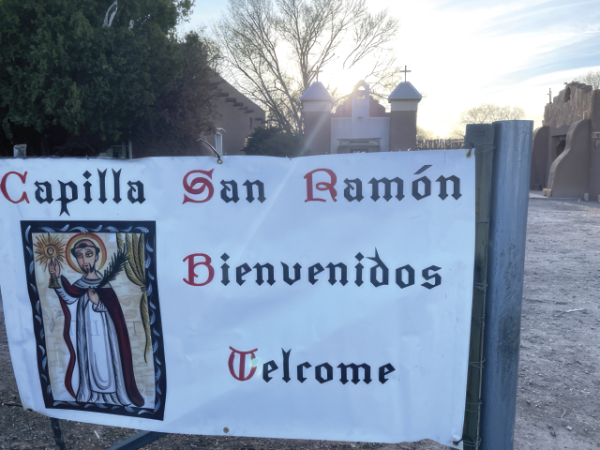
Capilla San Ramo´n, Tomé, New Mexico, 2023.
Welcome sign to family capilla of Dr. Ramón Sanchez.
Photo by Leeanna Torres.
Capilla San Ramo´n, Tomé, New Mexico, 2023. Welcome sign to family capilla of Dr. Ramón Sanchez. Photo by Leeanna Torres.

Papa grew up and was raised Catholic, as was his father, and his father, and his father. Mama’s familia was Catholic too, and thus both my brother and I were raised within the adobe walls of one of New Mexico’s oldest, and still active, Catholic parishes—La Nuestra Señora de la Immaculada Concepcíon.

Like my father before me, I’d been baptized within the walls of our local parish and remained committed to the faith. But several of my tías, tíos, and primos were no longer Catholic for their own reasons. Why did I stay? What is it that grounded me, tethered me so tightly to the Divine in this Christian tradition?

“Did you go to mass?” Papa asks me often, and most of the time I say yes.  But what would we say to each other—come to the capilla instead of the church? I thought of the Penitentes, historically not recognized by the Vatican, and oftentimes reprimanded because only the priests, only the ordained, were allowed to lead.

But when Papa and I went to the capilla, neither of us realized what would meet us there.

+

Papa enters in through the two front doors, open wide. Stepping inside, it’s suddenly cool, damp, dark. Behind the narrow row of wooden pews are fold-out chairs, added for the event’s visitors. Mrs. Padilla is here, along with her esposo; Mr. and Mrs. Romero too. Professor Enrique hands out a paper pamphlet, printed resos inside. “Comó estás?!” he whispers, and we hug, having not seen each other since before the pandemic. This, too, is a fact, so many community members gathered again in the wake of the COVID-19 pandemic, many still leery, like Erica and her husband sitting along the wall, both still wearing cloth masks over their noses and mouths. A community on the edge of what was separation for so many, many, months, now together again, slowly, cautiously.

“Siéntensen, siéntensen…” invites Mr. J. Sánchez, his hands motioning to empty chairs. His invitation is warm, enduring. Papa and Mr. Sánchez shake hands. Whispers fill the capilla, vecinos talking with vecinos, until the resos start.

Cuatro hermanos de Carñuel, two wearing plaid green and brown work jackets, take their place up front near the altar. Inside, the only light source is dim twilight coming in through the front doors, still open, and thin flickering candlelight from the altar.
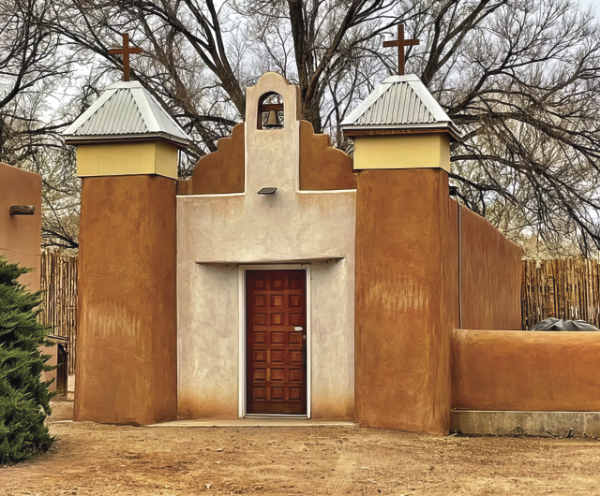
Capilla San Ramo´n, Tomé, New Mexico, 2023. Exterior of family capilla of Dr. Ramón Sanchez. Photo by Leeanna Torres.

With a history as vast and complex as New Mexico’s physical landscape, the myth, mystery, and traditions of the Hispanic Hermanos Penitentes are still alive today. “The Penitentes of New Mexico represent an interesting New Mexican Spanish religious survival,” Dr. J. Manuel Espinosa writes in his 1993 article, “The Origin of the Penitentes of New Mexico: Separating Fact from Fiction,”

This lay Catholic penitential brotherhood… who long have called themselves Los Hermanos de Nuestro Padre Jesús Nazareno, commonly known as the Penitentes, came into existence in New Mexico sometime during the second half of the eighteenth century.

As we are seated in pews along the narrow interior of the capilla, two otherHermanos Penitente standing in the back near the entryway begin the resos with a cadence between prayer and song, voices strong and commanding. There is no sound system, no microphone or speakers; instead, their voices are amplified by adobe walls and the vigas above, low enough to almost reach up and touch. 

“Padre nuestro, que estás en el cielo…” begin the Hermanos. Papa’s sitting beside me, reading through the prayer pamphlet handed out at the door, the print of the pamphlet declaring “tinieblas,” but in the ever-darkening capilla, he gives up quickly, folding the thin paper and stashing it in the back pocket of his jeans. 

I’d heard of tinieblas, familiar with the worditself—but what is it, really? The paper does not say. Instead, the pamphlet gives only a brief outline of the capilla’s Holy Week events: 

INVITATION SEMANA SANTA…
ROSARY… TINIEBLAS… PROCESSION…  LENTEN MEAL… ALL WELCOME
(No donations, please).

Within the pamphlet, I am familiar with all except for one—tinieblas. A prayer? An event? A ceremony?

“Help us preserve and experience the rich traditions of Semana Santa at Capilla San Ramón,” states the pamphlet. 

As the voices of Los Hermanos speak, a repetitive prayer-answer from the small crowd gathers, I look downwards, eyes drifting along the dirt floor, then over to Papa’s boots, scuffed and worn.

“Padre nuestro, que estás en el cielo…” the repetitive prayers continue. Inside this capilla, full of people, communidad, and as the Hermanos Penitentes recite in my first language, Spanish, I’d like to imagine their resos as old as time itself. Similarly, in the lull of growing darkness and vocal incantation, I’m transported into the teaching by Father Richard Rohr—a globally-recognized Franciscan priest and founder of the Center for Action and Contemplation in Albuquerque—who invites us to realize a “Christ” larger than Jesus, an eternal Christ more powerful and expansive than any human heart can conceive.

I think too of Father Demkovich, our priest just a few miles down the road assigned to the Tomé Catholic parish, preparing for the mass, a different prayer and ceremony than this. 

In this capilla with the Hermanos, the place of prayer feels rogue, rebellious, and deeply grounded in the people, of the people, for the people. This here and now feels different than any mass I’ve ever attended. This capilla, these Penitentes aren’t ruled by the Vatican or any Archbishop. It’s its own kind of gathering, a ceremony as old as New Mexico, or at least I’d like to imagine it this way.

“The Penitentes, a private Catholic brotherhood, is wholly unique to Northern New Mexico and southern Colorado,” Sol Traverso wrote in Taos News in 2022. “While its date of origin has been debated, they have been in the area for hundreds of years and are centered around community and penance, a Catholic sacrament involving the confession of sin, self-punishment and forgiveness.” 

What is prayer? What forms does it take? I thought of the prayers my parents taught me, the ones Nana recited, and the many said by the numerous priests of my childhood. How was this current time of tinieblaswithin this capilla similar? How was it different?

Light wanes inside. I can hardly see Papa’s shadow next to me now. Resos y mas resos. Between breath and word, I imagine the Hermanos praying for the suffering of the whole world. Some of us seated repeat the prayers in cadence with the Hermanos, but others are silent, the sacredness of adobe walls already settled into their bones. We are just ordinary people, reciting prayers passed down through generations as the light inside the capilla darkens.

We entered through the wooden doors as twilight was settling into evening. And now quietly, almost unnoticeably, the Hermanos close the two main doors, enclosing us all inside, the dim flicker of candlelight at the altar keeping our attention as the voices of the Penitentes continue their prayers.
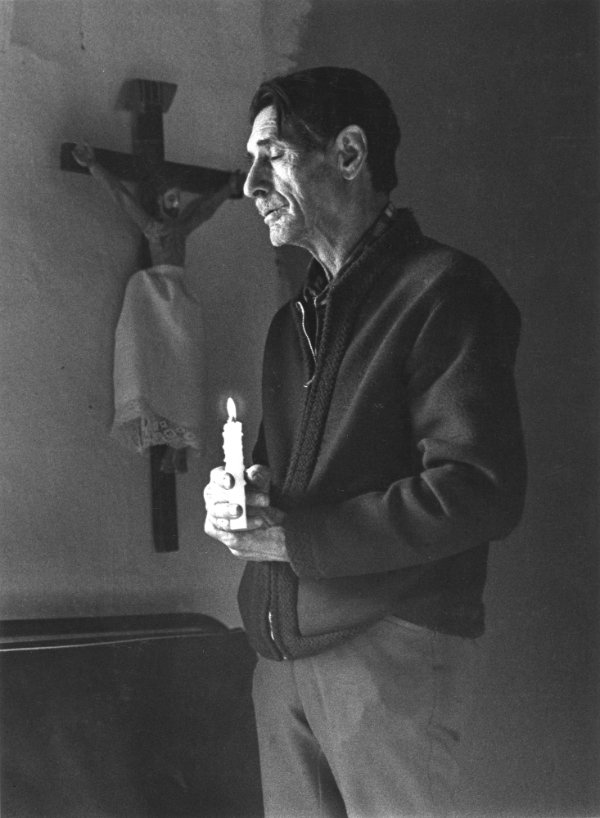
Nancy Hunter Warren, The Penitente, New Mexico, ca. 1973 –1990
Courtesy of the Palace of the Governors Photo Archives (NMHM/DCA),
HP.2003.29.4.
Nancy Hunter Warren, The Penitente, New Mexico, ca. 1973 –1990 Courtesy of the Palace of the Governors Photo Archives (NMHM/DCA), HP.2003.29.4.

The rituals of Semana Santa have been present in my life since childhood, yet this is different. How many Catholic masses had I attended in my forty-plus years? I’d been to cathedrals and basilicas in other cities too. But here in this small adobe capilla, among vecinos and familia, my body tenses. Still seated, I try focusing on the voices, on the physical presence of Papa beside me. 

Then slowly, almost imperceptibly, the Hermanos begin blowing out the twelve candles at the front altar, one by one. Their voices in prayer do not stop; their cadence continues, the only thing grounding us as the darkness inside begins to squeeze, engulf, smother. Before I realize, it’s pitch dark inside. Resos y mas resos. I can see nothing now. Absolutely nothing. A complete darkness. My eyes struggle. I can hear people shifting in the pews. Los Hermanos are still praying, and I struggle to hear as their voices lower. Somehow, I can’t move; my body is suddenly paralyzed within the darkness.

I struggle to sense the people around me. Wasn’t I just sitting inside adobe walls with my vecinos? Where are they? I can’t see them, can’t sense them, and in this darkness, I am sharply alone, clinging to the cadence of a prayer, song, and voices I no longer recognize or sense as familiar. Something in me wants to reach over, to feel Papa still sitting next to me, but I’m paralyzed in this darkness, more fearful than even now I care to admit. Why? What’s happening?
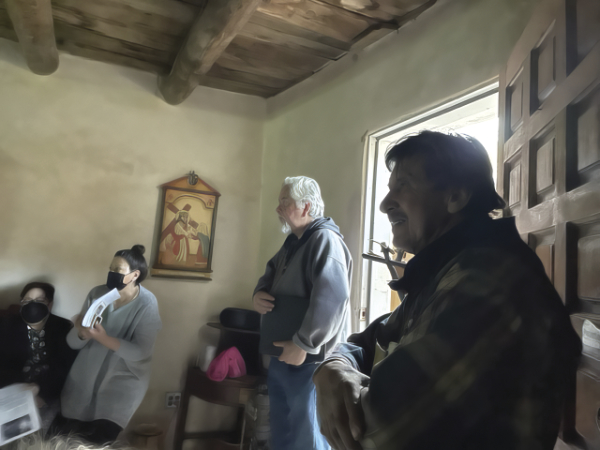
Holy Thursday participants at Capilla San Ramo´n, Tomé, New Mexico, 2023.
Photo by Leeanna Torres.
Holy Thursday participants at Capilla San Ramo´n, Tomé, New Mexico, 2023. Photo by Leeanna Torres.

My eyes still struggling, looking for light, any light. But nothing. Only the voices of the Hermanos. They are plunging us into the darkness. They are plunging me into darkness.

Then the songs, the voices, the prayers—all of it stops. In a capilla full of people, it’s only silence and darkness. I’m here, waiting for what will come next, paralyzed in fear. Why? What’s happening? Where has my logical mind gone? I wait for it to pass. It does not pass. There is only deeper darkness.

It is silent for longer than I care to admit. I’m paralyzed for longer than I care to admit.

Then, I hear what sounds like metal snapping, cracking, splintering. It’s sudden and terrifying, and still, there is only darkness. I try opening my eyes wider, grasping for light, but there is nothing. More unfamiliar sounds, what I’d describe now as chains falling on wood. Clanging and dragging in the darkness.

Still unable to move, I try feeling my body, time itself suddenly gone. 

What is darkness? What steepness or gravity presses on both your senses and your soul when you least expect it? 

The sounds stop. There is no light. Papa is not beside me. No songs, not even prayers. Only darkness. 

Then one candle is lit, a single yellow flame breaking the darkness. One of the Hermanos begins to sing an alabado, low and grounding. 

In my daily life, I seek joy as much as peace, but what I found in the participation, the invitation, to las tinieblas that evening at the San Ramón Capilla was something different than my common Catholic upbringing. Even now, a year later, I think about what we witnessed and experienced. Historians and estorias tell me there used to be Penitentes in my home region of Tomé as early as the 1800s. As a child I’d heard the mythologized, and often exaggerated stories of New Mexican Penitentes. But really, I did not know what the Penitentes were about and what they illuminated about the Catholic faith.

Truth be told, I did not experience what Willa Cather’s novel Death Comes for the Archbishop describes as, “the bloody rites of the Penitentes.” Instead, what was revealed to me was a practice of much deeper gravity. Not a bloodied dramatization, but an event grounded in unabashed and unapologetic validity. It was a lesson I had not learned in my many years as a traditional New Mexican Catholic growing up in and among the formal church. 

To experience a New Mexican Penitente ceremony is not to describe it. To experience a prayer is not the same as to say it. And I thought of the invitation Papa had received, and how he and I were welcomed into a space not recognized by the Archdiocese of our upbringing.

+

“How would you describe tinieblas?” I ask a Nuevomexicana friend one morning on an outside patio restaurant. There is a long pause, deep thought on her part before she answers, her hand holding a cup of coffee. I watch steam rise from her cup as she thinks about this seemingly simple question. 

Her pause is longer than I expect. It’s in that moment—many weeks after the actual tinieblasevent at the capilla—that I realize many of our nuevomexicano traditions are just this: hard to define, difficult to describe, impossible to ever fully explain. Instead, their essence is cupped gently in the liminal space between our essence, our identity, and our deepest knowing.

How to explain the importance of a New Mexican matanza, a velorio for your Nana? How to explain or describe New Mexican tinieblas?

Then came my friend’s answer. “It’s a practice,” she replied with deep conviction. “It’s a practice, but one where you say to yourself, ‘I don’t even fully understand what’s happening right now, but I accept it as a part of myself, a part of my community, a part of my querencia.’”

Las Tinieblas, more than a ritual, more than a ceremony or event.

Las Tinieblas, an outward expression, a practice. This reso, devout individuals—Penitentes—actively practicing what my amigo (and UNM scholar emeritus) Professor Enrique Lamadrid explains as “una visita.” And these men pray not as performance, but out of expression and season and faith.

Tinieblas is Spanish for the Tenebrae service that represents the darkness and chaos following the Crucifixion of Christ. But more than this. 

Las Tinieblas, the ritual of “the darkening,” takes place inside a morada on the evening of Holy Thursday. But more than this.

My friend puts into words what I’d been trying to define for myself about what happened that evening at the capilla. When prayers move you, when they create a physical reaction, and yet you cannot define nor fully understand it. Nor do you necessarily want to understand it. This is the power of practices that reflect the terrain and culture we come from here in Nuevo Mexico.

The complex history and current-day continuation of evolved practices of our Nuevo Mexico cannot be fully understood, rationally defined, or even accurately described. That evening with the tinieblas, I came to experience darkness with a gravity my soul had not yet grasped. My entire life, catechism classes and Catholic mass services had tried to explain the plunge into Christ’s passion. Somehow, they’d all fallen short. But now, at a rogue capilla within a Holy Week service led by Penitentes, I’d been plunged into a strange and sudden re-translation of holiness, ceremony, and reso. This is the power of practices reflecting the terrain and culture of Nuevo Mexico.

+

One does not have to be Catholic to experience tinieblas; in fact, I’d dare say my Catholic upbringing had less to do with what I experienced that Holy Thursday evening than I can explain. Because suffering, turmoil, and what any individual might name as their deepest darkness is a brutal yet universal truth for all humans. Although tinieblas was centered and grounded in the passion of a universal Christ, more importantly it seemed to reveal what it means to be invited as both human and divine. An inevitable journey into the darkness.
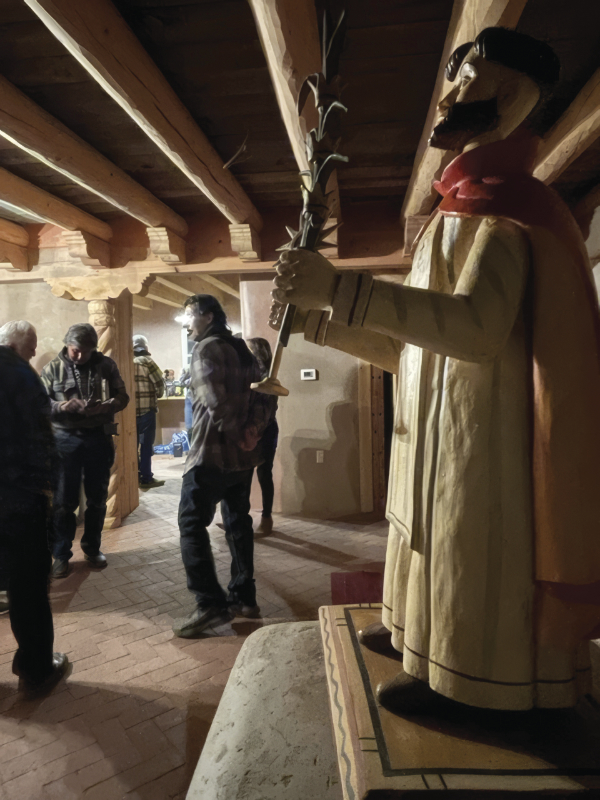
Guests and wooden bulto of San Ramon (by santero Alacrio Otero),
Tomé, New Mexico, 2023. Capilla San Ramón. Photo by Leanna Torres.
Guests and wooden bulto of San Ramon (by santero Alacrio Otero), Tomé, New Mexico, 2023. Capilla San Ramón. Photo by Leanna Torres.

The community was just coming out of the COVID-19 pandemic when I experienced tinieblas at Capilla San Ramón. COVID-19 had been a kind of darkness for so many. And cancer in the community. And poverty in our country, despite such wealth. Political division in our nation. War in the world. Seemingly endless darkness in so many ways. And yet, a single candle was lit by a Hermano Penitente, to break the darkness, to reveal the light.

That night, Papa and I exited through windowless wooden doors, the sun long set, our limbs shaky and unsettled. It was only the start of our holy days. Before I could look to Papa, ask him if he’d experienced any of what I had, Mr. Sánchez warmly spoke, “Ven a comer,” his voice like a single candle lit, urging us warmly to go next door, where a light Lenten meal waited.

Leeanna T. Torres is a native daughter of the American Southwest, a Nuevomexicana writer with deep Indo-Hispanic roots in New Mexico. She has worked as environmental professional throughout the West since 2001. Her essays have appeared in various print and online publications (Blue Mesa Review, High Country News, High Desert Journal), as well as several anthologies, including Torrey House Press’s First & Wildest; The Gila Wilderness at 100 (2022), and Elementals: An Elemental Life, Vol. 5, forthcoming by Center for Humans & Nature Press (2024).
Leeanna T. Torres is a native daughter of the American Southwest, a Nuevomexicana writer with deep Indo-Hispanic roots in New Mexico. She has worked as environmental professional throughout the West since 2001. Her essays have appeared in various print and online publications (Blue Mesa Review, High Country News, High Desert Journal), as well as several anthologies, including Torrey House Press’s First & Wildest; The Gila Wilderness at 100 (2022), and Elementals: An Elemental Life, Vol. 5 by Center for Humans & Nature Press (2024).
The Sound of Community:

By Lazarus Letcher

Early in his documentary The Whistle, StormMiguel Florez muses about his LGBTQIA+ friends who grew up in other parts of the country in the ’70s and ’80s who always say, “I didn’t know anybody like me.”

Florez retorts, “Albuquerque was packed full of queers back then!” Later in the film, we see a woman holding a scrapbook. It shows the wear and tear of being well-loved over many years. A bumper sticker reading “Get Wrecked” falls out of it and she chuckles. To her, it’s a scrapbook of cherished memories. To our underrepresented community, it’s a treasure trove, an archive, a key to reminding us that we’ve always been here and we’re not going anywhere.

Thanks to this woman and several others in StormMiguel’s The Whistle, New Mexico’s incredible queer, predominantly lesbian history won’t be forgotten anytime soon. Code phrases like “get wrecked,” “took a walk on the wild side,” and the eponymous whistle were secret ways for lesbians in Albuquerque to connect decades before it was safe to be out in the open. Florez set out to find the origins of the codes of his youth, growing up as a lesbian in Albuquerque in the ’70s and ’80s. High school pictures of his glorious mullet often grace the screen as he takes us down memory lane, accompanied by rare and beautiful queer ephemera and hand-drawn animations.

Trans filmmaker Florez is New Mexican to the bone. His roots run deep—he was born in Albuquerque, his father is from Roswell, and his mother is from San Acacia. Florez identifies as Chicane, a gender-neutral spelling of Chicano/Chicana that’s easier to pronounce in Spanish than Chicanx. He feels lucky that he grew up in a home not profoundly wed to the Spanish myths espoused by many classmates. He got into arguments on the playground, where he said, “We’re not Spanish; we’re Mexican,” a sentiment not shared by most of his peers. Florez credits his early understanding of his people and culture to an older cousin who often talked about their family history and the Chicane movement—Florez said it would be years until anyone in the family began using the term “Hispanic.”

In the B reel of The Whistle, shots of backwoods bosque trails lavished in leaf-filtered light demonstrate the care of someone who knows and loves cottonwoods, the Rio, and this place deeply. The care he takes in every aspect of his work is reflected in his interviews, capturing a rare and beautiful moment in Albuquerque’s queer history. It’s a history that’s hard to capture, with transient members, illegal lives, and exclusion from institutions, until recently. While New Mexico was one of the earliest states to legalize sodomy in 1975, that doesn’t mean the LGBTQIA+ community was warmly embraced; living out loud and daring to document it could lead to firing, ostracization, or even death.

Ade Cruz, Dyke Wall. Production still from The Whistle, 2019. Courtesy of StormMiguel Florez.

Florez tried turning to official archives to hunt down some answers for his film, but LGBTQIA+ archives are few and far between, and the ones that covered New Mexico’s queer and trans history skew alarmingly white for a state that’s majority-minority. Our history often feels like folklore. Our lives and history aren’t easily found neatly cataloged on library shelves, but in the memories of the elders we still have and the ephemera and scrapbooks that survive. Hannah Abelbeck, curator of archival photos at the New Mexico History Museum, said this struggle is especially present in New Mexico.

“New Mexico has vibrant and unique LGBTQIA+ histories. But they really aren’t very accessible to outsiders, not even for LGBTQIA+ people across communities or across generations,” Abelbeck says. “And when you can find them, they are generally not told very well. There are a number of reasons for that, starting with typical problems in queer historiography and extending to unique and surprising things about New Mexico in particular.”

The Whistle is an accessible and rare glimpse into this history. Florez’s artistic career didn’t start with film, but with music. During the time captured in The Whistle, Albuquerque had a robust feminist and lesbian music scene. Florez was lured out of his shell to begin performing—of all places—with a church youth group. His girlfriend at the time dumped him, citing her commitment to Christianity as the end of her queerness, and Florez almost followed suit. Thankfully, he was saved by the 1988 Albuquerque Women Fest, and he jokes that the pivotal event made him “a born-again lesbian.” Florez  spent his teenage years performing around Albuquerque as a solo artist and in queer bands before moving to the Bay Area in California in his early twenties.

StormMiguel’s first venture into filmmaking was a music video, quickly followed by helping his partner Annalise Ophelian create and edit a documentary about the inimitable and unmovable Black trans icon Miss Major, titled MAJOR! Florez caught the filmmaking bug, and after talking to some childhood friends, he knew he had to make a movie chasing down the mysterious lesbian whistle of his youth. Florez first heard and used the whistle in the late ’80s, learning it from other lesbians around Albuquerque, but its origin went back further and farther than he could have imagined.

The whistle is created by sharply inhaling, producing a note so high it sounds similar to a dog whistle. During Florez’s time in the late ’80s at Albuquerque’s Del Norte High School, he and his queer comrades from neighboring schools would use this whistle to communicate in groups, “Hey, I’m here, I’m queer, let’s hang.” 

Florez first used social media to try to find folks who might know where the mysterious whistle came from. Then, he interviewed old high school friends and put together a teaser trailer to try to find more folks to interview.

Florez was met with mostly excitement but some skepticism, with some women saying, “Who’s this man making a documentary about us?” For trans creators revisiting our past for stories, it can be tricky to navigate and explain, “This is who I am, this is who I was, this is my connection,” and thankfully, Florez was mostly met with open arms. In the trans-masculine community, there can be some fear when it comes to interacting with our peers under the rainbow umbrella—will butch lesbians see us as traitors, will women see us as abandoning the movement, will I be seen as an outsider to the outsider? Although we grew up at different times, Florez and I have both navigated these questions and fears in our transitions. Florez says making The Whistle and meeting and connecting with butch lesbian elders was especially healing.

Through the teaser trailer, Florez was able to meet with members of the queer community older than him; he was part of the last generation to use the whistle and was surprised by how far back it truly went. For Florez, chasing the origins of the whistle became the vehicle for telling the story of an extensive and supportive network of queer youth in the 1970s and 1980s in Albuquerque, and he was shocked when he found the genesis of the high-pitched siren song. I won’t ruin the surprise, but I will say the origins of the whistle demonstrate the importance of queer connection, the magic of the Borderlands, and the LGBTQIA+ community’s indefatigable effort to find each other, no matter what.

The world premiere of The Whistle took place at Albuquerque’s historic KIMO Theater in September 2019. Watching the documentary in 2023 is bittersweet. I was in high school in the early aughts as fights for gay marriage raged, and trans representation was saved for trashy daytime TV. I was out to only a few close friends, and I could count the number of peers who were out to everyone, including family, on one hand. I was already Black in small-town Indiana; I didn’t need to add another burden to my shoulders. Seeing high schoolers in the ’70s and ’80s be out to each other and their families in The Whistle was truly wild.

Although the stories in the documentary are mostly positive portrayals of finding community, friendship, and themselves, bullying was a factor in the subjects’ lives. Homophobic harassment led to one interviewee dropping out of high school and another being expelled once outed. Being out at school was not entirely safe, so the whistlers mostly connected either at sporting events or at the myriad gay bars in Albuquerque with the help of fake IDs. Even in the ’70s and ’80s, these gay establishments were still getting raided. At the time, the subjects of the documentary thought the raids related to them being underage guests; it wasn’t until they were in their thirties they realized that these were coordinated homophobic attacks by the Albuquerque Police Department.

One montage that was surprising to me as a viewer—and even to Florez as a director—was of several stories of mental health professionals that his childhood friends shared. Every interviewee who was taken to a therapist was supported by the mental health professional, and the parents were told to change their attitudes. These young people were being sent to therapists when their bible, the Diagnostic and Statistical Manual for Mental Disorders (DSM), still classified homosexuality as a “sociopathic personality disturbance.” In the documentary, Florez’s pediatrician soothed his mother’s worries over his queerness by saying, “Well, I can tell you it’s a lot safer than your child sleeping with every boy on the block.” While making the film, Florez reconnected with his old pediatrician and discovered that she went on to relay this story during trainings to help other physicians navigate how to respond to parents trying to “fix” queer kids. Despite our small population and placement at the bottom of several national lists of state rankings, New Mexico has long been a relatively safe space for the LGBTQIA+ communities, and these medical professionals going against the grain decades before the rest of the country is more proof of how deep our rainbow roots run.

Gloria Vigil, Ro Sanchez, and Bern Adkins reminisce about high
school in Albuquerque in the 1970s. Production still from The Whistle, 2019.
Courtesy of StormMiguel Florez.
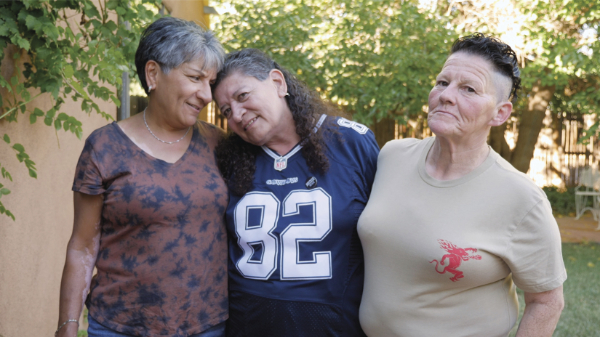
Gloria Vigil, Ro Sanchez, and Bern Adkins reminisce about high school in Albuquerque in the 1970s. Production still from The Whistle, 2019. Courtesy of StormMiguel Florez.

I’ve been lovingly entrapped by the Land of Enchantment for nearly a decade. Growing up primarily in small towns in the Midwest, Albuquerque felt like a bustling metropolis with an actual gay scene at first. Watching the folks in The Whistle rattle off an extensive list of not just queer bars but lesbian bars left me with my mouth hanging open. Of the several listed, only the Albuquerque Social Club remains. In the film, Florez narrates some of his old haunts while he drives around Albuquerque. As he pans to a venue that used to be a lesbian bar with a marquee that now reads His Place Ministries he sarcastically says, “clearly not a lesbian bar anymore.” Since the 1980s, over two hundred lesbian bars have permanently shuttered across the U.S., with Albuquerque being no exception. According to the creators of The Lesbian Bar Project, these closures are the result of gentrification, misogyny impeding access to financial support, and the rise of dating apps. The closures threaten centuries of seeking sanctuary at a bar and meeting other queer people there.

While never explicitly named, the documentary is haunted by the impending AIDS epidemic and the corresponding meteoric rise of the Christian Right. The stories shared in the documentary are nestled between the Stonewall Rebellion and losing nearly 330,000 queer and trans folks to AIDS—and the U.S. government’s inaction. Florez says the Albuquerque lesbian scene was a bit separate from the gay men’s spaces and he can’t quite pinpoint when the epidemic came to ’Burque. He says when he came out as a lesbian, some people would ask if he was worried about AIDS. The gay bars at the time were one of the few places where regular HIV testing was taking place. The whistlers weren’t oblivious to what was happening, but between being high schoolers and lesbians, they were somewhat sheltered from the chaos swirling through the LGBTQIA+ community nationally and internationally.

The documentary ends with a montage of news clips showing the threats that LGBTQIA+ youth faced in 2019. Watching it five years later, it’s heartbreaking knowing the list is much more extensive, with 2023 ushering in more anti-LGBTQIA+ bills than any legislative year. So many of the attacks aimed at queer and trans youth are backed by a claim that our LGBTQIA+ youth are something new, but The Whistle proves that we know who we are pretty dang early, and finding community is essential to our survival.  It’s hard not to feel like we’ve gone two steps forward and one step back. Compared to a majority of the United States, New Mexico’s legislature and citizens have tended to be more progressive when it comes to protecting LGBTQIA+ individuals and our rights. In 2023, Governor Michelle Lujan Grisham signed House Bill 7, the Reproductive and Gender-Affirming Health Care Act, enshrining New Mexicans’ rights to our bodily autonomy, from reproductive rights to accessing gender-affirming medical services. This bill is a far cry from legislation passed by twenty-five states limiting transgender healthcare.

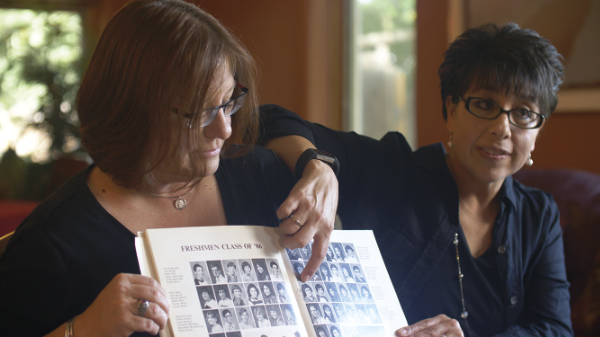
Stephanie Sanchez points to her sister Molly Chavez’s photo in the Valley
High School yearbook. Production still from The Whistle, 2019. Courtesy of
StormMiguel Florez.
Stephanie Sanchez points to her sister Molly Chavez’s photo in the Valley High School yearbook. Production still from The Whistle, 2019. Courtesy of StormMiguel Florez.

While queer and trans youth rights are under attack, the whistle generation is proof that having a supportive community nearly guarantees success. A lot of this community’s success can be attributed to the teacher featured in the film, Havens Levitt, who acted as a beacon to the younger generation. In one scene, Levitt recounts an interaction with a parent of one of her lesbian students, who thanks her for helping her daughter live authentically as herself. While Levitt had no legal protections as a gay teacher at the time, she said, “It was a pivotal moment for me where I just got this huge message that the people who don’t want me to support LGBT kids don’t matter. And the people who do, including the parents that love their kids and want them to be affirmed and, you know, be happy and … live happy lives, those are the people that I care about.”

While watching The Whistle and witnessing the solid lesbian community thrive nearly forty years before marriage equality was legalized in the United States, you can’t help but ask, “Why Albuquerque? Why then?” Albuquerque was never necessarily seen as a hotspot for queer people, like larger cities including San Francisco or New York City. When the whistle was born, Albuquerque’s population was just shy of a quarter million. Florez suspects that part of the equation was the fact that young women had the ability to be invisible more easily than gay men.

“We could kind of fly under the radar; people just thought we were jocks or tomboys,” he says. Florez also reflected on how less likely his friends of color were to be kicked out of their homes after coming out, even if the parents were less than accepting. He was particularly moved by his friend Gloria’s story of coming out to her mother, depicted in The Whistle. While crying on the porch after her first break up her mother comforted her, saying, “Don’t worry, there’s other girls out there.” When your community or family has experienced forced ruptures from colonization, turning around and doing the same thing to your child is a harder pill to swallow. The interviewees weren’t exempt from bullying or violence, but they found sanctuary in each other and received the care of some supportive adults.

As states across the country try to push queer teachers into closets and sweep representation from library shelves, it’s wild to look back in history and see it as more progressive in some regards. Florez and I discussed this double-edged sword of visibility—how so much of the recent pushback against queer and trans youth is partially due to the shift from secret codes and whistles to connecting openly online and in person. Decades ago, our numbers seemed smaller largely because people didn’t know we existed; now that we’re visible, our numbers continue to climb while our safety doesn’t seem to be keeping pace. The big emphasis on transgender visibility has helped folks like me recognize that other worlds and lives are possible, allowing us to come out—but it hasn’t decreased the violence the LGBTQIA+ community, and especially trans women of color, face.

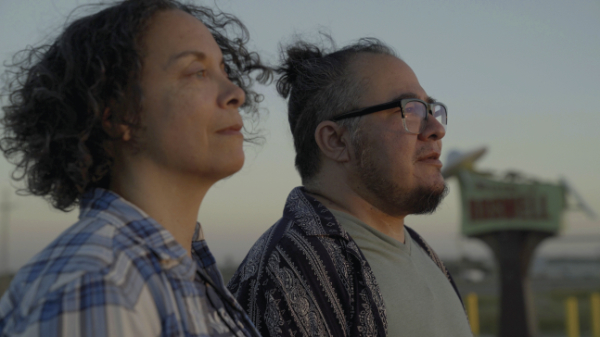
Characters Miguel and Elise look to the horizon on their way to film and interview Miguel’s family. Production still from Road to Roswell – A Welcome to
Roswell Short, 2023. Courtesy of StormMiguel Florez.
Characters Miguel and Elise look to the horizon on their way to film and interview Miguel’s family. Production still from Road to Roswell – A Welcome to Roswell Short, 2023. Courtesy of StormMiguel Florez.

As Florez’s former documentary star (Florez doesn’t use the term “subject” to describe those in his films), Miss Major says in her memoir Miss Major Speaks: Conversations with a Black and Trans Revolutionary, “With all the visibility we’ve gotten—or I should say a few of us have gotten—over the past couple of years, it hasn’t done shit for most of the community. The murders they’re still happening. The body count keeps going up.”

Just this past summer, in the LGBTIQA+ sanctuary state of New Mexico, I was attacked with an AK-47 in an event I believe was motivated by hatred of my identity. Trans and queer stories in our media are a step in the right direction, and we can’t stop fighting for what’s happening off the screen and in our lives.

Last year, the New Mexico History Museum hosted a screening of The Whistle as well as a discussion with Florez and the film’s participants as part of their Hispanic Heritage Month programming. The film is an essential record of not just Albuquerque’s queer history, but Chicane and Latine history as well. While Florez doesn’t personally use the label Hispanic, he thinks the inclusion of the film in the museum’s programming was important “because even though it is not a film explicitly about being Latino/a/e, it is a film by a Chicane person that explores dynamics and culture that came directly from Latina lesbian and Latino gay community. Hispanic or Latino heritage and New Mexico history have always included queer and trans people, whether or not we are a part of the record, and so we absolutely belong in places that preserve and teach our stories and histories.” The film now lives in perpetuity on New Mexico PBS, where it can be viewed at no cost. Its accessibility is crucial: this is New Mexico’s history, and New Mexicans need to see it.

Florez’s current project, which recently received funding from the Sundance Institute, is a mockumentary titled Welcome to Roswell. He was inspired to make the film after taking a road trip to Roswell with his partner after being gone for over twenty years. On this trip, Florez laughed off his partner’s questions about the famed 1947 UFO craze. Florez said that growing up, no one ever mentioned the event—not even the family who lived in Roswell when it happened. As they rolled into town though, Florez was astounded to witness the transformation of the sleepy southern New Mexico town to a full-blown UFO and alien utopia, with flying saucers adorning nearly every building on Main Street.

Welcome to Roswell was partially inspired by this sojourn back to Roswell and all its weird glory. In the film, Florez plays Miguel, an overly serious documentarian, capturing his journey to Roswell, where he comes out to his family as trans. His plans go off the rails as his family and girlfriend focus instead on finding the truth behind the alleged 1947 UFO crash, remaining far too blasé over his “big reveal.” It was hard not to chuckle at Florez’s planned plot for the mockumentary—especially his spin on the classic coming-out narrative. So much of trans media fixates on our coming out journeys and our family members’ reactions. Often, the trans joy of coming out gets overshadowed by the cisgender “grief” family members experience over coming out and adjusting their views and expectation of us.

The 2020 Netflix documentary Disclosure covers the mostly problematic history of trans depiction in film. One moment that stuck out to me was how often trans “reveals” were used as gags (and often literally, like in Ace Ventura: Pet Detective when Jim Carey’s character vomits upon learning of his crush’s “truth”). Actress and activist Laverne Cox notes in the film that making trans people a laughing stock has real-world implications, saying, “I can’t even tell you how many times I’ve been in a public space, particularly early in my transition in New York City when I would walk into a subway car, and people would just burst into laughter as if my experience on that subway car was just a joke. And I think people have been trained to have that reaction.”

Welcome to Roswell will lead the way for trans comedies made by us and for us. We’re more than tragedy or grief, an oddity, or freaks—we’re people with stories to tell, and many of those stories are pretty damn funny. Welcome to Roswell will give us a rare chance to see a trans-driven comedy where we aren’t the butt of the joke and where our identities aren’t either inspirational or a harbinger of doom—because there are bigger fish to fry, like aliens.

With The Whistle and Welcome to Roswell, Florez is sharing the often-overshadowed positive experiences of being queer and trans, especially in the overlooked haven of New Mexico. The Whistle depicts a rare magical moment in time and space where queer kids were able to have community decades earlier than anyone might have imagined. Welcome to Roswell will open us up to new forays into the genre of comedy, where queer- and trans-driven films are not solely focused on our identities but on our community and our hijinks. In a time where things seem so dark for queer and trans folks in the U.S., Florez is providing a window to show the world New Mexico’s light. 

Lazarus Letcher (they/them) is a Ph.D. candidate in American Studies at the University of New Mexico, focusing on linking homophobia and transphobia to white supremacy culture and examining QTBIPOC art as resistance. Laz has written for Autostraddle, them, and the occasional dry academic journal. You can read more of their work at LazarusLetcher.com and on Instagram @L.nuzzles.

Lazarus Letcher (opens in a new tab) (they/them) is a PhD candidate in American Studies at the University of New Mexico. Their dissertation is titled Memorializing Queer and Trans Lives in a Time of Spectacular Erasure. They play viola for Eileen & the In-Betweens and Stages of Tectonic Blackness. Their writing can be found in Autostraddle, them, El Palacio magazine, and the odd dry academic journal or fun zine.

​StormMiguel Florez  (opens in a new tab) is a trans, queer Chicane filmmaker, whose work includes the award-winning films The Whistle (2019, Producer/Director), MAJOR! (2015, Editor/Co-Producer) and Vulveeta (2022, Co-producer, Editor, Actor). StormMiguel is currently working on his feature narrative directorial debut, Welcome To Roswell. He’s originally from Albuquerque, and has lived in the San Francisco Bay Area for over twenty-five years.

Look Long

Throughout the eight years I lived in Montana, I wrote essays that were essentially love letters to New Mexico. If you had asked me in high school if I wanted to stay, my answer would have been a resounding “No.” But I was born near the red willows on the banks of the Rio Grande and raised in the seam between the Great Plains and the foothills of Hermit’s Peak. The red earth and unrelenting sun are a part of me. 

Still, my family does not go back generations on this land. I wrestle with my sense of belonging in my love letters to New Mexico. This wrestling is not unique; no matter their birthplace or ancestral history, many people wrestle with belonging or identity. The pandemic heightened questions of purpose and prompted us all to examine the communities we did and didn’t belong to. In isolation in those early days, we remembered, yearned, and dreamed. My yearning brought me back home. 

“Blood is thicker than water” is a phrase meant to emphasize the strength of familial bonds. But the correct phrase, with origins that are murky but perhaps attributable to the Bible, is “The blood of the covenant is thicker than the water of the womb.” Which is to say, community and belonging are often forged through shared meaning and experiences rather than shared genetics. For those of us in the LGBTQIA+ community, this has always been understood. As Lazarus Letcher writes in their profile of filmmaker StormMiguel Florez, the focus on joy and community—rather than pain and discrimination—is a worthy one. 

Belonging rings through the pages of this issue of El Palacio. In her article, Annie Wenstrup talks with three artists whose work grapples with the Missing and Murdered Indigenous People epidemic. Though the artists and the communities they belong to are bound, in part, by disproportionate trauma and loss, their art is a testament to the power of community and collaboration. Through their work, the artists convey an unwavering insistence on the presence and vitality of Indigenous communities. It is a declaration, a prayer, a song: “We are here.”

This insistence for visibility and shared humanity reverberates through Jimmy Santiago Baca’s ode to prison art and the Pinto plebe who create it. He writes with heart and from experience as he pays tribute to the Chicano artists who continue to assert their dignity despite their constructed invisibility and the indignities they face. Like the artists Wenstrup interviews, the art conveys emotion and connection that surpass language.

Even in small New Mexican communities, the church you do or don’t attend communicates one kind of belonging. Penitente services are often held in private, family-owned capillas—but Leeanna Torres’s recounting of her experience at a Penitente service in Tomé last year invites readers into the Sánchez capilla so that we, too, can feel the power of ceremony and community within the chapel’s adobe walls.  

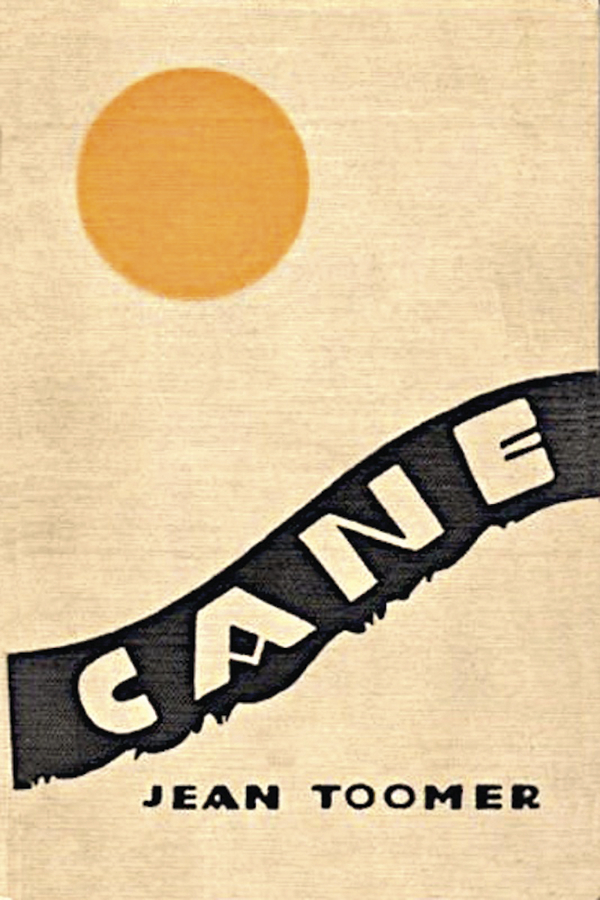
Exclusion is often the flip side of belonging. For me, as I wrestle on the page with my own maps of belonging, it can sometimes be easier to see where I don’t belong. Was this also true for Harlem Renaissance writer, and former Taos resident, Jean Toomer? In his analysis of Toomer’s writing and legacy, Darryl Lorenzo Wellington makes one thing clear: we are, all of us, caught in the middle of our ideals and our lived realities. How do we square individual and communal belonging within our historical and contemporary contexts? Like anything worth doing, perhaps the seeking is itself the point. 

Emily Withnall (opens in a new tab) is the editor of El Palacio and the host of Encounter Culture. Prior to stepping into the editor role, she wrote for the magazine for eight years. Emily has also been published in The New York Times, Al Jazeera, High Country News, Orion Magazine, Tin House, The Kenyon Review, Gay Magazine, Source New Mexico, and other publications. She lives and writes in Santa Fe, New Mexico.

A poem to acknowledge that the land itself — along with the people whose language, culture and religion were born of it — is rarely acknowledged

BY CMARIE FUHRMAN
Let us pause for a moment and acknowledge the land on which we live. This is the traditional land of Tewa people of O’Ga P’Ogeh Owingeh. We should take another moment to acknowledge the ways Indigenous people have been/are being removed and erased from the land they’ve stewarded for over 16,000 years: Swiftly. Brutally. Culturally. Fatally. Let us acknowledge that soldiers for the United States killed women and children because they were Native. Let us acknowledge the recentness of this. Let us acknowledge the Native people buried in their land without markers while unnamed settlers rest in fenced graves. Let us acknowledge Indian graves dug up and looted. Let us acknowledge that place names like Squaw Mountain do not honor ancestors. Let us take a moment and acknowledge that this land was not stolen from the people whose language, culture, and religion were born of it; let us acknowledge that the people were stolen from this land. The people who celebrate this land with song, dance, ceremony; people who do not commodify and commercialize trees and water or call it resource. Here we pause to acknowledge that the land itself is rarely acknowledged. The land buried beneath asphalt, cement, floorboards, and foundations. Let us acknowledge that this buried land which once grew food and medicine now grows dollar stores and subdivisions. Let us acknowledge the land in the way subdividers do, with the blade of the bulldozer and with names like Forest Trails, Aspen Ridge, River Ranch, with words, the way the Government recognizes only Federally recognized tribes and has taught some Natives to recognize others only on paper, through blood quantum and CIB instead of commitment to rights and sovereignty. Let us recognize Land Acknowledgments that serve as consolation, another box checked on a list titled Due Diligences. The way wearing a Black Lives Matter T-shirt acknowledges white wokeness while the same whites shop at white lives businesses; acknowledgment as performative allyship. Let us acknowledge that internment camps were prisons. This Land Acknowledgement was written for the people who acknowledge land in the way spotted knapweed acknowledges it, the way a ‘For Sale’ sign acknowledges it, the way the Forest Service acknowledges land by stating #itsallyours, but meaning #itsnottheirs. This statement acknowledges the land in the same way the media and FBI acknowledge the over 2,000 missing Native women and girls—by recognizing the one missing white woman for whom hundreds search and whose picture is present on all our screens, the way Native silhouettes are screened on paper to sell cigarettes. This Land Acknowledgment is inked on the heartwood of a pine that escaped the fires but fell for the mill from a land that cannot help but acknowledge climate crisis and carrying capacities, the grizzly bear fatally removed, and the salmon who can no longer reach their original homelands. This land acknowledges the wolves shot by stockmen and sportsmen, to preserve the animals stockmen and sportsmen will thenceforth kill in the name of husbandry and sport. Let us acknowledge how we honor loss with dollars and not grief. Let us make depredation a science and pay officers from the bank of conservation. Let us acknowledge the words used to disassociate kill/er/ing/ed from the act of execution. This land acknowledges that it is recognized for its monetary value, recreational value, and aesthetic value. Because it too is living, this land recognizes us by our carbon footprint, our clear-cuts, our gold mines, and our greed. This acknowledges that Land Back means languages back, means medicine back, means ceremony back, means culture back, means reparations. Means all people depend on the land. Let us acknowledge that unless action is taken to identify and empower Indigenous peoples, erase inaccurate history from every school curriculum, carry out land-based justice and climate change policy, a Land Acknowledgment is a perfunctory, alienating, and otherwise hollow gesture. Acknowledgment means acceptance, admittance; acknowledgment is a dead word, is not a verb, is not deed, does not mean education. Acknowledgment means too late for an apology. Read me your Declaration of Change. Detail your Plan of Procedure. Show me your Map to Equality. And then, just maybe then, I might be convinced that your Land Acknowledgment is not but another broken treaty.

CMarie Fuhrman is the author of Camped Beneath the Dam: Poems and co-editor of Cascadia: Art, Ecology, and Poetry, and Native Voices: Indigenous Poetry, Craft, and Conversations. She has published or forthcoming poetry and nonfiction in multiple journals and anthologies. CMarie is an award-winning columnist for the Inlander and Director of the Elk River Writers Workshop. She is Associate Director at Western Colorado University, where she teaches nature writing. CMarie is the host of the podcast Terra Firma. She resides in the Salmon River Mountains of Idaho. CMarieFuhrman.com

Cara Romero (opens in a new tab) is an award-winning photographer known for her work that examines Indigenous life through a contemporary lens. She is an enrolled citizen of the Chemehuevi Tribe and is married to artist, Diego Romero (Cochiti Pueblo). Cara majored in cultural anthropology at the University of Houston and later studied photography at the Institute of American Indian Arts. Her work is highly-sought after and is featured in galleries and museums across the globe.

CMarie Fuhrman (opens in a new tab) is an award-winning author, poet, and teacher whose work is deeply rooted in the Western landscape. She is the author of the essay collection Salmon Weather: Writing from the Land of No Return, which was chosen as a Great Read from Great Places, and the poetry chapbook Camped Beneath the Dam. She is also the co-editor of two influential anthologies: the multi-award-winning Cascadia Field Guide: Art, Ecology, and Poetry and Native Voices: Indigenous Poetry, Craft, and Conversations. A former Idaho Writer in Residence, CMarie’s writing has been featured in Terrain.org, Emergence Magazine, Alta Magazine, Big Sky Journal, and Poetry Northwest. She is the host of Colorado Public Radio’s Terra Firma and an award-winning columnist for the Inlander. CMarie serves as the Associate Director of Western Colorado University’s Graduate Program in Creative Writing.

Love Pa’ Mi Gente Shine Through Me

By Jimmy Santiago Baca

There was a time when you would have never caught me in a museum. At most, I had maybe visited a cultural display for el Día de los Muertos at our local community center. I had other things to do besides pay an entrance fee I couldn’t afford. Can you imagine my wife asking me where the groceries for the money she gave were and me saying some stupid thing like, “Ah, yes my dear, well, I visited the museum”? No doubt, she’d throw me out of the house after that reply. Besides, I had grass to cut, screen doors to repair, bathtub drains to unplug, kids to run around—unlike those rich white people who could hire people to do all that. And besides, really, when two-thirds of the planet is starving, and most of it is in coughing death-throes from urban toxins, and you hear of someone buying a painting for a gazillion dollars, you’re like, What? Must be a misprint, no? You tell yourself to hold your sanity in place, No, people do not do this. For a picture of corn fields? Nudes? Picasso’s work looks like someone on meth after three months of no sleep, so it really, I mean really, does make you wonder if you’re one of the billions of inhabitants on this planet trying to meet the bills each month and make sure your kids are safe.

Museums weren’t for me: costly entrance fees, guards trailing me, paintings depicting European cultures, wine and cheese (Tequila? Tacos? How about a little cultural sensitivity?), table fruit, girl looking out a window or in a mirror, widow in a rocking chair knitting by a fire, wheat fields. If my wife knew I’d spent the day staring at these paintings, she’d insist I pay her to watch her looking out the window or in a mirror, which she wouldn’t do, not with that youthful glow gone and too many cups of ice cream and popcorn packed in. But loving each other, we’d survive this mega quarrel and hug and kiss and have sex later and probably laugh it all away.      

But times have changed, and I caught the bug. The museum bug. Now, not a month goes by when I don’t sweep my kids and wife into the car and head to the latest exhibition at the Albuquerque Museum in Old Town or the National Hispanic Cultural Center in the South Valley or the Museum of International Folk Art in Santa Fe.

I love these excursions.

This love affair began, budded, bloomed when museums started showing Chicano art. An important part of the renaissance is Pinto Art, art by men and women in prison. This is the real stuff—grim, vulgar, untamed beauty. 

But here’s the catchall—most of the world’s prestigious museums are out scouting the boonies to find these artists and exhibit their work. It’s an enthusiastic time for an exciting phenomenon, with only one setback; whereas thirty years ago you could pick up a Paño or Chicano painting done by a Pinto for say, five thousand, (or sometimes a six-pack depending on the day and mood of el pintor), now you have to sell your firstborn. And that’s good for them, bad for me, Old Empty Pockets Poet (my street label).

Some collectors are paying upwards of a hundred thousand to half a mil or a million a pop. Problem is, no one’s selling because there’s not enough work to go around. It’s like those Walmart Black Friday sales: collectors are pushing and shoving to get in the door first. The smart guys have cornered the market, but at least I can still see the work in museums.

Value. The magisterial skill they reflect, the controlled freedom of the lines, the imaginative colors and merging and blurring any reference you bring to its content, explodes in your mind and spins like it’s a piece of clay on a wheel. The face or car or landscape sometimes is so mesmerizing that I can walk right into it and, for a suspended moment in time, leave my miserably poor life and enjoy, through the Paño art, a happy, fulfilled life. If not fulfilled, then purposeful.

Unidentified Artist, Chicano Beauty from the Barrio, date unknown. 15 1/2 × 16 in. National Hispanic Cultural Center Art Museum Permanent Collection, 2019.30.130. Photo by Addison Doty.

But now to the nitty gritty: The talk about what Chicano art is, for all you trust funders needing to spend your money on a good investment. I’ll tell you what to look for, how to understand it.

Let’s take two of the best museums in the country and their current and upcoming exhibits: the National Hispanic Cultural Center’s exhibition, Into the Hourglass: Paño Arte from the Rudy Padilla Collection, on view until April 14, 2024, and the Museum of International Folk Art’s exhibition, Between the Lines: Prison Art & Advocacy | A Community Conversation which opens August 9, 2024, and runs through April 2025.

A lot of the Chicano art—and Paño arte especially—I’ve seen deal with bad guys/good guys, accidents, injustice, and peril. It redefines the narrative of culture and bias, fearlessly. For so long, we’ve looked at art in museums with an eye-patch on (hell, if James Drake’s work didn’t bring West Texas culture back, we’d still be thinking it was pearl-handled pistols and fourteen-carat spurs).

Paño arte and Chicano painting is returning home with a journey to tell about. Look at the exciting and innovative work of John Paul Granillo, Adam Montoya, Eric Martinez, Nicolas Hererra—those standstills of Indians in ceremonial garb and maudlin, sentimental Hispanic scenes of women weaving and making tortillas in the kitchen are now being (alas!) placed in storage. The feeling that I’ve been mugged is over. I breathe freely, move about, and feel liberated by the new exhibitions.

There is a new vital dynamism of Chicano creativity waking us from our timid voyeurism into the wonderful lashing of waves against reefs that is the cultural renaissance; the Pachuco resurrects, my identity is no longer displayed (or flayed) as a lecherous criminal on canvas, but as a joyous manifestation of engagement with songs, dance, literature, and, in this specific case, painting. Yayyy, I live again, there are artists painting me and my culture as I am! As I wish to be treated, seen, related to. Wow, let the world in! Yes.

Prison art holds a special place in my heart. Artists working under duress and oppression have always produced the volatile work that interests me, and now it seems to have summited public interest, especially for the wealthy, who are rushing, as I mentioned, in droves to museums and galleries to get their rich hands on this work.

Prison art represents the spirit stripped of pretense, the mind at its most acute, and the heart at its most passionate. Do away with the macabre perceptions of the idle, bored artists to portray dumb effigies of who we are—violent, sexually maddened, depraved weirdos. Why anyone would waste their talent painting lies is beyond me, but it does sometimes usher in the deplorable side of the vast breadth of human nature which is inclined towards the cruel and wicked. No, though there is a long road yet ahead, Chicano art has matured, after being long nurtured in silence and isolation, into adulthood.

I speak from experience, having done time for a quarter of a century in some form of contained environment—orphanage, juvy hall, gladiator school at Montessa Park, county jail, and alas, maximum-security prison. It was in these socially sanctioned torture palaces where I first encountered Paño arte and where it first took my breath away. I couldn’t believe the fine detail, the meticulous manner in which portraits were sketched. They came alive and almost spoke, almost gestured to me, almost called me into their world. I noted the symbols and myths, the dreadful needle, and La Llorona in hooded cowl and reaper’s blade.       

Prison art is fearless, bends no knee before authority or monarchy of public opinion, and shatters tasteless and timid portrayals. It doesn’t imply, it points with an unblinking stare, it doesn’t shy from historical shames—women raped by gringo vigilantes, police brutality, injustice—no, the Indigenous Chicano takes the stage in Paño arte with dignity and meaning, a purpose that fosters deep thought and new appreciation of an ancient culture and draws from that legacy the richest journey into Self.

Paño arte, prison art specifically, is a search for meaning and celebration of survival under the direst conditions of repression and brutality, and herein is where the spirit fuses with craft and announces its genius. Rebellion in art is the best art (take Picasso’s Franco period), showcasing our uniqueness, how a prayer on a rosary can suddenly look like a starry night, tattoos become metaphors of love and loyalty, Southwest landscapes and prison landscapes all become grounds for blending the desperate and hopeless with achievement and success, merging the halves into a beautiful whole state of love and endurance that speaks to our experience in the fields, borderlands, prison cells, schools, judicial arenas; every cliché is wrenched apart, the corporate selling points of acceptance and what is mainstream are stomped underfoot and crushed as debris, swept into the gutter and replaced with realism that shows extraordinary grace and control of craft.

The vato loco, la ruca, la curada, Jesús Cristo, y la Virgen de Guadalupe, all take front and center and reach the powerful heights of true conciliation with the viewer in a way that leaves wonder in the bones, appreciation in the mind, a grace that is bestowed and cherished and kept long after leaving the gallery.

We now see things differently.

We now live in a place with fresh eyes; not the idealized, but the communized. I wear sunglasses inside, I button my Pendleton at my collar, my babe wears heavy make-up, I wear my black leather Calcos polished bright, and dude, let me tell you, I got attitude. These are the hallmarks of the Chicano that I am, ages of Indigenous love pa’ mi gente shine through me, and I ain’t taking steps back, pa’delante compa.

The era of trying to please the overseers is over: no more braided little Spanish girls smiling from book covers to please my white audience. Nope, no, no, no. This is barrio land, this Pinto plebe, camaradas in the joint doing time because a racist system loves sacrificing the brightest and most beautiful men and women. This is injustice no more, ya se `cabo, we come now to reflect our mothers’ loves, our familia, our sorrow, and our alegria, no longer are we demonized—because now we are telling the story, we are painting our culture. 

This is the new Paño arte and what it fleshes out on handkerchiefs—this is what the Hollywood directors and movie stars and rich stockbrokers and art collectors are tripping over each other trying to buy. The people who have for so long been forced into isolation have come to light, to expose another piece of democracy or lack thereof, to show how people can overcome and thrive and love and destroy each other, how they hurt and what their dreams are, all within the confines of a handkerchief.      

What you see of graffiti is a detailed script of place, street-cred lifted to high art form, those hearts and roses and crucifixes are the cultural residue of metaphysical beliefs.
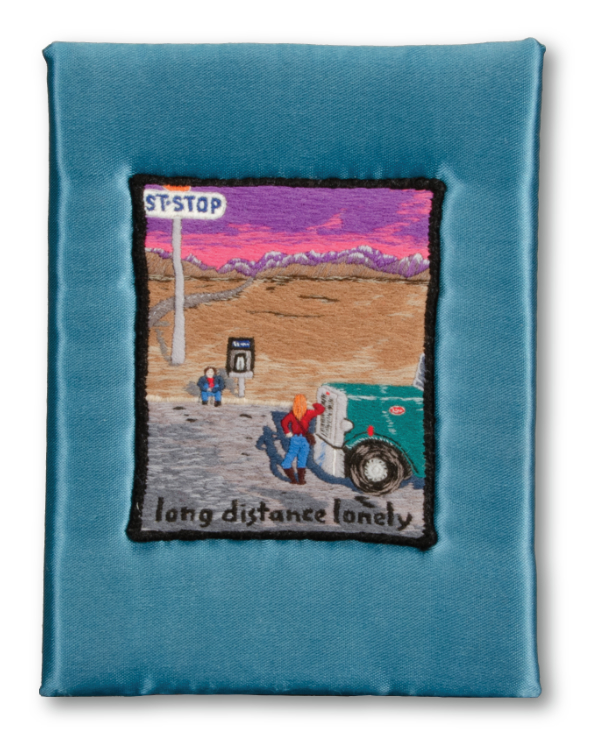
Paño arte is the work of the undesirables, the dispossessed, the disposable human beings, it is clearing the attic cobwebs and opening the boxes and discovering your past, present, and hopes for the future, it’s despair where there is no bottom, no trap door, the telling of a tale of a human being who only has a handkerchief to dwell upon and tell his journey.

Ray Matterson, Long Distance Lonely, 1990. Thread and fabric. Somers, Connecticut. Museum of International Folk Art Permanent Collection. Photo by Chloe Accardi.

Here you will find no white people, you will see judgment from the artist’s point of view, terror from their experience told with a fine-point ink pen or a No. 2 pencil, the shades and dark lines penned with an astute devotion to truth—captive artists working in the most inhumane conditions to render the beauty of their damaged lives.

Sexualized content in its destruction, noir butchery and dripping bloody blades, black ink images of death that haunt, religious piety and assaults on the enemies, renditions of demonic reigns in caressing pastels, mixtures of heaven and hell in grueling combat for the sketcher’s soul, personal histories that disturb the viewer with their disarming sincerity, the gut-stuff of life, the doomed pleas for mercy, a surrendering to God, wherein the artist can no longer endure the piercing agony of his life, martyrdom—here in this Paño where death and life abound, Pintos find their redemption.

The artists sometimes portray themselves as crucified, as tear-dropped faces of dead friends murdered in drive-bys or by police, political raising of fists defying authority, dreams of ancestral victims, generation after generation of family members plunged into the abyss of prison and darkness, all portrayed with love that shines as bright as the sun.

[wonderplugin_slider id=190]

And all of it tells a story of oppression and liberation, love and hate, mercy and mercilessness, all of the bleakness offered in a beautiful Paño for the viewer as another valid face of the real art world that comes from America’s prison industry. 

Jimmy Santiago Baca is a poet and writer of Chicano descent. While serving a five-year sentence in a maximum-security prison, he learned to read, eventually emerging as a prolific writer and spoken word artist. Baca’s memoir, A Place to Stand, earned him a prestigious international award and was turned into a documentary with the same title.

Addison Doty is a photographer based in Santa Fe, New Mexico. His images of of artwork are featured in award-winning books, catalogs, periodicals, and exhibits worldwide. For more than twenty-five years, Addison has supported galleries, collectors, artists, and museums.

Jimmy Santiago Baca is a poet and writer of Chicano descent. While serving a five-year sentence in a maximum-security prison, he learned to read, eventually emerging as a prolific writer and spoken word artist. Baca’s memoir, A Place to Stand, earned him a prestigious international award and was turned into a documentary with the same title.

Grief’s Outline, Memory’s Shape

BY ANNIE WENSTRUP

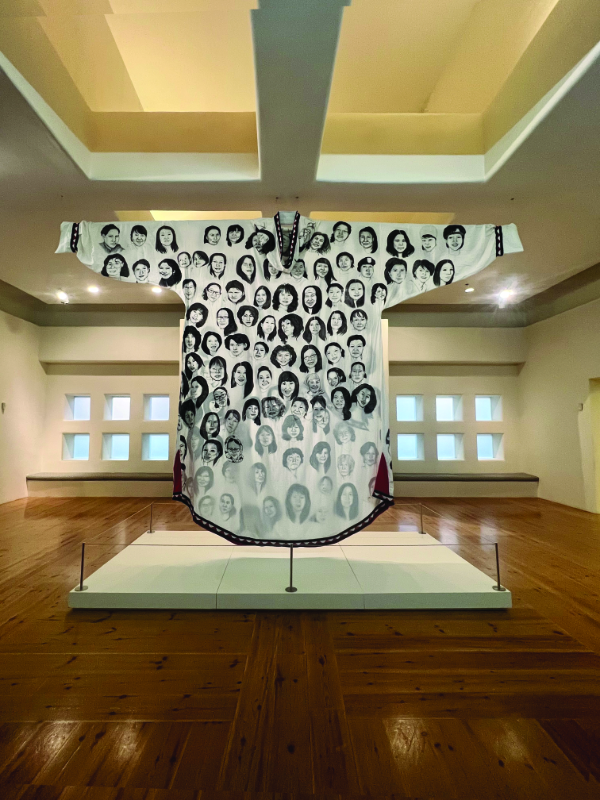
Amber Webb’s Memorial Qaspeq is a permanent work in progress. Webb is a Yup’ik artist from Dillingham, Alaska, and she draws portraits of Indigenous women on an oversized qaspeq. She adds portraits to the garment as she learns the names and identities of Indigenous women who’ve been killed throughout Alaska and the Pacific Northwest. At over ten feet tall, the qaspeq’s proportions suggest the scope and scale of the Missing and Murdered Indigenous Peoples (MMIP) crisis.

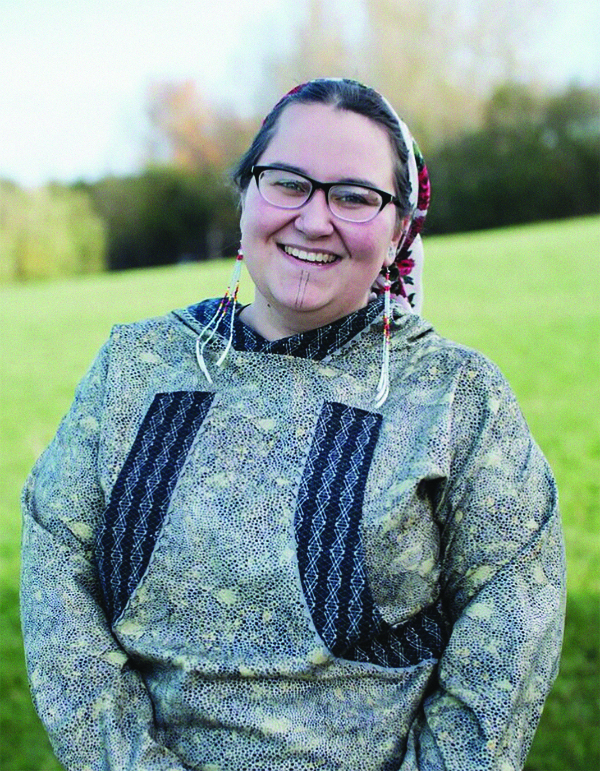
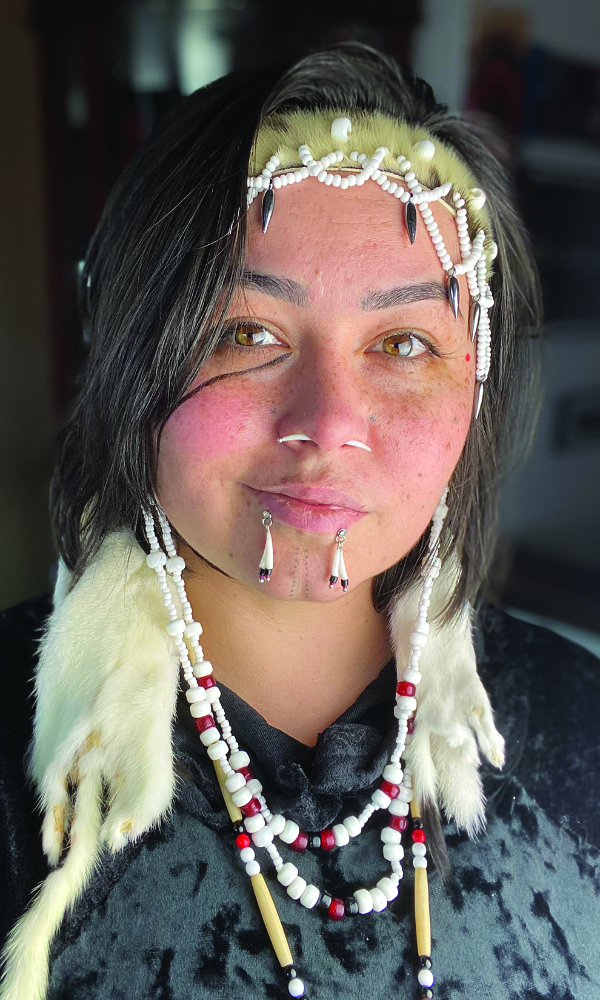
While Webb’s work gestures at the enormity of the epidemic, Bobby Qalutaksraq Brower’s (Iñupiaq) project, Healing Stitches, reveals how the survivors of the MMIP crisis grieve and honor their relatives. Brower is an Iñupiaq designer who specializes in creating traditional clothing with a contemporary twist. Healing Stitches features an atikluk made by Brower, along with five other atikluks made by other artists affected by the MMIP epidemic. The project emphasizes the importance of care and connection in the face of violence.

Hanna Agasuuk Sholl’s (Sugpiaq, Alutiiq) songs, like Webb’s and Brower’s garments, reflect the artist’s desire to honor missing relatives. Sholl’s music gives voice to grief while visualizing a future founded on traditional Indigenous values. Collectively, the three artists’ work ensures loved ones are not forgotten. Viewing the qaspeq and atikluks while listening to Scholl’s music makes the loss tangible. Their work gives shape to shared grief.

In Protection: Adaptation and Resistance, a traveling exhibition from Bunnell Street Arts Center in Homer, Alaska, on view at the Museum of International Folk Art until April 7, 2024, Alaska Native artists resist erasure of culture, history, and contemporary identity. Through artwork, song, and story they document experiences and values of Alaska Native Peoples. Works by Webb, Sholl, and Brower contest the assumed invisibility of missing and murdered Indigenous Peoples.

The artists’ commemorations resist conventional assumptions about Missing and Murdered Indigenous Peoples. While the acronym MMIP evokes faceless and nameless statistics accompanied by violent imagery, the artwork in the exhibition is deeply intimate and emphasizes the individuality of the people they honor. Webb’s Memorial Qaspeq carries the faces of loved ones. In wrapping an imagined torso with relatives and friends, the garment suggests a way to move through collective grief. The qaspeq reclaims what colonization, genocide, and trauma stole from Indigenous Peoples—identities and stories of community members. By covering the imagined body with portraits, Memorial Qaspeq also reminds us that we are collectively responsible for carrying the stories and names of the relatives and friends who’ve gone missing or been murdered into the future.

Browers’ unworn garment is sized for her sister, who was murdered in 2002. What’s especially moving is how the work insists on the necessity of recognizing relatives and community members within the context of relationships.

Webb’s and Brower’s artwork invites the audience to imagine the women who should be in the room, laughing and visiting with each other, the relatives who should be wearing the atikluks—holding hands with the artists instead of with empty fabric. Sholl’s music asks the audience to substitute their physical presence for one of the artist’s family members. In “Words to My Brother,” Sholl voices the conversations she can’t have with her sibling. The audience’s ears must fill in for his presence. But the work does not accept the audience as a perfect substitute. Lacking her brother’s response, the lyrics repeat, changing in pitch and cadence without reaching resolution.

In our conversations, each of the artists reiterated that the process of creating was as important as the work itself. Sholl and Webb reminded me that it’s important that their projects reflect traditional values of respect. For Sholl, this meant workshopping some of her songs with other Indigenous songwriters. Similarly, Webb emphasized that the knowledge and stories she shares and advocates are communal. That awareness is reflected in her commitment to acknowledging how grassroots MMIP advocates have shaped her path.

Brower explained to me that the atikluks were created in a workshop she led. All the participants were Indigenous women whose lives are affected by the MMIP crisis. Brower is proud the workshop became a safe space where participants could grieve with others who understood. Describing the workshop and exhibition, Brower says, “We are the circle of protection. We can take care of each other, even if it’s just through prayer. It helps.”

The Missing and Murdered Indigenous Peoples Crisis:
An Epidemic Rooted in the Interstices of Colonialism and Racism

The phrase most frequently used to refer to Indigenous Peoples who were murdered or who are missing because of racialized and gendered violence is Missing and Murdered Indigenous Women. Recently, activists have advocated for updating that phrase. As Webb reminded me, transgender, nonbinary, and Two-Spirit Indigenous Peoples also experience racialized and gendered violence. Brower pointed out that Indigenous men are also at increased risk of being murdered or listed as missing because of racialized violence. Both artists also noted that the Missing and Murdered Indigenous Peoples crisis is connected to rates of domestic violence and substance use disorder.

Webb notes, “[people say] we somehow cause the violence that happens to us, but the [violence] is really a part of colonization.” In the same vein, exhibition curator Asia Freeman remarked, “Indigenous communities are not responsible for historic trauma, but they still must survive and live through it.”

Freeman, a non-Indigenous ally and artistic director at Bunnell Street Arts Center, is acutely aware of how structural racism continues to enact violence on Indigenous Peoples throughout Alaska. She believes that true cross-cultural support and the elevation of Indigenous Peoples’ voices is impossible without first reckoning with the effects of colonialism and genocide. “These lives, these missing and murdered people, the families who have been impacted—their voices have not been elevated through the funding and solving of cases,” Freeman says. “It’s as if their lives are viewed as less important.”

In Alaska, that system of inequity is reflected in the state’s higher-than-average percentage of Indigenous Peoples who are missing or have been murdered. According to a 2018 study by the Urban Health Institute (UHI), Alaska ranks fourth in the nation in the number of cases reporting Indigenous women who’ve been murdered or are listed as missing. Because of structural problems in how the judicial system handles cases involving Indigenous Peoples, the UHI report is limited in what it can tell us about the crisis’s scope. Additionally, although the UHI report is one of the most comprehensive examinations of its kind, it specifically looks at cases in urban areas and against women. As a result, the report cannot speak to violence in rural areas or violence committed against men, nonbinary, and Two-Spirit people.

The lack of definitive data on the MMIP crisis is recognized by multiple agencies, including The Bureau of Indian Affairs. The BIA notes that nationwide data on MMIP is incomplete and inaccurate, stating that “there is no reliable count of how many Native women go missing or are killed each year. … thousands have been left off a federal missing-persons [databases].” The UHI report identifies the problem as three-part institutional erasure, “in life, in the media, and then in the data.”

The missing data is a state and federal problem. The federal government maintains a national database, the National Missing and Unidentified Persons System (NamUs). The database is not limited to Indigenous Peoples, rather it compiles information about anyone listed as missing or unidentified throughout the U.S. However, states aren’t required to update the NamUS. Presently, the largest database of MMIP-specific data is maintained by Sovereign Bodies Institute, a non-government, Indigenous-led organization.

The lack of data is a symptom of the judicial system’s perpetuation of inequality. If the violent acts against Indigenous Peoples remain undocumented (the way genocide, pandemics, and the deaths of Indigenous children at boarding schools were undocumented) it’s impossible to define the scope of the crisis. Without being able to define the problem, it is difficult to address the root causes or to hold perpetrators accountable. For the survivors, or people killed or missing due to racialized violence, how can they advocate through a justice system that does not value them?

MMIP and New Mexico

The Protection: Adaptation and Resistance exhibition’s presence in New Mexico is timely. The same 2018 UHI study that ranked Alaska fourth in the nation for Missing and Murdered Indigenous Peoples ranks New Mexico first. The report’s findings prompted New Mexico state lawmakers to create a task force in 2019 to address the epidemic. One of its first goals was to increase the quality and quantity of MMIP data. The task force requested that law enforcement organizations throughout the state provide demographic data about individuals listed as murdered or missing. However, in a 2020 report, the task force reported that law enforcement agencies deemed the request “excessively burdensome or broad,” limiting the task force’s ability to improve the state’s data.

Bobby Qalutaksraq Brower (Iñupiaq), 2020. Photograph by Yves Brower.

Despite facing resistance from law enforcement, the task force continued to advocate for people affected by the MMIP crisis until the summer of 2023 when Governor Michelle Lujan Grisham’s administration disbanded it. In November 2023, Lujan Grisham’s administration announced the creation of an advisory council. Because the council’s role and scope appeared to be limited, former task force members worried there would be no community input or budget to ensure real changes on the ground. As a result, task force supporters introduced Senate Joint Memorial 2 during this year’s legislative session which requests the creation of a permanent forty-member task force housed in the New Mexico attorney general’s office. At the time of publication, the Memorial had been passed and awaited action by the attorney general.

As I wait to learn what will become of the task force and advisory council, I keep thinking about an anecdote Brower shared:

A few years ago, when I went to my first Indian Market in New Mexico, some guy came up to my booth and asked if the whole epidemic of Missing and Murdered Indigenous Women was a real thing. That blew my mind. I [told him] “I’ve been directly affected. My sister was missing and murdered. So yeah, it’s a real thing. It’s not made up. Why would we make something like that up?” It made me really sad.

Holding Hands, That’s How We Protect Each Other:
Bobby Qalutaksraq Brower’s Reminder that No One is Anonymous

Healing Stitches began as an online workshop Brower offered during the pandemic. Four participants, Melissa Ahnoorik Ahlooruk Ingersoll, Cassandra Tikasuk Johnson, Jackie Qataliña Schaeffer, and Beverly Tuck, plus Brower, honored Indigenous relatives who’d been murdered or are missing, by sewing atikluks.

Atikluk is the Iñupiaq name for a hooded and pocketed overshirt with trim on the cuffs and sleeves. The garment appears across Alaska Native cultures with its form and name varying depending on the community and families that create it. In Central Alaskan Yugtun it’s known as a qaspeq or kuspuk, in St. Lawrence Island Yugtun it’s called a qiipaghaq, while in Koyukon Athabascan it’s called me’tsegh’ hoolaanh. The garment is not regalia. Instead, it’s everyday clothing that serves as a reminder of Indigenous presence in Alaska.

Brower is an Iñupiaq fashion artist and furrier. She’s the owner of Arctic Luxe where she sells and promotes Indigenous clothing and accessories. Brower didn’t set out to be an advocate for Indigenous Peoples who’d been murdered or are missing. Instead, her advocacy work grew out of a project in memory of her sister, Nancy. In 2018, the Bunnell Street Arts Center asked Brower to participate in their 2019 Qaspeq/Kuspuk/Atikluk Invitational Exhibit. “I had a red lace atikluk that I made in honor of my sister who was murdered twenty years ago,” Brower says. “It was the first time I kind of advocated for Missing and Murdered Indigenous Women. It’s a difficult topic to even talk about or advocate for.”

Amber Webb (Yup’ik), 2018. Photograph by Rasmuson Foundation.

After the exhibition closed, Asia Freeman, curator of Protection: Adaptation and Resistance, asked Brower if she’d participate in an exhibition that addressed the Missing and Murdered Indigenous Peoples crisis. Brower proposed a workshop as a safe place for people who’d experienced the violent loss of a loved one to receive support while creating an atikluk.

Five atikluks hang at adult-shoulder height, one child-sized atikluk closer to the ground. It’s as though they’re waiting for the missing women and child to step into and animate them again. If they were being worn, the six wearers would be facing each other. Brower connected each atikluk cuff to its neighbor’s—as though they are holding hands. Each garment is red in a nod to the Red Dress Movement, but the fabric is varied. Some, like Brower’s, Tuck’s, and Ingersoll’s, are made from cotton quilting fabric and edged with ric rac, while Shaeffer’s is a heavier weave, edged with long red fringe. Johnson’s atikluk incorporates deconstructed winter coats, along with the quilting fabric, bias trim, and ric rac.

For Brower, the display is meant to suggest communal closeness, like a group of people close enough to pray together. For the viewer, there’s a discrepancy between the suggested kinship and the fact there is no one physically present. The eye cannot resolve the cognitive dissonance: the neat stitches, vivid fabric, and carefully matched trims attest that the intended wearer is claimed by a community grieving for them.

For Brower, the process of selecting materials helped her process things she didn’t have language for.

It has red and black ravens on it, and she used to act like a raven. So, when I see it, I think of her. The atikluk is kind of a common one, it doesn’t have a traditional skirt. It’s more of a regular shirt with long sleeves and a hood, which was more her style because she was more of a tomboy. And she would never wear dresses. So, I had to figure out what she would actually wear. And it turned out! I feel like it suits, like it really honors who she was.

When displayed, the atikluks provoke questions about grief, persistence, and presence. Brower explains that the display places her work in conversation with other Indigenous artists and activists responding to the MMIP crisis.

“The way we have everything set up was made to be kind of like the Red Dress Movement where they hang red dresses up in trees to honor Missing and Murdered Indigenous Women. That was kind of what the display was about. And also, to have a circle—the protection.” The Red Dress Project is an ongoing public art installation project by Jamie Black, a Métis and Finnish artist based in Winnipeg. Brower’s reference highlights how the MMIP crisis is not limited to a specific community or nation. Instead, the MMIP crisis exists wherever Indigenous Peoples have experienced colonialism. Similarly, Black’s project’s roots extend outside of Black’s community, finding solidarity with women in Bogotá, Colombia, where women wore red dresses to demonstrations protesting their government’s lack of action when women were killed.

Brower notes that the atikluks in the display reflect communal values of support:

They’re holding hands in the exhibit. That’s kind of how I feel we protect each other, and how we protect our families and my hometown. [Seeing them in a circle] makes people remember that they’re in a relationship. It’s not an isolated person, it’s not somebody that is unfamiliar, it’s somebody who’s part of a community who’s missing. … You know, it affects all of us. Even if we’re not directly related. I feel like we’re all from different places, but we’re all connected because we’re all Indigenous.

Brower recognizes that communal support also necessitates shared grief. “It affects all of us because if someone goes missing and they’re not even like a relative of mine, it affects how I feel about being Indigenous. It’s tough being Indigenous, but when you are in the circle of protection, it makes me think we can take care of each other even if it’s just through a prayer.”Brower hopes the workshop and the Protection exhibition further the conversation about the gendered and racialized violence. She sees an ongoing need for advocacy work. “The workshop was a way to honor somebody that went missing or was murdered. I also hope it has opened eyes to people that this is a real and serious thing,” Brower says. “There’s been quite a few people who’ve gone missing in my hometown in the past, like ten years, and they don’t know what happened to them. It’s still happening every day.”

I Am the Steward of a Story: Amber Webb
on Collective Responsibility in the Face of the MMIP Crisis

The portraits of more than two hundred women look out over the gallery space. They’re part of Webb’s Memorial Qaspeq, a series of portraits drawn in black Sharpie on a twelve-foot-high muslin qaspeq. Before sewing the Memorial Qaspeq, Webb created a smaller prototype that recognized and honored forty-seven women in Alaska affected by the MMIP crisis. As she sewed the prototype, she tried to learn more about their lives. She was frustrated by the lack of available information noting that she “couldn’t even find all their pictures.”

For the Memorial Qaspeq Webb felt it was important to include portraits of Indigenous women from outside Alaska. She recognized that some information she came across about the women existed because of advocacy groups based elsewhere. 

“I thought I should acknowledge and connect to the work that’s being done all over the United States and Canada, where people are talking about this issue,” Webb says. “We know that the violence is happening anywhere Native women exist. The violence is part of colonization. So, I wanted to honor the grassroots work that’s been done in a lot of different communities.”

Webb initially imagined that she’d represent the women who are missing or been murdered by drawing feathers or a bird on the qaspeq. As she worked on the prototype, she decided to draw faces instead.

I was trying to represent our women and destigmatize them. There’s so many stories people tell about us, but they’re not historically accurate. They are not our stories, but people will tell the story that we all (Indigenous Peoples) have substance use issues or that somehow we cause the violence that happens to us, as if it’s not worth looking for these different narratives that are part of colonization. They see us as objects or treat us like cheap labor.

Webb hopes her work resists easy tropes perpetuated by news, media, and popular culture that flatten the representation of people who’ve experienced violence. “I wanted to show that it doesn’t matter where we come from, what our life choices are, or what we’re doing,” she says. “We face high rates of violence no matter what choices we make.”

Webb notes that while touring with the qaspeq, people share stories with her that underline the constant threats of violence Indigenous women experience.

As I toured … people would tell me stories about being targeted by suspicious vehicles, or about partners that would threaten them … things that were representative of a much bigger problem. So, for every woman that we know is killed, we have thousands more that are experiencing different forms of violence throughout their lifetime, and I just wanted to talk about that. I wanted to focus on the fact that these human beings—they lived. And we shouldn’t focus on the way they died or on how colonization came down on them. We should focus on who they really were.

The desire to honor the lives of Missing and Murdered Indigenous Peoples is a responsibility Webb takes seriously. “When I did this qaspeq project I read every woman’s story. I know details about their lives. I know their names. I know where they’re from. I’ll never forget those women when I see those portraits,” she says. 

She is also conscientious of how she delineates her role as an artist responding and advocating for Missing and Murdered Indigenous Peoples. She says the portraits are a collection of stories that don’t belong to her.

I feel like I’m a steward of a story, a collection of stories. It’s like the concept behind the show being protection. We’re talking about upholding and uplifting things that don’t belong to us, they’re of us, we’re a part of them, but there’s a collective responsibility for that. I think the show uplifts that—the collective responsibility of being a Native person and being in community.

A Call to a Ceremony:
Hanna Agasuuq Sholl’s Music for a Radically Imagined Future

Hanna Agasuuq Sholl (Sugpiaq/Alutiiq), 2019. Photograph by Hanna Agasuuq Sholl.

Three songs composed by Sugpiaq artist Sholl accompany the visual works in Protection: Adaptation and Resistance. Sholl hopes her music educates non-Native listeners about the issues Indigenous Peoples face such as racism, substance use, cultural appropriation, and domestic violence. She also hopes her music uplifts Native communities. “One of the most essential parts of my art is encouraging our people to use art as a form of healing, with the understanding we do not have to be another generation of trauma,” Sholl says.Sholl’s music speaks to that hope. Taken together, her songs “Words to My Brother,” “Deer Hunt,” and “Overcome,” speak to a world where Indigenous Peoples have experienced violence and loss while still remaining present for their communities and imagining their futures.

She notes that “Words to My Brother” was born from a need to tackle emotions and experiences that she didn’t have language for. Scholl says that writing the song helped her express things she wanted to say to her brother but couldn’t.

This song doesn’t have a lot of words to it. The change in the words and change in sounds really is where the expression comes out in this song. It repeats itself. It was designed to have a conversation with my brother without having to speak these words or having to process and share these emotions that are so deep and painful that I don’t even have words for them. In the repetition I’m filling them with emotion. Anyone who’s dealt with or witnessed or lost anyone, or anyone who has family who’s recovered from addiction, they know you’re left without words. There’s no way to process emotions. Even if you say the words, they don’t express what you feel.

Scholl imagines the song “Overcome” as a relative to “Words to My Brother.” She says,

This is about collectively finding our power and coming together to bring these issues forward. It’s almost as if it’s a symbolic dance that is designed to paint a picture of what it would look like if we were able to come together and really process through these issues and support each other.

For Scholl, community connection and resolution through ancestral knowledge becomes its own form of healing.

It’s a song of hope and resilience and almost like an open invitation to a ceremony that hasn’t yet been created to bring us all together and solve the world’s problems. Solve our world, solve our nation, our tribe or reservation, our regional area. Solve all those problems. The song becomes a call to a ceremony that has not been awoken yet.

On the surface, Sholl’s third song, “Deer Hunt” is stylistically different from both “Overcome” and “Words to My Brother.” The song was written to celebrate her son’s first hunt as well as to share cultural values.

It’s a very light song. It’s from the perspective of a child reclaiming their own cultural identity through hunting. The idea of sharing about a successful hunt together and celebrating, giving respect to the hunt that just took place and the animal—that ensures there would be future successful hunts.

While “Deer Hunt” is situated in the present, it reaches backwards and forwards in time. The song’s embrace of traditional form and values in the present create the possibility of future. That sense of interconnectedness is intrinsic to Sholl’s practice. She’s quick to assert her songs and their creation are part of something larger than herself.

Amber Webb (Yup’ik), Memorial Qaspeq, 2018-2022. 
Ink on cotton muslin. Photo by Asia Freeman. Courtesy of Bunnell Street Arts Center.
Amber Webb (Yup’ik), Memorial Qaspeq, 2018-2022. Ink on cotton muslin. Photo by Asia Freeman. Courtesy of Bunnell Street Arts Center.

The songs about healing and processing were done in pieces and then placed together. I almost feel bad taking credit for them because it’s more like there was … I don’t want to say something working through me to create them, but essentially, that’s what it was. It’s the importance of connection. I have worked really hard to develop a very deep connection with my ancestry and the lands that I’m on and the people I work with and the people I learn about. Song development has become more of a spiritual practice and less of what we think of in Westernized society of sitting down and writing a song, recording it in a padded room, and then monetizing it.

Art as Resistance, Art as Ceremony

The structural violence that perpetuates the MMIP crisis is not limited to law enforcement or the judicial system. It’s pervasive. While writing this article it has felt impossible to respectfully refer to community members and relatives who have been murdered or who are missing. In English there are few ways to collectively name Indigenous Peoples who are missing or who’ve been murdered without using the passive voice. One option is to use individual names, but this is challenging when families wish to protect privacy. Beyond this, how can I name each affected individual? The databases are incomplete.

The active voice would insert the subject into the phrase and name the perpetrator behind the deaths and disappearances of Indigenous Peoples. Colonization, racism, natural resource extraction, and human trafficking murder and disappear Indigenous Peoples. 

That’s also unsatisfactory. The failure in nomenclature speaks to a structural inability to name the sentence’s subject without objectifying Indigenous Peoples. In English it’s difficult to honor the individuality and humanity of a collective, linked because they experienced violence rooted in white supremacy and colonialism.

I think this is why I’m deeply moved when I witness Brower’s, Sholl’s, and Webb’s work. Their art succeeds where language fails me. They’ve insisted on the physicality and presence of the people they honor and remember. The atikluks, qaspeq, and songs render what’s been obscured—in data and in language—into tangible expressions encompassing grief, community, and love.

Their art extends community to the audience. For an Indigenous audience, acknowledging the horror and violence of the MMIP crisis, it’s an empowering act of truth-telling. For a non-Indigenous audience, it’s an invitation to learn about Indigenous realities. From that communal place the work becomes restorative, not only for the present audience but also for missing loved ones. 

By creating work with traditional values, in relationship to other Indigenous Peoples, and respect for story—their artwork refuses to allow isolation and violence to be the last portion of their loved ones’ stories. In their art and advocacy Webb, Sholl, and Brower carry their relatives’ and communities’ stories into the future. Those stories become commemoration and a call to end violence against Indigenous Peoples. 

Annie Wenstrup is a Dena’ina writer living in Fairbanks, Alaska. She serves as the Donor and Alumni Relationship Coordinator for Indigenous Nations Poets.

Annie Wenstrup (opens in a new tab) is a Dena’ina writer living in Fairbanks, Alaska. She serves as the donor and alumni relationship coordinator for Indigenous Nations Poets. Wenstrup is the author of The Museum of Unnatural Histories (Wesleyan University Press 2025) and the recipient of a 2025 Whiting Award in poetry. Originally from Anchorage, Alaska, she now lives in Fairbanks with her family. She received her BFA from the University of Fairbanks Alaska and her MFA from Stonecoast.

Bobby Lynn Qalutaksraq Brower (opens in a new tab) is an Inupiaq artist who was born and raised in Utqiagvik, Alaska. She started her custom Indigenous clothing business in 2010, then later bought a fur business in 2015. She makes everything from parkas, hats, booties, and also printed designed clothing. Everything she makes is inspired by her home and culture.

Hanna Agasuuq Sholl (opens in a new tab) was born in Kodiak, Alaska, to Sophie Frets (Hansen) and Bruce Burns. Her maternal grandparents were Walter and Edna Hansen and her paternal grandparents are Suzanne Burns and the late Robert Burns. She hopes to honor the resistance and creativity of her ancestors and to learn and share the complex and beautiful culture of the Sugpiaq/ Alutiiq people while combining traditional practices with present-day methods.

Jean Toomer’s Search for Identity in Taos

Mysterious, mercurial, hard-to-pin down sociologically or racially—and even described as being unbearably vain and pretentious—why is Jean Toomer important? My attention turned to him shortly after I became the 2021-2023 poet laureate of Santa Fe. I researched Toomer while looking for Black literary precursors, given that he is one of the few figures in African American literature who has written about this region. Toomer is also an iconoclast, whom Henry Louis Gates called “an ex-Negro.” His New Mexico connection began at the point when he rejected conventional racial categorization.

Toomer was a literary trailblazer. He was, to my mind, one of the most important lyrical writers in the English language, possessing a gift comparable to Shelley or Hart Crane. He authored lines as biting and as immutable as:   

Black reapers with the sound of steel on stone   
Are sharpening scythes. I see them place the hones   
In their hip pockets as a thing that’s done,   
And start their silent swinging, one by one. 

The poem “Reapers” is in the mode that initially defined Toomer. It evokes the resilience exhibited by Black sharecroppers, bent but unbroken by continual hardship. It is one of similar pieces in Toomer’s classic work, Cane, intimately describing rural Black life in the South, or the psychological travails of Black people who journeyed North. Cane was published to great acclaim in 1923. It was immediately embraced as a seminal text in the cultural movement known as the Harlem Renaissance led by 1920s Black intelligentsia. Toomer subsequently “disappeared” and disassociated himself from the Harlem movement, even to the point of allowing Cane to fall out of print.  

Cane’s reputation was restored in the late 1960s by new scholars spearheading the first Black studies programs. Cane has been a staple of African American literary studies ever since. If you study the Harlem Renaissance, you study Cane. But in the past fifteen years, more attention has been paid to Toomer’s biographical lacuna. What happened to him after his “disappearance?” 

The story relies on examining his unpublished work, which today is still gradually seeping into print. In terms of literary detective work, the emphasis switches from the arguable literary quality of his post-Cane material to accessing the significance and symbolism of his personal biography, which has become a focal point for issues involving social construction, essentialism, multi-culturalism, communalism, individualism, and post-racial dreams. These issues extend from his time to ours.     

I note that renewed interest in Toomer’s biography compels a re-reading of Cane, being such an avant-garde and geographical book, like an experimental travelogue, with stories and poems honoring flash points in the Great Migration. A re-reading of Cane involves a partial rerouting since Toomer’s biography extends in another direction—the American Southwest.   

Cane successfully fused several settings and genres into rich, layered poetry, underpinned by a heavy sense of burden and apocalypse. It takes its title from a scene describing a tired sharecropper, as she falls asleep, and a stranger—possibly God—retrieves her cat.

Someone… echo Jesus…soft as the bare feet of Christ moving across bales of southern cotton, will steal in and cover it that it need not shiver, and carry it to her where she sleeps: cradled in dream-fluted cane.   

Cane. Jean Toomer, Boni and Liveright, 1923.

Given that the book’s primary subject is Black identity, Black psychology, and modes of Black survival, when initially published, Cane was heavily publicized for being the work of a ‘Negro”—that is, an American Black writer capturing the song and soul of his birth race. Readers then and now presumed the author drew from the “Black experience” to achieve literary immortality. These assumptions were not wholly inaccurate. Nor wholly accurate. The story is more complicated.    

From Fame to Obscurity

Born in 1894 in Washington, D.C., Toomer was the scion of a renowned light-skinned family, who were mixed race yet identified as Negro. They were culturally elite. Toomer boasted that his maternal grandfather, Pinkney Pinchback, had served as governor of Louisiana, during the brief, anomalous period in Reconstruction when Black people were free to vote.    

Most people surrounding him during his formative years were highly aware that he was from a special ancestry. Although Toomer sometimes attended majority-white schools in Washington and New York, to his peers, judged by the American one-drop standard, he was Black. His self-conception may have differed because families from Toomer’s class and background were sometimes called “elite mulatto.” Certainly, in his later years, he emphasized his cosmopolitanism and multi-cultural heritage, and when he revisited Cane—which he rarely did—he underscored that it was written by someone with little direct experience of Southern Black struggle and strife. 

Always restless and living an adventurous life, Toomer attended six colleges without graduating, experimented with bohemianism, then became interested in socialism, which in turn inspired his visit to the Deep South. Toomer took a job at an agricultural school in Sparta, Georgia, where he experienced a kind of epiphanic transformation, hearing folk songs, attending rural church services, and witnessing rituals among sharecroppers who lived under white hegemony. Beauty and horror converged against a Southern backdrop. Its pathos ignited intense, rich poetry inside him.   

Toomer’s time in Sparta, Georgia, was relatively brief—lasting only a few months—but his letters from 1921-23 record that he spent the next two years industriously wrestling stories he gathered in the Deep South into the literary masterpiece Cane. Following his apex in the public eye, when twenty-nine-year-old Toomer published Cane to acclaim, his paper trail becomes confused. Toomer never subsequently published a full-length volume. 

Jean Toomer, 1925. Gelatin silver print. National Gallery of Art, Washington, Alfred Stieglitz Collection, 1949.3.652.

While enjoying flash-in-the-pan fame, Toomer briefly lived in Harlem, the center of Black intelligentsia. He corresponded with renowned writer Sherwood Anderson about possibly creating a Negro magazine, and in these letters, Toomer, vehemently proselytizing for Negro causes and social uplift, sounded like a Negro spokesperson. Perhaps Anderson expected this. Toomer assumed the Negro leadership mantle in other ways, too, discoursing freely on Black psychology in an essay on Eugene O’Neill’s The Emperor Jones. In another piece, he wrote, “The Negro says: I am. What I am, I am searching to find out. Also, what I may become.” 

Then, though he lived forty additional years, he fell off the Harlem Renaissance map.    

Esteemed poet Langston Hughes’s 1940 autobiography, The Big Sea, includes several sardonic paragraphs on Toomer’s vanishing act. Hughes blames Toomer’s investment in a quirky spiritualist quest, after he followed the teachings of Russian-born mystic George Gurdjieff.  

Gurdjieff (1867-1949) made a splash in Harlem in the 1920s. He required his students to make a daily practice of physical exercises and sacred dances toward the goal of liberating the consciousness from a state of “sleep” by stretching body and mind. The exercises purportedly pared away false identities, pride, vanity, or identification to any classification (including race) rather than human oneness. Gurdjieff was like a whirling cyclone, often initiating drama among his students as a means to siphon away their personal vanity, while he behaved like an overbearingly charismatic leader. Hughes had trouble taking Gurdjieff’s principles seriously, quipping with jovial wit, “Nobody in Harlem could afford to pay for Gurdjieff. And very few there have evolved souls.” 

But Gurdjieff’s philosophy answered a longing that Toomer’s prior success left unfulfilled. After discovering his mentor, Toomer became an important figure in Gurdjieff’s movement, spending the bulk of his energy over the next decade traveling to new cities to establish training institutes and communes (with limited success) based on living by its ethics. Sometimes Toomer—who throughout his life was known for having a flamboyant, difficult, and self-centered personality—was negatively critiqued by his fellow adherents, as when he self-consciously adopted Gurdjieff’s mannerisms, an affection others called obnoxious. The men were both strong-willed and eventually clashed, parting ways after a disagreement over finances. Toomer, in the meantime, filled several unpublished notebooks with heavy-handed Gurdjieff-inspired stories and married twice (both times to white women named variant spellings of “Majorie”). He lost touch with his Harlem associates. Or did he purposefully alienate himself? Langston Hughes framed the mystery in this manner, writing in The Big Sea:    

The next thing Harlem heard of Jean Toomer was that he had married Margery Latimer, a talented white novelist, and maintained to the newspapers that he was no more colored than white—as certainly his complexion indicated. When asked for permission to use some of his poems in the Book of American Negro Poetry, James Weldon Johnson reported that the poet, who, a few years before, was “caroling softly souls of slavery” now refused to permit his poems to appear in an anthology of Negro verse—which put all the critics, white and colored, in a great dilemma. How should they class the author of Cane in their lists and summaries?

With wit and insight, Hughes summarized the beginning of the great divide in Jean Toomer studies, reflecting the divergent lives of the man. The publication of Cane was both an end and a new beginning. Who was the soulful poet behind Cane, cited as a major influence by countless Black writers, including Toni Morrison and Alice Walker, vis-á-vis the man who refused to have work republished in an Afrocentric anthology? Who was Jean Toomer up to 1923, vis-á-vis the mystic sojourner who came afterward? His disparate career is like a house with two doors. It confounds some readers, depending on which door they enter. 

Toomer’s Shifting Self-Identification

Henry Louis Gates is the preeminent African American literary scholar today, and he has extensively studied Toomer’s surviving records. His conclusion is that, given Toomer’s background—judged alongside the extremity of his break with his Black roots—Toomer began “passing.” The word has unpleasant connotations. It critiques someone who falsifies their genealogy to gain privileges in the American racial hierarchy. Gates makes this argument primarily because Toomer began intentionally obscuring that his parents and grandparents lived and worked in Negro communities.    

In his earliest preserved document, a 1917 draft registration card, Toomer self-identified as “Negro.” On 1920 and 1930 census forms, he marked himself “white.” Eventually, Toomer claimed ignorance about whether he had any “colored blood.” Later in life, Toomer encouraged the assumption that he was East Indian. After 1923, he appeared overeager, or at least willing, to link himself to any heritage but Black heritage.

It is dismaying that the author of Cane actually, almost unbelievably, stated, “I would not consider it libelous for anyone to refer to me as a colored man, but I have not lived as one, nor do I really know whether there is colored blood in me or not”—while refusing to allow his work to be republished in any volume highlighting the word “Negro.” What could be a more hurtful irony?   

Gates relates the mystery of Toomer’s post-1923 decades to the author being a self-conflicted soul, preoccupied with misrepresentations. “He was running away from a cultural identity that he had inherited. He never, ever wrote anything remotely approaching the originality and genius of Cane. I believe it’s because he spent so much time running away from his identity.” In 2010, Gates said to the New York Times:   

The fact that Toomer’s family tree consisted of a lot of light-skinned mulattoes who married one another is not exceptional. Many African American family trees are shaded the same way… Toomer was right to declare he was of mixed ancestry, and that the opposition between black and white was too simplistic. But he was wrong to say he had never lived as a Negro. He lived as a Negro while growing up. 

Gates suggests these falsehoods were means of “passing” that eased his racial tensions or the burden of Blackness. Someone who “passes,” furthermore, however intellectually sophisticated, is victimized by an inferiority complex, or a horrendous level of internalized oppression. 

This is one point of view. In the last fifteen years, other critics have emphasized Toomer’s second life as visionary. He lived in a time of binary racial constraints; he admirably pushed back against them. “Passing” suggests someone chasing social standing or behaving disingenuously. Toomer’s letters indicate his reservations ran deeper. Even before he was thrust into the limelight, he grumbled in a pre-publication letter to his publisher, Horace Liveright, “My racial composition and my position in the world are realities which I alone may determine… Feature Negro, if you must, but do not expect me to feature it in advertisements for you.”    

He married his first wife (who later died in childbirth) in 1931. Given Toomer’s name recognition and a hint of remnant notoriety from Cane, the powerful chain of Randolph Hearst-owned newspapers (less interested in his writing abilities than in pure sensationalism) snatched the story and ran ugly, rabble-rousing headlines, such as “Negro marries White Woman.” His problematic disavowal that he possessed Black ancestry warrants sympathy and understanding when considered alongside this particularly painful incident. Toomer shot off a forceful response to the press:

There is a new race in America. I am a member of this new race. It is neither white nor black nor in between. It is an American race, differing as much from white and black as white and black differ from each other. It is possible that there are Negro and Indian bloods in my descent along with English, Welsh, Scotch, French, Dutch and German. This is common in America; and it is from these strains that an American race is being born…. Now is the time of a new order, a new vision, a new ideal of man. I proclaim this new order. My marriage to Margery Latimer is the marriage of two Americans. 

Prior to 1923, Toomer might have argued for full Black equality, or against miscegenation laws. This was not his style after becoming—in Gates’s words—“an ex-Negro.” Challenges to the political system or specific systems of oppression had become peripheral. Like Perceval, searching for a grail, Toomer avowed “a new ideal” free of labels, while in his mostly unpublished post-Cane writings, he described an enlightened group of adherents who belong to a transformational type he calls (somewhat confusingly) “an American race.” But Toomer’s new American Eden needed a birthplace. This is why his search turned to the Southwest, leading him to the frontier cities—Taos and Santa Fe, New Mexico.   

The Quest for Racial Transcendence

Like innumerable readers, I initially encountered Toomer in college. His poetically apocalyptic language in Cane thrilled me. My fascination with him would be justified by his work alone; it is enhanced by my familiarity with points in his travelogue. I was raised in Georgia, near the area that inspired Cane. I have since relocated to the Southwest, and I am now living in New Mexico, near the areas that magnetized Toomer. 

I am a student of the state’s Black history. Though New Mexico’s Black population has historically been infinitesimal, its Black history presents a thrilling narrative, top-heavy with stories of persons who migrated in desperation or under tense circumstances, such as Buffalo Soldiers. Many Black people relocated to escape Jim Crow, which was less pervasive in New Mexico, given its small Black footprint. 

They all sought freedom, yet Toomer’s legacy proves that “freedom” is a relative concept. His story is the most unique. 

Previously unpublished writings, since collected in A Jean Toomer Reader (1993), and A Drama of the Southwest: The Critical Edition of a Forgotten Play, left unfinished in 1936, then belatedly published in 2016, reveal the previously underestimated extent that New Mexico compelled him. It is no exaggeration to write that of all the places he visited in the Southwest, only Taos, New Mexico ignited hopes that he could resolve the dilemma of race and identity that had pursued him since Cane.

Renowned art patron Mabel Dodge Luhan met Toomer in New York and funded him with $15,000 to establish a Gurdjieffian institute in Taos. These plans quickly disintegrated. But after Toomer arrived in 1926, he was too enamored to end his burgeoning romance. He later reflected, “I have never tried to put into words the unique gift of New Mexico to me… Something in New Mexico came to me fifteen years ago. It is a penetration deep under the skin.”

Note the reference to skin; there is an inference that through penetration of skin (and skin color), the truth-seeker finds peace. Color is both static—what separates people from other people—and symbolizes the spectrum, as the color wheel turns. These kinds of metaphors that play with the concept of race—sometimes engaging it as a nominally fixed or fluid concept—became common in Toomer’s New Mexico journals. 

He began filling notebooks with prose songs, comparing Taos to a germinal seed, and reiterating the word “God” whose metaphorical presence in New Mexico is as elemental as “a hawk in a tree.” His writing while in New Mexico assumes an apocalyptic quality, too, as though fate is speeding to a culmination, and race is a notion whose time is passing.

What did Toomer see that struck him so deeply? Certainly, like tourists even today, he was struck by Native, Spanish, and white diversity—a kaleidoscope of clothes, facial features, and colors—an interplay that suggested social relations were significantly more fluid, more cross-cultural, and less rigid than elsewhere. Specifically, he discovered that New Mexico’s social landscape was heavily influenced by mestizaje, which means “of mixed race”—a sense of identity created by centuries of relations between Spanish, Mexican, Black, and Indigenous populations. To Toomer, the hordes of mestizaje were a provisional drawing—if not a complete picture—of a better world, as he pondered the mix of people he encountered.

What I do not know is—Do the elders of Taos vision the coming destruction as the end of man, or the matrix of new birth? Will resurrection follow this death? And if so, who will be resurrected. White men? Red men? Black men? An entirely new race?

In New Mexico, the pre-Cane Toomer became the most articulate version of the post-Cane Toomer. Perhaps the major moment representing his rejection of Negro identity occurred when Toomer sent a letter to James Weldon Johnson refusing to have his work republished in a Negro anthology, explaining, “I must withdraw from all things that emphasize racial or cultural division” to align himself with projects “that spring from the result of racial blendings here in America.” New Mexico, apparently, was a project Toomer considered worthy.

Having abandoned Gurdjieff, Toomer and his second wife, Marjorie Content, decided to build their own spiritual community in Taos, where they returned several times over the subsequent twenty years. 

Toomer’s writing by now placed a passionate emphasis on interracial unions. In “The Blue Meridian” a poem he worked on throughout the 1930s, he celebrated a people who achieved the “spiritual fusion… of racial amalgamation” so that their children were born blue and purple. The blue people stood at the highest point of human development. “The Blue Meridian,” which he labored over for years, can be long-winded, didactic, and heavily sentimental, but the Land of Enchantment represented the closest he had discovered to a providence of “racial amalgamation” in the United States. 

Choosing Taos was obviously a reaction against his demoralization in cities like Washington or Harlem, defined by strict racial classifications, Black-white binary oppositions, and civil rights politics. Taos is linked in his mind with birth and renewal—spiritual as well as physical birth—producing a mestizaje or blue people for the salvation of the nation. In 1939, Toomer visited India, where he was dismayed by the prevalence of poverty and sickness. He left India thankful that the possibility of humanity “cooperating upon a higher plane” survived in Taos, whose very name is a spell, synonymous with seed imagery.

Taos is an end-product. It is the end of the slope. It is an end-product of the Indians, and end-product of the Spaniards, an end-product of the Yankees and puritans. Out of the fertility which death makes in the soil, a new people with a new form may grow. I dedicate myself to the swift death of the old, to the whole birth of the new. In whatever place I start work, I will call that place Taos. 

Toomer, the Enigma 

Toomer’s unrealized plan to build a commune in Taos sired a major creative work, published posthumously. The University of New Mexico Press edition of A Drama of the Southwest, published in 2016, is a lasting record of Toomer’s vision. In it, Tom and Grace Eliot (a white couple who represent Toomer and Content) return to Taos where they have dreamt of buying land. The plan has been stymied by financial constraints, personal shortcomings, and indecision. Is New Mexico ready? The play reads like a series of static conversations, debating whether Taos is prepared to be the catalyst for racial, sexual, and intellectual transcendence. It ends irresolutely, although Tom Eliot’s unrepentant romanticism conflates possibility with accomplishment.

Toomer and Content instead settled in Doylestown, Pennsylvania, where they lived thirty years, and he spent his last two years in a nursing home. Toomer died in 1967, just as Cane was finally reprinted by University Place Press. We can only speculate about whether Toomer himself knew. 

According to Emily Lutenski, in her essay “A Small Man in Big Spaces,” during his decades in Doylestown, Toomer convinced his neighbors he was of East Indian origins. Why? His white neighbors in a segregated suburb would not accept a Black/white interracial couple, nor allow his daughter to attend community schools. An East Indian, however, was permissible.  

Was adopting an East Indian (rather than a Negro or multi-racial) identity an example of Toomer “passing” and fleeing his Black heritage to gain privilege? Or was he a daring visionary for his commitment to a multi-racial identity?  

Having lived as a Black New Mexican since 2010, I believe these perspectives can have simultaneous merit, like a puzzle that adds up to a life lived in between visionary ideals and inherited realities.  

I can find his ideas both inspiring and naïve. My feelings are related to why I deem Cane by far his most significant literary work, because its complexity combines poetry, pathos, and idealism with an unblinking study of racism. There was a time when, in Cane, Toomer acknowledged the impact of generational oppression, but an absence of social protest against systems of oppression weakens his post-Cane material when he extols a degree of racial fluidity which was not available to most Black people in a segregated city.

Similarly, although mestizaje identities make New Mexico less racially binary, this land and its people purchased mixed-race identities at the cost of a long history of colonialism, barbarism, cruelty, and rape. Toomer’s New Mexico writing understates these scars. This is why passages of his journals and A Drama of the Southwest risk perpetuating the worst aspects of the tri-cultural myth which elides New Mexico’s violent history to attract tourists to an imaginary Elysium.

I critique one man named Jean Toomer. I admire the same man named Toomer because he was ahead of his time. He foresaw the modern world, in which he would have the right to label himself how he chose, proudly declare his multi-racial heritage, or not pick a racial category at all on a job application. He displayed courage, challenging society in the face of a mindset of conformity. It was a necessary challenge. Even, or perhaps especially, today.

Darryl Lorenzo Wellington is the sixth poet laureate of Santa Fe, New Mexico. His collection is Legible Walls: Poems for Santa Fe Murals. Wellington enjoys working for the Alto Arts Integration program where he teaches poetry in the Santa Fe Public Schools.

Down to Earth

So much that could have gone wrong in 1865 at Fort Selden Military Reserve somehow didn’t. Soldiers outfitted with inferior tools and a lackadaisical spirit, occasionally enlivened by one officer’s proffer of whiskey, nevertheless managed to stack adobe bricks into walls and hoist vigas to the ceilings. Once constructed, the fort withstood the vagaries of life on the southern frontier of New Mexico Territory. Soldiers crowded into barracks on the south end of the parade ground while officers and their families enjoyed more spacious homes on the north.


Up to 200 people occupied the fort, with varying levels of crabbiness. When not patrolling the hinterlands by horseback to ensure the safety of miners and settlers, the soldiers battled boredom, often smuggling alcohol onto the grounds and erupting into fistfights. Several companies of  Buffalo Soldiers—African American troops—were stationed at Fort Selden. According to Alexandra McKinney, instructional coordinator supervisor at Fort Selden, these units were segregated from their Anglo counterparts and the Buffalo Soldiers were regularly subjected to racial discrimination. 

Some soldiers used their on-duty sorties to search for personal mining claims. Others found pleasure in sex workers and gambling beyond the fort’s boundaries. A few deserted.

The fort was temporarily abandoned in 1878. By the time it was reactivated in 1880, most of the buildings required significant reconstruction to make them habitable. Some were left in such disrepair they had to be demolished entirely.

The fort was commanded by Arthur MacArthur, whose son Douglas grew up to become a legendary World War II general in 1887, the fort began a four-year slouch toward dissolution, as did other military outposts in the territory. Between 1889 and 1896, forts Cummings, Marcy, Union, Selden, Craig, Stanton, and Bayard closed. An 1896 inventory of Fort Selden said all that remained were “parts of walls and piles of dried mud.”

After fits of construction, drunken brawls, warfare with Apache people, and an on-and-off record of occupation, the thing that truly went wrong with Fort Selden was this: the army marched away.

The southwest corner of the Fort Selden barracks. This wall would have been the outside wall of one of the two rooms to house non-commissioned officers.
Photograph by Tira Howard.
The southwest corner of the Fort Selden barracks. This wall would have been the outside wall of one of the two rooms to house non-commissioned officers. Photograph by Tira Howard

“When it became a state monument in 1973,” says former Southern Region Manager for New Mexico Historic Sites Rhonda Dass, “eighty-five percent of the structures were gone. The military took every scrap of wood from it. Most of the foundations that were there are still intact, but I’m sure if we looked around the community at other older structures, there are rocks and things embedded in them from the fort.”

An adobe wall without a roof will begin to wither with every drop of rain. Adobe bricks at the base of the wall slurp up moisture through a capillary action that leaves salt deposits within them, breaking down their solidity. For nearly a century, until the state took possession, no savior showed up with mud plaster to smear on the walls, and no visionary sounded an alarm persuasive enough to ensure the fort’s preservation.

Today, telling a coherent story from what’s left on the 28-acre site can challenge the best interpretive ranger and the most engaged friends group—both of which Fort Selden Historic Site has. The lumpy remnants of walls at Fort Selden have already endured decades of cash-strapped neglect from the state and now, even with infusions of money, are challenged by surprisingly spiteful rains and piercing sandstorms, as well as dramatically increasing construction costs and an infestation of subterranean termites. Though mute, the eroded structures pose questions all too familiar to those who treasure the preservation of our past: “How little is too little, and how much is too much?” Dass says. “How much can we intercede? Can we rebuild what’s already there? What have we learned, what works, and what doesn’t work? There’s a total spectrum of what we can do. And it all depends on funding.”

Aerial view of Fort Selden Historic Site and the Robledo Mountains. Photograph by Tira Howard

Pat Taylor, an adobe preservationist based in Mesilla, near Fort Selden, has overseen various attempts to stabilize the fort’s walls. He brings a globalist’s knowledge of how adobe works and says any such building’s long-term success depends on three things: “Good dirt, good application, and cyclical maintenance.”

Fort Selden, which sits in today’s Radium Springs about sixteen miles northwest of Las Cruces, did well enough on the first two tenets. Even barring adequate maintenance, it held up reasonably well after its abandonment. His parents, Mary and J. Paul Taylor, used to bring their large family to the site for lazy picnics conjoined with childhood treasure hunts for military buttons and other artifacts.

The experiences surely helped inspire Pat’s fascination with old adobe buildings, as it did the archaeology and museums career of one of his brothers, Michael Romero Taylor, who later served as deputy director of New Mexico State Monuments, a precursor to the Historic Sites Division.

One of Michael’s first state gigs was “doing grunt labor” for an archaeological exhibition at Fort Selden. “Back then,” he says, “our research design was along the lines of ‘Go find the goodies.’ We excavated the magazine where the ammunition had been stored and the latrines for the hospital, the officers, and the enlisted men. In the soldiers’ latrines, we found lots of liquor bottles, one opium pipe, and bullets. It was against military regulations to carry live ammo, but a lot of the men would shove bullets into their pockets during target practice. Later, they’d realize, ‘Oh, I screwed up,’ and throw them down the latrine.”

We’re sharing memories inside the welcome cool of the historic site’s visitor center on a blazing summer day. The center contains a small museum created in the 1970s that holds some of Michael’s finds, as well as those he and his family collected when the property was still in private hands. His favorite is a beat-up pair of children’s shoes excavated in the 1970s that he loves telling people were General Douglas MacArthur’s. “That’s speculation,” he says with a wink.

Their father’s death in February 2023 has plunged the brothers and their siblings into a process of dividing what they want from his longtime Mesilla home before it completes its transformation into the state’s Taylor-Mesilla Historic Site, tasks that have added a golden burnish to their Fort Selden memories.

“The walls were still pretty high,” Michael says. “There was enough to be able to experience the form and outline of the fort. You could tell where the doors and windows were. You could see how cool it was.”

The Sentinel sculpture honoring the 9th Cavalry Buffalo Soldier. Photograph by Eric Maldonado.

“It was a maze,” Pat adds. “There were a lot of room blocks.”
    
When we finally steel ourselves for the heat, I try to imagine them as boys scampering through a shimmering mirage of buildings. It isn’t easy.

Few of the existing walls reach much higher than our heads.
Once two feet thick, they’ve eroded in patterns best described as linear triangles, with bases that, in some cases, measure barely a foot wide. The undulation of their eroded tops mimics the more distant silhouette of the Robledo Mountains.

“Adobe melts,” Pat says. “That’s a given. Once you lose a roof, it happens quickly.”

Over the years, the state’s attempts to slow the erosion have included capping the walls with protective coverings and shoring up the bases. Paradoxically, every at-tempt to help invites harm. Original adobes below a cap or above an amended base can erode at an even higher rate. Compensating for the erosion can require redoing the caps and bases every few years, incurring expenses that gobble up the opportunity to exact other repairs.

When he worked for State Monuments, Michael joined forces with other like-minded preservationists at the Getty Conservation Institute to build test walls in an open area east of the visitor center. The intent was to try out a variety of plasters, mud, and chemical additives that could withstand desert sun, rain, and wind.

Adobe bricks ready for use in Fort Selden preservation projects. The Robledo Mountains can be seen behind. Photograph by Tira Howard.

“We had good crews working for the historic sites, but we always wanted to know if a magical elixir could be applied to the walls to fix them. In the end, only one acrylic polymer worked,” he says of Rhoplex E330. “But we were purists at the time, and a lot of people didn’t like the idea of adding something to adobe.”

The effort also resulted in “Adobe 90,” an earthen-architecture conference in Las Cruces in 1990 that drew 300 attendees from all around the world, many of whom developed an ongoing interest in Fort Selden.    

Years ago, Michael oversaw a bracing project that failed to perceive that the walls had adjusted to swaying a bit with the wind. One of the walls collapsed. Future braces—metal plates screwed high into the walls and held with diagonal posts—took the wind’s power into account and have held up well.

In 2021, Pat found a local adobe maker to help Avanyu General Contracting, a woman-owned San Ildefonso Pueblo–based team, build up the foundations of the old soldiers’ barracks. “They went down to a certain depth, repaired and replaced the adobes, then mudded it over,” he says, as he points out the long line of work, which included adding manure and lime to the plaster coating—both of them traditional materials. “It’s holding. But that’s a 1970s, 1980s layer above it, and it’s delaminating now.”

Delamination, the peeling away of surface plaster or even the adobe bricks themselves, afflicts buildings throughout the site. While wandering paths interspersed by mesquite scrub, prickly pear cactus, and creosote bushes, a visitor can spy walls with surfaces appearing to have slumped or actively sloughing off.

Glass from whiskey, beer, and medicine is some of the most common archaeological finds at Fort Selden Historic Site. Several have been recovered during surveys and are now on display in the Fort Selden Historic Site Visitor Center. Photograph by Tira Howard.

We stop at the hump of a berm surrounding the old corral. Pat notes there should be six inches of fill dirt on top of it at all times. Rain has washed it all away.
    
Over the past decade, more state money has flowed to improve the site, including roughly $50,000 to replaster the officers’ quarters about six years ago. One rainstorm erased it.
    
“That happens more and more often,” says Dass. Among the brutalities climate change has wrought upon southern New Mexico are frequent windstorms and damaging rains. “We had more rain last year than we’ve had in a long time,” she says.
    
“And we ended up with subterranean termites coming up through the adobe. No one could have predicted that. Everything had to stop while we killed off the termites.”
    
Meanwhile, the pandemic drove construction prices higher and higher.

The Taylor brothers acknowledge that family memories impact how much importance they place on Fort Selden. And they realize that other historic sites and the state’s museums likewise require costly care. Still, they can’t help but feel a touch of sorrow for the fort’s appearance and how it dampens the visitor experience. Michael wonders whether alternatives to standard historic preservation practices could be considered for at least one corner of the site. Maybe, he says, they could erect a protective structure over one portion of the ruins and recreate one of the buildings on another corner —“even if we don’t know exactly what it looked like.” Emerging museum technology might be able to help, too, he says. Perhaps some kind of digital projection could give visitors a clearer idea of how people once moved through a building that long ago crumbled.

He knows each idea invites criticism from some pres-ervationists and inhales breathtaking amounts of money. But, he says, “We’ll eventually lose even what we have now.”

“The fort is at a real pivotal place,” Pat adds. “And it’s been there for a while. There needs to be some thinking about what the end game is. The interpretation and keeping people’s interest are driving forces. You can’t just have a continually eroding wall.”


In the 1990s, while an undergraduate at New Mexico State University, Patrick Moore drove from Las Cruces to what was then called Fort Selden State Monument. Walking through the museum, he thought, Wow, these exhibits are really out of date. When he became director of the Historic Sites Division in 2016, he says, “It was pretty much the same exhibit.” Beyond the issues with preserving adobe structures, he faced a host of problems that had to be fixed before the exhibits could change. Among them were an outmoded heating-and-cooling system, inadequate visitor parking, and the installation of accessibility-compliant paths. This past summer, the museum’s aging floor was replaced.

He credits state senator Jeff Steinborn, whose district includes Radium Springs, for being a hero to the site, which relies on state money for all capital improvements including adobe preservation. Before Steinborn’s aid, Moore says, the fort had a tough time making a case for itself. “It’s the smallest and least visited of all the historic sites, with only a few thousand people coming through each year.”

The northwest corner of the Fort Selden barracks facing southeast. A historic freight wagon can be seen to the left of the barrack ruins. Photograph by Tira Howard.

The state’s other historic sites had more compelling and larger calls to action. Lincoln Historic Site and Fort Stanton Historic Site hold numerous buildings that need lifesaving improvements.

The Bosque Redondo Memorial at Fort Sumner Historic Site required a complete reorganization of the story it told about the Long Walk of the Diné and Mescalero Apache. Los Luceros Historic Site had only recently joined the state system and had yet to figure out how to welcome guests.

Meanwhile, archaeological and maintenance work at Jemez and Coronado historic sites demanded action.

“What are the best uses of the very limited resources of the people of New Mexico?” Moore asks. “We try to lift everybody up as best as we can, but there are real challenges: Where are the dollars to support it? The fact that New Mexico does historic preservation at all is significant. But when you have to make a choice between schools, police, fires, highways, it’s all critical. Who gets pushed to the back?”

Thanks to the infrastructure improvements at Fort Selden, he says, the museum can soon change how it represents the site. It’s a story that extends well beyond the fort. The proximity of the Rio Grande has attracted people to the area since at least CE 400. A Mogollon-era pithouse on the property testifies to a centuries-deep history among Indigenous people. Apaches traveled through it for generations before and even after Spanish explorers began using it as a rest stop, called Paraje Robledo, before tackling the harsh Jornada del Muerto portion of El Camino Real.

Western expansion into the region forced violent changes to the Apache people, which is where the fort enters the picture and commands just a quarter-century slice of the larger story. “This wasn’t just Fort Selden,” Dass says. “There’s a lot of depth to it. There are so many angles we need to tell.”

Some of that legwork is done through public program-ming, such as living-history reenactments. This summer, to celebrate the site’s 50th anniversary, a public party that was expected to attract fifty visitors instead hosted hundreds, Moore says. Besides further improvements to Fort Selden, he aims to coordinate programs and exhibits at the site with ones at the Taylor-Mesilla Historic Site and the New Mexico Farm & Ranch Heritage Museum in Las Cruces with a goal of weaving a larger and more complex tapestry of life in the borderland. He’s even talking with New Mexico State Parks officials about looping in nearby Leasburg Dam State Park, thereby deepening visitors’ ties to
 the region.

“If money was in an unlimited supply, Fort Selden would be fabulous,” he says. “But right now, the state is putting millions into stabilizing and improving Fort Stanton. I do think there are options at Fort Selden using technology. We’re looking at augmented-reality options, but there’s limited cell phone coverage there. There might be a time in the future when we can do things with digital projections, but many of those would have to be at night, since it’s outdoors.

“All of these things are enormously expensive,” he cautions. “I do think there is some real op-portunity to tell visitors why the site is so important. But we’re fighting against history, climate, and weather.”

The north end of the Fort Selden Administration Row. The Administration Row was the headquarters for the Fort Selden. A reproduction wagon is on display to the left of the ruins. Photograph by Tira Howard.

Given those odds, along with the need to tell a more inclusive story of the site, one focused on more than soldiers in adobe buildings, could the time have arrived to reconsider what must be preserved, what can be salvaged, and when adobe should be allowed to melt back into the earth?
    
State Historic Preservation Officer Jeff Pappas says that’s not his call to make, but he notes the fort, which has been on the National Register of Historic Places since 1970, has qualities that bode well for it. Among them are the continued use of its original materials and the fact that the buildings haven’t been moved to new locations. “Under historic preservation law, you can certainly recreate a building,” he says. “If you’re doing it within the same context, that’s allowed.” As for how far the law can bend in using next-gen materials with longer lifespans, Pappas advises keeping the fort’s options open.
    
“We really trust the judgment of Pat and Mike Taylor on that,” he says. “The closer you can get to the original material is good, but newer materials can be taken into consideration. The secretary of the Interior Department is really flexible when it comes to reconstruction.”
    
Moreover, he says, Fort Selden has a narrative that can grow as we learn more about our own history, underscoring its reason for being and for the Historic Sites Division’s plans.
    
“There are all these engagement opportunities,” Moore says. “The site looks dramatically different than it did a few years ago. We have a new entry, new parking lot, an ADA-compliant path. We get railed on for how little we do to protect it, but every time I go there, I’m giddy as a school kid—‘Hey, there’s a new floor!’ This is an incredibly important site. It’s a slow process, but it’s a beautiful site in ways it wasn’t before.” 

Kate Nelson (opens in a new tab) is a longtime New Mexico journalist who retired as managing editor of New Mexico Magazine where she earned numerous awards from the International Regional Magazine Association.

Tira Howard (opens in a new tab) is a portrait, lifestyle, and fashion photographer based out of Santa Fe, New Mexico. Her work can be seen in V Magazine, Cowgirl Magazine, Table Magazine, New Mexico Magazine, El Palacio magazine, Pasatiempo, Cowboys and Indians Magazine, The Santa Fe New Mexican magazines, The Santa Fe Reporter, Western Art & Architecture Magazine, and Edible New Mexico Magazine.

Soft Launch

It is fitting that this issue of El Palacio Magazine is filled with so much dirt—from Rick Dillingham’s clay vessels, the melting adobe walls at Fort Selden, and the dusty Great North Road near Chaco Canyon. Dirt is everywhere, of course, but in New Mexico, it seems pervasive. The wind has a way of carrying it into hidden corners and crevices. And as evidenced by centuries-old ceramics artists and civilizations whose mud walls are still standing, dirt has staying power.

For those of you who do not recognize my name: Hello! I am the new editor of El Palacio Magazine. I began writing for the magazine in 2016 and I’m delighted to find myself now sitting on the other side of the desk. I am also a native New Mexican, raised in Las Vegas—yes ours, not the other one. As anyone who lives in Las Vegas or has visited can attest, the wind coming off the Great Plains towards the Sangre de Cristo Mountains is full of dirt. You might say I was raised on dirt—and a deep connection to the landscape that so often casts a spell on those of us lucky enough to live here.

Although I helped usher the fall issue out of the door, and my invisible fingerprints are all over the articles in this issue, the winter 2023 issue of El Palacio is, in many ways, a shared venture between me and former editor Charlotte Jusinski. Because magazine content must be planned well in advance of publication, I am thankful to Charlotte for ensuring that my transition into the job was a smooth one. Between her content curation and my editing, I am delighted to share our last El Palacio collaboration with you in these pages. Between us, I think we’ve managed to make a solid adobe wall: she laid the bricks, and I smoothed the mud over them. 

Our collaboration on this issue is also a way for you to get to know me slowly. Good editing is often invisible and behind the scenes, but what you see on these pages reflects an editorial vision. For those of you who have read this magazine for years—or even decades—I imagine you’ve witnessed shifts in perspective and voice each time a new editor has arrived. As I plan for next year’s issues, I anticipate you will see another shift. You may not see my fingerprints in the mud, but I hope the warmth you feel from the pages will remain.

In the meantime, I welcome you into the world of dirt that this issue offers. Kate Nelson’s article on the preservation of adobe walls at Fort Selden poses questions that carry across many of the other articles in the issue: What do we preserve when we preserve history? How does what we preserve reveal what we value? From the complications that arise when we uncover more information about an artist, as Jennifer Levin reveals in her article about Gustave Baumann, to the layered histories at Mesa Prieta and Los Luceros as revealed by Matthew Martinez, preservation and record keeping is an active and ever-evolving practice. In Maurice Dixon’s profile of ceramicist Rick Dillingham, Charles Fisk describes Dillingham’s work this way: “To make, to unmake, to make again.”

Perhaps it is our job, collectively, to continuously make, unmake, and make again our art, our histories, and the adobe walls that shelter us.

Emily Withnall (opens in a new tab) is the editor of El Palacio and the host of Encounter Culture. Prior to stepping into the editor role, she wrote for the magazine for eight years. Emily has also been published in The New York Times, Al Jazeera, High Country News, Orion Magazine, Tin House, The Kenyon Review, Gay Magazine, Source New Mexico, and other publications. She lives and writes in Santa Fe, New Mexico.

Apple Glow

BY BRANDON BROWN

In late September, Tira Howard and I chased the light around Los Luceros Historic Site.

Tira works on contract for the Department of Cultural Affairs and frequently takes gorgeous photos of our museums and historic sites. You might recognize her work from former El Palacio editor Charlotte Jusinski’s story on Bosque Redondo Memorial in the Summer 2022 issue. We like working with Tira because she understands that New Mexico’s story is complicated and that in service to the people of our state, we have to see the world through many different lenses.

As we chased the light in September, the annual Los Luceros Fall Harvest Festival was just around the corner. We were hoping to catch the apple orchard before hundreds of people from Alcalde and beyond arrived to pick the trees clean.

We walked the site a few times and said hello to the sheep and goats living there, talked about the beautiful doors on the Almacén, the crops they grow here in Northern New Mexico, the river, and the mosquitos.

The apples would be the last thing we did, she said. “They glow in the right light.” Tira wanted to capture the site around sunset when the light would be softer and more evocative. I don’t have to tell you: the light in New Mexico is spectacular, but not forever. When the light was just right, we’d need to move.

A cluster of clouds in the west kept us guessing. Harsh light yielded to something softer more than once, but always came roaring back. We putzed around by the river, waiting for the right moment. Tira’s hatchback was open, her equipment ready to go.

How to describe it? When the light softened, the land around us was darker, almost purple. We rushed from the river to the casita and Hacienda, rattling off our wish list as we went. We cheered when we found apples. And out by the acequia, Tira unfolded her drone and told me about the time she and her family had visited the site five years earlier and picked apples. Families crowded the parking lot, ready to fill their bags with apples. Kids hung from the historic orchard’s trees. It was ritual and fresh all at once. The sense of belonging was palpable. “That’s happening at all the sites,” she said. “I can tell when I visit. They’re focused on their communities.”

There are a lot of hands in this pot. Folks living and working on the historic sites, custodians keeping the spaces clean and accessible, security guards keeping them safe, curators imagining exhibits, designers developing the exhibits’ look and feel, and educators spreading their know-how with good cheer. And there are contractors like Tira, helping all of us tell these stories. The work is not always straightforward, but it is worth doing—and made sharper when we work together.

Brandon Brown (he/they) is a former PR Specialist for NMDCA. They also write speculative fiction with an interest in shifting climates and bodies. For some years, he has been very focused on stories about a strange small town called Brittle.

Brandon Brown (he/they) is a former PR Specialist for the New Mexico Department of Cultural Affairs. They also write speculative fiction with an interest in shifting climates and bodies. For some years, he has been very focused on stories about a strange small town called Brittle. Brandon holds an MFA in Writing from the Vermont College of Fine Arts and now serves as the Director of Student Affairs & Success for the college, which is now affiliated with CalArts.

Tira Howard (opens in a new tab) is a portrait, lifestyle, and fashion photographer based out of Santa Fe, New Mexico. Her work can be seen in V Magazine, Cowgirl Magazine, Table Magazine, New Mexico Magazine, El Palacio magazine, Pasatiempo, Cowboys and Indians Magazine, The Santa Fe New Mexican magazines, The Santa Fe Reporter, Western Art & Architecture Magazine, and Edible New Mexico Magazine.