Glass is the Memory of Light

By Almah LaVon Rice

Where does glass come from? From the Phoenicians, ancestors of the alphabet in modern-day Lebanon, Syria, and Israel. Or perhaps the Sumerians, inventors of the cuneiform, were the first fashioners of glass in what is now southern Iraq. It could have been the ancient Egyptians—creators of papyrus, whose daughter is paper. What seems more certain: Naturally occurring glass is the clear-eyed child of the meteorite. One notable example is Libyan desert glass, which formed 29 million years ago when debris from outer space hit and melded with a swath of quartz sand at the Egyptian and Libyan border. The breastplate buried with King Tut even boasts a scarab made of the rare golden glass.

Maybe the creation story of glass can be told by Enaliarctos, or “grandfather seals.” Fossil records suggest that they began swimming in the waters off the western coast of Turtle Island twenty-nine million years ago—arguably at the same time that Libyan desert glass was formed. Tlingit artist Raven Skyriver was born near the same glassy waters, on Lopez Island of the San Juan Islands, Washington State. He is known for the lifelike craftsmanship and dynamism of his glass seals, otters, orcas, walruses, whales, turtles, fish, cephalopods, and other creatures of the sea. Watching Skyriver and his team conjure a sea lion out of base material is like witnessing a feat of primordial magic. “It’s like a form of alchemy,” he says.
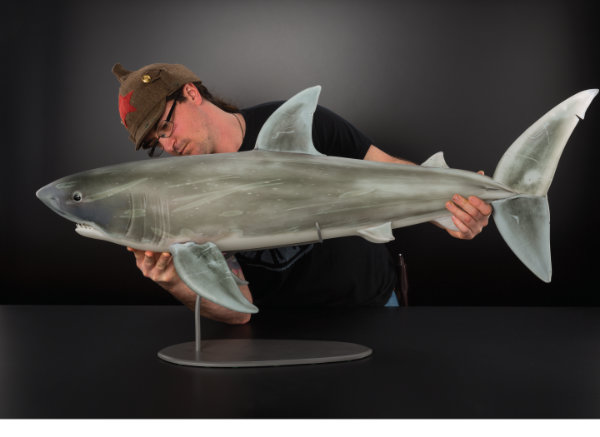
Raven Skyriver, installing Apex, 2017. Offhand sculpted glass. Photograph by KP Studios. Photograph courtesy of Raven Skyriver.
Raven Skyriver, installing Apex, 2017. Offhand sculpted glass.
Photograph by KP Studios. Photograph courtesy of Raven Skyriver.

The spark of life for one of his sea lions begins in the fiery depths of the crucible. The blowpipe is inserted into the crucible, mimicking a magic wand summoning new worlds. The glass is now molten and pliable, on the precipice of myth. The blowpipe is pulled out, and at its end sits a small sun: an orb of extremely hot, viscous glass. 

What follows is a choreography of rolling and rotating, of spinning a planet of glass that grows and grows in girth. You must keep blowing into the blowpipe as you turn it. Step over to the marver and roll the glass on its surface to shape it and modulate its temperature. To make the glass malleable again, repeatedly head to the glory hole, the furnace that reheats the piece while it is in process. Heating up and cooling down over and over again, the glass is restless—so the glass artist must follow suit, always in motion, just like the celestial body twirling on the end of the blowpipe.

During one of these orbits, the glass globe gets sprinkled with a powdery substance. A cylindrical shape takes over, then it’s bluish, mottled. The body of the seal surfaces, darkening under Skyriver’s torch. As he uses tools to carve the sea mammal’s facial features, the artist’s face is also shaped: With his knitted brow, unwavering gaze, and the determined set of his mouth, Skyriver looks like a god of concentration bringing inert matter to life.

Pure presence is the philosopher’s stone in this alchemist’s hot shop. “So much of the joy and the experience of making glass is the process,” the 38-year-old artist explains. “The end product is definitely on my mind the whole time, but the process is just so captivating and fascinating and challenging in a good way, most of the time.” Before long, the sea lion’s hind flippers materialize, and then the fore flippers, its entire body curved like a comma but filling the viewer with question marks. Is this animal made of light? Liquid? This is not glass, surely. After being placed in the annealing oven, where glass migrates to cool safely, and the threat of thermal stress ebbs away, the sea lion will be released into the wilds of the human world: the gallery, the private collection, the art patron’s insatiable gaze.

Skyriver’s orca sculpture now plumbs the high desert blue of Santa Fe, in the Museum of Indian Arts and Culture’s groundbreaking show Clearly Indigenous: Native Visions Reimagined in Glass (on view through June 16, 2022). The exhibition is unique not only because it is the first such survey of Native glass art, but because it features, for the first time for MIAC, artists from outside the American Southwest.

“It’s definitely a different biome [from the Pacific Northwest]. I’ve always felt super connected to the Southwest,” Skyriver says. “We would always go on road trips to the Southwest and Chaco Canyon and check out all the different places out there. … So [the region] definitely holds a dear place in my heart.”

Co-curated by Dr. Letitia Chambers and Cathy Short (Citizen Potawatomi), Clearly Indigenous features twenty-eight other Native artists from around the world in addition to Skyriver. One of them is Joe Feddersen, another glass maestro who hails from Washington State. 

Born and still based in Omak, Washington, Feddersen is a member of the Confederated Tribes of the Colville Reservation whose storied career encompasses sculpture, basketry, photography, printmaking, and mixed media. He has also taught and exhibited his work at the Institute of American Indian Arts in Santa Fe. One of his contributions to the show is Charmed, an installation of cut and fused glass charms. These hanging charms, or “icons” as Feddersen also calls them, embody the time-traveling nature of glass—a substance used since time immemorial to reflect the present and to persist for the future.

Invoking the style of ancient petroglyphs, the installation is a matrix of deer and coyote men frolicking in a dense forest of pick-up trucks, planes, high-voltage towers, and radiation warning signs. “It’s the idea that part of our culture takes on other aspects over time and all of these things are part of our life today,” explains Feddersen. 
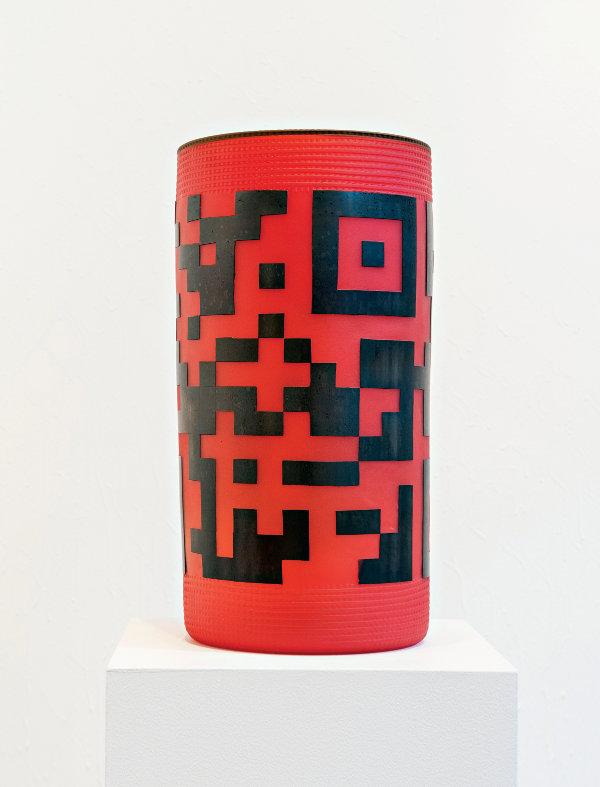
Joe Feddersen, QR Code, 2013. Blown and etched glass. In the collection of the National Museum of the American Indian, Washington, D.C. Photograph by Rebekah Johnson and courtesy Froelick Gallery, Portland, Oregon.

Nearly a decade ago Feddersen was commissioned by the Umpqua Valley Arts Association in Roseburg, Oregon, to, as he says, “make an installation piece that talked about hybrid culture.” He decided that he wanted to illustrate the concept of inhabiting multiple worlds by combining a charm bracelet, petroglyph wall, and wind chime. Form and content tinkle and chime together in Charmed; his choice of medium represents ingenuity and whimsy as well as reflecting place and circumstance. “I made charms out of fused glass because I live in a really rural area and it’s hard to have access to a lot of equipment,” adds Feddersen, who has also exhibited work at Santa Fe’s Wheelwright Museum of the American Indian. He continues, “I made this kind of a blanket form so that when the light shines through, it creates these images on the wall, like petroglyphs. The wind chime part comes because it’s like a large blanket and when the air moves through it, it sounds like a chandelier.” The exuberant profusion of charms creates a lattice of starkly beautiful silhouettes on the adjacent wall, making the wall an extension of the artwork. Relying on shadow for “ink,” the wall looks printed with stylized images—invoking Feddersen’s expertise as a printmaker. Such bold, geometric patterning is characteristic of Feddersen’s oeuvre as well as Plateau Native aesthetics evidenced in basketry and other art forms.
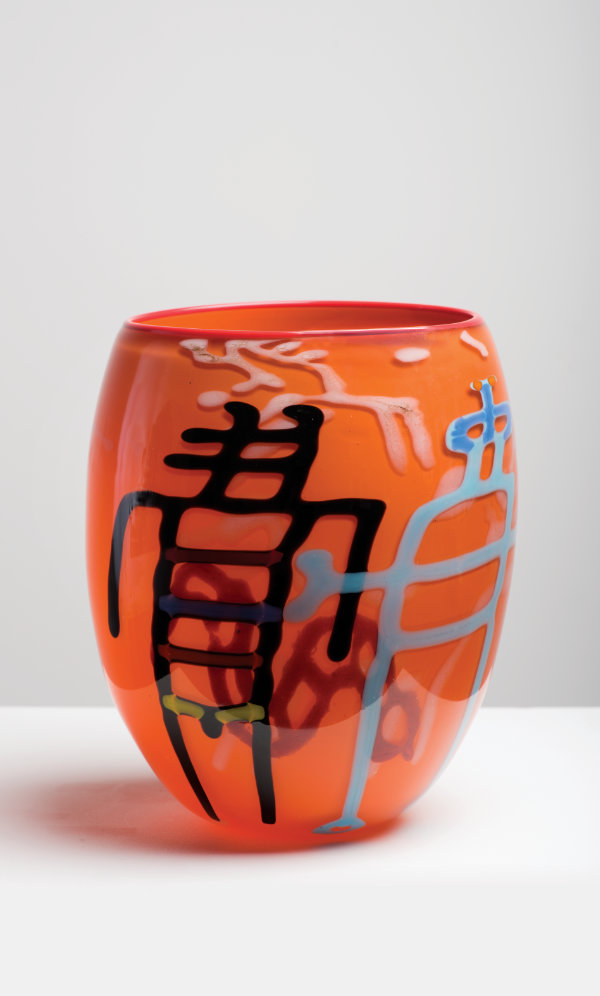
Joe Feddersen, Coyote and Robot, 2017. Blown glass. Photograph by Rebekah Johnson and courtesy Froelick Gallery, Portland, Oregon.

Feddersen describes himself as a “generalist;” his primary métier is possibility itself. “I draw from the landscape, current events, regional histories, tribal legacies, personal narratives, and contemporary dialogues,” he writes in an unpublished manuscript shared with the author. He notes that his late mentor Vi (Taqseblu) Hilbert, an Upper Skagit elder who led efforts to revitalize the language and culture of Native people in the Pacific Northwest, always said that he is “really a storyteller.” Feddersen agrees with that assessment. “A lot of times it’s about the stories and about the narrative that holds everything together,” Feddersen says. “I flow pretty easily through glass and printmaking and basket weaving. The iconography blends back and forth.”

This fluid approach has defined his creative career from its very inception. Growing up in the Inland Plateau region of the Columbia Basin, he made things constantly with no thought of calling himself an artist with a capital A. “I had friends who said, ‘I took this one class in college, and I knew I was an artist,’” he recalls. “They know the exact moment. But for me, it was when I was growing up that we always made things, and it was just natural to me.” He even fondly remembers a professor speaking at Evergreen State College in Olympia, Washington, where Feddersen himself taught art for 20 years. The visiting professor, according to Feddersen, said that “the artwork can come from just as you breathe.” Inhale stories, landscapes, recollections, colors, and textures and exhale a robust body of work.

“Working in that kind of intuitive manner” continues to be a navigational constant in his artmaking today. A typical day for Feddersen looks like rising to do firings in the morning. “I’ll pick out what I fired the day before and put new pieces in,” he explains. Art and the daily motions of life are integrated; he resides under the roof of his daily creative practice. He continues, “I love living in the middle of my work. I live alone, so I’m usually doing a lot of things at the same time.”

Making home while meaning-making through art is also true for Skyriver. He just moved back to Lopez Island to a family compound—after some years away on the mainland in Stanwood, Washington—with his wife and 10-year-old son. This homecoming included a crowdfunded home studio and hot shop. The furnace was turned on in May 2021. That same month, Skyriver mused: “I think my ideal daily artistic practice is going to be: Wake up and turn on the furnace and have a cup of coffee while things warm up, and then make stuff during the day, and just have that be part of the routine.”
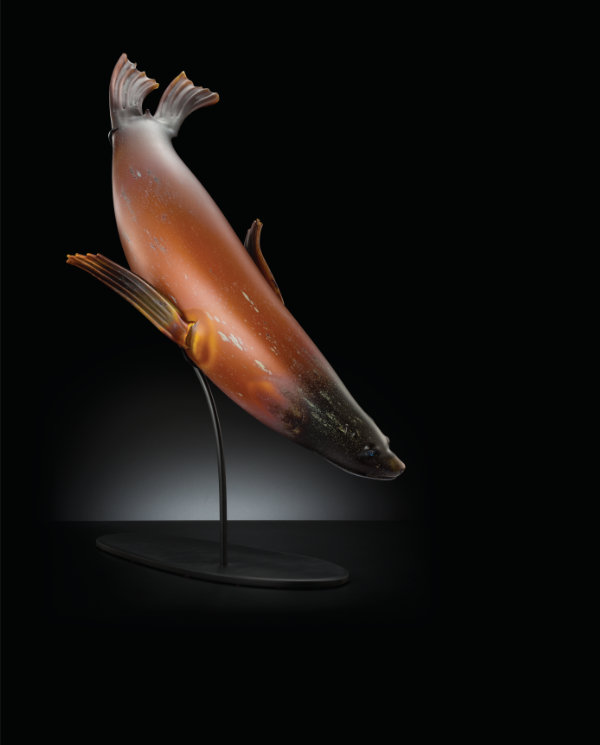
Raven Skyriver, Submerge, 2015. Offhand sculpted glass. Photograph by KP Studios and courtesy Raven Skyriver.

Skyriver stresses that collaboration is an integral part of his artistic trajectory and process. Along with his wife Kelly O’Dell, an accomplished glass artist in her own right, Skyriver raised almost $125,000 to actualize a “dream glass studio.” But collaboration didn’t begin and end with Kickstarter. Working in tandem with a team of other established artists facilitates “a certain kind of flow,” he says. “[Rather than] hiring a subcontractor and having them do part of the work, it becomes something more. It’s more based in community and camaraderie and sharing experiences and telling stories and stuff like that while we work.” Skyriver likens it to playing in a musical ensemble. In such contexts, “everyone’s knowledge comes together to create something that couldn’t be created by one person.”

Ultimately, though, the lead artist has the final say when it comes to firming up decisions in the studio, Skyriver says. “Whoever’s the gaffer, which is the person sitting at the bench or the lead person, you’re making their work. So they call the shots, and they are responsible for how the piece ends up looking and how big it’s going to be and all those things. Everyone else is assisting that person.” He invites input and appreciates when one of the artists on his team suggests, for example, that a whale sculpture in process might need its proportions adjusted. While he says it is “liberating” to relinquish some control, he admits, “It’s my piece in the end, it’s my call. It’s my fault if it breaks—I don’t blame other people.”

Feddersen also values a communal approach to artmaking. Although his creative career is studded with countless accolades, awards, and fellowships, he highlights “a collaborative book project” as one of his most luminous accomplishments. The book project was Terrain: Plateau Native Art and Poetry, a collection of relief prints and poetry by thirty-four Plateau artists and writers that Feddersen curated. “A lot of times our people leave the reservation to find jobs; they’re taken off into other communities. I wanted to do something that brought people back together, that created this artists’ community,” he says. He is currently working on another project similar to 2014’s Terrain. In collaboration with the Northwest Museum of Art and Culture in Spokane, Washington, Feddersen’s new project amplifies contemporary Plateau artists such as Jaune Quick-To-See Smith and Jim Lavadour.

Artist-to-artist community kindled both Feddersen’s and Skyriver’s relationship to glass art. While Feddersen took a glass casting class during his tenure securing an MFA at the University of Wisconsin, Madison, his sustained engagement with glass was sparked when he was asked to be part of a major art show almost two decades ago. 

Continuum 12 Artists: Joe Feddersen was part of a shifting collection of twelve artists creating work in conversation with the legacy of Indigenous twentieth-century art giants George Morrison and Allan Houser, respectively. Continuum, which ran from 2003 to 2005, was an exhibition of the Smithsonian Institution’s National Museum of the American Indian at the George Gustav Heye Center, New York, curated by Truman Lowe; it was part of the ushering in of NMAI’s opening on the Mall in Washington, DC.

“I made this rather large print—it’s about 10 feet by 60 feet across. I was working on these really small baskets that were maybe 5 inches high and about 3 or 4 inches across,” he recalls. “I wanted to show them together, but the baskets were so small that they would just be lost in the exhibit.” So Feddersen approached his friend and internationally renowned Seattle glass artist Cappy Thompson for guidance. Thompson introduced him to glass artist Preston Singletary (Tlingit), and the rest was art history in the making. Feddersen says, “Preston and I worked together on making a suite of glass vessels that were remakes of the handmade baskets. So they could handle the space. The seductiveness of the glass and the way it collects light worked well.”
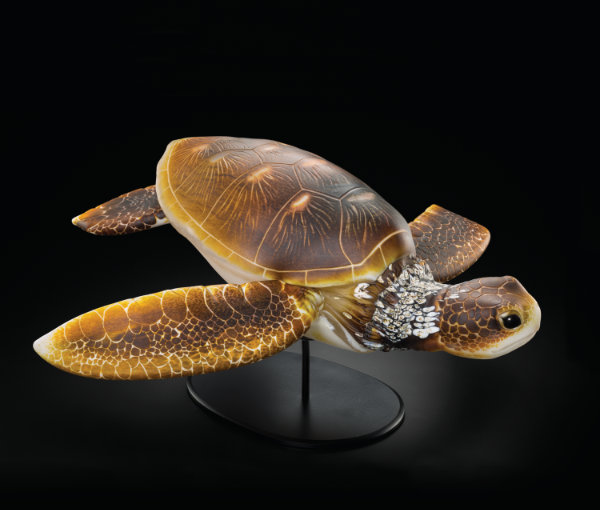
Raven Skyriver, Adrift, 2015. Offhand sculpted glass. Photograph by KP Studios and courtesy Raven Skyriver.

Skyriver would eventually collaborate with Singletary as well—but it all began when he was 16 and met his mentor Lark Dalton while attending an alternative high school program. Dalton introduced him to glass blowing equipment and trained him in the traditional Venetian technique. Skyriver would go on to sell his sailboat to finance a glassblowing course in Venice, city of gondolas. There he learned from the famed eleventh-generation glassworker Davide Salvadore, whose lineage includes glass artmaking for a Piedmontese princess in 1721. Other career coups for Skyriver include teaching and/or demonstrating in Japan, Denmark, Norway, Turkey, and the Czech Republic. He has held residencies at noted venues such as the Tacoma International Museum of Glass in Tacoma, Washington, and the Corning Museum of Glass in Corning, New York.

When Feddersen turns 70 in 2023, Spokane’s Northwest Museum of Art and Culture will host a retrospective of his work. He has already been the subject of Vital Signs, a major retrospective exhibition and monograph jointly organized by Froelick Gallery in Portland, Oregon, and the Hallie Ford Museum of Art at Willamette University in Salem, Oregon. For now, he is ready to start an endeavor that had been deferred for a year due to COVID-19: a residency that is a collaboration between Seattle’s Burke Museum of Natural History and Culture and the aforementioned Museum of Glass in Tacoma. He is also looking forward to exhibiting in the next invitational at the Renwick Gallery in Washington, DC.

Where is glass going? Wherever these boundary-shattering artists choose to take it. It’s the protean nature of glass that beguiles Skyriver, who is fascinated by its “plasticity and its ability to mimic so many things, textures, and light.” He further notes, “You can have something that… will drip like honey off the end of the pipe. And then in less than two minutes it’s rock hard and breakable if you drop it. When it’s super-hot it has an incandescence and it glows and creates its own light.”

The future is for forging, and Raven Skyriver and Joe Feddersen are pellucid examples of that. “I realized that I didn’t want to mimic the work of my elders or reenact histories,” Feddersen writes. “In my conversations with Colville elder Elaine Timintwa, we often talk of the petroglyphs near Brewster, Washington. She told me that the youth, while questing, would go to the rock wall, study the petroglyphs and add to them. They would extend history—learning the past and continuing the story to the present. I think of my work in this way—it is grounded in tradition and carries forward to the present.”   

Former resident of New Mexico Almah LaVon Rice is a Pittsburgh-based writer at work on her first book. You can find more of her writing at AlmahLaVonRice.com.
Almah LaVon (opens in a new tab) (they/them) is a writer and fairy marsh monster living in Dionde:gâ. They write creative nonfiction and short fiction engaging unfettered Black imagination and dreaming a new world many-petaled. Almah is a recipient of the Exposure Artists Program First-Time Grantee Award from The Pittsburgh Foundation.They were selected for the global Orange Tangent Study grant in 2022. They were awarded the 2022 Fable Grant, an initiative led by New York Times-bestselling author Adrienne Young.

Charles Froelick (opens in a new tab) founded his gallery in Portland, Oregon in 1995.

Joe Feddersen (opens in a new tab) is a Colville sculptor, painter, photographer and mixed-media artist. He is known for creating artworks strong in geometric patterns.

Raven Skyriver (opens in a new tab) started blowing glass at the age of sixteen. His mentor, Lark Dalton, taught him how to build glass blowing equipment and trained him in the traditional Venetian technique. In 2003 Raven was invited to join the William Morris team. Skyriver lives near the Pilchuck Glass School in Stanwood, Washington, and produces his work in the greater Seattle area. Raven shows his work nationally and has been featured in group shows internationally. His focus is sculpture, and the depiction of marine life is inspired by his island upbringing and informed by the creatures that inhabit this fragile ecosystem.

Archi-story

By Carmella Padilla

Stepping onto the sprawling campus of the National Hispanic Cultural Center in late spring 2021, a visitor expects little has changed since a nearly year-long pandemic shutdown emptied the Center’s public spaces and ground its cultural and educational programs to a halt. Yet on this hot June afternoon, in the season of New Mexico’s re-awakening, it’s clear the NHCC never slept.

Just beyond the parking lot, at the site’s northeast edge, a new Welcome Center slants into view. At once squat and angular, plain and nondescript, the 1,700-square-foot structure rose on the grounds with few witnesses during the pandemic, though its construction had long been planned. As the Center marked its twentieth anniversary in 2020, it was time to finally set into brick and mortar what its staff has been doing for two decades: welcoming the world into the art, culture, and humanity of the Hispanic, Chicano, and Latinx communities of New Mexico, the greater Southwest, and beyond.

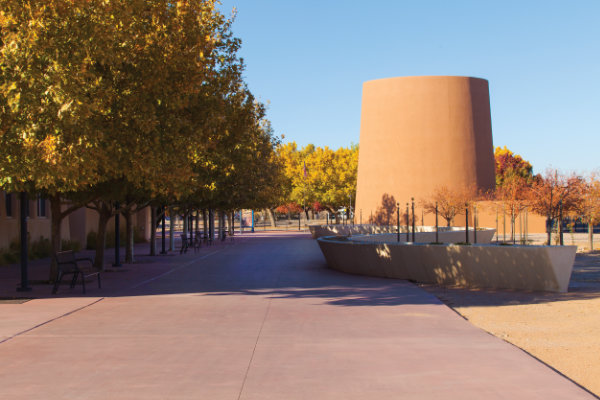
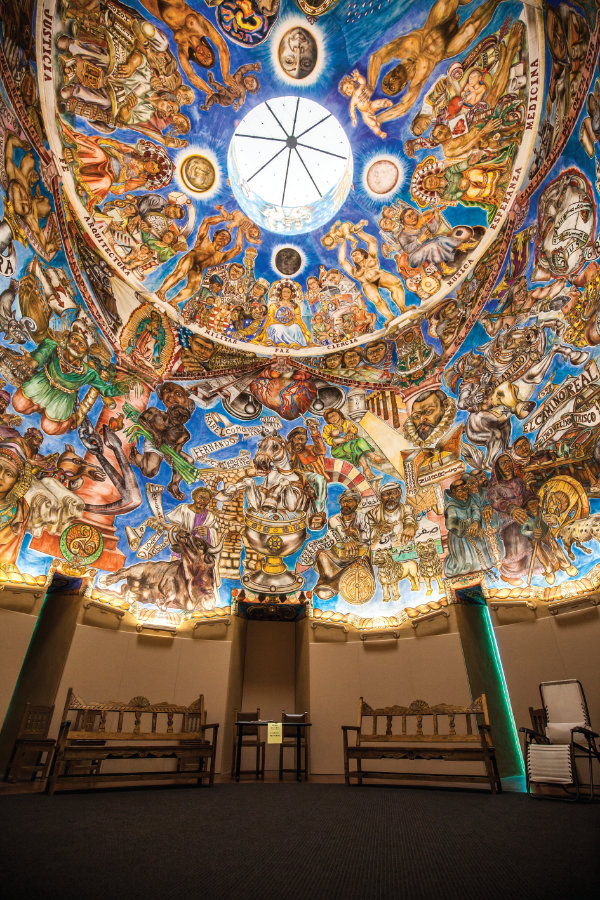
Today, the New Mexico Mutual Welcome Center connects to the site’s signature Torreón, whose elegant watchtower form soars skyward, and whose interiors boast Frederico Vigil’s world-class buon fresco, Mundos de Mestizaje, depicting the Hispanic diaspora. The new building conjoins the concave Torreón as if always meant to be there. Practically speaking, its purpose is to provide visitor information and space for ticket sales to art exhibitions, performing arts events, and other public programs. Text panels along the corridor leading into the Torreón offer an introduction to the fresco as well.

Narratively, the new structure and the old one form a kind of exclamation point on the NHCC’s architectural journey, which for over two decades has been an evolving work-in-progress—one that even a global pandemic could not stop from moving forward. Even as museum-goers, literary arts lovers, students of history, and performing arts buffs momentarily disappeared, the Center stood its local and global ground across a 20-acre network of buildings that root the campus in an extraordinary sense of place. This structural backdrop, where visitors experience, express, and imagine Hispanic life, art, and culture, reflects the diverse communities it was built to represent.

Because of that diversity, the site’s architecture “isn’t just one thing,” says National Hispanic Cultural Center archivist Anna Uremovich. Her exhibition, ¡Mira! Nuestra Arquitectura: An Architectural Journey, charts the Center’s history of design and construction through the institution’s archival collections, including sketches, blueprints, maps, photographs, dioramas and other documentation. The twentieth-anniversary exhibition debuted during the pandemic at the Center’s outdoor Bosque Gallery, an open-air gallery space that follows the adjacent Bosque Trail. This fall, the exhibition has another run inside the History and Literary Arts Building, where it is on view through December.

“The exhibition tells a story of the Center’s buildings,” says Uremovich. But ultimately, she adds, “It’s a story about people and place.”

From the Torreón to the Art Museum, the Performing Arts Center, to the History and Literary Arts Building and beyond, the story is ambitious, dramatic, and rarely follows a straight line. Its chapters chart the NHCC’s lifetime of hope, growth, and challenge, of milestones and mistakes, of commitment, and always, change. The plot is bigger than the Center’s birthplace barrio of Barelas, or the city and state where the institution has been raised. Yet for all its worldliness, and the culture whose centuries of history it holds, its personality is still so very hometown.

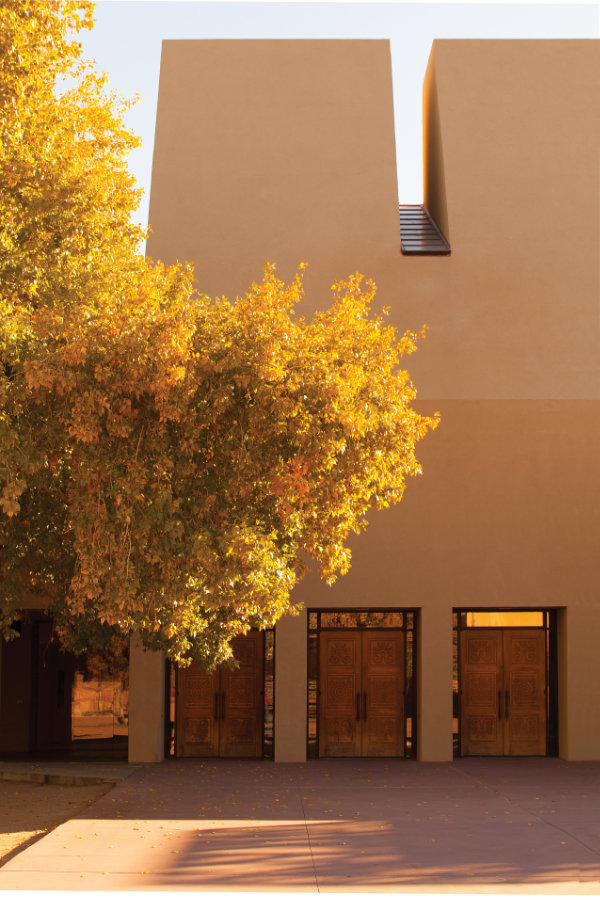
Mesoamerican-inspired designs and hand-forged iron hardware highlight the entrance to the Art Museum in the southeast quadrant of the campus. The museum and visual arts facilities were originally designed to front the north end of the site. Photograph by Addison Doty.

On January 29, 2000, ten months before the NHCC opened its doors to hundreds of revelers, including Prince Felipe de Borbón of Spain (now King Felipe VI), Vice President Al Gore, and other celebrated dignitaries, an equally momentous event occurred on site: 80-year-old Adela Martinez died in her beloved Barelas home. Her family had occupied the small plot of land on Manuel Avenue Southwest since the mid-1920s, when she was four years old. She had grown up between the cottonwood-shaded Bosque and the railroad tracks in an area then known as West San José, where a historic schoolhouse would be built by the Works Progress Administration. She lived close to her parents, and after she married she raised her children to love Barelas.

By the time Martinez passed, two green stucco houses tucked into a small yard were all that remained of the old neighborhood. Some fifty other families had once lived in the area, but after decades of development, all had migrated elsewhere. Some left during the first wave of change in the 1970s, when an urban renewal project tore down parts of the old barrio for an industrial park. Others left in the early 1990s, when the plan to build the NHCC brought a court-imposed act of eminent domain. The plan called for property owners to be compensated so that their land could be converted to public use. Martinez held out.

Mesoamerican-inspired designs and hand-forged iron hardware highlight the entrance to the Art Museum in the southeast quadrant of the campus. The museum and visual arts facilities were originally designed to front the north end of the site. Photograph by Addison Doty.

As her son Orlando Lujan Martinez recounted in Barelas, Mi Amor, an undated essay published on the website of the Office of the New Mexico State Historian, Martinez’s wealth was in her memories: “No, a million dollars is not enough. Not now, not ever,” she said, “I won’t move.” Martinez sued to stay—and won. In the end, her son wrote, “Government and the courts met their equal in Adela because they did not know that God was on her side.”

Martinez’s experience was undoubtedly harrowing. It was also heroic, perhaps the perfect metaphor for aspects of the greater Hispanic experience that the Center was built to express. Martinez’s land, her faith, and her family meant everything. Manuel Avenue was long gone, but Martinez remained to represent the local culture. In doing so, she not only upended the Center’s architectural plan; she became part of it.

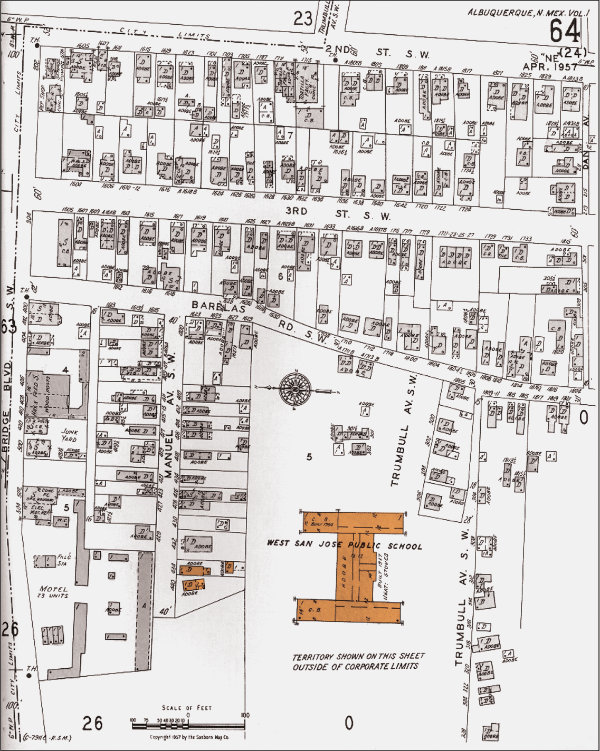
The Martinez homes, now an indelible part of the NHCC’s architectural look, are representative of mid-twentieth century architecture and growth of the Barelas neighborhood. Highlighted on this April 1957 Sanborn Fire Insurance map are the homes that are still present on campus (circled at lower middle left), as well as the West San José Public School (lower middle right), now NHCC’s History and Literary Arts Building. Image courtesy the National Hispanic Cultural Center.

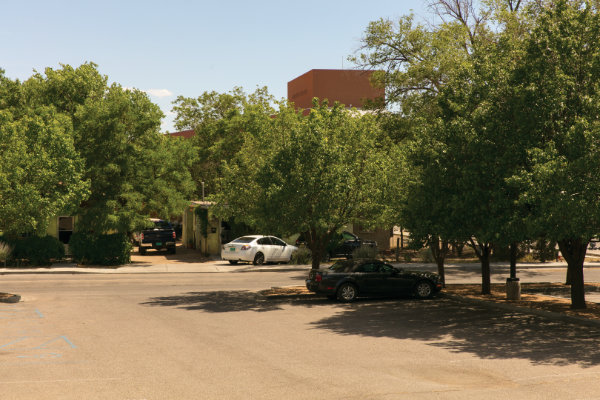
Today, Martinez’s property can’t be missed. Her two houses, where her current family members live, sit between the main parking lot and a large adobe wall built to separate them from the institution. There are cars in the front drive and a pickup out back. Santos, tools, and other signs of daily life are scattered about, testaments to the humanity of Martinez’s fight. The NHCC looms large above her family’s homestead, but as her son wrote, “Adela’s house of memories is still there.”

The houses where Adela Martinez once lived remain shrouded in old cottonwoods and the legend of her refusal to leave the site. Photograph by Addison Doty.

The idea for an Albuquerque-based Hispanic cultural center dates to the early 1980s, when the Hispanic Cultural Foundation was established to preserve and celebrate New Mexico’s Hispanic heritage. Edward Lujan, Foundation co-founder and National Hispanic Cultural Center chairman emeritus, says the Foundation seeded a dream to create a place whose “programs and buildings were designed with the culture in mind.” But translating that broad term culture into a tangible—and affordable—public space would not be so simple.

Early documentation is spotty, but grassroots support quickly emerged, making clear that various individuals shared the dream. Informal discussions involved the types of programming that might reflect the unique histories of Hispanic New Mexicans. Antoine Predock, an internationally known Albuquerque-based architect, was consulted to consider how the Center might, architecturally, represent the cultural landscape. Questions of funding soon led organizers to city leaders and state legislators. As local and state powers warmed up to the idea, the vision bloomed. Hispanic culture involved art, history, food, education, performance, and more. The Center would have to embody a range of experience.

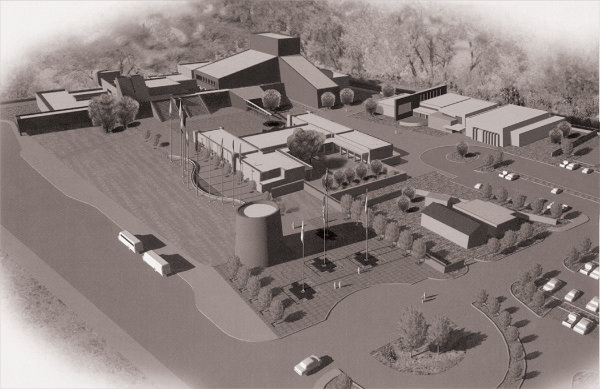
With the choice of the Barelas neighborhood location at Bridge (now Avenida Dolores Huerta) and 4th streets, the original campus plan was condensed to fit the 16-acre site. Noticeably absent in this revised design is the charreada lienzo (rodeo arena). The design focused on pedestrian access to the renovated historic elementary school (today’s History and Literary Arts Building), a visual arts building with numerous museum galleries, a performing arts building with three theaters, an international and education building housing the Instituto Cervantes, two torreóns (watchtowers) exhibiting art, and an amphitheater. Image courtesy the National Hispanic Cultural Center.
With the choice of the Barelas neighborhood location at Bridge (now Avenida Dolores Huerta) and 4th streets, the original campus plan was condensed to fit the 16-acre site. Noticeably absent in this revised design is the charreada lienzo (rodeo arena). The design focused on pedestrian access to the renovated historic elementary school (today’s History and Literary Arts Building), a visual arts building with numerous museum galleries, a performing arts building with three theaters, an international and education building housing the Instituto Cervantes, two torreóns (watchtowers) exhibiting art, and an amphitheater.
Image courtesy the National Hispanic Cultural Center.

By the early 1990s, the state Legislature was on board to appropriate funding to launch an architectural design competition for the NHCC’s design, at that time envisioned for a site in Martineztown in central Albuquerque, one of the city’s oldest neighborhoods. In addition to Predock, it drew such major international names as Mexico’s Ricardo Legorretta, James Stewart Polshek of New York, and Argentinian-U.S. architect Emilio Ambasz. Predock invited Sofia Márquez, a rising young talent, to be his associate in creating the Center’s design. Márquez had worked for Predock while a graduate student at the University of New Mexico School of Architecture. Márquez not only was born and raised in Northern New Mexico, but in a remarkable twist of fate, had written a graduate thesis on a proposed National Hispanic Cultural Center designed for 18th and Mountain in Albuquerque’s Old Town. The thesis paved the way to Márquez’s architectural career.

“Antoine was aware of my thesis, which I had started to develop when I was in undergraduate school,” recalls Márquez, whose company, Architects Out West, is now based in southern Colorado. “Growing up in New Mexico, there were museums for everything—history and Native American museums and American art museums. As a Hispanic, I sometimes felt very unwelcome. Even then, I saw a need for celebrating the culture.”

Predock and Márquez understood that “culture” is not a singular subject; it comprises a continuum of history, identity, and experience at once individual and collective. Add “Hispanic” to the word “culture,” and the architectural equation grows more complex. The state’s competition guidelines designated a range of programming disciplines that the design would need to accommodate on the Martineztown site. In 1993, Predock and Márquez won the competition with a plan that reflected those guidelines. As soon as the contract was secured, the two set out to refine the designs, inviting stakeholders statewide to voice their vision for the NHCC.

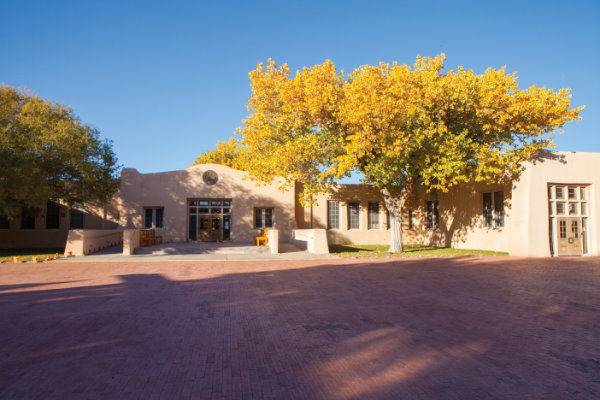
The façade of the History and Literary Arts Building exposes the historic core of the former West San José elementary school, built in Barelas in 1937 as a project of the Works Progress Administration. Photograph by Addison Doty.
The façade of the History and Literary Arts Building exposes the historic core of the former West San José elementary school, built in Barelas in 1937 as a project of the Works Progress Administration.
Photograph by Addison Doty.

Márquez recalls “a very intensive few months of brainstorming meetings, where we interviewed artists and craftspeople, musicians and playwrights, activists, and other recommended names from people in the world of arts and culture in New Mexico. We got very specific about space and programming needs and developed a full-bodied plan. The dynamics were over the top.”

The group represented the range of unique identities among Hispanic New Mexicans, from strict traditionalists steeped in old-time ways of life and art, to politically progressive Chicanos committed to an Indo-Hispano heritage embracing Mexican identity, to what Márquez describes as “the puros españoles, we’re-from-Spain types.” The series of dialogues also included politicians throughout the state. Some pushed to fund the project. Others pushed back.

“Antoine wasn’t particularly interested in playing politics, and neither was I,” Márquez recalls. “But we were sort of the diplomats caught in the middle, or entrapped if you will, to try to bring all of these artists and politicians from different perspectives together on some common ground.”

By 1993, however, the actual ground where the NHCC would stand had become a point of contention. Martineztown was scrapped for a smaller site in Barelas, where the City of Albuquerque had identified developable land. It bordered a riverside stretch of the Bosque governed by the Middle Río Grande Conservancy District, which was willing to provide access to Bosque acreage as part of the Center’s programming. The site was smaller, but already, there were funding concerns. Predock and Márquez scaled back aspects of their competition-winning design.

The team’s revised plan for Barelas was complete by 1995, by which time Adela Martinez had won her bid to stay in her home. The team was now directed to incorporate her property into the design scheme. Rather than embark on a redesign, Predock walked away from the project. Márquez, as Predock’s associate, departed by default.

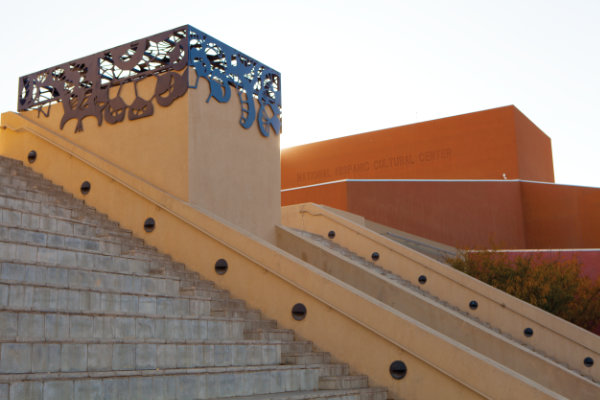
The pyramidal stairwell on the Plaza Mayor was later capped by a metal sculpture by New Mexico artist Paula Castillo. Photograph by Addison Doty.

Despite Predock’s withdrawal, the push for the NHCC had engendered too much support to abandon. The state Office of Cultural Affairs (now the Department of Cultural Affairs) was on board, creating its own Hispanic Cultural Division. Significant legislative funds had been appropriated and spent. The potential for federal funding signaled a move to make the Center even more national in scope. Unlike Predock, Márquez wasn’t about to let politics get in the way of her long-held dream.

“I said, ‘Wait a minute, this is an important project. There’s got to be a way to make this work,” Márquez recalls. “I went directly to the cultural affairs director and said, ‘I know more about this project than anyone else in the state. Is there a way I can do this?’”

The director said yes—with conditions. The state had already spent the majority of the architect’s fees. Márquez would have to work with the remaining funding and keep Martinez on-site. Márquez agreed and assumed the role as project architect. As associate, she hired Santa Fe architect Lloyd Tryk. Márquez recalls their immediate challenge: “How do we salvage the majority of the drawings? It felt like an impossible task.”

Not entirely. The existing design for the land on the corner of 4th and Bridge (now Avenida Dolores Huerta) placed primary buildings, including visual arts and performing arts, facing north. A large parking lot was to the south. Márquez and her team devised a “flip” of the design scheme, placing the parking lot on the north end of the site. This would accommodate Martinez’s home, and save some beautiful old cottonwoods to boot.

“We flipped it 180 degrees, mirroring the original design,” Márquez says. “We altered a few windows to take advantage of the sun, and made a few other changes to salvage 90 percent of the drawings and adapt to the new orientation. Everything fit.”


The backward nature of the NHCC’s redesign offers another apt metaphor for a place whose subject matter flows back in time to move forward into a contemporary cultural landscape. The Center would serve the people of modern-day New Mexico, but the architectural vision was borderless. As Predock originally described it, “The campus design was meant to showcase the Center’s disciplines in an eclectic expression of architectural styles.”

More specifically, says Márquez, “We drew from multiple sources, from Spain to Mesoamerica, precolumbian, Indo-Hispano, Spanish Colonial. Then, we modernized it into an interpretation of all the above.”

Disciplines reflective of the culture’s journey through time—visual arts, performing arts, and history and literary arts—inspired some of the most distinctive structures. The Art Museum communicates airy and elegant Old World references from Spain’s El Escorial, including an interior colonnade supporting barrel-vaulted ceilings. Both the Art Museum and the Performing Arts Center take inspiration from the soaring pyramidal shapes of Mesoamerica, a culturally rich and significant route of Hispanic migration. Indo-Hispano architectural traditions, melding Puebloan and Spanish Colonial materials and forms, ground the History and Literary Arts space solidly in New Mexico through the lens of the remodeled Barelas schoolhouse. Features include buttressed adobe walls, a flat roof, and exposed viga ceilings.

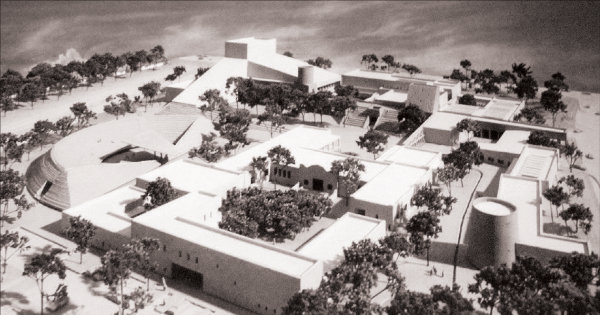
This undated design is the rendering closest to the current NHCC campus. The new Welcome Center to the north of the Torreón is missing, but the Martinez homes between the History and Literary Arts Building and the parking lot are visible. Image courtesy the National Hispanic Cultural Center.
This undated design is the rendering closest to the current NHCC campus. The new Welcome Center to the north of the Torreón is missing, but the Martinez homes between the History and Literary Arts Building and the parking lot are visible.
Image courtesy the National Hispanic Cultural Center.

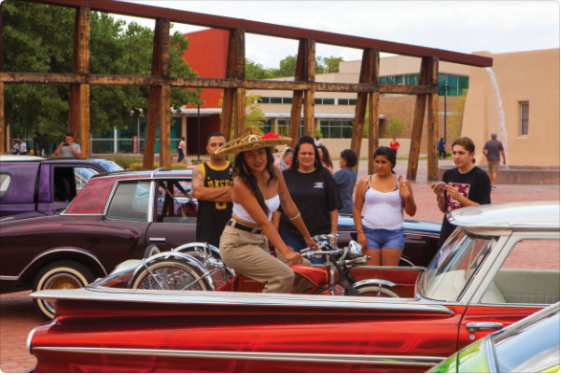
Outdoor spaces expand the landscape, with plans originally including an open-air amphitheater and a charreada lienzo (rodeo arena). The Plaza Mayor, Márquez says, “is as important as any of the buildings,” its imposing stepped backdrop calling to mind ancient Mesoamerican cities of ceremony and gathering. The plaza was designed for everything from outdoor exhibitions and performances to lowrider shows and other community gatherings.

“An architect not only creates buildings; we create the entire landscape,” Márquez continues. Patios, portals, and courtyards thus extended the options for experiencing the outdoors. The proximity of the river and the Bosque influenced elements of design. A carved log canoba, a form that traditionally is used as an animal trough, translated to a tall, rustic water feature that splashes into a circular pool below. A raised concrete water channel inspired by the state’s acequias cuts a serpentine track across another portion of the site.

Inside and out, the plan fleshed out a fuller expression of the culture. Although it was justifiably far-reaching, the funding was not. Over time, such costly features as the amphitheater and rodeo arena disappeared. The plan was divided into the most affordable phases, with Phase 1 aimed toward the NHCC’s 2000 opening. The only new building to survive Phase 1 was the Art Museum.

A brand-new History and Literary Arts building was replaced with a less expensive but practical solution: the renovation of the WPA-era schoolhouse. The 1937 elementary school had all the elements of the Spanish-Pueblo Revival Style, and though the building had been expanded decades before, a core portion was listed on the National Register of Historic Places. Its vernacular expression was inherently historic, rooted in the history of Barelas and the state, though parts of the building were in extreme disrepair. The remodel, Márquez recalls, was minimal but important, not only for the sake of the programs the building would house—including a genealogy center, library, and archive—but for the dignity of the building’s legacy in Barelas.

“We restored what was there and added portals to create exterior circulation,” Márquez says. “We gave this old, gorgeous, hand-built adobe honor again.”

Both the Art Museum and the History and Literary Arts buildings would boast other important local reference points. Funding was allocated to commission a range of decorative handmade arts and crafts, including ironwork, woodcarving, tin lighting fixtures, benches, and more. Incorporating the works of New Mexican artists into the architecture put another spotlight on how Hispanics in New Mexico have created a sense of place through the centuries.

Though vastly reduced from the original plan, Phase 1 was in Márquez’s hands. Between work on the master plan, the Art Museum building, and the schoolhouse renovation, Márquez spent a total of nine years on the project. Before construction, Márquez visited Martinez and asked for her blessing. She gave it, freeing Márquez to build an institution that strived to rise above individual and political division and celebrate what unifies the Hispanic peoples historically and today.

Locals celebrate Qué Chola, a 2019 exhibition at the Art Museum, in high lowrider style. Photograph by Addison Doty.

According to Márquez, initial dialogues around the project had involved passionate discussions about the Spanish colonization of Indigenous peoples in Mexico and New Mexico, as well as the Hispanic land-grabs by Anglo-American arrivals in the nineteenth and twentieth centuries. The stakeholders acknowledged these and other disturbing histories should be subjects for programmatic exploration. But, architecturally speaking, Márquez says, “The bottom line was to create an all-encompassing venue to celebrate what is good about this culture. To demonstrate how the culture spread through Spain and Mexico into New Mexico and deposited all of these methods and traditions of creativity and living. All of that became the emphasis.”

To be successful, the architecture would have to prove instructive for a range of visitors, not just New Mexicans. “An architect has to be a storyteller,” Márquez says. “How do we tell the story of Hispanic culture with no words? We do it with shapes and forms that are reminiscent of the people and places that came before. We put those shapes and forms before people’s eyes to bring them into the present.

“A person doesn’t have to be from the Southwest or have an education in architecture to know, intuitively, that there is meaning in these buildings,” Márquez continues. “It’s not about being literal, it’s about evoking the spirit of this place. When all of these pieces come together, you experience feelings of ascension, magnificence, transformation. That’s a celebration.”


The Torreón and an acequia-inspired water feature pay tribute to traditional elements of New Mexican Hispanic life transplanted from Mexico and Spain. Photograph by Addison Doty.

Strolling through the NHCC on a June afternoon, across the simmering Plaza Mayor, amid towering cottonwoods and blooming flames of red roses, the poetry of Márquez’s perspective sinks in. Around every corner, one is struck by a different mood. A Veteran’s War Memorial. A tile-inlay fountain honoring a late, longtime Center supporter. Walls splashed in hot pink and purple hues. The great plaza, even abandoned, is an event in itself. Though largely devoid of visitors, the site vibrates with the color and energy of a space—and a people—ever in motion.

Back at the Welcome Center, archivist Anna Uremovich fills in a few blanks of the NHCC’s growth and development over the past two decades. Phase 2 featured the addition of the long-anticipated Roy E. Disney Center for the Performing Arts in 2004, a signature feature of the original plan. Overseen by Albuquerque architect Alex Griego, it added three performance theaters, a movie theater, and rehearsal hall to the programmatic mix. By 2007, the dream for an International Building to house education and culinary arts programs had fallen by the wayside for lack of sufficient funding. Phase 3 instead took shape solely as an education center named in honor of the late U.S. Senator Pete Domenici. Designed by Studio Southwest Architects, the building opened in 2009. Today, it is home to the Spanish language programs of the Instituto Cervantes, a nonprofit project of the government of Spain, and also hosts programs in the culinary arts.

One feature that was not lost in the shuffle from the project’s inception was a plan for a Torreón. Indeed, not one, but two torreóns were originally planned for the site—one intended as an exhibition space, another providing the interactive experience of a lookout. In its original function, this iconic representation of Colonial New Mexico would have served as a watchtower from which to defend against enemies and intruders. While its traditional form was retained, its function was re-interpreted. “The Torreón’s placement was meant to be a welcoming point,” Uremovich says.

By the time of the 2000 grand opening, the Torreón had been erected near the NHCC’s north entrance, though it debuted in a naked, unstuccoed state. In 2009, the Torreón debuted again—this time with Frederico Vigil’s 4,000-square-foot buon fresco, Mundos de Mestizaje, gracing the interior of its concave walls. In a brilliant swirl of color, symbol, and form, the fresco depicts thousands of years of Hispanic and pre-Hispanic history, highlighting the diverse cultural connections between people and places from the Iberian Peninsula to the Americas.

The site’s signature Torreón, whose elegant watchtower form soars skyward, features Frederico Vigil’s world-class buon fresco, <i>Mundos de Mestizaje,</i> depicting the Hispanic diaspora. Photograph courtesy the National Hispanic Cultural Center.
The site’s signature Torreón, whose elegant watchtower form soars skyward, features Frederico Vigil’s world-class buon fresco, Mundos de Mestizaje, depicting the Hispanic diaspora. Photograph courtesy the National Hispanic Cultural Center.

The Torreón would quickly become a celebrated feature of the Center’s narrative of Hispanic culture through time. It’s a natural starting point for a visitor’s exploration of the programmatic offerings throughout the campus, one made even more significant now that it adjoins the new Welcome Center. “The Welcome Center is, literally, the fulfillment of what the Torreón was meant to be,” Uremovich says.

The first new construction in over a decade, designed by Living Designs Group Architects, the Welcome Center ushers the institution into the next decade of its archi-story. Finance and circumstance will undoubtedly continue to impact the NHCC’s architectural progress, but Uremovich feels certain this newest building won’t be the last. She says her exhibition research led her to believe the NHCC benefited from the added time, bringing a range of thoughtful minds to important matters of function and design.

“It took a lot of people, a lot of talent, a lot of fortitude to see this vision come to life, to physically make the Center a full expression of our programming,” she says. “The first word that comes to mind to describe this journey is ‘tenacity.’ My hat’s off to the Center’s designers.”

During her research, Uremovich compiled a file she called “Buildings that were not to be.” One project she still holds out hope for is the long-stalled International Building. As recently as 2016, she says, conceptual development discussions about the building were underway. Among other things, the space is slated to host a coffee shop.

“Why we don’t have coffee on the campus—that’s a question I get asked all the time,” she says. “A coffee shop in the International Building. I think it will happen someday. That’s the tenacity of the NHCC. We may be slow-moving, but we hold on to our dreams.” 

Carmella Padilla is a Santa Fe writer who frequently explores intersections in art, culture, and history in New Mexico and beyond. Her books include El Rancho de las Golondrinas: Living History in New Mexico’s La Ciénega Valley; Low ‘n Slow: Lowriding in New Mexico; and The Chile Chronicles: Tales of a New Mexico Harvest. She is a recipient of the New Mexico Governor’s Award for Excellence in the Arts.

Story Tellers in Glass

By Dr. Letitia Chambers

Clearly Indigenous: Native Visions Reimagined in Glass is a groundbreaking exhibition of works in glass by Indigenous artists. Co-curated by Dr. Letitia Chambers and Cathy Short (Citizen Potawatomi) and on view at the Museum of Indian Arts and Culture in Santa Fe through June 22, 2022, the stunning art in the exhibit embodies the intellectual content of Native traditions expressed in glass. A companion book of the same name (Museum of New Mexico Press, 2021) tells the story of how glass art came to Indian Country and provides information on the American Indian artists who work in the medium of glass and the processes and methods they employ in creating glass art.

Story Tellers in Glass: An Exhibit Overview

The exhibition presents glass art made by twenty-nine Native artists from twenty-six tribes from the U.S. and Canada, as well as artworks by Dale Chihuly, who founded several teaching programs where Native American students learned the art of working with glass. Native American glass artists have also collaborated with Indigenous artists from Pacific Rim countries, and glass creations by two Māori artists from New Zealand and two Aboriginal Australian artists are also included in the exhibit and the book.

The stunning pieces of glass art in this exhibition document the fusion of the Contemporary Native Arts and the Studio Glass Art movements. This fusion forms a new genre of glass art, characterized by the intellectual content of Native traditions and expressed using the properties that can be achieved by working with glass. While the book is organized around the artists, the exhibition is organized around the subject matter of the works of arts, highlighting the traditional iconography embodied in these works in the contemporary medium of glass.

The artists and artworks featured here in El Palacio provide only a brief experience of the total exhibit, which includes over 130 works of art. Images of only a few of the many fascinating works of art referenced in this text are pictured here. 

Inspiration for Native glass art has come from multiple sources. It may be tribal utilitarian items, such as vessels and baskets, or it may come from a reach back into mythology, creation stories, ancient imagery, and oral history. It is often an interpretation of cultural heritage, a way of honoring and giving voice to ancestors. Other works incorporate important cultural ways of knowing, such as respect for flora and fauna.

Native glass art may also be an expression of more contemporary issues affecting today’s Native Americans and/or society at large. Some works in the exhibit include a political dimension that incorporates references to important stories in history or are a reaction to current events, while other pieces are notable for their advocacy role.

Pueblo Pottery Recreated in Glass

Tribal functional items, such as ceramic pots or baskets woven from natural fibers, represent artistic traditions still followed by glass artists. Pueblo peoples of the southwestern United States have created utilitarian vessels made of clay for millennia. Historic pots and other vessels can be found in museum collections and are admired not only for their utility, but also for their artistry. In the twentieth century and continuing to the present, traditional pottery forms made by contemporary Pueblo potters have been appreciated for both their beauty and the cultural continuity they represent.

Tony Jojola (Isleta Pueblo), untitled, 2014. Blown glass with silver stamps. 8 1/10 × 74/5 in. MIAC Collection: 59229. Photograph by Kitty Leaken. Courtesy the Museum of Indian Arts and Culture.

Tony Jojola (Isleta Pueblo), untitled, 2014. Blown glass with silver stamps. 8 1/10 × 74/5 in. MIAC Collection: 59229. Photograph by Kitty Leaken. Courtesy the Museum of Indian Arts and Culture.

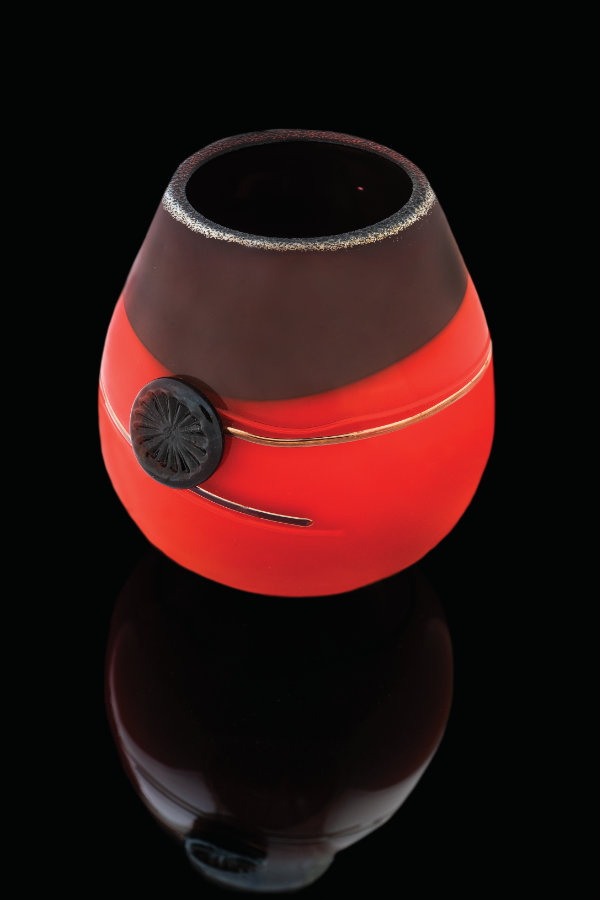
Several Pueblo artists have chosen to work in glass as their primary medium of creation. Tony Jojola (Isleta Pueblo), one of the first Native artists to work in glass, finds inspiration in the Pueblo pottery with which he grew up. While the forms he creates are rooted in tradition, he infuses his glass art with beautiful colors to create vivid, luminous vessels. Jojola inherited his grandfather’s jewelry-making tools and silver stamps, and he has used the stamp on some of his glass vessels.

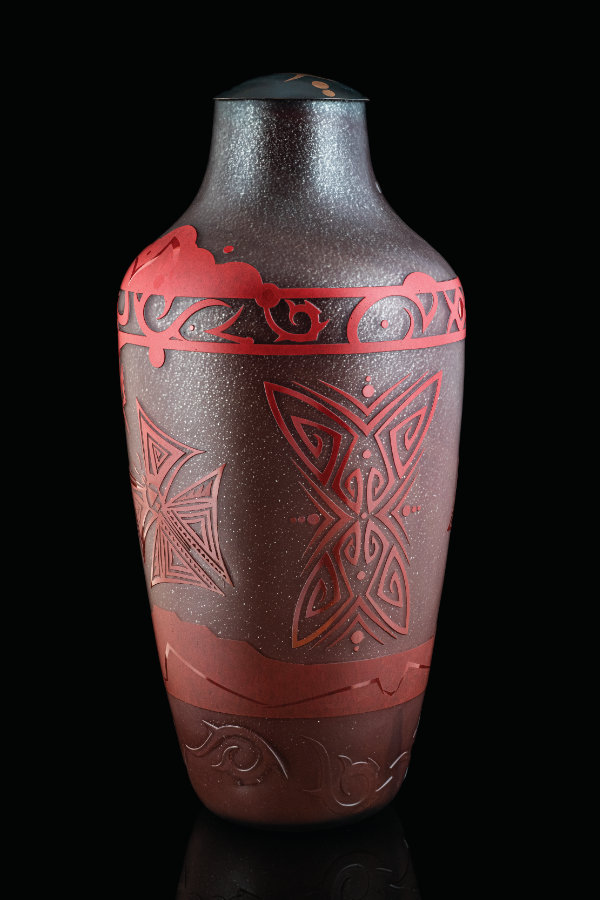
Robert “Spooner” Marcus (Ohkay Owingeh), Blood Moon Moth, 2016. Blown and sand-carved glass, copper lid. 20 × 9 in. Photograph by Kitty Leaken. Courtesy the Museum of Indian Arts and Culture.

The glass vessels created by Robert “Spooner” Marcus (Ohkay Owingeh) are rooted in Pueblo tradition, and the striking range of colors and the light emanating through his pieces in the exhibit are particularly beautiful. Recently, Marcus started a series of vessels inspired by a book on a collection of ancestral Puebloan pottery. Many of the items in the collection were pieced together from shards, with the lines from their reassembly still visible, a look which Marcus has recreated in glass. To several of the vessels in this series, he added a ladder to represent Pueblo kiva entrance ladders. While Marcus often makes vessels, his love of experimentation has also led him to create sculptural forms, such as a clear glass replica of a Pueblo on a granite base, with a ceramic pot set at the entrance.

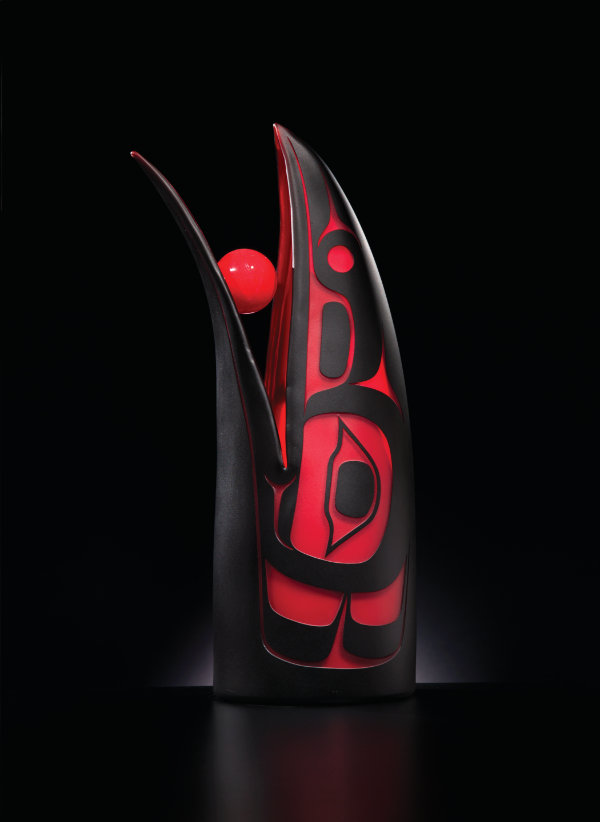
Preston Singletary (Tlingit), Raven Steals the Sun, 2017. Blown and sand-carved glass. 9 × 20 ¼ × 7 in. Photograph by Russell Johnson. Courtesy Preston Singletary Studio.
Preston Singletary (Tlingit), Raven Steals the Sun, 2017. Blown and sand-carved glass.
9 × 20 ¼ × 7 in. Photograph by Russell Johnson. Courtesy Preston Singletary Studio.

Several notable Pueblo potters, who generally work with clay, have collaborated with Tlingit glass artist Preston Singletary to create works of art that incorporate Pueblo pottery designs onto blown glass vessels, including Tammy Garcia (Santa Clara), Jody Naranjo (Santa Clara) and Harlan Reano (Kewa Pueblo).

For example, Garcia began a collaboration in 2005 with Singletary to transform her pottery designs into glass. Using Garcia’s designs, Singletary and his team blew glass bowls, which Garcia then carved. These vessels are stunning in their representation of Santa Clara pottery, with the medium of glass adding a luminescence that enhances the visual impact. Famous for making black pottery in the Santa Clara tradition, Garcia created a series of black pots in glass. Garcia and Singletary have worked together on several occasions, and other glass vessels from these collaborations demonstrate the depth of color characteristic of glass.

Basketry of Northwest Coast Tribes Re-Envisioned in Glass

Tribal peoples of the North American Pacific Coast historically made utilitarian vessels of barks, grasses, or woods. Traditional baskets and bags were made of natural fibers after a painstaking process of collecting and preparing the materials so that they could be woven into useful vessels. Artists from Salish, Tlingit, Lummi, and other Northwest Coast tribes have reinterpreted baskets and bags in blown and woven glass.

Dan Friday’s understanding of his Lummi culture was influenced by Lummi artist Fran James, a master basket weaver who worked with cedar, cherry bark, and bear grass. To honor the importance of weaving in the Lummi tradition, Friday created a series of baskets woven in glass, which he entitled Aunt Fran’s Basket, in homage to James. To make his striking glass baskets, Friday groups glass rods of varying colors, and then he pulls them together into a bundle, which he fuses with a torch. The bundle is placed in a furnace to create molten glass, which he then blows into a vessel. This creates the effect of the crisscross of the traditional woven cedar baskets that inspired him.

Raya Friday (Lummi), like her brother Dan, also makes glass baskets, as does Haila Old Peter (Skokomish/Chehalis), a well-known basket weaver who in recent years has begun creating baskets in glass that mirror her grass and cedar basket designs. Alano Edzerza (Tahltan) has carved stunning glass boxes. These and the other artists featured in this section of the exhibit have based their glass art on the baskets, bags and boxes made of natural fibers and woods in their tribal homelands in the Pacific Northwest.

Textiles Recreated in Glass

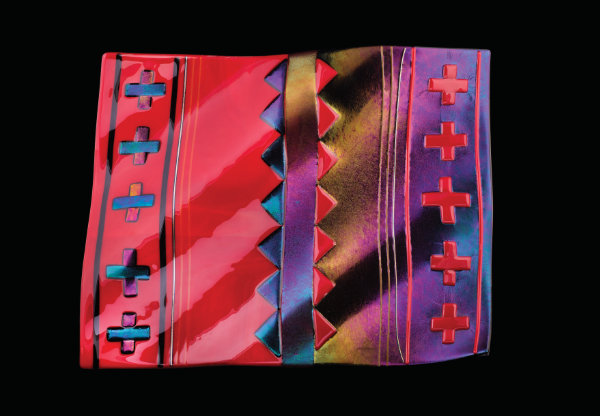
Textiles have been woven in the Americas for over 12,000 years using natural plant fibers and coats of animals. Traditional spindle whorls for making threads have been created in glass by several artists, notably by Susan Point (Musqueam). In the southwestern United States, fabrics were historically woven of cotton and wool; Carol Lujan (Navajo) has created glass panels, which incorporate woven designs such as those made by her grandmother. These works reflect the importance of textile production in Native life.

Carol Lujan (Diné), Grandmother’s Legacy series, 2014. Cut and fused glass. 14 1⁄2 × 12 × 1 1⁄2 in. Photograph by Stephen Lang. Courtesy Carol Lujan.

Gifts from the Sea

Native Americans have traditionally regarded all of nature as an integrated whole, and nature often plays an important role in tribal ceremonies and art. Legends and stories often involve animals of the land, sky, rivers, and oceans.

A major section of the exhibit is devoted to the sea creatures that are so important to the tribal peoples of the Northwest coast. Tlingit artist Raven Skyriver has created beautiful sea animals using an off-hand sculpture technique, and both the quality of the sculpture and the colors he creates are visually striking.

There are several renditions in the exhibit of orcas, which are the largest member of the dolphin family. Orcas are important in Native life and legends and are frequently depicted in the art of Northwest Coast tribes. The orca is said to protect those who travel away from home, and to help lead them back. Orcas in the exhibit have been created by several artists, including Skyriver, Singletary, and Marvin Oliver (Quinault/Isleta Pueblo).

Water is often incorporated into art to express concern for the environment, especially the rising oceans. Rivers have played a significant role in the siting of settlements for tribes, and Brian Barber, a Pawnee architect and glass artist, has created a site model in glass of the area of the Platte River adjacent to a Pawnee sacred site on the American plains. There also are a number of pieces in the exhibit that represent the tools for trapping and catching fish for sustenance, historically an important part of tribal life.

Animals of the Land

Respect for the animal world is a prominent cultural principle in Native communities. When animals are killed for food, the hunter thanks the animal and explains how its body will be used. Animals may also provide spiritual guidance. Bears symbolize strength and courage, and wolves figure predominantly in legends where they generally signify protection. Numerous depictions of these and other totemic animals are included in the exhibit by such well known artists as Ed Archie NoiseCat (Salish/Shuswap), Ira Lujan (Taos Pueblo/Okhay Owingeh), and Dan Friday.

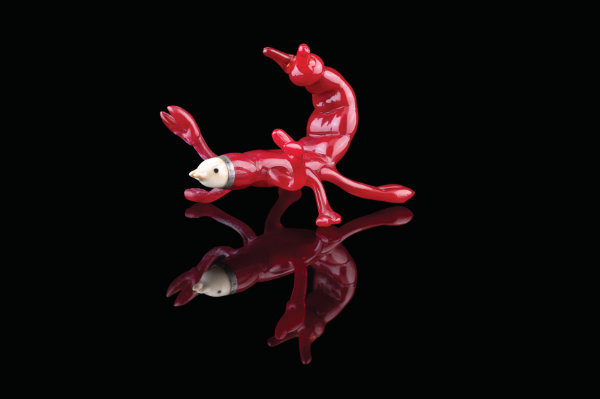
Friday’s great-grandfathers were well known wood carvers, renowned for totem pole carving, as well as for being culture-bearers in their community. Creating totem poles in glass became for Friday a way of continuing his family’s traditions. The exhibit also includes the first known creature created in glass by a Native  artist: Scorpion (ca. 1978) by Larry Ahvakana (Inupiaq), who was the first Native artist to work in glass, beginning at the Rhode Island School of Design in the early 1970s.

Larry Ahvakana (Inupiaq), Scorpion, ca. 1978. Blown glass, ivory, metal. 5 × 8 × 3 in. Collection of Tony Jojola. Photograph by Kitty Leaken. Courtesy the Museum of Indian Arts and Culture.
Larry Ahvakana (Inupiaq), Scorpion, ca. 1978. Blown glass, ivory, metal. 5 × 8 × 3 in. Collection of Tony Jojola. Photograph by Kitty Leaken.
Courtesy the Museum of Indian Arts and Culture.

The Sky Above and Flying Creatures

Long before European contact, Indigenous tribes of the Americas had advanced knowledge of astronomical cycles, and depictions of the sun and stars were common. Made by many tribes, star maps reflected the heavens and also a philosophy of being. Weather-related aspects also appear in drawings, such as depictions of clouds and lightning and other symbols of thunder and rain. Artists have reimagined such elements in blown and cast glass.

Ancestral Puebloan peoples incorporated this information about the sun and moon and the alignment of sunrises and sunsets during solstices and equinoxes into their architecture, as found at the ruins of Chaco Canyon in New Mexico. Works in the exhibit of several artists reflect this knowledge of the heavens, including pieces by well-known sculptor and glass artist Adrian Wall (Jemez Pueblo).

Birds and other flying creatures play primary roles in many Native myths and other stories. Eagles carry prayers to the Creator. Owls and other birds are featured in totems. Other flying creatures in the exhibit include Butterflies by Ramson Lomatewama (Hopi), Carol Lujan’s (Navajo) Dancing Dragonflies, Ira Lujan’s (Taos/Ohkay Owingeh) Quail Canopic Jar, and Circling Ravens by Shawn Peterson (Puyallup). Several artists have also depicted creatures as decorations on vessels or baskets, combining the making of utilitarian objects with their respect for birds and other animals. The resulting works are notable for their artistry as well as for their cultural expression.

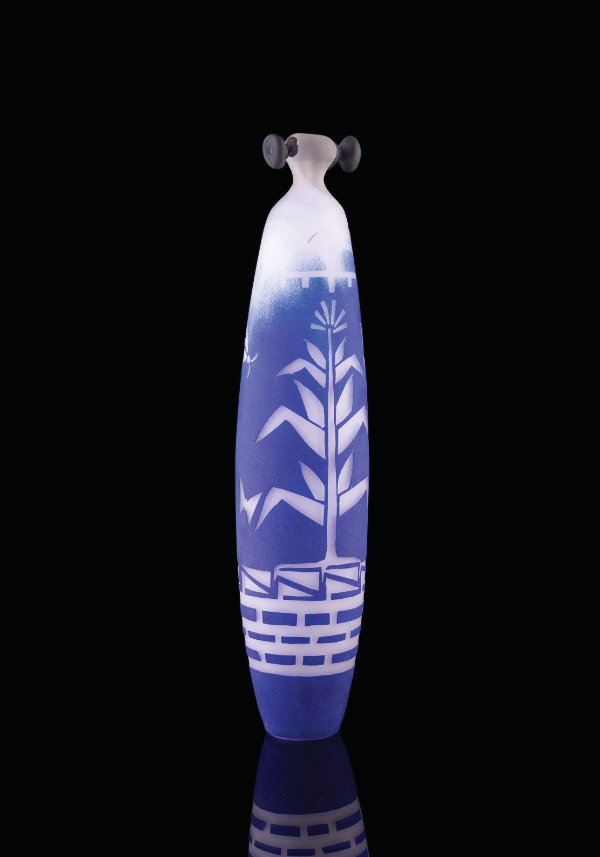
Ramson Lomatewama (Hopi), Blue Corn Maiden, 2017. Blown glass with two-color overlay, hand-cut design, sandblasted. 16 1/5 × 3 ½ × 3 ½ in. Photograph by Kitty Leaken. Courtesy the Museum of Indian Arts and Culture.
Ramson Lomatewama (Hopi), Blue Corn Maiden, 2017. Blown glass with two-color overlay, hand-cut design, sandblasted. 16 1/5 × 3 ½ × 3 ½ in. Photograph by Kitty Leaken.
Courtesy the Museum of Indian Arts and Culture.

A major focus of Singletary’s work is the Tlingit creation story of Raven stealing the sun, the moon, and the stars and flinging them into the sky to give light to the people. Singletary has become internationally recognized for the brilliant combination of his talent for creating glass objects and his use of the forms and symbology of his native Tlingit culture.

Interpreting Ancestors’ Voices in Glass

Native glass artists have also drawn inspiration from their tribal mythology and oral histories, reinterpreting traditional stories or designs in glass. Communications from the ancestors in the form of petroglyphs and pictographs also link current Native communities to the past. Glass artists have symbolized their ancestors through cast glass masks and other regalia, and through cast or blown glass version of ancient pictographs. These works in glass are an interpretation of cultural heritage and serve as ways of honoring and giving voice to ancestors.

Lillian Pitt (Wasco/Yakama/Warm Springs) developed her own approach to art by studying the petroglyphs and pictographs of her ancestors, who lived in the Columbia River region of the Pacific Northwest for more than 10,000 years. She Who Watches, a lead crystal mask she made from a mold, is her depiction of a famous rock art image that is both a petroglyph and a pictograph. The ancient rock art, perched high on a mountain, is visible from her ancestral village, and it is dominant in the stories and oral history of her people. Ancestors’ Messages, which is from a recent Pitt collaboration with Dan Friday, is a blown-glass piece in the shape of a Wasco-style sally bag—a type of cylindrical root basket—with petroglyph figures of people and birds fused on the surface. 

Ramson Lomatewama is a member of the Eagle Clan of the Hopi Tribe, known for his blown and hand-sculpted glass spirit figures and corn maidens, which are drawn from his study of Hopi artifacts and iconography. His compelling spirit figures in glass are inspired by photographs of rock art in Horseshoe Canyon in Canyonlands National Park in Utah. Some of the most significant rock art in North America, these ancient works date to the Late Archaic period, from 2000 BCE to 500 CE. Lomatewama has developed a sense of how Hopi perspectives influence his creations. In a glass vase, terracing at the rim may be a representation of the Grand Canyon, while glass bamboo may represent the Hopi creation story of emergence from the Third World; and a traditional corn maiden recreated in glass may represent prayers or gratitude for a bountiful corn crop.

Another way that Native cultures convey ancestral knowledge is through ceremonies and ceremonial regalia, such as an arresting Ghost Shirt by Chippewa artist Rory Erler Wakemup.

Nuu-chah-nulth artist Joe David collaborated with Singletary on Looks to the Sky, a three-dimensional bust that resembles masks carved in wood by David. Recognizable as Nuu-chah-nulth in the design of the features, the head is set on a torso that could be from any one of numerous cultures, Native and non-Native, which creates an interesting juxtaposition.

A Singletary collaboration with Marcus Amerman (Choctaw) resulted in a series of large blown-glass portrait jars entitled Voices from the Temple Mound, which are reminiscent of ceramic portrait jars of the Mississippian culture of southern and midwestern North America, which flourished from 4500 BCE to 1600 CE. Several of these glass jars representing the ancestors are presented in the exhibit. 

Bridging Two Worlds

A number of important works in the Contemporary Native Arts movement have focused on the dichotomies of living in two worlds, balancing those things that honor traditional cultures and those things that conform to the mores of mainstream society. Joe Feddersen has created an installation for the exhibit of hanging glass charms, which represent a cultural continuum from ancient petroglyphs to pop culture iconography, thus bridging two worlds. The charms create both a dialogue between past and present and an echo between the glass charms and their shadows. Each charm is made of cut and fused glass pieces. Feddersen has also created works which reflect on the differences in past and current tracks on the landscape.

Pueblo potter and fashion designer Virgil Ortiz (Cochiti Pueblo) also has created works in glass, and he has created characters in glass to tell a science fiction story related to efforts in the distant future to save cultural artifacts destroyed in the Colonial period by Spanish invaders, thus bridging past, present and future. 

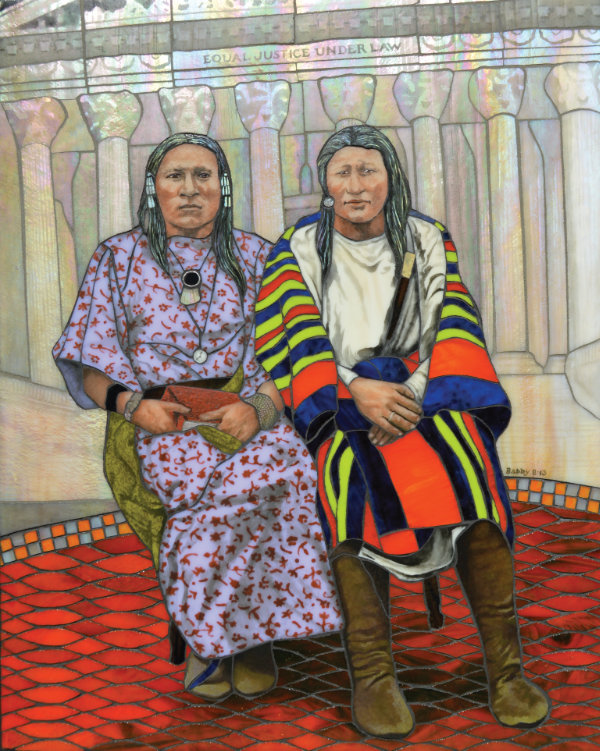
Angela Babby (Lakota) has developed a unique technique for creating glass on glass works using powdered enamel which she liquifies and then paints on glass. Whether picturing two-spirit individuals in front of the Supreme Court with the inscription “Equal Justice Under the Law,” or juxtaposing a traditionally clothed Inuit child with a changing climate, Babby’s works often draw from history and are expressions of issues affecting Native peoples and/or society at large. Her works also provide pointed social commentary.

Angela Babby (Lakota), Supreme Respect for the Two Spirits, 2013. Kiln-fired vitreous enamel on glass mosaic on tile board. 20 × 16 in. Collection of Jim Leach. Photograph by Angela Babby.

Conclusion

Native glass artists are part of a continuum of generations that have created art that reflects cultural knowledge and traditional designs, and their inspiration often stems from tribal lifeways. These artists have incorporated their traditions into artistic expression across an ever-evolving set of media. While glass is not a traditional medium for Native artists, a growing number have been attracted to glass, both for the properties inherent in working with glass and the joy of working in collaboration with a community of glass artists. Although glass is a relatively new medium for the creation of Indigenous art, cultural heritage remains integral to the practice. The Native artists working today in glass have, to a significant degree, taken on the role of culture-bearers as they lead in the development of this relatively new form of indigenous art.

The artists featured in Clearly Indigenous are all established artists; some have had long careers as glass artists, while others have only recently turned their artistic endeavors to the medium. These artists have melded the properties inherent in glass art with their cultural knowledge to create a remarkable body of work that reflects both traditional heritage and contemporary aesthetics. The result is a stunning presentation of thought-provoking and beautiful works of art. 
— 

After a distinguished career in federal and state government, as a business CEO, and as the Heard Museum CEO, Dr. Letitia Chambers returned to Santa Fe in 2012, where she has lived off and on for 50 years. She has curated major exhibits for MIAC and the Santa Fe Botanical Garden and is the author of Clearly Indigenous: Native Visions Reimagined in Glass.

Angela Babby (Oglala Lakota) (opens in a new tab) is a kiln-fired glass mosaic artist. Her work is influenced by her Lakota ancestry and the mysterious nature of glass. Babby’s artworks are glass mosaic tiles and she primarily uses images based on black and white photographs of her ancestors.

Kitty Leaken (opens in a new tab) learned photojournalism on the job at the Santa Fe Reporter and the Santa Fe New Mexican. 

Letitia Chambers (opens in a new tab) is the former chief executive officer of the Heard Museum. She has served as a trustee of the Institute of American Indian Arts and board chair of the Association of Tribal Archives, Libraries, and Museums. Prior to this, she had a long and distinctive career in education and public policy at the state and federal levels. She has curated major exhibits at the Museum of Indian Arts and Culture and the Santa Fe Botanical Garden and is the author of Clearly Indigenous: Native Visions Reimagined in Glass.

Robert “Spooner” Marcus is a contemporary glass artist from Ohkay Owingeh known for incorporating Pueblo pottery designs and styles into his unique work. His great-grandmother was Regina Cata who played a leading role in reviving traditional pottery-making in Ohkay Owingeh. His grandmother and mother were also potters, and Marcus found working in glass to be a natural outgrowth of this distinguished pottery background. He merges traditional pottery forms and designs into his one-of-a-kind works of glass and has also created a glass pot inspired by micaceous clay pottery.

Picturesque, Romantic, Practical

By James E. Snead

Susan Elston Wallace was not impressed with Santa Fe.

“It is the small boast of the citizens of this place that this is the oldest city in the U.S.,” she wrote a cousin in March 1879. But the town itself resembled “nothing so much as a collection of brick kilns.” The wife of Territorial Governor Lew Wallace, she had come West from Indiana under protest, bringing along the preconceptions of her time and class. Nonetheless, the historic associations seen in the streets and countryside exerted a subtle appeal. “Still,” she concluded, “we must not despise adobe. Babylon was built of it.”

Santa Fe as experienced by Elston Wallace was deep in the throes of an identity crisis. Bypassed by the railroad and with the local mining industry failing, the city’s business elite struggled to promote the town and its assets. In The Myth of Santa Fe, Chris Wilson called these circumstances “boosterism in the face of decline.” Dire economic news was compounded by pervasive bias against Hispanos, Native Americans, and the Catholic Church. Despite vigorous defense, racist diatribes in the national press complicated any effort to tout the city as a tourist destination. Any promotional campaign would have to skillfully weave business and culture together.

Efforts by Santa Fe’s business community to “boost” the town in the 1880s were an early attempt to establish what came to be called the “three cultures” myth. Indigenous and Hispano heritage were recast as positive cultural assets. In effect, this approach attempted to counter prejudice—and make the region more economically attractive—by embracing cultural differences, stripping them of their nineteenth-century context and wrapping them in Eurocentric romance. Such a strategy allowed the Anglo territorial elite to position themselves as heirs to such refashioned history.

In November of 1882, Santa Fe’s Board of Trade turned away from a plan to build a new smelter in favor of a new promotional scheme. In the words of Arthur Boyle, secretary of the organization, the idea was to host an event but one that would not simply be “an agricultural fair, or a mining exposition. These things are all the same,” he opined. As for a theme, a “prominent railroad man” had “suggested a celebration recalling the customs of the Aztecs, the ancient games of the inhabitants of the country in the early days.” Others in the room offered a “tri-centennial of the European occupancy of Santa Fe.” A committee was established under Boyle’s guidance, with a mandate to “lose no time.”

Arthur Boyle’s English accent and unusual history would have made him a distinctive character on the streets of Santa Fe. Born in Staffordshire, he had come to Santa Fe as the husband of Blanche Blackmore, whose family had extensive real estate holdings in the American West. Boyle, identified by The Santa Fe New Mexican as “Santa Fe’s enterprising capitalist,” dabbled in various schemes and identified himself as “Agent for British and Australian Investors.” He was a fixture on the numerous civic boards and committees that “improved” the town.

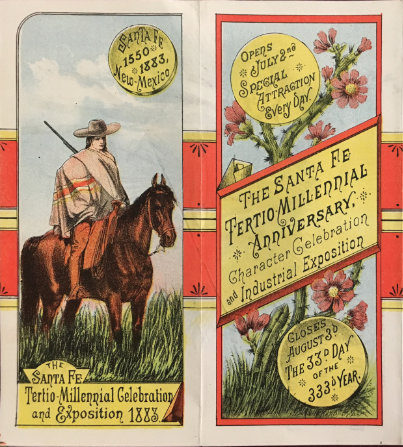
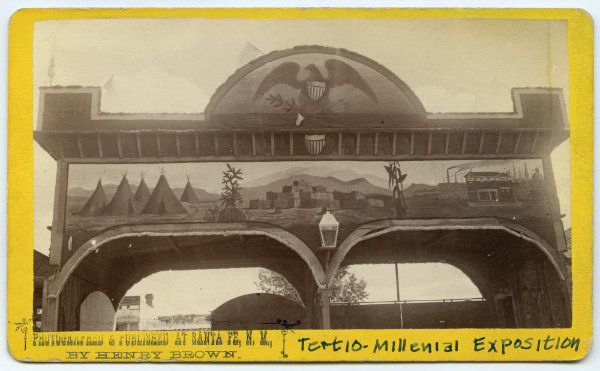
Brochure panel from the Santa Fe Tertio-Millennial Celebration and Exposition. Courtesy of the Fray Angélico Chávez History Library.
Brochure panel from the Santa Fe Tertio-Millennial Celebration and Exposition.
Courtesy of the Fray Angélico Chávez History Library.

After some deliberation, the exposition was dubbed Tertio-Millennial, signifying the passage of 333 years since the (incorrect) date Santa Fe was “founded.” It would demonstrate that Santa Fe offered “attractions to the capitalist, to the invalid, to the business man,” and induce “capital and immigration… to flow into the Territory to an extent which no other measure would equal.” The committee giddily estimated an attendance of 100,000 visitors. Their mandate was to deliver an event that—as described in the pages of the Lincoln County Leader—would be “picturesque, romantic, practical!”


The American public had felt the appeal of “expositions” since at least 1876, with the huge success of the Centennial Exposition at Philadelphia. In the Western states and territories, where competition for capital and immigration was keen, such celebrations offered the chance to tout local resources and achievements. Denver’s “Mining and Industrial Exposition,” inaugurated in 1881, demonstrated the potential of expositions to draw tourists and promote economic growth.

New Mexico’s participation in expositions had been modest. A collection of Indigenous ceramics, textiles, and antiquities intended for Philadelphia was displayed in Santa Fe in 1874 and included a Navajo blanket with “1776 U.S.A. 1876” woven into the fabric. These materials were ultimately dispersed, and a plan to take “a large delegation of Indian chiefs” to the Centennial collapsed. Lack of funding doomed the Territorial commission and associated county advisory boards.

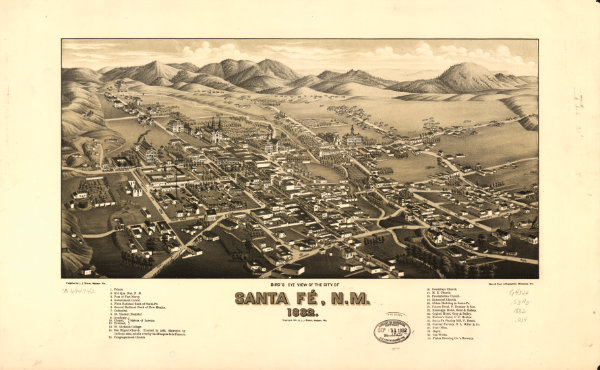
This familiar 1882 map of Santa Fe shows the unfinished territorial capitol building that would become the Tertio-Millennial Exposition hall to the left of the Plaza on Capitol Avenue (now Federal Place). Bird’s eye view of the city of Santa Fé, N.M., 1882. Courtesy Library of Congress Geography and Map Division, image no. G4324.S3A3 1882.W4.

It was only with the Denver Exposition of 1882 that the business community in Santa Fe grew alert to the opportunity of such events. New Mexico’s representative was Judge W.B. Sloan, a newspaperman and correspondent for The New Mexican, who traveled the Territory, cajoling cooperation and specimens from the mining districts. The seeds of the Tertio were clearly planted in Denver, perhaps by Judge Sloan himself, who was one of Boyle’s colleagues on the Board of Trade.


A variety of tasks faced Boyle’s Tertio committee. Subscriptions were solicited, excursion rates arranged, color brochures drafted and printed. A joint stock company was established in the anticipation that the Tertio-Millennial might ultimately prove profitable. But the most critical element of the program—promotion—was already in capable hands.

L. Bradford Prince was one of Santa Fe’s most skillful boosters. A New York politician who had been appointed as Chief Justice of New Mexico’s Supreme Court, Prince had recently resigned from that position in an unsuccessful effort to gain the Republican nomination for Territorial Delegate to the U.S. House of Representatives. In early 1883 he was in the East, pondering his political future, which was entangled in the fortunes of his adopted home. For Prince, the success of the Tertio-Millennial Exposition had both personal and civic implications.

Prince began the Tertio-Millennial campaign via a “conversation” arranged with a reporter from the New-York Tribune. Over the next six weeks, this interview and others like it were reprinted across the country. While in New York, Prince also boosted New Mexico in his capacity as president of the Immigration Bureau, setting up shop in an office on Broadway to dispense information and advice. Described as “a free and easy talker, and fully in love with the Southwest,” Prince proved a talented ambassador for the cause.

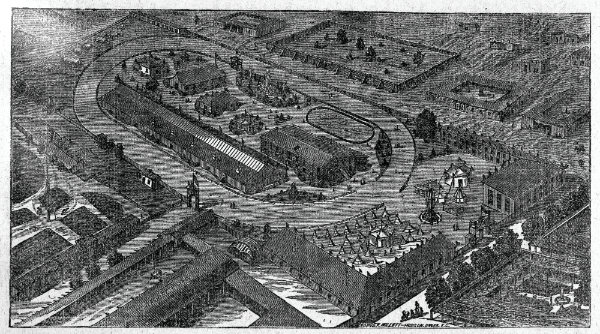
Exposition grounds, Tertio-Millennial Exposition, Santa Fe, New Mexico, 1883. Courtesy Palace of the Governors Photo Archives (NMHM/DCA), neg. no. 010994.

By the time he returned to Santa Fe in March, the exposition grounds had been demarcated around the old Territorial Capitol building—a stone structure that had languished unfinished for years only two blocks north of the Plaza. Some of the building’s space would be roofed for office and exhibit space, and a “grandstand” for performances was also installed within the walls.

That Territorial Capitol remained unfinished. After a new structure was built across the river, elements of the older building were reconstituted as a courthouse, today the Santiago Campos U.S. Courthouse on Federal Place.

Bids were solicited for an additional, temporary building in an “Alhambra or Moorish style of architecture.” Preparing the grounds required developing a system to supply water for fountains, fire prevention, an ornamental lake, and thirsty tourists. Pipes for gas lamps would also be required. A racetrack one-third of a mile long was planned; indeed, the curiously oval walkway wrapping around the present-day courthouse and the main post office traces the Tertio’s racetrack, but all other vestiges have been erased.

Women were distinctly absent from the Tertio’s organizing committee. This had not been the case elsewhere; women and had been deeply involved in assembling Colorado’s collections sent to Philadelphia, and had organized the art exhibits at the Denver Exposition. Any roles taken by Blanche Blackmore Boyle, Mary Prince, and others among the Santa Fe elite in planning for the Tertio-Millennial were either elided by the organizers themselves or ignored by newspaper coverage.

Boyle hoped to delegate much of the planning to Charles W. Greene, who came up from the mining town of Lake
Valley to take the position of “general manager.” The two men spent the spring holding meetings throughout the Territory. Local audiences were assured that promoting Santa Fe would have benefit beyond the city limits, and wide participation was encouraged.

Making the Tertio “work,” however, required cultural entrepreneurs who were already invested in promoting the image of the Southwest. Some—like Judge Sloan—emerged from a floating class of newspapermen, already adept at the mechanics of promotion itself. Greene had only recently been editor of The New Mexican itself, having departed to establish the Lake Valley Tribune. He was described as understanding “exactly the relation which judicious advertising bears to the celebration.” Among other tactics, Greene sent complimentary tickets to newspapers across the country, which garnered favorable publicity, if not necessarily greater attendance. “Subscriptions will have to come in a little thicker before we can go way out there,” apologized the editor of West Virginia’s Shepherdstown Register.

Collectors and curio dealers were the foremost boosters of Southwestern history and culture, and they were tapped in support of the Tertio. Arrangements for Indian dances also required the skills of cultural entrepreneurs. Such events were increasingly common in Santa Fe; in April, two different curiosity shops on San Francisco Street hosted dancers from San Ildefonso and Tesuque for tourists in the hotels. These communities were relatively close to Santa Fe, but additional recruits were sought, including Matachines dancers from Taos. Indian “agents” among the Apaches, such as W.H.H. Llewelyn, promised to assist. Dancers from Zuni were particularly desired, and so Tertio organizers contacted the mercurial Frank Hamilton Cushing for assistance.

Zuni Kick Stick racers, Tertio-Millennial Exposition, Santa Fe, New Mexico, 1883. Courtesy the Ben Wittick Collection, Palace of the Governors Photo Archives (NMHM/DCA), neg. no. 016234.

The debate over Cushing began shortly after he arrived at Zuni in 1879—and continues today. Considered a genius by his mentors in the then-new field of ethnology, cozened by patrons, and reviled by many for his pretensions to cultural authority, he occupied a central node in the evolving relationship between Indigenous and Euro-American perspectives. Phil Hughte’s A Zuni Artist Looks at Frank Hamilton Cushing presents a sharply humorous community perspective on the pueblo’s unwanted guest.

By 1883, the “Smithsonian young man” had achieved some prominence in territorial and national circles, in particular via articles published in The Century and Harper’s New Monthly Magazine. Adolph Bandelier stayed with Cushing at Zuni that spring and was delighted by the information his colleague had acquired. But he also described resistance to Cushing within the pueblo, noting—prophetically—that his “enthusiasm might take him too far.”

Extensive plans for commercial exhibits were unveiled. Philadelphia’s Best Brewing Company promised to send “an immense bottle, made from the ordinary bottles of their celebrated beer.” Purveyors of pianos, agricultural implements, undertaker’s supplies, and an “automatic gold panning machine” would all be present. Hopes were also raised for more modest exhibitors at the Tertio. One Harry Gosney of Albuquerque gained permission for a lemonade stand, although the Albuquerque Journal suggested that Gosney—perhaps disillusioned about opportunities in the territory—planned to retreat east once the event was over.


The Tertio-Millennial Exposition opened with a flourish on July 2, 1883. Early visitors witnessed Mme. Rosette’s highwire act and a Zuni footrace. The temporary building, having survived a windstorm a few weeks earlier, proved adequate shelter for decor that placed “the visitor in a happy frame of mind.” The first notable delegation to attend, arriving by train that evening, was “a visiting party of Missouri and Kansas commercial men” and their families, heralding the economic ambitions of the fair’s sponsors.

The organizing committee set up shop in the newly roofed section of the old capitol building, along with the “antiquities department.” By the early 1880s the term “cliff-dwellers” had joined “Aztecs” as popular (and grossly inaccurate) references to the ancient inhabitants of the Southwest. “The cliff-dwellers,” noted The New Mexican, “will not be present at the Tertio-Millennial,” but their artifacts were well-represented. Competitions of all kinds were scheduled, including a “burro race” for boys and a skills challenge pitting the various “hose companies” of the territory against each other.

Painted archway at the entrance to the Exposition Hall, Tertio-Millennial Exposition, Santa Fe, New Mexico, 1883. Photograph by Bennett & Brown. Courtesy Palace of the Governors Photo Archives (NMHM/DCA), neg. no. 010999.

July Fourth featured a grand parade led by Territorial Governor Lionel L. Sheldon. Marching bands, mounted troops, and carriages filled with dignitaries wound down Palace Avenue, past the cathedral, and on along San Francisco Street before returning to the grounds, where Prince and Rafael Romero gave speeches in English and Spanish. The afternoon featured a competitive drill. Events culminated in a public ball, a banquet, and “the greatest display of fireworks ever seen west of the Missouri River.”

If women were underrepresented among the Tertio’s planners, they were engaged in the fair itself at every level. One of the more successful commercial exhibits was the “Art Parlor” managed by photographer Frances Emma Luse Albright. It was somewhat of a family affair for the women of the Luse family. Sarah Luse Larimer had taken up the trade during the 1860s, working all across the high plains. Albright began her own career in photography in the mid-1870s in Elk County, Kansas. She set up shop in Santa Fe in 1881, when her husband, John G. Albright, took over the local Santa Fe Democrat. “Mrs. Albright’s Art Parlor” removed to Albuquerque in 1882, but she returned to the Tertio with acclaim. Assisted by her younger sister Nettie, Albright took portraits of many of the visitors to the fair, including babies, Territorial legislators, mining commissioners, and General Manager C.W. Greene himself.

Another enterprising woman who garnered attention at the Tertio was Nellie Boyd of Nellie Boyd’s Dramatic Company. One of the West’s premier traveling theater groups, the company had been contracted for the duration. Melodramas like A Celebrated Case, Miss Multon, The Planter’s Wife, and Led Astray were staged for the Santa Fe audience. The company marched in the July Fourth parade. The New Mexican described Boyd’s performances as “chaste and refined,” urging residents to
“patronize the company and encourage them to visit again.”

Women visited from throughout the country, often together or in small family groups. Laura Thomas of Emporia, Kansas, traveled to Santa Fe with her niece, Pearl Stuckey. According to her hometown Weekly News-Democrat, “Miss Thomas has earned this respite from… her position in the City Book store, and we trust she may enjoy it to the fullest possible extent.” That such “average” tourists made the effort to visit Santa Fe demonstrates that the promotional industry of Prince and others had reached some of the intended audience.                

Events associated with the Tertio demonstrated a tactful weaving-together of myth and romantic fancy to establish a historical narrative of Santa Fe calibrated for audience appeal. In light of kneejerk bias, particular care was taken to project a positive image of the Territory’s Indigenous communities. The circular announcing the event emphasized the “respectable” history of these people as reflected by ruins in the region, casting them as “direct descendants of the Aztecs… tilling the soil and living under wholesome laws.” Indigenous history was thus whitewashed for visitors, who could enjoy the fair and ignore troubling issues facing this community in contemporary context. A different bias thus emerged: framing Native American history as economically and spiritually exploitable, apt for use to the benefit of Anglo settlers.

The most complex myth-making at the Tertio was a three-day “street pageant,” offering a fanciful version of the city’s
history to the public. With the support of “Madame Purcell” of St. Louis, who arrived with fifteen trunks loaded with costumes, participants took on the roles of characters from the city’s past, with pronouncements and presentations to highlight “general progress and advancement” over time. On the evening of July 21, a “Knight’s Court” was held for an estimated 500 guests to capitalize on the romantic imagery. The costumes were perhaps the greatest attraction, loaned to the participants and used for dress balls held during the summer. Eventually Madame Purcell, hoping to return to St. Louis, had to publish advertisements in the papers imploring that the costumes be returned.

Some paid attention to the careful image-building of the exposition. The Leavenworth Standard published five dispatches from a special correspondent, “Tranquillo,” whose perspective contrasted with the casual racism and anti-Semitism of other witnesses. “Mingling and blending of ancient civilizations with modern refinement and culture interest me more than the rocks, the carbonate, the story of the shafts,” he observed. He wondered from what he saw in Santa Fe “whether the Indians of… New Mexico would not have been in better condition had they never seen a white man.”

Observers who traveled a greater distance were also attracted by the Indigenous cultures on display. The New-York Tribune devoted several paragraphs to describing the dances. Cushing, who found time for several interviews, provided complementary interpretation. As intriguing as such events were, however, the Tribune’s reporter remarked that “it does not appear that the irrigation of New Mexico’s soil by eastern capitalists has been materially enhanced by thirty-three days of Indian dances and horseracing.”

As July wore on, Tranquillo also grew more skeptical about the Tertio’s “success,” writing: “The want of attendance is
deplorable, humiliating, grievous, especially when it is the fact that the exhibition is a good one.”

Not all of his Kansas associates agreed. “It only takes about 15 minutes to view the town and the ancient wonders that have accumulated there in the past 333 years,” noted a letter in the Halstead Times. “Truly Santa Fe would take the cake for the greatest humbug of ’83.”


The Tertio-Millennial Exposition officially closed on August 5. Within a few weeks, boys and girls of the neighborhood could be seen “paddling around” the ornamental lake. Some of their peers amused themselves by breaking the windows of the empty exhibit building, which was gradually dismantled and re-used for other projects, including as a roller-skating rink on Palace Avenue. The grounds slowly evolved into an informal park, with benches for strollers and a baseball field. Efforts to convert the unfinished capitol building into an Indian School were debated, but never realized.

In 1883, Santa Fe resembled “nothing so much as a collection of brick kilns,” according to Susan Elston Wallace, wife of Territorial Governor Lew Wallace. Peter Moran, Santa Fe, 1883. Etching on wove paper. 4 1⁄2 ×  6 7⁄8  in. Reba and Dave Williams Collection, National Gallery of Art, Washington, image no. 2008.115.3585.
In 1883, Santa Fe resembled “nothing so much as a collection of brick kilns,” according to Susan Elston Wallace, wife of Territorial Governor Lew Wallace. Peter Moran, Santa Fe, 1883. Etching on wove paper. 4 1⁄2 × 6 7⁄8 in. Reba and Dave Williams Collection, National Gallery of Art, Washington, image no. 2008.115.3585.

Predictably, no profit was realized from the Tertio, leaving Boyle and the other stockholders scrambling to pay bills. Bradford Prince had taken the opportunity to publish a widely advertised history of New Mexico, although his financial gains were uncertain. Some entrepreneurs vanished, but others turned their Tertio experience into a more lengthy engagement with fairs and expositions. Mrs. Albright returned to Albuquerque, but—as “Franc Luse Albright”—went on to exhibit photographs in the World’s Columbian Exposition in 1893 and serve as one of the Territorial Commissioners.            

If it was difficult to evaluate the impact of the Tertio-Millennial on national perceptions of Santa Fe, the legacy of the Exposition for residents of the town itself was profound. Not yet “Santa Fe Style,” the impact of Tertio on the town’s identity was dramatic. The “three cultures” myth proved to be a powerful promotional tool, embellished thereafter via literature, pageants, and countless related attractions. The manipulation of Hispano and Indigenous culture for such commercial ends shaped the idea of Santa Fe, but more than a century was to pass before the cost of such appropriation for these communities themselves was to be reckoned by Anglo culture in any significant way.

It is thus the written record that best captures the significance of the Tertio in context. The New Mexican Review summed it up a week after the gates closed: “It was an experiment,” the paper noted. “Dealing with the past as well as the present… a complete historical picture… of a land whose past is full of strange and romantic incidents…. These are the peculiar features which attracted interest.”


James E. Snead is professor of anthropology at California State University, Northridge. A 1980 graduate of Santa Fe High School, he is an archaeologist and historian with diverse interests concerning the U.S. Southwest.

James E. Snead (opens in a new tab) is a professor of anthropology at California State University, Northridge. A 1980 graduate of Santa Fe High School, he is an archaeologist and historian with diverse interests concerning the U.S. Southwest.

Eyes on the Land

By Paul Weideman

Messing with the matrix. That’s one of the problems with the modern-day fad of stacking stones into cairns in wilderness areas. Cairns are an age-old method of marking trails, but those that are constructed for less serious reasons at archaeological sites can cause irreparable damage.

“If there were associated grid gardens or shallow subsurface deposits, the rock removal would likely disturb them, compromising the shallow subsurface stratigraphy,” says Jessica Badner. A field archaeologist for about two decades, she is now the coordinator of New Mexico SiteWatch, a network of trained site stewards who monitor the state’s historic and prehistoric resources as part of a program of the New Mexico Department of Cultural Affairs’ Historic Preservation Division. Badner once excavated an archaeological site that had a time depth of thousands of years less than four inches from the surface.

“We have amazing Archaic sites throughout New Mexico, and some are deeply buried and some are not,” Badner says. “The site I’m talking about is in the Santa Fe area. We have extreme time depth in some very shallow sites, so a lot of damage can be done. The effect of moving stones at a site is cumulative. For example, pollen samples from intact grid gardens can tell species of plants that were cultivated and can provide a season of occupancy. The interface between an undisturbed cultural horizon, or floor, and a rock can provide a prime sampling location—but if the rock has been popped out, that special context is contaminated with other environmental pollen and the sample is no good.”

A lot of this hinges on an arguably subtle and esoteric quality: the record of past human activities that exists in the layered “sequence” of a site’s earth, stone, or other natural material. The archaeologist says the SiteWatch program is “really important to preserving the story” of past peoples that can be read in the landscape.

“It’s very Poindextery, and that’s kind of the funny part about archaeology: It can be really neat and exciting, but a lot of times what you end up with is a very particular way of talking about it that isn’t exciting.”

New Mexico SiteWatch is managed by the Historic Preservation Division and funded by the State of New Mexico, the U.S. Bureau of Land Management, and the U.S. Forest Service. Its volunteer stewards adopt and routinely monitor archaeological sites, historic buildings and trails, bridges, and other features for signs of erosion, wear and tear, vandalism, and looting.

Badner coordinates the activities of about 130 stewards, who collectively drive some 30,000 miles every year to perform their mission. She trains stewards “to know why they’re monitoring and how to classify what they find,” she describes. Some of the impacts to sites are purely natural, like animals burrowing or wildfires that result in flash floods and erosion.

A “decorative” cairn made of stones lifted from their context at an archaeological site. Photograph courtesy Jessica
A “decorative” cairn made of stones lifted from their context at an archaeological site. Photograph courtesy Jessica Badner.

The classes of site degradation that are human-caused run the gamut. Like stone-stacking, another activity that only seems innocuous is when people find pretty potsherds and arrange them on a flat rock. “That’s not great because it causes a rift in the integrity of the context,” Badner says. “People may be well-meaning, showing a desire to share what they’re experiencing with other people—’Hey, look, we found a cool sherd. Look what’s here!’—They’re trying to share their experience with their fellow visitor within the parameters of what they understand to be acceptable behavior. Nothing’s going off-site, so people don’t see it as an issue. It’s not done with nefarious intent. If it were just five or so sherds, okay, it’s not ideal, but in the grand scheme of things it’s a relatively small impact. But multiply that over 20 or 30 years of site visits.

“They don’t realize that they’re changing the spatial relationship of those materials. That would be something our stewards would report and the land managers would make a decision, maybe to put up signs or they may decide to have a ranger on hand for crowded days.”

People don’t realize that picking up potsherds to make a trailside display destroys the historical record of the site. Photograph courtesy Jessica Badner.

Among the other categories that stewards encounter are trash-dumping; illegal woodcutting and out-of-bounds ATV use; damage from wandering cattle; and vandalism and looting. Once reported by stewards, the land manager may decide that it’s a crime scene, then law enforcement takes over.

Badner helps put the puzzle together in cases where a land manager expresses concern about activity at a particular site. She may decide to call the area coordinator to see if there’s someone to monitor it.

The volunteer stewards, many of whom are retirees, often spend an entire day getting to and monitoring a site. “We have a lot of stewards who have had very full work lives, a lot in demanding professional situations, and the type of people who want to serve are those who really want to make a difference,” Badner says.

“I really admire our Site Stewards. These are not people who show up at a gala and write a check. They’re doing a lot of work as volunteers, and sometimes with very little recognition. And if a situation goes into the black box of law enforcement, the coordinator will ask them not to go visit that site for a while.”

Badner says the past year has been busier than ever because of the COVID pandemic; there are a lot more people on the land. For Sandra Arazi-Coambs, the Sandia/Tijeras chapter coordinator for SiteWatch, that means trouble as more and more housebound citizens want to hit the trails. “I work outside the city of Albuquerque, so some of the vandalism is graffiti,” she says.

Arazi-Coambs is the Sandia/Mountainair zone archaeologist and also a land manager with the Cibola National Forest and National Grasslands.

“We have over 10,000 recorded sites, and we have not surveyed a lot of that area,” she says. “We have five or six staff archaeologist positions, so there’s no way we can monitor even just the significant sites. Of the 10,000, there are about 100 particularly significant sites that we think would be vulnerable. New Mexico SiteWatch volunteers allow us to have eyes and ears on the ground.”

In a December 2020 interview, Arazi-Coambs said she was dealing with a new example of the kinds of impacts that can happen to historic features. This one involved a Sandia Mountains picnic area that was built by the New Deal-era Civilian Conservation Corps.

“We get so much vandalism in the foothills because these sites are accessible. We had volunteers who had reconstructed one of the picnic tables. It’s really cool. The CCC had suspended a picnic table from a chain attached to a boulder. We have a picture of it from the 1930s, and our volunteers sized it just right so it would conform to how it was built. I just found out that the table was recently vandalized. They took it off the chain that was suspending it and did some graffiti. It’s really discouraging.”

In this context, the term “historic” means at least 50 years old, and the CCC table satisfied that criteria with about 35 years to spare. An “archaeological site” is anything that’s 50 years or older and meets the National Register of Historic Places criteria for significance; according to New Mexico administrative code, it is a location where there exists “material evidence of the past life and culture of human beings.” Examples include pueblos, homesteads, campsites, and artifact scatters. By state law, most of these sites are also anonymous; their locations are not public knowledge.

“We have these big sites like Chaco Canyon and Mesa Verde that are clearly unique, that kind of punch you in the nose,” Badner explains. “We call those the sexy sites. But we also have fairly ephemeral sites that are culturally and scientifically important even though they’re not a big wow. Some of our mining sites are in that category. A site can be significant because of its contribution to knowledge or because of its association with important people, but also because of its documentation of the winds of history. Some of those mining sites can answer questions like, ‘What was going on in society during this time?’”

Illegal digging is the main problem for Peter Lipscomb at Cerrillos Hills State Park, which is known for its mining history. “People think mines mean they can come out here and just dig, but these are protected cultural sites,” he says. “And as is true on many public lands, collecting, metal-detecting, and prospecting are off limits; they’re against the law. They are monitored and activities are documented and information is shared with law enforcement.”

The rules for the park (which has been closed to all but New Mexico residents since July 2020) are posted on trailside signs. Stewards working here enjoy a realm of big skies and long views of the surrounding mountains. It’s a land of roadrunners and bobcats, of soaring red-tailed hawks and bats. Along the flinty trails—five miles of them—that wind through the hilly piñon-juniper landscape, you encounter cholla and prickly pear, mountain mahogany and four-wing saltbush, and, of course, abandoned mines.

During a site visit, we came onto a big black hole in the ground, covered with steel netting and perimetered by a low barrier of black steel railing. There’s no way you can miss such historic abandoned mines. On the other hand, examples of illegal digging can be subtle, like the slight depression further down the trail that was less than 12 inches in diameter. “I can distinguish what an animal does compared to what a human does,” Lipscomb said when he noticed it. “This is a prospect pit.”

SiteWatch volunteers learn how to read those signs to monitor mine sites. The park has had a cooperative program with Badner’s organization for a little over a year.

“Earlier in 2020 we had a rash of incidents, six in a row at one site on the Cortez Mine Trail,” Lipscomb says. “There’s the illegal side, but there’s also the disrespect of the shared cultural identity of the people who were here and their stories.”

He believes mining is the park’s most important narrative. “It’s how the natural history influenced the cultural history and multicultural settlement of New Mexico, from Indigenous cultures to Spanish explorers, and on up to Territorial mining. These little hills tell a big story.”

There is evidence here not only of Ancestral Puebloans who lived in the area a thousand years ago, but of Archaic and Paleoindian migrants going back 10,000 years. “This was winter hunting ground for people coming out of the Jemez and the high country,” Lipscomb says. “There can be evidence of transient campsites. You get potsherds and lithic scatters from flintknapping. There are some places where we have metates and stone mauls.”

The park is at the end of a mile-long vein of galena, a lead-silver sulfide. Native people ground galena into pottery glaze starting in about 1300 CE, but they focused on the area around the Cerrillos Hills’ Mount Chalchihuitl four centuries before that to mine turquoise. “All you needed was a rock harder than what you were working,” according to Lipscomb. “You had to be very skilled at using a stone hammer to get turquoise, for example, to not destroy what you were seeking.”

SiteWatch volunteers also monitor features left by Spaniards who sought lustrous metals—not only galena but silver, lead, copper, iron, zinc, and manganese—beginning in the late 1500s, and then by Territorial U.S. miners during a boom in the late 1870s and early 1880s. Archaeological sites in Cerrillos Hills State Park also include stone foundations for Territorial-era tent platforms.

Sandia/Tijeras SiteWatch volunteer Lee Riley documents a site in the Sandia Mountains. Photograph courtesy Sandra Arazi-Coambs.

Overall, New Mexico SiteWatch monitors for the BLM; the Gila, Lincoln, Carson, and Cibola national forests; Santa Fe County; Bandelier National Monument; Chaco Culture National Historical Park; the Archaeological Conservancy; the Wells Petroglyph Preserve; New Mexico State Parks; and the State Land Office. The two other major New Mexico stewarding programs are more localized: Santa Fe National Forest Site Stewards and Northwest New Mexico Site Stewards.

“Our most common problem is erosion; just the natural forces of the climate and weather,” says Will Dearholt, chairman of the Santa Fe National Forest Site Stewards Program and one of its area team leaders. Natural forces have collapsed 800-year-old walls. Segments of ancient walls are not too rare in the national forest, although many are only hip-high.

There is also the issue of cattle tromping over archaeological sites. However, off-road and out-of-bounds vehicles pose a greater threat. The numbers of forest visitors, particularly in the Jemez, has increased greatly in the pandemic. And many of those visitors are people who are not used to taking care of the land.

“They bring huge numbers of vehicles and stuff, great big RVs and ATVs. There are places where it almost looks like they’re setting up a town,” Dearholt says. “Some archaeological sites are not obvious. They don’t look like much—it’s not Mesa Verde—so you can imagine why people don’t know what it is and go ahead and do a wheelie over it with their ATV.”

The all-volunteer Santa Fe National Forest Site Stewards goes back to about 1998. Since then, volunteers have helped to monitor priority sites, assisted with identification and documentation, and researched cultural resources. “The Forest Service’s heritage resource program manager assigns us sites,” Dearholt says. We go out and check sites about once a month.”

The Santa Fe National Forest is vast, encompassing more than 2,400 square miles and including nearly 300,000 acres of wilderness. Ancient peoples inhabited these lands, and some left pictographs and petroglyphs. “Some of the archaeological sites do have those and people shoot at them or chip away with a hammer and chisel,” Dearholt says.

In northwestern New Mexico, Navajos painted and pecked beautiful figures onto the face of a sandstone cliff at Bi-Yazh about 350 years ago. In the late 1980s or early 1990s, thieves chiseled off three rectangular panels from the stunning site.

The site is in Largo Canyon, a good 60 miles south of Bloomfield, says Larry L. Baker, executive director of Northwest New Mexico Site Stewards. “Two of the panels that were removed from Bi-Yazh we have on display here at the Salmon Ruins Museum [in Bloomfield] on semi-permanent loan from the Museum of New Mexico. … They’re under the stewardship of the Bureau of Land Management. When they were removed, they were sold in Santa Fe. BLM law enforcement was able to chase that and actually recovered two of the three. There’s still one out there, but law enforcement doesn’t feel that they have enough evidence yet to get the search warrant.”

The bureau removed others in Pueblo Canyon, afraid that the same thing would happen again. “Somebody had gone in and started drilling holes, so when BLM identified that, they decided to go in and remove the panels,” Baker says. “They were at the Wheelwright Museum of the American Indian in Santa Fe, and they were ultimately sent to the Navajo Nation Museum in Window Rock.”

Fortunately, such dramatic cultural thefts have not reoccurred. Volunteers with Northwest New Mexico Site Stewards have been patrolling the area since 1999. An original site stewards program began in the late 1980s, but lapsed. “Through the 1990s we began to see an increase in looting and vandalism, and we decided to re-institute the program. We’ve been operating it consistently with the BLM; our program is an internal division of the San Juan County Museum Association, which operates the Salmon Ruins Museum.”

The group monitors sites under the jurisdiction of the BLM, the Bureau of Reclamation, New Mexico Game & Fish, the State Land Office, and some private property, including two sites for the Archaeological Conservancy. A current patrol focus is the prehistoric Great North Road north of Chaco Canyon.

“The other thing that my site stewards do is monitor Navajo defensive sites that have standing architecture. If they see that a wall is deteriorating or there is an issue involving damage, they will make a note of that and inform me, and I’ll go out with my co-directors and we’ll make an assessment and report it to the BLM.”

Baker says it’s usually during times of a tough economy like we have now that looting activity begins to increase. “Someone can go out and find a pot and sell it. But we have been very fortunate in the past two decades to have seen very few violations. We’ve only seen one instance of recent looting—digging—at a historic ranch site on private property. Over the last ten years we’ve seen a few instances of vandalism, where people have shot holes in rock-art panels or have taken charcoal and wrote their names and stuff. But I think it says that we’re making a difference, just going out there, having a presence.”   

For more information, visit individual program websites:
nmhistoricpreservation.org/programs/sitewatch.html

salmonruins.com


Paul Weideman has written about archaeology, historic preservation, architecture, real estate, art, and culture for The Santa Fe New Mexican and other publications for 30 years. He is the author of the 2019 book ARCHITECTURE Santa Fe: A Guidebook.

Jessica Badner is a field archaeologist and the coordinator of New Mexico SiteWatch, a network of trained site stewards who monitor the state’s historic and prehistoric resources as part of a program of the New Mexico Department of Cultural Affairs’ Historic Preservation Division.

Paul Weideman has written about archaeology, historic preservation, architecture, real estate, art, and culture for The Santa Fe New Mexican and other publications for thirty years. He is the author of the 2019 book ARCHITECTURE Santa Fe: A Guidebook.

Sandra Arazi-Coambs is the Sandia/Mountainair zone archaeologist and also a land manager with the Cibola National Forest and National Grasslands.

We’ve Got a War to Win!

By Lois Rudnick and Jonathan Warm Day Coming

The following is an excerpt from the third chapter of Eva Mirabal: Three Generations of Tradition and Modernity at Taos Pueblo (Museum of New Mexico Press, 2021). Eva Mirabal (Eah-Ha-Wa, Fast Growing Corn, 1920–1968, Taos) studied at the Dorothy Dunn Studio Arts Program at the Santa Fe Indian School, where she was a favorite of the founder and served as an assistant to Dunn’s replacement, Geronima Montoya (P’Otsunu, 1915–2015, Ohkay Owingeh). By the time she was 20 years old, Mirabal was exhibiting at museums and galleries across the nation.

During World War II, Mirabal enlisted in the Women’s Army Corps in the US Army (1943–1946), the only WAC assigned as a full-time artist. She was likely the first Indian artist to publish her own comic strip, the subversive G.I. Gertie, which she published monthly for the nationally distributed newspaper, AIR WAC. During the same period, she worked on two significant murals. After the war, she was a visiting art instructor at Southern Illinois University. Following her return to Taos Pueblo in 1947, to help care for her ailing mother, she was a student at the Taos Valley Art School (1949–1951). Throughout her lifetime, her paintings and murals received national acclaim.


CHAPTER III: Eva Mirabal and World War II (1943–1946)

In 1942, Eva’s last year at Santa Fe Indian School, she entered a national poster contest, sponsored by the US Treasury Department, which was held in Indian schools throughout the nation to help sell war bonds. Hers was one of three winning posters, now preserved at the Library of Congress as well as in other museum collections. Indian iconography was popular during World War II. Most of it was stereotypical (war chief icons and lingo—“braves,” “warpath”—were especially popular). Eva’s depiction of the warrior in Smoke Signals seems intended to remind her fellow Americans that an earlier Indian mode of communication predated modern technologies and that the original “Native” Americans were as patriotic as any other Americans.

The introduction to the award-winning posters by the US Treasury Department, ironically, drew on stereotypes of Indian “savagery,” which now benefited the nation that had decimated Native lands and cultures: “All over the country American Indians still in school are making posters that tell how they feel about the war. … Some of these poster-makers say these things differently because they see America and the war with a special vision. … They see the war as their fight—to be fought with their ancient courage and cunning.”

Eva Mirabal drawing her first G.I. Gertie cartoon, 1944. Photograph by AAF Air Service Command. This photo was published in the July 1944 issue of New Mexico Magazine in a full-page spread titled “G.I. Gertie.” The caption reads: “Pfc. Eva Mirabal’s first assignment was to draw a comic strip for WAC publications.” Courtesy collection of Coming/Gomez.

As Jeré Bishop Franco points out in Crossing the Pond: The Native American Effort in World War II, Indians played “a vital role as media figures designed to promote the war effort.” This role “developed from a conscious effort on the part of the Indian Bureau, the media, and politicians. The hard-earned reputation of the Indian as self-sacrificing, hard-working, and patriotic implied that the Indian Bureau had successfully transformed reservation Indians into citizens capable of merging into mainstream society.” But there were contradictory tensions in the images and discourse that presented Indians as at once assimilated and exotic.

There is no question, however, that many Native Americans who enlisted or were drafted genuinely felt part of their country—perhaps for the first time—and its mission to defeat the Axis powers. This was likely because their contributions were embraced (as were those of many other previously despised ethnic groups) as part of the fight for freedom. Native American enrollments in the military service went from 7,500 in 1942 to 24,500 in 1945, exclusive of officers. Another 20,000 off-reservation Indians worked at war-related jobs—one of the highest percentages of any ethnic group.

New Mexico Indians from all nineteen pueblos, as well as Apaches and Navajos, served in every branch of the armed services, as well as in defense factories. Men served as “deep-sea divers, paratroopers, aerial gunners, medics, and radio operators.” About 300,000 women served in the military during World War II. Out of the 61,000 women on military duty in the month Eva enlisted, some 800 Native women served as WACs or WAVEs [Women Accepted for Volunteer Emergency Service], and hundreds of others worked in hospitals and defense factories around the country. Ironically, the approximate numbers of Native women who served might be low because they were typically designated “white” under “military ethnicity parameters.” …

Before she decided to the join the WACs, Eva looked for factory war work in California, which she was apparently not able to obtain. Inspired by her continuing desire for adventure, and looking forward to the many advantages of living and working in a milieu where she might be able to put her artistic talents to patriotic service, she set out with two Taos Pueblo girlfriends, and the blessings of her parents, to start basic training at Fort Devens, in Bedford, Massachusetts, where she was stationed for four weeks, starting on June 7, 1943.

Eva Mirabal, two pages from her address book recounting her experiences including basic training at Fort Devens, Bedford, Massachusetts, June 7–July 18, 1943. Courtesy collection of Coming/Gomez.

In her study of Native women who served during World War II, Pamela Bennett found that they had little difficulty identifying both with their nation and their tribes. “The terms ‘traditional’ and ‘non-traditional’ held little significance in the broad view because each of them fully embraced who they were as Native women.” Like Eva, many had come from Indian boarding schools, where they got used to long absences from home and were “exposed to strict regulations within the schools [that] helped make their adaptation to the military a relatively easy process.” While patriotism was a “strong factor in their enlistment decision … healthy self-interests, such as the desire to learn new things, meet new people and travel” were also motivations. The women she interviewed “experienced few incidences of sexual harassment or gender discrimination in their service … overwhelmingly the women stated they were treated with respect and their work was appreciated and acknowledged.”

This was certainly true for Eva. The delight she took in her new path can be seen in her cartoon sketches and blithe descriptions of the exhausting physical labor required in hours of marching and calisthenics during basic training, which she entered into her black address book. Viewing these pages, it’s not surprising to discover that Mirabal would be assigned as both a full-time artist (according to Franco, the only full-time designated artist in the WACs) and commissioned to draw a comic strip for the AIR WAC, a nationally distributed newspaper that was published at Wright-Patterson Air Force Base in Ohio, where Eva spent her three-year tour of duty.

Eva’s first G.I. Gertie cartoon was published in February 1944. According to Bertha P. Dutton’s Pocket Handbook: New Mexico Indians, “She [Eva] was used exclusively for artwork during the war, painting murals for camp buildings and making a weekly cartoon for an air force magazine.” G.I. Gertie was both revolutionary and subversive for its time. This is not just because Gertie was unlike any other WAC female cartoon character, most of whom were created by white men, but also because of the national panic, which at times came close to mass hysteria, over women enlisting and being recruited into the armed forces.

Public fears were related to the belief that military women were undermining gender roles throughout society, losing their femininity, unmanning men, and most likely serving in the armed forces as a cover for prostitution in order to satisfy the sexual needs of military men. One of the strangest rumors that came out of Los Alamos during the war was that the baby boom that occurred there during the war years because of the Manhattan Project was the result of pregnant WACs being sent secretly to Los Alamos to have their children. Robert Nott interviewed a Santa Clara woman who worked on the Manhattan Project, whom he quoted in an obituary he published about her in The Santa Fe New Mexican on March 12, 2018. Floy Agnes Lee had told him that she did “pioneering research on radiation biology and cancer, working as a hematology technician in early 1945,” although she had no idea what the scientists were working on. “Lee described how Manhattan Project officials tried to cover up the activities of the men scientists, doctors, and military veterans at the site, including women, by explaining that Los Alamos was a ‘hideout for pregnant WACs. Santa Fe loved that story and many believed it,’ she said.”

There were numerous syndicated cartoons during World War II that presented women in the service as one of two traditional stereotypes: feather-brained or mannish. In her book Creating G.I. Jane, Leisa Meyer reproduced several such cartoon images, which were intended to reassure men that women in the armed forces were no threat to them in any way. A WAC goes to a movie theater and asks for “four soldiers, please” at the ticket booth. A WAC shows her engagement ring to a fellow WAC, telling her, “One confirmed—two probables!” A WAC and an army man on a date sit on opposite sides of a couch. The WAC asks, “Can’t you forget I’m a first-class private?”

In The 10 Cent War: Comic Books, Propaganda, and World War II, Trischa Goodnow and James J. Kimble take a more benign view of these stereotypes, at least as they were deployed in comic books, which they believe “might have helped foster tolerance for the newly created women’s corps by using recognized gender stereotypes as contrary evidence to dominant social complaints about women’s military service.” Comics “reframed gender norms to depict feminine stereotypes as strengths, rather than weaknesses in military service.” But they admit that while “women were encouraged to expand their self-expectations and dreams,” it was only to be “for the duration” of the war. At the end of the war, all conceivable social and cultural forces were brought to bear to get women back to their domestic duties.

The enabling legislation for the Women’s Army Auxiliary Corps (WAAC) was passed on May 14, 1942. The army refused to have a service over which they did not have full control, so women, as auxiliaries, were denied equal rank, pay, and benefits, such as tuition to attend college after they finished their tour of duty. The women in charge of the WAAC demanded better—full membership in the army—and they got their way when Congress passed a bill on July 1, 1943, that established the Women’s Army Corps (WAC), providing women the same rights (except for fighting on the battlefield) as men.

However, this change in status did not affect most media representations of WACs in the least—if anything it created a deeper need to deny women’s intelligence and equality. The most famous cartoon and comic book WAC was Winnie the WAC, who also became a pinup girl known as the Flaming Bomb. White and sexy, she sits on the lap of a patient in a dental office and tells the dentist she is doing it to cheer him up. She brings bags of clothes back to her dormitory after a shopping spree, complaining that the WACs were “too uniform.” She poses as a newspaper journalist who doesn’t need a notepad for her articles because she has “lots of room in my head.” What is most outrageous about this portrayal is that the model for Winnie was the brilliant Private Althea Semanchik, who had taken a course in higher mathematics under Army supervision and was assigned to the instrument section of the Fuge Chronograph Department in Aberdeen, Maryland. There, she worked on computing the firing ranges and hitting power of shells. Winnie’s creator, Corporal Vic Herman, won an award for his strip in 1945. Both he and Semanchik got a three-day pass to go to New York City to be feted at the Pen and Pencil Club.

In dramatic contrast, Mirabal’s Gertie uses her wit to undermine army rules. In one first strip, published in February 1944, she greets her superior as an equal, as though difference in rank doesn’t count; in another, she writes a letter where she lies about her grandmother’s death in order to obtain a leave. It is sad to note that while there are scores of images of mostly silly cartoon women WACs and WAVEs available to historians in books and archives, there would be no knowledge or memory of G.I. Gertie’s publication if Elaine Wagner had not found the AIR WAC newspaper that published Eva’s first strip. It is one of only two strips we have been able to find—the other was cut out of the paper, probably by Eva, and photocopied.

Eva Mirabal, G.I. Gertie cartoon strip, published in AIR WAC newspaper, c. 1944. The strips spell her name incorrectly as “Mirabel.” Courtesy collection of Coming/Gomez.

Two years of scouring government and military museums and archives has yielded no other copies of Mirabal’s comic strip. Among the many US Army and Air Force archivists and historians I spoke with, one told me that it was unlikely that the AIR WAC newspaper would have been saved because it was by and for women and thus not seen as having significance. The issue Wagner purchased (the first in which G.I. Gertie appeared) includes substantial coverage of many aspects of the lives and work of WACs at Wright-Patterson Air Force Base. However, it is not surprising that at the time it was considered inconsequential because it was about women.

In addition to her professional accomplishments, Eva’s papers reveal the private side of her life during the war, which paralleled the lives of many women in and out of the armed forces who had male friends and boyfriends abroad, and for whom the possibilities of wounding or death on the battlefield heightened the intensity of romantic bonding and the frequency of early marriage. Eva held on to a small but precious collection of love letters written to her by two men she had met during her time at SFIS, who were now in the armed forces.

Eva Mirabal, G.I. Gertie cartoon strip, published in AIR WAC newspaper, February 1944. The strips spell her name incorrectly as “Mirabel.” Courtesy collection of Coming/Gomez.

The bulk of them are from Private Homer Charlie, a Navajo from Crown Point, New Mexico, who was stationed in Texas in 1941 and eventually sent to a military base in the Panama Canal Zone. He wrote to her frequently over the course of three years, with the intention of one day marrying her when he returned home. His letters reveal not only the intense loneliness many soldiers felt for the women they left behind, but also the great respect he had for her talent as an artist. Before she entered the WACs, he encouraged her to take advantage of an art program she had written to him about in Phoenix that would allow her to take more classes, and he encouraged her to go to college, regretting that he had only finished high school.

On December 11, 1941, Homer spoke yearningly of wishing to see her before being sent abroad: “Just remember what I’ve told you, that I always did love you, and will be thinking of you forever and ever. I wish you could too. We’ve had a swell time together you know. You’ve got a good future ahead of you, keep it up. I hope you succeed. Think of us Soldiers.” Eva apparently reciprocated his feelings, to judge from his comments about one of her letters. Among other things, Homer provided an interesting glimpse of the dating life of young Indian teenagers at the SFIS and ABQIS. On February 3, 1942, he wrote to her at Fort Devens from the Canal Zone: “Them were the days when I used to race up and down between Albuquerque and Santa Fe. You know why don’t you? Just to see you every weekend and sometimes during the week.” He told her he had to get back to “Bessie,” but that there was no need for her to be jealous because “she” was not a girlfriend but the name of his gun. “When I think of you I’m not afraid anymore, & so I’m fighting for the love of you. Will you marry me and share my happiness until the dooms day comes?”

Whatever Eva felt for Homer, he was not the only soldier who hoped to marry her after the war. Sgt. J.L. Martyn, 479th Bomber Squad, Fort Myers, Florida, wrote on October 5, 1942, “I may sound crazy but I have loved you since the time I went around with you. Will you marry me? I mean it sincerely. I’ll prove to you that I really meant all I said & if you’ll accept me I’ll do my best to keep you happy.” Eva kept one postcard from the man whom she would marry in 1950. She had known Manuel Gomez since they were children in Taos Pueblo. Gomez was sergeant second class at the time he wrote a casual postcard to her on May 10, 1942 or 1943. He said that he thought he would drop her a card because he was thinking of her. “Be glad to hear from you.” But Eva was set on a mission throughout the war and for five years afterward, when she gave her full attention to advancing her career as a nationally recognized artist—which, of course, she already was even before she entered the army.

Wright-Patterson Air Force Base, 1943–1945

When Eva moved to Wright-Patterson Air Force Base (WPAFB) in August 1943, she entered a world that was nothing like any she had experienced before. She had traveled to big cities as a Girl Scout and received basic training at Fort Devens, a major military facility in central Massachusetts. But Wright-Patterson was entirely different in size and military importance. When Eva moved to Wright Field in 1943 (Wright and Patterson air fields merged in 1948), it had just been designated the Air Services Command Headquarters for the US Air Force. At the beginning of the war, the United States had a very small air force. When Eva arrived, there were forty buildings at Wright Field; by 1944, more than three hundred buildings had taken over an area of 2,064 acres. The federal government provided $300 million for the base to produce 5,500 warplanes. By the end of World War II, WPAFB served the needs of the US Air Force around the world.

Stuyvesant Van Veen, portrait of Eva Mirabal. Charcoal on paper, 19 ¼ × 16 in., framed. Courtesy collection of Coming/Gomez. 

Wright Field workers repaired damaged planes and worked on air safety and weapons. By 1944, some 50,000 employees lived and/or worked there. Civilian employees peaked at 19,433 in March 1943, half of them women, who worked alongside men as tug and truck drivers, in warehouses, and as storekeepers. The base also had the amenities to provide a social life for enlisted men and women, which included musical performances, dining, and dancing. It was a cosmopolitan place, where Eva encountered people from many walks of life, class backgrounds, ethnicities, and cultures. In effect, Eva was working in a city that had three hospitals, dormitories for three hundred WACs, thousands of servicemen, several large facilities for building new planes, and maintenance sheds and repair shops for repairing them.

Eva was given her own small studio space at headquarters by her commanding officer so that she could continue her own painting, but the demands of her job seemed not to allow her much time for this. (I could find very few paintings from her time at Wright.) Mirabal’s public fame grew exponentially from the publication of her G.I. Gertie strip, as she was very likely the first Native woman to publish her own cartoon. But she was also touted for the extraordinary murals she worked on, both as an assistant for Corporal Stuyvesant Van Veen’s monumental Bridge of Wings, which still exists in the building that housed the headquarters of WPAFB, as well as in her own right, when she was given a commission in October 1944 to paint an original design for a mural celebrating an Air Power show in the Buhl Planetarium, located in Pittsburgh.

Eva Mirabal, Prairie Fire (detail), 1965. Casein on board, 26 × 38 in., unframed. Courtesy collection of Coming/Gomez.

On August 31, 1943, before Eva had even begun the work that brought her local and national magazine coverage, she was interviewed by the base radio station about her career as an artist. She told the interviewer that she had made art her career up until the time she joined the WAC, and that she had always participated in the dances at her pueblo. She painted “episodes from the lives of Indians, their ceremonies and watercolor landscapes. Most of these have been done on order from collectors who visited my studio in Taos. After the war I intend to illustrate a book on Indian legends from the stories told to me by my grandmother. She is in her 90s now. This book will also contain illustrations of famous buffalo hunts and other exciting adventures in Indian legend which my grandfather related to me.” When asked why she joined the WACs, Eva replied that two of her friends and she “decided we wanted to help the war effort so we joined at once.” Her interviewer, who obviously knew nothing about Pueblo villages, seemed anxious to establish that her ultimate goal was to settle down “in a little home in the west with a little white fence, flowers, and …” Mirabal cut him off: “If you’re talking about marriage, Corporal, that’s out for the duration. We’ve got a war to win—remember?” 

Lois Rudnick is a retired professor of American studies who has written and edited ten books, mostly about New Mexico arts and culture. She also teaches courses for the Renesan Institute for Lifelong Learning. 

Jonathan Warm Day Coming is an illustrator, painter, and children’s book writer who lives in Taos Pueblo. He is the author of Taos Pueblo Painted Stories.

Jonathan Warm Day Coming (Taos Pueblo) (opens in a new tab) is an established painter, author, and illustrator. He draws inspiration from the rich history of his native land. His books include Eva Mirabal: Three Generations of Tradition and Modernity at Taos Pueblo, Taos Pueblo Painted Stories, The White Buffalo, and Kiki’s Journey.

Lois P. Rudnick is professor emerita of American Studies at the University of Massachusetts Boston, a resident of Santa Fe, and author of Mabel Dodge Luhan: New Woman, New Worlds; Cady Wells and Southwestern Modernism; and The Suppressed Memoirs of Mabel Dodge Luhan: Sex, Syphilis, and Psychoanalysis in the Making of Modern American Culture(University of New Mexico Press, 2012).

The Cause of Every American Artist

By Oliver Horn, PhD

In May 1921, New Mexico Senator Holm O. Bursum introduced a bill to Congress that would incite a power struggle over politics and culture in New Mexico. Crafted behind closed doors and without any consultation with the Pueblo people, the legislation proposed allowing non-Pueblo people to claim reservation land if they could prove ten years of residency. Ostensibly designed to settle competing claims over land grants, the bill in effect threatened to strip the Pueblo of their land rights and transfer vast sums of their territory to mostly Anglo ranching and mining interests. Similar tactics had proven effective against the region’s Hispano communities, who had lost as much as 80 percent of their land to Anglo interests over the previous generation. Bursum and his supporters expected that Pueblo lands would soon meet a similar fate.

The Bursum Bill instead sparked resistance within New Mexico, pitting a unique alliance of the Pueblo and members of the Santa Fe and Taos artist colonies against the vestiges of the Santa Fe Ring and their supporters in the Bureau of Indian Affairs (BIA). The Bursum Bill became more than a dispute over Pueblo land; it morphed into a proxy battle over the nature of the region’s economy. To fight this legislation, the opponents of the Bursum Bill fused together art and politics to defend Pueblo land and culture.

The repercussions of the contest were profound. It marked the beginning of the end of the federal government’s deeply destructive assimilationist policies toward Indian communities and it hastened the rise of the tourism industry in New Mexico. At the same time, however, it created new inequalities within the region. This year marks the centennial of the fight over the Bursum Bill, among the most consequential and unique events in modern New Mexican history.


The context 

The Bursum Bill emerged within the shifting political landscape surrounding statehood in New Mexico in 1912. Up until that point, a small group of mostly Anglo officials and businessmen, known as the Santa Fe Ring, had dominated New Mexican politics. Key positions in the territorial government (1848–1912) ranging from the governorship to judgeships were appointed rather than elected, which enabled well-connected political insiders to seize control of local governing institutions. They wielded their political power to exploit New Mexico’s predominately non-white population for their own enrichment. Members of the Ring infamously pillaged the territorial government’s treasury, stole pensions from the families of Civil War veterans, and cut backroom deals with mining and railroad interests. New Mexico during this period more closely resembled an overseas colony rather than a U.S. territory.

The Santa Fe Ring’s most notorious and profitable activity, however, was defrauding New Mexicans of their land in the last decades of the nineteenth century. They particularly targeted Hispanos and their ranchitos, which were small, village-based farms. To legitimize their actions, members of the Santa Fe Ring and their allies attacked Hispanos for their cultural practices, and in particular for having communal landholdings. Ring members argued that by appropriating and breaking up community-owned land, they were promoting private property ownership. In other words, they asserted that the impoverishment and displacement of Hispano communities was actually a civilizing act.

The Hispanos fought back, though their resistance was ultimately unsuccessful. The Hispano vigilante group Las Gorras Blancas (“The White Caps”) formed in the 1880s and 1890s to fight the Santa Fe Ring’s predatory practices. Nevertheless, the Santa Fe Ring’s tactics of bribery, corruption, and coercion proved effective in commandeering vast amounts of land. By 1900, Hispanos had lost over two million acres of private property and 1.7 million acres of communal land. At this point, as much as eighty percent of early Spanish and Mexican land grants had fallen under Anglo control.

New Mexican statehood in 1912, however, diminished the power of the old political guard. Most positions in the new state government were now directly elected rather than appointed, which impeded backroom dealing and empowered the state’s majority Hispano population. Newly elected state and local leaders, in turn, sought to develop a new civic identity rooted in Hispano and Native American cultures and expand the nascent tourism industry within New Mexico. In 1912, Santa Fe Mayor Arthur Seligman established a planning committee for the redevelopment of New Mexico’s capital city. The group included staff members from the Museum of New Mexico and School of American Anthropology, and it adapted local adobe architecture to develop what subsequently became known as Santa Fe Style. The state government under Governor William C. McDonald (1912–1917), in turn, underwrote the New Mexico displays at the 1915 Panama-California Exposition in San Diego, which prominently featured Pueblo and vernacular architecture. It also oversaw the establishment of the Museum of Fine Arts in Santa Fe in 1917. These efforts reflected the growing belief among local officials and boosters that carefully curated and distilled displays of Indigenous and Hispano cultures might provide a boost to the local economy.

In the face of these changes, the Bursum Bill became a vehicle for the old political guard to reformulate its power. Bursum drafted his bill in collusion with former New Mexico senator and then-Secretary of the Interior Albert Fall, as well as Santa Fe lawyers Ralph Emerson Twitchell and A.B. Renehan. All were former members of the Santa Fe Ring. The privatization of Pueblo lands, in their estimation, would benefit encroaching Anglo ranchers and corporate interests as well as roughly 5,000 Hispano families who had lived on the disputed land for generations. The bill’s instigators cynically hoped that granting these people title to the land would garner support among the state’s newly empowered Hispano voters. Members of the old political elite hoped to wield the Bursum Bill to unite its interests with Hispanos, the same group that they had ruthlessly exploited only a few years earlier, at the expense of the Pueblo.

The Bureau of Indian Affairs (BIA) was a crucial ally of the Bursum Bill’s backers. Since the 1880s, the federal government had pursued a policy of assimilation among Native Americans. In New Mexico, the BIA set up schools aimed at teaching the region’s Indian peoples English, common trades, and Christianity. The Catholic and Protestant missionaries who ran the schools also actively discouraged Native American religious practices and beliefs. They dispatched a series of reports to the BIA between 1913 and 1916 attacking Pueblo dances. The reports contained specious accusations ranging from acts of human sacrifice to bestiality. Then, during World War I, the BIA began to characterize the ceremonies as seditious. Officials labeled Pueblo people who refused to give up such dances as “covertly disloyal to the United States” and “victims of [German] propaganda.” These criticisms played into longstanding stereotypes that portrayed Native American culture as savage, destructive, and anti-American.

Political group at Governor’s Mansion, Santa Fe, New Mexico, ca. 1910-1911. Pictured left to right; Harry W. Kelly, Holm Bursum, Albert B. Fall, Governor William Mills, Dr. J.M. Cunningham, and unidentified. Photograph by Walton. Courtesy Palace of the Governors Photo Archives (NMHM/DCA), neg. no. 102043.

In April 1921, Commissioner of Indian Affairs Charles H. Burke used the missionaries’ reports as pretext to ban all Indian ceremonies “apt to be harmful.” The list of offenses, however, was so long and vague—it condemned “frequent or prolonged periods of celebrations which brings Indians together from remote points to the neglect of their crops, livestock, and home interests”—that it de facto prohibited most ceremonies. Announced just weeks before the Bursum Bill’s introduction to Congress, the BIA’s restrictions on Native American dances provided ideological justification for the legislation’s supporters. It buttressed the assimilationist argument that the privatization of land and the eradication of traditional beliefs would enable Native Americans to integrate into broader American society. The cost, however, was the material and cultural erosion of their communities.

The remnant members of the Santa Fe Ring were not the only Anglos with interest in the Pueblo. Since the turn of the twentieth century, New Mexico had attracted a burgeoning group of artists and writers who had established artist colonies in Taos and Santa Fe. Many had fled to the Southwest from the nation’s major urban centers, most notably New York and Chicago. In their view, the forces of industrialization had gravely damaged American society. They were concerned that manufacturing’s displacement of the previous rural economy had riven American society between a new class of ultra-wealthy plutocrats and impoverished workers forced to live in densely packed slums. They were responding to the large numbers of people enduring substandard living conditions that transformed cities into unhealthy environments and epicenters of disease. Typhoid, cholera, polio, influenza, and most of all tuberculosis flourished in these urban environments.

Many of the artists and writers that came to New Mexico were victims of these stratified, unhealthy industrial centers. They arrived in Northern New Mexico seeking treatment in the salubrious high desert landscape, and particularly gravitated to Sunmount Sanatorium in Santa Fe. Among these artist-migrants were Carlos Vierra (1904); Gerald Cassidy and Ina Sizer Cassidy (1912); Sheldon Parsons (1913); Theodore Van Soelen (1916); Alice Corbin Henderson and William Penhallow Henderson (1916); and Will Shuster (1920). Each suffered from severe respiratory problems that they contracted in cities such as Chicago, New York, and Philadelphia. Their concentration in Northern New Mexico marked the unique emergence of a cosmopolitan creative class in a region that had long been geographically and culturally isolated from the rest of the United States.

These peripatetic painters and poets perceived New Mexico in a strikingly different manner than the Anglos associated with the Santa Fe Ring. Rather than a landscape with natural resources to exploit, the high desert appeared to them as a stunning and unique example of wilderness that had already receded in other parts of the country. In addition, they did not view Hispanos and Pueblo people as poor and culturally retrograde, but rather as ascetics who placed community and spirituality over individual self-interest and materialism. The artists, as a result, came to believe these New Mexican communities maintained crucial values that Americans elsewhere had lost.

Capturing the inhabitants and environment of New Mexico and the ideals they represented became the major focus of the region’s burgeoning creative class. In the process, they envisioned themselves as performing a new, dynamic social role. Taos painter Walter Ufer expressed these sentiments in a 1916 El Palacio article when he described the wave of artists and writers as an “advanced guard of a new conquering host which is doing more than merely occupy the land, a host that is taking hold of the imagination of men and creating in them a new and nobler spirit.” Ufer and his colleagues chauvinistically believed that their purpose was to interpret, express, and spread the region’s unique cultural dynamics to a broader American audience.

The purpose of this artistic project was twofold. First, the artists hoped to inspire Americans in other parts of the country to adopt elements of Pueblo and Hispano ways of life as an alternative to the prevailing industrial lifestyle. Second, they hoped to change the nature of the arts within the United States. They believed New Mexico offered them an aesthetic foundation that would liberate them from European cultural hegemony and establish a uniquely American form of art. The artists sought to refashion New Mexico into a haven of the avant-garde, and in the process portray the region as an alternative to the political, economic, and cultural norms in the core of the United States.

With the Pueblo aesthetically and ideologically vital to their own work, the artists emerged as vociferous opponents to assimilationist policies in the years leading up to the Bursum Bill. They refuted the slanderous accusations against Pueblo ceremonies, and helped organize and publicize Pueblo dances in 1917 and 1918 to raise money for the Red Cross. In 1919, Marsden Hartley wrote about the dances in El Palacio and noted, “The Pueblos patriotically offered their services for the Red Cross and gave … certainly one of the most beautiful spectacles, brief though it was, which I have ever witnessed.” Such accounts recast Pueblo ceremonial dances as positive and significant acts that contributed to a broader shared community within New Mexico and the United States.

The pro-Pueblo activities of New Mexico’s creative class angered government officials, who began to label them as “anti-American, and subversive” as well as “agents of Moscow.” Thus, contrasting visions of culture and its connections with local politics and the economy had created battlelines within the state at the time of the Bursum Bill’s introduction.


The conflict 

Despite the growing tensions within New Mexico, word about the Bursum Bill took months to reach the state. The proposed legislation languished in Congress, as it passed through a series of Senate subcommittees and underwent multiple redrafts. Nevertheless, Senator Bursum and Interior Secretary Fall skillfully managed to keep the matter out of the press. They also began to drum up support for the bill among other Republicans by promising that its passage would guarantee New Mexico’s support for the Republican Party in the next presidential election. Through these closed-door machinations, Bursum succeeded in scheduling the bill to be brought to the Senate floor in September 1922 without a public hearing. The bill thus appeared poised for passage into law.

Despite Bursum’s best efforts to keep the legislation under wraps, news of the Bursum Bill finally began to reach New Mexico that summer thanks to the General Federation of Women’s Clubs (GFWC). Members of the philanthropic organization had recently begun organizing to support Indian rights, and caught wind of the legislation from their Washington lobbying circles. They dispatched sociologist and community organizer John Collier to notify the Pueblo, who were caught completely by surprise. Pueblo leaders initially reached out to Fall and Burke to ask why they had been neither informed of the bill’s existence nor consulted about its provisions. Fall’s and Burke’s offices in the Department of the Interior and Bureau of Indian Affairs, however, sent contemptuous statements in return. Pueblo leaders also met with a government attorney in Albuquerque, who dismissed them as “ungrateful” and “no good.” Collier and a small group of Pueblo representatives then traveled to Washington, D.C., to meet directly with Bursum and negotiate an alternative bill. The New Mexican senator replied that it was too late to revise the legislation. At this point, Pueblo leaders recognized that the governing institutions charged with protecting their welfare were instead colluding against them.

New Mexico delegation in Washington DC, protesting the Bursum Bill, President Calvin Coolidge in center, ca. 1923-1924. Includes Pueblo governors and members of the All-Pueblo Council including Juan Avila (Sandia), Santiago Naranjo (Santa Clara), Martin Vigil (Tesuque), Sotero Ortiz (San Juan), Jose Alcario Montoya (Cochiti), and others. Photograph by Schutz. Courtesy Palace of the Governors Photo Archives (NMHM/DCA), neg. no. 047827.

In response, Pueblo governors organized an emergency meeting of the All Pueblo Council (APC) in November 1922 at Santo Domingo Pueblo (Kewa Pueblo). The convention comprised 121 delegates from twenty Pueblos under the direction of the meeting’s chair, Charlie Kie of Laguna Pueblo. Participants determined that the best means to resist the Bursum Bill was to launch a public relations campaign. They crafted a public statement declaring that the bill “will deprive us of our happy life by taking away our lands and water and will destroy our pueblo governments and customs.” They appealed to the public for “fair play and justice and the preservation of our pueblo life.” With the federal government turned against them, the Pueblo hoped that the American people might come to their aid.

The APC selected a group of delegates that embarked on a cross-country diplomatic tour in January 1923 to rally the public to lobby Congress against the Bursum Bill. Its members traveled to Chicago, where they met with the Chicago Indian Rights Association, and then to New York, where they danced outside the New York Stock Exchange. In Washington, they met with members of Congress and gave testimony before the Senate Committee on Public Lands and Surveys. Isador Abeita, a delegate from Isleta Pueblo, bluntly told the U.S. senators, “We were civilized and lived as such until you came in to disrupt and corrupt our method of civilization.” Such testimony made clear that the Bursum Bill was not designed to help the Pueblo, but rather to strip them of their land and culture.

New Mexico’s artists, in turn, perceived the attack on the key subjects of their work as an attack on themselves, and they rallied to the Pueblo people’s defense. Beginning in the latter half of 1922, they established a series of organizations aimed at championing Native American rights and culture. They organized the New Mexican Association on American Indian Affairs as well as its sister organization, the New York-based Eastern Association on American Indian Affairs. They also assisted John Collier in establishing his American Indian Defense Association the following year. These organizations, which eventually merged to form the basis of today’s Association on American Indian Affairs, launched a nationwide campaign lobbying against the Bursum Bill and the BIA’s assault on Indigenous culture. In addition, the artists established the Indian Arts Fund (1922) and the inaugural Indian Market (1922) to showcase Indigenous artists and promote Native American culture. The artists sought to wield art as a political weapon.

Mural by Gerald Cassidy in the Joseph M. Montoya Federal Building and U.S. Courthouse, built in 1979, in Santa Fe, New Mexico. Courtesy the Carol M. Highsmith Archive, Library of Congress Prints and Photographs Division, image no. LC-DIG-highsm-54590.

Under the leadership of poet Alice Corbin Henderson, who became head of the publicity committee of the New Mexico Association of Indian Affairs, the artists launched a public relations campaign on behalf of the Pueblo people. Their activities included Mary Austin’s cross-country speaking tour and articles and opinion pieces by other writers and artists in major newspapers and magazines. Elizabeth Sergeant wrote articles for Harper’s and The Nation, Witter Bynner for Outlook, John Sloan for Arts and Decoration, Alida Malkus for The New York Times, Natalie Curtis for The Freeman, and Corbin for The New Republic, The Christian Science Monitor, and Theater Arts Magazine, among others.

Poet Alice Corbin Henderson and her husband painter William Penhallow Henderson, Santa Fe, New Mexico, 1932. Photograph by Will Connell. Courtesy Palace of the Governors Photo Archives (NMHM/DCA), neg. no. 059757.

The artists’ public argument was twofold. First, they argued that the Pueblo embodied spiritual authenticity that other Americans desperately needed. Corbin expressed such sentiments when she described the plight of the Pueblo in Theater Arts Magazine as “the cause of every American artist, the cause of art itself, as against the materialistic tendency of the age and its lack of vision.” She contended that through their ceremonies, “we could regain some of this older unity, this essential faith.” She and her colleagues argued that the Bursum Bill threatened not only to destroy the Pueblo, but also to damage a unique and significant element of U.S. culture.

Second, the artists cast the Pueblo as the center of New Mexico’s burgeoning tourist industry. In a January 1923 speech to the members of the National Popular Government League, Mary Austin described the Pueblo people’s “value to the average American … as a diversion, as a spectacle, as a form of entertainment, peculiarly our own, not too easily accessible to make them common, but just far enough removed to make seeing them one of the few remaining great American adventures.” Austin portrayed the Pueblo as a valuable economic asset and a potentially pivotal source of amusement for other Americans.

The campaign notably unfolded during an era when xenophobia and racism were at their zenith within the United States. The Second Ku Klux Klan had as many as three to six million members nationwide at the time, and was in the midst of a racial terror campaign that led to the lynching of nearly 4,000 African Americans. At the same time, nativism had become so popular that the federal government subsequently enacted the Immigration Act of 1924, which reduced the number of immigrants allowed to enter the country by eighty percent.

Remarkably, the Pueblos’ and the artists’ public relations campaigns succeeded in rallying the public against the Bursum Bill. The American public began to flood their Congressional representatives with telegrams and letters in support of the Pueblo. The backers of the Bursum Bill, in contrast, were used to wielding power discreetly and unprepared to fight in the court of public opinion. The bill, furthermore, lost one of its principal supporters as Fall became increasingly embroiled in the Teapot Dome scandal (for which Fall was later sent to prison, accused of accepting bribes from oil companies). By the start of 1923, support for the Bursum Bill in Congress began to collapse, forcing the politically weakened Bursum to negotiate with the pro-Pueblo lobby and make major concessions. The outcome of these negotiations was the Pueblo Lands Board Act, which passed into law in June 1924. The bill not only upheld the Pueblo’s communal land titles, but also prioritized Pueblo claims in land disputes. The legislation barred non-Indians from gaining legal title on reservation land, provided those occupying reservation land with compensation, and evicted them from what was now undisputed Indian land. Pueblo rights, as result, ended up expanded and reinforced.

The defeat of the Bursum Bill had a sweeping impact across the country. The public relations campaigns had, according to The Santa Fe New Mexican, “roused the sentiment of the nation” and shifted public opinion against the government’s assimilationist policy. The BIA subsequently retreated from its efforts to curtail Indian dancing. The success of the campaigns also helped pave the way for Collier’s appointment as head of the BIA in 1933, where he oversaw the passage of the 1934 Indian Reorganization Act. This “Indian New Deal” put a stop to land allotment, permitted the organization of tribal governments, and allowed Native tribes to incorporate and partially consolidate their lands. The defeat of the Bursum Bill marked the terminal decline of assimilation policy and helped spark a gradual shift toward greater Indigenous autonomy. The All Pueblo Council emerged as a formal political body representing the interests of the Pueblo at the national level.

The defeat of the Bursum Bill also hastened a fundamental shift in the political and economic dynamics of New Mexico. As part of their campaign on behalf of the Pueblo, the artists touted tourism as a new economic foundation for the state. They highlighted the Pueblo as an attraction for large numbers of tourists, who stayed in local hotels, ate in local restaurants, purchased Native American handicrafts in local stores, and bought artwork from local artists. Furthermore, the artists’ lobbying doubled as an advertising campaign for the region. In 1923, The Santa Fe New Mexican noted that the movement against the Bursum Bill “has done Santa Fe a great service by advertising the unique historic, science, and the ethnological attractions of this region.” As a result, the majority of New Mexicans began to embrace tourism as a vital element of the state’s economy. This new, primarily urban-based coalition subsequently displaced the old political guard, which was based on rural industries such as ranching, mining, and farming.

Walter Ufer painting the Hurd Frieze, ca. 1924. Courtesy Palace of the Governors Photo Archives (NMHM/DCA), neg. no. 017011.

The fight over the Bursum Bill, however, created new divisions within New Mexico. Artists consciously chose to support the interests of the Pueblo over the thousands of poor Hispanos who also lived on the contested Pueblo land. In one of her speeches against the bill, Austin recognized that “many of [these Hispano farmers] are as innocently victims of the situation as the Indians themselves, a circumstance which the Indians readily admit.” Nevertheless, the artists accepted the disenfranchisement of these Hispano communities as the price to pay to protect the Pueblo. This decision reflected their artistic sentiments and material interests. Hispanos were never as popular subjects as Indians in their work, in large part because, for the artists, they lacked the mystical appeal of the region’s “original” inhabitants. In addition, Hispano communities were not as popular tourist attractions as their Pueblo counterparts, and thus, in the eyes of artists, lacked similar economic and cultural importance.

The defeat of the Bursum Bill marked a double defeat for Hispanos. Not only did thousands of Hispanos lose their land, but the fallout from the bill’s failure relegated their culture to the bottom of New Mexico’s burgeoning tricultural hierarchy.


The aftermath 

In the wake of the Bursum Bill’s defeat, New Mexico emerged as the notable cultural center it remains today. The number of tourists coming to New Mexico during the remainder of the 1920s skyrocketed, with as many as one hundred thousand people visiting Santa Fe each summer. In 1927 alone, the number of tourists increased by 169 percent, and occupancy at La Fonda Hotel increased threefold. They came to visit the surrounding cliff dwellings, mission ruins, pueblos, Hispano villages, local museums, and artist studios. The region’s rising tricultural identity became a major engine of the state’s economy.

During this period of flux, the artists assumed a privileged position as the arbiters of local culture. Through the Indian Arts Fund and Indian Market, they not only promoted Indigenous arts and crafts, but also took on the role of middlemen between Indigenous artists and tourists. The lines between advocacy and self-interest, as a result, further merged. The artists’ treatment of New Mexico’s Native population increasingly appeared tawdry and exploitative. Erna Fergusson wrote of this period:

Witter Bynner bought and wore and hung on his friends a famous collection of Indian jewelry. Alice Corbin introduced the velvet Navajo blouse. Stetson hats, cowboy boots, flannel shirts, and even blankets were the approved costume. Everybody had a pet pueblo, a pet Indian, a pet craft. Pet Indians with pottery, baskets, and weaving to sell were all seated by the corner fireplace (copied from the pueblo), plied with tobacco and coffee, asked to sing and tell tales.

In this portrayal, the artists appropriated their relationships with Indigenous people and used Indigenous objects and iconography to enhance their own individual mystique. Native American culture, once mainly a source of ideological inspiration, increasingly became a mere fad for them to enjoy superficially. At the same time, Native American arts and crafts began to reflect the demands of white consumers rather than authentic representations of their culture. Instead of harnessing the region’s character to heal the soul of the nation, the artists had instead made it commercially palatable for the nation to consume.

While Hispano arts never generated the same level of national interest as Native American arts, the artists became similarly active in promoting and marketing Hispano arts and crafts. In 1926, they established a yearly festival in Santa Fe for Hispano artists, woodcarvers, and weavers, which eventually became Spanish Market. In 1929, Anglo artists organized the Spanish Colonial Arts Society (SCAS) to codify, preserve, and promulgate Hispano arts and culture. The development of Spanish Market and SCAS thus mirrored their treatment of Native American artists. They promoted Hispano culture while also anointing themselves as its arbiters.

Indian Detours buses outside La Fonda Hotel, Santa Fe, New Mexico, ca. 1920. Courtesy Palace of the Governors Photo Archives (NMHM/DCA), neg. no. 014036.

There were, however, key differences between the treatment of Hispano and Native American arts and crafts. Whereas members of the creative class promoted Native American culture as an alternative to contemporary society, their notion of Hispano products was based on a mythologized Spanish Colonial period that relegated Hispano culture to the past. The artists encouraged visitors to New Mexico to experience contemporary Native American culture, to engage with the community, and to appreciate the vibrancy of their current way of life. In contrast, they insinuated that the attraction of Hispano culture lay only in its Spanish Colonial past. This stance implied its present was not worthy of attention or promotion. As a result, the market for Spanish Colonial goods highlighted the culturally subordinate status of contemporary Hispanos within New Mexico.

The defeat of the Bursum Bill ended the predatory practices of the Santa Fe Ring, but created new disparities within New Mexico. Artists positioned themselves as cultural brokers with power and authority over New Mexico’s Hispano and Native American peoples. Under the guidance of the artists, elements of Hispano and Indian cultures became commoditized to meet the demands of their white patrons and tourists. As a result of this process, a new cultural hierarchy developed with Anglos at the top as gatekeepers and Hispanos devalued due to their lack of commercial appeal among tourists and art collectors.

The promotion of a tricultural identity fashioned new economic and racial inequalities within New Mexico. The fight over the Bursum Bill hastened and entrenched mythologized Anglo views of Native American and Hispano culture while ostensibly protecting and promoting them. The contradictory nature of these activities lies at the heart of New Mexico’s emergence as a cultural center and continues to define the region today. 

Oliver Horn, PhD, is the co-founder of Sunmount Consulting, a historical consulting company in Santa Fe, and is a research associate professor at the University of New Mexico’s Latin American and Iberian Institute. He received his PhD in history from Georgetown University.

Dr. Oliver Horn is the regional manager at Fort Stanton Historic Site and Lincoln Historic Site, part of the New Mexico Historic Sites division of New Mexico Department of Cultural Affairs. Prior to being hired, Horn and his wife, Dr. Robynne Mellor, worked as consultants with the state’s Historic Preservation Division and helped draft its ten-year preservation plan. Horn also worked on the team that developed the 950-page Fort Stanton Historic Site Cultural Landscape Report, which serves as a roadmap for the site’s preservation.

Bohemian Rhapsody

By Christian Waguespack

A century ago, in 1920, serious health issues brought Pennsylvania-born artist William Howard Shuster (1893– 1969) to New Mexico, beginning forty-nine years of creativity, exploration, and community engagement. Though he received some fine-arts training in Philadelphia, it was not until he experienced the inspiration of Santa Fe that he decided to dedicate his life to art. Almost immediately, he famously joined four other young bohemians to become Los Cinco Pintores, and integrated himself into Santa Fe’s burgeoning Modernist art scene. He soon made a reputation for himself as an eccentric and passionate member of the community with an unsurpassed lust for life.

Shuster embraced the unique beauty of New Mexico, from Carlsbad Caverns to Cañoncito and the Badlands. The artwork he left behind illuminates the natural beauty and rich cultural heritage of the state that gave him a new lease on life. Shuster quickly moved to the center of the Santa Fe art scene, becoming close friends with American Modernist painter John Sloan and establishing himself as a member of one of the city’s first artist communities. 

The five artists of Los Cinco Pintores comprised a group of Modernist painters with an affinity for presenting fine art to the masses. December of this year marks a century since their first show at the Santa Fe institution that was then called the Museum of Fine Arts. In celebration and commemoration, this year the New Mexico Museum of Art presents A Fiery Light: Will Shuster’s New Mexico to highlight the artistic legacy he developed in Santa Fe and throughout the state and illustrate the artistic relationships he forged here.

Los Cinco Pintores

Five painters—Jozef Bakos, Fremont Ellis, Walter Mruk, Willard Nash, and Shuster—came together in the early 1920s at a time when Santa Fe was beginning to establish a distinctive identity as an arts colony. These five were part of a younger, more avant-garde scene in the city, and had not been able to make much headway into the artistic community of more established artists thriving in Santa Fe and Northern New Mexico. Ellis came up with the name “The Five Painters,” but his wife, Laurencita Gonzales, suggested the Spanish “Los Cinco Pintores” to reflect the culture of the area. In El Palacio’s November 1921 edition, Bakos published a manifesto for the group, stating its “endeavor to reach out to the factory, the mine and the hospital, as well as the gallery, and it aims to awaken the worker to a keener realization and appreciation of beauty, thus helping to develop the art instinct which lies latent in every human mind.”

Will Shuster painting mural, patio, Fine Arts Museum, Museum of New Mexico, Santa Fe, New Mexico, ca. 1934. Photograph by R.H. Dawson. Courtesy Palace of the Governors Photo Archives (NMHM/DCA), neg. no. 030849.

As a group, they were more interested in the potential of art enriching the lives of everyday people than a dedication to a common aesthetic or philosophy of art. Commonly—and affectionately—referred to as “five little nuts in five mud huts,” they built adjacent adobe homes on Camino del Monte Sol, effectively creating Santa Fe’s first art-colony road.

Will Shuster, Sermon at Cross of the Martyrs, 1934. Oil on canvas. 48 × 35 ¾ in. Collection of the New Mexico Museum of Art. Donated in memory of Helen H. Shuster by her family, 1972 (2964.23P). Photograph by Cameron Gay.

John Sloan and the Aschcan School

Sloan and Shuster were introduced in 1920 over dinner by the owners of the boarding house on what is now the corner of Guadalupe Street and San Francisco Street, where they both stayed when they first came to Santa Fe. This fortuitous encounter led to a lifelong friendship, and resulted in Sloan, who was twenty-two years Shuster’s senior, becoming a mentor to the aspiring young artist. Sloan first visited New Mexico in 1919 on the advice of Robert Henri, who, some four years earlier, had convinced the New Mexico Museum of Art’s founder, Edgar Lee Hewett, of the importance of Modern art and who was seminal to the establishment of the museum. Sloan and Henri were prominent members of the Ashcan School in New York, a group of realist artists focused on representing the lives of everyday people and the poorer neighborhoods of the city.

Sloan brought this interest in finding inspiration in ordinary life with him to New Mexico. Shuster picked up these themes in his own work. Over the next thirty years, Sloan continued to visit New Mexico regularly, painting primarily genre scenes of community life, such as Pueblo religious ceremonies.

Will Shuster, The Santo Domingo - Corn Dance, 1929. Oil on canvas. 29 3/8 × 39 5/8 in. Collection of the New Mexico Museum of Art. Gift of Will Shuster, 1934 (361.23P).
Will Shuster, The Santo Domingo – Corn Dance, 1929. Oil on canvas. 29 3/8 × 39 5/8 in. Collection of the New Mexico Museum of Art. Gift of Will Shuster, 1934 (361.23P).

Pueblo life and culture were a reoccurring theme for Shuster, too. While many earlier depictions of Native ceremonies could be documentary in nature, skewing to the anthropological, modernists like Sloan and Shuster aimed to capture the feeling and expression of these ceremonies, pulling the viewer in close to the action. As time went on and Sloan became more conscientious in his representation of Native peoples, his paintings pull back, offering a more realist and respectful representation of these ceremonies, similar to the composition we find in paintings by Shuster such as The Santo Domingo – Corn Dance. Shuster would have been familiar with the evolution of Sloan’s treatment of this subject, and Sloan’s work certainly informed the way Shuster approached his art; but Shuster always remained true to his own vision. Sloan enthusiastically encouraged Shuster to paint the life of the Native people of New Mexico, and for both artists it was a staple of their regional subject matter.

Sloan’s influences on Shuster went beyond local subject matter. He first sparked Shuster’s interest in printmaking when he sent him a textbook on the principles of etching. Shuster’s zest for the new medium often distracted him from his painting. In a letter to Sloan in 1925, he writes, “Painting has been at a standstill because of the etching splurge, but somehow or other it doesn’t bother me much.” Shuster made large editions of etchings focused on picturesque regional scenes and was especially fond of making Christmas cards. He was particularly taken by the populist nature of printmaking and made his prints with an eye to accessibility and affordability; the large editions made them available to any who wanted one. He priced them within the budget of tourists with even the most limited of means. His etchings earned attention outside of New Mexico, with the New York Times publishing a glowing review of a series of prints exhibited at the Society of Independent Artists in New York City in 1923.

Zozobra

When it came to making art for all, undoubtedly Shuster’s most communitarian contribution to Santa Fe is Zozobra—a soaring cloth and paper marionette representing Old Man Gloom that is burned every year in late summer. It is almost impossible to imagine Santa Fe without Zozobra. One of Santa Fe’s most unique and spectacular community celebrations, the dramatic and therapeutic group catharsis that is the burning of Zozobra is both a staple of local culture and a magnet for visitors to Santa Fe.

Will Shuster, Zozobra Mural, 1964. Oil on board. 74 × 188 ½ in. Collection of the New Mexico Museum of Art. Gift of Irene Arias Walker and museum purchase with major funds donated by Margot & Robert Linton and the Los Trigos Fund with additional support provided by Phyllis & Ed Gladden, J. McDonald Williams, the Santa Fe Kiwanis Club, Charles & Valerie Diker, Frank & Dolores Ortiz, Helen Shuster, James S. Ipiotis, and Ray Sandoval, 1992 (1992.66.1ab).

The roots of Zozobra reach deep into the fertile artistic soil of Santa Fe. The first burning of Zozobra was the result of an artistic collaboration between Will Shuster and Gustave Baumann in 1924. Their inspiration came from the Yaqui Indians of Mexico who, during the nation’s Holy Week celebrations, reportedly led a donkey carrying an effigy of Judas around their village. At the end of the day, the effigy, which is filled with firecrackers, is set alight. Shuster and his good friend E. Dana Johnson, a newspaper editor, came up with the name Zozobra. As the story goes, they flipped at random through a Spanish-English dictionary landing on the word that in Spanish means “anguish, anxiety, gloom,” or “the gloomy one.”

Shuster and Baumann burned the first Zozobras at private parties attended by the other artists in the community. The ceremony was introduced into the city’s annual Fiestas celebration in 1926. The burning of Zozobra continued through the devotion of Shuster until 1964, when he passed responsibility for the event to the Kiwanis Club of Santa Fe, which has kept his cultural legacy thriving ever since.

Will Shuster, fiesta, Santa Fe, New Mexico, 1950. Photograph by Robert H. Martin. Courtesy Palace of the Governors Photo Archives (NMHM/DCA), neg. no. HP.2005.22.039.

When he died in 1969, Shuster—who served in the United States Army in World War I—was buried in Santa Fe National Cemetery, in the shadow of the Sangre de Cristo Mountains. His death was an occasion for regional mourning. In its coverage of Shuster’s funeral, The Santa Fe New Mexican reported: “It snowed last Thursday when they buried Will Shuster, and later that snow turned to rain and sleet. In the skies, Zozobra reigned, but the people who attended the funeral service went along out to the cemetery to be with their old friend to the very last.”  

A Fiery Light: Will Shuster’s New Mexico is currently scheduled to be on view at the New Mexico Museum of Art until July 25. Due to uncertainty related to the COVID-19 pandemic, please check nmartmuseum.org for updates before planning your visit.

Christian Waguespack is curator of twentieth-century art at the New Mexico Museum of Art in Santa Fe.

Cameron Gay (opens in a new tab) is a professional photographer.

Christian Waguespack is the director of curatorial affairs and curator of Northwest Art at the Museum of Northwest Art in La Conner, Washington. He is a former head of curatorial affairs and curator of twentieth-century art at the New Mexico Museum of Art in Santa Fe. Waguespack received an MA in Museum Studies with an emphasis on Curatorial Studies and Museum Education and an MA in Art History with an emphasis on Modern + Contemporary Art, both from the University of New Mexico, Albuquerque. He holds a BA and BFA from the University of New Mexico.

Buy the World a Coke

By Andrew Wice

This photograph celebrates the abundance of the Cerrillos coal beds, located about twenty-five miles south of Santa Fe. The Atchison, Topeka and Santa Fe Railroad built a railroad depot in Cerrillos in 1892, and was responsible for creating the infrastructure to harvest the precious fuel. This included establishing what would eventually become the mining town of Madrid, building the railhead hamlet of Waldo, and laying a 3-mile railroad spur to connect the two. At the time, the nearby village of Los Cerrillos, named for its turquoise-laden “little hills,” boasted dozens of saloons and brothels, as well as a booming population to support them.

The deposits contained veins of both bituminous (soft) and anthracite (hard) coal, and in fact are the only locations west of the Mississippi for the preferred, cleaner-burning anthracite. Most of this hard coal was shipped out immediately on the AT&SF to California and Colorado. The soft coal, with its impurities, burned at a lower temperature and emitted voluminous, greasy smoke. It was made much more valuable by converting it into “coke,” which possesses metallurgic properties similar to hard coal. While soft coal was acceptable for heating homes or powering steam engines, the higher-burning temperatures of anthracite and coke were necessary for smelting steel. 

It was in Waldo that the soft coal was turned into coke, by a distillation process appropriately named coking. Waldo itself was named for Waldo Henry Rogers, the former chief justice of New Mexico, a member of the notorious Santa Fe Ring which controlled the territory’s political, legal and business interests. Fifty beehive coking ovens melted out the impurities from the soft coal, leaving behind a porous rock which burned at a much higher temperature, similar to hard coal. Compared with soft coal, coke was not only more valuable as a fuel but also weighed less, and was thus easier to transport. 

Despite being brittle, the lightness of low-density coke made it possible to stack it into an elaborate freestanding arch display, as seen in this photograph. Such an array of high-quality coke would have convinced attendees to the Tertio-Millennial Exposition of New Mexico’s bountiful mineral commodities. It also might have highlighted the savvy of the AT&SF. The corporation’s vertical monopoly controlled the excavation, distillation, transport, and sale of this coal. Yet perhaps this enthusiastic exhibit was disingenuous, for the AT&SF sold its interests in the coal beds in 1896. While the beehive-type coke ovens soon proved obsolete and Waldo disappeared into ruins, Madrid successfully mined coal for another sixty years, even supplying the fuel which powered the Manhattan Project in Los Alamos. 

Andrew Wice is a novelist and screenwriter. He is the author of seven novels, including To The Last Drop (Bäuu Press, Colorado, 2008) and the acclaimed Madrid Oral History Tour, a smartphone app which lets visitors hear Madrid, New Mexico’s stories, as told by the people who lived them. Visit AndrewWice.com.
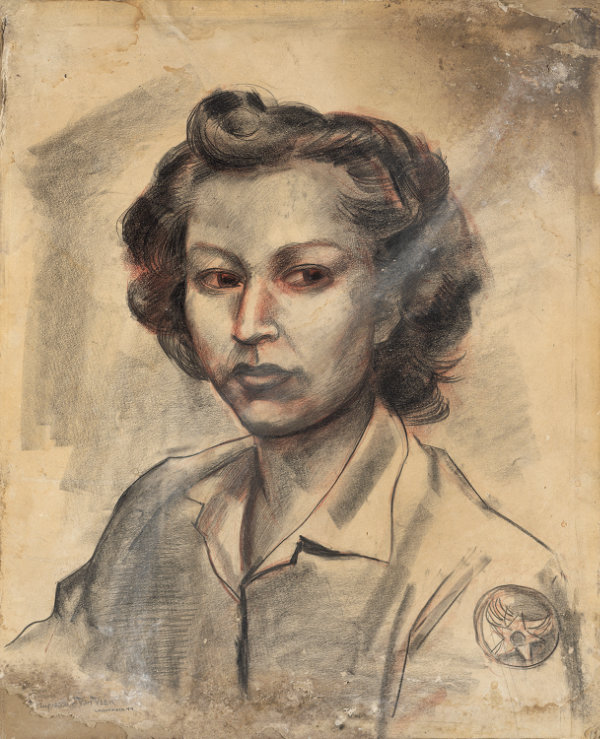
Andrew Wice (opens in a new tab) is a novelist and screenwriter. He is the author of eight novels, including To The Last Drop (Bauu Press, 2008), and produced the acclaimed Madrid Oral History Tour, a smartphone-guided walking tour of the New Mexico town of Madrid.
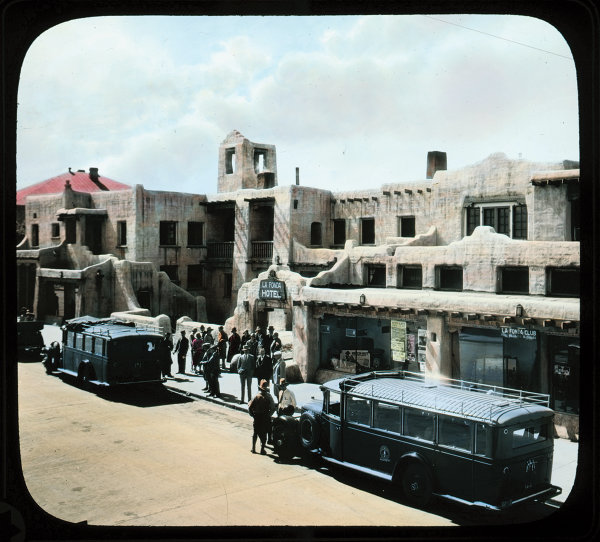
Memento Mori

By Charlotte Jusinski

My dog died during the production of this magazine.

Maybe it’s not standard for these editor’s letters to go this way. We need to stay professional, we need to keep it clean, we need to stay a bit cold and stoic. Stick to business. Don’t get too personal. Don’t get personal at all.

If you know me, however, you know that the above sentiment is one that I buck. I am obsessed with being human; with being messy. There is deep understanding and compassion available when we expose the things we impulsively keep hidden.

And what is art and culture and history if not deeply human? We can talk all we want about historical events and cultural trends—but if we forget that there were and are thinking, breathing, bleeding human beings at the core of all of these subjects, we lose sight of the very thing that makes a magazine like this relevant.

So, that brings me to my dog. He was wonderful. I loved him deeply and fiercely. And he died while I was putting together this issue for you.

For many days before and after, it was hard to work; I’m sure every person reading this has been through an event that makes your day job impossible. But once I broke through the fog of acute grief, I took solace in these pages.

I’ve been editor of El Palacio since July 2019, and the stories that have stuck with me most since then have been ones that expose the softer underbelly of the history, art, and even geography of the Southwest.

In our Winter 2019 issue, in “From Ineffable to Incandescent,” Dr. Nicole Panter Dailey entered the New Mexico Museum of Art’s exhibition of Agnes Pelton’s transcendent abstract paintings through the lens of the painter’s psychological trauma; Dr. Panter Dailey didn’t just look at the works of art, she investigated the intense emotions that went into creating such luminous masterpieces, to great effect.

Spring 2020 featured “Adulation and Anguish,” in which Hugo Chapman of the British Museum reminded us that not only does the story of Christ include every human emotion there could possibly be, but the Museum of Art’s exhibition of devotional drawings encouraged the viewer to get in close; the drawings were small, inviting visitors to practically put their nose to the glass to see their detail.

In Fall 2020, Dr. Larry Crumpler of the New Mexico Museum of Natural History and Science singlehandedly made that issue the most requested one of my tenure here with his lengthy piece, “Land of a Thousand Volcanoes.” Dr. Crumpler oozed his passion for the geology of New Mexico right onto the page. It would have been so easy for that story to have been dry as a bone, but Dr. Crumpler is far too human to let that happen.

Also in Fall 2020 was Emily Withnall’s “Native Tongues,” a touching profile of photographer Kenji Kawano. Not only is Kawano a fascinating individual, but Withnall’s breathtaking prose makes the story of the photographer’s relationship with Navajo Code Talkers engaging and heart-rending.

These are just a few selections; this doesn’t even touch on Molly Boyle’s “Whatever Decided Them” in Spring 2021, “Corridos My Father Sang to Me” by Rob Martinez in Summer 2020, Dr. Frances Levine’s “A Beautiful Death on the Santa Fe Trail” in Spring 2020, Fall 2019’s acclaimed “Spinster Acts” from Ethan Ortega, and many more. Humanity is rampant in every issue of El Pal.

So, please enjoy this issue of El Palacio in honor of all that is human within us (and, if you’re so inclined, in celebration of all that is canine around us). It’s not always clean, and in fact it’s often ugly—but within these pages, we manage to make it all gorgeous.