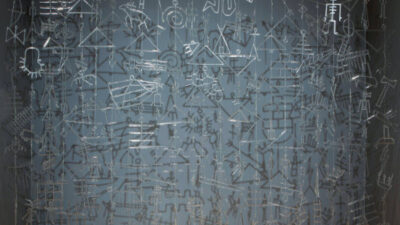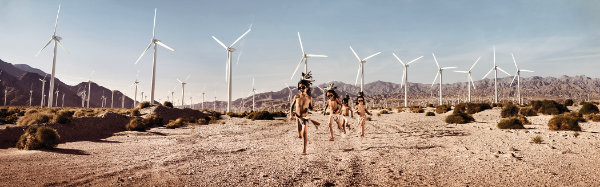
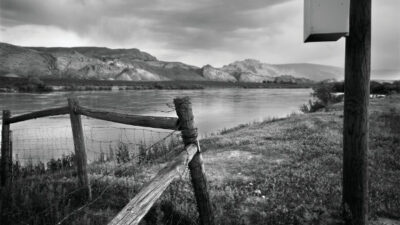
Read Pasó por Aquí Gregory Mac Gregor, Green River crossing site, Dinosaur National Monument, Utah, 2008. Courtesy the artist.

Pasó por Aquí

By Dr. Alicia M. Romero "For through the lack of expert help we made many detours, wasted time from so many days spent in a very small area, and suffered hunger and thirst. … But God doubtless disposed that we obtained no guide, either as merciful chastisement for our faults or so that we could acquire some knowledge of the peoples living hereabouts,” wrote Fray Francisco Atanasio Domínguez on November 7, 1776, just as he, Fray Silvestre Vélez de Escalante, and their exploration party successfully traversed what is now known as the Crossing of the Fathers at Lake Powell, between Utah and Arizona.

Categories: New Mexican history, Visual art

Read Fall Poetry: Scott Wiggerman & David Meischen View looking up through the winding, orange and red sandstone walls of Antelope Canyon with a strip of bright blue sky above. [gen-ai]

Fall Poetry: Scott Wiggerman & David Meischen

Scott Wiggerman —Scott Wiggerman is the author of three books of poetry, most recently Leaf and Beak: Sonnets, and an editor of several volumes, including 22 Poems and a Prayer for El Paso, winner of a New Mexico-Arizona Book Award in 2020. “Canyon at Kasha-Katuwe” was previously published in Weaving the Terrain: 100-Word Southwestern Poems. Albuquerque: Dos Gatos Press, 2017. “Reveries While Walking the Mesa on the Hottest Day of the Year” was a Laureates' Choice Winner in the 2020 Maria W.

Categories: Essays and memoir, Poetry

Read A Long Time Coming Joe Feddersen, detail, Charmed, installation at Marylhurst University, Marylhurst, Oregon, 2019. Fused glass and cord. Photograph by Charles Froelick and courtesy Froelick Gallery, Portland, Oregon.

A Long Time Coming

By Charlotte Jusinski When I look at the table of contents of this issue of El Pal, one word immediately comes to mind: “Finally!” This issue, broad in its scope and hefty in its page count, is also the result great anticipation; a number of the stories herein have been on my radar for over a year. Thanks to writers’ schedules, COVID-era complications, and other delays, we had to wait quite a while for many of these pieces.

Categories: Editor's Letter

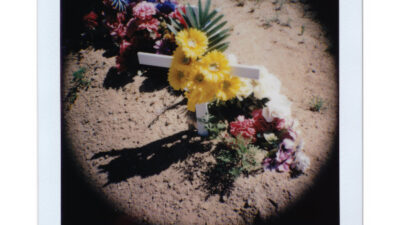
Read Most Strange J.C. Gonzo. From the project A New Mexican Burial, 2020-2021.

Most Strange

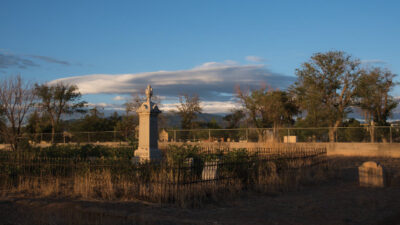
By J.C. Gonzo "The child’s corpse was exposed to view, decked with rosettes of brilliant hues, and the mourners talked and laughed gaily, which seemed to me most strange,” noted Lieutenant James W. Abert in 1846, after witnessing a child’s funeral in Santa Fe. The deaths of recently baptized infants were to be celebrated—they enjoyed a sure path to heaven. I stumbled across the lieutenant’s statement in an old Santa Fe New Mexican article in spring 2020 while researching New Mexican cemeteries, a new photographic project I’d embarked upon.

Categories: Framework

Read Found in Collection Public Works of Art Collection, Work Projects Administration. Courtesy of the New Mexico State Records Center & Archives. Collection 0200-0201 (#wpa5383).

Found in Collection

By Michelle Gallagher Roberts In early 2007, staff at the New Mexico Museum of Art were implementing the first phase of planned collecting storage renovations that required all artworks from the first collection storage room be removed from the space to allow for the installation of new state-of-the-art compact art storage. More than 1,700 artworks had to be inventoried and relocated in the span of nine days.

Categories: Visual art

Read In Conversation with the Sea Hermosa, 2021. Archival pigment photograph. 47 ½ × 40 inches. © Cara Romero, courtesy of Gerald Peters Contemporary.

In Conversation with the Sea

In Cara Romero’s black and white photograph Sand & Stone, Chemehuevi and Diné woman Sheridan Silversmith is embedded in earth. Her head and clasped hands are above the surface of the hard, dry dirt, but the rest of her body is not visible. Silversmith’s gaze is powerful. She is not trapped or buried; she seems to draw strength from the earth.

Categories: Artist profiles, Indigenous arts and cultures

Read A Hidden History of the Dead Independent Order of Odd Fellows Cemetery. Courtesy of the Independent Order of Odd Fellows Santa Fe Chapter. Photograph by Carrie McCarthy.

A Hidden History of the Dead

In an ancient city brimming with monuments to her last 400 years, most of the people who lived and died here between 1610 and the turn of the twentieth century—and some even later—have no monuments. Where once the graves of La Villa Real de la Santa Fe de San Francisco de Asis were marked with wooden crosses or stone tablets, flowers or ivy, most are now covered by parking lots.

Categories: Archaeology, Southwestern history

Read Glass is the Memory of Light Joe Feddersen, 2019. Photograph by Charles Froelick and courtesy Froelick Gallery, Portland, Oregon.

Glass is the Memory of Light

By Almah LaVon Rice Where does glass come from? From the Phoenicians, ancestors of the alphabet in modern-day Lebanon, Syria, and Israel. Or perhaps the Sumerians, inventors of the cuneiform, were the first fashioners of glass in what is now southern Iraq. It could have been the ancient Egyptians—creators of papyrus, whose daughter is paper. What seems more certain: Naturally occurring glass is the clear-eyed child of the meteorite.

Categories: Artist profiles, Indigenous arts and cultures

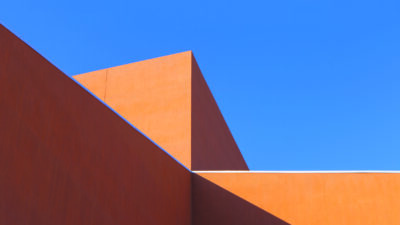
Read Archi-story The stepped roofline of the Roy E. Disney Center for the Performing Arts cuts a dramatic impression into the Albuquerque sky. Photograph by Addison Doty.

Archi-story

By Carmella Padilla Stepping onto the sprawling campus of the National Hispanic Cultural Center in late spring 2021, a visitor expects little has changed since a nearly year-long pandemic shutdown emptied the Center’s public spaces and ground its cultural and educational programs to a halt. Yet on this hot June afternoon, in the season of New Mexico’s re-awakening, it’s clear the NHCC never slept.

Categories: New Mexican cultures