The Home that Lives in the Heart

By Laurann Gilbertson

At its most basic level, clothing provides warmth and protection from the elements. But clothing is so much more. It can be beautiful and valuable. It can express our emotions and beliefs. Clothing can communicate far morethan what might be printed on a T-shirt or baseball cap. Through our clothing and choices, we can show that we are part of a group or that we stand apart.

The exhibition Dressing with Purpose: Belonging and Resistance in Scandinavia examines three Scandinavian dress traditions—Swedish folkdräkt, Norwegian bunad, and Sámi gákti—and traces their development during two centuries of social and political change across northern Europe. The exhibition will be on view at the Museum of International Folk Art in Santa Fe from December 12, 2021, through February 19, 2023.

The Sámi are the Indigenous people of Norway, Sweden, Finland, and the Kola Peninsula of Russia. There are an estimated 50,000 to 200,000 Sámis living in the Nordic countries and the majority live in Norway.
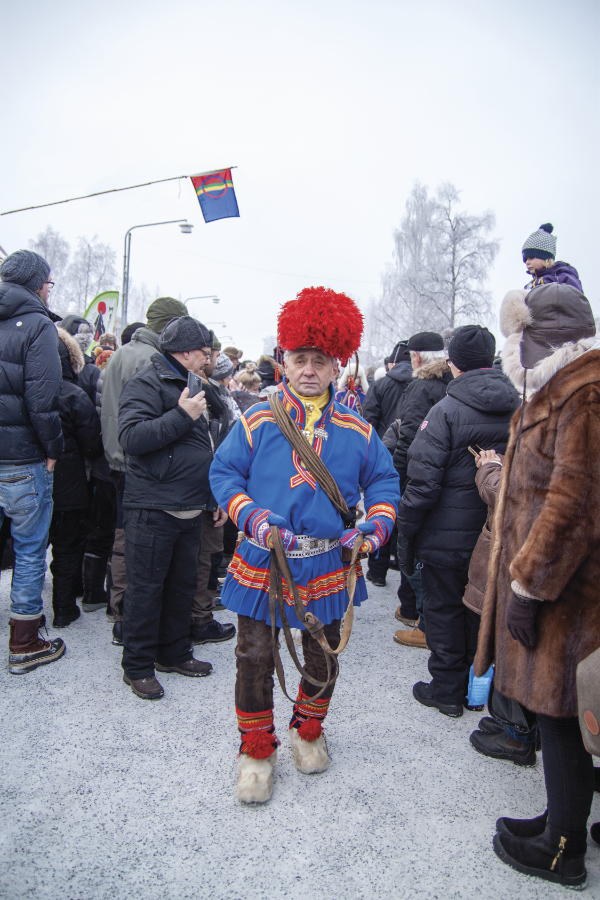
Per Kuhmunen dressed in Gárasavvon/Karesuando gákti and leading the annual reindeer parade during the Winter Market in Jåhkåmåhkke/Jokkmokk, Sweden. Photograph by Carrie Hertz, 2017. 

In the United States, there are more than 30,000 Americans with Sámi ancestry. For them, the path to learning and celebrating heritage has not always been an easy one. “We were all feeling our way along,” explains Marlene Wisuri as she recalls the early 1990s. “There weren’t the resources for learning as there are today.” Wisuri is chair of the board of the Sami Cultural Center of North America, located in Duluth, Minnesota. She is one of the founders of the center and one of the leaders in a movement in the United States to awaken the Sámi spirit and reclaim cultural identity.
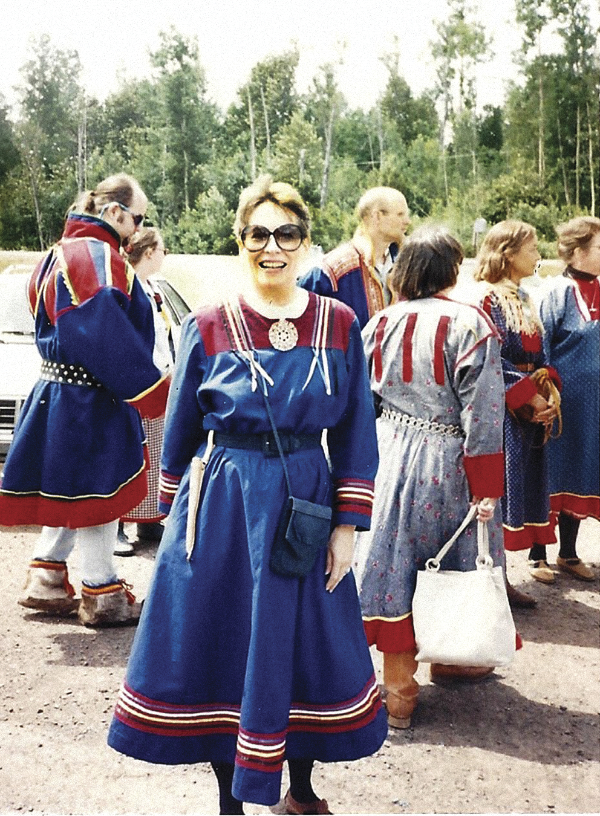
Marlene Wisuri wearing the “American gákti,” in about 1994. Marlene only wore the dress at gatherings a few times. Photograph courtesy Sami Cultural Center of North America. 

The Sámi community began to connect in 1991 with the founding of Báiki, the American journal of Sámi living (issues of which are available at samiculturalcenter.org and saamibaiki.org). The journal was edited by Faith Fjeld (1935–2014), a San Francisco artist, writer, and lecturer. Contributors included Americans of Sámi ancestry, respected scholars in North America, and Sámis in the Nordic countries. The journal was an opportunity to share through art, poetry, and personal accounts what it meant to be Sámi and, for the first time, to celebrate being Sámi; the journal ceased regular publication in 2015, after Fjeld’s passing.

Báiki is a Sámi word that roughly translates to “the home that lives in the heart.” This is a home that is not dependent on a dwelling or a specific location. Especially for Sámis that herded reindeer, the sense of home often came from family, community, and culture. Báiki, then, seems the perfect name for a journal that nurtured in North America a familiarity with Sápmi, the traditional Sámi homelands in Norway, Sweden, Finland, and Russia.
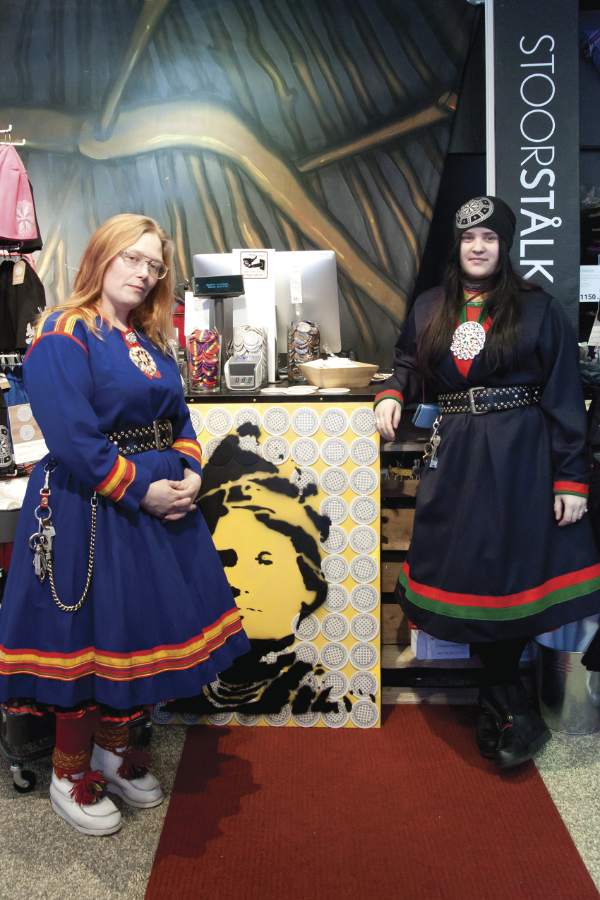
da-Maria Kuhmunen and Ann-Therese Rannerud dressed for Sámi National Day, honoring the one-hundredth anniversary of the first Sámi conference held in 1917. They pose with a portrait of conference organizer Elsa Laula Renberg (1877–1930) created by Anders Sunna. Photograph by Carrie Hertz, 2017.

For more than 500 years and well into the twentieth century in Sápmi, Sámi people were discriminated against and Sámi culture was actively suppressed. Sámi languages and religion were forbidden. Children were taught to be ashamed of their ancestry and culture, and were removed from homes and sent to boarding schools to be assimilated into a national (and non-Sámi) society. National borders restricted the movement of Sámis who herded reindeer. The governments’ colonialist policies were rationalized by a belief of racial superiority and a desire to control natural resources.

Sámis who immigrated to North America hid their identities to avoid further discrimination. They came as “Norwegians” or “Swedes” or “Finns.” They would deny they were Sámi if there were comments about dark hair, dark eyes, and high cheekbones, features which often appeared different from other immigrants from these countries. After several generations, scant information—if any—was passed along as rumor; for many Nordic Americans, they have only recently learned about their Sámi ancestry.
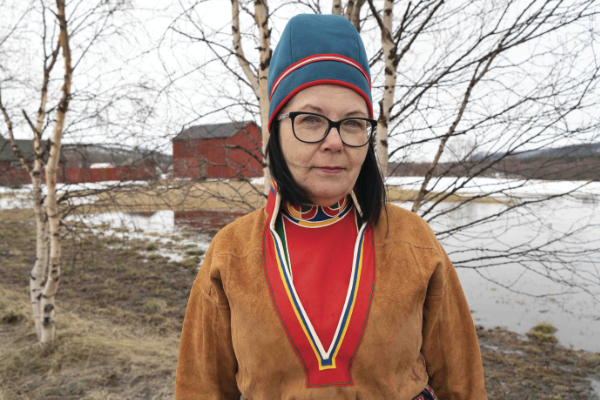
Eva Aira in a sváltjá (reindeer skin gákti) from Jåhkåmåhkke/Jokkmokk, Sweden.
Photograph by Chloe Accardi, 2018.

A notable exception to the many immigrants who had felt compelled to hide their Sámi ancestry were the 126 men, women, and children who came from Sápmi to Alaska in 1894 and 1898 at the request of the United States government. Sheldon Jackson, general agent of education for Alaska, hoped that reindeer could ease a famine in Native communities on the Seward Peninsula that had been caused by destructive commercial hunting practices by both Russian and American hunters. Sámi families taught reindeer husbandry to local Yup’ik and Inupiaq apprentices. The Sámis arrived wearing garments of reindeer hide, reindeer leather, and wool, and continued to make and wear them in Alaska. (To share this little-known story, Báiki and the Sami Cultural Center created a traveling exhibition, The Sámi Reindeer People of Alaska. I first met Faith Fjeld, Marlene Wisuri, and Nathan Muus when my museum hosted the exhibition in 2012.)

Wisuri feels connected to Sámi culture. Her grandmother was from northern Finland. Wisuri grew up with stories that her grandmother’s family had reindeer, though she doesn’t think they herded them. “Grandpa called Grandma lappalainen,” Wisuri says, using the Finnish word for Sámi. Further genealogical research bears this out.

When the Sámi community began to connect through Báiki, they also began connecting in person at events, including Nordic cultural festivals held throughout the United States. An important part of the gatherings is the sharing of cultural heritage. Community members set up a lavvu, a conical tent, and demonstrate or set out examples of duodji, defined as “useful things made beautiful,” such as sheath knives, drinking cups, and coffee pouches.

“There was the thought that we should be wearing something at events,” Wisuri recalls. Some of the women sewed print cotton dresses in the style of Sámi summer-weight gákti. “Everyone had one at the beginning. The pattern was passed around.”
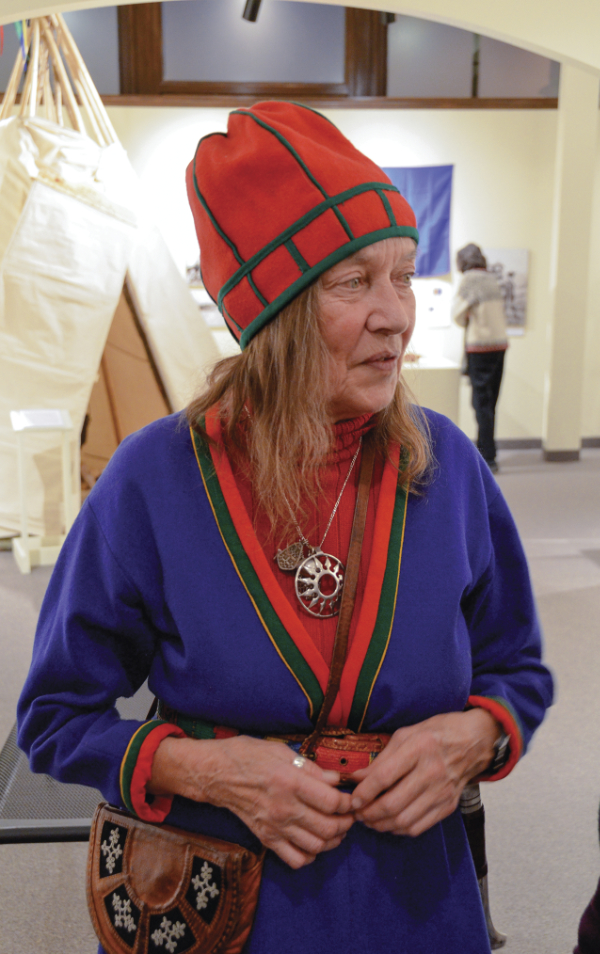
Faith Fjeld at the opening of The Sámi Reindeer People of Alaska exhibition at at Vesterheim Norwegian-American Museum in Decorah, Iowa, in 2012. Faith’s wool South Sámi gákti was given to her by relatives in Sápmi. Photograph courtesy Vesterheim Museum.
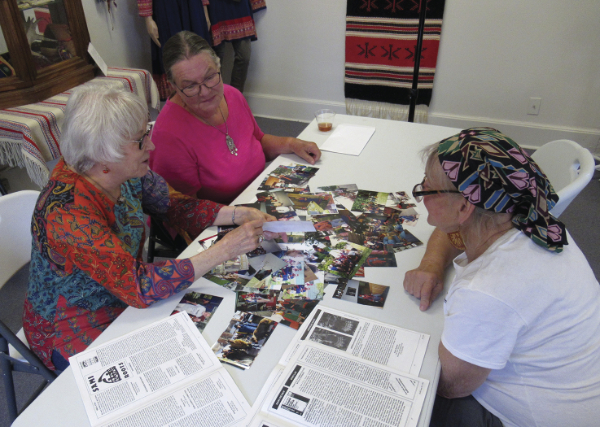
Marlene Wisuri, Nancy Olson, and Laurel Sanders at the Sami Cultural Center of North America looking at photos taken at gatherings of the Sámi community. Photograph courtesy Laurann Gilbertson.

Gákti is the clothing used by Sámi people. The word describes the tunic-like and dress-like garments worn by men and women, respectively, and it also is the word used for the outfit of clothing. (The plural of gákti in North Sámi language is gávttit, but non-native speakers in North America commonly use gákti as both singular and plural.) There are many different gákti, and they generally follow the linguistic boundaries of the nine living Sámi languages. There are further variations by community and for summer and winter.
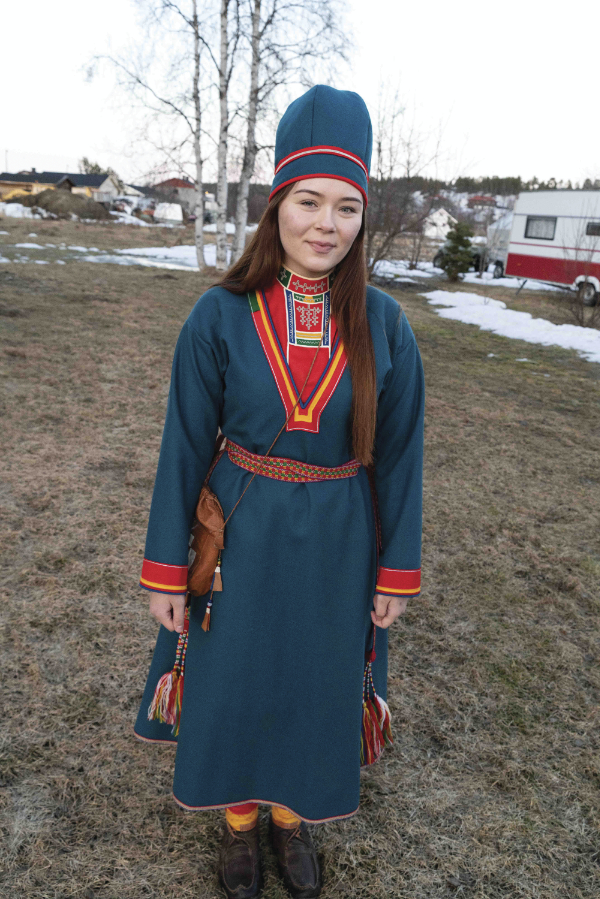
Inga Lajla Aira Balto dressed in a gákti from Jåhkåmåhkke/Jokkmokk, Sweden. Photograph by Chloe Accardi, 2018.

Fjeld was among the first in the community to travel to Sápmi and visit relatives. She began wearing a cotton dress made from the pattern that was passed around. In 1993, relatives gave her a wool winter gákti with the deep, V-shaped yoke characteristic of South Sámi gákti. Most members of the community in America, though, had not connected with family and were not even sure of where in Sápmi their ancestors were from. So Fjeld encouraged Wisuri and Gladys Koski Holmes (1932–2005), a visual artist and respected member of the Sámi-American community, to come up with something that would be appropriate to wear if one was uncertain of where their ancestors had come from. “We were thinking that a ‘North American gákti’ was something that we could all feel comfortable wearing.”

The “American gákti” designed by Wisuri and Holmes is a blue denim dress. Wide red bands at the shoulders, cuffs, and hem are overlaid with rows of blue, white, yellow, and black ribbon. The silhouette, colors, and rows of ribbon visually link this dress to many of the Sámi gákti. The colors and rows of ribbon were also chosen because of their use by and importance to Native American cultures. The colors are symbolic of the four directions, and the ribbon stripes link the dress to ribbon shirts worn as regalia at powwows and made to honor achievements.

Wisuri explains that combining Sámi and Native American elements in the garment was done out of respect. “There are the cultural connections of Indigenous people living in harmony with nature and personal connections,” she says, “as many of us in the Sámi community have Native American family members.”

“I made a prototype [of an American gákti], only a woman’s,” she continues. “I wore it several times, but the whole idea didn’t go very far. It wasn’t clear what the path was, but the path wasn’t to make American gákti.” As more members of the community were able to trace their own ancestry to specific locations in Sápmi, there was a stronger sense of what they should be wearing.
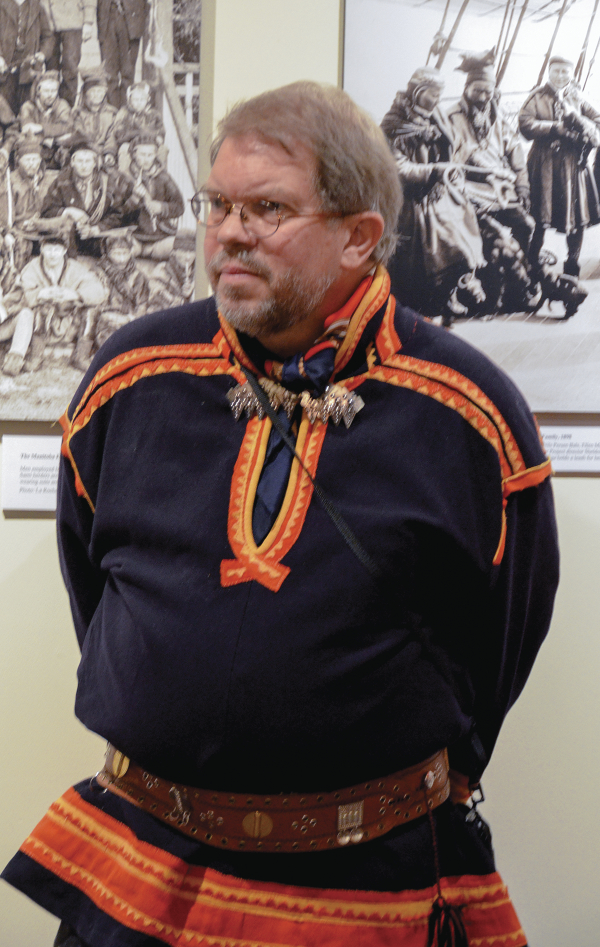
Nathan Muus at the opening of The Sámi Reindeer People of Alaska exhibition at Vesterheim Norwegian‑American Museum in 2012. He has been wearing this gákti for about twenty-five years. Photograph courtesy Vesterheim Museum.

Nathan Muus is a leader of the Sámi-American community and lives in Oakland, California. A recent conversation focused on the cultural norms surrounding gákti and the living character of gákti, which he’s observed on many trips visiting friends and family in Sápmi. “Usually there is a tie to a family and where you are from,” he says. “That might signify a geographic area and even further delineation by a clan or family.

“You must be Sámi to sew and wear gákti. All in or not in at all. You are connected by family, not just genetics. A certain gene occurs in high percentages in Sámi populations, but that is not proof of being Sámi. Sámi people [in Sápmi] are offended if there is only a DNA connection and you wear gákti. … On one hand, there is the very strict opinion that you can only wear gákti if your family has made it and you are from that family. The other is that you can wear it if you have a family tie to that gákti.”

He follows the latter practice. His great-grandparents were from Nordland in Norway, and the gákti for this area of Norway is also worn in parts of Sweden. The gákti connects to both Muus and the Swedish-American woman who sewed it in 1995. It’s an older style gákti for Gárasavvon/Karesuanto/Karesuando, Sweden. “While Sámis in Sápmi can be bolder and experiment with gákti, they frown on Americans doing that,” Muus continues. “It’s all about understanding how far you can go, while staying within the cultural norms.”

Another layer of complexity is that in Sápmi, gákti tend to change style. “You can wear the older style, but they do change,” Muus says. “For example, the Kautokeino man’s gákti for a long time was royal blue with heavy red and white trim. It has gotten darker blue with dark red, almost metallic trim.” Muus was recently in northern Sweden; in contrast to his 25-year-old gákti, he said, “Everyone else’s was new, crisp, perfect.” He showed me a photo in a 2020 online newspaper article as an example. Not only did the fabric look crisper, the pleats at the hem of the gákti for Guovdageaidnu/Kautokeino in Norway came to very sharp points, not possible with the older style of heavier fabric.

Muus wears gákti at cultural events and festivals, especially when he is asked to speak or perform a traditional style of chanting and singing called joik. “If I’m wearing gákti with other Sámi people, I feel like an insider, part of the group. They know who you are and who you are related to. In the American public, you’re representing Sámi culture and you are comfortable with that, or not.” He is generally comfortable with it, and ready for the questions. Not all of the questions are unique to American viewers; even in Sápmi, wearers might have to explain, “This is why I’m wearing this.”
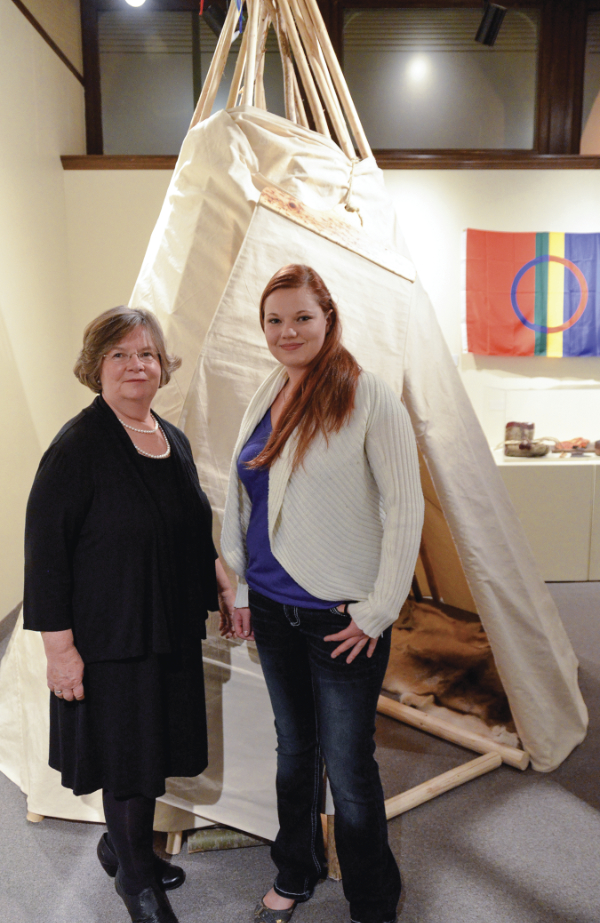
Nancy Olson and her niece Marie Olson at the opening of The Sámi Reindeer People of Alaska in 2012. They sewed the canvas cover for the lavvu (conical tent) in the exhibition. Behind them is the Sámi flag. The circle symbolizes the sun (on red) and the moon (on blue). The colors, including green and yellow, come from gákti worn throughout Sápmi. Astrid Båhl designed the flag, which was formally adopted by the Nordic Sámi Conference in 1986. Photograph courtesy Vesterheim Museum.

I visited the Sami Cultural Center recently. The center is located in a former school building in the Lakeside-Lester Park neighborhood in Duluth, Minnesota. Wisuri and I were joined by Nancy Olson and Laurel Sanders, two board members who have fairly recently learned that they have Sámi ancestry. We sat around a table looking at photographs from past gatherings. Wisuri told how challenging it has been for her and other Americans to learn about Sámi culture, history, and gákti. “Today, there is greater access to information about the different gákti, greater access to family in Sápmi and to gákti. There also seems to be greater scrutiny about what should and should not be worn.” She often sees comments in social media about posted photos.

For those who are “newly Sámi,” their enthusiasm in learning about gákti can often be quickly squelched by culture-bearers. “Some are writing from Sápmi, and they are certainly knowledgeable, but we’re different than they are. There’s so much mixed ancestry here. Identities were lost when our ancestors came here, and we can’t hold people responsible for that,” Wisuri says. While she is sometimes discouraged by critical attitudes, she does see people jumping in naively without looking into their family history and the history of gákti. While one can wear gákti proudly today, that has not always been the case. Under government policies of assimilation, called “Norwegianization” and “Swedification,” wearers of gákti faced verbal and sometimes physical harassment. Gákti represents cultural survival and ethnic identity, and that is only understood through research and reflection.

Wisuri recommends that people start with accessories, such as a traditional pin or brooch, a silk scarf with long fringe, a pewter-thread bracelet, or a hooded cape called a luhkkha. Nancy Olson says that for events at the Sami Cultural Center, she will often dress in one of the colors of the Sámi flag. She would like to wear a gákti and has started sewing one from a pattern shared by Wisuri: “It would be a representation of the culture. It would be a talking point about the reawakening of my heritage.”
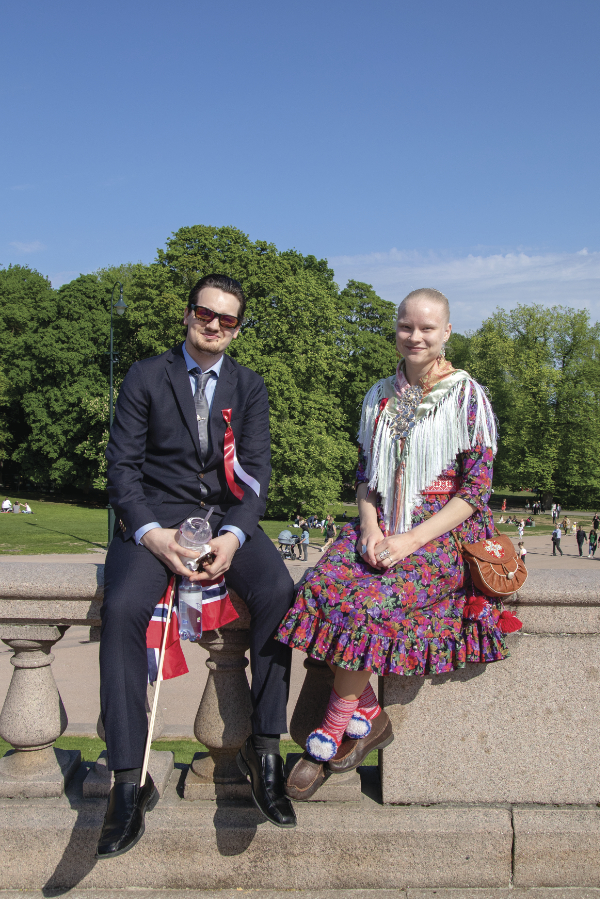
Couple celebrating Norway’s national day on the steps of the Storting (the Norwegian Parliament) in Oslo, Norway. The young woman wears summer gákti from Guovdageaidnu/Kautokeino. Photograph by Carrie Hertz, 2018.

In 2008, Olson was contacted by a relative who asked if she knew she had Sámi heritage. “I wasn’t aware of the Sámi heritage or even the word Sámi. Yet, my brothers who are three and six years older than me were aware of my maternal grandmother being [Sámi]. I’m not sure if my maternal grandfather was Sámi. He was born in Finland and came to the U.S. as a young man.” Her grandparents met in the Copper Country of the Upper Peninsula of Michigan. Later, they mined in Goldfield, Nevada, and homesteaded north of Chisholm, Minnesota.

The family’s Sámi ancestry was never openly discussed. When she asked her mother questions about family connections, she would receive vague answers like, “You’re too young to understand,” “There are some things we don’t talk about,” and “I’ll tell you when you are older and can keep a secret.”

“When I learned of my Sámi heritage, I joined a Finnish genealogy group. Marlene and Faith came to a meeting and showed the film Suddenly Sámi.” The 2009 documentary by Norwegian filmmaker Ellen-Astri Lundby records her discovery of her Sámi heritage. “It really piqued my interest to know about Sámi life. So I connected with Marlene and Faith. Their enthusiasm for Sámi heritage drew me in to discover more. At first, I had a romanticized vision of the reindeer people. Then I learned about their harsh nomadic life, forced assimilation, and loss of culture and language. Then I understood why that part of my own family story was hushed and very vague.”

Laurel Sanders sewed a gákti in about 1998 when she worked as an interpreter at the Sámi encampment at Minnesota Discovery Center in Chisholm, Minnesota. She copied the gákti that belonged to the previous interpreter. At the site, Sanders learned to weave bands and birch bark shoes. She said she loved being in the goahti, which is a conical or arched dwelling sometimes covered with turf. At that time, she didn’t know she had Sámi ancestry.

“I had known that my dad’s parents were from Norway. Then my cousin, the family genealogist, told me that her father said we were part ‘Laplanders.’ I asked my dad what he thought. He didn’t know, but recalled hearing about letters from relatives in Norway that mentioned trading fish for hides. I attended Sámi cultural events and presentations and read a lot to learn more. I have begun to look for any evidence in census records to corroborate my uncle’s statement. Independent from me, other cousins have also made strong connections to Sámi culture.”

Partly due to concerns that what they wear isn’t right, some members of the Sámi-American community choose not to wear gákti often or at all. Sanders continues, “The gákti I made to interpret at Minnesota Discovery Center is mine. I also wore it at the rededication of the site. Early on I wore it to a couple of powwows I attended with my Ojibwe children. I made komager [summer boots] to wear with it and have worn them on ‘Rock Your Mocs’ day. However, once I became more aware of the traditions around wearing gákti, that it should definitely reflect one’s family and region, I haven’t felt right about wearing it, since it is nonspecific. I still weave articles and make bags as gifts and demonstrate the craft. All I can say is what I know; I’ve been told that I have Sámi heritage and I value that.”

Thirty years after the first issue of Báiki, Faith Fjeld’s wish to see an awakening of Sámi spirit in America seems to have come true. Through the efforts of Fjeld, Wisuri, Muus, and many others, Sámi culture can more easily be learned, shared, and celebrated. 

Laurann Gilbertson is chief curator at Vesterheim Norwegian-American Museum in Decorah, Iowa. She contributed an essay to the book accompanying the Dressing with Purpose exhibition.
Beverly Bennett Dobbs (opens in a new tab) (1868–1937) was a photographer and filmmaker in the Pacific Northwest and Alaska.

Laurann Gilbertson (opens in a new tab) is the chief curator at Vesterheim Norwegian-American Museum in Decorah, Iowa. She contributed an essay to the book accompanying the Dressing with Purpose exhibition at the Museum of International Folk Art.

Like Butta

by Charlotte Jusinski

Ever have a whole chunk of time at work go so smoothly you barely have to think about it? All the puzzle pieces fall into place, everyone gets along with everyone else, the whole organization runs like a well-oiled machine? You are comfortable in your power, you and your colleagues are in perfect harmony, and the result of your work comes out impeccable, exactly as it should be?

Yeah, me neither.

I can say, however, that this issue of El Palacio was about as close to that idealized situation as you can probably get.

Putting together a publication is an enjoyable, albeit tricky business. I must admit that some issues have been a little more blood, sweat, and tears than others.

This one, though? This one was like butta.

Not sure what made it so nice, but the wide selection of fascinating articles and the consummate professionals who brought them to life played a significant role in this issue’s smooth production.

The cover image was the first no-brainer I encountered. A number of the stories herein could have easily been featured prominently, but the moment I saw Carl-Johan Utsi’s captivating image of Jenni Laiti in a gold sequined gákti, I knew Laurann Gilbertson’s exploration of themes in Dressing with Purpose at the Museum of International Folk Art (The Homes That Live In the Heart) had to be our cover feature.

From there, everything just… worked.

Last summer, Fred Friedman, a longtime railroad professional, came to me with a cold pitch for a story about the Lamy Branch. He told me it was about 6,000 words. I said, “Sure, I have room for about 3,000 words, but I’ll take a look.” He then sent me a 10,000-word manuscript. But I’ll tell you, all 10,000 words are captivating. I have published half his story here, and the second half will come in the Spring issue. Photographer Tira Howard contributed breathtaking photographs to his piece, exceeding every expectation I had of landscapes of the rail line.

I also got to tap the talents of photographer Kevin Lange for this issue. He took last-minute mind-blowing portraits of three New Mexico poets to accompany Molly Boyle’s triple-profile of the writers featured in the Museum of Art’s Poetic Justice. Kevin worked like the wind, Molly’s prose was impeccable as ever, and the story looks and reads like a symphony.

New Mexico History Museum Palace of the Governors Photo Archives Archivist Hannah Abelbeck joined forces with California-based scholar Robert Quintana Hopkins for a double-header about Sam Adams, a Black Civil War pensioner, and the impact his family structure had on his descendants and modern-day considerations about race in New Mexico. That such a huge topic was discussed so concisely and by writers so easy to work with felt like a trap, but we made it. Read Hannah’s piece and Robert’s.

Rounded out by a profile of Royal Prentice from Dr. Richard I. Ford, Allison Colborne, and Gary Hein (for which Palace of the Governors Photo Archives Digital Imaging Archivist Catie Carl spent hours heroically hunched over a scanner), a rundown of Collecting Jewelry at the Museum of Indian Arts and Culture by curator Ross Altshuler, along with Santa Fe Poet Laureate Darryl Lorenzo Wellington’s poetry selection, and the lilting prose of Southern Colorado writer Chela Lujan, pretty much everything about this issue was easy. I have the writers and photographers herein to thank for that.

Will the next issue be this easy? Probably not. But the last three months of my work life have been an absolute joy, and I can only hope reading this issue is as fun for you as making it was for us.

Charlotte Jusinski served as the editor of El Palacio from 2019 to 2023. Charlotte previously worked as copy editor for the Santa Fe Reporter and penned their award-winning “Acting Out” theater review column. She also received a second-place Top of the Rockies award from the Society of Professional Journalists in 2019 for her coverage of a nonprofit that provides aid to Native elders on the Navajo Nation.

Pasó por Aquí

By Dr. Alicia M. Romero

“For through the lack of expert help we made many detours, wasted time from so many days spent in a very small area, and suffered hunger and thirst. … But God doubtless disposed that we obtained no guide, either as merciful chastisement for our faults or so that we could acquire some knowledge of the peoples living hereabouts,” wrote Fray Francisco Atanasio Domínguez on November 7, 1776, just as he, Fray Silvestre Vélez de Escalante, and their exploration party successfully traversed what is now known as the Crossing of the Fathers at Lake Powell, between Utah and Arizona. They were making their way back to Santa Fe after an unsuccessful attempt at finding an overland route to Monterey, Alta California, to connect colonial Mexico’s far northern lands. Escalante’s journal documented details in the land that would have been used to determine settlement and agricultural potential, as well as possible exploitation of natural resources. Additionally, because two priests led this survey expedition without any actively serving soldiers accompanying them, their interests in proselytization potential of Native people from New Mexico to California was likely just as important as forging the overland route itself.

Domínguez and Escalante’s expedition in 1776 inspired multiple generations of people to recreate their journey. In the early 2000s, photographers Siegfried Halus and Gregory Mac Gregor set out with their cameras and maps in hand to document the contemporary changes to the land that Domínguez and Escalante traversed nearly 235 years prior. Halus and Mac Gregor’s photographs are the basis for the New Mexico History Museum’s long-awaited exhibition, In Search of Domínguez & Escalante, on view through fall 2022 in the Palace of the Governors and based on a book of the same title.

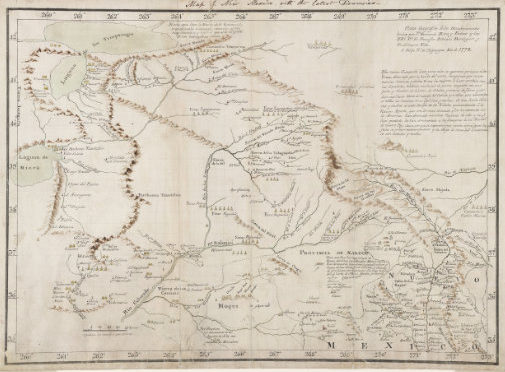
Bernardo de Miera y Pacheco, Plano geografico de los descubrimientos hechos por Dn. Bernardo de Miera y Pacheco y los RRs. Ps. Fr. Francisco Atanasio Dominguez y Fr. Silvestre Veles: S. Felipe Rt. de Chiguagua, 1778. Courtesy Yale University Library, call number WA MSS S-2856.

 The juxtaposition of Escalante’s journal entries, available in the original Spanish and in a contemporary English translation, with forty contemporary photographs from Halus and Mac Gregor, invite the viewer to consider the vast changes throughout the terrain since the 1776 exploring party stumbled across what is now the Four Corners area so many years ago. Halus and Mac Gregor sought to portray the land laid before them with visual precision similar to that of Escalante’s written descriptions, all the while putting into perspective the rapid environmental change of some of these areas due to human activity and industry. In order to accomplish this monumental task, Halus and Mac Gregor studied both whom and what the friars met along their way.

Domínguez and Escalante, plus an initial group of eight, planned to leave Santa Fe for Monterey on July 4, 1776, but were delayed twenty-five days before finally setting out on what became a five-month expedition. (Of course, they had no idea what other major event was happening on that significant day, thousands of miles to the east.) Despite covering over 1,800 miles of terrain, the group never made it to Alta California; they ended up back in Santa Fe on January 2, 1777, likely feeling defeated at being unable to complete their task at hand. That the exploration party knew little of what to expect as they attempted to reach Alta California is no surprise, given the vast terrain they intended to cross during one of the most difficult seasons of the year.

Fray Francisco Atanasio Domínguez, at 36 years old, originally from Mexico City, led the expedition. Fray Silvestre Vélez de Escalante, 26 years old and born in Spain, was formerly priest at Our Lady of Guadalupe at Zuni Pueblo and chronicled the entire journey in writing. His extensive daily entries included descriptions of people, weather, flora and fauna, rivers, mountains, canyons, and distance traveled. Of course, he also included blunt descriptions of frustrations and illnesses, especially when it came to the “stomach trouble” of the party’s cartographer, Bernardo de Miera y Pacheco, who fell ill more than once on the journey.

Because Escalante chronicled the expedition, generations of scholars erroneously attributed him with commanding the party and nearly omitted Domínguez completely. In fact, it was actually Domínguez who brought Escalante on and convinced Governor Pedro Fermín de Mendinueta to fund their journey. This long-lasting error was perpetuated throughout the Four Corners area, specifically southeastern Utah, as one can attest to the number of places named solely for Escalante.

Gregory Mac Gregor, Water Diamond Canyon, 2008. Courtesy the artist.

Another key member to the party was de Miera y Pacheco, highly recognized cartographer, artist, army engineer, and soldier—among other notable professions. Miera y Pacheco meticulously plotted the geographic features and put down on paper what Spanish-language names Domínguez and Escalante gave these “newly discovered” lands and people. His were among the first maps created of the area, and he remained an influential member of Santa Fe society throughout his life.

A number of other men accompanied the expedition, though few, if any, have received recognition for their role in the effort. Andrés Muñiz, a Nuevomexicano guide from Bernalillo and Ute interpreter, was among the vecinos—Spanish-speaking citizens of the territory—who traveled with Domínguez and Escalante. Also important were the number of Genízaros, Pueblo, and Ute people who either began or joined the expedition as the group made their way through Ute lands. Some of these Indigenous individuals were described in contemporaneous writing as joining “voluntarily” or by coincidence; some were also “given” from the tribes. We can’t be sure how much of their participation was voluntary or not. People such as Juan de Aguilar (Santa Clara Pueblo), Simón Lucero (Zuni Pueblo), Juan Domingo (Abiquiú Genízaro), Francisco (Ute), and Atanasio (Ute) made this journey possible, although their roles were diminished in favor of the friars’ description of and interactions with Indigenous people, the atmosphere, and their own hardships.

They first traveled northward through the Pueblo de Santa Clara and the Pueblo de Santa Rosa de Abiquiú before finding the Sierra de la Plata and the Río de Nuestra Señora de Dolores, or the Dolores River, in southwestern Colorado. As they moved farther on, the party soon met Motawei, Taviwatsiu, Mowataviwatsiu, and Ute communities in southeastern Utah. Escalante described these and other Indigenous people either favorably or badly depending on whether or not they were welcoming of the Nuevomexicanos. On the one hand, Domínguez and Escalante met Native people who, the friars felt, were accepting of their missionizing efforts; these groups were spoken of with sensitivity and high regard as “gentle and affectionate.” On the other hand, other Indigenous people maintained clear boundaries with Domínguez and Escalante. In one remarkable instance toward the end of the journey, the party met with Hopi people who welcomed and provided provisions for the Nuevomexicanos—but outright rejected their Christianity. In turn, Escalante remarked that the party “withdrew quite crestfallen back to [their] lodgings after seeing how invincible was the obstinacy of [those] unfortunate Indians.” Many of the journal entries featured alongside Halus and Mac Gregor’s photographs include these complex interactions, as the photographers keenly recognized this clash of cultures that often resulted in spiritual misunderstandings and uneven power dynamics, much like today.

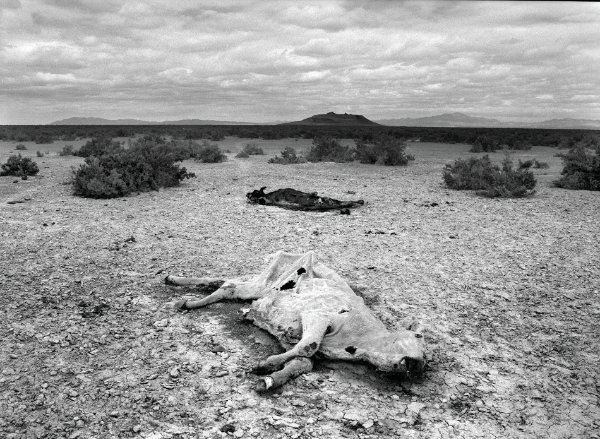
Siegfried Halus, Dead cattle and Pot Mountain, Escalante Desert, Utah, 2009.
© Siegfried Halus, courtesy Maximilian Halus.

After the group realized that winter was on the horizon and they seemed to be far from their destination, a decisive vote was cast to return to Santa Fe rather than continue to Monterey. Had they continued northwest, they would have likely encountered the Great Salt Lake next, but they headed south instead. Upon changing course, the party redirected their path through northeastern Arizona, where they met Havasupai and Hopi people. Amazingly, they both circled and crossed the Grand Canyon.

The story of Domínguez and Escalante has inspired generations of people to embark on the same journey and attempt to experience what the friars saw long ago. Still, others followed the journal to find a possible inscription marking their passage through the land, which is a typical human activity not limited to colonists. Siegfried Halus and Greg Mac Gregor’s 2011 ambitious photographic project to document the 1,800-mile trail is the most contemporary of these efforts, though theirs differed in intention and result.

The first recorded retracing of the route came from Harry L. Baldwin who, as he prepared maps for the United States Geological Survey in 1884, came across what he believed was Escalante’s 1776 “pasó por aquí” rock inscription in northern Arizona. Years later, in October 1939, Dr. Herbert Bolton of the University of California, Berkeley, Dr. George Hammond of the University of New Mexico, Jesse Nusbaum of the National Park Service (at that time), and two unnamed Diné guides, among other academics and archaeologists, set out to verify Baldwin’s claims.

That endeavor proved fruitless—Baldwin was unable to accompany Bolton’s group, and they never found Escalante’s inscription. In typical fashion, Jesse Nusbaum took his camera and photographed the party on horseback and on foot as they journeyed along an area of the Colorado River in Glen Canyon, Utah, near the Crossing of the Fathers (named for Domínguez and Escalante).

Despite not finding Escalante’s rumored inscription in 1939, Bolton eventually trekked much of the Domínguez and Escalante trail and produced Pageant in the Wilderness, a 1951 publication that offered a map, translation of Escalante’s journal, and astute, firsthand observations from Bolton the explorer himself.

Then, in 1976, Fray Angélico Chávez produced a new translation as part of the Domínguez-Escalante State/Federal Bicentennial Committee; scholars from the University of Utah followed this updated translation and corrected a number of cartographic inaccuracies for an updated USGS map of the route. Participants from New Mexico, Arizona, Colorado, and Utah embarked on a reenactment of the trail as part of the bicentennial celebration.

Nearly twenty years later, Dr. George C. Baldwin, son of Harry Baldwin, finally located the inscription in the Echo Cliffs area of northern Arizona with the help of volunteers and support from the Palace of the Governors. Surprisingly, in 2006, two volunteers from the National Park Service at Lake Powell found another inscription attributed to the friars: “Pasó por aquí, anyo 1776.”

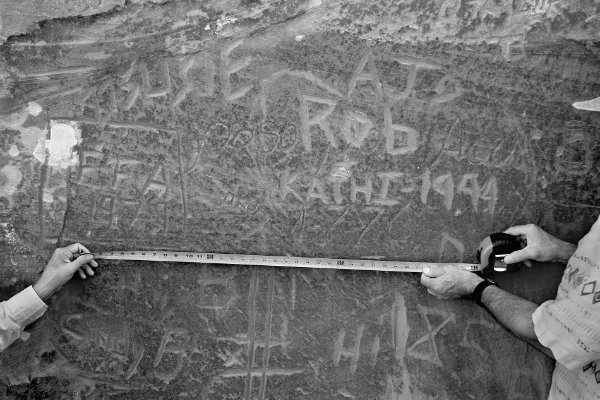
Siegfried Halus, Expedition graffiti, Pasó por aquí año 1776 (passed by here year 1776) on canyon wall, Lake Powell, Page, Arizona, 2009. © Siegfried Halus, courtesy Maximilian Halus.

So although Halus and Mac Gregor weren’t the first to follow Domínguez and Escalante’s journey, their project differed substantially from others. Using technology like GPS, unavailable to earlier groups, Halus and Mac Gregor located with as much accuracy as possible each and every stop for which Escalante wrote a journal entry. And they photographed what they saw. Sometimes the landscape appeared relatively unchanged, save for a fence or two. In other locations, however, it was clear from Escalante’s descriptions and the passage of time that many areas had experienced radical transformations due to increased human activity and settlement of the area. Many of their photos document remnants of large-scale ranching, industrialization and infrastructure in power plants and dams, and trash-strewn stretches of land. Clearly, as Halus and Mac Gregor demonstrate, much of the area that the 1776 group explored would be unrecognizable to them, and perhaps even to Bolton’s 1939 party.

In Search of Domínguez & Escalante promises to inspire the viewer, encourage appreciation for inquiry and determination, and put into perspective the limits and impact of humankind at any given moment. As Siegfried Halus observed of the 1776 journey and his and Mac Gregor’s documentary project: “We became bound by mutual amazement over the difficulties we encountered as modern pilgrims on the heels of Domínguez and Escalante. We looked east, west, north, and south as we tried to formulate a coherent vision of what these friars must have imagined so long ago. … Nevertheless, we photographed all the identified sites, making it a point not to reject what we saw, and ultimately coming to terms with the vicissitudes of time.”

Unfortunately, Halus passed away in 2018 just as this exhibition was being planned for the Palace of the Governors. We hope that students of photography, New Mexico history enthusiasts, caretakers of the environment, and adventure-seekers might better imagine what Domínguez, Escalante, and their compañeros experienced through Siegfried Halus and Greg Mac Gregor’s contemporary photographs of a centuries-old journey. 
 

Dr. Alicia M. Romero is curator of Nuevomexicano/a history at the New Mexico History Museum. She graduated with a BA and MA in history from the University of New Mexico and a PhD in history from the University of California, Santa Cruz.

Alanna Romero is a New Mexican artist. For the past twenty-seven years she has been nurturing a passion in photography. Mostly self-taught, she has travelled through the United States and Europe capturing imagery focused on nature, culture, spirituality, and history. Her work has been displayed in the New Mexico Museum of Art and several New Mexico shops and galleries.

Greg MacGregor is Professor Emeritus from California State University, East Bay where he originated the photography department in 1980. He has been photographing non stop since 1968. During that time he has published four books, had eighty one person exhibitions and published numerous articles. His photographs deal with both fine art and documentary. He lives and works in Santa Fe New Mexico with his wife, photographer Jo Whaley.  His photographs are in the  permanent collections  of over thirty national  museums.

Fall Poetry: Scott Wiggerman & David Meischen

Scott Wiggerman


Scott Wiggerman is the author of three books of poetry, most recently Leaf and Beak: Sonnets, and an editor of several volumes, including 22 Poems and a Prayer for El Paso, winner of a New Mexico-Arizona Book Award in 2020.

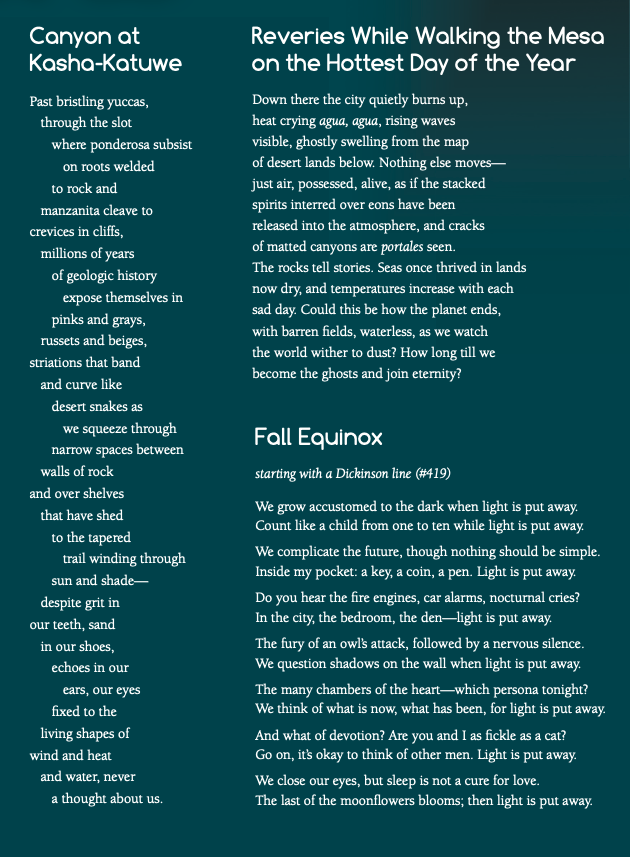
“Canyon at Kasha-Katuwe” was previously published in Weaving the Terrain: 100-Word Southwestern Poems. Albuquerque: Dos Gatos Press, 2017.

“Reveries While Walking the Mesa on the Hottest Day of the Year” was a Laureates’ Choice Winner in the 2020 Maria W. Faust Sonnet contest.

“Fall Equinox” was previously published in The Good Men Project, July 30, 2014.


David Meischen

Lost in the Sonora, Sunset of the Fourth Day

            golden shovel on a haiku by Ann Howells

Along the moonlit arroyo, cactus
spines, the bristle of edges, a screech-owl
calling from juniper shadow. Day retreats,
sky a bruise deep
cold, into dream, the sleep of saguaro
prickling at wakefulness. A nest
of lizard eggshells, a lacing of snow.
the wind with grit, the

Desert Walker, Setting Sun

            golden shovel on a haiku by Lesley Anne Swanson

Chamisa brushes his shins, tufts
light as breath, these puffs of
forgetfulness—rabbitbrush—
its dust of blooms. And the coyote
frozen mid-step beyond: she waits,
she does not falter, beside
her a rabbit, unstrung, at his drooping ear a
glint, a flint-struck fragment, no shaft
to send it humming, no blood of
prey, no fire, no song. Only this. And moonlight.

A Step Beyond Silence

            Bandelier National Monument, New Mexico

The rattlesnake dozes in trailside dust—
sinuous diamond-backed mosaic coalescing
from the pattern of fallen leaves like a lizard
materializing out of sunshine and stone.

The trail is wide enough for snake and
hiker, though as I cross the point
where an invisible strike line bisects
the path I am so carefully inscribing, where fangs

would connect with blood and bone,
the part of my brain that can think must
face down the part that whispers Run!

When I return, the rattler curls unmoved
among the leaves and dust. Again I trace
a path just out of reach if he should wake

and strike. Again my ankles feel the current,
a knowledge older than the people
who tended squash and beans along this creek,

who left with just the caves they deepened
in this porous desert rock, the stonework
walls of their houses, their markings
on the canyon walls to tell us of their passing.

Walking South Texas, Spring 1955

from the Rio Grande near Zapata to Agua Dulce Creek in Jim Wells County

Aquí se abre. Here—an opening—
barbed wire clipped by some
coyote’s wire cutters, barbed wire

spiraling from a shaggy, shedding
cedar post, a rattler curling
in the dust, vigilant even in sleep.

Aquí se abre. Hunger draws him,
in the distance a new life: el espejismo.
Beyond this fence, another, another—

roadrunners, jack rabbits, javelinas leading
the way, bright dry day bleeding into cold
dry night: antes y otra vez, otra vez, otra vez.

One morning, a creek bed, cool and dry
and live-oak shaded. Another fence, a field.
Beyond the field, a gate, a yard, a bed: geraniums

red as the first fresh drops of blood.
A walkway strewn with pebbles. Foot scraper
and steps, weathered boards. A shaded porch:

chair, table, pitcher, the almost taste
of agua y limonada. A screen door opens,
lone farm wife stepping out of shadow,

her husband in the field, she says, distant
murmur of a tractor where she points, dust
pluming there. Seedlings, rain, harvest—

these are hopes he knows too well. Her eyes,
though. What we have is ours, her eyes say.
Fence posts, barbed wire that marked his way,

the river he swam. She wants him
on the other side. You have no place here,
her eyes say. Move along. But he will stay.

Trabajo, he says—a word, a need
she clearly understands. The fields will take
what he can offer. Aquí se abre.

David Meischen is the author of Anyone’s Son, winner of the John A. Robertson Award for Best First Book of Poetry from the Texas Institute of Letters. A lifelong storyteller, Meischen has twice received the Kay Cattarulla Award for Best Short Story, also from the Texas Institute of Letters. Co-founder and managing editor of Dos Gatos Press, Meischen lives in Albuquerque with his husband—also his co-publisher and co-editor—Scott Wiggerman.

“Lost in the Sonora, Sunset of the Fourth Day” was previously published in the San Pedro River Review.

“Desert Walker, Setting Sun” was previously published in the Manzano Mountain Review.

“A Step Beyond Silence” was previously published in the previously published in issue #15 of the Naugatuck River Review, Summer/Fall 2015. “Walking South Texas, Spring 1955” was previously published in Bosque.

David Meischen (opens in a new tab) is the author of Anyone’s Son, winner of the John A. Robertson Award for Best First Book of Poetry from the Texas Institute of Letters. A lifelong storyteller, Meischen has twice received the Kay Cattarulla Award for Best Short Story, also from the Texas Institute of Letters. Co-founder and managing editor of Dos Gatos Press, Meischen lives in Albuquerque, New Mexico with his husband—also his co-publisher and co-editor—Scott Wiggerman.

Scott Wiggerman (opens in a new tab) is the author of three books of poetry, most recently Leaf and Beak: Sonnets, and an editor of several volumes, including 22 Poems and a Prayer for El Paso, winner of a New Mexico-Arizona Book Award in 2020.

A Long Time Coming

By Charlotte Jusinski

When I look at the table of contents of this issue of El Pal, one word immediately comes to mind: “Finally!”

This issue, broad in its scope and hefty in its page count, is also the result great anticipation; a number of the stories herein have been on my radar for over a year. Thanks to writers’ schedules, COVID-era complications, and other delays, we had to wait quite a while for many of these pieces.

Our cover feature this time around was originally scheduled to make its splash in Summer 2020, but… well, we all know what happened there. Author Carmella Padilla and photographer Addison Doty needed access to the National Hispanic Cultural Center’s campus and archives to craft the piece, and when it became clear that setting foot in brick-and-mortar structures was going to have to wait, this story’s can just kept getting kicked, issue after issue. At long last, it now makes its debut.

Almah LaVon Rice, a new name in El Palacio, has also been waiting in the wings; her seamless, elegant prose caught my eye in the summer of 2020, and we corresponded over the last year in hopes that a story just right for her would come across my desk. I finally found one, and she offers a unique woven portrait of two artists in the Museum of Indian Arts and Culture’s Clearly Indigenous exhibition.
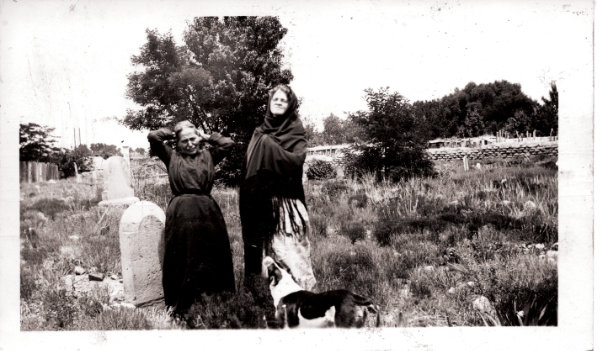
Last spring, I approached Dr. Alysia L. Abbott about writing a story about Santa Fe’s “lost” graveyards for our Fall 2020 issue. Right as her writing would have ramped up, however, her work as an archaeologist also kicked into high gear with new projects, and we bumped the story. I delayed it one year (because I think a story about graveyards is ideal for fall, don’t you?), and I’m thrilled that it has come to fruition.

Writer Emily Withnall presented a profile of Cochiti ceramicist Diego Romero in Winter 2019, and at that time, Withnall asked if I might also be interested in a profile of Romero’s wife Cara, a renowned photographer. I said yes, soon—and upon hearing that one of Cara’s photographs was recently accepted into the Museum of Modern Art’s collection, I knew it was the perfect time to offer her profile. I pinged Withnall and pulled the trigger on her pitch. Perfect timing.

Fall 2020 was the most-requested issue of El Pal from my tenure as editor, and I credit Dr. Larry Crumpler’s cover feature about the geology of New Mexico as the reason for its popularity. As it were, Jayne C. Aubele had penned a sidebar piece for that article that simply didn’t fit in the issue, offering a geodiversity road trip map of sorts. I tucked the piece in the back of my mind and promised Aubele I’d circle back to it. It may have taken me a year, but I kept my word. Get out your GPS and click here to get exploring.

The last bits of the magazine have come about on more normal timelines; Michelle Gallagher Roberts’s account of “lost” Gerald Cassidy murals piqued my interest only a few months ago, and I’m happy to present it to you now. Poets (and spouses) Scott Wiggerman and David Meischen appeared on my radar in spring 2021 and I fast-tracked them into an issue to showcase their breathtaking work. And kudos to J.C. Gonzo, whose Framework feature this issue swept in like a deus ex machina to add a perfect capstone to this issue. Making a magazine can often be a slow burn, and that was definitely the case for the one you are about to enjoy. Thank you to all my intrepid writers for keeping the faith.

Most Strange

By J.C. Gonzo

“The child’s corpse was exposed to view, decked with rosettes of brilliant hues, and the mourners talked and laughed gaily, which seemed to me most strange,” noted Lieutenant James W. Abert in 1846, after witnessing a child’s funeral in Santa Fe. The deaths of recently baptized infants were to be celebrated—they enjoyed a sure path to heaven. I stumbled across the lieutenant’s statement in an old Santa Fe New Mexican article in spring 2020 while researching New Mexican cemeteries, a new photographic project I’d embarked upon.

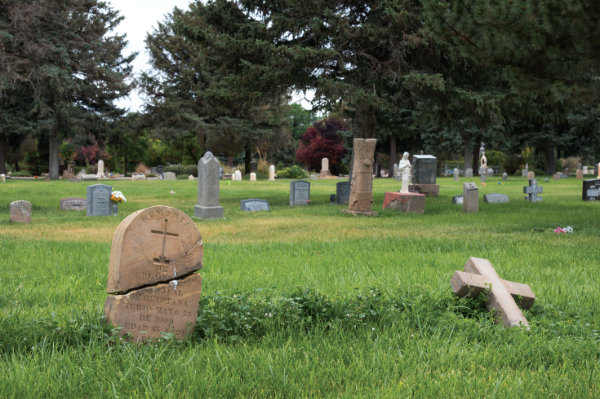
As a child, I found the common depictions of East Coast cemeteries on television and in movies to be “most strange.” Their austere marble and stone markers, sporting eternal angels and cupids, looked nothing like that of the humble, dusty, colorful sites members of my family and community were buried at in La Union, New Mexico. Simple, sometimes painted wooden crosses speckled the desert; heavily adorned with either fake or real flowers, housing an occasional statuette of a saint, namely la Virgen de Guadalupe. What marks the gravesites in the American Southwest as distinct from much of the country lies somewhere between cultural tradition and available materials.

When looking upon a New Mexican burial, one sees a landscape that is both historical and modern at once. Stories of the land are embedded in aesthetic signifiers, invisibly layered with burial reports, family trees, and personal narratives. It is a history of colonialism, harsh conditions, and common disease. It is a testament to ingenuity, cultural exchange, tradition, and religious custom. It is also not simply history, but a constantly evolving reflection of the living. When I photograph a New Mexican burial, I present both a past and a present, the living and the dead.

As the pandemic took full force last spring, I found myself both with the time to go on a statewide cemetery road trip, and frequently contemplating death. Suddenly, death was at the forefront of all media and casual conversation. Not subliminally, not anecdotally, but center-stage. I asked myself: Do we culturally cope with death differently today than before? What can we learn by examining the various ways we handle death?

From outsiders, one of the most common responses to New Mexican cemeteries is shock. The cemeteries are either all too joyous in their bold colors, too primitive in their modesty, or too morbid in their frank celebration. However, I’d like the unfamiliar viewer to find the natural harmony with the landscape in their unique expressions. I also want the familiar viewer to take a moment to honor and appreciate. Dirt mounds, wood, flowers, dried-out cholla crosses, uncarved stones… the most natural elements delicately reconfigured to represent our most natural event: death.
— 

J.C. Gonzo is an artist based in Santa Fe, New Mexico. His focus lies in re-contextualizing social and environmental histories as a form of meta-ecological research. His reports are depicted through a variety of media, serving both as a referential document and a celebration of chaos in the natural world.

J.C. Gonzo (opens in a new tab) is an artist based in Santa Fe, New Mexico. His focus lies in re-contextualizing social and environmental histories as a form of meta-ecological research. His reports are depicted through a variety of media, serving both as a referential document and a celebration of chaos in the natural world.

A Drive Through Time

By Jayne C. Aubele

We are familiar with the cultural diversity of New Mexico, reflected in its people, history, art, food, and more. But there is another kind of diversity in New Mexico that makes it special: our landscape. And the diversity of our landscape, from mountains to mesas to volcanoes to rivers, is due to the diversity of our geology—our geoscape.

Think about the beautiful landscape of New Mexico: the colorful mesas of Ghost Ranch, the badlands of the Bisti/De-Na-Zin Wilderness, rugged Wheeler Peak, the Valles Caldera and its tent rocks and hot springs, the different profiles of the Sandia Mountains and the Organ Mountains, the cliffs along the Gila River, the amazing Blue Hole near Santa Rosa, Carlsbad Caverns and White Sands National Parks, and Ute Mountain and the “desert peaks” of New Mexico’s two newest national monuments.

Every rock records something about the time and the environment when it was formed. New Mexico’s rocks are time capsules that tell us about the long geologic history of our state, from the oceans to the lowland river plains and the Sahara-like deserts that once covered our state. The landscape tells us about the more recent geologic history; as with the rocks, the landscapes of New Mexico—volcanoes, mountains, mesas, buttes, and rivers—also represent the time period and a geologic process by which they were formed. “Reading the record” of both the rocks and the landscape provides a complete picture of New Mexico’s amazing geodiversity.


1 Rio Grande Rift: The Defining
Feature of New Mexico’s Geology

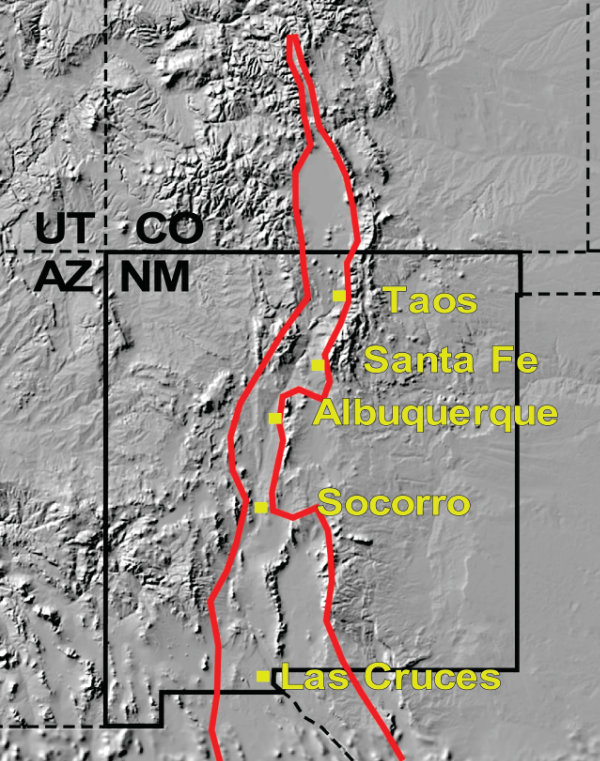
Figure 1: Red lines show the general margins of the Rio Grande rift. The rift began to form about twenty to twenty-five million years ago and is still forming today. Courtesy Larry Crumpler, New Mexico Museum of Natural History and Science.

In New Mexico, the landscape is primarily a result of young, dynamic and, often, still-active geologic processes. One of the reasons why New Mexico is so special is a geologically young and active rift (an area where the Earth’s crust has stretched and thinned) that is located north-south down the center of the state. It is not a plate boundary, it is what is called a continental rift; no other American state has a young, active rift.

You have probably heard of the East African rift; our rift is very similar, and it is one of only five such rifts on the entire planet. The other geologically young continental rifts are Lake Baikal (Russia), the Rhine Valley (Germany), and a rift beneath the ice of Antarctica.

The Rio Grande rift, named after the river that flows down it, began forming about twenty to twenty-five million years ago at the same time that the Basin and Range began to form; both were due to a change in movement along the boundary between the North American plate and the Pacific plate, far to our west. The location of the rift in the middle of our state appears to be the result of the interaction between two physiographic provinces: the Basin and Range Province and the stable and unchanging Colorado Plateau Province. (Figure 1)

Associated with the Rio Grande rift are abundant volcanoes, including the Jemez Mountains/Valles Caldera supervolcano and many more. The rift is a large part of the reason that New Mexico is the Land of Volcanoes. But the rift is also responsible for the north-south mountain ranges running down the center of the state, commonly called the “central mountain chain,” and the rift’s basins or low areas served as a pathway for the Rio Grande. Historically, the rift served as a ready-made route for exploration and trade up and down El Camino Real de la Tierra Adentro; and its flat floodplains and abundant water provided perfect settings for settlement by Native American and colonial territorial agriculture and urban development.


2 New Mexico’s Physiographic
(Geologic) Provinces

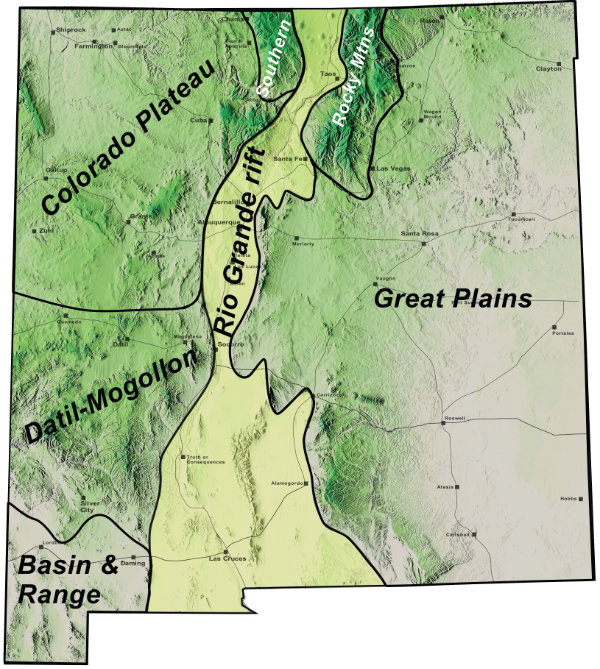
Figure 2: A geologic province is a region of the Earth’s crust in which the general type and age of rocks and their geologic history is similar. Each province creates a generally similar landscape. The names of the provinces are shown. Many of them extend into our neighboring states but they all intersect within New Mexico. Courtesy Larry Crumpler, New Mexico Museum of Natural History and Science.

But the rift is just one element in the story of our state’s geodiversity; New Mexico doesn’t stop with just one unique geologic feature. Our state contains the intersection of six major physiographic or geologic provinces—arguably more than any other state. (Figure 2)

The concept of a physiographic province in geology is similar to the concept of ecoregions or biomes in biology. In this case, a physiographic (also called geologic or geographic) province is a region in which all of the landforms within that area are similar in rock type(s), geologic structure, and geologic history.

Each of these provinces has created a landscape that has recorded different times and different events and looks quite different. The geological landscape provides the framework for topography, and therefore life zones; it has influenced the state’s biodiversity, our natural resources, our art and cultural history, where we have settled, and how we make our living in every region of New Mexico.

As you travel throughout New Mexico, you are surrounded by beautiful landscapes that reflect our state’s amazing geodiversity. Let’s take a quick tour to see how this actually looks.


3 Colorado Plateau Province
Northwestern New Mexico
        and the Four Corners

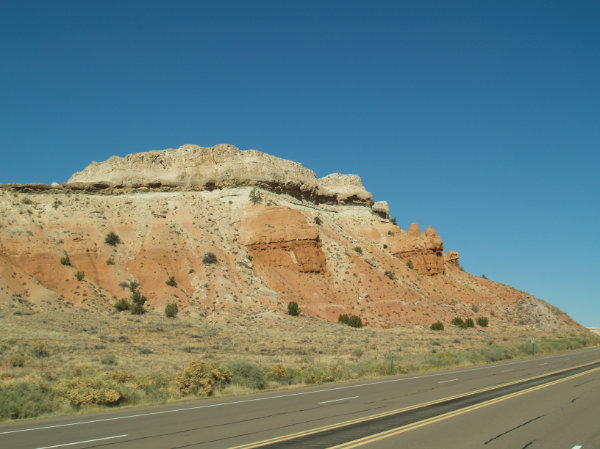
Figure 3: Colorado Plateau: Cliff along Highway 550 near San Ysidro, New Mexico. The colorful rock layers are flat-layered Mesozoic Era rocks from the age of dinosaurs. From bottom to top are Triassic Period rocks in the valley, with Jurassic Period sandstone, limestone, and gypsum above. They are topped in some places with Cretaceous Period rocks. Photograph by Jayne C. Aubele, New Mexico Museum of Natural History and Science.

This is the classic landscape of countless Hollywood Western movies. Geologists call it “layer-cake” geology. (Figure 3) Flat-lying rock layers of red, white, and tan sandstone, shale, and limestone have been eroded into mesas, buttes, and sometimes arches or amphitheaters. These rocks were formed during the age of dinosaurs when New Mexico experienced many different environments including rivers, deserts, swamps, and ocean. Subsequently, a few old volcanoes, like Ship Rock, erupted through the flat layers of rock. However, not much else has changed. The Colorado Plateau has remained a stable area of canyons and mesas. It was a place of special meaning to the Ancestral Pueblo people, but resources hidden deep within some of the rocks, such as coal, gas, and uranium have changed our association with this region.

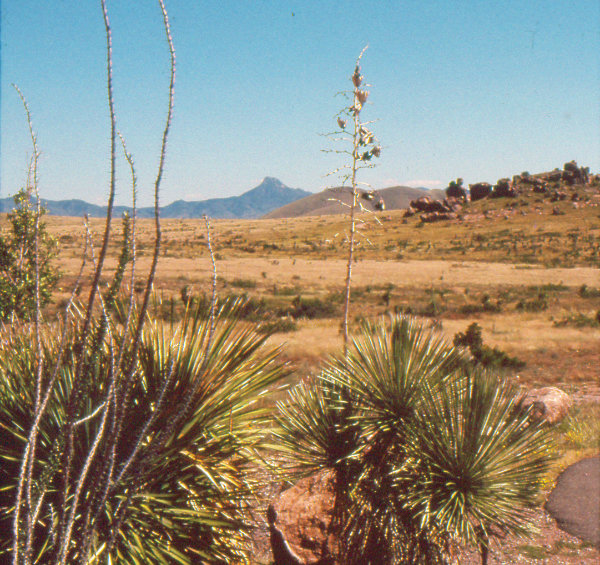
Where to go to see classic Colorado Plateau: Ghost Ranch, Bisti Badlands, Gallup’s Red Rocks, El Morro National Monument, Ship Rock.


4

 Datil-Mogollon Highlands
Southwestern and West-Central
        New Mexico

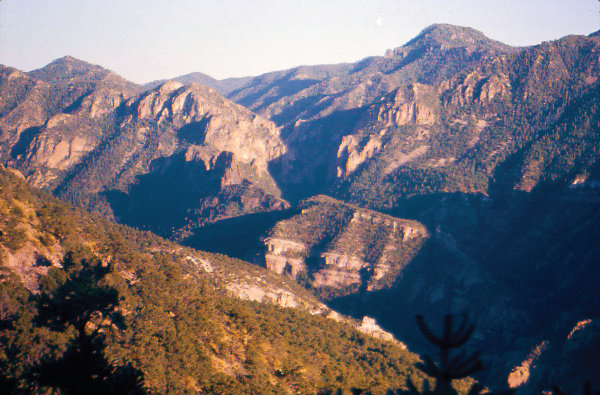
Figure 4: Datil-Mogollon Highlands, Gila Wilderness: The cliffs are eroded volcanic rock from multiple, gigantic, caldera super-eruptions that built today’s Mogollon Mountains and other mountain ranges such as the Datil, Black, Socorro, and Magdalena Mountains. Photograph by J.F. Callender.

A transition zone of faults lies at the southern margin between the Colorado Plateau and the Datil-Mogollon Highlands, and is the site of abundant young volcanism, including Mount Taylor. However, the Datil-Mogollon Highlands is a region of much older volcanism (Figure 4). This area includes today’s Mogollon, Datil, Black, Socorro, and Magdalena mountains, and these mountains are the eroded and faulted remnants of multiple gigantic caldera eruptions and ash-flows from “super-eruptions,” erupted twenty to forty million years ago.

Where to go to see classic Mogollon Highlands: Gila Wilderness, the nearby Catwalk, City of Rocks State Park, Gila Cliff Dwellings.


5 Basin and Range  •  Extreme
Southwestern New Mexico

Figure 5: Basin and Range: Cookes Peak, Cookes Range, and the Mimbres Valley are part of a region of north-south trending mountain ranges and valleys. Visible at right are a few of the eroded boulders of City of Rocks State Park that once erupted from calderas in the Mogollon Mountains and were broken and eroded as the Basin and Range Province formed. Photograph by Dr. Larry Crumpler, New Mexico Museum of Natural History and Science.

This is a land of parallel mountain ranges and valleys formed by the pulling apart of the North American continent that
began about thirty million years ago. The mountain ranges consist of all ages and types of rock that have been lifted up along faults.

Where to go to see classic Basin and Range: Mimbres Valley, Florida Mountains, Rockhound State Park.


6 Great Plains
Eastern New Mexico

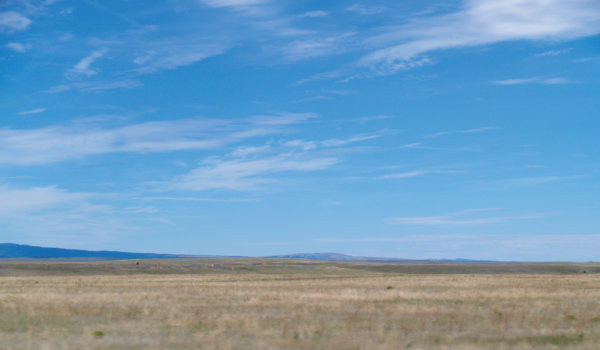
Figure 6: Great plains near Las Vegas, New Mexico: Beneath the extensive grasslands are flat-lying old terrestrial and marine rocks that contain resources such as water, and in some places, oil and gas. In the distance are the southernmost Rocky Mountains. Photograph by Jayne C. Aubele, New Mexico Museum of Natural History and Science.

New Mexico’s eastern plains are formed by flat-lying older rocks capped by younger sediment. In the southeast, the flat marine limestone layers, deposited by oceans that existed long before the age of dinosaurs, hide the remains of an ancient marine reef and abundant oil and gas deposits. (Figure 6) Extensive cavern systems and sinkholes began to develop within the ancient marine rocks during the Ice Ages. In the northeast, the flat sandstone, siltstone, and shale layers, deposited during the age of dinosaurs, contain dinosaur footprints. In extreme northeastern New Mexico, the rocks are capped by the easternmost young volcanic field in the continental U.S., the Raton-Clayton Field.

Where to go to see classic Great Plains: Guadalupe Mountains, Carlsbad Caverns, Blackwater Draw between Clovis and Portales, sinkholes such as the Blue Hole near Santa Rosa, Clayton Lake State Park, Capulin Volcano National Monument.


7 Southern Rocky Mountains
North Central New Mexico

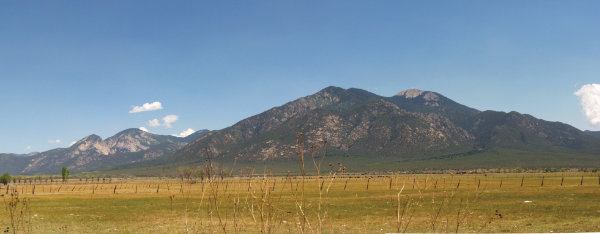
Southern Rocky Mountains: Taos Range of the Sangre de Cristo Mountains viewed just outside Taos, New Mexico. Old rocks were folded into mountains at the end of the age of dinosaurs and then shaped by glaciers. Photograph by Larry Crumpler, New Mexico Museum of Natural History and Science.

From Raton and Taos south to Santa Fe, the Sangre de Cristo Mountains represent the southern Rocky Mountain Province (Figure 7). In fact, the Sangre de Cristos near Santa Fe are the southernmost true Rocky Mountains; mountains to the south of Santa Fe are either related to the rift or are volcanic. The Rocky Mountains were formed by the folding and faulting of the North American continent at the end of the age of dinosaurs. The rocks within the mountains are even older than the mountains themselves—billions of years old—but the mountains were formed just around sixty-five million years ago and have been shaped and transformed by glaciers within the past few tens of thousands of years.

Where to go to see classic Southern Rocky Mountains: Sangre de Cristo Mountains including the Taos Range, Cimarron, Wheeler Peak, and Pecos Wilderness.


 8 Rio Grande Rift
Central New Mexico

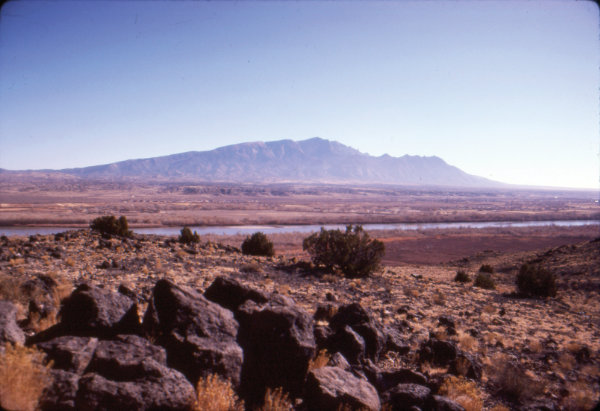
Figure 8: Rio Grande rift: Sandia Mountains and Rio Grande viewed from Bernalillo, New Mexico. The Sandia mountains are called fault-block mountains. The entire range has been lifted up along the eastern marginal faults of the Rio Grande rift, as the rift formed, and the rocks have tilted toward the east like an open trap door. The river took advantage of the low regions of the rift as it developed into a major waterway between one and four million years ago. Photograph by Jayne C. Aubele, New Mexico Museum of Natural History and Science.

The center of New Mexico is dominated by topography and geology associated with the young and still-active Rio Grande rift. The rift is a series of basins with margins defined by young rift-related mountains, like the Sandia Mountains (Figure 8), Fra Cristobal, San Andres, Sacramento, and others, and interiors filled with young volcanism and sediment. The Rio Grande followed the rift’s low valleys to become a major river between one and four million years ago. Most of the central mountains in New Mexico are young mountains related to the development of the rift. The rift has produced much of the landscape of central New Mexico and is responsible for many of its young volcanoes and most of its earthquakes.

Where to go to see classic Rio Grande rift: Taos Plateau, Santa Fe badlands, Fra Cristobal, San Andres, Sacramento, Sandia Mountains.

Jayne C. Aubele is a geologist and adult programs educator for the New Mexico Museum of Natural History and Science. She has worked as a field geologist for the U.S. Geological Survey and as a NASA scientist and program manager. Her publications include scientific papers and geologic maps of Earth, Mars, and Venus, geoscience articles/book chapters for the general public, and curricula/materials for teachers of all grade levels. She is past president of the New Mexico Academy of Science and a fellow of the Geological Society of America.

Jayne C. Aubele is a geologist and adult programs educator for the New Mexico Museum of Natural History and Science. She has worked as a field geologist for the U.S. Geological Survey and as a NASA scientist and program manager. Her publications include scientific papers and geologic maps of Earth, Mars, and Venus, geoscience articles/book chapters for the general public, and curricula/materials for teachers of all grade levels. She is past president of the New Mexico Academy of Science and a fellow of the Geological Society of America.

Found in Collection

By Michelle Gallagher Roberts

In early 2007, staff at the New Mexico Museum of Art were implementing the first phase of planned collecting storage renovations that required all artworks from the first collection storage room be removed from the space to allow for the installation of new state-of-the-art compact art storage. More than 1,700 artworks had to be inventoried and relocated in the span of nine days.

Museums use unique identifying numbers, called accession numbers, to track objects and to refer to the object’s associated paperwork and computer record. Sometimes objects become separated from their accession numbers; other times, accession numbers are not assigned for a variety of reasons. Museum staff work hard to ensure this does not happen, but when it does, these objects over time earn the designation “found in collection,” or FIC. Staff changes, and memories become hazy about how and why an object is at the museum. The status of these objects can be difficult to resolve, although the museum profession has developed a series of best practices around these types of objects. No matter how diligent a staff is, inevitably something turns up “found in collection.”

Public Works of Art Collection, Work Projects Administration. Courtesy of the New Mexico State Records Center & Archives. Collection 0200-0201 (#wpa5385).
Public Works of Art Collection, Work Projects Administration.
Courtesy of the New Mexico State Records Center & Archives. Collection 0200-0201 (#wpa5385).

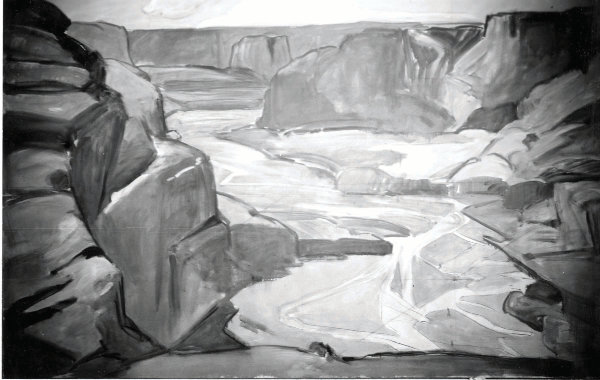
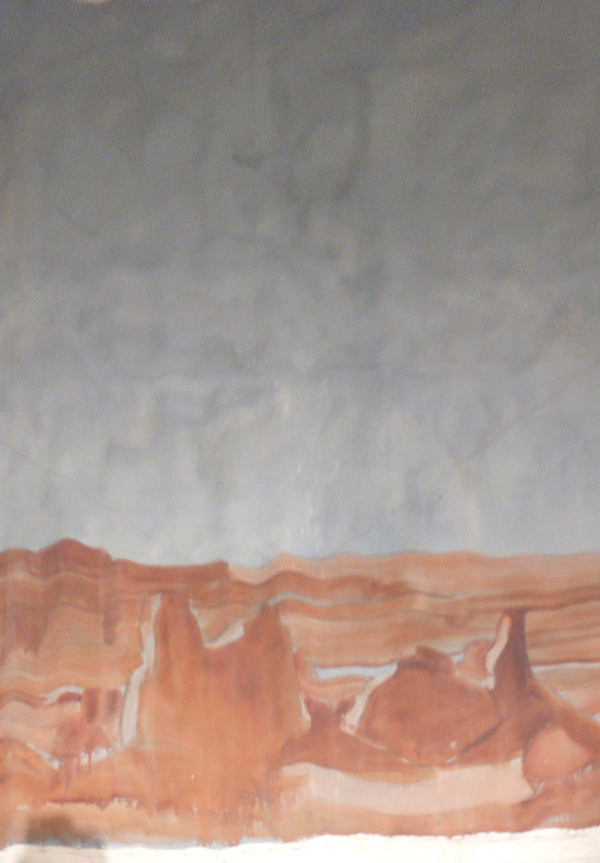
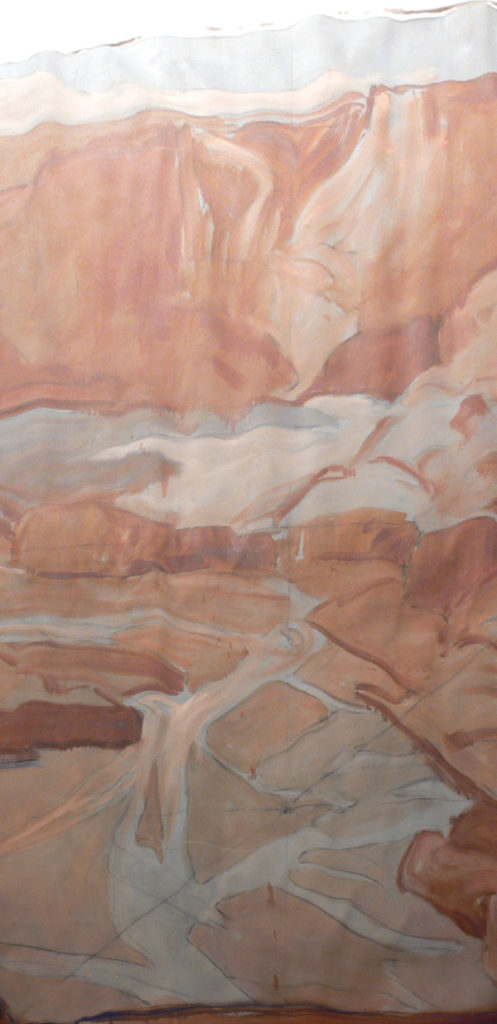
Given the nature of inventories and collection moves, it is during these times that the most FICs are identified. The Museum of Art’s 2007 renovation was no exception. Since the space had to be emptied, every corner and top shelf was investigated. Located on top of a shelving unit in the back of the room were two folded canvases wrapped in plastic. The canvases lacked identifying marks or signatures, except for the initials “PWAP” written in pencil on the back. On the canvases were unfinished landscapes. The first depicted a Southwest composition with reddish land formations, cliffs, and a grayish-blue sky. The second canvas was also of a Southwest scene, but with a stream at the center trickling through reddish bluffs. The composition apparently extended past the edges of the canvas, suggesting that both paintings had been cut down.

Museum staff were on a tight schedule for the renovation and couldn’t take the time to track down the works’ attributions or paperwork. The canvases were photographed, tagged with an FIC number, and relocated with the rest of the art. Once the renovation was complete, the collection and registration staff returned to the FIC works identified during the move. Staff examined the condition of the paintings, recorded measurements, and rolled the unstretched canvases onto archival tubes. Because the artist applied the paint thinly, cracking of the paint is unlikely.

As a first step in identifying FICs, museum staff have some standard searches they run in the computer database that tracks all objects in the collection. If that doesn’t turn up an easy answer, they are often familiar enough with the idiosyncrasies of the collection they work with every day in order to look for those fruitful nuggets of information that can answer their questions; but for the most part, identifying FICs can be serendipitous. One right piece of information can lead to another, and finally to the answer. Each FIC is a mystery where the clues must be followed to the end—and, in the case of these two unfinished canvases, the only clue was the initials PWAP. Through previous work with the collection, PWAP was known to stand for Public Works of Art Project.

In the 1930s, the Southwest, and New Mexico in particular, had been hard-hit by economic depression, prolonged drought, and dust storms. President Franklin Delano Roosevelt had been elected during the worst economic and agricultural collapse in the history of the United States. Roosevelt pledged “a New Deal to aid the forgotten man,” and drafted numerous policies to relieve unemployment and boost local and state economies.

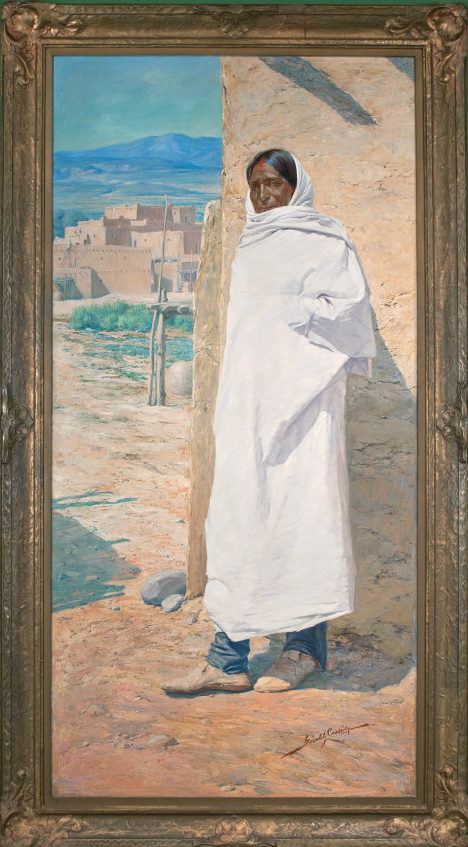
Gerald Cassidy, Chaco Canyon Mural (unfinished), 1934. Oil on canvas, 147 × 96 in. On long-term loan to the New Mexico Museum of Art from the Fine Arts Program, Public Buildings Service, U.S. General Services Administration (2008.19.2).

A number of New Deal programs employed art to boost confidence and inspire people by portraying the history and culture of America through images of everyday life. The first federal program with these lofty goals was the Public Works of Art Project. The program began in December 1933 and ran for six months. New Mexico and its residents were eager to take advantage of this extraordinary opportunity. Less than one month after the program began, New Mexico artists were ready to go. Through the PWAP, artists were commissioned to decorate parks and public buildings such as post offices and courthouses.

Many names now synonymous with the Santa Fe and New Mexico art scene were involved in the PWAP. Jesse Nusbaum became the PWAP regional administrator for New Mexico and Arizona. In 1930, he had been named the first director of the Laboratory of Anthropology and had overseen important civic projects in prior years, such as the rehabilitation of the Palace of the Governors, and the design and construction of the New Mexico Museum of Art building on the Plaza. Gustave Baumann, noted woodblock artist, carver, and marionette maker, was the field coordinator for the PWAP.

Gerald Cassidy, Canyon de Chelly Mural (unfinished), 1934. Oil on canvas, 144 × 95 ½ in. On long-term loan to the New Mexico Museum of Art from the Fine Arts Program, Public Buildings Service, U.S. General Services Administration (2008.19.1).

PWAP artists were classified into three categories. Class A included professional fine artists who worked primarily in frescoes, oil paintings, watercolors, etchings, and sculpture; they were the primary recipients of PWAP funds. They were paid $2 an hour for twenty hours a week. From this money, they had to provide their own supplies, except for large projects requiring expensive canvases. Walter Ufer, Victor Higgins, Kenneth Adams, Olive Rush, Emil Bisttram, Ward Lockwood, and Bert Philips, to name a few, were all enthusiastic participants in the program. Class B included less experienced artists. They earned $27.50 a week for twenty hours. Laborers and craftspeople comprised Class C. These would include weavers, wood carvers, and pottery makers. This group would often assist the fresco painters in the preparation of the walls. For mural projects, the PWAP required artists to submit a series of sketches and drawings for pre-approval, and the final product had to fit an assigned space, such as over a doorway or around a window.

Another well-known Santa Fe artist eager to participate in the PWAP was Gerald Cassidy. Like many others, Cassidy first came to New Mexico in 1890 when he was stricken with pneumonia while studying and working in New York. That pneumonia degenerated into tuberculosis. Given six months to live, he was sent to a sanatorium in Albuquerque. However, he quickly recovered in the dry climate of New Mexico. While here, he became taken with the light and vibrant colors of the state.

One of ten children, Ira Diamond (Dymond) Gerald Cassidy was born in Covington, Kentucky, in November 1869. When he was a small child, his family moved to Cincinnati, Ohio. His first art lessons were at the Institute of Mechanical Arts, now known as the Cincinnati Art Institute. Cassidy studied with Frank Duveneck, a famous painter at the Institute; Duveneck encouraged Cassidy to work in lithography, so Cassidy joined one of his older brothers in New York City to work as a lithographer for the Miner Company. He would become known as one of the four best commercial lithographers in the country. At night he studied at the Art Students League and the National Academy of Design. At the time of his TB diagnosis, Cassidy was the art director at a lithography firm. While lithography was his profession, he always dreamed of painting.

When his health improved, he moved to Denver to resume his lithography career. In Denver, he met and married Ina Sizer Davis. They moved to Santa Fe on January 1, 1912. According to Ina, Cassidy’s one wish was to be a painter. When the couple returned to New Mexico, she encouraged Cassidy to pursue his passion for painting landscapes and the Native American people of the Southwest.

Public Works of Art Collection, Work Projects Administration. Courtesy of the New Mexico State Records Center & Archives. Collection 0200-0201 (#wpa5383).
Public Works of Art Collection, Work Projects Administration.
Courtesy of the New Mexico State Records Center & Archives. Collection 0200-0201 (#wpa5383).

In 1914, Edgar Lee Hewett, founder and director of the Museum of New Mexico, was arranging the exhibitions for the New Mexico Building for the 1915 Panama-California Exposition in San Diego. Preceded by a letter of recommendation, Cassidy met with Hewett, who subsequently commissioned the artist to paint fifteen mural panels for the Indian Arts Building. During this same period, Cassidy was tasked with celebrating the opening of the Panama Canal at an exposition in San Francisco with another mural. His central panel from the Panama-California Exposition, which illustrated a cliff dwelling from the Southwest, won a gold medal and the grand prize. Also on display was Cassidy’s now-iconic painting Cui Bono?, which he would later donate to the New Mexico Museum of Art and was featured in the museum’s inaugural exhibit. 

Gerald Cassidy, Cui Bono?, ca. 1911. Oil on canvas, 93 ½ × 48 in. Collection of the New Mexico Museum of Art. Gift of Gerald Cassidy, 1915 (282.23P). Photograph by Blair Clark.

In 1917, the Cassidys decided to travel to Europe. They reached New York before their plans were halted by World War I. Unable to return to Santa Fe, the Cassidys stayed in New York, where he earned a reputation for producing excellent portraits and murals. During this time, Cassidy painted murals for the Gramatan Hotel in Bronxville, New York, and private homes. At the end of WWI, they returned to Santa Fe, where Cassidy continued painting portraits and murals. His murals include Dawn of the West, painted for the high school in Golden, Colorado; a mural of Robin Hood in a private home in Houston, Texas; and two murals commissioned for the Onate Theatre in Santa Fe.

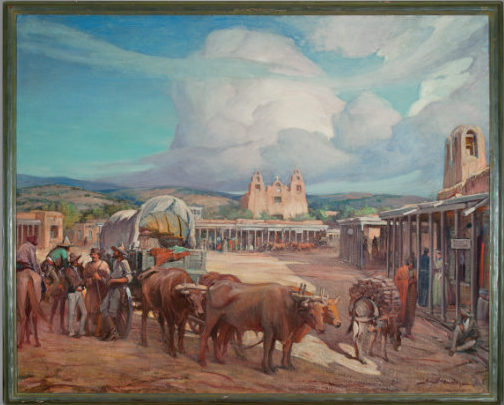
Located on the corner of the Santa Fe Plaza that is currently occupied by the First National Bank, the Onate Theatre murals depicted the conquistador Francisco Vázquez de Coronado riding his great white horse with some of his cavalry and a Franciscan priest. Cassidy used the faces of his friends and neighbors to depict the figures. The second mural depicts a Zuni Pueblo warrior, armed and defiant. For the central figure, Cassidy used a portrait of Julian Martinez, the late husband of the famous San Ildefonso potter Maria Martinez.

These murals traveled a twisting path to their current location. After the Onate Theatre closed, it was converted to a parking garage. According to a 1979 Santa Fe New Mexican article, “the great murals were deplorably confined ‘in the dark and oily recesses’ of the garage.” They were later purchased by John Hardin of Oklahoma City, who moved them to his hotel in Hobbs, New Mexico, and then to his hotel in Acapulco, Mexico. They eventually made their way back to New Mexico when Hardin donated them to the state of New Mexico in 1948 with the provision that the paintings never leave the state again. These murals spent some time in the Museum of Art’s storage before they were transferred in 1962 to the federal government and conserved by John Pogzeba. They can now be seen in the lobby of Santa Fe’s Joseph M. Montoya Federal Building located on Federal Place, just north of the Plaza.

In the 1920s, the Cassidys were finally able to spend a year traveling through Europe and North Africa, supported by a benefactor. These travels spawned numerous works and international acclaim for Cassidy. Cassidy’s paintings were included in a number of exhibitions in Berlin, Paris, and Vienna, and were added to a museum collection in Berlin and to the Luxembourg Palace.

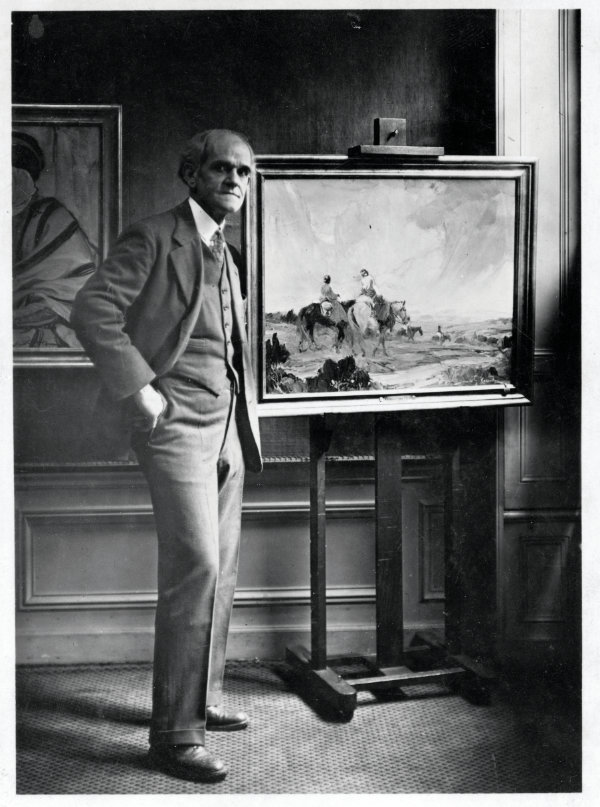
Gerald Cassidy with his painting, Navajo Romance, which was purchased by the French government for the Luxembourg Galleries in Paris, n.d. Courtesy the Hewett Collection, the Palace of the Governors Photo Archives (NMHM/ DCA), neg. no. 007121.
Gerald Cassidy with his painting, Navajo Romance, which was purchased by the French government for the Luxembourg Galleries in Paris, n.d.
Courtesy the Hewett Collection, the Palace of the Governors Photo Archives (NMHM/ DCA), neg. no. 007121.

Like many artists, the Cassidys bore the weight of the economic collapse of the 1930s, but Cassidy was excited about the announced PWAP. He was the first artist selected for the program by Nusbaum. Cassidy was commissioned to complete several large-scale murals for the Federal Courthouse on Federal Place in Santa Fe. Per the requirements of the PWAP, Cassidy submitted sketches for two murals: one of Chaco Canyon and one of Canyon de Chelly. These two drawings would later be transformed into the two FIC paintings in storage at the Museum of Art.

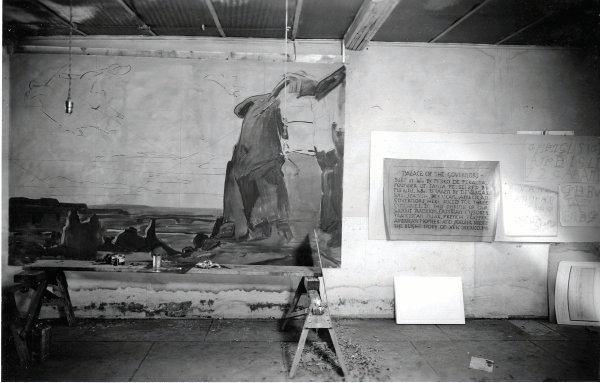
Cassidy rented an empty store space to complete these large canvases in the middle of winter. Gas for heating and cooking had just been introduced to Santa Fe, and the studio’s heater had been incorrectly installed. According to Nusbaum,
Cassidy “had a big canvas to get started the way he does. He worked with a fire in there, and he had to dope it, the canvas, to stretch it out and get it ready. It was cold weather and they kept the building tight, and he inhaled too much of the fumes. … He didn’t last long after that.”

The turpentine fumes and carbon monoxide combined into a lethal combination. After drinking his noon coffee with his wife at home, Cassidy died on February 12, 1934.

Nusbaum would also call Cassidy “one of the fellows that worked the hardest.” Ina Sizer Cassidy would later say her husband “gave his life for the WPA,” using the abbreviation of the better-known Works Progress Administration. 

Gerald Cassidy, View of Santa Fe Plaza in the 1850s (End of the Trail), ca. 1930. Oil on canvas, 47 ¾ × 60 ¼ in. Collection of the New Mexico Museum of Art. Gift of the New Mexico Historical Society, 1977 (350.23P). Photograph by Blair Clark.
Gerald Cassidy, View of Santa Fe Plaza in the 1850s (End of the Trail),ca. 1930. Oil on canvas, 47 ¾ × 60 ¼ in. Collection of the New Mexico Museum of Art. Gift of the New Mexico Historical Society, 1977 (350.23P). Photograph by Blair Clark.

Many of Santa Fe’s most well-known figures in the art world were pallbearers at his funeral at the Masonic Temple: Sheldon Parson, Carlos Vierra, Will Shuster, William Penhallow Henderson, Kenneth Chapman, Gustave Baumann, and Jesse Nusbaum. After the funeral, a group of friends raised funds by public subscription to purchase a work from Ina. They donated View of Santa Fe Plaza in the 1850s (End of the Trail) to the New Mexico Historical Society as a memorial. In 1977, when the Historical Society made the decision to no longer collect, the work was transferred to the New Mexico Museum of Art’s collection.

After Cassidy’s death, the Federal Courthouse mural project was assigned to his friend and fellow artist William Penhallow Henderson. Henderson’s completed murals can be seen today throughout the halls.

But what happened to the canvases that Cassidy was working on when he died? Cassidy had received his hourly wage for the work, and the canvas material was presumably paid for by the PWAP. Like Cassidy’s Onate Theatre murals, they were on a winding path.

In a lucky twist of fate, black-and-white photographs were taken of the preparatory sketches and of one of the canvases-in-progress in Cassidy’s studio space. One of the sketches for Canyon de Chelly was sent to the National Park Service director’s office. The photographs were placed in the New Mexico State Records Center and Archives’ PWAP collection. The photograph showcasing the in-situ canvas has been published in a number of books discussing the history of the PWAP.

It was through Jacqueline Hoefer’s A More Abundant Life: New Deal Artists and Public Art in New Mexico that this writer made the connection between Cassidy and the FIC canvases in the collection storage of the New Mexico Museum of Art. A comparison of the imagery showed that one of the FIC paintings was clearly a cut-down version of Cassidy’s Chaco Canyon. A request to the New Mexico State Archives yielded the additional photographs of Cassidy’s last works. Comparing the second FIC canvas to the images showed a similar cut-down version of Cassidy’s Canyon de Chelly composition. 

There are no records found that explain why these two canvases were cut down or what happened to the other sections. It is also not known why these two sections were given to the Museum of Art, although it can be speculated.
The museum currently holds the largest collection of artworks in New Mexico created under all the New Deal programs.
It would make sense these unfinished paintings would make their way through the museum’s doors.

Artworks created under many of the New Deal programs remain under the ownership of the federal government. Currently, more than 150 works that are owned by the federal government are cared for by the New Mexico Museum of Art under a long-term loan agreement.

With the PWAP designation on the back of the canvases, these works were originally listed as untitled and by an unknown artist. Once the connection was made to Cassidy’s PWAP work, their listing was updated. Attribution and ownership of these works has been clarified and a unique identifying number has been assigned so they can’t become disassociated with their records again. Given the unique set of circumstances surrounding these canvases, it isn’t surprising they became separated from their origins—but they are no longer listed as “found in collection.”

Beyond the imagery and their appearance, many objects capture a distinct moment in time. The unassuming, unfinished canvases forgotten on a shelf in the collection storage of the New Mexico Museum of Art encapsulate a unique slice in U.S. history and the final moments of a talented artist’s life. It is only fitting that they came back into the light after eighty-seven years.

Michelle Gallagher Roberts is currently the deputy director and former head of Registration & Collection at the New Mexico Museum of Art. She was lead on the 2007 collection move and renovation.

Blair Clark is an illustrative photographer with over thirty years experience in studio and on-site photography and almost twenty-five years in museum photography.

Michelle Gallagher Roberts is the deputy director of New Mexico Department of Cultural Affairs and previously served the department as Chief Registrar then Head of Registration and Collections at New Mexico Museum of Art, and also served as the Acting Registrar at the Museum of International Folk Art. Prior to moving to New Mexico, Michelle was the Collections Manager at Palm Springs Desert Museum/Palm Spirits Art Museum, Curatorial Assistant at Foothills Art Center in Golden, Colorado, Assistant Registrar at the University of Denver Museum of Anthropology, and an Archaeologoist at Central Washington Archaeological Survey in Ellensburg, Washington. She has written multiple publications on museums and cultural institutions and received the “Heritage Preservation Award: Architectural Heritage” from the Cultural Properties Review Committee in 2018. She was a Next Generation 2017 Fellow at the Getty Leadership Institute, Claremont Graduate University and holds both a BS in Anthropology from Central Washington University and a MA in Anthropology/Museum Studies from University of Denver.

In Conversation with the Sea

In Cara Romero’s black and white photograph Sand & Stone, Chemehuevi and Diné woman Sheridan Silversmith is embedded in earth. Her head and clasped hands are above the surface of the hard, dry dirt, but the rest of her body is not visible. Silversmith’s gaze is powerful. She is not trapped or buried; she seems to draw strength from the earth. In another black and white photograph, Hermosa, Romero’s daughter Crickett wears a grass skirt and thick seashell necklaces. Crickett stands in the ocean with dark clouds behind her as frothing sea water rises around her. The image is a direct interpretation of the Chemehuevi Creator, Great Ocean Woman (Hutsipamamow). Sand & Stone and Hermosa are both testaments to the inseparability of the Mojave Desert from the first peoples who inhabited this landscape long before colonization—and continue to inhabit it still.

Evolvers, 2019. Archival pigment photograph. 19 × 61 inches. Collections of the Autry Museum, Birmingham Museum of Art, Hood Museum, Nerman Museum of Contemporary Art, Peabody Essex Museum, Virginia Museum of Fine Art, and Williams Museum of Art.

Chemehuevi resilience is a theme also evident in Romero’s photographic series, Jackrabbit, Cottontail, & Spirit of the Desert, which was showcased on billboards in Coachella Valley in 2019 as a part of the Desert X Biennial. The installation featured Romero’s four nephews, who wore Ray-Ban sunglasses and traditional feather bundles on their heads. In Evolvers, one photograph in the series, the young boys run barefoot on the dry earth surrounded by the giant wind turbines near Palm Springs. Their feather bundles mimic both the shape of the turbine’s blades and the shape of the mountains behind them. In other photographs in the series, the feather bundles mimic the shapes of palm trees and yucca plants. Referred to as “time travelers” in the series description, it is clear that these little boys are of the desert: past, present, and future. As Sand & Stone reminds viewers of Chemehuevi creation and inseparability from the earth, Evolvers says: “We’re still here.”

When I spoke with Cara Romero in April, she was at work on her most recent installation project in Southern California for the NDN Collective’s Radical Imagination grant. She has lived and worked in Santa Fe for twenty years, but Romero grew up bouncing between her father’s home on the Chemehuevi Reservation in the Mojave Desert and her mother’s home in Houston, Texas. Her mom is Anglo, and Romero is quick to tell me that she identifies as mixed-race—an identity that can make it hard to feel like she fits in anywhere. “I am a Chemehuevi photographer, but it can sometimes feel a little bit like people are just interested in me being Native,” Romero says.

Normally, she’d leave her husband, Cochiti ceramics artist Diego Romero, and their kids at home in Santa Fe to make trips back and forth for a big project. But the pandemic reshaped Romero’s plans in the spring: She decided to move her whole family to the beach for a few months while she worked. The grant allowed her to once again purchase billboard space in Southern California, but this time the billboards feature photographs of the Gabrielino-Tongva people, the first peoples of Los Angeles, across the LA cityscape. This project is a part of a larger body of work that includes photographs of other tribes native to Southern California, including the Ajachmem, Chumash, Tataviam, and Chemehuevi people, as well as personal work with her family.  

The Tongva, like over fifty-five other tribes across California, are not federally recognized and have no land base. “There are modern struggles that go along with being Southern Californian first peoples—we experience a lot of invisibility and persecution,” Romero says.

The project is her way of acknowledging the ancestral homelands of many different tribes whose people are still very much present. “A lot of people don’t know that Los Angeles was the place of origin not only for the Tongva, but for all of the desert people long before it was ever settled by non-Native people.”

Romero didn’t pick up a camera until she was 20. She majored in anthropology at the University of Houston, partly because she couldn’t figure out what interested her and partly because the anthropology department included Native studies. Disillusioned by what she describes as an “incredible paucity of contemporary lived experience” in Native coursework, Romero thought she might use her degree to write new textbooks.

“I can remember always being so disappointed in the Native American history section, whether it was second grade at Thanksgiving or a fourth-grade mission project and all the way up through high school and into college,” she says. “I’m not really a writer though, so I thought maybe I would be a teacher, but I’m not really scholarly either.”

When she picked up her camera her senior year of college, however, Romero knew she had found her calling. With the mentorship of her instructor, Bill Thomas, she learned to shoot and develop silver gelatins. When he saw her talent for storytelling, he encouraged her to pursue content over technical skill. When she shot a series of a friend who had HIV, Thomas was moved, and the series became a part of a campaign to inspire compassion and awareness around HIV/AIDS. “That was it for me,” Romero says. “My whole purpose after that was to pursue photo documentary and photojournalism of Native peoples.”

Romero went on to pursue an associate’s degree in photography from the Institute of American Indian Arts and an applied science degree in photography technology at Oklahoma State University, where she moved into digital work. She describes her current work as an amalgamation of her background in film and her commercial training in digital photography. In her early days as a photographer, Romero says she and other Native students emulated the style of Edward S. Curtis, whose photographs were viewed as canonical to Native American photography. As Curtis had done, Romero shot in black and white, used sepia tones, and had friends pose in their regalia without any evidence of contemporary life.

This period in Romero’s trajectory was short-lived. When her “aha moment” arrived, Romero knew her primary audience needed to be other Native people. “We are functional modern human beings simultaneous to our incredible cultures, and we exist against all odds,” she says.

TV Indians (Color), 2017. Archival pigment photograph. 39 × 60 inches. Collections of the Hood Museum, Crocker Museum, Figge Museum, Muscarelle Museum, University of Nevada Reno, and Weisman Art Museum.

Romero’s work breaks down the boxes Indigenous people have been placed in by outsiders for centuries. Her sepia-toned TV Indians is a direct response to Curtis. In the image, five Pueblo people stand in a New Mexico landscape in front of a pile of old, clunky television sets. The TV screens depict a range of outdated and stereotypical images of Native peoples, from the Iron Eyes Cody to Tonto and Lone Ranger. The contrast between the Pueblo people and the images on the screens reveals how ludicrous the old stereotypes are.

This year, a new color version of TV Indians was printed for Alcoves 20/20 #4 at the New Mexico Museum of Art, which was on display through Summer 2021. In color, the photograph offers an even more striking contrast between the ways Indigenous peoples have been represented and the ways they actually look. In an online presentation Romero gave for Alcoves 20/20, she sits in front of a background of Mojave cholla. Her dark hair is long and she has bangs. She wears a plaid shirt, big plastic glasses, and long silver earrings. Even in the digital realm, the background of her beloved desert landscape reminds viewers of her deep connection to place.

“We are very culturally private, and it’s very uncomfortable to ask somebody, ‘Hey, can I go on your reservation and take a photograph of you doing anything,’” Romero says. “That’s when your camera becomes like a weapon. It’s been used against Native peoples for a really long time.”

For her, shooting ethically is about responsibility and respect for the people she is photographing. “I’ve always been trying to solve the problem of how to Indigenize this medium that I love so much so that it’s never taking from my community,” she says. “How can I be of service with this skill that I’ve acquired? I really come from that space of service to my community.”

Problem-solving is a part of Romero’s entire process, from start to finish. As a mother with three kids at home, she no longer has the luxury of walking around to find photos or immersing herself in a community for months at a time like many photojournalists do. “There was a time where I didn’t think I was going to get to make art and be a mom,” Romero says.

What she discovered, however, is that by turning to staged productions, she could do a lot of the dreaming and planning in her head while she folded clothes and washed the dishes. “The style that emerged was really a product of my environment,” Romero says. “They’re theatrical because I’m spending a lot of time in my mind and in my sketchbook daydreaming while I’m doing other, motherly tasks.”

When it’s time for the big shoot, her husband, Diego, takes care of all her normal responsibilities at home for the duration of her production. Shooting digitally also makes it easier for Romero to juggle her responsibilities, enabling her to work on postproduction when her kids are sleeping.

Romero says a typical photograph takes roughly three weeks to fully execute, but many can take longer. “All of my photographs start from an in-depth interview process,” Romero says. For her NDN Collective grant project, she interviewed elders, artists, scholars, and activists for two months before she started shooting. Interviews are Romero’s way of discovering what universal themes come up in the community and what stories people want to tell. “Sometimes I have an idea and I talk to them about it—and sometimes the idea comes from the person, and there’s this editorial aspect to it,” Romero says. “We’ll sit down for hours and hours and just talk about life, things that are important to the person, and then I’ll show them sketches of my ideas and let them pick a direction.”

Following the production, Romero shows her models the photographs to “make sure they’re happy with being immortalized.” In her efforts to repair the harm caused by photography in the past, Romero is focused on ensuring that her models’ representation is accurate and comfortable to them. “I really make an effort to ask, ‘Do you love it? Does your grandma love it? Do you want copies?’” says Romero. “It’s a compliment for me when people want copies.”

Not only does Romero give her models plenty of copies, but she pays them, too. “That’s been something that was always really important to me to not capture the exploitative nature of photography and to give back to my community. I always pay my models,” she says.

Romero mostly photographs her friends and family members, and she most enjoys the shared creation they engage in when she begins production. “I like getting up before sunrise and driving out to one of my spots in the desert with one of my dear friends at 4:30 in the morning,” she says. As they wait for the sun to come up, they talk about ideas and the plan for the shoot.

Oil Boom, 2015. Archival pigment photograph. 55 × 55 inches. Collections of the Hood Museum and Smithsonian National Museum of the American Indian.
Oil Boom, 2015. Archival pigment photograph. 55 × 55 inches.
Collections of the Hood Museum and Smithsonian National Museum of the American Indian.

“There’s something about the process and holding space for art that’s really, to me, a magical space of connection,” Romero says. “You’re talking about things that you wouldn’t normally talk about, and you’re sharing space and sacred time together. It’s like playing dress-up and playing imagination when you’re a kid.” 

In addition to producing photos in the desert, Romero serves as the director of the Indigeneity Program at Bioneers, a Santa Fe-based nonprofit dedicated to finding solutions to environmental and social issues. She admits that her photography career has become successful enough that she could have stepped away from her role there, but she is committed to Bioneers’ important work. Romero runs the Indigenous Forum, an annual conference dedicated to environmental, Indigenous, and social justice issues, and she’s currently working on a project to create a methodology for tribes to adopt the rights of nature into their tribal governance.

“What that looks like is creating amendments or ordinances within tribal governments that reflect that nature is alive and deserves protection, and that we’re interdependent on our ecosystem,” Romero says. “A lot of tribes have colonial constitutions, so we’re looking at ways to incorporate this language of rights of nature. That work is really inspiring.”

Romero is also inspired by Bioneers’ work with traditional ecological knowledge (TEK), which is an interest she’s held since childhood. TEK involves sustaining traditional arts, medicines, and foods in a way that supports a tribe’s culture and the ecosystem it depends upon. “To be able to make abalone jewelry, the abalone ecosystem has to be healthy,” Romero says. 

Bioneers’ influence on her work is particularly evident in her photograph Oil Boom, which depicts an Indigenous man submerged in brown water with pump jacks positioned above ground. And although it’s more subtle, in Water Memory, two Indigenous women float in teal-colored water, dressed in their full regalia—a reference to both the construction of the Parker Dam in 1934, which submerged her ancestral homelands under Lake Havasu, and to rising sea levels.

Naomi, 2017. Archival pigment photograph. 49 × 40 inches. Collections of the Autry Museum, Crocker Art Museum, Nelson‑Atkins Museum, Museum of World Cultures (Rotterdam), and Palm Springs Art Museum.
Naomi, 2017. Archival pigment photograph. 49 × 40 inches.
Collections of the Autry Museum, Crocker Art Museum, Nelson‑Atkins Museum, Museum of World Cultures (Rotterdam), and Palm Springs Art Museum.

Additionally, TEK appears in many of the photographs in her First American Girl series. In this series, Romero does not break down boxes, but rather, she constructs them—on her terms. She constructs the life-sized doll boxes herself, and then works with a model to assemble the precise regalia and accessories specific to a particular tribe. The series began as a response to the dearth of accurate representation in dolls and figurines. Naomi features a contemporary Northern Chumash woman dressed in her tribe’s traditional clothing and surrounded by pine cone shapes and bristle pine cones, which are central to Naomi’s culture. The Northern Chumash are located in California and the doll box’s hot pink background and pinecone checkerboard border is a nod to the state’s skater and MTV cultures. “Naomi in particular has so much about the Indigenous science of California in it,” Romero says. “In my work I try to show that we really need to focus on our ability to continue to not only preserve, but revitalize, these arts.”

Wakeah, 2015. Archival pigment photograph. 53 × 40 inches. Collections of the Museum of Modern Art (NYC), Museum of World Cultures (Rotterdam), and Nelson‑Atkins Museum.
Wakeah, 2015. Archival pigment photograph. 53 × 40 inches.
Collections of the Museum of Modern Art (NYC), Museum of World Cultures (Rotterdam), and Nelson‑Atkins Museum.

Romero’s First American Girl series began with Wakeah in 2015. “Most dolls that you do find that are Native American are Plains Indian,” Romero says, “but they still get those wrong. And so Wakeah was really an attempt to own the representation and say, ‘If you’re going to do Plains Indian, it needs to be accurate.’” Wakeah is dressed in intricately beaded regalia of primarily white and red. She stands in a teal box with a black border and has her real-life accessories surrounding her, which include a backup pair of beaded moccasins.

Wakeah earned a ribbon at the Heard Indian Market in Phoenix later the same year. Then, in 2019, following a panel on matriarchy that she participated in at Indian Market, Romero met Helen Kornblum.

“The first time she showed up to my studio, she bought her own coffee and scones—and I was like, ‘I love you,’” Romero remembers. Kornblum was 80 and Romero had no idea who she was. “She kind of became like my adopted grandma,” says Romero. As they talked, Romero learned that Kornblum was a psychotherapist and had been collecting the work of women photographers for 60 years. “I had no idea she was an epic serious collector, and she wanted Wakeah and TV Indians for herself,” Romero says. “Then, after establishing this relationship, she dropped the MoMA bomb on me.”

At 82, Kornblum decided to submit 100 different photographs from her private collection to the Museum of Modern Art in New York City, including Wakeah. MoMA curators ultimately selected Wakeah to include in the museum’s collection. Romero plans to attend the photo’s unveiling in the spring of 2022. “I could never have imagined. I think I cried a couple of times,” she says. “I really give Helen so much credit for being such a visionary.”

Kornblum has inspired Romero to begin her own art collection. She hopes that like Kornblum, she can make a difference in how museums represent women and Native artists. Romero has also been working as a consultant with three different museums to help correct issues with representation. Romero says, “Now, I have some kind of privilege that I can share.”

Most of the people who collect Romero’s work are women, and it’s not hard to see why. Her photographs of women are informed by Chemehuevi culture. “Chemehuevi women are taught to be strong and speak up and take up space and be protectors,” Romero says. In some of her photographs, such as Coyote Tales and Sheridan, the women look directly at the camera with confidence and strength. In other photographs, such as Kaa, TY, and Jenna, the women are each tuned into an inner reflection of strength, unconcerned by the viewer’s gaze. “It’s the opposite of objectification or voyeurism. It comes from a really maternal place, and a place of empowerment,” Romero says.

David Titterington, who has been teaching Romero’s work for five years at Haskell University in Lawrence, Kansas, says his classes are mostly comprised of women who really respond to her work. “We have a lot of single mothers and a lot of students from reservations just like hers,” he says. “There’s always this immediate recognition of the themes and landscapes and the bodies.”

Although Romero’s work does not overtly engage with the epidemic of Missing and Murdered Indigenous Women (MMIW), she is focused on creating empowerment and humanity in her depictions of women. “The idea that we’re not human, or that we don’t exist, or the racist mascots and stereotypes make us invisible and othered,” Romero says. “I think those are part of the systemic reasons why young Native women go missing.” When Indigenous people have been written out of history books, or do not receive federal recognition—like the Tongva she has recently photographed—it’s hard to gain traction on the MMIW epidemic. “These women are real and loved,” Romero says. “I hope that that message comes through in my work.”

Water Memory, 2015. Archival pigment photograph. 55 × 55 inches. Collections of the Autry Museum, Los Angeles County Museum of Art, Palm Springs Art Museum, and Smithsonian National Museum of the American Indian.
Water Memory, 2015. Archival pigment photograph. 55 × 55 inches.
Collections of the Autry Museum, Los Angeles County Museum of Art, Palm Springs Art Museum,
and Smithsonian National Museum of the American Indian.

Ultimately, love is Romero’s motivating force in creating her photographs, and is one reason she suspects many women connect with her work. “I really love the people that I photograph,” she says. “I’m trying to communicate that love and connection to other people, so I like it when people can feel the emotion from my work.”

When I spoke to her again three weeks later, Romero had been hard at work on her installation project and had given a variety of presentations at institutions around the country. “I have a collection of hoodies from all the colleges I get to lecture at,” she laughs. Her photographs, with their deep colors and powerful Native people, inspire conversation and the need to look and look again. Her work also appears alongside a lesson plan in PBS’s Craft in America “Identity” episode.

Romero has carried her early photography mentor’s legacy forward, and encourages students to focus more on content than aesthetics. “She inspires students and is able to awaken the inner artists in the students in a way that it’s very uncommon,” says Titterington. 

Carlos Rivera Santana of the College of William & Mary in Williamsburg, Virginia, says the majority of his students are people of color who often struggle with gruesome histories. “Cara’s work has this way of processing it in a way that it’s not all horrible, but life-affirming, identity-affirming, people-affirming,” he says.

In the end, Romero’s photographs are new versions of the textbooks she wanted to rewrite when she was 20. “I am able to teach about environmental issues, social justice issues, representation issues, and problems with Curtis photographs,” Romero says. “It’s such an honor to have circumvented the system and figured out how to do it with what I was gifted at. I wasn’t gifted at the other stuff, but I desperately did want to teach people.”

Romero has discovered that photographs can often engage students far more than other mediums can, and she’s often surprised and moved by the emotional responses her work can evoke in others. An idea that’s nuanced or groundbreaking can often feel risky, but Romero has discovered that it’s the risky ideas that often resonate the most. “It’s the product of being really truthful to self and really having visual conversations with my peers and contemporaries and community,” Romero says. “My photographs are really an attempt to subtly combat one-story narratives.” 

Cara Romero (opens in a new tab) is an award-winning photographer known for her work that examines Indigenous life through a contemporary lens. She is an enrolled citizen of the Chemehuevi Tribe and is married to artist, Diego Romero (Cochiti Pueblo). Cara majored in cultural anthropology at the University of Houston and later studied photography at the Institute of American Indian Arts. Her work is highly-sought after and is featured in galleries and museums across the globe.

Emily Withnall (opens in a new tab) is the editor of El Palacio and the host of Encounter Culture. Prior to stepping into the editor role, she wrote for the magazine for eight years. Emily has also been published in The New York Times, Al Jazeera, High Country News, Orion Magazine, Tin House, The Kenyon Review, Gay Magazine, Source New Mexico, and other publications. She lives and writes in Santa Fe, New Mexico.

A Hidden History of the Dead

In an ancient city brimming with monuments to her last 400 years, most of the people who lived and died here between 1610 and the turn of the twentieth century—and some even later—have no monuments. Where once the graves of La Villa Real de la Santa Fe de San Francisco de Asis were marked with wooden crosses or stone tablets, flowers or ivy, most are now covered by parking lots. They are often cross-cut by utilities and building foundations, but they are there. They lie in churchyards and cemeteries that are no longer designated as sacred spaces in the modern world.

Burial grounds are unique pieces of the Historic landscape (in this case, Historic refers to events occurring between 1610 and 1950), but they are not permanent memorials. Gravestones crumble. Wooden crosses rot. Adobe walls surrounding graveyards melt into the earth. Iron gates or wooden picket fences that delineated the spaces of the dead are repurposed. The dead become invisible.

It is because they are invisible that the Historic dead of Santa Fe are imperiled every day by forces the dead are ill-equipped to counter. Lost, in some cases now for centuries, they are at the mercy of encroaching development. They are often not planned for, very often not looked for, and too often afforded little protection.

The Historic lost dead of Santa Fe were men, women, and children. They were of many faiths and none. They were born in Spain and in Santa Fe. They were from Mescalero and Mexico. They are the famous, the infamous, the anonymous. The dead, their stories and their burial grounds, are essentially a record of the city itself. So how is it that they could be lost? How does a place that was once a landmark dissolve from the collective consciousness of a community as ancient as Santa Fe’s?

More important than how we lose our dead is how we find them again. They can teach us about our history and we can protect them from ourselves. In Santa Fe, to find the lost dead of the last 400 years, all you have to do is look.

Women in the old Saint Michael’s cemetery, Santa Fe, New Mexico, ca. 1930. Courtesy Palace of the Governors Photo Archives (NMHM/DCA), neg. no. 056598.
Women in the old Saint Michael’s cemetery, Santa Fe, New Mexico, ca. 1930.
Courtesy Palace of the Governors Photo Archives (NMHM/DCA), neg. no. 056598.
THE MISSING DEAD OF SANTA FE

Pedro de Peralta formally established the Villa in 1610. For hundreds of years after, if you were important enough in the community—a priest, a soldier, a wealthy benefactor—you could claim a place under the floor of a church or chapel. Most everyone else could find a place in a camposanto, as close as possible to the church door.

If you visit the churchyards or any of Santa Fe’s oldest standing churches now, you will not encounter a single headstone or cross to mark the graves of Santa Fe’s earliest Catholic faithful. Wander among the graves in Santa Fe’s active Historic cemeteries and you will see monuments to a cross-section of late nineteenth- through twenty first-century Santa Fe. You will see the graves of governors, prominent business women, Sisters of Charity, Odd Fellows, clergy, outlaws, and ordinary people.

What you will not see is any grave monument memorializing a death older than 1857.

In photographs, historic descriptions, plats, maps, and oral histories lie clues to where many of the missing dead of Santa Fe reside. Peruse the plats and maps maintained in the records of the Santa Fe County Clerk and one will encounter parcels designated simply as “Cemetery,” where no surface evidence of the burial ground remains. Nineteenth-century photographs of Santa Fe’s chapels and churches show marked graves in their camposantos that, sometime between then and now, simply disappeared.

“But the graves were all moved … weren’t they?” is often heard with regard to Historic burial grounds in Santa Fe. People are largely incredulous to hear that for thousands of Santa Fe’s dead, only their monuments were moved. The reasons why graves were left is largely practical; it is difficult and expensive work to excavate a grave. Coffins and their occupants deteriorate. Many of the Historic dead in Santa Fe likely would not have been coffined, wood being in very limited supply. In the rare cases that graves were moved, often graves were not completely emptied of their contents during the process. Only skulls or longbones were collected, with all else left behind.

People were frequently disinterred for a variety of reasons. However, there is no archaeological or historical evidence to date from Santa Fe’s Historic graveyards that suggests that there was ever any systematic or thorough removal of graves. The proof is that Historic graves are encountered several times a year across the city, exposed when trenches are dug for utilities and building foundations.

When human remains are encountered unexpectedly in New Mexico, state law requires that law enforcement be contacted. Investigators from the Office of the Medical Investigator and the New Mexico Historic Preservation Division then determine if the remains are part of an archaeological context. If a grave is encountered during construction or development, work in the vicinity of the grave must stop until a plan is in place to preserve the grave or to move it out of the path of development.

THE PRE-1610 DEAD OF SANTA FE

Though not part of this study, it is important to mention that people occupied O’gha Po’oge—what is now Santa Fe—for thousands of years before the arrival of Europeans. The graves of Pueblo people have been encountered in the hundreds across the city for decades. Certainly many hundreds more women, men, and children, the original settlers of Santa Fe, still remain where they were buried. Their graves are also imperiled. We know even less about Pueblo burial locations and find their locations harder to predict.

Group at the National Cemetery in Santa Fe, New Mexico, 1909. Courtesy Palace of the Governors Photo Archives (NMHM/DCA), neg. no. 005761.
Group at the National Cemetery in Santa Fe, New Mexico, 1909.
Courtesy Palace of the Governors Photo Archives (NMHM/DCA), neg. no. 005761.
FINDING THE MISSING DEAD

Research by dozens of archaeologists and historians of Santa Fe history suggests that for every existing known burial ground, there are many burial grounds that are poorly documented or unaccounted for. Many locations where the dead still reside have no obvious clue to their whereabouts in records that mention their existence, often referred to locationally in only the vaguest terms. Some are known about only colloquially. Copies of early plats do not exist for every cemetery, and descriptions of boundaries are often contradictory and inaccurate in the archived records. Burial grounds frequently were given multiple names through time. Fortunately, Santa Fe’s largest missing Historic burial grounds, though no longer marked from above, have excellent, well-established boundaries in historic plats and maps.

To give scale to the issue, a map showing the location of known and hidden burial grounds in Santa Fe (see the next page) shows the locations scattered across Santa Fe. It is by no means conclusive. The burial grounds marked on the map, with the exception of the National Cemetery (No. 1), Rosario Cemetery (No. 4), and Fairview Cemetery (No. 17 ), are lacking in some measure with regard to what is known about their exact or even their inexact boundaries, their establishment dates, how long the were in use, and who is or was buried there.

San Miguel Church, Santa Fe, New Mexico, ca. 1875-1880. Photograph by William Henry Jackson. Courtesy Palace of the Governors Photo Archives (NMHM/DCA), neg. no. 049163. 
San Miguel Church, Santa Fe, New Mexico, ca. 1875-1880. Photograph by William Henry Jackson.
Courtesy Palace of the Governors Photo Archives (NMHM/DCA), neg. no. 049163. 
OTHER POSSIBLE BURIAL GROUNDS

In addition to the burial places with established graves, there are many places in Santa Fe where there is a reasonable expectation of burial grounds associated with one of several institutions. Some people who died in at Santa Fe’s hospitals or while incarcerated in Santa Fe’s Territorial Penitentiary or in the Japanese American Internment Camp may lie in associated graveyards no longer or perhaps never marked. Some people from these institutions are known to have been buried in Fairview and Buena Vista. There are many that must be. However, some in-depth research may shed more light on these suspected cemeteries.

The Bruns Hospital was a WWII-era facility located near the south end of what was the Christian Brothers’ College of Santa Fe campus (later the Santa Fe University of Art and Design, and currently referred to as the Midtown Campus), between St. Michael’s Drive and Siringo Road. The Sunmount Sanatorium property on the east side of Santa Fe is also an obvious location for a burial set aside.

In addition, research suggests that there is the possibility of graves extant on any property ever owned by the Catholic Church, particularly property associated with chapels and convents, such as the Old Convent associated with the Parish Church that was near Water Street and Cathedral Place.

SCHOOLS

Santa Fe has been home to boarding schools for Indigenous children and for the hearing impaired. The earliest and initially the most controversial boarding school was the Ramona Indian School, founded circa 1884. Originally for boys from local pueblos, and later for girls from Mescalero and the Navajo Nation, the school was opposed initially from all sides. Indigenous families were reluctant to part with their children, the Protestant school ran afoul of the Catholic churches’ monopoly on education in Santa Fe, and there was the popular belief among the population of Territorial era Santa Fe that tribal children were not deserving of or capable of being educated.

The school moved from an adobe residence on San Francisco Street to land donated to the University of New Mexico, close to the intersection of Coronado Road and Don Gaspar Avenue. The school closed at the end of the nineteenth century. If there was a burial ground associated with this school, it could exist anywhere underneath the houses and streets of the Ramona Subdivision east and west of Don Gaspar between Coronado Road and Valencia Street. In an era when families were very far away with little or few resources, Indigenous families often could not retrieve their childrens’ remains.

Burial grounds associated with boarding schools for Indigenous children are particularly poignant and tragic, given that the young they enclose often died of disease, neglect, and worse, far from family and community. The recent discoveries in Canada of hundreds of graves at the sites of residential schools are horrifying—but unfortunately not surprising, and certainly not isolated. As awareness grows and research is focused on finding them, more lost children’s graves are certain to be found.

SO HOW DID WE LOSE OUR DEAD?

Cemeteries, particularly old ones, are rarely going concerns; their only value exists as real estate when no one is left to visit the dead. Follow the ownership histories of parcels that were designated as burial grounds through time, and one can often track the timeline of when those spaces ceased to be designated as burial grounds in the record. Camposantos shrink as churches sell parcels. We see the process ongoing even today.

In Santa Fe, as the population expanded over time, once-rural cemeteries became urban nuisances. In Santa Fe, the decommissioning of the three largest Historic cemeteries were followed by periods of decay where graves and monuments fell and deteriorated or were moved. An article in The Santa Fe New Mexican dated July 12, 1899, documents the state of the Old Masons and Odd Fellows Cemetery:

Rosario Cemetery. Photograph by Carrie McCarthy.

“Attention is being called to the dilapidated and disgraceful condition of the old cemetery in the rear of the federal building. The adobe wall is crumbling, several gravestones have been dragged around, and burros browse among the weeds that cover the ground. The cemetery might be turned into a beautiful park or else cultivated to advantage.”

One might assume that the lost graves and missing cemeteries most likely to disappear were those of or for people who had no family or influence to advocate for their memorial. But rank or status does not seem to provide any added measure that one’s resting place would be remembered. Santa Fe’s most famous missing grave is likely that of Don Diego de Vargas. Long before his statue disappeared from public view, the grave of the conquistador himself was lost. His final resting place has long been a subject of conjecture among historians; his most likely place is underneath what was the military chapel in the Palace of the Governors, now underneath Palace Avenue at Washington Avenue.

Santuario de Guadalupe. Photograph by Carrie McCarthy.
IN CONCLUSION

For all of their perceived permanence, burial grounds can become lost regardless of the importance of their occupants or their history. In Santa Fe, for too long, finding the unmarked graves underneath us has been a practice of discovery by sheer blind chance. It is better that the possible locations be identified through research and educated archaeological guesswork. We have Historic resources and burial protection laws that can help us, but we must find our missing dead first. The reestablishment of the original boundaries of cemeteries and camposantos is critical for the management and preservation of our long-lost dead.

Burial grounds, like the people they entomb, have a lifespan. The life histories of those interred at Santa Fe’s burial grounds and the grounds themselves so often are mirrors of each other. They were established, flourished for years or decades, and then succumbed to an array of forces over time. Though they are hidden, they are not really lost. But we must look for them, study them and, when possible, protect them for all of us.

KNOWN AND HIDDEN BURIAL GROUNDS IN SANTA FE

1   National Cemetery

2   Valley Drive: Construction for housing in 1985 exposed a row of graves, possible victims of epidemic disease, buried at the same time. A handful of graves were removed, but the extent of the graves remains undetermined. There are no markers.

3   Saint Catherine’s Indian School: The school operated from 1887 to 2006. Sisters of the Blessed Sacrament, who apparently died in service at the school, lie in a small plot marked with simple tablet stones on the grounds. Read more about Indian Schools later in this article.

4   Rosario Cemetery

5   Old Masons and Odd Fellows Cemetery: This cemetery, established in 1853 north of the federal oval, was the creation of a group of fraternal order members for themeselves, their families and non-Catholics in the community. The location of the cemetery exists in multiple plats and maps. At the decommissioning of the Old Masons and Odd Fellows Cemetery (circa 1890), some burials were exhumed and re-interred in the Santa Fe National Cemetery, Fairview, or in what was then the new Independent Order of Odd Fellows Cemetery. Corinne Sze notes in her History of Fairview Cemetery, “The process [of moving bodies] was declared over at the beginning of 1903 but was apparently never completed, as bodies have been unearthed in later excavations at the site.” The vast majority of this major community cemetery is still likely to be intact beneath a parking lot. There are hundreds of graves to be accounted for here.

6   La Garita (Kearney Road) Camposanto: This large cemetery, generally believed to have been in use since 1840 (though probably much earlier), grew up around the chapel and camposanto associated with a Spanish Colonial-era guardhouse known as La Garita. Excavations performed by the Office of Archaeological Studies begun in 1995 after utilities trenching exposed dozens of graves. There are likely hundreds of people still buried underneath the homes and asphalt of Kearney Avenue and Magdalena Street.

7   Fort Marcy on the Hill: Home of as many as 300 reported unmarked graves of Mexican War-era soldiers who died in or near Santa Fe. Some graves were removed to the Old Masons and Odd Fellows and the National Cemetery. No markers indicate the extent of the original cemetery. Graves continue to be exposed whenever there is construction in the area.

8   Palace of the Governors: Graves include those buried underneath the floor of the military chapel, Nuestra Senora de La Casas Reales, and those Indigenous people buried during the occupation of the palace between 1680 and 1692 by a Pueblo Confederation.

9   Our Lady of Guadalupe Camposanto: Dedicated in 1795, the camposanto has been shrinking and graves have been lost, like so many of Santa Fe’s seventeenth- and eighteenth-century chapels.

10  Our Lady of Light (La Castrense) Chapel and Camposanto: One of the early military (Castrense) chapels, La Castrense was an active chapel and camposanto between 1760 and 1859. A handful of graves were removed by archaeologists Stubbs and Ellis in 1955. Evidence suggests that the historic boundaries of the camposanto extend under asphalt and the buildings to the south, to the east and to the north, and underneath San Francisco Street.

11  Parish Church: There have been at least three iterations of the Parish Church since the founding of Santa Fe: The Church of St. Francis, founded in 1610; La Paroquia, founded in 1714; and the Cathedral Basilica of St. Francis of Asis, expanded beginning in 1869. All iterations have had camposantos, the boundaries of which have moved and retreated through time.

12  San Miguel Chapel and Camposanto: Multiple construction and destruction episodes since the chapel was first built circa 1620 leaves the exact size and the locations of associated camposantos largely unknown. This chapel had interations before and after the Pueblo Revolt. Excavations under the floor and in the unmarked camposanto to the west of the ancient chapel have encountered graves.

13  Old Saint Michael’s Cemetery (PERA): Generally assumed to have been founded in 1846, this cemetery was easily the largest nineteenth-century burial ground in Santa Fe. The location of the cemetery is well-documented in plats, drawings, and photographs. This cemetery became decrepit in the early twentieth century, and was “lost” with the transfer of the parcel from the Christian Brothers to the State of New Mexico. A majority of the cemetery remains underneath the PERA building’s eastern parking lot. Graves have been encountered repeatedly during construction and utilities work in the area since the 1960s.

14  Cristo Rey Church: Built in 1940, this church camposanto contains only two known graves; the Reverend Patrick Smith, who was the church’s first rector, is one.

15  Cristo Rey Cemetery: This small communal cemetery, used since the 1940s, has fallen into almost complete disrepair. Almost no headstones remain standing. The number of the buried here is unknown.

16  Our Lady of Guadalupe (Buena Vista) Cemetery: This Catholic burial ground, established in 1868, is all that remains of a series of burial grounds known collectively as the Buena Vista Cemeteries. Stretching for acres to the east, underneath Early Street and beyond, underneath what became the Buena Vista subdivision, were set-asides for Protestants and the indigent. How many graves exist here remains undetermined, but the density of marked graves that remain in Our Lady of Guadalupe Cemetery suggests hundreds. Graves have been exposed by construction in the area for decades.

17  Fairview Cemetery

18  The Independent Order of Odd Fellows Cemetery: The Odd Fellows considered it their mission to provide a “Little Earth for Charity,” a place where the indigent and the outcast of Santa Fe could have dignified burial. The cemetery founders also saw the cemetery as the resting place for members of Santa Fe’s burgeoning fraternal and sororal community and their families. While there are standing monuments in this cemetery, many grave markers have been lost over time. Nearly all of the cemetery records were lost in a fire.

19  Casa Linda 1: This cemetery underneath a parking lot, named by the author, was operated by the Southern Presbyterian Church (Spanish). The cemetery is marked in plats through 1952. Nothing is known about who is buried at the location.

20  Casa Linda 2: Under a tiny space owned by the City of Santa Fe and called Casa Linda Park, this cemetery, which appears in plats from 1952, is considered a possible location for graves from the Territorial Penitentiary. The designation “cemetery” disappears after the area became the Casa Linda Subdivision.

Alysia L. Abbott is a professional archaeologist living in Santa Fe.