
Summer Poetry: Lauren Camp

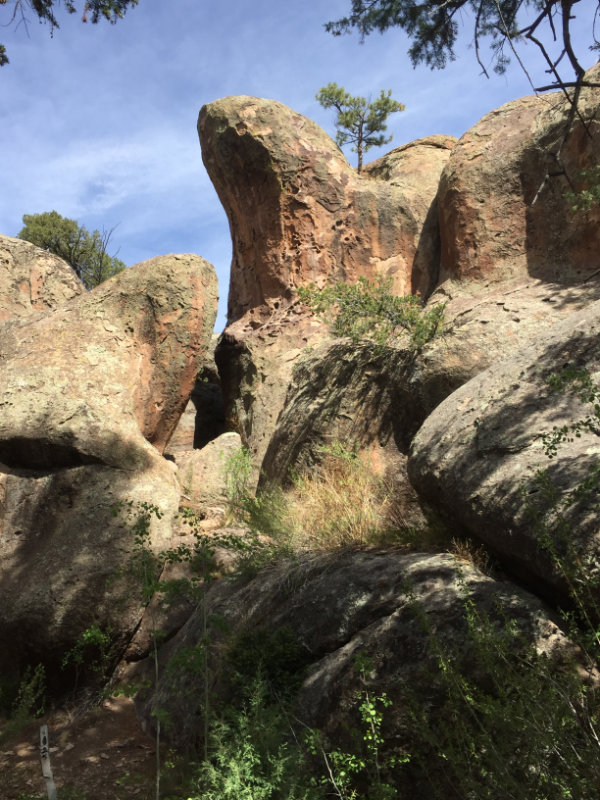
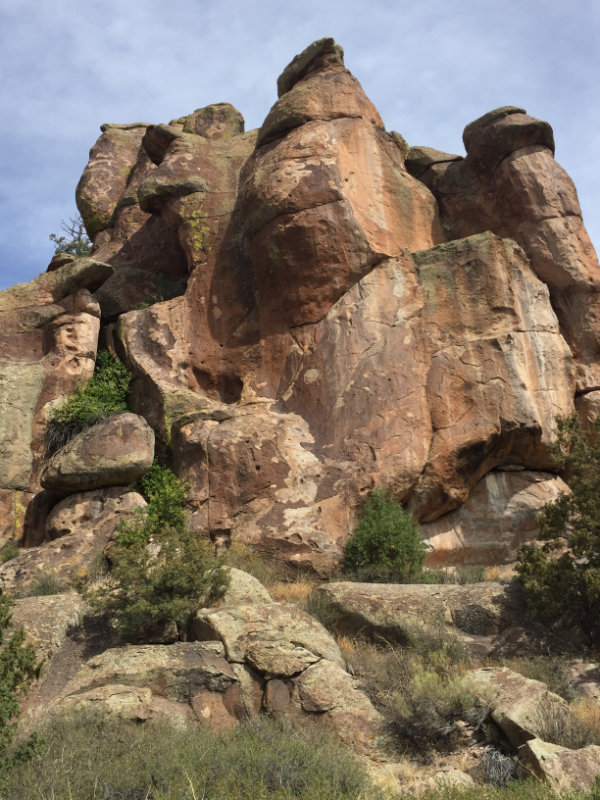
Pentitente Canyon (poem)

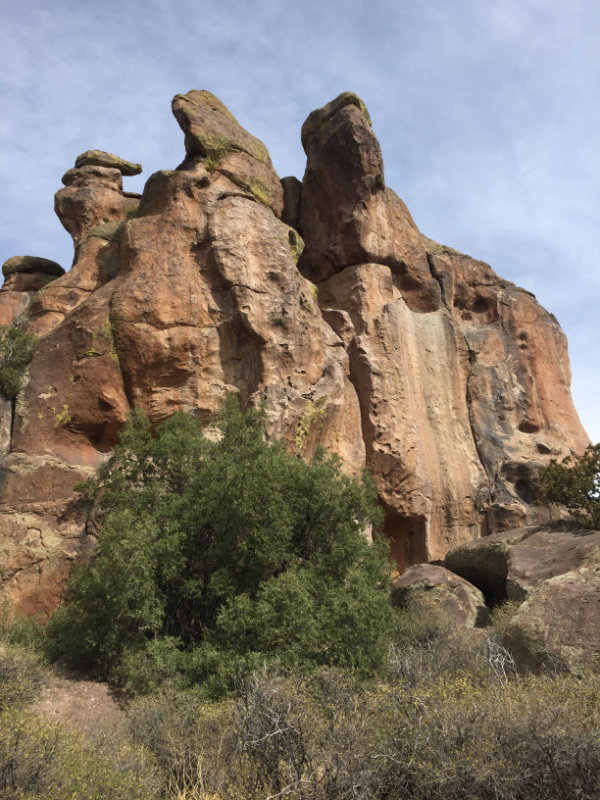
Across the Victorious Scrub Brush, Crow Spirals

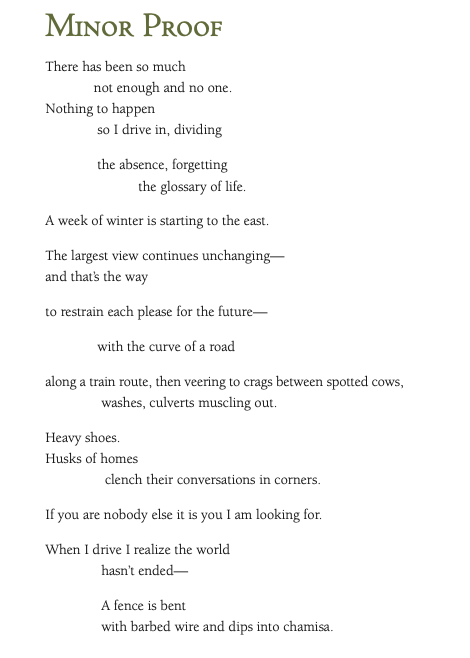
Minor Proof (poem)


Lauren Camp is the author of five poetry collections, including Took House, published by Tupelo Press in 2020. Her honors include the Dorset Prize and finalist citations for the Arab American Book Award and the New Mexico- Arizona Book Award. See more at laurencamp.com.

All photographs by D. Camp.
Lauren Camp (opens in a new tab) served as the second New Mexico Poet Laureate. She is the author of nine poetry collections, including In Old Sky (Grand Canyon Conservancy, 2024), winner of the New Mexico Book Award, which grew out of her experience as Astronomer-in-Residence at Grand Canyon National Park, and Is Is Enough (Texas Review Press, 2026). Her poems have been translated into Mandarin, Turkish, Spanish, French, and Arabic.

We Like Your Digs, Your Style, and Your Art

By Julie Sasse

Elaine Horwitch was a major force in contemporary art in the Southwest from the late 1960s until her death   in 1991. She was responsible for launching the careers of hundreds of artists from the Southwest and the nation.  She promoted the integration of fine art and crafts as well as contemporary Indigenous, Latino, and Southwest art within global art contexts. Horwitch opened her first art business in Scottsdale in 1964 and the first Elaine Horwitch Galleries in Scottsdale in 1973, followed by galleries in Santa Fe in 1976, Sedona in 1982, and Palm Springs in 1986. She was a catalyst for the rise of what has been coined “Southwest Pop” and the “Art of the New Southwest.”

With a spotlight on Horwitch’s colorful life, galleries, and artists, Julie Sasse’s Southwest Rising: Contemporary Art and the Legacy of Elaine Horwitch (Tucson Museum of Art and Cattle Track Press, 2020) surveys art in Arizona and New Mexico from the middle of the nineteenth century through the early 1990s, revealing the artistic journeys and accomplishments  of hundreds of artists, galleries, and art professionals who contributed to the Southwest’s rich cultural heritage.

In the book, excerpted here, Sasse, who worked at Elaine Horwitch Galleries for fourteen years, presents a combination of biography, memoir, and a historical overview of the arts and the rise of contemporary art in Arizona and New Mexico.

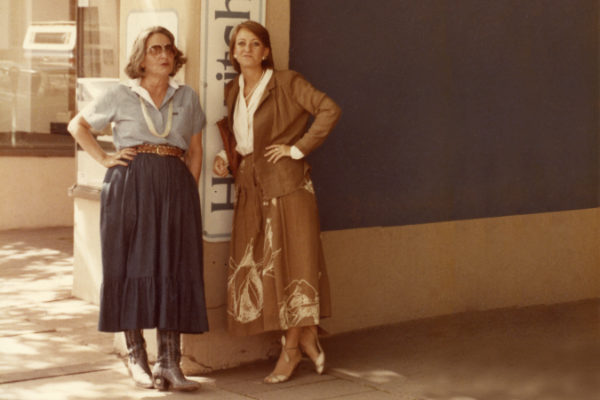
Elaine Horwitch and Julie Sasse in front of Horwitch’s Santa Fe gallery, 1984. Photograph courtesy Julie Sasse.
Elaine Horwitch and Julie Sasse in front of Horwitch’s Santa Fe gallery, 1984.
Photograph courtesy Julie Sasse.

Horwitch Opens in Santa Fe

As early as 1956, Elaine and Arnold  Horwitch  began  to  visit Santa Fe on a regular basis and made a special trip in 1958 to attend the second season of the Santa Fe Opera at   its open-air theater with panoramic views of the countryside. O’Keeffe and other noted celebrities were known to frequent the opera, so it was a thrill to spot many of the cultural elite who were an essential part of the artistic fabric of the region. […] In the summer of 1974, after years of making regular trips to Santa Fe, the Horwitches rented a condominium at Fort Marcy Compound on 320 Artist Road to look into the idea of opening a gallery. Horwitch often spoke to her artists about expanding into Santa Fe, including [Billy] Schenck, who hoped she would act on her dream so he could have a new venue for his work. Coming out in the summer, she investigated the art market, became involved in the social activities of the town, and learned about the various artists who were establishing themselves in the area.

Opening a gallery in Santa Fe was Horwitch’s dream come true. Her daughters were growing up; Wendy was almost twelve, Mindi and Deena were in high school, Carrie was living on a kibbutz in Israel, and her son Mark was away at Harvard. She was finally able to travel more freely and invest in the time it would take to launch a gallery in Santa Fe. As Horwitch later recalls:

I wanted to find a place to spend four or five months a year where the weather wasn’t so hot. But I thought that   I should have a reason to be here, a gallery. People told me that you could not sell contemporary art in Santa Fe. My husband thought I was crazy, but he went along with it. I knew that we could make it here. You have to have a certain amount of intuition about what you are doing.

In 1976, the Horwitches moved to a new house at The Compound and found a location for a gallery on 129 West Palace Avenue, only a block and a half from the Plaza. The gallery was a short walk to the Museum of Fine Arts and the Portal of the Palace of the Governors, where Native American and Hispanic artisans had come to sell their wares since the early twentieth century. Her building had deep roots in presenting regional crafts for which Horwitch later became known. The ample space, still adorned on the ceiling with the original white-painted embossed tin tiles, was owned by Leonora Curtin Paloheimo, who established and operated the Native Market in the mid-1930s to promote New Mexico folk arts and crafts.

Although a legacy existed at this historic site, it was not a guarantee of a successful enterprise. Melding Southwest contemporary art and folk art with nationally and internationally acclaimed artists was a risky business, considering the deep trench that had drawn boundaries between art and craft over the centuries. However, artistic lines were being blurred since the late 1960s, and the plucky Horwitch accepted and even encouraged the melding of the two disciplines. The Paloheimos were the Horwitches’ landlords, and Yrjö Palaoheimo often stopped by the gallery to visit and conduct business with Arnold. While from different eras and artistic aims, Paloheimo and Horwitch were both enterprising women who shared a deep love of the Southwest and a dedication to supporting arts and crafts from the Southwest. […]

With such an illustrious history of 129 West Palace Avenue, Horwitch had big shoes to fill, but she was up to the task. On June 27, 1976, she opened her season with a great flourish,   a group show of works by [Fritz] Scholder, [Earl] Biss, and Sam Francis, an unlikely trio, but it brought in a crowd. However, Horwitch was never one to keep things simple, and her strategy of diversity was well-received. According to John Hamilton of the Santa Fe Reporter:

The building has been beautifully renovated into a light, airy and attractive space for the display of a pot-pourri [sic] of paintings, drawings, sculptures, ceramics, wall hangings and jewelry which offers something for everyone who likes contemporary or modern art. Welcome to Santa Fe, Elaine Horwitch. We like your digs and your style and your art. There wasn’t a dog in the exhibition.

Biss was an obvious choice for Horwitch’s Santa Fe season. Scholder had ignited a contemporary Indian art movement in Santa Fe, and Biss was already showing promise at her Scottsdale location. Furthermore, his studio in Santa Fe was in a new complex on 2200 West Alameda, just down the street from Horwitch’s gallery. Several other artists had also moved their studios away from historic Canyon Road to the cheaper complex, including [T.C.] Cannon, [Douglas] Hyde, [Peter] Jones, and Kevin Red Star. At the space, artists could work without interruptions from the throngs of tourists combing the streets of Canyon Road yet still conduct business with serious buyers.

Of the Alameda group, Horwitch had shown Biss, Hyde, Jones, and Red Star in her Scottsdale gallery. She really wanted Cannon, but he had an exclusive with Aberbach Gallery in New York City. Although the action was at Horwitch, these artists were aware that they could not compete with their mentor and Horwitch’s star artist—Scholder. Everyone knew that Scholder came first. He insisted on vetting her artists and expected her to show him extreme generosity. Horwitch bought Scholder a dark green 1937 Jaguar. When he gave it to his wife Romona, Horwitch did not react. She simply gave him a Rolls-Royce. Within a year, only Scholder remained at the gallery.

Everyone in town came to Elaine Horwitch Galleries’ grand opening. One newcomer to Santa Fe not only attended the festivities, he also got a job. David Rettig knew of and admired Scholder and was a friend of Cannon, meeting him in 1975 when he was a work-study student at Dartmouth and they were artists-in-residence. Cannon encouraged him to move to Santa Fe, so he took him up on the challenge. Rettig came to the grand opening of Elaine Horwitch Galleries and a week later, he paid another visit with Cannon:

There was road construction out front, so it was muddy and hard to get to. I came into the gallery with T.C. Cannon to apply for a job. Elaine recognized T.C. and called out, ‘I want to buy one of your paintings!’ He declined because he only showed with Gene Aberbach in New York at the time, a man who owned Sun Records and made his fortune off Elvis Presley. She kept badgering him to sell her a painting to no avail, so she said, ‘What about a car—do you want  a new car? Let’s trade!’ So, T.C. answered, ‘I want a truck, and my friend here needs a job.’ T.C. never got the truck, but I got the job.

The Action in Santa Fe

In the 1980s, Santa Fe’s population had reached almost 50,000 residents, nearly tripling in size since 1940, and new exclusive housing developments were spreading out beyond the city limits. Nonprofit agencies became more prominent as a result of the infusion of financial support. For example, the Western States Arts  Federation  (WESTAF)  established its headquarters in Santa Fe, serving a twelve-state region of support to the arts. Additionally, Stuart Ashman became the Visual Arts Coordinator at the Foyer Gallery at the Armory for the Arts, later becoming the coordinator for exhibitions at the Governor’s Gallery. In the heart of the city, the Museum of Fine Arts revived Alcove shows, bringing back the tradition of supporting artists from the region that had spanned 1917 through the 1950s. Promoting film, video, performance art, and other new media, Rising Sun Media Arts Center, founded in the late 1970s by Bob Gaylor and Linda Klosky, transformed into the new Center for Contemporary Arts in 1983. At first, the center occupied a gallery in the basement of the Armory for the Arts until locals raised money for a new building on the Armory campus in the mid-1980s.

The art market was a key catalyst for the support of the arts in the region at that time. Santa Fe was reported in the press as being third in art sales volume next to New York City and Los Angeles. Sophisticated new gallery guides proliferated, and publications devoted to the arts increased, including the launch of Artlines magazine in northern New Mexico in 1980, founded in Taos by Nancy Pantaleoni and Stephen Parks. Fashion designers, writers, actors, movie directors, musicians, conductors, and visual artists flocked to the city, and Elaine Horwitch Galleries was the meeting place for everyone to get the latest art gossip, find a good restaurant or nightclub, and get on a party list—all while sales were in constant motion. For example, the Duke and Duchess of Bedford, who lived on a five-acre estate called Rancho Viejo, bought art from Horwitch and often came in to see the new arrivals of art and artists.

Elaine Horwitch Galleries was a first stop for well-heeled new residents. In the early 1980s, Nancy and William Zeckendorf, Jr. arrived in Santa Fe from New York City, where William had been a real estate developer. Nancy and William met Horwitch through mutual friends Marjorie and Julian H. Levi, a Chicago lawyer and urban renewal advocate. Levi had worked with William “Bill” Zeckendorf, Sr. in Chicago in the 1950s. When Frank Lloyd Wright’s Robie House was slated for demolition in 1958, Levi enticed Zeckendorf, Sr. to purchase the historic house to preserve it. The Zeckendorf family had a long history in the Southwest, beginning with Aaron Zeckendorf, who founded a mercantile company in Santa Fe in 1854. Nancy fell in love with Santa Fe before she married William when she was a principle dancer with  the  Metropolitan  Opera  and danced for the Santa Fe Opera Company. In 1983, the Zeckendorfs purchased the site of the historic Big Jo Lumber Company at 309 San Francisco Street and began to make plans for their latest real estate venture, the Eldorado Hotel. Opening in 1986 to great fanfare, the 200-room, fifteen-million-dollar Santa Fe Style hotel was touted as the latest and largest luxury hotel in Santa Fe. Hundreds of the most prominent Santa Fe residents came to the grand opening as a benefit for the Santa Fe Community Foundation.

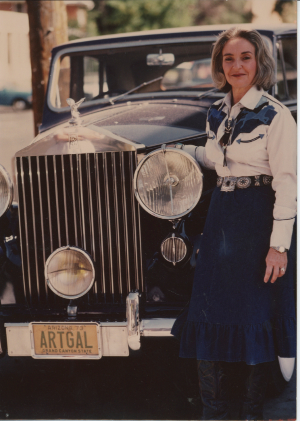
Elaine Horwitch by her Rolls-Royce, circa 1980s. Photograph courtesy Deena Horwitch Semler.

One of the special features of the hotel was the formidable presence of contemporary Southwest art, including large- scale works by [John] Fincher, Douglas Johnson, and other Horwitch artists. As Nancy Zeckendorf recalls:

Elaine’s gallery was always the place to go to see new art and she introduced everyone to everyone. Bill was so grateful for his friendship with her when we first came to Santa  Fe, and we were like family. We bought paintings by Fritz Scholder and Judy Rhymes from the gallery and Bill rode horses with her. When we decided to build the Eldorado, he gave the Horwitches a small interest in the hotel, and in exchange, Elaine supplied the art.

Nancy could always count on Horwitch to participate in her many philanthropic projects, including the Santa Fe Opera and the Lensic Performing Arts Center, developed by her husband. Horwitch knew everyone in town, and she had the clout to make introductions and wrest substantial amounts of money from her many clients for worthy causes.

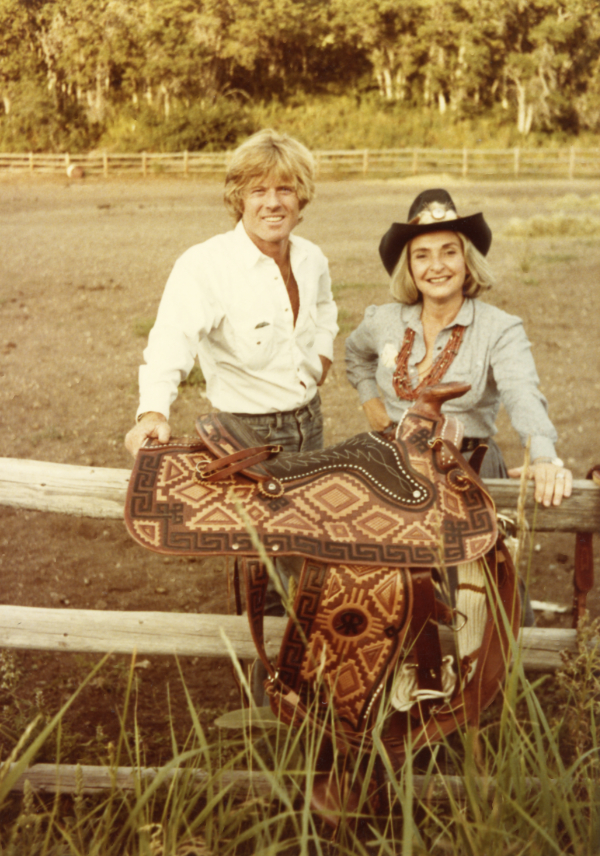
Elaine Horwitch with Robert Redford, Sundance, Utah, 1981.
Photograph courtesy Nancy Silver.

Fashion designer Ralph Lauren, who launched his “Santa Fe Collection” in the fall of 1981, came regularly to Horwitch’s gallery with his wife Ricky to buy Indian jewelry and blankets for his Native American and frontier-inspired fashions. Designers Zandra Rhodes and Jean-Charles de Castelbajac also paid visits to the gallery, staying to talk about their ideas and getting new ones from Horwitch’s eclectic offerings. Horwitch kept an open copy of People magazine at the front desk to spot a passing celebrity, and she never hesitated to grab someone off the street to bring them into the gallery if she knew them to be famous. Often, Horwitch’s staff would alert her to notable patrons if she did not recognize them. The day that Rhodes first came to the gallery, she was not aware that the flamboyant magenta redhead was a famous clothing designer and snarled, “Who is she? She’s not a buyer.” Employee Steven Ward replied, “You don’t know who that is Elaine? That’s Zandra Rhodes. She’s one of the greatest fashion designers in London.” Within minutes, Horwitch was busy making Rhodes her new best friend. She occasionally did not know some of the important people visiting her gallery, but it was of no consequence because they were eager to make her acquaintance. Horwitch was a celebrity in her domain.

Santa Fe not only became a top destination city, it also became the subject of a “road show” at Lord & Taylor’s department store in April of 1982. Called “Focus America,” the Santa Fe Chamber of Commerce, Horwitch, and other gallerists assembled artists and artisans for the special display, including a reconstruction of Horwitch’s bedroom in her Santa Fe house. Weavers, potters, jewelers, folk carvers, and fine artists were included in this special event. Felipe Archuleta, Brian Blount, [Randy Lee] White, Char & Sher fashion designers, Galisteo potter Priscilla Hoback, and several Native American artisans displayed their works, which stoked the fires of desire for all things Santa Fe in New York City and beyond.

Keeping pace with the influx of celebrities, artists, and movies to the area, new restaurants began to spring up, making Santa Fe a food as well as an art destination. Mark Miller was one of the most notable. In the 1970s, Miller had worked for Williams-Sonoma and at Alice Waters’s Chez Panisse restaurant, noted for its innovative cuisine. In 1979, he started his first restaurant, the Fourth Street Grill in Berkeley, followed by the Santa Fe Bar and Grill in the same city. Miller first visited the Southwest in the mid-1970s on a road trip and had long been entranced by the region. With the success of his two new restaurants in California, he bought land outside of Santa Fe in the Jemez Mountains. In 1985, Miller moved to Santa Fe permanently and opened a restaurant called the Coyote Café, influenced by Leroy Archuleta’s carved cottonwood coyotes. Miller’s restaurant was a favorite of artists, collectors, and tourists, and he decorated his café with works by many of Horwitch’s artists.

Horwitch in Santa Fe: Paradise Found

Horwitch’s life revolved around riding her horses in the hills near her home, attending Indigenous dances, going to the flea market, and interacting with artists, collectors, and celebrities, who embraced all that Santa Fe had to offer. When she rode, Horwitch’s cowboy/caretaker Phil Kniffen saddled and unsaddled the horses and put them to pasture. Kniffen lived in a rustic one-room adobe house on the property with his wife Gloria, when they were not at their own home in Nambé. Within a couple of years, Dale Harris, a handsome jeweler and horse wrangler who always wore clanging spurs in the house, replaced “cowboy Phil.” Harris moved his family into a pre-fabricated house, stuccoed to look like adobe, that Horwitch installed on the property, and turned the old adobe hut into his jewelry shop. Both Kniffen and Harris enjoyed the “city slickers” who came to visit Horwitch and the attention they received as her cowboys.

Immersing herself in Santa Fe culture, in the 1980s, Horwitch rode her horse, festooned with an ornate silver saddle and bridle, in the Fiesta Parade. Horwitch increasingly took on the appearance of a cowgirl. She was often seen in her office leaning back in her chair, picking her teeth with a toothpick, and crossing her legs on her desk, her revolver in plain view. She wore colorful knee-high Larry Mahan cowboy boots from her stash of thirty, a straw cowboy hat with feather adornments from Fast Eddie’s hat shop in Aspen, a denim prairie skirt, and a fitted plaid shirt with pearl snaps. Every outfit was embellished with a classic silver concho belt and layers of fetish, turquoise, and silver necklaces. Her look was so distinctive that some noticed that Riva Yares stopped dressing in Western clothes, perhaps realizing that she had met her match.

As at her gallery in Scottsdale, Horwitch needed to increase her staff for her growing operation in Santa Fe, and in 1980, she added the quiet and inquisitive Steve Piepmeier to her Santa Fe sales staff. Working with Ann Wilson, he became a trusted employee for six years, carefully observing the dynamics of collectors, employees, and artists. Over the years, in vivid detail, he recorded in his journals the parties, arguments, sales, and emotional outbursts in the gallery. In 1984, Horwitch hired the statuesque Kelly Cozart, a recent bachelor of fine arts graduate in ceramics at Texas Tech University in Lubbock. Cozart’s husband Brett had recently taken a position at Shidoni, and Cozart worked at the gallery part-time while raising a newborn son. A fresh-faced young woman from Idalou, Texas, she was thrust into the sophisticated art world, and Horwitch and Pfaelzer never hesitated to make fun of her heavy Texas drawl and naïveté. Cozart took it in stride, believing that her experience at the gallery was “like getting a graduate degree in the business of art.” With her beauty and positive outlook, she soon became one of the most popular gallerists at the Santa  Fe gallery.

Soon after Horwitch hired Cozart, Horwitch added John Guernsey to her Santa Fe staff, a handsome, introspective man, newly arrived from Colorado to work on a new Zen center in the area. Answering an ad in the newspaper, Horwitch quickly hired him. Guernsey had never worked in a gallery before, so he learned to install and handle art on the job. Guernsey found Horwitch’s quirks amusing, recalling, “She always had a phone in each ear, a cigarette in her hand, and a hamburger on the desk in front of her.” To him, part of the appeal of the gallery was that everyone worked hard but enjoyed it, and every day seemed like a party, with all gravitating around Horwitch. The staff started to make cappuccinos in the back kitchen and serve them to the artists who came to the gallery to hang out with Pfaelzer, and tequila or martinis for themselves after a long day of catering to demanding artists and finicky collectors.

Business was so good that Horwitch added Nicholas Sealey to her Santa Fe team to work with Guernsey in 1985. Sealey was an art-circle insider in town who had been working as a crater and shipper for Ancient City Art Shippers before starting his own crating business, so he knew the volume of art that went in and out of the gallery. Tall, dark, and handsome with a seductive British accent, he charmed the artists and customers alike, calling everyone “love.” Horwitch knew that he would be an asset as a preparator, but he could also sell art to her wealthy clients who enjoyed interacting with such an attractive and engaging young man. Women of all ages streamed into the gallery throughout the day asking for Sealey to show them art, often avoiding the trained female staff in front of them.

Nicholas Sealey, Elaine Horwitch, Steven Ward, and Julie Sasse. Photograph courtesy Julie Sasse.
Nicholas Sealey, Elaine Horwitch, Steven Ward, and Julie Sasse.
Photograph courtesy Julie Sasse.

Truckloads of art needed to go back and forth between Scottsdale and Santa Fe, and staff would do the same, working wherever they were required, depending on the season. In Scottsdale, Horwitch had a pool table at her home, and staff would play with her before breakfast and at the end of the day. Ward, [Lisa] Fisher, [Rudy] Fernandez, [Christopher] Pelley, and I often came to Santa Fe to work during the summer months and stayed at the Horwitch house, where work and fun intermingled. Life at the Horwitch compound was always exciting. For instance, while digging post holes on the property, Ward found vintage slot machine parts buried in the dirt, which fueled the rumor that Horwitch’s historic house, built by New Mexico governor John J. Dempsey in the 1930s, was a gambling house and brothel at one time. During off-hours, Ward enjoyed the good life. He rode horses with Horwitch and her friend Ali MacGraw, practiced roping with her caretaker, and prepared art for private showings with celebrities,  including  Michael  Keaton,  Rob  Halford of Judas Priest, and Sylvester Stallone. Swaggering and flirtatious, both Ward and Sealey became Horwitch’s two favorite employees, and she treated them more like friends than staff. But while Horwitch enjoyed their charismatic qualities, she was no pushover. She knew how to channel their confidence and good looks into sales and an enjoyable work experience for everyone.

During seasonal work, some staff slept in a converted garage bedroom on the bottom floor next to Horwitch’s housekeeper Mia. Others stayed in what Horwitch rather insensitively referred to as the “Anne Frank room,” a spacious bedroom hidden behind a false door off the kitchen. Later, she purchased the house next door for staff to use in the summer. Those who stayed at her compound were allowed unfettered access to the two large refrigerators in her commercial-grade kitchen. If she brought in extra help for Indian Market and the house was full of guests, she would rent rooms for the staff at the De Vargas Hotel, a cheap hotel with few amenities at the time. Staff found a way to make it fun, using toilet paper for napkins at impromptu cocktail parties, and inviting Horwitch and her visitors to join them in their downtown antics.

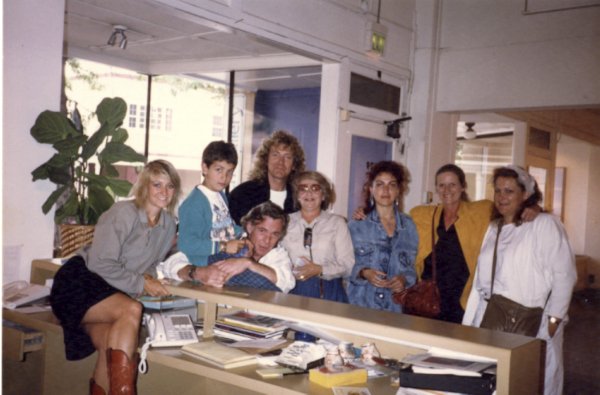
ulie Sasse, Logan Romero, John Morris, Robert Plant, Elaine Horwitch, Carmen Jane, Char Velasquez, and Dale Kern at Elaine Horwitch Galleries, Santa Fe, New Mexico, 1982. Photograph courtesy Elaine Horwitch Galleries.
Julie Sasse, Logan Romero, John Morris, Robert Plant, Elaine Horwitch, Carmen Jane, Char Velasquez, and Dale Kern at Elaine Horwitch Galleries, Santa Fe, New Mexico, 1982. Photograph courtesy Elaine Horwitch Galleries.

Horwitch treated staff like family, but she did not tolerate it when some got too close to her artists or engaged in bad behavior, and she could turn on a dime from best friends to tyrant if staff became too personal with her clients. “She could be the fun art dealer making it fun for everyone or the Wicked Witch,” recalls one employee. “If she got pissed, she was like Dr. Jekyll and Mr. Hyde. She had a way of giving a pass to all the men and always held the women accountable.” Other staff saw her mood swings differently—some noticed that when Horwitch’s energy level dipped, she began to pick a fight to get her adrenaline up. Even with her strict standards and volatile temper, some staff often willingly worked on their days off and vacations, or rented their own apartments in Santa Fe, simply to be where the action was.

During Indian Market, Horwitch was always on the lookout for free help. She also had summer interns, many whom were the sons and daughters of New York City and Paris gallerists or other art professionals. Interns were given basic duties and limited access to Horwitch’s inner circle of artists and collectors. Still, their pedigrees and youth added intrigue and a new level of cultural cachet to the gallery name. For example, Sharron Lannan, the daughter of J. Patrick Lannan, Jr., whose father established the Lannan Foundation, worked in the Santa Fe gallery for a summer, much to the delight of the male artists, who found her attractive.

David Aberbach was another intern at the Santa Fe gallery. His father, Joachim Aberbach, was an art dealer and the founder of Hill and Range Songs, noted for publishing such hits as “I Walk the Line,” “Frosty the Snowman,” and “Love Me Tender.” Aberbach opened his Manhattan gallery in 1973 and represented T.C. Cannon, so he was well aware of Horwitch’s presence in the Southwest. In 1986, he sent his son to spend the summer with Horwitch so he could learn the art business without his direct influence. However, the young Aberbach was not a dedicated gallerist and preferred to spend more time smoking pot in the storage building than to learn the business. As employee Carol Sherman recalls, “One day, Guernsey handed him a can of paint and a paintbrush and told him to do touchups in the gallery. He splattered paint over several paintings, so Guernsey hauled off and slugged him.”

Julie Sasse is the author of more than forty published art books, exhibition catalogs, and essays. Dr. Sasse is the chief curator at the Tucson Museum of Art, where she has organized more than 100 solo and group exhibitions of regional, national, and international artists.


El Palacio presents this excerpt in advance of an associated exhibition, Southwest Rising: Contemporary Art and the Legacy of Elaine Horwitch, slated to open at the New Mexico Museum of Art on March 13 and to run through January 2, 2022. Due to uncertainty caused by the COVID-19 pandemic, please call the museum to confirm details before scheduling your visit.

The book Southwest Rising: Contemporary Art and the Legacy of Elaine Horwitch is available for purchase from the Tucson Museum of Art and Cattle Track Press.

Southwest Rising was written with contributions from research conducted during a residency by the author at the Women’s International Study Center, Santa Fe, New Mexico.

Dr. Julie Sasse is the author of more than forty published art books, exhibition catalogs, and essays. Dr. Sasse is the chief curator at the Tucson Museum of Art, where she has organized more than 100 solo and group exhibitions of regional, national, and international artists.

Elaine Horwitch (1933-1991) got her start in as an art dealer by selling painting out of her station wagon in Scottsdale, Arizona in the 1970s. Later, she became a major force in contemporary art in the Southwest and was responsible for launching the careers of hundreds of artists from the region. With galleries in Scottsdale, Santa Fe, Sedona, and Palm Springs, she was a leader in fostering what has been called “new Western art” or “Southwest pop.”

Blackdom in the Borderlands

Editor’s Preface

With widespread reporting on racial disparity in the United States in 2020 has come a renewed interest in a New Mexico site not often discussed: Blackdom, an all-Black settlement in the southeastern corner of the state, founded in 1903 and occupied until the 1920s.

Historically, conversations about Black people project the intentions of others and obscure deep analysis of Black folks. As a society in the post-Obama era, we must ask new questions about Black people and reframe histories we thought we knew. The summer of 2020 resembled the summer of 1919, a time referred to as Red Summer—a pandemic was raging, Russia was in the news, and violence against Black bodies was both state-sponsored and vigilante-inspired. One might argue that history repeated itself.

As the state of New Mexico enters its second century and grapples with the histories that came before, this essay about Blackdom, New Mexico, provides a model; as modern historians do not subscribe to the idea of “history repeating itself,” we must instead focus on relearning and reimagining our preconceived notions of success, failure, and equality.

The most common narrative about Blackdom is that its original homesteaders established their own town in order to escape the oppression of American white supremacy, but found farming in the arid and acrid Permian Basin challenging, and soon abandoned their efforts.

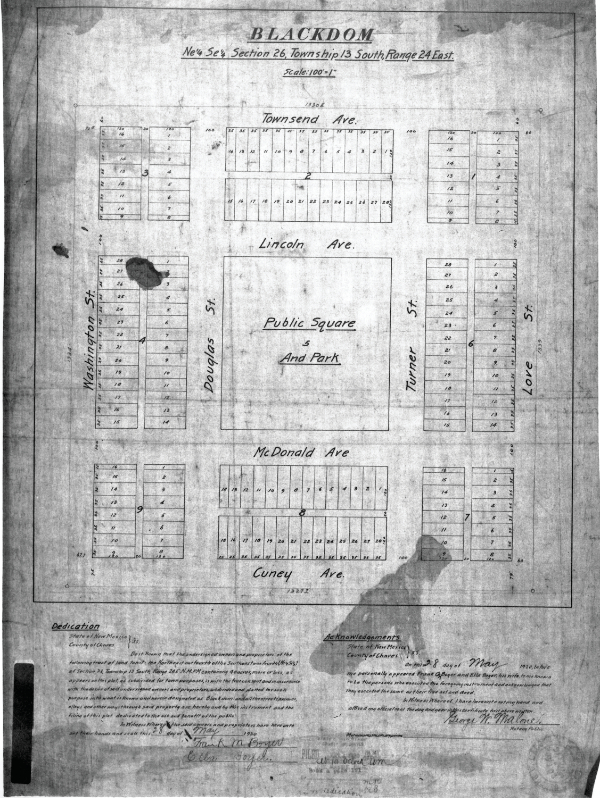
Blackdom Township Plat map, 1920. Courtesy New Mexico State University Library, Rio Grande Historical Collection, item no. RG98-102-001.
Blackdom Township Plat map, 1920. Courtesy New Mexico State University Library,
Rio Grande Historical Collection, item no. RG98-102-001.

Recently published scholarship by historian Dr. Timothy E. Nelson, however, suggests Black people intentionally used the legal and social system of separate-but-equal to their advantage. Travel, then, to what  Dr. Nelson refers to as the Afro-Frontier—immerse in a new history of the prairie. Rather than a story of ultimate failure, you will read a story featuring the ingenuity of a community that made use of a corporate veil to achieve sovereignty in the chaos of the borderlands at the turn of the twentieth century.

What appears today to be a physical ghost town is, in fact, a testament to Black ingenuity in the face of immense hardship; rather than a story of agricultural failure, Blackdom is a story of generational economic success.

-Charlotte Jusinski


Introduction

In the early 1900s, the North American continental interior hosted two different centuries-long global colonization schemes. The Pecos Valley region’s economic surge underwent the largest infrastructure projects in the world at the time and brought exploitation of people and land. African descendants under the conditions of American Blackness (Black people) sought opportunity in the colonization collision at Mexico’s northern frontier and the United States’ western frontier. Through the homestead process in the southeastern section of the New Mexico Territory, Black people became colonizers. After the discovery of oil in New Mexico, they fully participated in the bonanza and received royalties that extended through the post-World War II era. In this essay, we explore an intersection of African descendants in diaspora, who quarantined themselves to achieve the goals of their ancestral strivings.

Blackdom, New Mexico, was an Afrocentric microcosm of hegemonic society and the result of colonization efforts that spanned over four centuries. The first major global colonization scheme is familiarized by the stories of Christopher Columbus. In the late 1400s, during the exploitation of Indigenous peoples and their lands, some Africans benefited from the spoils of war to include landlordship. The second major colonization effort began in the late 1500s, when a new set  of European colonizers lurched westward into Indigenous spaces. Launched from the European continent, Africans from the western and northern parts of their homeland sought opportunistic employment through military service with the colonizing forces. African soldiers helped seize what became Mexico on the North American continent.

In the 1800s, the two sets of colonizers converged amidst the chaos of Mexico’s northern frontier, in all-Black military units. Buffalo Soldiers engaged a Spanish-speaking borderland as an occupying force and border patrol. By 1900, African descendants in the U.S.-Mexico Borderlands carved out spaces to fully develop an Afro-Frontier. Significant in the trajectory of African descendant peoples in diaspora, Blackdom embodied a declaration of sovereignty: separate-but-equal.

In September of 1903, thirteen Black men signed the Blackdom Townsite Company’s articles of incorporation and were able to function as businessmen first, rather than citizens of  a certain race, which further protected them from pervasive racism. However, Blackdom’s grand opening in May of 1904 fell short of expectations, in part due to the lack of interest to follow through on the homestead process on desert prairies.

The prospect for a town languished until the 1909 Homestead Enlargement Act. Partitioning themselves at the contested intersection of the U.S.-Mexico Borderlands, Black people who were diverse in age, character, and capacity unified to consciously engage in Afrotopia. New Mexico was on the verge of statehood, and an incorporated all-Black town had the potential to produce generational wealth.

On the eve of New Mexico’s 1912 incorporation as a state of the union, Blackdom was revived and functioning as a thriving unincorporated town until May of 1920. Particularly after statehood, Blackdomites found opportunity behind the corporate veil of their municipality. Newly discovered documents have revealed that Blackdom’s third decade, during the Roaring Twenties, included the advent of Blackdom Oil Company. In May of 1920, Francis (Frank) Marion Boyer and his wife Ella (McGruder) Boyer filed the official plat for the Town of Blackdom, which documented the surveyed location and details about the terrain. In the State of New Mexico, on Mescalero Apache Reservation land with Chaves County, Black- domites mapped a township of blocks, streets, and alleys in a grid pattern with a Townsquare in the center. Once officially incorporated, the county, state, and federal authorities were able to assess property values and taxes.

A tricultural (Indigenous, Spanish, White) understanding of New Mexico precludes the public acknowledgement of Black folks striving—and thriving. For example, Blackdomites were at the vanguard of regional oil market forces without the impositions of a White-dominated society. Yet, few people in New Mexico have been exposed to this history.

On biblically dry desert prairies, Black people realized their Afrotopic ambitions because they incorporated and made their living a business. The Blackdom Townsite Company was an economic vehicle to drive Blackdomite success in the creation of generational wealth. When the Blackdom experiment began in the Territory of New Mexico, federal laws and jurisdictions superseded any laws or local ordinances and made Jim Crow law in the territory hard to enforce. Until statehood, Blackdomites had no higher authority than God. The territory Jim Crow-law loophole afforded Black people full authority to realize their dreams. The incorporation of the Blackdom Townsite after statehood was for the protection of their sovereignty on government “promised land.”

1903-1909: The Lost Years

Blackdom’s early years were lost to “the struggle.” Over time, Blackdomites mitigated the initial hardships of homesteading by providing apprenticeship programs and host families  to new immigrants. As  newcomers,  Blackdomites indulged in their duality as thinkers and doers; they brought together their experiences of religious teachings, military service, and Prince Hall Freemasonry that amalgamated into an intentional intersectional sovereign Blackness. During Blackdom’s lost years, the idea of building a town in the Pecos River Valley was far-fetched, akin to believing in miracles. As Blackdomite homesteaders, they forged bonds working on their own land, in church, and masonic lodges, as all of them were required to submit to divine laws of sowing and reaping declared in the articles of incorporation of the Blackdom Townsite Co.

In the first wave of homesteaders, Crutcher Eubank, born and raised in the South under the institution of slavery, had witnessed its demise after the U.S. Civil War (1861-1865). As a young man, Crutcher also watched the rise of white supremacy and suffered the conditions of American Blackness. Moreover, in 1896, The Supreme Court decided that Black people were legally allowed to be separate. In his adult life, Crutcher saw the end of American Reconstruction and the beginnings of modern American racism; and yet, he and his family decided to migrate into the frontier, where there was more insecurity and civil mayhem. The Eubank family witnessed chaos throughout the nineteenth century, and chose Afrotopia at the turn of the twentieth century.

In 1905, during America’s racial nadir, Crutcher and the Eubank family migrated to the New Mexico Territory from Kentucky. They settled in Southeastern New Mexico in the small, unincorporated community of Blackdom, where Crutcher began the family homestead patent on October 9, 1906, and he became the pastor of Blackdom’s first church. Pastor Eubank not only preached about faith; he chose to live his faith by homesteading on New Mexico’s desert prairies. By faith, he started planting kaffir corn in the winter, a warm-weather plant. This corn variety had slow early growth and wasn’t ideal to plant in a cold winter ground. Crutcher quickly learned that if planted too early, late replanting was needed, which made his leap of faith inefficient—even worse, if a sufficient stand was secured in the first planting, the growth of the young plants would grow slowly, weeds aggressively grew, and more cultivation was needed.

The Eubank family was faithful, consistent and hard-working, but they sowed seeds in the right place at the wrong time and reaped little harvest for their toil. Water was hard to access, and planting mishaps could prove financially ruinous. In a completely new climate than they were used to, they were forced to pivot and transition into new agricultural cycles. Specifically, they needed to adjust to the biblical drought conditions. They adjusted by learning the vagaries of irrigating desert land to subsist. In their “Promised Land,” the Eubank family was on a steep learning curve.

Crutcher, as head of the family, found side hustles to fund the homestead. Typical of Blackdomite society, he often had to leave his family on the unimproved homestead to raise capital working as a laborer in nearby cities.

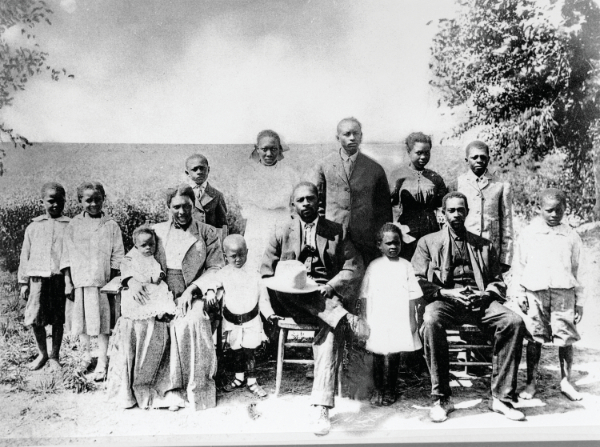
Boyer family, undated. Courtesy New Mexico State University Library, Rio Grande Historical Collection, neg. no. RG98-109-001.
Boyer family, undated. Courtesy New Mexico State University Library,
Rio Grande Historical Collection, neg. no. RG98-109-001.

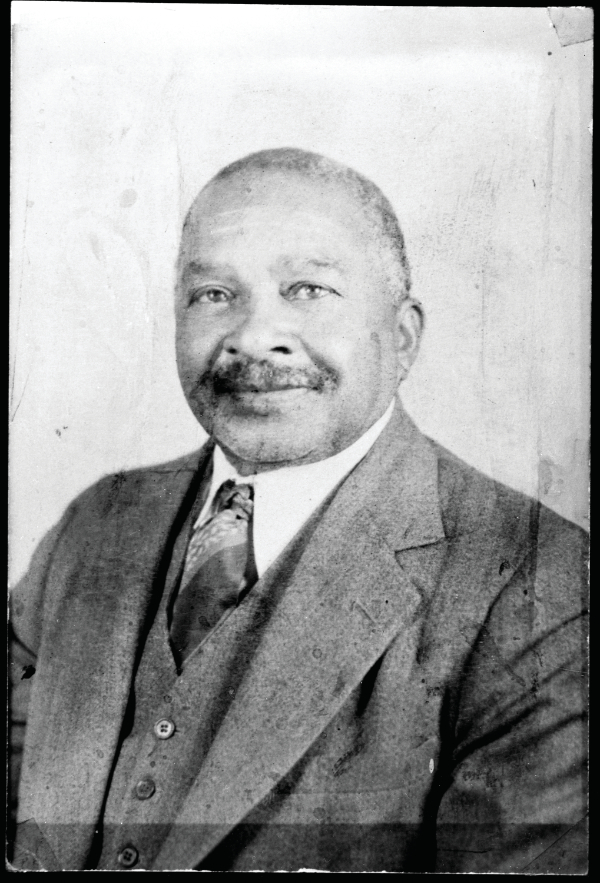
When they first settled in Chaves County, Crutcher and his family were hosted by the Boyer family. Frank Boyer was a minister, a former Buffalo Soldier, a freemason, and served as the first Blackdom Townsite Company president. Crutcher was a minister and, like Frank, part of a religiously inspired homesteader class. The Eubank family endured with the help of the Boyers, who oriented them to the divine laws of the region and homestead process.

The homestead process was complete once a homesteader established residence, built a home, and farmed for three years to be eligible to “prove up” a homestead. According to Crutcher’s homestead proof, he built a modest home worth about $250 ($7,000 today), complete with a porch. Crutcher leveraged most of his capacity and capital in proving up his land with a water well cased up with a mechanical pump worth $350 ($9,000). With the help of family labor and community support, Crutcher fenced 160 acres with barbed wire worth about $125 ($3,000).

Blackdom Township farmers, 1911. Courtesy New Mexico State University Library, Rio Grande Historical Collection, neg. no. RG98-103-001.
Blackdom Township farmers, 1911. Courtesy New Mexico State University Library,
Rio Grande Historical Collection, neg. no. RG98-103-001.

In 1907, Crutcher broke ground on two acres of his land, which yielded little that year. In the 1908 growing season, he planted kaffir corn on another two acres, bringing the total farming acreage up to four. By 1909, he broke ground on another two acres, planting corn, beans, potatoes, and other garden products over the six acres. In 1910, Crutcher did not break new ground to farm; he replanted on the acreage of previous years. Crutcher and the region were relieved as drought conditions ended in 1911.

The Eubank family faced a grueling six years to complete a family homestead patent. To this day, the Eubank family still holds the largest amount of land connected to the original Blackdomite society commons (homesteads within a day’s walk of Blackdom’s Townsquare).

Pastor Crutcher Eubank’s notion of God’s sovereignty manifested into landlordship. Crutcher’s faith helped transform sandy loam—a mixture of silt, sand, and clay—into fertile farmland to secure the futures of his wife and eleven children. He completed the patent process on November 28, 1911, on the eve of New Mexico’s statehood.

1909-1919: The Revival

The Enlargement Act, signed February 19, 1909, began a new era of tremendous growth in land ownership that positioned Blackdomites to enter boom times a decade later. In revival, people who endured harsh, dry growing seasons got reprieve when the laws of the land changed. Passage of the Enlargement Act was the first of many new U.S. colonization tactics to encourage homesteader occupation of confiscated Indigenous desert land in Mexico’s northern frontier.

Bitter border battles exploded into the Mexican Revolution (c. 1910)—this was the backdrop of Blackdom’s ascendence. In the forefront, New Mexico statehood became militarily strategic as Pancho Villa’s raids gained steam and border-dwellers began to view his military campaigns favorably on both sides of the newly erected border. The Enlargement Act sparked Blackdom’s revival by loosening restrictions on who could own land, and increased allotments from 160 acres to 320 acres (a halfsquare mile). Consequently, more Blackdomite women joined the homestead class.

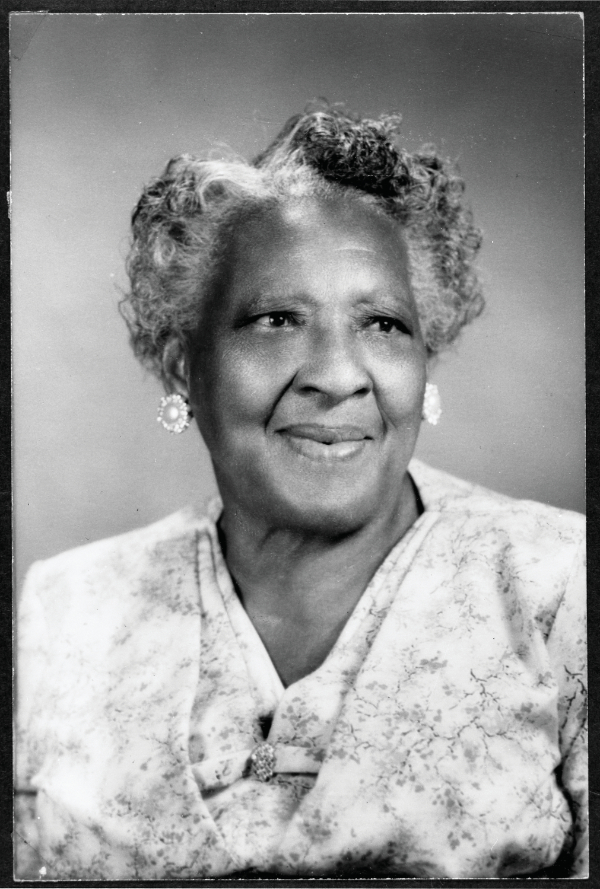
One of the first women to benefit from women’s ascendance in Blackdom was homesteader Ella Boyer, née McGruder. She had agreed to marry Frank Boyer when they were in Georgia during the 1890s; at the time, Frank attended Atlanta Baptist College (Morehouse College today) while Ella attended the Haines Institute. Founded by Miss Lucy Laney, Ella’s school for nurses was where she honed her midwifery skills. Frank was gainfully employed at the Atlanta Constitution as a proofreader when they began their family.

After the Boyers’ 1900 migration to the New Mexico Territory, by 1910, the Boyer household swelled to include ten children. Ella’s life revolved around children, as she “officiated so many births there were too many to count,” according to a 1947 interview reported in the Las Cruces Sun-News. She also held office in the Negro Order of Eastern Star, a Masonic auxiliary organization. In 1909, she became one of the first women to participate in and benefit from Blackdom’s revival. According to her homestead records, she spent about $3,000 ($80,000 today) to prove up her land—but with little success. After numerous extensions, Ella successfully “proved up” her homestead and earned her final patent in December of 1918, on the eve of Blackdom’s boom time. North and adjacent to what would become Blackdom Townsquare’s 40 acres, Ella owned 160 acres.

Approximately 300 Blackdomites (men, women and children) had an insatiable appetite for land ownership, and they absorbed as much as they were legally allowed. John Boyer, Frank Boyer’s older brother, took swift action to take advantage of the Homestead Enlargement Act, which helped him double the size of his land to 320 acres. He had endured a childhood on a plantation under the institution of slavery in Georgia. By 1910, at the age of 54, John reached sovereignty and was in the midst of growing generational wealth via a homestead patent in a municipality he helped build.

John’s Afrotopic dreams materialized with his first land patent on August 16, 1907, when he became the first Boyer to complete a homestead process in Blackdom’s commons. He also owned a home in Roswell, New Mexico, on South Main Street with his wife, Pinkie, and their three sons: Berry (18), Ethon (15) and Porter (14), according to the 1910 Census.

lackdom church and schoolhouse, undated. Courtesy Historical Society for Southeast New Mexico.
Blackdom church and schoolhouse, undated.
Courtesy Historical Society for Southeast New Mexico.

The Boyer family was one of the first multi-generational families of homesteaders in Blackdom. John Boyer’s significant thriving was due in part to being from the Boyer family, which collectively owned over 5 square miles. As an example of the efficiency of their familial homestead system, Frank Boyer and Daniel Keys (who was married to Frank’s twin sister, Francis) started their process on the same day in 1905; they completed their homestead patents on the same day as well, on June 11, 1908. Frank and Daniel owned a contiguous 320 acres near the Pecos River in Dexter, New Mexico.

Further, the Enlargement Act allowed for assignee privileges, which meant Frank was allowed to file for a land patent using the rights of the two women, Mattie Moore and Pernecia Russel, using their ex-husbands’ soldier benefits. Although Daniel Keys did not pursue a new homestead during Blackdom’s revival, Frank began a homestead patent for the 40 acres for Blackdom’s Townsquare with help from Mattie and Pernecia.

At a time of great progress and celebration, on December 7, 1911, the Pecos Valley News reported on a “Negro Thankgiving:”

The Blackdom population has imbibed the spirit of the valley time and have a Booster’s club. This club gave a banquet Thanksgiving evening. Blackdom is the negro town of the Pecos Valley, eighteen miles east [sic] of Roswell. Its citizens and officials are composed entirely of the colored people. Francis [Frank] Boyer was the toastmaster of the evening.

Blackdom School, Blackdom, New Mexico, ca. 1920s. Teacher Loney K. Wagoner (far right).
Blackdom School, Blackdom, New Mexico, ca. 1920s.
Teacher Loney K. Wagoner (far right). Oscar Oliver, Henry Oliver, Ira Taylor, Johnnie Taylor, Inez Oliver, unknown girl in hat, and Evelyn Taylor.
Courtesy Historical Society for Southeast New Mexico.

Blackdomites publicly displayed their success. According  to the article, William Young, who completed his homestead in July of 1911, discussed “immigration.” In a formal setting with musical interludes between speakers, more Blackdomites spoke about the business of Afrotopia. James Eubank answered the toast with an update on the school system, followed by Daniel Keys’s lecture on “What We Produce.” Fellow resident Wesley Williams answered the toast with a brief synopsis of the real estate market; indeed, by the time New Mexico was granted statehood on January 6, 1912, the Afro-Frontier town had developed into an ordered society.

Wesley finalized his first homestead on October 15, 1914, when the Blackdom homestead class increased exponentially. Thriving in revival, Blackdomites employed the skills of Harold Coleman, a journalist from back east, to market the town’s success to entice a new round of investment. From January 1913 through December of 1914, Blackdomites marketed their successful Afrotopia in The Crisis magazine, the official magazine of the National Association for the Advancement of Colored People. The publication was most known for engaging the intellect of Black people—and for its executive editor, W.E.B. Du Bois.

At the top the advertisement, in large bold letters, it read:

“WANTED”: 500 Negro families (farmers preferred) to settle on FREE Government Lands in Chaves County, New Mexico. Blackdom is a Negro Colony. Fertile soil, ideal climate. No “Jim Crow” Laws. For information write JAS. Harold Coleman, Blackdom, New Mexico.

The refined homestead process required a certain malleability to the steep learning curve of transforming drought-ridden desert prairies into generational wealth. In revival, Blackdomites were more discerning of who invested in the town. The advertisement’s emphasis on farmers was a signal that there would be a seedtime and harvest time, which required newcomers to be patient, maintain capacity for loss, and focus on rural adaptability.

1919-1929: Boom Times

Blackdom was a town that enforced temperance and shortly after the announcement of Blackdom oil, the Blackdom faithful began a new exodus outward and new leadership came in. Blackdom’s boom time began and ended in the Roaring Twenties, when the town’s economy shifted from agriculture to oil exploration.

Citizens of Blackdom, New Mexico, ca. 1920s. Loney K. Wagoner, the three daughters of Joseph and Harriet Smith, and unknown man. Courtesy Historical Society for Southeast New Mexico.
Citizens of Blackdom, New Mexico, ca. 1920s. Loney K. Wagoner,
the three daughters of Joseph and Harriet Smith, and unknown man.
Courtesy Historical Society for Southeast New Mexico.

On December 31, 1919, the Roswell Daily Record reported the incorporation of the Blackdom Oil Company. Blackdomites reportedly had land holdings of 10,000 acres. The new age in Blackdom ushered in a host of new leaders including Blackdomite men who returned from World War I and an infamous bootlegging madam named Mittie Moore. On February 25, 1922, Mittie completed her homestead proving documents for a whole square mile on the south side of Blackdom commons.

With this new source of income—royalties from oil wells—Frank and Ella Boyer, Daniel Keys, and other townspeople were no longer obligated to remain on the land on which they toiled and began a new Afrotopia in Vado, New Mexico. Frank frequently traveled back to Blackdom and Roswell to visit family, attend masonic meetings, and to pick up his royalty checks. Blackdom’s church was built during the height of Blackdom’s revival in 1915. In the summer of 1922, Blackdomites sold the church house to First United Methodist Church of Cottonwood, 15 miles south of Blackdom. By then, Blackdomites had established a church in Roswell.

As a town, Blackdom slowly declined in population as Blackdomite families leased their land to oil exploration companies. The business of Blackdom moved to Roswell, and Blackdom’s Townsquare became a ceremonial place to celebrate major events like Juneteenth.

On October 24, 1929, when world economic markets crashed, Blackdom’s fate as a town was sealed. The town suffocated in the Great Depression and blew away in the wind of the Dust Bowl. The economic collapse ended the ability of Blackdomites to muster in the town square. According to Frank Boyer, two years before his passing in 1949, he confirmed that oil royalties persisted into the late 1940s and beyond.

Dr. Timothy E. Nelson (opens in a new tab) ‘s multi-faceted work concerns racism, ambition, and the search for opportunity. His 2015 PhD dissertation, The Significance of the Afro-Frontier, reveals these themes. Dr. Nelson was born in South Central LA, raised in Compton, in the wake of the 1990s race and class-based conflict with the LAPD. He earned his PhD from the University of Texas at El Paso. Find more at BlackdomThesis.com.

Common Ground

By Julia Goldberg

A dry climate with warm days and cold nights. Harsh spring winds. A landscape informed by long-ago volcanic eruptions. These are a few of the characteristics that describe New Mexico. They also describe Mars, and the connection between the terrains has informed Dr. Larry Crumpler’s work as a geologist for many decades.

In November, Crumpler, the New Mexico Museum of Natural History and Science’s research curator of volcanology and space sciences, was named one of only a handful of scientists selected by NASA as part of the science team for the Mars 2020 Perseverance rover mission, the objective of which is to better understand the geology of the planet and look for signs of ancient life.

Crumpler’s interest in other planets dates to childhood, when he observed the night skies with his small refracting telescope and conducted solar astronomy in the summer. “At that time, Mars was just this red globe with all these strange streaky blotches, and it was a very mysterious place,” he says. When the U.S. conducted its Mariner 4 mission to Mars in July 1965, Crumpler was a child “literally sitting by the radio waiting to hear what they’d found.” In those days, he notes, “there was no media coverage really to speak of until it came out in the paper a day or two later and there were these pictures of the surface.”

When Crumpler went to college at North Carolina State, he knew he wanted to study the “surfaces of planets,” but “at that time, in the seventies, it wasn’t clear what you went into to do that. It was a totally new field.” He started out in physics, but it didn’t fill his need “to talk about the planets.” Rather, “basically you got a math degree before you did any physics,” he says.

Geology seemed like a better fit, he says, “because they studied rocks and surfaces and landscapes.” Indeed, it was. “I discovered how exciting that was, and essentially got interested in geology and almost lost track of planetary interests until the early seventies.”

When he finished his bachelor’s degree, he knew he wanted to conduct “real geology in the field,” and New Mexico seemed like the place to do it. The landscape immediately resonated for him. “It looked like all those 1950s science fiction movies of another planet. They’re always dry and arid and red.”

Crumpler earned a master’s degree in geology from the University of New Mexico and his doctoral degree in planetary science and geophysics at the University of Arizona. But coming to New Mexico solidified what would become a personal and professional twinned interest in the state’s landscape and its connection to his early fascination with far-away planets.

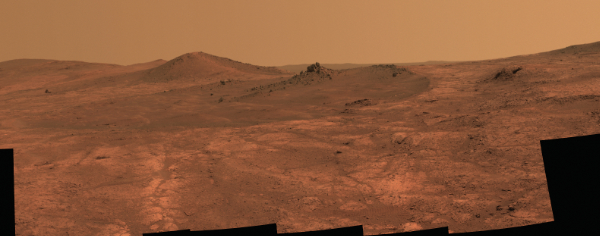
Rim of Endeavour Crater, Mars. Photograph courtesy NASA.

“New Mexico has so many volcanoes,” Crumpler says. “And when I came here for grad school, it became pretty obvious that volcanoes were something in New Mexico that you couldn’t find in very many other places. They’re so well preserved, it’s almost like standing on them the day after they erupted. You can see all the evidence. I really got fascinated with them because of that, but also at the same time… we had just started visiting the moon and the first few flybys of Mars, and we started getting the sense that volcanism—lava f lows and volcanoes—were a very important part of the landscape there. There was that dual interest in what was going on, and they supported each other.”

His passion for New Mexico’s landscape remains undiminished from those early days, with a particular commitment to educating the public—through lectures, articles, and other types of outreach—about the state’s volcanic features.

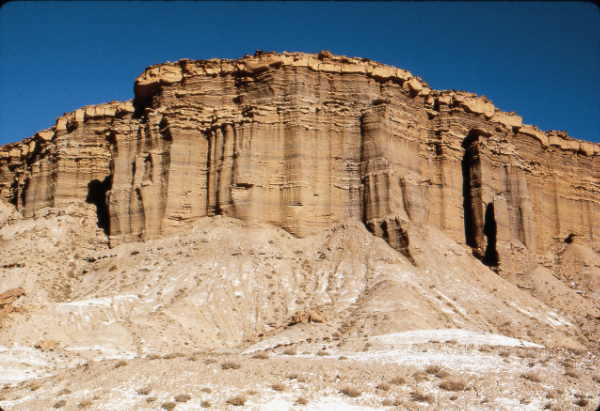
Layered sediments in the Rio Puerco Valley, New Mexico. Photograph by Larry Crumpler.
Layered sediments in the Rio Puerco Valley, New Mexico.
Photograph by Larry Crumpler.

“You’re not living just anywhere,” he says. “You’re living in a very special place, and it’s part of the appreciation of where you are. I think if you’re in New Mexico and you don’t know any geology, it would be like living in a library and not being able to read.”

At the same time, Crumpler has applied his intimate knowledge of conducting field geology here to helping NASA study Mars, including fifteen years working on the Spirit and Opportunity missions.

He has a forthcoming book, in fact, that explores fifty years of exploration of Mars. “I’ve been involved since the mid-seventies when I was a graduate student intern on the Viking mission, so I’ve seen the whole progression of development of the Mars sciences. When I started, we really knew nothing about Mars— it was just this red planet with strange markings. And then we started sending spacecraft there and started learning that those markings had nothing to do with what Mars really was. So, it’s been a long history.”

Despite his extensive knowledge and experience, after he submitted his proposal last March, Crumpler did not take for granted he would be accepted, given that he was up against steep competition. Only thirteen scientists would be chosen for the team operating the Perseverance rover when it landed on Feb. 18, 2021. In late 2020, he was finishing up his manuscript—which will include many photographs, he says—the same week he learned he had been chosen for the newest mission.

“I assumed, because we had shown through the Spirit and Opportunity missions how fun and interesting rover missions were, that the competition would be outrageous,” he says. While the competition was indeed robust, Crumpler’s proposal brought a unique perspective and scope: In a nutshell, he’ll be conducting the type of field geology he’s done so much of in New Mexico on Mars.

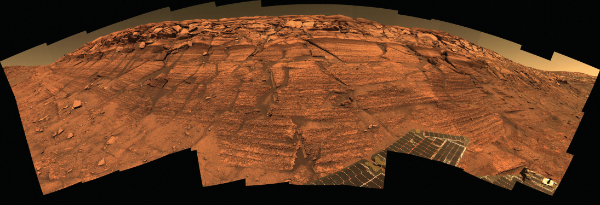
Layered sediments in the wall of Endurance Crater, Mars. Photograph courtesy NASA.

“I was always half field geologist and half planetary geologist, so I sort of transferred my love of mapping field geology to Mars. And since Mars is like New Mexico—just more so—it was an easy transition.”

The constraints of conducting field research on the rover changes the process and adds new technology to the undertaking. On Earth, “when you’re walking along, you look at an outcrop and determine where the rock is and what you knew about the rocks in the region, and then trace out how far you can see it to either side of your little traverse,” Crumpler explains. “And you do this all day long and, in the case on Earth, you’re able to walk off to the side and visit outcrops beyond what you’re able to see, and so you end up mapping the area.” In the rover, on the other hand, “you’re constrained along the path. So it ends up being this long noodle, maybe 100 meters wide on either side of the rover, that you’ve mapped in this way.” But on the rover, Crumpler will have other tools, such as the SuperCam instrument developed at Los Alamos National Laboratory, described by the lab as a kind of rock-zapping laser that will allow scientists to study rocks that might otherwise be out of reach.

“It’s a complicated process” Crumpler says. “The mission will cache samples on its traverse, and there’s a great desire on the mission to document where the samples come from and what their context is.”

The technology on the mission improves the efficacy of the process, he says, but the outcome is “basically the same: You end up drawing the lines on the map.”

Crumpler will also help NASA evaluate the use of the new helicopter, Ingenuity, for geologic research along the rover’s traverse at the Jezero Crater landing site, having been one of the team members who worked on the proposed Mars helicopter, Scout, in 2014.

“It’s really just kind of a test,” he says. “It’s probably only going to last about thirty days, so it will be an interesting experiment. But it will be exciting when it does fly.”

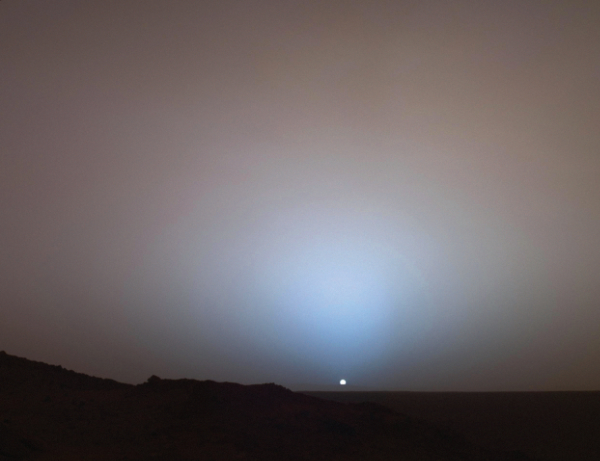
Blue sunset, Gusev Crater, Mars. Photograph courtesy NASA. ·

Crumpler’s enthusiasm for applying his technical expertise amounts to developing a “new way of doing science and geology on Mars,” one in which the field geology perspective may yield key knowledge about the planet’s history. But the also brings a poetic and philosophical awareness to his upcoming adventure.

“So much of trying to understand the geology through the landscape that is so important to places like New Mexico, and I think important to places like Mars, is it gives you a deeper understanding of where those landscapes come from, what their significance is, what’s unique about them. Rather than just being pretty pictures—what’s behind that story?”

More than fifty years ago, Crumpler listened as Mariner 4 made the first successful flyby of Mars and captured the first photographs of its surface. Now, he too will be making history. “It’s been centuries since a small group of people stood on the edge of a new world and took steps to understand it,” he says.

“That’s an exciting process to be involved in.”

Julia Goldberg is a journalist and teacher in Santa Fe, New Mexico, as well as the author of Inside Story: Everyone’s Guide to Reporting and Writing Creative Nonfiction.

Julia Goldberg (opens in a new tab) is the editor of Source New Mexico, a journalist and teacher in Santa Fe, and the author of Inside Story: Everyone’s Guide to Reporting and Writing Creative Nonfiction.

Whatever Decided Them

By Molly Boyle

THEY CAME TO THE LUSH, vast land east of Las Cruces from places like Texas, Oklahoma, Socorro, and Magdalena in the waning years of the nineteenth century. To them, the Tularosa Basin looked like prime ranching country, sided by the Sacramento Mountains in the east and the San Andres and Oscura ranges to the west. In the wet years of the 1880s, when people trickled into the basin with herds of cattle and sheep, native grasses grew to the height of a horse’s shoulder. It seemed a natural place to begin again, to plant families and gardens, dig wells, and build ranches among the mesquite, grama grass, poppies, and verbena.

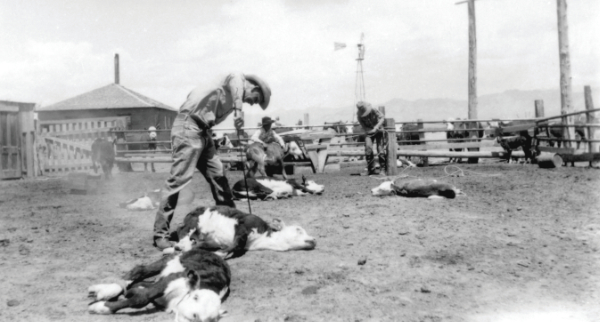
A.D. Helms and A.B. Helms branding calves, Oscura, NM, 1952. Photo courtesy of Human Systems Research and WSMR.
A.D. Helms and A.B. Helms branding calves, Oscura, NM, 1952.
Photo courtesy of Human Systems Research and WSMR.

A century later, the ranchers were gone—their adobe and frame houses eroded into ruins by dust, drought, and a government that had decided the land was better suited for testing the twentieth century’s deadliest weapons of war.

Home on the Range: From Ranches to Rockets, an exhibition at the New Mexico Farm & Ranch Heritage Museum in Las Cruces, tells the story of ranch life in the Tularosa Basin—especially the area that eventually became White Sands Missile Range—in the early twentieth century. A hard-fought self-sufficiency allowed ranchers to maintain their homes on the range for more than fifty years. Then, military requisitioning of the land gave life to the defense industry, and with it, a very different kind of range.

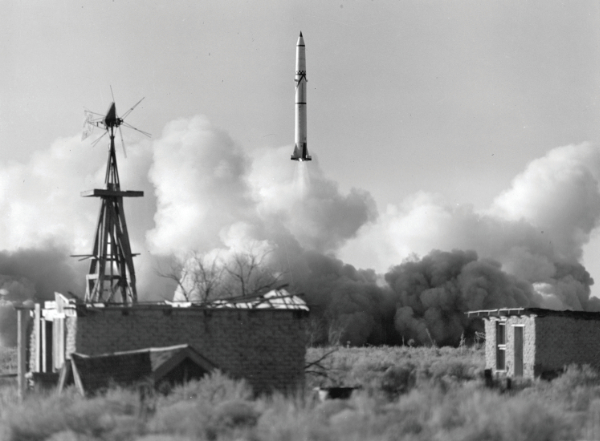
Museum curator Leah Tookey says one succinct photograph donated by John Bloom sparked the exhibit she envisioned. Depicting a missile launch at White Sands around 1959, it shows a dilapidated windmill and two low-ceilinged adobe ranch buildings in the foreground of the rocket, which bursts into the sky above billowing dust clouds. The image broadcasts the striking clash between rural life and the advance of modern military technology that punctuates the From Ranches to Rockets story.

The launch of a Redstone rocket on White Sands Missile Range, circa 1959. Photo by Judsen Caruthers, of cial White Sands photographer for 35 years, late 50’s to late 80’s.

Not so lush after all

The late-1800s migrants who settled in the Tularosa Basin soon learned that what looked like a great place to ranch was actually fraught with environmental problems. “As Mother Nature often does, she fooled them,” Tookey says. Homesteaders realized they had come to the grasslands during a rainy period that was soon followed by years of severe drought.

Nevertheless, they persisted, supplementing the lots they purchased by leasing vast acreages of grazing land from the government. In the desert Southwest, the use of these surrounding lands was integral to the survival of livestock, since it took 640 acres of grassland to sustain six or seven cows. The new residents realized early on that though the basin was filled with water that lay just under the soil, that water was laden with minerals and was saltier than the ocean. If ranchers could figure out how to harness a steady supply of potable water, a family could raise a couple hundred white-faced Hereford cows on the leased lands to buy, sell, and provide them with a reasonable living. Ranchers living closer to the surrounding mountains tended goats instead of cattle. In 1897, Natalia DiMatteo’s grandfather José Lucero leased 20,000 acres from the U.S. government in addition to the titled 160 acres of his Circle J.M. Ranch. DiMatteo, born in Las Cruces in 1920, told historians from the Legacy Resource Management Ranching Oral History Project that she imagined her relatives valued the leased land for its grazing potential because “they could actually keep the cattle where they knew they could survive. So I imagine that’s the reason they decided to buy land up there, not knowing that someday the government would come in and take it over.”

“At that time, you know, what else could they do?” DiMatteo says, summing up the limited options for families choosing to settle in the basin. “I have no idea whatever decided them to become cattle ranchers.”

A half-century later, these early transactions between ranchers and the government would set the stage for a different kind of business relationship, after the military began looking for land to use for a bombing test site in the early 1940s.

DiMatteo grew up at the Circle J.M. during times of drought. She recalls her father firing a gun into the air to deter wild horses from drinking the ranch’s water; cows would break into the yard to invade the family’s water tanks during particularly dry seasons. The ranch had a small windmill-powered tank for drinking water with a pipe extending to a larger tank where the children often swam. Another pipe led to corrals that held water troughs for pastured cattle and horses. In addition, two wells (the “old well,” from her grandfather’s tenure, and the “new well,” from her father’s era) were drilled on the ranch property. Her relative Felipe Lucero had it even better: He tapped into the San Nicolas Spring west of his home to bring it down two miles to ranch headquarters, providing enough irrigation for an orchard and garden.

Most ranchers used hand-dug wells with windmills to pump water from the ground. Holm Bursum III, born in 1934, remembers a rainwater cistern at his family’s Ozanne ranch in addition to a 40-foot well. Most wells were situated at a strategic distance between the house and the pasture to allow for convenience in watering the animals.

Home on the range

By 1940, the average ranch was still made up of privately owned lots that were supplemented by much larger parcels leased from the federal or state governments for grazing purposes. Many of the ranch houses were very small, built from adobe bricks, stone, or hand-cut logs and heated by wood fireplaces or stoves. Wood-frame houses, which fared the worst after the transition to the missile range, were insulated by little more than newspaper or cardboard; many succumbed to the ravages of windstorms and fire.

Some residences were grander. The Bursum house in Ozanne was a former stagecoach station on the route from San Antonio, New Mexico, to White Oaks, New Mexico, later used as a ranch headquarters with a fireplace in every room. After the Army took it over, it was repurposed as a hunting lodge and accidentally burned, reduced to a charred ruin.

100 pounds of flour,
100 pounds of pinto beans

When it came to food, ranchers had to factor in two challenges: the distance to the nearest grocery store, at least a day away, as well as a lack of refrigeration in the desert. Dixie Gilliland Tucker was around 15 years old in 1931 or ’32 when her Uncle John “traded the work horse and thirty-five dollars for an old Ford”— before that, she remembers monthly wagon trips to town.

Most families stocked a month’s worth of groceries, using cellars or water cisterns to keep perishables cool. Many wrapped meats in waxed paper, burlap, and an old quilt and stored it in the coolest place in the house—beneath the family bed. In the one-room house constructed at the Farm & Ranch Heritage Museum as part of the exhibition, a hunk of meat, wrapped in a blanket, is stored under the bed.

Dorothy Wood Miller wrote in 1992 of an average farm order from the Sears catalog, which her family would pick up in Engle: “The best I remember, the items were 100 lbs. flour, 100 lbs. pinto beans, 48 oz. baking powder, 24 oz. baking soda, 25 lbs. salt, 1 horn cheddar cheese, 10 lbs. elbow macaroni, 1 case tomatoes, and a case of peaches, pears and apples. We got a side of salt pork, one gallon black strap molasses, one gallon Blue Hill peanut butter, 100 lbs. sugar and 100 lbs. of potatoes.” Families also supplemented their meat by raising turkeys, pigs, and chickens. Miller remembers burning thorns off local tuna or coyote cacti for four milking cows to eat, as well as marking billy kid goats with missing testicles for family consumption. Ranchers recall a stable, if monotonous, diet in the early twentieth century comprised of meat, pinto beans, chile, biscuits, and whatever fresh fruits and vegetables the desert-dwellers could grow and preserve.

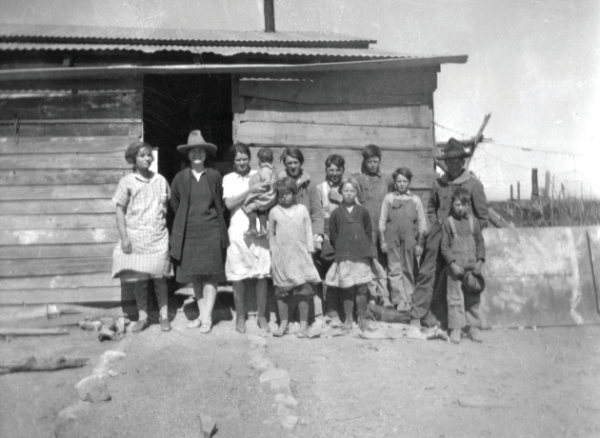
School group at the Gililland Ranch. Back row— Unknown, Miss Le wich, teacher, Alice Gililland holding Lola Gililland, Emmett Henderson, Andy Henderson, Sam Gililland, Hodges Henderson, and Frank Martin. Front row—Dixie Gililland, Bera Martin, and unknown, 1926-27.
School group at the Gililland Ranch. Back row— Unknown, Miss Le wich, teacher, Alice Gililland holding Lola Gililland, Emmett Henderson, Andy Henderson, Sam Gililland, Hodges Henderson, and Frank Martin. Front row—Dixie Gililland, Bera Martin, and unknown, 1926-27. Photo courtesy of Human Systems Research and WSMR.

Anna Lee Gaume, born in 1912, recalls sumptuous break- fasts of steak and biscuits and gravy when cows were newly slaughtered. But in leaner times, families knew how to manage their expectations. Gaume recalls a visiting young nephew who loved her mother’s pumpkin pie. One day, when she told him they were out of pumpkin pie, he quite reasonably requested cold beans instead.

The Wild Man of the San Andres

As is often the case in close-knit, far-flung communities, one neighbor in particular became a regular topic of conversation in the Tularosa Basin: a nameless wanderer called the Wild Man of the San Andres. “During the 1930s, a solitary man roamed the mountains on foot,” writes Home on the Range co-curator Jim Eckles in his book Pocketful of Rockets: History and Stories Behind White Sands Missile Range. “He tried to avoid people but to survive he needed the generosity of the ranch families who often fed him.” No one knew where the Wild Man had come from or why he made the mountains his home, but he was known throughout the basin for his almost visible stench and sooty clothes, which were soiled from his keep-warm method of sleeping on coals. Though the Wild Man usually wandered into an unlocked kitchen and helped himself while the family was out at work on the ranch, Dixie Gilliland Tucker remembers first feeding him in her Grapevine Canyon home in 1934 and seeing him as late as 1952, after her family had left the range. “When he got up to leave, well, he was just like a little quail. He could get out of sight faster than anybody. … If he saw you first, he went and hid in a ditch.” He always refused a bed, but ranchers say he ate enough biscuits and beans in one sitting to fuel him for long stretches of isolation. Residents speculated that the Wild Man ran drugs north and south of the border, but the hospitality extended to him was typical. Tucker says she never quite knew who would show up for dinner, but it was “the rancher’s way” to feed anyone who opened her house’s unlocked door—even when she wasn’t home. “If they wanted to eat, they fixed their meals. The only thing we required was to clean up your dishes.”

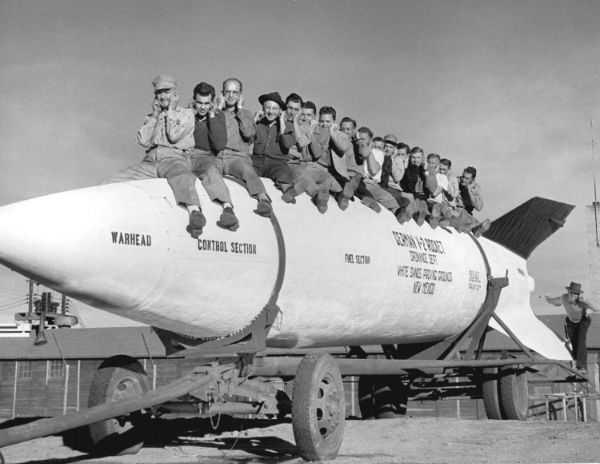
General Electric employees posing on the V-2 rocket. GE had the contract to work on the V-2 at the Proving Ground. Photo courtesy of WSMR.

“Toil, tears, and sweat” versus
“a heartless governmental machine”

In Prime Minister Winston Churchill’s first speech to his cabinet in 1940, he told them, “I have nothing to offer but blood, toil, tears, and sweat.” The same might be said for the White Sands ranchers who began ceding their land to the government in 1942. That year, an executive order established a training range in the middle and west portions of the Tularosa Basin, Mockingbird Gap, the plains west of the Oscura Mountains and the eastern part of the San Andres Mountains. Originally planned for British Royal Air Force bombing crews, runways were built using British plans but then requisitioned for American B-17s, forming what was then known as the Alamogordo Bombing Range.

But before any bombers could fly, the new range had to be completely rid of humans and livestock. Army Corps of Engineers representatives scoured the area, paying visits to ranches and mining shacks with new lease agreements stowed in their brief-cases. The new leases stipulated that owners and all animals were to vacate the lands until the war ended, and that the compensation for doing their patriotic duty would come in annual payments based on the size of their ranch units.

What might have seemed like a fair contribution to the national war effort was, in reality and practice, much more complex and traumatic. “When you examine the details, you see a clash of cultures, one that eventually led to great animosity toward White Sands, the Army and the federal government,” Jim Eckles writes. “On the one hand, you had a rural lifestyle characterized by hard work, independence, a sense of trust, and a love for the land. On the other hand, there was a layered bureaucracy with no one person in charge, where decisions were often driven by budget considerations, and the cogs in the machine expected instantaneous compliance.

… Some people illustrate it as a conflict with human beings on one side and a heartless governmental machine on the other.”

The idea of a temporary paid relocation did not stand up against the indignity of ranchers being forced to leave their land and livelihood. Some were only given two weeks to leave, threatened with forced relocation by Army trucks and soldiers. One elderly rancher, Tom McDonald, armed himself against a moving team that included a military Jeep with a mounted gun, two military police, and a United States marshal. His son ultimately took his pistol and convinced him to leave. “It was hard to believe what we were all going through,” wrote Laura McKinley, his neighbor.

The Army did not provide moving expenses or the cost of relocating livestock, the result being that ranchers were forced to sell their animals in a bottomed-out market. Many took jobs in nearby towns, ostensibly to tide them over until the war’s end. But most of the relocated ranchers later testified that they didn’t receive a single lease payment until long after the war was over. By the late 1940s, it was finally dawning on basin residents to seek more permanent fortunes elsewhere.

Rancher Alyce Lee Cox says, “With the war and all its anguish, there was no reason for the ranchers to be treated in the rude and dictatorial manner by these employees of the government.” Natalia DiMatteo recalls that her father said he did not want to live to see his ranch taken by the government. He died in 1946, one year after the White Sands Missile Range took over his property and four years before the government told DiMatteo’s family to permanently vacate the premises.

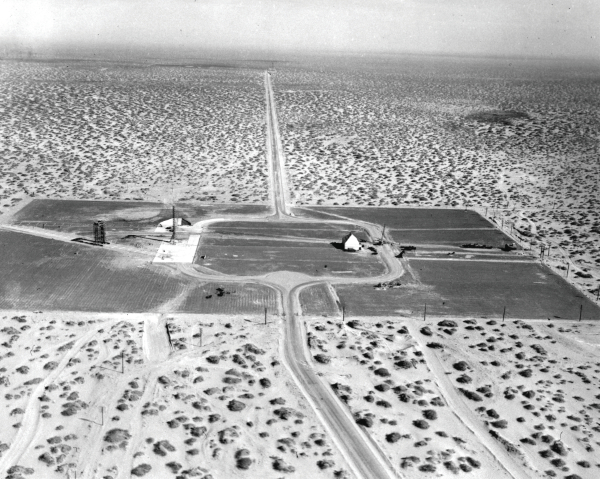
Aerial view of Launch Complex 33 with a view of the blockhouse, WAC Corporal launch tower, and the V-2 Gantry.
Aerial view of Launch Complex 33 with a view of the blockhouse, WAC Corporal launch tower, and the V-2 Gantry. Photo courtesy of WSMR.

From ranches to rockets

The ranchers’ fates were sealed, in many ways, after Germany began launching V-2 rockets in England. By the autumn of 1944, it was clear that America needed its own land-rich range to test their own new rockets. One hundred miles long and 40 miles wide, the Alamogordo Bombing Range met the requirements. And just like that, all of a sudden, ranchers were not guaranteed to get their lands back after the war.

Leases to the government for ranch land continued after the war, renewed annually until 1950, when ranchers were cajoled into twenty-year agreements. However, the late 1940s saw an unusual period of co-use arrangements, during which ranchers were allowed to work their land provided they evacuated the range when V-2 rockets were tested.

A 1946 lease stipulated that “no firing period under a given notification will exceed 20 days and that during that period the ranchers are authorized to return every third day for the purpose of watering and feeding their cattle.” But often, ranchers didn’t get the launch memos. Lucero family lore includes a story about a V-2 rocket exploding near the house, shaking the ground and badly frightening the family. Anna Lee Gaume, who says the Trinity test of the atomic bomb took nails out of a window, and that another test rocket went astray and landed on a neighboring ranch, says, “It never would have worked if [the government] had done it any other way ’cause [the ranchers] wouldn’t have stood for it.”

Holm Bursum III told historians in 1994 of his experience on the Adobe Ranch in July 1945 during the Trinity test. Eighteen miles northeast of Trinity Site, he says, “It woke us up, there at the Adobe. … I was sleeping on the top deck of a double decker bunkbed, and it rocked that bed enough that it woke me up. It was real bright but in the wrong direction, ’cause my bed was next to a south window. That was the wrong way for the sun to come up. … It really shook the house.” Bursum recalls that the red Hereford cattle facing the Trinity Site turned white, and that local sheepherders with black beards also saw them turned white, as well as one black cat in particular.

The Atomic Energy Commission purchased two carloads of Bursum livestock and transported them to Knoxville, Tennessee, where, by all accounts, they lived out normal lives and died of natural causes.

Charles H., Fred, and Joe Pete Wood at the Wood Ranch home, 1935.
Photo courtesy of Human Systems Research and WSMR

Rancher retakes home on the range

During the 1950s and sixties, some ranchers pleaded with the government to be allowed back onto the missile range. They petitioned White Sands, senators, and members of Congress to allow co-use again, arguing that the newly grown grass was a fire hazard and the solution was grazing. Others pointed to the nation’s new dependence on imported beef, asking permission to run cattle in order to contribute to the local food chain. Their pleas fell on deaf ears, however, and co-use activities remained excluded to the former ranching residents of White Sands.

In 1970, eighty-four ranchers lost compensation for the public domain lands that lay within their ranch units. Since many ranches had been largely comprised of public land, the annual fees paid to the ranchers shrank significantly. Their appeals made it to the Supreme Court in 1973, when the ruling on U.S. versus Chester Fuller decreed that ranch units with “enhanced value” due to use in combination with federal grazing permits required “no compensation for any value added to fee lands by the revocable federal permits.”

By 1980, with only thirty-four ranch owners left, most voluntarily sold their acreage or lost suits to the Army Corps of Engineers under the law of eminent domain. But on Oct. 15, 1982, the New York Times breathlessly reported, “An 81-year- old rancher armed with two rifles and an old pistol has set up camp at his former homestead, which sits in the middle of this top-secret missile range.”

“They’re trying to fool people by calling it a desert,” rancher Dave McDonald, son of Tom, who was making one last stand to reclaim his family ranch, told the Times. “Last summer the grass was knee high.”

With his 32-year-old niece Mary, who carried a .30-30 rifle, McDonald’s stand lasted four days. After talks with Senator Pete Domenici, Congressman Joe Skeen, and the New Mexico Cattle Growers Association, the McDonalds peacefully left the ranch Dave’s family had vacated forty years before. A year later, the government was given the deed to McDonald’s 640 acres. With years of leases combined with a final payment, McDonald and his partner were ultimately paid nearly $450,000.

The Army Corps of Engineers acted legally from 1942 on, winning all major court cases that pertained to the interpretation of the laws that allowed them to seize the ranches and, for the most part, making good on their promises to fairly compensate ranchers. But as Eckles writes, “It was wobbly ethics or morality at best. This is not how any of us want to be treated by the government when there are hard decisions being made.” On the other hand, given the forbidding climate and the difficulty of running cattle on the land, one rancher’s wife says flatly, “God used the Army to move them off the land before they all starved.”

As the adobe structures left on the missile range surrender to the elements year after year, their bricks deteriorating in the harsh desert sun, the homes on the White Sands range belong entirely to the Army now. Their more permanent remnants are in the multiple family memories, records, and photographs of a truly hardscrabble American way of life.

Natalia DiMatteo, who attended school in Las Cruces and spent summers on the Circle J.M., recalls the sheer excitement of one annual rite. Heading to the ranch each June, the family loaded their pickup truck with personal effects, mattresses, and blankets. DiMatteo would scramble atop the whole mound with her brothers and sisters to ride to the Tularosa Basin in the open air.

“Without a doubt,” she says, “we knew we were going to the ranch, and we’d all be so happy.”


Molly Boyle is a writer and editor living in Northern New Mexico. She writes a column on Southwestern literature for the Santa Fe Reporter and reviews restaurants for the Albuquerque Journal.

Molly Boyle is the managing editor of New Mexico Magazine. She is an experienced arts and culture writer, having written articles for El Palacio magazine, New Mexico Magazine, the Santa Fe Reporter, the Albuquerque Journal, and other outlets.

Collaboration, Multivocality, and Authority

by Felicia Garcia and Lillia McEnaney

When the Museum of Indian Arts and Culture opened its flagship exhibition in 1997, it did so with a purpose. Here, Now and Always was to be an exhibition different; an exhibition where Native people in the Southwest were the curators, the narrators, and the authority on themselves.

Rooted in Edmund J. Ladd’s (Zuni Pueblo) affirmation that “I am here. I am here, now. I have been here, always,” the exhibition was broken up into several distinctive, yet fluid, themes: Ancestors, Plants and Animals, Cycles, Exchange, Architecture, Survival, Language and Song, and Arts. It was an exhibition with a staggering number of objects—approximately 1,200— and each section told a unique story about Indigeneity in the Southwest. Foregrounding intergenerational storytelling, visitors were urged in the exhibition brochure to “Listen carefully. Let the stories carry you to the center created by each Native community. Here, at the intersection of sky and earth, you will find the Southwest’s people.”

Museums are intertwined within contested histories of colonialism, extraction, and exploitation, and MIAC did vitally important work that fundamentally changed the course of museum practice not only in New Mexico, but throughout the United States. Here, Now and Always actively and purposefully worked against these historical contexts, moving into a reciprocal future grounded in community partnerships.

The following conversation is based on a January 26, 2020 program at MIAC which commemorated the temporary closing of Here, Now and Always. Before a larger panel discussion between the exhibition’s original curators, Felicia Garcia, curator of education at the School for Advanced Research, and Lillia McEnaney, assistant curator at MIAC, reflected on the exhibition’s local impact, national legacy, and overarching themes.

Introduction: How would you describe your positionality?
Felicia Garcia: I am Samala Chumash from Santa Ynez, California. I hold a bachelor’s in psychology from Willamette University and a master’s in museum studies from New York University. Growing up, I never saw my community’s story told from our own perspective. In school, we briefly learned about our history, but the curriculum always focused on the missionization of California. In museums, the anthropological narratives were always written in the past tense, and the content seemed so unfamiliar. I went to school and studied museums to learn how to work within these institutions and take control of our own representation.

Currently, I am privileged to live and work as a guest here in Pueblo territory as the curator of education at the School for Advanced Research’s Indian Arts Research Center. I strive to use my position as a museum professional to carve out a space for Indigenous people to tell their own stories so that our youth both see themselves in these spaces and feel seen. It’s important to acknowledge that my perspective is shaped both by my lived experience as an Indigenous woman, as well as my education within colonial Western institutions.

Lillia McEnaney: Originally from Newtown, Connecticut, I am a non-Native woman currently residing as a guest in O’gha Po’oge. Trained as a museum anthropologist, I hold  a bachelor’s in anthropological archaeology and religious studies from Hamilton College and, like Felicia, a master’s in museum studies from New York University. I am currently an assistant curator at the Museum of Indian Arts and Culture/ Laboratory of Anthropology, where I am privileged to work on the renewal of HNA.

As a non-Native person working in these spaces, I see my role as a facilitator. There is a long and violent history of non- Indigenous anthropologists and curators conducting extractive research “on” communities. But the past several decades have seen a distinctive shift—largely due to scholarship and activism from Indigenous folks—in the ways in which museums operate, and a resurgence in the academic study of the histories and anthropologies within museums themselves. Rather than following the common anthropological path of being an “expert” on a particular type of material culture or community, I study the institutional structures within museums, aiming to facilitate a space for Indigenous people and narratives to be foregrounded.

Context: What are the historical context(s) needed to understand the impact of Here, Now and Always?
LM: The histories of museums, collections, and anthropology are muddy, contested, and fraught with colonial violence. Fundamentally part of the larger, ongoing Euro-American colonial project, museums are inseparably linked as part of larger social and cultural processes.

As European nation-states expanded and colonized, they also built and mobilized an all-encompassing epistemological structure to understand human difference. These ideologies worked to legitimize and reify their quest for political control. In a chapter titled “Racial Science, Blood, and DNA” in Native American DNA: Tribal Belonging and the False Promise of Genetic Science, Dr. Kim TallBear (Sisseton-Wahpeton Oyate) tells us that the classification and construction of race began with the grouping of humans “on the basis of natural characteristics,” which worked to establish racial difference and “the laws of behavior for [racial] members.” This work of constructing racial classifications allowed for “discrimination against the racially defined other.” Today, these ideas and tactics for control are largely inescapable in our everyday lives, and are particularly evident in the lived experiences of historically marginalized communities whose elimination was, and continues to be, the fundamental goal of colonial rule and the American project.

And while Euro-Americans attempted to study this “racially defined other,” they concurrently began to collect. They took people’s belongings and stories, captured photographs and recorded voices, and attempted to strip away people’s fundamental senses of self, community, and belonging through the manipulation and control of particular types of heritage. The processes and results of collecting aided in the building of nation states, formed symbolic capital over Native people, and represented a desire for stasis while simultaneously building the museum structure, through which Indigenous people were “packaged and marketed,” to borrow terminology from Dr. Curtis Hinsley. These methods of “museumification” worked as mechanisms of control: They kept Indigenous people confined within the romantic imaginations of the Euro-American public. So, today’s museum exhibition panel text, object labels, murals, installations, and display cases work as “meaning- making machines” that govern the living and shape contemporary understandings of Indigenous communities. Fetishizing Indigeneity, museums work as ideologically active environments, where they continue to foster, assert, and maintain sociopolitical dominance over the Indigenous “Other.”

Simply put, museums museumify people. University of British Columbia museum anthropologist Dr. Michael Ames, in his Cannibal Tours and Glass Boxes: The Anthropology of Museums, sums this up poignantly: Museums are “cannibalistic in appropriating other peoples’ material for their own study or interpretation, and they confine their representations to glass box display cases. […] There is a glass box for everyone.”

FG: As Lillia explained, museums are important agents within the ongoing colonial project. Many, if not most, historic Native American collections that are housed within U.S. museums were assembled to document cultures that were thought to be on the brink of extinction. To this day, museums continue to perpetuate the myth of the “vanishing Indian” by portraying Native peoples as “extinct,” “primitive,” passive, and in the past. Further, museums continue to uphold ideologies related to manifest destiny. The impact of these representations transcends institutional walls and continues to have a significant negative effect on Native communities—from shaping individual perceptions of Native peoples to informing federal and state policies. Museums, which are perceived to be neutral and trustworthy sources of information, not only control the means of representation and historical narrative, but continue to play an active role in colonization.

In 2016, while I was living in New York City, I visited a local well-known natural history museum to document the observations of visitors for a class project. While I was stationed in one of the Native American halls, I overheard a mother explain to her child that the people depicted in the vitrines were “from the time of the dinosaurs.” To me, that experience really encapsulated the intended colonial function of a museum: To those visitors, the exhibition communicated that the Native people represented were both primitive and in the past or extinct. It successfully represented Native people as both inferior and “other.”

Navajo necklace, Unknown artist
Unknown artist (Navajo), necklace, ca. 1920. Silver and elk tooth. 19 11⁄16 × 9 13⁄16 inches.
MIAC Collection: 10675/12. Gift of Mrs. Philip B. Stewart. Photograph by Addison Doty.

Difference: How does HNA differ from other museums’ representations of Native people?
LM: In Here, Now and Always, Native voices are the authority. The text—written largely by Indigenous artists, scholars, and community members—is written in the first person, in active voice, and in present tense. These individual text panels are authored to emphasize the fact that the text conveys one perspective on one story. This makes a larger ontological shift explicit: The institution is no longer speaking to you; individual community members are instead sharing stories. And these stories can be heard (or read) in any point in the exhibition, showing that the physical space is indeed constructed around dozens of Native voices. Being exposed to these personal narratives also makes the visitor ask what other perspectives are out there, and what other things can be learned about the people of this region. Here, objects are the supporting act—it is the personal stories and community connections that give the objects their meaning.

But these deliberate strategies may leave the visitor slightly confused about the audience. Who is this exhibition meant for? This ambiguity is, in fact, intentional. As Felicia and I discussed, museums are often uncomfortable spaces for Indigenous people because of their violent histories.

HNA flips this on its head. What does it look and feel like for a white person to be uncomfortable in a museum? And what implications does this have outside of the exhibition’s context? This question fundamentally complicates the understanding of the function and purpose of a museum.

In this, the exhibition’s overarching goal is unique. Many encyclopedic museums, by their very nature and construction, aim to be representative of whatever it is that they are displaying—the “most complete” collection of velociraptor remains, or the “most comprehensive” collection of botanical illustrations. Rather than falling into this common practice, HNA makes it clear that not all possible information is presented. The exhibition instead operates as an entry point for visitors to think about what Indigeneity in the Southwest is and means. It is not meant to be a comprehensive or representative of anything, but instead a first look, or the first chapter, in a longer, more sustained and deliberate conversation about (and with!) Native people in the Southwest.

In doing so, the exhibition unsettles non-Native perceptions of Native cultures (what you think you know is likely incorrect), and at the same time works as an entry point for Indigenous folks to begin to perhaps feel comfortable in these spaces.

 Unknown artist (Ancestral Pueblo),  basketry sandal, ca. 1000 BC-AD 500.
Unknown artist (Ancestral Pueblo), basketry sandal, ca. 1000 BC-AD 500.
Yucca fiber.  5 1⁄16  × 9 7⁄16  inches. MIAC Collection: 53779/11.
Gift of Grace Bowman. Photograph by Addison Doty.

FG: From the first time I visited MIAC, it was clear that HNA differed from any exhibition I had previously experienced. Even the name of the exhibition—Here, Now and Always—suggests a deviation from typical museum narratives about Native communities. This wording communicates that Native people are contemporary and present, and not only that they have always been here, but they always will be here. There is an element of survivance to the title that starkly contrasts with the passive depictions that most of us are used to.

When I entered the exhibition space, I was struck by the many disruptions of both Western thought and museology. One of the first text panels I read described the archaeological information within the exhibition as “a story.” Typically, fields of study that are associated with museums, such as archaeology and anthropology, are framed as objective and capable of gleaning indisputably truthful or factual information. Conversely, firsthand information shared by Native communities is treated as subjective, and therefore less credible. By describing a Western field of study as a story, the exhibition challenges visitor perspectives of museum narratives, illustrating the fact that all information shared within these spaces is part of a story that is subject to personal biases, so these institutions cannot be neutral.

I was similarly intrigued by the maps that I encountered within the exhibition, which did not emphasize U.S. borders or place names. To the viewer, this omission suggests that there are alternative ways of viewing land and space. Generally, these map features are accepted as fact, but most Native communities have different conceptions, since land was organized differently and places were recognized by different names pre-contact. Because sources of information like maps are so uniformly ingrained in our educational institutions, we often take them for granted. This slight variation again illuminates the subjective nature of museums and the information they convey.

The authority of the museum is further disrupted by the visitors’ ability to choose their own path through the exhibit. It is the norm for most museums to use exhibition architecture to control the visitor’s path through the exhibit. Additionally, most exhibitions that depict Native people are organized chronologically, and the exhibition path follows the timeline. HNA diverges from this standard by framing time as cyclical. In Western societies, time is solely understood as linear; however, many cultures view time differently. This is yet another intervention that challenges certain Western concepts that we have been conditioned to view as fact.

Yet another example of the many ways HNA differs from typical museum representations of Native people, is the curatorial decision to not group objects and information by community. As Lillia previously mentioned when she referenced the work of Kim TallBear, standard exhibition organization is grounded in Western attempts to categorize and order entire groups of people in order to determine a racial hierarchy. By not adhering to this standard, HNA challenges colonial epistemologies and the perceived isolation between communities. Native peoples have always participated in exchange when it comes to food, tools, ideas, stories, art, etc. Though each community is unique and distinct, any attempt to separate communities into completely isolated groups ignores this ongoing tradition of kinship.

Santa Clara Pueblo Jar ca. 1940s
Van Gutierrez and Lela Gutierrez (Santa Clara Pueblo), jar, ca. 1940s.
Clay, temper, slip, mineral paint, and carbon paint; made using the coil
and scrape method and stone-polished. 6 5⁄16 × 5 11⁄16 inches.
MIAC Collection: 54306/12. Gift of the estate of Rick Dillingham.
Photograph by Addison Doty.

Impact: What is the broader impact of HNA beyond the museum?
FG: Excluding my experiences within tribal museums, it is really rare for me to go through a museum and feel like Native people were considered a target audience when an exhibition was developed—and by that, I mean most exhibitions about Native communities are designed to communicate information about Native people to non-Native people. When I visited museums as a kid, the text always felt so foreign. I knew the information was about us, but I never felt accurately represented by it.

Going through HNA, there were so many recognizable elements that made me feel that the exhibition was meant for me—like the T-shirt all of my cousins bought at the powwow or the HUD kitchen replica that felt like home. Most of these things probably go unnoticed by non-Native viewers, but then there are also some elements that are meant to be more mysterious, like the burden basket full of Tootsie Rolls. Non-Native people probably go through the exhibition, look at that vitrine, and wonder what it means—and the exhibition texts provide no answer. This probably makes them feel slightly uncomfortable, but that’s the point.

Too often, museum exhibits seem to communicate that it is possible to know everything about a group of people and that the public has a right to know everything. However, for most Native communities, we don’t want to share every element of our history and culture with “scholars” or the general public, and we are still actively trying to recover from the harm caused by the extractive methods of anthropologists and archaeologists. By creating displays that are meant just for Native viewers, HNA communicates that not everything needs to be displayed for non-Native people to understand—some parts of our culture are just for us. I think that’s a really important takeaway that can affect an individual’s perception of Native people and Native culture, and it goes far beyond the museum itself.

Similarly, many of the text panels in HNA include an author’s name—most often these authors are Native. This disrupts the museum’s authority by exposing the fact that the texts are written by individuals. When author names are not included on text panels, the information takes on an institutional voice, which gives it a lot of power by making it seem objective.
By including these names, HNA communicates that Native people have valid things to share about their own communities—anthropologists are not the only ones with voices worth listening to. Further, it demonstrates that these panels represent just one perspective, and ideally it compels the viewer to consider all of the other perspectives that must be out there and seek them out. I think if this exhibition inspires visitors to learn more about Native communities from sources created by Native people, that is a success.

LM: MIAC—with HNA as its flagship exhibition—functions with an explicit vision in mind. The museum envisions “a world that recognizes and understands Native peoples as diverse tribes, each with a distinctive history, culture, and language, and each of which is an integral part of the vibrant, historical, and cultural landscape of the American South- west.” At first glance—and perhaps to El Palacio readers—this may not seem like a radical idea, but given the historical contexts Felicia and I have talked about, it is indeed radical for a museum to operate in this way. The reverberations of MIAC’s educational mission are felt far outside of institutional walls—from the way a teacher presents Native history in her classroom, to the way a family from out of town discusses contemporary Indigenous art on the Plaza. As one of society’s most trusted institutions, what museums do and say actively and tangibly matters.

Constructive Criticism: What do you think could have been done better?
LM: Though HNA did heavy legwork, there is always room for improvement! There were serious accessibility issues throughout the exhibit, ranging from light levels and placement of text panels to physical accessibility throughout the gallery space. Visitors also often remarked that the exhibition was “too text- heavy,” which begs the question of how much content visitors were actually absorbing.

FG: In the Ancestors section of the exhibit, there are these little flip books that include cards for the objects that are displayed within the vitrines. These cards are modeled after older museum catalog cards. Lillia and I had a conversation about these cards and discussed how they just don’t seem to fit with the rest of the exhibit. They portray the items as “artifacts” and communicate a sense of ownership by the museum, which just seems to work against the larger purpose of HNA.

Though the exhibition is nearly the same age as me and shows some signs of its age, I was surprised to have such a short list of items that I felt could have been done better.

Influence: Are there any other exhibitions that have built off of HNA?

LM: Here, Now and Always had a tangible impact on the trajectory of museum practice throughout the United States. In many ways, the Smithsonian Institution’s National Museum of the American Indian—with HNA curators Dr. Bruce Bernstein and Tony Chavarria (Santa Clara Pueblo) on its curatorial team—built its inaugural exhibitions off the collaborative model facilitated by MIAC.

More recently, Dr. Jill Ahlberg Yohe and Teri Greeves (Kiowa) organized Hearts of Our People: Native Women Artists, which traveled between the Minneapolis Institute of Art, the Frist Center for Visual Arts, the Smithsonian American Art Museum’s Renwick Gallery, and the Philbrook Museum of Art in 2019 and 2020. Collaboratively curated in partner- ship with an advisory panel of twenty-one Native artists and Native and non-Native scholars, the exhibition has largely been seen as a turning point, not for only how Native women’s art is presented and understood, but as a model for meaningful community partnership. MIAC’s recently closed exhibition, San Ildefonso Pottery 1600–1930: Voices of the Clay, co-curated by Russell Sanchez (San Ildefonso Pueblo), Erik Fender (San Ildefonso Pueblo), and Dr. Bruce Bernstein, also worked in similar ways.

Today, collaborative practices—not only in exhibitions, but in all aspects of museum work, from collections management to educational programming—are becoming more and more common, though there is still significant work to be done.

FG: One of my favorite exhibitions that I’ve seen in recent years is the Poeh Cultural Center’s Di Wae Powa (2019). This exhibition features 100 historic Tewa pots that were brought home from the Smithsonian Institution’s National Museum of the American Indian. All of the interpretation for the exhibition was written by Tewa community members and really demonstrates the potential of collective narrative. One thing  I especially loved about this exhibition was the intro text panel, which was written addressing the pottery itself. I had never seen exhibition objects addressed as the audience for a text panel and probably would have never thought to do so. Western museology has limited the ways in which we connect with exhibition objects, which many of us consider ancestors or relatives. Exhibits like HNA and now Di Wae Powa are so impactful because they inspire us to challenge Western or colonial ways of thinking.

digital rendering or sketch
Loren Aragon (Acoma Pueblo), sketch, 2019. Digital rendering.
Courtesy of the artist. Photograph by Addison Doty.

Conclusion: Final thoughts?
LM: I feel incredibly privileged to work on the renewal of Here, Now and Always alongside MIAC staff and community curators. MIAC strives for the new iteration of the exhibition to be reflective of the same values presented in the original. The “new HNA” will address the previously mentioned accessibility issues and integrate new technologies, allow visitors to engage with objects that have never before been displayed, and provide a space for new, younger generations of Native people to tell their stories.

For those who may be interested in continuing the conversation, I would encourage you to seek out anthropological scholarship written by Indigenous authors. Dr. Linda Tuhiwai Smith’s (Ngāti Awa and Ngāti Porou, Māori) Decolonizing Methodologies: Research and Indigenous Peoples and Dr. Amy Lonetree’s (Ho-chunk) Decolonizing Museums: Representing Native America in National and Tribal Museums are two good places to start.

FG: To me, HNA really successfully demonstrates the strength of collective narrative versus individual authority, which I think is the general direction that the museum field is currently moving. Since this exhibition opened, more and more exhibitions have tried to prioritize and elevate a collective comprehensive Indigenous narrative instead of highlighting a single curatorial voice. As an early career museum professional, this approach has inspired the work that I do, and I look forward to seeing how the narrative evolves in the next iteration of HNA. I echo Lillia’s suggested resources, and for museum professionals who are looking to begin working more collaboratively with Native communities, I recommended SAR’s Guidelines for Collaboration, available at guidelinesforcollaboration.info.


Felicia Garcia (Samala Chumash) is the curator of education at the School for Advanced Research’s Indian Arts Research Center in O’gha Po’oge/Tewa territory/ Santa Fe, New Mexico.

Lillia McEnaney is an assistant curator at the Museum of Indian Arts and Culture/ Laboratory of Anthropology in O’gha Po’oge, or so-called Santa Fe, New Mexico.

Felicia Garcia (Samala Chumash) is a museum scholar and the former Curator of Education at the Indian Arts Research Center, School for Advanced Research, Santa Fe, New Mexico. She currently works for the Indigenous data sovereignty initiative Local Contexts, and strives to use her platform to support Indigenous sovereignty within museum spaces and other cultural institutions.

Los Derechos de las Mujeres

BY CASSANDRA E. OSTERLOH, MA, MLS

IN JULY 2019, on a visit to the Smithsonian’s National Portrait Gallery to see the exhibition Votes for Women: A Portrait of Persistence, I was disappointed to notice the absence of Latinx women in the gallery. I already knew about New Mexico suffragists like Nina Otero Warren and Aurora Lucero Lea, who had fought for the women’s vote. During a conversation with Valerie Martínez, director of History and Literary Arts at the National Hispanic Cultural Center in Albuquerque, about the absence of Latinas in the story of women’s suffrage, we decided to begin the process of researching Latina suffragists in the Hispanic diaspora as a focus for a program exhibition. I spent the next six months discovering a wealth of information about Latinas in twenty-four countries who were instrumental in the promotion and achievement of suffrage worldwide.

Adelina “Nina” Otero-Warren, ca. 1923. Courtesy Library of Congress, image no. LC-B2-6031-10.
Adelina “Nina” Otero-Warren, ca. 1923.
Courtesy Library of Congress, image no. LC-B2-6031-10.

While researching the involvement of Latinas in the women’s suffrage movement in the United States, few women were found. But when the scope is widened to investigate Latinas from the international Hispanic diaspora (including the United States) who were instrumental in women’s suffrage worldwide, a wide array of activists emerges. The expansive list features women not only influential in their respective country’s suffrage movement, but also many individuals successful in their own right.

Many of these women were highly educated, but not all. Some were well-traveled; some were not. Many were firsts in their country (first female lawyer or first female journalist, for example). They were lawyers, doctors, nurses, educators, journalists, authors, poets, actresses, social workers, civil leaders, and politicians; they were well-known, unknown, mothers, wives, sisters, daughters, and more. All were passionate about suffrage, especially as it pertained to women’s civil rights. Many were also active in other realms such as domestic rights, reproductive rights, labor and human rights movements, and children’s rights. Much of their work evolved from aid societies and cultural feminist clubs at which these women were involved and could easily reach others.

Celebrating the centennial anniversary of women’s suffrage in the United States became the catalyst for the determination of El Voto Femenino: sufragistas Latinas luchando por el derecho al voto / The Women’s Vote: Latina Suffragists Fighting for the Right to Vote, one of the History and Literary Arts Program’s two 2020 exhibitions. El voto femenino features seventy Latinas from twenty-four countries who were instrumental in women’s suffrage. The exhibition is organized by decade and country, featuring photographs, narrative, various objects, music, books, and documents that illuminate the fight for suffrage worldwide. Let’s begin just about a century ago, when we saw not only the United States granting women’s suffrage in 1920, but also Ecuador and Puerto Rico (both 1929).

★ ★ ★

MATILDE HIDALGO NAVARRO DE PRÓCEL (1889-1974) was a physician, poet, and activist. She was the first Ecuadoran woman to receive a doctorate in medicine. On June 9, 1924, Matilde Hidalgo voted in Loja, Ecuador, becoming the first woman in Latin America to vote in a national election, making Ecuador the first country on the Latin American continent to grant women voting rights, although suffrage was not officially granted until 1929.

First female voters in Brazil, Natal, Rio Grande do Norte, 1928. Courtesy Brazilian Federation for Women's Progress and public domain.
First female voters in Brazil, Natal, Rio Grande do Norte, 1928. Courtesy Brazilian Federation for Women’s Progress and public domain.

In the 1930s, many more countries from the international Hispanic diaspora achieved women’s suffrage: Brazil and Uruguay (1932), Bolivia and Cuba (1934), the Philippines (1937), and El Salvador (1939).

In Brazil, BERTHA LUTZ (1894-1976) was a leader in both the Pan American feminist and human rights movements. Lutz fought hard to earn her countrywomen the right to vote. She was born in São Paulo and studied natural sciences, biology, and zoology at the University of Paris at Sorbonne, graduating in 1918. After obtaining her degree, she returned to Brazil. She was a naturalist at the National Museum of Brazil, specializing in poison dart frogs. She has three frog species and two lizard species named after her. In 1919, a year after returning to Brazil, Lutz founded the League for Intellectual Emancipation of Women and was appointed to represent the Brazilian government in the Female International Council of the International Labor Organization (ILO).

In 1922, Lutz created the Brazilian Federation for Women’s Progress, a political group which advocated for Brazilian women’s rights—most importantly, their right to vote around the world. Lutz served as a delegate to the Pan-American Conference of Women in Baltimore, Maryland, that same year, and would continue to attend women’s rights conferences in the years to follow. In 1925, she was elected president of the Inter-American Union of Women. Lutz›s involvement in the fight for women›s suffrage made her the leading figurehead of women’s rights until the end of 1931, when Brazilian women finally gained the right to vote. She fought for women’s suffrage in Brazil and represented her country at the United Nations Conference on International Organization, signing her name to the United Nations Charter. In 1935, she ran for Congress and became one of the few Brazilian congresswomen of the time.

Another Brazilian woman of note, CELINA GUIMARÃES VIANA (1890-1972), was a teacher and suffragist. She was the first woman to vote in Brazil on April 5, 1928, in Mossoró, Rio Grande do Norte. (Rio Grande do Norte was the first Brazilian state to allow women to vote with the enactment of Law No. 660 of October 25, 1927, which established that there was no gender difference for voting.) Guimarães Viana registered to vote because her husband convinced her to do so. As an educator at a time when discipline was by the paddle, she abolished this from her classroom, instead relying on theater to attract the attention of her students. She wrote plays and performed at the school, and was the first person to promote soccer in Mossoró. The sport was not well known there, and she translated the game manual and rules from English into Portuguese. She then taught the sport to the children of the area.

Josefa Llanes Escoda, organizer of the Philippine Girl Scout Movement. Photograph originally published in Philippines Magazine, Volume I, Number 2, February 1941. Courtesy public domain.
Josefa Llanes Escoda, organizer of the Philippine Girl Scout Movement. Photograph originally published in Philippines Magazine, Volume I, Number 2, February 1941.
Courtesy public domain.

Two Filipina women of note were very different in their work, but both worked hard for the goal of women’s suffrage—sometimes together. CONCEPCIÓN FELIX (1884-1967) was a Filipina feminist and human rights activist who established one of the first women’s organizations in the Philippines, Asociación Feminista Filipina. Felix lobbied during the 1934 Philippine Constitutional Convention for women’s suffrage. The 1935 Filipino Constitution provided provisions for women to gain the right to vote if they were successful in achieving the needed votes of 300,000 qualified women in a special referendum. The Philippine women’s suffrage referendum, held on April 30, 1937, was a landslide victory for women. Felix has been recognized as one of the first feminists of the Philippines and was honored with many awards, including being recognized for her human rights work by UNESCO in 1940. In 1956, she was awarded the Pro Ecclesia et Pontifice by Pope Pius XII for her work with the Catholic Women›s League, and was the first recipient of the Josefa Llanes Escoda Medal when that award was established by the National Federation of Women›s Clubs, and the first recipient of the Carrie Chapman Catt Award by the Manila Women›s Club. During the 1966 Women›s Rights Day celebrations, Felix was awarded the Presidential Medal by Ferdinand Marcos. In 1984, Felix was recognized with a commemorative postage stamp.
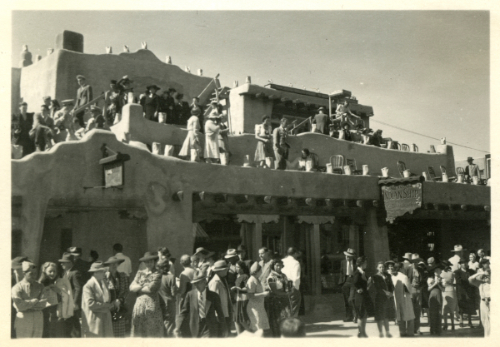
JOSEFA LLANES ESCODA (1898-1945) was a prominent civic leader and a social worker. She is well known as a Filipina advocate of women’s suffrage and was founder of the Girl Scouts of the Philippines. While working as a social worker with the Philippine Chapter of the American Red Cross, she was given a scholarship toward graduate work at Columbia University. She earned her master’s degree in sociology there in 1925. While in the United States she also attended human rights programs, gave lectures to increase interest in the Philippines, and trained in Girl Scouting. When Llanes Escoda returned to the Philippines, she began training women on becoming Girl Scout leaders and organized the Girl Scouts of the Philippines, which was signed into being by President Manuel L. Quezon on May 26, 1940.

During World War II, when Japanese forces began invading the Philippine islands, Llanes Escoda and her husband provided medicine, food, clothing, and messages to Filipino war prisoners and American concentration camp internees. Llanes Escoda’s husband, Antonio, was arrested in June 1944, and Josefa was arrested on August 27, 1944. She was imprisoned in Fort Santiago, and presumably executed in early 1945. She was last seen on January 6, 1945, being transferred into a Japanese transport truck. The legacy of Llanes Escoda remains strong in the Philippines with many streets and buildings named after her, along with her depiction on the 1,000-peso note (with two other martyred Filipinos). The Girl Scouts of the Philippines celebrate Llanes Escoda’s birthday every September 20 with celebrations and activities.

Acción Feminista Dominicana. Courtesy public domain.

The 1940s saw another round of Spanish-speaking countries granting women’s suffrage: the Dominican Republic (1942), Panama (1941, 1946), Guatemala and Venezuela (both 1946), Argentina (1947), and Chile and Costa Rica (both 1949).

A 1941 electoral law in Panama provided additional rights to women (to vote for and be elected to provincial bodies) if they held a university degree or completed vocational training, graduated from a teacher’s college, or finished secondary schooling. Full political rights were granted to women in 1946. This was not uncommon around the world; many countries granted gradients of suffrage to people of varying ethnic, socioeconomic, and educational classes. This often makes it difficult to pinpoint a specific date or year for women’s suffrage in any given country. For some of the countries in El voto femenino, as with Panama, two years are listed for this reason.

CLARA GONZÁLEZ (1898-1990) was the first Panamanian woman to earn her bachelor of law degree in 1922, and was the first Latin American woman to earn a doctorate in law. She was one of the founders of the National Feminist Party of Panama and pressed for suffrage for women. She served in the Constitutional Assembly, which finally granted women suffrage in 1946, and was the first Panamanian woman named as a juvenile court judge.

ELIDA LUIS CAMPODÓNICO MORENO (1894-1960), another suffragist and a founder of the National Feminist Party of Panama, was a teacher, women’s rights advocate, and attorney.

From the Dominican Republic, DELÍA MERCEDES WEBER PÉREZ (1900-1982) was a teacher, artist, poet, and film actress, as well as a feminist and supporter of women’s suffrage. Through her writing and painting, she portrayed her world and the restrictions placed upon her life. Founding several cultural and feminist clubs, she helped gain both civil and political rights for women.

ANA EMILIA ABIGAIL MEJÍA SOLIERE (1895-1941) was a writer, literary critic, and educator, and is considered a pioneer of the feminist movement in the Dominican Republic. She and Delía Weber co-founded Club Nosotras (initially a literary organization formed in 1927), which was reorganized as Acción Feminista Dominicana (AFD) in 1931. AFD became the most important feminist group uniting women from across the nation. AFD mobilized to “fight for the vindication of women’s rights,” particularly women’s suffrage, but they also focused on penal facility reform and fighting alcoholism, prostitution, and illegal drugs, among other issues. Women’s suffrage in the Dominican Republic was not achieved until 1942, after much work was done trying to convince the president and other politicians.

In the 1950s, Mexico (1953), Colombia (1954), Honduras, Nicaragua, and Peru (all 1955) all achieved the women’s vote.

In Mexico, MARÍA DEL REFUGIO GARCÍA, also known as Cuca García (1898-1970), was an important figure in the early struggle for women’s rights. Jocelyn H. Olcott, in her book Revolutionary Women in Postrevolutionary Mexico (Duke University Press, 2006), quotes Refugio García on the battle for suffrage:

The gunpowder from the battlefields passed through our hair many times without making us turn back, but our country’s government, when the Revolution was ended and they had taken advantage of our services, sent us back home, saying that “the woman’s place is in her home.”

HERMILA GALINDO ACOSTA (1886–1954) was another Mexican feminist as well as a writer. She was an early supporter of many radical feminist issues, primarily sex education in schools, women’s suffrage, and divorce. She was one of the first feminists to state that Catholicism in Mexico was upsetting feminist efforts. In 1915, she founded the political literary weekly Mujer Moderna, promoting the equality of women and men. At the end of 1916, she asked the Constituent Congress for political rights for women, mainly their right to vote, in the Political Constitution of the United Mexican States of 1917. In 1918, she ran for the Congress of the Union; however, she did not obtain the position, even though she had the majority of votes. Finally, in 1952, Galindo Acosta became the first female federal congresswoman in Mexico. In 1953, she was able to include the right to vote for women in Article 34 of the Constitution, which passed, finally enfranchising Mexican women.

Elvia Carrillo Puerto, also known as “The Red Nun,” ca. 1901. Courtesy public domain.
Elvia Carrillo Puerto, also known as “The Red Nun,” ca. 1901.
Courtesy public domain.

ELVIA  CARRILLO PUERTO (1878–1968) was a politician and feminist activist. Due to Carrillo’s contributions to Mexican government and history, she was officially decorated as a “Veteran of the Revolution.” Carrillo’s dedication to the revolution and women’s movement earned her the nickname “The Red Nun” (La Monja Roja). She dedicated her life to fighting the injustices caused by gender inequality and founding feminist resistance organizations like the Rita Cetina Gutiérrez League (named for her former teacher and mentor). Puerto helped get women the right to vote and be elected in the state of Yucatán. She was elected to the Yucatán legislature in 1923, continuing to fight for women’s rights long after serving in that post. Her work was influential in the introduction of Mexican women’s suffrage nationally in 1953. Even Google has recognized both Elvia Carrillo Puerto and Hermila Galindo Acosta in their Google Doodles on December 6, 2017, and June 2, 2018, respectively, celebrating their accomplishments.

In Peru, MARÍA JESÚS ALVARADO RIVERA (1878-1971) was a feminist, educator, journalist, writer, and social activist. She was noted by the National Council of Women of Peru in 1969 as the “first modern champion of women’s rights in Peru.”

MAGDA PORTAL (1900-1989) was a poet, journalist, feminist, and activist. She was a central figure in Peru’s political vanguard during the first half of the twentieth century and spent extended periods of her life imprisoned or in exile.

In the 1960s and 1970s, there were only a few Hispanic/ Latino countries that granted women’s suffrage: Paraguay (1961), Portugal (1976), and Spain (1977).

Women’s suffrage in Francoist Spain was inhibited by age limits, definitions around heads of household, and a lack of elections. Women earned the right to vote in Spain in 1933, but lost most of their rights after Franco came to power in 1939 at the end of the Spanish Civil War. Repression of the women’s (and men’s) vote occurred as the dictatorship held no national democratic elections between 1939 and 1977. The first national elections in which women could vote took place in 1977, two years after the death of Franco.

Carolina Beatriz Ângelo. Courtesy public domain.
Carolina Beatriz Ângelo.
Courtesy public domain.

CAROLINA BEATRIZ ÂNGELO (1878-1911) was a physician and the first woman to vote in Portugal. She used the vagueness of a law that issued the right to vote to literate heads-of-household over 21 to cast her vote in the election of the Constituent National Assembly in 1911. Shortly after her vote, on July 3, 1913, a law was passed to specify the right to vote was only for male citizens who were literate and over 21. Her act was widely reported on throughout Portugal and among feminist associations in other countries. Over the next several decades there were a few allowances made for women to vote. In 1976, all voting restrictions were lifted following the Carnation Revolution, in which the authoritarian Estado Novo regime was overthrown and the shift to democracy began.

★ ★ ★

The El voto femenino exhibition at NHCC also features a companion piece, Pan American Unity. This mural, in the form of a large series of woodblock prints, was created by Albuquerque artist Julianna Kirwin. Kirwin replaces Diego Rivera’s depiction of the Founding Fathers (from one of the panels of his 1940 Pan American Unity mural in San Francisco) with powerful women of the Americas, including Isabel Allende (Chilean author), Michelle Bachelet (former President of Chile, 2006-2010 and 2014-2018), Deb Haaland (former U.S. Representative from New Mexico’s 1st Congressional District and the nominee for U.S. Secretary of the Interior, awaiting confirmation as of press time), Dolores Huerta (U.S. activist), and Berta Cáceres (Honduran environmental activist).

Even though, as of press time, the NHCC is currently closed due  to the COVID-19 pandemic, you can visit El voto femenino online. There, you can work your way through the decades to learn about even more women not mentioned here. There are also online and downloadable activities, videos, presentations, and resources to learn more.

Find the exhibition online, here.

Cassandra E. Osterloh, MA, MLS, is the librarian in the History and Literary Arts Program at the National Hispanic Cultural Center. History and Literary Arts houses a library, archives, and special collections, features two to four exhibits a year, and presents over a dozen history and literary arts programs serving children, youth, adults, elders, and families.

Cassandra E. Osterloh (Cherokee Nation) MA, MLS, is the Tribal Libraries Program Coordinator at the New Mexico State Library and is a former librarian in the History and Literary Arts department at the National Hispanic Cultural Center.

¿Dónde Está Tu Querencia?

BY DR. MATTHEW J. MARTINEZ

Querencia: Reflections on the New Mexico Homeland (University of New Mexico Press, 2020) provides an insightful collection of essays that serve as a testament to the beauty of our state. And indeed, Querencia could not be more timely, as New Mexico continues to struggle amidst a global pandemic, threats to sacred sites, and strained community relations played out by removal of statues and monuments.

This edited collection is dedicated to writer and community activist Juan Estevan Arellano, who wrote that Querencia “is that which gives us a sense of place, that which anchors us to the land, that which makes us a unique people.” The fifteen essays therein are written by a diverse range of scholars, creating an intellectual and culturally grounded space to reflect on what it means to be connected to a homeland. Each essay is interwoven in five general sections that include Community Querencias, Screening Querencias, Memory as Querencia, Cultural Landscapes of Querencia, and Storytelling as Querencia. The collection may be read chronologically across chapters or by each section. What remains constant across the essays is a lens that sheds light on deep community connections, experiences and, at times, contested spaces.

Querencia begins with a sort of manito manifesto by famed nuevomexicano writer Rudolfo Anaya. The beauty of this writing is that it remains Anaya’s last publication before his passing in 2020. Anaya is perhaps best well known for his 1972 novel Bless Me, Ultima, and was considered one of the founders of the canon of contemporary Chicano literature. He paved the way for many of the scholars in Querencia, who continue to teach in English, ethnic studies, and literature departments. In the forward, Anaya articulates, “Love for our querencia spreads out to the larger country.  Our love is strong because it has its center at home, in our casita, en los solares, our neighbors, the land, river, and the llano.” Like many of Anaya’s writings, this essay puts an unspoken landscape into words. This is by no means a romantic and pastoral perspective, since Anaya also touches upon the ills of society not easily solvable; he states that “too many have become separated from the querencia of family and ancestors.… Can we say that con el corazón abierto, la cultura cura?”—might an open heart cure our culture?

As a follow-up to this theme, Querencia continues to explore the varied complexities of New Mexico history in the chapter “Critical Reflections on Chicanx and Indigenous Scholarship and Activism.” Here, editor Vanessa Fonseca-Chávez presents a conversation between scholars reflecting on the practices of placemaking and how Chicanx and Indigenous communities can work together to build bridges and solidarity for decolonization. The intent of this critical conversation is to offer insights to better understand and work with communities. Dr. Tey Marianna Nunn, director and chief curator of the National Hispanic Cultural Center, states that “community involvement and voice need to be authentic and meaningful (nothing at the table about us—without us).”

Perhaps a seemingly practical note of advice, these words are echoed by community members who have been historically displaced and ignored. According to Myla Vicenti Carpio, “when we look at New Mexico from an Indigenous perspective, it means we first look at the land not in geopolitical terms or boundaries, but as Indigenous space.” It is the recognition of what Indigenous space means that can lead to healing and creating beneficial collaborations. Readers can gain additional perspectives on ongoing controversies, such as the treatment of symbols and monuments that glorify symbolic and physical violence. The authors illustrate such examples that can be seen in “The Three Peoples,” a mural inside Zimmerman Library at the University of New Mexico, or the Juan de Oñate monuments in Alcalde and at Albuquerque’s Tiguex Park, both of which were removed during the summer of 2020.

Another essay, “New Mexico Triptych” by Spencer R. Herrera, dives into film propaganda that reflects the ideas of querencia and how powerful media can be. As one of his examples, Herrera draws upon the New Mexico True campaign produced by the New Mexico Tourism Department, which he interrogates by conveying what he calls a false, romanticized image of our state in which everyone rides a hot-air balloon, ventures out to majestic hiking trails, or hangs out benignly at a local pueblo plaza. Herrera argues that “we fail to see the complete picture of who we are and thus ignore our social ills.” Furthermore, “to better appreciate the spirit of New Mexico’s people and cultures, we must learn about the region’s deep historical memory and respect the value of place that defines the sacred space of where two or more people gather in the name of community.”

In “Ak’u, Beloved,” C. Maurus Chino details a personal story through a description of Acoma, invoking the vast landscape and making connections with other Indigenous communities across North America. By reflecting on place and homeland, his childhood memories and reverence for land are inherent in the writing. Chino clearly articulates that “Acoma People are a matrilineal society. Women take a central role in the welfare of the family.” It is through this reminder that Chino makes a direct connection by recognizing clan relations, family, community, and all things related to land. Readers will enjoy Chino’s personal realization when he noticed the use of T-shaped doors on his travels where he states, “I could see clearly the architectural link among Chaco, Acoma, Paquimé and, there in southern Mexico, Palenque, all geographically and culturally connected.” A critical takeaway from Chino’s essay is that despite historical atrocities at Acoma, Indigenous people are still here and continue to thrive in spiritual and creative ways to continue honoring land and place.

In “Revolution Begins at La Cocina!,” authors Patricia Marina Trujillo, Corrine Kaa Pedi Povi Sanchez, and Scott Davis invite readers to engage in a kitchen-table-style conversation. This essay is about centering voices and experiences in ways that food and humor often bring people together. The authors want readers to know that “we are using story sharing—which is active and ongoing—recognizing that we each hold pieces of the story. This signals how our communities privilege oral communication and interpersonal interactions: that is to say,  relationships. This dialoguing on the page embodies a resistance to individual authorship and its relationship to authority.” One of the table conversations occurs at Sonic, which Trujillo states, “not even joking, one of my grandma’s signature meals when I was growing up was the Brown Bag Special. This place, as much as any around here, is part of the culture. Española and Sonic, that’s querencia! I love the concept of querencia; it really resonates with me. I also love to think of it as a neologism that connects the two Spanish words, querer [to love, to want] and herencia  [heritage].”  Readers will indeed appreciate this refreshing approach of table-style conversations not commonly written in conventional history and cultural studies publications.

Automobile on road to Enchanted Mesa near Acoma Pueblo, New Mexico, 1926. Photograph by Frank Shoemaker. Courtesy Palace of the Governors Photo Archives (NMHM/DCA), neg. no. LS.2094.
Automobile on road to Enchanted Mesa near Acoma Pueblo, New Mexico, 1926. Photograph by Frank Shoemaker.
Courtesy Palace of the Governors Photo Archives (NMHM/DCA), neg. no. LS.2094.

Querencia acts as a magnifying glass trained on traditional places and homelands; it is through this bowed lens that readers are able to see the deep connections between people and place. This is often glaringly absent when current discussions on proposed fracking at Chaco Canyon negate the importance of spiritual places that are continuously alive. Nevertheless, cultural and historic sites continue to thrive, despite the lack of perceived people inhabiting such places. From Indigenous perspectives, it is known that such historical sites have never been abandoned but, in contrast, continue to be called upon and visited through many traditions. Much like New Mexico’s acequias, these sites are like the bodies of water that are the lifeways of many traditional communities and villages. Similarly, the ongoing threats to access and acequia stewardship in the name of development compromise what New Mexico reveres as a love for land that provides life for all. New Mexico is a landscape that embodies lived experiences and historical memories. Upon driving through majestic open spaces, it is common for travelers to New Mexico to perhaps ask, “Why don’t the tribes develop more housing in these open spaces or put  up  more businesses to better their  employment  opportunities?” Indeed, there is a  delicate balance between economic development and the preservation of a natural homeland. Since time immemorial, these lands have been occupied by active volcanoes, prehistoric dinosaurs, and a vast trade network of Indigenous peoples across the Americas long before any semblance of modernity began to take shape. Each of the authors featured in the book articulate this historical memory of querencia. These homelands and arid spaces are intended to exist within a time and purpose of their own. That is querencia.

Crowds at La Fonda hotel during fiesta, Santa Fe, New Mexico, ca. 1941-1944.
Courtesy the Mildred Sortgatz Collection, the Palace of the Governors Photo Archives (NMHM/DCA), neg. no. HP. 1993.8.10.

Whether readers are interested in learning more about the Las Vegas Fiestas, Genízaro cultural landscapes, La Llorona,  or any of the other topics discussed, there are myriad histories here to unpack. Poet Laureate of New Mexico Levi Romero, one of the editors of the volume, states that “ultimately, the goal is to inspire the reader to embark on a journey toward his or her own Querencia. ¿Dónde está tu Querencia?

This seemingly simple but insightful question guides readers to reflect upon their own value systems. Querencia: Reflections on the New Mexico Homeland is a gem and should be required reading in schools and for avid readers who are interested in learning more about a Beloved People and Beloved Land— Amuu Hanu, eh Amuu, Haatsi.

Matthew J. Martinez (Ohkay Owingeh) is currently deputy director at the Museum of Indian Arts and Culture in Santa Fe, New Mexico. He received his PhD from the University of Minnesota (2008) in American studies, and has published in the areas of Pueblo Indian history.

Dr. Matthew J. Martinez (opens in a new tab) is currently serving as executive director of the Mesa Prieta Petroglyph Project. He is a former First Lieutenant Governor at Ohkay Owingeh.

Come Downstairs and Say Hello

BY CHARLOTTE JUSINSKI

Issues of El Palacio don’t typically have a theme, but sometimes one emerges organically. I guess it shouldn’t be that surprising that I subconsciously assembled a book full of innovators this spring. For better or for worse, 2020 made us all innovators. These last twelve months, day by day, we’ve had to figure next steps out ourselves, and simply have faith that this work will pay off in a brighter future.

That was also the case when, 23 years ago, the Museum of Indian Arts and Culture opened Here, Now and Always, its groundbreaking exhibition that was not only about Native peoples, but it was by Native peoples and for Native peoples. Decolonization of museums is now a common topic of discussion, but at the time, it was downright radical. Lillia McEnaney and Felicia Garcia discuss the exhibition and its reverberations in “Collaboration, Multivocality, and Authority.”

Dr. Timothy E. Nelson’s history of Blackdom, New Mexico is a double dose of innovation; not only does he point out the imaginative and effective way in which Black people incorporated the Blackdom Townsite Company as a corporate veil, but Dr. Nelson’s research itself is brand-new, concentrating for the first time on this history of Blackdom.

Forgive the old cliché, but indeed, space is the final frontier—so what could be more innovative than conducting new research on another planet? That’s exactly what Dr. Larry Crumpler from the New Mexico Museum of Natural History and Science is doing as a member of the NASA team that’s put a new rover on Mars. Julia Goldberg has the story.

Dr. Crumpler is continuing a long tradition of New Mexican influence in space. Before there were rockets launching from the Tularosa Basin in Southern New Mexico, there were ranchers new to the arid area. Writer Molly Boyle takes a look at the New Mexico Farm & Ranch Heritage Museum’s Ranches to Rockets exhibition.

On the ideological front, National Hispanic Cultural Center History and Literary Arts librarian Cassandra Osterloh takes a look at the remarkable women of the Hispanic diaspora who fought tooth and nail for women’s suffrage, from Mexico to the Philippines.

Sometimes innovation looks like brashness, and some might argue that was the case for famed Southwestern gallerist Elaine Horwitch. She was opinionated, shrewd, driven, and unwavering—and she also ushered in a new era of contemporary art in the Southwest that can still be felt today everywhere you turn in Santa Fe. Julie Sasse, curator at the Tucson Museum of Art, has published a new book about Horwitch, and we excerpt it.

Dr. Matthew J. Martinez takes a look at Querencia: Reflections on the New Mexico Homeland, a volume of new and honest takes on what it means to be from New Mexico; Silver City and Grant County Poet Laureate Eve West Bessier offers up poets from Southern New Mexico for our consideration; and in this issue’s Framework feature, El Palacio copy editor Robin Babb makes her debut with a story from Sasse about Horwitch- represented artist Billy Schenck.

Our lives may feel unnavigable and overwhelming to us now—but we are not the first people to face such seemingly insurmountable challenges, nor will we be the first to overcome them and build a better society in their wake. Be calm, be brave. It’ll be okay.

The Southwestern Connection

BY ROBIN BABB

Whenever Billy Schenck came by Elaine Horwitch’s gallery in Santa Fe, the whole staff stopped what they were doing to talk to the handsome cowboy painter.

Wearing his beat-up old cowboy boots and with a bandana always hanging out of the back pocket of his blue jeans, Schenck cut quite the figure amidst the refined Santa Fe art world. At the time, Schenck was known to bring some of his larger paintings to the gallery in his horse trailer, requiring one to navigate horse manure while unloading. “As far as I know, he still does that,” says Julie Sasse, chief curator at the Tucson Museum of Art and author of the new book Southwest Rising: Contemporary Art and the Legacy of Elaine Horwitch, excerpted here.

Schenck’s paintings, much like the man himself, reflect images of the Old West, with all its romance and conflict. It was in the late seventies that he started applying his signature paint-by-numbers style to the landscape of the American West, a pop art technique that he still employs today. In some later paintings such as Cliff, he began including text, a gesture towards Lichtenstein’s comic-book aesthetic—one which Horwitch found overly critical and too tongue-in-cheek.

Although they were friends, the professional component of Schenck and Horwitch’s relationship wasn’t always smooth sailing. They often sparred over sales percentages, especially after Schenck got some national notoriety and wanted a better deal than the typical sixty-forty dealer-artist percentages on his works. Horwitch was a notoriously tough negotiator, and butted heads with more than a few of the artists she worked with.

To gather source material for his paintings, Schenck travelled all over the Southwest photographing the landscape and the people. Often, many landscapes were synergized in the final product, as in Cliff, which Schenck says  depicts “part Wyoming, part Arizona, and part pure imagination.” By the seventies he was deeply in love with the region, and was one of the first to encourage Horwitch to open a gallery in Santa Fe.

Schenck split his time between Scottsdale, Arizona, and Jackson Hole, Wyoming, for most of the seventies and eighties before he bought a house in La Cienega, New Mexico, in 1997. He purchased the home, where he still lives with his wife Rebecca, from the landscape architect and writer J.B. Jackson, who published the highly influential magazine Landscape from 1951 to 1968. Schenck, who has won several awards at local and national rodeo competitions, keeps a small ranch at his La Cienega property, where he can still be found practicing team penning in his beat-up old cowboy boots.

Robin Babb is a writer and the copy editor of El Palacio. She owns Harvest Moon Books, an independent bookshop in Albuquerque.

Robin Babb (opens in a new tab) is a writer in Albuquerque, New Mexico, and the associate editor of edible New Mexico and The Bite. She has worked in newspaper and magazine editorial for ten years, and her work has been published in the Kenyon Review, Phoebe Journal, New Mexico Magazine, Eaten, Civil Eats, Southwest Contemporary, and other places. In 2024 she was awarded the New Mexico Writers Annual Grant and the Center for Regional Studies Fellowship. She likes to write about animals, books, video games, and the end of the world. She is currently working on a collection of essays.