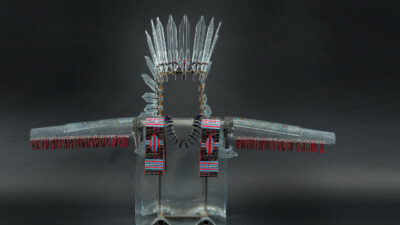
Read Story Tellers in Glass Ghost Shirt, 2014. Glass and rebar. 34 ½ × 51 ½ × 18 in. Accession/catalog no. CHP-187, collection of the IAIA Museum of Contemporary Native Arts. Photograph by Eric Wimmer. Courtesy the IAIA Museum of Contemporary Native Arts.

Story Tellers in Glass

By Dr. Letitia Chambers Clearly Indigenous: Native Visions Reimagined in Glass is a groundbreaking exhibition of works in glass by Indigenous artists. Co-curated by Dr. Letitia Chambers and Cathy Short (Citizen Potawatomi) and on view at the Museum of Indian Arts and Culture in Santa Fe through June 22, 2022, the stunning art in the exhibit embodies the intellectual content of Native traditions expressed in glass.

Categories: Indigenous arts and cultures
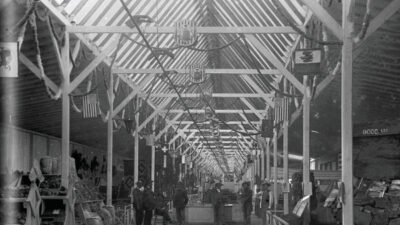
Read Picturesque, Romantic, Practical Exposition Hall, Tertio-Millennial Exposition, Santa Fe, New Mexico, ca. 1880-1890. Photograph by Ben Wittick. Courtesy the Ben Wittick Collection, Palace of the Governors Photo Archives (NMHM/DCA), neg. no. 015860.

Picturesque, Romantic, Practical

By James E. Snead Susan Elston Wallace was not impressed with Santa Fe. “It is the small boast of the citizens of this place that this is the oldest city in the U.S.,” she wrote a cousin in March 1879. But the town itself resembled “nothing so much as a collection of brick kilns.” The wife of Territorial Governor Lew Wallace, she had come West from Indiana under protest, bringing along the preconceptions of her time and class.

Categories: Southwestern history

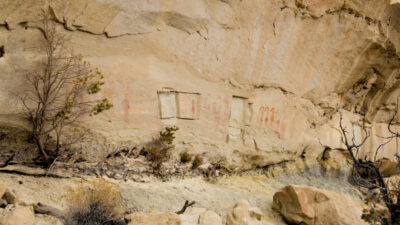
Read Eyes on the Land Thieves cut out Navajo images from this cliff face south of Bloomfield, New Mexico. Photograph courtesy Kenneth Russell.

Eyes on the Land

By Paul Weideman Messing with the matrix. That’s one of the problems with the modern-day fad of stacking stones into cairns in wilderness areas. Cairns are an age-old method of marking trails, but those that are constructed for less serious reasons at archaeological sites can cause irreparable damage. “If there were associated grid gardens or shallow subsurface deposits, the rock removal would likely disturb them, compromising the shallow subsurface stratigraphy,” says Jessica Badner.

Categories: Archaeology

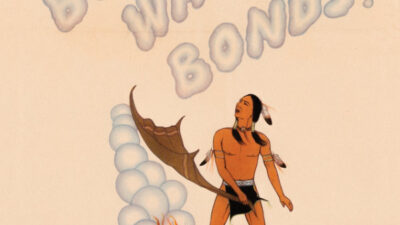
Read We’ve Got a War to Win! Eva Mirabal, Buy War Bonds, 1942. Offset poster, 19 ¾ × 16 1⁄8 in., unframed. Fred Jones Jr. Museum of Art, University of Oklahoma, Norman. The James T. Bialac Native American Art Collection, 2010.

We’ve Got a War to Win!

By Lois Rudnick and Jonathan Warm Day Coming The following is an excerpt from the third chapter of Eva Mirabal: Three Generations of Tradition and Modernity at Taos Pueblo (Museum of New Mexico Press, 2021). Eva Mirabal (Eah-Ha-Wa, Fast Growing Corn, 1920–1968, Taos) studied at the Dorothy Dunn Studio Arts Program at the Santa Fe Indian School, where she was a favorite of the founder and served as an assistant to Dunn’s replacement, Geronima Montoya (P’Otsunu, 1915–2015, Ohkay Owingeh).

Categories: Essays and memoir

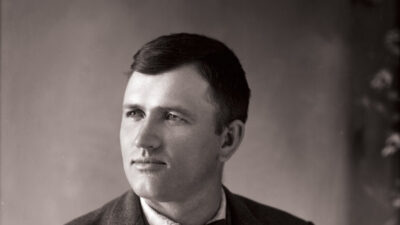
Read The Cause of Every American Artist Territory Senator, Holm Bursum, Socorro, New Mexico, ca. 1900-1910. Courtesy Palace of the Governors Photo Archives (NMHM/DCA), neg. no. 077073.

The Cause of Every American Artist

By Oliver Horn, PhD In May 1921, New Mexico Senator Holm O. Bursum introduced a bill to Congress that would incite a power struggle over politics and culture in New Mexico. Crafted behind closed doors and without any consultation with the Pueblo people, the legislation proposed allowing non-Pueblo people to claim reservation land if they could prove ten years of residency.

Categories: Southwestern history

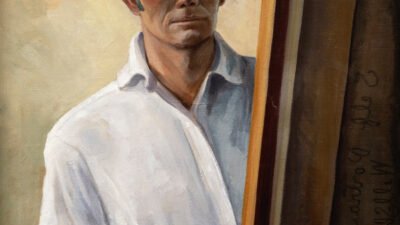
Read Bohemian Rhapsody Will Shuster, Self Portrait, 1931. Oil on canvas. 30 × 24 in. Courtesy the family of Will Shuster, Santa Fe, and Zaplin Lampert Gallery, Santa Fe.

Bohemian Rhapsody

By Christian Waguespack A century ago, in 1920, serious health issues brought Pennsylvania-born artist William Howard Shuster (1893– 1969) to New Mexico, beginning forty-nine years of creativity, exploration, and community engagement. Though he received some fine-arts training in Philadelphia, it was not until he experienced the inspiration of Santa Fe that he decided to dedicate his life to art. Almost immediately, he famously joined four other young bohemians to become Los Cinco Pintores, and integrated himself into Santa Fe’s burgeoning Modernist art scene.

Categories: Essays and memoir

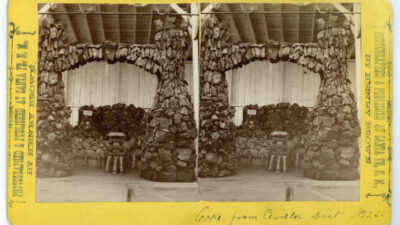
Read Buy the World a Coke Display of coke from Cerillos mining district, Tertio-Millennial Exposition, Santa Fe, New Mexico, 1893. Photograph by Bennett and Brown. Courtesy Palace of the Governors Photo Archives (NMHM/DCA), neg. no. 011002.

Buy the World a Coke

By Andrew Wice This photograph celebrates the abundance of the Cerrillos coal beds, located about twenty-five miles south of Santa Fe. The Atchison, Topeka and Santa Fe Railroad built a railroad depot in Cerrillos in 1892, and was responsible for creating the infrastructure to harvest the precious fuel. This included establishing what would eventually become the mining town of Madrid, building the railhead hamlet of Waldo, and laying a 3-mile railroad spur to connect the two.

Categories: Framework

Read Memento Mori Rectangular glass artwork with a red and purple color scheme, featuring cross shapes and geometric patterns on a black background. [gen-ai]

Memento Mori

By Charlotte Jusinski My dog died during the production of this magazine. Maybe it’s not standard for these editor’s letters to go this way. We need to stay professional, we need to keep it clean, we need to stay a bit cold and stoic. Stick to business. Don’t get too personal. Don’t get personal at all. If you know me, however, you know that the above sentiment is one that I buck.

Categories: Editor's Letter