Celestial Petroglyphs and  Chimpanzees in Space

By Cathy Harper and Michael Shinabery

More than twenty years later, the Space Trail continues to evolve as unknown sites are added that tickle the adventurous fancy of travelers from near and far. A link on the New Mexico Museum of Space History’s website takes curiosity seekers to a statewide map marking fifty two sites across the Land of Enchantment, and each is directly related to space research, exploration, and development. It includes archeoastronomy sites like Chaco Canyon and Wizard’s Roost to present-day facilities such as Spaceport America.
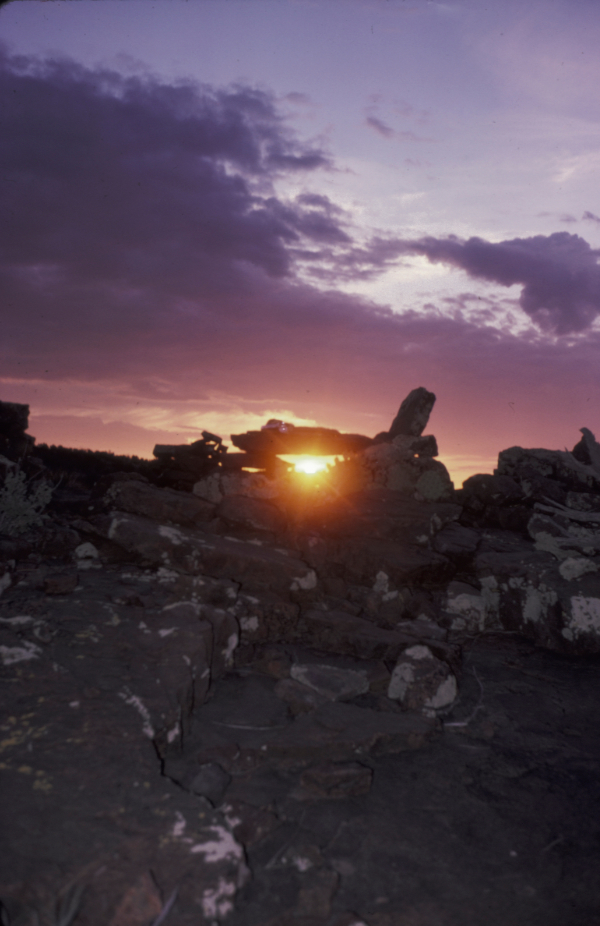
View of the summer solstice sunrise
View of the summer solstice sunrise on June 21, 1980, at Wally’s Dome, Otero County. Featured in this prehistoric solar observatory are several upright rock formations supporting a horizontal rock slab astronomically aligned to record the annual solstice event. Photograph courtesy of Human Systems Research, Incorporated.

Prehistoric observations in New Mexico, like those shown in the sand paintings of the Navajo or the petroglyphs of the Zuni, allowed ancient Native Americans to predict seasonal changes to plan and implement the agricultural and religious events of their lives. The rock alignments at Wizard’s Roost in the Sacramento Mountains, built between 100 BCE. and CE 900, were used as a calendar, like the much larger site of Stonehenge. The Crab Nebula supernova in 1054 is thought to be depicted in a pictograph created by the Ancestral Puebloan culture in Chaco Canyon. Ancient Indigenous peoples across the globe depended on their knowledge of the stars to plot their courses, plant their seeds, and harvest their crops. Some of these archeoastronomy sites—like the Scholle petroglyph and Wally’s Dome—are closed to the public to protect them, while others such as Chaco Canyon and the Three Rivers Petroglyph Site, are open to explore.

In 1598, the Spaniards who trekked the El Camino Real blazed a trail not only across New Mexico but also to the future, as their path crossed what is now the home of Spaceport America. In 1945, the United States Army seized 2,671,000 acres of ranching land in southern New Mexico that would become known as White Sands Missile Range—the “Birthplace of America’s Missile and Space Activity.”
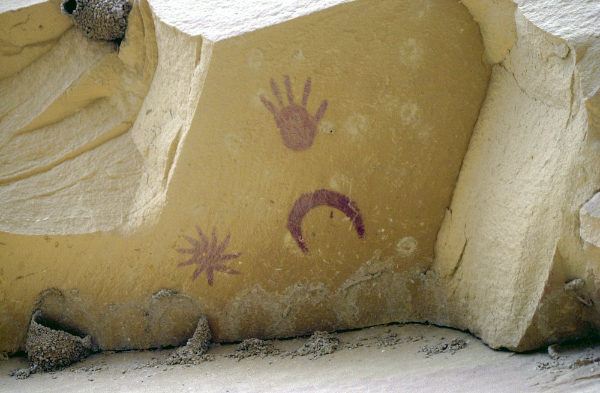
11th century pictograph at Chaco Canyon
This 11th century pictograph at Chaco Canyon may depict the supernova of 1054 BCE. The supernova and the moon were in this configuration when the supernova was near its brightest. An imprint of a hand at the top signifies that this is a sacred place. Photograph courtesy of Wikimedia Commons.

In the early 1930s and into the ’40s, American inventor Robert H. Goddard conducted research in Roswell. Funded by the Daniel and Florence Guggenheim Foundation, Goddard and his small staff pioneered many of the techniques used in today’s rockets. Goddard and his crew made major strides in rocket propulsion, as well as the practical matters of launch control, stabilization, tracking, and recovery. Visitors today can get a look at his laboratory at the Roswell Museum of Art, where an accurate full-scale reproduction is on display.
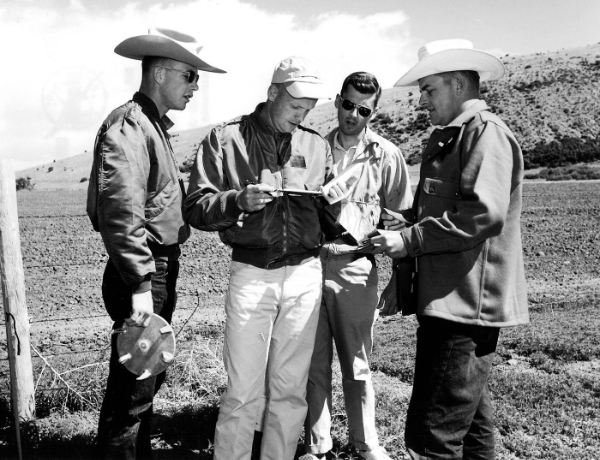
astronaut trip to Philmont Boy Scout Ranch in June 1964
On this astronaut trip to Philmont Boy Scout Ranch in June 1964, Joel Watkins (USGS) (right) discusses gravity meter data with Dave Scott (left), Neil Armstrong, and Roger Chaffee. Neil Armstrong attended Philmont as an Eagle Scout before returning to train for his trip to the moon. Photograph courtesy of NASA.

World War II brought many changes to New Mexico, where the wide-open spaces offered many opportunities for the military. In 1942, the Alamogordo Bombing and Gunnery Range opened (now Holloman Air Force Base). On April 18, 1951, an Aerobee rocket launched from Holloman Air Force Base carried its first animal payload, the monkey Albert V. Unfortunately, his parachute failed on return. Six months later, a Rhesus monkey and eleven mice became the first to be recovered alive. The second flight was the first success in a program of research that led to manned space travel.
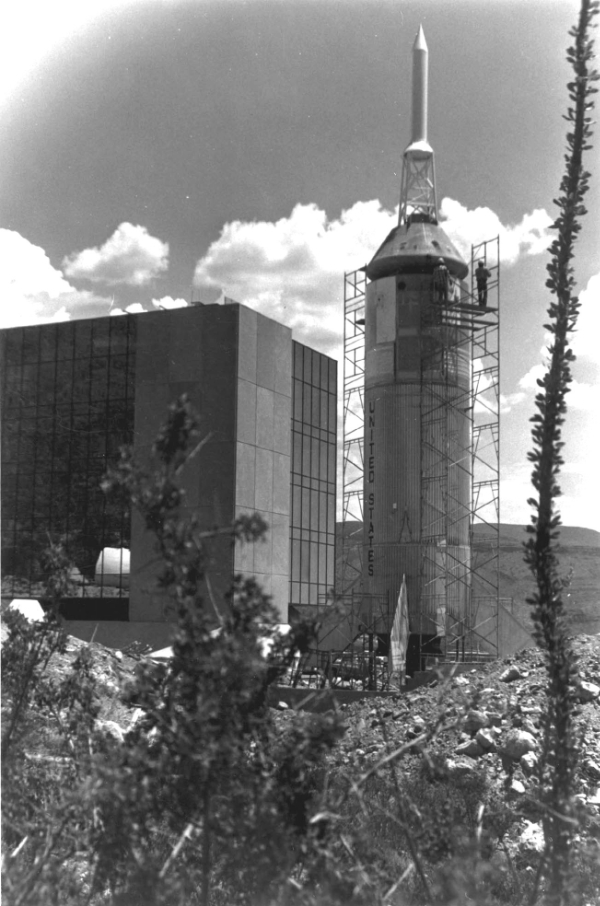
The largest rocket ever to be launched from New Mexico to date,
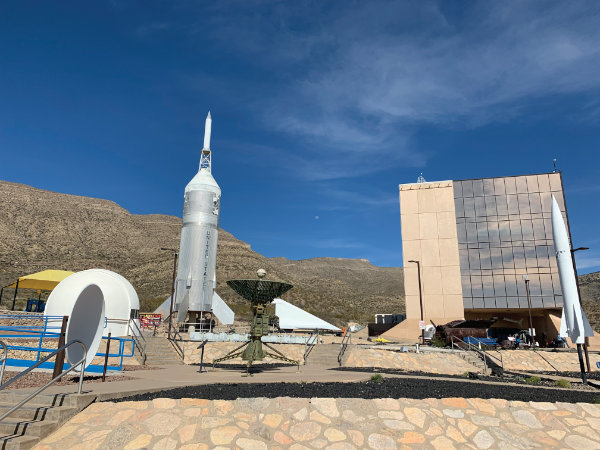
The largest rocket ever to be launched from New Mexico to date, the Little Joe II was used to test the Apollo spacecraft launch escape system. It was tested at White Sands Missile Range. Here, a Little Joe II is being assembled next to the New Mexico Museum of Space History during the museum’s construction in the mid-70s. Photograph courtesy of New Mexico Museum of Space History.

At Holloman’s High Speed Test Track on December 10, 1954, another space pioneer—Dr. John Paul Stapp—rode the Sonic Wind I rocket sled to a speed of 632 miles per hour. This test was to measure human response to sudden deceleration. As the sled hit the water brake, Dr. Stapp sustained 43 Gs, and experienced the same effects as a pilot ejecting from an aircraft traveling at 1,000 miles per hour at 35,000 feet. This test, along with others done at Holloman and other bases, resulted in improved safety belts in airplane cockpits and passenger seating. Dr. Stapp’s ride earned him the nickname the “fastest man on Earth.” Fun fact: for a time, seat belts were called “Stapp Straps.”

Before human pilots rode the Mercury spacecraft into space, animal passengers verified the adequacy of the capsule’s life support system. Because of their size and physical similarity to humans, chimpanzees were used. Eight chimpanzees participated in the Mercury Animal Test Program; two of them flew into space. The first chimpanzees in space, Ham and Enos, received their training at the Aeromedical Research Laboratory at Holloman Air Force Base. Ham, whose name is an acronym for the lab, is buried under the flagpoles at the New Mexico Museum of Space History.

New Mexico has frequently been the site for astronaut selection and training activities. The first groups of astronauts underwent medical screening at the Lovelace Clinic in Albuquerque, as did the women of Mercury 13. The clinic was founded in 1947 by William Randolph “Randy” Lovelace II, a native New Mexican. In 1959, a group of Lovelace Clinic aviation medicine experts put thirty one of the original astronaut candidates through a week of medical exams. On April 9, 1959, those who responded best to all the tests were introduced to the world as the Mercury Seven, America’s initial astronauts.

Apollo astronauts received geological training during field trips to sites in the Land of Enchantment. In the mid-1960s, astronauts found the Zuni Salt Lake’s near lunar landscape an excellent place to train. Later, astronauts from Apollo 15 and 16 honed their Lunar Rover driving skills across the rugged landscape of the Rio Grande Gorge area.
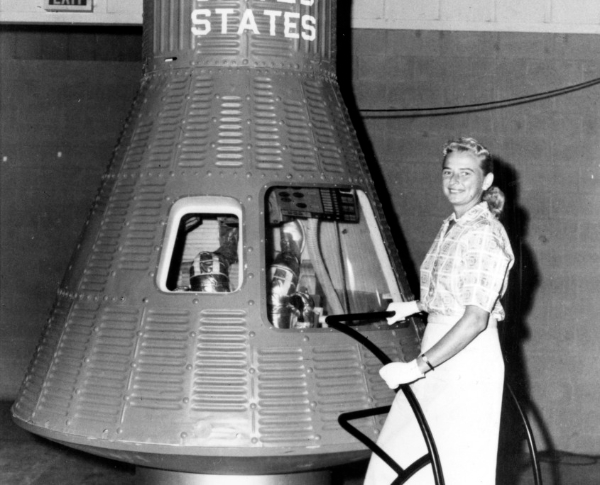
twenty years later that the first U.S. woman flew into space.
In 1959, Thirty two male candidate pilots under contract with NASA underwent a seven-day series of rigorous physiological and psychological tests at the Lovelace Foundation for Medical Education and Research (now Lovelace Biomedical). Seven of the candidates were selected to be the Project Mercury astronauts. Dr. Randy Lovelace II, founder of the facility, believed that women could pass the tests with about the same success rate as men. Lovelace conducted the same tests with a group of women who became known as the “Mercury 13,” including Jerry Cobb, pictured here. The women passed the tests, but NASA abruptly cancelled that program. It wasn’t until twenty years later that the first U.S. woman flew into space. Photograph courtesy of Lovelace Biomedical.
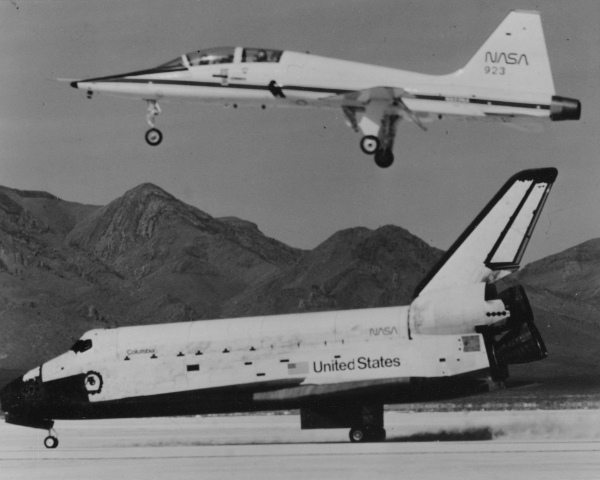
The only space shuttle to ever land in New Mexico, Columbia
The only space shuttle to ever land in New Mexico, Columbia touched down on the gypsum surface of Northrup Strip at White Sands Missile Range on March 30, 1982. The strip was renamed White Sands Space Harbor two months later. Photograph courtesy of NASA.

Space Shuttle pilots practiced landing approaches at White Sands Space Harbor (formerly Northrup Strip) on the White Sands Missile Range. White Sands Space Harbor was an alternate landing site for the Space Shuttle and is the chosen landing site for today’s Boeing Starliner, which is designed to transport crew to the International Space Station.

The National Radio Astronomy Observatory, a facility of the National Science Foundation near Magdalena, is the home of the Very Large Array (VLA). Many stars emit electromagnetic radiation in the form of radio waves. The VLA consists of twenty eight dish-shaped antennae, each of which is eighty two feet in diameter and weighs 230 tons. They are linked to form a single large telescope, as each antenna collects incoming radio signals and sends them to a central location where astronomers combine these signals to make detailed pictures of extremely faint objects in space. The first antenna began operation in 1975, and the complex was formally opened in 1980. The VLA Visitor’s Center is open year-round.

Originally a “Z Division” of Los Alamos, Sandia National Laboratories has a long history of developing science-based technologies for the U.S. military, but space has always been included, and in 1997, Sandia-designed airbags enabled NASA’s Pathfinder to land safely on Mars. At Sandia, Los Alamos National Laboratory (LANL), and many other locations, military goals and space exploration often overlapped. Needing rockets for their own purposes, the military funded the research necessary to create and test them. Scientists took advantage of the opportunity to use these same rockets for exploration.
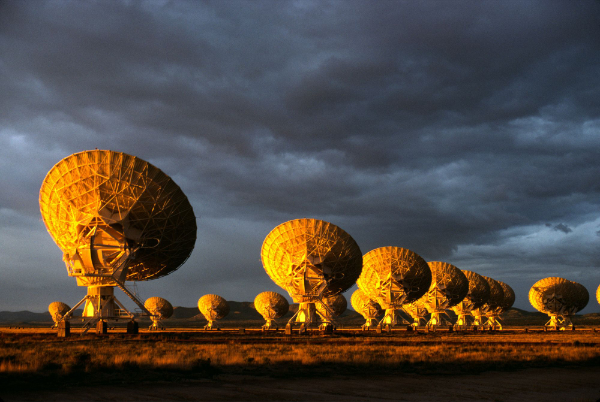
The National Science Foundation’s Very Large Array radio telescope near
Socorro is perhaps the world’s most sophisticated radio receiver. Photograph by
Andrew Clegg, U.S. National Science Foundation.
The National Science Foundation’s Very Large Array radio telescope near Socorro is perhaps the world’s most sophisticated radio receiver. Photograph by Andrew Clegg, U.S. National Science Foundation.

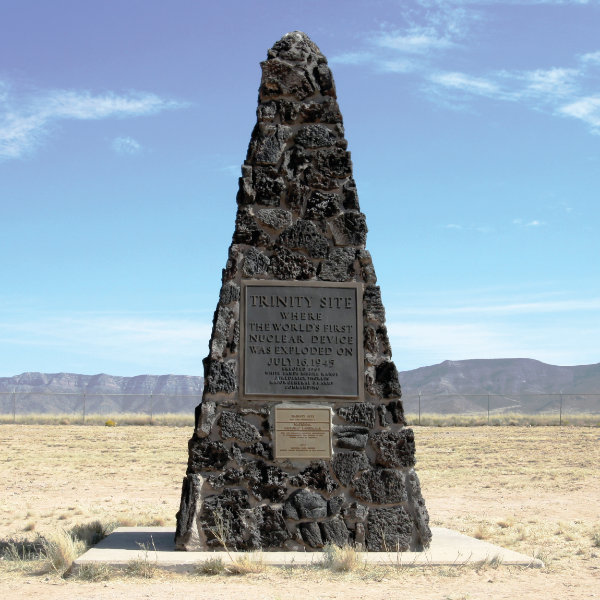
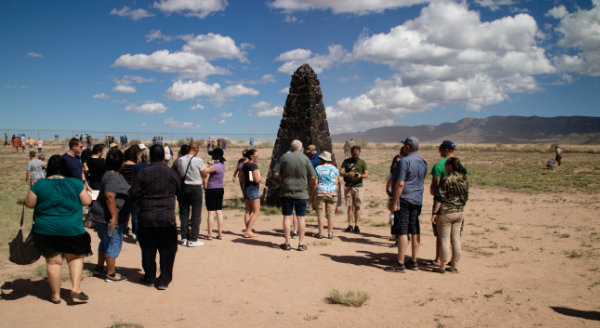
Los Alamos National Laboratory began in 1943 with the single purpose of designing and building an atomic bomb. Twenty-seven months later, the world’s first atomic bomb was detonated at Trinity Site, on the north end of White Sands Missile Range. The development of the atomic bomb brought the world into the atomic age. Research that began with military purposes spawned myriad private sector uses, from energy production on earth to powering trips to the edge of the solar system in spacecraft like the Viking and Galileo probes.
LANL also operates a small robotic observatory, Robotic Optical Transient Search Experiment (ROTSE), that in 1999 filmed a gamma-ray burst, the most luminous celestial object ever observed. In addition to this facility, Los Alamos maintains a system of robotic observatories called Rapid Telescopes for Optical Response (RAPTOR). The astronomical research facility system consists of six robotic observatories. The older RAPTOR telescopes, RAPTORs A, B, S, and P, each consist of a wide-field telescope and a narrow-field telescope. They are mounted on platforms that can swivel to any point in the sky in less than three seconds, making them the fastest-moving telescopes ever built.

Three hours southeast of Los Alamos, the NASA Balloon Facility near Fort Sumner, New Mexico, consists of a launch pad, take-off and landing strips, and two large hangars. Located in the Fort Sumner Municipal Airport, it is the main alternative base for stratospheric globe launching by NASA.

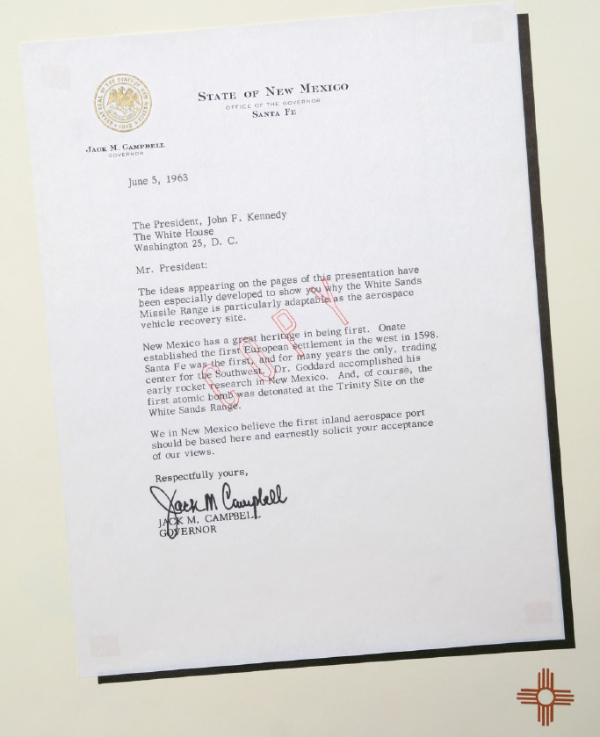
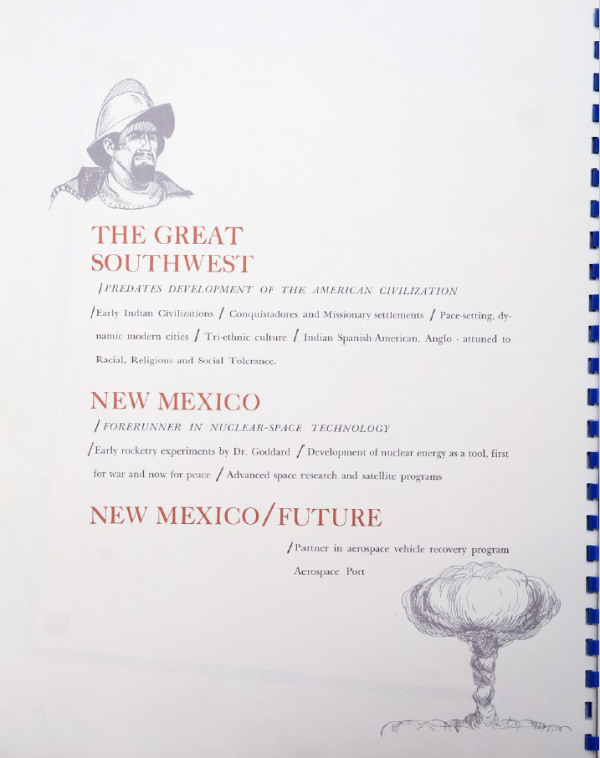
The New Mexico Office for Space Commercialization (NMOSC) was established in 1994 under Governor Bruce King to promote, coordinate, develop, and manage New Mexico’s regional spaceport program. There was a push at the time for the state to develop a spaceport in southern New Mexico—an initiative that could arguably have been started in 1963 when then-Governor Jack Campbell sent a proposal to President John F. Kennedy touting White Sands Missile Range as an aerospace recovery site and proposing that the state become the first inland “aerospace port.”
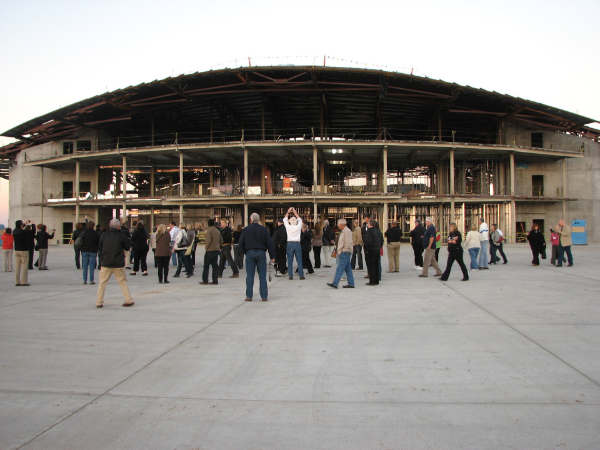
In late 2010, the New Mexico Economic Development Department, under the
leadership of then Executive Director Rick Homans, invited educators, media,
and other interested parties to see the progress of construction at Spaceport
America. Photograph courtesy of New Mexico Museum of Space History, neg.
no. 10.7.10 041.
In late 2010, the New Mexico Economic Development Department, under the leadership of then Executive Director Rick Homans, invited educators, media, and other interested parties to see the progress of construction at Spaceport America. Photograph courtesy of New Mexico Museum of Space History, neg. no. 10.7.10 041.

It wasn’t until many years later, under the leadership of then-Governor Bill Richardson, that the will to create a spaceport came about, and in October 2011, Spaceport America was declared officially open. Because anything worth having is worth waiting for, it was almost another decade before the first test flight of Virgin Galactic’s SpaceShipTwo from the world’s first purpose-built spaceport in May 2020, followed by its first private astronaut flight in June 2023. Virgin Galactic expects to launch at least one monthly commercial flight through the end of 2023, and plans to ramp that up as its fleet of spacecraft grows.

In New Mexico, space has been around for a long, long time. Space to grow, space to create, space to explore. The most unique thing that the New Mexico Space Trail offers to those adventurous enough to traverse its length is the rich historical and cultural legacy of a land that has enchanted for eons. When George House first envisioned the space trail, there were a mere twenty sites. Today there are fifty two, many of which represent locations that have more than one connection to space, like the many different types of research done at Los Alamos National Lab or the White Sands Test Facility. The common thread among these sites is the never-ending human curiosity for what lies beyond.
— 

Cathy Harper grew up watching the moon launches during the Apollo era and has had a lifelong fascination with space travel. She currently serves as the Public Relations and Marketing Director at the New Mexico Museum of Space History.

Michael Shinabery grew up near Neil Armstrong’s hometown during the Space Race, which ignited his interest in space. In 2015 he flew two missions aboard NASA’s Stratospheric Observatory for Infrared Astronomy, and today is Education Director at the New Mexico Museum of Space History.
Cathy Harper (opens in a new tab) grew up watching the moon launches during the Apollo era and has had a lifelong fascination with space travel. Sheis a former PR specialist at the New Mexico Museum of Space History in Alamogordo, and continues her work supporting the museum through their foundation, the International Space Hall of Fame.

Michael Shinabery grew up near Neil Armstrong’s hometown during the Space Race, which ignited his interest in space. In 2015 he flew two missions aboard NASA’s Stratospheric Observatory for Infrared Astronomy, and today is Education Director at the New Mexico Museum of Space History.
Cowboy Boots and Cow Pies, Clay and a Soup Spoon:

By Maurice M. Dixon, Jr.

In the spring of 1974, while firing some newly crafted clay vessels, an incident radically changed James Richard (“Rick”) Dillingham II’s artistic trajectory. 

Retrieving the fired vessels from his friend and noted Albuquerque ceramicist Billie Walters’s backyard kiln, the tall, lanky, bearded Dillingham was dismayed to discover that one of his prized pieces—a marginally burnished globe whose upper body was ornamented with regularly spaced rows of perforations—had cracked in the firing or while cooling. In a pique of unbridled colère, he gave the piece a swift kick that sent it tumbling. Envisioning possibilities, Walters suggested he reassemble the shattered sherds. Following her suggestion, he chose a gooey mastic (to which he added black pigment) that oozed from the cracks of the reassembled vessel.

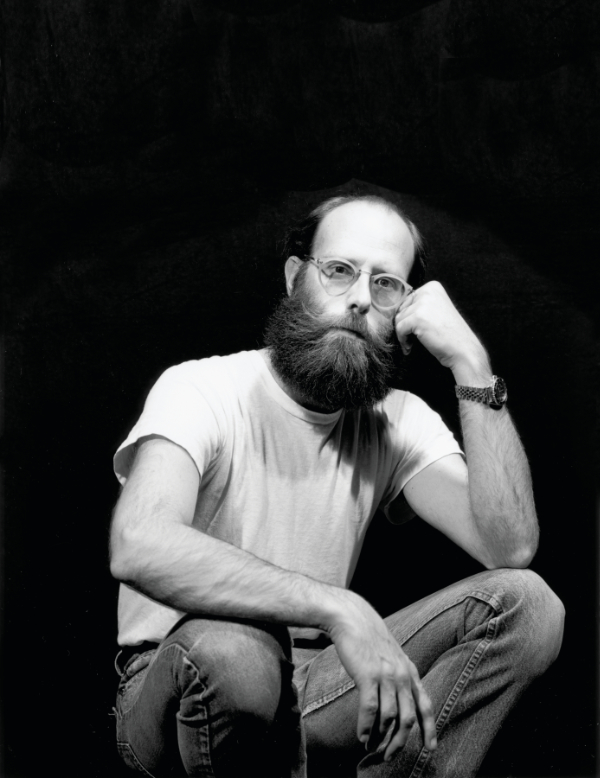
Rick Dillingham
Rick Dillingham, 1990. Photography by Herbert Lotz. Courtesy the photographer.

The result was a surprising success. Of a serendipitous moment, an entire genre of “fractured” vessels (Dillingham’s preferred terminology) emerged that would bring the impetuous potter wealth and international recognition.

During Dillingham’s brief but highly productive lifetime and in the decades following his death, various aspects of his persona confused, irritated, and flummoxed those who have at times conveyed sensational and misleading presumptions of his brilliant and substantial accomplishments as a scholar, anthropologist, and artist.

Rick Dillingham: To Make, Unmake, and Make Again, on view at the New Mexico Museum of Art in Santa Fe through June 16, 2024, is the first retrospective exhibit of Dillingham’s artistry in twenty-seven years. The last was a limited posthumous tribute in 1996, also at the Museum of Art (then the Museum of Fine Art), following Dillingham’s untimely death at 41, two years prior, due to complications from AIDS. Selected pieces from Dillingham’s bequest to the museum—works that were never exhibited or offered for sale to the public but were kept for study, reference, or sentimental attachment—comprise a significant portion of the new exhibition.

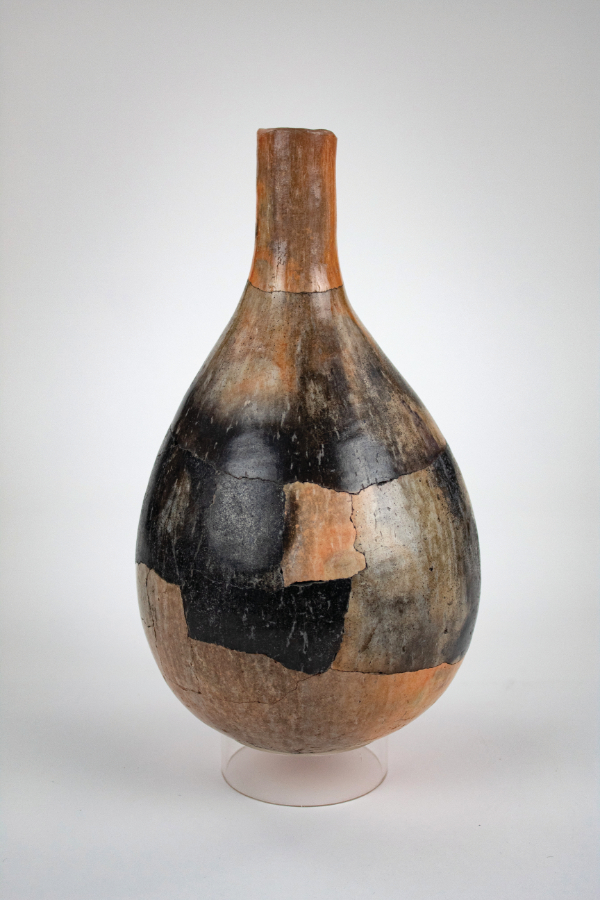
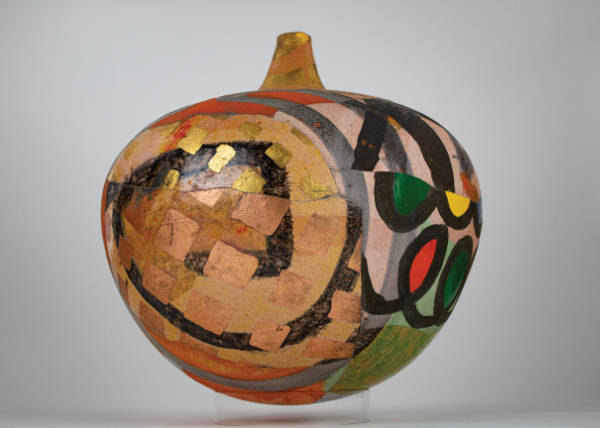
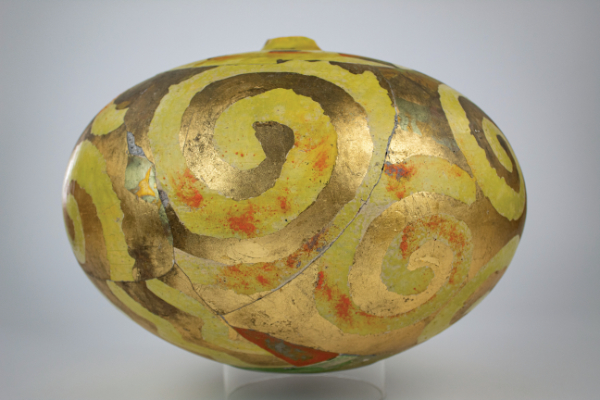
Rick Dillingham, Globe, 1987. Raku and kiln-fired reassembled earthenware, glaze, metallic leaf, 11 x 16 ½ inches. Courtesy of Ray and Judy Dewey. Photograph by Orlando Dugi.
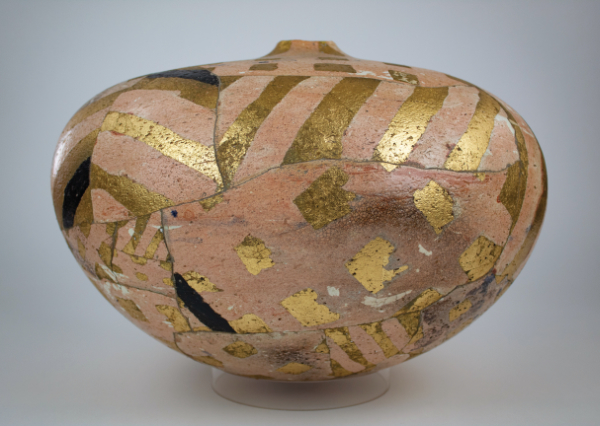
Rick Dillingham, Globe, 1980. Raku and kiln-fired reassembled earthenware, glaze, metallic leaf, 12 x 17 ½ inches. Private collection. Photograph by Orlando Dugi.

The pieces Dillingham crafted during his first months as an undergraduate at The University of New Mexico (1971–1974), although skillfully wrought in stoneware and porcelain clay are, with few exceptions, unremarkable, reflecting the 1970s era of pottery-making. Influenced by renowned British potter Bernard Leach (1887–1979), an advocate of rustic functionalism, and Shoji Hamada (1894–1978), internationally revered Japanese master of the art of raku, Dillingham’s well-crafted vessels included the requisite “weed pots” of the era.

An abrupt change occurred when Dillingham began frequenting workshops hosted by the California guru of organic, back-to-basics pottery making, Hal Riegger (1913–2005). Riegger’s dynamic personality and forceful determination, in tandem with Dillingham’s increasing awareness of the traditions of Southwestern Pueblo pottery—encompassing not only that of contemporary potters but also the earliest extant examples of Ancestral Pueblo cultures—dramatically altered and informed his understanding of, and relationship to, clay and the many possibilities the medium possessed.

Abandoning the potter’s wheel and eschewing commercially prepared clay, slips, and complex high-fire glazes, Dillingham embarked on a journey of discovery, seeking local sources of clay, digging it from road-cut embankments, then methodically processing, tempering, and making repeated test firings to determine its strength and resilience. His forays into the wilds of the Southwest were often searches for fuel for firing his wares. Emphatically avowing that cow pies collected in the remote expanses of Arizona were superior to those scattered on the grazing lands of New Mexico, he was perpetually on the lookout for cattle as he traversed the highways of northern Arizona while journeying to visit pottery-making friends in their Hopi villages. His dusty Volkswagen van was legendary for its earthy aroma of dried manure.

After graduating from The University of New Mexico with a BFA, Dillingham returned to California, where he enrolled in the master’s program in ceramics at Claremont Graduate University. There, he had the good fortune to study with acclaimed American ceramicists Paul Soldner and Peter Volkus, known for their vigorous approach to clay and expressionist attitudes regarding the supremacy of form, with little or no regard for function. Under their tutelage, as well as other faculty, Dillingham’s work aquired a sophistication of form and an original character that is not easily defined.

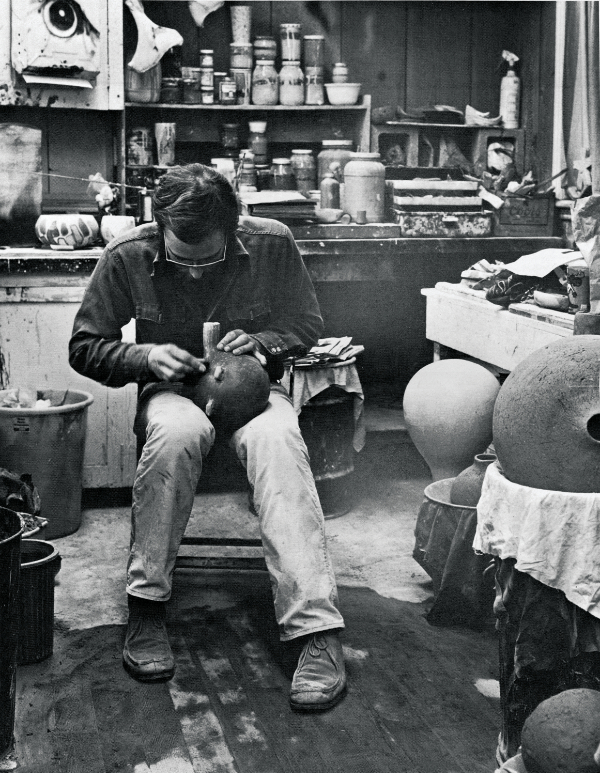
Rick Dillingham at work in his studio, n.d., Moreau Gallery, St. Mary's College exhibition announcement, New Mexico Museum of Art Archives, Rick Dillingham Collection. Photograph by Glen Short.
Rick Dillingham at work in his studio, n.d., Moreau Gallery, St. Mary’s College exhibition announcement, New Mexico Museum of Art Archives, Rick Dillingham Collection. Photograph by Glen Short.

After earning his MFA in 1976, Dillingham headed to Santa Fe. There, he soon established his permanent residence and studio on historic Agua Fria Street, where he continued the exploration of the themes and forms he initiated while at Claremont Graduate University. In 1977, his worldview was considerably enhanced when he received a National Endowment for the Arts Craftsmen’s Award (he was awarded a second NEA Craftsman’s Fellowship in 1982), a portion of which financed an extended period of travel and study in Europe.

There, Dillingham’s artistic horizons were broadened by viewing rare treasures firsthand while also slipping away to bask in the sensual pleasures of Greek islands and their sun-washed beaches. His exploration of European cities with their architectural treasures and art-filled museums was the first of many journeys he made to the continent. He returned to Spain time and again, having become enamored with the landscape, architecture, arts and culture, and inhabitants. The rustic artistry of rural Spain enchanted him to such a degree that he began importing furniture, artifacts, and ceramics to augment the inventory of the high-end East De Vargas Street gallery, which specialized in historic Hispanic and Indigenous art, that he co-owned with antiquarian Joe Carr and charismatic, indomitable, Harvey Mudd III.

Dillingham’s early years on Agua Fria Street were dedicated to the diligent crafting of slab-and-coil-built vessels which he raku- and pit-fired in the kilns of other potters, and in his backyard overlooking the Santa Fe River. Billie Walters—who first made Dillingham’s acquaintance in ceramic classes at The University of New Mexico—in the foreword to the catalog of his posthumous UNM Art Gallery retrospective, Rick Dillingham: 1952–1994, described his meticulous firing process:

“It was always fascinating to watch Rick carefully and patiently build a beehive shape of layers of dry cow dung around his large, round burnished pots. The dung would be ignited, burn and cool to a whitish ash. When the pots had cooled, Rick inspected each one by turning it in his hands and tapping it with his fingers to listen for cracks or flaws, and then would sit back to study the beautiful colors that had developed.”

Dillingham was on fire. It was a condition with which he was intimately familiar; as a student at The University of New Mexico, he had fired some newly crafted vessels in a fifty-gallon garbage can in the back alley of the apartment complex where he was living, eliciting great excitement with the arrival of a large contingent of the Albuquerque Fire Department. The energy, visible and inherent in each piece he fashioned, was mirrored by his vortex of activity. He crafted an immense volume of work for gallery and museum exhibitions throughout the United States, entered competitions, guest-curated exhibitions, and delivered lectures on the history of Ancestral, historic, and contemporary Pueblo pottery.

Additionally, Dillingham maintained a thriving business representing contemporary Pueblo potters, placing their work with dealers and galleries nationwide. His Mudd-Carr Gallery affiliation was coupled with a whirlwind social schedule regularly fêting art, music, and fashion celebrities. Weeknights would find him gracefully two-stepping to George Strait’s All My Ex‘s Live in Texas at Mr. R’s Rodeo Nights, the popular country-and-western dance hall on lower Cerrillos Road. Weekends would find Dillingham late-night disco-dancing in New York or Los Angeles, or in downtown Santa Fe at the clamorous, smoky Senate Lounge.

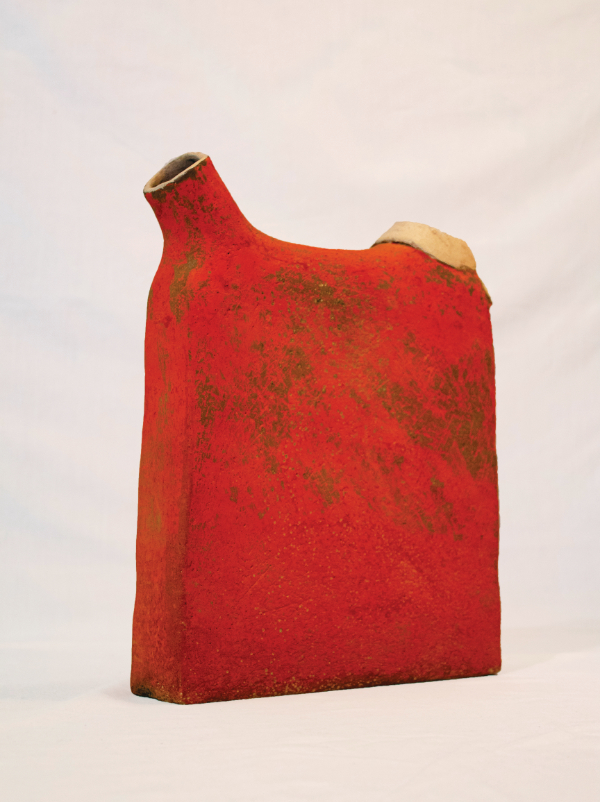
Dillingham’s most iconic works are a series of Gas Cans crafted in numerous iterations throughout his career. Their inspiration may have been the ubiquitous sturdy metal fuel containers strapped onto the rear of four-wheel-drive vehicles of the 1940s and ‘50s. The precursor to the form (beginning as an ungainly, lumpy, bulbous vessel with a pair of opposing spouts) was possibly a series of Bag Pots—narrow, elongated, ductile vessels reminiscent of the sturdy canvas water pouches that once could be seen attached to the grills of vehicles traversing the arid Southwest—that appeared early in Dillingham’s oeuvre. The quasi-rectilinear forms of the subsequent vessels were bathed in refulgent hues of incandescent red, flaming orange, ochre yellows (achieved with a wide assortment of oxide-infused clay-based slips and washes) or, conversely, in midnight black. The University of New Mexico Art Museum Director Peter Walch observed that Dillingham’s iconic gas cans were ‘‘wonderful mock-utilitarian creatures of alternately mirthful and sinister appearance.”

The bold vessels sported fins, tails, rooster-like combs, and on occasion, odd and questionable tree trunk-like appendages. Each piece represented an aspect of existential freedom, the freedom of exploration exemplified by Dillingham’s love of driving at break-neck speed across the expanses of the West on his motorcycle or in his sleek, grey-green Porsche. Jarring, daring, and confrontational, the Gas Cans were the expression of an artist who did not readily communicate in words his innermost thoughts. Not that Dillingham was inhibited. Quite the contrary. Many were at the receiving end of his razor-sharp wit, just as there were those who were beguiled by his easygoing, graceful manners and thoughtful generosity.

Penning the text for the catalog of a retrospective exhibit (installed at St. John’s College in Santa Fe in 1982), faculty member of the California College of Art and Crafts, Charles Fiske, recognized in his former student (Dillingham attended CCAC from 1970 to ’71 and there formed a close, lifelong friendship with Fiske’s partner, acclaimed ceramicist Viola Frey) a great and unusual talent, capturing the essence of Dillingham’s artistry in two lines:

To make, to unmake, to make again.
To juggle tradition, disrupt utility.

In tandem with his periodic episodes crafting Gas Cans, Dillingham simultaneously explored the seemingly endless possibilities of fractured vessels, which he first discovered with Walters’s encouragement following the firing episode gone awry. Aware of the significance of his first reassembled vessel, Dillingham retained the piece in his personal collection. It remains today in the collection of The University of New Mexico Art Museum.

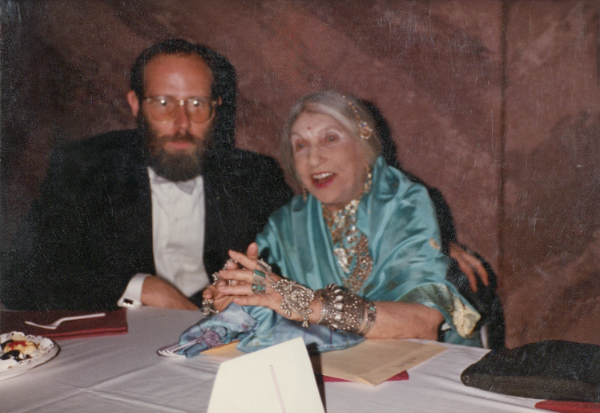
Dillingham and Beatrice Wood seated at banquet table of the Dada Ball on the occasion of Wood's ninetieth birthday. The Dada Ball was held at California State College at Fullerton, March 3, 1983, where Wood, a longtime friend of Marcel Duchamp, was guest of honor. New Mexico Museum of Art Archives, Rick Dillingham Collection.
Dillingham and Beatrice Wood seated at banquet table of the Dada Ball on the occasion of Wood’s ninetieth birthday. The Dada Ball was held at California State College at Fullerton, March 3, 1983, where Wood, a longtime friend of Marcel Duchamp, was guest of honor. New Mexico Museum of Art Archives, Rick Dillingham Collection.
Rick Dillingham, Globe, 1993, kiln-fired earthenware, oxide washes, slips, glaze, metallic leaf enamel, 18 ½ x 19 ½ inches. Private Collection. Photograph by Orlando Dugi.

Dillingham’s fractured vessels invariably elicit the most interest, leading to confusion, puzzlement, intrigue, and in some instances, hostility on the part of collectors, gallerists, admirers, and journalists. The works that initially emerged from his studio were similarly formed bulbous spheres with tapering necks or spouts, highly burnished and with little or no decorative ornamentation. By randomly placing a vessel’s fractured segments throughout the firing pit, individual sherds would acquire tonal characteristics unique to the atmospheric conditions of the firing. When the variously hued sherds were reassembled, an entirely different vessel emerged, its various component parts ranging from dark umber to light sienna orange, subtly suffused with freeform “fire clouds.”

Dillingham’s vessels incrementally increased in scale and variety of form. When intentionally fractured (the bisque-fired pieces were not smashed but were tapped with a flattened, wooden baton, cracking like an egg), the carefully separated pieces were then randomly painted with mineral-based washes, oxides, slips, and glazes. Selected pieces were repeatedly fired three or more times until a desired effect was achieved, the final appearance not known until after the firing and reassembly of the individual work. With the acquisition of a commercial kiln, the ability to “paint” with vivid lead- and chromium-based low-fire slips and glazes extended the range of color and textural possibilities.

Having stated to a reporter that he was not a “potter’s potter” but “a painter-in-clay,” he produced works dominated by complex patterns achieved with resplendent color. These works, although initially appearing (to the untrained eye) as an incomprehensible mishmash, were carefully considered and methodically executed. Dillingham’s design regimen was basic, consisting of a checkerboard-like grid, parallel bars, chevrons, and spirals.

In an undated artist’s statement, he wrote: “I keep all the processes as simple as possible to reach the results that I do. And keeping the forms simple as well—spheres, triangles, cones, rectangles—lets me get away with visual murder on the surface.” His schematic choices, like his meticulous and detailed record-keeping, did not suddenly appear, but had been gestating since his earliest student days at the California College of Arts and Crafts. The few extant examples of wheel-thrown stoneware production from the early 1970s are decorated with parallel bars of muted hues or anchored with rigid grid patterns.

Like all perceptive artists, Dillingham knew what to select and translate into his personal decorative lexicon. He also knew what to leave behind. In interviews with incurious or uninformed journalists (some described his work as having been wheel-thrown), Dillingham defended the origin and aesthetics of his work by explaining that if there was a visible influence in his work, it was that of the pottery of Africa, and to a lesser extent Asia and Egypt. To those who defined his work in terms of Indigenous American influence, Dillingham’s responses were adamant. In one example, he replied to a 1975 Buffalo, New York, newspaper article comparing his work to that of Pueblo artisans: “I can’t be an Indian. I’m not trying to be.” The viewer had only to look with a more discerning eye.

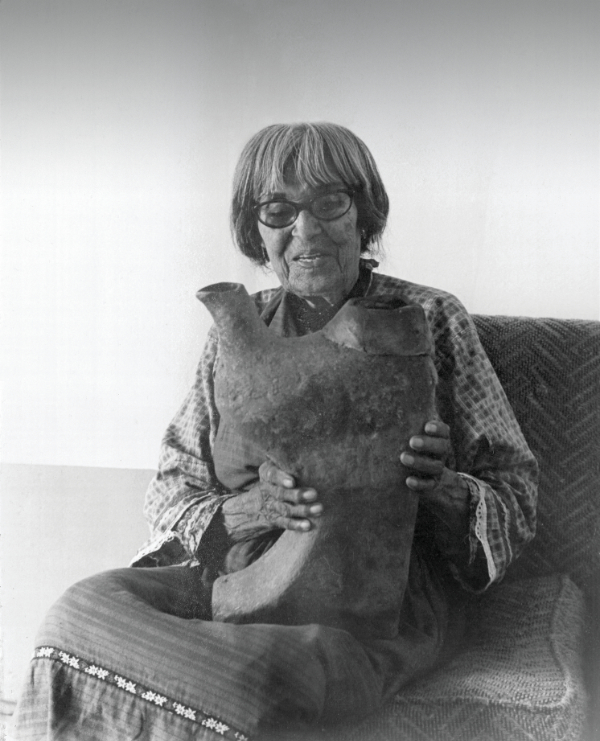
Maria Martinez holding a Rick Dillingham Gas Can, before 1980. Collection of the New Mexico Museum of Art. Gift of Diane and Sandy Besser, 1998 (1998.39.2). Photograph by Rick Dillingham.

Participating in Riegger’s workshops, he would certainly have been made aware of the centuries-old pottery traditions of African cultures—not only the sculptural forms of daily utilitarian vessels, but their decorative aspects as well. The regimented decorative perforations and protrusions characteristic of his student work may have been derived from this knowledge. His interest in monumental form was most readily realized in his open-mouth vessels of the late 1970s and, later, in the early 1990s. Indeed, keen knowledge of African utility vessels may have informed the series of “deformed” flat-bottom bowls and columnar vases, elongated, provocative pyramids, and enigmatic cones whose function is perplexing. They pose the question: What am I? What is my purpose?

Encountering one of Dillingham’s globular vessels enveloped in a kaleidoscope of glittering spirals, is reminiscent of the bold color and patterning in paintings by Austrian artist Gustav Klimt (1862–1913). Egyptian ritual and funerary objects were of interest to Dillingham, as was his appreciation of luster glazes harking to the centuries-old Arabic presence in northern Africa and Spain. His fascination with luster glazes resulted in hours of research and experimentation with glazes harboring hazardous ingredients (he was known to open the door of the kiln while firing and casually toss assorted powdered oxides and glazing ingredients onto the molten forms of his vessels), which led to a serious bout of lead poisoning.

Gas Can, 1977. Kiln-fired earthenware, oxide-slip wash, 15 x 11 ¼ x 2 ¾ inches. Private Collection. Photograph by Orlando Dugi.

The interest in the properties of luster glazes possibly began when, as a teenager (and an already accomplished studio ceramicist), Dillingham made a visit to the home and studio of the legendary doyenne of odd but intrinsically fascinating luster-glazed ceramics: Beatrice Wood (1893–1998). Having taken an immediate liking to the intense and inquisitive young man, Wood assumed the role of teacher, mentor, surrogate parent, and lifelong friend. Dillingham was a frequent guest at Wood’s Ojai, California home, where the pair spent endless hours discussing the properties of clay and glazing techniques.

When in the early 1980s Wood completed her memoirs chronicling her vibrant bohemian life and could not find a publisher, Dillingham stepped in with encouragement and financing. Dillingham Press was formed. I Shock Myself: The Autobiography of Beatrice Wood was published in 1985, selling thousands of copies. Wood’s gratitude to Dillingham was immense and warmly expressed in the letters she sent, each containing a check as repayment for his generosity.

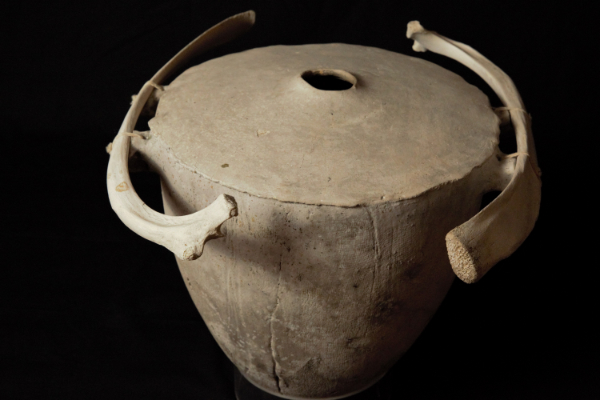
Many of the letters Wood wrote to Dillingham emphasized her recognition of his work as “of the earth,” a spiritual response to the majestic landscape and limitless horizon of the Southwest. Regarding his clay works as receptacles for space, he routinely crafted works of ethereal mystery. Coil- and slab-built and customarily pit-fired, the pieces are reminiscent of sun-bleached bones, or when burnished (Dillingham’s preferred burnishing tool was the back side of an old soup spoon), river-polished stones. Wood’s astute observations may have been made in reference to a series of gray or bone-white vessels to which he attached the rib bones of sheep or the feathers of road-kill birds he encountered during his periodic cow pie hunting expeditions.

Scrutiny of this series of vessels reveals an informed knowledge of Archaic Greek fired-clay funerary urns or objects of similar form; the feathers, sticks, twigs, and bones serve as distractions for those with preconceived notions and romanticized visions—promulgated by movies, comic books, and romanticized visions of what constitutes traditional Southwestern ceramics. Dillingham’s close relationship with Pueblo potters was based on trust and his sincere interest in the properties of clay, its crafting, and the techniques of firing. His respect for the potters’ artistry was paramount. Secure in his own innate creativity, he had no need or desire to imitate or appropriate the work of others.

Dillingham’s desire to collaborate with other potters and artisans—including Georgia O’Keeffe—was expressed early in his career when, following one of Riegger’s rigorous expedition workshops, he was introduced to collaborative pottery-making traditions with Mojave potters of the Colorado River Basin. Having established friendships with many Pueblo potters, he posited the idea with varying success. Dextra Quotskuyva (Hopi-Tewa), who considered Dillingham to be a dear friend, was particularly fascinated by his working methods, fondly reflecting on Dillingham making his “little spouts.” His collaboration with San Ildefonso Pueblo potter Maria Poveka Martinez was perhaps that of student and instructor given the two artists’ age and fame difference, yet he prevailed in at least one collaborative effort with the legendary potter. Photographed by Dillingham, Martinez, with a slightly skeptical expression, was shown holding a partially completed green-ware Gas Can in her lap.

His friendship with Santa Clara Pueblo potter Margaret Tafoya was sincere and respectful. In preparation for an exhibit of her work, The Red and The Black, at the Wheelwright Museum of the American Indian in Santa Fe in the summer of 1983, Tafoya entrusted Dillingham to photograph her as she crafted one of her trademark wedding jars. The photographs documented Tafoya’s creative process, from the preparation of the clay to the final carving, burnishing, and firing of the piece. The image chosen as the frontispiece for the catalog portrayed the potter proudly displaying the finished vessel. Dillingham’s friendship with potter Dora Guachupin Tse-Pe’ (Zia/Jemez/San Ildefonso) was such that he crafted for her an entire set of wheel-thrown stoneware dinner pieces that included stemmed goblets and dessert plates with her trademark stylized bear emblazoned in the center and her name skillfully inscribed on the rim of each plate.

Underlying the strenuous daily activities of business and studio were Dillingham’s intellectual pursuits researching the origins of Southwestern Pueblo pottery, spending hours in the collections of the Museum of New Mexico’s Laboratory of Anthropology and the School of American Research (now the School for Advanced Research, or SAR), as well as visiting museums and collections in Arizona, California, Washington, D.C., and elsewhere. He periodically contributed articles to scholarly publications (such as El Palacio, Summer/Fall 1987), and he was often invited to lecture at venues throughout the United States. At these events, he would engage the audience in rapt attention as he discussed in his distinctive pedagogic timbre the myriad aspects of Pueblo pottery, flatly declaring at one Seattle ceramics conclave in 1980, “Pots are just dirt!” His craftsman’s knowledge of clay, its preparation and execution, the specific slips and organic pigments used by Pueblo potters, coupled with his keen knowledge of the properties of pit firing, was riveting. Recorded lectures housed in the SAR archives are rare documents of his iconoclastic yet insightful knowledge of the history and cultural relevance of Pueblo pottery throughout the Southwest.

The ease with which he conducted his lectures may be attributed to his undergraduate studies at The University of New Mexico. Having acquired curatorial training at the Maxwell Museum of Anthropology along with a regimen of anthropology classes, Dillingham was asked to participate in organizing an exhibit comprising the works of seven contemporary Pueblo pottery-making families whose work was of significant and long-standing merit. An un-posed photograph taken at the exhibit’s opening in May 1974 evinced a youthful but pensive Dillingham, standing, surrounded by the matriarchs of Pueblo pottery dressed in their finest traditional ceremonial attire. The occasion was momentous, but only later was its significance fully appreciated. Seven Families in Pueblo Pottery, the exhibit catalog compiled and edited under Dillingham’s tutelage, proved so influential that for more than three decades, collectors and museum curators consulted it religiously prior to making purchases of contemporary Pueblo pottery.

Dillingham was encouraged to describe and codify the centuries-old pottery-making traditions of the adjacent Pueblo villages of Laguna and Acoma in west-central New Mexico. Sponsored by SAR, Dillingham worked diligently on the project, struggling mightily with the appropriate content and tone of the manuscript. After nearly a decade—despite institutional and editorial roadblocks—and with the assistance of author Melinda Elliott, his efforts were realized in 1992 with the publication of Acoma and Laguna Pottery.

Receiving accolades from scholars and collectors alike, Dillingham revisited the success of Seven Families in Pueblo Pottery. With renewed vigor, he widened his study to include seven additional pottery-making families. Aware of the increasingly perilous status of his health, he was intent on seeing the project to fruition. Much of his new research was conducted via phone and written communication, although he also made personal visits to his Pueblo friends. The manuscript of his expansive effort, Fourteen Families of Pueblo Pottery, was completed in 1993 but did not go to press until later in the year. It was posthumously published in the spring of 1994.

Like his patrons, Dillingham was a collector of refined aesthetic discernment, having begun his collection as a twelve-year-old on vacation with his parents in Tucson, Arizona, when he purchased a pair of small black-and-white painted pots for a few dollars. (These, along with a significant collection of works by contemporary Pueblo potters, were gifted by Dillingham to the Museum of Indian Arts & Culture.) Among the works that held pride of place in his home were those of ceramicists Peter Voulkos, Lucie Rie (El Palacio, Fall 2001), Betty Woodman, Ken Price, Viola Frey, and Beatrice Wood. Magnificent pieces by Pueblo potters Maria Poveka and Julian Martinez, Popovi and Tony Da, Margaret Tafoya, Lucy Lewis, Lolita Concho, Rachael Nampeyo, and Santana Melchor, along with historic Pueblo pottery, were prominently displayed. His extensive collections of vintage and contemporary Mojave “dolls” were artfully displayed on the shelves of his library, beneath which were arranged his vast stable of stylish cowboy boots, many of which he wore with joyous abandon on the dance floor or, on feast days on the hard-packed earth of Pueblo plazas.

Personal adversity, coupled with his deteriorating health status, inevitably contributed to the angst and anger visible in the striking pieces that emerged from Dillingham’s studio in the late 1980s and early 1990s. Unsettling in their brutal appearance and realized in distorted proportions and jarring juxtapositions of pattern, hue, and tone, they were expressions of unleashed emotion in response to the political apathy and inattention in the United States toward the ever-worsening AIDS crisis.

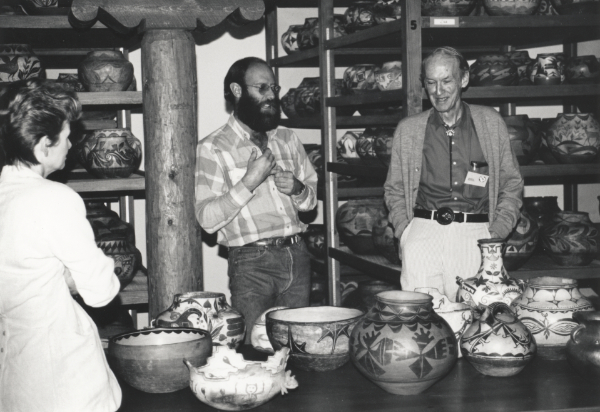
Rick Dillingham (center), a speaker at the 1991 Collector’s Symposium, in the vaults of the Indian Arts Research Center, with James J. Butler, attendee (right), August 12, 1991. Courtesy of the School for Advanced Research, Rick Dillingham Archive, file AC:3-40:1.

Tackling the issue head-on, he crafted a series of works for an exhibition, Random Beauty: The AIDS Series, scheduled for the spring of 1993 at the Linda Durham Gallery in Santa Fe. The series, consisting of four monumental disparate-shaped forms, was confrontational, unsettling, and profoundly original. Nothing of their kind had been seen before in Dillingham’s vast repertoire of clay vessels. The exterior of each piece was bathed in muted earthen hues suffused within and beneath dense matte-black oxide, each of their suffocating surfaces relieved only by a solitary cut-away aperture in the shape of a heart, square, and in two of the works, a triangle that revealed interiors swathed in silver metallic foil or coated with a vivid Pepto Bismol-pink matte slip.

Never before had Dillingham’s artistry been inspired by metaphor. When asked by journalists about the meaning and purpose of the work, Dillingham’s reply was one of quiet acquiescence and forthright acknowledgment of the plague that was ravaging the gay community, but also of hope for a brighter future. In an interview with Guy Cross, reporter for the April 1993 issue of THE Magazine, he mused: “I find it empowering to take away some of the disease and put it into an object.”

Among other vessels crafted that spring was an extraordinary work: a bold visual statement resplendent with plangent color, expressive gestures, and scintillating metallic collage. The piece was a tour de force that reflected his past accomplishments as a master-in-clay and issued an expressionistic vision of future achievement. Each reassembled sherd was imbued with a volatile energy conversing in tandem with decorative themes yet to be fully explored. Dated March 1993, the vessel was to be his last polychrome sphere brought to fruition: a final self-portrait of an artistic continuum contained in a receptacle for space. Fittingly, the piece was chosen to illustrate the cover of the catalog for the Santa Fe Rotary Club’s Distinguished Artist Award banquet, held to honor Dillingham on October 27, 1993.

Returning at the beginning of the New Year from Las Vegas, Nevada, where he attended an eagerly anticipated Barbara Streisand concert, and although exhausted from the holiday adventure, Dillingham was keenly anticipating the publication of Fourteen Families of Pueblo Pottery and the completion of plans for a traveling University of New Mexico Art Gallery retrospective exhibit scheduled to open in the spring of 1994.

Fate was to prove otherwise. In an expansive front-page article dated January 23, 1994, the Santa Fe New Mexican announced the death of the celebrated ceramicist.

Of the many posthumous tributes that were published in the following months, the foreword to The University of New Mexico Art Museum’s retrospective catalog—contributed by Dillingham’s beloved friend Billie Walters—was a succinct assessment of Dillingham’s artistry: “Without a doubt, Rick loved his pots—their forms, surfaces, and colors. It seems to me that throughout his career, he never lost his sense of awe and wonder at seeing the transformation of coiled clay into beautiful and mystical expressions.” 

Maurice M. Dixon Jr. (BFA, MFA) is a painter, tinsmith, art historian, and author of The Artistic Oddyssey of Higinio V. Gonzales: A Poet and Timsmith in Territorial New Mexico and coauthor with Lane Coulter of New Mexico Tinwork, 1840–1940, and a past contributor to El Palacio. He was a consultant for Rick Dillingham: To Make, Unmake, and Make Again, and was a long-time acquaintance of the ceramicist.

Herbert Lotz was born and raised on a small farm town in Illinois and drafted in his third year at the School of the Art Institute of Chicago where he studied photography. He served as a radio operator in Vietnam in 1968 detached to the 25th Infantry Division at Cu Chi, the experience of which was to affect him the rest of his life, not unlike so many others of his generation. Driving into Santa Fe from the north passing by the National Cemetery in 1970, Lotz felt he had found his new home but still struggled to deal with his wartime experiences. In 1981, Lotz finally came to terms with his experience and continues to work with the photographs he took in Vietnam.

Maurice M. Dixon, Jr. (BFA, MFA) (opens in a new tab) is a painter, tinsmith, antiquarian, collector, and researcher. He a consulted on an exhibition about Rick Dillingham at the New Mexico Museum of Art, and is also at work on an account of Dillingham’s life and artistry.

Orlando Dugi (opens in a new tab) is a fashion designer and photographer who draws inspiration from his childhood memories of stargazing in the desert of northern Arizona while spending summer vacations on his paternal grandparents’ sheep ranch.

Sacred Geographies Of Northern New Mexico

By Matthew J. Martinez
Photography by Jim O’Donnell

To us, these petroglyphs are not the remnants of some long-lost civilization
that has been dead for many years … they are part of our living culture.
What is stored in the petroglyphs is not written in any book or to be found in any library. We need to return to them to remind us of who we are and where we came from, and to teach our sons and daughters of it.
— Herman Agoyo, (Kaafedeh)
Former Governor, Ohkay Owingeh and All-Indian Pueblo Council Chairman

These words provide breath and spirit in the continued work of the Mesa Prieta Petroglyph Project (MPPP), which will celebrate its 25th anniversary in 2024. As a 501(c)(3) nonprofit organization, the mission of MPPP is focused on education and stewardship of Mesa Prieta, or Tsikwaye. This Ancestral Tewa landscape comprises more than 100,000 petroglyphs and archaeological features dating back thousands of years. Located in the northern Rio Grande region, the stories embedded in this place are foundational to sharing New Mexico’s histories and beyond.

Despite an ongoing misrepresentation of being non-literate, Indigenous peoples have always been skilled at documenting stories and movements. We can point to early petroglyphs dating back at least 8,000–10,000 years that reflect movement and migrations. Volcanic eruptions from millions of years ago gave life to a cooled lava flow that became basalt boulders—a perfect rock panel to create images that reflected the natural environment. Such rocks and boulders became useful instruments to design systems to divert water sources and create grid gardens for subsistence. These age-old practices serve as a testament to how land-based people viewed themselves within a larger ecological system. The literature on Southwestern history continuously refers to the harsh and drought environments that Native peoples lived in and often dismisses the vibrant and diverse ecosystems along the Rio Grande region.

Documenting and preserving Mesa Prieta petroglyphs has been a core initiative of the project. More than 80,000 images have been recorded across the mesa by the MPPP. Its recording team has noted numerous other archaeological features, such as check dams, field houses and other structures, and ancestral trails in addition to the abundance of rock images. The vast number of petroglyphs in the region is similar to other major sites in New Mexico such as Petroglyph National Monument in Albuquerque and the Three Rivers site near Tularosa. Approximately eighty percent of the glyphs and other features are on private land. Most of the remaining twenty percent are located on Bureau of Land Management land, with The Archaeological Conservancy owning 181 acres, and Ohkay Owingeh a small amount.

In 2007, what is known as the Wells property was donated by Katherine Wells to The Archaeological Conservancy. The Wells Petroglyph Preserve represents the most concentrated area of petroglyphs on Mesa Prieta and is on the National Register of Historic Places and the State Register of Cultural Properties. Katherine’s story and steadfast passion for preservation is documented in her Life on the Rocks (1999). In 2019, Katherine was awarded a Lifetime Achievement Award by the Historic Preservation Division.

Staff and volunteers at MPPP educate students and the public about Mesa Prieta’s history through school outreach activities and scheduled private tours. Because of the sensitive nature of the preserve, the area otherwise remains strictly off-limits. I often tell my student-athlete son to imagine a large basketball net that covers the entire state of New Mexico. Within every visible square is a cultural property that is interconnected with other squares; and the spaces in between the net are equally significant markers. The history and archaeological record of Mesa Prieta do not stand in isolation but are intricately woven within a surrounding agricultural corridor that, for thousands of years, has sustained people traveling through and establishing vibrant communities. Tewa people regard all life as a continuous movement along a pathway. Seemingly uninhabited ancestral places like Tewa Yógeh (Mesa Verde) and Tsankawi (Bandelier National Monument) are alive and honored in songs and ceremonies. Pueblo people continue to visit such places and maintain these ongoing rrelations to and reverence for place. These places were never left nor abandoned.

The Ancestral Tewa village of Phiogeh (Flicker Place) is situated adjacent to historic Los Luceros. The archaeological record for Phiogeh dates approximately between 1400-1600 (Ortman et al., 2020). Outlines of room blocks are still visible today. Phiogeh is property owned by Ohkay Owingeh and remains off-limits to the public. What is significant to know is that Phiogeh, as well as Saeshu’ Owingeh (Corn Silk Village) down the road, were occupied well before Spanish contact and perhaps may have overlapped in the 1600s. These neighboring ancestral sites remain a continued part of Tewa oral traditions and are significant place markers that convey ancestral occupations and migration stories. It is believed that Tewa ancestors from these villages were the ones who created the thousands of archaic and ancestral (Classic Pueblo Period) petroglyphs along Mesa Prieta.

Phiogeh is intimately linked to the northern Rio Grande valley. According to Scott Ortman, Patrick Cruz, and Arthur Cruz, “A series of natural springs occur within the floodplain between the site and the river. This was a likely attraction to the area prior to development of irrigation infrastructure. The site is situated so that both Tsikumu P’in (Chicoma Peak) and K’uusehn P’in (Truchas Peak), both significant elements of the Tewa cultural landscape, are in view on the horizon to the west and east, respectively” (2020). These mountain ranges provide a marker and context for recognizing existing homelands.

In contemporary times, tribal, city, and state boundaries are often formally defined through the jurisdiction and management of such lands. From a cultural perspective, homelands are vast and ever-fluid. Much like birds and insects which intersect with many ecological systems according to seasons, so too do Indigenous peoples and lifeways. Through Tewa oral histories, we know that people from Phiogeh eventually moved to present-day Ohkay Owingeh. Flicker bird imagery is common at Mesa Prieta. Often viewed as perhaps knifewing bird imagery or other smaller bird petroglyphs, it is clear that people of Phiogeh etched some of these images. We can see a variety of bird petroglyph images that could be interpreted as turkeys, eagles, or macaws. Reasons for this imagery include paying homage or serving as a visual reminder that birds are interconnected to all life cycles.

Situated on Tewa homelands, the New Mexico historic property known today as Los Luceros is a continuum of human occupation. Named after a Spanish colonial family that once lived there, Los Luceros remains a significant cultural connector to sharing the histories of Northern New Mexico and beyond. As a relative newcomer to the region, Los Luceros offers an aesthetically pleasing experience of the historic 148-acre ranch that remains under the operations of the New Mexico Department of Cultural Affairs. Access and engagement with historic sites present opportunities for all communities to experience. The role of historic site staff includes not only what it means to be a good steward of cultural sites, but also of relationships—with Tribes and surrounding communities, both living and ancestral. In 1983, Los Luceros was placed on the National Register of Historic Places. The property is also on the New Mexico State Register of Cultural Properties. These designations can help bridge conversations between historic sites and the larger communities they serve by recognizing how sites are part of age-old traditions and stories.

It was common for families from Ohkay Owingeh to visit Los Luceros during the fall to pick apples and trade other fruits and vegetables with surrounding neighbors when I was a kid, growing up down the road. After spending time along this vibrant agricultural corridor, it is clear why people chose to settle in this place. Not only for Ancestral Tewa people and later Spanish families, Los Luceros remains an active site for elk, coyotes, eagles, and many other animals and species that call this place home and depend on its food and water. Elk frequently bugle during the early winter mornings. They have established trails that cross P’oesógeh (Rio Grande River) through Mesa Prieta and commonly gather at the confluence of the Rio Chama and Rio Grande. Deer, elk, and other animal tracks are ubiquitous throughout the area and figure prominently in nearby petroglyphs and through the Rio Grande Gorge area.

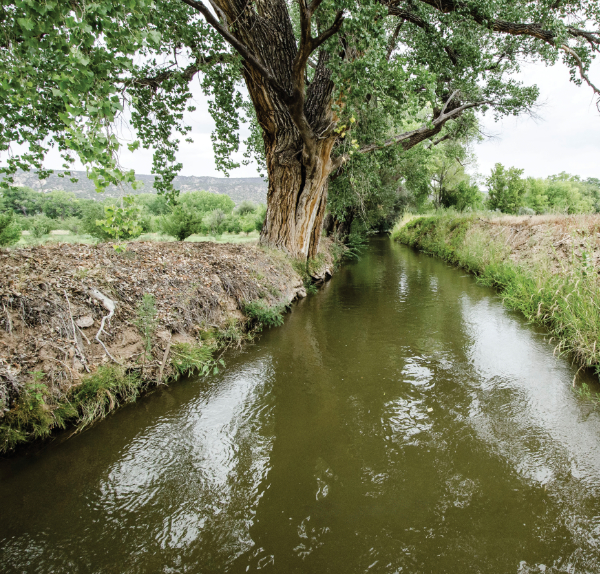
Acequia running through Los Luceros Historic Site.

Today at Los Luceros, visitors can experience the beautiful walking trails amidst the cottonwood trees and visit the territorial-style hacienda that houses centuries of history within its walls. The property also includes an eighteenth-century capilla (chapel), Victorian cottage, and farmyard with churro sheep, goats, and burros. The acequia madre was constructed sometime in the 1700s. The use of irrigation systems to support agriculture in this region began with the Ancestral Tewa people. We know that they used a variety of sophisticated methods that included farming on terraces, grid gardens, and water diversions. Once Spanish colonists settled in this area, they quickly realized the need for survival and to develop agricultural practices in their newfound home. The acequia systems had their roots in the Middle East and were brought to Spain by the Moors. The word acequia comes from the Arabic word al-sāqiyah, which means, among other things, irrigation canal.

Spring weather in New Mexico is a transitional time as the earth cleanses itself through wind, dust storms, and spring showers. Around mid-spring, it is a common, intergenerational activity for families and neighbors to come together to clean out the acequias and prepare for a new planting season. For Tewa people, the avanyu (horned serpent) is revered for bringing water and life through the valley. He can be seen in the sky coming through as a lightning figure during a rainstorm or flowing along the acequias. Not only are avanyu representations common as petroglyphs, but today they are evident in the larger Rio Grande style on pottery and weaving designs as a reminder of ever-flowing life.

For norteños, such traditions are honored through San Isidro Labrador, the patron saint of farmers, gardeners, and laborers. Communities gather on San Isidro Day, May 15, to bless the farm fields and acequias. The village of San Ysidro was named for the patron saint of farmers, an eleventh-century Spanish saint. Isidro was a laborer for Juan de Vargas, an ancestor of Don Diego de Vargas. According to Charlie Carrillo, “God rewarded him, as a very holy man by sending an angel to help with the plowing. To get a drink of water for his master, Isidro struck the ground with a gourd and an eternal spring came forth” (Awalt and Rhetts, p. 89). He is commonly depicted wearing blue trousers, a red shirt, and a flat hat, and accompanied by a plow, oxen, and an angel.

These spring activities are central to sustaining ecological lifeways. Water from the acequia madre is utilized to water apple orchards and the fields at Los Luceros. Visitors to Los Luceros can witness the churro sheep enjoying the freshly harvested alfalfa. This can be attributed to continuing acequia cultural practices that give life to people, food, and the surrounding landscapes.

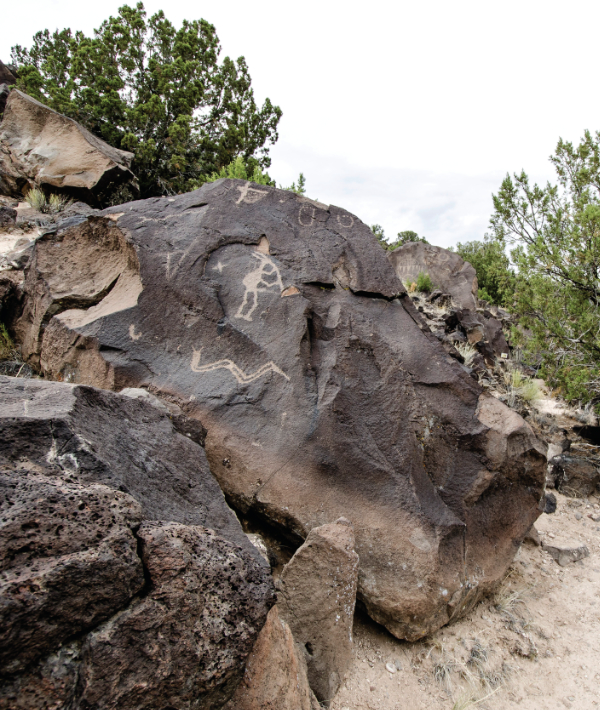
Petroglyph of a flute player. Below the flute player is a two-horned avanyu with a round object within its body. Other features on this panel include a sandal track, a bear track, and an equilateral cross or star.

Along this same region, the beautiful village of Estaca figures prominently into this corridor that links the histories of Mesa Prieta and Los Luceros. Many Northern New Mexicans are unaware of its existence and some Estaqueños perhaps prefer it this way. Estaca is a small Hispano village north of Ohkay Owingeh and Española on the west bank of the Rio Grande. The village is defined by its visual marker of La Capillita. This chapel serves to house the statue of San Fransisco, the patron saint of Estaca. In Tewa, this place has historically been referred to as Namponuu, which can be translated as “down at the holes in the earth.” The Ancestral Tewa use of Estaca dates from the 1300s into the 1600s based on archaeological research in the area. And evidence suggests that Ancestral Tewa use of the site was seasonal farming by residents most likely from Phiogeh (Ortman, 2022).

According to Peggy Coyne,

Two large arroyos drain from the east and west sides of the Rio Grande to converge on the river at Estaca, where they deposit silt and force the river into a shallow, braided configuration, making an ideal site for a river crossing. Estaca’s site atop a raised promontory above this crossing of the Rio Grande gave it a strategic importance for both trade and defense. Military maps from the 1840s through 1860s show Estaca or ’Staca’ and note its geographical location near the ford on the Rio Grande and trails leading across Black Mesa to Ojo Caliente (Coyne, p. 35).

We know that ancestral trails set the pattern for key routes to establish New Mexico cities and villages. Perhaps one of the most well-known was the El Camino Real de Tierra Adentro. Built atop a vast network of Indigenous footpaths and trade corridors, this trail connected central Mexico with the people of the American Southwest. Extended in the sixteenth century, it was at one time the longest road in North America.

The colonizing expedition of 1598, led by Juan de Oñate, brought settlers, priests, soldiers, Indigenous guides, and servants into present-day New Mexico. The northern end of that trail ended at Ohkay Owingeh on the west bank of the Rio Grande known as Yungeh (Mockingbird Place). Ancestral trails across Mesa Prieta were just a small part of the expansive networks that were perhaps utilized for trade with many other villages in Northern New Mexico and beyond. We know that trade items such as seeds and food were critical to the survival of people in the area. Because of trade relations across the Americas, Tewa people had access to items such as coral, macaw feathers, and new words and concepts that are still in use today.

We continue to be shaped by Indigenous texts embedded within items such as pottery, weavings, and dance traditions. These are ever continuous, and it is through these movements that long life is created for all people. Tewa history is not referenced within a formal time period and people are not placed within assigned historical categories along a continuum of progress. Tewa naming of newborn babies, as perhaps common among many Indigenous people, is often connected to skywatching and associated relations. Names such as Agóyó Anyéh (Moving Star), Okhúwá Povi (Cloud Flower), Than Tsídeh (Sun Bird), Tsígówänú (Lightning), Kwahténbây (Rainbow), and numerous others, are tied to all things related to above and below worlds. Names may include references to animals, lakes, and mountains as part of interconnected environments. Each village differs in ascribing names which may be given throughout one’s life. Tewa names carry blessings and cultural histories and provide a strong life path for children into adulthood.

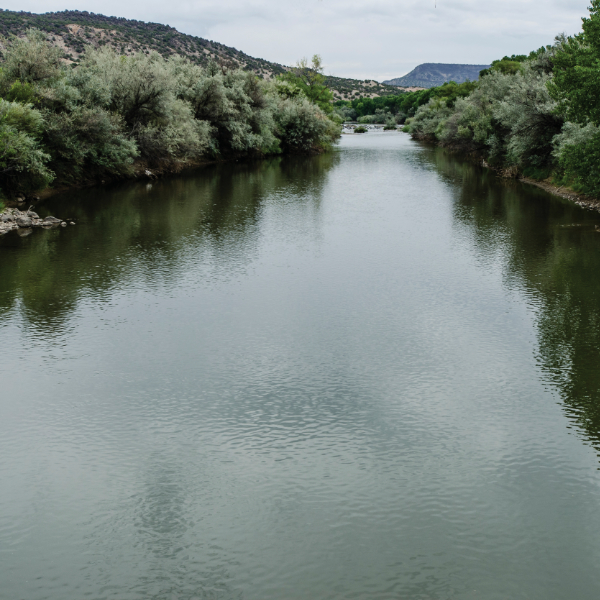
The Rio Grande just below Mesa Prieta.

One time I asked my sa’yâa, (grandmother) Esther Martinez, about stories she knew about the old railroad tracks that crossed our village property. She recalled the following story when the Chile Line (Denver and Rio Grande Railroad) arrived in 1890 in Northern New Mexico, crossing the Embudo station and cutting through Tewa villages.

My grandfather told me a story about the train, about when the whole village came to see what the train looked like. They [Tewa people] came with cornmeal. Cornmeal is used to pray in Indian whenever they [Tewa people] go anywhere, when they gather medicine from nature they always throw cornmeal and ask for the earth’s permission to get the medicine and tell her what they need it for, before they take it—and that is the same way for pottery clay, always throw cornmeal, ask for clay and tell her what they need the clay for. So, they came prepared with cornmeal when they heard the train whistle. There used to be a hill that came down, where the river [Rio Grande] came around, the train track they had to cut into the hill to make it run straight through. The train whistled loud, you know how it steams loud and sounds like it was breathing hard, so they thought it was alive and they were afraid of the loud sound … [they said] you’re welcome to come here but please don’t be angry, come peacefully, and then they threw cornmeal. It stopped. They said it was breathing hard; [they] thought it must have come from a long way and was tired. That was their first sight. After that they [presumably railroad staff] told the Indian people they could travel for free, for free anytime they wanted, anywhere the train took them. [There would be] plenty of places to sell their pottery. [Pueblo] People sold mostly pottery to the people on the train. They could travel anywhere they want, anytime to sell their ware to other places (Martinez, p.2).

This was the first sight of the ohibay (steam container) for the Tewa people in 1890. No longer in existence, the paths created to lay the tracks are still visible today on the western banks along the northern Rio Grande and surrounding communities. The socio-economic impact of the Chile Line was important to the farmers and residents of Northern New Mexico. For generations the primary mode of production was farming, and the introduction of the railway significantly altered a new wave of subsistence that would be evident in the decades that followed.

The entire northern Rio Grande corridor remains a testament to a vast network of trade and cultural exchange that is very much alive. Those who came before are generally referred to as Ancestors who have a special place in the present physical world. Mesa Prieta, Los Luceros, and the places in between shaped individual lives and communities, affecting the establishment and development of Northern New Mexico. The actions of the Ancestors are encouraging plant growth and stewardship today by enduring positive benefits for the world. Recognition and respect of these cultural places and villages as an international historic region is critical to commemorating our state’s history. People are part of the land within all living things, and not separate from nature. Our human community—as the link between the Ancestors and the unborn—carries the responsibility to be good stewards of these sacred lands. Kúdaawóháa. 
Matthew J. Martinez, Ph.D., is currently serving as Executive Director of the Mesa Prieta Petroglyph Project. He is a former First Lieutenant Governor at Ohkay Owingeh.

For more information, please visit: www.mesaprietapetroglyphs.org and www.nmhistoricsites.org

Dr. Matthew J. Martinez (opens in a new tab) is currently serving as executive director of the Mesa Prieta Petroglyph Project. He is a former First Lieutenant Governor at Ohkay Owingeh.

No Untroubled Worlds:

by JenniferLevin

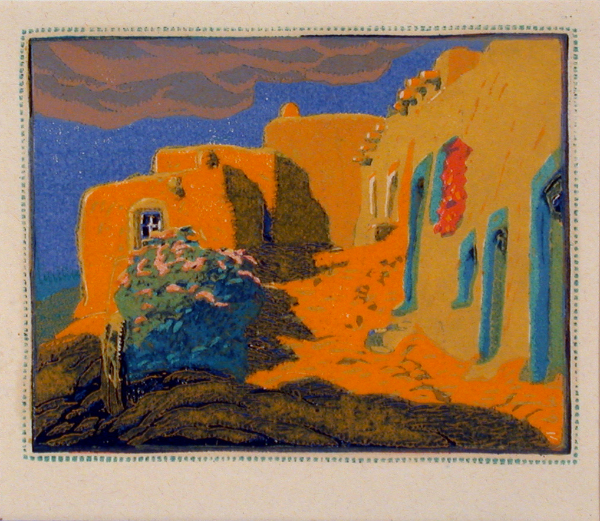
Gustave Baumann is best known for color woodcuts depicting Southwestern landscapes—gorgeous compositions of chamisa, piñon, mountains, and sky. He came to New Mexico from the Midwest in 1918 and fell in with other legends of the era like John Sloan, Mary Austin, and Will Shuster—with whom he collaborated on creating the first Zozobra. Credited with helping create the modern era of American Southwestern art, he and his friends often depicted scenes of Pueblo life and Hispanic Catholic iconography.

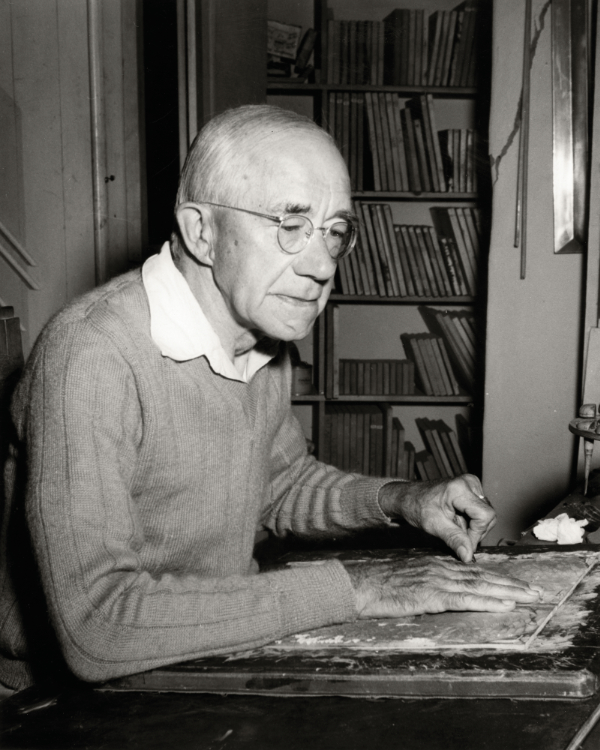
Portrait of Gustave Baumann at work. Courtesy of the Palace of the Governors Photo Archives (NMHM/DCA), neg. no. 016804.

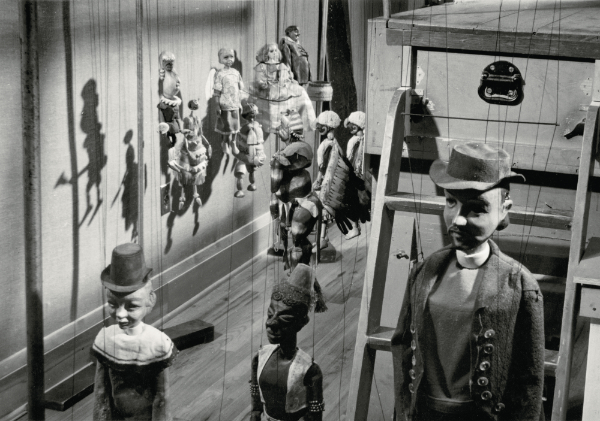
In Santa Fe, where he lived until his death in 1971, Baumann is also beloved as a marionette maker. Among more than 1,800 woodcuts, paintings, and other artworks by Baumann, more than seventy hand-carved wooden puppets live in collections storage at the New Mexico Museum of Art. Characters include a cowpoke, a princess, an eagle dancer, a koshari, a dragon, and a gaggle of magical sprite-like beings called duendes. He even rendered himself and his wife, Jane, in puppet form. The puppet shows were most active between 1932 and 1941, especially at the holidays, and ended for good in 1959. In the 1990s, the museum recreated several of the fragile marionettes and revived the Baumanns’ Christmas tradition to celebrate “Papa Gus.”

Though Thomas Leech appreciates the marionettes as much as anyone, Baumann’s reputation as a kindly puppeteer who created untroubled Southwestern landscapes doesn’t sit well with the former longtime director of the Press at the Palace of the Governors, which houses a recreation of the studio Baumann kept at the Museum of Art. “It’s too bucolic. He was so much deeper than that. I would like people to go beyond that in their estimation of him. So much of what’s been written is just the same old thing.”

Fresh possibilities lie in a new Baumann archive that contains hundreds of pages of his writings, currently being processed at the New Mexico History Museum, and a massive retrospective at the New Mexico Museum of Art planned for 2026.

Gustave Baumann marionettes
Gustave Baumann marionettes, ca. 1959. Photograph by Tyler Dingee. Courtesy of the Palace of Governors Photo Archives (NMHM/DCA), neg. no. HP.2011.07.015.

“We want to look beyond his craft and practice to dive more into his content, examining the cultural intersections at play in his work, how he engaged with and represented local communities and cultures, and look at his work through the lens of ecology,” says Christian Waguespack, head of curatorial affairs and curator of twentieth-century art at the New Mexico Museum of Art.

Although scholarship in this area has just begun, Leech and Waguespack are among a growing cohort of curators, educators, and writers developing a more complete picture of a profoundly driven artist and a complicated yet imperfect man.

Scale and Awe

Baumann emigrated from Germany to Chicago as a child and became a commercial artist when he was still a teenager, studying at night at the School of the Art Institute of Chicago. In his late teens, he pursued an applied arts education in Munich, then honed his woodcuts for a time in Indiana before heading west, lured by Fred Harvey’s promise of experiencing a foreign country on domestic soil. In Santa Fe, he promptly secured a studio at the new Museum of Fine Arts and landed a cash gig sketching for the museum’s founder, Edgar Lee Hewitt, who took him on archeological excursions.

“It was a freewheeling era of artists and writers who, searching for new subjects to fuel their modernist expressions, descended on northern New Mexico like moths to flame,” Carmella Padilla writes in an essay for the limited-edition Gustave Baumann’s Book of Saints, produced by Leech at the Palace of the Governors Historic Press in 2021. “Though ubiquitous in their day, the artists’ audacity in tackling subject matter outside of their cultural experience can be controversial now…Tourist propaganda aside, the Indigenous and Hispano peoples the art colonists explored and interpreted in their work led vibrant cultural lives steeped in old traditions that didn’t need discovering.”

When researching Baumann for a 2023 Wonders on Wheels traveling museum exhibition, Program Manager Jennifer Hasty questioned his Indigenous representation in prints like Day of the Deer Dance, a 1919 color woodcut of Frijoles Canyon at what’s now Bandelier National Monument. A tall tree bisects a vivid orange cliff face. Small figures in the lower right corner go almost unnoticed.

“It seems the purpose is to provide scale, but on the other hand, as an anthropologist, I see these human beings made to be these tiny figures, like the landscape is much more important and belittles them in some way,” Hasty says.

Tony Chavarria, curator of ethnology at the Museum of Indian Arts and Culture and the Laboratory of Anthropology, has consulted on cultural sensitivity issues in Baumann’s works. “I wouldn’t have read it that way,” he says. In keeping with the landscape painting trends of the time, “He’s depicting scale and awe.”

Looking at several Baumann images from the 1920s and ’30s, Chavarria acknowledges that none would be made by a white artist today. Recording of any kind is no longer allowed at Pueblo dances, as it was when Baumann made the evocative Eagle Dance at Tesuque Pueblo and Winter CeremonyDeer Dance at what he guesses is his Pueblo, Santa Clara. But, he says, while some of these dances can be seen as sensitive, Baumann’s depictions of everyday Pueblo life are more accurate and respectful than artists who invited Indigenous models to their studios and painted invented scenarios.

Gustave Baumann, Old Santa Fe (Progressive Proofs), 1952, color woodcut, 6 x 7 9⁄16 in. Collection of the New Mexico Museum of Art. Museum purchase with funds raised by the School of American Research, 1952 (982a-n.23G). © New Mexico Museum of Art. Photo by Blair Clark.

“Like many visitors to the Southwest in that era, he got inspiration from the Native peoples. You can argue he’s being exploitative, but so were the anthropologists and archeologists.” Although they smack of exoticism today, Baumann’s images don’t convey private information about sacred ceremonies. “They’re his interpretations,” Chavarria says, adding that Baumann’s eagle dancer marionette, which can accurately perform the traditional dance, is also acceptable. The koshari puppet, however, is more sensitive because of the figure’s important and nuanced spiritual role, which is why it’s only displayed with historical context but never included in contemporary marionette performances.

“Baumann can become a lens for us to think about these issues historically, how we think about the ethics of representation now,” says Hasty, who found during further research for the Wonders on Wheels exhibition that Baumann’s sensitivity towards his adopted state’s Indigenous population didn’t always extend to other marginalized groups. A museum staffer discovered five Black marionettes in the collection. Though they’re carved with as much attention to detail as his other characters, they resemble common racist caricatures popular at the time, complete with insulting, exaggerated facial features.

Combing Through History

Baumann carved puppets in the central European tradition, an art form that’s still alive, says Waguespack. “In that cultural context, these wouldn’t be seen as craft or toys the way that they may be here in the United States.” The puppets starred in scripts he wrote, some based on local happenings or folktales. He usually wrote in a New Mexican vernacular, emphasizing the Southwestern speech patterns of “Nambe Nell,” for instance. He also adapted stories by popular writers, including Oscar Wilde’s Birthday of the Infanta—in which a princess’s cruelty towards the story’s “hunchback dwarf” caused eight-year-old Ann Baumann to burst into tears during the show.

The plays could be silly and fun, but like puppet shows throughout history, they weren’t necessarily nice, says Ellen Zieselman, former head of education at New Mexico Museum of Art and author of The Hand-Carved Marionettes of Gustave Baumann: Share Their World (1999). “Performances included plenty of riffing and drinking. Was it always appropriate? I don’t know because I wasn’t there.”

She equates the scripts featuring local characters to the annual Fiesta Melodrama presented by the Santa Fe Players, the original name of the Santa Fe Playhouse that Mary Austin founded in 1919, with which Gus and Jane were both involved. Continuing to this day, the Fiesta Melodrama pokes fun at current events, with jokes rooted in tension among Santa Fe’s “triculture.” One funny bit in a Baumann puppet show features a koshari gently mocking an Anglo tourist who compliments his English.

“Satire is moment-specific. You can’t take these people out of their context,” Zieselman says. “Only they know what it was like to live in this town at this time. Nothing that I’ve ever heard or read has made it seem like that there was anything other than interest and respect for the multiculturalism of the local culture. The Black puppets, however, that’s worth exploring. I didn’t know about those.”

Baumann made two sets of Black characters. “Willie,” “Christina,” and “Baby” were featured in Christmas stories that took place on an imagined Caribbean Island called Giumbo. Their parts are written in African American Vernacular English, but “there isn’t a lot of personification from a racial perspective,” Waguespack says. “Santa shows up and brings them a Christmas tree. The siblings get in a fight about who deserves presents.”

Photos in the new Baumann archive show performances of “Christmas on Giumbo” in 1935 and “Christmas Flies to Giumbo Island” in 1941. The other characters were a preacher and his wife, created for a 1934 production of “How Come Christmas?” adapted from a story by Southern writer Roark Bradford, whose books featured Black characters speaking in AAVE. Some contemporary critics consider his work patronizing and demeaning, although others see it as Bradford’s authentic cultural context. It’s probable Baumann and Bradford knew each other, as Bradford’s first wife died of tuberculosis at Santa Fe’s Sunmount Sanatorium, where many transplanted artists were treated.

In “How Come Christmas,” the preacher tells the story of Christmas. He wears a formal suit with a long coat, and she wears an elegant ice-blue evening gown with a diamond bracelet and choker. Waguespack finds her reminiscent of Josephine Baker, “who would have been the most famous Black woman around this time, with many cartoon images of her banana skirt, the accentuation of her features, that kind of visual material. I also think about her when I see the glamour of this woman’s outfit. These are high-end folks, so I’d be interested to see the script, which I don’t think we have.”

Jane Baumann, an actress, made most of the marionette costumes. She was active with the Santa Fe Players, where it seems she and many of her and her husband’s friends were similarly captivated by popular culture’s demeaning portrayals of Black people. An undated photograph housed in the New Mexico History Museum Photo Archives shows Jane Baumann, Will Shuster, Witter Bynner, and eight unidentified actors performing a minstrel show in blackface.

“I always feel like it’s a cop-out to say they’re just part of a moment in history,” Waguespack says, “but they are part of that moment, when twentieth-century American history was not particularly kind to Black folks. And these marionettes, which Baumann so often did in a caricature style, fell victim to that. We can spend our whole life combing through history to find these things. Maybe we should.”

Cutting Criticism

No one wants to uncover something unsavory or outright hateful about people we admire. We fall back on saying someone is a “product of their time,” when what we wish is that these ancestors understood that time belongs to everybody, not just white artists depicting people and places that are new to them. Of Baumann and his cohort, Carmella Padilla writes, “Their work provides vital social commentary that illuminates the complexities of making art in a multicultural community. The issues that developed in the cultural consciousness of their time, including the occupation and commercialization of other cultures, still resonate loudly, and passionately, in ours.”

Although archival material is useful, it’s difficult to truly understand why historical figures did what they did. We don’t know what Baumann thought of his Black marionettes when he packed them away in 1959, or when he died in 1971, after witnessing the Civil Rights Movement. It doesn’t seem he carved the children, or the preacher and his wife, in malice. He was multidimensional. But we know he wasn’t always kind, or politic. He could be brutal in his estimation of other artists, as evidenced in the reports he wrote as area coordinator for the Works Progress Administration in the 1930s.

Jana Gottshalk wrote her doctoral dissertation on the WPA era in New Mexico, and these reports were her first encounter with Papa Gus. “He talks a lot about people not getting things done on time,” says the curator for the Museum of Spanish Colonial Art. “He speaks about women artists strangely. One of my favorites is when he says, ‘She carves in the most unladylike way.’”

This backhanded compliment was the only thing he wrote about one Hannan Mecklem of 1016 Cañon Road, and he was unsparing even toward his closest friends. “Will never set the Art World on fire … but he plods along intent on giving his money’s worth,” he wrote about Will Shuster.

“They sent those verbatim to Washington,” Gottshalk says. “I have a letter from Jesse Nusbaum [the director of the Laboratory of Anthropology] sort of apologizing for his tone, so from what I can tell, it wasn’t appreciated. Was it a tone of entertainment or joking? I can’t tell from reading them. He’s deeply critical of the artists’ work and dedication. It makes you wonder if he was critical of the whole project.”

What we do know is that in 1921, Baumann and other Anglo artists helped defeat the Bursum Bill, federal legislation that would have made it easier to defraud the Pueblo people of their land. And in 1929, he was instrumental in helping the Spanish Colonial Arts Society purchase and permanently transfer the historic El Santuario de Chimayó to the Archdiocese of Santa Fe.

“He was concerned about nuclear weapons, about Indian rights, many movements of the period that we would look back and call liberal or radical,” says Leech. “Today, knowing they put on minstrel shows is cringe-worthy, but it was the mood of the time. You don’t know, if they had been confronted by our values now, what would they have done. Maybe they would have reconsidered.”

As the new Baumann archive is examined, his writings analyzed, and personal motivations scrutinized, curators and historians will continue to wrestle with period-specific context versus broader social responsibility, and how it manifests in or is relevant to art. In 2023, critics and the public often mine art for the socio-political ideology of its maker, even though the approach can overburden art made 100 years ago or more. And 100 years from now, the culture will likely frown at today’s artists’ woeful naivete about our current social issues. Baumann might be perplexed by or even defensive about modern critique of his work—but as a cutting critic himself, he might welcome the attention. We’re still talking about him, after all. His art still sells. Although curators don’t believe Baumann was negatively interpreting anyone in his images, or with his puppets, they’re keenly aware that new information and new ways of thinking will affect perception. Not everyone will be satisfied with that explanation. For others, Baumann made beautiful images, and for them, that is enough. 
—  

Jennifer Levin is a freelance arts and culture writer and communications specialist in Santa Fe, New Mexico. She is working on a memoir, All the Girls in Their Cages.

Blair Clark is an illustrative photographer with over thirty years experience in studio and on-site photography and almost twenty-five years in museum photography.

Jennifer Levin is a freelance writer and communications professional in Santa Fe, New Mexico. As a journalist, she writes primarily about arts and culture. She grew up in Chicago and holds a bachelor’s in creative writing from the College of Santa Fe.

An American Pilgrimage:

By Scott Robinson

The North Road has been on my backpacking bucket list for years. Only one person, adventurer-journalist Craig Childs, documented walking the entire length of the North Road nearly two decades ago in House of Rain: Tracking a Vanished Civilization Across the American Southwest. When I learned that my childhood friend, Scott Tsoodle, had recently passed away, I began making plans to hike the North Road as a way of saying goodbye.

Roughly the same time as the Camino de Santiago cult was gaining traction in Medieval Europe, an extraordinarily straight, 30-foot-wide, groomed pilgrimage trail called the Great North Road spanned 33 miles north from Chaco Canyon to Kutz Canyon in northwestern New Mexico. There is no trail to follow today, and signs of its existence are mostly invisible without satellite or LiDAR imagery. But as Keith Basso pointed out in his influential book, Wisdom Sits in Places: Landscape and Language Among the Western Apache, the desert landscapes of the Southwest are anything but empty.

Scott Robinson hiking the Great North Road. Photographs by Scott Robinson.

Scott and I were best friends as kids growing up together in Texas before his family moved back to their Kiowa homeland in Oklahoma. We were on the same youth track and field team in the summer of 1971 and played football together the following fall. Our friendship, as brief as it was, shaped the way I grew to understand American history as an adult.

In 2019, I dug up an old photo that spurred me to do an internet search for my friend. I learned that Scott had died just a few months earlier. The photo I found shows ten-year-old Scott Tsoodle surrounded by white faces, including mine, as teammates on a pee-wee football team in 1971. My father caused raised eyebrows when he invited Scott’s father, Duke Jr, to join him on the coaching staff of that all-white youth league football team.

Coach Tsoodle had brought his family to Fort Worth near the end of extremely controversial and damaging federal policies initiated in the mid-1950s, collectively known as “termination and relocation”—terminating reservations and relocating Native people to cities—which was intended to move them out of rural poverty and into the mainstream of urban economic opportunity. In some ways, these policies were the latest government effort to assimilate Native Americans into non-existence. With or without federal relocation programs, however, Indian Country had been steadily spreading into urban areas since WWI. Duke Jr. was employed by the Bureau of Indian Affairs to assist Native people in making the transition to urban life in the Dallas-Fort Worth area. 

Scott and I were typical American kids. We shared sports obsessions, sleepover shenanigans, and AM radio pop music. At the same time, the Vietnam War and social unrest loomed in the background. America was still reeling from the Kent State shootings a year before. School board protests over federally mandated desegregation of our public schools dominated the local news. Emblematic of the national Chicano Movement, La Raza Unida Party had just formed in Crystal City and would soon win campaigns in local elections throughout the Rio Grande Valley of Texas. The Women’s Liberation Movement gained impressive momentum as the contentious Equal Rights Amendment, hotly debated in Washington and around dining tables nationwide, was passed by the U. S. House of Representatives in the autumn of 1971 and was months away from being placed before the states for ratification. Marvin Gaye’s “What’s Going On” charted at number two while Gil Scott-Heron, poet laureate of the Black Panthers, released “The Revolution Will Not Be Televised” as Side B to his “Home Is Where the Hatred Is” single.

This, too, was a historic time of political activism among a growing population of urban Native Americans. Before WWII, most Indigenous people lived on reservations. By the early 1970s, nearly half the Native population resided in cities. Rather than disappear by assimilation, urban Native Americans found strength in numbers. Intertribal community centers were springing up in Seattle, San Francisco, Dallas, Denver, Chicago, and Milwaukee—the birthplace of the American Indian Movement (AIM). When Scott and I met in 1971, the nineteen-month occupation of Alcatraz by AIM members had just ended, followed by the takeover of the Interior Building in Washington, D.C., at the end of the Trail of Broken Treaties march in 1972. The deadly siege at Wounded Knee began only months after that. These three events are often cited collectively by historians as a major turning point in modern Indigenous history. 
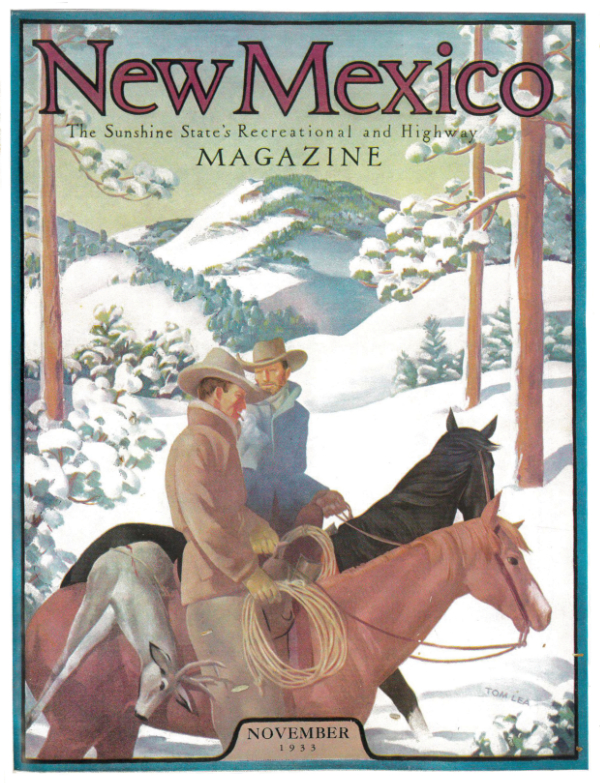
Mainstream America, however, was too distracted by economic recession, draft lottery numbers, and body counts posted on the evening news to think much about Native America. For most Texans, the historic rise of Indigenous activism was obfuscated by an increasing number of black-and-white television news clips showing violent anti-war demonstrations at the national level, and bitter protests over federally mandated desegregation locally.

Such was the complicated social setting when I spent nights at the Tsoodle house. Scott’s mother, Cherry, introduced me to fry bread while she quizzed her sons on their Native American history lessons. At age ten, that was my first awareness that Native American history existed. The traditional hymns that the Tsoodle family sang in the Kiowa and Apache languages at the First Apache Indian Baptist Church in Fort Cobb, Oklahoma, which Scott’s grandfather founded, were unfamiliar to me. Scott’s siblings still sing those hymns today as congregants in that original church building. When Scott’s great-uncle Fred Tsoodle was recognized as an NEA National Heritage Fellow in 2001 for preserving Native church singing, Pulitzer prize winning author N. Scott Momaday called the hymns “national treasures” that represent a novel form of “unique and profoundly spiritual American music.”

In hindsight, when I entered the Tsoodle home as a child in the early 1970s, I was a visitor in a world that was far more American than my Scots-Irish ancestry. As a ten-year-old white kid from the ‘burbs, I had no idea how an explosion of powwows and Gourd Dances from Oklahoma at the time were playing key roles in emerging tribal and intertribal identities nationwide. I had never heard of Indian boarding schools like Haskell, Chilocco, and Rainy Mountain that were designed by the federal government to “kill the Indian, save the man” through assimilation but failed. It makes sense to me now why Scott’s most prized college track and field medals as one of the top middle-distance runners in Oklahoma were from a meet he attended at what is today Haskell Indian Nations University. Scott’s parents, Cherry and Duke Jr, were students there in the 1950s when Haskell was a federal boarding school for grades 6 through 12.

The name Tsoodle, or Ts’ó:òl in Kiowa, means “stone carrier.” As a direct descendant of Red Tipi, Scott came from an important family of leaders, warriors, and athletes. Red Tipi’s son, Satanta (Sétt’àiñdè or “White Bear”), was one of the last war chiefs to lead battles against American soldiers. Scott’s great-grandfather, Satanta’s brother, was keeper of one of the ten sacred bundles of the Kiowa. In the 1950s, near the time when termination and relocation policies were initiated, Fred Tsoodle organized a revival of the Gourd Dance which, like so many other cultural influences from Oklahoma that shaped the spread of pan-tribal powwows nationwide in the post-war decades, has been adopted by Indigenous communities from coast to coast.

Momaday, a member of the Gourd Clan, describes the Kiowa community as the last culture to evolve in North Amer-ica. Proto-Kiowa peoples began moving out of the Colorado 
Plateau during a time of upheaval and migration after the 
Chaco Canyon culture began to fade during the twelfth 
century. The Ancestral Kiowa appear to have crossed the Continental Divide and entered the northern Great Plains by the 1300s, arrived in the Yellowstone region by the early 1700s, then traveled to the area near Devil’s Tower (Ts’òâi in Kiowa) in northeastern Wyoming by the end of the century. Having adopted the plains horse culture and Sun Dance tradition along the way, the Kiowa moved southward to establish a homeland in the southern Plains by the early 1800s. Scott Ortman and Lynda McNeil at the University of Colorado described this north-then-south migration as the “Kiowa Odyssey.”

Although they were late arrivals among Plains Indians, modern Kiowa language remains closely related to early dialects of proto-historic peoples from the Four Corners region. Noted anthropologist Jane Hill suggested that Proto-Kiowa-Tanoan was a single-speech community at the time maize farming reached the Southwest 3,000 years ago. Parker 
McKenzie began compiling the first orthography of the Kiowa language while a student at Rainy Mountain Kiowa Boarding School in the early 1900s. Parker’s great-grandson, Andrew McKenzie, continues the former’s research as a professor at the University of Kansas. From linguistic evidence alone, according to Andrew, “We can suppose confidently that the (future) Kiowas were part of the Ancestral Puebloan peoples.” 

Hiking the North Road became a way to bring this rich history of movement full circle in Scott’s honor. In preparation, I reached out to Scott’s siblings about the pilgrimage and did practice hikes with Scott’s oldest brother, Gary, a Kiowa elder. I made field trips to archaeological sites along the North Road and obtained permission from the nearest Navajo chapterhouse to cross a checkerboard of tribal land. Given that the pilgrimage route traverses rugged desert terrain and requires GPS mapping and logistical planning to follow accurately on foot, I plotted coordinates using Gaia software with drop-off and pick-up points along oil and gas access roads that tear through the North Road.

Ancient Road near Aztec, NM, 1916, El Palacio vol. 3, no.4, pg. 52. As late as 1916, when this photo was published, segments of the Great North Road were still visible on the ground.

The 360-degree panorama appeared vast and empty as the dust from the drop-off vehicle silently faded miles away in the distance. I stood alone in the middle of an isolated dirt road about a half-day’s hike south of Pierre’s Complex. Early into the hike, I encountered exploratory trenches left by the archaeologists who contributed to the Chaco Roads Project Phase I: A Reappraisal of Prehistoric Roads in the San Juan Basin, published in 1983. This tome of data, maps, aerial photographs, and site drawings was one of the earliest in-depth studies of Chacoan roads. Appendix C provided detailed documentation of 
selected sites, each numbered with new and revised archaeological information organized into standardized sections, 
including names of in-the-field data recorders. Peg Van Valen was listed for numerous sites. Peg and I had worked together as backpacking guides in the Sangre de Cristo Mountains of Philmont Scout Ranch in the summer of 1983. In doing my research, I learned Peg had passed away in 2009. As it turned out, my pilgrimage was a way of saying goodbye to two people with connections to the North Road.

Hiking the North Road proved physically challenging. Although the terrain is relatively flat, the abundance of desert brush, various cacti, and clumps of ankle-turning desert grasses make walking in a direct path impossible. Open spaces between scrubby vegetation consist mostly of shifting sand, which makes footing laborious. I followed intermittent game trails whenever these paths ran in a direction that was reasonably congruent with my course. I also encountered occasional arroyos with 4- to 8-foot vertical drops, forcing me off course as I sought passage down into the flat, sandy bottom and back out again. Pathfinding in this landscape is at best an inefficient zig-zag. Hiking the entire thirty-three-mile route safely in one trip alone and in my sixties became problematic. On this first trip, 
I managed to complete approximately the middle third of the North Road, which includes the most important archaeological site along the route, Pierre’s Complex.

Approaching Pierre’s Complex from the south. El Faro appears on the left and Acropolis on the right. Photograph by Scott Robinson.

As I hiked, I constantly wondered how the people of the Chaco Canyon culture constructed and maintained the North Road, thirty feet across, in arrow-straight segments with virtually no deviation, through such formidable terrain. It’s mind-boggling that nearly 400 miles of Chacoan roads have been documented or projected in four states so far. Debate about the purpose and use of the roads ranges from transporting more than 200,000 large timbers needed for construction at Chaco Canyon to symbolic avenues for spirits. More Chacoan-like “roads” are being identified in relatively concurrent 
archaeological sites in central Arizona, though these shorter segments are mostly interpreted as “racetracks” for ceremonial running events, perhaps like those held at various Pueblos 
today, rather than processions or pilgrimages.

The act of following a path as a symbolic and literal connection to the past continues among the descendants of the Chaco Canyon culture in the Hopi concept of kukhepya, searching for itaakuku, “our footprints,” among the ruins and potsherds purposely left by the ancestors during their migration to Hopitutskwa, or Hopi land. To the Hopi, these palimpsest pathways in the landscape are spiritual “umbilical cords” to their ancestral past. Scholars point out that some of the trails honored by the Hopi today may have once been Chacoan roads.

The lengths and directions of these Chacoan-era earthworks throughout the Southwest vary widely. Some connected to ruins, shrines, or water sources. Many align with celestial calendar events and/or significant geological features on the horizon line. Others end without an apparent destination. The North Road is the granddaddy of them all.

Pottery sherds were evident as I hiked, which confirmed that I was tracking the North Road accurately. Pierre’s Complex, the largest group of Chaco Canyon “outliers” on the North Road, came into view at the end of the first day. From a distance, I recognized the profile of two cone-shaped mesas identified by archaeologists as the Acropolis and El Faro. The two-story structures with attached kivas on top the Acropolis must have presented an impressive profile when seen by pilgrims from below as they approached along the North Road. Only piles of masonry remain today, but outlines of a spur road that formed a grand ramp up the side of the mesa to the ruins remains visible.

A year before the hike, I visited Pierre’s Complex with Rob Weiner, the 2022-2023 Paloheimo Fellow at the School of Advanced Research in Santa Fe. His forthcoming dissertation under the mentorship of Stephen Lekson at the University of Colorado will be a landmark contribution to the abundant literature on Chaco Canyon and a significant reset for studies of Chacoan architecture and roads.

Rob showed me a fire ring atop El Faro. Signal fires visible for many miles may have served as beacons for guiding pilgrims and/or spirits along the North Road. Standing on the top of El Faro, we could draw a straight line visually to Pueblo Alto on the north edge of Chaco Canyon, where the North Road begins twelve miles to the south. This sight line continues in the opposite direction over arroyos and mesas to the next stop on the North Road, Halfway House, ten miles to the north. The North Road is obsessively straight, with total disregard to topography, as if to mirror this sightline.

Kira Enriquez Loya, Flor 1, 2021. Ceramic. Photograph by Kira Enriquez Loya.

“Temples all around the world,” Rob explained, “are built like giant houses for gods.” The ruins on the North Road once appeared as oversized houses for deities and attending priests, dramatically perched on a mesa above the North Road. These “great houses” overlook a path that may have symbolically, if not literally, connected the people of the Chacoan world to their place of origin—what the Hopi call the Sipapu—and the ancestral place of spiritual return. 

Pottery sherds are everywhere around the ruins. The act of breaking pottery as part of funerary ceremonies has a long history in the Americas. Breaking vessels along the North Road likely had something to do with the cosmology of the people who built and maintained the pilgrimage route. In an animist worldview, all things have a spirit. Made things, like a clay vessel, have a special kind of spiritual existence. Ceremonially breaking these objects can be a powerful act of release.

While planning my pilgrimage, I had commissioned ceramicist Kira Enriquez Loya, chair of the department of art at Indiana State University, to create a vessel to break in Scott’s honor. Kira grew up in northern Mexico and is intimately familiar with the ceramics of the region’s Paquimé culture, the artistic descendants of Chacoan ceramicists to the north.

Kira created a vessel about the size and shape of a human heart with a surface that suggested an unfolding flower. As a Mexican artist, Kira recognized a direct link between Uto-Aztecan and Chacoan cosmologies and a common association of flowers as symbols of the spirit world. “I used a flower as reference,” Kira explained, “because it can be a tribute to Scott that you are presenting a flower in this journey and for the reference to the life cycle it represents.” We chose red for the color of the pot to honor Scott’s ancestor, Red Tipi. During the months leading up to the pilgrimage, I studied the way light played over the interlocking shapes and graceful curves of the vessel’s surface. The object I held in my hand was a work of mesmerizing visual motion.

Black-and-white style Chacoan potsherd. Photograph by Scott Robinson.

At dawn on my second day of the pilgrimage, I broke the vessel amid the ruins of the Acropolis. The first rays of sunlight over the horizon illuminated the pieces. Casting a sherd to each of the four directions with a prayer, I symbolically 
released Scott to retrace the Kiowa Odyssey back to the Kiowa homeland and his place of burial in Oklahoma. I made an offering to the ancestors, gathered the remaining pieces of the pot, and continued my hike northward toward Halfway House.

Keith Chino, an Acoma Pueblo friend and ceramist, said to me after the hike, “That’s a fine tribute to your friend Scott. I’m positive he received your prayers—and with a good heart.” In my heart of hearts, the hike was not only a pilgrimage in honor of my Kiowa friend; it was a pilgrimage into American history. William Faulkner famously wrote, “The past is never dead. It’s not even past.” The past remains alive in the landscape of the North Road. Walking among the ruins and potsherds, however, I contemplated how pumpjacks and pipelines are threatening the North Road’s preservation, and I wondered what history will remain alive for future pilgrims in this changing American landscape.
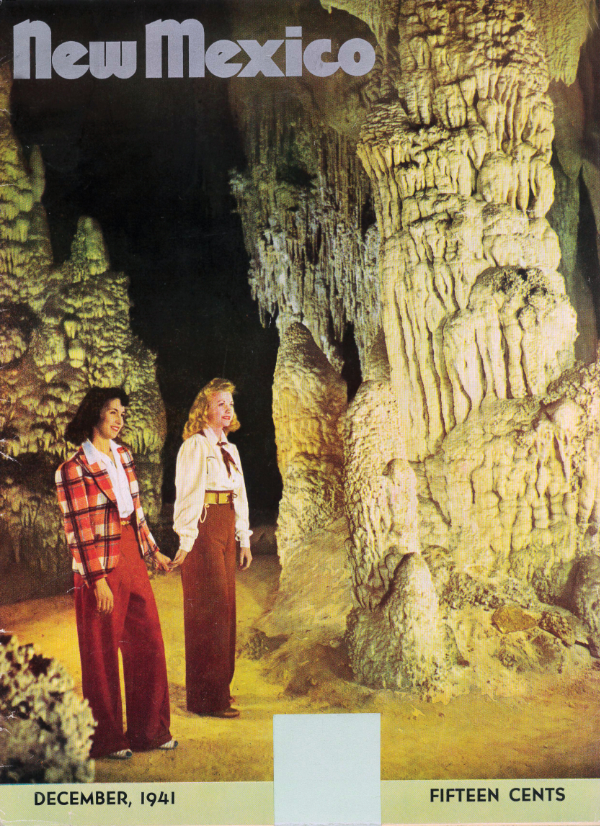
Scott Robinson served as associate professor and director of the School of Art at Stephen F. Austin State University and dean of humanities at Tarrant County College in Fort Worth where he retired in 2020. Scott now lives in Albuquerque and is writing a book about hiking the Great North Road in honor of his childhood friend Scott Tsoodle.   

Scott Robinson served as associate professor and director of the School of Art at Stephen F. Austin State University and dean of humanities at Tarrant County College in Fort Worth where he retired in 2020. Scott now lives in Albuquerque and is writing a book about hiking the Great North Road in honor of his childhood friend Scott Tsoodle.

The Poetry of Belonging

In a collaboration with the New Mexico State Library’s Poetry Center, inaugural New Mexico Poet Laureate Levi Romero and Albuquerque Poet Laureate Emerita Michelle Otero have edited the New Mexico Poetry Anthology 2023, published by the Museum of New Mexico Press. The 333- page book contains poems from every corner of our state, from writers of all ages and backgrounds, covering topics from nature to community, all bound by a single common thread: our querencia, our love of New Mexico. This small selection of poems is only a smattering of the talent contained therein; peruse all the poems yourself in your own copy, available at mnmpress.org.

Coyote Morning by Tani Arness

Moving to Taos by Jami Donley

Acequia by Jerry Ortiz y Pino

Cumulonimbus by C. John Graham

Along the River by Gregory Opstad

The Parting Glass by Mitch Rayes

How to Sell A Weaving by Laura Tohe

Ancestors In Us, With Us by Venaya Yazzie


Coyote Morning

I watch the coyote go trotting through my yard
pushed into these city streets
as I was pushed into dream last night.
We can’t slow the pace of expansion
as one day pushes into the next,
no time to pause and reflect,
the coyote keeps moving,
unsure what it’s looking for.
I remember I wanted to be something other,
something disappearable as a dream
or a coyote that’s here and then gone
trotting through yards and underbrush.
There are so many people with clipboards
and check lists insisting, “First this, then that.”
I can’t figure out what I am trying to finish exactly.
Is it true we all have more than we can handle, or no one does?
First things first. We have to
call Animal Control about that coyote.
What is it doing here pushed too deep into the city,
trotting along like the world is made of love?

—Tani Arness
Tani Arness has enjoyed living and exploring in New Mexico for the past twenty-three years. She strives to integrate her writing and teaching with humanity, nature, and spirit. A collection of her poems can be found in Tzimtzum: 5 Contemporary Poets Lend Us Their Hearts by Mercury Heartlink Press. Her poetry is also in numerous literary magazines including North American Review, Rhino, Bosque (the magazine), Malpais Review, and Crab Orchard Review. See also: tani-arness.com.


Moving to Taos

the cat asks to go outside
inside outside all day all night
I say no to him—coyotes
I go outside at night to marvel
at stars, the clarity of sky
outside is a magnet
the cat stands at the door
watches me as I stare up
both of us waiting
we stand together under apricot trees
tiny white feathers blow past
land on his white socks, my grey boots
the feathers sound like stars
the stars sound like feathers
blowing away our old lives

—Jami Donley
Jami Donley grew up in Mississippi and moved to Taos from Louisiana in 2017. She feels at home in her new landscape and appreciates the many artists who share it. Poetry keeps her company. She is currently working on a manuscript of poems and learning about lyric essays.


Acequia
—Dixon, July 5, 2016

In our forgotten, narrow valley I scramble up
Twenty feet of log-strewn hillside to
Cottonwood-shaded mountain snowmelt
Flowing serenely in the weedy bed of
La Acequia del Llano.
The metal gate grudges, gives in at last and
Instantly a cascade erupts,
Tumbling noisily down a hidden channel
So steep it feels and sounds a waterfall.
Surging under a paved road
It forces its way into our field.

The water’s music—and its power—
Take me; shake me. Unexpected,
They force delight through my heart.
Caught by surprise, my knees wobble
At the sound; the smell;
The beauty of this ancient rite:
Water infusing earth with life;
Dusty plots of sunbaked dirt
Converted alchemically into fertility.

The valley’s birds aren’t caught
Off-guard, though.
They gather rapidly, adding lyrics
To the ditch’s flowing melody.
I am ankle-deep in mud, leaning on my
Shovel, struggling to stay upright in
The pulse of our acequia,
Grinning at the birds, the sun, the music
And the throbbing of this life.

—Jerry Ortiz y Pino
Jerry Ortiz y Pino is a life-long New Mexican, retired from a forty two-year career as a social worker and currently serving his fifth term in the New Mexico State Senate. He and his wife divide their time between a home they share with children and grandchildren in Albuquerque and one they retreat to in Dixon. They are parciantes of the Acequia del Llano in Dixon. While in Dixon, Ortiz y Pino, he writes and reads for joy.


Cumulonimbus

Sprouting from the bristling hillside, it
blackens its feet, tears up the docile

atmosphere not a mile past
this single pane of glass.

The unctuous understory
shadows a neglected, not-yet-sodden

lawn and splits

the viscous quiet with light.
The obedient cedars are not safe.

The unharvested alfalfa is not safe.
Icy amulets ricochet

across the vapor-clad parking lot. The
gravelly summons of thunder brings

hand to heart in the anarchy. I can’t
linger indoors anymore. There’s too much

falling

from the sky.

—C. John Graham

C. John Graham’s poetry has appeared in The Laurel Review, Birmingham Poetry Review, Blue Mesa Review, Taos Journal of Poetry and Art, and the anthology Off Channel, among other publications. Graham lives in Santa Fe, New Mexico, and until retirement, was the safety manager for Los Alamos National Laboratory’s particle accelerator facility. He now serves as a search and rescue pilot for Civil Air Patrol and continues a lifelong spiritual inquiry.


Along The River

Three miles downstream from where
the Rito de Frijoles meets the Rio Grande,
there is still enough water in early November
to float my kayak. The river runs slowly.
I take my time, meander below high palisades,
volcanic tuff sandwiched between breccia and basalt.
An osprey stands on an updraft, hovering, calculating,
then drops a hundred feet. There’s hardly a ripple
until it lifts, grasping a small fish, and flies to its perch
near the canyon’s rim.

—Gregory Opstad

Gregory Opstad is a retired teacher. He divides his time between homes in Cloquet, Minnesota, and Cochiti Lake, New Mexico. A member of Lake Superior Writers, his poems have appeared in literary journals and anthologies. His chapbook, Lake Country, was released by Finishing Line Press in 2013.


The Parting Glass

who can believe Taylor’s sudden death
riding too fast on his motorcycle just days
from completing his new house?

a house warming party turned
into a funeral just like a party

the guitar and dulcimer
still playing the fresh picked apples
the homemade bread the clean shirt
the shovel dropped to catch
a beer tossed over the fence

and a toast: now

while we can let us drink
to everything unfinished

—Mitch Rayes
Poet, translator, musician, arts organizer, professional outfitter, contractor, and father of two, Mitch produced four Albuquerque Poetry Festivals, published THE TONGUE newsletter for eight years, and received a Gratitude Award in 2013 from New Mexico Literary Arts for his warehouse performance space THE PROJECTS. Learn more at mitchrayes.com.


How to Sell A Weaving

Trading post day and Masaní
gathers lightning and mountains
she pulled from the sky and

wove onto parallel lines
for she is part geometrician,
part coyote.

She buries her treasure
in the cornfield
damp from desert rains

still fresh from the memory
of the loom before she will walk
to the trading post and get only

half for the weight of mountains and lightning,
half for woolly clouds spun into horizontal lines on her lap,
half for her creation laid down one line at a time.

But in her dwells an old Indian trick:
she shakes off the sand and retains the dampness
for the scale from which the trader will pay her

full for the weight of mountains and lightning,
full for woolly clouds spun into horizontal lines on her lap,
full for her creation laid down one line at a time.

—Laura Tohe

Laura Tohe is Diné, the current Navajo Nation Poet Laureate, and ASU professor emerita. She is of the Sleepy Rock People clan and born for the Bitter Water People clan. She has published five books and written two librettos, Enemy Slayer: A Navajo Oratorio, and Nahasdzaan in the Glittering World, performed in Phoenix and France, respectively. Her awards include the 2020 Academy of American Poetry Fellowship and the 2019 American Indian Festival of Writers Award.


Ancestors In Us, With Us

Rooted strong—
high desert cedar trees tower like the mesas.
I speak with a green sage tongue
where female words sparkle like water—
like shimmering summer storm clouds,
like the shimmering eyes of brown grandmothers.

Like the purple juniper berries on the trees,
the old language lives atop my fingertip swirls:
adindii, adindii—shining, shining.

Rooted at the foot of Huerfano Mesa,
grandmother prays,
prayed, is praying inside a circle home where her songs and sodizin rise—
like shimmering winter star constellations,
like the shimmering eyes of her brown grandchildren.

Like the mesa clouds of old
female Athabaskan language lives atop my fingertip swirls:
másaní, másaní—grandmother, grandmother.

Matriarch speaks with glittering hands,
each finger gripping the femme voice,
curving lines
where female words dance vertical—
like the shimmering waters of the Animas
like the shimmering overflowing arroyos at Creation.

Like the river flows,
Matriarch sits and pours her migration
and old language lives atop my ridged fingertips:
nihi zaad, nihi zaad, our voice, our voice.

—Venaya Yazzie
Venaya Yazzie is a Diné/Hopi woman from the San Juan Valley in northwestern New Mexico. As an artist, poet, and researcher, she strives to reclaim the true historical past of Indigenous southwest people and reaffirm land narrative and identity. Yazzie is an alumna of the University of New Mexico, Fort Lewis College, and the Institute of American Indian Arts. She is a board member of the Detroit Institute of Arts Native American Advisory Committee.


Gregory Opstad is a retired teacher. He divides his time between homes in Cloquet, Minnesota, and Cochiti Lake, New Mexico. A member of Lake Superior Writers, his poems have appeared in literary journals and anthologies. His chapbook, Lake Country, was released by Finishing Line Press in 2013.

Jami Donley grew up in Mississippi and moved to Taos, New Mexico from Louisiana in 2017. She feels at home in her new landscape and appreciates the many artists who share it. Poetry keeps her company. She is currently working on a manuscript of poems and learning about lyric essays.

Jerry Ortiz y Pino is a life-long New Mexican, retired from a forty two-year career as a social worker and served five terms in the New Mexico State Senate. He and his wife divide their time between a home they share with children and grandchildren in Albuquerque and one they retreat to in Dixon. They are parciantes of the Acequia del Llano in Dixon. While in Dixon, Ortiz y Pino, he writes and reads for joy.

John C. Graham (opens in a new tab) ‘s poetry has appeared in The Laurel Review, Birmingham Poetry Review, Blue Mesa Review, Taos Journal of Poetry and Art, and the anthology Off Channel, among other publications. Graham lives in Santa Fe, New Mexico, and until retirement, was the safety manager for Los Alamos National Laboratory’s particle accelerator facility. He now serves as a search and rescue pilot for Civil Air Patrol and continues a lifelong spiritual inquiry.

Laura Tohe (Diné) (opens in a new tab) is of the Sleepy Rock People clan and born for the Bitter Water People clan. She has published five books and written two librettos, Enemy Slayer: A Navajo Oratorio, and Nahasdzaan in the Glittering World, performed in Phoenix and France, respectively. Her awards include the 2020 Academy of American Poetry Fellowship and the 2019 American Indian Festival of Writers Award.

Mitch Rayes (opens in a new tab) is a poet, translator, musician, arts organizer, professional outfitter, contractor, and father of two. He produced four Albuquerque Poetry Festivals, published The Tongue newsletter for eight years, and received a Gratitude Award in 2013 from New Mexico Literary Arts for his warehouse performance space The Projects. Learn more at mitchrayes.com.

Tani Arness (opens in a new tab) has enjoyed living and exploring in New Mexico for the past twenty-three years. She strives to integrate her writing and teaching with humanity, nature, and spirit. A collection of her poems can be found in Tzimtzum: 5 Contemporary Poets Lend Us Their Hearts (Mercury Heartlink Press). Her poetry is also in numerous literary magazines including North American Review, Rhino, Bosque (the magazine), Malpais Review, and Crab Orchard Review.

Venaya Yazzie (Diné/Hopi) (opens in a new tab) is from the San Juan Valley in northwestern New Mexico. As an artist, poet, and researcher, she strives to reclaim the true historical past of Indigenous southwest people and reaffirm land narrative and identity. Yazzie is an alumna of the University of New Mexico, Fort Lewis College, and the Institute of American Indian Arts. She is a board member of the Detroit Institute of Arts Native American Advisory Committee.

Gallup to Guam

By Mark J. Crawford

Although new to America and often struggling to find work, Italian immigrants Joe and Dominica Cresto Curbis felt extremely grateful for the opportunity to settle in the United States in the early part of the twentieth century. They were further blessed when their son, Dominic Sebastian Curbis, was born on July 20, 1921, in Ridley, Kansas. The family soon moved west to work in the New Mexico coal fields. 

After living in the small mining town of Madrid, nestled in the Ortiz Mountains, they moved to Gallup, which became the family’s final destination. At age 12, when money became especially hard to come by, Dominic worked alongside his grandfather in the coal mines. Later, he excelled in high school sports, especially football, baseball, boxing, and wrestling. 

When Japanese forces attacked Pearl Harbor on December 7, 1941, Dominic, like thousands of other young New Mexico men, left their communities and flocked to enlistment stations to join the fight. Dominic enlisted in the U.S. Navy on December 30, 1941, leaving the love of his life, Ida Pardich, behind, with impassioned promises to write. Their frequent letters kept them connected during his deployment until Dominic returned home on leave to marry Ida at St. Francis Catholic Church in Gallup on January 20, 1944. 

Ida and Dominic Curbis in an undated photograph. Courtesy Dorie Havens.

Dominic was assigned in March 1944 as a machinist mate to the USS Bryant, which was being outfitted at the Charleston Navy Yard and soon set off for Pearl Harbor, where it arrived on April 3. Here the crew made repairs and carried out maneuvers. At the end of May the USS Bryant departed for the island of Eniwetok, a staging area in the Pacific Ocean for the upcoming invasion of the Mariana Islands. For the next six weeks the destroyer patrolled the waters surrounding Saipan and Tinian, occasionally providing fire support for troops fighting ashore. 

Later, in mid-December 1944, the USS Bryant was attacked by Japanese aircraft on its way to Mindoro in the northern Philippines. “Enemy planes are making suicide dives,” Dominic wrote in his journal. Even after reaching Mindoro, the air assaults continued. “We knocked down two planes on this trip,” he added. “One plane attempted to crash-dive after our gunners hit him. It missed our ship by a mere few yards. We took shrapnel holes in our port bow, injuring one man. Our ship now has six planes and one cruiser to its credit.” 

Dominic’s journal is essentially an extended love letter to his wife; all entries are directed to her and he thinks of her always: “Love you more than ever, darling” … Wishing I could be home with you” … “Missing and loving you beyond words.” 

The USS Bryant, on which Dominic was stationed, photographed in South Carolina on January 7, 1944. Images courtesy of Patriots
Point Naval and Maritime Museum, Mt. Pleasant, South Carolina.
The USS Bryant, on which Dominic was stationed, photographed in South Carolina on January 7, 1944. Images courtesy of Patriots Point Naval and Maritime Museum, Mt. Pleasant, South Carolina.

And of course, there are the precious letters from Ida: 

Received mail today! 7 letters! Darling, you’re a nut, but a very loving one. We will be on our way soon. Keep your chin up. Loving and missing you always. Very happy to have received your letters. Was beginning to feel kind of low. Love you, you big bunch of loveliness!

LONESOME CHRISTMAS 

Christmas Eve 1944 found the USS Bryant getting ready to support another major operation. 

Dominic wrote that, even though there were no Christmas carols, he was happy, “as I know you are safe and thinking of me. Loving you so very very much, Darling. Making repairs on machinery and I believe getting prepared for the invasion of Luzan.” 

This land battle proved to be one of the costliest engagements in the Pacific Theater. Little did Dominic and his fellow crewmen know that this protracted fight would grind on for six months and kill nearly 8,000 American soldiers. 

For Dominic, the fight was marked by the incessant, nerve-wracking suicide dive bombers, which would suddenly appear and attack the ship throughout its Pacific campaigns. On January 9, he wrote that the men were under constant attack, with “continuous air raids all day.” To compound the tension, the “seas were very rough—our ship is rolling like a barrel. Tornado [cyclone] expected. We were in a few already, and boy! Talk about sandstorms—they are nothing compared to a tornado.” 

JANUARY 14: 

“Darling, you are everything to me. I will always have courage just for you. Keep thinking of our little dream house.” 

JANUARY 20: 

“The happiest day of my life! A year ago, Darling, you made me so very, very happy! All our happiness lies ahead. Loving you with all my heart and soul. Provisions are low, coffee is being rationed. Wow, what a place to spend an anniversary!” 

NEXT MISSION: IWO JIMA 

Once Luzan was secured, the USS Bryant left for Guam, where “the farms are all green and arranged in squares. Reminds me very much of McGaffey,” he wrote, referencing the New Mexico community northeast of Zuni, in Cibola National Forest. The next day they docked at Saipan. “At night it reminds me of Albuquerque,” wrote Dominic. “The mountains in the background and city at the foot. Saw all the lights, just like a big city! What a feeling.” 

The men had the opportunity to relax a bit, swim in the ocean, and patrol the islands in relative safety. As they left Saipan they learned of their next mission—to support the invasion of Iwo Jima. 

“Reports say it will be very rough,” he reported to Ida in his journal. “As always my thoughts and love are with you. God bless you, Darling. Being always careful, for you.” 

The USS Bryant entered the action on February 16. “Battleships are bombarding the beach,” he wrote. “Two Japanese ships afire. No sign of suicide diving yet. Our turn to fire tomorrow.” 

Dominic Curbis poses while home on leave. Undated. Photograph courtesy Dorie Havens.

Heavy bombardment of the island continued throughout the next day. The ship’s 40-millimeter guns pounded the beach. The vessel also acted as a hospital ship, picking up survivors “who were badly shot up.” Japanese planes then began making suicide attacks, interrupting the brief lull that everyone had hoped would last a little longer. 

On February 19, all the U.S. ships bombarded the beach. “One minute the island is visible and the next it cannot be seen from the rising smoke,” wrote Dominic. “There is so much noise from the firing, you cannot hear yourself think. I don’t see how the enemy can take it—there must be 300 or 400 shells hitting the island every minute or two. Overhead, our planes, hundreds of them, dive in and let their loads of destruction fall. They bomb, dive, and strafe Japanese positions. Smoke, fire, arise as far as you can see.” 

At about 9 a.m., the first wave of Marines landed on the beach. By mid-afternoon, “all along the beachhead can be seen wreckage, human, as well as mechanical,” wrote Dominic. “Fires litter the beach. Nightfall has come and firing has ceased, but on the morrow only to rage with much fiercer determination.” 

This was the deadliest and most destructive action Dominic had seen so far in the war—feeling low and perhaps mortal, he told Ida, “I have seen war all these months out here. I have been through many, many air raids, some of which I thought we would never pull through. The sea battle and those suicide diving planes, but I experienced so much more than that today. I saw bodies blown to bits only to be replaced by others. Let’s pray for these brave lads who have given back that which was given to them and all humanity—life.” 

February 20 was another day of “plundering and human suffering.” Shelling intensified. “Our ship seems to jump from under us at every salvo of our guns,” Dominic wrote. Shelling continued through the night, with bursts of all colors lighting up the sky. The men on the USS Bryant continued shelling enemy positions, patrolling, and carrying out rescue operations for pilots and sailors. “The fighting rages with even greater fury,” he wrote the next day, speculating that the engagement “must be the greatest battle in Marine history.” 

On February 23, in the midst of heavy firing, the U.S. flag could be seen flying over Mount Suribachi in the distance, giving the men a tremendous boost. “This morning our troops raised the Star-Spangled Banner over the volcano, which will soon wave over the entire island!” he wrote proudly. 

By March 5 the battle was nearly over—remaining resistance consisted only of small groups of Japanese soldiers who refused to surrender. With victory secured, the USS Bryant moved out to rejoin the Seventh Fleet at Saipan. The weather turned hot with heavy rains. 

“Do not know when we will leave,” he wrote to Ida. “God bless you Darling—My love is all yours. A million kisses and more. However, weather is very rough, waves coming over the sides of the ship, tossing it as if it were a cork.” 

OKINAWA 

A few weeks later the USS Bryant joined a task force of eleven battleships and twenty-four destroyers, headed to the heavily defended Ryukyu Islands and drawing ever-closer to Tokyo. The first few days of contact with the largest island, Okinawa, consisted of desultory firing and patrolling. Not only were they the target of suicide bombers, Dominic and crew were at high risk from prowling submarines, which they attacked with depth charges. 

On March 29, heavy shelling of Hagushi Beach, on the west coast of central Okinawa, commenced. 

“This is the prettiest island yet,” Dominic wrote. “Fires litter the beach. Smoke rising from our shelling darkens the sky as if it were going to thunder.” Most likely referring to Yomitan, he wrote, “Town with beautiful homes, which took a lifetime to build, are shattered in a few days. Our firing has been constant for eight hours; everywhere you look, large fires.” 

He also reported the seas had turned rough: “We have hit a typhoon and cloudburst. A cyclone is nothing compared to this! Waves come over the ship, knocking and tearing whatever they hit.” Thankfully, the next day was calm with a steady drizzle, with fried chicken for dinner. “Nothing like at home, but I am very thankful for getting what I am,” he wrote. 

From March 29 to March 31, U.S. forces were busy clearing the beaches of mines and blowing up nearly 3,000 submerged wooden posts that were meant to deter landings. “One of our mine sweepers ran into a mine and was blown to bits,” said Dominic. “Full moon is out and the darkness has changed to daylight. Enemy subs lurking all around.” 

The invasion of Okinawa officially began the next day. The fight for Okinawa and the Ryukyu Islands lasted eighty-two days and is considered to be one of the bloodiest battles of World War II, with a loss of 48,000 U.S. troops.

A DAY TO REMEMBER 

After the Okinawa land battle was well under way, the USS Bryant was ordered to carry out radar screen duty near Okinawa with other ships to detect enemy movements. Several U.S. ships had already been attacked there, which made Dominic uneasy. As they approached the area they could see “many, many gun flashes on the horizon, and Japanese planes were all around us.” 

The U.S. Navy aircraft carrier USS Intrepid (CV-11) afire, after it was hit by a kamikaze off Okinawa on April 16, 1945. A Fletcher-class destroyer steams by in the foreground. Official U.S. Navy Photograph, now in the collections of the National Archives, catalog no. 80-G-328441.

On April 16 the ship was attacked by swarm of six Japanese planes, which were downed or driven off by the ship’s gunners. “All that could be heard was the rumble of our guns until there was a great explosion—a Japanese plane suicide-dived on us with a bomb attached to its wings,” wrote Dominic. 

Fire raced down the hatch. “It is so full of smoke down there you can barely see and it is very hard to breathe,” he continued. “Everyone is running around trying to put out fires and repair damage. The suicide crashing demolished our half-deck, but our greatest loss, as in all battles, is human beings. On our starboard deck bodies are burned to a crisp, arms and legs of individuals burned beyond recognition. Some very, very good friends of mine; boys with whom I have spent many an evening with, chatting about our experiences or the day’s troubles. Darling, I’m sick inside of this inhuman mess of human suffering. Up to now we have counted 28 dead, not counting those that cannot be recognized. May I never again see such an undeservable mass of wreckage.” (The final casualty total was thirty-four dead and thirty-three wounded.) Considering the heavy damage to his ship, Dominic wondered if they might go back to the “good USA, and I pray we do.” 

After making limited repairs, the USS Bryant sailed for Guam, arriving on May 6. 

“We are safe now,” he told Ida, with some relief. “The lights are all on and even the automobiles have their lights on. These are the first I have seen since leaving Pearl Harbor one year ago. Seems like good ole’ Gallup. Loving and missing you beyond words.” 

Three days later they received their next orders—just as Dominic had hoped, they were taking their battle-scarred ship back to the U.S., coming to port at San Francisco. 

“We are going back, Darling!” he wrote enthusiastically. “Will be off to sea again, only this time heading USA way. Be with you soon. Goodnight, my Queen.” 

The USS Bryant departed for Pearl Harbor, flying its Homeward Bound pennant. On May 21 they entered Pearl Harbor about eleven in the morning. “Love you Darling! All my life. Days are getting cooler. Our engine room is up to 119 degrees. I can take it! Almost 4,000 miles from the action now.” Instead of taking liberty to go ashore like many of his mates, Dominic stayed on board and washed his dress blues. 

After passing Honolulu, Dominic wrote the final entry in his journal on May 22: “Well out of danger now. Darling, getting nearer and nearer all the time. Keeping my chin up and my heart is bursting with joy. Wow, won’t that Golden Gate look good?” 

EPILOGUE 

Six days later, on May 28, the USS Bryant arrived in San Francisco. First Class Machinist Mate Dominic Curbis was honorably discharged from the U.S. Navy in September 1945 and returned home to Gallup, where he and Ida adopted two children. He put his mechanical skills to good use, taking care of maintenance matters for a convent in St. Michaels, Arizona, a 28-mile drive one-way on dirt roads—he was never a day late for work and always attended mass in the mornings with the sisters. Later he worked as a mechanic for the El Paso Natural Gas plant until he retired in 1988. 

Ida and Dominic Curbis in an undated photograph. Courtesy Dorie Havens.

On January 1, 2011, while preparing for his grandson’s birthday party, Dominic collapsed and died from a stroke. A beloved figure in Gallup, much of the town turned out for his funeral service; a military honor guard fired volleys in his honor. He is buried in Gallup next to Ida. Their son, Phillip A. Curbis, passed away in 2019. Dominic and Ida are survived by daughter Dorie Havens of Albuquerque. 

Note: After winning seven U.S. Navy battle stars, the USS Bryant was decommissioned in January 1947. It remained part of the Pacific Reserve Fleet for nearly thirty years before being sold for scrap in 1976. 

Mark Crawford is a writer in Corrales, New Mexico. He has written five books, including the Encyclopedia of the Mexican-American War and Confederate Courage on Other Fields: Overlooked Episodes of Leadership, Cruelty, Character, and Kindness

Mark Crawford (opens in a new tab) is a writer in Corrales, New Mexico. He has written five books, including the Encyclopedia of the Mexican-American War and Confederate Courage on Other Fields: Overlooked Episodes of Leadership, Cruelty, Character, and Kindness.

The Accidental Archivist

By Kate Nelson

MY INTRODUCTION to New Mexico Magazine’s archive in 2013 elicited my inner Bette Davis. Led past a warren of offices in the basement of the Lew Wallace Building, a onetime dormitory for St. Michael’s School, I was deposited into a small, windowless room. Where heavy books encasing twelve issues from each year should have lined up on military-tight shelves, they were instead scattered around the room, some stacked on chairs, some fallen to the floor, none organized by year, much less decade. Loose copies of magazines joined the general disarray, each one at risk of disintegration through neglect.

Archaeologist Florence Hawley Ellis, Chaco Canyon, New Mexico, 1940. Photograph by Armand G. Winfield. Courtesy Palace of the Governors Photo Archives (NMHM/DCA), neg. no. 155545.

What a dump, I thought, echoing Ms. Davis’s most famous line in the 1949 film Beyond the Forest.

I’d arrived as a freelancer working on the biography Helen Hardin: A Straight Line Curved, about the artist whose career had soared after a March-April 1970 cover story in the magazine. I wanted to see what else might have been written about her, so headed to the magazine’s office while I was on a break from my main hustle as marketing manager for the New Mexico History Museum. There, I’d grown accustomed to the deeply layered and efficiently operated archives of the Fray Angélico Chávez History Library, where qualified professionals possessed both the skills and the passion to treat every book, periodical, letter, and map with white-glove care.

My research trip produced little of value, but it planted a seed— one that turned into an unexpected thicket of thorns three years later when I joined the magazine’s staff as managing editor. Eager to learn where the magazine had been since its July 1923 founding and certain that I could discover hidden treasures—great writers, amazing photographs, brushes with history as it happened—I embarked on a self-directed sojourn aimed solely at filling my brain with knowledge of the past.

On work breaks, I would pull an old issue from the three file cabinets that were supposed to hold all of our individual issues (and where I discovered confounding gaps and too many empty file folders). Each weekend, I would lug home one of the bound issues and pore over them, struggling to see past dated typography and early photo reproduction quality for the occasional jewel—all except 1927’s bound copy, which I still haven’t found.

Formed as the New Mexico Highway Journal in July 1923,
its first issue’s cover featured a 3-by-5-inch black-and-white photo of an
indistinguishable locale, captioned “Federal Aid Project No. 20-A, Lincoln
County.” Image courtesy New Mexico Magazine.
Formed as the New Mexico Highway Journal in July 1923, its first issue’s cover featured a 3-by-5-inch black-and-white photo of an indistinguishable locale, captioned “Federal Aid Project No. 20-A, Lincoln County.” Image courtesy New Mexico Magazine.

I learned a lot. But I also turned into a nagging librarian, with fingers bloodied by thousands of file-folder papercuts and a back strained by waves of moving the entire collection not once, not twice, but—oh, who even remembers how many times anymore. Fortunately, I had people like Paul A. Jones to keep me going.

“Shut in by narrow canyon walls, it is a place of almost complete quiet,” he wrote of Chaco Canyon in January 1932. “Rambling through the ruins, one’s imagination, stifled for years, begins to manifest itself. He can feel if not see the spirits of thousands of busy people about him, softly slipping into the scores of doors and over terraced flat roofs. He stands and dreams in the silence of death to be startled and jump nervously when a cottontail leaps from behind a rock and scuttles away through the dry sage brush.”

I felt like I was standing in wonder with him. Then I rode shotgun with author Conrad Richter (March 1957) as he drove across the state’s eastern plains, a trip that inspired him to write Sea of Grass, one of my favorite novels. Archaeologist Florence Hawley Ellis amazed with her account of a newfangled technology called tree-ring dating (June 1936). Ina Sizer Cassidy introduced me to the artists who were enlivening Santa Fe (every month, 1931–1960). Tony Hillerman showed me around the University of New Mexico’s Albuquerque campus (February 1964). Rudolfo Anaya invited me to a Christmas celebration in Puerta de Luna (December 1982).

There were other, less salubrious accounts, ones that referred to Indigenous people with language now regarded as inappropriate, or regarded Hispanic villages as places to, essentially, gawk at “quaint” lives. Still, within the collective voice of the magazine’s many incarnations, my inner type A problem-solver heard an adamant call: Organize this chaos!

ENCHANTORAMA! 100 Years of New Mexico Magazine, an exhibition at the New Mexico History Museum on view through February 14, 2024, revels in the story of how the nation’s oldest state-owned magazine played key roles in the development of roads and bridges all across the llano, the birth of the tourism industry, the celebration of the state’s art, history, culture, and recreation, and still-evolving efforts to provide respectful representation of all New Mexicans in more ways than the former once-a-year focus on Indigenous communities or Hispanic fiestas.

Writer Tony Hillerman, ca. 1988. Courtesy the Santa Fe New Mexican
Collection, Palace of the Governors Photo Archives (NMHM/DCA), neg. no.
HP.2014.14.2212.
Writer Tony Hillerman, ca. 1988. Courtesy the Santa Fe New Mexican Collection, Palace of the Governors Photo Archives (NMHM/DCA), neg. no. HP.2014.14.2212.

Formed as the New Mexico Highway Journal in July 1923, its first issue, all fifteen pages of it, introduced the staff of the New Mexico Highway Department, provided a convoluted explanation of federal funding, and wrung its hands over “by all odds our greatest problem”: the maintenance of gravel roads. On the cover: A 3-by-5-inch black-and-white photo of an indistinguishable locale, captioned “Federal Aid Project No. 20-A, Lincoln County.”

Who was the intended audience? According to a small notice inside: “This publication will be sent free upon request to state and county officials, exchanges, newspapers, libraries, schools, clubs, chambers of commerce, contractors, hotels, garages, or to any persons interested in the improvement of highways in the state and in the operation of the Department.”

(If my predecessors had ever held onto a copy of this issue, free or otherwise, they later let it slip away. Our only survivor is in one of the year-end books we still dutifully produce, though the combined Vol. I–II bears a frighteningly diminished binding.)

A second issue had to wait until October 1923, and its twenty- two pages contained what could be seen as the first attempt at encouraging readers to use those new roads to get out and see something. Erna Fergusson, founder of the Koshare Tours that the Fred Harvey Company would later take over and rename Indian Detours, wrote about visiting Acoma Pueblo. In it, she lamented the kind of tourist whom Pueblo people could rightly view as “crude invaders from another civilization who regard an Indian village as they might a zoo.”

Two more 1923 issues followed, and in 1924, the magazine began publishing monthly, with more tourism-related stories appearing, including several on Carlsbad Caverns. That site was then accessible only by a dubious dirt road and getting into the caverns themselves required an even more dubious trip in a large bucket.

In the thirties and forties, Tom Lea’s Winter in New Mexico painting of two cowboys appeared four times, and Gerald Cassidy’s The Navajo Shepherdess and Her Flock painting reached readers seven times. Images courtesy New Mexico Magazine.
In the thirties and forties, Tom Lea’s Winter in New Mexico
painting of two cowboys appeared four times, and Gerald Cassidy’s The
Navajo Shepherdess and Her Flock painting reached readers seven times.
Images courtesy New Mexico Magazine.
In the thirties and forties, Tom Lea’s Winter in New Mexico painting of two cowboys appeared four times, and Gerald Cassidy’s The Navajo Shepherdess and Her Flock painting reached readers seven times. Images courtesy New Mexico Magazine.

In July 1931, the Highway Department merged its publica- tion with the state Game and Fish Department’s. The masthead changed to simply New Mexico, and a monthly smattering of hunting and fishing articles joined those of art, historic churches, and the building of diversion dams and installation of culverts.

During those Depression years, I marveled at how many times the magazine re-ran covers, possibly as a cost-saving move or simply because the most-repeated ones were that lovely: Tom Lea’s Winter in New Mexico painting of two cowboys appeared four times; Gerald Cassidy’s The Navajo Shepherdess and Her Flock painting reached readers seven times.

As the magazine matured, more tourism-related stories appeared, including several on Carlsbad Caverns. December 1941; image courtesy New Mexico Magazine.

I wish I could say I had noted all these details during my early explorations of the archive, as a proper archivist would have. Instead, I relegated them to my increasingly faulty memory. This closer look by me and Molly Boyle (then senior editor, now managing editor) took root when we as a staff began thinking about how to commemorate our 100th anniversary. For creating a precise accounting of how the magazine changed over time, Molly and I dreamed big. Too big.
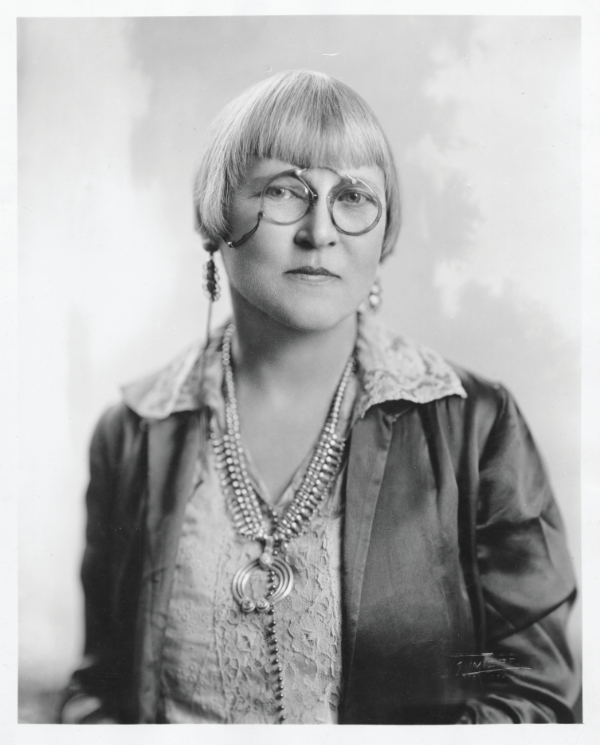
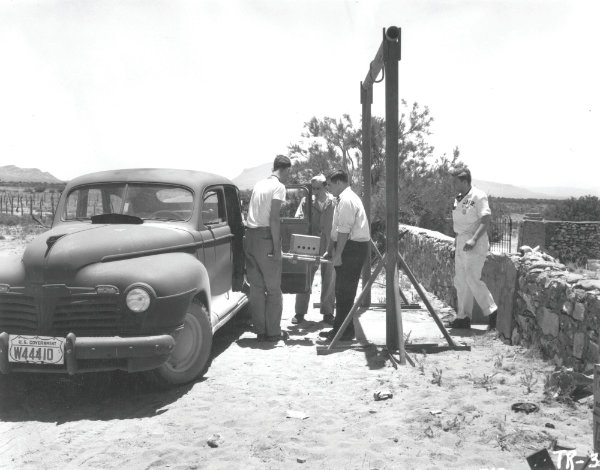
For the period of 1923 to 1988, the magazine had at its disposal a print-only index that dutifully notes authors and subjects and that has long aided our searches for particular articles. Post-1988, a random cast of magazine staffers kept similar track, but used a variety of methods—Word Docs and Excel sheets—while employing differing levels of attentiveness. The bottom line: We have indexes that don’t always track what they purport to be tracking. Worse? They never considered the importance of noting the first tourism-related advertisement (May 1924), or the first Hispanic or Indigenous writer (December 1932 and February 1933, respectively), or the launch of an editorial campaign against billboards (August 1929).

Molly and I intended to do just that. While also tending to our regular duties, we began inputting details that previous record-keepers had skipped. We tracked the editorship from R.W. Bennett, deployed from his Highway Department duties as an engineer, to the 1935 ascendancy of George Fitzgerald, who steered the magazine’s shift into a travel publication. We described what was on the covers. We pinpointed each illustrated map created by Wilfred Stedman, a noted Santa Fe artist who helped lay out each issue in the Fitzgerald era. We noted changes in subscription rates. We even had a category called “cringe,” where we pointed out how the mores of an earlier era curdled during ours.

Ina Sizer Cassidy in Paris, 1926. Photograph by Lumiere Studio.
Courtesy Palace of the Governors Photo Archives (NMHM/DCA), neg. no.
091561.
Ina Sizer Cassidy in Paris, 1926. Photograph by Lumiere Studio. Courtesy Palace of the Governors Photo Archives (NMHM/DCA), neg. no. 091561.

We got as far as 1940 before crying uncle, requesting reinforce- ments, and learning that the magazine, which relies solely on advertisements, subscriptions, and newsstand sales for its budget, lacked the money to deliver any help.

The Excel document has gathered digital dust since then. Sometimes, it teases me with thoughts of how its completion could fuel a master’s thesis or even a doctoral dissertation. If interested, inquire here.

THE ARCHIVAL COLLECTION has fewer gaps these days. I credit all the nagging that led colleagues to excavate loose copies from the teetering stacks on their desks and to relinquish the bound copies they had used to elevate their computers. When a librarian for the University of New Mexico’s Taos campus told me she needed to get rid of several decades’ worth of issues, we worked out a plan to deliver them to our office. That alone filled several dozen holes in the file folders.

Those individual copies that were once crammed into three file cabinets to the point of immobility now have more elbow room, thanks in part to a fourth cabinet in the office’s copy room, which saw me spending several evenings and one weekend hauling piles of folders from one room to the other. I even sated my desires for neatness by using a labeler to replace nine decades of handwritten scrawls on folders and cabinets.

The holes that remain bug the heck out of me—especially as I head into a retirement that, by state rules, requires me to sit out involvement with the magazine for a year. The bound copies are in the front portion of our office while the file cabinets are in the back, divided into two rooms. Connecting the rooms is a dark corridor where yet another set of shelves holds duplicate copies of issues that I never got around to organizing. We keep them in hopes of making readers’ dreams come true when they request— as they often do—one old issue or another that held a story of a beloved grandfather.

The Excel document stops abruptly, we still lack an online index, and we never pulled together the wherewithal to digitize every issue—goals that I hope a future staffer will embrace. What might help them is the way in which those bound issues now line up in the magazine’s lobby. About half of them look sharp in their chocolate-brown covers with shiny gold lettering on the spines. The earlier eras feature a less-uniform mix of beige, green, blue, and maroon covers, some with spines so beat up that pages slink to the floor any time you open them.
Perhaps that someday-staffer will stand before them and note only the ragtag spines and the oddball way that some books sometimes stand tall while others lean. It’s no dump, but to their ears, it still could scream more flaw than order. To them I say, nay, because now they’re arranged chronologically. Journey of a thousand steps, baby.

The New Mexico Magazine archives at the New Mexico History Museum’s Fray Angélico Chávez History Library are complete and can be made available to researchers and members of the public by appointment. The magazine can also make arrangements for people to peruse its archives in their office, but the staff readily bows to the skills of the History Library’s researchers in actually finding what someone is seeking.

Kate Nelson is a longtime New Mexico journalist who recently retired as managing editor of New Mexico Magazine —partly so she could explore the state without having to carry a reporter’s notebook.

Kate Nelson (opens in a new tab) is a longtime New Mexico journalist who retired as managing editor of New Mexico Magazine where she earned numerous awards from the International Regional Magazine Association.

A Flower is More Than a Flower

By C.L. Kieffer

When you walk the Los Luceros Historic Site property, the apple orchard is impossible to miss, and many understand the orchard has been here a long time—even if there are no signs to tell them it dates back to the mid-1700s, when it was Sebastian Martin’s ranch. We at New Mexico Historic Sites know that sometimes signs and labels distract from the natural beauty, so we invite guests to dive deeper with guided tours and supplemental reading about the different historic sites throughout the state. However, the interpretation and presentation to guests don’t always come out as we plan when we visit New Mexico’s historic sites.

As I planned the Los Luceros West Garden’s beds this season, I reviewed the list of flowers that Frank Cabot had grown in these beds to convey his vision. I reviewed the historical changes to the gardens to envision what previous owners wanted by way of flow and experience. I restrain myself from planting the vegetables I want, because they are not part of the interpretive plan. But while the West Garden was primarily used for flowers, I think about what would have been planted through time by all the individuals who have called this place home. Their story deserves to be told, too, in addition to the flowers of one specific period.

As the thunder clouds loomed overhead, my brain clouded with questions and self-doubt. Will a child feel free to explore this path I made for them through the blue corn? Am I planting the corn too late? I become critical of the placement of every seed. I exhale. I remind myself that the local farmer I purchased the beans from was excited I planned to plant them at Los Luceros. His story and the stories of the many generations of farmers in Northern New Mexico are the stories the seeds will quietly tell. I remind myself that not every story can be told at once. I remind myself that interpreting with flowers and plants is not sterile and controlled. It’s in nature’s hands, not just mine.

C. L. Kieffer, PhD is the historic preservation and interpretation specialist with New Mexico Historic Sites and adjunct assistant professor (LAT) in the Anthropology Department at the University of New Mexico.

Dr. C.L. Kieffer Nail is the registrar at the Museum of Indian Arts & Culture, a division of New Mexico Department of Cultural Affairs. She previously served the department as the Historic Preservation and Interpretation Specialist for New Mexico Historic Sites. Kieffer has nearly two decades of museum experience in collections and exhibitions from previous roles with the Autry National Center, the Maxwell Museum of Anthropology, and the Wheelwright Museum of the American Indian. She holds a bachelor’s in anthropology from the University of California Riverside, a master’s in anthropology from California State University Los Angeles, a master’s in Museum Studies from the University of New Mexico, and a doctorate in anthropology with an emphasis on Archaeology from the University of New Mexico.

A Blinding Light

By Andrew Wice

With a fireball brighter than the New Mexican sun, matter flashed into energy at 5:29 a.m. on July 16, 1945. The world did not yet know it had been forever changed—even as hot, waxy ash began snowing on the dryland acres of Southern New Mexico’s Tularosa Basin. 

Controlling fire was humankind’s first milestone in technological evolution, but there is no single place where this discovery occurred. However, people are able to visit Trinity Site twice per year to stand precisely where the first atomic bomb exploded; the very place where humanity seized the power to become a destroyer of worlds. 

Why New Mexico? 

New Mexico became the birthplace of the nuclear age largely thanks to one man’s lifelong enchantment with the state. Dr. J. Robert Oppenheimer, a U.C. Berkeley theoretical physicist, had vacationed in New Mexico since the 1920s. A decade before the bomb, he propitiously wrote to a friend, “My two great loves are physics and New Mexico—what a pity they can’t be combined.” 

Warned by Albert Einstein in 1939 about Nazi development of an atomic weapon, President Franklin Delano Roosevelt launched an American quest for the bomb codenamed “The Manhattan Project.” Lieutenant General Leslie Groves of the Army Corps of Engineers, who had just overseen completion of the Pentagon, took command in 1942. Brusque and corpulent, Groves selected as head scientist the dark-horse Oppenheimer, a lanky, brooding, chain-smoking daydreamer. 

The top-secret project needed a headquarters. This covert laboratory, codenamed “Site Y,” had to be isolated and secure, away from cities and coastlines. With the Second World War not going particularly well for the Allies, there was little time to survey the entire expanse of the West for the perfect spot. 

The federal government has the right, called eminent domain, to appropriate private property—but it must give “just compensation,” according to the Fifth Amendment. Groves rejected otherwise suitable locations for Site Y because he expressly wanted a frictionless acquisition and quiet displacement. This spared a white Mormon farming community in tight-knit Utah and a Native American reservation in Arizona (jurisdiction of the federal Bureau of Indian Affairs). Ever the pragmatist, Groves sought a place with no local or interagency political pushback. 

Oppenheimer had long recommended his beloved New Mexico for Site Y, and Groves came to recognize its advantages. The state, admitted to the union barely thirty years prior, was chiefly government-owned wildland, won in the U.S.-Mexico War (1846-1848). A dispersed, largely Spanish-speaking rural population promised cheap labor. Groves decided that New Mexico was the place to hide his secret science colony. 

Why Los Alamos? 

Groves zeroed in on Northern New Mexico’s Jemez Mountains for Site Y. It was mostly Forest Service land, distant from white cities and Native Pueblos. Among its manifold ridges, Oppenheimer pushed for the Pajarito Plateau, a broad flat-top mesa, primarily because it had a better view than the other finalist, canyon-bottom Jemez Springs. 

Too steep for locomotives, the craggy journey up “the Hill” only enhanced its hermetic solitude. There were already buildings and basic infrastructure from a boys’ ranch camp. Power could be supplied by daily truckloads of hard and soft coal clandestinely driven up switchbacks, coming the back way from Madrid, New Mexico. 

Workers from Los Alamos National Laboratory transporting equipment for the nuclear test at Trinity Site, at McDonald Ranch House, New Mexico, 1945. Courtesy the Santa Fe New Mexican Collection, Palace of the Governors Photo Archives (NMHM/DCA), neg. no. HP.2014.14.1713.

Its shortcomings were determined to be tolerable. Besides buying out the ranch camp, a few dozen hardscrabble Norteño homesteader families had to be displaced. Morale was a greater challenge, for the scientists of the Manhattan Project were all indoor kids. Many complained about the rustic conditions. 

Oppenheimer acknowledged that few physicists appreciated the site’s roughhewn charm, later telling an interviewer: 

“It had many very bad disadvantages. But it was not a place where you felt locked [in] because you looked out over the whole valley. … And we did not have enough water; that was a perpetual problem. The problem of getting things was very much more terrible than it need have been because of security and because there actually was no transportation. So that I will not say it was the ideal site but it was good enough.” 

The deciding factor for Groves was cost efficiency. The government paid out $225 per acre for the boys’ camp with its improvements, and as little as a non-negotiable $7 per acre for the homesteaders. In all, Groves acquired 50,000 acres for under $425,000 to start building what the world would eventually come to know as Los Alamos National Laboratory. 

Building The Bomb

At Site Y, the free world’s greatest physicists, including eighteen Nobel Prize laureates, fitted together the puzzle pieces. 

Atomically unstable elements have a tendency to fire off high-speed subatomic particles: this energy is called radiation. If this slow, steady radioactive decay of energy were somehow released all at once, by bringing enough of the atoms together to make a “critical mass,” it could start a fission chain reaction. Manhattan Project theoretical physicists only had chalkboard calculations, but they suggested that the result would be a bigger explosion than had ever been dreamt. 

To produce the most powerful chain reaction, the scientists reasoned they should use the heaviest, most unstable ele-ments. Heavier means more fuel for the reaction. Unstable, because atoms don’t want to be split, so it’s helpful to find an element which is already shooting off high-energy radiation—priming the pump, as it were.

Manhattan Project scientists experimented with both uranium and plutonium. Uranium has the highest atomic weight of all naturally occurring elements. Plutonium is a manmade element created to be both heavier and more unstable than uranium.

The challenge in creating a fission chain reaction was its likelihood to blow itself apart before all the materials could react. Somehow, the critical mass would have to be achieved instantaneously. Manhattan Project scientists experimented with two approaches to solve this: gun and implosion.

The gun method would fire a bullet of uranium into a mass of uranium, forcing a sudden critical mass. Although it had its limitations in raw power yield, the gun method was considered surefire by its LANL team. 

The implosion method would violently squeeze a cannonball of plutonium into itself, potentially yielding a much more powerful nuclear explosion. But there was also a significant risk that it might fizzle. The Manhattan Project had produced about 27 pounds of precious plutonium. Half was taken to make a test bomb, codenamed “Gadget.” 

All well and good, but where could they possibly test such a destructive weapon? 

McDonald Ranch: View from East showing debris of windmill in foreground – White Sands Missile Range, Trinity Site, Vicinity of Routes 13 & 20, White Sands, Doña Ana County, NM. Courtesy Library of Congress Prints and Photographs Division, item no. HAER NM,27-ALMOG.V,1A—30.

Why White Sands?

During the Second World War, the military seized an enormous swath of Southern New Mexico desert from local homesteaders to become a practice bombing range. The signed leases were supposed to only last the duration of the war, but those acres became White Sands Missile Range (WSMR) and its value as a designated wasteland proved too valuable and too dangerous to ever give back. (A poignant account of the displaced homesteaders is found in the Spring 2021 El Palacio article by Molly Boyle, “Whatever Decided Them.”)

When it came time to choose where to test Gadget, those bombing grounds of White Sands were an easy choice for Groves. If WSMR was safe enough for years of profligate bombing, surely it was safe enough for testing just one A-bomb. Furthermore, White Sands had the unmistakable appeal of proximity to Site Y. The exact spot within WSMR determined best for detonation, located on a tract of land previously owned by the McDonald ranching family, was given the code name Trinity Site.

Gadget’s components were driven from Los Alamos to White Sands in unmarked sedans. In fact, the car transporting the implosion detonators was pulled over for speeding in Albuquerque. If the patrolman had searched the trunk, the entire Manhattan Project could have been derailed. That might have changed the entire course of New Mexico’s space history. 

McDonald Ranch: Remains of Chicago Aermotor windmill – White Sands Missile Range, Trinity Site, Vicinity of Routes 13 & 20, White Sands, Doña Ana County, NM. Courtesy Library of Congress Prints and Photographs Division, item no. HAER NM,27-ALMOG.V,1A—12.

New Mexico Museum of Space History 

On April 1, 2023, I was invited to join a twice-yearly caravan to Trinity Site. I was given a seat on a tour bus organized by the International Space Hall of Fame Foundation, just part of a day of public access to Trinity Site offered by White Sands Missile Range. Each access day usually accommodates 3,000 to 5,000 guests.

The tour is supported by staff at the New Mexico Museum of Space History, located in Alamogordo. Originally built to house the International Space Hall of Fame, the New Mexico Museum of Space History is a gleaming cube of mirrored glass perched on a hill overlooking White Sands on the horizon. The museum has a planetarium, captivating exhibits, and a wondrous collection of artifacts.

Among the exhibition items outside the museum, the twisted wreckage of a deadly V-2 rocket, Hitler’s desperate revenge weapon, is a grave reminder that warfare benefits science, and vice versa. How long was it after mankind took control of fire before it was used as a weapon? In other words, there was nothing unprecedented about Operation Paperclip.

At the end of the Second World War, this American covert action captured 100 V-2 rockets and 1,600 Nazi engineers and scientists, including the director of the Nazi missile program, Dr. Wernher von Braun. A few months after the war ended, these Nazis were brought to WSMR to continue the rocket experiments that would eventually evolve into the American space program. 

Dedicated October 5, 1976, as the International Space Hall of Fame, the New Mexico Museum of Space History
overlooks Alamogordo and houses significant artifacts relevant to the history of space. Photograph by Andrew Wice.
Dedicated October 5, 1976, as the International Space Hall of Fame, the New Mexico Museum of Space History overlooks Alamogordo and houses significant artifacts relevant to the history of space. Photograph by Andrew Wice.

Standing at attention outside the museum are a variety of experimental vehicles, sharp-nosed missles, and even a giant F-1 engine, the kind von Braun used to send astronauts to the moon. There’s a replica of a Mercury capsule, America’s first spacecraft, with switches to flick and buttons to click to your inner (or actual) child’s delight. The grounds of the museum are also the final resting spot of the Mercury capsule’s first passenger: Ham (an acronym for Holloman AeroMedical), the Astrochimp.

Ham was a four-year-old chimpanzee trained at neighboring Holloman Air Force Base. Scientists wanted to see if he could still perform tasks (flicking switches) while experiencing high g-forces and weightlessness. Strapped inside his Mercury spacecraft, Ham was launched on January 31, 1961. 

There was a hazardous malfunction and Ham’s rocket went faster, farther, and higher than planned—157 miles into the mesosphere. Ham was weightless for nearly seven minutes of the sixteen-minute flight, yet performed his tasks faultlessly. He was recovered safely and in good spirits, having beaten the Soviet Union’s Yuri Gagarin into space by more than two months. Afterward, Ham enjoyed a long and peaceful zoo retirement. Ham’s gravesite is located below the flagpoles outside the museum, where visitors leave coins, smooth stones, and the occasional banana. 

The museum frequently hosts expert lecturers such as Loretta Hall, author of eight space-related books including Out of This World: New Mexico’s Contributions to Space Travel (Rio Grande Books, 2011). Hall was on hand during our April 1 tour to educate visitors about the ways in which New Mexico has been vital to space exploration since its earliest days. After Hall’s history lesson, the giddy audience of space buffs was thrilled by an appearance from Albuquerque-raised astronaut Mike Mullane, veteran of three space shuttle missions. It was an engaged and bookish assembly, overwhelmingly from out of state. Many were touring New Mexico’s Space Trail. But what everyone was here for, of course, was the rare opportunity to see Trinity Site.

Riding In

On the long drive through WSMR to reach Trinity Site, I enjoyed the great advantage of being on a tour bus led by Dr. Patrick Moore, director of Historic Sites for the New Mexico Department of Cultural Affairs. A Los Alamos kid and former NASA Society for Engineering Education fellow, his professorial past was manifest when he extemporaneously talked us all through the entire story of the nuclear weapons program: the pressures, challenges, uncertainties, and dangers.

It was an experience of true smallness against a scale of time and size, that two-hour drive through the scrubland missile range. At 3,200 square miles, White Sands is the biggest military installation in the world, larger than Rhode Island and Delaware combined.

A simple obelisk marks Trinity Site. Photograph by Samat Jain.

The area is so large it has its own national park—White Sands National Park resides fully within WSMR borders. To the south of Trinity, photogenic gypsum dunes can be visited year-round. However, as the famous park is on the grounds of a missile range, it does close periodically. 

Coming through Alamogordo, the caravan rolled over many miles of arid flats, dominated by the snow-capped Sierra Blanca range to the east. The desert dawn was blurred by coarse stalks of spiny soaptree yucca and greasewood bushes. Then, a sudden herd of oryx. 

Moore explained the perplexing sight of an African heavyweight antelope on this American missile range. The former head of the New Mexico Department of Game and Fish happened to be a big game hunting enthusiast. Somehow he was able to import ninety-five oryx into WSMR from 1969 to 1977. Compared to the African savannah, New Mexico’s high desert is an easy life for the formerly endangered oryx, with ample food and no local predators willing to tussle with those fearsome goring horns. Trophy hunting and culling maintain the ever-multiplying herds.

Driving through Mockingbird Gap between the Oscura Mountains to the north and the San Andres to the south, our caravan was a trickle of ants on cracked linoleum between towering tablelands. New Mexico’s landscape makes more sense when it’s remembered that this is the floor of a dried-up ocean from about 75 million years ago.

Testing the Bomb at Trinity Site

Trinity Site’s dusty parking lot, one of two, filled up with more than 200 vehicles. Trinity Site itself is a short walk from the lot, but Dr. Moore recommended we beat the crowd by first visiting the McDonald Ranch House. 

Named for the family who last lived there before it became irradiated federal property, the McDonald Ranch House is a low-slung, thick-walled adobe structure. It housed the key scientists who made the final calibrations and assembled the test bomb’s plutonium core.

From here, the Manhattan Project scientists were mere observers as Gadget was driven two bumpy miles to Trinity Site. It was precisely the same route followed by the whitewashed school buses that shuttle visitors back and forth. Upon returning to the parking lot, I walked down a corridor of chain-link fence to ground zero of Trinity Site. 

To get to Trinity Site, the convoy travels through Mockingbird Gap, a pass between the San Andres and Oscura mountain ranges. Mockingbird Gap is narrowest as it skirts past the Little Burro Mountains (pictured). The foreground of high desert scrubland, dominated by loose sandy soil and gnarled creosote, is typical of most of the missile range. Photograph by Andrew Wice.

The flat, high desert steppe is ringed by distant, layer-ribboned mountains. Low scrub brush, rough sandy soil. Gadget was hoisted 100 feet in the air, where it spent the night swinging in a monsoon rain that threatened to cancel the test. 

The rain stopped at 4 a.m., and they armed Gadget at 5 a.m. Inside the McDonald Ranch House, Enrico Fermi is remembered to have darkly joshed about “whether or not the bomb would ignite the atmosphere, and if so, whether it would merely destroy New Mexico or destroy the world.”

Gadget exploded with four times the force of their predictions. The shockwave blew out the windows of the McDonald ranch house, as well as windows 120 miles away. The mushroom cloud rose 40,000 feet into the air, cruising altitude for a modern commercial airplane. Many of the scientists, notably Oppenheimer, were haunted by the power they’d unleashed. As explored in the recent eponymous Christopher Nolan movie, Oppenheimer’s tortured conscience cost him his career and reputation.

By contrast, bumptious General Groves was defiantly triumphant in a message distributed throughout the military after the two A-bombs ended the war: “It is not an inhuman weapon. I have no apologies or excuses for its use. I think our best answer, to anyone who doubts this, is that we did not start the war and if they don’t like the way that we ended it, to remember that they started it.” 

Today, a plinth with a plaque marks ground zero at Trinity Site, where people pose for photos. The tone is motley— proud but half-hushed for respect, touristy but with radiation, and also dogs are allowed. It’s not a cheerless place. I didn’t notice any insects, which is strange. Trinity Site feels like much of New Mexico’s open country, except occasionally underfoot there’s some mildly radioactive green glass, Trinitite. 

Beneath that eternal blue New Mexico sky, the bomb is a half-remembered story from seventy-five years ago. But the ticking of Geiger counters used to detect and measure radiation reminds us that it’s all too real. Although Trinity Site is not supposed to be dangerously radioactive, nobody complained when it was time to get back on the bus. 

Leaving WSMR through the northern Stallion Gate, protestors with homemade signs peaceably demonstrated. Among the normally inquisitive people who visited Trinity Site, there was a baffled defensiveness which pre-empted engagement with the protesters’ message. A disheartening shame because that message is an essential and unfinished part of this story. These protesters were Downwinders, the first victims of the Nuclear Age. 

Fallout 

Manhattan Project scientists had calculated that the explosion’s rising heat would take any radioactive debris high into the upper atmosphere where it could safely disperse. However, detonating Gadget only 100 feet off the ground sucked soil into the implosion, dampening what should have been a pure plutonium fission reaction. Only three of the 13 pounds of fuel reacted, while the rest of the molten plutonium continued airborne. 

Instead of dissipating harmlessly, the dense dust cloud precipitated weapons-grade plutonium as it drifted along in the prevailing northeasterly winds. Among the Manhattan Project’s many discoveries was radioactive fallout. 

First, Gadget’s thunderous nuclear blast sent high-energy radiation screaming through families who happened to be living as close as 12 miles away. Infant mortality in the area sharply spiked for both newborns and the unborn. 

Crowds gather at Trinity Site on October 6, 2018. Photograph by Thomas Farley.

Then, irradiated dust powdered the downwind acres where it scorched and poisoned the livestock, crops, and water supply. Since then, the Tularosa Basin has been afflicted with multiple generations of cancer.

Tina Cordova directs the Tularosa Basin Downwinders Coalition. Though she was born fifteen years after Gadget’s test, she herself is a cancer survivor. Speaking on the phone, she explained how Trinity has harmed the community she grew up in.

“We don’t ask if we’re going to get cancer, we ask when it’s going to be our turn. … This has had a horrible negative economic impact that has precluded people from developing any kind of generational wealth. And we know that most people who are Downwinders end up depending on Medicaid or Medicare at the end of their life, because they have nothing. They can no longer work, they lose their health insurance, they’re sick, and their families spend everything they have just to try to save their life. And at the end, all they’re left with is debt.”

Visitors conduct a search for the hottest radioactive “hot spot” at Trinity Site. Using a digital radiation detector (white), a personal dosimeter (on the lanyard) and an analog Geiger counter (yellow box), these civilians are zeroing in on a dubious treasure. The Geiger counter sounded like the hollow ticking of an irregular but agitated clock. Photograph by Andrew Wice.

How much radioactive fallout landed on these unsuspecting citizens? It’s impossible to know, because nobody had thought to set up any radiation monitors prior to the test, and nobody checked on residents afterward. Eventually, the fallout cloud was measured as far away as Rochester, New York, before it drifted out to sea.

In his book Atomic Doctors, James L. Nolan, Jr. discovered an interview with Louis Hempelmann, director of the Health Group for the Manhattan Project. Speaking of the fallout that blanketed the Trinity Downwinders, Hempelmann admits, “Nobody had had any experience like this before, and we were just hoping that the situation wouldn’t get terribly sticky. … But they couldn’t prove it and we couldn’t prove it. So we just assumed that we got away with it.”

Unwarned, people continued to live and farm and subsist on their ancestral land, growing poisonous food and feeding it to their children, year after year. For the Trinity Downwinders and the New Mexican uranium miners and their families, as well as the Downwinders of the Nevada Test Site, exposure to radiation unquestionably caused cancer—and they deserve restitution.

A piece of Trinitite, a glass-like matter that developed from desert sand by the explosion of the first atomic bomb at the Trinity Test Site. Photograph by Scherff.

The good news is that in 1990, Congress passed the Radiation Exposure Compensation Act, recognizing the profound suffering that was the unintentional consequences of the U.S. nuclear program. Along with an official apology, RECA has given out more than $2.5 billion to deserving claims over the past thirty-three years.

The bad news is that the Trinity Downwinders, the very first victims of radiation exposure, were inexplicably left out of RECA. These are the people trying to get Trinity tourists to notice them, with their homemade signs. 

Why Not New Mexico?

What is especially strange about RECA’s egregious lapse is that New Mexico’s Senator Pete Domenici sat on the committee where the legislation originated. And in the House, then-Representative Bill Richardson was actually a co-sponsor of the bill. So how could New Mexico’s victims have been forgotten? 

It’s a mystery that not even a serving U.S. senator has been able to solve. In an email, Senator Ben Ray Luján wrote: 

“New Mexicans were left out of the original RECA legislation and nobody has ever been able to explain why to me. This is an issue of justice—of making New Mexicans whole who played a role in our national security. They paid a price for it—their health, livelihoods, and lives.”

With the stubborn inertia of a bureaucracy entrenching the status quo, repeated attempts to correct this injustice have been met with decades of institutional indifference and post-hoc rationalizations. It is part of a systemic pattern of environmental racism that UNM professor Dr. Myrriah Gómez identifies as “nuclear colonialism” in her book Nuclear Nuevo México (University of Arizona Press, 2022).

“The location sited for the world’s first atmospheric nuclear test was selected for the same reason that the nearby communities were subsequently excluded from RECA: the rural communities nearby identified as Hispanic communities. These communities are victims of environmental racism. … Even if the environmental racism was unintentional in 1945, the negligence of the federal government to conduct a full-scale epidemiological study in the seventy-five years after the test highlights the environmental racism that pervades this Trinity test today.”

With RECA about to sunset forever in 2022, Senator Luján and his colleague in the House, Representative Teresa Leger Fernández, successfully fought to extend it to 2024. In July 2023, precisely 78 years after Gadget, they successfully reintroduced legislation to include the Trinity Downwinders, once and for all. Its fate is subject to the political winds of the 118th Congress. They only have until the end of 2024 to get the RECA amendment passed and signed into law. 

Senator Luján is well aware that this might be their last chance for restorative justice. He wrote, “The clock is ticking to get something done here. We cannot let this program expire while Americans are still hurting. The federal government must do right by the folks it’s harmed.”

Illumination by Knowledge

Many scientists on the Manhattan Project were Jewish refugees, working feverishly to beat Hitler in the race of building the bomb. By contrast, Operation Paperclip sheltered Nazi scientists because America needed them for the Cold War Space Race. Not the most inspirational aspect, but it’s still part of the story. The Manhattan Project and the space program reflect mankind’s aspiration to transcend our terrestrial limitations. However, the pursuit of that goal has inflicted pain and injustice. 

We do have the power to be death, the destroyer of worlds. As with fire, will we learn to control it before we burn up everything? We can only create a better future if we learn from our past. Not just the happy highlights, but the full story. This is how wisdom is acquired. History is not meant to comfort or entertain, but to teach.

No Astrochimp or homesteaders or Downwinders volunteered to be part of this history. Nonetheless, what they’ve contributed is clear. We must not be blinded by hubris, or hide from shame’s glaring blast. Opening our eyes to the dawning light of wisdom is the only way we’ll find the path forward.

— 

The next tours to Trinity Site are scheduled for October 21, 2023, and April 6, 2024. For more information, please visit spacehalloffame.org/trinity-site-tour-registration.

Andrew Wice is a novelist and screenwriter. He is the author of eight novels, including To The Last Drop (Bauu Press, 2008), and produced the acclaimed Madrid Oral History Tour, a smartphone-guided walking tour of the New Mexico town of Madrid. To learn more about his work, visit AndrewWice.com.

Andrew Wice (opens in a new tab) is a novelist and screenwriter. He is the author of eight novels, including To The Last Drop (Bauu Press, 2008), and produced the acclaimed Madrid Oral History Tour, a smartphone-guided walking tour of the New Mexico town of Madrid.