Read The Art of Survival black and white, historic photograph of a politician holding up a stack of papers

The Art of Survival

The engraving on the side of the cup is painstakingly scratched out of the silver metal. The top line reads “PNM”—the Penitentiary of New Mexico. Below are two simple statistics that together tell a brutal story with remarkable concision.  “33 DIED,” reads the second line. “89 WOUNDED,” reads the third.  Paul Oliver remembers the day his father, Nordaine Oliver, brought the cup home from work.

Categories: Featured, New Mexican history

Read What the Land Holds color photograph of woman with glasses smiling

What the Land Holds

Returning from a trip once, the woman seated beside me peered out the window as the plane began its descent to Albuquerque. “Oh my,” she said. “Look at how brown it is.” I looked. I saw some brown and grey buildings, but I also saw red earth, the gentle green of the cottonwood leaves, the dark green of the juniper, and the deep blue of the Sandias—which I knew from experience would blush a luminous pink at sunset.

Categories: Editor's Letter

Read She, The Mountain color landscape of rain in the foreground and light behind

She, The Mountain

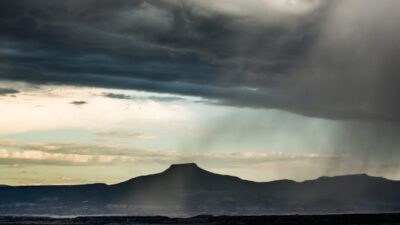
At a sleepover when I was seven, my friend said the mountain was a volcano that would erupt at any moment, cracking the dam and flooding Abiquiú. I stayed up most of that night panicking over my impending death. I prayed we would float down the valley like worn winter leaves on water. For years I watched the mountain, leery of her fragile flattop and percolating lava within.

Categories: Framework

Read Almost Yuman (1972) color photo of two girls on tricycles in matching yellow outfits in the mid 70s

Almost Yuman (1972)

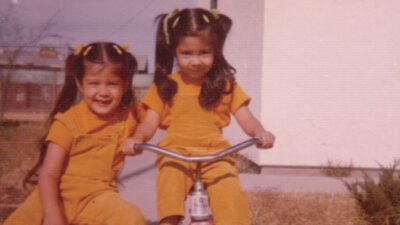
Remembering the Animas River helps me forget, at least for a moment, the challenges, fears, and feelings of inadequacy I experienced in my childhood. Memoria praeteritorum bonorum. My own set of rose-colored glasses. A trick of the mind that helps me highlight the peaceful days, the quiet ones that punctuated the violence, pressures, and confusion of being a Native girl in a northwestern New Mexico town where cowboys still hated Indians, and three White teenagers murdered three Native men just before my family and I moved there for my father’s new job.

Categories: Essays and memoir, Featured, New Mexican history

Read Hands, Heart, Land, Table Diverse group of older children eating outdoors at a picnic table

Hands, Heart, Land, Table

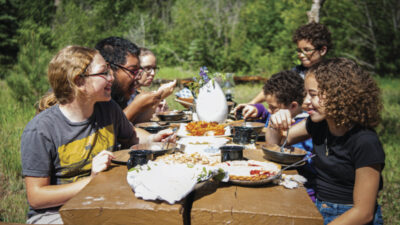
When we arrive at the table, we witness an assortment of heads intermittently lowered in praise-filled bites, not prayer, trying to draw the meal out as long as possible. No food grows cold or is left over, which is the ultimate compliment to the chef.  What is New Mexican-based art, if not our foods? The arts all carry the opportunity to permeate our minds and hearts, traveling different routes to our scatterplot of available senses.

Categories: Essays and memoir

Read Feet, sandals,and the power of political agency in the ancient southwest illustration of ancient times in full color - three guards on the roof, a hunter with a catch speaks with a female figure weaving at her loom

Feet, sandals,and the power of political agency in the ancient southwest

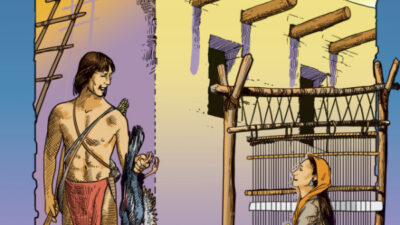
Illustrations by Marty Two Bulls Sr. Eight hundred years ago, something profoundly interesting happened in the American Southwest. Over the course of about one hundred years, the Puebloan world consciously transformed itself from a stratified hierarchical society to a system with no apparent markers of classor status. In our current state of political and climate chaos and anxiety, the experiences of Ancestral Puebloan people teach us that deep societal change is possible.

Categories: Featured, New Mexican history

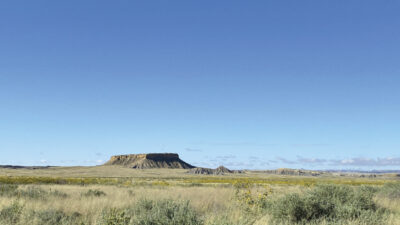
Read Returning Home Landscape photograph with a clear blue sky, a foreground of high desert native plants and a mesa at the horizon.

Returning Home

Santa Ana Pueblo / Tamaya Santa Ana Pueblo calls itself Tamaya and its people, the Tamayame, speak Keres. To the rest of the world, however, it is known as Santa Ana Pueblo because it is the official government title for the sovereign nation. Santa Ana currently encompasses 79,000 acres of land northwest of Albuquerque and borders Bernalillo to the south. For the most part, the Tamayame have been able to maintain being on their homelands in the Rio Grande Valley since their arrival in the region in the 1200s.

Categories: Featured, New Mexican history

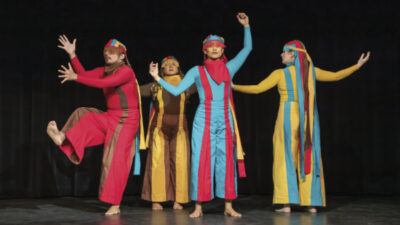
Read “¿Tecolote d’ónde vienes?” Four dancers on a stage with a black background in various poses, several with arms extended wide.

“¿Tecolote d’ónde vienes?”

Four dancers take the stage. Their headpieces cast a striking resemblance to the headdresses of los soldados from the tradition of Los Matachines. Long colorful ribbons flutter down their backs and fringe covers their eyes. The vocals of Lia Martinez, Jordan Wax, and Shae Fiol of Lone Piñon hauntingly narrate the movement of messenger birds on stage with the opening words: “¿Tecolote d’ónde vienes?” or “Where do you come from, little owl?” A keen eye will quickly notice the contrast of brown bodies against brightly colored costumes.

Categories: Featured, New Mexican history