Welcoming Everyone from Princes to the Public

Historically, visitors to the Museum of New Mexico’s four museums in Santa Fe have enjoyed tasteful receptions hosted by the Women’s Board featuring impeccable hors d’oeuvres trays and colorful punch bowls. This hospitable group is integral to the public’s perception of Santa Fe’s museums and had plans for a lively celebration of its 110th anniversary earlier this year—which were then cancelled due to COVID-19. Instead, grab a glass of punch and a delicious snack at home to toast the Women’s Board of the Museum of New Mexico’s 110 years of dedicated service.

The Territorial Legislature chartered the Museum of New Mexico on February 19, 1909, to be housed in the Palace of the Governors under the direction of Edgar Lee Hewett. A little over a year later, Judge John R. McFie announced at a meeting of the Santa Fe Archaeological Society the formation of a Women’s Auxiliary Committee. The role of this group, and other similar organizations of the time, was to “aid in the organization and maintain an interest in the work of the Museum of New Mexico and the American Archaeological Society.” The Puye Room at the Palace of the Governors was designated as their meeting room, and the first meeting of the Women’s Auxiliary Committee was held on April 15, 1910. Their first official duty was to host a reception for the formal opening of “The Museum of Archaeology in the Old Palace” on August 20, 1910. Their reception was the lead of the front-page article in that day’s Santa Fe New Mexican.

The Women’s Auxiliary Committee was officially renamed the Women’s Board of the School of American Research and the Museum of New Mexico on March 24, 1917, and given a new permanent home on the second floor of the soon-to-be-completed New Museum, as it was then called—today known as the New Mexico Museum of Art. When the museum opened in November of 1917, the Women’s Board rooms (which took up virtually the entire second floor) had been designed by its members to be a social gathering place and reception hall; some of the original furnishings are still in the Women’s Board Room Gallery today. According to Susan Mayer’s 1986 history of the Women’s Board, the formalized function of the group was “especially to perpetuate the traditional hospitality of Santa Fe and to use the resources of the School and Museum in the public services which are the particular province of women.”
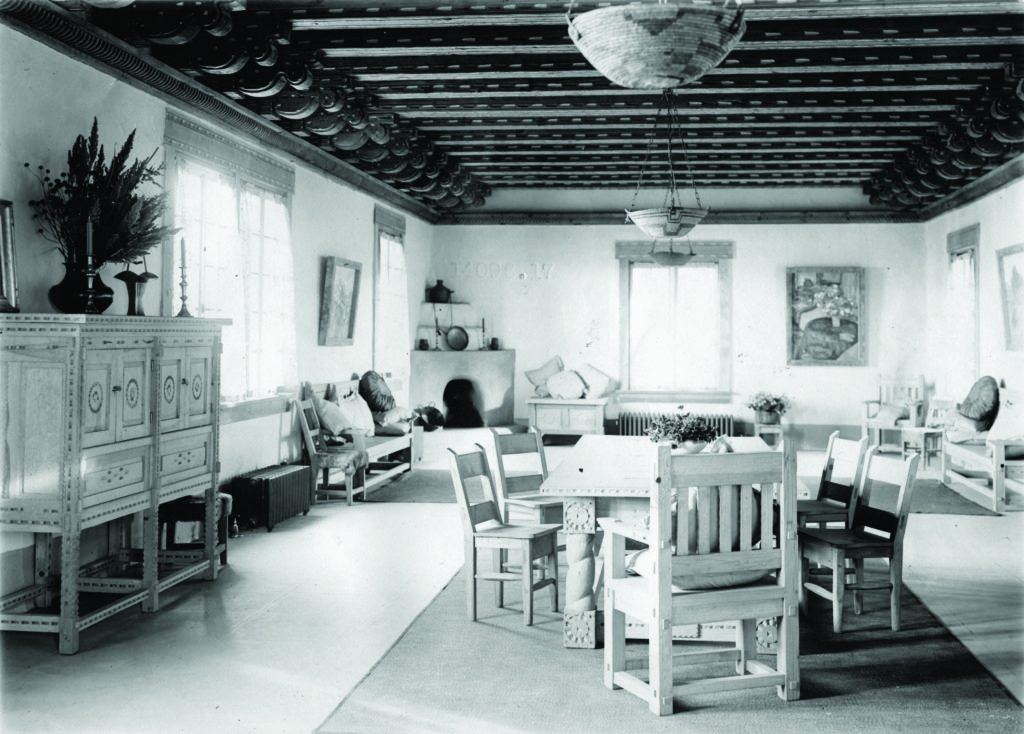
Interior, Women’s Board Room, Fine Arts Museum, Santa Fe, New Mexico, ca 1920. Courtesy the New Mexico Centennial Project collection, Palace of the Governors Photo Archives (NMHM/DCA), neg. no. 016777.

The Women’s Board, 110 years after its founding, still fulfills this mission. It has, since the opening of that first exhibition at the Palace of the Governors in 1910, provided gracious, delicious, creative hospitality for Museum of New Mexico exhibition openings and preview events.

Things have changed since 1910; most notably, the number of museums, exhibitions, and audiences has grown. Over the years, the spaces on the second floor of the art museum have been thoroughly converted to exhibition spaces, but the homey feel of the central gallery reflects some of the original ambience designed by the members of the Women’s Board back in 1917. In the renovations of the early 1980s, the museum’s New Wing Galleries were added (along with extensive underground art storage and office spaces), and the kitchen adjacent to the Women’s Board rooms was removed.
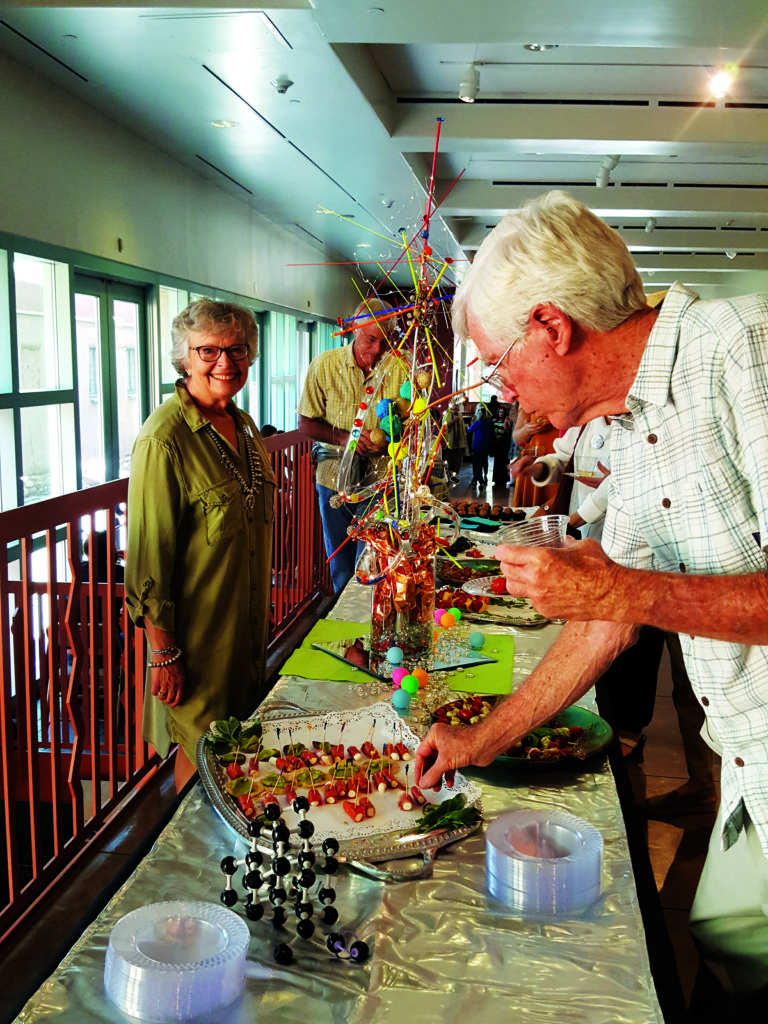
Diane Catron serves with a smile from behind a themed table at the opening of Atomic Histories: Remembering New Mexico’s Nuclear Past at the New Mexico History Museum in 2018. Three generations of the Catron family have served on the Women’s Board. Photograph courtesy the Women’s Board.

In 1973, the Board of Regents of the Museum of New Mexico further codified the Women’s Board’s relationship with the museum system, thus recognizing the Women’s Board as the official group responsible for museum public receptions. In 1982, the Museum of New Mexico Foundation entered into an agreement for the Women’s Board to host members’ preview events as well. As the number of museum spaces increased (the Museum of Indian Arts and Culture, the Governor’s Gallery, and the New Mexico History Museum were all created between 1975 and 2009), the Women’s Board increased its membership and activity. What began as fifteen women in 1910 is now fifty-three women in 2020. In the earliest days, the entire membership attended every reception; today, receptions are staffed by teams of about ten people.

For many years, the wives of the sitting governors of New Mexico were active members of the Women’s Board during their husbands’ tenure. The Women’s Board also has a long tradition of hosting an inaugural reception for New Mexico governors at the State Capitol. On January 2, 1967, Roberta Brosseau wrote a detailed report of the reception she chaired for the inauguration of Governor David Cargo on January 1. Among her suggestions for future receptions were practical items like, “If the reception is held in the Palace of the Governors again, it is imperative that heat be installed in the working area.” She also reflected a certain resignation to how things operate in the museums generally: “Check to see that there are receptacles in which to place used cups. Mrs. Frank donated several attractive plastic trash cans which were to have been kept in the Women’s Board room, but I believe they have been absorbed into the Museum.” Over the years, inaugural receptions have been hosted by the Women’s Board at the Palace of the Governors, at the New Mexico Museum of Art and, in 2019, the inaugural reception for Governor Michelle Lujan Grisham was held at the Santa Fe Community Convention Center.

The receptions of the Women’s Board are sometimes close to alchemy. The platters are beautifully prepared in a variety of out-of-the-way spaces and then brought to the serving tables. Each museum has a kitchen where supplies are washed and dried at the end of the reception, and everyone knows to be careful to have your cell phone with you at the Museum of Art, in case you get stuck in the elevator or—as has happened at least once—locked in the building at the end of a reception.

Today, the Women’s Board maintains a closet of supplies in each of the four museums it serves (the New Mexico History Museum, the New Mexico Museum of Art, the Museum of Indian Arts and Culture, and the Museum of International Folk Art). In the past few years, it has also been involved in designing a storage space in the soon-to-open Vladem Contemporary annex, part of the Museum of Art. Each closet is a treasure trove of trays, punch bowls, table runners, cups, and napkins. There is a protocol for receptions handed down from veterans to new members. Trays on the serving table are replenished and refreshed repeatedly, and punch is always poured for guests.

The Women’s Board is somewhat famous for its creative punches. Associate member Kay Lewis recalls, “We were hosting an art museum opening and I was brand new; we had a lot more guests in the courtyard than anticipated. Those were the days when wine was served in the punch bowls with ice. My instructions were to pour several bottles into the bowl, but I pointed out there were three different varietals. The reception chair’s answer was to stir them all together as no one would know the difference—and she was absolutely right, and there were no comments or complaints.”

Just as the scale and size of reception attendance forced the shift in the 1980s from china teacups to plastic cups, a growing awareness of our impact on the environment has encouraged a shift away from plastic to paper goods. As co-chair of the House Committee Linda Smith recently recalled, “Here is one conversation that encouraged our move away from plastic.

Gentleman with an attitude: ‘So, ah, where is your recycle bin?’
Me: ‘Oh, I’m sorry sir. We don’t have a recycle bin, but you could put your cup in the trash can against the wall.’
He: ‘Seriously? The museum doesn’t recycle? You really need to change that and not put all this plastic in the landfill. I’ve been recycling for years. This is Santa Fe. We are environmentally conscious here.’
Me: (smiling politely) ‘Oh, that’s wonderful. Perhaps you’d like to take that cup with you to add to your recyclables?’

With that, he walked directly to the trash can, exclaiming ‘Well, not tonight!’ However, he got me thinking about changing over from plastic to paper, and any new purchases going forward will be paper products. The Women’s Board may be 110 years old, but we can get with the program!”

New, younger members encouraged the Women’s Board to establish a web presence, and a website was launched in the last few years (nmwomensboard.org). An endowment fund at the Museum of New Mexico Foundation will support the membership of the Women’s Board for the next 100 years.

In this COVID-19 era, the Women’s Board has had to adapt in other ways, including quarterly meetings held over Zoom, and the sad inability to fulfill its primary function as hostesses for the museums. The Women’s Board has played host to royalty at least twice in the last 110 years as Princess Anne and her brother, Prince Charles, of the United Kingdom each separately visited Santa Fe in 1982—but the board has always hosted the general public as graciously as the distinguished visitors, artists, writers, politicians, and scholars.
Ellen Zieselman was the curator of education at the New Mexico Museum of Art for twenty-five years. She is currently first vice president of the Women’s Board.

Objects of a Certain Era

By Erica Prater and Christian Waguespack

In 1912, George A. and Lillian D. Harris of New York City purchased the painting Figure of a Woman by Paul Burlin (1886–1969), the earliest Modernist to work in New Mexico. This acquisition was the beginning of a years-long relationship between the extended Harris family and Burlin. Over the years, the family commissioned several paintings, amassing what former New Mexico Museum of Art Director David Turner would call “the most significant collection of Burlin’s work in the country.”

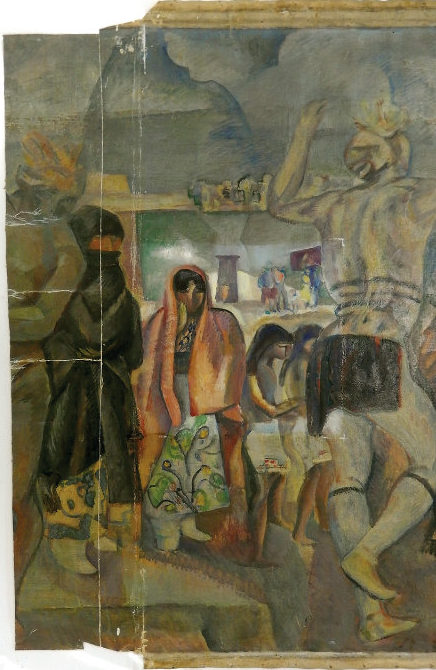
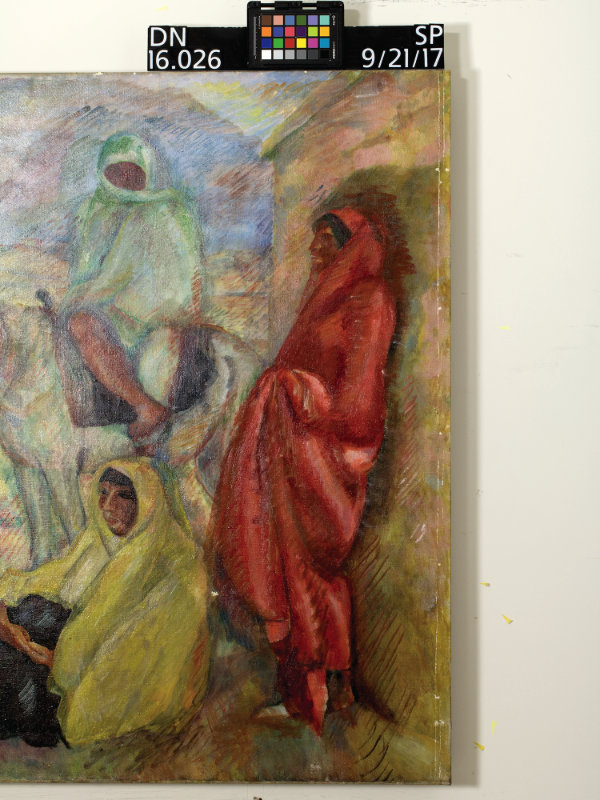
The Harrises commissioned Burlin to complete three murals for their Manhattan apartment in 1912—Stone Age, Rhapsody, and Awakening—all influenced by the artist’s 1910 visit to New Mexico. In 1921, an article from The Arts described the Harrises’ murals: “Above the paneling, which is about a tall man can reach [sic], there runs a painted frieze, about 2 feet high by Paul Burlin.” After the completion of the 1912 murals, additional paintings such as Untitled (Pelicans and Other Seabirds), and depictions of Indigenous ceremonies like Untitled (Indian Ceremonial Dance) and Untitled (Southwest Indian Scene), were commissioned by the family for their various homes. Over time, the murals and other pieces were passed down to members of the Harris family with the eventual consolidation of the artworks by George’s nephew, Edwin A. Harris Jr. In 1984, the murals were moved to the townhouse Edwin Jr. shared with his wife Frances, where they remained until Frances’s death in 2015.

In 2017, funds from the Jean and Robert L. Clarke Endowment Fund enabled the New Mexico Museum of Art to pursue its mission of conserving and caring for important works in the collection. One of Burlin’s murals, acquired by the museum in 2015, was among those preserved for generations to come.

[wonderplugin_slider id=180 alignment=”center”]

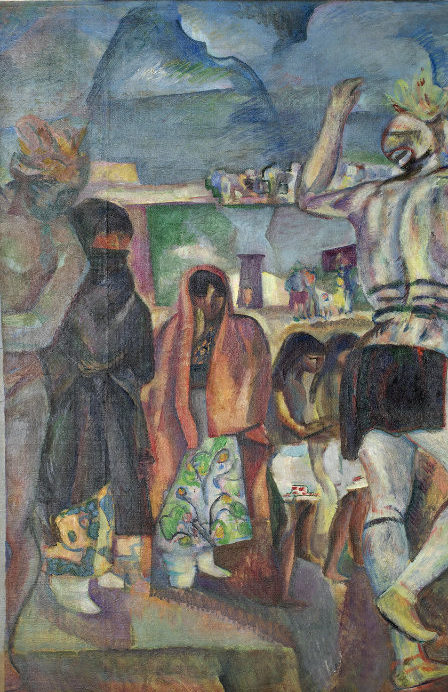
Having been originally hung above the family fireplace, several of these murals were in need of cleaning to remove years of smoky residue in order bring their vibrant colors back to life. Santa Fe conservator Steven Prins & Company cleaned the mural, restored the colors to their former brilliance, and created a new support for the canvas. The transformation of this work from its dark and dull appearance to its original bright and brilliant colors is undeniably impressive; with its conservation, the New Mexico Museum of Art has added another historic and aesthetically thrilling jewel to its Modernist crown.

Paul Burlin: New Mexico’s First Modernist
Paul Burlin is recognized as the first artist to bring the stylistic developments of European and American Modernism, such as the expressionistic color of Fauvism, to New Mexican art. In 1910, Burlin first visited Santa Fe, and the paintings he made on this trip were displayed in New York the following year. The approbation this work received led Ashcan painter William Glackens to invite Burlin to participate in the 1913 New York Armory Show.

At only 27 years old, Burlin was the one of the youngest artists included in the exhibition. Despite his young age and the participation of Europe’s premier modern artists, Burlin made a splash at the Armory Show—a contemporary claimed that he was “the most progressive contributor” to take part. The Armory Show was financially supported by Mabel Dodge (later Mabel Dodge Luhan), who would be responsible for bringing numerous American Modernist artists to New Mexico. Though Burlin arrived in New Mexico several years before Dodge, he was later part of the artistic circle of Modernists she drew west, including the likes of Marsden Harley and Andrew Dasburg.

The Armory Show is often credited with introducing Americans to European Modernism, featuring the work of artists like Matisse, Picasso, and Cézanne. Though Burlin had already seen work by Picasso two years earlier, he was particularly struck by Cézanne. The first three murals Burlin painted for the Harris apartment, Stone Age, Rhapsody, and Awakening, were completed the year before the Armory Show and illustrate Burlin’s embrace of European Modernist aesthetics before they became more recognized across the United States. Untitled (nudes in landscape with house) recalls Cézanne in content, palette, and post-impressionist form. Cézanne regularly painted groups of nude figures relaxing in Arcadian natural scenes. Like Cézanne’s paintings of bathers, Burlin’s figures are arranged almost as if on a stage lined up in various reclining or luxuriating poses, nude or in the act of disrobing.

Picasso and Cubism were also strong formal influences for Burlin, though how exactly indebted his work was to Cubism is a point of contention. A 1921 essay on the murals Burlin painted for the Harris apartment, published in The Arts, suggests, “Although the work is not definitely Cubistic, Burlin has been influenced by Cubist art, as was Arthur B. Davis, in the room which he decorated so successfully. There is in the work of the great Florentine decorators, especially in the work of Piero della Francesca, much which is akin to the Cubist masters. Paul Burlin has felt how fitted to decorative purposes cubism is.”

The aesthetics of Cubism can certainly be seen in geometric treatment of form in several of these murals. In Stone Age and Rhapsody, we find the characteristics of flattening and distortion of forms. These characteristics can be found in Picasso’s early Cubist works. There is shallow space where the figures and background merge into one surface that is regularly fractured into various solid areas of color and texture. These Cubist formal tendencies are most pronounced in Burlin’s earlier murals, but we find subtle recurrences of these formal tendencies in his later pueblo scenes as well.

Perhaps the more important influence on Burlin was the rekindling of his interest in non-Western cultures as subject matter after seeing the European Modernism of the Armory Show. At that exhibition, Burlin was struck by the influence of so-called “primitive” art, particularly African art, on European Modernism, and wanted to find a similar inspiration in his own country. Though this interest would find its most noteworthy fulfilment in Burlin’s fascination with Pueblo dances and ceremonies in New Mexico, his painting Stone Age shows that he was already looking to prehistoric and non-Western material even before his exposure to European Modernists’ appropriation of African art.

In Stone Age, we see what could be a primordial landscape, populated with nude figures and the kind of animals one would expect to see in prehistoric cave paintings. The browns and reds of Burlin’s palette, as well as the way he poses the animals in this scene, certainly echo what we find in cave paintings, but these figures are anachronistically paired with a central figure of a Pueblo woman, wrapped in a dark shawl with a pot balanced on her head, as well of other artifacts of Puebloan pottery on the left of the painting. Burlin’s interest in Pueblo subject matter was a major recurring theme and the subject of his later murals Untitled (Southwest Indian Scene) and Untitled (Indian Ceremonial Dance).

Burlin arrived again in New Mexico in 1913 where he and his wife, ethnomusicologist Natalie Curtis, became deeply interested in the traditional cultures of the region. Burlin’s interest in Pueblo dances influenced other major American Modernists. After leaving Taos for Santa Fe, Marsden Hartley frequented Pueblo dances with Burlin and his wife during his first visit to New Mexico in 1918. This exposure led Hartley to the conclusion that Pueblo culture was the truly American subject matter he was looking for in the West and prompted him to write, “I am an American discovering America.”

For his part, Burlin and his wife often fought with Dodge over whether Indigenous ceremonies should be shown to the outside world; Burlin and Curtis believed they should be protected. Paradoxically, however, this did not stop Burlin from enthusiastically representing these ceremonies in his work. For Burlin, the dances and ceremonies of the Pueblo peoples along the Rio Grande provided that uniquely American subject matter for which he was longing.

[wonderplugin_slider id=181 alignment=”center”]

The Harris Murals in New Mexico
Former New Mexico Museum of Art Director David Turner made a visit to New York City in 1992 and met with Edwin and Frances Harris at their Manhattan apartment to view the Harris family’s collection of Paul Burlin paintings, including seven murals. A 1994 letter from Turner mentioned how important the works were, and also stated, “As you plan for the eventual disposition of these works, especially the murals, please keep the Museum of Fine Arts, Santa Fe in mind for we would offer them an appropriate home.” Flash forward twenty-one years, when the museum received notice regarding the will of Frances Harris, bequeathing seven murals by Paul Burlin to the New Mexico Museum of Art.

In 2015, members of the museum’s collections committee were informed of the bequest. The committee was very excited to hear of this significant acquisition, and there was unanimous agreement to accept these works for the collection. This acquisition was a perfect fit with the museum’s mission; Burlin was an important artist to New Mexico, the murals have a connection to New Mexico, and the works are of great scale with a solid provenance. At the July-August 2015 Museum of New Mexico Board of Regents meeting, the murals were officially approved for acceptance into the New Mexico Museum of Art’s collection.

Since the murals were in New York at the time of acceptance, the logistics of getting them to the museum took some time. They had to be removed from the walls of the apartment, packed, and crated for travel across the country to Santa Fe. On May 13, 2016, the crate arrived at the museum. The crate measured 40 by 135 by 10 inches, and needed time to acclimate for several days before the contents were unpacked.

Collections Manager Erica Prater recalls, “Due to the size of the murals, I was unable to unpack them alone. At the time the collections department had intern Mariah Creelman working with us, who happily assisted. When we took the first mural out of the crate, we found it to be flimsy due to it being longer than tall and lacking a rigid support backing, and we had to be extra careful so as not to torque it. We worked our way through them one by one, and photographing them along the way. After Mariah and I finished unwrapping and photographing each work, we put them away for safe keeping until we could get them processed into the collection.

“Upon inspection of each of the murals, I found that they all showed their age; however, this is not surprising. Any object of a certain era that has been exposed to environmental and human hazards is going to have condition issues. For example, as in the case of the murals, they all have a layer of grime present on the painted surface, [due to] exposure to soot, nicotine, dirt, and dust, all which accumulate over time. Another common attribute of old paintings is a yellowing of the varnish, which the murals appeared to have as well. These issues resulted in a muddled palette, obscuring the vibrant colors. The support backings of the murals were cobbled together, and different materials were used for each mural, resulting in a lack of rigidity. This lack of support can cause the painting to twist quite easily, resulting in bending of the canvas and cracking of the painted surface. Another condition issue was the murals had been moved from residence to residence throughout the years, causing strain and damage to the artworks. Unfortunately, the overall condition of the murals made them unable to be exhibited until they received conservation.”

Decision to have one conserved
Since conservation treatment is time-consuming and labor-intensive, it is expensive. Budget concerns for conservation treatment of artworks are always a factor at the museum, and there are several elements to consider when deciding which object will receive treatment. The murals, though a significant acquisition, were unable to be exhibited in the state in which they were received; this prompted the decision to use available funds to have one mural undergo conservation treatment.

Head of Curatorial Affairs and Curator of Contemporary Art Merry Scully was the one to select which mural underwent treatment. With an eye towards what would be most immediately useful for upcoming exhibitions, she selected Untitled (Indian Ceremonial Dance) for its distinct New Mexican content.

Shortly after, the museum hired a new curator of twentieth-century art, Christian Waguespack. Waguespack remembers, “This was one of my first projects coming on board at the museum, and it was incredibly exciting to work with such a large and significant piece by Burlin. I still remember the excitement of visiting the painting at the conservator’s studio the first time—even dulled and dirty, it was stunning. The process just got more exciting from there. On top of the anticipation I felt revisiting the painting over the course of its treatment and getting to see the vibrant colors slowly emerging from under the grime, there were unexpected surprises! One day we found a piece of the painting which had at one point been cut off and glued to the back! We were able to see it get reattached and the painting become whole again for the first time in who knows how long. That was really special.”

Conservation
Local painting conservator Steven Prins was contacted about conserving this mural and completing an assessment. With the mural being fragile and large, the Museum of Art Chief Preparator Sam Rykels built a simple travel crate to transport the mural safely to Prins’s studio.

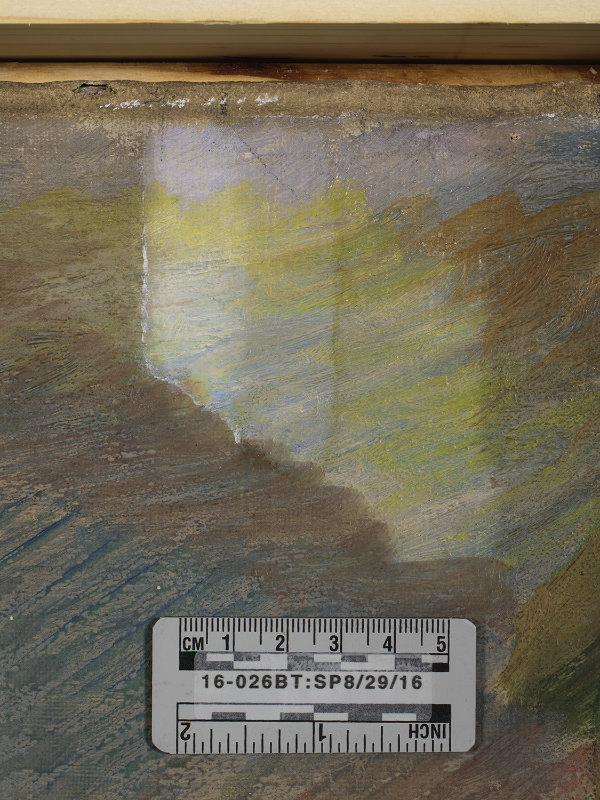
In a small test section, the results of three cleanings are clearly evident. The lighter section to the right has been cleaned to remove grime; the middle, to remove varnish; and the left section is the original color of the paint, cleaned to remove more underlying grime. Photograph courtesy Steven Prins & Company.

Before treatment, Prins provided a proposal to the museum detailing the scope of work required and a cost estimate. The proposal laid out in great detail the condition issues that needed addressing and how Prins proposed to treat them: “Cleaning to remove heavy accumulation of soot, grime and old discolored varnish; remounting onto a proper stretcher or more substantial panel; reduce and alleviate deformations in the canvas, including those associated with cracking, to the extent safely possible by local treatment.” The proposal was reviewed, considered, and approved by the director, thus commencing the treatment of the mural.

Burlin
The use of ultraviolet gradients of cleaning over various stages, as well as the extent of the grime outside the cleaned section.

When Prins examined the verso of the mural, he found that a 5- to 5 ½-inch section of the original image was cut off and used as reinforcement for the two pieces of the backing. A 3-inch portion of the image was folded over on the right side and 1-inch section of the original image was cut off and used to reinforce a rupture in the paperboard backing. Prins suggested that the painting should be removed from the unidentified wall board, noting that “in spite of the fact that it appears to have adequately supported and preserved the painting for some time, the panel on which it is currently mounted is no longer deemed suitable for continued service.” It was recommended that the painting be remounted to a new secondary support that would allow for for inclusion of the folded sections and reattachment of the cut segment. Prins also conducted a little investigative work on the unidentified backing board and, with the help of a colleague, identified the original backing as Compo Board.

The sections of canvas previously folded over and adhered to the back, now restored to their proper place on the painted surface, pictured before general treatment of the painting. The seams where it was reattached, however, required inpainting to fill in the lines of paint loss. Also visible is paint loss in the seam where the canvas was folded over. Photograph courtesy Steven Prins & Company.
The far left section of the canvas as it appeared after the seams from foldings and cuttings were inpainted and repaired, and the entire canvas cleaned. Photograph courtesy Steven Prins & Company.

Addressing the dirty surface, Prins completed three spot tests to see if cleaning would be safe and effective in removing the grime. Based on the results, the painted surface could receive treatment and, much to our surprise, would require removing two layers of grime and a single layer of varnish; Prins wrote, “The appearance of the painting is seriously compromised by a heavy accretion of grime and old, discolored varnish. This occurs in three distinct layers: gray sooty grime deposited directly on the painted surface; a heavy, very irregularly applied layer of what appears to be natural resin varnish on top of that; a heavy second layer of gray, sooty grime that has accumulated on the painted surface since it was varnished.” Prins provided an image of the test-cleaned areas and the results were impressive, showing the vibrancy of colors that the painting originally had featured.

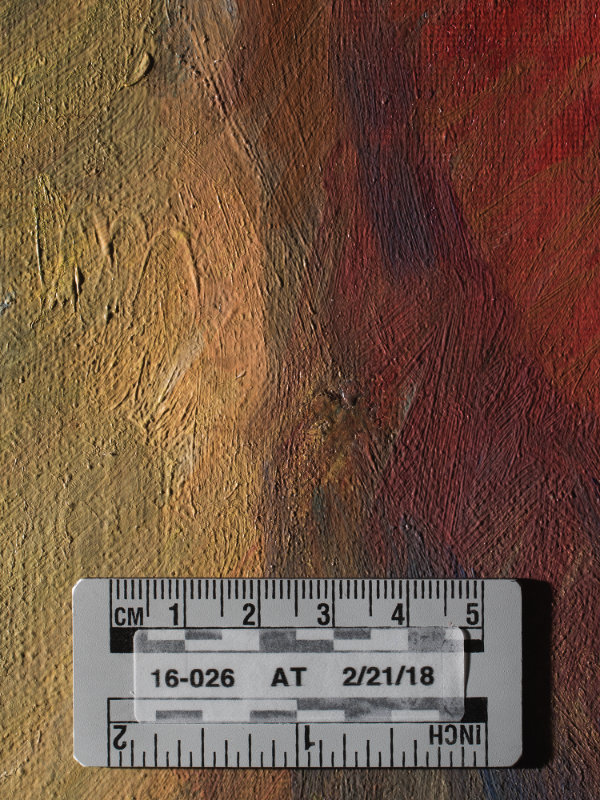
A small spot of lost paint on the edge of the red blanket was meticulously documented, cleaned, and repaired during conservaiton.
A small spot of lost paint on the edge of the red blanket was meticulously documented, cleaned and repaired during conservation.

After 200-plus hours of treatment to the tune of $21,600, the mural was finished in late February 2018. “Cleaning was carried out in three phases,” Prins wrote, “in order to selectively remove three distinct layers: superficial grime, old, oxidized and discolored varnish, and underlying grime residing directly on the painted surface.” Additionally, he wrote, “treatment to reduce and alleviate cracks and other deformations in the canvas were carried out; while still mounted in the oversized working stretcher the reattachment of the detached fragment was finalized; filling and inpainting were carried out as necessary to compensate for damage and loss of original paint and ground.”

At this point, Untitled (Indian Ceremonial Dance) was ready to be returned to the museum. The painting was shown for the first time in Bringing Together: Recent Acquisitions in 2019–2020. Currently, the painting is on display in the Governor’s Mansion, hanging above the credenza in the dining room.

How you can help
We have seen some truly stunning results for the conservation of Untitled (Indian Ceremonial Dance), but there is still a long way to go before all of these murals are restored to their former glory. We have secured half the funds for the conservation of Stone Age through generous gifts from Susan Johnson and Kathy Jones (members of the Harris family), but we are actively seeking donors interested in assisting in the conservation of this important mural cycle.

Any inquiries regarding the murals and their conservation may be directed to either Dr. Mark White, executive director of the New Mexico Museum of Art, or the authors of this article.

Additionally, Paul Burlin’s other murals not featured in this article are available to view at the Museum of Art’s searchable art museum at sam.nmartmuseum.org

Christian Waguespack has served as curator of twentieth-century art at the New Mexico Museum of Art for more than three years, where he has organized over a dozen exhibitions on New Mexican art and culture.

Erica Prater has served as collections manager at the New Mexico Museum of Art for more than seven years, where she has overseen the care and safety of the museum’s collection.

Erica Prater (opens in a new tab) resides in Gilbert, Arizona, and is a former collections manager at the New Mexico Museum of Art, a division of New Mexico Department of Cultural Affairs. Other key roles include Registration Assistant at the Musical Instrument Museum and Assistant Registrar at the Gerald Peters Gallery.

Steven Prins , of Steven Prins & Company, owns a Santa Fe-based art conservation studio, which conserves and restores old paintings and murals.

Native Tongues

By Emily Withnall
Photography by Kenji Kawano

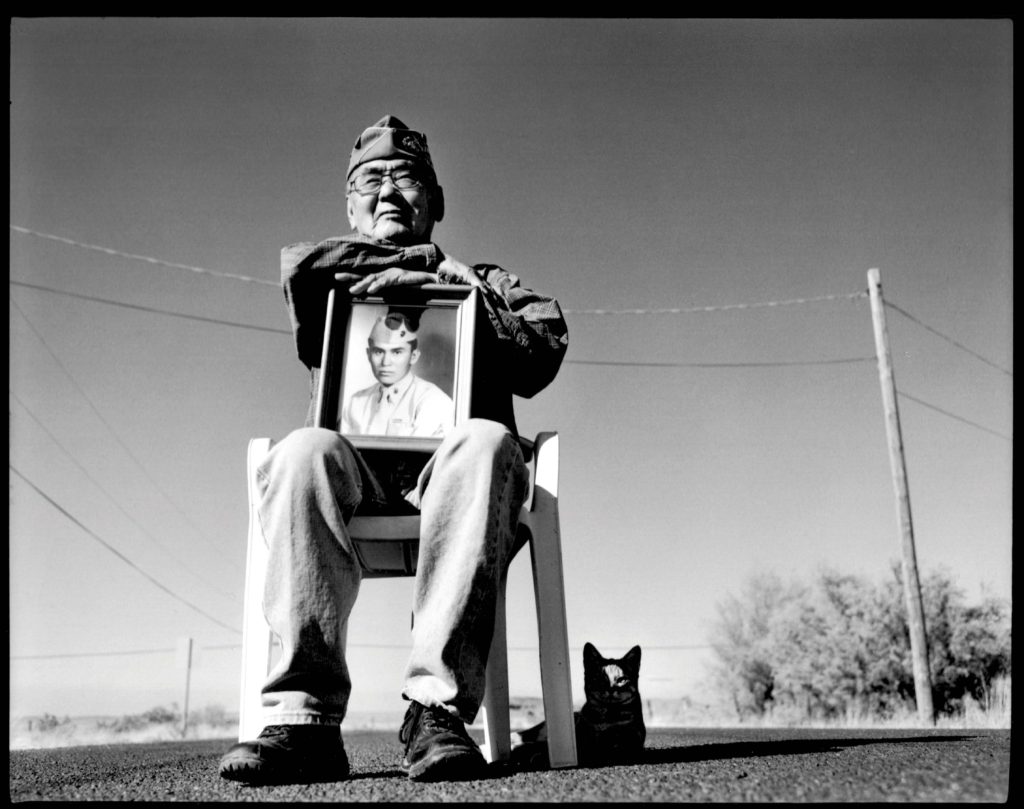
In a black-and-white photograph taken by Kenji Kawano in 2005, two Navajo men stand side by side at a Monument Valley overlook. Their heads are positioned in the gaps between the three famous buttes behind them—West Mitten, East Mitten, and Merrick. The brothers, Samuel F. Sandoval and Merril L. Sandoval, wear weathered fatigues and trifold Garrison caps heavy with silver pins. Marine Corps medals decorate their left breast pockets and they wear beaded turquoise jacla necklaces, concho belts, and ornate bolo ties. Like the buttes behind them, the mens’ faces have been weathered by time. The landscape and the brothers’ attire tell many stories, but their unflinching gaze intimates a history of hardship, courage, and pride. The photo is one of many in Kawano’s Warriors portrait series of the World War II veterans known as the Navajo Code Talkers.

Monument Valley is encompassed by the Navajo Nation. The famous buttes have served as a backdrop for many old Hollywood Westerns, many of which Kawano watched as a child in the 1950s in Gotemba, Shizuoka Prefecture, Japan. Kawano’s love of the stories of cowboys and Indians portrayed in the movies sparked his interest in the United States. As a child, however, he did not know the Navajo Nation existed, or that Navajo soldiers had fought in World War II. Kawano’s own father had been trained to be a human torpedo (Kaiten) pilot during WWII, but fortunately the war ended before he was deployed.

When Kawano graduated from high school he began working for a graphic design company, but soon gravitated to photography.

“When you do graphic design you stay in the office all day, but when you take pictures you go out and meet different people,” Kawano says. “So I bought a camera and started to go around the American bases like Yokota and Yokosuka because I wanted pictures of Americans.”

Alfred J. Peaches, Navajo Code Talker, Winslow, Arizona, 2007.

On November 10, 1973, the anniversary of the founding of the Marine Corps, Kawano left Japan to visit the U.S. He planned to stay for a few months to build a portfolio he could bring back to Japan for an exhibit. Kawano started out in Los Angeles, taking photos along Hollywood Boulevard, but he soon learned of the Navajo Nation and wanted to see it for himself. He hopped on a Greyhound headed to Gallup, New Mexico. Before long, he found himself working pumping gas at a station in Ganado, Arizona, where he took photos of children who were as curious about him as he was of them. Initially, he couldn’t speak English or Navajo, so the camera became a way to connect with young people. Over time, Kawano picked up a few Navajo phrases, and gas station customers would sometimes ask if he was Navajo.

While hitchhiking one day in 1975, Kawano received a ride from Carl Gorman, father of the renowned artist R.C. Gorman. Through conversation, Kawano soon learned that Carl had been a Code Talker in World War II and had been at the battles of Saipan and Tinian, among others. Gorman invited Kawano to a Navajo Code Talkers Association meeting, where he met other Code Talkers and learned about their role in the war. Later, when Kawano was hired as a photographer for the Navajo Times, he frequently accompanied the Code Talkers to parades and other events to document their stories.

Sam Charlie, Sr., Navajo Code Talker, Chilchinbito, Arizona, 1987.

In 1942, well into the war with Japan, the U.S. government began to recruit Navajo men to the Marine Corps to serve as messengers of classified information. The Navajo language was coded to thwart Japanese attempts at interception—and it worked. In particular, the Code Talkers are credited with victory at Iwo Jima. Navajo coding was faster and more efficient than codes the Marines had used before, and was impossible to crack.

As one Code Talker, Teddy Draper Senior, shared with Kawano: “When I was going to boarding school, the U.S. government told us not to speak Navajo, but during the war they wanted us to speak it!”

As he learned more about the Code Talkers, Kawano began to take portraits of them. He traveled for hours on dirt roads through the desert to find Code Talkers, and sometimes he got lost. The Navajo Nation is large—approximately the size of Ireland—and rural, and many Code Talkers did not have telephones, so finding them required patience and persistence. Kawano had plenty of both. And because he had married a Navajo woman, Ruth, in 1978, this helped him to earn the trust of many Code Talkers over the years. Most of them permitted Kawano to photograph them, but others were more wary.

Charles Guy Sr., Navajo Code Talker, Chinle, Arizona, 1993.

“One guy said, ‘You are Japanese so you are my former enemy. You can take a picture, but I don’t want to give my information,’” Kawano recalled.

Not everyone felt this way, however. During one memorable visit to the Navajo Nation in 1990, Kawano’s father met Code Talker Carl Gorman. “They forgave each other,” Kawano said. “Mr. Gorman said, ‘War is between governments, not individuals.’”

Exhibits of his first Warriors series drew much appreciation from Navajo people and led Kawano to other Code Talkers he had not met. The positive response and his desire to document the Code Talkers’ contributions to WWII spurred him to create a book that would bring their lives and stories to people across the world. In 1990, Kawano’s book of black-and-white portraits, Warriors: Navajo Code Talkers, was published. Over the past thirty years, it’s been reprinted twenty times.

Although he finally purchased a digital camera last year for freelance work, Kawano prefers shooting black-and-white film because it keeps his focus on light and composition. All of the photographs featured in this story are silver gelatin prints.

“When you take a portrait, you look at the face,” Kawano said. “It’s a really unique part of humans and they always change—especially the eyes. The eyes tell you what they feel.”

Kawano started shooting portraits for his Warriors series in 1975 and finished in 1989, before his book was published. Years later, between 2002 and 2007, Kawano put together a Warriors II series. By then, many of the nearly 400 Code Talkers had died, and he recognized the urgency in capturing their stories. The two Warriors series, like all of his other photos of the Navajos, are more than simple portraits—they are photo essays. Each photo tells its own story, but collectively, the photos reveal rich culture, history, and humanity.

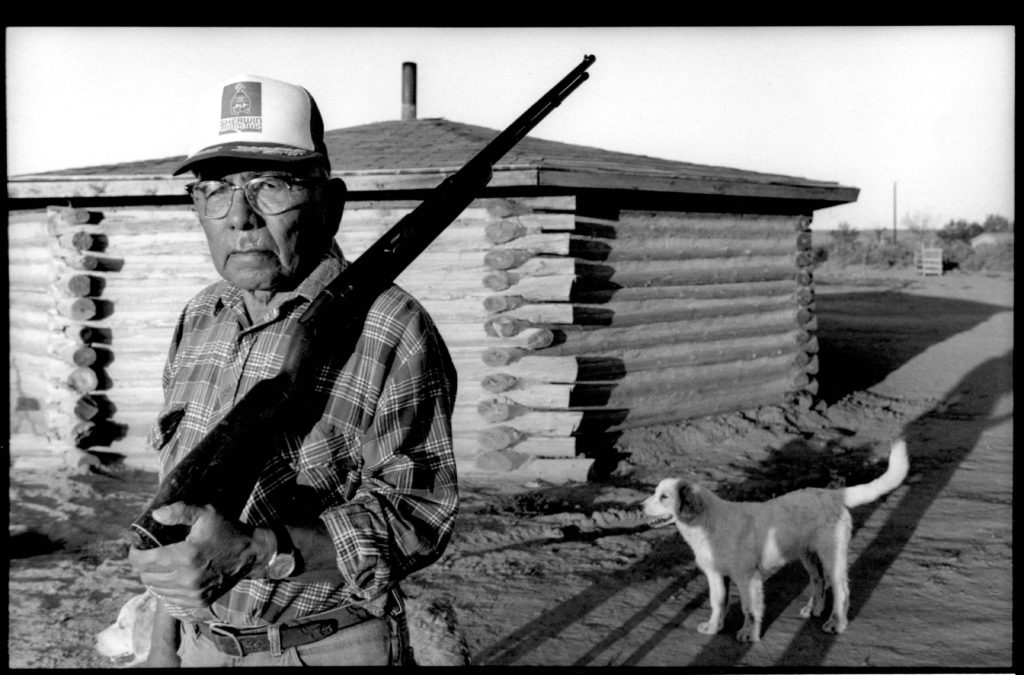
“I wanted to show who they are,” Kawano said. “One guy was a sheep herder, so I took a photo with sheep in the background. Sheep are the Navajo people’s life; they butcher sheep and they use the hair for weaving. Sheep are very important for their life.”

For each portrait he shot, Kawano gave the Code Talker a form asking them to share one story from the war. Some did not want to respond, and their photos in the book simply bear their name, clan name, and the battles they fought. Others shared harrowing stories of being shot at or captured by their own troops because other Marines mistook them for being Japanese. Some recounted humorous stories about encountering sand crabs and bullfrogs in their fox holes.

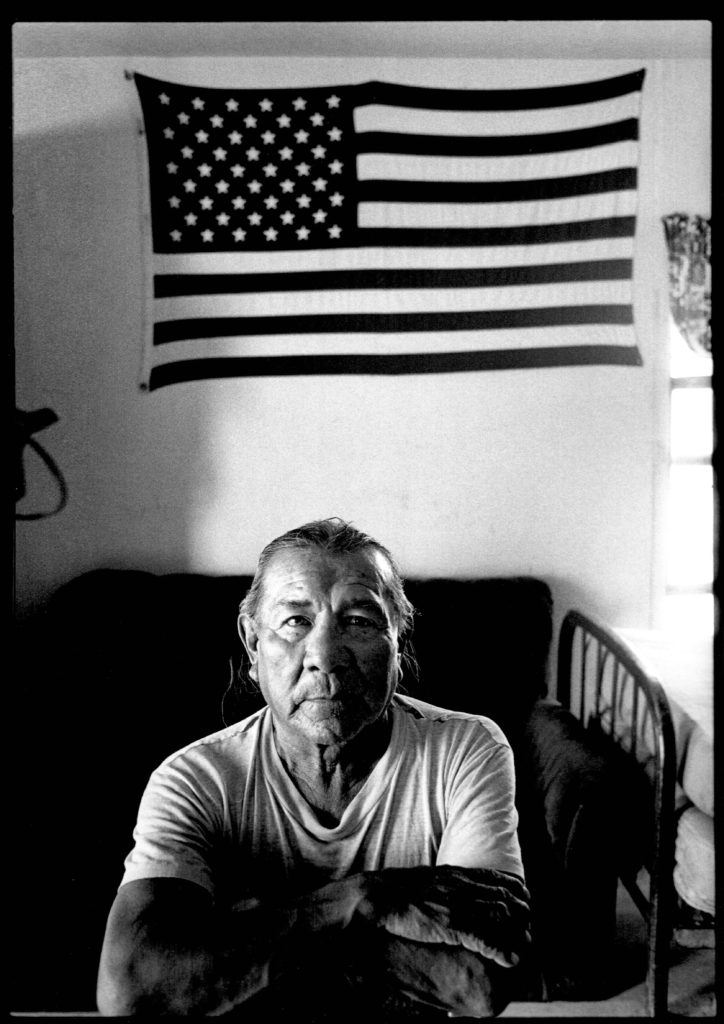
In his portrait, Wilson Keedah Senior holds a worn photo of himself as a Marine. He wears a plaid shirt and is seated in his dark living room. His memories hang heavily on his face. “I went to war because there were no jobs on the reservation,” the caption reads. Another man, David E. Patterson, is also seated indoors. The room is light and he gazes upwards, away from the camera, through thick eyeglasses. A small crucifix hangs on the wall behind him. The caption beneath his portrait reads:

[wonderplugin_slider id=178 alignment=”center”]

“When I was inducted into the service, one of the commitments I made was that I was willing to die for my country—the U.S., the Navajo Nation, and my family. My language was my weapon.”

Crosses appear in many of the Warriors portraits, along with quotes crediting Navajo traditional beliefs with protection during the war, or healing afterwards. American flags and statues commemorating the war also appear in the background of many photos. In others, there are hogans, sheep, basketball hoops, and a vast landscape and sky unrolling towards a distant horizon. Most of the Code Talkers look directly at the camera, but some look to the sky.

Kawano has now lived on the Navajo Nation for over forty years, and he says photographers like Eugene Smith, Henri Cartier Bresson, and Robert Frank have provided inspiration for his own photo essays. His photos are intimate and emotional, and even the heaviest expressions reveal a humanity that draws the viewer in. Unlike visiting photojournalists who take in the Navajo Nation for the first time, Kawano admits he sometimes puts off taking photos because he thinks he’ll have another opportunity. Still, he wouldn’t trade fresh eyes for the intimacy of really knowing a place and culture.

“If I can visit their home, I like to spend all day taking pictures,” Kawano said. “I don’t want to be a stranger taking a picture. I like to be part of their life and take pictures of their everyday lives.”

At 71, Kawano’s hands move like a music conductor as he speaks. He is wiry and lively and his warm smile invites connection and conversation. Kawano estimates that he met 130 Code Talkers, but now there are only four living. The oldest is 102 years old. Kawano has continued to take their portraits when he is able, and he hopes to publish another book to encompass the breadth of the portraits he’s shot over the four decades he’s lived on the Navajo Nation.  In the last photo of his Warriors II series, taken in 2007, Kawano stands in the middle of a paved road in Winslow, Arizona, shoulder-to-shoulder with Alfred Peaches. Peaches wears his Garrison cap and holds a framed photo of himself as a young Code Talker. Kawano’s camera bag is slung over his shoulder. With steady gazes, they face the camera together, holding onto memories and language for future generations.

Emily Withnall was born and raised in New Mexico, and now works as a freelance writer and editor in Missoula, Montana. Her work can be read at emilywithnall.com.

Editor’s Note: An earlier version of this story misidentified Carl Gorman. He is R.C. Gorman’s father, not his son.

Emily Withnall (opens in a new tab) is the editor of El Palacio and the host of Encounter Culture. Prior to stepping into the editor role, she wrote for the magazine for eight years. Emily has also been published in The New York Times, Al Jazeera, High Country News, Orion Magazine, Tin House, The Kenyon Review, Gay Magazine, Source New Mexico, and other publications. She lives and writes in Santa Fe, New Mexico.

Kenji Kawano (opens in a new tab) has been photographing the Navajo since 1974, documenting their lives and culture. He is known for his photographs of Navajo Code Talkers. Kenji has published four books and have taken thousands of photographs.

Where the Wild Things Are

By Julia Goldberg

Growing up in Cimarron, New Mexico, Jason Malaney knew he enjoyed camping, hiking, and wildlife. When he arrived at college at Eastern New Mexico University, he discovered that love could become a career.

“I was a first-generation student,” Malaney says. “None of my family had been to university and I didn’t know what to expect. Everybody was like, ‘You want to be a doctor or a lawyer or something really up there.’” When he began taking introductory biology classes, though, he learned about wildlife management. “That hooked me into field biology, and I kind of tripped all over myself to get through graduate school, get more degrees, and that kept working out for me,” says Malaney, who went on to receive both a master’s degree and a PhD in biology. “Being outdoors was certainly a love, and finding out I could do some sort of career with it—I was in.”

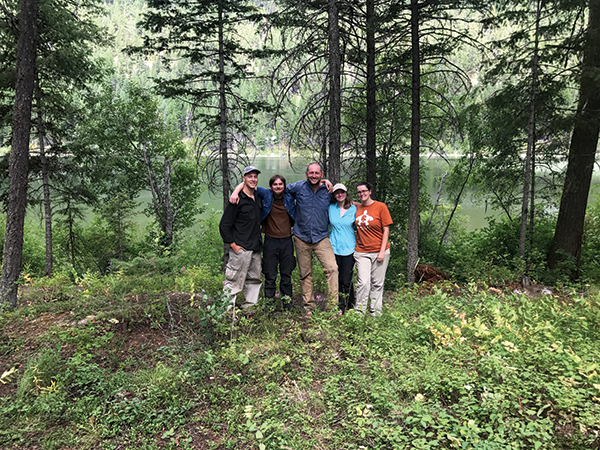
Jason Malaney poses with students from Austin Peay State University in Bonaparte Lake, Washington, while studying mammals and their parasites across western United States. Left to right: Beau Rapier, Mark van Andel, Jason Malaney, Rachel Gant, and Lindsey Smith. Photograph courtesy Jason Malaney.

His early interest in wildlife serves the current moment well, as the world grapples with the repercussions of the COVID-19 pandemic, believed to have spread to humans through bats. Such zoonotic diseases—hantavirus in the Southwest is another—require in-depth study and understanding of both the species and their changing ecosystems.

Malaney became the curator of biosciences at the New Mexico Museum of Natural History and Science in July 2019, a position that brings into play several aspects of his career: research, field work, and education, all driven by a commitment to conservation and ecology. Prior to taking the position at the museum, he had been an assistant professor in the department of biology at Austin Peay State University in Clarksville, Tennessee, and curator of mammals at that university’s David Snyder Museum of Zoology. But he says he’d always had his eye on the New Mexico Museum of Natural History and Science.

“It was always close to home, obviously, and being back close to family was important to my family,” he says, but it also matched more closely with his interests. “While I enjoyed academia, I’m much more of a field biologist; the field work is what I really, really love.” In academia, such field work is typically reserved for summers. Now, while Malaney still has academic endeavors and works regularly with students, his position “typically will allow me to be in the field quite a bit to meld both those worlds a lot more.”

The museum’s extensive Bioscience Collection includes thousands of mammals, mollusks, arthropods, and plants that represent New Mexico’s natural history, as well as hundreds of birds and reptiles. These specimens serve multiple purposes, as they are used in the museum’s exhibits, for education programs, and for scholarly research.

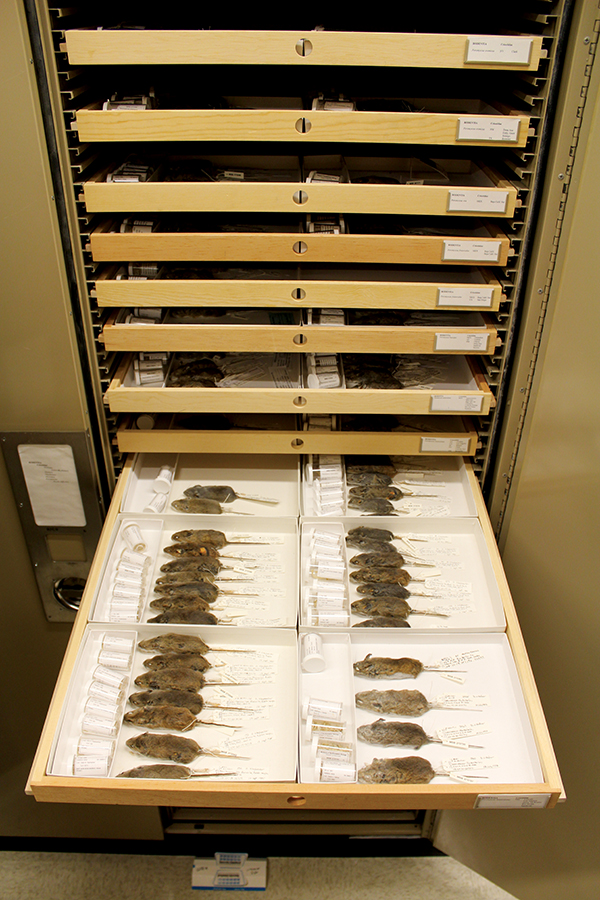
The collection of deer mice in the collections of the New Mexico Museum of Natural History and Science aids researchers interested in, among other things, the human-animal transfer of diseases such as hantavirus. Photograph by Charlotte Jusinski.

“The collections are the foundation of what we do,” Malaney says. “A lot of the show-and-tell that goes on—the outreach and education programs—they’re predicated on that foundation. Collections are the primary piece of the puzzle for us to be able to do all of those.”

While such programs are more visible aspects of the museum’s work, critical research projects stretch far beyond the museum’s walls to impact the larger ecological concerns of New Mexico, the Southwest, and beyond.

Currently, the museum has a grant from the U.S. Fish & Wildlife Service to perform population genomics for the New Mexico meadow jumping mouse—Zapus luteus luteus—which was designated as an endangered species in 2014, primarily due to habitat loss and fragmentation. Population genomics screens species’ DNA, looking for differences between populations in different locations to “understand how organisms are moving through the landscape and what impacts that has on their genetics,” Malaney explains.

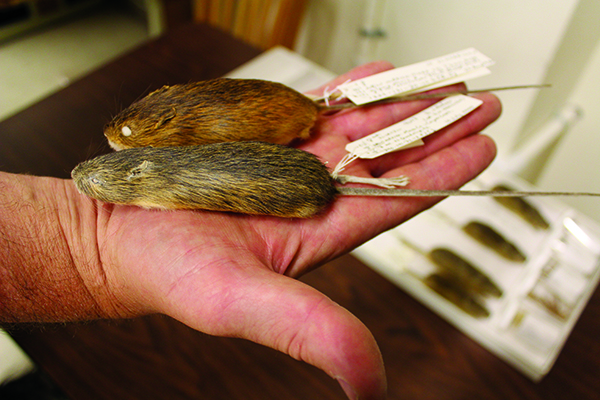
Specimens of two species of jumping mice that occur in New Mexico from the collections of the New Mexico Museum of Natural History and Science. Photograph by Charlotte Jusinski.

As a result of modern technology—think super computers—this process has evolved to involve screening and analyzing massive amounts of data and allows scientists such as Malaney to look for adaptations across different populations of species that would have been invisible even a decade ago.

For example, he says, “We know that humans who live at higher elevations have a different profile in their blood” than those living at lower levels. “There’s a reason so many people train here in Albuquerque for the Olympics and MMA and for track and field,” he notes. “Folks come to the Southwest, and particularly New Mexico, they train at a mile high, adapt, and then they go and perform at sea level.”

In this particular project, Malaney is looking for similar adaptations, but among the jumping mouse. “We’re looking for those differences … at high elevations and low elevations,” for example, “or maybe there are different disease profiles: We have to find out what the diseases are, relate those genomics back. There are a lot of different ways in which we can explore and test for population-level differences that would maybe relate to adaptions now that we couldn’t do a decade ago, even though we knew they were there.”

Such discoveries can then help inform strategies for conservation. “If there are differences among those populations, then that would perhaps have those implications at a management level where you want to manage those populations that have certain adaptions,” Malaney says.

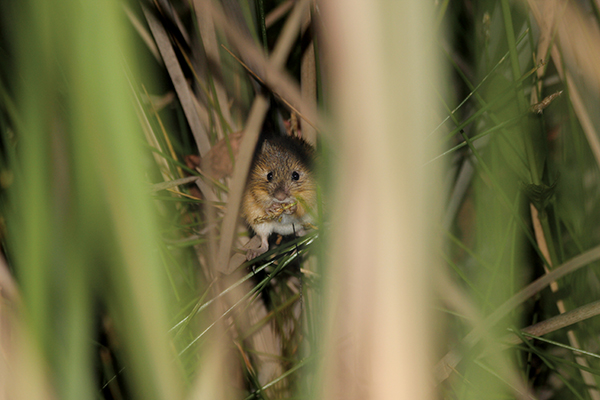
An endangered New Mexico meadow jumping mouse feeds among the cattails and rushes at Bosque del Apache. Photograph by J.N. Stuart.

The work also marries new technology with much older practices. Because the jumping mouse is endangered, field work would not necessarily be an appropriate way to collect specimens. Instead, the science team relies on museum specimens.

“Museum specimens are like library books that you can use over and over again,” Malaney says. “We have this huge resource in the form of museums that enables us to do this sort of research without having to go to the field.” While contemporary understanding of DNA dates to the late 1940s, the process of specimen preservation has happened for hundreds of years.

“We’ve been preserving specimens all the way back through Darwin into the 1800s,” Malaney says. Now, “we can pull DNA out of those specimens, and it allows us to leverage new technologies from those older specimens and ask these new questions that we couldn’t even begin to address a decade ago.”

While the physical specimens are invaluable in such work, a second project involves digitizing them and putting together a public database. That project—Arctos—is an open-source collaborative effort across natural history museums to provide research-grade data for more than three million records.

“It allows all of our specimen data to be publicly available and web accessible,” Malaney says. “So, if I’m in Mongolia working on a project, for example, I can pull up any of the specimen records we have for a specific species on my phone.”

The first phase of the project involves collating information about the specimens—localities, dates, and measurements, for example. A second phase, which was stalled by COVID-19 and lack of access to the museums, will entail photographing specimens in both 2 and 3D. In the spring, Malaney was writing grants to leverage the database and digitized specimens to create educational modules.

“We’ll develop a few tutorials and education modules and hopefully turn it into a system by which students can generate their own sorts of data and questions and analyses,” he says.

In addition to those funded projects, Malaney and his team also are working to secure grants for a long-term climate monitoring project, which will seek to monitor changes to local populations as a result of climate change. For example: “Are they more susceptible to things like carrying viruses?”

That question, obviously, carries weight during the COVID-19 pandemic, but has had implications for decades in the past and will continue to be a key inquiry going forward. Climate change, impacts on species’ habitats, and increasing contact between humans and mammals all play a role in the emergence of zoonotic diseases. In the case of COVID-19, the novel coronavirus is believed to have originated with a bat that came into contact with an animal sold in a wet market in China. But these types of diseases also have emerged much closer to home. Hantavirus spreads through rodents, and first appeared in 1993 in several states in the Southwest, including New Mexico.

“COVID-19 seems kind of foreign and it arrived in our backyard and there’s a lot of political rhetoric,” Malaney says, “but the point is, it’s not always that way; it’s all of our backyards.” Hantavirus, he says, “doesn’t get as much of the big fanfare, or publication in the media as it did on our first outbreak, but it continues to occur every few years.”

Those occurrences respond directly to increased precipitation following El Niño weather patterns, just one example of how climate change and human behavior all intersect to create events in the natural environment such as pathogens and parasites.

“As humans alter landscapes or infiltrate into wild areas, this is where these [diseases] are coming from,” Malaney says. “That’s where we’re getting things like SARS and MERS and Ebola; it’s a pretty grim list, and it’s the same story.”

While the story is grim, natural history museums such as New Mexico’s play a key role in telling it and advancing the science to help understand it. Malaney says the museum hopes to continue building out programs and outreach to showcase its behind-the-scenes research initiatives. “Almost everything that we deal with in my lab and in my research and career has been related to conservation and management,” he says. “The cool thing about museums is museums are really critical to unpacking that story and unraveling what is going on.

Julia Goldberg is a journalist and teacher in Santa Fe, New Mexico, as well as the author of Inside Story: Everyone’s Guide to Reporting and Writing Creative Nonfiction.

Dr. Jason Malaney (opens in a new tab) is the Curator of Biosciences at the New Mexico Museum of Natural History and Science and an associate curator and associate research professor at the Museum of Southwestern Biology at the University of New Mexico where he is part of the CUERVO Lab (Center for Understanding Evolutionary Relationships of Various Organisms). At the NMMNH&S he oversees the research, educational activities, and exhibits using specimens of six research collections (Amphibians and Reptiles, Birds, Fish, Insects, Invertebrates, and Mammals).

Julia Goldberg (opens in a new tab) is the editor of Source New Mexico, a journalist and teacher in Santa Fe, and the author of Inside Story: Everyone’s Guide to Reporting and Writing Creative Nonfiction.

The Land of A Thousand Volcanoes

Story and Photographs by Larry Crumpler

Every volcano is like a living thing. They are born, live, die, and leave behind their remains, eventually returning to the Earth as fragmented rock and soil. Sometimes they live in the presence of entire communities of other volcanoes that we geologists call volcanic fields, and sometimes as isolated individuals. Volcanic eruptions have happened in the recent as well as the not-so-recent past in New Mexico, and they will happen again.

Volcanoes are uncommon in most places, yet volcanoes have created features that are part of the everyday landscape for New Mexicans. There are nearly 1,000 centers of volcanic eruption younger than 4 million years old, and many of these are much, much younger than that. Younger features include two of the largest young lava flows on the continent, known as the El Malpais National Monument and Valley of Fires State Park flows, and a young supereruption, the Valles Caldera, an example of a giant volcano formed from a supereruption that now broods in repose on the western horizon of Santa Fe.

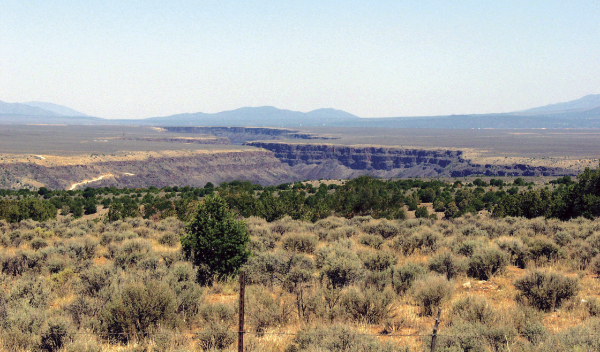
New Mexico certainly has a diverse array of volcanoes. There is one that you can drive up at Capulin Volcano National Monument, a classic cinder cone and the easternmost young volcano on the continent. Young lava flows are the canvas for ancient rock art at Petroglyph National Monument, where an Icelandic-style fissure eruption occurred in the recent past. And layered lava flows west of Taos have been cut by the Rio Grande into a deep chasm known as the Rio Grande Gorge. There are young explosion craters like Zuni Salt Lake and Kilbourne Hole of Desert Peaks National Monument, where chunks of the mantle have been blown out onto the surface during violent eruptions not long ago. There are lava flows at El Malpais National Monument that are so young, so vast in extent, that they defy a simple hike. They preserve the intricacies of how lava flows move and form, and are the peer of anything to be found in the recent eruptions of Hawaii.

There are also the “bones” of older supereruptions at City of Rocks State Park and old volcanic sentinels such as Tomé Hill, the site of an important Easter pilgrimage. There is the icon of New Mexico landscapes, Ship Rock, and other volcanic necks, such as Cabezon Peak in the Rio Puerco Valley. And there are many others, lesser-known because there are so many, but as spectacular as any volcano on the continent.

But while we have extolled the wonders of New Mexico on many fronts, its amazing collection of volcanoes appears to have gone “missing in action” and unrecognized; and surprisingly, many New Mexicans are unaware of their presence.

The Importance of Volcanoes in New Mexico’s Landscapes
Volcanoes are an integral and widespread part of the New Mexico landscape. It’s an important association because, over and over again, when someone wants to express why the place we call New Mexico is special, the word “landscape” usually figures prominently in their first sentence.

When the 1878 Governor of New Mexico Territory Lew Wallace famously said, “All calculations based on our experiences elsewhere fail in New Mexico,” he was referring to the political landscape—but it is equally true of the physical landscape. All experience with landscape elsewhere fails to prepare you for comprehending the New Mexico landscape.

Elsewhere, the common experience is that the landscape is a sculpted thing, shaped by erosion of old rocks, but in New Mexico it is as often as not a constructed thing, either uplifted or erupted. It is all dynamic and young, evocative of a thing born and alive rather than carved like a statue from some inert mass. So it invites the imagination on many levels, and is uniquely beautiful on many scales. New Mexico’s landscape is one of its special brands that distinguished it from the rest of the continent. And yet, it is a largely invisible landscape. Despite their recurrence in the art, culture, and beauty of New Mexico, many people are unaware of the presence of its volcanoes or do not recognize them when they encounter them on their daily travels throughout the state.

We have stared at volcanoes in famous paintings and photographed their stark forms, gone hiking, skiing, camping, and hunting on their slopes and craters, marveled at the wildlife and forests that they support, and watched the sun set behind their peaks. While it is difficult to travel anywhere in the state without seeing a volcano, few citizens can see them because they are often invisible, not because they are subtle, but because the uninformed eye cannot recognize them for what they are.

Volcanoes Dot the New Mexico Landscape
But where are all these volcanoes? They occur pretty much throughout the state. The younger volcanoes tend to cluster in a broad swath across the northern part of the state, an alignment generally referred to as the Jemez lineament, probably following ancient structures of the crust slicing diagonally across the state. Many other volcanoes occur up and down what is the single largest natural history characteristic of the state, the Rio Grande Rift. It is no coincidence that where the two trends cross, there is a striking morphological example of a large supereruption caldera, the Valles Caldera.

There was a great mantle warming and break-up of the western United States tens of millions of years ago that started the process of forming the Basin and Range province of southern New Mexico, and that process ultimately initiated the formation of the Rio Grande Rift, and spawned the older great supereruption clusters in southwestern New Mexico, the Datil-Mogollon-Gila volcanic field. Even the stable Colorado Plateau province of northwestern New Mexico was not immune to this flare-up, and created the great centers of now-eroded volcanic features like Ship Rock and surrounding volcanic plugs.

Interestingly, up and down the Rio Grande, every major city and town has nearby an important volcanic landform, almost as though it is a requirement for any center of art and commerce in the state. The great Taos Plateau volcanic field extends west of Taos. And as we have seen, the great Valles Caldera lies across White Rock Canyon west of Santa Fe and forms the backdrop for the Santa Fe Opera.

The Valles Caldera, formed in a supereruption, broods on the western skyline of Santa Fe, here as seen from Museum Hill.

The Albuquerque Volcanoes, one of the youngest eruptions within the Rio Grande Rift, and the more distant Mt. Taylor volcano, the second-largest young volcano in the state, form the western horizon for the largest city’s sunsets. Low shield-shaped volcanoes lie to the city’s north and south. Socorro lies on the margin of the great Datil-Mogollon-Gila supereruption cluster, as does Silver City. Las Cruces lies within the outline of a buried caldera and is flanked on the west by the Potrillo volcanic field with its impressive Kilbourne Hole and other explosion craters and young lava flows. Even smaller towns are nestled near prominent volcanoes. Who has not seen the large hills west of Los Lunas that are Los Lunas volcano and the Cat Hills volcanoes?

Truth or Consequences and the popular recreation site of Elephant Butte Lake are rimmed with young volcanic centers. And outside the Rio Grande Valley, Wagon Mound, Raton, Clayton, and Grants grew alongside entire fields of young volcanoes and their lavas. Oddly, where the volcanic fields are bigger or where they are particularly young, the cities near them are centers of art and culture.

Rather than being some mystical effect, perhaps the volcanic landscape has influenced the residents over the years with an unusual environment of light and color, and stirred their imaginations with untapped possibilities of exploring untamed terrain.

[wonderplugin_slider id=179 alignment=”center”]

New Mexico as a Museum of Volcanoes
Once you become aware how common volcanoes are here, the realization dawns on you that New Mexico is actually a giant outdoor museum of volcanoes. There are many different types of volcanoes, some big, many small, and all representing the range of volcanic landforms that are built by different styles of eruption. In New Mexico, there is an example of almost every type of volcano and they are all young, relatively uneroded, and often appear nearly the same now as the day they last erupted. They are so well-preserved that many of us find these to be a bonanza for research into how volcanoes and lava flows work.

Volcanoes are not all shaped like Mount Fuji in Japan or the conical spires of Central America, the Andes, the Pacific Northwest, or Indonesia. Those represent only one type of eruption. A good example of that type, known as a composite volcano, is Mt. Taylor, where thick, viscous lava flows covered the flank of the volcano layered with ash and scoria, the products of explosive and lava flow eruptions. Mt. Taylor could be thought of as being to the Rio Grande Rift what Kilimanjaro is to the East African Rift.

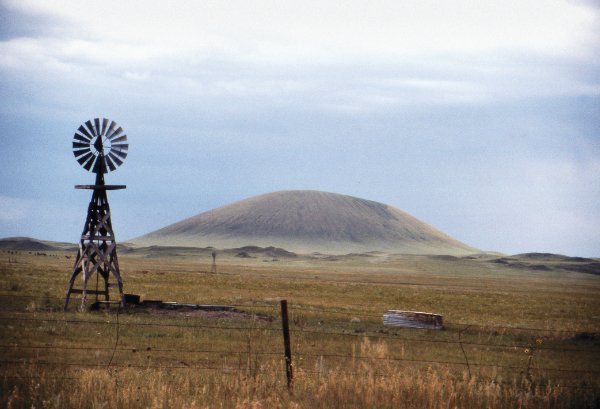
Another more common type of volcano in New Mexico is the cinder cone, of which two well-known examples include Capulin Volcano and Bandera Crater. These are piles of scoria and liquid spatter, often complex internally if not outwardly, formed by intermittent explosive bursts that rain down near the vents and pile up into beautiful cones. They tend to be gregarious and occur in clusters over large areas in what we call volcanic fields. The area west of Las Cruces, known as the Potrillo volcanic field, is a good example. The western part of El Malpais National Monument, the region between Raton and Clayton, the areas west of Ft. Union and north of Mt. Taylor, the Cat Hills west of Los Lunas, and near Red Hill, at the state line along Highway 60, are just a few other examples.

Even the volcanic necks of the Rio Puerco Valley are the near-surface interiors of eroded cinder cones. Cinder cones are a common volcano type, and many people think these are currently dead landscapes that at one time bubbled with abundant and simultaneous eruptions of hot lava. But the reality is that thousands to tens of thousands of years typically separate the birth, life, and death of each volcano within a volcanic field. So the entire field of volcanoes may span a million years or more in intermittent eruptions; the landscape between eruptions was likely quiet and covered with trees and soil between those individual eruptions, and the area would have looked much as it does today for most of the time.

New Mexico also has a striking collection of explosion craters, called “maars,” after the German word for the small lakes filling similar craters in the Eifel district of Germany. This type has very little cone about them and were formed when hot magma encountered groundwater near the surface at the time of eruption. Zuni Salt Lake between Red Hill and El Malpais is one famous example. Kilbourne Hole in the Potrillo field is one of many maars west of Las Cruces that nestle among the cinder cones there, and even more can be seen in the older volcanic fields around White Rock Canyon and in the field north of Mt. Taylor, or within the Rio Grande Rift such as the margins of Elephant Butte Reservoir.

Shield volcanoes are another New Mexico specialty. This type of volcano is so named because in profile it looks like a warrior’s flat shield lying on the ground. The Hawaiian Islands are large examples of this type, but they also occur at much smaller scales as low, broad conical mounds of lava less than a mile across. Maxim Crater near the rest stop between Watrous and Wagon Mound is a prime example.

Another hill, west of I-25 near La Bajada before descending toward Santa Fe, is passed by thousands of commuters every day. This is La Bajada shield volcano. When you drive west down the wide arroyo from I-25 towards San Felipe Pueblo, the great conical hill atop the mesa looming to the west of the pueblo, San Felipe shield volcano, is also a fine example of this volcano type. Cerro Verde in the Lucero volcanic field south of I-40 and Mesita is another outstanding example that to many must look like just an old eroded hill, but take a closer look and you will see multiple lava flows and a summit of small cinder cones. And there are many, many others of this type in New Mexico.

Some volcanoes are really “non-traditional” in shape. Volcanic domes are an example; they form when very viscous magma is piled up at the volcanic vent without much ejection of material into the air. The viscous magma associated with this dome-shaped type of volcano, usually a type of lava called rhyolite, normally goes along with violently explosive eruptions like the one that formed most of New Mexico’s supereruptions.

But sometimes the magma is just less gaseous. It is this type of volcano where you are likely to find obsidian, a dark glassy rock formed when high silica lava quickly chills, often with streaks and bands from its flowing origin. Many of the clusters of volcanoes that preceded the formation of the Valles Caldera and the Datil-Mogollon-Gila supereruptions were of this type. Volcanic domes can be fragile like the stony glass that they are and crumble as they grow.

It is the debris shed off one such dome, along with small amounts of ash, that forms much of the Kasha-Katuwe Tent Rocks National Monument—not ash from the Valles Caldera, which came much later. But volcanic domes also happened after the caldera formation at Valles Caldera, and a ring of volcanic domes form an arc around the floor of the caldera. One diminutive and perfectly domical example is Cerro La Jara on the floor of the Valle Grande right next to the Valles Caldera visitor’s center. Many people probably think this hill is just an old eroded volcanic hill. Not so; it pretty much looked like that when it formed about 50,000 years ago, long after the caldera formed 1.2 million years ago.

And then there are very large-volume lava flows. New Mexico’s large lava flows are numerous, but the youngest example, and the youngest eruption in the state dated at 3,900 to 1,200 years old, is the McCartys lava flow on the eastern margin of El Malpais National Monument. The McCartys lava flow rivals the volume of the great 1783 eruption of the Laki fissure in Iceland, an eruption so voluminous that it remains one of the most globally influential eruptions in recorded history, spawning an increased mortality rate in Europe, contributing to the potato famine, and casting a haze over the northern hemisphere that prompted Benjamin Franklin to speculate that volcanoes could have global climatic influences.

But there is another characteristic of the McCartys lava flow. Besides being one of the largest young lava flows on the continent, it is well preserved because of its youth. Many terms we use to describe the features seen on lava flows were derived from studies of this flow. The flow also exhibits a peculiar characteristic of some large lava flows, and the subject of some of my own recent scientific research: The lavas are inflated, or puffed up. This happens when flows are emplaced on low slopes. The margins begin solidifying as the flow advances slowly, and they eventually hold the interior hot lava back with nowhere to go. So the cooled crust on the lava begins to inflate with the arrival of more lava within. All sorts of phenomena occur, including deep cracks and breakouts that bypass the inflated parts, resulting in a complex interplay of new and not-so-new lava.

There are a few other examples of this inflation process, such as the 1859 flow on the west shores of the Big Island in Hawaii. But despite being younger, the Hawaiian flows are a less perfect example of the process. Besides, the McCartys lava flow, unlike the flat, low landscape and the sea-humidified air of coastal Hawaii, is surrounded by a beautiful contrasting setting of sandstones and mesas in the high and dry air of New Mexico; and the flows erupted in landscape that looked much as it does today. The molds of trees are preserved in many places on the McCartys lava where they were toppled onto the lava flow as it advanced across the valley floor.

The second-youngest eruption, at around 5,000 years old, is another young and large lava flow, the great Carrizozo lava flow. It is the site of the Valley of Fires State Park, one of a handful of state parks that is not a lake but instead focuses on something unique to New Mexico. Another impressive lava flow surrounds Aden Crater in the Potrillo volcanic field west of Las Cruces. Here, too, the lavas are inflated on the low slopes of the rift valley floor.

Round Mound, a large cinder cone along the Santa Fe Trail in the Raton-Clayton volcanic field.

The Role of Volcanoes in the Cultural Landscape of New Mexico
Many of us use the collection of New Mexico volcanic landforms in research studies to better understand features we are exploring on other planets such as Mars. But the volcanoes of New Mexico are not only a scientific research resource, but a cultural one as well.

The cultural landscape of New Mexico, both in art and history, is littered with the influence of New Mexico’s volcanoes. One of the things that has set the state apart and influenced the minds of creative souls is this unusual invisible landscape sculpted from Earth’s original fire.

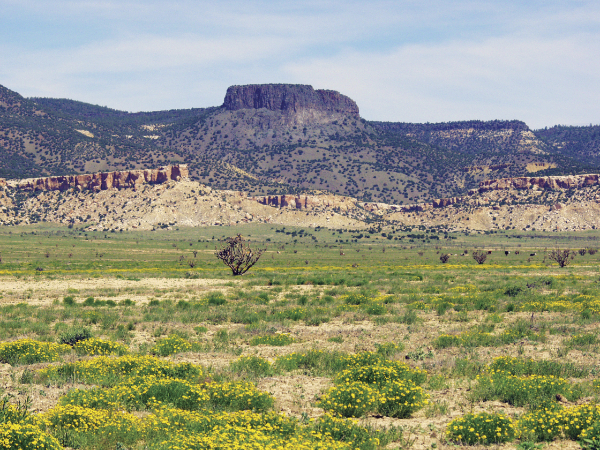
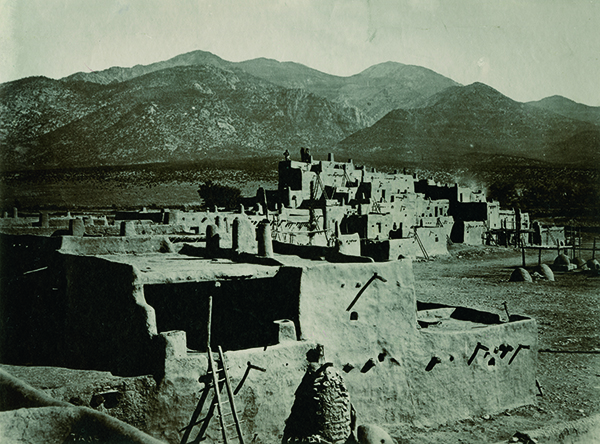
Ever sensitive to the special qualities and the living spirit of the landscape, the value of volcanic landscapes did not go unnoticed by the Puebloans. The sites of both ancient and modern pueblos are situated near many of these volcanic landscapes. Taos Pueblo has the Taos Plateau volcanic field, San Ildefonso Pueblo and Santa Clara have the ash sheets of the Pajarito Plateau and Black Butte, Kewa and Cochiti lie near the tent rocks at the margin of the Jemez field. San Felipe, Santa Ana, and Zia ring the southern end of the San Felipe field. And Jemez Pueblo is situated at the south end of great ash flow sheets that rolled off the margins of the great Valles Caldera. Mt. Taylor watches over and is sacred to the Laguna and Acoma Pueblos. And Isleta Pueblo is located on an island of basalt lava flows near the Rio Grande and encompasses lands that include one of the younger eruptions in the Rio Grande Rift, the Cat Hills. Zuni Pueblo is situated near the western tip of a great lava flow that moved down the Zuni River from the Zuni-Bandera-El Malpais volcanic field.

Where there is a pueblo, you are not far from a young volcanic landform.

Casting farther back in time to the Ancestral Puebloans, the Gila Cliff Dwellings were carved into debris shed off the surrounding great supereruptions of the Datil-Mogollon field. Ancestral Puebloan sites were carved directly into the erupted ash flows of the Valles Caldera at Bandelier National Monument. It is unsurprising that many arrowheads, scrapers, and other tools for cutting were made from the obsidian of many of these volcanoes.

Tomé Hill volcano, along the Camino Real de la Tierra Adentro.

Volcanoes and volcanic clusters form many of New Mexico’s uplands and open ranges that provide the resources of forests, grasslands, and mineral-rich rocks, and that may have pre-disposed settlement by Native peoples near volcanoes; however, other factors may have been at play as well. Perhaps the Native American awareness of landscape subtleties allowed recognition of the special character of the volcanic landscapes, a sacred landscape of mountains that are entities with living spirits that provide a pathway to an underworld. For whatever reason, they chose to settle near them; the Indigenous populations were appreciative of the volcanic environments they lived near.

In the recent history of the colonization of New Mexico by Spanish and American settlers, volcanoes were sentinels, waypoints, and refuges in their movements throughout the interior of the new lands. Travelers journeying along El Camino Real de la Tierra Adentro, following the rift from Mexico up to Santa Fe, could hardly avoid the volcanoes that populate the Rio Grande Rift. Even the great and formidable escarpment at La Bajada that separated Rio Abajo from Rio Arriba is the edge of lava flows from La Bajada shield volcano and the Cerros del Rio volcanic field.

At the stop along El Camino Real at Tomé, the dark volcanic rise of Tomé Hill has become a shrine now visited daily and especially on Easter by the faithful. Also on their movement along El Camino Real, travelers were forced from the rugged floor of the Rio Grande Valley and past the great lava flows of La Jornada del Muerto volcano. Today, this volcano’s lava tube is better known for its bat population; however the volcano itself has an extraordinarily unusual structure, an inflated platform that surrounds the edifice, from which the lavas were erupted.

Even the older volcanoes played a role in the history of New Mexico. South of Santa Fe, the Cerrillos, Ortiz Mountain, and San Pedro Mountain are the deeply eroded remains of the Espinoza volcanic field, which formed in that older age bracket 20 to 30 million years ago, some of the lavas of which are preserved on the mesa tops surrounding places like the town of Golden. The heat of the volcanism mobilized elements and, over time, produced deposits of important resource minerals. The Cerrillos, of course, are the site of the iconic mineral used in jewelry: turquoise. Turquoise was mined from the hard rocks of Cerrillos by Native Americans long before it later became the source of the famous mineral of Tiffany fame.

Debris eroded from the nearby Ortiz Mountain and San Pedro Mountain created the gold placers from which gold was extracted, often in private to avoid the Spanish law that said gold was the property of the King. Later the area became the site of the first gold rush west of the Mississippi River, twenty years before the California gold rush.

Moving forward in history to a time when people were arriving across the plains from the East on the fabled Santa Fe Trail, the first sentinels announcing their arrival in New Mexico were the “mounds”—the volcanoes—of the Raton-Clayton volcanic field. Features such as Rabbit Ears were among the first beacons to travelers, who were encouraged as, one by one, they passed Round Mound, a smooth sloped cinder cone, and Wagon Mound, a massive volcanic ridge that resembled a Conestoga wagon. Fort Union was established as an outpost to protect travelers, and many a soldier stationed there must have felt as though they had been sent to the Moon when they saw the volcanic peaks of the Ocaté volcanic field to the immediate west.

I think that it is very important the the land itself testifies . The land of New Mexico is so eloquent. These incredible mesas—Yes, they can tell stories. And if you're in New MExico and You're not hearing what the land is saying you should stop and listen. —Peter Sellars, libretists for Dr. Atomic
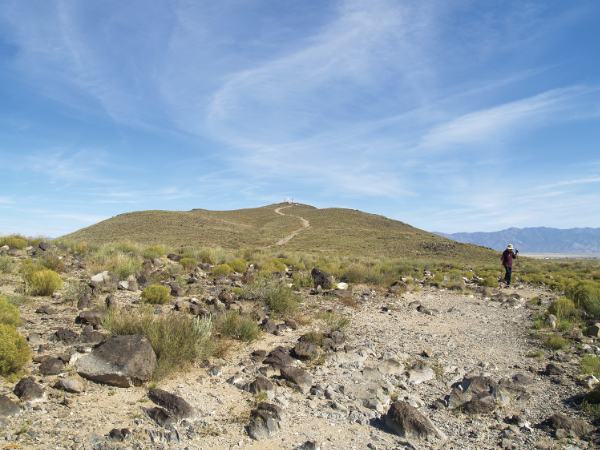
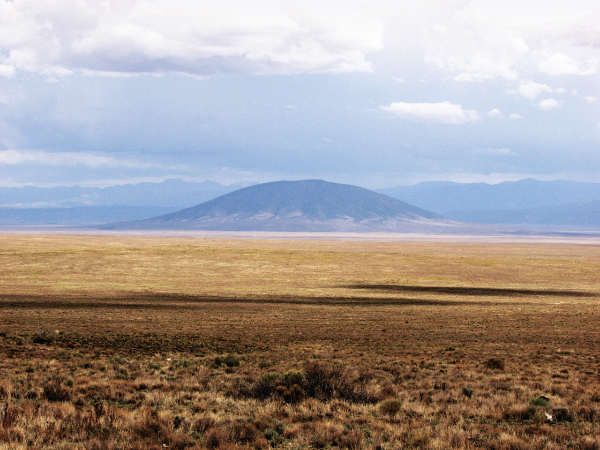
The Ute Mountain volcano is one of several unusual steep-sided volcanoes of the Taos Plateau volcanic field.

Even today, when flying to New Mexico from Chicago across the northeastern corner of the state, you know that you have finally arrived back home when you look down and see the first squiggly lava flows of the Raton-Clayton volcanic field. Since they are the easternmost young volcanic field in the continental U.S., they proudly announce to the air traveler that you are now in the far northeastern corner of New Mexico.

The list goes on and on. But the essential point remains that New Mexico’s volcanoes are and have been a fundamental part of the art, the culture, and the history of New Mexico.

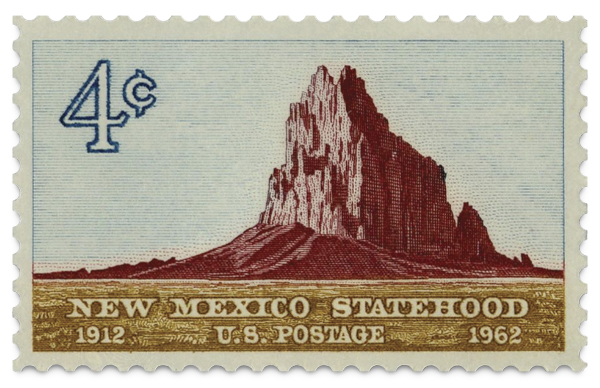
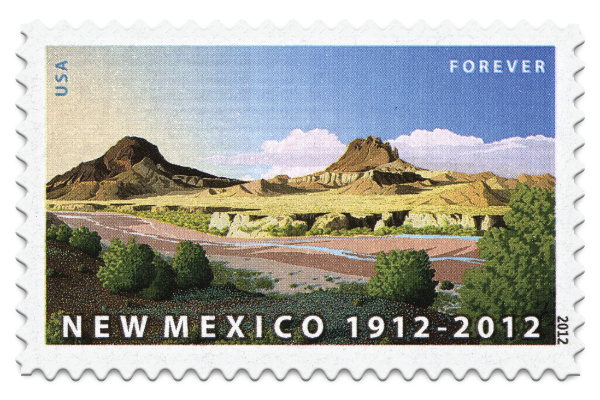
Another place to continue on our journey of familiarization with this invisible landscape of the Land of Volcanoes is the many ways this landscape has been appreciated through art and woven into the culture of New Mexico as a destination for artists. When volcanoes are mentioned, one of the first features that comes to mind for many people is Ship Rock, a veritable icon of the Southwest. Ship Rock is so much a part of New Mexico’s image that it appeared on the official postal stamp celebrating the state’s fiftieth anniversary in 1962. And on the state’s 100th anniversary, another celebratory stamp featured a volcanic scene reminiscent of, and probably selected for its similarity to Ship Rock: the painting by artist Doug West of two other volcanic features, Cerros de Santa Clara and Guadalupe.

Ship Rock, an eroded volcanic center known as a volcanic neck, is such an iconic image of New Mexico’s landscape that it was used in the New Mexico fiftieth anniversary stamp. 1980.2493.5402
In a nod to the state’s fiftieth anniversary stamp depiction of a volcanic neck, the New Mexico centennial stamp made use of the painting Sanctuary by Doug West, which depicts Cerros de Santa Clara and Cerro de Guadalupe, both volcanic necks in the Rio Puerco Valley near the old settlement of Guadalupe. 2012.2025.251. Copyright United States Postal Service. All rights reserved. Photographs courtesy of Smithsonian Institution / National Postal Museum.

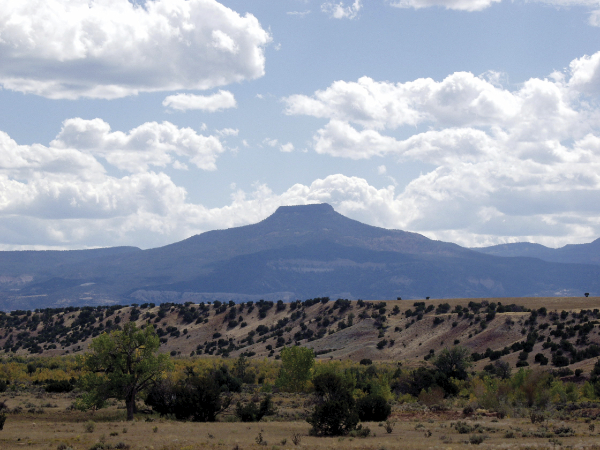
All three are a type of volcanic landform known as “volcanic necks,” because in each case, the top or head of the volcano has been worn away and only its “neck,” the interior hard intrusions of former magma, remain. The Rio Puerco Valley contains dozens of these in a collection that ranks among the greatest concentration of volcanic necks in the world. Even more importantly, they are well exposed and preserved because of the arid environment, lack of vegetation, and relatively rapid erosion in the Rio Puerco Valley. The volcanic necks are a rare opportunity for volcanologists to see the near-surface interior details of small volcanoes that erupted 3 million years ago, their siblings remaining relatively uneroded on the surrounding mesa tops.

Set in a surrounding of much older bright yellow sandstones and shales dating from the time of New Mexico’s great Cretaceous sea and through which they erupted much later, they create a serene and craggy landscape evocative of other worlds. Or, if you are a volcanologist, your mind is twisted, attempting to make sense of the intertwining of scoria, ash, intrusions, and lavas.

All that is required is that you approach one with your volcanic eyes, and they will speak volumes to you.

The volcanic landscapes in New Mexico had an early influence on the twentieth-century landscape artist movement centered at Taos. Of course, anyone familiar with the story of the Taos Society of Artists has seen the epic painting by Ernest Hennings, The Rio Grande Gorge, Taos, New Mexico. In fact, the view from the highway just before descending into Taos is often called “the artist’s view.”

Oddly for New Mexico, instead of being created by volcanic activity, it is an eroded feature; like the eroded shape of Ship Rock, the artistic scene of the gorge results from the erosion of an unusually thick sequence of lava flows creating the volcanic landscape through which the Rio Grande flowed. The gorge is a part of the Taos Plateau volcanic field that fills the Rio Grande Rift valley west of Taos, an otherworldly landscape of unusually large and domical volcanoes, somewhat unique among volcanoes in the West, owing their shape as much to summit erosion and the absence of much ash as to their viscous and thick lava flows. In 1971, the gorge was used as an analog training site for Apollo astronauts preparing for their trip to Hadley Rille on the Moon. 

Pedernal Peak looks like a volcano to many people, but is actually an eroded lava flow capping sedimentary rocks.

Following the theme of the invisible, or in another case, the misunderstood volcanoes of New Mexico, are the many famous scenes of Pedernal Peak by Georgia O’Keeffe as viewed from many places in the area of Ghost Ranch. Pedernal Peak is not actually a volcano or the site of a volcanic eruption. It is partly volcanic, however, and was sculpted into an unusual flat-topped pyramid, otherwise satisfying the untrained eye’s vision of a volcano. Instead it is capped with the remnant of an old lava flow, a sort of narrow mesa, left high-standing when the surrounding rocks eroded on either side of the valley in which the original lava flowed some 6 million years ago. This is what geologists call inverted topography, and it occurs when hard, massive lava caps and protects otherwise easily eroded rocks underneath the lava flows. The beginning and the end of the lava flow are cut off at Pedernal Peak and only a small portion remains orphaned atop a pinnacle made of sedimentary rocks. Other more expansive mesas in New Mexico are capped with entire fields of even younger volcanoes and volcanic rocks, but Pedernal Peak is an unusually narrow and tall example.

The “artist’s view” of the Rio Grande Gorge, cut by the river into the lava flows filling the valley west of Taos, has long been a popular site for painters and photographers to gather inspiration. These lava flows are part of the Taos Plateau volcanic field.

There are many other scenes painted by artists, again of eroded volcanic features that the untrained eye can more appreciate, but not recognize as volcanic. Subjects have famously included  Black Mesa near San Ildefonso Pueblo, Canyon Diablo and White Rock Canyon in the Cerros del Rio volcanic field west of Santa Fe, and, of course, Ship Rock. But not all of New Mexico’s preserved volcanoes are unseen; they may be seen just as interesting solitary mountains, if not as volcanic mountains.

Classic basalt lava-capped mesas of the Mt. Taylor volcanic field near the mountain villages of Seboyeta and Marquez.

The isolated but brooding presence of Mt. Taylor volcano is captured in the series of paintings 30 Views of Mt. Taylor by Mary Sweet, perhaps alluding to its shared origin with the object of another famous series of another volcano, Mt. Fuji in Japan. Other volcanoes are painted in scenes such as Mt. Capulin in Summer by Joshua Martin. The isolated and symmetrical character of many volcanoes invite the talents of artists to capture their sublime presence. There are few other places where the sheer number and range in forms are available for artists.

The Future of Volcanoes in New Mexico
Finally, the future may hold the creation of new volcanoes and the destruction of old ones. Many cinder cones have been quarried for their hard, fine scoria over the years. An entire cone, perhaps one of the youngest eruptions in the Raton-Clayton field, has been removed by quarrying just north of Capulin Volcano. Some of the cones representing the youngest eruptions within the Rio Grande Rift have been quarried away in the Cat Hills in the past. Housing developments encroach on the landscapes formed thousands of years ago in volcanic eruptions. Lava flows that have lain untouched for thousands to millions of years are dug up and blasted away or cut through. And while archeologists provide official reports to document information from sites hundreds of years old, there is rarely a thought among officials that geologists should be brought in to recover the geological data, thousands to millions of years old, exposed in these unique opportunities to learn about past volcanic eruptions.

Unlike the destruction of old growth forests in the wetter climates of the continent, these “old growth” volcanoes are much older and will not regrow on the timescale of human civilization. And wouldn’t it be wonderful if artists could use their skills to imagine how each volcano looked as it was when alive and erupting, much the way they paint detailed scenes of saber-toothed cats when they were alive?

Destruction may not be the future fate of all volcanoes in New Mexico; there may be creation as well. Even now, magmas stir 12 miles down inside the crust between Socorro and Belen, the Socorro magma body, one of just a few “mid-crustal” magma bodies on the continent. Most of New Mexico’s yearly occurrence of earthquakes are centered about this area within the Rio Grande Rift. It is every geologist’s favorite candidate for a future eruption. But that eruption need not happen tomorrow or anytime in the near future; its timeline remains unknown.

Perhaps we should honor these “old ones” that represent the unique volcanological heritage of the state, and the new ones to come, by agreeing to identify a State Rock. Many states have a designated rock, but there is no official New Mexico State Rock—only a mineral and a state fossil, in addition to many species of plants and animals. It seems fitting that there be a State Rock that represents our landscape, and that it should be volcanic.

The rock should probably be basalt, the rock that has formed the top of many of our scenic and beautiful mesas, the canvas for rock art, the cinder cones that served as waypoints for travelers and colonists, and the outlines of some of our majestic mountains, the “old ones” that are so meaningful to all of us in New Mexico. 

Dr. Larry Crumpler is a self-funded research curator of volcanology and space sciences at the New Mexico Museum of Natural History and Science. Recently he contributed to a new renovation of the museum’s Land of Volcanoes exhibition, where visitors may feel the power and sound of volcanoes, interact with virtual flowing lava, and learn about volcanoes and volcanic rocks around New Mexico from interactive exhibits.

Dr. Larry S. Crumpler (opens in a new tab) is the Research Curator of Volcanology and Space Sciences at the New Mexico Museum of Natural History and Science and serves as an associate professor at the University of New Mexico. Larry has participated in NASA planetary missions including the Viking, Pathfinder, and Mars Exploration Rover missions, and Magellan synthentic aperture radar mapping missions to Venus. His current research focuses on volcanic terrain in New Mexico and Arizona and the geology of terrestrial planets and planetary volcanism.

Land Back

By Jim O’Donnell

On a frigid February day in 2019, representatives from New Mexico’s Carson National Forest and the Taos Ski Valley invited members of Taos Pueblo to join them on a ride to the top of Kachina Peak. Kachina is a rocky, snow-dressed 12,841-foot mountain that towers over Taos’ world-famous ski resort. It is also an important spiritual landmark for the people of Taos Pueblo.

“It was myself and Edwin Concha,” Cameron Martinez, director of the Taos Pueblo Department of Natural Resources, told me one bright morning over coffee. We sat in his office at the warehouse-like DNR building. The walls were covered with maps, awards, photographs, and mounted bison, pronghorn, and elk heads.

“We rode Lift 4 up to the basin and they explained all their expansion plans. Then we took the Kachina Lift to the top of the mountain. When we got up there, Edwin and I looked around. Then we looked at each other and I thought—‘Well, this isn’t right.’”

What bothered Martinez and Concha were the Tibetan prayer flags fluttering in the wind atop the peak. “When we pray, you can’t tell we were ever there,” Martinez said. “Everyone has a different way of praying, and we appreciate anyone who wants to pray, but these prayers were man-made. We found the flags deeply odd. For us, our offerings aren’t man-made. The ski lift tower is offensive enough. You can see all directions from up there. This is a holy, sacred area,” he continued. “We don’t want trash up there. All these high-altitude areas are sacred to us. Especially the waters. Williams Lake. Long Lake. Horseshoe Lake. Blue Lake is just over the ridge.”

This year marks the fiftieth anniversary of the return of Blue Lake to Taos Pueblo, the return of what has been described by Taos tribal members as “an open-air cathedral.” It marked a significant turning point in the relationship between the federal government and Native American nations; North America’s original peoples were long given cash payments for the land that was stolen from them. That wasn’t what most of them wanted, however. They wanted their land.

 “We were stressed. We couldn’t rest,” said Diane Reyna, education coordinator at the Wheelwright Museum in Santa Fe. Her
father, Tony Reyna, was instrumental in getting Blue Lake back to the Pueblo. “Without Blue Lake being secure in our hands, it was like a dark cloud hanging over our heads.”

How did Blue Lake (Ba Whyea) end up in the hands of the Carson National Forest in the first place?

By the late 1800s, there was a near panic among national leaders that the natural resources fueling the explosive growth of the U.S. were about to run out.

In the east, woodlands had been decimated. Western forests were on the road to a similar fate. Massive conflagrations such as the disastrous Peshtigo Fire in Wisconsin raged throughout the country, killing thousands of people a year. The vast prairie grasslands were over-grazed. Soil erosion ate away once-rich agricultural lands while mining and industrial poisons created mile upon mile of dead zone along the nation’s rivers. Gold, silver, and coal mines ate men alive.

 Throughout the country, fish and wildlife populations crashed from a combination of over-fishing, over-hunting, and habitat loss. The once-immeasurable herds of elk, pronghorn, and bison had been reduced to a shadow of their former populations. Beaver had been extirpated from vast areas of their natural habitat and wolves were being driven to extinction. 

It was what author Dan Flores described as an “orgy of destruction” in his seminal book American Serengeti.

And yet, many people pushed back against this orgy. 

America’s first national and state parks were established soon after the Civil War. During the 1870s, hundreds of sportsmen and conservation organizations were established throughout the country. In 1890, the General Federation of Women’s Clubs named conservation and “ecology” among its top priorities. In 1892, the Sierra Club was founded. By 1901, almost every state had its own Audubon group.

At a governmental level, “sustainable” management of natural resources was seen to require regulations and the creation of federal agencies.

President Benjamin Harrison signed the Forest Reserve Act into law in 1891 after nearly twenty-five years of debate. The act gave the federal government the ability to set aside “forest reserves” to be managed by the Division of Forestry within the Department of the Interior. In 1905, these forest reserves fell under the management of the Bureau of Forestry, soon renamed the United States Forest Service.

The preservation of forested lands throughout the country was not in the name of some sort of romanticism or deep appreciation for the complexity and beauty of ecological systems. This was a practical, clear-eyed, and even cold-hearted move that saw natural systems as a resource to support the national mission of constant expansion. Forests and soil were a national security issue.

It was in this milieu that the people of Taos Pueblo were robbed of their sacred waters.

“Prior to the 1870s, the United States government treated the tribes as sovereign nations in accordance with both U.S. and international laws,” says Dr. Sherri Thomas, the associate dean of institutional climate and equity at the University of New Mexico Law School and assistant director of the UNM Law Library. An enrolled Taos Pueblo member, Thomas was adopted and grew up on the Navajo Nation.

In New Mexico, Thomas says, the Treaty of Guadalupe Hidalgo, which ended the 1846–1848 Mexican-American War and transferred nearly one-third of Mexico into the hands of the United States, protected the Pueblos against land grabs by the American government. But only for so long.

In 1906, President Theodore Roosevelt created the Carson National Forest and, with the stroke of a pen, took tens of thousands of acres of Taos Pueblo. Including Blue Lake.

What ensued was a frustrating and complex sixty-four year fight for the return of the sacred waters and their sheltering wilderness.


From the outset, the Pueblo pointed out that the land seizure was illegal. The people of Taos Pueblo refused any sort of monetary compensation for the stolen land. As far as they were concerned, the Pueblo held “aboriginal title” to the land, having been there at least one thousand years. That aboriginal title had been recognized by the Spanish Crown and, later, the Mexican government. The United States had agreed in the Treaty of Guadalupe Hidalgo to guarantee those rights. This legal progression appeared pretty clear-cut.

“But the federal government was never clear on how to deal with Indians,” says UNM’s Dr. Thomas. American law regarding Native Americans grew more complicated after 1848. “The Federal Courts started looking at the status of the pueblos,” Thomas explains. “What are they? How are they defined? The result was a mess of conflicting laws, policies, and court rulings, none of which offered a clear path forward.”

The Forest Service’s vision for the Blue Lake wilderness clashed with the Puebloan vision of a sacred bond between the people and the Earth expressed through respect, prayer, and ritual. Soon after the takeover, the Forest Service opened the area to grazing, recreation, timber harvesting, and even explored the option of mining within the Blue Lake area. These actions were seen as a direct assault on the sanctity of Pueblo culture and spirituality.

Taos Pueblo, New Mexico, 1880. Photograph by John K. Hillers. Courtesy the Palace of the Governors Photo Archives (NMHM/DCA), neg. no. 016096.

This was far from unique. Throughout New Mexico, the sovereignty of the pueblos was threatened by land grabs and outright attacks on their religion. Using the 1883 U.S. Code of Indian Offenses (which more or less outlawed Native American religious ceremonies), many American officials felt it was their duty to separate Native peoples from their spiritual beliefs and practices.

In 1924, Congress passed the Pueblo Lands Act to address land disputes between the pueblos, the federal government, and individuals. Again the Pueblo was offered money for Blue Lake. Again it refused. Taos Pueblo leaders made a wide range of concessions to no avail.

A 1933 ruling allowed the Pueblo to use Blue Lake—if it obtained a permit from the Forest Service. Needless to say, this wasn’t acceptable to the Pueblo.

“We are probably the only citizens of the United States who are required to practice our religion under a permit from the government,” Taos elder Paul Bernal later told Congress. “That is not religious freedom as it is guaranteed by the
Constitution.”

The fight for Blue Lake slogged on.

Then, in 1946, Congress established the Indian Claims Commission (ICC). This was in part in response to the trial of Nazi war criminals at Nuremburg and the United Nations declaration on the inherent right of self-determination, and the nation’s growing awareness of the wrong that had been done to its Indigenous peoples. The government wanted to settle once and for all remaining tribal land complaints.

“They wanted to start dismantling the tribes,” says Thomas. “The idea was to pay off the tribes and wash their hands of it. This was the time of termination and relocation. They wanted to get rid of the so-called ‘Indian problem.’”

Taos Pueblo saw an opportunity.

The ICC was tasked with awarding monetary judgments to tribes for stolen land. Still, Taos Pueblo leaders didn’t want cash. They wanted the land. The lake. The Pueblo’s attorneys, however, urged it to file a claim in hopes that a favorable ICC decision could be used to support a claim before Congress. In 1951, the Pueblo filed its claim before the Commission.

It took fourteen years for a decision to be returned.


“What did we want with money? We wanted land, our land, Indian land. But mostly we wanted the mountains. We wanted the mountains, our mother, between whose breasts lies the blue eye of faith. The deep turquoise lake of life. Our lake, our church. Where we make our pilgrimages, hold our ceremonials…” 

Frank Waters, The Man Who Killed the Deer

In 1942, Frank Waters published a thin novel entitled The Man Who Killed the Deer. At first, the book languished, then went out of print. But the little out-of-print book became somewhat of a collector’s item, and nearly ten years after its initial publication, the University of Denver Press reissued the book and it took off.

Waters’ novel is the fictional story of a fictional man at a fictional pueblo somewhere in Northern New Mexico, but the pueblo in the book is clearly a thinly veiled version of Taos. The man in the novel, Martiniano, kills a deer out of season. His action triggers a confrontation between the Pueblo and the American government. At the core of the novel is the pueblo’s struggle to regain its sacred lake and the unification of land and self, and the struggle for Native American cultural survival, all told from a complex and multi-faceted Native American perspective.

Whether The Man Who Killed the Deer holds up under scrutiny today is for a whole other article. The fact is that in the years after its publication, the book had a profoundly positive impact on how the average white American and decision-makers throughout the nation viewed the struggle over Blue Lake and Native American cultural survival in general.

Taos Pueblo gained allies.

Senator Fred Harris (right), whose support was instrumental in the return of Blue Lake, photographed with leaders from Taos Pueblo ca. 1970. Photograph courtesy LaDonna Harris.

Waters, novelist Oliver LaFarge, arts patron Mabel Dodge Luhan, and a host of other well-known artists and intellectuals pushed for the return of Blue Lake. In 1955, the New York Times called on the government to return the lake to the Pueblo. The National Council of Churches protested that religious freedom enshrined in the Constitution was being denied the people of Taos Pueblo. By the 1960s, a host of powerful politicians had joined the cause: Stuart Udall, Senator Morris Udall, Senators Edward and Robert Kennedy and even Barry Goldwater.

Perhaps most important to the Taos cause was Senator Fred Harris of Oklahoma and his wife, Comanche activist LaDonna Harris. Senator Harris sponsored a bill in the United States Senate to return Blue Lake to the Pueblo. New Mexico’s powerful Senator Clinton P. Anderson, however, was opposed.

“Anderson came to Fred. ‘You don’t mess with my Indians and I won’t mess with your Indians,’ he told Fred. Well, that just infuriated me,” LaDonna recalls. “Nobody owns the Indians.”

LaDonna was already a seasoned activist, a veteran of anti-segregation and anti-poverty battles in Oklahoma. She’d come to Washington with her husband, determined to have an impact on the lives of Native Americans across the country.

“When the Taos elders first came into Fred’s office, I was struck by their power and their dignity,” she said. “They reminded me of my grandfather. The Taos and Comanche had been allies, historically, and I felt a strong connection to these men and their cause.”

LaDonna saw opportunities. “There really had never been a national cause for Indians,” she says.

In the meantime, the ICC had rejected the arguments of the Forest Service and the Justice Department. Blue Lake, they said, and its 48,000 acres were taken illegally. Taos Pueblo used the ruling as political leverage to push for legislation in Congress. The late 1960s were a scramble of negotiations, forward momentum, setbacks, growing alliances, and frustrating political tradeoffs.

Then in 1968 came a new presidential administration. Richard Nixon was in the White House.

LaDonna Harris quickly found a new ally: a young lawyer serving as a fellow in the Nixon White House. “Bobbie Kilberg had Nixon’s ear,” LaDonna said. “I told her, ‘You tell Nixon he owes Taos Pueblo. They voted for him!’”

Taos Pueblo also found Vice President Spiro Agnew on their side. Giving Blue Lake back to the Pueblo would, in his words, “facilitate our long term objectives of having the Indians assume increased responsibility and direction over programs affecting them.”


Meanwhile, in Taos, “everyone did what they could,” Diane Reyna says. “We organized a group at Taos High School called the Kiva Club to support the delegation.” The Kiva Club provided food for the delegation when it returned from Washington; it organized protests and worked with local churches to build support within Northern New Mexico. “The outside support was crucial,” Reyna says.

At the same time, opposition within New Mexico to returning Blue Lake to the Pueblo came from all directions.

“Some guy wrote a letter to the newspaper in Los Alamos,” former Taos Pueblo Governor Gilbert Suazo Sr. told me on a snowy afternoon in February. “The guy says: ‘I’ve been to Blue Lake and I’ve never seen an Indian up there. It is a poorly attended church.’” Suazo smiled, almost laughing. “So I wrote a letter in response. I said: ‘I walk by the First Baptist Church every morning on my way to work and there is never anyone there, so…’”

Suazo and I sipped coffee in the McDonald’s in Taos. He pointed out the window at all the pieces of land the Pueblo owns right in the middle of town. Many of them are culturally significant, and most of them are paved over.

Taos Pueblo compromised with the Indian Claims Commission as negotiations moved forward, relinquishing claims of more than 82,000 acres the commission ruled in 1965 had been unjustly taken by the government. They refused monetary compensation and instead pushed on for full ownership of Blue Lake and its critical 48,000 acres.

“They ridiculed our elders. They ridiculed our culture and our beliefs on the radio and TV and in the newspapers,” Suazo says. “They called it an old man’s religion. They said, ‘Why should we give it back if the Indians are dying out?’”

Suazo was a young laboratory technician at Los Alamos National Labs in the 1960s and he didn’t like what he was hearing. He helped organize the Youth of Taos Pueblo, a group that gathered signatures and educated members of the community on the importance of Blue Lake, the elders, and religious freedom. They pushed back wherever they could.

“One day I look in the Los Alamos paper and see that someone was going to give a talk against us. Something called the Izaak Walton League of America, a fly-fishing organization.” Suazo called up the tribal attorney, the governor at the time, and elder Paul Bernal. The four of them showed up to the meeting, which turned out to be quite large.

“The speaker came out, took one look at us, turned around and went right back out. After ten minutes or so, the president of the league comes back and cancels the talk. The speaker snuck out the back.”

Suazo also pushed the head of the local Sierra Club chapter to defy the national organization and take at least a neutral stance on the topic. “Having them go quiet helped us a lot,” he said. In July 1970, Suazo found himself on the way to Washington, D.C., representing the younger generation of the Pueblo before the United States Senate.

The same month Suazo arrived in Washington, President Nixon endorsed the Blue Lake bill as part of a larger national policy shift on Indian affairs. New Mexico Senator Clinton P. Anderson was surrounded.

“Fred held up every single bill Anderson wanted passed until he allowed Blue Lake to move forward,” said LaDonna. Anderson relented.

In the fall of 1970, the Blue Lake bill passed the Senate.

In a 2010 interview with the Taos News, Bobbie Green Kilberg, the former staff member of the Domestic Policy Council in the Nixon White House, recalled the day the vote passed Congress. The 90-year old cacique of Taos Pueblo, she said, “stood in the [Senate] gallery and he held up in his hands the cane that President Lincoln had given [to the Pueblo in 1864] and the replica cane that we had brought him in July 1970 from President Nixon.

“He held those aloft in the air and all the senators turned and looked, and applause just burst out of nowhere. The applause was like a wave and it was deafening. And all these senators were turning, waving and applauding, and the gallery started applauding, and of course I started crying. It was just an extraordinarily emotional moment.”

President Nixon, surrounded by the Taos Pueblo delegation, signed the bill at the White House in December of that year.

President Richard Nixon, surrounded by the Taos Pueblo delegation, Senator Fred Harris, and many onlookers, signs the bill that returned Blue Lake to Taos Pueblo in December 1970. Photograph courtesy LaDonna Harris.


Cameron Martinez walked me to a large map hanging in the room next to his office at the Taos Pueblo Department of Natural Resources.

“We take care of Blue Lake like we are supposed to take care of the world,” he says. “Pristine, lightly touched, and with reverence for the attributes of the land, air, and water.”

Taos Pueblo manages the Blue Lake area with their interpretation of the 1964 Wilderness Act. No permanent structures, no mechanized vehicles, and “any kind of non-native animal is kept out,” says Martinez.

According to Martinez, the biggest challenges facing Blue Lake today are climate change and intrusions from outsiders. Hunters, hikers, high altitude runners, and extreme sport enthusiasts present a constant challenge. Patrols from the Warchief’s office keep an eye on the boundary.

“Most people are unaware of the boundaries,” says Martinez. “They come on our land by mistake and leave as soon as we ask them. But others don’t. They don’t care. They have no respect. We’ve had to issue fines and confiscate equipment at times.”

How climate change will impact the health of the forests in the Taos Pueblo high country remains to be seen. Scientists generally agree that there will be less precipitation and that New Mexico’s forests will dry out, increasing the likelihood of fires. Martinez and his crew of thirty employees are working with both the Carson National Forest and The Nature Conservancy to thin areas of the forest, run prescribed burns, and generally reduce fuel-loading in the area.

“Nowadays the Carson is very receptive to working with us. It is a big change. We work on a government-to-government basis and get along quite well,” says Martinez.

As development in Taos Ski Valley increases, the Pueblo worries what impact that will have on their lands and their way of life. Increased tourism puts unwanted pressure on the Pueblo.

Martinez is clear that Taos Pueblo wants its boundaries respected and the health of the environment prioritized in any development plan. “We don’t know how the creator connected everything up in those high alpine areas, so we take care of all of it.”


For LaDonna Harris, the return of Blue Lake marked the beginning of a nationwide push to improve the plight of Native Americans. “Blue Lake gave us momentum,” she said. “We could do big things!”

Soon after the Blue Lake victory, LaDonna and her allies got the Menominee Tribe’s status restored, then they passed the Alaska Native Claims Settlement Act, the Indian Education Act, and the Indian Self-Determination Act. “We established the Council of Energy Resource Tribes and began working with individual tribes around timber, fisheries, and oil and gas issues.” LaDonna also cofounded and served as president of Americans for Indian Opportunity.

“It was the idea that tribes could do something now. That they could take their own power and have a say in their future.”

But the struggle for sacred lands is far from over for America’s original people.

In December 2017, the Trump administration reduced the Bears Ears National Monument by over 1 million acres, and has recently opened the area to development. Bears Ears is sacred to numerous Native Americans in Utah and Arizona.

Outside of Flagstaff, Arizona, the San Francisco Peaks, sacred to the Navajo and Hopi, are covered in ski areas and other forms of outdoor recreation. The Blackfeet are fighting for control over Badger-Two Medicine, a 130,000-acre area of sacred lands within the Lewis and Clark National Forest.

In New Mexico, a seemingly never-ending battle has been under way to protect the sacred sites of the Chaco Canyon area from oil and gas development.

Land returns are rare. The federal government generally does not like to return land to tribes. Most struggles for sacred sites on public lands end up being about access. Can Native peoples even physically get to their sacred sites if they are owned and managed by the government?


“I couldn’t imagine right now not having that land base,” says Ilona Spruce, the Taos Pueblo director of tourism. “I can take my little ones up there for a cook out. I can immerse my children in that land. It molds who we are as a people and a culture. If we didn’t have that land base, we wouldn’t have been able to continue as powerfully as we have.”

Native American spirituality is inseparably linked to the land. For Native Americans, the land is alive and the beings that inhabit that land—the trees, bushes, animals, rivers—these things are sacred. “The influence of the return is very subtle for us,” says Reyna of the Wheelwright Museum. “It made things right. It is a different kind of victory. It isn’t a gift. It made things as they should be. And for us, it was and still is proof that we have the reverence, the dedication, the perseverance, the resilience. This is personal.”

Author and photographer Jim O’Donnell is based in Taos, New Mexico. His work has appeared in Discover, Scientific American, Ensia, Sapiens, BBC Travel and New Mexico Magazine, among others. Jim is the author of Notes for the Aurora Society and a wide range of short stories. Find him at jimodonnellphotography.com.

Jim O’Donnell (opens in a new tab) is a writer, photographer, and explorer based in Taos, New Mexico. Jim’s writing focuses on people and ecosystems in flux. From journalism to literary non-fiction to full-on creative fiction, transformation is the thread that binds all his writing. He is the author of Fountain Creek: Big Lessons from a Little River (2025) from Torrey House Press and Who Broke the World (2024).

Selected Poems

By Eve West Bessier & Tommy Archuleta

Eve West Bessier
Gila Triptych

1. The Crimson Hedgehog Cactus (Echinocereus Triglochidiatus)

Your overt juxtaposition of skin lacerating
aggression and soul captivating lushness
is an approach-avoidance dance.
I cannot resist your improbable
gesture of seduction.

Your Byzantine palette of purple stamen
contained as deep surprise within
vermilion blossoms is piously papal,
while your chartreuse stigma
screams inebriated Mardi Gras!

The waxy texture of your thick petals
shines with a plasticized gleam even
in the partial overcast of a monsoon sky.

I desire to touch your round red velvet beds
designed to besot pollinators,
blooming as a brazen boudoir metaphor,
hovering too close over a discouraging
mesh of razor sharp spines.

In the spare underbrush, you paint
this sage green desert forest
of skinny piñon, alligator juniper,
and high rise ponderosa pine
with a scarlet exclamation
of fantastical frivolity.


2. The Pinyon or Piñon Pine (Pinus Monophylla)

Up on the Trail of the Mountain Spirits,
on the edge of the ancient caldera,
with a foreground of fresh snow, the piñons
capped in glittering crystals, accent the landscape,
between juniper and tall-trunked ponderosa pines.

One gnarled piñon stands in elegance with dark barked
limbs gesturing westward. I wait for a sunburst to highlight
this pristine scene, but the indigo sky is committed to its somber
Rembrandt hues. The hushing light holds the day in limbo,
no indication of the passing of hours. The tree stands regal,
a sentinel to all of its long seasons, its hundred harvests
of nutritious nuts pecked at by hungry nuthatches
and stashed away under dry dirt by Mexican jays.

It takes a powerful wind to set these stout piñons into motion.
At this moment, the usually incessant jet stream is still.
The tree’s aged limbs remain in repose. It stands solo.
No juniper boughs intermingle with its needled outreach.
A lone piñon seems out of ecotone, and so an emissary of an unusual grace,
its shape unhampered, unobscured, like an ancient, well-tended bonsai,
a Zen sentinel atop this rocky slope covered in powered white winter.


3. Horned Lizard (Horny Toad) (Phrynosoma)

Impersonating a stone with your sepia toned scales
you soak in sun, bask in radiant warmth of dusty soil.

I only see you when you scurry to miss my descending boot.
You sprint, halt a few feet away. Luckily for both of us,
you need not spray odiferous blood
from your slit eyes. You are not my prey.

Wide flattened back, dark burnt sienna markings
on your turtle shell shape, you blend into the landscape
with eons of evolutionary skill. I stand still.

You return to your primordial predisposition to loaf,
a lounge lizard, all the while eyes vigilant
in continual surveillance of potential predatory intention.

After many days of my hiking this winding trail,
you no longer scramble as I pass your favorite day spa
in respectful distance, not setting off instinctual alarms.
You now know that you can afford to ignore me.

There is something comical in your toady appearance,
but you will have the last laugh. That hint of Ankylosaurus
in your sturdy feet, scaled back, and horned head speaks volumes.
No doubt, your lineage will far outlast my own.


Mimbres Bowls

Her image welcomes you from a past millennium.
A greeting from the concave inner surface of a bowl.
Her face, arms, and hands are beige negative images
created by the painted clay-red background.

Her own round bowl sits before her, eclipses her body
with geometric lines spanning like lightning bolts,
east and west. Black hatch lines, north and south.

Her face and hands are upward turned,
as if offering this vessel of art and purpose to the sky.

Her mouth is neutral in expression,
emotions unable to be read, as elusive
as the ancient history of her agricultural people,
who filled the Mimbres Valley and the Mogollon
with over a hundred villages, and whose stories
are known only through these bowls.

These bowls with their mysterious center holes,
broken it is believed to release the spirits
of their makers to the next world, but just a theory.

These bowls with their remarkably modern,
stylized patterns of insects, turtles, deer, fish,
hunters and fishermen, Escher-like geometric
patterns, and, oh, the rabbits! The rabbits!
The long-legged skinny jacks!

In one bowl, a black and white striped clown Koshari
indicates its maker believed in Kachina spirits.
Perhaps she was a decedent of the ancient pueblo peoples
who fled south after the fall of Chaco, and still further south,
into what is now northern Mexico, but just a theory.

So many interpretations. So many theories.

For now, I am satisfied to look back by looking inside.
In this small Mimbres bowl, the painted outline of a hand,
no different than my own, reaches for sustenance, for affection,
for knowledge of the world, of the heart, of the cosmos.

Eve West Bessier is poet laureate of Silver City, New Mexico. She is a retired social scientist and voice coach. Eve is a jazz vocalist, visual artist, and nature enthusiast. Her website is: jazzpoeteve.com


Tommy Archuleta
Damiana

To aid first contact, one need only the herb’s yellow flowers. Blanch them in holy water, then air-dry for prior to mashing. Next, carve a wooden stake from red cedar. Christen the stake with fire and smoke before coating the tip with the pulp mixture. Wrap the stake in black cloth and place under the bed of the deceased for three days. At midnight of third day, drive the stake into the grave where the beloved’s heart might lay six feet below. Look for the first signs over the coming days while continuing to pray ceaselessly as before.


Youre in the first hit of 
cedar burning

arent you

The one sent that says Might 

as well name everyone and

everything

you love

Sever

And whats

up with the whiskey voice

 rhyming womb with

 wound over

 and over

whenever

the whole house

goes oh

so mum

Is that yours too

•••

At around eighty

thousand I lose count of the souls

flying in and out

of the O

in the headline

COVID-19 Update

I miss the sun

Maybe even more than the moon

Moon meaning the woman

working a loom

in the darkened

cell one over

who sometimes

comes to feed me then tells

me to look at my hands

when dreaming

Look at them

she says Look at them

real good

and close and

just watch

what happens next

•••

Who else knows I wonder how

much I hate

my body

Fuck (forgive

me) my tongue

My face

My wings

Plus I still have the letter

to the bishop you

finished

bur never sent

Part of me cuts the words up

and throws them

down every

day at noon

At night if you stand

right over them

then pretty

much nothing

But if you fly up high

enough and squint

they spell

the word

numb every time

•••

Sing Little knives little knives

litter the ground of every life we survive

Now sing the mind stores some

but the body houses all

Sing these things in Spanish

Sing them nonstop if you can but

do so only crawling end

to end across the valley floor

•••

Great

That voice again

This time coming from the well

Only no

What I needed most is 

dot dot dot

or I drowned in blackbirds too

and still I thirst

And me here

Still unable to move

Still omg quarantined

Most likely forever

And who

I wonder will come nightly

to visit my ashes

Some even

darker child

Or some baby blue priestess

Tommy Archuleta is a mental health counselor for the New Mexico Corrections Department. He lives and writes on the Cochiti Reservation. His work has appeared in Pleiades, The Laurel Review, Snapdragon, Guesthouse, and the Poem-a-Day series sponsored by the Academy of American Poets. The pieces here are from Archuleta’s in-progress book-length poem titled Susto (Spanish for fright, shock).

Eve West Bessier (opens in a new tab) is a poet laureate of Silver City, New Mexico. She is a retired social scientist and voice coach. Eve is a jazz vocalist, visual artist, and nature enthusiast.

Tommy Archuleta is the Santa Fe Poet Laureate. His work has appeared in Pleiades, The Laurel Review, Snapdragon, Guesthouse, and the Poem-a-Day series sponsored by the Academy of American Poets. The pieces here are from Archuleta’s book, Susto (Spanish for fright, shock).

Sovereign to Sovereign

By Matthew J. Martinez

With the relative newness of statehood against a backdrop of thousands of years of thriving Indigenous communities, the 1920s was a critical moment in time for New Mexico. State politics at the turn of the twentieth century were entrenched in assimilationist practices as evidenced by boarding schools where Native children were forcibly removed from their homelands to be “civilized” into good Americans. Further, the constant encroachment of settlers onto ancestral Indigenous lands served to break up and homogenize a sacred landscape.

In 1921, New Mexico Senator Holm Bursum introduced a bill into Congress that would have allowed non-Native people to claim ownership of Pueblo Indian lands based on residency.

In 1923, Pueblo Governors and tribal leadership traveled to Washington, D.C., to fight the Bursum Bill. This was a deliberate act of commitment and spirited determination among leadership to effectively lobby for the best interest of the Pueblos and future generations.

Featured in the above photo is the New Mexico delegation in Washington, with President Calvin Coolidge at center. Upon closer inspection of the Pueblo leaders in the photo, we see them carrying their canes of authority. In 1864, President Abraham Lincoln recognized Pueblo independence by bestowing silver-tipped canes to each Pueblo Nation. These canes symbolize sovereignty, and serve as a reminder of the recognition of a nation-to-nation status. From a Pueblo perspective, it is common to proudly carry these canes out in such historic times, as these hold the fingerprints and breath of leaders who came before.

A year after this photo was taken, President Coolidge signed the Indian Citizenship Act of 1924. This act granted full U.S. citizenship to the Indigenous peoples of the United States. The act was enacted partially in recognition of the thousands of Native Americans who served in the armed forces during World War I. Despite being granted U.S. citizenship, people of the New Mexico Pueblos were not granted the right to vote until 1948. Land use and connections to homelands are viewed in relation to Pueblo values and systems. Like in the 1920s, this continues to remain a contested notion. Nearly a hundred years after the defeat of the Bursum Bill, the fight of these Pueblo leaders continues to resonate with the current attacks on Chaco Canyon, Bears Ears, and many other sacred sites which Indigenous people hold dear.

Matthew J. Martinez (Ohkay Owingeh) is currently deputy director at the Museum of Indian Arts and Culture in Santa Fe, New Mexico. He received his PhD from the University of Minnesota (2008) in American studies, and has published in the areas of Pueblo Indian history.

Dr. Matthew J. Martinez (opens in a new tab) is currently serving as executive director of the Mesa Prieta Petroglyph Project. He is a former First Lieutenant Governor at Ohkay Owingeh.

Passing the Mic

By Charlotte Jusinski

What’s the point of a magazine? More specifically, what’s the point of this magazine?

As of this summer, El Palacio has been publishing for 107 years. In that time it’s served both as a mouthpiece for the state museums and historic sites of New Mexico, as well as a magnifying glass trained on the unique history and culture of the Southwest. Due to its nature as a quarterly, it’s never been a place for breaking stories or hard news; rather, it’s always served up deep dives into Southwestern culture and behind-the-scenes information about museum exhibitions. This was and remains an important mission.

In recent months, however, the role of publications in the United States and in the world has become more complicated—and more important. It began with the shutting down of life as we knew it due to COVID-19. Responsible journalism became more vital than ever, yet simultaneously, many publications struggled to stay afloat. Then, in May, with the murder of George Floyd and subsequent protests in all fifty states calling for police reform, the work of writers was magnified as they reported from the heart of a movement.

But there is an even more important factor at play: Our feet are being held to the fire to examine the role of publications as advocates for underserved populations. It didn’t take long after May 25 for editors across the country to finally begin interrogating their own role in racial injustice in the United States, and with the ousting of some high-powered executives and the appearance of some pointed letters from editorial boards around the nation, it has become clear that there is a sea change occurring in the American press.

I have only been editor of El Palacio for .935% of its lifespan, but I have done my best to continue its tradition of elevating and amplifying melanated voices in our state, especially our Latinx, Hispanic, and Indigenous populations.

But New Mexico’s cultural mélange doesn’t end there. There are significant, important, and vibrant Black stories in our state’s history too, and they’re stories that have admittedly not made it into the pages of El Pal as often as they should have, if at all.

So, these past few months, there have been two huge ways in which El Palacio has changed: There’s a more temporary shift as we pivot our focus away from museum exhibitions, since brick-and-mortar buildings are closed to the public for the time being. There’s also a more permanent paradigm shift in which we are examining how we can better serve New Mexico’s diverse communities in our pages through story, history, and illumination.

The point of this magazine has always been to delight, entertain, inspire, and educate. But now, over all else, the point of this magazine is to do those things while remaining solidly on the correct side of history.

We are poised at the gaping mouth of a revolution in American publishing, and El Pal is not separate from it. I am considering more carefully what kinds of stories we tell and whom we have tell them. I am interrogating my own inherent biases and prejudices and working to break them down so that I can better serve my writers and our readership. I am stepping aside and listening more closely to communities whose histories we have not uplifted in the same way we have others. I’m learning, listening, and changing. And so is El Palacio.

History with a Grain of Salt

By Molly Boyle

According to an old saw, history is written by the victors. But depending on who gets to create the official record, it can also be composed by the losers—or by those who weren’t even there.

When graphic novel artist Turner Avery Mark-Jacobs was invited by the New Mexico History Museum to do his own rendering of the battle depicted in the museum’s Segesser II hide painting, he sifted through multiple narratives of the ill-fated 1720 Spanish military expedition of Pedro de Villasur. Mark-Jacobs could tell, he says, “It was going to be one of those situations where you weren’t sure who to believe.”

Mark-Jacobs began drawing with the more contemporary idea that history is written by unreliable narrators. He took his organizing principle from the Akira Kurosawa film Rashomon, in which various characters give conflicting and self-serving versions of the same event. Mark-Jacobs applies the “Rashomon effect” to his twenty-four-panel exhibition The Massacre of Don Pedro Villasur, on long-term display across from the hide paintings in the museum’s Segesser Gallery. The exhibition explores the shifting perspectives on Villasur’s fate in three acts. Its story is set in a courtroom at the Palace of the Governors, where different characters testify to the events of the massacre.

Turner Avery Mark-Jacobs, The Massacre of Don Pedro Villasur, Panel No. 2 of 24, 2017. Watercolor and India ink on paper, 12 × 18 in. Collection of the New Mexico History Museum. Image courtesy of the artist.

Some facts of the case are indisputable: At dawn on Aug. 14, 1720, at the confluence of the Platte and Loup rivers in present-day Nebraska, Villasur and nearly forty of his men were killed at dawn by a group of Pawnee and Otoe. The expedition had been dispatched by Spanish interim governor Antonio Valverde y Cosío to gather intelligence on French colonists moving into territory claimed by Spain.

The museum’s Segesser II painting tells that story, but adds an extra element: Thirty-seven Frenchmen in tri-cornered hats who fire muskets at the Spanish contingent. This addition muddies the record, suggesting that the French joined forces with Plains Indians to decimate Villasur’s contingent. Historians speculate that the hide painting was created by Spanish artists who added this bit of propaganda to bolster Valverde’s claim that the attack was instigated by the French. “The hide paintings reflect a very specific version that comes from the government of New Mexico,” Mark-Jacobs affirms.

No one knows the origin of the tale the hide tells. That ambiguity freed up the interpretations in The Massacre of Don Pedro Villasur. Stylistically, the hide painting and the graphic novel couldn’t be farther apart, but Mark-Jacobs sees the two works on a continuum.

“Those hide paintings are a form of comic-book storytelling,” he says, speculating about the influences that drove the hide artists. For his part, he has long been attached to the clean lines in Hergé’s The Adventures of Tintin. He also studied the red and brown palette of Diego Velázquez paintings and watched Werner Herzog’s Aguirre, the Wrath of God to capture a Spanish Colonial feel.

As an interpretive tool, The Massacre of Don Pedro Villasur goes far beyond the flat drone of museum text panels. It reminds us that history is more colorful, thought-provoking, and (dare we say) accurate when its narrators are put on trial.

Molly Boyle is a writer and editor living in Northern New Mexico. She writes a column on Southwestern literature for the Santa Fe Reporter.

Molly Boyle is the managing editor of New Mexico Magazine. She is an experienced arts and culture writer, having written articles for El Palacio magazine, New Mexico Magazine, the Santa Fe Reporter, the Albuquerque Journal, and other outlets.