Read History with a Grain of Salt A judge with clasped hands announces the opening of court and calls two governors to be seated. [gen-ai]

History with a Grain of Salt

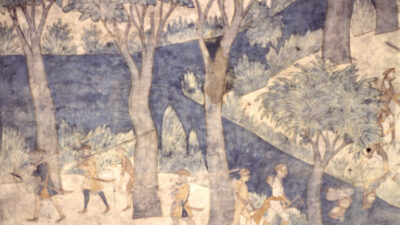
By Molly Boyle According to an old saw, history is written by the victors. But depending on who gets to create the official record, it can also be composed by the losers—or by those who weren’t even there. When graphic novel artist Turner Avery Mark-Jacobs was invited by the New Mexico History Museum to do his own rendering of the battle depicted in the museum’s Segesser II hide painting, he sifted through multiple narratives of the ill-fated 1720 Spanish military expedition of Pedro de Villasur.

Categories: Framework, New Mexican history

Read Summer 2020 Poetry Selections: Encantada by Michelle Otero Close-up view of an uneven mud brick wall with rough texture and visible gaps between the bricks. [gen-ai]

Summer 2020 Poetry Selections: Encantada by Michelle Otero

A version of this poem was created for the Environmental Grantmakers Association Annual Retreat, September, 2014 By Michelle Otero — Michelle Otero is the poet laureate of Albuquerque (2018–2020) and the author of the forthcoming Bosque (UNM Press, 2021). Originally from Deming, New Mexico, she holds a bachelor of arts in history from Harvard College and an master of fine arts in creative writing from Vermont College of Fine Arts.

Categories: Poetry

Read On the Tip of Your Tongue A grayscale image of a persons ear and part of their head, with comic-style speech bubbles above the ear displaying words like AAH!, EEK!, UGH!, YIKE!, and OOF!. [gen-ai]

On the Tip of Your Tongue

By Andrew Wice The notion that our left brain determines analytic deduction while the right brain fosters emotional perception remains useful as a metaphor if not as a neurological reality. In that model, the right brain would assess the feelings aroused by a vermillion octagon overlaid with white runes, while the left brain would instead recognize a stop sign. When text and image are combined in a single work of art, these adversarial modes of thinking collide in the intersection, and never the same way twice.

Categories: Visual art

Read Gimme Shelter-in-Place Aerial view of an ancient archaeological site on a rocky, sunlit plateau with excavation areas and mountains in the background. [gen-ai]

Gimme Shelter-in-Place

By Charlotte Jusinski I report to you from the height of the COVID-19 pandemic. I know that by the time you are reading this, the visceral panic will have passed. I am choosing to say I know this. (Truth is, I don’t know this. I hope for this. I am crossing my fingers, toes, arms, legs, and eyes for this.) But right now, it’s very real.

Categories: Editor's Letter

Read Finding Her Place in Clay A woman with long dark hair, wearing a black jacket and beaded earrings, smiles outdoors in a desert landscape with hills in the background. [gen-ai]

Finding Her Place in Clay

By Lillia McEnaney with Charlotte Jusinski In the 1960s, potter Helen Cordero (Cochiti Pueblo) turned to her grandfather for inspiration. Known for being an engaging storyteller, Santiago Quintana was always surrounded by children. Cordero took the image of a seated figure surrounded by a crowd of little ones, avidly listening to a story, and sculpted it in clay. This “storyteller” figure quickly gained popularity, with potters throughout the Pueblos soon creating their own versions.

Categories: Artist profiles, Indigenous arts and cultures, Visual art

Read Summer 2020 Poetry Selections: Selected Poems by Elizabeth Jacobson A green-leaved tree stands behind a tall wooden picket fence on a grassy area under a clear blue sky. [gen-ai]

Summer 2020 Poetry Selections: Selected Poems by Elizabeth Jacobson

By Elizabeth Jacobson Curator of Insects I started asking questions about how human bodies held together. Already I was a certain age,  and not seeing any usual patterns. My mind had become fuzzier, mirroring the now fuzzier vision of my eyes. I read about hymenoptera vision,  how paper wasps and honeybees can remember the characteristics of a human face. And since a dragonfly had remembered me, I knew that this is true for them as well.

Categories: Poetry

Read Hides in Plain Sight Segesser II (left side detail)

Hides in Plain Sight

By Rick Hendricks Historians and buffs of the Plains and the Southwest likely know the tragic story of the denouement of the Villasur expedition, which departed Santa Fe on June 16, 1720, in search of French soldiers on the eastern plains. Taking the field was a small force consisting of approximately forty-two mounted soldiers, sixty Pueblo allies, an unknown number of Apache guides, and a Franciscan friar.

Categories: New Mexican history, Southwestern history

Read Corridos My Father Sang to Me An older man in a suit holds a small guitar and gestures toward a microphone on stage, with other musicians in the background. [gen-ai]

Corridos My Father Sang to Me

By Robert Martínez Growing up in a musical family in Albuquerque afforded me many unique cultural experiences. Watching The Brady Bunch and The Odd Couple on TV during the week—then taking weekend family trips to the high mountain village of Mora to visit my dad’s relatives—was a shock to the system. My relatives only spoke Spanish there, and I only knew English; I heard Spanish in the house only when our parents didn’t want us to understand what they were saying.

Categories: Essays and memoir

Read Living on the Edge Aerial view of an archaeological site on a hillside with excavated areas and surrounding desert landscape, mountains in the background. [gen-ai]

Living on the Edge

By Jason S. Shapiro In 1915, the world was consumed by a devastating world war—but it was also the year that a tall, thin, Danish archaeologist made his second trip to New Mexico in order to study the archaeology of the Galisteo Basin in the northern Rio Grande Valley. Nels Nelson, working for the American Museum of Natural History in New York, made numerous test excavations at several large pueblos, including a site just outside the city of Santa Fe: an archaeological gem called Arroyo Hondo.

Categories: Archaeology

Read Twenty in Twenty A life-sized car sculpture covered in blue, yellow, white, and silver fringe, resembling a piñata, displayed in a gallery setting. [gen-ai]

Twenty in Twenty

By Jadira Gurulé Over the years, the National Hispanic Cultural Center Art Museum has presented exhibitions that explore visual culture, identity, social issues, and creative expression from around the world. Each year, the NHCC Art Museum presents an average of five exhibitions in its three gallery spaces and offers a robust schedule of educational programming that invites children, families, and adults to explore the richness of Hispanic, Latina/o/x, and Latin American art from a variety of perspectives.

Categories: New Mexican cultures