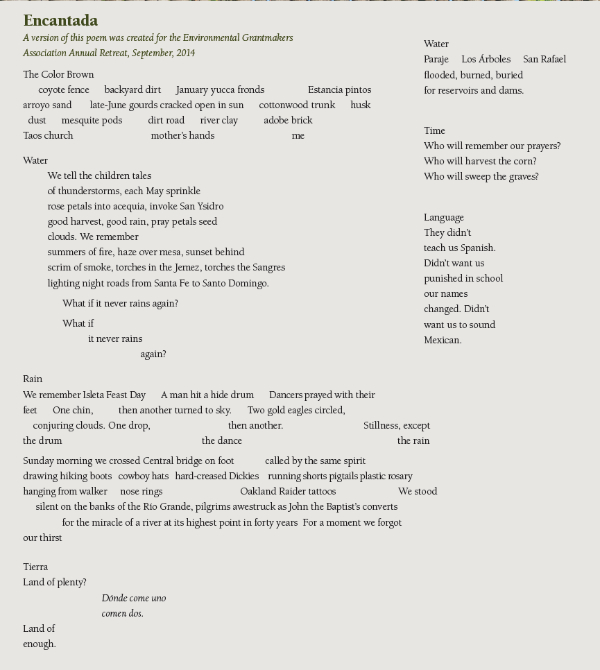
Summer 2020 Poetry Selections: Encantada by Michelle Otero

A version of this poem was created for the Environmental Grantmakers Association Annual Retreat, September, 2014

By Michelle Otero

Michelle Otero is the poet laureate of Albuquerque (2018–2020) and the author of the forthcoming Bosque (UNM Press, 2021). Originally from Deming, New Mexico, she holds a bachelor of arts in history from Harvard College and an master of fine arts in creative writing from Vermont College of Fine Arts.

Michelle Otero (opens in a new tab) is the author of Vessels: A Memoir of Borders, Bosque: Poems and the essay collection Malinche’s Daughter. She served as Albuquerque Poet Laureate from 2018-2020 and co-edited the New Mexico Poetry Anthology (2023) and 22 Poems and a Prayer for El Paso, a tribute to victims of the 2019 El Paso shooting and winner of a New Mexico-Arizona Book Award. She is a member of the Macondo Writers Workshop.

On the Tip of Your Tongue

By Andrew Wice

The notion that our left brain determines analytic deduction while the right brain fosters emotional perception remains useful as a metaphor if not as a neurological reality. In that model, the right brain would assess the feelings aroused by a vermillion octagon overlaid with white runes, while the left brain would instead recognize a stop sign. When text and image are combined in a single work of art, these adversarial modes of thinking collide in the intersection, and never the same way twice.

Word Play, a freewheeling exhibition at the New Mexico Museum of Art, offers examples of the limitless ways pictures and words can cooperate to make a singular expression. Artworks using text-based images vary as much by intention as they do by material, and the exhibition surveys a range of works, from the earnest photography of homespun signboards such as Roadside Stand Near Birmingham, Alabama (1936) by Walker Evans, to the scathingly ironic subversions found in the series Paper Doll for a Post-Columbian World (1991) by Jaune Quick-To-See Smith. That series features the paper doll “Barbie Plenty Horses” and her collection of “fun” outfits to wear, like “Maid’s Uniform.”

For curator Katherine Ware, such a variety of styles presented a rare opportunity to juxtapose wildly divergent tones and textures within a unified show. To that end, the works are grouped into categories more suggestive than canonical. Ware has opted to let the pieces speak for themselves, rather than impose interpretations upon the exhibit.

“I’m leaving a lot to the visitor,” Ware says, “and I’m making these loose categories and arranging things in a way that I think is interesting. … The categories are just informed by the work. It’s a show for people to bring things to, rather than me to be didactic about.”

These loose associations gather in categories such as “Speech Bubbles,” which playfully commandeers comic book exposition; for example, Eek Ugh (1980) by Joyce Neimanas, who is known for her unorthodox approach to photography. By contrast, Bruce Nauman’s print Live or Die (1985) represents the nakedly philosophical, aphoristic compositions in the group “Words to Live By.” Don’t expect much practical advice here, but perhaps a quiet moment contemplating a photograph of graffiti which reads “No sense makes sense,” from Santa Fe’s esteemed photo historian and curator Van Deren Coke.

“Free Speech” contains polemical works, speaking truth to power by welding defiant illustrations to agitprop maxims, such as We Are the Slaves of Slaves: Lucy Parsons (1980) by activist and artist May Stevens. That piece foregrounds an appropriated image of the radical labor organizer Lucy Parsons over handwritten text from one of her incendiary speeches.

By contrast, everything in “Mother Tongue” treats words as an ingredient for the collage. Though the words have didactic weight, they become letterforms, reduced to their aesthetic effect. No meaning, just shapes—the medium is the message in works like Lesley Dill’s Woman with a Hindi Healing Dress (2005).

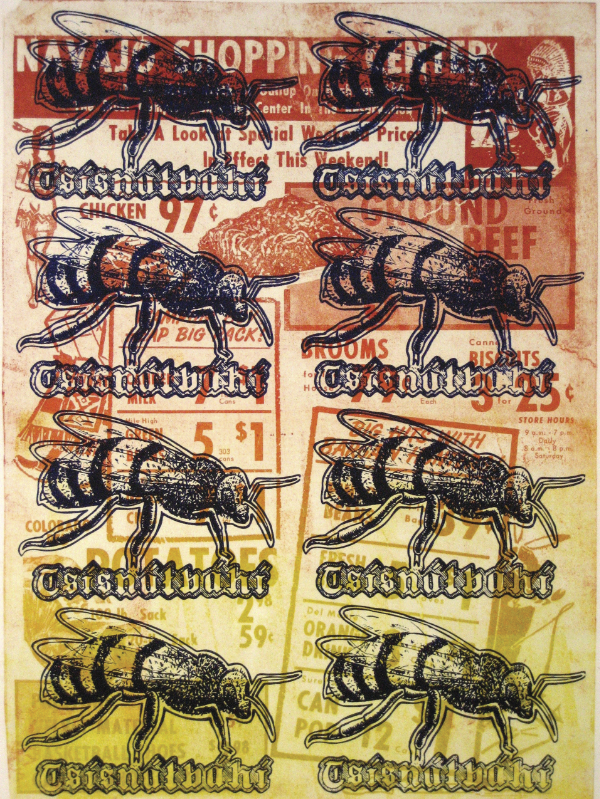
David-Alexander Hubbard Sloan, Tsínátbáhi (Honey Bee), 2013. Monoprint. 16 × 11 in. Image courtesy of the artist.

Other pieces in “Mother Tongue” assert identity through language, reclaiming moral high ground in our ongoing personal-is-political discourse. Santa Fe-born artist David-Alexander Hubbard Sloan’s Tsísnátbáhí (Honey Bee), from 2013, prints drawings of bees and the word for them in the artist’s native Diné onto a grocery store flyer. The contrast between the eminent imagery and the prosaic advertisement is as pointed as the difference between a bee’s honey and its sting.

The selections for the section “Mixed Messages” includes enigmatic pieces like Crownet 173 Crying (1983) by Doris Cross, a page from the “C” section of the dictionary obscured by paint and ink, while “Missives” involves correspondence-based works such as Alex Traube’s poignant 1976 suite of “Letters to My Father.” Meanwhile, “And Now a Word from Our Sponsor” recontextualizes ads, street signs, and graffiti, divorcing intent from meaning. The appealing photograph This Year Ride A Bicycle by Ralph Steiner both documents the look of a 1920s urban landscape while also reflecting the incongruity that in this image, there is no place where a bike could be ridden.

These loose arrangements offer a jumping-off point, rather than a landing spot, for such divergent works. They encourage the visitor to regard each artwork on its own terms. The pieces within each category are associated, but only proximately, like strangers waiting for the same bus. The wide latitude of this approach permits Ware to dive deep into the museum’s collection, demonstrating the strategy through different eras. “It’s a show that cuts across the collection in a different way,” Ware says. “Such a wide-open topic allows us to pull out some really interesting work that hasn’t been shown in a while and to showcase some new acquisitions.”

This omnibus format means that the exhibit pivots from wry humor to pointed inquiry to brazen inscrutability. In the dialogue between text and image, who is commenting on whom? Visitors might be inspired to continue that conversation with their companions long after leaving, perhaps contemplating that old familiar ratio between pictures and words. For while pictures can instantaneously express a galaxy of ideas, some might argue that words (in their thousands) can communicate in higher definition. Meaning is always in the eye of the beholder, but never more so than when text and image compete for our trust. 

Audiences have perhaps accepted the idea that a painting doesn’t have to depict anything; that a sculpture doesn’t have to explain anything. However, when words join the image, we expect meaning, and are driven to search for it. In Word Play, many of these works beguile such attempts at explication.

This clashing of left-brain expectations versus right-brain sensation is what kindled the curiosity of the curator, now in her twelfth year at the New Mexico Museum of Art. “We often think that written communication is clear, or it’s meant to be clear,” Ware says. “And works of art don’t really do that so much, and I think the words in these pieces on view don’t do that so much. So it really is a more cryptic exchange, rather than descriptive or narrative.”

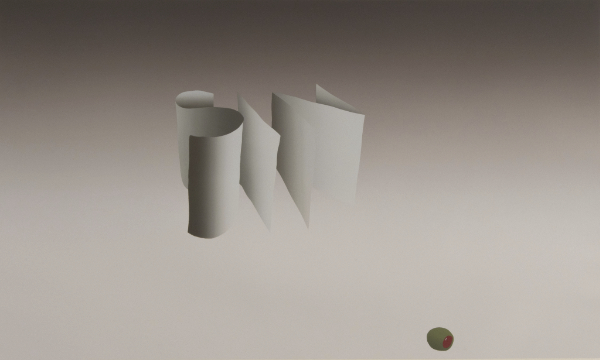
Ed Ruscha, Sin (detail), 1970. Screen print. 19 × 26 ½ in. Collection of the New Mexico Museum of Art. Gift of Rosalind M. Constable Trust, 1995 (1995.26.26) © Ed Ruscha. Photograph by Cameron Gay.

Ed Ruscha is one of the better-known artists featured in the show, exemplifying this cryptic approach. Often word-based and resistant to explanation, his images have been a particular touchstone for Ware, leaving the viewer wondering which side of the joke they are on. Sin, from 1970, is idiomatic yet ambiguous, seemingly both cynical as well as transcendent. A three-dimensional rendering of the word “sin” stretches into the distance, while a cartoonish green olive incongruously floats in the foreground. It is pleasing to the eye, a riddle to the mind, and succeeds in planting a question mark in the heart of every viewer. An apparent lack of depth encourages an exploration of the liminal surface, its unresolved ripples. Juxtaposed above it on the gallery wall is William Christenberry’s landscape photograph taken in Alabama, punctuated with an oil sign that reads “PURE.”

Ruscha’s method reflects the irony-drenched cool of Pop Art and its plastic ethics (both with regards to artificiality and in pliancy). A response to an assumption of guilelessness by earlier generations, that eighties sarcasm has now been overtaken by our contemporary culture’s heartfelt vehemence. Methods of combining images and words seem to somehow reflect society’s pendulum swing between cynicism and genuineness.

Not surprisingly, an exhibition containing both playful and fervid expressions might find some pieces overwhelming others. The subjectivity of this response emphasizes the importance of each audience member’s perspective and preferences. Visitors will recognize themes echoing through the collection, changing pitch and amplitude as they go. The individual artworks often merge aesthetic pleasure with challenging concepts. Anger is leavened by wit, abstruse ideas are conveyed by concrete form. This one-two punch afforded by text-based imagery gives the exhibit an unexpectedly hopeful, open-ended plausibility.

Across these different techniques and objectives, the conflict of words and pictures can generate sparks, like steel on flint. For Ware, the friction of these encounters are entirely the point: “I’m interested in the complication of bringing those two communication media together. And I’m not necessarily interested in delineating all the ways that it makes something; I was just more interested in the collision. A picture may be worth a thousand words to somebody, but I’m more interested in the messiness.”

Visitors will need both their left and right brains to engage with this eclectic, multifarious survey. Word Play combines a dizzying array of colliding ideas. It is proof that, at the intersection of language and fine art, one must always look both ways. 

Andrew Wice is a novelist and screenwriter. He is the author of seven novels, including To The Last Drop (Bäuu Press, Colorado, 2008) and the acclaimed Madrid Oral History Tour, a smartphone app which lets visitors hear Madrid, New Mexico’s stories, as told by the people who lived them. Visit AndrewWice.com.

Andrew Wice (opens in a new tab) is a novelist and screenwriter. He is the author of eight novels, including To The Last Drop (Bauu Press, 2008), and produced the acclaimed Madrid Oral History Tour, a smartphone-guided walking tour of the New Mexico town of Madrid.

Gimme Shelter-in-Place

By Charlotte Jusinski

I report to you from the height of the COVID-19 pandemic.

I know that by the time you are reading this, the visceral panic will have passed. I am choosing to say I know this. (Truth is, I don’t know this. I hope for this. I am crossing my fingers, toes, arms, legs, and eyes for this.)

But right now, it’s very real. I’m stocked up on coffee and snacks at home. I’ve loaded my office plants into my back seat since I was just told to work from home for the next few weeks. I’m taking in a foster dog from Española Humane, because nothing but an empty house sounds like more than I could take. I’m refreshing news sites constantly.

I don’t know what is going to happen.

Well, that’s not entirely true. I do know one thing that is going to happen: We’re going to give you a magazine.

El Palacio has been a staple of the New Mexican cultural landscape since 1913. Since I took this job last summer, I have been approached by countless folks telling me what a gorgeous magazine I produce.

My response is always the same: Thank you, I’m thrilled that you love El Pal, but I can’t take credit. I inherited a beautiful magazine thanks to my predecessors at the helm, my hardworking Department of Cultural Affairs colleagues, a stable of immensely talented writers, and our truly world-class graphic design team.

And part of my inheritance is the strong legacy of El Palacio as a constant in turbulent times. Through the influenza pandemic of the teens, the depressed 1930s, the wartime 1940s, the protests of the 1970s, the murky early-aughts, and all the strange and beautiful and ugly times in between, El Palacio has been there.

El Palacio will continue to be here.

So as I write this, I’m transferring my files for this issue into a Dropbox folder I can access from home, I’m emailing my writers to make sure they’re calm and healthy, and I’m saving my colleagues’ cell phone numbers in my phone since we are no longer office neighbors for a bit after today. I’m taking the steps necessary to ensure you get an end product that is not reduced in quality, and to make sure I devote just as much time and energy to these stories as I would under normal circumstances.

Our culture is what we have when everything else is stripped away. When we worry for our friends and families, when our jobs are insecure, when our health wavers, when our children are afraid, art is something to which we can cling.

I offer all this with a humble heart and a grateful spirit. I am so lucky to live in New Mexico, this beautiful land of rich history and formidable people. I am so lucky to have you, dear reader, to pick up this magazine. I am so lucky to be able to offer you this gift of culture in trying times. I am so lucky to know you, and this place, and this art.

I am so lucky.

Finding Her Place in Clay

By Lillia McEnaney with Charlotte Jusinski

In the 1960s, potter Helen Cordero (Cochiti Pueblo) turned to her grandfather for inspiration. Known for being an engaging storyteller, Santiago Quintana was always surrounded by children. Cordero took the image of a seated figure surrounded by a crowd of little ones, avidly listening to a story, and sculpted it in clay. This “storyteller” figure quickly gained popularity, with potters throughout the Pueblos soon creating their own versions.

Storyteller figures continue to blossom and evolve with the next generation of Pueblo potters—including in the hands of 2020 Museum of Indian Arts and Culture Living Treasure Kathleen Wall (Jemez Pueblo). Today, as an established mixed-media artist, Wall creates figurative, expressive sculptures that bring joy and inspire conversation. Wall’s work will soon be on exhibit at MIAC in A Place in Clay; the exhibition has changed dates due to COVID-19, so contact the museum before you plan to visit.

Grounded in Jemez Pueblo, Wall’s whole ethos exudes a sense of place. Raised by a family of storytellers, she grew up surrounded by clay. “I was around eight years old, we were living in the Jemez Valley, and my mother [Fannie Loretto] was making a very large wedding vase,” Wall recalls. “There was a photographer there. … I remember pictures being taken and it being a really neat time. Then, in my mid-twenties, I saw the wedding vase for sale at a gallery in Durango, Colorado!”

Reconnecting with the vase was a pivotal moment for Wall. “Of course, I couldn’t afford it, but they let me put it on layaway,” she continues. “Now, I own that wedding vase. My mom has been such an influence in my work—she taught me everything. All of my earliest memories are of my aunts and my mom working. That is a wonderful memory that came full-circle.” And those early influences, Wall says, continue to play a major role in the work she creates to this day. “I always want to make sure that my family is a part of not only my work, but of my world, of my life. I try to embrace my family and make sure that we’re together often, because you can’t replace it. … These stories of my mom and my aunts making and selling pottery aren’t just memories. They are woven into the threads of my life.”

As she was honing her craft, she gained constant inspiration from her family—as well as a license to blaze her own path while staying rooted in Jemez. “My auntie Dorothy [Trujillo] always used to give me natural clay to work with, but one day she told me that I could use whatever I want—it didn’t have to be natural clay,” she says. “That was radical; it gave me the license to do what I could with what I had. Pueblo potters have a lot of rules imposed on them, but she took those away from me.”

Similarly, her aunt Edna Coriz taught her to make do with what she had. “Once, when I was in high school in Albuquerque, I didn’t have a brush for our white paint. So I tracked her down and asked if she had one I could borrow. She went into her purse, pulled out a makeup brush, and said, ‘Anything works!’”

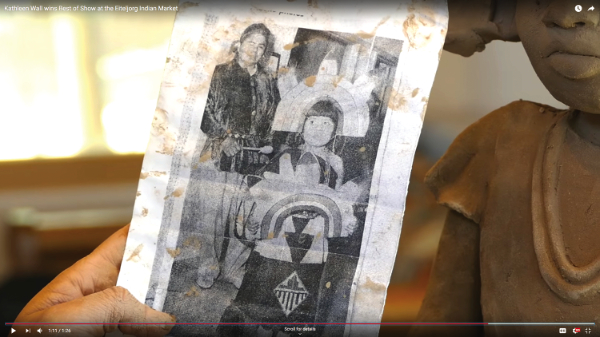
The newspaper clipping that inspired Gye wha la’ pah. Photograph courtesy of the School for Advanced Research; videography by John Sadd.

For her relatives, working with clay “was almost like babysitting,” Wall reflects. “I see that clearly now because my kids are the same way. I need to work, so I let them play with clay, I let them get muddy. I was very fortunate to grow up like that.”

By the time Wall was fifteen, she was following in Helen Cordero’s footsteps, focusing on creating storyteller figures in her mother’s kiln. “It was illegal to have a job, but it wasn’t illegal to make pottery!” she laughs. Soon, she started travelling from Jemez to Old Town Albuquerque to sell her pieces. “I’d walk around with a basket of goods and just see who was willing to purchase.”

In her twenties, Wall left college to return to Jemez and take care of her grandfather, Louis Loretto, in whom she found constant inspiration. “I can’t even start explaining how much that experience influenced my work,” she says. “He was a rebel; he was very outspoken and accepting of a lot of things. He gave me a very grounding approach to my work—he gave me license to create.” Though Loretto was visually impaired, the pair travelled throughout the Southwest together, attending state fairs, powwows, and feast days. “Those experiences taught me so much not only about Pueblo culture, but also about so many other Native traditions,” explains Wall.

In between trips across New Mexico, Wall soon began rebuilding his house, pouring herself into the project, and “fall[ing] in love with him, and with Jemez.”

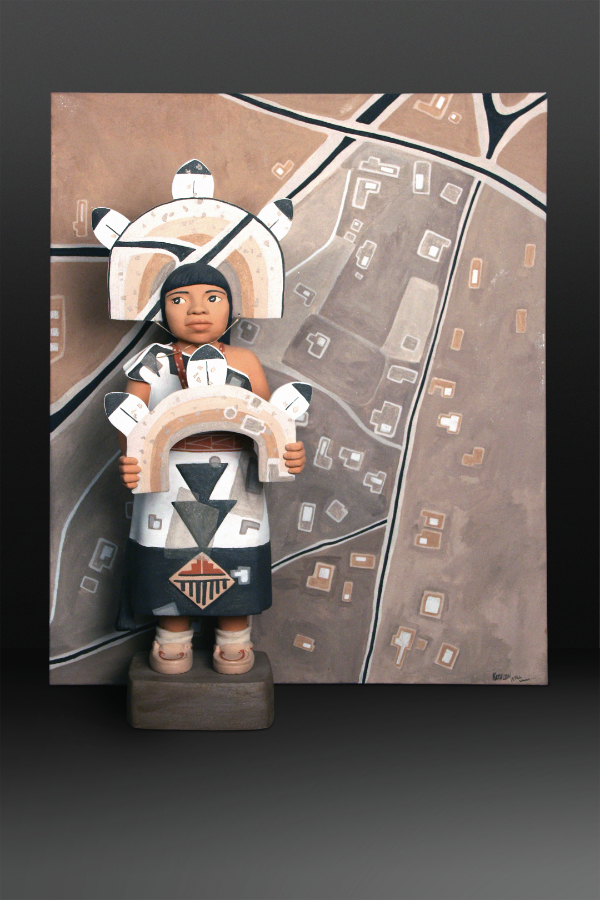
Kathleen Wall (Jemez Pueblo), Gye wha la’ pah, from the Place series, 2016. Figure: hand-processed Jemez Pueblo clay, acrylic and earth pigments, clay slip, underglazes; Painting: acrylic and earth pigments, clay slip, and sand on canvas. 36 × 30 × 8 in. Photograph courtesy of the Museum of Indian Arts and Culture.

Taking this license to create to heart, Wall began adapting her storyteller figures into the work for which she is known—her koshare, or sacred clown, figures. Painted with the matte pigment for which Jemez potters are known, these jubilant, expressive pieces are almost always smiling, spreading joy to their viewers and owners. Wall created three koshare figures for A Place in Clay, a series titled Koshare Stars. Holding ceramic buckets of stars, the warm and welcoming figures greet visitors to the Museum of Indian Arts and Culture.

After experiencing significant success in the market and gallery scenes with her koshares, Wall started experimenting, moving towards more mixed-media works. “Sometimes, I can’t believe how much my work has evolved from a craft into a way of expressing myself,” says Wall. “My ambition is what made me leap into other situations, such as building Pueblo clay figures a lot larger than your average clay figure, or moving into installation art.” Ranging from bronze sculptures to ceramic figures embedded within or placed in front of paintings, these installation pieces illuminate new and innovative applications of Wall’s established talent in sculpture.

A Place in Clay puts the Koshare Stars figures into conversation with these larger, mixed-media works, which Wall often categorizes as her “project pieces.” In an effort to showcase the diversity of her artistic practice, the exhibition features selections from multiple bodies of “projects.” Visitors to the exhibition can explore the Place series, developed from a residency at the School for Advanced Research, and Harvesting Traditions, her senior thesis project at the Institute for American Indian Arts, which was previously exhibited at the now-defunct Pablita Velarde Museum of Indian Women in the Arts in Santa Fe.

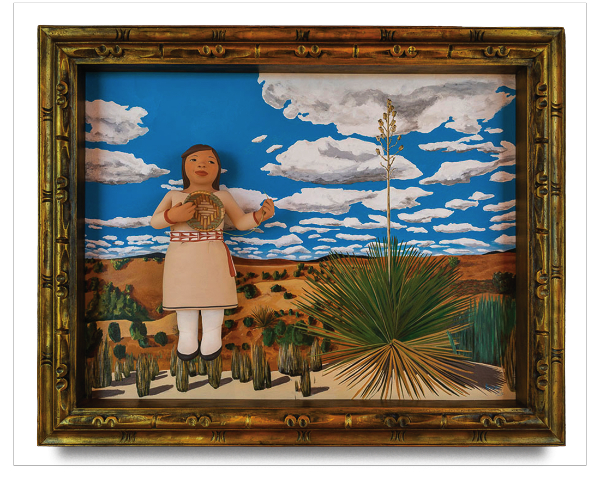
Kathleen Wall (Jemez Pueblo), The Basket Maker, from the Makers series, 2018. Painting: acrylic paint on wood panel with mounted Jemez Pueblo clay figurine; Figure: hand-processed Jemez Pueblo clay, slip, underglazes, and acrylic paint. 22 × 24 × 4 in. Photograph courtesy of the Museum of Indian Arts and Culture.

The largest selection of work in the exhibition comes from Harvesting Traditions, which confronts questions surrounding Indigenous food sovereignty and pre-Colonial foodways. In her project statement, Wall writes: “In this body of work I explore the way Native people used to, and still do harvest, gather, grow, and hunt their food in a traditional manner. Reflecting on this traditional knowledge in foodways gives an opportunity to acknowledge the difference in how we practice our diet today.”

In A Place in Clay, the Pueblo Farmer is an extension of his surroundings. Carefully sculpted with hand-processed Jemez clay and painted with acrylic and earth pigments, he holds a hoe and stands in front of his corn field, a split-field painting. The foreground holds three monumental corn stalks within a larger agricultural landscape, and the bottom left mirrors this view, but this time the stalks are smaller, abstracted with traditional Jemez pottery motifs. The Rio Grande frames the top left corner, reminding the viewer of the lifesource for both the corn and the farmer.

Rabbit Hunter follows a similar path. Positioned in front of an expansive high desert landscape, the hunter is stretching, aiming his rabbit stick towards the cottontail on the opposite side of the canvas.

In these didactic, mixed-media pieces, Wall embeds ceramic figures within striking landscapes on canvas. Here, it is difficult to imagine the Pueblo Farmer without his well-cared for field, or the Rabbit Hunter without his desert landscape. Through this body of work, Wall hopes to start a discussion that “juxtaposes this past knowledge [with] what we practice today. Maybe in this discussion we can come up with ideas of compromise in traditional foods, in order to be healthier people.”

The exhibition would feel incomplete without Gye wha la’ pah (The Place Where I Began), which is a portrait of Wall’s auntie Edna Coriz as a young girl. From the Place series, this sculpture was based on a photograph of Coriz that Wall found in a newspaper clipping. The figure, sculpted with hand-processed Jemez Pueblo clay and painted with acrylic and earth pigments, is standing in front of a topographical painting of her neighborhood in Jemez, Gye wah la’. Though Coriz grew up away from home in San Francisco, she never forgot her home in Jemez. The painting and the sculpture come together flawlessly, with portions of the topography painted directly onto the figure of Coriz.

[wonderplugin_slider id=177 alignment=”center”]

Over the years, Wall has faced criticism for not falling into the tropes of the “traditional” or the “contemporary” Pueblo potter. As a younger artist, she wanted to be seen as a “modern artist” because that is what the collectors, markets, and galleries were embracing. “But it turns out that I can’t change a lot of things about me,” she says. “I can’t change the way I look, my voice, my penmanship. It is what it is. I am not somebody else’s art. … My work is just what comes out of me—my art is everything about me.”

Beyond her individuality, art defines Wall’s family, culture, and home. “The creative side is grounded in Native culture, my surroundings, my family, and my friends,” she says. “Living in Jemez, which is constantly culturally active, you can’t help but be inspired. And then we live in New Mexico, where there is this incredible beauty everywhere we go, and I don’t take it for granted. My appreciation for beauty is fed by the culture I live in, the family I am surrounded by, and the landscape around me. It is undeniably heartwarming—we are constantly giving thanks in our dances and our songs. That is what inspires me.”

Through both her koshare figures and her multimedia works, Kathleen Wall has sculpted a place that is uniquely hers within the larger Native art world. When asked about creativity, Wall tears up.

“It’s absolutely everything,” she says. “It’s just what comes out of you—how you do your makeup, the clothes you wear, the music you listen to, the way you drive. It’s the way you see. Creativity is everything; we just have to acknowledge it.” 

Lillia McEnaney is a museum anthropologist and freelance arts writer living and working in Santa Fe, New Mexico. She is the curator of A Place in Clay: 2020 MIAC Living Treasure Kathleen Wall, on view at the Museum of Indian Arts and Culture.

Charlotte Jusinski is the editor of El Palacio.

Lillia McEnaney (opens in a new tab) is a museum anthropologist and independent curator living and working in Santa Fe, New Mexico. Lillia is an assistant professor of museum studies at the Institute of American Indian Arts. Her ongoing projects include collaborations with the School for Advanced Research Indian Arts Research Center and the Navajo Nation Museum. Lillia is co-editor, with Dr. Jennifer Nez Denetadle (Diné), of “Our Livestock Will Never Diminish” / “Nihinaaldlooshii doo nídínééshgóó k’ee’ąą yilzhish dooleeł:” Breathing Life into the Photography of Milton Snow Across Diné Bikéyah (University of New Mexico Press, 2026). Previously, Lillia was assistant curator at the Museum of Indian Arts & Culture, director of the Hands-On Curatorial Program at the Ralph T. Coe Center for the Arts, and adjunct instructor in Lehigh University’s Department of Art, Architecture, and Design/Semester in the American West. She holds an MA from New York University and a BA from Hamilton College.

Summer 2020 Poetry Selections: Selected Poems by Elizabeth Jacobson

By Elizabeth Jacobson

Curator of Insects

I started asking questions about how human bodies held together.
Already I was a certain age, 

and not seeing any usual patterns.
My mind had become fuzzier,

mirroring the now fuzzier vision of my eyes.
I read about hymenoptera vision, 

how paper wasps and honeybees
can remember the characteristics of a human face.

And since a dragonfly had remembered me,
I knew that this is true for them as well.

Some insects live only a few hours 
or a few weeks, 

30 days for a fruit fly, 
2 months for a horse fly.

I saw the age of the body 
might never again match the stretch of its will, 

and like Keats, who remarked on the fading animation of his hand
at the end of his life,  

there grew a sadness for this former vivacity,
yet unlike Keats, I had joy in its release. 

Some of the things I do seem to move backwards.
Others feel as if they have a spherical momentum.

As I grow older, it all appears to taper, 
yet there is also a broadening, 

and although this is illogical, 
this is what happens to people.

The dropping away leaves space, 
which quickly floods with small things

like the blue-eyed dragonfly in flight, 
facing me in the early morning,

or saving an ant from drowning 
in a puddle of warm rainwater.

I cultivate flowers and trees for a small variety of bees, 
offer them aspen and willow for when they are ailing.  

They scrape the resin off the leaves 
and secure it to their back legs.  

A box elder bug has been resting on the base of the
   desk lamp for days, 
his tender black limbs secured around the cord.  

He is close to death, and waiting.  
All my life, I tell him, I have been told I should not
   see the things I see,  

the way I see them.  
It is too late for all that now. 

He turns his head and thorax toward my voice,
his opaque bead eyes red with inquiry.


Each Day Travelling

Hello Buson!

I found another dead snake on the road today 
and thought of you, the way you said Use the commonplace 

to escape the commonplace.  Your square face 
framed many canvases—  the ashen leaves of cold days, 

one purple thistle poking through.

You walked a long way 
with pebbles in your shoes, 

sat above a mountain pond considering your reflection
until nothing remained.

Here, the foothills are full of coyotes, 
and in my room I am surrounded 

with the yelps of their longing.
The senses flood; the sunken islands of brackish grass 

appear to float in the pond— 
                                                        the whole world is in me,  

an unrelenting grief that is each day travelling 
so quickly into the next.  How closely 

you looked at things: Struck by a raindrop, snail closes up.  
And then, dear Buson, and then?

You would have kissed me, I think, 
on all sides of my face.


Electrical Storm

When the lights went out 
So many things were happening

But all I wanted to do was write a poem 
About how good it felt 

To fill buckets with cold water 
From the gravity fed pump in the orchard

To walk across the tall summer grass
Feeling the hollow crush of deathlessness 

Cushion the soles of my feet
And store the buckets under the porch 

For drinking and safe keeping.  
When the lights went out 

The crickets strummed louder for mates
The stars shone brighter,

A voice called out of the blackness
That was exactly me

Life is just a thing that feels like something.

When the lights went out
The canyon wren offered a feather to the night

And the bear shat in peace 
Under the apple tree by the back door.

It felt so good to be in the dark 
With nothing turning on

And nothing turning off,
To hear a voice that was exactly mine

And everything else’s
At the same time

If you don’t do another thing, 
You’ve done enough.

Elizabeth Jacobson, poet laureate of Santa Fe, New Mexico, is the author, most recently, of Not into the Blossoms and Not into the Air (free Verse Editions/Parlor Press, 2019) which won the New Measure Poetry Prize selected by Marianne Boruch, and the 2019 New Mexico–Arizona Book Award for both New Mexico Poetry and Best New Mexico Book. She is the reviews editor for the online literary journal Terrain.org and teaches poetry workshops regularly in the Santa Fe community.

Elizabeth Jacobson (opens in a new tab) is a former poet laureate of Santa Fe, New Mexico, is the author, most recently, of Not into the Blossoms and Not into the Air (free Verse Editions/Parlor Press, 2019) which won the New Measure Poetry Prize selected by Marianne Boruch, and the 2019 New Mexico–Arizona Book Award for both New Mexico Poetry and Best New Mexico Book. She is the reviews editor for the online literary journal Terrain.org and teaches poetry workshops regularly in the Santa Fe community.

Hides in Plain Sight

By Rick Hendricks

Historians and buffs of the Plains and the Southwest likely know the tragic story of the denouement of the Villasur expedition, which departed Santa Fe on June 16, 1720, in search of French soldiers on the eastern plains.

Taking the field was a small force consisting of approximately forty-two mounted soldiers, sixty Pueblo allies, an unknown number of Apache guides, and a Franciscan friar. The disastrous encounter between the troops from New Mexico and what is believed to be a combined force of Pawnees, Otoes, and French took place on August 14, 1720, at the confluence of the Loup and Platte Rivers in present-day Nebraska. The grim reckoning of casualties indicated that many New Mexican men lay dead on the plains, and just over a dozen made it back to Santa Fe to recount the battle.

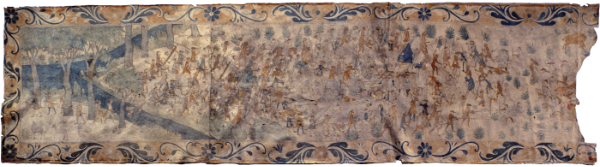
Not just the subject of books and oral history, the expedition is also chronicled on the Segesser hides, two very large paintings on animal hides that were stitched together to form a canvas. Although it is astounding that the hide paintings have survived for almost three centuries and that their violent narrative can still be read, by the early twenty-first century, they were in need of some tender loving care.

When the Museum of New Mexico reopens the Palace of the Governors following extensive renovation, the Segesser hides will have a new home in state-of-the art, environmentally controlled cases.

In order to provide the care required by such a unique artifact, a special kind of doctor was needed. The Museum of New Mexico found him in the person of Mark MacKenzie, a native of Canada. When confronted with the challenge of the Segesser hides, MacKenzie, who recently retired as director of the Museum of New Mexico Conservation Department, remarked that he was pursuing two conservation goals. First, there was the need to preserve the centuries-old hide paintings by gaining an understanding of how they were aging to know how best to preserve them. Second, there was much information waiting to be discovered through a thorough scientific examination.

Background on the Segesser Hides
The events of that August day in 1720 took place in two very different contexts. In the view from New Mexico, Spain was seeking to halt French penetration into its territory. Rather than achieve this aim, the expedition was an utter failure and marked the end of Spanish expansion north of New Mexico.

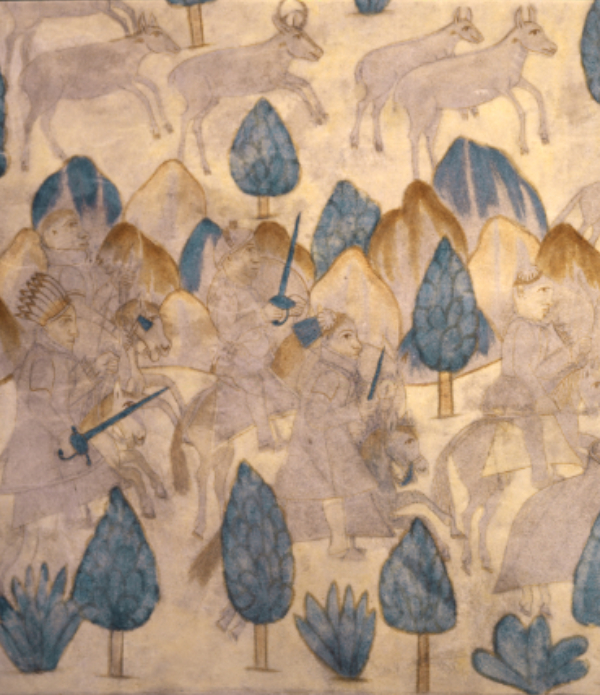
Segesser I (center detail), ca. 1720–1729. Courtesy Palace of the Governors Photo Archives (NMHM/DCA), Neg. No. 149799; Palace of the Governors artifact no. 11004/45.
Segesser I (center detail), ca. 1720–1729. Courtesy Palace of the Governors Photo Archives (NMHM/DCA),
Neg. No. 149799; Palace of the Governors artifact no. 11004/45.

From the Pawnee perspective, their world was changing; they felt pressure on their traditional lands from Siouxan Dakotas from the east, the arrival of the Otoes in the area, and Comanche and Apache expansion from the west. Moreover, the Pawnees viewed Spaniards as allies of the Apaches, their traditional enemies. The Pawnees responded to these pressures with a general movement west and south, relocating to hilltops along the Loup and Platte Rivers. The Otoes established villages in the same area, filling in gaps between Pawnee villages. Finally, the Pawnees formed a strategic alliance with the French. Annihilating the New Mexican troops effectively eliminated a dangerous ally of the Apaches.

No one knows why the hide paintings were made. The narrative of Segesser II clearly relates a massacre of New Mexican troops at the hands of Pawnees, Otoes, and French. This suggests Governor Antonio Valverde Cosío as a likely patron. He was probably the wealthiest man in New Mexico in the 1720s, and because he was roundly criticized for sending the inexperienced Villasur in command of the expedition, he had reason to show that the New Mexican troops were badly outnumbered by enemies with superior firepower. In defending himself, Valverde always insisted on French involvement in the massacre—although this cannot be corroborated in French sources. Where the hides were made and how they made their way to Sonora, Mexico, are queries still in search of definitive answers.

What is beyond question is that the hides came into the possession of the priest Philipp Anton Segesser von Brunegg, SJ, who served in Jesuit missions in the Pimería Alta. In 1758 he sent three “colored skins” to his brother in Switzerland. There is no consensus on the scene that appears on Segesser I. Some scholars believe it depicts one of Valverde’s several punitive expeditions onto the Buffalo Plains, since there are bison in the painting. Segesser II is a narrative of the Villasur expedition. There are no images or descriptions of Segesser III. All that is known with respect to this third hide is that it arrived in Spain with the other two.

Dr. Gottfried Hotz of the North American Native Museum in Zurich learned of the hides in 1945 when they were still in the possession of the Segesser family. Hotz corresponded with Dr. Bertha Dutton, curator at the Museum of New Mexico, beginning in 1960. E. Boyd, curator of Spanish Colonial art at the Museum of International Folk Art, along with Oliver LaFarge, campaigned for the hides to come to New Mexico for an exhibition. New Mexico History Museum Director Dr. Tom Chávez traveled to Zurich in 1985, and the Museum of New Mexico’s Board of Regents and the Museum of New Mexico Foundation requested an eighteen-month loan of the Segesser hide paintings. The hides arrived in Santa Fe in 1986, and two years later, by means of an emergency appropriation by the state Legislature, the State of New Mexico purchased them from Dr. Andre von Segesser.

Multispectral Imaging
MacKenzie was interested in the possibilities of multispectral imaging for revealing information about the Segesser hides. Multispectral imaging, as the name implies, involves breaking the light spectrum into multiple bands beyond the RGB (red, green, and blue) of the visible spectrum. Multispectral imaging can extend into ultraviolet (shorter wavelength, higher frequency) or out to near-infrared (longer wavelength, lower frequency). False color images make it easier to discern features that are not easily discernable in visible RGB.

In 2012, MacKenzie formed a pilot project with Michael B. Toth, president of R.B. Toth Associates in Bethesda, Maryland. Toth brought his hyperspectral imaging equipment to the museum. Also participating were Dr. Fenella G. France, chief of the Preservation Research and Testing Division of the Library of Congress, and Dr. Eric Hansen, the former holder of the same position.

The exciting results of the visit of specialists inspired MacKenzie—a creative and skillful gadgeteer—to build a camera for the Museum of New Mexico. Because the hides measure 54 inches by nearly 18 feet, a simple camera would not suffice. The result was what MacKenzie liked to call “Franken-Camera.” The equipment consists of an imaging gantry that can travel 8 by 6 feet horizontally over a bed where the Segesser hides rest while being examined. The camera has 2 feet of vertical travel over the bed and has .001 inches of positioning accuracy controlled by a computer program. The camera is capable of taking 3,817 images for the project. As an example of the data that were collected, the imaging of Segesser I at RGB and other wavelengths from ultraviolet to infrared produced a mosaic of 8.1 gigapixels (a gigapixel is a digital image bitmap composed of one billion pixels). The project produced more than 4 terabytes (a terabyte is 1 trillion bytes) of data.

The imaging study provided a wealth of information about the pigments used on the hides and what the original colors looked like. It also revealed drawings and patterns invisible to the naked eye. This showed how the artists made alterations to the underlying plan for the narrative image, such as repositioning a horse’s head. Importantly, the study also suggested something about how the paintings were made.

European and Native Artists
The deep dive below the surface of the Segesser hides has led to a solid hypothesis regarding how they were produced.

Father and son Tomás and Nicolás Jirón de Tejeda were guild-trained master painters in Mexico City before they joined Diego de Vargas in the recolonization of New Mexico of 1693. Nicolás participated on the Villasur expedition and was listed among those who died in the battle—but Nicolás did in fact survive the massacre, and eventually made his way back from present-day Nebraska to New Mexico. Archaeologist Dedie Snow of the state’s Historic Preservation Division champions the notion that Nicolás lived as a captive among the Pawnees for years, which made it possible for him to represent the Natives in such an anthropologically accurate way and to relate the narrative of the massacre as only a participant could. Pawnees who have studied the hides recognized some individuals carrying status objects.

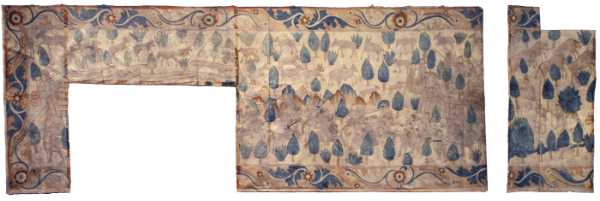
Segesser I (full view), ca. 1720–1729. Courtesy Palace of the Governors Photo Archives (NMHM/DCA),
Neg. No. 152691; Palace of the Governors artifact no. 11004/45.
Segesser II (full view), ca. 1720–1729. Courtesy Palace of the Governors Photo Archives
(NMHM/DCA), Neg. No. 152690; Palace of the Governors artifact no. 11005/45.

Nicolás would have been the master hide painter directing his Native apprentices in a traditional atelier, a method he would have known from his guild training. MacKenzie’s investigations have revealed both European and Native techniques, tool use, and concepts, strongly suggesting they are the work of a master and his apprentices from different cultural backgrounds. He believes Segesser II provides evidence of a more sophisticated integration of European and Native artists.

The use of borders on the hides is perhaps the most obvious example of this fusion. Borders are European in concept, and here they are formed of flowing acanthus leaves. Native hide paintings, winter counts being the most illustrative, do not have borders. Peering beneath the surface of the acanthus leaves reveals long brush strokes produced by a European paint brush. By contrast, the trees that appear in proliferation on the hides show a dabbing technique, the product of a Native brush made from a splayed plant stem.

Images painted on the hides were first drawn freehand or transferred by means of a pattern. Analysis shows evidence of pouncing, a technique employed to transfer images from a pattern to the surface of the prepared hide, which to date has been observed only in the border areas. In this method, an original image is traced by creating holes in a pattern. The outline of the image is transferred to the hide by tamping powdered graphite through the holes in the pattern. Pouncing has been a common technique for centuries.

There is evidence of freehand pencil drawing as well as pouncing, although the exact kind of pencil used remains unknown. The underdrawing on the Segesser hides was made with graphite, and the drawing instrument was a sharpened rectangle. Such a drawing would be produced by pencils from the period. Graphite deposits were also found in New Mexico in the Sandia Mountains east of Albuquerque adjacent to Tijeras Canyon and in the mountains east of Taos.

Pigments
One of the most dramatic scenes on the Segesser hides is the death of the commander of the ill-fated expedition, Pedro de Villasur. He appears lying on his back, attended by Jean L’Archevêque. Villasur is wearing the bright red coat of an officer. Cochineal typically provided the rich red color of military uniforms, such as those worn by the British Army. Because of time constraints, MacKenzie’s examinations did not include organic dye testing. So whether cochineal was used on the Segesser hides remains to be determined, as does the source for some of the other colors.

Father Juan Mínguez is clearly depicted running from Pawnee attackers with his blue habit pulled over his head and bearing a cross. The blue color of the habit Franciscans wore in New Mexico came from indigo, but Tom Chávez speculated that the blue in the Segesser hides was Prussian blue, the first synthetic color. When MacKenzie subjected the hide to multispectral analysis, however, he was surprised to find that the pigment was not Prussian blue and was indigo-based.

The questions, then, were how the blue in the Segesser hides lasted so long, and why it has a slight greenish cast. The solution MacKenzie hit upon for the blue pigment was Maya blue. As its name implies, Maya blue was used in Maya art, notably in decorating sculpture and ceramics. The bright blue pigment was also used in paintings in New Spain. It is remarkable for retaining its vibrancy for centuries.

After the Colonial period, the secret of producing Maya blue was lost—but recently the elusive formula has been recovered. Maya blue is a compound consisting of añil plants (Indigofera suffruticosa) and a natural clay called palygorskite. The archaeological literature establishes that palygorskite occurs in deposits in the Maya heartland. There are also large deposits in the far southwestern corner of the state of Georgia near the town of Attapulbus, which gives the clay its other name—attapulgite.

Lighter and darker shades of the same color appear on the hides. Tests showed that the varying shades came from the same source. The lighter shades were created by diluting the paint. One imagines the artist using a single pot of pigment and adding water or mordant to lighten the color.

The Hides
One of the abiding questions about the Segesser paintings was whether they were rendered on buffalo, elk, or some other kind of hide. To determine the type of hide, MacKenzie relied on a process called zooarchaeology by mass spectrometry (ZooMS). Inspired by an article he read, MacKenzie contacted York University in Great Britain and enlisted the assistance of their team of ZooMS researchers. ZooMs identifies a given species from the peptide mass fingerprint of collagen extracted from samples. The process of collecting samples involved extracting protein from the obverse surface of the Segesser hides by using electrostatic charge generated by gentle rubbing of a PVC eraser on the surface of the hide. The eraser crumbles were analyzed at York University, which maintains a growing database that makes it possible to identify specific species. The definitive answer was that the Segesser hides were buffalo.

Knowing that the hides are buffalo leads to a lot of additional information and likely conjecture, because the processes involved in preparing buffalo hides are well known. Each Segesser hide painting consists of multiple buffalo hides stitched together. A typical buffalo hide would have come from either a cow or bull weighing a thousand pounds. After being removed from the carcass, processing the hide began with soaking. This was followed by fleshing, which removed all remnants of flesh from the hide.

In the case of the hides destined for use as a canvas for painting, both the hair side and flesh side were scraped clean. Thinning, which was required for softening, left only a thin layer of tightly bound collagen fibers. Typically, a hide was next brained, a process whereby brain matter, often mixed with grease, was worked into the hide. MacKenzie was unable to determine whether the Segesser hides were brained because he did not have the opportunity to perform that type of analysis, but there is a yet-to-be identified yellowish coating underneath the pigment on the hides that may be evidence of braining.

Pulling is a step that involves working the hide back and forth around an upright pole, further softening the hide. A final step in preparing a hide is smoking. Smoking could be accomplished intentionally or simply by close exposure to campfires. It is unclear whether the Segesser hides were intentionally smoked, but there is clear evidence of exposure to smoke in the form of a dark, greasy substance in some parts of the hides. Perhaps this substance was deposited when the painted hides hung in a building in proximity to a fireplace. Interestingly, the Segesser hides show three distinctly different nail holes, which suggests that they only hung in three places and at three different time periods.

Conclusions
Looking back with the perspective of thirty-four years since the Segesser hides arrived in Santa Fe, Tom Chávez notes, “The Segesser hides are important documents of New Mexico history, and they are unique works of art. They are just as significant to New Mexico today as when they were acquired, perhaps even more so, since so much has been learned about them in the intervening years.”

There are questions that the application of cutting-edge science has still not answered, but the amount of new information Mark MacKenzie uncovered in his decade-long investigation will doubtless lead to even more discoveries. He left a complete archive of all the data he amassed over the years; all those gigapixels and terabytes await a similarly inquisitive researcher to further his valuable work of science in the service of history so that the Segesser hides can continue to inform us as they reveal their secrets far into the future. 

Sources

Thomas E. Chávez, “The Segesser Hide Paintings: History, Discovery, Art,”
Great Plains Quarterly 10, no. 2 (1990): 96-109.

Gottfried Hotz, The Segesser Hide Paintings: Masterpieces Depicting
Spanish Colonial New Mexico
. Santa Fe: Museum of New Mexico Press,
1991.

Interview with Mark MacKenzie, August 22, 2019.

Dr. Rick Hendricks is the New Mexico state records administrator and a former state historian.

Dr. Rick Hendricks (opens in a new tab) is the New Mexico state records administrator and a former New Mexico State Historian (2010-2019). He received his BA from the University of North Carolina at Chapel Hill and his PhD from the University of New Mexico. He also studied history of Spain in the Americas at the Universidad de Sevilla. Rick is a former editor of the Vargas Project at the University of New Mexico. He later worked at New Mexico State University (NMSU), most notably on the Durango Microfilming Project, helping to produce and edit a 1,400-page guide to the collection. Rick has written written, cowritten, and coedited more than twenty books about the history of the American Southwest and Mexico. Among his recent books are Pueblo Indian Sovereignty: Land and Water in New Mexico and Texas (Norman: University of Oklahoma Press, 2019) and Pablo Abeita: The Life of Times of a Native Statesman of Isleta Pueblo, 1871-1940 (2023).

Corridos My Father Sang to Me

By Robert Martínez

Growing up in a musical family in Albuquerque afforded me many unique cultural experiences. Watching The Brady Bunch and The Odd Couple on TV during the week—then taking weekend family trips to the high mountain village of Mora to visit my dad’s relatives—was a shock to the system. My relatives only spoke Spanish there, and I only knew English; I heard Spanish in the house only when our parents didn’t want us to understand what they were saying.

But I also heard Spanish when my family played music.

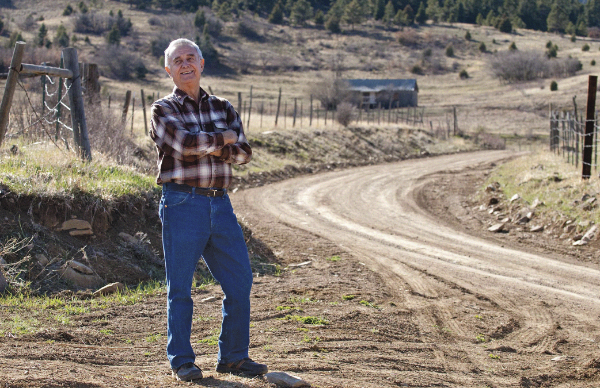
Roberto Martínez in Chacón, New Mexico. Photograph by Genevieve Russell.

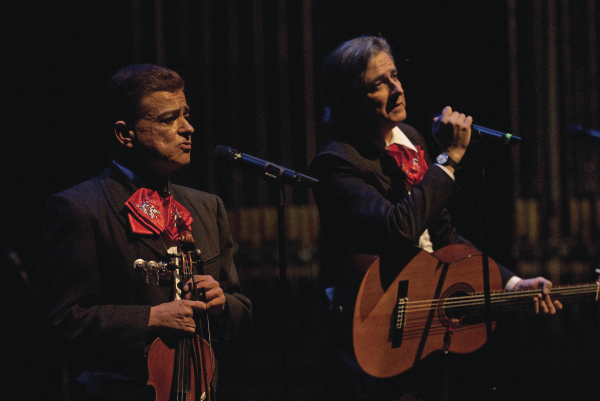
My dad was Roberto Martínez, a civil servant by day, a dashing mariachi músico by night. As a boy living a harsh life in the mountains, he had worked the land and animals, dreaming of a life as a Mexican musician. Pedro Infante, the star of Mexican cinema, planted the seed, and his uncle Flavio Lovato fanned the flames with his smooth singing voice, ready fingers to play a saxophone or guitar, and original compositions with romantic themes in Spanish.

Dad learned to strum a guitar on a homemade instrument that was not likely of high quality, but he was determined. The sounds of Penitente alabados, community sing-alongs of alabanzas, and his mom, Rosa, humming inditas to him gave Dad a steady diet of New Mexican music traditions to supplement the Mexican corridos and rancheras.

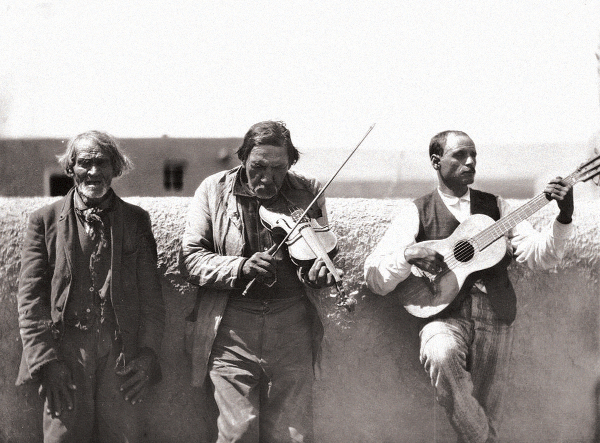
As the Second World War faded into the past, Dad enlisted in the United States Air Force. After stints in New Orleans, Puerto Rico, and Panama, he returned to his beloved New Mexico and married our mom, Ramona Elena Salazar, in Las Vegas, New Mexico. She also had a musical past: Her maternal grandfather Dionisio Ulibarri played guitar while his brother Tiburcio played the violin, the traditional instrument pairing in New Mexican Hispano music in the late 1800s into the 1900s. Mom and Dad started a family and moved north to Denver in 1951, joining the diaspora of Nuevo Mexicanos leaving the isolated mountain villages of the Sangre de Cristos in search of opportunity in the big city.

Robert Martínez’s great-grandfather Dionisio Ulibarri played guitar while his brother Tiburcio played the violin,
the traditional instrument pairing in New Mexican Hispano music in the late 1800s into the 1900s. Photograph courtesy Robert Martínez.

In Denver, Dad joined forces with Mom’s uncle Jesse Ulibarri to form a guitar and vocal duo, calling themselves Los Trobadores. Their luck started looking up when Dad was having a drink at a juke joint called El Chapultepec in a rough part of downtown. The bar owner became agitated when his music group didn’t show—so my dad, seeing an opportunity, told the man, “We can play here tonight.”

He got Jesse and they brought their guitars and established themselves as a regular act at the bar. Scattered family documents reveal a repertoire full of Mexican songs, mainly polkas and waltzes; songs that lift the spirit and help drinkers forget their woes. But it was also an education in Mexican music forms and traditions for my dad. He would later use what he learned to compose his own corridos.

El Corrido de Daniel Fernández
Amigos vengo a cantarles
El corrido de un paisano
Se llamo Daniel Fernández
Hijo Nuevomexicano

Corridos are Mexican ballads that developed out of the Romancero folk music tradition of Spain. Leading up to and as a result of the Mexican Revolution of 1912, there was an explosion of corridos written about the heroic people and events of the moment. Famous, or even infamous, men such as Pancho Villa and Emiliano Zapata were immortalized in song. Even guns were sung about and honored! Dad’s fascination and love of the music of Mexico collided with historic events—local, national, and international—that drove him to write songs to express not only his emotions, but those of his fellow Nuevo Mexicanos concerning what was happening in New Mexico, the nation, and the world.

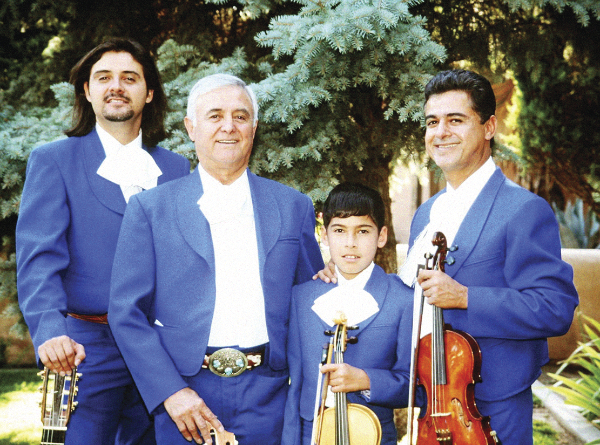
By the early 1960s, Dad moved the family to Albuquerque, where he worked at the local Air Force base and started playing with local mariachis. He then started his own group, Los Reyes de Albuquerque, playing local bars for tips, as well as weddings and parties.

By the early 1960s, Roberto Martínez moved his family to Albuquerque and started his own group,
Los Reyes de Albuquerque. They played local bars for tips, as well as weddings and parties. Pictured are Robert Martínez, Roberto Martínez, Larry Martínez, and Lorenzo Martínez. Photograph courtesy Robert Martínez.

Dad got involved with local politics as the civil rights movement lit a fire in him that would burn fiercely the rest of his life. When he read that a local young man died a hero’s death in Vietnam in 1966 by throwing himself on a grenade to save his fellow soldiers, Dad felt it his duty to commemorate and remember Daniel Fernández, and all Hispano New Mexican soldiers, in song. Further, when Reies López Tijerina and his Alianza Federal de Mercedes made national news by raiding the courthouse at Tierra Amarilla in 1967, dad was on it: composing, recording, and remembering history with a corrido.

El Corrido de Río Arriba
Año de sesenta y siete
Cinco de Julio fue el día
Habia una revolución
Halla por Tierra Amarilla

When my older siblings were in their teens, Dad came up with the idea of forming a family band, calling them Los Chamacos: The Kids. Maxine, Doris, and Lorenzo played traditional songs in Spanish in three-part harmony, but also knew some songs from The Beatles, Bob Dylan, and the Mamas and the Papas. They wore ponchos and recorded for Al Hurricane. I was about five years old, so I took it all in from the audience.

My sister Debbie was too young to be in Los Chamacos, but she had a voice like Lola Beltran, one of Mexico’s most beloved singers known for belting ranchera songs, and she would not blend. So dad dubbed her “La Chicanita” and she started a career belting out Mexican rancheras and boleros, backed by local mariachis, including Dad’s Los Reyes.

Music and other cultural forms blended and mixed in our home, creating an upbringing that had vihuelas, electric guitars, and song forms from around the world.

Our dear New Mexican Hispano culture was not forgotten. In the 1970s, Dad and Lorenzo started mining the rich violin and guitar tradition of New Mexico to record and perform redondos, chotises, pasaditos and other rhythms and melodies that reflected our mixed heritage. They even learned “San Antonio Rose,” a tune more closely associated with Western singers than with Hispano musicians. All of this music was recorded on my dad’s record label, M.O.R.E. Records. This stood for Minority Owned Recording Enterprise, in honor of his civil rights work. All the while, my dad composed corridos for many events and occasions, both tragic and happy.

In the 1980s, Dan Sheehy of the Smithsonian Institution took notice not only of our family music tradition, but the whole of Hispanic New Mexico. In 1985, we were invited to play New Mexican Hispano music at the Smithsonian Folklife Festival in Washington, D.C. It was an honor to attend such an exciting event, experiencing cultures from India to Louisiana and beyond. We represented our state and our people proudly, and were asked to come back a number of times.

In 2003, Dad and my brother Lorenzo were honored with a National Endowment for the Arts National Heritage Fellowship award for all their hard work preserving and promoting New Mexico’s violin tradition. Dad was also recognized by the Smithsonian as a corridista in a travelling exhibition called Corridos Sin Fronteras: A New World Ballad Tradition. The next year we got to play the Millennium Stage at the Kennedy Center. f

Brothers Lorenzo Martínez and Robert Martínez perform at the National Hispanic Cultural Center in Albuquerque, December 2008. Photograph by Genevieve Russell.

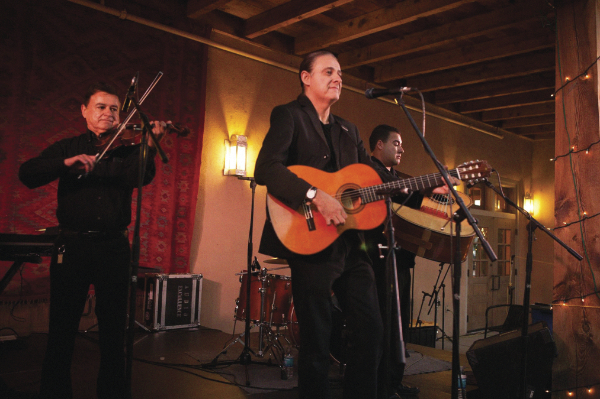
It’s been quite a ride. In 2009, Lorenzo started a mariachi tribute to The Beatles called Mariachi Mystery Tour. I got to sing my favorite Fab Four songs with a full-blown mariachi! We played some pretty big stages, such as Grand Performances in Los Angeles, the Musical Instrument Museum in Phoenix, Arizona, and the Pachanga Latino Music Festival in Austin, Texas.

Los Martínez (Lorenzo Martínez, Rob Martínez and Larry Martínez) in action at Globalquerque, September 2015. Photograph by Jim Holbrook.

And the tradition continues. As state historian of New Mexico, my goal is to preserve and promote New Mexico’s rich historical and cultural legacy. Our music is just one way to do this.

Dad is gone; so are Debbie and Maxine. But memories of familia fill my head. Memories of the aroma of tortillas, frijoles, and chile cooking in the kitchen; Dad and Los Chamacos running out the door to make a gig at the top of the Sandia Mountain on the tramway; guitars, violins, and trumpets filling the house with sound; Debbie warming up her voice to belt out songs at the state fair; a Simon and Garfunkel song playing on the family stereo; boxes of records being delivered for dad to sell; rosaries prayed in Spanish while travelling in the family car; relatives visiting and dad breaking out the homemade chokecherry wine.

“Come on kids, sing ‘Los Laureles’ for your tios and primos!” 

Robert Martínez is the state historian of New Mexico.

Genevieve Russell (opens in a new tab) is a visual storyteller and creative director whose work is rooted in documentary traditions and a deep respect for place, community, and lived experience. She lives in Santa Fe.

Jim Holbrook (opens in a new tab) became a photographer in 1973, when he enrolled in a summer course at the University of New Mexico. Later at UNM he studied under such luminaries as Beaumont Newhall, Van Deren Coke, Anne Noggle, and Betty Hahn.

Rob Martínez (opens in a new tab) is the New Mexico State Historian an a native New Mexican born and raised in Albuquerque. A graduate of the University of New Mexico with a BBA in International Business Management, Rob then went on to pursue his interest in New Mexican culture and history at the University of New Mexico, earning an MA in Latin American history, with an emphasis on church, cultural, and social practices of the Spanish Colonial period in New Mexico. Rob worked for fourteen years as a research historian for the Sephardic Legacy Project, scouring civil and church archives analyzing documents for a research and publishing project about the Crypto-Jewish phenomenon in New Mexico and the Caribbean.

Living on the Edge

By Jason S. Shapiro

In 1915, the world was consumed by a devastating world war—but it was also the year that a tall, thin, Danish archaeologist made his second trip to New Mexico in order to study the archaeology of the Galisteo Basin in the northern Rio Grande Valley.

Nels Nelson, working for the American Museum of Natural History in New York, made numerous test excavations at several large pueblos, including a site just outside the city of Santa Fe: an archaeological gem called Arroyo Hondo. When he died at age 89 in 1964, Nelson could not have known that a young archaeologist whom he once had met in the hallways of the museum in New York would, within a short time, build on his work and make Arroyo Hondo one of the most comprehensive archaeological projects in the history of Southwest archaeology.

The late Dr. Douglas Schwartz was that young archaeologist and, in 1967, he became the president of the School of American Research in Santa Fe, now the School for Advanced Research, a position he would hold until 2001. In 1970, Schwartz began a five-year project that would add immeasurably to our understanding of how people lived in and around Santa Fe more than 600 years ago. Almost fifty years later, scholars are still learning from the corpus of material uncovered, catalogued, and analyzed by Schwartz and his team.

Arroyo Hondo (LA 12) is a large pueblo site encompassing about 25 acres that sits on a small, windswept mesa about 6 miles
southeast of Santa Fe. The site is private property currently owned and maintained by the Archaeological Conservancy. Schwartz initiated his project in order to understand the chronology, culture, history, and land use patterns of the people who lived at Arroyo Hondo, together with what those patterns might mean for the larger northern Rio Grande region.

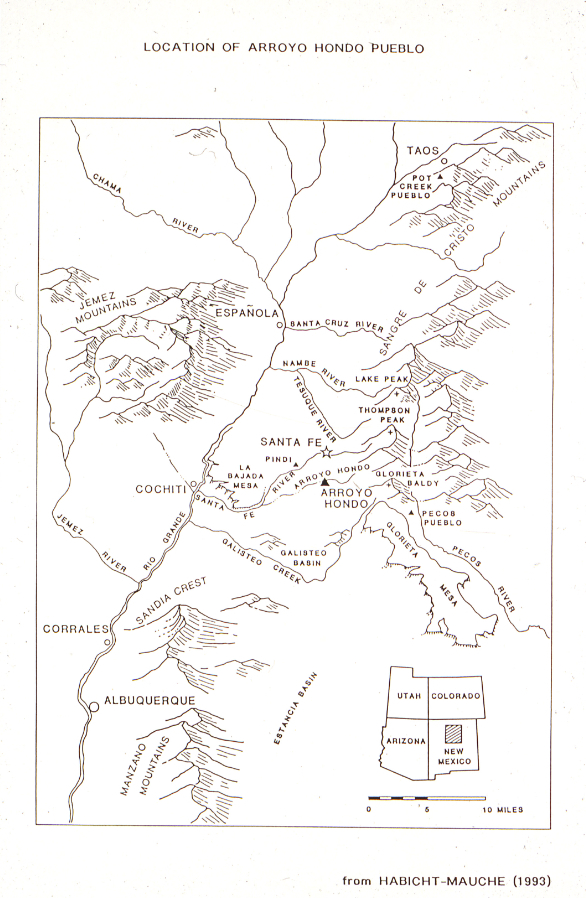
Map showing Arroyo Hondo in relation to Santa Fe and other sites referenced in text.
Courtesy the School for Advanced Research.

In order to answer his questions, Schwartz assembled an interdisciplinary research team that included archaeologists, ethnographers, ecologists, botanists, and even a professional photographer. Over the course of five field seasons, the team excavated and analyzed the roomblocks and plazas, and also recorded aspects of the local geology, hydrology, plant and animal life, climate, and geography. The results of Schwartz’s efforts have been published in a series of nine monographs together with numerous articles and academic dissertations, all of which are accessible on the official Arroyo Hondo Pueblo Project website.

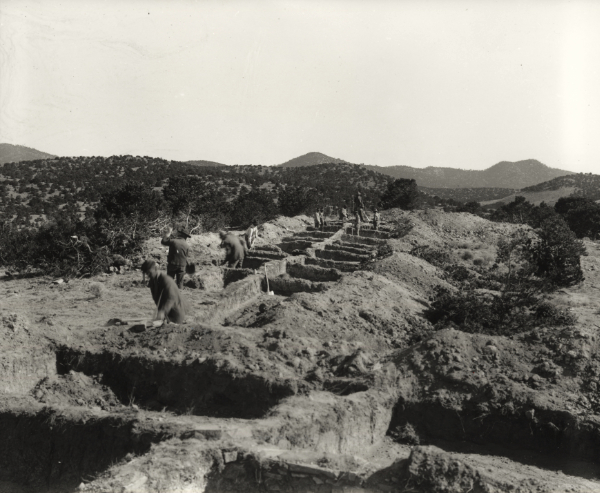
The actual pueblo remains, adjacent to a spring that is the only permanent and dependable water source along the southern edge of the Sangre de Cristo Mountains, was never a “lost site” like some Puebloan Machu Picchu. Indeed, many local residents remember that as children they rode horses across the site or played among the roomblocks. But aside from Nelson’s brief foray in 1915, and then Schwartz in 1970, no one had ever attempted to systematically excavate and analyze that site.

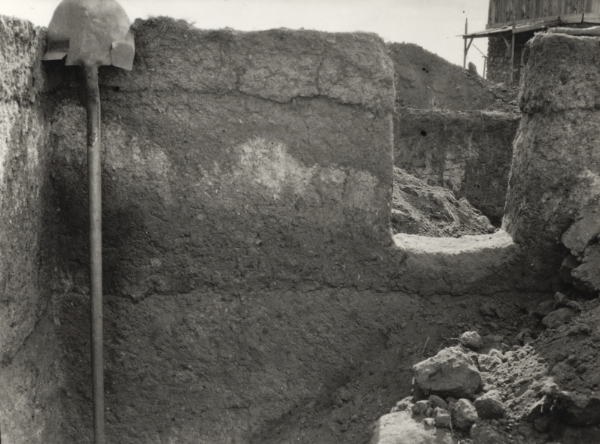
Detail of room construction showing adobe courses, ca. 1915. Photograph by N.C. Nelson. Courtesy the Department of Library Services, American Museum of Natural History, Neg. No. 2A23683.

A sequence of tree ring dates has revealed that Arroyo Hondo’s occupation straddled two cultural periods: the Coalition Period (1200–1325 CE) and the Classic Period (1325–1540 CE), a time of dynamic change throughout this region. By the late thirteenth and early fourteenth centuries, the northern Rio Grande was filling up with people—though it was an environmentally challenging area for maize-based agriculture, and there was not very much well-watered, arable land. Larger pueblos could muster more agricultural workers and warriors in what had become a highly competitive landscape. Arroyo Hondo was the first local settlement to experiment with “bigness.”

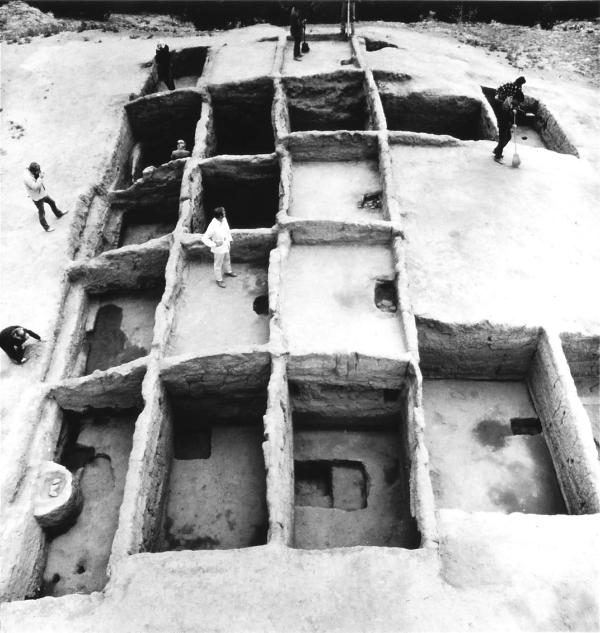
We know that Arroyo Hondo had two separate and distinct occupation episodes (components) that in total spanned about 125 years. Beginning with the initial building phase around 1300, the pueblo grew rapidly until within a few decades it encompassed 1,000 rooms arranged in twenty-four mostly orthogonal roomblocks around thirteen plazas. The initial construction was masonry—tabular sandstone rocks held together with adobe mortar, although within a relatively short time there was a shift in construction methodology to puddled adobe and “ladder type” roomblock construction. This shift most likely was for the sake of convenience; using a puddled adobe/ladder roomblock approach was a more expedient way to build larger accommodations more quickly in order to deal with an influx of people.

Excavation of Roomblock 2 showing “ladder-type” roomblock construction, ca. 1915. Photograph by N.C. Nelson. Courtesy the Department of Library Services, American Museum of Natural History, Neg. No. 128868.

Available evidence suggests that Arroyo Hondo never had more than 700 or 800 residents at its maximum and probably fewer people for most of its occupation, but that still made it the largest single community in the vicinity of Santa Fe in its time. The initial construction is identified as Component I. Nothing in this area had previously been built that looked anything like Arroyo Hondo, but subsequent local pueblo constructions loosely followed the template established by Arroyo Hondo. Given its protected setting on a natural bench overlooking Arroyo Hondo Creek, the site seemingly had a favorable location. However, for reasons that are not entirely clear and which may be related to an extended drought, by the 1340s Arroyo Hondo could no longer feed its population and the remaining residents left. After a hiatus of perhaps twenty-five or thirty years, some people arrived at the site and built a new and separate pueblo literally on top of the old one.

This second settlement is denoted as Component II, but in some ways it is so different from the original pueblo that it could be considered an entirely new settlement. Only ten of the original twenty-four roomblocks were rebuilt, which resulted in a much smaller pueblo with approximately 200 rooms and only three plazas. Clusters of tree ring dates indicate the builders of Component II worked at a relatively rapid pace, particularly during the 1380s, but this new settlement was occupied for no more than two generations before it too was abandoned.

Archaeologists have found evidence of extensive burning throughout the pueblo associated with tree ring dates around 1410 that initially supported the idea of an external attack by raiders from another community. This hypothesis is still supported by a number of archaeologists, but Dr. Ann Palkovich has suggested an alternative hypothesis based upon intra-pueblo violence. Whether this violence was the result of tensions among political factions, different cultural groups, or even because of alleged witchcraft is not clear. The presence of several unburied skeletons, physically traumatized skeletons, and twenty-five skulls without bodies is clear evidence of some kind of violent episode, whether internally or externally based.

In addition to its much smaller size, the residents of Component II organized their space differently than had the residents of Component I. Living areas within the roomblocks became somewhat more private and more difficult to access, whereas public spaces such as plazas became more accessible and less restricted than they had been during the initial occupation. Whether these differences reflected fundamental changes in community social structure or whether they reflect different needs associated with the much smaller second occupation remains to be determined. In any event, after the fires in the 1420s, the burned rooms were not reused and the last residents appear to have left the pueblo around 1425.

In order to properly appreciate Arroyo Hondo within its complete context, one also needs to know that the large Classic site is less than 2 miles downstream from Upper Arroyo Hondo (LA 76), an earlier Coalition Period settlement with possibly 100 to 200 rooms. Although it has never been fully surveyed and barely tested—Nelson excavated twelve rooms in 1915—its size and location make Upper Arroyo Hondo a presumed contributor for at least some of the people who built and occupied the larger pueblo downstream. The Coalition Period was locally characterized by numerous small settlements all located along small secondary and even tertiary streams. While a few larger sites such as Pindi and Agua Fria Schoolhouse were built along the Santa Fe River corridor south of the city and were eventually comprised of as many as 200 or more rooms, most of the contemporaneous Coalition sites had fewer than a hundred rooms.

Although a class of specialized Pueblo architects probably never existed, the enclosed plaza layout at Arroyo Hondo suggests a degree of community-level planning by some “core group” who designed the settlement according to preconceived ideas of “how things should look.” Classic Period pueblos such as Arroyo Hondo may appear more planned and less eccentric than the earlier Coalition pueblos because the method of decision-making may have changed. This does not mean these pueblos were always built in a single construction episode, but it implies some overriding and mutually acceptable idea about how pueblos like Arroyo Hondo should look. Not every large settlement that developed during the Classic Period was configured the same way but, overall, the size and spatial complexity of Classic pueblos was unlike anything that had ever been built before in the northern Rio Grande.

One notable element at Arroyo Hondo is that the thirteen plazas are not interconnected; rather, each plaza has its own external gateway that controls access. The existence of the gateways suggests that individual plaza-roomblock sections did not blend seamlessly into one another but were designed as semi-discrete units within the larger settlement. People could move between the plazas and roomblocks, but overall, the plaza-roomblock design at Arroyo Hondo allowed resident groups to maintain some autonomy within self-contained and plaza-centered “barrios.”

View of partially excavated Roomblock 16, Component II, showing a variety of floor and wall features, ca. 1973. Photograph by David Noble, courtesy the School for Advanced Research.

The assumption is that as Arroyo Hondo absorbed the residents of numerous smaller Coalition Period communities, it must have functioned as more of a “mixing bowl” than a “melting pot.” At Arroyo Hondo one can see that pueblos were no longer just variations of large, extended family compounds; they were evolving into small towns with more complexity and internal diversity but where residents still knew almost everyone with whom they lived and interacted.

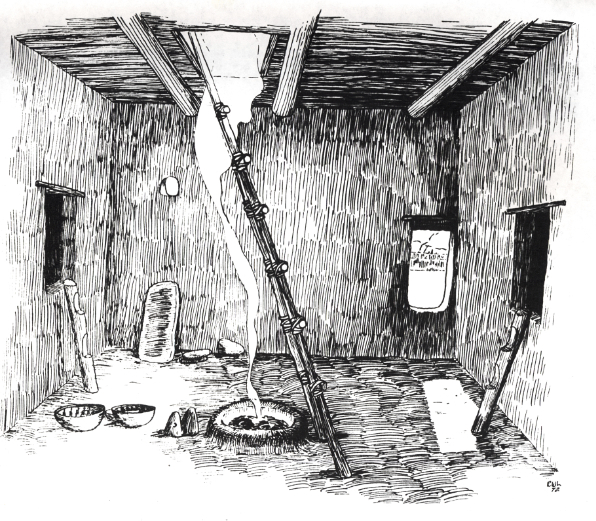
A typical residential room at Arroyo Hondo was probably quite spartan, but readers should not infer that ruled out the existence of art, music, and a complex spirituality rooted in the natural world. Among the innumerable pottery sherds and stone tools, archaeologists discovered bone, shell, and ceramic pendants, beads and other kinds of jewelry; as well as ornaments: a variety of ceramic and carved stone pipes, ceramic and carved stone animal effigies, ceremonial stones, a prayer plume base, and several bone whistles and other musical instruments. Life at Arroyo Hondo was demanding, but it was not without its pleasures.

Interior Room 36, Roomblock 16, depicted ca. 1325. Illustration by R.W. Lang.
Courtesy the School for Advanced Research.

Although it would be nice to say that Arroyo Hondo thrived, “struggled” is probably a more accurate description of life in the pueblo, and there is compelling evidence that the people living at Arroyo Hondo were not in robust health. Skeletal remains suggest a scenario of a community under substantial nutritional stress, experiencing high infant mortality, and suffering from an incidence of anemia greater than most of the surrounding pueblos, including El Pueblo de Santa Fe (LA 1051), located under the Santa Fe Convention Center, a mere 5 or 6 miles to the north.

As stated by Nancy Akins, an osteologist with the New Mexico Office of Archaeological Studies, “Rather than typical, the Arroyo Hondo population, or at least segments of that population, was considerably more stressed than other groups in the surrounding area. Life and the general health at LA 1051 were probably more typical of the Late Coalition and Early Classic periods in the northern Rio Grande.” The people at Arroyo Hondo did the best they could, but the vagaries of soil and water conditions meant that Arroyo Hondo’s existence was always somewhat marginal.

As a matter of fact, a subset of the population actually suffered from rickets, a remarkable conclusion given that the disease results from a Vitamin D deficiency in an area that receives more than 300 days of sunshine every year. Dr. Palkovich, who reached that conclusion based upon careful examination of Arroyo Hondo’s skeletal remains, believes that groups of children had been kept indoors for extended periods either because of concerns for their safety, or because they constituted a marginalized group—perhaps war captives or an out-of-favor ethnic minority living in the pueblo.

One of the ongoing challenges for archaeologists is to reconcile seemingly incompatible data. If the mortuary remains from El Pueblo de Santa Fe reveal a much healthier, more vigorous population with little evidence of either the nutritional stress or physical trauma experienced at Arroyo Hondo, one wants to understand this dichotomy. Did the residents of El Pueblo de Santa Fe have access to more and better food, especially protein? Were the downtown residents connected to social or economic networks that provided them with both material support and protection that Arroyo Hondo did not have? Archaeologists have not yet answered the question why two contemporaneous settlements so close together should have such divergent demographic profiles, but it is yet another issue that demonstrates the need for continuing study.

As archaeologists, we need to remain sensitive to the reality that as we excavate “our sites,” they constitute places where real people lived out real lives. Seven hundred years ago, Arroyo Hondo was a place where several generations of people were born, worked, farmed, struggled, and died. Both Upper and Lower Arroyo Hondo were most likely southern Tewa sites, and as such, both appear to have constructed a Tewa-like network of shrines that helped to structure a spiritual life that extended far into the surrounding landscape beyond the roomblocks and plazas.

Dr. Alfonso Ortiz, the late anthropologist from Ohkay Owingeh Pueblo, has written about Tewa shrine systems, and the remnants of the system at Arroyo Hondo appear consistent with Ortiz’s writings. The fact that Tewa speakers had a formal name for Arroyo Hondo (Kua-Kaa) may not necessarily be determinative of Tewa status, but it demonstrates that at a minimum, the Tewa were aware of Arroyo Hondo as a place in their ethnogeography.

The shrines identified at Arroyo Hondo include one large world quarter shrine (a semi-subterranean unroofed rock circle), several ground slick rocks (stones in the ground used to grind and sharpen tools, but also serve an ideological purpose; grinding was paired with making offerings and contemplating community), a few upright boulders, and formerly at least one large boulder with cupules ground into its surface (unfortunately, the boulder “disappeared” from its position near a residential road). 

Although Arroyo Hondo has generally avoided the vicissitudes of pot-hunting that has been a scourge throughout the Southwest, the encroachment of residential development has definitely impinged upon and affected areas with cultural deposits adjacent to the pueblo.

The world quarter shrine (LA 10608) was located on a small hill approximately three quarters of a mile southeast of Arroyo Hondo and was identified and photographed by Nelson in 1915. Most large Tewa sites are associated with these circular, semi-subterranean, uncovered structures that appear to have been used in connection with agricultural rituals.

In 2005, in preparation for the construction of a private residence that ultimately destroyed the shrine, it was surveyed, mapped, and tested in connection with a legally mandated archaeological data recovery program. Diagnostic pottery sherds associated with the shrine were consistent with the early fourteenth- through early fifteenth-century occupations at Arroyo Hondo. The final survey report produced by Lone Mountain Associates is ultimately noncommittal regarding the nature and affiliation of the shrine, and concludes: “The site may have been part of the ritual landscape network of three different pueblos, beginning with Lower Arroyo Hondo, followed by Pecos Pueblo, and most recently the home of the Pecos Pueblo descendants, Jemez Pueblo. Each affiliation likely brought a different set of relationships with similar sites on the landscape.”

In other words, the affiliation and use of that shrine, while initially part of Arroyo Hondo’s ritual network, may have been recycled and repurposed by subsequent communities.

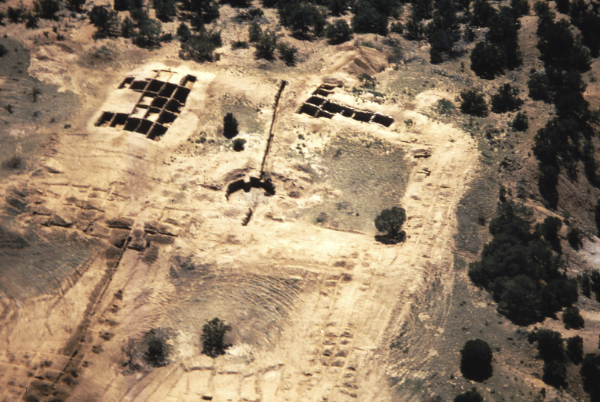
Aerial view of partially excavated eastern section of Arroyo Hondo showing Roomblocks 10 and 11 as well as Plaza C. Photograph by David Noble, courtesy the School for Advanced Research.

Conceivably, a pueblo as small as Arroyo Hondo’s second occupation, located in a somewhat marginal agricultural zone, simply could not sustain itself, and so became a target for one or more of the larger local pueblos that had developed by that time. One enduring question has always been, “So, where did the remaining people go?”

As the crow flies heading due west from Arroyo Hondo, it is not far to the pueblos of Cieneguilla and La Bajada. Either of these pueblos could have absorbed the relatively small population from Arroyo Hondo, and logic tells us that one or both settlements may have done just that. Logic, however, is not a substitute for evidence, and neither archaeology nor ethnography has provided any clear answers. None of the contemporary Rio Grande pueblos have claimed any ancestral relationship with Arroyo Hondo. This is an almost unprecedented situation within the complex cultural landscape of the northern Rio Grande, where residential abandonment and relocation does not usually denote a permanent loss of connection to a former settlement, and where traditional associations with archaeological remains are passionately guarded and maintained. Ancestral sites and cultural landscapes remain an important and active component of Pueblo life, and yet for reasons that have never been articulated but probably involve some past traumatic event, no descendant Pueblo community wants to be associated with Arroyo Hondo.

The final occupation of Arroyo Hondo ended in the early part of the fifteenth century, around the same time that the occupations of several other local pueblos (including Pindi, Agua Fria Schoolhouse, Chamisa Locita, and El Pueblo de Santa Fe) also ended. The results of several excavations in the city of Santa Fe support the view that the downtown settlements were either completely or substantially unoccupied within a generation or two after 1400. Thus, three of the fourteenth century’s local settlement nodes—east of the city, west of the city, and downtown—all closed down within slightly more than a century.

During the early fifteenth century, there seems to have been a wholesale shift in settlements away from higher elevations in favor of lower elevations near water sources that was encouraged by the “usual suspects,” including the onset of cooler temperatures and shortened growing seasons, drought, population pressure on limited resources such as arable land, and conflict. If we substitute the term “settlement shifting” for the culturally loaded term “abandonment,” then the idea of mobility, of being able to relocate when conditions were not conducive to group survival, appears to have been a constant theme. Fifteenth-century Puebloan farmers may have had a more difficult time relocating to new areas than did small bands of Archaic foragers 1,500 years earlier, but the adaptive strategy was essentially the same.

Archaeologists survey the area around the pueblo. Photograph courtesy the School for Advanced Research.

Even with all this settlement-shifting, people continued to occupy areas north of Santa Fe in the Tesuque Basin, south of the city along the Santa Fe River near the Cienega escarpment, and in particular, southeast of the city in the Galisteo Basin where several Classic Period pueblos more than twice as large as Arroyo Hondo were built. Beyond the immediate vicinity of Santa Fe, large towns existed at Pecos, Taos, and the areas around Albuquerque, a number of which remained occupied at the time of the Spanish entrada.

In my opinion, the roomblock-and-plaza style that evolved during the fourteenth century as exemplified by Arroyo Hondo was a more sustainable form than the smaller Coalition Period settlements. The evolution of settlement form was not just about aggregation, the idea of collecting people into larger units, but also included amalgamation and accommodation. People found themselves living in communities that were both larger and more diverse than the Coalition communities of only a few generations past. Everyone needed access to land and water and people had to be blended into the community’s social fabric.

If we cut away all the overlays of social and cultural elaboration and are willing to indulge in some reductionism, we can say that the Classic Period was essentially about the idea of “bigness” as an adaptive solution to the problems of environmental productivity, population growth, and conflict. In a sense, bigness became the ultimate survival strategy that packaged economic, social, political, and ideological ingredients in new and larger ways in order to ameliorate the inherent riskiness of life in the northern Rio Grande. Even though Arroyo Hondo did not persist as long as some communities, it was the first local community to experiment with “bigness.” The sheer size of subsequent Classic pueblos coupled with their apparent ability to field a critical mass of warriors suggests that the capacity to “look big” was really important, an early manifestation of Cold War Deterrence during a period of considerable local volatility, uncertainty, and anxiety.

Bigger settlements were built, bigger associations of those settlements were created, and finally even bigger ideological and ceremonial movements such as the Katsina system and inter-community medicine societies evolved. The ways in which those “big” entities were organized and directed are still being studied, but if institutional continuity is one proxy of measure for long-term cultural success, then we know that at least until the sixteenth century when Europeans arrived in the Rio Grande Valley, all three elements—large pueblos, multiple alliance systems, and large-scale ceremonial systems—were still going strong.

Arroyo Hondo has something to tell us about the dynamic cycles that many northern Rio Grande communities experienced. The three Arroyo Hondos all grew, declined, were abandoned, in some cases reused, and in the final case, were seemingly wiped off the collective memories of local Pueblo people. These cycles form a common thread throughout Southwestern archaeology, and yet very few communities have three separate and distinct occupations that can be analyzed as either standalone sites or viewed as part of a singular process.

We cannot be certain of what the residents of Arroyo Hondo thought about their pueblos or how they viewed the role of those pueblos within the larger environment that included other communities as well as local and distant landscapes, but Arroyo Hondo remains a place, a process, and a people that is critically important for a more complete understanding of the archaeology of the northern Rio Grande.

Jason S. Shapiro, PhD, is the site steward for Arroyo Hondo Pueblo. He has been studying and writing about Arroyo Hondo for twenty-five years. This article is dedicated to the vision, research, and memory of Dr. Douglas W. Schwartz.

David Grant Noble is a writer and photographer whose books include In the Places of the Spirits, Ancient Ruins of the Southwest: An Archaeological Guide, and In Search of Chaco: New Approaches to an Archaeological Enigma.

Dr. Jason "Jay" S. Shapiro is a retired archaeologist living in Santa Fe. In addition to several prior contributions to El Palacio, Dr. Shapiro is the author of Before Santa Fe, The Archaeology of the City Different (Museum of New Mexico Press, 2008), the first comprehensive synthesis of the Santa Fe region.

Twenty in Twenty

By Jadira Gurulé

Over the years, the National Hispanic Cultural Center Art Museum has presented exhibitions that explore visual culture, identity, social issues, and creative expression from around the world. Each year, the NHCC Art Museum presents an average of five exhibitions in its three gallery spaces and offers a robust schedule of educational programming that invites children, families, and adults to explore the richness of Hispanic, Latina/o/x, and Latin American art from a variety of perspectives. Exhibitions over the last few years focused on subject matter that encouraged visitors to think deeply about a range of topics such as racial equity in New Mexico, the complexity of subculture and stereotypes, the implications of colonial histories on art, and cultural consumption in a transnational context.

As the NHCC as a whole is celebrating its twentieth birthday this year, the museum hosts Mira, Mira On the Wall: Reflecting on 20 Years of Exhibitions as an institutional retrospective recounting the significant exhibitions that have been presented over the last two decades, and their impact on the permanent collection.

The NHCC opened its doors on October 20, 2000, in the historic Barelas neighborhood in Albuquerque, New Mexico. It was born in a climate of nationwide efforts to establish ethnic-specific cultural centers, often in response to exclusionary practices in more mainstream arts venues. As a part of the State of New Mexico’s Department of Cultural Affairs, it has been a multidisciplinary art and cultural hub. It currently hosts programs in history and literary arts, performing arts, and visual arts, all of which present a variety of year-round programs.

Mira, Mira On the Wall is a multigenerational exhibition for visitors to reflect on together. While exhibitions that serve as retrospectives or institutional reviews are somewhat common and may not sound particularly dynamic at first, they are important endeavors that can allow an institution to hold up a mirror to its own initiatives and examine their impact. Mira, Mira features old favorites from the collection in a new light, and gives museum staff, volunteers, and visitors the opportunity to reconnect with artworks within the larger framework of the museum’s historical trajectory—which ultimately ends up tracing the identity of the museum itself.

Historically, museums have played an important, and often problematic, role in constructing a sense of national identity. In many cases, they reinforce socially constructed hierarchies related to identity and culture. For decades, but particularly in recent years, the museum world has been the scene of numerous calls by the public to consider a range of issues, including the impact of inequity in hiring practices, the continued privileging of some content over others, gender imbalances in collecting priorities, censorship, and the business dealings of funding sources. A 2014 survey conducted by the Andrew W. Mellon Foundation is an example of nationwide struggles with equitable hiring practices in the field; the foundation studied the demographics of museum workers across the United States. Results showed that the demographics of those working in museums were about 10 percent less diverse than the population. Only 3 percent of leadership positions were filled by people of Hispanic background in a country that, according to the U.S. Census Bureau at that time, was at least 17 percent Hispanic.

In response to this climate of speaking out about what museums can and should do for the public, many museums are taking action. The Mellon Foundation has reported an upward trend in the hiring of people of color since their report in 2014. Earlier this year, the Whitney Museum of American Art in New York hosted an exhibition featuring the work of Mexican muralists and their impact on bringing social justice concerns to light, as well as their influence on other artists in the United States. The Baltimore Museum of Art has decided to address the gender imbalance in their collections by only purchasing art created by women in 2020. And further, a number of museums across the nation have cut ties with problematic funding sources (for example, those that are involved in the opioid market) and are working toward transparency in this area.

These are exciting times to be a part of a museum and to participate in transforming the work they do for and alongside those they serve. In many ways, the NHCC Art Museum has been engaged in this work since it opened. Yet, if there is anything to learn from cultural moments like these, it is that there is always work to be done and room to grow. It is a reminder that all institutions have blind spots, and it is important to create opportunities to review what has been done, to consider what changes need to be made, and to do so with best efforts made toward honesty and transparency with the communities we serve.

Mira, Mira is intended to be a first step in this endeavor; a place to take stock of the museum’s big picture and the collaborations that have made it possible, and gather feedback from visitors.

The Museum
Since 2000, the NHCC Art Museum has presented approximately seventy exhibitions, and currently serves as home to a rapidly growing permanent collection of over 3,000 artworks from around the world.

Currently, the museum space is divided into three gallery areas. One features rotating artworks showcasing the breadth of the permanent collection. It is a place where one can, from a single vantage point, put a third of a 1963 Cadillac decorated with line drawings that reference tattoos and paño art (Luis Tapia, A Slice of American Pie, 2008) in conversation with an abstract line-drawing of nude figures (1998) by Mexican artist Karima Muyaes or a screen print of a portrait, Chameleon 1492 (2012), by Dominican-American artist Scherezade Garcia. The permanent collection exhibition space is all about dialogue between local, national, and international art.

In the heart of the museum is the Community Gallery, which is dedicated to showcasing artworks by New Mexican artists and themes that are relevant to our local culture. This gallery has hosted exhibitions that present the range of artistic production taking place in New Mexico. It is also an exhibition space that has been guest-curated by New Mexican artists, as well as one that has served as the first curatorial experience on the resumes of a number of the museum’s student interns. The Community Gallery also hosts two recurring series: Nuestros Maestros, which honors the legacies of often under-recognized New Mexican artists, and a santo series that examines the importance of religious iconography in New Mexican art. Exhibitions within the latter series are indebted to the contributions of artists often blending traditional techniques and contemporary themes, many of whom show their work at Spanish Market.

The large galleries in the southern part of the museum feature rotating large-scale exhibitions including those that are conceived in-house, such as the recent Qué Chola and El Perú: Art in the Contemporary Past, as well as traveling exhibitions like 2016’s House On Mango Street: Artists Interpret Community from the National Museum of Mexican Art, which celebrated the iconic Chicana novel by Sandra Cisneros. Mira, Mira On the Wall features artworks from exhibitions that have been presented in every gallery space and from exhibitions that travelled to the museum as well as those curated in-house. Every artwork on display is a part of the NHCC Art Museum’s permanent collection and speaks to the relationship between exhibitions and collections.

A Sample of What to See
While the big picture is important for any museum’s retrospective, the small picture (or small sculpture, or small textile) is significant too, in that each and every artwork presented doesn’t just help illustrate the museum’s history of exhibits. Each artwork also stands for itself and reminds us of the creative labor and dedication of each artist that ultimately makes every exhibition possible. This exhibition is also very much about honoring the contributions of the artists that have worked with the museum staff over the years.

Mira, Mira On the Wall includes interviews with former and current museum staff, interns, volunteers, and artists. Catalogs and gallery guides from exhibits are on view, as are excerpts from comment books. It provides ample opportunity for visitors to share their thoughts, experiences, and feedback with the museum and, of course, it showcases artworks from the NHCC Art Museum permanent collection that have been shown in at least one exhibition at the NHCC in prior years.

One of the first artworks to grace the walls of the NHCC Art Museum was El Comanche David, Talpa, New Mexico (1996), by Española-born photographer Miguel Gandert. Nuevo Mexico Profundo: Images of an Indo-Hispanic Homeland was the museum’s first exhibition (October 20, 2000 through May 2001). This exhibition featured a number of photographs by Gandert taken throughout New Mexico that examined the intersections of Indigenous and Hispanic identity and cultural practice that are so characteristic of Northern New Mexico and the state’s complex and layered colonial history. Gandert’s closeness with the dancer David Gonzales is representative of the intimacy and spontaneity that he is able to capture in his work. A number of photographs from this first exhibition are housed in the NHCC Art Museum’s permanent collection and a small selection are on display.

[wonderplugin_slider id=174 alignment=”center”]

The exhibition Latin American Posters: Public Aesthetics and Mass Politics (September 2006 through March 2007) is another example of the collaborative history of the museum. This exhibition featured posters and prints from the NHCC collection as well as from the Sam L. Slick Collection of Latin American and Iberian Posters on behalf of the University of New Mexico’s University Libraries Center for Southwest Research and the Center for Regional Studies. Posters from throughout Latin America and the United States created a stunning commentary on the role of art in the global sociopolitical climate.

Many of these images are iconic representations of artist activism, including one by California-based Chicana artist Ester Hernández, titled Sun Mad (1982). Hernández comes from a family of farmworkers and activists with the United Farm Workers. For this print, she draws attention to the hazardous working conditions for many farmworkers by using the recognizable Sun Maid Raisins imagery, but instead depicting the young maid as a calavera in an undeniable critique with continued relevance.

Artworks from the exhibition Caminos Distintos: Patrocinio Barela and Edward Gonzales in New Mexico (February 2007 through August 2008) reflect two significant collections of each artist’s work housed in the museum’s permanent collection. The exhibition placed the artwork of Barela and Gonzales in conversation as two groundbreaking artists with significant contributions to the ways in which New Mexican and Hispanic art are perceived. Barela was a woodcarver from Taos known for his organic and emotive bultos that embrace the natural curvature of the wood. Gonzales is a painter and a printmaker from Albuquerque whose work is often based on old photographs in an effort to depict complex and realistic visions of New Mexican Hispanic life. Gonzales’s Commemorative Portrait of Patrocinio Barela (1989) reflects the overlapping contributions of these artists, as well as Gonzales’s interest in representing important Hispanic figures in his work.

New Mex Now Mix (August 2008 through January 2009) was the inaugural exhibition in the museum’s Community Gallery, and it featured artworks by four contemporary mixed media artists turning everyday objects into art. Artists included the digital photo-montage artist Alex Chávez; recycled metal assemblage artist Kenny Chavez; and Goldie Garcia and Johnny Salas, both of whom use found objects, sequins, and glitter to create large and small devotional shrines paying homage to significant figures and religious icons. Goldie Garcia, innovator of glitter bottle cap art, created Guadalupe’s Chooe Shoe (2004) from a high heel to show off Our Lady of Guadalupe’s glamourous side. The work of these four artists is significant for the ways they push the boundaries of what can be considered art materials, and is also grounded in an accessible cultural aesthetic. These four were the perfect artists to be featured in the first exhibition in the Community Gallery, a gallery that celebrates the range of artistic production by New Mexican artists.

In September 2008, the museum opened Meso-Americhanics: (Maneuvering Mestizaje) de la Torre Brothers & Border Baroque (September 2008 through August 2009), featuring larger-than-life blown glass and found object sculptures that transformed the museum space into the vision of two brothers, Einar and Jamex de la Torre. The de la Torre brothers were born in Guadalajara, México, but live and work on both sides of the border. Their work is about hybridity, the borderlands, and an identity that doesn’t fit neatly in a box—all of which are themes that arise frequently in exhibitions presented at the NHCC Art Museum and certainly in the broader Latina/o/x art world.

Marte y Venus (1997) is the brothers’ commentary on the pop psychology book Men Are from Mars, Women Are from Venus. The best-selling 1992 volume addressed the emotional and communication styles expressed by different genders. Here, the “Martians” are represented by a red bull, an icon of strength and symbol of the ritualistic bullfighting of Spain and Mexico. Women are “on top” in the form of the statue of Venus, after Alessandro Botticelli’s Birth of Venus (ca. 1485). Her feet rest on a scallop shell which has been labeled with the Shell Oil Company logo. The brothers have a gift for blending multiple references that often result in complex social commentary.

En La Cocina with San Pascual (September 2013 through June 2014) began the museum’s series that examines the role of religious iconography in New Mexican art. San Pascual (also spelled Pasqual or Pasquale) is the beloved “saint of the kitchen” featured in numerous representations in New Mexican and Mexican art. The exhibition explored this saint’s image and highlighted how a range of artists rendered him in their work, often through intricately carved wood and paint made of natural pigments. In a 2012 retablo by Joe Gabaldon, he included images of red and green chile as if to note the critical presence of these foods in any New Mexican kitchen. Since this first exhibition of the santo series, the Art Museum has also presented Outstanding in His Field: San Ysidro – Patron Saint of Farmers (April 2017 through November 2017) and Southwest of Eden: The Art of Adam and Eve (May 2019 through March 2020). The latter was a body of artwork collected over the span of twelve years and was recently donated to the museum by the collector, Dr. Joyce Kaser.

The African Presence in México: From Yanga to the Present (March 2007 through August 2007) and AfroBrasil: Art and Identities (December 2014 through August 2015) explored the complexity of Afro-Latino identity and art. The African Presence in México travelled to the NHCC from the National Museum of Mexican Art in Chicago, and AfroBrasil resulted from a collaboration between the NHCC Art Museum, the University of New Mexico Art Museum, UNM’s Center for Southwest Research, and UNM’s Tamarind Institute.

AfroBrasil featured a number of lithographs created at Tamarind in 2012, including one by the Brazilian artist Rosana Paulino titled Assentemento #1 /Settlement #1 (2012), which is now included in the NHCC Art Museum permanent collection. This image is part of a series which features a woman photographed on the Thayer Expedition to Brazil (1865–66). The photograph references images of women in slavery in the United States and the use of photography and pseudo-science to rationalize slavery, a practice with profound and long-lasting impacts on the visual, social, and material effects of race and gender on a global scale. Here, Paulino reclaims this imagery and history and redirects its purpose to Brazilian place and identity. Her image, with what appear to be roots extending from the woman’s head and feet, draws attention to both the violence contained within this type of imagery and the physical and spiritual destruction of enslaving human beings. Exhibitions like these have been critical to the NHCC Art Museum’s role in facilitating dialogue around subjects related to social justice through art.

While posters and prints have a long and recognized history of being used by artists for social commentary, other forms of paper art have not been as recognized. The exhibition ¡PAPEL! Pico, Rico, y Chico (June 2014 through January 2015) noted the history of papel picado (cut, perforated, or punched paper), including its use in devotional spaces and by artists to present social and political critique. The exhibit featured four artists: Catalina Delgado-Trunk, Cay Garcia, Kai Margarida-Ramírez, and Josie Mohr, all of whom have developed stunning and unique approaches to this delicate and ephemeral art form. Catalina Delgado-Trunk’s La Nao de China (2006) refers to the Spanish trading ships that travelled between Mexico, Manila, and China that carried a number of items, including tissue paper. Here, Delgado-Trunk is noting the transnational movement of goods as well as artistic traditions through an image of la sirena, or mermaid, and La China Poblana, a well-known symbol of Mexico with a connection to the Manila Galleons trade routes.

[wonderplugin_slider id=175 alignment=”center”]

Paper, in yet another form, took center stage in The Piñata Exhibit – Sure to be a Smash Hit! (June 2017 through April 2018) which showcased piñatas as art and illustrated their transnational cultural histories. For this exhibition, museum staff worked closely with local piñateros or piñata artists to learn about technique and inspiration for this endangered art form. In addition to piñatas created in more traditional styles, the exhibit also featured numerous pop culture references, political piñatas, and the work of artists taking the form of the piñata to new levels. One such artist is Justin Favela, a piñata muralist, who uses similar tissue paper techniques to transform spaces into elaborate and colorful paper landscapes. Favela travelled to Albuquerque to create a site-specific installation for the exhibit. His research included touring the city and seeking out buildings with lost, unpreserved, or covered-up murals. He chose to work with the façade of the neighborhood bar El Madrid (now closed), and recreated the front of this building and the murals that used to be present on it, piñata-style, right in the museum. Favela is also known for creating piñata lowriders. Pura Suerte (2016) was created as a collaborative effort with Favela at the New Mexico Museum of Art in Santa Fe. The car references the state’s centennial license plate through the turquoise and yellow colors of the lowrider.

The cultural symbol of the lowrider continued to be at play in one of the museum’s 2019 exhibitions, Qué Chola (March 2019 through August 2019), but in a way that challenged the gender roles associated with car culture. Qué Chola was an exhibition that featured cholas and homegirls in art and pop culture and celebrated them as symbols of strength, power, and resilience in the face of racial, gender, and economic adversity. It featured artworks predominantly by women of color and explored the increased popularity of the chola as an archetype as well as her resistance to gender norms and dominant expectations of femininity. The NHCC Art Museum was able to acquire three artworks from this exhibition, including Peacock (2018) by Denver-based artist Antonia Huerta. In her artist statement, Huerta connects the modern-day chola with her World War II-era precursor, the pachuca. This intimate portrait becomes a representation of women challenging societal norms and stereotypes.

The museum’s trajectory over the last twenty years has been influenced by the hard work and contributions of artists, NHCC staff members, partners, volunteers, and visitors from across the world. It is our hope that this exhibition becomes an opportunity to celebrate the hard work of all who participated in making the museum what it is today, to take a broad view of the work the museum does, to account for the areas that have been overlooked, and to gather critical feedback about what our visitors want and need from us moving forward. 

Jadira Gurulé is a curator at the National Hispanic Cultural Center Art Museum, where she organized exhibitions such as Qué Chola (2019) and Because It’s Time: Unraveling Race and Place in NM (2018).​

Christopher Roybal is a photographer and videographer from El Valle de Arroyo Seco, New Mexico

Jadira Gurulé (opens in a new tab) is a curator at the National Hispanic Cultural Center Art Museum, where she organized exhibitions such as Qué Chola (2019) and Because It’s Time: Unraveling Race and Place in NM (2018). Jadira has a MA in American Studies from the University of New Mexico where she studied Visual Culture with an emphasis on race, gender, identity, and culture.

A Kid In Lincoln’s Pageant

By Jason Strykowski

Long before he painted an official presidential portrait, Peter Hurd portrayed a notorious perpetrator. The Roswell-born artist was the first actor to take the title role in the inaugural Last Escape of Billy the Kid pageant staged in 1940. The event was held on the very spot where the actual Billy the Kid engineered his getaway fifty-nine years earlier.

The pageant demanded a star who could ride a horse, brandish a firearm, and hold himself with a little bit of panache. Hurd fit the bill. He was raised in wide-open country near Roswell and was trained at the New Mexico Military Institute and at West Point. He boxed and played water polo. Hurd also had a penchant for riding naked in the middle of night. His lifelong friend, the Pulitzer Prize-winning author Paul Horgan, proclaimed that “Hurd’s horsemanship deserves a word to itself, for it is extraordinary in its physical expertness and grace.”

Hurd would go on to distinguish himself as one of the preeminent painters of the Southwest. Taught by the illustrator N. C. Wyeth, Hurd painted dynamic scenes of regional life. During World War II, he entered the fray as an artistic war reporter for Time Life. Later, he painted the official portrait of President Lyndon B. Johnson. Hurd transformed himself into one of the best known Southern New Mexicans, so it’s not a coincidence that he earned the right to play the region’s most famous one.

Billy the Kid, alias Henry McCarty, alias Kid Antrim, alias William H. Bonney, transcended his life as a cattle rustler, cow puncher, and murderer to become a household name and the subject of an opera, stage play, novels, comic books, and even ballet. Perhaps no other historical American has inspired and featured in so many films and television shows. In a 1966 film, Billy the Kid even faced down Dracula.

Not surprising that the people of Lincoln wanted to get in on the Billy the Kid phenomenon. In 1940, as part of an event to commemorate the quatercentenary of the Coronado entrada, the townsfolk in Lincoln staged a recreation of the expedition. They also used the opportunity to reenact their local history. The events, of course, included an homage to Billy the Kid, the town’s best known alumnus.

Highway curves past the Bonnell Ranch in Lincoln County  where Billy the Kid once blazed his exploits with a six-shooter, 1940. Photograph by Wyatt Davis. Courtesy New Mexico Magazine Collection, Palace of the Governors Photo Archives (NMHM/DCA), Neg. No. HP.2007.20.272.

That first year, and for several after, the people of Lincoln staged Billy the Kid’s Last Escape all throughout the Lincoln Historic Site, reenacting history exactly where it had once occurred, shutting down the single road through town so actors and tourists could freely wander around town and follow the action. The event proved so successful that it has run every summer since, excepting a brief pause for World War II. During the first full weekend of August the Lincoln Historic Site is transported back in time to the moment that made it famous.

The greater weekend, called Old Lincoln Days, included a parade, Mescalero Apache dances, a fiddling contest and even a Pony Express race. The riders carried real mail during the race and then postmarked and circulated those parcels.

Today, the event is an all-hands-on-deck community celebration that involves the Friends of Historic Lincoln, the Lincoln Pageant and Festivals, Inc., and Lincoln Historic Site itself. The site currently organizes living history demonstrations and a market inside the Dr. Woods home, one of the nine buildings that it administers.

• • •

The real Billy the Kid died at the ripe age of 21 and spent almost all of his adult years traversing Southern New Mexico. The Kid was born around 1859, possibly with the given name of Henry McCarty. Despite years of research by historians and scholars, details on the Kid’s early life remain nebulous. In all likelihood, the Kid and his mother and brother migrated from New York when the Kid was just a few years old. The family then made a stop or two in the Midwest before arriving in Santa Fe, where the Kid’s mother married William Antrim.

From Santa Fe, the new family moved south to Silver City. The boomtown was filled with opportunity for work and opportunity for trouble. The Kid’s mother ran a boarding house and the Kid managed to stay on the right side of the law. Later, fellow residents of the town would describe young Billy as affable and well-behaved. Only after his mother’s death did the Kid fall in with the wrong crowd.

The Kid and a local hooligan called Sombrero Jack stole a bundle of clothes from a laundry and got caught. Although the local sheriff didn’t take the charges against the Kid too seriously—it was merely a handful of clothes—they locked the Kid up in jail all the same. The Kid shimmied up a chimney, escaped, and then disappeared.

Some myths claimed that Billy the Kid killed twenty-one people over the course of his life. The claim was mostly a poetic one that matched his killing to his age at death. In reality, Bonney dispatched perhaps a dozen people, beginning with Francis P. “Windy” Cahill in 1877. Cahill was a blacksmith by trade, but a bully and a braggart by nature. He talked incessantly and was not much liked in Camp Grant, Arizona, where he met the Kid. He and Cahill got into a dustup at a bar and the Kid shot him. Until that point, the Kid’s largest transgression had been horse theft.

Not eager to await the consequences, the Kid took off back to New Mexico and stayed with friends near Silver City. From there, he sought opportunity in Lincoln County. Even in the wilds of New Mexico Territory, Lincoln distinguished itself as a harsh frontier ruled by violence. It was an ideal destination for someone with the Kid’s experience.

Left: William H. Bonney (“Billy the Kid”), New Mexico, ca. 1878–1880. Courtesy Palace of the Governors Photo Archives (NMHM/DCA), Neg. No. 030769.
Right: Bullet holes believed to have been made by “Billy the Kid” during his escape from jail, Lincoln, New Mexico, 1958. Photograph by the New Mexico Tourism Bureau. Courtesy New Mexico Magazine Collection, Palace of the Governors Photo Archives (NMHM/DCA), Neg. No. HP.2007.20.436.

Lincoln County stretched over the Capitan Mountains and into the high plains. Even with limited water availability, the county attracted a diverse population. Cattle barons like John Chisum owned expansive swaths of land in the region. Some farming families could trace their roots to Spanish settlers. The United States Army was stationed near Lincoln at Fort Stanton, where they campaigned against the Mescalero Apaches.

Once in Lincoln, the Kid took on a new alias, possibly to escape charges from Arizona. He called himself William H. Bonney, but most knew him as “Kid Antrim” or “the Kid.” The moniker fit the teenager with a boyish affect, lean physique, and only the faintest signs of a beard. By some reports, his prominent and protruding two front teeth only added to his youthfulness.

The Kid also had a new boss. Through connections with friends, the Kid fell in with John Henry Tunstall. A recent migrant from the United Kingdom, Tunstall hoped to hone in on the mercantile monopoly of James Dolan. Along with his partners, Dolan provided goods to Fort Stanton and the Indian Agency. Through building local alliances, Tunstall believed he could wrest some of that business from Dolan. 

The conflict between the two groups remained a commercial one until Sheriff William Brady issued a writ of attachment for horse and cattle owned by Tunstall. The stock was meant to recompense Dolan for a life policy that Alexander McSween, Tunstall’s partner, had handled. Sheriff Brady organized a posse to retrieve the stock. After an unsuccessful initial attempt, the posse reorganized and caught up to the Tunstall group, which was on its way to Ruidoso. The posse opened fire and shot Tunstall to death. The Lincoln County War was officially underway.

Tunstall’s surviving partner, McSween, attempted to use the law to settle matters. Ultimately, though, he succeeded only in receiving legal permission to capture Tunstall’s killers. The Kid and his cohort dubbed themselves “The Regulators” and set out for justice. With little funding, but a need for righteous revenge, their numbers swelled. Within a matter of weeks, they gunned down three people associated with Tunstall’s death. Soon after, the Kid and company shot Sheriff William Brady to death while trying to retrieve a warrant.

The Dolan faction reorganized, strengthened their numbers and attacked, turning little Lincoln into an active war zone. The Army stepped in to try and calm things down, but the fighting continued in the form of skirmishes throughout the countryside.

Then, in July of 1878, these occasional bouts gave way to a pitched battle. Both the Regulators and the Dolan clan held positions in Lincoln. Although the Regulators had better numbers, the Army arrived and drove some of the Regulators into the hills. The remaining Regulators crowded into the McSween house and soon found themselves surrounded. One of the Dolan men set fire to the house. Five of the men trapped were able to slip into the night and escape, but McSween was killed.

News of the desperate standoff and attendant killings spread across the nation and into the White House, where President Rutherford B. Hayes called the road through Lincoln “the most dangerous street in America.” He replaced Territorial Governor Samuel Axtell with the author and Civil War veteran General Lew Wallace.

Wallace had a quick fix for the troubles in Lincoln: He issued all involved persons a pardon in the hopes of resetting the board.

The Kid saw the pardon as an opportunity to make amends with his rivals. He went to Lincoln to drink with Dolan lieutenants. The peace celebrations turned violent when one of the Dolanites shot attorney Huston Chapman to death in the middle of the street. The Kid, who had gone to Lincoln to get out of trouble, found himself witness to a murder.

Still hoping to clear his name, the Kid wrote a letter to Wallace. The governor and the outlaw reached an agreement: The Kid would testify in court, and in exchange, Wallace would grant him a pardon. (Wallace’s previous blanket pardon did not apply to the Kid because the Kid was under indictment for the killing of Sheriff Brady.) The two even met in person under the cover of night to discuss terms.

For his part, the Kid made good on the deal. He turned himself in after a staged arrest. Wallace watched and later commented on the Kid’s time in jail: “A precious specimen named ‘The Kid,’ whom the sheriff is holding here in the Plaza, as it is called, is the object of tender regard. I heard singing and music the other night; going to the door I found the minstrels of the village actually serenading the fellow in his prison,” he wrote.

Later, the Kid testified in court to what he had seen. His duty complete, the Kid skinned out to rustle cattle, steal horses, attend bailes, and deal monte.

The fun, though, couldn’t last forever; in December of 1880, the Kid was captured at Stinking Springs by Sheriff Pat Garrett and his posse. For the next few months, the Kid travelled around New Mexico under incarceration until a judge ordered his execution in April of 1881.

While on the run and in jail, the Kid wrote letters to Wallace, hoping to receive his promised pardon. His pleas fell on silent ears as the hangman’s noose loomed.

Robert W. Bell and Bob Ollinger kept watch over the Kid at the Lincoln County Courthouse. They knew the Kid could be dangerous and shifty, but Ollinger didn’t take the possibility of escape seriously. He should have. After a walk to the bathroom, the Kid wrestled Bell to the floor, grabbed his gun and then shot him to death. Still shackled, the Kid grabbed a shotgun out of Ollinger’s office and targeted Ollinger on the road below. The Kid killed him on the spot. Not in a rush, the Kid took some time to speak with folks in town, then mounted a horse and rode out of Lincoln.

Instead of fleeing to Mexico, or disappearing into the vast West, the Kid chose to stay close to home and his friends and lovers. Garrett and company received enough tips to track the Kid to the Maxwell Ranch near Fort Sumner. There, they spotted the Kid and waited.

In the middle of the night, the Kid sauntered outside to find something to eat. Suddenly aware that he was not alone, the Kid asked: “Quien es?”

In the darkness, Garrett fumbled with his pistol before he could get a shot off. He fired three times and hit the Kid in the chest. Billy the Kid died instantly.

Upon his death in 1881, brief obituaries ran across the world, most decrying him a vicious killer. That same year, the Kid appeared as the hero of multiple dime novels. These yarns were often exaggerated, confused, or simply fabricated from whole cloth. They drummed up enough interest that Garrett himself made an attempt to set the record straight. He wrote The Authentic Life of Billy, the Kid with Ash
Upson. The book, though, didn’t exactly break sales records. A few years later, the success of Charlie Siringo’s A Texas Cow Boy: Or, Fifteen Years On the Hurricane Deck of A Spanish Pony solidified the Kid’s legend. The bestselling memoir had a chapter on the Kid.

Forty years later, author Walter Noble Burns transformed the Kid legend. The Saga of Billy the Kid was a book of the month club selection and a hit. It recast the Kid as a romantic hero—a sort of Robin Hood of the plains. Burns set the precedent for the Kid to become a phenomenon. He transcended books and dime novels to become a star of stage and screen. Over the years, actors like Roy Rogers, Johnny Mack Brown, Paul Newman, Kris Kristofferson, and Emilio Estevez have played the Kid.

His growing fame spurred interest in Lincoln, which, by the 1940s, had changed little since the Kid’s death in 1881. During the Great Depression, the Works Progress Administration stabilized some of the landmarks, and the State of New Mexico took possession of the courthouse, the site of the Kid’s infamous escape. Billy the Kid fans arrived in droves.

Actors in the early days of Lincoln’s Last Escape of Billy the Kid pageant used dangerous live rounds during their performances. More safety measures are in place now, but the thrill is still there. Here, Brett McInnes portrays Billy on the balcony as he shoots Deputy Robert Ollinger, played by Colt McInnes. Photograph by Eric Moldanado for the New Mexico Department of Cultural Affairs, 2013.

In 1952, the pageant moved to a stage built just feet away from the courthouse, which is part of the Lincoln Historic Site.  The stage is a kind of Lincoln in miniature, and supports facsimiles of the courthouse, torreón, and other nearby landmarks. The facility, complete with bleacher seating for
hundreds, is big enough for the cast to bring in sixteen horses and a long-horn steer.

Wilbur Coe, whose father rode with Billy the Kid, donated the land for the stage and helped write the script for the pageant. That script, still in use today, tells the story of Lincoln’s history and crescendos with the Kid’s death-defying and murderous escape from jail. A true country-style pageant, voice actors speak from a booth while the large cast mouths the dialog.

Kent McInnes, president of the Lincoln Pageant and Festivals, Inc., calls the annual event a family reunion. “We practice two times a week, three weeks before the actual show date. What’s neat about the cast is that many of them have been doing it as long as I have,” said McInnes, who has been involved for forty-five years.

The pageant runs for three performances every year on Friday, Saturday, and Sunday of the first full weekend in August. “It’s really something that you don’t see anymore. It’s got the horses and the guns, and Friday and Saturday nights, it’s done with footlights and spotlights,” said McInnes. 

Peter Hurd, The Last Escape of Billy the Kid, 1965. Egg tempera on board. 21 ½ × 37 in. The Eugene B. Adkins Collection at the Fred Jones Jr. Museum of Art, the University of Oklahoma, Norman, Oklahoma, and the Philbrook Museum of Art, Tulsa, Oklahoma. Image courtesy Hurd Gallery, Guest Homes & Wine Tasting Room, San Patricio, New Mexico.

In the 1940s, Peter Hurd contemplated reprising his role as Billy the Kid after the war. He even attended a rehearsal, but noticed that the bullets fired by reenactors ricocheted off walls. Hurd reasoned that blanks wouldn’t behave like that, and so begged off further involvement with the pageant, afraid of getting hit by a live round.

Instead, Hurd applied his interest in Billy the Kid to a painting. His son, Michael Hurd, also a successful artist, calls The Last Escape of Billy the Kid one of Peter’s best works. The horse and the Kid in the foreground are both lively and true to life, the New Mexico landscape behind them sublime. The Kid looks both determined and familiar.

Hurd felt camaraderie with the Kid. “The romantic side of his rebellious nature and his willingness to buck the system,” said Michael. “I think my father identified with him.”

After all, he says, “if you were an artist when my dad was an artist, you were a rebel.”

Sources:
Tatum, Stephen. Inventing Billy the Kid: Visions of the Outlaw in America, 1881-1981. Albuquerque: UNM Press, 1982.

Tuska, Jon. Billy the Kid: A Handbook. Lincoln: University of Nebraska Press, 1983.

Utley, Robert. Billy the Kid: A Short and Violent Life. Lincoln: University of Nebraska Press, 1989.

Jason Strykowski is a freelance writer and historian. Next year, UNM Press will publish his book on New Mexico film locations.

Jason Strykowski (opens in a new tab) is a writer and historian who has worked on more than a dozen major film and television sets as a script coordinator and an assistant to producers and actors. He also spent years as a tour guide in Northern New Mexico. His articles have appeared in the Santa Fe New Mexican, Edible New Mexico, Santa Fean, wired.com, Comic Book Resources, and New Mexico Magazine. He is the author of A Guide to New Mexico Film Locations: From Billy the Kid to Breaking Bad and Beyond.