Spring 2021 Poetry Selections

Curated by and with photography by Eve West Bessier

I am honored to showcase voices from the southern region of our state. I have chosen poems that speak to the theme of spring as a movement from darkness into light. The transition is not always fluid. Light and darkness interchange back and forth before spring ultimately blooms.

EWB

Tortugas
Turtle Mountain
By Denise Chávez

Tortugas
Turtle Mountain
We stand in your shadow
Your strength grounds us
Beauty Visible

It is here our Antepasados
Climbed, stopped, rested, looked out
Saw blue earth unfold hopes and dreams

It is here Geronimo and Billy the Kid
Breathed the holy air, left their sign
It is here, sacred peak
Where we come to venerate La Guadalupe
Diosa de Las Americas
The Female Face of God
Mother – the children gather again
This time to ask you to protect this blessed earth

It was here our grandfathers’ fathers prayed
Our grandmothers’ mothers cried,
wiped their tears, continued on –
With dignity and faith
It is here where prayers circle round

We are all pilgrims on this sacred earth
Blue sky
Moon seen in daylight
Yucca and sotol
Blackbird: You are our witness

Tortugas
Turtle Mountain
Sacred Mountain
You were home to the Apache, the Piro Manso
El Mexicano, el Guadalupano y la Guadalupana
lo indigena, the wave of settlers
Finding a home here, new beginnings

Tortugas
Turtle Mountain
Sacred Mountain

You remind us that the way to heaven
Is through the earth
You are all we need
You will care for us, protect us and nurture us
As long as we do the same for you

Tortugas
Mother Mountain
You are the ancient wisdom
You are the Order
You are the Creation
You who Endures
Who is Strong
You will be here long after we are gone

Mother
Why would we hurt you?
Sacred Mother Mountain
We Bless you

Yucca root, yucca stalk, our quiote
A testimony of our journey
Let us know the words
Let us say the words
Protect this Sacred Earth
Protege esta tierra sagrada

Fronteriza writer, teacher and community activist Denise Chávez was born in Las Cruces, where she owns Casa Camino Real Bookstore. She is the founder of Libros Para El Viaje/Books for the Journey, an ongoing refugee book initiative on the U.S./México border. She and her husband, Daniel Zolinsky, are working to create Museo de La Gente/Musuem of the People, an archival resource and community center in the Mesquite District on the historic Camino Real.


Spring Equinox Portal
By Pamela Williams

Portal to a new paradigm. One that we
have all been dreaming, visioning. And
most all of us with wet wings. In the
time normally assigned to the loss of life,
this season of rebirth feels askew like so much
of our world. The prescribed perfect equity
between light and dark seems to be broken.
A bird spins helpless circles on the floor,
so many of its brothers lost to all the smoke.
Humanity struggling in similar disorientation,
reaching out to each other, whether in
tormenting fear or in loving connection. Having
already experienced too many losses to
honor in this tragic and interminable year,
our need for one another has never been more
blatant. Optimism and determination rise
over stories of all those emerging as
warriors and heroes, wounds disregarded.

Facing forward as we are destined, towards
the rising sun of a shiny future awash
with possibilities, opportunities undreamed.
The young, hardwired for this new world,
offer their own reimagined concepts.
Change, repair, remediation required.
A chance to show up as our best selves,
eager hands reaching to help others up,
to point the way to something worthier.
To offer sustenance and spread kindness.
Necessary to shed much – masks, entitlements,
perceptions of place and purpose.
Miracles becoming commonplace in a time
of new justice and peace. Energy flowing
into novel programs, training, cooperation.
The ultimate reward, an era of gentleness.

Pamela Williams is a poet, writer, and artist. She searches out poignant truths provoked by the heartbreaking beauty of a miniature wing on her studio floor, or the current pain on our border, and follows the ties that either bind or tear us apart. Her poems and assemblages have appeared in the Poets Speak Walls and Survival anthologies, four Lummox anthologies, Live Out Loud, We Dont Break anthology, Poetry Lovers and Writing in a Woman’s Voice epubs, and her own collection, Hair On Fire (Mercury Heartlink).

The Ruins
By Connie Voisine

Nothing has come down to us intact and by us
I mean you, the woman asleep on the sidewalk
in the small urban park, shoes paired beside you,
your clothes a wreck as the sun excruciated slowly

your dull face. The uniformed officer slowed, pulled
up and from his vehicle shouted, are you alright?
your head lifted from the pillow of your own arm
with an underwater grace and without opening

your eyes a crack said, yes. He kept driving. Your clothes
were not a wreck, sorry. The capris and blouse not clean,
but nice, maintained, the shoes an English brand.
Great things once existed. Did you have water?

Did you need someone with kind face and hands
to lift you a drink? Make a phone call? What did
he think he had accomplished as he accelerated
away from your body exhausted in the city’s sun?

The dog walkers stepped around your form that day,
and only one of them, the pharmacist who had
dementia and called for help again should be pardoned,
and in the painting a person might make of this day

the rest of us shall be depicted as small figures, faceless,
demonstrating the huge scale of the ruins of humanness,
Caritas, as we stand beside the fallen, gesturing.
You were, and have since been joined by, many,

why I put on the mask and gloves. Last night another
woman was screaming in this same park, screaming at
a man in that hoarse, ragged way as she dragged a pillow
and blanket towards the picnic table and he hit her.

Connie Voisine is the author of The Bower (2019) and four other books. Her poems have appeared in The New Yorker, Poetry Magazine, and elsewhere. She directs the creative writing program at New Mexico State University.

Constantly Invited
By Alethea Eason

You can constantly be invited to be what you are.

Ralph Waldo Emerson

You can be the tender wolf who fights
to the death to defend the wild child.
You can be the golden girl.
You can be happy. It is allowed.
You can be antlered and tattooed
and wear costumes on Tuesdays. 

You can be a sexual flower
bursting with red passion and secrets.
You can be the color black,
or be the blue of the Queen
of Heaven’s gown.

If you want to wear Her gown,
don’t be afraid to try it on.
Be the golden girl,
Put on Heaven’s color,
the tender blue tattooed
to the face of the Sky.


Constantly Invited
Translation by Susana Montanares

Puedes ser constantemente invitado a ser lo que eres.

Ralph Waldo Emerson

Puedes ser el lobo tierno quien pelea
hasta la muerte por defender a la niña salvaje.
Puedes ser la chica dorada.
Puedes ser feliz. Está permitido.
Puedes tener cuernos y tatuarse
y usar disfraces los martes.

Puedes ser una flor sexual
rebosante con roja pasión y secretos.
Puedes ser el color negro,
o ser el azul del vestido
de la Reina de los Cielos.

Si quieres ponerte Su vestido,
no tengas miedo de probártelo.
Se la chica dorada
Ponte el color del Cielo
el tierno azul tatuado
en Su rostro.

Alethea Eason is an award-winning writer and artist who has found happiness and her true home in the intersection of desert and mountains in southern New Mexico. She has been recently published in Writing in a Woman’s Voice and Desert Exposure. Her novel Whispers of the Old Ones will be released in early 2021.

Susana Montanares is Chilean artist, artisan, and poet.
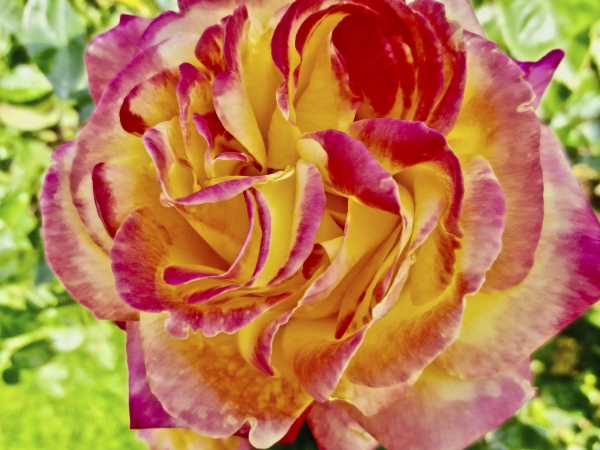

Evensong
By Beate Sigriddaughter

the answer is yes

let go of the elegant mantle of pain
keep dreaming a life worth living
don’t hesitate to ask

trust the beauty of the world

don’t be ashamed to be sad
when evening comes and there is so much
you still want to do

keep patiently unfolding

use twilight to reach
for the sweet flame within
don’t be afraid of your ego or your anger

they are here to help you too

keep praying your fierce admiration
of all you have been given
even as the forest of anxiety grows

taller than you have ever imagined

trust the lizards and the asters
and the moon that glides behind the juniper
let them persuade you

craving for peace has never been wrong

place a rose on your altar
now you are your own
cathedral of devotion

this moment will not come again

do something
you are not alone in this darkening
listen to the subtle symphony of rain

dance to the rhythm of dusk
each footfall a prayer
if there is a lizard under your eve
use your sweetest voice to wish it goodnight

the answer is still yes

Beate Sigriddaughter grew up in Nürnberg, Germany. Her playgrounds were a nearby castle and World War II bomb ruins. She lives in Silver City, New Mexico, where she was poet laureate from 2017 to 2019. Learn more at sigriddaughter.net.
Beate Sigriddaughter (opens in a new tab) grew up in Nürnberg, Germany. Her playgrounds were a nearby castle and World War II bomb ruins. She lives in Silver City, New Mexico, where she was poet laureate from 2017 to 2019.

The Poetry Inside

By Eve West Bessier

The first thing you notice when you meet Levi Romero is his tremendous generosity of spirit. He is nuevomexicano, born and raised in the state; and he personifies the open-hearted nature of New Mexican culture. This is a place where strangers wave to each other and smiles are abundant. In our modern, fast-paced society, that kind of courtesy is perhaps no longer the norm—possibly due to our lack of deep connection with the place in which we live. Many of us have become distanced from our histories and sense of community.

Helping people reconnect with their own history and community is part of Romero’s goal as state poet laureate. He talks about the essential connection between place and identity in Querencia: Reflections on the New Mexico Homeland, a 2020 anthology he co-edited. “I speak of querencia from an experience embedded in an upbringing among close-knit relations,” he says. “For me, querencia is not only personal; it is communal and deeply connected to the people and place where I was raised, mi gente, mi pueblito.” He explains, “No matter where I find myself, the arrow of my internal compass always points toward my ancestral home, where my cultural and spiritual point of reference originates.”

That ancestral home is Dixon, El Puesto del Embudo de San Antonio, on the Embudo River south of Taos. His world view, his locura, was shaped there. It was influenced by his close relationship with his grandmother, who played harmonica and told cuentos on the porch in the evenings. It was influ- enced by cruising in lowriders with his older cousins. It was shaped by the land itself and by La Academia de La Nueva Raza, the land-based organization headquartered in his great-grandmother’s house, dedicated to preserving cultural traditions by engaging community activism and collecting oral historias.

“New Mexico is a place where stories and the oral tradition are so vital to how we sustain ourselves,” Romero says.

His own story is a river with many tributaries. He received his bachelor’s and master’s degrees in architecture from the University of New Mexico, and is now a professional architect. While studying architecture, Romero took a writing workshop taught by Luci Tapahonso, inaugural poet laureate of the Navajo Nation. The experience brought his writing out of seclusion and into public expression. He was never a full-fledged member of Burque’s slam poetry movement, but honors the oral tradition that it upholds. His work is representative of the spoken- and written-word traditions, and finds his community in both spaces.

Romero was invited to be a lecturer in the creative writing program at UNM and taught there for five years. He then taught in the School of Architecture and Planning for another five. He is now an assistant professor in the Chicana and Chicano Studies Department. Romero has managed to weave together a life expressing his love of Chicanx culture, storytelling, poetry, and architecture, and has merged his various backgrounds into a cultural landscapes language that evokes its own type of narrative. He speaks about being an architect and builder of both physical and linguistic structures. He loves working with adobe; it’s an earthen material and hand-shaped, so you have to move the bricks around to find which ones fit together as you create the structure. In writing, Romero sees a similar process.

“You’re moving things around. You’re thinking, ‘I love that image but it doesn’t fit this poem, it’s for another poem.’”

Romero enjoys this intuitive puzzling to create the perfect poetic structure. He also loves sharing that process with others, helping them tell their stories and build strong poems.

In his first year as state poet laureate, Romero originally planned to visit all thirty-three counties and bring writers together—but the pandemic made this impossible. So, he has used Zoom and Facebook to gather people and promote poetry. He’s co-hosted online poetry readings with the poets laureate of three cities: in Albuquerque with Michelle Otero, in Taos with Catherine Strisik, and in Silver City with me. Romero is also posting poems, especially by emerging writers, on his Facebook page. This coming year, he will be collecting work for a New Mexican poetry anthology.

Romero’s primary objective as laureate is to be a steward of stories, providing a conduit for the river of cultural meaning to flow like a Rio Grande of vibrant language.

“People are naturally poetic,” he says. “They have the poetry inside themselves.”

Romero feels his job is to recognize this, help bring that poetry to the surface, and then get out of the way, giving the stage to other voices telling their stories.

Levi Romero’s dedication to these poetic cuentos is a joyous expression of his adventurous nature. Whether riding his Harley, savoring an excursion in a lowrider with brilliant chrome, or delving into the ever-fascinating landscapes of place and culture, he is always an explorer in search and support of our interwoven historias.

Nightstand Testimonio
by Levi Romero

A bulto of Santo Niño on the nightstand

The beloved safe-keeper of infants and children

Oh Niño Precioso
De Atocha
Llamado Tu
Socorres Siempre
Al Desamparado

Propped up by their spines
A row of books supporting each
other Two book jackets Caramelo
and
Underground: My Life with SDS and the Weathermen
Orphaned and sandwiched between una biblia and books long ago half-read
Whose titles keep open the doors of procrastination

Echoes of the Flute
The Old Man’s Love
Story Salvation on
Mission Street Keeping
the Quiet Meatballs for
the People
Manuel Banderia: Selected Poems

Magazines thumbed through
Saved for what purpose?

The History of
Rock The New
Yorker Lowrider
Magazine
Selena, Newsweek Feature
Rolling Stone, Bob Dylan: His 100 Greatest Songs
Time Magazine, 100 Photographs: The Most Influential Images of All Time Tattoo Marque

An opened envelope with two photographs

Tío Alfonso and tío Antonio on grandma Juanita’s porch, summer 1970 Cousins Hilary, Valerie, Panchita, Jerry, and Gerald, summer 1970

One comic book

The Amazing Spider-Man: Secret Origins A pair of dulled-lens reading glasses  A dog-eared anthology submission

A Sudoku number puzzle

A For-The-Love-Of-Lavender pouch gifted from a friend

A keepsake museum brochure from San Miguel de Allende

An unused writing journal for poems that came in the night But were gone by morning

Oh Niño Precioso
De Atocha Llamado
Tu Socorres Siempre
Al Desamparado

Levi Romero’s publications include Querencia: Reflections on the New Mexico Homeland (ed. Levi Romero, Vanessa Fonseca-Chávez, and Spencer R. Herrera, University of New Mexico Press, 2020); Lowcura: An Introspective Virtual Cruise through an American Subcultural Tradition (as part of Voices of Counterculture in the Southwest, ed. Jack Loeffler, Museum of New Mexico Press, 2017); Sagrado: A Photopoetics Across the Chicano Homeland (by Spencer R. Herrera and Levi Romero, University of New Mexico Press, 2014); and his two poetry collections, A Poetry of Remem- brance: New and Rejected Works (University of New Mexico Press, 2008) and In the Gathering of Silence (West End Press, 1996).

Eve West Bessier is poet laureate of Silver City, New Mexico. She is a retired social scientist and voice coach. Eve is a jazz vocalist, visual artist, and nature enthusiast. Her website is jazzpoeteve.com.

Eve West Bessier (opens in a new tab) is a poet laureate of Silver City, New Mexico. She is a retired social scientist and voice coach. Eve is a jazz vocalist, visual artist, and nature enthusiast.

Selected Poems

By Hakim Bellamy & Liza Wolff-Francis

Hakim Bellamy

Black Butterfly


Whether Duke (Ellington)
or Deniece (Williams)…

you are Butterfly Black.

Open armed
in flight or otherwise.
Ready for air.

A flittering trumpet mute.

Finding a runway
on any given pearly gate.

Finding a Sunday
to ever so occasionally spread

your wings.

Invertebrate grace
often confused for celebration.

Turn insides out,
spread cheeks and tongues for examination.

Bare bones and teeth,
as though better blocks and auctions
could preen you.

The ultimate believers,
in those who share your species
and genus.

We are butterflied people.
All open heart surgery
and lower back vertebrae,

fused and refused

by the sun.
The monarchs
we always wanted to be.

Showing your skeleton
to the world
takes a toll on your soul.

And trading your spine for wings
is how exoskeletons roll.

So you fly.
So fly you don’t need a neck
to breathe.
So fly you don’t have a neck
to break.

Gave up wins
for wings.

Hung up on a halo
slung a lil’ lower.
A gold chain,
with those Black Boy bullseyes
cross our backs.

But Black is Black,
and beauty won’t escape you

nor save you.

You,
a sign of rebirth
perhaps unnecessary death,

but whatever
at least you fly as ******.


Hakim Bellamy is the inaugural poet laureate of Albuquerque, New Mexico (2012–2014), and currently serves as deputy director for the Cultural Services Department for the City of Albuquerque. Having shared his work in no less than five countries, he is convinced that poetry is the sixth love language. He’s also written a few books. Find them (and him) at beyondpoetryink.com.


Liza Wolff-Francis

Voice of the dried acequia

In summer’s heat, the earth misses
water when it’s gone. Trickle of feather,
now wind and weed. When canals dry up,
what do the plants that fill them say?
Do they speak dreams of sharing water
in the desert? Under the leering
twisted arc of Cottonwoods,
the untended acequia, handed down
by generations of earth’s whispers,
a worn path, proud with mud and imprint,
a breeze brushes against my face
as if it had a name. Water may be rerouted,
but remembers where it once traveled.
Can we irrigate ourselves?
As if one body, water feels in one place
when it is hurt in another.


Her jump in the desert


It is the coyote in the comb of light through dawn
that wakes me, nudges my feet with the wet
of her nose, calls me beyond sleep breath.
My feet, cold on the hard earth, follow her
across dirt sprinkles. Scattered winded burrs
invite the cruel appetite of my flesh.
I always wanted to believe my body was not fragile,
that it came too far to give up on itself,
but when I say this, coyote begins to howl.
What is left of the dark paints a chill into my skin
that coyote fur does not feel. I am away
from all we have created, the sharpening of our knives,
the ovens for our bread. There is a silence we know here
from before we knew there was noise. Its taste
is empty of sand, of salt. I am a crumb
that may dissolve at any moment into only matter.
The sky holds me between thumb and forefinger, dangling
as the mountains watch us. This may be a dream.
I see myself fade away between the desert and its wide lens.
Coyote’s is an open-mouth existence and I cannot bear
my own weight. I may disappear,
break the infinite quiet and bring the day.
Coyote jumps at my voice, my solid existence.
Her body an animal curve, magic falls from her, like dust,
makes a cloud of her own shedding decay, settles
into the air we breathe. Silence pulls back from me.
The day comes fast now, coyote is gone, and I am alone.


Healer


Tides of moon, fears of sun,
our features like animals

with breath of storm.
This was not raising the dead,

so we unfolded ourselves
before her. Her house full

of dried herbs, flowering plants,
a psychic knowing. Dexterity

in her fingers as if they acted
alone, poetry in her words

and hummed songs. Laws
of the universe working

to make us strong again.
Each earth emptied

of past doubt, anointing us
with perfumed oil of lavender,

of sandalwood, under arms,
in the hair of our bodies. Healer,

she sliced air with sword sticks
to focus our minds on our wishes,

served us water to drink passion,
to set fire to dreams.

In the motion of the aether,
the cosmos, the universe, the sky,

she gathered the petals of our spirits
to put us back together as flowers.


Nostalgia and what we remember

all comes back,
when we hear
that which is tangled
in a laugh,
a misplaced heart,
the holiness
of sound and scent.
Dreams of flying,
meaning in the hidden,
a soul, clumsy lips,
voice from taste buds,
from drool, from a tongue
like the old country
we say we once had
and now try to let go of
or try to hold onto.


Liza Wolff-Francis is a poet and writer with an MFA in creative writing from Goddard College. Her work has been published in various publications, and she has a chapbook called Language of Crossing (Swimming with Elephants Publications).

Hakim Bellamy (opens in a new tab) is an inaugural poet laureate of Albuquerque, New Mexico (2012–2014), and currently serves as deputy director for the Cultural Services Department for the City of Albuquerque. Having shared his work in no less than five countries, he is convinced that poetry is the sixth love language. He’s also written a few books. Find them (and him) at beyondpoetryink.com.

Liza Wolff-Francis (opens in a new tab) is a poet and writer with an MFA in creative writing from Goddard College. Her work has been published in various publications, and she has a chapbook called Language of Crossing (Swimming with Elephants Publications).

With Gold In Their Eyes

By Paul Reed

“Our churches are being attacked and our people can’t go to them to pray. It’s a fight against white men with gold in their eyes.”
—Suzan Shown Harjo (Cheyenne and Hodulgee Muscogee)

In this tumultuous year of 2020, the wind whistles through an apparently vacant Chacoan landscape, dominated by uplifted sandstone mesas and a few solitary buttes. Above, the sky is a perfect azure, radiant blue contrasting with the soon-to-be-hot morning sun. The pandemic has reduced the normal crowds to just a trickle of visitors and brilliant blue-black ravens nearly outnumber people. For those of us captivated by ancient sites and landscapes, however, the word “vacant” could be no further from the truth.

The Greater Chaco Landscape holds tens of thousands of ancient, sacred cultural sites representing the traditions of multiple Native peoples of the American Southwest. Many of these sites are part of the ancient Chacoan World, dated between 850 and 1200 CE. Modern Pueblo peoples (including the pueblos of Acoma, Zuni, Hopi, Santa Clara, Tesuque, Santa Ana, Laguna, Jemez, Taos, and many others) of today are the descendants of the Chacoan groups who built thousands of great houses, smaller dwellings, shrines, and roadways across the modern Four Corners states.

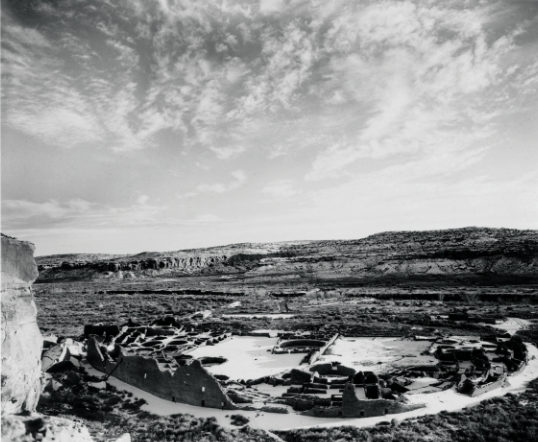
High view of Pueblo Bonito, South terminus of NM56 & North terminus of NM164, Nageezi, San Juan County, New Mexico. Photograph courtesy Historic American Buildings Survey Records, Library of Congress.

Beginning in 2011 and accelerating in 2012 and 2013, oil and gas companies punched hundreds of wells into the 5,000-foot- deep Mancos Shale formation at different locations across the Greater Chaco Landscape. With recent advances in hydraulic fracturing (fracking) and horizontal drilling technology, billions of gallons of oil and natural gas became accessible, particularly as the price of crude oil on the world market soared over $100 per barrel. This activity came on very quickly and was not anticipated by very many people in the region.

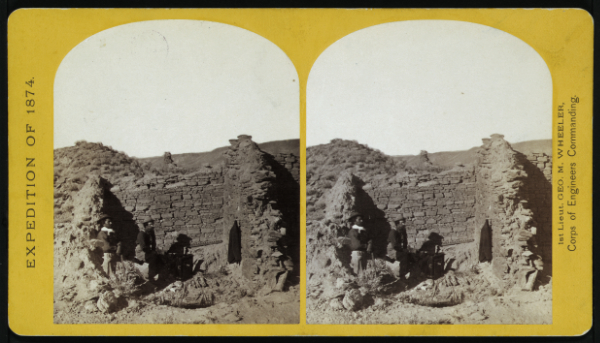
Characteristic ruin, Pueblo San Juan, New Mexico. Photographer Timothy O’Sullivan is seated on right, next to his 10 × 12-inch large-plate camera. Photograph courtesy Library of Congress. This site is not the pueblo historically known as San Juan Pueblo (now Ohkay Owingeh). Rather, this site came to be known as Salmon Ruins or Pueblo, and is located on the San Juan River, just west of the town of Bloomfield, New Mexico.

The Farmington Field Office of the Bureau of Land Management (BLM), the managing agency, moved slowly to regulate these new approaches to oil and gas extraction. It was not until late 2012 that the BLM decided that its 2003 resource management plan (RMP) needed an amendment to properly regulate the fracking and horizontal drilling technologies. The amendment process and drafting of a new Environmental Impact Statement (EIS) was initiated in early 2013 and is still ongoing as of press time.

The BLM was sued in federal court by a coalition of environmental and Native grassroots groups for exceeding its authority to issue permits for drilling under the 2003 RMP. The lawsuit ultimately resulted in several well permits being overturned, but did not substantially impact or slow down development in the Mancos Shale formation. Fortunately, market forces did greatly slow down the juggernaut of drilling in 2014, as a glut of oil flooded world markets and prices declined. Finally, most recently, the current pandemic has brought all new activity in the greater Farmington area to a standstill.

Before delving further into the ongoing oil and gas threat to Chaco’s sensitive sites, I want to briefly set the stage by discussing the history of accessing and protecting Chaco Canyon and its surrounding landscapes.

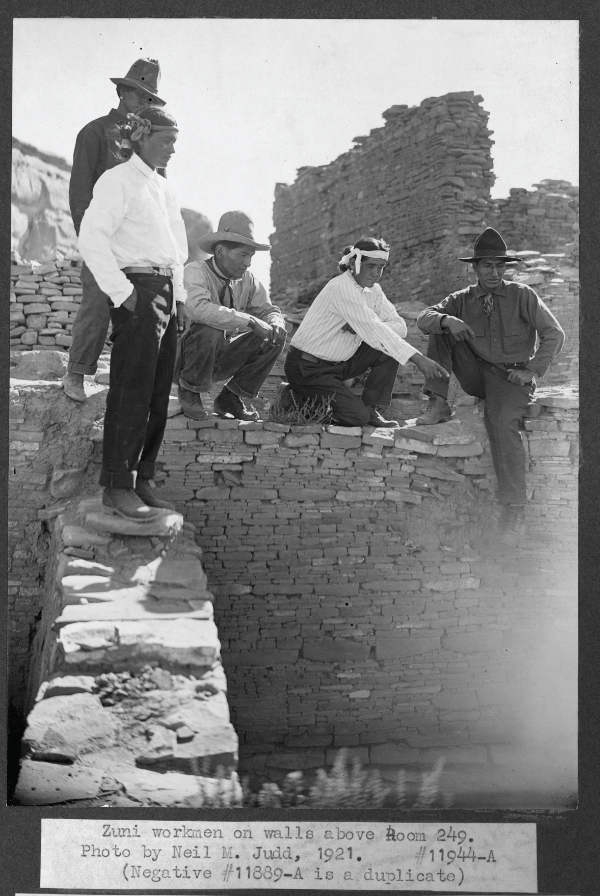
Zuni workmen on the walls above Room 249, 1921. Photograph by Neil M. Judd. Courtesy the National Anthropological Archives, Smithsonian Institution, neg. no. NGS 11944-A.

Chaco’s Early History of Protection and Exploitation
The date of the “discovery” of the spectacular sites in Chaco Canyon is hard to pinpoint precisely. To begin, the notion of discovery is very Euro-centric and insulting to many Native Americans. Even after the migration of people from Chaco Canyon before 1300 CE, we can infer that Pueblo people and other Indigenous groups continued to visit the great houses to reconnect with ancestral places. Abundant references to Chaco exist in many origin stories and oral histories of the modern Pueblos. Thus, it seems reasonable to suggest that Chaco Canyon never passed out of the memory or experiences of Pueblo people.

As to Chaco’s “rediscovery” by Euro-Americans, visits by Spanish explorers and other travelers (from the early 1600s forward) undoubtedly occurred, but because of the destruction of Spanish records during the Pueblo Revolt of 1680, little or no documentation has survived into the present. More surprising, perhaps, and certainly unexplained, is the absence of written descriptions of the Chacoan great houses from about 1700 through the early 1800s. Historical records indicate that during that time, the Spanish launched numerous punitive expeditions against Navajo and Apache Indians in areas west of Santa Fe and the Rio Grande. Some of the routes described passed through the Chaco country; the name Chaco or Chaca was first applied to the canyon and surrounding lands at this time, in the eighteenth century. Although it is unlikely that he ever visited the canyon, Spanish cartographer Bernardo de Miera y Pacheco identified the general area around Chaco, and particularly to the south, as “Mesa de Chaca” in his 1776 map.

The earliest documented trip through Chaco Canyon was made by a Spanish military officer named Jose Antonio Vizcarra, who was pursuing Navajos accused of raiding settlements in 1823. Vizcarra’s pursuit went down Chaco Wash, and he observed and recorded several large pueblo sites in the canyon. Additional accounts, mostly made by Spanish military expeditions, mentioned Chaco over the next several decades, but it was not until 1849 that the first comprehensive descriptions and maps of the Chaco Canyon great houses were made.

At the end of the Mexican War in 1848, the United States was in possession of millions of acres of new Western lands. With these new lands came clashes with the Native American inhabitants, and a military expedition was launched into Navajo country in 1849. Under the command of Col. John Washington, military governor of New Mexico, the expedition also included Lt. James Simpson and two brothers, Richard and Edward Kern, both accomplished artists. As the company passed through Chaco Canyon, taking the trail west towards the Chuska Mountains and Navajo country, Simpson was assigned a detail to explore Chaco and document the spectacular sites within.

A man of considerable diligence, Simpson set about creating a detailed recording of the great houses, while Richard Kern prepared the first known drawings and reconstructions of the pueblos. So accurate were his descriptions and drawings that they stood the test of time and were not surpassed in detail nor quality for nearly 100 years. The group’s Spanish guide Carravahal, from San Ysidro, New Mexico, identified most of the largest ruins by name. Simpson applied these names to the sites, and they are still in use today.

Francisco Hosta, then the governor of Jemez Pueblo and one of the Native American guides for the group, reportedly told Simpson that Montezuma and his Aztec people had built the ruins in Chaco on a northern sojourn before heading south to construct the urban center at Tenochitlan, Mexico. Apparently following Hosta’s lead, Simpson speculated that the ruins were built by the Aztecs or another Mesoamerican kingdom, and so initiated a period of many years of ill-informed understanding of the origins of the Chacoan great houses.

Simpson’s journal and the drawings of Richard Kern made the spectacular structures of Chaco Canyon known to only a few people, and the “secret” of Chaco remained hidden for several decades. The 1870s, though, saw renewed interest in Chaco Canyon. Photographer William Henry Jackson and William Henry Holmes together made a trip in 1877, as part of the US Geologic and Geographic Survey of the Territories (also known as the Hayden Survey). The Hayden Survey hired the same Jemez guide Francisco Hosta, who had led Simpson through Chaco. Jackson spent most of a week studying sites in Chaco and exposing photographic plates. Unfortunately, Jackson was experimenting with a new technique, and none of his photographs of Chacoan houses came out. It was decades before Jackson was able to duplicate some of his shots and produce photographs of Chaco. Most importantly, perhaps, was Jackson’s determination that the ruins were not built by the Aztecs or another vanished tribe, but were the ancestral homes of the modern Pueblo people of New Mexico and Arizona.

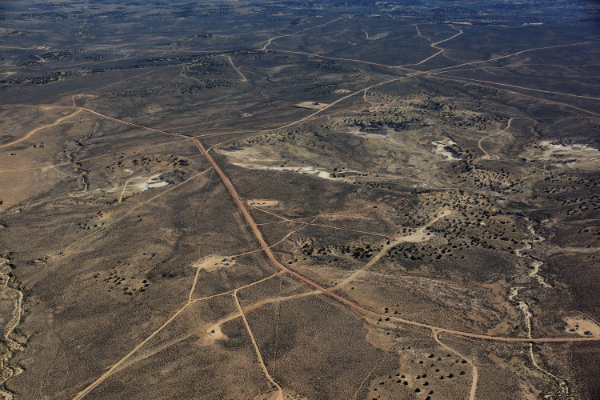
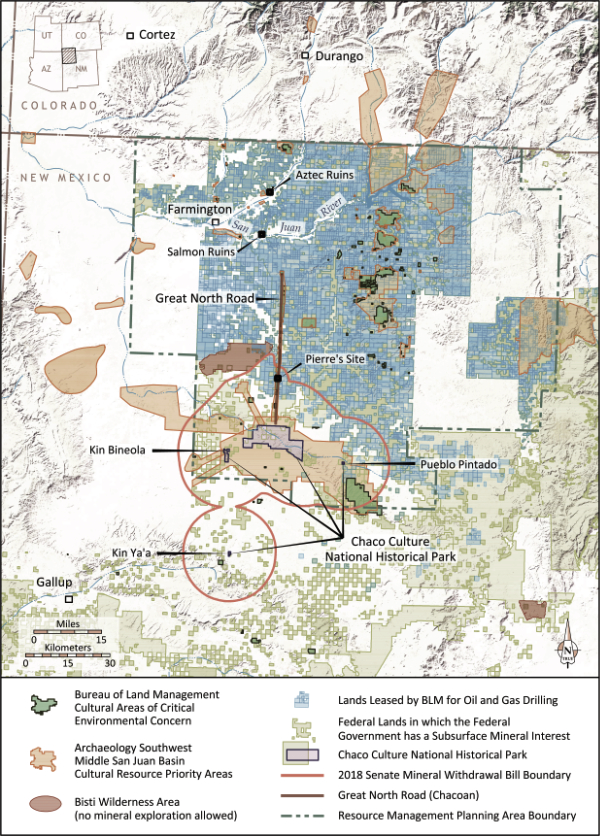
An aerial view of the oil field north of Chaco’s ten-mile cultural protection zone. Note the spiderweb pattern of crisscrossing roads and numerous oil well pad facilities. Photograph by Paul Reed, courtesy Archaeology Southwest.

Large-scale excavations at sites in Chaco Canyon began in the 1890s, during the period that archaeologist David Hearst Thomas describes as the “collecting phase” of American archaeology. Eastern museums began to sponsor work across the American West, to collect artifacts that were believed to be the last remnants of vanishing Native American cultures and societies. Accompanying all of this work was the racist idea that Native tribes represented primitive examples of humanity that required study before these groups were vanquished and acculturated, and “joined the rest of American society.”

Sites across America, particularly in the West, were looted with massive, unscientific projects designed to collect as many artifacts as possible in the shortest possible time. This burst of activity, which lasted for decades, resulted in incredible damage to and outright destruction of many cultural sites. The passage of the Antiquities Act in 1906 stopped some of the looting of America’s ancient heritage and instituted a permit process to provide some level of control over excavations and removal of artifacts.

Somewhat miraculously, given the unrestrained digging and the volume of artifacts that flowed eastward in the late eighteenth and early nineteenth centuries, as well as very different ideas about what constituted “preservation,” the great houses of Chaco Canyon were not destroyed and still stand more than 120 years later. Nearly all of the credit for this goes to the Navajo and Pueblo masons and workers who have labored tirelessly for the National Park Service preservation crews at Chaco since the 1930s.

More recent archaeological and scholarly research on Chaco’s amazing sites has covered considerable ground. Among other issues, much of this interpretation has sought to explain the presence of so many dwellings and ceremonial sites in an apparently inhospitable climate. The Chaco region today receives less than 7 inches of rain yearly (on average). During its heyday from 850 to 1150 CE, many decades produced much more rainfall than the long-term average, and the now-entrenched Chaco Wash flowed freely at the surface many months in good years. Thus, our twenty-first-century perception of Chaco as a dry, forbidding place is hardly accurate. Beyond this, few of the archaeologists and scholars writing or thinking about Chaco are of Native American descent. It is fair to say, then, that widely consumed interpretations of Chaco from the perspectives of Pueblo descendant communities are rare.

Although the early days of American anthropology saw close connections between archaeological work on ancient sites and ethnographic studies with tribes, by the 1940s, these approaches were considered passé and archaeology went on a decades-long path of greater reliance on scientific methods. Unfortunately, this change heralded a huge shift in the field away from significant interaction with the living descendants of the Ancestral Pueblo groups who built places like Chaco Canyon. In recent decades, things have shifted again, in large part due to the passage of the Native American Graves Protection and Repatriation Act (NAGPRA) of 1990.

In brief, NAGPRA requires museums to: 1) Identify all human remains, funerary items, and items of cultural patrimony; and 2) Consult with descendant Native American tribes to repatriate items and rebury human remains. Although the law has resulted in some well-publicized cases of conflict between archaeologists and Native Americans (the Kennewick Man case, in particular), many of the interactions between Native Americans and museum staff or archaeologists have been seen as productive and positive.

Oil and gas leases just north of Chaco Cultural National Historic Park’s boundary have developed rampantly in recent years. Leases are much less common in the ten-mile zone around Chaco, and should remain rare to protect the World Heritage site. Image courtesy Archaeology Southwest.

One important legacy of NAGPRA, in addition to the repatriation of human remains and sacred items, is greatly increased communication between archaeologists, anthropologists, museum specialists, and Native American groups. Although this contact has not immediately resulted in new interpretations of Native sites, I believe it has created many more opportunities for cooperation and the broadening of what have been Euro-American-dominant narratives of the ancient American past. My own participation in an ongoing NAGPRA process has allowed me to make many important contacts with individuals and leaders from various tribes, and has enriched my understanding and appreciation of their perspectives on their own histories.

I am happy to say that American archaeology is in the midst of a decolonizing operation. In brief, many of us non-Native archaeologists feel that Native interpretations of sites and control of archaeological research and collections are long overdue. It should go without saying that many of our Native American colleagues and friends are in agreement and are ready to support and embrace this process. I believe we are on the cusp of fundamental changes in the pursuit of archaeological work in the United States.

Protecting Greater Chaco from 2014 to 2020
With regards to the current oil and gas development threats on Chaco Canyon, Native American groups have taken critical leadership roles in the multiyear protection effort. The organization with which I work, Archaeology Southwest, became involved with efforts to protect Greater Chaco in early 2014. We have been in close contact with the offices of United States Senators Tom Udall and Martin Heinrich and Congressman Ben Ray Luján. We have partnered with a number of environmental and preservation organizations during the last several years, including the National Trust for Historic Preservation, National Parks and Conservation Association, the Wilderness Society, New Mexico Wilderness Alliance, Conservation Lands Foundation, and PEW Charitable Trusts. We created a Chaco Coalition and immediately began outreach to Native tribes affected by oil and gas development. Since 2015, I have met with a number of Pueblo leaders and representatives from the Navajo Nation.

As the process continued, the All Pueblo Council of Governors (APCG), representing the nineteen New Mexico Pueblos and Isleta del Sur (in Texas), took a leading role in advocacy. The APCG passed several resolutions calling for protection of the Greater Chaco Landscape and asking that the BLM and Bureau of Indian Affairs work closely with Pueblo people as the resource management plan amending process progressed. The Pueblo governors also endorsed a series of measures that would go a long way toward protecting the magnificent cultural resources and modern-day residents of the Chaco area from oil and gas development, including supporting a 10-mile cultural protection zone around Chaco Culture National Historical Park that would be off-limits to oil and gas development. Most recently, the APCG has partnered with the Navajo Nation in 2017 and 2018 to press the agencies for additional protections across the Greater Chaco Landscape.

The National Congress of American Indians passed a resolution in October 2017 calling on the Department of the Interior to issue a moratorium on all oil and gas permitting and leasing in the Greater Chaco Canyon Region to protect traditional cultural properties and sacred sites in the region until the BLM and Bureau of Indian Affairs initiate and complete an ethnographic study of cultural landscapes across the Greater Chaco region and finish the management plan and environmental impact statement.

Sites within the boundaries of Chaco Culture National Historical Park are protected from oil and gas and all other development. The park holds nearly 3,500 cultural and historic sites that date back to 10,000 BCE. Just beyond Chaco’s boundaries, however, very few protections exist for thousands of cultural sites. Because of this, our Chaco Coalition and the APCG began pushing in 2016 for a cultural protection zone around Chaco and its outliers. In 2018, the concept was greatly advanced with a U.S. Senate bill introduced by Senators Udall and Heinrich. Although the 2018 Senate bill did not advance, it built momentum for the idea. In 2019, the U.S. House of Representatives passed H.R. 2181, the Chaco Cultural Heritage Protection Act of 2019. A companion bill was introduced in the Senate in late 2019 (S. 1079; essentially the same bill from 2018). The Senate bill is currently in committee and is very unlikely to pass in 2020.

Also, in 2019, New Mexico’s Commissioner of Public Lands Stephanie Garcia Richard issued an executive order to prohibit leasing of state trust lands for oil and gas development. The order covers nearly 73,000 acres of land within 10 miles of Chaco’s boundary and is in place until 2024.

The basis for protecting a 10-mile zone around Chaco Canyon derives from two primary facts: This area is much less developed and more pristine than the area beyond 10 miles; and the area contains a dozen significant and largely unprotected Chacoan great house communities with hundreds of sites. From the air, it is clear that at about 10 miles from the Chaco Park boundary line, the Greater Chaco Landscape begins a serious transition. South of the northern 10-mile line, the landscape is relatively pristine. Certainly, there is some development within this zone—limited oil and gas facilities and some power lines and pipelines that cross the area, but the 10-mile protection zone is largely unimpacted by oil and gas development. North of that northern 10-mile boundary, the landscape begins to change, and shows the effects of industrial development of the oil and gas resources that lie beneath the surface.

Although less than twenty percent of the Greater Chaco Landscape has been surveyed archaeologically, we have a strong sense of the range and diversity of archaeological site types. Because much of the land is and has been home to Navajo people for many years, cultural studies have been completed by the Navajo Nation several times since 1970 to identify sites important in Navajo history. What we lack is knowledge of cultural sites of importance to modern Pueblo people. Of course, many of the Ancestral Pueblo archaeological and historic sites are very important to modern Pueblo groups. But there is a large gap in knowledge because the Pueblo tribes have not been afforded the opportunity to visit the landscapes of Greater Chaco and identify ancient places of importance.

Understanding the lack of important data regarding Pueblo traditional sites across the Greater Chaco Landscape, we partnered with the Pueblo of Acoma in 2018 to begin this important work. The Acoma team visited a number of locales across Greater Chaco and reconnected with ancestral landscapes and sites. The Acoma project resulted in a comprehensive report on Acoma’s connections to the Greater Chaco Landscape. Currently, the Acoma Tribal Council and Governor are reviewing the document prior to public release to ensure that confidential information is not revealed. A similar project across the Greater Chaco Landscape is in the planning stages with the Pueblo of Zuni, but has been slowed by the COVID-19 pandemic.

The BLM and BIA released draft planning documents in February 2020, including the RMP amendment and environmental impact statement for the nearly 3 million-acre planning area in northwestern New Mexico. Despite years of input from the APCG, the Navajo Nation, individual Pueblo tribes, Ute Mountain Ute, Jicarilla Apache, and many environmental and preservation groups, the action alternatives proposed were woefully inadequate to protect the Navajo families living at ground zero above the Mancos Shale formation and the ancient heritage represented by thousands of cultural and historic sites. Only one of the alternatives provided for no new leasing within 10 miles of the Chaco park boundary. The agencies’ chosen path forward shows very little concern for protecting Greater Chaco’s fragile cultural resources. The public review and comment period ended on September 25, 2020, and after reviewing the thousands of comments submitted, the agencies will issue the final documents sometime in 2021.

In summary, Chaco’s complicated history has seen multiple waves of exploitation, exploration, interpretation, and preservation. Despite this history, the current oil and gas development threats are unprecedented. Although BLM and BIA took seven years to finish their RMP amendment and EIS planning documents, the final versions do not adequately protect the Navajo families living on the landscape currently or the thousands of cultural sites that date back 12,000 years. To those of us who have worked on this issue for years, it is abundantly clear that the BLM and BIA should protect larger pieces of the remaining landscape, particularly areas surrounding Chacoan great house communities and areas identified by Native American pueblos and tribes as traditional cultural places and sacred sites. With the advances in various technologies, including LiDAR scans of large landscape tracts and our work with the Pueblo of Acoma, it is clear that cultural sites important to New Mexico’s tribes are not being identified during cultural resource work. Continuing with the current approaches to resource protection will result in losses of additional undocumented cultural resources and will inflict further negative impacts to the Greater Chaco Landscape.

Further, consistent with their obligations under Federal law, the agencies must incorporate and use significant new information about the Greater Chaco Landscape that has been provided to them by the tribal and archaeological communities. The recently completed Acoma Project demonstrates the need for Native American experts to identify their own cultural resources in the field prior to leasing and development.

Ultimately, I ask the agencies to work with the many stakeholders to find new and creative ways to protect and preserve what remains of the ancient Chacoan and Puebloan landscapes. 
—    

Paul Reed has been a preservation archaeologist with Archaeology Southwest since 2001. He lives north of Taos, New Mexico. Reed’s most recent writing is an edited book (with Gary M. Brown as co-editor) entitled Aztec, Salmon, and the Pueblo Heartland of the Middle San Juan (SAR Press, 2018). During the last six years, Reed has been working to protect the Greater Chaco Landscape from the effects of expanded oil-gas development associated with fracking in the Mancos Shale formation.

Paul Reed has been a preservation archaeologist with Archaeology Southwest since 2001. He lives north of Taos, New Mexico. Reed co-edited, with Gary M. Brown, Aztec, Salmon, and the Pueblo Heartland of the Middle San Juan (SAR Press, 2018). During the last six years, Reed has been working to protect the Greater Chaco Landscape from the effects of expanded oil-gas development associated with fracking in the Mancos Shale formation.

Timothy H. O'Sullivan (1840 – 1882) was an American photographer widely known for his work related to the American Civil War and the Western United States.

Look Southward

By Charlotte Jusinski

It’s not terribly easy to plan and execute a magazine in a zeitgeist like this. I’m sure that’s unsurprising (though I like to think we here at El Palacio make it look easy). Trying to scope out what a year’s worth of stories might look like while not even knowing when our brick-and-mortar cultural institutions will open again to the public is awkward at best.

Keeping that in mind, we’ve made a few changes around here lately—some of which I covered in my previous editor’s letter, and all of which will make El Pal more informative and vibrant than ever before.

One change you may have noticed in El Pal in the last year or so is one that we ushered in quietly, but will indelibly change the landscape of this magazine. In addition to covering the four Museum of New Mexico Foundation institutions in Santa Fe (the New Mexico Museum of Art, the Museum of Indian Arts and Culture, the Museum of International Folk Art, and the New Mexico History Museum) and New Mexico’s historic sites, El Pal has expanded its scope to include all state cultural institutions in New Mexico—so we have welcomed to the fold the National Hispanic Cultural Center (which made its debut in El Pal’s pages in Winter 2019), the New Mexico Museum of Natural History and Science (which brought us our cover stories in both Spring and Fall 2020), the New Mexico Museum of Space History (first featured in Summer 2020), and the New Mexico Farm & Ranch Heritage Museum (about which we have great things in the works).

Why make this shift? There are a few reasons. Selfishly, I was excited to receive the expansive behest from Cabinet Secretary Debra Garcia y Griego—I would like more reasons to explore more nooks and crannies of our state, so I’m excited to set my GPS for sites in Las Cruces and Alamogordo when pleasure travel is once again safe. Editing a magazine that
covers these areas is the perfect excuse!

Also conveniently, now that the world has changed its functionality for at least a few more issues’ worth of time (isn’t that how everyone measures time? In magazine issues?), it also helps provide exponentially more subject matter for El Pal writers to mine as we wait patiently for the green light from government and science to reopen our museums.

But beyond that, it’s become clear in recent years that El Palacio belongs to all of New Mexico. Our tagline stipulates that we explore “the art, history, and culture of the Southwest,” and keeping the microscope endlessly trained on Santa Fe and its environs, as we’ve done for 107 years or so, no longer fulfills that mission. The intricate histories, stories, personalities, and artworks of our state don’t stop at I-40 as you head south. There are many differences between Southern and Northern New Mexico, of course, but these differences need to be treated as sections of one magnificent tapestry rather than divisions between regions.

There is so much to see here, so much to do, and so many areas to explore in our beautiful state. While remaining firmly rooted in the ethos and scope of state institutions, El Palacio is dedicated to uplifting the culture of every corner of New Mexico. Hopefully even lifelong residents and longtime readers of El Pal will be able to learn something new from the fascinating stories we’ll be providing over the next 107 years.

Winning with Work

Publications are the work of many people, and the Federal Writers’ Project, founded in 1935, was no different. This WPA-era photograph shows only a few members of the initial New Mexico team—relief roll workers, folklorists, researchers, translators, historians, news writers, typists, illustrators, editors, students, and volunteers—assembled by project director Ina Sizer Cassidy.

Working under the guise of a proposed five-volume grand overview of the history, scenery, and wonders of America, in its first year the Writers’ Project employed fifty-five people for New Mexico’s contribution to the American Guide. With a quota of 57,000 words for the final project, less than six months in, Cassidy joked that “copy is flowing into the State office at the rate of 20,000 words a week, and … editors are trying to dam the flow of words with sturdy blue pencils.” In March 1936 alone, the workers contributed 250,000 words.

Thus, much of the work went unpublished, leaving a well of important primary and secondary sources for research. The Writers’ Project quickly evolved to include translation of archival documents from the Spanish and Mexican eras held by the Historical Society of New Mexico and the State Land Office. It also oversaw a survey of state and local historical records, starting with territorial records, correspondence, and miscellaneous books found in the basement of the state capitol.

Interviewers fanned out and collected folk stories, tall tales, and historical yarns from New Mexicans. Folklorist Lorin W. Brown, whose father was Anglo and mother nuevomexicana, recalled spend-ing his workdays renewing old acquaintances, chatting in the afternoons and evenings with elders, and typing until 2 or 3 am, only to get up for brunch and resume his schedule. It was not office work. He said, “I mailed all my manuscripts in to the head office, rarely going in except on occasions.” Similar remote work was contributed by writers Georgia Redfield of Roswell and “cowboy poet” Jack Thorp of Albuquerque.

Even though this photograph was probably posed and taken by a WPA state photographer such as Roger H. Dawson or D. Orton Smith Jr. to emphasize the bustling activity of project staff, this busy mid-twentieth-century bureaucratic office, with its typewriters and dictionaries, card catalogs and filing cabinets, seems striking today. After decades of slow transitions towards digital and paperless work, office work during the COVID-19 pandemic has quickly shifted to work done remotely, but often alone.

See additional New Mexico WPA pieces in the New Mexico History Museum’s exhibition Looking Back: Reflecting on Collections. The physical exhibition will be on view until October 2021, and there is a virtual tour now available here.

Hannah Abelbeck (opens in a new tab) is the photo archivist in the Palace of the Governors Photo Archives at the New Mexico History Museum and is actively working to increase access to its photographic collections.

The Middle

By Sahra Ali
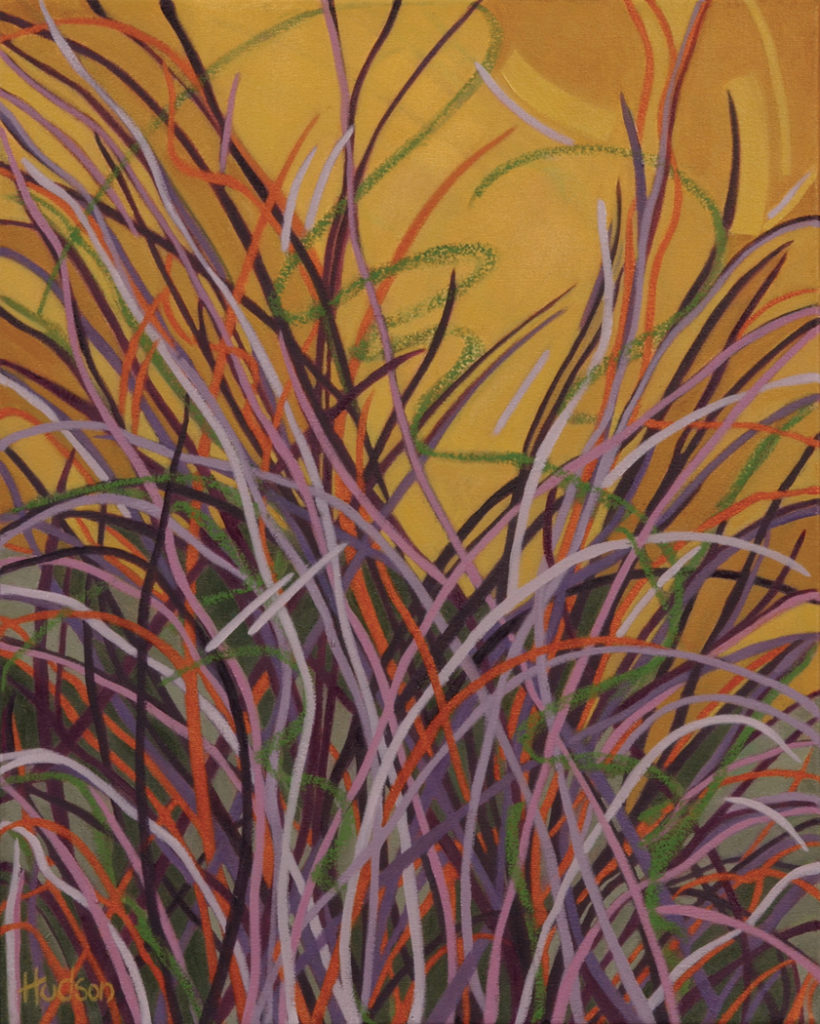
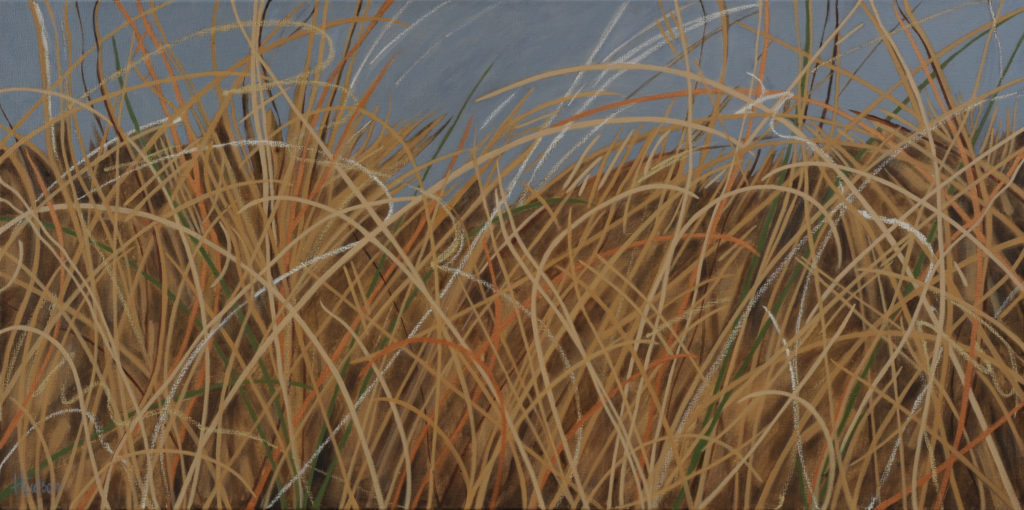
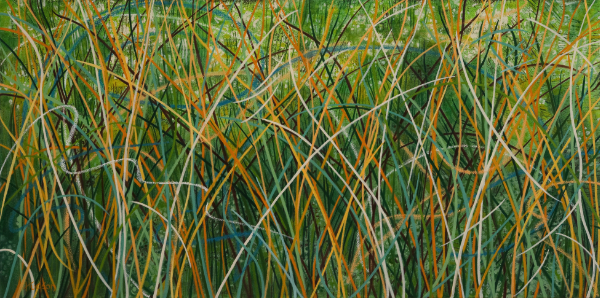
Paintings by Noël Hudson

“You have to get in the middle. The natural current will take you down the river.”

I was told this upon entering the Rio Grande in Truth or Consequences, New Mexico. It was June and incredibly hot. My friend, her mom, and I rented floating tubes. We each had life jackets, though I would be the one who would need it the most, since I could not swim. I stayed behind them a great distance. They made it look so easy. I kept going into the trees and having to push my way out each time. I did not panic. I just could not find the middle. What was to be a quiet and relaxing time on the river became an existential reflection on finding the balance in my life; that sweet spot.

There have been countless moments in my life where I analyzed the middle. Finding the middle ground. Watching my father navigate the middle class. As a youngster, I relished getting to the middle of the Klondike bar. These days, I traverse to “middle of nowhere” towns, alone. It’s not that the middle evades me; it’s just hard to sustain. For a nomad with nomadic roots, the middle is the journey—though sometimes, it serves as a dream deferred.

Patterns of Nature Series #23: Evening Song, 2008. Oil on canvas, 20 × 16 inches. Photograph by Margot Geist, Geistlight Photography.

Perhaps the most fascinating part about the middle is our inherent aspiration toward it. We live in a predominantly dualistic society. But living in extremes isn’t healthy; those of us who are fortunate enough to create our own path seek the balance that comes with the middle. In this way, the middle represents something far more enticing; something we could actively nurture. It’s an aspiration toward groundedness. When we are grounded in our perspectives, we can aspire to balance. Even when we lose the middle, it is still there.

On the Rio Grande, I pushed hard to stay in the middle, but the trees on the sides called me. Each time, I found myself using my feet to propel off the branches. I squeezed my eyes shut, allowing a flood of memories. Two hours of this prompted a dream-like state. I could see the beautiful coastline of my home country of Somalia. In the summers we would retire to Las Khorey to take advantage of the sea breeze. Never once had I or my siblings learned to swim.

Somalis have long been trekkers, nomads who walk from village to village to gather food and look for work. We are adaptable and resilient. Our resourcefulness is only preceded by our generosity, as we are communal people. Unfortunately, tribalism has often created barriers to community; when tribes only wish to share and build within the tribe, the whole society suffers. Conversely, when tribes share with those outside their group, a community can flourish and resources can be accessible to all. It could be a cohesive unity that many mainstream cultures are currently missing.

My late uncle, Ali, would tell me stories about this. His discontent with the dualistic social separatism that divided the country was not lost on me. It was through his wisdom and experiences that I became curious about obtaining balance in my life. Education had long been a middle ground to achieving success for those coming from the Third World. Schooling was a bridge my uncle used to obtain the freedom and opportunities that were not accessible to him growing up. I aspired to leverage the same opportunity, and longed to find my own way; I knew I had more advantages than my uncle did when he left Somalia. I just had to find my own middle ground that honored that truth.

My uncle was a man of extraordinary tact and precision. Eventually, he settled in the mountains of western Maryland. His balcony overlooked two states, with a clear view into West Virginia. A bond tethered by the Appalachian mountain range. For twenty-five years, the space between these mountains served as meditation on a life well lived. It was his middle.

My uncle taught me to live by example. He transplanted the seeds of his Somali dreams into American gardens. The fruition is the manifestation of the lives he helped gain the same fate—one of whom was my young, opportunist father, who was sponsored by my uncle in the late eighties.

My young parents brought two different groups of offspring into the world. I was born in the middle of a cluster of siblings; I am the third oldest in my family, and the last born in Somalia. Shortly after I was conceived, my father migrated to New York. Eight years later, I was reunited with him in small human form in Djibouti. Much to my siblings’ chagrin, I deemed myself the family love child. Within five years, our three-bedroom Jersey City apartment would become a playground for four additional American-born children. The mechanics of communal culture would have it that my older sister and I parent these new shiny faces as they looked up at us, to us, and occasionally spilled into our awkward transcultural adolescence. We loved every minute of it.

Patterns of Nature Series #30: Chasing the Wind, 2009. Oil on canvas, 24 × 48 inches. Photograph by Margot Geist, Geistlight Photography.

The river was calm. I seemed to be the only thing disrupting the waters. The memories continued.

I began my journey from the Northeast Kingdom of Vermont in late May of 2020. As I left New England, my little Honda, whom I affectionately call Eva, passed through all the East Coast states I had once called home. New Jersey, New York, and that small stint in New Haven, Connecticut. My eager eyes traced the lines on the highway with tire marks that led me to my parents’ doorstep in Columbus, Ohio—the only Midwest I had ever known. The whole state of Ohio is reflective of quintessential small-town middle America. Small cities, leveled cornfields, Appalachian mountain range, and people who smile at you on the street. It’s where I discovered country music and dated more white boys than you could find in all my favorite nineties boy bands combined. Young Sahra would be proud of this, I am sure. Sahra in her 30s, on the other hand, is fascinated by the complex evolution of her wandering American experience.

Suddenly, it’s April of 2018. Six o’clock in the morning. I am a 28-year-old deckhand on the Mississippi River, trying to steer a 4,000-ton river boat. “You see that red line on the screen?” my captain said with his strong Biloxi accent. There were three screens. The one he was referring to had several gray lines and a red one. On one of the slanted gray lines was a small image of a boat. “I want you to bring that boat to the red line, right there in the middle, and keep it there.” Captain had his arms crossed over his chest, which indicated that he had no plans on partaking in this venture. I cringed at what was to come of this tutorial.

Ten minutes of silence passed before I heard the captain say, “Where the hell are you going?”

Apparently, I had turned the boat too far to the left. To be fair, it didn’t take much wind for it to shift the rudder. I did not have the heart to tell him that I was distracted by the beautiful sunrise.

After a month in Truth or Consequences, I moved north to Santa Fe. I rented a place close to the middle of downtown where I took long walks each day. The old adobe buildings matched my New Mexican tan. I was happy about that. I felt golden.

By day, I wrote articles for magazines on equity and the Black experience in light of George Floyd’s death. By evening, I took long strolls on the Plaza or Canyon Road. The desert air tugged on my curls, leaving a whiff of lavender oil for those who walked behind me. Nomadic life gets you intimate with yourself in ways that conventional life cannot. For me, my strolls felt like gliding through time. I wrote poetry on park benches. To the outside world, I was a young Black woman traveling solo during contentious times. On the inside, I was liberated and empowered, soaking up the moment with each stride.

I had long been acquainted with the stereotypical nonsense thrown at me by strangers who find my looks conveniently interesting. One can imagine how I must look to a world that dissects my Muslim name and East African features under curious pretenses. White people especially have taken to coming up to me and saying things like “Black Lives Matter” or “Let me guess: Ethiopia?” The one that really gets me going is, “I am happy you are here.” As if my Blackness is an endangered virtue. Still, I enjoyed my walks. They served as my middle.

Much to my surprise, my experience on rivers has not left me—even when I found myself living on a farm in Taos, passing the Rio Grande Gorge bridge. I wondered if there was a middle spot for me in New Mexico—and if so, would the river be there, also?

There is so much converging history in New Mexico. It made me think of my own American history. The one I had lived out for the past twenty-three years in this country. The first American sky I had ever seen exemplified my ambitions for what the American experience would be like: tall skyscrapers that consumed the sky. Blue specks revealed an in-between world that I would later become intimate with upon witnessing my first mountain range.

The New Mexico skyline is a little more dramatic. The blue is alive here. The golden-red hue that envelops the evening is impeccably precise and breathtaking each time.

Patterns of Nature Series #40: Dance to the Music, 2011. Oil on canvas, 24 × 48 inches. Private collection. Photograph by Margot Geist, Geistlight Photography.

“You have to get to the middle and the natural current will take you down the river.”

These words come back to me. Where is the current now?

My people are current-riders. They also know how to abandon one current and catch another. For survival and opportunity. For sheer curiosity. For hunger for a better life.

For me, it’s a lifelong quest. I have no need to let survival tactics inform the way I lead my life. What a fortunate byproduct of the immigrant narrative, I tell myself. Instead, I seek to learn from the currents and redirect accordingly.

I have lost count how many times a current has threatened to swallow me whole. My Somali heritage encourages me not to fear the uncertainty of entering these changing currents. It may not be the most comfortable way to learn to swim, but it’s the only way to get to the middle. My middle.

Sahra Ali is a nomadic Somali-American writer and diversity and equity consultant based in Vermont. Ali is fascinated with creating dialogue around equity through productive and meaningful engagement. Currently, she is working on her first poetry collection while studying Somali phonetics with a goal of translating her work to Somali.

Noël Hudson served as an adjunct art professor at Santa Fe Community College for twenty-two years, and is the secretary/treasurer of the New Mexico Capitol Art Foundation, which oversees the Capitol Art Collection in Santa Fe. The Patterns of Nature Series: Grasses currently consists of forty-eight paintings, the most current of which can be viewed at RioBravoFineArt Gallery in Truth or Consequences, New Mexico, or at noelhudsonart.com. She maintains an art studio in Santa Fe.

Margot Geist (opens in a new tab) was the owner of Geistlight Photography–Albququerque’s award-winning commericial and fine art studio–until 2024 She earned her MFA from the University of New Mexico and holds a BFA from Ohio University.

Noël Hudson (opens in a new tab) served as an adjunct art professor at Santa Fe Community College for twenty-twi years, and is the secretary/treasurer of the New Mexico Capitol Art Foundation, which oversees the Capitol Art Collection in Santa Fe. The Patterns of Nature Series: Grasses currently consists of forty-eight paintings, the most current of which can be viewed at RioBravoFineArt Gallery in Truth or Consequences, New Mexico, or at noelhudsonart.com. She maintains an art studio in Santa Fe.

Sahra Ali is a nomadic Somali-American writer and diversity and equity consultant based in Vermont. Ali is fascinated with creating dialogue around equity through productive and meaningful engagement. Currently, she is working on her first poetry collection while studying Somali phonetics with a goal of translating her work to Somali.

Distorted Memories and New Threats to the Realm

By Elizabeth Lillehoj

A colorful painting on a wooden tablet in the Museum of International Folk Art features the Japanese legend of Empress Jingū. Painted in 1862, the Jingū votive tablet looks back to Japan’s premodern interactions with its neighbor, Korea. But the painting has little to do with facts; instead, it presents distorted memories of ancient events and reactions to threats facing Japan in the nineteenth century.

Images of Empress Jingū appear on shrine tablets, painted scrolls, woodblock prints, and a variety of other media. Playwrights integrated Jingū tales into noh, kabuki, and puppet theaters. Authors incorporated Jingū into mythico-historical chronicles, narratives about religious institutions, local gazetteers, and war tales. Musicians wrote court songs about her.

The tablet at MOIFA is only one of many interpretations of the mythological empress, though the Santa Fe museum’s depiction includes many unique aspects that warrant further study. While not currently on view to the public, here El Palacio allows for exploration in great detail.

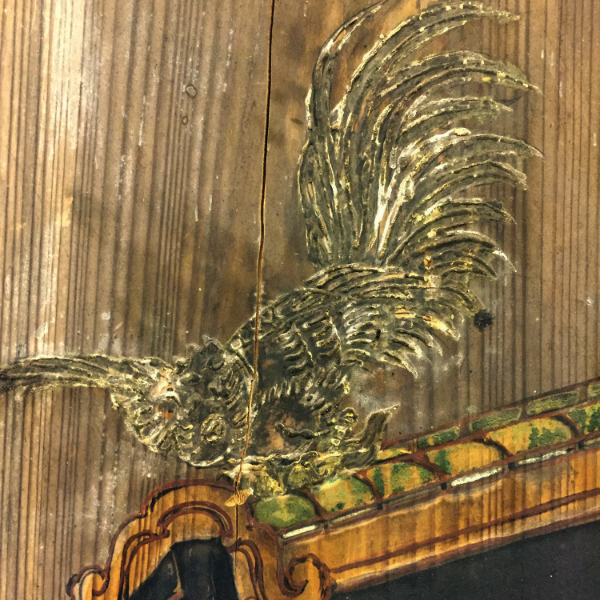
A gilded sculpture of a phoenix, a symbol for virtuous imperial reign, perches with outstretched wings atop the cabin roof directly over Jingū. Photograph by Elizabeth Lillehoj.
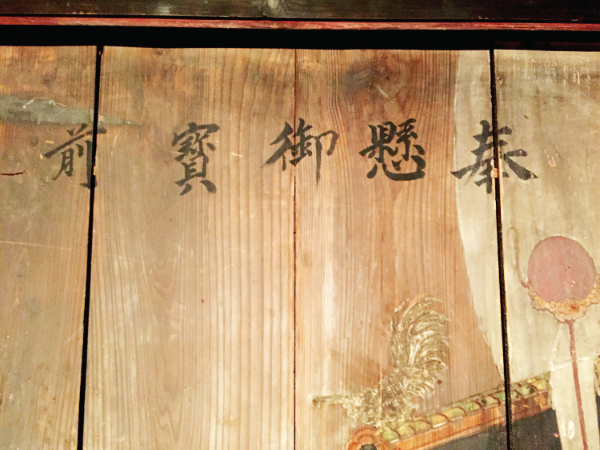
Across the top of the tablet is a boldly written inscription, read from right to left: “Hung and respectfully dedicated to the gods.” Photograph by Elizabeth Lillehoj.

Shrine Tablets
The MOIFA Jingū votive tablet is a large ema, a type of painting meant for viewing by groups of visitors at a Shinto shrine. “Ema” means “painted horse(s).” The term derives from an early practice of dedicating live horses to shrines. Worshippers honored horses, said to carry messages to the gods and provide transportation for divine beings. Painted representations eventually replaced the live horses, and new subjects appeared on tablets.

Shrines display large-scale tablets outdoors under the eaves of sanctuaries or in open-air structures. Artists began using bolder colors and designs. They also enlarged the tablets’ size, allowing viewers who stood below to identify subjects from a distance. Over time, as a result of exposure to humidity and sunlight, the tablet surfaces weathered and darkened.

Inscriptions
Across the top of the Jingū votive tablet is a boldly written inscription, which is read from right to left as “Hung and respectfully dedicated to the gods” (Hōken gohōzen). At the left side of the tablet is another inscription, explaining that two male members of a religious congregation commissioned the piece for dedication to a Shinto shrine. The name of the shrine is unknown, but the two men likely lived and worshipped at the shrine where they donated the work.

Of the two additional inscriptions on the tablet, one gives the date of 1862 and the other tells the artist’s name: Kano Asanobu. Many painters used the surname Kano, and several achieved renown as talented artists. It is unclear whether Asanobu was a lineal descendent of the influential Kano family. More likely, he adopted the name after training in a Kano workshop and then worked in a provincial atelier, perhaps as a specialist in painting shrine tablets.

The Figure of Jingū
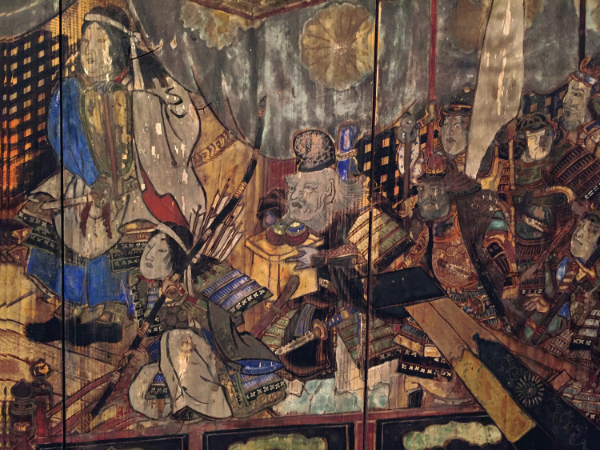
Asanobu portrayed mythic Empress Jingū in a boat near the center of the tablet. She sits alongside a cohort of gods and soldiers, staring at cliffs along the Korean shoreline. Having recently arrived from her homeland on the Japanese archipelago, Jingū is preparing to disembark and conquer the Three Kingdoms—Shiragi (Korean: Silla), Kudara (Baekje), and Kōkuri (Goguryeo)—which controlled most of the Korean peninsula in the first centuries CE. Myths claim there was a queen-regent named Jingū at the time, but most historians have concluded that Jingū never existed (or, at most, that she was semi-historical).

Asanobu portrayed Jingū as a grand and imposing presence. The legendary queen-regent functions as commander-in-chief of her fleet. She sits at the edge of a cabin on the leading ship. A gilded sculpture of a phoenix, a symbol for virtuous imperial reign, perches with outstretched wings atop the cabin roof directly over her.

Although pigment that Asanobu applied to Jingū’s face has flaked away, we can make out her features sketched in under painting. Asanobu represented Jingū in armor with a sheathed sword. Her hair is held in place with a white headband in preparation for battle, and she holds on her lap a tall war fan.

Near the center of the tablet, Jingū is depicted alongside a cohort of gods and soldiers, staring at cliffs along the Korean shoreline. Photograph by Elizabeth Lillehoj.

Origin of the Jingū Legend
Asanobu followed the oldest known written descriptions of Jingū’s legendary incursion onto the Korean peninsula. The descriptions appear in two accounts: the Records of Ancient Matters (Kojiki, dated 711–12) and the Chronicles of Japan (Nihon shoki, 720). These official mythico-histories of Japan identify Jingū as the wife of second-century Emperor Chūai and as a sorceress who channels the voices of the gods. According to the accounts, Jingū fulfills a divine mission given to Chūai before his death to lead forces across the sea and assume control of the peninsula. Jingū manages this without bloodshed and, upon returning home, she gives birth to Chūai’s son, later known as Emperor Ōjin.

The veracity of the early accounts is dubious, as they were composed long after the purported lifetime of Jingū and under imperial auspices as part of a project to justify Yamato rule. The accounts were compiled by a group of courtiers instructed to narrate the alleged divine origin and unbroken lineage of the ruling Yamato dynasty. The dynasty had emerged in the fourth century as a federation located in what is today central Japan, including Nara and Kyoto. By 700—shortly before the two mythico-historical accounts were composed—Yamato emperors had unified the heartland of the archipelago.

A key reason it has been impossible to confirm claims about Jingū’s existence is the paucity of records on early Japan, then mostly non-literate. Yet, the oldest known written source on prehistoric Japan, a Chinese account of about 297 entitled “Treatise on the People of Wa,” mentions a female ruler named Himiko who ended a civil war in the second century and ruled Yamatai on the archipelago.

Early Yamato leaders seem to have borrowed the description of Himiko from “Treatise on the People of Wa” and used it to advance their quest for legitimacy. They claimed that “Treatise on the People of Wa” confirmed the Yamato emperor’s right to rule given that the imperial line descended directly from Himiko.

The memory of Himiko possibly spawned the Jingū legend; indeed, authors of medieval and early modern Japan commonly held that Jingū was Himiko. Officially speaking, however, Jingū is mythological. Her name was excised from the list of Japanese emperors, and she is deemed legendary. Today, historians point out that many aspects of the Jingū legend appear to have been invented, even the name “Jingū” (meaning “divine success”).

That said, certain elements of the Jingū legend might have been based loosely on historical realities. It is known, for example, that peoples in East Asia had long interacted, even before either Korea or Japan came to be governed by a single unified regime. Several premodern kingdoms on the peninsula and the archipelago struggled between one another, locally and across the sea. More common than armed conflicts, however, were extended periods of open exchange.

For centuries on end, the two East Asian neighbors engaged in peaceful interaction, making the scene of battle captured on the Jingū votive tablet an anomaly. In fact, many ancestral links connected peoples of the peninsula and the archipelago. It is estimated, for example, that a third of aristocratic Japanese in the eighth century could trace their ancestry to Korea, their relatives having moved to the archipelago during the previous five hundred years.

One of Jingū’s own forefathers is said to have been a Shiragi prince who immigrated to Japan from the Korean peninsula. This Shiragi ancestor carried to Japan ritual objects associated with religious authority. According to early accounts, the Japanese emperor ultimately acquired the imported objects, providing Yamato leaders a special link with the peninsula’s advanced culture.

Jingū’s Companions
In the queen-regent’s crew on the tablet, there are several gods. One is the Great God Sumiyoshi, shown kneeling to the right of Jingū. Sumiyoshi appears as an elderly aristocratic gentleman with a black courtier’s cap and wispy white hair, beard, and eyebrows. He holds up a short stand atop which sit two magical orbs—the tide-ebbing and tide-raising jewels. Medieval versions of the legend claim Sumiyoshi had informed Jingū of the orbs’ power, and the empress had sent him to the palace of the Dragon King at the bottom of the sea to procure the jewels. Jingū succeeds in her mission due to the jewels. Joining Sumiyoshi on the quest was Jingū’s sister, Toyohime. In the votive tablet, Toyohime sits between Sumiyoshi and the queen-regent.

[wonderplugin_slider id=185 alignment=”center”]

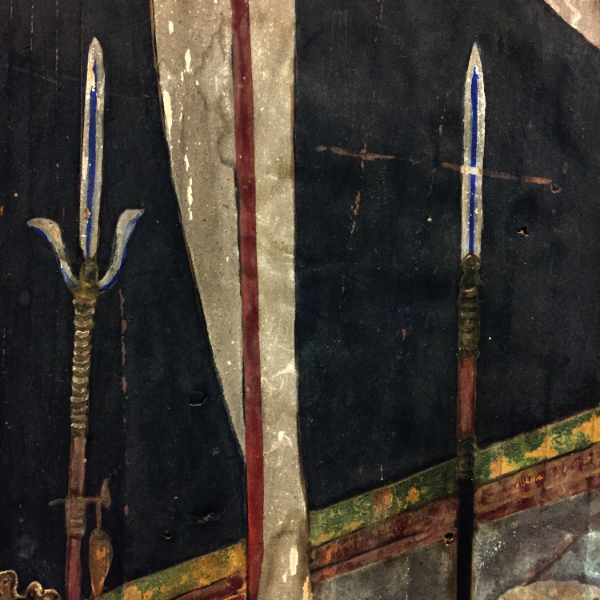
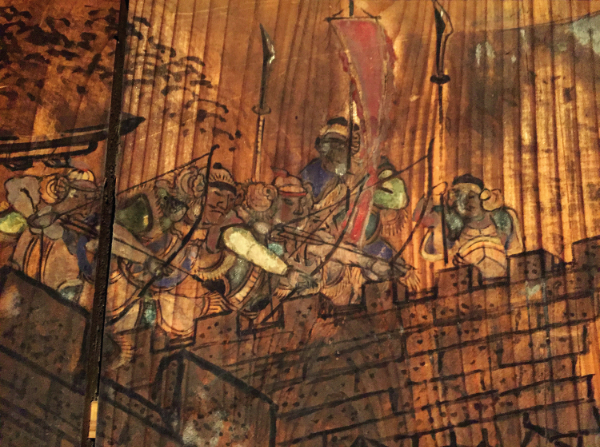
Japanese samurai appear in a second boat, slightly to the right of Jingū’s vessel. The samurai wear distinctive armor of lamellar construction with small rectangular plates laced together in horizontal rows, creating flexible protection. Several warriors wear ornate chest plates. Their helmets have a short visor and a segmented neck guard extending out at the back. The Japanese weapons they hold include the long bow, the spear ending in a curved naginata blade, the trident-headed spear, and the yari spear with a single straight blade.

Banners and other heraldry in the votive tablet are recognizable from early Japanese battle scenes. Perched on wafting clouds atop one banner is a large red disk. This solar motif refers to the Sun Goddess and to the land of the rising sun, Japan.

Although the Jingū legend can be traced back to the eighth century, it evolved over time, especially during Japan’s medieval period from the thirteenth through the sixteenth centuries. Medieval authors affiliated with shrines and temples along Japan’s southern seacoast worked to promote their cultic centers by re-writing the Jingū legend and by adding the names of formerly obscure gods. One such god was Isora.

Isora is identified as the progenitor of the Azumi people, who were linked to the Yamato aristocracy and who led maritime ventures. Jingū allegedly set sail for the Korean peninsula from a religious site worshipping Isora. The site is located at Shikanoshima on Kyushu, Japan’s southern island. Shikanoshima long served as a landing point of ships sailing between Japan and continental East Asia.

In the votive tablet, Isora stands on a raised platform near the bow of Jingū’s boat. Leading the empress’s retinue forward, the sea god wears Japanese armor and has two sheathed swords tucked under his belt. As he confronts Jingū’s opponents, Isora waves two sacred wands with white paper strips meant to ward off evil. Thanks to Isora’s use of the magic wands, enemy arrows fall away into the sea.

Early descriptions of Isora say he is hideous in appearance with barnacles and shells covering his face, but the artist of the tablet depicted no encrustations on Isora. Instead, Asanobu presented Isora as an impressive man with flowing white hair and a deep frown. The creases in Isora’s forehead suggest his intense absorption in warding off the enemy. The god wears a court cap with a knob at back from which a long tail extends. Originally donned by Japanese noblemen for formal events, this type of cap was later adopted by Shinto priests.

The Death of Emperor Chūai
Of the medieval alterations to the Jingū legend, perhaps most fanciful is the embellishing of Chūai’s death. According to one medieval tale, an eight-headed Korean demon killed Jingū’s husband during the attack on Japan. This fantastical tale appears in the fourteenth-century text Lessons on Hachiman for Ignorant Children. Priests of Iwashimizu Hachiman Shrine, associated with the imperial court, likely composed Lessons on Hachiman, intending to promote their shrine by describing its mystical origins. This version of the Jingū legend has novel references to repeated foreign attempts to invade Japan, all of which fail due to the intercession of divine beings. By claiming that Chūai was a victim of Korean aggression, the medieval Lessons on Hachiman positions Jingū’s campaign as a response to foreign invasion. In addition, it recasts the Jingū story in Buddhist terms and transforms Jingū into a savior being.

Attempted Mongol Invasions
Shikanoshima, one of the main sites of Isora worship, served as a memorable battleground in 1274 and 1281, when Japanese warriors twice defended the realm against Mongol-led invaders. In 1274, Japanese warriors faced a massive enemy force—a joint Mongol-Korean-Jurchen-Han Chinese coalition—arriving by sea at Hakata Bay in northern Kyushu. Defenders routed the attackers, who fled. Seven years later, a significantly larger Mongol-led fleet appeared. It was met by violent winds off the Kyushu coast and invaders were again forced to flee.

As Japanese storytellers narrated accounts of the Mongol invasions, they added fantastical elements to explain how Japan managed to fend off the aggressors. According to one new narrative, a green dragon lifted its head from the waves to wreak havoc on foreign ships. It was said Japan’s victory owed to divine intervention as the emperor had prayed to the Sun Goddess, beseeching her to protect the realm.

The Japanese weapons the samurai hold include the trident-headed spear and the yari spear with a single straight blade. Photograph by Elizabeth Lillehoj.
Defenders atop the sloping stone ramparts at left are depicted with weapons, costumes, and heraldry identifying them as Mongol-led soldiers of the thirteenth century. The soldiers wear Mongol helmets with protective flaps that curl outward over their ears and embellishments of fur and feathers. Photograph by Elizabeth Lillehoj.

Soon after the Mongol-led attacks, Japanese authors began conflating the recent defense of the realm with Jingū’s legendary Korean campaign. Even though the Mongol invasions occurred long after Jingū’s alleged lifetime, the correspondence with her campaign was considered valid. But the correspondence was clearly arbitrary, a kind of psychological compensation for the trauma of the Mongol assaults, in which foreigners managed to approach and attack Japan.

Certain details in the votive tablet owe to the medieval conflation of Mongol invasions and Jingū lore. Most notably, defenders atop the sloping stone ramparts at left are depicted with weapons, costumes, and heraldry identifying them as Mongol-led soldiers of the thirteenth century, not Koreans from much earlier times. The soldiers wear Mongol helmets with protective flaps that curl outward over their ears and embellishments of fur and feathers. Several defenders hold a type of Mongol pole weapon with a short curving blade known as a moon blade. Others shoot distinctive short bows and rain down arrows from on high. Here, the artist captured the notorious Mongol tactic of shooting arrows en masse into the air. The defending ranks display a type of long red banner, unlike the blue and white banners and sun disk emblem of Japanese heraldry.

Modern Jingū Images
In 1862, when Asanobu painted the tablet, Jingū images proliferated in Japan. Most featured fantastical elements added to the Jingū legend in the medieval period. Jingū was further altered in the modern era to serve as a potent martial symbol for a country facing unprecedented change.

In 1839, war had broken out between China and Britain. Chinese authorities resisted Britain’s imposition of the opium trade, but China lost the war. After a second defeat several years later, China submitted to Britain’s demands and opened treaty ports to European commerce. Japanese audiences watched developments on the continent, recognizing the vulnerability of their own country. If Westerners could demand free entry, extraterritorial rights, and trading privileges from China, they could easily demand the same from Japan.

A debate swept across Japan over how to avoid foreign domination. Leaders began to ramp up border defenses to combat the threat of Western colonialist incursions. But it became clear in 1853—when U.S. Admiral Matthew Perry arrived in Tokyo Bay with a squadron of four black ships—that Japanese authorities could not control the encroachment of unwelcome Western vessels into Japanese territorial waters. The government acceded to U.S. demands, and Japan opened its doors to foreign trade.

During the Meiji period, which began in 1868, nationalistic sentiments increased. Distorted memories of Japan’s past achievements in Korea were promoted in the form of freshly minted Meiji versions of medieval tales. Japan, meanwhile, was implementing expansionist policies of its own and soon emerged onto the world stage as a colonialist and imperialist power. Meiji authorities argued among themselves over when to invade Joseon Korea. After nearly a half-century of debate, authorities took action in 1905 and annexed the peninsula. Then for four decades, Japan dominated Korea.

Throughout the early years of the twentieth century, representations of the Jingū legend trumpeted Japan’s military successes of the past, portraying the queen-regent as a heroic role model for modern Japan. Jingū imagery remained current during WWII, when the Jingū conquest story was integrated into textbooks read nationwide in Japanese elementary schools. As full-blown propaganda, it was meant to justify the unfortunate Japanese aggression toward and colonization of Korea.

But shrine visitors who had viewed the votive tablet in 1862—before Japan’s modern invasion of Korea, when the tablet was first installed as an ema—could have appreciated the martial, monarchial, and sacred features of the image. They would have understood that this and many other contemporary paintings of the legendary empress showed Jingū as a heroic role model for the modern nation. Moreover, viewers likely knew that the tablet scene was highly inaccurate in historical terms; it was not a documentary portrayal of actual events from the past. The artist had presented the Jingū story as a hybrid fantasy, addressing a growing anxiety in Japan about threats to the country’s sovereignty. 

Elizabeth Lillehoj is a research associate of the Museum of International Folk Art and a professor emeritus of Asian art history at DePaul University, Chicago. Her research focus is premodern Japanese art. Her 2011 book, Art and Palace Politics in Japan, 1580s–1680s, appears in Brill’s Japanese Visual Culture series.

Elizabeth Lillehoja is a former research associate of the Museum of International Folk Art and a professor emeritus of Asian art history at DePaul University, Chicago. Her research focus is premodern Japanese art. Her 2011 book, Art and Palace Politics in Japan, 1580s–1680s, appears in Brill’s Japanese Visual Culture series

From the Ground Up

Text and photographs by Brian K. Edwards, MFA, PhD

Give a man a dole, and you save his body and destroy his spirit. Give him a job and you save both body and spirit.”
—Harry Hopkins, WPA administrator

The economic collapse that followed the 1929 stock market crash eventually saw one in four Americans without work. Some areas, like Toledo, Ohio, and Lowell, Massachusetts, were hit especially hard, and saw unemployment rise to over 80 percent. Overall economic activity was cut nearly in half. In the midst of this calamity, the administration of President Franklin D. Roosevelt created the New Deal, which comprised numerous programs to help the economy recover from the Great Depression. These included the Social Security Act of 1935, the Tennessee Valley Authority Act (which built dams along the Tennessee River for flood control and electric power generation), price support programs for many agricultural products, the National Industrial Recovery Act (which guaranteed workers the right to unionize, among many other provisions), suspending some antitrust laws, and the Glass-Steagall Act, which brought reforms to the banking industry.

[wonderplugin_slider id=182 alignment=”center”]


The persistent high rates of unemployment into the mid-1930s prompted a second round of New Deal programs, one of which was the Works Progress Administration (WPA) in 1935. It provided jobs to workers to build schools, bridges, post offices, parks, highways, and other public infrastructure. In some cases, WPA funding was combined with funding from other New Deal programs such as the Civilian Conservation Corps (CCC). Larger projects such as the Grand Coulee and Hoover Dams were funded by a sister New Deal program, the Public Works Administration (PWA), a program often confused with the WPA. Larger WPA projects included the Griffith Observatory in Los Angeles, Midway International Airport in Chicago, Dealey Plaza in Dallas, and the River Walk in San Antonio. PWA projects in New Mexico include Brown Hall at the New Mexico School of Mines in Socorro, Quay Hall at Eastern New Mexico State University in Portales, the Zimmerman Library at the University of New Mexico in Albuquerque, and the Santa Fe County Courthouse in Santa Fe, designed by noted architect John Gaw Meem.

Before its dismantling in 1943, the WPA employed more than 8.5 million workers on 1.4 million projects. According to the New Mexico Humanities Council, over half of the roughly 425,000 people living in New Mexico in 1935 had a job with one of the New Deal agencies. Nearly a century later, over 15,000 sites nationwide—over 300 of which are in New Mexico—remain. Many still are part of our communities, including schools, government facilities, parks, and murals, and many of these sites helped those places grow economically and have become important parts of these communities.

My own interest in this topic stems from three sources: my first career as an economist with an interest in the Great Depression and the New Deal; the photography of the many New Deal-era Farm Service Administration (FSA) photographers that documented people and places during the Great Depression; and my own family history. My paternal grandparents and other relatives migrated from Arkansas to California and lived at the Tulare Migrant Labor Camp in Visalia in the early 1940s. FSA photographers Russell Lee and Arthur Rothstein took photographs of them during their stay.

[wonderplugin_slider id=183 alignment=”center”]


My interest in the WPA also stems from debates our nation is having currently on issues like climate change, immigration, the future of federal programs like Social Security and Medicare, and certainly our recent experience with the COVID-19 pandemic.

One common thread and critical aspect of these debates is the apparent divide on the merits of making sacrifices today for a better tomorrow. Total WPA expenditures through 1941 amounted to $11.4 billion, which translates to $198 billion today—but the many buildings, parks, and other facilities built with those funds still in use, as well as the artwork that has survived since, attest to the many benefits from these expenditures that persist to this day. In the throes of the Great Depression, the Roosevelt administration moved resources away from other uses to help the country rebuild from the individual level up.

[wonderplugin_slider id=184 alignment=”center”]


The photographs presented here are a very small sample of sites scattered throughout New Mexico that were either fully or partially funded by the WPA. New Mexicans today are beneficiaries of the modest public investments made well before most of them were born, and these structures are undeniable illustrations that decisions we make today will make a difference to the world of tomorrow.

Now once more the belt is tight and we summon the proper expression of horror as we look back at our wasted youth. Sometimes, though, there is a ghostly rumble among the drums, an asthmatic whisper in the trombones that swings me back into the early twenties when we drank wood alcohol and every day in every way grew better and better, and there was a first abortive shortening of the skirts, and girls all looked alike in sweater dresses, and people you didn’t want to know said “Yes, we have no bananas,” and it seemed only a question of a few years before the older people would step aside and let the world be run by those who saw things as they were—and it all seems rosy and romantic to us who were young then, because we will never feel quite so intensely about our surroundings any more.

                                      —F. Scott Fitzgerald, 1931

Santa Fe, New Mexico-based photographer Brian K. Edwards specializes in fine art and documentary photography. He has photographed extensively in the Southwest, across the United States, and internationally. He received an MFA in photography at the Academy of Art University in San Francisco. You can see more of this work at briankedwards.com.

Brian K. Edwards (opens in a new tab) a Santa Fe, New Mexico-based photographer specializes in fine art and documentary photography. He has photographed extensively in the Southwest, across the United States, and internationally. He received an MFA in photography at the Academy of Art University in San Francisco.

A Sacred Space

By Brian D. Vallo, Governor of Acoma

My connection to sacred space and topography, including places like Wáphra’ba’shúka (Chaco Canyon), begins before birth, through many generations of ancestors whose prayers established the foundation for this distinct affinity. The bloodline of those who settled and engaged with the vast hallowed landscape is the same blood that runs through my own being as an Acoma man, in this present time. The migration of my bloodline from the time of creation and emergence provides me and other descendants of Chaco with a context for identity and understanding of contemporary Pueblo culture. Further, this connection extends to the sky above, the oceans, and the depths of our Earth Mother.

I recently returned from a trip to Kásh’kútruti (Mesa Verde National Park) where, along with three other Pueblo tribes, we reburied ancestors who were removed from their final places of rest within this sacred and vast cultural landscape 130 years ago in the name of Western science and privilege. I could not help but think about who they were. I wanted to acknowledge them by name or by any relation I may have had through clan and kinship. I wondered about their age—if they were young, anticipating the migration to places like Chaco Canyon. I could only refer to them as my elders and offer the utmost respect as they were placed carefully in a new grave along with their funerary items. What I do know is that we were of the same blood, and that we reconnected during the solemn and gut-wrenching observance. Under the bright sun of that early Sunday morning, my ancestors and I created a new sacred space, and I prayed and ensured them that I would call upon their spirits for protection of all people and guidance in the collective work to repatriate other ancestors, and to protect Mesa Verde and other ancestral homelands.

I am often asked to speak on the connection the Pueblo of Acoma has to ancestral homelands like Chaco Canyon. Since as early as the mid-1990’s, I have been invited to engage with non-Native American scholars and others, the “experts,” on initiatives that ultimately advance their own research about ancestral Pueblo culture. Many of these projects did not include consultation with descendant communities, nor did they provide any direct benefit to Acoma and other tribes.

I am always very selective and cautious when fielding these opportunities, as some lead to inquiry that attempts to extract esoteric information. In my early years, I learned about these crafty attempts the hard way. The Native American Graves Protection and Repatriation Act (NAGPRA) of 1990, a policy enacted by the United States Congress designed with the ambitious intent to repatriate collections of Native American human remains, associated funerary objects, and objects of cultural patrimony (and a provision for protection of eagle feathers), provided me with an introduction to the complexity of federal processes as well as challenges within my own Acoma community where access to traditional knowledge and history were concerned.

This introduction did not come with any formal training or education in the field of archaeology, anthropology, museum studies, or law; rather, I was a 23-year-old college student studying marketing at New Mexico State University in Las Cruces, called back to Acoma to fulfill an appointment by cultural leaders to serve as a tribal official for the term of one year. The experience I had as a tribal leader for three consecutive years, rather than the one-year term, had a significant influence on the way in which my own career interests would shift and instead focus on becoming a steward of traditional Acoma knowledge and history associated with ancestral Pueblo landscapes. Moreover, my own upbringing and teachings provided by my maternal great-grandfather, clan uncles, paternal grandfather, my own father, and many tribal elders and cultural leaders helped me to cultivate a stronger understanding and acceptance of my inherent responsibility to be a good caretaker of the great intellectual property of my bloodline, my ancestors.

The initial implementation of NAGPRA included my involvement in the review of the first inventories received from various institutions throughout the country and participation in the mandated provision for tribal consultation. Those who worked alongside me and other tribal leaders called upon the oral history and personal experiences shared by our elders to help us navigate the new federal policy and its process so that we might repatriate ancestors, their funerary items, and sacred materials (objects of cultural patrimony), many of which were taken from Chaco Canyon. This experience presented the immediate need to work cooperatively with federal agencies and institutional representatives to gain access to collections, have the “upper hand” where cultural affinity claims were concerned, and to establish control over the repatriation process.

The same teachings also provided us an advantage in terms of establishing limitations where information sharing was concerned. The “burden of proof” provision in the law, however, was our biggest challenge, as this often presented pressure to divulge culturally sensitive information in order to substantiate an affinity claim to objects in a collection. Attempts by repatriating institutions and federal agency officials to obtain detailed information as to why an object or the remains of ancestors were sacred was insulting and demeaning.

Those early experiences, as difficult as they were, did result in successful repatriation (among other outcomes), which ensured the protection of Acoma’s traditional knowledge, and ultimately helped to improve federal processes. The work is ongoing, and many individuals from Acoma and other tribes throughout the country have contributed greatly towards strengthening and advancing repatriation efforts beyond NAGPRA. Moreover, this work has directly influenced our ongoing commitment to safeguard not only all materials protected under NAGPRA, but the sacred places from which they originate.

A leader in the movement to protect cultural resources on the Southwest’s vast landscape, Acoma and other tribes throughout the country have established capacity and are committed to the development and implementation of our own strategies for the protection and preservation of sacred places that remain integral to the continuance of the bloodline which connects us. The active engagement of Acoma knowledge keepers, Tribal Historic Preservation Officers, tribal leaders, Acoma scholars, young Acoma people, and the many friends of the Pueblo who have stepped forward to assist us in this most important work ensures a meaningful and relevant process for addressing these often difficult initiatives, especially when federal policy and government agendas are not always in alignment with our Pueblo core values.

Nonetheless, we move forward with full control over parameters for data sharing, consultation, and asserting our sovereignty. This, in itself, is a sacred process.

I was asked to write about how and why Chaco Canyon is sacred to Pueblo people. First, I would never speak on behalf of other Pueblo tribes. Secondly, when I accept an invitation to speak or am presented with the opportunity to participate in projects involving Chaco Canyon, I always share information that I hope is useful in shaping a better understanding among others of the complexity of the Acoma narrative in relation to our connections to Chaco and other settlements of our ancestors.

I enjoy sharing stories and the experiences I have had in my young life that influenced my own understanding of these special connections. My career in historic preservation has also afforded me great opportunities to be actively engaged in protecting cultural resources. During presentations, I will often make the ever-annoying (to some non-Native participants, anyway) minimal references to ongoing cultural practices like pilgrimage, songs, prayers, oral history, architecture, material culture, and agriculture—all vital to recognizing our lineage to Chaco. I suppose that during any future public presentations, I will allude to these concepts in hopes of an acknowledgement of this great living connection of Governor Vallo and his people to the ancestors and cultural landscape of Chaco Canyon.

Ultimately, however, the desire of Acoma people is to remain steadfast in sharing Indigenous knowledge, values, and contemporary lived experiences about Wáphra’ba’shúka to our young people so as to ensure respect and understanding of the connection to the bloodline of our ancestors. Doing so will guarantee the perpetuation of Chaco culture in future generations.   

A former resident of Santa Fe, Governor Brian D. Vallo served as director of the Indian Arts Research Center at the School for Advanced Research and as a member of the Santa Fe Arts Commission, Santa Fe Community Foundation Board of Directors, and Chamiza Foundation. He is currently the governor of the Pueblo of Acoma.

Brian D. Vallo (opens in a new tab) is a former resident of Santa Fe, and served as director of the Indian Arts Research Center at the School for Advanced Research and as a member of the Santa Fe Arts Commission, Santa Fe Community Foundation Board of Directors, and Chamiza Foundation. He served as the governor of the Pueblo of Acoma from 2019-2021.