
Tracks Through Time

Part 2: The Lamy Branch Line 1880 to present
by Fred Friedman

Read part I of this history in El Palacio’s Winter 2021 edition, here.

Even with the Iron Steed’s arrival in Santa Fe in February of 1880, railroads came late to New Mexico. The states and territories surrounding New Mexico enjoyed at least some railroading presence prior to that time. Within a few years, however, systems seeking to compete with the Atchison, Topeka & Santa Fe were laying track into and through New Mexico, as well as constructing depots while acquiring economic and political influence.

Territorial legislators ensured that regulatory statutes were accommodating to all rail growth through the forgiveness of taxes, eminent domain implementation, and related statutory incentives.

The later part of the nineteenth century saw the emergence of the Denver & Rio Grande Railroad, the Santa Fe Central Railway, Texas, Santa Fe & Northern, Cerrillos Coal Railroad Company, and others becoming established. Accordingly, several depots associated with the Lamy branch were built. Such depots were both utilitarian and symbolic. Each of the structures became immediately multi-functional, serving as the corporate presence of each railroad, plus being local meeting and community centers, not to mention serving as the focal points for the railroad’s passenger and freight business.

Structures Along the Route

Several important structures are located along the Lamy branch alignment. They include the depot at Lamy, the former AT&SF depot in the downtown railyard, and the Union depot, which now houses the Santa Fe restaurant Tomasita’s. In addition, two other railroad structures are found near the rail line, although not adjacent to it: the former Kennedy depot and the no-longer-standing United States’ Bruns Army Hospital, located near what is now known as the Midtown Campus on St. Michael’s Drive. Each of these areas and structures have a relationship to the Lamy branch.
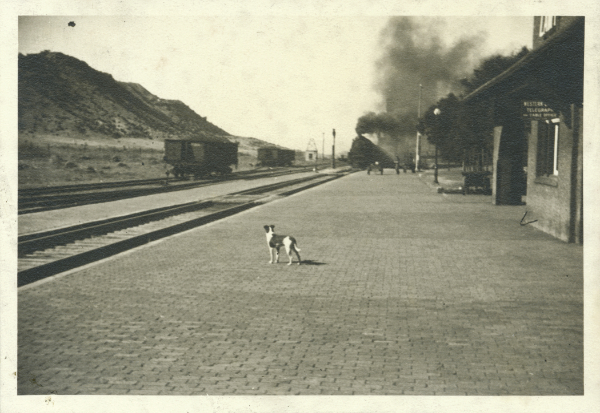
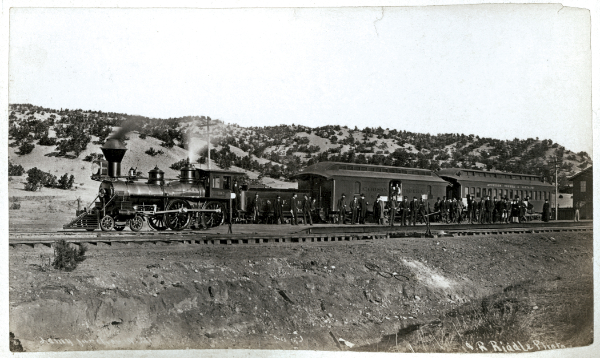
Train arriving from the South at railroad depot in Lamy, New Mexico, 1937. Courtesy Palace of the Governors Photo Archives (NMHM/DCA), neg. no. 142776.

Santa Fe Southern Railway’s Lamy Depot

The one-story, 39-by-108-foot rectangular Lamy depot was built for the Atchison, Topeka & Santa Fe Railway and opened to passengers in 1909. It replaced a two-story wood frame structure erected in 1881. When the new passenger station opened, the original was converted into a freight depot and served this purpose into the 1940s.

The structure had a tower built for the purpose of viewing trains approaching from the west and east. Space is now leased to Amtrak for awaiting Southwest Chief Chicago-to-Los Angeles trains. The Spanish Mission style, featuring shady arcades, red tile roofs, and stucco-clad walls drew on the region’s Spanish colonial past to provide the railroad with a cohesive visual identity. It also became an effective marketing tool to lure residents and tourists from the East and Midwest. Constructed of brick covered in stucco, the Lamy depot features a waiting room outfitted with carved wooden beams, handsome wood benches in a Spanish Revival style, and colorful decorative tiles. Common to many depots in the region, it has a covered outdoor waiting room on the east end and a trackside arcade.

The tower over the ticket office was removed in 1933, while a small freight room was added to the building’s west end in 1941. Its function is evident by the placement of small windows high on the wall that admit light but deter thieves, as well as the large wooden doors that allowed station personnel to roll in carts stacked with luggage, boxes, and crates.


Atchison, Topeka & Santa Fe Railway Depot

Located in the Santa Fe Railyard, the Atchison, Topeka & Santa Fe Railway depot is owned by the City of Santa Fe and has seen a variety of interests throughout its existence. This building was superseded by a wood frame structure, constructed the same year that the branch from Lamy was built, in 1880. It was converted to a freight depot after the present-day 35-by-92-foot brick and stucco station was built in 1909.

The original stucco color was brown and the pitched roof was originally covered with mission-style tiles. Rail passenger service was provided into Santa Fe until 1928. After that time, the Clarkson Bus Company moved passengers to and from Lamy.

Today, the structure is used by the City of Santa Fe for accommodation of passengers of the New Mexico Rail Runner Express commuter line.

Union Depot

Although not one of the Lamy line’s related structures, the building that now houses Tomasita’s was an important feature. Known as Union Depot, the station accommodated both Chili Line and Santa Fe Central/New Mexico Central Railroad passengers and freight from 1903 until 1941, when Denver and Rio Grande/Chili Line service was discontinued. Railroad employees of different companies often shared equipment and conceivably worked for two or three of the operating systems located in the downtown yard.

Kennedy Depot

Just out of sight of Santa Fe Southern/Sky Railway passengers at Eldorado sits the former Kennedy depot, now used as the residential area’s community center. This station structure was formerly located at the intersection of the AT&SF and Santa Fe Central alignments near Galisteo. It was named to honor Arthur Kennedy, chairman of the Santa Fe Central Railway/New Mexico Central Railroad. Upon service discontinuation of the line, the structure was used as a ranch building. In the 1970s it was transported to Eldorado to be used as a real estate office, prior to its becoming a community facility.

[wonderplugin_slider id=188 alignment=”center”]

Bruns Army Hospital in Santa Fe

In Santa Fe, the closing of the Bruns Army Hospital in 1945 became emblematic of things changing throughout the area. Opened in 1943, the hospital at one point had more than 200 buildings. It was named after Col. Earl Harvey Bruns, an Army doctor who succumbed to pulmonary tuberculosis in 1933. The hospital was the largest industry in the Santa Fe area, employing 1,000 civilians along with 500 military men
and 100 military nurses. The facility had a bed capacity of 2,500 beds and contributed about $4.5 million a year into Santa Fe’s economy.

Other Railroads Associated with the Lamy Line

After the county and city were served by the AT&SF, other rail companies followed and its years of sole railroad dominance in the community came to an end. The Santa Fe Central (1901-1908) ran from the yards in Santa Fe south to Moriarty, then on to Estancia and Willard. There, it connected with the Chicago, Rock Island & Pacific, making national rail travel from Santa Fe finally possible. The Santa Fe Central, thereby, provided an alternative to the AT&SF’s eleven-year transportation monopoly. The Santa Fe Central route was purchased and reorganized by the New Mexico Central Railroad in 1908, itself being restructured in 1918 as the New Mexico Central Railway. Even though the Santa Fe Central, the New Mexico Central Railroad, and the New Mexico Central Railway were essentially the same mechanical system, from a legal and regulatory stance, a total of four railroads had operated in Santa Fe by 1918.

Rail travel to the north from Santa Fe was delayed for several years until terms of the Treaty of Boston (an agreement with the AT&SF prohibiting construction further south than 90 miles from the Colorado/New Mexico border until 1880, when the Texas, Santa Fe & Northern Railroad was incorporated) approved the final link. Thereupon, the Texas, Santa Fe & Northern was established by several of the members of a Santa Fe citizens’ committee, headed by Antonio Ortiz y Salazar. Following the Texas, Santa Fe & Northern, the first of several subsequent roads by the same name, Santa Fe Southern Railway came into existence in 1890.

The Denver & Rio Grande Railway had begun construction of the Chili Line in 1880 and completed it from Antonito to Española. It closed in 1941, mostly due to truck transport competition, and was subsequently abandoned in that year.

Joining the parade of the county’s rail development, the communities of Cerrillos and Madrid were eventually linked by steel, with the establishment of the Cerrillos Coal Railroad Company being established in 1892 for the transport of Madrid coal to Waldo’s coking ovens 5 miles to the north. While the Santa Fe Central, the New Mexico Central and the Chili Line eventually ceased operations, the Lamy branch and its owner-operator, the AT&SF, continued freight operations, hoping also to capitalize on emerging tourism that began capturing the minds and wallets of travelers.

The Harvey Era & Famous Trains Period

The extensive food and lodging empire of Fred Harvey positively affected the Lamy line for more than fifty years in the form of the construction and use of Lamy’s El Ortiz Hotel from 1896 to 1945. The phenomenon of Harvey Indian Detours, streamliner trains, and the sophisticated elegance that the company brought to the line was largely responsible for the branch’s continuance before and for a brief time following World War II.

For a few years, mixed train service prevailed, with often as many cattle and sheep aboard as paying passengers. Before the Second World War, the line was a connection for Harvey hotels in Arizona and other New Mexico locations.

The diminutive El Ortiz established a reputation unique among other elegant railroad posadas and bore the essence of building designer Mary Elizabeth Jane Colter’s (1869–1958) artistic style.

The El Ortiz was a one-story building with ten rooms and an enclosed courtyard. As quoted in Virginia Grattan’s Mary Colter, Builder Upon the Red Earth, one guest described the El Ortiz as a “little oasis among the desert hills, creating the temptation to give up all plans and stay a week for the pleasure of living and resting in such a place.”

Also part of the Harvey offering to travelers were Harvey Detours. El Capitan, Chief, and Super Chief rail passengers detraining at Lamy were delighted to be met by a two-team host of driver and courier at the station. Vehicles were primarily seven-passenger Cadillac and Packard “Harvey cars,” available for $75 per day, which included food and accommodations en route to more than a dozen spectacular New Mexico locations. Often part of the welcome included picnic lunches and several well-planned multi-day itineraries.
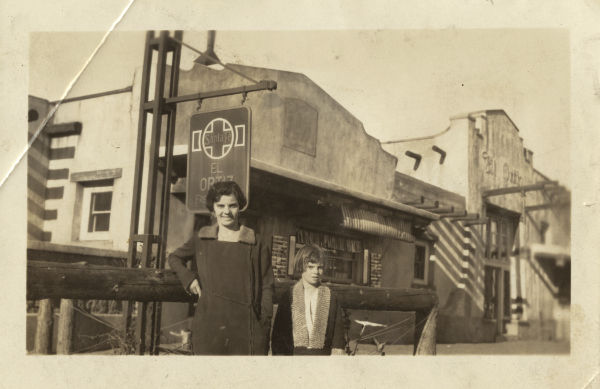
Woman and child in front of El Ortiz Hotel, Lamy, New Mexico, ca. 1920. Courtesy Palace of the Governors Photo Archives (NMHM/DCA), neg. no. 112259.

Famous Trains

Among the famous passenger trains of the past, the Santa Fe Chief (1926-1968), the Super Chief (1936-1971), and the El Capitan (1938-1971) ran from Chicago, through Lamy, then on to Los Angeles. Prior to Amtrak’s creation in 1971, via the National Railroad Passenger Act, these “streamliners” afforded luxury travel accommodations via well-appointed dining cars, observation dome cars, and sleepers. At Albuquerque, Navajos and other Native Americans, dressed in ceremonial attire, provided interesting narrative talks as the trains entered the red rock areas near and through Gallup and McKinley County.

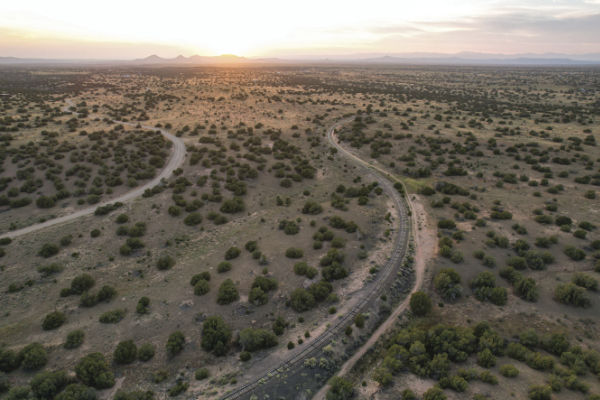
Traveling south on the main line, approaching Lamy, the magnificent Galisteo Basin presents itself to the observer. It is not difficult to imagine Indigenous people and Spanish explorers passing through that landscape. Piñon, juniper, yucca, and related high-desert flora embellish the scene like few other locations in the country. A mile further up the line, a 360-degree vista of the Sandia, Jemez, and Sangre de Cristo mountains mesmerizes even old-timers.

Military Usage

The Lamy line contributed to numerous military campaigns during its existence. The World War I years of 1916 and 1917 were particularly active as troops, vehicles, and personnel shared the line with civilian commodities of passengers, freight, and livestock. Occurring during the same period, the Pancho Villa Punitive Expedition and the United States’ participation in World War I emphasized the line’s importance both locally and regionally. A factor contributing to increased military activity in the Southwest was the interception of the Zimmerman telegram in 1917, which suggested that Germany would support Mexico in regaining “her lost territories” in Arizona, Texas, and New Mexico, contingent upon Mexico’s Axis alliance.

The branch line was used for both personnel and vehicle transport from Santa Fe to El Paso, California, and other locations east and west of Santa Fe. Numerous young local men and women left from the depot platform at Lamy, bound for the training facilities at Camp McClellan, Alabama, Camp Kearny in California, and dozens of other locations.

The Lamy branch also became the link to recovery for many returning service personnel at the Bruns Army Hospital on what was then Santa Fe’s south side. Toward the ending years of the global conflict, war casualties were transported to the hospital. The facility treated many of the 200th Coast Artillery Battalion survivors of the Bataan Death March. The facility, which had 2,500 beds, was in operation for a short period (1943-45), but the wye, where Lamy branch trains entered and exited the hospital property, can still be seen today to the south immediately off present-day St. Michael’s Drive.

The rail line connected travelers to Santa Fe, to 109 East Palace Avenue, and eventually to Los Alamos—those travelers, of course, being the scientists destined for work on the Manhattan Project. Edward Teller, Leo Szilard, Glenn Seaborg, Klaus Fuchs, and others arrived by train from distant localities and universities to the quiet community location of Lamy.

More than 4,500 Japanese-American internees also arrived under military guard by train for placement at the detention camp located in Santa Fe. A monument to that time and place was dedicated at Frank S. Ortiz Park on Camino de Las Crucitas, with a plaque dedicated by the city in 2002.
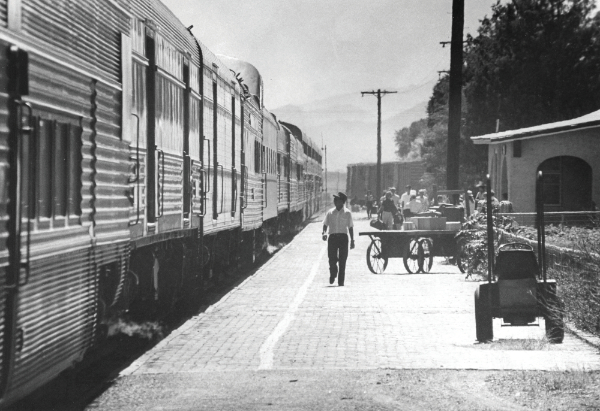
Amtrak train at depot in Lamy, New Mexico, ca. 1975. Photograph by Juan Rios. Courtesy Palace of the Governors Photo Archives (NMHM/DCA), the Santa Fe New Mexican Collection, neg. no. HP.2014.14.774.

Decline of AT&SF

The conclusion of World War II brought about several transportation changes that were to become eventually life-threatening for the Lamy line. The 1950s produced newfound affluence among many American families, and vacations in new cars that could go anywhere—not just from depot to depot—became increasingly popular. This, and the gradual decline of railway mail via Railway Express transport, increased truck commodity deliveries, and shrinking levels of luxury passenger train travel of earlier years heralded trouble for American railroads.

Eventually, years of deferred maintenance, system bankruptcies, and competition from passenger airlines contributed to the complex problems of the Atchison, Topeka & Santa Fe, the Southern Pacific, Missouri Pacific, Chicago & Rock Island, and other once-magnificent railroad companies operating in New Mexico.

By 1970, things continued to worsen for railroads, spurring a variety of attempts at cost-cutting. Mergers were attempted—some being temporarily helpful, others disapproved by the Interstate Commerce Commission at the outset of their application. Crew size reductions and a proposal for the elimination of cabooses pitted railroad management and labor against one another and became publicized elements of a shift in American railroad services.

During the early 1990s, in a continued effort to reduce what were viewed as unnecessary costs, railroads nationwide began closing down unprofitable branch lines. Some were bought by short line companies that sought to continue to provide freight services to rail-dependent industries like mining, logging, and similar businesses. Others, where the entire alignment could be preserved, became rails-to-trails candidates. The vast majorities of these railroad branch lines were abandoned with rights-of-way reverting to adjacent landowners, ties going to landscape companies, and rail torn up to be re-used in yards. Such line service discontinuances involved more than the cessation of train operations locally.
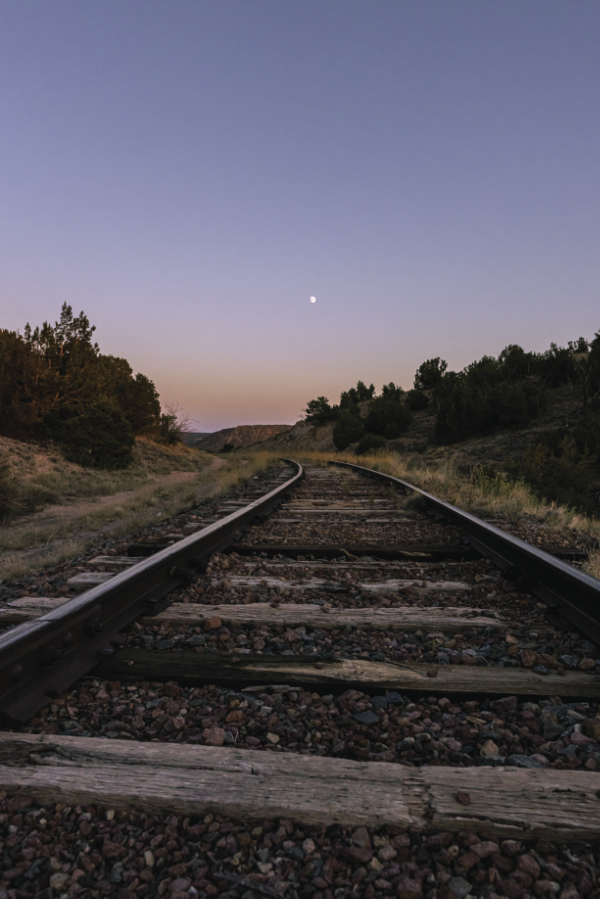
Photograph by Tira Howard

Elimination of rail freight or passenger services was and remains a highly regulated and time-sensitive legal process, allowing for public input, examination of proposed substitute uses, analyses of environmental impacts, and a detailed examination of potential alternative commodity transport options.

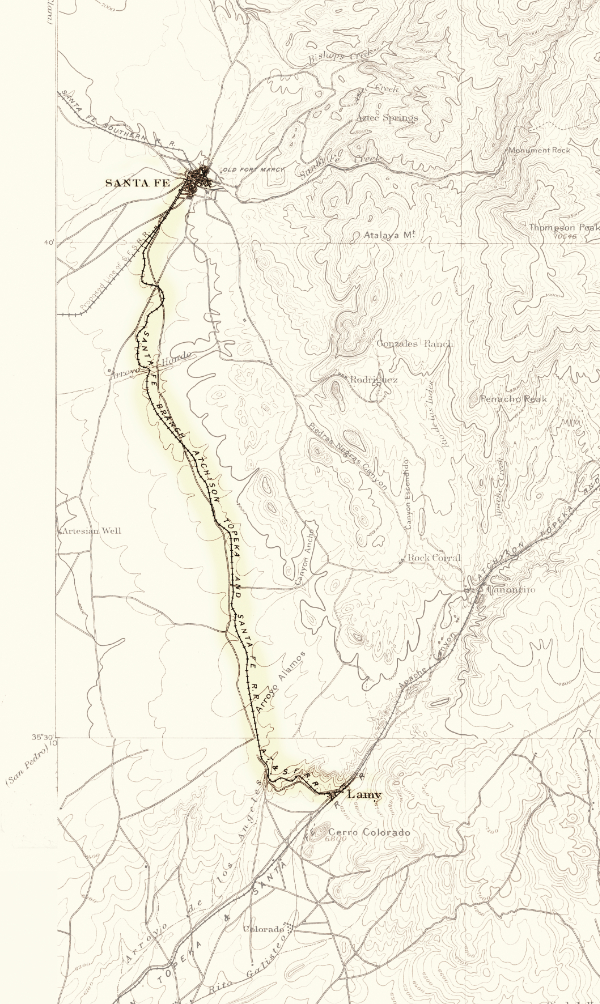
While both historic and romantic to many, the Lamy branch had, by 1990, become too expensive to operate and maintain for the AT&SF. Its comparatively light revenue-producing traffic, along a twisty incline up from the main line, became increasingly burdensome. It was only one of more than fifty other such unprofitable branch lines. Eventually, in May of 1991, the entire 18.1-mile alignment was placed in an Interstate Commerce Commission abandonment category, the first in a series of legal steps to permit its owner to either sell or scrap the line.

Line for Sale

On the morning of Friday, August 2, 1991, a Santa Fe railway consist, including eight chrome business cars, pulled into the Santa Fe Railyard and hissed to a stop. The train was powered by twin red and silver diesel engines “with Santa Fe emblazoned across their face in the gold letters long etched into western Americana,” wrote the Santa Fe New Mexican. It was a moment out of Southwestern history brought to life, and was to be the final visit of Santa Fe Railway corporate executives to the railroad’s namesake community.

Representatives of the railroad’s legal, real estate, and executive departments had arrived in town for two purposes. One was to participate in the Sunday, August 4 opening at the Museum of Fine Arts’ major exhibition of forty-seven paintings from the Santa Fe Railway’s collection, including the company’s jaw-dropping collection of Southwestern railroad art which incorporated famous artists’ paintings, Mimbres and Harvey-era dining car place settings, and other works of art. Newspaper articles referred to the train and its collection as the “Art Train,” and the Journal North reported:
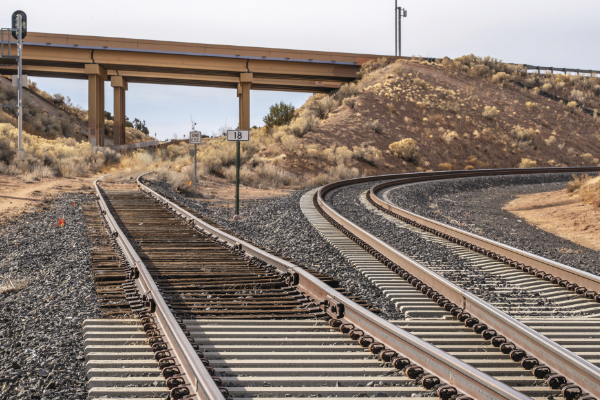
Junction of Lamy branch line and the New Mexico Railrunner tracks south of Santa Fe.
Photograph by Brian K. Edwards.

The magic imparted by the plaintive whistle of a train, stretching across wide open spaces is still very much alive. The sound of that whistle caused some people to stop whatever they were doing and wave from their backyards in the pueblos and subdivisions that snuggle against the train tracks between Albuquerque and Santa Fe.

The Chicago contingency of Atchison, Topeka & Santa Fe Railway executives was also in its namesake city for the purpose of attending an announced public meeting to discuss the railroad’s abandonment of the Lamy branch line, a highly regulated and time-sensitive process governed by federal statute for approval of the discontinuance of rail service on specified track segments. That meeting was arranged by the State Railroad Bureau and fell conveniently on the day railroad executives were in Santa Fe for the railroad art activities. The history, present usage, and ultimate disposition of the Lamy branch line had again become front-page news, just as it had 111 years earlier.

The meeting, on the subject of the formal disposal of the Lamy branch, began at 10 a.m. on August 5, 1991. Held in the auditorium of the State Land Office, the gathering was well-attended and included representatives of the railroad’s executive and real estate departments; officers of the railroad’s land development subsidiary, Catellus; citizens from the communities of Santa Fe, Eldorado, and Lamy; city and county officials; potential purchasers of the line; and finally, an executive of A&K Railroad Salvage. That national salvage company specialized in dismantlement of rail lines, and had money in-hand for the purchase of the line.

At the hearing, only two parties expressed interested in acquiring the alignment. One was A&K. The other consisted of a loosely structured group of local entrepreneurs with little practical railroad operating background and about the same depth of purchasing capital, interested in a mixture of possible freight, passenger, and tourist excursion activities. Dreamers, some said.

That lone potential purchaser/operator consisted of an assortment of personalities. Included was Bob Sarr, a former Procter & Gamble executive familiar with corporate management intricacies. Sarr was also a general admirer of railroads, having had an interest in them since adolescence. There was also Neil Carter (1951-2013), a locally respected architect who recognized the potential of continued local rail services. So too did one Brian R.R. Wripple and television actor Michael Gross. The seeds for the line’s preservation were thus sown, and proceedings for the line’s discontinuance temporarily halted while the new investors arranged financing and organized themselves as an operating entity.

Eventually, in March of 1992, the group amassed an amount sufficient ($300,000) for purchase of the line, plus a reserve balance for operating expenses. Relieved that service to shippers would be sustained, the AT&SF loaned the group a locomotive engineer to help get the newly reorganized railroad up, moving freight, and running.
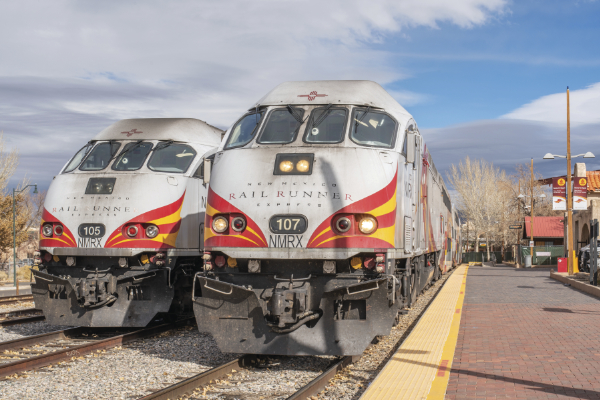
New Mexico Rail Runner Express trains at the depot in Santa Fe. Photograph by Brian K. Edwards.

Transfer of the line and its traffic from a class I, multistate, national railroad corporation to a group of inexperienced, albeit enthusiastic, non-railroaders presented challenges both operational and fiscal. The newly established line was named after the railroad that ran from Santa Fe to Española for six years between 1889 and 1895; they called it the Santa Fe Southern Railway.

Through a purchase agreement, maintenance, regulatory, and other responsibilities were transferred literally overnight from a national corporate leviathan to a staff of six with no practical railroad experience. Added to the obligations were those mandated through inescapable county, city, state, and federal regulatory requirements. Atop those requirements were local business issues, parking complexities, environmental matters, and liability questions, plus evolving complexities requiring eventual evaluation, prioritization and resolution, all while keeping trains operating safely and on time—and hopefully even at a profit.

As general manager, Sarr learned the railroad business quickly and became proficient in all primary tasks, plus was available at all hours for dozens of other elements of running a railroad. He learned how grade crossing signals operated, how to deal with Federal Railroad Administration track and locomotive inspectors, and established critical relationships with shippers, politicians, and bureaucrats.

Extra Baggage

What had not been apparent to the group attempting to raise sufficient capital for the line’s purchase and operation was the awaiting extra baggage that the corporation would soon need to accommodate. Newfound interest in the railroad, its property, and ancillary structures materialized in the form of trail enthusiasts, the City of Santa Fe’s acquisition of the railroad depot, rail yard parking space conflicts, state government plans for commuter train right-of-way usurpation, unusually frequent locomotive, bridge, and track inspections by Federal Railroad Administration staff, and more.

For a period of time, bright spots for the railroad appeared in the form of local citizen support, more numerous excursion trips to Lamy, special event trains, improved schedule coordination with Amtrak, and a small but steady freight element to the business. Freight shippers for Santa Fe Southern included a lumber and home improvement company, a beer distributor, decorative landscaping rock transport, and others. Still, no profit had developed, though interest in the line had by this time become international.

Eventually, in 2010, an Australian firm, STI Global, purchased controlling interest in Santa Fe Southern. STI was a leading company in the development of configuring positive train control programming, which was at that time about to be required by Congress for passenger and freight rail systems throughout the United States. Among other reasons for the selection to use SFSR operations was the proximity of three different rail configurations, all within a small geographic vicinity.

The three track designs included the main line track paralleling Lamy and an active Federal Railroad Administration class 5 track, which permits train speeds of up to 80 miles per hour for freight and up to 90 miles per hour for passengers; the more developed Rail Runner commuter track alignment, which allowed for speeds from 60 to 79 mph; and the Lamy branch line itself, being the least sophisticated trackage among the three, allowing for a top speed of only 15 miles per hour.

For the ten years after STI Global’s acquisition of the branch line, it continued to experience declines in passenger and freight revenues. Mandated track maintenance, safety issues, and remaining in compliance with federal operating standards eventually proved too much. A multitude of ongoing issues added to the burden of running the railroad and included disagreements among Railyard occupants for parking for respective customers, the refusal of the city for use of the historic AT&SF depot for Santa Fe Southern passengers, and ongoing safety issues with the Trust for Public Land’s rail trail adjacent to the active train line.

The New Mexico Rail Runner commuter train’s need for access into Santa Fe via Santa Fe Southern trackage added to accumulating and chronically unaddressed issues facing Santa Fe Southern’s management.
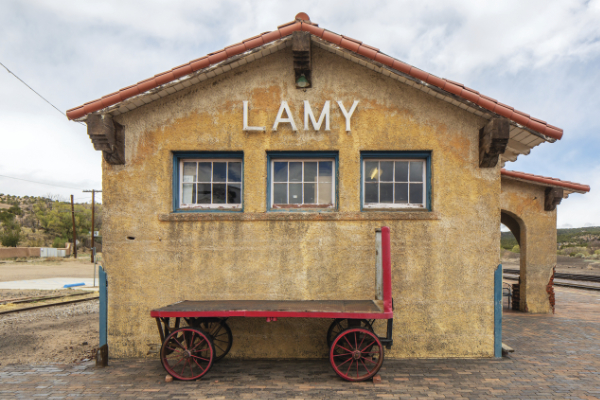
Santa Fe Southern Railway Depot, Lamy, New Mexico. Photograph by Brian K. Edwards.

The Phoenix Arises

In 2020, relief was to come for the railroad’s longtime chief executive, Karl Ziebarth, who had kept the railroad from bankruptcy for the past six years. The new saviors were three Santa Fe entrepreneurs—George R.R. Martin, Catherine Oppenheimer, and Bill Banowsky—who, according to Martin’s blog entry from August 12, 2020, were sitting around together one evening, enjoying a pitcher of margaritas and mulling the idea of owning a railroad. Collectively, the three agreed that it “would be fun” to own a railroad. Additionally, each investor was also concerned about the likelihood of the railroad soon disappearing because of an absence of passenger demand, freight orders, and public interest. The management troika immediately set about actions to preserve the system, with subsequent plans for longer-term rehabilitation of track, rolling stock, and train operations.

Re-mortgaging the historic passenger depot at Lamy was a first step, ensuring continued departure and arrival of Amtrak’s Southwest Chief passengers. Getting a general manager on board who was actually familiar with freight and passenger railroad operations was another primary need. That critical acquisition was met through the hiring of John Howell, an industry-respected railroader, able to combine regulatory realities with management’s visions of market appeal.
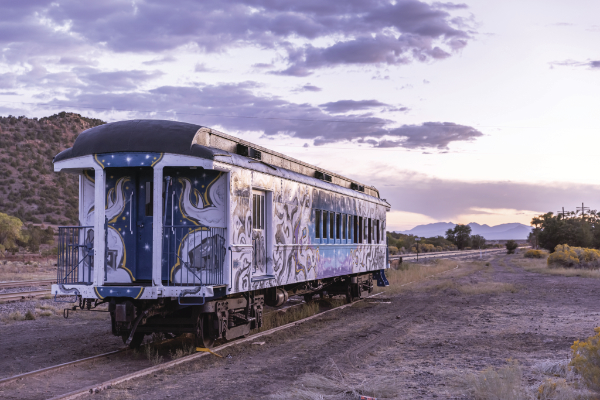
Sky Railway passenger car. Photograph by Tira Howard.

Once the locomotives are reconditioned, coaches cleaned and seats reupholstered, and track and ties brought up to Federal Railroad Administration standards, a multitude of imaginative excursions are being planned for what is now known as Sky Railway. Possible gourmet dinner trains, evening astronomy excursions, a history train describing the Railyard and significant locations in Lamy, and other innovations are under consideration. It’s also possible that “The Kid” himself may reboard to entertain passengers with protestations of his innocence. So too, there may appear staged “train robberies,” and the presence of historical impersonators in the form of Territorial Governor Lew Wallace and influential legislator Miguel Antonio Ortega, who organized the last-minute community-railroad negotiations with the New Mexico & Southern Pacific back in 1880—the move that effectively brought the railroad up the hill from Galisteo Junction in the first place.

The phoenix has arisen.

Fred Friedman has an extensive background in the state’s railroading past. He oversaw New Mexico railroad issues for decades and is recognized as an authority on the subject. As a board member of the state Historical Society, he lectures on numerous aspects of New Mexico and its railroads.
Fred Friedman (opens in a new tab) oversaw New Mexico railroad issues for decades and is recognized as an authority on the subject. As a board member of the Historical Society of New Mexico, he lectures on numerous aspects of New Mexico’s railroads.

Tira Howard (opens in a new tab) is a portrait, lifestyle, and fashion photographer based out of Santa Fe, New Mexico. Her work can be seen in V Magazine, Cowgirl Magazine, Table Magazine, New Mexico Magazine, El Palacio magazine, Pasatiempo, Cowboys and Indians Magazine, The Santa Fe New Mexican magazines, The Santa Fe Reporter, Western Art & Architecture Magazine, and Edible New Mexico Magazine.

A Gift for Sketching Buildings

By Rachel Preston

In the 1930s, the Great Depression had wiped out economies and careers. President Franklin Delano Roosevelt’s New Deal would offer up programs in craft, design, construction, and art that would eventually put more than half of New Mexico’s population—more than 200,000 people—back to work.

One New Mexican architect would rise to the occasion, finding ways to empower communities across the state, right as he hit his stride in a career that would come to define mid-century New Mexico design. John Gaw Meem IV was enabled to this task by a cadre of New Mexico believers, particularly Edgar Lee Hewett, with whom he had worked since the mid-1920s rehabilitating historic missions with the Society of the Preservation and Restoration of New Mexico Mission Churches.

While I had heard of Meem during the early years of my career in New Mexico preservation, I was working in and around Taos, so I wasn’t often coming into contact with his work. I knew that he had worked on Taos’s Harwood Museum, and designed the First Presbyterian Church of Taos—one of my favorite modern churches. Before I moved to Santa Fe, Meem was a mythical bespectacled character that I kept coming across as I learned that he designed or rehabilitated the buildings I felt especially drawn to—Santa Fe’s Cristo Rey Church, Delgado House, the former County Courthouse, and Los Poblanos in Albuquerque’s North Valley. His buildings offered a tantalizing taste of good design that just stuck with me. It was something about the lines and the way he landmarked many of his buildings with towers, as if he were putting a pin in a grand walkable map of the city that said, “Here is where you want to go,” much as his father, John Gaw Meem III, had in Meem IV’s childhood home of Pelotas, Brazil.

The elder Meem, an Episcopal missionary, built his congregation a church that landmarked itself as “HERE” through the use of a white color palette and sky-reaching tower, cast against the sea of low-slung pastel-colored Renaissance and Baroque Revival buildings that defined the southern Brazilian port city, located near Uruguay. The younger Meem borrowed his father’s landmarking ideas and built upon them, weaving Indigenous and Hispano art, and modern architectural forms and materials into his original New Mexican creations.

It wasn’t until I started working around his buildings that I started to understand Meem’s hand as a designer. Then, as my peers and I started considering how we might redefine our styles in Santa Fe so we could find ways to make them more sustainable, I realized we were carrying on the same work Meem was trying to get done almost a hundred years ago. So I added all his buildings to the list of 350 or so churches and historic sites I was going to visit for a book I am writing about New Mexico’s sacred spaces. After seeing more of his buildings and learning more about the man himself, I started to realize his extraordinary impact—not only on our styles and standards of design, but on the way we saw ourselves culturally, and our ability to build a better future economically. His work empowered the lives of ordinary New Mexicans in ways it couldn’t have at any other time, which made his work all the more captivating.


Kuaua/ Coronado Historic Site

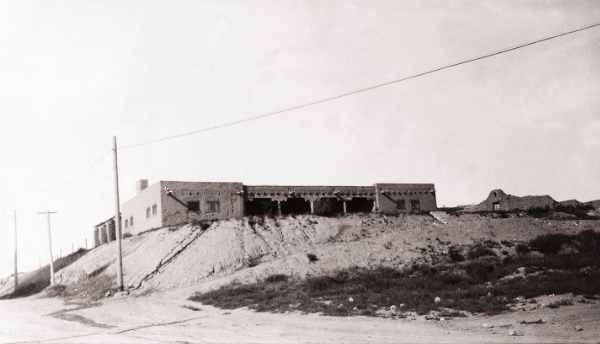
It was 1939. Archaeologist Edgar Lee Hewett, then director of the New Mexico Museum and the Society for American Archaeology, wanted to create New Mexico’s first official historic site—and the country’s first archaeological tourist attraction—on land in Bernalillo owned by the University of New Mexico. Located on a bluff overlooking the Rio Grande, just a few miles from Route 66 and El Camino Real, the site boasts a breathtaking view of the riparian landscape, centered on the sacred Sandias in the east, and two ancestral pueblos located between and shared culturally by both Sandia and Tamaya (Santa Ana) pueblos. There was an abandoned Spanish- and Mexican-period hacienda just a few hundred yards away. For Hewett, it was a perfect place to tell the story of the pueblos, the Hispanic period, the modern period, and how archaeology had brought them all together.

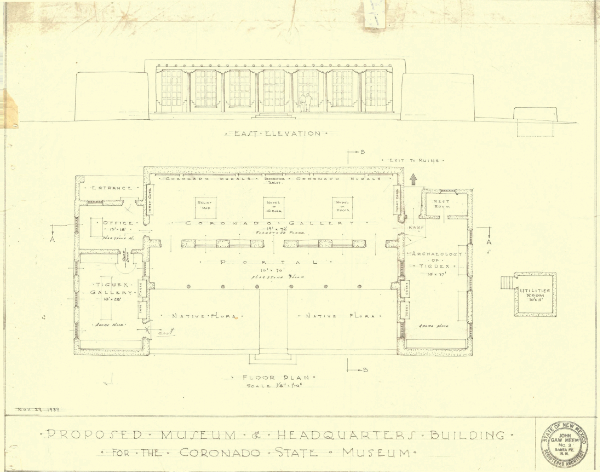
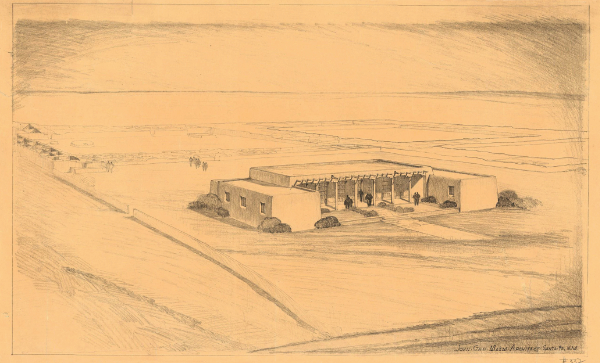
An early sketch of the Coronado visitor’s center. Elevation, John Gaw Meem, architect. Courtesy the SWA John Gaw Meem Drawings and Plans, John Gaw Meem Archives of Southwestern Architecture, Center for Southwest Research, University Libraries, University of New Mexico.

To draw bigger crowds, Hewett wanted to tie one of the two ancestral pueblos, Kuaua, to Spanish explorer Francisco Vásquez de Coronado’s 1540 expedition, just in time for its four-hundredth anniversary. He had been leading excavations there for several years, and hoped that the site would prove to have been the explorer’s winter base camp. Kuaua was known to date from the 1300s to the 1600s, though more recent archaeology suggests occupation may actually go back more than a thousand years, and be as recent as the 1700s. While it has most often been associated with Tiwa-speaking people like those at Sandia, neighboring Tamaya, a Keres-speaking people, also claim a relationship.

In 1540, Coronado designated the area Tiguex, the local name of the area, as well as that of its largest village. Earlier, in 1582, Antonio de Espejo visited and documented the name of the then-intact ancestral Puebloan village as Guagua. The modern Tiwa name, according to neighbors at Sandia, is Kuaua, the “evergreen village,” which scholars suggest came from its peoples’ use of fir greens in ceremonies. According to Keres-speaking neighbors at Tamaya, the pueblo is called Kua, which simply means “southern village.”

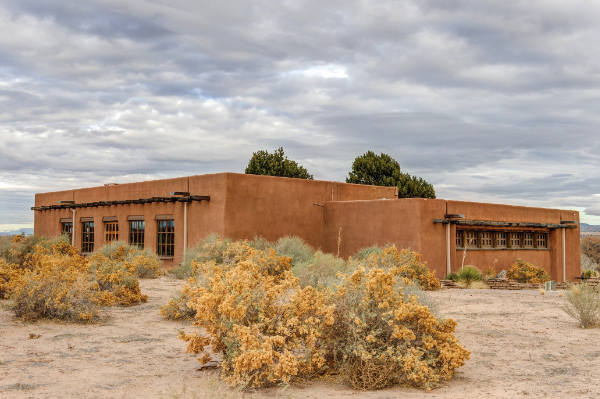
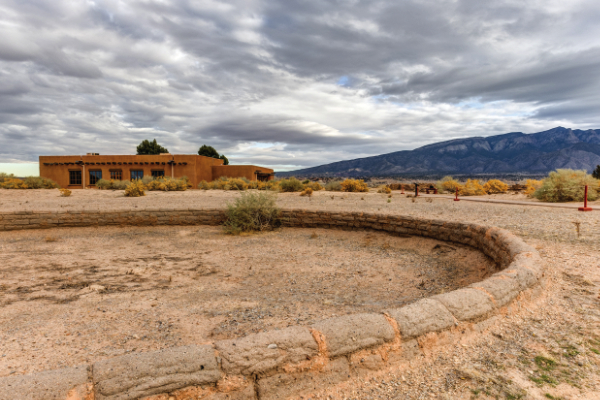
Looking from an excavated kiva at Kuaua towards the Coronado visitor’s center, with the Sandias beyond. Photograph by Beau Sniderman.
Aerial view of Kuaua ruins, Coronado State Monument, New Mexico, ca. 1946. Photograph by Sargent Fullerton. Courtesy Palace of the Governors Photo Archives (NMHM/DCA), neg. no. 045345.

Adolf Bandelier visited the site in 1882 with Juan Trujillo of Sandia Pueblo, but no significant exploration occurred until the large rectangular multi-storied ancestral pueblo was excavated by Hewett as part of the New Deal’s Work Projects Administration programs between 1934 and 1939. Interestingly, those excavations didn’t actually support the idea that Coronado used the pueblo as his base camp, though metal detecting on the site in the past few years has unearthed clues that suggest that, in fact, there may have been a battle or skirmish there between the Puebloans and the Spaniards around that time.

While the excavated ancestral pueblo and its ambitious connection to Coronado is interesting, what makes the site truly unique is that an unburned religious structure—or kiva—with intact mural fragments was discovered in the dig. Ultimately the panels (covered in more than eighty layers of paint, of which fifteen had painted figures) were painstakingly removed, and each layer was separated, documented, and stabilized at the University of New Mexico. Fourteen of those fragments are displayed at the site. The murals are considered some of the finest, if not the finest pre-contact mural art in the United States. What really astounded me in experiencing them was realizing that this sacred Puebloan religious, seasonal, and hunting art was being painted about the same time that Michelangelo was painting the Vatican’s Sistine Chapel with the religious stories of his people. And, unlike Michelangelo and his contemporaries’ plentiful works, Coronado Historic Site’s Kuaua Pueblo is the only place where you can see original Puebloan kiva art in person.

Hewett had both an enormous personality as well as ambition for creating big monuments that drew big crowds. He and architect Isaac Rapp had done this quite successfully with the New Mexico Building for the 1915 Panama California Exposition in San Diego. They would then morph that building into an even bolder statement in what we now know as the 1917 New Mexico Museum of Art. Both structures were popular with tourists from around the world, which they hoped to court again at Coronado.

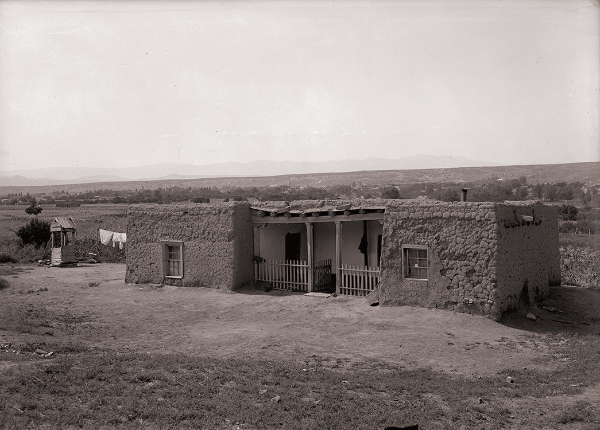
Meem leaned into a type of historic house that twentieth-century planners celebrated as ideal, with its long portal flanked by a symmetrical room block on each end. An early example of that house, known as the Roque Lobato house, just across Bishops Lodge Road from the Scottish Rite Temple, was visible to all from its perch on a hill above Santa Fe. Morley home on Washington Avenue, Santa Fe, New Mexico, 1920. Photograph by Wesley Bradfield. Courtesy Palace of the Governors Photo Archives (NMHM/DCA), neg. no. 010547.
Meem also revered houses that modeled the Beaux Arts ideal of symmetry; it became one of the most-used building forms in twentieth-century New Mexico, probably because most of our early architects were Beaux Arts-trained. Old house with portal, Mexican settlement below Sunmount, Santa Fe, New Mexico, 1912. Photograph by Jesse Nusbaum. Courtesy Palace of the Governors Photo Archives (NMHM/DCA), neg. no. 061507.

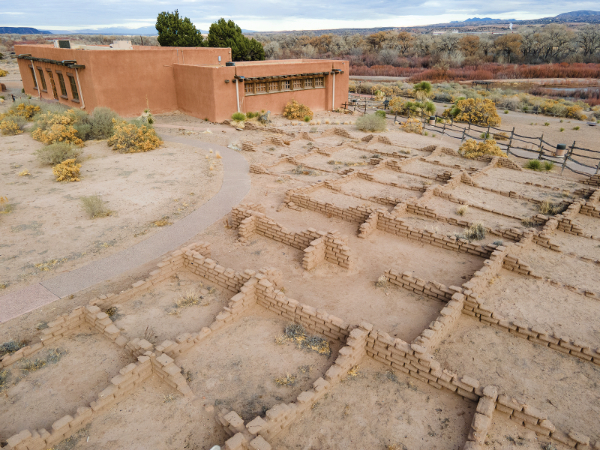
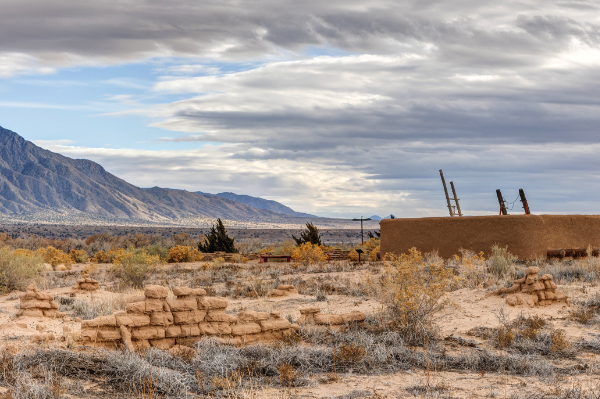
Hewett wanted to fully reconstruct the excavated pueblo to “make it more visible.” However, due to budget shortfalls, the few partial walls we see now are but a hint of the reconstruction, which since 1940 has mostly melted back into the earth from which it came, and only implies the form of the excavated 1,200-room pueblo and its three plazas. Adjacent to the reconstituted historic village, Hewett envisioned a grand architectural monument in honor of Coronado, featuring a large museum that would look out over a pedestrian bridge across the river that was to be topped by a 40-foot equestrian statue of the explorer. Visitors would climb a formal staircase to an observation deck off the bridge where they could look out over the ancestral pueblo.

However, Hewett’s dreams outpaced the available recovery funds, and time was short. Knowing he needed someone who could materialize his vision, and do so quickly, he hired Meem, his friend and collaborator of nearly two decades. He then informed the architect that he had until May 1940—about six months—to design the center and get it built. And, because they designed and built the entire site out in just a few months, the right combination of functions to include was only revealed as they were building.


While most of Meem’s buildings are special because of his elevation of historic architectural forms into a more monumental scale, what would ultimately be built for the visitor’s center at Coronado was, architecturally, an exercise in humility. It is a masterwork of one of Meem’s ideals; he called it “a functional architecture.”

So, what is “a functional architecture”?

It’s architecture that works for you, rather than just looks a certain way. Meem was tapping into ancient vernacular design techniques, including capturing the winter sun to keep warm, seen in the south- and west-facing cliffhouses at Chaco, the terraces at Acoma, and the south-facing resolanas in historic Hispanic villages.

This technique was harnessed by Meem at the Coronado visitor’s center through the use of an east-facing portal, which would naturally store heat on winter mornings. Combined with the room at the south, the two rooms would effectively shade the courtyard from the brunt of the summer heat.

The relevance of the Kuaua/Coronado site in history challenged Meem to find an architectural style that worked for both a pre-colonial time period and his own. He leaned into vernacular precedents: what architectural historians may call Pueblo Revival today, but which Meem would have likely defined as “Old Santa Fe Style.” It was a simple construction of earth-toned adobe with wooden details defining a whitewashed porch. It was a style made popular by the early-twentieth-century remodel of the Palace of the Governors, which he would eventually renovate; a monumental variation of a type of historic house that twentieth-century planners celebrated as ideal, with its long portal flanked by a symmetrical room block on each end.

Meem used massing—terracing the building’s “blocks”—to create visual interest and make the building look more like a pueblo. Photograph by Beau Sniderman.

An early example of that house, known as the Roque Lobato house, just across Bishops Lodge Road from the Scottish Rite Temple, was visible to all from its perch on a hill above Santa Fe. That home was rehabilitated by Sylvanus Morley, one of the advocates of Santa Fe’s City Different movement, and photographed by fellow promoter Jesse Nusbaum for the 1912 New/Old Santa Fe Exhibition at the Museum of New Mexico, which was put together for the purpose of defining Santa Fe Style. Another dozen or so versions from Isleta, Santa Clara, Jemez, Pojoaque, Santa Fe, Peña Blanca, Ranchos de Taos, and San Ildefonso were featured in a series of six photo albums presented to Meem by Carlos Vierra as a type of architectural pattern book, which Meem would refer to throughout his career.

Another of these simple symmetrical houses was on the way to Sunmount Sanitorium, where Meem sought tuberculosis treatment when he arrived in New Mexico in 1924. Meem likely passed by that house on the long walks that were part of his healing, and it was sure that he knew Morley, as they were both members of the Scottish Rite and its neighboring Masonic Lodge, which Meem would go on to design.

That house type documented and exhibited in the early twentieth century was transformative, because it modeled the Beaux Arts ideal of symmetry, even though the majority of New Mexico’s historic buildings did not. It became one of the most-used building forms in twentieth-century New Mexico, probably because most of our early architects, including Meem himself, were Beaux Arts-trained. Beaux Arts was a subset of Greek Revival architecture that was popular in the U.S. from approximately 1885 to 1925. Most often used in public buildings, the style is characterized by symmetry, order, formal design, grandiosity, and elaborate ornamentation. New Mexico’s most beloved example is Isaac Rapp’s hyper-regional 1917 New Mexico Museum of Art, though his 1911 Chavez County Courthouse in Roswell would be more recognizable to the style’s more traditional fans.


In October 1939, Meem visited Kuaua with Reginald Fisher, Hewett’s deputy director of the Museum. While on site, they determined that the visitor’s center would be located “east of the exterior pueblo walls.” The building would be “in the shape of a U, with the legs facing so the patio was facing the river and the east.” There would be a keeper’s quarters on the north, a central “lounge” portal, and a museum on the south. The building was to be adobe and “very native in character.”

One of Meem’s earliest sketches, included in his project files donated to the Center for Southwest Research at UNM, indicates that he envisioned a parallel and separate relationship between the Monument and the ancestral village. In one of several iterations he was developing simultaneously, he offers a classical Beaux Arts-inspired design, drawing a shallow portal in front of an enclosed sunroom gallery, with ample French doors with transoms, similar to his New Deal La Quinta event center at Los Poblanos, commissioned in 1932. Between the windows, a painted dado—a darker painted lower wall section that would hide scratches and stains better than whitewashed sections—featured a favorite decorative detail: the stepped cloud, a traditional Puebloan symbol for rain.

One of the first formal plans Meem developed for Coronado featured a shallow portal in front of an enclosed sunroom gallery, and French doors with transoms. Floor plan, John Gaw Meem, architect. Courtesy SWA John Gaw Meem Drawings and Plans, John Gaw Meem Archives of Southwestern Architecture, Center for Southwest Research, University Libraries, University of New Mexico.

One of the first formal plans he developed was also traditional Beaux Arts in style, but without the expensive window wall and its enclosed gallery beyond. It featured a long open portal flanked by a room block on each side. Large sculptures, with Coronado in the center, flanked by a “Priest” at the right and an “Indian” at left, decorate the space. A set of “Coronado Murals” painted by Gerald Cassidy, which may have been reused from the New Mexico Museum of Art or the Panama Expo, would be installed on the back wall. The keeper’s quarters are integrated into the building on the north, to the right of the portal.

The second plan, produced over Thanksgiving in 1939, has the same symmetrical form, but instead of sculptures featured an inscribed tablet between the murals, with bancos at each end of the open portal—one of Meem’s signature designs used throughout his career, including at UNM’s Zimmerman Library. This shift was prescient, as Hewett officially eliminated the sculptures in December 1939 because they were going to be too expensive. Hewett declared that a stone tablet depicting a Pueblo Indian, a conquistador, and a priest should be placed “inside the museum,” implying that the western room was going to be added back in. This plan also marks a major shift—making the keeper’s quarters a separate structure—and replacing it with more museum space on the north, which had the benefit of keeping fireplace smoke as well as kitchen grease out of the exhibition space.

In these early iterations, a small, tucked-away entry on the southwest towards the parking lot was intended to be the main entrance. The large portal that is the primary entrance now was intended to be something of a reward after visiting the museum, with a beautiful view of the river and the Sandia Mountains beyond, and what would have been Hewett’s dream bridge and monument.

[wonderplugin_slider id=187 alignment=”center”]

Meem’s elevations, which show us how he intended each side of the building to look once built, indicate he intended to use the Puebloan technique of an exposed stone foundation with earth plaster on the exterior. This would protect the bottom of the wall from canale splashback, as well as rising damp from snow. A set of “Coronado Murals” painted by Gerald Cassidy, which may have been reused from the Museum of Fine Arts or the Panama-California Expo, would be installed on the back wall. The keeper’s quarters are integrated into the building north of the portal.

Construction of the visitor’s center likely started with the open-portal plan. The southwest entrance was abandoned in favor of the portal as main entrance. Works Progress Administration, Federal Emergency Relief Administration, and National Youth Administration funds were procured, while crews made adobes, detailed wood, and prepared the site. The idea of a western gallery behind the portal was revisited. A sketch in the job files notes the Coronado mural and exhibits moved into the new room, and a space for archaeological interpretation added. This would explain how the western gallery building ended up being inside the archaeological site; that room wasn’t originally going to be there, and they were already building. The window wall returned, this time on the west and using doors ordered for the original plan, capturing the view of the sunset over the ancestral village.

The building was constructed of a smaller, older form of adobe called terrones, cut from clay at the riverbank on-site, rather than the more common frame-formed adobes made of a mix of sand, clay, straw, and water. Floors were earthen, and coated in blood as they would have been historically. The rooms were simple and unadorned, outside of the ceilings and a few painted wall decorations, so they were easier to maintain. Small windows were placed up high, to minimize light impact on the fragile mural fragments and exhibits, as well as to secure them. Security grilles were simple turned wood; they could be easily made and replaced when they needed to be. The original building used true earth plaster and lime whitewash, and was capped with a shallow dirt-insulated roof with built-up roofing.

The Coronado Historic Site and visitor’s center’s grand opening was on May 29, 1940. The opening festivities were to launch the Cuarto Centennial—a year-long celebration of the four-hundredth anniversary of Coronado’s expedition. That evening after the dedication was to be the first of thirty pageants scheduled in New Mexico, Texas, and Arizona. The pageant, written by Thomas Wood Stevens, premiered at UNM’s stadium. The elaborate reenactment of the Coronado entrada had eighteen acts, each depicting a place on the conquistador’s journey, depicted by a cast of more than 20,000 players on a 300-foot portable stage. Other planned events included folklife festivals, rodeos, frontier days, old trail days, fiestas, local fairs, and cavalcades.

While the monument was successful in fulfilling Hewett’s dream of being the first American archaeological site to open to the public, the effort to elevate New Mexico archaeology to the level of “legend” was not as successful as he had hoped.

Archaeologist Erik Reed described the building as “splendid” but the exhibits “mediocre,” and lamented the placement of the museum and the keeper’s house within the context of the ancestral pueblo itself as “unfortunate.”

He was not alone in his disappointment—and trouble was brewing. Neither the pageant nor the folk festivals drew the expected crowds, and the impact was immediate. Two days after the opening, it was announced that no additional funds would be made available to complete the aspirational work of the monument, nor would any more of the celebratory events go on as planned.

A view of reconstructed village walls, with the visitor’s center beyond.
Photograph by Beau Sniderman.

Coronado Historic Site in Context

What also intrigued me about the Coronado project was where it landed in Meem’s career, and how exploring what was happening alongside it reveals just how significant Meem’s impact was.

Meem was 30 years old in 1924 when he happened upon his new architectural vocation. After dealing with debilitating illnesses from Spanish flu that eventually became tuberculosis, Meem was told he should take respite at a sanitorium. Shortly after seeing a pamphlet from the Santa Fe Railroad that featured the New Mexico Museum of Art (then the Museum of Fine Arts), he hopped on a train out west, arriving in Santa Fe to rest and recover at Sunmount Sanitorium. It was there that he discovered he had a gift for sketching buildings.

In just a few months, he was activated into the world of architecture by Sunmount’s director Frank E. Mera, fellow Portuguese speaker Carlos Vierra, and other friends he met there who were inclined to save New Mexico’s historic buildings. Architecture was not a great leap from the structural engineering degree he had obtained from Virginia Military Institute (from which he, his engineer father, architect grandfather, engineer great-grandfather, and great-great grandfather had matriculated). After finishing college, Meem had worked for two years for his uncle in New York City building a portion of the subway system under Canal Street, before he was called up to train reserve recruits in World War I.

Once in New Mexico, he started his new career rehabilitating historic missions, eventually including the influential San Esteban at Acoma. Once he was strong enough to, Meem left New Mexico to study architecture in Colorado. He worked for the firm Fisher and Fisher while studying for a year at Atelier Denver, a Beaux Arts architecture school, and won national awards in design before his TB flared and he had to return to Santa Fe. It wasn’t long before he was designing homes for friends, then schools, commercial, and religious projects. After only three years, Meem was considered so accomplished in the field that the American Institute of Architects elevated him to “Architect” by vote, despite his not being degreed or fully apprenticed in architecture.

Meem became known as the go-to architect for doing expedient designs that could be swiftly built, especially to stabilize historic buildings, and most especially in planning for projects that were to be built by volunteers. He would co-found the Old Santa Fe Association, design Fuller Lodge in Los Alamos, and help save Chimayó’s sanctuario by helping to arrange for it to be procured by the Catholic Church. He would do renovations of Isaac Rapp’s works at the Museum of New Mexico, Sunmount, and the New Mexico School for the Deaf. He was also hired by the Harvey Company’s Mary Colter to complete a renovation and addition to the south side of La Fonda on the Santa Fe Plaza, which had quickly become a hub of regional tourism just a few years after Rapp’s inaugural design.

Beginning in 1930, Meem won a competition for the redesign of the Santa Fe Plaza, and expanded the Santa Fe Indian School. He also realized that brick parapets (previously cast aside when Santa Fe’s City Different proponents decided to abandon the Territorial style in favor of romanticized versions of our local vernacular architectures) were actually quite good at protecting the top of the wall, thus minimizing maintenance. He revived the practice, giving birth to the popular Territorial Revival style.

In 1933, the American Institute of Architects named Meem to a national commission to plan and direct the Historic American Building Survey (HABS), one of the New Deal programs which would provide employment for American architects. He would also facilitate the Public Works Administration and Works Progress Administration to find and employ artists throughout the state. He designed the first iteration of the Museum of International Folk Art in a fusion of New Mexico design with the modern International style, and stabilized the St. Francis Cathedral, whose interior columns were built without foundations, rendering the building in danger of collapse.

Meem also married his wife, Faith Bemis, that year. They had met through her two-year apprenticeship in the design and drawing of Meem’s renowned Art Deco-meets-Southwest-style Colorado Springs Fine Arts Center—one of several projects in Colorado Meem did for her aunt, Alice Bemis Taylor. Taylor asked Meem to give her niece the opportunity. It was an almost miraculous gift, as while Faith had inherited her father’s talent and love for construction, attended art school in Europe, and matriculated from the MIT/Harvard’s Cambridge School of Architecture and Landscaping Design (for women) in 1928, women were rarely “allowed” to work in architecture at the time. Thanks to that open door, Faith Meem was one of the first women to follow Mary Colter’s lead and work in architecture in New Mexico.

In archaeology, art, linguistics, business, botany, and other fields, the West had long been a place where women could flourish. Meem was supportive of that tradition. Another woman whose work he championed was Eugenie Shonnard, a sculptor who Meem considered one of the finest not only in the state, but in the country. He offered her multiple commissions, including one of the sculptures for the original Beaux Arts version of the visitor’s center.

Meem was also an advocate for racial equality, and implored with the people of Santa Fe, pointing out their “reputation for tolerance,” to recognize the rights of African Americans to be able to attend the local theater and hotel.

Meem would design or amend dozens of buildings for the University of New Mexico’s campus from 1933 through 1959, which he considered one of his crowning achievements, owing to its being featured in Time magazine as a fine regional example of Contemporary design. Meem was also recognized for his efforts by UNM’s College of Fine Arts, which gave him an honorary doctorate in 1960. The bulk of the historic campus, including the fifty or so buildings he designed or modified, is its own historic district now. Several, including Zimmerman Library, Scholes Hall, the Student Union (now part of the Anthropology complex), and the demoed Engineering Annex, were New Deal projects.

Meem worked on early New Deal projects in Santa Fe as well, including a John D. Rockefeller Jr.-backed, national competition-winning entry for the Laboratory of Anthropology that was featured in the New York Times. Other projects included what is now the New Mexico Military Museum, the Villagra Building on Palace Avenue, the old Santa Fe City Hall (now the Santa Fe Public Library), and the recently rehabilitated County Building and Courthouse. Other New Deal projects included work at New Mexico Highlands University in Las Vegas, Western New Mexico University in Silver City, and the Harwood Museum in Taos. He was also named the regional director of HABS, which has documented numerous important ancestral Puebloan sites, historic homes, and mission churches in New Mexico, and continues to document important historic buildings and structures throughout the country to this day. Meem’s New Deal work employed thousands, and the program enabled a new generation of designers and preservationists to do what they do. To be sure they did it well, Meem also set up a system of architectural licensing for the state.

In 1939, while he was working on the Coronado visitor’s center, Meem was also working on a remodel of First Presbyterian Church in Santa Fe, while concurrently leading HABS as it documented Ceremonial Cave (now known as Alcove House) and the Large Kiva at Bandelier, as well as Kin Kilzhin at Chaco. Meem was working on the design of the Church of Saint Anne at Acoma, several residences, as well as Maisel’s Indian Trading Post in Albuquerque (which sadly closed permanently in 2020).

He also worked on the design of Cristo Rey Church on Canyon Road, which was to become home of the famous altarpiece, or reredos, rescued from the demolition in the 1860s of La Castrense, a historic church formerly on the south side of Santa Fe Plaza, which had been stored behind the cathedral’s chancellery until there was a place for them to go. Like the visitor’s center, Cristo Rey was also a memorial to the Coronado expedition’s four-hundredth anniversary, and had to be built in record time. At a dinner on April 6, 1939, Archbishop Gerken announced the project: “We shall build a memorial to the Coronado Centennial in the form of the most beautiful church in the Southwest. This memorial will become a new parish.” The church, the construction of which required 120 workmen and more than 180,000 hand-made abobe bricks, opened in 1940.

Shortly after completing these projects, Meem was recognized for his efforts in the New Deal and beyond with an honorary fellowship in the Society of American Archaeology, which Hewett led.

By 1941, Meem had teamed up with Hugo Zehner, who had worked for him since 1930 as a draftsman and then head draftsman, and the pair grew the firm to a staff of over thirty. They would rehabilitate Bishop’s Lodge, beginning its transformation from residence to resort; designed Santa Fe’s Sanbusco Center (portions of which are now the New Mexico School for the Arts); and worked on St. Michael’s College (now Santa Fe’s Midtown Campus).

The painted kiva reconstruction, the above-ground portion of which stands at right, shows the relationship between the site and the sacred Sandia Mountains beyond.
Photograph by Beau Sniderman.

After World War II, Meem focused on leading, and let associates do most of the designing. He brought on another partner, William Holien, who had worked for him since 1944. The firm worked on the Montezuma Hotel (now the Hotel St. Francis) in Santa Fe, the St. Francis Cathedral School, renovations at the Palace of the Governors, Santa Fe’s Temple Beth Shalom and First Baptist Church, the Santa Fe downtown post office, numerous buildings for the Southern Union gas company, the Cathedral of the Sacred Heart in Gallup, the Episcopal Cathedral of St. John in Albuquerque, expansions to New Mexico Military Institute in Roswell, and the Good Shepherd Mission in Fort Defiance, Arizona, in addition to a long list of other projects throughout New Mexico.

While his team handled the day-to-day operations, Meem watched over production to ensure that the designs met his standards, and started working on building a legacy that would lead New Mexico into the twenty-first century. He was named Planning Commission chair for the City of Santa Fe in 1945, helped found the New Mexico chapter of the American Institute of Architects in 1946, and worked towards creating both a city masterplan as well as a new architectural ordinance for The City Different, finally achieving the latter in 1957. Meem helped deal with a major addition to his Museum of International Folk Art with Alexander Girard, who had donated his folk art collection, and architect Harvey Hoshauer, who was leading that project. He also procured the expansion of St. John’s College to Santa Fe, donating the land for the facility, helping plan and implement the campus design, and bringing his new friend Alexander Girard on to help decorate the interior spaces of the Administration Building (now the Peterson Student Center).

Meem was respected-—and generous. He said that he “retired in 1959,” owing to his simply wearing his body out; though he wasn’t one to not help when he was needed, so he didn’t truly retire until 1975. He passed away in 1983. John Gaw Meem still permeates preservation and design throughout the state, and his legacy endures nearly a century after he arrived.


In a 1959 letter to New Mexico Architect magazine editor Jim Philips, who was preparing an article about Meem’s life after another of his numerous awards, Meem wrote, “I am forever indebted to the State of New Mexico, which not only gave me back my health, but presented me with opportunities for service and happiness. … Perhaps that is one reason I can take such pleasure in trying to recall our history and landscape in the regional architecture of New Mexico; not as imitations of the past, but as symbols of a rich heritage which spiritually enhances our solutions to modern problems.”

I think he was onto something there. 

Rachel Preston, director of The Ministry of Architecture in Santa Fe, has documented historic buildings across New Mexico, and produced documentaries about architecture at Acoma and Bandelier. She writes, teaches, and speaks about New Mexico’s thousand-year tradition of sustainable design. 

Beau Sniderman (opens in a new tab) is a photographer based in Santa Fe.

Rachel Preston (opens in a new tab) is the director of The Ministry of Architecture in Santa Fe. She has documented historic buildings across New Mexico and produced documentaries about architecture at Acoma and Bandelier. She writes, teaches, and speaks about New Mexico’s thousand-year tradition of sustainable design.

The Element of Beings

By Chela Lujan

I am grateful for the land, for my hands. Grateful for the browned earth hardened by the sun, scented with chamisa and sage after the rain. Palms thick as groves of chokecherry, gnarled fingers like piñon, they are an extension of my Creator and my creation. Worn with lines like wind-carved arroyos, their cracks collect dust from silver and stone which lie waiting to be turned and pulled like water moving through old acequias. Bright metals wanting to be shaped like the new crescent moon shining over fresh dirt turned earlier that day.

In the morning, before I sit upon my work bench, I will plant.

It is time to sow the seeds that will soon bring idea into fruition. These knowing-hands will gather materials to nurture squash, beans, and kernels of corn into towering stalks. Sisters collecting pollen to bless the morning sun. They will dry the labors of their love and grind azul gems into meal to become pudding sprinkled with juniper ash and honey sweetened by bees’ late-spring work. When the afternoon sun shifts through the windows, that is the time to collect strips of precious metal and chunks of stone from unmoving holy mountains to be spun into rows of beauty and protection, of grace and recognition. I will adorn these makings about my companion’s collar for her fingers to brush through raven hair and along the curve of her slender neck.  A curve I know just as well as the bows of silver pearls and petals I carve.

I make these works of life. With my hands, my eyes, my connection to the roots that bind us all together—Plant, Being, and Element. Together they join and create doorways that let us move in and out, come and go, yet always find a way back home. Back to the sacred ground and a warmed wooden bench and sturdy table. Back to the leather apron draped worn and patient in the corner. Back to the earth I’ve walked a thousand times, calling me to plant myself down like those seeds and harvest the thoughts I’ve sown. And when I tire of walking, I fly in dreams of things my ancestors may have seen, bringing them forth into the waking world. The button of a blouse, the curve of her neck, the buzz of a bee, the bitter taste of medicine awakening the spirit within me. The spirit which coaxes out the constant movement of strong yet nimble fingers from hands that will always remember these old ways.

They are brown like the dirt I call home, my hands. Warmed by the sun and worn by the elements. The bee whose spring honey sweetens my day sleeps cradled in a blossom of squash. The blossom that tells them, “Make me last beyond the drought, the monsoon, and the first frost.”

Chela Lujan is an artist, activist, and mother who gathers inspiration from her Chicana and N’dee roots, and from an upbringing on the Diné Nation. She resides in Southern Colorado where she runs a small-batch folk medicine and beadwork business.

Chela Lujan (opens in a new tab) is an artist, activist, and mother who gathers inspiration from her Chicana and N’dee roots, and from an upbringing on the Diné Nation. She resides in Southern Colorado where she runs a small-batch folk medicine and beadwork business.

Darryl Lorenzo Wellington

Easy Street. Or, The Year of Getting
a Driver’s License and Exciting
Eldritch Regions of Consciousness

Taking a cue from the sweet effluvium or (so-called) sickle moon, maybe “the dead of night” is no valley of bones, just a figure of speech, the young kid itches to take the family car under screaming streetlamps on a spin; his soul escapes the house like air whizzing from an unknotted balloon, or a space craft hovering in pursuit of the facts which can be drawn from a colorful expression. Last year, surrounded by school buses like enemies, he thought. The dead of night is a cradle of ghostly life.

                  Blobs haunt errant estates. Stick against the tar-black pits. Radiance bubbles out of sinkholes. Crawling Etruscan Neon. Neon slurps uptown like an oozing movie monster. Time supersedes timeliness, and a wisp of air blows out of the funereal house, an estate sick and tired of disciplining a voyager of vaguer purposes than a philosopher looking at his own imminent death on a watch without a second hand. Emptiness? Eleven o’clock — ergo — is elastic. E. Street bridges ‘beyond good and evil’ at the crack of the devil.


Street sepulchral is a cradle of ghostly life

                  This is the year of getting even-steven. The street is a flash of a black coat — estranged undertaker servicing an urban underground. The street may keep statistics on the many thousands gone. Its denizens can’t in turn detail its distinct characteristics. The length and breadth of the street is just a generalization, like birth, childhood, adolescence and first love. Hence the kid tends to assume the right to hang out anywhere. Erstwhile curfew hours: conceptually as problematic as the hours, minutes, seconds left to deconstruct whether his license plate is a ticket into a movie theater called society owes me a fun time at equitable cost. Kid ponders whether Easy St. beneath the new moon is Horus’ sarcophagus. Eleven o’clock eastern standard time. His cherubic face albeit precludes XXX clubs.


Street sepulchral is a cradle of ghostly life

                  The Golgotha of his coming-of-age is Avangelo’s pool hall, Open at Ten. Kid never too discouraged to hope. And peek.  Sedan steers feelings there must be somewhere worth going when evening promulgates semaphores, at a second thought. An obstructed stop sign reads Easy St. 666, No restrictions here.  He considers lying to his parents on a week-end, lying so that he can have thirty more minutes, forty five, at most another hour to drive the sedan. Kid parks near the pool hall — steers his shadow —catches a glimpse interior, poor kid, sees laughing, slightly lewd men and adult woman in an expressionistic thicket, and hears caws, like bird caws in the colorful rainforest distances. A pool stick on a billiard table wets his guilt. Exoticism exfoliates eroticism.  Entails Egyptian Enigmas. Etruscan signage emanates Establishment rules. Environmental hazards. Don’t Drink and Drive. No Resurrections here


Racing Thoughts
on Gentrification

                      in Charleston, South Carolina

If you can imagine
all the haute couture/ storefronts/
bulging at the seams/
beware the waistline
a suit that can’t fit on a Goliathan
nor inhibit his effortless largesse/
Sunday morning crowds besting
Saturday night fevers
strolling into the pithiest bon mots
custom painted signs
challenging man’s idiomatic inventory
a storefront Renaissance
then you can/ painfully/
reimagine in
-glorious Black Sundays
innumerable vacancies
ratcheting up no such sales
inside gritty metal cups
that can’t rattle. Downtown’s
failed reclamation project.
Charleston’s afterthought.
Blighted blocks universalized.
Memory’s emotional drought.
No taste. Touch. Tang.
No streetwise purview. Seeds. Spawn.
No Maxine’s Restaurant church coven.
And divine
from the left unsaid, flickering
socially acceptable memories on, flicking

sentimental neighborhood tall tales on 
then off, polarities puzzled, like a light switch.
The sentiments in between
sketching a picturesque light and dark
make a parable. Though no one
inside the centerpiece paradigm
one city/ one coastline/
where the moral is given
and the temperature is taken
will say who is responsible —
nor how the visions possibly
describe one lowcountry/
one love/
one pulse beat wandering the peninsula amicably.


A Fantastic World

Ah. And then he inserted fingers, working his potter’s green thumb
Beneath his belt buckle, his salaciously soiled — sardonically sheepish —
Coy planter’s hand. And groped his private regions under the school
Desk. A loose button snaps. Pops. Soundless. Seventh grade hopes that sigh
Effortlessly. But he remained attuned to unremarkable pings, plinks, funny,
Fastidious, amplifying fantastical worlds. His pathetic amour, meanwhile, Ms.
Garvin used a walking stick that tapped, tapped, tapped, her fluttering skirts
Harboring secrets that rustled halfway open, blouses, hems,  fleurs,
Incrementally unloosened. O Ms. Garvin wielded her cane’s persistent
Jerkily deathly rhythms. Her spastic steps. Her funereal shtick. Rumored
Knells presaged Ms. Garvin’s replacement. A forty three year old schoolmarm’s
Last days should be lauded with lunchbox apples. Her vivacity regardless,
Muscular Dystrophy, or an unpronounceable motor ailment whose
Nomenclature resisted him stiffened her middle-aged bones. Here, Ms. Garvin!
Or. Receive my last gifts, he fantasizes, but other voices assert, she’s ill,
Proving neither the rumors valid. Nor his fantastical days inconceivable.
Question: Why is this particular spring the providence of sex and death?
Response: Seventh Grade. Seeds burgeoned inseparably from scythed roses.
Scattered thoughts in class. Dragged him toward nature. The playgrounds.
Terrific seasonal parades of tart colors, odors and sweet grasses
Unhinged customary assignments. His handwriting spirals, spinning chaos.
Verily a symbolic history of the fine arts, formal, then free expression, like pre-
World War One Edwardian aesthetics collapsing to ahistorical chaos, striking
X’s over his feverish sketches, doodles, curlicues, while his left hand
Yearned that nothing, nothing stymie completion. Every rakish ABC sweated.
Zephyr winds brushed his thighs. Ms. Garvin’s cane tapped lightning. And then the spring           

                                                                                                                              rains.

An uprooted Southerner, Darryl Lorenzo Wellington has been a New Mexican for the past ten years. He is the 2021-23 poet laureate of Santa Fe. His full-length poetry collection, Psalms at the Present Time, was published by Flowstone Press in November; all of these poems appear in that volume.

Darryl Lorenzo Wellington is the sixth poet laureate of Santa Fe, New Mexico. His collection is Legible Walls: Poems for Santa Fe Murals. Wellington enjoys working for the Alto Arts Integration program where he teaches poetry in the Santa Fe Public Schools.

Collecting Culture

By Ross Altshuler

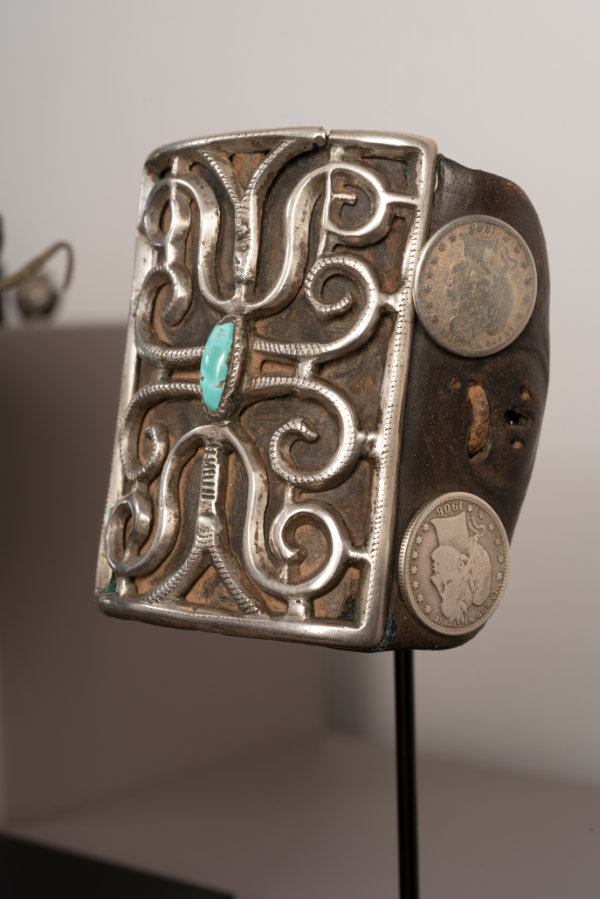
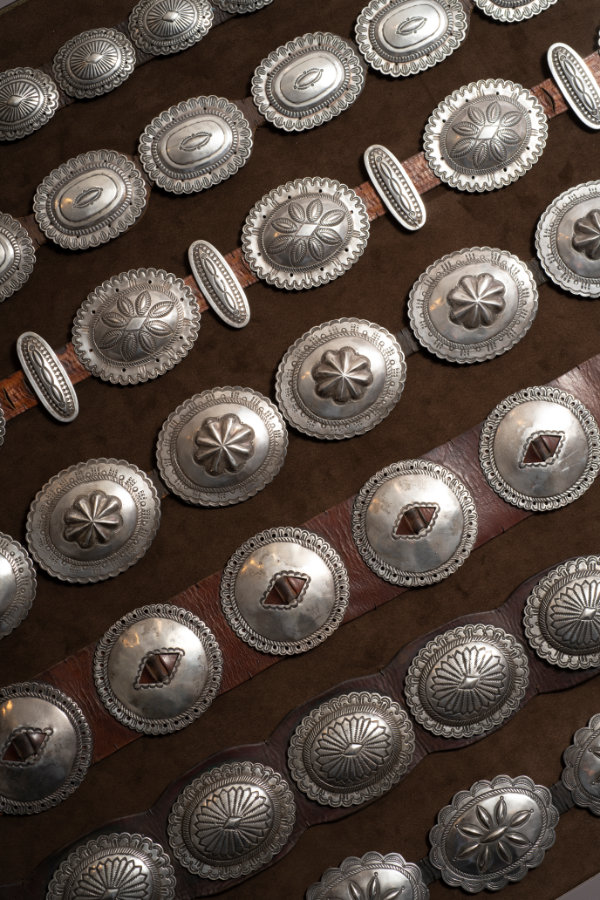
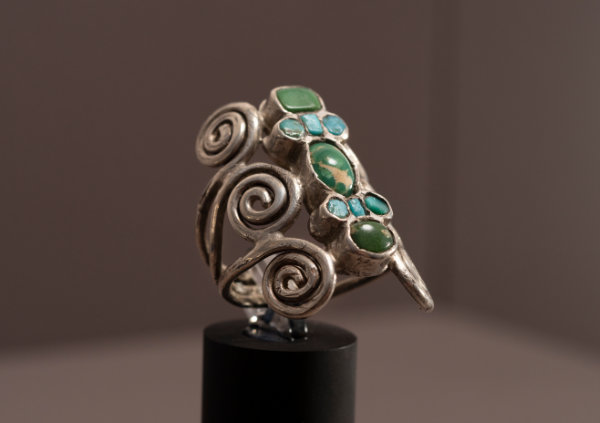
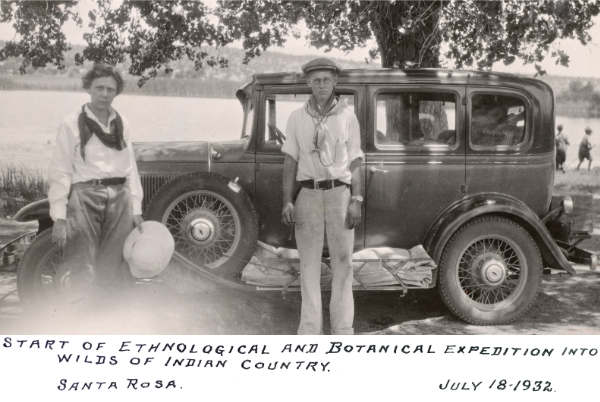
In 1932, Dr. Harry Percival Mera (1875-1951), curator at the Laboratory of Anthropology, embarked on a trip to the Navajo Nation with the purpose of assembling an assortment of Navajo silverwork to form the beginnings of the Lab’s jewelry collection. He visited traders throughout the reservation to compile examples with a variety of styles and techniques. Bracelets range from the early pieces with heavy silver and decoration made with the tip of a file, to later ones decorated with handmade or purchased stamps and set with turquoise. The earliest concho belts are similar to their Spanish and Plains antecedents. Later, the styles diverge with better soldering techniques and availability of turquoise. Squash blossom necklaces derived from the pomegranate decorations on Spanish men’s clothing and the crescent-shaped ornaments on their horse bridles. In all, the collection demonstrates the history of early Navajo silverwork, and the talent and creativity of the makers.

An exhibition of the pieces Mera obtained on this buying trip are currently on view at the Museum of Indian Arts and Culture in Collecting Jewelry: Curator H.P. Mera’s Trip to Navajo Country, on display through early January 2022.

Mera was born and raised in Detroit, Michigan. After graduating from high school, he worked briefly as a commercial artist in New York and a miner in Colorado before enrolling at Ohio State University and obtaining his medical degree in 1899. He practiced medicine in the Midwest for a number of years prior to pursuing his lifelong interest in the Native cultures and archaeology of the Southwest.

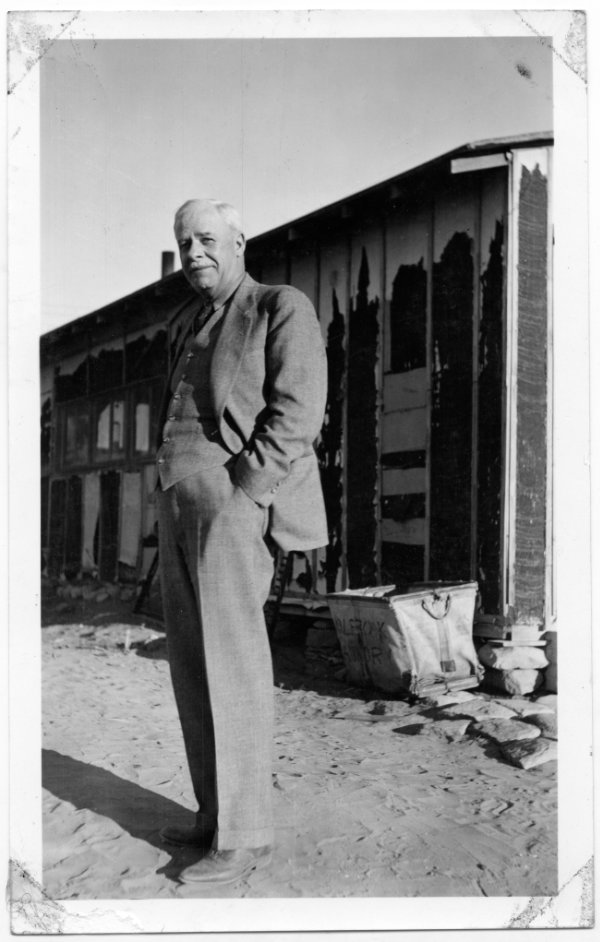
Dr. Harry P. Mera, designer of the New Mexico state flag, ca. 1938. Photograph by Harriet. Courtesy Palace of the Governors Photo Archives (NMHM/DCA), neg. no. 025798.

In 1922, Mera relocated to Santa Fe where he served as Santa Fe County health officer for eight years. In his personal time, he began to scientifically catalog the archaeological sites he visited. He began his career as curator of archaeology at the Laboratory of Anthropology (now the Museum of Indian Arts and Culture/Laboratory of Anthropology) in 1929, where he built collections of both historic and prehistoric material, and wrote extensively on pottery, textiles, and jewelry.

Pre-1940 silver jewelry collected by Mera during a trip to the Navajo Nation in 1932 forms the foundation of the Museum of Indian Arts and Culture’s jewelry collection. This work by early Navajo silversmiths is the root of work produced by today’s southwest Native jewelers who pay them homage by using designs and techniques they created and developed. In Collecting Jewelry, the museum presents a detailed look at the collection and what we can learn from it.

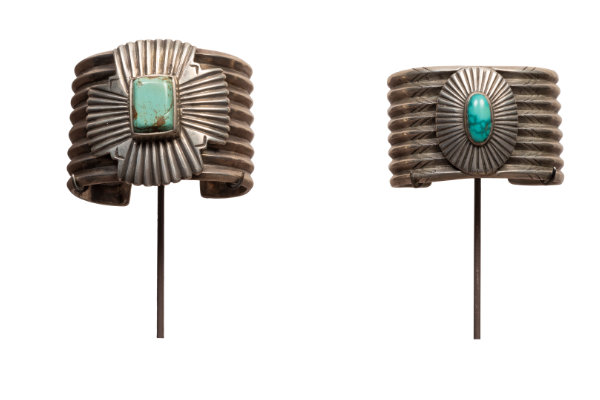
(Left) Bracelet (Navajo, ca. 1910-1920). Silver, turquoise. Purchased at C.T. Vann and Co., Cross Canyon, Arizona, on October 15, 1932 for $7. MIAC Collection: 10190/12. Photograph by Kitty Leaken.
(Right) Bracelet (Navajo, ca. 1910-1930). Silver, turquoise. Purchased at C.T. Vann and Co., Cross Canyon, Arizona on October 15, 1932 for $15. MIAC Collection: 10191/12. Photograph by Kitty Leaken.

A prevailing sentiment among anthropologists at the time that Mera was traveling in Indian Country was that Native culture and its arts were disappearing due to assimilation and acculturation; this, in turn, created an urge to collect. Beginning in the late 1880s, expeditions from Eastern museums such as the Smithsonian and American Museum of Natural History were collecting and removing cultural objects from the Southwest. In 1932, Jesse Nusbaum, the director of the Laboratory of Anthropology, met with John D. Rockefeller, Jr., an important financial supporter, to discuss creating a collection of Southwest Native arts for the Lab, in part to keep these objects in the Southwest where they would be available for study by scientists and future generations of Pueblo and tribal people. One of the projects Rockefeller funded was the creation of a jewelry collection.

Nusbaum enlisted Mera for the task of “building up a collection of Navajo silver craftsmanship for the Laboratory, illustrative of all phases, trends and periods of the art.” Further, in that correspondence with Rockefeller, he said, “The Laboratory is particularly concerned in establishing the collection of Navajo silverwork available here on a basis comparable to that of the combined collections of blanketry and historic pottery of the Laboratory and the Indian Arts Fund, which together form the finest and most comprehensive collection available to the public and student in this country today.”

So, in the fall of 1932, with a budget of $2,500—the equivalent of approximately $50,000 in 2021—Mera set off on a trip around the Navajo Nation with the goal of accumulating a fundamental assortment of Navajo silver jewelry. He was accompanied by David L. Neumann, a dealer in Native arts, who was familiar with the area. He provided his car and was paid 10 cents a mile plus expenses. Over a period of two weeks, they covered over 2,500 miles and visited 79 trading posts on or near the reservation. It was an arduous trip; Their car had the rudimentary suspension and shock absorbers of the time. The roads, built for horse and buggy travel, were rough, rutted affairs that rendered travel hot and dusty or muddy after the rains. Mera kept in touch with Nusbaum by phone, telegraph, and correspondence and said, “We had to plan our route to avoid some badly washed roads, as there have been some very bad rains. Road conditions make planning very far ahead impossible.” Persevering, Mera purchased 300 pieces of jewelry, all meticulously documented as to place of purchase and cost.

Bowguard (Navajo, ca. 1900-1920). Silver, turquoise, leather. Purchased at Babbitt Brothers Trading Co., Flagstaff, Arizona, on October 12, 1932 for $2. MIAC Collection: 10340/12. Photograph by Kitty Leaken.

Navajo silversmithing began in 1868 when Mexican silversmiths came to trade their silver jewelry for blankets or livestock. Some of the early Navajo silversmiths had already learned blacksmithing and were making things such as knives and bridle bits. One of these men was Atsidi Sani (Old Smith). He is considered the first Navajo silversmith, having been taught the skill by the Mexican smith known to the Navajo as Nakai Tsosi (Thin Mexican). Atsidi Sani subsequently taught some of his friends and relatives the skills to make buttons, bridle ornaments, and rings.

Another important early smith was Atsidi Chon (Ugly Smith) whose bridle, purchased by Mera, is part of MIAC’s collection. According to Grey Mustache, Atsidi Chon’s brother-in-law and student, Atsidi Chon made the first concho belt and was the first Navajo smith to set turquoise in silver. Atsidi Chon traded with the Zuni and was paid one good horse to teach the first Zuni silversmith, Lanyade. Lanyade, in turn, taught the first Hopi silversmith, Sikyatala. Atsidi Chon also taught Slender Maker of Silver, who worked in the 1880s and 1890s, and is considered one of the best silversmiths of the era. Grey Mustache was interviewed and quoted by John Adair in his book, The Navajo and Pueblo Silversmiths.

Mera bought pieces that he felt demonstrated the development of Navajo jewelry, from the early simplest designs to later, more complex styles. He purchased examples of techniques used between 1880 and 1930, including wrought silver, casting, wirework, stone setting, and applied decoration.

Almost all of the pieces collected were originally made for use by the maker, his family, or other tribal members. Most of Mera’s purchases were of pawn jewelry; personal jewelry traded for credit at the trading post to be redeemed at a later date. Unclaimed jewelry became “dead pawn,” which could then be sold. When Mera saw pieces in pawn that he wanted to purchase, he asked the trader to contact the owner and, for several months after Mera returned to Santa Fe, he was able to purchase pieces offered by the owners.

A variety of early concho belts (Navajo, ca. 1900-1930). Silver, leather, turquoise. MIAC Collection. Photograph by Kitty Leaken.

This older jewelry reflects Navajo preference for heavier silver, with the silverwork more prominent than set stones. Set stones are always of an odd number, with a central stone and an even number of other stones, satisfying the Navajo’s desire for harmony. By 1920, with the influence of the outside market, Navajo silversmiths began to make pieces for sale.

The first smiths traded with soldiers from nearby forts to obtain American coins to melt down for the silver. Later, sometime after 1890, they began using Mexican coins, obtained from Mexican traders, which had a higher percentage of silver and produced a warmer appearance. After 1900, silver slugs became available from federal mints and trading posts supplied the silver. These materials were either melted into ingots and wrought or melted and poured into molds made from stone or sand saturated with oil. Sheet silver and wire became available around 1920, from which jewelers fashioned thinner, more refined bezels for setting stones.

Early tools were basic: hammers, files, scissors, bellows, and anvils formed from pieces of train rail or tree stumps. Early decorations were scratched or stamped onto the silver using the pointed end of a file, and lines were gouged out with a piece of iron. Lorenzo Hubbell, who operated a trading post in Ganado, Arizona, was an important figure in the development of Navajo silverwork. He hired Mexican jewelers to teach techniques to the Navajo smiths in his area, and he brought more advanced tools such as pre-made stamps from California to improve the quality of their work. Jewelry made by the smiths near his trading post became more refined earlier than it did in other parts of the Navajo Nation.

Between 1880 and 1900, Navajo smiths developed two jewelry styles that became ubiquitous: the concho belt and the squash blossom necklace. The concho belt was inspired both by the German silver disc belts worn by several of the plains tribes and the silver conchos on the Spanish bridles. The first belts had a diamond-shaped cutout in the center of the concho to run the leather belt through, named “first phase” by traders. When the smiths became adept at soldering, they dispensed with the cutout and added copper rings on the back of the concho for the belt, which became known as “second phase.” Third-phase belts include turquoise cabochons.

Distinctive, three-part squash blossom necklaces typically consist of plain round beads, beads with petal-like extensions, and crescent-shaped pendants called najas. Smiths formed the beads by pounding a silver disc into a pre-made depression to form half the bead, punched a hole in each end, and soldering the two halves together. These early beads are identifiable by the outward flange around the holes. After about the late 1930s, beads were formed whole and the holes drilled from the outside. The naja was inspired by the forehead piece on Spanish bridles, which in turn was inspired by the Iberian Muslims’ naja, which symbolized good luck. The “squash blossom” beads were first seen as pomegranate-shaped ornaments on Spanish men’s clothing. The Navajo eventually elongated the petal to resemble the squash blossom, with which they were more familiar.

Ring (Navajo or Pueblo, ca. 1920). Silver, turquoise. Purchased at Red Rock Trading Post, Shiprock, New Mexico, on October 7, 1932 for $1.50. MIAC Collection: 10128/12. Photograph by Kitty Leaken.

To the Navajo, turquoise symbolizes luck, protection, and wealth. They had long traded with Santo Domingo Pueblo for beads, earrings, and ear-bobs, which they sometimes converted to settings for their silver jewelry. Though some turquoise mining was being done at locations such as Cerrillos and Hachita in New Mexico and Manassa in southern Colorado, it was a scarce commodity. To alleviate this scarcity at the turn of the century, Lorenzo Hubbell imported cut and polished stones from Persia, which are easily identified by their high dome. It wasn’t until mining for turquoise began in Nevada around 1910 to 1920 that turquoise became more widely available.

The jewelry in this exhibit was made at a time when the Navajo silversmiths had few design or technique references. That they created such a variety of designs and developed the techniques to produce them attests to their artistry, even though they referred to themselves as only makers or smiths. Today, the H.P. Mera collection is the foundation of a silverwork collection which spans the period from 1880 to 2021.

Ross Altshuler, curator of Collecting Jewelry, works in the Individually Cataloged Collections department of the Museum of Indian Arts and Culture. He is the co-author of Turquoise, Sky, and Water, the catalog of the exhibit of the same name, and has written for El Palacio and other professional journals.

Kitty Leaken (opens in a new tab) learned photojournalism on the job at the Santa Fe Reporter and the Santa Fe New Mexican. 

Ross Altshuler works as a contractor for the Museum of Indian Arts and Culture. He is the co-author of Turquoise, Sky, and Water, the catalog of the exhibit of the same name, and has written for El Palacio and other professional journals.

Excavating the Past and Present

By Robert Quintana Hopkins

One email can radically change your understanding of yourself. I received that email in 2015 from Hannah Abelbeck, photo archivist at the New Mexico History Museum. A 1915 photo of Sam Adams at the Palace of the Governors Photo Archives (see “Sam and the Adams Family“) prompted a multi-year exploration into his life story by Hannah and me. I am a descendent of Timotea Chavez, Sam Adams’ wife. Over six years, Hannah and I have shared notes and records and engaged in conversations to better understand Sam and Timotea’s experiences. What follows is my firsthand account of how learning Sam and Timotea’s story changed my understanding of myself.

I was born in 1970s California to a Mexican American mother, Bonnie, and an African American father, Robert Charles. My sister Shane and I grew up navigating our bi-racial and bi-cultural identities, believing we were the first Blacks in our Mexican American family.

Our Blackness was significant among our relatives. My parents, responding to their families’ disapproval of their relationship, eloped, leaving their respective families in the Central Valley of California and moving 350 miles south to Los Angeles. They started their own family with my birth, and as a result, my mom’s father, a grandfather I never met, disowned her, never reconciling their relationship before his death. My mom remembered her family’s race prejudice and consciously decided to protect my sister and me from it by raising us in California with my dad’s immediate family and her own younger sister, not in Colorado with her extended family. In our youth, our Mexican American identities were shaped almost exclusively by our mom and her sister, Georgina.

Our environment was filled with symbols of our Mexican heritage—symbols that, like most elements of culture, were so normal they were not recognized as significant. On weekends our mom often served chorizo and eggs with fried potatoes for breakfast, or large pancakes she made on a cast iron comal. As teenagers our primary snack was a plastic tub of homemade salsa fresca and a bag of store-bought chips. She taught us to make chile verde, two versions of Mexican rice, menudo, guacamole, and beans. From the black wrought-iron chairs and table in our kitchen, red clay Mexican pottery with multi-colored papier-mâché flowers next to the fireplace, or the wooden kitchen utensils hanging near the stove, including a rolling pin, spatula, spoon, bean masher, and molinillo for mixing hot chocolate, there were small, subtle reminders of our Mexican roots.

As a graduate student in anthropology during the late 1990s, I decided to write an autoethnography as my master’s thesis. Writing my own story and researching my family’s history was my way to resist the colonial roots of the field, in which whites researched people of color, controlling and commodifying knowledge and narratives. I wanted to show that we could tell our own stories in our own voices, turning the researcher’s gaze internally, so that the subject and researcher became one, and the power to represent another shifted to the power to represent one’s self.

Francisco and Adelaida Barela with two of their children, 1903. According to oral history, Francisco was half Navajo and half French, a reflection of the long history of mestizaje also present in the author’s family. Photograph courtesy Robert Quintana Hopkins.

I began interviewing the people around me: my parents, my paternal grandmother, Bennie Mae, and her mother, my great grandmother, Jessie Ann. I regularly interviewed my paternal grandfather Robert’s eldest sister, Llemma Mae. I spoke with my dad’s sister, Carolyn, and my mom’s sister, Gina. I visited extended family on both sides, researching my African American family in Utah, Texas, and Arkansas, and my Mexican American family in Colorado, and performed archival research in New Mexico. I was embraced by the elders on both sides of the family. I met my maternal great-grandmother Sidelia’s brother, Manuel, who lived to be 98. I interviewed my maternal grandmother Irene’s sisters, Geri and Dolores, and her cousins, Viola and Lucy, and my maternal grandfather’s cousin, Ercie. Through my cousin Nikki I learned of my great-great-grandmother Timotea, our Great-Grandma Tillie’s mother. Generously, my family shared the stories of our ancestors, making them my stories too, as if one generation bestowed our family narratives to the next, ensuring my ancestors would continue to live in our collective memory for generations to come.

As we sat at her kitchen table eating homemade tamales and menudo, Aunt Viola told me about my maternal great-great-grandmother Adelaida Barela. Adelaida’s parents left New Mexico and settled in Southern Colorado, one of the first Mexican families to settle in the region. Her parents, Francisco and Justa Catalina Martinez, were born in New Mexico when it was part of Mexico. Their parents were born in New Mexico when it was a Spanish colony. Francisco and Justa Catalina married at the oldest church in Colorado in 1865, eleven years before Colorado became a state, and were awarded a 160-acre land grant in 1901, reflecting the settler colonial history in my family.

Roy and Sidelia Vigil, Bonnie’s grandparents and cousin Lucy’s aunt and uncle, were married in 1928 in Fort Collins. Roy was 21 and Sidelia was 28. Photograph courtesy Robert Quintana Hopkins.

The family moved north via horse and wagon, living in Walsenburg and Pueblo, finally settling in the Fort Collins area around 1906, working as farm workers in the sugar beet, barley, and wheat fields of Larimer County. Adelaida was widowed after her husband, Francisco Barela, died from injuries sustained in an automobile accident in 1921. According to oral history, Francisco was half Navajo and half French, a reflection of the long history of mestizaje also present in my family. Aunt Viola described Adelaida as a loving grandmother who helped raise many of her grandchildren and faithfully attended mass at Holy Family Catholic Church every morning.

Born in 1915, cousin Lucy recounted her memories of my great-grandparents Roy and Sidelia Vigil, her aunt and uncle. They were married in 1928 in Fort Collins. Roy was 21 and Sidelia was 28. They moved to Denver to raise their six children. Cousin Lucy lived with them for a while. Roy worked as a chef at the Cosmopolitan and Brown Palace hotels, while Sidelia was a homemaker, cooking and sewing for the family and spending summers in Fort Collins canning vegetables and fruits with her sisters Mary and Opal. Lucy described the segregation Mexicans experienced in theaters, restaurants, and other businesses, with signs that said “White Trade Only.”

First, the family lived in a poor, but racially diverse neighborhood in East Denver and later moved to a mostly Italian neighborhood in North Denver. Proud of the family’s Spanish roots, Lucy applied a critical lens, describing how our ancestors became second-class citizens in “their own country,” working for German and Russian “foreigners with money” as a result of being poor. Silently, I applied the same critique to our family, aware that our presence negatively impacted Indigenous communities.

The author’s parents, Robert Charles Hopkins and Bonnie Quintana, in 1975. Responding to their families’ disapproval of their relationship, they eloped, leaving their respective families in the Central Valley of California and moving 350 miles south to Los Angeles. Photograph courtesy Robert Quintana Hopkins.

My mom told me about her grandmother Tillie, originally born in New Mexico. Tillie raised my mom and her sister Gina. Widowed after the death of her husband, Raymond Quintana, who was sixteen years her senior, my mom described Tillie as strict and independent. She worked as a day worker for the wives of two local doctors and wanted upward mobility for her granddaughters. Education and assimilation were the paths she encouraged them to take for a better life.

Through archival research I found census records of Timotea, Tillie’s mother, in Galisteo, New Mexico. One record in particular caught my attention. The 1900 Census lists Timotea and three children. While Timotea is listed as white, the three children are listed as Black. Not being sure if this was the right family, I saved the record, but questioned its pertinence to my search. Several times my mom had told me that she suspected someone in the family was part Black. She thought it may have been one of her uncles. I always brushed off her assertion as speculation.

Eventually, I was contacted by Grandma Tillie’s niece, Cecilia. Cecilia was Tillie’s eldest brother Nestor’s daughter. Cecilia confirmed that the record was indeed our family. She told me that Timotea had married Sam Adams, an African American man, and that some of the sisters were mixed-raced. She told me that her parents lived with Timotea in Galisteo when they first married in 1914 and that she had stayed in contact with her cousins, Irene and Jane, for years via phone calls and Christmas cards, before losing contact.

I wondered about the experiences of Timotea and Sam’s mixed-raced daughter, who I discovered was named Paublita. My sister and I were raised within the context of an Anglo ideology that governed the social and legal classification of race, with whiteness defined as the absence of Blackness. The “one-drop rule” established that anyone with one drop of Black blood was Black. I questioned whether or not Paublita, too, was monoracialized, in spite of navigating the world with a multi-racial identity and sense of self, like us.

The author, Robert Quintana Hopkins, and his sister Shane Quintana Hopkins, in 1975. Photograph courtesy Robert Quintana Hopkins.

In 1970’s California there was no language to identify children who were both Black and Mexican. Forms and census records forced you to choose. This wasn’t true in Colonial New Spain. Colonial New Spain had a multitude of names to describe racial identities, such as mestizo, mulatto, pardo, and zambo, among others. Race was more fluid. Native American scholar Jack D. Forbes used census records to show that residents of Mexican California changed racial categories over time, and educator and scholar Edgar Love used colonial church records to show interracial marriage patterns in Mexico City.

I wondered if Paublita, who was born in New Mexico only forty-one years after the Treaty of Guadalupe Hidalgo, experienced a more fluid racial context, like that of the Spanish Colonial period, or a binary racial context as a result of the Anglo influence after 1848. I wondered if Paublita maintained a Black identity, held a Mexican identity, or created a new mixed-raced identity like me. I self-identify as AfroChicano. Did she “pass” as Mexican? Do her descendants know they have African ancestry? Was she proud to be both?

For a long time I bemoaned the fact that my generation didn’t know about Paublita and that no one in our family today is in contact with her descendants. Was their erasure from our collective memory and oral history intentional? I speculated that the family’s silence was due to her mixed-raced background. I was relieved when I discovered that Paublita died in 1945, before my mom was born. My relief was due to the fact that I know that around 1964, Grandma Tillie and her brother, Nestor, travelled from Colorado and California, respectively, to visit Paublita’s husband, Isidro, and children, Jane and Irene, in New Mexico; this tells me that nearly twenty years after their sister’s death, they were still visiting their brother-in-law and nieces. Race, for that generation at least, did not divide the family.

All our lives, my sister Shane and I grew up thinking we were the first Blacks in our Mexican American family. Sam Adams and Timotea’s marriage reveals that our story is not as unique as we thought it was. There must be many untold stories of people who have loved and married across racial categories and across identities, creating new notions of family and identity, preserving, mixing, and recreating cultures, passing on the old, while creating something new in a constant state of emerging, unfolding, and “becoming” within a context that at times supports and at times challenges what and who is created. So much is unknown about Sam, Timotea, and Paublita, but their stories remind us that there have always been brave people who have challenged norms and crossed geographic and racial borders, living at the intersection of multiple cultures and identities. Through Sam, Timotea, and their descendants, we see New Mexico as a site in which multiple people, histories, cultures, and genes converge in a complex web of human experiences still waiting to be fully understood.
—  

Robert Quintana Hopkins is an AfroChicano descendant of the Martinez, Barela, Quintana, Chavez, and Vigil families from Colorado and New Mexico. He was born and raised in California and currently resides in the San Francisco East Bay, where he works as an organizational development practitioner and is completing a PhD in organizational psychology. In his spare time he writes poetry and facilitates a monthly writing group.

Robert Quintana Hopkins is an AfroChicano descendant of the Martinez, Barela, Quintana, Chavez, and Vigil families from Colorado and New Mexico. He was born and raised in California and currently resides in the San Francisco East Bay, where he works as an organizational development practitioner and is completing a PhD in organizational psychology. In his spare time he writes poetry and facilitates a monthly writing group.

Sam and the Adams Family

As a New Mexican, Samuel Adams stands out. Of African American heritage, Adams arrived in Colorado as a young man, one of a generation of freeborn and formerly enslaved people who courted new opportunities in the American West during an era of rigid, oppressive racism and rapid territorial expansion. He enlisted in the Civil War, serving the Union with the Colorado Volunteers, perhaps as their only African American recruit. By the late 1870s, he had settled in New Mexico, married a local Hispanic woman, and started a large, complex family. He lived fifty to sixty years of his life in rural communities, working as a farmer and laborer, through New Mexico’s transition from a U.S. territory into statehood. As a veteran, he was buried in the Santa Fe National Cemetery after his death in 1927.

Despite this atypical biography, Adams is like many relatively anonymous historical figures whose presence has been overlooked and forgotten. Details about his life are hard to track down and are enigmatic and inconclusive when found. His contemporaries include well-documented Buffalo soldiers who crossed over the Santa Fe Trail in 1866 and enslaved people brought into the territory by white, Southern political appointees. He was followed by other African American settlers who used photography to document their striving and their successes, including communities of exoduster utopianists like the pioneers of Blackdom, and prominent local families like the Slaughters of Santa Fe, whose specialized occupations allowed them to carve out niches in local economies.

However, beyond recent reclamation of legacies like those of Black cowboys, there isn’t much writing about Sam Adams and laboring men like him—maybe because research on their lives proves so difficult. Yet, Adams’s story may illuminate questions historians have had about frontiers of the African American experience, about overlooked Afro-Latine histories and possibilities, and about racial identity in nuevomexicano families. His life spans the reconfiguration of racial and ethnic identities in the Southwest between 1880 and 1930, which were under pressure from American racial politics and an influx of white colonists.

Traces

The photo archives at the New Mexico History Museum is stuffed with photographs collected as historical, artistic, and socio-cultural documents. Although researchers often query the department looking for photographs to illustrate what they have written, the broad photographic collections also function as a pool of information about what people in the past were interested in. This corpus does not capture the past itself; instead, it reflects what people chose to record and reproduce with photographic processes, and what from those efforts was kept by design or by accident.

In digging for interesting but neglected material worth digitizing, the five glass plate negatives with portraits of Samuel Adams seemed notable for both their quality and for their very presence, among the general lack of images—particularly captioned ones—showing African Americans in territorial and early-statehood New Mexico.

Many historic photographs lack records documenting their creation and context, and it takes diligence and happenstance to interpret decontextualized images more fully. Although he was not recorded as the photographer, Jesse Nusbaum likely took the series of portraits of Adams. Nusbaum worked for the Museum of New Mexico and School of American Archaeology. He had a keen eye, great technique, and a sense both for whimsy and for historical significance. In 1915, Nusbaum was often out at the Pecos Ruins for the excavation and restoration of the pueblo and mission church there. He brought a camera on more than one occasion, and some of his photographs of the site, excavations, and archaeological work appeared in El Palacio at the time. While the photo archives has a large body of Nusbaum’s documentary, archaeological, and ethnographic photographs from this work-for-hire, these five glass plates featuring Adams came to the museum’s collections directly or indirectly from New Mexico historian Ralph Emerson Twitchell.

Reference copies of the photograph mentioned that Adams was a “Civil War prisoner.” New Mexico History Museum staff considered the portrait for an exhibit about personal memories and the Civil War, but couldn’t confirm the story. However, evidence suggests a cataloguer in the past incorrectly transcribed the word “pensioner” as “prisoner” on a copy.

Adams was definitely a Civil War pensioner. One of the original sleeves from an old glass negative had a longer note on it, with only the barest biographical sketch of Adams. It also mentioned that Mrs. Dendahl, a prominent local white woman, was assisting Adams, helping him manage his finances, navigate federal bureaucracies, and secure his pension. Based on this note, perhaps the Dendahls spoke with Twitchell or Nusbaum about Adams and his Civil War service. Maybe as a result of such a conversation or at the urging of Twitchell, Nusbaum then made an effort to seek out Adams and photograph him at the Pecos site. Certainly the Civil War engagements near Glorieta Pass were on Nusbaum’s mind during the dig. Nusbaum isn’t the only option for the originator of the images: Henry Dendahl and Twitchell’s son Waldo were also capable photographers.

Whatever the exact details, the existence and persistence of these photographs suggests an active albeit brief interest in Adams and his story, as well as an attempt, however incomplete and fragmented, to preserve that history.

More spotty records

It is not easy to trace the early life of Samuel Adams. His is a common name, and it evokes a U.S. Founding Father. The Sam Adams of these photographs was probably born between 1836 and 1843, according to estimates of his age in later census and vital records. Amid the multitudes of men who were called Sam or Samuel Adams, we don’t have confirmation of his ancestry or the names of his parents and siblings. His birthplace is listed as Illinois in the 1880 census, and Mexico or Maine in another, but he most frequently names Virginia as his birthplace. We don’t know if he was born free.

We do not know exactly how, when, or why Adams ended up in the West. In fact, it is a great question, but maybe not one that’s answerable with any precision—not yet, anyway, and perhaps maybe it won’t ever be. Census records indicate Adams was not literate, so Adams did not write down his thoughts, and, as far as we know, no one recorded them. Even when traces of his life appear in written sources, he was forced to rely on others to transcribe information about him accurately, and it was usually for their purposes, not his.

Records regarding Adams’s military enlistment are inconsistent. Although biographical hints linked him to the Colorado Volunteers, early in our searching, one Colorado historian expressed skepticism that a Black man would have served with the “all-white” Volunteers. Although African Americans were not allowed to formally join the Colorado Volunteers in 1862 when New Mexico battles from Valverde to Glorieta took place, nineteenth-century military encampments were supported by non-enlisted people—laundresses, traders, photographers—that either supported military activities or catered to enlisted men. Theoretically, federal rules changed with the Emancipation Proclamation, and African Americans should have been able to enlist after that, certainly by 1863. But it is unclear if other African American men in addition to Adams attempted to enlist in Colorado.

While the records are spotty, Adams shows up regularly in enlistment records and post returns near Denver. He was possibly officially serving as early as February of 1863, and definitely was by May of 1864. His heritage was not a secret. One record notes he was “mustered as under cook of African descent.” As Colorado units weren’t integrated and no separate “colored” regiment existed, Adams probably only had the option to serve in a support role of some kind. In fact, a number of documents indicate that he was valued as a cook and sometimes tended animals.

Another muster roll for January and February 1865 documents that he was actively laboring with his unit. Yet, a later hand noted with a bright red scrawl, “Name not borne on sub. rolls of Co,” which might indicate a gap between on-the-ground records and how officers listed him in full reports about the unit.

Many African American men who volunteered for military service during the Civil War tolerated unequal treatment and racism from white officers and fellow soldiers because the cause, and the opportunity, was so important to them. As Joseph T. Glatthaar observed in Forged in Battle: The Civil War Alliance of Black Soldiers and White Officers, one formerly enslaved man thought serving in uniform “was the biggest thing that ever happened in my life.” Glatthaar further documents a white officer of the United States Colored Troops echoing the sentiment, writing that “[o]ne of the greatest incentives in fitting [a Black man] for a soldier was the inspiration of his being an American citizen, and of being recognized as a soldier in the same uniform that white soldiers wear.” A Black sergeant in the USCT put it this way: “We are fighting for liberty and right, and we intend to follow the old flag while there is a man left to hold it up to the breeze of heaven. Slavery must and shall pass away.”

In narratives about this period, Union soldiers are often commemorated as “the good guys.” However, even beyond the unequal treatment of Black servicemen, Union actions in the West deserve more scrutiny. Union officers and soldiers spent more time on territorial expansion, control of resources, and subjugation of Indigenous peoples than they did fighting pro-slavery forces. These activities are central to omitted stories of the Civil War era. Dual faces of anti-Confederate and anti-Indigenous conflict are memorialized in the (as of this writing) partially disassembled “Soldier’s Monument” obelisk, which has stood at the center of the Santa Fe Plaza since 1867.

Like the Genízaro communities at the northern edge of Spanish colonies, Black soldiers on the American frontier were often agents and allies of an empire who treated them as second-class citizens. Adams was probably enlisted while the troops he was serving massacred Cheyenne and Arapaho people at Sand Creek in southeast Colorado on November 29, 1864. Jim Beckwourth, a well-known frontiersman of African American heritage, was at Sand Creek that day. A generation older than Adams, he was born to an enslaved woman in Virginia and freed by his father (and owner) in Missouri. Despite working as a scout and translator for the Colorado infantry, Beckwourth later expressed regret for the role he played at Sand Creek, and testified against Colonel John M. Chivington during a congressional inquiry in 1865.

We may never know what Adams’s service meant to him, how he dealt with the monotony and challenges of camp life, or how he responded to the significant events and changes he may have witnessed. What Adams did between 1865 and 1878 is unclear, although he may have married Eva Martín from Taos in 1868. If Adams married at Taos, it seems like connections made during his service might have provided a reason to move to Taos or an introduction into social networks. Biographically, he seems to have developed deep ties in New Mexico, which probably felt like borderlands between northern Mexico, Indigenous territories, and the metastasizing U.S. empire. Adams then cemented ties to New Mexico with his 1878 marriage to Timotea Chaves of Galisteo.

Afro-Nuevomexicano identities and New Mexico’s racial politics

The rest of this piece will take a deeper look at questions of family dynamics, genealogy, and heritage in Adams’s New Mexico family. Centering these questions is not meant to imply that genealogy is inherently important. Inheritances exceed genetics, some family relationships are legal ones, and other kinship is more than biological. We have many ancestors and many relations. Yet, it is interesting which inheritances get claimed and why.

New Mexico’s “tri-cultural myth,” the simplistic idea that our culture is comprised of three distinct Indigenous, Spanish, and white cultures, has downsides, including a lack of engagement with regional stories about African American history. It renders invisible Afro-nuevomexicano pasts and possibilities. And it obscures the alignment of some Hispano identities with legal and racial whiteness.

The fact that Timotea Chaves and Samuel Adams were married in Peña Blanca in January 1878, and that by the 1880 census they were living together in Galisteo as a newly married couple, indicates that Adams may have been visually able to blend in or pass as a darker-skinned Latino. Or it could show that nuevomexicano communities were willing to absorb community and family members with identifiable African descent, which happened in similar communities in Mexico proper. In the second case, perhaps Hispano identification with whiteness was less rigid in some communities and in some decades than it seems to have become across many communities in Northern New Mexico in the early twentieth century.

Even without knowing any nuances—how they met, what they thought of one another, or even whether their marriage was arranged or not—Sam and Timotea’s union was a viable social choice. Both African Americans and Mexican-Americans in the U.S. Southwest shared some commonalities in this time of great change. Both chattel slavery and Indian slavery had ended, at least legally. African Americans and Hispanos were granted status as American citizens in a way that Indigenous peoples of the Southwest weren’t: African Americans as a result of the Civil War, and some Hispanic people after the Mexican-American War. Although citizens legally, their status as full citizens in parity with white Americans was viewed grudgingly by those who believed in a white racial version of manifest destiny. And in many cases, neither group was treated as fully equal under American law or by white arbiters of that law—so their equality was increasingly socially, if not also legally, circumscribed. Anglos pouring into Texas, New Mexico, Colorado, Arizona, and California may have had one vision of the future, while Samuel and Timotea may have had a different set of assumptions about potential futures in the borderlands.

At the same time, legacy Spanish colonial frameworks centering blood and heredity were not egalitarian and depended on distinctions around caste and class. Any potential opening of possibilities for those with African heritage, starting with Mexico’s abolition of slavery in 1829, may have become foreclosed again as U.S. leaders gave up on Reconstruction and reified the relationship between whiteness and citizenship. Reconstruction ended in 1877, Samuel and Timotea married in 1878, and the railroad arrived in 1880.

It is unclear whether, or to what degree, this may have become a problem for the family.

In “Becoming Spanish-American,” published in the Journal of American Ethnic History, Charles Montgomery argues that strategic investment in Spanish-American identity and the erasure of mestizo identity that followed was “the product of an entrenched racial confrontation, the standoff of ‘Americans’ and ‘Mexicans’ in the four decades after 1880.” Pablo Mitchell also focuses on this period in Coyote Nation, noting that although the identifiable African American population in 1880 New Mexico may have been only around 1,000 people, they “were absolutely central in symbolic terms and played prominent roles in New Mexico’s multiple and multi-layered racialization projects.”

“Races” are a biological fiction, but they are a biological fiction with the ability to create social realities. By the time of this 1915 speech, New Mexico politician Antonio Lucero boasted about the Spanish American heritage of nuevomexicanos with rhetoric typical of the time:

If there is a trace of the Indian among us, it is so slight and so rare as to prove the exception rather than the rule. We are not only Caucasians, but we belong to that branch of the white race, the Aryan, which, more than all the other, has made the history of the world. … Ours is a past that can take its place in that grand procession of greatness that is no more—a past to be admired, honored, and reverenced.

This speech was given the same year that the photographs of Adams were taken at Pecos, when Adams was probably in his seventies, during a decade when social and cultural institutions in New Mexico invested deeply in the tricultural myth.

Although norms are changing, elders in some nuevomexicano families, especially those whose attitudes were shaped between the 1920s and 1950s, overtly favor lighter skin and hold discriminatory attitudes about African Americans. Looking back at the life of Sam Adams shows particular ways that the African American pasts and possibilities in New Mexico have been forgotten.

Reconstructing family history

Timotea was born in Galisteo between 1858 and 1865 to Felipe and Francisca Chaves, and the family did and still does identify with their heritage as Chavez: a Spanish Colonial settler family. In census records, Timotea is always listed as “white,” which is uniformly the case for New Mexico Hispanics after the Treaty of Guadalupe Hidalgo. Timotea’s large and probably blended family was a Spanish-speaking household.

The descendants I’ve spoken to don’t have an active oral history about Sam Adams, and most of what they know about the couple is frequently based on genealogy research and census records. This research is difficult for them to do, as lots of the records are, quite frankly, marked by a disconnect between authorities and the family. They’re replete with reporting categories the family did not fit or which they may have wished to obscure, and garbled by census-takers seemingly baffled by Spanish names. For example, a son was born in 1882, whose baptismal record from Pecos is filed under “Juan Elias Aramas,” a mishearing of “Adams.” Daughters whose names started with “P” include Paula, Pauline, Paulita, Polita, and Pablita on the 1900 and 1910 census, which could be just one daughter.

The 1890 census records are absent, destroyed in an archival fire, but there are hints of tension in Timotea and Sam’s marriage. Timotea had a gray-eyed son, Nestor King Adams, born February 26, 1891. As an adult, Nestor appears in Madrid, Albuquerque, Van Houten, and Blossburg (the latter two mining camps in Colfax County)—probably working in mining. He moved to California, and in later records, he seems to identify as “white.” Family lore says he centered Adams as his surname after experiencing closed doors under the name Chavez. According to Nestor’s daughter, Timotea had fallen in love with a white man, a blond-haired, blue-eyed “Mr. King,” who is actually Nestor’s father, not Sam. It’s possible: in 1900, a Charles King, a blacksmith living with his wife in Galisteo, is listed on the same census page as Timotea.

King did not divorce his wife to marry Timotea. In 1900, Timotea is still listed as married to Adams and also as the head of their Galisteo household. The census reports her as the mother of eight children, just four of whom were then living. In the 1900 census, Nestor and two younger sisters are listed as “black” by a census-taker, who records all of their nuevomexicano neighbors as white. Meanwhile, Samuel appears in the 1900 census elsewhere, working as a “wood chopper” and living as a boarder in the boomtown of Bland, New Mexico. One non-specific story from descendants holds that Adams abandoned the family. And while there is evidence that Sam and Timotea had separate households in 1900 and in 1920, the couple never actually divorced.

The interpretation of these family changes is challenging 100 years in the rearview mirror. Were they having marital troubles, so Sam left before they had more children? Did he suspect at least one of the children wasn’t his, and so he left the marriage for a while? Did he leave to earn money, and did Timotea have an affair while he was away? If Timotea lost four children between 1880 and 1900, a period of drought in New Mexico, was the loss of children, combined with a tough agricultural economy, a strain on their marriage? Were they incompatible? Was one of them intolerable in the relationship? Did one give up? Was Timotea increasingly bothered by his heritage and found King a better prospect? Whether any of these is a better possibility than others is not clear.

Of the family’s children that we know about, Juan Elias Adams and Polita Chavez are the most likely to have had Adams as a biological parent. Tillie (variously Clotilda, Cleotilde), born in 1902, has no father listed on her birth certificate but lists her father as Luis Chavez on a social security application, and Sam Adams may still have been in Bland when she was conceived. Based on DNA tests taken by Tillie’s descendants, Tillie’s father was probably not Sam Adams. There are also reasons to suspect Tillie’s brother Isabel, who later married a Las Vegas restaurateur known as Mama Lucy, may also have had a different father than Samuel.

Observations about these family dynamics are not being offered up for judgment based on nineteenth-century yardsticks set by church authorities or white puritanical newcomers. Instead, they are offered to show that the past is complicated too. Professed heteropatriarchal ideals in which legal, affective, and hereditary relationships are perfectly aligned is an incomplete toolkit for figuring out what choices people made under the pressures and incentives of their particular circumstances.

Sam Adams died in 1927 and is buried in the Santa Fe National Cemetery. Timotea seems to have received his military pension until her own death in Colorado on July 31, 1931.

Learn more about Sam Adams, his descendants, and the Palace of the Governors Photo Archives on the third episode of Encounter Culture, a new podcast from the New Mexico Department of Cultural Affairs. Find episodes wherever you get your podcasts.

Hannah Abelbeck (opens in a new tab) is the photo archivist in the Palace of the Governors Photo Archives at the New Mexico History Museum and is actively working to increase access to its photographic collections.

A Bid for the Canon

By Dr. Richard I. Ford, Allison Colborne and Gary Hein

Attorney Royal A. Prentice (1877-1958) was successful in every way imaginable. He was a wealthy rancher and land manager. He was an active member of several fraternal organizations. His political activity was constant as a Republican partisan. His contributions to the archaeology of eastern New Mexico were numerous, as were the 1,100 glyph sites that he revealed and recorded for the state. In addition to a collection of his photographs at the Palace of the Governors Photo Archives, his written records of the sites and their photographs are in the New Mexico Department of Cultural Affairs’ Historic Preservation Division Archaeological Records Management Section repository in Santa Fe, and his manuscripts are in the Fray Angélico Chávez History Library in the Museum of New Mexico. He described over 160 new archaeological sites on the “Mera” site cards first for the state museum, and then for the Laboratory of Anthropology after it opened in 1931. His homemade site forms and his completed Mera Site Cards are now in ARMS. The ceramics and artifacts he collected are in the Laboratory of Anthropology.

He loved archaeology and his productivity reveals his dedication. His site discoveries are still useful to archaeologists in the state for regional research and background for contract archaeology projects. His rock art photographs are very informative. His goal was to reveal similarities within clusters of glyphs from different parts of the state and establish a guide like the Pecos Classification archaeologists use.

The question these authors have is: “When did he sleep?”

A look at the life of Prentice reveals a chronicle of a man so dedicated to his “hobby” of archaeology that he forever altered the landscape of the field in New Mexico—yet his name is not typically among the canon most often referenced in casual conversation. Perhaps it should be; the story of his accomplishments and successes serves to illuminate his contribution.

Shortly before statehood, in 1908, George McJunkin, a Black cowboy, found Pleistocene-period bison bones at
Folsom, New Mexico. Within a short period of time and for several years following, paleontologists from Denver and the eastern United States came to the Llano Estacado region of eastern New Mexico combing for similar sites. Three self-taught New Mexico avocational archaeologists would join in this quest by looking for archaeological sites elsewhere in the state. The first and most professional of the three was Dr. H.P. (Harry Percival) Mera, a physician. Mera, along with his brother
Dr. Frank E. Mera, founded the Sunmount Sanitorium in Santa Fe and worked at the Laboratory of Anthropology, Inc., an anthropology think tank underwritten by J.D. Rockefeller which was taken over by the Museum of New Mexico in 1951. Mera searched the greater Santa Fe area and published extensively about the region. The second was Herbert W. Yeo, a state engineer and hydrologist who sought archaeological sites in the Doña Ana region and southern New Mexico.

The third, Royal A. Prentice, was a Tucumcari-based attorney. After 1920, he spent his weekends traveling in his station wagon, usually with one of his three children, surveying for archaeological sites, especially rock art, from West Texas to the Rio Grande. His articles about archaeology in the eastern part of New Mexico were published in several amateur publications. All three avocational archaeologists each registered numerous new archaeological sites with the Museum in Santa Fe. 

Royal A. Prentice was born in Milford, New York, on July 19, 1877 (although 1876 is sometimes given erroneously, even appearing on his cemetery stone in Tucumcari). His mother was Flora Bowe, a homemaker from Connecticut. His father, Edwin A. Prentice, was a rancher and occasional butcher from New York. Shortly after his birth, the young family moved to Lancaster, Nebraska, where they stayed for just two years. Happenstance intervened while the family was on their way to California in 1879: They just happened to stop in Las Vegas, New Mexico. They loved it and stayed. Here Prentice was schooled, graduating valedictorian from Southwestern Academy High School in 1897. He spent his off time wandering the Las Vegas area landscape, searching for Indian artifacts and photographing the area. He went to Purdue University, studying engineering for a year, after which he returned to New Mexico, entering the offices of Long and Fort in East Las Vegas to receive a legal education—a common practice in those days. He was admitted to the New Mexico Bar in 1898. 

While back home, he enlisted in Governor Miguel Otero’s New Mexico militia. When Theodore Roosevelt came to Las Vegas to recruit “Rough Riders,” however, Prentice was notably the second New Mexican to enlist. He signed up in Santa Fe on May 3, 1898. His enlistment papers tell us that he was 21, 5’7” tall, of fair complexion with grey eyes and brown hair, that he was not yet married, and that he was employed as a stenographer at that time.

Royal A. Prentice, Roosevelt Rough Rider, Montauk Pt. Photograph by Robert W. Denny. Courtesy Palace of the Governors Photo Archives (NMHM/DCA), neg. no. 005993.

He trained with the Rough Riders in the United States Army in San Antonio, Texas. Several of the companies in the army remained in San Antonio during the Spanish American War. His Rough Riders 1st Volunteer Cavalry, E Company, was not one of these, being in the thick of five campaigns fought in Cuba. Much can be gathered about these engagements from his photographs and the conditions facing soldiers in letters sent home and to their local newspapers. Prentice sent well-written letters describing the battles he was in and the mens’ health conditions to the Las Vegas Optic, which published them. 

Prentice returned from Cuba wounded and ill with yellow fever in 1898. He first went to Mexico to mend. While working for a railroad in Mexico, he was severely injured in a train accident and oil tanker explosion. Thereafter, he sought cures, first in Mazatlán, Mexico, then New York and Washington, D.C. He finally went to Alamogordo for further
treatments. There he was hired as assistant to the president of the El Paso and Northeastern Railroad, where he served as a brakeman. Timbers from the Lincoln National Forest were carried by the railroads in eastern New Mexico to support
railroad track, for maintenance, to build bridges, and to construct new homes on farms in eastern New Mexico.

After mustering out of the Rough Riders as a Quarter-master sergeant in Montauk, New York in September 1898, he resumed his careers as a stenographer and notary. He was court recorder for the 6th Judicial District in Tucumcari from 1906 until 1908.

Tucumcari was a rough town when he arrived in 1905. It started as a railroad workers’ community called “Ragtown,” because most lived in tents while they lay tracks for the Rock Island and Pacific railroad. The first train arrived from Texas in 1902, joining horseback and wagon transportation for those claiming federal ranch land to reach this new rail stop. In 1907, Prentice married Louise Behrens from St. Louis on Christmas Day. By 1908 they were living permanently in Tucumcari, where they had two boys who died in infancy, a daughter Florence, and two sons, Lawrence and Sylvester. (All three surviving children lived well into their 80s.) In 1908, Prentice was appointed by President Taft to the position of federal land registrar in Tucumcari where he distributed land to new farmers who were migrating to eastern New Mexico through 1914. By 1910, Prentice had accumulated 12,000 acres of land in Quay County alone, and was cattle ranching as well.

With a law office next door to the land office, he developed a successful legal practice specializing in land title law and was corporate attorney for six new companies in Tucumcari. He quickly became an important citizen in Tucumcari. For a short time, he was Tucumcari’s city attorney. In Tucumcari, he was elected the head of the Republican Party. He directed the Prohibition movement in eastern New Mexico, but he could not get the sale of alcohol banned in the state constitution.

Since his teens, Prentice notably was rarely without a camera. He photographed many of the Rough Rider activities from recruitment in Las Vegas, training in San Antonio, Texas, as well as events and engagements in five battles in Cuba, including San Juan Hill. His numerous Spanish American War photographs are in the Rough Rider Museum in Las Vegas, New Mexico, the Palace of the Governors Photo Archives at the New Mexico History Museum, and a special photographic album he assembled as a gift for Teddy Roosevelt that is in the Roosevelt archive at Harvard College. 

He continued to strongly identify with the state’s Rough Riders throughout his life. From the time he returned from Cuba, he became historian of the Rough Riders’ Retirement Association while also helping to organize its annual
reunions. By the time of his death in 1958, Prentice was one of the last survivors of the organization; it terminated with the death of the last surviving member in 1975. 

In addition to the Rough Riders Retirement Association, Prentice was a member of several fraternal organizations in Tucumcari including the Elks. In 1901 he became a 32nd degree of Masonic Brotherhood and attended five different temples, and was a member of the Knights of Columbus in St. Anne’s. For many years he was scoutmaster for the only Boy Scout troop in Tucumcari.

After the Spanish American War, Prentice’s interest shifted to photographing and developing pictures of “trains, archaeology, rock art, ethnology,” as well as spectacular train crashes, family trips, civic events, and everyday life in Tucumcari. His interest in these topics sustained him throughout his life, and it is these topics which comprise the bulk of the 7.5 linear feet of photographs in the Royal A. Prentice Photograph Collection in the Palace of the Governors Photo Archive and the Archaeological Records Management Section in the Laboratory of Anthropology. 

Residence R. A. Prentice, Tucumcari. Photograph by Royal A. Prentice. Courtesy Palace of the Governors Photo Archives (NMHM/DCA), Royal A. Prentice collection, neg. no. HP.1985.93.002.

A substantive portion of this collection are of photographs Prentice took documenting archaeological sites and rock art in eastern New Mexico. Prentice became skilled at site identification through his consultation with Dr. H.P. Mera of the Laboratory of Anthropology in Santa Fe. He learned from Mera how to record archaeological sites and about using ceramic sequencing to date sites; this work from the 1930s continues to be consulted and cited through to the present day.

As his archaeological sophistication grew, he developed his own methodology to use in the field. Prentice’s approach to site surveying was not scientific at first. He initially located sites by pure happenstance or luck. By continuing to revisit places where he had located sites previously and not expanding and covering more territory, he obviously missed sites. Unfortunately, Prentice would chalk in petroglyph images to make them more visible and recognizable in his photographs, which destroyed the scientific information.

Looking back from the knowledge we have gained in the twenty-first century, perhaps we can’t be too critical—without his dedication, we might know little about the archaeology of eastern New Mexico or the significant rock art of this region. His site descriptions were minimal but enough to contextualize the sites. After 1930, he used the famous Mera cards to record site information. He developed his own photographs, mounted them in albums, and wrote comments about the sites in the margins. He also kept a record of the pottery sherds, artifacts, and architecture he found in association with each site.

His site recording began in the Pecos River Valley. Here he located the ruins of habitation sites, including some with standing architecture. Many sites had petroglyphs associated and several had pictographs. He covered the area between Puerto de Luna and Santa Rosa State Park. He next discovered the Pintado Arroyo, flowing eastward into the Pecos, and its many petroglyph sites and archaeological architecture. It is an archaeologist’s dream valley! He followed it westward into the Estancia Basin over several weekends, recording 161 sites of several time periods and finding some fluted points. He labeled the points as Folsom, as was the practice then, but they were renamed Clovis later. These sites included sixty-five architectural ruins and 145 petroglyph sites.

Near Vaughn, N.M., 1923. Photograph by Royal A. Prentice. Courtesy Palace of the Governors Photo Archives (NMHM/DCA), Royal A. Prentice collection, neg. no. HP.1985.93.003.
Sylvester, Lawrence and boy scout truck, August 1932. Photograph by Royal A. Prentice. Courtesy Palace of the Governors Photo Archives (NMHM/DCA), Royal A. Prentice collection, neg. no. HP.1985.93.005.

Under the influence of H.P. Mera, Prentice developed an interest in the ethnogeneses of ceramics. He had found
Chupadero Black-on-white pottery sherds almost wherever he looked and, after venturing to Chupadero Mesa, he located the Armstrong Pueblo and concluded it was the missing San Ysidro Mission site built for the Jumanos in 1629. He went to Santa Fe to discuss the distribution of this type with Mera, and he deduced that members of the Jumanos tribe made this pottery.

Later in his archaeological career, he returned to the Pecos and the lakes in Santa Rosa. He centered his research on the sandstone cliffs east of Hidden Lake, where he found extensive shelters with pictographs. One was a magnificent panel, 9 feet by 7 feet, of multiple sacred images painted apparently by the Plains-living Jicarilla Apaches who, only two hundred years earlier, received Spanish horses, and afterward visited the Tucumcari area before white settlement. On August 2, 1933, Prentice sent a letter describing the pictograph to the Museum of New Mexico, and Stanley Stubbs sent Santa Fe artist Louie Ewing to make a silkscreen rendering of the panel. The other pictographs in Pecos sandstone shelters were older, of a style called Linear Red, which were painted in red ochre. They are like other pictographs further south along the Pecos and are recognized as Archaic in cultural designation.

According to archaeologist Polly Schaafsma, El Paso area Boy Scouts are thought to have painted these images earlier. Jicarilla elders questioned Schaafsma’s conclusion, however, during interviews conducted by Richard I. Ford, one of the authors of this paper, and the noted Jicarilla potter Felipe Ortega in Dulce, New Mexico, in 2017. First, they wondered how the Boy Scouts would know the sacred images of the Jicarilla before any had been published. Second, these are
sacred images known to the Jicarilla and recognized by them, not outsiders. David Gebhard, director of the Roswell
Museum from 1955 to 1961 and who documented rock art in the southeastern part of New Mexico, offered the idea that they were painted by Apaches may be true, although until Jicarilla artists study them firsthand, we are left to guess.

Like others did in that era, he also searched for Pleistocene mammals. Finally, he and friends located a mastodon in 1925 near Fort Sumner in the Pecos River bottom, and he helped to excavate it, one of his few excavations. He also worked with geologist Sheldon Judson at San Jon, a Paleoindian site with San Jon and Folsom points, in localities with extinct bison, elephants, and horses. In higher levels Archaic points were found with modern bison (Judson 1953: 64). Judson thanked Prentice in his monograph for his assistance.

By 1920, he was site-surveying and had become interested in rock art. The first site he investigated was Rocky Dell rock shelter, located on a branch of the Canadian River near Adrian, Texas. He kept searching for rock art in the river drainages of eastern New Mexico; as a result, he became a recognized authority of the archaeology of the Canadian
River. In 1918, General George W. Goethals, chairman and chief engineer of the Isthmian Canal Commission, visited Santa Fe with the view of developing the Canadian River to expand the number of irrigated acres and for springtime flood control. Goethals traveled with Prentice to inspect the Canadian River and “offered an opinion that a site on the Canadian just below its confluence with the Conchas River appeared best suited for a dam.” When the U.S. Bureau of Reclamation decided to dam the Canadian river, Prentice became a consultant to the dam contractor. Another Prentice contact was Robert Morrow, a teacher from Raton, who championed the dam in 1920 to the Army Corps of Engineers; they sponsored the project and finally, twenty years later, built it. Federal officials and the dam contractors toured the dam site with Prentice to learn about the archaeology and eventually to preserve the sites in the dam flood pool.

Prentice found extensive shelters with pictographs on the sandstone cliffs east of Hidden Lake. One was a panel of multiple sacred images painted apparently by the Plains-living Jicarilla Apaches. On August 2, 1933, Prentice sent a letter describing the pictograph to the Museum of New Mexico, and Stanley Stubbs sent Santa Fe artist Louie Ewing to make this silkscreen rendering of the panel. Image courtesy the Laboratory of Anthropology.

His knowledge of eastern New Mexico archaeology was acknowledged by the archaeology community in Santa Fe. Consequently, in 1927, he was invited to attend the famous Pecos Conference organized by Alfred V. Kidder, also of the Laboratory of Anthropology, who was excavating Pecos Pueblo. The conferees matched a series of cultural periods with chronologically recognized ceramic types and architecture. However, he was disappointed that the famous Pecos Conference concluding document said nothing about eastern New Mexico, and he rewrote it to document the archaeology of eastern New Mexico. His revised document was never published, but remains an important historical manuscript in the Fray Angélico Chávez History Library in Santa Fe.

On July 4, 1932, Prentice drove to the Pecos ruin area to visit Professor William Holden and his student excavation crew from Texas Tech University. On this holiday, they had just finished excavating the kiva at Glorieta Ruin, now named Arrowhead, in Pecos National Park, and were reroofing it with ponderosa pine vigas.

Start of the Ethnological and Botanical Expedition into the wilds of Indian Country, Santa Rosa, July 18, 1932. Photograph by Royal A. Prentice. Courtesy Palace of the Governors Photo Archives (NMHM/DCA), Royal A. Prentice collection, neg. no. HP.1985.93.004

Royal Prentice next investigated large ranches west of Tucumcari. First, he went to the Newkirk area to seek petroglyphs. Next, he went to the neighboring huge Bell Ranch. There he found petroglyphs almost everywhere; in all, he located and photographed seventeen petroglyph sites. On another weekend he went to the Conchas River at the north end of the ranch and recorded petroglyphs. When the U.S. Bureau of Reclamation decided to dam the Canadian river, as consultant to the dam contractor, Prentice shared his knowledge of the archaeology of the flood pool with the engineers and helped to protect many sites before construction began.

He always had an interest in the history of the Tucumcari area. He was president of the Quay County Historical and
Museum Society. He often gave public lectures about the archaeology of the Tucumcari area. However, the one subject he returned to frequently was the conquistador Francisco Vázquez de Coronado’s presence on the eastern plains and
curiosity about where his entrada crossed the Pecos River totrek eastward across Texas. In July 1934, he brought some of his Boy Scouts across the river at San Miguel where he thought Coronado crossed to look for historic artifactual
 evidence. Prentice and the Boy Scouts went in a Model T truck named Columbine to the Pecos through Blanco
Canyon. He concluded—without archaeological evidence, only deductive logic and using Bandelier’s map as a guide—that the expedition did not cross the Pecos River by bridge, but constructed their crossing bridge over the Canadian
River south of where the Mora joins the Canadian. He selected this location because of the large trees that could be used for a bridge and the lack of quicksand, a problem in the Canadian and its tributaries. Along the way Prentice and the Scouts
visited several drainages and mesas with ruins and glyphs such as Ute Creek and Cerro Tejano in Blanco Arroyo.

Along the way they explored the sheep-raising country east of Mosquero on Highway 39. This highway led to David Hill and its spectacular views of two major grasslands in eastern New Mexico. He found this landmass had many petroglyphs that he then also recorded.

In the late 1990s, Richard and Shirley Cushing Flint, archaeologists studying the Coronado expedition, considered the same question about Coronado’s crossing, but reached a different conclusion. They regarded Coronado’s eastern Pecos crossing 10 miles south of Anton Chico. However, Prentice was so convinced of the accuracy of his conclusion that several years after he returned with the Scouts, he wrote a book espousing his hypothesis, which he self-published with the financial assistance from the Boy Scouts. Copies of this book are very rare, though Gary Hein, an author of this paper, located one in the University of Texas-Arlington library in Dallas.

Although archaeology was a hobby for him, Prentice was very serious about his efforts. Even after twenty-four years of pursuing this hobby, the newly launched University of New Mexico periodical, the New Mexico Anthropologist, reported that in 1936 and 1937 he was “…making a site potsherd, and pictograph survey of the Tucumcari area.”

Petroglyphs on David Hill, August 7, 1933. Photograph by Royal A. Prentice. Courtesy Palace of the Governors Photo Archives (NMHM/DCA), Royal A. Prentice collection, neg. no. HP.1985.93.009.

For almost twenty years Prentice led a Boy Scout troop in Tucumcari, leading the boys to archaeological sites and exploring for artifacts. His dedication to the Boy Scouts was rewarded on January 10, 1941, when he received the Silver Beaver Award, the highest honor the National Council of Boy Scouts of America bestows on an adult volunteer. His nomination came from the Eastern District in Tucumcari of the Boy Scouts and was endorsed by the National Council of the Boy Scouts of America in Washington, D.C.

Petroglyphs North of Newkirk, January 1, 1933. Photograph by Royal A. Prentice. Courtesy Palace of the Governors Photo Archives (NMHM/DCA), Royal A. Prentice collection, neg. no. HP.1985.93.006.
A Canine Archaeologist, ca. 1933. Photograph by Royal A. Prentice. Courtesy Palace of the Governors Photo Archives (NMHM/DCA), Royal A. Prentice collection, neg. no. HP.1985.93.010.

Throughout his residency in Tucumcari, he belonged to St. Anne’s Catholic Church. During his many years as a resident of Tucumcari, he was a member of the Knights of Columbus and Scoutmaster of its troop. Toward the end of his life after a stroke and again treatment in Mexico, he moved to Albuquerque, where many members of his extended family were living. Prentice died March 4, 1958, and was returned to Tucumcari for burial in the Memorial Cemetery in Tucumcari with his wife, his two deceased infants, and, later, his three children, who lived into their 80s.

 When Dr. Edgar Lee Hewett founded the Museum of New Mexico in Santa Fe in 1909, he wanted it to be a full-service museum like its counterparts in the eastern United States and Europe. This meant the Museum would hold well-documented collections, have educational exhibits, and conduct original research, especially with regard to the state’s Indigenous history and culture.

Unidentified petroglyphs. Photograph by Royal A. Prentice. Courtesy Palace of the Governors Photo Archives (NMHM/DCA), Royal A. Prentice collection, neg. no. HP.1985.93.011.

Hewett encouraged volunteers to work in the museum, and they soon became invaluable to its many missions. Within a decade of its founding, Prentice was contributing to the museum’s mission to document the archaeology of the state and volunteered to provide new information about eastern New Mexico. This took the form of recorded descriptions of the sites, extensive photograph records of the sites, especially petroglyphs and pictographs, and giving the artifacts he collected to the Museum and later the Laboratory of Anthropology. The work of volunteers, as it still does, helped it to grow in collection size and stature.

Prentice, of course, was one of the early volunteers in the Museum of New Mexico, and his lasting contributions to the organization have become his legacy, and will be a boon to New Mexico’s cultural landscape for decades to come.

Dr. Richard I. Ford’s academic career began with a Ph.D. from the University of Michigan, where his appointment was in anthropology, botany, and administration, along with occasional professorships at six American universities, Mexico, and China. His research is in ethnobotany, traditional ecological knowledge, and recently, rock art. 

Allison Colborne has worked as a professional librarian specializing in arts and culture for twenty-eight years. Having graduated with master’s degrees in art history and library studies, she commenced her career as a faculty librarian at the Architecture/Fine Arts Library at the University of Manitoba in 1994. The College of Santa Fe recruited her to establish two new libraries in the newly completed Visual Arts Center on the campus in 1999. Since 2008, she has been the librarian directing the special collections at the Laboratory of Anthropology.

Gary Hein retired from General Atomics in 2001 and moved with his wife Ann to Eldorado in 2002. As a volunteer at the Office of Archaeological Studies, he created a database of archaeomagnetic data and also spent time recording rock art at Mesa Prieta and the Galisteo Basin with George Wessler and Ruth Holme. During the research process for this piece, Dr. Ford asked Hein to help with the Prentice photo archive.

Allison Colborne (opens in a new tab) has worked as a professional librarian specializing in arts and culture for twenty-eight years. Having graduated with masters degrees in art history and library studies, she commenced her career as a faculty librarian at the Architecture/Fine Arts Library at the University of Manitoba in 1994. The College of Santa Fe recruited her to establish two new libraries in the newly completed Visual Arts Center on the campus in 1999. Since 2008, she has been the librarian directing the special collections at the Museum of Indian Arts and Culture Laboratory of Anthropology.

Dr. Richard I. Ford (opens in a new tab) ‘s academic career began with a PhD from the University of Michigan, where his appointment was in anthropology, botany, and administration, along with occasional professorships at six American universities, Mexico, and China. His research is in ethnobotany, traditional ecological knowledge, and recently, rock art.

Gary Hein (opens in a new tab) created a database of archaeomagnetic data as a volunteer at the Office of Archaeological Studies, and also spent time recording rock art at Mesa Prieta and the Galisteo Basin with George Wessler and Ruth Holme.

It’s In the Telling

By Molly Boyle

On January 20, 2021, when 22-year-old Amanda Gorman read her poem “The Hill We Climb” at the presidential inauguration of Joe Biden, the pandemic-stricken world sat up and took notice. Gorman’s poetry, which combined nimble wordplay with the hopeful verve of youth at the dawn of a new era, was elevated by her electric delivery of 723 words.

Here are some: “Being American is more than a pride we inherit, it’s the past we step into and how we repair it.”

For perhaps the first time on a contemporary stage, the humdrum genre of occasional poetry—or, what ensues when a poet is commissioned to write a poem for a special event—caught international fire. Gorman was the breakout star of the day (although Sen. Bernie Sanders’ much-memed mittens must also be acknowledged). Books she hadn’t published yet, including a bound version of “The Hill We Climb,” rose to the top of Amazon’s bestseller lists. IMG Models signed her for fashion and beauty endorsements. She booked a gig at the Super Bowl and graced the cover of TIME magazine.

Meanwhile, in Santa Fe, New Mexico Museum of Art Curator of Contemporary Art Merry Scully was busy devising Poetic Justice, on view at the museum through June 19, 2022. The exhibition brings together three pioneering artists—Judith F. Baca, Mildred Howard, and Jaune Quick-to-See Smith—to showcase decades of their social justice-focused works.

“The exquisite prose of their visual story telling draws attention to alternate perspectives surrounding community issues such as land use, the environment, housing, civil rights, police brutality, and immigration policy,” Scully writes in the exhibition description. “Painting, installation, film, and monument making are used to relay both history and hope from within and about society.”

Mildred Howard, Millennials & XYZ #IV, 2014. Monoprint and digital print on collaged found papers. Collection of Jordan D. Schnitzer. © Mildred Howard. Photograph by Strode Photographic, LLC.

The phrase “poetic justice” floated into Scully’s mind one day. Then, perhaps seizing the moment of occasional poetry in the spotlight, she decided to add an extra layer to the exhibition. The New Mexico Museum of Art commissioned three New Mexico poets—2020-2021 New Mexico Poet Laureate Levi Romero, former Albuquerque Poet Laureate Hakim Bellamy, and artist and writer Edie Tsong—to write poems in response to the artists and artworks featured in Poetic Justice.

The poems by Bellamy, Romero, and Tsong combine cultural identity and experience, taking those touchstones through the liminal wash-cycle of ekphrasis. “Through the imaginative act of narrating and reflecting on the ‘action’ of a painting or sculpture, the poet may amplify and expand its meaning,” explains the Poetry Foundation in its definition of ekphrasis. The result of the ekphrastic exercise is a poem that straddles several mediums, defying boundaries and, in the case of the Poetic Justice poems, borders.

How does a poet summon the muse for an assignment that is at once straightforward, with a due date and a stated theme, and wholly abstract? What about the problem of tackling thorny, weighty matters of social justice represented visually, then wresting them into the floating, imaginary space of a poem?

Judith F. Baca, Red Scare and McCarthyism, detail reproduction from the 1950s section of The Great Wall of Los Angeles, 1993. Three sheet lithographs. Courtesy the artist.

“The way I work is that you can put a gun to my head and tell me to write a poem, but it’s not gonna happen unless you want me to write about the gun to my head,” Levi Romero says dryly. Romero, who was appointed as New Mexico’s first poet laureate in 2020, likes to quote what Robert Frost said to John F. Kennedy when the soon-to-be president asked the poet to write an inaugural poem. “They asked him if he had written a poem for the occasion and his reply was no, because ‘I’m not an occasional poet,’” Romero recounts. “’I’m a full-fledged poet,’ is what he meant. I always play off that when I have the opportunity.”

Hakim Bellamy spins the straw of occasional assignments into poetic gold in his 2021 book Commissions y Corridos (University of New Mexico Press). It opens with a language-focused poem titled “One Hundred Years of Corridos: A Song for the New Mexico Centennial.”

It begins:

In the first chapter

of the Gospel

according to Anaya

Rudolfo writes . . .

“All of the older people spoke only Spanish,

And I myself understood only Spanish . . .”

. . . in English.

¡Bienvenidos Albuquerque!

I myself understand only English

. . .in Diné.

For Bellamy, who served as Albuquerque’s first poet laureate in 2012, an ekphrastic poem quickly becomes an identity-based declaration. “You don’t write ‘it’s orange’ because the work is orange,” he explains, delving into his process. “You figure out what’s your personal connection to the color orange, and you try to let the writing stem from that.”

As a self-described “oral practitioner” steeped in the quick flow and staccato rhythms of spoken-word poetry, Bellamy relishes the opportunity to write a poem designed as a response to concrete objects, one that people will read and listen to.

Edie Tsong. Photograph by Kevin Lange.

“Spoken-word poems that are meant to be performed, you don’t have the luxury of someone being able to read it and reread it,” he says. “They generally tend to be a bit more literal instead of abstract. And I come from a very political poetry background. A lot of my fare is current events and contemporary analysis. But when you’re responding to visual work, you have to go to this imaginative place, which is where the artist went.”

Looking over the works in Poetic Justice, Bellamy was pulled to examine layers of substance and meaning. He was struck by Mildred Howard’s approach to history-based collage in her overlaid images of Black artists and people over newsprint. He was also drawn to Jaune Quick-to-See Smith’s mixed-media depictions of Buffalo nickels. “It’s a piece of currency. But it’s overlaid with a backdrop of earth tones and colors you might see out on the mesa, so there’s another layer. And there’s another layer: What does money mean? I look at how artists layer, and it’s able to have meaning on multiple levels that you can read into.”

Bellamy’s Poetic Justice poem, “Build Your Own Bouquet,” references the sediment of the Native American art-making traditions that power Smith. “Bronzed likeness of mineral and mud. / Made a living from clay,” he writes early in the poem.

A later stanza in Bellamy’s poem might be a stand-in for an artist’s statement that references her identity, be it Indigenous (Smith), Black (Howard), or Chicana (Baca):

We are made of what we make.
The way we have learned to replace
all the parts of us
that have been taken away.

Edie Tsong’s poem “How I Became Miss America” also jumps off from the iconography in Smith’s work, particularly her series Paper Dolls for a Post Columbian World. One print, Barbie Plenty Horses, replaces the plastic Mattel doll with an illustration of a topless Indian woman. “This is my America,” the artist seems to be saying. That was all the inspiration Tsong needed to recall and eventually retell her personal journey to defining beauty and Americanness for herself, on her own terms.

“My parents are from Taiwan, and I was born here,” Tsong explains. “Growing up, people were always questioning my validity as an American.”

Like Bellamy’s poem, Tsong begins hers with clay, referencing the elemental task of creating art.

In the studio, we use recipes combining different proportions of dirt
from different parts of the country to make clay bodies. Rooting my fingers
into the clay, I belong to a composite land, a place of my own making.

Tsong’s path to becoming “Miss America” is marked by the verbal punches of her classmates’ slurs and the less-detected subtleties of immigrant erasure. “Wearing the projections of others, I make myself more invisible, until I become / as subtle as a ghost,” she writes. But by the poem’s end, she stands in the fullness (and emptiness) of her constructed identity as Miss America, having dressed up to walk city streets in a red Goodwill gown, sash, and blond wig.

Tsong says the poem has its roots in a performance piece she enacted in downtown Portland, Oregon, several years ago, when she walked around for eight hours in a Miss America costume. She describes that experience in the poem:

By the end

of the day, I am no longer playing

a role or wearing a costume. I am simply Miss

                                                                           America.

                                                                           I am missing

                                                                                 America. I am

                                                                                                 America.

Tsong says Smith’s paper dolls made her reflect on “the costumes we wear, the role-playing we do as human beings. I gave myself permission to tell my story as an artist through these different moments. It made sense in relation to the work in the show.”

Levi Romero. Photograph by Kevin Lange.

Romero similarly describes the process of writing his Poetic Justice poem, “Carlos, Prieto, and Ramiro Come to Hoe the Milpa,” as one of internal mining. “The poem is there, but you have to imagine it,” he explains. He knew he wanted to reference certain works by the artists, or even weave their titles into the poem’s verbal landscape. But as the deadline approached, he also sought, like Bellamy and Tsong, a way to personalize his response to “memory, history, and emotion,” the broad themes outlined in the exhibition’s description.

Mostly, it’s about getting a handle on the feeling of the art, Romero explains. “I’m searching for what’s gonna hit me, where’s it gonna come from; where’s the emotion that I’m feeling through this artwork?”

“Carlos, Prieto, and Ramiro” takes us into the thought process of the poet laureate who is sitting at his kitchen table in the Embudo Valley, watching three hired Mexican immigrants work the land he grew up on. The poem explains,

I have been unable to keep up with the gardening
This year and have had to hire help.
I have never hired help before, and I feel as if I
Might be breaking a code-of-honor,
An unstated rule where we are supposed to do everything ourselves,
Even when we can’t, even if it kills us.

The works of Baca appear between the lines, ciphered throughout the poem. “Every day is the First of May, International Day of the Workers,” Romero writes in Spanish. He’s referencing Baca’s mixed-media Styrofoam sculpture Primero de Mayo “Big Pancho,” which is layered with images of the massive immigrant rights protests that swept the nation on May 1, 2006.

The poem continues:

For others, the days seem
To come and go, thin as a veil of smoke
Swirling from a Pachuca’s cigarette.

That ineffable image comes from the series of Baca photographs entitled Pachuca Valley Girl, in which the artist dressed as an over-the-top Chicana bad girl, blowing a plume of smoke that floats into the camera and over the top of her teased black mane.

“As I’m working through the poem,” Romero explains, “I’m looking for those ways in which the exhibit, the art, the themes, the language—essentially how it all moves through me.” “Carlos, Prieto, and Ramiro” embody the perspectives of hired hands who came from Mexico to work land that once belonged to Mexico. They are akin to the laborers Baca depicts in her monumental San Fernando Valley mural and most well-known artwork, The Great Wall of Los Angeles (1978).

Jaune Quick-to-See Smith (Citizen of Confederated Salish and Kootenai Nation, Montana), I See Red: Indian Head Nickel, 1994. Mixed media on canvas, 72 × 72 in. Heard Museum Collection, gift of Lynne and Albion Fenderson, catalog #4611-1. © Courtesy of the artist and the Garth Greenan Gallery. Photograph by Craig Smith.

“What’s wonderful about these kinds of projects is that this is what poets do,” Romero says of Poetic Justice. “They work with a language that speaks for what other people are feeling that maybe they can’t express themselves. I think what they’re asking us to do is to be able to feel something that others are feeling. More specifically, what is the poet feeling, how do they interpret and express that?”

Across the board, Bellamy, Tsong, and Romero filter notions of personal and collective identity—and how they define the idea of “poetic justice”—into their larger definitions of the art of Baca, Howard, and Smith. When asked how he sees poetic justice, or community activism, in his own work, Romero replies, “I think it was Joy Harjo who said that the real revolution is love.” He nourishes that place-based love in his poetry through the verbal rhythms and traditional landscapes of born-here-all-their-lives New Mexicans.

Judith F. Baca, La Pachuca, from the Las Tres Marías, Vanity Table performance, 1975. Suite of twelve pigment prints, printed 2009. Courtesy the artist. Photograph by Donna Deitch.

Tsong’s poetic depiction of her personal journey as an artist is inspired by the pioneering spirit of the artists in Poetic Justice, who also define art on their own terms. “By telling my story and talking about my own experience, I think there’s this social justice that’s built in. It’s in the telling that I’m making space for myself,” she says.

Bellamy, too, says he identified strongly with the artists’ non-mainstream perspectives. “I think of them coming into the museum world, which was not always friendly to stories of women and people of color. We might come from a community where we don’t even have a word for art, because we don’t look at it as a commodity or something that we do for money. It’s part of our culture.”

“We sing every day, we make pottery every day, we paint every day,” he says, adopting the familiar percussion of a spoken-word poem. “That’s who we are. We don’t separate it from ourselves.”

Molly Boyle is the senior editor at New Mexico Magazine. She lives in Northern New Mexico.

Kevin Lange (opens in a new tab) is a photographer working out of Albuquerque, New Mexico, in the shadow of the Sandia Mountains.

Molly Boyle is the managing editor of New Mexico Magazine. She is an experienced arts and culture writer, having written articles for El Palacio magazine, New Mexico Magazine, the Santa Fe Reporter, the Albuquerque Journal, and other outlets.

Tracks Through Time

By Fred Friedman

Confessions of a Trespasser

Even before I was familiar with the Lamy branch line technically and historically, I was attracted to it. From the first time I stood in that 56.5-inch-wide space between the rusted rails, I seemed to have had a connection with it. It was easy, while walking on those old wooden ties, to imagine people and things moving over them more than one hundred and forty years ago. It carried apples and sheep from Española, pianos from back East, and even blocks of limestone to construct the Cathedral Basilica of Saint Francis of Assisi located just off the Plaza. Later, passengers on the line included movie stars, young Santa Fe men going off to war, wounded vets returning in army hospital cars en route to the Bruns Army Hospital, kids going off to new adventures as college students, and thousands of vacationing families. Each individual had a story and a reason for being on the line. That’s partly why it’s important, because of the stories and the legacies that the Lamy branch embodies.

Almost immediately after its construction in 1880, mixed trains began moving up and down the alignment with both passengers and freight in the same consist. Initial freight for the Santa Fe Railway Company involved products loaded in Santa Fe and later, after the Santa Fe Central and the Chili Line railroads appeared on the scene, included people and commodities from those roads, funneled down to Lamy and then transferred onto the main line. It naturally functioned both ways, with people and commodities moving north and south.

The walk down the track to Lamy was always beautiful. In places, a vehicle access road paralleling the line provided a break from the natural inclination of stepping on inconsistently located ties. Where the road evaporated into the surrounding landscape, trekkers were obliged to return to the ballast and oak pathway, the faint odor of creosote coming up from below on hot summer days. In the early morning coolness, snakes could sometimes be found, stretched out along the inside of the track, attempting to acquire residual warmth from the steel’s retained heat.

Lamy branch map of the AT&SF Railroad. United States Geological Survey. Santa Fe and Lamy Sheets, October 1894 edition.

Not surprisingly, there was and still is much to see on such an excursion. Area scenery alone is magnificent, especially when, around mile post three, the expansion of the Galisteo Basin sprawls out along the high desert floor. I recall the response from a walking companion to whom I had just pointed out the spectacular view before us. A lifelong New Mexican, she patiently responded that New Mexico was “just showing off,” and for me to watch where I was walking. New Mexico does that on summer mornings.

At ground level, along the rail line, there is much to see as well. The 1880s skills of manual track construction are readily apparent in a line like the Lamy branch, built during America’s railroad expansion era by men with picks and shovels and supplemented by mule power. It is not difficult to imagine a survey crew, carrying heavy instruments uphill, plotting out the course across frequent arroyos and washouts. Then the graders came, with mule-powered plows, leveling where they could, filling cuts and constructing wooden bridges otherwise. The track gangs were a mixture of white, Hispanic, and a few Native people, even though Asian workers had been primarily Southern Pacific railroad employees, starting in southern California and working east, through places like Tucson and Lordsburg, on into south Texas.

As the day heated up, one could hear the occasional, then more frequent, “pop” of rail lengthening as the New Mexico sun warmed the track and it expanded. Railroaders have a name for than phenomenon. They call it rail creep, and compensating for it is one of many skills known to steel gangs and section crews responsible for building and maintaining track.

It is that perspective of historical events associated with the line that warrants broader understanding among everyone even vaguely familiar with the track, placing future, present, and past occurrences into historical perspective. The Lamy branch is a connection to the past as well as a bridge into the future. Knowing something of the origin of this historical portal and how we nearly lost that heritage is fundamental to its appreciation.

Two obviously distinct rail lines come together at a point within the south end of the City of Santa Fe. The Lamy branch line and the New Mexico Rail Runner Express alignments run parallel to each other there, separated by only a few feet of high desert sand and vegetation. At that location, a rare opportunity presents itself, it being possible to set one foot in the nineteenth century, the other in the twenty-first. Those historically attuned can easily imagine a distant steam whistle and almost catch the whiff of coal-burning locomotives.

Compared to the modern New Mexico Rail Runner Express commuter line, with its massive welded rail, electronic signaling, and concrete ties situated only a few feet away, the Lamy branch appears deceptively unimportant and neglected. For years, due to the high cost of railroad maintenance and management complexities, it has been neglected, although the line remains far from being unimportant. Most of its wooden ties are old and split. Weeds have grown up between them and even the rail itself, some of it manufactured in the early 1900s, appears to be exhausted.

Yet, embodied in those rusting, eighty-five-pound-to-the-yard rails are critical elements of United States and New Mexico history. Entire epochs, representing periods of Manifest Destiny, westward expansion, corporate and governmental corruption, labor disputes, and of Fred Harvey’s hotel and restaurant empire reside there. The line also reflects the demise of once-great passenger trains like the Santa Fe Chief, the El Capitan, and the Super Chief, all bound up within that eighteen-mile-long, two-hundred-foot-wide piece of real estate.

Today, events are evolving rapidly for this unique geographic thread of New Mexico history as the line replicates its oddly recurring phoenix-like ability to recover from tragic events, then progress forward as a conveyor of passengers and freight. The Lamy branch line’s quality of arising successfully from disastrous circumstances has been repeated on critical occasions throughout its one-hundred-forty-one-year lifespan. Purchased in May of 2020 by a trio of local investors, the line, which had been recently inoperative, is again on the threshold of becoming a potential regional economic generator and important transporter of freight, passengers, and fun-seekers.

The 2020 purchase reflects the line’s history, which is as long and circuitous as is its high desert serpentine alignment, built by men and mules, up from the quiet town of Galisteo Junction—later renamed Lamy—crossing arroyos with timber bridges and negotiating dozens of treacherous curves before entering the city’s downtown rail yard.

The Lamy line was built as an afterthought, only once county citizens voted to pay for its construction. It has never been profitable for any of its varied owners. Yet it continues to define Santa Fe’s heritage, constructed by a subsidiary of the Atchison, Topeka and Santa Fe Rail Road Company in 1880, called the New Mexico & Southern Pacific Company. That company’s management viewed the Territory of New Mexico as a place to get through, rather than as a destination. Upon entering New Mexico from Colorado in 1878, the concept was to build south toward El Paso, where the line would split in two directions; one toward Rincon, the other continuing south through El Paso, then to connect with Mexican railroads and the
potentially expansive markets of that republic. From Rincon, the western leg was to continue in that direction, connecting with the Southern Pacific Railroad and forming the second transcontinental railroad, at Deming, in March of 1881.

The intention of bypassing the territorial capital made considerably more economic and engineering sense than did constructing a branch line over difficult terrain for minimal commodity transport. Fortunately, about a dozen substantial
Santa Fe citizens disagreed with the bypassing proposal. Among them were Governor Lew Wallace, Archbishop
Jean-Baptiste Lamy, railroad promoter Miguel Antonio Otero, the Spiegelberg brothers, and other community stalwarts.

Through coordinated local effort, perseverance, and persuasive dialogue, the line was constructed and has become increasingly important with the passage of time. The branch has hauled not only freight and passengers as originally intended, but also wounded military personnel, livestock, Los Alamos’s Manhattan Project scientists, movie stars, local kids going off to college, and thousands of vacationing families. Its alignment presently also serves as a pedestrian and bicycle trail, accommodates the Rail Runner commuter system’s entry into Santa Fe, provides a pathway for fiber optic cable, and stands as a potential economic generator on multiple new levels.

The line is a physical conduit from the past and into the future. From an historic stance, the Lamy branch is also a
microcosm of United States and New Mexico history, symbolizing the era of westward migration, impacts of the series of Pacific Railroad Acts, the beginnings of New Mexico tourism, and the period of luxurious passenger trains of the past. Even the history and eventual 1996 demise of its legendary operator, the Atchison, Topeka and Santa Fe Railway is a part of the Lamy branch’s legacy.

Lamy railroad junction, Lamy, New Mexico, ca. 1884. Photograph by J.R. Riddle. Courtesy Palace of the Governors Photo Archives (NMHM/DCA), neg. no. 076033.

Birth of the Branch

The creation story of the Lamy branch line begins with President Lincoln’s signing of the series of Pacific Railway Acts (1862-65). Those documents became the implementers of presidential and congressional intent, while the railroad became the personification of the government’s policy of Manifest Destiny.

Railroads were the space program of the 1880s, and the American West was their proving ground. The first transcontinental railroad was completed at Promontory Point, Utah, in 1869, and the second at Deming, New Mexico, some twelve years later. Finally, the disparate array of states that had just concluded a long and bloody civil war were physically connected by steel. The process of “binding up the nation’s wounds” could begin. Corporate rivalry with the Southern Pacific Railroad and others compelled the Atchison, Topeka and Santa Fe Rail Road to temporarily re-organize itself as the New Mexico & Southern Pacific Railroad (NMSPRR) as it descended Raton Pass into former Santa Fe Trail towns of Willow Springs (Raton), Watrous, and Las Vegas. It would be the NMSPRR that eventually constructed the Lamy branch following prolonged negotiations with territorial political, religious, and financial leadership.

 As Santa Fe Trail freight wagon volumes gradually declined, the New Mexico Territory was increasingly viewed by government-financed railroads as a place to get through, rather than to. Lucrative connections and new markets existed elsewhere and the railroads’ intermediate focus became the improbable location of Rincon, New Mexico, in Doña Ana County. Places where rail lines separated toward two destinations were important to railroad companies as natural junctions for maintenance crews as well as being geographical indicators of track moving to new destinations.

Approximately 60,000 square miles of unassessed land lie between Willow Springs, at the territory’s northernmost spot, and the junction point of Rincon.

A Reconnaissance Into New Mexico

Two highly influential executives within the New Mexico and Southern Pacific Railroad were Chief Executive Officer Thomas Nickerson and his chief surveyor and engineer Albert Alonzo Robinson. Both men were New Englanders and no-nonsense administrators, focused on returning profits to the line’s investors. That meant that as the line developed south from Colorado, it was connected, as rapidly as was practical, to other railroads and potential freight centers, capable of providing additional tonnage and accompanying profits.

Even by the time the Atchison, Topeka and Santa Fe had entered New Mexico, specific details about benefits-versus-costs between line construction and resource acquisition remained obscure. It was generally known that coal, timber, water, and other resources were available in locations throughout the territory, but development of a transport system for their procurement and movement had not, by 1880, been constructed. Nickerson’s solution for necessary clarification was assigning Robinson to personally visit the area, taking note of all elements of potential benefit and those of likely hinderance to the railroad’s construction, and to document those findings with recommendations for accomplishment.

That brief five-year window of time, between 1875 (the year of Robinson’s excursion into New Mexico) and February of 1880 (when the branch was eventually constructed into Santa Fe), was to become immensely important for the territory’s transition to statehood.

While federal legislation in the form of the Pacific Railway Acts and other railroad-related law defined congressional intent of joining the continent by rail, the mechanics of implementing the new mandates was left to company surveyors and engineers such as Robinson and his crews. Significantly, the objectives of congress, of territories such as New Mexico, and of emerging individual railroad companies like the Santa Fe, Southern Pacific, Union Pacific, and
others, were largely parallel and mutually accommodating. It was becoming increasingly apparent that federal and territorial governments subsidized the railroads, secured their rights of way, regulated them, and protected them. Through the passage of federal legislation for land acquisition and resource use, governments provided land for routing, resources for constructing and financial incentive for achieving railroad/governmental mutual objectives of land acquisition and
population growth throughout the West. Territorial statutes were in many instances more permissive than federal law for railroad development through the forgiveness of taxes, free water and timber usage, and implementation of eminent
domain for railroad initiatives.

In 1875, three years before the AT&SF reached the top of Raton Pass and entered the Territory of New Mexico, A.A. Robinson initiated his “trip of inquiry through southern Colorado and New Mexico.” It had three purposes: to examine and describe the terrain in terms of setting a rail route south; to ascertain whether and where New Mexico had the resources the company could use such as timber for rail ties, coal to power the locomotives; and of course, to identify
water availability. Robinson was also to determine potential for townsite development, attitudes of influential citizens
toward railroad construction, and to consider the prospect for rail-transported commodity development of all kinds.

In January, February, and March of 1875, Robinson traveled from southern Colorado, down the eastern plains of New Mexico, turning west across the Rio Grande valley to Socorro and the Magdalena Mountains, continuing further south and west to Silver City.

Reporting back on April 20, 1875 to AT&SF president Nickerson, Robinson provided detailed information, analysis, and estimated valuations of arable, cultivated, and pasture land and of the crops and animals the land could sustain; as well as the availability and quality of timber and lumber for fuel, fence posts, railroad cross-ties, and telegraph poles; the existence, accessibility, and viability of coal, iron, and other minerals. His professional description of the geography of the terrain was also included in his findings.

Robinson’s description and impressions of the local populace says as much about him as it does the individuals he observed. His report described people living in nineteenth-century New Mexico:

“The people of N.M. and of Las Animas County in Colorado are largely Mexicans. Of a population of 124,000 people, N.M. has not more than 9,000 Americans, or whites, as distinguished from the New Mexicans or Natives. This 9,000 is made up from all nationalities, among whom the Jews largely predominate. The natives are all Roman Catholics, excepting one community, the town of Tome, in the Rio Grande valley, which is Protestant in faith. Only the wealthy class of the natives are able to educate their children; the mass of the people are ignorant and very superstitious. All of their modes of life are primitive, but few innovations have been introduced by the Americans. The wooden plow is still used, and the ass, as a pack animal, furnishes the favorite means of transportation. With this people it is sacrilegious to depart from the usages of their grandfathers. …

“Besides this, affecting the governments, it must be remembered that this people have not long been citizens of the U.S. … The present generation is unused to the customs of the U.S. Government and of civil life. They were not subjected to taxation, except in form of fines and licenses, until 1870. … New Mexico has an area of about 77,000,000 acres, is divided into 13 counties of which Santa Fe Co. is the smallest. … Santa Fe, the Capital of the Territory and county seat of Santa Fe Co., has a population of 5,000 or 6,000 people; has an elevation above sea level of 6,850 feet.”

By 1875, the railroad’s practice of financing its expansion through bonds issued by the local governments of the communities through which the train passed was well-established. Robinson related, “By territorial law of 1872, bonds to aid public enterprises can’t exceed 5% of the assessed valuation.” He noted the bonding capacity of several counties, and whether he thought the people of the county would be willing to “give liberal aid in bonds to secure the construction of a R.R. into their county.”

Later, Robinson reported that “Thos. Catron U.S. Dist. Attorney for N.M. who … [has] great influence in the political affairs of the territory, says the odious law in regard to bond limits could be changed at the next session of the legislature.” Robinson concluded that northern New Mexico had sufficient resources to build and run the train, and the territory as a whole had enough mining and agricultural products that “a candid man who examines this subject carefully will say that the business of the [rail]road will at least double in three or four years.”

His assessment of the value of running the line through Santa Fe, however, was blunt and negative: The line should bypass Santa Fe because “it is a place of no commercial importance geographically: it is sustained by territorial and Govt. patronage. Aside from this the county has less resources than any county in N.M. A rail-road will never be built there until people have money to squander.”

Robinson told Nickerson that he was “satisfied the proper route for a R.R. into N.M. lies on the east side of the Spanish Range of Mts. to Anton Chico; thence by Canon Blanco and the Galisteo to the Rio Grande; this strikes high enough in this valley to secure nearly all that is of any value. … By this route we avoid the severe trouble from snow …; secure a line with much the easiest grades and lightest work; and pass through the country giving the most local business.”

In Robinson’s view, although Santa Fe was the capital of the territory and the hub of the Santa Fe Trail, the Camino Real, and the Old Spanish Trail, the city itself was not a destination so much as a connecting point to those other storied trade routes. Most of the trading and settlements of American immigrants happened along those routes, not so much in Santa Fe—partly because of its difficult location at 7,000 feet, in the bottom of a cup of surrounding mountains and because for many trail travelers, Santa Fe was never intended to be the end of their destination.

Both Robinson and Nickerson were also aware that the entirety of Santa Fe Trail annual freighting business amounted to only about $2,000,000, which could be hauled by railroad in a week. Subsequent construction proceeded through Colorado with the focus on accessible markets in Mexico and from other California-based railroads. It was clear that in the minds of rail company management that corporate profitability lay outside New Mexico, not within it.

The Lamy branch line. Photograph by Tira Howard.

A Committee of Substantial Citizens

Railroad construction in Colorado had been meticulously monitored by New Mexico railroad advocates, particularly within the city and county of Santa Fe, where it was well understood that rail service was fundamental to economic competition, survival in a rapidly changing national marketplace, and as a prerequisite for statehood. Communities with rail service generally flourished, while those bypassed soon deteriorated, not only economically, but socially and culturally as well.

Toward the objective of being included in the anticipated developing economy, a committee of fifteen “substantial citizens” was organized. It was guided by the advice of the same Miguel Antonio Otero (1829-1892), who had served as political adviser to the New Mexico and Southern Pacific Railroad during its legislative struggle against the competing Southern Pacific and Denver & Rio Grande systems also seeking entry into New Mexico two years earlier. Because of his successful work in assisting the Santa Fe railroad’s entry into New Mexico, Otero was given the honor of driving the first spike on rail laid in the territory. Otero’s influence within white, Hispanic, and railroading politics was growing.

Photograph by Tira Howard

He was a uniquely qualified railroad promoter with deep personal ties to both Hispanic and white territorial leadership. Born in Valencia, Socorro County, in 1829, while New Mexico was still a province of the Mexican Republic, he was elected as New Mexico’s congressional delegate in 1855. Heavily involved with railroad activities throughout the territory and frequently retained by the AT&SFRR, Otero provided advice on a variety of matters of relevance to the railroad. He grew to be immensely influential in economic, political, and legal issues of New Mexico, all of which were of fundamental interest to railroad development.

The Santa Fe Citizens’ Railroad Committee involved more than a dozen of the county’s “heaviest taxpayers” and businessmen in addition to Otero. Others directly engaged in the effort to attract the railroad included Governor Lew Wallace, Archbishop Jean-Baptiste Lamy, the Spiegelberg brothers, Supreme Court Chief Justice Henry Waldo, A. Stabb, and several other gentlemen whose names remain locally familiar today. The diversity of committee membership is notable for a time when ethnic, religious, and economic classes of society came together infrequently and then usually only on issues of broad concern. Their doing so in this instance illustrates the unity among the committee’s view of the importance of securing local rail service.

As construction crews worked southward from Raton, the committee intensified dialogue with company president Nickerson, chief engineer Robinson, and other railroad executives. Evidently, the committee was successful in its deliberations with the company. An open letter from Nickerson was published on July 19, 1879, in The Weekly New Mexican, detailing three proposals offered by the railroad to the committee toward possible establishment of a connecting alignment for freight and passengers, thereby offering access to all corners of the territory and country. Although not specified in the offers from Nickerson, all scenarios center on the construction of a branch line, as opposed to the initially sought main line construction to Santa Fe. Thereby, in direct opposition to Robinson’s original recommendation to bypass the territorial capital altogether, he settled for construction of the branch line, toward the end of moving on to more lucrative markets further south.

Nickerson’s Options for Rail Service

Nickerson offered three choices to the county via the local committee, as recorded by the newspaper:

The first offer asked that the community donate to the railroad company $175,000 in thirty-year, 7% county bonds, plus sufficient depot grounds for the conduct of railroad business (for a depot, storage, track configuration, and related necessities). In return, the railroad would build and operate the line.

The second offer asked that the county and city build the line “with such grades that can be operated at a reasonable cost” and constructed “to the satisfaction of our chief engineer.” Thereupon, the railroad would furnish rolling stock and operate the line.

The third alternative was that the community of Santa Fe could organize a company, build, equip, and operate the line, and agree to do business with the railroad on its terms.

Discussion followed and a counteroffer ensued, discounting all three of Nickerson’s offers with a new proposal. City and county officials proposed $150,000, as opposed to the $175,000, with the rail company constructing the line and operating the branch. Even though $25,000 under the sought amount, that offer was accepted.

Land for a depot and train operations at the north end of the line was negotiated separately, as it was for related railroad facilities at Galisteo Junction. Archbishop Lamy was directly involved in the ensuing land-use agreement at Galisteo Junction, since he and/or the Catholic Church owned property sought by the railroad. Part of his incentive for local railroad development may have been connected to his long ambition to complete the construction of Saint Francis Cathedral, whose construction began in 1869, eventually completed in 1886. Stone from Cerro Colorado butte was conveniently located at the junction of the railroad main line and the newly built branch up to Santa Fe. Stone blocks for the cathedral could be hauled on flat cars to their appropriate destination, then hauled by wagon from the rail yard to the construction site of the cathedral.

Instrumental in the committee’s dealing with the New Mexico & Southern Pacific Rail Road was Miguel Otero, the recognized politician, businessman, and negotiator. He was no stranger to the array of railroad needs and a welcomed partner for both sides. His amity with A.A. Robinson stemmed from the days in the winter of 1878, when the railroad was in critical need of political allies for territorial authorization and chartering of the railroad to enter the territory at the birth of New Mexico’s railroading odyssey.

Following additional communication with railroad management, the committee’s offer was formally accepted and construction of the line began. Several inaccurate versions of the railroad’s approaching the city have obscured the reality of the event, with some accounts describing local disbelief as the railroad supposedly by-passed the community, continuing west from Glorieta, through Manzanares, and on toward Galisteo. It was then called back, the myth continues, at the urging of Governor Wallace or Archbishop Lamy, who inexplicably presented the necessary funding, the line thereupon being constructed. President Nickerson and chief engineer Robinson were too vigilant as stewards of the railroad’s resources to permit such construction backtracking, especially as the more practical objectives of Mexico and California awaited.

Actual work on the branch line began several months prior to its celebrated February 9, 1880 entry into the city.
Constructed by horse and mule power in concert with men wielding picks and shovels, work on the alignment was a challenge. Uphill all the way from Galisteo Junction, it was necessary to keep the rise in elevation to 3% or less.(Railroad track grade is measured in degrees, reflecting the rise or decline from level to about three degrees above that; a 3% grade indicates a rise of 3 feet for every 100 feet of linear space.) The efficiency advantage of steel wheels on steel rails turned to a liability, as slippage on inclines in excess of that percentage was inevitable. The most common solution for ameliorating inclines like the one between Lamy and Santa Fe was the construction of curves, as is still done today,
totaling fifty-five of them on the Lamy line, along with nineteen wooden bridges. Centuries of downhill water flow had established a multitude of arroyos and gullies, each requiring timber spanning. All the necessary wood for ties and bridges, rail, hardware in the form of tie plates, joint bars, nuts, bolts, and spikes had to be ordered, assembled, and transported to the construction site. Only then could the work begin.

Arrival of the Iron Steed

The headline of The New Mexican for February 14, 1880 ecstatically proclaimed the great event that had occurred five days earlier. The arrival day was February 9, 1880, and there had to have been several earlier work trains coming up from the main line with supplies and track equipment prior to the celebratory entrance of the one described in the paper.

Santa Fe’s Triumph!

The Last Link is Forged in the Iron Chain

Which Binds the Ancient City to the United States

And the Old Santa Fe Trail

Passes Into Oblivion.

An Immense Crowd Greets the

Coming of The Iron Steed

Speeches and Congratulations

In part, the exhilarating newspaper narrative recorded the famous day by declaring, “Hundreds of Santa Feans came out to greet the Iron Steed. A procession formed on the town plaza’s west side, led by the 9th Cavalry band (a Buffalo Solider unit), along with Gen. Edward Hatch and his staff from Fort Marcy. Federal and county officials, members of the territorial legislature, teachers and students of St. Michael’s College, and citizens in carriages followed.

“At the newly constructed depot, speeches of welcome were delivered and the last spike was hammered down by Gov. Lew Wallace, amid the huzzas and loud applause of spectators.”

The age of railroading, for Santa Fe, at long last, had begun.

The second part of this history, from 1880 to the present, was published in the Spring 2022 edition of El Palacio.

Fred Friedman has an extensive background in the state’s railroading past. He oversaw New Mexico railroad issues for decades and is recognized as an authority on the subject. As a board member of the state Historical Society, he lectures on numerous aspects of New Mexico and its railroads.
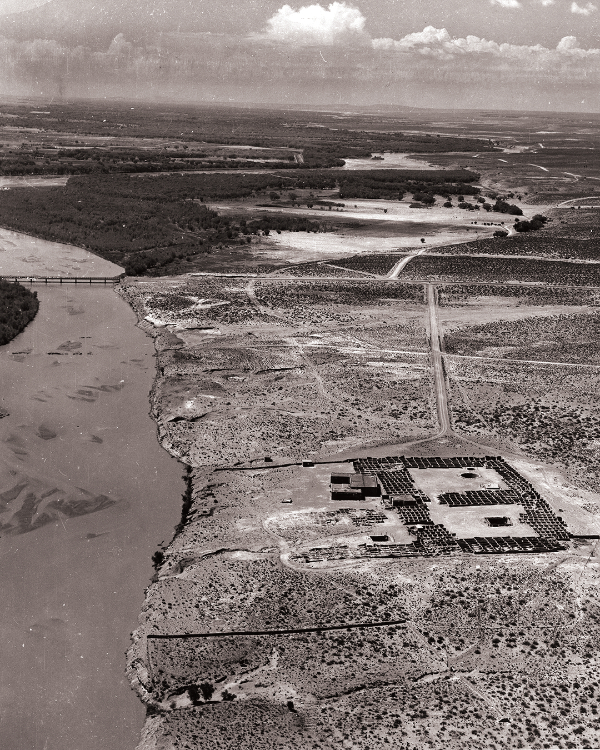
Fred Friedman (opens in a new tab) oversaw New Mexico railroad issues for decades and is recognized as an authority on the subject. As a board member of the Historical Society of New Mexico, he lectures on numerous aspects of New Mexico’s railroads.
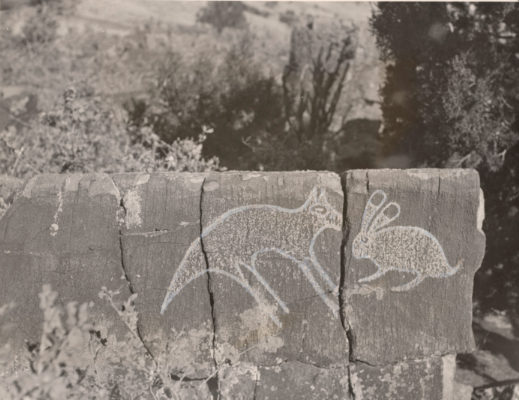
Tira Howard (opens in a new tab) is a portrait, lifestyle, and fashion photographer based out of Santa Fe, New Mexico. Her work can be seen in V Magazine, Cowgirl Magazine, Table Magazine, New Mexico Magazine, El Palacio magazine, Pasatiempo, Cowboys and Indians Magazine, The Santa Fe New Mexican magazines, The Santa Fe Reporter, Western Art & Architecture Magazine, and Edible New Mexico Magazine.