Traveling the Latin World through Nacha Mendez’s Music

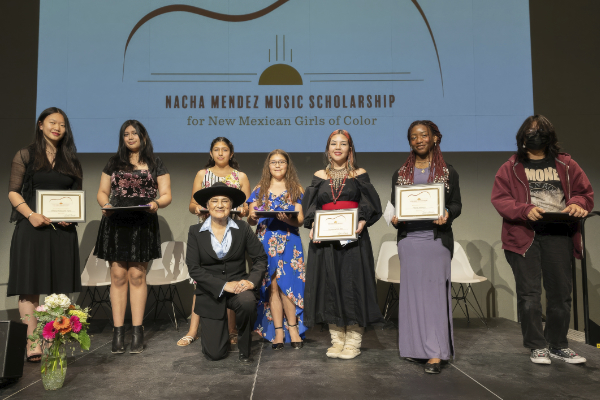
Seven young women and one adult pose on stage, some holding certificates, in front of a screen displaying Nacha Mendez Music Scholarship for New Mexican Girls of Color.
Junior High, Anthony, New Mexico, 1972. Courtesy of artist.

Notes from a guitar and Spanish lyrics float out of the Hotel Santa Fe as the lobby doors open on a Friday, inviting residents and visitors to step inside and travel to Latin America. Accomplished musician Nacha Mendez’s (Chihene Nde Nation) right hand strums her Córdoba wooden guitar, laying down chords and syncopated rhythms. Her rich, full voice enters effortlessly, bringing in Spanish melodies to mix and float across the room. Mendez sits in the dining area of the hotel, lights from the floor catching the Southwestern geometric patterns on her black and terracotta skirt. A hum of conversation from diners accompanies the music, but all eyes are focused on Mendez. Her eyes are closed as she seems to become one with her guitar. One woman starts to walk by, then the music hits her ears, and she sits, entranced.

On Sundays, Mendez can be found at La Boca, the Santa Fe tapas restaurant. “I’m seeing more people come out to hear me, but one of the things that happens with non-Spanish speakers is that they’ll ask me, ‘Was that Spanish or was that Portuguese?’” she says. “I don’t sing in Portuguese, although I would love to learn the language, and I don’t sing Brazilian Portuguese to do any of the Latin jazz classics…but what happens with us when we’re having that conversation is that they’ll say at the end, ‘Well, I don’t know what you were singing about, but I really felt it’…They’re moved by it, they’re moved by the language.”

Mendez was chosen by Governor Michelle Lujan Grisham as one of seven recipients of the 2025 New Mexico Governor’s Awards for Excellence in the Arts, an honor celebrating the significant contributions of artists in the state. “The fact is that I have been working hard for many, many years—but so have so many people. There’s so many talented people in Santa Fe. And it’s either you love what you do or you don’t love what you do,” she says. “It’s just a weekly release of creativity, of joy—I feel good afterwards… It’s a great release for me to have—It’s almost like you’ve had all this pent-up emotion all week or pent-up physical thing going on with your body, whatever. Once you start singing or playing music, you’re letting it go. So I love it for that reason. It’s very healing.”
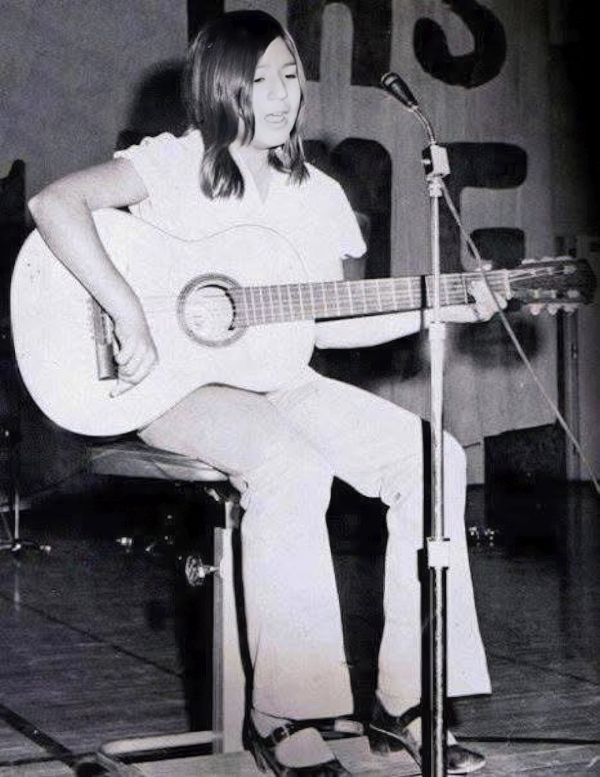
Nacha Mendez performing at a talent show at age thirteen at Gadsden Junior High, Anthony, New Mexico, 1972. Courtesy of artist.

Mendez, also known as Margarita Cordero, was born in Chicago, but grew up in the Mesilla Valley. When she was six, her family moved to La Union, a colonia of southern Doña Ana County. She first picked up a guitar around that time and her grandmother was her first teacher; Mendez honors her through her stage name, Nacha. 

Mendez’s grandmother traveled from California over the summers to visit and care for her grandchildren. Mendez started learning traditional Mexican songs on a plastic guitar given to her by her father, Galdino “Dino” Cordero. Huapango-style songs such as “Cucurrucucú paloma” and “La malagueña” were some of the numbers Mendez’s grandmother taught her, along with songs by José Alfredo Jiménez. “One of the songs I still do is called ‘Paloma querida’…and ‘Indita mía.’ I still do those, I learned those early on,” she says.

In first grade, Mendez had to take about a year and a half off from playing after an accident cost her the tip of her finger. “I was coming back from recess…and I closed the door behind me, but that day there was a really strong wind and it caught my middle finger on my right hand. It caught it and just severed it,” she recalls. Mendez went into shock, but a teacher quickly wrapped her hand, trying to slow the bleeding. “She says, ‘We’re rushing you to the hospital now because this is major.’ And I said, ‘No, you can’t take me yet until I find the other part of my finger.’” None of the teachers could find it, so Mendez was taken to the hospital where doctors stitched her up and placed a stent on her hand. It wasn’t until afterward that she started to feel the pain. 

Once Mendez was finally healed, her father bought her a Tres Pinos guitar from Ciudad Juárez, Mexico, and arranged private lessons with Don Luis Garcia of Anthony, New Mexico. When she pointed out her injured finger, Garcia told her not to worry, that they would figure out a way around it. All of the Garcia family members were musicians in their own right. “They called themselves La Familia Garcia and I would take lessons from [Don Luis]. And then sometimes when he couldn’t do it, his son, one of his sons, would take over and teach me,” Mendez says. “They were actually well-known throughout the whole border region.” The family performed Mariachi at weddings and other events.

Later, Mendez played in the band at Gadsden High School. And because of an undiagnosed learning disability, music became a beacon of light for her. “I was extremely shy,” she says. “I was dyslexic, but nobody knew that I was—nobody could diagnose it. Nobody knew why I acted the way I did. And so, I personally pursued music and continued with it because it helped me. It made me feel better—it made me happy to express myself through song. It just was wonderful to have that in my life early on.”
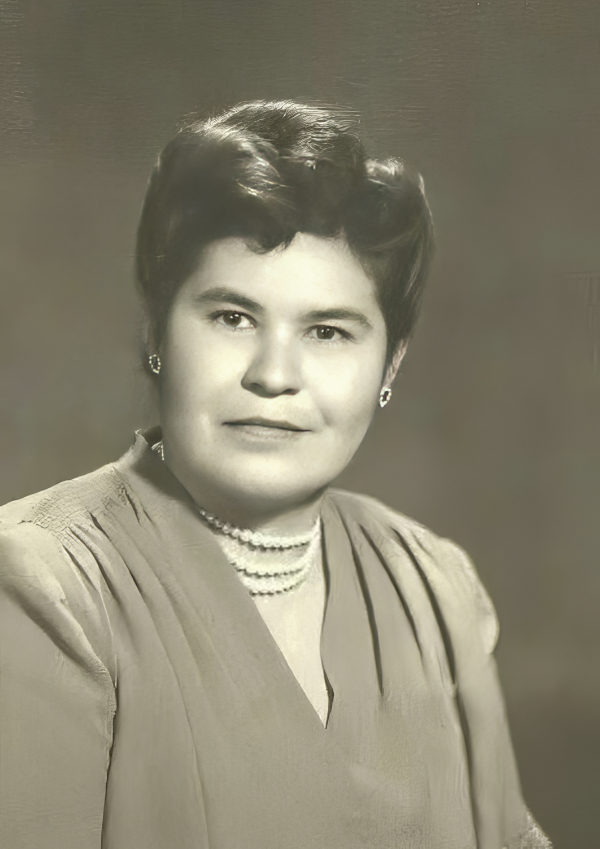
A portrait of the real Nacha Mendez (the singer’s grandmother and teacher), ca. 1940s to 1950s. Courtesy of artist.

It was Mendez’s music teacher, Ruth Madrigal, and her speech teacher, Jan Sanders, who noticed something wasn’t right. “They kind of took me under their wing and just gave me a lot of confidence,” she says. Madrigal would let Mendez hang out in the music room when she didn’t want to be in her other classes, as long as she worked on learning to read music. “I would sit there and I would try, but it was always so quiet, and she was in the other room in her office and I felt safe because I could just sit there and then just try to focus by myself.”

Sanders was bolder, Mendez says, calling her to the front of the class to talk about her week, what she was reading, or just what was on her mind. “I would start talking. ‘Well, I listened to David Bowie, the new album that he came out with, and I really liked it.’ I would just share.” Today, Mendez makes a statement with her confident personal style and performances, but gaining this confidence took a lot of time and support.

“It was continual development on my terms,” she says. “Honestly, I always felt pressure because my parents would have a barbecue or we’d be at a party and they’d say, ‘Go get the guitar and sing a song, m’ija.’ And I always like, ‘No, I don’t want to.’ And so, it was always going to be on my terms… And that’s how, through the years I was like, ‘I’m going to do music the way I want to do music.’”
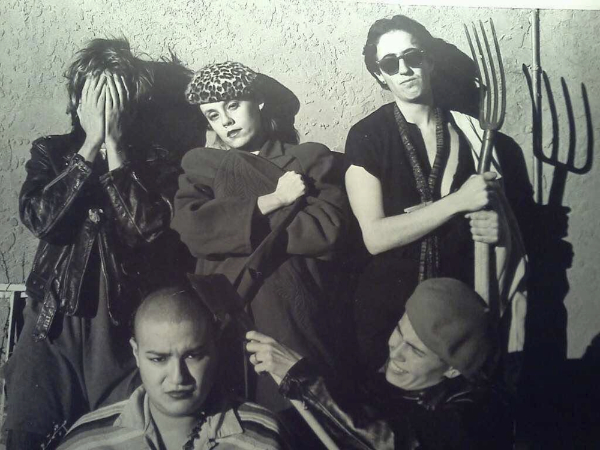
Nacha Mendez (bottom left) with members of the all-girl punk band, the Quadrasexuals, Santa Fe, 1980. Photograph by Kami Martinez. Courtesy of artist.

Much of Mendez’s musical development happened in high school, including forming a rock band with her cousins—her uncle, Jimmy Carl Black, was a drummer in Frank Zappa’s band, The Mothers of Invention. Black’s youngest son, Geronimo Black, was a guitarist and collaborated with Mendez on her second recording. “They’re very talented individuals,” she says.

In college, Mendez studied journalism and mass communications at New Mexico State University, and her love for music led her to work in radio. She worked for KNMS, the campus radio station now known as KRUX. “It was easy for me to go to radio, because nobody could see me. I could just be behind a microphone,” she says. She enjoyed playing any music she wanted. “Because no one was there in the studio with me… I got brave. I was able to speak, and I didn’t have anybody making fun of me… I could just be myself, and I could just slowly get out of this shell that I had been in for many, many, many years.”
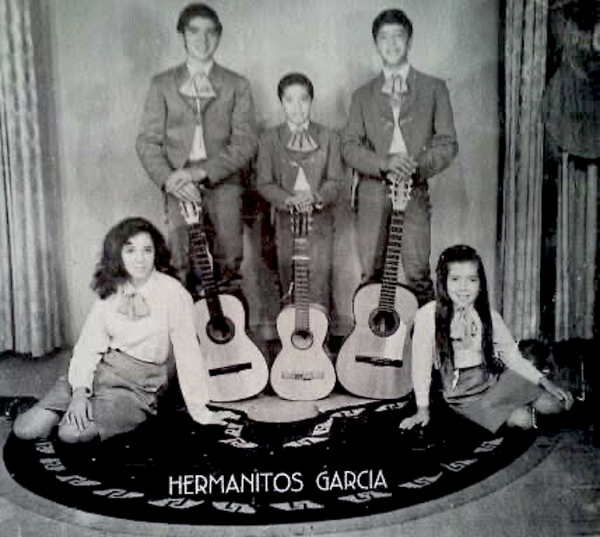
La Familia Garcia, Anthony, New Mexico, ca. mid- to late-1960s. Courtesy of artist.

Mendez pauses between songs Friday night to talk to the audience. She shares that she wrote her song “Bodega de amor” in Cuban bolero style, sung in Spanish and Italian and recorded with an Italian man who happened upon her music. “He put it all together and I had sent him my voice from my studio here in Santa Fe,” she says, plucking the strings of her guitar in anticipation. She chuckles as her fingers dance and she begins singing.

Mendez followed her older brother, Frank X. Cordero, to Santa Fe in 1978 and continued her work in radio. “He had already been here, he raved about it,” she says. “He got a job for a hotel, working, and then he was just so taken by everything. And I think at one point he sent me a picture…of him and Ginger Rogers—and I was like, ‘Oh, my god, you know, that’s Ginger Rogers, so it must be a fun place.’” She went for a visit and decided then and there to make the move.

She took over her brother’s apartment lease and didn’t look back. “It was like it was meant to happen,” Mendez says. Over the years, she has worked for several other radio stations, including KAFE, KTRC, KLSK, and KIOT in Santa Fe. She also started playing guitar during the noon hour at a restaurant that is now Cafe Pasqual’s. “Back then, they were like, ‘Oh, we can’t pay you, but we can feed you and you can make tips,’ So I said, ‘I’ll take it,” Mendez says. “I did that for a little while, and then I just took off with that. I started working with other people musically, in bands.” She joined several bands, including an all-girl punk band called the Quadrasexuals, which needed a bass player. She also played in Madonna Moderna, a group that played new wave music.

Mendez relocated to the Tribeca neighborhood in New York City in the mid-1980s, after a friend invited her to visit. She continued her radio career, working at Pacifica Radio’s WBAI station. “I was [in New York] for five years, but I felt like there was a sensory overload constantly. Smells, noise—it was very stimulating—and so, I just wanted to be back in New Mexico,” Mendez says. She didn’t play a lot of music in New York, but she did study flamenco-style guitar briefly. However, her injured finger complicated some of the techniques, like playing tremolos. Her teacher, Manuel Granados, who was visiting from Barcelona, Spain, told her not to worry. They focused on rhythm guitar instead, or playing the foundation of chords and rhythms in a piece. “I took a few classes with him that were very impactful,” she says. “I’ve been a very strong rhythm guitarist for many, many, many years.”
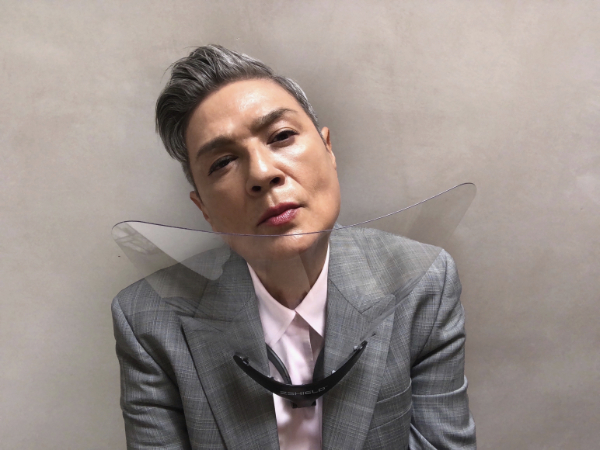
Nacha Mendez during the COVID pandemic, Santa Fe, 2022. Courtesy of artist.

When Mendez returned to Santa Fe, she continued performing at restaurants, performing with bands, and forming her own bands. In the early 1990s, Mendez was living in Chimayó when she was approached to join a different kind of project. “I would go … sit in church, and I would pray. I was really struggling… I would say, ‘Someday I just want to make a lot of money and do what I enjoy doing and maybe see the world.’”

A friend called one day, informing her that American composer Robert Ashley was coming to Chimayó and was searching for someone to collaborate with on an opera about lowriders. Now Eleanor’s Idea was one opera in a trilogy that explored Hispanic culture in the Southwest. Mendez helped bring the “language of the low riders” to the composition. When a singer was unable to tour with Ashley and the company, Mendez was offered a spot on the tour. “I’m memorizing three operas and then I go on tour with him and I’m seeing the world,” she says.

Mendez joined the company in New York for rehearsals and performed at the Brooklyn Academy of Music. The group included established American vocalists Joan La Barbara, Jacqueline Humbert, Amy X Neuburg, Thomas Buckner, and Sam Ashley, Robert’s son. The company went international, flying to Japan and visiting the major cities of Tokyo, Sapporo, Kyoto, and Kobe. They stayed in the country for a full month and went on to visit Strasbourg, France, and other locations. “It was my first time ever leaving the country,” she says. The music part of touring wasn’t difficult for her, Mendez says, but she did develop camaraderie, and there was “always a really high sense of professionalism, like being there on time, rehearsals, and learning your repertoire. All of that was really great learning for me because I had never been in a professional touring group like that, an opera company.”

After returning to New Mexico, Mendez visited her original music teacher—her grandmother. It was around this time Mendez decided to go back to her Latin and Spanish music roots and asked to use the name Nacha Mendez in her grandmother’s honor. She also returned to performing solo, just her voice and a guitar. The original Nacha Mendez passed in 2002 at the age of 97. “Her last song that she sang for my tías and I, as she lay in her bed and was in her last days, was ‘Canción mixteca.’ She sang along with my recording of that song,” Mendez says. The song was featured two years later on Mendez’s second album Volando. “That was a poignant and emotional moment but encouraging for I felt she was continuing to bless me with her voice,” she says. “¡Qué lejos estoy del suelo donde he nacido! Inmensa nostalgia invade mi pensamiento,” the Mexican folksong goes.

Mendez calls her genre Latin World; she plays traditional Mexican songs she learned in childhood but also expands into and explores music from the rest of Latin America and Spain. She writes her own pieces, influenced by tradition and her experiences. Music making becomes a collaborative experience, and Mendez gets ideas for what music to dive into next. “I’ve discovered that Latin music is very diverse…

There’s so much repertoire to choose from. And I found that when I ever perform, say, a song from Puerto Rico, or a song from Chile, or a song from Argentina, people in the audience would say, ‘I like that song. Do you know this one? Because I like what you did, because that’s our song from our country,’” Mendez says. “It creates, for me, community to get to meet people. And then I’ll say, ‘Did I do good? I mean, I didn’t screw it up, did I?’ And they go like, ‘No, no, we love your version of it.’” 

Overall, she says she feels that she’s carved out a niche in Santa Fe, something different from classical music, jazz, blues, and Americana. “I think part of my success here is that I do present [Latin Music] and it’s different. Because people come from other cities where that might not be the main type of music that they hear in their hometown,” Mendez says.

While Mendez has worked hard in her career, she also dedicates her time to assisting young musicians beginning their journeys. She taught private lessons about twenty years ago, and music classes for a short time at Moving Arts Española, an after-school arts program. In March 2021, she established the Nacha Mendez Music Scholarship for New Mexican Girls of Color, which awards scholarships to girls between eight and fifteen years old who are studying music. The nonprofit organization awarded its first scholarships in May 2022 and has since awarded a total of forty-eight scholarships ranging from $500 to $2,500. The organization hosted its first annual Frida Fest Santa Fe, named after Frida Kahlo, in early November at the Museum of International Folk Art as a fundraiser for the scholarship, featuring art and a lineup of local musicians.

Mendez says she enjoys traveling across New Mexico to schools to help spread the word about the scholarship. “I want them to know that doors will open for you… Because you could be in situations and put in these places where you would never dream of being a part of, like, you could join a choral group or a band or, you know, try out for a competition or something. And you just all of a sudden, you’re like traveling and moving.” She also stays busy leading music workshops, including a recent class at New Mexico School for the Arts.
Nacha Mendez (kneeling) with recipients of the Nacha Mendez Music Scholarship for New Mexican Girls of Color. Santa Fe, 2022. Photograph by Kitty Leaken. Courtesy of the artist.

As for what is on the horizon, Mendez says she is interested in exploring the jazz genre, particularly Latin jazz, and finding new ways to bring people together through music. Mendez is a member of the Mary Esther Gonzales Senior Center in Santa Fe, where she takes the odd pottery class and uses the gym, but says she would like to find time to play music there during lunch. “I noticed some of the people don’t know the songs that I know, but I’m sure the people that are there would know those songs. Especially the Hispanic people that are there would know the songs that I’m singing. And I think they would love that.”

After a short break to hydrate and chat with restaurant staff and patrons, Mendez returns to her guitar in the dining area of the Hotel Santa Fe. One of the last songs she sings in this second set is called “The Peace Song.” The melodic line is simple, but the message is weighty: “Every day I pray for peace in the world.” She starts in English, but continues to recite the line over and over, switching to Spanish, Italian, Russian, Hebrew, and many other languages. The lyrics are like a chant that blends with the repeated notes of the guitar, and the audience quiets, focused on Mendez’s figure in the spotlight.

Leah Romero (opens in a new tab) is a southern New Mexico-born writer based in Las Cruces. She has worked as a journalist in New Mexico since 2018 at various news outlets.

Shards of Paper, Shreds of Glass

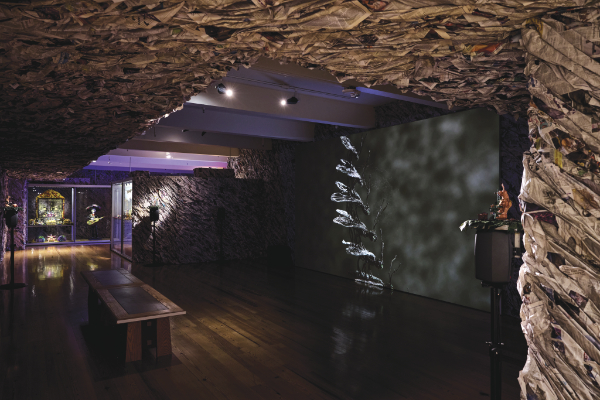
An art gallery with walls and ceiling covered in crumpled paper, wooden floors, benches, and a projected image of a plant on one wall.
ZHANG XU Zhan, Compound

The descent into the depths of the Museum of International Folk Art for the Once Within a Time exhibition involves immersion in paper. Paper forms forest creatures, funeral scenes, and walls, transforming the space into a newsprint cave. At this lair’s heart, a film features paper writhing through a sequence of transformations. 

In the final moments of Compound Eyes of Tropical, shards of paper flash into scraps of mirror as they crash through the air. We do not see the material tear, but somehow the shards’ edges are both jagged and continuous. Like gymnasts tumbling, paper writhes along its downward trajectory, twirling against the forest background. In the center of the frame, one scrap of brown paper twists in the air, then suddenly turns into a mirror. The scrap now twinkles as it turns, now turns back into paper. Flashing back and forth between paper and mirror, mirror and paper, gravity pulls it in a descending arc. 

A little fly, himself a mixture of paper and glass, fixes his eyes on the scraps. Black crepe paper covers his wire frame and borders his fine iridescent wings, which quiver in the wind. He careens through the air amongst the bits of wreckage, distinct from the fragments only in his careening through their descent. Like the fly, we are transfixed by the constant flux between scrap and shard. 

The brown wrapper shatters on impact with the forest floor, leaving glass strewn across the ground like confetti. The fly with iridescent wings inspects the wreckage. His thin wire forearms stretch to capture the shine. The fly drags a slip of glass in close to himself, as if to fuse the miraculous glass with his paper body. 

Just as paper and mirror have fantastically traded places, another paper creature has crossed and re-crossed a river. His essential movement has been rocking back and forth on his legs, gathering up his strength to propel a forward trajectory. But this larger context is unnecessary: it is enough to watch the final sequence of the film and see the mirror flash to paper, as if an incredible substance somehow possessed an alchemical power. The fly hugs the smallest final shard close to his slight body. What do glass and paper share?  Both fragment into minute flickering pieces; that is clear enough.

Wesley Cannon is a recent graduate of St. John’s College in Santa Fe and currently serves as the editorial assistant at the Museum of New Mexico Press.

Sun Series

Bright sunlight shines through tree branches against a clear blue sky, with visible lens flare and sun rays spreading outward.

Sunrise, 
accept this offering. 
Sunrise. 

 –From Ceremony, by Leslie Marmon Silko

Part I: Sunsetting

The end is full of waiting. 

Of willful meandering. 

The kind that compels you to put candles of too many varieties into your cart, despite your fear of fire. 

There is moxie in doing something you don’t want to. 

In finding feral. 

In seeking an unachievable solace. 

At the windowsill, sitting at the battered and water-stained pane, you will notice your breath is too shallow to properly fog your view. 

Tea is tasteless. 

Coffee is too sharp for your tongue. 

The outdoors is calling but you cannot keep warm. 

And when you are looking for the cure, a cure, any cure, you will look back and be astonished by your own unwillingness to believe. 

Part II: Sunlight

There is a clinking sound when I remove the worn, hand-me-down plate from Mama. 

The reflective cast and orbital shine it sheds on your jawline is luminous.

I stare. 

How its half-lit light creates a moon on your face and I realize the galaxy is sitting at my kitchen table. 

Part III: Sun Mountain

The miracle of living. 

Of catching a prism in the eye – to have the gift of blindness for only a few spark moments. 

The sun-felt sprawl of erosion and basalt rock. 

I am porous. 

Am wilting under the fainting feeling that is being grounded and roofed for too long. 

I have been carrying rocks from the Pacific Ocean in my many threaded pockets and here they tell me they are home. 

When I walk 

Up

Cactus needles lean forward to catch my hand and I do not pull away. 

My foot slips on the mountain’s worn grain and I meet the earth more than once. 

My water is in the car, but I know I will not be thirsty when I reach the top. 

How is it

That with each step

I push down 

I am lifted up? 

Can I call this flight? 

Part IV: Sunrisen 

I am gathering the parts. 

At the fifth post of the newly sown barbed wire fence, in the backfield, next to the oldest peach tree on the property, there is one. 

In the back wheel well of my mother’s silver Prius, which she uses to transport groceries and alfalfa, goats and grandchildren, there is another. 

The third was harder to find. 

It was nestled, like a newborn kitten, blinking and wild, beneath the patchwork flagstone porch of my new home. 

And last was the sacred fourth. 

It came to me, unbidden, unwanted at the time. 

It sat, both squat and tall, a sentry in the pillowy ashes of my father’s woodstove, the morning after the coldest night of the year. 

I keep them in a lacquered, honey toned box, which I dust monthly. 

They hum. 

Vibrating a holy frequency that I can only hear in the pink morning before my dreams have left me. 

Or the night it snowed four inches, after Spring threatened her pollen-clad backhand for a week, surprising us as it always does to no one’s surprise. 

The whales are singing so loud, we hear them from our desert perch. 

White light is making us sick and weepy. 

Forests groan, brown and fibrous, under the weight of smoke and gases that were meant to stay below.

I do not want to write another poem about the earth’s fetid ending. 

But all the parts have come to me at a time we cannot call coincidence, don’t you dare. 

I disrespectfully decline the demise. 

I refuse fear in all its opulent and chaotic forms. 

For I have medicine embedded in the printed patterns of my palms. 

I have feathers braided through the pines of my hair. 

And I have the parts, in their almighty and wayward forms, 

Ready to protect us when needed. 

But first,

We must,

“Accept this offering.”

Santana Shorty (opens in a new tab) earned her BA from Stanford University and her MFA from the Institute of American Indian Arts. Her work focuses on New Mexican landscape and culture. Currently, she is working on her first novel. She is a member of the Navajo Nation and lives in Santa Fe, New Mexico.

Pathways Through Opacity and Apocalypse

To arrive at SITE SANTA FE’s 12th International: Once Within a Time installations at the Palace of the Governors, a visitor must first proceed through a series of doorways. Following an uncanny eyeline best suited for a dream sequence in a Hitchcock thriller, the eerie recursion within this ancient structure creates the sensation of re-entering the same room again and again. This phenomenological experience triggers an ominous feeling of timelessness, as if individual actors and actions have become gelled in the building’s material and historical heft.

It is no coincidence then, that Once Within a Time exhibitions by contemporary artists Daisy Quezada Ureña and Charisse Pearlina Weston can be found at a deliberate sidestep from this rather Jungian passageway. In diverging from the main artery of the oldest continuously occupied public building in what is now known as the United States, a viewer is freed from a centuries-old choreography, and newly able to imagine through and beyond the Palace of the Governors’ thick adobe walls. The presence of the paired exhibitions in this architectural eddy enables the artists to assert their wisdom in a setting historically hostile to women of color, and in so doing, offer urgent alternatives to hegemonic narratives about our shared past and present.

As each venue in Once Within a Time is tied to an organizing “figure of interest,” Weston and Quezada Ureña were each asked to reflect on the history of Esteban—the first African in the historical record to have set foot in the American West.

“The theme of the exhibition was so rich and there was so much information given,” says Weston of the extensive historical research that curator Cecilia Alemani shared in preparation for the show. From that background, Weston became fascinated by the layout of the Zuni-Cibola Complex, a fifteenth-century architectural site where Esteban may have met his end. “Zuni buildings included these strategic lines of sight that let inhabitants defend themselves and control who was allowed in,” she explains. “My practice deals with Black interiority, opacity, and resisting surveillance, so that kind of defensive architecture and its spaces of protection really resonated with me.”

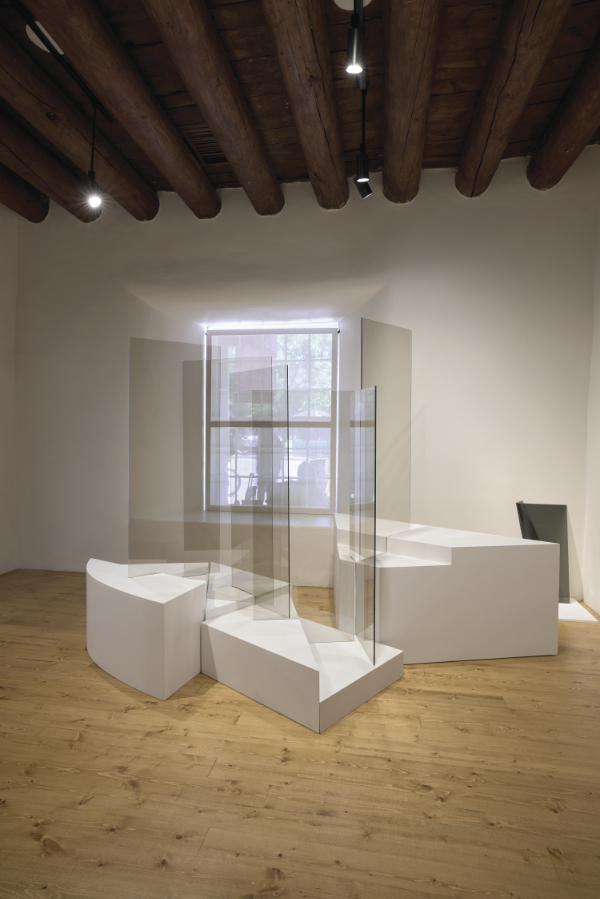
Weston’s exhibition opens with two large glassworks that fill the small exhibition space, restricting movement, admission, and lines of sight in homage to Zuni Pueblo architecture. To the left, a collection of smoky glass slabs entitled brick to block to base to sharpened rim renders its physical boundaries ambiguous through repetition and layering. This uneasy visual prompts viewers to move with caution and a heightened awareness of their bodies, for fear of disrupting a delicate, sharp-looking, amorphous piece. 

“I wanted to make people have to navigate really intentionally around these works,” Weston says. “I wanted that feeling of precarity relative to the glass to reflect the precarity of Black lives in these spaces.”

The surveillance and concealment of Black bodies within Western architecture is a frequent touchstone in Weston’s practice, a theme further explored by the wall-hanging collage called defiance reduced to a pinpointed warning hum. Situated to the right of the exhibition entrance and across from brick to block to base to sharpened rim, this piece layers broken glass, printed canvas, epoxy, and other materials within a large wooden frame evocative of a window. Though this murky piece refuses easy parsing, its form nods to Weston’s ongoing meditations on broken windows policing—an ill-defined and widely critiqued policing ideology that correlates an increased focus on petit crimes (like breaking a window) with an eventual drop in violent crime. Though variations of this strategy have seen widespread implementation in the United States—New Mexico included—since its popularization in the 1990s, broken windows policing has been continuously shown to supercharge police surveillance, incarceration, and abuse in communities of color. Questioning equivalencies between transparency, perceived order, and safety, Weston’s window-like work reminds us that surveillance and policing are ultimately modes of oppression, not protection.

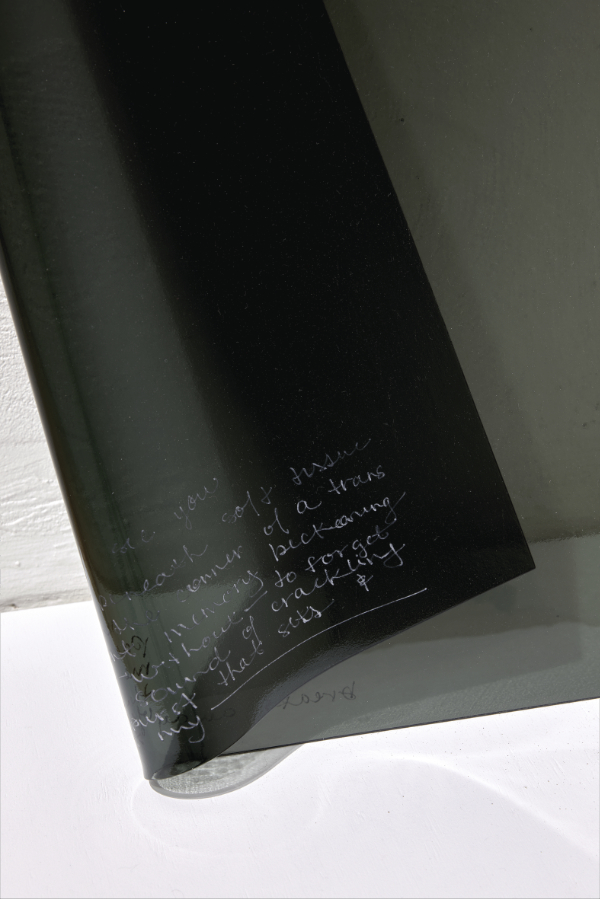
Charisse Pearlina Weston, untitled corner piece (on the balance) (detail), 2022.

According to the artist, protection can be found in relationship rather than transparency, as evidenced in this exhibition by the dynamic created by the two larger pieces, and the smaller work they partially conceal: untitled corner piece (on the balance). Nestled between a corner and a built-in fireplace, this slight, curving glasswork, adorned with lines of handwritten text, is rendered quasi-illegible by the curve of its surface and its position relative to its protectors. This arrangement bucks perceptions of glass as a placid, transparent medium through which one can remotely extract information (think windows, camera lenses, phone screens, etc.). Instead, Weston’s installation complicates our understanding of her chosen material, transforming glass from something so ubiquitous as to be rendered functionally invisible into a medium fully capable of concealing, distorting, and impeding—and importantly, one that reflects social roles and relationships.

Taken as a whole, Weston’s exhibition asserts that glass is not neutral or natural in our built environment, but in fact carries far-reaching ideological, practical, and social implications. Situating her work alongside Édouard Glissant’s essay “For Opacity” during our interview, Weston echoed the idea that the Western demand for perpetual transparency is a colonial strategy that advances white supremacy. In other words, if participation in society requires our constant comprehensibility, we must not only efface our individual complexity to remain consumable to others but also submit to the omnipresent surveillance and policing that maintains our flattening en masse. In symbolic dissent, the persistent ambiguity and personified positioning of Weston’s works challenge viewers’ assumptions about glass as a medium within the gallery and beyond. And more broadly, the work asks us to consider opacity and the discomfort of not knowing as a viable alternative to the oppression inherent in compulsory transparency. To borrow from Weston’s musings during our interview, “What happens when we sit with our not-knowing-ness? How might it be generative?”


Charisse Pearlina Weston, brick to block to base to sharpened rim (detail), 2025. 12th SITE SANTA FE International: Once Within a Time (details). June 27, 2025–January 12, 2026, installed at the New Mexico History Museum, Palace of the Governors. Courtesy of SITE SANTA FE.

The ambivalent role of transparency within historical constructions is significant in Quezada Ureña’s exhibition Past [between] Present as well, evident in the content of the works on view, and in their placement within the Palace of the Governors. One full wall of the gallery is punctuated by gleaming windows looking out onto the bustling plaza. On opposing walls, cutouts behind plexiglass reveal the New Mexico History Museum’s earthen structure beneath its white-cube veneer. The simultaneous visibility of the original architecture, the smooth, contemporary renovation, and the adjacent plaza lends the exhibition a sense of permeability, where portals between the past and present, inside and out, remain painfully open.

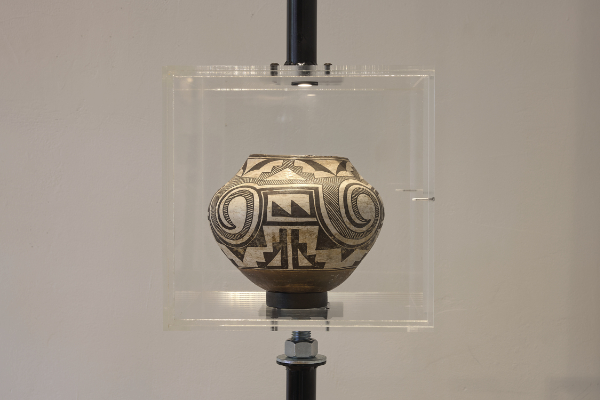
Past [between] Present engages directly with this architectural liminality by not only replicating the museological use of plexiglass in the installation, but by also displaying the artist’s curated artworks and artifacts between shoring posts. More often seen in construction or archaeological sites, the shoring posts in Quezada Ureña’s installation elevate some objects over others, demonstrate the historical, social, and political forces they withstand, and minimize deleterious effects on the historic site. Where art installation often requires invasive, damaging interventions to the spaces they occupy (like drilling into a wall or ceiling), Quezada Ureña’s works hover using pressure alone, like bones healing beneath a plaster cast.

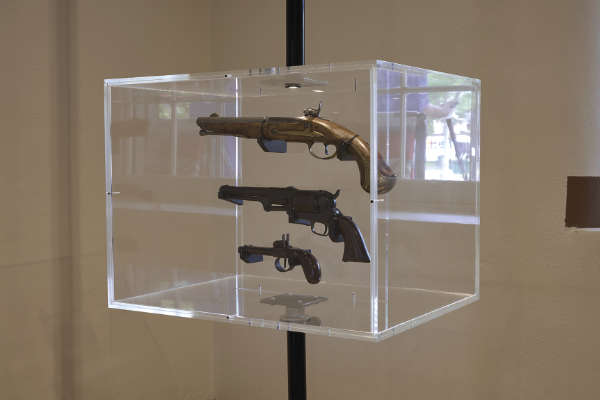
As a viewer navigates this array of shoring posts and floating vitrines, it becomes clear that this vertical force barely begins to contain the power of the items borne between. Ghostly porcelain garments float alongside highly charged historical artifacts, including (but not limited to) guns belonging to New Mexican Confederate soldiers and glittering soil from the controversial excavation of the Georgia O’Keeffe Museum. However, the quietest of these historic pieces may also be the most explosive: shards of a bell likely used during the Pueblo Revolt of 1680. Like shrapnel lodged beneath the skin, these bell fragments rest directly on the centuries-old adobe bricks behind the museum’s plexiglass barrier, rather than within one of the artist’s vitrines. While this striking commentary might be easily overlooked by visitors unaware of local history, or those who simply miss the ceramic splinters in the Palace of the Governors’ side, this subtle choice speaks to lingering social rifts that have strained Santa Fe for centuries.

As the only successful Native uprising against a colonizing power in North America, the Pueblo Revolt expelled Spanish settlers from New Mexico and beyond, following decades of extortion, enslavement, and abuse of Indigenous peoples. Puebloan communities then occupied the Palace of the Governors for several decades, during which some say the tradition of vending under the portal began. This practice remains visible through the windows of the exhibition, though so too does the Soldiers’ Monument’s stone panel belying “savage Indians” and the annual celebration of Spanish forces retaking the Palace. This tension between colonizer and colonized has been on display on the plaza for centuries, but Quezada Ureña’s choice to slip historic Picuris bell fragments under the Palace’s plexiglass protection quietly honors the centuries of Indigenous resistance to social, economic, and environmental oppression in New Mexico.

Daisy Quezada Ureña, Past [between] Present (details), 2025. 12th SITE SANTA FE International: Once Within a Time (details). June 27, 2025–January 12, 2026, installed at the New Mexico History Museum, Palace of the Governors. Courtesy of SITE SANTA FE.

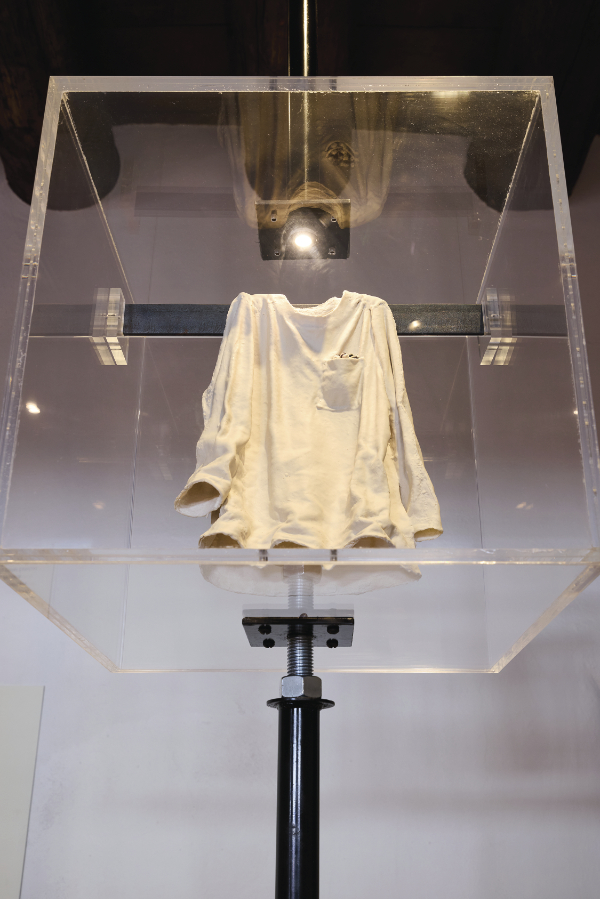
Opposite this powerful installation, Past [between] Present highlights one of the most pressing instances of ongoing colonial injustice impacting the Land of Enchantment: nuclear extraction on Native lands. One of the artist’s porcelain sculptures takes the petrified form of a garment selected by a curandera to protect local journalist Alicia Inez Guzmán during her investigative tour of Los Alamos National Laboratories. Adjacent to this haunting piece is a retablo depicting Our Lady of Light and a ceramic child’s blouse filled with blue corn seed. Viewed optimistically, these companion pieces might suggest divine guidance leading the next generation toward nonviolence and ethical land use. However, the process of creating the artist’s sculptural works might suggest a more ominous read. After being soaked in slip, the sometimes-found, sometimes-gifted reference garments are incinerated in the kiln, leaving disembodied traces of their obliterated forms not unlike the eerie “shadows” left by Hiroshima and Nagasaki residents vaporized in atomic warfare.

A similarly apocalyptic interpretation lurks within the retablo depicting Our Lady of Light. While her visage could be viewed as a savior to Catholic viewers, she might also refer to the eponymous Spanish colonial missions that sprawled over present-day Texas. More broadly, the invocation of Catholic iconography might point to the role of the Church in the colonial occupation of the Americas and genocide of Indigenous peoples: an era historian Gerald Horne has posited as an apocalypse. This interpretation may be bolstered by the resemblance between folk depictions of Our Lady of Light and Our Lady of the Apocalypse (a precursor to La Virgen de Guadalupe), both of whom hold a male infant before a celestial backdrop of attending angels. Analyzed thus, the Light in question might just as easily refer to the possibility of nuclear annihilation as it does to a guiding light.

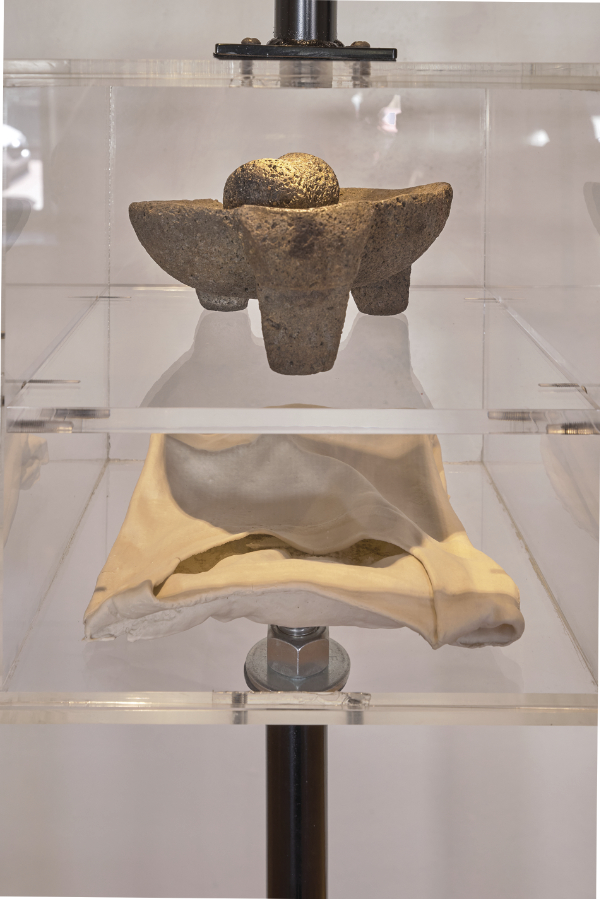
As we grapple with the weighty sense that Quezada Ureña’s objects impart about our presence amid contemporary apocalypse, the artist also provides some needed inspiration through the remaining artifacts in the exhibition. There are cases bearing historic Zuni pottery, beaded moccasins, and early belts made by renowned Santa Clara artist Porter Swentzell, a scale balancing the hands of an elder with those of a child, and a neatly folded ceramic t-shirt beneath the Quezada family molcajete. There is a map showing Cíbola, the site of Esteban’s ultimate liberation from slavery, be it by concealment or by death. Through these tender pieces, we might see our own freedom as made possible through focus on craft, creativity, community, and cultural transmission of knowledge.


Though each visitor to the Once Within a Time exhibitions at the Palace of the Governors will draw their own conclusions about the significance of the works on view, the aching social traumas they illuminate are undeniable. Both artists’ installations point to moments of confusion, flux, and unspeakable violence—from colonialism and nuclear extractivism to racist surveillance and policing—and demand that we acknowledge our presence in this ongoing history. In Quezada Ureña’s words, “Things are shifting, and we need to understand what we’re becoming.” A hopeful answer to this urgent uncertainty may lie at the intersection of these exhibitions: While implicating architecture in the persistent problems that plague us, Weston’s and Quezada Ureña’s work collaborates with the exposed adobe of their setting to illustrate the astonishing forms tiny flecks of sediment can take together. Weston’s mysterious glassworks, Quezada Ureña’s delicate ceramics, and the very walls of the Palace of the Governors, are all examples of the persistent social power of the things we build together, and the enduring generativity of many. 

Brad Trone  (opens in a new tab) is a photographer whose practice is situated at the intersection of fine art and editorial storytelling. He is currently based in Santa Fe.

Rica Maestas (opens in a new tab) is an artist and writer from Albuquerque, New Mexico. My diverse, multidisciplinary works prioritize mutuality, elevate lived expertise, and often take surreal or whimsical forms. Rica earned an MA in Public Humanities from Brown University with special support from the University of Southern California Renaissance Scholarship. Rica has participated in residencies at the Santa Fe Art Institute, Harwood Art Center, PASEO Project, and Friends of Orphan Signs. Profiles of Rica’s work can be found in the Providence Journal, Coastal Post, Maine Arts Journal, Santa Fe New Mexican, the Santa Fe Reporter, and Taos News.

The Art of Time Travel

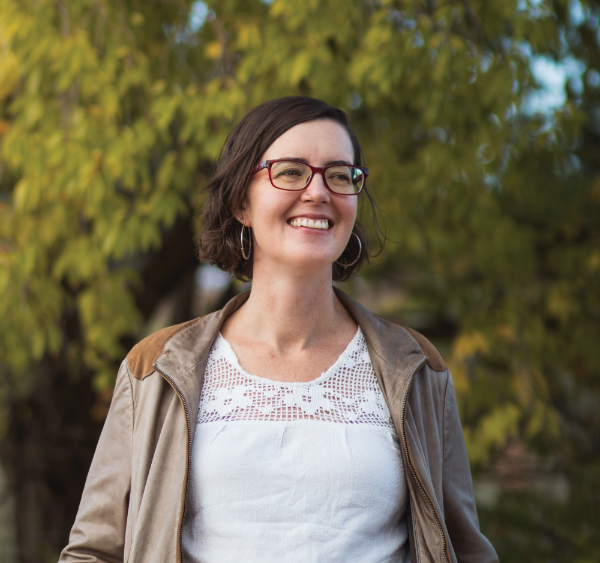
Woman with short brown hair and glasses, wearing a light jacket and white top, standing outdoors in front of leafy green trees, smiling.

When I’m out walking I often pause to consider the landscape, trying to imagine what a specific place may have looked like one hundred years ago, or five hundred years ago. I take in the shapes of the hills and mountains and conjure other people, other forms of settlement, and other relationships to the land. And when the wind feels particularly harsh, it comforts me to know that others across time have also endured it. 

The more I learn in editing El Palacio, the more vividly I can imagine these scenes from the past. There are plenty of gaps in my knowledge of New Mexico histories and cultures and I take pleasure in slowly filling them, issue by issue, and expanding the layers and nuance of my understanding so that I can, in turn, share this knowledge with readers. 

Though I grew up in Las Vegas, for example, I knew very little of the Chicano activism that happened there at the height of El Movimiento. The cultural pride from this time was re-tained, but the history itself was not taught—at least, not when I was in school. In Myrriah Gómez’s article about students who participated in the 1970s protests and created art and community, I learned about the critical role that women and children played in the Chicano Movement—roles that, as Gómez points out, have often been overlooked. 

As a norteña, I also knew little of the southern part of the state. With the opening of the Department of Cultural Affairs’ newest Historic Site, Taylor-Mesilla—the former home of J. Paul Taylor and Mary Daniels Taylor—the objects within the site provide a physical archive of the layered, multicultural history of the region. Coupled with the genealogical and historical archives Mary assembled throughout her life, the family’s decision to share their home and research helps to deepen our understanding of the past.  

Ensuring the enduring legacy of cultural traditions is something Nacha Mendez is also invested in. Mendez is one recipient of the 2025 Governor’s Awards for Excellence in the Arts, and as a renowned musician her life has been shaped by cultural pride, overcoming adversity, and using music to seek healing and connection. Mendez’s inspiration from other musicians and support from teachers early on led her to create a music scholarship for New Mexican girls of color so that the reverberations of cultural learning can ripple forward into the future. 

Sometimes the connection between past and present can take form literally. At Acoma Pueblo, a historic excavation of a 150-year-old homesite was recently completed to make way for the building of a much-needed bridge. As Laura Paskus writes in her article, the Pueblo led the project in partnership with the Office of Archaeology to ensure the protection of culturally sensitive areas and to provide a broader understanding of what is important to preserve. 

Without deep ties to the land or culture, it can be easy to remove yourself from the arc of history and to look back at events with a feeling of detachment. In her article about two installations within SITE Santa Fe’s Once Within a Time exhibition, Rica Maestas writes about the powerful ways artists Daisy Quezada Ureña and Charisse Pearlina Weston demand that we acknowledge our presence and contributions to a history that is not static but ever-present. In Quezada Ureña’s words, “Things are shifting, and we need to understand what we’re becoming.”

As if in response, in her poem, “Sun Series,” Santana Shorty says, “when you are looking for the cure, a cure, any cure, you will look back and be astonished by your own unwillingness to believe.” How we see ourselves in relationship to the land, each other, our ancestors, and future generations will shape our understanding of the past and our ability to imagine what is possible in the future.

Emily Withnall (opens in a new tab) is the editor of El Palacio and the host of Encounter Culture. Prior to stepping into the editor role, she wrote for the magazine for eight years. Emily has also been published in The New York Times, Al Jazeera, High Country News, Orion Magazine, Tin House, The Kenyon Review, Gay Magazine, Source New Mexico, and other publications. She lives and writes in Santa Fe, New Mexico.

Connecting Time, Place, and People

On a warm August morning about 150 years ago, the people who lived on the sandstone promontory above Di’ Chuuna would have looked east at the slumbering lines of Kaweshtima. 

Even with the summer harvest underway, they might have wondered when snow would start draping the mountain. Today, the people of Acoma still time spring plantings to the shifting of that white shawl, so that when snowmelt arrives in Di’ Chuuna and the ancient irrigation canals, they are ready.  

In the 1870s and ’80s, the riverbank would have been open, not yet choked with salt cedar planted by agents of the U.S. Bureau of Indian Affairs. And the stream would have run higher and more consistently, before a warming climate and upstream water demands started to drop and dry its flows.

From this vantage point, the family living here would have watched their sheep and goats in the valley below, and over time, seen railway cars travel on newly laid tracks, and early automobiles putter and zip past on Route 66. 

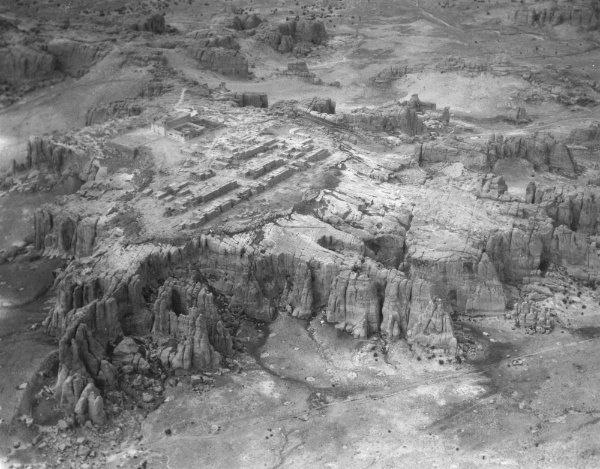
Aerial view, Acoma Pueblo, New Mexico, 1957. Courtesy of the Palace of the Governors Photo Archives (NMHM/DCA), Neg. No. 058320.

In the late nineteenth and early twentieth centuries, significant changes were underway at the Pueblo of Acoma, whose people migrated from the north, passed through Wáphra’ba’shúka (Chaco Canyon) and Kásh’kútruti (Mesa Verde National Park), and settled at Haak’u more than ten centuries ago. At Haak’u, or Old Acoma, people harvested and conserved rainwater for centuries and even rebuilt the multi-story village after the Spanish destroyed it and killed and tortured hundreds of Acoma men, women, and children in the late sixteenth century. 

Infinitely adaptable, the people of Acoma spent centuries developing knowledge of how to survive and flourish in the arid Southwest. And even as they maintain their culture, traditions, and ceremonies, they are a part of all that shifts and changes, too. 

“When the railway came through here, there were (Acoma) people working on the construction, and they farmed at the same time,” says Steven Concho, the Pueblo of Acoma’s tribal historic preservation officer, as he describes the home that once stood above the river valley. 

During that era, some people moved away from Haak’u, bolstering villages like Acomita and McCartys. People farmed and raised livestock along Di’ Chuuna. And as families grew, they added more living spaces, storage rooms, and corrals.  

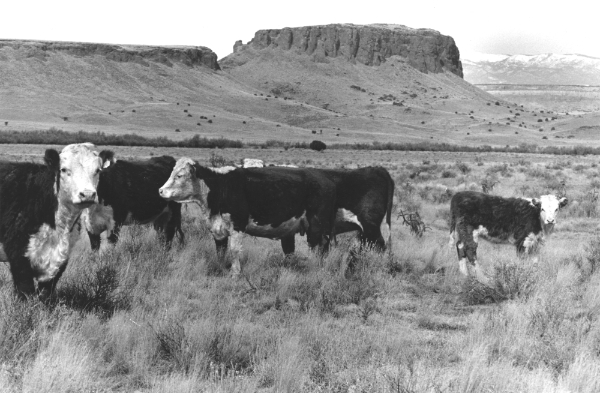
Herz, Cary. Cattle grazing on the Arroyo Colorado allotment, thirty-five miles southwest of Albuquerque, administered by Acoma Pueblo, New Mexico, 1993. Courtesy of the Palace of the Governors Photo Archives (NMHM/DCA), Neg. No. HP.2008.22.10.
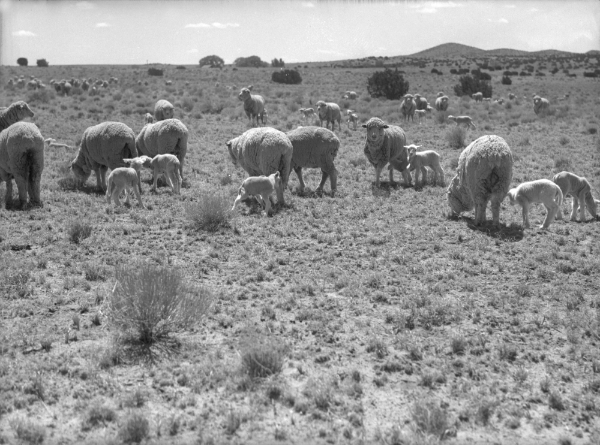
Fedor, Ferenz. Flock of sheep, Acoma Pueblo, New Mexico, 1940. Courtesy of the Palace of the Governors Photo Archives (NMHM/DCA), Neg. No. 100460.

“From here, you can see all around the whole valley, up and down, and it was an important area to live at that time,” Concho says. The people would have witnessed and been a part of significant changes at the Pueblo of Acoma and across the West.

“This was a transition (time) between all the hustle and bustle of the West and the Acoma people still practicing their traditional culture,” says Concho. “It was around that time, the 1880s and 1900s, where you start to see this shift of people coming into the valley and starting to stay here a lot longer because all the resources are here.” 

The mountain runoff, springs, and stream provided water, and people planted crops throughout the valley. “This was before Wal-Mart and convenience stores, so they had to rely on the land, raise sheep, raise cattle,” he says. “Coming to this valley made it a little bit easier for them.” 

The railway brought jobs, and Route 66 made Albuquerque and the burgeoning uranium mines near Grants more accessible. Eventually, these pueblo communities closer to the highway and railway also gained access to electricity. 

“Rather than being clustered very closely in a nucleated village, there’s a transition to modernity during this period, and even a rearrangement of how they were organizing their space domestically,” says Dr. John Taylor-Montoya, executive director of the New Mexico Office of Archaeological Studies. 

Atop Haak’u, buildings grew by stories in the mesa’s limited space. In the communities along Di’ Chuuna, homes could spread horizontally, and today, archaeologists study not only what was held within the rooms—ranging from traditional pottery to canned foods—but how they were laid out. In partnership with community members, these archaeologists also better understand a family’s connection to landscape, culture, and history. 

People lived in the home on the promontory above Di’ Chuuna, or the Rio San José, from the 1870s through the 1930s or 1940s, according to Taylor-Montoya. They raised sheep and goats, and used a mix of traditional Acoma pottery, grinding stones, and selenite (also used for the windows), along with commercially available metal tools and containers, porcelain tableware, and glass bottles.

Over time, the home’s sandstone walls collapsed. And the cleared outdoor areas—one a plaza or courtyard, and the other a corral or threshing area—had become ticked with weeds. The site was only excavated and studied ahead of an infrastructure project, the Mesa Hill Bridge and Road Extension, that the Pueblo of Acoma has needed for almost fifty years. 

For decades, the Pueblo has sought funding to build a new bridge over the railroad tracks that separate its villages from Interstate 40. Since the 1970s and ’80s, as train traffic increased on the Burlington Northern Santa Fe Railway, residents and visitors have endured longer and longer waits on the road. Ambulances and other emergency vehicles get stuck at the railway crossing too, sometimes for up to twenty minutes if multiple trains are crossing. 

In 2012, an average of ninety-five trains a day passed through the Pueblo, says Raymond Concho, director of community development at the Pueblo, and Steven’s uncle. Today, the official numbers are down to about sixty, but the trains are longer—sometimes up to three miles in length—and are often double-stacked. 

Now, with federal funding in place, Mesa Hill Bridge and Road Extension is finally moving forward. The project will include a new span of road and a thousand-foot bridge over the railway, the river, farmland, and a natural gas pipeline. While advocating for and planning for the bridge, the tribal administration held community meetings and listened to traditional leaders, says Raymond Concho. 

The Pueblo doesn’t undertake new development lightly, especially if it will destroy a homesite. But the project, which will level the sandstone rise and destroy the former homesite, is necessary for the community’s safety. 

“If I had lived here, I would watch my sheep down in the valley,” Raymond Concho says while walking across the site, pointing to original plaster or whitewash still visible at the base of sandstone rocks that once formed a room. A train appears, and he counts the minutes it takes to pass.  

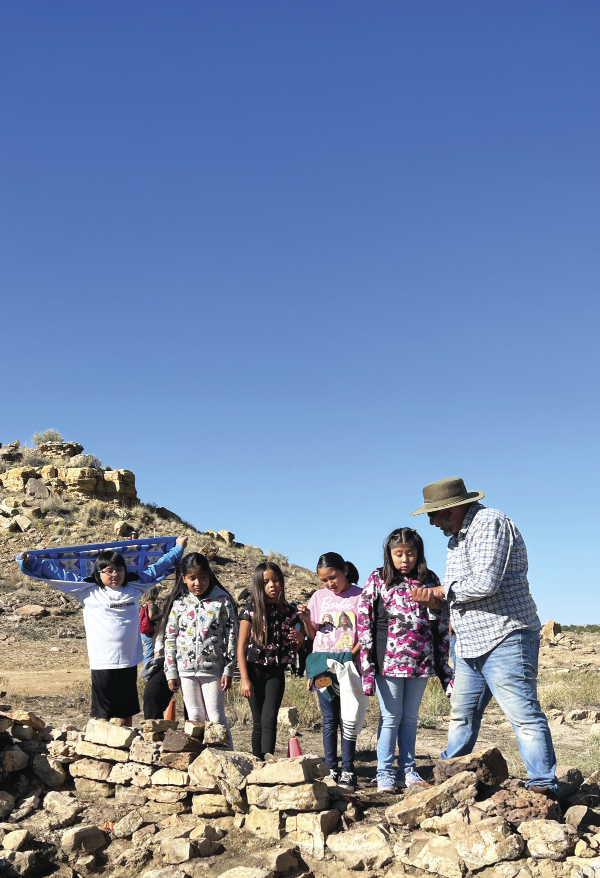
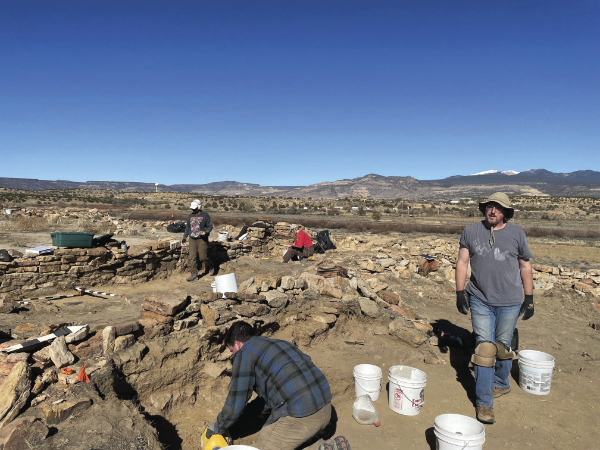
OAS Executive Director John Taylor-Montoya (right) leads a tour group of students from the Haak’u Community Academy at the site. In the foreground is the partially standing wall of a room of the house. Photograph: Melissa Martinez, near Acomita, Pueblo of Acoma, 2024. Courtesy of the Office of Archaeological Studies/
Department of Cultural Affairs.

Ahead of the bridge and road construction project, the Pueblo hired the New Mexico Office of Archaeological Studies (OAS), and in late 2024 and early 2025, crews excavated the homesite. During this project, OAS built on work models and relationships developed a decade ago, which incorporate traditional and community knowledge, science, and public education. 

“The ‘Acoma method’ is more than just collaborative or community archaeology, in that you’re working with and among members of the community,” says Taylor-Montoya. “The crux of it is having a real partnership.” 

In 2014, OAS worked on an archaeological survey ahead of an energy project crossing the Pueblo’s lands. The Pueblo of Acoma Historic Preservation Office designed the project and archaeologists worked closely with the community. Cultural monitors accompanied archaeologists, who would oftentimes follow behind, as they walked the ground in staggered transects, looking for signs of buildings, artifacts, shrines, and other notable or special places on the landscape. Using a tiered system, they identified sites within the project area and preserved the privacy of the Pueblo’s cultural sites.

At the top of the tiered system were the most sacred and culturally sensitive areas, explains Taylor-Montoya. Acoma elders or monitors identified these places, which outsiders like archaeologists are not allowed to visit, never mind record. Then there were culturally sensitive places archaeologists were allowed to see, but which were mapped with a buffer around them for privacy. Finally, there were what archaeologists would traditionally call sites. Those could include remains of buildings or certain activities but weren’t necessarily culturally sensitive. 

When it came time to work on the Mesa Hill Bridge site, OAS adapted its usual excavation practices, as well. Going into their very first meeting with the Pueblo, Taylor-Montoya says the archaeologists wanted to respect the boundaries, conditions, and specifications Acoma set. The state also integrated community members into the project as cultural monitors and hired local people to work with the state crew on the excavation. 

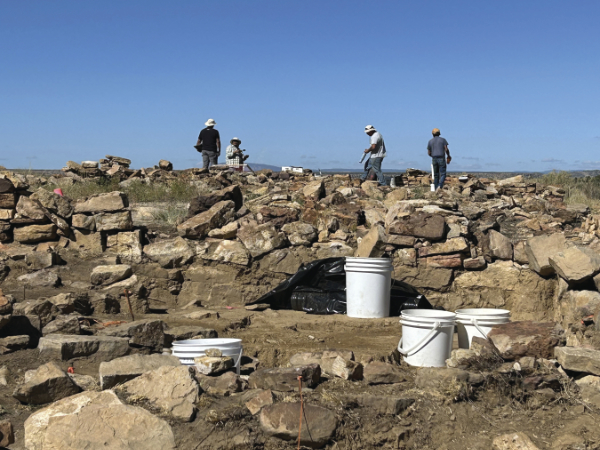
Typical scene of work progressing on the eastern part of the house. OAS staff and Acoma field archaeologists are pictured working together. The partially standing walls of the house can be seen extending from the foreground into the background. The Rio San José valley is in the background. Photograph: Melissa Martinez, near Acomita, Pueblo of Acoma, 2024. Courtesy of the Office of Archaeological Studies/Department of Cultural Affairs.

While the project was ongoing, elders and others would stop by the site to check in, ask questions, and share their knowledge. Teachers from Haak’u Community Academy and Haak’u Learning Center brought students to visit as well. “They were able to see what they were doing over there and get it in their heads to become future archaeologists, future tribal historic preservation officers, whatever,” says Kathy Felipe, program coordinator for the Tribal Historic Preservation Office. “They were able to look at the site, and they have millions of questions.”

Traditionally, archaeologists were little more than looters and pot hunters. In the nineteenth century, the Southwest was full of white men who ripped apart sacred sites and ancient buildings, and desecrated graves. Even in modern times, archaeologists and researchers have often treated human remains and funerary objects with curiosity rather than respect. People who had been carefully laid to rest in the earth to be with their ancestors were torn from the soil, measured and photographed, and placed in boxes upon shelves in hundreds of museums and storage facilities. 

There have been movements within the profession to work more closely with Native communities—and there are more Native archaeologists, as well—but archaeology remains an extractive field of study. And while the Pueblo of Acoma can’t control what archaeologists and researchers do on lands beyond their federally designated reservation, within their own boundaries they choose to work with archaeologists who show greater respect for the past, the landscapes, and the living community.  

Acoma field archaeologists talking and taking notes during excavation (background). Foreground shows a wall of the house and buckets used to carry excavated dirt to screens (not pictured). Courtesy of the Office of Archaeological Studies/Department of Cultural Affairs.

“Working with archaeologists, I like making sure that they understand our story and where we’re coming from,” says Steven Concho. He also wants to ensure they understand the people of Acoma. Typically, Southwestern archaeologists were drawn to—and valued—masonry buildings, kivas, and other human-made sites, such as where someone knapped a weapon or tool, cached a water pot, or ground and processed plants. 

“What is important to us is not just a building,” says Steven Concho. “But it’s everything that ties to it, the landscape, the trees, the water, the fields or plants, its relationship to the mountain,” he says. “Everything is connected to a site.”

Steven Concho recalls the words of Aaron Sims, from the Pueblo of Acoma, who said, “One of the biggest issues that we constantly run into is the understanding of what is a cultural resource. For Acoma, all ancestral pueblo archaeological resources are cultural resources, but not all cultural resources are archaeological in nature.”

All archaeologists should strive to understand and respect tribes, whether they are working on or off sovereign tribal lands. Doing work this way is sensible, says Taylor-Montoya, and it bridges the gaps between scientific and traditional knowledge. It’s also replicable across communities and archaeological companies.

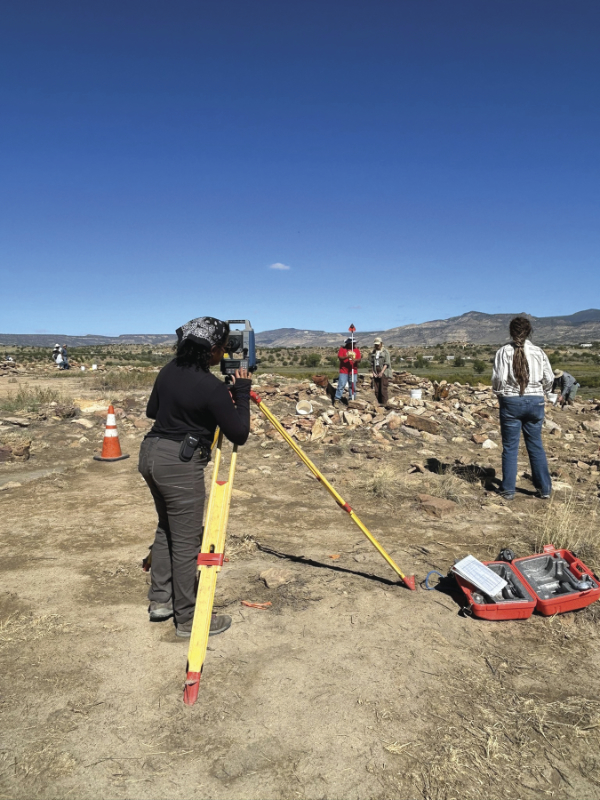
OAS staff archaeologist (wearing black shirt) takes an elevation reading using the digital total mapping station with the help of an Acoma field archaeologist. Other field crew members are excavating or taking notes. Photographs: Melissa Martinez, near Acomita, Pueblo of Acoma, 2024. Courtesy of the Office of Archaeological Studies/Department of Cultural Affairs.

 “Why shouldn’t we be doing this? Why can’t we have all this work in concert to bring a full, rich story? Sometimes it’s not intuitive. Sometimes (the scientific data) tells a different story than what the shared memory is,” Taylor-Montoya says. “But we should respect and value what has been handed down through the generations from the people who witnessed those things.” 

Archaeological work like this fosters understanding and empathy, he says, and brings knowledge together equitably. “One of the cool things about archaeology is that it’s not just (studying) big people and great events,” says Taylor-Montoya. “It’s everyday life. So, you’re talking about what you made for a meal or how you cooked bread, and when you harvested corn. Those are shared human experiences.” 

At the now-excavated homesite above Di’ Chuuna, Raymond Concho points across the valley to where he grew up, and to where Steven’s house is today. The past, present, and future are all here, watched over by the mountain, by Kaweshtima. Raymond recalls his childhood. He talks of an upcoming weekend celebration. And he sees the bridge where it will someday cross above the railroad tracks. All these stories, times, and places are connected. 

Meanwhile, no matter where they work, archaeologists can be better community members. “The most important thing moving forward is archaeologists and tribes working together,” says Steven Concho. “No matter what the project is, we have to work together. We don’t own the land, we are stewards of the land. And our job is to protect it.”

Laura Paskus (opens in a new tab) is a writer based in New Mexico. She’s the author of At the Precipice: New Mexico’s Changing Climate and editor of Water Bodies: Love Letters to the Most Abundant Substance on Earth. Paskus started her journalism career at High Country News in 2002 and worked for print, online, radio, and television news outlets, covering the most important environmental issues of her generation, including climate change, wildfire, water, and the military’s contamination of groundwater with PFAS. Most recently, she produced and hosted Our Land: New Mexico’s Environmental Past, Present and Future for eight seasons on New Mexico PBS.

A Gathering Point

Driving to the southern New Mexico town of Mesilla feels like slipping into a peaceful dream. 

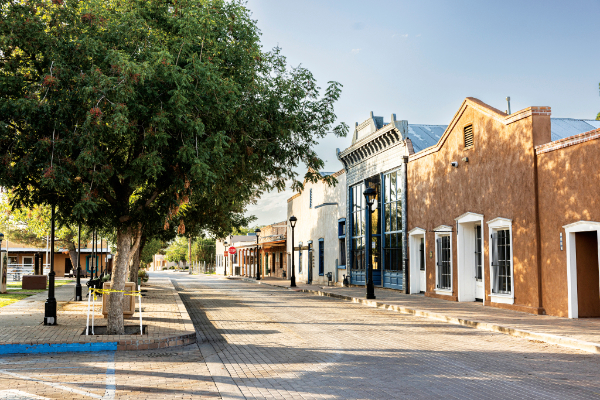
Leave behind the noise and frantic energy of I-10, and soon the wide, winding road takes you past pecan orchards, chile fields, and acequias that have been used for generations. Get closer to the plaza, and the adobe buildings begin to cluster tightly together. The sound of church bells drifts above narrow streets and tiled portillos. Bougainvillea rests against palm trees that rustle meditatively in a gentle breeze.

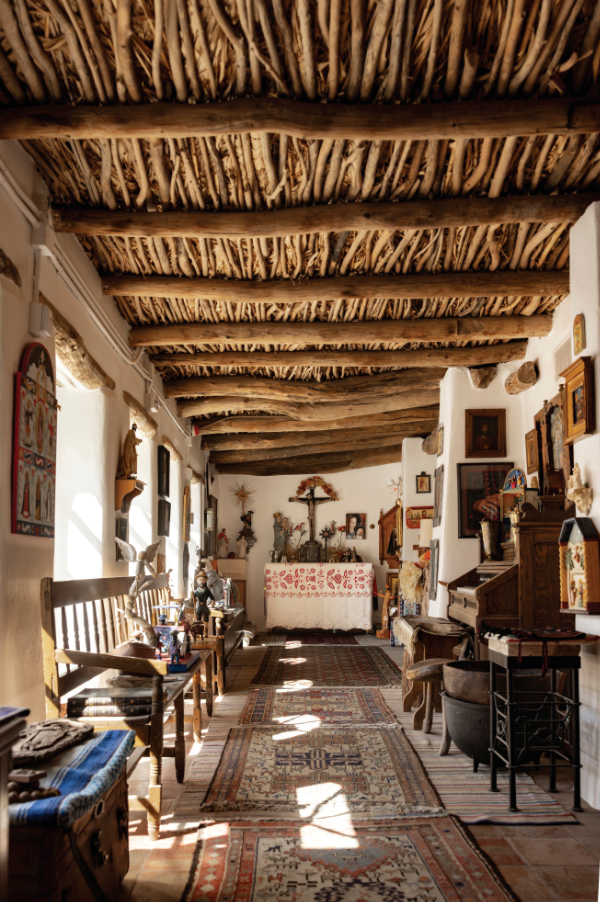
The Oratorio of Taylor-Mesilla Historic Site. This room was an addition the Taylor family made in the early 1970s. It features a viga and latilla ceiling, windows salvaged from the nineteenth century build of the Basilica of San Albino, and an altar that the Taylor family continues to use.

On the west side of the plaza, the home of J. Paul Taylor, Mary Daniels Taylor, and their family has reopened to the public after two years of renovations managed by New Mexico Historic Sites—a division of the New Mexico Department of Cultural Affairs. Here, visitors can find a trove of more than four thousand objects of notable historical, cultural, and artistic significance representing southern New Mexico. Each artifact belonged to the Taylor family, each a symbol of their curiosity toward the people and customs around them. In fact, the Taylor house and its contents are so significant that it became a state monument in 2004, while Paul and Mary were still alive and living on-site. Mary died at 84 in 2007, after which Paul maintained the property until his death at 102, in 2023.

Alexandra McKinney, instructional coordinator supervisor and historian at the Taylor-Mesilla Historic Site, says that after Paul’s passing, the donation agreement by the family stipulated a transition period of two years to allow the state to update the home to make it fully accessible to the public. The renovations were relatively minor but plentiful: updating the house to meet modern safety standards, leveling the floors, properly cataloging all of its contents, and more.

“I remember standing in the sala grande shortly after Mr. Taylor passed, and we were preparing to start doing the construction work—and I just remember thinking that he and his wife had this vision, and they had this idea for their home to be this place of learning and history and family and all of these things that they just loved,” McKinney says. “But in order for it to happen, they couldn’t be here anymore. And there’s something unbelievably selfless about that. That is a huge amount of trust that you have to put in the people around you to say, This is what I want to see, but I’m not going to be here when that happens, so I need you to see it through.

The Taylor-Mesilla Historic Site on Mesilla Plaza. The large glass windows and stamped tin façade of the Reynolds Store Visitor Center were installed on top of the adobe building by Charles Reynolds at the turn of the 
twentieth century. The Town of Mesilla was the most populous community between San Antonio, Texas, and San Diego, California, in the 1850s and 1860s.

The house was built in the 1850s in the Territorial Style and is representative of Mesilla. It sits within a stretch of buildings with one continuous wall along the western side of the plaza. The continuity of the buildings was an intentional safety feature—a telltale sign of the tumultuous nineteenth century, a violent era filled with gunslingers, raiders, hustlers, and everyday folks fighting for a decent life. But when you move past that adobe façade, you step into a world of quiet, layered beauty, with artful details bringing color, depth, and mystery to the space. There, passages and courtyards separate the Taylor house from the buildings around it. You can trace the influences of French architecture and Spanish Revival Style as the home’s earlier owners—including the French priest, Father Juan Grange (who became the priest of the plaza’s San Albino Catholic Church and owned the house from 1913 to 1937)—left their mark on the property.

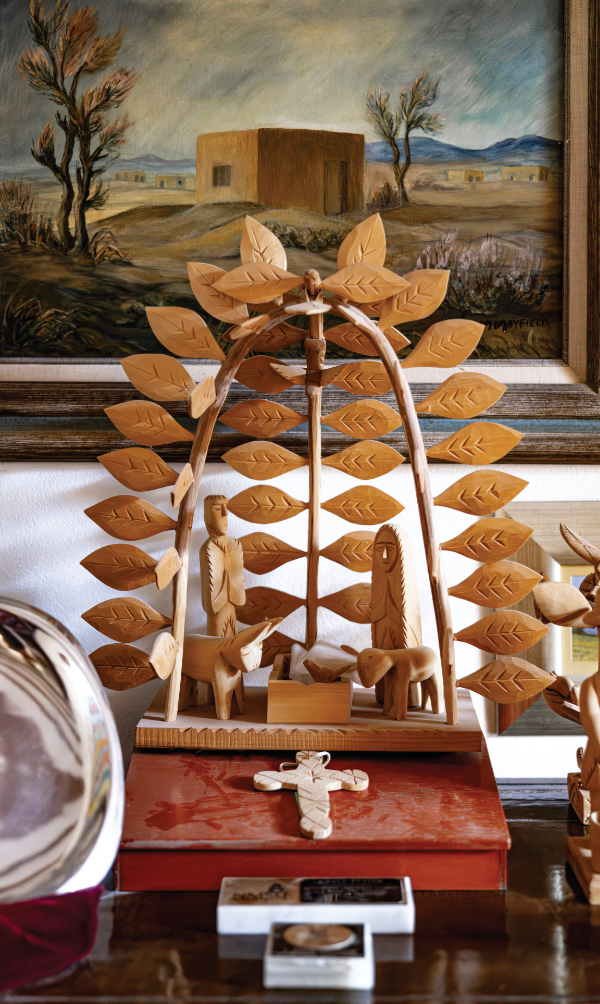
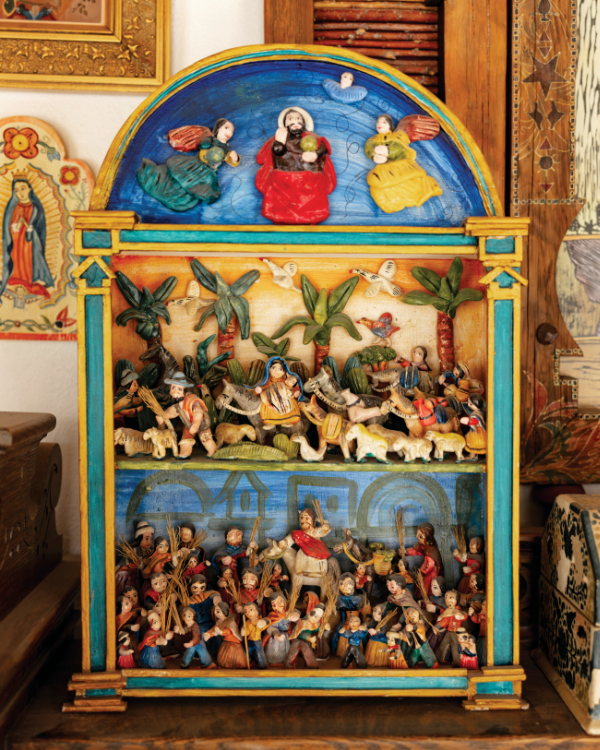
This unpainted wood carved nacimiento (nativity scene) is by Sabinita Lopez Ortiz, a member of New Mexico’s “School of Cordova” tradition.

After the Spanish established the El Camino Real trade route in 1598, connecting Mexico City to what is now Northern New Mexico, Mesilla’s population began to grow. The fertile valley enticed farmers and homesteaders who had a variety of backgrounds. Two and a half centuries later, the Treaty of Guadalupe Hidalgo, signed in 1848, formally ended the Mexican-American War and resulted in the U.S. taking fifty-five percent of Mexico’s territory, which included New Mexico, Arizona, Nevada, Utah, California, and parts of Colorado and Wyoming. The area shifted under competing powers until 1854, when the Gadsden Purchase officially absorbed Mesilla into American territory.

By the 1860s, Mesilla’s population grew to more than 2,500, making it the largest city at the time between San Antonio and San Diego. With the completion of the Santa Fe Railroad line in 1881, which stopped in Las Cruces, traffic to the area increased even more. The local Indigenous Manso, Piro, and Tiwa populations blended—at times violently and others peacefully—with the Spaniards and Mexicans who remained. Mesilla became officially part of New Mexico in 1912 when the state was established. People from other states came to the area seeking opportunities in agriculture and mining. Thousands more from all over the United States migrated to the Mesilla Valley for health reasons; the dry climate was ideal for people suffering from tuberculosis and other ailments.

Some of the adobe walls at Taylor-Mesilla Historic Site are five feet thick, including this doorway between the Alma Capen Sitting Room and the Tin Room.

Paul and Mary grew up in the area—Paul on a farm in Chamberino, and Mary in El Paso. Paul studied at the New Mexico College of Agriculture and Mechanic Arts, which became New Mexico State University in 1960. Mary, wanting to be an archaeologist, studied at what is now the University of Texas at El Paso. Both were interested in history, art, education, and community service, and they attended the same church, where Paul first noticed Mary. But it wasn’t until a chance meeting at a New Year’s Eve celebration in El Paso that the couple got together.

After getting married in 1945, Paul and Mary bought the property that would eventually expand to the six-thousand-square-foot home that makes up most of the historic site (the outdoor spaces expand it to nearly nine thousand square feet in total). The Taylors had seven children—Robert, Dolores, Michael, Mary Helen, John, Pat, and Rosemary—and over the decades, they renovated the home while adding rooms and expanding into adjoining buildings.
Simultaneously, the Taylors built a legacy of public service.

Mary, a passionate writer, researcher, photographer, paleographer, teacher, and genealogist, became a leading authority on the history of southern New Mexico. In the second edition of A Place as Wild as the West Ever Was: Mesilla, New Mexico 1848–1872, a book Mary first published in 2004, Mary’s children write in the introduction that their mother “grew up as a youngster within a few blocks of the Mexican border at Smeltertown […] where her father was foreman of the cement plant. The daily life along the border, with its inherent intrigue and social/racial discrimination, had a profound influence on her future work as a respected scholar of border studies.”

Through her discovery of primary documents in Durango, Mexico, related to the families and history of the Mesilla Valley, Mary organized a microfilm project to painstakingly record these documents and brought them to New Mexico. These documents now live in the Library Archives and Special Collections at NMSU.

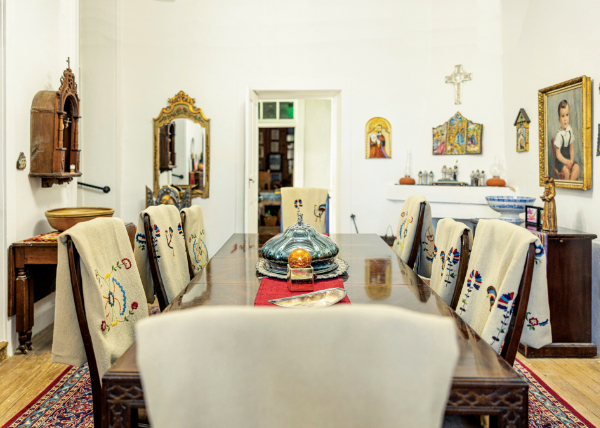
The Dining Room at Taylor-Mesilla Historic Site. The room features a large table with colcha curtains on the backs of each chair, a carved wooden nicho made by previous homeowner Father Juan Grange, and a fireplace in the room’s corner.

“We now have a guide to that collection that is available online, and it’s about 1,300 pages long,” says Dennis Daily, associate professor and department head of Archives and Special Collections at NMSU. “People can access this guide and find documents that they’re interested in, either for their historical or genealogical research. …The impact of Mary and her finding the collection and helping us get access to it, and of Paul for funding this project—the impact is still huge.”

Daily was hired by the Taylors in the late 1990s to help Mary with the Durango project, which began in 1992 and was completed in 2007. The documents date back to the 1600s and include family trees and marriage, birth, and death records. “Historians researching New Mexico and the border areas can find minute details of social life and customs and information about the economy, agriculture, relationships with Indigenous people—you name it,” says Daily. He and his colleagues at the archives field requests from folks seeking information about their own ancestry on a weekly basis.

This unpainted wood-carved nacimiento (nativity scene) is by Sabinita Lopez Ortiz, a member of New Mexico’s “School of Cordova” tradition.

The archives include information gathered and created by J. Paul Taylor. So much material has come from the Taylor house—including maps, letters, essays, and more than 35,000 photographs—that it now takes up shelf space equivalent to six hundred linear feet, or two football fields if the boxes were lined up side-by-side. “All of it is here, every scrap of paper. It really illustrates the breadth of the Taylors’ lives and work,” says Daily. “All of these materials were in the house. I have no idea how they kept all this stuff there, because I was in the house many times, and it was never chaotic! It was a very nice, neat house.”

Paul, who spent more than thirty years in the Las Cruces Public School system as a teacher, principal, and associate superintendent, served nine consecutive terms as the Democratic Representative for District 33 in the New Mexico legislature. During his tenure as a representative, he earned the nickname “Conscience of the Legislature” for his unflagging commitment to reminding his colleagues of the needs of the least fortunate. Taylor co-founded the Doña Ana County Historical Society in 1963. He also served as a regent of the Museum of New Mexico Foundation. In 1978, Taylor helped establish the state’s Department of Cultural Affairs, which is now the largest department of cultural affairs in America. The very entity Taylor helped create is the one to which he and Mary donated their house and belongings.

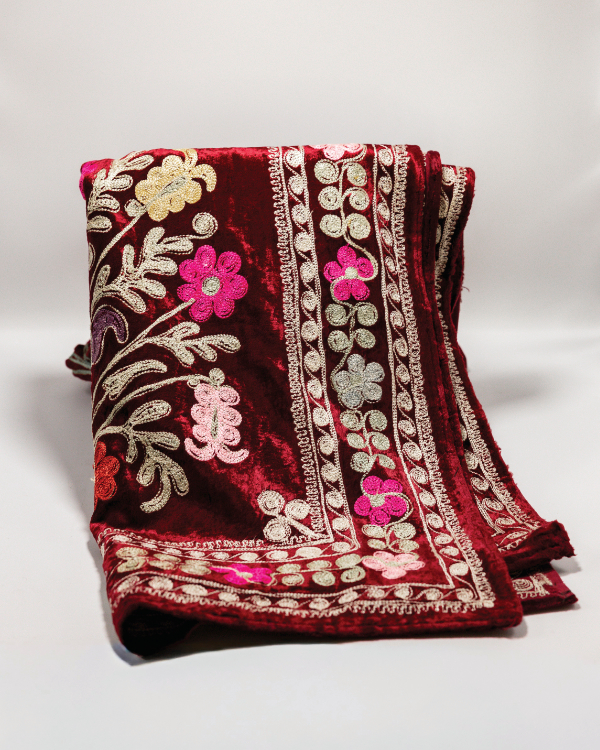
Table runner, India, embroidery on velvet, 21st century.

“[J. Paul Taylor] was the nicest man I have ever met or ever will meet in my life,” says McKinney. “What he really wanted was to leave a place where people could learn about this area’s history. …He was a very humble man. He did not want things to be about him. He used to joke every year when we would prepare for his birthday party that, you know, ‘Why are you throwing me a birthday party? Nobody’s going to come to my birthday party.’ And then three hundred people would show up to his party!”

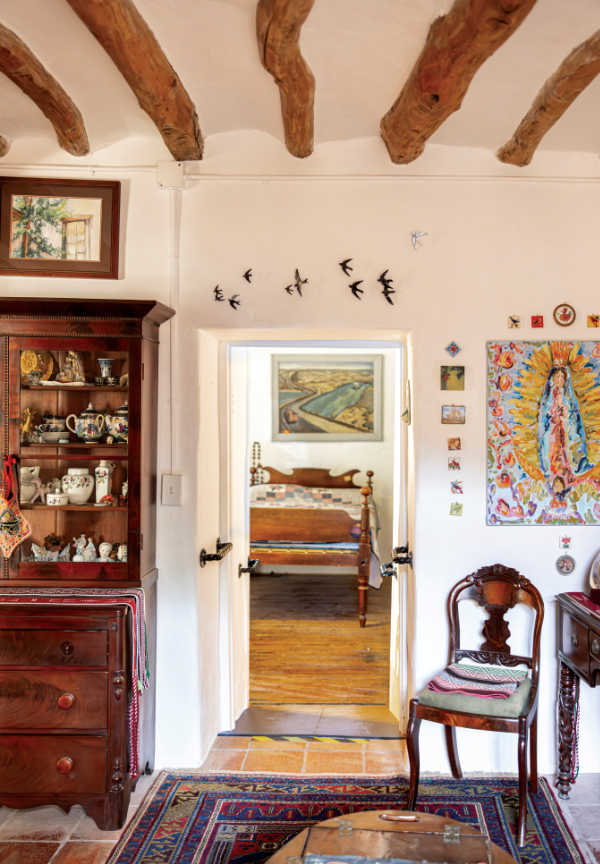
Today, visitors to the Taylor home, which is on the National Register of Historic Places, enter through a zaguán to explore seventeen spaces open to the public (only two spaces are restricted). Visitors walk through the older rooms first, making their way into newer areas that were added on by the Taylors as the family grew. Each room preserves the architectural details of the original house and its time period, and is filled with remarkable furniture, art, books, collectibles, textiles, and other items. In one room, a Mexican Baroque painting of San Miguel dates back to the 1600s. Spanish Colonial furniture fills another room, and another features pottery by Mata Ortiz. The site contains numerous paintings by local artists such as Ken Barrick, José Cisneros, Helen Cordero, Julia Gomez, Maria Martinez, Eileen Shannon, and Dorothea Weiss.

“The home also has a sanctuary, one that includes all the liturgical items necessary for mass,” McKinney adds. “Three windows that are in the sanctuary now come from the San Albino church. …There are a lot of features in the home, from windows to vigas to doors, that have been salvaged and reused from other locations in the Mesilla Valley.”

Visitors can also view more than two hundred nacimientos, or nativity sets, the family collected. One set is from Mary’s childhood, and several others were gifts the Taylors received when traveling abroad. Locals and tourists alike enjoy visiting the site around Christmas to view the nacimiento collection, says Heather Pollard, president of the Friends of the Taylor-Mesilla Historic Site, a volunteer group that runs the gift shop. “A trip to southern New Mexico and West Texas would not be complete without a stop in Mesilla to visit the Taylor-Mesilla Site. This site is truly a gem in the desert, any time of year.”

“Christmas Eve with the Taylor family at their home was an annual highlight for my family,” adds Tom Dormody, secretary of the Friends group. “Homemade tamales and posole, plus good conversation with the extended Taylor family members and their friends, made a stop at the Taylor home a memorable Christmas Eve tradition.”

“I’m a fourth-generation resident, and this monument carries personal meaning for me,” says Mesilla Mayor Russell Hernandez. “I had the privilege of visiting Mr. Taylor himself, sitting with him, and listening to his stories. He shared not just moments from Mesilla’s past, but also the lessons of resilience, dignity, and service that shaped his life. I remember him recalling how he taught and mentored so many—including members of my own family. For me, those conversations were a gift. They bridged the distance between generations and reminded me that our history is not abstract—it is personal, and it lives on in us.”

Mayor Hernandez considers the Taylor-Mesilla Historical Site a living reminder of the people and stories that have shaped the Mesilla Valley into the region it is today. “[The monument] has become a gathering point, a place where stories are remembered, where younger generations can learn about those who came before them, and where the pride of Mesilla’s heritage is made visible. …It connects the past with the present, it honors the lives and contributions of those who came before us, and it inspires all of us to continue building a community rooted in respect, memory, and pride.”   

For address, hours of operation, entrance fees, and upcoming exhibitions at the Taylor-Mesilla Historic Site, please reference the exhibitions on page 78 or visit nmhistoricsites.org/taylor-mesilla.

Monika Dziamka (opens in a new tab) is an Albuquerque-based writer and editor whose work has also been published in New Mexico Magazine, Blue Mesa Review, Southwest Contemporary, Chicago Review of Books, River Teeth, and elsewhere.

Tira Howard (opens in a new tab) is a portrait, lifestyle, and fashion photographer based out of Santa Fe, New Mexico. Her work can be seen in V Magazine, Cowgirl Magazine, Table Magazine, New Mexico Magazine, El Palacio magazine, Pasatiempo, Cowboys and Indians Magazine, The Santa Fe New Mexican magazines, The Santa Fe Reporter, Western Art & Architecture Magazine, and Edible New Mexico Magazine.

Art and Activism at Highlands University

If you are walking on the New Mexico Highlands University campus in Las Vegas, New Mexico, and you find yourself on the south side of Hippie Hill, and you know where to look, you can see the phrase “Viva la Raza” scratched into the sidewalk. You can see it best during golden hour, when the sun starts to set across the plains of Nuestra Señora de los Dolores de Las Vegas Grandes. And, if you stand outside of Professor Eric Romero’s office, you can see a poster for the first meeting of the National Caucus of Chicano Social Scientists in 1973, the organization that would later become the National Association for Chicana and Chicano Studies (NACCS).

As a twenty-year-old Chicanita, I sought out that history when I was a student at Highlands. I sought it out in classes like Chicano Literature with Professor Daniél Martínez and Poesía Chicana with Professor Lillian Gorman. When Highlands saw a mini resurgence of the Chicano activism of the 1970s during the early 2000s, the old timers told us about the murals activists had painted on campus during the Chicano Movement. But that story had been covered up as part of the larger whitewashing—both literal and figurative—of student activism at Highlands.

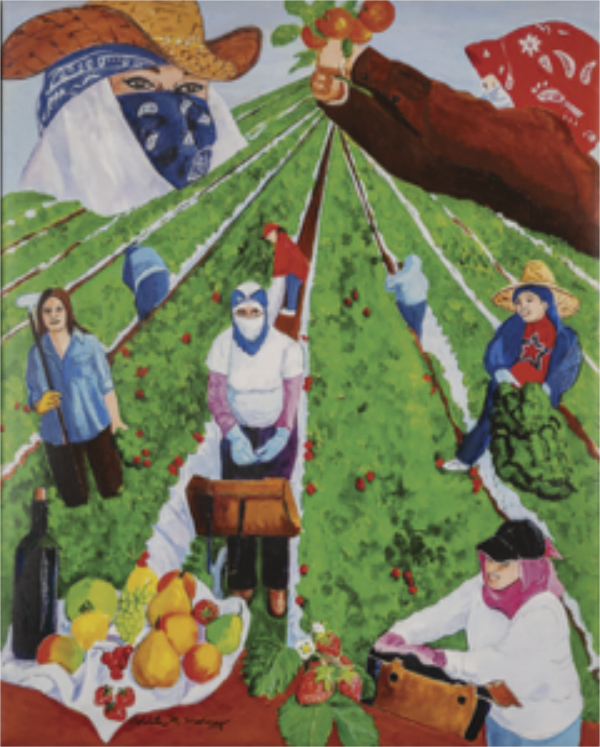
A new exhibition documents Chicano art and activism at NMHU in the 1970s. Voces del Pueblo: Artists of the Levantamiento Chicano in New Mexico, currently on view at the National Hispanic Cultural Center until February 8, 2026, documents the art and activism of six featured artists— Ignacio “Nacho” Jaramillo, Juanita J. Lavadie, Francisco Lefebre, Noel Márquez, Roberta Márquez, and Adelita M. Medina—all of whom were students at NMHU in the 1970s. The exhibition was curated over seven years by Dr. Ray Hernández-Durán and Dr. Irene Vásquez and contains 146 artworks by the six artists. Themes include community, family, querencia, land, home, and others. A focus of the exhibition is El Movimiento (the Chicano Movement).

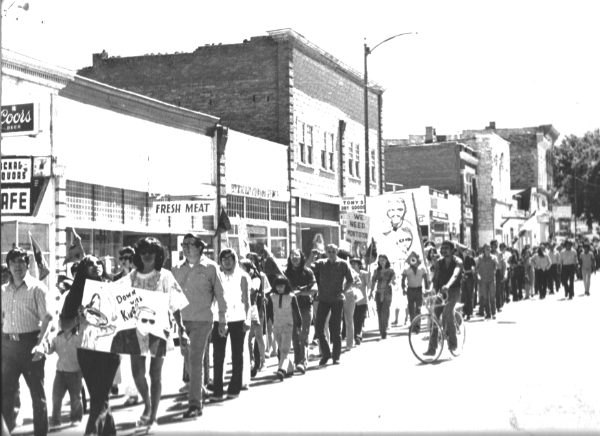
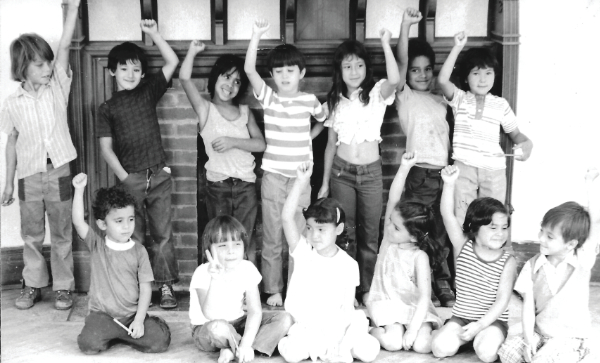
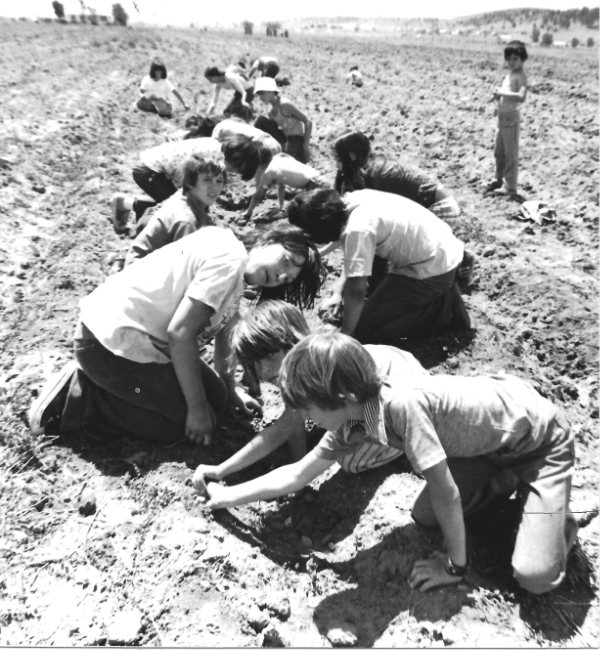
In stark contrast to the colorful drawings, paintings, and tapestries created by her peers, Adelita M. Medina’s black and white photographs help narrate the underlying story that the artists tell about the Chicano Movement at Highlands. Her photography documents a multigenerational movement that occurred not only at the university but across the city. The roles that women and children played during the Movement have been overshadowed by the stories of the men, and Medina’s photos provide a window into the educational front of the Chicano Movement in New Mexico. Most interestingly, her work provides a snapshot of the little-known alternative school for Chicano youth in Montezuma, just five miles north of Las Vegas. At the center of El Movimiento in Las Vegas was the demand for educational equity at the K-12 and college levels and a culturally relevant curriculum to help students connect to their language, history, and cultural practices.

The Highlands Uprising

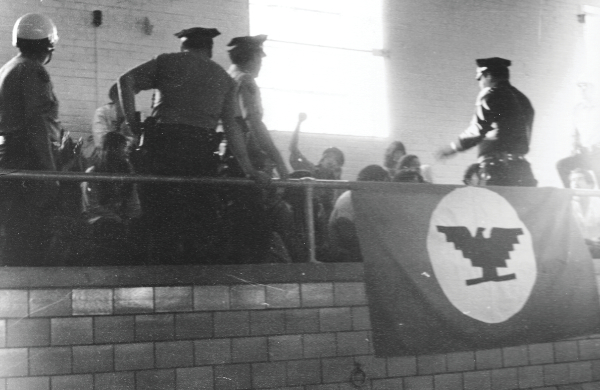
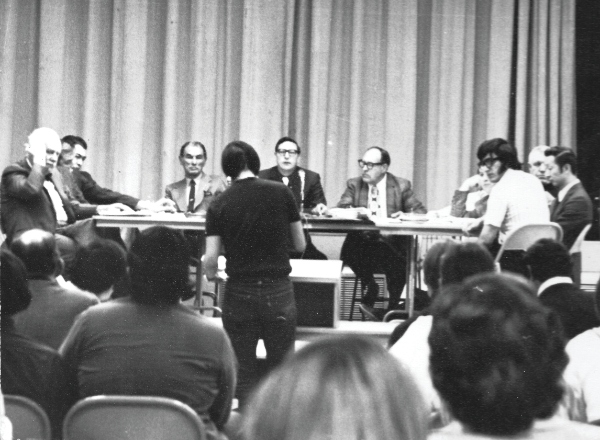
In 1970, upon the impending retirement of NMHU president John C. Donnelly, students and community members lobbied the Board of Regents to hire Dr. John A. Aragon, a Nuevomexicano educator from the University of New Mexico. Instead, the Board selected Charles Graham, who had been dean of the College of Arts and Sciences at the University of Wisconsin-Whitewater.

After Graham accepted the initial offer, Chicanos began protesting. Students occupied the administration building at Highlands for eight days in May 1970. District attorney and president of the West Las Vegas school board, Donald A. Martínez, filed a lawsuit to stop the hiring of Graham. Ultimately, Graham did not take the position and later stated in an oral history interview that he declined because it was the “peak of the Chicano Militant Movement,” and that Chicano students at Highlands “never had a chance to do much there, except go and learn how to be teachers in a very traditional Anglo way.” Graham acknowledges that “the Board was wrong to appoint me, and I think they were almost deliberately ignoring some of the factors in this situation.”

The regents allowed the vice president under Donnelly to act as president until Dr. Frank Ángel was hired in 1971. Ángel was Las Vegas-born and the first Chicano to be hired as president at Highlands. In his speech at Ángel’s inauguration, U.S. Commissioner of Education S.P. Marland Jr. noted: “Thus it seems to me, in a sense that I am sure President Ángel will understand, somehow inaccurate to celebrate the fact that, 340 years later, one of our 1,400 senior educational institutions should be headed by an American of Mexican descent. Instead of saying, ‘Isn’t it wonderful?’, we should be asking, ‘What took us so long?’”

Police arrive at the East Las Vegas School Board Protest, 1973. Silver gelatin print, 6” x 9”. Private collection of David Montoya and Susan Seymour.
Meeting with Frank Ángel and the Board at NMHU, 1973. Silver gelatin print, 6” x 9”. Private collection of David Montoya and Susan Seymour.

Ángel was the first Chicano president of any four-year university in the U.S. The New York Times wrote of his hiring: “He is widely regarded as a father figure, or patton [patron], for Chicanos who have risen through the state’s colleges and universities.” During this time, fifty-four percent of students enrolled at Highlands were Chicano. Las Vegas was—and remains—a low-income, predominantly Hispanic-identifying community. Although Ángel was not the protestors’ first choice to become NMHU’s president, Martínez said at the time, “If you’ve been knocking at a door for many, many years and you get it opened a crack, you’re not going to be mad at the fresh air coming in.”

The protests led to the creation of cultural studies programming at Highlands and eventually resulted in the hiring of several Chicano professors and administrators. Although there were similar efforts on campus to add a Black Studies curriculum, the university made it impossible to institute an intercultural program that included both Chicano and Black Studies; thus modest efforts to create a Chicano Studies program prevailed. Willie Sánchez, an associate professor of math at NMHU during this time, told The New York Times in 1971 that, “The Chicano element for some time has felt it is necessary to provide proper role models. […] It’s pretty difficult to convince a kid that there is a place for him in the world when there is nobody to look up to.” He went on to say: “If all [NMHU administrators] are going to do is be a pallid reflection of Northwestern University or of the University of New Mexico, then let’s buy a bus ticket for the students and send them there.”

Sylvia and Betita March on Bridge Street, Down with King, 1973. Silver gelatin print, 9” x 14”. Private Collection of David Montoya and Susan Seymour.

The Chicano Movement brought to the surface many of the lingering tensions from New Mexico’s territorial period. This included the creation of a hyper-mythologized Spanish American identity for Nuevomexicanos, who had adopted a Spanish identity in large part due to the push for statehood, when being “mixed” blood was looked down upon and seen as a barrier to advancement. Across the country, the Chicano Movement was a resuscitation of an Indigenous past that many Nuevomexicanos still found unacceptable. However, almost everyone agreed that the Spanish language should be protected and that a just education included the ability to use, learn, and teach Spanish in the classroom. Many of the students participating in the protests at Highlands had been punished as children for speaking Spanish in the classroom, and now they protested for the inclusion of Spanish in the school curricula as a fundamental right.

Chicano Studies and Art

One professor hired to teach art and Chicano Studies at Highlands made a lasting impact. Pedro Rodríguez was hired in 1971 to direct a new Chicano Studies program. All six artists exhibiting work in Voces del Pueblo at NHCC were Rodríguez’s students at Highlands. In 1972, some of them traveled to Mexico City with Rodríguez and learned to paint murals. When the students returned, they painted various murals across campus depicting Chicano history and culture under his tutelage. The murals appeared in Connor Hall, Burris Hall, and the student union building, among other locations. However, according to Hernández-Durán, President Frank Ángel is remembered as having publicly stated that not only were murals not art, but that Mexico had nothing to do with New Mexico. He ordered them to be whitewashed.

NMHU student Adelita M. Medina’s photo “Meeting with Frank Ángel and the Board at NMHU” (1973) documents one meeting in which Chicano students protested Ángel’s presidency. Chicano activists were targeted by the administration during this time, especially the artists. Francisco Lefebre was expelled by Ángel for painting a mural of Ché Guevara at the student union building. Rodríguez was later denied tenure and dismissed from Highlands, and Juan José Peña was hired to replace him. Ultimately, the Chicano Studies program at Highlands did not endure. In Medina’s “What Happened to Chicano Studies?” (ca. 1973), a group of Highlands students stand in front of the administration building protesting with signs; a banner with the United Farm Workers eagle hangs from the balcony behind them.

The protests at Highlands inspired Chicano students in the East Las Vegas City Schools to protest what they deemed discriminatory practices and the absence of a culturally-relevant curriculum. Several of Medina’s photos show protests at school board meetings and outside of the Las Vegas Police Department. One photograph shows five Chicanas standing outside the police department holding protest signs in support of several activists who had been jailed. Highlands students were the central figures in the protests across town.

Medina was a student in 1971 when she became involved in the movimiento. She was a single mother to a six-month-old baby and living in an apartment next to the Plaza Hotel when she heard protesting outside in the park. She saw students from Highlands chanting and marching and saw her older brother Benjie and his friend Fred. “We’re protesting against the discrimination against Chicanos at Highlands,” her brother said. “I think I’m gonna march with you guys,” she told them. “And that changed my life forever,” Medina says. 

She avoided the stereotypical roles that women were often assigned, even in activist spaces. “They’re gonna ask us if we know how to type,” she told her friend Sylvia Gutiérrez. “Tell them we don’t know how to type.” Sure enough, when asked the expected question, the women said no. Medina and Gutiérrez disrupted the male space of the Movement in Las Vegas in multiple ways. They often met the other leaders at the home of Lucy López (Mama Lucy) on Hot Springs Boulevard to strategize about what actions to take at the university. According to Medina, the local politicians invited them to these meetings.

During the summer of 1971, Medina began working on the famous Chicana newspaper El Grito del Norte with Elizabeth “Betita” Martínez in her hometown of Española. She was hired as a proofreader and soon learned newspaper layout and photography. Her photography training helped her capture the images now on view in the Voces del Pueblo exhibition. When El Grito moved to Las Vegas, Medina continued working on the paper until its final issue in July/August 1973.

Her photographs in the exhibition document the events at Highlands, the walkouts and marches by East Las Vegas middle and high school students, and the grassroots education that happened just outside of Las Vegas at the Escuela Antonio José Martínez in the 1970s. As Hernández-Durán writes in the exhibition text, “Photographs documenting the Chicano movement in New Mexico show children learning about farming, conveying how this longstanding love and respect for the land has been passed down from generation to generation.” 

Medina’s photos are powerful for various reasons. Most images of the Chicano Movement across New Mexico universities depict violence. The New Mexico Museum of Art curriculum on “The 1970 Protests & Violence at the University of New Mexico” is entirely composed of images ranging from photos of the armed National Guard to paramedics loading a sheet-covered body onto a stretcher. Medina’s photos instead document women and children planting seeds, making food, and holding up signs during peaceful protests.

Escuela Antonio José Martínez

On August 26, 1973, Chicanos Unidos para Justicia (CUPJ) took over one of the buildings at the Montezuma Castle, which had recently been a seminary for Mexican Jesuits until the Archdiocese of Santa Fe announced plans to sell the property in 1972. That day about one hundred people marched from the Plaza Vieja in Las Vegas—after celebrating an outdoor Mass there—to the Montezuma Castle. CUPJ had been petitioning the Archdiocese of Santa Fe and the U.S. Conference of Catholic Bishops to rent the castle to start a school for Chicano youth, to no avail. 

Chicanitos at the Escuela Antonio José Martínez, 1973. Silver gelatin print, 4” x 6”. Private collection of David Montoya and Susan Seymour.

After CUPJ occupied the building and refused to leave, the archdiocese began to work with them. In a letter to the general secretary of the U.S. Conference of Catholic Bishops, Archbishop James Peter Davis states, “After many meetings with those concerned, I am pleased to report that the Montezuma Seminary property problem has been thoroughly researched and the following conclusions are in order: […] The old buildings, including the castle, the former chapel building and sufficient farm acreage to provide agricultural development for educational purposes and food supplies for the school, will be made available by grant of use to Chicanos Unidos para la Justicia.” In this way, the Escuela Antonio José Martínez, named after Padre Martínez of Northern New Mexico fame, was established.

The CUPJ assigned Adelita M. Medina and David Montoya as coordinators for the Escuela. While it was not accredited by the New Mexico State Department of Education, it did earn accreditation from the Rio Grande Educational Association (RGEA), a regional accrediting agency for non-public schools. In January 1974, the New Mexico Supreme Court ruled that the State of New Mexico could not regulate non-public schools, which validated the RGEA accreditation. The school had approximately seventy-five students with instructors that included licensed teachers and professors from NMHU. According to co-curator Irene Vásquez, “Students from NMHU and community members organized the Escuela Padre Antonio José Martínez to provide youth with a culturally inclusive education that centered the wisdom and resilience of their land-based communities.” 

In one of Medina’s photographs, “Niños sembrando en Moctezuma [sic]” (1973), a dozen or so children line a bordoin an empty field and sow seeds while one shirtless boy around five years old looks on. In “Chicanitos at the Escuela Antonio José Martínez” (1973), a group of school kids pose in front of a fireplace for a class photo, but in this one, the kids all raise their arms in a power fist, and one child opts for a peace sign. All the kids have smiles on their faces.

In April 1973, CUPJ held a Chicana Conference at the Escuela. People came from across New Mexico and Texas, Wisconsin, Delaware, New York, New Jersey, and Pennsylvania to address issues related to housing, healthcare, welfare, education, employment, childcare, sex discrimination, and the penal system. Those were the issues in which the Escuela Antonio José Martínez
was interested. 

In “Sylvia and Pita in the Kitchen at the Castle,” three rows of lunch trays line an industrial kitchen counter. Two women stand in the foreground with two men in the background. Medina says the women of Las Vegas—mothers of the children who attended the Escuela—showed up to run a baking cooperative and bake bread at the castle to share with the families. 

Niños sembrando en Moctezuma, 1973. Silver gelatin print, 5” x 4 ¼”. Private collection of David Montoya and Susan Seymour.

The Escuela was, perhaps, one of the best examples of mutualismoin Las Vegas during that era. One mother, Esmeralda Torres, wrote in a letter published in an issue of Tierra y Libertad: “The bread Co-op has been a very good community program also. It has given us ladies a cooperative community spirit that had almost been lost in our culture, plus the practical knowledge and savings. Again, I want to say mil gracias for all you have done for this community in general and my two children, in particular. Quedo en su deuda.” The school was mutually beneficial to the children, families, and teachers who participated in the Escuela. But the school only lasted two years, total. During that time, it provided a free and reduced lunch program, school credits, educational materials, and transportation.

In Voces del Pueblo, just above Noel Márquez’s painting entitled “Nuestras raíces” (1990) is a quote attributed to Quintin González that says, “Not all Chicano activists are artists, but all Chicano artists are activists.” The impact that participating in the Chicano Movement at New Mexico Highlands University had on this group of artists is undeniable—and Medina continues to use her art as activism to this day.

Campesinas, 2019. Acrylic on canvas, 24” x 18”. Collection of Alianza Nacional de Campesinas, Oxnard, California

As a student at Highlands in the early 2000s, there were things I could not understand about Chicana/o activism on campus during the 1970s, but I better understand now that I work at the University of New Mexico. Voces del Pueblo, and especially Medina’s photos, deepened my understanding of the significance of Highlands within the greater Chicano Movement. Her photos document the presence of women andchildren working to create and institutionalize a curriculum in which students learn to protect and project their culture. Voces del Pueblo is a reminder of the importance of educating students about their homeland, people, and ways of life. 

In Rudolfo Anaya’s novel, Heart of Aztlán, written during the Chicano Movement but set in the 1950s, one of the characters says, “I believe in revolution, like Lalo believes in revolution, but I think the revolution will be done by educating our children. Later, they will return to help us, in their own way they will return to work for our good. I trust in that.” I, too, trust that university spaces have been and can continue to be revolutionary spaces where we will neither be punished nor made to kneel down and beg forgiveness for speaking Spanish or practicing our cultural values.

Myrriah Gómez (opens in a new tab) is from El Rancho in the Pojoaque Valley. She earned her bachelor’s degree at New Mexico Highlands University. She is an associate professor in the Honors College at the University of New Mexico and the author of Nuclear Nuevo México. She thanks Dr. Ray Hernández-Durán, Juanita J. Lavadie, Francisco Lefebre, Adelita M. Medina, and Dr. Irene Vásquez for sharing their time and knowledge with her.

Returning to the Body

While editing this issue of El Palacio, I spent a lot of time thinking about the body. Work has always been central to the American identity and in the West this work has—and continues to be—rooted in hard, physical labor. It’s the kind of labor that does not allow you to forget about your body. In New Mexico, as in many other places, this labor has often been deeply entangled with questions of race, class, nationality, and colonialism. Those who labor and those who gain wealth from this labor are usually not the same people. 

In David Correia’s article about the Gallup coal wars, he chronicles the violent suppression of Mexican miners trying to unionize for better pay and working conditions. Miners’ speeches and picketing were met with a government response that included inflammatory accusations, incarceration, and deportations. Although the period covered in Correia’s article happened between 1933-35 in Gallup, New Mexico, the conflict between workers and those profiting from the work then reverberate in newspaper headlines today. Our context is both wildly different (the rise of artificial intelligence, biodiversity loss and dwindling water, and the speed at which we can travel or communicate, to name just a few) and eerily the same. There is, as ever, much we can learn about our present by looking to the past. 

Perhaps making sense of our present and history is simply about returning to the body. As José Rivera, Enrique Lamadrid, and Levi Romero demonstrate in their co-authored article about molinitos (small mills) in Northern New Mexico, physical labor is also embedded in our food systems. The small flour mills that dot Northern New Mexico once sustained villages and communities that relied on regular wheat grinding. That the mills were often powered by flowing water in the acequias makes this labor more poignant; labor to dig and maintain the acequias, build the mills, and harvest the wheat is intimately tied to the water and food we need as nourishment. 

How do we nourish the body when it is poisoned? This is not a question Daisy Atterbury asks directly in their recent book, The Kármán Line, but it is one I pondered while reading Chelsey Johnson’s profile of the author. With layered and intersecting inquiries about New Mexico histories, identities, geographies, and the state’s nuclear legacy, Atterbury brings the body into the narrative, too. Cancer is one concern with respect to nuclear exposure, but so too are gender, bodies in space, and space burials, among other things. Atterbury’s probing of Trinity Site and Spaceport America as sites of bodily discomfort grounds a conversation often marked by ethics alone. By placing their body in these challenging spaces, Atterbury offers one path for reckoning with discordant histories. 

As Petra Salazar demonstrates in a love letter to her hometown, Española, culture itself can embody New Mexico’s layered histories. For Salazar and her friends and neighbors, lowriders function as a tangible shrine—both ode to memory and loved ones who have passed, and celebration of a rooted present. The cars are a testament to faith and devotion and function as a form of resistance to a fast-paced world. As Salazar shares, slow cruising functions as a physical form of prayer and reverence for querencia. 

Often glued to our screens and interfacing through virtual realities, it’s easy to feel disconnected from our corporeal existence in a world we are very much a part of. Physical labor—whether to sustain the body, pay the bills, or create art—can root us in the landscapes that nourish us, helping us to embrace the complexity of our history and navigate a new way forward.

Emily Withnall (opens in a new tab) is the editor of El Palacio and the host of Encounter Culture. Prior to stepping into the editor role, she wrote for the magazine for eight years. Emily has also been published in The New York Times, Al Jazeera, High Country News, Orion Magazine, Tin House, The Kenyon Review, Gay Magazine, Source New Mexico, and other publications. She lives and writes in Santa Fe, New Mexico.

Los Molinitos de la Gente

A small, weathered log cabin sits on bare ground with plants growing on its roof and sides under a clear blue sky.
Molino de los Parciantes, el molino abandonado. Photo by Levi Romero.

After the Spanish introduced wheat to the Americas, molinitos (small gristmills) in New Mexico played a major role in the agricultural economy for centuries. Wheat, in its ground form as flour, was a staple during the Spanish colonial period of the fledgling Province of Nuevo México. Whole kernel flour could spoil, so it was baked into bizcochos (hard tack) that dried easily and kept for months. To process raw wheat, local mills became essential infrastructure along with the acequias that powered them.

The Pueblos welcomed wheat cultivation, and the staple grain became a part of their diet, alongside corn. Many hundreds of loaves are baked for Feast Days in hornos (outdoor ovens), and to this day, traditional Pueblo enchiladas are made with wheat tortillas, since corn tortillas were introduced much later, along with the large white concho nixtamal corn used to make them. The Pueblos also appreciated the advanced milling technology introduced by the Spanish pobladores (settlers). Previously, corn was laboriously hand ground by women using a mano and metate.

Most molinitos were built from logs and were situated near the banks of watercourses. A few others were built from adobe bricks, and in at least one case, an adobe mill on the Camino Real de Tierra Adentro was powered by burros. Researchers have documented the existence of several hundred mills, with the earliest reference dating to about 1600 at the first Spanish settlement, San Gabriel. Unlike large industrial mills, these smaller mills were susceptible to the effects of weather, and most collapsed after prolonged periods of non-use and abandonment.

The Early Gristmills

At instruction from Juan de Oñate, New Mexico’s first governor, his party of pobladores, with the assistance of local Tewa farmers from Ohkay Owingeh/San Juan de los Caballeros, dug the first acequia near the confluence of the río Grande and the río de Chama in 1598. In the high desert environment, water from nearby streams was vital for domestic consumption as well as for food production at hundreds of villages along the northern río Grande corridor. 

A few years after the founding of the first Spanish settlement at Yungue Owingeh/San Gabriel across the river, fray Juan de Torquemada conducted an inspection of New Mexico and reported on the diversity of crops already thriving at the new colony, and noted that water diverted from the río de Chama “irrigates all the varieties of wheat, barley, and corn, in cultivated fields, and other items that are planted in gardens, because those lands produce cabbage, onions, lettuce and beets, and other small vegetables.”

The varieties of wheat Torquemada mentioned were introduced to the Americas as part of the Columbian Exchange of garden crops, fruits, and grains between the Americas, Europe, and West Africa. Maize, or corn, is the American staple that went global. In a letter addressed to his relatives on March 22, 1601, Oñate referred to wheat cultivation and the first gristmill built at San Gabriel: “Our wheat has been sown and harvested, and it does extremely well in that land… A flour mill has already been erected. More than 1,500 fanegas of wheat were gathered this year, and there remain to be harvested more than another three thousand.” The fanega was both a measure of volume (1 fanega=1.58 bushels) and a name for the land necessary to produce it.

Molino de los Duranes, Ranchos de Taos, NM, November 2023. Restored by the Taos County Historical Society. Photo by José Rivera.

To build the mill at San Gabriel, the colonists needed only simple hand tools: axe, adze, awl, hammer, chisel, and a small saw. They brought the heavy millstones with them up the Camino Real, as noted during the Juan de Frías Salazar inspection of the Oñate expedition in December 1597 at the Valley of San Bartolomé, near the Santa Bárbara mines, before setting out on the final journey to El Paso del Norte. In his report, Salazar notes that Captain Alonso de Quesada, Sergeant Hernán Martín, and soldier Pedro Sánchez each declared they were transporting millstones among other supplies, tools, and equipment in carts pulled by oxen and mules.

In time, the pobladoresconstructed molinos along the river valleys using falling water to power the handmade machinery inside each mill. Most of the small gristmills were built from pine and fir logs cut from nearby forests, dragged by a team of horses, and then peeled by hand and sawed into the lengths needed to form the exterior walls of the mill house.Molineros (millers) quarried and shaped the milling stones from basalt deposits on neighboring mesas and took them back to the community in carts. Typically, one of the landowning villagers took the initiative to construct a molinito on his property for use by the rest of the community. 

Payment was in kind, usually a modest share of the flour and powdered chile after the milling. The molinitos were also used for grinding dried chile pods into powdered red chile. Levi Romero’s tío, Celestino, is one of many people who recall that the residue from the chile would remain on the ruedas and gave the flour a slight chile flavor. Both pobladores and Pueblos patronized the same mills, many of which were referred to by the name of the molinero, for example: the José de la Luz and Pedro Barela Molino de Truchas, the Molino de los Duranes in Ranchos de Taos, the Corsinio and Lauriano Córdova Molino in Vadito, the José Maximiano Cruz Molino in Las Trampas, the Juan de la Cruz Borrego Molino in El Güique-Estaca, and the Felipe García Molino in Angostura.

Nineteenth-century merchants and entrepreneurs built larger mills using durable construction materials such as rock and adobe masonry. While the molinitos were driven by a small horizontal paddle wheel situated at the base of the log building, commercial production required the use of an overshot water wheel outside the building with a connecting driveshaft to move the large stones or more modern steel rollers and sifters inside. The molinitos had little chance of surviving into the present day. While most fell into disuse by the late 1930s, a few continued in service until the 1940s and 1950s. 

We call them “molinitos de la gente”to distinguish them from the industrial mills that supplied large quantities of white wheat flour and other milled grains to U.S. Army posts and reservations under government contracts. The molinitos, on the other hand, were family-owned and served the needs of local villages through exchange and bartering arrangements negotiated by each molinero.

Felipe García’s burro-driven gristmill built circa 1886, Angostura, New Mexico. Photographer unknown, 1918. Courtesy Palace of the Governors Photo Archives.

Once commercial milling reduced the cost of flour and other milled grains, small-scale milling was no longer economical. Some molinitos were converted for use as storage sheds, and others were abandoned. Exposed to the elements season to season, most eventually rotted and collapsed. For those left standing, the logs were often repurposed as fence and corral posts or simply chopped for use as firewood. The internal components were also made of wood and were replaced after decades of use. When the mills closed, these too were likely consumed as fuel or converted to other uses. The durable millstones were left lying around the owner’s property, and some were later sold as artifacts. In recent times, millstones are often used as landscaping materials, and some have been observed in public spaces, such as footpaths bordered with millstones. There are also gravesites in some camposantos (cemeteries) that are framed by rows of ruedas de molino (millstones). Still others can be found at museum exhibits depicting life in New Mexico during the colonial and territorial periods.

Although reports exist as to many of their historical locations, very little has been done to survey what remnants, if any, exist on the ground today. Reports by travelers and others described gristmills at various communities such as Manzano (1847, Torrance County), Peña Blanca (1855, Sandoval County), and Santa Cruz (1881, Santa Fe County). Earlier references date to the Spanish Colonial period at San Gabriel around 1600, Santa Fe in 1756, Chimayó in 1776, and Ojo Caliente in 1807. 

Photographic evidence can be found for historic molinos that no longer remain at Chamita, Chimayó, Sena, La Ciénega del Embudo, Santa Fe, Vallecitos, Pecos, Ledoux, El Güique-Estaca, Nambé, Cañada de Cochití, Taos, Sebolleta, and others. In addition, longtime residents still have memories of places along acequias where molinos once operated and can point to rubble or stones that served as foundations for the mill structures.

In 1988, David Snow prepared a report on the acequia systems of Santa Fe and noted that water from acequias powered several gristmills along the Santa Fe River. The earliest known mill, he states, was called “el molino de San Francisco” and was located upstream from the plaza and built prior to 1756. A number of others were built during the nineteenth century, one of which was located on the south side of the river just east of Cristo Rey Church. Higher up the river on the north bank was the “molino de las ánimas” (mill of the blessed souls) on what was called the Acequia Rivera, just west of 1497 Canyon Road. Two mills were referenced in property deeds from 1856 and 1887, and another in a plat map from 1898, located somewhere along the Acequia Madre.

Further south, at Angostura near Algodones, Felipe García built a molino propelled by a large wheel, thirty to forty feet in diameter, slanted on an axle. Four burros walked along a wheel platform while rotating the axle as the wheel revolved in a contrary direction under the weight of their steps. A rawhide rope was strapped around the rim of the platform, then passed into two openings of an adjacent adobe building, leading to a smaller wheel and the millstones. Troughs holding the ground grain separated the bran, the whole wheat, and the white flour. Travelers who passed through the area remarked on the lush fields and orchards that lined the Camino Real in the vicinity of Algodones. Apples, peaches, quince, pears, apricots, and grapes were grown along with corn, chiles, and beans. Elders from the community recall that Felipe García’s molino ground wheat and corn for local Hispano farmers as well as for the Pueblos of Tamayá/Santa Ana, Katishtya/San Felipe, and Kewa/Santo Domingo.

Commercial mill buildings that survived are well known to the public, for example the Cleveland, St. Vrain, and La Cueva mills along the Mora River, as well as one at Pendaries Village near Rociada, the stone mill in Cimarrón, and the Old Dowlin Mill at Ruidoso. A handful of horizontal wheel molinitos are still standing and have been listed in state and national registers which today serve as historic landmarks linking the past with the present. These “survivors” include the Molino Barela de Truchas relocated to El Rancho de las Golondrinas, the Córdova Molino in Vadito near Peñasco, the Molino de los Duranes in its original location in Ranchos de Taos, and the Cruz Las Trampas Molino reassembled and on loan to the Cleveland Roller Mill. Along with the Barela de Truchas Molino, two other molinitos were relocated to El Rancho de las Golondrinas: the Molino Viejo de Talpa from Taos County and the Old Golondrinas Mill from near Truchas and then rebuilt on the foundation of the original molino site at Golondrinas. Another mill still standing is located in Apodaca, known locally as the Molino de losParciantes (mill of the irrigators).

Preservation of molinos has been undertaken in different ways, some by a family member as in the case of the Córdova Molino, others by sponsor agencies such as the Rancho de las Golondrinas that relocated the Truchas and the Talpa molinos to their compound, and also by historical societies in the case of the Molino de los Duranes in Taos County. Those involved ranged from volunteer engineers to contracted architects, with assistance from funding sources. Where needed, logs and other wood material were easily replaced due to the simple design of these small gristmills.

In remembrance of the times, Levi Romero wrote a poem about the Molino de los Parciantes, once managed by his uncle Sylviano Griego, titling it “Molino abandonado.” The repeating chorus line is taken from a traditional canto, “trillando – el tril.” After threshing in a nearby field, it was sungas crops such as corn, beans, chile, or wheat were laid out and winnowed in sábanas (sheets) in the afternoon breeze to remove dust and debris before milling. The canto was handed down to Romero by Aarón Griego, who said that one person would stand at each end of the sábana and shake it while they sang the canto in unison as the breeze blew the debris from the produce that was being prepared for milling.

Preserving the molinitos

Preserving the molinitos recognizes that these handcrafted flour mills sustained self-sufficient farming for multiple generations of Nuevomexicanos. When the small mills were in operation, the owner handled repairs independently or solicited aid from neighbors with knowledge of mill construction. Recently, one mill owner followed this approach, and with a grant from the Society for the Preservation of Old Mills, succeeded in restoring a family gristmill once operated by both his grandfather, Corsinio, and father, Lauriano Córdova. Gustavo Córdova recalls that his grandfather, Corsinio, married in 1893 and soon cleared a parcel of land along the río Pueblo in Vadito and prepared it for farming. After his first harvest, he visited nearby mills and, with the help of neighbors, built the Córdova Molino in 1895. After a relocation in 1897 to a site where he constructed an acequia to provide the waterpower, Corsinio operated the mill until he died in 1926. Meanwhile, Corsinio’s son, Lauriano, learned the milling operation by observing his father and took over running the mill at age fourteen when his father passed. Lauriano continued milling until his death in 1976. After years of neglect, Gustavo secured the grant to complete the restoration in 2003. It remains on the family property to this day.

In the case of mills requiring extensive repairs, preservation sponsors have teamed up with landowners and hired consultants to conduct structural assessments and develop a restoration plan. In a recent example, the Taos County Historical Society obtained funds from the New Mexico Historic Preservation Division (HPD) to restore the Molino de los Duranes at its original site along the Camino Abajo de la Loma in Ranchos de Taos. Following a nomination from Rachel Preston Prinz, a Santa Fe architectural designer and historian, along with HPD, the mill was placed on the State Register of Cultural Properties in 2019 and the National Park Service’s National Register of Historic Places in 2020. Erected in 1879, this molinito’s log crib construction stands out as the last surviving water-powered gristmill in the Taos Valley. In the Statement of Significance in their nomination report, staff at HPD noted the importance of the molino as an engineering structure along with its role in agriculture: “the mill was a critical component of the regional agricultural cycle in which farmers and residents at the end of the spring and fall harvests would bring corn and wheat to the mill to be ground into flour.”

Notes at the Library of Congress credit the mill as the only example of Spanish Colonial gristmills “powered by a rodenzo, a horizontal water wheel, that is currently operational in the United States…and is a rare survivor of a once prevalent feature of eighteenth- and nineteenth-century rural northern New Mexico.”

Martin Stupich, Barela de Truchas Molino, Courtesy of Library of Congress, Prints and Photograph Division. Creator: Historic American Engineering Record. Negative number: HAER NM 14A-1.

Some preservationists file reports in national repositories as in the case of Martin Stupich who collaborated with the Historic American Engineering Record and posted his collection of photographs of the Barela de Truchas Molino at the Library of Congress along with a sketch detailing the interior mechanisms on the top floor and the water wheel in the lower level. El Rancho de Las Golondrinas offers milling demonstrations at the Truchas Molino during their annual harvest festivals. In addition to the Truchas Molino, the living history museum at Golondrinas features two other molinitos, making these three mills the most anywhere in New Mexico that can be found that are open to the public. Volunteers and staff of the Rancho routinely maintain the structures as part of the museum experience for visitors. For an example of commercial-scale mills, the ranch property also includes a replica of the adobe mill built by the Pacheco family in the Rociada Valley of San Miguel County.

Asplund, Theodore J. Automobile next to old mill, Truchas, New Mexico, ca. 1917. Courtesy of the Palace of the Governors Photo Archives (NMHM/DCA), Neg. No. 011585.

Two small mills not yet restored include the still-standing Molino de los Parciantes at Apocada near Embudo, and a partial structure constructed of terrones at El Llanito near Bernalillo. Earl Porter, the volunteer and now retired engineer who restored the Barela de Truchas Molino in the 1990s, left behind survey maps of mill sites throughout New Mexico, some of which might still be standing or can be reconstructed. Other sites on the maps will probably only show traces of where the mills once stood. With pride, current landowners often point to rubble and say, “This is where our molino used to grind wheat from our fields.” Or they point out that the carrier ditch is still called “la Acequia del Molino.” In cases of total collapse, some families save remnants such as the logs, waterwheels, hoppers, or durable millstones that they display on their patios. Memories live on from one generation to the next. All molinos, whether standing or in ruins, are windows to a past agrarian culture, monuments to a self-sufficient economy that sustained village life for generations. Los molinitos de la gente have become iconic in the cultural memory of the people, a reminder of our querencias, the love of ancestral homelands, and respect for the resilience of our ancestors. 

Molino Abandonado -Levi Romero                            
From: A Poetry of Remembrance: New and Rejected Works

sopla viento, sopla más   y la paja volará     

ahí preparado el banquete        

pa’ todo el que vaya entrando 

sopla viento, sopla más  y la paja volará   ahí preparado el banquete  pa’ todo el que vaya entrando

la historia  

de un pueblo 

hecha polvo     

¿qué pasó aquí,     

qué es esto?    

¿en dónde está la sabiduría   

granma, granpa?

  ya no quedan ni mígajas   

ni tansiquiera una tortilla dura 

¿el sonido esta tarde?    

una Harley retumbando por la plaza   

¿y con eso seponemos de quedar contentos?   

sopla viento, sopla más     y la paja volará    

ahí y preparado el banquete      

pa’ todo el que vaya entrando 

    sopla viento, sopla más  y la paja volará    ahí preparado el banquete  pa’ todo el que vaya entrando

aquel molino   

en un tiempo con su rueda en el agua

ahora, se usa de dispensa  

¡ay, hasta miedo me da 

arrimarme a este pueblo!  

las lenguas como flechas 

apuntadas y venenosas 

somos hijos de los hijos 

de hombres en aquel antepasado 

que se trataban como hermanos 

ayudándose unos a los otros

al estilo mano a mano  

sopla viento, sopla más     y la paja volará    ahí preparado el banquete       pa’ todo el que vaya entrando 

sopla viento, sopla más  y la paja volará    ahí preparado el banquete  pa’ todo el que vaya entrando

¿qué pasó aquí, 

qué es esto?

  ¿qué no te conozco,   

de qué familia eres?   

¡o, pues, yo y tu abuelo  

anduvimos juntos 

en la borrega en Colorado

y en el betabel en Wyoming!

nos conocemos bien

sin saber quién semos  

esta tarde, aquí 

el maíz bailando   

seco en el viento 

y el pueblo sin molino 

sopla viento, sopla más     y la paja volará    ahí preparado el banquete       pa’ todo el que vaya entrando 

sopla viento, sopla más  y la paja volará   ahí preparado el banquete  pa’ todo el que vaya entrando

Molino Abandonado -Levi Romero                            
From: A Poetry of Remembrance: New and Rejected Works

blow breeze, blow some more       

and the husk will fly

prepared is the banquet

for all who enter

blow breeze, blow some more

and the husk will fly

prepared is the banquet

for all who enter

the history

of a village

turned to dust

what happened here,

what is this?

where is the wisdom

gramma, grampa?

not even crumbs remain

not even a hardened tortilla

the sound this evening?

a Harley roaring through the plaza

and is that what should make us content?

blow breeze, blow some more

and the husk will fly

prepared is the banquet

for all who enter

blow breeze, blow some more

and the husk will fly

prepared is the banquet

for all who enter

that molino

at one time with its wheel in the water

is now used as a storage shed

ay, I am even fearful

to approach this village!

tongues like arrows

pointed and venomous

we are children of the children

of men in that ancestral time

who regarded each other as brothers

assisting one another

hand to hand

blow breeze, blow some more

and the husk will fly

prepared is the banquet

for all who enter

blow breeze, blow some more

and the husk will fly

prepared is the banquet

for all who enter

what happened here,

what is this?

do I not know you,

what family do you belong to?

ooh well, your grandfather and I

travelled together

as sheepherders in Colorado

and in the sugar-beet fields of Wyoming!

we know each other well

without knowing who we are

here, this evening

the cornstalks dancing

dry against the wind

and the village without its molino

blow breeze, blow some more

and the husk will fly

prepared is the banquet

for all who enter

blow breeze, blow some more

and the husk will fly

prepared is the banquet

for all who enter

We encourage readers to share stories, knowledge, photographs, poems, and other memories about molinos of your community.

Enrique R. Lamadrid is Distinguished Professor Emeritus of Spanish, University of New Mexico, and editor of the prizewinning Querencias Series at UNM Press. He is a commissioner of the Álamos de los Gallegos Acequia Association in Albuquerque’s North Valley. In 2023, he coedited Water for the People: Acequia Heritage of New Mexico in a Global Context with José A. Rivera.

José A. Rivera is Professor Emeritus of Community and Regional Planning, University of New Mexico. His research deals with comparative water institutions globally and mutual aid societies of the American Southwest. Among others, his publications include Acequia Culture: Water, Land, and Community in the Southwest(1998) and The Zanjeras of Ilocos Norte: Cooperative Irrigation Societies of the Philippines (2020).

Levi Romero is Professor Emeritus in the Chicana and Chicanos Studies department at the University of New Mexico. He was selected as the Inaugural New Mexico State Poet Laureate, 2020-2023. He is the author of A Poetry of Remembrance: New and Rejected Works, and coauthor of New Mexico Poetry Anthology (2023)Querencia: Reflections on the New Mexico Homelandand other publications.