

Roads of the Dead

I’m going to Spaceport America.

To access the spaceport, I’ll have to cross the Jornada del Muerto, a desert basin cut by a hundred-mile road. I calculate and the Jornada del Muerto is longer than the distance between the edge of space and my body on land. Trace one expanse, maybe you’d carve across another.

The Jornada has been mapped many times, including by Google. The online map’s layers include Satellite, Transit, Traffic, Biking, Terrain, Street View, Wildfires, and Air Quality. As you approach the area on screen, its layers reveal details.

Some few users have accessed the volcano and comment, Scenic, with a geotag. A user with a sad emoji suggests that the road’s proximity to the Trinity Site, where the first atomic bomb was detonated, gives the Jornada its name, Road of the Dead. Another suggests the name long pre-dates this explosion.

According to the Bureau of Land Management, the Jornada Wilderness Area is almost entirely composed of lava flows that are characterized by lava tubes, sink holes, and pressure windblown sand and clay materials, which support a variety of grass species and soaptree yucca. The area is also home to many species of dark reptiles and a large population of bats that live in a lava tube extending from a crater.

I recall the story of Raffia, a camel who carried a camera across the Liwa Oasis in Abu Dhabi to capture terrain on video for Google Maps. When you look up videos of Raffia’s footage, all you see are trains of more camels. I imagine the Jornada’s dark reptiles. What could these be? Are they on Street View? 

I want to tell you: 

The name Jornada del Muerto was given by Spanish conquistadores crossing south to north in retreat during the 1680 Pueblo Revolt, one of this continent’s first of many highly coordinated social revolutions. 

Now the road is only crossed by a few people, including tourists.

You would quote Lauren Berlant: 

No one wants to be a bad or compromised kind of force in the world, but the latter is just inevitable… The question is how to develop ways to accentuate those contradictions, to interrupt their banality, and to move them somewhere. 

This person’s coping is difficult to distinguish from an exterminating impulse. This person’s ledger doesn’t add up. If the constraint is a kind of boundary, then why is it so maximally invasive? 

We become identified with a wound, you said, and I am like, sure, let me. I persist in autobiography. 

Dear __________________,

Can I tell you about driving to Spaceport America? I want to take you to the site of my nightmare. To fill the seepage holes in me with the excesses in you. I want my nightmare to be your nightmare so we can finally see. Backscatter

The Belt of Venus, also called Venus’s Girdle, is an atmospheric phenomenon visible shortly before sunrise or after sunset, during civil twilight. It’s the pinkish glow that surrounds an observer, extending roughly ten to twenty degrees above the horizon.

My windshield looks like paintings or a dry erase board. I take a photo, post it on my story, forty-five minutes from the end of my drive. I’ll park, stay the night, get on my tour. I’ll probably text, or maybe I won’t.

I’ll definitely compose a text. Will I send?

Here’s a photo of an alien sticker on the back of some guy’s trailer.

You like this.

I could write volumes.

In March of this year, I pulled up YouTube Live to watch Falcon 9’s launch of the Iridium-5 mission, SpaceX’s tenth flight of a previously flown (recycled) rocket. Ten satellites were to be delivered and deployed to low-Earth orbit for Iridium, a satellite constellation. 

Iridium, the only satellite network that allows you to send out an immediate SOS from anywhere on Earth. 

I’d heard about Iridium flares, where the sun reflects off one of the satellites’ flat, door-sized antenna arrays in the exosphere. These are sometimes visible in one bright flash from the ground. A man who worked at NASA once said, I saw one by accident. It looks like a police spotlight, WAY up there. 

I wish to see one for myself—a seconds-long burst of police that outshines the planet Venus. 

Back in the spring, I watched comments roll as the Iridium-5 launch mission counted down on YouTube. Anticipation seemed to turn to boredom as the time rolled on. But then the rocket’s wings came out. The mood shifted. Comments took a dark, frantic turn.

Don’t blow it up. Pray for them. Avatars hedged and fussed.

As I drive, I review in my head the various offerings available to the dead at Spaceport America. I’d read on Spaceport website that these unique funeral services are available to honor loved ones with a far out sendoff.

You can purchase the Earth Rise Service, which allows you to send a symbolic portion of your dead loved one into space. They experience zero gravity and are returned to Earth. 

You can purchase the Earth Orbit Service, which places your loved one in orbit on the Celestis rocket where their DNA floats until it reenters the atmosphere burning up on entry and costs a little more.

You can order the Luna Service, which places your loved one’s cremains on the moon, the surface of our nearest neighbor, and costs a little more. 

$12,500 is somehow less than I expected. Two cars in the rearview, I imagine funeral services that could be ignited by Celestis Memorial Spaceflights. 

In a serene and dry, modern setting in the New Mexico desert, family and friends gather at the carefully chosen launch site. Anticipation is palpable, mingling with a sense of sorrow and wonder. The surroundings are serene under a breathtaking, unending sky. Attendees find solace in the beauty and tranquility of the notion of the cosmos. Guests prepare to bid farewell to their loved one. 

The service begins with a procession, with attendees walking together in unity towards the launchpad. As the group approaches, gentle music fills the air. Adorned with the Celestis insignia and personalized tributes, the waiting rocket stands ready, a symbol of remembrance and also hope, for a future beyond this world. A speaker steps forward, offering comforting words and reflections for a life departed. The speaker shares memories, and anecdotes, all positive. These stories evoke tears and smiles. A vivid picture is painted of the beloved. The speaker’s voice resonates, carrying their words as waves across the launch site and through the atmosphere.

My great-aunt was a rancher in La Madera, New Mexico. I remember my great-aunt’s memorial. Her childhood asthma brought her parents west for the air, then brought my grandparents, my parents. These are colonial stories, familial, personal, historical, social, structural. Neighboring ranchers called my great aunt, Doña Jona. And also, Crazy, loca. She was never far from her shotgun. 

Joan Atterbury ran three hundred head of cattle across hundreds of acres of juniper forest for most of her life. She married her ranch hand. As a younger woman, she was raped on the side of the road by a group of men passing in a car. As children, we sprinkled her ashes on the dirt ground of her ranch in the shape of a long cross. 

I don’t know what to do with these stories. So many communities’ relatives have walked these lands. I drive, asking what rites have ushered them through this here, if not also beyond?

To think—already, some beings are being sent skywards, not returning to the Earth.

Perhaps for an extra fee, a visiting astronaut follows. 

Perhaps, this astronaut offers a speech describing the science and miracle of liftoff.

At the moment of ignition, the Iridium-5’s Falcon 9 rocket engines, pixelated, roared to life on my screen. In the browser’s lingering feed, flames erupted from rocket base. Billowing clouds of smoke and steam engulfed the launchpad.

Watching the livestream, I’d wished hard at that moment for some newsreel—some teleprompter, or polyphonic chorus—  put together a meaningful narrative. Not the emoji, or the rush of hearts, but some words, maybe a story of the complexities of occupancy and occupation; a text box, a tickertape; a convulsion of new narratives.

The Belt of Venus is like the alpenglow visible near the horizon during twilight, a backscatter of reddened sunlight so familiar it hardly bears remark. I’ve seen it included by happenstance, on nearly every painting of a mountainscape, sunlight scattered by fine particulates causing the rouged arch of the Belt to shine high in the atmosphere after sunset or before sunrise. 

Miles on, the painting in my windshield becomes less lineated. Figures or shadows dance convex on its plane.

Es freue sich

Wer da atmet im rosigten Licht.

Let him rejoice

Who breathes up here in the roseate light.

What the Boundary

A particle, even an association, can flash into being, dissolve, then flash over there.

–Mei-mei Berssenbrugge, from A Treatise on Stars

I might’ve described our separation in terms of star death. You might’ve said my address was never directional. Barthes writes of ravishment, ravissement. I don’t know where to go from here having disembarked again. I sit at this threshold of change with a desire to be unknown.

The sky this far south is less hazy with smoke from smoldering northern forest fires. Still, I think about contaminants.

aaronseyer: The real “Rocket Man”! 

levarforever: I’m so sad I missed the live stream

haljordan70: That’s great can’t wait till there is a manned mission 

andyglatfelter: They said it couldn’t be done. Now 10x!!!!!!!! 

multipole: Soon it’ll be hundreds, and then thousands 

caindacosta: i want to get away i want to fly away

realjdcope: The future is here!

The U.S. Government’s Office of Nuclear Energy at present lists three reasons why we don’t launch nuclear waste into space.

1. It’s very expensive

2. Space is complicated

3. Rockets are not perfect 

Finally:

It is not worth risking rocket failures when we already have safe and secure ways to store spent nuclear fuel right here on Earth.

In 1978, NASA published a technical paper titled Nuclear Waste Disposal in Space. The paper begins, The disposal of certain components of high level nuclear waste in space appears to be feasible from a technical standpoint. 

The paper goes on to clarify that disposal of all high-level waste is, in fact, impractical, because of the high rocket launch rate required and the resulting economic and environmental factors. A separation of waste product, specifically unused uranium and cladding, might make storage of waste feasible on the surface of the moon or in solar orbit. 

Remote mining techniques could be employed to recover the waste from the lunar surface.

In her study Wastelanding: Legacies of Uranium Mining in Navajo Country, Traci Brynne Voyles writes about Indigenous and rural working-class communities who have borne the burden of nuclear weapons development in the southwestern U.S., starting when the U.S. Army began mining plutonium and uranium for use in atomic weaponry during WWII, and continuing with the present-day burial of transuranic nuclear waste in rural, wastelanded regions of the southwest.

waste (adj.) 1300, of land, “desolate, uncultivated,” from the Anglo-French and Old North French waste (Old French gaste), or from Latin vastus “empty, desolate.” 

Masahide Koto writes, the primary targets [of nuclear warfare] … have been invariably the sovereign nations owf Fourth World and indigenous peoples. She lists nuclear warfare sites, most coded as tests—the start-to-finish detonation of nuclear weapons in the world. 

Marshall Islands: sixty-six times 

French Polynesia: 175 times 

Australian Aborigines: nine times

Newe Segobia (the Western Shoshone Nation): 814 times 

Christmas Island: twenty-four times

Hawaii (Kalama Island, also known as Johnston Island): twelve times

Republic of Kazakhstan: 467 times

Uighur (Xinjian Province, China): thirty-six times

Trinity, New Mexico

Radiation knows no semantics, and contagion knows no rhetoric. The military deployment of weapons, whether labeled test or strike, has all the effects and conditions of warfare unleashed upon the land and peoples it touches.
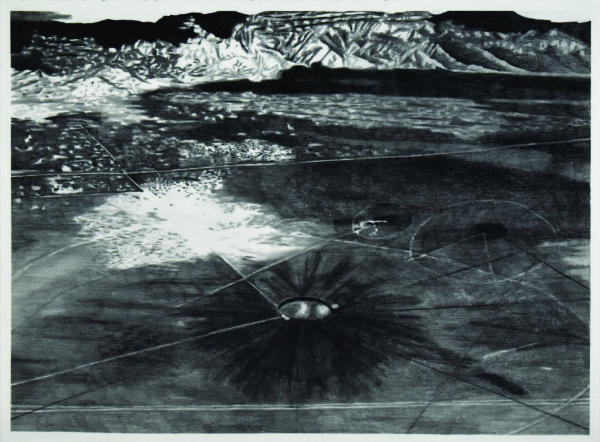
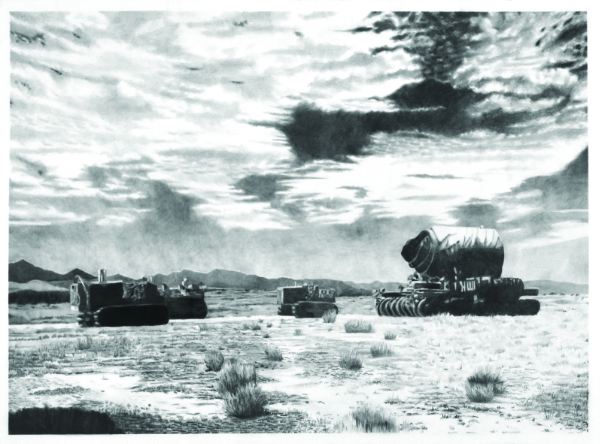
Trinity Test Site (August 1945), 2012. Graphite and radioactive charcoal on paper. Albuquerque Museum, museum purchase 2017, General Obligation Bonds, PC202.9.4.

Water from the well tapped at my grandparents’ land has been found to contain uranium at four times the volume recommended by the health department for safe consumption. We arrive at thresholds, look at patterns, wonder about safety. My mom gets cancer. It’s probably from something else.

Elizabeth Povinelli writes, Familiarity breeds this nervous system.

On January 29, 1951, Geiger counters at the Eastman Kodak Company’s film production plant at Lake Ontario detected high levels of radiation as snow fell around the city. Six years earlier, just after the July 16, 1945 detonation of the first atomic weapon, known as the Trinity Test, Kodak experienced significant financial loss after receiving reports that their film rolls were coming out cloudy. 

The company registered a complaint with the National Association of Photographic Managers, who telegrammed the Atomic Energy Commission. Tests snowfall Rochester Monday by Eastman. Kodak Company give ten thousand counts per minute, whereas equal volume snow falling previous Friday gave only four hundred. Situation serious. Will report any further results obtained. What are you doing? 

The Atomic Energy Commission released a statement to the press. Investigating reports that snow fell in Rochester was measurably radioactive.

My mom’s uterine cancer requires radiation. I touch her back as she hears this at the doctor’s office. The problem, she tries to explain, is that she knows too much.

I look into calculating my annual radiation dose on a typical year, an idea I get from the U.S. Nuclear Regulatory Commission. The tab says Radiation is All Around Us.

It’s a strange body feeling to attune oneself to a number.

It seems we live in a radioactive world, that radiation has always been constitutive of our material surroundings. I calculate my cosmic radiation, from outer space, which at sea level is only twenty-six mrem. At 7,000 feet where I live, this number is between forty and fifty mrem. I calculate my terrestrial radiation from the ground. A state bordering the Gulf or Pacific coast is exposed to twenty-three mrem. The Colorado Plateau area around Denver is exposed to ninety mrem. Everywhere else clocks in around forty-three mrem.

If you live in a stone, brick or concrete building, add seven mrem.

If you eat food and drink water, add forty mrem.

If you breathe the (radon in the) air, add two hundred mrem.

If you travel by jet plane, have porcelain crowns, wear a luminous wristwatch, use luggage inspection at the airport, watch TV, have a smoke detector, wear a plutonium-powered cardiac pacemaker, live within fifty miles of a nuclear power plant, or live within fifty miles of a coal-fired electrical utility plant, add more mrem. I do my best, and come out with 410.01 mrem, a number I have no emotional relationship to. This calculation feels like it betrays me, like everything I’ve heard about radiation’s destructive potential is wrong. Radiation is All Around Us.

According to the chart, natural radiation sources account for about eighty-two percent of all public radiation exposure. Man-made radiation sources account for the remaining eighteen percent for a typical person.

Executives at the Kodak Company, after their complaint following the secret detonation of a one-kiloton nuclear device, code name Able, at the Nevada Proving Ground, were granted “Q’’ clearances to receive information in advance of atomic tests to alter plant operations and protect film merchandise, so the company could secure profit margins despite radioactive fallout.K O D A K (1892)
You Press the Button, We Do the Rest!

Communities living downwind of the nuclear test sites were never given a warning.

The atomic story is one of tapping into, and harnessing, a destructive universal force of radiation, of matter’s self-immolating potentiality on Earth. The story goes, we’ve mastered it. But there is only story, itself a drive, and the inevitable unleashing of force, a narrative entropy that unspools in place.

The occupational exposure limit for radiation is 5,500 mrem per year. An occupational dose of 1,000 mrem increases the chance of eventually developing a fatal cancer.

The detonation of atomic weapons and the mining of heavy metals for their production is a known cause of harm for humans and various ecological receptors.

Radiation is all around us. One story betrays another.   
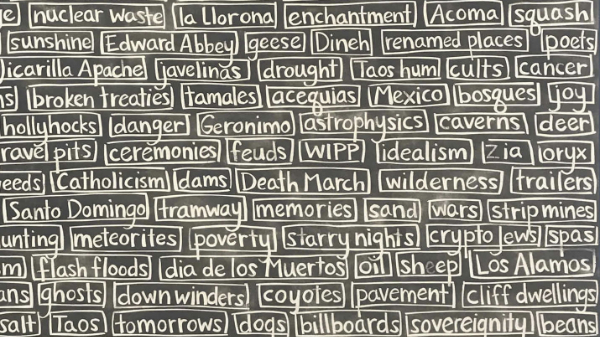
An Incomplete List of Everything in New Mexico, 2023. Mixed media drawing.

Established by the New Mexico State Legislature in 1986, the Art in Public Places (AIPP) program sets aside one percent of state capital outlay funds for the acquisition or commissioning of original visual artwork for public buildings and sites across the state. Since then, AIPP has placed over three thousand artworks across all thirty-three counties, enriching communities with innovative public art that reflects New Mexico’s cultural diversity, as well as regional and national artistic excellence. The AIPP program is one of many arts and culture services serving the creative sector as the State Arts Agency within the Department of Cultural Affairs.

Nina Elder’s artwork has been acquired through the AIPP program historically, and most recently for the permanent collection. An Incomplete List of Everything in New Mexico is currently on display at the New Mexico Arts offices in Suite 270 in the Bataan Memorial Building in Santa Fe.
Daisy Atterbury (opens in a new tab) has written for publications including The Paris Review Daily, BOMB, and The New Yorker online. Currently teaching in American Studies and the Women, Gender and Sexuality Studies Program at University of New Mexico, Atterbury’s work investigates queer life and fantasies of space and place, with an interest in unraveling colonial narratives in the Southwest. This excerpt is from The Kármán Line, published by Rescue Press in 2024. The Kármán Line was a St. Lawrence Book Award Finalist and is described as “a new cosmology” (Lucy Lippard) and “a cerebral altar to the desert” (Raquel Gutiérrez).

The Shapes of Space

Space is a shapeshifting throughline in Daisy Atterbury’s book The Kármán Line. There’s space as in I need some—a lover pulling away. There’s space misread as emptiness, as in the vast expanses of deserts and oceans, open space where governments detonate practice bombs. The space of the page flows and breaks around prose, poetry, and numbers. Above all else (literally) lies outer space, all stars, infinity, and awe, transcending the line between humanity’s illusory borders and the infinite free space beyond. “The air above me is full of invisible material and energy,” Atterbury writes. “It is full of matter—and memory.”

All these spaces and forms intermingle, collide, and layer upon each other in Atterbury’s debut, published by Rescue Press in 2024. The Kármán Line is a deceptively slender book that contains multitudes. A road trip to Spaceport America is interwoven with reflections on space travel, nuclear disaster, colonialism, identity and belonging, wildfires, and layers of history and violence in New Mexico. Formally, it’s just as adventurous. Narrative prose bursts into fragments, poetry, theory, instructions, text messages, and lists; equations even enter the chat. The quantifiable (physics, economics, nuclear science, one-star motel reviews) and the unquantifiable (love, loss, queerness, metaphor) move side by side.

And New Mexico carries it all. “In a story, setting provides a background against a foreground of self-making,” Atterbury writes. “But here? Setting wants to be foregrounded.”

This powerful sense of place is inextricable from Daisy Atterbury’s form as well as content. Born and raised in New Mexico, Atterbury now lives in Albuquerque and teaches American Studies and Women’s, Gender, and Sexuality Studies at The University of New Mexico. They spent the first seven years of their life in Shiprock, where their mother worked for the Indian Health Service, and independently, to support uranium miners and their families suffering dire aftereffects of the hazardous work: cancer, renal failure, miscarriages, death.When the family moved to Santa Fe, Atterbury encountered a “jarring” shift in the narrative about nuclear investment and production. The construction of relief route 599 around the city ignited heated discussion about nuclear waste transport and Santa Feans’ exposure to radioactive waste being transported from Los Alamos to the Waste Isolation Pilot Plant (WIPP) site. “I was feeling the importance of those conversations, and at the same time I was frustrated that that kind of care wasn’t brought to uranium miners doing work out in the more marginalized communities,” Atterbury said. “I’m still passionate about that, given that there’s an interest in renewing uranium mining [in the Navajo Nation].”

Atterbury moved to the East Coast for college and stayed to earn an MFA and a PhD, but New Mexico continually pulled them back home. In 2010, they co-founded an independent summer program called NM Poetics with Genji Amino. Their mission: “Using poetry as one name for those practices which recall and reconstruct alternative material and social ecologies, we work to attune ourselves to social and aesthetic movement that calls into question prevailing political framework.” In its ten-year run, the free incubator for artists and writers proved transformative.

 “[Experimental poetics] always felt political for me, coming up after the post-2008 financial crisis into a world in which it didn’t feel like my generation had a lot to move into. We were expected to be workers in this way that had become a faulty promise,” Atterbury says. “Meeting people who were trying to think through how to create alternative ways of conceiving of the world, and using art and writing to do that, felt really urgent.” For ten years, on a shoestring budget, NM Poetics convened artists and writers from New Mexico and elsewhere for two- to four-week residencies at rotating host sites. Faculty over the years have included luminaries such as Lucy Lippard, Layli Long Soldier, Arthur Sze, and Mei-mei Berssenbrugge. In the theory and practice of experimental poetry, Atterbury also tapped into a deep current of writers past and present “who took really seriously their aesthetic commitments as political scaffolding, as arenas and terrains for articulating other worldviews and other politics.” New forms created new possibilities.

It’s not that Atterbury intended to abandon traditional narrative altogether. But they had become acutely attuned to narrative’s pleasures and dangers, they say, including “both its fruitfulness for drawing people in and creating an experience and working with affect, and also its potential for manipulation.” Their youth in Santa Fe had been one such catalyst.

“Growing up in Santa Fe, I grew up into multiple competing narratives about what the city is and means, and who it’s for and what it stands for and what its values are,” Atterbury says. “Those narratives were very powerful in drawing people into living and acting and working and being in a particular way. And sometimes those narratives were successful in reaching a lot of people and folding people into the idea of what an equitable city can look like—and sometimes those narratives were limiting and were contingent on erasing certain parts of history, erasing Indigenous history, or not talking about violence and the city’s founding in a way that marginalized a lot of people and excluded them from the city’s narratives.” Atterbury grew up to understand narrative as “a material and a texture, a tool that I could explore, unravel, play with, unpack, try to understand in the writing of this book.”

Atterbury lights up when talking—and writing—about the material of language. The Kármán Line wrestles with analogy, synecdoche, taxonomy, and what a poem can possibly contain. The answer to the latter: everything.

“A poem is sparse, it’s economical, but if you’re interested in etymology, you have one word that can mean a whole history, right? And the word that you choose determines everything about the piece,” Atterbury says. “I like the weight that puts on language in an acute, compact space, where it frames and brings forward this idea of what language contains—which is a whole social history.”

Science holds its own poetry as well. Not only does the natural world teem with irresistible metaphors, but storytelling and figurative language are crucial tools for scientists to help us understand the world beyond what we can see. “I think that actually physicists and poets have a lot in common,” Atterbury says. “There’s of course a shared language that is descriptive and world-building and constructive, and then it does meet abstraction at a point.” In the life and writing of Theodore von Kármán, a twentieth-century Hungarian American mathematician and aerospace scientist, Atterbury found “a real kinship” and a way to conceive and frame the work that became this book. Kármán was fascinated with the point at which the wind ceases, which he identified as the demarcation between Earth’s atmosphere and outer space: the Kármán line. Below this line, nations declare borders and boundaries that extend up into the airspace. Beyond it, space is free, unclaimable, open to the entire universe. Encircling a world where humans have mapped and claimed every surface, free space offers another way to conceive of place and property, which dovetails with Atterbury’s earthly concerns of unraveling colonial narratives.

Utopian ideals of space meet the reality of material circumstances in New Mexico’s own Spaceport America near Truth or Consequences, a site Atterbury renders vividly: “From the road, like a lump in an endless horizon, the Spaceport’s soft organic form is a subtle dysregulation in the landscape.” Yet even in its strangeness, Atterbury finds something quintessentially New Mexican about the vexed launchpad:The Spaceport venture in New Mexico feels like it was essentially a failure. That Virgin Galactic, the company it was constructed for, recently transferred its business to the Mojave Air & Space Port launchpad in California, that the New Mexico spaceport primarily hosts school science contests, the government millions in the whole, is no surprise and no real deterrent. This only adds to its appeal, makes it more local.

There’s genuine affection in this assessment, as Atterbury later explains. “The aspirational aspect with the reality of the infrastructure at hand and always ending up in a strangely compromised situation everyone has to accept and deal with, feels familiar. But I love New Mexico. And I loved returning.” Moving back permanently in 2018, Atterbury found a generous, strong community of writers and artists, a community that coalesced even more powerfully during the COVID-19 pandemic.

This sense of belonging was potent, particularly for any artist who has ever felt like an outsider in the culture. “My experience of outsiderness has been vulnerable and challenging,” Atterbury says. As a settler child in the Navajo Nation, Atterbury’s outsider position taught them to listen and observe closely, tuning in to cultural and linguistic nuances that expanded their understanding of place, culture, and colonial assumptions. “Existing in a gendered and sexual body feels misaligned with normative culture and understanding the histories of people inhabiting those kinds of bodies and those kinds of experiences,” Atterbury says. They try “to find the value in the perspective it brings while acknowledging the friction and the hardship and anxiety that can come along with feeling on the outside to a degree.” They write:Meanwhile, we structure social norms around a dislike for seeing someone other than in their place. We fear the sudden wind of a betrayal of position, the ways it blows up our skirts and exposes the truth that we all have choices to make.

Through their writing, Atterbury is “trying to understand how those misalignments provoked in me a desire to understand more about social history, social dynamics, and power dynamics, and how language reflects and produces the ways we understand ourselves in relation to others. It’s a vulnerability I tried to bring to the book at times.” Amid the more intellectual and heady material, “I wanted there to be some real moments where I went to a place of rawness.”

Sometimes that rawness materializes in the recurring storyline of a romantic relationship coming painfully apart. Sometimes it’s in the tenderness and uncertainty of familial silences, in tacit understandings. Sometimes it’s in the unraveling of colonial narratives and Atterbury’s reckoning with their own place in legacies of settler violence. Throughout, the book raises questions of harm and repair, how to reckon with and love the world we have created and live in:To concern yourself in this place with the health, well-being, and sustenance of life and not-life in this place, and to ask of the integrated and delicate network some permission to percolate into this place, may be to admit first that some forms of contact will leave a scar.

Learning to live with your own potential to do damage, and to love what’s damaged and altered, emerges as the primary arc of The Kármán Line. “I think about loving a wrong tree, an invasive tree, its luxuriating spread a reminder of seeds scattered without attention to the disorder the land wanted, how it’s our problem now to love,” Atterbury writes near the end.

“It’s turned out to be my favorite line in the book,” Atterbury says, “because it captures, I think, the incredible challenge in front of us and quandary that we’re in, which is that we have to invest in the world that we’ve built and made … to find a way to invest and love what exists in a grounded real place, to live as we are in a tolerable way and change what we can.”

Even in the effort to become more connected and present, space can still teach us how to live better lives on Earth, Atterbury says. They cite Afrofuturists, Indigenous futurists, and writers such as Ursula K. Le Guin as models who think beyond the fantasies of conquest, solitude, and dissociation, “who use space as a metaphor but from a really grounded and creative place, trying to find a way to actually live in a necessary present, but with tools.” Drawing upon all the disciplines and tools Atterbury gathers for the journey —science, poetry, memoir, cultural histories—The Kármán Line vividly, insistently seeks both to make sense of what is and to imagine what could be.   

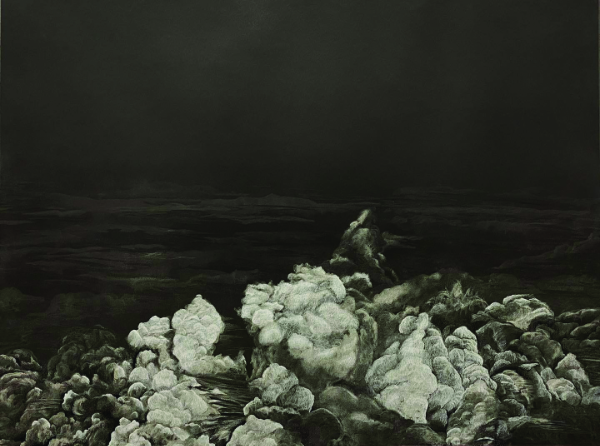
Hiroshima Sky (August 6, 1945, as photographed from U.S. Air Force plane Necessary Evil), 2022. Graphite, wildfire charcoal and graphite on paper. Courtesy of artist.
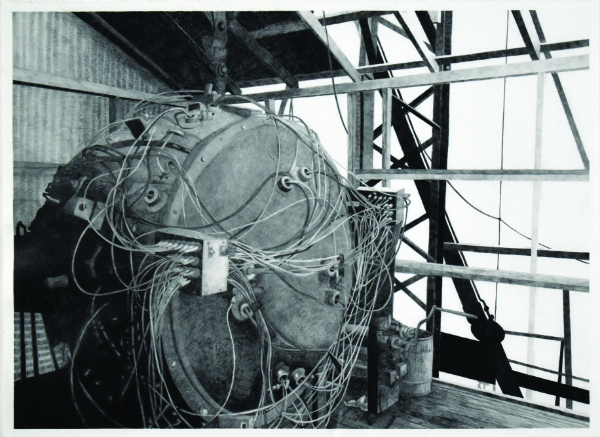
The Gadget (Trinity Test Site, July 15, 1945), 2011. Graphite, radioactive charcoal on paper. Albuquerque Museum, museum purchase 2017, General Obligation Bonds, PC2020.9.1.
Jumbo (Trinity Test Site, April 7, 1945), 2012. Graphite and radioactive charcoal on paper. Albuquerque Museum, museum purchase 2017, General Obligation Bonds, PC2020.9.2.

Chelsey Johnson is the author of the novel Stray City and the director of the City of Santa Fe’s Arts & Culture Department.

A Visit to La Cueva

Northern New Mexico is full of unexpected surprises, like a stunning vista around a bend in the highway, or a crumbling adobe building at a fork in the road. With history nestled in the valleys and tradition perched atop every mountain, the ties to this land stretch back through triumph, turmoil, and time.

In one of these valleys, partially hidden behind a cluster of trees along a two-lane road, is La Cueva Mill and its adjoining farm. Cottonwoods envelop the lush landscape along the Mora River. Here, the leaves rustle in the breeze, mimicking the sounds of flowing water while flowers of all shapes, sizes, and hues reach for the bright blue skies above. Everything is bathed in the ambient summer air carrying warmth and the smell of pine and river water. This place is a far cry from what most picture when thinking of New Mexico; the cacti are sparse here, and the visual language of a desert is not spoken fluently in this area.

I remember many trips to the raspberry farm with my family and friends. We wove through the rows, crouching and stretching to pick raspberries that were just right. The hue of my red-stained fingers deepened as I enjoyed more than occasional taste tests while filling my bucket well past the brim. Every trip closed with a raspberry sundae in the shade to cool off after picking. It was a treat to bring home raspberries—some to eat fresh and some to make raspberry sauce. Their bright red color and floral flavor always added a sweet vibrance to anything they were paired with.

La Cueva is illuminated by a rich afternoon sunlight which gives everything a warm glow. The radiance intensifies as the day leaks through the yellows and greens of the trees’ leaves. The sun lends its light to the structures that speckle each edge of the road. Assembled from wood, adobe, stucco, and tin, the buildings along NM-442 look as though they sprouted directly from the earth. Like small mountains, they stand rooted in the land, weathered by nearly two centuries of history, but resilient and enduring. 

Chris Romero is a graphic designer, illustrator, and photographer currently pursuing an MFA in Media Arts & Cultural Technology at New Mexico Highlands University. He is based in Las Vegas, NM.

Strike and Struggle

When violence erupted in early 1935 after the Gallup American Coal Company attempted to evict striking miners from its coal camps, Robert Minor, the famous union activist, raced to Gallup, New Mexico, from New York to help. It would be his first and only trip to Gallup, and he would barely make it out alive.

Minor hoped to lend his celebrity to the cause of the Gallup miners. In the early twentieth century, he was the most popular and highest-paid cartoonist in the country. His cartoons for the St. Louis Post-Dispatch and New York World condemned imperial wars, lampooned wealthy industrialists, and celebrated working-class struggles. On the eve of World War I, when his paper demanded he draw pro-war cartoons, he quit his job, declared himself a Socialist, and joined the staff of The Masses and The Call, two of the most radical political magazines in the country.

More than 250 troopers from National Guard units from throughout New Mexico occupied Gallup for more than four months after New Mexico’s Governor declared martial law in August 1933. Courtesy of the Palace of the Governors Photo Archive (NMHM/DCA), Neg. No. HP.2024.26.0021.

Minor’s cartoons made him a major celebrity among left-wing political activists. When he went to Russia in 1918, Vladimir Lenin told the cartoonist he was a fan of his work. When he went to France to work on behalf of striking railway workers, he was jailed for treason and threatened with execution. When he returned to the U.S. in 1920, he was known as “Fighting Bob,” a dyed-in-the-wool Communist, and he gave up art for politics. 

He joined the executive committee of the Communist Party of the United States of America and spent the next two decades organizing campaigns to free political prisoners and political activists. As director of the Communist Party’s International Labor Defense (ILD), he helped defend Sacco and Vanzetti, the Italian anarchists accused of, and later executed for, robbery. He co-organized the defense of the Scottsboro Boys, the nine Black teenagers accused of rape by a white woman in Alabama. He was instrumental in starting ILD’s magazine, Labor Defender, which chronicled labor struggles across the country, particularly the campaigns of the National Miners’ Union (NMU). 

Robert Minor is inspected by police after his kidnapping. Courtesy of the Palace of the Governors Photo Archive (NMHM/DCA), Neg. No. HP.2024.26.0023.
Robert Minor (left) and David Levinson pose for a photo in Gallup following their kidnapping in May 1935. Courtesy of the Palace of the Governors Photo Archive (NMHM/DCA), Neg. No. HP.2024.26.0030a.

This communist-affiliated labor union organized coal miners in Appalachia and the intermountain West. When a series of NMU-organized strikes shut down coal mining in Utah and Colorado in the mid-1930s, Minor and the ILD helped organize relief supplies. The strike spread to New Mexico, where Governor Arthur Seligman declared martial law in Gallup in August 1933. Minor sent lawyers to defend the Gallup strikers and their union organizers from harassment and arrest by troops. In the months after the strike was settled, the Gallup coal bosses slow-walked their promise to rehire coal miners in 1934. Minor condemned the coal mining companies and publicized the strikers’ plight in the pages of Labor Defender.

A month before Minor arrived, Sheriff’s deputies had arrested three striking coal miners for resisting their eviction from the company camp, then hauled them into Gallup for a preliminary hearing. Hundreds of miners protested the hearing, banging on the courthouse doors, prompting the judge to suspend the hearing. The Sheriff and three deputies hauled their prisoners out of the courthouse’s back door but found themselves surrounded. They fired tear gas into the crowd. Shots rang out. When the smoke settled, the Sheriff lay in a pool of his own blood, dead from a gunshot wound to the head.

Chaos erupted. McKinley County Undersheriff Dee Roberts organized an official posse and dispatched it to Gallup. For the next forty-eight hours, hundreds of armed men roamed the town, searching homes and making arrests. Scores of miners were charged with capital murder of the Sheriff. Dozens were deported. The killing of the Sheriff made national news.

When Minor, along with an ILD lawyer named David Levinson, showed up in Gallup on May 2, 1935, armed men, some masked, patrolled the town. Minor was in Gallup to interview witnesses and collect evidence in the defense of the dozens of people charged with capital murder. He and Levinson met with Julia Bartol, the wife of one of the jailed union leaders, at El Navajo hotel. Deciding it wasn’t safe to discuss the case in the hotel lobby, they met instead in Bartol’s car, which was parked at Gallup’s plaza. 

Just as they began to talk, masked men in three different cars surrounded them. Levinson stepped out of the car, put his hands in the air, and said he was a lawyer representing working men. 

“We don’t want speeches,” said a masked man just before pistol-whipping Levinson. The last thing Minor remembered was being dragged from the car. When he came to, it was the middle of the night, twenty-five miles from Gallup, and he was lying on the side of the road bleeding from the head. 

“Get out of Gallup,” yelled a masked man as he sped away. “Get out and stay out.”

The Start of the Gallup Coal War

The kidnapping of Minor and Levinson came at the tail end of one of the Great Depression’s most dramatic labor struggles. For decades, the two thousand coal miners who worked the Gallup coal fields had risked their lives to work more than six hundred feet underground, digging hundreds of thousands of tons of coal each week. They came from all over the world. Most had been recruited in Mexico to work the Gallup mines. Some had come from eastern and central Europe. Fewer than a dozen were U.S. citizens. The coal they dug fueled New Mexico’s blast furnaces and copper smelters, powered The Santa Fe railroad locomotives, generated electricity for every town west of Albuquerque, and was sold as far west as San Francisco.

The miners were paid in company scrip, and their wages were based on the amount of coal a miner could dig, measured by rigged scales. By the early 1930s, most worked only a day or two a week and earned less than twenty dollars a month, a wage reduced by deductions for the company doctor, rent in a company-owned camp, food and powder at a company-owned store, and electric mining lamps and fuel at marked-up prices. If miners complained, the bosses docked their pay. 

When Governor Andrew Seligman declared martial law in late August 1933 and Adjutant General Oswald Wood proclaimed “inflammatory language” illegal, NMU organizer Martha Roberts (center standing) read editorials from New Mexico newspapers condemning martial law. “These aren’t my words,” she told the crowd. “They can arrest the Albuquerque Journal if they want.” Courtesy of the Palace of the Governors Photo Archive (NMHM/DCA), Neg. No. HP.2024.26.0031.

When they tried to join a union, workers were blacklisted or deported. The United Mine Workers of America (UMW) organized Gallup miners during the nationwide coal miners’ strike of 1922 on the promise of better wages and working conditions. When the UMW settled the strike in Kentucky and the Virginias, it ordered the Gallup miners back to work before they could gain union recognition from the coal companies.

Coal mining remained profitable in New Mexico during the Great Depression, but only because the mine operators reduced the workforce and slashed payroll by using skeleton crews. Half of all miners were unemployed and living on aid from the Depression-era Federal Emergency Relief Administration. In the summer of 1933, despite previous failures, desperate miners once again tried to organize a union. The National Industrial Recovery Act of 1933 granted workers the right to join independent unions and to bargain collectively with their bosses. Still distrustful of the UMW, the Gallup miners turned instead to the NMU, which was created in 1928 by Communists purged from the increasingly conservative UMW.

The NMU sent Martha and Bob Roberts to Gallup in August 1933. Both had just graduated from New York’s famed Brookwood Labor College, a school novelist Sinclair Lewis called “labor’s Harvard.” Martha was just twenty-one years old and was already a seasoned organizer. Before coming to Gallup, she’d spent months organizing farmworkers in New Mexico’s Pecos Valley. Over the next four months in Gallup, she and Bob enrolled nearly one thousand mine workers into the NMU, created a women’s auxiliary that picketed alongside the miners throughout the strike, and even organized the children of Gallup’s miners, who spent the strike marching through the streets demanding better wages and safer working conditions for their fathers. 

Martha became the face of the strike. She led members of the women’s auxiliary to and from the picket lines each morning, gave rousing speeches at the plaza condemning the coal companies for refusing to negotiate, and confronted the police and the soldiers when they were sent to break up the strikers’ marches. She was arrested by deputies for being a Communist, beaten by troopers for insurrection, attacked by UMW agitators who opposed the strike, and eventually, in late 1934, ejected from New Mexico by the Governor.

The struggle that began in the summer of 1933 lasted nearly two years and would become among the most dramatic labor struggles in U.S. history. Before it was over, martial law was declared and vigilantes patrolled the streets, troops occupied Gallup, civil rights were suspended, a Communist witch hunt seized the town, hundreds of miners were arrested. Half a dozen were convicted on dubious charges, scores were evicted from their homes, dozens deported, and a County Sheriff was assassinated.

When the Reds Arrived in Gallup

The Gallup American Coal Company, known locally as Gamerco, whose company town north of Gallup was known by the same name, was the largest of the five coal operators in Gallup during the 1930s. Gamerco was owned by the Kennecott Corporation, the Guggenheim-financed company that operated southern New Mexico’s Chino mine, the world’s most profitable copper mine. Gamerco dictated wages and working conditions throughout the coal fields. As one historian described it, Gamerco was the kind of western operator that prided itself on its “strong-armed frontier refusal to recognize labor unions.” 

The New Deal, however, offered federal protections for union organizing. In July 1933, Gamerco’s General Manager Horace Moses, hoping to get around the new law, created a company-run union and ordered his employees to join it. The miners refused and voted to join the NMU instead.

National Miners’ Union strikers in Gamerco along Highway 666 prepare to set up pickets to stop replacement workers from entering the mine. Courtesy of the Palace of the Governors Photo Archive (NMHM/DCA), Neg. No. HP.2024.26.0029.

When coal miners in Utah walked out of the mines just weeks later, the local papers feared Gallup would be next. We have grievances, Gallup miners explained, but no plans to strike. Union organizers presented the miners’ grievances to Gamerco in August and asked for an answer by the following Monday. Moses said he didn’t need till Monday. “Our answer is ready now,” he said, “and the answer is no.” The miners declared a strike on August 29.

The first pickets appeared at Gamerco at dawn the next day, where strikers blocked the mine entrance and turned back the scabs, some of whom were Navajo miners recruited by Gamerco to replace the strikers. Scores of strikers kept non-union workers out of the Mutual Mine, while dozens more blocked the trail to the Southwestern Mine.

Just hours after the strike was called, McKinley County Sheriff Dee Roberts sent New Mexico Governor Arthur Seligman a telegram demanding that he call in troops and force the miners back to work. The miners were armed, he told Seligman, and violence and bloodshed were likely. The telegram was signed by the general managers of all five coal companies, the Mayor of Gallup, Gallup’s Justice of the Peace, the American Legion, Veterans of Foreign Wars, and even the American Federation of Labor. The Governor, who had never heard of the National Miners’ Union, sent a telegram to John L. Lewis, the powerful president of the United Mine Workers of America, asking for his advice. 

This strike was “the first time in history that I know of,” he told Lewis, “where all of the unions like the United Mine Workers Union, the Big Four Brotherhoods, the American Federation of Labor, have asked an executive for troops and martial law.” That’s because “the NMU is a subsidiary of the Communist Party U.S.A.,” wrote Lewis, who recommended the Governor send in the troops. Seligman sent a telegram to the National Recovery Administration (NRA), a New Deal-era agency created to mediate labor disputes. They wired back, telling Seligman that “the NMU have direct connection with Communist leaders in this country.”

Seligman, a Democrat, at first hesitated to send troops into a labor dispute. He wired New Mexico Senator Bronson Cutting, asking for advice. An aide suggested he go to Gallup and investigate the situation himself. Seligman, too ill to travel, sent Adjutant General Osborne Wood instead. Wood traveled to Gallup the day after the strike and spoke only to the Sheriff and Mayor of Gallup. I can confirm, he wrote Seligman, “the communistic affiliations of the National Miners Union.” He advised the Governor to declare martial law. Despite the growing Red Scare of the 1930s—which became a Communist witch hunt following World War II, in which Communist labor organizers were purged from unions throughout the U.S.—the National Miners’ Union never hid the fact that its organizers were Communists. 

The year before the Gallup strike, at its national convention in Pittsburgh, NMU delegates pronounced NMU the vanguard union of a working-class revolution. We are “founded on the principles of the class struggle of the exploited masses of the working class against their capitalist exploiters,” they declared, and our ultimate aim is “to participate in the struggle for abolishing the capitalistic system and replace it by socialism.” 

Martha Roberts published fiery updates in the pages of Labor Defender. The magazine was edited by a “who’s who” of the American left, including Langston Hughes, Lincoln Steffens, and John Dos Passos. The magazine also published articles by writers unaffiliated with the Communist Party, such as Upton Sinclair and Eugene V. Debs. NMU organizers wrote articles in nearly every issue of Daily Worker, Western Worker, Pacific Weekly, and other left-wing newspapers and magazines.

Seligman wired Senator Cutting and explained why he felt compelled to send troops to Gallup. “The National Miners’ Union is an organization created by the Executive Committee of the Communist Party of America,” he wrote, “and is financed and directed by such Committee.” Cutting’s aide dismissed Seligman’s concerns and cautioned against declaring martial law. “We all know there are communists in all organizations and perhaps more in the NMU than others,” wrote the aide. “But this does not make it a communistic organization.” He reasoned that just because the organizers were Communists didn’t mean the miners were. 

Their goals were more modest than revolution. Just read their grievances, Cutting’s aide told Seligman. They were tired of getting no pay for all the work that went into maintaining mine shafts. They wanted union miners at the scales when the bosses weighed their coal. The miners were tired of loading coal into coal cars all day and then watching as the bosses claimed it was full of rocks and dirt—“dirty coal,” the bosses called it—and refused to pay them. They wanted time and a half for overtime and double time on Sundays. Mostly, they wanted union recognition.

Seligman ignored the aide’s advice and declared martial law on August 30, 1933. The declaration ordered all criminal trials to be held by military tribunal. “Incitement” and “inflammatory language,” which General Wood alone would define, were declared illegal. The possession of firearms and explosives were banned. Meetings of more than five people required a permit. By the end of the first day, hundreds of troopers from National Guard units in Roswell, Clovis, and Albuquerque occupied Gallup. The cavalry patrolled the stockyards where the strikers rendezvoused each morning. Troopers armed with tear gas blockaded the highway. Armed squads occupied NMU headquarters and stood guard at every coal mine. 

“Picketing has gone on at each of the mines in a peaceable and orderly manner,” protested Alejandro Alvarado, the local NMU secretary in Gamerco, in a letter to Seligman. “We have molested no one, nor have we damaged any property.” 

Seligman ignored the pleas. “I did everything possible to avoid sending the troops,” he explained, “but the appeals were so insistent, and so many prominent people from other parts of the state, who I contacted, both Republicans and Democrats, believed it best for me to act and act promptly.”

Sheriff Dee Roberts (front, center) leads a parade of arrested miners to jail in April 1935. Courtesy of the Palace of the Governors Photo Archive (NMHM/DCA), Neg. No. HP.2024.26.0070a.
By the end of the first night on April 4, 1935, police and members of the Sheriff’s posse had arrested hundreds of unemployed miners. Courtesy of the Palace of the Governors Photo Archive (NMHM/DCA), Neg. No. HP.2024.26.0013.

The NRA sent a negotiator to mediate the dispute, but the union refused to meet “unless local union committees are recognized by operators.” Moses likewise refused, saying he “had nothing to discuss with the strikers.” 

Undeterred, the federal mediator told the local paper he “saw no reason why the strike could not be settled quickly.” The union’s only chance, he explained, was “to go back to work and wait for the coal industry code.” Though it would be declared unconstitutional in 1936, the Coal Code, part of Franklin Delano Roosevelt’s New Deal restructuring of labor law, gave workers the right to collectively bargain, but not if they declared a strike. Despite the law, union miners refused to return to work.

In mid-September, with troops escorting more and more replacement workers, most of whom were Navajo miners, past the picket lines, Gamerco announced an agreement with the UMW. As one mine manager explained it, “the UMW are a better class of people than the NMU. The NMU consists of I would say probably 80 percent Mexicans, probably 80 percent of those are not citizens of the U.S. Therefore, the UMW is a more intelligent race of people.” 

The agreement reserved mining jobs for UMW members only, which at the time refused membership to the Navajo miners who were hired to work the mines as scabs. In response to the UMW agreement, the NMU began secret negotiations with two smaller mines. In a series of confidential letters among organizers, they described the negotiations as an effort “to split up these companies from working together” and “utilize the difference between them to destroy their present solidarity.” They took the willingness of the smaller mines to engage in secret talks as evidence that “bears out the correctness” of the strategy. But the plan depended on getting agreements with “two or three of them, not one.” 

The union, however, abandoned the strategy before any agreements could be reached when Sheriff Roberts raided NMU headquarters and arrested five strike leaders on vagrancy charges, including Martha and Bob Roberts.

With all negotiations canceled and picketing in front of the coal mines banned by the troops, striking coal miners took to the streets instead, marching through Gallup in protest. Scores of children walked out of school and marched to the jail, chanting, “We want Martha.” ACLU attorneys rushed to Gallup to represent the jailed leaders. Newspapers throughout the state condemned the arrests. How could they be guilty of vagrancy, one of the lawyers asked, when “they make more money than we do.” 

Sheriff Roberts charged them instead with “Assault and Battery by Words,” but a judge dismissed the charges four days later, releasing all prisoners.

Unemployed miners are loaded onto trains to be deported following the killing of Sheriff Carmichael in April 1935. Courtesy of the Palace of the Governors Photo Archive (NMHM/DCA), Neg. No. HP.2024.26.0072a.

A Red Scare Arrives in Gallup

The arrests marked an escalation in strike-breaking tactics. In response, NMU organizers sent picketers back to the mines. In late September, with nearly five hundred strikers picketing Gamerco, guard troops waved a vehicle through the blockade. As it drove past a line of picketers, a UMW miner named Bill Reese rolled down the window and sprayed the strikers in the face with a fire extinguisher. The terrified picketers ran from the car, but troopers with tear gas and bayonets blocked their escape. Dozens were treated for burns to the face. Six were held in the hospital overnight, including Martha Roberts. 

They had it coming, explained Reese, who wasn’t charged for the attack. “This fight is between Americans and un-Americans,” he told the press, “with the Americans on the side of the coal operators.” Reese defended his actions in a letter sent to every newspaper in the state. “This is not a common strike between capital and labor,” he wrote, “but a fight between American working men and a bunch of working men composed almost entirely of foreigners, half of whom are communists at heart and the other half poor ignorant Mexicans that are too dumb to know what they are and are easy prey for agitators whose teachings are entirely foreign to American principles.”

In October, the coal companies threatened to deport striking Mexican and Eastern European miners. General Wood ordered the arrest of seven union organizers, including Bob Roberts, for making “inflammatory remarks” at union meetings. Wood claimed to have overhead Roberts exhorting striking miners to “pick up their firearms” and “intimidate the families” of replacement workers. 

Governor Andrew Hockenhull, who’d been inaugurated just weeks earlier when Seligman died of a heart attack, asked federal officials to assume responsibility for the Gallup strike, but they refused. He begged the largest operators to negotiate, but Moses, claiming he’d found replacements for nearly eighty-five percent of his workforce, saw no reason to negotiate. When Hockenhull considered withdrawing troops, Kennecott threatened to close its mines and smelter and lay off its workforce of thousands.

In early November, Martha Roberts led the miners to the town plaza to protest the arrests. When they arrived, troopers fired tear gas at the marchers. Hand-to-hand combat erupted when strikers threw the smoking tear gas canisters back at the troopers. General Wood issued a shoot-to-kill order and sent reinforcements. Troopers arrested thirteen people, including Roberts. Furious letters from prominent Santa Feans, including one from the artist Gustave Baumann, flooded the Governor’s office, but Hockenhull refused to intervene.

The trial for the seven union leaders arrested in October was held in a military court in November. Four were released, but three, including Bob Roberts, were sentenced to six months of hard labor. The operators applauded. “Keep the militia in Gallup,” they proclaimed, and “the agitators in jail.” General Wood ordered the arrest of six more union leaders.

The National Labor Relations Board sent a mediator to Gallup in late November. Its relief supplies exhausted, the union agreed to negotiate. When the coal companies agreed to rehire most of the strikers and Governor Hockenhull promised relief jobs for those not rehired, the union settled the strike and agreed to return to work, but only if union members were released from jail. Hockenhull agreed, but on the condition that union leaders leave New Mexico. 

Eighteen strikers were freed from jail on November 29, 1933. The union claimed victory in the strike and held a rally on the plaza to celebrate. As soon as the rally ended, National Guard troopers forced the union organizers into cars and drove them to the Arizona border, where they were physically thrown out of New Mexico.

With the strike over, the miners reapplied to Gamerco for their jobs but were told there were none to be had. Despite his promises, Governor Hockenhull declined to intervene when local emergency relief boards of the Civil Works Administration refused to hire unemployed miners. The blacklisted miners organized themselves into an Unemployed Council of the NMU and spent the next year picketing the relief offices. Fearful of another fight with the NMU, Gamerco sold Chihuahuita, the company camp where most unemployed miners lived, to Clarence Vogel, a local junk dealer and recently elected state senator. 

Vogel demanded rental payments that no striker could afford. Evictions began in April 1935 when Sheriff’s deputies removed Victor Campos and his family from their home, boarded up the house, and left the family’s belongings on the street. When the deputies left, neighbors tore off the boards and moved the family’s belongings back into the house. When Vogel complained, deputies arrested Campos, his neighbor, and Exiquio Navarro, who had built the house with his own hands, charging all three with trespassing.

A “Mob Riot Murder” in Gallup

Hundreds of miners from Chihuahuita came to Gallup for the preliminary hearing on April 4, 1935, but Justice of the Peace William Bickel padlocked the courtroom and refused entry. With protesters pounding on the door, Bickel postponed the hearing until defendants could find lawyers. Sheriff Carmichael, former Sheriff, now Undersheriff, Dee Roberts, and two deputies, hoping to avoid the protesters, took the three prisoners out the back door of the courthouse but were found in an alley and surrounded. 

Roberts ordered the fire department to blast its sirens, the signal that called the Sheriff’s posse to duty. Hundreds of members of the American Legion, Veterans of Foreign Wars, and local ranch hands armed with pistols and shotguns responded to the call. Roberts deputized two hundred fifty “special deputies” and sent them out in small squads to search for Communists. “We are going to arrest everyone identified with the radical movement,” he promised. 

Justice of the Peace William Bickel (center, right) kept a rifle on the bench during the preliminary hearing for those arrested following the Sheriff’s killing in 1935. To his right stands Adjutant General Osborne Wood who led the military occupation of Gallup during the 1933 strike. Wood was the son of famed Army General Leonard Wood, who’d served as Military Governor of Cuba and Governor- General of the Philippines after the Spanish-American War. Courtesy of the Palace of the Governors Photo Archive (NMHM/DCA), Neg. No. HP.2024.26.0014.

Deputies fired tear gas into the crowd. Gunfire erupted. When the smoke settled, the Sheriff and Ignacio Velarde, an unemployed miner, were dead. Two deputies and Solomon Esquibel, a leader of the Gamerco NMU local, lay wounded. Two of the prisoners, Campos and Navarro, disappeared and were never seen again. Dee Roberts claimed Velarde and Esquibel killed the Sheriff and then shot the deputies, but the only gun found in the alley was the one Roberts used to shoot Velarde and Esquibel in their backs.

Roberts ordered the fire department to blast its sirens, the signal that called the Sheriff’s posse to duty. Hundreds of members of the American Legion, Veterans of Foreign Wars, and local ranch hands armed with pistols and shotguns responded to the call. Roberts deputized two hundred fifty “special deputies” and sent them out in small squads to search for Communists. “We are going to arrest everyone identified with the radical movement,” he promised.

By early afternoon, thirty people “affiliated with the Communist party” were under arrest. The deputies, some with warrants, others with instructions to search every house, made arrests throughout the night and into the next until the county and city jails were full. The district court was converted into a temporary jail to hold the overflow. When it was over, nearly a thousand people, more than fifteen percent of Gallup’s population, had been arrested, questioned, or had their homes searched.

Preliminary hearings began two days later. When defendants, none of whom had lawyers, entered the court, they found a loaded rifle on the Judge’s bench and armed deputies in the jury box. Those not charged with murder were charged with being members of “an organization that believes in the overthrow of the government of the United States by force and violence.” The defendants who spoke no English were loaded onto trains and turned over to immigration authorities for deportation. All others were shipped to the prison in Santa Fe. The Gallup newspaper reported that a dozen more “were believed deportable as the result of a seizure of Communist literature made yesterday.”

Days later, a coroner’s jury exonerated Dee Roberts for killing Velarde, calling the shooting “justifiable homicide by an officer,” a decision based entirely on the testimony of the jury’s only witness, Dee Roberts. The next day, prosecutors charged fifty-five people for the “mob riot murder” of Carmichael, a charge based on an obscure territorial statute. Never before in U.S. history had a state sought to execute so many people for the same capital offense.

On April 12, the same day Esquibel died of his wounds, District Judge Miguel A. Otero ordered a new preliminary hearing for those arrested. Otero gave the defense team, led by ACLU attorney A.L. Wirin, time to hire legal staff, collect evidence, and prepare a defense. He asked Robert Minor and David Levinson for help, and the two men arrived in Gallup on May 2 to interview witnesses. As they sat in Julia Bartol’s car, talking about the case, two cars approached and circled their automobile. A third appeared and pulled up alongside Bartol’s car. Three masked men stepped out. 

Levinson protested but was pistol-whipped by a man in a mask. Another put a gun in Bartol’s face. A third pulled Minor from the car and hit him in the face with the butt of a pistol, knocking him unconscious. Hoods were placed over their heads and they were thrown in separate cars. “When I came to, I was again beaten and remained unconscious until shortly before the conclusion of the ride,” Levinson said later. Minor and Levinson walked all night in a rainstorm, eventually coming upon a hogan where a Navajo man took them in, covered them in blankets, and drove them to the hospital in Tohatchi. 

The kidnapping of Levinson and Minor made national news. Sheriff Roberts, however, dismissed it as a hoax. The District Attorney refused to investigate, calling it a “waste of the taxpayers’ money.” When Minor and Levinson demanded protection, the DA refused, telling the Governor, “There was no evidence to justify action.” Minor and Levinson, fearing for their lives, resigned from the legal team and left New Mexico. They spent the next month on a national speaking tour raising money for the defense.

Wirin managed to get dozens released from jail at the preliminary hearing in Santa Fe when he proved that most of those arrested, nearly all of whom were Mexican citizens, were nowhere near the courthouse at the time of the shooting. He convinced the prosecution to drop the charges against three more defendants. He asked what arrangements could be made to return them to Gallup. 

“There is no need for transportation arrangements,” explained the District Attorney. Since they’re not American citizens, “they will be seized at once by the United States Marshal for deportation.”

By the time the trial was held in Aztec, New Mexico, in early October 1935, the charges against most defendants had been dismissed, but ten men still stood accused of murder. Dee Roberts, who suffered no injuries during the shooting, testified at the trial that one of the defendants hit him in the head with a hammer. Another deputy, who’d suffered no knife wounds, claimed a second defendant stabbed him with an ice pick. Seven defendants were acquitted on the murder charges but found guilty of rioting. 

District Judge James B. McGhee blamed the crimes on Bolshevism and ordered five of the men acquitted of charges to be “released to immigration authorities for deportation to Mexico.” He ordered two men, both of whom were U.S. citizens born in New Mexico, “to leave New Mexico at once.” One was driven to Arizona and the other to Colorado. Three men, Juan Ochoa, Manuel Avitia, and Leandro Velarde, the brother of the slain Ignacio Velarde, were convicted of murder in the second degree and sentenced to “not less than forty-five or more than sixty years” in prison. Velarde was eventually released on appeal by the New Mexico Supreme Court in 1937. Ochoa and Avitia were pardoned by Governor John E. Miles in 1939, but only on the condition that they leave the state for good.

The National Miners’ Union officially disbanded after the Gallup Coal War. Martha and Bob Roberts continued to organize farm workers and coal miners in Colorado and Utah, but undercover police tailed them wherever they went. We are “alert and determined that the Roberts shall not disrupt the present tranquility in the mining camps,” wrote police in one confidential 1934 report to the Governor of New Mexico. The Gallup miners voted to rejoin the United Mine Workers in 1935 but were unable to get a contract with any of the coal companies in Gallup. By 1936, no dues-paying member of any union could be found in any Gallup coal mine.   

The photos in this story are from the Mullarky Studio Collection, donated to the New Mexico History Museum in 2024 by John R. Stein and Lillian Makeda. In 1927, William Thomas “Tom” Mullarky purchased the J.R. Willis Studio in Gallup, New Mexico. Through his death in 1959, Mullarky Camera Shop and its staff documented the area, photographed significant people and events, and created influential promotional images. The collection in the Palace of the Governors Photo Archives contains important images of the city of Gallup and surrounding communities during a time of transformation. Photo Archives hopes to digitize and create public access to this collection in the future. 

David Correia is a historical geographer who writes about New Mexico history, labor geography, and environmental politics. He is a professor in the Department of Geography and Environmental Studies at the University of New Mexico and the author of six books, including Properties of Violence: Law and Land Grant Struggle in Northern New Mexico.

Aztlán

The City of Española, New Mexico, officially turns one hundred years old this year. But the land and people of the valley tell a deeper story—one that slips past the barbed-wire borders of time, place, and stereotype, refusing to be hemmed in by the bias of public imagination.

The centennial fiestas in September offer more than municipal commemoration—they are an opportunity to honor nuestra querencia: our belonging to the land and lifeways that have sustained valley communities for millennia. As a traditional site of pilgrimage, the Española Valley is uniquely situated as the true beating heart of Aztlán, the mythic Chicano homeland, where Tewa, Spanish, and Mexican-American histories converge in a deeply felt display of defiance, devotion, and style.

I’m a coyote, part-Anglo, part-Indohispano, from Valley Estates, raised in “The Beautiful Española Valley,” as the news anchor Nelson Martinez called it in the ’90s, defying media caricatures. My mixed-race upbringing attuned me to the complexities of our querencia, its tragedies, its resilience, and its long history of being misunderstood. As the Centennial approached, I wondered: How will Española choose to tell its story?

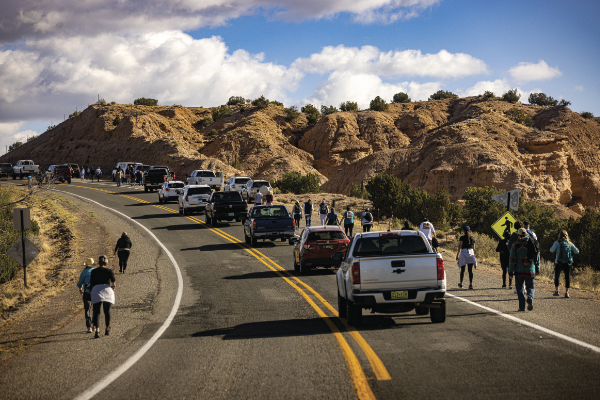
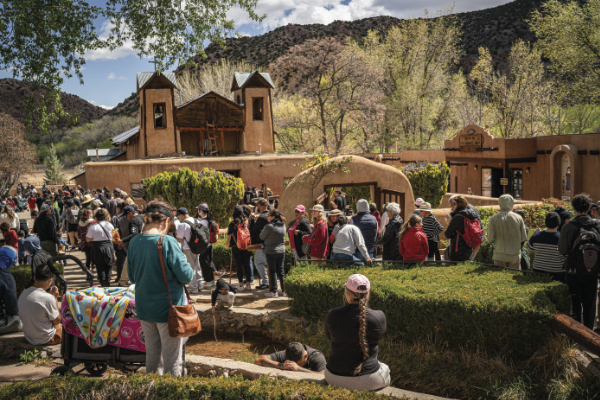
I returned home for Holy Week in April and joined the sorrowful procession of lowriders climbing the hill to Chimayó, offering prayers to the spring wind. I shared stories with people on the road and in kitchens, workshops, and city offices across the valley. I spoke with artists, scholars, lowriders, officials, primos, and friends, asking What does this place mean to you?

Again and again, I was moved to hear about the struggle to pass forward our cultural inheritance. For many of us, querencia continues to be our touchstone, anchoring us to land and to each other. It’s what has allowed us not just to survive, but to thrive in this harsh, beautiful terrain, together, and often against impossible odds.

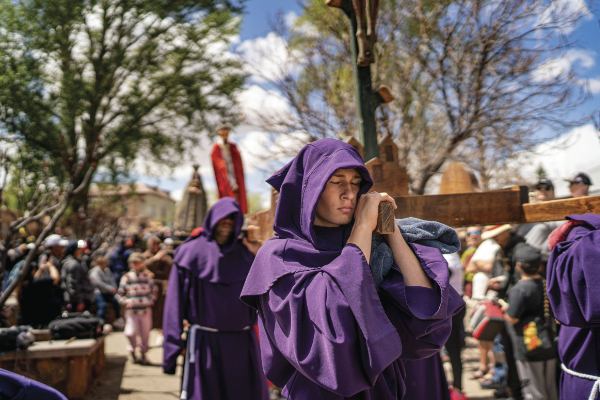
religious practitioner carrying a wodden cross with others in purple religious garb
Marcus Oviedo of Chimayó helps to carry a large wooden cross during a procession for Good Friday at El Santuario de Chimayó for Semana Santa, 2025.

Nuestra querencia gives us identity, offering existential traction, “a place to stand,” as Santa Fe poet Jimmy Santiago Baca writes, in a society that treats us like “immigrants in our own land.” By claiming our inheritance, we steady ourselves on the shifting sands of zozobra—the affective disequilibrium born of social disintegration, as named by Mexican philosopher Jorge Portilla. Expressing our cultural identity, says sociolinguist Damián Vergara Wilson of Ojo Caliente, “opens up a space for us,” holy ground for recognition and belonging, a way to locate one another in an increasingly-disoriented modern world.

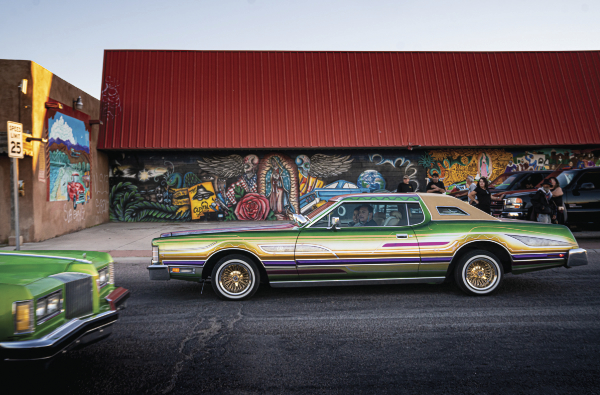
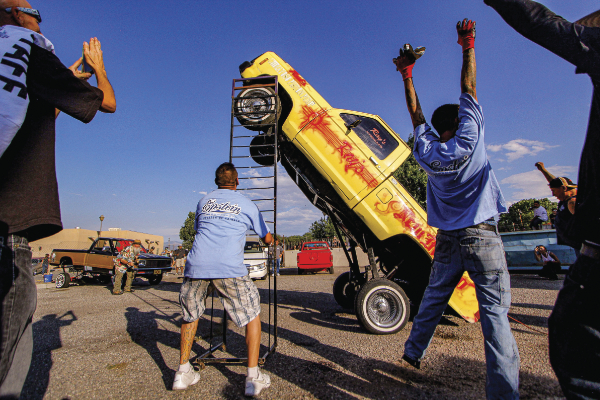
Nothing captures Española more iconically than the lowrider: part car, part human, part spirit. Levi Romero, an Embudo native and preeminent scholar of New Mexican history and culture, says lowriders “formed a shield against the imminent winds of change,” becoming “el resuello y alma of the culture.” And while some feared the tradition was dying, the recent passage of HB 239, commissioning a study for a state lowrider museum in Española, signals its revival.

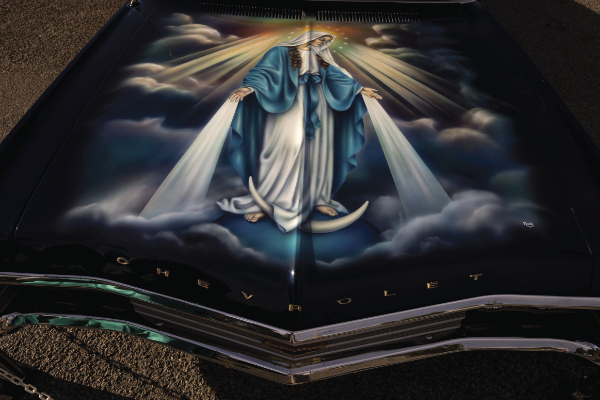
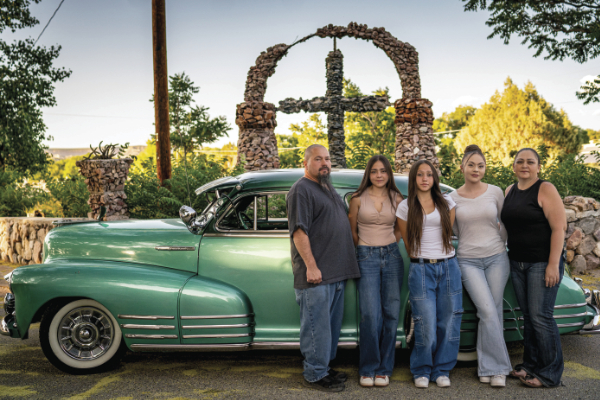
Our lowriders—pristine and passed down, or rusty and resurrected from arroyos—are living descansos, mobile altars of memory. They embody what Tomás Atencio, another Embudo native and scholar of New Mexican culture, calls “el oro del barrio,” the lived wisdom of our people, the true currency of this lifeworld.

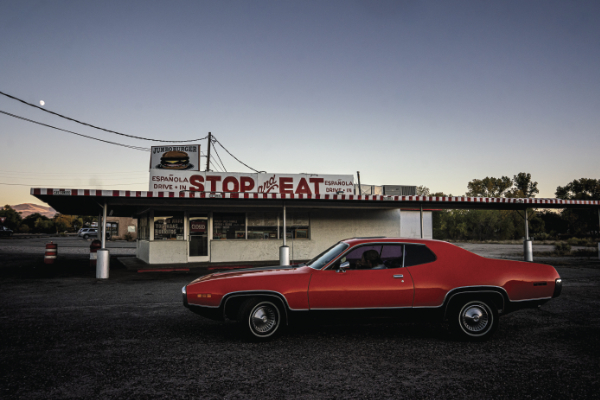
A classic car parks outside of the Stop & Eat Drive-In in Española following Lowrider Day, 2021.

Pilgrimage to Aztlán

After my father Joe Salazar, the valley’s beloved music teacher, died, I sold the house we once shared and moved to North Carolina with my family for work. In the dislocation that followed, I worried I’d lost my footing in the world. But as time passes, I see that I’m not lost, not without a home. I can locate the desert bones of my ancestors on a map. I follow them like a homing beacon to the hearths of primos and El Santuario de Chimayó to remember who I am.

In the Southeast, my identity often feels precarious—scrutinized, misread, or flattened into something it’s not. My Spanglish sing-song is swallowed by a foreign twang, and I feel voiceless. To survive erasure, I carry home with me. Hanging from my rearview mirror is the name of my car, “Espera,” written in Old English script. She’s a dusty old Prius wagon, but I see a redemption arc in her: gold paint, a mural, and dark-tinted windows.

Crowds of pilgrims gather outside El Santuario de Chimayó for Good Friday, April 2025.

Visions like these sustain me, but it’s only in New Mexico that I feel fully rooted. In the Spanish bullring, querencia is the place where the bull takes its stand, draws its strength, and becomes almost impossible to kill. This is my querencia too—a place where I reclaim my power. When I return home, my voice returns with me—melodic, boisterous, and complicated.

Mine is a contested voice. But walking to Chimayó, I know I’m not alone. Many of my fellow pilgrims from this region carry the same ache. Damián Vergara Wilson describes this as “always having to explain ourselves,” being mocked for our “funny accents,” and targeted by degrading jokes. I still remember the sting of shame I felt in college at UNM when a classmate dismissed my accent as “unintellectual.” I didn’t have the words for it then. I do now.

Gloria Anzaldúa, writing from the Texas borderlands, calls this kind of violence “linguistic terrorism.” 

A lowrider with a custom paint job passes by the Treasures of the Cultura mural during a cruise following Lowrider Day in Española, 2021.

“I am my language,” she writes. “If you attack my language, you attack me.” Her words give voice to what I had once mistaken for personal failure—shame that was never mine to carry. Anzaldúa reminds us that language is soul-deep, so when it’s silenced or erased, something ancestral is lost.

This is what makes Vergara Wilson’s work all the more vital. His project El Español de Nuevo México is working to provide a publicly accessible archive documenting endangered varieties of New Mexican Spanish. This documentation is resistance, a way of remembering who we are and the lifeways that sustain us. When we lose our language, we don’t just lose words—we lose the dichos, the remedios, the worldview and wisdom encoded in its grammar. We lose the grief rituals—the alabados, descansos, and pláticas that help us mourn and remember.

On the road to Chimayó, I passed my family graves in Pojoaque. These are the graves I cleaned with my father each Memorial Day. We whispered to the dead, left offerings, swept stones. Other days, we visited dying tíos and primos down dusty roads, where the best conversations happened—unguarded, honest, real. There, I learned the warmth of presence in the space that Tomás Atencio calls “la resolana”: those sunny spots, traditionally along the south wall of a building, “where people have gathered across the years … to talk about everyday life, about birth, and about death.”

In New Mexico, grief is not peripheral. It is shared, sung, and built into the landscape. Even the law here protects roadside descansos; in other states building them is illegal. This reverence points to a deeper worldview, one shaped by Latinx and Indigenous traditions, where the sacred is inseparable from the land and still walks with us, mapping the way home.

Our cultural relationship with grief is visible even in car culture. A West Side native whose family ran the Block-Salazar Mortuary for fifty-six years tells me, “Death has been reflected in a whole different way here. We grieve. And we remember. That’s a strong part of our cultural heritage.” For many, the lowrider becomes a vessel of memory: “a living museum,” he calls it. “People who lost a brother, a loved one, have a mural of him painted on the hood of a lowrider. They say, ‘I wanted to carry him with me.’” In this way, our devotion transcends churches and graveyards.

Hospitality, shaped by Tewa lifeways, has long been sacred here. That ethic of care stretches beyond the Pueblos into Indohispano communities rooted in kinship and reciprocity. When I visited relatives this spring, I came away with a turquoise necklace, a woven bag, clothes, banana bread, apricot jam, and chile—like I’d been out shopping, not just catching up with family.

One city official tells me this spirit of generosity is both a gift and a challenge—part of why people experiencing homelessness find refuge in this valley, which still remembers how to care. “It’s the cholo helping the grandma load groceries at Center Market,” he said. Devotion has “always defined this valley … It’s just very special. It’s just something very unique about us being natives of the land.” Devotion—rooted in land, family, and mutual aid—echoes across generations, shaping not only how we treat each other, but how we move through the world.

Aerosol artist Thomas Vigil of El Guache also spoke with me about this ethic, which he calls an “unwritten law” learned young. “We’re raised in a way that’s so caring. We’re the keepers of the land.” His parents modeled right relationship to land and community: where fixing a neighbor’s car or cruising slowly through town isn’t wasting time—it’s devotion.

In communities like ours, where home has always been a collective practice, not merely private property, there is deep concern that our querencia is under threat, fraying under the extractive logics of modern life. I experience this pressure as a kind of susto—a soul sickness I treat by returning home, where remembrance serves as remedio.

In doing so, I become part of the cycle of loss and return characteristic of the Manito Diaspora. Romero explains that “Manito,” from hermanito, was used by Mexican laborers who met New Mexicans far from home. Through the digital archive Following the Manito Trail, Romero and his students at the University of New Mexico map how families survived the collapse of the land grant system and decline of agrarian life by preserving culture through adaptation.

Although Española has long resisted the pressures of modernity, it is increasingly impacted by homelessness, gentrification, and displacement. And yet, my Holy Week pilgrimage left me encouraged because I saw that the people of this land are still dreaming, building, and enacting pathways toward a future rooted in care, memory, and collective resilience.

Our complex cultural and ecological diversity forms a spiritual geography. Few people say they’re from Española proper: we’re from Chimayó, Ranchitos, La Mesilla—an interconnected constellation of llanos and valleys. What unites us are shared threads: Spanglish, acequias, hospitality, devotion. In Bless Me, Ultima, Rudolfo Anaya from Santa Rosa depicts the regional contradictions with the llano symbolizing Márez defiance and the river valley symbolizing Luna care. These aren’t just settings. They are cosmologies shaping nuestra locura—our worldview and style.

Española’s complexity is reflected in its municipal locura. Within city limits, five governing bodies converge: Ohkay Owingeh, Kha’p’o Owingeh, the City, Rio Arriba County, and Santa Fe County. Sovereignty and colonial inheritances are interwoven here, but not seamlessly. From the dissonance, a distinct borderland consciousness emerges. Anzaldúa calls this plural personality “new mestiza consciousness,” a way of transforming ambivalence into beauty. You see it in the matachines dances, in the Catholic echoes within curanderismo—practices that, like the city itself, hold contradictions without simplification. As Vergara Wilson puts it, “We might not be perfect. We might not all perform our identities the same way. But you have to love la raza tal como estamos.”

A lowrider featuring an image of the Virgin Mary on display during a Lowrider Day celebration, July 2023.

Española’s layered cultural terrain gives rise to countless “hometactics”: everyday acts of creativity that carve out a sense of belonging in the face of displacement and gentrification. According to Mariana Ortega, Latinx feminist philosopher from Nicaragua, hometactics might include painting walls in colors that recall home or reimagining family through deep bonds with neighbors. In Española, lowriding is one such hometactic—a mobile altar rooted in diaspora. Borrowed from L.A. Chicano lineage and customized through Manito style, lowriders carry memories and faith across distances.

So, it is no accident that the Española Valley, as a sacred site, is also the Lowrider Capital of the World. While this place has long been mischaracterized as dangerous, locals know it as a sanctuary. Our semi-arid steppe, threaded with riparian woodlands, is a cradle of resistance, remembrance, and return. For generations, people have gathered here in ceremony, seeking healing. If Aztlán lives anywhere, it lives here.

Bobby Chacon, Angel Chacon, Bobbie Chacon, Heaven Chacon and Pam Jaramillo stand for a family photo outside of the Holy Family Parish Church with their 1948 Chevy Fleetline in Chimayó, June 2025.

Lowriding the Manito Trail

At the Todos Unidos Car Show in Ohkay Owingeh, Claudio Sanchez of the San Luis Valley shared his own pilgrimage story. As a child, his migrant family often passed through Española. He was so moved by the lowriders he saw that he made a vow: one day, he’d own one. Now, each Holy Week, he returns with his grandchildren and his collection of cars.

His story reflects a larger pattern, where migration, memory, and homecomings entwine. The lowrider becomes a traveling descanso: memento mori on wheels, carrying our cultural DNA, our dreams, and our grief in chrome and paint. Murals of loved ones. Tributes on trunks. Each lowrider is a devotional shrine.

After WWII, Chicanos flipped the script of American car culture. Instead of speeding, they cruised with dignity: low and slow. Why race through life when you can cruise through it? Vergara Wilson calls the lowrider “a symbol of defiance to mainstream culture and a symbol of solidarity.” It’s a subversion of form and function: smaller tires, custom hydraulics, bodies lowered almost to the ground. Impractical by design, these cars aren’t built for efficiency—they’re built for ritual, for presence, for beauty. It’s more than resistance. It’s reverence.

Like retablos and alabados, lowriders are devotional art, crafted with sacred attention and labor. “We really are very attentive to what we’re doing,” says Thomas Vigil. “My dad is the perfect example.” Anytime he helps, the job takes twice as long, not from slowness, but care. “He wants to make sure it’s done the right way.”

Lowriders embody the Manito ethos of precision, patience, and pride. Vigil describes cars with full-frame engravings covering the underside, invisible to most. That’s why car shows place mirrors beneath them: to honor what can’t always be seen. It echoes Classic Maya ceramics with bases often engraved not for human eyes, but for the divine. Spirit lives in every surface. The labor becomes prayer.

The sun sets at El Santuario de Chimayó on Holy Thursday of Semana Santa, April 2025.

Aztlán survives through these small, sacred acts. Through care and persistence. “Just talk about faith in action,” Romero tells me, recalling the sight of lowriders being brought back to life from forgotten arroyos. “Seeing something that you think is dying, and there’s that one kernel of life that still exists.” Lowriders carry our querencia forward, restored.

Pam Jaramillo of Chimayó says, “Lowrider culture means family.” She and her husband, Bobby Chacon, raised three daughters, each with her own ride. Together, they build more than cars; they build memory, pride, and place. “The media always brings up drugs,” she says. “That’s not what it’s about. Española is about family and culture. We are rich in history.”

Jaramillo was born into lowriding—into the weekend rhythm of cruising, music, and community. “Nobody gets that anymore,” she says. “Now there’s a lot of challenges with phones and social media.” But she reminds her daughters: “That will pass.” What lasts is the sacred ride—the ’64 convertible her daughter drives, the ’51 Chacon bought with boot camp money—still gleaming.

The team with a hopping truck from Red’s Old School Hydraulics celebrates during a hopping competition during Lowrider Day in Española, 2019.

In his essay “Lowcura,” Romero describes lowriding not just as a vehicle but a worldview—a locura that carries our spirit of defiance and devotion. I’ve always admired the mad-dogging lowrider with sacred heart tattoos and a steady, unflinching gaze, staring down the barrel of erasure, rolling deep with the antepasados. What outsiders read as danger on that face is, in fact, sovereignty—composure on the shaky ground of zozobra, la vida loca.

If you want to understand this locura, go out onto the llano at sunset and repeat after me: “The four directions of the llano meet me, the white sun shines on my soul.” Stay there until a curtain of stars opens up across the sky. Only then might you begin to discern our shared horizon of meaning—the ancestral logic that shapes sustainable lifeways in the harsh, sacred terrain of the Española Valley.

Stay Down

This Holy Week, walking from the morada in Pojoaque to the Santuario, I felt spirit return to my body. I came seeking comfort in my sacred querencia, but as I moved through the tide of modernity, I learned that the sacred doesn’t promise safety. It is la vida loca—a roiling power that demands reverence and courage. The same courage it takes to hold onto hope in a collapsing world. The same courage that rides through the valley, embodied in the lowrider.

The lowrider is a post-colonial Don Quixote, all cabesuda with a laid-back locura, riding forward on a trusty steed with a steady gaze and a holy foolishness, knowing we are tied to the earth. And if the earth is also tied to us, lassoed to our skinny necks, then let us ride together through our sacred, shared fate—low and slow.

Romero tells a story about Anaya’s writing process, which is distinctly New Mexican. Anaya described coming to the page “a pura pala,” a phrase that captures the grit and devotion behind his craft. It’s the same kind of devotion you see when caretakers haul fresh dirt to refill the pocito at El Santuario, or when mayordomos clear the acequias each spring to let the water flow. This approach to labor isn’t performative, it’s rooted. Devotion is how we show up, how we stay down—in care work, in resistance, in passing forward what we love.

Romero reminds us that in a world built to make us doubt our worth, the deepest act of devotion may be belief—belief in our own sacred value, even when others can’t see it. “If no one else believes in us,” he says, “we have to believe in ourselves. Believing in oneself and empowering others to believe in themselves is one of the highest forms of resistance.” I believe in Española—in its beauty, its contradictions, and the fierce, creative power of our locura.

That belief is what brings me here, to sit with you now in la resolana, away from the fluorescent glare of the twenty-four-hour workday, having carved out time, a pura pala, to ask: To whom—and to what—do you devote your sacred attention and labor? Do your days serve your soul or your erasure?  

This essay was made possible by conversations with no less than four Vigiles (Española was once called La Vega de los Vigiles), as well as ancestors, primos, curanderos, philosophers, poets, comadres, children, and pets. With support from the N.C. Arts Council, a Division of the Department of Natural and Cultural Resources, the Arts Council of Winston-Salem & Forsyth County, and The Arts Council of Greater Greensboro. Special thanks to José Gallegos and Francisco Gallegos.

Petra Salazar (opens in a new tab) is a coyote (regional term for an Indohispano/Anglo racial identity) from Española, New Mexico, aka “Spaña.” She teaches children at a Montessori school and adults at philopoetics.com. Petra’s work has been published or is forthcoming in Colorado Review, Indiana Review, Sonora Review, The Southampton Review, Latin American Literature Today, and elsewhere.

Held in Warmth, Held in Motion

By Zuyva Sevilla

Energy moves through us and beyond us, slipping from form to form, never still. It stretches across steel, rises from bodies, and presses into the air. Heat is a material in its own right, sculpted by every touch and shaped by every presence. It is in the warmth of our skin, in the dim glow of a town at night, in the slow burn of a star an unfathomable distance away. We are entangled in a system spanning the microscopic to the cosmic, where what seems like waste becomes a map of exchange.

Heat is the soft echo of movement, unfolding after the action has passed. It pools in the spaces where we gather, like an unperceived atmosphere of human presence. It is in the clasp of hands—warmth vaulting from one palm to another. In the cold silence of space, heat is a rare artifact. Without matter to hold it, energy slips away, uncontained. All warmth, in time, drifts outward, thinning and slipping beyond reach and measure. But within our atmosphere, heat finds material to shape and be shaped by, clinging to skin and sky. It lingers, absorbed into a choreography too vast to watch in full.

Heat is a signal that something, somewhere, is happening, that we are here, alive, participating. The desert knows this well. Heat bends air into shimmering glass, making the horizon waver. Stone radiates warmth long after sunset, blurring the line between what is solid and what is not. Some traces exist only as distortion—always in motion, reshaping even as they fade.

We cast off heat, shed dust, and move through atmospheres shaped by the energy of others. On a planetary scale, this exchange sustains us; we are warmed by a star while standing on ground built from ancient cosmic debris. The mirage is to think of heat as excess, something to be expelled—waste energy, a byproduct of function, inefficient.

Earth does not differentiate between the warmth of an engine and a body. It takes in all energy, inscribing it into an immutable ledger of movement and exchange. To exist is to participate in an endless cycle of neither creation nor destruction, but redistribution.

Heat is not just an output but a connection—a quiet shout into the cold. It is not waste. It is a reminder that we are part of this choreography—held in warmth, held in orbit, holding each other. 


Zuyva Sevilla is a new-media sculpture artist whose work deals with the fundamental forces that make our existence possible. He is based in Albuquerque.

Zuyva Sevilla (opens in a new tab) is a new-media sculpture artist whose work deals with the fundamental forces that make our existence possible. He is based in Albuquerque.

If You Can Talk, You Can Sing

My Aunt Kate had a poster in her living room that I liked to look at as a kid. It featured two Zimbabwean women in colorful clothing with their arms extended and hands linked. A proverb at the top of the poster read: 

If you can walk
You can dance
If you can talk
You can sing.

The image was imbued with color and joy, but I appreciated the message most. Expression is an essential part of the human experience, and art is meant to be shared, passed down, and created in community. The proverb from Zimbabwe encouraged me to see art as accessible to everyone. No specific skill level or access to special groups or spaces is required to participate. 

In keeping with this proverb, the essays and articles in this issue of El Palacio affirm the necessity of creation for surviving and thriving. In RoseMary Diaz’s article about Makowa: The Worlds Above Us, a new exhibition at the Museum of Indian Arts & Culture, storytelling is central to the ways we make sense of the world, our place in it, and what we know from all that we can see in the sky—from stars to birds to clouds. Jon Ghahate (Laguna Pueblo/Zuni Pueblo) tells Diaz, “If we allow ourselves to be open to the contributions of other societies and civilizations and their place in the cosmos, perhaps we can focus more on the commonalities among us rather than the differences between us.”

For Aboriginal artist, Cynthia Burke, art is generational and rooted in the Australian bush. As writer Gina Rae La Cerva relays through her profile of Burke, Dreamtime creation stories are imbued with cultural knowledge that often takes the form of artistic expression. A vendor at the International Folk Art Market in 2024, Burke’s fiber art sculptures are an important source of income with deep ties to the Ngaanyatjarra community. Likewise, Dr. Gregory Cajete (Tewa/Santa Clara Pueblo) finds profound meaning in the process of creation. Cajete tells writer Jamie Figueroa that humans are an expression of creation: “Let go and become the music and the dance of creation. Embody what you create.” His words amplify the Zimbabwean proverb—across cultures, creation is a global inheritance. 

In Simón Romero’s essay about his mother, Janet Stein Romero, readers will encounter another artist and teacher with an insatiable curiosity and love for folk arts. Romero was my high school art teacher, (and fittingly, a friend of my Aunt Kate!), and I can attest that she brought this passion into her teaching and into the communities of Villanueva and Las Vegas. A prolific artist, Romero was big-hearted and fearless. As her son recounts, she understood that people have always created art in the face of oppression. 

Creation is also integral to the ways we pass knowledge through generations. For some groups, history has been purposefully obscured. Artist Chris E. Vargas approaches the erasure of queer and trans history by interrogating museums and archives as sites of memory. Who and what do these institutions serve? For Vargas, as writer Jake Skeets reveals, the gaps in the archive provide a space of infinite possibility for imagining and reimagining our past and possible futures. 

In a similar vein, Lazarus Letcher reconstructs the history of Buffalo Soldier Cathay Williams, a woman who dressed as a man to serve in the 38th Infantry Regiment after the Civil War. By weaving Williams’s words and records, Black history in New Mexico, and their own family history, Letcher creates an understanding of what it can take to seek liberation. 

Whether donning different clothing to forge a new life, passing along inherited stories or artforms, or embracing the process of experimentation, this issue of El Palacio is an invitation to participate in creative expression. 

Emily Withnall (opens in a new tab) is the editor of El Palacio and the host of Encounter Culture. Prior to stepping into the editor role, she wrote for the magazine for eight years. Emily has also been published in The New York Times, Al Jazeera, High Country News, Orion Magazine, Tin House, The Kenyon Review, Gay Magazine, Source New Mexico, and other publications. She lives and writes in Santa Fe, New Mexico.

Poetry by Michelle Otero

Painting of a rocky canyon landscape with boulders, shrubs, and distant mountains under a partly cloudy sky.
Detail. Marsden Hartley (1877-1943), Landscape, New Mexico, ca. 1920.
The poem wants
to drink water from the stream running through land that hasn’t been in the family since   
the gringos came but will settle for lead-free pipes and no rotten-egg smell
to visit a doctor when her bones ache and her head burns without waiting or worrying
what they might find because she might not have the cash but would settle for another year
or two on her parents’ health insurance
the poem wants an end to megadrought, dousings to fill the aquifer and flow the Río
Grande but will settle for one good snow, one good monsoon
the poem wants you to love a woman who isn’t and won’t be a mother as much as you love
a fetus but will settle for lower rates of sepsis in Texas
the poem wants 
purple mountains
no majesty 
wants
amber, turquoise
empathy
black beans
grain
maybe the poem just wants too much 
Detail. Marsden Hartley (1877-1943), Landscape, New Mexico, ca. 1920.
Wait for her
after Mahmoud Darwish
With a cup of bluecorn atole
Ground by mother hands in the molcajete you 
Carried in place of extra water. Remember 
How it held rain. Welcome her 
As you welcomed monsoons, chin
Raised, mouth open, eyes closed. You will
Know her by the shift in breeze, the damp
On your tongue, and scent of creosote. Remember 
The word petrichor. Remember all the words
You pinned to inside pockets in place of papers
Proving you were you, porque quién eres sin ceniza 
Polvo, pan y agua, sin Florentino, Jesusita, Eleuteria, 
Rosaura, Pantaleón and the grandma you called China
For her curly hair. Forgive the curly haired grandma her 
Sharp edges, the grandfather his tender soles. You know
So much desert can cut, burn. You know the cast 
Iron skillet provides but does not love. You told yourself 
Your favorite season was Lent. Wash her feet
With rosewater. Dry her toes with your hair.

Michelle Otero (opens in a new tab) is the author of Vessels: A Memoir of Borders, Bosque: Poems and the essay collection Malinche’s Daughter. She served as Albuquerque Poet Laureate from 2018-2020 and co-edited the New Mexico Poetry Anthology (2023) and 22 Poems and a Prayer for El Paso, a tribute to victims of the 2019 El Paso shooting and winner of a New Mexico-Arizona Book Award. She is a member of the Macondo Writers Workshop.

Cathay Williams

By Lazarus Letcher
Illustrations by Adri Norris

“Can the class touch your hair?”

I was sitting in my high school sophomore year of U.S. History when I first heard of the Buffalo Soldiers. It was a rare moment in my Indiana education when we touched on African American history that took us beyond or outside of victimhood. My teacher’s question quickly dashed my joy at this rare reflection of myself in my curriculum.

“Can we touch your hair to understand where their name comes from?”

I and the two other Black classmates locked eyes and telepathically agreed that, at least for today, we would not be a petting zoo.

There’s some debate about exactly where the term for the segregated African American troops fighting in the timespan post–Civil War, through the Spanish-American War, and up until World War II came from. Many, like my misguided teacher, assume the name comes from the natural texture of our hair. The Buffalo Soldiers National Museum claims the name also referenced their fierce fighting style. What most accounts seem to agree on is that the name of the Black Cavalry Regiment was given to them by the Indigenous communities they fought.

African Americans, both enslaved and free, fought and died for the United States long before the official formation of all-Black regiments. The soldiers of the 10th Cavalry Regiment, created at Fort Leavenworth in 1866, are considered the first Buffalo Soldiers. They were followed by an additional cavalry regiment and three infantry regiments. Several Black soldiers fought for the Union army, but the Buffalo Soldiers were the first peacetime all-Black units, making up about ten percent of the U.S. Army. The Buffalo Soldiers were essential to the Westward Expansion project: building roads, hanging telegraph lines, clearing out illegal settlements, escorting wagon trains, and even acting as some of the first National Park rangers. They were often given the most challenging assignments, low-quality or faulty equipment and uniforms, and sometimes faced hostility in the towns where they were placed.

These soldiers were based throughout the Southwest, including New Mexico—playing a key role in our transformation from territory to state. An estimated four thousand Buffalo Soldiers served across eleven posts in the New Mexico Territory, especially in the south. They fought in several battles against the Apache, even engaging with Apache Chief Victorio close to what is now the White Sands Missile Range. They were also tasked with keeping the peace amid heavily armed battles between residents in the Colfax and Lincoln County Wars.
Several members of the 9th Cavalry received Medals of Honor—
in fact, the only troops stationed at Fort Union to receive this achievement were Buffalo Soldiers. The 9th Cavalry Band musicians were especially known for their musical prowess and were stationed at several New Mexico posts, even performing for President Rutherford B. Hayes during his 1880 visit to Santa Fe.

The focus of the Buffalo Soldiers shifted from the American Frontier to abroad during the Spanish-American War in 1898 when the 9th and 10th Cavalry landed in Cuba on June 22, 1898, without their horses. Transitioning from horseback combat to a new country and new fighting style must have been jarring. Buffalo Soldiers fought alongside the Rough Riders and Theodore Roosevelt at the Battle of San Juan Hill, losing twenty-six of their men. One Rough Rider, Frank Knox, said of the Buffalo Soldiers, “I never saw braver men anywhere.” As the Spanish-American War progressed into the Philippine-American War, Buffalo Soldiers were sent to the Philippines, where they struggled to fight for a country that didn’t fight for them.

Several Buffalo Soldiers wrote home to Black newspapers to describe the racism they saw Filipinos facing at the hands of white American troops. Sergeant Patrick Mason of the 24th wrote, “I feel sorry for these people and all those that have come under the control of the U.S.” The feeling was mutual, with Filipino fighters creating fliers targeting Buffalo Soldiers, asking them why they’d fight for a nation that murders them in cold blood back home. One reads,

To the Colored American Soldier: It is without honor that you shed your precious blood. Your masters have thrown you in the most iniquitous fight with double purpose—to make you the instrument of their ambition, and also, your hard work will soon make the extinction of your race. Your friends, the Filipinos, give you this good warning. You must consider your situation and your history and take charge that the blood of Sam Hose [a recently lynched Black man in Newton, Georgia] proclaims vengeance.

Some Buffalo Soldiers were fed up with the racism, defected and joined the Filipino troops, most famously Corporal David Fagen, who rose to the level of Captain.


Crossing the Rio Grande, 2025. Digital painting. Cathay Williams fords the Rio Grande with fellow troops from the 38th Infantry Regiment.

As the descendant of a stolen people on a stolen land, I’ve struggled with this history. What choices or opportunities did we have post-Emancipation? What relationships did we have with Indigenous communities beyond or beside the Buffalo Soldiers’ role in Westward Expansion and imperial endeavors? I’ve had Black ancestors fight in every war since the Civil War, many of them labeled Buffalo Soldiers. What were their motivations? How did white leadership treat them? Did they know how they would be treated when they were discharged?

Scholar and professor of Black Studies at Northwestern University, Sylvester Johnson says of Buffalo Soldiers, “With few exceptions, they fought on behalf of a violently expanding US empire to make war against American Indians and to control what should have been self-governing sovereign polities of Indian nations… It became for African American men an imperial and patriarchal mode of pursuing national belonging.” Most Buffalo Soldiers’ histories stress the few opportunities for African American men post-Emancipation for employment. When it came to African American women, the options were even more dire. Is this why Cathay Williams decided to change her name and don a uniform?

Cathay Williams:  The Woman Buffalo Soldier

We know little about Cathay Williams beyond the scant military records and one newspaper interview she gave in 1876, and the information and dates are often conflicting. Black history is so
often missing due to the legacy of scarce records from enslavement and the anti-literacy laws that made it illegal for most African Americans to write our own stories. We do know that Williams enlisted in Missouri on November 15, 1866, a year after the signing of the Thirteenth Amendment that abolished slavery except “as punishment for a crime,” to join the ranks of the 38th Volunteer Infantry Regiment. She said she was born in 1842 and listed Independence, Missouri, as her place of birth. She was born to a free man and an enslaved mother, and due to the seventeenth-century legal doctrine Partus sequitur ventrem, this enslaved Williams automatically.

Williams was involved with the army before her enlistment—
potentially not of her own free will. In 1861, Williams worked for the Union army as “contraband.” In 1861, the U.S. Congress decided that any African Americans who self-emancipated would not be returned to their enslavers if they made it to Union lines. “Contraband” was a term typically used to describe stolen goods, which further demonstrates that while the Civil War was a fight for Emancipation, African Americans were still viewed legally as objects by many on both sides. Some historical accounts paint the picture of contraband African Americans as paid and appreciated by the Union, while Union officials like General Butler openly referred to them as slaves and did not pay them. According to Williams, her experience was closer to the latter. Some of these African Americans, like Williams, were not self-emancipators but “confiscated property.”

In her interview with the Denver News, Williams said of this experience, “…when the war broke out and the United States soldiers came to Jefferson City, they took me and other colored folks with them to Little Rock. Col. Benton of the 13th Army Corps was the officer that carried us off. I did not want to go.” She witnessed the burning of cotton fields throughout the South, the capture of Rebel gunboats in Shreveport, and General Philip Sheridan’s destruction of the Shenandoah Valley.

For years, Williams was forced to work with the 8th Indiana Volunteer Infantry Regiment—most likely an all-white regiment save for “contraband” like herself. She trudged across the country, from Arkansas to Louisiana to Georgia. It is unclear when Williams’s time as contraband was up and when her freedom began. I find it even more curious that she would voluntarily
enlist in the military when she was once, essentially, enslaved by the men wearing the same uniform. It again drives home the hard place African American women were in post-Emancipation to find work. Her options were likely to continue doing the domestic labor she did for the Army, sharecropping, or relying on family or a husband for support.

While the 38th Infantry Regiment was largely composed of African American troops, the leadership was all white. Laws at the time prohibited women from joining the Regular Army until 1948 (the same year troops were integrated), so she simply inverted her name and enlisted as “William Cathey.” The misspelling of her first name was likely due to high rates of illiteracy across the nation, but especially among formerly enslaved African Americans for whom reading and writing was illegal in most states and territories. Records show her making it to New Mexico on July 20, 1867, arriving first at Fort Union before traveling to Fort Cummings in southern New Mexico, where she remained for eight months.

Cathay Williams’s time in New Mexico is commemorated with an official roadside Historic Marker in Luna County, near her former post at Fort Cummings. According to Williams, she never saw any action, saying, “No bayonet was ever put to my back.” When she wasn’t hospitalized for various ailments, she stood guard, ran drills, and scouted for Apache fighters.

She ended her Army career at Fort Bayard in Silver City, being discharged on “medical grounds” when her womanhood was discovered on October 14, 1868. She returned to Fort Union as a cook before continuing to Pueblo, Colorado. It’s unclear whether, during her last tenure working at Fort Union, she simply reverted to her original name, Cathay Williams, and pretended she had never been stationed there, or if she continued her life as William Cathay and worked as a cook.

Black History in New Mexico

Pension Denied, 2025. Digital painting. Upon discharge from the 38th Infantry Regiment, Cathay Williams attempted to collect her military pension but was denied.

One of the first things I researched when I learned of Williams’s story was what it might have been like to be a Black man or woman in New Mexico shortly after Emancipation. Calling New Mexico a free territory is a bit tricky. Indigenous communities have faced and fought subjugation and enslavement since the moment Europeans arrived in the 1500s. In addition, the first Europeans to arrive in what is now New Mexico also had an enslaved African with them.

Black history in New Mexico begins far earlier than most would assume, with “Esteban the Moor,” whose Muslim name was Mustafa Azemmouri. In 1522, the Arabic-speaking African was sold to Spanish nobleman Andrés Dorantes de Carranza, who then brought Azemmouri on the Narváez expedition to the “New World.” Only Christians were allowed to the “New World”—I can only guess whether his change of name or faith were of his own volition, but given Azemmouri’s status as property,
I think it’s safe to assume it wasn’t necessarily his choice.

The expedition was riddled with misadventures, including Azemmouri surviving a shipwreck just to be re-enslaved with his fellow survivors by members of the Coahuiltecan tribe. After escaping Spanish bondage, Azemmouri and three fellow survivors were considered the first Europeans and Africans to reach the American West. Upon arriving in Mexico City, they heard rumors of riches to the north. The few mentions of Azemmouri in Álvar
Núñez Cabeza de Vaca’s book, La relación de Álvar Núñez Cabeza de Vaca (The story of Álvar Núñez Cabeza de Vaca), mention that he was a scout, sent ahead far beyond the rest of his party—and this is how he met his potential demise. Accounts vary—from Azemmouri wearing the garb of a “medicine man,” thus infuriating the Zuni Pueblo, which led to his death; or that he demanded turquoise and women and was promptly killed; or that Indigenous communities helped him fake his death so that he might finally be free. While we will never know the truth, we do know that Black people have been in New Mexico for over five hundred years.

While African American chattel slavery didn’t exist nearly on the same scale as it did in other parts of the country, New Mexico still had Slave Codes to restrict Black rights and further entrench Indigenous exploitation. Enslaved African Americans numbered less than twenty when the Slave Code of 1859 went into effect, primarily targeting runaways from neighboring Texas. The codes limited the number of free Blacks that could be in the territory at once, restricted enslaved African American movement (and ostensibly any Black person regardless of where they were coming or going), made it illegal to testify in court, and, like many of our nation’s first gun control efforts, limited our right to bear arms—except to quell Indigenous uprisings.

Life After the Buffalo Soldiers

Less than a decade after New Mexico’s Slave Code went into effect, Williams forded the Rio Grande with her fellow Buffalo Soldiers—a free woman bearing arms on behalf of her country. It appears the 38th Infantry never faced combat but participated in drills and went scouting for signs of Indigenous enemies. Williams was in and out of infirmaries for her short-lived military career—a fact that makes it even more impressive that her sex assigned at birth wasn’t discovered for almost two years of service. In her own words, she did catch smallpox early in her service while in St. Louis. However, she received her discharge from the 38th Infantry Regiment after being hospitalized, saying she “played sick, complained of pains in my side, and rheumatism in my knees. The post-surgeon found out I was a woman, and I got my discharge.”

In her chapter on Williams in An African American History of New Mexico, DeAnne Blanton wonders if racism helped her conceal her identity. Blanton writes, “The fact that five hospital visits failed to reveal that William Cathey was a woman raises questions about the quality of medical care, even by mid-nineteenth-century standards, available to the soldiers of the U.S. Army, or at least to African American soldiers.”

It’s clear that Williams left the Army disabled, but whether she was disabled in the line of duty is hard to parse out. At some point, Williams had to have several toes amputated and needed crutches—was this a potential long-term result of smallpox or, as Blanton suspects, undiagnosed diabetes? Williams’s story was shared with the world in the Denver News in 1876 after the reporter heard rumors about a woman who was a Buffalo Soldier. While serving, she stated that only her cousin and one regiment member knew she was a woman. Her final doctor in New Mexico caught Williams’s secret, but her discharge papers make no mention of this discovery. Instead, Williams was discharged for disability.

In 1891, Williams applied for a disability pension for her military service. While Williams is considered the first documented woman to enlist, she is not the first woman to file for pension after her service. People assigned female at birth (AFAB) have dressed as men to fight in wars throughout American history, and to assume doing so was solely a fight for wages or freedom could erase some more nuanced stories. Kit Heyam writes in Before We Were Trans: A New History of Gender, “In many cases, we simply can’t know people’s motivations with any certainty. We know, for example, that at least four hundred AFAB people fought in the American Civil War—but most of their names are lost to us, let alone the complexities of how they understood their genders or the multiple factors that led them to enlist. But if we assume that their gender must be ‘disguise’ until proven otherwise, we’re privileging one possible interpretation over several others: bringing cisnormative assumptions to history and letting them colour the way we read it.”

I won’t lie, as a Black transmasculine person, I wish I could ask Williams what her motivations were to spend two years living as a man or have some kind of evidence that I can count her as a trans ancestor. How long would she have gone by William if she could have still “passed” as a man? How was life in New Mexico and Colorado different for her being read as a Black man compared to a Black woman in the 1800s? Was there any way for her to move through the world where she felt comfortable in her skin—or was it all to survive?

Williams was denied her military pension. The board and examining doctor declined to state anything about her years served in disguise. Instead, they decided it was unclear if her disability was a direct result of her service. It’s hard to say if racism or misogyny played a role in this decision.

Patching Together the Archive

My ancestor, Dempsey Spencer, was also denied his pension following his service with the Buffalo Soldiers. My great-great-great-great-grandpa, Dempsey, was born into enslavement in Missouri—just like Cathay Williams. My brilliant aunt, Marilyn Harbaugh-Letcher, our family genealogist, was able to track down his story through military records and the battles our family had to fight after he served his country. Dempsey ran away from his plantation to join the Union army and served this country until October 9, 1865, two months before the Thirteenth Amendment’s ratification. One hidden story my Aunt Marilyn was able to uncover was that his enslaver filed papers to request compensation for an “enlisted slave.” While he freed himself and fought for his country, this country, quite literally, did not pay him back.

After his death, his daughter Susie fought for his pension and was denied due to the scant documentation of enslaved African Americans. The government interviewed the enslaver’s children, other folks enslaved with my ancestors, and Dempsey’s fellow soldiers. Despite this bevy of oral records and history, they deemed that my ancestors’ wedding tradition of jumping the broom was insufficient to prove a “legitimate” marriage to compensate Dempsey’s family for his service. Dempsey’s name is listed on a memorial alongside other African American soldiers who fought for freedom while their metaphorical and literal siblings were in chains, only to have their bravery left unpaid.

The disrespect of Black soldiers runs deeper than being paid less than their white counterparts or nothing at all. Buffalo Soldiers and African American soldiers of the nineteenth and twentieth centuries did not receive the adoration or even respect they might have expected or deserved. Several of the race riots and lynchings between the Civil War and the end of the Second World War were spurred by seeing a Black man wearing an American uniform. Part of this fear came from the belief that African American men who fought for their country abroad might go home and begin fighting for their rights and communities. In 1917, U.S. Senator James Vardaman of Mississippi warned of the dangers Black veterans posed, saying that bringing Black soldiers home to the South would “inevitably lead to disaster.”

How many Black soldiers have similar stories? Denied compensation, given worse positions, facing racism from their own brother-in-arms? Scraping conflicting archives to piece this story together really highlighted for me the many gaps in all African American histories, even within the robust documentation of military operations like Westward Expansion. The intentional illiteracy of so many emancipated African Americans creates additional holes in the narrative—ones that projects like the Slave Narratives from the Federal Writers’ Project, launched in 1935, sought to fill long after Williams’s and many other Buffalo Soldiers from the Indian War’s passing. What other choices are there in a country built on the backs of our labor and stolen land? The Buffalo Soldiers fought for freedoms still not guaranteed for them and their families.

We don’t know precisely when Cathay Williams passed away in Trinidad, Colorado, or from what. The years between her discharge and her pension application are murky, but she spent most or all of them in New Mexico and Colorado. She says she was married and had her husband arrested for robbing her, which led to their divorce. In her 1876 interview, she says of her choice to join the Buffalo Soldiers, “I wanted to make my own living, and not be dependent on any relations or friends.” She was hoping to buy some land and get rich. Williams didn’t seem to have many positive things to say about her time in the military, either as a forced teenage girl or while living as William. She said, “I shall never live in the States again”—although Colorado became a state a month later.

The legacy of Buffalo Soldiers like Williams is mixed and murky. Many of them were our first National Park Rangers, established incredible Black communities like New Mexico’s own Blackdom, and built military careers that led to some economic and social mobility soon after enslavement. Many Buffalo Soldiers ended up disabled or dead, denied pensions, and further disenfranchised by the country they fought for. As Bob Marley sings in “Buffalo Soldier,” Black Americans have fought since we arrived in the Americas—for our survival and for nations that don’t always love us back. The legacy of Williams and the thousands of Buffalo Soldiers that followed her forces us to ask what it truly means to be free—to be the descendants of stolen people on a stolen land, conscripted to help in the continued theft of that land and attempted erasure of Indigenous peoples.

I believe we’re at a turning point in Native American and African American relations, with a mutual understanding of historic harms like the actions of the Buffalo Soldiers or the practice of chattel slavery among the Cherokee, Chickasaw, Choctaw, Creek, and Seminole, and the future disenfranchisement and disenrollment of the Freedmen. The Red Nation, an Indigenous-led leftist collective, writes, “We encourage people to build upon the dreams and histories of liberation that Black and Indigenous people share, rather than compete for resources or recognition of our trauma by the state…whatever harm we may have caused one another, we encourage Black and Indigenous people to come together in this moment to fight in unity so we can bring this beast down once and for all.”

Other hidden stories of Buffalo Soldiers share similarities with those the U.S. deemed their enemy, and they built fugitive lives together, like in the autonomous Black communities dotting the Americas. I dream about more people like Williams who joined the troops, erased their past, and were able to live a new truth far from their former plantations. I hope we continue to challenge what it means to be free and understand that all oppressed people must see our interconnection to achieve true liberation.   

Lazarus Letcher (they/them) is a PhD candidate in American Studies at the University of New Mexico. Their dissertation is titled Memorializing Queer and Trans Lives in a Time of Spectacular Erasure. They play viola for Eileen & the In-Betweens and Stages of Tectonic Blackness. Their writing can be found in Autostraddle, them, El Palacio, and the odd dry academic journal or fun zine.

Adri Norris (opens in a new tab) is an Albuquerque-based artist. She was born in Barbados and moved to the United States at the age of 5. Being a Black, queer, immigrant woman has shaped the way she views and interacts with the world, and it is this experience that she uses in her art.

Lazarus Letcher (opens in a new tab) (they/them) is a PhD candidate in American Studies at the University of New Mexico. Their dissertation is titled Memorializing Queer and Trans Lives in a Time of Spectacular Erasure. They play viola for Eileen & the In-Betweens and Stages of Tectonic Blackness. Their writing can be found in Autostraddle, them, El Palacio magazine, and the odd dry academic journal or fun zine.

Dancing with the Masters

By Simón Romero
Photographs by Adria Malcom

The sun was setting over Santa Fe’s Canyon Road. An opening at Ernesto Mayans Gallery had attracted an assemblage of artists and collectors who were sipping wine from plastic cups and energetically discussing art and politics as cigarette smoke wafted overhead. The year was 1981.

“Not again,” I remember mumbling to my ten-year-old self. My mom, Janet Stein Romero, a Brooklyn-born artist who followed her star to New Mexico in the 1960s, had been dragging me to gallery openings for as long as I could remember. If it wasn’t a gallery, it was a sculpture garden, a private collection, someone’s studio, or, I learned early on, one museum after another.

Both of my parents were artists, but as a kid, all the exposure to art seemed to have had an underwhelming effect on me. I didn’t inherit their talents for painting, ceramics, printmaking, collage, or sculpture. Instead, I was obsessed with early video games (anyone still remember ColecoVision?), comic books (from Silver Surfer to Love and Rockets), and football. I dreamed of playing for the West Las Vegas Dons.

Entrance to the courtyard of the main house at the Romeros’ El Ancón compound in Ribera, New Mexico.

Still, my mom never gave up on exposing me to art. When I moved away from New Mexico and began working as a journalist in New York, no visit from my mom would be complete without taking in places like the Guggenheim or the Frick or the Cloisters. When my career took me farther afield, with postings in Latin America, visits from my mom included going to Rio de Janeiro’s ramshackle, falling-apart Museu do Índio, or the cavernous Museum of Contemporary Art in Caracas, which was often devoid of other visitors, allowing us to savor the work of Francis Bacon, Vasily Kandinsky, and Robert Rauschenberg in near isolation.

It wasn’t until I was well into adulthood that I realized what a gift she had given me. She was a diehard believer in the redemptive value of art and treasured art in all its forms with a special appreciation for work that was outsider, transgressive, naïf, or shocking to the refined bourgeois values with which she was raised. I may not have had my parents’ artistic gifts, but I did develop an incurable appreciation and fascination for art. When my mom died last year at the age of eighty, I was
reminded by many others of her significance as an artist, teacher, and community leader in shaping a broader understanding of art and nurturing the careers of artists across New Mexico.

Like so many others drawn to New Mexico, her story began somewhere else. Her father, Morris J. Stein, had arrived as an immigrant child in New York when his Jewish family fled the pogroms of Czarist Russia. Eventually, he became involved in New York politics, rising to become a judge and an elected member of the New York City Council. Her mother, Ella K. Stein, was born in Manhattan to Jewish immigrants from Hungary and devoted her life to teaching the visually impaired in New York’s public schools.

Janie, as she was known to many people close to her, attended Abraham Lincoln High School in Brooklyn before going to Connecticut College, where she studied art. She could have continued living on the East Coast, as was expected of her and many classmates. At the time, Connecticut College had long operated as a women’s college and was viewed as a matchmaking school for nearby Yale University.

Janet and Nicasio Romero in their early off-grid days.

Instead of staying put, she packed her bags and lit out for the West. In graduate school at the University of New Mexico, she obtained her master’s in fine arts and met my dad, Nicasio Romero, an artist and builder born in the village of Manzano. They married in 1969 and went off-grid in Northern New Mexico, living in remote villages like Chacón and Ledoux, before settling in El Ancón, at a bend on the Pecos River, in 1973.

While constantly making art and raising my sister and me, she also delved into teaching art at every educational level, from elementary school to university. In Las Vegas, she taught generations of students in the public schools, viewing the teaching of art as something akin to salvation for both pupil and teacher. She often noted that some of her favorite students were the cholos, gangbangers, and other nonconformists. At Robertson High School, everyone was welcome in her classroom, which was viewed as a refuge for students with troubled lives at home or on the streets.

She also taught at New Mexico Highlands University in Las Vegas, and at the United World College in Montezuma, in addition to holding private drawing classes with nude models at her studio in El Ancón, almost until she was physically unable to continue. For nineteen years, every Father’s Day from 1988 to 2006, she and my dad hosted the El Ancón Outdoor Sculpture Show at our family home, showcasing artists from across New Mexico. She was also exceptionally active in the New Mexico arts community, serving in organizations such as the Capitol Arts Foundation, where she sought to promote the work of artists in Northern New Mexico, and the Las Vegas Arts Council.

James Rutherford, a Santa Fe curator, museum specialist, and gallerist has curated a retrospective show of her work this year at the United World College where it will be on view from June 7 to July 7 in the Kluge Auditorium. He has situated her among the artists who relocated to New Mexico from the East Coast in expatriations starting in the late 1800s. Some needed an escape from oppressive cultural norms, Rutherford notes, while others sought relief from stifling climates in the region’s sanatoriums, or a romanticized vision of the Wild West.

“Janet was among the legions genuinely captivated by the welcoming and culturally diverse milieu at the University of New Mexico in the 1960s,” Rutherford says.

“In her work, we see an undeniable fondness for the land, light, and Indigenous cultures shared by many artists, but what distinguished Janet’s oeuvres was that she was not simply quoting existing conceptions,” Rutherford adds. “Her art-making practice uniquely coalesced the influences of her Jewish immigrant lineage, motherhood, and raising a family with the love of her life who also happened to be a native New Mexican, and a network of creatives the two nurtured for decades.”

She worked in a variety of media including watercolor, collage, fantasy shrines, acrylic paintings, retablos, clay figures, and monotypes. In a career spanning decades, her work has come to be featured in galleries, museums, private collections, and permanent public collections like the New Mexico Capitol Art Collection. With a passion for working with the figure as form and mystery in an anti-hierarchical context, she wanted her work to knock people out of their complacency. As a kid, in practical terms, this sometimes meant that my friends would express surprise at the number of paintings of nudes around our house. As I got a bit older, I realized that her approach to art was far more nuanced, mischievous, and subversive. Art had the ability to awaken new worlds, both in our surroundings and within us, she believed. The more paradigm-eroding and establishment-threatening, the better, for what else is art good for if not arousing in us the instinct to create something that transcends our ho-hum daily lives?

A corner of Romero’s studio. She was prolific in her art making and art collecting.

She was unapologetic about relishing in artistic freedom while reaching for the heights. Citing some of her many influences, she wrote in an artist statement in 2011: “I dance with the masters from Picasso and Matisse to Jean-Auguste-Dominique Ingres. I reach out to Frida Kahlo and Xul Solar from Latin America. I seek to reveal the inner spiritual core and foundation, to touch the emotional nerve of the human body using form and line and orgiastic color in a flattened, anti-illusionistic perspective.”

She also drew inspiration from interacting with other artists and promoting their work. Spearheading artist-in-the-schools programs in Las Vegas, she exposed her students to creators such as the renowned santero Margarito Mondragon. She also had a special affection for Santa Fe’s Museum of International Folk Art, bringing her students from Robertson High School there nearly every year she was teaching.

These trips, and her aim of making art as accessible as possible, clearly resonated with many of her students. Later in life, it was hard for her to circulate in Las Vegas or Santa Fe without someone yelling “Ms. Romero! She was often amused when they would come up and speak to her; it may have helped that she was easily recognizable with her gray curls and oversized retro eyeglasses.

In the supermarket aisle, or in line at the bank, or while waiting to renew a driver’s license, some would tell her she was their favorite teacher of all time. Others thanked her for making them aware that it was possible not to fall into a life of crime or addiction. Some told her she was the reason they became artists as well.

Author Simón Romero (center left) poses with his kids, parents, and sister.
Nicasio and Emily Romero with cat Josie in the kitchen at El Ancón.

I saw her fascination for connecting over art play out in yet another of her roles as a collector. When I was posted to Caracas in 2006, it was one of the world’s most dangerous, crime-infested cities. But that didn’t stop my mom and dad from frequently visiting us. Of course, the main draw was to see their grandkids. But my mom never hesitated to venture out on foot to see what gems she could find in the city’s markets. I’ll never forget when she returned beaming from one such excursion into the teeming Sabana Grande district with what she was told were spears dipped in poison and items that looked eerily like shrunken human heads. (On the trip back to New Mexico, she explained to inquisitive customs officials that these creations were pieced together from different animal fibers.)

Once in Caracas, I made the unorthodox decision to allow my mom to tag along on an interview. This turned out to be a bad idea. I had arranged to speak with Sofía Ímber, an eminence in the Venezuelan art world who founded the exceptional Museum of Contemporary Art, only to lose her position as the museum’s head in one of Hugo Chávez’s early purges. Suffice to say that Ímber found my mom a lot more interesting than talking to a correspondent from The New York Times. Over tea and biscuits, they hit it off, exchanging stories about their Jewish ancestry and ruminating about their favorite artists and art history.

As I think about it now, from my current posting in Mexico City, those visits from my mom during my Latin American wanderings, and all the museums she kept dragging me to, opened my eyes to other ways of understanding the societies I was covering. She taught me that describing places merely in political or economic terms provided an incomplete picture of the forces shaping country after country. I also learned that art could play a vital role in nurturing flickers of hope during times of authoritarian oppression, political upheaval, and ideological campaigns of vengeance.

My mom’s passion for finding far-flung museums, and collecting, continued when I was posted to Rio de Janeiro in 2011. She would spend hours at Museu da Chácara do Céu, the former mansion of industrialist Raymundo Ottoni de Castro Maya nestled in Rio’s hillsides overlooking Guanabara Bay, featuring work by Lygia Clark and Portinari.

Some of her favorite museums in Rio involved obstacles simply to get there, like the original site of the Museu do Pontal, on the edge of the city’s sprawling metropolitan area. Without speaking Portuguese, she hopped on a city bus, somehow was able to communicate with the driver and other passengers, and arrived ninety minutes later at the collection of Brazilian folk art assembled by Jacques van de Beuque.

The streets of Rio, especially during Carnival, were also a kind of museum for my mom. Dismissing warnings over pickpockets, she waded into the street parties involving hordes of participants like Santa Teresa’s Bloco das Carmelitas, in which revelers often dress as nuns and priests.

Once, on the way back from Santa Teresa, she expressed wonder at the discarded costumes, banners, and other Carnival-related detritus piled up on the sidewalk near the Arcos da Lapa.

“Is it OK to take some of this stuff?” she asked.

Looking around us, dozens of people were in various stages of inebriation. Idling street sweepers were chatting with one another. Music blared from speakers.

“Um, yeah, I guess,” I answered.

The painting on the far right is a part of Romero’s series of people with objects in their mouths. She often approached her art with humor.

So, we rode the subway back to Ipanema, grasping the multicolored costumes which, of course, found their way back to her studio in El Ancón. She loved showing the pieces off to visitors, eventually incorporating them into a series inspired by trips to Brazil, Venezuela, and Colombia she called Altered States.

“I have a fascination with the mysteries of trance and its connection with dance,” she wrote about this phase. “Images of women in pairs, or alone, or within an interior jungle of the mind are reflected in my work.”

“I love to use screen, or lace, as a curtain to draw the viewer into the image with a feeling of intimacy,” she added. “Art gives me opportunities for pleasure on a daily basis.” 

Simón Romero was born in Albuquerque and raised in Northern New Mexico. He graduated with honors from Harvard College before going into journalism. For The New York Times, he has served as Andean Bureau Chief, based in Caracas, and Brazil Bureau Chief, based in Rio de Janeiro. He is currently an international correspondent for The New York Times based in Mexico City.

Adria Malcolm  (opens in a new tab) is a freelance photojournalist based in Albuquerque, New Mexico.

Simón Romero (opens in a new tab) was born in Albuquerque and raised in Northern New Mexico. He graduated with honors from Harvard College before going into journalism. For The New York Times, he has served as Andean Bureau Chief, based in Caracas, and Brazil Bureau Chief, based in Rio de Janeiro. He is currently an international correspondent for The New York Times based in Mexico City.