From New Mexico to the Universe

By Loretta Hall

New Mexico’s sky has always been captivating. Not only beautiful to look at, it was historically useful for predicting the changes of seasons for agricultural planning. A thousand years ago or so, observatories were built by the Jornada Mogollon people in the southeastern part of the state and the Ancestral Puebloans in the northwest. Rocks were aligned to track the movement of certain stars, the sun, and the moon. Observation points were marked to note key positions of celestial bodies in relation to natural notches in distant mountain ranges.

During the past century, modern observatories have been built throughout the state to gather information about the nature of objects and energies in outer space. The data gathered by optical and radio-wave telescopes allow scientists to explore distant parts of the universe. The Karl G. Jansky Very Large Array west of Magdalena is perhaps the most prominent example. Built in the 1970s and upgraded in 2011, this movable array of huge dish antennas has been used to examine 80 percent of the Earth’s sky.

Looking at the sky from Earth is one thing, but sending spacecraft to explore regions beyond this planet is another. Researchers working in New Mexico have contributed significantly to that effort for nearly a hundred years, beginning in 1930 in Roswell.
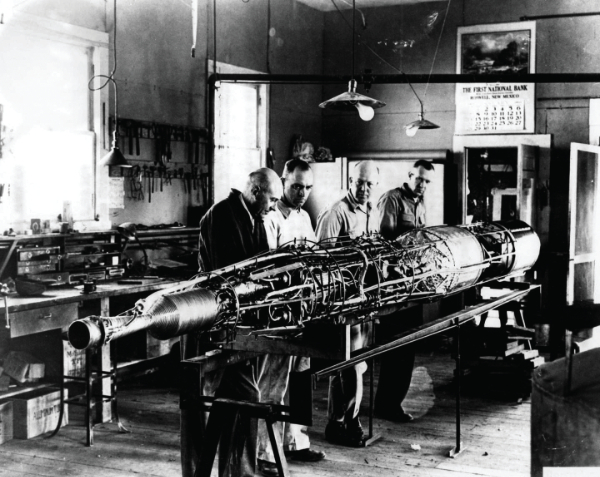
Dr. Robert H. Goddard works with his team at his lab in Roswell.
Dr. Robert H. Goddard works with his team at his lab in Roswell. From 1930 to 1932 and from 1934 to 1941, Dr. Goddard conducted research in which he and his staff pioneered many of the techniques used in today’s rockets. Photograph courtesy the National Air and Space Museum.

Dr. Robert H. Goddard, a physics professor in Massachusetts, had a vision—one might even say an obsession. Inspired by reading books by H.G. Wells and Jules Verne, Goddard envisioned the marvelous potential of humans to travel to our moon and other planets. He committed himself to doing everything he could to make that possible. At that time, rockets were powered by solid fuels such as gunpowder or saltpeter. That worked well enough for small rockets used for ceremonies, celebrations, or as war weapons—but Goddard recognized that such fuels were not powerful enough to propel vehicles away from the Earth. He dedicated his life’s work to developing more powerful liquid-fuel rocketry. He began experimenting with rockets fueled by gasoline, using liquid oxygen to support combustion.
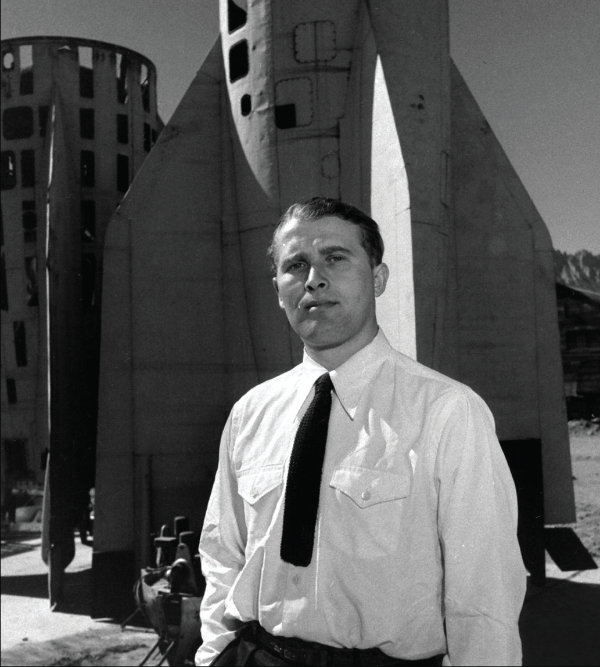
Dr. Wernher von Braun with V-2 rocket components at White Sands Proving Grounds in November 1946. Photograph courtesy Thomas D. McAvoy.

By 1929, Goddard’s first few rocket test flights in Massachusetts were impressive enough to frighten people who lived nearby, and the state fire marshal prohibited any future tests. Unwilling to give up his work, Goddard began searching for a new location. He needed a place with expanses of level, wide-open spaces, little vegetation to limit fire potential, sparse population to limit fear and possible injury, generally good weather all year round, and railroad access for bringing in supplies. A relatively high elevation would be helpful too, as it would reduce the amount of fuel needed for each launch. After consulting with weather experts and the famous aviator Charles Lindbergh, who had flown over much of the country, Goddard settled on Roswell as the best choice.

Goddard set up operations in Roswell in 1930 and began conducting experiments involving rocket propulsion, flight stability and steering mechanisms, and parachutes. With the help of his wife, Esther, and a few employees, he made dramatic progress with liquid-fuel rocket performance. He launched the first manmade vehicle to travel faster than the speed of sound in 1935, and one of his rockets reached an altitude of nearly 9,000 feet in 1937.

World War II interrupted Goddard’s rocket research, but similar work was being pursued in Europe by then. In particular, Germany’s Nazi regime created a liquid-fuel rocket development program led by Dr. Wernher von Braun. Their premier result was the V-2 missile, which could deliver a ton of explosives to targets up to 200 miles away. The extent to which that missile’s design was derived from Goddard’s inventions is unclear, but when Goddard saw captured parts of a V-2 in 1945, he noted their remarkable similarity to his inventions. This could have resulted from copying his work or simply from simultaneous but independent invention.

By the time Goddard left New Mexico in 1942, the U.S. Army at White Sands Proving Ground (WSPG) was developing its own liquid-fuel rocket, the WAC Corporal. Its designers had consulted with Goddard for advice. The Army missile was intended for scientific research of the upper atmosphere. The 1945 test flights of its solid-fuel booster rockets and then the WAC Corporal itself were the first rocket launches at the White Sands facility.

About a year later, New Mexico hosted the next major advance in rocketry for space exploration. At the end of World War II, von Braun and more than a hundred of his colleagues surrendered to the U.S. Army in Germany. Under Operation Paperclip, they were brought to this country and assigned to White Sands Proving Ground to work with American scientists and engineers in further developing their V-2 missile and other rockets. Three hundred train car loads of German missile components, launch equipment, and research documentation were brought to WSPG.

One result of that collaboration was the world’s first two-stage, liquid-fuel rocket in 1948, known as the Bumper project. Its first stage was a modified V-2, and the second stage was a WAC Corporal. In one test at WSPG, the second stage reached an altitude of 244 miles and a speed of 5,100 miles an hour. In 1950, the Bumper project was transferred to a new launch facility in Florida, and the New Mexico-developed rocket became the first vehicle launched from Cape Canaveral.

Space exploration research in New Mexico reached a new, broader level after the National Aeronautics and Space Administration (NASA) was created in 1958, the same year that White Sands Proving Ground was renamed White Sands Missile Range (WSMR). At last, plans were underway to send people into space, as Goddard and von Braun had long dreamed. Projects planned and carried out in New Mexico were keys to the success of that effort.

Suborbital rockets launched at WSMR during the next decade tested the ability of various devices to withstand the forces of rocket launch and reentry, and to operate correctly in microgravity (commonly called weightlessness).

Since 1946, research at Holloman Air Force Base in Alamogordo has centered on biological factors related to spaceflight. In 1953, Dr. John Paul Stapp became head of the Aeromedical Field Laboratory at Holloman, where he conducted much of the research and oversaw the rest. Stapp’s personal interest was in the effects of rapid acceleration and deceleration on the human body. He devised several types of equipment to study this topic using animals and human volunteers. He always tested an experiment on himself before allowing other men to experience it, in order to ensure its safety.
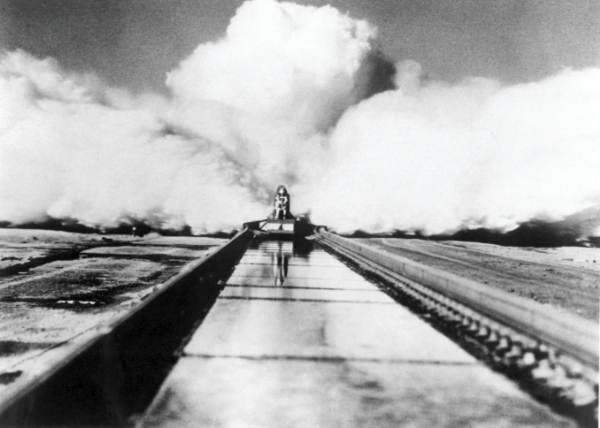
On December 10, 1954, Col. John P. Stapp propelled down the Holloman High Speed Test Track aboard the rocket sled Sonic Wind 1 at a rate of 632 miles per hour, proving that a pilot flying at 35,000 feet, going twice the speed of sound, could withstand the wind blast if they had to eject. Photograph courtesy Holloman Air Force Base.

Stapp was the only subject for his most famous human experiments. In 1954, he rode a rocket-propelled sled on Holloman’s high-speed test track in three successively more severe acceleration /deceleration tests. The ultimate run came that December. Stapp was strapped into an unprotected seat on the sled, wearing a standard Air Force flight suit and a helmet with a full visor. His arms, legs, and head were secured. Then nine rocket engines on the back of the sled ignited for five seconds, propelling him to a speed of 632 miles an hour. Just after the rockets shut down, the sled hit a water brake section that brought the sled to a complete stop in one and one-quarter seconds. During that stop, Stapp experienced 25 Gs of sustained deceleration that actually peaked at 46 Gs for a fraction of a second. He sustained broken blood vessels in his eyes, but was back to essentially normal health by the following day.
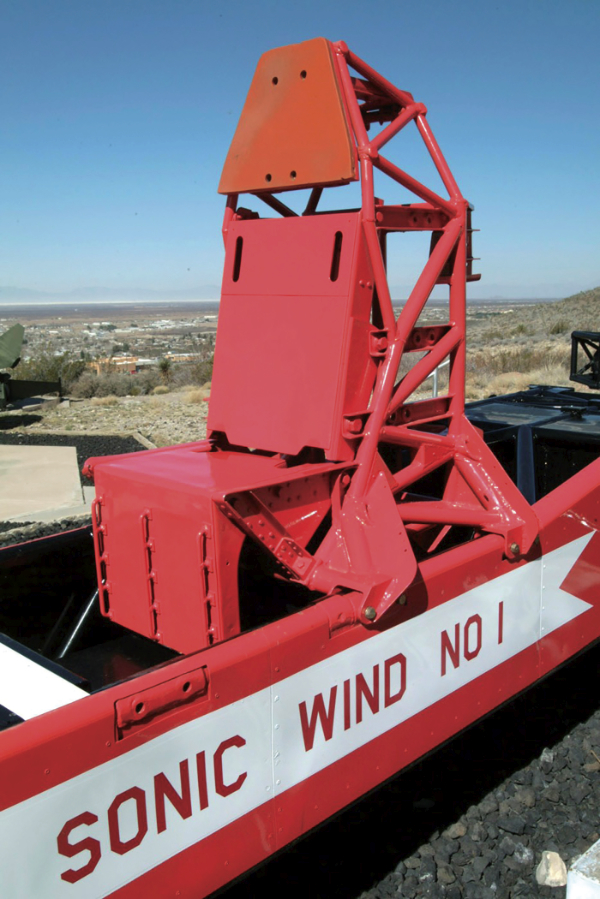
Col. Stapp’s Sonic Wind 1 rocket sled is displayed at the New Mexico Museum of Space History. Photograph courtesy Holloman Air Force Base.

This daring experiment proved the human body’s ability to withstand far more powerful forces than would be experienced during rocket launch and reentry. (Experience would later show that maximum acceleration forces in manned space flights of the Mercury, Gemini, and Apollo programs were about 7 Gs; and the greatest deceleration forces were about 11 Gs.)

In spaceflight, an astronaut would experience not only acceleration and deceleration forces, but also the virtual absence of the force of gravity. Scientists worried that blood would not circulate adequately in that condition, or that an astronaut might not be able to swallow food or drink. Or they might become so disoriented in an environment with no up or down that they would be unable to do their required tasks. To explore these possibilities, airplane pilots at Holloman became proficient in flying a series of steep vertical arcs that produced half a minute of microgravity at each apex. Volunteers riding in the plane’s cargo bay could try eating, drinking, writing, and doing other essential activities.
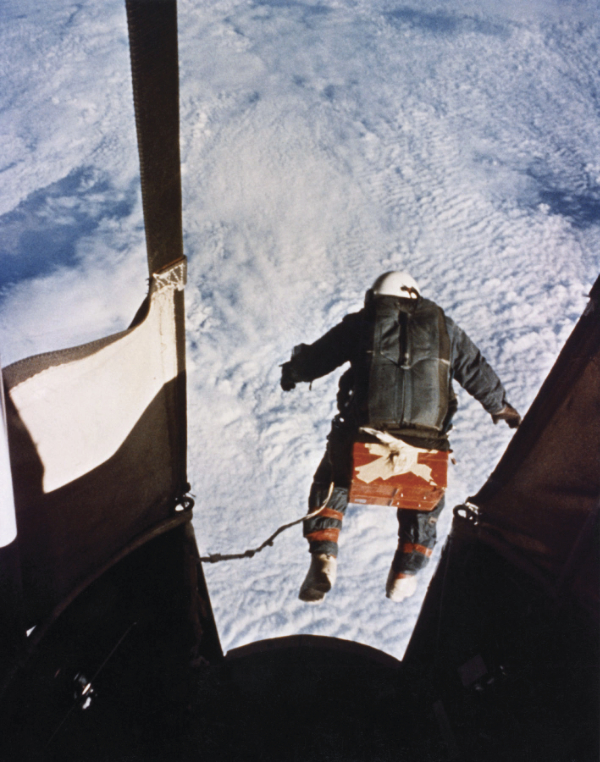
In a 1960 Holloman Air Force Base test to evaluate high-altitude bailout techniques, Cpt. Joseph Kittinger, Jr., stepped from the Excelsior III balloon gondola at the altitude of 102,800 feet. In freefall for 4.5 minutes at speeds up to 714 mph and temperatures as low as -94 degrees Fahrenheit, he opened his parachute at 18,000 feet. Photograph courtesy U.S. Air Force.

There was one other important project developed at Holloman called Manhigh. Led by Dr. David Simons under Stapp’s command, it demonstrated the feasibility of constructing a space capsule that could protect an astronaut during an extended stay in the cold, low-pressure, radiation-exposed environment of a space-equivalent altitude. The capsule also required an oxygen regeneration system and communications capabilities. During the most successful of the program’s three manned flights, a 200-foot-diameter, helium-filled balloon carried the capsule to an altitude of more than 100,000 feet (19 miles). Simons stayed at a very high altitude for twenty-three hours of the thirty-two-hour flight. The program’s three flights demonstrated not only the performance of the space capsule but also the ability of a trained person to function effectively in a small, confined space at a great distance from the ground.

Through these and other experiments with animals and humans, researchers in southern New Mexico verified that spaceflight was humanly possible. By 1959, NASA was ready to select its first astronauts, who would fly into near-Earth space in the Mercury program. Using selection criteria expanded from ones used in the Manhigh project and drawing on a pool of potential candidates who were military test pilots, NASA narrowed its choices to thirty-two men. (Women were automatically excluded because they could not be military pilots at that time.) The next step was conducting medical exams to ensure these men were in “excellent physical condition,” which was one of the selection criteria.

NASA chose Dr. William Randolph (Randy) Lovelace II to design and conduct the test regimen at the Lovelace Clinic in Albuquerque. Lovelace had been developing oxygen equipment for pilots in high-altitude flight since the late 1930s. By 1958, he was chairman of NASA’s Special Advisory Committee on Life Sciences. The Lovelace Clinic had already been conducting secret physical exams for pilots of the ultra-high-altitude U-2 spy planes, and its staff had developed a machine-readable card system that made analyzing the astronaut candidates’ test results very efficient.

Beginning in February 1959, the astronaut candidates came to the Lovelace Clinic in groups of half a dozen, each group being tested for seven and a half consecutive days, with each day’s tests lasting eleven hours or more. Lovelace described the regimen as “one of the toughest medical examinations in history.” Not knowing exactly what physical challenges spaceflight would present to the human body, the doctors examined basically everything they could think of. This process not only revealed the overall health of each candidate, but it also provided baseline measurements that could be compared with post-spaceflight examinations to identify any possible physical effects.

Of the thirty-two candidates examined at the Lovelace Clinic, eighteen passed “with no medical reservation.” After psychological examinations and physical stress tests in Ohio and further interviews, seven men were chosen to be America’s first astronauts.

As NASA moved forward through its Mercury, Gemini, and Apollo manned space programs, crews in New Mexico continued to test new generations of equipment. Seats astronauts would sit in during Apollo launches were evaluated on acceleration/deceleration devices at Holloman Air Force Base. Essential instruments to be used on missions to the moon were subjected to rocket launches, landings, and brief exposures to the space environment at WSMR. Recovery of payloads proved to be a major challenge, as they often landed far from the target location and the impact could bury them in the sand upon landing. In the mid-1960s, specially trained dogs were used to find the payloads, which had been coated with a distinctive scent. This novel approach was highly successful, with a recovery rate of 96 percent.
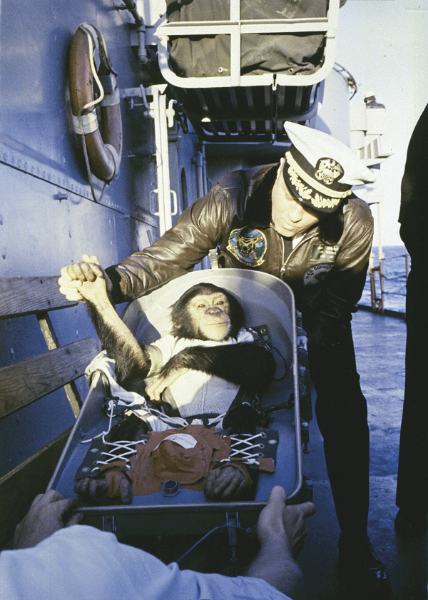
Chimpanzee Ham is greeted with the famous “handshake” welcome by the recovery ship commander after his flight on the Mercury Redstone rocket, 1961. Ham, along with several other chimpanzees, had been trained at Holloman Air Force Base to endure spaceflight and to perform mental and physical tasks during his flight. Photograph courtesy NASA.

The Soviet Union sent a cosmonaut on a one-orbit flight before NASA conducted its first two manned suborbital flights, and then sent a second cosmonaut on a seventeen-orbit flight before NASA’s first manned orbital flight. Nevertheless, NASA chose to proceed with an abundance of caution, sending a human surrogate on each type of flight before sending a human. A chimpanzee named Ham took a fifteen-minute suborbital flight in January 1961 before Alan Shepard became America’s first man in space. Another chimpanzee, Enos, flew a two-orbit mission later that year, before John Glenn became the first orbiting astronaut in February 1962. Ham and Enos, along with several other chimpanzees, had been trained at Holloman Air Force Base to endure spaceflight and to perform mental and physical tasks during their flights. In both of the chimps’ flights, malfunctions caused the animals unexpected stress, yet both performed their assigned tasks almost flawlessly. Ham the Astrochimp is buried at the New Mexico Museum of Space History beneath the flagpoles.

In the haste to fulfill President John F. Kennedy’s pledge of sending a man to the moon and returning him safely to the Earth by the end of the 1960s, the three phases of NASA’s first manned space program overlapped. As the Mercury program was validating orbital spacecraft and humans’ ability to function in space, the Gemini program was being planned and prepared. Its missions would also be in Earth’s orbit, but would test equipment and procedures for extravehicular activities (spacewalks) and docking of two orbiting spacecraft. Preparations for the Apollo missions, with larger crews ultimately reaching the moon for landings and lunar orbiting, actually began as early as 1962, the same year as the first Mercury orbital flight. During all that time, Holloman and WSMR played active support roles.

In preparation for the Apollo moon landings, engineers at Sandia National Laboratories in Albuquerque began developing procedures in 1963 for making sure the landing modules did not contaminate the lunar surface with foreign materials. They also helped develop and test radioisotopic heaters that would provide necessary warmth for equipment left there by the first human visitors.

Also in 1963, NASA built its own propulsion systems development station on the edge of the WSMR property outside of Las Cruces. Rocket engines designed for use in the Apollo program were evaluated in static tests at this White Sands Test Facility (WSTF) before being approved for use in actual launches.

After the last Apollo missions in 1972, NASA shifted its crewed space activities to Earth-orbit operations. The space shuttle vehicle was developed to serve first as an orbiting laboratory and then as a transportation vessel to carry astronauts and supplies between the Earth and the International Space Station (ISS). In fact, more than two dozen shuttle missions delivered modules used to construct the ISS in low-Earth orbit.

New Mexico figured prominently in the space shuttle program. WSTF staff tested materials and components that would be used in the shuttle’s propulsion, power, and life-support systems as well as payloads and experiments to be carried on missions by the shuttle and the ISS. The facility even has a team of smell testers that evaluate objects for potential unpleasant odors in the confines of crewed spacecraft or the ISS.

White Sands Space Harbor, a facility operated by WSTF using a pair of runways on WSMR property, became a practice facility for landing shuttles starting in 1976. The shuttles landed as gliders, so the astronauts flying them had only one chance to make a safe landing. This made actual training flights, as well as those done in stationary simulators, crucial. Four Gulfstream II airplanes were modified to fly like a space shuttle would during landing, and the cockpits were outfitted as replicas of shuttle cockpits. Before each shuttle mission, the astronaut assigned to land the craft had to complete 1,000 landings in the training aircraft. Most of these practice sessions were at White Sands, although some were also done at the primary shuttle landing sites of Kennedy Space Center in Florida and Edwards Air Force Base in California.

In addition to being a major training facility, White Sands Space Harbor was the contingency landing site for each space shuttle mission during the program’s duration from 1981 to 2011. If both Kennedy Space Center and Edwards Air Force Base were unavailable as landing sites, White Sands would be used. Although only one shuttle actually landed at White Sands, in 1982, crews and equipment were assembled and ready at the end of every shuttle mission in case they were needed.
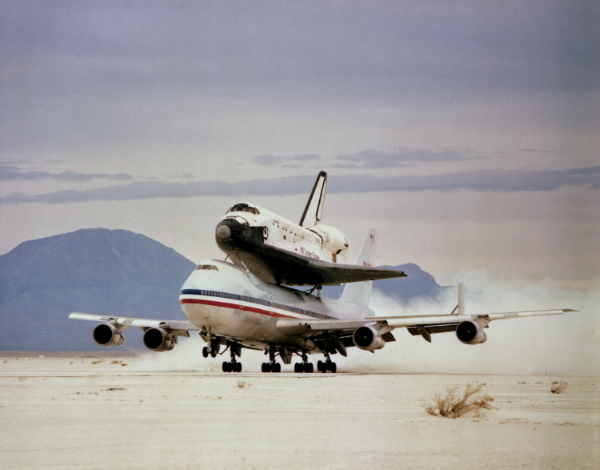
With Space Shuttle Columbia mounted firmly atop, NASA’s modified Boeing 747 Shuttle Carrier Aircraft 905 lifts off Northrup Strip at White Sands Missile Range on April 6, 1982 to ferry Columbia back to the Kennedy Space Center in Florida. Photograph courtesy NASA.

During its thirty-year history, the space shuttle program experienced two disasters with the losses of the Challenger during its 1986 launch and the Columbia during its return from space in 2003. After both incidents, scientists and engineers at Sandia National Laboratories helped determine the causes of the catastrophes and develop equipment and procedures for preventing similar events.

So far, humans have explored space in person only as far as the moon. But people in New Mexico have helped explore objects and environments much farther away by means of unmanned space probes. Scientists and engineers at Los Alamos National Laboratory (LANL) have played major roles in those endeavors. For example, as early as the mid-1950s, they began trying to develop nuclear power for rocket propulsion in Project Rover. Nuclear power would dramatically reduce the weight of the fuel needed to power the rocket and provide propulsion for a much longer period of time. While it has not yet been feasible to use nuclear power for rocket launch, other applications of nuclear power have proven enormously useful in long-duration, unmanned missions to distant planets, asteroids, and comets.

One nuclear application developed for spacecraft at Los Alamos was radioisotope thermoelectric generators (RTGs). These devices can generate electricity to power instruments on the spacecraft and to provide heat in the extreme cold of deep space. RTGs have been used in many space exploration projects including the Voyager 1 and Voyager 2 space probes launched in 1977. Both are still gathering and transmitting data, now from interstellar space. RTGs also powered the Pioneer 10 and 11 missions launched in 1972 and 1973 that performed the first flybys of Jupiter, Saturn, Uranus, and Neptune. RTGs were also used on the New Horizons mission to Pluto in 2015. A replica of the spacecraft is on display inside the Tombaugh Education Center at the New Mexico Museum of Space History.

Both Goddard and von Braun saw the potential for electric propulsion of spacecraft by creating charged ions that would be expelled from the spacecraft to produce thrust. Ion propulsion produces a very small amount of thrust; but operating continuously for a long period of time, it can propel spacecraft to very high velocities. LANL employees have worked on developing ion propulsion systems. During the Deep Space 1 mission, which launched in 1998, LANL-developed instruments and analysis determined that ion propulsion could be used without interfering with operations of the scientific instruments on board.
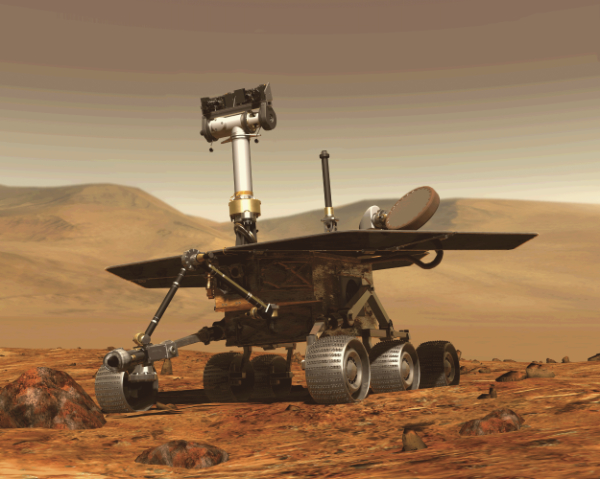
Artist’s conception of Mars Exploration Rover, 2003. Rovers named Spirit and Opportunity launched June 10 and July 7, 2003 (respectively). Their primary objective was to find evidence of water in Martian rocks and/or soil. Larry Crumpler of the New Mexico Museum of Natural History and Science in Albuquerque was a member of the team that operated Spirit and Opportunity until Opportunity’s last communication in 2018. Image courtesy NASA.

Robotic explorations of Mars have been the next best thing to going there in person. Dr. Larry Crumpler of the New Mexico Museum of Natural History and Science in Albuquerque knows that better than anyone. A planetary geologist, he was a member of the Mars Exploration Rovers team that operated Spirit and Opportunity on the red planet from their landings in 2004 until Opportunity’s last communication in 2018. A rare exact duplicate of one of the rovers is on display at the museum in a realistic Mars-like setting constructed of soil and rocks gathered from parts of New Mexico.

Until relatively recently, American space exploration has been the purview of NASA. New Mexico, however, has been at the forefront of a new generation of commercial space exploration. Just over thirty years ago, in March 1989, a NASA scientific mission first used a commercially built and launched rocket that took off from White Sands Missile Range. Even the payload integration was performed by the contractor, Space Services. From that beginning, New Mexico has been a leader in the development of commercial spaceflight.

The brief descriptions in this article give just a hint of the crucial contributions New Mexico researchers and engineers have made to space exploration for nearly a century. Each of the topics mentioned here can be explored in far greater depth for a better understanding of their details.

But the state’s involvement is even broader than the locations and facilities mentioned here. Staff members at the New Mexico Museum of Space History in Alamogordo have created a “New Mexico Space Trail” to more fully document important sites throughout the state. A map showing fifty-two historic sites can be downloaded at NMSpaceTrail.org. The sites include ancient astronomy installations, twentieth-century observatories, museums, Apollo astronaut training sites, and other test and launch facilities, as well as all of the places described in this article.

Use the New Mexico Space Trail as a roadmap to further explore New Mexico’s unique, prolific history of space exploration. Some of the sites are not open to the public, but you can visit them virtually through books, articles, and museums. As New Mexico continues its leadership role in space exploration through its growing commercial space industry as well as its ongoing contributions to its traditional partnerships with NASA, it is useful to understand how that leadership position evolved. 

—  

Loretta Hall is the author of four space-related books including Out of this World: New Mexico’s Contributions to Space Travel and Miguel & Michelle Visit Spaceport America.
Loretta Hall (opens in a new tab) is a freelance author whose nonfiction themes include space exploration, human experience, ecological architecture, and multiculturalism. She is the author of four space-related books including Out of this World: New Mexico’s Contributions to Space Travel and Miguel & Michelle Visit Spaceport America. Loretta is a member of the National Federation of Press Women, New Mexico Press Women, SouthWest Writers, and the Historical Society of New Mexico’s Speakers Bureau.
The Jump to Virtual

By Charlotte Jusinski

When a museum shuts its doors each evening, it’s perhaps a relief for many curators, educators, and other museum staffers. Bringing art to the public is a full-time job, and at the end of a long day, sometimes there is nothing better than being able to leave work at work, go home, and kick back for a few hours until you have to do it all again.

But what about when the museum shuts its doors one evening … and doesn’t open them the next day? Or the next, or the next, or for weeks thereafter?

It’s precisely the circumstance in which we find ourselves due to the COVID-19 pandemic. New Mexico’s museums and historic sites temporarily closed to the public at the end of the day on Sunday, March 15, and have not opened again as of this writing. It’s unclear when patrons will be able to walk back into brick-and-mortar spaces.

As a result, museum staff have had to get creative with how to bring their collections to the masses—all done from home, the place we once came to relax. Jana Gottshalk, an assistant curator at the New Mexico Museum of Art, immediately saw an opportunity in the shutdown and curated a crowdsourced exhibition titled Now!, featuring work from the public. Inspired by her idea, Curator of Twentieth-Century Art Christian Waguespack perused the museum’s digital collections and put together The Solitary Figure. Both of these virtual exhibitions are available to view on Instagram (Now! | The Solitary Figure) and Facebook (Now! | The Solitary Figure)—no account required.

Once public spaces in New Mexico became inaccessible, it became clear that artists, writers, and curators were going to have more time to express themselves artistically. Many started turning to social media as an outlet.

“When the museum closed, we had to come together quickly to figure out how to focus our efforts on social media and art accessibility,” Gottshalk says. “I decided to curate the virtual exhibit Now!, and tapping into the art that was being posted by our community regarding this time of uncertainty felt like an obvious step.”

The Museum of Art put out a call for original art from the community through its social media pages and received hundreds of entries. “From there,” Gottshalk says, “I chose eight pieces and compiled them into an Instagram post and also a video you can see on our Facebook page. It was an experiment, but I feel we had pretty great results.”

The idea of a virtual exhibition wasn’t necessarily an easy transition for everyone at the museum; Waguespack, for example, says: “I’ve always felt strongly about experiencing art in the flesh,” he says. “That is one of the main reasons I pursued museum work, to be able to be involved with artwork directly, instead of on a screen or slide or in a book, like we do so much in classrooms. … I have always felt [that] you lose so much when an object isn’t experienced in person, things like scale, the true vibrancy of color, surface texture, being able to really examine brushwork and the way paint sits on its surface; but also on a more abstract level, the experience of being with that object and forming a connection with it. All of those formal things that made me fall in love with art in the first place. All that is lost on a screen. …

“So for me, the biggest challenge connected with an art exhibition in a virtual space is letting these prejudices go. … No matter how much we all love being in the presence of a specific painting in a specific gallery, in the twenty-first century, anyone with a modicum of hope of being relevant has to be at peace with the idea that we are a screen culture, that we consume the majority of our lives through tiny glowing rectangles. If you can’t make your work relevant in that way, it may be time to hang up your hat. … To dismiss virtual spaces now is, to me, akin to dismissing books as a way to engage the arts. You just can’t do it.”

Indeed, the accessibility and variety provided by a virtual platform soon became clear in Gottshalk’s inaugural virtual exhibition, Now!. The exhibition includes a variety of pieces firmly rooted in the zeitgeist, ranging from Joel Armstrong’s wire sculpture of a bottle of hand sanitizer to Ryan Callisto’s instantly recognizable painted portrait of the Tiger King. More timeless pieces include Andrea Sanchez’s poignant self-portrait or Alvin Gill-Tapia’s beautiful painted rendering of sunlight on Taos Pueblo.

[wonderplugin_slider id=172 alignment=”center”]

Only two of the eight pieces have obvious connections to the pandemic (the aforementioned sculpture of Purell, as well as S.M. Chavez’s Young Cowhand, Masked), and Gottshalk says she wasn’t specifically looking for pieces related directly to the pandemic. “I found a good mix among the submissions, and I wanted to represent that,” she says. “I enjoyed the fact that people were able to see many different possibilities. The sampling shown was meant to exemplify the many interpretations. It reminded me of all the ways we are experiencing this time, and to speculate on what will leave a lasting impression and what we may forget moving forward.”

Tension between the pieces keeps the small collection vibrant and engaging. “One of the most interesting examples of tension I found was the coexisting of calm and chaos,” Gottshalk says. “For example, the piece by Thomas Bowers”—an amalgam of densely patterned arms and legs appropriately titled Arms and Legs—”expresses an idea of lack of control, whereas the self-portrait by Andrea Sanchez is so controlled and calm. Bowers’ piece reminded me of how overwhelming the world is right now, while Sanchez’s piece speaks about the time we have in isolation, primarily experiencing this with ourselves.”

Indeed, Waguespack adds, the way social media has catapulted to the forefront of our interactions has shone a light on new modes of expression. “I have been very interested in watching how people are putting themselves out into the world when we are unable to get out physically,” he says. “I think it is telling to see how we are able to use social media to keep connected in new ways and make our personal lives visible, and accessible, and keep in contact with one another, and of course represent ourselves to the world. But like Jeff Goldblum said, ‘Life, uh, finds a way.’ In a way, that is what we are trying to do with social media initiatives like our virtual exhibitions: Expand the life of the museum beyond the walls of the galleries or the confines of physical limitations.”

The inclusion of crowdsourced art also harks back to one of the important tenets on which the New Mexico Museum of Art was founded: strong community involvement. From its earliest days offering exhibition space to local artists until now, with its popular Alcoves series featuring small collections from numerous New Mexico creators, the museum has always been dedicated to showcasing pillars of the art world under the same roof as lesser-known artists. “The New Mexico Museum of Art started as a community-based experience and this was continuing that mission,” Gottshalk says. “We have an obligation to the community to start conversations, and talking about what was happening in these current times through art was needed.”

Gottshalk’s curation “got the rest of the curators thinking about what we could do with this kind of format, a small scale exhibition designed for a virtual platform,” Waguespack says. “This was all new to me. Her project was crowdsourced and contemporary. I wanted my version to be a little different, so I decided to focus on what we have in the twentieth-century art collection at the museum. … It is important for me to work on how the collection can be relevant for people in new ways, not just on the walls of the galleries, but instead to think about how I may bring it into people’s homes in a meaningful way.”

[wonderplugin_slider id=173 alignment=”center”]

To choose the pieces for The Solitary Figure, Waguespack says, “I started to go through our Searchable Art Museum; … I wanted to work from paintings that anyone could access online. The Searchable Art Museum is a fantastic resource for anyone who is curious what we have in the collection. I went through the work there and came up with a list of about fifty works of art that fit my criteria for this, and then went through the always painful process of narrowing the list down to the final eight.”

After choosing the pieces and writing a curator’s statement, for the video version available on Facebook, Waguespack recorded a video introduction and pieced the whole thing together into a slideshow. The magic of technology means he could do it all right from his phone. “I made the video myself, on my iPhone in my living room, wearing a blazer from the waist up and my PJs from the waist down, which is something I think a lot of us can relate to these days.”

The transition from home space to office space, Waguespack says, is perfectly exemplified by Miki Hayakawa’s One Afternoon. “It encapsulates everything good about quiet solitude for me,” he says, “and since I have been working from home I relate to it all the more. I think of myself at my home office (the living room) sitting on the floor with my papers spread out around me. The prominence of the lush peace lily echoes for me the new role my houseplants have taken in livening up my space (though I have to say my own peace lily has never looked that good). The fruit in the corner recalls the ever-present plate of snacks by my work station, and the heater in the corner evokes the cozy atmosphere I am able to cultivate working from my own home.”

Beyond just the physical location of the figure, Waguespack says, he is also drawn to what the emotionality of the painting connects with in his own life. “I’m also interested in the complete absorption of the figure. His back in turned to us, he is emotionally closed off, not engaging the viewer, fully wrapped up in his reading and full at ease. This puts me in mind of the new focus I am able to find working from home with the noises of the office and outside world shut off for a time. For me, this painting is iconic of everything good working from home has come to mean for me and feels very ‘now,’ even though it was painted about 80 years ago.”

Not only does The Solitary Figure put in the forefront the subject of a painting as solitary, but it evokes thoughts about the artist as a solitary figure. Waguespack bucks against the idea as the artist as necessarily alone, however, thought it has long been a prominent image when we think about creators.

“I think the romantic image of the artist as a loner working in isolation has been so prominent over the modern period that we can just dismiss it,” he says. “I can’t help but think of Warhol’s Factory, the ateliers of the academy, Renaissance workshops; and more locally, about the fact that so many artists in New Mexico’s history came together to form collections: The Taos Society of Artists, the Rio Grande Painters, Los Cinco Pintores, The Transcendental Painters Group, the list goes on.” But each artist is an individual, of course, so the pendulum swings both ways. For those who are enthralled by their isolation right now, you are certainly not alone. “Outside of medieval monks, I can’t think of many artists that really flourished being truly isolated from the world,” says Waguespack. “I think time to think and work alone is beneficial to the creative process, but I think isolation is limiting if we want to be relevant. At the very least, there needs to be a balance.”

Charlotte Jusinski is the editor of El Palacio.

Treading through Research

BY C. L. Kieffer

My favorite aspects of working in museum collections are the inadvertent discoveries. Typically, these discoveries occur during inventory or while entering data into the collections database. Suddenly light is shed on an object or artifact that has been forgotten about. It’s bound to happen, given how large most museum collections are. My most recent inadvertent discovery here at the Wheelwright Museum of the American Indian was what most people would consider to be a well-loved, ratty old pair of sneakers.

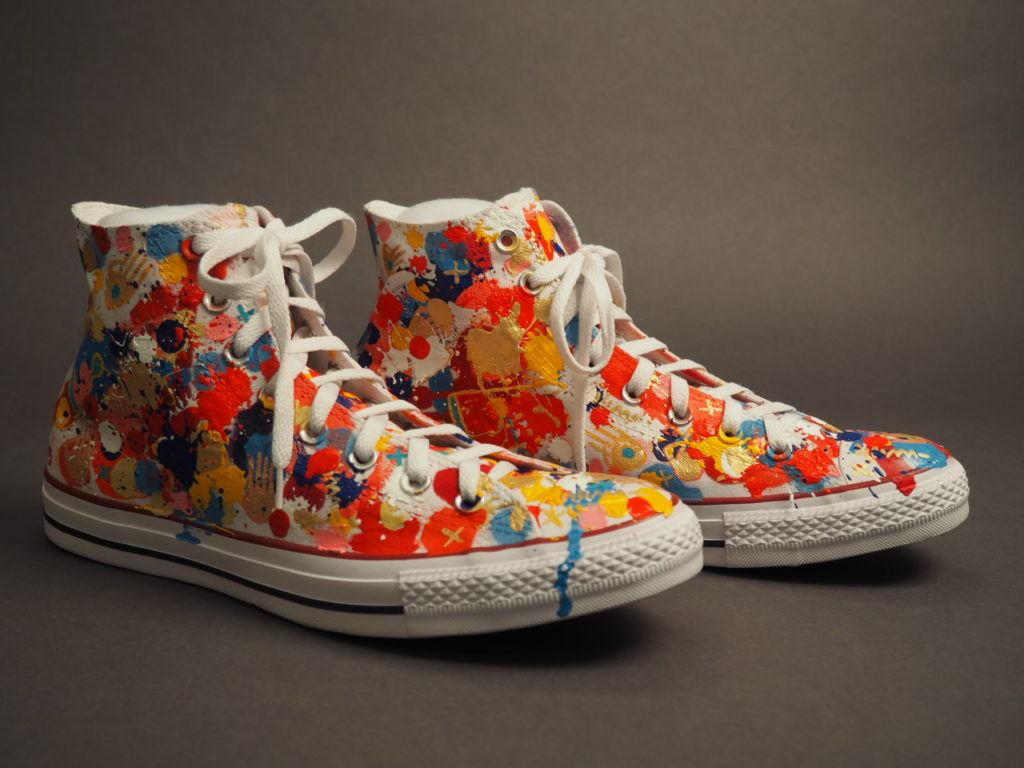
At first glance, these sneakers do not look like they belong in a museum. But as a fan of Converse, I see the potential. I know they are vintage based on the blue and white “Converse Lucky Boy” ankle patch. Furthermore, their age is supported with the staining and discoloration of what used to be white canvas. Unlike the numerous beaded shoes that have made their way into exhibitions and museum collections, these are painted with patterns of repetitive semicircles, triangles, chevrons, and parallel line designs in red, blue, green, and yellow. Finally, the blue thunderbirds on the white rubber toe guard signal the artist’s possible desire to add a supernatural element of their ideological beliefs. These thunderbirds and the collecting scope of the museum lead me to the conclusion that the artist is Native American.

The design element on these Converse that took me by surprise were the parallel lines in pencil that flanked an area of chevrons and triangles. These pencil lines made the shoes seem like a work in progress. They made me suspect that the artist either sold or gifted them before they were finished, or they were possibly worn by the artist between bouts of artistic expression.

A lot of information about these Converse was unknown when I came across them in the collection. The Wheelwright’s database did not have any information on when they were made, who made them, or even who donated them. All it could tell me is that they had been accessioned in 1985.

After combing through accession logs and old catalog sheets, none of the unknown information materialized. It is not unheard of at any given museum for items to be dropped off anonymously, for information to become disassociated from objects in collections, or even for them to fall through the cracks at the time of acquisition and later be found and cataloged as a “found in collection” item. This lack of information reeled me in even more. These shoes had an untold story, and it was up to me to conduct the research to bring it to light.

The first phase of the research was to determine the age of the Converse. The ankle patch would be crucial in me narrowing down a rough age of the work, since the “Lucky Boy” line was mainly produced in the 1960s, according to various collectors and sellers online. However, it is always best to go to the source for confirmation.

My first discussion with Converse’s corporate business was an online chat with a customer service representative who did the same Google search I had done to get initial information on the age of the shoes. I explained that I had already done that Google search and I wanted a more accurate source than a seller on eBay.

Though it wasn’t fruitful, I was not discouraged by this initial interaction with Converse. After all, there are numerous websites with the history of the corporation. Many of these histories going back to the founding of the company in 1908 by Marquis Mills Converse in Malden, Massachusetts. These intricate histories, of course, included how a basketball player by the name of Charles H. Taylor helped promote the shoes, which led to the now ubiquitous nickname for Converse shoes: “Chucks.”

All this information had to come from somewhere. Throughout all of my early communications with corporate, I had requested to have my inquiry forwarded on to someone at the company was in charge of keeping track of old styles and company history. I was informed that there was no one at the company who did that.

After numerous phone calls, voicemail greetings that informed me not to leave a message, and unanswered emails to various divisions at the Converse corporate office, I was informed that the company would be willing to authenticate the shoes if I provided a photograph of the QR code on the inside of the shoes’ tongue. I explained that the shoes predate QR codes; QR codes were not created until the 1990s and were not regularly used until the early 2000s. I sent them pictures of the shoes anyway, which resulted in no response.

Despite having been told numerous times that Converse did not have a historian, I eventually stumbled upon a YouTube video interview with Samuel Smallidge, credited as Converse’s archivist. The video was posted to YouTube in 2018, so I thought it was safe to assume that Smallidge was still their archivist, or at least someone was there in that role. The video explained that the Converse archives are only accessible by employees and that any requests from outsiders needed to go through corporate’s public relations. As a respectful researcher, I reached out to their public relations folks via email, sent photos of the shoes, and requested my inquiry be passed along to Smallidge.

Days and weeks went by with no word from Converse. I assumed my emails to their public relations folks fell through the cracks. I searched for a way to get in direct contact with Smallidge, possibly a work email or a website about the archives. All I was able to find was his private Twitter account, which had not been active in a number of months.

Just as I was about to give up, I received an email from Smallidge. He confirmed my internet research by stating they were made in the 1960s. I shared with him a photo of the completed exhibit case and thanked him for his help.

While waiting to hear from various people at Converse’s corporate headquarters, I started phase two of my research. In my decades of my museum work, I had never come across a Native-decorated pair of mass-produced sneakers that were more than a few years old—let alone a pair that was more than half a century old. Was this the oldest known pair of Native American decorated shoes? Did anyone else have a pair of painted Chucks that could possibly be from the same artist?

I emailed every museum I knew that collected Native American art and every shoe museum. Originally, I was hoping to find a similar set of Chucks. I dreamed of another institution having a similar aged pair, designed in a similar way, and hoped that that institution would in turn know something about the artist.

A few institutions had a pair. More often than not, it was a pair of beaded Converse by Terri Greeves (Kiowa). All of these pairs I already knew about thanks to Ms. Greeves’ website. I will admit, however, that I was a little surprised by these results. Why hadn’t a pair of beaded Vans by Charlene Holy Bear (Standing Rock Lakota Sioux) or a pair of Jamie Okuma’s (Luiseño/Shoshone-Bannock) beaded Louis Vuitton heels ended up in any museum collection yet?

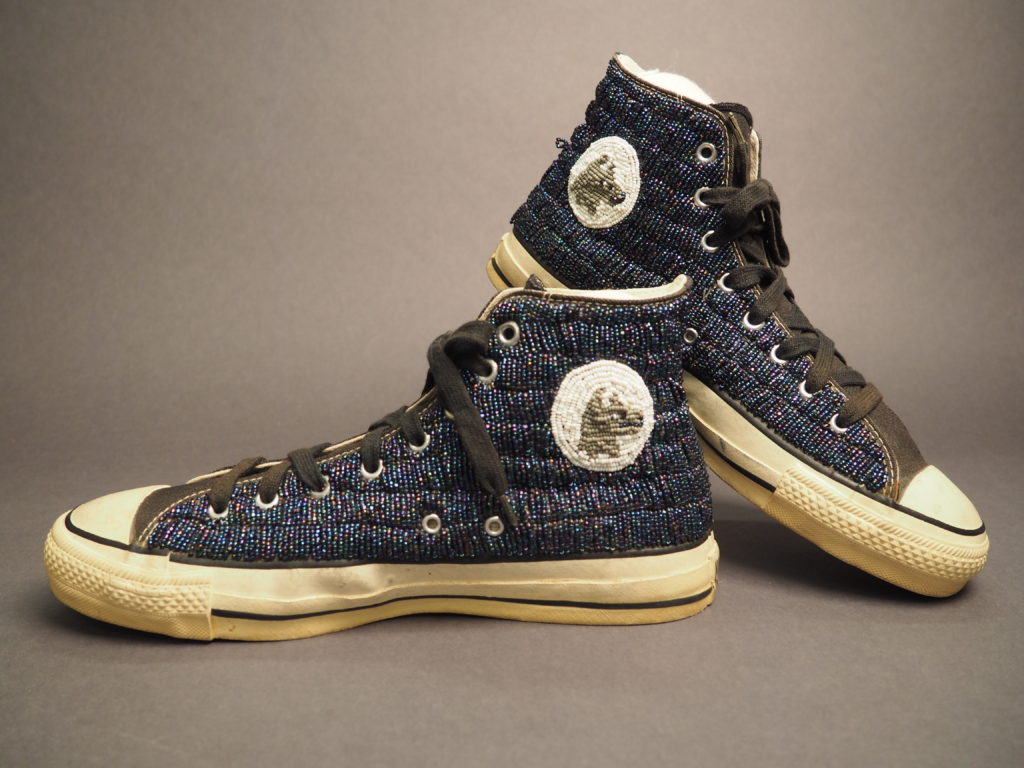
After finding few pairs of Native-decorated mass-produced shoes in museum collections, I began researching the Wheelwright Museum’s other pair of Converse. The canvas of this pair was almost completely covered with a bluish-black iridescent bead. The area on the inner ankle where the Converse patch typically was adhered was covered with the profile of a coyote on a field of gray beads.

Converse beaded by Marie Flying Horse (Lakota/Mi’kmaq), commissioned by Harry Fonseca (Nisenan Maidu/Native Hawaiian). Photograph by C.L. Kieffer, courtesy Wheelwright Museum of the American Indian Collections (2005.06.001).

The shoes had been donated to the collection in 2005. Unlike the painted pair, there was a bit of provenance information with this pair. They had been commissioned from Marie Flying Horse (Lakota/Mi’kmaq) by Harry Fonseca (Nisenan Maidu/Native Hawaiian), who had worn them to his first exhibition opening at the Wheelwright in 1983.

While the collections database has fields for tribal affiliation and birth and death years of artists, all of these were blank for this beaded pair of Converse. In trying to find out more information about Flying Horse, I was able to track down and email her son Christopher, who is now a professor of geology at a prestigious university.

This email correspondence was probably the most rewarding of this entire research project. Chris was surprised to hear that one of his mother’s pairs of Converse had made it into a museum collection. He explained to me that his mother had actually made numerous pairs for Harry Fonseca to wear throughout the 1980s, and he correctly guessed right off the bat that the pair had belonged to him. I feel grateful that I was able to entertain his request to see a picture of the shoes and let him know we would be putting them on display with another pair from our collection.

In reaching out to numerous museums, I learned a number of interesting things about Native American-decorated mass-produced shoes. The Autry Museum of the American West in Los Angeles replied to my inquiry rather quickly. They informed me that Harry Fonseca had incorporated a single painted Converse shoe into one of his statues that was in their collection. They were kind enough to send me pictures of the shoe. The lone shoe was a right foot, size six Converse with painted watermelon wedges on a brightly painted pink background and lime green trim and interior. Sadly, much like the Wheelwright’s painted Converse, they did not have a date on the artwork.

At this point, I will admit I was entertained and off-track, following Fonseca’s love affair with Converse and watermelon. I began to see stylized Converse in some of his artwork and was very familiar with some of his paintings that incorporated watermelons that were in our collection. I was also distracted by the fact that the Autry only had one Converse. Where was the other one? Could it be in another museum collection somewhere? There was no way Fonseca kept the shoe to wear, because I knew he wore a size ten and a half.

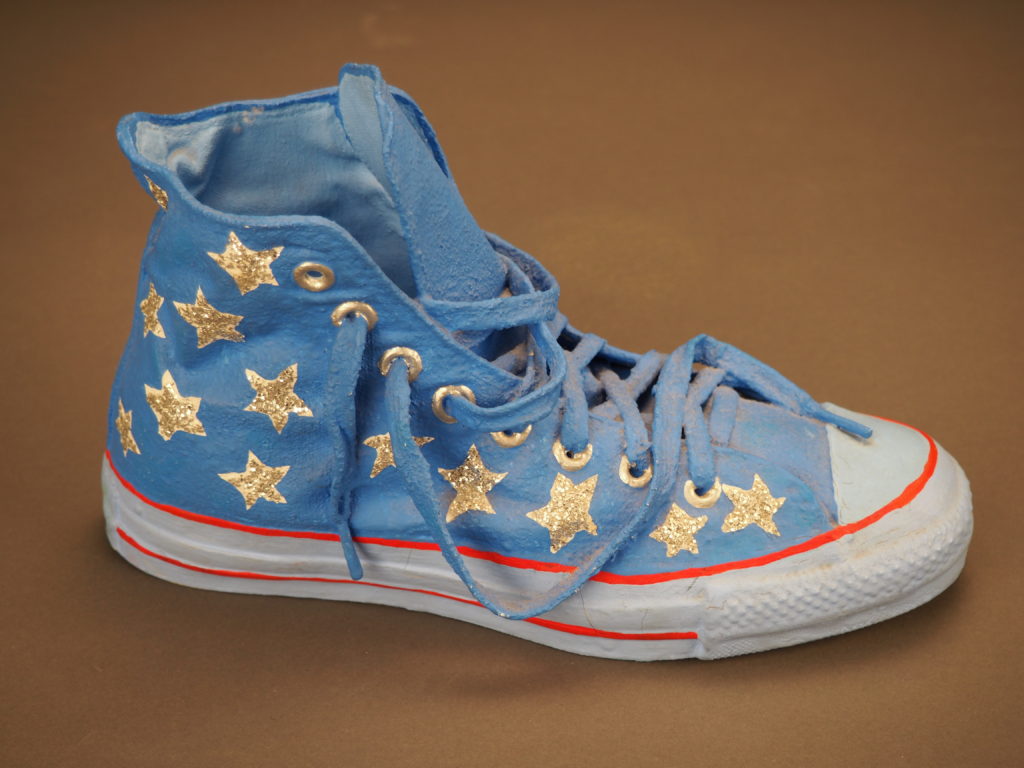
Painted Converse by Harry Fonseca (Nisenan Maidu/Native Hawaiian). Photograph by C.L. Kieffer, courtesy Museum of Indian Arts and Culture/Laboratory of Anthropology (MIAC 57629).

I thought I may have found the shoe’s mate when the Museum of Indian Arts and Culture in Santa Fe, New Mexico responded to my email. They informed me that in addition to a pair of beaded high-top heels and a beaded kid’s pair, both by Terri Greeves, they had one shoe painted by Harry Fonseca. I asked if it was bright pink with watermelons. Nope. The curator’s recollection of the shoe was that it was a high-top, painted light blue, embellished with stars. There was no image of the shoes in their database that they could share with me, and the only other information they had on hand other than that it came into the collection around 1981 or 1982 after being purchased from a Wheelwright Museum auction.

After scheduling a research visit, I was able to examine the shoe for myself. It appeared to have been treated with gesso, which hardened the painted canvas and laces. The stars were white from a paint that was applied under the blue that covered most of the shoe’s surface. The white stars then had large flecks of silver glitter glued onto them. The size chart on the inside of the tongue was non-existent and the inner sole was painted over, so no indication of year of manufacture was available for scrutiny. The interesting thing was that it too was a size six right shoe, exactly like the one at the Autry.

Thank you, Harry Fonseca, for the burning question you have now left us with: Where did the two left size six shoes end up?

Acrylic painted Converse in a Charles Loloma (Hopi) tribute style, made by Phillip Vigil (Jemez/Jicarilla Apache). Photograph by C.L. Kieffer, courtesy Wheelwright Museum of the American Indian. Private collection.

As a researcher classically trained in the realm of archaeology and museum studies, normally it is the results of the research that become something worth sharing with others or publishing. Ultimately, I never discovered much more about the 1960s pair of painted Converse. I do know that they are probably the oldest Native American decorated Converse in any museum collection. However, I don’t know which Native American artist made them, I don’t know who wore them, and I don’t know who blessed our collection with them.

The winding road of research for this pair of ratty, old, painted Converse has unfolded into a number of interesting tangential stories, thus making the research itself rewarding and informative in its own right. Their untold story will remain untold. Yet, their mysterious past adds to their allure. One’s playful imagination is left to wander, creating elaborate stories of what may have been, adding to their priceless sentimental value.


C.L. Kieffer has over 15 years of museum experience from leading museums focused on Southwest archaeology and Native American art, including the Autry National Center, the Maxwell Museum of Anthropology, and the Museum of Indian Arts & Culture. In addition to curating a number of exhibitions, she has completed masters degrees in anthropology and museum studies as well as her doctorate in anthropology. She is currently the collections manager/registrar for the Wheelwright Museum of the American Indian in Santa Fe.

The Rise of Mammals in New Mexico

by Thomas E. Williamson

Walking alone over the uneven ground of the badlands of the San Juan Basin, David Baldwin tugged again at the bridle of his mule, leading it around a hoodoo—a tall pinnacle of banded rock. Baldwin could see his breath in the cold, crisp New Mexico winter air. It was 1879. Baldwin preferred to search for fossils in the winter. He could gather snow from the north- facing slopes and melt it for drinking water in this parched land.

Something unusual caught his eye. He stooped down for a closer look. It was a small bit of jawbone with black teeth—a fossil jaw of an early Paleocene mammal—jutting from the mudstone. Baldwin removed his gloves and blew warm air on his cold hands before carefully lifting it from the rock. He reached under his poncho and removed an empty rectangular tobacco tin from his shirt pocket, carefully placing the jaw inside. Then he saw another jaw, and another…

At least that’s what I imagine happened as I scan the badlands before me. I’m looking over the same exposures that Baldwin trod 140 years ago. Baldwin discovered the first mammal fossils from these particular rocks, a spectacular set of badland exposures in the Nacimiento Formation. The name refers to a traditional nativity scene, which is appropriate considering that the fossils that Baldwin collected proved to be the first early Paleocene mammal fossils found anywhere in the world. Moreover, the Paleocene marks the first appearance of placental mammals, the group of mammals that now dominates the Earth.

[wonderplugin_slider id=166 alignment=”center”]

Baldwin shipped these fossils to Othniel Charles Marsh at Yale, but after having to wrangle with Marsh over payment, he shipped later discoveries to Marsh’s major competitor and nemesis Edward Drinker Cope. Shortly thereafter, Cope and Marsh engaged in a long, bitter, and highly public fight over the new fossil discoveries made in the West, known as the “Bone Wars.” Cope was quicker in recognizing the importance of the fossils discovered by Baldwin and published a flood of papers over the next ten years that described and named many extinct animals. New Mexico fossils provided much of the earliest evidence for the rise of mammals following the extinction of the dinosaurs.

Near the end of the nineteenth century, the American Museum of Natural History in New York, the preeminent museum of its kind, opened its doors to a public fascinated by the latest fossil discoveries made out west. Henry Fairfield Osborn, the museum’s first curator of the new Department of Vertebrate Paleontology, authorized the purchase of Cope’s collection, including his thousands of Paleocene mammals from New Mexico. This became the kernel of the museum’s paleontological collection. Osborn sent several expeditions from New York to New Mexico to collect more Paleocene fossils over the next several decades. These crews collected many thousands of additional mammal specimens that still reside in the museum’s metal cabinets in the heart of Manhattan.

Western North America contains the very best record in the world of what happened to life on land during the last few million years of the Cretaceous and the first few million years of the Paleocene, the first epoch of the Cenozoic—the beginning of the Age of Mammals. At this time, the lands of the West were undergoing a bout of mountain-building called the Laramide Orogeny. This resulted in a buckling of the crust behind the proto Rocky Mountains that accumulated thick sequences of sediment, called strata.

New Mexico’s San Juan Basin is one of these structural basins, one of the southernmost of North America, that accumulated strata through this time. These strata were subsequently lifted and are now eroding in spectacular badlands, revealing the story of the distant past to those who are able to read it.

Mammals originated at about the same time as the dinosaurs—about 230 million years ago, near the end of the Triassic Period. The first mammals were small, unassuming animals and they remained relatively small through the Age of Reptiles. Early in the Mesozoic, mammals evolved some key adaptations that allowed them to thrive in a world dominated by reptiles. It has been said that during the Mesozoic, mammals lived in the shadows of the dinosaurs. They became warm-blooded, which allowed them to be active even in cooler temperatures; they developed whiskers and fur (whiskers are special hairs that are connected to nerves and are used to sense in the dark). They evolved exquisite hearing via a unique system that incorporates bones that previously had been part of the lower jaw. They also evolved the ability to hear a very wide range of sounds, from low to high frequencies. These adaptations allowed mammals to be active at night, when most reptiles slept.

Other evidence to support this scenario is offered by the study of the mammalian genes that govern vision. Most mammals, for example, lack color vision. The most light-sensitive cells in the retina can distinguish only black and white. The ability to distinguish color among our distant ancestors was partly lost during this time when mammals took to a life in the dark. Only much later did a few mammals, such as some primates, reacquire color vision.

Mammals also developed a unique way to process food, probably connected to their need to extract as much nutrition as possible given the high energy demands required to maintain warm-bloodedness. They evolved a precision bite in which the upper and lower teeth each have a complicated pattern of raised cusps and ridges that interlock when the jaws are closed. Mammals masticate; that is, they chew their food to help break it down into smaller pieces before it is swallowed. In order to retain this interlocking pattern, mammals have reduced the replacement of their teeth so that most mammals, including humans, only replace some teeth once, replacing an initial set of deciduous (“baby”) teeth gradually with a permanent set as they mature.

The first mammals probably laid eggs, similar to just a few living mammals (the monotremes, which include the echidna and the platypus). Some mammals went on to evolve live birth. Marsupials and placentals are the only other surviving groups of these mammals. Marsupials give birth to poorly developed young that further develop in a pouch, or marsupium. Placental mammals, the predominant group of living mammals, retain the developing fetus in the body until it is much more developed before giving birth. All mammals share the trait of lactation.

The fossils of Mesozoic mammals are generally very rare, and while exceptional skeletons have been recovered, most fossils are represented only by jaws and teeth. Fortunately, thanks to their quickly evolving, complex, interlocking dentitions, various Mesozoic mammal species can often be identified just by their distinctive teeth. The teeth also give us clues as to their diets and we can look among living mammals for exemplars. We can deduce that small mammals with high, sharp cusps and crests probably ate insects; those with lower, more blunt cusps likely ate seeds and fruit. No Mesozoic mammals appear to have been adapted for chewing leaves.

Through the Mesozoic, mammals may have mostly remained in their burrows by day, venturing out only after nightfall to prey on insects. Until recently, it was thought that mammals remained unspecialized through this time; but some spectacularly well-preserved fossils from China have shown that some mammals had evolved some remarkable adaptations for gliding, digging, and swimming. Some mammals were relatively large. Repenomamus, from the Early Cretaceous (about 125 million years ago) of China, is the largest known Mesozoic mammal, reaching a length of about 3 feet (1 meter) and weighing about 30 pounds (14 kilograms). One specimen was found with a gut containing a juvenile dinosaur (the small ceratopsian dinosaur Psittacosaurus). Most Mesozoic mammals, however, were far smaller—smaller even than mice.

Despite their small size, mammals thrived in the warm Mesozoic world. In the latter half of the Mesozoic, flowering plants, the angiosperms, appeared, and by the end of the Cretaceous era they had become the dominant plants in tropical forests. These fast-growing plants provided new food sources for animals in the form of fruits, abundant seeds, and leaves. Mammals continued to prosper, feeding on the insects and other animals that dined on the flowering plants. A few mammals began eating fruits and seeds of the new plants.

The Cretaceous came to a sudden and fiery end about 66 million years ago. Dinosaurs had dominated the world for over 150 million years, and were still thriving. Tyrannosaurus rex and the giant sauropod (“long-neck”) Alamosaurus roamed the swampy forests of New Mexico.

Then they all came to an end. A large space rock the size of Mount Everest collided with the Earth, hitting the Yucatan peninsula near the present town of Chicxulub, at a velocity about ten times faster than that of a rifle bullet. The impact released the energy of a billion nuclear bombs.

The effects were catastrophic. Huge earthquakes shook the earth. Tsunamis raced from the impact site to splash inland miles from shore. Perhaps the worst bit of luck for the dinosaurs is that the rock hit an area underlaid by a thick deposit of sediments rich in sulfur. The impact vaporized these deposits and blasted them into trajectories that would encircle the earth. The fine dust and condensing droplets of sulfur compounds eventually settled into the atmosphere and drifted aloft, blocking sunlight for years. Sulfuric acid rained down and acidified the oceans, causing further environmental damage. The results were extreme. About 75 percent of all species on Earth went extinct.

Mammals didn’t survive unscathed. Virtually all the mammals known from the latest Cretaceous of North America went extinct. Only one or two species appear to have survived unchanged. A few other mammals also survived, but only after evolving into new species—or perhaps they descended from some unknown species that lived elsewhere.

How were these mammals able to survive? That is still some- thing of a mystery. Cold-blooded reptiles, such as turtles and crocodiles, may have fared better than warm-blooded animals and larger animals—it appears that anything over about 25 kilo- grams (about 55 pounds) went extinct. It may be that the survivors were those animals that were small enough to take shelter in burrows and then later take advantage of the detrital food web, a network of feeding that ultimately relies on consuming decaying organic matter. (There was no shortage of that after the impact.) Presumably, the surviving mammals were feeding primarily on the insects that ate the fungi that were consuming the rotting plants and animals.

What happened in the next few million years is nothing short of amazing. Mammals, now no longer living in the shadow of the dinosaurs, began diversifying and evolving at an explosive rate. They were free to exploit the various environmental niches left vacant by the mass extinction. Mammals didn’t waste any time. It’s this critical time, when mammals first took charge of this new world, that is recorded in the sediments of the Nacimiento Formation of New Mexico.

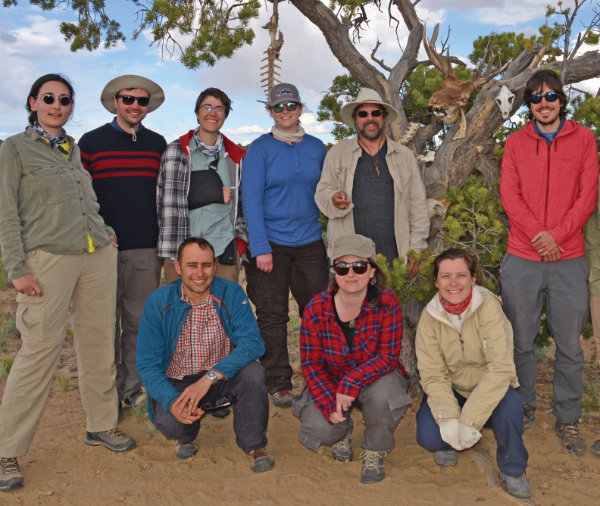
I have been working for many years now on trying to decipher the geological and paleontological record of Paleocene strata in order to better understand this critical time. I studied the beginning of the Age of Mammals in New Mexico for my doctoral dissertation at the University of New Mexico, and then was hired as a curator at the New Mexico Museum of Natural History and Science soon after. After twenty-five years of fieldwork, the museum has amassed the largest collection of early Paleocene mammals from New Mexico in the world, far surpassing even the collections of the American Museum of Natural History. For many years, I have also been working collaboratively with like-minded scientists on the early Paleocene. We are also now training a new generation of students who will hopefully continue this work in the coming decades. Each year, usually in late spring and early summer, we gather in the San Juan Basin to conduct fieldwork, exploring the badlands. In 2019, we had our largest crew ever.

The summer 2019 field crew. From left to right, back row: Zoi Kynigopoulou, Neil Adams, Paige dePolo, Dr. Sarah Shelley (Carnegie Museum of Natural History, Pittsburgh), Dr. Tom Williamson (New Mexico Museum of Natural History, Albuquerque), and Hans Puschel Rouliez. From left to right, front row: Dr. Stephen Brusatte (University of Edinburgh), Sofia Holpin, and Dr. Ornella Bertrand (University of Edinburgh). Photograph courtesy Thomas E. Williamson.

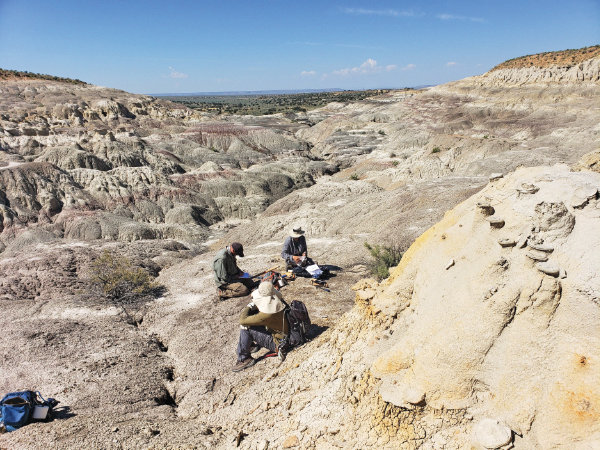
Dan Peppe of Baylor University in Texas arrived with Andrew Flynn, a PhD student, and Jeremiah Robinson, an undergraduate assistant. They were here to improve our under- standing of how vegetation changed here in the basin through the early Paleocene.

Peppe and Flynn are paleobotanists. They looked like old- time coal miners as they lugged their large pickaxes up the steep hillsides. They would stop, and with a few quick strokes of their pickaxes, they laid bare fresh bedding planes bearing complete Paleocene leaves. They wrapped up the best sandstone or shale blocks with leaves in toilet paper before stuffing them into their already-heavy backpacks. Analyses of the leaves has revealed not only that forests recovered quickly from the mass extinction, but also that forests were far more diverse here in New Mexico than they were at other sites farther north, such as up in the Dakotas.

A careful study of the plants has also revealed something really exciting about the climate of this time: The basin was covered with tropical rainforests, or seasonal tropical forests, similar to what we find today in Central America. This part of New Mexico received over 80 inches of rain a year—far more than the 8 inches or so that it receives today. Peppe and his team also measured strata and collected samples of rock that preserve a faint Paleocene magnetic signature. These will be used to correlate the rocks to the global time scale so that we can precisely date the rocks to an unprecedented degree.

Matt Heizler from the New Mexico Geochronology lab at the New Mexico Bureau of Geology and Mineral Resources in Socorro tagged along, collecting samples that he can date using radioisotopic dating. He would occasionally pick up a block of sandstone chipped up by Flynn’s pickaxe and whip out his hand lens to scrutinize it. “This is a keeper,” he would say, and bag the sample. The block of sandstone might contain tiny grains of the mineral sanidine that was once part of a volcanic ash that belched from a nearby volcano and settled over the landscape nearly 65 million years ago. These samples will be blasted by a laser back in Heizler’s lab. The gases from the vaporized mineral will be carefully measured to yield a precise age for the rocks and ultimately for the fossils that are contained within.

Steve Brusatte, my long-time friend, colleague, and fellow vertebrate paleontologist, is originally from the Chicago area, but is now part of the faculty at the University of Edinburgh, Scotland. He and I are part of a large collaborative project investigating Paleocene mammals. We are also founding members of the Paleocene Mammal Working Group, or PalM. We are studying the Paleocene mammals, primarily to get a better understanding of mammalian evolution during their initial radiation in the early Paleocene.

Paleocene mammals tend to be enigmatic. They are often so odd, and usually lacking in the specializations that are typically used to characterize the various groups of living mammals, that we don’t know where they fit in the mammalian family tree. Ultimately, we want to understand how and when the initial radiation of mammals occurred and how this radiation led to the origin of all the groups that are with us today. Finding how Paleocene mammals fit into the early part of the radiation of mammals is crucial to understanding the rise of placental mammals.

Sarah Shelley, a former PhD student of Brusatte whom I co-supervised, is now a postdoctoral research fellow at the Carnegie Museum of Natural History in Pittsburgh. She recently spearheaded the publication of a monographic description of her favorite Paleocene mammal, Periptychus. As Shelley has recently explained to an audience of other paleontologists, Paleocene mammals have previously been described as “archaic” or “maladapted.” However, this does not adequately describe them.

Periptychus, for example, does not closely resemble any single living mammal. It was about the size of a large dog, and had a heavy body and thick tail, similar to an aardvark; powerful limbs like a bear; and five-toed feet, each tipped with a small hoof. The skull of Periptychus is elongated and its molars resemble those of a pig. However, its premolars are absolutely unique. They are large, cone-shaped, and marked by distinctive ridges. The premolars typically become blunted with wear, so that the enamel at the tips are worn away and the softer dentine is exposed as a cup-shaped depression, functioning similar to a mortar and pestle for crushing hard objects like seeds and tough plants. Periptychus was among the largest mammals of its day. Large numbers of this animal once lumbered clumsily through the forests of the American West for millions of years! How bizarre!

Brusatte has brought a number of students with him this year. Each member of this cosmopolitan crop of students has been assigned a different group of Paleocene mammals to study.

Sofia Holpin, a PhD student from Italy, is studying the mammal Tetraclaenodon, which is thought to be near the ancestry of perissodactyls, the group of mammals that includes rhinos, horses, and tapirs. The fossils of Tetraclaenodon are particularly abundant and include several skulls and skeletons, which are rare for Paleocene mammals. The large numbers of fossil specimens allows us to examine how this animal varied over time. We have found evidence that it decreased in size during episodes of warming—a somewhat baffling phenom- enon that has also been seen among some other mammals in other warming periods.

Zoi Kynigopoulou is a PhD student hailing from Greece. She is passionately studying a strange group of mammals called the Taeniodonta. Taeniodonts are a group of stout mammals that were good at digging. They evolved massive forelimbs with large claws. One of the strangest features of taeniodonts is their teeth. The front teeth became very large, forming a sort of hard beak made of teeth; one of our Paleocene taeniodonts was even named Psittacotherium, meaning “parrot mammal.” The relationship of taeniodonts to living mammals remains obscure. We are hoping to find their place within the mammalian family tree.

Paige dePolo is originally from Reno, Nevada, but ironically, she has moved to Edinburgh to study fossils from New Mexico. She is studying one of my favorite groups of mammals: the Pantodonta. Pantodonts were the largest mammals of the early Paleocene. They were large, lumbering animals, some attaining the size of a small cow. Pantodonts often have canines that are enlarged into tusks, and their cheek teeth are specialized for eating leaves—among the first of placental mammals to do this.

Hans Püschel is a doctoral student from Chile exploring the evolutionary relationships of Paleocene South American mammals. The continent of South America was isolated for many millions of years during most of the Cenozoic, and during this time, an endemic mammal fauna arose there. The founding members of this fauna, however, probably came from North America during the early Paleocene. There are mammals in the early Paleocene of South America that are stunningly similar to some, such as those of a group we call Mioclaenidae, which we find in New Mexico.

Ornella Bertrand is a postdoctoral research fellow at the University of Edinburgh working on the brains and sensory systems of Paleocene mammals. Did mammals with larger brains better survive the end-Cretaceous mass extinction? Did mammalian brain size rapidly increase in those first few million years of the mammalian radiation as mammals evolved to explore new ways to live? In order to examine the brains of early mammals, Bertrand is examining fossil skulls using high- resolution CT scans. This technology allows us to peer inside the fragile fossils without damaging them. She has become a master of creating digital models of the normally hidden cranial cavities that once firmly held those small brains. The relative sizes of parts of the brain can tell us how important different parts of the brain, such as those involved with the sense of smell, were. Bertrand is also examining the sensory systems of early mammals, particularly the senses of hearing and balance. The ear regions of the skulls contain the middle ear—a region that houses the bony labyrinth—that part of the inner ear that contains the cochlea, the part of the ear that senses sound, and the semicircular canals, the looping cavities that are involved with balance. Did these senses change among various groups of mammals as they evolved in different ways?

Neil Adams is a doctoral student from the University of Leicester, England, whom Brusatte and I are co-supervising. Adams is looking at tooth wear in Paleocene mammals. The fossil enamel preserves the pits and scratches produced through chewing that give clues to the foods they ate. His study should tell us how mammals shifted their diets as they passed from the Mesozoic into the early Paleocene and how those ranges of diets changed as mammals evolved to occupy new environmental niches.

Ross Secord, an assistant professor of geology from the University of Nebraska, could not make it out this year. Secord is also a vertebrate paleontologist who studies fossil mammals, but he is also an expert on using stable isotopes to measure past climates. He has sampled both sediments and even the enamel from fossil mammal teeth to extract and measure the proportions of various isotopes of oxygen and carbon. These can tell us such disparate aspects of the early Paleocene environment as temperature, what part of the forest animals occupied, and even what kind of greenhouse gases were present in the atmosphere. His research has revealed that the early Paleocene was marked by brief episodes of increased levels of the heavier isotope of carbon: C-13. Times when the air was enriched in C-13 are indicative of hyperthermal event; times in the distant past when massive amounts of the greenhouse gas methane were somehow injected into the atmosphere, apparently leading to a sudden spike in global temperature.

Dr. Dan Peppe (left; Baylor University) and students (Andrew Flynn, above, and Jeremiah Robinson, below) recording data on a new fossil leaf locality in badland exposures of the lower Paleocene Nacimiento Formation in the San Juan Basin, northwestern New Mexico. Photograph courtesy Thomas E. Williamson.

Distant times in the past, such as during the early Paleocene, are seen as natural laboratories for us to study how past ecosystems responded to sudden climate change. They could help to prepare us for what may befall us soon. At least one of the hyperthermal events that we have detected in the early Paleocene appears to correspond to the sudden disappearance of several Paleocene mammals, suggesting that these brief episodes had significant impacts on Paleocene ecosystems.

As I survey the stark beauty of the desert badland landscape, I wonder at how little the landscape has changed since David Baldwin tramped across these exposures so many years ago, yet how much has come to pass over the past 60 million years. I am also amazed by how much we’ve learned about the early Paleocene mammals during my career. I think of all the wonderful fossils I have collected and all the great times I’ve experienced in this fantastic place.

Some things never grow old. I’m giddy with anticipation of what we’re going to discover next.

Dr. Thomas E. Williamson has been a curator of paleontology at the New Mexico Museum of Natural History & Science for over 25 years. He has worked extensively on the fossil record preserved in the San Juan Basin of northwestern New Mexico.

Dr. Thomas E. Williamson (opens in a new tab) was a curator of paleontology at the New Mexico Museum of Natural History and Science for more than twenty-five years. He worked extensively on the fossil record preserved in the San Juan Basin of northwestern New Mexico.

Looking for Time in a Glowing Bottle

By Jason H. Shapiro

If I could save time in a bottle
The first thing I’d like to do
Is to save every day
‘Til eternity passes away
Just to spend them with you.

Jim Croce

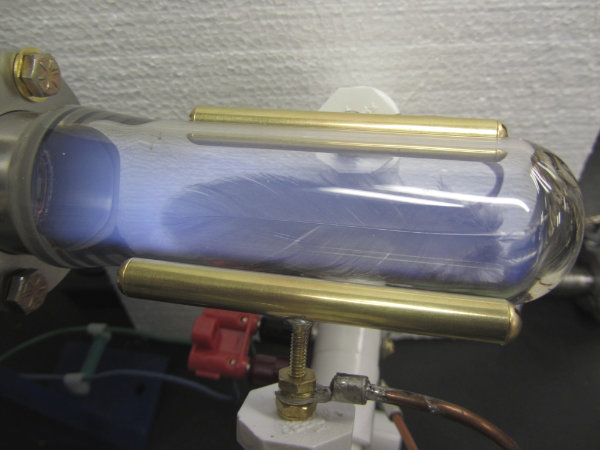
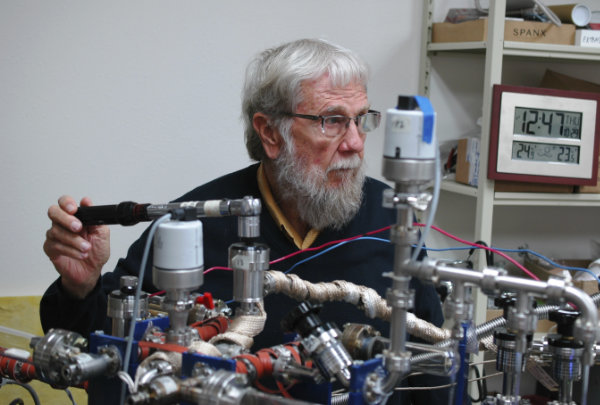
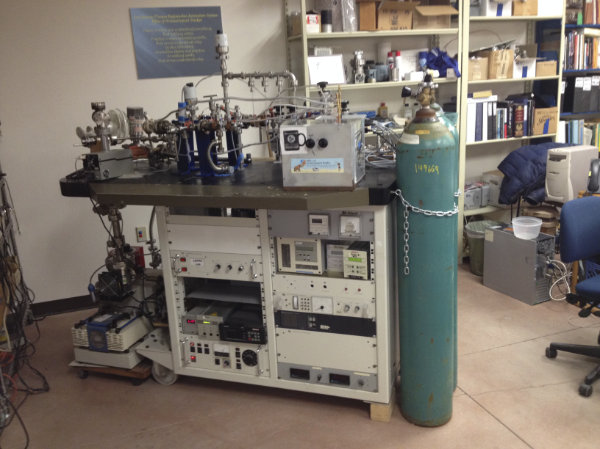
The plasma laboratory at the Center for New Mexico Archaeology in Santa Fe is filled with the background hum of vacuum pumps. The gentle noise comes from an island of equipment: stainless steel piping and valves, glass chambers, wires and electrodes, gas cylinders, a radio frequency tuner, and some metal boxes with gauges, knobs, and switches. If you are there at the right time, the glass chambers glow with a faint white or lavender light, and cups of liquid nitrogen boil over in frosty cascades. There is something innovative unfolding in that laboratory, and Marvin Rowe is making it happen.

Archaeologists generally are not in the business of physics and chemistry; they are more interested in uncovering patterns of past human behavior. Nevertheless, the field of archaeology has come to rely upon some extraordinarily sophisticated and complex laboratory science, including a new and developing scientific procedure that enables archaeologists to fulfill their core mission: to discover, understand, and present the story of us.

If the public takes any interest in archaeology, it is usually in a romanticized, media-inspired picture of sunburned field workers toiling away with trowels and screens trying to uncover “treasures.” Fieldwork is indispensable to archaeology, but more and more our knowledge about the past is uncovered in laboratories such as the one Rowe, a research associate with the Museum of New Mexico, created and operates.

Rowe may not use a trowel, but his carefully choreographed ritual of opening and closing valves, monitoring readouts, and resetting timers is part of an evolving dating technique. It may provide answers to the kinds of nettlesome questions about which archaeologists heretofore have only offered informed speculation, such as, “When was this example of rock art created?” or “Can we accurately date a unique and fragile object such as the Shroud of Turin without the destructive sampling that even sophisticated modern dating analysis requires?”

Despite the intimidating moniker—low energy plasma radiocarbon sampling—this new procedure is, at its heart, a variation of the radiocarbon dating that has been the mainstay of archaeology for decades. It has the potential to be an indispensable tool for archaeologists looking to explain the past.

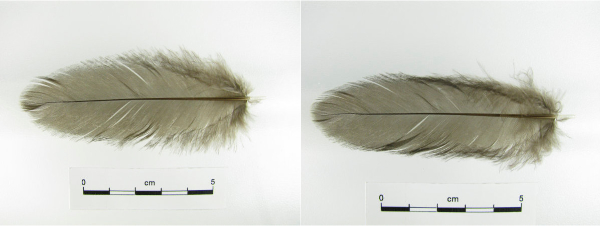
A turkey feather inside the apparatus; photograph courtesy the Center for New Mexico Archaeology Low Energy Plasma Laboratory.

Dating and Archaeology
The essential business of archaeology is interpreting patterns of earlier human behavior. Our ability to understand that behavior depends upon our capacity to accurately place it in the context of time. When something occurred is as critical as what, where, and why it occurred. Archaeologists separate the past into chronological sequences called periods, phases, or components based upon the evidence of human activity at the time. Those sequences are used to conceptually organize past behavior in ways that bring to light what people were doing and how these behaviors changed over time. In order to decode and make sense of the sequences, archaeologists must uncover time.

There are many ways to mark the passage of time, from the tiny fractions of seconds measured by physicists to the billions of years measured by geologists and astronomers. In the broadest sense, archaeologists are concerned with cultural history that occurred yesterday to some point between two and three million years ago (when stone tools, the oldest forms of preserved human cultural behavior, were first produced). Essentially, they uncover all available information in order to answer the question, “How old is it?”

Historically, archaeologists have approached this question using two broad categories of techniques: relative and absolute dating. Relative dating involves ordering objects or events from earlier to later without a precise idea as to the amount of time that passed between those objects or events. Relative age is determined primarily through the concept of superposition: the idea that the archaeological record is comprised of layers or strata, with older layers located underneath newer layers. In its simplest terms, relative dating is based upon the sequential layering of cultural deposits.

The problem with relative dating is that it merely provides a progression from earliest to latest, without being able to specifically tie the sequences to a definite chronological date; but it was really all that archaeologists had until 1949. That’s when everything changed.

The second category of dating techniques is called absolute or chronometric dating. All of the various techniques within this category are based upon the observation of continuously occurring natural events that change at constant measurable rates. These techniques provide a specific date; they allow objects to be dated to thousands, tens of thousands, or even millions of years.

Radiocarbon dating (C-14) is probably the most widespread and well known of the absolute techniques used in archaeology. In 1949, the chemist William Libby came up with the process as he was studying cosmic radiation and the manner in which radioactive carbon atoms are produced and decay. Libby understood that all living things incorporate fresh carbon atoms into their tissues until death, whereupon the process stops. The older, atomically unstable isotope C-14 in the tissues degrades into the more stable C-12. The proportion of C-14 relative to C-12 changes at a constant measurable rate over time. The measurable rate for C-14 is described as its atomic half-life of 5,730 years, give or take forty years.

Archaeologists are often dealing with extremely small amounts of material, particularly with older sites—since, for example, after 23,000 years, less than 7% of the original C-14 in any sample is still present. C-14 dating is generally applied to objects between 100 and 40,000 years old, although various enhancement techniques have pushed the application to samples up to 80,000 years old.

One of the problems associated with traditional C-14 dating is that it is destructive. In order to date an object, a small portion must be removed and burned to release CO2. The CO2 is converted to graphite (carbon) that allows one to measure the C-14 to C-12 ratio, and determine the last point in time when new C-14 molecules were incorporated into the living tissue that became the artifact, i.e., when the organism died. If all that one has is a tiny sample or a single, unique artifact, standard radiocarbon dating may not always be feasible.

Low Energy Plasma Radiocarbon Sampling
In the late 1980s, Marvin Rowe was a professor of chemistry at Texas A&M University when he was asked by an archaeologist about the possibility of dating rock art pictographs. Pictographs are notoriously difficult to date; while styles and pigment sources changed over time, establishing a precise date for any particular example had always been more of an exercise in “informed guesstimation” than hard science. That question got Rowe thinking about how one might extract dateable carbon samples from rock art pigments that don’t contain very much organic carbon.

Shortly thereafter, in an example of pure serendipity, Rowe read an article on an airplane that described how a Swiss scientist was using hydrogen plasmas in the controlled restoration of heavily oxidized metal objects. No one had thought to use the plasma-based process for the direct dating of artifacts, but the Swiss study piqued Rowe’s interest. Plasma is often described as an electrically charged gas, but it is really a fourth state of matter (the other three being liquids, solids, and gases).

Plasma is found in fluorescent lighting, your flat-screen plasma TV, and lightning strikes, so it is something that we “know about,” even if we do not think much about it. Using some donated and reconfigured equipment, Rowe created a connected system of chemical treatments, radio frequency tuners, and electronic analysis capable of dating rock art pigments. The system had some of the same complications associated with existing dating techniques such as required sample size, external contamination, and calibration, but it showed genuine promise—promise that Rowe has persistently refined and improved upon for the past thirty-plus years.

Left to right: Before and after. The turkey feather after plasma dating looks virtually the same as before, and that’s the whole point. Photograph courtesy the Center for New Mexico Archaeology Low Energy Plasma Laboratory.

How and Why Plasma Dating Works
The most appealing quality of Rowe’s method is that it is nondestructive. This is a major consideration, as many artifacts are simply too fragile or unique to have pieces removed for standard types of radiocarbon dating. Non-destruction is the aspect about which museum curators and restoration specialists are most excited, because they want to refrain from damaging even the tiniest portions of their prized artifacts. In addition, this process can potentially be used to uncover fake artifacts whose actual age may be inconsistent with its alleged provenance.

Marvin Rowe; photograph courtesy the Center for New Mexico Archaeology Low Energy Plasma Laboratory.

Rowe’s methodology solves the artifact damage problem by placing the entire artifact in a sealed vacuum chamber and gradually igniting an oxygen plasma that slowly oxidizes the surface of the artifact to produce CO2 for C-14 analysis. This electrically excited plasma produces the “glow in the bottle” that is the signature of this method. In some ways this process is akin to a slow-motion, very controlled, and extremely limited burn, especially as the rate of burn can be controlled by the level at which the operator energizes the plasma.

The critical part of the process is maintaining control of the rate of oxidation across the entire surface of the artifact so that its integrity is not impacted. In addition, great care (and a variety of pretreatment chemical rinses) are used in order to ameliorate the effects of potential environmental contaminations, such as humic acids in soils.

The process is so sensitive that, in order to get an accurate date, the sample must be scrupulously cleaned of as many impurities as possible. The payoff is that the nondestructive nature of the process allows fragile textiles, artworks, wooden objects, seeds, or human and animal remains to be dated without destroying even a small portion of the artifact. At the present time the techniques are not automated but are hands-on, labor-intensive actions that rely on trained specialists to initiate and monitor the entire process.

Rowe has applied his dating process to a variety of organic materials such as rock paintings, wood, charcoal, animal skin, bone, and paint pigments on a pottery sherd. In one experiment, Rowe successfully applied the technique to a single turkey feather that was not only successfully dated, but whose overall appearance and structural integrity were not altered. In other words, Rowe demonstrated how even the most delicate objects can potentially be dated without fear for their destruction. As Jeffrey Cox, who works with Rowe, has described the nondestructive quality of plasma dating: “It’s like using a loofah scrub on your arm. The loofah scrubs off some outer cells, but the arm remains virtually unaffected and unchanged.”

Given the rarity and fragility of many artifacts being dated, that element alone makes the technique revolutionary. Indeed, the Archaeological Institute of America was sufficiently impressed that in 2010 its popular Archaeology magazine named low energy plasma radiocarbon sampling as one of its top ten discoveries.

The laboratory is comprised of a deceptively compact setup. Photograph courtesy the Center for New Mexico Archaeology Low Energy Plasma Laboratory

In addition to its nondestructive aspect, low energy plasma carbon sampling can be applied to incredibly small sample sizes such as the organic paint on a single pottery sherd, or even a few linen threads from a painted canvas. One experiment involved dating several small threads on the edge of an alleged signed and dated Pablo Picasso painting. Five dates were obtained from the threads that revealed the painting was younger than the date painted on the corner, and therefore fraudulent.

Plasma extraction radiocarbon dating has been applied to samples as small as 25-30 millionths of a gram, and the Center for New Mexico Archaeology Plasma Lab typically works with samples with a maximum weight of 100 millionths of a gram of carbon. Field archaeologists have been trained to secure much larger sample sizes because they are aware that in traditional radiocarbon dating, unlike the plasma approach, much of the sample material is destroyed during standardized decontamination pretreatments that rely on a series of relatively harsh acidic and alkaline chemical washes. By eliminating the need for these destructive washes, the plasma-based technique can be applied directly to extremely small samples without the destruction that occurs during standard radiocarbon dating.

Despite its successes and potential, low energy nondestructive plasma carbon dating is still being refined—not so much in the accuracy of the dates, which has always been good, but with a greater specificity and clarity of the internal operating procedures. Whether one views it as still experimental or demonstrably effective depends somewhat on what one is trying to date.

Although the aforementioned turkey feather is considered a useful and replicable application of the process, consider the problem of trying to date a sample of powdered soot from a burned structure. This is the kind of “experimental stretching” that the archaeologists at the Office of Archaeological Studies are trying to achieve. It is not the soot per se that concerns the archaeologists; rather it is the burning event that produced the soot that is of interest, because dating that soot provides an answer to the question, “When did someone burn this log or structure?”

After that date is known, one can move on to considering who did the burning and why they did it. It is the sensitivity of the plasma dating process that enables a researcher to date that specific event.

The detailed and demanding nature of the process is underscored by the fact that Rowe’s laboratory is one of only four similar laboratories in the entire world. The complexity and demanding nature of the procedures, the need for specifically trained technicians, some resistance from within the C-14 dating establishment, and the fact that one major institution has tried and failed to make the process work with sufficient ease and effect have so far limited its widespread use.

Despite—or maybe even because of—all these complexities, Rowe and his team have made it work. Their ultimate goal of having a dependable, accurate, and nondestructive dating technique that is a useful tool for a variety of researchers with highly specialized dating challenges appears to be only a question of … time.

Jason S. Shapiro J.D., Ph.D., is a retired archaeologist living in Santa Fe. In addition to several prior contributions to El Palacio, Dr. Shapiro is the author of Before Santa Fe: The Archaeology of the City Different (Museum of New Mexico Press, 2008), the first comprehensive synthesis of the archaeology of the Santa Fe region. 

Dr. Jason "Jay" S. Shapiro is a retired archaeologist living in Santa Fe. In addition to several prior contributions to El Palacio, Dr. Shapiro is the author of Before Santa Fe, The Archaeology of the City Different (Museum of New Mexico Press, 2008), the first comprehensive synthesis of the Santa Fe region.

Proud Pageantry

By Nicolasa Chávez

Prior to their arrival in the Americas, the Spanish people were already mestizo (mixed), and they brought varied age-old traditions with them to these lands. One such tradition is the reenactment and pageant known as Moros y Cristianos, which represents years of cohabitation, conflict, and cultural assimilation in Medieval Spain.

Between 711 and 1492 ACE, the Arab and Berber cultures of Northern Africa ruled and controlled most of the Iberian Peninsula. During this time, cultural assimilation and conflict existed side by side while Christian people from the north attempted to gain control of the land. The series of battles for control of territory, commonly referred to as the Reconquista, later gave rise to ceremonies, public dances, and mock battles to celebrate the reclaiming of lands for a growing Christian nation and shared cultural heritage. The last Moorish stronghold, the Alhambra in Granada, Spain, was defeated by 1492, after the unification of the kingdoms of Castilla and León with the marriage of Ferdinand and Isabella.

But even with the creation of a new Spanish nation, Arabic traditions and culture were present in the daily lives of Spaniards. The architecture, gardens, cuisine, music, fine arts, and language all contained elements of the Muslim past and led to the rise of a new hybrid Muslim/Christian artistic style referred to as Mudejar.

Heading up the Desfile de los Moros parade, Alcoy, Alicante, Spain 2019. Photograph by Nicolasa Chávez. Florence Dibell Bartlett Library and Archives, Museum of International Folk Art.

Moros y Cristianos reenactments and pageants began during the period of the Reconquista in Spain. These dances and festive community gatherings that represented the regional and localized battles were embraced by the local communities and lasted for centuries. The celebratory events synthesized various components of medieval pageantry: the representation of chivalry, themes of romance, use of the mock battle and tournaments to show strength and power, and dramatic and theatrical representations of historic events. Moros y Cristianos was accompanied by tilts at the ring, dramatic entertainment, and the running of the bulls. The first documented performance of the pageant was during the royal wedding of Ramón Berengure IV, Count of Catalonia, and Petronila, Queen of Aragón in 1130. The post-wedding festivities included a simulated battle between Andalusian Arabs and Christians that took place at the Cathedral of Lérida.

The tournaments and celebrations vary from region to region and among individual towns. Regional variations still exist today. In northern Spanish territories, masquerades are popular; in central Spain, spoken enactments are common. From the east coast into east-central Spain, the taking of the castle by the Moros is popular, while in southern Spain the Moros steal away a particular saint. The most elaborate performances on the eastern seaside feature ships arriving to storm the coast.

The Queen Caravaca de la Cruz, Murcia, Spain, May 2, 2019. Photograph by Nicolasa Chávez. Florence Dibell Bartlett Library and Archives, Museum of International Folk Art.

Today’s celebrations are multi-day affairs. All consist of two separate processions, one for the Cristianos and one for the Moros, which can last for hours. The town’s people dress in elaborate and often fantastical costume either as Moros or Cristianos from the Middle Ages. The celebrations generally take place at the same time as the honoring of the town’s patron saint. The final day is the day of the mock battle, usually fought on the main plaza or in an open field adjacent to the town. This is the day that a stolen saint is returned or the Christian soldiers regain control of the castle.

In many instances, local legend states the saint appeared during the final battle between the Muslims and the Christians. For example, the city of Bocairent honors Saint Blas and the battle that took place in 1358. The cities of Alcoy and Banyeres hold celebrations that date to 1276 and 1780, respectively.

Heading up the Desfile de los Moros parade, Alcoy, Alicante, Spain 2019. Photograph by Nicolasa Chávez. Florence Dibell Bartlett Library and Archives, Museum of International Folk Art.

Coming to the Americas
This tradition was brought to the Americas and was celebrated until quite recently in New Mexico, the final place being Chimayó. By the time the Spanish arrived in Mexico, the pageant had already become the symbol of the recently unified nation. As early as 1524-25, the first Moros y Cristianos pageant in the New World was included in celebrations in honor of Hernán Cortés.

After the 1539 peace treaty between Carlos I of Spain and Francis I of France, the Mexican viceroy Mendoza, together with Cortés and the royal Audiencia, agreed to hold a great pageant. That same year Moros y Cristianos was included in a grand celebration in Oaxaca. The tradition came to New Mexico in 1598 with the arrival of the Spanish settlers. Gaspar Pérez de Villagrá, in his Historia de la Nueva México (Alcalá, Spain, 1610), wrote of a drama produced for the first Spanish encampment on the Rio Grande in May of 1598. The play, written by Captain Marcos Farfán, depicted the battles and interactions that took place in Spain between the Andalusian Arabs and the Christians during the period of the Reconquista. The 1539 ceremonies were described as “tournaments and tilts with cane spears, running bulls, and mounted knights meeting each other,” and the 1598 pageantry was described as including “tilts with cane spears, running bulls and tilts at the ring.”

Mexican codices from this same period illustrated similar rituals of combat held among the Native tribes of Mexico. This might explain the quick assimilation of Moros y Cristianos. During the Colonial period, civil authorities in Mexico granted permits for whips and horse-riding to a growing number of Native tribes.

The next mention of Moros y Cristianos in New Mexico occurs in 1777, as documented by Fray Anastasio Dominguez. In New Mexico, the play is traditionally conducted on horseback and is accompanied by music and recited text, although music plays a minor role within the entire production. One version of the play represents the 1492 battle at Granada, Spain, when Castile and Aragon joined forces to end Islamic domination of the Spanish peninsula.

Curiously, in New Mexico the tradition of Moros y Cristianos served as a catalyst for a totally new play and reenactment that is considered the first play written and developed in the present-day United States: Los Comanches. This play is an account of events that took place between 1774 and 1779. Throughout the Colonial period, Spanish and Pueblo Natives were continuously invaded by the Comanches and other Athabascan tribes. The folk drama of Los Comanches tells of battles against and the defeat of the Comanche leader Cuerno Verde by both Spanish and Pueblo people. It is possible the original author of the first dramatization had actually been in the battle. Similar to the Moros y Cristianos battle scenes, Los Comanches is conducted entirely on horseback.

During the last third of the twentieth century, the reenactment of Moros y Cristianos was kept alive largely due to the devotion and research of Josie Luján. She, along with her husband Percy Luján, organized an annual reenactment in Chimayó and surrounding towns. Through painstaking research and dedication, the couple revived the original text and created new costumes, swords, and horse gear. Community members near and far, equestrians in particular, joined in the celebrations that took place on the feast day of Santiago (Saint James), July 25, in Chimayó, and throughout towns and villages during various fiestas in Northern New Mexico, including Alcalde and El Rito. The 1992 celebrations of the Cuatrocentenario, which celebrated the 400 years of European contact with the Americas, included the group from Chimayó to conduct the reenactment at the Smithsonian Institution’s American Folklife Festival.

Throughout the Americas and the Philippines the plays are accompanied with pageantry, fanfare, elaborate costumes, and marching bands, celebrating the rich multicultural history of the Iberian Peninsula along with native and regional characteristics unique to each location in which it is celebrated. Contemporary pageants and mock battles are celebrated throughout the region of Valencia in eastern Spain; Oaxaca and Zacatecas in Mexico; Peru, Puerto Rico, and, until the end of the twentieth scentury, in Chimayó. The event in Chimayó was heavily dependent on organizers Josie and Percy Luján, and when they and many of the cast members passed away, the tradition there died with them.

Desfile de los Cristianos, Alcoy, Alicante, Spain, 2019. Photograph by Nicolasa Chávez. Florence Dibell Bartlett Library and Archives, Museum of International Folk Art.

Though at first glance some may think the primary focus of the mock battle is conflict or war, these events actually celebrate a multicultural heritage that is still evident today in both Spain and in the Americas. Many words in the Spanish language are of Arabic origin, as is our acequia system, the adobe houses that make New Mexico famous, the horno, and even the sopaipilla. (Read this article to learn even more about the African and Arabic roots of New Mexican cuisine.)

The enactments of Moros y Cristianos represent remnants of our Medieval past, reminding us of the early Arabic and Mediterranean roots that influence who we are today.

Nicolasa Chávez, a fourteenth-generation New Mexican, is the curator of Latino/Hispano/Spanish Colonial collections at the Museum of International Folk Art. She co-curated the exhibition Música Buena: Hispano Folk Music of New Mexico with guest curator and folk musician Cipriano Vigil.

Nicolasa Chávez (opens in a new tab) is the curator of Latin American & Nuevomexicano Collections at the Museum of International Folk Art. She is a respected historian, curator, and performance artist and previously served as the Deputy State Historian of New Mexico. Her past exhibitions at the museum include New World Cuisine: The Histories of Chocolate, Mate y Más, The Red that Colored the World, Flamenco: From Spain to New Mexico, and Música Buena: Hispano Folk Music of New Mexico.

Al-Andalus Abroad

By Alex La Pierre
Photographs by Joy Godfrey

In the early 2000s, a piece of pottery was uncovered during archaeological investigations at the Presidio San Agustín del Tucson, a Spanish Colonial and later Mexican adobe fortress founded in 1776 on the frontier edge of New Spain. Once used as table settings for meals, this sherd of polychrome majolica ware had been produced in the central Mexican state of Puebla and emulated an Iberian style of painted tin-glazed pottery originally from Al-Andalus, or Islamic Spain. From production centers in Puebla, it likely travelled by mule train to arrive for use on the tables of this earthen fortification in the far north of the Spanish colony, now Arizona.

Following its archaeological recovery centuries later, this fragment of a decorated dish was placed on display at the fort museum, where it happened to catch the eye of a visitor from Saudi Arabia. They insisted the design on the pottery piece was Arabic script for “Allah.

Homer Thiel, the presidio excavation’s archaeologist, was intrigued by this and sent a photograph of the sherd to various people in multiple Arabic-speaking countries; Turkish visitors to the exhibition were also consulted. Unanimously, these Arabic speakers confirmed the design was Arabic script for “God.” While the potters of majolica in colonial Mexico may not have realized the significance of the script design mimicked from Iberian examples, this tableware legacy represents an allegory of the subtle undercurrent of Moorish heritage in Mexican gastronomic culture.

Today, Mexican gastronomy is a UNESCO-recognized intangible heritage of humanity. The honored cuisine is a deep-rooted hybrid of cooking techniques and ingredients that resulted from the Columbian exchange between the cultures of Mesoamerica and the Iberian Peninsula.

Beyond great taste, gastronomy is a useful tool because it also functions as a time machine, a sociocultural thread that inherently links contemporary society to the past. Worldwide, the diversity of traditional cuisine is as much the expression of a region’s climatic and geographic features as it is a reflection of historical cultural hybridity. These developmental circumstances are projected into the future, carried from generation to generation like a language, and expressed on the plate as an alternative lens for historical analysis.

An ideal case study to consider the complexity of this process is the existence of foods and culinary techniques traditional to the Arab world within Mexican cuisine. This is an edible patrimony of the Spanish Colonial era in Mexico and the American Southwest and echoes Spain’s Islamic heritage transmitted across the Americas over three centuries.

The existence of Moorish influences within Mexico’s culinary identity as a result of Spanish colonization can be interpreted by looking further back into history during Spain’s formative medieval period. It was during this time that the reconquista, Roman Catholic Spain’s seven-century-long territorial struggle to retrieve the Iberian Peninsula from the colonization and control of Muslim North Africans and Arabs (frequently known collectively as the Moors), took place. This process began with the disembarkation of Islamic forces near Gibraltar in 711 and ended with the fall of the final Nasrid emirate outpost of Granada in 1492. The arrival of Islamic settlers from the Middle East and North Africa during this period resulted in the anchoring of lasting Eastern cultural roots in Iberia and the introduction and incorporation of new plants, dishes, and cooking techniques.

While the geopolitical lessons accrued over these centuries by the Iberian population served as a model for colonization by the next generation’s Spanish settlers in the Americas, the multicultural setting of this dynamic Medieval borderland also set a precedent for Iberian permeability in the adoption and synthesis of new cultural traits that occurred later in Mexico between the Indigenous peoples and Spanish settlers. Due to its privileged position as a frontier between the Western and Eastern worlds in Europe, Islamic Spain emerged as a crucible of foreign influences from North Africa and the Middle East imprinted over centuries, particularly in the development of the culinary arts.

Clockwise from top: Red chile, oregano, saffron, fennel, and cinnamon are regulars in most New Mexican and Mexican kitchens. They also represent the melding of Spanish, Arabic, Moorish and New World tastes and cooking styles. Styled by Brendan Godfrey.

As a result, homesick Iberian settlers of colonial Mexico not only emulated the tastes of their Christian grandfathers active in the reconquista, but also faithfully adhered to the culinary examples of Muslim ancestors in the planting of a new colonial society with gastronomic standards. Rather than one over the other, the foundation of Spanish culture exported to New Spain is directly rooted in this historical melding; a mestizaje. In this way, the Colonial-era incorporation of the gastronomy of Al-Andalus serves as an artifact for better understanding the historical role between food, religion, identity, and its far-reaching impact across the Atlantic in the cuisine of Mexico.

Many groups of Islamic adherence or influence inhabited Spain during the reconquest and post-reconquest periods. These people, known as mudejares, muladis, Moriscos, elches, mozarabes, nuevos cristianos, and conversos, heralded the Moorish flavors in Iberia that came to be exported to Colonial Spanish America. With over eight centuries of cultural interaction, these groups personified the diffusion and absorption of traditional Moorish culinary practices into Spanish culture.

Spanish Muslims remaining in Christian Spain after the completion of the conquest in 1492 transitioned to become known as Moriscos, nuevos cristianos, or conversos following widespread imposed Roman Catholic conversions. Although frequently segregated, these communities of different faiths living together would barter, sell, and share new culinary products as well as agricultural and cooking techniques and accompanying taboos. Furthermore, the entrenched Islamic heritage of Spain is even evident in the language, with nearly one out of every ten words in Spanish being of Arabic origin.

There are two ways to think about this influence of Islamic Spain’s cuisine on Mexico during the Colonial era. One is that this process was a result of baptized Moriscos or cristianos nuevos bringing traditional foodways across the Atlantic despite royal restrictions forbidding passage to anyone except Old Christians (Spaniards with documented long lineages of Roman Catholic faith). Extensive records prove that, indeed, there were Moriscos who clandestinely immigrated, founding frontier colonies in the New World.

Genetics or religious beliefs aside, one must also remember that the Spanish culture imported into the Americas was enduringly pre-colonized by the early Arab world. Arab and North African soldier-settlers who were enticed to colonize Spain introduced products from their homelands such as cuttings and seeds for agriculture. Spanish expansion in the Americas echoed Al-Andalus, long a flourishing epicenter of exchange and acculturation between European, Middle Eastern, and North African cultures.

Many Spanish colonists of today’s American Southwest and Mexico fell back upon the oasis cultures they inherited from the arid Arab lands in order to best manage the challenges of colonizing a desert landscape. One area in which this is particularly true is in the frontier regions of northern Mexico and particularly in the state of Nuevo León, an arid region resembling North Africa and the Middle East.

One clear example of this imported culture is the appearance and prevalence of the iconic wheat flour tortilla (instead of corn) in these regions. The northern Mexican wheat flour tortilla has drawn parallels to the arid land Arabic flatbreads by multiple Mexican historians, and its genesis is attributed to the region’s first Andalusian women colonizers. Spanish settlers found the dry regions of northern Mexico to be ideally fertile for planting and harvesting this wheat, first brought into Spain by the Moors in the tenth century. However, the most critical role this durum variety of wheat would later play for imperial Spain was as the base for hardtack, which sustained galleon passengers across the Atlantic travelling to the colonial world.

In Nuevo León, there is also a prevalence of traditional cuisine attributed to converso Jewish heritage. In the capital city of Monterrey, the most renowned local dish is undoubtedly the open fire, spit-roasted goat barbecue known as cabrito. It is a celebrated dish of northeastern Mexican identity, one that alludes to converso roots, and a clear opposite to the pork carnitas of central Mexico’s Michoacán state. It is important to note that many of these dishes attributed to the Jewish legacy in northeastern Mexico could also reasonably derive origin from Morisco or even Mozarabic influence.

Classic examples of foods that became staples on both sides of the journey from Moorish Spain to the American Southwest include oranges, figs, and raisins. Styled by Brendan Godfrey.

A whole category of foods representing Morisco identity or association was made apparent by Spanish writers of the seventeenth century, the epoch bridging Islamic Spain and an overseas imperial Castilian Spain. These included olive oil, raisins, figs, tripe, goat, fritters, couscous, milk, fruits, and others. Despite these Islamic connotations, almost all of these foodstuffs later became essential ingredients of the Mexican pantry. A straightforward means for identifying foodstuffs introduced in the Islamic era of Spain is by tracing the the etymologies of the corresonding Spanish words. Some classic examples include the Arabic origins of words like arroz (rice; sounds like “orez” to an English speaker), azafran (saffron; sounds like “zagrani”), naranja (orange; sounds like “naranj”), and aceituna (olive; sounds like “zaytun”), among many others.

Raisins are a critical ingredient in the sweet-savory, Moroccan-reminiscent empanadas of New Mexico. Traditional Hispanic harbingers of the holiday season in the Southwestern state, these spiced mincemeat and pine nut-studded treats are frequently sold door-to-door alongside tamales in the communities of Northern New Mexico. The turnovers tend to be fried and not baked, another culinary technique borrowed from the Arab world.

Religious culinary restrictions of Spain’s Muslims also had indirect lasting impacts upon Mexican gastronomic culture. The pervasive presence of lard as a foundational cooking element in the traditional cuisine of Mexico is likely a relic of the era when food content became religiously weaponized following the final Christian conquest in 1492. This amounted to a campaign of frequent and ambitious pork and wine use (haraam for adherents of Islam) across the culinary landscape, but especially so in the newly acquired former Muslim territories like the Nasrid emirate of Granada; it was a brutal form of gastronomic colonization.

Despite the Greek or Roman origins of olive cultivation in Iberia, even the use of olive oil in place of lard was viewed with suspicion as a Morisco trait by Old Christians. Lard or pork became a handy tool of culinary demarcation for Iberians fearful of being considered cristianos nuevos or conversos, whose faith was viewed with great skepticism. Pork inclusion as a pointed religious signifier became as extreme as its incorporation in sweets such as the lard-based cookies known as mantecados.

Lope de Vega, one of Spain’s foremost writers of the Hapsburg golden age, mused upon the act of hanging salted pork parts such as the classic jamón serrano in clear view on one’s property as a reasonable method of distinguishing religious orthodoxy for doubtful authorities during the Inquisition. Bizarre as it sounds, even the act of publicly stating a loyalty to eating pork products was frequently used as a defense in inquisitorial judicial proceedings.

America’s most frequent encounter with an ancient preservation method from the Arab world is perhaps atop the classic Mexican-American dish of nachos. Jalapeños en escabeche, vinegar-pickled peppers, are a fascinating item in the Mexican culinary repertoire because they are reflective of the three cultures that resulted in their existence. Jalapeño chiles are a Mesoamerican product, but the process of turning them into a vinegar-based pickle is a preservation technique from the Moors. This useful process incorporated into the cooking skills of Iberia during the Islamic period was brought into Mexico by Spaniards beginning in the sixteenth century. The word escabeche etymologically betrays these Eastern roots, deriving from a Spanish linguistic corruption of the Persian sik baj, referring to a “vinegar stew” or an acid-based food.

Jalapeño chiles, that mainstay of regional cuisine, are a Mesoamerican product, but the process of turning them into a vinegar-based pickle is a preservation technique from the Moors. Styled by Brendan Godfrey.

Living in a world with electric-powered refrigeration and freezers, modern society feels far removed from reliance upon preservation techniques like escabeche to make infrequent but generous harvests, whether fruit off the tree or the slaughter of an animal, last longer. Indeed, escabeche in the Mexican kitchen is not only an accompanying relish but also a main dish. Composed typically of fish, chicken, or turkey, escabeche is a common main course in the Yucatán Peninsula, a region geographically closer to Havana than the capital of Mexico City and one of the first areas to be colonized only a few decades following the fall of Granada.

Fragrant of oregano and chile, the vermillion stew of hominy, hooves, and tripe known as menudo in Mexico and the American Southwest has almost reached cult status. Fans of the dish are quick to point out its curative qualities, known to counteract the severe headaches of hangovers.

In Mexico and the Southwest, consuming menudo constitutes a special gastronomic tradition that is separate from all other dishes as it is often reserved for celebrations. It customarily appears on tables on Sundays in restaurants, perhaps after Mass, or is crafted for special family occasions and holidays in home settings.

Menudo estilo Sonora is not the only stew from the northwestern Mexican state with distinct qualities and Morisco origins. The pozole of Sonora is also divergent from the common pork and hominy soup that’s served with radishes, cabbage, lime, and tostadas in central Mexico. Sonoran pozole de trigo is not made with a base of hominy but rather wheat berries and includes garbanzo beans, vegetables, and typically beef. Its appearance during the year coincides with the wheat harvest as well as an opportunity to honor the patron saint of agriculturalists, San Isidro, taking place May 15 in the Catholic calendar.

Tracing the lineage of the Sonoran pozole for origins on the other side of the Atlantic, we find the olla de trigo (wheat berry stew) of Andalusia, which strongly resembles an Iberian prototype dish. Similar to the Sonoran version, this vegetable and wheat stew, also with garbanzo beans and meats, is flavored with wild fennel instead of cilantro and is traditional to the province of Almeria, located along the southeastern coast of Andalusia. Slowly cooked in a clay pot, it is reminiscent of dishes from the arid lands of the Maghreb in Northern Africa.

Like pozole de trigo’s association with the agricultural patron saint of Madrid, San Isidro, the olla de trigo similarly has an association with San Anton or Saint Anthony Abad, on whose feast day it is customarily cooked. While this phenomenon of attribution of a Christian saint to a particular dish may be an innocent coincidence reflecting a convergence of the agricultural and religious calendar, it may also have been a tactic to assuage inquisitorial fears of the dishes associated with Islamic origins. Another plot twist to this story is recent scholarship pointing to the Muslim background of San Isidro. The birth of this patron saint of Madrid predated the Christian reconquest of Madrid from the control of Al-Andalus, and he was likely a converted mudejar. His name may be a Spanish corruption of a traditional Arabic name, Driss.

Sweet-savory mincemeat empanadas, Spanish rice, and even horchata have roots in Spain, and, in turn, can trace their lineage to African and Arabic cultures. Styled by Brendan Godfrey.

The classic Mexican-American restaurant combination plate is incomplete without the requisite red-tinged “Spanish rice.” The name alone betrays its Iberian origins, hinting at what many consider to be the national dish of Spain, paella. Despite the saffron-flavored rice’s distinct regionality to Mediterranean coastal areas of the country with a long history of Islamic rule, paella is representative of the soul of Spanish cookery. Records show that rice cultivation took place in Spain as far back as the tenth century, a mere two hundred years after the Moors made landfall on the Iberian Peninsula. Rice’s trajectory towards the New World can be traced to the Canary Island of La Gomera as early as the fifteenth century, the traditional refueling stop and transhipment point of fleets en route to the Americas, including for Christopher Columbus.

The earliest record of rice in Mexico mentions the transfer of a “small amount” or “sack of rice” from the port of Veracruz to Hernán Cortés in the Coyoacán district of today’s Mexican capital in 1522. By the 1570s, rice cultivation had taken root in Mexico and the grain was already being exported from Gulf of Mexico coastal plantations with reports of its suitability to the new lands.

As it is known in Mexican restaurants in the United States, Spanish rice is really a misnomer, given that it actually arrived in Iberia with Islamic colonizers who introduced the pilaf style of cooking rice; the oil-frying of the grains followed by the addition of a seasoned liquid and resulting absorption process of cooking. Rather than sharing a place on a combination plate beside beans and a protein, as is common in the United States, rice originally composed what was considered the separate sopa seca, or “dry soup” course to a traditional Mexican midday meal. This concept of eating meals in courses is best exemplified by Mexico’s midday comida corrida tradition. This practice originated with someone known as Ziryab, a prominent personality of Islamic Al-Andalus who, while exiled from Baghdad, introduced Arabic sociocultural concepts to this extreme edge of the Islamic world. Ziryab’s influence can be felt particularly in the Iberian culinary arts, from the order of the arrival of food to table, as mentioned, to the serving of drinks in glassware, notions initially brought by the gourmand to this frontier of Andalusia.

Rice in the form of a traditional summer drink, horchata, also has North African roots. Similar to paella, the Spanish origins of horchata stem from the Valencian coast, an area ideal for growing an underground tuber known as chufa or tiger nuts. This small, potato-like root crop is said to have been brought by the Moors beginning in the eighth century from an arid region of Sudan known as Chuf or Chufi. It continues to be the base for the Iberian version of the drink in horchaterías throughout Spain.

One theory on the source of the name horchata comes from reconquista folklore and highlights the process of gastronomic transition from the Islamic world to eventual acceptance into the Roman Catholic Iberian realm. Apparently, James I of Aragon, the thirteenth-century conqueror of Valencia, was offered the refreshing drink after battle by a local girl, to which the ruler proclaimed in antiquated Spanish: “Aixo es or, xata” (“This is gold, girl”).

However, tiger nut cultivation in Hispanoamerica seemingly never developed, and instead another Moorish introduction, rice with cinnamon, assumed the role in Mexico for producing one of the most iconic aguas frescas of Mexican cuisine. The humid shores of the Mexican Gulf states of Veracruz, Tabasco, and Campeche, where conquistadors first landed in the early sixteenth century, along with coastal Sinaloa on the Pacific side of the country, continue to account for the majority of the country’s rice production. In addition to this Moorish origin, there are scholars who attribute the entire class of beverages known in Mexico as aguas frescas as the Mexican descendants of the sharbat-flavored waters of the Arab world, or even of West Africa, where agua de tamarindo and agua de jamaica are known as dahkar and bissap.

The Arabic word used to describe a fritter dunked in honey is zalabiya. Sounds a bit like “sopaipilla,” doesn’t it? That isn’t a coincidence. Styled by Brendan Godfrey.

One example of this Moorish confectionary genealogy exists in the American Southwest, where partaking in piping-hot pillows of fried dough known as sopaipillas is a traditional way to cap off a New Mexican meal. The sopaipilla is a culinary cornerstone of Southwestern cuisine, remarkable for its dual utility as both a meal-accompanying form of bread (that is even stuffable) and as a staple dessert covered in honey.

The sopaipilla medium of wheat flour and the deep-frying cooking technique are prime examples of both foreign material and immaterial culture arriving in the Southwest from Spain as a part of the Columbian exchange. Sopaipillas are likely the Southwestern descendent of the olive-oil-fried dough called sopaipas in the Andalusian city of Cordoba in southern Spain. During the early Spanish colonization of Mexico, the trade of fried wheat dough cooking was often associated with the Moriscos. Spanish Colonial settlers to New Mexico imported a late-Medieval food culture comprised of the post-reconquista tatters of a diverse convivencia between Muslims, Jews, and Christians. Its Iberian epicenter was in Cordoba, and this cultural mixing resulted in the gastronomic grandparent of sopaipillas: sopaipas cordobesas.

The origin of the sopaipilla can be traced even further back to the tenth century, where it appears as one of the recipes in the caliphal cookbook of Baghdad. The etymology of the word is revealed in the audible similarity of the Arabic word used to describe a fritter dunked in honey: zalabiya.

Now more than ever, with the recent designations of Tucson and San Antonio as World Cities of Gastronomy by the United Nations Creative Cities Network, it is important to identify the cultural commonalities that link us together across borders, beyond modern political boundaries, and that reveal shared diverse heritages. The culinary legacy of Al-Andalus present in the contemporary cuisines of Mexico points to a unique cultural impact across an ocean. This gastronomic footprint lends credence to the cliché of history repeating itself, first with the colonization of Iberian Peninsula by Islamic forces and later followed by the colonization of Mexico by the Spaniards—one just needs to look to the resulting gastronomies for corroborating evidence.

The cultural webs connecting these historical developments, as well as the inevitable mixing stemming from both situations, resulted in timeless and distinct cultural legacies. The resilience of these diverse traditions leave clues of the past that are frequently in edible form, perhaps served on a majolica plate. 

Alex La Pierre is the program director for Border Community Alliance, a 501(c)(3) nonprofit organization based in Tubac, Arizona. BCA’s mission is bridging the border and fostering community through education, collaboration, and cultural exchange. He previously worked for the National Park Service at Tumacácori National Historical Park, Pecos National Historical Park, and Fort Union National Monument in the fields of historic preservation and interpretation.

Photographer Joy Godfrey has been a freelance photographer for almost 20 years, photographing for various publications, taking “out-of-the-box” portraits, and her favorite—photographing food and drinks. To see more of her work, visit joygodfreyphotography.com.

Alex La Pierre (opens in a new tab) is a program director for Border Community Alliance (BCA), a nonprofit based in Tubac, Arizona. BCA’s mission is to bridge the border and foster community through education, collaboration, and cultural exchange. He previously worked for the National Park Service at Tumacácori National Historical Park, Pecos National Historical Park, and Fort Union National Monument in the fields of historic preservation and interpretation.

Joy Godfrey (opens in a new tab) has been a freelance photographer for almost twenty years, photographing for various publications, taking “out-of-the-box” portraits, and her favorite—photographing food and drinks.

I Rebuilt the Palace of the Governors at My Own Expense

By Cordelia T. Snow and Stephen S. Post

“I rebuilt the Palace of the Governors at my own expense.” Versions of those same words have been spoken by Spanish, Mexican, and American governors—and several museum directors—for more than 400 years. Several centuries of remodeling and maintenance culminated in the Palace’s transformation into the centerpiece of the nascent Museum of New Mexico in 1909. A long line of museum directors sought to balance preservation of a treasured historic building with the need to portray New Mexico’s rich history.

Now the Palace is changing again. In 2018, all exhibits were removed so the HVAC and fire suppression systems could be modernized. While the upgrades were completed, an empty Palace afforded current museum staff and consultants the opportunity to rethink, reprogram, and reorient the narratives about the Palace and its people. As a result, the New Mexico History Museum has planned many new exhibits, including Palace Seen and Unseen. The exhibition is co-curated by the authors and Dr. Alicia Romero, curator of Spanish Colonial, Mexican, and Chicano/a history, and will open on April 19, 2020.

Patio, Palace of the Governors, Santa Fe, New Mexico, ca. 1912. Photograph by Jesse Nusbaum. Courtesy Palace of the Governors Photo Archives (NMHM/DCA), Neg. No. 61541.

A review of the interrelationships between the Palace’s appearance and its use as well as the people who lived and visited there yields an anecdotal puzzle missing a lot of pieces. At the turn of the twentieth century, solving the puzzle was temporarily derailed by the well-intentioned writings of Palace enthusiasts such as LeBaron Bradford Prince, Edgar Lee Hewett, Sylvanus Morley, and Jesse Nusbaum. They portrayed it as a long and low adobe building; the flagship of the newly conceived Spanish Pueblo Revival or Santa Fe Style. This exercise in identity construction inadvertently de-emphasized the building’s rich and complex past. With the Palace entering a new phase, now is a good time to look back at its changing appearance and uses.

Seventeenth-century diagonal adobe brick floor found in Room 5. Uncovered during C.T. Snow’s 1974–1975 Palace of the Governors excavation. Photograph courtesy Cordelia T. Snow.

The Palace in the Seventeenth Century
A centerpiece of the casas reales, or royal buildings, the first Palace took cues from the architectural styles popular elsewhere in the Spanish empire. However, given the distance from the nearest large urban centers in New Spain, the Palace of the Governors in Santa Fe was not nearly so ornate as contemporary buildings in Mexico City or Spain. In fact, the earliest Spanish buildings in Santa Fe were almost certainly plain, simple, and possibly even crude by the most generous of modern standards. When the cabildo, or town council, complained that the buildings in the villa were still unfinished in 1619, the viceroy sent needed tools and supplies to hasten construction the following year. Using local materials, even basic construction took time—time to make and dry adobe bricks, time to cut and cure wood for vigas and corbels, doors, and window frames, time to excavate and fill foundations with river cobbles. Embellishments such as carved or painted detail on beams, corbels, and doors had to wait until Pueblo workers could be trained by master carpenters to do that work.

The use and layout of the seventeenth-century Palace comes from detailed Inquisition documents translated and interpreted by historian and genealogist José Antonio Esquibel. In addition to major restoration and construction work between 1659 and 1661, Esquibel’s research reveals the elaborate and fully functional Palace compound of Governor Bernardo López de Mendizábal and provides a unique look at the life of the governor and his wife. Esquibel’s list of eighteen rooms and/or apartments includes a receiving hall (sala de recibimiento), a new hall where Pueblo dancers changed into their catzina dancing clothing, a kitchen and a dining hall, an apartment (aposento) that served as chambers for the governor, a drawing room (sala de estrado) where Doña Teresa de Aguilera y Roche received guests and which had an altar with a canopy and a crucifix, Doña Teresa’s dressing room, a chapel (capilla), the governor’s office, a room that served as an archive where documents were stored, four living rooms along the east side of the building “by the orchard,” servant quarters, a carriage house, a tack room, storerooms, and a jail.

Storage pits denoting Pueblo Revolt pueblo plaza in south half of Room 7. Uncovered during C.T. Snow’s 1974–1975 Palace of the Governors excavation. Photograph courtesy Cordelia T. Snow.

We know the structure was whitewashed during López de Mendizábal’s term of office in the Palace because the local Puebloan laborers responsible for the work brought suit against López for non-payment of their wages. Juan Chamizo, or Chamiso, was apparently in charge of both the remodeling and new construction at the Palace and much of Santa Fe in the years leading up to the Pueblo Revolt in August 1680. Chamiso was a guild-trained master mason (albañil maestro), a native of the Valley of Mexico, and the supervisor that represented the laborers’ claims. During the Inquisition hearing, Chamiso testified to building a corredor grande de patio, or arcade, around an interior patio or plaza of the Palace, but reported no architectural embellishment for the south side of the building, such as is present today. Chamiso also repaired or replaced a torreón, or tower, at the Palace, which had fallen to the ground on October 21, 1661, along with the battlements or parapets around the structure.

Fortuitously, in early August 1680, Governor Antonio de Otermín reported that he rebuilt and fortified the Palace and the other royal buildings surrounding the Plaza; work probably supervised by Chamiso. By August 13, 1680, the Pueblo Revolt was underway, and the same compound described by Mendizábal provided 1,000 fleeing colonists, including Chamiso, and their 400 head of livestock, a defensible refuge from attacking Pueblo warriors. After a nine-day siege, 2,500 victorious Pueblo warriors and their allies let the colonists peaceably leave.

Radical renovations followed expulsion of the Spanish. Tanogeh (southern Tewa from Galisteo Basin villages), Tewa, and Keres families built and lived for ten to twelve years in a pueblo that enveloped the Palace. The account of the resettlement of Santa Fe and New Mexico by Diego de Vargas Zapata y Luján Ponce de León y Contreras in 1692 and 1693 provides sketchy, but important, details about the pueblo. His journal and subsequent accounts indicate the pueblo had four main buildings, each three to four stories high, encircling two plazas with estufas (kivas). Form and layout were similar to other contemporary villages built on the mesas above modern-day Cochiti and Jemez Pueblos. Reflecting Pueblo architectural sensibilities, its layout suggests a return to traditional ways and the resurrection of a world suppressed by Spanish presence and prohibitions.

Locating and reconstructing the Pueblo Revolt-era pueblo is tricky. Spanish military terms describing Pueblo architecture are ambiguous. Measurement and location rely on relational, rather than precise measurements—the structure is described in terms of arquebus shots and relative location to natural features, such as the cienega or swamp that arced around the eastern part of the villa’s core.

From the accounts and our calculations, we surmise Vargas encountered a building 360 to 400 feet long with a defensible, four-story-high south wall forming a dual-plaza adobe pueblo oriented north-south, with the south roomblock overlaying the south half of the modern-day Palace and extending to the south curb of Palace Avenue. It roughly fit within the space defined by Palace, Lincoln, and Washington Avenues and extended 100 feet north of the present-day New Mexico History Museum.

Archaeologist Cordelia (Dedie) Snow’s 1974–75 excavation uncovered four Pueblo-style rooms within a larger Spanish room. Fronted on the north by nine deep storage pits filled with debris from the Pueblo and earlier Spanish occupations, the ground floor rooms were the southern limit of the south plaza. This hypothetical layout may have contained 1,100 rooms and would have comfortably housed Vargas’ rough estimate of 1,000 Puebloan residents—and definitely the 500 residents he captured or killed there on December 29, 1693.

Following the military capture of the village, execution of the male combatants, and temporary enslavement of the women, children, and elderly, Vargas moved the settlers and troops into the Pueblo Revolt pueblo. Ironically, from this pueblo he staged his military campaign against the other villages, advanced resettlement, and sought refuge from Navajo and Apache raids.

1869, Ground plans of the Palace, Palace of the Governors Building Plans. Courtesy Fray Angélico Chávez History Library, NMHM, AC591-OV.

The Palace in the Eighteenth Century
During the first twenty years following the return of the Spanish government and settlers, there was a lot of activity at the Palace. In 1697, Governor Pedro Rodriguez de Cubero succeeded, arrested, imprisoned, and sent Vargas to trial for malfeasance of duty in Mexico City. Cubero also criticized Vargas for not building a proper government or military compound. He promptly built a replacement that incorporated intact remnants of the pre-1680 compound, while leaving in ruin elements of the Revolt-period pueblo.

Upon his exoneration and return in 1703, Vargas observed that Cubero’s replacement casas reales, composed of “six lower and six upper rooms,” were woefully inadequate to serve the purposes of the government and military. Only four years later, Governor José Chacón Medina Salazar y Villaseñor wanted to demolish the “presidial castle” and build anew. We don’t know if he completed all or just some of the task, because in 1715 Governor Félix Martínez described a Palace in serious disrepair.

From this account, we learn that the Palace walls were buttressed and only two rooms, including a military chapel, were functional. Zaguánes, or passageways, allowed wagons, horses, and people to pass from the Plaza into the interior plaza or courtyard, which was bounded on the north by two-story buildings. Remnants of these buildings, which housed soldiers, a mill, storerooms, wagons, and coaches, were found during Steve Post’s archaeological excavations for the New Mexico History Museum between 2002 and 2007. Rooms outlined by cobble foundations remained north of and beneath the Palace Print Shop. We believe the Palace rooms described by Félix Martínez were those left from Otermín’s Palace modified by Cubero in 1697, and maybe added to by Salazar y Villaseñor in 1708.

A big question for us is, what happened to the second story? The last mention of a second story in translated documents is Ysidro Sánchez’ testimony in 1720 pertaining to his theft of goods by gaining entrance to the Palace through a second-floor balcony window. Once inside the building, Sánchez stated he walked downstairs to the storeroom he robbed. Subsequent residencias reporting repair or construction and the renovations that likely accompanied the construction of the presidio from 1789–91 do not mention a second story. Inspection visits by priests mention the overall poor condition of the villa and the casas reales, but do not specifically describe the Palace. We know that two-story houses were present throughout the period and continued in use into the nineteenth and twentieth centuries.

An intriguing clue is found in the building instructions issued in 1781, which specify that governmental buildings should be five varas tall, or about 15 feet. A two-story building would then be 30 feet tall. Was the early eighteenth-century Palace first story less than five varas high, and if so, are there viga beam sockets left in the current Palace walls left from the first-floor ceiling and second-story floor? Could they have survived the late nineteenth century and Nusbaum’s 1909 –1913 renovation?

Until eighteenth-century walls are completely defined and their upper elevations investigated, we will continue to be left in the dark, except for mute testimony of the three-foot-wide cobble foundations found throughout the Palace by archaeologists.

The Palace and New Mexico in Transition
At some point during the last half of the eighteenth century, the second story of the Palace disappears. That is not to say the building no longer had two stories, but all references to the structure mention the ground floor only. That was certainly the case when brigadier general and explorer Zebulon Pike described the Palace in 1807. In fact, Pike’s description of the building was noteworthy primarily for its brevity, for he mentions nothing aside from entering the governor’s office after going through several rooms where the floors were covered with the skins of bear, deer, and other animals. By 1821, when Mexico declared independence from Spain and William Becknell’s risky trading venture to New Mexico presaged the opening of the Santa Fe Trail, the fact that the Palace once had a second story, even if only in parts of the building, disappeared completely from both oral and written history.

Throughout the eighteenth and into the nineteenth century, in addition to being the seat of Spanish government on the northern frontier, the Palace was used as an embassy. It was there that Pueblo leaders, as well as important representatives of the Comanches, Apaches, and later the Utes, among other Native groups, were heard. When Pike was captured on New Mexican soil in 1807, he was questioned by the governor in the Palace before he and his men were sent south to Mexico. William Becknell met with Governor Facundo Melgares when he first entered Santa Fe to open trade with the United States in 1821. And on August 18, 1846, acting Governor Juan Bautista Vigil y Alarid met U.S. General Stephen Watts Kearny and his army of occupation in front of the Palace.

Several years later, W.W.H. Davis, the newly appointed United States attorney for the Territory of New Mexico, described Santa Fe and the Palace in less than glowing terms: “The public edifices in Santa Fe are few in number and of rude construction. The government Palace, a long, low mud building, extends the entire north side of the Plaza and is occupied by the officers of the territorial government and is also made use for the purposes of legislation.”

During the last half of the nineteenth century, after New Mexico became a territory of the United States, the appearance and use of the Palace continued to evolve. It soon included a post office and the U.S. Depository, private law offices, and a library, in addition to containing legislative offices and chambers for the territorial government. Other rooms in the building were used by the Historical Society of New Mexico and at one point housed Governor Bradford Prince’s rock collection, some examples of which were said to have been artfully arranged around walkways in the patio.

With the exception of those years when the Palace was a pueblo during the Revolt, the greatest changes to take place in both the building and its uses undoubtedly occurred during the twentieth century after legislation was passed which turned the Palace into the Museum of New Mexico in 1909. Edgar Lee Hewett became the first director of the new museum and, aided by his right- and left-hand men Jesse Nusbaum and Kenneth Chapman, went to work “restoring the Palace to its former appearance as a monument to Spanish civilization in New Mexico.”

Exactly who devised plans to design the new portal is unknown, but it’s entirely possible that Hewett and Nusbaum worked hand-in-glove with Sylvanus Morley and other originators of the new Santa Fe Style. There is no question that all changes that took place were dictated by how the Palace “should look,” as opposed to changes based on historic research or ideas of preservation. At the same time, former storerooms along the north side of the Palace patio were renovated to provide studio and office space for staff and visiting scholars.

Wagons loaded with wood in front of Palace of the Governors, Santa Fe, New Mexico, ca. 1912. Photograph by Jesse Nusbaum. Courtesy Palace of the Governors Photo Archives (NMHM/DCA), Neg. No. 61543.

Beginning with Nusbaum’s restoration of the building between 1909 and 1913, rooms used as the governor’s quarters by Lew Wallace, Bradford Prince and others were turned into exhibit spaces, with murals of the Pajarito Plateau and other picturesque areas painted over the walls. In Room 5, the large room at the west end of the building, the site of the former depository was used as a meeting hall and exhibit space. When a large portion of the north wall in Room 5 collapsed in the 1950s as the result of a leaky canale that allowed water to melt the adobe bricks, the wall was rebuilt with a huge picture window installed where no such windows had existed before. In other rooms, large spaces were carved into interior walls for shelves and other exhibit cases.

Workers looking down during excavation and restoration of old well, patio, Palace of the Governors, Santa Fe, New Mexico, 1956. Courtesy Palace of the Governors Photo Archives (NMHM/DCA), Neg. No. 006825.

By 1974, the Palace was in dire need of renovation once again. Wood floors that had been laid more than fifty years before required replacement, as did the electrical wiring and heating system. Upon completion of a historic structures survey of the standing building by John Conron of Conron and Woods Architects, as well as archaeological investigations in the west end of the building and subsequently in the main entry, the Palace was restored as the flagship of the Museum with period rooms and changing exhibitions.

With the completion of the New Mexico History Museum, the Palace was no longer the museum. Instead, it became part of a larger campus where visitors could learn about and interact with New Mexico history through exhibits, docent tours, education staff activities, and their own explorations. As the future plans for the Palace take shape, its roles as landmark and storied place will continue to change. This will start with the April 19, 2020 opening of Palace Seen and Unseen, where visitors will learn of the evolution of Palace buildings and grounds through its architecture, history, and archaeology.

Stephen S. Post is an archaeologist and research associate and former deputy director for the Office of Archaeological Studies, Department of Cultural Affairs. He first experienced the intrigues of Palace archaeology in 1978.

Cordelia T. Snow has worn many hats since she started her career as a historic sites archaeologist at the Laboratory of Anthropology in 1970, and currently works for the Archaeological Records Management Section of the Historic Preservation Division.

Post and Snow are co-curators, along with Alicia Romero, of Palace Seen and Unseen, scheduled to open on April 19 at the Palace of the Governors.

Cordelia T. Snow has worn many hats since she started her career as a historic sites archaeologist at the Laboratory of Anthropology in 1970, and also worked for the Archaeological Records Management Section of the Historic Preservation Division. Snow is a co-curator of the exhibition Palace Seen and Unseen inside the Palace of the Governors at the New Mexico History Museum.

Stephen S. Post (opens in a new tab) is is a former deputy director for the Office of Archaeological Studies, a division of New Mexico Department of Cultural Affairs, where he worked from 1976–2011. He worked as a ceramic analyst and field technician for the School for Advanced Research (SAR) Contract Archeology Program in 1983–1984 and authored a study of the SAR campus in 2011. His experience encompasses 12,000 years of New Mexico’s rich past. Between 1994 and 2011, he directed advance archaeological excavations for Santa Fe’s public and private projects, including the New Mexico History Museum, the Santa Fe Community Convention Center, Santa Fe Railyard, and Las Campanas de Santa Fe, among others.

A Beautiful Death on the Santa Fe Trail

By Frances Levine, Ph.D.

Travel on the Santa Fe Trail was not restricted to the hale and hearty. Some travelers made the strenuous journey to try to reclaim their health. Many travelers—men and women—wrote diary entries remarking about their increasingly robust constitution that seemed to come from the pure air and sunshine of the best days on the trail and their connection with nature that came from sleeping under the stars. Others wrote about the discomfort of the trail and the challenges that accompanied them on their crossing, yet hoped the journey would improve their health. The trail from St. Louis to Santa Fe and the return from the Southwest to the States was not without risks and dangers, and even death lurked on the prairie. 

The story of Kate Messervy Kingsbury, who died on the Santa Fe Trail in June 1857, is especially poignant. Kate made three trips across the trail between 1854 and 1857. As her husband, veteran trail merchant John M. Kingsbury, planned each trip from her home in Salem, Massachusetts, to supply houses in St. Louis, and then on to Santa Fe or the reverse direction, he feared that any one of those journeys might end her life.

Described by her family as a genteel and fragile beauty, Kate was the sister of William Sluman Messervy, a well-regarded merchant. He moved from Salem to St. Louis in 1834; in 1839, when he joined as a junior partner in the mercantile firm of James Josiah Webb, Messervy opened their store in Santa Fe. With suppliers in New England and St. Louis, Webb and Messervy followed a competitive and lucrative business practice that wholesaled fabrics, groceries, housewares, and hardware obtained in northern markets, aggregated them in Missouri supply centers, and carted them across the heartland of the continent for the Santa Fe trade.

John M. Kingsbury, a Boston bookkeeper, joined the firm in Boston in 1849 and was mentored into the trade by Webb and Messervy. Kingsbury traveled between St. Louis and Santa Fe for the firm in 1851, and by 1854 he joined the firm as a junior partner, handling their business transactions in Santa Fe. Webb, Messervy, and Kingsbury each prospered financially, but all suffered personal losses and economic strains that ultimately led to their abandoning the Santa Fe trade.

Messervy began to withdraw from the business after 1853, and left New Mexico in 1854. Kingsbury furthered his importance to the partnership after he married Messervy’s sister Kate on December 21, 1853. Kingsbury was the last of the partners to live in Santa Fe, where he spent the majority of his time between 1853 and 1861.

When Kate married John M. Kingsbury, she had already been diagnosed with the early symptoms of tuberculosis, or consumption as it was called then. It was a disease that struck many people in the crowded, often unsanitary cities of the United States in the nineteenth century. One prescribed therapy for the disease that persisted well into the early twentieth century was a regimen of travel to more healthful climates, where fresh air and rest supposedly provided much of the cure.

Her brother and her husband feared that she might not be strong enough to travel to Santa Fe. But it was that very journey that offered her the last and best hope for recovery. Kate Messervy Kingsbury may never have enjoyed any of her three crossings of the Santa Fe Trail, but she left no personal record of her feelings or fears. In correspondence between Kingsbury and his partner Webb and with his brother-in-law and partner Messervy, the progression of Kate’s illness is discernable, and Kingsbury’s own emotional turmoil is evident. 

Use Van Beil’s rye and rock, the tonic and only cure for coughs, colds and consumption, 1888. Courtesy Library of Congress Prints and Photographs Division, LC-USZ62-9197.

Consumption Causes and Cures in the Nineteenth Century

Permit me to give [a recipe] for producing consumption. Take a girl between the age of twelve and eighteen, who is growing rapidly, of delicate constitution; confine her six hours each day in a crowded school-room; let her have lessons to get out of school which will require from two to three hours of study, in addition to two hours’ practice on the piano-forte; stimulate her to extra exertion by hope of a prize at the end of the term, or of excelling her classmates; let her sleep in a dark, close and small bedroom, with one or more persons; supply her plentifully with candy and sweet-meats, so as to destroy any little appetite she may have for wholesome and nourishing food; when out of school, confine her to a heated room, except occasionally going to church or to parties in thin stockings and shoes, and low dress, so as to expose the chest and neck to the cold—and you have all the requisites to produced disease. Should you not produce consumption, you will be likely to have disease of the brain, equally but more quickly fatal.
–Professor C.B. Coventry, 1856

Tuberculosis, known in nineteenth century literature as consumption or by its more technical name phthisis, was widespread throughout the world. Discussions of what caused the disease and how to cure it ranged from the scientific to the spurious, from practical and healthful to utter quackery. Antibiotics would prove to be the only cure, but nineteenth-century doctors and their patients experimented with cod liver oil, sugar vapor, and inhaled iodine and an inhalation made with creosote for short-term relief. 

Professor Coventry’s description of the social conditions and lifestyle stresses that could give rise to consumption refers to some of the common ways in which consumption was thought to have been contracted in the early nineteenth century. It was not until 1882 that the bacteria responsible for the spread of TB was identified by a German microbiologist. When rest and recuperation were not enough to halt the disease, its progression was marked by specific symptoms.

Dr. James Clark published one of the many sources offering a comprehensive consideration of the course of TB in 1835. In its first stages, consumption could be diagnosed by its persistent cough and fatigue. Gradually, the patient might experience night sweats and chills, and some loss of muscle firmness. There could be a seasonal aspect to the disease’s progress as well. If a patient first experienced symptoms in the spring, the onset of warmer weather and the opportunity for outdoor activities could slow or even arrest the disease. If the patient contracted the disease in winter, Dr. Clark thought there was little chance it would subside. 

The second stage of consumption was marked by a frothy, sometimes bloody, but always a productive cough, as well as a marked rasp or crackling in the lungs. Bouts of fever and chills increased, and the patient began to experience pain in their chest and shoulders as the lungs “softened.” Dr. Clark noted that some people persevered with the symptoms for months and even years, while others arrived “at the brink of the grave” within weeks. In the third stage of the disease, patients had frequent attacks of chills and fever, diarrhea, and of course the deepening and prolonged coughing. By this stage they also experienced a marked change in posture and body appearance as their shoulders raised and stooped forward, forming a more concave upper chest. Dr. Clark noted that patients had diminished physical and mental energy, and could appear to be “skeletal.” In their final days, patients became delirious, and often violently so. Dr. Clark concluded with a rather telling summary of how consumption impacted the emotional state of the patient: 

…[T]hat inward struggle between hope and fear, which, whether avowed or not is generally felt by the patient in the latter stages—constitute a degree of suffering which, considering the protracted period of its duration, is seldom surpassed in any other disease.

Bound for Santa Fe—A New Western Frontier 
John Kingsbury was 22 years old when he first journeyed to New Mexico in 1851 as a clerk and bookkeeper for Messervy and Webb. He served for a time as well as a private secretary to William Carr Lane, the second territorial governor of New Mexico. Kingsbury was known as a careful bookkeeper with fine penmanship, good organizational and personal skills, and was “proficient with numbers as well as guns,” according to the firm’s biographers.

While Kingsbury attended to the trade, Messervy became involved with political affairs, serving as a delegate to Congress from the newly recognized Territory of New Mexico. Messervy was never seated in Washington, but did serve in Santa Fe as secretary of the territory, and then as acting governor during the administration of David Meriwether (1853 to 1855). When Messervy decided to leave the trade, Kingsbury and Webb then formed a new partnership. 

John Kingsbury and Webb returned to New England in the fall of 1853, both determined to find wives. They kept up their correspondence with each other, sometimes playful and sometimes seriously trying to reassure each other of the arrangements that might make for continued success in the Santa Fe business, provided they could find wives ready to join them. Each would marry before the end of the year.

When Webb visited the Messervys in Salem in early October 1853, he wrote a long letter to Kingsbury, who was then on a supply trip to St. Louis, mentioning that he saw Kate, the “original” of the photo John had carried in New Mexico. William Messervy writes to Webb as well, urging him to influence Kingsbury to resume his courtship with Kate, but also to buy out Messervy’s share of the Santa Fe business. Messervy is anxious to return to Salem so that he can rejoin his own family there. Kingsbury and Kate seemed uncertain about marrying, though it is not clear if this is due to Kate’s illness, her strong bond with her mother and sister in Salem, or the dangers of living in New Mexico—though all are certainly mentioned in correspondence between Kingsbury and Webb. Webb writes:

I spent but a short time in Salem, and had but little time to see the gals, but made the most of my time in talking with, and looking at, the original of the picture you value so highly. I talked much of New Mexico, and much of her going out there provided you desired her to do so. I think she would go, but her sister and Mrs. Messervy have the greatest horror of that country, and the strongest attachments to home of any two persons I ever met. I told her (as I really thought and still think) she ought by all means to go there in preference to remaining in this country, even with pecuniary prospects equal. Her health is very delicate and I can but believe that the trip and a residence of a few years in that country would establish her health upon a strong constitution. I told her of the proposals I had made you and Mr. Messervy, that I was willing to take you in an equal partner, whether we continued the business, or he should withdraw from the concern. This I desire to do. 

On December 2, Kingsbury and Kate Messervy were married in Salem. They honeymooned in New York, where they met up with James Webb and his new wife Florilla “Lillie” Mansfield Slade. Webb and Kingsbury, the new partnership, used their respective honeymoons to buy supplies for the Santa Fe trade. They bought cloth and clothing, shoes and boots, alcohol, and hardware. They sought markets to receive beaver pelts, wools, and minerals from New Mexico. 

Old Santa Fe Trail map, showing route from Independence, Missouri, to Santa Fe, New Mexico. Courtesy Fray Angélico Chávez History Library, NMHM, DCA 78.0 P 1822-80.

At the end of February 1854, there still seemed to be some question about when Webb, Kingsbury, and their brides would return to New Mexico. Writing to Kingsbury from Santa Fe, William Messervy chided his new brother-in-law for taking so long to make up his mind about his business offer, and whether he would bring Kate and her sister Eliza Ann with them to New Mexico. He scolded his partners for being unprepared for their wives to begin life New Mexico, but he was also clearly pleased that they were returning to the West, and that Kate’s health was improving since the wedding. 

I was much pleased to learn that you and Kate had so fine a wedding and that Kate’s health is improving. I have no doubt she will experience great benefit from her trip to this country, that is if she comes. I am most anxious about my sisters and am completely in the dark to know even where to write to them. You have managed this thing very badly. You should have made up your minds either to stay or come as long as the first of January.…

If my sisters are with you I must depend upon you and Mr. Webb to do the best you can to promote their comfort. Give Eliza Ann, if she is with you, all she wants. It is too late now for me to make arrangements….

I wish you and Webb would think a little about what you are going to do when you get out here. You both remind me of two boys who have found birds’ nests and think the whole world is in them. Would it not be well to give a thought as to where you are to live when you get out here—or do you intend to tumble in here with the whole crowd who come in at the same time with you….

Over the years Messervy continued to advise Kingsbury from afar, and it is through their family connections and lengthy correspondence that we learn the most about the progression of Kate’s health and other personal details.

Messervy was solicitous yet directive in business matters in his correspondence with Kingsbury. Later, his letters have a strong tone of censure when he describes what he sees as Kate’s failures as a wife and an upstanding Christian woman when she pities herself for her illness and the undisclosed deformity and illness of her only child. (Kingsbury’s letters written during his time in Santa Fe, meanwhile, are focused largely on the business climate and the difficulties he encounters in placing and receiving orders. His letters also contain warm fraternal feelings for both Webb and Messervy. As Kate’s condition worsens, his letters reflect his fears and his hopes, his frustration and his devotion.)

There is little in the surviving correspondence about the trip that these two newly wedded couples made together across the Santa Fe Trail in 1854. Webb writes to Kingsbury on March 7, urging them to set a date to begin their return, noting that they will need three weeks in Independence to gather the goods they have bought in New York, Philadelphia, and St. Louis. In mid-March they began their journey. At the end of March, Messervy wrote to Webb urging them to exercise caution as bands of the Jicarilla Apaches and Utahs (Utes) lately had been increasing their attacks on wagons and the U.S. Army.

Old Santa Fe Trail looking east, Santa Fe, New Mexico, ca. 1884–1892. Photograph by D.B. Chase. Courtesy Palace of the Governors Photo Archives (NMHM/DCA), Neg. No. 112209.

They shipped items first by rail from New York to Pittsburgh, and then from there to St. Louis on the Granite State Steamship. Then on April 11 they were in St. Louis purchasing wholesale groceries from the Glasgow Brothers. They bought boxes of soaps and candies, condiments and cordage, sugar, tobacco, and whiskey, all totaling just over $2,100.00 in value. On April 17 they purchased an assortment of plates, lamp glass chimneys and globes, canisters, and housewares from E.A. & S.R. Filley on Main Street in St. Louis. And on that same day they purchased a few chairs and tables, a camp bedstead, bolsters, cotton batting, pillows, and mattresses. Some of the items no doubt they used to make comfortable camps on the trail, and others were likely furnishings for their new homes in Santa Fe.

By the end of April, Messervy was anxiously awaiting the reunion he would have with his partners and Kate. He wrote to Kingsbury that he would “give a dollar an hour if you and Webb were only here—it would take a great load off my shoulders.”

They arrived in Santa Fe in June 1854 to begin their new life. 

The Webbs’ and Kingsburys’ Santa Fe Experience 
As the Webbs and Kingsburys established themselves in Santa Fe, William Messervy withdrew from the business and his political life. He resigned as Secretary of New Mexico Territory in July 1854, then sold his house fronting the Santa Fe Plaza to the two couples. Messervy returned to Salem, but stayed in correspondence with both couples. 

Santa Fe was not so impressive to those who arrived in the nineteenth century. Webb, Messervy, and Kingsbury entered New Mexico as it was transitioning from a military occupation to an administrative territory of the United States. They were joined too by Archbishop Jean Baptiste Lamy, who brought a French Catholic perspective and style to the church that was a departure for centuries-old Hispanic practices and local traditions. 

Santa Fe and the Territory of New Mexico in the 1850s were divided by political allegiance, religious and family alignments, and feuds. It was a time punctuated by rising disagreements among territorial governing authorities who had little experience with local customs, not to mention politicians and political processes that were not understood by these newly arrived officials. The military and the growing Anglo-American population differed over how to deal effectively with raids by nomadic Indian groups. There was insufficient funding for the government, and the imposition of new laws, norms, and language on the population made solving any issue fraught.

Merchants had the hard cash, so that even the territorial governors had to issue warrants to support the new government. The solvency of the territorial government and the stress it put on the merchants is a recurring theme in Kingsbury and Webb’s correspondence. Their letters are filled with political intrigues and business details. Unfortunately, none of the letters that Kate or Lillie wrote have been found, and so they are remembered only in passing comments in others’ correspondence about their lives in Santa Fe. 

Wagon train ruts, Santa Fe Trail near Fort Union, New Mexico, ca. 1895. Courtesy Palace of the Governors Photo Archives (NMHM/DCA), Neg. No. 012845.

By summer, Kate and Lillie’s advancing pregnancies must have been evident—though none of said letters mention it. Lillie Webb gave birth to a son on December 22, 1854, and Kate to her son George in January 1855.

What should have been a joyous event for the Kingsburys was apparently not, although John Kingsbury’s letter on the subject in which he confided his worries to his brother-in-law was evidently destroyed. William Messervy wrote to John on March 13, responding to his letter of February 1, 1855. Messervy assured Kingsbury that he had burned the letter informing him of the birth of their son who was somehow deformed and might not survive. Messervy promised that he had told no one of the birth of the child. He counseled John from his own experience with a child who was not “perfect” that, should the child survive, he was sure that Kate and John would come to love the child and would in their Christian kindness extend that extra care that the child might need.

Kate’s despair only deepened when the Webbs left Santa Fe in September 1855. By the next month Kingsbury was concerned that Kate’s health and stamina were weary caring for their sick child. Kate’s health and state of mind were evidently so unsettling that Kingsbury wrote of his concern to her brother. Messervy responded with a rather stern rebuke directed at Kate:

She is the last person who ought to complain, and she should accept the condition of her little boy cheerfully and without a murmur. God placed him into your and her charge for a good and wise purpose, & it is her duty as a woman, as a mother & as a Christian to cheerfully—affectionately & pleasantly—without a murmur—to cherish & be proud of it—had it been my child, it would never have me an hour’s unhappiness. My rule is—‘What we can’t cure—we should cheerfully endure.’ Tell Kate, that as hard as she thinks her lot is—that there are but few who have been as highly blessed as herself. 

The news from Santa Fe in the winter of 1856 that Kingsbury sent to Webb and Messervy was of a very slow market and increased Indian raids. At the end of April 1856, Kingsbury decided to send Kate and their son George to New England for the summer. They traveled with William Watts Hart Davis, the United States Attorney for the Territory of New Mexico and a trusted friend, as far as New York, where they were met by William Messervy. He would take them on to Salem, arriving there in June 15, 1856.

Kate must have been delighted to be reunited with her family, but that happiness would be short-lived. Her child George died on July 29 of an infection of the bowels. John had already begun his trip east to join them in Salem and Davis was traveling west back to Santa Fe; it was he who told Kingsbury the news of his child’s death. They were on the Santa Fe Trail at the Middle Crossing of the Arkansas River near Cimarron, Kansas. John hastened to Massachusetts, even neglecting to finish some of his buying and business negotiations in St. Louis. When he reached Kate in Salem, she was grieving and already quite relapsed into consumption. He wrote to Webb in October 1856 displaying his own grief and pledging his energy to return Kate to Santa Fe.

I found Kate as my letters had indicated very sick. She is on her feet & able to move about the house but that is all. Her cough is very troublesome and has got a strong hold on her. I have had a long consultation with her physician but could get no encouragement from him. He thinks her lungs are past cure. All that remains for me is to get her back again to Santa Fe if possible. 

Waiting for the Doleful Last Crossing
Kate and John moved into the Messervy homestead in Salem for the winter of 1856–57. Her sister Eliza Ann was with them, as well as one of their New Mexican servants, Facunda. John wrote to Webb, who was in Santa Fe, suggesting that Lillie, who was in Connecticut, visit when she could, as that would cheer Kate—who was now often confined to her bed.

Kingsbury’s letters to Webb and Messervy vacillate between hope and despair. In November he wrote to Webb, saying he knew Kate could not live long with consumption and affirming that it was too soon to say if she would be able to withstand the trip to Santa Fe. Messervy wrote to Webb at the same time, doubting Kingsbury’s chances of returning Kate to their home in Santa Fe. As the year ended, Kingsbury wrote a long summation of her condition to Webb that showed his own inner struggle between hope and the fear that Kate would die:

Kate’s health I am sorry to say…is certainly no better. Her cough is still very troublesome, and in addition she is now confined to her bed with Rheumatism, this however, we hope is nothing permanent and may soon be relieved—but it is very unfortunate as it deprives her the privilege of taking fresh air, which is quite important in keeping up her appetite—In losing her appetite she will of course lose what little strength she had gained. I felt at times quite encouraged, but now do not know what to hope for. I fear every change, & look with dread for the next. It is now two weeks since she was out, she is in as good spirits as can be expected, the weather is pleasant & cold for this season of the year, the cold does not appear to affect her unpleasantly.

By January 1857, Kingsbury was determined to take Kate back to Santa Fe. He, perhaps on the advice of his doctors, believed it presented her only chance for recovery. The urgency of her health was wearing on John, who wrote Webb a long and quite emotional appraisal of the situation and his own anguish. He did not know what the best solution was for Kate, and he worried as well about the business: 

Since my last letter the weather has been very changeable, extreme cold and then warm, which has been very trying for Katy. The last week she was again compelled to take to her bed, suffering severe pain in the chest and side—something like pleurisy. She is now just sitting up again. It has reduced her strength much. I have no encouragement from her Doctor or anyone else. She has already lived beyond their expectations. I am satisfied there is little hope for her here. I may be deseived [sic] but I cannot give up the hope that she may be able to start with me. The time is fast approaching and still it looks very dark. My mind is so harassed with anxiety for her that I am almost beside myself. I hope I shall have strength to do my duty. The disease is very flattering, and so far has been slow, and I think in spite of all opposition it will be a case of long & protracted termination. Her friends think different. They say if we start she will never reach St. Louis. If she remains there is but little hope of her getting through the summer. What am I to do? She is willing to start & wants to leave here, is very unwilling for me to leave her only for a single night. I feel very anxious to go out with the goods and relieve you and still intend too [sic], but it may prove otherwise, a week’s time may prostrate here so as to put it beyond a doubt and show me plainly what course to pursue. You may rest assured that I will not encroach upon your indulgence more than the necessities of the case will warrant.

By mid-March, John, Kate, and her sister Eliza Ann, as well as Facunda, were all on their way back to Santa Fe. Messervy was with them in New York, and even he had some hope that Kate would regain her health and make it back to Santa Fe.

They reached Westport Landing, Kansas, at the end of April, but were delayed there by the lack of grass and the difficulty and expense of finding mules for their wagons. Kingsbury estimated that 800 wagons would reach Santa Fe as soon as the grass was available. Kingsbury had little choice but to use oxen to pull his wagons. While this might make the animals less attractive to Indian raids, he was concerned that the slow pace might delay getting Kate to Santa Fe where there was the fresh air and rest she needed.

In separate correspondence, Messervy and Webb shared their concerns that Kate would make it to Santa Fe. Messervy asked Webb to see that his other sister Eliza Ann would be well taken care of and safely returned to Salem should Kate die on the trail.

As they approached the Lower Crossing of the Arkansas River east of Dodge City, Kansas, Kate’s health took a turn. Her breath was labored and she slipped into delirium, marking the last and fatal stage of consumption.

Kate died there on June 5, 1857. John Kingsbury had prepared for just such an emergency. He had packed a metal coffin in one of the wagons. John, Eliza Ann, and their close friends Mr. and Mrs. Tom Bowler accompanied Kate’s body to Santa Fe, covering the 375 miles in a record eleven days. Webb later described her last night: 

Letter from John Kingsbury to James Webb requesting Webb’s help in having a headstone made for Kate, February 1858. Courtesy Missouri Historical Society Collections.

Mrs. Kingsbury was at no time improved in health on the whole route….She urged her husband and sister to take all care and persevere in trying to save her and then just after midnight she seemed to realize the end was close. She said, ‘is it possible that I have come this far on my way and must now take leave of you all?’ She then commended with perfect composure, and took leave of her sister and John. She wished to assure them that the course they had pursued was in every respect to her satisfaction, and asked forgiveness for every hasty expression, or unkind word that had passed her lips during her illness, her every wish had been complied with, and everything in the power of man had been done to promote her comfort.

‘And now,’ said she, ‘if my Heavenly Father has sent for me, I am ready to go. I leave myself in His hands, having the fullest confidence in His justice and mercy. Don’t regret, or grieve over the step you have taken. I have taken leave of everything behind; I have got everything with me. Oh,’ said she, ‘I am very tired and now let me go to sleep.’ 

Eliza Ann says that the whole scene of that night was the most overwhelmingly sublime that she has ever witnessed or imagined, transcending the power of man to describe. Not a cloud in the sky—not a breath of air swept over the plain—

not a sound of man, beast or fowl to break the stillness of the night—all nature seemed hushed and subdued to silence by the sublimity of the scene. The moon shone in her most dazzling splendor, and the majesty and power of God seemed to pervade all nature. At 6 o’clock, all was over.…

She died in the peaceful knowledge that her husband had made all the proper arrangements for her body, and indeed he had. He pulled from one of the trains a crate labeled “private stores” and in it was a metallic coffin. Mrs. Bowler and Facunda laid out the body and by 9 o’clock they had completed their duties. 

Despite their best efforts, Kate Kingsbury did not make it across the Santa Fe Trail that third time, but she was rewarded with a beautiful death under a moonlit night attended to with the careful ministrations of her family and friends. She was laid to rest at the end of the Santa Fe Trail, beneath a headstone honoring her memory that John ordered carved and later transported to Santa Fe.    

To learn more about Kate’s resting place and the stories of Santa Fe’s cemeteries explore Kate’s Final Journey.

Frances Levine is president of the Missouri Historical Society, St. Louis, and the former director of the New Mexico History Museum and the Palace of the Governors.

Frances Levine (opens in a new tab) is the president of the Missouri Historical Society, St. Louis, and the former director of the New Mexico History Museum. Levine holds degrees in anthropology: a PhD and MA from Southern Methodist University and a BA from the University of Colorado. Among a list of distinguished professional honors and awards, she received the Fray Atanasio Dominguez Award for Historical Survey from the New Mexico Historical Society in 2000 for her book on Pecos Pueblo. She also has published extensively on New Mexico history and archeology and is an active contributor to numerous professional associations and committees.

Kate’s Final Journey

Kate Kingsbury met her fate on June 5, 1857, while riding with a wagon train carrying people and goods from Missouri to the old Spanish Capital. The trip was rough, but Kate had made it before. Her health was not good, but she was intrepid even up to her final passing.

She could not have foreseen that death was not to be the end of the trail for her. Even after she succumbed to consumption and to the rigors of the journey, Kate Kingsbury’s story—and indeed, her travels—would continue.

When Kate Kingsbury’s remains were brought to Santa Fe, she was buried in the only cemetery in the Villa Real that would accept people outside of the Catholic faith. This cemetery, on vacant land north of town (what is now under the parking lot west of where the Scottish Rite Temple stands, north of Federal Place), was the creation of a group of fraternal order members, mostly soldiers and merchants, whose brotherhoods included various faiths. One of the brotherhoods, the first permanent (as opposed to traveling) Masonic lodge in Santa Fe, the Montezuma Lodge No. 1, was instituted on July 19, 1851. Only three months later, they found themselves in need of a cemetery, following the murder of one of their own, shot and killed in Santa Fe.

Masons and Odd Fellows together purchased the land for the cemetery. What was called the “Masons and Odd Fellows Cemetery” was incorporated by an act of the Territorial Legislature on April 23, 1853, and in 1857, Kate Kingsbury’s grieving family buried her there. John Kingsbury, a prominent merchant, wanted his wife’s resting place to be well marked. In February 1858, he ordered from his own colleague a “neat white marble grave stone,” a “base stone suitable to set it in,” and a “small foot stone;” he ordered also a “light iron fence” to surround the grave. He requested a poignant inscription for her monument.

Mrs. Kate L. Kingsbury
Died June 5th, 1857
at the crossing of Arkansas River
Aged 30 Years
“Blessed are the Dead which die in the Lord”

After having brought his wife’s body hundreds of miles to the end of the trail, John left her, marked head and foot by marble stones and surrounded by an iron fence that could last if not for eternity, at least for many decades. But if he imagined that he had installed Kate in her final resting place, he was mistaken.

Kate Kingsbury rested for forty-three years in what eventually became known as the “old” Masons and Odd Fellows Cemetery. By the end of the ninteenth century, those old cemeteries still in use in Santa Fe were being decommissioned. The reasons were both aesthetic and practical. The old cemeteries were often unhealthy, unattractive, and difficult to maintain.

The new cemeteries were placed outside of town for the orderly and “sanitary” disposal of the dead. The International Order of Odd Fellows Cemetery was one such place, commissioned in 1884 as the “Aztlan Cemetery” on what was then vacant farmland southwest of town (and what is now bordered by Cerrillos Road, the campus of the New Mexico School for the Deaf, and the southern terminus of the Railyard). Sometime between 1890 and 1903, Kate’s remains were exhumed and she was moved there to be reburied.

Kate Kingsbury’s marble headstone can still be found in the I.O.O.F. Cemetery, though there is no sign of the base, foot stone or fence that once marked her earlier grave. Her monument lies on the ground, broken, no longer neat or white. It has been ravaged by the elements, having stood exposed for nearly half a century before beginning its own travels.

It marks, one hopes, Kate Kingsbury’s final resting place at last.    

This look at Kate Messervy Kingsbury’s resting place in Santa Fe accompanies Frances Levine’s A Beautiful Death On the Santa Fe Trail.

Alysia L. Abbott is a professional archaeologist living in Santa Fe.