
Gee! Haw!

By Charlotte Jusinski Kids enamored of books and words often want to grow up to be writers, and I was one of them. I knew even before I could hold a pencil that I wanted to write. Blank pages sparkled in my eyes. I developed a slight deformity in my right hand because I held my pencil funny, and sometimes spent up to twelve hours a day scribbling stories.

Categories: Editor's Letter

Read Poetry On and Off the Page Three open books appear to float in midair along a leafy, pergola-covered pathway with sunlight filtering through the foliage. [gen-ai]

Poetry On and Off the Page

Curated by Darry Lorenzo Wellington The poems that I have curated for El Palacio reflect a maxim that branded me with a lasting mark. My instructor at a residency program at the Atlantic Center for the Arts, Thomas Sayers Ellis, smilingly explained: “The poem isn’t on the page.” He iterated the pronouncement whenever he encountered a poem that fell flat and lifeless.

Categories: Essays and memoir, Poetry

Read Hot In Here Two people relax in a small, concrete hot spring pool surrounded by rocks and greenery. [gen-ai]

Hot In Here

By Paul Weideman "It’s easy in New Mexico to wind down while things heat up,” according to a New Mexico Tourism Department guide to New Mexico’s hot springs at newmexico.org. However, residents’ ability to enjoy our steamy mineral springs is not what it historically was. Part of the problem dates to the U.S. takeover of New Mexico Territory in 1848. More and more people came from the East trying to seek respite from tuberculosis and other infectious diseases, and entrepreneurs took advantage of opportunities to transform increasingly popular hot springs into businesses.

Categories: New Mexican history, Visual art

Read A New Mexican Love Story A person with tattoos stands facing a scalloped-edged backdrop, seen from behind, wearing a polka-dot top and denim shorts in a dimly lit setting. [gen-ai]

A New Mexican Love Story

By Emily Withnall In Frank Blazquez’s photograph Sleepy and his Daughter, Sleepy flashes the prison gang sign for Los Padillas. He is shirtless and covered in tattoos, his arms wrapped around his young daughter, who sits on his lap. His hands partially obscure the girl’s face and he looks directly at the viewer in a bid for acknowledgment. Los Padillas are also a family affiliation, and as Blazquez explains, many of Sleepy’s tattoos also demonstrate allegiance to family, as well as place and faith.

Categories: Artist profiles, New Mexican cultures, Visual art

Read On the Fly A man stands by a lake holding up a string of five fish, with a small rowboat and mountains visible in the background. [gen-ai]

On the Fly

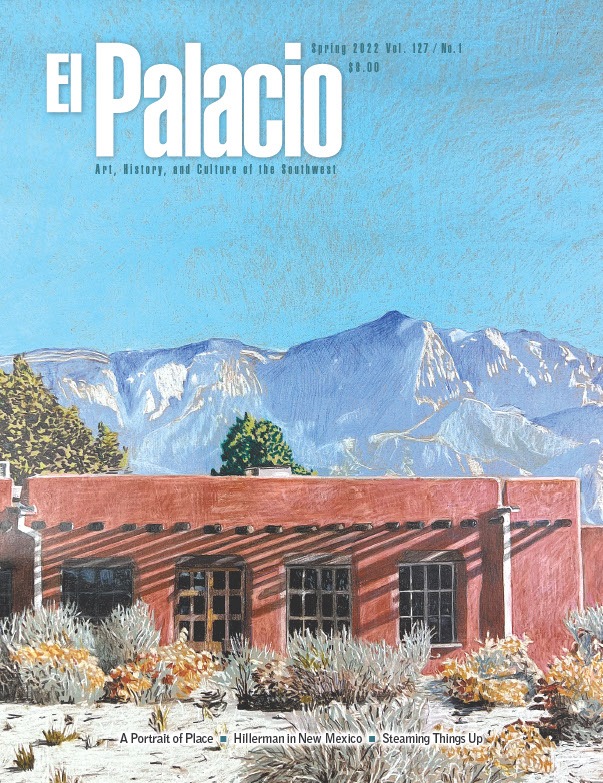
By James McGrath Morris For Tony Hillerman, there was only one thing that could lure him away from his typewriter, and that was his fishing rod. On slow news days, beginning in the 1950s, Hillerman would trade his seat at the Santa Fe New Mexican for a spot on the banks of rivers and streams in Northern New Mexico and southern Colorado.

Categories: Essays and memoir, Framework

Read Hillerman Opens his New Mexico Chapter A man sits at a cluttered desk with papers, a typewriter, and office machines in the background, looking at the camera and smiling. [gen-ai]

Hillerman Opens his New Mexico Chapter

By James McGrath Morris When Tony Hillerman left behind his native Oklahoma for New Mexico in 1952, journalism paid his bills—but he dreamed of one day writing fiction. Santa Fe would be an important stop on his path to eventually becoming one of America’s best-known writers of mysteries. In a new biography, Tony Hillerman: A Life, author James McGrath Morris tells Hillerman’s story as no one has before; here, we excerpt Chapter 11, in which Hillerman arrives in Santa Fe.

Categories: Essays and memoir

Read Tracks Through Time A vintage train station with a “WELCOME” sign, an old building labeled “LAMY,” and part of a silver train car visible at dusk. [gen-ai]

Tracks Through Time

Part 2: The Lamy Branch Line 1880 to presentby Fred Friedman Read part I of this history in El Palacio's Winter 2021 edition, here. Even with the Iron Steed’s arrival in Santa Fe in February of 1880, railroads came late to New Mexico. The states and territories surrounding New Mexico enjoyed at least some railroading presence prior to that time. Within a few years, however, systems seeking to compete with the Atchison, Topeka & Santa Fe were laying track into and through New Mexico, as well as constructing depots while acquiring economic and political influence.

Categories: Southwestern history

Read A Gift for Sketching Buildings A man wearing glasses and a bow tie stands beside a scale model of a modern building, with large windows and a landscape visible in the background. [gen-ai]

A Gift for Sketching Buildings

By Rachel Preston In the 1930s, the Great Depression had wiped out economies and careers. President Franklin Delano Roosevelt’s New Deal would offer up programs in craft, design, construction, and art that would eventually put more than half of New Mexico’s population—more than 200,000 people—back to work. One New Mexican architect would rise to the occasion, finding ways to empower communities across the state, right as he hit his stride in a career that would come to define mid-century New Mexico design.

Categories: Artist profiles, New Mexican history