
Read ¡Oye Primos! A row of wooden turntables with vinyl records are displayed on blue pedestals in a modern art gallery with a blue wall in the background. [gen-ai]

¡Oye Primos!

By Petra Salazar How do we survive the uncertainty of our globalized, techno-digital age? Listen for answers in the sounds and stories of the Borderlands. The border is not just a geographic location, but something embodied in people who dwell on the border of conflicting identities. In the U.S. Southwest, the region referred to in Chicano philosophy as Aztlán, the border is a place where we find a confluence of diverse Indohispano perspectives, blending Indigenous and Spanish ways of knowing.

Categories: Featured, New Mexican cultures

Read The Power of One Black-and-white portrait of a man in a military uniform and cap, displaying several medals and stripes on his jacket, facing the camera with a neutral expression. [gen-ai]

The Power of One

By Stephanie PadillaPhotographs courtesy Dr. Michael H. Trujillo In 1948, Pueblo advocate Miguel H. Trujillo and Indian Law attorney Felix Cohen walked into a courtroom and prevailed in their fight to win the Native American right to vote in New Mexico. Despite such a monumental achievement, only recently has Miguel Trujillo started to become a familiar name to the average New Mexican.

Categories: Featured, New Mexican history, Southwestern history

Read An Honest Instinct Black and white portrait of an older man with gray hair and glasses, wearing a dark shirt, looking slightly to the left against a cloudy textured background. [gen-ai]

An Honest Instinct

By Leslie Linthicum “The first thing I should say,” photographer Joel-Peter Witkin told a writer for Vanity Fair decades ago, “is I am not a monster.” His photographic canon—stylized portraits of cross-dressers, amputees, masked nudes, body parts, and corpses —has been called grotesque, perverted, and macabre. But shuffling around his photo studio in Albuquerque’s South Valley in sweatpants and slippers, wearing his signature oversized glasses and a T-shirt printed with one of his most famous images, the 83-year-old comes across as anything but dark.

Categories: Artist profiles, Featured

Read The Doing or The Thing The Grand Canyon at sunset, with layered red-orange rock formations and deep shadows under a clear blue sky with scattered clouds. [gen-ai]

The Doing or The Thing

By Charlotte Jusinski I forget who asked me first, or when, but the question has stuck with me for years: Do you like the doing or the thing? It’s intended to be asked of artsy types, and generally translates to: When you make your art, do you like the process, or do you like the end result? I asked it of New Mexico Poet Laureate Lauren Camp in our interview featured in this issue.

Categories: Editor's Letter

Read Writing Ourselves Back Into the Story A brown historical marker sign stands beside a rural road, overlooking a wide, dry grassy plain under a cloudy sky. [gen-ai]

Writing Ourselves Back Into the Story

By Emily WithnallPhotographs by Alanna Romero When Patricia French saw Big Bird building an horno on Sesame Street in 1975, she knew she wanted to live in New Mexico.In 1978, she moved to the state with her husband and two-year-old son in tow. As they drove across the country from New York, French remembers singing Buffy Sainte-Marie’s refrain from the series: “Sunny day, on my way to Santa Fe.” French is the mind behind the New Mexico Historic Women Marker Program, which launched as a 2005 initiative to commemorate women’s contributions to the state’s history.

Categories: Featured, Southwestern history

Read Writing the Ripe World An older woman with short hair sits in an armchair, resting her head on her hand, with several books stacked on her lap. A lamp and bookshelf are visible in the background. [gen-ai]

Writing the Ripe World

By Jennifer Levin Peggy Pond Church (1903–1986) was a poet of place. She emerged from the Southwestern landscape pre-statehood, born in what would become Mora County. She spent her adolescence riding horses on the Pajarito Plateau, in New Mexico’s Jemez Mountains. As a teen, she was sent away to East Coast boarding schools against her wishes. Her father founded the Los Alamos Ranch School in 1917, which did not admit girls.

Categories: Essays and memoir, Framework

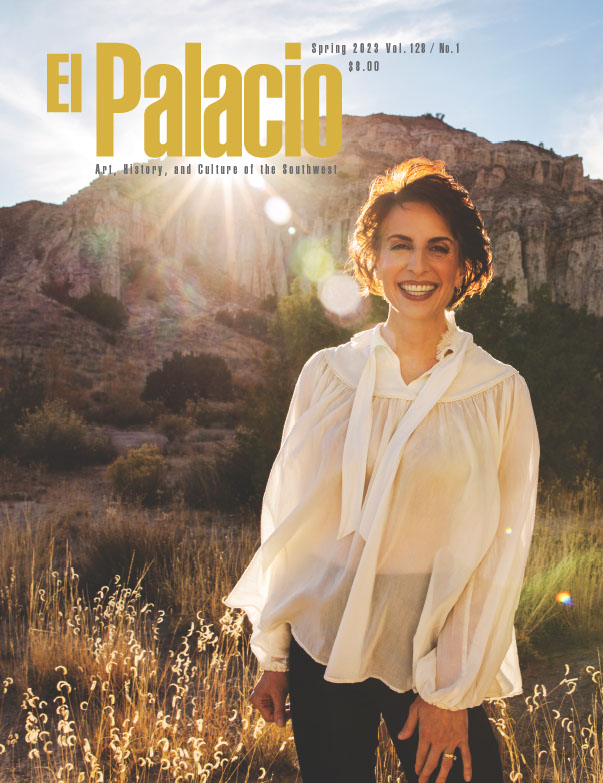
Read New Mexico’s Queen of Poetry A woman in a white blouse sits in a sunlit field with tall grasses, mountains in the background, and the sun shining behind her. [gen-ai]

New Mexico’s Queen of Poetry

By Charlotte Jusinski One of the first things Lauren Camp will do when you meet her is ask you about you. This interview, conducted over coffee at my kitchen table in October 2022, was edited for length and clarity—and also to remove many questions Camp asked about me and my own creative life. She had just wrapped up a month-long appointment as astronomer-in-residence at the Grand Canyon, announced her poet laureateship right after that, had been published in dozens of journals in the last couple years, and seemed always on the verge of something else new and exciting—but still, she wanted to reach out into the world and learn more, more, more.

Categories: Essays and memoir