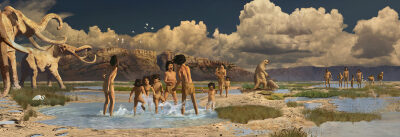
Read History, Science, Mythology, and the First Americans Artist’s conceptualization of life at Lake Otero. Missing from the image are trees. Researchers believe that the area was forested with pine, spruce and cottonwood, among other species. Research on pollens from the footprint layers is ongoing, with results expected next year. Image by Karen Carr; courtesy of the National Park Service.

History, Science, Mythology, and the First Americans

A young woman hurried across the flat, trailing footprints. At times she slipped. At times she stretched to cross a puddle. She carried a child and possibly a container for water, or food, or perhaps a bag of firewood or stones for making tools. The ditch grass, a thin herb growing in the wet lakeshore mud, had gone to seed. As the woman walked, she squished the tiny seeds into the mud.

Categories: Archaeology, Southwestern history
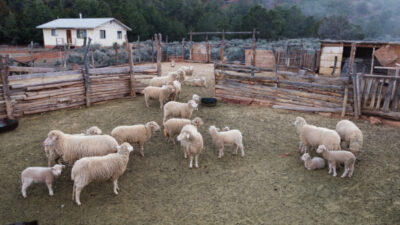
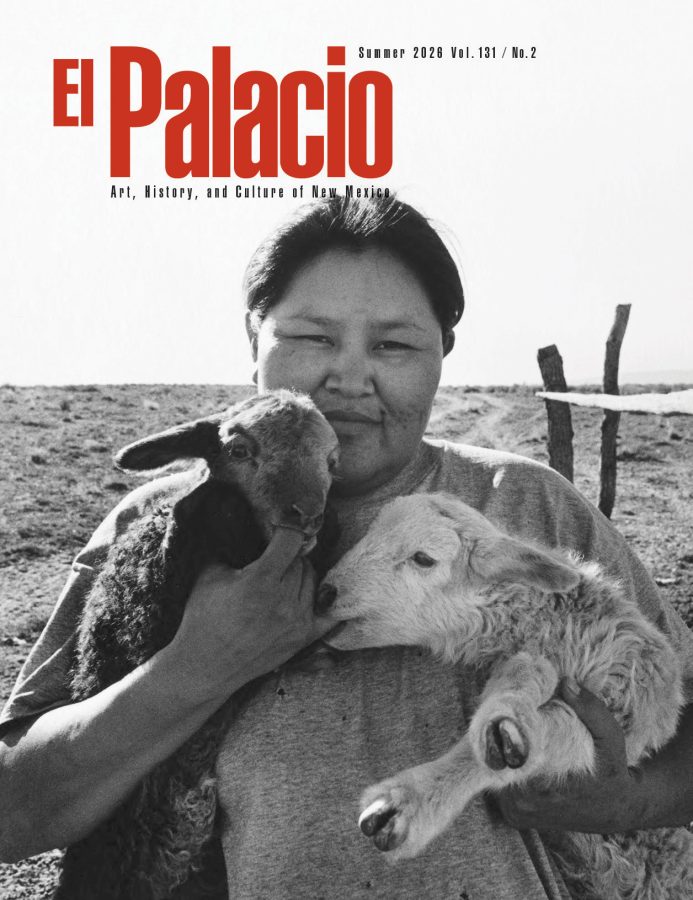
Read Sheep is Life Rapheal Begay (Diné), Navel (Hunter’s Point, AZ), 2017. Photo mural, 102 × 132 inches. Courtesy the artist.

Sheep is Life

By Rapheal Begay As Diné, we embody a holistic relationship with dibé (sheep), kéyah (land), and hooghan (home). To illustrate, my family homesite in Hunter’s Point, Arizona, happens to be our old winter sheep camp and is a space of origin and belonging that continues to provide sustenance, connection, and healing. Concerning the Diné lifecycle, this image alludes to where my mother buried shitséé’ (my umbilical cord) within the sheep corral.

Categories: Framework

Read Looking Back to Look Ahead A person in a black dress stands with arms crossed against a weathered wooden building in a rural, grassy area at sunset. Another building is visible in the background. [gen-ai]

Looking Back to Look Ahead

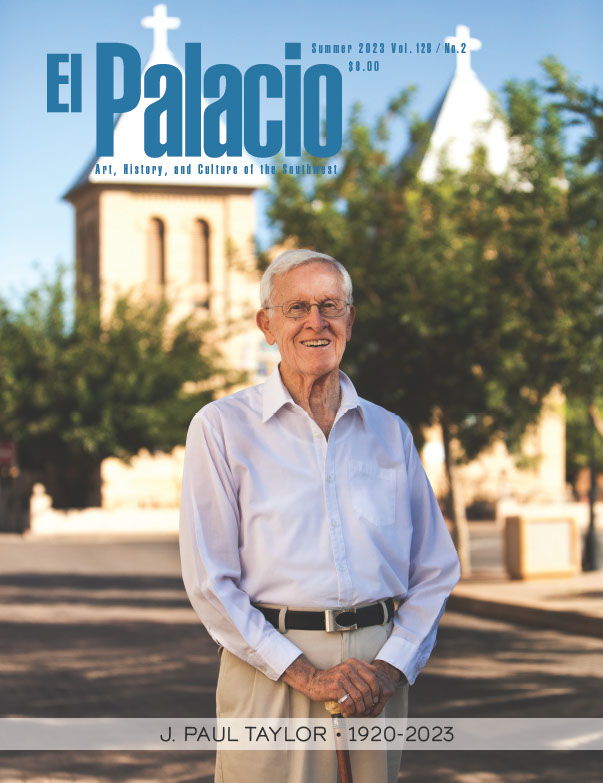
By Charlotte Jusinski Not-so-hot take: There is so much we can learn from the past and from those who came before us. While we didn’t try to give this issue a theme, here at the end, we’ve noticed that every single story herein exemplifies what we can learn from history, whether distant or recent. Our cover feature this time around is Kate Nelson’s in memoriam of J.

Categories: Editor's Letter

Read Everything Changes Over the course of its existence as a state monument and historic site, Fort Selden received not only attention to stabilize and preserve its adobe walls, but it also garnered attention for adobe experimentation

Everything Changes

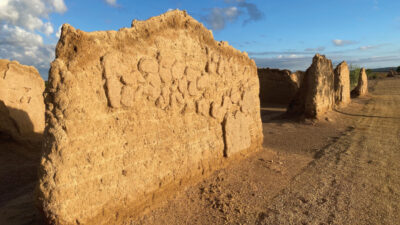
Text and photographs by Dr. Rhonda Dass Time changes everything. A lot has changed at Fort Selden in the fifty years since it was declared a State Monument and became one of the handful of New Mexico Historic Sites. On July 2, 1973, Gov. Bruce King proclaimed Fort Selden a state monument. The proclamation states that Fort Selden “is now a hauntingly beautiful ruin administered by the Museum of New Mexico for the public benefit.” This summer it will be a challenge to look back at the fifty years of the state’s influence and not see the changes that have happened to the site just north of Las Cruces near the Rio Grande in Radium Springs, New Mexico.

Categories: New Mexican history

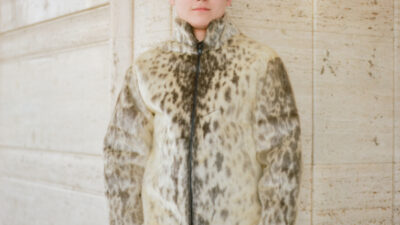
Read Sharing Our Identity and Keeping Warm Bobby Lynn Brower (Iñupiaq), Seal Skin Jacket, 2021, Utqia vik, Alaska. Spotted seal skin. Modeled by Bradley Brower (Iñupiaq). Photograph © Brian Adams.

Sharing Our Identity and Keeping Warm

By Dr. Nadia Jackinsky-Sethi Every time I see a sea otter pelt, I instinctively want to run my hands across it. The sea otter is arguably the warmest fur-bearing animal on our planet, one used historically in Alaskan communities to keep us warm. In the North, we are accustomed to the cold, the wind, the rain, the darkness. We know that to be comfortable and safe in this environment we need to dress for the weather and be prepared.

Categories: International folk art

Read Fragments of the Story: Who was Mary Greene Blumenschein? A background of an old photo of a pueblo with mountains, overlaid with a torn newspaper clipping showing a woman, and an official document with a red seal. [gen-ai]

Fragments of the Story: Who was Mary Greene Blumenschein?

By Marcy Botwick There are many stories waiting to be discovered at the New Mexico History Museum, particularly those tucked safely away in the archives of the Fray Angélico Chávez History Library. The FACHL houses a variety of materials, from old territorial maps to collections of scientists and writers who lived in New Mexico. One relatively unexplored collection is that of artist Mary Greene Blumenschein, who was married to Taos Society of Artists painter Ernest L.

Categories: Featured, New Mexican history

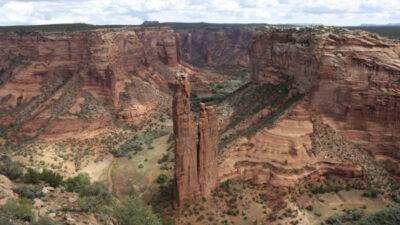
Read A Diné Horizon Rapheal Begay (Diné), Spider Rock (Tseyi—Canyon de Chelly, Chinle, AZ) (detail), 2021. Digital photograph. Courtesy the artist.

A Diné Horizon

By Dr. Michelle J. Lanteri A horizon connects multiple planes of existence by way of light, and experiencing horizons—whether literal or metaphorical—is a commonality shared between beings. Horizons: Weaving Between the Lines with Diné Textiles, an exhibition which opens on July 16, 2023 at the Museum of Indian Arts and Culture in Santa Fe, or O’gah’poh geh Owingeh (White Shell Water Place), on the traditional lands of the Tewa-speaking peoples, offers audiences immersion into connections between land and weaving through the themes of storytelling, identity, kinship, and community.

Categories: Featured, Indigenous arts and cultures

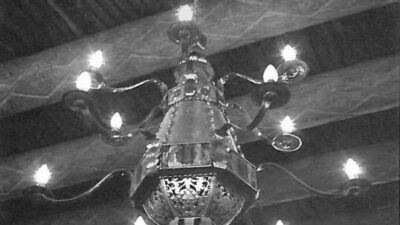
Read A Fortuitous Convergence Laboratory of Anthropology foyer chandelier. Terneplate, reverse-painted glass. Approx. 60 × 55 inches. Photograph by Nancy Hunter Warren, as printed in El Palacio, vol. 87, no. 3.

A Fortuitous Convergence

By Maurice M. Dixon, Jr. Although rare, every so often a convergence occurs of such magnitude that, at the time, little or no thought is given to its consequence by those involved. Nevertheless the significance of its occurrence has traversed the decades, continuing until the present. Such a convergence transpired nearly one hundred years ago with the most unlikely of participants: an East Coast philanthropist of immense wealth; a Portuguese-speaking, up-and-coming architect; a gifted young artisan from the llano of northeastern New Mexico; and a multi-talented native of Santa Fe, recently deceased and largely unknown beyond the Spanish-speaking population of New Mexico and Southern Colorado.

Categories: Artist profiles, Featured

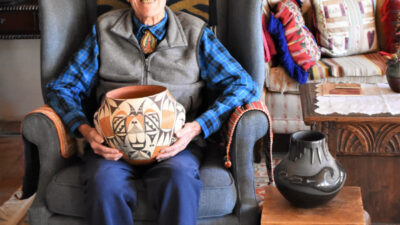
Read The Man in the Sala J. Paul Taylor in his home in Mesilla.

The Man in the Sala

By Kate Nelson Late-afternoon light tinged with autumnal gold spills into the sala grande of J. Paul Taylor’s home. The muted melodies of a mariachi band performing on the Mesilla Plaza seep through the adobe walls and wind down the zaguán, a hallway connecting the home’s living areas to this southern New Mexico town’s historic square. Seated in one of his favorite chairs for holding an informal sort of court, Taylor greets me with the warmth of a treasured guest—a hallmark of his renowned hospitality.

Categories: Featured, New Mexican history