
Read Coyota Historic photograph of an adobe village with several people standing or walking in an open central area, surrounded by flat-roofed buildings and fenced enclosures. [gen-ai]

Coyota

BY JOSÉ ANTONIO ESQUIBEL Pueblo Indians and Hispanos of New Mexico share common bonds forged over the course of more than four hundred years. During those centuries, there were more years of cooperation and co-existence, punctuated with episodes of conciliation, than years of conflict. Each group influenced the cultural history of the other, which is evident in historical records as well as in our own time.

Categories: Featured, Southwestern history, Staff favorites

Read Of Pig-Dogs and Plethoras An older man with a guitar sits on a bench outside as another person with headphones records him using a reel-to-reel recorder and a microphone. [gen-ai]

Of Pig-Dogs and Plethoras

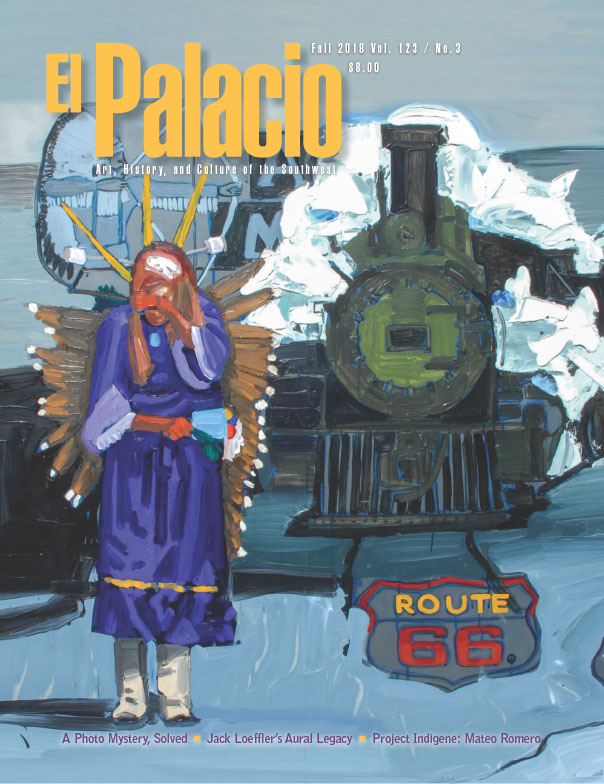
BY CANDACE WALSH Jack Loeffler’s feature, “The Practice of Aural History” describes his epic, lifelong project of recording “the myriad sounds recalling the half-century timespan of the spirit of place that pervades this region of the planet.” He decided that “oral history” was too linear to encompass his project’s ethos, and so he coined a new phrase. Loeffler’s recordings preserve music, spoken word, conversations, and the sounds of the desert at sunrise for posterity.

Categories: Editor's Letter

Read Presents Rich with Provenance A painted wooden figure of a mythical creature with a red face, long horn, sharp teeth, and elaborate jewelry, from traditional Indonesian art. [gen-ai]

Presents Rich with Provenance

BY NICOLASA CHÁVEZ The Museum of International Folk Art (MOIFA) regularly displays recently acquired items alongside items from its immense permanent collection, but visitors rarely get to experience an entire display dedicated only to recent acquisitions donated by individual collectors, groups, galleries, and artists. That changed last June, when MOIFA opened Recent Acquisitions: The Gift of Folk Art in its popular downstairs gallery, Lloyd’s Treasure Chest.

Categories: International folk art

Read Photo Synthesis A sepia-toned, faded photograph of a large group of people outdoors, posed in rows under trees, with most sitting and some standing. [gen-ai]

Photo Synthesis

BY HANNAH ABELBECK One hundred and fifty years ago, thousands of Navajo people undertook a second arduous 300-mile journey across New Mexico as the first Native nation to—with the 1868 Bosque Redondo Treaty—negotiate a return to their homeland. This year, two significant historical records turned up just in time for the commemorations. The first is a copy of the 1868 Treaty, recently unearthed from the attic of a descendant of negotiator Colonel Samuel Tappan.

Categories: Essays and memoir, New Mexican history, Southwestern history

Read Semiotic Sovereignty A person wearing a patterned headband and traditional clothing stands outdoors, looking to the side with a neutral expression. [gen-ai]

Semiotic Sovereignty

BY MARLA REDCORN-MILLER The following interview with Mateo Romero (Cochiti) describes a more abstract form of cultural appropriation that takes place in intellectual spaces such as academic institutions, museums, and art venues. Romero is a contemporary Pueblo painter and was raised in Berkeley, California. Although he grew up in an urban area, he formed a connection to Cochiti Pueblo through Santiago Romero, his father.

Categories: Indigenous arts and cultures

Read Dance of the Monarch A person with round glasses and dark hair stands in front of a yellow background, holding a colorful woven basket featuring geometric patterns. [gen-ai]

Dance of the Monarch

BY EMILY WITHNALL Thomas Haukaas (Lakota) beads like a painter. At first glance, a viewer might simply see colorful animals or butterflies in his soft beaded baby cradles—but a closer look reveals social messages. One cradle, Mitakuye Oyasin, depicts men, women, and children in a number of configurations. Figures robed in blue, green, red, and purple ride black, yellow, and pink horses.

Categories: Artist profiles, Featured, Indigenous arts and cultures

Read Flowing From Our Wildest Imaginations A wide, gently flowing river surrounded by dense green trees and shrubs under a clear blue sky. [gen-ai]

Flowing From Our Wildest Imaginations

BY WILLY CARLETON · PHOTOGRAPHS BY SHERMAN HOGUE/BLMNM My legs dangle over the small bridge as I watch the Rio Chama rushing below, rippling over stones. Over the constant din of the moving water, the leaves of scattered cottonwoods at the river’s edge clap softly with brief bursts of wind. Beyond the banks, a sloping plain rises toward towering cliffs and rock amphitheaters stratified with the reds, yellows, and browns of long-gone geological epochs.

Categories: Featured, Southwestern history

Read More Than Words A large, suspended sculpture resembling a military vehicle is crocheted from beige yarn, displayed in an art gallery with white brick walls and vehicle sketches. [gen-ai]

More Than Words

BY PETER BG SHOEMAKER Ten years ago, Shirley Klinghoffer launched her seminal Santa Fe-based Love Armor Project, an effort to demonstrate the power of art to heal and to comfort the country’s warriors. Now eighteen years into America’s second-longest war, she thinks it’s time to do it again. “People can’t forget what’s going on over there, and more importantly, who is going over there,” she says.

Categories: New Mexican cultures, Visual art

Read Back to the Future Three people view abstract art pieces displayed on the walls and a sculptural installation in a modern, well-lit gallery space. [gen-ai]

Back to the Future

For Mary Kershaw, all it took was one sight of brick walls soaring up to an industrial-style ceiling. For Mike Halpin, it was the old-time freight elevator with a pull-down gate and three buttons: up, down, and stop. For Stuart Ashman, it was empty space. Ashman’s Halpin Building remembrance starts in 2005, with a cabinet meeting in then-Governor Bill Richardson’s office.

Categories: New Mexican cultures, New Mexican history, Southwestern history, Visual art