
![A group of people sit around a campfire near a lake at dusk, surrounded by trees and outdoor chairs. [gen-ai]](https://elpalacio.org/wp-content/uploads/2025/12/Love_MorphyLakeCampfire-400x225.jpg)
Love is a Verb
BY LES DALY In the year 1968, America was in turmoil. It was a time of war, assassinations, riots, and burnings. (more…)
Categories: Featured

New Mexico Department of Cultural Affairs welcomes you to subscribe and support our state’s cultural treasures.
BY LES DALY In the year 1968, America was in turmoil. It was a time of war, assassinations, riots, and burnings. (more…)
Categories: Featured
BY CANDACE WALSH Minimalism has enjoyed an unquestioned mandate for years. Clean out your closet! Banish clutter! Having a lot of stuff has acquired the whiff of the weird. The conversation’s false binary boils down to a spotless house with off-white everything, vs. Grey Gardens-y rooms stacked to the ceiling with old newspapers and cobwebby tea sets, plus herds of feral cats.
Categories: Editor's Letter
BY NEPHI CRAIG LAND Landscape is destiny. As Indigenous peoples, we represent our landscapes. Basically, landscape is destiny means that you are your landscape. (more…)
Categories: Essays and memoir
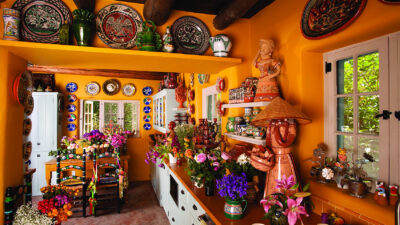
BY CHARLENE CERNY A Gathering of Voices: Folk Art from the Judith Espinar and Tom Dillenberg Collection, an exhibition at the Museum of International Folk Art which opens on December 16, 2018, celebrates the promised gift of a stellar collection and invites visitors to consider a kind of collecting that is less about accumulation than about living surrounded by meaning and beauty. Here, Charlene Cerny, a director emeritus of the Museum of International Folk Art, interviews her friend Judith Espinar about the collection and how it came to be.
Categories: Featured, International folk art
BY PAUL ANDREW HUTTON The Mexican soldiers came late in the Spring of 1855. The people saw them in the distance but thought they must be their own Bedonkohe men returning from a raid deep into Mexico. The rancheria in the Animas Mountains in New Mexico’s bootheel, far south of the Bedonkohe homeland, was well north of the line the Americans thought so important—the line that divided them from Mexico.
Categories: Featured, Indigenous arts and cultures, Southwestern history
BY DAVID ROHR Sylvanus Morley was starting to worry. It was November 1912—only days away from the public unveiling of his new exhibition, New-Old Santa Fe, located in the historic Palace of the Governors. (more…)
Categories: New Mexican history
BY EMILY WITHNALL In 1990, at the height of Peru’s war, Wari Zárate and other artists in the Andes began to teach art to children orphaned by the war. The artists thought it might be a way to help the children cope with the bloodshed they had witnessed. As the children learned traditional crafts like ceramics and retablo-making, they began to shape their losses into artistic narratives.
Categories: International folk art
BY DEVORAH ROMANEK Only a few years before the United States joined the Great War as it was raging in Europe, New Mexico achieved statehood. It would be easy to assume that such a new and rural state would not figure largely in World War I, but, as ever is the case where New Mexico is concerned, you would be surprised.
Categories: New Mexican history
BY JACQUELINE KEELER We live in a world largely constructed by the wants and dreams of white men. When we turn on the radio, we hear their voices, and when we go to the movies, we see their dreams as if “written in lightning,” to paraphrase Woodrow Wilson. (more…)
Categories: Southwestern history
Before there were any museums in Santa Fe, civic boosters presented what was likely the very first organized public exhibition in the city. Opening in July of 1883, the Santa Fe Tertio-Millennial Celebration and Exposition was organized as a way to promote economic development in New Mexico. Mining and industry were among the main attractions. This grand month-long event included Native American dances, historical reenactments, horse races, agricultural displays, band concerts, and a celebrated mineral exhibition.
Categories: Framework
![A colorful living room with orange walls, wooden ceiling beams, eclectic furniture, patterned rugs, decorative plates, paintings, and various ornaments. [gen-ai]](https://elpalacio.org/wp-content/uploads/2025/12/ESP0133-400x225.png)
![A person cooks over a campfire surrounded by rocks in a wooded outdoor setting, with a table covered by a patterned cloth in the background. [gen-ai]](https://elpalacio.org/wp-content/uploads/2025/12/1D5A0591_cmyk72dpi-400x225.jpg)
![Black and white portrait of an older Indigenous woman with long hair, wearing patterned clothing and beaded necklaces, looking directly at the camera. [gen-ai]](https://elpalacio.org/wp-content/uploads/2025/12/Captive_Nah-thle-tla-400x225.jpg)
![Black and white photo of a historical museum room with glass display cases, wooden furniture, and artifacts mounted on the walls. [gen-ai]](https://elpalacio.org/wp-content/uploads/2025/12/053554-scaled-1-400x225.jpg)
![A two-story building with murals and posters on the exterior walls, depicting faces, text, and various human and animal figures. The windows have metal bars. [gen-ai]](https://elpalacio.org/wp-content/uploads/2025/12/Museo-2008-2-scaled-1-400x225.jpg)
![Four men in uniform and hats sit on steps, playing string instruments including a violin, guitar, mandolin, and banjo, in front of a wooden building. [gen-ai]](https://elpalacio.org/wp-content/uploads/2025/12/Gonzales-41978_1220705043_1158-00238_cmyk-e1552019839903-400x225.jpg)
![A silver cuff bracelet shaped like butterfly wings, featuring a central iridescent stone and two small red stones as accents. [gen-ai]](https://elpalacio.org/wp-content/uploads/2025/12/unnamed-400x225.jpg)
![A display of american flags. [gen-ai]](https://elpalacio.org/wp-content/uploads/2025/12/010996-e1549952479370-400x225.jpg)