Poetry Lives

By Elizabeth Jacobson

At 92, Victor di Suvero is full of vitality, and his mind is swift. I had the pleasure of visiting with him recently in his cozy book-filled apartment at Brookdale, an assisted living facility in Santa Fe, with a view from the portico that opens onto a tree-filled courtyard.

His family’s story is a fortunate one. Di Suvero’s father was a Sephardic Jew whose family converted to Catholicism during the Spanish Inquisition, but still maintained the knowledge of their Jewish ancestry.

“The Levi-Schiff-di Suvero family originally went from Israel down to Egypt and across North Africa and then got to Gibraltar and went across into Spain,” di Suvero chronicles. “And when they got to Spain, it was fine to be Jewish for a while. But Queen Isabella knocked all the Jews out of Spain. So that’s how our family went to Italy—first in Genoa and then to Venice—where they brought a palazzo which was built in 1600.”

When di Suvero was a boy, his family lived freely as Italian citizens in China, where Victor’s father, a diplomat, was working in Tientsin as the secretary of the Italian Concession. That ended in 1941, however, when Mussolini ordered the family back to Italy.

The di Suveros, sensing danger, quickly used their local resources to acquire visas. In just a few days, the family of six left China and arrived on the President Cleveland in San Francisco Bay on February 27, 1942.

Victor, who was thirteen at the time, was eager to begin his new life.  “America was our savior,” he says.

During World War II, Victor served as a deckhand in the Merchant Marines, then went on to the University of California at Berkeley, where he began to write poetry. A true Renaissance man, in the early 1950s Victor was at the center of a flourishing   arts and poetry scene in the Bay Area as the Bohemians made way for the Beats. He had a number of successful business ventures as well, including a design and color service which led to him becoming a real estate entrepreneur.

Victor remained passionate about poetry and was an integral part of the first National Poetry Week Festival, which took place in San Francisco in 1988. He had been asked by Herman Berlandt, the director of the National Poetry Association, to organize the inaugural event. Victor writes in his autobiography: “This ten-day event in October featured poets as diverse as the colors of the rainbow and included Francisco Alarcon, James Broughton, Andrei Codrescu, Marilyn Chin, Diane di Prima, Joyce Jenkins, Etheridge Knight, Ishmael Reed, Jerome Rothenberg, Anne Waldman, and David Whyte, among some eighty others.”

Who would guess that what we know now as National Poetry Month, the month of April, has its origins in sibling rivalry? According to Victor, “I have a younger brother who is a sculptor; … he deals with large pieces of steel. Mark said, ‘You write poetry; poetry is flimsy.’ And so I said, ‘No, … we go back to Homer, we go back to Dante.’ … Mark said, ‘Your words are like water.’ And I said, ‘No, they last longer than steel.’”

Motivated by this poetry festival, Victor began Pennywhistle Press in San Francisco, and continued the press after he moved to New Mexico in 1987, publishing books of numerous local poets. He has also edited anthologies, including ¡Saludos! Poems of New Mexico. He is the author of fourteen books of poetry, his latest From the Sea to Santa Fe: Poems Spanning a Lifetime, The Collected Works of Victor di Suvero 1952 – 2019. Victor excitedly divulged that he is at work on a new book, one about lips: “Because nobody has written a book about lips. There has never been any recognition of lips.”

These days, Victor is the Poet Laureate of Brookdale, where he participates in a writer’s workshop.

“Poetry,” Victor says, shaking his fists in the air as I stand to leave, “is the right way!” 

Poetry curator Elizabeth Jacobson is the poet laureate of Santa Fe. Her most recent collection, Not into the Blossoms and Not into the Air, won the New Measure Poetry Prize and both the New Mexico/Arizona Book Awards for Best New Mexico book and Best New Mexico Poetry in 2019. She is the reviews editor for the online eco-journal, Terrain.org.
Elizabeth Jacobson (opens in a new tab) is a former poet laureate of Santa Fe, New Mexico, is the author, most recently, of Not into the Blossoms and Not into the Air (free Verse Editions/Parlor Press, 2019) which won the New Measure Poetry Prize selected by Marianne Boruch, and the 2019 New Mexico–Arizona Book Award for both New Mexico Poetry and Best New Mexico Book. She is the reviews editor for the online literary journal Terrain.org and teaches poetry workshops regularly in the Santa Fe community.

Spring 2020 Poetry Selections

By Various Authors

Did We Come Here?

By Victor di Suvero

How did we come here and to what end?
What was it that drew us here?
Was it the land calling, the piñon?
The great shaped clouds blessing the blue of the sky?
Was it the dawn’s quiet or the other one,
The one that comes from the day of work, at dusk
In summer, promising rest and respite and all
The other good things we dream of when we let ourselves do so?

How did we come here? Was it the wind?
Or was it the star that moved us, all of us?
Tell me about the Anasazi, how they came here,
Out of the Earth’s navel, the Sipapu, the hole
In the ground made by Coyote when Lightning
Came after him — tell me about the old ones,
The ones who came from over the edge
By starlight, riding the wind, driven
By hope as well as by terror — tell me!

How is it that we came here, to this place
Where the cottonwood grows? We brought
Our cooking pots and histories and prayers,
We brought our hopes to make a place
Where the children’s children not yet
Born may come to tell each other stories
Of how it is that we came here
And why — and they may end up
Knowing more about it than we do now.

I have come to give
Thanks to wind and star and call of land
And all that served
To bring us here.

¿Cómo Llegamos Aquí?

¿Cómo llegamos aquí y a qué final?
¿Qué fué lo que nos atrajo aquí?
¿Acaso fué la tierra llamándonos, el piñón?
¿Acaso las grandiosas nubes bendiciendo el cielo azul?
¿Acaso fué la quietud del alba, o la otra,
¿La que llega después de un día de trabajo, en el atardecer
En el verano, prometiendo descanso y todas
Las otras cosas buenas que soñamos cuando nos permitimos hacerlo?

¿Cómo llegamos aquí? ¿Acaso fué el viento?
¿O acaso fué la estrella que nos movió, a todos nosotros?
Cuéntane de los Anasazi, cómo llegaron aquí,
Del centro de la Tierra, del Sipapu, del agujero
En el suelo hecho por Coyote cuando le cayó
Un Rayo — cuéntame de los ancianos,
Los que vinieron de la orilla
Iluminándolos una estrella, montados en el viento, empujados
Tanto por la esperanza como por el terror — dime!

¿Cómo es que venimos aquí, a este lugar
Donde crecen los álamos? Trajimos
Nuestras ollas de concinar, historias y oraciones,
Trajimos nuestra esperanza para hacer un lugar
Donde los hijos de nuestros hijos, aún no
Nacidos puedan venir a contarse sus cuentos
De como fué que venimos aquí
Y porqué — y puede que terminen sabiendo más de esto
De lo que nosotros sabemos ahora.

Vine a dar
Gracias al viento y a la estrella y a la llamanda de la tierra
Y a todo lo que sirvió
Para traernos aquí.

Originally published both in English and Spanish in ¡Saludos! Poems of New Mexico, edited by Victor di Suvero and Jeanie C. Williams. A special thank you to Brandywine Avila, Victor’s assistant for her help in gathering information.


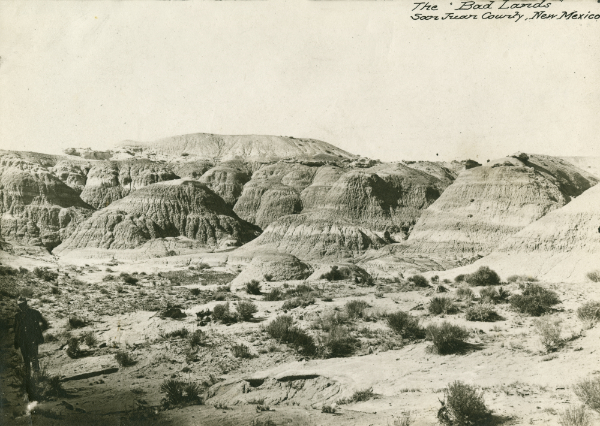
The Bad Lands, San Juan County, New Mexico, 1915–1920. Courtesy of the Palace of the Governors Photo Archives (NMHM/DCA), Neg. No. 037832.

Deer Trap

By Jane Lin

When you say teleological
I think geological, the layers laid down
in ashy additions. Think paleological,
the ur-cat loved for being first.
Fish heads and shrimp tails.
The land rises up. The stone wears down,
footholds one in front of another
in the hip’s required zag.

Is god mystery or what you know?
The rectangular hole for catching deer.
Standing on a mesa top, close to
the dead a thousand miles away.
The sun mists the mountain dusk,
the bent light like a cataract,
the decay of sight. Like cracking the window
to hear whoever might call.

“Deer Trap” is reprinted by permission of the publisher, 3: A Taos Press, from Jane Lin’s book, Day of Clean Brightness, First U.S. Edition, 2017.

Jane Lin is a poet, software engineer, and the Southwest regional chair for Kundiman. Day of Clean Brightness (3: A Taos Press) is her first book.


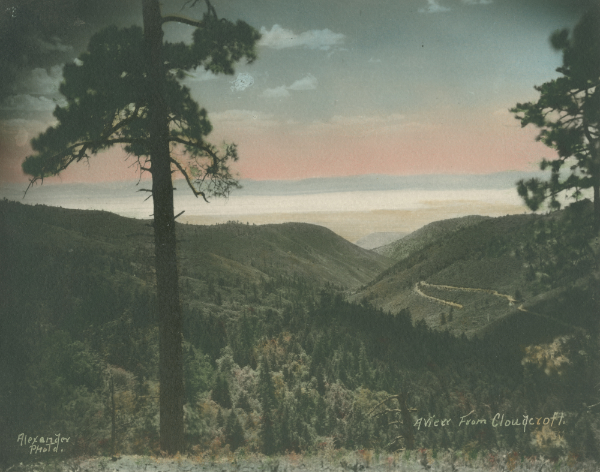
Jim Alexander, A View from Cloudcroft, New Mexico, 1927–1931.
Courtesy of the Palace of the Governors Photo Archives (NMHM/DCA),
Neg. No. HP.2012.20.21.

Bear of Mountain — & She Flies In, Too

By Sawnie Morris

I was raised in the light of mountain   hulk of
a confident outline   brazen    vibrational

luster    a conglomerate presence  of    pine   stone  
lion    deer        &   bear’s  

amorous  desiring  of apples      her choke-cherry
seed-filled    scat    left  in the meadow

we often returned to
the edge of  the drive     where she wanted

close to  bushels    fragrance in  storage.  Unthinking, or at behest
of white-eared hummingbird ––  we left

the  door ajar.  And don’t you love  a-jar  
its   alliance with   fruit  jams    spontaneous    music    impromptu 

elations    the elemental chorus :   insects  playing stick-wing  
&  leg instruments     the frisson of   bear fur

& fat   against  bark    the curly-haired
dog     his nose for    eternity    its scent :    fungus & moss –– 

while  nearby   [ in-house ]  a colloquium of   female  iconography   carries
on
a  statuesque  chat. There are nights   I want to ––

but it’s a waste    bending  time    its   orbital 
belly    its  hot   sensual    core.   The mountain refuses   

a belt    and that is power ––  happily
it leaks  all over  itself    a fountain    intricate.   My favorite

watercolor  mountain  is    arroyos    their spidery   legs   
edging   toothy  rocks-streams-skip ––   the way  that poet was    

always  skipping  beyond  mountain     piano keys  of  
fingers   piercing   air –– caw!  caw! ––    into  imagination   

the other side of     perception     respectful  of    sky-streaked  clouds.  
Even  her  cat   cried out     and  her dog would have died  

for her   he  was  such  an   accomplice. Stigmata  
dripping  from  claw.  We are bears drunk on

apples ––  apples   delighted   to   be  
desired   by  bears.   Fruit’s  not-too-tough   cellulose  crimps

at mouth    puckers where grey bird stabbed
bit   tore.     Left sunburst in the kisser

of a gap.  I think of Jackson    his cat-mouth   chattering   
uncontrollable  at window   practicing the clamp down and tear.

His mouth    sunk  in   imagination
of  bird flesh    warm   provision   beyond 

feathers.   I tell you    when my mother  tears  a   fingernail   
my own is ripped-to-the-quick.  And when  after long walk

through  woods    I tell bear   I want to   see her  –-  she appears  
that very   night   where  I  spoke  ––   righteously   offended  

by my shout   &  heave of  the  magnitudinous   Rothenberg
anthology –– my cup flying up –– a star into ether –– the shatter of 

tea leaves over  fired  brick.    She  came  in search of  
apples.  Her cinnamon  gleam  splays   \|//  patio  light. 

She doesn’t  hurt   my dog   though she could have
slashed him to   watercolors:  arterial  thick.   Dog hides in bush.

Bear ambles out  the taming arch   into  far  infrared  night.
Woman with a curl   in her belly   is stricken  by  after-the-visitation:

Bear could have killed  my dog. Bear could have taken a bite of me  
or my  beloved. Bear and I  had a   galactic  halo  of   conversation   

which continues.  Listen  
the same story can be  told  as   myth   or   matter (of) ––

Bear of Mountain — & She Flies In, Too” was published by Puerto del Sol.

Sawnie Morris’s collections include Her, Infinite (New Issues Press) and Matapolvo Rain in The Sound a Raven Makes (Tres Chicas Books). She is the inaugural poet laureate of Taos (2018-2019).


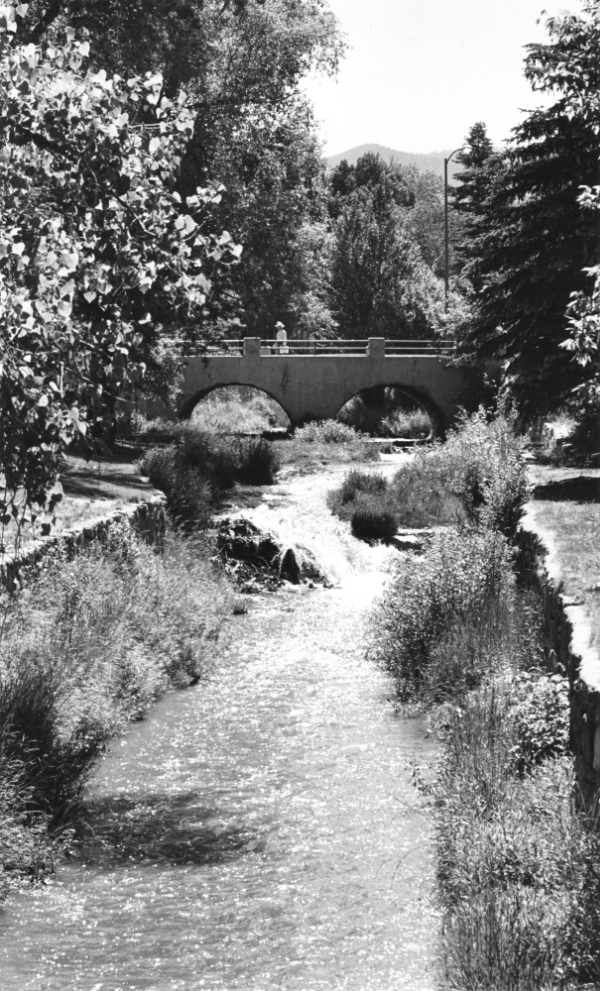
Michael Heller, Santa Fe River in downtown Santa Fe, New Mexico,
1984. Courtesy of The Santa Fe New Mexican Collection, the Palace of the
Governors Photo Archives (NMHM/DCA), negative number HP.2014.14.1390.

Blue Winding, Blue Way

By Valerie Martínez

I tell you, City, City, City, a story you told me—brown eyes, green eyes, black—in the days of snow drifts, mini-skirts, nothing beyond Richards Ave. The center of earth was a patch of land, our house, a back yard, the arroyo humming over the reddish concrete wall, and one immortal turtle. The neighbor’s immense ham radio antenna and Mr. Chang hunched to static and metal under the morning buzz of Osage Ave. We went to school in sedans¸ in dented station wagons, and on weekends workmen showed up to build vigas for the new den that swelled our home–so many children–Alfonso saying, mi linda, get me that bucket and ¿donde está tu mama? Me saying, at the grocery store, buying tubs of ice cream, you know, those big ones? Get me, ice cream, you know took to the air over the rooftops spilling toward Frenchy’s Field. We weren’t supposed to play there—he’ll shoot, you know—and I imagined the old man hunched somewhere near the water, listening. In those days the Santa Fe River ran and sang. It’s true? you ask, staring at the empty bed, dust rising at the dead end of Avenida Cristobal Colón. There was water? Now we dream of blue winding, blue way along West Alameda—barbershop, coop, health clinic. The clog and cough of St. Francis Drive. Back then there were cars and wanderers and children just like now—towheads, dark braids, dirty cuffs—rolled up with all of us on the days of markets and parades along San Francisco and Palace Ave. Hmmm went the setting sun and you really could get fry bread for a quarter after walking down Washington Street from Fort Marcy after Zozobra burned. Now I drive downtown where the acequia crosses Closson and Maynard, stutters along Water St. and sings the parallels of East Alameda and Canyon Road. Like a whisper, it lays itself down between Camino del Monte Sol and Camino Cabra, two streets with the river in-between—one with her skirt trailing southwest to the Paseo Real, the other reaching her fingernail moons to the foothills. And the river itself, dream of p’oe tsawa, flushed from the red burn of the Sangres, running headlong downhill into this city of ours, then and now, with her canciónes encantadas, with her blue, with her brown mouth open.

Grateful acknowledgment is made to the following publications where this poem, in this or an earlier version, has appeared: And They Called It Horizon: Santa Fe Poems (Sunstone Press, 2020). This collection was written by Valerie Martínez during her tenure as Santa Fe Poet Laureate, 2008-2010.

Valerie Martínez was the poet laureate for the City of Santa Fe from 2008 to 2010. She has published six books of poetry and translation, and her work has appeared widely in literary journals and magazines. Her book-length poem, Each and Her (winner of the 2011 Arizona Book Award), was nominated for a Pulitzer Prize. She is currently the director of history and literary arts at the National Hispanic Cultural Center.


Tracks

By Sherwin Bitsui

Canyon river water combed
from the Milky Way’s gray hair,

shimmers when shelved on a stack
of sheetrock next to a window

glaring at an office chair
hurling toward it.

A woman gazes at a stairway
of light mixed with dust,

she presses her back
to the fist hammered wall,

her fingertips’ swirling
where broken glass glints.

Next door a singer
shakes a gourd rattle,

imagines a trail of embers
glowing in the dark maw

of a scorched coyote skull
nailed to an aspen’s charred limb.

Narrowing

By Sherwin Bitsui

We carry our _______
to the furthest seam,
wake with bleached eyes.

Thorn-punctured breath,
sealed inside
our outside voices—

We exchange faces
for ears of corn, duct-taped
to the red tassels of November’s fires.

Our horned shadows against
the dining room wall;
our split tongues shivering
under a blade’s half smile.

Our middle name:
one yellow leaf, unfurling our last.

Bosque Moon

By Sherwin Bitsui

Night air, cupped and shook,
bleed sighs when you dampen

the mouth’s slit. Calendars assigned
to others’ winters break into hyphens

under each new weather forecast,
fragrant as noon pavement

on which you scrape your eyes
to glimpse the cranes’ return.

Look, the snow-blind moon,
clouds in lungs; shoulder blades

sharpened against dry skin—
it argues when marched away.

Sherwin Bitsui (Diné) is originally from White Cone, Arizona, on the Navajo Reservation. He is the author of Shapeshift, Flood Song, and Dissolve. In addition to teaching at the Institute of American Indian Arts, he is a member of the faculty at Northern Arizona University.

Jane Lin (opens in a new tab) is a poet and a software engineer for an environmental consulting company. She studied under Denise Levertov at Stanford University and received her MFA from New York University’s Creative Writing Program w here she was a New York Times Company Foundation Creative Writing Fellow. Her poem “Signs and Portents” was transformed into an art song by Emmy Award-winning composer Glen Roven for his composition “The Santa Fe Songs” for soprano and piano and appears on Talise Trevigne’s album At the Statue of Venus. Her honors include a Kundiman fellowship and scholarships from Bread Loaf Writers’ Conference and Taos Summer Writers’ Conference. For many years she taught creative writing at UNM-Los Alamos and facilitated the Mesa Public Library Poetry Gathering series. Jane lives in Northern New Mexico with her husband, daughter, and three cats. She was born and raised on Long Island, NY.

Sawnie Morris (opens in a new tab) is an award-winning poet, prose writer, and long-time professional environmental activist –as well as a dreamworker – with over twenty years of teaching experience. Her teaching and coaching approach is that of a grounded ecstatic, whose love of language and the poetic traditions serve to inspire and liberate, while her knowledge of craft empowers others to discover and express their own truths within a respectful and supportive atmosphere.

Sherwin Bitsui (Diné) (opens in a new tab) is originally from White Cone, Arizona, on the Navajo Reservation. He is the author of Shapeshift, Flood Song, and Dissolve. In addition to teaching at the Institute of American Indian Arts, he is a faculty member at Northern Arizona University.

Valerie Martinez (opens in a new tab) is poet, writer, and educator. She was the poet laureate for the City of Santa Fe from 2008 to 2010. She has published six books of poetry and translation, and her work has appeared widely in literary journals and magazines. Her book-length poem, Each and Her (winner of the 2011 Arizona Book Award), was nominated for a Pulitzer Prize.

Victor di Suvero (1927-2021) was a poet and recipient of the 2019 Governor’s Awards for Excellence in the Arts. He has participated in bringing poetry and literature to the people for nearly 80 years in his role as poet, publisher and community organizer. His more recent poetry books include Harvest Time (2001), Spring Again (2005), Moving On (2007), A Gathering (2010), Considering (2012), Still Here (2014), and Once Again (2016). Spring Again was awarded the Independent Publishers Association Bronze Medal in 2007. He has edited several anthologies including ¡Saludos!, the first bilingual collection of the poetry of New Mexico, and We Came to Santa Fe (2009), which was awarded a 2009 Southwest Book Design and Production Award by the New Mexico Book Association. di Suvero was a key force in founding several important and long-standing literary organizations and programs in New Mexico including the Poetry in the Schools program, New Mexico Book Association, PEN New Mexico, New Mexico Literary Arts, and the Live Poets Society. As the director of the National Poetry Association he assisted in establishing National Poetry Week, which has now grown into National Poetry Month and celebrated across the country.

Adulation and Anguish

By Hugo Chapman with Charlotte Jusinski

With the opening of The birth, death and resurrection of Christ: from Michelangelo to Tiepolo, a traveling exhibition of works on paper from the British Museum on view at the New Mexico Museum of Art through April 19, New Mexicans are offered a rare glimpse deep into one of the most prestigious collections of devotional art on the planet. But beyond depictions of the life of the Messiah, the works included therein also contain immeasurable information about the history of art-making worldwide, as well as an opportunity to gaze inward at the human condition.

The selection of the works in the show was made by me and my colleague Sarah Vowles, the Hamish Swanston curator of Italian and French prints and drawings at the British Museum. Together we devised the theme and then had the fun of going through the boxes of Italian prints and drawings, making our picks.

We wanted to show off the richness and breadth of our Italian collection, one of the best in the world, hence our desire to include works by some of the greatest names of art history. The exhibition features works from the likes of Michelangelo, Parmigianino, and Giambattista Tiepolo, but also great examples by lesser-known names, such as the earliest drawing in the exhibition: Parri Spinelli, an artist from Arezzo in Tuscany working in the first half of the 1400s.

The selection that Sarah and I made was specifically designed for a Catholic audience in mind who we knew would be very familiar with the Biblical stories in the works. This was exciting for us, as such knowledge cannot be taken for granted in the much more secular and less religiously knowledgeable viewers in the UK. We felt confident that in San Diego and Santa Fe, the show’s viewers will appreciate and pick up the different ways that artists across the centuries have variously recounted these episodes from Christ’s life.

At the same time, because these prints and drawings are small and intimate, they often allowed artists to be more personal in their expression of faith. An example of that is the little-known Florentine sixteenth-century artist Jacone’s The Lamentation drawing. This is so extreme and outlandish in the rendering and proportions of Christ’s broken body draped across the bony lap of his mother that it can never have been intended as a design for a finished public work. It is rather a personal articulation of his religious feelings. As with so many of the works, the intimacy of drawing allows us into the private emotional sphere of the artist in a way that is rarely encountered in the greater formality and fixedness of the final work.

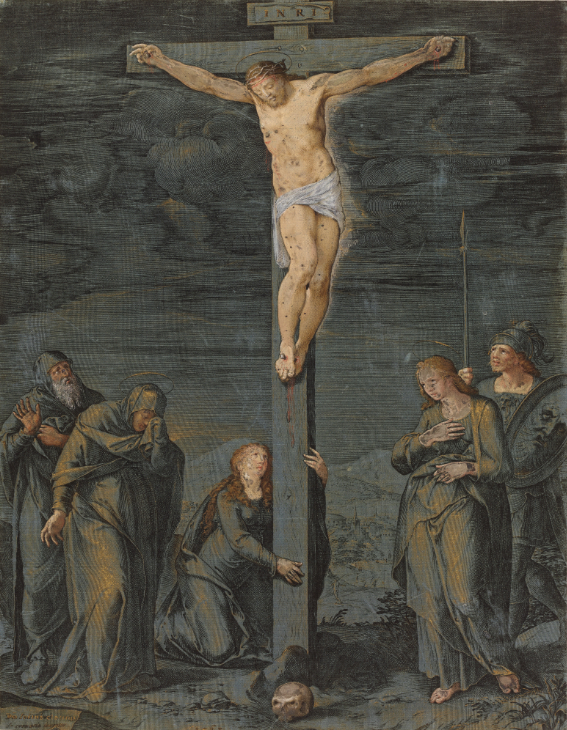
Cornelis Cort, The Crucifixion, after Giulio Clovio, 1568. Hand-colored engraving with bodycolor, heightened with gold and white, printed on blue-gray silk. © The Trustees of the British Museum.

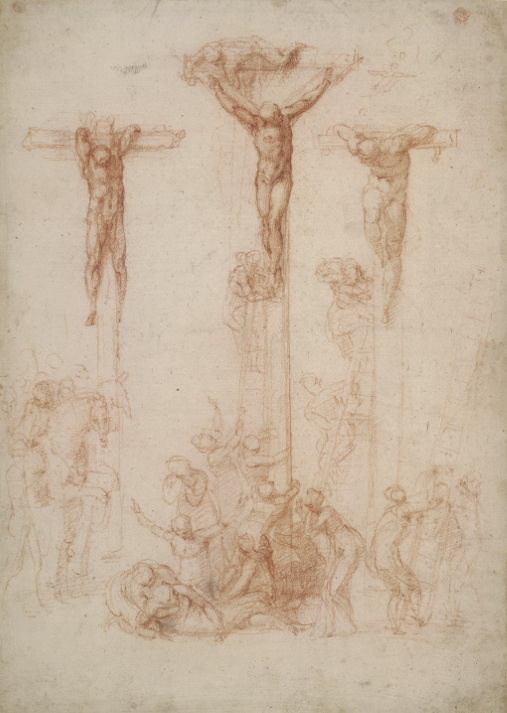
Further, most drawings were never intended to be seen outside the confines of the artistic studio, as they were working tools in the development of a finished work in paint or stone. We know from Michelangelo’s letters that he was extremely secretive about his drawings, and he would have likely been appalled by the thought that his thinking on paper—his red chalk The Three Crosses study from the first part of the 1520s—was exhibited for all to see.

As drawings were not intended to be seen outside the studio, they were very rarely signed. As such, it is rare that we can be perfectly certain of their authorship. That said, akin to our ability to recognize the handwriting of our parents and partners on a note or envelope without the need of a signature, the identities of artists can be deduced from building up a picture of how they went about making a drawing. In some cases, drawings can be linked to figures or compositions in surviving works, as for example with the powerful red chalk study for the suspended figure of Christ from the mid-1570s by Giacomo Rocca related to the artist’s fresco of the Deposition in a Roman church. The identification of an artist’s style of drawing, as discerned in the way that he or she draws a contour or adds shading, is in the end very subjective, as much of it depends on an assessment of quality and touch.

Michelangelo, The Three Crosses, 1521–1524. Red chalk. © The Trustees of the British Museum.

In the case of the study by Michelangelo, one of the most contested artists as some scholars have historically sought to cut down the number of drawings while others have been more expansive, I feel confident that the piece included herein is by him. The sheet is so alive and full of movement, and the geometric simplification of the figures beneath the cross is so like the shorthand style he learned from his time in the studio of Domenico Ghirlandaio. But others may disagree, and for me that lack of certainty is one of the attractions of looking at drawings. It encourages all of us to look at the works with an analytical and questioning gaze, and to be skeptical of authority. Just because I or Sarah think the work is by Michelangelo does not make it so, and it is unlikely there will ever be definitive, iron-clad proof—so I invite everyone to come and take a look at it and make up their own minds.

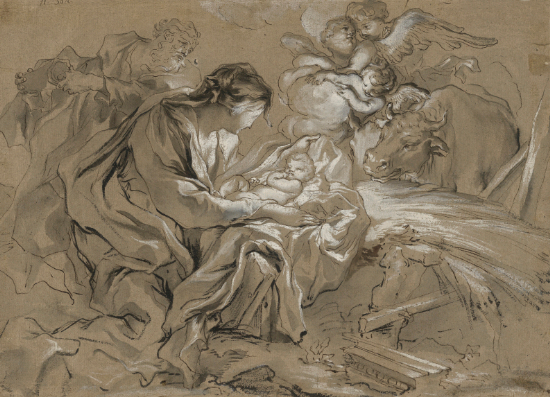
Tracing the manner of expression of the works within the exhibition, there is most definitely a discernible shift in the show as the battle for the Catholic church to fight off the rise of Protestantism from the 1520s onwards can be felt in the greater emotiveness and dramatic force in the telling of Christ’s life. For example, the quiet piety of the figures in the early-1500s The Adoration of Christ by an artist in the circle of Pietro Perugino is transformed into a scene of mystery and wonder, with light pouring from the newborn Infant Christ, in both Carlo Maratti’s nocturnal rendering of the scene from the 1650s, a study for a painting in a chapel in Rome, and in the Genoese artist Gregorio de’Ferrari’s no less dramatic version of the scene from around fifteen years later (The Adoration of the Shepherds and The Nativity, respectively).

That said, the subjects of all three works are based on the same Biblical accounts of Christ’s birth but interpreted in different ways. The fascination of the show is how artists over the centuries kept finding new nuances of visual storytelling to bring out different aspects of the narratives.

Even beyond the stories depicted in these works about the life of Christ, there is much to learn about the innerworkings of European art at large through the works selected. The artistic training that normally began in Italy around the age of 12 was rooted in drawing from a live male model, clothed and unclothed, so by the time that the artists reached maturity they had a huge mental image bank and lots of sketch books filled with such studies.

As a result of years of figure drawing, most artists had the facility to draw figures without the need of a model, while also being able to manipulate freely the poses of figures that were in front of them. It is therefore very hard to be sure when an artist is drawing from life, but I would guess that the specificity of the lighting of the figure in Camillo Procaccini’s red and black chalk study A shepherd playing bagpipes is indicative of him having someone adopt the pose of the bagpiper he wanted for his painting.

[wonderplugin_slider id=170 alignment=”center”]

But live models could only hold poses for so long without moving, and in the case of Fra Bartolommeo’s very detailed study of light falling on the folds of a drapery, he most likely draped the material dipped in wax or liquid clay (to ensure that the folds did not move once arranged) over a small wooden lay figure, the like of which can still be found in artist’s studios. The tubular shape of the model’s chest is the clue to his use of such an inanimate model.

Further, the very material upon which these pieces were created opens a glimpse into the history of civilization as we know it. The key material in the show is paper, as all but one of the works in the show are either drawn or printed on it. The technology of papermaking spread from China via the Middle East and into western Europe through the Arabic conquest of Spain in the eleventh century. In China, paper was made with the pulp from tree bark, but in Europe the base material was hemp or linen, obtained from old clothes, rags, worn sails, and ropes.

The plant fibers of hemp and linen would be mixed with water in vats into which the papermaker would dip a metal wire mold. The skill of a papermaker was to scoop up a thin and even layer of this aqueous porridge-like mixture. This thin layer was then deposited by the papermaker’s assistant on sheets of felt, which absorbed the excess water. Sheet after sheet of this pulpy mixture was piled up between layers of felt, which were then put in a press to squeeze out even more water. The paper was then hung up to dry, like washing on a line, and when that was finished each sheet was brushed over with a gluey mixture, known as size, so that it held the ink or watercolor on the surface on the paper (without it the paper would be as absorbent as blotting paper).

Although artists could and did draw before the spread of papermaking in Italy in the 1400s, the high cost of working on parchment or vellum (the treated skins of sheep or goats) must have been a deterrent to exploring ideas. So not unlike the way that digital cameras fitted in our mobile phones have opened up image-making to everyone, the rise of papermaking in the 1400s and 1500s allowed artists to experiment more freely and with greater frequency.

Without paper, another technological innovation invented by the Chinese, the printing press (which in Europe started in Germany in the mid-1400s), would not have taken hold and spread so fast. Paper is so ubiquitous today (in defiance of claims that computers and digital devices would push us towards relinquishing it) that it requires considerable powers of imagination to realize what a truly revolutionary material it is. Without paper, the ideas expressed in books and the artistic images that articulated and elaborated them would not have spread so widely, and would not have made such an impact on how the world is today.

If visitors leave the exhibition with nothing more than a new appreciation of the historical importance of paper, it will have succeeded. But as head of a British Museum department that has well over two million pieces of paper in it, I am perhaps a little biased in its favor. 

After these pieces leave Santa Fe, theywill return to their boxes and be visible only when requested by visitors to the Prints and Drawings Study Room in the British Museum, a wonderful room dating from the early 1900s filled with mahogany cases packed with works on paper which I warmly invite you all to come and see. It is open by appointment, so a little prior notice is required, but it is worthwhile, as the treasures of our collection are open to all—from great drawings by old and modern masters from Raphael to Ruscha, to satirical prints by Gillray and Rowlandson, and much else … including the world’s most sought-after baseball card, Honus Wagner.

Gregorio de’ Ferrari, The Nativity, 1659–1726. Pen and brown ink, brown wash, heightened with white, on light brown paper. © The Trustees of the British Museum.

As works on paper are light-sensitive, especially those in pen and wash, some of the drawings may not be lent again for many years, and certainly the combination of works found in Santa Fe is unlikely ever to be reassembled. The phrase “once in a lifetime” is a well-worn one in promoting exhibitions, but in the case of works-on-paper shows, it is accurate: Once the works have returned home, they won’t ever come out again in the same configuration. 

Even if a visitor to the show has no religious beliefs of any kind or comes to it from a different faith, the humanity of the works is universal. Through them we can feel the joy and surge of love felt by Mary and Joseph at the sight of their newborn son, and be touched by the anguish and pain felt by a mother cradling her adult son’s lifeless body.

The cycle of birth and death are core to the Christian story, and to all of humanity irrespective of their religious feelings. Time and time again, it is these themes that are explored in innovative and arresting ways in the works in the Santa Fe exhibition.   

— 

Hugo Chapman is the Simon Sainsbury keeper of prints and drawings at the British Museum. Chapman joined the British Museum in 1995 as curator of Italian drawings. During his time as curator he has been involved in a number of monographic graphic exhibitions on Michelangelo, Parmigianino and Raphael, as well as broader surveys of drawing, including one on the greatest Italian fifteenth-century Renaissance drawings in the British Museum and the Uffizi in Florence and on silverpoint drawing. In 2011 he became head, or keeper, of the Prints and Drawings Department. 

Hugo Chapman (opens in a new tab) is the Simon Sainsbury keeper of prints and drawings at the British Museum. Chapman joined the British Museum in 1995 as curator of Italian drawings. During his time as curator he has been involved in a number of monographic graphic exhibitions on Michelangelo, Parmigianino and Raphael, as well as broader surveys of drawing, including one on the greatest Italian fifteenth-century Renaissance drawings in the British Museum and the Uffizi in Florence and on silverpoint drawing. In 2011 he became head, or keeper, of the Prints and Drawings Department.

Perú Past and Present

By Tey Marianna Nunn, PhD

In recent years, interest in Perú and all things Peruvian has increased at a rapid rate around the world. Llamas are everywhere in popular culture and home décor. Traditional weaving patterns and other elements of Andean fashion are featured sources for contemporary style magazines. In part thanks to a 2005 Bon Appétit feature edition, Perú’s culinary contributions have gained a large following among global foodies.

Correspondingly, the country’s export sales of pisco (traditional grape brandy and a key ingredient in Perú’s national cocktail, the pisco sour) have grown 168 percent in the last five years. Tourism to the country has increased so much that the government is considering the establishment of an airport between Cusco and the UNESCO World Heritage Site of Machu Picchu. While the construction project is controversial and contested, it focuses a contemporary spotlight on the issue of balancing the Peruvian present with its past; particularly as the country approaches the bicentennial of its proclamation of independence in 2021.

These trends are part of the inspiration for the National Hispanic Cultural Center (NHCC) Art Museum’s most recent major exhibition, El Perú: Art in the Contemporary Past, currently on display in the gallery through May 31.

Peruvian artists have produced significant visual culture for centuries. Yet, when one thinks of Perú, usually the first thing that comes to mind is the country’s past, el pasado, including pre-Colombian ceramics, Andean ruins and other ancient sites, Colonial religious paintings, and artesanias, or folk arts. Both the pre-Colonial and Colonial past provide incredible historical richness and cultural context for understanding Perú today. From the artists of the Moche culture (active 1 to 800 CE) and the Inka Empire (flourished 1425 CE to 1532 CE), to the Cusco School of Spanish Colonial painting (active 1532 to 1821), to the costumbrismo style popularized by Francisco “Pancho” Fierro (the 1830s to the 1860s), and the indigenismo movement founded by José Sabogal (1888 to 1956), to one of the first Peruvian post-war abstract painters, Fernando de Szyszlo (1925 to 2017), Peruvian artists have contributed significantly to the world’s art historical record.

Yet it is often easier and more comfortable for a visitor to see only the idealized, romanticized past of a nation, rather than how the layered complexity of culture, influenced by the past, plays out in the present. Peruano artists are only seen as contributing to the past rather than having a global impact though contemporary visual culture and art.

Artists with deep connections to Perú are highly aware that the Indigenous pre-Colonial past and post-Colonial present are  simultaneously present in Peruvian identity—thus, the idea of a “Contemporary Past” for this exhibition. Each of the four featured artists in El Perú: Art in the Contemporary Past (Baldomero Alejos, Ana de Orbegoso, Lorry Salcedo, and Kukuli Velarde) acknowledges this in their work as they traverse across visual history. They engage their communities in revisiting history, and they each perform a critical role in a continuum of visual culture as well as in the artistic heritage of Perú. The work of each artist connects to the next. For the purposes of this article, each is introduced in order of appaearance in the physical exhibition space at the NHCC Art Museum.

Together, the incredible works of these four artists reveal the history of art and the art of history and spotlight the significance of Perú’s visual culture—and, in doing so, honor yesterday, today, and tomorrow.

Kukuli Velarde
Born 1962, Cuzco, Perú; lives in Philadelphia, Pennsylvania

kukulivelarde.com

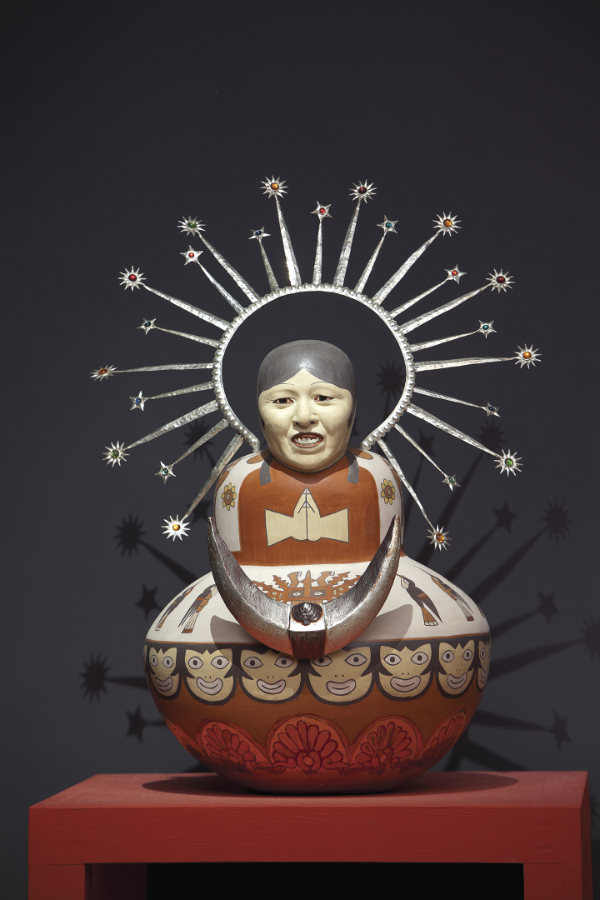
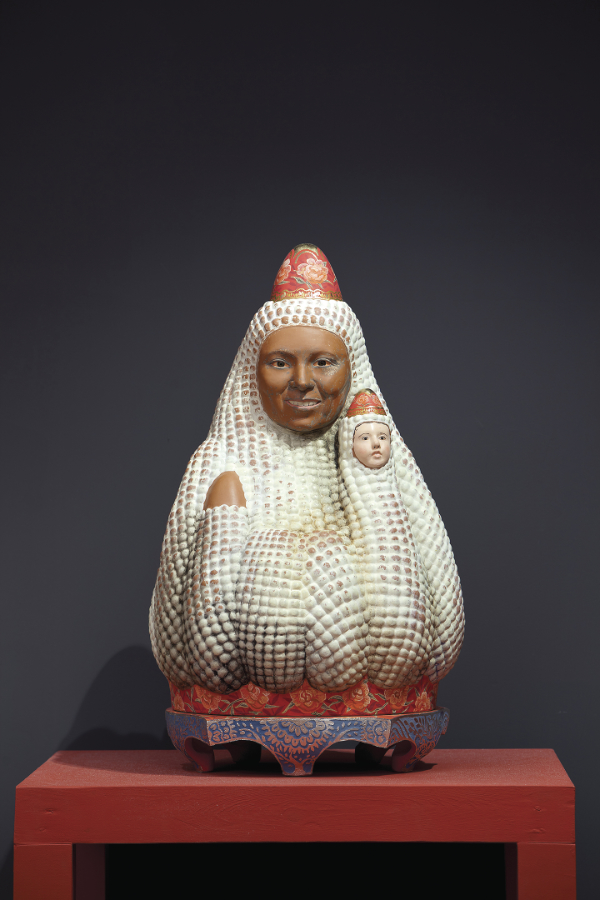
Kukuli Velarde creates ceramic and multimedia works that revolve around the consequences of colonization and colonialism, as well as contemporary Latin American culture. Through various materials, she visually investigates aesthetics, cultural survival, and inheritance; she writes of her work: “In 2012, an exhibition of my work in Lima surveyed the last ten years of my career to that point. Peruvian audiences saw themselves reflected in the work, and the exhibition stimulated conversations about race and inequality right there on the spot. It also got the attention of art students, for it confronted Western ideals and aesthetic paradigms foreign to our own understanding of self.”

Velarde has been working on a series of works titled CORPUS: Contemporary Art and Historical Identity. The El Perú exhibition features six of her large-scale ceramic sculptures, based on Catholic icons from the Feast of Corpus Christi in Cusco (celebrated every year sixty days after Easter Sunday), along with accompanying video and corresponding traditional embroidery banners.

Velarde thoroughly researches the traditional materials and techniques of Peruvian pre-Columbian pottery styles in order to create her contemporary works in homage to the artists before her. CORPUS narrates the history of Perú, incorporating pre-Columbian and Colonial-era sensibilities, visually mimicking syncretism within a contemporary viewpoint. Colonization and colonialism have, for centuries, forced populations to dismiss, among other things, their regional aesthetics, including their understanding of personal beauty. Velarde feels that as a consequence, there is a pervasive belief that a universally pleasing aesthetic exists, though it is actually rooted in European canons of beauty that do not correspond to all populations.

Baldomero Alejos
Born 1902, Santiago de Chocorvos, Perú; died 1976, Lima, Perú
archivoalejos.org

[wonderplugin_slider id=171 alignment=”center”]

Baldomero Alejos was born in Amaupata, a village of Santiago de Chocorvos in the department of Huancavelica. He was the youngest of seven children in a family of shepherds and potato and barley farmers. Orphaned at the age of six, Alejos and one of his brothers went to live in the department of Ica, where they worked in the vineyards of the Cabildo hacienda. In the 1920s, Alejos moved to Lima, apprenticed with photographer Diego Goyzueta, and later opened his own studio in the now-trendy Barranco neighborhood.

Around the age of twenty-two, Alejos moved his studio to Ayacucho (also known as Huamanga in Quechua), an important city in the Andes some 340 miles southeast of Lima. There, Alejos photographed the town and its people, recording history as it happened. He was known for his studio photography and created images of families from different socioeconomic backgrounds, featuring all with equal respect. Layered in meaning, the portraits reveal the twentieth-century moments when Ayacucho stepped into modernity. At the same time, Alejos’s images also portray the past and vernacular traditions. His subjects wore both European-inspired garb and the traditional Indigenous dress of the region. When Alejos took his camera outside to photograph, he documented everything from dignitaries and sports teams to religious processions and new highway construction. He used only natural light, both in his studio and outside. Each time he created a portrait, Alejos would hang a copy in his studio window for the community to see.

Alejos’s images are significant because he chronicled a revered community before the 1980s and 1990s when the radical-left Shining Path, or Sendero Luminoso, and military forces fought for control of the region in a civil conflict that resulted in the death and disappearance of more than 60,000 people. Alejos passed away just before the Shining Path took hold. During this violent time, Alejos’s son Walter and his sister Nelly hid his archive, protecting it for future generations. In doing so, they preserved the past of a traumatized region.

Today the archive resides in Barcelona, Spain, and consists of more than 60,000 negatives and prints, as well as documents compiled by Alejos between 1924 and 1975.

Luis “Lorry” Salcedo
Born 1957, Chepén, Perú; lives in New York and Lima, Perú
lorrysalcedo.com

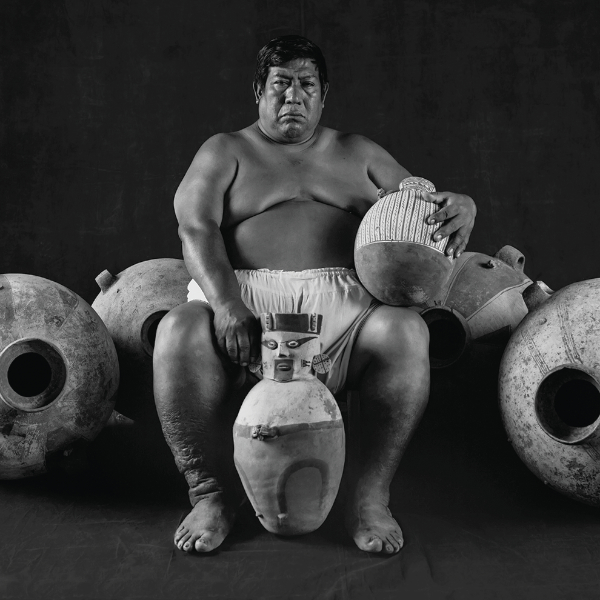
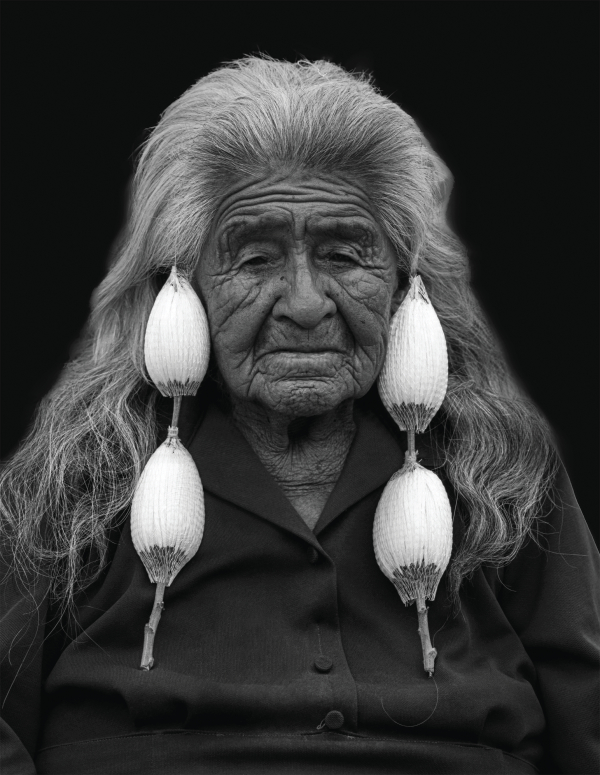
Through his work, photographer and filmmaker Lorry Salcedo explores his Peruvian roots and the varied intersections of African and Indigenous identity and experience. Salcedo studied cinematography at Armando Robles Godoy’s academy in Lima (1981), film production at New York University (1987), and digital cinematography at the New York Film Academy (2004). Among his many films, Salcedo directed and produced Amazonian Rainforest (2007), a documentary history of the Jewish immigration to the jungle of Perú during the nineteenth-century rubber boom. Salcedo is also the founder, director, and curator of the New York Peruvian Film Showcase, an annual film festival that has been held at the Instituto Cervantes of New York since 2010.

Salcedo’s photographic images featured in the El Perú exhibition are drawn from Mitos (Myths), Retratos (Portraits), and Afroperú, three components of the artist’s series Myths of Imagination. About this body of work, Salcedo says:

What I show in Myths of Imagination has been greatly influenced by Memoria del Fuego (Memory of Fire), Eduardo Galeano’s classic trilogy recounting the history of the Americas from pre-Columbian times to the twentieth century. Using this source of inspiration, my own fantasy, and characters that typify the daily domestic nature of the social panorama of Latin American urban society, I have represented the most striking elements of the complex cosmology of our ancient cultures.

Salcedo’s black and white images simultaneously evoke the past and the contemporary, connecting centuries-old ancestors to their present-day counterparts. His images relate the history of a multicultural Perú, a nation that, like its counterparts throughout America, is still in the process of recognizing the true richness and value of its own diversity. His visual explorations of what it means to be Peruvian highlight the similarities that unite us all as humans, regardless of ethnicity, gender, or nationality.

Ana de Orbegoso
Born 1964, Lima, Perú; lives in New York City
anadeorbegoso.com

Ana de Orbegoso, La Virgen de Belén (The Virgin of Bethlehem) (detail), from Vírgenes Urbanas / Urban Virgins series, 2006. Inkjet print on canvas. Courtesy of the artist.

Ana de Orbegoso lives and works in both Perú and New York. Her interdisciplinary art practice explores different aspects of the individual and the social psyche through the use of popular iconography and staged situations. Her aim is to confront the viewer with a mirror that sparks recognition, thought, and memory.

The connection of huacos (a generic word for Peruvian pre-Columbian ceramics found in ancient sites) to Colonial paintings and contemporary Peruvian identity is a prominent characteristic of her work. Her Neo-Huaco series exemplifies this by demonstrating that Moche (northern Peruvian culture, which flourished approximately 100 to 800 CE) portrait jugs take on an entirely new sculptural persona when cast in sleek metallic glazes. They also come alive when the artist digitally projects a contemporary portrait onto the surface, thus establishing a continuum. This is all the more poignant, for the pre-Columbian examples of these ceramics were modeled after the community faces of that time.

De Orbegoso’s other body of work, Vírgenes Urbanas / Urban Virgins, is a photographic decolonization project that has been exhibited throughout Perú since 2006. Inspired by Colonial paintings from the Cuzco School (a distinct Andean style of painting by both Spanish and Indigenous artists during the sixteenth, seventeenth, and eighteenth centuries), she reimagines the works to reflect contemporary realities and ideals. These works mirror contemporary Peruvian identity that may not coincide with the ideals of conquest and colonialism. De Orbegoso’s use of printed vinyl banners allows the works to be processed easily by communities, and the project has visited more than thirty-three different regions of Perú as an ongoing traveling exhibition and performance with participation from local artists. Each work is accompanied by a poem by Cusqueño poet Odi Gonzales rendered in three languages: Quechua, Spanish, and English. The poems give voice to the figures as contemporary Peruvian women telling their own stories. Vírgenes Urbanas / Urban Virgins is the most locally exhibited art project in Peruvian history. 

Dr. Tey Marianna Nunn is the director and chief curator of the art museum and visual arts program at the National Hispanic Cultural Center, as well as the curator of El Perú: Art in the Contemporary Past.

Tey Marianna Nunn (opens in a new tab) is the associate director of content and interpretation at the National Museum of the American Latino, a Smithsonian institution. She was formerly the chief curator of the art museum and visual arts program at the National Hispanic Cultural Center, as well as the curator of the exhibition El Perú: Art in the Contemporary Past. Nunn earned her doctorate degree from the University of New Mexico in Latin American studies, a dual disciplinary program with an emphasis on Latino and Latin American history and art history. Her academic experience includes an internship and multiple fellowships at the Smithsonian, including the Latino Museum Studies Program class of 1994.

Small But Mighty

Idella Purnell started the small poetry magazine PALMS in 1923 when she was twenty-two years old, while supporting herself by working as a secretary for the American consulate in Guadalajara. For the next seven years, she was the magazine’s editor and publisher, carrying it through political upheavals, marriage, moves, personal tragedy, and divorce.

The magazine never made any money. Purnell wrote, “The joke of poetry magazine publishing is that it is a lot of hard work, a big expense, and not very much fame for the editor, because, if the magazine is bad, who cares who the editor is? And it if it is good,—why, who cares who edits it?”

If it wasn’t about fame or fortune, Purnell’s endeavor was about a roll-up-your-sleeves and do-it-yourself effort, intellectual stimulation, and creative community. Small modernist magazines were often supported by an interlocking international network of subscribers, supporters, and contributors. PALMS was no different. Before her return to Mexico in 1922, Purnell had been a promising young student, studying with Witter Bynner at the University of California at Berkeley, volunteering with the Women’s Land Army and editing the school’s literary magazine. Bynner, who moved to Santa Fe in 1922, served as an advisor and associate editor throughout the magazine’s run, weighing in on submissions and sending her work by up-and-coming poets. Bynner wrote later that he considered himself a “grandfather” to both PALMS and to Spud Johnson’s Laughing Horse, a small magazine published from New Mexico.

Despite its small circulation (at its height, it hovered around 2,000 subscriptions), PALMS was an attractive outlet for unknown and beginning poets, as well as a few better-known poets from Purnell and Bynner’s networks. And it might have been good, too: Writing in 1930 about little magazines, Ezra Pound offhandedly mentioned it as “probably the best poetry magazine of its time.” Work by D.H. Lawrence, Mabel Dodge Luhan, Warren Gilbert, Haniel Long, Lynn Riggs, Kahlil Gibran, and Langston Hughes appeared in the magazine. Also notable is the magazine’s support of Harlem Renaissance writer Countee Cullen: PALMS not only published his breakthrough poem “Ballad of a Brown Girl,” but Purnell also asked him to edit a 1926 issue that featured African American poets.

This photograph of Purnell was probably taken by Bynner while visiting her in Guadalajara. After she stopped publishing PALMS in 1930, Purnell operated a gold mine, taught creative writing, and worked as a riveter during WWII. She continued editing and writing poetry, novels, children’s fiction (including the 1944 picture book adaption of Disney’s Bambi), science fiction, a biography, and a cookbook.

Hannah Abelbeck (opens in a new tab) is the photo archivist in the Palace of the Governors Photo Archives at the New Mexico History Museum and is actively working to increase access to its photographic collections.

Self-Guided Learning

By Charlotte Jusinski

One bright day back in December, I was sitting at a wobbly wooden table at Michael’s Kitchen in Taos with writer Jim O’Donnell. Jim is penning a piece about Taos Pueblo for a future El Palacio, and we were touching base about it when he asked a challenging yet common question.

“How far back in history do you want me to go with this?” he asked. Indeed, he said, the story’s entire word count could be taken up just with the events of the 1940s that contributed to the current-day situation; how should we fit it all in?

This eternal question about historical pieces is never easy to answer. Volumes can and do come out of seemingly simple aspects of New Mexico’s history. Every page in El Pal could be dedicated entirely to a single historical subject and not even scratch the surface. How to reduce that to 3,500 words or so?

I thought for a moment, and tried to consider my answer with regards to our readership and how I suspect folks use El Palacio. Then, the answer—in this particular situation, at least—became clear.

“Just throw the reader a bone,” I said. Drop in a few proper names that our readers can pluck out of the story and Google. Offer a single sentence about a peripheral artist so the reader has the chance to check a volume of their paintings out of the library. If you only have ten words to describe a court case, as long as an El Pal reader has its name, that will likely be enough.

This works because the El Palacio reader is voracious. If we spark someone’s curiosity in an Army general or an Indigenous leader or a town in the southern part of the state, they won’t just close the magazine and say, “Well, I wish I knew more about that.” They’ll take the initiative and look it up. They’ll go out of their way to learn. They’ll write us and say, “You mentioned such-and-so in a story two issues ago, and I haven’t been able to get it out of my head; do you have more resources about it?”

I love this about El Pal readers, because they read the way I do. They aren’t content with only what’s within our pages. Their lives are lives of inquiry, and as long as we can offer a hint at another door into a whole new world of learning, that is sometimes all the background we need (or can fit).

This issue is ripe for the forever-student. Many of these stories cover massive subjects that practically burst out of the binding. Plasma dating artifacts is mercifully (a bit) simplified in the hands of Jason Shapiro; Thomas Williamson interrogates the mammalian history of New Mexico; Alexander La Pierre whets your appetite with the origins of Southwestern cuisine; Santa Fe Poet Laureate Elizabeth Jacobson offers teasers from renowned local poets that will make you want to buy a book or two; British Museum curator Hugo Chapman elucidates how an object as simple as a piece of paper is a chapter in the history of communication. Maybe you’ll be inspired to travel to London to leaf through print archives as Chapman has invited us to do, or perhaps to Spain to see a Moros y Cristianos pageant, take a jaunt to Peru to see how the past and present comingle, get in the car and traverse the Santa Fe Trail as the Kingsbury family did—or keep it close to home and dig down into the ground to discover Santa Fe’s past. All of the pieces in these pages are complete, but all of them also contain the ends of threads into various avenues of research and intrigue.

Grab a thread and hold on. Follow it, if your interest is piqued. Tie a knot to your finger so you don’t forget.

But whatever you do, never stop learning.

Each Stone Has Its Face

BY ALIX I. HUDSON

On a brilliant, hot August morning, I met with Frederico Vigil to speak inside his virtuosic fresco Mundos de Mestizaje, which he created over the course of a decade. Located inside El Torreón at Albuquerque’s National Hispanic Cultural Center, it measures over 45 feet tall and covers 4,000 square feet; it is North America’s largest concave fresco.

(more…)

Alix I. Hudson is a dual language educator, librarian, writer, and company member of Teatro Paraguas. She lives and works in Santa Fe, New Mexico.

Leaving the Ladder Down

BY DIANE BIRD

As a kid, I never would have imagined today. I will leave the ladder down behind me so girls of color know they can be anything they want to be.

Congresswoman Deb Haaland, January 3, 2019.

In November 2018, Deb Haaland of Laguna Pueblo and Sharice Davids of the Ho-Chunk Nation became the first Indigenous women elected to the U.S. House of Representatives. Rep. Haaland took the Oath of Office on January 3, 2019, wearing a traditional Laguna Pueblo woman’s dress and accessories, and now has graciously donated her historic attire to the Museum of Indian Arts & Culture for inclusion in theSurvival and Resilience section of the Here, Now and Always exhibition.

Last spring, while visiting the National Hispanic Cultural Center to listen to renowned labor activist Dolores Huerta (born in Dawson, New Mexico) at the annual César Chávez Day celebration, I saw Rep. Haaland talking to visitors and introduced myself. I asked if she would consider donating her Laguna dress to the museum.

She agreed—then tears filled her eyes as she said, “I never thought a museum would be interested in my clothing!”

When her staff delivered the package, it was my turn to cry. I had been expecting MIAC to receive only the long-sleeved cotton Laguna dress—but Rep. Haaland also donated her manta, silver pins, turquoise and shell necklaces, bracelets, earrings, woven red, black, and green belt, and white moccasins. Accepting the Laguna Pueblo clothing and jewelry worn by the first Pueblo woman to win a Congressional election was one of the most amazing moments of my career.

In 1923, several Pueblo leaders traveled to Washington, D.C., testifying to defeat a bill introduced by Rep. Holm Bursum that would have confiscated traditional lands from the nineteen Indian pueblos in New Mexico. In 1924, Puebloans and other Native Americans were duly recognized as citizens of the United States. In 1948, World War II veteran Miguel Trujillo, an Isleta Pueblo citizen, successfully sued to obtain Native Americans’ right to vote. And now, Rep. Haaland’s election has brought full-circle the long campaign of Pueblo and other Native peoples to be recognized as full contributing citizens of New Mexico and the United States.

When I was a child growing up at Santo Domingo, I would listen to my uncle John Bird (Santo Domingo Pueblo) and great-grandfather Jose Alcario Montoya (Cochiti Pueblo) talk about solutions to maintaining Pueblo land and water rights, their plans to visit Washington, D.C. to testify against the damming of the Rio Grande, and their participation in the All Indian Pueblo Council activities.

Last January, I imagined them proudly standing in the U.S. Capitol Statuary Hall, alongside the statue of Popé, as Deb Haaland and Sharice Davids took their oaths.

Archivist Diane Bird, member of Santo Domingo Pueblo, is the curator of the Survival and Resilience section of the Here, Now and Always permanent exhibition at the Museum of Indian Arts & Culture.

Diane Bird (Santo Domingo Pueblo) is the archivist at the Museum of Indian Arts and Culture, where she played a critical role in the development of the museum’s permanent exhibition, Here, Now and Always. She was also the founding archivist for the Smithsonian Institution’s National Museum of the American Indian.

The Punchline at the End of Art

BY EMILY WITHNALL

One of Diego Romero’s favorite activities is watching people react to his art. He keeps a low profile and usually not even the security guards know he’s the artist. Hiding in plain sight, he looks on as people study his Pueblo-inspired pots with comics painted inside them. With work in places like the British Museum, the Cartier Foundation, and the Metropolitan Museum of Art, Romero has lurked in numerous museums around the world over his 30-year career and delights in the groans, sighs, and chuckles his art elicits. “It doesn’t matter whether they speak English or not,” he says. “They can take one look at my pot, look at each other, and then just start laughing.” Whether he’s combining Moche stirrup bottles with a Homer Simpson Chia Pet head or a neo-Mimbres style pot with a Pueblo version of Uma Thurman’s iconic Pulp Fiction pose on it, Romero is adept at eliciting reactions.

(more…)

Emily Withnall (opens in a new tab) is the editor of El Palacio and the host of Encounter Culture. Prior to stepping into the editor role, she wrote for the magazine for eight years. Emily has also been published in The New York Times, Al Jazeera, High Country News, Orion Magazine, Tin House, The Kenyon Review, Gay Magazine, Source New Mexico, and other publications. She lives and writes in Santa Fe, New Mexico.

Make It New

BY CHARLOTTE JUSINSKI

Do you smell that?

Yeah, me too. It smells like a 2020 model car, fresh off the lot. Or the spine of a book just plucked from the store shelf. Or a new pair of hiking boots with the tissue paper still taped around them in the box.

It smells like new stuff. This issue of El Palacio is full of it.

Nothing quintessential has changed, of course; you can still expect high-quality writing, deep dives into history, and top-notch scholarly research. We’ve been doing it since 1913, and that isn’t going to change any time soon.

But you want new voices? We have a few of those this issue. Extend a warm welcome to writers Julia Goldberg, Alix I. Hudson, and Dr. Nicole Panter Dailey to El Pal’s pages. They provide strong voices and incomparable expertise on subjects as wide-ranging as how centuries of Japanese folklore translate to a new modern exhibition, a massive fresco about Hispanx history, and the psychology behind transcendentalist painting. Annemarie Sawkins, curator of a traveling exhibition of Afghan war rugs soon to show at the Museum of International Folk Art, tells us more about the art form; we also welcome Museum of Indian Arts and Culture archivist Diane Bird to the pages, as she tells the story of how MIAC came to own an incomparable piece of Pueblo history.

Even beyond that, El Pal also expands its geographic reach this issue. Historically, we have always focused on museums in Santa Fe—but it’s no secret that other parts of the state have some cool stuff going on too, starting with Albuquerque. The aforementioned Hudson has penned our first-ever look at Albuquerque’s National Hispanic Cultural Center, examining the Torreón gallery on the NHCC campus and the giant concave fresco inside, painted by artist Frederico Vigil.

That isn’t the end for new institutions, either, looking forward. Stay tuned to future issues of El Palacio for more about the NHCC, as well as dedicated articles about the New Mexico Museum of Natural History and Science, the New Mexico Farm and Ranch Heritage Museum, and the New Mexico Museum of Space History.

But that’s for later. I’m getting ahead of myself.

Speaking of whom, I’m also new around here. With this issue I fully transition from serving as copy editor under former editor Candace Walsh to being the editor myself, with new blood in the form of Albuquerque-based writer Robin Babb joining us on the masthead as copy editor.

The key to helming a historic publication, of course, is to know when something ain’t broke and shouldn’t be fixed. That’s why we have regular El Pal contributor Emily Withnall sharing about the pottery of Diego Romero, as well as New Mexico Museum of Art Curator of Twentieth Century Art Christian Waguespack and historians Felipe R. Mirabal and Charlie M. Carrillo lending an artful eye to the Penitente Brotherhood. Former State Historian Rick Hendricks is back as well, with a look at the Spanish flu pandemic in New Mexico (and with a look at old El Palacio pages therein, I might add), and Museum of International Folk Art curator Nicolasa Chávez escorts us to hell and back with a glimpse at El Espiritu Malo through the years in holiday-season productions.

Is there something you want to see more of in El Palacio? Something we used to do that you want brought back? Love letters, big questions, concerns of any size? My email inbox is always open: charlotte.jusinski@state.nm.us.

It’s a fine balance, knowing when to open new doors and knowing when to keep exploring the room you’re in. It’s one I’m going to take my time in striking while editing El Palacio, and I hope you enjoy the journey with me.