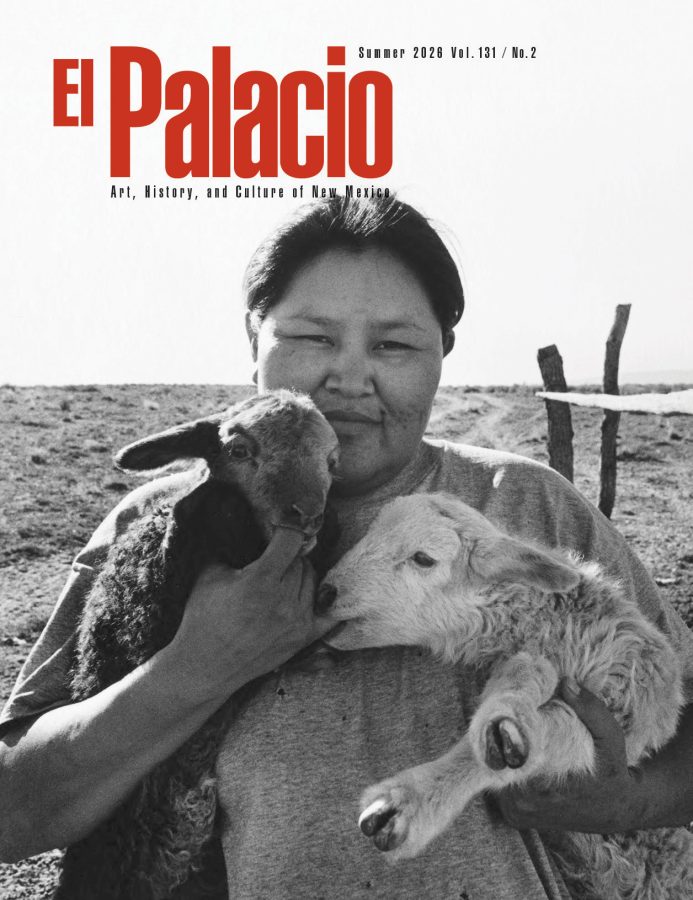
Interview with Delilah Montoya

Light green background with the words El Palacio repeatedly printed in large, bold, diagonal text in a lighter shade.
WITH KATHERINE WARE

While working on the solo exhibition Delilah Montoya: Syncretism, artist Delilah Montoya spoke with curator Katherine Ware about growing up as a New Mexican in Omaha, her emerging activism, the importance of collaboration, and how art can give a voice to communities. (more…)

Delilah Montoya was born in Texas and raised in the Midwest, artist Delilah Montoya’s longtime place of residence is New Mexico, the ancestral home of her mother’s family. Her work is grounded in the mestizo/a experience of the Southwest and borderlands. Her artistic home is the cacophony of the contemporary Chicano/a –Mexicano/a – Hispano/a experience in New Mexico. Montoya has exhibited nationally and internationally since the mid-1980s. Working her way through school as a medical photographer, she received her MFA in 1994 from the University of New Mexico and has taught at several colleges and universities.

An Act of Citizenship

Light green background with the words El Palacio repeatedly printed in large, bold, diagonal text in a lighter shade.

BY BARRY LOPEZ

Adapted for El Palacio

Editor’s note: This spring, distinguished author Barry Lopez addressed a joint meeting of the New Mexico Association of Museums and the Texas Association of Museums, in Lubbock, Texas. El Palacio was in attendance and subsequently received permission to publish Mr. Lopez’s remarks. (more…)

Loti, Laguna Pueblo

A Native American woman in traditional clothing stands holding a large vessel, wearing beaded jewelry and a decorated belt, looking at the camera. [gen-ai]
Path to Spring, Loti, Laguna Pueblo, New Mexico, by Karl Moon, 1907. Palace of the Governors Photo Archives (NMHM/DCA), Neg. No. 146660.

Karl Moon was born in Wilmington, Ohio, in 1878 and moved to Albuquerque, where he established a photography studio in 1904.

He started working for the Fred Harvey Company in 1907 and was mentioned as an official photographer for the Santa Fe Railroad in 1909. Moon saw himself as a visual historian belonging to both the scientific and artistic communities.He made thousands of negatives between 1903 and 1930 of Native Americans in the Southwest, and his work was renowned nationwide. Over the years he formed friendships with his subjects that enabled him to spend weeks at a time in tribal villages, learning about their culture.

This young Laguna woman wears a dress made of two deerskins with a heavily beaded belt and a fringed skirt with glass-bead fringes along its center. She no doubt has turquoise beads in the heishi necklace she is wearing under the lovely silver squash blossom necklace, and there is turquoise on the bracelet on her left wrist. She holds a piñon-pitch-covered water basket with a handwoven strap attached. The strap has a silver “button” at its base similar to the ones on either side of her necklace. To her right is a part of a Navajo blanket. It was not uncommon for photographers in this era to keep in the studio or travel with certain props. In the case of some photographers, such as Ben Wittick, you can spot the same props in many different photographs. So we cannot say for sure whether or not the blanket and the water basket belonged to this young woman or her family.

The Photo Archives at the New Mexico History Museum/Palace of the Governors can be searched online at palaceofthegovernors.org/photoarchives.html.

[wonderplugin_slider id=”165″]

Daniel Kosharek (opens in a new tab) is a writer and former photo curator at the Palace of the Governors Photo Archives at the New Mexico History Museum.

A Master’s Private Turquoise

Light green background with the words El Palacio repeatedly printed in large, bold, diagonal text in a lighter shade.

Turquoise has become so closely associated with New Mexico that I was surprised to realize that Gustave Baumann (1881–1971), the consummate visual interpreter of Santa Fe and its environs, made only sparing use of it in his colored woodblock prints. There it is, outlining a window or door surround in the depiction of an adobe house or, on occasion, one of the many tints he used to capture the effects of the ever-changing New Mexican sky.

Still, I thought it worth a visit to the re-creation of his studio in the Print Shop in the courtyard of the Palace of the Governors to see if the color was among the powdered pigments preserved from the array he used to make up his inks. Before my eyes could even focus on the shelves of bottled hues opposite the doorway, I was assaulted by turquoise on all sides. Yes, there were two bottles numbered “9” that contained subtle shades of the color I sought, and a couple more of a brighter blue-green, but their delicacy was overpowered by the intense turquoise of the commercial paint on the cabinetry, woodwork, and the printing press itself.

Baumann’s studio behind his home on Camino de las Animas was renovated in the 1970s to accommodate a companion for the artist’s widow, and in 2009, almost forty years later, its contents, acquired bit by bit through donations and purchases, were reassembled in the Print Shop. When the curator, Thomas Leech, emerged from the back office, where he was at work on his upcoming exhibition of greeting cards by Baumann (opening at the New Mexico History Museum October 31, 2014), I asked what inspired the color scheme. Steeped in Baumann’s history and practice, Tom answered without hesitation, “His tools.” As he showed me, many of the handles had been painted turquoise. Bauman revered and treasured tools, even keeping, and using until the end of his life, an English-made set he had purchased as a student in Munich in 1905.

Tom pointed out the artist’s work table, whose original, worn surface was painted turquoise. And then there was the press itself, the very one Baumann had purchased from a Chicago manufacturer in 1917. A subsequent owner had tried to eliminate the turquoise paint in order to return the press to its original industrial black, but conservator Maureen Russell was able to restore Baumann’s transformative color.

After working for the summer of 1918 in Taos, Baumann visited Santa Fe, where he was welcomed by the museum’s director, Edgar Lee Hewett; and his assistant (and first El Palacio editor), Paul Walter. The artist accepted their offer of work space in the basement of the newly built Art Gallery (now the Museum of Art). At the age of eighty, he recalled the experience in a self-interview for the Santa Fe New Mexican (April 2, 1961). He had discovered that “a museum basement is a distracting place to work; somebody is always looking for something or putting something away where it can’t be found.” Nonetheless it was the opportunity to make “furniture for another studio with the help of Sam Huddleson [sic]” (see my piece on Hudelson, “Searching for Good Old Sam,” El Palacio 118 [1]). “With my furniture completed I transferred it to Canyon Road,” he wrote. Then, to escape gregarious members of the Santa Fe artists’ colony who soon settled in, “I reconsidered and moved away—built a studio of my own.”

In 1926 Baumann constructed his ideal workplace, a small independent structure behind the home he had built three years earlier on Camino de las Animas. In the study undertaken by the Historic Santa Fe Foundation before the recent restoration of the house, it was noted that “in much of his decorative paint treatments Baumann added bits of the southwestern turquoise.” The German-born artist asserted, “Given free choice in the matter, I would have selected the Southwest as the place to be born.” There could be no more telling evidence of his love of this place than his painting of the tools he held dear, and the furnishings of the solitary inner sanctum where he created his art, in New Mexico’s signature color—turquoise. 

Penelope Hunter-Stiebel was a curator at the Metropolitan Museum of Art and the Portland Art Museum, Oregon, and recently curated Mirror, Mirror: Photographs of Frida Kahlo for the Nuevo Mexicano Heritage Arts Museum.

Our Lady Comes to the New World

Light green background with the words El Palacio repeatedly printed in large, bold, diagonal text in a lighter shade.

A 1960s wave of ecclesiastical urban renewal convinced priests at mission churches throughout the Americas to ditch their centuries-old artwork. Considered inferior to fine European art, the locally made pieces found little favor with galleries or museums.

But Charles W. Collier, then a cultural attaché to Bolivia, and his wife, Nina Perera Collier, knew a treasure when they saw one. The couple began purchasing and obtaining pieces that eventually formed the backbone of the International Institute of Iberian Colonial Art, once based at their Los Luceros estate in northern New Mexico. In 2005, with the promised construction of spacious galleries and a state-of-the-art collections vault, the institute donated seventy paintings and three sculptures to the then-unbuilt New Mexico History Museum.

On June 29, with the opening of Painting the Divine: Images of Mary in the New World, thirty-five of these seventeenth- and eighteenth-century masterpieces will share an exhibition space for the first time. Set in the second-floor Herzstein Gallery, paintings that once were the neglected stepchildren to European art rise to their deserved place in art history.

“Now we know that they’re amazing, hybrid images that combine Old World with New World elements, from local people to textiles, flora, fauna, and new appearances of Mary in the Americas,” said Josef Díaz, the museum’s curator of Southwest and Mexican colonial art and history collections.

Amazing as they might be, not all of them were ready for the spotlight. Twelve pieces underwent repairs and cleaning by Denver-based art conservator Cynthia Lawrence, whose work became a metaphor for the paintings themselves. Under her hand, Native peoples, along with plants and animals unknown to European eyes, emerged from beneath centuries of varnish and candle soot. The discoveries mimicked those that greeted colonists as they journeyed into South America, Mexico, and New Mexico. When they could, the travelers carried religious art crafted in European studios. When that failed, they created their own. An evolution of artistic styles appeared—from European masters to criollo and mestizo painters trained in the artistic centers of Cuzco, Peru, and Mexico City, and led, finally, to the emergence of uniquely New Mexican artists: the santeros.

Painting the Divine dovetails with the long-term exhibit Treasures of Devotion/Tesoros de Devoción, which features master santeros from the late 1700s to 1900, in the Palace of the Governors. And it pairs the Collier paintings with modern interpretations by artists such as Ray Martín Abeyta, Arthur López, Charlie Carrillo, Ramón José López, Alfredo Arreguín, and Marion Martínez. Together, they demonstrate the unifying force that the Catholic Church held among Spanish colonists and its resonant power today.

“The people who made these paintings were moved by their faith,” Díaz said. “Even though many of them were struggling to exist, they made these wonderful works of art. And they give us glimpses of New World settings. We see Native peoples in their traditional clothes. We see mountains typical of Potosí, Bolivia. We see parrots and turkeys. And we experience the love of freedom in form and color found in the baroque style that New World artists often took to the extreme, with canvases exploding in decorative details and layers of iconography.”

For months, though, all Lawrence saw were problems. After she inspected all the paintings, Díaz chose twelve for conservation, including a loaned painting, The Visitation, from Our Lady of Belen Catholic Church south of Albuquerque.

“There were two paintings that were actively flaking,” Díaz said. “These took priority since they were not stable enough to be put on exhibit. The others were chosen based on their importance as well as which would benefit most from a cleaning and in-painting.”

Most had hung in flat-roofed adobe buildings prone to roof leaks and cave-ins. Votive candles surrounded them, the smoke settling in an inky wash. The final insult: years of neglect and urban renewal’s new-is-better ethos.

“Their condition issues,” Lawrence said, “were rather typical of many Spanish colonial paintings, with significant, old loss and damage to the paint and image layers, likely from poor handling

and environmental conditions over many years. Also there were multiple layers of grime, soot, and darkened surface coatings from traditional varnish, and crude restorations, which resulted in fragile structural conditions and very poor aesthetic conditions.”

Lawrence stabilized the paintings, removed multiple layers of materials that had obscured the original images, filled in lost areas, and added in-painting and varnish “with the aim to preserve the artist’s intent to as great a degree as possible, while accepting the paintings’ historic and aged nature.”

She balks at providing “recipes” for do-it-yourselfers, citing a concern about the pitfalls of amateur art conservation. (Remember news stories in 2012 about the botched conservation of Elías García Martínez’s Spanish fresco, Ecce Homo?) “That being said,” she added, “distilled or other purified water, pH adjusted and often with numerous options of additives to aid in cleaning, are helpful with grime removal. Alcohols, ketones, and several hydrocarbons and petroleum distillates, or mixtures of any of these, are commonly tested for varnish removal. Reagent-grade materials are used to avoid impurities and guarantee consistency of components and properties like the evaporation rate.”

To the untrained observer, even the simplest of her efforts conjure magic. Last summer, Lawrence did a small amount of testing on Our Lady of the War Club, a painting that usually hangs in the museum’s main exhibit, Telling New Mexico: Stories from Then and Now, but joins its fellow “our ladies” for Painting the Divine.

The painting depicts a series of New World miracles involving Mary, starting with a sculpture of Our Lady of the Sacristy of Toledo that was housed in the Palace of the Governors. In the early 1670s, the figure predicted the 1680 Pueblo Revolt to Governor Juan de Durán de Miranda’s daughter. During the revolt, the sculpture survived a death blow by a macana that left only a mark on her forehead. Created after the Reconquest, the painting (which shows the forehead scar) came to the museum in 2012 in relatively good shape. To assess its potential for future work, Lawrence spent a few hours lightly swabbing portions of it and almost immediately teased out striking qualities of clarity and luminosity.

One of her most dramatic before-and-after acts came with The Visitation. Díaz knew of the work only because a few years earlier it had been mentioned in a booklet honoring the church’s bicentennial. It and four other mid-eighteenth-century paintings had been locked in storage for decades, their deteriorated condition barring them from public display.

The museum paid for its conservation in return for the temporary loan.

Lawrence repaired several rips in the canvas, strengthened the stretcher, in-painted a few lost areas, and applied a long-needed cleaning that both amazed and inspired the church’s priest.

“Who knows how many people have prayed in front of this image,” Reverend Stephen Schultz said when Díaz returned the painting to him before staging the exhibit. “How many babies may have been baptized in front of it? How many marriages were celebrated with this painting looking down?”

Having seen what Lawrence can do, Schultz vowed to raise the money for conserving all of the church’s paintings.

“There is nothing more a curator or art historian can hope to achieve than to witness a people truly connecting to their history and finding joy in that revelation,” Díaz said. “Connecting with the parish of Our Lady of Belen and seeing these paintings that tell their history come back to life was exhilarating. This makes my work worthwhile.”

Lawrence spent between forty and eighty hours of concentrated “bench work” on each painting, not including the time to examine, test, and document them. That forged a personal tie to each one. Pressed for a favorite, she noted Our Lady of Saint John of the Lakes, the only known canvas painting by an early New Mexico santero. “It holds a very special place for me because of its historic importance for New Mexico, the sweet quality Our Lady portrays, and the outcome of the painting’s condition with conservation treatment.”

Díaz is drawn to Our Lady of the Rosary of Pomata. “It illustrates how the baroque style was interpreted in the New World with its abundance of decorative details and lavish use of color,” he said. “Also worth noting are the crowns that she and the Christ child wear—both European symbols of royalty, while the magnificent colorful feathers were used by the Incas to designate royal rank. An Inca princess has become the Virgin Mary—Our Lady of Pomata.”

Despite his enthusiasm for that painting, Díaz’s heart returns always to the piece that received only an examination, not a treatment. “Our Lady of the War Club is one of my favorites,” he said. “She’s a hometown girl.”

Kate Nelson (opens in a new tab) is a longtime New Mexico journalist who retired as managing editor of New Mexico Magazine where she earned numerous awards from the International Regional Magazine Association.

Photography and Identity

Light green background with the words El Palacio repeatedly printed in large, bold, diagonal text in a lighter shade.

In an initiative titled Focus on Photography, the New Mexico Museum of Art is devoting its three upstairs galleries to a variety of changing photography exhibitions for a full year, from March 7, 2014, through March 15, 2015, presenting numerous opportunities for visitors to look at, learn about, and discuss this ubiquitous and evolving form of picture making.

 The second installment of exhibitions will be on view from August 30 through December 7, 2014. This article is the second in a series of three that explores some of the work on view as well as contemporary issues in photography.

One of the most extensive and infamous portrait series in the United States is that of Edward Curtis, a photographer whose twenty-volume publication The North American Indian (1907–1930) was intended to document the life and customs of indigenous peoples from coast to coast. Curtis was dedicated to this monumental undertaking and worked obsessively to achieve it. His romanticized and sometimes anachronistic pictures are often beautiful and convey the artist’s view of indigenous people as noble but doomed. Rather than addressing contemporary conditions and challenges, Curtis chose to create a nostalgic version of the past, accompanied by sometimes sentimental or inaccurate text, factors that have undermined his accomplishments. Public confidence in photography’s veneer of factualism (it appears to capture on film a slice of the real world), rather than in its deep-seated subjectivity, gave Curtis’s point-of-view a weight of truth that we continue to grapple with today.

Like Curtis, we all bring our own ideas and assumptions to the act of making or viewing a photograph. One of the museum’s roles is to help visitors develop critical tools for viewing art and to offer a variety of perspectives. One of the ways we balance the pervasive vision of photographers like Curtis in the Southwest is by collecting and showing work by contemporary Native artists who, particularly since the 1960s and 1970s, have used the camera to portray themselves and their own communities. These insider views about culture and identity offer a crucial counterpoint to the proliferation of romanticized, anthropologized, and touristic portraits of Native peoples.

On view in the museum’s Photo Lab are several examples that explore issues of authorship and identity, which were also chosen to highlight their creative, often nonstandard, use of photography. Arizona artist Victor Masayesva Jr. (Hopi) shows a room at the ancient cliff dwelling Keet Seel, but instead of portraying the site as an abandoned ruin, Masayesva adds another photographic image of an active dwelling, highlighting the stored food with bright colors to emphasize the vitality, prosperity, and ongoing significance of this place. In another piece in the collection, Melanie Yazzie (Navajo) creates a layered composition titled The U.S. Government Will Never White Wash My Grandparents, a reference to stringent efforts by the government to assimilate Native Americans into Anglo culture, particularly up to the mid-twentieth century.

New Mexico artist Will Wilson (Navajo) decided to “talk back” to Edward Curtis directly, in his series Critical Indigenous Exchange. Wilson uses the nineteenth-century photographic process of wet collodion to refer back to Curtis and turns the tables on him by being the Indian behind the camera instead of the one in front of it. The portraits are primarily of Native subjects, and each session results in a one-of-a-kind likeness called a tintype, which the artist scans for future use before giving the original to the sitter (so that “Indians are not for sale”). Because the tintypes are owned privately and the larger project with scans is still in progress, the museum acquired the prints of two portraits Wilson made of himself, dressed as an Indian in one and as a cowboy in the other.

Because of New Mexico’s history as a crossroads of commerce and culture, the museum is interested in collecting and showing art that explores questions of identity. In photography, this area of inquiry includes a rich selection of work about ethnic, racial, cultural, religious, community, family, and gender identity, to name a few. For instance, Ian van Coller, a native of South Africa, created his sculptural photo piece Joseph in a format inspired by African tribal memory boards. The artist uses an updated version of the nineteenth-century photographic process, the ambrotype, and an old portrait frame to associate his piece with family, memory, and changing traditions, adding an image of a tree as another witness to history. Ultimately, this portrait of Joseph and his family is really about van Coller’s own growing awareness of apartheid during his childhood.

Featured in a solo exhibition in the museum’s Roland Gallery is an artist known for addressing uncomfortable issues of culture and identity in her work, Delilah Montoya. With family roots in northern New Mexico as well as Poland, Montoya is deeply interested in the idea of syncretism, the combination of seemingly contradictory beliefs or elements into something new. In New Mexico, syncretism has been alive and well as a variety of cultures and nationalities have interacted and influenced one another in religion, art, and cultural traditions. Montoya’s series El Sagrado Corazón (Sacred Heart) examines the ongoing significance of the Baroque sacred heart, an icon forged from the collisions and alliances of European Catholicism and Aztec philosophy in what is now Mexico and the southwestern United States. Another body of work explores the practice by male Hispanic prison inmates of tattooing the image of La Guadalupana, the Virgin of Guadalupe, on their bodies.

One of the great strengths of the museum’s collection is the many stories it has to tell. In this group of exhibitions, along with showcasing work that confronts our assumptions about identity, we also have an opportunity to think about photography’s powerful role in influencing perceptions, establishing personas, reinforcing stereotypes. Another thread running through these exhibitions is how artists have used the medium of photography in adventurous ways, drawing on processes from early in the medium’s history, adding paint or three-dimensional elements to their compositions, using a photo as a starting point for another type of printmaking, and sometimes not using a camera at all. Come see what a photograph can be, or feel free to disagree!

Katherine Ware is the curator of photography for the New Mexico Museum of Art. She organized the recently released online exhibition Fear and Loathing and is author of recent essays on the photographs of Caleb Charland, Chris McCaw, and Terri Warpinski. Her piece “Focus on Photography” was the first installment in this series of three articles about the museum’s year-long photography initiative.

Apache Mountain Spirit Dancer Shines Again (Minus One Bird’s Nest)

Light green background with the words El Palacio repeatedly printed in large, bold, diagonal text in a lighter shade.

The twenty-four-foot bronze sculpture Apache Mountain Spirit Dancer stands tall on Milner Plaza in front of the Museum of Indian Arts and Culture, against a backdrop of New Mexico sky and the Sangre de Cristo Mountains.

The work was purchased in 2004 with funds provided to the Museum of New Mexico Foundation from Sam and Ethel Ballen and has graced Museum Hill with its charismatic presence since. It is one of the most photographed works of art in Santa Fe and has captivated thousands of visitors.

The Apache Mountain Spirits are very important to Apache culture. They are the agents of the Supreme Being and provide protection from disease and enemies. Crowned with wooden-slat headdresses, armed with wooden swords and a bullroarer, they dance at night, wielding their wooden swords to the resonating sounds of drums, singing, and the whirling bullroarers. The Spirit Dancers bring the spiritual world into physical manifestation and give blessings to many ceremonies.

Artist Craig Dan Goseyun, a member of the San Carlos Apache Tribe, has attended many of these ceremonies and is world renowned for his ability to capture the essence of dancing movements in his bronze renditions of the Mountain Spirits. The sculpture comes alive at different times of day, through mountain storms and early dawns.

In the spring of 2014, this important icon of Native American culture received conservation treatment. A bird’s nest had grown in one of its crevices, and after years of exposure to the elements, the bronze needed a careful and delicate cleaning, followed by a wax coating to protect the surface. Bien Irizarry, a patina specialist from Shidoni Foundry in Tesuque, New Mexico, where the bronze was originally cast, conducted the preservation treatment and breathed some life back into Apache Mountain Spirit Dancer.

Cathy Notarnicola is the curator of Southwest history at the New Mexico History Museum. She has also worked at the Museum of Indian Arts and Culture in Santa Fe and at the Smithsonian Institution’s National Museum of the American Indian in Washington, D.C.

Layu Resplendent Turquoise on the Roof of the World

Light green background with the words El Palacio repeatedly printed in large, bold, diagonal text in a lighter shade.

New Mexico’s adoration of the turquoise stone is palpable. Whether native, transplant, transient, or tourist, denizens of the state are wearing it, admiring it on others, or coveting it in the windows of jewelry shops or the displays of artists. But turquoise is not just a Southwest thing. It is cherished all over the world.

Take for example, the Himalayas.Treasured by Tibetans, turquoise adorns images of deities, ritual and secular objects, clothing, and people. Turquoise, rare and beautiful, is not considered a mere stone. It is a precious stone — a jewel. In fact, turquoise is considered among the most precious articles and ornaments after gold, silver, coral, and pearl. But beyond an affinity for this jewel’s beauty, Tibetan culture sees special importance and power in turquoise.

Despite its geographical isolation high up in the mountains, Tibet has a long and complex history of interaction and trade with other regions, far and near. Turquoise has probably been traded into Tibet since at least the eleventh century. Tibetans’ preferred shade of turquoise is a bright blue hue, the most valued of which comes from Iran. Chinese- and Tibetan-mined turquoise, particularly the latter, are a softer variety and consequently may change colors with age, turning more blue-green from exposure to oils in the skin and other elements (color change, especially in untreated stones, may vary depending on the individual and his or her constitution). Because of these properties, some Tibetans associate turquoise with the cycle of life: bright and vibrant in youth, fading in color with age and declining health.

The use of turquoise in Tibet is often amuletic. The word yu in the Tibetan language means “turquoise stone,” and la means “spiritually above” or something “higher.” The word layu refers to resplendent turquoise imbued with “vitality” or “life-essence.” Yu by itself is special, but through tantric ritual performed by a lama (a teacher of the dharma, a complex worldview which may be understood as the teachings of the Buddha), layu is given a life-essence and provides protection from harm, negative activity, or sickness. Thus, wearing turquoise is believed to offer protective and medicinal functions and to bring the body and mind into balance. It keeps la within the body, where it is needed for proper, healthy balance and overall wellness. Consequently, layu is usually the first item of jewelry given to infants for protection, and generally, all Tibetans — men, women, and children — wear layu, even if only a single bead, around their necks. Both men and women wear turquoise earrings, and turquoise rings are also important because it is believed that la can leave the body through a finger.

Since ancient times, if someone is sick but cannot get to a lama for treatment, they can send their layu instead and still benefit from ritual treatment of the turquoise. Academic publications in the late nineteenth and early twentieth centuries reference early Tibetan medical texts, which list turquoise as a medicament functioning specifically to remove poison and heat (sickness and imbalance) from the liver. Other substances listed in these early texts include gold, silver, copper, iron, pearl, coral, conch, lapis lazuli, mother-of-pearl, and mercury. These substances may be worn, offered to deities and demons, and, after ritual and purification treatments, mixed in specified proportions to make a “precious pill” and ingested. While each substance has its own function (coral for instance is said to keep blood healthy and pure), these metals and jewels bring balance to one’s being. Balance, in essence, is what keeps people healthy and safe from harm that may be caused in the physical or spiritual realms.

A common jewelry item worn by Tibetans is a ga’u, or amulet case, a kind of portable shrine. Ga’u may contain written prayers and mantras, talismans, or images of special lamas or deity figures. All of these items offer protection from harmful energy or spirits, which can cause sickness or other stressors affecting life’s balance. Ga’u come in many shapes and sizes; not all of them are worn. They may be placed on a home altar, and while some are quite large, they are meant to travel, usually attached to a belt or worn around the neck. They range from simple containers of metal to those of silver (and less commonly gold), elaborately set with jewels.

Turquoise is so precious in Tibet that it is offered to deities on altars of worship as a gift, for ornamentation, and for spiritual healing rituals. Demons are also offered turquoise jewels on altars to keep them pacified so that they will not attack.

Whether for deities or demons, turquoise offerings help maintain that essential life balance. In addition to acting as an offering itself, turquoise jewels serve a decorative function and beautify other ritual items used in ceremony and/or daily prayer.

Beyond ritual, protective, and medicinal functions, turquoise is also a status symbol. Secular or sacred items with a great amount of turquoise might be reserved for people of religious status (such as high lamas), administrative status, or people of wealth. A bowl of turquoise and other precious articles such as coral would be found on the altar of someone who could afford it. Those of more modest means may place a single turquoise stone or a mix of other items on their altar. Also loved as a thing of beauty, there are countless poetic allusions to the stone. It is stuff of legends and romance found in popular folklore and the namesake of nature’s wonders, such as turquoise lakes and turquoise heavens.

The Museum of International Folk Art has a small collection of Tibetan folk art that includes jewelry, ritual items, and amulets. Presented here are some examples of those that include turquoise stones. Additional items from the collection are currently on view in the exhibition Turquoise, Water, Sky: The Stone and Its Meaning, at the Museum of Indian Arts and Culture.

The author would like to thank special friends, Khenrab Choephel of Barcelona, Spain; and Lama Gyurme Rabgyes of Santa Fe, New Mexico, for their clarification of certain ideas and translations presented in this article.

Turquoise at Ogapogeh

Light green background with the words El Palacio repeatedly printed in large, bold, diagonal text in a lighter shade.

In October 2008, the Santa Fe Community Convention Center opened at the northeast corner of Grant Avenue and West Marcy Street, just a few blocks north of the plaza. The property has a long and vibrant history.

Prior to the Convention Center, going backwards in time, the property housed the Santa Fe Civic Center, Santa Fe High School, portions of the Fort Marcy Military Reservation, portions of the Spanish presidio, and a large Pueblo village. To the Tewa-speaking Indians of Tesuque Pueblo, this village is known as Ogapogeh—the White Shell Water Place.

Following state law and the Santa Fe Archaeological Ordinance, before construction could begin on the property, archaeologists were required to document what remained buried beneath the earth. This task fell to the Office of Archaeological Studies, a state agency within the Department of Cultural Affairs. Over several years, archaeologists excavated numerous foundations, privies, and wells associated with Fort Marcy and the Spanish presidio, as well as pit structures, hearths, and refuse pits associated with Ogapogeh.

Excavation of Ogapogeh suggested a village occupied, at least intermittently, from about AD 900 to 1450, encompassing the time known to archaeologists as the Late Developmental, Coalition, and Early Classic periods. Among the artifacts recovered were black-on-white and glazeware pottery, flaked- and ground-stone tools, animal bone, and over 100 turquoise fragments from formal ornaments to raw material and manufacturing debris. Of particular note were sixteen turquoise pendants in trapezoid shapes and four round turquoise beads. The beads were relatively uniform in size and shape and may have come from a single necklace.

Turquoise was found in a wide variety of contexts, including debris pits, burials, and religious structures known to archaeologists as kivas. The discovery of turquoise in ceremonial contexts suggested that the material was of some intrinsic value and may have been used in rituals. However, archaeologists continue to debate the notions of “secular” and “sacred” in Pueblo society; many argue that all aspects of Pueblo life contain some aspect of ritual and ceremony.

The area closest to Santa Fe where turquoise can be collected is in Cerrillos Hills, about thirty miles to the south. Anthropologists working in the early twentieth century noted that only certain tribes were allowed direct access to the turquoise mines, including the Keres-speaking Pueblos of Santa Ana, Santo Domingo (now known as Kewa), Cochiti, and San Felipe, and the Tewa-speaking Pueblos of San Ildefonso.

It is believed that some of the inhabitants of these modern Pueblo villages once occupied San Marcos Pueblo, just north of Cerrillos Hills. Based on San Marcos pottery found in the mines and a few Spanish archival documents, archaeologists believe San Marcos controlled access to both turquoise and lead in Cerrillos Hills from about AD 1300 to 1700. After the Pueblo Revolt of 1680, San Marcos was abandoned, and the villagers fled to these other Pueblo settlements.However, San Marcos may not have monopolized the turquoise mines of Cerrillos Hills before the fourteenth century. Excavations at Pindi Pueblo, a Santa Fe–area village contemporaneous with Ogapogeh, uncovered a turquoise workshop specializing in the production of beads and pendants. While no turquoise workshop was discovered during archaeological investigations at the Convention Center, the presence of both raw turquoise and manufacturing debris strongly suggests the fabrication of turquoise ornaments at Ogapogeh. This emphasis on turquoise manufacture in the Santa Fe area indicates that the inhabitants of Pindi and Ogapogeh had or even controlled access to the Cerrillos Hills mines before the 1300s. Moreover, it is possible that the inhabitants of these Santa Fe pueblos moved south in the fourteenth century to help found San Marcos and perhaps other large, nearby villages in Galisteo Basin.

All of these notions—the manufacture of turquoise ornaments in the Santa Fe area, the ancestral ties of Tesuque to Ogapogeh, the early 1900s ethnographic work which concluded that access to turquoise was relegated to a small number of Keres- and Tewa-speaking Pueblo villages, and control of Cerrillos Hills by San Marcos after AD 1300—have ramifications for the history of the settlement and abandonment of northern New Mexico by Pueblo peoples. Underlying the distribution of turquoise at Ogapogeh and elsewhere is a complex narrative that archaeologists may never fully understand. Yet, the materials found at the Santa Fe Community Convention Center demonstrate the value of turquoise to Pueblo people and its importance in the Santa Fe region as a whole.

Matthew Barbour is the deputy director of New Mexico Historic Sites, a division of New Mexico Department of Cultural Affairs. He has worked for the department since 2002 holds a BA and MA in Anthropology from the University of New Mexico. Throughout his decades-long career, he has published more than 200 nonfiction articles and monographs. In 2012 and 2014, he was awared the City of Santa Fe Heritage Preservation Award for Excellence in Archaeology.

So Many Ways of Looking at Turquoise

Light green background with the words El Palacio repeatedly printed in large, bold, diagonal text in a lighter shade.

Turquoise, Water, Sky: The Stone and Its Meaning, the new exhibition curated by Maxine McBrinn at the Museum of Indian Arts and Culture, inspired the many perspectives on turquoise in this issue. (more…)