
“Quilts Is in Everything”

Light green background with the words El Palacio repeatedly printed in large, bold, diagonal text in a lighter shade.
BY LAURA M. ADDISON

“The most miraculous works of modern art America has produced” is how Michael Kimmelman of the New York Times described the quilts by African American women from Gee’s Bend, Alabama, that were exhibited in 2002 at the Whitney Museum of American Art.

[wonderplugin_slider id=”136″] (more…)

Laura Addison is curator of North American and European folk art at the Museum of International Folk Art. She was previously curator of contemporary art at the New Mexico Museum of Art (2002–13), and is a frequent contributor to El Palacio.

From Bombs to Baubles

Light green background with the words El Palacio repeatedly printed in large, bold, diagonal text in a lighter shade.

This spring we mark the seventieth anniversary of the first detonation of the atomic bomb with an essay by distinguished cultural critic Lois Rudnick on a group of “Atomic Artists,” as she calls them, who span several generations in New Mexico.

Rudnick begins with Cady Wells, the subject of her fall 2012 El Palacio article and her book Cady Wells and Southwestern Modernism (published by the Museum of New Mexico Press) and continues through the 1960s to artists working today. It’s a fascinating look at the cultural convergence of two of New Mexico’s most powerful economic sectors—the arts and nuclear research.

Rudnick is probably best known as the biographer of Mabel Dodge Luhan, whose work was crucial to making New Mexico the arts center that it is today. Luhan does appear in this issue, in a beautiful cluster of poems that Lauren Camp began writing while in residence at the Mabel Dodge Luhan House in Taos. Eliza Wells Smith photographed Luhan’s grave to illustrate “The Sighing of the Kit Carson Cemetery,” and the Taos Community Foundation contributed photographs from the D. H. Lawrence Ranch. We are gratified to be publishing these poems when the Lawrence Ranch has reopened after a five-year hiatus, and we salute the Taos Community Foundation for their efforts in making it again available to the pilgrims from around the world who visit the Lawrence shrine, which Camp memorializes in “Temple of Lawrence.”

One of Rudnick’s Atomic Artists, Meridel Rubenstein, contributes a wonderful photograph of painter Jerry West to the interview that retired Museum of Art curator Joseph Traugott conducted with him. Jerry West’s stunning painting, Japanese Internment Camp, from the museum’s collection, was our cover painting in spring 2012. Now the Museum of New Mexico Press is publishing a comprehensive book of West’s work.

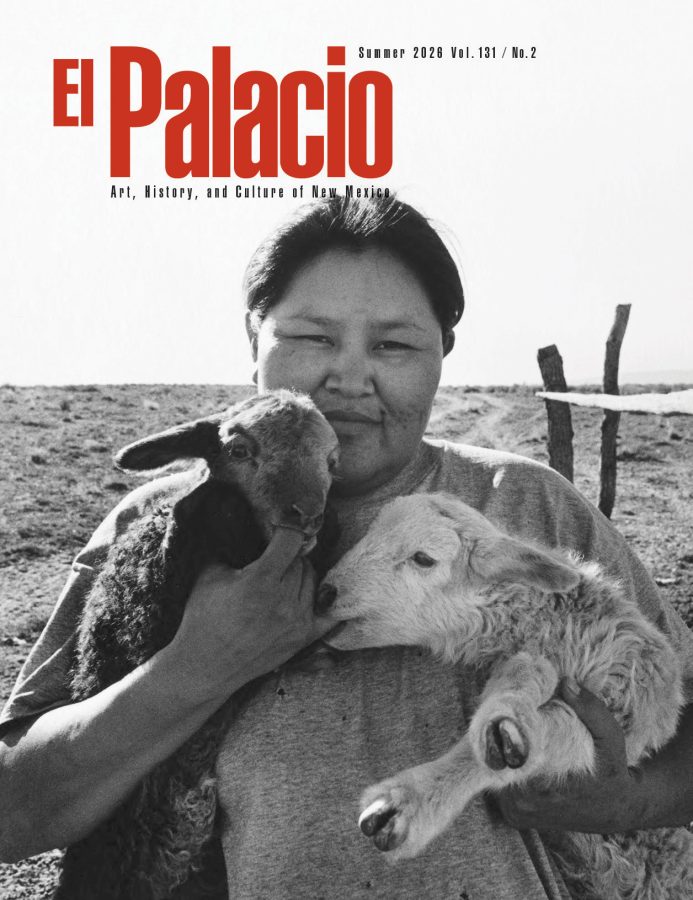
Our cover image is from the New Mexico Magazine Collection at the Photo Archives of the Palace of the Governors/New Mexico History Museum, one of several archival photographs that writer Cindra Kline found that show Native Americans from other pueblos wearing Santo Domingo Depression-era jewelry. Kline uses these photographs to document how this vibrant, colorful jewelry was appreciated at pueblos other than Santo Domingo, and to counter the belief that this jewelry, which often included found and repurposed plastic, was simply cheap stuff made for tourists. In this photograph a young Navajo girl sports a Santo Domingo necklace, which probably includes plastic substituting for jet and coral. (As Kline explains, the substitutions were so artful and the materials so well chosen that it can sometimes take a close examination of the object to distinguish plastic from natural stone.)

The photographer, John Candelario, was born in Santa Fe in 1916, the grandson of the noted curio dealer, Jesus Sito Candelario. He studied physics and chemistry in college and took over the curio business after his grandfather’s death. He was primarily self-taught as a photographer, drawing on his chemistry background to explore different processes and seeking out help from leading photographers such as Laura Gilpin, Ansel Adams, and Edward Weston. Georgia O’Keeffe introduced Alfred Stieglitz to his work, and he exhibited at An American Place and at the Museum of Modern Art.

Candelario’s vast archive at the Palace has been occupying two volunteers, Art Encinias and Richard Montoya, for about two years. Their work is leading to an electronic finding aid which will facilitate online access to this important collection.

David Rohr, El Palacio’s art director, chose this image for the cover because he loved the joyful look on the young girl’s face—she seems to be smiling at a familiar person off camera rather than posing for a commanding photographer. He also appreciated the authenticity of the setting.

Cynthia Baughman served as the editor of El Palacio magazine from 2010 to 2015. Cynthia and her husband moved permanently from the Philadelphia area to Tesuque Village in 2010. Born in Tennessee, Cynthia grew up in Washington DC, earned a BA in English from Dartmouth College and an MFA in Creative Writing from Cornell, and taught writing at Ithaca College and Temple University before working with the New Mexico Department of Cultural Affairs.

Indian Country

Light green background with the words El Palacio repeatedly printed in large, bold, diagonal text in a lighter shade.
BY VALERIE K. VERZUH

Through his career, artist David Paul Bradley, an enrolled member of the Minnesota Chippewa Tribe, has become a recognized voice from Indian Country.

(more…)

Valerie K. Verzuh is an anthropology graduate of the University of California, Berkeley, has studied and cared for Native American artifacts for the last twenty years, first at the Oakland Museum of California and later at the Museum of Indian Arts and Culture. As curator of the Individually Cataloged Collections, she has worked to increase understanding of Southwest American Indian material culture and accessibly to the museum’s holdings for artists, scholars, and community members.

Surpassing Beauty

Light green background with the words El Palacio repeatedly printed in large, bold, diagonal text in a lighter shade.
BY PENELOPE HUNTER-STIEBEL

A sense of awe pervades the galleries of the remarkable exhibition Painting the Divine at the New Mexico History Museum as the Queen of Heaven, remote in splendid regalia or transported skyward beyond earthly reach, looks out at you from imposing canvases.

[wonderplugin_slider id=”139″] (more…)

Penelope Hunter-Stiebel was a curator at the Metropolitan Museum of Art and the Portland Art Museum, Oregon, and recently curated Mirror, Mirror: Photographs of Frida Kahlo for the Nuevo Mexicano Heritage Arts Museum.

Jemez Historic Site in 1880

Black and white photo of ancient stone ruins situated on a hillside, surrounded by sparse trees and rocky terrain. [gen-ai]

John K. Hillers, a German immigrant, became one of the greatest photographers of the American West. After serving in the Civil War he was hired as a general worker for the second Powell Expedition of the Grand Canyon in 1872.

When the two photographers on the expedition left, he was made chief photographer. Armed with only the rudiments of photography, he quickly excelled in the role and won the deep friendship of Powell. Hillers went on to produce a large body of superb photographs documenting the American landscape and the American Indian. The Palace of the Governors Photo Archives holds a small collection of his prints.

San José de los Jémez Mission was built in 1621 and may have been occupied until the Pueblo Revolt of 1680. This photograph depicts the mission as it stood in 1880. It and the surrounding ancestral Jemez Pueblo of Giusewa are preserved today as Jemez Historic Site. First occupied in the fourteenth century, Giusewa was among the largest Jemez villages at the time of Spanish colonization in 1598.

As Hillers’s photograph shows, Jemez Historic Site was never really abandoned. Shot from the top of a ridge to the southeast of the mission, the picture shows a one-story house built into parts of the sacristy and a portion of the storeroom being used to house livestock. Tree-ring dates suggest this house was built in 1866, and archival documents note that the Toledo family of Jemez Pueblo lived in the structure during much of the late nineteenth century.

Daniel Kosharek (opens in a new tab) is a writer and former photo curator at the Palace of the Governors Photo Archives at the New Mexico History Museum.

Matthew Barbour is the deputy director of New Mexico Historic Sites, a division of New Mexico Department of Cultural Affairs. He has worked for the department since 2002 holds a BA and MA in Anthropology from the University of New Mexico. Throughout his decades-long career, he has published more than 200 nonfiction articles and monographs. In 2012 and 2014, he was awared the City of Santa Fe Heritage Preservation Award for Excellence in Archaeology.

For Eyes Only

Light green background with the words El Palacio repeatedly printed in large, bold, diagonal text in a lighter shade.

Wouldn’t New Mexico Historic Sites always want tantalizing images published to attract visitors? Not necessarily. Coronado Historic Site walks a fine line, because the treasures they hold reach to the very heart of the religious beliefs of the first inhabitants of our state and their current descendants. What faith has no mysteries? And what mystery can be captured in a photograph?

This of course has nothing to do with the historic figure of Coronado, who may not have set up camp at the site in 1540 but would surely have stopped to raid the food storage rooms of the Tiwa village of Kuaua. Conservative estimates of his troop of Europeans and “indios amigos” put the number of mouths to feed at 1,500! None of the villages along the Rio Grande would have been spared his requisitioning of supplies.

Though cultural tourism is now a byword, times have changed since 1935, when Edgar Lee Hewett, pioneer of the concept, succeeded in making this location the first state historic monument (now historic site) in New Mexico. It was to stand for all the Rio Grande pueblos and demonstrate the tricultural diversity of the state. Invoking the name of Coronado for its star power, Hewett planned a large museum and a bridge across the river surmounted by a 40-foot equestrian monument of the conquistador. When he was unable to fund this extravaganza in the Great Depression, he fell back on a simpler building funded by a patchwork of Works Progress Administration (WPA) agencies. He placed it at the very edge of the excavation of Kuaua to serve as the entrance to the ruined village abandoned in the late sixteenth century in the face of a new wave of Spanish intruders.

Today we approach along a small road off busy NM 550 traversing the northern boundary of the city of Bernalillo. Past the gate lies another world, the jagged peaks of the Sandias to the west and below them the river that sustained Tiwa peoples long before the Spanish came. The path from the parking lot leads past piles of mud bricks replicating Hewett’s attempt to evoke the walls of Kuaua.

We come to the visitor center obliquely because it was meant to face the unbuilt bridge of Hewett’s dreams. Beside the entry door at the center of the deep portal is a plaque citing only the 2006 restoration of the building with no mention of the original architect. In fact this classic example of the Santa Fe style was the work of John Gaw Meem. It was rushed to completion for the 1940 celebration of the quadricentennial of Coronado’s entrada. Inside, the modest display fulfills Hewett’s intention of telling the story of the Native people, the conquistadors, and the Anglo archaeologists. Visitors can follow paths through the pueblo site, but the focus of most is the recently restored Painted Kiva, which can only be entered with a ranger or volunteer guide.

The greatest treasure lies, however, behind the door of the north wing of the visitor center. Here, mounted on framed panels, are fourteen fragments of the Painted Kiva’s frescoes, dating between 1475 and 1500. They represent a selection from the 364 individual figures painted on multiple layers of plaster that were laboriously removed to the University of New Mexico for preservation and are now held by the Museum of Indian Arts and Culture.

In the darkened room it takes time for the eye and mind to adjust and piece together the fragmented images into stylized life-sized figures. Some are frontal, stiff, with flared black skirts and tasseled white sashes. Some, with still bright eyes, unflinchingly return your stare. The largest figure sprawls headlong. Only when comparing him with another figure that stands next to a catfish on a rod does it become horribly clear that he is not wearing a huge black headdress: his head has disappeared into the whiskered mouth of a giant catfish. There are yellow figures, naked, with the rounded forms of oversized toddlers. Most haunting of all is a small being unlike any of the rest. He is totally black with just three white circles creating an expressive mouth and pair of eyes. He stands beneath the stepped Pueblo symbol of a rain cloud and holds a water jar in one hand and, in the other, a stick tipped with limp feathers. Moving back and forth between panels, a common element emerges in the cascades of droplets—life-giving liquid, the essence of fertility—and also small disembodied red hands. There have been many interpretations of the images, but, in the end, ours is not to know. This is the one and only place where a visitor can see and ponder such works, whose images remain central to the beliefs of Pueblo peoples. Their guarded privacy could be compared to the secrecy of the rites of Masons or Elks in the secular Anglo world. Over the past decades, awareness of, and a respect for, Native cultural stakeholders has led to the removal of sensitive materials from public view, restricting access to qualified professionals and tribal members.

By agreement with nearby pueblos, only the fresco of the rabbit may be reproduced by Coronado Historic Site. Even this seemingly secular image is filled with suggestions of meaning. The rabbit is shot through with an arrow, and those disembodied red hands grasp at his feet.

How is it, you might wonder, that Hewett could commission for his cultural tourist attraction reproductions of a series of these images on the kiva walls they originally adorned from a Native artist, Valerio Herrera? Clearly standards of intercultural relations have evolved over seventy-five years. Moreover, according to the research of Leslie White (Bureau of Ethnology Report, 1962), Herrera was cast out of his native Zia Pueblo for following his elder brother into an evangelical Pentecostal sect. Both were declared “heretics” by their tribe because they avowed no faith in either Catholicism or traditional tribal religion. Hence, for Valerio, the Kuaua images would have been historic but not sacred.

Passionate but respectful rangers and guides at the site fulfill their stakeholder agreement. They offer no explanations of the images, though, with erudite humor, they can cite chapter and verse of conflicting archaeologists’ attempts. They permit no photography of the original murals or the recreations in the kiva; hence I cannot illustrate what I have described. Kept at a remove from our digital world, these are mysteries, reserved for the awe of direct experience, and most fittingly stored in the mind’s eye.

Penelope Hunter-Stiebel was a curator at the Metropolitan Museum of Art and the Portland Art Museum, Oregon, and recently curated Mirror, Mirror: Photographs of Frida Kahlo for the Nuevo Mexicano Heritage Arts Museum.

The Siege of Santa Fe

Light green background with the words El Palacio repeatedly printed in large, bold, diagonal text in a lighter shade.
BY MATTHEW J. BARBOUR

The Pueblo Revolt of 1680 was a pivotal event in New Mexico history. Under the guidance of a religious leader, Popay, Pueblo peoples of the Northern Rio Grande united and with their Apache and Ute allies drove out the Spanish. The center of this conflict focused on the siege of Santa Fe, which lasted for about eight days between August 13 and August 21.

(more…)

Herman Schweizer

Light green background with the words El Palacio repeatedly printed in large, bold, diagonal text in a lighter shade.
BY KATHLEEN L. HOWARD

On display in the newly expanded Fred Harvey exhibit in the New Mexico History Museum sits a battered black Santa Clara olla. Crowned with a piecrust rim and graced with an indented base that once sat on top of a Tewa-speaking maiden’s head, the pot has numerous dings and dents from years of use and abuse. (more…)

Estevan the Moor

Light green background with the words El Palacio repeatedly printed in large, bold, diagonal text in a lighter shade.
BY ANNE VALLEY-FOX
In the Year of Our Lord 1528, Cabeza de Vaca and three soldiers among them Estevan the Moorish slave were shipwrecked off the coast of Texas and saved then enslaved by natives. (more…)

Explore History Where It Happened

Light green background with the words El Palacio repeatedly printed in large, bold, diagonal text in a lighter shade.
BY CYNTHIA BAUGHMAN

New Mexico’s historic sites take center stage in this issue. Exciting things are happening at our historic sites, and we encourage our readers to explore history where it happened and visit the sites they’ve never ventured to and revisit the ones they haven’t seen for a while. (more…)