El Placio Plática: The women of the Chicano Movement

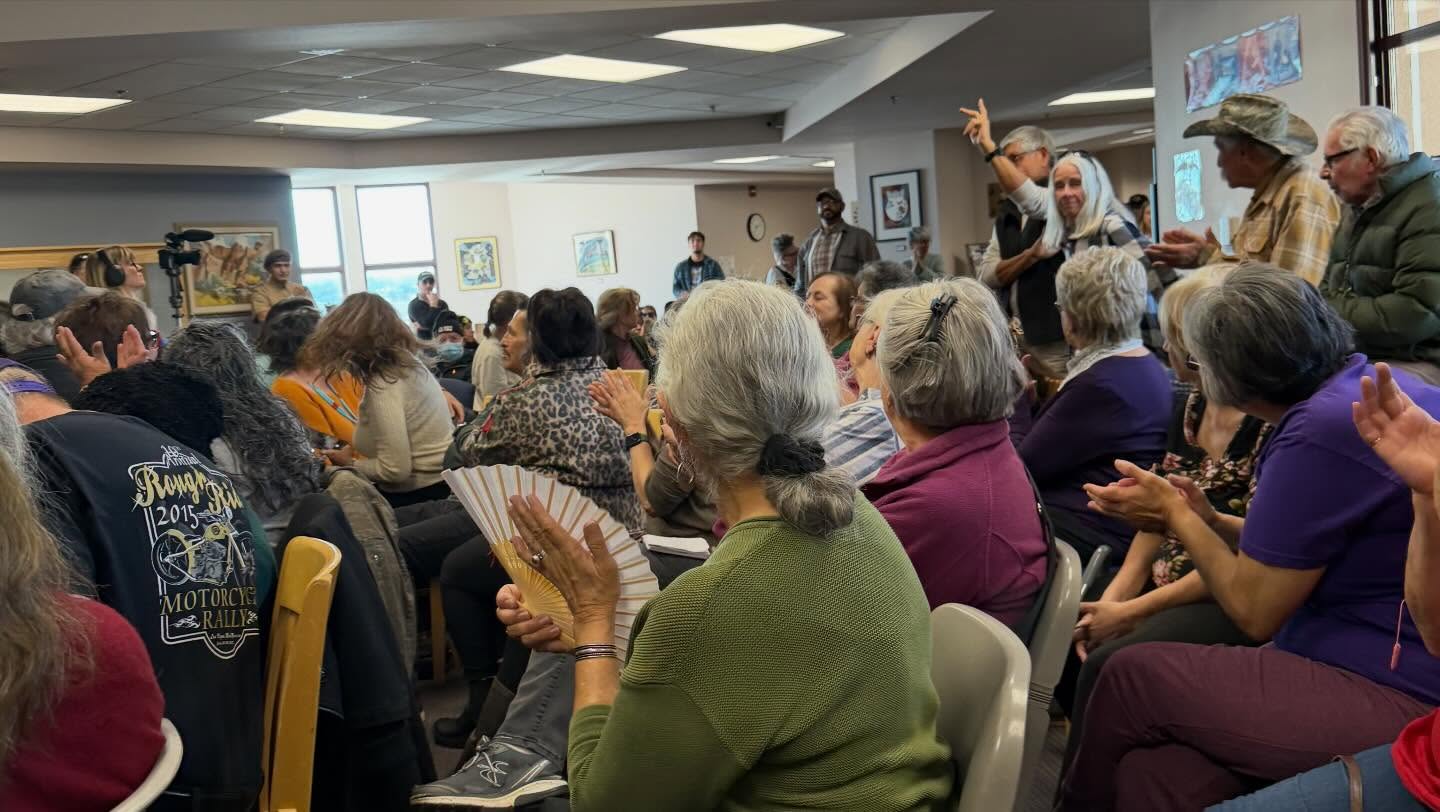
A group of people sit and stand in a crowded room, some clapping and others talking; artwork hangs on the walls in the background.

On February 22, 2026, 120 people in Las Vegas, NM, attended the El Palacio Plática at the New Mexico Highlands University Donnelly Library. The plática featured writer Myrriah Gómez and photographer and activist Adelita M. Medina. Medina was an activist during El Movimiento in Las Vegas in the 1970s and she shared her memories of the women who shaped the movement and created a school and farm in Montezuma. Many people in the audience shared their memories of that time too, and young people in the Brown Berets showed up, too.

To watch the video recording of the plática, see the link in the comments — and please subscribe to the New Mexico Department of Cultural Affairs YouTube channel so you don’t miss future recordings.

Myrriah Gómez, author of “Art and Activism at Highlands University,” speaks at the El Palacio Plática held February 2026.
The former cook at the Escuelita raises her hand. Women of the Chicano Movement created Escuela Antonio José Martínez to provide culturally responsive education to youth in Las Vegas, NM.
Miguel Medina, son of photographer and activist Adelita M. Medina, shares his childhood memories of attending the Escuela Antonio José Martínez that his mom helped created with other women in El Movimiento.

Emily Withnall (opens in a new tab) is the editor of El Palacio and the host of Encounter Culture. Prior to stepping into the editor role, she wrote for the magazine for eight years. Emily has also been published in The New York Times, Al Jazeera, High Country News, Orion Magazine, Tin House, The Kenyon Review, Gay Magazine, Source New Mexico, and other publications. She lives and writes in Santa Fe, New Mexico.

Myrriah Gómez (opens in a new tab) is from El Rancho in the Pojoaque Valley. She earned her bachelor’s degree at New Mexico Highlands University. She is an associate professor in the Honors College at the University of New Mexico and the author of Nuclear Nuevo México. She thanks Dr. Ray Hernández-Durán, Juanita J. Lavadie, Francisco Lefebre, Adelita M. Medina, and Dr. Irene Vásquez for sharing their time and knowledge with her.

Art as Inheritance

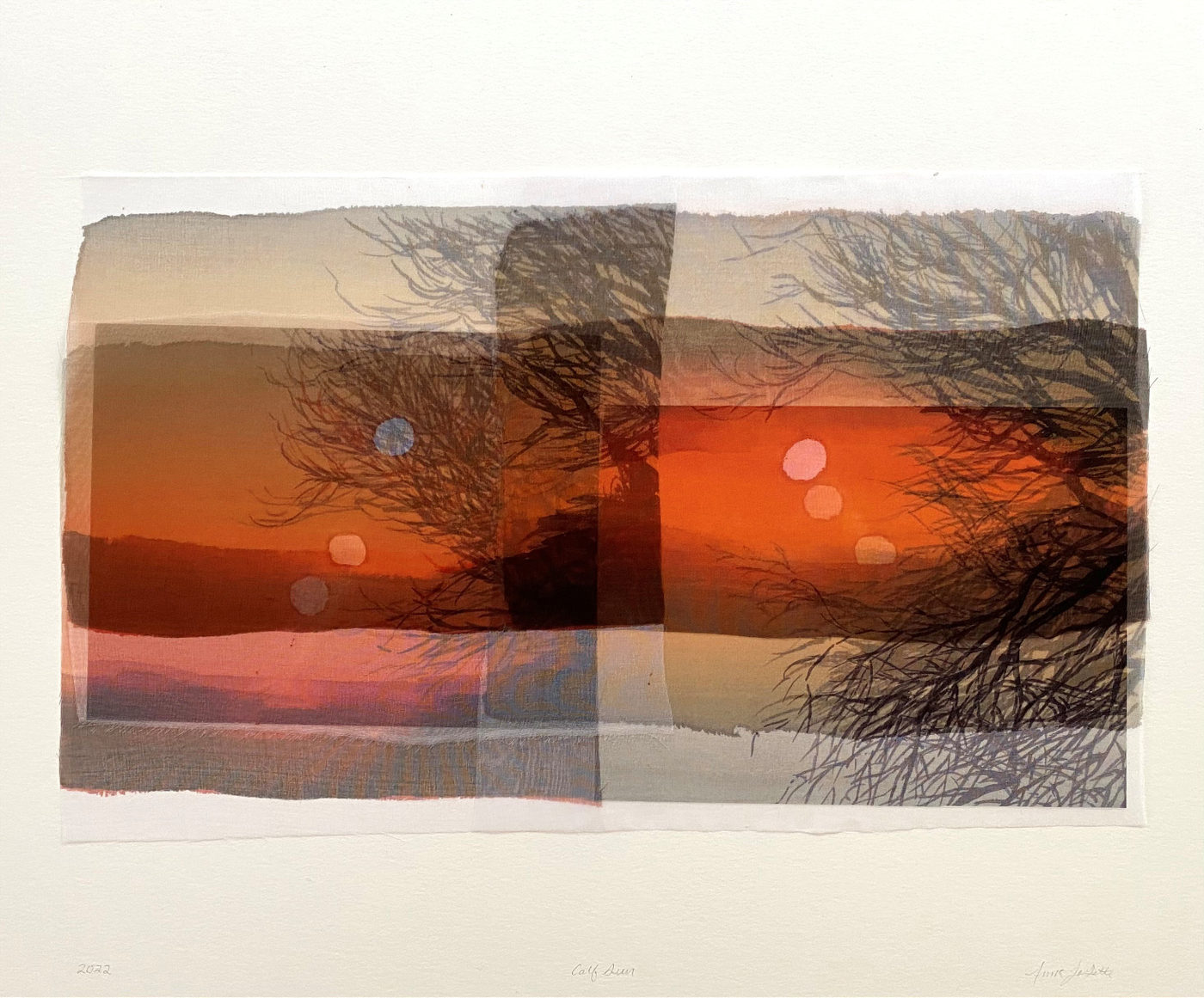
Aime LeGette. Calf Sun. Watercolor on paper and dye on silk, 15” x 22” x 2.” Courtesy of Art in Public Places, New Mexico Arts.

Poetry is my inheritance. My dad, raised by Scottish immigrants in New York City, was taught by Catholic nuns to memorize poetry. He passed the practice on to me; I remember standing at the edge of the Pecos Wilderness as a child, repeating the lines of “The Fairies,” by William Allingham, until I could recite it by heart. I still carry the words in my body, the rhythm of each line urging a steady onward march despite the poem’s dark elements. 

Poetry was how I made sense of the world and how I sought to express myself. Even now, when words fail me, I turn to poetry. Poets most keenly understand the limits and possibilities of language, and they alchemize letters and sounds into the unexpected and profound.  

In difficult times, there can be tension between feeling that art is superfluous and feeling that art is the only way to live, to express ourselves, and to imagine ourselves into something new. As the editor of a publication that celebrates the arts, I advocate for the creative possibilities inherent in art and offer this issue of El Palacio, brimming with poetry. 

Beloved by locals, Santa Fe poet Arthur Sze is the new United States Poet Laureate, and, as poet Kathryne Lim writes, the nuanced weaving of his Chinese heritage, New Mexican Indigenous knowledge, and the Northern New Mexican landscape “allows for a kind of collapsing of space and time.” In a new poem, “Sight Lines,” Sze writes: “salt cedar rises through silt in an irrigation ditch— / the snowpack in the Sangre de Cristos has already dwindled before spring—,” the backdrop from which he introduces topics like plutonium, Thomas Jefferson, the Chinese Cultural Revolution, and the Louisiana Purchase in a contemplation of infinity.  

The newly-appointed New Mexico Poet Laureate, Manuel González, featured by former Albuquerque poet laureate Hakim Bellamy, is a “poet of the people” in every sense. Not only did he inherit music from his father, but he’s passed it on to his poet daughter, is an integral part of the slam scene in Albuquerque, and is committed to bringing poetry to pueblos, schools, detention centers, and rehab centers to facilitate what he calls heartwork. González tells Bellamy, “I want to bring this healing medicine. Because New Mexico has a lot of healing to do.” 

In partnership with Michelle Laflamme-Childs of New Mexico Arts, New Mexico Poet Laureate Emerita Lauren Camp is completing the final stages of her Epic Poem Project. The two women traveled across New Mexico, hosted poetry workshops, and wove imagery from participants into twenty-nine community poems that illuminate the distinct character of each place. Six of those poems appear in these pages, alongside the work of artists who live in the communities.  

This issue of El Palacio also features several Indigenous artists in the Essential Elements exhibition at the Museum of Indian Arts & Culture. Like the poets, these artists weave grief and celebration into their artistic visions, blending art and activism to reflect environmental disasters in New Mexico and to imagine regenerative possibilities. As contributor Christina Castro writes, “What happens to the land, happens to the people.” 

The instinct to weave art and activism also underpins Lucy Lippard’s art writing, curating, and community building. In an exhibition currently at Vladem Contemporary, Lippard’s art collection reveals a tapestry of collaborations with other artists across time. It is not hard to find poetry within the associative collage of Lippard’s life; her art and relationships serve as a kind of offering—a generative inheritance for us all. 

As the poet CMarie Fuhrman writes, “Make your art. Plant a garden. Dance. No, not to distract yourself from the world as it is, but to build the world as it could be. As it will be.… Trust there will be someone there to see it.”

Emily Withnall (opens in a new tab) is the editor of El Palacio and the host of Encounter Culture. Prior to stepping into the editor role, she wrote for the magazine for eight years. Emily has also been published in The New York Times, Al Jazeera, High Country News, Orion Magazine, Tin House, The Kenyon Review, Gay Magazine, Source New Mexico, and other publications. She lives and writes in Santa Fe, New Mexico.

From Javelinas to Oil Refineries: Building the New Mexico Epic Poem Project One Community at a Time

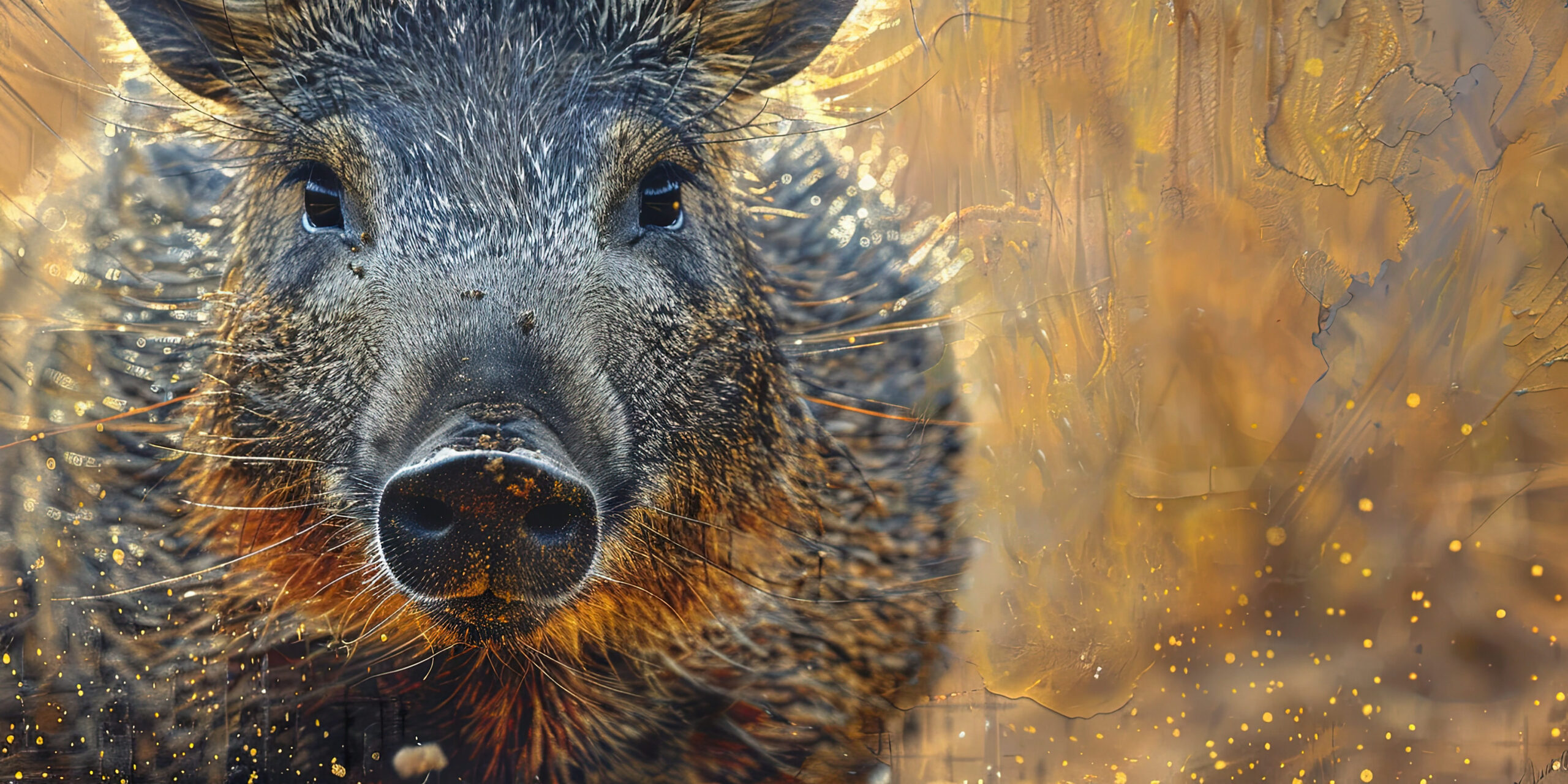
Close-up of a wild boar facing the camera with detailed fur and snout, set against a warm, softly blurred background with golden tones.

Lauren Camp: The goal was to go everywhere, county to county across the state, reaching many small, rural communities. I started in Alamogordo, in the south-central part of New Mexico, reading poems and answering questions, then watching with delight as everyone in the vast crowd wrote in response to a prompt I gave. The next day, I watched the dunes shift at White Sands, restoring, remaking.

After that, New Mexico Arts and I agreed to partner for this new project. Our first event together was at the public library in Gallup. The librarians set chairs out in a hoop shape. They put out a terrific spread of snacks for after. Then they stepped away, leaving us to deliver a worthy program. People arrived, middle-aged and older, ready for poetry. A man walked in with his three pre-teen daughters. When I asked if any of them wrote, one daughter, just one, nodded. Slightly.

I spoke to the audience, but I spoke techniques and approaches and encouragement toward her. From that experience, I understood my role in each venue—to build a circle, a safe space, and gently spread confidence. To guide them and give permission: not in how to write, but how to trust themselves to write.

Michelle Laflamme-Childs: As the crow flies, my office in Santa Fe is about nine thousand miles from the coast of Antarctica, which is just shy of the number of miles Lauren Camp and I drove together to cities, towns, and villages across New Mexico for the Epic Poem Project. Together we sought to gather writing from communities through public workshops that we would later use to assemble crowd-sourced poems about each place using the words of the people from that place.

Lauren: New Mexico is the fifth largest state—by land area—in the country. There were so many places to reach that we could have gone anywhere. Daunted by a map full of perfect (i.e., rural and arts-underserved) locations, we followed the Wonders on Wheels (WOW) mobile museum that first summer of 2023. I led brief workshops to accompany their gorgeous exhibition of Gustave Baumann’s art. We scheduled Epic Poem Project events in each area for the evening. This got us to Roswell, Farmington, Tucumcari, Curry and Roosevelt counties, and Deming. The street murals, the old theaters, railway stations: the architecture of each place fascinated. The whistles of trains and ravens guided us on. Wide fields of wildflowers, snowbanks, descansos, and the blades of wind turbines brought us toward each new destination.

The project got clearer and became more real. We met in coffee shops, libraries, colleges, high schools, elementary schools, a local radio station, planetarium, a ranch, art spaces, community centers—any place where people could freely gather.

Michelle: Although the format and structure of each workshop remained basically the same, the unique personalities of the residents in each community made every visit feel fresh and exciting. In the village of Reserve, the group was lively and jovial as they shared the legend of Elfego Baca and stories about hiding from a yard full of javelinas. A young woman in Artesia described the omnipresent smell of the local oil refinery as comforting and sweet, remembering it from her father’s work clothes. Madrid’s workshop took place at the local community radio station and initially, a group of older male visual artists were quiet until Lauren asked them to describe their artistic processes. The resulting poem reflects Madrid’s quirky vibe and outlaw energy.

Lauren: In Las Cruces, a crowd of college kids and older adults gathered in, eager for the open mic and writing exercise. In Truth or Consequences, the local poetry group and seemingly another half of the town joined. We went to Socorro in a blizzard, Roswell in intense heat, and Portales in a downpour. In Gallup, the organizers scrambled to put out more and more chairs.

Michelle: Lauren and I were compatible travel partners and despite the occasionally grueling schedule, we tried to make time in each community to eat local food, browse public libraries, and poke around in secondhand stores. These side-quests proved to be valuable in gleaning additional insights about each place, and colored how we went about collaging the poems.

Lauren: In each place people showed up, often uncertain about poetry. They came cautious but willing to learn more, to hear (perhaps) their own voices. I gave them time to read works they love or things they’d written in journals or pushed under their beds. We all discussed poetry so casually and openly—what it’s for, why you might turn to it, how it works.

Michelle: As you might expect, there were some common themes from community to community—wind, sun, trains, chile—however, each of the constructed poems is unique both in form and content, showcasing the people and places we visited with specificity and personality.

Lauren: Each time, we drove and landed somewhere else, somewhere quiet and wonderful. We talked and encouraged attendees. We gathered responses from residents so we could build each community their own poem from their own words.

Michelle: The twenty-nine crowd-sourced poems will be printed as broadsides, one for gifting back to each community and a full set that will be displayed at the New Mexico History Museum’s Palace of the Governors along with community-sourced artworks from the places we were unable to visit. The longer-term plan is also to publish a book. Showing all the poems and accompanying artworks together will not only celebrate the distinctive characteristics of each community, but also collect them into a larger narrative about our vast, astounding state.

Lauren: The little towns that murmur from the sidelines: those have my heart. We all have New Mexico’s wide sky to connect us, but the writing and conversations made regions on a map pulse with names and colors. We invited residents to help us understand where they live, and they in turn let their words—and the spirit and textures of their places—accompany us on our growing journey. It has been one of the great privileges and honors of my life to co-create and guide this project. Every mile earned us a new vista, a new dirt road that could loop and tie us to community. Every poem Michelle and I built is a living portrait of a very real group of people in a vivid and memorable place. I don’t think we can understand humanity without the arts. Poetry, with its strong senses and surprise, offers us a small, powerful way to pay attention to each other, to not live apart.

Michelle: It’s easy to take where we live for granted; to lean into what we perceive as lacking or inadequate. The writing exercise in each workshop encouraged participants to go deeper, to think about what they taste, see, hear, smell, or touch in the places they call home. The resulting writing is personal, thoughtful, and honest—rich with sensory descriptions of red chile chicken enchiladas, an old brick corner store, desert creosote after the rain, grandma’s creaky rocking chair, mariachi music on the plaza, scraggly ocotillo on a mountain trail. The poems tell a story of New Mexico that is intimate and authentic: a story of home.

Small Town Embrace – City of Champions
Artesia


Thick oil, the dairy.
Success rising from the industrial roar
of hard work. A crowd is quick to cheer.
Parades, football, blue sky haze wide open
blaze of sun. Warm silk
magenta glow. Charm and grit,
stale air, hot asphalt. Hot
grass droning cicadas.
The town is alive with neighbors,
green chile and sweetness, heat
from the sunrays.
Terracotta dirt on the sill.
Deep fat, fried and Tejano
home in the dry blown in wind.
Adobe Rose and Kith + Kin
coconut sweet tea. Taste the bitter
dust on the Southern gusts. Echoing early
and late alarms. The refinery always groans
always east. The strong wind lets
nothing imprint for long.
Pungent money seeps from the ground.
My father’s old work clothes smell
familiar and sweet.
Cool, clean rain.
I’m not followed by ghosts.
Savana Watts. Dancing Downtown, 519 West Main St., Artesia, New Mexico, June 2024. Created with support from Andrea Alvarado, Alison, Greene, Juli Newton, and Brandi Cox. Courtesy of Downtown Mural Program! with the Artesia Arts & Cultural District.
Jesse Kriegel. Mimbres Mural, on the corner of Gold and Spruce streets, Deming, New Mexico, 2019. Courtesy of Deming Luna County MainStreet Program. Photograph by Cosetta Lewis.

Diminishing Echo
Deming

People say there’s a smell that comes before
a rain. I’ve smelled it, too.

Before time engraved on mountainsides.
Before petroglyphs,
or Butterfield Stagecoach,
before Mexico or the USA.

Dust and warm dust. One learns not to touch
or pet or pick. I live
two miles from the Deming tracks.

The tiny red pepper I grew
didn’t burn my mouth
until I bit into the yellow seed.

Soggy thundered air tries to cool us.
Nightshade, dark green summer night.
Spadefoot toad neighbors in warm, sticky mud.

Many of our people have lived
long, their eyes tell you.

How the train persists.

Interstate 10 rolls town, dead skunks
in the middle
of the pavement.

Clouds hearing silence
touch space. The mountain changes the afternoon.

Finally the sound, blue to purple.
Mourning doves on every branch.

Tasha Nez. Nightly Summer Indian Dances, 2025. Acrylic on canvas.
Sandra Hatch. Century Plants with Mountains, 2022. Cotton, fabric dye, wax, 18” x 22.”

Depending on the Current of the Wind
Gallup


Train roar trailing down Route 66.
Highway medians become sunflower fields in fall
leading in three ways. The city slowly creeps awake.
Silversmiths stamp patterns into sheets.
A new pancake recipe. My daughters are growing fast.

String lights over downtown.
Friends share handshakes. Bump of the trains.
Ice cream truck jingle drifting. Wind between buildings.
I leave Jerry’s Café on Coal Street.

We cross the tracks. Fine dust hits my bare legs.
Prairie dog heads pop up and down.
Frybread is not optional powdered sugar salt honey
or wrap it around a roasted green chile.
Vinyl tablecloths sizzling grease.
Folding metal chairs creak like cranes.

Gallupians or Gallupeños?
Woven rugs outdoor murals clay turquoise.
Shot of an old car gun in the distance.
Native, classical, country and church songs.
That one train conductor lays on the horn
in the middle of the night.

My father-in-law’s kitchen, one single stretch of counter.
A dark wall lined with books
and a painting of a hogan in front of a cliff.
Cedar burning in a pot-bellied stove.
Alligator junipers bend scattered sand.
At the same time the rabbitbrush blooms like popcorn.
The iron monster envelops us in a whistle-kiss.

March wind always from the west always with grit.
The slow lonesome blare of the trains a sound I no longer notice.
Abundant groundhogs run.
The Gallup Coffee Co. roaster is fired up.
Blue corn mush from a Styrofoam bowl.
Wet sage in spring early morning walkers stroll by.
The flap of a raven’s wing.

Frybread and roasted lamb.
Hardened mud pink-red chartreuse neon
and inflatable cowboy pointing home.
A woven belt wrapped around a waist.
Gallup Flea. Train wind in your hair.

Sunlit Particles and an Occasional Horse
Lincoln County


I roll over the last set hills.
The miles are easy.
A railroad was here
and a town.
Gold was here.
Pines fill the air with pitch.
The oryx and antelope retreat
to the backcountry.
Elk stroll past
and sound their hunger.
A greasy breeze.
The railroad slips through
town and vanishes
with vibration.
Big sky arches over gray green.
Clouds kiss the ground.
The gold disappeared.
Arroyos striped with sediment.
Music became history.
The snow quiets all other sounds.
Chiles at Smokey’s Market
and fragrant roasting haze.
Dirt in my eyes and wrinkles.
The brass lock twists
right-left-right. Ravens wing
from a nearby tree.
Reenacted battle.
If only I could undo
my future, I would
be here now.
Bird song, early morning.
A whiptailed lizard.
Linda Carroll. Once Upon a Dream, 2025. Watercolor on cold press paper, 20” x 26.”
Bernard Sandoval. Raton Train Station, 2025. Oil on canvas, 20″ × 10.” Courtesy of artist.
Raised Here All My Life
Mountainair

Here in our half-mile town, roosters call.
Little houses, some falling down, maybe abandoned.
The side hug, a cowboy custom of respect.
Cinnamon and butter from grandmother’s biscochitos.
I wish the rest of the world is this pretty—

dry grama grass along a trail, bumpy, sandy and sharp.
Hear the hum-buzz of old gas station lights,
trains rumble in the distance, horns warning
at each crossing. Nearly ever-present wind sings
and screams. At night the common poorwill tells me he’s proud.

Bright moon, no streetlights are required.
Bring heaven here where we belong.
Music with full bass, daisy perfume, salsa sounds.
Dancing on the patio. I see loyalty, familia.
Red and green chile. Both please!

After the cows are fed, I watch the train go by,
smell a hint of oil. All the cars are the same.
Cool red clay under my feet.
A breeze so fresh you could fly.
Sage in the fall, dogwood in spring.

Coyotes dusty and crusty
bark from one pack to another.
Canyon walls show their mood in sunset colors.
Deer cross the road. Leather and brass bridle
still cool in my hands. Soft hair, sweet

and gentle breath. My horse nickers for dinner.
Late sun on my skin. I’m free. I can see dust picking up.

Foraged Dandelions
Raton


I hear the town through conversations.
The railroad arrived with its steel carpet.
Miners and boy scouts and our soldiers departing.
Crows count out rhythms one
insists on repeating. Listening
to locals talk and laugh.
Roots underfoot.
What is home? Is it the sight
of the mountains and mesas?
Apples love it here and so do I (most days).
Bees in the cholla. Bear muscles
rippling like music.

From Goat Hill,
the mountains have their arms around Raton.
Adobe bricks, tree branches.
I wander streets, alleys, yards. Easy
to be peaceful.
I taste the hillside.
I taste the trout I caught at Lake Maloya.
Taste the wind, not dust, mostly
sweet. You can see so many stars.
Piñon burning on frosty nights.
Air tinted with wood smoke.

You have to be sturdy and resourceful.
Church bells in clear air whether we
go in or not, we are
reminded. Train whistle marks
the hours. Clicking grasshoppers.
I touch the unpaved path with my feet.
Sun bakes on prairie grasses.
Juicy apples
drip summer sticky
onto skin.
Little alien
somersaulting gymnast—
a fence lizard.
Rough rocks along the rails worth collecting.

Lauren Camp (opens in a new tab) served as the second New Mexico Poet Laureate. She is the author of nine poetry collections, including In Old Sky (Grand Canyon Conservancy, 2024), winner of the New Mexico Book Award, which grew out of her experience as Astronomer-in-Residence at Grand Canyon National Park, and Is Is Enough (Texas Review Press, 2026). Her poems have been translated into Mandarin, Turkish, Spanish, French, and Arabic.

Michelle Laflamme-Childs is the executive director for New Mexico Arts, the state’s art agency housed within New Mexico Department of Cultural Affairs. Michelle has served as an arts administrator and poet for more than twenty years in the private and public sectors. She holds a BA in English from the University of Massachusetts, an MA from St. John’s College in Santa Fe, and hopes someday to complete her MFA in creative writing at the University of Texas, El Paso.

Arroyo Lessons

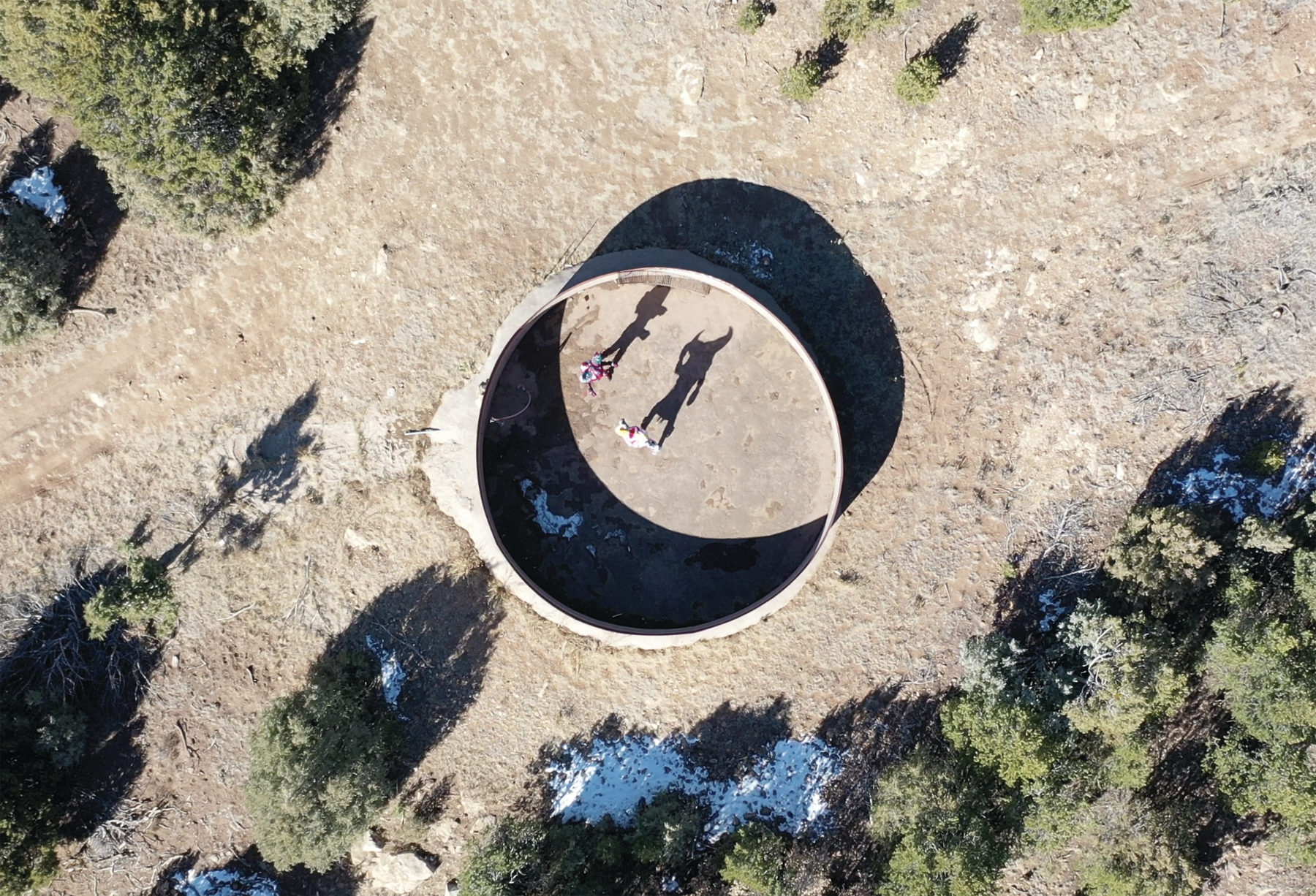
Aerial view of two people standing inside a large, circular concrete structure casting shadows, surrounded by dry terrain and sparse vegetation.
Cannupa Hanska Luger (Mandan/Hidatsa/Arikara/Lakota).Future Ancestral Technologies // Muscle, Bone & Sinew, 2021. Drone video still from Shadow Holding Shape to Experience the Energy of the Sun.

I write letters to my father, the riverbed, when I need answers that mother can’t give. Father empty stream, father arroyo, who houses the rattlesnake beneath his wind-smoothed stones. Father imminent danger, the flash flood, the whipping monsoon mud froth, father aftermath in ribbons of ruined earth. 

The arroyo spreads his tiger moth wings and paints his back in dark, tide-pulled streaks of metallic silt. He sings out from the limestone valley where dead sea minerals are alive in the ground. His answer to me is not a poem or passage, no missive nor manual, but a magnet, to gather up his iron-rich words.

I beg for explanation, instructions to survive these eons of lost time, but with no inheritance, no dowry but this dusty steel globe, desert land repulsing against me. I sift the black sand through each new set of shiny, manufactured fingers, pooling silt and shavings and dust until I can no longer see the fractaling sheen of my magnet’s surface.

I scramble up the hill, every time to a home no longer mine, fall back to the cactus plastered valley, and I beg for the wild’s embrace, but the arroyo is dry and does not answer. I beg for a poem I can read, but the floods are rushing and the arroyo silently drowns beneath. 

The black sand sticks until the Earth loses its axis and the compass spins ever round and everything held close begins to repel. There the loose earth grinds into the grout of my cold tiled floor and spells out his last retort.

Child, when you are wrong, I remember you are real. Your mask is all the meager parts of history, all those that ignore the imperfections and the music of loss and livelihood. You cannot write a future without mistakes, and you cannot mistake an apology to mean you are right. 

I would raise you if this was all wilderness. Tamed animal child. Tanned pelt child. If you could learn slowly, you could forget, you could learn again, from me, from the riverbed. You work so hard to chronicle all you’ve ever learned. It will never change with your eroding, rain-swept memory. You need impermanence. How do you think I’ve lasted so long?

Adrienne Rugg teaches poetry and multi-genre writing at New Mexico School for the Arts. They graduated in 2024 from Western Washington University with a BA in creative writing. Rugg often pairs their poetry and fiction with multi-media arts. Their award-winning poetry has been published in the Santa Fe New Mexican, Dreams of Montezuma, and Convergence II.

The Counterculture’s Curator: Lucy Lippard on Writing, Art and Life 

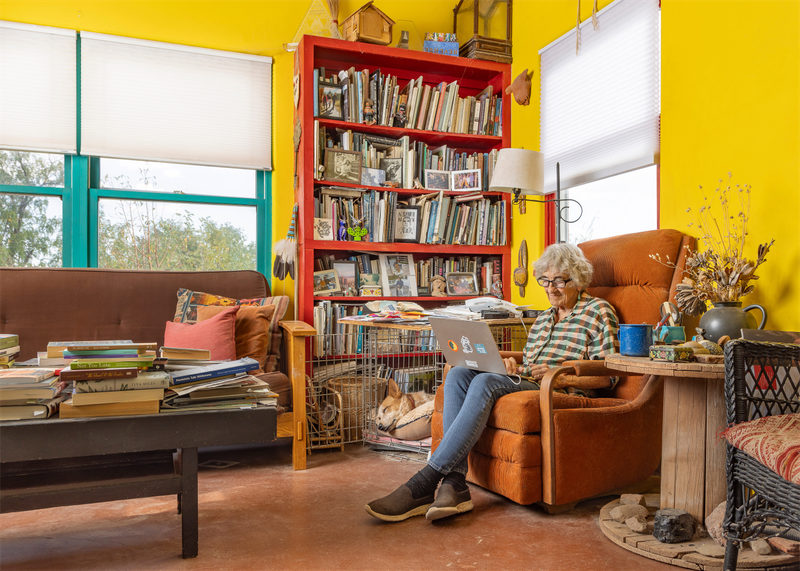
An older person sits in an orange armchair using a laptop in a bright, yellow-walled room with bookshelves, a couch, and stacked books.
Lucy Lippard at her home in Galisteo. Photo by Kevin J. Miyazaki/The Rabkin Foundation. © Kevin J. Miyazaki 2024.

If you know anything about Lucy Lippard, you know she’s one of the most significant art writers and curators of our time. You may know her thirty published books and countless essays on artists, art movements, and land. You may know her as a cofounder of the legendary artists’ book space, Printed Matter, the feminist art collectives Heresies and the Ad Hoc Women’s Committee, or any number of groups that rose up in the latter half of the twentieth century to fight institutional gatekeepers for fair inclusion of women and people of color. You may know that following decades of culture-shifting writing and activism in her hometown of New York City, she moved in 1993 to the tiny historic village of Galisteo, where she edits and writes most of the monthly community newsletter, El Puente de Galisteo, and serves in the auxiliary fire department. Any one of these sentences could outline a remarkable life, but all of them cohere in the singular Lucy Lippard—and they’re just the start.

Lippard tends to understate how she’s built her extraordinary bibliography and career. “I haven’t made that many decisions about what I’m doing and not doing, just things come along. One thing leads to another, and that’s it,” she says of her approach. “I mean, I’m always changing. I’m interested in this, and then I’ve done that, and I go off in a corner and get interested in that, and so on. I meet somebody or I fall in love or get involved in some group like Heresies.” Her intellectual interests have proven inseparable from her romantic ones, as she admits with her rapid, ready laugh. “One guy I lived with—I’ve lived with several—said to me, ‘You tend to choose your men with what you’re interested in at the moment.’ I said, ‘Yeah.’” 

Harmony Hammond, Bag IX, 1971, paint on cloth, 60 × 22 ½ in. Collection of the New Mexico Museum of Art. Gift of Lucy R. Lippard, 1999 (1999.15.344). © Harmony Hammond / Licensed by VAGA, New York, NY. Photo by Addison Doty.
Yaagul, July 1973, chromogenic print, 9 9/16 × 6 5/8 in. Collection of the New Mexico Museum of Art. Museum Purchase, 1998 (1998.33.1b). © The Estate of Ana Mendieta, Courtesy of Galerie Lelong, New York. Photo by Blair Clark.

But look, many people meander through life from one thing to the next and just end up lost. Lippard’s inner compass is tuned to a singular set of instincts she has always trusted. If she’s ever been afraid, she says she can’t remember it. Across almost nine decades (she’ll be eighty-nine in April) her entire way of being in the world has been to follow her curiosity: on foot, on wheels, in words, and into the company of brilliant artists and thinkers.

Kathy Vargas, Oracion: Valentine’s Day/ Day of the Dead (Chest), ca. 1990, Gelatin silver print with applied color, 22 3/8 × 17 ¼ in. Collection of the New Mexico Museum of Art. Gift of Lucy R. Lippard, 1999 (1999.15.205). © New Mexico Museum of Art. Photo by Blair Clark.
Melanie Yazzie, The U.S. Government Will Never Whitewash My Grandparents, 1992, screen print, 14 15/16 × 21 7/8 in. Collection of the New Mexico Museum of Art. Gift of Lucy R. Lippard, 1999 (1999.15.213). © Melanie Yazzie. Photo by Blair Clark.

“I have always seen myself as an outsider,” Lippard says. “People think, Oh, she’s an insider in the art world. But I never went to Warhol’s parties, I didn’t know any collectors, I stayed away from the gallery scene, and so forth. So I’m an outsider in that sense. I’m an insider in the fact that I lived in studios.”

Those studios turned out to hold many of the foremost innovators in conceptual and minimalist art. Deeply enmeshed in arts communities from her twenties onward, Lippard swiftly rejected the prevailing standard of critical distance and objectivity. She wrote about friends and lovers and acquaintances, curated their work, and collaborated with them on projects and activism. And they gave her fine art. In fact, they gave her so much art she hung it on every wall of her New York loft, including in the bathroom, and stashed it under furniture. When she moved to Galisteo, she gave most of her collection and archives to the New Mexico Museum of Art.

Much of that astonishing work has re-emerged into the light for the knockout new exhibition, Lucy R. Lippard: Notes from the Radical Whirlwind, at the Vladem Contemporary in Santa Fe through August 9, 2026. The title comes from a 1982 lament by the eminent New York Times critic Hilton Kramer, who believed “high art” must be guarded from politics and popular culture: “There was every reason to suppose that a writer of this quality would one day become one of our leading historians of the Modern movement. Yet in the seventies Miss Lippard fell victim to the radical whirlwind.”

Eleanor Antin, 100 Boots Marching, 1971-1973, 43 offset lithograph postcards, 4 ½ × 7 in. (each). Collection of the New Mexico Museum of Art. Gift of Lucy R. Lippard, 1999 (1999.15.352). © Eleanor Antin. Photo by Blair Clark.

Drawing on these copious archives and personal narratives, curator Alexandra Terry has pulled off a feat of worldbuilding across the Vladem’s two galleries by telling the story of Lippard’s career through her collaborations and relationships. The fine art in the main-floor gallery draws a core sample of some of the most significant practitioners of experimental, abstract, conceptual, and feminist art: Eva Hesse, Robert Rauschenberg, On Kawara, Edward Ruscha, Ana Mendieta, Jaune Quick-to-See Smith, Howardena Pindell, Nancy Spero, Harmony Hammond, Ad Reinhardt, Sol LeWitt, and more. There’s a painting by Lippard’s ex-husband, Robert Ryman, as well as a striking abstract sculptural object by their son Ethan Ryman, a talented music engineer-turned-painter. And though Lippard declines to be labeled an artist herself, an intricate woodcut print she made is also on exhibit, despite her reservations. “It’s a beautiful piece, and it tells the story of her entry into understanding what it takes to be an artist,” says Terry. “Having practiced art herself, understanding how physical it can be and what it really is—that’s important because as a curator, as a writer, often you can be so disconnected from the process. But she was always very much aware of the process of it all.”

Moving out of the studios and into the streets, so to speak, the show’s other half in the upstairs gallery holds a trove of printed media. There’s a lived-in, personal feeling to this spread of small-run artists’ books, posters, pins, comix, correspondence projects, and experiments, by artists both eminent and obscure. These are objects that have been handled, passed around, worn, taped up in public space. You can flip through reproduced zines, yellowed edges and all. One gallery wall glows with a moving slideshow of Lippard protesting, speaking, looking at art, eating cake, her arms slung around friends. In this beautifully analog space, the counterculture’s energy feels tangible.

Taken altogether, Notes from the Radical Whirlwind is an immersive guide to creative defiance, pleasure, generosity, and friendship. The exhibition has the depth and specificity of a self-made universe, simultaneously intimate and epic.

Intimate and epic describe Lippard’s approach to writing as well. She is drawn to the marginal details that define cultural shifts, specific stones in vast landscapes, interiors of artists’ studios as they work, the urgent present moment in the sweep of geological time, insular communities and their complex human networks. Even as her interests roamed into history, geology, myth, land use, extraction, and all matters of place, her visual and narrative sensibilities have remained keenly attuned to the aesthetics of all. She says, “I can drag art into everything.”

Lippard lives with her solicitous red heeler Tanita in the little house she built creekside in Galisteo. The main room has sunny yellow walls and a coffee table built by Sol LeWitt and a loft she still prefers to climb up the ladder to sleep in every night. Her current desk, famously, is a slab of plywood atop Tanita’s crate. Lippard revels in her autonomy, and the thrift that enables it. “Everything in this room is secondhand, including me,” she jokes from her self-described throne, a reupholstered La-Z-Boy that used to be her father’s. Everything in the room has a story behind it, and the story of Lucy’s wild and wide-ranging life materializes through and among the objects she has accrued and made.

This was how she wrote her sole work of memoir, Stuff, cheekily subtitled Instead of a Memoir (2023). Stuff tethers her autobiography only to the material things that surrounded her at the time of writing in 2022 and 2023: art objects, furnishings, rocks, photographs. The self-imposed writing constraint is characteristic of Lippard. For one, tightening the frame makes possible the impossible task of describing a very full life; for another, it draws a clear boundary around what she will tell. Lippard is a lively, candid storyteller who keeps a firm hand on the narrative wheel. Her writing eschews the common memoirist impulse toward confession, self-exposure, and cathartic revelation, favoring instead vivid events, descriptions, and observations deftly recounted in a smart, conversational, and at times irreverent voice.

In person, Lippard’s voice is a gravelly alto, punctuated by a quick, easy laugh. Once you listen to her speak, you’ll hear her voice in her writing too, especially in her more recent books like Stuff and the exuberant Undermining: A Wild Ride Through Land Use, Politics, and Art in the Changing West. Her prose is clear, energetic, and warmly intellectual; in several of her books, a running sidebar of text and pictures tells parallel and related stories to the main body of work. Standard forms cannot contain her.

Lippard decided early in her career to break from the academic, formalist art criticism of the time to write accessibly, even—and especially—on complex subjects such as conceptual art. At a time when art writing was for and about a highly select few, this move showed swagger. “I am probably safe in saying, as I have of some exhibitions I have organized, that no one but me (and my editors) will read the whole book through,” she deadpanned in the introduction of Six Years: The Dematerialization of the Art Object from 1966 to 1972. Indeed, the outraged (and suffocatingly stiff) 1973 Artforum review of Six Years called it “explicitly an uncritical endeavor.” Conceptual artist and critic Mel Bochner railed, “Lippard’s notion of how art informs other art is one of misguided democratization, defined as everybody can understand everything.”

Bochner and Lippard were both wrong: Six Years became the definitive text on the origins and history of conceptual art, and it was both prescient and enduring. Its canonical red cover, bearing the entire eighty-six–word title and subtitle in plain white Helvetica, can be purchased as a T-shirt. Six Years made her name and marked a career turning point for Lippard.

Another turning point was Overlay: Contemporary Art and the Art of Prehistory (1983). This was her first foray into stones, maps, rituals, feminism and prehistory, and land art, and it set the course for several books to come. Lippard had been working on a novel in rural Devon, England, when on her weekly walks on the Dartmoor, she noticed stones placed in the landscape, inscrutable traces of human artistic expression. She became fascinated by “times and places where art was inseparable from life,” as she later wrote in Overlay: “The ancient sites and images are talismans, aids to memory, outlets for the imagination that can’t be regulated, owned, or manipulated like so much contemporary art because so little is or ever will be known about them.”

Both on the ground and on the page, Lippard journeys to see what she can find, and embraces what surpasses her understanding. In the process, she strikes a rare balance of conviction and humility. In Mixed Blessings: New Art in a Multicultural America (1990), the first published book to discuss the cross-cultural processes taking place in the world of contemporary Latinx, Indigenous, Black, and Asian American artists, she explains that “the book is above all a record of my own still-incomplete learning process.” She writes, “The context does not exist for a nice, seamless narrative and probably never will. I can’t force a coherence that I don’t experience, and I write with the relational, unfixed feminist models of art always in the back of my mind.”

Drawn to the powerful glow of expertise, scholars and writers are often tempted or trained to claim the authoritative take. But browse any library shelf of dusty art history books for glum evidence of its fossilizing effects. Because she stays open to the limits of her knowledge, always in intellectual motion, Lippard writes into an enduring relevance.

She also writes with great descriptive beauty, especially about place. One example from her landmark The Lure of the Local: Senses of Place in a Multicentered Society (1997): “I can feel kinesthetically how it would be to hike for hours through a vast ‘empty’ landscape that I’m dashing through in a car—the underfoot textures, the rising dust, the way muscles tighten on a hill, the rhythms of walking, the feeling of sun or mist on the back of my neck.” Undermining (2014, dedicated in part “to New Mexico, one of the loves of my life”) marshals her reverence for place into a voracious and unflinching exploration of how land in the West is used and abused; the policies and histories that enable this; and the ways art can respond to, resist, document, or even be complicit in, the damage. Lippard names the fast-paced Undermining as one of her favorites, and it’s an exemplary entry point to her canon, equal parts images and prose, a petite giant of a book. 

The original plan was not to be an art writer at all. Fiction was Lippard’s first love. “But I was no good at the kind of fiction I like to read,” she says of the character-driven realism she is drawn to. No matter how she tried, her own work turned irrepressibly experimental. Lippard kept writing conceptual stories and vignettes on the side, and ultimately published a novel called I See/You Mean (1979), along with a collection of short works from 1951–1994, Headwaters (2024). Her fiction is an aperture into different rooms of Lippard’s mind: intuitive, imagistic, both personal and enigmatic, and sometimes diaristic. Sentence structures shuffle and overlap, time collapses and loops, autobiography goes pointillistic. Rocks recur in several pieces, often with animistic qualities. Drawings and photographs mingle with text. The intensity of some of the stories lingers long afterward like a strange dream.

“I gave up fiction for what can be seen as hack art journalism, though always inspired to do and say what I wanted on the model of what I once thought artists were,” she says, even as she came to understand the precariousness of the artist’s life and how “even the freest of spirits” are beholden to the art world’s dynamics and dysfunctions. “I decided to freelance forever because I hate being told what to do. I make my own decisions and mistakes.” At least outwardly, Lippard prefers not to second-guess or ruminate, more engaged by the realities and possibilities of the present. In The Lure of the Local, she writes, “Nostalgia is a way of denying the present as well as keeping some people and places in the past, where we can visit them when we feel like taking a leave of absence from modernity. It can also be seen as an apology for the betrayal of forgetfulness, a halfhearted bow to the significance of histories we are too lazy to learn.” It’s one thing to write this in your fifties, but does it hit differently in your eighties when you’re sorting through your massive archives and circling through an entire exhibition about your life? Not for Lippard. “I’ve never been nostalgic, except perhaps for landscapes. I can walk through Devon or Maine or Spain or New York City in my imagination when I like. But I like change.”

Political change is at the forefront of her mind these days. Living through McCarthyism catalyzed her first political awakening when Lippard was a teenager and her father was dean of the medical school at the University of Virginia. “I was going to high school, and I said, ‘I’m going to tell everybody you were a communist,’ because he was friends with communists in New York in the ’30s—both my parents were. My father was a very gentle man, and he grabbed my arm and he said, ‘Don’t do that.’ And it hurt. And that was a moment where I thought, Oh. People were scared to death.”

Now, she says, that feeling is back. “This is definitely the worst in my lifetime. The cruelty is what gets to me, especially living in a border state.” In true form, she’s collaborating on a local project called Impact Art Lab, training people to build activist and mutual aid networks and design art-based direct actions.

Unknown makers, political and protest buttons, n.d. Paint or ink and paper, plastic over metal, various sizes. Collection of the New Mexico Museum of Art. New Mexico Museum of Art Archive Collection. Gift of Lucy R. Lippard.

And she is still writing steadily, despite her desire to slow down a little. “If it’s something that interests me, I think, Oh, that’ll be fun. And if it doesn’t, I just say I’m too busy. I’m trying desperately not to do these things, not to say yes.” Why, then, does she keep saying yes? “My partner says, ‘You never say no!’ And I say, ‘I say no all the time! But I just say yes too.’”

Meanwhile, another book is in the works. At a friend’s house in Galisteo a few years back, a Colombian drag queen filmmaker offered Lippard a tarot card reading. “I said, ‘I’d love to start another book, but I’m so old I probably wouldn’t live to finish it,’” she recounts wryly. Fortunately, the tarot spread foretold she’d have eight or nine more years. So she got underway with The Burden of Memory, a book about U.S. sites of contested history. She recounts the drag queen’s reading as a great story, and indeed, the tarot revelation may have provided a useful nudge. But regardless of what the cards say, if there’s anything we can learn from her example, it’s that Lucy Lippard has never asked or needed permission to do exactly what she wants.  

Chelsey Johnson is the author of the novel Stray City and the director of the City of Santa Fe’s Arts & Culture Department.

What Happens to the Land, Happens to the People

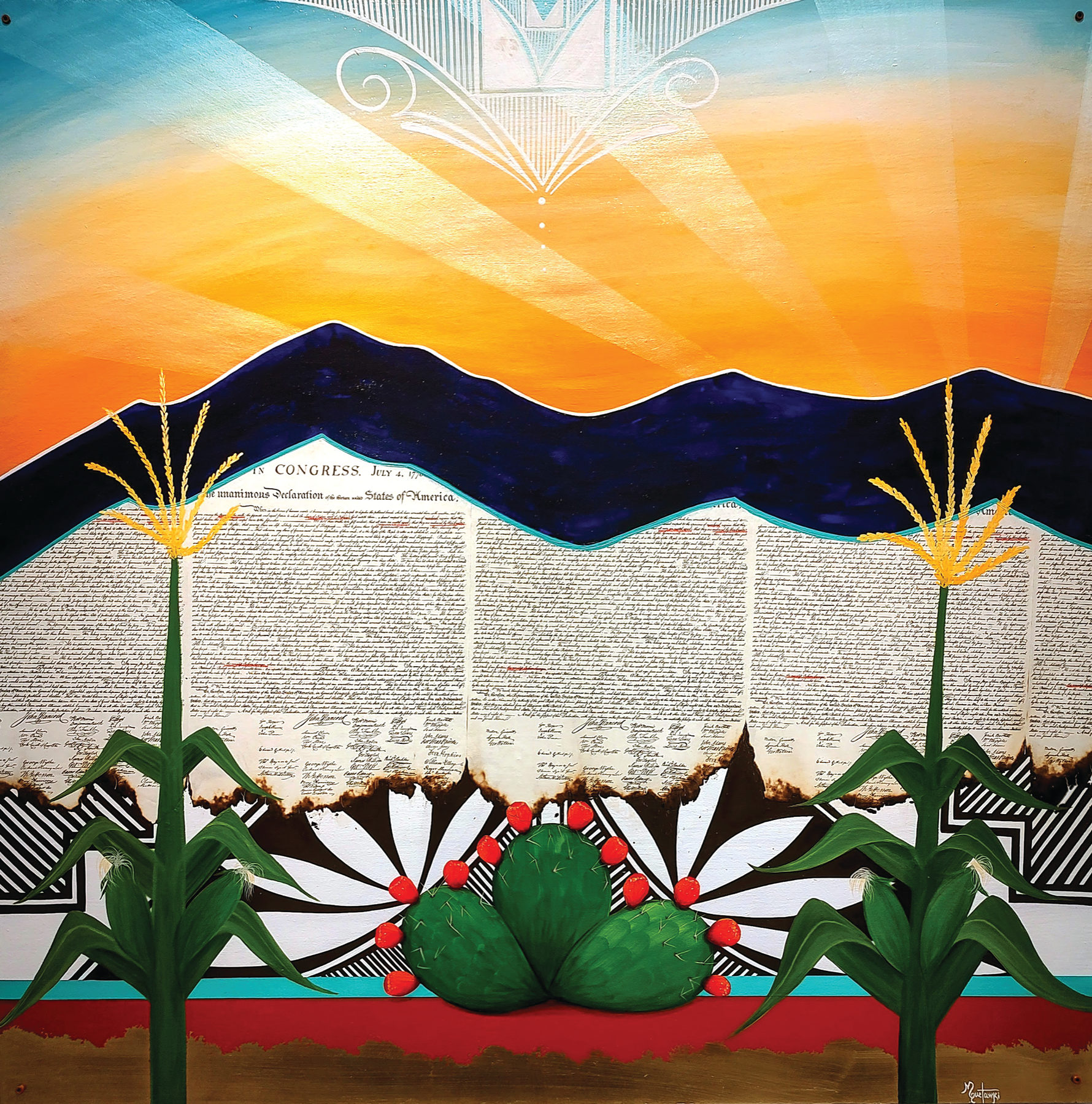
Mallery Quetawki (Zuni Pueblo). Merciless, 2025. Acrylic, gold leaf, Declaration of Independence on parchment. 48 × 48 in. Courtesy of the artist and the Community Environmental Health Program at UNM-COP.

Indigenous Artists in the Movement to Protect Their Homelands

Embedded in the mountainscape are pages from a large-scale printing of the Declaration of Independence. The bottom half of the pages are intentionally singed as they meld into distinctly pueblo black and white line work, accentuated by two cornstalks and a prickly-pear cactus at the center with ripe red fruit, seemingly ready for picking. Beyond the silhouetted mountain range, the sun is setting, sending illuminating rays upward. The entirety of the sky is a bright yellow, except for a small patch of blue along the top. At the center, there is more delicate linework, perhaps a representation of divinity or a symbolic prayer holding everything together; a promise of a brighter day ahead.

Mallery Quetawki’s (Zuni) Merciless is a substantial and evocative tribute to Dewankwin Kyaba:chu Yalanne (so-called Mt. Taylor). Her artist statement reads, “To all the broken treaties and desecration of Aweklan Tsit’da (Mother Earth), may she show no mercy against the opening of uranium mines that threaten her place of vigil.”

Quetawki is one of thirty-one artists featured in the Essential Elements: Art, Environment, and Indigenous Futures exhibition, on view through April 5, 2026, at the JoAnn and Bob Balzer Contemporary Art Gallery at the Museum of Indian Arts & Culture. Using the four elements essential for life on this planet, artists representing eighteen tribal communities explore the critical issues of climate change, environmental degradation, and the ongoing effects of colonialism and racialized capitalism on the health and well-being of their respective homelands.

Quetawki’s work is striking in the way she manages to weave the sacred and profane to create breathtaking visual representations of our collective stories of strength, adaptation, and resistance. Quetawki holds a bachelor of science degree in biology from The University of New Mexico and is a second-year graduate student at Johns Hopkins University, studying public health. She has served for nine years as the communications and outreach specialist for UNM’s Community Environmental Health Program, where she creates multimedia messaging for the public, which she describes as “research translation.”

Serving as a community educator, as well as a resource for scientists to better understand and address community needs, Quetawki’s guiding questions include: How does science create real-world applications? How does science respond respectfully to community concern, and how can the community benefit from data and research?

“It’s hard to speak on Traditional Ecological Knowledge (TEK) and Indigenous ways of knowing to really rigid scientists,” she says. “My work involves a lot of convincing. My perspective is on science, research and culture, traditional and ecological stewardship, and ultimately fighting for justice for the most marginalized communities.”

Quetawki describes her art activism, or “artivism,” as something that has come about more recently, beginning with her growing awareness of the environmental issues impacting Zuni and surrounding communities. In particular, she was drawn to learning about the fight for Zuni Salt Lake, a long-term battle the tribe engaged in to protect this sacred site, home to Salt Woman—or Salt Mother as she is known to the Zuni people. Since time immemorial, the Zuni and other local tribes have made pilgrimages to Salt Woman to collect her salt for ceremonial events. From 1994 to 2003, a proposal to develop a coal mine near Zuni Salt Lake would have extracted water from the aquifer below the lake and impacted Zuni Pueblo sacred sites. The proposal was withdrawn after several lawsuits and community refusal.

Leah Mata-Fragua (yak tityu tityu yak tiłhini [Northern Chumash]). The Sun is on the Ground, 2025. Handmade paper dyed with natural plants, cotton string. Installation dimensions variable. Photograph by Patricia Watts.
Kevin Naranjo (Santa Clara Pueblo). Las Conchas Fire, 2011. Clay, volcanic ash, temper, slip. 2 3/8 x 3 x 3 in. MIAC 59702/12. Gift of Carol Warren.

For Indigenous artists, embedded in our creativity is our connection to spirit—to our homelands, to our ancestors, to our collective history and future as original peoples in a nation that continues to deny the right to the fullness of our humanity. Although it sometimes feels like we can never catch a break, here we are, not only surviving but thriving in spite of the violences we’ve endured, speaking and relearning our languages and histories while continuing ceremonies embedded in our traditional calendars and epistemologies. We wouldn’t do what we do, what our ancestors have always done, if we didn’t believe in the power of our prayers to care for this land and for one another. It occurred to me, while immersed in the exhibition, that every piece carries a story of our survivance; and more than that, what I like to call our Indigenuity: the ability to create beauty out of the most difficult of circumstances.

Rowan Harrison (Diné/Isleta Pueblo). Bomb Shelter Deck, 2025. Gesso, acrylic, pen and ink on layered wood. 31 × 8 1/2 in. Courtesy of the artist.

The diversity of mediums—from homemade paper to film to earthen materials like clay—employed by almost three dozen artists in the exhibition is incredible to witness. The ornately detailed vessel titled Las Conchas Fire, by Santa Clara Pueblo potter Kevin Naranjo depicts, on smoke-colored clay, intricately-chiseled, billowing orange flames running through a backdrop of pine trees along the eastern Jemez mountain range. Avanyu, the pueblo water serpent, circles the lip. The sacred deity is known to live in the sky and waterways, relieving the destruction of the fires with the promise of rain. Naranjo’s ability to take an event so singularly devastating and create a work of art with such fine-toothed precision encapsulates the transformative power of creativity to take pain and turn it into something redemptive and beautiful.

The Las Conchas Fire of 2011 started in the Santa Fe National Forest and burned more than 150,000 acres, threatening Los Alamos National Laboratories (LANL) and the town of Los Alamos. After five days of steady burning, it became the largest wildfire in New Mexico state history at the time. The catastrophic fire was the result of human-caused climate change, more specifically, the burning of fossil fuels like coal, oil, and natural gas that create greenhouse gases such as carbon dioxide and methane, that are released into the Earth’s atmosphere. In addition to twentieth-century forest mismanagement, these conditions have led to dramatic alterations in wildfire frequency and size, impacting forest ecosystems and function. Driving through Los Alamos en route to Jemez Pueblo, the burn scars are still visible, and I can’t help but mourn the devastation to my homelands that had once been so lovingly cared for by my ancestors.

At the opening of the bright gallery, an umbrella of wild poppies constructed of handmade paper, dyed with natural plants, and tethered by strings, cascades down from the ceiling, casting complex shadows on white walls. In the artist statement for Leah Mata Fragua’s (yak tityu tityu yak tiłhini [Northern Chumash]) colorful installation, The Sun is on the Ground, she writes, “Wild poppies need intense heat to germinate, making them one of the first flowers to bloom after a major fire. Their profusion and vivid colors following the devastation of wildfires are powerful symbols of resilience and renewal.” The installation is accompanied by audio generated from poppy data which seeks to further immerse the viewer “in the subtle, often overlooked dialogues between land and culture.”

Larry King, a Diné community leader from Church Rock, New Mexico was working at the uranium mill when the tailings dam broke. He lived less than five miles from the spill site. In the years following the disaster Larry noticed alarming changes—not just to the land and water, but to the health of his family’s livestock.

In 2016, a friend from Standing Rock, South Dakota, called to ask me, and any others I could round up, to come support a growing action to stop an oil pipeline from being constructed on her tribal lands. The Dakota Access Pipeline (DAPL), often referred to by tribal people as the “Black Snake,” would desecrate sacred sites and could potentially compromise her tribe’s main water source, the Missouri River. Her family and others had formed an encampment and were calling friends and relatives from all nations to come and support them in this last-ditch effort to prevent the prophesied Black Snake from entering their beloved homelands.

At the time, I was in the second year of my PhD program, feeling the full range of madness that comes with such an endeavor, in addition to being the wife of an equally busy small business owner and mom to a rambunctious three-year-old daughter. Although I was where I wanted to be, knowing I’d be among a small percentage of terminally-degreed Native folks and would utilize the acquired credentials to enact some tangible change in my communities, I was also feeling disconnected from the “real” world I so wanted to impact. The phone call shook me. It made me think of everything we as Indigenous people have had to fight for to still be here.

I made two trips to the NO DAPL encampment. The first, in September 2016, with a couple of friends and my daughter. She was one of many children at the camp at that time, as most of the lead organizers were women, mothers. By then they had formed a school, Mni Wicˇhóni Nakícˇižin Owáyawa, Defenders of the Water School. My daughter was too young to be aware of what she was stepping into, but in the future I wanted her to know that she was a part of a collective effort that would make its way into history books; one significant story in a larger movement on Turtle Island, led by Indigenous matriarchs to protect our lands and livelihoods. I needed her to know that she—that we—are part of this movement. I still remember the chill of nights sleeping in a thin tent, the wind howling as I cuddled my daughter close for warmth as she slept soundly, oblivious to the harsh world I was pushing back against.

I returned again with friends Thanksgiving week of the same year. The elements were extreme and the tension was thick. As soon as we entered camp, I noticed how many more people were there since my last visit, the billowing flags from many tribal nations ushering us in with urgency. We lucked out and got to stay in a Mongolian yurt with colorful, ornate design work on the exterior, complete with a wood stove in the center. The warm, womb-like structure was a welcome reprieve to cold days spent on Turtle Island, dodging water cannons and attack dogs.

By then, “Pueblo Camp” had been established and many of my own community members were there, lending their support to the cause. I will never forget Thanksgiving Day, after the day’s actions died down. We pueblo folks convened when the sun went down. Accompanied by a drum and song from a relative from Kewa Pueblo, a handful of women donned traditional dresses and danced corn dances under a blanket of stars on lands foreign to our own. We danced as prayer, for the people of Standing Rock and for all those who showed up to the call and for our beloved Mother Earth to know we were here to protect her against the imposing Black Snake.

Bordered to the north and southwest by Navajo Nation Tribal Trust lands, the United Nuclear Corporation’s Uranium Heap Leaching Pond contaminated the Rio Puerco and groundwater. Though the spill rendered the water unusable for local residents, they were not warned for days, and the Governor of New Mexico at the time, Bruce King, refused to declare the site a federal disaster area.

Some say we lost that battle against the Black Snake, but I disagree. The experience changed me and many others. I remember coming home, still on a high from the experience, and having a conversation with my aunt from Taos Pueblo, elder Henrietta Gomez, a highly respected matriarch in our Pueblo. In so many words, she said, It’s nice that you went but what are you going to do to help us here at home and the environmental threats we face here?

As tourists flock to our state annually to enjoy our geography and culture, it is easy to see and experience the beauty of our land and never know the lived history of the people here. New Mexico continues to be deemed a “sacrifice zone” for ongoing resource extraction. Oil and gas industries fund massive portions of our state budget, including our public schools, early childhood education, general infrastructure including roads, highways, water access, and healthcare. With the current political climate, we are looking at protections around sacred sites like Chaco Canyon being lifted for continued resource exploration.

Since the early twentieth century and the discovery of uranium on the Navajo Nation, tribal communities in New Mexico have had to endure the brunt of the destructive impacts of nuclear colonialism on our lands and bodies: from the invisible labor of pueblo people and Hispanos who travelled up the hill daily in the early 1940s to work in some of the most dangerous conditions at LANL, leading to the development of the first atomic bomb, to those whose lands and bodies were sacrificed to that first test detonation known as “Trinity” in 1945 on the plains of the Alamogordo Bombing Range in White Sands, to those currently working in the nuclear corridor of Southeastern New Mexico. Most recently, in late 2025, we battled and lost to LANL an attempt to prevent the “controlled release” of tritium into our local atmosphere. Tritium is a radioactive form of hydrogen that is highly toxic if inhaled or ingested and is known to cause cancer and genetic damage.

A photograph by Shayla Blatchford (Diné) in the Essential Elements exhibition depicts the commanding presence of Larry King, a community leader from Church Rock, New Mexico. King worked as an underground surveyor at a uranium mine that had experienced a toxic spill. Living in the vicinity of the mine, King was able to assess the impact of the spill on the land, water, and livestock, observing that many of his cattle died off shortly thereafter. This photograph is one of many that belong to Blatchford’s ongoing Anti-Uranium Mapping Project, a project she founded that seeks to document, archive, and share the images and stories of those affected by uranium mining on the Navajo Reservation from an Indigenous perspective. Raised in Southern California, Blatchford was shocked to learn of the more than five hundred abandoned uranium mines within the reservation boundary where her mother grew up.

Her aerial image of the United Nuclear Corporation’s Uranium Heap Launching Pond that contaminated the Rio Puerco and groundwater with radioactive, acidic, and toxic waste appears like an oozing sore on an otherwise pristine landscape. Looking at this photograph, I am forced to acknowledge the hard truth that our lands and our people continue to be expendable to these industries. As long as my relatives in the Southwest continue to endure these material conditions, my work continues.

Like Blatchford, as a young person, Quetawki learned little-to-nothing about how uranium mines had been impacting local Indigenous communities. “I was a full-grown adult when I realized our neighbors in Laguna and Diné were living amongst unmediated mine sites,” she says. “I had zero idea how mines affect Indigenous communities; no one teaches you that. You never hear about the process of plutonium creation and the making of the atomic bomb. You only hear about the successes. Movies like Oppenheimer only add to this narrative.”

Since beginning her employment at UNM in 2016, Quetawki has implemented what she describes as silent activism in her art. “As a scientist you have to be objective. There are no biases, no feelings in science, you work with data, and whatever comes out is what it is,” she says. “My role is to interpret this research into traditional knowledge systems for people in our communities. In doing so, my art just naturally went in that direction. I see people and the conditions they live in, and I have to translate that information to them. I use art as a tool to speak to justice and representation. The real conversations happen off the page.”

Shayla Blatchford (Diné). Anti-Uranium Mapping Project, 2023. Archival digital inkjet pigment prints. Courtesy of the Anti-Uranium Mapping Project.

Two smaller pieces reflect this silent activism—DNA Damage and We Will Continue to Fight. Both utilize color and symbols associated with the nuclear industry, a DNA strand to highlight the inherent binary of our worldview as pueblo people versus the dominant culture’s insatiable desire for power and domination. DNA Damage is a visual representation of the heavy metals—arsenic, mercury, lead, and uranium—used to create weapons of mass destruction attacking a DNA strand.

She doesn’t stop there. Quetawki incorporates sacred symbolism and geography, urging us to reflect and find strength in the genetic inheritance found in our DNA, rather than focus on the sickness and death these industries can cause. “It’s not just one community it speaks to,” she emphasizes. “It’s the Downwinders, the miners, and of course, families. It touches on epigenetics, which to me is the scientific term for historical trauma that carries over in generations, experiences and exposures. These pieces of art become sources of power.”

Further, Quetawki embeds what she describes as esoteric knowledge in her work, through ancient iconography only her community can interpret. “As a Zuni woman I can’t paint certain things, but I can depict colors and forms that only a Zuni person would understand. I do the same thing in my work. As I depict obscure concepts like DNA damage, I also embed ceremony on how we protect ourselves from these ongoing impositions. As pueblo women, we will continue to fight, we are matriarchal protectors.”

After my return from Standing Rock in 2016, my aunt’s words offered an invitation to go deeper than my PhD program would allow. I needed to do more than write a dissertation and find a cushy job in academia. That conversation became a catalyst for the formation of my grassroots, women-led pueblo organization, Three Sisters Collective, established in 2017 to continue the advocacy for our rights as Indigenous people to live in our homelands free of harm. We are not the only organization in New Mexico that was born from the NO DAPL movement; the youth-led Pueblo Action Alliance is also doing work to educate the broader community about the impacts of extractive industries and to lobby against false climate solutions.

As we say in Indian Country: What happens to the land, happens to the people.

Interviewing Quetawki, a comrade in the movement, and visiting the timely Essential Elements exhibition reminded me why I do this work as an Indigenous land defender. The Land Back movement isn’t just about returning lands to Native hands, although that is indeed part of it. It is a restorative action that affirms our innate relationship to our homelands and acknowledges our responsibility therein.

Quetawki maintains her commitment to advocating for the most vulnerable communities through her art. “We have always been resilient,” she asserts. “We’ve lived through so many decades of impositions as a community, as a people. Although we face these issues, we have the power to heal, to move forward, to look beyond the surface. We need to make sure we continue to fight so we don’t forget our commitment to the land and to each other. This includes holding our law and policymakers accountable, as it is their responsibility to make sure our environments are safe to live in. Our DNA is our kinship. We are in this together.” 

Dr. Christina M. Castro (Taos & Jemez Pueblos) (opens in a new tab) resides in O’ga P’ogeh (Santa Fe). She is a mother, writer, scholar, educator, community organizer, multidimensional artist, and public speaker. Dr. Castro received her doctorate in 2018 from the Pueblo PhD Program at Arizona State University’s School of Social Transformation and Justice Studies, and she is an independent consultant with Castro Consulting, LLC.

Ritual. Vessel. Volcano. Vision.

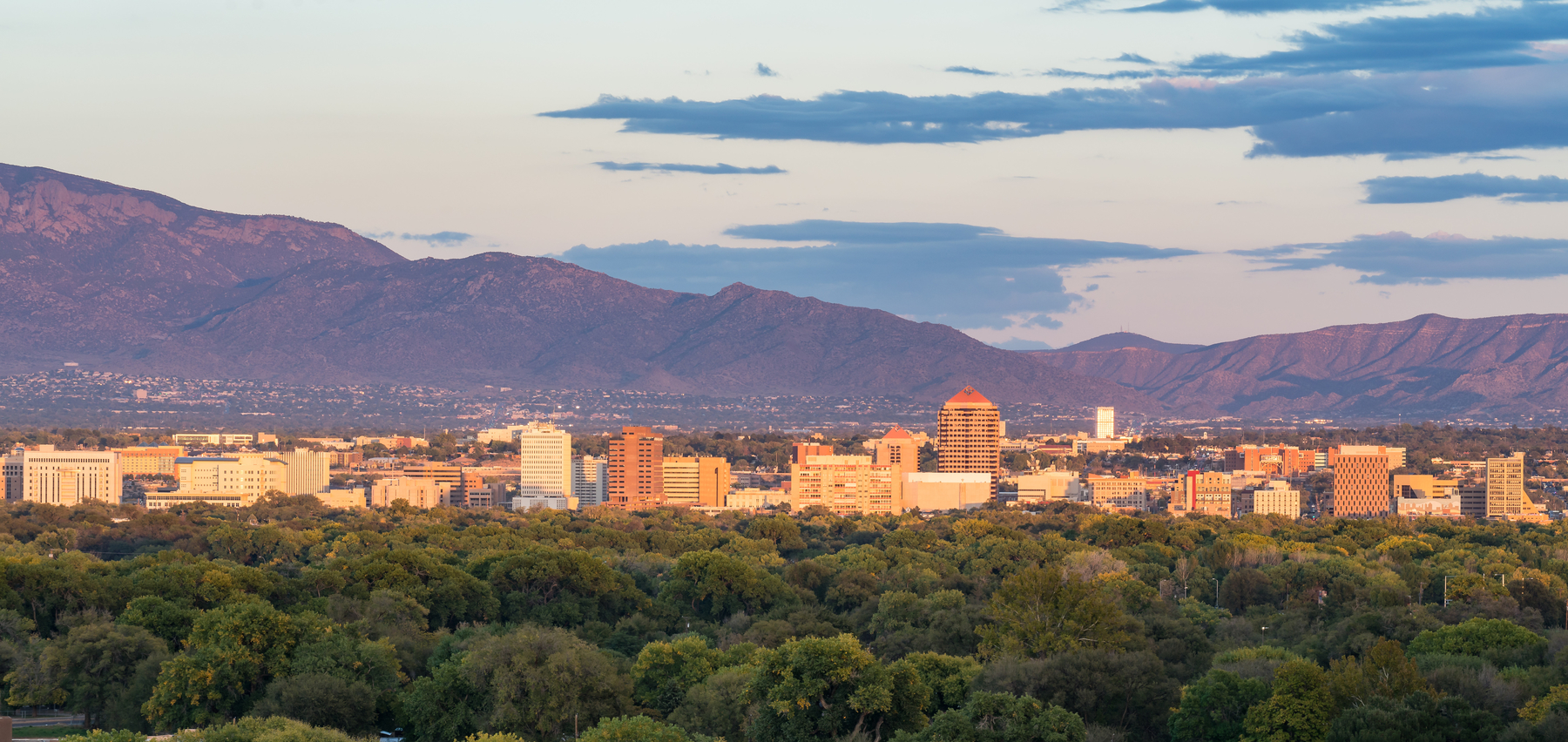
A city skyline with mid-rise buildings is set against a backdrop of mountains under a partly cloudy sky, with trees in the foreground.

Read the profile of New Mexico State Poet Laureate Manuel González, here.

Albuquerque, 
this is healing,
reclamation.
We sanctify the soil,
We are more than crime statistics.
We are San Jose sunrises,
Barelas barrio alchemy,
Central Avenue gospel
painting hope in bold strokes of dawn.

The blue light of the magic hour.

From Tramway to Old Town's soul,
To the west mesa

We carry medicine in our stride.
Our mouths,
our breath.

Our hearts are war drums.


Rebellion embodied.

Forged in fire

by volcano breath,


blessed by

the Rio's sacred flow
Burque, you are holy ground.
Not forgotten,
nor forsaken.
You are the drum circle,
the car show,
the lowrider moonrise over

El Chante: a temple.
West Mesa: the horizon
beckoning you to rise again

Like the sun over the Sandias
and ignite every barrio that dimmed its glow.

We are building a city that heals,
That honors,
that shouts joy into the future.

Be the ceremony that heals this whole city.
The Universe will listen.


We struck the first match,
kissed fire,
walked smoldering stars.

We awaken this city,
by touching rain.
Muraled saints,
lowrider prophets,
pueblo percussion,
spoken word sorcerers.

Our artists bleed authenticity all over their city!

Let’s shift systems and slice through borders


See the Youth with ancient souls,

grandmothers outchanting algorithms,

Shift silence to story,
trauma to testament,
survival to rising.

Burque, we have the power to rewrite gravity.
We forge the future,
barefoot,
on fire,
free.

We are the artists
powerful,
abundant,
magnetic as moonlight. 
This city raised us
with calloused hands and hungry prayers.
We were never broken,
just buried like seeds.

We are ancestral dreams and tears nourishing the soil.


We’ve mastered sacrifice,

breath,

devotion.

Burque,
we build mesas of marigolds and stardust.
We move mountains with our tongues.
These hands remember miracles.

Albuquerque,
we spray-paint change onto barrio walls,
weave it into our daughters’ braids,
drop it low with the lowriders.
This city is ceremony
every block a blessing.

We are the medicine,
the miracle,
the shift.
We are here.
We are healing.
We are sacred.

We remix the sacred,
architect revolution with our mouths.
We are here,
rising,
shifting from silence to sovereignty.

Our art comes out of our pain, our history, our family.
Trauma turns to creativity.
We are the strategy,
the spirit.
This is ceremony,
rebirth,
Burque transforming.

We rise together,

ancestors singing,

hoodies, feathers, microphones,

altars of pavement,

we are the medicine,

We are children of
corn and chaos,
mixtapes and medicine wheels.
We build,
breathe,
burn lies

fluent in flame.

Like the Mexican Revolution.
The Pueblo Revolt.

Our words:
ritual.
vessel.
volcano.
vision.

We invite communion, inspiration.
We are exactly who we came here to be.

Burque.
Here.
Now.
Community.
Find out more about Manuel González and follow or engage his journey as laureate, here.

Manuel González (opens in a new tab) began his three-year appointment as the New Mexico State Poet Laureate in 2025. He is a former Albuquerque Poet Laureate (2016-2018) and is widely respected for his unwavering commitment to community and justice. For more than two decades, González has worked at the intersections of poetry, education, and social change. His leadership has reached detention centers, classrooms, and community spaces throughout New Mexico. As a teacher at the Native American Community Academy, he uses trauma-informed, culturally grounded curricula to empower Indigenous and Chicano youth. He mentors young poets through Brave New Voices and co-founded Low Writing at El Chante: Casa de Cultura, a beloved community workshop that brings intergenerational groups together to write, heal, and build solidarity.

A Higher Purpose: Why the state poet laureateship is about more than poetry

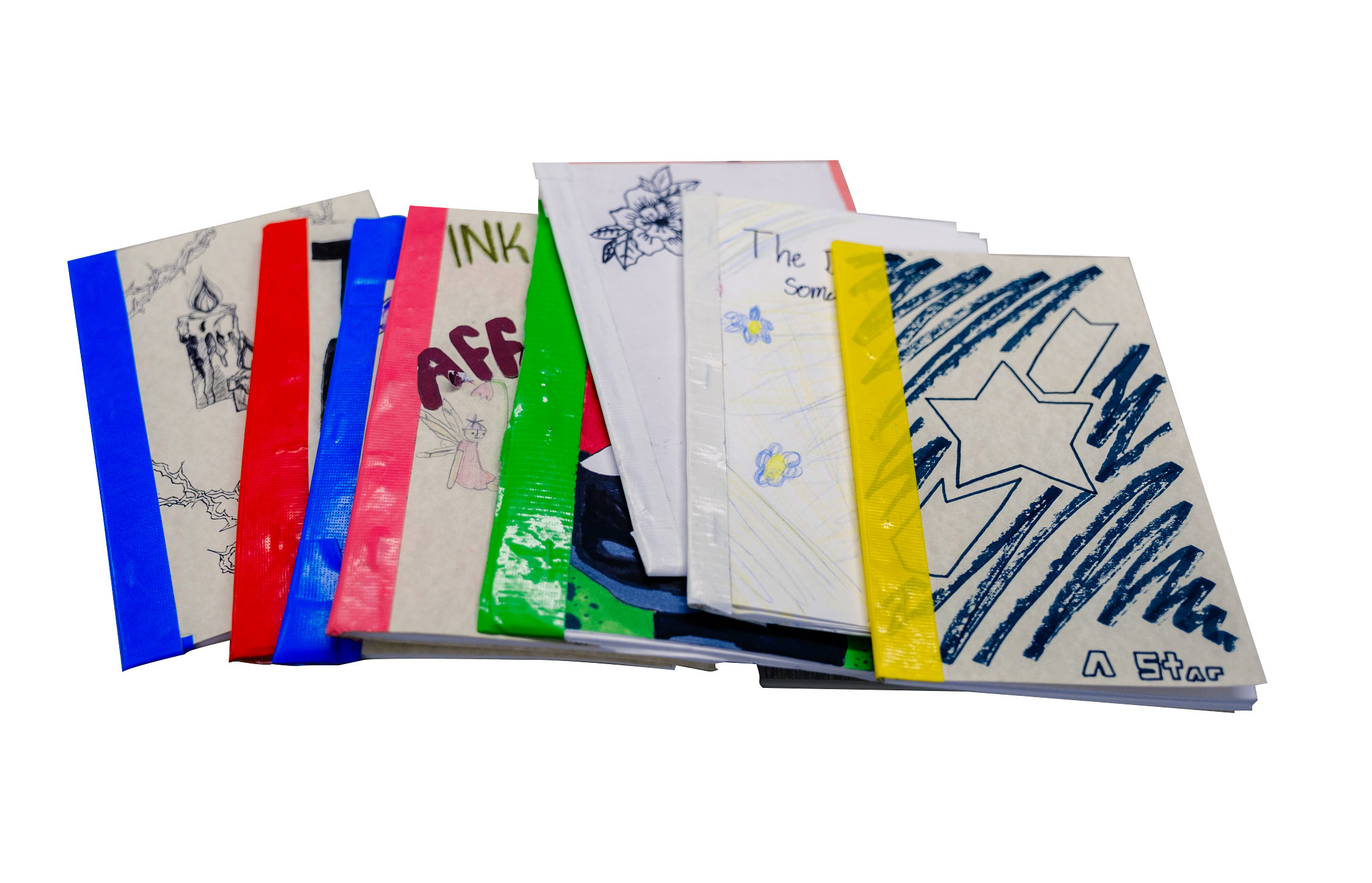
A stack of handmade, illustrated booklets with colorful taped spines and various cover designs, arranged on a white background.
His students’ poetry chapbooks at the Native American Community Academy, 2025.

The coffee shop was unusually packed with regulars for 7 p.m. on a Wednesday. There was a mix of folks, some looking like they’d been there for a while, entire book bags of belongings sprawled across tables. A noticeably larger group—appearing to be recent arrivals—were obviously there for something that would start soon. In short order, the Mega All-Ages (MAS) Poetry Slam host would secure five judges at random from audience members who committed to staying for the duration of the event. Upon arrival, six to eight poet participants signed up for the opportunity to compete. Other poets signed up on the spot for the open mic that would kick off the event. Manuel González would follow the open mic readings as the featured poet preceding the slam. And as a cacophony of nervous pre-game chatter and anticipation reached a fever pitch— wholly out of character for a university area coffee shop on a weeknight—the host launched into his familiar and interactive introduction about how the poetry slam is all about crowd participation. How the five judges were given score cards to rate each poem read on an Olympic-style scale of zero to ten. How the audience is encouraged to use their power of applause to influence the judges and are even empowered to boo the scores should a judge’s assessment of a poem be at odds with the vibe in the room. And after the open mic came and went, González took to the microphone.

The first time I heard him perform live in 2005, I am certain my expectations were prohibitively high. González’s legend preceded him long before he became New Mexico’s poet laureate. The coffee shop was R.B. Winnings Coffee Company (now Flock of Moons Brewery) just across Historic Route 66 from The University of New Mexico main campus in Albuquerque. I’d moved to New Mexico a few months prior. From the moment I started performing poetry locally, folks would hear me and immediately ask if I’d heard González. That night at Winnings, I could finally say, “Why yes, I have.”

Manuel González talks about the ofrenda he and his students at the Native American Community Academy created together, 2025.

Except heard is not the right word for it. You don’t hear a hurricane, you experience it. You don’t watch a tornado, you are hurled by it. And on that evening, in that coffee shop, Manuel was a force of nature. And like any encounter with an extreme weather event, that day was not soon forgotten. No more than twelve to fifteen lines into his first poem, I got the sense that it was a crowd favorite. The standing-room-only coffee shop repeated after González in unison, “My name is Albuquerque, but my friends call me ’Burque.” Even the students who found themselves unwittingly in the middle of a poetry slam that they didn’t sign up for, stopped gathering their things and stood transfixed as his storytelling captivated the room. 

In 1999, after a month of house arrest, a young González was looking for a place to go that wouldn’t land him back with an ankle bracelet. So, he reached for the now defunct Weekly Alibi to get a sense of what the world (read: Albuquerque) was up to after his month on “time out.” The first thing that jumped off the page was the announcement of a poetry slam at the Dingo Bar (now Echoes). Of course, for someone who—at the time—had never been to a poetry slam, it would be understandable to conclude that this would be the kind of pedestrian, even uneventful, sort of activity that would not run afoul of his prior conditions of release. I mean, on its face, the notion of a poetry reading barely raises a person’s blood pressure, right? I mean, how much trouble (read: “fun”) could it possibly be?

Boy, was he wrong. On that particular evening, good trouble was on full display in a clash of the titans between poets from Albuquerque versus poets from Santa Fe. Among the literary combatants were the icons and architects of the emergent New Mexico Poetry Slam scene: the likes of Kenn Rodriguez, Danny Solis, Matthew John Conley, and Joe Ray Sandoval. For Manny, prior to this date with destiny, his verses had been exclusively held in the confidence of clandestine journals and the hip hop cyphers of his youth where he was more likely to beatbox than spit. But that evening at the Dingo Bar changed everything. “It blew me open, I was awestruck,” he says. “I had no idea what this was. This was new. This was emotion. This was feeling. This was energy and electricity, and I felt it.”

González showed up to the next slam…and lost. In fact, he kept losing. But he kept showing up. And the more he did, the less the paperbound poems shook in his hand. Soon, his poems would take flight from the page and start bouncing off the back walls of bookstores, bars, classrooms, and juvenile detention centers, riding nothing but the unmistakably New Mexican baritone of his Nuevomexicano inflection. For Manuel, performance quickly became about more than winning poetry slams.

My Life is For You

In the early ’70s, Manny and the Casanovas were making a name for themselves, taking regional New Mexican music and introducing it to a national audience. Their vinyl album, Florecitas Mexicanas, was issued by Lance Records in 1968. Of his father—Manny Sr.’s—music, González wrote the following in 2014:

I love his music, but it’s not exactly what you would think. The sound of his music was not always easy to find in our home. He passed away from pancreatic cancer when I was eighteen months old. I don’t have any real memories of my father, but what I do remember is how much it would hurt my mother to hear his music. Every time his music would come on the local New Mexico station (which at the time was KABQ) my mother would break down and cry. They were really in love, and now with him gone the music was a source of pain. People always wanted to dig out my father’s albums whenever they saw us, and I knew that the fun was over and it was time to sit with my mother while she cried. It got to the point where I didn’t want to hear my father’s music because I didn’t want to see my mother cry.

González’s father was from Anton Chico and he passed away when the future poet laureate was just a baby, so young Manny never had the benefit of having his father teach him how to play an instrument. However, González had his father’s heart and this music inside him. When it eventually came out, it emerged as poetry.

Over time, Manny Jr.’s musical repertoire expanded beyond beatboxing to include percussion, the didgeridoo, and DJing weddings and other special or sacred occasions. But the González creative spark is not confined to Manny I and II; his wife and daughter hold the torch as well. “I carry my family in every poem I write,” says González. “Nichole and Sarita are my world. Without them and their support, I would never be who I am today.” As part of my own twenty-year involvement in the Albuquerque poetry community, Nichole González has served as the joyful—yet fiercely protective—den mother for consecutive generations of slam poets. It was unusual for González to show up for a poetry event without his family in tow. And with my son only a few years younger than Sarita, witnessing Manuel and Nichole raise their daughter “in the round” set an example for me and other poets trying to strike a precarious balance between what we practice and what we preach as poet-parents.

Poetry is traditionally considered an activity one does in solitude. For Manny (and many like him), the slam was an introduction to poetry through community. It’s a path that places publishing or the enrichment of oneself secondary to public benefit and the enrichment of community.

Manuel González performs for his students at the Native American Community Academy in Albuquerque, 2025.

It is fitting that Manny and Nickie conspired to raise a prodigal sun. As a young adult, Sarita Sol González is already an accomplished poet. I may or may not have been in the room the very first time that a pre-adolescent Sarita read an original poem during the open mic before a slam. I’ve watched Sarita captivate a room with a ease and sense of charm—well beyond her years—countless times since. In fact, while Manny and I were comparing notes about our first time meeting someone conferred the title of poet laureate, I was reminded that I also attended an Albuquerque reading by United States Poet Laureate Juan Felipe Herrera, where Manny and Sarita both performed. Sarita did such a phenomenal job at that event, that Herrera—the first Chicano to ever hold the position of U.S. poet laureate—invited Sarita to read her poetry in Washington, D.C.

To hear Manny talk about his love for his family recalls a Manny and The Casanovas original, “Mi Vida Es Para Ti (My Life is For You).” For its part, the slam poetry community in Albuquerque has always been more like a ragtag band of feral cousins: literary misfits who have seen each other grow up, a motley crew of punk rock poets who have watched one another have and raise kids. “We’re a family,” says González. And like a doctor or a lawyer, it’s really nice to have a state poet laureate in the family. Perhaps even more useful in times like these.

Sin Fronteras

From the page to the stage to the cage? When I think about Manuel González, I think “bards without borders.” Nobel and Pulitzer prize-winning author Toni Morrison once said, “You wanna fly, you got to give up the shit that weighs you down.” Not only has González lived this Morrison dicho, he’s fashioned it into a lesson plan. In 2011, he invited me to co-present a weeklong performance poetry workshop and residency at Sequoyah Adolescent Treatment Center in Albuquerque. A thirty-six-bed residential treatment center operated by the New Mexico Department of Health, Sequoyah provides care, treatment, and reintegration into society for boys ages thirteen to seventeen who have a history of violence, a mental health disorder, and are amenable to treatment. 

Manuel González performs at TogetherSource in Albuquerque during its first third Thursday open mic poetry reading of 2026.

Prior to this opportunity to apprentice under González, we’d been friendly. What began as admiring him from afar eventually led to shared stages and laughs at poetry events. González was larger than life on stage, but effortlessly approachable off mic. At Sequoyah, however, not only did I get to peek under the hood (double entendre intended), I got a front row seat to González’s process. Being able to observe him as he methodically rolled out how to put a poem together was worth the proverbial price of admission. Witnessing González shapeshift from demonstration to facilitation in helping the young men in front of us put their poems together was a profound education for me as a nascent teaching artist at the time. It was the power of poetry bringing people together that has stayed with me from that time at Sequoyah. Both of us have continued to do this work in the years since. González will take this work to the next level as state poet laureate as he continues his mission to bring poetry to the places it is least expected.

“I use poetry and literacy as a guise to do real heartwork in spaces where people need that type of healing,” he says. And when González says “heartwork,” he means it. Even in environments flush with poets and poetry, an infusion of heartwork can prove transformative. González, whose day job is teaching high school, recounted his experience traveling to the Brave New Voices youth poetry slam competition in Madison, Wisconsin last summer, with a group of his students at the Native American Community Academy (NACA).

Even at the annual, multi-day competition which features upwards of fifty teams of teen poets from across the country; the NACA team opted to bring healing to what can best be described as a “literary gunfight.” González remembers being approached by other coaches and festival organizers who were troubled by the “take no prisoners, win at all costs” vibe among the young competitors at the previous year’s competition. NACA did not participate in 2024, but this past year the team brought an energy that González described as sacred. “We started with pulling out the smudge sticks,” he says. While most of the other teams were making last minute adjustments and preparations for their performances, NACA smudged each other and prayed. “And those other teams saw that, and paid attention,” González goes on. “It started to rain and our kids engaged in prayer, celebrating the rain, while all the other kids ran for cover. But after seeing the joy with which our students were praying and playing in the rain, those other teams came out and joined us.”

More Medicine Than Metaphor

El Palacio readers may well be familiar with the phrase “poor man’s therapy” as applied to poetry. More an indictment of the accessibility of mental health services than a referendum on the mental well-being of poets, the benefits of expressive writing have long been documented. However, the therapeutic impact of poetry to which González subscribes is so much more than just “getting it off your chest.” It is a genuine, spiritual belief in the healing power of the spoken word: more chant than song; more incantation than description; more prayer than poem; more the art of living than the act of writing.

“We have a practice of finding the sacred in things,” he says. “This is what makes the poetry from this place and our people special.” 

González will be the first to tell you that poetry saved his life, and it is not hyperbole. He means it in the most prosaic of ways: both memoir and magical realism. Poetry not only changed the direction of his life, it also changed his relationship with the world and the people he shares it with. 

In this way his poetry is more medicine than metaphor: a way of healing, but also a way of being. A way of well-being. More for fixing broken hearts than broken bones. Craft? Certainly. However, when done with intention, that craft can be shared as a nuts-and-bolts process for seeing the world differently. And since I am not one to shy away from hyperbole, I dare say González’s approach to poetry-as-healing is to posit poetry as a way of seeing. The type of healing that reverses blindness. Think “New Testament” (no pressure, Manny). Because like González, I believe that the more you look for milagros, the more you find them—and the more they find you.

Like the state poets laureate before him, González is charged with leading statewide poetry initiatives, developing educational outreach programs, and acting as an ambassador for our state’s traditions of literary excellence. While New Mexicans can expect a robust menu of programmatic offerings—such as public readings, workshops, stakeholder activations and other creative projects—Manuel sees the position as less meta and more medic.

“If people are so courageous enough to stand up and share the healing journey they went on through poetry, it gives other people the inspiration to go on their own journeys in that way,” he says. “And that’s kinda what I want to do with the healing journey that I’ve been on through poetry as I go to the different pueblos, different counties, and different corners of New Mexico. I want to bring this healing medicine. Because New Mexico has a lot of healing to do.”

I saw González heal a room for the first of many times that night at R.B. Winnings Coffee Company, not necessarily through his poetry, but through his presence. González did not perform his feature set and leave immediately. He returned to his seat, rejoined his wife (his daughter hadn’t been born yet), and enjoyed the remainder of the poetry slam as a spectator—and as the loudest cheerleader for every poet who took the stage that night. He reminded me and everyone in that room that being a poet is more than just “the work.” Poetry is also bearing witness. That’s where the healing begins.

To find out more about Manuel González and follow or engage his journey as laureate, please visit https://nmarts.org/all-programs/poet-laureate/.

Hakim Bellamy (opens in a new tab) is an inaugural poet laureate of Albuquerque, New Mexico (2012–2014), and currently serves as deputy director for the Cultural Services Department for the City of Albuquerque. Having shared his work in no less than five countries, he is convinced that poetry is the sixth love language. He’s also written a few books. Find them (and him) at beyondpoetryink.com.

Manuel González (opens in a new tab) began his three-year appointment as the New Mexico State Poet Laureate in 2025. He is a former Albuquerque Poet Laureate (2016-2018) and is widely respected for his unwavering commitment to community and justice. For more than two decades, González has worked at the intersections of poetry, education, and social change. His leadership has reached detention centers, classrooms, and community spaces throughout New Mexico. As a teacher at the Native American Community Academy, he uses trauma-informed, culturally grounded curricula to empower Indigenous and Chicano youth. He mentors young poets through Brave New Voices and co-founded Low Writing at El Chante: Casa de Cultura, a beloved community workshop that brings intergenerational groups together to write, heal, and build solidarity.

A selection of Arthur Sze’s poetry

An older man in a light blue shirt sits at a desk, typing on a typewriter in a spacious, book-filled home office.
Arthur Sze at his home in Santa Fe, 2025.
Leafless
Sunlight strikes the leafless aspen branches,
strikes the white picket fence, and as I
look at highlighted edges, my eyes sting.
Tufted grass stalks sway in the flooding rays,
and, in the poinsettia of this hour, I need
some darkness to bloom: in this space
a snow leopard leaps among rocks,
the rosettes of its fur a moving landscape;
its hunger scents the air. As I exhale,
a blue-throated hillstar sips from a Chuquiragua
flower, a fly agaric pushes out of soil,
a raccoon scampers backward down an elm—
we are always running from and lunging to;
when we stop, the eagle feather
of this pause blesses. Before light
of the shortest day lifts to the hills,
it runs across my line of sight in widening gold.

Arthur Sze, “Leafless,” from Into the Hush. Copyright 2025 by Arthur Sze. Reprinted with the permission of Copper Canyon Press.

Sight Lines
I’m walking in sight of the Río Nambé—
salt cedar rises through silt in an irrigation ditch—
the snowpack in the Sangre de Cristos has already dwindled before spring—
at least no fires erupt in the conifers above Los Alamos—
the plutonium waste has been hauled to an underground site—
a man who built plutonium triggers breeds horses now—
no one could anticipate this distance from Monticello—
Jefferson despised newspapers, but no one thing takes us out of ourselves—
during the Cultural Revolution, a boy saw his mother shot by a firing squad—
a woman detonates when a spam text triggers bombs strapped to her body—
when I come to an upright circular steel lid, I step out of
the ditch—
I step out of the ditch but step deeper into myself—
I arrive at a space that no longer needs autumn or spring—
I find ginseng where there is no ginseng my talisman
of desire—
though you are visiting Paris, you are here at my fingertips—
though I step back into the ditch, no whitening cloud dispels this world’s mystery—
the ditch ran before the year of the Louisiana Purchase—
I’m walking on silt, glimpsing horses in the field—
fielding the shapes of our bodies in white sand—
though parallel lines touch in the infinite, the infinite is here—

Arthur Sze, “Sight Lines” from Sight Lines. Copyright 2019 by Arthur Sze. Reprinted with the permission of Copper Canyon Press.

Red Breath
Shaggy red clouds in the west—
unlatching a gate, I step into a field:
no coyote slants across with a chicken in its mouth,
no wild asparagus rises near the ditch.
In the night sky, Babylonian astronomers
recorded a supernova
and witnessed the past catch up to the present,
but they did not write
what they felt at what they saw—
they could not see to this moment.
From August, we could not see to this moment
but draw water out of a deep well—
it has the taste of
creek water in a tin cup,
and my teeth ache against the cold.
Juniper smoke rises and twists through the flue—
my eyes widen
as I brush your hair, brush your hair—
I have red breath:
in the deep night, we are again lit,
and I true this time to consequence.

Arthur Sze, “Red Breath,” from Compass Rose. Copyright 2014 by Arthur Sze. Reprinted with the permission of Copper Canyon Press.

Returning to Northern New Mexico After a Trip to Asia
A tea master examines pellets with tweezers,
points to the varying hues, then pushes
the dish aside. At another shop, a woman
rinses a cylindrical cup with black tea:
we inhale, nod, sip from a second cup—
rabbit tracks in snow become tracks
in my mind. At a banquet, eating something
sausage-like, I’m told, “It’s a chicken’s ball.”
Two horses huddle under leafless poplars.
A neighbor runs water into an oval container,
But, in a day, the roan bangs it with his hoof.
The skunks and raccoons have vanished.
What happened to the End World Hunger project?
Revolutionary slogans sandblasted off
Anhui walls left faint outlines. When
wind swayed the fragrant pine branches
in a Taiwan garden, Sylvie winced, “Kamikaze
pilots drank and whored their last nights here.”

Arthur Sze, “Returning to Northern New Mexico After a Trip to Asia,” from Compass Rose. Copyright 2025 by Arthur Sze. Reprinted with the permission of Copper Canyon Press.

Kintsugi
He slips on ice near a mailbox—
no gemsbok leaps across the road—
a singer tapped an eagle feather on his shoulders—
women washed indigo-dyed yarn in this river, but today gallium and germanium particles are washed downstream—
once they dynamited dikes to slow advancing troops—
picking psilocybin mushrooms and hearing cowbells
in the mist—
as a child, he was tied to a sheep and escaped marauding soldiers—
an apple blossom opens to five petals—
as he hikes up a switchback, he remembers undressing her—
from the train window, he saw they were on ladders cutting fruit off cacti—
in the desert, a crater of radioactive glass—
assembling shards, he starts to repair a gray bowl with gold lacquer—
they ate psilocybin mushrooms, gazed at the pond, undressed—
hunting a turkey in the brush, he stops—
from the ponderosa pines: whoo-ah, whoo whoo whoo—

Arthur Sze, “Kintsugi,” from Sight Lines. Copyright 2019 by Arthur Sze. Reprinted with the permission of Copper Canyon Press.

First Snow
A rabbit has stopped on the gravel driveway:
imbibing the silence,
you stare at spruce needles:
there’s no sound of a leaf blower,
no sign of a black bear;
a few weeks ago, a buck scraped his rack
against an aspen trunk;
a carpenter scribed a plank along a curved stone wall.
You only spot the rabbit’s ears and tail:
when it moves, you locate it against speckled gravel,
but when it stops, it blends in again;
the world of being is like this gravel:
you think you own a car, a house,
this blue-zigzagged shirt, but you just borrow these things.
Yesterday, you constructed an aqueduct of dreams
and stood at Gibraltar,
but you possess nothing.
Snow melts into a pool of clear water;
and, in this stillness,
starlight behind daylight wherever you gaze.

Arthur Sze, “First Snow,” from Sight Lines. Copyright 2019 by Arthur Sze. Reprinted with the permission of Copper Canyon Press.

Arthur Sze (opens in a new tab) is the twenty-fifth United States Poet Laureate. Sze was born in New York City in 1950 to Chinese immigrants. He is the author of twelve poetry collections, most recently Into the Hush (2025), as well as the prose collection The White Orchard: Selected Interviews, Essays, and Poems (2025).

Arthur Sze

An older man walks through a field of leafless trees with a white dog on a grassy path during daylight.
Arthur Sze at his home in Santa Fe, 2025.

Read six selected Sze poems published in this issue here.

At age twenty-one, Arthur Sze hitchhiked from El Paso to Santa Fe in a single day. Knowing no one, and accompanied only by his boundless curiosity, he arrived seeking a place to build a life as a poet. Fifty-three years later, he hasn’t left. And his plans for becoming a poet clearly came to fruition.

Sze was recently appointed the twenty-fifth United States Poet Laureate for the 2025–2026 term. The appointment tops a highly decorated career, which includes twelve poetry books, a book of Chinese poetry translations, a National Book Award for Sight Lines (2019), Pulitzer Prize finalist recognition for Compass Rose (2014), the Ruth Lilly Poetry Prize, the Jackson Poetry Prize, and the Bollingen Prize for American Poetry for Lifetime Achievement.

Arthur Sze appeared in conversation with Forrest Gander as a part of the Lannan Foundation’s “Readings & Conversations” series, 2022.

Though widely renowned on national and international levels, local poetry aficionados have long claimed Sze as a beloved New Mexico poet who braids depth of observation, complex connections, and lived experiences into his work. The abundance he brings to readers through his poetry is perhaps only matched by his generosity as a local steward of the art form. From his early days working in the New Mexico Poetry in the Schools program, teaching workshops to incarcerated people at the penitentiary, and organizing the 1983 Tone Roads West: Poetry and New Music Festival; to collaborating with local artists and museums, and showing up to local poetry readings and events, Sze has always been community minded.

It feels like an act of generosity, as well, when Sze meets with me for conversation one brisk November afternoon. I began reading Sze’s work two decades ago when I became more serious about writing poetry, and he has since become one of my favorite living poets. While sipping hot beverages
on the patio of a downtown Santa Fe coffee shop, we talk about his journey to New Mexico and life as a poet. The literary luminary disarms me with his warmth and humility, and at times it feels like I am simply chatting with a new friend.

Born in Manhattan, Sze grew up in Queens, Long Island, and New Jersey. He describes his largely suburban upbringing as feeling “too insular” and protected. Raised by first-generation Chinese immigrant parents, he says he was encouraged by them to “do something safe professionally, like doctor, lawyer, scientist, banker.” But an itch for poetry, while majoring in science at MIT, caused him to transfer to UC Berkeley, where he studied poetry with his mentor Josephine Miles. While there, he also took to translating ancient Chinese poems under the tutelage of Mandarin instructor Ts’ai Mei-hsi. These formative experiences broadened his horizons and allowed him to see that “I needed more life experience, basically.” 

After college, he traveled around Mexico for a few months before hitching a ride to Santa Fe. Those early years in his newfound home were filled with a sense of discovery. “I knew the East Coast and the West Coast. New Mexico was somehow outside of the America I had grown up with, and I really liked it,” he says.

Arthur Sze at his home in Santa Fe, 2025.

From 1974 to 1980, Sze worked as a poet with New Mexico Poetry in the Schools, a program of New Mexico Arts. The work took him all over the state and connected him to fellow poets Mei-mei
Berssenbrugge and Joy Harjo—the twenty-third poet laureate of the United States—both of whom would become life-long friends and sources of inspiration. “In many ways it was like my equivalent to grad school,” says Sze, who forged his own learning path after college. He also received small grants from the Santa Fe Council of the Arts to hold workshops at the New Mexico School for The Deaf and the Penitentiary of New Mexico. The grant-based work proved fulfilling but was not enough to sustain him financially. “I was basically a really poor poet for many years,” he says.

To make ends meet, he took a lot of odd jobs. He painted houses, worked for the U.S. Census, waited tables at the old Palace Restaurant & Saloon, did construction work, and was even an extra in a movie. Dedicated to his poetry, Sze chose jobs with schedules that afforded him time to write. He pursued work that was practical and available, and that ultimately exposed him to a different kind of living.

“I wanted to feel like poetry isn’t just something somebody teaches students in an academic environment,” he says. “I wanted poems to be able to talk about somebody who puts plaster up on a wall, or who is weaving, or who is making jewelry, or is picking mushrooms. I wanted a lot of that world in my poetry, so in many ways I consciously pursued that.”

The poem “The Moon is A Diamond,” published in Sze’s 1982 book Dazzled, offers a glimpse of Flavio Gonzales, under whom Sze apprenticed as a construction worker. The poem presents a clear-eyed picture of two workers plastering a portal together, recalling “ristras of red chile hanging / in the October sun.” The short poem reveals empathy and reverence for labor and the unique cultural landscape of Santa Fe.

Other early poems reference visits to regional locations, such as Taos, Jemez, and Zuni Pueblos, and are colored by the open sky, wind, trees, languages, and deserts of New Mexico. Poems from his early books show an attunement to nature and exhibit Sze’s application of deep seeing. Both skills originated from his engagement with ancient Chinese poetry as a translator, as well as American imagist poets Ezra Pound and William Carlos Williams, whom Sze has credited as influences.

Arthur Sze at his home in Santa Fe, 2025.

Sze’s poetic gifts can be seen in these lines from the poem “Strawberries in Wooden Bowls” published in his first book, The Willow Wind (1972):

The fields are green with their rain

and the wind curls the stars in the cold air.

You stand now, silent, in the window of light

and the milk you pour is glazed.

The strawberries in the wooden bowls

are half-covered with curdled milk.

The keenly observant and relatively straightforward lyric poems Sze had been writing early on underwent a wild expansion with the publication of his fifth book, Archipelago, in 1995. Breaking free of the single poem format, serial poems radiate throughout the book to create a network of subconscious connections. By expanding his poems, Sze also allows for a kind of collapsing of space and time, whereby women dancing in a pueblo, the Chinese Cultural Revolution, an Alaskan float house, and the Blue Mosque in Istanbul can all exist within the same poem.

“If you want to write a poem that’s one hundred lines long or one hundred and fifty lines long, what kind of poem is that going to be?” Sze says of his extended poems. “For me, it meant trying to figure out how to put more of the world into the poem and that meant finding ways to enable the poem to become open to complexity but also enact more complexity.”

The world and its various cultures as experienced through travel appears thematically in many of Sze’s poems. But Native American and Asian cultures remain the most prevalent throughout his body of work. The diasporic Asian experience in the American Southwest is an ongoing preoccupation of mine, and I’m interested in how the different cultures manifest and fold together. I ask Sze if he sees a connection between New Mexico and Asia. In response, he says, “I do,” and explains that he witnessed many of those connections at the Institute of American Indian Arts (IAIA), where he taught for twenty-two years, and currently serves as professor emeritus.

“The influence of Native Americans is particularly strong in my work and in my life,” Sze says. “The sense of Native American worldviews, of language, of culture, struck a really deep chord in me and had strong connections to Asian perspectives.”

Sze began teaching as an instructor at IAIA at age thirty-three and later moved up to become creative writing department head. He was with the school as it transitioned from Bureau of Indian Affairs (BIA) leadership and was instrumental in growing the Associate of Arts degree into a four-year Bachelor of Fine Arts undergraduate degree program.

As a teacher, Sze has nurtured generations of Native American poets. He talks about how he found commonalities with them by reaching into his own Chinese culture and background. While at IAIA, he invented a class called The Poetic Image that incorporated Chinese classical poetry. “If I said Chinese verbs have no tense, the Native students said, ‘our language is that way,’” he shares. “If I said the Asian perspective of self is much smaller than in the West—think of a landscape painting—they immediately understood that.”

Poems in Archipelago give way to a multitude of connections by juxtaposing scenes, events, and natural phenomena that span time and place. The interlacing of seemingly disparate cultures and Native American and Asian aesthetics form a luminous tapestry in Sze’s hands. It’s no surprise that it was Archipelago that caught the attention of Copper Canyon Press some thirty years ago, marking the beginning of a lifelong and life-changing publishing relationship.

Sze’s first four books found homes with what Sze describes as tiny presses run by publishers with a love for poetry. One of those publishers was Tooth of Time Books, a small press run by John Brandi out of Guadalupita, New Mexico. Tooth of Time published Sze’s second book Two Ravens and reissued his first, The Willow Wind.

In an email to me, Brandi opened up about the poetry landscape of New Mexico in the late sixties and seventies, when he and Sze first met. “Poets were deeply wedded to the character of the land, the particulars of deeply-rooted, varied cultures,” he shares. “Camaraderie was paramount. You’d find poets like Arthur, Joy Harjo, Harold Littlebird, Mei-mei Berssenbrugge, Leo Romero, Anne Valley-Fox, Larry Goodell, Luci Tapahonso gathered in animated talk.” As he got to know Sze, he says, “I was struck by his absolute fidelity to poetry, to the word as a living substance, to his ever-curious, tactful way of moving through the world without getting caught in it.”

Sze recognizes Brandi’s influence as a publisher who took an interest in his early poetry “when no one else did.” He admired his do-it-yourself spirit of starting his own press in the early 1970s. “There was a courage and wildness that was important to me,” Sze says of Brandi’s style, which matched his own liberated path.

Arthur Sze at his home in Santa Fe, 2025.

Publisher relations have always been paramount to Sze. “There were really only two publishers in the country, when I looked across the spectrum, that I thought could be an aesthetic match,” he says. Those publishers were New Directions, which had published Ezra Pound and “had an understanding of Asian poetry,” he says, and Copper Canyon Press because “they published beautiful books” that included translations of ancient Chinese poetry. Sze sent manuscripts of his early books to Sam Hamill, then publisher of Copper Canyon Press, over a span of fifteen years, and they were rejected again and again. At one point Hamill wrote that he loved Sze’s translations of Chinese poetry and offered to publish a book of his translations. Sze declined the offer, as he felt the need to establish himself as a poet first.

Then in 1994, Sze finished Archipelago and sent it to Hamill. Expecting another rejection, he simultaneously submitted it for the National Poetry Series book prize. The book was selected for the prestigious award by Barbara Guest, but it turned out Hamill also wanted to publish it. Sze declined the National Poetry Series award because to accept it would mean going with a publisher other than Copper Canyon Press. Hamill was so moved by this gesture that he promised Sze that Copper Canyon Press would not only publish Archipelago, but they would publish all his work “past, present, and future,” and publish his future book of Chinese poetry translations whenever it was ready.

A month after our interview, Sze marks the beginning of his tenure as U.S. Poet Laureate with an inaugural reading at the Library of Congress, which I stream online. Dressed in a dark suit and tie, Sze presents just as humbly as the casually attired person I met at our local coffee shop. New Mexico is prominently featured in the reading as Sze introduces his poem “Farolitos” along with a short explanation of the history of this distinctly New Mexican tradition. He also reads his poem “Acequia del Llano,” that he describes as a “poem rooted in Santa Fe, New Mexico” that uses “four classic Japanese forms” to shape the language. As U.S. Poet Laureate, Sze plans to continue to do what he has always done: bring cultures together and reveal how across language and distance and time, humanity is connected.
Arthur Sze (opens in a new tab) is the twenty-fifth United States Poet Laureate. Sze was born in New York City in 1950 to Chinese immigrants. He is the author of twelve poetry collections, most recently Into the Hush (2025), as well as the prose collection The White Orchard: Selected Interviews, Essays, and Poems (2025).

Don J. Usner (opens in a new tab) was born in 1957 in Embudo, New Mexico. He has written and provided photos for several books, including Sabino’s Map: Life in Chimayó’s Old Plaza, Benigna’s Chimayó: Cuentos from the Old Plaza, Valles Caldera: A Vision for New Mexico’s National Preserve, and Chasing Dichos through Chimayó. Don is also the photo editor consultant for the annual New Mexico Treasures Engagement Calendar published by the Museum of New Mexico Press.

Kathryne Lim (opens in a new tab) was born in Seoul, Korea, and has lived in the American Southwest most of her life. She is author of the poetry collection Constellation of Wings (2023). She lives and writes in Santa Fe.