
Betty Thomas Toulouse

Light green background with the words El Palacio repeatedly printed in large, bold, diagonal text in a lighter shade.

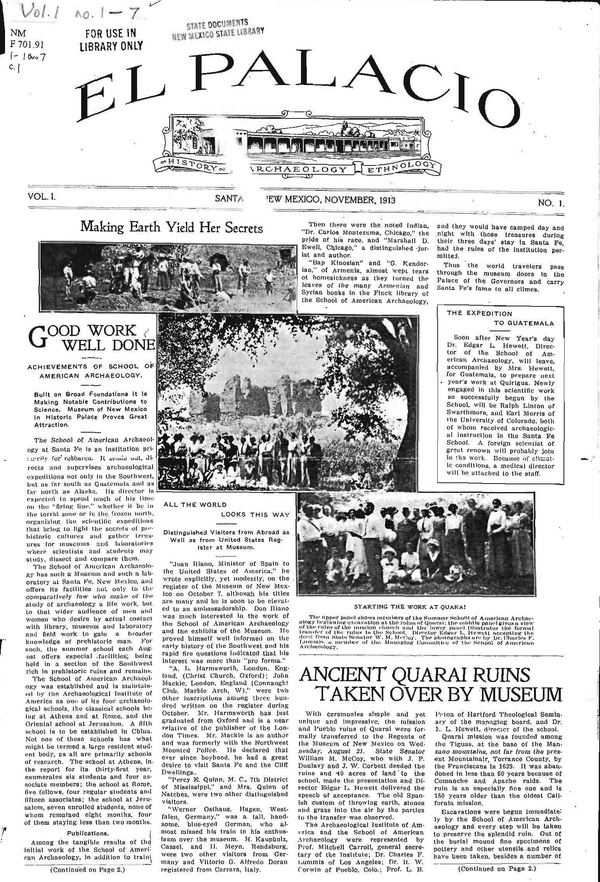
On the occasion of the seventy-fifth anniversary of El Palacio, Betty Toulouse, then recently retired as curator of collections at the Laboratory of Anthropology, wrote an article titled “Happy Birthday El Palacio” (90 [2], July 1984). She had just finished indexing the first fifty volumes of El Pal, and in her tribute to the magazine noted how the Museum of New Mexico and El Palacio had evolved and grown together since 1913. Today, as we celebrate the 100th anniversary of El Palacio, we pay tribute not only to the magazine, but also to Betty Toulouse in long-overdue recognition of her many contributions to El Palacio, the Indian Arts Fund, the Lab, and the Museum of New Mexico.

An artist in her own right, Betty Toulouse spent years curating the Indian Arts Fund collections at the Laboratory of Anthropology in Santa Fe, New Mexico. Her knowledge of the collections was encyclopedic, and she was never happier than when she was able to share that knowledge with staff or visitors. Long before it became correct curatorial practice to wear gloves when handling the pots or jewelry, Toulouse, along with the rest of the staff at the Lab, was known to stroke admiringly her favorite seed bowl, made by the famed Hopi ceramist, Nampeyo; trace the design on a special bracelet; or discuss the weaving techniques and dyes used in an unusual blanket.

Growing Up Artistic

Betty Thomas Toulouse was born March 9, 1915, in San Diego, California, the daughter of Frederick Trent Thomas, an architect, and his wife, Louisa (pronounced Lou-eye-za) Ewing, whose family had homesteaded in Farmington, New Mexico, and Durango, Colorado. Toulouse’s childhood took her to cities across the West and Southwest, and exposed her to a range of architects, designers, and artists. After San Diego, the Thomas family lived for a brief time in Albuquerque before moving to Santa Fe in early 1918, where Betty’s father worked with Rapp, Rapp and Hendrickson, known for their iconic design of the new Art Museum on the northwest corner of the plaza, and on the design and supervision of the extensive makeover of La Fonda.

Before moving to Trinidad, Colorado, later that year to continue his association with the Rapp brothers’ firm, Thomas renewed his acquaintance with artist, photographer, and designer Carlos Vierra, whom he had met at the Panama-California Exposition in 1915. Many years later, Toulouse recalled that Thomas and Vierra exchanged ideas about the Spanish-Pueblo Revival style of architecture, which resulted in the design of the Vierra house, on the corner of East Coronado Road and Old Pecos Trail in Santa Fe, now on the State Register of Cultural Properties and the National Register of Historic Places. Between 1922 and 1929, Thomas worked for Allied Architects in Los Angeles before moving back to Albuquerque.

The Thomases spent the early years of the depression in Durango before moving back to Santa Fe in 1934, where Trent Thomas worked as an architect for numerous state and federal agencies: the New Mexico Highway Department, the New Mexico State Park and Energy Conservation Commissions, the National Park Service, the Public Works Reserve, and the Kruger and Clark design firm (K. C. Kruger would go on to design the New Mexico state capitol building, known as the Roundhouse). At the same time, Thomas worked with John Gaw Meem and Truman Matthews on the Historic American Buildings Survey (HABS). Thomas became an associate member of the American Institute of Architects in 1926 and a full member in 1948. He died in Santa Fe in 1951.

Betty Thomas learned about art and design in the multiple venues of her childhood. A seamstress from the age of five, when she outfitted her doll from head to toe, she briefly attended Chouinard’s Art Institute in Los Angeles, where she studied under the noted costume designer, Edith Head, herself an alumna of the school. Betty graduated from Albuquerque High School in 1932 and returned to Santa Fe, where her father, by then a registered architect in New Mexico, was busy overseeing the construction of the Don Gaspar Street Bridge.

Nineteen-year-old Betty soon landed a job as an intern at the new Laboratory of Anthropology on what is known today as Museum Hill. There she worked with Kenneth Chapman of the Indian Arts Fund Collection and Harry Mera, the first archaeologist on the staff of the Lab. In her later life, Toulouse delighted in reminiscing to younger staff at the Lab about her early years in the building, when, at 4:00, buzzers sounded, work ceased, and everyone gathered in the sherd room, now the reception area of the Archaeological Records Management Section (ARMS) for tea and a discussion of the day’s events.

At the Lab

Betty Thomas began work as an intern at the Lab in the summer of 1934. Nominally a museum assistant, she was primarily the Lab’s tour guide. “The visitors . . . came in buses, courier limousines and private automobiles,” she said. “The American Express Company sponsored tours at least once a week, and sometimes more often during the travel season. Large buses, two or three, filled to capacity, would drive up front of the Laboratory [where Milner Plaza is now] and in mere minutes the building would be inundated with people, seemingly in all directions. Talking to visitors was usually done to the accompaniment of small chatter between members of the group—until we went down the stairs into the pottery rooms [the former collection rooms are used for storage]. As each person saw that large room filled with richly decorated Indian pottery, there was an intake of breath, a low sound of amazement and then complete silence. Finally questions began to come and always among the first were, ‘How much are they worth?’ or ‘How many are there?’ and occasionally, ‘How do you know where to find them?’”

Throughout her career, Toulouse loved working and corresponding with visitors, whether they were tourists, professional archaeologists and anthropologists in town to work on their own research projects, collectors, or dealers. Many asked her, “What can you tell me about this piece?” She was especially fond of working with groups of Pueblo potters, who would come in to discuss and handle old pieces made by their mothers, grandmothers, or other relatives, long deceased. Occasionally there would be a lengthy discussion in Tewa, Keres, or Tiwa, along with giggles or gales of laughter when someone told a funny story about a certain potter. Whenever Toulouse asked how the visiting potters determined exactly who had made a special bowl or olla, she was invariably told that they “just knew.”

Her internship completed, she joined the staff at the Lab and was asked by Dr. Mera and Stanley Stubbs to catalogue the Indian Arts Collection. The goal of the Indian Arts Fund, founding in 1922 as the Pueblo Pottery Fund, was twofold: “to save Indian Art for the Indians, and to preserve a complete historical record of the varied Indian Arts of the Southwest.” According to Toulouse’s history of the Lab, Harry Mera had been in charge of the Indian Arts Fund materials since the fund’s founding but because of his other duties had never had a chance to catalogue the many items in the collection. Instead, Mera wrote the accession information on a slip of paper, which he then saved in a shoe box. Thus began Toulouse’s love affair with modern Southwestern material culture. She measured and described each piece in the collection, leading over time to her voluminous knowledge of it.

Marriage and the War Years

Joseph Toulouse, the archaeologist who excavated much of the seventeenth-century Spanish mission at Abo, New Mexico, came to Santa Fe to confer with Harry Mera or Kenneth Chapman at the Lab. It is likely that he and Betty met at that time. They were married in 1939 and moved to Abo and Mountainair, where Joe wrote up the results of his excavations and Betty illustrated his paper. After the start of World War II, Joe accepted a position as a security officer with the Atomic Energy Commission, and the small family, which by then included their daughter Patricia, moved to Los Alamos, the “Secret City on the Hill,” where a son, Joseph Jr., was born and they remained until after the war.

Even though the Laboratory of Anthropology had managed to eke out an existence through the Great Depression, and just barely managed to hold on through World War II, after Harry Mera retired in 1946, staffing was at an all-time low, and the publications program had come to an end. Edgar Lee Hewett died on December 31, 1946, and in 1947 the Lab became part of the Museum of New Mexico. With the merger of the Lab and Museum, the ownership of the Indian Arts Fund collection was retained by the School of American Archaeology even though it continued to be housed at the Lab.

At the Museum of NewMexico

Betty returned to Santa Fe with her children in the mid-1950s and became curator of the Indian Arts Fund collections, which were still housed at the Lab. However, in 1959 the legislature passed SB 147, which ended the collaboration of the School and Museum and formally separated the institutions into two discrete entities. Wayne Mauzy, who had been director of the dual organization, submitted his resignation to the School to become director of the Museum, and Edward Weyer Jr. became the new director at the School. Shortly thereafter, Betty was hired by the School to inventory the collections of the Indian Arts Fund, which by then had been comingled with gifts to the Museum and stored with collections of the Laboratory of Anthropology, Inc., in the basement of the Lab. In 1972 the Indian Arts Fund dissolved its organization, and Betty was hired by the Museum to curate its collections.

Betty continued to work in the basement of the Lab until her retirement. I met her in October 1970 when I started my first job at the Lab as an assistant curator. Betty was slender, of medium height, and was always dressed in an impeccable skirt and freshly ironed blouse that she had made. By noon my first day on the job, she had shown me her favorite Nampeyo seed jar, owned by the Indian Arts Fund; a favorite ceramic model of a train engine owned by the Museum, with two cars made by a Santa Clara potter; and her favorite archaeological artifact, the Pecos cat, which had been recovered by Jesse Nusbaum during his excavations of the Pecos Mission church and convento in 1915.

Betty’s enthusiasm for her job and the collections never waned in all the time she spent in the basement. Her curiosity was unflagging. On one occasion, a visitor asked her about the most unusual weaving that I had ever seen, a circular Navajo textile with a double-sided design. Betty explained that while circular textiles were unusual, the piece was not unique, and she proceeded to describe one or two other circular specimens she had seen. As it turned out, the double-sided design wasn’t unique, either, but had been produced by attaching two different pieces at regular intervals, which produced the effect of two different designs. Betty then went on to describe another double-sided textile she had seen, where a talented weaver had used a double warp to weave a different design on each side of the piece. In another instance of Betty’s meticulous record-keeping, just after Thanksgiving in 1971, a friend gave her an amaryllis bulb and told her that once sprouted, the leaves and stem of the plant could grow an inch or so in a day. Each morning and evening thereafter, the plant was carefully measured and the measurements recorded for discussion and comparison with future plants.

While untangling the ownership of the items in the various collections, Betty wrote From the Indian Arts Fund Collection, with photographs by Laura Gilpin (1970); and Pueblo Pottery of the New Mexico Indians (1977), both published by the Museum of New Mexico Press. In 1981 Betty completed an article in celebration of the fiftieth anniversary of the Laboratory of Anthropology, “The Laboratory’s Early Years: 1927–1947,” followed in 1984 by her birthday article for the seventy-fifth anniversary of El Palacio.

Shortly after she officially retired, Betty started a volunteer job. Exasperated at never finding the article she wanted, when she wanted it, she took it upon herself to index the first fifty years of El Palacio. Betty spent eight years preparing the index. Long before computers were in common use, she meticulously listed each item, volume, and page number on as many 3-by-5-inch cards as required for the entry; after placing the cards in alphabetical order, she typed the index on a typewriter, using carbon paper for copies. Betty’s workroom at her house was a writer’s nightmare of hundreds upon hundreds of small boxes, each filled with individual entries. The index was completed in 1985, and although it covered only the first fifty years of El Palacio, it has been used by researchers and librarians ever since. The problem is, we’ve long needed an index to cover the years of El Palacio that have been published since Betty’s tour de force.

Betty was plagued with ill-health in the years before her death in 1991. Still, on days when she felt up to it, she walked from the family house on Cordova Road to the shopping center several blocks to the west or to admire the roses in Harvey Cornell Park. I can’t help thinking that after grousing about those newfangled computers that were becoming common in the years before her death, Betty would have been intrigued and then delighted with the digitized version of El Palacio, now available online. So, on behalf of Betty Toulouse, happy birthday, El Palacio. Here’s to the next 100 years!

This paper could never have been written without the help of Patricia Toulouse, Betty and Joe Toulouse’s daughter, who answered my many questions and provided me with several albums of photographs, along with examples of Betty’s animal figures and a carved soapstone piece. I also wish to thank Allison Colborne, librarian extraordinaire at the Laboratory of Anthropology.

SELECTED SOURCES

John Conron. The Laboratory of Anthropology Historic Structures Report for the State of New Mexico. Santa Fe: Ellis Browning Architects, 1997.

Nancy Owen Lewis. A Peculiar Alchemy: A Centennial History of SAR, 1907–2007. Santa Fe: School for Advanced Research, 2007.

John Gaw Meem. Quiet Triumph: Forty Years with the Indian Arts Fund, Santa Fe. Fort Worth: Amon Carter Museum of Western Art with the cooperation of the School of American Research, Santa Fe, 1966.

Betty Toulouse. “The Laboratory’s Early Years: 1927–1947.” El Palacio 87 (3), 1981.

———. “Happy Birthday El Palacio,” El Palacio 90 (2), 1984.
Folk Art Through The Decades

Light green background with the words El Palacio repeatedly printed in large, bold, diagonal text in a lighter shade.

Since 1953 fourteen words have declared themselves to all who enter the Museum of International Folk Art with the compelling mystery of scripture or a message on an ancient tomb: “The Art of the Craftsman is a Bond Between the Peoples of the World.”

Despite its dramatic presentation above the museum entrance, the inscription is unattributed; the author chose anonymity after carefully choosing words that spoke for themselves. Painted by an artist’s hand at the threshold of a new museum, the original display emphasized the visitor’s experience of the handmade world just beyond the door. To cross the threshold was to transcend the borders of mind, place, and time.

Sixty years after the museum’s grand opening on September 5, 1953, its founder, Florence Dibell Bartlett, is remembered as the visionary who created the world’s first international folk art museum, now internationally known for advancing the world’s view of, and appreciation for, folk art. The original hand-painted letters (crafted by her close friend, renowned woodblock-print artist Gustave Baumann) were later replaced by weatherproof materials. Bartlett’s inscription continues to express her belief that folk art is a unifying force in an increasingly troubled world.

Looking back on the museum’s sixtieth anniversary, Museum of International Folk Art director Marsha Bol says Bartlett’s message of bridging cultures and generations through folk art was groundbreaking in the field for her time. “Here was a woman who had lived through two world wars and had seen the United Nations built, and in her mind, the way to peace was through the craftsman,” Bol says. “Today, we would use the term ‘folk artist’ rather than ‘craftsman,’ but we still clearly understand what she means.”

Bartlett was not an art historian, an ethnologist, or a scholar of any kind. Her family had deep philanthropic roots in her hometown of Chicago, though she preferred to call herself a “civic worker.” In line with that calling, her most fervent wish was to create a museum that would actively engage, educate, and inspire the masses in the folk arts and cultures of the world.

Until 1953 such engagement was largely limited to individuals like Bartlett with the means to travel and collect. But her gift of her collection, a museum building, and her longtime Alcalde home to the State of New Mexico (later sold to provide ongoing funds for the museum) made the adventure of international exploration accessible to the public. Bartlett had compiled much of her collection in such far-flung places as Morocco, Egypt, and the Sudan. Yet she chose to make her greatest cultural contribution off a bumpy dirt road in the still-remote, eastside hills of Santa Fe.

Of all the museum details that Bartlett pondered, the most important was how to communicate the meaning of folk art— its social and cultural value and the connections it inspires between art and people—to those who had never heard the term. She narrowed it down to folk art’s common promise. Writing in a 1953 edition of El Palacio dedicated to the occasion of the museum’s founding, she defined the institution’s aim: “[to] contribute toward greater mutual understanding among the various peoples of the world” and to be “a link in drawing the people into closer fellowship.”

With that issue, El Palacio officially entered the folk art conversation, though the magazine had from its inception included folklore among its subjects. Indeed, in the founding issue editors promised not only to “print live notes from the field of archaeology,” but also to “continue a regular folklore department under the heading ‘Once Upon a Time.’”

The new museum, however, gave El Palacio reason to take a more active voice as a documentarian of, and witness to, how the world viewed folk art. Although debates about the meaning of folk art had been circulating in scholarly circles since at least the 1930s, both El Palacio readers and museum-goers would learn that definitions of folk art are not easy to come by. The 1846 establishment of the term folklore by English writer and antiquary William John Thoms launched terms like folk art, folk life, and folk culture, used to describe the creative traditions and cultural lifeways of largely lower-class residents of rural, agricultural communities. Such communities demonstrated great ethnic and cultural diversity, and their artworks commonly reflected refined and complex skills and cultural symbolism. Still, the homegrown nature of these traditions inspired stereotypical scholarly and popular descriptions of the work as provincial, simple, quaint, crude, unschooled, and unsophisticated. These led to such artistic genres as primitive art, naive art, and peasant art, which were applied in broad brushstrokes in popular conversation, as well as in popular and scholarly writings.

“The language and attitudes of early scholars and writing were uppity and class-conscious,” Bol says. “It was the way the world was, and nobody thought a thing about it.”

Early numbers of El Palacio commonly highlighted local and regional artistic and cultural traditions, including Pueblo Indian pottery, Spanish Colonial New Mexican santos (paintings and sculptures of saints), and the religious and ceremonial rituals of Pueblo and Hispano residents. While traditional Hispano and Native arts today are frequently (and for some contemporary artists and scholars, arguably) referred to as “folk art,” early contributors alternately referred to local artistic traditions as “primitive art” and “handicraft.” The centuries-old history of regional art forms is emphasized; a poetic and romantic nostalgia about the past is also evoked, presenting the work as reflections of exotic cultures lost in time. Additionally, “Spanish” or “Mexican” artworks are often lumped into one vague category, failing to explain the development of Hispano arts in New Mexico as a unique genre.

El Palacio’s initial archaeological bent focused on Pueblo art and cultural traditions, but by the mid-1920s, local Hispano arts, especially santos, were being discussed more seriously. Still commonly noted as “primitive art” in its pages, santos were recognized as a regional art form and a collectible one, at that. In 1929 every issue highlighted a New Mexico bulto (sculpture) or retablo (painting) on the cover, and a feature devoted to santos included a photograph of a painted or sculpted saint, presumably from the Museum of New Mexico collections, with a brief history of its origins, religious symbolism, and often, its significance in New Mexico religious tradition.

Like many of her New Mexico contemporaries, Bartlett collected santos and other traditional Hispano and Native arts from New Mexico and displayed them at El Mirador, her beloved Alcalde home. Eventually, her estate donated them to the museum. According to various accounts, however, she did not originally intend for the folk art museum to be a venue for regional folk art. In a booklet published by the International Folk Art Foundation as a tribute to Bartlett on the museum’s tenth anniversary, renowned cultural historian John B. Jackson wrote that Bartlett “stated on many occasions that she did not wish the folk art of Spanish-American New Mexico to be included in the collection of the future museum, any more than she wished Pueblo Indian art or Anglo-American folk art to be included. Not only (in her opinion) were these fields adequately provided for in other museums, they did not belong in a museum whose purpose as she saw it was to introduce the folk art of foreign peoples to the American public.”

While the museum eventually built a major New Mexican Hispano folk art collection and devoted the Hispanic Heritage Wing to its display, the museum’s beginnings were true to Bartlett’s expansive international view. For the most part, however, she avoided the precarious path of telling people what folk art is in favor of showing them.

“The fact that she called it art that was worthy of preservation, worthy of exhibition, shows she was trying to elevate perceptions of folk art,” says Laurel Seth, executive director of the nonprofit International Folk Art Foundation, which Bartlett founded to help support the museum’s future. (Seth also cowrote and coedited with Ree Mobley the 2003 book Folk Art Journey: Florence D. Bartlett and the Museum of International Folk Art [Museum of New Mexico Press]).

“Many people still viewed folk art as backward and primitive—peasant art in the worst sense,” Seth continues. “But Bartlett definitely did not think of it as primitive. She also loved New Mexico folk art. She resisted having it in the museum at first because she didn’t want to impose on areas that other arts organizations were already covering in Santa Fe.”

As quoted in another tenth-anniversary publication, this one issued by the Museum of New Mexico Press and the International Folk Art Foundation, Bartlett said, “Folk art is the spontaneous, unstudied expression of those who have the spark of joy which leads them to create beauty, even in the simplest forms of everyday use.” But by many accounts, Bartlett was a practical woman of few words. The architect John Gaw Meem, paying tribute to her on the museum’s tenth anniversary, singled out her “quiet poise.” Seth, whose father and grandfather both represented her interests as attorneys, says, “She was very private, shy. She preferred being behind the scenes. She didn’t want the museum to be named after her or her name included with the inscription above the door. She wanted the focus on folk art.”

And so with fourteen carefully chosen words, Bartlett invited the world into the cross-cultural heart of folk art. For her, it was a vibrant mosaic of living traditions whose communal history and aesthetics reflect alternative and culturally sophisticated ways of being in the world, even in the most isolated, economically deprived places. She emphasized its broad points of connection— individual to individual, culture to culture, artist to art work to viewer.

Less than a year after the museum’s opening, in 1954, Bartlett died. Today, Seth says, “I don’t think people in general know her as well as they should.” But even if they don’t know her name, they know her words—the sacred mantra that has guided the museum’s growth from her original gift of some 5,000 folk art objects from thirty-four countries to the home of the world’s largest international folk art collection, with more than 150,000 objects from over 150 countries on six continents. The maxim has guarded the thoughtful expansion of Meem’s decidedly modern original building to a modern-day destination for tens of thousands of visitors each year.

Bartlett’s generosity and her philosophy of building bonds through folk art has inspired other collectors to follow her lead. The next major museum gift after Bartlett’s came in 1979, when collector and designer Alexander Girard and his wife, Susan, donated a collection of 106,000 objects that now form the worldly and whimsical exhibition, Multiple Visions: A Common Bond. In a 1982–83 interview in El Palacio, Alexander Girard described his dedication to collecting and exhibiting folk art in a way that surely would have made Bartlett smile: “My thought in this collection and exhibition is to present opportunities for connecting with people all over the world, while avoiding the bromide of ‘one world.’ It’s true that all the ‘people’ in the exhibit, like real people, have hands, feet, eyes, and bodies, and often they do the same things. But the truth is, they do them differently. What becomes interesting is seeing the differences as well as the similarities; that’s the real pay-off, the third dimension.”

In 1998 folk art collector Lloyd Cotsen, former CEO of the Neutrogena Corporation, donated a collection of 3,500 textiles and international folk art objects to the museum, along with an endowment for exhibiting the collection in the uniquely interactive Neutrogena Wing and for collections storage. In a 1998 El Palacio interview, Cotsen said, “I guess the bond I have is a fascination with how people express themselves, what they think, how they think in cultures so far distant from mine . . . . That’s why I started collecting. It was a physical link to another culture that I loved.”

Meanwhile, scholars continued to debate the definition of folk art. In 1973 the museum opened What Is Folk Art?, a three-year exhibition whose stated aim was “to emphasize that a neat, compact definition of folk art is not easy to achieve, involving as it does two distinct factors: the producer (folk) and the product (art).” Using 900 diverse folk art objects to illustrate the complexity of attempting to “partition artistic endeavor into a hierarchy of classes,” the exhibition invited viewers “to ponder over these stereotyped notions.”

The exhibition was particularly well-received. But by the 1980s, Bol says, scholarly attempts to define folk art, particularly in the context of emerging genres of “craft,” “outsider art,” and “visionary art,” again picked up steam. In a 1982 issue of El Palacio, National Endowment for the Arts folk arts specialist Robert Teske weighed in on the “controversy.” Teske discarded ideas of folk art “defined emotionally” as “the art of the common man” and “defined aesthetically” as “simple,” “naïve,” “technically unsophisticated,” and “instinctual to the point of unselfconscious.” He centered its definition around three ideas: “communal aesthetic,” “traditional nature,” and “social context.” Yet in closing his very convincing arguments, even he conceded that “there remain a number of grey areas.”

Today, Bol says, scholars are more comfortable with those areas. “The notion of having to rigorously define folk art versus fine art versus craft, etc., has mostly gone away. The field of folk art has broadened, and the world has changed, but folk art, as Bartlett understood it, is still purposeful.”

While scholars debated the definition of folk art, folk artists kept making it. And Bartlett’s dream of advancing public knowledge and perceptions of folk art has lived and evolved in a dynamic, experiential museum environment. The museum’s world-class collections and pioneering exhibitions and publications are now internationally known and respected. The museum continually reaches for new ideals of global connection.

“You can’t ever rest on your laurels,” Bol says. “Bartlett got out there and saw what was being done and what could be done. Our obligation to her is to keep moving this institution forward.”

Beyond presenting new and thought-provoking exhibitions and publications, Bol says the museum’s primary goal is to “form partnerships that have lasting value.” The museum’s partnership with the International Folk Art Market, for example, is providing more opportunities for sustainable folk art communities. Partnerships with individual artists remains at the heart of museum exhibitions and educational initiatives, including the Gallery of Conscience, which addresses social issues and spotlights today’s folk artists as the voices of their communities. The internet and other technologies have made it easier for museum staff to maintain an ongoing dialogue with folk artists and to connect with other global stakeholders. The museum is currently building relationships and exchange opportunities with artists, organizations, and governments in Saudi Arabia, Southern China, Laos, and beyond.

“It has taken a long time to build up enough expertise and connections to be truly international,” Bol says. “Now, in the museum’s sixtieth year, more opportunities come into play from different directions. Bartlett’s dream of international connection is a daily reality. I think she would be happy.”

Carmella Padilla is a Santa Fe writer who frequently explores intersections in art, culture, and history in New Mexico and beyond. Her books include El Rancho de las Golondrinas: Living History in New Mexico’s La Ciénega Valley; Low ‘n Slow: Lowriding in New Mexico; and The Chile Chronicles: Tales of a New Mexico Harvest. She is a recipient of the New Mexico Governor’s Award for Excellence in the Arts.

The Rio Grande Painters

Light green background with the words El Palacio repeatedly printed in large, bold, diagonal text in a lighter shade.

The Rio Grande Painters group wished at the time to have a gallery outside of the State Art Museum which was still much devoted to “Indian” subjects. Although art was displayed in Santa Fe in the one bank then existing & in cafes, there were no small galleries in the early depression years.

—E. Boyd, coordinator and secretary of the Rio Grande Painters Group

It seems like a very modest proposal. A group of diverse “moderate modernists,” as one museum director described them, opened a gallery at 129 Palace Avenue, in Sena Plaza, in the fall of 1933, which was disbanded by the end of 1935. Very little has been written about the group, aside from a few brief mentions in the biographies of two of its members. Yet their story is a fascinating window into the Santa Fe and Taos arts communities of the 1930s, one that enriches our understanding of the aesthetics of the era. Those aesthetics include the Rio Grande Painters Group’s (RGPG) carnivalesque ways of celebrating identity and community, as well as their exhibition of modern New Mexico art in some surprising venues where they were, for the most part, warmly welcomed. These include Dubuque, Iowa, famously stereotyped by Harold Ross, the founding editor of The New Yorker, who wrote in 1925 that his urbane and sophisticated magazine was not intended “for the little old lady from Dubuque.”

In a decade of economic desperation, when most American artists, particularly those supported by the New Deal programs in the arts, turned to social realism in order to create an art that spoke about and to the “common” man and woman—farmers, Dust Bowl migrants, the urban poor, among them—the RGPG sought to promote an eclectic modern art and modern aesthetic to all age groups. During their short-lived tenure as a formal group, they showed in small cities throughout the East, Midwest, and South, as well as in museums like the Nelson Gallery of Art in Kansas City; the Worcester Art Museum in Massachusetts; and the Wadsworth Atheneum in Hartford, Connecticut.

Joseph Traugott, former curator of twentieth-century art at the New Mexico Museum of Art, has written about the Santa Fe and Taos arts communities as a “Fraternity Row.” The mostly short-lived early to mid-twentieth century artists groups and associations included the Taos Society of Artists (1915–1927), the New Mexico Painters (1923–1927), Los Cinco Pintores (1922–1926), and the Transcendental Painting Group (1938–1942). There were a total of four women artists among all of these groups, although many professional women artists were working in Santa Fe and Taos.

The RGPG disrupted this male-dominated pattern. Its chief organizing officer was E. Boyd, who would become the foremost authority on Spanish colonial religious art in New Mexico and the first curator of the Department of Spanish Colonial Art, within the Museum of New Mexico. The group included three other women artists: Gina Schnaufer Knee, Anne Goodwin Stockton, and Eleanor Cowles. Although the RGPG’s one and only catalogue, published in 1933, shows strong work by all of these women, and they received praise from critics, I have only been able to locate reproducible images for the two best known, Boyd and Knee. Other members of the group included Cady Wells, Paul Lantz, Charles Barrows, and James Stovall Morris; Stockton and Barrows left the group after the first year, and McHarg Davenport and John Dorman were added. The deepening of the Great Depression was likely a major factor in the disbanding of the RGPG. Starting in January 1936, Boyd, Wells, Morris, Barrows, Lantz, and Dorman began to work on the Portfolio of Spanish Colonial Design, under the aegis of the WPA, which ultimately published 200 copies of fifty color plates of Hispano religious art. Morris, Barrows, and Lantz also benefited from work on other New Deal projects.

The informal articles of incorporation that the RGPG drew up in 1934 indicate a much more ambitious project than E. Boyd’s modest summation in the notes she wrote in 1966, when she donated their papers to the New Mexico State Archives. Correct in their assessment that modern art was given short shrift by the New Mexico Museum of Art, they hoped to form a permanent gallery of modern art in Santa Fe, both for members of the association and others, and to provide education in modern art for the general public. Modern art for them was broadly inclusive, both in terms of the ethnic identities of the artists who showed in their gallery and the range of styles they embraced.

The RGPG’s monthly exhibitions included artists like Rebecca James, whose reverse paintings on glass were stunning modern examples of a practice that began during the Renaissance. Other artists mentioned in local reviews were Hispano woodcarvers Pablo Roybal and Antonio Gallegos, and painter Pablo Cervantez; Polia Pillin, a Polish Jewish immigrant who lived in New Mexico during the 1930s, painting delicate watercolors of adobe houses and landscapes, before moving to California in the 1940s, where she became a noted potter; and Valintin Vidauretta, from Taxco, Mexico, who created lithographs of Mexican workers in the modern Mexican muralist tradition before joining the famous silversmithing workshop, Taller de las Delicias, in the 1940s. (In her review of this exhibition in the Santa Fe New Mexican, Ruth Laughlin referred to the Hispanos as local “boys” and to Pillin as a “Polish girl”—apparently in her lexicon only Anglo artists were grownups.)

All of the RGPG artists were second-generation escapees from the East and Midwest. They arrived in Santa Fe in the late 1920s and early 1930s, when they were still young enough (in their thirties) to be seen as youthful turks staking a claim to a place, not a style, to their right to paint as they saw fit and not for the benefit of promoting romantic landscapes and portraits of Pueblos and Hispanos. (The “Land of Enchantment” became the state tourist industry’s motto in 1935.) The RGPG planned to have scholarships for needy artists, and painting and art education classes for children that would include prize competitions. In short, they wanted to do “everything possible to develop a public interest in modern art.”

E. Boyd, who wrote most of the publicity and the biographies of the artists that appear in the 1933 catalogue, noted that they had nothing in common but their post office box number and their love of the Southwest. Francis Henry Taylor, director of the Worcester Art Museum, wrote in the introduction to their catalogue: “The RGP are a small group of younger artists living in the Southwest with a distinct preference for the landscape of New Mexico and its freedom from inhibitions. This same freshness of the great open spaces . . . [is] reflected in their work . . . they advocate a moderate modernism.” The “freedom from inhibitions” Taylor mentions was a cardinal marker of the RGPG’s play as well as their work. Not taking themselves too seriously is part of their lasting charm.

We are familiar with many of the delightful ways that Anglo artists in Santa Fe created counter-cultural ceremonies and rituals: Will Schuster’s and Gustave Baumann’s Zozobra, the burning man who consumes our human miseries, created in 1924 and still marking the end of Santa Fe Fiesta; and the Pasatiempo parade, initiated by poet Witter Bynner and social activist Dorothy Sloan, during which artists created fanciful costumes and floats as a comic antidote to the seriousness of the annual re-creation of the Spanish entrada. But the RGPG seem to have taken these antics to new heights during the 1930s, particularly in the level of cross-dressing that took place at their fund-raising parties, even among the more serious members of the artists’ community.

In their first gala, in 1933, the RGPG organized a Circus Ball at La Fonda that brought 400 Santa Feans together under a big tent. The editor of the Santa Fe New Mexican, Dana Johnson, showed up as an “alluring Spanish dancer”; painter Gerald Cassidy as “The Menace of Mickey Mouse” and his wife as antisaloon zealot Carrie Nation (Prohibition had just been repealed); John Gaw Meem came as a grizzly bear and his wife in trainer’s clothes; Randall Davey and his wife as circus dancers in pink tights; Theresa Bakos as Mae West. The proceeds from the ball helped to pay for the RGPG’s traveling exhibitions (always reviewed admiringly in El Palacio), and several of the costumes were donated for display in their gallery.

The RGPG had their first gallery show in October 1933. The first review, written by novelist Myron Brinig, who was Cady Wells’s lover at the time, shares the same insouciant spirit as the group itself. Brinig told his readers that they could “admire or get angry or just stand and look. If you don’t care for pictures there is a lovely plaza just outside, in the rear. Or you may cross the street to the church and pray for the souls of the artists, if you like.”

The bios that E. Boyd wrote for the 1933 catalogue are delightfully irreverent and brash. I will introduce the six artists whose works appear in the catalogue through Boyd’s lens.

E. Boyd (Van Cleave) (1903–1974)

Born in Philadelphia and brought up almost everywhere between California and Berlin. Went to experimental outdoor school with an absence of discipline. . . . Came to Santa Fe in the Fall of ’29 for three months and seems to have become rooted to the spot.

E. Boyd was the chief organizer for the RGPG. A feisty, independent, and highly intelligent woman, with an acerbic wit and no tolerance for pretention, she came from a wealthy Philadelphia Main Line family. Boyd’s early schooling in the Phoebe Anna Thorpe Outdoor School for Girls provided her with a progressive education and reinforcement for not following the rules. During a stint in Paris in the twenties, she married her first of three or four husbands and took up painting. She said of her signature “E. Boyd” (one word): “There is no sex in art, so why should one sign their work as man or woman? If a woman . . . why in her chosen career should she be obliged to change her name just because she has chosen to marry?” She also averred that having gotten “married and unmarried” several times, she needed a permanent name.

The most productive period of Boyd’s art was in the three years that she belonged to the RGPG, after which she devoted her life to collecting, copying, researching, conserving, and publishing on Spanish Colonial religious art. As was true of Rebecca James —a tough and gritty woman whose father managed Buffalo Bill’s Wild West Show—Boyd’s art reveals an aspect of her character that seems counter to the persona she displayed. The delicate washes, brushwork, and low-key palette of her watercolors create a desert landscape that reveals subtle beauties, as it shelters the adobe homes embedded within it. Colors of lavender, blue, green, and sienna mark her paintings as distinctive from the work of her fellow RGPG members, especially the dark and dramatic watercolors of Cady Wells, her closest friend while she lived in New Mexico.

After Boyd joined the team that worked on the Portfolio of Spanish Colonial Design, she traveled throughout northern New Mexico making watercolor reproductions of Spanish colonial church altars. It is a sign of the cultural currents of the time that her paintings were exhibited at the Museum of Modern Art, under the auspices of Holger Cahill, director of the Federal Art Project for the WPA. Cahill titled the exhibition New Horizons in American Art, selecting the works of over 180 artists who, he believed, could speak to audiences in useful ways (i.e., not abstract modernists). Patrocina Barela, whose expressionist woodcarvings were modernist in spirit; Charles Barrows, one of the more realistic of the RGPG; Gene Kloss, a highly popular printmaker; and Pedro Cervantez, a self-taught oil painter who showed at the RGPG gallery, were the others chosen from New Mexico.

In expanding the word “modern” to encompass folk and religious art, Cahill was well within the conceptual framework of many Anglo patrons and artists who embraced New Mexico’s Indian and Hispano aesthetics, in the words of art historian Jackson Rushing, as “modern by tradition.”

Cady Wells (1904–1954)

Left six successive boarding schools, studied music in Paris and Boston. . . . Coming in the fall of ’32 he studied with Dasburg, and has in his painting worked out what he feels of the rhythmic disorder and motion of the country.

Cady Wells was born in Southbridge, Massachusetts, to a wealthy family. The Wellses put together one of the great collections of premodern New England tools and crafts, which became the basis of their living-history museum at Sturbridge Village, which opened in 1946. Wells himself would become one of the foremost collectors of Spanish colonial religious art, donating over 300 pieces to the Museum of New Mexico with the agreement that they would house them in a newly formed department of Spanish colonial art and hire E. Boyd to be the curator, which the museum board agreed to do.

Boyd had been Wells’s mentor in helping him form his santo collection, as well as a keen supporter of his art. Wells developed into one of the finest watercolorists of the mid-twentieth century, as well as the only New Mexico artist of his generation to take on the anxieties and terrors of the birth of the atomic age in his postapocalyptic landscapes of the Pajarito Plateau, near Los Alamos, which was twelve miles from his home.

Charles (Chuck) Barrows (1903 –1988)

Began painting with chemicals on the frosted panes of the laboratory in which he was employed after school hours; at the same time he sold tickets at “The Rat’s Nest” a dance hall in his native town of Washington, Pa.

Charles Barrows studied at the Carnegie Institute of Art, the National Academy of Design, and the Art Students League. In 1928 he met cowboy artist Hal West at the B&G Sandwich Shop in New York City, where they both worked. Hal talked about Santa Fe.

Chuck and his buddy Jim Morris (see below) had read about the town and the modern art teacher and painter Andrew Dasburg, who did much to train many of the first and second generation of modern artists in Santa Fe and Taos. They decided it was the place for them.

One day, so the story goes (in slightly different versions), Barrows and Morris were eating sandwiches in Central Park when they asked a policeman the way to the Holland Tunnel. When he said it was at least five miles, Barrows replied: “That’s all right. We’re going to walk to New Mexico.” They left in April, hitchhiking, hopping freight trains, and finally buying a Model T with money given them by Barrows’s father, in Arizona. They arrived in Santa Fe with no money; camped above the Santa Fe River on Alameda Street; met Witter Bynner, who invited them to “tea” (white lightning) that evening at his house.

Barrows painted in oils and watercolor. A fine example of his early work is his boldly colorful impressionist rendering of the Josef Bakos house on Camino del Monte Sol. But he is best known for his serigraphy. His prints were exhibited widely throughout the US and internationally in the 1940s and 1950s.

James Stovall Morris (1898 –1973)

Began to draw at age four. . . . After a miserable, cold, gloomy winter in Woodstock, deserted to Santa Fe via a freight train. . . . He continues to regard the New Mexican scene as the most spacious and complete in America.

James Stovall Morris was born in Marshall, Missouri, and studied at the Cincinnati Art Academy and the Pennsylvania Academy of Fine Arts. At some point, he saw a painting by John Sloan of Indians coming from the kiva (most likely Ancestral Spirits, 1919, in the New Mexico Museum of Art) that impressed him greatly. After he met John Sloan in Santa Fe, Sloan provided Morris with a scholarship to the Arts Student League, from which he returned in 1933.

Among the best known of the RGPG, Morris’s work is distinctive for its dynamic and high-energy surrealist portrayal of Santa Fe houses and landscapes. Lightning, ca. 1940, is a fantastical homage to the sometimes terrifying electrical storms that rip through northern New Mexico during the summer monsoons.

Gina (Schnaufer) Knee (1898–1982)

Born in Marietta, Ohio. . . . Attended the Art Students League in New York. . . . Matrimony temporarily checked progress in painting until she began doing pastels of children on commission.

Gina Knee grew up in a genteel southern family in Virginia, prepared for the traditional role of marriage and family. She lived a parties-and-polo life, marrying in her social set when she was nineteen. Ten years later, after seeing a John Marin painting, she left her home, divorced her husband, and in 1931 moved to Santa Fe. Painter and photographer Ernest Knee was her third husband. As Boyd none too slyly suggests, matrimony only “temporarily checked” her, although she did not begin to study painting in earnest until she worked under Ward Lockwood in Taos, at which time she changed her name from Virginia to Gina, with a hard G.

Knee’s biographer, Sharyn Udall, points out that Knee “explored . . . the processes of nature: birth, growth, death, decay, rebirth,” and in these processes she “found the visual and metaphorical basis for her art.” Her earliest watercolors show her fascination with Indian dances and Penitente rituals. Sun, Wind, and Stars, ca. 1935, is a lyrical abstract ode to the forces of nature in New Mexico. Here she achieved one of the most delightful renditions of her aesthetic philosophy, “trying to express in the forms their spirit, or sound, or smell—a more complete picture—a sensual statement—as important as the forms.

Like her fellow RGPG members, Knee regularly showed in the Art Gallery of the Museum of New Mexico. She joined the Heptagon, the only modern gallery in Taos, in 1939, as did Cady Wells. Although she left New Mexico in 1940 and moved to California, she wrote in her seventies: “I never got over New Mexico—the landscape, the mesas, mountains, the green and tan.” Her final tribute to New Mexico, painted in 1940, was her most powerful. In Near Cordova, New Mexico she embodied the life-giving impulses of the Penitente ceremonials and the dynamism of the environment that she had internalized over the decade she had lived there.

Paul Lantz (1908–2000)

At the age of ten made violins in exchange for lessons in painting, at fifteen went to art school in Kansas City.

Paul Lantz was born in Stromburg, Nebraska, and spent his early childhood in Montana and Missouri. He studied at the Kansas City Art Institute, the National Academy of Design, the Art Students League, and in Europe. He lived in Santa Fe from 1929 to 1939 and worked with Randall Davey.

In a 1976 article on Lantz in Southwestern Art, John Jellico insightfully tagged him as a “Modern Old Master,” whose colorful and dynamic art was “composed upon a fine pattern of movement,” noting that he was “a consummate draughtsman . . . capable of extreme dramatic intensity.” Snow in Santa Fe, ca. 1935, demonstrates these qualities; it is, without doubt, the most stunning landscape “portrait” of the city created by a New Mexico artist in the interwar years.

Lantz was also an illustrator of children’s books, with over thirty-five to his credit. One of these, the Caldecott Award–winning Blue Willow (1940 and still in print), is a remarkable story about the friendship between a young Okie girl, Janey Larkin, and Lupe Romero, whose Mexican American family helps Janey’s family through the worst time of their lives during the Great Depression.

McHarg Davenport(1891–1941)

Like Gina Schnaufer Knee and Cady Wells, McHarg Davenport came from a wealthy eastern family—his father was a banker and on the New York Stock Exchange. A precocious young man, he published A Likeable Chap: A Story of Prep School Life in 1911 while a student at Columbia University. In the early 1920s, he married socialite Florence Chester Johnson and founded the Garden News and Long Island Sketch. Nothing in this background would prepare the viewer for the paintings he would create after moving to Santa Fe.

Davenport’s experiences as a soldier in World War I, during which he was gassed, altered the course of his life. After the war, he continued to suffer from lung problems that sent him to Santa Fe in 1929, and that led to his early death. His family is certain that the horrors of that war and its debilitating effects on him contributed to his satiric and sardonic views of both high art and the human race. Davenport painted the underside of life in Santa Fe, often focusing on aspects of Hispano society that no other Anglo painter had before. Alfred Morang noted of his contribution to the 1938 annual fiesta show at the Art Gallery of the Museum of New Mexico: “Among American painters concerned with satire, Davenport ranks high, and this is a splendid example of his bitter sympathy.”

Although Davenport seems to have been a self-taught artist, he clearly knew some of the works of the symbolist and expressionist painters who may have influenced him, James Ensor among them. He worked in what most reviewers spoke of as “primitive” style that came close to caricature, but he never demeaned his subjects.

Davenport’s show at the Montross Gallery in New York in 1935 drew a large crowd and mostly favorable commentary. Titled Life and Death in Santa Fe, it included La Vida Nueva, his lively, rhythm-infused depiction of jazz dancers and performers at a bar. In 1937 he painted Bishop’s Lodge Road, a witty depiction of one of the more infamous roadhouses in the Santa Fe area, El Nido. It was run as a bordello by a madam from San Francisco for a few years in the late 1930s before becoming a respectable restaurant in the 1940s.

The painting shows what at first looks like a bucolic scene: a Mexican man on a burro is making his way into a courtyard. But as one looks closer, one notices that the open doors of each room have ladies standing in them, waiting for business. Davenport has used telltale signs of El Nido’s décor—the vultures in the lower right-hand corner reference the bird of prey on their roadhouse sign, while the palm tree has been imported from the murals painted by Ford Ruthling on the inside of the bar.

Davenport’s New York exhibit received notice in Art News and the New York World Telegram. They praised Davenport not only for his “vigor and originality,” but for showing views of New Mexico that never made it to New York art galleries: “Life as Davenport thinks of it, is something more than Red Hills and Stunted Trees,” one of them wrote, and “something from New Mexico besides chilli [sic] . . . adobes, and Indians,” as the other put it.

John Carroll Dorman (1911/12–?)

The youngest of the RGPG, John Carroll Dorman, was the son of Teresa Bakos and her first husband. He was born either in Berlin, Germany, or Cambridge, Massachusetts. Dorman first came to Santa Fe in 1920, with his mother, Teresa, who soon divorced her husband and married Josef Bakos. Dorman graduated from Santa Fe High School and studied at the Santa Fe Art School, the École de Beaux Arts in Paris, and Pomona College. He had a one-man show in San Francisco and lived on and off in Santa Fe from 1928.

Dorman was the only nonobjective artist among the RGPG painters. His 1934 Abstract Balance, included in the RGPG traveling exhibition, suggests the influence of Raymond Jonson in its geometric harmonies and soft pastel colors .

While most of the RGPGworked within landscape and portrait aesthetics that would be recognizable to the general art museum public, it is still surprising to discover how well they were received, especially in the small and often provincial cities where their work was traveled under the sponsorship of the American Federation of the Arts. In fact, we may have to rethink a bit some of our cosmopolitan snobbery about such places, after reading their reviews.

It is hardly surprising that Santa Fe arts promoter Ina Sizer Cassidy sang a song of praise for the “youth” who were “carrying their message of southwestern beauty to art lovers of the middle west” in the May 1935 issue of New Mexico Magazine, or that a Santa Fe New Mexican critic wrote that the show was “overwhelming, deliberate, dramatic, bold, of emotional power, invigorating, stimulating, poetic, lean, vibrant, concrete, articulate, and showing subtle though sophisticated humor.” More unusual was the review in the American Magazine of Art, which spoke of the work in the RGPG’s fifteen-month traveling exhibition as “widely liked” in the Middle West. These comments are affirmed in the clippings of reviews and letters sent to E. Boyd by members of the museums and art associations that hosted the exhibitions. A reviewer for a Tulsa, Oklahoma, newspaper took her readers on a full-page pedagogic tour of the exhibition, noting that the artists of the RGPG were “very pleasing colorists” and savvy stylists.

Clyde Gartner of the Tulsa Art Association wrote to Boyd about her appreciation of this “most interesting group of paintings,” while Don Glasell, from the Lasell Art Galleries in Dubuque, Iowa, told Boyd, “We have thoroughly enjoyed your show,” although he also noted that he was sending an article from the local newspaper that he hoped she wouldn’t “take too seriously.” Mrs. McGehee of the Mississippi Art Association wrote that the RGPG exhibit had been “very much enjoyed for their interesting technique and their feeling of a wholesome new point of view.”

Mrs. McGehee would certainly not have described as anything like wholesome a group painting that the Rio Grande Painters contributed to, along with several other Santa Fe artists. According to Laurie Rufe, former curator at the Roswell Museum, it was first put on exhibit at Capital Pharmacy before being up for sale at Kidding the Masters, an exhibition held in conjunction with the 1939 Santa Fe Fiesta. It is also believed to have been created as a celebration of the birthday of Santa Fe art patron Amelia Elizabeth White.

The Birthday Painting (1939) is a witty and somewhat scatological send-up of several classic motifs found within Renaissance and Baroque European art, with some irreverent New Mexican touches. The joint effort of the fourteen painters whose names decorate the frame, it incorporates stories from the Garden of Eden and Santa Fe (the snake is holding a chile ristra in its mouth), the rape of Europa by Zeus, and Leda and the Swan. Five of the fourteen contributors were women painters, among them Olive Rush, whose gently fanciful watercolor of deer, typical of her work, only seems out of place. Her inclusion bespeaks of the many ways in which the artists of Santa Fe were able, at least at times, to be broadly generous, as well as self-mocking in their collective outlook on what constituted modern art. Four of the contributors had been members of the RGPG. Two of them would die tragically early—McHarg Davenport in 1940, and Cady Wells in 1954. Lantz, Morris, Barrows, and Knee had successful, long-lived careers.

Davenport, who died the youngest of them all, would be accompanied by his Bull Heaven in the obituary written for the impressive special edition of the Santa Fe New Mexican published on June 26, 1940. The oversized paper was devoted to the accomplishments of the scores of writers and artists, both sojourners and permanent settlers—among them the RGPG—who had contributed to making northern New Mexico a significant hub of the modern American art and literary universe in the first four decades of the twentieth century.

Special thanks go to David Davenport for providing me with information about his grandfather, McHarg Davenport, and putting me in touch with family members who graciously provided biographical information and images of Davenport’s work for this article. Also to Anne McNally for providing information on her great-aunt, Eleanor Cowles; to Sandra Goodwin for information on her grandmother, Anne Stockton; and to Stanley Cuba for providing me with on the life and work of John Dorman.

Lois P. Rudnick is professor emerita of American Studies at the University of Massachusetts Boston, a resident of Santa Fe, and author of Mabel Dodge Luhan: New Woman, New Worlds; Cady Wells and Southwestern Modernism; and The Suppressed Memoirs of Mabel Dodge Luhan: Sex, Syphilis, and Psychoanalysis in the Making of Modern American Culture(University of New Mexico Press, 2012).

Reading between the Lines

Light green background with the words El Palacio repeatedly printed in large, bold, diagonal text in a lighter shade.

Works on paper are seldom seen in the original. The vulnerable sheets are kept in museum storage drawers or collectors’ albums to protect them from the ravages of exposure to light. The exhibition Renaissance to Goya: Prints and Drawings from Spain, from the famed collections of the British Museum, goes behind the brilliance of Spanish paintings to provide a rare glimpse into the graphics that are a vital but little-known aspect of Spanish art. The New Mexico Museum of Art is the last and only American venue for this landmark show.The British Museum is one of the world’s greatest repositories of graphic art. Founded in 1753, the museum represents the collective scholarship of generations of leading specialists as it expanded to cover fields from antiquity to ethnology. The depth and range of its holdings of European drawings and prints are legendary.

Historically, drawings made by Spanish artists were regarded by the artists themselves simply as working tools preparatory to paintings, or as visual records of compositions for subsequent use by assistants or students. They were not valued, collected, and preserved as independent works of art. Few survived heavy studio use, leading to the assumption by art historians that, unlike their contemporaries elsewhere in Europe, Spanish artists simply did not draw.

British art collectors of the Victorian era were among the first to take an interest in the relatively few surviving sheets by Spanish masters. Most of the examples in the British Museum were donated by these prescient connoisseurs or purchased by the museum at that time. The museum’s comprehensive representation of Francisco de Goya’s achievements in printmaking, however, came about more recently, thanks to Tomás Harris. An artist and famed World War II MI5 double agent, Harris was a passionate collector and scholar of Goya prints. In 1962 he was invited by the British Museum to curate an exhibition drawn from his own collection. The museum subsequently acquired the more than 700 sheets Harris had amassed, including early proofs produced by Goya, decades earlier than their publication for sale.

Until recently the museum’s Spanish drawings lay buried in its storage and overlooked in favor of the works of Italian, French, and Dutch artists favored by modern art historians — overlooked, that is, until the current exhibition, organized by British Museum curator Mark McDonald, who has mined this rich vein to assemble a presentation of Spanish art as never seen before. Here on sheets hundreds of years old we see drawings that reveal artists’ initial ideas and creative struggles along with prints that published their successes. All of Spain’s most famous artists are represented: Diego Velázquez, Bartolomé Esteban Murillo, Francisco de Zurbarán, José (Jusepe) de Ribera, and of course Goya, along with a host of others, less familiar but often equally compelling.

But what do we actually see as we come face to face with these rare works of art that are enjoying this brief moment in the light? Here are just a few examples of the 132 works in the exhibition.

Assumption of the Virgin, ca. 1555 – 1561 by Alonso Berruguete (1486 – 1561) Ink and wash heightened with white over black chalk 1895,0915.866.An eerie figure with muscular limbs looms out of the shade of an oval as the androgynous gray face recedes into the shadows of a cowl that seems to belong as much to a monk as a Madonna. Only the angel heads tucked in around the figure and the impossibly small foot couched in a cloud relieve the intensity of this vision and tell us that this is the Assumption of the Virgin. Where have we seen such Amazonian figures? The same place that Alonso Berruguete did — in the works of Michelangelo that so impressed the twenty-year-old Berruguete when he left Spain, and the tutelage of his artist father, to study in Rome and Florence. You can imagine this sheet as preparatory to either a painting or a sculpture. Like Michelangelo, Berruguete did both, but the final product is not known. We can well suppose that neither would have had the sexual ambiguity of this intimate study, which the artist never meant to be exhibited, never imagining that it might find a very different audience over 300 years later.

Design for an Altarpiece in a Chapel, ca. 1650 – 1660 by Sebastián de Herrera Barnuevo (1619 – 1671) Ink over black chalk with colored washes 1993,0724.2.Whoever first said that clients were impossible might have been an architect trying to get a commission for decorating a church in seventeenth-century Madrid. Herrera Barnuevo was a triple threat — painter, sculptor, and architect — but he was in a tough market. The Catholic Church endorsed the decision of the court to establish its permanent base in Madrid by renovating and embellishing its churches. In the ensuing competition for commissions, Herrera Barnuevo’s strong graphic skills gave him an enormous advantage.

In this sheet the candidate puts his best foot forward in the detailing of architectural ornament, the selling point for the chapel wall the altarpiece was to grace. He let an assistant fill in the spaces he had boldly defined with dinky indications of saintly figures. He even indicated in color the kind of marble that could be used to enrich the effect.

Traditionally an architect seeking such an important commission would prepare a design with different right and left sides to suggest options to the client. How many differences can you spot in the details between right and left? I found over a dozen. But wait. There were more. The right side has a second sheet pasted over the original set of options. Clearly two was not enough, and the beleaguered architect had to come up with a third set. We will never know if Herrera Barnuevo finally won the commission, since precious few of his realized works survive. But this rare drawing bears witness to the rigors of making a go of it in the art business in seventeenth-century Spain.

Equestrian Portrait of Don Juan of Austria, 1648 by José (Jusepe) de Ribera (1591 – 1652) Etching 1862,0712.533.We might dismiss the formulaic elegance of this equestrian subject as an obligatory potboiler of little interest demanded by a local prince, since it seems at first glance no more than a reproduction to disseminate the image of a large painting (now in the Museo del Prado) commissioned from the artist in the last years of his career. It is certainly far from our expectations of Ribera, the master of cruel agonies. His dark canvases came to characterize Baroque painting in Naples, a kingdom in Italy ruled by the Spanish where the artist fled to escape creditors in his native Valencia. His tortured bodies are amply represented in this exhibition with images of flayed saints and a particularly brutal red-chalk rendering of Christ Beaten by a Tormentor.

But not so fast. This print has quite a story to tell. What seems to be a dandified princeling is Don Juan of Austria (1629 – 1679), the illegitimate son of Philip IV and an actress. The king’s only recognized bastard, he became a popular hero advancing the military and diplomatic interests of the Spanish Empire throughout continental Europe. The teenage Don Juan arrived in Naples with a fleet of galleons to put down a local rebellion against Spanish rule in 1647.

As part of the ruling Spanish class, Ribera’s sympathies were with Don Juan. In fact, the artist and his family had taken refuge in the viceregal palace during the uprising. While Ribera’s painting simply glorifies the prince astride his rearing horse high on a bluff above the Bay of Naples, the print is much more specific. In the distance Spanish warships approach the port, whose buildings and streets are clearly recognizable. Presaging present-day uprisings in Egypt and China, the hub of the Neapolitan revolt was the square indicated on the extreme right. Most tellingly, McDonald has noted that the horse’s left hoof is positioned to fall directly on the square, symbolizing Don Juan’s effective suppression of the insurrection.

The Dwarf Miguelito, ca. 1680 – 83 by Francisco Rizi (1614 – 1685) Black chalk with touches of red chalk 1850,0713.6.This straight-on record of the appearance of a significant personage dressed in the height of French fashion makes no plea for sympathy like the portraits of dwarves painted by Velázquez some two decades earlier. Short he may be, but this man Miguelito is clearly no court jester, and his resolute expression indicates that he is ready to take on any contenders for his privileged position.

Dwarves were an essential part of the Spanish court in the sixteenth and seventeenth centuries before they were expelled in 1700 with all other “entertainers” as part of the reforms of Philip V, the first king of the new Bourbon dynasty. Considered both monsters and marvels of God’s creation, they were given responsibilities as important as the care of royal children. Their frequent appearance with the royal family served to illustrate the contrast between the “perfection” of the latter and their own deformities, something to appreciate if you were a member of the inbred Hapsburg line, which produced the spindly, long-faced Charles II.

Rizi was an accomplished master of architectural painting who knew well the ins and outs of survival at court, having been named painter to the King Philip IV in 1656, only to fall from favor but return to the court of Charles II during the painter’s last years. His study of Miguelito had been attributed to Velázquez until the figure in exactly these garments and pose was noted in Rizi’s masterpiece, a panoramic (9 by 14+ feet) painting of the Inquisition’s most spectacular auto de fe, in 1680. The dwarf’s presence had little to do with his religious beliefs, but everything to do with his status, positioned within arm’s reach of the king, in this trial that was staged for ranks of assembled dignitaries of church and state filling Madrid’s Plaza Mayor.

Plate 43 from Los Caprichos: The Sleep of Reason, 1797 – 1798 by Francisco de Goya (1746 – 1828) Etching and aquatint 1975,1025.124.This self-portrait of the artist records the point of his midlife crisis. Recovered from a long illness to find himself permanently deaf, he turned away from colorful tapestry designs and court portraits to create masterpieces of social criticism and the dark imagery of depression. Here he pictures himself head down in despair or sleep, surrounded by creatures of the night. Their symbolism would have been readily understood at the time: bats representing ignorance; cats, witchcraft; owls, folly (note the one on the right who offers the artist a stick of chalk); and a lynx who can see in the dark. All these creatures stare not at the artist but directly out at us, the viewers, as if to draw us into their world of shadows.

No image in the history of art has inspired more and different readings than this etching. Goya himself provided conflicting interpretations. He initially intended the image to be the frontispiece of a series of drawings and etchings of social satire titled Los Caprichos (follies). His inscription on the preparatory drawing (now in the Prado) translates as “Universal Idiom Drawn and Engraved by Fco. de Goya in the year 1797, The Author Dreaming.” The author’s intent is to banish commonly held harmful beliefs and with this work of Caprichos to perpetuate the solid testimony of truth. In the final etching he introduced the definitive title, The Sleep of Reason Produces Monsters, and an early print bears the caption that translates, “Imagination abandoned by reason produces impossible monsters, united with her, she is the mother of the arts and source of their wonders.” The exhibition offers several examples from the Caprichos illustrating how Goya combined imagination and reason to create nightmarish imagery condemning the ills of Spanish society. Horrors real and imagined would haunt him for the rest of his life.

Arthur Wellesley, 1st Duke of Wellington, 1812by Francisco de Goya (1746 – 1828) Red chalk over black chalk and graphite 1862,0712.185.Goya’s prints of The Disasters of War are among the most devastating depictions of the collateral damages of warfare. This exhibition includes images of the victims: mutilated bodies of soldiers, corpses of innocents, and terrified peasants in flight. Yet just as haunting is Goya’s portrait study of the victor, Arthur Wellesley, 1st Duke of Wellington. This soldier / statesman led the British troops in six years of incessant battles, chasing Napoleon’s forces from the Iberian Peninsula from a first landing in Portugal in 1808 to the final victory in 1814. Wellington posed for Goya in Madrid in 1812, shortly after a decisive victory at Salamanca. But what Goya shows us is not a victor flushed with triumph but an exhausted, hollow-cheeked man whose wide, sorrowful eyes have witnessed the same horrors as Goya and more.

Goya used the drawing as the basis for quickly painting over the head in a traditional equestrian portrait (now in Apsley House, London) he had done of a previous leader (Prime Minister Godoy or even, possibly, Joseph Bonaparte) as well as for a more highly worked portrait (now in the National Gallery, London) where Wellington is decked out in a dress uniform. Adding the multitude of medals and honors bestowed by Spain and Britain, shifting the slouched posture to an upright military stance, and subtly changing the regard to one of proud command, Goya created the desired impression of a military hero. The truth of the war-weary soldier is recorded on this sheet, which Goya hid away, only to be discovered by his grandson, folded in among the master’s etchings.

For Having Jewish Ancestry, ca. 1808 – 14by Francisco de Goya (1746 – 1828) Brush drawing in brown ink and wash 1862,0712.187.This drawing comes from the collection known as the Inquisition Album, in which Goya depicted the sufferings of victims of the powerful quasi-judicial institution. In an intensely inked sketch, the artist delineates a line of prisoners wearing the tall cone hat on which their crimes were written and the sleeveless coat with the large St. Andrew’s cross that identified them as accused by the Inquisition. Accompanied by a guard and a member of the clergy, they are being marched from their jail to hear their sentence. The leader’s head is bowed and his fists clenched in anguish: conviction is inevitable. In Goya’s own hand we learn the nature of their crime: “For being of Jewish ancestry.”

Over the centuries since the expulsion of the Moors from the Iberian Peninsula, Jews had been included among the nonbelievers targeted by the Inquisition, allowing the state to confiscate their wealth. Although Napoleon issued an edict suppressing the Inquisition when he took Madrid in 1808, supported by the Constitution of 1813, the clergy resisted, and heresy remained a crime. When Ferdinand VII was returned to the throne as an absolute monarch, he revived the Inquisition, and it was only in 1834 that his widow, Maria Christina, accomplished the definitive abolition of the heinous institution.

The subject was near and dear to Goya, who had avoided the Inquisition only through the intercession of highly placed supporters. He left Spain in 1824 to escape the reactionary policies of the Restoration monarchy and spent his last years in Bordeaux, a city with a long-established Sephardic community, which became a haven for liberal Spanish refugees.

The Old Man on a Swing, ca. 1827 – 1828, by Francisco de Goya (1746 – 1828) Etching and aquatint 1975,1025.48. The personage in the etching Old Man on a Swing bears a resemblance to Goya himself as portrayed by Vicente López y Portaña in a formal portrait painted in 1826 (now in the Prado), but instead of the grumpy painter dressed to the nines, clasping his brush and palette and staring belligerently out at us, we see a senior citizen who seems to be joyously celebrating the liberation of second childhood. A preparatory drawing (in the collection of the Hispanic Society, New York) shows a shorter, gnomelike figure, much like others that Goya called “locos” (lunatics), in clothing so tattered that his bottom is bared. His is a fiendish grin as he swings through a void to more daring heights. Here, however, the likeness to Goya himself is more pronounced, and the expression is one of sheer delight as he kicks his bare feet in the air, swinging free of nebulous monsters lurking in a surrounding darkness. This is one of the artist’s last works. Goya died on April 16, 1828, finally relinquished by his demons.

Penelope Hunter-Stiebel was a curator at the Metropolitan Museum of Art and the Portland Art Museum, Oregon, and recently curated Mirror, Mirror: Photographs of Frida Kahlo for the Nuevo Mexicano Heritage Arts Museum.

One Hundred Years of El Palacio

Light green background with the words El Palacio repeatedly printed in large, bold, diagonal text in a lighter shade.
BY CYNTHIA BAUGHMAN

The February 16, 1925, issue of El Palacio announced: “The New York Public Library . . . which is consulted daily by more than eight thousand persons, is very anxious to complete its file of El Palacio.” (more…)

Here Now, But Not Always

Light green background with the words El Palacio repeatedly printed in large, bold, diagonal text in a lighter shade.

It’s the 2013 Southwestern Association of American Indian Art’s Indian Market, and I am attending the State of Native Arts symposium at the swank New Mexico History Museum auditorium.

Occupying the stage are the best and brightest minds in the business, including leading artists, museum directors, and curators.1 As the discussion turns to exhibition aims and display techniques, a panelist from the Brooklyn Museum argues that Native arts are “ghettoized” in institutions that show only American Indian cultures. Their proper presentation should be with the best arts of the world. Other panelists respond favorably to this stridently presented proposal, as does the audience, who enthusiastically clap in support.

The idea that Native arts belong on display with mainstream fine arts is not new. In fact, here in New Mexico the discussion about the place of American Indian arts is over a hundred years old and coincides with the first issue of El Palacio, published in 1913.2 By the time the state art gallery (now New Mexico Museum of Art) opened its doors in 1917, the definition of Native arts was a full-on debate. Santa Feans, including the director of the School of American Research and the Museum of New Mexico, Dr. Edgar L. Hewett; philanthropist Amelia Elizabeth White; artist John Sloan; arts patron Mabel Dodge Luhan; and other well-known figures promoted (sometimes at cross-purposes) the presentation of American Indian art in the same settings as the work of non-Native fine artists, not only in the museum’s galleries but at exhibitions nationally and internationally. In the early 1920s, Pueblo painters such as Awa Tsireth (Alfonso Roybal) and Fred Kabotie were frequently exhibited as named individual artists, their works displayed, sold, and reviewed in major cities.

Problematically, this early inclusion of Native arts was accompanied by rationales that reinforced rather than questioned established racial hierarchies. An El Palacio article described the 1919 art gallery’s exhibition of Santa Fe Indian School paintings (cited by J. J. Brody as possibly the world’s first exhibition of Pueblo Indian painting)3 as “racial, not individual.”4 It was argued that even Western art instruction inhibited Native artists’ “spontaneous expressions of released natural talent.”5 While the intentions of early patrons appeared progressive, their rationales were informed by a variety of personal and political motives that ultimately compromised their lofty ideas.6 In another twenty years, Indian painting was no longer celebrated in the same fashion. Native arts were more commonly exhibited as ethnographic items. Acceptance and inclusion of Native art as art in the museum setting was not consistent over time. We were here for now, but not for always.

The recent digitization of the entire 100-year history of El Palacio has enabled new readings of curatorial trends in light of current professional standards of inclusive curatorial practices. A progression from the paternalistic control of the 1920s to ethnographic objectification in the 1940s to multicultural celebration in the 1960s is evident in the pages of over a hundred volumes in the El Palacio archives. Sometimes humorous, other times offensive, these vital records are key to understanding our regional concerns, attitudes, and preoccupations. Early documentation of the cultural shock of encounter is vividly exposed in first-person essays such as this passage by Taos art colony founder Ernest L. Blumenschein in 1926: “The great naked anatomy of a majestic landscape once tortured, now calm; the fitness of adobe houses to their tawny surroundings; the vastness and overwhelming beauty of skies; terrible drama of storms; peace of night—all in beauty of color, vigorous everchanging light.” I’m not even sure he is talking about the landscape here! But wait, there’s more: “After a hundred miles in New Mexico, we drove out to the foot of the Taos peak prepared to camp at the pueblo itself, but the Indians refused us permission to locate in their midst and also wanted considerable money for the privilege of sketching. So back we went to the Mexican village, three miles away.”7 This potent mixture of hope, dreams, and the reality of living among the natives is poignantly recorded in these narratives of the times.

The pages of El Palacio illuminate complicated biases, motivations, and changes. A 1934 editorial depicts the romanticism of the age in the essay “Will the Pueblo Amalgamate with the White?”8 According to the article, a Pueblo Indian “lives in the past, communes with the past, derives his wisdom from the past and is satisfied.” Chastising his own culture, the author muses, “Have we anything to be proud of? Hundreds of thousands in our cities must go hungry, cold and half-clothed—or accept public charity; while thousands of others have more money than they can possibly spend. Does this indicate a high general civilization?” Here, disenchantment with urban values and American capitalism was linked to and made more explicit by exposure to idealized Native lifeways.

By 1930 Director Edgar Lee Hewett had installed the “Hall of Indian Arts” in what was then known as the “new museum building,” now the New Mexico Museum of Art. His aim was to replace what was then the trend to “crowd as many specimens in as small a space as possible” with a display of “well-selected type specimens” to give a “clear-cut impression of unity.”9 Baskets, jewelry, stone axes, Edward Curtis photographs, paintings of missions, and “drawings by famous Pueblo Indian artists” were displayed together in order to show “well-presented pictures of each phase of culture of the Southwest.” It is difficult to imagine how the adjacent display of these different objects would today be considered a unified exhibit. More problematic was the addition of human remains on display in the Hall of Indian Arts in 1934. An essay titled “Exhibition from Summer Activities” describes how a “child mummy from Jemez forms the center of the exhibit. It is flanked by beautiful hand made fabrics from the Indian villages of Guatemala.”10

By 1940 American Indian material culture had moved back across the street to what was called the “Hall of Ethnography” in the Old Armory at the Palace of the Governors. This space was also known as the “Hall of the Modern Indian.” Curated by Bertha Dutton, the exhibits featured typological cases such as “Weapons,” “Leather,” “Headdresses,” and “Weaving.” Glass cases featured miniature maquettes of “models representative of Southwestern house types with inhabitants” such as a “plains Indian village.”11 American Indian participation in this anthropological approach to curation appears limited to host functions such as guiding tours or providing services. Navajo singers were in residence at the museum for six weeks to produce a set of sandpaintings of the Shooting Way ceremony for the exhibit’s opening. During this time, Bertha Dutton, “under whose supervision the singers worked,” obtained “detailed notes, explanations and legends,” including copies of additional ceremonial sandpaintings on paper in tempera. It is apparent that these works on paper were not to be considered “art” by the museum system, but rather as research to be exhibited “in the ceremonial alcove of the ethnology hall.”12

In 1966, concurrent with the Hall of the Modern Indian exhibits, Curator Bob Ewing initiated a series of exhibits featuring the work of the Institute of American Indian Arts (IAIA) faculty and students at the Museum of Fine Arts (as the art gallery was then called). One of these exhibits, The Rain Cloud Callers, showed “Indian-created material from an aesthetic rather than an ethnological point of view.” Another exhibit, The Changing Image of the Indian, traced “the history of non-Indians painting Indians.” The accompanying 1969 El Palacio article, “New Indian Art,” featured the work of Native artists such as Otellie Loloma and “non-Indians who are working in the context of the New Indian Art,” including the arts director of the IAIA, James McGrath, and artist Tom Dickerson. National and hemispheric examples of “New Indian art” were cited, providing an important point of reference for current scholarship engaged in indigenous global art movements. More troublesome from current curatorial standards is Ewing’s premise that inclusion as a “New Indian art” practitioner should not be limited to artists of Native heritage: “Occasionally there is a flash of antagonism from an Indian questioning the validity of the non-Indian borrowing from his culture, or an Indian painter may be caustically labeled a ‘professional Indian’ by fellow artists who feel that he is unfairly trading on his Indian status. But art is free and in the United States in the 1960s it is possible and valid to work from any source which helps the creator to ‘do his own thing.’”13 By 1990 art was less “free” in the United States, with federal legislation under the Indian Arts and Crafts Act enforcing standards of tribal membership in order to sell or have works be distributed as Indian art.

Today, American Indian arts are displayed at virtually all Museum of New Mexico facilities to varying degrees. The decision to develop the Museum of Indian Arts and Culture (MIAC) as a separate facility for interpreting American Indian material culture in 1987 signaled the achievement of Native-directed interpretations of American Indian lives. This development grew from national trends that empowered Native communities as collaborators, consultants, and leaders in the “new museology” at the turn of the twenty-first century. As W. Richard West Jr. (now CEO of the Autry National Center and one of the speakers at the SWAIA panel) asserted at the time of the opening of the Smithsonian National Museum of the American Indian in 2004, “The party missing at the table of conversation about native cultures and peoples, present and past, has been the voice of the native person himself.”14 Clearly, exhibit strategies change over time. Museums over the past century have represented and interpreted Native peoples utilizing varied approaches that tell us much about our social world. Far from leading in an ultimate direction, the debates about Native arts and Native communities are cyclical and in many ways unchanging. American Indian participation as leaders of the Indian arts field is certainly essential to equitable and accurate interpretation of Native culture, but how much have these conversations really changed? Museum of Indian Arts and Culture director Della C. Warrior notes that while more Native professionals are entering the profession, “Native kids still experience a devaluation of who they are. Museums should be a gathering place for elders, youth, community, a reflection of who they are, what they represent and what they should be proud of.” The museum by definition is informed by ideas of ownership and commercial value, and these priorities are often at odds with Native cultures. In a 1987 El Palacio essay, Dr. Rina Swentzell asked, “How, then, can a museum dedicated to Indian arts and culture establish a working relationship with, for example, the Pueblo people and communities when it is an institution created within a world where individual genius, ownership of products, object-orientedness, connoisseurship and specialized roles and activities are honored?”15

In 1992, at the height of what we now label “the new museology,” scholar Michael Ames concluded, “Indigenous peoples view their creative works, contemporary and earlier alike, as neither art nor artifact but both, or even more likely, more than both. Deciding what is ‘art’ . . . is a political act.”16 A key consideration to our understanding of these exchanges is the degree to which public institutions like museums are willing to expose the process of colonization and oppression of Native people through time, or as University of California, Santa Cruz, professor Amy Lonetree argues, to tell the hard truths: “For Native peoples, the question around museums has been, ‘How can we begin to decolonize a very Western institution that has been so intimately linked to the colonization process?’ A decolonizing museum practice must involve assisting our communities in addressing the legacies of historical unresolved grief.”17

This truth-telling curatorial standard is far from the origins of Native representation at the Museum of New Mexico. Museum director Hewett stated in 1922, “The destruction of original American culture, commenced four centuries ago, has not been as thorough as we supposed . . . the soul of a great people has survived the shock of subjugation . . . with the enlightened encouragement of a people that is in some degree emancipated from its conceits the American Indian can come back.”18 From a Native perspective, our art has always been “here,” but only occasionally represented in the museum as “now.” A fuller look at cyclical changes in museum practice over time exposes what these developments can tell us about our collective values, orientations, and desires.

The title of this essay refers to Here, Now and Always, a long-term exhibition at the Museum of Indian Arts and Culture. 

Notes
1. The Fourth Annual State of Native Arts Symposium, “Positionality and Contemporary Indigenous Art,” was held Friday, August 16, 2013, at the New Mexico History Museum.
2. El Palacio’s inaugural issue in November of 1913 framed its mission as being devoted to “the conservation of the native arts and architecture of the southwest” and “advancement of knowledge of and interest in the historic past of the Southwest.” El Palacio 1 (1): 3.
3. J. J. Brody, Pueblo Indian Painting: Tradition and Modernism in New Mexico, 1900–1930 (Santa Fe: School of American Research Press, 1997), 4.
4. “Exhibit by Indian Pupils,” El Palacio 7 (9, April 7, 1919): 143.
5. Dorothy Dunn, “The Development of Modern American Indian Painting in the Southwest and Plains Areas,” El Palacio 58 (11, Nov. 1951): 348.
6. I am grateful for the scholarship of O’Keeffe Museum director of curatorial affairs, Cody Hartley, who argues that, despite the apparent opportunity for more integrative presentation, ultimately, “Indian art was treated as separate and unequal.” Cody J. Hartley, “Art in an Arid Climate: The Museum of New Mexico and the Cultivation of the Arts in Santa Fe,” University of California Santa Barbara dissertation in history of art and architecture, 2005, 185.
7. Ernest L. Blumenschein, “Origin of the Taos Art Colony,” El Palacio 20 (10, May 15, 1926): 190.
8. Roy A. Keech, “Will the Pueblo Amalgamate with the White?” El Palacio 36 (1–2, Jan. 3–10, 1934): 1–3.
9. “Hall of Indian Arts,” El Palacio 29 (14–15, Oct. 28, 1930): 260–65.
10. “Exhibition from Summer Activities,” El Palacio 37 (11–12, Sept. 12–19, 1934): 95.
11. “Ethnology Installation Project,” El Palacio 48 (2, Feb. 1941): 29.
12. Ibid.
13. Robert A. Ewing, “The New Indian Art,” El Palacio 76(1, spring 1969): 33-39.
14. W. Richard West Jr., “Native Treasures,” PBS NewsHour, Sept. 21, 2004.
15. Rina Swentzell, “The Process of Culture: The Indian Perspective,” El Palacio 93 (1, summer/fall 1987): 3–5.
16. Michael M. Ames, “Museums in the Age of Deconstruction,” in Reinventing the Museum: Historical and Contemporary Perspectives on the Paradigm Shift, edited by Gail Anderson (Walnut Creek, California: AltaMira Press, 2004), 83.
17. Amy Lonetree, Decolonizing Museums: Representing Native America in National and Tribal Museums (Chapel Hill: University of North Carolina Press, 2012).
18. Edgar Hewett, “Indian Art an Asset,” El Palacio 13 (1, Nov. 15, 1922): 124–25.

Thanks to New Mexico Museum of Art librarian Rebecca Potance; Palace of the Governor’s photo archivist Daniel Kosharek; Laboratory of Anthropology librarian Allison Colborne; director of the Museum of Indian Arts and Culture, Della C. Warrior; and mentors Dave Warren and Chuck Dailey for their kind assistance in preparing this article.

Nancy Marie Mithlo, PhD (Chiricahua Apache), is an associate professor of art history and American Indian studies at the University of Wisconsin–Madison. She earned her PhD in 1993 from Stanford University writing on Native American identity and arts commerce in Santa Fe, New Mexico. Her book “Our Indian Princess”: Subverting the Stereotype was published by the School for Advanced Research Press in 2009.

Joe Traugott, Always on Display

Light green background with the words El Palacio repeatedly printed in large, bold, diagonal text in a lighter shade.

Curator Laura Addison’s many contributions to El Palacio include “That Was Then, This Is It,” a history of the magazine, which is online at elpalacio.org. We asked her to interview another of our regular contributors, Joseph Traugott, to mark the occasion of El Palacio’s birthday and Traugott’s retirement from the New Mexico Museum of Art.

Addison: Joe, I just wanted to start with the fact you retired in July.

Traugott: Yes, I was at the New Mexico Museum of Art for seventeen and a half years. Before that, I held curatorial positions at the University of New Mexico at the Art Museum, the Jonson Gallery, and the Maxwell Museum of Anthropology.

Addison: You’ve been in New Mexico for how many years?

Traugott: Just thirty-four years. I came in 1979 as a graduate student in studio art—printmaking—at the University of New Mexico and stayed long enough to finish a doctorate in American studies while working as a curator at the U.

Addison: Why don’t you share a little of your background before you came to New Mexico. What was your first curatorial position?

Traugott: I worked in the printing trades first as a linotype mechanic, and then an offset press mechanic, before taking my first museum position at the South Street Seaport Museum in New York City. I was the curator of the Model Ship Gallery and left after a year to work for I. M. Pei as a model maker.

Addison: What does a curator of model-making do?

Traugott: We organized exhibitions of model ships, displaying them in their historic context. I taught model building at night and installed a workbench in the front of the gallery with an old-salt volunteer—a retired vice president from Union Carbide—who built models as a demonstration and answered questions. It was surprisingly popular.

Addison: You were on display.

Traugott: Always on display.

Addison: Did you actually put ships in bottles?

Traugott: Sure. There is a collection of empty bottles awaiting ships in my study.

Addison: As your colleague at the Museum of Art, I saw that you have very clear objectives in how you want to retell the history of New Mexico art. Did you have those in ’96?

Traugott: I came to the Museum of Art to present Native American, Hispanic, and European American art in a holistic manner. My perspective on New Mexico art really was forged in Albuquerque while working as a freelance art writer for the Albuquerque Journal in the 1980s. It bothered me that “art” usually meant European American. Native American and Hispanic art weren’t on the radar and always seemed subordinated to mainstream traditions.

Addison: It seems to me that one of your goals was to be more representative of all the state’s artists.

Traugott: That was always the goal from the beginning, back to 1990 at Jonson Gallery. It was very important to me to bring a diverse mix of artists and aesthetic perspectives to the public. Most exhibitions were group projects—Art Lives/Art Lives: Art in Response to an Encounter with Cancer, Aesthetically Correct/Aesthetically Incorrect, and of course Thanks for the Mimbres—that covered everything from ancient vessels to real estate signs. But then Rick Dillingham, Elizabeth Kay, Florence Pierce, and Charles Ross each had one-person shows. Vincent Craig’s project Muttonman Discovers Columbus traveled from the Jonson to the Experimental Gallery at the Smithsonian in Washington, DC.

These projects allowed me to present artists along with bits of material culture—like an atomic depth charge—in Appropriation/Transformation. The National Atomic Museum lent the nuclear casing, and gallery display transformed it into a work of art. We didn’t appreciate the power of this idea until a Chinese printmaker and government official came by the gallery and was stunned to see a nuclear weapon sitting there on display—and in an art museum no less. It was such a charged political object, and one he had only heard about, but never seen. When we picked it up the rules were strict. You couldn’t show it while driving it across town because it would create a panic. We winched the bomb in its wheeled carrier onto the back of a tow truck and tied it down. Then we had to completely tarp the thing so that no one would know we were transporting a bomb to the Jonson.

Addison: This last show that you did at the Museum of Art included one of Robert Goddard’s experimental rocket motors from 1931–32. You have a history of recontextualizing objects, and posing the question: what is art?

Traugott: Always pose the question of what is art. People bring their own biases to the museum and it is important for us, as curators, to challenge people to rethink their ideas. Viewers become the artists and recontextualize nonart into art. I have a history of showing motorcycles as art, beginning with a 1989 show called Motorcycling in New Mexico—a small exhibit in the teaching gallery at UNM.

Addison: It’s been your curatorial philosophy to basically make interventions into other fields of study by way of art history. For example in It’s About Time: 14,000 Years of Art in New Mexico, you had design, technology, and archaeology; you also reconsidered stone tools.

Traugott: It’s very important for us to think in an interdisciplinary manner, and understand that objects have multiple meanings. A stone tool is a functional object, but it can also be a work of art. An atomic bomb can also be a conceptual object—a conceptual work of art.

Addison: This interdisciplinary strategy has allowed you to make inroads into other audiences and to bring up social issues.

Traugott: When we did Motorcycling in New Mexico at the UNM Art Museum—and this was years before the Guggenheim Museum in New York did The Art of the Motorcycle—we organized a ride on Sunday morning for the opening of the exhibition. We had 200 Harley-Davidsons with 300 male and female riders, all in their black leathers, milling through the Fine Arts Center. Quite a scene. We served punch, and we made sure that we got the smallest teacups that we could find. These very large bikers had trouble holding the small punch cups by the handle, but they loved the tea sandwiches with the crusts cut off that Director Peter Walch made that morning at 2:00 a.m.

For many years art museums rejected the idea that politics, or political issues, or social issues are appropriate subjects for art. New Mexico art reflects our lives, our culture, our politics, our ethnic perspectives, our religious perspectives and views the world in a very broad and encompassing manner. And audiences respond to topics that are relevant to them, and these exhibitions draw new audiences to the museum.

Addison: What were some of the highlights of your career at the New Mexico Museum of Art?

Traugott: Well, I really loved the first big show that I did—O’Keeffe’s New Mexico—that coincided with the opening of the Georgia O’Keeffe Museum in 1997. I think much of our audience thought that they were going to see a large number of O’Keeffe paintings. But there were only two. O’Keeffe’s New Mexico was a broad look at New Mexico art from 1800 to the present and made the point that O’Keeffe was only one of many important artists who had worked here. It was the first really intercultural exhibition that I did here at the art museum.

O’Keeffe’s New Mexico included an interesting selection of Native American and Hispanic works woven into what most people thought would be a high-modern, mainstream, European American exhibition.

While working on O’Keeffe’s New Mexico it became clear that potholes existed in the museum’s modernist collection, and I worked hard to fill them. My major acquisitions include works by Stuart Davis, Rebecca Salsbury [Strand] James, Raymond Jonson, Agnes Pelton, Florence Miller Pierce, Esquipula Romero de Romero, and Stuart Walker. More contemporary acquisitions include T. C. Cannon, Barton Beneš, Frederick Hammersley, Bill Lumpkins, and Virgil Ortiz.

Addison: What else? Any other of your products you’ve been most proud of?

Traugott: Thirteen years ago Duane Anderson and I did Tourist Icons: Kitsch, Camp and Fine Art along Route 66 at the Museum of Indian Arts and Culture. It brought together an eclectic mix of Native American art and cultural traditions, including 500 pairs of Native American–made or Native-subject salt and pepper shakers.

Addison: Whose collection was that?

Traugott: Andrea Fisher’s collection. We also included a variety of works that went from what most people think of as “kitsch,” to the most incredible pieces of Native American art from the twentieth century. All of that was shown with 1950s road tunes and doo-wop oldies playing in the background. Visitors really got their kicks as they looked at this range of materials about western culture and Native American art.

Addison: What about writing for El Palacio? You’ve written countless articles for them over the years.

Traugott: For a century El Pal has been an important vehicle for curators. We spend a lot of time thinking about the art from the intellectual perspective. What is more important is translating those academic ideas into words and images that a broader audience can understand. Translating a 300-page book into a 1,500-word essay, and making it interesting and provocative, is really essential to producing an exhibition that really connects with the public.

There’s a humanist perspective El Pal expresses. I’m thinking specifically of Maxine McBrinn’s memorial discussion in the last issue about Southwestern archaeologist Linda Cordell, and her relationship with her, and Linda’s importance to the art and culture of New Mexico.

One of the things about Cordell that most people don’t know is that she was very interested in art, and was not just an archaeologist. She was a wonderful foil for me while working on 14,000 Years of Art in New Mexico, was always challenging, and offered great suggestions for moving forward.

The nice thing about Santa Fe is that there are so many talented people like Cordell who make New Mexico really an intellectually provocative and aesthetically exciting place to live.

Addison: I always find for myself that writing the article for El Palacio, in terms of the development of the curatorial project, is really helpful for distilling my ideas.

Traugott: Absolutely.

Addison: It helps for my own thinking in terms of what to communicate in the gallery.

Traugott: Exactly. Sole Mates was a show that benefited from the El Pal essay.

Addison: What was that?

Traugott: Sole Mates: Cowboy Boots and Art allowed us to show western art in the context of an iconic western image—cowboy boots. It was remarkably popular, even though some thought of that subject matter as being thin. I found it fascinating, and the material ranged from cowboy boots to fine art, and the most high-end cowboy boots that you can imagine. I know that a lot of people who are not boot folks were more interested in the connections that we were drawing between the art of the West and these iconic images of western-ness.

Addison: Now that you’re retired, what projects are you working on?

Traugott: Retired? I’m not really retired. I’m continuing a project that began with It’s About Time: 14,000 Years of Art in New Mexico. I’m expanding work on a Native American design strategy first investigated in this exhibition. That strategy involves Ancestral Pueblo artists who created paired design motifs that present visual ambiguities. As viewers we see those ambiguities as optical illusions. I am calling them isomers and isomeric design—that’s Greek: iso for equal and mer for form—equal-form designs. Isomeric design has not been discussed in either the art-historical or the archaeological literature.

Addison: Did you coin the term? It is “isomeric,” right? Or “isometric”?

Traugott: Isomeric. Isomer is a concept that chemists use and may be the only thing I remembered from taking chemistry as a junior in high school. Isomers are two compounds that have the same chemical formula, but the atoms are arranged in a different structural order. Hence, they create two different, but related chemicals. My point with applying that idea to Native American design is that these images flip and flop back and forth. Visually they create a figure and ground instability. At one point, you’ll see a black image on white background. Then it will flip in your mind, and you’ll see a white image on a dark background. It’s wow stuff.

All of us have difficulty seeing this because we have all been taught to read and recognize black patterns on white paper. When you’ve trained your mind to see black on white words for decades, seeing the reverse is very difficult. But if you take your glasses off, stare at these images, and let your eyes unfocus, all of a sudden the transformation will appear. Really!

Addison: What about model making? Are you going back to your roots?

Traugott: I’ve never left my roots. I think one of my greatest pleasures at the museum was always flying ultralight, rubber band-powered model airplanes in St. Francis Auditorium, bouncing them off the light fixtures! The models weigh half a gram, fly very slowly, and are truly magical. If they ran into something, they would do no damage.

Addison: A lot of people know you as the guy with the suspenders and the bow tie. A lot of people don’t realize that you’re also an artist. Are you able to get in the studio?

Traugott: I’ve been thinking about that. I bought some paper. I need to make some studio equipment. I’d like to get back to drawing, but before I can really do that I need to finish playing with the isomer project. I think it’s very difficult for former artists who have become curators to make the transition back, to being just an artist. I certainly feel that I have approached curatorial activities from the perspective of an artist, not as an art historian. I think I’ve brought an artist’s sensibility to the gallery. Part of that transformation is in the writing of expanded label narratives. Over the years I have worked to make labels that answer the kind of questions a visitor might ask if they were standing next to the artist in the gallery. One of the things that I did in It’s About Time: 14,000 Years of Art in New Mexico was to reverse the order of things. Instead of revealing the name of the work of art first and then telling them something about it, I answered a question about the work before I told them who made it and what it’s called.

I worked very hard on the first sentence of those narratives to challenge the viewer to read on, and offer them something that they didn’t expect. If you write a label that starts, “Mary Smith first came to New Mexico in 1918,” you’ve already put your audience to sleep.

Addison: How has humor played into that? You clearly use humor a great deal.

Traugott: Humor is one of the essential components of good exhibitions. I try very hard to create titles with plays on words.

Addison: It’s a way of quickly relating to your viewers, capturing their attention.

Traugott: I think so. Punning is a metaphor of what I’m trying to do with the exhibition. When you make a pun, a single sound or phrase has multiple meanings. I want people to look at a rocket engine that Robert Goddard made, and think of it not just as technology, but think of it as a conceptual work of art—a conceptual work of art that tells us about the times and the context of when that object was made. And to realize that the cutting-edge technology quickly becomes antiquated.

Addison: Like a pun, that object would have multiple meanings.

Traugott: Multiple meanings? Yes. I came to the museum with three ideas about art. One was that I wanted to tell the history of art in New Mexico, in the Southwest, as a single history—not as three cultures chopped up into little pieces—but one tradition. Very complex in terms of its aesthetic ideas, and very complex in terms of the ethnic cultures who have come to New Mexico, and have borrowed ideas from each another. The second thing is that New Mexico is really the only place in the world where the history of technological invention ranges from stone tools, 14,000-year-old stone tools, to the atomic bomb. This is the only place where that kind of invention can be presented as an unbroken history. The art of New Mexico is clearly a reflection, and a by-product, of those technological and social experiences. Finally, art is a very important healing medium. We have not always treated each other kindly. Art is one of those vehicles that allows us to overcome how we have treated our fellow humans in an inhumane manner. n

Laura Addison is curator of North American and European folk art at the Museum of International Folk Art. She was previously curator of contemporary art at the New Mexico Museum of Art (2002–13), and is a frequent contributor to El Palacio.

The Art and Legacy of Bernardo Miera y Pacheco

Light green background with the words El Palacio repeatedly printed in large, bold, diagonal text in a lighter shade.
EDITED BY JOSEF DÍAZ

Though small in physical stature—just five feet tall—Don Bernardo Miera y Pacheco cast a considerable shadow across the eighteenth-century frontier of the Spanish Empire, now the American Southwest.

Soldier, cartographer, explorer, artist, he was a classic stranger in a strange land—a land he made distinctly his own even as change roiled throughout the Spanish Empire, from Europe to Mexico to a northern colony centered on Santa Fe. Miera’s maps and commentaries have appeared in nearly every book and article about New Mexico’s colonial history, but the full extent of his art, life, and works only recently became the focus of scholarly interest. This book offers the first complete record of his art, one long anticipated by art historians and aficionados of Spanish colonial history.

Miera would have been remembered just for his exquisite paintings and religious sculptures, but he also had a multifaceted intellectual curiosity. He enthusiastically explored a diverse range of endeavors—a distinguished soldier, a captain of engineers of the Spanish Royal Corp of Engineers, painter, alcalde (town mayor), and an intrepid explorer of Spain’s vast northern colony. He was additionally one of the foremost early cartographers of the region’s vast uncharted lands, producing maps between 1743 and 1779 that were famous for accuracy, artistry, and attention to geography, geology, and ethnography. His many maps of Spanish borderlands were key for the strategic military campaigns in defense of New Mexico against French and Comanche advancement.

His scientific knowledge allowed him to successfully explore northern New Spain and make discoveries for his descriptive maps, such as the one produced after his famous expedition with Franciscan friars Francisco Atanasio Domín guez and Silvestre Vélez de Escalante in 1776, one of the most important European expeditions in the American Southwest. Miera’s explorations and maps predated the Lewis and Clark expeditions of 1804–1805. Pioneers exploring the Southwest used his maps well into the nineteenth century.

He applied his artistic talents to the sacred as well as the secular. Many art historians consider Miera one of the founders of the New Mexico santero tradition, specifically alluding to his prototype development of retablos (icons of saints painted on wooden panels) and bultos (sacred figures carved in the round). He became a well-known and sought-after source for religious images due to these diverse artistic talents, skillfulness in making sacred images, and his understanding of religious iconography. He received commissions to create altar pieces, such as the one for the Capilla Castrense, a stone altar screen that today adorns the Cristo Rey Church on Canyon Road in Santa Fe. While he undoubtedly would have described himself as Spanish, his art sparked a fusion of aesthetics, materials, and styles that helped to create the culturally unique santero tradition that began in the late eighteenth century, flowered into the mid-nineteenth century, and continues to thrive today.

Excerpted from the Museum of New Mexico Press book, The Art and Legacy of Bernardo Miera y Pacheco: New Spain’s Explorer, Cartographer, and Artist, edited by Josef Díaz. Clothbound, 156 pages, 61 color and 9 black-and-white images, $34.95. This and other publications by the Museum of New Mexico Press are available at bookstores and museum shops, including the Museum of New Mexico Foundation Shops in Santa Fe, or by calling 800-249-7737, or at mnmpress.org.

Cover Story

Light green background with the words El Palacio repeatedly printed in large, bold, diagonal text in a lighter shade.

How many times have you passed by the murals on your way through the courtyard to the galleries of the New Mexico Museum of Art? They are the work of Will Shuster, the creator of the giant Zozobra puppet, whose annual fiery demise takes with him the troubles of Santa Fe.

The August–September 1934 issue of El Palacio announced the series of six frescoes depicting “subjects of Indian life” as a project of the Federal Emergency Relief Administration (established in 1932 and replaced by the WPA in 1935). Shuster, “consulting with Director [Edgar Lee] Hewett,” was “employing Indians as models, and . . . also using a number of paintings done by Indians, to assure the murals being authentic in design as well as in theme.”

Hewett’s high-minded program involved depicting the importance of the earth, sky, water, and emergence myth to the Pueblos, yet the small fresco on the right as you enter the gallery doors is distinctly different. Drawn to its intimate realism, I began to wonder: could Shuster’s scene of the inhabitants of a pueblo home engaged in various stages of making pottery relate to the famed San Ildefonso potter Maria Martinez?

Distinguishing the typical Pueblo overdress of the woman shaping a pot is the very same Navajo squash-blossom necklace, with a single turquoise at the top of the naja pendant, that Maria wears in numerous photographs in the Palace of the Governors Photo Archives showing her demonstrating pottery making in the courtyard of the Palace. In the New Mexico Digital Collections (a University of New Mexico online archive that includes material from the Photo Archives at the Palace of the Governors), I found two versions of a commercial lantern slide of one such demonstration by Maria, her husband Julian, and her sister that particularly recalls Shuster’s mural. One version was reversed, showing Julian, who was right-handed, painting with his left hand. This is the way the man in Shuster’s mural paints. Had Shuster held up the hand-colored film sandwiched between layers of glass first one way then the other as he sought to adapt the horizontal composition to fit the narrow wall he wanted to fill? Transposing the photograph’s outdoor scene to indoors allowed him to place Julian at a table above the two women. Further, it was the reversed image of Julian that allowed him to compact and pull Curiously, the lantern slide’s background is the patio doorway of what was then called the Art Museum, not the usual Palace of the Governors. Looking for clues in old issues of El Palacio, I found the same photo used for the covers of both the August 13 and October 22, 1927, issues and illustrating the feature article of the July 9 issue on the Summer School of the School of American Research. In 1927 over fifty postgraduate students attended courses in the history, archaeology, flora, and fauna of the Southwest as well as Indian culture.

The article reported that every day “in the Patio of the Art Museum, there is a visual demonstration of Indian arts. This week Maria Martinez, Julian Martinez and Desideria Sanchez [Maria’s sister] of San Ildefonso exemplified every step in the making of pottery, an art in which they are the acknowledged masters.”

In the mural located just behind where Maria and her family had sat to introduce the assembled students to the living fact of pueblo artistry, Shuster memorialized El Palacio’s cover story!

Penelope Hunter-Stiebel was a curator at the Metropolitan Museum of Art and the Portland Art Museum, Oregon, and recently curated Mirror, Mirror: Photographs of Frida Kahlo for the Nuevo Mexicano Heritage Arts Museum.

The Father of “El Pal”

Front page of a 1913 issue of El Palacio newspaper featuring articles on archaeological work, black-and-white photos, and headlines about Quarai ruins and New Mexico expeditions.
Cover of the first issue of El Palacio in 1913.

El Palacio’s longevity can be attributed in large part to its first editor, Paul A. F. Walter. Shown in this photograph seated at his desk in the Palace of the Governors about 1913, Walter was the editorial voice of “El Pal” for forty-four years.

He guided the publication through two world wars, a depression, and into the Space Age. He ended his long editorial run in December 1957, but his name remained on the masthead as editor emeritus through the end of 1959.

Previously published in the pages of El Palacio, this photograph was cropped to focus only on Walter, excluding the woman, presumably a secretary, occupied with typing adjacent to his desk. Here, we publish the full image to honor this unknown, but no doubt hardworking, member of the original El Palacio staff.

A former newspaperman, Walter was a reporter (and later owner) of the Santa Fe New Mexican from 1899 through 1912. The photograph indicates that he still maintained an interest in regional news. Folded on his desk is a copy of what appears to be a newspaper from Raton, and in the trash can is a discarded front page of a Roswell paper. During its first two years, issues of El Palacio were designed in a large, four-column newspaper format, a likely holdover from Walter’s earlier publishing experience. In October 1916, he converted to a much smaller folded pamphlet, a format that would continue through his retirement in 1959.


David Rohr has served as the El Palacio art director since 2005, with many years of graphic design and digital interactive experience. In his role as executive director of the Museum Resources Division, he oversees exhibition development, conservation, the Museum of New Mexico Press, and the Wonders on Wheels mobile museum. David is dedicated to supporting culture and creativity through engaging visual design.