Women and Jodhpurs and Pipes, Oh My!

BY HANNAH ABELBECK

A friend of mine, Annie Sahlin, often comes in  to work on some of the materials she donated to the Palace of the Governors Photo Archives. Now and then, after seeing one of our posts on Facebook, she’d say, “Oh, I saw that photograph by Margaret. My grandmother, Isabel, was friends with Margaret.” She said it enough times that I asked her what she was really saying. 

(more…)

Hannah Abelbeck (opens in a new tab) is the photo archivist in the Palace of the Governors Photo Archives at the New Mexico History Museum and is actively working to increase access to its photographic collections.

Spinster Acts

BY ETHAN ORTEGA

On March 28, 2019, Governor Michelle Lujan Grisham signed legislation designating Los Luceros (formerly a Historic Property) as a State Historic Site, thus securing funding, staffing, and preservation of the site in perpetuity. As a result, Los Luceros and its complicated history were thrust into the limelight and embraced by its visitors.

(more…)

Alicia Inez Guzmán (opens in a new tab) is from Truchas, New Mexico. She’s a Trucheña, a Chicana, Chingona, a staff writer for Searchlight New Mexico and was a 2025 local investigations fellow for The New York Times. She holds a PhD in visual and cultural studies from the University of Rochester. Her writing and editorial work focus on complex histories of land use, on artists of color, and queer artists of color.

Ethan Ortega is from Portales, New Mexico, and identifies as a queer Hispanic man. He has a BS in anthropology from Eastern New Mexico University, and an MS in museum studies from the University of New Mexico. Ethan is a former instructional coordinator and archaeologist for New Mexico Historic Sites and enjoys challenging the historical narratives that have been promoted in our museums and sites for decades. He believes that history is fluid and that future generations will benefit from an equitable multi-perspective interpretation of the past.

Gene Peach (opens in a new tab) has been photographing the cultures and landscapes of New Mexico for more than thirty years. His work appears regularly in magazines and books and has been featured on more than three hundred publication covers. Peach has published four award-winning coffee-table books and his exhibit Making a Hand: Ranch Children of New Mexico toured nationwide to fourteen museums.

Hannah Abelbeck (opens in a new tab) is the photo archivist in the Palace of the Governors Photo Archives at the New Mexico History Museum and is actively working to increase access to its photographic collections.

Rapheal Begay (opens in a new tab) is a visual storyteller based in the Navajo Nation. His work activates cultural landscape photography and oral storytelling traditions to document and celebrate the Diné way of life. His research and practice include curatorial collaboration and community organizing informed by visual sovereignty and land-based knowledge.

Stake Your (Re)Claim

BY CHARLOTTE JUSINSKI

While copy editing this issue of El Palacio this summer, I was struck by the number of stories of reclamation included therein. New Mexico’s history is fraught with both fact and fiction, oftentimes nearly indistinguishable from one another, and this issue of El Pal serves to drive home the true (or at least the truer) version of so many tales we’ve heard differently again and again.

(more…)

The Naming Ceremony

BY ROSEMARY DIAZ

Through the thin layer of darkness that slowly moved away from the coming morning, I could see the silhouettes of the sisters as they walked down the narrow dirt road and toward our house. Starlight lingered in all directions, sparkling above the stillness of frost-covered trees as I held the child close on this fourth day of her life. The stream swimming down from deep within the canyon, to the south, rushed over smooth stones and past tall reeds toward its waiting river: the day’s first song pushing through the last moments of night. 

(more…)

RoseMary Diaz (Santa Clara Pueblo) (opens in a new tab) is a freelance writer based in Santa Fe. She studied literature and its respective arts at the Institute of American Indian Arts (IAIA), Naropa University, and the University of California, Santa Cruz.

Vessels of a Truth Obscured

BY BRUCE BERNSTEIN, ERIK FENDER, AND RUSSELL SANCHEZ

This past summer, at the Museum of Indian Arts and Culture, a years-long collaborative project culminated with the opening of San Ildefonso Pottery 1600–1930: Voices of the Clay. The exhibition is curated by two San Idlefonso potters and a Native arts scholar and is the first-ever exhibition on San Ildefonso pottery at a museum. 

(more…)

Bruce Bernstein is director the Continuous Pathways Foundation and tribal historic preservation officer, Pojoaque Pueblo. As assistant director for collections and research at the National Museum of the American Indian, he supervised the opening and operation of the Museum’s Cultural Resources Center. Bernstein has also served as chief curator and director of Santa Fe’s Museum of Indian Arts and Culture and Laboratory of Anthropology, and as executive director of the Southwestern Association for Indian Arts. He holds a doctorate in anthropology from the University of New Mexico and has published broadly on Native arts and museums as well as curated numerous exhibitions. His most recent book is Santa Fe Indian Market: A History of Native Arts and the Marketplace, published by the Museum of New Mexico Press.

Erik Fender (San Ildefonso Pueblo) is a potter and jeweler. He teaches at the Poeh Center, and is working with Museum of New Mexico Conservation Department to develop collaborative conservation strategies.

Russell Sanchez resides in San Ildefonso, where he is an active community member and potter. He is the recipient of a 2017 Governor’s Award for Excellence in the Arts.
The 2019 Governor’s Arts Awards

On June 14, Governor Michelle Lujan Grisham and the New Mexico Arts Commission announced this year’s recipients of the Governor’s Awards for Excellence in the Arts.
“Art is intimately woven into the fabric of our great state,” Lujan Grisham said. “Artists uplift us, inspire us and tell the stories that define us. I’m humbled to have the opportunity to celebrate the diverse and unique talents of these incredible artists and supporters of the arts. Their creativity and commitment to craft represent the very best of the Land of Enchantment.”

The Governor’s Arts Awards were established in 1974 to celebrate the extraordinary role artists and their work have played in New Mexico. A diverse and noteworthy list of painters, weavers, sculptors, dancers, musicians, storytellers, poets, actors, playwrights, and potters have been honored. Past awardees include Georgia O’Keeffe, Maria Martinez, Tony Hillerman, and N. Scott Momaday.

ARTISTS

Victor di Suvero of Santa Fe: Artist, Poetry, Publishing

Victor di Suvero has participated in bringing poetry and literature to the people for nearly 80 years in his role as poet, publisher, and community organizer. His book Spring Again was awarded the Independent Publisher Book Awards Bronze Medal in 2007. He has edited several anthologies including ¡Saludos!, the first bilingual collection of the poetry of New Mexico, and We Came to Santa Fe (2009), which was awarded a 2009 Southwest Book Design and Production Award by the New Mexico Book Association. 

Through his publishing company, Pennywhistle Press, which he established with his wife the late Barbara Windom, di Suvero has consistently published the work of many New Mexico writers, including Joan Logghe, Renée Gregorio, John Brandi, Judyth Hill, and Luci Tapahonso. Di Suvero was a key force in founding several literary organizations and programs in New Mexico, including the Poetry in the Schools program, New Mexico Book Association, PEN New Mexico, New Mexico Literary Arts (formerly the Poetry Center of New Mexico), and the Live Poets Society. As the director of the National Poetry Association, he assisted in establishing National Poetry Week, which has now grown into National Poetry Month and is celebrated across the country. 

Marc Neikrug of Santa Fe: Artist, Pianist, Musical Composition

Marc Neikrug’s musical career has spanned over fifty-four years as a globally recognized concert pianist, composer, and artistic director of the Santa Fe Chamber Music Festival. Since 1998, Neikrug has been the artistic director of the Santa Fe Chamber Music Festival. Its annual season of forty-five concerts features nearly one hundred musicians from all over the world, and the festival’s three-month series of radio shows is broadcasted by over 200 stations. He developed major educational components to the festival that brings curriculum, teacher training, and performances to 6,000 elementary students, as well as to pre-K students through the Music in Our Schools program.

As a pianist, he performed as a soloist, a chamber musician, and most notably as a duo partner with the violinist Pinchas Zuckerman for over thirty-five years. Together they performed in North and South America, Europe, Asia, and the Middle East. As a composer, he wrote major pieces commissioned by the Berlin Opera, London’s South Bank Festival, the Frankfurt Festival, the Polish Radio Symphony, the Library of Congress, Lincoln Center, and the Atlanta, Houston, Pittsburgh, Milwaukee, Boston, Washington National, and Jerusalem symphonies. 

Nicolas Otero of Los Lunas: Artist, Painter, Retablos

Nicolas Otero began practicing the tradition of santo-making at just sixteen years of age by apprenticing with master artists. Otero produces retablos, bultos, altars, gesso reliefs, hide paintings, and ramilletes (paper flower adornments). He continues to use traditional methods in his work, such as the production of natural pigments and hand-carved panels. 

In his twenty-two years of practicing the santero tradition, he has garnered over forty-two awards, including the 2017 Grand Prize Best of Show for Traditional Spanish Market. Working within his community of artistic colleagues, he curated the exhibit Ayer, Hoy, y Mañana/Yesterday, Today, and Tomorrow: An Exhibition of Traditional and Contemporary Arts at the Los Lunas Museum of Heritage and Arts. Otero’s work can be found in museum collections including the Denver Art Museum, Santa Fe’s Museum of International Folk Art, and the Archive Collection of the White House.

Roxanne Swentzell of Santa Clara Pueblo: Artist, Sculpture, Clay

Photograph by Phil Karshis.

Roxanne Swentzell made her first piece of art at age four: a clay dog. After formal training at the Portland Museum Art School and the Institute for American Indian Arts, Swentzell began to create full-length clay figures
that represent the complete spectrum of the human spirit. She feels that many people are out of touch with their environment, and hopes relating to her expressive characters will help them get back in touch with their surroundings and feelings. Her figures represent a full range of emotions and irrepressible moods. Swentzell often focuses on interpretative female portraits, attempting to bring back the balance of power between the male and female inherently recognized in her own culture. 

Though steeped in her own culture, Swentzell’s work demonstrates an astounding universality, speaking to people of all cultures. Awards for her work include the Spirit of the Heard Award (Heard Museum, Phoenix), the Native Treasures Living Treasures Award (Museum of Indian Arts and Culture, Santa Fe), and awards for specific work from the Southwest Association of American Indian Arts Indian Market and the Heard Museum Guild Indian Fair and Market. Her piece E-wah-Nee-nee was commissioned by the Smithsonian’s National Museum of the American Indian  for its auditorium. Her work is continuously shown in the Tower Gallery in Pojoaque.

MAJOR CONTRIBUTORS TO THE ARTS

New Mexico PBS/KNME ¡COLORES! of Albuquerque: Major Contributor to the Arts

Non-commercial, educational, and inspirational, ¡COLORES! is dedicated to telling stories about the remarkable creative spirit, the rich multicultural communities, and the extraordinary history found in the Land of Enchantment. This weekly art series features local and national stories about film, performing arts, theater, photography, literature, painting, sculpture, poetry, and dance. 

Since 1989, the staff has produced over three hundred programs. Featured artists include Rudolfo Anaya, Judy Chicago, Arlene Cisneros Sena, Nicholas Herrera, Elodie Holmes, Allan Houser, Peter Hurd, and Georgia O’Keeffe. Its programs have been included in museums across the country, at community events, and in classrooms from elementary school to college. ¡COLORES! has received a national Public and Community Service Emmy nomination, several Rocky Mountain southwest regional Emmys, and the Jury Prize at Telluride Mountainfilm. 

Lee Gruber of Silver City, Major Contributor to the Arts

Lee Gruber has been a major force in her community by initiating ideas and following through to reach goals that promote contemporary visual art, foster an understanding of the history of New Mexico cultural arts, and nurture an environment that economically supports the business of art. Gruber founded the Silver City tile business Syzygy with her husband over twenty-five years ago. Though she recently retired, Syzygy continues to make architectural ceramics. The company’s many actions as part of their community include donating an estimated $50,000 of materials over twenty years to local organizations and projects. 

As board president of Southwest New Mexico Arts Culture and Tourism, Gruber led the establishment of the Silver City Arts & Culture District. She also initiated the Silver City Clay Festival and the Southwest New Mexico Clay Arts Trail. The Clay Festival has evolved into a national event of exhibitions, workshops, and demonstrations. The Clay Trail, begun in 2013, now includes over sixty member sites in Luna, Hidalgo, Grant, and Catron counties. It also partners with historic sites related to clay such as the Gila Cliff Dwellings and the Mimbres Cultural Center.  


The 2019 Governor’s Arts Awards ceremonies will be held on Friday, September 20, at 5:30 p.m. in the St. Francis Auditorium at the New Mexico Museum of Art in Santa Fe. The ceremony is preceded by a public reception beginning at 4:30 p.m. in the museum courtyard. A hosted open house exhibiting the honorees’ work will take place in the Governor’s Gallery at the State Capitol from noon to 4 p.m. The awards ceremony and open house are free and open to the public.

Phil Karshis ’ 50-year career as an educator and photographer has given him decades of experience working with Native communities, including the Poeh Cultural Center and Museum, where he served as arts training coordinator and director.

For the Love of the Little

BY LAURA ADDISON / PHOTOGRAPHS BY KITTY LEAKEN

For thirty-seven years, Multiple Visions: A Common Bond has drawn international visitors and attention to the Museum of International Folk Art. This unique installation of some 10,000 toys and folk art objects from Alexander Girard’s own collection, designed and installed by Girard himself, was a labor of love and a testament to this modern-design master’s attention to the global handmade. Yet from the beginning, it was never clear just how long the exhibition would grace the wing. Museum lore tells us that, depending on whom you asked, the exhibition was meant to be on display somewhere between six months and forever.

(more…)

Kitty Leaken (opens in a new tab) learned photojournalism on the job at the Santa Fe Reporter and the Santa Fe New Mexican. 

Up in the Air, Back in

Almost eighty years ago, Coronado State Monument, now Coronado Historic Site, opened on May 29, 1940. At the time, much of the area surrounding Coronado Historic Site was undeveloped. Prior to the installation of Cochiti Dam, the Rio Grande Flood Plain was still active. The river was also much larger and wider.

(more…)

The Fuel of Activism

BY SUZAN SHOWN HARJO

Almost all of decades of meetings and visits with Herman Agoyo in New Mexico involved some kind of food. On lucky days for me, he would share something delicious with green chiles he and his family planted and harvested in that perfect mile-high altitude, mineral-rich soil and rare earth elements of lands and waters at the Rio Grande and Chama Rivers of northern New Mexico: Ohkay Owingeh, the Place of the Strong People.

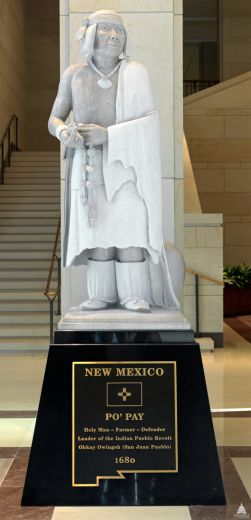
In 2003 and 2004, when we worked on the final details regarding the statue of Popé, the hero of the 1680 Pueblo Revolt, our most serious discussions took place after official sessions—you know, those meetings after the meetings where the best ideas and plans are hatched. I would join Herman and his longtime friend from Kewa Pueblo, Bennie Atencio—the two leaders and organizers started working together for Pueblo land and water rights as community action directors in the 1960s.  Sometimes joining the select group was their younger friend and mentee, New Mexico Senator Benny Shendo (Jemez Pueblo), who then was the first cabinet secretary of the first Indian affairs department in any state.

Po’Pay by Cliff Fragua, Marble. 2005. The statue now stands in Emancipation Hall, U.S. Capitol Visitor Center.

And where would those most important meetings take place? Furr’s Buffet in Santa Fe. There, in a strip mall near the main road in or out of town, is an old-timey cafeteria, then complete with a shelf of metal pipes for sliding those huge polystyrene trays past metal bins holding the ultimate selection of comfort food. Mashed potatoes? You got it. Roasted corn on the cob? Coming right up. Salad and a rainbow of jello cubes? Congratulations. Pico de gallo and guacamole? You betcha!

The people who served whatever odd combinations you asked for and steered you toward the freshest choices smiled and said “Enjoy your day” and “You’re most welcome” and “Can I get anything else for you?” in a way that you believed it. They had the humility, kindness, and working hands of our relatives, and we felt at home.  There—amidst the callouts to the kitchen, the clanging of indestructible tableware, and the sounds of children being themselves—we would eat and meet and solve all the problems we brought with us, energized by table service of seemingly endless coffee, iced tea and pop refills.

It was at Furr’s that Herman and his loyal back-up group figured out how and when to move the Popé statue from sculptor Cliff Fragua’s Jemez Pueblo studio to Santa Fe, and then to its homecoming ceremony at Ohkay Owingeh, after which the marble Popé would be imbued with the spirit of the culture hero himself. Because the statue was a living being, Popé required extra layers of care, treatment, prayer, and security, far beyond those needed to protect an ordinary work of art during storage, travel to Washington, DC, and installation in the Statuary Hall Collection in the United States Capitol.  

It was at Furr’s that we helped Herman think about additional members for the Popé commission and fundraising panels, when state regulations precluded him from chairing both. Later, one of his adult children, the brilliant and beautiful Pamela Agoyo, director of the University of New Mexico’s American Indian Student Services, replaced Herman as commission chair.

After our next commission meeting, Pamela suggested that we go to lunch, and we all said we’d meet at Furr’s. “Furr’s?” she gasped, and offered to pay for our lunch elsewhere, thinking that we suggested going there out of necessity. Once there, she could see that we were comfortable and actually liked the food, which gave us all a good laugh, but she said we were on our own for future cafeteria meetings.

Herman’s late-1970s vision of Popé in the US Capitol grew out of our work with national movements to end “Indian” mascoting and the stereotyping of Native peoples during the “Indian” costume season, from Columbus Day and Halloween to Thanksgiving.

The greater Pueblo effort was to shift focus from the legacy of the Conquistadors to true representations of Native cultures and histories, and Herman was at the forefront of ending the name of colonization, San Juan Pueblo, and reclaiming the traditional Ohkay Owingeh. 

Herman was a big part of The 1992 Alliance, a three-year project on the occasion of the Columbus Quincentenary, which culminated in an important gathering at Taos Pueblo. There, one hundred wisdomkeepers, artists and writers spent four days focusing on the theme “Our Visions: The Next 500 Years,” and never mentioned the lost explorer.

Our collective efforts were not just to vanquish stereotypes, but also to replace them with accurate representations, both historical and contemporary, and to lift up our own heroes and role models. That overarching purpose made the goal of sending Popé to Capitol Hill even more important. Through similar projects up and down the hemisphere grew the goal of establishing Indigenous Peoples Day, and it is no wonder that New Mexico was one of the first states to ditch Columbus for Indigenous Peoples Day.

I think the secret of our many political and policy successes have been the small and large gatherings of Native peoples inspired by our cultural strength and fueled by the Furr’s and green chile foods of our old countries.

Desperately Seeking Carmel

BY FRANCES LEVINE

The Santa Fe Trail is not often associated with stories of frontier women, although there are several well-known published diaries and collections of letters written by Anglo-American women who traveled from the East to the far end of the trail in New Mexico and beyond. It’s challenging to find biographical details and, rarer still, autobiographical accounts of Hispanic, French, African American, and Native American women who traveled the trail in the nineteenth century.

(more…)