

The power of protest suffused the smoky air in Window Rock, Arizona.
It was January 2007. Diné men wearing respirators held signs that read “Defend your right to clean air.” Diné women held American flags and faced off against police with hands on their pistols. A large painted sign of a smoke-belching power plant loomed ominously in the background, while a Diné woman looked pleadingly to the skies with a nuclear power logo superimposed over her gas mask.
This wrenching scene was captured by photographer Carlan Tapp, a descendant of the Wicocomico Tribe. While documenting the Diné struggle against power plants, Tapp saw that power can be many things—it can fuel communities; it can pollute the land, air, water and animals; and it can energize three elder Diné women in their fight to stop a giant corporation in its dirty tracks.
Tapp followed these three remarkable Diné women—Sarah Jane White, Lucy A. Willie, and Molly Hogue—over a period of several years. He shot pictures and videos as they defeated the construction of a coal-fired power plant known as Desert Rock Energy Facility within a red stone’s throw from Shiprock, on the Navajo Nation. They used their matrilineal power as land managers and sheep owners to keep tribal lands safe from pollution and mining.
Almost a decade in the making, Tapp’s photographs and videos are now on view in A Question of Power at the New Mexico History Museum (NMHM) through June 27, 2027. The exhibition features forty photographs and interviews with Diné people. Between 2004 and 2011, Tapp documented protests, tribal government, and the toll the pollution took on the people, land, and animals. Before the Desert Rock facility was built, there were already thirteen million pounds of chemical toxins being released into the air by the existing Four Corners Power Plant and San Juan Generating Station.
Shiprock (Tsé Bit’a’í) is a sacred site for Diné. The enormous volcanic remnant stone outcrop is central to their mythology as the “Rock with Wings,” a petrified bird that carried them to their current homeland from the north. It is a sacred site and climbing or desecrating it are forbidden.
The Desert Rock plans were developed with Sithe Global Power, LLC, a New York-based company financed by Blackstone Capital and Reservoir Capital, in partnership with the Diné Power Authority, a Navajo Nation enterprise that saw jobs and money in the deal but not the cultural and environmental impact. The plant’s proposed size would have made it the nation’s sixth largest emitter of carbon pollution.
Tapp had been doing commercial photography and film work, but in 2001, following the horror of 9/11, he changed course to make more meaningful documentaries. “I wanted to see what I could do with my gifts of image-making to do something worthwhile,” he says. He moved to New Mexico because he had spent time growing up in the Santa Fe area. He knew about the health issues to the north, and in the Navajo Nation specifically. While teaching photography classes at Santa Fe Community College in 2004, Tapp mentioned to colleagues that he was interested in understanding the Navajo Nation health problems, particularly asthma, due to air quality. He was told to go to Shiprock’s Indian Health Services and talk to people. “I found a journalist who had been writing stories about this proposed Desert Rock power plant who told me to get in touch with Sarah White, a Navajo woman who was protesting the plant,” Tapp says. “I told her I am a documentary filmmaker, and she invited me to tour the reservation area to see what was going on. Once I saw the tip of the iceberg it stunned me that this is really happening to these people and why. My moral compass knew this isn’t right and I needed to get involved.”
Tapp kept going back to earn their trust. He put 250,000 miles on his truck going house to house to help White talk to people about their health issues and the ongoing deaths of their sheep. In a video interview with Tapp, White explains that she worked as a reservation chapter official for the Navajo Council. Her job as its local administrator was to write up the resolutions the Council approved of, even if she did not agree with them because she was not a voting member.
In 2003, White was asked to write up a resolution stating that the Navajo Council wanted to approve construction of a power plant “right across from where I live, on top of the Chaco Wash. The people there didn’t even ask questions,” White says. “As a chapter official, I was not supposed to interfere with the public because I’m there as their servant. Whatever they want, I accept them whether I like it or not, even if there’s something that I’m not happy with that they decide to do. But this time I broke the rule. I said, ‘Wait a minute, you can’t just get up and pass a resolution to accept this power plant. We already have too many power plants, we’re already getting too much pollution. And the pollution is real,” White says. “I became an enemy to my president and to my secretary.”
The Tribal Council told her the plant would use “clean coal,” but she didn’t believe them. She rounded up her friends, Lucie Willie (59) and Molly Hogue (70), to help her contest the resolution. “Sarah pulled in Lucy and Molly because she could look right across Chaco Wash where the power plant was going to be and actually see Lucy’s place, it was that close,” Tapp says. “Sarah knew they both believed in the same things for their lives and families and had seen the health crisis firsthand.”
Because Willie and Hogue didn’t have jobs with the tribe, they did not know about the plant proposal. Many of the reservation residents did not have electricity or running water and never received news about it. “I said to my friends, all I want is your voice. You go to the chapter meeting with me because the plant promoters are going to be at the next one,” White recalls. “We just went from house to house on that site, and I went and did some research on what kind of disease these can cause. It’s not healthy. [The coal plant pollution] is dirty as the air. I was at the chapter meeting again, and that’s what I told them. I printed out some information, and I give it to the people. I did everything that I can to stop this thing.”
Her report cited major health issues that coal plant pollution can cause: asthma attacks, respiratory disease, heart attacks, and premature deaths. “I said, ‘These are the problems with this, and we already got two plants in running operation. This one hasn’t even started, so now is the time to kill it,’” White says.
The three women and their supporters were up against supporters of the plant, Navajo Nation President Joe Shirley, Jr., and the many council delegates who pushed for the project they claimed was a vital economic development tool. Advocates argued it would bring in over $50 million to the Navajo Nation annually in the form of thousands of construction jobs and over four hundred permanent plant operation jobs. Federal official members of the New Mexico congressional delegation, including former Senator Pete Domenici, supported the project.
White and the other women created the grassroots group Doodá Desert Rock (in Diné, “Doodá” means “absolutely not”). They received strategic, legal, and material support from Diné CARE (Citizens Against Ruining our Environment) and the San Juan Citizens Alliance between 2006 and 2010.
To visually document how the plant pollution was affecting the remote homes, people, and livestock, and to show reservation residents how much worse it could get if the new plant was built, Tapp hit the dirt road with the three women, camera gear in tow. He didn’t know at the time that his work would end up being legal documentation, too.
“I went around with Sarah, Lucy, and Molly, talking with them, eating with them, staying with them, taking pictures of what they were doing and who they were talking to,” says Tapp. “My goal then was to create a visual voice since there was no way to understand the full picture of the devastation of what was happening health wise on the reservation homes from existing pollution—and then the tribal council pushing the new plant construction that residents did not even know about that would bring even more pollution.”
The three women kept the pressure on for years with constant headline-making activities. They created and maintained a protest camp near the proposed Desert Rock site. They held campfire vigils, blocked the road to the site, faced off with tribal police, made signs, and met with journalists.
Dying Sheep and Billowing Smokestacks
While going door-to-door with White, Tapp met the people directly affected by the existing power plants. White convinced community members to attend meetings and protests, and Tapp filmed interviews with people and took their portraits. On return trips, he gifted them prints he had made.
White translated Tapp’s interviews from Diné to English. One of the more powerful interviews Tapp filmed was with Cynthia Dixon of Burnham, New Mexico. She told the painful story of how all her sheep and the newborn lambs died from the existing coal pollution at the Four Corners Power Plant twenty miles away. Dixon was one of the people directly affected. Losing her sheep cut deep for Dixon.
In Diné mythology, sheep are a gift from the Holy People; they represent a sacred responsibility, not ownership. Sheep are living symbols of balance (hózhó) and harmony with nature. Sheep provide a steady source of meat, milk, and wool that allows Diné families to stay self-sufficient and rooted in their homelands. The wool from sheep is the foundation of Diné weaving, a renowned cultural practice that turns raw wool into textiles that are functional and artistic. In addition, sheep are traditionally owned and managed by women, who are the primary weavers, making them central to the passing down of cultural knowledge.
“They were just newborns. They just breathed for a few minutes or so and they’re gone,” Dixon says, in tears. “I come out here and I bury all of them and I dug all the graves for them. I come to the corral to feed them, throw some grain or little bit of hay and then you can see, no, they’re just gone. I see it’s because of that coal and coal dust on the grass that they’ve been chewing and that’s why they were dying and then when they’re carrying their lambs, the lambs die too. I brought this up with the mine officials. I told them that they can come out here and I can show them the sheep’s graves. I literally cry when I’m digging these graves.”
Dixon signed on to a resolution White created—one of many White had drawn up and would revise over the years as she continued to learn about the plant’s reach and pollution’s consequences. The resolution was designed to challenge and counter Tribal Council resolutions in support of Desert Rock.
Another important Navajo voice whose livestock and plants were affected by existing power plants was Jim Mason, Diné Medicine Man of Burnham, New Mexico. He too signed on to White’s resolution and came to Council meetings. Tapp photographed Mason standing outside his modest desert home by a fence in a weather-beaten cap. “The ceremonial plants are dying from the pollution which falls from the sky. Their roots are dead. We no longer have the plants we need for ceremony,” Mason says. “The blasting of Mother Earth for the strip mine shakes the ground I stand on every day. The walls of my hogan suffer from great cracks caused by the blasting. My sheep can no longer drink the water.”
Tapp’s photographs capture the daily realities and community activism on the Navajo Nation over several years as the fight against the plant went on. In one of his photographs, Diné elder Alice Gilmore and White are shown in a pickup truck making the rounds of the far-flung homes on the sprawling reservation. They were having discussions with the residents about grazing rights and off-limits burial areas being threatened by the plant pollution.
Gilmore had a particularly rough situation as she and her sheep were displaced from her home when her grazing land permit was given to the strip-mining industry. The company had started mining before the Desert Rock plant was approved. Gilmore was moved again from a trailer as the mining-permit site expanded. While sharing her story with Tapp, she asked him to drive her out to where her sister was buried, alongside her horse to carry her into the afterlife. The grave had been marked with a shovel, but when they got there, they saw a backhoe had dug out the grave so the mining company could say there was no one interred there.
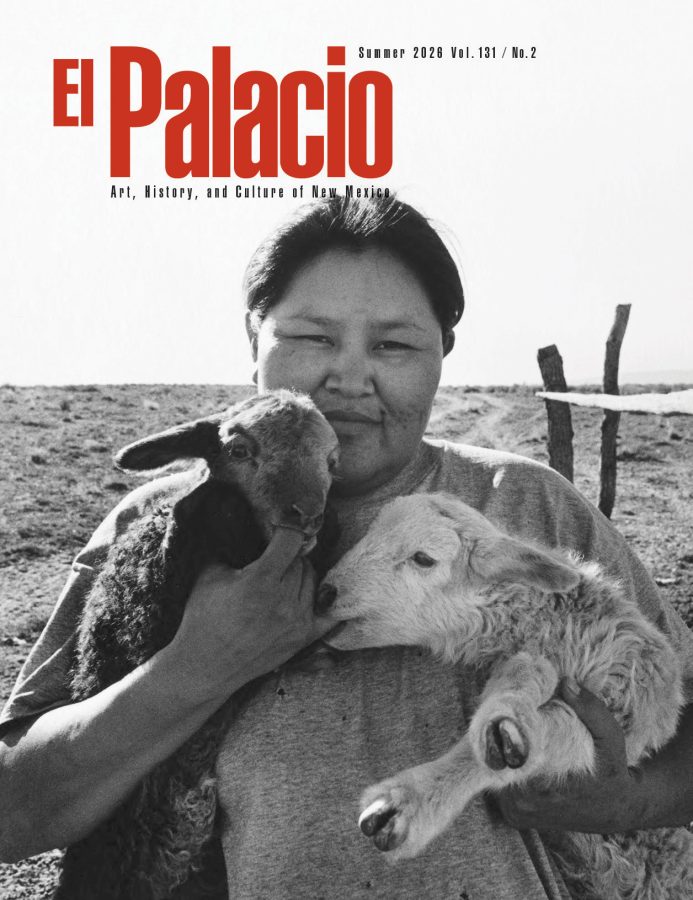
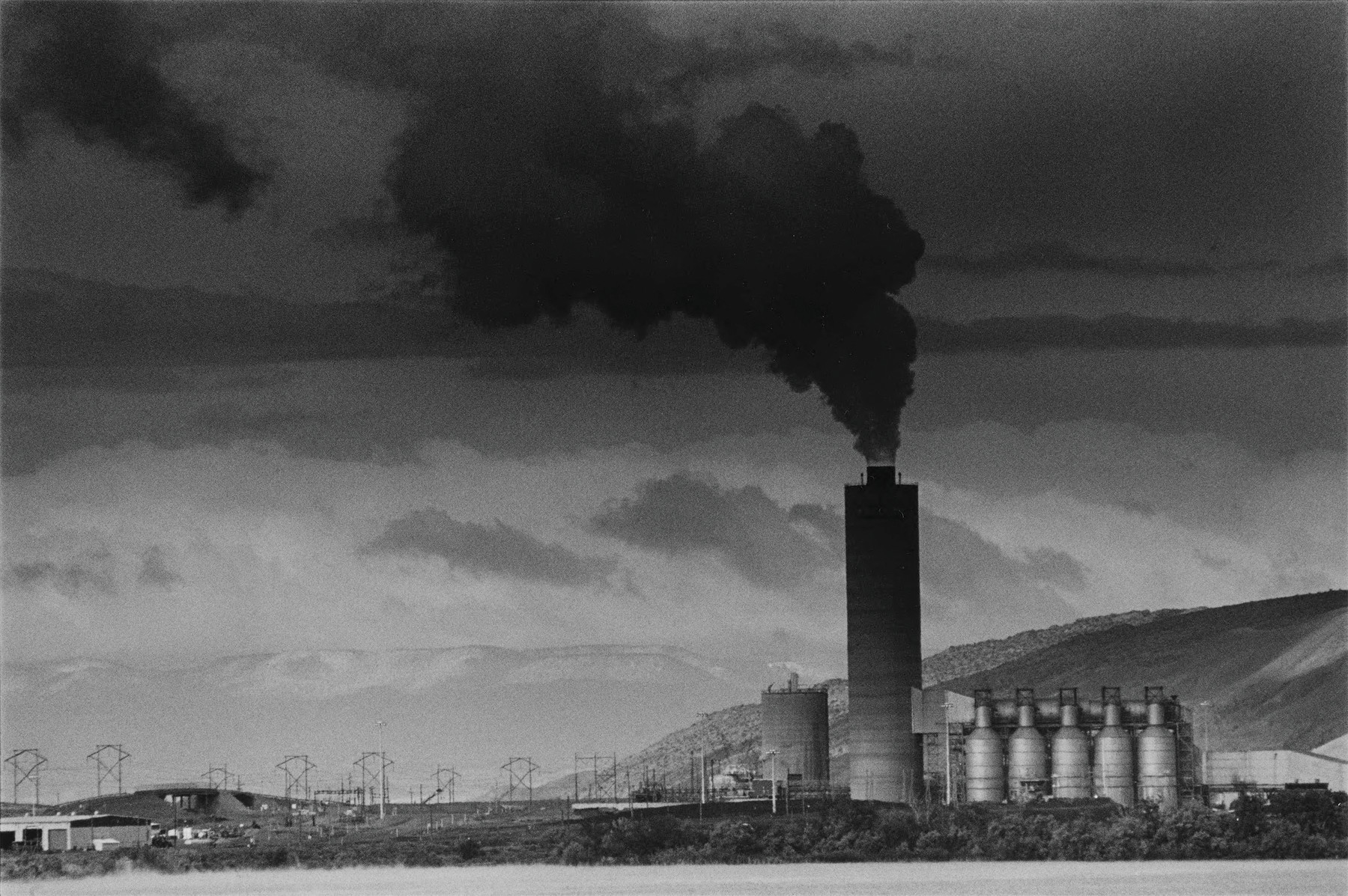
In another photo, Lucille Willie, Lucy’s daughter, holds baby lambs outside her corral, demonstrating the love and pain she endures as coal dust pollution kills off her herd. An image of the Four Corners Plant in Shiprock depicts bellowing black smoke and multiple electrical transmission towers against the blackened skies and snow-covered peaks.
In a photo of the organizers in action, a big “X” is drawn across Navajo Nation President Joe Shirley’s headshot on a poster made for a protest. The sign reads “Bringing Power back to the Navajo People: Yeah right!” “In this one photograph that Carlan took, the sign with Joe Shirley’s X-ed out picture …was actually confiscated by the Navajo tribal police,” Cathy Notarnicola, acting head curator of New Mexico History Museum, says. “Now why would the Navajo tribal police align with the pro-Desert Rock folks, you know? And they were against the protesters.”
Tapp brought many of these photos to the Tribal Council meetings to support White and did some investigating of his own. “I collected soil samples and I took them to a lab in Albuquerque to have the pH levels checked. When they had the results, the guys called me and asked, ‘Where did you get these samples? Numbers are off the charts, and the mercury levels are unbelievably high,’” says Tapp. “Lucy’s husband Ambrose was a very highly respected Medicine man, and he was a Vietnam vet. He had been subjected to Agent Orange and had a lot of problems with that. At the nearby Four Corners Plant, they would blow off the stacks at night, all that coal dust pollution stuff settled down and it got in his lungs; it’s basically what killed him.”
Diné People Have the Power
Following three years of organizing on the Navajo Nation, tribal elders spoke to New Mexico State legislators at the state capitol in Santa Fe starting in late 2006 to urge them to oppose the plant. A striking photo shows the elders lined up in the capitol rotunda in their traditional clothing and wearing protest buttons in unity. They waited an entire day at New Mexico Governor Bill Richardson’s office. He finally agreed to speak with them and look at the enormous stacks of resolutions, photos, interviews, and research regarding the harmful effects the power plant would have had on residents’ health, the land, the animals, the air, and the water.
The elders also spoke about how they would be displaced as the plant took over their lands––as had already happened to Alice Gilmore. If constructed, Desert Rock plans included either offering residents living near the site a few thousand dollars or simply taking residents to court to seize their land outright, since the Diné only had grazing or housing permits, not land ownership.
The meeting with Governor Richardson proved pivotal as he recognized the full picture of the damage the plant approval would inflict. Due to the organizers’ tremendous efforts, the $85 million tax credit that Sithe Global Power, LLC would have received was cancelled along with the construction of the power plant.
White and her friends and community members stopped the 1,500-megawatt coal-fired plant by challenging and overturning Tribal Council resolutions that supported Desert Rock, organizing protests, researching and documenting the extensive health issues created by existing power plants, and pursuing a pivotal meeting with Governor Richardson. “We realized that it was all women who made this happen,” White says. “Each project that we ever did was always led by women, protecting Mother Earth, that was their life.”
“The work with the Diné on the Navajo Nation was close to my heart,” Tapp says.
Anything you start to document you become passionate about it, you hope that in the long run you can create a visual voice for a situation that doesn’t have that opportunity to have that voice and then later to find out where it was going to go. I had no idea in the beginning it would turn into legal documentation. White stopped the plant through the legal channels—resolutions, speaking to New Mexico State legislators, and enlisting environmental groups. Since then, Lucy walked on, Molly walked on with COVID, as the airborne disease hit that particular area hard. They saved everybody from the coal and uranium pollution and then many died from COVID. Sarah is in declining health. The important thing is that three women brought down a multimillion-dollar corporation. It rarely happens. For me, that’s the core of the story I saw firsthand. The people standing together.
Tapp donated his photographs and videos to the New Mexico History Museum in 2016. “We thought it was an important and timely story because it touches on issues of Native sovereignty and environmental justice,” says Notarnicola. “It’s important to note that in Diné culture it’s a matriarchal society, and these women deployed their authority within their matrilineal system. The land is passed down, and the sheep are passed down through the women of the family. They are responsible for land use decisions.
Tapp’s photographs illustrate not just the pollution of the air from the burning of the coal, but also the extraction of it—it’s everywhere. It all comes down to money, and people wanting to make money by harvesting natural resources. They pick lower income areas such as the Navajo Nation for almost a century … And there was also uranium mining.”
Notarnicola says that while they’re extracting these resources and burning fossil fuels, the electricity that the power plants generate travels hundreds of miles through towers to cities like Las Vegas, Nevada, San Diego, and Albuquerque. Meanwhile, most Navajo homes don’t have electricity.
A Cleaner Future—and New Danger
The Desert Rock power plant construction was officially cancelled in 2011 due to increased public opposition and to the leadership of Diné women White, Willie, and Hogue.
“It’s one of the few times that environmental justice prevailed,” Notarnicola says. “They fought the good fight and they won. There was an eagle nesting site overlooking Shiprock where the plant would have been built and there’s a great image of two women standing on the edge of that. That would have been destroyed. There are burial grounds, there’s sacred plants. There’s water. There’s so many aspects and resources to that environment that would have [resulted in] famine if that plant was built.”
The activism to stop Desert Rock rippled out to other plants. The San Juan Generating Station, a large coal-fired plant near Shiprock, was decommissioned and demolished in 2022, and cleanup from the plant has been ongoing. The plant was closed due to high operational costs, excessive use of water, declining affordability of coal versus natural gas and renewable solar and wind energy, and state environmental regulations that San Juan had not complied with. The closure aligned with New Mexico’s Energy Transition Act, passed in 2019, which aims to move away from coal-fired electricity.
The New Mexico Environment Department is overseeing efforts to address decades of contamination from coal ash and wastewater. PNM, the operator of the San Juan plant, documented groundwater contamination and fifty-nine million tons of coal ash stored in unlined pits at the site. In 2023, the New Mexico state legislature passed HB 142, which mandates independent assessment of the site, annual reports, and community input on cleanup plans. In accordance with a 2024 EPA rule, PNM is obligated to fund the cleanup of coal ash ponds to prevent further groundwater leaks.
The Four Corners Power Plant, scheduled to close by 2038, is operating on a seasonal basis to manage costs and the reliability of the power grid. The utilities are providing transition funds for Navajo communities as it moves to cleaner sources of energy like the Shiprock Solar Facility, a major solar and battery storage project now operating on Navajo land to replace the coal-generated power from the phased-out San Juan Generating Station. About the Solar Facility, Tapp says the community “feels great—the air up there is unbelievably cleaner. I’m serious, it’s blue sky again.”
“To us, we love our deserts. It’s beautiful. It’s people that don’t know nature because they have so much money. We were raised there, we know what we have, and we want it that way,” White says. “We want clean air and we did beat it; there’s no Desert Rock plant. My wish for my grandchildren and my great-grandchildren, I want them to breathe fresh air and just enjoy a good life. That’s what I want for them.”
But the coal problems remain in the ground. Tapp says the San Juan plant did a massive cleanup in August 2024 that continued through 2025, but coal combustion waste (CCW) is a by-product and “is the most toxic stuff in the world because coal contains all the heavy carcinogenic metals. It’s like a light gray talcum powder and they dump this back in the ground, put the soil back on the top of it and say that everything would grow back and they could raise sheep or crops.”
These claims, by the coal industry and their supporters, have proved to be false. Tapp says he’s met with mine engineers who observe that the heavy metals continue to leech up through the topsoil, rendering the ground sterile.
“It’s still toxic and there is no plan,” Tapp says. “There has even been talk of coal plants making a comeback. So, the fight continues.”