

It is known today as New Mexico, a place where time is recognized as “immemorial.” Here, the footprints of people in motion, likely left 23,000 years ago, remain impressed upon the land. We honor breath and recognize the living presence of people whose complex identities have formed across generations. We speak and listen to a multitude of languages, stories, and prayers. Here we praise the dignity of work, including the annual rituals of mudding houses and sacred spaces, cleaning the ditches, harvesting crops, and the daily acts of preparing and sharing meals. These are grounded commemorations, but this too is a place where representations of time have been flattened into a straight line.
Singular dates are held up like static museum pieces, obscuring everything that leads up to and follows particular events. It is in this tension that I reflect on the semi-quincentennial, an anniversary that sits uneasily with New Mexico’s past, at least not without context, critical assessment, and a close reading of the colonial archive of that year.
The 250th anniversary revolves around the singular date of July 4, 1776, commemorating the Second Continental Congress’s adoption of the Declaration of Independenceand the separation from Great Britain. The question of who is included and who counts in the nation has been present from the very beginning. The Declaration did not explicitly name gender, race, or class; its political subject was implicitly male and propertied. The language reflected the assumptions of colonial elites and centered whiteness. It excluded Indigenous people and represented them as “merciless Indian savages,” an intentional move to both marginalize and justify dispossession. It also makes no reference to people of African descent living and laboring in the colonies.
Although Thomas Jefferson’s original draft condemned the slave trade, that language was struck from the final document. The irony is unmistakable: at the time, Jefferson enslaved approximately 180 people. He was by no means the sole beneficiary of the system. About three-quarters of the men who signed the Declaration enslaved people. Taken together, these omissions and contradictions reveal the moral tensions embedded in the nation’s foundation. They raise enduring questions about who was included in the promise of liberty, and who was excluded from it.
The fractures in this foundation have emerged from the margins over time. In a July 5, 1852 speech, Frederick Douglass, a formerly enslaved African American and leading abolitionist, asked, “What, to the American slave, is your Fourth of July?”—a question that exposed the hypocrisy of celebrating liberty in a nation that still enslaved people. One hundred and sixty-seven years later, in a resounding echo of Douglass’s critique, The New York Times Magazine launched The 1619 Project. Nikole Hannah-Jones placed another date at the center of the national discourse: the 1619 arrival of a ship at Point Comfort in the British colony of Virginia, carrying as many as thirty enslaved Black Africans. More than a provocation, Hannah-Jones challenged and invited readers to rethink the nation’s symbolic origin story—not only when it begins, but where, who, and what counts in shaping the nation’s foundations.
I welcome Hannah-Jones’s invitation, particularly at a moment when debates over who belongs to the nation have resurfaced with racial and ethnic overtones, and when democratic principles are being eroded. The founding document was unequivocally a revolutionary declaration of independence from the rule of a king, and a statement of principles, natural rights, and the consent of the governed. Despite its famous axiom that “all men are created equal,” men and women originally left out of the compact have endured persistent inequalities in economic, political, legal, and civic life, and yet have fought to create the democracy promised.
Politicians and boosters have often framed the Declaration as a living document, an unfinished ideal. It is a mistake to treat the document as a museum piece or a static moment in time. The anniversary should instead serve as an opportunity to assess how it has manifested across 250 years and whether it can sustain the principles it proclaims. Such an assessment must also reckon with the politics and poetics of place—the geographies into which the nation expanded, and the people already there.
Nuevo México ¡Presente!
Centering the national narrative solely on the thirteen original colonies obscures the histories and experiences of regions that would later become part of the United States. This diminishes how interconnected and meaningful those places were before, during, and after 1776. It also obscures how territorial expansion shaped the formation of the United States. From its founding, the United States had the ability to enter alliances, make treaties, and wage war, all shaped by power imbalances and territorial ambition that led to the acquisition of both Indigenous land and other territories. While independence removed imperial restraints, imperialist ideologies and practices remained core to the still-evolving nation. In time, this expansion was even framed as providential.
Anniversary celebrations began as early as 1777 in Philadelphia, although Congress did not establish the Fourth of July as a federal holiday until 1870. That designation came more than two decades after New Mexico was ceded to the United States and more than four decades before statehood and full political equality were extended to New Mexicans in 1912. Including New Mexico in these commemorations requires acknowledging that the entire region became part of the United States through imperial expansion. This warrants reflection, particularly in a nation long committed to a narrative of democratic exceptionalism. The U.S.-Mexico War was an aggressive war of territorial expansion that resulted in the forced cession of over half of Mexico’s northern territory. There is no way to fully measure what that loss meant to Mexico, nor to those in the region who were left behind, including Indigenous communities for whom U.S. expansion represented another chapter in a long history of colonial incursions that had already reshaped the land and its people.
This was not only an attack on sovereignty and a tremendous loss of resources, but also a cultural rupture. New Mexicans were severed not only from their nation, fracturing families and cultural ties, but also from their historical inheritance. When a place and its people are conquered, their history is often obscured or neglected. Erasure demands a void. In the years that followed, a mythmaking project took shape that diminished long-standing identities. In the late nineteenth and early twentieth centuries, boosters, politicians, and cultural brokers promoted a narrative that recast the region’s past as Spanish rather than Mexican to reconcile New Mexico’s incorporation into the United States. The resulting tri-cultural mythology flattened centuries of relationships, collapsing distinct Indigenous nations and generations of mixed communities into static categories, while imagining a population perpetually tied to Spain. This was overlaid with an American origin story, complete with its own symbols: a flag, founding fathers, and a new national narrative. In the process, historical amnesia set in. Yet those places were not empty of presence of people with long memory and deep histories, including those preserved in archives.
Archival Presence
In the wake of conquest, the archive of place assumes new significance. Although shaped by power and structured to privilege some voices over others, it also functions as a site of reclamation and recovery. In societies that privilege the written record, archives preserve presence and carry the accounts of earlier generations whose lives have been recorded for centuries. Long before New Mexico’s annexation, places were named, events documented, and people’s lives set down in writing. When the United States occupied and later annexed the territory, the archival record became vulnerable. In the years following annexation, some records housed in the Palace of the Governors were dismissed as “worthless papers.” They were discarded during an incident in the 1870s when territorial officials ordered archival materials cleared from the building, revealing how easily documentary patrimony could be lost during political transition. The consequences were real, and their impact is generational. Recovering this history remains an imperative. Yet the challenge lies in locating the documentary past, for New Mexico’s records had long circulated within earlier imperial networks and were not confined to the territory itself.
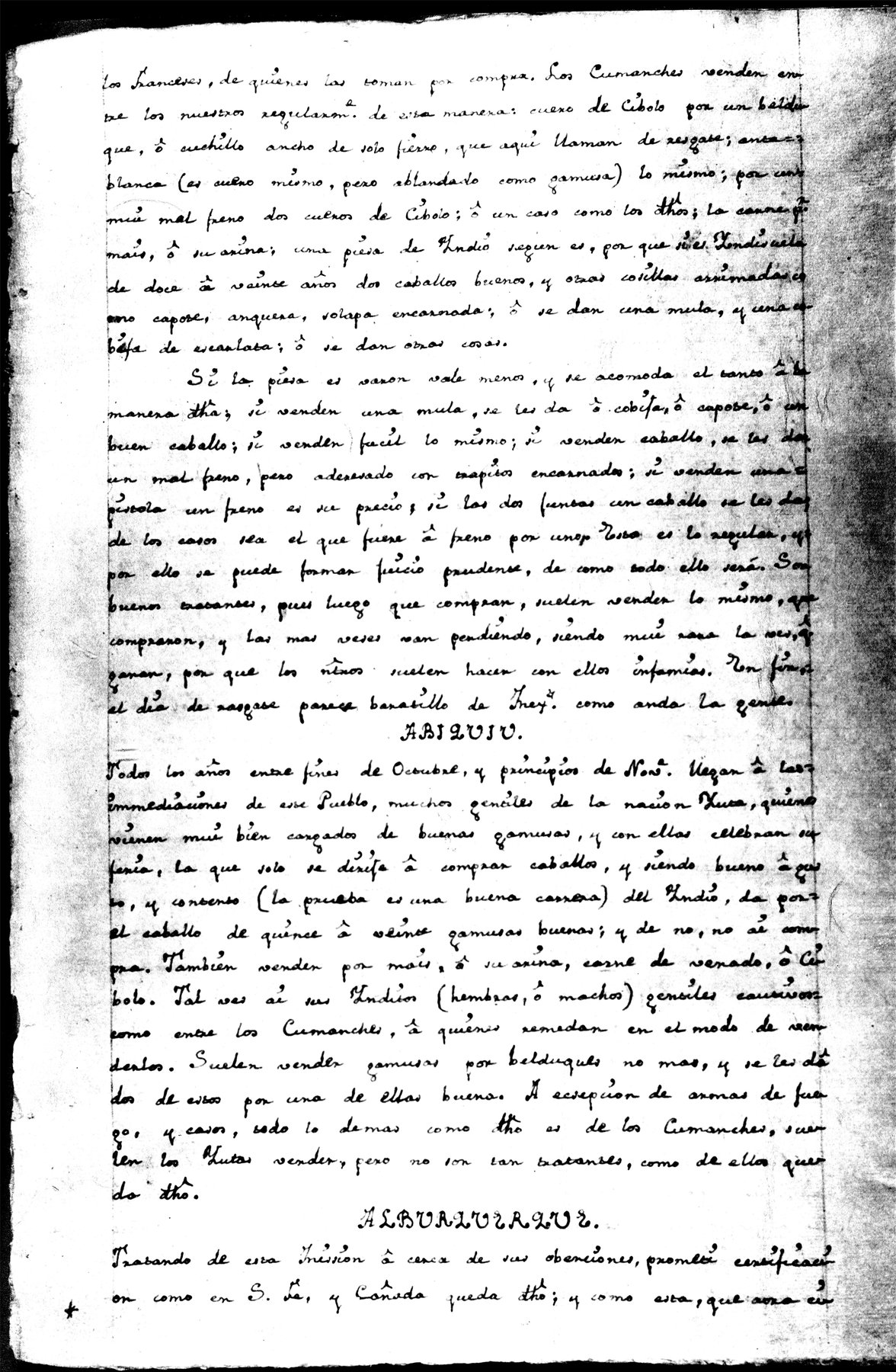
Many of these records lay hidden, obscured by imperial dispersion and by barriers of paleography and language, yet many remain in archives across Mexico, the United States, and Europe. One such manuscript was located more than a century and a half after its creation. In 1928, historian France V. Scholes encountered it in the National Library of Mexico, where it had been shelved among unsorted bundles of papers. Like the Declaration of Independence, it was written in 1776, although it emerged from a province that belonged to another empire. Recognizing its value, Scholes secured a copy and brought it to New Mexico, where it entered The University of New Mexico archives. It remained unpublished until 1956, when historians Eleanor B. Adams and Fray Angélico Chávez edited and translated the manuscript for publication by the University of New Mexico Press. The volume was reprinted in 1975, on the eve of the nation’s Bicentennial. Yet, more than fifty years later, it remains largely unknown.
The document was created by the thirty-seven-year-old Fray Francisco Atanasio Domínguez, who arrived in New Mexico in 1776 as visitador comisario. He was charged with inspecting the missions’ spiritual and economic conditions and gathering “geographical and ethnological data.” He wrote that this information would serve “both Majesties,” the Church and the Crown, informing ecclesiastical oversight and royal governance of the province. As part of the visit, he was asked to ascertain the condition of the province’s records. In correspondence with his superiors the following year, Domínguez described the condition of the archives he encountered. He noted that “complete entries” from sacramental books had been used “to stuff the windows.” He also reported that officials had removed parish books from the missions and used the pages to make cigarettes. Even in 1776, the province’s archive bore signs of neglect and loss. Yet what remained was substantial enough to record communities already rooted in place.
Domínguez’s 1776
New Mexico was a far frontier, distinct from Mexico City, which Domínguez described as “the delightful and alluring cradle” of his birth. Founded in 1524 atop the conquered city of Tenochtitlan, Mexico City rose upon an Indigenous metropolis established in 1325 as the Mexica capital. Long before it became the seat of Spanish rule, Tenochtitlan stood as the political and ceremonial heart of a vast imperial network. By the late eighteenth century, it was the most cosmopolitan city in the Americas. Its population approached 150,000, far exceeding that of Lima, Rio de Janeiro, or Havana. Cities in the rebelling British colonies did not come close; Philadelphia, the largest, counted roughly 40,000 inhabitants. The capital sustained a university founded more than a century before Harvard, a powerful viceregal court, and an expansive bureaucracy governing half a continent, including the distant province of New Mexico.
Francisco Atanasio Domínguez was born in 1739 within this richly layered urban world. His baptismal record names his parents as Don Lucas Domínguez and Doña Juana Francisca Chagaray y Laynes, titles that signaled their standing within the colonial order of the viceregal capital. Parish registers identify his maternal grandparents, Josepha Antonia Laines and Martín de Echegaray, as españoles, situating the family within the privileged caste of the colonial hierarchy. When he arrived in New Mexico, Domínguez did so from within that social order, shaped by the hierarchies of caste and status that structured life in the imperial capital.
Like Mexico City, the region Domínguez encountered in New Mexico was already ancient. When Spanish expeditions entered the area in the sixteenth century, sixty to eighty pueblo communities existed, with a total population estimated between forty and sixty thousand. Colonialism, epidemic disease, warfare, famine, and the upheavals of revolt and reconquest sharply reduced pueblo populations over nearly two centuries of Spanish presence. By 1776, only a fraction of those communities remained. According to his count, 8,503 people identified as Pueblo. Zuni was the largest Pueblo, with nearly 400 families and more than 1,600 individuals. The smallest community was Pojoaque, with 27 families and 98 individuals. Domínguez’s report preserves detailed portraits of Pecos and Galisteo, still standing in 1776 yet vulnerable, especially to Comanche incursions.
By 1776, long-established colonial communities in New Mexico had stood for generations, many tracing their lineage to the earliest colonial families. Spanish colonization of the region began with exploratory entradas in the early sixteenth century, most notably the Coronado expedition of 1540–1542, which extended imperial ambitions into the northern reaches of New Spain. Permanent settlement followed in 1598 with the Oñate expedition, establishing a lasting colonial foothold. Colonization was interrupted by the Pueblo Revolt of 1680 and resumed with the reconquest of 1692. The settlements restored in the 1690s were those Domínguez encountered nearly a century later, firmly rooted. Santa Fe, founded in 1609, counted 1,167 individuals within the villa itself. Albuquerque, established in 1706, was the next largest settlement, with 763 inhabitants. Santa Cruz de la Cañada, founded in 1695 by families recruited from Mexico City and later joined by migrants from Zacatecas, held nearly 700 people and became a center where earlier colonists and later arrivals intermingled. Each of these towns was surrounded by smaller villages: Chimayó and Truchas near Santa Cruz, Atrisco, Belén, and Tomé near Albuquerque.
Like other imperial regimes of the eighteenth century, Spanish colonial society imagined and represented Indigenous peoples within a framework that distinguished between the “civilized” and the “barbarous.” By 1776, pueblo communities, though still subject to civil and missionary scrutiny, were regarded as settled and Christianized. Beyond the colonial frontier lived other Indigenous nations, including Apache, Navajo, Pawnee, Comanche, and Ute, whom imperial correspondence described as outside that civil order. In 1775, Domínguez wrote to Fray Isidro Murillo about the “wretched panic-stricken state” to which Apache and Comanche attacks had reduced the settlements and missions of New Mexico. Although imperial categories divided the province along civilizational lines, the reality Domínguez recorded was far more complex and interwoven.
Although the report reveals the continuity of Indigenous communities, it also records a society in which Spanish, Pueblo, and other Indigenous populations were deeply entangled. Eight pueblo communities—including Cochiti, Taos, San Juan, Picuris, Santa Clara, Jemez, Sandia, and San Felipe—counted non-pueblo settlers among their residents, totaling 1,742 individuals. The presence of these Spanish-mestizo families within pueblo towns did not dissolve the caste hierarchies that structured colonial society. Instead, it generated daily encounters that shaped language, labor, religion, and kinship—experiences reflected in the archives, even if only in fragments. By 1776, none of the communities Domínguez described were impermeable; each reflected patterns of exchange and adaptation under colonial rule. While most spoke Spanish, even “if brokenly” according to Domínguez, the Pueblos of Nambé and San Juan (Ohkay Owingeh) were more fluent. Most revealing is his description of the settlers of Taos: “They speak the local Spanish, and most of them speak the language of the pueblo with ease, and to a considerable extent the Comanche, Ute, and Apache languages.”
Unlike the Declaration, which remains silent on slavery, Domínguez’s report records it plainly. He noted the presence of Genízaros, Indigenous captives and their descendants, living across the province. Abiquiú, founded as a Genízaro settlement, included 46 families and 136 individuals, although Spaniards resided there in significant numbers and outnumbered them. Belén, counted within the mission of Isleta, likewise contained two populations: 593 Spanish settlers and 209 Genízaros. Santa Fe itself included 42 families and 164 individuals identified as Genízaros. Writing of Santa Clara, Domínguez observed, “In addition to this mixed populace, there are here nine families of Genízaros.” Although Domínguez identified Genízaros in several settlements, sacramental and other archival records suggest that captive populations were even more widely distributed across the province than his report indicates. Baptismal records alone suggest that in the eighteenth century more than a thousand Indigenous people had been captured and incorporated into these communities. The incorporation of captive populations into colonial society was not episodic; it was continuous.
Captivity and forced labor were not confined to Genízaro settlements. In nearly every community Domínguez described, servitude appeared as an ordinary feature of social life. Writing of the settlers in San Juan, he observed that they were “of different classes: some are masters, others servants, and still others are their own masters and servants.” He offered a similar description of Taos: “These settlers are of all classes. Some are masters, others servants, and others are both, serving and commanding themselves.” Of the settlers in Santa Fe, he noted that most “have servants of different classes, for only as a last resort do they serve themselves.”
Domínguez takes great care to describe each church and convento in detail, reflecting the priorities of his inspection. Charged with reporting on the missions’ spiritual and economic condition for both Church and Crown, he produced a meticulous account of their physical and institutional life. Yet he is almost completely silent about the fact that the buildings were constructed and maintained by Indigenous labor. In a letter to Fray Murillo in 1777, he does point to the “cost of the poor Indians’ sweat and labor” at the missions. He scarcely addressed the labor in fields, haciendas, and ranchos, large and small, though it structured everyday life.
He often glossed over slavery. When mentioned, he failed to account for the violence and loss embedded in Indigenous captivity and displacement. Writing of the trade fairs in Abiquiú, he devoted more attention to deerskins than to the fact that human beings were bought and sold there each year. Slavery was not peripheral to this society; it was foundational in shaping New Mexico by the late eighteenth century. Several historians, including Albert Schroeder, have suggested that by that time as much as one-third of the population consisted of Indigenous enslaved people and their descendants. The slavery of Indigenous people continued through the eighteenth century and intensified in the following century. In 1848, when New Mexico was annexed following the U.S.-Mexico War, it encompassed pueblo communities and towns once settled by the Spanish—communities already reshaped by slavery, whose inhabitants would be incorporated into the United States.
Closing
The world Domínguez perceived was complex, multilingual, and shaped by the convergence of cultures. What he recorded offers only a partial glimpse of the societies that defined New Mexico in 1776. Yet his report also stands in quiet contrast to another document written in that same year: the Declaration of Independence. While the Declaration proclaimed universal principles of liberty yet remained silent about slavery, Domínguez’s account reveals a frontier society structured largely by Indigenous slavery. Read together, the two documents illuminate both the aspirations and the silence of slavery embedded in the historical moment of 1776. Like all imperial observers, Domínguez’s ethnographic descriptions were colored by bias and ethnocentrism, shaped by his aristocratic upbringing and ecclesiastical training. When read alongside other primary sources, including sacramental registers, censuses, and other colonial records, his report reveals the deep presence of peoples whose histories in this land long predated those of the Atlantic seaboard colonies.
As New Mexicans join the nation in commemorating the semi-quincentennial, the date becomes one more commemoration layered onto others that are more local and deeply resonant, including events defined by revolution. The year 1680 marked pueblo resistance and survival. The year 1821 marked New Spain’s independence from a distant king and imperial rule. In 1847, people in Northern New Mexico rose up again to resist yet another conquest—that of the United States itself. Each of these moments reshaped sovereignty and belonging. New Mexicans are heirs to each of these events and to the layered histories they hold, yet none alone can contain the fullness of time here.
At its core, this is about the power of origin stories. I think of the ancient yet living storytelling practices that have long gathered people around a hearth, at a kitchen table, or at the resolana—the south side of a building illuminated by the sun—where elders share memory and wisdom carried across generations. These narrative rituals remind us that emergence, migration, and ancestry shape communities over time. Such stories are never static; they are delicate and changing. Depending on who tells them, they are subject to both forgetting and remembering. The same is true when we remember and reckon with 1776.