Art as Inheritance
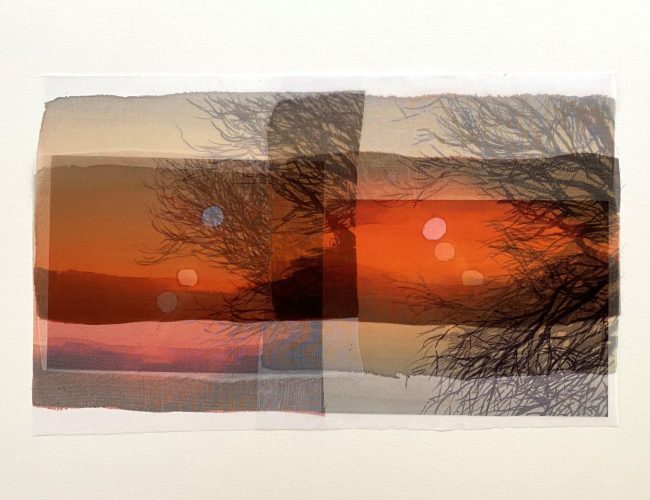 Aime LeGette. Calf Sun. Watercolor on paper and dye on silk, 15” x 22” x 2.” Courtesy of Art in Public Places, New Mexico Arts.
By Emily Withnall
Poetry is my inheritance. My dad, raised by Scottish immigrants in New York City, was taught by Catholic nuns to memorize poetry. He passed the practice on to me; I remember standing at the edge of the Pecos Wilderness as a child, repeating the lines of “The Fairies,” by William Allingham, until I could recite it by heart. I still carry the words in my body, the rhythm of each line urging a steady onward march despite the poem’s dark elements.
Poetry was how I made sense of the world and how I sought to express myself. Even now, when words fail me, I turn to poetry. Poets most keenly understand the limits and possibilities of language, and they alchemize letters and sounds into the unexpected and profound.
In difficult times, there can be tension between feeling that art is superfluous and feeling that art is the only way to live, to express ourselves, and to imagine ourselves into something new. As the editor of a publication that celebrates the arts, I advocate for the creative possibilities inherent in art and offer this issue of El Palacio, brimming with poetry.
Beloved by locals, Santa Fe poet Arthur Sze is the new United States Poet Laureate, and, as poet Kathryne Lim writes, the nuanced weaving of his Chinese heritage, New Mexican Indigenous knowledge, and the Northern New Mexican landscape “allows for a kind of collapsing of space and time.” In a new poem, “Sight Lines,” Sze writes: “salt cedar rises through silt in an irrigation ditch— / the snowpack in the Sangre de Cristos has already dwindled before spring—,” the backdrop from which he introduces topics like plutonium, Thomas Jefferson, the Chinese Cultural Revolution, and the Louisiana Purchase in a contemplation of infinity.
The newly-appointed New Mexico Poet Laureate, Manuel González, featured by former Albuquerque poet laureate Hakim Bellamy, is a “poet of the people” in every sense. Not only did he inherit music from his father, but he’s passed it on to his poet daughter, is an integral part of the slam scene in Albuquerque, and is committed to bringing poetry to pueblos, schools, detention centers, and rehab centers to facilitate what he calls heartwork. González tells Bellamy, “I want to bring this healing medicine. Because New Mexico has a lot of healing to do.”
In partnership with Michelle Laflamme-Childs of New Mexico Arts, New Mexico Poet Laureate Emerita Lauren Camp is completing the final stages of her Epic Poem Project. The two women traveled across New Mexico, hosted poetry workshops, and wove imagery from participants into twenty-nine community poems that illuminate the distinct character of each place. Six of those poems appear in these pages, alongside the work of artists who live in the communities.
This issue of El Palacio also features several Indigenous artists in the Essential Elements exhibition at the Museum of Indian Arts & Culture. Like the poets, these artists weave grief and celebration into their artistic visions, blending art and activism to reflect environmental disasters in New Mexico and to imagine regenerative possibilities. As contributor Christina Castro writes, “What happens to the land, happens to the people.”
The instinct to weave art and activism also underpins Lucy Lippard’s art writing, curating, and community building. In an exhibition currently at Vladem Contemporary, Lippard’s art collection reveals a tapestry of collaborations with other artists across time. It is not hard to find poetry within the associative collage of Lippard’s life; her art and relationships serve as a kind of offering—a generative inheritance for us all.
As the poet CMarie Fuhrman writes, “Make your art. Plant a garden. Dance. No, not to distract yourself from the world as it is, but to build the world as it could be. As it will be.… Trust there will be someone there to see it.”
—
Emily Withnall is the editor of El Palacio and the host of Encounter Culture. Prior to stepping into the editor role, she wrote for the magazine for eight years. Emily has also been published in The New York Times, Al Jazeera, High Country News, Orion Magazine, Tin House, The Kenyon Review, Gay Magazine, Source New Mexico, and other publications. She lives and writes in Santa Fe, New Mexico.