
A Higher Purpose: Why the state poet laureateship is about more than poetry
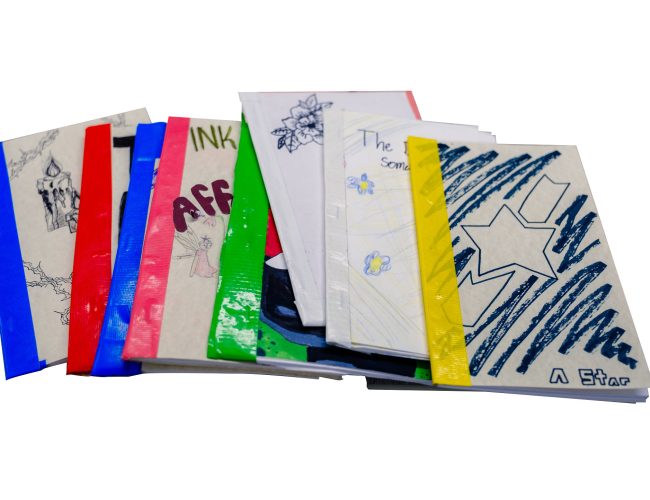 His students’ poetry chapbooks at the Native American Community Academy, 2025.
By Hakim Bellamy and Manuel GonzálezCredits
Photographs by Isabel Miranda
Read the poem, Ritual. Vessel. Volcano. Vision.
The coffee shop was unusually packed with regulars for 7 p.m. on a Wednesday. There was a mix of folks, some looking like they’d been there for a while, entire book bags of belongings sprawled across tables. A noticeably larger group—appearing to be recent arrivals—were obviously there for something that would start soon. In short order, the Mega All-Ages (MAS) Poetry Slam host would secure five judges at random from audience members who committed to staying for the duration of the event. Upon arrival, six to eight poet participants signed up for the opportunity to compete. Other poets signed up on the spot for the open mic that would kick off the event. Manuel González would follow the open mic readings as the featured poet preceding the slam. And as a cacophony of nervous pre-game chatter and anticipation reached a fever pitch— wholly out of character for a university area coffee shop on a weeknight—the host launched into his familiar and interactive introduction about how the poetry slam is all about crowd participation. How the five judges were given score cards to rate each poem read on an Olympic-style scale of zero to ten. How the audience is encouraged to use their power of applause to influence the judges and are even empowered to boo the scores should a judge’s assessment of a poem be at odds with the vibe in the room. And after the open mic came and went, González took to the microphone.
The first time I heard him perform live in 2005, I am certain my expectations were prohibitively high. González’s legend preceded him long before he became New Mexico’s poet laureate. The coffee shop was R.B. Winnings Coffee Company (now Flock of Moons Brewery) just across Historic Route 66 from The University of New Mexico main campus in Albuquerque. I’d moved to New Mexico a few months prior. From the moment I started performing poetry locally, folks would hear me and immediately ask if I’d heard González. That night at Winnings, I could finally say, “Why yes, I have.”
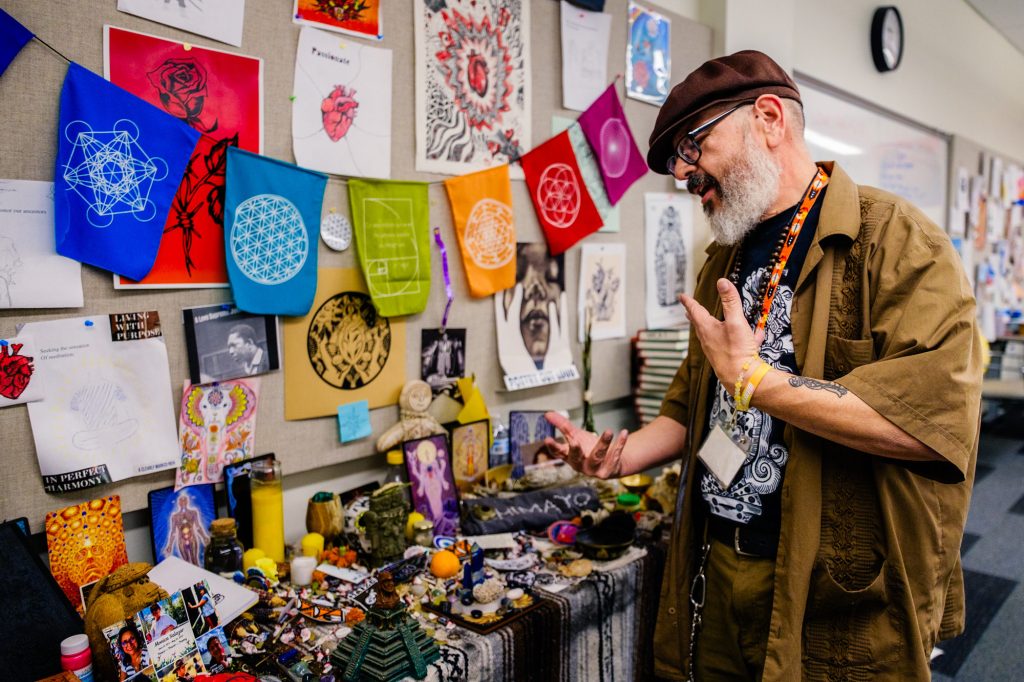
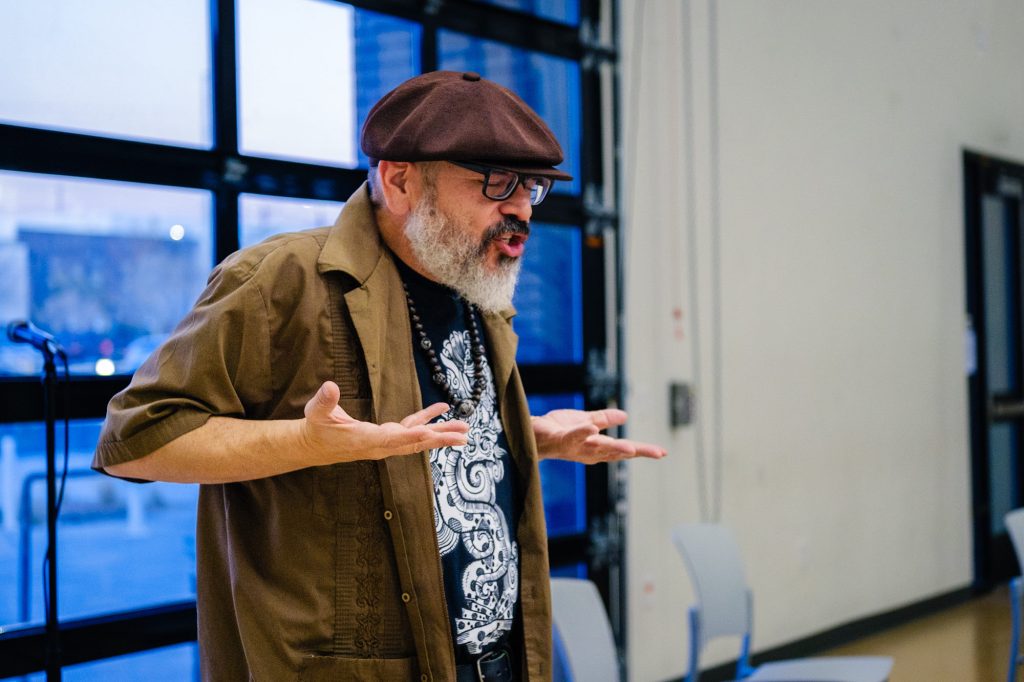
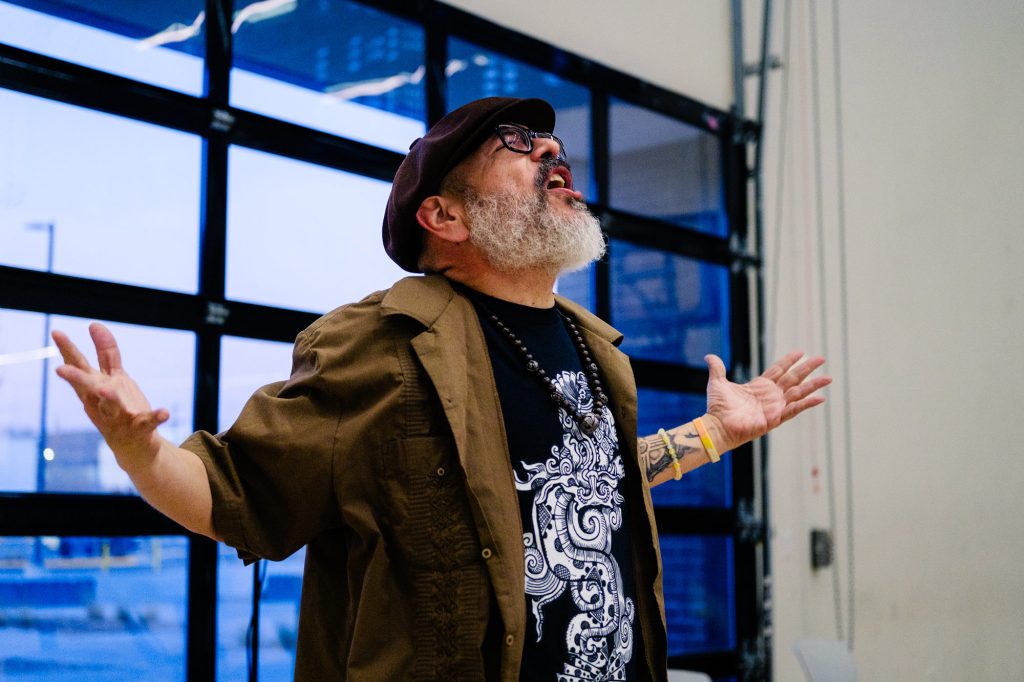
Except heard is not the right word for it. You don’t hear a hurricane, you experience it. You don’t watch a tornado, you are hurled by it. And on that evening, in that coffee shop, Manuel was a force of nature. And like any encounter with an extreme weather event, that day was not soon forgotten. No more than twelve to fifteen lines into his first poem, I got the sense that it was a crowd favorite. The standing-room-only coffee shop repeated after González in unison, “My name is Albuquerque, but my friends call me ’Burque.” Even the students who found themselves unwittingly in the middle of a poetry slam that they didn’t sign up for, stopped gathering their things and stood transfixed as his storytelling captivated the room.
In 1999, after a month of house arrest, a young González was looking for a place to go that wouldn’t land him back with an ankle bracelet. So, he reached for the now defunct Weekly Alibi to get a sense of what the world (read: Albuquerque) was up to after his month on “time out.” The first thing that jumped off the page was the announcement of a poetry slam at the Dingo Bar (now Echoes). Of course, for someone who—at the time—had never been to a poetry slam, it would be understandable to conclude that this would be the kind of pedestrian, even uneventful, sort of activity that would not run afoul of his prior conditions of release. I mean, on its face, the notion of a poetry reading barely raises a person’s blood pressure, right? I mean, how much trouble (read: “fun”) could it possibly be?
Boy, was he wrong. On that particular evening, good trouble was on full display in a clash of the titans between poets from Albuquerque versus poets from Santa Fe. Among the literary combatants were the icons and architects of the emergent New Mexico Poetry Slam scene: the likes of Kenn Rodriguez, Danny Solis, Matthew John Conley, and Joe Ray Sandoval. For Manny, prior to this date with destiny, his verses had been exclusively held in the confidence of clandestine journals and the hip hop cyphers of his youth where he was more likely to beatbox than spit. But that evening at the Dingo Bar changed everything. “It blew me open, I was awestruck,” he says. “I had no idea what this was. This was new. This was emotion. This was feeling. This was energy and electricity, and I felt it.”
González showed up to the next slam…and lost. In fact, he kept losing. But he kept showing up. And the more he did, the less the paperbound poems shook in his hand. Soon, his poems would take flight from the page and start bouncing off the back walls of bookstores, bars, classrooms, and juvenile detention centers, riding nothing but the unmistakably New Mexican baritone of his Nuevomexicano inflection. For Manuel, performance quickly became about more than winning poetry slams.
My Life is For You
In the early ’70s, Manny and the Casanovas were making a name for themselves, taking regional New Mexican music and introducing it to a national audience. Their vinyl album, Florecitas Mexicanas, was issued by Lance Records in 1968. Of his father—Manny Sr.’s—music, González wrote the following in 2014:
I love his music, but it’s not exactly what you would think. The sound of his music was not always easy to find in our home. He passed away from pancreatic cancer when I was eighteen months old. I don’t have any real memories of my father, but what I do remember is how much it would hurt my mother to hear his music. Every time his music would come on the local New Mexico station (which at the time was KABQ) my mother would break down and cry. They were really in love, and now with him gone the music was a source of pain. People always wanted to dig out my father’s albums whenever they saw us, and I knew that the fun was over and it was time to sit with my mother while she cried. It got to the point where I didn’t want to hear my father’s music because I didn’t want to see my mother cry.
González’s father was from Anton Chico and he passed away when the future poet laureate was just a baby, so young Manny never had the benefit of having his father teach him how to play an instrument. However, González had his father’s heart and this music inside him. When it eventually came out, it emerged as poetry.
Over time, Manny Jr.’s musical repertoire expanded beyond beatboxing to include percussion, the didgeridoo, and DJing weddings and other special or sacred occasions. But the González creative spark is not confined to Manny I and II; his wife and daughter hold the torch as well. “I carry my family in every poem I write,” says González. “Nichole and Sarita are my world. Without them and their support, I would never be who I am today.” As part of my own twenty-year involvement in the Albuquerque poetry community, Nichole González has served as the joyful—yet fiercely protective—den mother for consecutive generations of slam poets. It was unusual for González to show up for a poetry event without his family in tow. And with my son only a few years younger than Sarita, witnessing Manuel and Nichole raise their daughter “in the round” set an example for me and other poets trying to strike a precarious balance between what we practice and what we preach as poet-parents.
Poetry is traditionally considered an activity one does in solitude. For Manny (and many like him), the slam was an introduction to poetry through community. It’s a path that places publishing or the enrichment of oneself secondary to public benefit and the enrichment of community.
It is fitting that Manny and Nickie conspired to raise a prodigal sun. As a young adult, Sarita Sol González is already an accomplished poet. I may or may not have been in the room the very first time that a pre-adolescent Sarita read an original poem during the open mic before a slam. I’ve watched Sarita captivate a room with a ease and sense of charm—well beyond her years—countless times since. In fact, while Manny and I were comparing notes about our first time meeting someone conferred the title of poet laureate, I was reminded that I also attended an Albuquerque reading by United States Poet Laureate Juan Felipe Herrera, where Manny and Sarita both performed. Sarita did such a phenomenal job at that event, that Herrera—the first Chicano to ever hold the position of U.S. poet laureate—invited Sarita to read her poetry in Washington, D.C.
To hear Manny talk about his love for his family recalls a Manny and The Casanovas original, “Mi Vida Es Para Ti (My Life is For You).” For its part, the slam poetry community in Albuquerque has always been more like a ragtag band of feral cousins: literary misfits who have seen each other grow up, a motley crew of punk rock poets who have watched one another have and raise kids. “We’re a family,” says González. And like a doctor or a lawyer, it’s really nice to have a state poet laureate in the family. Perhaps even more useful in times like these.
Sin Fronteras
From the page to the stage to the cage? When I think about Manuel González, I think “bards without borders.” Nobel and Pulitzer prize-winning author Toni Morrison once said, “You wanna fly, you got to give up the shit that weighs you down.” Not only has González lived this Morrison dicho, he’s fashioned it into a lesson plan. In 2011, he invited me to co-present a weeklong performance poetry workshop and residency at Sequoyah Adolescent Treatment Center in Albuquerque. A thirty-six-bed residential treatment center operated by the New Mexico Department of Health, Sequoyah provides care, treatment, and reintegration into society for boys ages thirteen to seventeen who have a history of violence, a mental health disorder, and are amenable to treatment.

Prior to this opportunity to apprentice under González, we’d been friendly. What began as admiring him from afar eventually led to shared stages and laughs at poetry events. González was larger than life on stage, but effortlessly approachable off mic. At Sequoyah, however, not only did I get to peek under the hood (double entendre intended), I got a front row seat to González’s process. Being able to observe him as he methodically rolled out how to put a poem together was worth the proverbial price of admission. Witnessing González shapeshift from demonstration to facilitation in helping the young men in front of us put their poems together was a profound education for me as a nascent teaching artist at the time. It was the power of poetry bringing people together that has stayed with me from that time at Sequoyah. Both of us have continued to do this work in the years since. González will take this work to the next level as state poet laureate as he continues his mission to bring poetry to the places it is least expected.
“I use poetry and literacy as a guise to do real heartwork in spaces where people need that type of healing,” he says. And when González says “heartwork,” he means it. Even in environments flush with poets and poetry, an infusion of heartwork can prove transformative. González, whose day job is teaching high school, recounted his experience traveling to the Brave New Voices youth poetry slam competition in Madison, Wisconsin last summer, with a group of his students at the Native American Community Academy (NACA).
Even at the annual, multi-day competition which features upwards of fifty teams of teen poets from across the country; the NACA team opted to bring healing to what can best be described as a “literary gunfight.” González remembers being approached by other coaches and festival organizers who were troubled by the “take no prisoners, win at all costs” vibe among the young competitors at the previous year’s competition. NACA did not participate in 2024, but this past year the team brought an energy that González described as sacred. “We started with pulling out the smudge sticks,” he says. While most of the other teams were making last minute adjustments and preparations for their performances, NACA smudged each other and prayed. “And those other teams saw that, and paid attention,” González goes on. “It started to rain and our kids engaged in prayer, celebrating the rain, while all the other kids ran for cover. But after seeing the joy with which our students were praying and playing in the rain, those other teams came out and joined us.”
More Medicine Than Metaphor
El Palacio readers may well be familiar with the phrase “poor man’s therapy” as applied to poetry. More an indictment of the accessibility of mental health services than a referendum on the mental well-being of poets, the benefits of expressive writing have long been documented. However, the therapeutic impact of poetry to which González subscribes is so much more than just “getting it off your chest.” It is a genuine, spiritual belief in the healing power of the spoken word: more chant than song; more incantation than description; more prayer than poem; more the art of living than the act of writing.
“We have a practice of finding the sacred in things,” he says. “This is what makes the poetry from this place and our people special.”
González will be the first to tell you that poetry saved his life, and it is not hyperbole. He means it in the most prosaic of ways: both memoir and magical realism. Poetry not only changed the direction of his life, it also changed his relationship with the world and the people he shares it with.
In this way his poetry is more medicine than metaphor: a way of healing, but also a way of being. A way of well-being. More for fixing broken hearts than broken bones. Craft? Certainly. However, when done with intention, that craft can be shared as a nuts-and-bolts process for seeing the world differently. And since I am not one to shy away from hyperbole, I dare say González’s approach to poetry-as-healing is to posit poetry as a way of seeing. The type of healing that reverses blindness. Think “New Testament” (no pressure, Manny). Because like González, I believe that the more you look for milagros, the more you find them—and the more they find you.
Like the state poets laureate before him, González is charged with leading statewide poetry initiatives, developing educational outreach programs, and acting as an ambassador for our state’s traditions of literary excellence. While New Mexicans can expect a robust menu of programmatic offerings—such as public readings, workshops, stakeholder activations and other creative projects—Manuel sees the position as less meta and more medic.
“If people are so courageous enough to stand up and share the healing journey they went on through poetry, it gives other people the inspiration to go on their own journeys in that way,” he says. “And that’s kinda what I want to do with the healing journey that I’ve been on through poetry as I go to the different pueblos, different counties, and different corners of New Mexico. I want to bring this healing medicine. Because New Mexico has a lot of healing to do.”
I saw González heal a room for the first of many times that night at R.B. Winnings Coffee Company, not necessarily through his poetry, but through his presence. González did not perform his feature set and leave immediately. He returned to his seat, rejoined his wife (his daughter hadn’t been born yet), and enjoyed the remainder of the poetry slam as a spectator—and as the loudest cheerleader for every poet who took the stage that night. He reminded me and everyone in that room that being a poet is more than just “the work.” Poetry is also bearing witness. That’s where the healing begins.
To find out more about Manuel González and follow or engage his journey as laureate, please visit https://nmarts.org/all-programs/poet-laureate/.
—
Hakim Bellamy is an inaugural poet laureate of Albuquerque, New Mexico (2012–2014), and currently serves as deputy director for the Cultural Services Department for the City of Albuquerque. Having shared his work in no less than five countries, he is convinced that poetry is the sixth love language. He’s also written a few books. Find them (and him) at beyondpoetryink.com.
Manuel González began his three-year appointment as the New Mexico State Poet Laureate in 2025. He is a former Albuquerque Poet Laureate (2016-2018) and is widely respected for his unwavering commitment to community and justice. For more than two decades, González has worked at the intersections of poetry, education, and social change. His leadership has reached detention centers, classrooms, and community spaces throughout New Mexico. As a teacher at the Native American Community Academy, he uses trauma-informed, culturally grounded curricula to empower Indigenous and Chicano youth. He mentors young poets through Brave New Voices and co-founded Low Writing at El Chante: Casa de Cultura, a beloved community workshop that brings intergenerational groups together to write, heal, and build solidarity.