
Strike and Struggle
The National Miners’ Union and The Great Gallup Coal War, 1933-1935
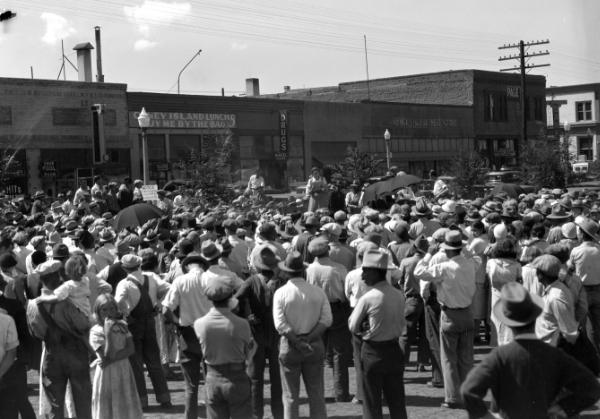
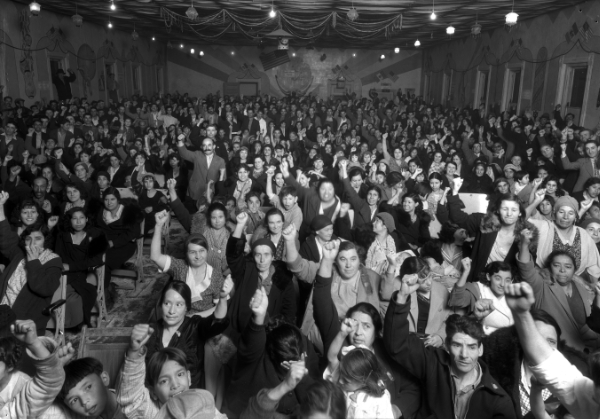 Coal miners and their families in Kitchen’s Opera House
vote to strike in late August 1933. Courtesy of the Palace of the
Governors Photo Archive (NMHM/DCA), Neg. No. HP.2024.26.0024a.
Coal miners and their families in Kitchen’s Opera House
vote to strike in late August 1933. Courtesy of the Palace of the
Governors Photo Archive (NMHM/DCA), Neg. No. HP.2024.26.0024a.
By David Correia
Archival photographs by William Thomas Mullarky
When violence erupted in early 1935 after the Gallup American Coal Company attempted to evict striking miners from its coal camps, Robert Minor, the famous union activist, raced to Gallup, New Mexico, from New York to help. It would be his first and only trip to Gallup, and he would barely make it out alive.
Minor hoped to lend his celebrity to the cause of the Gallup miners. In the early twentieth century, he was the most popular and highest-paid cartoonist in the country. His cartoons for the St. Louis Post-Dispatch and New York World condemned imperial wars, lampooned wealthy industrialists, and celebrated working-class struggles. On the eve of World War I, when his paper demanded he draw pro-war cartoons, he quit his job, declared himself a Socialist, and joined the staff of The Masses and The Call, two of the most radical political magazines in the country.
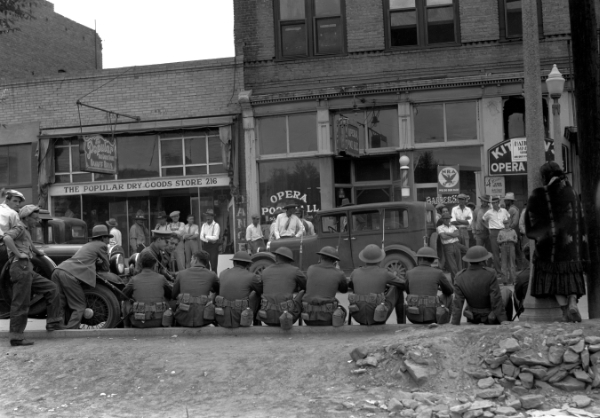
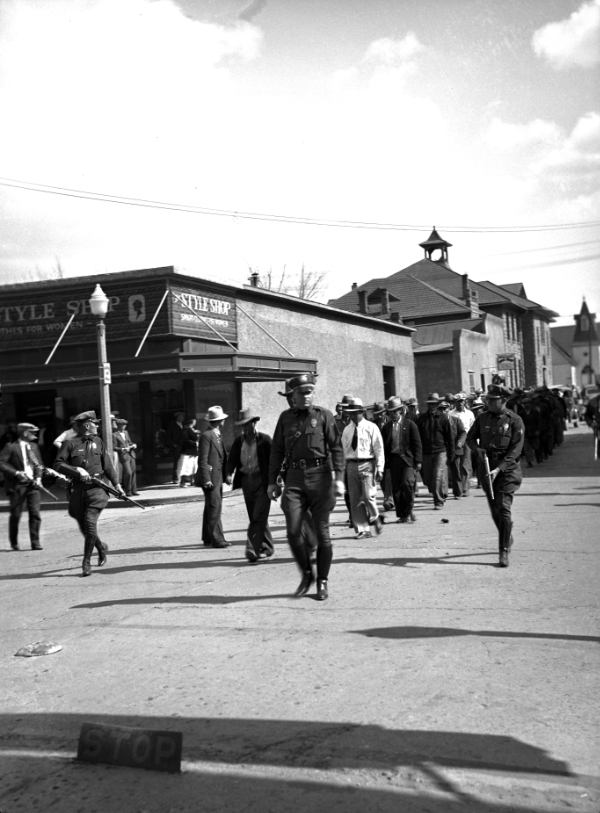
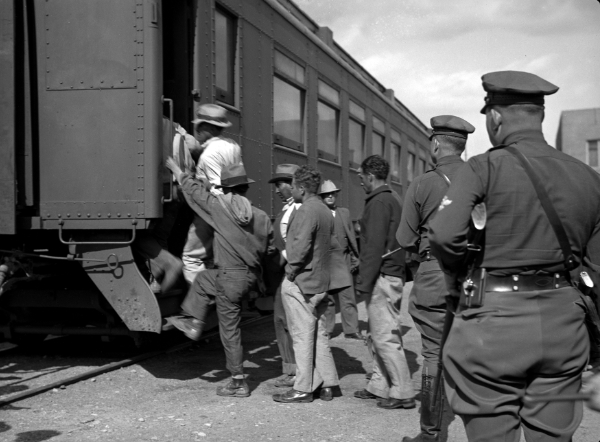
New Mexico occupied Gallup for more than four months after New Mexico’s Governor declared martial law in August 1933. Courtesy of the Palace of the Governors Photo Archive (NMHM/DCA), Neg. No. HP.2024.26.0021.
Minor’s cartoons made him a major celebrity among left-wing political activists. When he went to Russia in 1918, Vladimir Lenin told the cartoonist he was a fan of his work. When he went to France to work on behalf of striking railway workers, he was jailed for treason and threatened with execution. When he returned to the U.S. in 1920, he was known as “Fighting Bob,” a dyed-in-the-wool Communist, and he gave up art for politics.
He joined the executive committee of the Communist Party of the United States of America and spent the next two decades organizing campaigns to free political prisoners and political activists. As director of the Communist Party’s International Labor Defense (ILD), he helped defend Sacco and Vanzetti, the Italian anarchists accused of, and later executed for, robbery. He co-organized the defense of the Scottsboro Boys, the nine Black teenagers accused of rape by a white woman in Alabama. He was instrumental in starting ILD’s magazine, Labor Defender, which chronicled labor struggles across the country, particularly the campaigns of the National Miners’ Union (NMU).
This communist-affiliated labor union organized coal miners in Appalachia and the intermountain West. When a series of NMU-organized strikes shut down coal mining in Utah and Colorado in the mid-1930s, Minor and the ILD helped organize relief supplies. The strike spread to New Mexico, where Governor Arthur Seligman declared martial law in Gallup in August 1933. Minor sent lawyers to defend the Gallup strikers and their union organizers from harassment and arrest by troops. In the months after the strike was settled, the Gallup coal bosses slow-walked their promise to rehire coal miners in 1934. Minor condemned the coal mining companies and publicized the strikers’ plight in the pages of Labor Defender.
A month before Minor arrived, Sheriff’s deputies had arrested three striking coal miners for resisting their eviction from the company camp, then hauled them into Gallup for a preliminary hearing. Hundreds of miners protested the hearing, banging on the courthouse doors, prompting the judge to suspend the hearing. The Sheriff and three deputies hauled their prisoners out of the courthouse’s back door but found themselves surrounded. They fired tear gas into the crowd. Shots rang out. When the smoke settled, the Sheriff lay in a pool of his own blood, dead from a gunshot wound to the head.
Chaos erupted. McKinley County Undersheriff Dee Roberts organized an official posse and dispatched it to Gallup. For the next forty-eight hours, hundreds of armed men roamed the town, searching homes and making arrests. Scores of miners were charged with capital murder of the Sheriff. Dozens were deported. The killing of the Sheriff made national news.
When Minor, along with an ILD lawyer named David Levinson, showed up in Gallup on May 2, 1935, armed men, some masked, patrolled the town. Minor was in Gallup to interview witnesses and collect evidence in the defense of the dozens of people charged with capital murder. He and Levinson met with Julia Bartol, the wife of one of the jailed union leaders, at El Navajo hotel. Deciding it wasn’t safe to discuss the case in the hotel lobby, they met instead in Bartol’s car, which was parked at Gallup’s plaza.
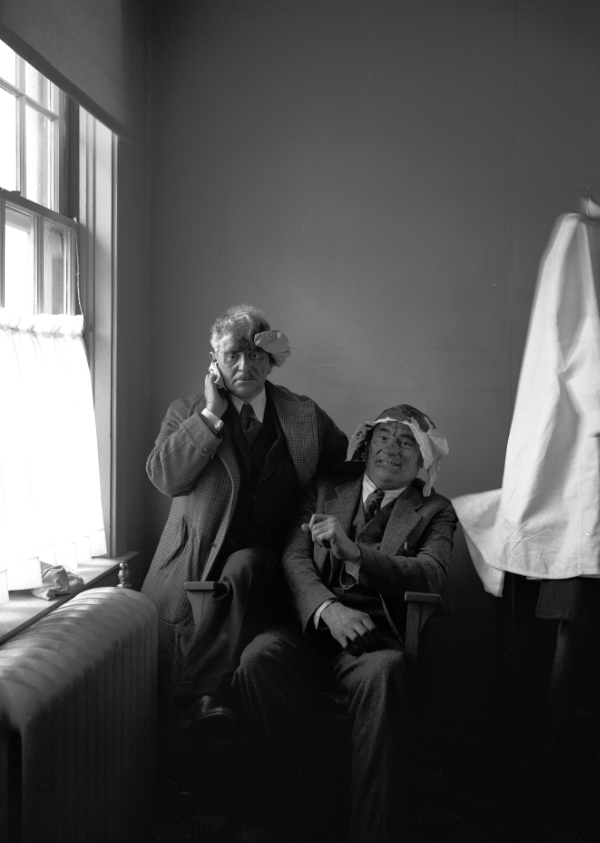
Just as they began to talk, masked men in three different cars surrounded them. Levinson stepped out of the car, put his hands in the air, and said he was a lawyer representing working men.
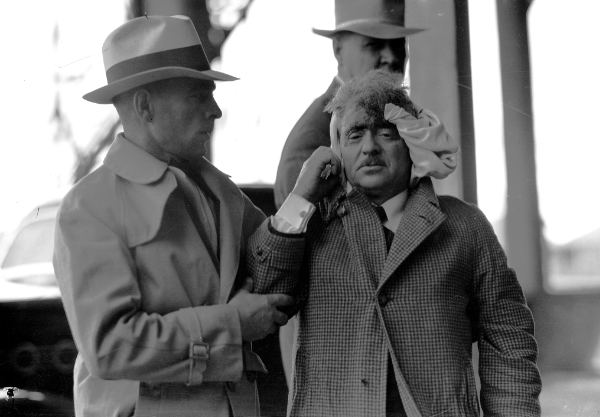
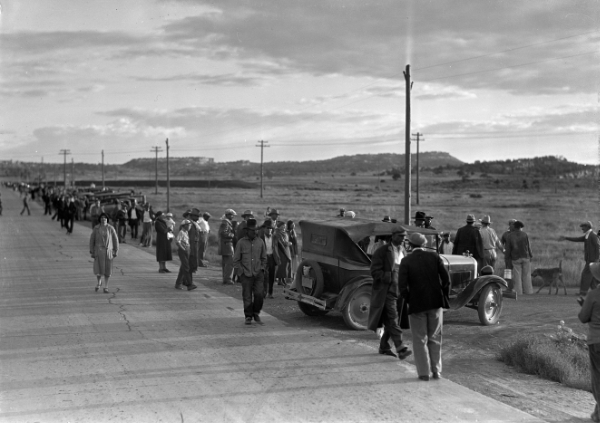
“We don’t want speeches,” said a masked man just before pistol-whipping Levinson. The last thing Minor remembered was being dragged from the car. When he came to, it was the middle of the night, twenty-five miles from Gallup, and he was lying on the side of the road bleeding from the head.
“Get out of Gallup,” yelled a masked man as he sped away. “Get out and stay out.”
The Start of the Gallup Coal War
The kidnapping of Minor and Levinson came at the tail end of one of the Great Depression’s most dramatic labor struggles. For decades, the two thousand coal miners who worked the Gallup coal fields had risked their lives to work more than six hundred feet underground, digging hundreds of thousands of tons of coal each week. They came from all over the world. Most had been recruited in Mexico to work the Gallup mines. Some had come from eastern and central Europe. Fewer than a dozen were U.S. citizens. The coal they dug fueled New Mexico’s blast furnaces and copper smelters, powered The Santa Fe railroad locomotives, generated electricity for every town west of Albuquerque, and was sold as far west as San Francisco.
The miners were paid in company scrip, and their wages were based on the amount of coal a miner could dig, measured by rigged scales. By the early 1930s, most worked only a day or two a week and earned less than twenty dollars a month, a wage reduced by deductions for the company doctor, rent in a company-owned camp, food and powder at a company-owned store, and electric mining lamps and fuel at marked-up prices. If miners complained, the bosses docked their pay.
When they tried to join a union, workers were blacklisted or deported. The United Mine Workers of America (UMW) organized Gallup miners during the nationwide coal miners’ strike of 1922 on the promise of better wages and working conditions. When the UMW settled the strike in Kentucky and the Virginias, it ordered the Gallup miners back to work before they could gain union recognition from the coal companies.
Coal mining remained profitable in New Mexico during the Great Depression, but only because the mine operators reduced the workforce and slashed payroll by using skeleton crews. Half of all miners were unemployed and living on aid from the Depression-era Federal Emergency Relief Administration. In the summer of 1933, despite previous failures, desperate miners once again tried to organize a union. The National Industrial Recovery Act of 1933 granted workers the right to join independent unions and to bargain collectively with their bosses. Still distrustful of the UMW, the Gallup miners turned instead to the NMU, which was created in 1928 by Communists purged from the increasingly conservative UMW.
The NMU sent Martha and Bob Roberts to Gallup in August 1933. Both had just graduated from New York’s famed Brookwood Labor College, a school novelist Sinclair Lewis called “labor’s Harvard.” Martha was just twenty-one years old and was already a seasoned organizer. Before coming to Gallup, she’d spent months organizing farmworkers in New Mexico’s Pecos Valley. Over the next four months in Gallup, she and Bob enrolled nearly one thousand mine workers into the NMU, created a women’s auxiliary that picketed alongside the miners throughout the strike, and even organized the children of Gallup’s miners, who spent the strike marching through the streets demanding better wages and safer working conditions for their fathers.
Martha became the face of the strike. She led members of the women’s auxiliary to and from the picket lines each morning, gave rousing speeches at the plaza condemning the coal companies for refusing to negotiate, and confronted the police and the soldiers when they were sent to break up the strikers’ marches. She was arrested by deputies for being a Communist, beaten by troopers for insurrection, attacked by UMW agitators who opposed the strike, and eventually, in late 1934, ejected from New Mexico by the Governor.
The struggle that began in the summer of 1933 lasted nearly two years and would become among the most dramatic labor struggles in U.S. history. Before it was over, martial law was declared and vigilantes patrolled the streets, troops occupied Gallup, civil rights were suspended, a Communist witch hunt seized the town, hundreds of miners were arrested. Half a dozen were convicted on dubious charges, scores were evicted from their homes, dozens deported, and a County Sheriff was assassinated.
When the Reds Arrived in Gallup
The Gallup American Coal Company, known locally as Gamerco, whose company town north of Gallup was known by the same name, was the largest of the five coal operators in Gallup during the 1930s. Gamerco was owned by the Kennecott Corporation, the Guggenheim-financed company that operated southern New Mexico’s Chino mine, the world’s most profitable copper mine. Gamerco dictated wages and working conditions throughout the coal fields. As one historian described it, Gamerco was the kind of western operator that prided itself on its “strong-armed frontier refusal to recognize labor unions.”
The New Deal, however, offered federal protections for union organizing. In July 1933, Gamerco’s General Manager Horace Moses, hoping to get around the new law, created a company-run union and ordered his employees to join it. The miners refused and voted to join the NMU instead.
When coal miners in Utah walked out of the mines just weeks later, the local papers feared Gallup would be next. We have grievances, Gallup miners explained, but no plans to strike. Union organizers presented the miners’ grievances to Gamerco in August and asked for an answer by the following Monday. Moses said he didn’t need till Monday. “Our answer is ready now,” he said, “and the answer is no.” The miners declared a strike on August 29.
The first pickets appeared at Gamerco at dawn the next day, where strikers blocked the mine entrance and turned back the scabs, some of whom were Navajo miners recruited by Gamerco to replace the strikers. Scores of strikers kept non-union workers out of the Mutual Mine, while dozens more blocked the trail to the Southwestern Mine.
Just hours after the strike was called, McKinley County Sheriff Dee Roberts sent New Mexico Governor Arthur Seligman a telegram demanding that he call in troops and force the miners back to work. The miners were armed, he told Seligman, and violence and bloodshed were likely. The telegram was signed by the general managers of all five coal companies, the Mayor of Gallup, Gallup’s Justice of the Peace, the American Legion, Veterans of Foreign Wars, and even the American Federation of Labor. The Governor, who had never heard of the National Miners’ Union, sent a telegram to John L. Lewis, the powerful president of the United Mine Workers of America, asking for his advice.
This strike was “the first time in history that I know of,” he told Lewis, “where all of the unions like the United Mine Workers Union, the Big Four Brotherhoods, the American Federation of Labor, have asked an executive for troops and martial law.” That’s because “the NMU is a subsidiary of the Communist Party U.S.A.,” wrote Lewis, who recommended the Governor send in the troops. Seligman sent a telegram to the National Recovery Administration (NRA), a New Deal-era agency created to mediate labor disputes. They wired back, telling Seligman that “the NMU have direct connection with Communist leaders in this country.”
Seligman, a Democrat, at first hesitated to send troops into a labor dispute. He wired New Mexico Senator Bronson Cutting, asking for advice. An aide suggested he go to Gallup and investigate the situation himself. Seligman, too ill to travel, sent Adjutant General Osborne Wood instead. Wood traveled to Gallup the day after the strike and spoke only to the Sheriff and Mayor of Gallup. I can confirm, he wrote Seligman, “the communistic affiliations of the National Miners Union.” He advised the Governor to declare martial law. Despite the growing Red Scare of the 1930s—which became a Communist witch hunt following World War II, in which Communist labor organizers were purged from unions throughout the U.S.—the National Miners’ Union never hid the fact that its organizers were Communists.
The year before the Gallup strike, at its national convention in Pittsburgh, NMU delegates pronounced NMU the vanguard union of a working-class revolution. We are “founded on the principles of the class struggle of the exploited masses of the working class against their capitalist exploiters,” they declared, and our ultimate aim is “to participate in the struggle for abolishing the capitalistic system and replace it by socialism.”
Martha Roberts published fiery updates in the pages of Labor Defender. The magazine was edited by a “who’s who” of the American left, including Langston Hughes, Lincoln Steffens, and John Dos Passos. The magazine also published articles by writers unaffiliated with the Communist Party, such as Upton Sinclair and Eugene V. Debs. NMU organizers wrote articles in nearly every issue of Daily Worker, Western Worker, Pacific Weekly, and other left-wing newspapers and magazines.
Seligman wired Senator Cutting and explained why he felt compelled to send troops to Gallup. “The National Miners’ Union is an organization created by the Executive Committee of the Communist Party of America,” he wrote, “and is financed and directed by such Committee.” Cutting’s aide dismissed Seligman’s concerns and cautioned against declaring martial law. “We all know there are communists in all organizations and perhaps more in the NMU than others,” wrote the aide. “But this does not make it a communistic organization.” He reasoned that just because the organizers were Communists didn’t mean the miners were.
Their goals were more modest than revolution. Just read their grievances, Cutting’s aide told Seligman. They were tired of getting no pay for all the work that went into maintaining mine shafts. They wanted union miners at the scales when the bosses weighed their coal. The miners were tired of loading coal into coal cars all day and then watching as the bosses claimed it was full of rocks and dirt—“dirty coal,” the bosses called it—and refused to pay them. They wanted time and a half for overtime and double time on Sundays. Mostly, they wanted union recognition.
Seligman ignored the aide’s advice and declared martial law on August 30, 1933. The declaration ordered all criminal trials to be held by military tribunal. “Incitement” and “inflammatory language,” which General Wood alone would define, were declared illegal. The possession of firearms and explosives were banned. Meetings of more than five people required a permit. By the end of the first day, hundreds of troopers from National Guard units in Roswell, Clovis, and Albuquerque occupied Gallup. The cavalry patrolled the stockyards where the strikers rendezvoused each morning. Troopers armed with tear gas blockaded the highway. Armed squads occupied NMU headquarters and stood guard at every coal mine.
“Picketing has gone on at each of the mines in a peaceable and orderly manner,” protested Alejandro Alvarado, the local NMU secretary in Gamerco, in a letter to Seligman. “We have molested no one, nor have we damaged any property.”
Seligman ignored the pleas. “I did everything possible to avoid sending the troops,” he explained, “but the appeals were so insistent, and so many prominent people from other parts of the state, who I contacted, both Republicans and Democrats, believed it best for me to act and act promptly.”
The NRA sent a negotiator to mediate the dispute, but the union refused to meet “unless local union committees are recognized by operators.” Moses likewise refused, saying he “had nothing to discuss with the strikers.”
Undeterred, the federal mediator told the local paper he “saw no reason why the strike could not be settled quickly.” The union’s only chance, he explained, was “to go back to work and wait for the coal industry code.” Though it would be declared unconstitutional in 1936, the Coal Code, part of Franklin Delano Roosevelt’s New Deal restructuring of labor law, gave workers the right to collectively bargain, but not if they declared a strike. Despite the law, union miners refused to return to work.
In mid-September, with troops escorting more and more replacement workers, most of whom were Navajo miners, past the picket lines, Gamerco announced an agreement with the UMW. As one mine manager explained it, “the UMW are a better class of people than the NMU. The NMU consists of I would say probably 80 percent Mexicans, probably 80 percent of those are not citizens of the U.S. Therefore, the UMW is a more intelligent race of people.”
The agreement reserved mining jobs for UMW members only, which at the time refused membership to the Navajo miners who were hired to work the mines as scabs. In response to the UMW agreement, the NMU began secret negotiations with two smaller mines. In a series of confidential letters among organizers, they described the negotiations as an effort “to split up these companies from working together” and “utilize the difference between them to destroy their present solidarity.” They took the willingness of the smaller mines to engage in secret talks as evidence that “bears out the correctness” of the strategy. But the plan depended on getting agreements with “two or three of them, not one.”
The union, however, abandoned the strategy before any agreements could be reached when Sheriff Roberts raided NMU headquarters and arrested five strike leaders on vagrancy charges, including Martha and Bob Roberts.
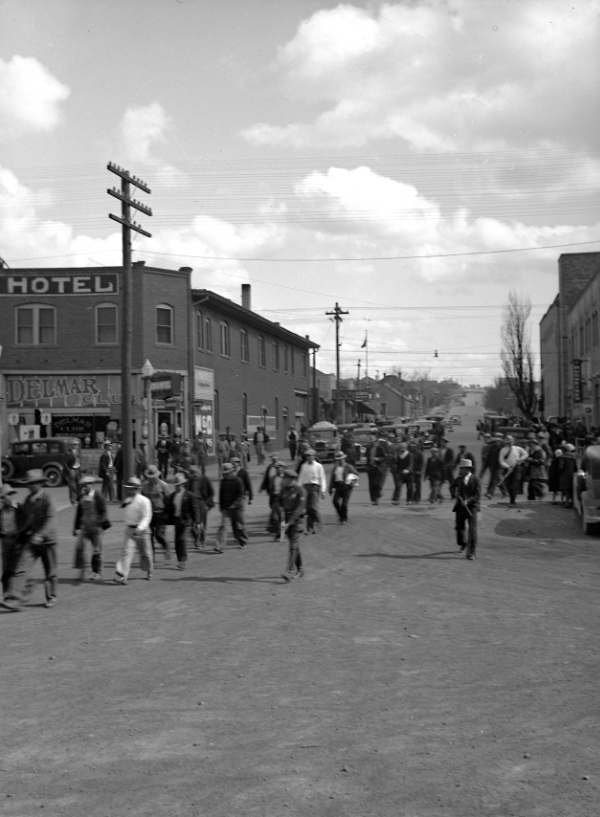
With all negotiations canceled and picketing in front of the coal mines banned by the troops, striking coal miners took to the streets instead, marching through Gallup in protest. Scores of children walked out of school and marched to the jail, chanting, “We want Martha.” ACLU attorneys rushed to Gallup to represent the jailed leaders. Newspapers throughout the state condemned the arrests. How could they be guilty of vagrancy, one of the lawyers asked, when “they make more money than we do.”
Sheriff Roberts charged them instead with “Assault and Battery by Words,” but a judge dismissed the charges four days later, releasing all prisoners.
A Red Scare Arrives in Gallup
The arrests marked an escalation in strike-breaking tactics. In response, NMU organizers sent picketers back to the mines. In late September, with nearly five hundred strikers picketing Gamerco, guard troops waved a vehicle through the blockade. As it drove past a line of picketers, a UMW miner named Bill Reese rolled down the window and sprayed the strikers in the face with a fire extinguisher. The terrified picketers ran from the car, but troopers with tear gas and bayonets blocked their escape. Dozens were treated for burns to the face. Six were held in the hospital overnight, including Martha Roberts.
They had it coming, explained Reese, who wasn’t charged for the attack. “This fight is between Americans and un-Americans,” he told the press, “with the Americans on the side of the coal operators.” Reese defended his actions in a letter sent to every newspaper in the state. “This is not a common strike between capital and labor,” he wrote, “but a fight between American working men and a bunch of working men composed almost entirely of foreigners, half of whom are communists at heart and the other half poor ignorant Mexicans that are too dumb to know what they are and are easy prey for agitators whose teachings are entirely foreign to American principles.”
In October, the coal companies threatened to deport striking Mexican and Eastern European miners. General Wood ordered the arrest of seven union organizers, including Bob Roberts, for making “inflammatory remarks” at union meetings. Wood claimed to have overhead Roberts exhorting striking miners to “pick up their firearms” and “intimidate the families” of replacement workers.
Governor Andrew Hockenhull, who’d been inaugurated just weeks earlier when Seligman died of a heart attack, asked federal officials to assume responsibility for the Gallup strike, but they refused. He begged the largest operators to negotiate, but Moses, claiming he’d found replacements for nearly eighty-five percent of his workforce, saw no reason to negotiate. When Hockenhull considered withdrawing troops, Kennecott threatened to close its mines and smelter and lay off its workforce of thousands.
In early November, Martha Roberts led the miners to the town plaza to protest the arrests. When they arrived, troopers fired tear gas at the marchers. Hand-to-hand combat erupted when strikers threw the smoking tear gas canisters back at the troopers. General Wood issued a shoot-to-kill order and sent reinforcements. Troopers arrested thirteen people, including Roberts. Furious letters from prominent Santa Feans, including one from the artist Gustave Baumann, flooded the Governor’s office, but Hockenhull refused to intervene.
The trial for the seven union leaders arrested in October was held in a military court in November. Four were released, but three, including Bob Roberts, were sentenced to six months of hard labor. The operators applauded. “Keep the militia in Gallup,” they proclaimed, and “the agitators in jail.” General Wood ordered the arrest of six more union leaders.
The National Labor Relations Board sent a mediator to Gallup in late November. Its relief supplies exhausted, the union agreed to negotiate. When the coal companies agreed to rehire most of the strikers and Governor Hockenhull promised relief jobs for those not rehired, the union settled the strike and agreed to return to work, but only if union members were released from jail. Hockenhull agreed, but on the condition that union leaders leave New Mexico.
Eighteen strikers were freed from jail on November 29, 1933. The union claimed victory in the strike and held a rally on the plaza to celebrate. As soon as the rally ended, National Guard troopers forced the union organizers into cars and drove them to the Arizona border, where they were physically thrown out of New Mexico.
With the strike over, the miners reapplied to Gamerco for their jobs but were told there were none to be had. Despite his promises, Governor Hockenhull declined to intervene when local emergency relief boards of the Civil Works Administration refused to hire unemployed miners. The blacklisted miners organized themselves into an Unemployed Council of the NMU and spent the next year picketing the relief offices. Fearful of another fight with the NMU, Gamerco sold Chihuahuita, the company camp where most unemployed miners lived, to Clarence Vogel, a local junk dealer and recently elected state senator.
Vogel demanded rental payments that no striker could afford. Evictions began in April 1935 when Sheriff’s deputies removed Victor Campos and his family from their home, boarded up the house, and left the family’s belongings on the street. When the deputies left, neighbors tore off the boards and moved the family’s belongings back into the house. When Vogel complained, deputies arrested Campos, his neighbor, and Exiquio Navarro, who had built the house with his own hands, charging all three with trespassing.
A “Mob Riot Murder” in Gallup
Hundreds of miners from Chihuahuita came to Gallup for the preliminary hearing on April 4, 1935, but Justice of the Peace William Bickel padlocked the courtroom and refused entry. With protesters pounding on the door, Bickel postponed the hearing until defendants could find lawyers. Sheriff Carmichael, former Sheriff, now Undersheriff, Dee Roberts, and two deputies, hoping to avoid the protesters, took the three prisoners out the back door of the courthouse but were found in an alley and surrounded.
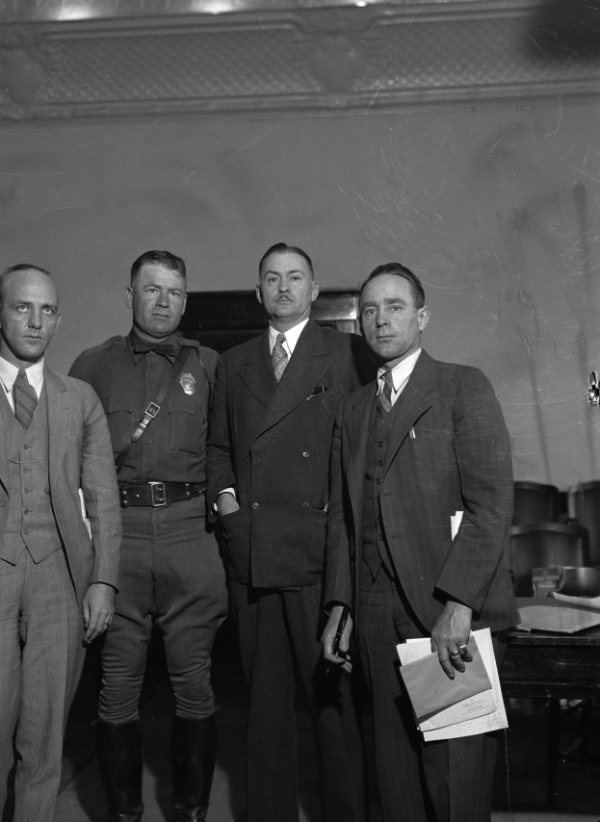
Deputies fired tear gas into the crowd. Gunfire erupted. When the smoke settled, the Sheriff and Ignacio Velarde, an unemployed miner, were dead. Two deputies and Solomon Esquibel, a leader of the Gamerco NMU local, lay wounded. Two of the prisoners, Campos and Navarro, disappeared and were never seen again. Dee Roberts claimed Velarde and Esquibel killed the Sheriff and then shot the deputies, but the only gun found in the alley was the one Roberts used to shoot Velarde and Esquibel in their backs.
Roberts ordered the fire department to blast its sirens, the signal that called the Sheriff’s posse to duty. Hundreds of members of the American Legion, Veterans of Foreign Wars, and local ranch hands armed with pistols and shotguns responded to the call. Roberts deputized two hundred fifty “special deputies” and sent them out in small squads to search for Communists. “We are going to arrest everyone identified with the radical movement,” he promised.
By early afternoon, thirty people “affiliated with the Communist party” were under arrest. The deputies, some with warrants, others with instructions to search every house, made arrests throughout the night and into the next until the county and city jails were full. The district court was converted into a temporary jail to hold the overflow. When it was over, nearly a thousand people, more than fifteen percent of Gallup’s population, had been arrested, questioned, or had their homes searched.
Preliminary hearings began two days later. When defendants, none of whom had lawyers, entered the court, they found a loaded rifle on the Judge’s bench and armed deputies in the jury box. Those not charged with murder were charged with being members of “an organization that believes in the overthrow of the government of the United States by force and violence.” The defendants who spoke no English were loaded onto trains and turned over to immigration authorities for deportation. All others were shipped to the prison in Santa Fe. The Gallup newspaper reported that a dozen more “were believed deportable as the result of a seizure of Communist literature made yesterday.”
Days later, a coroner’s jury exonerated Dee Roberts for killing Velarde, calling the shooting “justifiable homicide by an officer,” a decision based entirely on the testimony of the jury’s only witness, Dee Roberts. The next day, prosecutors charged fifty-five people for the “mob riot murder” of Carmichael, a charge based on an obscure territorial statute. Never before in U.S. history had a state sought to execute so many people for the same capital offense.
On April 12, the same day Esquibel died of his wounds, District Judge Miguel A. Otero ordered a new preliminary hearing for those arrested. Otero gave the defense team, led by ACLU attorney A.L. Wirin, time to hire legal staff, collect evidence, and prepare a defense. He asked Robert Minor and David Levinson for help, and the two men arrived in Gallup on May 2 to interview witnesses. As they sat in Julia Bartol’s car, talking about the case, two cars approached and circled their automobile. A third appeared and pulled up alongside Bartol’s car. Three masked men stepped out.
Levinson protested but was pistol-whipped by a man in a mask. Another put a gun in Bartol’s face. A third pulled Minor from the car and hit him in the face with the butt of a pistol, knocking him unconscious. Hoods were placed over their heads and they were thrown in separate cars. “When I came to, I was again beaten and remained unconscious until shortly before the conclusion of the ride,” Levinson said later. Minor and Levinson walked all night in a rainstorm, eventually coming upon a hogan where a Navajo man took them in, covered them in blankets, and drove them to the hospital in Tohatchi.
The kidnapping of Levinson and Minor made national news. Sheriff Roberts, however, dismissed it as a hoax. The District Attorney refused to investigate, calling it a “waste of the taxpayers’ money.” When Minor and Levinson demanded protection, the DA refused, telling the Governor, “There was no evidence to justify action.” Minor and Levinson, fearing for their lives, resigned from the legal team and left New Mexico. They spent the next month on a national speaking tour raising money for the defense.
Wirin managed to get dozens released from jail at the preliminary hearing in Santa Fe when he proved that most of those arrested, nearly all of whom were Mexican citizens, were nowhere near the courthouse at the time of the shooting. He convinced the prosecution to drop the charges against three more defendants. He asked what arrangements could be made to return them to Gallup.
“There is no need for transportation arrangements,” explained the District Attorney. Since they’re not American citizens, “they will be seized at once by the United States Marshal for deportation.”
By the time the trial was held in Aztec, New Mexico, in early October 1935, the charges against most defendants had been dismissed, but ten men still stood accused of murder. Dee Roberts, who suffered no injuries during the shooting, testified at the trial that one of the defendants hit him in the head with a hammer. Another deputy, who’d suffered no knife wounds, claimed a second defendant stabbed him with an ice pick. Seven defendants were acquitted on the murder charges but found guilty of rioting.
District Judge James B. McGhee blamed the crimes on Bolshevism and ordered five of the men acquitted of charges to be “released to immigration authorities for deportation to Mexico.” He ordered two men, both of whom were U.S. citizens born in New Mexico, “to leave New Mexico at once.” One was driven to Arizona and the other to Colorado. Three men, Juan Ochoa, Manuel Avitia, and Leandro Velarde, the brother of the slain Ignacio Velarde, were convicted of murder in the second degree and sentenced to “not less than forty-five or more than sixty years” in prison. Velarde was eventually released on appeal by the New Mexico Supreme Court in 1937. Ochoa and Avitia were pardoned by Governor John E. Miles in 1939, but only on the condition that they leave the state for good.
The National Miners’ Union officially disbanded after the Gallup Coal War. Martha and Bob Roberts continued to organize farm workers and coal miners in Colorado and Utah, but undercover police tailed them wherever they went. We are “alert and determined that the Roberts shall not disrupt the present tranquility in the mining camps,” wrote police in one confidential 1934 report to the Governor of New Mexico. The Gallup miners voted to rejoin the United Mine Workers in 1935 but were unable to get a contract with any of the coal companies in Gallup. By 1936, no dues-paying member of any union could be found in any Gallup coal mine.
—
David Correia is a historical geographer who writes about New Mexico history, labor geography, and environmental politics. He is a professor in the Department of Geography and Environmental Studies at the University of New Mexico and the author of six books, including Properties of Violence: Law and Land Grant Struggle in Northern New Mexico.
The photos in this story are from the Mullarky Studio Collection, donated to the New Mexico History Museum in 2024 by John R. Stein and Lillian Makeda. In 1927, William Thomas “Tom” Mullarky purchased the J.R. Willis Studio in Gallup, New Mexico. Through his death in 1959, Mullarky Camera Shop and its staff documented the area, photographed significant people and events, and created influential promotional images. The collection in the Palace of the Governors Photo Archives contains important images of the city of Gallup and surrounding communities during a time of transformation. Photo Archives hopes to digitize and create public access to this collection in the future.