
One of New Mexico’s Most Beloved Poets, Arthur Sze on His Uncompromising and Unconventional Journey to Becoming the Nation’s Poet Laureate
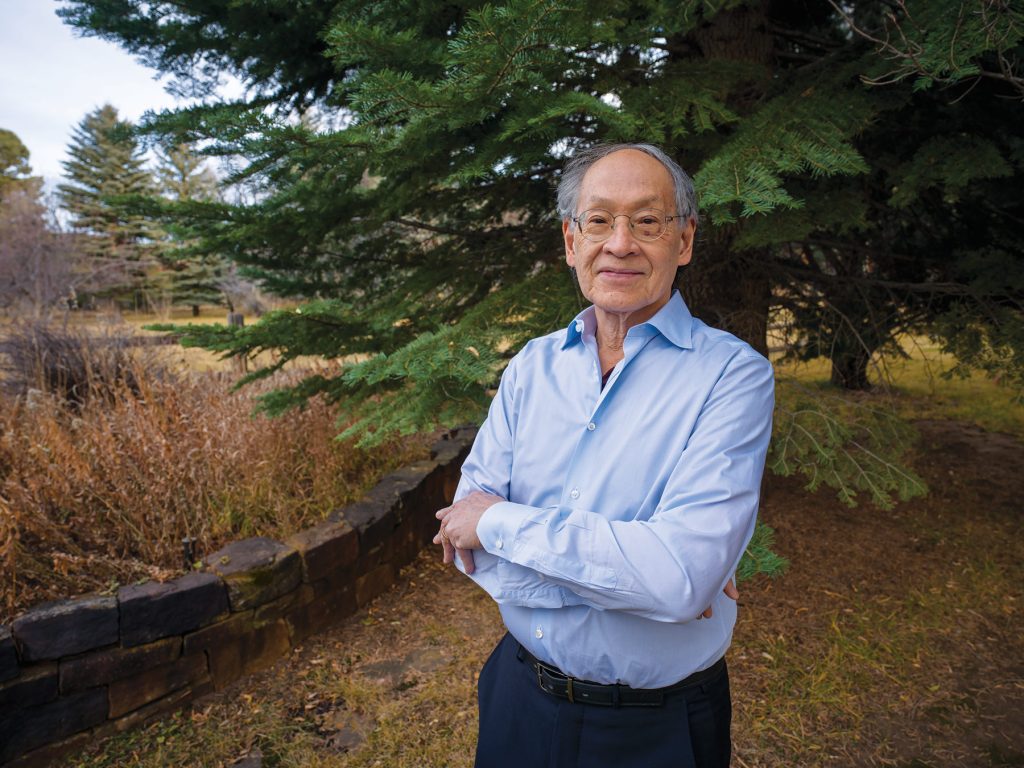
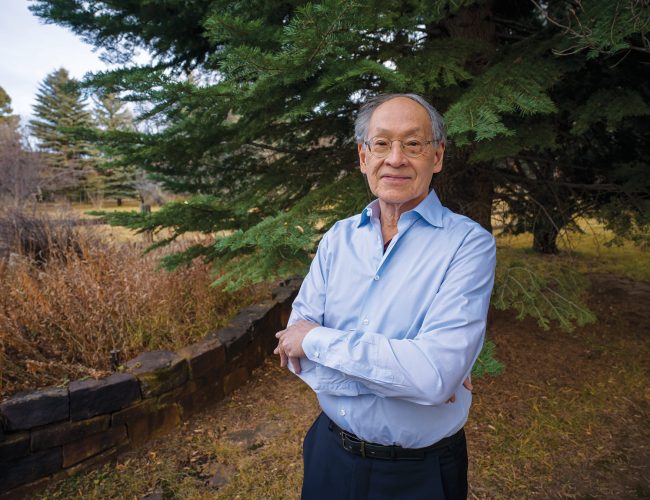 Arthur Sze at his home in Santa Fe, 2025.
BY KATHRYNE LIM
PHOTOGRAPHS BY DON USNER
Read six selected Sze poems published in this issue here.
At age twenty-one, Arthur Sze hitchhiked from El Paso to Santa Fe in a single day. Knowing no one, and accompanied only by his boundless curiosity, he arrived seeking a place to build a life as a poet. Fifty-three years later, he hasn’t left. And his plans for becoming a poet clearly came to fruition.
Sze was recently appointed the twenty-fifth United States Poet Laureate for the 2025–2026 term. The appointment tops a highly decorated career, which includes twelve poetry books, a book of Chinese poetry translations, a National Book Award for Sight Lines (2019), Pulitzer Prize finalist recognition for Compass Rose (2014), the Ruth Lilly Poetry Prize, the Jackson Poetry Prize, and the Bollingen Prize for American Poetry for Lifetime Achievement.
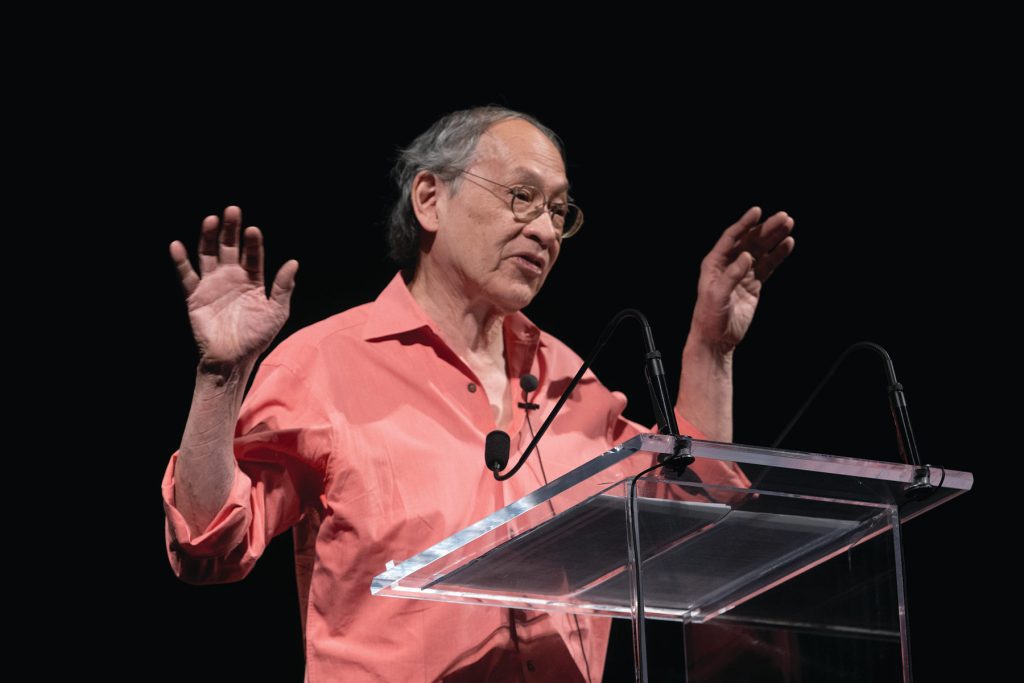
of the Lannan Foundation’s “Readings & Conversations” series, 2022.
Though widely renowned on national and international levels, local poetry aficionados have long claimed Sze as a beloved New Mexico poet who braids depth of observation, complex connections, and lived experiences into his work. The abundance he brings to readers through his poetry is perhaps only matched by his generosity as a local steward of the art form. From his early days working in the New Mexico Poetry in the Schools program, teaching workshops to incarcerated people at the penitentiary, and organizing the 1983 Tone Roads West: Poetry and New Music Festival; to collaborating with local artists and museums, and showing up to local poetry readings and events, Sze has always been community minded.
It feels like an act of generosity, as well, when Sze meets with me for conversation one brisk November afternoon. I began reading Sze’s work two decades ago when I became more serious about writing poetry, and he has since become one of my favorite living poets. While sipping hot beverages
on the patio of a downtown Santa Fe coffee shop, we talk about his journey to New Mexico and life as a poet. The literary luminary disarms me with his warmth and humility, and at times it feels like I am simply chatting with a new friend.
Born in Manhattan, Sze grew up in Queens, Long Island, and New Jersey. He describes his largely suburban upbringing as feeling “too insular” and protected. Raised by first-generation Chinese immigrant parents, he says he was encouraged by them to “do something safe professionally, like doctor, lawyer, scientist, banker.” But an itch for poetry, while majoring in science at MIT, caused him to transfer to UC Berkeley, where he studied poetry with his mentor Josephine Miles. While there, he also took to translating ancient Chinese poems under the tutelage of Mandarin instructor Ts’ai Mei-hsi. These formative experiences broadened his horizons and allowed him to see that “I needed more life experience, basically.”
After college, he traveled around Mexico for a few months before hitching a ride to Santa Fe. Those early years in his newfound home were filled with a sense of discovery. “I knew the East Coast and the West Coast. New Mexico was somehow outside of the America I had grown up with, and I really liked it,” he says.
From 1974 to 1980, Sze worked as a poet with New Mexico Poetry in the Schools, a program of New Mexico Arts. The work took him all over the state and connected him to fellow poets Mei-mei
Berssenbrugge and Joy Harjo—the twenty-third poet laureate of the United States—both of whom would become life-long friends and sources of inspiration. “In many ways it was like my equivalent to grad school,” says Sze, who forged his own learning path after college. He also received small grants from the Santa Fe Council of the Arts to hold workshops at the New Mexico School for The Deaf and the Penitentiary of New Mexico. The grant-based work proved fulfilling but was not enough to sustain him financially. “I was basically a really poor poet for many years,” he says.
To make ends meet, he took a lot of odd jobs. He painted houses, worked for the U.S. Census, waited tables at the old Palace Restaurant & Saloon, did construction work, and was even an extra in a movie. Dedicated to his poetry, Sze chose jobs with schedules that afforded him time to write. He pursued work that was practical and available, and that ultimately exposed him to a different kind of living.
“I wanted to feel like poetry isn’t just something somebody teaches students in an academic environment,” he says. “I wanted poems to be able to talk about somebody who puts plaster up on a wall, or who is weaving, or who is making jewelry, or is picking mushrooms. I wanted a lot of that world in my poetry, so in many ways I consciously pursued that.”
The poem “The Moon is A Diamond,” published in Sze’s 1982 book Dazzled, offers a glimpse of Flavio Gonzales, under whom Sze apprenticed as a construction worker. The poem presents a clear-eyed picture of two workers plastering a portal together, recalling “ristras of red chile hanging / in the October sun.” The short poem reveals empathy and reverence for labor and the unique cultural landscape of Santa Fe.
Other early poems reference visits to regional locations, such as Taos, Jemez, and Zuni Pueblos, and are colored by the open sky, wind, trees, languages, and deserts of New Mexico. Poems from his early books show an attunement to nature and exhibit Sze’s application of deep seeing. Both skills originated from his engagement with ancient Chinese poetry as a translator, as well as American imagist poets Ezra Pound and William Carlos Williams, whom Sze has credited as influences.

Sze’s poetic gifts can be seen in these lines from the poem “Strawberries in Wooden Bowls” published in his first book, The Willow Wind (1972):
The fields are green with their rain
and the wind curls the stars in the cold air.
You stand now, silent, in the window of light
and the milk you pour is glazed.
The strawberries in the wooden bowls
are half-covered with curdled milk.
The keenly observant and relatively straightforward lyric poems Sze had been writing early on underwent a wild expansion with the publication of his fifth book, Archipelago, in 1995. Breaking free of the single poem format, serial poems radiate throughout the book to create a network of subconscious connections. By expanding his poems, Sze also allows for a kind of collapsing of space and time, whereby women dancing in a pueblo, the Chinese Cultural Revolution, an Alaskan float house, and the Blue Mosque in Istanbul can all exist within the same poem.
“If you want to write a poem that’s one hundred lines long or one hundred and fifty lines long, what kind of poem is that going to be?” Sze says of his extended poems. “For me, it meant trying to figure out how to put more of the world into the poem and that meant finding ways to enable the poem to become open to complexity but also enact more complexity.”
The world and its various cultures as experienced through travel appears thematically in many of Sze’s poems. But Native American and Asian cultures remain the most prevalent throughout his body of work. The diasporic Asian experience in the American Southwest is an ongoing preoccupation of mine, and I’m interested in how the different cultures manifest and fold together. I ask Sze if he sees a connection between New Mexico and Asia. In response, he says, “I do,” and explains that he witnessed many of those connections at the Institute of American Indian Arts (IAIA), where he taught for twenty-two years, and currently serves as professor emeritus.
“The influence of Native Americans is particularly strong in my work and in my life,” Sze says. “The sense of Native American worldviews, of language, of culture, struck a really deep chord in me and had strong connections to Asian perspectives.”
Sze began teaching as an instructor at IAIA at age thirty-three and later moved up to become creative writing department head. He was with the school as it transitioned from Bureau of Indian Affairs (BIA) leadership and was instrumental in growing the Associate of Arts degree into a four-year Bachelor of Fine Arts undergraduate degree program.
As a teacher, Sze has nurtured generations of Native American poets. He talks about how he found commonalities with them by reaching into his own Chinese culture and background. While at IAIA, he invented a class called The Poetic Image that incorporated Chinese classical poetry. “If I said Chinese verbs have no tense, the Native students said, ‘our language is that way,’” he shares. “If I said the Asian perspective of self is much smaller than in the West—think of a landscape painting—they immediately understood that.”
Poems in Archipelago give way to a multitude of connections by juxtaposing scenes, events, and natural phenomena that span time and place. The interlacing of seemingly disparate cultures and Native American and Asian aesthetics form a luminous tapestry in Sze’s hands. It’s no surprise that it was Archipelago that caught the attention of Copper Canyon Press some thirty years ago, marking the beginning of a lifelong and life-changing publishing relationship.
Sze’s first four books found homes with what Sze describes as tiny presses run by publishers with a love for poetry. One of those publishers was Tooth of Time Books, a small press run by John Brandi out of Guadalupita, New Mexico. Tooth of Time published Sze’s second book Two Ravens and reissued his first, The Willow Wind.
In an email to me, Brandi opened up about the poetry landscape of New Mexico in the late sixties and seventies, when he and Sze first met. “Poets were deeply wedded to the character of the land, the particulars of deeply-rooted, varied cultures,” he shares. “Camaraderie was paramount. You’d find poets like Arthur, Joy Harjo, Harold Littlebird, Mei-mei Berssenbrugge, Leo Romero, Anne Valley-Fox, Larry Goodell, Luci Tapahonso gathered in animated talk.” As he got to know Sze, he says, “I was struck by his absolute fidelity to poetry, to the word as a living substance, to his ever-curious, tactful way of moving through the world without getting caught in it.”
Sze recognizes Brandi’s influence as a publisher who took an interest in his early poetry “when no one else did.” He admired his do-it-yourself spirit of starting his own press in the early 1970s. “There was a courage and wildness that was important to me,” Sze says of Brandi’s style, which matched his own liberated path.

Publisher relations have always been paramount to Sze. “There were really only two publishers in the country, when I looked across the spectrum, that I thought could be an aesthetic match,” he says. Those publishers were New Directions, which had published Ezra Pound and “had an understanding of Asian poetry,” he says, and Copper Canyon Press because “they published beautiful books” that included translations of ancient Chinese poetry. Sze sent manuscripts of his early books to Sam Hamill, then publisher of Copper Canyon Press, over a span of fifteen years, and they were rejected again and again. At one point Hamill wrote that he loved Sze’s translations of Chinese poetry and offered to publish a book of his translations. Sze declined the offer, as he felt the need to establish himself as a poet first.
Then in 1994, Sze finished Archipelago and sent it to Hamill. Expecting another rejection, he simultaneously submitted it for the National Poetry Series book prize. The book was selected for the prestigious award by Barbara Guest, but it turned out Hamill also wanted to publish it. Sze declined the National Poetry Series award because to accept it would mean going with a publisher other than Copper Canyon Press. Hamill was so moved by this gesture that he promised Sze that Copper Canyon Press would not only publish Archipelago, but they would publish all his work “past, present, and future,” and publish his future book of Chinese poetry translations whenever it was ready.
“I felt vindicated after being rejected for fifteen years,” Sze says. When he called New York to turn down the award he told them, “I have a publisher, not just for one book but for my work, and that’s what I’ve al-ways wanted.”
True to its word, Copper Canyon recently published Sze’s latest book of poems, Into the Hush. The book is a result of his daily writing practice, beginning in the quiet hours of early morning. Copper Canyon Press, in association with The Library of Congress, will publish another book by Sze in April 2026. Transient Worlds will be a project of his laureateship and will guide readers through translations from thirteen languages into English, covering 1,500 years of poetry.
In 2025, the Museum of New Mexico Press also published a prose book, The White Orchard, which offers more insight into Sze’s creative process. It includes a craft essay that details Northern New Mexico’s influence on Sze’s poetry, a draft analysis revealing the invisible seams behind a poem, and interviews and con-versations culled from thirty-six interviews spanning several decades. Sze says, “It’s my only book of prose and I finally felt, well, I’m ready to put something together that might be interesting.”
A month after our interview, Sze marks the beginning of his tenure as U.S. Poet Laureate with an inaugural reading at the Library of Congress, which I stream online. Dressed in a dark suit and tie, Sze presents just as humbly as the casually attired person I met at our local coffee shop. New Mexico is prominently featured in the reading as Sze introduces his poem “Farolitos” along with a short explanation of the history of this distinctly New Mexican tradition. He also reads his poem “Acequia del Llano,” that he describes as a “poem rooted in Santa Fe, New Mexico” that uses “four classic Japanese forms” to shape the language. As U.S. Poet Laureate, Sze plans to continue to do what he has always done: bring cultures together and reveal how across language and distance and time, humanity is connected.
—
Kathryne Lim was born in Seoul, Korea, and has lived in the American Southwest most of her life. She is author of the poetry collection Constellation of Wings (2023). She lives and writes in Santa Fe.
Arthur Sze is the twenty-fifth United States Poet Laureate. Sze was born in New York City in 1950 to Chinese immigrants. He is the author of twelve poetry collections, most recently Into the Hush (2025), as well as the prose collection The White Orchard: Selected Interviews, Essays, and Poems (2025).
Don J. Usner was born in 1957 in Embudo, New Mexico. He has written and provided photos for several books, including Sabino’s Map: Life in Chimayó’s Old Plaza, Benigna’s Chimayó: Cuentos from the Old Plaza, Valles Caldera: A Vision for New Mexico’s National Preserve, and Chasing Dichos through Chimayó. Don is also the photo editor consultant for the annual New Mexico Treasures Engagement Calendar published by the Museum of New Mexico Press.