
A Gathering Point
Rooted in Respect, Memory, and Pride
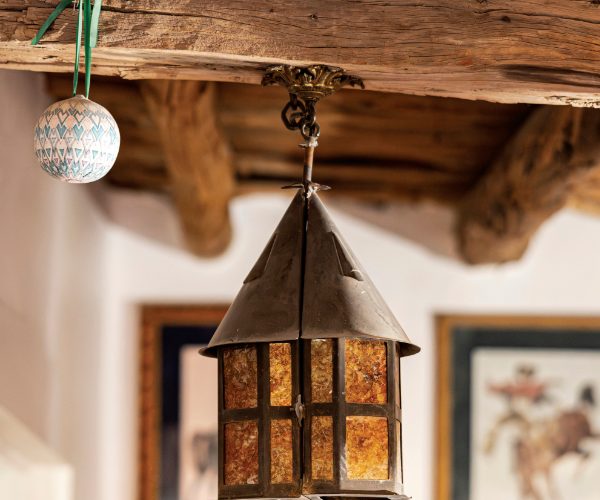 This small lantern is now an electrical light fixture that hangs from
a viga in the Sala Grande and helps to light the room.
This small lantern is now an electrical light fixture that hangs from
a viga in the Sala Grande and helps to light the room.
By Monika Dziamka
Photographs by Tira Howard
Driving to the southern New Mexico town of Mesilla feels like slipping into a peaceful dream.
Leave behind the noise and frantic energy of I-10, and soon the wide, winding road takes you past pecan orchards, chile fields, and acequias that have been used for generations. Get closer to the plaza, and the adobe buildings begin to cluster tightly together. The sound of church bells drifts above narrow streets and tiled portillos. Bougainvillea rests against palm trees that rustle meditatively in a gentle breeze.
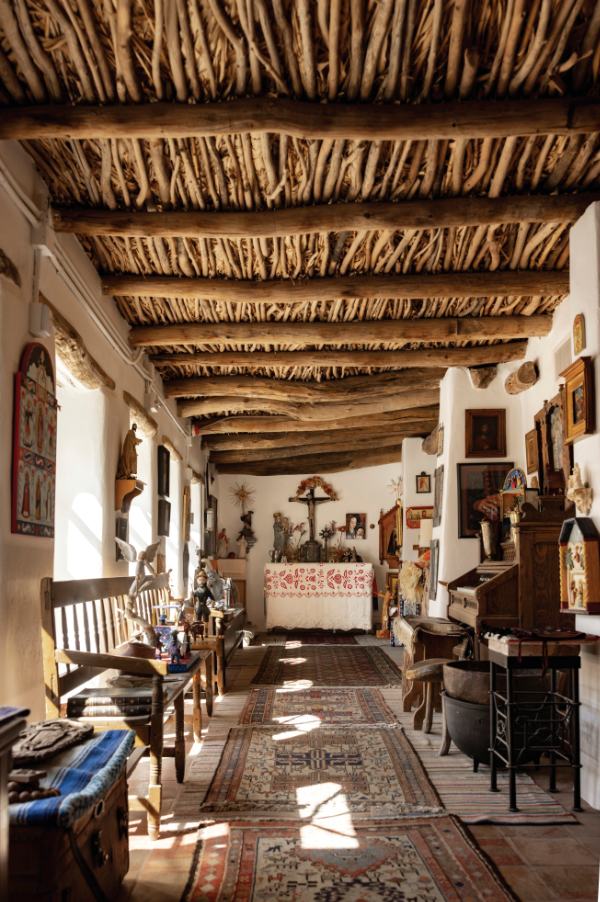
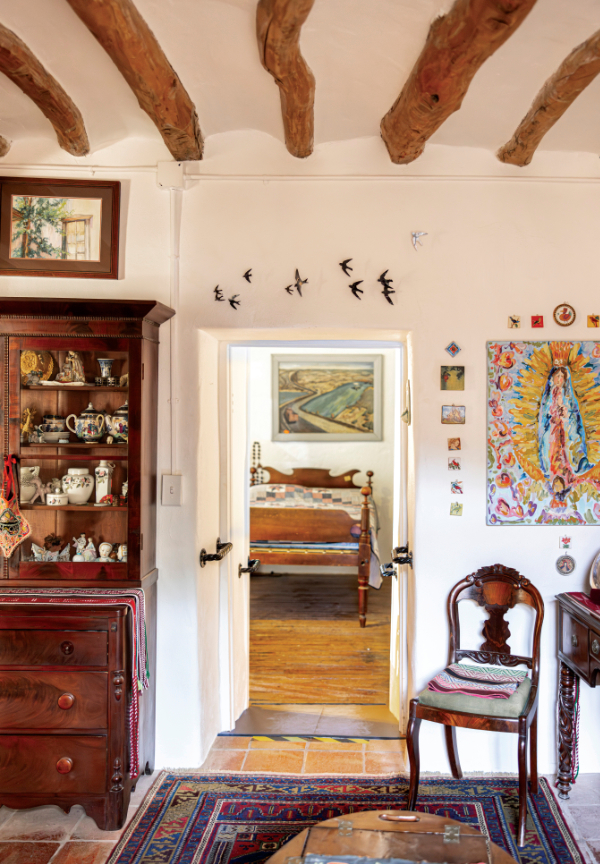
On the west side of the plaza, the home of J. Paul Taylor, Mary Daniels Taylor, and their family has reopened to the public after two years of renovations managed by New Mexico Historic Sites—a division of the New Mexico Department of Cultural Affairs. Here, visitors can find a trove of more than four thousand objects of notable historical, cultural, and artistic significance representing southern New Mexico. Each artifact belonged to the Taylor family, each a symbol of their curiosity toward the people and customs around them. In fact, the Taylor house and its contents are so significant that it became a state monument in 2004, while Paul and Mary were still alive and living on-site. Mary died at 84 in 2007, after which Paul maintained the property until his death at 102, in 2023.
Alexandra McKinney, instructional coordinator supervisor and historian at the Taylor-Mesilla Historic Site, says that after Paul’s passing, the donation agreement by the family stipulated a transition period of two years to allow the state to update the home to make it fully accessible to the public. The renovations were relatively minor but plentiful: updating the house to meet modern safety standards, leveling the floors, properly cataloging all of its contents, and more.
“I remember standing in the sala grande shortly after Mr. Taylor passed, and we were preparing to start doing the construction work—and I just remember thinking that he and his wife had this vision, and they had this idea for their home to be this place of learning and history and family and all of these things that they just loved,” McKinney says. “But in order for it to happen, they couldn’t be here anymore. And there’s something unbelievably selfless about that. That is a huge amount of trust that you have to put in the people around you to say, This is what I want to see, but I’m not going to be here when that happens, so I need you to see it through.”
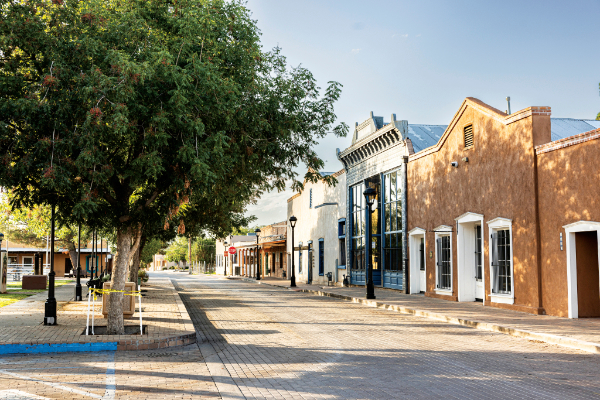
The house was built in the 1850s in the Territorial Style and is representative of Mesilla. It sits within a stretch of buildings with one continuous wall along the western side of the plaza. The continuity of the buildings was an intentional safety feature—a telltale sign of the tumultuous nineteenth century, a violent era filled with gunslingers, raiders, hustlers, and everyday folks fighting for a decent life. But when you move past that adobe façade, you step into a world of quiet, layered beauty, with artful details bringing color, depth, and mystery to the space. There, passages and courtyards separate the Taylor house from the buildings around it. You can trace the influences of French architecture and Spanish Revival Style as the home’s earlier owners—including the French priest, Father Juan Grange (who became the priest of the plaza’s San Albino Catholic Church and owned the house from 1913 to 1937)—left their mark on the property.
After the Spanish established the El Camino Real trade route in 1598, connecting Mexico City to what is now Northern New Mexico, Mesilla’s population began to grow. The fertile valley enticed farmers and homesteaders who had a variety of backgrounds. Two and a half centuries later, the Treaty of Guadalupe Hidalgo, signed in 1848, formally ended the Mexican-American War and resulted in the U.S. taking fifty-five percent of Mexico’s territory, which included New Mexico, Arizona, Nevada, Utah, California, and parts of Colorado and Wyoming. The area shifted under competing powers until 1854, when the Gadsden Purchase officially absorbed Mesilla into American territory.
By the 1860s, Mesilla’s population grew to more than 2,500, making it the largest city at the time between San Antonio and San Diego. With the completion of the Santa Fe Railroad line in 1881, which stopped in Las Cruces, traffic to the area increased even more. The local Indigenous Manso, Piro, and Tiwa populations blended—at times violently and others peacefully—with the Spaniards and Mexicans who remained. Mesilla became officially part of New Mexico in 1912 when the state was established. People from other states came to the area seeking opportunities in agriculture and mining. Thousands more from all over the United States migrated to the Mesilla Valley for health reasons; the dry climate was ideal for people suffering from tuberculosis and other ailments.
Paul and Mary grew up in the area—Paul on a farm in Chamberino, and Mary in El Paso. Paul studied at the New Mexico College of Agriculture and Mechanic Arts, which became New Mexico State University in 1960. Mary, wanting to be an archaeologist, studied at what is now the University of Texas at El Paso. Both were interested in history, art, education, and community service, and they attended the same church, where Paul first noticed Mary. But it wasn’t until a chance meeting at a New Year’s Eve celebration in El Paso that the couple got together.
After getting married in 1945, Paul and Mary bought the property that would eventually expand to the six-thousand-square-foot home that makes up most of the historic site (the outdoor spaces expand it to nearly nine thousand square feet in total). The Taylors had seven children—Robert, Dolores, Michael, Mary Helen, John, Pat, and Rosemary—and over the decades, they renovated the home while adding rooms and expanding into adjoining buildings.
Simultaneously, the Taylors built a legacy of public service.
Mary, a passionate writer, researcher, photographer, paleographer, teacher, and genealogist, became a leading authority on the history of southern New Mexico. In the second edition of A Place as Wild as the West Ever Was: Mesilla, New Mexico 1848–1872, a book Mary first published in 2004, Mary’s children write in the introduction that their mother “grew up as a youngster within a few blocks of the Mexican border at Smeltertown […] where her father was foreman of the cement plant. The daily life along the border, with its inherent intrigue and social/racial discrimination, had a profound influence on her future work as a respected scholar of border studies.”
Through her discovery of primary documents in Durango, Mexico, related to the families and history of the Mesilla Valley, Mary organized a microfilm project to painstakingly record these documents and brought them to New Mexico. These documents now live in the Library Archives and Special Collections at NMSU.
“We now have a guide to that collection that is available online, and it’s about 1,300 pages long,” says Dennis Daily, associate professor and department head of Archives and Special Collections at NMSU. “People can access this guide and find documents that they’re interested in, either for their historical or genealogical research. …The impact of Mary and her finding the collection and helping us get access to it, and of Paul for funding this project—the impact is still huge.”
Daily was hired by the Taylors in the late 1990s to help Mary with the Durango project, which began in 1992 and was completed in 2007. The documents date back to the 1600s and include family trees and marriage, birth, and death records. “Historians researching New Mexico and the border areas can find minute details of social life and customs and information about the economy, agriculture, relationships with Indigenous people—you name it,” says Daily. He and his colleagues at the archives field requests from folks seeking information about their own ancestry on a weekly basis.
The archives include information gathered and created by J. Paul Taylor. So much material has come from the Taylor house—including maps, letters, essays, and more than 35,000 photographs—that it now takes up shelf space equivalent to six hundred linear feet, or two football fields if the boxes were lined up side-by-side. “All of it is here, every scrap of paper. It really illustrates the breadth of the Taylors’ lives and work,” says Daily. “All of these materials were in the house. I have no idea how they kept all this stuff there, because I was in the house many times, and it was never chaotic! It was a very nice, neat house.”
Paul, who spent more than thirty years in the Las Cruces Public School system as a teacher, principal, and associate superintendent, served nine consecutive terms as the Democratic Representative for District 33 in the New Mexico legislature. During his tenure as a representative, he earned the nickname “Conscience of the Legislature” for his unflagging commitment to reminding his colleagues of the needs of the least fortunate. Taylor co-founded the Doña Ana County Historical Society in 1963. He also served as a regent of the Museum of New Mexico Foundation. In 1978, Taylor helped establish the state’s Department of Cultural Affairs, which is now the largest department of cultural affairs in America. The very entity Taylor helped create is the one to which he and Mary donated their house and belongings.
“[J. Paul Taylor] was the nicest man I have ever met or ever will meet in my life,” says McKinney. “What he really wanted was to leave a place where people could learn about this area’s history. …He was a very humble man. He did not want things to be about him. He used to joke every year when we would prepare for his birthday party that, you know, ‘Why are you throwing me a birthday party? Nobody’s going to come to my birthday party.’ And then three hundred people would show up to his party!”
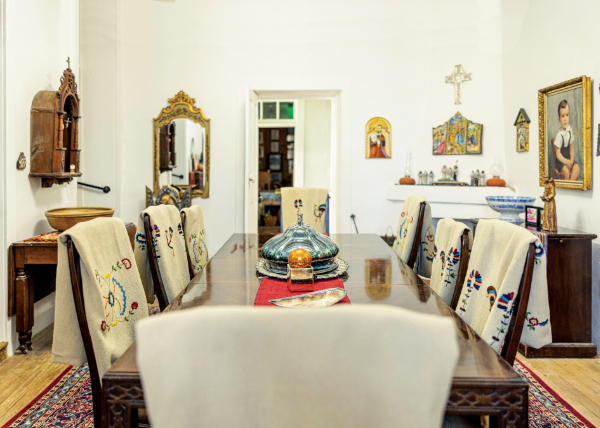
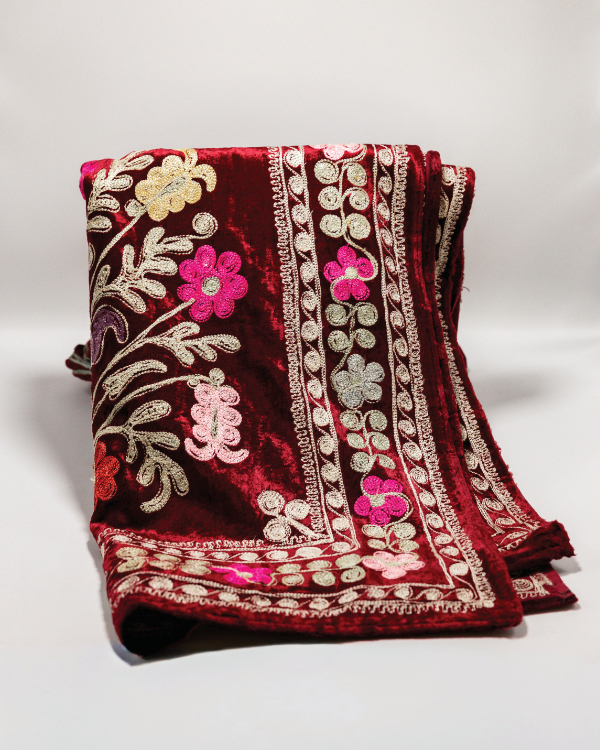
Today, visitors to the Taylor home, which is on the National Register of Historic Places, enter through a zaguán to explore seventeen spaces open to the public (only two spaces are restricted). Visitors walk through the older rooms first, making their way into newer areas that were added on by the Taylors as the family grew. Each room preserves the architectural details of the original house and its time period, and is filled with remarkable furniture, art, books, collectibles, textiles, and other items. In one room, a Mexican Baroque painting of San Miguel dates back to the 1600s. Spanish Colonial furniture fills another room, and another features pottery by Mata Ortiz. The site contains numerous paintings by local artists such as Ken Barrick, José Cisneros, Helen Cordero, Julia Gomez, Maria Martinez, Eileen Shannon, and Dorothea Weiss.
“The home also has a sanctuary, one that includes all the liturgical items necessary for mass,” McKinney adds. “Three windows that are in the sanctuary now come from the San Albino church. …There are a lot of features in the home, from windows to vigas to doors, that have been salvaged and reused from other locations in the Mesilla Valley.”
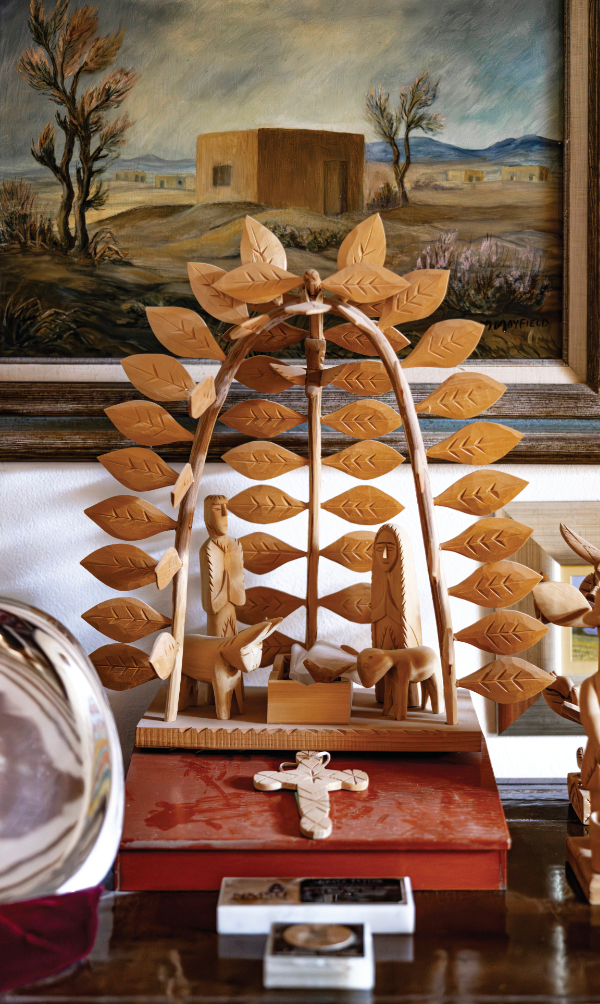
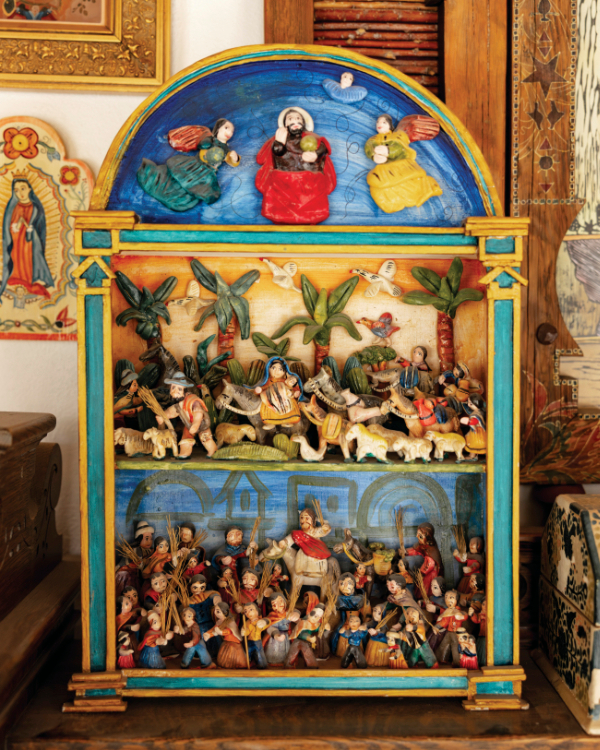
Visitors can also view more than two hundred nacimientos, or nativity sets, the family collected. One set is from Mary’s childhood, and several others were gifts the Taylors received when traveling abroad. Locals and tourists alike enjoy visiting the site around Christmas to view the nacimiento collection, says Heather Pollard, president of the Friends of the Taylor-Mesilla Historic Site, a volunteer group that runs the gift shop. “A trip to southern New Mexico and West Texas would not be complete without a stop in Mesilla to visit the Taylor-Mesilla Site. This site is truly a gem in the desert, any time of year.”
“Christmas Eve with the Taylor family at their home was an annual highlight for my family,” adds Tom Dormody, secretary of the Friends group. “Homemade tamales and posole, plus good conversation with the extended Taylor family members and their friends, made a stop at the Taylor home a memorable Christmas Eve tradition.”
“I’m a fourth-generation resident, and this monument carries personal meaning for me,” says Mesilla Mayor Russell Hernandez. “I had the privilege of visiting Mr. Taylor himself, sitting with him, and listening to his stories. He shared not just moments from Mesilla’s past, but also the lessons of resilience, dignity, and service that shaped his life. I remember him recalling how he taught and mentored so many—including members of my own family. For me, those conversations were a gift. They bridged the distance between generations and reminded me that our history is not abstract—it is personal, and it lives on in us.”
Mayor Hernandez considers the Taylor-Mesilla Historical Site a living reminder of the people and stories that have shaped the Mesilla Valley into the region it is today. “[The monument] has become a gathering point, a place where stories are remembered, where younger generations can learn about those who came before them, and where the pride of Mesilla’s heritage is made visible. …It connects the past with the present, it honors the lives and contributions of those who came before us, and it inspires all of us to continue building a community rooted in respect, memory, and pride.”
For further reading:
“The Man in the Sala,” El Palacio, summer 2023, by Kate Nelson
J. Paul Taylor: The Man from Mesilla by Ana Pacheco (Museum of New Mexico Press, 2012)
A Place as Wild as the West Ever Was: Mesilla, New Mexico 1848–1872 (Second Edition) by Mary Daniels Taylor (Mesilla Publishing, 2025)
For address, hours of operation, entrance fees, and upcoming exhibitions at the Taylor-Mesilla Historic Site, please reference the exhibitions on page 78 or visit nmhistoricsites.org/taylor-mesilla.
—
Monika Dziamka is an Albuquerque-based writer and editor whose work has also been published in New Mexico Magazine, Blue Mesa Review, Southwest Contemporary, Chicago Review of Books, River Teeth, and elsewhere. Connect with her through monikadziamka.com.